



The magma ocean was a huge helium reservoir in the early Earth
Affiliations | Corresponding Author | Cite as | Funding information
Published by the European Association of Geochemistry
under Creative Commons License CC BY-NC-ND 4.0
Keywords: ab initio molecular dynamics, partition coefficient, noble gases, primordial helium


- Share this article


-
Article views:3,252Cumulative count of HTML views and PDF downloads.
- Download Citation
- Rights & Permissions

top
Abstract
Figures
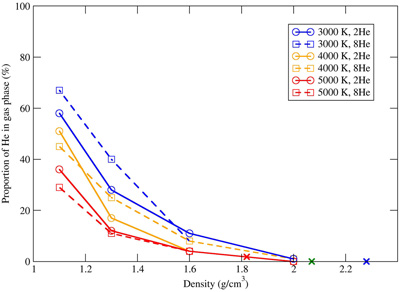 Figure 1 Proportion of He in the gas phase relative to molten pyrolite. 1 kbar approximately corresponds to a melt-vapour system density of 2.3, 2.1 and 1.8 g/cm3 at 3000, 4000 and 5000 K, respectively (“×” symbols). | 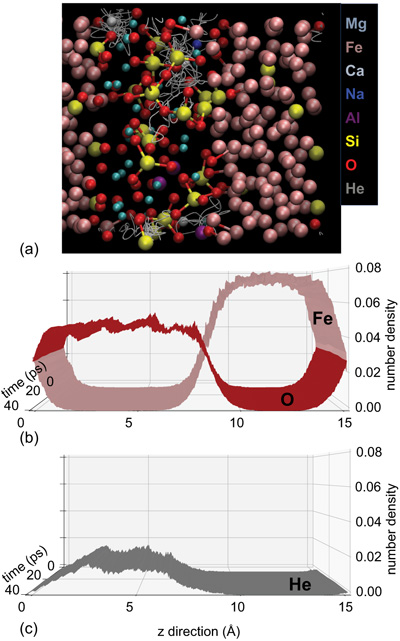 Figure 2 (a) Snapshot of the contact simulations between liquid pyrolite and molten iron (2000 K, 3 GPa). The trajectories of He atoms are represented over 8 ps of simulation, with grey ribbons. (b) ND profiles of Fe and O separate the two melts. The interface is highly localised and characterised by steep gradients of the Fe and O concentration. (c) ND profiles for He, which lie almost entirely in the silicate melt, as observed also in the trajectories of the individual atoms. | 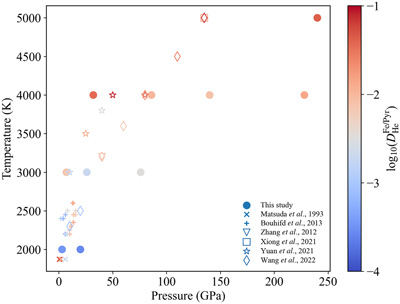 Figure 3 Metal/silicate He partition coefficients. Previous experimental data are shown with crosses and previous computed results by open symbols. Present study is plotted with solid symbols. The affinity of He for the silicate melt decreases along the mantle adiabat by about two orders of magnitude between the top and the bottom of the MO. | 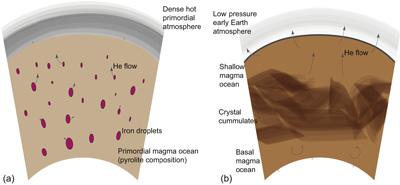 Figure 4 Cartoon representation of He fluxes (arrows) during core formation through the MO model. There is a strong initial transfer of He from the iron droplets to the silicate magma. (a) The hot, dense atmosphere prevents degassing and escape of He. (b) With cooling and formation of a crystal layer at mid-depths, He is trapped in the basal MO, while the shallow MO undergoes massive evaporation to the secondary colder and less dense atmosphere. |
| Figure 1 | Figure 2 | Figure 3 | Figure 4 |
top
Introduction
Noble gases are useful geochemical tracers of physical processes. Their non-radiogenic isotopes are residues of the Big Bang or of stellar nucleosynthesis. They were accreted from nebular gases, from meteoritic material irradiated by solar wind, and/or delivered by chondritic or cometary material (Marty, 2012
Marty, B. (2012) The origins and concentrations of water, carbon, nitrogen and noble gases on Earth. Earth and Planetary Science Letters 313–314, 56–66. https://doi.org/10.1016/j.epsl.2011.10.040
; Moreira, 2013Moreira, M. (2013) Noble Gas Constraints on the Origin and Evolution of Earth’s Volatiles. Geochemical Perspectives 2, 229–403. https://doi.org/10.7185/geochempersp.2.2
). They were largely degassed from the mantle during the partial or total melting episodes of the early Earth. Whatever fraction remained, was stored in geochemical reservoir(s) inside the Earth, from where they continuously escape at a slow rate via deep melts that eventually bring them to the surface. Their concentration in deep Earth reservoirs, therefore, decreases over geological time. The radiogenic isotopes of noble gases are products of nuclear decay reactions from unstable parent isotopes, like 238U, 235U, or 232Th, which are lithophile elements (Bouhifd et al., 2013Bouhifd, M.A., Jephcoat, A.P., Heber, V.S., Kelley, S.P. (2013) Helium in Earth’s early core. Nature Geoscience 6, 982–986. https://doi.org/10.1038/ngeo1959
). The radiogenic noble gas isotopes are therefore replenished over geological time. Their ratios of non-radiogenic to radiogenic isotopes arriving at the surface constrain the isolation and mixing of Earth’s internal reservoirs over geological time (Marty, 2012Marty, B. (2012) The origins and concentrations of water, carbon, nitrogen and noble gases on Earth. Earth and Planetary Science Letters 313–314, 56–66. https://doi.org/10.1016/j.epsl.2011.10.040
; Moreira, 2013Moreira, M. (2013) Noble Gas Constraints on the Origin and Evolution of Earth’s Volatiles. Geochemical Perspectives 2, 229–403. https://doi.org/10.7185/geochempersp.2.2
; Jackson et al., 2017Jackson, M.G., Konter, J.G., Becker, T.W. (2017) Primordial helium entrained by the hottest mantle plumes. Nature 542, 340–343. https://doi.org/10.1038/nature21023
; Péron et al., 2018Péron, S., Moreira, M., Agranier, A. (2018) Origin of Light Noble Gases (He, Ne, and Ar) on Earth: A Review. Geochemistry, Geophysics, Geosystems 19, 979–996. https://doi.org/10.1002/2017GC007388
).In particular, He received decades of attention from the Earth and planetary community. The degassed He from the crust and mantle continuously escapes into space from the Earth’s atmosphere, unlike much heavier noble gases. As He is not recycled back into the mantle in important quantities, its radiogenic 4He to primordial 3He isotopic ratio preserves ancient MO signatures. One such signature is the low 4He/3He ratio observed in ocean island basalts (OIBs) such as Iceland, Hawaii, the Galapagos, Reunion and Samoa, which are the surface manifestations of deep mantle plumes (e.g., Farley et al., 1992
Farley, K.A., Natland, J.H., Craig, H. (1992) Binary mixing of enriched and undegassed (primitive?) mantle components (He, Sr, Nd, Pb) in Samoan lavas. Earth and Planetary Science Letters 111, 183–199. https://doi.org/10.1016/0012-821X(92)90178-X
; Kurz and Geist, 1999Kurz, M.D., Geist, D. (1999) Dynamics of the Galapagos hotspot from helium isotope geochemistry. Geochimica et Cosmochimica Acta 63, 4139–4156. https://doi.org/10.1016/S0016-7037(99)00314-2
; Stuart et al., 2003Stuart, F.M., Lass-Evans, S., Godfrey Fitton, J., Ellam, R.M. (2003) High 3He/4He ratios in picritic basalts from Baffin Island and the role of a mixed reservoir in mantle plumes. Nature 424, 57–59. https://doi.org/10.1038/nature01711
). They sample a significantly low degassed deep reservoir, which has preserved most of its 3He. The mid-ocean ridge basalts (MORBs) bear a significantly different signature with a comparatively higher 4He/3He ratio. Their origin is in the more degassed upper mantle (Trieloff and Kunz, 2005Trieloff, M., Kunz, J. (2005) Isotope systematics of noble gases in the Earth’s mantle: possible sources of primordial isotopes and implications for mantle structure. Physics of the Earth and Planetary Interiors 148, 13–38. https://doi.org/10.1016/j.pepi.2004.07.007
; Moreira, 2013Moreira, M. (2013) Noble Gas Constraints on the Origin and Evolution of Earth’s Volatiles. Geochemical Perspectives 2, 229–403. https://doi.org/10.7185/geochempersp.2.2
; Jackson et al., 2017Jackson, M.G., Konter, J.G., Becker, T.W. (2017) Primordial helium entrained by the hottest mantle plumes. Nature 542, 340–343. https://doi.org/10.1038/nature21023
; Péron et al., 2018Péron, S., Moreira, M., Agranier, A. (2018) Origin of Light Noble Gases (He, Ne, and Ar) on Earth: A Review. Geochemistry, Geophysics, Geosystems 19, 979–996. https://doi.org/10.1002/2017GC007388
; Mukhopadhyay and Parai, 2019Mukhopadhyay, S., Parai, R. (2019) Noble Gases: A Record of Earth’s Evolution and Mantle Dynamics. Annual Review of Earth and Planetary Sciences 47, 389–419. https://doi.org/10.1146/annurev-earth-053018-060238
). Whole mantle convection models show that there are only a few possible isolated places in the mantle today, like the D″ layer (Tolstikhin and Hofmann, 2005Tolstikhin, I., Hofmann, A.W. (2005) Early crust on top of the Earth’s core. Physics of the Earth and Planetary Interiors 148, 109–130. https://doi.org/10.1016/j.pepi.2004.05.011
) or the large low shear wave velocity provinces (LLSVPs; Jackson and Carlson, 2011Jackson, M.G., Carlson, R.W. (2011) An ancient recipe for flood-basalt genesis. Nature 476, 316–319. https://doi.org/10.1038/nature10326
), which could still be largely undegassed. Another hypothesis to explain the high primordial He ratio in OIBs is the isolation of the plume source from the MORB source for more than 1 Gyr (Class and Goldstein, 2005Class, C., Goldstein, S.L. (2005) Evolution of helium isotopes in the Earth’s mantle. Nature 436, 1107–1112. https://doi.org/10.1038/nature03930
). The alternative possibility is that the noble gas reservoirs are hidden in the Earth’s core (Matsuda et al., 1993Matsuda, J., Sudo, M., Ozima, M., Ito, K., Ohtaka, O., Ito, E. (1993) Noble Gas Partitioning Between Metal and Silicate Under High Pressures. Science 259, 788–790. https://doi.org/10.1126/science.259.5096.788
; Bouhifd et al., 2013Bouhifd, M.A., Jephcoat, A.P., Heber, V.S., Kelley, S.P. (2013) Helium in Earth’s early core. Nature Geoscience 6, 982–986. https://doi.org/10.1038/ngeo1959
; Jackson et al., 2017Jackson, M.G., Konter, J.G., Becker, T.W. (2017) Primordial helium entrained by the hottest mantle plumes. Nature 542, 340–343. https://doi.org/10.1038/nature21023
; Olson and Sharp, 2022Olson, P.L., Sharp, Z.D. (2022) Primordial Helium-3 Exchange Between Earth’s Core and Mantle. Geochemistry, Geophysics, Geosystems 23, e2021GC009985. https://doi.org/10.1029/2021GC009985
). A series of recent computational studies (Xiong et al., 2021Xiong, Z., Tsuchiya, T., Van Orman, J.A. (2021) Helium and Argon Partitioning Between Liquid Iron and Silicate Melt at High Pressure. Geophysical Research Letters 48, e2020GL090769. https://doi.org/10.1029/2020GL090769
; Yuan and Steinle-Neumann, 2021Yuan, L., Steinle-Neumann, G. (2021) The Helium Elemental and Isotopic Compositions of the Earth’s Core Based on Ab Initio Simulations. Journal of Geophysical Research: Solid Earth 126, e2021JB023106. https://doi.org/10.1029/2021JB023106
; Wang et al., 2022Wang, K., Lu, X., Liu, X., Zhou, M., Yin, K. (2022) Partitioning of noble gases (He, Ne, Ar, Kr, Xe) during Earth’s core segregation: A possible core reservoir for primordial noble gases. Geochimica et Cosmochimica Acta 321, 329–342. https://doi.org/10.1016/j.gca.2022.01.009
) proposed the same origin, although they found out that noble gases partition preferentially in the silicate melt, i.e. into the MO.The first condition to store primordial He in a mantle reservoir is preferential He partitioning into the MO in the early Earth. The second condition is to trap He in the MO by preventing degassing into the atmosphere. Here we investigate these two aspects. We study from ab initio molecular dynamics simulations the chemical behaviour of He at the two boundaries of the MO: at the base, at the contact with the molten liquid core and at the top, at the contact with the atmosphere. Moreover, instead of using simplified Mg silicate models for the MO, we employ the bulk silicate Earth model (McDonough and Sun, 1995
McDonough, W.F., Sun, S.-s. (1995) The composition of the Earth. Chemical Geology 120, 223–253. https://doi.org/10.1016/0009-2541(94)00140-4
) to approximate the global MO, which we call pyrolite. In our simulations, first we decrease the density of He-bearing pyrolite until we reach the liquid-vapour dome. We perform a detailed analysis of the interatomic connectivity in the simulation cell; we identify free atoms and molecules that occupy void spaces and constitute the gas phase. Second we put in contact pyrolite and iron melts, allow them to equilibrate, and perform long production simulations where the He atoms are allowed to migrate between the two melts. All the computational details are given in the Supplementary Information.top
Degassing into the Hot Dense Early Atmosphere
The top of the MO was in contact with a dense hot atmosphere, which dominated the early Earth. Until the formation of the first crust, which protected the liquid silicate from the atmosphere, the flux of volatiles degassing from the MO was rich in CO2 and poor in H2O (Solomatova and Caracas, 2021
Solomatova, N.V., Caracas, R. (2021) Genesis of a CO2-rich and H2O-depleted atmosphere from Earth’s early global magma ocean. Science Advances 7, eabj0406. https://doi.org/10.1126/sciadv.abj0406
). The results of our degassing simulations suggest that He follows a devolatilisation trend with pressure that is similar to that of CO2. At pressures above 1 GPa, corresponding in our simulations to magma densities in the range 2.5–3.6 g/cm3, all of the He is dissolved in the silicate melt, without any formation of gas bubbles. These densities are similar to ultramafic lavas at present day surface conditions. As we decrease the melt density below 2.0 g/cm3, cavities with volatiles start to form. As a result, the system now consists of polymerised pyrolite melt and a vapour-like phase composed of volatile atoms and atomic clusters. The ratio between the concentration of He inside the pyrolite melt and the gaseous phase enables us to quantify the He vapourisation as a function of density and temperature (Fig. 1).Figure 1 Proportion of He in the gas phase relative to molten pyrolite. 1 kbar approximately corresponds to a melt-vapour system density of 2.3, 2.1 and 1.8 g/cm3 at 3000, 4000 and 5000 K, respectively (“×” symbols).
He degassing starts below 2.0 g/cm3. Down to about 1.6 g/cm3, the devolatilisation is less than 10 %. At these conditions, the rate and amount of degassing is weakly dependent on He concentration and temperature. Below 1.6 g/cm3, the opening of the silicate framework that is the backbone of the melt allows for massive devolatilisation, similar to CO2 degassing from pyrolite (Solomatova and Caracas, 2021
Solomatova, N.V., Caracas, R. (2021) Genesis of a CO2-rich and H2O-depleted atmosphere from Earth’s early global magma ocean. Science Advances 7, eabj0406. https://doi.org/10.1126/sciadv.abj0406
). He degassing is favoured by the increase in the amount of total He present in the system. At the lowest density examined in this study (1.1 g/cm3), about 50 % (±10 %) of He exists in the vapour phase for the low concentration system (pyrolite + 0.25 wt. % He). At higher concentrations (pyrolite + 1.0 wt. % He), He volatility does not change significantly within the resolution of this study.To express He vapourisation as a function of temperature along isobars, we fit our density values to a third order Birch-Murnaghan equation of state in the pressure range 1 to 10 kbar (Fig. S-6). At these conditions, He concentration in pyrolite is in the range 2400–2500 ppm, in good agreement with concentrations calculated in molten CI chondrites below 8 GPa (Bouhifd et al., 2013
Bouhifd, M.A., Jephcoat, A.P., Heber, V.S., Kelley, S.P. (2013) Helium in Earth’s early core. Nature Geoscience 6, 982–986. https://doi.org/10.1038/ngeo1959
). At constant pressure, the He volatility increases with increasing temperature. Nevertheless, He remains mostly dissolved in the silicate melt at surface pressures analogous to the early MO covered by a thick dense atmosphere. As the atmospheric pressure decreases, the degassing accelerates and becomes predominant at conditions close to ambient.top
Equilibration during Core Formation
Simulations of molten pyrolite in contact with liquid iron at conditions along the mantle adiabat, show that during equilibration they remain two separate entities though they exchange a certain amount of atoms (Fig. 2a). In particular Si, and in a lesser extent O, exit the silicate melt, and penetrate into the iron. The presence of Si and O in the metallic melt ensure a realistic description of the two melts, which were in contact during the core formation process. Further chemical reactions occur at the interface, with the iron mixed with the silicate atoms. But the chemistries of the bulk of the two slabs are remarkably conserved throughout the simulations. This is a clear indication of the separation of the iron droplets during the process of core formation.
Figure 2 (a) Snapshot of the contact simulations between liquid pyrolite and molten iron (2000 K, 3 GPa). The trajectories of He atoms are represented over 8 ps of simulation, with grey ribbons. (b) ND profiles of Fe and O separate the two melts. The interface is highly localised and characterised by steep gradients of the Fe and O concentration. (c) ND profiles for He, which lie almost entirely in the silicate melt, as observed also in the trajectories of the individual atoms.
For each simulation, we consider all the snapshots after thermalisation. Then we define number density (ND) profiles along a given axis as the number of atoms of a certain type present at a given height along that axis. This is done for each snapshot. Then the number densities are summed up, averaged and normalised to the total number of snapshots in the simulation to provide concentrations. We chose the direction perpendicular to the interface to perform the ND analysis; we illustrate the chemical affinities of the different atoms of the simulations in Figure 2b. At conditions close to the MO adiabat, iron and oxygen ND profiles show regions with flat and non-overlapping high density values, corresponding respectively to homogeneous core and pyrolitic slabs. The He ND curves have high flat regions superposed to the pyrolite slab, and low flat regions, corresponding to the iron slab. This shows a clear preference for He partitioning into the MO. We observe the same trend even for different initial configurations (He on the interface, inside the pyrolite slab, or inside the iron slab) and for larger concentrations (8 He atoms) (Figs. S-2 to S-5). The preference of He for the silicate melt is so strong that over a simulation of up to 60 picoseconds, i.e. 60,000 successive steps, with 4 or 8 He atoms, only in a few hundred instances do He atoms lie in the metallic melt, the rest of the time being in the silicate part. Moreover, in simulations that start with He placed in the middle of the metallic slab, He leaves the molten iron over time scales on the order of hundreds of femtoseconds, and is further trapped in the pyrolite melt. Even at temperatures much higher than the adiabat, He partitions mainly into the pyrolite fraction at pressures in the 80–240 GPa range (Fig. S-3).
The ratio between ND of the same atomic type in pyrolite and iron melts yields the chemical partitioning, hereby DFe/SilicateHe . Our results (Fig. 3) indicate that He is lithophile at all MO conditions. We obtain DFe/SilicateHe = 3.4 × 10⁻⁴ close to the shallow MO conditions (3 GPa and 2000 K), increasing to 1.0 × 10⁻² close to the core-mantle boundary (140 GPa and 4000 K) and up to 4.2 × 10⁻² at higher pressures and temperatures (240 GPa and 5000 K). While partition coefficients change with pressure, the main governing factor is temperature (Yuan and Steinle-Neumann, 2021
Yuan, L., Steinle-Neumann, G. (2021) The Helium Elemental and Isotopic Compositions of the Earth’s Core Based on Ab Initio Simulations. Journal of Geophysical Research: Solid Earth 126, e2021JB023106. https://doi.org/10.1029/2021JB023106
). Increasing the temperature by 2000 K, approximately the difference between the surface and the bottom of the MO, decreases the partitioning by two orders of magnitude.Figure 3 Metal/silicate He partition coefficients. Previous experimental data are shown with crosses and previous computed results by open symbols. Present study is plotted with solid symbols. The affinity of He for the silicate melt decreases along the mantle adiabat by about two orders of magnitude between the top and the bottom of the MO.
Experiments at realistic thermodynamic conditions are extremely difficult, because of the volatility of the noble gases and the small sample volumes produced for chemical analysis. Only few experimental studies exist (Matsuda et al., 1993
Matsuda, J., Sudo, M., Ozima, M., Ito, K., Ohtaka, O., Ito, E. (1993) Noble Gas Partitioning Between Metal and Silicate Under High Pressures. Science 259, 788–790. https://doi.org/10.1126/science.259.5096.788
; Bouhifd et al., 2013Bouhifd, M.A., Jephcoat, A.P., Heber, V.S., Kelley, S.P. (2013) Helium in Earth’s early core. Nature Geoscience 6, 982–986. https://doi.org/10.1038/ngeo1959
), but they cover a small P-T range. Recent ab initio molecular dynamics studies of He partitioning between molten MgSiO3 and Fe (Xiong et al., 2021Xiong, Z., Tsuchiya, T., Van Orman, J.A. (2021) Helium and Argon Partitioning Between Liquid Iron and Silicate Melt at High Pressure. Geophysical Research Letters 48, e2020GL090769. https://doi.org/10.1029/2020GL090769
; Yuan and Steinle-Neumann, 2021Yuan, L., Steinle-Neumann, G. (2021) The Helium Elemental and Isotopic Compositions of the Earth’s Core Based on Ab Initio Simulations. Journal of Geophysical Research: Solid Earth 126, e2021JB023106. https://doi.org/10.1029/2021JB023106
; Li et al., 2022Li, Y., Vočadlo, L., Ballentine, C., Brodholt, J.P. (2022) Primitive noble gases sampled from ocean island basalts cannot be from the Earth’s core. Nature Communications 13, 3770. https://doi.org/10.1038/s41467-022-31588-7
; Wang et al., 2022Wang, K., Lu, X., Liu, X., Zhou, M., Yin, K. (2022) Partitioning of noble gases (He, Ne, Ar, Kr, Xe) during Earth’s core segregation: A possible core reservoir for primordial noble gases. Geochimica et Cosmochimica Acta 321, 329–342. https://doi.org/10.1016/j.gca.2022.01.009
) show that DFe/SilicateHe is insensitive to pressure. MgSiO3 values at 80 GPa are one order of magnitude smaller than pyrolite, probably because of the simplified chemistries. Simulations of partitioning between molten MgSiO3 and liquid Fe-O alloys are closer to our results (Yuan and Steinle-Neumann, 2021Yuan, L., Steinle-Neumann, G. (2021) The Helium Elemental and Isotopic Compositions of the Earth’s Core Based on Ab Initio Simulations. Journal of Geophysical Research: Solid Earth 126, e2021JB023106. https://doi.org/10.1029/2021JB023106
), most probably because of the presence of O in the liquid core. This comparison shows that while He must have different affinities to different silicate melts, the exsolution of He from the liquid iron, which might be enhanced by the presence of light elements, is the most important factor acting on the core-mantle partitioning of noble gases during the process of core formation.top
Conclusions
The bulk of the Earth’s primordial noble gas content is acquired during the main accretion stage. Primordial He originates from either the early ingassing of solar nebula (Olson and Sharp, 2022
Olson, P.L., Sharp, Z.D. (2022) Primordial Helium-3 Exchange Between Earth’s Core and Mantle. Geochemistry, Geophysics, Geosystems 23, e2021GC009985. https://doi.org/10.1029/2021GC009985
) or accreting chondritic material irradiated by the solar wind (Moreira and Charnoz, 2016Moreira, M., Charnoz, S. (2016) The origin of the neon isotopes in chondrites and on Earth. Earth and Planetary Science Letters 433, 249–256. https://doi.org/10.1016/j.epsl.2015.11.002
). Considering the short lifetime of the solar nebula (∼3 Myr; Borlina et al., 2022Borlina, C.S., Weiss, B.P., Bryson, J.F.J., Armitage, P.J. (2022) Lifetime of the Outer Solar System Nebula From Carbonaceous Chondrites. Journal of Geophysical Research: Planets 127, e2021JE007139. https://doi.org/10.1029/2021JE007139
), He should originate mostly from solid accretion. Partial loss during giant impacts, and later enrichment by accreted materials slightly altered the initial concentration (Péron et al., 2018Péron, S., Moreira, M., Agranier, A. (2018) Origin of Light Noble Gases (He, Ne, and Ar) on Earth: A Review. Geochemistry, Geophysics, Geosystems 19, 979–996. https://doi.org/10.1002/2017GC007388
).During accretion, the integrity of the incoming planetesimals and meteorites is lost. Their silicate parts mix and disperse in the MO, while their cores may turn into small droplets inside the MO (Ichikawa et al., 2010
Ichikawa, H., Labrosse, S., Kurita, K. (2010) Direct numerical simulation of an iron rain in the magma ocean. Journal of Geophysical Research: Solid Earth 115, B01404. https://doi.org/10.1029/2009JB006427
; Kendall and Melosh, 2016Kendall, J.D., Melosh, H.J. (2016) Differentiated planetesimal impacts into a terrestrial magma ocean: Fate of the iron core. Earth and Planetary Science Letters 448, 24–33. https://doi.org/10.1016/j.epsl.2016.05.012
). Centimetre or millimetre-sized droplets totally equilibrate in the MO within a few tens of metres (Rubie et al., 2003Rubie, D.C., Melosh, H.J., Reid, J.E., Liebske, C., Righter, K. (2003) Mechanisms of metal–silicate equilibration in the terrestrial magma ocean. Earth and Planetary Science Letters 205, 239–255. https://doi.org/10.1016/S0012-821X(02)01044-0
), and based on our partitioning results, lose 99.999 % of their initial He. As such, they arrive into the core heavily depleted in He. Larger droplets (yet smaller than the MO thickness) break during descent to smaller centimetre-sized stable droplets, which attain equilibrium before reaching the bottom of MO (Samuel, 2012Samuel, H. (2012) A re-evaluation of metal diapir breakup and equilibration in terrestrial magma oceans. Earth and Planetary Science Letters 313–314, 105–114. https://doi.org/10.1016/j.epsl.2011.11.001
). This suggests that He equilibration occurs earlier in the MO, at shallow conditions with lower DFe/SilicateHe , in contrast to previous assumptions of equilibration at the core mantle boundary (Xiong et al., 2021Xiong, Z., Tsuchiya, T., Van Orman, J.A. (2021) Helium and Argon Partitioning Between Liquid Iron and Silicate Melt at High Pressure. Geophysical Research Letters 48, e2020GL090769. https://doi.org/10.1029/2020GL090769
; Yuan and Steinle-Neumann, 2021Yuan, L., Steinle-Neumann, G. (2021) The Helium Elemental and Isotopic Compositions of the Earth’s Core Based on Ab Initio Simulations. Journal of Geophysical Research: Solid Earth 126, e2021JB023106. https://doi.org/10.1029/2021JB023106
; Wang et al., 2022Wang, K., Lu, X., Liu, X., Zhou, M., Yin, K. (2022) Partitioning of noble gases (He, Ne, Ar, Kr, Xe) during Earth’s core segregation: A possible core reservoir for primordial noble gases. Geochimica et Cosmochimica Acta 321, 329–342. https://doi.org/10.1016/j.gca.2022.01.009
).As a result of the large and giant impacts of the accretion (Canup, 2004
Canup, R.M. (2004) Simulations of a late lunar-forming impact. Icarus 168, 433–456. https://doi.org/10.1016/j.icarus.2003.09.028
; Ćuk and Stewart, 2012Ćuk, M., Stewart, S.T. (2012) Making the Moon from a Fast-Spinning Earth: A Giant Impact Followed by Resonant Despinning. Science 338, 1047–1052. https://doi.org/10.1126/science.1225542
), the MO was covered by a thick and hot silicate atmosphere. The top of the MO witnessed temperatures higher than 2000 K and pressures of at least several kilobars. According to our simulations, at these conditions, He remains mostly dissolved in the MO (Fig. 4a). Later, after decreasing pressure, a large amount of He could have been degassed. The degassing would dominate the shallow MO, until a protective lid forms relatively late, at around 500–800 million years (Monteux et al., 2020Monteux, J., Andrault, D., Guitreau, M., Samuel, H., Demouchy, S. (2020) A mushy Earth’s mantle for more than 500 Myr after the magma ocean solidification. Geophysical Journal International 221, 1165–1181. https://doi.org/10.1093/gji/ggaa064
) (Fig. 4b). However, deep in the mantle, a chemically and thermally isolated basal MO may survive up to 2.5 Gyr (Blanc et al., 2020Blanc, N.A., Stegman, D.R., Ziegler, L.B. (2020) Thermal and magnetic evolution of a crystallizing basal magma ocean in Earth’s mantle. Earth and Planetary Science Letters 534, 116085. https://doi.org/10.1016/j.epsl.2020.116085
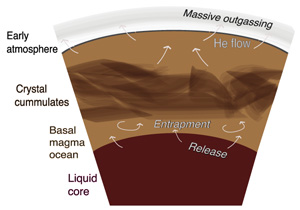
). As it crystallised, its load of incompatible elements concentrated, which were eventually captured in the last rocks forming at the base of the mantle. Long lifetime of basal MO also implies long chemical exchange with the core, which continually lost its He into the molten silicate (Fig. 4b).Figure 4 Cartoon representation of He fluxes (arrows) during core formation through the MO model. There is a strong initial transfer of He from the iron droplets to the silicate magma. (a) The hot, dense atmosphere prevents degassing and escape of He. (b) With cooling and formation of a crystal layer at mid-depths, He is trapped in the basal MO, while the shallow MO undergoes massive evaporation to the secondary colder and less dense atmosphere.
Assuming that Earth is mainly accreted from enstatite chondrites with 1.33 × 10⁻⁸ mol/kg of 3He (Patzer and Schultz, 2001
Patzer, A., Schultz, L. (2001) Noble gases in enstatite chondrites I: Exposure ages, pairing, and weathering effects. Meteoritics & Planetary Science 36, 947–961. https://doi.org/10.1111/j.1945-5100.2001.tb01932.x
), and using calculated DFe/SilicateHe of ∼10−3 at 3000 K (temperature at which iron silicate starts to segregate), the estimated abundance of 3He in the Earth’s core can be on the order of 4.0 × 10⁻¹¹ mol/kg. Higher values might be possible, based on alternate accretion scenarios (Olson and Sharp, 2022Olson, P.L., Sharp, Z.D. (2022) Primordial Helium-3 Exchange Between Earth’s Core and Mantle. Geochemistry, Geophysics, Geosystems 23, e2021GC009985. https://doi.org/10.1029/2021GC009985
). Nevertheless, our value is higher than previous estimations from Fe-MgSiO3, but at least one order of magnitude lower than that stemming from the Fe-O alloy-MgSiO3 system (Yuan and Steinle-Neumann, 2021Yuan, L., Steinle-Neumann, G. (2021) The Helium Elemental and Isotopic Compositions of the Earth’s Core Based on Ab Initio Simulations. Journal of Geophysical Research: Solid Earth 126, e2021JB023106. https://doi.org/10.1029/2021JB023106
). These numbers are also about one order of magnitude smaller than previous experimental estimates (10−11–10−10; Bouhifd et al., 2013Bouhifd, M.A., Jephcoat, A.P., Heber, V.S., Kelley, S.P. (2013) Helium in Earth’s early core. Nature Geoscience 6, 982–986. https://doi.org/10.1038/ngeo1959
). Combining the primordial 3He concentration in the core with the amount of 4He produced from the U and Th budget of the core over 4.5 Ga (10−6 mol/kg; Yuan and Steinle-Neumann, 2021Yuan, L., Steinle-Neumann, G. (2021) The Helium Elemental and Isotopic Compositions of the Earth’s Core Based on Ab Initio Simulations. Journal of Geophysical Research: Solid Earth 126, e2021JB023106. https://doi.org/10.1029/2021JB023106
), the current 3He/4He in the core would be about 28 Ra, far lower than highest isotopic signature (50 Ra). This is a higher limit estimation for 3He abundance without taking into account He degassing during impacts. This suggests that the core cannot play a significant role as a reservoir of high primordial helium. It is then apparent that the source of rocks like OIBs, with high 3He/4He ratios, taps into a geochemical reservoir which should be somewhere at the bottom of the mantle, consistent with conclusions derived from Ne partitioning (Li et al., 2022Li, Y., Vočadlo, L., Ballentine, C., Brodholt, J.P. (2022) Primitive noble gases sampled from ocean island basalts cannot be from the Earth’s core. Nature Communications 13, 3770. https://doi.org/10.1038/s41467-022-31588-7
).top
Acknowledgments
This work was supported by the Research Council of Norway through its Centres of Excellence funding scheme, project number 223272, and through project HIDDEN 325567. RC acknowledges support from the European Research Council under EU Horizon 2020 research and innovation programme (grant agreement 681818 – IMPACT), and for access to supercomputing facilities via eDARI stl2816 grants, PRACE RA4947 and RA0046 grants, and Uninet2 NN9697K grant.
Editor: Anat Shahar
top
References
Blanc, N.A., Stegman, D.R., Ziegler, L.B. (2020) Thermal and magnetic evolution of a crystallizing basal magma ocean in Earth’s mantle. Earth and Planetary Science Letters 534, 116085. https://doi.org/10.1016/j.epsl.2020.116085
 Show in context
 However, deep in the mantle, a chemically and thermally isolated basal MO may survive up to 2.5 Gyr (Blanc et al., 2020).
View in article
Borlina, C.S., Weiss, B.P., Bryson, J.F.J., Armitage, P.J. (2022) Lifetime of the Outer Solar System Nebula From Carbonaceous Chondrites. Journal of Geophysical Research: Planets 127, e2021JE007139. https://doi.org/10.1029/2021JE007139
Show in context Considering the short lifetime of the solar nebula (∼3 Myr; Borlina et al., 2022), He should originate mostly from solid accretion. Partial loss during giant impacts, and later enrichment by accreted materials slightly altered the initial concentration (Péron et al., 2018).
View in article
Bouhifd, M.A., Jephcoat, A.P., Heber, V.S., Kelley, S.P. (2013) Helium in Earth’s early core. Nature Geoscience 6, 982–986. https://doi.org/10.1038/ngeo1959
Show in context The radiogenic isotopes of noble gases are products of nuclear decay reactions from unstable parent isotopes, like 238U, 235U, or 232Th, which are lithophile elements (Bouhifd et al., 2013).
View in article
The alternative possibility is that the noble gas reservoirs are hidden in the Earth’s core (Matsuda et al., 1993; Bouhifd et al., 2013; Jackson et al., 2017; Olson and Sharp, 2022).
View in article
At these conditions, He concentration in pyrolite is in the range 2400–2500 ppm, in good agreement with concentrations calculated in molten CI chondrites below 8 GPa (Bouhifd et al., 2013).
View in article
Only few experimental studies exist (Matsuda et al., 1993; Bouhifd et al., 2013), but they cover a small P-T range.
View in article
These numbers are also about one order of magnitude smaller than previous experimental estimates (10−11–10−10; Bouhifd et al., 2013).
View in article
Canup, R.M. (2004) Simulations of a late lunar-forming impact. Icarus 168, 433–456. https://doi.org/10.1016/j.icarus.2003.09.028
Show in context As a result of the large and giant impacts of the accretion (Canup, 2004; Ćuk and Stewart, 2012), the MO was covered by a thick and hot silicate atmosphere.
View in article
Class, C., Goldstein, S.L. (2005) Evolution of helium isotopes in the Earth’s mantle. Nature 436, 1107–1112. https://doi.org/10.1038/nature03930
Show in context Another hypothesis to explain the high primordial He ratio in OIBs is the isolation of the plume source from the MORB source for more than 1 Gyr (Class and Goldstein, 2005).
View in article
Ćuk, M., Stewart, S.T. (2012) Making the Moon from a Fast-Spinning Earth: A Giant Impact Followed by Resonant Despinning. Science 338, 1047–1052. https://doi.org/10.1126/science.1225542
Show in context As a result of the large and giant impacts of the accretion (Canup, 2004; Ćuk and Stewart, 2012), the MO was covered by a thick and hot silicate atmosphere.
View in article
Farley, K.A., Natland, J.H., Craig, H. (1992) Binary mixing of enriched and undegassed (primitive?) mantle components (He, Sr, Nd, Pb) in Samoan lavas. Earth and Planetary Science Letters 111, 183–199. https://doi.org/10.1016/0012-821X(92)90178-X
Show in context One such signature is the low 4He/3He ratio observed in ocean island basalts (OIBs) such as Iceland, Hawaii, the Galapagos, Reunion and Samoa, which are the surface manifestations of deep mantle plumes (e.g., Farley et al., 1992; Kurz and Geist, 1999; Stuart et al., 2003).
View in article
Ichikawa, H., Labrosse, S., Kurita, K. (2010) Direct numerical simulation of an iron rain in the magma ocean. Journal of Geophysical Research: Solid Earth 115, B01404. https://doi.org/10.1029/2009JB006427
Show in context Their silicate parts mix and disperse in the MO, while their cores may turn into small droplets inside the MO (Ichikawa et al., 2010; Kendall and Melosh, 2016).
View in article
Jackson, M.G., Carlson, R.W. (2011) An ancient recipe for flood-basalt genesis. Nature 476, 316–319. https://doi.org/10.1038/nature10326
Show in context Whole mantle convection models show that there are only a few possible isolated places in the mantle today, like the D″ layer (Tolstikhin and Hofmann, 2005) or the large low shear wave velocity provinces (LLSVPs; Jackson and Carlson, 2011), which could still be largely undegassed.
View in article
Jackson, M.G., Konter, J.G., Becker, T.W. (2017) Primordial helium entrained by the hottest mantle plumes. Nature 542, 340–343. https://doi.org/10.1038/nature21023
Show in context Their ratios of non-radiogenic to radiogenic isotopes arriving at the surface constrain the isolation and mixing of Earth’s internal reservoirs over geological time (Marty, 2012; Moreira, 2013; Jackson et al., 2017; Péron et al., 2018).
View in article
The mid-ocean ridge basalts (MORBs) bear a significantly different signature with a comparatively higher 4He/3He ratio. Their origin is in the more degassed upper mantle (Trieloff and Kunz, 2005; Moreira, 2013; Jackson et al., 2017; Péron et al., 2018; Mukhopadhyay and Parai, 2019).
View in article
The alternative possibility is that the noble gas reservoirs are hidden in the Earth’s core (Matsuda et al., 1993; Bouhifd et al., 2013; Jackson et al., 2017; Olson and Sharp, 2022).
View in article
Kendall, J.D., Melosh, H.J. (2016) Differentiated planetesimal impacts into a terrestrial magma ocean: Fate of the iron core. Earth and Planetary Science Letters 448, 24–33. https://doi.org/10.1016/j.epsl.2016.05.012
Show in context Their silicate parts mix and disperse in the MO, while their cores may turn into small droplets inside the MO (Ichikawa et al., 2010; Kendall and Melosh, 2016).
View in article
Kurz, M.D., Geist, D. (1999) Dynamics of the Galapagos hotspot from helium isotope geochemistry. Geochimica et Cosmochimica Acta 63, 4139–4156. https://doi.org/10.1016/S0016-7037(99)00314-2
Show in context One such signature is the low 4He/3He ratio observed in ocean island basalts (OIBs) such as Iceland, Hawaii, the Galapagos, Reunion and Samoa, which are the surface manifestations of deep mantle plumes (e.g., Farley et al., 1992; Kurz and Geist, 1999; Stuart et al., 2003).
View in article
Li, Y., Vočadlo, L., Ballentine, C., Brodholt, J.P. (2022) Primitive noble gases sampled from ocean island basalts cannot be from the Earth’s core. Nature Communications 13, 3770. https://doi.org/10.1038/s41467-022-31588-7
Show in context Recent ab initio molecular dynamics studies of He partitioning between molten MgSiO3 and Fe (Xiong et al., 2021; Yuan and Steinle-Neumann, 2021; Li et al., 2022; Wang et al., 2022) show that DFe/SilicateHe is insensitive to pressure. MgSiO3 values at 80 GPa are one order of magnitude smaller than pyrolite, probably because of the simplified chemistries.
View in article
It is then apparent that the source of rocks like OIBs, with high 3He/4He ratios, taps into a geochemical reservoir which should be somewhere at the bottom of the mantle, consistent with conclusions derived from Ne partitioning (Li et al., 2022).
View in article
Marty, B. (2012) The origins and concentrations of water, carbon, nitrogen and noble gases on Earth. Earth and Planetary Science Letters 313–314, 56–66. https://doi.org/10.1016/j.epsl.2011.10.040
Show in context They were accreted from nebular gases, from meteoritic material irradiated by solar wind, and/or delivered by chondritic or cometary material (Marty, 2012; Moreira, 2013).
View in article
Their ratios of non-radiogenic to radiogenic isotopes arriving at the surface constrain the isolation and mixing of Earth’s internal reservoirs over geological time (Marty, 2012; Moreira, 2013; Jackson et al., 2017; Péron et al., 2018).
View in article
Matsuda, J., Sudo, M., Ozima, M., Ito, K., Ohtaka, O., Ito, E. (1993) Noble Gas Partitioning Between Metal and Silicate Under High Pressures. Science 259, 788–790. https://doi.org/10.1126/science.259.5096.788
Show in context The alternative possibility is that the noble gas reservoirs are hidden in the Earth’s core (Matsuda et al., 1993; Bouhifd et al., 2013; Jackson et al., 2017; Olson and Sharp, 2022).
View in article
Only few experimental studies exist (Matsuda et al., 1993; Bouhifd et al., 2013), but they cover a small P-T range.
View in article
McDonough, W.F., Sun, S.-s. (1995) The composition of the Earth. Chemical Geology 120, 223–253. https://doi.org/10.1016/0009-2541(94)00140-4
Show in context Moreover, instead of using simplified Mg silicate models for the MO, we employ the bulk silicate Earth model (McDonough and Sun, 1995) to approximate the global MO, which we call pyrolite
View in article
Monteux, J., Andrault, D., Guitreau, M., Samuel, H., Demouchy, S. (2020) A mushy Earth’s mantle for more than 500 Myr after the magma ocean solidification. Geophysical Journal International 221, 1165–1181. https://doi.org/10.1093/gji/ggaa064
Show in context Later, after decreasing pressure, a large amount of He could have been degassed. The degassing would dominate the shallow MO, until a protective lid forms relatively late, at around 500–800 million years (Monteux et al., 2020) (Fig. 4b).
View in article
Moreira, M. (2013) Noble Gas Constraints on the Origin and Evolution of Earth’s Volatiles. Geochemical Perspectives 2, 229–403. https://doi.org/10.7185/geochempersp.2.2
Show in context They were accreted from nebular gases, from meteoritic material irradiated by solar wind, and/or delivered by chondritic or cometary material (Marty, 2012; Moreira, 2013).
View in article
Their ratios of non-radiogenic to radiogenic isotopes arriving at the surface constrain the isolation and mixing of Earth’s internal reservoirs over geological time (Marty, 2012; Moreira, 2013; Jackson et al., 2017; Péron et al., 2018).
View in article
The mid-ocean ridge basalts (MORBs) bear a significantly different signature with a comparatively higher 4He/3He ratio. Their origin is in the more degassed upper mantle (Trieloff and Kunz, 2005; Moreira, 2013; Jackson et al., 2017; Péron et al., 2018; Mukhopadhyay and Parai, 2019).
View in article
Moreira, M., Charnoz, S. (2016) The origin of the neon isotopes in chondrites and on Earth. Earth and Planetary Science Letters 433, 249–256. https://doi.org/10.1016/j.epsl.2015.11.002
Show in context Primordial He originates from either the early ingassing of solar nebula (Olson and Sharp, 2022) or accreting chondritic material irradiated by the solar wind (Moreira and Charnoz, 2016).
View in article
Mukhopadhyay, S., Parai, R. (2019) Noble Gases: A Record of Earth’s Evolution and Mantle Dynamics. Annual Review of Earth and Planetary Sciences 47, 389–419. https://doi.org/10.1146/annurev-earth-053018-060238
Show in context The mid-ocean ridge basalts (MORBs) bear a significantly different signature with a comparatively higher 4He/3He ratio. Their origin is in the more degassed upper mantle (Trieloff and Kunz, 2005; Moreira, 2013; Jackson et al., 2017; Péron et al., 2018; Mukhopadhyay and Parai, 2019).
View in article
Olson, P.L., Sharp, Z.D. (2022) Primordial Helium-3 Exchange Between Earth’s Core and Mantle. Geochemistry, Geophysics, Geosystems 23, e2021GC009985. https://doi.org/10.1029/2021GC009985
Show in context The alternative possibility is that the noble gas reservoirs are hidden in the Earth’s core (Matsuda et al., 1993; Bouhifd et al., 2013; Jackson et al., 2017; Olson and Sharp, 2022).
View in article
Primordial He originates from either the early ingassing of solar nebula (Olson and Sharp, 2022) or accreting chondritic material irradiated by the solar wind (Moreira and Charnoz, 2016).
View in article
Higher values might be possible, based on alternate accretion scenarios (Olson and Sharp, 2022).
View in article
Patzer, A., Schultz, L. (2001) Noble gases in enstatite chondrites I: Exposure ages, pairing, and weathering effects. Meteoritics & Planetary Science 36, 947–961. https://doi.org/10.1111/j.1945-5100.2001.tb01932.x
Show in context Assuming that Earth is mainly accreted from enstatite chondrites with 1.33 × 10⁻⁸ mol/kg of 3He (Patzer and Schultz, 2001), and using calculated DFe/SilicateHe of ∼10−3 at 3000 K (temperature at which iron silicate starts to segregate), the estimated abundance of 3He in the Earth’s core can be on the order of 4.0 × 10⁻¹¹ mol/kg.
View in article
Péron, S., Moreira, M., Agranier, A. (2018) Origin of Light Noble Gases (He, Ne, and Ar) on Earth: A Review. Geochemistry, Geophysics, Geosystems 19, 979–996. https://doi.org/10.1002/2017GC007388
Show in context Their ratios of non-radiogenic to radiogenic isotopes arriving at the surface constrain the isolation and mixing of Earth’s internal reservoirs over geological time (Marty, 2012; Moreira, 2013; Jackson et al., 2017; Péron et al., 2018).
View in article
The mid-ocean ridge basalts (MORBs) bear a significantly different signature with a comparatively higher 4He/3He ratio. Their origin is in the more degassed upper mantle (Trieloff and Kunz, 2005; Moreira, 2013; Jackson et al., 2017; Péron et al., 2018; Mukhopadhyay and Parai, 2019).
View in article
Considering the short lifetime of the solar nebula (∼3 Myr; Borlina et al., 2022), He should originate mostly from solid accretion. Partial loss during giant impacts, and later enrichment by accreted materials slightly altered the initial concentration (Péron et al., 2018).
View in article
Rubie, D.C., Melosh, H.J., Reid, J.E., Liebske, C., Righter, K. (2003) Mechanisms of metal–silicate equilibration in the terrestrial magma ocean. Earth and Planetary Science Letters 205, 239–255. https://doi.org/10.1016/S0012-821X(02)01044-0
Show in context Centimetre or millimetre-sized droplets totally equilibrate in the MO within a few tens of metres (Rubie et al., 2003), and based on our partitioning results, lose 99.999 % of their initial He.
View in article
Samuel, H. (2012) A re-evaluation of metal diapir breakup and equilibration in terrestrial magma oceans. Earth and Planetary Science Letters 313–314, 105–114. https://doi.org/10.1016/j.epsl.2011.11.001
Show in context Larger droplets (yet smaller than the MO thickness) break during descent to smaller centimetre-sized stable droplets, which attain equilibrium before reaching the bottom of MO (Samuel, 2012).
View in article
Solomatova, N.V., Caracas, R. (2021) Genesis of a CO2-rich and H2O-depleted atmosphere from Earth’s early global magma ocean. Science Advances 7, eabj0406. https://doi.org/10.1126/sciadv.abj0406
Show in context Until the formation of the first crust, which protected the liquid silicate from the atmosphere, the flux of volatiles degassing from the MO was rich in CO2 and poor in H2O (Solomatova and Caracas, 2021).
View in article
Below 1.6 g/cm3, the opening of the silicate framework that is the backbone of the melt allows for massive devolatilisation, similar to CO2 degassing from pyrolite (Solomatova and Caracas, 2021).
View in article
Stuart, F.M., Lass-Evans, S., Godfrey Fitton, J., Ellam, R.M. (2003) High 3He/4He ratios in picritic basalts from Baffin Island and the role of a mixed reservoir in mantle plumes. Nature 424, 57–59. https://doi.org/10.1038/nature01711
Show in context One such signature is the low 4He/3He ratio observed in ocean island basalts (OIBs) such as Iceland, Hawaii, the Galapagos, Reunion and Samoa, which are the surface manifestations of deep mantle plumes (e.g., Farley et al., 1992; Kurz and Geist, 1999; Stuart et al., 2003).
View in article
Tolstikhin, I., Hofmann, A.W. (2005) Early crust on top of the Earth’s core. Physics of the Earth and Planetary Interiors 148, 109–130. https://doi.org/10.1016/j.pepi.2004.05.011
Show in context Whole mantle convection models show that there are only a few possible isolated places in the mantle today, like the D″ layer (Tolstikhin and Hofmann, 2005) or the large low shear wave velocity provinces (LLSVPs; Jackson and Carlson, 2011), which could still be largely undegassed.
View in article
Trieloff, M., Kunz, J. (2005) Isotope systematics of noble gases in the Earth’s mantle: possible sources of primordial isotopes and implications for mantle structure. Physics of the Earth and Planetary Interiors 148, 13–38. https://doi.org/10.1016/j.pepi.2004.07.007
Show in context The mid-ocean ridge basalts (MORBs) bear a significantly different signature with a comparatively higher 4He/3He ratio. Their origin is in the more degassed upper mantle (Trieloff and Kunz, 2005; Moreira, 2013; Jackson et al., 2017; Péron et al., 2018; Mukhopadhyay and Parai, 2019).
View in article
Wang, K., Lu, X., Liu, X., Zhou, M., Yin, K. (2022) Partitioning of noble gases (He, Ne, Ar, Kr, Xe) during Earth’s core segregation: A possible core reservoir for primordial noble gases. Geochimica et Cosmochimica Acta 321, 329–342. https://doi.org/10.1016/j.gca.2022.01.009
Show in context A series of recent computational studies (Xiong et al., 2021; Yuan and Steinle-Neumann, 2021; Wang et al., 2022) proposed the same origin, although they found out that noble gases partition preferentially in the silicate melt, i.e. into the MO.
View in article
This suggests that He equilibration occurs earlier in the MO, at shallow conditions with lower DFe/SilicateHe , in contrast to previous assumptions of equilibration at the core mantle boundary (Xiong et al., 2021; Yuan and Steinle-Neumann, 2021; Wang et al., 2022).
View in article
Recent ab initio molecular dynamics studies of He partitioning between molten MgSiO3 and Fe (Xiong et al., 2021; Yuan and Steinle-Neumann, 2021; Li et al., 2022; Wang et al., 2022) show that DFe/SilicateHe is insensitive to pressure. MgSiO3 values at 80 GPa are one order of magnitude smaller than pyrolite, probably because of the simplified chemistries.
View in article
Xiong, Z., Tsuchiya, T., Van Orman, J.A. (2021) Helium and Argon Partitioning Between Liquid Iron and Silicate Melt at High Pressure. Geophysical Research Letters 48, e2020GL090769. https://doi.org/10.1029/2020GL090769
Show in context A series of recent computational studies (Xiong et al., 2021; Yuan and Steinle-Neumann, 2021; Wang et al., 2022) proposed the same origin, although they found out that noble gases partition preferentially in the silicate melt, i.e. into the MO.
View in article
Recent ab initio molecular dynamics studies of He partitioning between molten MgSiO3 and Fe (Xiong et al., 2021; Yuan and Steinle-Neumann, 2021; Li et al., 2022; Wang et al., 2022) show that DFe/SilicateHe is insensitive to pressure. MgSiO3 values at 80 GPa are one order of magnitude smaller than pyrolite, probably because of the simplified chemistries.
View in article
This suggests that He equilibration occurs earlier in the MO, at shallow conditions with lower DFe/SilicateHe , in contrast to previous assumptions of equilibration at the core mantle boundary (Xiong et al., 2021; Yuan and Steinle-Neumann, 2021; Wang et al., 2022).
View in article
Yuan, L., Steinle-Neumann, G. (2021) The Helium Elemental and Isotopic Compositions of the Earth’s Core Based on Ab Initio Simulations. Journal of Geophysical Research: Solid Earth 126, e2021JB023106. https://doi.org/10.1029/2021JB023106
Show in context A series of recent computational studies (Xiong et al., 2021; Yuan and Steinle-Neumann, 2021; Wang et al., 2022) proposed the same origin, although they found out that noble gases partition preferentially in the silicate melt, i.e. into the MO.
View in article
Recent ab initio molecular dynamics studies of He partitioning between molten MgSiO3 and Fe (Xiong et al., 2021; Yuan and Steinle-Neumann, 2021; Li et al., 2022; Wang et al., 2022) show that DFe/SilicateHe is insensitive to pressure. MgSiO3 values at 80 GPa are one order of magnitude smaller than pyrolite, probably because of the simplified chemistries.
View in article
Simulations of partitioning between molten MgSiO3 and liquid Fe-O alloys are closer to our results (Yuan and Steinle-Neumann, 2021), most probably because of the presence of O in the liquid core.
View in article
This suggests that He equilibration occurs earlier in the MO, at shallow conditions with lower DFe/SilicateHe , in contrast to previous assumptions of equilibration at the core mantle boundary (Xiong et al., 2021; Yuan and Steinle-Neumann, 2021; Wang et al., 2022).
View in article
Nevertheless, our value is higher than previous estimations from Fe-MgSiO3, but at least one order of magnitude lower than that stemming from the Fe-O alloy-MgSiO3 system (Yuan and Steinle-Neumann, 2021).
View in article
Combining the primordial 3He concentration in the core with the amount of 4He produced from the U and Th budget of the core over 4.5 Ga (10−6 mol/kg; Yuan and Steinle-Neumann, 2021), the current 3He/4He in the core would be about 28 Ra, far lower than highest isotopic signature (50 Ra).
View in article
top
Supplementary Information
The Supplementary Information includes:
Download the Supplementary Information (PDF)
Figures
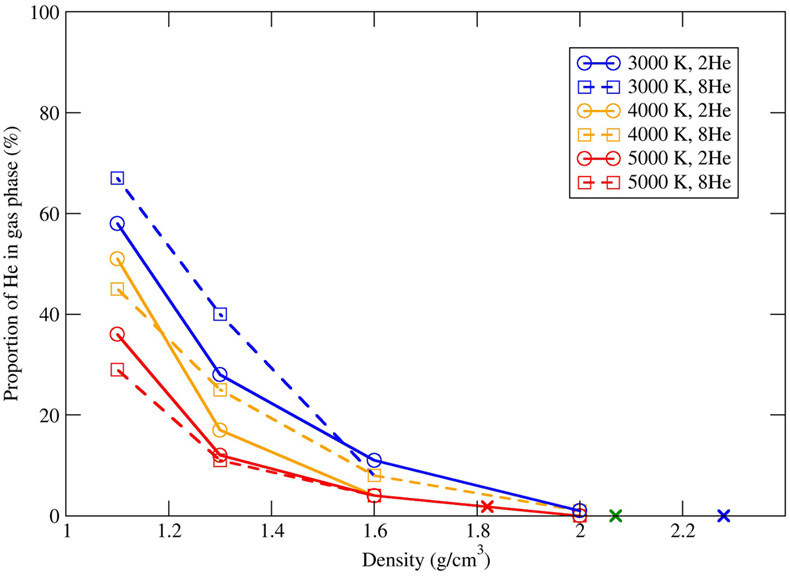
Figure 1 Proportion of He in the gas phase relative to molten pyrolite. 1 kbar approximately corresponds to a melt-vapour system density of 2.3, 2.1 and 1.8 g/cm3 at 3000, 4000 and 5000 K, respectively (“×” symbols).
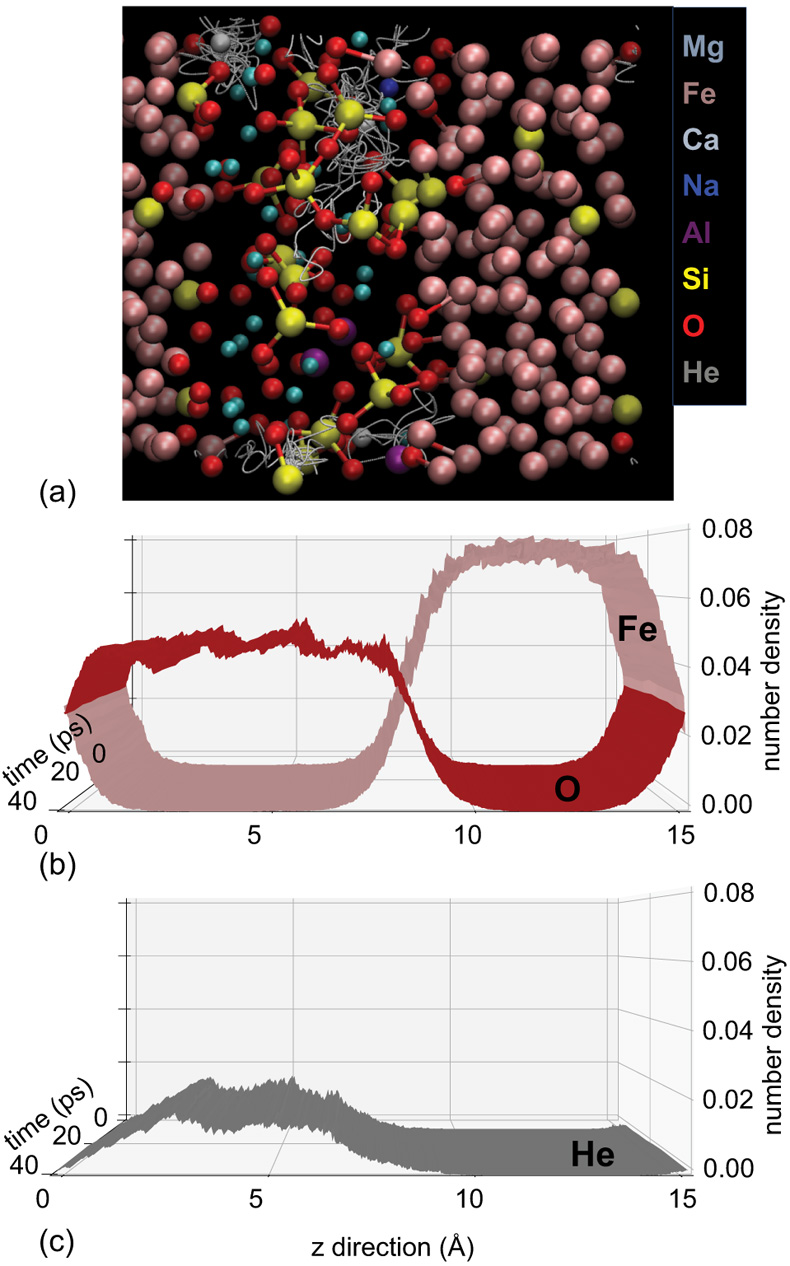
Figure 2 (a) Snapshot of the contact simulations between liquid pyrolite and molten iron (2000 K, 3 GPa). The trajectories of He atoms are represented over 8 ps of simulation, with grey ribbons. (b) ND profiles of Fe and O separate the two melts. The interface is highly localised and characterised by steep gradients of the Fe and O concentration. (c) ND profiles for He, which lie almost entirely in the silicate melt, as observed also in the trajectories of the individual atoms.
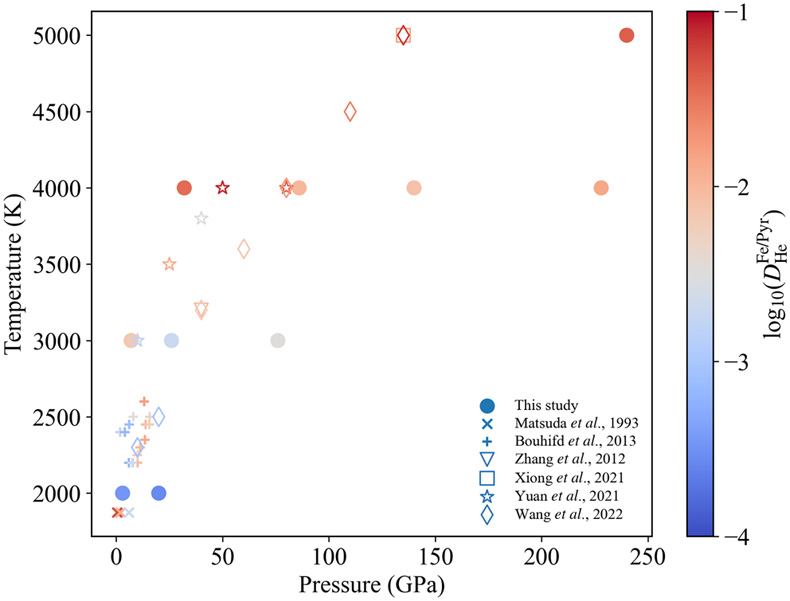
Figure 3 Metal/silicate He partition coefficients. Previous experimental data are shown with crosses and previous computed results by open symbols. Present study is plotted with solid symbols. The affinity of He for the silicate melt decreases along the mantle adiabat by about two orders of magnitude between the top and the bottom of the MO.
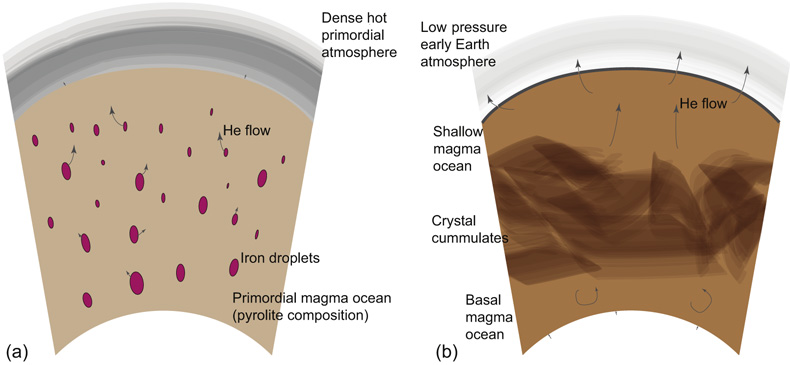
Figure 4 Cartoon representation of He fluxes (arrows) during core formation through the MO model. There is a strong initial transfer of He from the iron droplets to the silicate magma. (a) The hot, dense atmosphere prevents degassing and escape of He. (b) With cooling and formation of a crystal layer at mid-depths, He is trapped in the basal MO, while the shallow MO undergoes massive evaporation to the secondary colder and less dense atmosphere.