



Primordial noble gas isotopes from immoderate crushing of an Icelandic basalt glass
Affiliations | Corresponding Author | Cite as | Funding information
Published by the European Association of Geochemistry
under Creative Commons License CC BY-NC-ND 4.0
Keywords: xenon, mantle, plume, noble gas, heterogeneity, basalt


- Share this article


-
Article views:2,486Cumulative count of HTML views and PDF downloads.
- Download Citation
- Rights & Permissions

top
Abstract
Figures
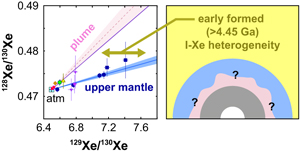
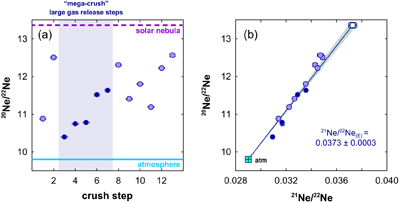 Figure 1 Ne isotopes in MiðfellRP09 step crushes. 20Ne/22Ne is shown (a) as a function of crush step and (b) against 21Ne/22Ne (error bars 1σ). Dark circles represent the heavy crush steps, referred to as “mega-crush” steps. Ne in mega-crush steps starts off close to atmospheric, and progressively shifts towards mantle compositions. All crush steps taken together define a mixing line between atmosphere and an extrapolated mantle source 21Ne/22Ne of 0.0373 ± 0.0003 (1σ) assuming a solar-like mantle 20Ne/22Ne of 13.36. | 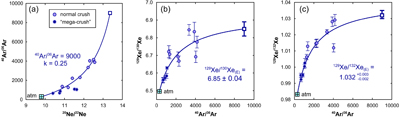 Figure 2 Ne-Ar and Ar-Xe mixing systematics in MiðfellRP09 step crushes. Data are shown along with best fit two component mixing hyperbola determined by total least squares (error bars 1σ). (a) In 40Ar/36Ar vs. 20Ne/22Ne, comparable fits can be achieved for a range of mantle end member 40Ar/36Ar ratios with compensating variation in the curvature parameter. Data and best fit mixing hyperbolae for 40Ar/36Ar vs. (b) 129Xe/130Xe and (c) 129Xe/132Xe are shown. In Ar-Xe, the mega-crush step data are tightly clustered and constrain the mixing hyperbolae, though they are more affected by atmospheric contamination than the relatively scattered normal-sized crush step data. | 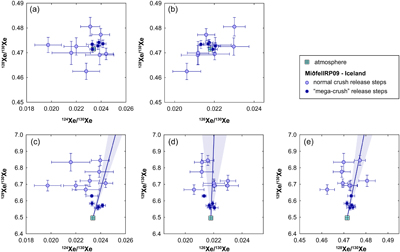 Figure 3 Xe primordial isotopes and 129Xe/130Xe. Data are shown with 1σ error bars. Among the normal crush steps, data are scattered with large error bars around the atmospheric composition. The mega-crush step data include steps that are resolved from the atmospheric composition in (a) 124Xe/130Xe and 128Xe/130Xe, though the relationship is not evident in (b) 128Xe/130Xe vs. 126Xe/130Xe. 129Xe/130Xe is plotted against the primordial isotope ratios in panels (c–e) along with fits through atmosphere and the error weighted averages of mega-crush data. | 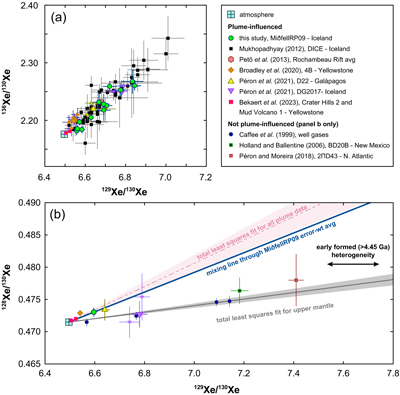 Figure 4 MiðfellRP09 and literature Xe isotopic data. Small symbols are individual data, while larger symbols are averages. (a) Mega-crush and regular crush step 136Xe/130Xe vs. 129Xe/130Xe data (1σ error bars) are consistent with prior Xe measurements in Iceland samples (Mukhopadhyay, 2012; Péron et al., 2021) and plume-influenced samples from Rochambeau Rift (Samoan plume), Galápagos, and Yellowstone (Pető et al., 2013; Broadley et al., 2020; Bekaert et al., 2023). (b) The error weighted average of mega-crush step 128Xe/130Xe vs. 129Xe/130Xe data (1σ error bars), along with average or most mantle-like compositions from plume and upper mantle samples (Péron and Moreira, 2018; Caffee et al., 1999; Holland and Ballentine, 2006; Bekaert et al., 2023; see Fig. S-6 for details). Fits forced through atmosphere and a mixing line between the MiðfellRP09 average and atmosphere are shown. The slope of the plume fit is strongly affected by the precisely determined Yellowstone 4B average, which may reflect some mass dependent fractionation in the hydrothermal system (Bekaert et al., 2023). While individual measurements for DG2017 (Péron et al., 2021) are shown, only the average was used to compute the best plume slope and its uncertainty. Despite a larger uncertainty in the plume fit, the plume and upper mantle fits have distinct slopes. The MiðfellRP09 mega-crush average is precisely determined, shows a prominent excess relative to atmosphere, and is consistent with data from other plume localities. The MiðfellRP09 average lies on a steeper slope than the upper mantle fit, indicating a plume mantle source with a lower 129Xe/130Xe at a given 128Xe/130Xe than the upper mantle. |
| Figure 1 | Figure 2 | Figure 3 | Figure 4 |
top
Introduction
Precise determinations of mantle heavy noble gas (Ne, Ar, Kr and Xe) isotopic compositions have the power to shed light on the delivery of volatiles to Earth during accretion, and transport of volatiles among terrestrial reservoirs (e.g., Parai and Mukhopadhyay, 2015
Parai, R., Mukhopadhyay, S. (2015) The evolution of MORB and plume mantle volatile budgets: Constraints from fission Xe isotopes in Southwest Indian Ridge basalts. Geochemistry, Geophysics, Geosystems 16, 719–735. https://doi.org/10.1002/2014GC005566
; Péron and Moreira, 2018Péron, S., Moreira, M. (2018) Onset of volatile recycling into the mantle determined by xenon anomalies. Geochemical Perspectives Letters 9, 21–25. https://doi.org/10.7185/geochemlet.1833
; Bekaert et al., 2019Bekaert, D.V., Broadley, M.W., Caracausi, A., Marty, B. (2019) Novel insights into the degassing history of Earth’s mantle from high precision noble gas analysis of magmatic gas. Earth and Planetary Science Letters 525, 115766. https://doi.org/10.1016/j.epsl.2019.115766
; Broadley et al., 2020Broadley, M.W., Barry, P.H., Bekaert, D.V., Byrne, D.J., Caracausi, A., Ballentine, C.J., Marty, B. (2020) Identification of chondritic krypton and xenon in Yellowstone gases and the timing of terrestrial volatile accretion. Proceedings of the National Academy of Sciences 117, 13997–14004. https://doi.org/10.1073/pnas.2003907117
; Péron et al., 2021Péron, S., Mukhopadhyay, S., Kurz, M.D., Graham, D.W. (2021) Deep-mantle krypton reveals Earth’s early accretion of carbonaceous matter. Nature 600, 462–467. https://doi.org/10.1038/s41586-021-04092-z
). Two characteristics make the noble gases sensitive tracers of volatile transport: (1) due to their extremely low abundances in the solid Earth, production of specific isotopes by radioactive decay generates large radiogenic isotope signatures, even when the parent nuclide is itself rare, and (2) the noble gases tend to partition into gas phases when possible – that is, they broadly follow the major volatiles (such as water and carbon dioxide) and escape from the mantle to melts, and from lavas to the atmosphere, over time. These characteristics also make noble gases difficult to measure in volcanic rocks, especially in light of pervasive atmospheric contamination of volcanic rock samples (e.g., Burnard et al., 1997Burnard, P., Graham, D., Turner, G. (1997) Vesicle-Specific Noble Gas Analyses of “Popping Rock”: Implications for Primordial Noble Gases in Earth. Science 276, 568–571. https://doi.org/10.1126/science.276.5312.568
; Ballentine and Barfod, 2000Ballentine, C.J., Barfod, D.N. (2000) The origin of air-like noble gases in MORB and OIB. Earth and Planetary Science Letters 180, 39–48. https://doi.org/10.1016/S0012-821X(00)00161-8
; Roubinet and Moreira, 2018Roubinet, C., Moreira, M.A. (2018) Atmospheric noble gases in Mid-Ocean Ridge Basalts: Identification of atmospheric contamination processes. Geochimica et Cosmochimica Acta 222, 253–268. https://doi.org/10.1016/j.gca.2017.10.027
). Analytical challenges have limited the number and type of samples for which magmatic heavy noble gas isotopic ratios have been resolved from the atmospheric composition.Various approaches have been adopted to battle atmospheric contamination and constrain mantle source noble gas isotopic compositions. Step release of gas from samples by crushing or heating has long been used to generate data arrays trending from the atmospheric isotopic signature towards a mantle composition (e.g., Sarda et al., 1988
Sarda, P., Staudacher, T., Allègre, C.J. (1988) Neon isotopes in submarine basalts. Earth and Planetary Science Letters 91, 73–88. https://doi.org/10.1016/0012-821X(88)90152-5
; Marty, 1989Marty, B. (1989) Neon and xenon isotopes in MORB: implications for the earth-atmosphere evolution. Earth and Planetary Science Letters 94, 45–56. https://doi.org/10.1016/0012-821X(89)90082-4
); linear or hyperbolic mixing arrays can be used to determine a model mantle composition by assuming a solar-like mantle 20Ne/22Ne ratio (see Parai et al., 2019Parai, R., Mukhopadhyay, S., Tucker, J.M., Pető, M.K. (2019) The emerging portrait of an ancient, heterogeneous and continuously evolving mantle plume source. Lithos 346–347, 105153. https://doi.org/10.1016/j.lithos.2019.105153
). Step release approaches have been used to determine mantle source 21Ne/22Ne, 40Ar/36Ar, and Xe isotopic compositions in mid-ocean ridge basalt and plume basalt samples. However, wide coverage of upper mantle and ocean island heterogeneity is yet to be achieved. Furthermore, mantle compositions for Kr and the rarest Xe isotopes (124Xe, 126Xe, and 128Xe) are limited to unusually gas-rich basalt samples (Moreira et al., 1998Moreira, M., Kunz, J., Allègre, C. (1998) Rare Gas Systematics in Popping Rock: Isotopic and Elemental Compositions in the Upper Mantle. Science 279, 1178–1181. https://doi.org/10.1126/science.279.5354.1178
), continental well gases (Caffee et al., 1999Caffee, M.W., Hudson, G.B., Velsko, C., Huss, G.R., Alexander Jr., E.C., Chivas, A.R. (1999) Primordial Noble Gases from Earth’s Mantle: Identification of a Primitive Volatile Component. Science 285, 2115–2118. https://doi.org/10.1126/science.285.5436.2115
; Holland and Ballentine, 2006Holland, G., Ballentine, C.J. (2006) Seawater subduction controls the heavy noble gas composition of the mantle. Nature 441, 186–191. https://doi.org/10.1038/nature04761
; Caracausi et al., 2016Caracausi, A., Avice, G., Burnard, P.G., Füri, E., Marty, B. (2016) Chondritic xenon in the Earth’s mantle. Nature 533, 82–85. https://doi.org/10.1038/nature17434
; Bekaert et al., 2019Bekaert, D.V., Broadley, M.W., Caracausi, A., Marty, B. (2019) Novel insights into the degassing history of Earth’s mantle from high precision noble gas analysis of magmatic gas. Earth and Planetary Science Letters 525, 115766. https://doi.org/10.1016/j.epsl.2019.115766
) and volcanic gases (Broadley et al., 2020Broadley, M.W., Barry, P.H., Bekaert, D.V., Byrne, D.J., Caracausi, A., Ballentine, C.J., Marty, B. (2020) Identification of chondritic krypton and xenon in Yellowstone gases and the timing of terrestrial volatile accretion. Proceedings of the National Academy of Sciences 117, 13997–14004. https://doi.org/10.1073/pnas.2003907117
; Bekaert et al., 2023Bekaert, D.V., Barry, P.H., Broadley, M.W., Byrne, D.J., Marty, B., et al. (2023) Ultrahigh-precision noble gas isotope analyses reveal pervasive subsurface fractionation in hydrothermal systems. Science Advances 9, eadg2566. https://doi.org/10.1126/sciadv.adg2566
), where large quantities of gas are available for analysis.Recent studies have demonstrated the utility of a screening and accumulation method (Péron and Moreira, 2018
Péron, S., Moreira, M. (2018) Onset of volatile recycling into the mantle determined by xenon anomalies. Geochemical Perspectives Letters 9, 21–25. https://doi.org/10.7185/geochemlet.1833
) to achieve high precision measurements of rare noble gas isotopes (Péron et al., 2021Péron, S., Mukhopadhyay, S., Kurz, M.D., Graham, D.W. (2021) Deep-mantle krypton reveals Earth’s early accretion of carbonaceous matter. Nature 600, 462–467. https://doi.org/10.1038/s41586-021-04092-z
). In this approach, gas from crush steps with 20Ne/22Ne above a certain threshold is progressively collected on a cold trap, and a large quantity of gas with a composition close to the mantle source is accumulated for Ar, Kr and Xe isotopic measurements (Péron and Moreira, 2018Péron, S., Moreira, M. (2018) Onset of volatile recycling into the mantle determined by xenon anomalies. Geochemical Perspectives Letters 9, 21–25. https://doi.org/10.7185/geochemlet.1833
; Péron et al., 2021Péron, S., Mukhopadhyay, S., Kurz, M.D., Graham, D.W. (2021) Deep-mantle krypton reveals Earth’s early accretion of carbonaceous matter. Nature 600, 462–467. https://doi.org/10.1038/s41586-021-04092-z
). This approach enables precise analysis of rare isotope ratios in accumulated gas with a reduced contribution from atmospheric contaminants. However, atmospheric contaminants may affect Ar, Kr and Xe isotopes in a given release step more strongly than Ne isotopes due to high Ar/Ne, Kr/Ne and Xe/Ne ratios in the atmospheric contaminant compared to mantle gas. Thus, an accumulation approach using screening based on Ne isotopes may reduce but not eliminate atmospheric contamination in Ar, Kr and Xe. The trade off between the loss of information (e.g., no mixing array from multiple gas release steps) and the gain in approaching the mantle composition using screened accumulation techniques must be weighed, and a hybrid approach may be best.Another intuitive strategy to pursue precise measurements of rare noble gas isotopes in typical basalt samples is to crush heavily to release a very large amount of gas from a very large amount of sample in a single extraction step. However, the net benefit of this approach is unknown: in practice, the largest gas release steps tend to be close to atmospheric in composition, particularly in gas-poor basalts (Parai et al., 2012
Parai, R., Mukhopadhyay, S., Standish, J.J. (2012) Heterogeneous upper mantle Ne, Ar and Xe isotopic compositions and a possible Dupal noble gas signature recorded in basalts from the Southwest Indian Ridge. Earth and Planetary Science Letters 359–360, 227–239. https://doi.org/10.1016/j.epsl.2012.10.017
; Parai and Mukhopadhyay, 2015Parai, R., Mukhopadhyay, S. (2015) The evolution of MORB and plume mantle volatile budgets: Constraints from fission Xe isotopes in Southwest Indian Ridge basalts. Geochemistry, Geophysics, Geosystems 16, 719–735. https://doi.org/10.1002/2014GC005566
). By repeatedly crushing a sample in very small steps, one may generate (with less precise data) a well defined mixing array between atmosphere and the mantle composition, with some steps nearing a pure mantle composition (Mukhopadhyay, 2012Mukhopadhyay, S. (2012) Early differentiation and volatile accretion recorded in deep-mantle neon and xenon. Nature 486, 101–104. https://doi.org/10.1038/nature11141
; Parai and Mukhopadhyay, 2021Parai, R., Mukhopadhyay, S. (2021) Heavy noble gas signatures of the North Atlantic Popping Rock 2ΠD43: Implications for mantle noble gas heterogeneity. Geochimica et Cosmochimica Acta 294, 89–105. https://doi.org/10.1016/j.gca.2020.11.011
). Very heavy crushing runs the risk of overwhelming small amounts of mantle gas with larger amounts of atmospheric gas in a single large gas release step, such that one obtains a very precise measurement of a nearly pure atmospheric contaminant rather than a good constraint on the mantle composition. However, this approach has not been tested in detail, potentially due to the risk it poses in making poor use of precious sample material.Noble gas geochemistry is currently discussed in terms less specific (“plume mantle” vs. upper mantle) than the detailed discussions of mantle components in the broader mantle isotope geochemistry field. Radiogenic Sr, Nd, Pb and Hf isotopic co-variations among ocean island basalts shed light on multiple distinct compositional components within the plume mantle (e.g., HIMU, EM-I and EM-II; see Weis et al., 2023
Weis, D., Harpp, K.S., Harrison, L.N., Boyet, M., Chauvel, C., Farnetani, C.G., Finlayson, V.A., Lee, K.K.M., Parai, R., Shahar, A., Williamson, N.M.B. (2023) Earth’s mantle composition revealed by mantle plumes. Nature Reviews Earth & Environment 4, 604–625. https://doi.org/10.1038/s43017-023-00467-0.
for a recent review); the heavy noble gas isotopic signatures of these components remain to be determined. In order to bring valuable insights from heavy noble gases to bear on a wider array of mantle samples, it is critical to develop strategies that enable precise determinations of mantle source noble gas compositions in typical gas-poor volcanic samples. Here I report results from an experiment in which a hybrid crushing strategy was applied to a large quantity of Icelandic basalt glass. A few moderate crush steps were used to roughly calibrate subsequent gas release through several very large crush steps, with ∼10–100× as much gas released per step than in prior studies that used a small step crush technique (Mukhopadhyay, 2012Mukhopadhyay, S. (2012) Early differentiation and volatile accretion recorded in deep-mantle neon and xenon. Nature 486, 101–104. https://doi.org/10.1038/nature11141
; Parai et al., 2012Parai, R., Mukhopadhyay, S., Standish, J.J. (2012) Heterogeneous upper mantle Ne, Ar and Xe isotopic compositions and a possible Dupal noble gas signature recorded in basalts from the Southwest Indian Ridge. Earth and Planetary Science Letters 359–360, 227–239. https://doi.org/10.1016/j.epsl.2012.10.017
; Pető et al., 2013Pető, M.K., Mukhopadhyay, S., Kelley, K.A. (2013) Heterogeneities from the first 100 million years recorded in deep mantle noble gases from the Northern Lau Back-arc Basin. Earth and Planetary Science Letters 369–370, 13–23. https://doi.org/10.1016/j.epsl.2013.02.012
; Parai and Mukhopadhyay, 2015Parai, R., Mukhopadhyay, S. (2015) The evolution of MORB and plume mantle volatile budgets: Constraints from fission Xe isotopes in Southwest Indian Ridge basalts. Geochemistry, Geophysics, Geosystems 16, 719–735. https://doi.org/10.1002/2014GC005566
). While one cannot control the gas content of a given volcanic rock sample, very large amounts of sample can be collected for analysis using this heavy crushing method, unlocking new insights into heterogeneous volatile accretion and differentiation of the Earth’s interior.top
Sample and Methods
Subglacial basalt glass was collected in the summer of 2009 from near Miðfell, Iceland (Supplementary Information). A large quantity of basalt glass rich in olivine crystals was collected from an outcrop of glassy pillow basalts by the eastern shore of Þingvallavatn off Route 36, near the location reported for the DICE sample (Harrison et al., 1999
Harrison, D., Burnard, P., Turner, G. (1999) Noble gas behaviour and composition in the mantle: constraints from the Iceland Plume. Earth and Planetary Science Letters 171, 199–207. https://doi.org/10.1016/S0012-821X(99)00143-0
; Mukhopadhyay, 2012Mukhopadhyay, S. (2012) Early differentiation and volatile accretion recorded in deep-mantle neon and xenon. Nature 486, 101–104. https://doi.org/10.1038/nature11141
) and DG2017 (Péron et al., 2021Péron, S., Mukhopadhyay, S., Kurz, M.D., Graham, D.W. (2021) Deep-mantle krypton reveals Earth’s early accretion of carbonaceous matter. Nature 600, 462–467. https://doi.org/10.1038/s41586-021-04092-z
).He, Ne, Ar and Xe abundances and isotopic compositions were measured in the WUSTL Noble Gas Laboratory. Details of gas processing, mass spectrometry, and preparation of the gas standards are given in the Supplementary Information (Fig. S-2).
A mixed-size step crushing strategy was followed. Two small crush steps were used to roughly calibrate the expected 129Xe signal as a function of the manometer reading. Steps 3–7 were “mega-crushes” targeting a 129Xe signal ∼50× higher than normally targeted in the laboratory (10,000 counts per second 129Xe instead of 200 counts per second; see Supplementary Information for typical sensitivities) to enable precise measurement of the rarest Xe isotopes. None of the mega-crush steps required more than a single actuation of the hydraulic cylinder, which was slowly extruded while monitoring manometer pressure (in contrast to vigorous solenoid driven crushing). Once an audible change in the type of sound generated by crushing was noted (from cracks and pops to fainter crunches), the smaller crush method was resumed (Steps 8–13) to exhaust the gas supply in the sample. Xe blanks in the mass spectrometer were monitored after the large crushes to check for memory effects; no increase in the line blank was observed.
top
Results and Discussion
He, Ne, Ar and Xe abundances and isotopic compositions from thirteen step crushes are reported in Supplementary Table S-1. Estimated CO2/3He, 4He/21Ne*, 4He/40Ar* and other elemental abundance ratios are also given and are discussed in the Supplementary Information (Figs. S-3, S-4). The weighted average 4He/3He for the MiðfellRP09 sample is 41,200 ± 100 (1σ), in good agreement with prior studies of the DICE and DG2017 samples (Harrison et al., 1999
Harrison, D., Burnard, P., Turner, G. (1999) Noble gas behaviour and composition in the mantle: constraints from the Iceland Plume. Earth and Planetary Science Letters 171, 199–207. https://doi.org/10.1016/S0012-821X(99)00143-0
; Mukhopadhyay, 2012Mukhopadhyay, S. (2012) Early differentiation and volatile accretion recorded in deep-mantle neon and xenon. Nature 486, 101–104. https://doi.org/10.1038/nature11141
; Péron et al., 2021Péron, S., Mukhopadhyay, S., Kurz, M.D., Graham, D.W. (2021) Deep-mantle krypton reveals Earth’s early accretion of carbonaceous matter. Nature 600, 462–467. https://doi.org/10.1038/s41586-021-04092-z
). Ne, Ar and Xe isotopic compositions are shown in Figures 1–4.Figure 1 Ne isotopes in MiðfellRP09 step crushes. 20Ne/22Ne is shown (a) as a function of crush step and (b) against 21Ne/22Ne (error bars 1σ). Dark circles represent the heavy crush steps, referred to as “mega-crush” steps. Ne in mega-crush steps starts off close to atmospheric, and progressively shifts towards mantle compositions. All crush steps taken together define a mixing line between atmosphere and an extrapolated mantle source 21Ne/22Ne of 0.0373 ± 0.0003 (1σ) assuming a solar-like mantle 20Ne/22Ne of 13.36.
Figure 2 Ne-Ar and Ar-Xe mixing systematics in MiðfellRP09 step crushes. Data are shown along with best fit two component mixing hyperbola determined by total least squares (error bars 1σ). (a) In 40Ar/36Ar vs. 20Ne/22Ne, comparable fits can be achieved for a range of mantle end member 40Ar/36Ar ratios with compensating variation in the curvature parameter. Data and best fit mixing hyperbolae for 40Ar/36Ar vs. (b) 129Xe/130Xe and (c) 129Xe/132Xe are shown. In Ar-Xe, the mega-crush step data are tightly clustered and constrain the mixing hyperbolae, though they are more affected by atmospheric contamination than the relatively scattered normal-sized crush step data.
Figure 3 Xe primordial isotopes and 129Xe/130Xe. Data are shown with 1σ error bars. Among the normal crush steps, data are scattered with large error bars around the atmospheric composition. The mega-crush step data include steps that are resolved from the atmospheric composition in (a) 124Xe/130Xe and 128Xe/130Xe, though the relationship is not evident in (b) 128Xe/130Xe vs. 126Xe/130Xe. 129Xe/130Xe is plotted against the primordial isotope ratios in panels (c–e) along with fits through atmosphere and the error weighted averages of mega-crush data.
Figure 4 MiðfellRP09 and literature Xe isotopic data. Small symbols are individual data, while larger symbols are averages. (a) Mega-crush and regular crush step 136Xe/130Xe vs. 129Xe/130Xe data (1σ error bars) are consistent with prior Xe measurements in Iceland samples (Mukhopadhyay, 2012
Mukhopadhyay, S. (2012) Early differentiation and volatile accretion recorded in deep-mantle neon and xenon. Nature 486, 101–104. https://doi.org/10.1038/nature11141
; Péron et al., 2021Péron, S., Mukhopadhyay, S., Kurz, M.D., Graham, D.W. (2021) Deep-mantle krypton reveals Earth’s early accretion of carbonaceous matter. Nature 600, 462–467. https://doi.org/10.1038/s41586-021-04092-z
) and plume-influenced samples from Rochambeau Rift (Samoan plume), Galápagos, and Yellowstone (Pető et al., 2013Pető, M.K., Mukhopadhyay, S., Kelley, K.A. (2013) Heterogeneities from the first 100 million years recorded in deep mantle noble gases from the Northern Lau Back-arc Basin. Earth and Planetary Science Letters 369–370, 13–23. https://doi.org/10.1016/j.epsl.2013.02.012
; Broadley et al., 2020Broadley, M.W., Barry, P.H., Bekaert, D.V., Byrne, D.J., Caracausi, A., Ballentine, C.J., Marty, B. (2020) Identification of chondritic krypton and xenon in Yellowstone gases and the timing of terrestrial volatile accretion. Proceedings of the National Academy of Sciences 117, 13997–14004. https://doi.org/10.1073/pnas.2003907117
; Bekaert et al., 2023Bekaert, D.V., Barry, P.H., Broadley, M.W., Byrne, D.J., Marty, B., et al. (2023) Ultrahigh-precision noble gas isotope analyses reveal pervasive subsurface fractionation in hydrothermal systems. Science Advances 9, eadg2566. https://doi.org/10.1126/sciadv.adg2566
). (b) The error weighted average of mega-crush step 128Xe/130Xe vs. 129Xe/130Xe data (1σ error bars), along with average or most mantle-like compositions from plume and upper mantle samples (Péron and Moreira, 2018Péron, S., Moreira, M. (2018) Onset of volatile recycling into the mantle determined by xenon anomalies. Geochemical Perspectives Letters 9, 21–25. https://doi.org/10.7185/geochemlet.1833
; Caffee et al., 1999Caffee, M.W., Hudson, G.B., Velsko, C., Huss, G.R., Alexander Jr., E.C., Chivas, A.R. (1999) Primordial Noble Gases from Earth’s Mantle: Identification of a Primitive Volatile Component. Science 285, 2115–2118. https://doi.org/10.1126/science.285.5436.2115
; Holland and Ballentine, 2006Holland, G., Ballentine, C.J. (2006) Seawater subduction controls the heavy noble gas composition of the mantle. Nature 441, 186–191. https://doi.org/10.1038/nature04761
; Bekaert et al., 2023Bekaert, D.V., Barry, P.H., Broadley, M.W., Byrne, D.J., Marty, B., et al. (2023) Ultrahigh-precision noble gas isotope analyses reveal pervasive subsurface fractionation in hydrothermal systems. Science Advances 9, eadg2566. https://doi.org/10.1126/sciadv.adg2566
; see Fig. S-6 for details). Fits forced through atmosphere and a mixing line between the MiðfellRP09 average and atmosphere are shown. The slope of the plume fit is strongly affected by the precisely determined Yellowstone 4B average, which may reflect some mass dependent fractionation in the hydrothermal system (Bekaert et al., 2023Bekaert, D.V., Barry, P.H., Broadley, M.W., Byrne, D.J., Marty, B., et al. (2023) Ultrahigh-precision noble gas isotope analyses reveal pervasive subsurface fractionation in hydrothermal systems. Science Advances 9, eadg2566. https://doi.org/10.1126/sciadv.adg2566
). While individual measurements for DG2017 (Péron et al., 2021Péron, S., Mukhopadhyay, S., Kurz, M.D., Graham, D.W. (2021) Deep-mantle krypton reveals Earth’s early accretion of carbonaceous matter. Nature 600, 462–467. https://doi.org/10.1038/s41586-021-04092-z
) are shown, only the average was used to compute the best plume slope and its uncertainty. Despite a larger uncertainty in the plume fit, the plume and upper mantle fits have distinct slopes. The MiðfellRP09 mega-crush average is precisely determined, shows a prominent excess relative to atmosphere, and is consistent with data from other plume localities. The MiðfellRP09 average lies on a steeper slope than the upper mantle fit, indicating a plume mantle source with a lower 129Xe/130Xe at a given 128Xe/130Xe than the upper mantle.Mantle-atmosphere mixing systematics. Ne isotope ratio variations among the 13 individual crush steps are shown (Fig. 1) with the “mega-crush” gas release steps highlighted. The mantle source 21Ne/22Ne(E) calculated for mantle 20Ne/22Ne of 13.36 (solar nebular gas; Heber et al., 2012
Heber, V.S., Baur, H., Bochsler, P., McKeegan, K.D., Neugebauer, M., Reisenfeld, D.B., Wieler, R., Wiens, R.C. (2012) Isotopic mass fractionation of solar wind: Evidence from fast and slow solar wind collected by the Genesis mission. The Astrophysical Journal 759, 121. https://doi.org/10.1088/0004-637X/759/2/121
) is 0.0373 ± 0.0003 (1σ; Fig. 1b), in good agreement with prior studies of Ne in DICE and DG2017 (Harrison et al., 1999Harrison, D., Burnard, P., Turner, G. (1999) Noble gas behaviour and composition in the mantle: constraints from the Iceland Plume. Earth and Planetary Science Letters 171, 199–207. https://doi.org/10.1016/S0012-821X(99)00143-0
; Mukhopadhyay, 2012Mukhopadhyay, S. (2012) Early differentiation and volatile accretion recorded in deep-mantle neon and xenon. Nature 486, 101–104. https://doi.org/10.1038/nature11141
; Péron et al., 2021Péron, S., Mukhopadhyay, S., Kurz, M.D., Graham, D.W. (2021) Deep-mantle krypton reveals Earth’s early accretion of carbonaceous matter. Nature 600, 462–467. https://doi.org/10.1038/s41586-021-04092-z
). The first mega-crush step had the lowest measured 20Ne/22Ne, corresponding to a large proportion of atmospheric contaminant in the measured gas, and over the course of five mega-crushes, the 20Ne/22Ne steadily increased (Fig. 1a).Mixing between mantle and atmospheric compositions generates hyperbolic arrays in 20Ne/22Ne vs. 40Ar/36Ar space, reflecting distinct 36Ar/22Ne ratios in the mixing end members (Fig. 2). Ar/Ne and Xe/Ne ratios in the atmosphere and in air-saturated seawater are higher than those in mantle sources (Williams and Mukhopadhyay, 2019
Williams, C.D., Mukhopadhyay, S. (2019) Capture of nebular gases during Earth’s accretion is preserved in deep-mantle neon. Nature 565, 78–81. https://doi.org/10.1038/s41586-018-0771-1
), and hyperbolic mixing arrays generated by step crushing thus have pronounced curvatures: addition of a small amount of atmospheric contaminant greatly affects Ar and Xe, without strongly affecting Ne (see Ne-Ar in Southwest Indian Ridge mid-ocean ridge basalt; Parai et al., 2012Parai, R., Mukhopadhyay, S., Standish, J.J. (2012) Heterogeneous upper mantle Ne, Ar and Xe isotopic compositions and a possible Dupal noble gas signature recorded in basalts from the Southwest Indian Ridge. Earth and Planetary Science Letters 359–360, 227–239. https://doi.org/10.1016/j.epsl.2012.10.017
). The pronounced increase in 20Ne/22Ne in progressive mega-crush steps of the MiðfellRP09 sample is thus muted in 40Ar/36Ar, 129Xe/130Xe and 129Xe/132Xe, though the measured gas is still not totally overwhelmed by atmosphere.Best fit mixing hyperbolae (Fig. 2) were determined by error weighted orthogonal least squares (Parai et al., 2012
Parai, R., Mukhopadhyay, S., Standish, J.J. (2012) Heterogeneous upper mantle Ne, Ar and Xe isotopic compositions and a possible Dupal noble gas signature recorded in basalts from the Southwest Indian Ridge. Earth and Planetary Science Letters 359–360, 227–239. https://doi.org/10.1016/j.epsl.2012.10.017
). The mantle source 40Ar/36Ar was not well resolved given the scatter in the data in Ne-Ar space (Fig. 2a) – good fits could be achieved with many pairings of mantle 40Ar/36Ar and curvature parameters (Fig. S-5). Applying a curvature parameter (k = 0.25) consistent with the contrast between 36Ar/22Ne in the atmosphere and Iceland mantle source (Williams and Mukhopadhyay, 2019Williams, C.D., Mukhopadhyay, S. (2019) Capture of nebular gases during Earth’s accretion is preserved in deep-mantle neon. Nature 565, 78–81. https://doi.org/10.1038/s41586-018-0771-1
) yields a best mantle source 40Ar/36Ar of 9,000 (Fig. S-5). This mantle source 40Ar/36Ar was used to find best fit mantle source 129Xe/130Xe and 129Xe/132Xe (Fig. 2b,c). Given the concave down curvature of the mixing arrays in Ar-Xe space, the extrapolated mantle source Xe isotopic compositions are only weakly sensitive to the exact mantle source 40Ar/36Ar. Despite having only 13 crush steps, the estimated mantle source Xe isotope compositions (Table S-2) are in excellent agreement with those determined using the 51 small crush steps in Mukhopadhyay (2012)Mukhopadhyay, S. (2012) Early differentiation and volatile accretion recorded in deep-mantle neon and xenon. Nature 486, 101–104. https://doi.org/10.1038/nature11141
. However, the inclusion of a mix of small and mega-crush steps seems critical: the small crush steps provide a spread in compositions ranging towards mantle-like values, while the mega-crush steps provide precise measurements that are tightly clustered and define a mixing hyperbola (Fig. 2c).The promising 129Xe/130Xe excesses compared to atmosphere in the mega-crush steps raise the question of whether 124Xe/130Xe, 126Xe/130Xe and 128Xe/130Xe are also well resolved from atmosphere. In the small crush steps, the primordial Xe isotope ratios are highly uncertain and scattered around the atmospheric composition (Fig. 3). In the mega-crush steps, primordial Xe isotope ratios are determined with much greater precision. 129Xe/130Xe is well resolved from atmosphere, while primordial isotope ratios either are not resolved (Fig. 3d) or show slight excesses (Fig. 3c,e) compared to atmosphere. The 129Xe/130Xe ratios are well resolved from atmosphere in part due to greater precision (Fig. S-2), but also due to the ∼10× greater proportional difference between mantle source and atmospheric end member compositions in 129Xe/130Xe (∼6.9 and 6.496, respectively) compared to the primordial isotope ratios (e.g., 128Xe/130Xe of ∼0.475 and 0.4715 in the mantle source and atmosphere, respectively).
Early formed mantle heterogeneity in 129Xe/130Xe. The improved precision and clear excess compared to atmosphere enable investigation of the nature of 129Xe/130Xe variations in the mantle. High 129Xe/130Xe in the mantle was generated by decay of short lived 129I in the first ∼100 Myr of Earth history, while high mantle 136Xe/130Xe was generated by a spontaneous fission of both short lived 244Pu and extant 238U. By plotting 129Xe/130Xe against a ratio of two primordial isotopes, 3He/130Xe, in the DICE sample (Iceland) and a North Atlantic mid-ocean ridge basalt, Mukhopadhyay (2012)
Mukhopadhyay, S. (2012) Early differentiation and volatile accretion recorded in deep-mantle neon and xenon. Nature 486, 101–104. https://doi.org/10.1038/nature11141
argued for low 129Xe/130Xe in the mantle sources (corrected for atmospheric contamination) of plumes compared to the upper mantle, supported by additional data from mantle-derived samples with unfractionated elemental ratios (Pető et al., 2013Pető, M.K., Mukhopadhyay, S., Kelley, K.A. (2013) Heterogeneities from the first 100 million years recorded in deep mantle noble gases from the Northern Lau Back-arc Basin. Earth and Planetary Science Letters 369–370, 13–23. https://doi.org/10.1016/j.epsl.2013.02.012
; Parai and Mukhopadhyay, 2021Parai, R., Mukhopadhyay, S. (2021) Heavy noble gas signatures of the North Atlantic Popping Rock 2ΠD43: Implications for mantle noble gas heterogeneity. Geochimica et Cosmochimica Acta 294, 89–105. https://doi.org/10.1016/j.gca.2020.11.011
). A similar comparison can be made using a ratio of two primordial Xe isotopes (e.g., 128Xe/130Xe) if precise, non-atmospheric data are available. Such a Xe three isotope plot has the advantage of being insensitive to whether elemental abundance ratios were fractionated by magmatic degassing (which does not generate resolvable Xe isotopic fractionation), meaning that Xe data from degassed samples may be included.The error weighted average of MiðfellRP09 mega-crush steps gives a high precision determination of a trapped magmatic gas composition with clear excesses relative to atmosphere in 128Xe/130Xe–129Xe/130Xe space, and shows a distinct, steeper slope for Iceland compared to the upper mantle (Fig. 4b; see Fig. S-6 for discussion of individual data sources). This translates to low 129Xe/130Xe in the plume mantle after accounting for atmospheric contributions (shallow contamination or regassing). The precise primordial isotope ratio (128Xe/130Xe) determined by mega-crushing thus confirms that the plume mantle had a low I/Xe ratio in the first 100 Myr of Earth history, and that early formed 129Xe heterogeneity from 129I decay has been preserved through ∼4.45 Gyr of mantle convection.
top
Conclusions
This study leveraged a new analytical method of heavy crushing of basalt glass to determine mantle source noble gas isotopic compositions. Precise determination of 128Xe/130Xe–129Xe/130Xe in MiðfellRP09 indicates that early formed 129Xe/130Xe heterogeneity persists in the mantle today. A hybrid analytical approach that leverages the advantages of different techniques may be the optimal strategy for future work, but requires large quantities of material: likely >20 g of basalt glass per sample, perhaps more material for olivines. Future sampling efforts should incorporate this need in order to shed light on whether noble gas isotopic signatures of volatile origins, early differentiation and long term mantle outgassing vary among the full range of diverse mantle components sampled by oceanic basalts.
top
Acknowledgments
I am very grateful to David Graham and an anonymous reviewer for comments that improved the manuscript, and thank Anat Shahar for editorial handling. I thank Julian Rodriguez, Xinmu Zhang and Nathan Vaska for their vital assistance in the assembly, calibration and tuning of the gas extraction and purification line and mass spectrometer at Washington University. This work was supported by NSF EAR Petrology and Geochemistry grant 2145663 to RP.
Editor: Anat Shahar
top
References
Ballentine, C.J., Barfod, D.N. (2000) The origin of air-like noble gases in MORB and OIB. Earth and Planetary Science Letters 180, 39–48. https://doi.org/10.1016/S0012-821X(00)00161-8
 Show in context
 These characteristics also make noble gases difficult to measure in volcanic rocks, especially in light of pervasive atmospheric contamination of volcanic rock samples (e.g., Burnard et al., 1997; Ballentine and Barfod, 2000; Roubinet and Moreira, 2018).
View in article
Bekaert, D.V., Broadley, M.W., Caracausi, A., Marty, B. (2019) Novel insights into the degassing history of Earth’s mantle from high precision noble gas analysis of magmatic gas. Earth and Planetary Science Letters 525, 115766. https://doi.org/10.1016/j.epsl.2019.115766
Show in context Precise determinations of mantle heavy noble gas (Ne, Ar, Kr and Xe) isotopic compositions have the power to shed light on the delivery of volatiles to Earth during accretion, and transport of volatiles among terrestrial reservoirs (e.g., Parai and Mukhopadhyay, 2015; Péron and Moreira, 2018; Bekaert et al., 2019; Broadley et al., 2020; Péron et al., 2021).
View in article
Furthermore, mantle compositions for Kr and the rarest Xe isotopes (124Xe, 126Xe, and 128Xe) are limited to unusually gas-rich basalt samples (Moreira et al., 1998), continental well gases (Caffee et al., 1999; Holland and Ballentine, 2006; Caracausi et al., 2016; Bekaert et al., 2019) and volcanic gases (Broadley et al., 2020; Bekaert et al., 2023), where large quantities of gas are available for analysis.
View in article
Bekaert, D.V., Barry, P.H., Broadley, M.W., Byrne, D.J., Marty, B., et al. (2023) Ultrahigh-precision noble gas isotope analyses reveal pervasive subsurface fractionation in hydrothermal systems. Science Advances 9, eadg2566. https://doi.org/10.1126/sciadv.adg2566
Show in context Furthermore, mantle compositions for Kr and the rarest Xe isotopes (124Xe, 126Xe, and 128Xe) are limited to unusually gas-rich basalt samples (Moreira et al., 1998), continental well gases (Caffee et al., 1999; Holland and Ballentine, 2006; Caracausi et al., 2016; Bekaert et al., 2019) and volcanic gases (Broadley et al., 2020; Bekaert et al., 2023), where large quantities of gas are available for analysis.
View in article
129Xe/130Xe data (1σ error bars) are consistent with prior Xe measurements in Iceland samples (Mukhopadhyay, 2012; Péron et al., 2021) and plume-influenced samples from Rochambeau Rift (Samoan plume), Galápagos, and Yellowstone (Pető et al., 2013; Broadley et al., 2020; Bekaert et al., 2023).
View in article
(b) The error weighted average of mega-crush step 128Xe/130Xe vs. 129Xe/130Xe data (1σ error bars), along with average or most mantle-like compositions from plume and upper mantle samples (Péron and Moreira, 2018; Caffee et al., 1999; Holland and Ballentine, 2006; Bekaert et al., 2023; see Fig. S-6 for details).
View in article
Fits forced through atmosphere and a mixing line between the MiðfellRP09 average and atmosphere are shown. The slope of the plume fit is strongly affected by the precisely determined Yellowstone 4B average, which may reflect some mass dependent fractionation in the hydrothermal system (Bekaert et al., 2023).
View in article
Broadley, M.W., Barry, P.H., Bekaert, D.V., Byrne, D.J., Caracausi, A., Ballentine, C.J., Marty, B. (2020) Identification of chondritic krypton and xenon in Yellowstone gases and the timing of terrestrial volatile accretion. Proceedings of the National Academy of Sciences 117, 13997–14004. https://doi.org/10.1073/pnas.2003907117
Show in context Precise determinations of mantle heavy noble gas (Ne, Ar, Kr and Xe) isotopic compositions have the power to shed light on the delivery of volatiles to Earth during accretion, and transport of volatiles among terrestrial reservoirs (e.g., Parai and Mukhopadhyay, 2015; Péron and Moreira, 2018; Bekaert et al., 2019; Broadley et al., 2020; Péron et al., 2021).
View in article
Furthermore, mantle compositions for Kr and the rarest Xe isotopes (124Xe, 126Xe, and 128Xe) are limited to unusually gas-rich basalt samples (Moreira et al., 1998), continental well gases (Caffee et al., 1999; Holland and Ballentine, 2006; Caracausi et al., 2016; Bekaert et al., 2019) and volcanic gases (Broadley et al., 2020; Bekaert et al., 2023), where large quantities of gas are available for analysis.
View in article
129Xe/130Xe data (1σ error bars) are consistent with prior Xe measurements in Iceland samples (Mukhopadhyay, 2012; Péron et al., 2021) and plume-influenced samples from Rochambeau Rift (Samoan plume), Galápagos, and Yellowstone (Pető et al., 2013; Broadley et al., 2020; Bekaert et al., 2023).
View in article
Burnard, P., Graham, D., Turner, G. (1997) Vesicle-Specific Noble Gas Analyses of “Popping Rock”: Implications for Primordial Noble Gases in Earth. Science 276, 568–571. https://doi.org/10.1126/science.276.5312.568
Show in context These characteristics also make noble gases difficult to measure in volcanic rocks, especially in light of pervasive atmospheric contamination of volcanic rock samples (e.g., Burnard et al., 1997; Ballentine and Barfod, 2000; Roubinet and Moreira, 2018).
View in article
Caffee, M.W., Hudson, G.B., Velsko, C., Huss, G.R., Alexander Jr., E.C., Chivas, A.R. (1999) Primordial Noble Gases from Earth’s Mantle: Identification of a Primitive Volatile Component. Science 285, 2115–2118. https://doi.org/10.1126/science.285.5436.2115
Show in context Furthermore, mantle compositions for Kr and the rarest Xe isotopes (124Xe, 126Xe, and 128Xe) are limited to unusually gas-rich basalt samples (Moreira et al., 1998), continental well gases (Caffee et al., 1999; Holland and Ballentine, 2006; Caracausi et al., 2016; Bekaert et al., 2019) and volcanic gases (Broadley et al., 2020; Bekaert et al., 2023), where large quantities of gas are available for analysis.
View in article
(b) The error weighted average of mega-crush step 128Xe/130Xe vs. 129Xe/130Xe data (1σ error bars), along with average or most mantle-like compositions from plume and upper mantle samples (Péron and Moreira, 2018; Caffee et al., 1999; Holland and Ballentine, 2006; Bekaert et al., 2023; see Fig. S-6 for details).
View in article
Caracausi, A., Avice, G., Burnard, P.G., Füri, E., Marty, B. (2016) Chondritic xenon in the Earth’s mantle. Nature 533, 82–85. https://doi.org/10.1038/nature17434
Show in context Furthermore, mantle compositions for Kr and the rarest Xe isotopes (124Xe, 126Xe, and 128Xe) are limited to unusually gas-rich basalt samples (Moreira et al., 1998), continental well gases (Caffee et al., 1999; Holland and Ballentine, 2006; Caracausi et al., 2016; Bekaert et al., 2019) and volcanic gases (Broadley et al., 2020; Bekaert et al., 2023), where large quantities of gas are available for analysis.
View in article
Harrison, D., Burnard, P., Turner, G. (1999) Noble gas behaviour and composition in the mantle: constraints from the Iceland Plume. Earth and Planetary Science Letters 171, 199–207. https://doi.org/10.1016/S0012-821X(99)00143-0
Show in context A large quantity of basalt glass rich in olivine crystals was collected from an outcrop of glassy pillow basalts by the eastern shore of Þingvallavatn off Route 36, near the location reported for the DICE sample (Harrison et al., 1999; Mukhopadhyay, 2012) and DG2017 (Péron et al., 2021).
View in article
The weighted average 4He/3He for the MiðfellRP09 sample is 41,200 ± 100 (1σ), in good agreement with prior studies of the DICE and DG2017 samples (Harrison et al., 1999; Mukhopadhyay, 2012; Péron et al., 2021).
View in article
Ne isotope ratio variations among the 13 individual crush steps are shown (Fig. 1) with the “mega-crush” gas release steps highlighted. The mantle source 21Ne/22Ne(E) calculated for mantle 20Ne/22Ne of 13.36 (solar nebular gas; Heber et al., 2012) is 0.0373 ± 0.0003 (1σ; Fig. 1b), in good agreement with prior studies of Ne in DICE and DG2017 (Harrison et al., 1999; Mukhopadhyay, 2012; Péron et al., 2021).
View in article
Heber, V.S., Baur, H., Bochsler, P., McKeegan, K.D., Neugebauer, M., Reisenfeld, D.B., Wieler, R., Wiens, R.C. (2012) Isotopic mass fractionation of solar wind: Evidence from fast and slow solar wind collected by the Genesis mission. The Astrophysical Journal 759, 121. https://doi.org/10.1088/0004-637X/759/2/121
Show in context Ne isotope ratio variations among the 13 individual crush steps are shown (Fig. 1) with the “mega-crush” gas release steps highlighted. The mantle source 21Ne/22Ne(E) calculated for mantle 20Ne/22Ne of 13.36 (solar nebular gas; Heber et al., 2012) is 0.0373 ± 0.0003 (1σ; Fig. 1b), in good agreement with prior studies of Ne in DICE and DG2017 (Harrison et al., 1999; Mukhopadhyay, 2012; Péron et al., 2021).
View in article
Holland, G., Ballentine, C.J. (2006) Seawater subduction controls the heavy noble gas composition of the mantle. Nature 441, 186–191. https://doi.org/10.1038/nature04761
Show in context Furthermore, mantle compositions for Kr and the rarest Xe isotopes (124Xe, 126Xe, and 128Xe) are limited to unusually gas-rich basalt samples (Moreira et al., 1998), continental well gases (Caffee et al., 1999; Holland and Ballentine, 2006; Caracausi et al., 2016; Bekaert et al., 2019) and volcanic gases (Broadley et al., 2020; Bekaert et al., 2023), where large quantities of gas are available for analysis.
View in article
(b) The error weighted average of mega-crush step 128Xe/130Xe vs. 129Xe/130Xe data (1σ error bars), along with average or most mantle-like compositions from plume and upper mantle samples (Péron and Moreira, 2018; Caffee et al., 1999; Holland and Ballentine, 2006; Bekaert et al., 2023; see Fig. S-6 for details).
View in article
Marty, B. (1989) Neon and xenon isotopes in MORB: implications for the earth-atmosphere evolution. Earth and Planetary Science Letters 94, 45–56. https://doi.org/10.1016/0012-821X(89)90082-4
Show in context Step release of gas from samples by crushing or heating has long been used to generate data arrays trending from the atmospheric isotopic signature towards a mantle composition (e.g., Sarda et al., 1988; Marty, 1989); linear or hyperbolic mixing arrays can be used to determine a model mantle composition by assuming a solar-like mantle 20Ne/22Ne ratio (see Parai et al., 2019).
View in article
Moreira, M., Kunz, J., Allègre, C. (1998) Rare Gas Systematics in Popping Rock: Isotopic and Elemental Compositions in the Upper Mantle. Science 279, 1178–1181. https://doi.org/10.1126/science.279.5354.1178
Show in context Furthermore, mantle compositions for Kr and the rarest Xe isotopes (124Xe, 126Xe, and 128Xe) are limited to unusually gas-rich basalt samples (Moreira et al., 1998), continental well gases (Caffee et al., 1999; Holland and Ballentine, 2006; Caracausi et al., 2016; Bekaert et al., 2019) and volcanic gases (Broadley et al., 2020; Bekaert et al., 2023), where large quantities of gas are available for analysis.
View in article
Mukhopadhyay, S. (2012) Early differentiation and volatile accretion recorded in deep-mantle neon and xenon. Nature 486, 101–104. https://doi.org/10.1038/nature11141
Show in context By repeatedly crushing a sample in very small steps, one may generate (with less precise data) a well defined mixing array between atmosphere and the mantle composition, with some steps nearing a pure mantle composition (Mukhopadhyay, 2012; Parai and Mukhopadhyay, 2021).
View in article
A few moderate crush steps were used to roughly calibrate subsequent gas release through several very large crush steps, with ∼10–100× as much gas released per step than in prior studies that used a small step crush technique (Mukhopadhyay, 2012; Parai et al., 2012; Pető et al., 2013; Parai and Mukhopadhyay, 2015).
View in article
A large quantity of basalt glass rich in olivine crystals was collected from an outcrop of glassy pillow basalts by the eastern shore of Þingvallavatn off Route 36, near the location reported for the DICE sample (Harrison et al., 1999; Mukhopadhyay, 2012) and DG2017 (Péron et al., 2021).
View in article
The weighted average 4He/3He for the MiðfellRP09 sample is 41,200 ± 100 (1σ), in good agreement with prior studies of the DICE and DG2017 samples (Harrison et al., 1999; Mukhopadhyay, 2012; Péron et al., 2021).
View in article
129Xe/130Xe data (1σ error bars) are consistent with prior Xe measurements in Iceland samples (Mukhopadhyay, 2012; Péron et al., 2021) and plume-influenced samples from Rochambeau Rift (Samoan plume), Galápagos, and Yellowstone (Pető et al., 2013; Broadley et al., 2020; Bekaert et al., 2023).
View in article
Ne isotope ratio variations among the 13 individual crush steps are shown (Fig. 1) with the “mega-crush” gas release steps highlighted. The mantle source 21Ne/22Ne(E) calculated for mantle 20Ne/22Ne of 13.36 (solar nebular gas; Heber et al., 2012) is 0.0373 ± 0.0003 (1σ; Fig. 1b), in good agreement with prior studies of Ne in DICE and DG2017 (Harrison et al., 1999; Mukhopadhyay, 2012; Péron et al., 2021).
View in article
Despite having only 13 crush steps, the estimated mantle source Xe isotope compositions (Table S-2) are in excellent agreement with those determined using the 51 small crush steps in Mukhopadhyay (2012).
View in article
By plotting 129Xe/130Xe against a ratio of two primordial isotopes, 3He/130Xe, in the DICE sample (Iceland) and a North Atlantic mid-ocean ridge basalt, Mukhopadhyay (2012) argued for low 129Xe/130Xe in the mantle sources (corrected for atmospheric contamination) of plumes compared to the upper mantle, supported by additional data from mantle-derived samples with unfractionated elemental ratios (Pető et al., 2013; Parai and Mukhopadhyay, 2021).
View in article
Parai, R., Mukhopadhyay, S. (2015) The evolution of MORB and plume mantle volatile budgets: Constraints from fission Xe isotopes in Southwest Indian Ridge basalts. Geochemistry, Geophysics, Geosystems 16, 719–735. https://doi.org/10.1002/2014GC005566
Show in context Precise determinations of mantle heavy noble gas (Ne, Ar, Kr and Xe) isotopic compositions have the power to shed light on the delivery of volatiles to Earth during accretion, and transport of volatiles among terrestrial reservoirs (e.g., Parai and Mukhopadhyay, 2015; Péron and Moreira, 2018; Bekaert et al., 2019; Broadley et al., 2020; Péron et al., 2021).
View in article
However, the net benefit of this approach is unknown: in practice, the largest gas release steps tend to be close to atmospheric in composition, particularly in gas-poor basalts (Parai et al., 2012; Parai and Mukhopadhyay, 2015).
View in article
A few moderate crush steps were used to roughly calibrate subsequent gas release through several very large crush steps, with ∼10–100× as much gas released per step than in prior studies that used a small step crush technique (Mukhopadhyay, 2012; Parai et al., 2012; Pető et al., 2013; Parai and Mukhopadhyay, 2015).
View in article
Parai, R., Mukhopadhyay, S. (2021) Heavy noble gas signatures of the North Atlantic Popping Rock 2ΠD43: Implications for mantle noble gas heterogeneity. Geochimica et Cosmochimica Acta 294, 89–105. https://doi.org/10.1016/j.gca.2020.11.011
Show in context By repeatedly crushing a sample in very small steps, one may generate (with less precise data) a well defined mixing array between atmosphere and the mantle composition, with some steps nearing a pure mantle composition (Mukhopadhyay, 2012; Parai and Mukhopadhyay, 2021).
View in article
By plotting 129Xe/130Xe against a ratio of two primordial isotopes, 3He/130Xe, in the DICE sample (Iceland) and a North Atlantic mid-ocean ridge basalt, Mukhopadhyay (2012) argued for low 129Xe/130Xe in the mantle sources (corrected for atmospheric contamination) of plumes compared to the upper mantle, supported by additional data from mantle-derived samples with unfractionated elemental ratios (Pető et al., 2013; Parai and Mukhopadhyay, 2021).
View in article
Parai, R., Mukhopadhyay, S., Standish, J.J. (2012) Heterogeneous upper mantle Ne, Ar and Xe isotopic compositions and a possible Dupal noble gas signature recorded in basalts from the Southwest Indian Ridge. Earth and Planetary Science Letters 359–360, 227–239. https://doi.org/10.1016/j.epsl.2012.10.017
Show in context However, the net benefit of this approach is unknown: in practice, the largest gas release steps tend to be close to atmospheric in composition, particularly in gas-poor basalts (Parai et al., 2012; Parai and Mukhopadhyay, 2015).
View in article
A few moderate crush steps were used to roughly calibrate subsequent gas release through several very large crush steps, with ∼10–100× as much gas released per step than in prior studies that used a small step crush technique (Mukhopadhyay, 2012; Parai et al., 2012; Pető et al., 2013; Parai and Mukhopadhyay, 2015).
View in article
Ar/Ne and Xe/Ne ratios in the atmosphere and in air-saturated seawater are higher than those in mantle sources (Williams and Mukhopadhyay, 2019), and hyperbolic mixing arrays generated by step crushing thus have pronounced curvatures: addition of a small amount of atmospheric contaminant greatly affects Ar and Xe, without strongly affecting Ne (see Ne-Ar in Southwest Indian Ridge mid-ocean ridge basalt; Parai et al., 2012).
View in article
Best fit mixing hyperbolae (Fig. 2) were determined by error weighted orthogonal least squares (Parai et al., 2012).
View in article
Parai, R., Mukhopadhyay, S., Tucker, J.M., Pető, M.K. (2019) The emerging portrait of an ancient, heterogeneous and continuously evolving mantle plume source. Lithos 346–347, 105153. https://doi.org/10.1016/j.lithos.2019.105153
Show in context Step release of gas from samples by crushing or heating has long been used to generate data arrays trending from the atmospheric isotopic signature towards a mantle composition (e.g., Sarda et al., 1988; Marty, 1989); linear or hyperbolic mixing arrays can be used to determine a model mantle composition by assuming a solar-like mantle 20Ne/22Ne ratio (see Parai et al., 2019).
View in article
Péron, S., Moreira, M. (2018) Onset of volatile recycling into the mantle determined by xenon anomalies. Geochemical Perspectives Letters 9, 21–25. https://doi.org/10.7185/geochemlet.1833
Show in context Precise determinations of mantle heavy noble gas (Ne, Ar, Kr and Xe) isotopic compositions have the power to shed light on the delivery of volatiles to Earth during accretion, and transport of volatiles among terrestrial reservoirs (e.g., Parai and Mukhopadhyay, 2015; Péron and Moreira, 2018; Bekaert et al., 2019; Broadley et al., 2020; Péron et al., 2021).
View in article
Recent studies have demonstrated the utility of a screening and accumulation method (Péron and Moreira, 2018) to achieve high precision measurements of rare noble gas isotopes (Péron et al., 2021).
View in article
In this approach, gas from crush steps with 20Ne/22Ne above a certain threshold is progressively collected on a cold trap, and a large quantity of gas with a composition close to the mantle source is accumulated for Ar, Kr and Xe isotopic measurements (Péron and Moreira, 2018; Péron et al., 2021).
View in article
(b) The error weighted average of mega-crush step 128Xe/130Xe vs. 129Xe/130Xe data (1σ error bars), along with average or most mantle-like compositions from plume and upper mantle samples (Péron and Moreira, 2018; Caffee et al., 1999; Holland and Ballentine, 2006; Bekaert et al., 2023; see Fig. S-6 for details).
View in article
Péron, S., Mukhopadhyay, S., Kurz, M.D., Graham, D.W. (2021) Deep-mantle krypton reveals Earth’s early accretion of carbonaceous matter. Nature 600, 462–467. https://doi.org/10.1038/s41586-021-04092-z
Show in context Precise determinations of mantle heavy noble gas (Ne, Ar, Kr and Xe) isotopic compositions have the power to shed light on the delivery of volatiles to Earth during accretion, and transport of volatiles among terrestrial reservoirs (e.g., Parai and Mukhopadhyay, 2015; Péron and Moreira, 2018; Bekaert et al., 2019; Broadley et al., 2020; Péron et al., 2021).
View in article
Recent studies have demonstrated the utility of a screening and accumulation method (Péron and Moreira, 2018) to achieve high precision measurements of rare noble gas isotopes (Péron et al., 2021).
View in article
In this approach, gas from crush steps with 20Ne/22Ne above a certain threshold is progressively collected on a cold trap, and a large quantity of gas with a composition close to the mantle source is accumulated for Ar, Kr and Xe isotopic measurements (Péron and Moreira, 2018; Péron et al., 2021).
View in article
A large quantity of basalt glass rich in olivine crystals was collected from an outcrop of glassy pillow basalts by the eastern shore of Þingvallavatn off Route 36, near the location reported for the DICE sample (Harrison et al., 1999; Mukhopadhyay, 2012) and DG2017 (Péron et al., 2021).
View in article
The weighted average 4He/3He for the MiðfellRP09 sample is 41,200 ± 100 (1σ), in good agreement with prior studies of the DICE and DG2017 samples (Harrison et al., 1999; Mukhopadhyay, 2012; Péron et al., 2021).
View in article
129Xe/130Xe data (1σ error bars) are consistent with prior Xe measurements in Iceland samples (Mukhopadhyay, 2012; Péron et al., 2021) and plume-influenced samples from Rochambeau Rift (Samoan plume), Galápagos, and Yellowstone (Pető et al., 2013; Broadley et al., 2020; Bekaert et al., 2023).
View in article
While individual measurements for DG2017 (Péron et al., 2021) are shown, only the average was used to compute the best plume slope and its uncertainty.
View in article
Ne isotope ratio variations among the 13 individual crush steps are shown (Fig. 1) with the “mega-crush” gas release steps highlighted. The mantle source 21Ne/22Ne(E) calculated for mantle 20Ne/22Ne of 13.36 (solar nebular gas; Heber et al., 2012) is 0.0373 ± 0.0003 (1σ; Fig. 1b), in good agreement with prior studies of Ne in DICE and DG2017 (Harrison et al., 1999; Mukhopadhyay, 2012; Péron et al., 2021).
View in article
Pető, M.K., Mukhopadhyay, S., Kelley, K.A. (2013) Heterogeneities from the first 100 million years recorded in deep mantle noble gases from the Northern Lau Back-arc Basin. Earth and Planetary Science Letters 369–370, 13–23. https://doi.org/10.1016/j.epsl.2013.02.012
Show in context A few moderate crush steps were used to roughly calibrate subsequent gas release through several very large crush steps, with ∼10–100× as much gas released per step than in prior studies that used a small step crush technique (Mukhopadhyay, 2012; Parai et al., 2012; Pető et al., 2013; Parai and Mukhopadhyay, 2015).
View in article
129Xe/130Xe data (1σ error bars) are consistent with prior Xe measurements in Iceland samples (Mukhopadhyay, 2012; Péron et al., 2021) and plume-influenced samples from Rochambeau Rift (Samoan plume), Galápagos, and Yellowstone (Pető et al., 2013; Broadley et al., 2020; Bekaert et al., 2023).
View in article
By plotting 129Xe/130Xe against a ratio of two primordial isotopes, 3He/130Xe, in the DICE sample (Iceland) and a North Atlantic mid-ocean ridge basalt, Mukhopadhyay (2012) argued for low 129Xe/130Xe in the mantle sources (corrected for atmospheric contamination) of plumes compared to the upper mantle, supported by additional data from mantle-derived samples with unfractionated elemental ratios (Pető et al., 2013; Parai and Mukhopadhyay, 2021).
View in article
Roubinet, C., Moreira, M.A. (2018) Atmospheric noble gases in Mid-Ocean Ridge Basalts: Identification of atmospheric contamination processes. Geochimica et Cosmochimica Acta 222, 253–268. https://doi.org/10.1016/j.gca.2017.10.027
Show in context These characteristics also make noble gases difficult to measure in volcanic rocks, especially in light of pervasive atmospheric contamination of volcanic rock samples (e.g., Burnard et al., 1997; Ballentine and Barfod, 2000; Roubinet and Moreira, 2018).
View in article
Sarda, P., Staudacher, T., Allègre, C.J. (1988) Neon isotopes in submarine basalts. Earth and Planetary Science Letters 91, 73–88. https://doi.org/10.1016/0012-821X(88)90152-5
Show in context Step release of gas from samples by crushing or heating has long been used to generate data arrays trending from the atmospheric isotopic signature towards a mantle composition (e.g., Sarda et al., 1988; Marty, 1989); linear or hyperbolic mixing arrays can be used to determine a model mantle composition by assuming a solar-like mantle 20Ne/22Ne ratio (see Parai et al., 2019).
View in article
Weis, D., Harpp, K.S., Harrison, L.N., Boyet, M., Chauvel, C., Farnetani, C.G., Finlayson, V.A., Lee, K.K.M., Parai, R., Shahar, A., Williamson, N.M.B. (2023) Earth’s mantle composition revealed by mantle plumes. Nature Reviews Earth & Environment 4, 604–625. https://doi.org/10.1038/s43017-023-00467-0
Show in context Radiogenic Sr, Nd, Pb and Hf isotopic co-variations among ocean island basalts shed light on multiple distinct compositional components within the plume mantle (e.g., HIMU, EM-I and EM-II; see Weis et al., 2023 for a recent review); the heavy noble gas isotopic signatures of these components remain to be determined.
View in article
Williams, C.D., Mukhopadhyay, S. (2019) Capture of nebular gases during Earth’s accretion is preserved in deep-mantle neon. Nature 565, 78–81. https://doi.org/10.1038/s41586-018-0771-1
Show in context Ar/Ne and Xe/Ne ratios in the atmosphere and in air-saturated seawater are higher than those in mantle sources (Williams and Mukhopadhyay, 2019), and hyperbolic mixing arrays generated by step crushing thus have pronounced curvatures: addition of a small amount of atmospheric contaminant greatly affects Ar and Xe, without strongly affecting Ne (see Ne-Ar in Southwest Indian Ridge mid-ocean ridge basalt; Parai et al., 2012).
View in article
Applying a curvature parameter (k = 0.25) consistent with the contrast between 36Ar/22Ne in the atmosphere and Iceland mantle source (Williams and Mukhopadhyay, 2019) yields a best mantle source 40Ar/36Ar of 9,000 (Fig. S-5).
View in article
top
Supplementary Information
The Supplementary Information includes:
Download the Supplementary Information (PDF)
Download Table S-1 (xlsx)
Figures
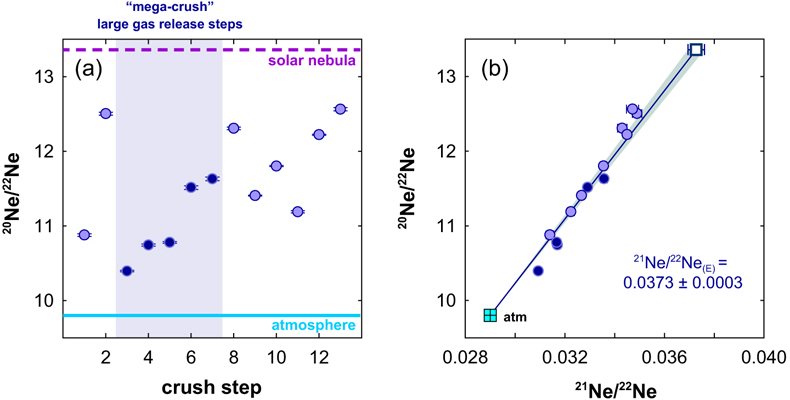
Figure 1 Ne isotopes in MiðfellRP09 step crushes. 20Ne/22Ne is shown (a) as a function of crush step and (b) against 21Ne/22Ne (error bars 1σ). Dark circles represent the heavy crush steps, referred to as “mega-crush” steps. Ne in mega-crush steps starts off close to atmospheric, and progressively shifts towards mantle compositions. All crush steps taken together define a mixing line between atmosphere and an extrapolated mantle source 21Ne/22Ne of 0.0373 ± 0.0003 (1σ) assuming a solar-like mantle 20Ne/22Ne of 13.36.
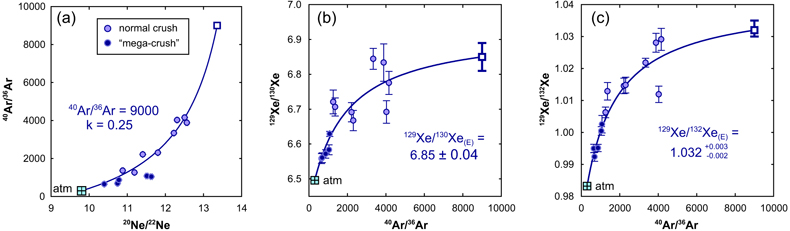
Figure 2 Ne-Ar and Ar-Xe mixing systematics in MiðfellRP09 step crushes. Data are shown along with best fit two component mixing hyperbola determined by total least squares (error bars 1σ). (a) In 40Ar/36Ar vs. 20Ne/22Ne, comparable fits can be achieved for a range of mantle end member 40Ar/36Ar ratios with compensating variation in the curvature parameter. Data and best fit mixing hyperbolae for 40Ar/36Ar vs. (b) 129Xe/130Xe and (c) 129Xe/132Xe are shown. In Ar-Xe, the mega-crush step data are tightly clustered and constrain the mixing hyperbolae, though they are more affected by atmospheric contamination than the relatively scattered normal-sized crush step data.
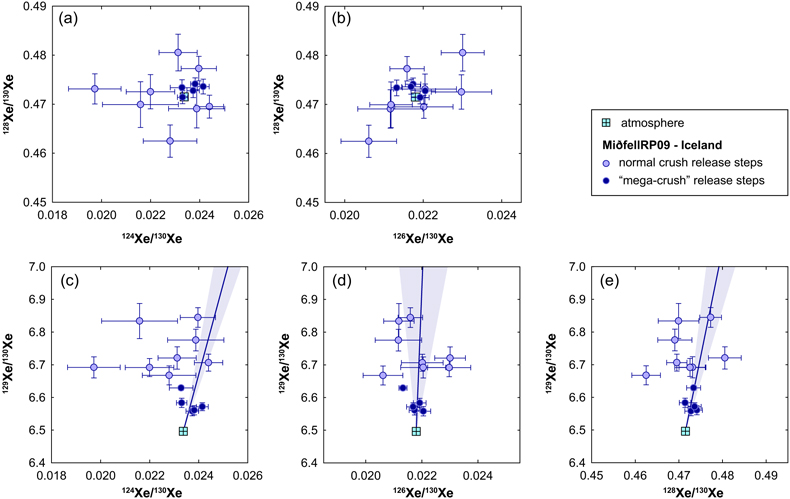
Figure 3 Xe primordial isotopes and 129Xe/130Xe. Data are shown with 1σ error bars. Among the normal crush steps, data are scattered with large error bars around the atmospheric composition. The mega-crush step data include steps that are resolved from the atmospheric composition in (a) 124Xe/130Xe and 128Xe/130Xe, though the relationship is not evident in (b) 128Xe/130Xe vs. 126Xe/130Xe. 129Xe/130Xe is plotted against the primordial isotope ratios in panels (c–e) along with fits through atmosphere and the error weighted averages of mega-crush data.
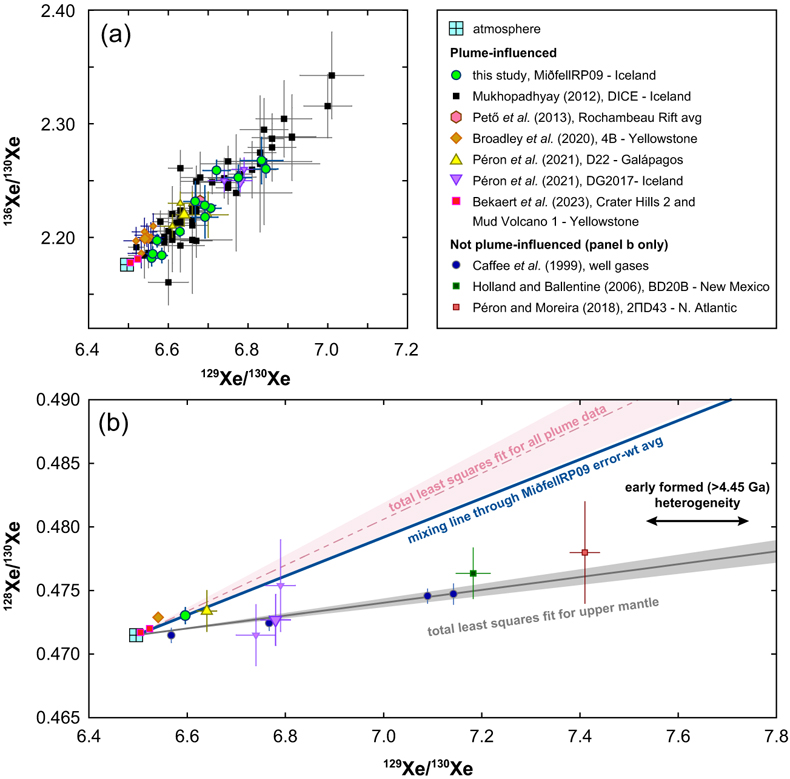
Figure 4 MiðfellRP09 and literature Xe isotopic data. Small symbols are individual data, while larger symbols are averages. (a) Mega-crush and regular crush step 136Xe/130Xe vs. 129Xe/130Xe data (1σ error bars) are consistent with prior Xe measurements in Iceland samples (Mukhopadhyay, 2012
Mukhopadhyay, S. (2012) Early differentiation and volatile accretion recorded in deep-mantle neon and xenon. Nature 486, 101–104. https://doi.org/10.1038/nature11141
; Péron et al., 2021Péron, S., Mukhopadhyay, S., Kurz, M.D., Graham, D.W. (2021) Deep-mantle krypton reveals Earth’s early accretion of carbonaceous matter. Nature 600, 462–467. https://doi.org/10.1038/s41586-021-04092-z
) and plume-influenced samples from Rochambeau Rift (Samoan plume), Galápagos, and Yellowstone (Pető et al., 2013Pető, M.K., Mukhopadhyay, S., Kelley, K.A. (2013) Heterogeneities from the first 100 million years recorded in deep mantle noble gases from the Northern Lau Back-arc Basin. Earth and Planetary Science Letters 369–370, 13–23. https://doi.org/10.1016/j.epsl.2013.02.012
; Broadley et al., 2020Broadley, M.W., Barry, P.H., Bekaert, D.V., Byrne, D.J., Caracausi, A., Ballentine, C.J., Marty, B. (2020) Identification of chondritic krypton and xenon in Yellowstone gases and the timing of terrestrial volatile accretion. Proceedings of the National Academy of Sciences 117, 13997–14004. https://doi.org/10.1073/pnas.2003907117
; Bekaert et al., 2023Bekaert, D.V., Barry, P.H., Broadley, M.W., Byrne, D.J., Marty, B., et al. (2023) Ultrahigh-precision noble gas isotope analyses reveal pervasive subsurface fractionation in hydrothermal systems. Science Advances 9, eadg2566. https://doi.org/10.1126/sciadv.adg2566
). (b) The error weighted average of mega-crush step 128Xe/130Xe vs. 129Xe/130Xe data (1σ error bars), along with average or most mantle-like compositions from plume and upper mantle samples (Péron and Moreira, 2018Péron, S., Moreira, M. (2018) Onset of volatile recycling into the mantle determined by xenon anomalies. Geochemical Perspectives Letters 9, 21–25. https://doi.org/10.7185/geochemlet.1833
; Caffee et al., 1999Caffee, M.W., Hudson, G.B., Velsko, C., Huss, G.R., Alexander Jr., E.C., Chivas, A.R. (1999) Primordial Noble Gases from Earth’s Mantle: Identification of a Primitive Volatile Component. Science 285, 2115–2118. https://doi.org/10.1126/science.285.5436.2115
; Holland and Ballentine, 2006Holland, G., Ballentine, C.J. (2006) Seawater subduction controls the heavy noble gas composition of the mantle. Nature 441, 186–191. https://doi.org/10.1038/nature04761
; Bekaert et al., 2023Bekaert, D.V., Barry, P.H., Broadley, M.W., Byrne, D.J., Marty, B., et al. (2023) Ultrahigh-precision noble gas isotope analyses reveal pervasive subsurface fractionation in hydrothermal systems. Science Advances 9, eadg2566. https://doi.org/10.1126/sciadv.adg2566
; see Fig. S-6 for details). Fits forced through atmosphere and a mixing line between the MiðfellRP09 average and atmosphere are shown. The slope of the plume fit is strongly affected by the precisely determined Yellowstone 4B average, which may reflect some mass dependent fractionation in the hydrothermal system (Bekaert et al., 2023Bekaert, D.V., Barry, P.H., Broadley, M.W., Byrne, D.J., Marty, B., et al. (2023) Ultrahigh-precision noble gas isotope analyses reveal pervasive subsurface fractionation in hydrothermal systems. Science Advances 9, eadg2566. https://doi.org/10.1126/sciadv.adg2566
). While individual measurements for DG2017 (Péron et al., 2021Péron, S., Mukhopadhyay, S., Kurz, M.D., Graham, D.W. (2021) Deep-mantle krypton reveals Earth’s early accretion of carbonaceous matter. Nature 600, 462–467. https://doi.org/10.1038/s41586-021-04092-z
) are shown, only the average was used to compute the best plume slope and its uncertainty. Despite a larger uncertainty in the plume fit, the plume and upper mantle fits have distinct slopes. The MiðfellRP09 mega-crush average is precisely determined, shows a prominent excess relative to atmosphere, and is consistent with data from other plume localities. The MiðfellRP09 average lies on a steeper slope than the upper mantle fit, indicating a plume mantle source with a lower 129Xe/130Xe at a given 128Xe/130Xe than the upper mantle.