



Rhenium elemental and isotopic variations at magmatic temperatures
Affiliations | Corresponding Author | Cite as | Funding information
Published by the European Association of Geochemistry
under Creative Commons License CC BY 4.0
Keywords: rhenium isotopes, Hekla, magmatic processes, terrestrial baseline, geochemical cycling of rhenium


- Share this article


Article views:2,689Cumulative count of HTML views and PDF downloads.
- Download Citation
- Rights & Permissions

top
Abstract
Figures
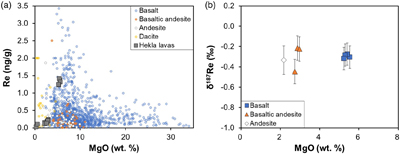 Figure 1 (a) A compilation of Re contents in igneous rock samples from the GEOROC database (http://georoc.eu; DIGIS Team, 2023) and from this study (Hekla lavas). (b) Re isotope (δ187Re) variations with MgO content in the Hekla lavas. Uncertainties on δ187Re represent the 2 s.d. of repeat multi-collector ICP-MS measurements on the same sample (or 2 s.e. internal error if there was only one measurement), or the long-term reproducibility for the standard solution (ICP; 0.11 ‰), whichever is larger (Table S-2). | 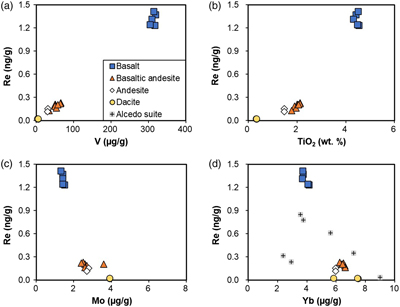 Figure 2 Re variations in the Hekla lavas with the concentrations of (a) V, (b) TiO2, (c) Mo and (d) Yb. Ancillary major and trace element data are given in Table S-3. In (d), Alcedo suite data from Righter et al. (1998) are plotted in grey for comparison. Error bars on the data are smaller than the size of symbols. | 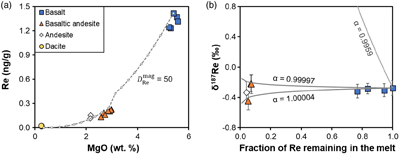 Figure 3 (a) Cotectic fractional crystallisation model (dashed line) for the evolution of Re in Hekla lavas. The fractionating assemblage at Hekla consists of orthopyroxene, plagioclase, clinopyroxene and (titano)magnetite (Sigmarsson et al., 1992; Geist et al., 2021). (b) Rayleigh fractionation model (solid lines) for assessing the extent of Re isotope fractionation during magma processes. Details of the modelling approach are given in Supplementary Information. | 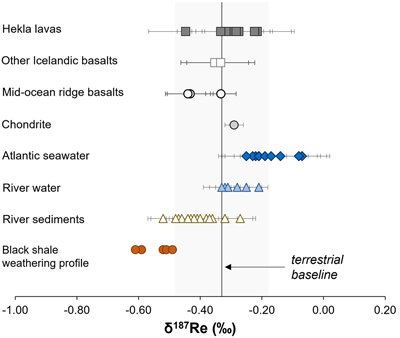 Figure 4 Available terrestrial Re isotope data (relative to NIST3143) measured to date. Data are from this study (Hekla lavas, other Icelandic basalts, MORBs; Table S-2), Dellinger et al. (2020; carbonaceous chondrite), Dickson et al. (2020; Atlantic seawater), Dellinger et al. (2021; Mackenzie River water and river sediments) and Miller et al. (2015; New Albany shale). |
| Figure 1 | Figure 2 | Figure 3 | Figure 4 |
top
Introduction
Rhenium (Re) is one of the rarest elements in the Earth’s crust, with an estimated abundance of ∼0.93 ng/g and 0.2–2 ng/g in oceanic and continental crust, respectively (Peucker-Ehrenbrink and Jahn, 2001
Peucker‐Ehrenbrink, B., Jahn, B.-m. (2001) Rhenium‐osmium isotope systematics and platinum group element concentrations: Loess and the upper continental crust. Geochemistry, Geophysics, Geosystems 2, 2001GC000172. https://doi.org/10.1029/2001GC000172
; Sun et al., 2003aSun, W., Arculus, R.J., Bennett, V.C., Eggins, S.M., Binns, R.A. (2003a) Evidence for rhenium enrichment in the mantle wedge from submarine arc–like volcanic glasses (Papua New Guinea). Geology 31, 845–848. https://doi.org/10.1130/G19832.1
, 2003bSun, W., Bennett, V.C., Eggins, S.M., Arculus, R.J., Perfit, M.R. (2003b) Rhenium systematics in submarine MORB and back-arc basin glasses: laser ablation ICP-MS results. Chemical Geology 196, 259–281. https://doi.org/10.1016/S0009-2541(02)00416-3
). The Re concentration of the primitive mantle is ∼0.28 ng/g, compared to 0.12–0.18 ng/g in the depleted mantle (McDonough and Sun, 1995McDonough, W.F., Sun, S.-s. (1995) The composition of the Earth. Chemical Geology 120, 223–253. https://doi.org/10.1016/0009-2541(94)00140-4
; Hauri and Hart, 1997Hauri, E.H., Hart, S.R. (1997) Rhenium abundances and systematics in oceanic basalts. Chemical Geology 139, 185–205. https://doi.org/10.1016/S0009-2541(97)00035-1
). There appears to be a “missing” Re component from the upper mantle (e.g., Sun et al., 2003bSun, W., Bennett, V.C., Eggins, S.M., Arculus, R.J., Perfit, M.R. (2003b) Rhenium systematics in submarine MORB and back-arc basin glasses: laser ablation ICP-MS results. Chemical Geology 196, 259–281. https://doi.org/10.1016/S0009-2541(02)00416-3
; Xue and Li, 2022Xue, S., Li, Y. (2022) Pyrrhotite–silicate melt partitioning of rhenium and the deep rhenium cycle in subduction zones. Geology 50, 232–237. https://doi.org/10.1130/G49374.1
), and there is a clear need for better constraints on the magmatic behaviour of Re. Whilst Re is known to be incompatible in most silicate phases, such as olivine and clinopyroxene (Righter et al., 2004Righter, K., Campbell, A.J., Humayun, M., Hervig, R.L. (2004) Partitioning of Ru, Rh, Pd, Re, Ir, and Au between Cr-bearing spinel, olivine, pyroxene and silicate melts. Geochimica et Cosmochimica Acta 68, 867–880. https://doi.org/10.1016/j.gca.2003.07.005
; Mallmann and O’Neill, 2007Mallmann, G., O’Neill, H.St.C. (2007) The effect of oxygen fugacity on the partitioning of Re between crystals and silicate melt during mantle melting. Geochimica et Cosmochimica Acta 71, 2837–2857. https://doi.org/10.1016/j.gca.2007.03.028
), the sulfur and oxygen fugacity (fS2 and fO2) controls on Re partitioning appear to be complicated. For example, Re is predicted to behave as a lithophile element under sulfide-poor and/or relatively oxidised conditions (such as during differentiation of arc magmas), whereas Re behaves as a chalcophile in reduced mid-ocean ridge basalt (MORB) type mantle and becomes more compatible with lower fO2 (Fonseca et al., 2007Fonseca, R.O.C., Mallmann, G., O’Neill, H.St.C., Campbell, I.H. (2007) How chalcophile is rhenium? An experimental study of the solubility of Re in sulphide mattes. Earth and Planetary Science Letters 260, 537–548. https://doi.org/10.1016/j.epsl.2007.06.012
; Mallmann and O’Neill, 2007Mallmann, G., O’Neill, H.St.C. (2007) The effect of oxygen fugacity on the partitioning of Re between crystals and silicate melt during mantle melting. Geochimica et Cosmochimica Acta 71, 2837–2857. https://doi.org/10.1016/j.gca.2007.03.028
); oxides such as magnetite can also potentially host Re (Righter et al., 1998Righter, K., Chesley, J.T., Geist, D., Ruiz, J. (1998) Behavior of Re during Magma Fractionation: an Example from Volcán Alcedo, Galápagos. Journal of Petrology 39, 785–795. https://doi.org/10.1093/petroj/39.4.785
; Li, 2014Li, Y. (2014) Comparative geochemistry of rhenium in oxidized arc magmas and MORB and rhenium partitioning during magmatic differentiation. Chemical Geology 386, 101–114. https://doi.org/10.1016/j.chemgeo.2014.08.013
).Rhenium has two isotopes, 187Re and 185Re, which comprise ∼63 % and 37 % of natural Re, respectively. The 187Re isotope is radioactive, but decays with a very long half-life (4.12 × 10¹⁰ yr; Smoliar et al., 1996
Smoliar, M.I., Walker, R.J., Morgan, J.W. (1996) Re-Os Ages of Group IIA, IIIA, IVA, and IVB Iron Meteorites. Science 271, 1099–1102. https://doi.org/10.1126/science.271.5252.1099
), making the isotope ratio of 187Re and 185Re more analogous to a stable isotope system (Miller et al., 2009Miller, C.A., Peucker-Ehrenbrink, B., Ball, L. (2009) Precise determination of rhenium isotope composition by multi-collector inductively-coupled plasma mass spectrometry. Journal of Analytical Atomic Spectrometry 24, 1069–1078. https://doi.org/10.1039/B818631F
). Rhenium is a redox-sensitive element (common valence states: 4+, 6+ and 7+), and because Re isotopes may be fractionated by redox and/or weathering processes (Miller et al., 2015Miller, C.A., Peucker-Ehrenbrink, B., Schauble, E.A. (2015) Theoretical modeling of rhenium isotope fractionation, natural variations across a black shale weathering profile, and potential as a paleoredox proxy. Earth and Planetary Science Letters 430, 339–348. https://doi.org/10.1016/j.epsl.2015.08.008
), the Re isotopic composition (denoted as δ187Re = [(187Re/185Re)sample/(187Re/185Re)NIST3143 − 1] × 1000) of ancient sediments holds the potential to infer changes in seafloor redox and/or global weathering intensity (Dickson et al., 2020Dickson, A.J., Hsieh, Y.-T., Bryan, A. (2020) The rhenium isotope composition of Atlantic Ocean seawater. Geochimica et Cosmochimica Acta 287, 221–228. https://doi.org/10.1016/j.gca.2020.02.020
; Dellinger et al., 2021Dellinger, M., Hilton, R.G., Nowell, G.M. (2021) Fractionation of rhenium isotopes in the Mackenzie River basin during oxidative weathering. Earth and Planetary Science Letters 573, 117131. https://doi.org/10.1016/j.epsl.2021.117131
). There is a growing dataset of Re isotopic compositions of seawater and river waters (Dickson et al., 2020Dickson, A.J., Hsieh, Y.-T., Bryan, A. (2020) The rhenium isotope composition of Atlantic Ocean seawater. Geochimica et Cosmochimica Acta 287, 221–228. https://doi.org/10.1016/j.gca.2020.02.020
; Dellinger et al., 2021Dellinger, M., Hilton, R.G., Nowell, G.M. (2021) Fractionation of rhenium isotopes in the Mackenzie River basin during oxidative weathering. Earth and Planetary Science Letters 573, 117131. https://doi.org/10.1016/j.epsl.2021.117131
). However, due partly to analytical challenges, few δ187Re measurements exist on igneous materials, limited to meteorites (Liu et al., 2017Liu, R., Hu, L., Humayun, M. (2017) Natural variations in the rhenium isotopic composition of meteorites. Meteoritics & Planetary Science 52, 479–492. https://doi.org/10.1111/maps.12803
) and standard reference materials (Dellinger et al., 2020Dellinger, M., Hilton, R.G., Nowell, G.M. (2020) Measurements of rhenium isotopic composition in low-abundance samples. Journal of Analytical Atomic Spectrometry 35, 377–387. https://doi.org/10.1039/C9JA00288J
). No studies have investigated the behaviour of Re isotopes during magmatic processes on Earth. Additionally, our understanding of the Re isotopic composition of the mantle is currently limited. These features need to be resolved to establish a terrestrial baseline that can be compared with δ187Re values of weathered materials, and to assess the global isotope mass balance of Re (Dickson et al., 2020Dickson, A.J., Hsieh, Y.-T., Bryan, A. (2020) The rhenium isotope composition of Atlantic Ocean seawater. Geochimica et Cosmochimica Acta 287, 221–228. https://doi.org/10.1016/j.gca.2020.02.020
).top
Materials and Methods
We present Re concentrations and isotopic compositions for a well-characterised sequence of lavas from Hekla volcano, Iceland. The analysed Hekla lavas cover a compositional range from basalt to dacite (46–69 wt. % SiO2), which have been interpreted as a differentiation sequence with or without contribution of minor amphibolite melting (Sigmarsson et al., 1992
Sigmarsson, O., Condomines, M., Fourcade, S. (1992) A detailed Th, Sr and O isotope study of Hekla: differentiation processes in an Icelandic volcano. Contributions to Mineralogy and Petrology 112, 20–34. https://doi.org/10.1007/BF00310953
, 2022Sigmarsson, O., Bergþórsdóttir, I.A., Devidal, J.-L., Larsen, G., Gannoun, A. (2022) Long or short silicic magma residence time beneath Hekla volcano, Iceland? Contributions to Mineralogy and Petrology 177, 13. https://doi.org/10.1007/s00410-021-01883-5
; Savage et al., 2011Savage, P.S., Georg, R.B., Williams, H.M., Burton, K.W., Halliday, A.N. (2011) Silicon isotope fractionation during magmatic differentiation. Geochimica et Cosmochimica Acta 75, 6124–6139. https://doi.org/10.1016/j.gca.2011.07.043
; Geist et al., 2021Geist, D., Harpp, K., Oswald, P., Wallace, P., Bindeman, I., Christensen, B. (2021) Hekla Revisited: Fractionation of a Magma Body at Historical Timescales. Journal of Petrology 62, egab001. https://doi.org/10.1093/petrology/egab001
; Supplementary Information). We also present results of Re isotope analysis for two unrelated Icelandic volcanic samples (RP80C-1 and BUR20-09) and three MORB samples spanning the Atlantic, Pacific and Indian Oceans (RDL DR30, CYP78 12-35 and MD57 D’10-1, respectively; Supplementary Information).The Re concentrations of the samples were determined via isotope dilution and isoamylol liquid-liquid extraction method (Birck et al., 1997
Birck, J.L., Barman, M.R., Capmas, F. (1997) Re-Os Isotopic Measurements at the Femtomole Level in Natural Samples. Geostandards Newsletter 21, 19–27. https://doi.org/10.1111/j.1751-908X.1997.tb00528.x
). The low Re concentrations of these samples mean that a mass of 1–10 g is necessary for the precise determination of stable Re isotopes (δ187Re). Chemical separation of Re was conducted using a three-step AG1-X8 anion exchange column procedure, following newly established methods by Dellinger et al. (2020)Dellinger, M., Hilton, R.G., Nowell, G.M. (2020) Measurements of rhenium isotopic composition in low-abundance samples. Journal of Analytical Atomic Spectrometry 35, 377–387. https://doi.org/10.1039/C9JA00288J
and Dickson et al. (2020)Dickson, A.J., Hsieh, Y.-T., Bryan, A. (2020) The rhenium isotope composition of Atlantic Ocean seawater. Geochimica et Cosmochimica Acta 287, 221–228. https://doi.org/10.1016/j.gca.2020.02.020
. Rhenium isotopes were measured using the multi-collector ICP-MS (Neptune Plus) instrument at Royal Holloway University of London. All the δ187Re results are reported relative to the NIST SRM 3143 standard. Details of the analytical methods and all Re data for this study are given in Supplementary Information and Tables S-1 and S-2.top
Results
The accuracy of the methods has been validated through the analysis of standard reference materials; the yielded δ187Re values of BHVO-2, BIR-1, BCR-2 and MAG-1 are consistent with literature values (Table S-1). The measured Re concentrations of the Hekla suite were the highest in the basalt samples (1.23–1.42 ng/g), and sharply decreased with decreasing MgO from 0.17–0.23 ng/g in the basaltic andesite to 0.13–0.15 ng/g in the andesite and 0.021–0.026 ng/g in the dacite (Fig. 1a; Table S-2). The δ187Re values of the Hekla lavas ranged from −0.28 ± 0.11 ‰ to −0.32 ± 0.11 ‰ and from −0.22 ± 0.11 ‰ to −0.45 ± 0.12 ‰ for the basalt and basaltic andesites, respectively, and a composition of −0.33 ± 0.14 ‰ (2 s.d.) was measured in an andesitic sample (Fig. 1b; Table S-2). It was not possible to analyse dacitic samples for Re isotopes because of their extremely low Re concentrations. The δ187Re values of two other Icelandic basalt samples, −0.35 ± 0.13 ‰ to −0.33 ± 0.11 ‰, were within the range of the Hekla suite. The three MORB samples exhibited Re concentrations of 0.78–1.43 ng/g and similar Re isotopic compositions of −0.33 ± 0.11 ‰ to −0.44 ± 0.11 ‰.
Figure 1 (a) A compilation of Re contents in igneous rock samples from the GEOROC database (http://georoc.eu; DIGIS Team, 2023
DIGIS Team (2023) GEOROC Compilation: Rock Types, GRO.data, V9. https://doi.org/10.25625/2JETOA
) and from this study (Hekla lavas). (b) Re isotope (δ187Re) variations with MgO content in the Hekla lavas. Uncertainties on δ187Re represent the 2 s.d. of repeat multi-collector ICP-MS measurements on the same sample (or 2 s.e. internal error if there was only one measurement), or the long-term reproducibility for the standard solution (ICP; 0.11 ‰), whichever is larger (Table S-2).top
Discussion
Evolution of Re during magmatic processes at Hekla volcano. The co-variations of Re with vanadium (V) and TiO2 provide a clue to the partitioning behaviour of Re within the Hekla suite. We demonstrate a concurrent removal of Re and V (Fig. 2a) during magmatic evolution; there is also a decreasing trend in Re concentrations with decreasing TiO2 (from 4.5 to 0.3 wt. %; Fig. 2b). In the Hekla lavas, oxide minerals, such as (titano)magnetite, host the majority of V (Prytulak et al., 2017
Prytulak, J., Sossi, P.A., Halliday, A.N., Plank, T., Savage, P.S., Woodhead, J.D. (2017) Stable vanadium isotopes as a redox proxy in magmatic systems? Geochemical Perspectives Letters 3, 75–84. https://doi.org/10.7185/geochemlet.1708
). A self-consistent model of fractional crystallisation of cotectic phases (Fig. 3a), following Prytulak et al. (2017)Prytulak, J., Sossi, P.A., Halliday, A.N., Plank, T., Savage, P.S., Woodhead, J.D. (2017) Stable vanadium isotopes as a redox proxy in magmatic systems? Geochemical Perspectives Letters 3, 75–84. https://doi.org/10.7185/geochemlet.1708
, shows that the evolution of Re concentrations in the Hekla lavas can be reproduced if the partition coefficient of Re in magnetite (DmagRe ) is ∼50. Similar to this study, Righter et al. (1998)Righter, K., Chesley, J.T., Geist, D., Ruiz, J. (1998) Behavior of Re during Magma Fractionation: an Example from Volcán Alcedo, Galápagos. Journal of Petrology 39, 785–795. https://doi.org/10.1093/petroj/39.4.785
observed a sharp decrease in Re concentrations in samples from Volcán Alcedo (Galapagos), from 0.61 ng/g in icelandite to 0.026 ng/g in rhyolite along the FeO and TiO2 depletion trend. These same authors measured an extremely high Re content in a magnetite separate (∼40 ng/g) and concluded that magnetite is a significant host phase for Re, with an estimated DmagRe = 20–50 for a sulfide-free system. In support of this argument, Mallmann and O’Neill (2007)Mallmann, G., O’Neill, H.St.C. (2007) The effect of oxygen fugacity on the partitioning of Re between crystals and silicate melt during mantle melting. Geochimica et Cosmochimica Acta 71, 2837–2857. https://doi.org/10.1016/j.gca.2007.03.028
suggested that Re4+ has a partitioning behaviour similar to Ti4+ and could substitute for Ti4+ in the solid phase. Note that fO2 (which is commonly reported in log units relative to the fayalite-magnetite-quartz buffer, FMQ) of the Icelandic magmas is close to FMQ (Moune et al., 2007Moune, S., Sigmarsson, O., Thordarson, T., Gauthier, P.J. (2007) Recent volatile evolution in the magmatic system of Hekla volcano, Iceland. Earth and Planetary Science Letters 255, 373–389. https://doi.org/10.1016/j.epsl.2006.12.024
) so is relatively higher than in average MORB, while for the Alcedo (Galapagos) suite, the estimated fO2 is more reducing, ∼FMQ−3 (Righter et al., 1998Righter, K., Chesley, J.T., Geist, D., Ruiz, J. (1998) Behavior of Re during Magma Fractionation: an Example from Volcán Alcedo, Galápagos. Journal of Petrology 39, 785–795. https://doi.org/10.1093/petroj/39.4.785
). Lower fO2 would result in higher fraction of Re as Re4+, favouring dissolution of Re in common upper mantle minerals as well as in magnetite (Mallmann and O’Neill, 2007Mallmann, G., O’Neill, H.St.C. (2007) The effect of oxygen fugacity on the partitioning of Re between crystals and silicate melt during mantle melting. Geochimica et Cosmochimica Acta 71, 2837–2857. https://doi.org/10.1016/j.gca.2007.03.028
; Liu and Li, 2023Liu, Z., Li, Y. (2023) Experimental constraints on the behavior of Pt and Re in oxidized arc magmas. Earth and Planetary Science Letters 603, 117986. https://doi.org/10.1016/j.epsl.2022.117986
). The similar DmagRe estimated for the two suites regardless of varying fO2 may be due to a compositional effect. In addition, it is possible that Re remains compatible in magnetite in anhydrous systems (e.g., both the Hekla and the Alcedo suites; Geist et al., 2021Geist, D., Harpp, K., Oswald, P., Wallace, P., Bindeman, I., Christensen, B. (2021) Hekla Revisited: Fractionation of a Magma Body at Historical Timescales. Journal of Petrology 62, egab001. https://doi.org/10.1093/petrology/egab001
; Righter et al., 1998Righter, K., Chesley, J.T., Geist, D., Ruiz, J. (1998) Behavior of Re during Magma Fractionation: an Example from Volcán Alcedo, Galápagos. Journal of Petrology 39, 785–795. https://doi.org/10.1093/petroj/39.4.785
) but is incompatible in hydrous systems, analogous to some high field strength elements (Nielsen and Beard, 2000Nielsen, R.L., Beard, J.S. (2000) Magnetite–melt HFSE partitioning. Chemical Geology 164, 21–34. https://doi.org/10.1016/S0009-2541(99)00139-4
).Figure 2 Re variations in the Hekla lavas with the concentrations of (a) V, (b) TiO2, (c) Mo and (d) Yb. Ancillary major and trace element data are given in Table S-3. In (d), Alcedo suite data from Righter et al. (1998)
Righter, K., Chesley, J.T., Geist, D., Ruiz, J. (1998) Behavior of Re during Magma Fractionation: an Example from Volcán Alcedo, Galápagos. Journal of Petrology 39, 785–795. https://doi.org/10.1093/petroj/39.4.785
are plotted in grey for comparison. Error bars on the data are smaller than the size of symbols.Figure 3 (a) Cotectic fractional crystallisation model (dashed line) for the evolution of Re in Hekla lavas. The fractionating assemblage at Hekla consists of orthopyroxene, plagioclase, clinopyroxene and (titano)magnetite (Sigmarsson et al., 1992
Sigmarsson, O., Condomines, M., Fourcade, S. (1992) A detailed Th, Sr and O isotope study of Hekla: differentiation processes in an Icelandic volcano. Contributions to Mineralogy and Petrology 112, 20–34. https://doi.org/10.1007/BF00310953
; Geist et al., 2021Geist, D., Harpp, K., Oswald, P., Wallace, P., Bindeman, I., Christensen, B. (2021) Hekla Revisited: Fractionation of a Magma Body at Historical Timescales. Journal of Petrology 62, egab001. https://doi.org/10.1093/petrology/egab001
). (b) Rayleigh fractionation model (solid lines) for assessing the extent of Re isotope fractionation during magma processes. Details of the modelling approach are given in Supplementary Information.Although it is generally accepted that Re is compatible in sulfide minerals under relatively reduced environments (e.g., Fonseca et al., 2007
Fonseca, R.O.C., Mallmann, G., O’Neill, H.St.C., Campbell, I.H. (2007) How chalcophile is rhenium? An experimental study of the solubility of Re in sulphide mattes. Earth and Planetary Science Letters 260, 537–548. https://doi.org/10.1016/j.epsl.2007.06.012
), we found no evidence for the partitioning of Re into sulfides in the Hekla lavas. While some studies found traces of sulfide saturation and mineral formation in the Hekla lavas (Geist et al., 2021Geist, D., Harpp, K., Oswald, P., Wallace, P., Bindeman, I., Christensen, B. (2021) Hekla Revisited: Fractionation of a Magma Body at Historical Timescales. Journal of Petrology 62, egab001. https://doi.org/10.1093/petrology/egab001
), others did not (Moune et al., 2007Moune, S., Sigmarsson, O., Thordarson, T., Gauthier, P.J. (2007) Recent volatile evolution in the magmatic system of Hekla volcano, Iceland. Earth and Planetary Science Letters 255, 373–389. https://doi.org/10.1016/j.epsl.2006.12.024
). The expected loss of molybdenum (Mo), another chalcophile element, due to sulfide extraction was also not observed (Yang et al., 2015Yang, J., Siebert, C., Barling, J., Savage, P., Liang, Y.-H., Halliday, A.N. (2015) Absence of molybdenum isotope fractionation during magmatic differentiation at Hekla volcano, Iceland. Geochimica et Cosmochimica Acta 162, 126–136. https://doi.org/10.1016/j.gca.2015.04.011
). High-pressure experiments conducted at ∼FMQ−1.8 to FMQ+1.5 show a strong correlation between the partition coefficients of Re and Mo between sulfide liquid, monosulfide solid solution and silicate melts (Feng and Li, 2019Feng, L., Li, Y. (2019) Comparative partitioning of Re and Mo between sulfide phases and silicate melt and implications for the behavior of Re during magmatic processes. Earth and Planetary Science Letters 517, 14–25. https://doi.org/10.1016/j.epsl.2019.04.010
), suggesting similar partitioning behaviours of Re and Mo between these phases. In the Hekla lavas, however, we find that the concentration of Re decreases with increasing Mo (Fig. 2c). We note that Hekla lavas do show a pronounced drop in sulfur (S) concentrations through two orders of magnitude from the basalt to the andesite and dacite (Table S-3), but this is likely the result of sulfur degassing (Moune et al., 2007Moune, S., Sigmarsson, O., Thordarson, T., Gauthier, P.J. (2007) Recent volatile evolution in the magmatic system of Hekla volcano, Iceland. Earth and Planetary Science Letters 255, 373–389. https://doi.org/10.1016/j.epsl.2006.12.024
).Whether Re and ytterbium (Yb) share a similar degree of incompatibility during differentiation is debated. Although early studies on mantle-derived magmas (e.g., Hauri and Hart, 1997
Hauri, E.H., Hart, S.R. (1997) Rhenium abundances and systematics in oceanic basalts. Chemical Geology 139, 185–205. https://doi.org/10.1016/S0009-2541(97)00035-1
; Sun et al., 2003aSun, W., Arculus, R.J., Bennett, V.C., Eggins, S.M., Binns, R.A. (2003a) Evidence for rhenium enrichment in the mantle wedge from submarine arc–like volcanic glasses (Papua New Guinea). Geology 31, 845–848. https://doi.org/10.1130/G19832.1
) found roughly constant Yb/Re ratios, others suggested that the Re-Yb similarity is not ubiquitous (e.g., Mallmann and O’Neill 2007Mallmann, G., O’Neill, H.St.C. (2007) The effect of oxygen fugacity on the partitioning of Re between crystals and silicate melt during mantle melting. Geochimica et Cosmochimica Acta 71, 2837–2857. https://doi.org/10.1016/j.gca.2007.03.028
; Li, 2014Li, Y. (2014) Comparative geochemistry of rhenium in oxidized arc magmas and MORB and rhenium partitioning during magmatic differentiation. Chemical Geology 386, 101–114. https://doi.org/10.1016/j.chemgeo.2014.08.013
). We show clearly that, in the Hekla lavas, Re is not enriched in evolved rocks (basaltic andesite, andesite, dacite) in the same way as Yb; Righter et al. (1998)Righter, K., Chesley, J.T., Geist, D., Ruiz, J. (1998) Behavior of Re during Magma Fractionation: an Example from Volcán Alcedo, Galápagos. Journal of Petrology 39, 785–795. https://doi.org/10.1093/petroj/39.4.785
observed a similar relationship between Re and Yb in their Galapagos icelandite to rhyolite sequence (Fig. 2d).A compilation of Re concentrations in igneous rock samples (basalt, basaltic andesite, andesite and dacite) from the GEOROC database is presented in Figure 1a. Rhenium concentrations appear to increase with decreasing MgO, to a Re concentration peak at ∼5 wt. % MgO, which could be primarily explained by the incompatibility of Re in common mafic phases, such as olivine and clinopyroxene. Whilst global igneous suites have varying degrees of sulfide saturation such that sequestration of Re by sulfide is plausible (e.g., Feng and Li, 2019
Feng, L., Li, Y. (2019) Comparative partitioning of Re and Mo between sulfide phases and silicate melt and implications for the behavior of Re during magmatic processes. Earth and Planetary Science Letters 517, 14–25. https://doi.org/10.1016/j.epsl.2019.04.010
; Liu and Li, 2023Liu, Z., Li, Y. (2023) Experimental constraints on the behavior of Pt and Re in oxidized arc magmas. Earth and Planetary Science Letters 603, 117986. https://doi.org/10.1016/j.epsl.2022.117986
), we propose that at lower MgO, crystallisation of oxide minerals also exerts a control on the behaviour of Re.No resolvable Re isotope fractionation during magnetite crystallisation. Despite the very large range in Re concentrations, there is no statistically significant difference, within uncertainties, between the δ187Re values for different types of rocks (basalt, basaltic andesite and andesite) of the Hekla suite. No clear trend or systematic variation in δ187Re values is observed when plotted against concentrations of MgO, SiO2, TiO2, S, V, Mo, Yb or Re in the Hekla lavas. (Figs. 1b, S-1). The Hekla lava samples showed an average δ187Re of −0.30 ± 0.14 ‰ (2 s.d., n = 8).
The relatively constant δ187Re (despite systematically varying Re concentrations) during magmatic evolution implies minor Re isotope fractionation between the crystallising minerals and silicate melt. In general, the magnitude of equilibrium isotope fractionation in high-temperature geological environments depends on differences in bond strength, which are dominantly related to oxidation states and cation coordination. When the solid phase is an oxide, such as (titano)magnetite, Re likely occurs in the +4 state as ReO2 (Righter et al., 1998
Righter, K., Chesley, J.T., Geist, D., Ruiz, J. (1998) Behavior of Re during Magma Fractionation: an Example from Volcán Alcedo, Galápagos. Journal of Petrology 39, 785–795. https://doi.org/10.1093/petroj/39.4.785
; Xiong and Wood, 1999Xiong, Y., Wood, S.A. (1999) Experimental determination of the solubility of ReO2 and the dominant oxidation state of rhenium in hydrothermal solutions. Chemical Geology 158, 245–256. https://doi.org/10.1016/S0009-2541(99)00050-9
). In the silicate melt, Re is mainly found as ReO2 (Re4+) and ReO3 (Re6+) species at typical terrestrial magma oxygen fugacities (Xiong and Wood, 1999Xiong, Y., Wood, S.A. (1999) Experimental determination of the solubility of ReO2 and the dominant oxidation state of rhenium in hydrothermal solutions. Chemical Geology 158, 245–256. https://doi.org/10.1016/S0009-2541(99)00050-9
; Ertel et al., 2001Ertel, W., O’Neill, H.St.C., Sylvester, P.J., Dingwell, D.B., Spettel, B. (2001) The solubility of rhenium in silicate melts: Implications for the geochemical properties of rhenium at high temperatures. Geochimica et Cosmochimica Acta 65, 2161–2170. https://doi.org/10.1016/S0016-7037(01)00582-8
); Re6+ is highly incompatible in mantle minerals (Mallmann and O’Neill, 2007Mallmann, G., O’Neill, H.St.C. (2007) The effect of oxygen fugacity on the partitioning of Re between crystals and silicate melt during mantle melting. Geochimica et Cosmochimica Acta 71, 2837–2857. https://doi.org/10.1016/j.gca.2007.03.028
; Liu and Li, 2023Liu, Z., Li, Y. (2023) Experimental constraints on the behavior of Pt and Re in oxidized arc magmas. Earth and Planetary Science Letters 603, 117986. https://doi.org/10.1016/j.epsl.2022.117986
). No experimentally determined isotope fractionation factor between different Re molecules has been reported, but we adopt the electronic structure modelling by Miller et al. (2015)Miller, C.A., Peucker-Ehrenbrink, B., Schauble, E.A. (2015) Theoretical modeling of rhenium isotope fractionation, natural variations across a black shale weathering profile, and potential as a paleoredox proxy. Earth and Planetary Science Letters 430, 339–348. https://doi.org/10.1016/j.epsl.2015.08.008
as a first approximation. Of all the Re4+ and Re7+ species investigated, excluding Re in the thiolated form, the net equilibrium fractionation factor (α) of Re, considering the combined mass dependent and nuclear volume effects at estimated Hekla magmatic temperatures of ∼1000 °C (Geist et al., 2021Geist, D., Harpp, K., Oswald, P., Wallace, P., Bindeman, I., Christensen, B. (2021) Hekla Revisited: Fractionation of a Magma Body at Historical Timescales. Journal of Petrology 62, egab001. https://doi.org/10.1093/petrology/egab001
), is very close to unity: ∼0.99997 to 1.00004 (Miller et al., 2015Miller, C.A., Peucker-Ehrenbrink, B., Schauble, E.A. (2015) Theoretical modeling of rhenium isotope fractionation, natural variations across a black shale weathering profile, and potential as a paleoredox proxy. Earth and Planetary Science Letters 430, 339–348. https://doi.org/10.1016/j.epsl.2015.08.008
; assuming ). We may expect the equilibrium isotope fractionation between Re4+ and Re6+ oxides to be even smaller. If we apply 0.99997 and 1.00004 as an estimation for the bulk Re isotope fractionation factor, then a Rayleigh fractionation model suggests that crystallisation of magnetite would lead to only subtly heavier or lighter δ187Re in the residual melt (Fig. 3b). The very subtle Re isotope fractionation in compositionally evolved lithologies may not be resolvable at current levels of precision.
The absence of significant Re isotope fractionation during magmatic processes at Hekla supports magnetite crystallisation as the dominant process instead of Re degassing. The volatility of Re has been reported in several magmatic systems (e.g., Norman et al., 2004
Norman, M.D., Garcia, M.O., Bennett, V.C. (2004) Rhenium and chalcophile elements in basaltic glasses from Ko’olau and Moloka’i volcanoes: Magmatic outgassing and composition of the Hawaiian plume. Geochimica et Cosmochimica Acta 68, 3761–3777. https://doi.org/10.1016/j.gca.2004.02.025
), but kinetic isotope fractionation of Re is expected during degassing. The theoretical maximum Rayleigh fractionation coefficient (α) during vaporisation as Re2O7 gas can be calculated as the inverse square root of the mass of the Re isotopes ( ) (e.g., Richter et al., 2007
Richter, F.M., Janney, P.E., Mendybaev, R.A., Davis, A.M., Wadhwa, M. (2007) Elemental and isotopic fractionation of Type B CAI-like liquids by evaporation. Geochimica et Cosmochimica Acta 71, 5544–5564. https://doi.org/10.1016/j.gca.2007.09.005
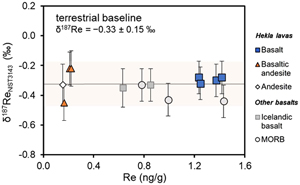
). If degassing of Re is the dominant process during the evolution of the Hekla lavas, we would expect the δ187Re in the residual silicate melts to become progressively heavier; this model is illustrated in Figure 3b, which does not agree with the observed relatively narrow range (−0.45 to −0.22 ‰). Given the volatile behaviour of Re and that the Re isotope system is insensitive to fractional crystallisation, δ187Re can potentially be used as a discriminant of Re degassing in magmatic processes.Implications for a first estimate of a Re isotope terrestrial baseline. Whilst degassing of Re and post-eruption alteration have the potential to modify the Re isotope signature, we have been able to demonstrate that Re isotope fractionation between crystallising minerals (magnetite) and silicate melt during magmatic processes is not analytically resolvable at the current stage. Un-degassed and unaltered igneous rocks therefore have the potential to infer the Re isotopic composition of their source. Although sourced from different tectonic settings and mantle depths, our analysed other Icelandic basalts (RP80C-1 and BUR20-09) and MORBs (from the Atlantic, Pacific and Indian Oceans) also show limited Re isotopic variability (−0.44 to −0.33 ‰), overlapping with the Hekla lava δ187Re (−0.45 to −0.22 ‰) (Table S-2; Fig. 4). We note that these Re isotope values are also indistinguishable within uncertainty from the δ187Re of carbonaceous chondrite (−0.29 ± 0.03 ‰, CV3 Allende; Dellinger et al., 2020
Dellinger, M., Hilton, R.G., Nowell, G.M. (2020) Measurements of rhenium isotopic composition in low-abundance samples. Journal of Analytical Atomic Spectrometry 35, 377–387. https://doi.org/10.1039/C9JA00288J
; Fig. 4), as well as our analysed standard reference materials BHVO-2 (Hawaiian basalt), BIR-1 (Icelandic basalt) and BCR-2 (Columbia River Flood basalt) (Table S-1).Figure 4 Available terrestrial Re isotope data (relative to NIST3143) measured to date. Data are from this study (Hekla lavas, other Icelandic basalts, MORBs; Table S-2), Dellinger et al. (2020
Dellinger, M., Hilton, R.G., Nowell, G.M. (2020) Measurements of rhenium isotopic composition in low-abundance samples. Journal of Analytical Atomic Spectrometry 35, 377–387. https://doi.org/10.1039/C9JA00288J
; carbonaceous chondrite), Dickson et al. (2020Dickson, A.J., Hsieh, Y.-T., Bryan, A. (2020) The rhenium isotope composition of Atlantic Ocean seawater. Geochimica et Cosmochimica Acta 287, 221–228. https://doi.org/10.1016/j.gca.2020.02.020
; Atlantic seawater), Dellinger et al. (2021Dellinger, M., Hilton, R.G., Nowell, G.M. (2021) Fractionation of rhenium isotopes in the Mackenzie River basin during oxidative weathering. Earth and Planetary Science Letters 573, 117131. https://doi.org/10.1016/j.epsl.2021.117131
; Mackenzie River water and river sediments) and Miller et al. (2015Miller, C.A., Peucker-Ehrenbrink, B., Schauble, E.A. (2015) Theoretical modeling of rhenium isotope fractionation, natural variations across a black shale weathering profile, and potential as a paleoredox proxy. Earth and Planetary Science Letters 430, 339–348. https://doi.org/10.1016/j.epsl.2015.08.008
; New Albany shale).With the current data, the restricted range in δ187Re values of the compositionally diverse igneous samples (eight Hekla lavas, two other Icelandic basalts, three MORBs, one chondrite) makes it possible to propose a first estimate of a terrestrial baseline for Re isotopes (−0.33 ± 0.15 ‰, 2 s.d., n = 14). Available Re isotope data (Fig. 4) suggest that the δ187Re of Atlantic seawater (−0.17 ± 0.12 ‰, 2 s.d., n = 12; Dickson et al., 2020
Dickson, A.J., Hsieh, Y.-T., Bryan, A. (2020) The rhenium isotope composition of Atlantic Ocean seawater. Geochimica et Cosmochimica Acta 287, 221–228. https://doi.org/10.1016/j.gca.2020.02.020
) is isotopically heavy compared to this baseline. Whilst the only published δ187Re values for river water (−0.29 ± 0.09 ‰, 2 s.d., n = 10; Dellinger et al., 2021Dellinger, M., Hilton, R.G., Nowell, G.M. (2021) Fractionation of rhenium isotopes in the Mackenzie River basin during oxidative weathering. Earth and Planetary Science Letters 573, 117131. https://doi.org/10.1016/j.epsl.2021.117131
) are within the baseline range, sedimentary rock δ187Re from New Albany shales (around −0.6 ‰; Miller et al., 2015Miller, C.A., Peucker-Ehrenbrink, B., Schauble, E.A. (2015) Theoretical modeling of rhenium isotope fractionation, natural variations across a black shale weathering profile, and potential as a paleoredox proxy. Earth and Planetary Science Letters 430, 339–348. https://doi.org/10.1016/j.epsl.2015.08.008
) and Mackenzie River sediments (around −0.52 to −0.27 ‰; Dellinger et al., 2021Dellinger, M., Hilton, R.G., Nowell, G.M. (2021) Fractionation of rhenium isotopes in the Mackenzie River basin during oxidative weathering. Earth and Planetary Science Letters 573, 117131. https://doi.org/10.1016/j.epsl.2021.117131
) all exhibit offsets to lighter isotopic values. This illustrates notable isotopic variability during the surface cycling of Re, both in terms of weathering processes on land, likely via preferential oxidation of reactive phases with heavy δ187Re (Dellinger et al., 2021Dellinger, M., Hilton, R.G., Nowell, G.M. (2021) Fractionation of rhenium isotopes in the Mackenzie River basin during oxidative weathering. Earth and Planetary Science Letters 573, 117131. https://doi.org/10.1016/j.epsl.2021.117131
), and in terms of isotopically light sinks for Re in the oceans and/or input of Re to the oceans from other sources that are yet to be discovered (Dickson et al., 2020Dickson, A.J., Hsieh, Y.-T., Bryan, A. (2020) The rhenium isotope composition of Atlantic Ocean seawater. Geochimica et Cosmochimica Acta 287, 221–228. https://doi.org/10.1016/j.gca.2020.02.020
). While there is a clear need for extending the analysis of stable Re isotopes in the Earth’s igneous reservoirs, results from this study are pivotal for interpreting the causes of Re isotope variations in low-temperature natural environments.top
Acknowledgements
This work was funded by Natural Environment Research Council UK Standard Grant to RGH, AJD, and JP (NE/T001119). Hekla lava samples were collected by PS & KB between 2009 and 2010 and MORB samples were provided by KB; we thank Matthew Thirlwall for providing the Icelandic basalt RP80C-1. We thank Bernhard Peucker-Ehrenbrink, an anonymous reviewer, and the editor Raúl Fonseca for their valuable comments that have improved the quality of this manuscript.
Editor: Raul O.C. Fonseca
top
References
Birck, J.L., Barman, M.R., Capmas, F. (1997) Re-Os Isotopic Measurements at the Femtomole Level in Natural Samples. Geostandards Newsletter 21, 19–27. https://doi.org/10.1111/j.1751-908X.1997.tb00528.x
 Show in context
 The Re concentrations of the samples were determined via isotope dilution and isoamylol liquid-liquid extraction method (Birck et al., 1997).
View in article
Dellinger, M., Hilton, R.G., Nowell, G.M. (2020) Measurements of rhenium isotopic composition in low-abundance samples. Journal of Analytical Atomic Spectrometry 35, 377–387. https://doi.org/10.1039/C9JA00288J
Show in context However, due partly to analytical challenges, few δ187Re measurements exist on igneous materials, limited to meteorites (Liu et al., 2017) and standard reference materials (Dellinger et al., 2020).
View in article
Chemical separation of Re was conducted using a three-step AG1-X8 anion exchange column procedure, following newly established methods by Dellinger et al. (2020) and Dickson et al. (2020).
View in article
We note that these Re isotope values are also indistinguishable within uncertainty from the δ187Re of carbonaceous chondrite (−0.29 ± 0.03 ‰, CV3 Allende; Dellinger et al., 2020; Fig. 4), as well as our analysed standard reference materials BHVO-2 (Hawaiian basalt), BIR-1 (Icelandic basalt) and BCR-2 (Columbia River Flood basalt) (Table S-1).
View in article
Data are from this study (Hekla lavas, other Icelandic basalts, MORBs; Table S-2), Dellinger et al. (2020; carbonaceous chondrite), Dickson et al. (2020; Atlantic seawater), Dellinger et al. (2021; Mackenzie River water and river sediments) and Miller et al. (2015; New Albany shale).
View in article
Dellinger, M., Hilton, R.G., Nowell, G.M. (2021) Fractionation of rhenium isotopes in the Mackenzie River basin during oxidative weathering. Earth and Planetary Science Letters 573, 117131. https://doi.org/10.1016/j.epsl.2021.117131
Show in context Rhenium is a redox-sensitive element (common valence states: 4+, 6+ and 7+), and because Re isotopes may be fractionated by redox and/or weathering processes (Miller et al., 2015), the Re isotopic composition (denoted as δ187Re = [(187Re/185Re)sample/(187Re/185Re)NIST3143 − 1] × 1000) of ancient sediments holds the potential to infer changes in seafloor redox and/or global weathering intensity (Dickson et al., 2020; Dellinger et al., 2021).
View in article
There is a growing dataset of Re isotopic compositions of seawater and river waters (Dickson et al., 2020; Dellinger et al., 2021).
View in article
Data are from this study (Hekla lavas, other Icelandic basalts, MORBs; Table S-2), Dellinger et al. (2020; carbonaceous chondrite), Dickson et al. (2020; Atlantic seawater), Dellinger et al. (2021; Mackenzie River water and river sediments) and Miller et al. (2015; New Albany shale).
View in article
Whilst the only published δ187Re values for river water (−0.29 ± 0.09 ‰, 2 s.d., n = 10; Dellinger et al., 2021) are within the baseline range, sedimentary rock δ187Re from New Albany shales (around −0.6 ‰; Miller et al., 2015) and Mackenzie River sediments (around −0.52 to −0.27 ‰; Dellinger et al., 2021) all exhibit offsets to lighter isotopic values.
View in article
This illustrates notable isotopic variability during the surface cycling of Re, both in terms of weathering processes on land, likely via preferential oxidation of reactive phases with heavy δ187Re (Dellinger et al., 2021), and in terms of isotopically light sinks for Re in the oceans and/or input of Re to the oceans from other sources that are yet to be discovered (Dickson et al., 2020).
View in article
Dickson, A.J., Hsieh, Y.-T., Bryan, A. (2020) The rhenium isotope composition of Atlantic Ocean seawater. Geochimica et Cosmochimica Acta 287, 221–228. https://doi.org/10.1016/j.gca.2020.02.020
Show in context Rhenium is a redox-sensitive element (common valence states: 4+, 6+ and 7+), and because Re isotopes may be fractionated by redox and/or weathering processes (Miller et al., 2015), the Re isotopic composition (denoted as δ187Re = [(187Re/185Re)sample/(187Re/185Re)NIST3143 − 1] × 1000) of ancient sediments holds the potential to infer changes in seafloor redox and/or global weathering intensity (Dickson et al., 2020; Dellinger et al., 2021).
View in article
There is a growing dataset of Re isotopic compositions of seawater and river waters (Dickson et al., 2020; Dellinger et al., 2021).
View in article
These features need to be resolved to establish a terrestrial baseline that can be compared with δ187Re values of weathered materials, and to assess the global isotope mass balance of Re (Dickson et al., 2020).
View in article
Chemical separation of Re was conducted using a three-step AG1-X8 anion exchange column procedure, following newly established methods by Dellinger et al. (2020) and Dickson et al. (2020).
View in article
Data are from this study (Hekla lavas, other Icelandic basalts, MORBs; Table S-2), Dellinger et al. (2020; carbonaceous chondrite), Dickson et al. (2020; Atlantic seawater), Dellinger et al. (2021; Mackenzie River water and river sediments) and Miller et al. (2015; New Albany shale).
View in article
Available Re isotope data (Fig. 4) suggest that the δ187Re of Atlantic seawater (−0.17 ± 0.12 ‰, 2 s.d., n = 12; Dickson et al., 2020) is isotopically heavy compared to this baseline.
View in article
This illustrates notable isotopic variability during the surface cycling of Re, both in terms of weathering processes on land, likely via preferential oxidation of reactive phases with heavy δ187Re (Dellinger et al., 2021), and in terms of isotopically light sinks for Re in the oceans and/or input of Re to the oceans from other sources that are yet to be discovered (Dickson et al., 2020).
View in article
DIGIS Team (2023) GEOROC Compilation: Rock Types, GRO.data, V9. https://doi.org/10.25625/2JETOA
Show in context (a) A compilation of Re contents in igneous rock samples from the GEOROC database (http://georoc.eu; DIGIS Team, 2023) and from this study (Hekla lavas).
View in article
Ertel, W., O’Neill, H.St.C., Sylvester, P.J., Dingwell, D.B., Spettel, B. (2001) The solubility of rhenium in silicate melts: Implications for the geochemical properties of rhenium at high temperatures. Geochimica et Cosmochimica Acta 65, 2161–2170. https://doi.org/10.1016/S0016-7037(01)00582-8
Show in context In the silicate melt, Re is mainly found as ReO2 (Re4+) and ReO3 (Re6+) species at typical terrestrial magma oxygen fugacities (Xiong and Wood, 1999; Ertel et al., 2001); Re6+ is highly incompatible in mantle minerals (Mallmann and O’Neill, 2007; Liu and Li, 2023).
View in article
Feng, L., Li, Y. (2019) Comparative partitioning of Re and Mo between sulfide phases and silicate melt and implications for the behavior of Re during magmatic processes. Earth and Planetary Science Letters 517, 14–25. https://doi.org/10.1016/j.epsl.2019.04.010
Show in context High-pressure experiments conducted at ∼FMQ−1.8 to FMQ+1.5 show a strong correlation between the partition coefficients of Re and Mo between sulfide liquid, monosulfide solid solution and silicate melts (Feng and Li, 2019), suggesting similar partitioning behaviours of Re and Mo between these phases.
View in article
Whilst global igneous suites have varying degrees of sulfide saturation such that sequestration of Re by sulfide is plausible (e.g., Feng and Li, 2019; Liu and Li, 2023), we propose that at lower MgO, crystallisation of oxide minerals also exerts a control on the behaviour of Re.
View in article
Fonseca, R.O.C., Mallmann, G., O’Neill, H.St.C., Campbell, I.H. (2007) How chalcophile is rhenium? An experimental study of the solubility of Re in sulphide mattes. Earth and Planetary Science Letters 260, 537–548. https://doi.org/10.1016/j.epsl.2007.06.012
Show in context For example, Re is predicted to behave as a lithophile element under sulfide-poor and/or relatively oxidised conditions (such as during differentiation of arc magmas), whereas Re behaves as a chalcophile in reduced mid-ocean ridge basalt (MORB) type mantle and becomes more compatible with lower fO2 (Fonseca et al., 2007; Mallmann and O’Neill, 2007); oxides such as magnetite can also potentially host Re (Righter et al., 1998; Li, 2014).
View in article
Although it is generally accepted that Re is compatible in sulfide minerals under relatively reduced environments (e.g., Fonseca et al., 2007), we found no evidence for the partitioning of Re into sulfides in the Hekla lavas.
View in article
Geist, D., Harpp, K., Oswald, P., Wallace, P., Bindeman, I., Christensen, B. (2021) Hekla Revisited: Fractionation of a Magma Body at Historical Timescales. Journal of Petrology 62, egab001. https://doi.org/10.1093/petrology/egab001
Show in context The analysed Hekla lavas cover a compositional range from basalt to dacite (46–69 wt. % SiO2), which have been interpreted as a differentiation sequence with or without contribution of minor amphibolite melting (Sigmarsson et al., 1992, 2022; Savage et al., 2011; Geist et al., 2021; Supplementary Information).
View in article
In addition, it is possible that Re remains compatible in magnetite in anhydrous systems (e.g., both the Hekla and the Alcedo suites; Geist et al., 2021; Righter et al., 1998) but is incompatible in hydrous systems, analogous to some high field strength elements (Nielsen and Beard, 2000).
View in article
The fractionating assemblage at Hekla consists of orthopyroxene, plagioclase, clinopyroxene and (titano)magnetite (Sigmarsson et al., 1992; Geist et al., 2021).
View in article
While some studies found traces of sulfide saturation and mineral formation in the Hekla lavas (Geist et al., 2021), others did not (Moune et al., 2007).
View in article
Of all the Re4+ and Re7+ species investigated, excluding Re in the thiolated form, the net equilibrium fractionation factor (α) of Re, considering the combined mass dependent and nuclear volume effects at estimated Hekla magmatic temperatures of ∼1000 °C (Geist et al., 2021), is very close to unity: ∼0.99997 to 1.00004 (Miller et al., 2015; assuming ).
View in article
Hauri, E.H., Hart, S.R. (1997) Rhenium abundances and systematics in oceanic basalts. Chemical Geology 139, 185–205. https://doi.org/10.1016/S0009-2541(97)00035-1
Show in context The Re concentration of the primitive mantle is ∼0.28 ng/g, compared to 0.12–0.18 ng/g in the depleted mantle (McDonough and Sun, 1995; Hauri and Hart, 1997).
View in article
Although early studies on mantle-derived magmas (e.g., Hauri and Hart, 1997; Sun et al., 2003a) found roughly constant Yb/Re ratios, others suggested that the Re-Yb similarity is not ubiquitous (e.g., Mallmann and O’Neill 2007; Li, 2014).
View in article
Li, Y. (2014) Comparative geochemistry of rhenium in oxidized arc magmas and MORB and rhenium partitioning during magmatic differentiation. Chemical Geology 386, 101–114. https://doi.org/10.1016/j.chemgeo.2014.08.013
Show in context For example, Re is predicted to behave as a lithophile element under sulfide-poor and/or relatively oxidised conditions (such as during differentiation of arc magmas), whereas Re behaves as a chalcophile in reduced mid-ocean ridge basalt (MORB) type mantle and becomes more compatible with lower fO2 (Fonseca et al., 2007; Mallmann and O’Neill, 2007); oxides such as magnetite can also potentially host Re (Righter et al., 1998; Li, 2014).
View in article
Although early studies on mantle-derived magmas (e.g., Hauri and Hart, 1997; Sun et al., 2003a) found roughly constant Yb/Re ratios, others suggested that the Re-Yb similarity is not ubiquitous (e.g., Mallmann and O’Neill 2007; Li, 2014).
View in article
Liu, R., Hu, L., Humayun, M. (2017) Natural variations in the rhenium isotopic composition of meteorites. Meteoritics & Planetary Science 52, 479–492. https://doi.org/10.1111/maps.12803
Show in context However, due partly to analytical challenges, few δ187Re measurements exist on igneous materials, limited to meteorites (Liu et al., 2017) and standard reference materials (Dellinger et al., 2020).
View in article
Liu, Z., Li, Y. (2023) Experimental constraints on the behavior of Pt and Re in oxidized arc magmas. Earth and Planetary Science Letters 603, 117986. https://doi.org/10.1016/j.epsl.2022.117986
Show in context Lower fO2 would result in higher fraction of Re as Re4+, favouring dissolution of Re in common upper mantle minerals as well as in magnetite (Mallmann and O’Neill, 2007; Liu and Li, 2023).
View in article
Whilst global igneous suites have varying degrees of sulfide saturation such that sequestration of Re by sulfide is plausible (e.g., Feng and Li, 2019; Liu and Li, 2023), we propose that at lower MgO, crystallisation of oxide minerals also exerts a control on the behaviour of Re.
View in article
In the silicate melt, Re is mainly found as ReO2 (Re4+) and ReO3 (Re6+) species at typical terrestrial magma oxygen fugacities (Xiong and Wood, 1999; Ertel et al., 2001); Re6+ is highly incompatible in mantle minerals (Mallmann and O’Neill, 2007; Liu and Li, 2023).
View in article
Mallmann, G., O’Neill, H.St.C. (2007) The effect of oxygen fugacity on the partitioning of Re between crystals and silicate melt during mantle melting. Geochimica et Cosmochimica Acta 71, 2837–2857. https://doi.org/10.1016/j.gca.2007.03.028
Show in context There appears to be a “missing” Re component from the upper mantle (e.g., Sun et al., 2003b; Xue and Li, 2022), and there is a clear need for better constraints on the magmatic behaviour of Re. Whilst Re is known to be incompatible in most silicate phases, such as olivine and clinopyroxene (Righter et al., 2004; Mallmann and O’Neill, 2007), the sulfur and oxygen fugacity (fS2 and fO2) controls on Re partitioning appear to be complicated.
View in article
For example, Re is predicted to behave as a lithophile element under sulfide-poor and/or relatively oxidised conditions (such as during differentiation of arc magmas), whereas Re behaves as a chalcophile in reduced mid-ocean ridge basalt (MORB) type mantle and becomes more compatible with lower fO2 (Fonseca et al., 2007; Mallmann and O’Neill, 2007); oxides such as magnetite can also potentially host Re (Righter et al., 1998; Li, 2014).
View in article
In support of this argument, Mallmann and O’Neill (2007) suggested that Re4+ has a partitioning behaviour similar to Ti4+ and could substitute for Ti4+ in the solid phase.
View in article
Lower fO2 would result in higher fraction of Re as Re4+, favouring dissolution of Re in common upper mantle minerals as well as in magnetite (Mallmann and O’Neill, 2007; Liu and Li, 2023).
View in article
Although early studies on mantle-derived magmas (e.g., Hauri and Hart, 1997; Sun et al., 2003a) found roughly constant Yb/Re ratios, others suggested that the Re-Yb similarity is not ubiquitous (e.g., Mallmann and O’Neill 2007; Li, 2014).
View in article
In the silicate melt, Re is mainly found as ReO2 (Re4+) and ReO3 (Re6+) species at typical terrestrial magma oxygen fugacities (Xiong and Wood, 1999; Ertel et al., 2001); Re6+ is highly incompatible in mantle minerals (Mallmann and O’Neill, 2007; Liu and Li, 2023).
View in article
McDonough, W.F., Sun, S.-s. (1995) The composition of the Earth. Chemical Geology 120, 223–253. https://doi.org/10.1016/0009-2541(94)00140-4
Show in context The Re concentration of the primitive mantle is ∼0.28 ng/g, compared to 0.12–0.18 ng/g in the depleted mantle (McDonough and Sun, 1995; Hauri and Hart, 1997).
View in article
Miller, C.A., Peucker-Ehrenbrink, B., Ball, L. (2009) Precise determination of rhenium isotope composition by multi-collector inductively-coupled plasma mass spectrometry. Journal of Analytical Atomic Spectrometry 24, 1069–1078. https://doi.org/10.1039/B818631F
Show in context The 187Re isotope is radioactive, but decays with a very long half-life (4.12 × 10¹⁰ yr; Smoliar et al., 1996), making the isotope ratio of 187Re and 185Re more analogous to a stable isotope system (Miller et al., 2009).
View in article
Miller, C.A., Peucker-Ehrenbrink, B., Schauble, E.A. (2015) Theoretical modeling of rhenium isotope fractionation, natural variations across a black shale weathering profile, and potential as a paleoredox proxy. Earth and Planetary Science Letters 430, 339–348. https://doi.org/10.1016/j.epsl.2015.08.008
Show in context Rhenium is a redox-sensitive element (common valence states: 4+, 6+ and 7+), and because Re isotopes may be fractionated by redox and/or weathering processes (Miller et al., 2015), the Re isotopic composition (denoted as δ187Re = [(187Re/185Re)sample/(187Re/185Re)NIST3143 − 1] × 1000) of ancient sediments holds the potential to infer changes in seafloor redox and/or global weathering intensity (Dickson et al., 2020; Dellinger et al., 2021).
View in article
No experimentally determined isotope fractionation factor between different Re molecules has been reported, but we adopt the electronic structure modelling by Miller et al. (2015) as a first approximation.
View in article
Of all the Re4+ and Re7+ species investigated, excluding Re in the thiolated form, the net equilibrium fractionation factor (α) of Re, considering the combined mass dependent and nuclear volume effects at estimated Hekla magmatic temperatures of ∼1000 °C (Geist et al., 2021), is very close to unity: ∼0.99997 to 1.00004 (Miller et al., 2015; assuming ).
View in article
Data are from this study (Hekla lavas, other Icelandic basalts, MORBs; Table S-2), Dellinger et al. (2020; carbonaceous chondrite), Dickson et al. (2020; Atlantic seawater), Dellinger et al. (2021; Mackenzie River water and river sediments) and Miller et al. (2015; New Albany shale).
View in article
Whilst the only published δ187Re values for river water (−0.29 ± 0.09 ‰, 2 s.d., n = 10; Dellinger et al., 2021) are within the baseline range, sedimentary rock δ187Re from New Albany shales (around −0.6 ‰; Miller et al., 2015) and Mackenzie River sediments (around −0.52 to −0.27 ‰; Dellinger et al., 2021) all exhibit offsets to lighter isotopic values.
View in article
Moune, S., Sigmarsson, O., Thordarson, T., Gauthier, P.J. (2007) Recent volatile evolution in the magmatic system of Hekla volcano, Iceland. Earth and Planetary Science Letters 255, 373–389. https://doi.org/10.1016/j.epsl.2006.12.024
Show in context Note that fO2 (which is commonly reported in log units relative to the fayalite-magnetite-quartz buffer, FMQ) of the Icelandic magmas is close to FMQ (Moune et al., 2007) so is relatively higher than in average MORB, while for the Alcedo (Galapagos) suite, the estimated fO2 is more reducing, ∼FMQ−3 (Righter et al., 1998).
View in article
We note that Hekla lavas do show a pronounced drop in sulfur (S) concentrations through two orders of magnitude from the basalt to the andesite and dacite (Table S-3), but this is likely the result of sulfur degassing (Moune et al., 2007).
View in article
While some studies found traces of sulfide saturation and mineral formation in the Hekla lavas (Geist et al., 2021), others did not (Moune et al., 2007).
View in article
Nielsen, R.L., Beard, J.S. (2000) Magnetite–melt HFSE partitioning. Chemical Geology 164, 21–34. https://doi.org/10.1016/S0009-2541(99)00139-4
Show in context In addition, it is possible that Re remains compatible in magnetite in anhydrous systems (e.g., both the Hekla and the Alcedo suites; Geist et al., 2021; Righter et al., 1998) but is incompatible in hydrous systems, analogous to some high field strength elements (Nielsen and Beard, 2000).
View in article
Norman, M.D., Garcia, M.O., Bennett, V.C. (2004) Rhenium and chalcophile elements in basaltic glasses from Ko’olau and Moloka’i volcanoes: Magmatic outgassing and composition of the Hawaiian plume. Geochimica et Cosmochimica Acta 68, 3761–3777. https://doi.org/10.1016/j.gca.2004.02.025
Show in context The volatility of Re has been reported in several magmatic systems (e.g., Norman et al., 2004), but kinetic isotope fractionation of Re is expected during degassing.
View in article
Peucker‐Ehrenbrink, B., Jahn, B.-m. (2001) Rhenium‐osmium isotope systematics and platinum group element concentrations: Loess and the upper continental crust. Geochemistry, Geophysics, Geosystems 2, 2001GC000172. https://doi.org/10.1029/2001GC000172
Show in context Rhenium (Re) is one of the rarest elements in the Earth’s crust, with an estimated abundance of ∼0.93 ng/g and 0.2–2 ng/g in oceanic and continental crust, respectively (Peucker-Ehrenbrink and Jahn, 2001; Sun et al., 2003a, 2003b).
View in article
Prytulak, J., Sossi, P.A., Halliday, A.N., Plank, T., Savage, P.S., Woodhead, J.D. (2017) Stable vanadium isotopes as a redox proxy in magmatic systems? Geochemical Perspectives Letters 3, 75–84. https://doi.org/10.7185/geochemlet.1708
Show in context In the Hekla lavas, oxide minerals, such as (titano)magnetite, host the majority of V (Prytulak et al., 2017).
View in article
A self-consistent model of fractional crystallisation of cotectic phases (Fig. 3a), following Prytulak et al. (2017), shows that the evolution of Re concentrations in the Hekla lavas can be reproduced if the partition coefficient of Re in magnetite (DmagRe ) is ∼50.
View in article
Richter, F.M., Janney, P.E., Mendybaev, R.A., Davis, A.M., Wadhwa, M. (2007) Elemental and isotopic fractionation of Type B CAI-like liquids by evaporation. Geochimica et Cosmochimica Acta 71, 5544–5564. https://doi.org/10.1016/j.gca.2007.09.005
Show in context The theoretical maximum Rayleigh fractionation coefficient (α) during vaporisation as Re2O7 gas can be calculated as the inverse square root of the mass of the Re isotopes () (e.g., Richter et al., 2007).
View in article
Righter, K., Chesley, J.T., Geist, D., Ruiz, J. (1998) Behavior of Re during Magma Fractionation: an Example from Volcán Alcedo, Galápagos. Journal of Petrology 39, 785–795. https://doi.org/10.1093/petroj/39.4.785
Show in context For example, Re is predicted to behave as a lithophile element under sulfide-poor and/or relatively oxidised conditions (such as during differentiation of arc magmas), whereas Re behaves as a chalcophile in reduced mid-ocean ridge basalt (MORB) type mantle and becomes more compatible with lower fO2 (Fonseca et al., 2007; Mallmann and O’Neill, 2007); oxides such as magnetite can also potentially host Re (Righter et al., 1998; Li, 2014).
View in article
Similar to this study, Righter et al. (1998) observed a sharp decrease in Re concentrations in samples from Volcán Alcedo (Galapagos), from 0.61 ng/g in icelandite to 0.026 ng/g in rhyolite along the FeO and TiO2 depletion trend.
View in article
Note that fO2 (which is commonly reported in log units relative to the fayalite-magnetite-quartz buffer, FMQ) of the Icelandic magmas is close to FMQ (Moune et al., 2007) so is relatively higher than in average MORB, while for the Alcedo (Galapagos) suite, the estimated fO2 is more reducing, ∼FMQ−3 (Righter et al., 1998).
View in article
In addition, it is possible that Re remains compatible in magnetite in anhydrous systems (e.g., both the Hekla and the Alcedo suites; Geist et al., 2021; Righter et al., 1998) but is incompatible in hydrous systems, analogous to some high field strength elements (Nielsen and Beard, 2000).
View in article
Ancillary major and trace element data are given in Table S-3. In (d), Alcedo suite data from Righter et al. (1998) are plotted in grey for comparison.
View in article
We show clearly that, in the Hekla lavas, Re is not enriched in evolved rocks (basaltic andesite, andesite, dacite) in the same way as Yb; Righter et al. (1998) observed a similar relationship between Re and Yb in their Galapagos icelandite to rhyolite sequence (Fig. 2d).
View in article
When the solid phase is an oxide, such as (titano)magnetite, Re likely occurs in the +4 state as ReO2 (Righter et al., 1998; Xiong and Wood, 1999).
View in article
Righter, K., Campbell, A.J., Humayun, M., Hervig, R.L. (2004) Partitioning of Ru, Rh, Pd, Re, Ir, and Au between Cr-bearing spinel, olivine, pyroxene and silicate melts. Geochimica et Cosmochimica Acta 68, 867–880. https://doi.org/10.1016/j.gca.2003.07.005
Show in context There appears to be a “missing” Re component from the upper mantle (e.g., Sun et al., 2003b; Xue and Li, 2022), and there is a clear need for better constraints on the magmatic behaviour of Re. Whilst Re is known to be incompatible in most silicate phases, such as olivine and clinopyroxene (Righter et al., 2004; Mallmann and O’Neill, 2007), the sulfur and oxygen fugacity (fS2 and fO2) controls on Re partitioning appear to be complicated.
View in article
Savage, P.S., Georg, R.B., Williams, H.M., Burton, K.W., Halliday, A.N. (2011) Silicon isotope fractionation during magmatic differentiation. Geochimica et Cosmochimica Acta 75, 6124–6139. https://doi.org/10.1016/j.gca.2011.07.043
Show in context The analysed Hekla lavas cover a compositional range from basalt to dacite (46–69 wt. % SiO2), which have been interpreted as a differentiation sequence with or without contribution of minor amphibolite melting (Sigmarsson et al., 1992, 2022; Savage et al., 2011; Geist et al., 2021; Supplementary Information).
View in article
Sigmarsson, O., Condomines, M., Fourcade, S. (1992) A detailed Th, Sr and O isotope study of Hekla: differentiation processes in an Icelandic volcano. Contributions to Mineralogy and Petrology 112, 20–34. https://doi.org/10.1007/BF00310953
Show in context The analysed Hekla lavas cover a compositional range from basalt to dacite (46–69 wt. % SiO2), which have been interpreted as a differentiation sequence with or without contribution of minor amphibolite melting (Sigmarsson et al., 1992, 2022; Savage et al., 2011; Geist et al., 2021; Supplementary Information).
View in article
The fractionating assemblage at Hekla consists of orthopyroxene, plagioclase, clinopyroxene and (titano)magnetite (Sigmarsson et al., 1992; Geist et al., 2021).
View in article
Sigmarsson, O., Bergþórsdóttir, I.A., Devidal, J.-L., Larsen, G., Gannoun, A. (2022) Long or short silicic magma residence time beneath Hekla volcano, Iceland? Contributions to Mineralogy and Petrology 177, 13. https://doi.org/10.1007/s00410-021-01883-5
Show in context The analysed Hekla lavas cover a compositional range from basalt to dacite (46–69 wt. % SiO2), which have been interpreted as a differentiation sequence with or without contribution of minor amphibolite melting (Sigmarsson et al., 1992, 2022; Savage et al., 2011; Geist et al., 2021; Supplementary Information).
View in article
Smoliar, M.I., Walker, R.J., Morgan, J.W. (1996) Re-Os Ages of Group IIA, IIIA, IVA, and IVB Iron Meteorites. Science 271, 1099–1102. https://doi.org/10.1126/science.271.5252.1099
Show in context The 187Re isotope is radioactive, but decays with a very long half-life (4.12 × 10¹⁰ yr; Smoliar et al., 1996), making the isotope ratio of 187Re and 185Re more analogous to a stable isotope system (Miller et al., 2009).
View in article
Sun, W., Arculus, R.J., Bennett, V.C., Eggins, S.M., Binns, R.A. (2003a) Evidence for rhenium enrichment in the mantle wedge from submarine arc–like volcanic glasses (Papua New Guinea). Geology 31, 845–848. https://doi.org/10.1130/G19832.1
Show in context Rhenium (Re) is one of the rarest elements in the Earth’s crust, with an estimated abundance of ∼0.93 ng/g and 0.2–2 ng/g in oceanic and continental crust, respectively (Peucker-Ehrenbrink and Jahn, 2001; Sun et al., 2003a, 2003b).
View in article
Although early studies on mantle-derived magmas (e.g., Hauri and Hart, 1997; Sun et al., 2003a) found roughly constant Yb/Re ratios, others suggested that the Re-Yb similarity is not ubiquitous (e.g., Mallmann and O’Neill 2007; Li, 2014).
View in article
Sun, W., Bennett, V.C., Eggins, S.M., Arculus, R.J., Perfit, M.R. (2003b) Rhenium systematics in submarine MORB and back-arc basin glasses: laser ablation ICP-MS results. Chemical Geology 196, 259–281. https://doi.org/10.1016/S0009-2541(02)00416-3
Show in context Rhenium (Re) is one of the rarest elements in the Earth’s crust, with an estimated abundance of ∼0.93 ng/g and 0.2–2 ng/g in oceanic and continental crust, respectively (Peucker-Ehrenbrink and Jahn, 2001; Sun et al., 2003a, 2003b).
View in article
There appears to be a “missing” Re component from the upper mantle (e.g., Sun et al., 2003b; Xue and Li, 2022), and there is a clear need for better constraints on the magmatic behaviour of Re. Whilst Re is known to be incompatible in most silicate phases, such as olivine and clinopyroxene (Righter et al., 2004; Mallmann and O’Neill, 2007), the sulfur and oxygen fugacity (fS2 and fO2) controls on Re partitioning appear to be complicated.
View in article
Xiong, Y., Wood, S.A. (1999) Experimental determination of the solubility of ReO2 and the dominant oxidation state of rhenium in hydrothermal solutions. Chemical Geology 158, 245–256. https://doi.org/10.1016/S0009-2541(99)00050-9
Show in context When the solid phase is an oxide, such as (titano)magnetite, Re likely occurs in the +4 state as ReO2 (Righter et al., 1998; Xiong and Wood, 1999).
View in article
In the silicate melt, Re is mainly found as ReO2 (Re4+) and ReO3 (Re6+) species at typical terrestrial magma oxygen fugacities (Xiong and Wood, 1999; Ertel et al., 2001); Re6+ is highly incompatible in mantle minerals (Mallmann and O’Neill, 2007; Liu and Li, 2023).
View in article
Xue, S., Li, Y. (2022) Pyrrhotite–silicate melt partitioning of rhenium and the deep rhenium cycle in subduction zones. Geology 50, 232–237. https://doi.org/10.1130/G49374.1
Show in context There appears to be a “missing” Re component from the upper mantle (e.g., Sun et al., 2003b; Xue and Li, 2022), and there is a clear need for better constraints on the magmatic behaviour of Re. Whilst Re is known to be incompatible in most silicate phases, such as olivine and clinopyroxene (Righter et al., 2004; Mallmann and O’Neill, 2007), the sulfur and oxygen fugacity (fS2 and fO2) controls on Re partitioning appear to be complicated.
View in article
Yang, J., Siebert, C., Barling, J., Savage, P., Liang, Y.-H., Halliday, A.N. (2015) Absence of molybdenum isotope fractionation during magmatic differentiation at Hekla volcano, Iceland. Geochimica et Cosmochimica Acta 162, 126–136. https://doi.org/10.1016/j.gca.2015.04.011
Show in context The expected loss of molybdenum (Mo), another chalcophile element, due to sulfide extraction was also not observed (Yang et al., 2015).
View in article
top
Supplementary Information
The Supplementary Information includes:
- Materials and Methods
- Tables S-1 to S-3
- Figure S-1
- Supplementary Information References
Download the Supplementary Information (PDF)
Figures
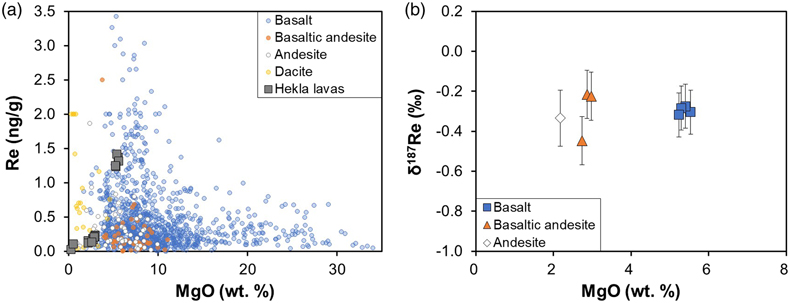
Figure 1 (a) A compilation of Re contents in igneous rock samples from the GEOROC database (http://georoc.eu; DIGIS Team, 2023
DIGIS Team (2023) GEOROC Compilation: Rock Types, GRO.data, V9. https://doi.org/10.25625/2JETOA
) and from this study (Hekla lavas). (b) Re isotope (δ187Re) variations with MgO content in the Hekla lavas. Uncertainties on δ187Re represent the 2 s.d. of repeat multi-collector ICP-MS measurements on the same sample (or 2 s.e. internal error if there was only one measurement), or the long-term reproducibility for the standard solution (ICP; 0.11 ‰), whichever is larger (Table S-2).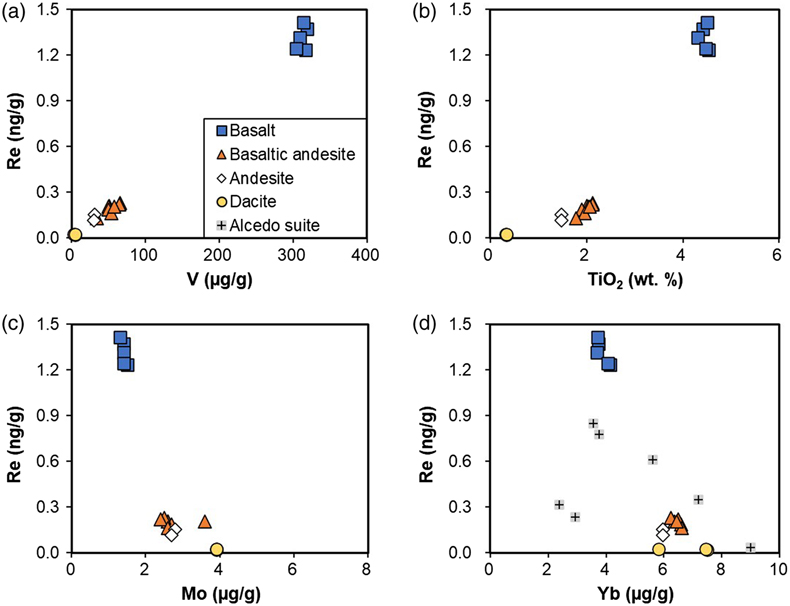
Figure 2 Re variations in the Hekla lavas with the concentrations of (a) V, (b) TiO2, (c) Mo and (d) Yb. Ancillary major and trace element data are given in Table S-3. In (d), Alcedo suite data from Righter et al. (1998)
Righter, K., Chesley, J.T., Geist, D., Ruiz, J. (1998) Behavior of Re during Magma Fractionation: an Example from Volcán Alcedo, Galápagos. Journal of Petrology 39, 785–795. https://doi.org/10.1093/petroj/39.4.785
are plotted in grey for comparison. Error bars on the data are smaller than the size of symbols.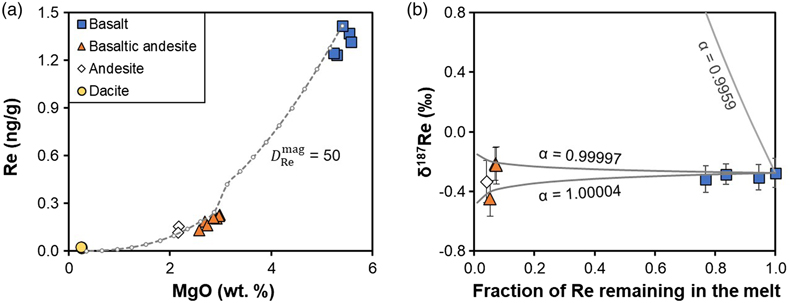
Figure 3 (a) Cotectic fractional crystallisation model (dashed line) for the evolution of Re in Hekla lavas. The fractionating assemblage at Hekla consists of orthopyroxene, plagioclase, clinopyroxene and (titano)magnetite (Sigmarsson et al., 1992
Sigmarsson, O., Condomines, M., Fourcade, S. (1992) A detailed Th, Sr and O isotope study of Hekla: differentiation processes in an Icelandic volcano. Contributions to Mineralogy and Petrology 112, 20–34. https://doi.org/10.1007/BF00310953
; Geist et al., 2021Geist, D., Harpp, K., Oswald, P., Wallace, P., Bindeman, I., Christensen, B. (2021) Hekla Revisited: Fractionation of a Magma Body at Historical Timescales. Journal of Petrology 62, egab001. https://doi.org/10.1093/petrology/egab001
). (b) Rayleigh fractionation model (solid lines) for assessing the extent of Re isotope fractionation during magma processes. Details of the modelling approach are given in Supplementary Information.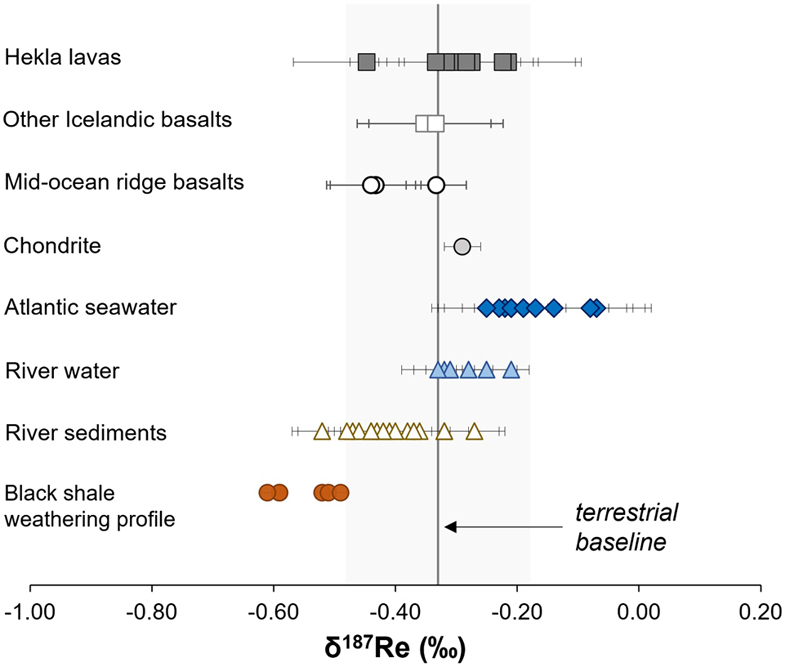
Figure 4 Available terrestrial Re isotope data (relative to NIST3143) measured to date. Data are from this study (Hekla lavas, other Icelandic basalts, MORBs; Table S-2), Dellinger et al. (2020
Dellinger, M., Hilton, R.G., Nowell, G.M. (2020) Measurements of rhenium isotopic composition in low-abundance samples. Journal of Analytical Atomic Spectrometry 35, 377–387. https://doi.org/10.1039/C9JA00288J
; carbonaceous chondrite), Dickson et al. (2020Dickson, A.J., Hsieh, Y.-T., Bryan, A. (2020) The rhenium isotope composition of Atlantic Ocean seawater. Geochimica et Cosmochimica Acta 287, 221–228. https://doi.org/10.1016/j.gca.2020.02.020
; Atlantic seawater), Dellinger et al. (2021Dellinger, M., Hilton, R.G., Nowell, G.M. (2021) Fractionation of rhenium isotopes in the Mackenzie River basin during oxidative weathering. Earth and Planetary Science Letters 573, 117131. https://doi.org/10.1016/j.epsl.2021.117131
; Mackenzie River water and river sediments) and Miller et al. (2015Miller, C.A., Peucker-Ehrenbrink, B., Schauble, E.A. (2015) Theoretical modeling of rhenium isotope fractionation, natural variations across a black shale weathering profile, and potential as a paleoredox proxy. Earth and Planetary Science Letters 430, 339–348. https://doi.org/10.1016/j.epsl.2015.08.008
; New Albany shale).