



Mantle depletion recorded by olivine and plagioclase megacrysts in oceanic basalts
Affiliations | Corresponding Author | Cite as | Funding information
Published by the European Association of Geochemistry
under Creative Commons License CC BY-NC-ND 4.0
Keywords: Plagioclase and olivine megacrysts, mantle depletion, Pb isotopes, ocean crust formation


- Share this article


-
Article views:2,353Cumulative count of HTML views and PDF downloads.
- Download Citation
- Rights & Permissions

top
Abstract
Figures and Tables
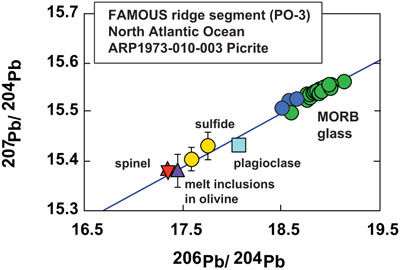 Figure 1 207Pb-206Pb isotope diagram for constituent minerals from a picritic basalt from the FAMOUS ridge segment. The Pb isotope composition of the glass and crystalline matrix (blue circles) is in the range of other enriched MORB samples typical of this ridge segment (green circles; Gale et al., 2013). However, spinel (red star), sulfide (yellow circle) and melt inclusions in olivine (purple triangle) possess Pb isotope compositions that are substantially less radiogenic than the host glass, indicating that these phases crystallised from a depleted melt that crystallised in the lower crust. Much of the plagicolase in this sample (blue square) crystallised late accounting for the more radiogenic composition (relative to the spinel, sulfide and melt inclusions). | 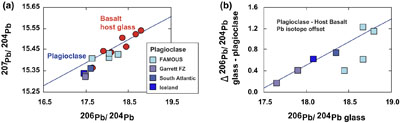 Figure 2 (a) 207Pb-206Pb isotope diagram for plagicolase crystals and their host basalts. Plagioclase crystals (blue squares) and host basalt (red circles) from samples from FAMOUS, Garrett fracture zone, South Atlantic and Iceland, in all cases the Pb isotope composition of plagioclase is less radiogenic than the host lava (Table 1). (b) Difference (Δ) in 206Pb/204Pb between the plagioclase/olivine and host basalt vs. the Pb isotope composition of the host basalt. These data show that in general the more radiogenic the host basalt composition, the greater is the difference in Pb isotope composition between the plagioclase/olivine and the basalt host. | 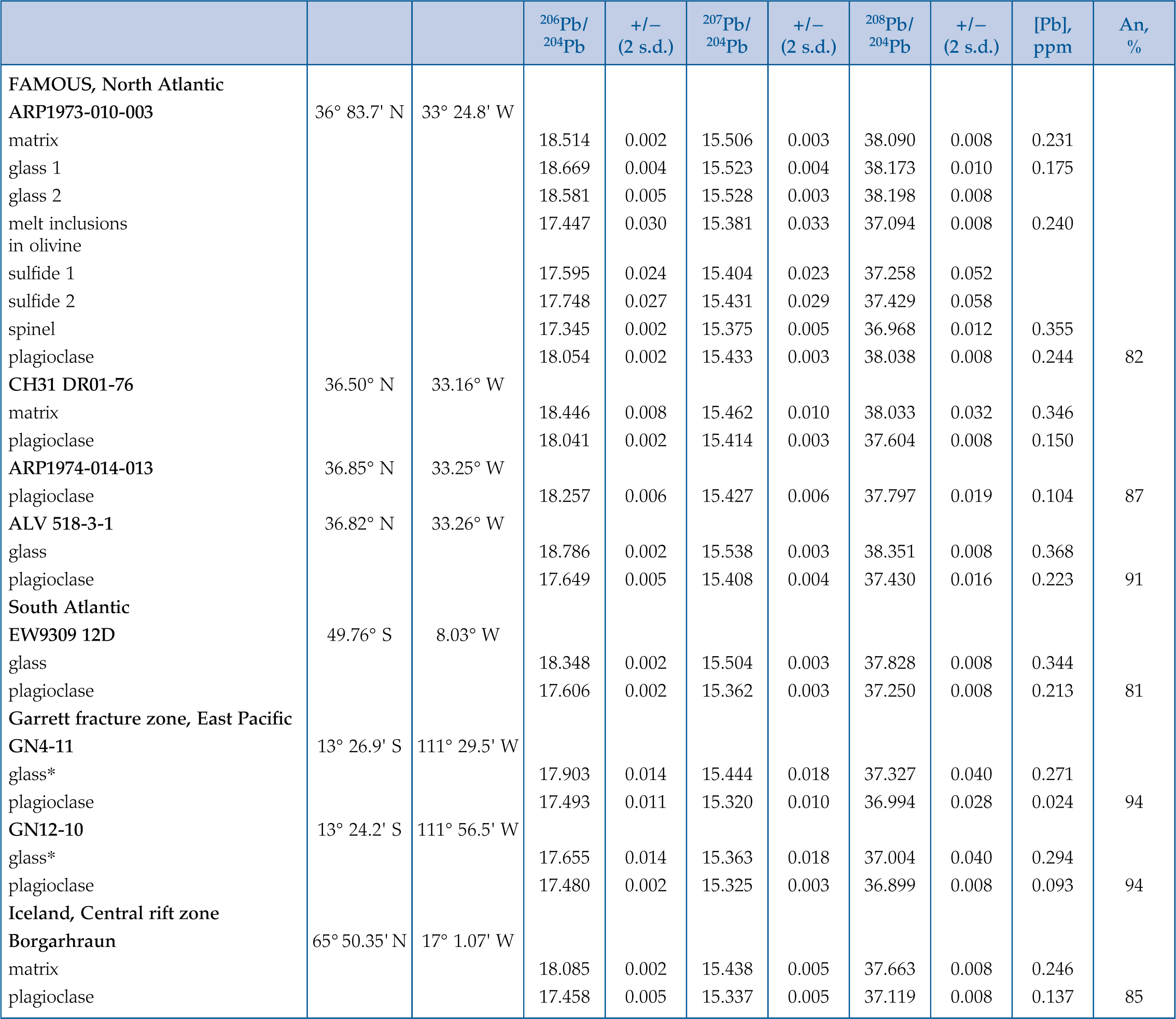 Table 1 Pb isotope data: oceanic basalts and minerals. |
| Figure 1 | Figure 2 | Table 1 |
top
Introduction
Earth’s silicate mantle is largely inaccessible to direct sampling yet bears the imprint of planetary formation and core segregation, melting to form the crust, and the recycling of crustal material through plate tectonics. Oceanic basalts form by partial melting of Earth’s upper mantle, and their concentration ratios of incompatible elements or radiogenic isotope compositions are considered to relate directly to that of the mantle source. The fundamental tenet underlying the use of radiogenic isotopes in such mantle-derived basalts is that they are in equilibrium with their mantle source (e.g., Hofmann and Hart, 1978
Hofmann, A.W., Hart, S.R. (1978) An assessment of local and regional isotopic equilibrium in the mantle. Earth and Planetary Science Letters 38, 44–62. https://doi.org/10.1016/0012-821X(78)90125-5
; Zindler and Hart, 1986Zindler, A, Hart, S. (1986) Chemical geodynamics. Annual Review of Earth and Planetary Sciences 14, 493–571. https://doi.org/10.1146/annurev.ea.14.050186.002425
). Thus, the composition of the long lived isotopes of heavy elements in basalts and their upper mantle source should be the same.For the most part the radiogenic isotope composition of Mid-Ocean Ridge Basalts (MORB) points to the depletion of incompatible elements (that is, those that preferentially partition into a silicate melt) in the mantle over much of Earth’s history (e.g., Hofmann, 2022
Hofmann, A.W., Class C., Goldstein, S.L. (2022) Size and composition of the MORB+OIB mantle reservoir. Geochemistry, Geophysics, Geosystems 23, e2022GC010339. https://doi.org/10.1029/2022GC010339
). Variations in the radiogenic isotope composition of MORB, however, indicate that there must be some degree of chemical heterogeneity in the mantle (Zindler and Hart, 1986Zindler, A, Hart, S. (1986) Chemical geodynamics. Annual Review of Earth and Planetary Sciences 14, 493–571. https://doi.org/10.1146/annurev.ea.14.050186.002425
; Salters and Dick, 2002Salters, V.J.M., Dick, H.J.B. (2002) Mineralogy of the mid-ocean-ridge basalt source from neodymium isotopic composition of abyssal peridotites. Nature 418, 68–72. https://doi.org/10.1038/nature00798
; Warren, 2016Warren, J.M. (2016) Global variations in abyssal peridotite compositions. Lithos 248, 193–219. https://doi.org/10.1016/j.lithos.2015.12.023
; Hofmann, 2022Hofmann, A.W., Class C., Goldstein, S.L. (2022) Size and composition of the MORB+OIB mantle reservoir. Geochemistry, Geophysics, Geosystems 23, e2022GC010339. https://doi.org/10.1029/2022GC010339
). These radiogenic isotope variations may be due to the presence of mantle material of either differing age, or differing concentrations of incompatible elements, resulting in variable radiogenic isotope compositions over time (or some combination of both factors). Furthermore, these chemical variations are often ascribed to the presence of discrete rock types in the mantle. Clinopyroxene is the dominant host of incompatible elements in the upper mantle, therefore, any mantle lithology relatively rich in clinopyroxene, such as pyroxenite, is likely to be enriched in incompatible elements relative to typical depleted mantle peridotite. Indeed, pyroxenites from orogenic peridotites often possess radiogenic isotope compositions that are distinct from peridotites from the same bodies (e.g., Warren, 2016Warren, J.M. (2016) Global variations in abyssal peridotite compositions. Lithos 248, 193–219. https://doi.org/10.1016/j.lithos.2015.12.023
).Evidence for mixing of magmas from both depleted and enriched sources in the mantle is seen in elemental variations (e.g., Rhodes et al., 1979
Rhodes, J.M., Dungan, M.A., Blanchard, D.P., Long, P.E. (1979) Magma mixing at mid-ocean ridges: evidence from basalts drilled near 22° N on the Mid-Atlantic ridge. Tectonophysics 55, 35–61. https://doi.org/10.1016/0040-1951(79)90334-2
), and radiogenic isotopes in erupted basalts (e.g., Stracke et al., 2003Stracke, A., Bizimis, M., Salters, V.J.M. (2003) Recycling oceanic crust: Quantitative constraints. Geochemistry, Geophysics, Geosystems 4, 8003. https://doi.org/10.1029/2001GC000223
). Moreover, pioneering work showed how olivine-megacryst hosted melt inclusions preserve significantly greater chemical variability than their host lava, and that mixing must occur during crystallisation in the crust or shallow mantle (e.g., Sobolev, 1996Sobolev, A.V. (1996) Melt inclusions in minerals as a source of principle petrological information. Petrology 4, 209–220. https://doi.org/10.1134/S0869591109030047
). More recently spatial variations in radiogenic isotopes preserved by magmatic minerals in both ancient and modern oceanic crust have been taken to indicate mixing and melt reaction (e.g., Jansen et al., 2018Jansen, M.N., Lissenberg, C.J., Klaver, M., De Graaff, S.J., Koornneef, J.M., Smeets, R.J., MacLeod, C.J., Davies, G.R. (2018) Isotopic variation in Semail Ophiolite lower crust reveals crustal-level melt aggregation. Geochemical Perspectives Letters 8, 37–42. https://doi.org/10.7185/geochemlet.1827
; Lambart et al., 2019Lambart, S., Koornneef, J.M., Millet, M.A., Davies, G.R., Cook, M., Lissenberg, C.J. (2019) Highly heterogeneous depleted mantle recorded in the lower oceanic crust. Nature Geoscience 12, 482–486. https://doi.org/10.1002/2015JB012762.
), dramatically reducing the chemical variability seen in erupted basalts. Nevertheless, that radiogenic isotope variations are still preserved, both globally and at the scale of individual ridge segments, indicates that magma mixing is incomplete.The problem that remains is that the range of radiogenic isotope variations seen in erupted basalts appears to be biased towards enriched compositions. It is now well established that many MORB possess radiogenic isotope compositions that must be derived from a mantle rock type that is more enriched than typical depleted peridotite, likely pyroxenite (e.g., Salters and Dick, 2002
Salters, V.J.M., Dick, H.J.B. (2002) Mineralogy of the mid-ocean-ridge basalt source from neodymium isotopic composition of abyssal peridotites. Nature 418, 68–72. https://doi.org/10.1038/nature00798
; Warren, 2016Warren, J.M. (2016) Global variations in abyssal peridotite compositions. Lithos 248, 193–219. https://doi.org/10.1016/j.lithos.2015.12.023
). As the mantle upwells beneath mid-ocean ridges it is inevitable that enriched, more fusible rock types, such as pyroxenites will melt first (e.g., Pertermann and Hirschmann, 2003Pertermann, M., Hirschmann, M.M. (2003) Partial melting experiments on a MORB-like pyroxenite between 2 and 3 GPa: constraints on the prescence of pyroxenite in basalt source regions from solidus location and melting rate. Journal of Geophysical Research: Solid Earth 108, 2125. https://doi.org/10.1029/2000JB000118
). Although the abundance of pyroxenites in the mantle is thought to be low, around 2–5 % (e.g., Pertermann and Hirschmann, 2003Pertermann, M., Hirschmann, M.M. (2003) Partial melting experiments on a MORB-like pyroxenite between 2 and 3 GPa: constraints on the prescence of pyroxenite in basalt source regions from solidus location and melting rate. Journal of Geophysical Research: Solid Earth 108, 2125. https://doi.org/10.1029/2000JB000118
), they appear to make a disproportionate contribution to melts forming the oceanic crust, perhaps because of their lower solidus temperature, higher melt productivity and higher elemental abundance (e.g., Shorttle et al., 2014Shorttle, O., Maclennan, J., Lambart, S. (2014) Quantifying Lithological Variability in the Mantle. Earth and Planetary Science Letters 395, 24–40. https://doi.org/10.1016/j.epsl.2014.03.040.
).An alternative possibility is that melt transport and crystallisation is controlled by the magma chemistry itself. Recent experiments indicate that magmas from enriched mantle rocks retain a higher melt fraction during cooling and ascent, largely because plagioclase crystallisation is suppressed to lower temperatures in the Na- and H2O-rich, but Ca- and Al-poor, liquids derived from enriched source lithologies (Neave et al., 2019
Neave, D.A., Namur, O. Shorttle, O., Holtz, F. (2019) Magmatic evolution biases basaltic records of mantle chemistry towards melts from recycled sources. Earth and Planetary Science Letters 520, 199–211. https://doi.org/10.1016/j.epsl.2019.06.003
). The preferential survival of enriched melts during cooling and crystallisation biases the compositions of erupted basalts towards those from enriched mantle sources (Neave et al., 2019Neave, D.A., Namur, O. Shorttle, O., Holtz, F. (2019) Magmatic evolution biases basaltic records of mantle chemistry towards melts from recycled sources. Earth and Planetary Science Letters 520, 199–211. https://doi.org/10.1016/j.epsl.2019.06.003
). In contrast, melts from depleted mantle peridotite will start to crystallise at higher temperatures in the lower crust (or mantle). If depleted melts crystallise at greater depths in the lower oceanic crust or mantle then this raises the intriguing possibility that their radiogenic isotope signatures are not simply erased by mixing but rather are not represented by the melts that arrive at the surface.top
Rationale
What is needed is a radiogenic isotope system that is highly susceptible to differing degrees of incompatible element enrichment in the mantle, and magmatic minerals that preserve a robust record of the chemistry of magmas that crystallised in the lower oceanic crust,
The lead (Pb) isotope system, involving the decay of uranium (U) and thorium (Th) to the isotopes of Pb, provides an extremely sensitive tracer of chemical variability in the mantle. Uranium and Th are highly incompatible (relative to Pb) and therefore likely to be depleted in mantle rocks that have experienced melting. Depleted mantle rocks will, consequently, possess low U/Pb and Th/Pb ratios and evolve to relatively unradiogenic Pb isotope compositions over time. In contrast, enriched mantle rock types, such as enriched melts from prior melting trapped in the mantle, or recycled crustal material, with high U-Th/Pb ratios, acquire relatively radiogenic Pb isotope compositions over time that can be readily traced in the melts that form the oceanic crust.
Mid-Ocean Ridge Basalts (MORB) commonly contain calcic plagioclase and magnesian olivine crystals that are physically entrained in more evolved and enriched host lavas from which they cannot have crystallised (e.g., Rhodes et al., 1979
Rhodes, J.M., Dungan, M.A., Blanchard, D.P., Long, P.E. (1979) Magma mixing at mid-ocean ridges: evidence from basalts drilled near 22° N on the Mid-Atlantic ridge. Tectonophysics 55, 35–61. https://doi.org/10.1016/0040-1951(79)90334-2
). Recent work, using the volatile contents of olivine- and plagioclase-hosted melt inclusions, indicates that crystallisation of plagioclase megacrysts often occurs in the lithospheric mantle (Drignon et al., 2018Drignon, M.J., Nielsen, R.L., Tepley III, F.J., Bodnar, R.J. (2018) Reequilibration processes occurring in plagioclase‐hosted melt inclusions from plagioclase ultraphyric basalts. Geochemistry, Geophysics, Geosystems 20, 109–120. https://doi.org/10.1029/2018GC007795.
; Bennett et al., 2019Bennett, E.N., Jenner, F., Millet, M.-A., Cashman, K.V., Lissenberg, C.J. (2019) Deep roots for mid-ocean-ridge volcanoes revealed by plagioclase-hosted melt inclusions. Nature 572, 235–239. https://doi.org/10.1038/s41586-019-1448-0
), while crystallisation of olivine may occur at shallower levels (Bennett et al., 2019Bennett, E.N., Jenner, F., Millet, M.-A., Cashman, K.V., Lissenberg, C.J. (2019) Deep roots for mid-ocean-ridge volcanoes revealed by plagioclase-hosted melt inclusions. Nature 572, 235–239. https://doi.org/10.1038/s41586-019-1448-0
), in the lower oceanic crust. For both the plagioclase and olivine megacrysts, their major element chemistry points to crystallisation from incompatible element depleted magmas (Sobolev et al., 2007Sobolev, A.V., Hofmann, A.W., Kuzmin, D.V., Yaxley, G.M., Arndt, N.T., Chung, S.L., Danyushevsky, L.V., Elliott, T., Frey, F.A., Garcia, M.O. Gurenko, A.A. (2007) The amount of recycled crust in sources of mantle-derived melts. Science 316, 412–417. https://doi.org/10.1126/science.1138113
; Neave and Namur, 2022Neave, D.A., Namur, O. (2022) Plagioclase archives of depleted melts in the oceanic crust. Geology 50, 848–852. https://doi.org/10.1130/G49840.1
) typical of those expected from the melting of depleted mantle peridotite.top
Methods
Here we present high precision Pb isotope data (Table 1) for sulfide and melt inclusions trapped in an olivine megacryst in a single MORB sample from the FAMOUS ridge segment, and for plagioclase megacrysts and host basaltic glass from several localities in the Pacific and Atlantic oceans (most of which are thought to have crystallised in the lower crust or mantle) (see Supplementary Information for a full description of the methods used, and major element data for all phases; Table S-1). Plagioclase and sulfide have relatively high Pb concentrations and are amenable to precise isotope measurement. Additionally, they possess low U/Pb ratios, so there is little ingrowth of Pb subsequent to crystallisation. Furthermore, for plagioclase, diffusion rates of Pb are often sufficiently low that the isotope composition is not significantly modified at magmatic temperatures (Cherniak, 1995
Cherniak, D.J. (1995) Diffusion of lead in plagioclase and K-feldspar - an investigation using Rutherford backscattering and resonant nuclear-reaction analysis. Contributions to Mineralogy and Petrology 120, 358–371. https://doi.org/10.1007/BF00306513
).Table 1 Pb isotope data: oceanic basalts and minerals.
| 206Pb/204Pb | +/− (2 s.d.) | 207Pb/204Pb | +/− (2 s.d.) | 208Pb/204Pb | +/− (2 s.d.) | [Pb], ppm | An, % | |||
| FAMOUS, North Atlantic | ||||||||||
| ARP1973-010-003 | 36° 83.7' N | 33° 24.8' W | ||||||||
| matrix | 18.514 | 0.002 | 15.506 | 0.003 | 38.090 | 0.008 | 0.231 | |||
| glass 1 | 18.669 | 0.004 | 15.523 | 0.004 | 38.173 | 0.010 | 0.175 | |||
| glass 2 | 18.581 | 0.005 | 15.528 | 0.003 | 38.198 | 0.008 | ||||
| melt inclusions in olivine | 17.447 | 0.030 | 15.381 | 0.033 | 37.094 | 0.008 | 0.240 | |||
| sulfide 1 | 17.595 | 0.024 | 15.404 | 0.023 | 37.258 | 0.052 | ||||
| sulfide 2 | 17.748 | 0.027 | 15.431 | 0.029 | 37.429 | 0.058 | ||||
| spinel | 17.345 | 0.002 | 15.375 | 0.005 | 36.968 | 0.012 | 0.355 | |||
| plagioclase | 18.054 | 0.002 | 15.433 | 0.003 | 38.038 | 0.008 | 0.244 | 82 | ||
| CH31 DR01-76 | 36.50° N | 33.16° W | ||||||||
| matrix | 18.446 | 0.008 | 15.462 | 0.010 | 38.033 | 0.032 | 0.346 | |||
| plagioclase | 18.041 | 0.002 | 15.414 | 0.003 | 37.604 | 0.008 | 0.150 | |||
| ARP1974-014-013 | 36.85° N | 33.25° W | ||||||||
| plagioclase | 18.257 | 0.006 | 15.427 | 0.006 | 37.797 | 0.019 | 0.104 | 87 | ||
| ALV 518-3-1 | 36.82° N | 33.26° W | ||||||||
| glass | 18.786 | 0.002 | 15.538 | 0.003 | 38.351 | 0.008 | 0.368 | |||
| plagioclase | 17.649 | 0.005 | 15.408 | 0.004 | 37.430 | 0.016 | 0.223 | 91 | ||
| South Atlantic | ||||||||||
| EW9309 12D | 49.76° S | 8.03° W | ||||||||
| glass | 18.348 | 0.002 | 15.504 | 0.003 | 37.828 | 0.008 | 0.344 | |||
| plagioclase | 17.606 | 0.002 | 15.362 | 0.003 | 37.250 | 0.008 | 0.213 | 81 | ||
| Garrett fracture zone, East Pacific | ||||||||||
| GN4-11 | 13° 26.9' S | 111° 29.5' W | ||||||||
| glass* | 17.903 | 0.014 | 15.444 | 0.018 | 37.327 | 0.040 | 0.271 | |||
| plagioclase | 17.493 | 0.011 | 15.320 | 0.010 | 36.994 | 0.028 | 0.024 | 94 | ||
| GN12-10 | 13° 24.2' S | 111° 56.5' W | ||||||||
| glass* | 17.655 | 0.014 | 15.363 | 0.018 | 37.004 | 0.040 | 0.294 | |||
| plagioclase | 17.480 | 0.002 | 15.325 | 0.003 | 36.899 | 0.008 | 0.093 | 94 | ||
| Iceland, Central rift zone | ||||||||||
| Borgarhraun | 65° 50.35' N | 17° 1.07' W | ||||||||
| matrix | 18.085 | 0.002 | 15.438 | 0.005 | 37.663 | 0.008 | 0.246 | |||
| plagioclase | 17.458 | 0.005 | 15.337 | 0.005 | 37.119 | 0.008 | 0.137 | 85 |
All errors are 2 s.d. mean. Concentrations in ppm weight.
Pb isotopic ratios relative to NBS 981 Pb standard which yields an external precision of 206Pb/204Pb = 16.9428 ± 24, 207Pb/204Pb = 15.5007 ± 28 and 208Pb/204Pb ratio of 36.7276 ± 75 (2 s.d., n = 59).
* Pb isotope data for glass samples from Wendt et al. (1999)Wendt, J.I., Regelous, M., Niu, Y., Hékinian, R., Collerson, K.D. (1999) Geochemistry of lavas from the Garrett Transform Fault: Insights into mantle heterogeneity beneath the eastern Pacific. Earth and Planetary Science Letters 173, 271–284. https://doi.org/10.1016/S0012-821X(99)00236-8.
top
Results
Sample ARP1973-010-003 is a porphyritic, picritic basalt from the FAMOUS segment (36° 50' N) on the mid-Atlantic ridge, with abundant (>20 %) olivine megacrysts (Fo89-91) in a glassy to crystalline groundmass. Chromium spinel and sulfide occur as inclusions in olivine and groundmass. Spinel is thought to be a relict high pressure phase (Sigurdsson and Schilling, 1976
Sigurdsson, H., Schilling, J.G. (1976) Spinels in Mid-Atlantic Ridge basalts: chemistry and occurrence. Earth and Planetary Science Letters 29, 7–20. https://doi.org/10.1016/0012-821X(76)90021-2
), and volatile contents of melt inclusions in olivine indicate crystallisation in the lower crust (Laubier, pers. comm). Melt inclusions themselves possess both depleted and enriched trace element compositions (Laubier et al., 2012Laubier, M., Gale, A., Langmuir, C.H. (2012) Melting and crustal processes at the FAMOUS segment (Mid-Atlantic Ridge): New insights from olivine-hosted melt inclusions from multiple samples. Journal of Petrology 53, 665–698. https://doi.org/10.1093/petrology/egr075
). The Pb isotope composition of the glass and crystalline matrix (blue circles) is in the range of other enriched MORB samples typical of this ridge segment (green circles) (Fig. 1). However, spinel, sulfide and melt inclusions in olivine (an aggregate of hand picked inclusions) possess Pb isotope compositions that are substantially less radiogenic than the host glass, indicating that these phases crystallised from a depleted melt in the lower crust. The question then is to what extent these unradiogenic Pb compositions are typical in the lower crust?Figure 1 207Pb-206Pb isotope diagram for constituent minerals from a picritic basalt from the FAMOUS ridge segment. The Pb isotope composition of the glass and crystalline matrix (blue circles) is in the range of other enriched MORB samples typical of this ridge segment (green circles; Gale et al., 2013
Gale, A., Laubier, M., Escrig, S., Langmuir, C.H. (2013) Constraints on melting processes and plume-ridge interaction from comprehensive study of the FAMOUS and North Famous segments, Mid-Atlantic Ridge. Earth and Planetary Science Letters 365, 209–220. https://doi.org/10.1016/j.epsl.2013.01.022
). However, spinel (red star), sulfide (yellow circle) and melt inclusions in olivine (purple triangle) possess Pb isotope compositions that are substantially less radiogenic than the host glass, indicating that these phases crystallised from a depleted melt that crystallised in the lower crust. Much of the plagicolase in this sample (blue square) crystallised late accounting for the more radiogenic composition (relative to the spinel, sulfide and melt inclusions).Plagioclase megacrysts from samples from FAMOUS, Garrett fracture zone, South Atlantic and Iceland, all possess Pb isotope compositions that are less radiogenic than their host lava (Table 1, Fig. 2a,b). For plagioclase from the North Atlantic substantially so, but even for the Garrett fracture zone lavas (amongst the least radiogenic MORB globally) the Pb isotope composition of plagioclase is less radiogenic than the host lava, and close to the composition expected for the bulk silicate Earth.
Figure 2 (a) 207Pb-206Pb isotope diagram for plagicolase crystals and their host basalts. Plagioclase crystals (blue squares) and host basalt (red circles) from samples from FAMOUS, Garrett fracture zone, South Atlantic and Iceland, in all cases the Pb isotope composition of plagioclase is less radiogenic than the host lava (Table 1). (b) Difference (Δ) in 206Pb/204Pb between the plagioclase/olivine and host basalt vs. the Pb isotope composition of the host basalt. These data show that in general the more radiogenic the host basalt composition, the greater is the difference in Pb isotope composition between the plagioclase/olivine and the basalt host.
top
Pb Isotopes in Oceanic Basalts
The results here are consistent with previously reported Pb isotope data for plagioclase and host lava from a single sample on the Mid-Atlantic Ridge (Bryce and DePaolo, 2004
Bryce, J.G., DePaolo, D.J. (2004) Pb isotopic heterogeneity in basaltic phenocrysts. Geochimica et Cosmochimica Acta 68, 4453–4468. https://doi.org/10.1016/j.gca.2004.01.016
). Although 204Pb data are not reported in that study, differences in 206Pb/207Pb and 238U/207Pb are consistent with the plagioclase having crystallised from a melt with a low U/Pb ratio (relative to the host lava) (Bryce and DePaolo, 2004Bryce, J.G., DePaolo, D.J. (2004) Pb isotopic heterogeneity in basaltic phenocrysts. Geochimica et Cosmochimica Acta 68, 4453–4468. https://doi.org/10.1016/j.gca.2004.01.016
). Likewise, strontium isotope data for plagioclase crystals in MORB shows that the plagioclase often possesses a less radiogenic 87Sr/86Sr isotope composition relative to host glass (Lange et al., 2013Lange, A.E. Nielsen, R.L., Tepley III, F.J., Kent, A.J.R. (2013) The petrogenesis of plagioclase-phyric basalts at mid-ocean ridges. Geochemistry, Geophysics, Geosystems 14, 3282–3296. https://doi.org/10.1002/ggge.20207
). This indicates that the plagioclase crystallised from a melt with a mantle source with a low Rb/Sr ratio, and therefore, like Pb, a source that has experienced ancient depletion of incompatible elements. Taken together, the results here, and elsewhere, indicate that both plagioclase and olivine megacrysts crystallise from melts sourced by depleted mantle material with an unradiogenic Pb isotope composition that is potentially widespread in the upper mantle and lower oceanic crust.top
The Pb Isotope Composition of the Silicate Earth and Ocean Crust Formation
Our data indicate that both plagioclase and olivine megacrysts in oceanic basalts commonly crystallise from melts sourced by depleted mantle material with an unradiogenic Pb isotope composition that is complementary to the radiogenic Pb isotope compositions seen in erupted basalts. In the past, the radiogenic Pb isotope composition of many oceanic basalts, the so called ‘Pb paradox’, has been attributed to segregation of Pb into Earth’s metallic core (e.g., Allègre, 1969
Allègre, C.J. (1969) Comportement des systemes U-Th-Pb dans le manteau superieur et modele d’evolution de ce dernier au cours des temps geologiques. Earth and Planetary Science Letters 5, 261–269. https://doi.org/10.1016/S0012-821X(68)80050-0
) or loss as a volatile element (Albarède, 2009Albarède, F. (2009) Volatile accretion history of the terrestrial planets and dynamic implications. Nature 461, 1227–1233. https://doi.org/10.1038/nature08477
). While the results here do not preclude Pb removal to the core, or volatile loss, they do show that a substantial proportion of Earth’s unradiogenic Pb is potentially present in the mantle, and that Pb is simply not sampled by erupted basalts.Spatial variations in radiogenic isotopes through the oceanic crust potentially reveal how melts are delivered to the surface, and the nature of oceanic crust formation. From an elemental and isotopic perspective it is generally thought that mantle melts from diverse sources (both incompatible element depleted and enriched) are delivered to the base of the crust, from where mixing and crystallisation during ascent act to reduce the primary chemical variability (e.g., Maclennan, 2008
Maclennan, J. (2008) Concurrent mixing and cooling of melts under Iceland. Journal of Petrology 49, 1931–1953. https://doi.org/10.1093/petrology/egn052
; Lambart et al., 2019Lambart, S., Koornneef, J.M., Millet, M.A., Davies, G.R., Cook, M., Lissenberg, C.J. (2019) Highly heterogeneous depleted mantle recorded in the lower oceanic crust. Nature Geoscience 12, 482–486. https://doi.org/10.1002/2015JB012762.
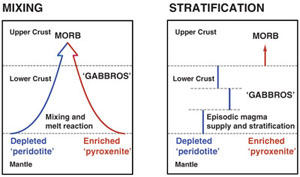
). Thus, the actual extent of isotope heterogeneity in the mantle is lost in the final melts erupted as MORB, the composition of which represents some average of those different mantle melts. However, if melts from depleted mantle rocks tend to crystallise in the lower crust, then that crust may, at least in some circumstances, be isotopically stratified. With MORB and gabbro from the shallowest part of the oceanic crust being derived from enriched mantle sources, while intrusive rocks deeper in the crust originate from depleted mantle lithologies. In this case, not only are the melts delivered to the oceanic crust derived from isotopically distinct sources, but those melts can also traverse the crust while maintaining a high degree of chemical integrity.The question remains as to what extent depleted melts with unradiogenic Pb isotope compositions contribute to the formation of the oceanic crust, rather than just the deep roots of oceanic magmatism in the mantle. Indeed, are the samples here more widely representative? Gabbroic plagioclase from the upper ∼500 m of oceanic crust at the Atlantis Bank on the Southwest Indian Ridge (ODP Hole 735B) preserves a relatively uniform Pb isotope composition (Kempton et al., 1991
Kempton, P.D., Hawkesworth, C.J., Fowler, M. (1991) Geochemistry and isotopic composition of gabbros from layer 3 of the Indian Ocean crust, Hole 735B. In: Von Herzen, R.P., Robinson, P.T., et al. (Eds.) Proceedings of the Ocean Drilling Program, Scientific Results 118, Ocean Drilling Program, College Station, TX, 127–143. https://doi.org/10.2973/odp.proc.sr.118.118.1991
) that is indistinguishable from nearby MORB. The work of Holm et al. (2002)Holm, P.M. (2002) Sr, Nd and Pb isotopic composition of in situ lower crust at the Southwest Indian Ridge: results from ODP Leg 176. Chemical Geology 184, 195–216. https://doi.org/10.1016/S0009-2541(01)00364-3
however, suggests that, at greater depths in this crustal section, gabbroic plagioclase possesses a systematically less radiogenic Pb isotope composition, consistent with the observations here. The presence of plagioclase-bearing depleted gabbros in the lower crust or mantle might also explain, at least in part, the so called “ghost plagioclase” signature seen in many oceanic basalts (e.g., Sobolev et al., 2000Sobolev, A.V., Hofmann, A.W., Nikogosian, I.K. (2000) Recycled oceanic crust observed in ‘ghost plagioclase’ within the source of Mauna Loa lavas. Nature 404, 986–990. https://doi.org/10.1038/35010098
). Basalts and melt inclusions characterised by Sr, Ba and Eu anomalies, have been attributed by some, to the presence of plagioclase-rich cumulates in the oceanic crust, through which these melts have percolated (e.g., Maclennan, 2008Maclennan, J. (2008) Concurrent mixing and cooling of melts under Iceland. Journal of Petrology 49, 1931–1953. https://doi.org/10.1093/petrology/egn052
). Finally, some erupted MORB do show unradiogenic Pb isotope compositions akin to those seen here (e.g., Wendt et al., 1999Wendt, J.I., Regelous, M., Niu, Y., Hékinian, R., Collerson, K.D. (1999) Geochemistry of lavas from the Garrett Transform Fault: Insights into mantle heterogeneity beneath the eastern Pacific. Earth and Planetary Science Letters 173, 271–284. https://doi.org/10.1016/S0012-821X(99)00236-8
), attributed to the preferential melting of depleted mantle stripped of enriched rock types by previous melting. Elsewhere, however, this unradiogenic signal appears to be lost either by mixing during ascent through the crust, or else by the tendency of melts from depleted sources to crystallise in the lower crust. In either case the actual composition of the depleted mantle is concealed.top
Acknowledgements
We would like to thank Frances Jenner and Al Hofmann for their thorough, thoughtful and constructive reviews, likewise the feedback and editorial handling of Horst Marschall.
Editor: Horst Marschall
top
References
Albarède, F. (2009) Volatile accretion history of the terrestrial planets and dynamic implications. Nature 461, 1227–1233. https://doi.org/10.1038/nature08477
 Show in context
 In the past, the radiogenic Pb isotope composition of many oceanic basalts, the so called ‘Pb paradox’, has been attributed to segregation of Pb into Earth’s metallic core (e.g., Allègre, 1969) or loss as a volatile element (Albarède, 2009).
View in article
Allègre, C.J. (1969) Comportement des systemes U-Th-Pb dans le manteau superieur et modele d’evolution de ce dernier au cours des temps geologiques. Earth and Planetary Science Letters 5, 261–269. https://doi.org/10.1016/S0012-821X(68)80050-0
Show in context In the past, the radiogenic Pb isotope composition of many oceanic basalts, the so called ‘Pb paradox’, has been attributed to segregation of Pb into Earth’s metallic core (e.g., Allègre, 1969) or loss as a volatile element (Albarède, 2009).
View in article
Bennett, E.N., Jenner, F., Millet, M.-A., Cashman, K.V., Lissenberg, C.J. (2019) Deep roots for mid-ocean-ridge volcanoes revealed by plagioclase-hosted melt inclusions. Nature 572, 235–239. https://doi.org/10.1038/s41586-019-1448-0
Show in context Recent work, using the volatile contents of olivine- and plagioclase-hosted melt inclusions, indicates that crystallisation of plagioclase megacrysts often occurs in the lithospheric mantle (Drignon et al., 2018; Bennett et al., 2019), while crystallisation of olivine may occur at shallower levels (Bennett et al., 2019), in the lower oceanic crust.
View in article
Bryce, J.G., DePaolo, D.J. (2004) Pb isotopic heterogeneity in basaltic phenocrysts. Geochimica et Cosmochimica Acta 68, 4453–4468. https://doi.org/10.1016/j.gca.2004.01.016
Show in context The results here are consistent with previously reported Pb isotope data for plagioclase and host lava from a single sample on the Mid-Atlantic Ridge (Bryce and DePaolo, 2004).
View in article
Although 204Pb data are not reported in that study, differences in 206Pb/207Pb and 238U/207Pb are consistent with the plagioclase having crystallised from a melt with a low U/Pb ratio (relative to the host lava) (Bryce and DePaolo, 2004).
View in article
Cherniak, D.J. (1995) Diffusion of lead in plagioclase and K-feldspar - an investigation using Rutherford backscattering and resonant nuclear-reaction analysis. Contributions to Mineralogy and Petrology 120, 358–371. https://doi.org/10.1007/BF00306513
Show in context Additionally, they possess low U/Pb ratios, so there is little ingrowth of Pb subsequent to crystallisation. Furthermore, for plagioclase, diffusion rates of Pb are often sufficiently low that the isotope composition is not significantly modified at magmatic temperatures (Cherniak, 1995).
View in article
Drignon, M.J., Nielsen, R.L., Tepley III, F.J., Bodnar, R.J. (2018) Reequilibration processes occurring in plagioclase‐hosted melt inclusions from plagioclase ultraphyric basalts. Geochemistry, Geophysics, Geosystems 20, 109–120. https://doi.org/10.1029/2018GC007795
Show in context Recent work, using the volatile contents of olivine- and plagioclase-hosted melt inclusions, indicates that crystallisation of plagioclase megacrysts often occurs in the lithospheric mantle (Drignon et al., 2018; Bennett et al., 2019), while crystallisation of olivine may occur at shallower levels (Bennett et al., 2019), in the lower oceanic crust.
View in article
Gale, A., Laubier, M., Escrig, S., Langmuir, C.H. (2013) Constraints on melting processes and plume-ridge interaction from comprehensive study of the FAMOUS and North Famous segments, Mid-Atlantic Ridge. Earth and Planetary Science Letters 365, 209–220. https://doi.org/10.1016/j.epsl.2013.01.022
Show in context The Pb isotope composition of the glass and crystalline matrix (blue circles) is in the range of other enriched MORB samples typical of this ridge segment (green circles; Gale et al., 2013).
View in article
Hofmann, A.W., Hart, S.R. (1978) An assessment of local and regional isotopic equilibrium in the mantle. Earth and Planetary Science Letters 38, 44–62. https://doi.org/10.1016/0012-821X(78)90125-5
Show in context The fundamental tenet underlying the use of radiogenic isotopes in such mantle-derived basalts is that they are in equilibrium with their mantle source (e.g., Hofmann and Hart, 1978; Zindler and Hart, 1986).
View in article
Hofmann, A.W., Class C., Goldstein, S.L. (2022) Size and composition of the MORB+OIB mantle reservoir. Geochemistry, Geophysics, Geosystems 23, e2022GC010339. https://doi.org/10.1029/2022GC010339
Show in context For the most part the radiogenic isotope composition of Mid-Ocean Ridge Basalts (MORB) points to the depletion of incompatible elements (that is, those that preferentially partition into a silicate melt) in the mantle over much of Earth’s history (e.g., Hofmann, 2022).
View in article
Variations in the radiogenic isotope composition of MORB, however, indicate that there must be some degree of chemical heterogeneity in the mantle (Zindler and Hart, 1986; Salters and Dick, 2002; Warren, 2016; Hofmann, 2022).
View in article
Holm, P.M. (2002) Sr, Nd and Pb isotopic composition of in situ lower crust at the Southwest Indian Ridge: results from ODP Leg 176. Chemical Geology 184, 195–216. https://doi.org/10.1016/S0009-2541(01)00364-3
Show in context Indeed, are the samples here more widely representative? Gabbroic plagioclase from the upper ∼500 m of oceanic crust at the Atlantis Bank on the Southwest Indian Ridge (ODP Hole 735B) preserves a relatively uniform Pb isotope composition (Kempton et al., 1991) that is indistinguishable from nearby MORB. The work of Holm et al. (2002) however, suggests that, at greater depths in this crustal section, gabbroic plagioclase possesses a systematically less radiogenic Pb isotope composition, consistent with the observations here.
View in article
Jansen, M.N., Lissenberg, C.J., Klaver, M., De Graaff, S.J., Koornneef, J.M., Smeets, R.J., MacLeod, C.J., Davies, G.R. (2018) Isotopic variation in Semail Ophiolite lower crust reveals crustal-level melt aggregation. Geochemical Perspectives Letters 8, 37–42. https://doi.org/10.7185/geochemlet.1827
Show in context More recently spatial variations in radiogenic isotopes preserved by magmatic minerals in both ancient and modern oceanic crust have been taken to indicate mixing and melt reaction (e.g., Jansen et al., 2018; Lambart et al., 2019), dramatically reducing the chemical variability seen in erupted basalts.
View in article
Kempton, P.D., Hawkesworth, C.J., Fowler, M. (1991) Geochemistry and isotopic composition of gabbros from layer 3 of the Indian Ocean crust, Hole 735B. In: Von Herzen, R.P., Robinson, P.T., et al. (Eds.) Proceedings of the Ocean Drilling Program, Scientific Results 118, Ocean Drilling Program, College Station, TX, 127–143. https://doi.org/10.2973/odp.proc.sr.118.118.1991
Show in context Indeed, are the samples here more widely representative? Gabbroic plagioclase from the upper ∼500 m of oceanic crust at the Atlantis Bank on the Southwest Indian Ridge (ODP Hole 735B) preserves a relatively uniform Pb isotope composition (Kempton et al., 1991) that is indistinguishable from nearby MORB. The work of Holm et al. (2002) however, suggests that, at greater depths in this crustal section, gabbroic plagioclase possesses a systematically less radiogenic Pb isotope composition, consistent with the observations here.
View in article
Lambart, S., Koornneef, J.M., Millet, M.A., Davies, G.R., Cook, M., Lissenberg, C.J. (2019) Highly heterogeneous depleted mantle recorded in the lower oceanic crust. Nature Geoscience 12, 482–486. https://doi.org/10.1002/2015JB012762
Show in context More recently spatial variations in radiogenic isotopes preserved by magmatic minerals in both ancient and modern oceanic crust have been taken to indicate mixing and melt reaction (e.g., Jansen et al., 2018; Lambart et al., 2019), dramatically reducing the chemical variability seen in erupted basalts.
View in article
From an elemental and isotopic perspective it is generally thought that mantle melts from diverse sources (both incompatible element depleted and enriched) are delivered to the base of the crust, from where mixing and crystallisation during ascent act to reduce the primary chemical variability (e.g., Maclennan, 2008; Lambart et al., 2019).
View in article
Lange, A.E. Nielsen, R.L., Tepley III, F.J., Kent, A.J.R. (2013) The petrogenesis of plagioclase-phyric basalts at mid-ocean ridges. Geochemistry, Geophysics, Geosystems 14, 3282–3296. https://doi.org/10.1002/ggge.20207
Show in context Likewise, strontium isotope data for plagioclase crystals in MORB shows that the plagioclase often possesses a less radiogenic 87Sr/86Sr isotope composition relative to host glass (Lange et al., 2013).
View in article
Laubier, M., Gale, A., Langmuir, C.H. (2012) Melting and crustal processes at the FAMOUS segment (Mid-Atlantic Ridge): New insights from olivine-hosted melt inclusions from multiple samples. Journal of Petrology 53, 665–698. https://doi.org/10.1093/petrology/egr075
Show in context Melt inclusions themselves possess both depleted and enriched trace element compositions (Laubier et al., 2012).
View in article
Maclennan, J. (2008) Concurrent mixing and cooling of melts under Iceland. Journal of Petrology 49, 1931–1953. https://doi.org/10.1093/petrology/egn052
Show in context From an elemental and isotopic perspective it is generally thought that mantle melts from diverse sources (both incompatible element depleted and enriched) are delivered to the base of the crust, from where mixing and crystallisation during ascent act to reduce the primary chemical variability (e.g., Maclennan, 2008; Lambart et al., 2019).
View in article
Basalts and melt inclusions characterised by Sr, Ba and Eu anomalies, have been attributed by some, to the presence of plagioclase-rich cumulates in the oceanic crust, through which these melts have percolated (e.g., Maclennan, 2008).
View in article
Neave, D.A., Namur, O. (2022) Plagioclase archives of depleted melts in the oceanic crust. Geology 50, 848–852. https://doi.org/10.1130/G49840.1
Show in context For both the plagioclase and olivine megacrysts, their major element chemistry points to crystallisation from incompatible element depleted magmas (Sobolev et al., 2007; Neave and Namur, 2022) typical of those expected from the melting of depleted mantle peridotite.
View in article
Neave, D.A., Namur, O. Shorttle, O., Holtz, F. (2019) Magmatic evolution biases basaltic records of mantle chemistry towards melts from recycled sources. Earth and Planetary Science Letters 520, 199–211. https://doi.org/10.1016/j.epsl.2019.06.003
Show in context Recent experiments indicate that magmas from enriched mantle rocks retain a higher melt fraction during cooling and ascent, largely because plagioclase crystallisation is suppressed to lower temperatures in the Na- and H2O-rich, but Ca- and Al-poor, liquids derived from enriched source lithologies (Neave et al., 2019).
View in article
The preferential survival of enriched melts during cooling and crystallisation biases the compositions of erupted basalts towards those from enriched mantle sources (Neave et al., 2019).
View in article
Pertermann, M., Hirschmann, M.M. (2003) Partial melting experiments on a MORB-like pyroxenite between 2 and 3 GPa: constraints on the prescence of pyroxenite in basalt source regions from solidus location and melting rate. Journal of Geophysical Research: Solid Earth 108, 2125. https://doi.org/10.1029/2000JB000118
Show in context As the mantle upwells beneath mid-ocean ridges it is inevitable that enriched, more fusible rock types, such as pyroxenites will melt first (e.g., Pertermann and Hirschmann, 2003).
View in article
Although the abundance of pyroxenites in the mantle is thought to be low, around 2–5 % (e.g., Pertermann and Hirschmann, 2003), they appear to make a disproportionate contribution to melts forming the oceanic crust, perhaps because of their lower solidus temperature, higher melt productivity and higher elemental abundance (e.g., Shorttle et al., 2014).
View in article
Rhodes, J.M., Dungan, M.A., Blanchard, D.P., Long, P.E. (1979) Magma mixing at mid-ocean ridges: evidence from basalts drilled near 22° N on the Mid-Atlantic ridge. Tectonophysics 55, 35–61. https://doi.org/10.1016/0040-1951(79)90334-2
Show in context Evidence for mixing of magmas from both depleted and enriched sources in the mantle is seen in elemental variations (e.g., Rhodes et al., 1979), and radiogenic isotopes in erupted basalts (e.g., Stracke et al., 2003).
View in article
Mid-Ocean Ridge Basalts (MORB) commonly contain calcic plagioclase and magnesian olivine crystals that are physically entrained in more evolved and enriched host lavas from which they cannot have crystallised (e.g., Rhodes et al., 1979).
View in article
Salters, V.J.M., Dick, H.J.B. (2002) Mineralogy of the mid-ocean-ridge basalt source from neodymium isotopic composition of abyssal peridotites. Nature 418, 68–72. https://doi.org/10.1038/nature00798
Show in context Variations in the radiogenic isotope composition of MORB, however, indicate that there must be some degree of chemical heterogeneity in the mantle (Zindler and Hart, 1986; Salters and Dick, 2002; Warren, 2016; Hofmann, 2022).
View in article
It is now well established that many MORB possess radiogenic isotope compositions that must be derived from a mantle rock type that is more enriched than typical depleted peridotite, likely pyroxenite (e.g., Salters and Dick, 2002; Warren, 2016).
View in article
Shorttle, O., Maclennan, J., Lambart, S. (2014) Quantifying Lithological Variability in the Mantle. Earth and Planetary Science Letters 395, 24–40. https://doi.org/10.1016/j.epsl.2014.03.040
Show in context Although the abundance of pyroxenites in the mantle is thought to be low, around 2–5 % (e.g., Pertermann and Hirschmann, 2003), they appear to make a disproportionate contribution to melts forming the oceanic crust, perhaps because of their lower solidus temperature, higher melt productivity and higher elemental abundance (e.g., Shorttle et al., 2014).
View in article
Sigurdsson, H., Schilling, J.G. (1976) Spinels in Mid-Atlantic Ridge basalts: chemistry and occurrence. Earth and Planetary Science Letters 29, 7–20. https://doi.org/10.1016/0012-821X(76)90021-2
Show in context Chromium spinel and sulfide occur as inclusions in olivine and groundmass. Spinel is thought to be a relict high pressure phase (Sigurdsson and Schilling, 1976), and volatile contents of melt inclusions in olivine indicate crystallisation in the lower crust (Laubier, pers. comm).
View in article
Sobolev, A.V. (1996) Melt inclusions in minerals as a source of principle petrological information. Petrology 4, 209–220. https://doi.org/10.1134/S0869591109030047
Show in context Moreover, pioneering work showed how olivine-megacryst hosted melt inclusions preserve significantly greater chemical variability than their host lava, and that mixing must occur during crystallisation in the crust or shallow mantle (e.g., Sobolev, 1996).
View in article
Sobolev, A.V., Hofmann, A.W., Nikogosian, I.K. (2000) Recycled oceanic crust observed in ‘ghost plagioclase’ within the source of Mauna Loa lavas. Nature 404, 986–990. https://doi.org/10.1038/35010098
Show in context The presence of plagioclase-bearing depleted gabbros in the lower crust or mantle might also explain, at least in part, the so called “ghost plagioclase” signature seen in many oceanic basalts (e.g., Sobolev et al., 2000).
View in article
Sobolev, A.V., Hofmann, A.W., Kuzmin, D.V., Yaxley, G.M., Arndt, N.T., Chung, S.L., Danyushevsky, L.V., Elliott, T., Frey, F.A., Garcia, M.O. Gurenko, A.A. (2007) The amount of recycled crust in sources of mantle-derived melts. Science 316, 412–417. https://doi.org/10.1126/science.1138113
Show in context For both the plagioclase and olivine megacrysts, their major element chemistry points to crystallisation from incompatible element depleted magmas (Sobolev et al., 2007; Neave and Namur, 2022) typical of those expected from the melting of depleted mantle peridotite.
View in article
Stracke, A., Bizimis, M., Salters, V.J.M. (2003) Recycling oceanic crust: Quantitative constraints. Geochemistry, Geophysics, Geosystems 4, 8003. https://doi.org/10.1029/2001GC000223
Show in context Evidence for mixing of magmas from both depleted and enriched sources in the mantle is seen in elemental variations (e.g., Rhodes et al., 1979), and radiogenic isotopes in erupted basalts (e.g., Stracke et al., 2003).
View in article
Warren, J.M. (2016) Global variations in abyssal peridotite compositions. Lithos 248, 193–219. https://doi.org/10.1016/j.lithos.2015.12.023
Show in context Variations in the radiogenic isotope composition of MORB, however, indicate that there must be some degree of chemical heterogeneity in the mantle (Zindler and Hart, 1986; Salters and Dick, 2002; Warren, 2016; Hofmann, 2022).
View in article
Indeed, pyroxenites from orogenic peridotites often possess radiogenic isotope compositions that are distinct from peridotites from the same bodies (e.g., Warren, 2016).
View in article
It is now well established that many MORB possess radiogenic isotope compositions that must be derived from a mantle rock type that is more enriched than typical depleted peridotite, likely pyroxenite (e.g., Salters and Dick, 2002; Warren, 2016).
View in article
Wendt, J.I., Regelous, M., Niu, Y., Hékinian, R., Collerson, K.D. (1999) Geochemistry of lavas from the Garrett Transform Fault: Insights into mantle heterogeneity beneath the eastern Pacific. Earth and Planetary Science Letters 173, 271–284. https://doi.org/10.1016/S0012-821X(99)00236-8
Show in context Pb isotope data for glass samples from Wendt et al. (1999).
View in article
Finally, some erupted MORB do show unradiogenic Pb isotope compositions akin to those seen here (e.g., Wendt et al., 1999), attributed to the preferential melting of depleted mantle stripped of enriched rock types by previous melting.
View in article
Zindler, A, Hart, S. (1986) Chemical geodynamics. Annual Review of Earth and Planetary Sciences 14, 493–571. https://doi.org/10.1146/annurev.ea.14.050186.002425
Show in context The fundamental tenet underlying the use of radiogenic isotopes in such mantle-derived basalts is that they are in equilibrium with their mantle source (e.g., Hofmann and Hart, 1978; Zindler and Hart, 1986).
View in article
Variations in the radiogenic isotope composition of MORB, however, indicate that there must be some degree of chemical heterogeneity in the mantle (Zindler and Hart, 1986; Salters and Dick, 2002; Warren, 2016; Hofmann, 2022).
View in article
top
Supplementary Information
The Supplementary Information includes:
- Mineral and Glass Major Element Compositions
- Sample Preparation for Pb Isotope Chemistry
- Pb Isotope Chemistry and Mass Spectrometry
- Table S-1
- Supplementary Information References
Download the Supplementary Information (PDF)
Figures
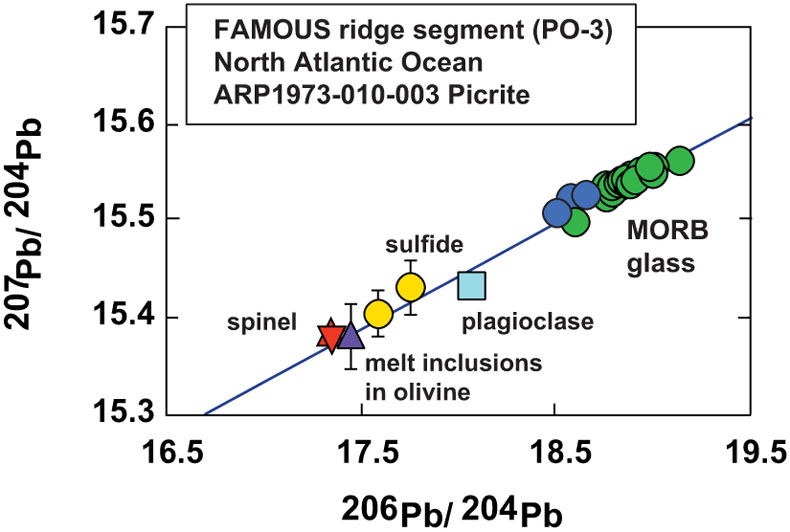
Figure 1 207Pb-206Pb isotope diagram for constituent minerals from a picritic basalt from the FAMOUS ridge segment. The Pb isotope composition of the glass and crystalline matrix (blue circles) is in the range of other enriched MORB samples typical of this ridge segment (green circles; Gale et al., 2013
Gale, A., Laubier, M., Escrig, S., Langmuir, C.H. (2013) Constraints on melting processes and plume-ridge interaction from comprehensive study of the FAMOUS and North Famous segments, Mid-Atlantic Ridge. Earth and Planetary Science Letters 365, 209–220. https://doi.org/10.1016/j.epsl.2013.01.022
). However, spinel (red star), sulfide (yellow circle) and melt inclusions in olivine (purple triangle) possess Pb isotope compositions that are substantially less radiogenic than the host glass, indicating that these phases crystallised from a depleted melt that crystallised in the lower crust. Much of the plagicolase in this sample (blue square) crystallised late accounting for the more radiogenic composition (relative to the spinel, sulfide and melt inclusions).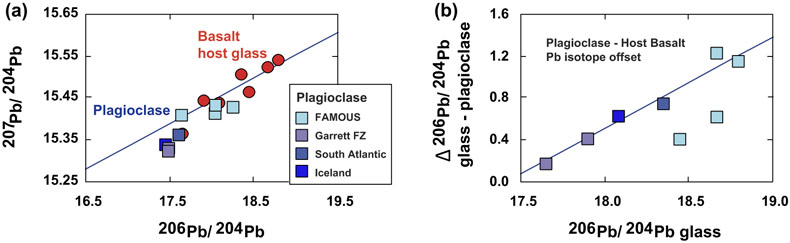
Figure 2 (a) 207Pb-206Pb isotope diagram for plagicolase crystals and their host basalts. Plagioclase crystals (blue squares) and host basalt (red circles) from samples from FAMOUS, Garrett fracture zone, South Atlantic and Iceland, in all cases the Pb isotope composition of plagioclase is less radiogenic than the host lava (Table 1). (b) Difference (Δ) in 206Pb/204Pb between the plagioclase/olivine and host basalt vs. the Pb isotope composition of the host basalt. These data show that in general the more radiogenic the host basalt composition, the greater is the difference in Pb isotope composition between the plagioclase/olivine and the basalt host.