



Chondritic chlorine isotope composition of acapulcoites and lodranites
Affiliations | Corresponding Author | Cite as | Funding information
Published by the European Association of Geochemistry
under Creative Commons License CC BY-NC-ND 4.0
Keywords: chlorine, isotopes, primitive achondrites, phosphates


- Share this article


-
Article views:2,094Cumulative count of HTML views and PDF downloads.
- Download Citation
- Rights & Permissions

top
Abstract
Figures and Tables
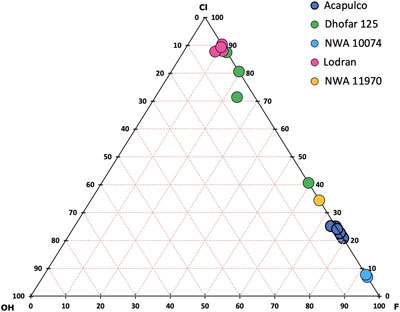 Figure 1 Ternary plot of apatite X-site occupancy (wt. %) from acapulcoites and lodranites. Procedures adopted for estimating OH and F contents are explained in the main text and Supplementary Information (McCubbin et al., 2021). | 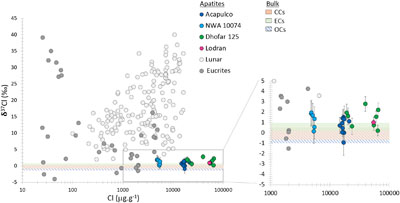 Figure 2 Chlorine abundance (μg.g−1) and isotopic composition (δ37Cl in ‰) of acapulcoite and lodranite apatite, lunar apatite (Barnes et al., 2019 and references therein), eucrite apatite (Barrett et al., 2019 and references therein). The orange band, green band and dashed blue band represent the average for bulk carbonaceous chondrites (CCs), enstatite chondrites (ECs) and ordinary chondrites (OCs), respectively (Sharp et al., 2013). | 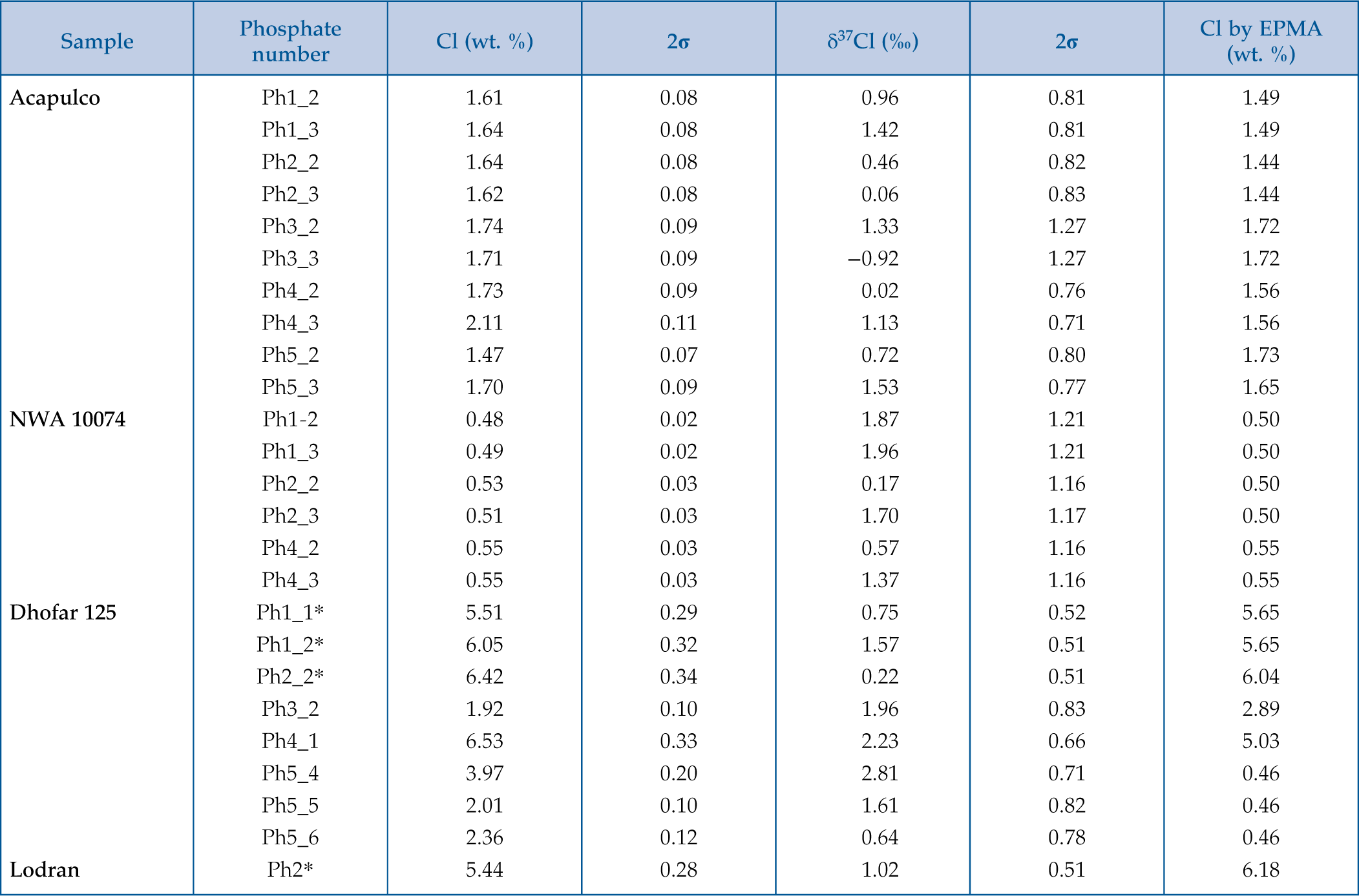 Table 1 Cl content and δ37Cl values and associated 2σ errors for apatite in Acapulco, NWA 10074, Dhofar 125 and Lodran measured by NanoSIMS (see Supplementary Information for details on the NanoSIMS protocol). Cl content estimated by EPMA is also given for comparison.* Identifies measurements made by image mode rather than spot mode. |
| Figure 1 | Figure 2 | Table 1 |
top
Introduction
Volatile elements are tracers of degassing processes experienced by planetesimals during thermal metamorphism and differentiation in the inner Solar System. Chlorine (Cl) is by far the most abundant halogen in chondritic meteorites, in the range of hundreds of μg.g−1 in bulk samples (Brearley and Jones, 2018
Brearley, A.J., Jones, R.H. (2018) Halogens in Chondritic Meteorites. In: Harlov, D.E., and Aranovich, L. (Eds.) The Role of Halogens in Terrestrial and Extraterrestrial Geochemical Processes, Springer, 871–958. https://doi.org/10.1007/978-3-319-61667-4_15
; Lodders and Fegley, 2023Lodders, K., Fegley Jr., B. (2023) Solar system abundances and condensation temperatures of the halogens fluorine, chlorine, bromine, and iodine. Geochemistry 83, 125957. https://doi.org/10.1016/j.chemer.2023.125957
), while being depleted in the Earth compared to chondritic abundances (Dreibus et al., 1979Dreibus, G., Spettel, B., Wänke, H. (1979) Halogens in meteorites and their primordial abundances. Physics and Chemistry of the Earth 11, 33–38. https://doi.org/10.1016/0079-1946(79)90005-3
). Bulk chlorine isotope analyses of terrestrial mantle-derived samples originating from various mid-ocean ridges, together with sediments sampling the crust, have led to the observation that no isotopic fractionation of Cl occurred during the differentiation, and subsequent volatile loss, of the Earth (Sharp et al., 2013Sharp, Z.D., Mercer, J.A., Jones, R.H., Brearley, A.J., Selverstone, J., Bekker, A., Stachel, T. (2013) The chlorine isotope composition of chondrites and Earth. Geochimica Cosmochimica Acta 107, 189–204. https://doi.org/10.1016/j.gca.2013.01.003
). In addition, the bulk chlorine isotopic composition of enstatite (ECs), ordinary (OCs) and carbonaceous (CCs) chondrites are similar to those of terrestrial reservoirs, which also led to the inference of a chondritic origin for Earth’s chlorine and the initial suggestion of a homogenous chlorine isotopic composition of the nebula, with a δ37Cl value estimated at −0.3 ± 0.3 ‰ (Sharp et al., 2013Sharp, Z.D., Mercer, J.A., Jones, R.H., Brearley, A.J., Selverstone, J., Bekker, A., Stachel, T. (2013) The chlorine isotope composition of chondrites and Earth. Geochimica Cosmochimica Acta 107, 189–204. https://doi.org/10.1016/j.gca.2013.01.003
).However, measurements of low chlorine isotopic compositions in a variety of extraterrestrial samples have challenged the chondritic/terrestrial δ37Cl value to be representative of the nebula’s primitive chlorine isotopic composition. Indeed, significant chlorine isotopic variations between the terrestrial mantle and surface reservoirs have been highlighted, the former recording a lower δ37Cl value, from −1.6 to −4.0 ‰ (Bonifacie et al., 2008
Bonifacie, M., Jendrzejewski, N., Agrinier, P., Humler, E., Coleman, M., Javoy, M. (2008) The chlorine isotope composition of the Earth’s mantle. Science 319, 1518–1520. https://doi.org/10.1126/science.1150988
; Layne et al., 2009Layne, G.D., Kent, A.J.R., Bach, W. (2009) δ37Cl systematics of a backarc spreading system: the Lau Basin. Geology 37, 427–430. https://doi.org/10.1130/G25520A.1
). The hypothesis of a low chlorine isotopic composition for the nebula has been further strengthened with even lower δ37Cl values measured in a variety of meteoritic samples, down to −6 ‰ for Mars (Shearer et al., 2018Shearer, C.K., Messenger, S., Sharp, Z.D., Burger, P.V., Nguyen, A.N., McCubbin, F.M. (2018) Distinct chlorine isotopic reservoirs on Mars. Implications for character, extent and relative timing of crustal interactions with mantle-derived magmas, evolution of the martian atmosphere, and the building blocks of an early Mars. Geochimica Cosmochimica Acta 234, 24–36. https://doi.org/10.1016/j.gca.2018.04.034
), −3.8 ‰ for eucrites (Sarafian et al., 2017Sarafian, A.R., John, T., Roszjar, J., Whitehouse, M.J. (2017) Chlorine and hydrogen degassing in Vesta’s magma ocean. Earth and Planetary Science Letters 459, 311–319. https://doi.org/10.1016/j.epsl.2016.10.029
; Barrett et al., 2019Barrett, T.J., Barnes, J.J., Anand, M., Franchi, I.A., Greenwood, R.C., Charlier, B.L.A., Zhao, X., Moynier, F., Grady, M.M. (2019) Investigating magmatic processes in the early Solar System using the Cl isotopic systematics of eucrites. Geochimica Cosmochimica. Acta 266, 582–597. https://doi.org/10.1016/j.gca.2019.06.024
), −4.7 ‰ for the OC Parnallee (Sarafian et al., 2017Sarafian, A.R., John, T., Roszjar, J., Whitehouse, M.J. (2017) Chlorine and hydrogen degassing in Vesta’s magma ocean. Earth and Planetary Science Letters 459, 311–319. https://doi.org/10.1016/j.epsl.2016.10.029
), and even down to −7.2 ‰ for iron meteorites (Gargano and Sharp, 2019Gargano, A., Sharp, Z. (2019) The chlorine isotope composition of iron meteorites: Evidence for the Cl isotope composition of the solar nebula and implications for extensive devolatilization during planet formation. Meteoritics and Planetary Science 54, 1619–1631. https://doi.org/10.1111/maps.13303
). As a result, it is now suggested that the primitive chlorine composition of the nebula should have been close to −7.2 ‰; the higher δ37Cl values observed denoting a later incorporation of 37Cl-enriched HCl hydrates into accreting material in the case of chondrites or degassing processes for larger bodies (e.g., Sharp et al., 2013Sharp, Z.D., Mercer, J.A., Jones, R.H., Brearley, A.J., Selverstone, J., Bekker, A., Stachel, T. (2013) The chlorine isotope composition of chondrites and Earth. Geochimica Cosmochimica Acta 107, 189–204. https://doi.org/10.1016/j.gca.2013.01.003
), although interaction with an HCl-rich ice impactor could have happened on differentiated bodies (Tartèse et al., 2019Tartèse, R., Anand, M., Franchi, I.A. (2019) H and Cl isotope characteristics of indigenous and late hydrothermal fluids on the differentiated asteroidal parent body of Grave Nunataks 06128. Geochimica et Cosmochimica Acta 266, 529–543. https://doi.org/10.1016/j.gca.2019.01.024
).The main carriers of chlorine in most meteorites are the three minerals belonging to the apatite group, namely hydroxyapatite, chlorapatite and fluorapatite, represented by the general formula Ca5(PO4)3(F,Cl,OH) (McCubbin and Jones, 2015
McCubbin, F.M., Jones, R.H. (2015) Extraterrestrial apatite: Planetary geochemistry to astrobiology. Elements 11, 183–188. https://doi.org/10.2113/gselements.11.3.183
). Therefore, in the following the term apatite will be used to refer generically to the three mineral species. Apatite is a volatile bearing Ca phosphate widespread in extraterrestrial samples and, as such, is key to investigate the distribution of volatile reservoir(s), in particular hydrogen and chlorine, in the inner Solar System, and to infer characteristics of the parent body from which they derive such as volatile depletion or differentiation (McCubbin et al., 2023McCubbin, F.M., Lewis, J.A., Barnes, J.J., Boyce, J.W., Gross, J., McCanta, M.C., Srinivasan, P., Anzures, B.A., Lunning, N.G., Elardo, S.M., Keller, L.P., Prissel, T.C., Agee, C.B. (2023) On the origin of fluorine-poor apatite in chondrite parent bodies. American Mineralogist 108, 1185–1200. https://doi.org/10.2138/am-2022-8623
). In situ chlorine isotopic measurements in apatite by secondary ion mass spectrometry (SIMS) tend to show some significant variability compared to bulk analyses performed either by gas source isotope ratio mass spectrometry (IRMS) or thermal ionisation mass spectrometry (TIMS) (Sharp et al., 2013Sharp, Z.D., Mercer, J.A., Jones, R.H., Brearley, A.J., Selverstone, J., Bekker, A., Stachel, T. (2013) The chlorine isotope composition of chondrites and Earth. Geochimica Cosmochimica Acta 107, 189–204. https://doi.org/10.1016/j.gca.2013.01.003
; Gargano et al., 2020Gargano, A., Sharp, Z., Shearer, C., Simon, J.I., Halliday, A., Buckley, W. (2020) The Cl isotope composition and halogen contents of Apollo-return samples. Proceeding of the National Academy of Sciences USA 117, 23418–23425. https://doi.org/10.1073/pnas.2014503117
). The large ranges of δ37Cl values measured in lunar and eucrite apatite have been interpreted as isotopic fractionation following metal chloride degassing during planetary differentiation (e.g., Sharp et al., 2010Sharp, Z.D., Shearer, C.K., McKeegan, K.D., Barnes, J.D., Wang, Y.Q. (2010) The Chlorine Isotope Composition of the Moon and implications for an anhydrous mantle. Science 329, 1050–1053. https://doi.org/10.1126/science.1192606
; Barnes et al., 2019Barnes, J.J., Franchi, I.A., McCubbin, F.M., Anand, M. (2019) Multiple volatile reservoirs on the Moon revealed by the isotopic composition of chlorine in lunar basalts. Geochimica Cosmochimica Acta 266, 144–162. https://doi.org/10.1016/j.gca.2018.12.032
; Barrett et al., 2019Barrett, T.J., Barnes, J.J., Anand, M., Franchi, I.A., Greenwood, R.C., Charlier, B.L.A., Zhao, X., Moynier, F., Grady, M.M. (2019) Investigating magmatic processes in the early Solar System using the Cl isotopic systematics of eucrites. Geochimica Cosmochimica. Acta 266, 582–597. https://doi.org/10.1016/j.gca.2019.06.024
) and, in the case of the Moon, may not be representative of bulk rock δ37Cl value (Gargano et al., 2020Gargano, A., Sharp, Z., Shearer, C., Simon, J.I., Halliday, A., Buckley, W. (2020) The Cl isotope composition and halogen contents of Apollo-return samples. Proceeding of the National Academy of Sciences USA 117, 23418–23425. https://doi.org/10.1073/pnas.2014503117
). As such, effects of differentiation processes on chlorine isotopic composition in apatite, such as metamorphism and partial melting, have yet to be investigated.In order to comprehend the processes responsible for δ37Cl fractionation in apatite and the potential effect of parent body processes, in particular partial melting, we have investigated the chlorine abundances and isotopic compositions in phosphates from primitive achondrites, acapulcoites and lodranites. Acapulcoites and lodranites derive from a single partially differentiated parent body, and the chemical composition of its chondritic precursor lies between ordinary and enstatite chondrites (e.g., Keil and McCoy, 2018
Keil, K., McCoy, T.J. (2018) Acapulcoite-lodranite meteorites: Ultramafic asteroidal partial melt residues. Geochemistry 78, 153–203. https://doi.org/10.1016/j.chemer.2017.04.004
; and references therein). These samples are strategic targets as they recorded a range in the degrees of planetary differentiation, from 1 % of partial melting for the less metamorphosed acapulcoites, some of which still retain relict chondrules, up to 20 % partial melting for the most differentiated lodranites, which have suffered from melt loss as evidenced by the depletion in plagioclases (e.g., McCoy et al., 1997McCoy, T.J., Keil, K., Muenow, D.W., Wilson, L. (1997) Partial melting and melt migration in the acapulcoite-lodranite parent body. Geochimica et Cosmochimica Acta 61, 639–650. https://doi.org/10.1016/S0016-7037(96)00365-1
). As such, these samples enable investigation of the role of thermal metamorphism and partial melting on the δ37Cl composition of apatite in meteorites.top
Materials and Methods
Three acapulcoites (Acapulco, NWA 10074, Dhofar 125) and two lodranites (Lodran and NWA 11970), covering 1 % to 20 % partial melting were investigated (see Supplementary Information for details on samples). Whole mount X-ray maps of Ca, Fe, Mg, P and Si were collected on the Cameca SX-100 electron probe microanalyser (EPMA) at the University of Arizona to identify phosphates in thin sections of Acapulco, NWA 10074, Dhofar 125, NWA 11970 and Lodran (Fig. S-1). Chemical characterisation of phosphates was carried out with a JEOL Superprobe JXA-8230 EPMA at the Department of Earth Sciences, University of Firenze. Chlorine concentration and isotopic measurements were performed with the secondary ion mass spectrometer NanoSIMS 50L at the Open University, UK. Secondary negative ions 1H16O−, 18O−, 35Cl−, 37Cl− and 40Ca19F− were measured on 12 phosphates from Acapulco, NWA 10074 and Dhofar 125 (n = 21) using a Cs+ primary beam of ∼10 pA rastered over a 5 μm × 5 μm surface area. These same negative ions were imaged by scanning mode over a 10 μm × 10 μm surface area for three phosphates in Lodran and Dhofar 125 (n = 4) <50 μm, too small for spot analyses. Unfortunately, no suitable phosphates for NanoSIMS analyses were found in NWA 11970, mainly due to the presence of cracks. Further details on the analytical protocol can be found in Supplementary Information (Figs. S-2 to S-4).
Phosphates in Acapulcoites-Lodranites: Petrographic Context and Volatile Abundances. Phosphates in acapulcoites and lodranites occur either as interstitial grains of fluorapatite or chlorapatite associated with Fe-Ni metal (Zipfel et al., 1995
Zipfel, J., Palme, H., Kennedy, A.K., Hutcheon, I.D. (1995) Chemical composition and origin of the Acapulco meteorite. Geochimica et Cosmochimica Acta 59, 3607–3627. https://doi.org/10.1016/0016-7037(95)00226-P
) or in large veins (McCoy et al., 1996McCoy, T.J., Keil, K., Clayton, R.N., Mayeda, T.K., Bogard, D.D., Garrison, D.H., Huss, G.R., Hutcheon, I.D., Wieler, R. (1996) A petrologic, chemical, and isotopic study of Monument Draw and comparison with other acapulcoites: Evidence for formation by incipient partial melting. Geochimica et Cosmochimica Acta 60, 2681–2708. https://doi.org/10.1016/0016-7037(96)00109-3
). In fact, similarly to ordinary and carbonaceous chondrites, halogens have been concentrated in apatite almost entirely as a result of secondary processes such as thermal metamorphism (Brearley and Jones, 2018Brearley, A.J., Jones, R.H. (2018) Halogens in Chondritic Meteorites. In: Harlov, D.E., and Aranovich, L. (Eds.) The Role of Halogens in Terrestrial and Extraterrestrial Geochemical Processes, Springer, 871–958. https://doi.org/10.1007/978-3-319-61667-4_15
). Phosphorus contained within Fe-Ni metal diffuses out of the metal to form secondary phosphates as metamorphic grade increases (Jones et al., 2014Jones, R.H., McCubbin, F.M., Dreeland, L., Guan, Y.B., Burger, P.V., Shearer C.K. (2014) Phosphate minerals in LL chondrites: A record of the action of fluids during metamorphism on ordinary chondrite parent bodies. Geochimica Cosmochimica Acta 132, 120–140. https://doi.org/10.1016/j.gca.2014.01.027
). Interestingly, apatite in OCs also contain low H2O contents, <100 μg.g−1 (Jones et al., 2014Jones, R.H., McCubbin, F.M., Dreeland, L., Guan, Y.B., Burger, P.V., Shearer C.K. (2014) Phosphate minerals in LL chondrites: A record of the action of fluids during metamorphism on ordinary chondrite parent bodies. Geochimica Cosmochimica Acta 132, 120–140. https://doi.org/10.1016/j.gca.2014.01.027
), similar to the estimation of water abundances in acapulcoites, i.e. <50 μg.g−1 (Stephant et al., 2023Stephant, A., Zhao, X., Anand, M., Davidson, J., Carli, C., Cuppone, T., Pratesi, G., Franchi, I.A. (2023) Hydrogen in acapulcoites and lodranites: A unique source of water for planetesimals in the inner Solar System. Earth and Planetary Science Letters 615, 118202. https://doi.org/10.1016/j.epsl.2023.118202
). Jones et al. (2014)Jones, R.H., McCubbin, F.M., Dreeland, L., Guan, Y.B., Burger, P.V., Shearer C.K. (2014) Phosphate minerals in LL chondrites: A record of the action of fluids during metamorphism on ordinary chondrite parent bodies. Geochimica Cosmochimica Acta 132, 120–140. https://doi.org/10.1016/j.gca.2014.01.027
suggested that in OCs the apatite record the latest stages of fluid compositions, which were halogen-rich and water-poor. These fluids could have been derived by degassing of melts, produced either by partial melting in the interior of the ordinary chondrite parent bodies, or as a result of impact melting. As such, acapulcoites and lodranites could have recorded these fluids in their apatite, in a similar manner to the OCs.In apatite, F−, Cl−, and hydroxyl (OH−) anions occupy the X crystallographic site. Cl contents measured by EPMA and by NanoSIMS present a good match, with NanoSIMS Cl abundances ranging from 0.48 ± 0.02 to 6.53 ± 0.33 wt. % (Fig. S-5). As such, we assume that X = F + Cl + OH and recalculated F abundance based on Cl and OH abundances, since F could be overestimated (Davidson et al., 2020
Davidson, J., Wadhwa, M., Hervig, R.L., Stephant, A. (2020) Water on Mars: Insights from apatite in regolith breccia Northwest Africa 600 7034. Earth and Planetary Science Letters 552, 116597. https://doi.org/10.1016/j.epsl.2020.116597
; McCubbin et al., 2021McCubbin, F.M., Lewis, J.A., Barnes, J.J., Elardo, S.M., Boyce J.W. (2021) The abundances of F, Cl, and H2O in eucrites: Implications for the origin of volatile depletion in the asteroid 4 Vesta. Geochimica et Cosmochimica Acta 314, 270–293. https://doi.org/10.1016/j.gca.2021.08.021
; Supplementary Information). The acapulcoite-lodranite apatite compositions cover the entire chloro-fluor-apatite compositional range (Fig. 1). Apatite in acapulcoites Acapulco and NWA 10074 are all F-rich, with F contents >2.80 wt. %, that display mostly subhedral shapes associated with Fe-Ni metallic phases (Fig. S-2). Acapulco apatite are generally several hundreds of μm in size and have an average Cl content of 1.6 ± 0.12 wt. % (n = 5; 2 s.d.), while NWA 10074 apatite sizes range around 100 μm and are Cl-poor with Cl contents below 0.52 ± 0.01 wt. %. Dhofar 125 contains Cl-rich apatite with varying F concentrations (2.89–5.57 wt. % Cl; 0.69–2.26 wt. % F; Fig. 1) and have smaller grain sizes than in the other two acapulcoites (50−100 μm). In the two lodranites Lodran and NWA 11970, apatite is rarer and much smaller (20 to 50 μm). NWA 11970 phosphates are heavily fractured and thus are unsuitable for NanoSIMS analyses. Lodran apatite are all F-poor chlorapatite (6.17 ± 0.05 wt. % Cl) while NWA 11970 is mostly comprised of volatile-free merrillites, with only one F-rich chlorapatite found in the thin section (2.49 wt. % F; 2.44 wt. % Cl). The F-rich composition of most acapulcoite and lodranite apatite analysed here is similar to some OCs affected by impact melting (McCubbin et al., 2023McCubbin, F.M., Lewis, J.A., Barnes, J.J., Boyce, J.W., Gross, J., McCanta, M.C., Srinivasan, P., Anzures, B.A., Lunning, N.G., Elardo, S.M., Keller, L.P., Prissel, T.C., Agee, C.B. (2023) On the origin of fluorine-poor apatite in chondrite parent bodies. American Mineralogist 108, 1185–1200. https://doi.org/10.2138/am-2022-8623
), as well as igneous apatite found in eucrites (e.g., McCubbin et al., 2021McCubbin, F.M., Lewis, J.A., Barnes, J.J., Elardo, S.M., Boyce J.W. (2021) The abundances of F, Cl, and H2O in eucrites: Implications for the origin of volatile depletion in the asteroid 4 Vesta. Geochimica et Cosmochimica Acta 314, 270–293. https://doi.org/10.1016/j.gca.2021.08.021
) and in lunar mare basalts (e.g., Boyce et al., 2014Boyce J.W., Tomlinson S.M., McCubbin F.M., Greenwood J.P., Treiman A.H. (2014) The Lunar Apatite Paradox. Science 344, 400–402. https://doi.org/10.1126/science.1250398
). Chondritic apatite are typically enriched in Cl (Brearley and Jones, 2018Brearley, A.J., Jones, R.H. (2018) Halogens in Chondritic Meteorites. In: Harlov, D.E., and Aranovich, L. (Eds.) The Role of Halogens in Terrestrial and Extraterrestrial Geochemical Processes, Springer, 871–958. https://doi.org/10.1007/978-3-319-61667-4_15
), similar to Lodran and Dhofar 125, suggesting latest stages of fluid compositions. However, it is important to note here that OC apatite also contain another unknown component, other than OH, missing in acapulcoite-lodranites (Jones et al., 2014Jones, R.H., McCubbin, F.M., Dreeland, L., Guan, Y.B., Burger, P.V., Shearer C.K. (2014) Phosphate minerals in LL chondrites: A record of the action of fluids during metamorphism on ordinary chondrite parent bodies. Geochimica Cosmochimica Acta 132, 120–140. https://doi.org/10.1016/j.gca.2014.01.027
).Figure 1 Ternary plot of apatite X-site occupancy (wt. %) from acapulcoites and lodranites. Procedures adopted for estimating OH and F contents are explained in the main text and Supplementary Information (McCubbin et al., 2021
McCubbin, F.M., Lewis, J.A., Barnes, J.J., Elardo, S.M., Boyce J.W. (2021) The abundances of F, Cl, and H2O in eucrites: Implications for the origin of volatile depletion in the asteroid 4 Vesta. Geochimica et Cosmochimica Acta 314, 270–293. https://doi.org/10.1016/j.gca.2021.08.021
).During degassing of its parental melt, apatite should evolve towards fluorapatite composition due to the relative volatility of the X site components: H > Cl > F (McCubbin et al., 2021
McCubbin, F.M., Lewis, J.A., Barnes, J.J., Elardo, S.M., Boyce J.W. (2021) The abundances of F, Cl, and H2O in eucrites: Implications for the origin of volatile depletion in the asteroid 4 Vesta. Geochimica et Cosmochimica Acta 314, 270–293. https://doi.org/10.1016/j.gca.2021.08.021
). Here, Lodran which underwent higher degrees of partial melting (i.e. 20 %; Supplementary Information), contain chlorapatite, which would tend to argue against preferential degassing of Cl towards F. However, considering that higher abundances of H and Cl should be released with increasing partial melt, the abundances of H, Cl and F in apatite cannot directly hint to the potential volatile loss experienced by these primitive achondrites during partial melting. As such, we need to estimate the bulk abundances of volatiles in acapulcoites and lodranites in order to gain insight into the behaviour of Cl, F and H abundances during early planetary differentiation.Bulk Rock Abundances of F, Cl and H2O in Acapulcoites and Lodranites. Using the method detailed in McCubbin et al. (2021)
McCubbin, F.M., Lewis, J.A., Barnes, J.J., Elardo, S.M., Boyce J.W. (2021) The abundances of F, Cl, and H2O in eucrites: Implications for the origin of volatile depletion in the asteroid 4 Vesta. Geochimica et Cosmochimica Acta 314, 270–293. https://doi.org/10.1016/j.gca.2021.08.021
, we estimated the bulk F abundance for each meteorite studied here, as well as their Cl and H2O bulk abundances (Supplementary Information; Table S-2). Acapulcoites bulk F abundances range from 42–392 μg.g−1 while Lodran bulk F content is estimated to be 2 μg.g−1. Bulk Cl concentrations have been estimated by McCoy et al. (1997)McCoy, T.J., Keil, K., Muenow, D.W., Wilson, L. (1997) Partial melting and melt migration in the acapulcoite-lodranite parent body. Geochimica et Cosmochimica Acta 61, 639–650. https://doi.org/10.1016/S0016-7037(96)00365-1
for Acapulco (i.e. 250 μg.g−1) and Lodran (i.e. 10 μg.g−1), as well as from Garrison et al. (2000)Garrison, D., Hamlin, S., Bogard, D. (2000) Chlorine abundances in meteorites. Meteoritics and Planetary Science 35, 419–429. https://doi.org/10.1111/j.1945-5100.2000.tb01786.x
for Acapulco (i.e. 204 ± 26 μg.g−1) with other acapulcoites ranging from 131 ± 38 to 268 ± 28 μg.g−1 and lodranites from 35 ± 110 to 78 ± 69 μg.g−1. Due to large uncertainties on the Cl, F and OH partition coefficient between melt and apatite (McCubbin et al., 2015McCubbin, F.M., Vander Kaaden, K.E., Tartèse, R., Boyce, J.W., Mikhail, S., Whitson, E.S., Bell, A.S., Anand, M., Franchi, I.A., Wang, J.H., Hauri, E.H. (2015) Experimental investigation of F, Cl, and OH partitioning between apatite and Fe-rich basaltic melt at 1.0-1.2 GPa and 950-1000 oC. American Mineralogist 100, 1790–1802. https://doi.org/10.2138/am-2015-5233
), we estimate lower limits for Cl bulk abundances. These estimations are in the range of literature data, ranging from 47 to 501 μg.g−1 Cl for acapulcoites and from 59 to 73 μg.g−1 Cl for lodranites. Depending on modal abundance estimations (see Supplementary Information), Dhofar 125 may have a higher bulk Cl content due to terrestrial alteration, highlighted by its higher degree of weathering (W1/W2) and the contiguous terrestrial alteration products to phosphates (Fig. S2). Indeed, an increase of 0.4 vol. % of Ca phosphates in modal abundance estimation results in a bulk Cl abundance estimation almost three times higher. This highlights the necessity of precise Ca phosphate modal abundance in order to determine accurate bulk Cl abundances. Acapulcoites contain more F and Cl than lodranites, suggesting that lodranites experienced degassing or volatile-rich melt loss as a result of partial melting increase. Regarding the H2O content, estimations based on apatite (i.e. 3–30 μg.g−1 H2O) are consistent with those made on nominally anhydrous minerals via NanoSIMS analyses (i.e. 3–19 μg.g−1 H2O; Stephant et al., 2023Stephant, A., Zhao, X., Anand, M., Davidson, J., Carli, C., Cuppone, T., Pratesi, G., Franchi, I.A. (2023) Hydrogen in acapulcoites and lodranites: A unique source of water for planetesimals in the inner Solar System. Earth and Planetary Science Letters 615, 118202. https://doi.org/10.1016/j.epsl.2023.118202
). Overall, the bulk F and Cl contents of acapulcoite-lodranites are consistent with OC compositions (i.e. F = 8–300 μg.g−1; Cl = 7–270 μg.g−1; Lodders and Fegley, 2023Lodders, K., Fegley Jr., B. (2023) Solar system abundances and condensation temperatures of the halogens fluorine, chlorine, bromine, and iodine. Geochemistry 83, 125957. https://doi.org/10.1016/j.chemer.2023.125957
and references therein), while ECs are even more enriched in Cl (up to 1000 μg.g−1; Brearley and Jones, 2018Brearley, A.J., Jones, R.H. (2018) Halogens in Chondritic Meteorites. In: Harlov, D.E., and Aranovich, L. (Eds.) The Role of Halogens in Terrestrial and Extraterrestrial Geochemical Processes, Springer, 871–958. https://doi.org/10.1007/978-3-319-61667-4_15
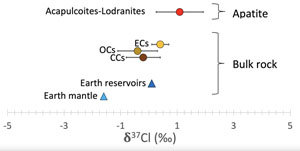
). As such, it would seem that the acapulcoites-lodranites still record the F and Cl contents of their chondritic precursor, which were very similar in composition to OC and EC parent bodies. Comparing the estimated volatile bulk content between acapulcoites and Lodran, it appears that Cl and F have either degassed or been carried away together with melt loss in lodranites, both mechanisms happening during early degree of partial melting (<20 %).Effect of Partial Melting on the Chlorine Isotopic Composition of Phosphates. The δ37Cl values in acapulcoite-lodranite apatite range from –0.91 ± 1.27 to +2.81 ± 0.71 ‰ (2 s.d.) (Table 1), with no apparent correlation with their large variation in Cl content (Fig. 2). Moreover, no correlation between δ37Cl measured in a specific sample and its degree of partial melting is observed. As such, chlorine isotopic compositions of apatite in acapulcoites and lodranites do not record notable (<2 ‰) fractionation during partial melting. As a result, the average δ37Cl value for acapulcoite-lodranites of +1.1 ± 0.8 ‰ (n = 25; 1 s.d.) is considered to be representative of the acapulcoite-lodranite parent body (ALPB), the chemical composition of which lies in between H ordinary chondrites and EL enstatite chondrites (e.g., Keil and McCoy, 2018
Keil, K., McCoy, T.J. (2018) Acapulcoite-lodranite meteorites: Ultramafic asteroidal partial melt residues. Geochemistry 78, 153–203. https://doi.org/10.1016/j.chemer.2017.04.004
).Figure 2 Chlorine abundance (μg.g−1) and isotopic composition (δ37Cl in ‰) of acapulcoite and lodranite apatite, lunar apatite (Barnes et al., 2019
Barnes, J.J., Franchi, I.A., McCubbin, F.M., Anand, M. (2019) Multiple volatile reservoirs on the Moon revealed by the isotopic composition of chlorine in lunar basalts. Geochimica Cosmochimica Acta 266, 144–162. https://doi.org/10.1016/j.gca.2018.12.032
and references therein), eucrite apatite (Barrett et al., 2019Barrett, T.J., Barnes, J.J., Anand, M., Franchi, I.A., Greenwood, R.C., Charlier, B.L.A., Zhao, X., Moynier, F., Grady, M.M. (2019) Investigating magmatic processes in the early Solar System using the Cl isotopic systematics of eucrites. Geochimica Cosmochimica. Acta 266, 582–597. https://doi.org/10.1016/j.gca.2019.06.024
and references therein). The orange band, green band and dashed blue band represent the average for bulk carbonaceous chondrites (CCs), enstatite chondrites (ECs) and ordinary chondrites (OCs), respectively (Sharp et al., 2013Sharp, Z.D., Mercer, J.A., Jones, R.H., Brearley, A.J., Selverstone, J., Bekker, A., Stachel, T. (2013) The chlorine isotope composition of chondrites and Earth. Geochimica Cosmochimica Acta 107, 189–204. https://doi.org/10.1016/j.gca.2013.01.003
).Table 1 Cl content and δ37Cl values and associated 2σ errors for apatite in Acapulco, NWA 10074, Dhofar 125 and Lodran measured by NanoSIMS (see Supplementary Information for details on the NanoSIMS protocol). Cl content estimated by EPMA is also given for comparison.
| Sample | Phosphate number | Cl (wt. %) | 2σ | δ37Cl (‰) | 2σ | Cl by EPMA (wt. %) |
| Acapulco | Ph1_2 | 1.61 | 0.08 | 0.96 | 0.81 | 1.49 |
| Ph1_3 | 1.64 | 0.08 | 1.42 | 0.81 | 1.49 | |
| Ph2_2 | 1.64 | 0.08 | 0.46 | 0.82 | 1.44 | |
| Ph2_3 | 1.62 | 0.08 | 0.06 | 0.83 | 1.44 | |
| Ph3_2 | 1.74 | 0.09 | 1.33 | 1.27 | 1.72 | |
| Ph3_3 | 1.71 | 0.09 | −0.92 | 1.27 | 1.72 | |
| Ph4_2 | 1.73 | 0.09 | 0.02 | 0.76 | 1.56 | |
| Ph4_3 | 2.11 | 0.11 | 1.13 | 0.71 | 1.56 | |
| Ph5_2 | 1.47 | 0.07 | 0.72 | 0.80 | 1.73 | |
| Ph5_3 | 1.70 | 0.09 | 1.53 | 0.77 | 1.65 | |
| NWA 10074 | Ph1-2 | 0.48 | 0.02 | 1.87 | 1.21 | 0.50 |
| Ph1_3 | 0.49 | 0.02 | 1.96 | 1.21 | 0.50 | |
| Ph2_2 | 0.53 | 0.03 | 0.17 | 1.16 | 0.50 | |
| Ph2_3 | 0.51 | 0.03 | 1.70 | 1.17 | 0.50 | |
| Ph4_2 | 0.55 | 0.03 | 0.57 | 1.16 | 0.55 | |
| Ph4_3 | 0.55 | 0.03 | 1.37 | 1.16 | 0.55 | |
| Dhofar 125 | Ph1_1* | 5.51 | 0.29 | 0.75 | 0.52 | 5.65 |
| Ph1_2* | 6.05 | 0.32 | 1.57 | 0.51 | 5.65 | |
| Ph2_2* | 6.42 | 0.34 | 0.22 | 0.51 | 6.04 | |
| Ph3_2 | 1.92 | 0.10 | 1.96 | 0.83 | 2.89 | |
| Ph4_1 | 6.53 | 0.33 | 2.23 | 0.66 | 5.03 | |
| Ph5_4 | 3.97 | 0.20 | 2.81 | 0.71 | 0.46 | |
| Ph5_5 | 2.01 | 0.10 | 1.61 | 0.82 | 0.46 | |
| Ph5_6 | 2.36 | 0.12 | 0.64 | 0.78 | 0.46 | |
| Lodran | Ph2* | 5.44 | 0.28 | 1.02 | 0.51 | 6.18 |
*Identifies measurements made by image mode rather than spot mode.
Sharp et al. (2013)
Sharp, Z.D., Mercer, J.A., Jones, R.H., Brearley, A.J., Selverstone, J., Bekker, A., Stachel, T. (2013) The chlorine isotope composition of chondrites and Earth. Geochimica Cosmochimica Acta 107, 189–204. https://doi.org/10.1016/j.gca.2013.01.003
measured bulk δ37Cl values in OCs, ECs, and CCs, with values of –0.4 ± 0.7 ‰, +0.4 ± 0.3 ‰ and –0.2 ± 0.6 ‰, respectively (Fig. 2), arguing for no variation in chlorine isotopic composition amongst the different groups of chondrites. Taken at face value, the slightly heavier δ37Cl of ALPB derived from apatite (+1.1 ± 0.8 ‰) could argue for some preferential loss of 35Cl induced during metamorphism or degassing associated with partial melting. In fact, Sharp et al. (2013)Sharp, Z.D., Mercer, J.A., Jones, R.H., Brearley, A.J., Selverstone, J., Bekker, A., Stachel, T. (2013) The chlorine isotope composition of chondrites and Earth. Geochimica Cosmochimica Acta 107, 189–204. https://doi.org/10.1016/j.gca.2013.01.003
also argued that the ∼1 ‰ increase observed in bulk δ37Cl between EH3 and EL6 chondrites could be interpreted as a sign of isotopic fractionation due to degassing. Moreover, the higher and more variable δ37Cl values in apatite compared to bulk rock, also observed in lunar basalts, have been suggested to result from local degassing affecting apatite-forming melts and/or fluids (Gargano et al., 2020Gargano, A., Sharp, Z., Shearer, C., Simon, J.I., Halliday, A., Buckley, W. (2020) The Cl isotope composition and halogen contents of Apollo-return samples. Proceeding of the National Academy of Sciences USA 117, 23418–23425. https://doi.org/10.1073/pnas.2014503117
). As a result, Gargano et al. (2020)Gargano, A., Sharp, Z., Shearer, C., Simon, J.I., Halliday, A., Buckley, W. (2020) The Cl isotope composition and halogen contents of Apollo-return samples. Proceeding of the National Academy of Sciences USA 117, 23418–23425. https://doi.org/10.1073/pnas.2014503117
suggested that lunar apatite are not representative of δ37Cl bulk rock. Nevertheless, our estimation of the ALPB δ37Cl value is within uncertainties of δ37Cl of bulk chondrites. Therefore, contrary to differentiated bodies, apatite in chondrites and primitive achondrites can be considered representative of their bulk Cl isotopic composition.top
Conclusion
Overall, while some Cl and F degassing might have occurred at 20 % partial melting, as highlighted by the lower F and Cl contents estimated in Lodran, no significant chlorine isotopic fractionation among acapulcoite-lodranite apatite during early stages (i.e. lower degrees) of partial melting occurred. Therefore, acapulcoites and lodranites retain their chondritic δ37Cl value, similar to that of most bulk chondrites. A similar conclusion has been reached regarding the hydrogen isotopic composition of acapulcoites and lodranites, where the δD value matches the inferred hydrogen isotopic composition of water in OCs (cf. Jin et al., 2021
Jin, Z., Bose, M., Lichtenberg, T., Mulders, G.D. (2021) New Evidence for Wet Accretion of Inner Solar System Planetesimals from Meteorites Chelyabinsk and Benenitra. Planetary Sciences Journal 2, 244. https://doi.org/10.3847/PSJ/ac3d86
; Stephant et al., 2023Stephant, A., Zhao, X., Anand, M., Davidson, J., Carli, C., Cuppone, T., Pratesi, G., Franchi, I.A. (2023) Hydrogen in acapulcoites and lodranites: A unique source of water for planetesimals in the inner Solar System. Earth and Planetary Science Letters 615, 118202. https://doi.org/10.1016/j.epsl.2023.118202
). As such, it seems that acapulcoites and lodranites have retained most of their initial volatile chondritic isotopic compositions.top
Acknowledgments
The authors would like to thank the Buseck Center for Meteorite Studies at Arizona State University for providing samples for this work. This manuscript was significantly improved by comments from two anonymous reviewers and the editorial expertise of Dr. Romain Tartèse. This work is supported by the EU’s Horizon 2020 research and innovation programme under the Marie Skłodowska-Curie grant agreement no. 884029 to AS. This project has also received funding from the European Union’s Horizon 2020 research and innovation programme under grant agreement no. 871149 to access the Open University NanoSIMS through the EuroPlanet programme (award code 20-EPN2-01). JD was supported by BCMS. CC, GP, and TC were partially supported by ASI INAF/ASI agreement no. 2018-16-HH.0, Ol-BODIES project. MA and IAF acknowledge funding from the UK Science and Technology Facilities Council (STFC) (#ST/X001180/1 #ST/T000228/1).
Editor: Romain Tartèse
top
References
Barnes, J.J., Franchi, I.A., McCubbin, F.M., Anand, M. (2019) Multiple volatile reservoirs on the Moon revealed by the isotopic composition of chlorine in lunar basalts. Geochimica Cosmochimica Acta 266, 144–162. https://doi.org/10.1016/j.gca.2018.12.032
 Show in context
 The large ranges of δ37Cl values measured in lunar and eucrite apatite have been interpreted as isotopic fractionation following metal chloride degassing during planetary differentiation (e.g., Sharp et al., 2010; Barnes et al., 2019; Barrett et al., 2019) and, in the case of the Moon, may not be representative of bulk rock δ37Cl value (Gargano et al., 2020).
View in article
Chlorine abundance (μg.g−1) and isotopic composition (δ37Cl in ‰) of acapulcoite and lodranite apatite, lunar apatite (Barnes et al., 2019 and references therein), eucrite apatite (Barrett et al., 2019 and references therein).
View in article
Barrett, T.J., Barnes, J.J., Anand, M., Franchi, I.A., Greenwood, R.C., Charlier, B.L.A., Zhao, X., Moynier, F., Grady, M.M. (2019) Investigating magmatic processes in the early Solar System using the Cl isotopic systematics of eucrites. Geochimica Cosmochimica. Acta 266, 582–597. https://doi.org/10.1016/j.gca.2019.06.024
Show in context The hypothesis of a low chlorine isotopic composition for the nebula has been further strengthened with even lower δ37Cl values measured in a variety of meteoritic samples, down to −6 ‰ for Mars (Shearer et al., 2018), −3.8 ‰ for eucrites (Sarafian et al., 2017; Barrett et al., 2019), −4.7 ‰ for the OC Parnallee (Sarafian et al., 2017), and even down to −7.2 ‰ for iron meteorites (Gargano and Sharp, 2019).
View in article
The large ranges of δ37Cl values measured in lunar and eucrite apatite have been interpreted as isotopic fractionation following metal chloride degassing during planetary differentiation (e.g., Sharp et al., 2010; Barnes et al., 2019; Barrett et al., 2019) and, in the case of the Moon, may not be representative of bulk rock δ37Cl value (Gargano et al., 2020).
View in article
Chlorine abundance (μg.g−1) and isotopic composition (δ37Cl in ‰) of acapulcoite and lodranite apatite, lunar apatite (Barnes et al., 2019 and references therein), eucrite apatite (Barrett et al., 2019 and references therein).
View in article
Bonifacie, M., Jendrzejewski, N., Agrinier, P., Humler, E., Coleman, M., Javoy, M. (2008) The chlorine isotope composition of the Earth’s mantle. Science 319, 1518–1520. https://doi.org/10.1126/science.1150988
Show in context Indeed, significant chlorine isotopic variations between the terrestrial mantle and surface reservoirs have been highlighted, the former recording a lower δ37Cl value, from −1.6 to −4.0 ‰ (Bonifacie et al., 2008; Layne et al., 2009).
View in article
Boyce J.W., Tomlinson S.M., McCubbin F.M., Greenwood J.P., Treiman A.H. (2014) The Lunar Apatite Paradox. Science 344, 400–402. https://doi.org/10.1126/science.1250398
Show in context The F-rich composition of most acapulcoite and lodranite apatite analysed here is similar to some OCs affected by impact melting (McCubbin et al., 2023), as well as igneous apatite found in eucrites (e.g., McCubbin et al., 2021) and in lunar mare basalts (e.g., Boyce et al., 2014).
View in article
Brearley, A.J., Jones, R.H. (2018) Halogens in Chondritic Meteorites. In: Harlov, D.E., and Aranovich, L. (Eds.) The Role of Halogens in Terrestrial and Extraterrestrial Geochemical Processes, Springer, 871–958. https://doi.org/10.1007/978-3-319-61667-4_15
Show in context Volatile elements are tracers of degassing processes experienced by planetesimals during thermal metamorphism and differentiation in the inner Solar System. Chlorine (Cl) is by far the most abundant halogen in chondritic meteorites, in the range of hundreds of μg.g−1 in bulk samples (Brearley and Jones, 2018; Lodders and Fegley, 2023), while being depleted in the Earth compared to chondritic abundances (Dreibus et al., 1979).
View in article
In fact, similarly to ordinary and carbonaceous chondrites, halogens have been concentrated in apatite almost entirely as a result of secondary processes such as thermal metamorphism (Brearley and Jones, 2018).
View in article
Chondritic apatite are typically enriched in Cl (Brearley and Jones, 2018), similar to Lodran and Dhofar 125, suggesting latest stages of fluid compositions.
View in article
Overall, the bulk F and Cl contents of acapulcoite-lodranites are consistent with OC compositions (i.e. F = 8–300 μg.g−1; Cl = 7–270 μg.g−1; Lodders and Fegley, 2023 and references therein), while ECs are even more enriched in Cl (up to 1000 μg.g−1; Brearley and Jones, 2018).
View in article
Davidson, J., Wadhwa, M., Hervig, R.L., Stephant, A. (2020) Water on Mars: Insights from apatite in regolith breccia Northwest Africa 600 7034. Earth and Planetary Science Letters 552, 116597. https://doi.org/10.1016/j.epsl.2020.116597
Show in context As such, we assume that X = F + Cl + OH and recalculated F abundance based on Cl and OH abundances, since F could be overestimated (Davidson et al., 2020; McCubbin et al., 2021; Supplementary Information).
View in article
Dreibus, G., Spettel, B., Wänke, H. (1979) Halogens in meteorites and their primordial abundances. Physics and Chemistry of the Earth 11, 33–38. https://doi.org/10.1016/0079-1946(79)90005-3
Show in context Volatile elements are tracers of degassing processes experienced by planetesimals during thermal metamorphism and differentiation in the inner Solar System. Chlorine (Cl) is by far the most abundant halogen in chondritic meteorites, in the range of hundreds of μg.g−1 in bulk samples (Brearley and Jones, 2018; Lodders and Fegley, 2023), while being depleted in the Earth compared to chondritic abundances (Dreibus et al., 1979).
View in article
Gargano, A., Sharp, Z. (2019) The chlorine isotope composition of iron meteorites: Evidence for the Cl isotope composition of the solar nebula and implications for extensive devolatilization during planet formation. Meteoritics and Planetary Science 54, 1619–1631. https://doi.org/10.1111/maps.13303
Show in context The hypothesis of a low chlorine isotopic composition for the nebula has been further strengthened with even lower δ37Cl values measured in a variety of meteoritic samples, down to −6 ‰ for Mars (Shearer et al., 2018), −3.8 ‰ for eucrites (Sarafian et al., 2017; Barrett et al., 2019), −4.7 ‰ for the OC Parnallee (Sarafian et al., 2017), and even down to −7.2 ‰ for iron meteorites (Gargano and Sharp, 2019).
View in article
Gargano, A., Sharp, Z., Shearer, C., Simon, J.I., Halliday, A., Buckley, W. (2020) The Cl isotope composition and halogen contents of Apollo-return samples. Proceeding of the National Academy of Sciences USA 117, 23418–23425. https://doi.org/10.1073/pnas.2014503117
Show in context In situ chlorine isotopic measurements in apatite by secondary ion mass spectrometry (SIMS) tend to show some significant variability compared to bulk analyses performed either by gas source isotope ratio mass spectrometry (IRMS) or thermal ionisation mass spectrometry (TIMS) (Sharp et al., 2013; Gargano et al., 2020).
View in article
The large ranges of δ37Cl values measured in lunar and eucrite apatite have been interpreted as isotopic fractionation following metal chloride degassing during planetary differentiation (e.g., Sharp et al., 2010; Barnes et al., 2019; Barrett et al., 2019) and, in the case of the Moon, may not be representative of bulk rock δ37Cl value (Gargano et al., 2020).
View in article
Moreover, the higher and more variable δ37Cl values in apatite compared to bulk rock, also observed in lunar basalts, have been suggested to result from local degassing affecting apatite-forming melts and/or fluids (Gargano et al., 2020).
View in article
As a result, Gargano et al. (2020) suggested that lunar apatite are not representative of δ37Cl bulk rock. Nevertheless, our estimation of the ALPB δ37Cl value is within uncertainties of δ37Cl of bulk chondrites.
View in article
Garrison, D., Hamlin, S., Bogard, D. (2000) Chlorine abundances in meteorites. Meteoritics and Planetary Science 35, 419–429. https://doi.org/10.1111/j.1945-5100.2000.tb01786.x
Show in context Acapulcoites bulk F abundances range from 42–392 μg.g−1 while Lodran bulk F content is estimated to be 2 μg.g−1. Bulk Cl concentrations have been estimated by McCoy et al. (1997) for Acapulco (i.e. 250 μg.g−1) and Lodran (i.e. 10 μg.g−1), as well as from Garrison et al. (2000) for Acapulco (i.e. 204 ± 26 μg.g−1) with other acapulcoites ranging from 131 ± 38 to 268 ± 28 μg.g−1 and lodranites from 35 ± 110 to 78 ± 69 μg.g−1. Due to large uncertainties on the Cl, F and OH partition coefficient between melt and apatite (McCubbin et al., 2015), we estimate lower limits for Cl bulk abundances.
View in article
Jin, Z., Bose, M., Lichtenberg, T., Mulders, G.D. (2021) New Evidence for Wet Accretion of Inner Solar System Planetesimals from Meteorites Chelyabinsk and Benenitra. Planetary Sciences Journal 2, 244. https://doi.org/10.3847/PSJ/ac3d86
Show in context A similar conclusion has been reached regarding the hydrogen isotopic composition of acapulcoites and lodranites, where the δD value matches the inferred hydrogen isotopic composition of water in OCs (cf. Jin et al., 2021; Stephant et al., 2023).
View in article
Jones, R.H., McCubbin, F.M., Dreeland, L., Guan, Y.B., Burger, P.V., Shearer C.K. (2014) Phosphate minerals in LL chondrites: A record of the action of fluids during metamorphism on ordinary chondrite parent bodies. Geochimica Cosmochimica Acta 132, 120–140. https://doi.org/10.1016/j.gca.2014.01.027
Show in context Phosphorus contained within Fe-Ni metal diffuses out of the metal to form secondary phosphates as metamorphic grade increases (Jones et al., 2014).
View in article
Interestingly, apatite in OCs also contain low H2O contents, <100 μg.g−1 (Jones et al., 2014), similar to the estimation of water abundances in acapulcoites, i.e. <50 μg.g−1 (Stephant et al., 2023).
View in article
Jones et al. (2014) suggested that in OCs the apatite record the latest stages of fluid compositions, which were halogen-rich and water-poor.
View in article
However, it is important to note here that OC apatite also contain another unknown component, other than OH, missing in acapulcoite-lodranites (Jones et al., 2014).
View in article
Keil, K., McCoy, T.J. (2018) Acapulcoite-lodranite meteorites: Ultramafic asteroidal partial melt residues. Geochemistry 78, 153–203. https://doi.org/10.1016/j.chemer.2017.04.004
Show in context Acapulcoites and lodranites derive from a single partially differentiated parent body, and the chemical composition of its chondritic precursor lies between ordinary and enstatite chondrites (e.g., Keil and McCoy, 2018; and references therein).
View in article
As a result, the average δ37Cl value for acapulcoite-lodranites of +1.1 ± 0.8 ‰ (n = 25; 1 s.d.) is considered to be representative of the acapulcoite-lodranite parent body (ALPB), the chemical composition of which lies in between H ordinary chondrites and EL enstatite chondrites (e.g., Keil and McCoy, 2018).
View in article
Layne, G.D., Kent, A.J.R., Bach, W. (2009) δ37Cl systematics of a backarc spreading system: the Lau Basin. Geology 37, 427–430. https://doi.org/10.1130/G25520A.1
Show in context Indeed, significant chlorine isotopic variations between the terrestrial mantle and surface reservoirs have been highlighted, the former recording a lower δ37Cl value, from −1.6 to −4.0 ‰ (Bonifacie et al., 2008; Layne et al., 2009).
View in article
Lodders, K., Fegley Jr., B. (2023) Solar system abundances and condensation temperatures of the halogens fluorine, chlorine, bromine, and iodine. Geochemistry 83, 125957. https://doi.org/10.1016/j.chemer.2023.125957
Show in context Volatile elements are tracers of degassing processes experienced by planetesimals during thermal metamorphism and differentiation in the inner Solar System. Chlorine (Cl) is by far the most abundant halogen in chondritic meteorites, in the range of hundreds of μg.g−1 in bulk samples (Brearley and Jones, 2018; Lodders and Fegley, 2023), while being depleted in the Earth compared to chondritic abundances (Dreibus et al., 1979).
View in article
Overall, the bulk F and Cl contents of acapulcoite-lodranites are consistent with OC compositions (i.e. F = 8–300 μg.g−1; Cl = 7–270 μg.g−1; Lodders and Fegley, 2023 and references therein), while ECs are even more enriched in Cl (up to 1000 μg.g−1; Brearley and Jones, 2018).
View in article
McCoy, T.J., Keil, K., Clayton, R.N., Mayeda, T.K., Bogard, D.D., Garrison, D.H., Huss, G.R., Hutcheon, I.D., Wieler, R. (1996) A petrologic, chemical, and isotopic study of Monument Draw and comparison with other acapulcoites: Evidence for formation by incipient partial melting. Geochimica et Cosmochimica Acta 60, 2681–2708. https://doi.org/10.1016/0016-7037(96)00109-3
Show in context Phosphates in acapulcoites and lodranites occur either as interstitial grains of fluorapatite or chlorapatite associated with Fe-Ni metal (Zipfel et al., 1995) or in large veins (McCoy et al., 1996).
View in article
McCoy, T.J., Keil, K., Muenow, D.W., Wilson, L. (1997) Partial melting and melt migration in the acapulcoite-lodranite parent body. Geochimica et Cosmochimica Acta 61, 639–650. https://doi.org/10.1016/S0016-7037(96)00365-1
Show in context These samples are strategic targets as they recorded a range in the degrees of planetary differentiation, from 1 % of partial melting for the less metamorphosed acapulcoites, some of which still retain relict chondrules, up to 20 % partial melting for the most differentiated lodranites, which have suffered from melt loss as evidenced by the depletion in plagioclases (e.g., McCoy et al., 1997).
View in article
Acapulcoites bulk F abundances range from 42–392 μg.g−1 while Lodran bulk F content is estimated to be 2 μg.g−1. Bulk Cl concentrations have been estimated by McCoy et al. (1997) for Acapulco (i.e. 250 μg.g−1) and Lodran (i.e. 10 μg.g−1), as well as from Garrison et al. (2000) for Acapulco (i.e. 204 ± 26 μg.g−1) with other acapulcoites ranging from 131 ± 38 to 268 ± 28 μg.g−1 and lodranites from 35 ± 110 to 78 ± 69 μg.g−1. Due to large uncertainties on the Cl, F and OH partition coefficient between melt and apatite (McCubbin et al., 2015), we estimate lower limits for Cl bulk abundances.
View in article
McCubbin, F.M., Jones, R.H. (2015) Extraterrestrial apatite: Planetary geochemistry to astrobiology. Elements 11, 183–188. https://doi.org/10.2113/gselements.11.3.183
Show in context The main carriers of chlorine in most meteorites are the three minerals belonging to the apatite group, namely hydroxyapatite, chlorapatite and fluorapatite, represented by the general formula Ca5(PO4)3(F,Cl,OH) (McCubbin and Jones, 2015).
View in article
McCubbin, F.M., Vander Kaaden, K.E., Tartèse, R., Boyce, J.W., Mikhail, S., Whitson, E.S., Bell, A.S., Anand, M., Franchi, I.A., Wang, J.H., Hauri, E.H. (2015) Experimental investigation of F, Cl, and OH partitioning between apatite and Fe-rich basaltic melt at 1.0-1.2 GPa and 950-1000 oC. American Mineralogist 100, 1790–1802. https://doi.org/10.2138/am-2015-5233
Show in context Acapulcoites bulk F abundances range from 42–392 μg.g−1 while Lodran bulk F content is estimated to be 2 μg.g−1. Bulk Cl concentrations have been estimated by McCoy et al. (1997) for Acapulco (i.e. 250 μg.g−1) and Lodran (i.e. 10 μg.g−1), as well as from Garrison et al. (2000) for Acapulco (i.e. 204 ± 26 μg.g−1) with other acapulcoites ranging from 131 ± 38 to 268 ± 28 μg.g−1 and lodranites from 35 ± 110 to 78 ± 69 μg.g−1. Due to large uncertainties on the Cl, F and OH partition coefficient between melt and apatite (McCubbin et al., 2015), we estimate lower limits for Cl bulk abundances.
View in article
McCubbin, F.M., Lewis, J.A., Barnes, J.J., Elardo, S.M., Boyce J.W. (2021) The abundances of F, Cl, and H2O in eucrites: Implications for the origin of volatile depletion in the asteroid 4 Vesta. Geochimica et Cosmochimica Acta 314, 270–293. https://doi.org/10.1016/j.gca.2021.08.021
Show in context As such, we assume that X = F + Cl + OH and recalculated F abundance based on Cl and OH abundances, since F could be overestimated (Davidson et al., 2020; McCubbin et al., 2021; Supplementary Information).
View in article
The F-rich composition of most acapulcoite and lodranite apatite analysed here is similar to some OCs affected by impact melting (McCubbin et al., 2023), as well as igneous apatite found in eucrites (e.g., McCubbin et al., 2021) and in lunar mare basalts (e.g., Boyce et al., 2014).
View in article
Ternary plot of apatite X-site occupancy (wt. %) from acapulcoites and lodranites. Procedures adopted for estimating OH and F contents are explained in the main text and Supplementary Information (McCubbin et al., 2021).
View in article
During degassing of its parental melt, apatite should evolve towards fluorapatite composition due to the relative volatility of the X site components: H > Cl > F (McCubbin et al., 2021).
View in article
Using the method detailed in McCubbin et al. (2021), we estimated the bulk F abundance for each meteorite studied here, as well as their Cl and H2O bulk abundances (Supplementary Information; Table S-2).
View in article
McCubbin, F.M., Lewis, J.A., Barnes, J.J., Boyce, J.W., Gross, J., McCanta, M.C., Srinivasan, P., Anzures, B.A., Lunning, N.G., Elardo, S.M., Keller, L.P., Prissel, T.C., Agee, C.B. (2023) On the origin of fluorine-poor apatite in chondrite parent bodies. American Mineralogist 108, 1185–1200. https://doi.org/10.2138/am-2022-8623
Show in context Apatite is a volatile bearing Ca phosphate widespread in extraterrestrial samples and, as such, is key to investigate the distribution of volatile reservoir(s), in particular hydrogen and chlorine, in the inner Solar System, and to infer characteristics of the parent body from which they derive such as volatile depletion or differentiation (McCubbin et al., 2023).
View in article
The F-rich composition of most acapulcoite and lodranite apatite analysed here is similar to some OCs affected by impact melting (McCubbin et al., 2023), as well as igneous apatite found in eucrites (e.g., McCubbin et al., 2021) and in lunar mare basalts (e.g., Boyce et al., 2014).
View in article
Sarafian, A.R., John, T., Roszjar, J., Whitehouse, M.J. (2017) Chlorine and hydrogen degassing in Vesta’s magma ocean. Earth and Planetary Science Letters 459, 311–319. https://doi.org/10.1016/j.epsl.2016.10.029
Show in context The hypothesis of a low chlorine isotopic composition for the nebula has been further strengthened with even lower δ37Cl values measured in a variety of meteoritic samples, down to −6 ‰ for Mars (Shearer et al., 2018), −3.8 ‰ for eucrites (Sarafian et al., 2017; Barrett et al., 2019), −4.7 ‰ for the OC Parnallee (Sarafian et al., 2017), and even down to −7.2 ‰ for iron meteorites (Gargano and Sharp, 2019).
View in article
Sharp, Z.D., Shearer, C.K., McKeegan, K.D., Barnes, J.D., Wang, Y.Q. (2010) The Chlorine Isotope Composition of the Moon and implications for an anhydrous mantle. Science 329, 1050–1053. https://doi.org/10.1126/science.1192606
Show in context The large ranges of δ37Cl values measured in lunar and eucrite apatite have been interpreted as isotopic fractionation following metal chloride degassing during planetary differentiation (e.g., Sharp et al., 2010; Barnes et al., 2019; Barrett et al., 2019) and, in the case of the Moon, may not be representative of bulk rock δ37Cl value (Gargano et al., 2020).
View in article
Sharp, Z.D., Mercer, J.A., Jones, R.H., Brearley, A.J., Selverstone, J., Bekker, A., Stachel, T. (2013) The chlorine isotope composition of chondrites and Earth. Geochimica Cosmochimica Acta 107, 189–204. https://doi.org/10.1016/j.gca.2013.01.003
Show in context Bulk chlorine isotope analyses of terrestrial mantle-derived samples originating from various mid-ocean ridges, together with sediments sampling the crust, have led to the observation that no isotopic fractionation of Cl occurred during the differentiation, and subsequent volatile loss, of the Earth (Sharp et al., 2013).
View in article
In addition, the bulk chlorine isotopic composition of enstatite (ECs), ordinary (OCs) and carbonaceous (CCs) chondrites are similar to those of terrestrial reservoirs, which also led to the inference of a chondritic origin for Earth’s chlorine and the initial suggestion of a homogenous chlorine isotopic composition of the nebula, with a δ37Cl value estimated at −0.3 ± 0.3 ‰ (Sharp et al., 2013).
View in article
As a result, it is now suggested that the primitive chlorine composition of the nebula should have been close to −7.2 ‰; the higher δ37Cl values observed denoting a later incorporation of 37Cl-enriched HCl hydrates into accreting material in the case of chondrites or degassing processes for larger bodies (e.g., Sharp et al., 2013), although interaction with an HCl-rich ice impactor could have happened on differentiated bodies (Tartèse et al., 2019).
View in article
In situ chlorine isotopic measurements in apatite by secondary ion mass spectrometry (SIMS) tend to show some significant variability compared to bulk analyses performed either by gas source isotope ratio mass spectrometry (IRMS) or thermal ionisation mass spectrometry (TIMS) (Sharp et al., 2013; Gargano et al., 2020).
View in article
The orange band, green band and dashed blue band represent the average for bulk carbonaceous chondrites (CCs), enstatite chondrites (ECs) and ordinary chondrites (OCs), respectively (Sharp et al., 2013).
View in article
Sharp et al. (2013) measured bulk δ37Cl values in OCs, ECs, and CCs, with values of –0.4 ± 0.7 ‰, +0.4 ± 0.3 ‰ and –0.2 ± 0.6 ‰, respectively (Fig. 2), arguing for no variation in chlorine isotopic composition amongst the different groups of chondrites.
View in article
In fact, Sharp et al. (2013) also argued that the ∼1 ‰ increase observed in bulk δ37Cl between EH3 and EL6 chondrites could be interpreted as a sign of isotopic fractionation due to degassing.
View in article
Shearer, C.K., Messenger, S., Sharp, Z.D., Burger, P.V., Nguyen, A.N., McCubbin, F.M. (2018) Distinct chlorine isotopic reservoirs on Mars. Implications for character, extent and relative timing of crustal interactions with mantle-derived magmas, evolution of the martian atmosphere, and the building blocks of an early Mars. Geochimica Cosmochimica Acta 234, 24–36. https://doi.org/10.1016/j.gca.2018.04.034
Show in context The hypothesis of a low chlorine isotopic composition for the nebula has been further strengthened with even lower δ37Cl values measured in a variety of meteoritic samples, down to −6 ‰ for Mars (Shearer et al., 2018), −3.8 ‰ for eucrites (Sarafian et al., 2017; Barrett et al., 2019), −4.7 ‰ for the OC Parnallee (Sarafian et al., 2017), and even down to −7.2 ‰ for iron meteorites (Gargano and Sharp, 2019).
View in article
Stephant, A., Zhao, X., Anand, M., Davidson, J., Carli, C., Cuppone, T., Pratesi, G., Franchi, I.A. (2023) Hydrogen in acapulcoites and lodranites: A unique source of water for planetesimals in the inner Solar System. Earth and Planetary Science Letters 615, 118202. https://doi.org/10.1016/j.epsl.2023.118202
Show in context Interestingly, apatite in OCs also contain low H2O contents, <100 μg.g−1 (Jones et al., 2014), similar to the estimation of water abundances in acapulcoites, i.e. <50 μg.g−1 (Stephant et al., 2023).
View in article
Regarding the H2O content, estimations based on apatite (i.e. 3–30 μg.g−1 H2O) are consistent with those made on nominally anhydrous minerals via NanoSIMS analyses (i.e. 3–19 μg.g−1 H2O; Stephant et al., 2023).
View in article
A similar conclusion has been reached regarding the hydrogen isotopic composition of acapulcoites and lodranites, where the δD value matches the inferred hydrogen isotopic composition of water in OCs (cf. Jin et al., 2021; Stephant et al., 2023).
View in article
Tartèse, R., Anand, M., Franchi, I.A. (2019) H and Cl isotope characteristics of indigenous and late hydrothermal fluids on the differentiated asteroidal parent body of Grave Nunataks 06128. Geochimica et Cosmochimica Acta 266, 529–543. https://doi.org/10.1016/j.gca.2019.01.024
Show in context As a result, it is now suggested that the primitive chlorine composition of the nebula should have been close to −7.2 ‰; the higher δ37Cl values observed denoting a later incorporation of 37Cl-enriched HCl hydrates into accreting material in the case of chondrites or degassing processes for larger bodies (e.g., Sharp et al., 2013), although interaction with an HCl-rich ice impactor could have happened on differentiated bodies (Tartèse et al., 2019).
View in article
Zipfel, J., Palme, H., Kennedy, A.K., Hutcheon, I.D. (1995) Chemical composition and origin of the Acapulco meteorite. Geochimica et Cosmochimica Acta 59, 3607–3627. https://doi.org/10.1016/0016-7037(95)00226-P
Show in context Phosphates in acapulcoites and lodranites occur either as interstitial grains of fluorapatite or chlorapatite associated with Fe-Ni metal (Zipfel et al., 1995) or in large veins (McCoy et al., 1996).
View in article
top
Supplementary Information
The Supplementary Information includes:
- Sample description
- Mineralogical and petrological analyses
- Chlorine abundance and isotopic composition analyses
- Tables S-1 and S-2
- Figures S-1 to S-5
- Supplementary Information References
Download the Supplementary Information (PDF)
Download Table S-1 (xlsx)
Figures
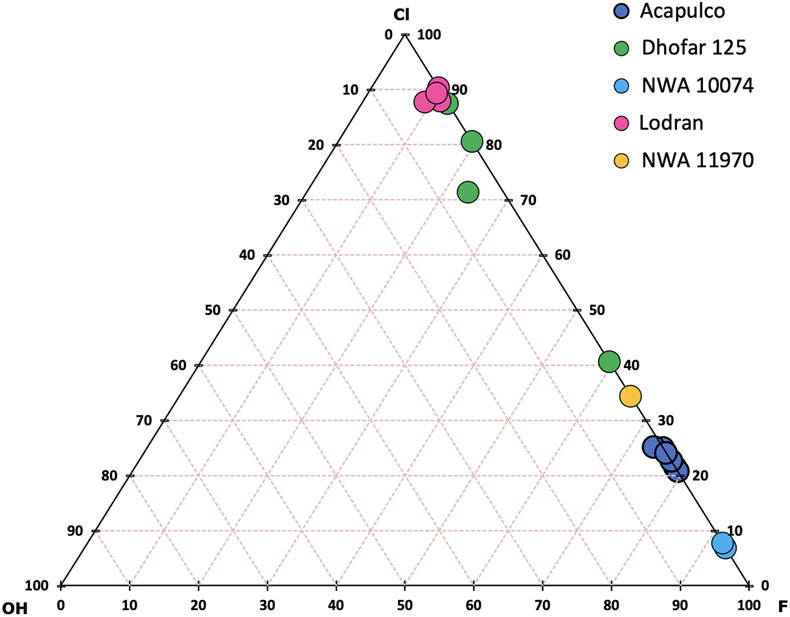
Figure 1 Ternary plot of apatite X-site occupancy (wt. %) from acapulcoites and lodranites. Procedures adopted for estimating OH and F contents are explained in the main text and Supplementary Information (McCubbin et al., 2021
McCubbin, F.M., Lewis, J.A., Barnes, J.J., Elardo, S.M., Boyce J.W. (2021) The abundances of F, Cl, and H2O in eucrites: Implications for the origin of volatile depletion in the asteroid 4 Vesta. Geochimica et Cosmochimica Acta 314, 270–293. https://doi.org/10.1016/j.gca.2021.08.021
).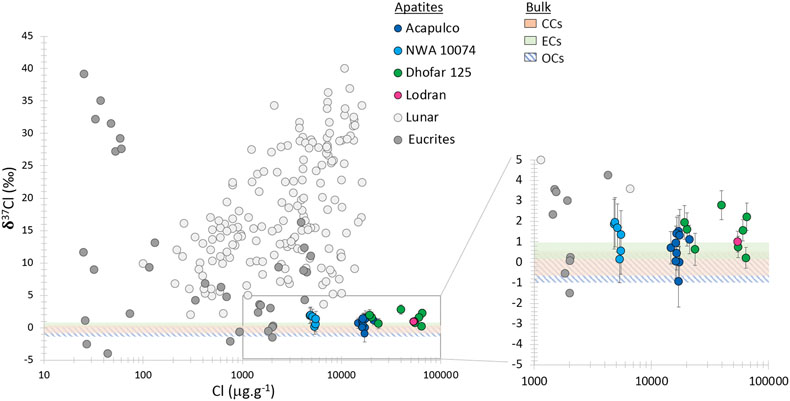
Figure 2 Chlorine abundance (μg.g−1) and isotopic composition (δ37Cl in ‰) of acapulcoite and lodranite apatite, lunar apatite (Barnes et al., 2019
Barnes, J.J., Franchi, I.A., McCubbin, F.M., Anand, M. (2019) Multiple volatile reservoirs on the Moon revealed by the isotopic composition of chlorine in lunar basalts. Geochimica Cosmochimica Acta 266, 144–162. https://doi.org/10.1016/j.gca.2018.12.032
and references therein), eucrite apatite (Barrett et al., 2019Barrett, T.J., Barnes, J.J., Anand, M., Franchi, I.A., Greenwood, R.C., Charlier, B.L.A., Zhao, X., Moynier, F., Grady, M.M. (2019) Investigating magmatic processes in the early Solar System using the Cl isotopic systematics of eucrites. Geochimica Cosmochimica. Acta 266, 582–597. https://doi.org/10.1016/j.gca.2019.06.024
and references therein). The orange band, green band and dashed blue band represent the average for bulk carbonaceous chondrites (CCs), enstatite chondrites (ECs) and ordinary chondrites (OCs), respectively (Sharp et al., 2013Sharp, Z.D., Mercer, J.A., Jones, R.H., Brearley, A.J., Selverstone, J., Bekker, A., Stachel, T. (2013) The chlorine isotope composition of chondrites and Earth. Geochimica Cosmochimica Acta 107, 189–204. https://doi.org/10.1016/j.gca.2013.01.003
).