



Imaging of boron in altered mantle rocks illuminates progressive serpentinisation episodes
Affiliations | Corresponding Author | Cite as | Funding information
Published by the European Association of Geochemistry
under Creative Commons License CC BY 4.0
Keywords: serpentinisation, boron, alteration events, imaging, Troodos Massif, boron isotope systematics


- Share this article


-
Article views:2,394Cumulative count of HTML views and PDF downloads.
- Download Citation
- Rights & Permissions

top
Abstract
Figures
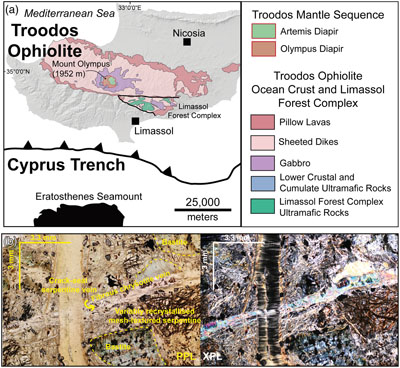 Figure 1 (a) Geological map of the Troodos ophiolite with the bullseye geometry of the Mantle Sequence highlighted (adapted from Evans et al., 2021). (b) Representative photomicrograph of completely serpentinised mantle peridotite located within the Artemis Diapir with variably recrystallised serpentine mesh texture, bastite, crack-seal serpentine vein and fibrous chrysotile vein. Scale bar is proportional to the mapped region of Figure 2. | 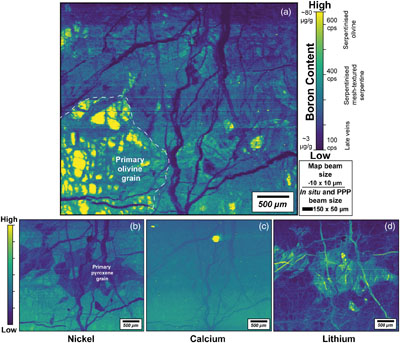 Figure 2 In situ (a) boron, (b) nickel, (c) calcium, and (d) lithium elemental count map of a completely serpentinised peridotite (sample AY2-2) from the Artemis Diapir. Data is plotted as counts per second and the relative differences are colour mapped accordingly using a linear colour map scale. | 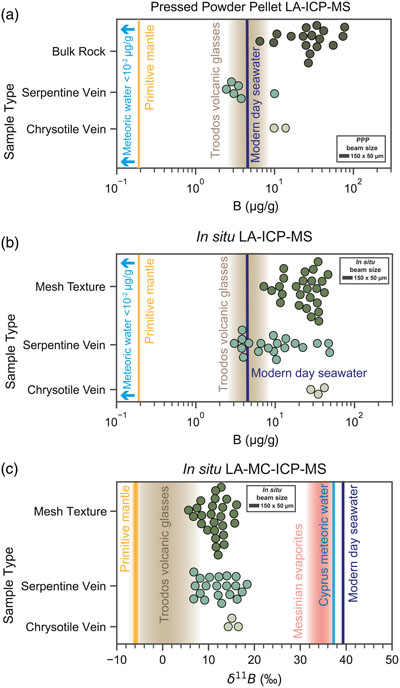 Figure 3 Caltech plots showing (a) B (μg/g) concentration data from pressed powder pellet LA-ICP-MS, (b) In situ LA-ICP-MS B (μg/g) concentration, (c) in situ LA-MC-ICP-MS δ11B on samples from the Artemis and Olympus Diapir. Boundaries of B (μg/g) and δ11B of Troodos for the reservoirs and reference materials shown are given in the Supplementary Information. Shading shows ±2σ of the reported value. Analytical errors (2 s.e.) are generally smaller than symbols. | 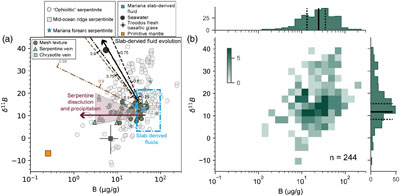 Figure 4 (a) δ11B and B (μg/g) data from the Olympus and Artemis Diapirs of the Troodos Mantle Sequence compared with compiled published serpentinite measurements. (b) Density histogram plot of compiled and new δ11B and B (μg/g) data. References for the compiled serpentinite values can be found in the Supplementary Information. Black solid lines of the bivariate histograms refer to the mean values of this study with dashed black lines reflecting ±1σ. Analytical error bars (2 s.e.) are shown for data from this study, most symbols are larger than associated analytical error. Simple fluid evolution model calculations using a Rayleigh fractionation model (Eq. 1) are shown as a black dashed line at 100 °C and black dash-dotted line at 400 °C using serpentine-fluid fractionation equations of Liu and Tossell (2005) and the model equations of Boschi et al. (2008) to estimate a fractionation factor (α). Black dash lines reflect evolution extent as B is removed from the fluid during serpentinisation at 100 and 400 °C respectively. Additionally, calculations using the serpentine-water fractionation values of Hansen et al. (2017) are shown as a brown dashed line at 100 °C and a brown dash-dotted line at 200 °C respectively. Initial fluid δ11B and concentration of the model is set as (+13 ‰ and 40 μg/g; Benton et al., 2001; Mottl et al., 2004). Blue box reflects assumed composition of slab-derived fluids at similar downgoing slab depths. Purple arrow and shading show vector of serpentine dissolution and precipitation. Isotopic fractionation between mineral and fluid phases likely results in scattering of the data. Black arrow shows slab-derived fluid evolution vector. |
| Figure 1 | Figure 2 | Figure 3 | Figure 4 |
top
Introduction
Serpentinisation, the interaction of water with mantle rocks, is a crucial process in the Earth system, influencing the planetary water cycle. It plays a key role in plate tectonics (Guillot et al., 2015
Guillot, S., Schwartz, S., Reynard, B., Agard, P., Prigent, C. (2015) Tectonic significance of serpentinites. Tectonophysics 646, 1–19. https://doi.org/10.1016/j.tecto.2015.01.020
), forms mountains through isostatic uplift (Evans et al., 2021Evans, A.D., Teagle, D.A.H., Craw, D., Henstock, T.J., Falcon-Suarez, I.H. (2021) Uplift and exposure of serpentinized massifs: Modeling differential serpentinite diapirism and exhumation of the troodos mantle sequence, Cyprus. Journal of Geophysical Research [Solid Earth] 126, e2020JB021079. https://doi.org/10.1029/2020JB021079
), and stores water, carbon, and fluid-mobile elements (Kodolányi et al., 2012Kodolányi, J., Pettke, T., Spandler, C., Kamber, B.S., Gméling, K. (2012) Geochemistry of Ocean Floor and Fore-arc Serpentinites: Constraints on the Ultramafic Input to Subduction Zones. Journal of Petrology 53, 235–270. https://doi.org/10.1093/petrology/egr058
). Understanding where, when, and with what fluids mantle rock alteration occurs is vital for quantifying serpentinisation's role in planetary cycles. Existing evidence, such as crosscutting relationships and stable isotopic compositions, suggests a progressive series of reactions during multiple water-rock interaction episodes (Alt and Shanks, 2006Alt, J.C., Shanks, W.C. (2006) Stable isotope compositions of serpentinite seamounts in the Mariana forearc: Serpentinization processes, fluid sources and sulfur metasomatism. Earth and Planetary Science Letters 242, 272–285. https://doi.org/10.1016/j.epsl.2005.11.063
). However, determining the conditions of distinct serpentinisation events is challenging due to the complex geological histories of altered mantle rocks, often overwritten by subsequent interactions (Kyser and Kerrich, 1991Kyser, T.K., Kerrich, R. (1991) Retrograde exchange of hydrogen between hydrous minerals and water at low temperatures. In: Tayor, H.P., O'Neill, J.R., Kaplan, I.R. (Eds.) Stable Isotope Geochemistry: a tribute to Samuel Epstein. The Geochemical Society Special Publication, 409–422.
). Whole rock analyses reflect cumulative signatures, making geochemical and isotopic fingerprinting of discrete events difficult (Wenner and Taylor, 1973Wenner, D.B., Taylor, H.P. (1973) Oxygen and hydrogen isotope studies of the serpentinization of ultramafic rocks in oceanic environments and continental ophiolite complexes. American Journal of Science 273, 207–239. https://doi.org/10.2475/ajs.273.3.207
; Alt and Shanks, 2006Alt, J.C., Shanks, W.C. (2006) Stable isotope compositions of serpentinite seamounts in the Mariana forearc: Serpentinization processes, fluid sources and sulfur metasomatism. Earth and Planetary Science Letters 242, 272–285. https://doi.org/10.1016/j.epsl.2005.11.063
) due to poorly constrained spatial and temporal distributions of elemental and isotopic changes resulting from serpentinisation events.Boron, an abundant element in serpentine with concentrations reaching ∼250 μg/g (Pabst et al., 2011
Pabst, S., Zack, T., Savov, I.P., Ludwig, T., Rost, D., Vicenzi, E.P. (2011) Evidence for boron incorporation into the serpentine crystal structure. The American Mineralogist 96, 1112–1119. https://doi.org/10.2138/am.2011.3709
), far exceeds levels in the primitive mantle (<0.25 μg/g; Marschall et al., 2017Marschall, H.R., Wanless, V.D., Shimizu, N., Pogge von Strandmann, P.A.E., Elliott, T., Monteleone, B.D. (2017) The boron and lithium isotopic composition of mid-ocean ridge basalts and the mantle. Geochimica Cosmochimica 207, 102–138. https://doi.org/10.1016/j.gca.2017.03.028
). This discrepancy makes boron and its isotopes valuable for discerning serpentinisation processes and conditions (Boschi et al., 2008Boschi, C., Dini, A., Früh-Green, G.L., Kelley, D.S. (2008) Isotopic and element exchange during serpentinization and metasomatism at the Atlantis Massif (MAR 30°N): Insights from B and Sr isotope data. Geochimica et Cosmochimica Acta 72, 1801–1823. https://doi.org/10.1016/j.gca.2008.01.013
; Vils et al. 2009Vils, F., Tonarini, S., Kalt, A., Seitz, H.-M. (2009) Boron, lithium and strontium isotopes as tracers of seawater–serpentinite interaction at Mid-Atlantic ridge, ODP Leg 209. Earth and Planetary Science Letters 286, 414–425. https://doi.org/10.1016/j.epsl.2009.07.005
; Martin et al., 2016Martin, C., Flores, K.E., Harlow, G.E. (2016) Boron isotopic discrimination for subduction-related serpentinites. Geology 44, 899–902 https://doi.org/10.1130/G38102.1
). Previous studies noted variations in boron concentrations and isotopic compositions, yet the lack of spatial context raises uncertainty about whether these variations indicate distinct serpentinisation events or the accumulation of successive episodes.Our investigation focuses on the Troodos ophiolite's serpentinised mantle rocks, utilising high resolution (10 μm/pixel) 2D maps of boron content, calibrated against in situ and powder measurements. In conjunction with in situ boron isotope analyses, our results reveal contrasting boron signatures in the strongly altered Troodos mantle peridotites. This allows us to identify distinct serpentinisation events by contrasting fluid sources.
top
Geological Setting
The Troodos Massif in Cyprus houses an exceptionally well preserved ophiolite sequence, featuring an elliptical bullseye-patterned welt at its centre (Fig. 1a). This welt, with the highest elevations composed of mantle peridotites, is part of the Troodos Mantle Sequence, which is divided into two regions: the Olympus and Artemis domains (Wilson, 1959
Wilson, R.A.M. (1959) The geology of the Xeros-Troodos area. Authority of the Government of Cyprus.
) that are interpreted as nested serpentinite diapirs with contrasting serpentinisation and deformation styles and intensities (Evans et al., 2021Evans, A.D., Teagle, D.A.H., Craw, D., Henstock, T.J., Falcon-Suarez, I.H. (2021) Uplift and exposure of serpentinized massifs: Modeling differential serpentinite diapirism and exhumation of the troodos mantle sequence, Cyprus. Journal of Geophysical Research [Solid Earth] 126, e2020JB021079. https://doi.org/10.1029/2020JB021079
). The Olympus Diapir consists of partially serpentinised tectonised harzburgites, while the Artemis Diapir is a sub-circular region with completely serpentinised peridotite blocks and clasts in a serpentinite breccia matrix (Wilson, 1959Wilson, R.A.M. (1959) The geology of the Xeros-Troodos area. Authority of the Government of Cyprus.
; Evans et al., 2021Evans, A.D., Teagle, D.A.H., Craw, D., Henstock, T.J., Falcon-Suarez, I.H. (2021) Uplift and exposure of serpentinized massifs: Modeling differential serpentinite diapirism and exhumation of the troodos mantle sequence, Cyprus. Journal of Geophysical Research [Solid Earth] 126, e2020JB021079. https://doi.org/10.1029/2020JB021079
). The Artemis rocks display variably recrystallised mesh-textured serpentine assemblages with distinctive features, including mutually crosscutting, fibrous asbestiform chrysotile and crack-seal serpentine vein sets (Fig. 1b). These serpentinite diapirs are proposed to originate from the tectonic juxtaposition of geochemically distinct mantle regions through serpentinite diapirism (Batanova and Sobolev, 2000Batanova, V.G., Sobolev, A.V. (2000) Compositional heterogeneity in subduction-related mantle peridotites, Troodos massif, Cyprus. Geology 28, 55–58. https://doi.org/10.1130/0091-7613(2000)028<0055:CHISRM>2.3.CO;2
).Figure 1 (a) Geological map of the Troodos ophiolite with the bullseye geometry of the Mantle Sequence highlighted (adapted from Evans et al., 2021
Evans, A.D., Teagle, D.A.H., Craw, D., Henstock, T.J., Falcon-Suarez, I.H. (2021) Uplift and exposure of serpentinized massifs: Modeling differential serpentinite diapirism and exhumation of the troodos mantle sequence, Cyprus. Journal of Geophysical Research [Solid Earth] 126, e2020JB021079. https://doi.org/10.1029/2020JB021079
). (b) Representative photomicrograph of completely serpentinised mantle peridotite located within the Artemis Diapir with variably recrystallised serpentine mesh texture, bastite, crack-seal serpentine vein and fibrous chrysotile vein. Scale bar is proportional to the mapped region of Figure 2.The Troodos ophiolite originated at a Neo-Tethyan spreading ridge around 90–92 million years ago above a supra-subduction zone (Moores et al., 1984
Moores, E.M., Robinson, P.T., Malpas, J., Xenophonotos, C. (1984) Model for the origin of the Troodos massif, Cyprus, and other mideast ophiolites. Geology 12, 500–503. https://doi.org/10.1130/0091-7613(1984)12<500:MFTOOT>2.0.CO;2
). However, its recent uplift and exposure, approximately 5.5 million years ago, is attributed to concentrated serpentinisation of the mantle wedge above a new north-dipping subduction zone. This zone consumes old oceanic crust, at least Mesozoic in age, on the leading edge of the Sinai plate (Cyprus slab) in the Cyprean trench to the south of the island. The initiation of subduction occurred in the early Miocene (∼20 million years ago) (Robertson, 1998Robertson, A.H.F. (1998) Mesozoic-Tertiary tectonic evolution of the easternmost Mediterranean area: integration of marine and land evidence. Proceedings of the Ocean Drilling Program 160, 723–782. https://doi.org/10.2973/odp.proc.sr.160.061.1998
; Feld et al., 2017Feld, C., Mechie, J., Hübscher, C., Hall, J., Nicolaides, S., Gurbuz, C., Bauer, K., Louden, K., Weber, M. (2017) Crustal structure of the Eratosthenes Seamount, Cyprus and S. Turkey from an amphibian wide-angle seismic profile. Tectonophysics 700–701, 32–59. https://doi.org/10.1016/j.tecto.2017.02.003
). A significant negative Bouguer anomaly is centred on the Artemis Diapir, modelled as a vertical, cylindrical body of low density (∼2,700 kg/m3) strongly serpentinised peridotite extending to a depth of approximately 11 km. This depth aligns with the inferred minimum depth of the top of the downgoing plate (Gass and Masson-Smith, 1963Gass, I.G., Masson-Smith, D. (1963) The Geology and Gravity Anomalies of the Troodos Massif, Cyprus. Proceedings of the Royal Society B: Biological Sciences 157, 587–588. https://doi.org/10.1098/rspb.1963.0030
; Feld et al., 2017Feld, C., Mechie, J., Hübscher, C., Hall, J., Nicolaides, S., Gurbuz, C., Bauer, K., Louden, K., Weber, M. (2017) Crustal structure of the Eratosthenes Seamount, Cyprus and S. Turkey from an amphibian wide-angle seismic profile. Tectonophysics 700–701, 32–59. https://doi.org/10.1016/j.tecto.2017.02.003
). It’s important to note that modern subduction differs from the supra-subduction zone setting that led to the formation of the Troodos ophiolite (Moores et al., 1984Moores, E.M., Robinson, P.T., Malpas, J., Xenophonotos, C. (1984) Model for the origin of the Troodos massif, Cyprus, and other mideast ophiolites. Geology 12, 500–503. https://doi.org/10.1130/0091-7613(1984)12<500:MFTOOT>2.0.CO;2
; Robertson, 1998Robertson, A.H.F. (1998) Mesozoic-Tertiary tectonic evolution of the easternmost Mediterranean area: integration of marine and land evidence. Proceedings of the Ocean Drilling Program 160, 723–782. https://doi.org/10.2973/odp.proc.sr.160.061.1998
). Subduction beneath Cyprus stalled due to the collision of the Eratosthenes plateau with the Cyprean trench less than 5 million years ago. This collision focused fluids released by the dehydration of the downgoing Cyprus slab beneath the Mount Olympus region, inducing serpentinisation hydration reactions and isostatic uplift (Robertson, 1998Robertson, A.H.F. (1998) Mesozoic-Tertiary tectonic evolution of the easternmost Mediterranean area: integration of marine and land evidence. Proceedings of the Ocean Drilling Program 160, 723–782. https://doi.org/10.2973/odp.proc.sr.160.061.1998
; Evans et al., 2021Evans, A.D., Teagle, D.A.H., Craw, D., Henstock, T.J., Falcon-Suarez, I.H. (2021) Uplift and exposure of serpentinized massifs: Modeling differential serpentinite diapirism and exhumation of the troodos mantle sequence, Cyprus. Journal of Geophysical Research [Solid Earth] 126, e2020JB021079. https://doi.org/10.1029/2020JB021079
, 2024Evans, A.D., Craw, D., Teagle, D.A.H. (2024) Active near-surface mobilisation of slab-derived geochemical signatures by hyperalkaline waters in brecciated serpentinites. Chemical Geology 643, 121822. https://doi.org/10.1016/j.chemgeo.2023.121822
).The Troodos mantle peridotites have been uplifted and exposed since the Pleistocene (Poole and Robertson, 1991
Poole, A.J., Robertson, A.H.F. (1991) Quaternary uplift and sea-level change at an active plate boundary, Cyprus. Journal of the Geological Society of London 148, 909–921. https://doi.org/10.1144/gsjgs.148.5.0909
), a process enhanced by the incursion of meteoric waters. Oxygen and hydrogen isotope analyses of serpentinised Troodos rocks have yielded various interpretations, including exchange with Cretaceous seawater at the spreading ridge, exchange at 200 to 300 °C with waters sourced from the Cyprus slab, or exchange at less than 50 °C with meteoric water (Magaritz and Taylor, 1974Magaritz, M., Taylor Jr, H.P. (1974) Oxygen and hydrogen isotope studies of serpentinization in the Troodos ophiolite complex, Cyprus. Earth and Planetary Science Letters 23, 8–14. https://doi.org/10.1016/0012-821X(74)90023-5
; Sheppard, 1980Sheppard, S.M.F. (1980) Isotopic evidence for the origins of water during metamorphic processes in oceanic crust and ophiolite complexes. Colloques Internationaux du CNRS 272, 135–147.
; Nuriel et al., 2009Nuriel, P., Katzir, Y., Abelson, M., Valley, J.W., Matthews, A., Spicuzza, M.J., Ayalon, A. (2009) Fault-related oceanic serpentinization in the Troodos ophiolite, Cyprus: Implications for a fossil oceanic core complex. Earth and Planetary Science Letters 282, 34–46. https://doi.org/10.1016/j.epsl.2009.02.029
; Evans et al., 2021Evans, A.D., Teagle, D.A.H., Craw, D., Henstock, T.J., Falcon-Suarez, I.H. (2021) Uplift and exposure of serpentinized massifs: Modeling differential serpentinite diapirism and exhumation of the troodos mantle sequence, Cyprus. Journal of Geophysical Research [Solid Earth] 126, e2020JB021079. https://doi.org/10.1029/2020JB021079
, 2024Evans, A.D., Craw, D., Teagle, D.A.H. (2024) Active near-surface mobilisation of slab-derived geochemical signatures by hyperalkaline waters in brecciated serpentinites. Chemical Geology 643, 121822. https://doi.org/10.1016/j.chemgeo.2023.121822
).top
Analytical Methods
Boron concentrations were mapped in polished serpentinite thick sections using a 10 × 10 μm ablation beam from an Elemental Scientific Lasers NWR193 Excimer laser ablation (LA) system with a TwoVol2 ablation cell coupled to an Agilent 8900 Triple Quadrupole ICP-MS. Boron concentrations were calibrated against in situ and pressed powder pellet (PPP) boron concentrations determined at coarser resolutions (150 × 50 μm). Boron isotope analyses of polished thick sections and pressed powder pellets (PPP) were acquired using a Thermo Scientific Neptune Plus multi-collector inductively coupled plasma (MC-ICP) mass spectrometer. For more details on our analytical procedures refer to the Supplementary Information.
top
Results
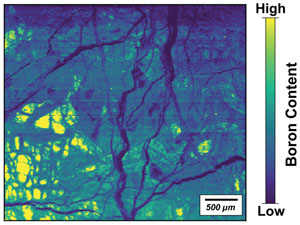
The in situ boron elemental 2D map of a fully serpentinised sample from the Artemis Diapir (Fig. 2a) indicates three distinct serpentine styles with varying boron concentrations: 1) high boron concentration serpentine, pseudomorphing original olivine grains, 2) moderate boron serpentine, coexisting with the B-rich style, and 3) discrete, irregular low boron concentration serpentine veins and mesh-textured background serpentine, which crosscuts types 1 and 2. The nickel content map (Fig. 2b) reflects the original primary texture before serpentinisation, with former olivine grains exhibiting high nickel contents and former pyroxene grains having relatively lower nickel contents. Calcium maps (Fig. 2c) highlight the contrast between mesh-textured serpentine and serpentine veins, with high calcium counts indicating calcium-rich inclusions. Lithium contents (Fig. 2d) show a distinct pattern from boron, with high lithium content occurring in serpentine pseudomorphing original pyroxene grains, while some late stage serpentine veins with mesh-textured serpentine generally have low lithium contents.
Figure 2 In situ (a) boron, (b) nickel, (c) calcium, and (d) lithium elemental count map of a completely serpentinised peridotite (sample AY2-2) from the Artemis Diapir. Data is plotted as counts per second and the relative differences are colour mapped accordingly using a linear colour map scale.
Samples from the Olympus and Artemis diapirs show similar boron concentrations and isotopic compositions (Fig. 3). In the Troodos Mantle Sequence, whole rock pressed powder pellet boron concentrations range widely (7 to 80 μg/g, mean 34 ± 21 μg/g, n = 17; Fig. 3a). In situ boron concentrations from polished thick sections exhibit a similar range (3 to 49 μg/g, mean 21 ± 13 μg/g, n = 49; Fig. 3b), with notable differences between serpentine types (Fig. 3b). Mesh-textured serpentine has a higher mean boron concentration (26 ± 12 μg/g, n = 26) compared to serpentine veins (12 ± 11 μg/g, n = 20). Chrysotile veins in thick sections and pellets have boron concentrations ranging between 10 and 35 μg/g (Fig. 3).
Figure 3 Caltech plots showing (a) B (μg/g) concentration data from pressed powder pellet LA-ICP-MS, (b) In situ LA-ICP-MS B (μg/g) concentration, (c) in situ LA-MC-ICP-MS δ11B on samples from the Artemis and Olympus Diapir. Boundaries of B (μg/g) and δ11B of Troodos for the reservoirs and reference materials shown are given in the Supplementary Information. Shading shows ±2σ of the reported value. Analytical errors (2 s.e.) are generally smaller than symbols.
Boron isotopic compositions (δ11B) of serpentine veins and serpentinites in the Troodos Mantle Sequence range from +6.7 to +18.4 ‰ (mean +11.9 ± 3.2 ‰, n = 49; Fig. 3c). Olympus and Artemis Diapirs' serpentinites have indistinguishable boron isotopic compositions, suggesting alteration by a uniform external fluid despite their different mantle origins. The Troodos Mantle Sequence's boron isotopic compositions align with those from various serpentinisation settings, yielding a mean δ11B value of +17.3 ± 10.2 ‰ (n = 195; Fig. 4). Published serpentinite boron concentrations vary widely (mean δ11B of 35 ± 32 μg/g, n = 195; Fig. 4b).
Figure 4 (a) δ11B and B (μg/g) data from the Olympus and Artemis Diapirs of the Troodos Mantle Sequence compared with compiled published serpentinite measurements. (b) Density histogram plot of compiled and new δ11B and B (μg/g) data. References for the compiled serpentinite values can be found in the Supplementary Information. Black solid lines of the bivariate histograms refer to the mean values of this study with dashed black lines reflecting ±1σ. Analytical error bars (2 s.e.) are shown for data from this study, most symbols are larger than associated analytical error. Simple fluid evolution model calculations using a Rayleigh fractionation model (Eq. 1) are shown as a black dashed line at 100 °C and black dash-dotted line at 400 °C using serpentine-fluid fractionation equations of Liu and Tossell (2005)
Liu, Y., Tossell, J.A. (2005) Ab initio molecular orbital calculations for boron isotope fractionations on boric acids and borates. Geochimica et Cosmochimica Acta 69, 3995–4006. https://doi.org/10.1016/j.gca.2005.04.009
and the model equations of Boschi et al. (2008)Boschi, C., Dini, A., Früh-Green, G.L., Kelley, D.S. (2008) Isotopic and element exchange during serpentinization and metasomatism at the Atlantis Massif (MAR 30°N): Insights from B and Sr isotope data. Geochimica et Cosmochimica Acta 72, 1801–1823. https://doi.org/10.1016/j.gca.2008.01.013
to estimate a fractionation factor (α). Black dash lines reflect evolution extent as B is removed from the fluid during serpentinisation at 100 and 400 °C respectively. Additionally, calculations using the serpentine-water fractionation values of Hansen et al. (2017)Hansen, C.T., Meixner, A., Kasemann, S.A., Bach, W. (2017) New insight on Li and B isotope fractionation during serpentinization derived from batch reaction investigations. Geochimica et Cosmochimica Acta 217, 51–79. https://doi.org/10.1016/j.gca.2017.08.014
are shown as a brown dashed line at 100 °C and a brown dash-dotted line at 200 °C respectively. Initial fluid δ11B and concentration of the model is set as (+13 ‰ and 40 μg/g; Benton et al., 2001Benton, L.D., Ryan, J.G., Tera, F. (2001) Boron isotope systematics of slab fluids as inferred from a serpentine seamount, Mariana forearc. Earth and Planetary Science Letters 187, 273–282. https://doi.org/10.1016/S0012-821X(01)00286-2
; Mottl et al., 2004Mottl, M.J., Wheat, C.G., Fryer, P., Gharib, J., Martin, J.B. (2004) Chemistry of springs across the Mariana forearc shows progressive devolatilization of the subducting plate. Geochimica et Cosmochimica Acta 68, 4915–4933. https://doi.org/10.1016/j.gca.2004.05.037
). Blue box reflects assumed composition of slab-derived fluids at similar downgoing slab depths. Purple arrow and shading show vector of serpentine dissolution and precipitation. Isotopic fractionation between mineral and fluid phases likely results in scattering of the data. Black arrow shows slab-derived fluid evolution vector.top
Discussion
High resolution (10 μm) boron elemental mapping of serpentinised mantle rocks highlights a highly heterogeneous spatial distribution of boron (Fig. 2). We interpret the three texturally distinct serpentines resulting from at least two temporally distinct alteration events. The initial pervasive serpentinisation by a fluid with a high boron concentration formed B-rich serpentine through the pseudomorphic replacement of olivine and serpentine vein precipitation. A second pervasive alteration event by a low boron concentration fluid is recorded by the mesh-textured serpentine, with lower boron concentrations indicating the differential leaching of boron. A subsequent channelled fluid event precipitated low boron and calcium but high lithium concentration serpentine in discrete veins and further leached boron from the surrounding mesh-textured host (Fig. 2).
An interpretation of multiple temporally distinct alteration events with contrasting fluid sources yielding serpentine of progressively lower boron concentrations is in agreement with the outlined geological history of the Troodos Mantle Sequence and interpretations of previous stable oxygen and hydrogen isotope analyses (Evans et al., 2021
Evans, A.D., Teagle, D.A.H., Craw, D., Henstock, T.J., Falcon-Suarez, I.H. (2021) Uplift and exposure of serpentinized massifs: Modeling differential serpentinite diapirism and exhumation of the troodos mantle sequence, Cyprus. Journal of Geophysical Research [Solid Earth] 126, e2020JB021079. https://doi.org/10.1029/2020JB021079
). The initial high boron (∼80 μg/g) pervasive serpentinisation most likely results from fluid liberated by dehydration of ocean crust and sediments from the subducting Cyprus slab (e.g., Robertson, 1998Robertson, A.H.F. (1998) Mesozoic-Tertiary tectonic evolution of the easternmost Mediterranean area: integration of marine and land evidence. Proceedings of the Ocean Drilling Program 160, 723–782. https://doi.org/10.2973/odp.proc.sr.160.061.1998
; Evans et al., 2021Evans, A.D., Teagle, D.A.H., Craw, D., Henstock, T.J., Falcon-Suarez, I.H. (2021) Uplift and exposure of serpentinized massifs: Modeling differential serpentinite diapirism and exhumation of the troodos mantle sequence, Cyprus. Journal of Geophysical Research [Solid Earth] 126, e2020JB021079. https://doi.org/10.1029/2020JB021079
, 2024Evans, A.D., Craw, D., Teagle, D.A.H. (2024) Active near-surface mobilisation of slab-derived geochemical signatures by hyperalkaline waters in brecciated serpentinites. Chemical Geology 643, 121822. https://doi.org/10.1016/j.chemgeo.2023.121822
), similar to high B concentration fluids from Mariana forearc serpentinite mud volcanoes that are interpreted to be upwelling slab-derived fluids (∼40 μg/g; Benton et al., 2001Benton, L.D., Ryan, J.G., Tera, F. (2001) Boron isotope systematics of slab fluids as inferred from a serpentine seamount, Mariana forearc. Earth and Planetary Science Letters 187, 273–282. https://doi.org/10.1016/S0012-821X(01)00286-2
; Mottl et al., 2004Mottl, M.J., Wheat, C.G., Fryer, P., Gharib, J., Martin, J.B. (2004) Chemistry of springs across the Mariana forearc shows progressive devolatilization of the subducting plate. Geochimica et Cosmochimica Acta 68, 4915–4933. https://doi.org/10.1016/j.gca.2004.05.037
).The boron isotopic compositions (mean +11.9 ± 3.2 ‰, 1σ, n = 49) of the Olympus and Artemis diapirs are similar to strongly serpentinised ultramafic clasts recovered from Mariana forearc serpentinite mud volcanoes (mean +14.5 ± 4.5 ‰, 1σ, n = 21; Benton et al., 2001
Benton, L.D., Ryan, J.G., Tera, F. (2001) Boron isotope systematics of slab fluids as inferred from a serpentine seamount, Mariana forearc. Earth and Planetary Science Letters 187, 273–282. https://doi.org/10.1016/S0012-821X(01)00286-2
). Estimating the δ11B of serpentinising fluids from rock analyses is complex, requiring assumptions about the isotope partitioning of boron fluid species (Spivack and Edmond, 1987Spivack, A.J., Edmond, J.M. (1987) Boron isotope exchange between seawater and the oceanic crust. Geochimica et Cosmochimica Acta 51, 1033–1043. https://doi.org/10.1016/0016-7037(87)90198-0
; Benton et al., 2001Benton, L.D., Ryan, J.G., Tera, F. (2001) Boron isotope systematics of slab fluids as inferred from a serpentine seamount, Mariana forearc. Earth and Planetary Science Letters 187, 273–282. https://doi.org/10.1016/S0012-821X(01)00286-2
; Boschi et al., 2008Boschi, C., Dini, A., Früh-Green, G.L., Kelley, D.S. (2008) Isotopic and element exchange during serpentinization and metasomatism at the Atlantis Massif (MAR 30°N): Insights from B and Sr isotope data. Geochimica et Cosmochimica Acta 72, 1801–1823. https://doi.org/10.1016/j.gca.2008.01.013
; Vils et al., 2009Vils, F., Tonarini, S., Kalt, A., Seitz, H.-M. (2009) Boron, lithium and strontium isotopes as tracers of seawater–serpentinite interaction at Mid-Atlantic ridge, ODP Leg 209. Earth and Planetary Science Letters 286, 414–425. https://doi.org/10.1016/j.epsl.2009.07.005
). However, at typical serpentinising conditions in the mantle wedge above subduction zones (pH > 8, ∼250 °C; following McCollom et al. (2020)McCollom, T.M., Klein, F., Solheid, P., Moskowitz, B. (2020) The effect of pH on rates of reaction and hydrogen generation during serpentinization. Philosophical Transactions of the Royal Society A: Mathematical, Physical and Engineering Sciences 378, 20180428. https://doi.org/10.1098/rsta.2018.0428
, experimental determination of pKB yields values of <5 (following Dickson, 1990Dickson, A.G. (1990) Thermodynamics of the dissociation of boric acid in synthetic seawater from 273.15 to 318.15 K. Deep-sea Research. Part A, Oceanographic research papers 37, 755–766. https://doi.org/10.1016/0198-0149(90)90004-F
; Arcis et al., 2017Arcis, H., Ferguson, J.P., Applegarth, L., Zimmerman, G.H., Tremaine, P.R. (2017) Ionization of boric acid in water from 298 K to 623 K by AC conductivity and Raman spectroscopy. The Journal of Chemical Thermodynamics 106, 187–198. https://doi.org/10.1016/j.jct.2016.11.007
). Consequently, borate ion is the dominant fluid species resulting in minimal pH dependent fractionation (Spivack and Edmond, 1987Spivack, A.J., Edmond, J.M. (1987) Boron isotope exchange between seawater and the oceanic crust. Geochimica et Cosmochimica Acta 51, 1033–1043. https://doi.org/10.1016/0016-7037(87)90198-0
; Benton et al., 2001Benton, L.D., Ryan, J.G., Tera, F. (2001) Boron isotope systematics of slab fluids as inferred from a serpentine seamount, Mariana forearc. Earth and Planetary Science Letters 187, 273–282. https://doi.org/10.1016/S0012-821X(01)00286-2
; Boschi et al., 2008Boschi, C., Dini, A., Früh-Green, G.L., Kelley, D.S. (2008) Isotopic and element exchange during serpentinization and metasomatism at the Atlantis Massif (MAR 30°N): Insights from B and Sr isotope data. Geochimica et Cosmochimica Acta 72, 1801–1823. https://doi.org/10.1016/j.gca.2008.01.013
; Arcis et al., 2017Arcis, H., Ferguson, J.P., Applegarth, L., Zimmerman, G.H., Tremaine, P.R. (2017) Ionization of boric acid in water from 298 K to 623 K by AC conductivity and Raman spectroscopy. The Journal of Chemical Thermodynamics 106, 187–198. https://doi.org/10.1016/j.jct.2016.11.007
). The δ11B of the Mariana forearc slab-derived fluid is estimated to be ∼+13 ‰ (Benton et al., 2001Benton, L.D., Ryan, J.G., Tera, F. (2001) Boron isotope systematics of slab fluids as inferred from a serpentine seamount, Mariana forearc. Earth and Planetary Science Letters 187, 273–282. https://doi.org/10.1016/S0012-821X(01)00286-2
). We note that the depths of dehydration beneath the Mariana forearc (∼15 to 29 km; (Mottl et al., 2004Mottl, M.J., Wheat, C.G., Fryer, P., Gharib, J., Martin, J.B. (2004) Chemistry of springs across the Mariana forearc shows progressive devolatilization of the subducting plate. Geochimica et Cosmochimica Acta 68, 4915–4933. https://doi.org/10.1016/j.gca.2004.05.037
) are similar to the depths of the Cyprus slab beneath the Troodos Mantle Sequence region (Feld et al., 2017Feld, C., Mechie, J., Hübscher, C., Hall, J., Nicolaides, S., Gurbuz, C., Bauer, K., Louden, K., Weber, M. (2017) Crustal structure of the Eratosthenes Seamount, Cyprus and S. Turkey from an amphibian wide-angle seismic profile. Tectonophysics 700–701, 32–59. https://doi.org/10.1016/j.tecto.2017.02.003
; Evans et al., 2021Evans, A.D., Teagle, D.A.H., Craw, D., Henstock, T.J., Falcon-Suarez, I.H. (2021) Uplift and exposure of serpentinized massifs: Modeling differential serpentinite diapirism and exhumation of the troodos mantle sequence, Cyprus. Journal of Geophysical Research [Solid Earth] 126, e2020JB021079. https://doi.org/10.1029/2020JB021079
). The range (+6.7 to +18.4 ‰) in δ11B in Olympus and Artemis serpentinites most probably reflects the progressive evolution of a serpentinising fluid that can be modelled by Rayleigh fractionation (Eq. 1; Fig. 4a)Eq. 1

Calculations using fractionation factors of α = 0.982 and 0.989 for 100 and 400 °C respectively (following Liu and Tossell, 2005
Liu, Y., Tossell, J.A. (2005) Ab initio molecular orbital calculations for boron isotope fractionations on boric acids and borates. Geochimica et Cosmochimica Acta 69, 3995–4006. https://doi.org/10.1016/j.gca.2005.04.009
; Boschi et al., 2008Boschi, C., Dini, A., Früh-Green, G.L., Kelley, D.S. (2008) Isotopic and element exchange during serpentinization and metasomatism at the Atlantis Massif (MAR 30°N): Insights from B and Sr isotope data. Geochimica et Cosmochimica Acta 72, 1801–1823. https://doi.org/10.1016/j.gca.2008.01.013
) and α = 0.990 and 0.996 for 100 and 200 °C respectively (following Hansen et al., 2017Hansen, C.T., Meixner, A., Kasemann, S.A., Bach, W. (2017) New insight on Li and B isotope fractionation during serpentinization derived from batch reaction investigations. Geochimica et Cosmochimica Acta 217, 51–79. https://doi.org/10.1016/j.gca.2017.08.014
) indicate that as fluid boron is sequestered into serpentine the isotopic composition of the fluid evolves to higher δ11B values, regardless of which fractionation factors are used (Liu and Tossell, 2005Liu, Y., Tossell, J.A. (2005) Ab initio molecular orbital calculations for boron isotope fractionations on boric acids and borates. Geochimica et Cosmochimica Acta 69, 3995–4006. https://doi.org/10.1016/j.gca.2005.04.009
; Hansen et al., 2017Hansen, C.T., Meixner, A., Kasemann, S.A., Bach, W. (2017) New insight on Li and B isotope fractionation during serpentinization derived from batch reaction investigations. Geochimica et Cosmochimica Acta 217, 51–79. https://doi.org/10.1016/j.gca.2017.08.014
). Consequently, higher δ11B serpentinites will precipitate further along the flow path (Spivack and Edmond, 1987Spivack, A.J., Edmond, J.M. (1987) Boron isotope exchange between seawater and the oceanic crust. Geochimica et Cosmochimica Acta 51, 1033–1043. https://doi.org/10.1016/0016-7037(87)90198-0
; Vils et al., 2009Vils, F., Tonarini, S., Kalt, A., Seitz, H.-M. (2009) Boron, lithium and strontium isotopes as tracers of seawater–serpentinite interaction at Mid-Atlantic ridge, ODP Leg 209. Earth and Planetary Science Letters 286, 414–425. https://doi.org/10.1016/j.epsl.2009.07.005
).Hydrothermally altered seafloor lavas commonly have high boron concentrations up to 200 μg/g (Yamaoka et al., 2015b
Yamaoka, K., Matsukura, S., Ishikawa, T., Kawahata, H. (2015b) Boron isotope systematics of a fossil hydrothermal system from the Troodos ophiolite, Cyprus: Water-rock interactions in the oceanic crust and subseafloor ore deposits. Chemical Geology 396, 61–73. https://doi.org/10.1016/j.chemgeo.2014.12.023
; Fonseca et al., 2017Fonseca, R.O.C., Kirchenbaur, M., Ballhaus, C., Münker, C., Zirner, A., Gerdes, A., Heuser, A., Botcharnikov, R., Lenting, C. (2017) Fingerprinting fluid sources in Troodos ophiolite complex orbicular glasses using high spatial resolution isotope and trace element geochemistry. Geochimica et Cosmochimica Acta 200, 145–166. https://doi.org/10.1016/j.gca.2016.12.012
) and the downgoing ancient altered ocean crust of the Cyprus slab is likely a significant reservoir of boron. Consequently, we propose that dewatering and dehydration reactions during the subduction of altered ocean crust of the Cyprus slab liberated the high boron fluid responsible for the initial pervasive serpentinisation of the Troodos Mantle Sequence.Alternative interpretations such as Cretaceous seawater-derived hydrothermal fluids penetrating through the Troodos ocean crust and into the Olympus and Artemis mantle domains do not match analyses of the Troodos ophiolite that show decreasing boron concentrations (from 207 to 0.3 μg/g) and lower δ11B signatures (from +15.6 to −1.7 ‰) with depth in the ocean crust and strong channelling of hydrothermal alteration in the gabbros (Yamaoka et al., 2015b
Yamaoka, K., Matsukura, S., Ishikawa, T., Kawahata, H. (2015b) Boron isotope systematics of a fossil hydrothermal system from the Troodos ophiolite, Cyprus: Water-rock interactions in the oceanic crust and subseafloor ore deposits. Chemical Geology 396, 61–73. https://doi.org/10.1016/j.chemgeo.2014.12.023
). Assuming that Cretaceous seawater-derived hydrothermal fluids had similar boron isotopic compositions and concentrations to modern fluids (+13.5 to +36.1 ‰ and 4.5 to 16 μg/g respectively; Yamaoka et al., 2015aYamaoka, K., Hong, E., Ishikawa, T., Gamo, T., Kawahata, H. (2015a) Boron isotope geochemistry of vent fluids from arc/back-arc seafloor hydrothermal systems in the western Pacific. Chemical Geology 392, 9–18. https://doi.org/10.1016/j.chemgeo.2014.11.009
), the ratio of hydrothermal fluid relative to rock required to form a high boron concentration (80 μg/g) serpentine is very high (from ∼5 to ∼18) and hence unlikely.The low boron fluid end member attributed to the second and third Troodos serpentinisation events is consistent with alteration by meteoric waters, where boron derived from the initial pervasive serpentinisation is remobilised by high pH (>9) groundwaters (Evans et al., 2024
Evans, A.D., Craw, D., Teagle, D.A.H. (2024) Active near-surface mobilisation of slab-derived geochemical signatures by hyperalkaline waters in brecciated serpentinites. Chemical Geology 643, 121822. https://doi.org/10.1016/j.chemgeo.2023.121822
) leaving residual or re-precipitated serpentine with lower boron concentrations but with the boron isotope signature of the initial event (Fig. 3). This meteoric water alteration event is consistent with previous stable oxygen and hydrogen analyses (Magaritz and Taylor, 1974Magaritz, M., Taylor Jr, H.P. (1974) Oxygen and hydrogen isotope studies of serpentinization in the Troodos ophiolite complex, Cyprus. Earth and Planetary Science Letters 23, 8–14. https://doi.org/10.1016/0012-821X(74)90023-5
; Nuriel et al., 2009Nuriel, P., Katzir, Y., Abelson, M., Valley, J.W., Matthews, A., Spicuzza, M.J., Ayalon, A. (2009) Fault-related oceanic serpentinization in the Troodos ophiolite, Cyprus: Implications for a fossil oceanic core complex. Earth and Planetary Science Letters 282, 34–46. https://doi.org/10.1016/j.epsl.2009.02.029
; Evans et al., 2021Evans, A.D., Teagle, D.A.H., Craw, D., Henstock, T.J., Falcon-Suarez, I.H. (2021) Uplift and exposure of serpentinized massifs: Modeling differential serpentinite diapirism and exhumation of the troodos mantle sequence, Cyprus. Journal of Geophysical Research [Solid Earth] 126, e2020JB021079. https://doi.org/10.1029/2020JB021079
) and is favoured over alternative interpretations of an evolving dehydrating slab fluid source as proposed for the Mariana system (e.g., Kahl et al., 2015Kahl, W.A., Jöns, N., Bach, W., Klein, F., Alt, J.C. (2015) Ultramafic clasts from the South Chamorro serpentine mud volcano reveal a polyphase serpentinization history of the Mariana forearc mantle. Lithos 227, 1–20. https://doi.org/10.1016/j.lithos.2015.03.015
) or distinct fluid pulses with similar boron isotopic compositions but contrasting boron concentrations as suggested for the Mid-Atlantic Ridge Atlantis Massif (e.g., Boschi et al., 2008Boschi, C., Dini, A., Früh-Green, G.L., Kelley, D.S. (2008) Isotopic and element exchange during serpentinization and metasomatism at the Atlantis Massif (MAR 30°N): Insights from B and Sr isotope data. Geochimica et Cosmochimica Acta 72, 1801–1823. https://doi.org/10.1016/j.gca.2008.01.013
). These alternative interpretations are inconsistent with previous Troodos stable oxygen and hydrogen isotope compositions.Novel high resolution elemental serpentinite mapping is a promising avenue in revealing the spatial distribution of boron and other elements (Ni, Ca, Li) in serpentinites. Elemental mapping leveraging a fine ablation beam size of 10 x 10 μm illuminates the heterogeneously distributed contrasting boron signatures that would otherwise not be observed with a coarser ablation beam or bulk rock sampling. This knowledge yields deeper interpretation of determined boron concentrations of pressed powder pellets and in situ polished thick sections.
In addition to boron, nickel mapping in serpentinites appears to highlight the original primary texture of mantle peridotites. Calcium mapping shows differences between mesh-textured serpentine and serpentine veins. The distributions of lithium and boron differ as these elements show contrasting affinities for serpentine that pseudomorphs olivine or pyroxene respectively. This is consistent with previous studies that demonstrate serpentine Li content is dependent on protolith mineralogy and potentially previous melt-rock interaction events (e.g., Kodolányi et al., 2012
Kodolányi, J., Pettke, T., Spandler, C., Kamber, B.S., Gméling, K. (2012) Geochemistry of Ocean Floor and Fore-arc Serpentinites: Constraints on the Ultramafic Input to Subduction Zones. Journal of Petrology 53, 235–270. https://doi.org/10.1093/petrology/egr058
). The high lithium abundance in some serpentine veins within the element map (Fig. 2d) likely reflects precipitation from Li-enriched meteoric-derived hyperalkaline groundwaters (Evans et al., 2024Evans, A.D., Craw, D., Teagle, D.A.H. (2024) Active near-surface mobilisation of slab-derived geochemical signatures by hyperalkaline waters in brecciated serpentinites. Chemical Geology 643, 121822. https://doi.org/10.1016/j.chemgeo.2023.121822
).Future studies to identify and determine the origin of fluid in serpentinised rocks should combine elemental mapping with in situ measurements of oxygen and hydrogen stable isotopes as well as novel isotopic tracers such as boron to identify distinctive geochemical and isotopic fingerprints of specific serpentinisation episodes.
top
Acknowledgements
We thank the Geological Survey Department of the Republic of Cyprus for facilitating field work (MoU/Ref. No. 05.26.001/5). ADE acknowledges a Natural Environment Research Council-SPITFIRE CASE PhD award NE/L002531/1 (Natural History Museum CASE Partner). DAHT acknowledges a Royal Society Wolfson Research Merit Award (WM130051). We thank Prof. Raúl Fonseca for editorial handling, and Jeff Ryan and an anonymous reviewer for their constructive reviews. We thank Dan Doran and Matt Beverly-Smith for the preparation of thick sections.
Editor: Raúl Fonseca
top
References
Alt, J.C., Shanks, W.C. (2006) Stable isotope compositions of serpentinite seamounts in the Mariana forearc: Serpentinization processes, fluid sources and sulfur metasomatism. Earth and Planetary Science Letters 242, 272–285. https://doi.org/10.1016/j.epsl.2005.11.063
 Show in context
 Existing evidence, such as crosscutting relationships and stable isotopic compositions, suggests a progressive series of reactions during multiple water-rock interaction episodes (Alt and Shanks, 2006).
View in article
Whole rock analyses reflect cumulative signatures, making geochemical and isotopic fingerprinting of discrete events difficult (Wenner and Taylor, 1973; Alt and Shanks, 2006) due to poorly constrained spatial and temporal distributions of elemental and isotopic changes resulting from serpentinisation events.
View in article
Arcis, H., Ferguson, J.P., Applegarth, L., Zimmerman, G.H., Tremaine, P.R. (2017) Ionization of boric acid in water from 298 K to 623 K by AC conductivity and Raman spectroscopy. The Journal of Chemical Thermodynamics 106, 187–198. https://doi.org/10.1016/j.jct.2016.11.007
Show in context However, at typical serpentinising conditions in the mantle wedge above subduction zones (pH > 8, ∼250 °C; following McCollom et al. (2020), experimental determination of pKB yields values of <5 (following Dickson, 1990; Arcis et al., 2017).
View in article
Consequently, borate ion is the dominant fluid species resulting in minimal pH dependent fractionation (Spivack and Edmond, 1987; Benton et al., 2001; Boschi et al., 2008; Arcis et al., 2017).
View in article
Batanova, V.G., Sobolev, A.V. (2000) Compositional heterogeneity in subduction-related mantle peridotites, Troodos massif, Cyprus. Geology 28, 55–58. https://doi.org/10.1130/0091-7613(2000)028<0055:CHISRM>2.3.CO;2
Show in context These serpentinite diapirs are proposed to originate from the tectonic juxtaposition of geochemically distinct mantle regions through serpentinite diapirism (Batanova and Sobolev, 2000).
View in article
Benton, L.D., Ryan, J.G., Tera, F. (2001) Boron isotope systematics of slab fluids as inferred from a serpentine seamount, Mariana forearc. Earth and Planetary Science Letters 187, 273–282. https://doi.org/10.1016/S0012-821X(01)00286-2
Show in context Initial fluid δ11B and concentration of the model is set as (+13 ‰ and 40 μg/g; Benton et al., 2001; Mottl et al., 2004).
View in article
The initial high boron (∼80 μg/g) pervasive serpentinisation most likely results from fluid liberated by dehydration of ocean crust and sediments from the subducting Cyprus slab (e.g., Robertson, 1998; Evans et al., 2021, 2024), similar to high B concentration fluids from Mariana forearc serpentinite mud volcanoes that are interpreted to be upwelling slab-derived fluids (∼40 μg/g; Benton et al., 2001; Mottl et al., 2004).
View in article
The boron isotopic compositions (mean +11.9 ± 3.2 ‰, 1σ, n = 49) of the Olympus and Artemis diapirs are similar to strongly serpentinised ultramafic clasts recovered from Mariana forearc serpentinite mud volcanoes (mean +14.5 ± 4.5 ‰, 1σ, n = 21; Benton et al., 2001).
View in article
Estimating the δ11B of serpentinising fluids from rock analyses is complex, requiring assumptions about the isotope partitioning of boron fluid species (Spivack and Edmond, 1987; Benton et al., 2001; Boschi et al., 2008; Vils et al., 2009).
View in article
Consequently, borate ion is the dominant fluid species resulting in minimal pH dependent fractionation (Spivack and Edmond, 1987; Benton et al., 2001; Boschi et al., 2008; Arcis et al., 2017).
View in article
The δ11B of the Mariana forearc slab-derived fluid is estimated to be ∼+13 ‰ (Benton et al., 2001).
View in article
Boschi, C., Dini, A., Früh-Green, G.L., Kelley, D.S. (2008) Isotopic and element exchange during serpentinization and metasomatism at the Atlantis Massif (MAR 30°N): Insights from B and Sr isotope data. Geochimica et Cosmochimica Acta 72, 1801–1823. https://doi.org/10.1016/j.gca.2008.01.013
Show in context This discrepancy makes boron and its isotopes valuable for discerning serpentinisation processes and conditions (Boschi et al., 2008; Vils et al. 2009; Martin et al., 2016).
View in article
Simple fluid evolution model calculations using a Rayleigh fractionation model (Eq. 1) are shown as a black dashed line at 100 °C and black dash-dotted line at 400 °C using serpentine-fluid fractionation equations of Liu and Tossell (2005) and the model equations of Boschi et al. (2008) to estimate a fractionation factor (α).
View in article
Estimating the δ11B of serpentinising fluids from rock analyses is complex, requiring assumptions about the isotope partitioning of boron fluid species (Spivack and Edmond, 1987; Benton et al., 2001; Boschi et al., 2008; Vils et al., 2009).
View in article
Consequently, borate ion is the dominant fluid species resulting in minimal pH dependent fractionation (Spivack and Edmond, 1987; Benton et al., 2001; Boschi et al., 2008; Arcis et al., 2017).
View in article
Calculations using fractionation factors of α = 0.982 and 0.989 for 100 and 400 °C respectively (following Liu and Tossell, 2005; Boschi et al., 2008) and α = 0.990 and 0.996 for 100 and 200 °C respectively (following Hansen et al., 2017) indicate that as fluid boron is sequestered into serpentine the isotopic composition of the fluid evolves to higher δ11B values, regardless of which fractionation factors are used (Liu and Tossell, 2005; Hansen et al., 2017).
View in article
This meteoric water alteration event is consistent with previous stable oxygen and hydrogen analyses (Magaritz and Taylor, 1974; Nuriel et al., 2009; Evans et al., 2021) and is favoured over alternative interpretations of an evolving dehydrating slab fluid source as proposed for the Mariana system (e.g., Kahl et al., 2015) or distinct fluid pulses with similar boron isotopic compositions but contrasting boron concentrations as suggested for the Mid-Atlantic Ridge Atlantis Massif (e.g., Boschi et al., 2008).
View in article
Dickson, A.G. (1990) Thermodynamics of the dissociation of boric acid in synthetic seawater from 273.15 to 318.15 K. Deep-sea Research. Part A, Oceanographic research papers 37, 755–766. https://doi.org/10.1016/0198-0149(90)90004-F
Show in context However, at typical serpentinising conditions in the mantle wedge above subduction zones (pH > 8, ∼250 °C; following McCollom et al. (2020), experimental determination of pKB yields values of <5 (following Dickson, 1990; Arcis et al., 2017).
View in article
Evans, A.D., Craw, D., Teagle, D.A.H. (2024) Active near-surface mobilisation of slab-derived geochemical signatures by hyperalkaline waters in brecciated serpentinites. Chemical Geology 643, 121822. https://doi.org/10.1016/j.chemgeo.2023.121822
Show in context This collision focused fluids released by the dehydration of the downgoing Cyprus slab beneath the Mount Olympus region, inducing serpentinisation hydration reactions and isostatic uplift (Robertson, 1998; Evans et al., 2021, 2024).
View in article
Oxygen and hydrogen isotope analyses of serpentinised Troodos rocks have yielded various interpretations, including exchange with Cretaceous seawater at the spreading ridge, exchange at 200 to 300 °C with waters sourced from the Cyprus slab, or exchange at less than 50 °C with meteoric water (Magaritz and Taylor, 1974; Sheppard, 1980; Nuriel et al., 2009; Evans et al., 2021, 2024).
View in article
The initial high boron (∼80 μg/g) pervasive serpentinisation most likely results from fluid liberated by dehydration of ocean crust and sediments from the subducting Cyprus slab (e.g., Robertson, 1998; Evans et al., 2021, 2024), similar to high B concentration fluids from Mariana forearc serpentinite mud volcanoes that are interpreted to be upwelling slab-derived fluids (∼40 μg/g; Benton et al., 2001; Mottl et al., 2004).
View in article
The low boron fluid end member attributed to the second and third Troodos serpentinisation events is consistent with alteration by meteoric waters, where boron derived from the initial pervasive serpentinisation is remobilised by high pH (>9) groundwaters (Evans et al., 2024) leaving residual or re-precipitated serpentine with lower boron concentrations but with the boron isotope signature of the initial event (Fig. 3).
View in article
The high lithium abundance in some serpentine veins within the element map (Fig. 2d) likely reflects precipitation from Li-enriched meteoric-derived hyperalkaline groundwaters (Evans et al., 2024).
View in article
Evans, A.D., Teagle, D.A.H., Craw, D., Henstock, T.J., Falcon-Suarez, I.H. (2021) Uplift and exposure of serpentinized massifs: Modeling differential serpentinite diapirism and exhumation of the troodos mantle sequence, Cyprus. Journal of Geophysical Research [Solid Earth] 126, e2020JB021079. https://doi.org/10.1029/2020JB021079
Show in context It plays a key role in plate tectonics (Guillot et al., 2015), forms mountains through isostatic uplift (Evans et al., 2021), and stores water, carbon, and fluid-mobile elements (Kodolányi et al., 2012).
View in article
This welt, with the highest elevations composed of mantle peridotites, is part of the Troodos Mantle Sequence, which is divided into two regions: the Olympus and Artemis domains (Wilson, 1959) that are interpreted as nested serpentinite diapirs with contrasting serpentinisation and deformation styles and intensities (Evans et al., 2021).
View in article
The Olympus Diapir consists of partially serpentinised tectonised harzburgites, while the Artemis Diapir is a sub-circular region with completely serpentinised peridotite blocks and clasts in a serpentinite breccia matrix (Wilson, 1959; Evans et al., 2021).
View in article
(a) Geological map of the Troodos ophiolite with the bullseye geometry of the Mantle Sequence highlighted (adapted from Evans et al., 2021).
View in article
This collision focused fluids released by the dehydration of the downgoing Cyprus slab beneath the Mount Olympus region, inducing serpentinisation hydration reactions and isostatic uplift (Robertson, 1998; Evans et al., 2021, 2024).
View in article
Oxygen and hydrogen isotope analyses of serpentinised Troodos rocks have yielded various interpretations, including exchange with Cretaceous seawater at the spreading ridge, exchange at 200 to 300 °C with waters sourced from the Cyprus slab, or exchange at less than 50 °C with meteoric water (Magaritz and Taylor, 1974; Sheppard, 1980; Nuriel et al., 2009; Evans et al., 2021, 2024).
View in article
An interpretation of multiple temporally distinct alteration events with contrasting fluid sources yielding serpentine of progressively lower boron concentrations is in agreement with the outlined geological history of the Troodos Mantle Sequence and interpretations of previous stable oxygen and hydrogen isotope analyses (Evans et al., 2021).
View in article
The initial high boron (∼80 μg/g) pervasive serpentinisation most likely results from fluid liberated by dehydration of ocean crust and sediments from the subducting Cyprus slab (e.g., Robertson, 1998; Evans et al., 2021, 2024), similar to high B concentration fluids from Mariana forearc serpentinite mud volcanoes that are interpreted to be upwelling slab-derived fluids (∼40 μg/g; Benton et al., 2001; Mottl et al., 2004).
View in article
We note that the depths of dehydration beneath the Mariana forearc (∼15 to 29 km; (Mottl et al., 2004) are similar to the depths of the Cyprus slab beneath the Troodos Mantle Sequence region (Feld et al., 2017; Evans et al., 2021).
View in article
This meteoric water alteration event is consistent with previous stable oxygen and hydrogen analyses (Magaritz and Taylor, 1974; Nuriel et al., 2009; Evans et al., 2021) and is favoured over alternative interpretations of an evolving dehydrating slab fluid source as proposed for the Mariana system (e.g., Kahl et al., 2015) or distinct fluid pulses with similar boron isotopic compositions but contrasting boron concentrations as suggested for the Mid-Atlantic Ridge Atlantis Massif (e.g., Boschi et al., 2008).
View in article
Feld, C., Mechie, J., Hübscher, C., Hall, J., Nicolaides, S., Gurbuz, C., Bauer, K., Louden, K., Weber, M. (2017) Crustal structure of the Eratosthenes Seamount, Cyprus and S. Turkey from an amphibian wide-angle seismic profile. Tectonophysics 700–701, 32–59. https://doi.org/10.1016/j.tecto.2017.02.003
Show in context The initiation of subduction occurred in the early Miocene (∼20 million years ago) (Robertson, 1998; Feld et al., 2017).
View in article
This depth aligns with the inferred minimum depth of the top of the downgoing plate (Gass and Masson-Smith, 1963; Feld et al., 2017).
View in article
We note that the depths of dehydration beneath the Mariana forearc (∼15 to 29 km; (Mottl et al., 2004) are similar to the depths of the Cyprus slab beneath the Troodos Mantle Sequence region (Feld et al., 2017; Evans et al., 2021).
View in article
Fonseca, R.O.C., Kirchenbaur, M., Ballhaus, C., Münker, C., Zirner, A., Gerdes, A., Heuser, A., Botcharnikov, R., Lenting, C. (2017) Fingerprinting fluid sources in Troodos ophiolite complex orbicular glasses using high spatial resolution isotope and trace element geochemistry. Geochimica et Cosmochimica Acta 200, 145–166. https://doi.org/10.1016/j.gca.2016.12.012
Show in context Hydrothermally altered seafloor lavas commonly have high boron concentrations up to 200 μg/g (Yamaoka et al., 2015b; Fonseca et al., 2017) and the downgoing ancient altered ocean crust of the Cyprus slab is likely a significant reservoir of boron.
View in article
Gass, I.G., Masson-Smith, D. (1963) The Geology and Gravity Anomalies of the Troodos Massif, Cyprus. Proceedings of the Royal Society B: Biological Sciences 157, 587–588. https://doi.org/10.1098/rspb.1963.0030
Show in context This depth aligns with the inferred minimum depth of the top of the downgoing plate (Gass and Masson-Smith, 1963; Feld et al., 2017).
View in article
Guillot, S., Schwartz, S., Reynard, B., Agard, P., Prigent, C. (2015) Tectonic significance of serpentinites. Tectonophysics 646, 1–19. https://doi.org/10.1016/j.tecto.2015.01.020
Show in context It plays a key role in plate tectonics (Guillot et al., 2015), forms mountains through isostatic uplift (Evans et al., 2021), and stores water, carbon, and fluid-mobile elements (Kodolányi et al., 2012).
View in article
Hansen, C.T., Meixner, A., Kasemann, S.A., Bach, W. (2017) New insight on Li and B isotope fractionation during serpentinization derived from batch reaction investigations. Geochimica et Cosmochimica Acta 217, 51–79. https://doi.org/10.1016/j.gca.2017.08.014
Show in context Additionally, calculations using the serpentine-water fractionation values of Hansen et al. (2017) are shown as a brown dashed line at 100 °C and a brown dash-dotted line at 200 °C respectively.
View in article
Calculations using fractionation factors of α = 0.982 and 0.989 for 100 and 400 °C respectively (following Liu and Tossell, 2005; Boschi et al., 2008) and α = 0.990 and 0.996 for 100 and 200 °C respectively (following Hansen et al., 2017) indicate that as fluid boron is sequestered into serpentine the isotopic composition of the fluid evolves to higher δ11B values, regardless of which fractionation factors are used (Liu and Tossell, 2005; Hansen et al., 2017).
View in article
Kahl, W.A., Jöns, N., Bach, W., Klein, F., Alt, J.C. (2015) Ultramafic clasts from the South Chamorro serpentine mud volcano reveal a polyphase serpentinization history of the Mariana forearc mantle. Lithos 227, 1–20. https://doi.org/10.1016/j.lithos.2015.03.015
Show in context This meteoric water alteration event is consistent with previous stable oxygen and hydrogen analyses (Magaritz and Taylor, 1974; Nuriel et al., 2009; Evans et al., 2021) and is favoured over alternative interpretations of an evolving dehydrating slab fluid source as proposed for the Mariana system (e.g., Kahl et al., 2015) or distinct fluid pulses with similar boron isotopic compositions but contrasting boron concentrations as suggested for the Mid-Atlantic Ridge Atlantis Massif (e.g., Boschi et al., 2008).
View in article
Kodolányi, J., Pettke, T., Spandler, C., Kamber, B.S., Gméling, K. (2012) Geochemistry of Ocean Floor and Fore-arc Serpentinites: Constraints on the Ultramafic Input to Subduction Zones. Journal of Petrology 53, 235–270. https://doi.org/10.1093/petrology/egr058
Show in context It plays a key role in plate tectonics (Guillot et al., 2015), forms mountains through isostatic uplift (Evans et al., 2021), and stores water, carbon, and fluid-mobile elements (Kodolányi et al., 2012).
View in article
This is consistent with previous studies that demonstrate serpentine Li content is dependent on protolith mineralogy and potentially previous melt-rock interaction events (e.g., Kodolányi et al., 2012).
View in article
Kyser, T.K., Kerrich, R. (1991) Retrograde exchange of hydrogen between hydrous minerals and water at low temperatures. In: Tayor, H.P., O'Neill, J.R., Kaplan, I.R. (Eds.) Stable Isotope Geochemistry: a tribute to Samuel Epstein. The Geochemical Society Special Publication, 409–422.
Show in context However, determining the conditions of distinct serpentinisation events is challenging due to the complex geological histories of altered mantle rocks, often overwritten by subsequent interactions (Kyser and Kerrich, 1991).
View in article
Liu, Y., Tossell, J.A. (2005) Ab initio molecular orbital calculations for boron isotope fractionations on boric acids and borates. Geochimica et Cosmochimica Acta 69, 3995–4006. https://doi.org/10.1016/j.gca.2005.04.009
Show in context Simple fluid evolution model calculations using a Rayleigh fractionation model (Eq. 1) are shown as a black dashed line at 100 °C and black dash-dotted line at 400 °C using serpentine-fluid fractionation equations of Liu and Tossell (2005) and the model equations of Boschi et al. (2008) to estimate a fractionation factor (α).
View in article
Calculations using fractionation factors of α = 0.982 and 0.989 for 100 and 400 °C respectively (following Liu and Tossell, 2005; Boschi et al., 2008) and α = 0.990 and 0.996 for 100 and 200 °C respectively (following Hansen et al., 2017) indicate that as fluid boron is sequestered into serpentine the isotopic composition of the fluid evolves to higher δ11B values, regardless of which fractionation factors are used (Liu and Tossell, 2005; Hansen et al., 2017).
View in article
Magaritz, M., Taylor Jr, H.P. (1974) Oxygen and hydrogen isotope studies of serpentinization in the Troodos ophiolite complex, Cyprus. Earth and Planetary Science Letters 23, 8–14. https://doi.org/10.1016/0012-821X(74)90023-5
Show in context Oxygen and hydrogen isotope analyses of serpentinised Troodos rocks have yielded various interpretations, including exchange with Cretaceous seawater at the spreading ridge, exchange at 200 to 300 °C with waters sourced from the Cyprus slab, or exchange at less than 50 °C with meteoric water (Magaritz and Taylor, 1974; Sheppard, 1980; Nuriel et al., 2009; Evans et al., 2021, 2024).
View in article
This meteoric water alteration event is consistent with previous stable oxygen and hydrogen analyses (Magaritz and Taylor, 1974; Nuriel et al., 2009; Evans et al., 2021) and is favoured over alternative interpretations of an evolving dehydrating slab fluid source as proposed for the Mariana system (e.g., Kahl et al., 2015) or distinct fluid pulses with similar boron isotopic compositions but contrasting boron concentrations as suggested for the Mid-Atlantic Ridge Atlantis Massif (e.g., Boschi et al., 2008).
View in article
Marschall, H.R., Wanless, V.D., Shimizu, N., Pogge von Strandmann, P.A.E., Elliott, T., Monteleone, B.D. (2017) The boron and lithium isotopic composition of mid-ocean ridge basalts and the mantle. Geochimica Cosmochimica 207, 102–138. https://doi.org/10.1016/j.gca.2017.03.028
Show in context Boron, an abundant element in serpentine with concentrations reaching ∼250 μg/g (Pabst et al., 2011), far exceeds levels in the primitive mantle (<0.25 μg/g; Marschall et al., 2017).
View in article
Martin, C., Flores, K.E., Harlow, G.E. (2016) Boron isotopic discrimination for subduction-related serpentinites. Geology 44, 899–902 https://doi.org/10.1130/G38102.1
Show in context This discrepancy makes boron and its isotopes valuable for discerning serpentinisation processes and conditions (Boschi et al., 2008; Vils et al. 2009; Martin et al., 2016).
View in article
McCollom, T.M., Klein, F., Solheid, P., Moskowitz, B. (2020) The effect of pH on rates of reaction and hydrogen generation during serpentinization. Philosophical Transactions of the Royal Society A: Mathematical, Physical and Engineering Sciences 378, 20180428. https://doi.org/10.1098/rsta.2018.0428
Show in context However, at typical serpentinising conditions in the mantle wedge above subduction zones (pH > 8, ∼250 °C; following McCollom et al. (2020), experimental determination of pKB yields values of <5 (following Dickson, 1990; Arcis et al., 2017).
View in article
Moores, E.M., Robinson, P.T., Malpas, J., Xenophonotos, C. (1984) Model for the origin of the Troodos massif, Cyprus, and other mideast ophiolites. Geology 12, 500–503. https://doi.org/10.1130/0091-7613(1984)12<500:MFTOOT>2.0.CO;2
Show in context The Troodos ophiolite originated at a Neo-Tethyan spreading ridge around 90–92 million years ago above a supra-subduction zone (Moores et al., 1984).
View in article
It’s important to note that modern subduction differs from the supra-subduction zone setting that led to the formation of the Troodos ophiolite (Moores et al., 1984; Robertson, 1998).
View in article
Mottl, M.J., Wheat, C.G., Fryer, P., Gharib, J., Martin, J.B. (2004) Chemistry of springs across the Mariana forearc shows progressive devolatilization of the subducting plate. Geochimica et Cosmochimica Acta 68, 4915–4933. https://doi.org/10.1016/j.gca.2004.05.037
Show in context Initial fluid δ11B and concentration of the model is set as (+13 ‰ and 40 μg/g; Benton et al., 2001; Mottl et al., 2004).
View in article
The initial high boron (∼80 μg/g) pervasive serpentinisation most likely results from fluid liberated by dehydration of ocean crust and sediments from the subducting Cyprus slab (e.g., Robertson, 1998; Evans et al., 2021, 2024), similar to high B concentration fluids from Mariana forearc serpentinite mud volcanoes that are interpreted to be upwelling slab-derived fluids (∼40 μg/g; Benton et al., 2001; Mottl et al., 2004).
View in article
We note that the depths of dehydration beneath the Mariana forearc (∼15 to 29 km; (Mottl et al., 2004) are similar to the depths of the Cyprus slab beneath the Troodos Mantle Sequence region (Feld et al., 2017; Evans et al., 2021).
View in article
Nuriel, P., Katzir, Y., Abelson, M., Valley, J.W., Matthews, A., Spicuzza, M.J., Ayalon, A. (2009) Fault-related oceanic serpentinization in the Troodos ophiolite, Cyprus: Implications for a fossil oceanic core complex. Earth and Planetary Science Letters 282, 34–46. https://doi.org/10.1016/j.epsl.2009.02.029
Show in context Oxygen and hydrogen isotope analyses of serpentinised Troodos rocks have yielded various interpretations, including exchange with Cretaceous seawater at the spreading ridge, exchange at 200 to 300 °C with waters sourced from the Cyprus slab, or exchange at less than 50 °C with meteoric water (Magaritz and Taylor, 1974; Sheppard, 1980; Nuriel et al., 2009; Evans et al., 2021, 2024).
View in article
This meteoric water alteration event is consistent with previous stable oxygen and hydrogen analyses (Magaritz and Taylor, 1974; Nuriel et al., 2009; Evans et al., 2021) and is favoured over alternative interpretations of an evolving dehydrating slab fluid source as proposed for the Mariana system (e.g., Kahl et al., 2015) or distinct fluid pulses with similar boron isotopic compositions but contrasting boron concentrations as suggested for the Mid-Atlantic Ridge Atlantis Massif (e.g., Boschi et al., 2008).
View in article
Pabst, S., Zack, T., Savov, I.P., Ludwig, T., Rost, D., Vicenzi, E.P. (2011) Evidence for boron incorporation into the serpentine crystal structure. The American Mineralogist 96, 1112–1119. https://doi.org/10.2138/am.2011.3709
Show in context Boron, an abundant element in serpentine with concentrations reaching ∼250 μg/g (Pabst et al., 2011), far exceeds levels in the primitive mantle (<0.25 μg/g; Marschall et al., 2017).
View in article
Poole, A.J., Robertson, A.H.F. (1991) Quaternary uplift and sea-level change at an active plate boundary, Cyprus. Journal of the Geological Society of London 148, 909–921. https://doi.org/10.1144/gsjgs.148.5.0909
Show in context The Troodos mantle peridotites have been uplifted and exposed since the Pleistocene (Poole and Robertson, 1991), a process enhanced by the incursion of meteoric waters.
View in article
Robertson, A.H.F. (1998) Mesozoic-Tertiary tectonic evolution of the easternmost Mediterranean area: integration of marine and land evidence. Proceedings of the Ocean Drilling Program 160, 723–782. https://doi.org/10.2973/odp.proc.sr.160.061.1998
Show in context The initiation of subduction occurred in the early Miocene (∼20 million years ago) (Robertson, 1998; Feld et al., 2017).
View in article
It’s important to note that modern subduction differs from the supra-subduction zone setting that led to the formation of the Troodos ophiolite (Moores et al., 1984; Robertson, 1998).
View in article
This collision focused fluids released by the dehydration of the downgoing Cyprus slab beneath the Mount Olympus region, inducing serpentinisation hydration reactions and isostatic uplift (Robertson, 1998; Evans et al., 2021, 2024).
View in article
The initial high boron (∼80 μg/g) pervasive serpentinisation most likely results from fluid liberated by dehydration of ocean crust and sediments from the subducting Cyprus slab (e.g., Robertson, 1998; Evans et al., 2021, 2024), similar to high B concentration fluids from Mariana forearc serpentinite mud volcanoes that are interpreted to be upwelling slab-derived fluids (∼40 μg/g; Benton et al., 2001; Mottl et al., 2004).
View in article
Sheppard, S.M.F. (1980) Isotopic evidence for the origins of water during metamorphic processes in oceanic crust and ophiolite complexes. Colloques Internationaux du CNRS 272, 135–147.
Show in context Oxygen and hydrogen isotope analyses of serpentinised Troodos rocks have yielded various interpretations, including exchange with Cretaceous seawater at the spreading ridge, exchange at 200 to 300 °C with waters sourced from the Cyprus slab, or exchange at less than 50 °C with meteoric water (Magaritz and Taylor, 1974; Sheppard, 1980; Nuriel et al., 2009; Evans et al., 2021, 2024).
View in article
Spivack, A.J., Edmond, J.M. (1987) Boron isotope exchange between seawater and the oceanic crust. Geochimica et Cosmochimica Acta 51, 1033–1043. https://doi.org/10.1016/0016-7037(87)90198-0
Show in context Estimating the δ11B of serpentinising fluids from rock analyses is complex, requiring assumptions about the isotope partitioning of boron fluid species (Spivack and Edmond, 1987; Benton et al., 2001; Boschi et al., 2008; Vils et al., 2009).
View in article
Consequently, borate ion is the dominant fluid species resulting in minimal pH dependent fractionation (Spivack and Edmond, 1987; Benton et al., 2001; Boschi et al., 2008; Arcis et al., 2017).
View in article
Consequently, higher δ11B serpentinites will precipitate further along the flow path (Spivack and Edmond, 1987; Vils et al., 2009).
View in article
Vils, F., Tonarini, S., Kalt, A., Seitz, H.-M. (2009) Boron, lithium and strontium isotopes as tracers of seawater–serpentinite interaction at Mid-Atlantic ridge, ODP Leg 209. Earth and Planetary Science Letters 286, 414–425. https://doi.org/10.1016/j.epsl.2009.07.005
Show in context This discrepancy makes boron and its isotopes valuable for discerning serpentinisation processes and conditions (Boschi et al., 2008; Vils et al. 2009; Martin et al., 2016).
View in article
Estimating the δ11B of serpentinising fluids from rock analyses is complex, requiring assumptions about the isotope partitioning of boron fluid species (Spivack and Edmond, 1987; Benton et al., 2001; Boschi et al., 2008; Vils et al., 2009).
View in article
Consequently, higher δ11B serpentinites will precipitate further along the flow path (Spivack and Edmond, 1987; Vils et al., 2009).
View in article
Wenner, D.B., Taylor, H.P. (1973) Oxygen and hydrogen isotope studies of the serpentinization of ultramafic rocks in oceanic environments and continental ophiolite complexes. American Journal of Science 273, 207–239. https://doi.org/10.2475/ajs.273.3.207
Show in context Whole rock analyses reflect cumulative signatures, making geochemical and isotopic fingerprinting of discrete events difficult (Wenner and Taylor, 1973; Alt and Shanks, 2006) due to poorly constrained spatial and temporal distributions of elemental and isotopic changes resulting from serpentinisation events.
View in article
Wilson, R.A.M. (1959) The geology of the Xeros-Troodos area. Authority of the Government of Cyprus.
Show in context This welt, with the highest elevations composed of mantle peridotites, is part of the Troodos Mantle Sequence, which is divided into two regions: the Olympus and Artemis domains (Wilson, 1959) that are interpreted as nested serpentinite diapirs with contrasting serpentinisation and deformation styles and intensities (Evans et al., 2021).
View in article
The Olympus Diapir consists of partially serpentinised tectonised harzburgites, while the Artemis Diapir is a sub-circular region with completely serpentinised peridotite blocks and clasts in a serpentinite breccia matrix (Wilson, 1959; Evans et al., 2021).
View in article
Yamaoka, K., Hong, E., Ishikawa, T., Gamo, T., Kawahata, H. (2015a) Boron isotope geochemistry of vent fluids from arc/back-arc seafloor hydrothermal systems in the western Pacific. Chemical Geology 392, 9–18. https://doi.org/10.1016/j.chemgeo.2014.11.009
Show in context Assuming that Cretaceous seawater-derived hydrothermal fluids had similar boron isotopic compositions and concentrations to modern fluids (+13.5 to +36.1 ‰ and 4.5 to 16 μg/g respectively; Yamaoka et al., 2015a), the ratio of hydrothermal fluid relative to rock required to form a high boron concentration (80 μg/g) serpentine is very high (from ∼5 to ∼18) and hence unlikely.
View in article
Yamaoka, K., Matsukura, S., Ishikawa, T., Kawahata, H. (2015b) Boron isotope systematics of a fossil hydrothermal system from the Troodos ophiolite, Cyprus: Water-rock interactions in the oceanic crust and subseafloor ore deposits. Chemical Geology 396, 61–73. https://doi.org/10.1016/j.chemgeo.2014.12.023
Show in context Hydrothermally altered seafloor lavas commonly have high boron concentrations up to 200 μg/g (Yamaoka et al., 2015b; Fonseca et al., 2017) and the downgoing ancient altered ocean crust of the Cyprus slab is likely a significant reservoir of boron.
View in article
Alternative interpretations such as Cretaceous seawater-derived hydrothermal fluids penetrating through the Troodos ocean crust and into the Olympus and Artemis mantle domains do not match analyses of the Troodos ophiolite that show decreasing boron concentrations (from 207 to 0.3 μg/g) and lower δ11B signatures (from +15.6 to −1.7 ‰) with depth in the ocean crust and strong channelling of hydrothermal alteration in the gabbros (Yamaoka et al., 2015b).
View in article
top
Supplementary Information
The Supplementary Information includes:
- Analytical Methods
- References for Figures 3 and 4
- Tables S-1 to S-4
- Figure S-1
- Supplementary Information References
Download the Supplementary Information (PDF)
Figures
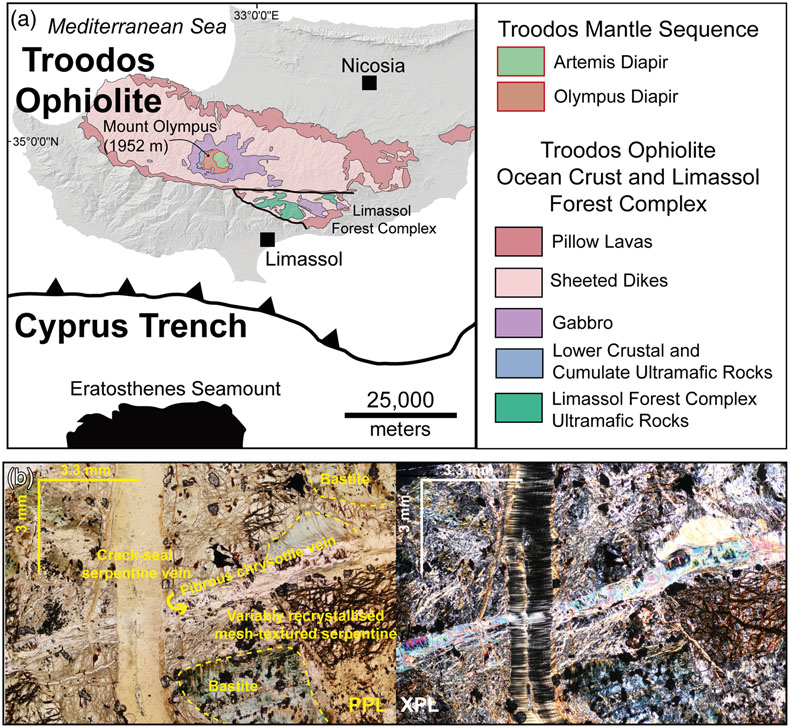
Figure 1 (a) Geological map of the Troodos ophiolite with the bullseye geometry of the Mantle Sequence highlighted (adapted from Evans et al., 2021
Evans, A.D., Teagle, D.A.H., Craw, D., Henstock, T.J., Falcon-Suarez, I.H. (2021) Uplift and exposure of serpentinized massifs: Modeling differential serpentinite diapirism and exhumation of the troodos mantle sequence, Cyprus. Journal of Geophysical Research [Solid Earth] 126, e2020JB021079. https://doi.org/10.1029/2020JB021079
). (b) Representative photomicrograph of completely serpentinised mantle peridotite located within the Artemis Diapir with variably recrystallised serpentine mesh texture, bastite, crack-seal serpentine vein and fibrous chrysotile vein. Scale bar is proportional to the mapped region of Figure 2.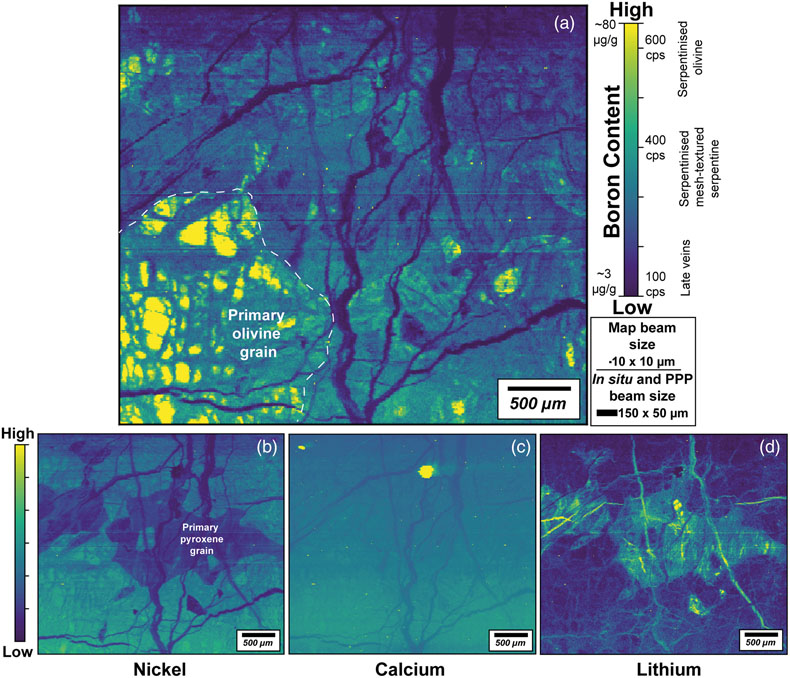
Figure 2 In situ (a) boron, (b) nickel, (c) calcium, and (d) lithium elemental count map of a completely serpentinised peridotite (sample AY2-2) from the Artemis Diapir. Data is plotted as counts per second and the relative differences are colour mapped accordingly using a linear colour map scale.
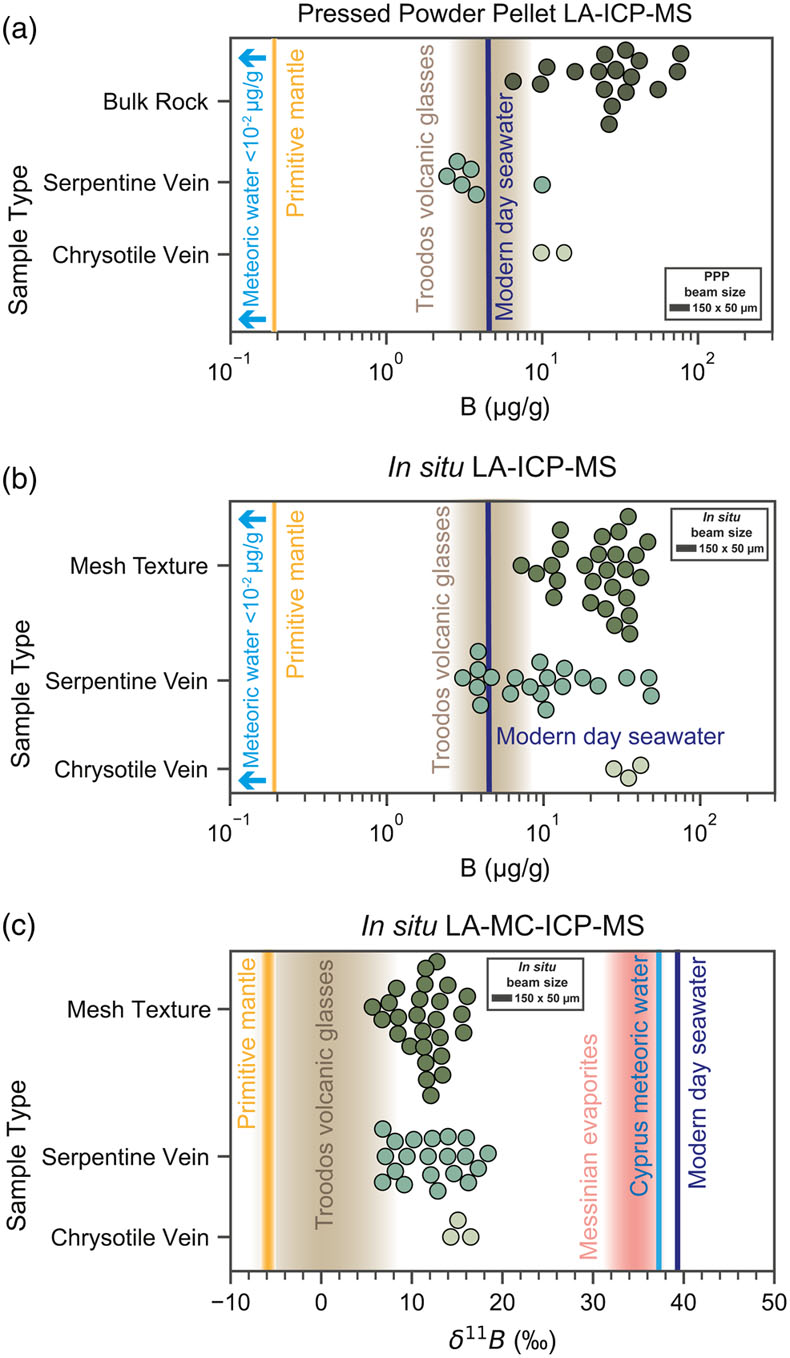
Figure 3 Caltech plots showing (a) B (μg/g) concentration data from pressed powder pellet LA-ICP-MS, (b) In situ LA-ICP-MS B (μg/g) concentration, (c) in situ LA-MC-ICP-MS δ11B on samples from the Artemis and Olympus Diapir. Boundaries of B (μg/g) and δ11B of Troodos for the reservoirs and reference materials shown are given in the Supplementary Information. Shading shows ±2σ of the reported value. Analytical errors (2 s.e.) are generally smaller than symbols.
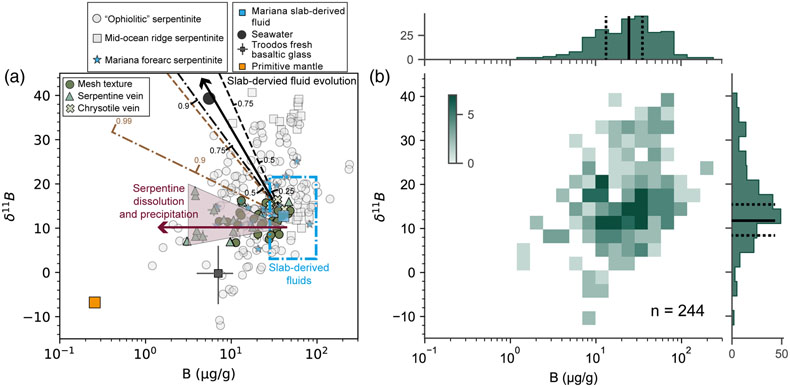
Figure 4 (a) δ11B and B (μg/g) data from the Olympus and Artemis Diapirs of the Troodos Mantle Sequence compared with compiled published serpentinite measurements. (b) Density histogram plot of compiled and new δ11B and B (μg/g) data. References for the compiled serpentinite values can be found in the Supplementary Information. Black solid lines of the bivariate histograms refer to the mean values of this study with dashed black lines reflecting ±1σ. Analytical error bars (2 s.e.) are shown for data from this study, most symbols are larger than associated analytical error. Simple fluid evolution model calculations using a Rayleigh fractionation model (Eq. 1) are shown as a black dashed line at 100 °C and black dash-dotted line at 400 °C using serpentine-fluid fractionation equations of Liu and Tossell (2005)
Liu, Y., Tossell, J.A. (2005) Ab initio molecular orbital calculations for boron isotope fractionations on boric acids and borates. Geochimica et Cosmochimica Acta 69, 3995–4006. https://doi.org/10.1016/j.gca.2005.04.009
and the model equations of Boschi et al. (2008)Boschi, C., Dini, A., Früh-Green, G.L., Kelley, D.S. (2008) Isotopic and element exchange during serpentinization and metasomatism at the Atlantis Massif (MAR 30°N): Insights from B and Sr isotope data. Geochimica et Cosmochimica Acta 72, 1801–1823. https://doi.org/10.1016/j.gca.2008.01.013
to estimate a fractionation factor (α). Black dash lines reflect evolution extent as B is removed from the fluid during serpentinisation at 100 and 400 °C respectively. Additionally, calculations using the serpentine-water fractionation values of Hansen et al. (2017)Hansen, C.T., Meixner, A., Kasemann, S.A., Bach, W. (2017) New insight on Li and B isotope fractionation during serpentinization derived from batch reaction investigations. Geochimica et Cosmochimica Acta 217, 51–79. https://doi.org/10.1016/j.gca.2017.08.014
are shown as a brown dashed line at 100 °C and a brown dash-dotted line at 200 °C respectively. Initial fluid δ11B and concentration of the model is set as (+13 ‰ and 40 μg/g; Benton et al., 2001Benton, L.D., Ryan, J.G., Tera, F. (2001) Boron isotope systematics of slab fluids as inferred from a serpentine seamount, Mariana forearc. Earth and Planetary Science Letters 187, 273–282. https://doi.org/10.1016/S0012-821X(01)00286-2
; Mottl et al., 2004Mottl, M.J., Wheat, C.G., Fryer, P., Gharib, J., Martin, J.B. (2004) Chemistry of springs across the Mariana forearc shows progressive devolatilization of the subducting plate. Geochimica et Cosmochimica Acta 68, 4915–4933. https://doi.org/10.1016/j.gca.2004.05.037
). Blue box reflects assumed composition of slab-derived fluids at similar downgoing slab depths. Purple arrow and shading show vector of serpentine dissolution and precipitation. Isotopic fractionation between mineral and fluid phases likely results in scattering of the data. Black arrow shows slab-derived fluid evolution vector.