




Correlative microspectroscopy of biogenic fabrics in Proterozoic silicified stromatolites
Affiliations | Corresponding Author | Cite as | Funding information
Published by the European Association of Geochemistry
under Creative Commons License CC BY-NC-ND 4.0
Keywords: stromatolites, Precambrian, Neoproterozoic, microspectroscopy, correlative microanalysis, carbon


- Share this article


-
Article views:2,682Cumulative count of HTML views and PDF downloads.
- Download Citation
- Rights & Permissions

top
Abstract
Figures
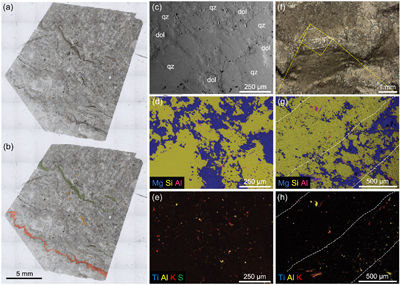 Figure 1 Petrographic characterisation of stromatolites in thin section. (a, b) Optical photomicrographs (original and annotated, respectively) showing organic-rich stromatolitic mesostructure (green), disseminated organics (amber) and stylolite (red). (c–e) SEM image and EDS maps showing representative matrix fabric; dol = dolomite, qz = quartz. (f–h) Optical photomicrograph (f) and EDS maps (g, h) showing contact between organic-rich layer and matrix. | 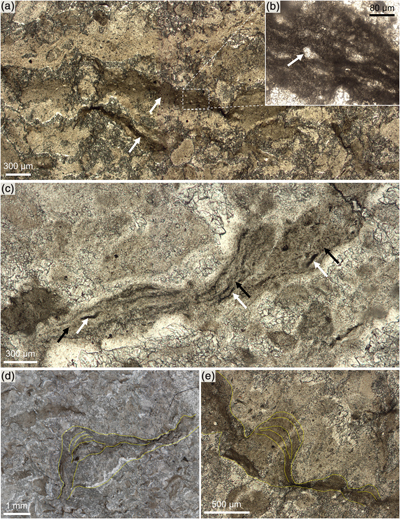 Figure 2 Thin section optical photomicrographs showing organic fabrics. (a, b) Undulatory organic-rich layers (arrows) containing oriented particles (inset (b), arrow). (c) Organic-rich layer featuring mat laminae (white arrows) surrounded by pale brown–grey organic staining (black arrows). (d, e) Biogenic stromatolitic laminations exhibiting a low–medium degree of inheritance; dotted lines trace visible stromatolitic laminations. | 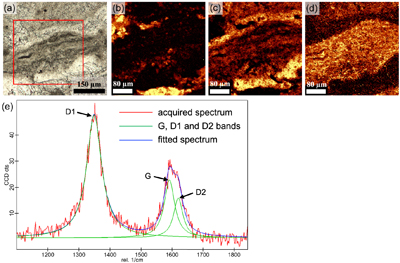 Figure 3 Raman microspectroscopic mapping and geothermometry. (a) Optical photomicrograph of organic material-rich layer; red box denotes region of (b–d). (b–d) Raman mapping of dolomite (b), quartz (c) and carbonaceous materials (d). (e) Decomposition of the first-order region of a representative Raman spectrum of carbonaceous materials showing ordered (G) and disordered (D1 + D2) carbon. | 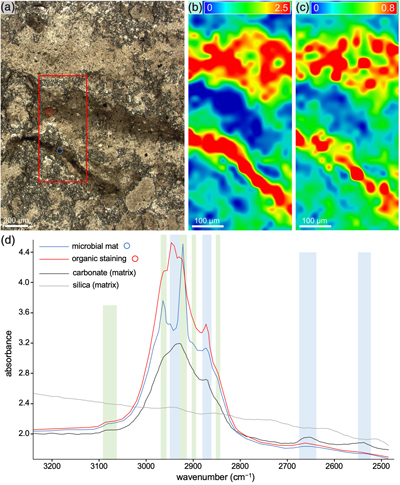 Figure 4 FTIR microspectroscopic characterisation of organic materials. (a) Optical photomicrograph of organic material-rich layer; red box denotes region of (b, c). (b, c) FTIR intensity maps for the C=C band at ∼1600 cm−1 (b), and C–H band at ∼2850 cm−1 (c). Colour scales given in absorbance units. (d) Representative FTIR spectra showing peaks corresponding to organic materials (green) and carbonate (blue). Spectra from matrix carbonate and silica are provided for comparison. |
| Figure 1 | Figure 2 | Figure 3 | Figure 4 |
top
Introduction
Stromatolites are laminated organo-sedimentary structures archiving complex interplays between microbial mat growth, nutrient diffusion, sedimentation, mineral nucleation, and hydrological and geochemical regimes (Burne and Moore, 1987
Burne, R.V., Moore, L.S. (1987) Microbialites; organosedimentary deposits of benthic microbial communities. Palaios 2, 241–254. https://doi.org/10.2307/3514674
; Awramik, 2006Awramik, S.M. (2006) Respect for stromatolites. Nature 441, 700–701. https://doi.org/10.1038/441700a
; Hickman-Lewis et al., 2019Hickman-Lewis, K., Gautret, P., Arbaret, L., Sorieul, S., De Wit, R., Foucher, F., Cavalazzi, B., Westall, F. (2019) Mechanistic Morphogenesis of Organo-Sedimentary Structures Growing Under Geochemically Stressed Conditions: Keystone to Proving the Biogenicity of Some Archaean Stromatolites? Geosciences 9, 359. https://doi.org/10.3390/geosciences9080359
). They provide a record of microbial ecosystems throughout almost 3.5 billion years of Earth history and are counted amongst the oldest traces of life (Awramik, 2006Awramik, S.M. (2006) Respect for stromatolites. Nature 441, 700–701. https://doi.org/10.1038/441700a
). Nonetheless, their geobiological significance is repeatedly challenged; indeed, Ginsburg (1991)Ginsburg, R.N. (1991) Controversies about stromatolites: vices and virtues. In: Müller, D.W., McKenzie, J.A., Weissert, H. (Eds.) Controversies in Modern Geology. Academic Press, London, 25–36.
stated that “almost everything about stromatolites has been, and remains to varying degrees, controversial.” Despite numerous compelling lines of evidence pointing to the biogenic origins of most fossil stromatolite-like structures (Awramik, 2006Awramik, S.M. (2006) Respect for stromatolites. Nature 441, 700–701. https://doi.org/10.1038/441700a
; Schopf, 2006Schopf, J.W. (2006) Fossil evidence of Archaean life. Philosophical Transactions of the Royal Society B 361, 869–885. https://doi.org/10.1098/rstb.2006.1834
), doubts endure regarding the unambiguous identification of primary biological influence in ancient examples with diverse morphologies (Lowe, 1994Lowe, D.R. (1994) Abiological origin of described stromatolites older than 3.2 Ga. Geology 22, 387–390. https://doi.org/10.1130/0091-7613(1994)022<0387:AOODSO>2.3.CO;2
; Grotzinger and Rothman, 1996Grotzinger, J.P., Rothman, D.H. (1996) An abiotic model for stromatolite morphogenesis. Nature 383, 423–425. https://doi.org/10.1038/383423a0
; Perri et al., 2013Perri, E., Tucker, M.E., Mawson, M. (2013) Biotic and Abiotic Processes In the Formation and Diagenesis of Permian Dolomitic Stromatolites (Zechstein Group, NE England). Journal of Sedimentary Research 83, 896–914. https://doi.org/10.2110/jsr.2013.65
; Brasier et al., 2019Brasier, A.T., Dennis, P.F., Still, J., Parnell, J., Culwick, T., Brasier, M.D., Wacey, D., Bowden, S.A., Crook, S., Boyce, A.J., Muirhead, D.K. (2019) Detecting ancient life: Investigating the nature and origin of possible stromatolites and associated calcite from a one billion year old lake. Precambrian Research 328, 309–320. https://doi.org/10.1016/j.precamres.2019.04.025
). It has been theoretically and experimentally demonstrated that abiotic processes can produce laminated stromatoloids, whose macrostructures mirror those of fossil stromatolites (Buick et al., 1981Buick, R., Dunlop, J.S.R., Groves, D.I. (1981) Stromatolite recognition in ancient rocks: an appraisal of irregularly laminated structures in an Early Archaean chert-barite unit from North Pole, Western Australia. Alcheringa 5, 161–181. https://doi.org/10.1080/03115518108566999
; Dupraz et al., 2006Dupraz, C., Pattisina, R., Verrecchia, E.P. (2006) Translation of energy into morphology: Simulation of stromatolite morphospace using a stochastic model. Sedimentary Geology 185, 185–203. https://doi.org/10.1016/j.sedgeo.2005.12.012
; McLoughlin et al., 2008McLoughlin, N., Wilson, L.A., Brasier, M.D. (2008) Growth of synthetic stromatolites and wrinkle structures in the absence of microbes – implications for the early fossil record. Geobiology 6, 95–105. https://doi.org/10.1111/j.1472-4669.2007.00141.x
); nonetheless, truly non-biological stromatolite-like features (e.g., de Wit et al., 1982de Wit, M.J., Hart, R., Martin, A., Abbott, P. (1982) Archean abiogenic and probable biogenic structures associated with mineralized hydrothermal vent systems and regional metasomatism, with implications for greenstone belt studies. Economic Geology 77, 1783–1802. https://doi.org/10.2113/gsecongeo.77.8.1783
) are probably rare in the geological record.Establishing biogenicity in ancient stromatolites is also hindered by a general lack of preservation of primary organic material and cellular microfossils (Buick et al., 1981
Buick, R., Dunlop, J.S.R., Groves, D.I. (1981) Stromatolite recognition in ancient rocks: an appraisal of irregularly laminated structures in an Early Archaean chert-barite unit from North Pole, Western Australia. Alcheringa 5, 161–181. https://doi.org/10.1080/03115518108566999
). Kremer et al. (2012)Kremer, B., Kazmierczak, J., Łukomska-Kowalczyk, M., Kempe, S. (2012) Calcification and Silicification: Fossilization Potential of Cyanobacteria from Stromatolites of Niuafo‘ou’s Caldera Lakes (Tonga) and Implications for the Early Fossil Record. Astrobiology 12, 535–548. https://doi.org/10.1089/ast.2011.0742
noted that microfossil preservation in stromatolites is rare due to early post-mortem and diagenetic nanogranular calcification. Where present, organic materials in ancient stromatolites often occur as discrete particles or agglomerations, intermixed with other phases, that are impossible to associate with primary microbial communities, or as secondary, post-diagenetic hydrocarbon infiltration fabrics (Rasmussen et al., 2021Rasmussen, B., Muhling, J.R., Fischer, W.W. (2021) Ancient Oil as a Source of Carbonaceous Matter in 1.88-Billion-Year-Old Gunflint Stromatolites and Microfossils. Astrobiology 21, 655–672. https://doi.org/10.1089/ast.2020.2376
).In the absence of cellular preservation, lamination-scale mesostructural characteristics, i.e. at the scale of a well developed microbial community, could provide crucial evidence for biogenicity in ancient stromatolites with simple macrostructural morphologies. This contribution presents an example of such high fidelity preservation of organic materials within silicified carbonate stromatolites using a combination of textural, mineralogical, and spectroscopic observations that elucidate microbial mat growth processes and the preservational mechanisms of organic-rich biofabrics.
top
Geological Context
The studied stromatolites are from the Tonian Skillogalee Dolomite (Burra Group) at Prince Alfred copper mine, near Cradock, Flinders Ranges, South Australia (Figs. S-1, S-2) and date to ∼790 Ma (Preiss et al., 2009
Preiss, W.V., Drexel, J.F., Reid, A.J. (2009) Definition and age of the Kooringa Member of the Skillogalee Dolomite: host for Neoproterozoic (c. 790 Ma) porphyry-related copper mineralisation at Burra. MESA Journal 55, 19–33.
). The mine is located at the east of the Nackara Arc where the Skillogalee Dolomite outcrops beneath an unconformity separating the pre-Sturtian Burra and post-Sturtian Umberatana groups (Preiss, 2000Preiss, W.V. (2000) The Adelaide Geosyncline of South Australia and its significance in Neoproterozoic continental reconstruction. Precambrian Research 100, 21–63. https://doi.org/10.1016/S0301-9268(99)00068-6
). Stromatolites from the Skillogalee Dolomite described by Preiss (1971Preiss, W.V. (1971) The biostratigraphy and palaeoecology of South Australian Precambrian stromatolites. Ph.D. Thesis, University of Adelaide.
, 1973Preiss, W.V. (1973) Palaeoecological interpretations of South Australian Precambrian stromatolites. Journal of the Geological Society of Australia 19, 501–532. https://doi.org/10.1080/00167617308728820
) as Baicalia burra are now widely used in Neoproterozoic chronostratigraphy.Palaeoenvironmental studies of the Skillogalee Dolomite conclude that it reflects a low energy peritidal setting associated with an inner platform reef (Preiss, 1971
Preiss, W.V. (1971) The biostratigraphy and palaeoecology of South Australian Precambrian stromatolites. Ph.D. Thesis, University of Adelaide.
, 1973Preiss, W.V. (1973) Palaeoecological interpretations of South Australian Precambrian stromatolites. Journal of the Geological Society of Australia 19, 501–532. https://doi.org/10.1080/00167617308728820
; Virgo et al., 2021Virgo, G.M., Collins, A.S., Amos, K.J., Farkaš, J., Blades, M.L., Subarkah, D. (2021) Descending into the “snowball”: High resolution sedimentological and geochemical analysis across the Tonian to Cryogenian boundary in South Australia. Precambrian Research 367, 106449. https://doi.org/10.1016/j.precamres.2021.106449
). Sr and O isotope systematics suggest marine deposition although certain horizons enriched in 18O and 13C denote intertidal–peritidal evaporitic episodes (Belperio, 1990)Belperio, A.P. (1990) Palaeoenvironmental interpretation of the Late Proterozoic Skillogalee Dolomite in the Willouran Ranges, South Australia. In: Jago, J.V., Moore, P.J. (Eds.) The Evolution of a Late Precambrian-Early Palaeozoic Rift Complex: The Adelaide Geosyncline. Special Publication 16, Geological Society of Australia, Sydney, 85–104.
. Coupling sedimentological observations with trace and rare earth element (REE) geochemistry, Virgo et al. (2021)Virgo, G.M., Collins, A.S., Amos, K.J., Farkaš, J., Blades, M.L., Subarkah, D. (2021) Descending into the “snowball”: High resolution sedimentological and geochemical analysis across the Tonian to Cryogenian boundary in South Australia. Precambrian Research 367, 106449. https://doi.org/10.1016/j.precamres.2021.106449
identified ripple marks and desiccation structures, superchondritic Y/Ho, light REE depletion and positive Eu anomalies consistent with a dynamic shallow water environment featuring clastic input and simultaneous marine, intertidal and fluvial influences. Although interbedded magnesite-bearing horizons may represent palaeoenvironments that were largely inclement to life (Belperio, 1990)Belperio, A.P. (1990) Palaeoenvironmental interpretation of the Late Proterozoic Skillogalee Dolomite in the Willouran Ranges, South Australia. In: Jago, J.V., Moore, P.J. (Eds.) The Evolution of a Late Precambrian-Early Palaeozoic Rift Complex: The Adelaide Geosyncline. Special Publication 16, Geological Society of Australia, Sydney, 85–104.
, primary dolomitic horizons evince colonisation by stromatolite-forming communities (Preiss, 1971Preiss, W.V. (1971) The biostratigraphy and palaeoecology of South Australian Precambrian stromatolites. Ph.D. Thesis, University of Adelaide.
, 1973Preiss, W.V. (1973) Palaeoecological interpretations of South Australian Precambrian stromatolites. Journal of the Geological Society of Australia 19, 501–532. https://doi.org/10.1080/00167617308728820
).top
Results
The Skillogalee stromatolites feature stratiform–domical macrostructures comprising undulatory and laterally discontinuous layers (∼0.5–2 mm) of micritic mudstone and packstone–boundstone (Figs. 1, S-3–S-6). Layers are primarily composed of fine grained dolomicrite and dolomicrospar (wackestone–packstone–boundstone), quartz, and rare cement-filled vugs and intraclasts (Figs. 1, S-3–S-6). SEM-EDS analyses show that, in addition to dolomite and quartz, aluminous phyllosilicates, pyrite, apatite and rare mafic phases occur throughout the matrix (Figs. 1, S-8–S-11). The stromatolites also feature organic-rich laminations with a low degree of inheritance, i.e. the topography of the underlying layers does not strongly act as a template for the overlying layers (Figs. 2d,e, S-4). Rare stylolites disconformably cross stromatolitic laminations (Fig. 1a,b). Some organic-rich laminations feature millimetre-scale (pseudo)columnar or microdomical structures (Figs. S-3, S-4 and S-6) whereas others include domains of organic-rich bindstone including fine, undulatory, wispy laminations set within a micrite/micrinite matrix (Figs. 1a,b, S-7). Isolated laminated organic fragments occur throughout the matrix (Fig. 1a,b). Many darker laminations are surrounded by pale brown–grey domains of diffuse organic material (Figs. 2c, S-7; organic staining cf. Pomoni and Karakitsios, 2016
Pomoni, F.A., Karakitsios, V. (2016) Sedimentary facies analysis of a high-frequency, small-scale, peritidal carbonate sequence in the Lower Jurassic of the Tripolis carbonate unit (central western Crete, Greece): Long-lasting emergence and fossil laminar dolocretes horizon. Journal of Palaeogeography 5, 241–257. https://doi.org/10.1016/j.jop.2016.05.003
; DeMott et al., 2020DeMott, L.M., Napieralski, S.A., Junium, C.K., Teece, M., Scholz, C.A. (2020) Microbially influenced lacustrine carbonates: A comparison of Late Quaternary Lahontan tufa and modern thrombolite from Fayetteville Green Lake, NY. Geobiology 18, 93–112. https://doi.org/10.1111/gbi.12367
). High magnification optical microscopy indicates that these diffuse organic materials occur mostly within interstitial zones of a fine grained mineral matrix (Fig. S-7). Some laminae bind grains in a pliable manner denoting original plasticity; elsewhere, carbonate particles surrounded by poorly preserved laminae form networks of oriented grains suspended within an organic matrix (Fig. 2b).Figure 1 Petrographic characterisation of stromatolites in thin section. (a, b) Optical photomicrographs (original and annotated, respectively) showing organic-rich stromatolitic mesostructure (green), disseminated organics (amber) and stylolite (red). (c–e) SEM image and EDS maps showing representative matrix fabric; dol = dolomite, qz = quartz. (f–h) Optical photomicrograph (f) and EDS maps (g, h) showing contact between organic-rich layer and matrix.
Figure 2 Thin section optical photomicrographs showing organic fabrics. (a, b) Undulatory organic-rich layers (arrows) containing oriented particles (inset (b), arrow). (c) Organic-rich layer featuring mat laminae (white arrows) surrounded by pale brown–grey organic staining (black arrows). (d, e) Biogenic stromatolitic laminations exhibiting a low–medium degree of inheritance; dotted lines trace visible stromatolitic laminations.
Raman microspectroscopy was used to map the distribution of carbonaceous materials and mineral phases associated with organic-rich laminations (Fig. 3a–d). The matrix is dominated by dolomite (Raman peaks at 175, 300, 723 and 1095 cm−1) and quartz (peaks at 205 and 465 cm−1), whereas the laminations are richer in carbonaceous materials (peaks at ∼1340 and ∼1600 cm−1). Quartz is often concentrated in layers surrounding carbonaceous materials (Fig. 3c). Although some carbonaceous materials show weak layering (Fig. 3d), most occur as diffuse clouds (Fig. S-12d). Raman geothermometry using carbonaceous materials-based spectral deconvolution was applied to organic-rich laminations to determine peak metamorphic temperatures (Fig. 3e, Table S-1); peak thermal histories of 348 ± 50 °C (after Beyssac et al., 2002
Beyssac, O., Goffé, B., Chopin, C., Rouzaud, J.N. (2002) Raman spectra of carbonaceous material in metasediments: a new geothermometer. Journal of Metamorphic Geology 20, 859–871. https://doi.org/10.1046/j.1525-1314.2002.00408.x
), and 346 ± 30 °C and 317 ± 50 °C (after Kouketsu et al., 2014Kouketsu, Y., Mizukami, T., Mori, H., Endo, S., Aoya, M., Hara, H., Nakamura, D., Wallis, S. (2014) A new approach to develop the Raman carbonaceous material geothermometer for low-grade metamorphism using peak width. Island Arc 23, 33–50. https://doi.org/10.1111/iar.12057
) were calculated.Figure 3 Raman microspectroscopic mapping and geothermometry. (a) Optical photomicrograph of organic material-rich layer; red box denotes region of (b–d). (b–d) Raman mapping of dolomite (b), quartz (c) and carbonaceous materials (d). (e) Decomposition of the first-order region of a representative Raman spectrum of carbonaceous materials showing ordered (G) and disordered (D1 + D2) carbon.
FTIR microspectroscopy was used to identify and map functional groups within the organic-rich laminations (Fig. 4, Table S-2). In the aliphatic stretching region (3000–2800 cm–1; Fig. 4d), methylene CH2, terminal-methyl CH3 and alkene =C–H moieties were detected in both stromatolitic laminations and the surrounding domains of diffuse organic materials. Weak signals potentially attributable to methyne C–H were also detected in laminations. Mapping both aliphatic C–H (2850 cm−1) and aromatic C=C (1600 cm−1) stretches shows more intense detections within dark carbonaceous laminations and a very low abundance or absence in the surrounding matrix (Fig. 4a–c); weak organic detections occur disseminated within fine grained dolomicrospar but are absent within dolosparite (Fig. 3). Although C–H and C=C detections are strongest in dark carbonaceous laminations, a weaker ‘halo’-like signal is also present in the surrounding diffuse organic staining domains (Figs. 4, S-13).
Figure 4 FTIR microspectroscopic characterisation of organic materials. (a) Optical photomicrograph of organic material-rich layer; red box denotes region of (b, c). (b, c) FTIR intensity maps for the C=C band at ∼1600 cm−1 (b), and C–H band at ∼2850 cm−1 (c). Colour scales given in absorbance units. (d) Representative FTIR spectra showing peaks corresponding to organic materials (green) and carbonate (blue). Spectra from matrix carbonate and silica are provided for comparison.
top
Discussion
A serious impediment to establishing the biogenic origins of Precambrian carbonate stromatolites is the absence of preserved cellular and cell-associated organic materials and biofabrics. Stromatolites from the Skillogalee Dolomite exhibit exceptional preservation of organic material-rich laminations interpreted to represent microbial mats and microbially induced sedimentary structures (MISS); their lithofacies association implies authigenic microbialite growth on a carbonate platform and is consistent with palaeoenvironmental interpretations (Virgo et al., 2021
Virgo, G.M., Collins, A.S., Amos, K.J., Farkaš, J., Blades, M.L., Subarkah, D. (2021) Descending into the “snowball”: High resolution sedimentological and geochemical analysis across the Tonian to Cryogenian boundary in South Australia. Precambrian Research 367, 106449. https://doi.org/10.1016/j.precamres.2021.106449
).By performing the first correlated optical, SEM-EDS, Raman and FTIR microanalyses of microbial mat structures in Precambrian carbonate stromatolites, we have shown systematic spatial variations in the signatures of organic and mineral phases throughout the microbial stratigraphy of Baicalia burra from the Tonian Skillogalee Dolomite that illuminate the morphogenetic and diagenetic history of these stromatolites.
The morphology of kerogen-rich layers is diagnostic of microbial mat growth. Non-isopachous laminations exhibiting a poor degree of inheritance are consistent with laterally variable biomass productivity and suggest complex interactions between ecosystems and local palaeoenvironments, which manifest as numerous directionally conflicting growth and decay morphogenetic vectors (Dupraz et al., 2006
Dupraz, C., Pattisina, R., Verrecchia, E.P. (2006) Translation of energy into morphology: Simulation of stromatolite morphospace using a stochastic model. Sedimentary Geology 185, 185–203. https://doi.org/10.1016/j.sedgeo.2005.12.012
; Hickman-Lewis et al., 2019Hickman-Lewis, K., Gautret, P., Arbaret, L., Sorieul, S., De Wit, R., Foucher, F., Cavalazzi, B., Westall, F. (2019) Mechanistic Morphogenesis of Organo-Sedimentary Structures Growing Under Geochemically Stressed Conditions: Keystone to Proving the Biogenicity of Some Archaean Stromatolites? Geosciences 9, 359. https://doi.org/10.3390/geosciences9080359
). Low degrees of inheritance are most common in regions containing organic material-rich laminations (Figs. 2d,e, S-4), here interpreted to be biogenic, i.e. the growth of the stromatolite-building community provided new relief, seeding topographic complexity that resulted in a sequence of layers characterised by low degrees of inheritance. Layers with a higher degree of inheritance are typically poorer in, or devoid of, organic materials, and we therefore suggest that these feature minimal biological morphogenetic components. The presence of isolated fragments of laminated organic materials in the matrix (Fig. 1a,b) may indicate either poorly formed mats or the reworking of epibenthic mats under energetic hydrodynamic regimes (Noffke et al., 2001Noffke, N., Gerdes, G., Klenke, T., Krumbein, W.E. (2001) Microbially Induced Sedimentary Structures: A New Category within the Classification of Primary Sedimentary Structures. Journal of Sedimentary Research 71, 649–656. https://doi.org/10.1306/2DC4095D-0E47-11D7-8643000102C1865D
, 2022Noffke, N., Beraldi-Campesi, H., Callefo, F., Carmona, N.B., Cuadrado, D.G., Hickman-Lewis, K., Homann, M., Mitchell, R., Sheldon, N., Westall, F., Xiao, S. (2022) Microbially Induced Sedimentary Structures (MISS). Treatise Online 162, Part B, Volume 2, Chapter 5, 1–29.
). Sub-angular carbonate particles bound within laminae (Figs. 2b, S-12) have a plausible origin through microbially mediated carbonate precipitation under carbonate-supersaturated Neoproterozoic interglacial conditions (Hood and Wallace, 2012Hood, A.v.S., Wallace, M.W. (2012) Synsedimentary diagenesis in a Cryogenian reef complex: Ubiquitous marine dolomite precipitation. Sedimentary Geology 255–256, 56–71. https://doi.org/10.1016/j.sedgeo.2012.02.004
; Corkeron and Slezak, 2020Corkeron, M.L., Slezak, P.R. (2020) Stromatolite framework builders: ecosystems in a Cryogenian interglacial reef. Australian Journal of Earth Sciences 67, 833–856. https://doi.org/10.1080/08120099.2020.1732464
). The orientation of these particles parallel to mat layers can be explained as an MISS: silt grade sediment baffled by vertically oriented microbial filaments was captured within upward-growing microbial biofilms, before becoming entrapped within the fossilised mat, which pushes the grains apart during biofilm growth (Noffke et al., 1997Noffke, N., Gerdes, G., Klenke, T., Krumbein, W.E. (1997) A microscopic sedimentary succession of graded sand and microbial mats in modern siliciclastic tidal flats. Sedimentary Geology 110, 1–6. https://doi.org/10.1016/S0037-0738(97)00039-0
, 2001Noffke, N., Gerdes, G., Klenke, T., Krumbein, W.E. (2001) Microbially Induced Sedimentary Structures: A New Category within the Classification of Primary Sedimentary Structures. Journal of Sedimentary Research 71, 649–656. https://doi.org/10.1306/2DC4095D-0E47-11D7-8643000102C1865D
).The dominance of aromatic moieties in Raman and FTIR microspectroscopic data (Figs. 3, 4) indicate that the kerogen composing organic laminations is thermally mature. Its peak thermal maturity (317–348 °C) is consistent with the metamorphic history of the region (greenschist facies; Preiss, 1971
Preiss, W.V. (1971) The biostratigraphy and palaeoecology of South Australian Precambrian stromatolites. Ph.D. Thesis, University of Adelaide.
), strongly suggesting that the kerogen derives from primary stromatolite-building communities. Furthermore, weak but unambiguous signals from aliphatic compounds in FTIR spectra, although providing only a qualitative estimation of maturity, suggest that moderate pressures and temperatures have influenced the kerogen, consistent with the quantitative estimation of thermal history from Raman data. Correlated microspectroscopic data therefore show that the mesostructures of interest are neither purely graphitic nor entirely aromatic, but retain a small amount of primary aliphatic complexity, i.e. moderately thermally mature carbonaceous materials. The syngeneity of kerogen is further supported by domains of diffuse organic staining surrounding dark laminations (Fig. S-7), indicating early diagenetic micro-scale mixing of fluids rich in finely particulate organic matter (Hips et al., 2011Hips, K., Haas, J., Vidó, M., Barna, Z., Jovanović, D., Sudar, M.N., Siklósy, Z. (2011) Selective blackening of bioclasts via mixing-zone aragonite neomorphism in Late Triassic limestone, Zlatibor Mountains, Serbia. Sedimentology 58, 854–877. https://doi.org/10.1111/j.1365-3091.2010.01186.x
); such domains are known to develop from early dissolution–reprecipitation of primary organic matter (DeMott et al., 2020DeMott, L.M., Napieralski, S.A., Junium, C.K., Teece, M., Scholz, C.A. (2020) Microbially influenced lacustrine carbonates: A comparison of Late Quaternary Lahontan tufa and modern thrombolite from Fayetteville Green Lake, NY. Geobiology 18, 93–112. https://doi.org/10.1111/gbi.12367
). The strong localisation of kerogen within microbial mat structures and its absence from matrix fractures renders secondary hydrocarbon contamination implausible.The preservation of organic materials in these carbonate stromatolites can be explained by their early post-depositional history. The presence of microquartz immediately surrounding organic-rich layers and more broadly throughout the matrix (Figs. 1, 3) suggests a palaeodepositional environment supersaturated with respect to silica, which precipitated rapidly, i.e. the earliest diagenetic processes included penecontemporaneous silicification. As in more ancient fossil microbialites, we interpret this early and rapid silica precipitation as contributing to the exceptional preservation of biochemical heterogeneity in the otherwise labile organic fraction; such preservation is otherwise rare in carbonates (Kremer et al., 2012
Kremer, B., Kazmierczak, J., Łukomska-Kowalczyk, M., Kempe, S. (2012) Calcification and Silicification: Fossilization Potential of Cyanobacteria from Stromatolites of Niuafo‘ou’s Caldera Lakes (Tonga) and Implications for the Early Fossil Record. Astrobiology 12, 535–548. https://doi.org/10.1089/ast.2011.0742
).Although constraining the origins of ancient stromatolite-like structures is challenging, demonstrably syngenetic mature organic materials exhibiting spatial distributions consistent with microbial morphogenesis and spectral characteristics consistent with thermally altered biological organic materials can allow biogenicity to be established. Such occurrences can be considered fossil lagerstätten. Identifying similar mesoscale phenomena in more ancient stromatolites using the correlated imaging–microspectroscopy approach developed herein could facilitate definitive interpretations of their morphogenesis.
top
Acknowledgements
KHL acknowledges UK Space Agency grant no. ST/V00560X/1 and Europlanet grant no. 871149. Duncan Murdock (OUMNH) and Euan Furness (Imperial College) facilitated access to materials.
Editor: Liane G. Benning
top
References
Awramik, S.M. (2006) Respect for stromatolites. Nature 441, 700–701. https://doi.org/10.1038/441700a
 Show in context
 Stromatolites are laminated organo-sedimentary structures archiving complex interplays between microbial mat growth, nutrient diffusion, sedimentation, mineral nucleation, and hydrological and geochemical regimes (Burne and Moore, 1987; Awramik, 2006; Hickman-Lewis et al., 2019).
View in article
They provide a record of microbial ecosystems throughout almost 3.5 billion years of Earth history and are counted amongst the oldest traces of life (Awramik, 2006).
View in article
Despite numerous compelling lines of evidence pointing to the biogenic origins of most fossil stromatolite-like structures (Awramik, 2006; Schopf, 2006), doubts endure regarding the unambiguous identification of primary biological influence in ancient examples with diverse morphologies (Lowe, 1994; Grotzinger and Rothman, 1996; Perri et al., 2013; Brasier et al., 2019).
View in article
Belperio, A.P. (1990) Palaeoenvironmental interpretation of the Late Proterozoic Skillogalee Dolomite in the Willouran Ranges, South Australia. In: Jago, J.V., Moore, P.J. (Eds.) The Evolution of a Late Precambrian-Early Palaeozoic Rift Complex: The Adelaide Geosyncline. Special Publication 16, Geological Society of Australia, Sydney, 85–104.
Show in context Sr and O isotope systematics suggest marine deposition although certain horizons enriched in 18O and 13C denote intertidal–peritidal evaporitic episodes (Belperio, 1990).
View in article
Although interbedded magnesite-bearing horizons may represent palaeoenvironments that were largely inclement to life (Belperio, 1990), primary dolomitic horizons evince colonisation by stromatolite-forming communities (Preiss, 1971, 1973).
View in article
Beyssac, O., Goffé, B., Chopin, C., Rouzaud, J.N. (2002) Raman spectra of carbonaceous material in metasediments: a new geothermometer. Journal of Metamorphic Geology 20, 859–871. https://doi.org/10.1046/j.1525-1314.2002.00408.x
Show in context Raman geothermometry using carbonaceous materials-based spectral deconvolution was applied to organic-rich laminations to determine peak metamorphic temperatures (Fig. 3e, Table S-1); peak thermal histories of 348 ± 50 °C (after Beyssac et al., 2002), and 346 ± 30 °C and 317 ± 50 °C (after Kouketsu et al., 2014) were calculated.
View in article
Brasier, A.T., Dennis, P.F., Still, J., Parnell, J., Culwick, T., Brasier, M.D., Wacey, D., Bowden, S.A., Crook, S., Boyce, A.J., Muirhead, D.K. (2019) Detecting ancient life: Investigating the nature and origin of possible stromatolites and associated calcite from a one billion year old lake. Precambrian Research 328, 309–320. https://doi.org/10.1016/j.precamres.2019.04.025
Show in context Despite numerous compelling lines of evidence pointing to the biogenic origins of most fossil stromatolite-like structures (Awramik, 2006; Schopf, 2006), doubts endure regarding the unambiguous identification of primary biological influence in ancient examples with diverse morphologies (Lowe, 1994; Grotzinger and Rothman, 1996; Perri et al., 2013; Brasier et al., 2019).
View in article
Buick, R., Dunlop, J.S.R., Groves, D.I. (1981) Stromatolite recognition in ancient rocks: an appraisal of irregularly laminated structures in an Early Archaean chert-barite unit from North Pole, Western Australia. Alcheringa 5, 161–181. https://doi.org/10.1080/03115518108566999
Show in context It has been theoretically and experimentally demonstrated that abiotic processes can produce laminated stromatoloids, whose macrostructures mirror those of fossil stromatolites (Buick et al., 1981; Dupraz et al., 2006; McLoughlin et al., 2008); nonetheless, truly non-biological stromatolite-like features (e.g., de Wit et al., 1982) are probably rare in the geological record.
View in article
Establishing biogenicity in ancient stromatolites is also hindered by a general lack of preservation of primary organic material and cellular microfossils (Buick et al., 1981).
View in article
Burne, R.V., Moore, L.S. (1987) Microbialites; organosedimentary deposits of benthic microbial communities. Palaios 2, 241–254. https://doi.org/10.2307/3514674
Show in context Stromatolites are laminated organo-sedimentary structures archiving complex interplays between microbial mat growth, nutrient diffusion, sedimentation, mineral nucleation, and hydrological and geochemical regimes (Burne and Moore, 1987; Awramik, 2006; Hickman-Lewis et al., 2019).
View in article
Corkeron, M.L., Slezak, P.R. (2020) Stromatolite framework builders: ecosystems in a Cryogenian interglacial reef. Australian Journal of Earth Sciences 67, 833–856. https://doi.org/10.1080/08120099.2020.1732464
Show in context Sub-angular carbonate particles bound within laminae (Figs. 2b, S-12) have a plausible origin through microbially mediated carbonate precipitation under carbonate-supersaturated Neoproterozoic interglacial conditions (Hood and Wallace, 2012; Corkeron and Slezak, 2020).
View in article
DeMott, L.M., Napieralski, S.A., Junium, C.K., Teece, M., Scholz, C.A. (2020) Microbially influenced lacustrine carbonates: A comparison of Late Quaternary Lahontan tufa and modern thrombolite from Fayetteville Green Lake, NY. Geobiology 18, 93–112. https://doi.org/10.1111/gbi.12367
Show in context Many darker laminations are surrounded by pale brown–grey domains of diffuse organic material (Figs. 2c, S-7; organic staining cf. Pomoni and Karakitsios, 2016; DeMott et al., 2020).
View in article
The syngeneity of kerogen is further supported by domains of diffuse organic staining surrounding dark laminations (Fig. S-7), indicating early diagenetic micro-scale mixing of fluids rich in finely particulate organic matter (Hips et al., 2011); such domains are known to develop from early dissolution–reprecipitation of primary organic matter (DeMott et al., 2020).
View in article
de Wit, M.J., Hart, R., Martin, A., Abbott, P. (1982) Archean abiogenic and probable biogenic structures associated with mineralized hydrothermal vent systems and regional metasomatism, with implications for greenstone belt studies. Economic Geology 77, 1783–1802. https://doi.org/10.2113/gsecongeo.77.8.1783
Show in context It has been theoretically and experimentally demonstrated that abiotic processes can produce laminated stromatoloids, whose macrostructures mirror those of fossil stromatolites (Buick et al., 1981; Dupraz et al., 2006; McLoughlin et al., 2008); nonetheless, truly non-biological stromatolite-like features (e.g., de Wit et al., 1982) are probably rare in the geological record.
View in article
Dupraz, C., Pattisina, R., Verrecchia, E.P. (2006) Translation of energy into morphology: Simulation of stromatolite morphospace using a stochastic model. Sedimentary Geology 185, 185–203. https://doi.org/10.1016/j.sedgeo.2005.12.012
Show in context It has been theoretically and experimentally demonstrated that abiotic processes can produce laminated stromatoloids, whose macrostructures mirror those of fossil stromatolites (Buick et al., 1981; Dupraz et al., 2006; McLoughlin et al., 2008); nonetheless, truly non-biological stromatolite-like features (e.g., de Wit et al., 1982) are probably rare in the geological record.
View in article
Non-isopachous laminations exhibiting a poor degree of inheritance are consistent with laterally variable biomass productivity and suggest complex interactions between ecosystems and local palaeoenvironments, which manifest as numerous directionally conflicting growth and decay morphogenetic vectors (Dupraz et al., 2006; Hickman-Lewis et al., 2019).
View in article
Ginsburg, R.N. (1991) Controversies about stromatolites: vices and virtues. In: Müller, D.W., McKenzie, J.A., Weissert, H. (Eds.) Controversies in Modern Geology. Academic Press, London, 25–36.
Show in context Nonetheless, their geobiological significance is repeatedly challenged; indeed, Ginsburg (1991) stated that “almost everything about stromatolites has been, and remains to varying degrees, controversial.”.
View in article
Grotzinger, J.P., Rothman, D.H. (1996) An abiotic model for stromatolite morphogenesis. Nature 383, 423–425. https://doi.org/10.1038/383423a0
Show in context Despite numerous compelling lines of evidence pointing to the biogenic origins of most fossil stromatolite-like structures (Awramik, 2006; Schopf, 2006), doubts endure regarding the unambiguous identification of primary biological influence in ancient examples with diverse morphologies (Lowe, 1994; Grotzinger and Rothman, 1996; Perri et al., 2013; Brasier et al., 2019).
View in article
Hickman-Lewis, K., Gautret, P., Arbaret, L., Sorieul, S., De Wit, R., Foucher, F., Cavalazzi, B., Westall, F. (2019) Mechanistic Morphogenesis of Organo-Sedimentary Structures Growing Under Geochemically Stressed Conditions: Keystone to Proving the Biogenicity of Some Archaean Stromatolites? Geosciences 9, 359. https://doi.org/10.3390/geosciences9080359
Show in context Stromatolites are laminated organo-sedimentary structures archiving complex interplays between microbial mat growth, nutrient diffusion, sedimentation, mineral nucleation, and hydrological and geochemical regimes (Burne and Moore, 1987; Awramik, 2006; Hickman-Lewis et al., 2019).
View in article
Non-isopachous laminations exhibiting a poor degree of inheritance are consistent with laterally variable biomass productivity and suggest complex interactions between ecosystems and local palaeoenvironments, which manifest as numerous directionally conflicting growth and decay morphogenetic vectors (Dupraz et al., 2006; Hickman-Lewis et al., 2019).
View in article
Hips, K., Haas, J., Vidó, M., Barna, Z., Jovanović, D., Sudar, M.N., Siklósy, Z. (2011) Selective blackening of bioclasts via mixing-zone aragonite neomorphism in Late Triassic limestone, Zlatibor Mountains, Serbia. Sedimentology 58, 854–877. https://doi.org/10.1111/j.1365-3091.2010.01186.x
Show in context The syngeneity of kerogen is further supported by domains of diffuse organic staining surrounding dark laminations (Fig. S-7), indicating early diagenetic micro-scale mixing of fluids rich in finely particulate organic matter (Hips et al., 2011); such domains are known to develop from early dissolution–reprecipitation of primary organic matter (DeMott et al., 2020).
View in article
Hood, A.v.S., Wallace, M.W. (2012) Synsedimentary diagenesis in a Cryogenian reef complex: Ubiquitous marine dolomite precipitation. Sedimentary Geology 255–256, 56–71. https://doi.org/10.1016/j.sedgeo.2012.02.004
Show in context Sub-angular carbonate particles bound within laminae (Figs. 2b, S-12) have a plausible origin through microbially mediated carbonate precipitation under carbonate-supersaturated Neoproterozoic interglacial conditions (Hood and Wallace, 2012; Corkeron and Slezak, 2020).
View in article
Kouketsu, Y., Mizukami, T., Mori, H., Endo, S., Aoya, M., Hara, H., Nakamura, D., Wallis, S. (2014) A new approach to develop the Raman carbonaceous material geothermometer for low-grade metamorphism using peak width. Island Arc 23, 33–50. https://doi.org/10.1111/iar.12057
Show in context Raman geothermometry using carbonaceous materials-based spectral deconvolution was applied to organic-rich laminations to determine peak metamorphic temperatures (Fig. 3e, Table S-1); peak thermal histories of 348 ± 50 °C (after Beyssac et al., 2002), and 346 ± 30 °C and 317 ± 50 °C (after Kouketsu et al., 2014) were calculated.
View in article
Kremer, B., Kazmierczak, J., Łukomska-Kowalczyk, M., Kempe, S. (2012) Calcification and Silicification: Fossilization Potential of Cyanobacteria from Stromatolites of Niuafo‘ou’s Caldera Lakes (Tonga) and Implications for the Early Fossil Record. Astrobiology 12, 535–548. https://doi.org/10.1089/ast.2011.0742
Show in context Kremer et al. (2012) noted that microfossil preservation in stromatolites is rare due to early post-mortem and diagenetic nanogranular calcification.
View in article
As in more ancient fossil microbialites, we interpret this early and rapid silica precipitation as contributing to the exceptional preservation of biochemical heterogeneity in the otherwise labile organic fraction; such preservation is otherwise rare in carbonates (Kremer et al., 2012).
View in article
Lowe, D.R. (1994) Abiological origin of described stromatolites older than 3.2 Ga. Geology 22, 387–390. https://doi.org/10.1130/0091-7613(1994)022<0387:AOODSO>2.3.CO;2
Show in context Despite numerous compelling lines of evidence pointing to the biogenic origins of most fossil stromatolite-like structures (Awramik, 2006; Schopf, 2006), doubts endure regarding the unambiguous identification of primary biological influence in ancient examples with diverse morphologies (Lowe, 1994; Grotzinger and Rothman, 1996; Perri et al., 2013; Brasier et al., 2019).
View in article
McLoughlin, N., Wilson, L.A., Brasier, M.D. (2008) Growth of synthetic stromatolites and wrinkle structures in the absence of microbes – implications for the early fossil record. Geobiology 6, 95–105. https://doi.org/10.1111/j.1472-4669.2007.00141.x
Show in context It has been theoretically and experimentally demonstrated that abiotic processes can produce laminated stromatoloids, whose macrostructures mirror those of fossil stromatolites (Buick et al., 1981; Dupraz et al., 2006; McLoughlin et al., 2008); nonetheless, truly non-biological stromatolite-like features (e.g., de Wit et al., 1982) are probably rare in the geological record.
View in article
Noffke, N., Gerdes, G., Klenke, T., Krumbein, W.E. (1997) A microscopic sedimentary succession of graded sand and microbial mats in modern siliciclastic tidal flats. Sedimentary Geology 110, 1–6. https://doi.org/10.1016/S0037-0738(97)00039-0
Show in context The orientation of these particles parallel to mat layers can be explained as an MISS: silt grade sediment baffled by vertically oriented microbial filaments was captured within upward-growing microbial biofilms, before becoming entrapped within the fossilised mat, which pushes the grains apart during biofilm growth (Noffke et al., 1997, 2001).
View in article
Noffke, N., Gerdes, G., Klenke, T., Krumbein, W.E. (2001) Microbially Induced Sedimentary Structures: A New Category within the Classification of Primary Sedimentary Structures. Journal of Sedimentary Research 71, 649–656. https://doi.org/10.1306/2DC4095D-0E47-11D7-8643000102C1865D
Show in context The presence of isolated fragments of laminated organic materials in the matrix (Fig. 1a,b) may indicate either poorly formed mats or the reworking of epibenthic mats under energetic hydrodynamic regimes (Noffke et al., 2001, 2022).
View in article
The orientation of these particles parallel to mat layers can be explained as an MISS: silt grade sediment baffled by vertically oriented microbial filaments was captured within upward-growing microbial biofilms, before becoming entrapped within the fossilised mat, which pushes the grains apart during biofilm growth (Noffke et al., 1997, 2001).
View in article
Noffke, N., Beraldi-Campesi, H., Callefo, F., Carmona, N.B., Cuadrado, D.G., Hickman-Lewis, K., Homann, M., Mitchell, R., Sheldon, N., Westall, F., Xiao, S. (2022) Microbially Induced Sedimentary Structures (MISS). Treatise Online 162, Part B, Volume 2, Chapter 5, 1–29.
Show in context The presence of isolated fragments of laminated organic materials in the matrix (Fig. 1a,b) may indicate either poorly formed mats or the reworking of epibenthic mats under energetic hydrodynamic regimes (Noffke et al., 2001, 2022).
View in article
Perri, E., Tucker, M.E., Mawson, M. (2013) Biotic and Abiotic Processes In the Formation and Diagenesis of Permian Dolomitic Stromatolites (Zechstein Group, NE England). Journal of Sedimentary Research 83, 896–914. https://doi.org/10.2110/jsr.2013.65
Show in context Despite numerous compelling lines of evidence pointing to the biogenic origins of most fossil stromatolite-like structures (Awramik, 2006; Schopf, 2006), doubts endure regarding the unambiguous identification of primary biological influence in ancient examples with diverse morphologies (Lowe, 1994; Grotzinger and Rothman, 1996; Perri et al., 2013; Brasier et al., 2019).
View in article
Pomoni, F.A., Karakitsios, V. (2016) Sedimentary facies analysis of a high-frequency, small-scale, peritidal carbonate sequence in the Lower Jurassic of the Tripolis carbonate unit (central western Crete, Greece): Long-lasting emergence and fossil laminar dolocretes horizon. Journal of Palaeogeography 5, 241–257. https://doi.org/10.1016/j.jop.2016.05.003
Show in context Many darker laminations are surrounded by pale brown–grey domains of diffuse organic material (Figs. 2c, S-7; organic staining cf. Pomoni and Karakitsios, 2016; DeMott et al., 2020).
View in article
Preiss, W.V. (1971) The biostratigraphy and palaeoecology of South Australian Precambrian stromatolites. Ph.D. Thesis, University of Adelaide.
Show in context Stromatolites from the Skillogalee Dolomite described by Preiss (1971, 1973) as Baicalia burra are now widely used in Neoproterozoic chronostratigraphy.
View in article
Palaeoenvironmental studies of the Skillogalee Dolomite conclude that it reflects a low energy peritidal setting associated with an inner platform reef (Preiss, 1971, 1973; Virgo et al., 2021).
View in article
Although interbedded magnesite-bearing horizons may represent palaeoenvironments that were largely inclement to life (Belperio, 1990), primary dolomitic horizons evince colonisation by stromatolite-forming communities (Preiss, 1971, 1973).
View in article
Its peak thermal maturity (317–348 °C) is consistent with the metamorphic history of the region (greenschist facies; Preiss, 1971), strongly suggesting that the kerogen derives from primary stromatolite-building communities.
View in article
Preiss, W.V. (1973) Palaeoecological interpretations of South Australian Precambrian stromatolites. Journal of the Geological Society of Australia 19, 501–532. https://doi.org/10.1080/00167617308728820
Show in context Stromatolites from the Skillogalee Dolomite described by Preiss (1971, 1973) as Baicalia burra are now widely used in Neoproterozoic chronostratigraphy.
View in article
Palaeoenvironmental studies of the Skillogalee Dolomite conclude that it reflects a low energy peritidal setting associated with an inner platform reef (Preiss, 1971, 1973; Virgo et al., 2021).
View in article
Although interbedded magnesite-bearing horizons may represent palaeoenvironments that were largely inclement to life (Belperio, 1990), primary dolomitic horizons evince colonisation by stromatolite-forming communities (Preiss, 1971, 1973).
View in article
Preiss, W.V. (2000) The Adelaide Geosyncline of South Australia and its significance in Neoproterozoic continental reconstruction. Precambrian Research 100, 21–63. https://doi.org/10.1016/S0301-9268(99)00068-6
Show in context The mine is located at the east of the Nackara Arc where the Skillogalee Dolomite outcrops beneath an unconformity separating the pre-Sturtian Burra and post-Sturtian Umberatana groups (Preiss, 2000).
View in article
Preiss, W.V., Drexel, J.F., Reid, A.J. (2009) Definition and age of the Kooringa Member of the Skillogalee Dolomite: host for Neoproterozoic (c. 790 Ma) porphyry-related copper mineralisation at Burra. MESA Journal 55, 19–33.
Show in context The studied stromatolites are from the Tonian Skillogalee Dolomite (Burra Group) at Prince Alfred copper mine, near Cradock, Flinders Ranges, South Australia (Figs. S-1, S-2) and date to ∼790 Ma (Preiss et al., 2009).
View in article
Rasmussen, B., Muhling, J.R., Fischer, W.W. (2021) Ancient Oil as a Source of Carbonaceous Matter in 1.88-Billion-Year-Old Gunflint Stromatolites and Microfossils. Astrobiology 21, 655–672. https://doi.org/10.1089/ast.2020.2376
Show in context Where present, organic materials in ancient stromatolites often occur as discrete particles or agglomerations, intermixed with other phases, that are impossible to associate with primary microbial communities, or as secondary, post-diagenetic hydrocarbon infiltration fabrics (Rasmussen et al., 2021).
View in article
Schopf, J.W. (2006) Fossil evidence of Archaean life. Philosophical Transactions of the Royal Society B 361, 869–885. https://doi.org/10.1098/rstb.2006.1834
Show in context Despite numerous compelling lines of evidence pointing to the biogenic origins of most fossil stromatolite-like structures (Awramik, 2006; Schopf, 2006), doubts endure regarding the unambiguous identification of primary biological influence in ancient examples with diverse morphologies (Lowe, 1994; Grotzinger and Rothman, 1996; Perri et al., 2013; Brasier et al., 2019).
View in article
Virgo, G.M., Collins, A.S., Amos, K.J., Farkaš, J., Blades, M.L., Subarkah, D. (2021) Descending into the “snowball”: High resolution sedimentological and geochemical analysis across the Tonian to Cryogenian boundary in South Australia. Precambrian Research 367, 106449. https://doi.org/10.1016/j.precamres.2021.106449
Show in context Palaeoenvironmental studies of the Skillogalee Dolomite conclude that it reflects a low energy peritidal setting associated with an inner platform reef (Preiss, 1971, 1973; Virgo et al., 2021).
View in article
Coupling sedimentological observations with trace and rare earth element (REE) geochemistry, Virgo et al. (2021) identified ripple marks and desiccation structures, superchondritic Y/Ho, light REE depletion and positive Eu anomalies consistent with a dynamic shallow water environment featuring clastic input and simultaneous marine, intertidal and fluvial influences.
View in article
Stromatolites from the Skillogalee Dolomite exhibit exceptional preservation of organic material-rich laminations interpreted to represent microbial mats and microbially induced sedimentary structures (MISS); their lithofacies association implies authigenic microbialite growth on a carbonate platform and is consistent with palaeoenvironmental interpretations (Virgo et al., 2021).
View in article
top
Supplementary Information
The Supplementary Information includes:
- Experimental Protocols
- Tables S-1 and S-2
- Figures S-1 to S-14
- Supplementary Information References
Download the Supplementary Information (PDF)
Figures
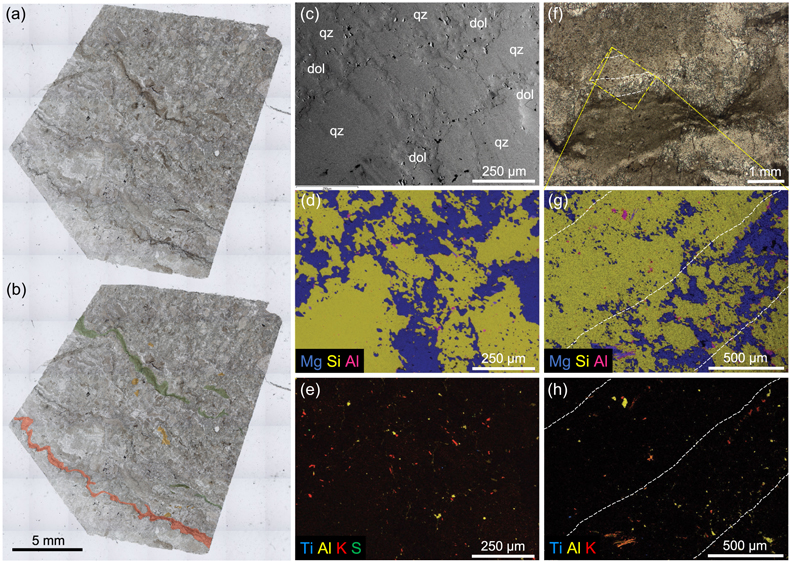
Figure 1 Petrographic characterisation of stromatolites in thin section. (a, b) Optical photomicrographs (original and annotated, respectively) showing organic-rich stromatolitic mesostructure (green), disseminated organics (amber) and stylolite (red). (c–e) SEM image and EDS maps showing representative matrix fabric; dol = dolomite, qz = quartz. (f–h) Optical photomicrograph (f) and EDS maps (g, h) showing contact between organic-rich layer and matrix.

Figure 2 Thin section optical photomicrographs showing organic fabrics. (a, b) Undulatory organic-rich layers (arrows) containing oriented particles (inset (b), arrow). (c) Organic-rich layer featuring mat laminae (white arrows) surrounded by pale brown–grey organic staining (black arrows). (d, e) Biogenic stromatolitic laminations exhibiting a low–medium degree of inheritance; dotted lines trace visible stromatolitic laminations.
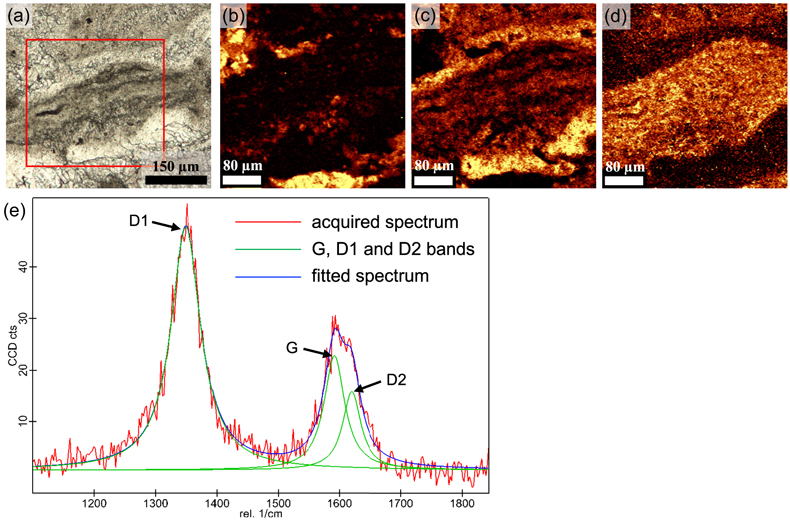
Figure 3 Raman microspectroscopic mapping and geothermometry. (a) Optical photomicrograph of organic material-rich layer; red box denotes region of (b–d). (b–d) Raman mapping of dolomite (b), quartz (c) and carbonaceous materials (d). (e) Decomposition of the first-order region of a representative Raman spectrum of carbonaceous materials showing ordered (G) and disordered (D1 + D2) carbon.
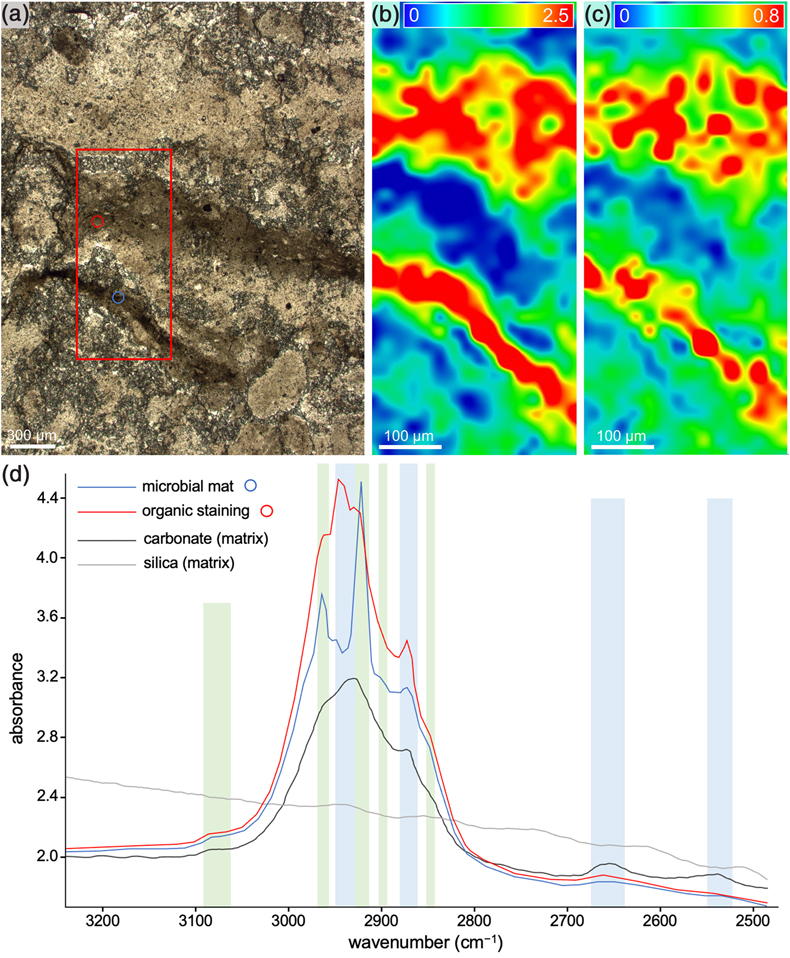
Figure 4 FTIR microspectroscopic characterisation of organic materials. (a) Optical photomicrograph of organic material-rich layer; red box denotes region of (b, c). (b, c) FTIR intensity maps for the C=C band at ∼1600 cm−1 (b), and C–H band at ∼2850 cm−1 (c). Colour scales given in absorbance units. (d) Representative FTIR spectra showing peaks corresponding to organic materials (green) and carbonate (blue). Spectra from matrix carbonate and silica are provided for comparison.