



Australasian microtektites: early target-projectile interaction in large impacts on Earth
Affiliations | Corresponding Author | Cite as | Funding information
Published by the European Association of Geochemistry
under Creative Commons License CC BY-NC-ND 4.0
Keywords: microtektites, tektites, impact melting, impact cratering, shock metamorphism, Indochina, Antarctica


- Share this article


Article views:2,942Cumulative count of HTML views and PDF downloads.
- Download Citation
- Rights & Permissions

top
Abstract
Figures
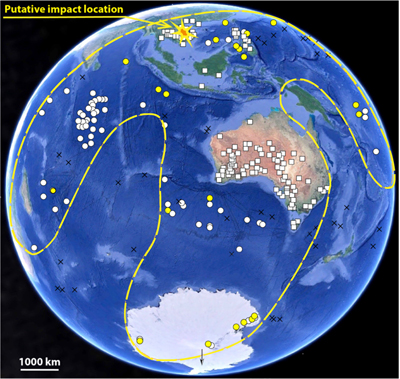 Figure 1 The Australasian tektite/microtektite strewn field (modified after Folco et al., 2023). The find locations of tektites and microtektites are marked by squares and circles, respectively; the yellow circles are the locations of the microtektites studied in this work. The putative impact location in Indochina (Ma et al., 2004) is arrowed. Tektites are found on land from Southeast Asia over much of Australia and Tasmania. Microtektites are found in deep sea sediments from the surrounding ocean basins, as well as on land in Antarctica, in the Transantarctic Mountains and Queen Maud Land. Black crosses are locations of deep sea sediment cores where microtektites were not found. | 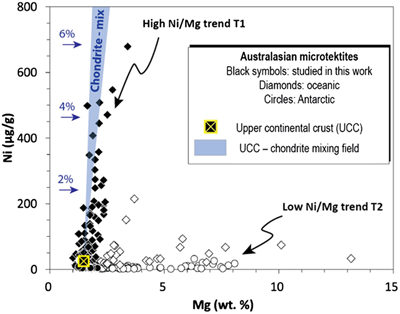 Figure 2 Nickel (μg/g) versus Mg (wt. %) variation diagram showing the two main Ni/Mg trends observed in Australasian microtektites (n = 244): the high Ni/Mg trend, T1 (black symbols; n = 144), and the low Ni/Mg trend, T2 (open symbols; n = 100) (modified after Folco et al., 2023). T1 is defined by microtektites with a chondritic impactor signature up to ∼6 wt. % and are distinguished from those on the T2 trend by having <2.2 Mg wt. % and >0.006 Ni/Mg for Ni <100 μg/g. | 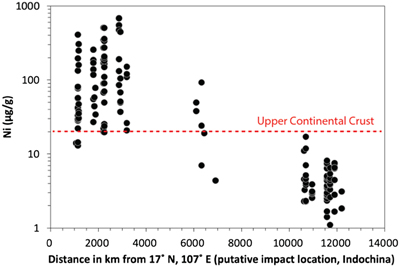 Figure 3 Nickel concentrations (μg/g) versus distance (km) from the putative impact location in Australasian microtektites. Geochemical data set (n = 144) from the literature; see Table S-1 and references therein. The putative impact location is from Ma et al. (2004). Nickel concentration for Earth’s upper continental crust is from Taylor and McLennan (1995). | 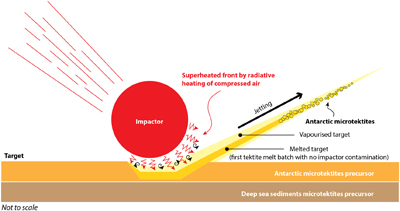 Figure 4 Schematic representation (not to scale) showing the role of radiative heating of compressed air at the front of the infalling fireball in the formation of the first tektite/microtektite melt batch. On approaching the target, melting (and vapourisation) begins just before the contact and the first tektite melt (in this work exemplified by distal microtektites from Antarctica), sourced from the topmost layer of the target, is devoid of impactor contamination. Upon subsequent contact (not shown here), compression and unloading, tektite/microtektite melts with variable impactor contamination (in this work exemplified by microtektites from deep sea sediment cores found closer to the impact location) and sourced from the underlying stratigraphic layers are produced. |
| Figure 1 | Figure 2 | Figure 3 | Figure 4 |
top
Introduction
Tektites are siliceous glass objects up to several tens of centimetres in size with splash/flanged ballistic and aerodynamic forms or blocky shapes with layered structures, i.e. the Muong Nong-type (e.g., Glass and Simonson, 2013
Glass, B.P., Simonson, B.M. (2013) Distal Impact Ejecta Layers: A Record of Large Impacts in Sedimentary Deposits. Springer Berlin, Heidelberg. https://doi.org/10.1007/978-3-540-88262-6
). Microtektites are their microscopic counterparts and typically occur in the form of spherules less than 1 mm in diameter. Tektites and microtektites are high velocity, distal impact ejecta, distributed in strewn fields extending for thousands of kilometres (e.g., Glass and Simonson, 2013Glass, B.P., Simonson, B.M. (2013) Distal Impact Ejecta Layers: A Record of Large Impacts in Sedimentary Deposits. Springer Berlin, Heidelberg. https://doi.org/10.1007/978-3-540-88262-6
). They are generated by the melting and vapourisation of the Earth’s continental crust during large scale (typically oblique) impacts of asteroidal/cometary bodies (Artemieva, 2002Artemieva, N.A. (2002) Tektite Origin in Oblique Impacts: Numerical Modeling of the Initial Stage. In: Plado, J., Pesonen, L.J. (Eds.) Impacts in Precambrian Shields. Impact Studies. Springer, Berlin, 257–276. https://doi.org/10.1007/978-3-662-05010-1_10
). Their volatile depleted, upper continental crust-like bulk composition derives from the involvement of large volumes of crustal materials during their formation process. As they are sourced from the top layers of the crustal targets (Ma et al., 2004Ma, P., Aggrey, K., Tonzola, C., Schnabel, C., de Nicola, P., Herzog, G.F., Wasson, J.T., Glass, B.P., Brown, L., Tera, F., Middleton, R., Klein, J. (2004) Beryllium-10 in Australasian tektites: Constraints on the location of the source crater. Geochimica et Cosmochimica Acta 68, 3883–3896. https://doi.org/10.1016/j.gca.2004.03.026
; Rochette et al., 2018Rochette, P., Braucher, R., Folco, L., Horng, C.S., Aumaître, G., Bourlès, D.L., Keddadouche, K. (2018) 10Be in Australasian microtektites compared to tektites: Size and geographic controls. Geology 46, 803–806. https://doi.org/10.1130/G45038.1
), they are a natural laboratory for investigating the chemical-physical, target-projectile interactions in large impacts. Such interactions are of critical importance for improving our understanding of the tektite/microtektite formation mechanism and of the impact melting process in general (e.g., Osinski et al., 2013Osinski, G.R., Grieve, R.A.F., Marion, C., Chanu, A. (2013) Impact melting. In: Osinski, G.R., Pierazzo, E. (Eds.) Impact Cratering: Processes and Products. Wiley-Blackwell, Oxford, 125–145. https://doi.org/10.1002/9781118447307.ch9
; Goderis et al., 2017Goderis, S., Tagle, R., Fritz, J., Bartoschewitz, R., Artemieva, N. (2017) On the nature of the Ni-rich component in splash-form Australasian tektites. Geochimica et Cosmochimica Acta 217, 28–50. https://doi.org/10.1016/j.gca.2017.08.013
).Evidence for chemical-physical, target-projectile interactions has been recently reported in some tektites and many microtektites from the Australasian strewn field (Fig. 1; Folco et al., 2023
Folco, L., Rochette, P., D’Orazio, M., Masotta, M. (2023) The chondritic impactor origin of the Ni-rich component in Australasian tektites and microtektites. Geochimica et Cosmochimica Acta 360, 231–240. https://doi.org/10.1016/j.gca.2023.09.018
). In our previous paper we interpreted the high Ni concentrations (>100 μg/g Ni and up to 678 μg/g), i.e. well above the average upper continental crustal value (20 μg/g Ni; Taylor and McLennan, 1995Taylor, S.R, McLennan, S.M. (1995) The geochemical evolution of the continental crust. Reviews of Geophysics 33, 241–265. https://doi.org/10.1029/95RG00262
), and relatively low Mg contents, as related to a chondritic impactor contamination of up to ∼6 % by mass. We also presented several geochemical arguments to exclude the alternative explanation of this enrichment by terrestrial ultramafic contamination. In this work, we study the geographic control in the distribution of this signature in the strewn field. We focus on microtektites because, in contrast to macroscopic tektites, they 1) have a wider and more continuous distribution from southeast Asia to Antarctica, from the Indian to the Pacific oceans, and 2) they are sourced from the topmost layer of the target, based on 10Be data (Rochette et al., 2018Rochette, P., Braucher, R., Folco, L., Horng, C.S., Aumaître, G., Bourlès, D.L., Keddadouche, K. (2018) 10Be in Australasian microtektites compared to tektites: Size and geographic controls. Geology 46, 803–806. https://doi.org/10.1130/G45038.1
) and thus the target material that experienced interaction with the projectile first. Here we show a relationship between impactor signature and ejection distance that opens new perspectives in the understanding of the target-projectile interactions, impact melting, and ejection in large scale impacts on Earth at the very contact.Figure 1 The Australasian tektite/microtektite strewn field (modified after Folco et al., 2023
Folco, L., Rochette, P., D’Orazio, M., Masotta, M. (2023) The chondritic impactor origin of the Ni-rich component in Australasian tektites and microtektites. Geochimica et Cosmochimica Acta 360, 231–240. https://doi.org/10.1016/j.gca.2023.09.018
). The find locations of tektites and microtektites are marked by squares and circles, respectively; the yellow circles are the locations of the microtektites studied in this work. The putative impact location in Indochina (Ma et al., 2004Ma, P., Aggrey, K., Tonzola, C., Schnabel, C., de Nicola, P., Herzog, G.F., Wasson, J.T., Glass, B.P., Brown, L., Tera, F., Middleton, R., Klein, J. (2004) Beryllium-10 in Australasian tektites: Constraints on the location of the source crater. Geochimica et Cosmochimica Acta 68, 3883–3896. https://doi.org/10.1016/j.gca.2004.03.026
) is arrowed. Tektites are found on land from Southeast Asia over much of Australia and Tasmania. Microtektites are found in deep sea sediments from the surrounding ocean basins, as well as on land in Antarctica, in the Transantarctic Mountains and Queen Maud Land. Black crosses are locations of deep sea sediment cores where microtektites were not found.top
The Australasian Tektite/Microtektite Strewn Field
The Australasian tektite/microtektite strewn field covers ∼15 % of the Earth’s surface (Fig. 1) and formed ∼0.8 million years ago (Jourdan et al., 2019
Jourdan, F., Nomade, S., Wingate, M.T.D., Eroglu, E., Deino, A. (2019) Ultraprecise age and formation temperature of the Australasian tektites constrained by 40Ar/39Ar analyses. Meteoritics & Planetary Science 54, 2573–2591. https://doi.org/10.1111/maps.13305
; Di Vincenzo et al., 2021Di Vincenzo, G., Folco, L., Suttle, M.D., Brase, L., Harvey, R.P. (2021) Multi-collector 40Ar/39Ar dating of microtektites from Transantarctic Mountains (Antarctica): A definitive link with the Australasian tektite/microtektite strewn field. Geochimica et Cosmochimica Acta 298, 112–130, https://doi.org/10.1016/j.gca.2021.01.046
) through the hypervelocity impact of a chondritic body (e.g., Goderis, et al., 2017Goderis, S., Tagle, R., Fritz, J., Bartoschewitz, R., Artemieva, N. (2017) On the nature of the Ni-rich component in splash-form Australasian tektites. Geochimica et Cosmochimica Acta 217, 28–50. https://doi.org/10.1016/j.gca.2017.08.013
; Folco et al., 2018Folco, L., Glass, B.P., D’Orazio, M., Rochette, P. (2018) Australasian microtektites: Impactor identification using Cr, Co and Ni ratios. Geochimica et Cosmochimica Acta 222, 550–568. https://doi.org/10.1016/j.gca.2017.11.017
, 2023Folco, L., Rochette, P., D’Orazio, M., Masotta, M. (2023) The chondritic impactor origin of the Ni-rich component in Australasian tektites and microtektites. Geochimica et Cosmochimica Acta 360, 231–240. https://doi.org/10.1016/j.gca.2023.09.018
). It is the youngest and the largest of the five Cenozoic strewn fields known: Australasian, Ivory Coast, Central European, Central America, and North America (Glass and Simonson, 2013Glass, B.P., Simonson, B.M. (2013) Distal Impact Ejecta Layers: A Record of Large Impacts in Sedimentary Deposits. Springer Berlin, Heidelberg. https://doi.org/10.1007/978-3-540-88262-6
; Rochette et al., 2021Rochette, P., Beck, P., Bizzarro, M., Braucher, R., Cornec, J., Debaille, V., Devouard, B., Gattacceca, J., Jourdan, F., Moustard, F., Moynier, F., Nomade, S., Reynard, B. (2021) Impact glasses from Belize represent tektites from the Pleistocene Pantasma impact crater in Nicaragua. Communications Earth & Environment 2, 94. https://doi.org/10.1038/s43247-021-00155-1
). It is also the most elusive since its source crater has not yet been identified. However, evidence of high pressure phases in tektites (Cavosie et al., 2018Cavosie, A.J., Timms, N.E., Erickson, T.M., Koeberl, C. (2018) New clues from Earth’s most elusive impact crater: Evidence of reidite in Australasian tektites from Thailand. Geology 46, 203–206. https://doi.org/10.1130/G39711.1
; Glass et al., 2020Glass, B.P., Folco, L., Masotta, M., Campanale, F. (2020) Coesite in a Muong Nong-type tektite from Muong Phin, Laos: Description, formation, and survival. Meteoritics & Planetary Science 55, 253–273. https://doi.org/10.1111/maps.13433
; Masotta et al., 2020Masotta, M., Peres, S., Folco, L., Mancini, L., Rochette, P., Glass, B.P., Campanale, F., Gueninchault, N., Radica, F., Singsoupho, S., Navarro, E. (2020) 3D X-ray tomographic analysis reveals how coesite is preserved in Muong Nong-type tektites. Scientific Reports 10, 20608. https://doi.org/10.1038/s41598-020-76727-6
) and other shocked ejecta (e.g., Glass and Fries, 2008Glass, B.P., Fries, M. (2008) Micro-Raman spectroscopic study of fine-grained, shock-metamorphosed rock fragments from the Australasian microtektite layer. Meteoritics & Planetary Science 43, 1487–1496. https://doi.org/10.1111/j.1945-5100.2008.tb01023.x
) indicate that they are linked to a crater forming event. Petrographic, geochemical, and isotopic trends (e.g., geographic distribution of microtektite abundance, of Muong Nong type tektites and their 10Be concentrations, etc.) point to an impact location in Indochina or the surrounding seas (e.g., Ma et al., 2004Ma, P., Aggrey, K., Tonzola, C., Schnabel, C., de Nicola, P., Herzog, G.F., Wasson, J.T., Glass, B.P., Brown, L., Tera, F., Middleton, R., Klein, J. (2004) Beryllium-10 in Australasian tektites: Constraints on the location of the source crater. Geochimica et Cosmochimica Acta 68, 3883–3896. https://doi.org/10.1016/j.gca.2004.03.026
; Glass and Koeberl, 2006Glass, B.P., Koeberl, C. (2006) Australasian microtektites and associated impact ejecta in the South China Sea and the Middle Pleistocene supereruption of Toba. Meteoritics & Planetary Science 41, 305–326. https://doi.org/10.1111/j.1945-5100.2006.tb00211.x
), or farther north in northwest China (Mizera, 2022Mizera, J. (2022) Quest for the Australasian impact crater: Failings of the candidate location at the Bolaven Plateau, Southern Laos. Meteoritics & Planetary Science 57, 1973–1986. https://doi.org/10.1111/maps.13912
). Ejecta distribution suggests a crater diameter in excess of 30 km (Glass and Koeberl, 2006Glass, B.P., Koeberl, C. (2006) Australasian microtektites and associated impact ejecta in the South China Sea and the Middle Pleistocene supereruption of Toba. Meteoritics & Planetary Science 41, 305–326. https://doi.org/10.1111/j.1945-5100.2006.tb00211.x
). The tri-lobate outline of the strewn field defined by the distribution of microtektites (Fig. 1) resulted from down range, S-, SE- and SW-ward ballistic ejection of three main ejecta rays, according to Glass and Simonson (2013)Glass, B.P., Simonson, B.M. (2013) Distal Impact Ejecta Layers: A Record of Large Impacts in Sedimentary Deposits. Springer Berlin, Heidelberg. https://doi.org/10.1007/978-3-540-88262-6
.Geochemical studies and mineral inclusions in layered tektites from Indochina suggest a fine grained, sedimentary source rock, e.g., greywacke or loess (Wasson, 1991
Wasson, J.T. (1991) Layered tektites: a multiple impact origin for the Australasian tektites. Earth and Planetary Science Letters 102, 95–109. https://doi.org/10.1016/0012-821X(91)90001-X
; Glass and Koeberl, 2006Glass, B.P., Koeberl, C. (2006) Australasian microtektites and associated impact ejecta in the South China Sea and the Middle Pleistocene supereruption of Toba. Meteoritics & Planetary Science 41, 305–326. https://doi.org/10.1111/j.1945-5100.2006.tb00211.x
). Consistently, the bulk composition of Australasian tektites and microtektites is strikingly similar to that of the upper continental crust, although depleted in volatile elements (e.g., Glass et al., 2004Glass, B.P., Huber, H., Koeberl, C. (2004) Geochemistry of Cenozoic microtektites and clinopyroxene-bearing spherules. Geochimica et Cosmochimica Acta 68, 3971–4006. https://doi.org/10.1016/j.gca.2004.02.026
). A surface or near surface sedimentary deposit was proposed based on 10Be studies (Ma et al., 2004Ma, P., Aggrey, K., Tonzola, C., Schnabel, C., de Nicola, P., Herzog, G.F., Wasson, J.T., Glass, B.P., Brown, L., Tera, F., Middleton, R., Klein, J. (2004) Beryllium-10 in Australasian tektites: Constraints on the location of the source crater. Geochimica et Cosmochimica Acta 68, 3883–3896. https://doi.org/10.1016/j.gca.2004.03.026
; Rochette et al., 2018Rochette, P., Braucher, R., Folco, L., Horng, C.S., Aumaître, G., Bourlès, D.L., Keddadouche, K. (2018) 10Be in Australasian microtektites compared to tektites: Size and geographic controls. Geology 46, 803–806. https://doi.org/10.1130/G45038.1
). The Nd model ages for both tektites and microtektites indicate source rocks with a Meso-Proterozoic crustal residence time (Blum et al., 1992Blum, J.D., Papanastassiou, D.A., Koeberl., C., Wasserburg, G.J. (1992) Neodymium and strontium isotopic study of Australasian tektites: New constraints on the provenance and age of target materials. Geochimica et Cosmochimica Acta 56, 483–492. https://doi.org/10.1016/0016-7037(92)90146-A
; Folco et al., 2009Folco, L., D’Orazio, M., Tiepolo, M., Tonarini, S., Ottolini, L., Perchiazzi, N., Rochette, P., Glass, B.P. (2009) Transantarctic Mountain microtektites: Geochemical affinity with Australasian microtektites. Geochimica et Cosmochimica Acta 73, 3694–3722. https://doi.org/10.1016/j.gca.2009.03.021
; Soens et al., 2021Soens, B., van Ginneken, M., Chernonozhkin, S., Slotte, N., Debaille, V., Vanhaecke, F., Terryn, H., Claeys, P., Goderis, S. (2021) Australasian microtektites across the Antarctic continent: Evidence from the Sør Rondane Mountain range (East Antarctica). Geoscience Frontiers 12, 101153. https://doi.org/10.1016/j.gsf.2021.101153
).top
The Data Set
The microtektites studied in this work (n = 144, ∼60 % of the total available from the literature), comprise those defining the high Ni/Mg trend identified by Folco et al. (2023)
Folco, L., Rochette, P., D’Orazio, M., Masotta, M. (2023) The chondritic impactor origin of the Ni-rich component in Australasian tektites and microtektites. Geochimica et Cosmochimica Acta 360, 231–240. https://doi.org/10.1016/j.gca.2023.09.018
and interpreted as a mixing line joining the composition of the upper continental crust, taken as an approximation of the quartz-feldspathic target rock, and chondritic material as the impactor (Fig. 2). The database, reported in Table S-1, is a compilation of geochemical data from the literature (see references therein). The other microtektites available from the literature were not included in the selection because they define mixing trends with end member compositions yet to be identified (Folco et al., 2023Folco, L., Rochette, P., D’Orazio, M., Masotta, M. (2023) The chondritic impactor origin of the Ni-rich component in Australasian tektites and microtektites. Geochimica et Cosmochimica Acta 360, 231–240. https://doi.org/10.1016/j.gca.2023.09.018
).Figure 2 Nickel (μg/g) versus Mg (wt. %) variation diagram showing the two main Ni/Mg trends observed in Australasian microtektites (n = 244): the high Ni/Mg trend, T1 (black symbols; n = 144), and the low Ni/Mg trend, T2 (open symbols; n = 100) (modified after Folco et al., 2023
Folco, L., Rochette, P., D’Orazio, M., Masotta, M. (2023) The chondritic impactor origin of the Ni-rich component in Australasian tektites and microtektites. Geochimica et Cosmochimica Acta 360, 231–240. https://doi.org/10.1016/j.gca.2023.09.018
). T1 is defined by microtektites with a chondritic impactor signature up to ∼6 wt. % and are distinguished from those on the T2 trend by having <2.2 Mg wt. % and >0.006 Ni/Mg for Ni <100 μg/g.Microtektites range from 60 to 760 μm in diameter (Fig. S-1). Eighty seven microtektites are from sixteen deep sea sediment cores from the Celebs Sea, South China Sea, Philippine Sea, Sulu Sea, Indian and Pacific Oceans (Fig. 1, Table S-1). They vary widely in shape from spheroids to dumbell and tear drops. The majority are translucent and have vitreous lustre, dark-brown-green colour, and variable contents of vesicles (up to few tens of μm in diameter). Most (>90 %) contain undigested microscopic, shocked target relict grains, lechatelierite and fine compositional schlieren. Few are yellow-brown, transparent and optically homogenous. The fifty seven Antarctic microtektites are from six locations in the Transantarctic Mountains, namely, Schroeder Spur, Killer Nunatak, Miller Butte, Allan Hills, Larkman Nunatak and Mount Reymond, and one location in Queen Maud Land, Mount Widerø. In contrast to microtektites from deep sea sediments, they are transparent, pale-yellow in colour, virtually devoid of mineral inclusions and compositional schlieren, and only few (∼15 %) contain a single microscopic vesicle. Except for a few with ellipsoid shapes, most are spheres.
top
Data Analysis
The following data analysis is based on the assumption that the still unidentified impact location is in southeast Asia, as mentioned above. Given the large extension of the Australasian strewn field, this approximation does not introduce significant bias in our discussion.
The data set shows that Ni concentrations — and thus impactor contamination — decreases, on average, with increasing distance from the putative impact location in Indochina (Fig. 3). Considering an impact location farther north in northwest China, as alternatively proposed by Mizera (2022)
Mizera, J. (2022) Quest for the Australasian impact crater: Failings of the candidate location at the Bolaven Plateau, Southern Laos. Meteoritics & Planetary Science 57, 1973–1986. https://doi.org/10.1111/maps.13912
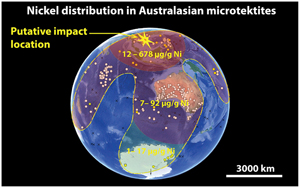
, would not introduce significant changes. Microtektites found within 3000 km of the putative impact location (n = 78) show Ni contents averaging 144 μg/g and ranging 13–678 μg/g; those found at distances >3000 km and <10,000 km in the Indian and Pacific Oceans (n = 9) have Ni contents averaging 51 μg/g and ranging 4–120 μg/g; those found at distances >10,000 km in Antarctica (n = 57) have Ni contents averaging 5 μg/g and range 1–17 μg/g. The Ni contents in microtektites found at distances over 10,000 km are similar to Earth’s upper continental crust values. This indicates that the most distal Antarctic microtektites yield no signature of impactor contamination, in contrast to microtektites found close to the putative impact location. The same pattern is observed for Co and Cr, taken as additional proxies for impactor contamination (Goderis et al., 2017Goderis, S., Tagle, R., Fritz, J., Bartoschewitz, R., Artemieva, N. (2017) On the nature of the Ni-rich component in splash-form Australasian tektites. Geochimica et Cosmochimica Acta 217, 28–50. https://doi.org/10.1016/j.gca.2017.08.013
; Folco et al., 2018Folco, L., Glass, B.P., D’Orazio, M., Rochette, P. (2018) Australasian microtektites: Impactor identification using Cr, Co and Ni ratios. Geochimica et Cosmochimica Acta 222, 550–568. https://doi.org/10.1016/j.gca.2017.11.017
, 2023Folco, L., Rochette, P., D’Orazio, M., Masotta, M. (2023) The chondritic impactor origin of the Ni-rich component in Australasian tektites and microtektites. Geochimica et Cosmochimica Acta 360, 231–240. https://doi.org/10.1016/j.gca.2023.09.018
). Cobalt and Cr decrease with launch distance from southeast Asia to Antarctica, with average and range values from 22 (4–50) to 4 (1–10) μg/g and from 145 (17–398) to 65 (25–209) μg/g, respectively (Fig. S-2).Figure 3 Nickel concentrations (μg/g) versus distance (km) from the putative impact location in Australasian microtektites. Geochemical data set (n = 144) from the literature; see Table S-1 and references therein. The putative impact location is from Ma et al. (2004)
Ma, P., Aggrey, K., Tonzola, C., Schnabel, C., de Nicola, P., Herzog, G.F., Wasson, J.T., Glass, B.P., Brown, L., Tera, F., Middleton, R., Klein, J. (2004) Beryllium-10 in Australasian tektites: Constraints on the location of the source crater. Geochimica et Cosmochimica Acta 68, 3883–3896. https://doi.org/10.1016/j.gca.2004.03.026
. Nickel concentration for Earth’s upper continental crust is from Taylor and McLennan (1995)Taylor, S.R, McLennan, S.M. (1995) The geochemical evolution of the continental crust. Reviews of Geophysics 33, 241–265. https://doi.org/10.1029/95RG00262
.top
Constraints for the Formation Model
Folco et al. (2010a)
Folco, L., Glass, B.P., D’Orazio, M., Rochette, P. (2010a) A common volatilization trend in Transantarctic Mountain and Australasian microtektites: Implications for their formation model and parent crater location. Earth and Planetary Science Letters 293, 135–139. https://doi.org/10.1016/j.epsl.2010.02.037
reported that the concentrations of volatile major elements Na and K in Australasian microtektites decreases, on average, with distance from the putative impact location: total alkalis Na2O + K2O = 4.27 ± 0.62 wt. % and 1.25 ± 0.25 wt. % in microtektites from deep sea sediment cores within 2000 km from 17° N, 107° E and Antarctica, respectively. Folco et al. (2010b)Folco, L., Perchiazzi, N., D’Orazio, M., Frezzotti, M.L., Glass, B.P., Rochette, P. (2010b) Shocked quartz and other mineral inclusions in Australasian microtektites. Geology 38, 211–214. https://doi.org/10.1130/G30512.1
showed that the abundance of shocked, relic grains of quartz and lechatelierite inclusions (interpreted as undigested remnants of the melting of the microtektite precursor materials), as well as compositional heterogeneities (namely, schlieren) decrease in the same fashion and become extremely low in microtektites from Antarctica. Chernonozhkin et al. (2021)Chernonozhkin, S.M., González de Vega, C., Artemieva, N., Soens, B., Belza, J., Bolea-Fernandez, E., Van Ginneken, M., Glass, B.P., Folco, L., Genge, M.J., Claeys, Ph., Vanhaecke, F., Goderis, S. (2021) Isotopic evolution of planetary crusts by hypervelocity impacts evidenced by Fe in microtektites. Nature Communications 12, 5646. https://doi.org/10.1038/s41467-021-25819-6
also showed that the iron isotopic signatures covaries with the average launch distance, with the most distal Antarctic microtektites containing isotopically heavier Fe (δ56/54Fe = 1.02 ± 0.69 ‰). These trends defined a relationship between increasing temperature-time regimes (regardless of the heating mechanism, i.e. impact, hypervelocity flight, re-entry; Folco et al., 2010aFolco, L., Glass, B.P., D’Orazio, M., Rochette, P. (2010a) A common volatilization trend in Transantarctic Mountain and Australasian microtektites: Implications for their formation model and parent crater location. Earth and Planetary Science Letters 293, 135–139. https://doi.org/10.1016/j.epsl.2010.02.037
; Chernonozhkin et al., 2021Chernonozhkin, S.M., González de Vega, C., Artemieva, N., Soens, B., Belza, J., Bolea-Fernandez, E., Van Ginneken, M., Glass, B.P., Folco, L., Genge, M.J., Claeys, Ph., Vanhaecke, F., Goderis, S. (2021) Isotopic evolution of planetary crusts by hypervelocity impacts evidenced by Fe in microtektites. Nature Communications 12, 5646. https://doi.org/10.1038/s41467-021-25819-6
) with greater ejection distances. Recently, Rochette et al. (2018)Rochette, P., Braucher, R., Folco, L., Horng, C.S., Aumaître, G., Bourlès, D.L., Keddadouche, K. (2018) 10Be in Australasian microtektites compared to tektites: Size and geographic controls. Geology 46, 803–806. https://doi.org/10.1130/G45038.1
documented that 10Be in microtektites increases with distance from Indochina, with average values of 125 × 106 and 184 × 106 atoms/g in oceanic and Antarctic microtektites, respectively, indicating that Antarctic microtektites were sourced from the topmost layer of the target, whereas those from lower latitudes were sourced from the underlying stratigraphic layers.The combination of the above trends with that of the Ni versus distance observed in this work (Fig. 3) constitutes a set of geochemical constraints that should be taken into account in microtektite formation modelling: the greater the ejection distance, the stronger the heating they experienced, the higher the stratigraphic level of the source material in the target, and the lower the impactor contamination. This implies that the parent liquids of the most distal Australasian microtektites from Antarctica, devoid of impactor contamination and sourced from the topmost layer of the target, formed first with no chemical interaction with the (chondritic) projectile. Bearing variable impactor contamination, the parent liquids of the less distal microtektites from the seas surrounding Indochina formed (immediately) after, from the underlying stratigraphic layers, through variable yet significant mixing between target and projectile materials.
One may argue that the Ni versus launch distance trend is due to volatilisation since it parallels the alkali and Fe isotopes trends reported by Folco et al. (2010a)
Folco, L., Glass, B.P., D’Orazio, M., Rochette, P. (2010a) A common volatilization trend in Transantarctic Mountain and Australasian microtektites: Implications for their formation model and parent crater location. Earth and Planetary Science Letters 293, 135–139. https://doi.org/10.1016/j.epsl.2010.02.037
and Chernonozhkin et al. (2021)Chernonozhkin, S.M., González de Vega, C., Artemieva, N., Soens, B., Belza, J., Bolea-Fernandez, E., Van Ginneken, M., Glass, B.P., Folco, L., Genge, M.J., Claeys, Ph., Vanhaecke, F., Goderis, S. (2021) Isotopic evolution of planetary crusts by hypervelocity impacts evidenced by Fe in microtektites. Nature Communications 12, 5646. https://doi.org/10.1038/s41467-021-25819-6
, respectively. The lack of a similar trend for major and trace elements with similar condensation temperatures, e.g., Mg (1340 K) and Eu (1338 K), suggests that significant Ni volatilisation (1354 K) did not take place (Fig. S-3).top
Scenario
Models envision that tektites and microtektites form as an expanding spray of liquid droplets of target materials that underwent melting, partial vapourisation, high velocity ejection and fragmentation upon unloading from the high pressures generated by hypervelocity impacts of asteroidal/cometary bodies onto the Earth’s crust. Models also predict accretion (to a variable extent) of condensed plume gases during atmospheric flight and, for those ejected at the highest velocities, ablation during high velocity atmospheric re-entry. All these models, either in the normal excavation flow or jetting contexts (e.g., Melosh and Vickery, 1991
Melosh, H.J., Vickery, A.M. (1991) Melt droplet formation in energetic impact events. Nature 350, 494–497. https://doi.org/10.1038/350494a0
; Artemieva, 2002Artemieva, N.A. (2002) Tektite Origin in Oblique Impacts: Numerical Modeling of the Initial Stage. In: Plado, J., Pesonen, L.J. (Eds.) Impacts in Precambrian Shields. Impact Studies. Springer, Berlin, 257–276. https://doi.org/10.1007/978-3-662-05010-1_10
; Johnson and Melosh, 2012Johnson, B.C., Melosh, H.J. (2012) Formation of spherules in impact produced vapor plumes. Icarus 217, 416–430. https://doi.org/10.1016/j.icarus.2011.11.020
), predict detectable amount of impactor contamination in the chemical composition of tektites/microtektites since, at this stage, around half of the projectile is involved in vapourisation and melting. This agrees with observations in Australasian microtektites found close to the impact location, but in contrast to those in the most distally deposited microtektites from Antarctica.The lack of impactor contamination in early formed microtektite liquids sourced from the uppermost crustal layer — here exemplified by the most distal microtektites from Antarctica — is a relevant (and apparently counterintuitive) constraint for modelling microtektite formation in large scale impacts on Earth. A plausible scenario envisions the start of the heating and melting of the very surface layers of the target — and thus the production of the first batch of tektite/microtektite melts — prior to impactor touch down, followed by squirting of the melts and compressed gas between the projectile and target into an expanding two phase jet. Sufficient heat to melt the surface layers of the target surface in excess of the tektite/microtektite liquidus of about 1400 K (e.g., Masotta et al., 2020
Masotta, M., Peres, S., Folco, L., Mancini, L., Rochette, P., Glass, B.P., Campanale, F., Gueninchault, N., Radica, F., Singsoupho, S., Navarro, E. (2020) 3D X-ray tomographic analysis reveals how coesite is preserved in Muong Nong-type tektites. Scientific Reports 10, 20608. https://doi.org/10.1038/s41598-020-76727-6
) could be provided by thermal radiation in compressed air, at the front of the incoming fireball (Fig. 4). The second batch of tektite/microtektite melt, bearing variable impactor contamination, formed later when the projectile touched the ground, consistently with the occurrence of inclusions of shocked target mineral relicts (Folco et al., 2010bFolco, L., Perchiazzi, N., D’Orazio, M., Frezzotti, M.L., Glass, B.P., Rochette, P. (2010b) Shocked quartz and other mineral inclusions in Australasian microtektites. Geology 38, 211–214. https://doi.org/10.1130/G30512.1
). In this latter stage, the addition of a projectile component could occur prior to ejection when both projectile and target melts were still under elevated shock pressures, as proposed earlier by Goderis et al. (2017)Goderis, S., Tagle, R., Fritz, J., Bartoschewitz, R., Artemieva, N. (2017) On the nature of the Ni-rich component in splash-form Australasian tektites. Geochimica et Cosmochimica Acta 217, 28–50. https://doi.org/10.1016/j.gca.2017.08.013
.Figure 4 Schematic representation (not to scale) showing the role of radiative heating of compressed air at the front of the infalling fireball in the formation of the first tektite/microtektite melt batch. On approaching the target, melting (and vapourisation) begins just before the contact and the first tektite melt (in this work exemplified by distal microtektites from Antarctica), sourced from the topmost layer of the target, is devoid of impactor contamination. Upon subsequent contact (not shown here), compression and unloading, tektite/microtektite melts with variable impactor contamination (in this work exemplified by microtektites from deep sea sediment cores found closer to the impact location) and sourced from the underlying stratigraphic layers are produced.
The proposed scenario for the formation of the first tektite/microtektite melt batch, devoid of any chemical interaction between target and projectile here exemplified by microtektites from Antarctica (Fig. 4), contrasts with the most widely accepted one which entails that heating and melting is caused by compression and adiabatic unloading during touch down of the impactor, starting soon after the contact and compression stage at the beginning of the excavation stage (e.g., Melosh and Vickery, 1991
Melosh, H.J., Vickery, A.M. (1991) Melt droplet formation in energetic impact events. Nature 350, 494–497. https://doi.org/10.1038/350494a0
; Artemieva, 2002Artemieva, N.A. (2002) Tektite Origin in Oblique Impacts: Numerical Modeling of the Initial Stage. In: Plado, J., Pesonen, L.J. (Eds.) Impacts in Precambrian Shields. Impact Studies. Springer, Berlin, 257–276. https://doi.org/10.1007/978-3-662-05010-1_10
; Osinski et al., 2013Osinski, G.R., Grieve, R.A.F., Marion, C., Chanu, A. (2013) Impact melting. In: Osinski, G.R., Pierazzo, E. (Eds.) Impact Cratering: Processes and Products. Wiley-Blackwell, Oxford, 125–145. https://doi.org/10.1002/9781118447307.ch9
). It thereby strengthens the concept that impact melting does occur in two stages, just before and after the contact of the impactor, as recently proposed by Rochette et al. (2024)Rochette, P., Di Vincenzo, G., Gattacceca, J., Barrat, J.A., Devouard, B., Folco, L., Musolino, A., Quesnel, Y. (2024) A two stage impact melting process in an impact glass strewn field from the Atacama Desert. Geochemical Perspectives Letters 30, 28–33. https://doi.org/10.7185/geochemlet.2418
for the formation of millimetric splash-form impact melt particles from Atacama (Atacamaites).The model proposed here for the most distal Australasian microtektites from Antarctica (Fig. 4) envisions jetting up to enormous distances >10,000 km, assuming an impact location in the Indochina area. Di Vincenzo et al. (2021)
Di Vincenzo, G., Folco, L., Suttle, M.D., Brase, L., Harvey, R.P. (2021) Multi-collector 40Ar/39Ar dating of microtektites from Transantarctic Mountains (Antarctica): A definitive link with the Australasian tektite/microtektite strewn field. Geochimica et Cosmochimica Acta 298, 112–130, https://doi.org/10.1016/j.gca.2021.01.046
showed that Antarctic microtektites contain significant amount of extraneous Ar, in striking contrast with macroscopic tektites, weakly or negligibly contaminated. Possibly, Antarctic microtektites incorporated extraneous Ar because they were enveloped within a hot gas enriched in vapourised target during ejection, while still molten droplets. Therefore, one possibility is that ejection of microtektites up to planetary distances may have occurred because Antarctic microtektites travelled within jets of gas of vapourised target (Fig. 4), perhaps assisted by atmospheric waves, similar to those recently observed in large volcanic eruptions (e.g., Hunga Tonga in January 2022; Matoza et al., 2022Matoza, R.S., Fee, D., Assink, J.D., Iezzi, A.M., Green, D.N., et al. (2022) Atmospheric waves and global seismoacoustic observations of the January 2022 Hunga eruption, Tonga. Science 377, 95–100. https://doi.org/10.1126/science.abo7063
).top
Acknowledgements
Transantarctic Mountains microtektite research at the University of Pisa is supported by the Italian Programma Nazionale delle Ricerche in Antartide (PNRA). Research on planetary materials at the University of Pisa is supported by the ASI SpaceitUP programme. The manuscript benefited from the constructive review of Steven Goderis and David Baratoux, and the careful handling of editor Romain Tartèse.
Editor: Romain Tartèse
top
References
Artemieva, N.A. (2002) Tektite Origin in Oblique Impacts: Numerical Modeling of the Initial Stage. In: Plado, J., Pesonen, L.J. (Eds.) Impacts in Precambrian Shields. Impact Studies. Springer, Berlin, 257–276. https://doi.org/10.1007/978-3-662-05010-1_10
 Show in context
 They are generated by the melting and vapourisation of the Earth’s continental crust during large scale (typically oblique) impacts of asteroidal/cometary bodies (Artemieva, 2002).
View in article
All these models, either in the normal excavation flow or jetting contexts (e.g., Melosh and Vickery, 1991; Artemieva, 2002; Johnson and Melosh, 2012), predict detectable amount of impactor contamination in the chemical composition of tektites/microtektites since, at this stage, around half of the projectile is involved in vapourisation and melting.
View in article
The proposed scenario for the formation of the first tektite/microtektite melt batch, devoid of any chemical interaction between target and projectile here exemplified by microtektites from Antarctica (Fig. 4), contrasts with the most widely accepted one which entails that heating and melting is caused by compression and adiabatic unloading during touch down of the impactor, starting soon after the contact and compression stage at the beginning of the excavation stage (e.g., Melosh and Vickery, 1991; Artemieva, 2002; Osinski et al., 2013).
View in article
Blum, J.D., Papanastassiou, D.A., Koeberl., C., Wasserburg, G.J. (1992) Neodymium and strontium isotopic study of Australasian tektites: New constraints on the provenance and age of target materials. Geochimica et Cosmochimica Acta 56, 483–492. https://doi.org/10.1016/0016-7037(92)90146-A
Show in context The Nd model ages for both tektites and microtektites indicate source rocks with a Meso-Proterozoic crustal residence time (Blum et al., 1992; Folco et al., 2009; Soens et al., 2021).
View in article
Cavosie, A.J., Timms, N.E., Erickson, T.M., Koeberl, C. (2018) New clues from Earth’s most elusive impact crater: Evidence of reidite in Australasian tektites from Thailand. Geology 46, 203–206. https://doi.org/10.1130/G39711.1
Show in context However, evidence of high pressure phases in tektites (Cavosie et al., 2018; Glass et al., 2020; Masotta et al., 2020) and other shocked ejecta (e.g., Glass and Fries, 2008) indicate that they are linked to a crater forming event.
View in article
Chernonozhkin, S.M., González de Vega, C., Artemieva, N., Soens, B., Belza, J., Bolea-Fernandez, E., Van Ginneken, M., Glass, B.P., Folco, L., Genge, M.J., Claeys, Ph., Vanhaecke, F., Goderis, S. (2021) Isotopic evolution of planetary crusts by hypervelocity impacts evidenced by Fe in microtektites. Nature Communications 12, 5646. https://doi.org/10.1038/s41467-021-25819-6
Show in context Chernonozhkin et al. (2021) also showed that the iron isotopic signatures covaries with the average launch distance, with the most distal Antarctic microtektites containing isotopically heavier Fe (δ56/54Fe = 1.02 ± 0.69 ‰).
View in article
These trends defined a relationship between increasing temperature-time regimes (regardless of the heating mechanism, i.e. impact, hypervelocity flight, re-entry; Folco et al., 2010a; Chernonozhkin et al., 2021) with greater ejection distances.
View in article
One may argue that the Ni versus launch distance trend is due to volatilisation since it parallels the alkali and Fe isotopes trends reported by Folco et al. (2010a) and Chernonozhkin et al. (2021), respectively.
View in article
Di Vincenzo, G., Folco, L., Suttle, M.D., Brase, L., Harvey, R.P. (2021) Multi-collector 40Ar/39Ar dating of microtektites from Transantarctic Mountains (Antarctica): A definitive link with the Australasian tektite/microtektite strewn field. Geochimica et Cosmochimica Acta 298, 112–130, https://doi.org/10.1016/j.gca.2021.01.046
Show in context The Australasian tektite/microtektite strewn field covers ∼15 % of the Earth’s surface (Fig. 1) and formed ∼0.8 million years ago (Jourdan et al., 2019; Di Vincenzo et al., 2021) through the hypervelocity impact of a chondritic body (e.g., Goderis, et al., 2017; Folco et al., 2018, 2023).
View in article
Di Vincenzo et al. (2021) showed that Antarctic microtektites contain significant amount of extraneous Ar, in striking contrast with macroscopic tektites, weakly or negligibly contaminated.
View in article
Folco, L., D’Orazio, M., Tiepolo, M., Tonarini, S., Ottolini, L., Perchiazzi, N., Rochette, P., Glass, B.P. (2009) Transantarctic Mountain microtektites: Geochemical affinity with Australasian microtektites. Geochimica et Cosmochimica Acta 73, 3694–3722. https://doi.org/10.1016/j.gca.2009.03.021
Show in context The Nd model ages for both tektites and microtektites indicate source rocks with a Meso-Proterozoic crustal residence time (Blum et al., 1992; Folco et al., 2009; Soens et al., 2021).
View in article
Folco, L., Glass, B.P., D’Orazio, M., Rochette, P. (2010a) A common volatilization trend in Transantarctic Mountain and Australasian microtektites: Implications for their formation model and parent crater location. Earth and Planetary Science Letters 293, 135–139. https://doi.org/10.1016/j.epsl.2010.02.037
Show in context Folco et al. (2010a) reported that the concentrations of volatile major elements Na and K in Australasian microtektites decreases, on average, with distance from the putative impact location: total alkalis Na2O + K2O = 4.27 ± 0.62 wt. % and 1.25 ± 0.25 wt. % in microtektites from deep sea sediment cores within 2000 km from 17° N, 107° E and Antarctica, respectively.
View in article
These trends defined a relationship between increasing temperature-time regimes (regardless of the heating mechanism, i.e. impact, hypervelocity flight, re-entry; Folco et al., 2010a; Chernonozhkin et al., 2021) with greater ejection distances.
View in article
One may argue that the Ni versus launch distance trend is due to volatilisation since it parallels the alkali and Fe isotopes trends reported by Folco et al. (2010a) and Chernonozhkin et al. (2021), respectively.
View in article
Folco, L., Perchiazzi, N., D’Orazio, M., Frezzotti, M.L., Glass, B.P., Rochette, P. (2010b) Shocked quartz and other mineral inclusions in Australasian microtektites. Geology 38, 211–214. https://doi.org/10.1130/G30512.1
Show in context Folco et al. (2010b) showed that the abundance of shocked, relic grains of quartz and lechatelierite inclusions (interpreted as undigested remnants of the melting of the microtektite precursor materials), as well as compositional heterogeneities (namely, schlieren) decrease in the same fashion and become extremely low in microtektites from Antarctica.
View in article
The second batch of tektite/microtektite melt, bearing variable impactor contamination, formed later when the projectile touched the ground, consistently with the occurrence of inclusions of shocked target mineral relicts (Folco et al., 2010b).
View in article
Folco, L., Glass, B.P., D’Orazio, M., Rochette, P. (2018) Australasian microtektites: Impactor identification using Cr, Co and Ni ratios. Geochimica et Cosmochimica Acta 222, 550–568. https://doi.org/10.1016/j.gca.2017.11.017
Show in context The Australasian tektite/microtektite strewn field covers ∼15 % of the Earth’s surface (Fig. 1) and formed ∼0.8 million years ago (Jourdan et al., 2019; Di Vincenzo et al., 2021) through the hypervelocity impact of a chondritic body (e.g., Goderis, et al., 2017; Folco et al., 2018, 2023).
View in article
The same pattern is observed for Co and Cr, taken as additional proxies for impactor contamination (Goderis et al., 2017; Folco et al., 2018, 2023).
View in article
Folco, L., Rochette, P., D’Orazio, M., Masotta, M. (2023) The chondritic impactor origin of the Ni-rich component in Australasian tektites and microtektites. Geochimica et Cosmochimica Acta 360, 231–240. https://doi.org/10.1016/j.gca.2023.09.018
Show in context Evidence for chemical-physical, target-projectile interactions has been recently reported in some tektites and many microtektites from the Australasian strewn field (Fig. 1; Folco et al., 2023).
View in article
The Australasian tektite/microtektite strewn field (modified after Folco et al., 2023).
View in article
The Australasian tektite/microtektite strewn field covers ∼15 % of the Earth’s surface (Fig. 1) and formed ∼0.8 million years ago (Jourdan et al., 2019; Di Vincenzo et al., 2021) through the hypervelocity impact of a chondritic body (e.g., Goderis, et al., 2017; Folco et al., 2018, 2023).
View in article
The microtektites studied in this work (n = 144, ∼60 % of the total available from the literature), comprise those defining the high Ni/Mg trend identified by Folco et al. (2023) and interpreted as a mixing line joining the composition of the upper continental crust, taken as an approximation of the quartz-feldspathic target rock, and chondritic material as the impactor (Fig. 2).
View in article
The other microtektites available from the literature were not included in the selection because they define mixing trends with end member compositions yet to be identified (Folco et al., 2023).
View in article
Nickel (μg/g) versus Mg (wt. %) variation diagram showing the two main Ni/Mg trends observed in Australasian microtektites (n = 244): the high Ni/Mg trend, T1 (black symbols; n = 144), and the low Ni/Mg trend, T2 (open symbols; n = 100) (modified after Folco et al., 2023).
View in article
The same pattern is observed for Co and Cr, taken as additional proxies for impactor contamination (Goderis et al., 2017; Folco et al., 2018, 2023).
View in article
Glass, B.P., Fries, M. (2008) Micro-Raman spectroscopic study of fine-grained, shock-metamorphosed rock fragments from the Australasian microtektite layer. Meteoritics & Planetary Science 43, 1487–1496. https://doi.org/10.1111/j.1945-5100.2008.tb01023.x
Show in context However, evidence of high pressure phases in tektites (Cavosie et al., 2018; Glass et al., 2020; Masotta et al., 2020) and other shocked ejecta (e.g., Glass and Fries, 2008) indicate that they are linked to a crater forming event.
View in article
Glass, B.P., Koeberl, C. (2006) Australasian microtektites and associated impact ejecta in the South China Sea and the Middle Pleistocene supereruption of Toba. Meteoritics & Planetary Science 41, 305–326. https://doi.org/10.1111/j.1945-5100.2006.tb00211.x
Show in context Petrographic, geochemical, and isotopic trends (e.g., geographic distribution of microtektite abundance, of Muong Nong type tektites and their 10Be concentrations, etc.) point to an impact location in Indochina or the surrounding seas (e.g., Ma et al., 2004; Glass and Koeberl, 2006), or farther north in northwest China (Mizera, 2022).
View in article
Ejecta distribution suggests a crater diameter in excess of 30 km (Glass and Koeberl, 2006).
View in article
Geochemical studies and mineral inclusions in layered tektites from Indochina suggest a fine grained, sedimentary source rock, e.g., greywacke or loess (Wasson, 1991; Glass and Koeberl, 2006).
View in article
Glass, B.P., Simonson, B.M. (2013) Distal Impact Ejecta Layers: A Record of Large Impacts in Sedimentary Deposits. Springer Berlin, Heidelberg. https://doi.org/10.1007/978-3-540-88262-6
Show in context Tektites are siliceous glass objects up to several tens of centimetres in size with splash/flanged ballistic and aerodynamic forms or blocky shapes with layered structures, i.e. the Muong Nong-type (e.g., Glass and Simonson, 2013).
View in article
Tektites and microtektites are high velocity, distal impact ejecta, distributed in strewn fields extending for thousands of kilometres (e.g., Glass and Simonson, 2013).
View in article
It is the youngest and the largest of the five Cenozoic strewn fields known: Australasian, Ivory Coast, Central European, Central America, and North America (Glass and Simonson, 2013; Rochette et al., 2021).
View in article
The tri-lobate outline of the strewn field defined by the distribution of microtektites (Fig. 1) resulted from down range, S-, SE- and SW-ward ballistic ejection of three main ejecta rays, according to Glass and Simonson (2013).
View in article
Glass, B.P., Huber, H., Koeberl, C. (2004) Geochemistry of Cenozoic microtektites and clinopyroxene-bearing spherules. Geochimica et Cosmochimica Acta 68, 3971–4006. https://doi.org/10.1016/j.gca.2004.02.026
Show in context Consistently, the bulk composition of Australasian tektites and microtektites is strikingly similar to that of the upper continental crust, although depleted in volatile elements (e.g., Glass et al., 2004).
View in article
Glass, B.P., Folco, L., Masotta, M., Campanale, F. (2020) Coesite in a Muong Nong-type tektite from Muong Phin, Laos: Description, formation, and survival. Meteoritics & Planetary Science 55, 253–273. https://doi.org/10.1111/maps.13433
Show in context However, evidence of high pressure phases in tektites (Cavosie et al., 2018; Glass et al., 2020; Masotta et al., 2020) and other shocked ejecta (e.g., Glass and Fries, 2008) indicate that they are linked to a crater forming event.
View in article
Goderis, S., Tagle, R., Fritz, J., Bartoschewitz, R., Artemieva, N. (2017) On the nature of the Ni-rich component in splash-form Australasian tektites. Geochimica et Cosmochimica Acta 217, 28–50. https://doi.org/10.1016/j.gca.2017.08.013
Show in context Such interactions are of critical importance for improving our understanding of the tektite/microtektite formation mechanism and of the impact melting process in general (e.g., Osinski et al., 2013; Goderis et al., 2017).
View in article
The Australasian tektite/microtektite strewn field covers ∼15 % of the Earth’s surface (Fig. 1) and formed ∼0.8 million years ago (Jourdan et al., 2019; Di Vincenzo et al., 2021) through the hypervelocity impact of a chondritic body (e.g., Goderis, et al., 2017; Folco et al., 2018, 2023).
View in article
The same pattern is observed for Co and Cr, taken as additional proxies for impactor contamination (Goderis et al., 2017; Folco et al., 2018, 2023).
View in article
In this latter stage, the addition of a projectile component could occur prior to ejection when both projectile and target melts were still under elevated shock pressures, as proposed earlier by Goderis et al. (2017).
View in article
Johnson, B.C., Melosh, H.J. (2012) Formation of spherules in impact produced vapor plumes. Icarus 217, 416–430. https://doi.org/10.1016/j.icarus.2011.11.020
Show in context All these models, either in the normal excavation flow or jetting contexts (e.g., Melosh and Vickery, 1991; Artemieva, 2002; Johnson and Melosh, 2012), predict detectable amount of impactor contamination in the chemical composition of tektites/microtektites since, at this stage, around half of the projectile is involved in vapourisation and melting.
View in article
Jourdan, F., Nomade, S., Wingate, M.T.D., Eroglu, E., Deino, A. (2019) Ultraprecise age and formation temperature of the Australasian tektites constrained by 40Ar/39Ar analyses. Meteoritics & Planetary Science 54, 2573–2591. https://doi.org/10.1111/maps.13305
Show in context The Australasian tektite/microtektite strewn field covers ∼15 % of the Earth’s surface (Fig. 1) and formed ∼0.8 million years ago (Jourdan et al., 2019; Di Vincenzo et al., 2021) through the hypervelocity impact of a chondritic body (e.g., Goderis, et al., 2017; Folco et al., 2018, 2023).
View in article
Ma, P., Aggrey, K., Tonzola, C., Schnabel, C., de Nicola, P., Herzog, G.F., Wasson, J.T., Glass, B.P., Brown, L., Tera, F., Middleton, R., Klein, J. (2004) Beryllium-10 in Australasian tektites: Constraints on the location of the source crater. Geochimica et Cosmochimica Acta 68, 3883–3896. https://doi.org/10.1016/j.gca.2004.03.026
Show in context As they are sourced from the top layers of the crustal targets (Ma et al., 2004; Rochette et al., 2018), they are a natural laboratory for investigating the chemical-physical, target-projectile interactions in large impacts.
View in article
The putative impact location in Indochina (Ma et al., 2004) is arrowed.
View in article
Petrographic, geochemical, and isotopic trends (e.g., geographic distribution of microtektite abundance, of Muong Nong type tektites and their 10Be concentrations, etc.) point to an impact location in Indochina or the surrounding seas (e.g., Ma et al., 2004; Glass and Koeberl, 2006), or farther north in northwest China (Mizera, 2022).
View in article
A surface or near surface sedimentary deposit was proposed based on 10Be studies (Ma et al., 2004; Rochette et al., 2018).
View in article
The putative impact location is from Ma et al. (2004).
View in article
Masotta, M., Peres, S., Folco, L., Mancini, L., Rochette, P., Glass, B.P., Campanale, F., Gueninchault, N., Radica, F., Singsoupho, S., Navarro, E. (2020) 3D X-ray tomographic analysis reveals how coesite is preserved in Muong Nong-type tektites. Scientific Reports 10, 20608. https://doi.org/10.1038/s41598-020-76727-6
Show in context However, evidence of high pressure phases in tektites (Cavosie et al., 2018; Glass et al., 2020; Masotta et al., 2020) and other shocked ejecta (e.g., Glass and Fries, 2008) indicate that they are linked to a crater forming event.
View in article
Sufficient heat to melt the surface layers of the target surface in excess of the tektite/microtektite liquidus of about 1400 K (e.g., Masotta et al., 2020) could be provided by thermal radiation in compressed air, at the front of the incoming fireball (Fig. 4).
View in article
Matoza, R.S., Fee, D., Assink, J.D., Iezzi, A.M., Green, D.N., et al. (2022) Atmospheric waves and global seismoacoustic observations of the January 2022 Hunga eruption, Tonga. Science 377, 95–100. https://doi.org/10.1126/science.abo7063
Show in context Therefore, one possibility is that ejection of microtektites up to planetary distances may have occurred because Antarctic microtektites travelled within jets of gas of vapourised target (Fig. 4), perhaps assisted by atmospheric waves, similar to those recently observed in large volcanic eruptions (e.g., Hunga Tonga in January 2022; Matoza et al., 2022).
View in article
Melosh, H.J., Vickery, A.M. (1991) Melt droplet formation in energetic impact events. Nature 350, 494–497. https://doi.org/10.1038/350494a0
Show in context All these models, either in the normal excavation flow or jetting contexts (e.g., Melosh and Vickery, 1991; Artemieva, 2002; Johnson and Melosh, 2012), predict detectable amount of impactor contamination in the chemical composition of tektites/microtektites since, at this stage, around half of the projectile is involved in vapourisation and melting.
View in article
The proposed scenario for the formation of the first tektite/microtektite melt batch, devoid of any chemical interaction between target and projectile here exemplified by microtektites from Antarctica (Fig. 4), contrasts with the most widely accepted one which entails that heating and melting is caused by compression and adiabatic unloading during touch down of the impactor, starting soon after the contact and compression stage at the beginning of the excavation stage (e.g., Melosh and Vickery, 1991; Artemieva, 2002; Osinski et al., 2013).
View in article
Mizera, J. (2022) Quest for the Australasian impact crater: Failings of the candidate location at the Bolaven Plateau, Southern Laos. Meteoritics & Planetary Science 57, 1973–1986. https://doi.org/10.1111/maps.13912
Show in context Petrographic, geochemical, and isotopic trends (e.g., geographic distribution of microtektite abundance, of Muong Nong type tektites and their 10Be concentrations, etc.) point to an impact location in Indochina or the surrounding seas (e.g., Ma et al., 2004; Glass and Koeberl, 2006), or farther north in northwest China (Mizera, 2022).
View in article
Considering an impact location farther north in northwest China, as alternatively proposed by Mizera (2022), would not introduce significant changes.
View in article
Osinski, G.R., Grieve, R.A.F., Marion, C., Chanu, A. (2013) Impact melting. In: Osinski, G.R., Pierazzo, E. (Eds.) Impact Cratering: Processes and Products. Wiley-Blackwell, Oxford, 125–145. https://doi.org/10.1002/9781118447307.ch9
Show in context Such interactions are of critical importance for improving our understanding of the tektite/microtektite formation mechanism and of the impact melting process in general (e.g., Osinski et al., 2013; Goderis et al., 2017).
View in article
The proposed scenario for the formation of the first tektite/microtektite melt batch, devoid of any chemical interaction between target and projectile here exemplified by microtektites from Antarctica (Fig. 4), contrasts with the most widely accepted one which entails that heating and melting is caused by compression and adiabatic unloading during touch down of the impactor, starting soon after the contact and compression stage at the beginning of the excavation stage (e.g., Melosh and Vickery, 1991; Artemieva, 2002; Osinski et al., 2013).
View in article
Rochette, P., Braucher, R., Folco, L., Horng, C.S., Aumaître, G., Bourlès, D.L., Keddadouche, K. (2018) 10Be in Australasian microtektites compared to tektites: Size and geographic controls. Geology 46, 803–806. https://doi.org/10.1130/G45038.1
Show in context As they are sourced from the top layers of the crustal targets (Ma et al., 2004; Rochette et al., 2018), they are a natural laboratory for investigating the chemical-physical, target-projectile interactions in large impacts.
View in article
We focus on microtektites because, in contrast to macroscopic tektites, they 1) have a wider and more continuous distribution from southeast Asia to Antarctica, from the Indian to the Pacific oceans, and 2) they are sourced from the topmost layer of the target, based on 10Be data (Rochette et al., 2018) and thus the target material that experienced interaction with the projectile first.
View in article
A surface or near surface sedimentary deposit was proposed based on 10Be studies (Ma et al., 2004; Rochette et al., 2018).
View in article
Recently, Rochette et al. (2018) documented that 10Be in microtektites increases with distance from Indochina, with average values of 125 × 106 and 184 × 106 atoms/g in oceanic and Antarctic microtektites, respectively, indicating that Antarctic microtektites were sourced from the topmost layer of the target, whereas those from lower latitudes were sourced from the underlying stratigraphic layers.
View in article
Rochette, P., Beck, P., Bizzarro, M., Braucher, R., Cornec, J., Debaille, V., Devouard, B., Gattacceca, J., Jourdan, F., Moustard, F., Moynier, F., Nomade, S., Reynard, B. (2021) Impact glasses from Belize represent tektites from the Pleistocene Pantasma impact crater in Nicaragua. Communications Earth & Environment 2, 94. https://doi.org/10.1038/s43247-021-00155-1
Show in context It is the youngest and the largest of the five Cenozoic strewn fields known: Australasian, Ivory Coast, Central European, Central America, and North America (Glass and Simonson, 2013; Rochette et al., 2021).
View in article
Rochette, P., Di Vincenzo, G., Gattacceca, J., Barrat, J.A., Devouard, B., Folco, L., Musolino, A., Quesnel, Y. (2024) A two stage impact melting process in an impact glass strewn field from the Atacama Desert. Geochemical Perspectives Letters 30, 28–33. https://doi.org/10.7185/geochemlet.2418
Show in context It thereby strengthens the concept that impact melting does occur in two stages, just before and after the contact of the impactor, as recently proposed by Rochette et al. (2024) for the formation of millimetric splash-form impact melt particles from Atacama (Atacamaites).
View in article
Soens, B., van Ginneken, M., Chernonozhkin, S., Slotte, N., Debaille, V., Vanhaecke, F., Terryn, H., Claeys, P., Goderis, S. (2021) Australasian microtektites across the Antarctic continent: Evidence from the Sør Rondane Mountain range (East Antarctica). Geoscience Frontiers 12, 101153. https://doi.org/10.1016/j.gsf.2021.101153
Show in context The Nd model ages for both tektites and microtektites indicate source rocks with a Meso-Proterozoic crustal residence time (Blum et al., 1992; Folco et al., 2009; Soens et al., 2021).
View in article
Taylor, S.R, McLennan, S.M. (1995) The geochemical evolution of the continental crust. Reviews of Geophysics 33, 241–265. https://doi.org/10.1029/95RG00262
Show in context In our previous paper we interpreted the high Ni concentrations (>100 μg/g Ni and up to 678 μg/g), i.e. well above the average upper continental crustal value (20 μg/g Ni; Taylor and McLennan, 1995), and relatively low Mg contents, as related to a chondritic impactor contamination of up to ∼6 % by mass.
View in article
Nickel concentration for Earth’s upper continental crust is from Taylor and McLennan (1995).
View in article
Wasson, J.T. (1991) Layered tektites: a multiple impact origin for the Australasian tektites. Earth and Planetary Science Letters 102, 95–109. https://doi.org/10.1016/0012-821X(91)90001-X
Show in context Geochemical studies and mineral inclusions in layered tektites from Indochina suggest a fine grained, sedimentary source rock, e.g., greywacke or loess (Wasson, 1991; Glass and Koeberl, 2006).
View in article
top
Supplementary Information
The Supplementary Information includes:
- Table S-1
- Figures S-1 to S-3
- Supplementary Information References
Download the Supplementary Information (PDF)
Download Table S-1 (.xlsx)
Figures

Figure 1 The Australasian tektite/microtektite strewn field (modified after Folco et al., 2023
Folco, L., Rochette, P., D’Orazio, M., Masotta, M. (2023) The chondritic impactor origin of the Ni-rich component in Australasian tektites and microtektites. Geochimica et Cosmochimica Acta 360, 231–240. https://doi.org/10.1016/j.gca.2023.09.018
). The find locations of tektites and microtektites are marked by squares and circles, respectively; the yellow circles are the locations of the microtektites studied in this work. The putative impact location in Indochina (Ma et al., 2004Ma, P., Aggrey, K., Tonzola, C., Schnabel, C., de Nicola, P., Herzog, G.F., Wasson, J.T., Glass, B.P., Brown, L., Tera, F., Middleton, R., Klein, J. (2004) Beryllium-10 in Australasian tektites: Constraints on the location of the source crater. Geochimica et Cosmochimica Acta 68, 3883–3896. https://doi.org/10.1016/j.gca.2004.03.026
) is arrowed. Tektites are found on land from Southeast Asia over much of Australia and Tasmania. Microtektites are found in deep sea sediments from the surrounding ocean basins, as well as on land in Antarctica, in the Transantarctic Mountains and Queen Maud Land. Black crosses are locations of deep sea sediment cores where microtektites were not found.
Figure 2 Nickel (μg/g) versus Mg (wt. %) variation diagram showing the two main Ni/Mg trends observed in Australasian microtektites (n = 244): the high Ni/Mg trend, T1 (black symbols; n = 144), and the low Ni/Mg trend, T2 (open symbols; n = 100) (modified after Folco et al., 2023
Folco, L., Rochette, P., D’Orazio, M., Masotta, M. (2023) The chondritic impactor origin of the Ni-rich component in Australasian tektites and microtektites. Geochimica et Cosmochimica Acta 360, 231–240. https://doi.org/10.1016/j.gca.2023.09.018
). T1 is defined by microtektites with a chondritic impactor signature up to ∼6 wt. % and are distinguished from those on the T2 trend by having <2.2 Mg wt. % and >0.006 Ni/Mg for Ni <100 μg/g.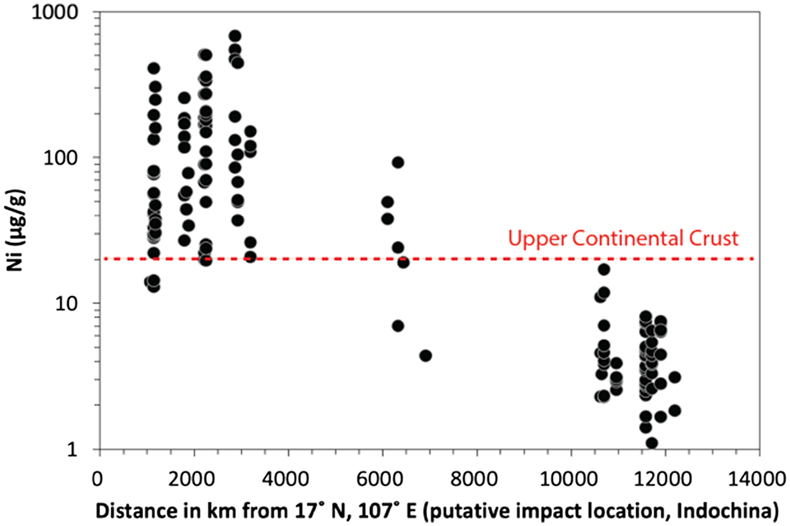
Figure 3 Nickel concentrations (μg/g) versus distance (km) from the putative impact location in Australasian microtektites. Geochemical data set (n = 144) from the literature; see Table S-1 and references therein. The putative impact location is from Ma et al. (2004)
Ma, P., Aggrey, K., Tonzola, C., Schnabel, C., de Nicola, P., Herzog, G.F., Wasson, J.T., Glass, B.P., Brown, L., Tera, F., Middleton, R., Klein, J. (2004) Beryllium-10 in Australasian tektites: Constraints on the location of the source crater. Geochimica et Cosmochimica Acta 68, 3883–3896. https://doi.org/10.1016/j.gca.2004.03.026
. Nickel concentration for Earth’s upper continental crust is from Taylor and McLennan (1995)Taylor, S.R, McLennan, S.M. (1995) The geochemical evolution of the continental crust. Reviews of Geophysics 33, 241–265. https://doi.org/10.1029/95RG00262
.
Figure 4 Schematic representation (not to scale) showing the role of radiative heating of compressed air at the front of the infalling fireball in the formation of the first tektite/microtektite melt batch. On approaching the target, melting (and vapourisation) begins just before the contact and the first tektite melt (in this work exemplified by distal microtektites from Antarctica), sourced from the topmost layer of the target, is devoid of impactor contamination. Upon subsequent contact (not shown here), compression and unloading, tektite/microtektite melts with variable impactor contamination (in this work exemplified by microtektites from deep sea sediment cores found closer to the impact location) and sourced from the underlying stratigraphic layers are produced.