



Refining Hf crust formation ages in Precambrian terranes
Affiliations | Corresponding Author | Cite as | Funding information
Published by the European Association of Geochemistry
under Creative Commons License CC BY-NC-ND 4.0
Keywords: crust formation, Archaean, model ages, zircon, orogenic phase


- Share this article


-
Article views:2,923Cumulative count of HTML views and PDF downloads.
- Download Citation
- Rights & Permissions

top
Abstract

Figures
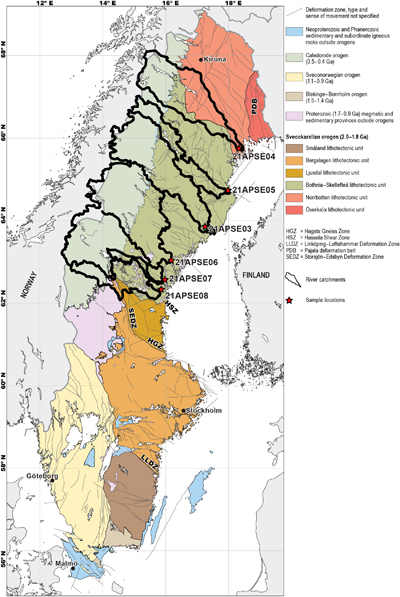 Figure 1 Simplified map of Sweden showing sample locations and the lithotectonic units of the 2.0–1.8 Ga Svecokarelian orogen and sampled river catchments. The map is largely based on the map of Stephens and Bergman (2020). | 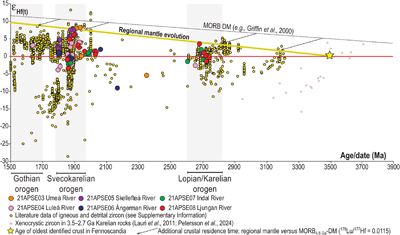 Figure 2 Zircon ɛHf(t) versus age of river zircon and Fennoscandian literature data. ɛHf(t) = [(176Hf/177Hf)unknown/(176Hf/177Hf)CHUR − 1)] × 104. | 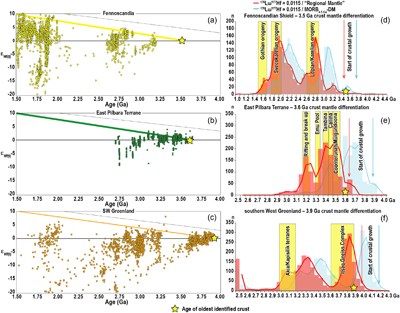 Figure 3 (a–c) Zircon ɛHf(t) versus age, showing regional mantle curves defined by the most radiogenic Hf isotope signatures traced back to a chondritic mantle at the age of the oldest known regional crust. (a) Fennoscandian Shield. (b) East Pilbara Terrane, Western Australia. (c) Southern West Greenland. (d–f) Histograms showing respective two stage model ages based on a bulk continental crustal 176Lu/177Hf = 0.0115 evolution. Red data using a regional mantle references and blue data are based on a | 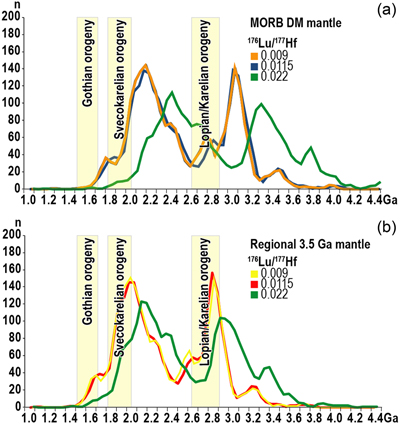 Figure 4 Probability density plots showing the change in crustal growth peaks with different 176Lu/177Hf values for the (a) MORB DM and (b) regional 3.5 Ga mantle sources. |
| Figure 1 | Figure 2 | Figure 3 | Figure 4 |
top
Introduction
The mechanisms and timing of long term chemical differentiation of the Earth are fundamental questions in the geosciences. Depleted mantle curves based on Hf isotopes typically depict a quasi-linear evolution since planetary formation (e.g., Vervoort and Blichert-Toft, 1999
Vervoort, J.D., Blichert-Toft, J. (1999) Evolution of the depleted mantle: Hf isotope evidence from juvenile rocks through time. Geochimica et Cosmochimica Acta 63, 533–556. https://doi.org/10.1016/S0016-7037(98)00274-9
), and these curves have important implications when calculating continental crust formation ages (see Vervoort and Kemp, 2016Vervoort, J.D., Kemp, A.I.S. (2016) Clarifying the zircon Hf isotope record of crust–mantle evolution. Chemical Geology 425, 65–75. https://doi.org/10.1016/j.chemgeo.2016.01.023
). The most commonly used depleted mantle curves project from chondritic compositions at ca. 4.5 Ga to current radiogenic mid-ocean ridge basalt (MORB) values of ɛHf ≈ +16, herein termedVervoort, J.D., Blichert-Toft, J. (1999) Evolution of the depleted mantle: Hf isotope evidence from juvenile rocks through time. Geochimica et Cosmochimica Acta 63, 533–556. https://doi.org/10.1016/S0016-7037(98)00274-9
). A consequence of usingLancaster, P.J., Storey, C.D., Hawkesworth, C.J., Dhuime, B. (2011) Understanding the roles of crustal growth and preservation in the detrital zircon record. Earth and Planetary Science Letters 305, 405–412. https://doi.org/10.1016/j.epsl.2011.03.022
). This implies that crust generation and crustal differentiation may have occurred in different tectonic settings and requires a mechanism for long term survival of presumably mafic protocrust before reworking into continental materials. The inferred times of crust formation are also commonly cryptic, with little expression in the geological record, and therefore the geodynamic controls on crust generation are unclear (Vervoort and Kemp, 2016Vervoort, J.D., Kemp, A.I.S. (2016) Clarifying the zircon Hf isotope record of crust–mantle evolution. Chemical Geology 425, 65–75. https://doi.org/10.1016/j.chemgeo.2016.01.023
). Furthermore, it is increasingly recognised that radiogenic isotope data from juvenile felsic and mafic rocks in many Archean-Proterozoic terranes show indications of not being consistent with derivation from MORB4.5 Ga-DM. Instead, Nd and Hf isotope data suggest a globally near-chondritic to mildly depleted mantle source for Eo- to Paleoarchean continental crust (e.g., Guitreau et al., 2012Guitreau, M., Blichert-Toft, J., Martin, H., Mojzsis, S.J., Albarède, F. (2012) Hafnium isotope evidence from Archean granitic rocks for deep-mantle origin of continental crust. Earth and Planetary Science Letters 337–338, 211–223. https://doi.org/10.1016/j.epsl.2012.05.029
; Fisher and Vervoort, 2018Fisher, C.M., Vervoort, J.D. (2018) Using the magmatic record to constrain the growth of continental crust—The Eoarchean zircon Hf record of Greenland. Earth and Planetary Science Letters 488, 79–91. https://doi.org/10.1016/j.epsl.2018.01.031
; Petersson et al., 2019aPetersson, A., Kemp, A.I.S., Hickman, A.H., Whitehouse, M.J., Martin, L., Gray, C.M. (2019a) A new 3.59 Ga magmatic suite and a chondritic source to the east Pilbara Craton. Chemical Geology 511, 51–70. https://doi.org/10.1016/j.chemgeo.2019.01.021
, 2020Petersson, A., Kemp, A.I.S., Gray, C.M., Whitehouse, M.J. (2020) Formation of early Archean Granite-Greenstone Terranes from a globally chondritic mantle: Insights from igneous rocks of the Pilbara Craton, Western Australia. Chemical Geology 551, 119757. https://doi.org/10.1016/j.chemgeo.2020.119757
; Whitehouse et al., 2022Whitehouse, M.J., Kemp, A.I.S., Petersson, A. (2022) Persistent mildly supra-chondritic initial Hf in the Lewisian Complex, NW Scotland: Implications for Neoarchean crust-mantle differentiation. Chemical Geology 606, 121001. https://doi.org/10.1016/j.chemgeo.2022.121001
; Kemp et al., 2023Kemp, A.I.S., Vervoort, J.D., Petersson, A., Smithies, R.H., Lu, Y. (2023) A linked evolution for granite-greenstone terranes of the Pilbara Craton from Nd and Hf isotopes, with implications for Archean continental growth. Earth and Planetary Science Letters 601, 117895. https://doi.org/10.1016/j.epsl.2022.117895
).One test of the applicability of a chosen mantle curve for calculating times of crust generation is whether the model crust formation ages can be reconciled with the observed geology. An ideal location to assess this question is the Scandinavian portion of the Fennoscandian Shield, which preserves a protracted orogenic history that spans from ca. 2.7 Ga to ca. 1.0 Ga. While there is abundant zircon Hf isotope data from central and southern Sweden (Andersson et al., 2011
Andersson, U.B., Begg, G.C., Griffin, W.L., Högdahl, K. (2011) Ancient and juvenile components in the continental crust and mantle: Hf isotopes in zircon from Svecofennian magmatic rocks and rapakivi granites in Sweden. Lithosphere 3, 409–419. https://doi.org/10.1130/L162.1
; Petersson et al., 2015Petersson, A., Scherstén, A., Andersson, J., Möller, C. (2015) Zircon U–Pb and Hf-isotopes from the eastern part of the Sveconorwegian Orogen, SW Sweden: implications for the growth of Fennoscandia. In: Roberts, N.M.W., Van Kranendonk, M., Parman, S., Shirey, S., Clift, P.D. (Eds.) Continent Formation Through Time. Geological Society, London, Special Publications 389, 281–303. https://doi.org/10.1144/SP389.2
, 2017Petersson, A., Bjärnborg, K., Scherstén, A., Gerdes, A. Næraa, T. (2017) Tracing Proterozoic arc mantle Hf isotope depletion of southern Fennoscandia through coupled zircon U–Pb and Lu–Hf isotopes. Lithos 284–285, 122–131. https://doi.org/10.1016/j.lithos.2017.04.010
; Petersson and Tual, 2020Petersson, A., Tual, L. (2020) Zircon U–Pb-Hf isotope data in eclogite and metagabbro from southern Sweden reveal a common long-lived evolution and enriched source. GFF 142, 253–266. https://doi.org/10.1080/11035897.2020.1822438
), comparatively few Hf isotope data exist from further north. Hence, to fully characterise the Archean-Proterozoic Hf isotope evolution of the Fennoscandian mantle, additional data from the central to northern regions are required.We here examine the initial Fennoscandian crustal growth history through zircon U-Pb, O and Lu-Hf isotope data from detrital zircons from six major river systems in central to north eastern Sweden (Fig. 1). A model is developed to interpret these data, together with previously published zircon and whole rock Hf isotope data, in the context of a mantle source corresponding to the existing geological evolution of the region. An outcome of this model is that growth of Fennoscandian crust occurred mainly in Proterozoic orogenic events, with only limited crust formation in the Archean. We show that for Fennoscandia, and for several other Archean cratons, the approach of using a geologically constrained mantle source curve eliminates the requirement of long time gaps between initial crust extraction and differentiation to produce felsic crust, and leads to a better alignment between times of inferred crustal growth and periods of known orogenic activity.
Figure 1 Simplified map of Sweden showing sample locations and the lithotectonic units of the 2.0–1.8 Ga Svecokarelian orogen and sampled river catchments. The map is largely based on the map of Stephens and Bergman (2020)
Stephens, M.B., Bergman, S. (2020) Regional context and lithotectonic framework of the 2.0–1.8 Ga Svecokarelian orogen, eastern Sweden. In: Stephens, M.B., Berman Weihed, J. (Eds.) Sweden: Lithotectonic Framework, Tectonic Evolution and Mineral Resources. Geological Society, London, Memoirs 389, 19–26. https://doi.org/10.1144/M50-2017-2
.top
Results
The zircon U-Pb, O and Hf isotope data from the Fennoscandian detrital zircon grains are summarised in Figure 2 (see Supplementary Information for details of the geological setting, sample information and analytical protocols). The age spectrum of the Fennoscandian detrital zircon grains matches the published igneous rock data from the region, with major age peaks at ca. 1.88 and 1.80 Ga, and a minor peak at 2.7 Ga. Zircon oxygen isotopes, expressed as δ18O values, range between +4.7 ‰ and +10.7 ‰. Zircon grains with heavy δ18O values (i.e. above the mantle range of 5.3 ± 0.6 ‰; Valley et al., 2005
Valley, J.W., Lackey, J.S., Cavosie, A.J., Clechenko, C.C., Spicuzza, M.J., Basei, M.A.S., Bindeman, I.N., Ferreira, V.P., Sial, A.N., King, E.M., Peck, W.H., Sinha, A.K., Wei, C.S. (2005) 4.4 billion years of crustal maturation: oxygen isotope ratios of magmatic zircon. Contributions to Mineralogy and Petrology 150, 561–580. https://doi.org/10.1007/s00410-005-0025-8
) occur in all river samples. The Paleoproterozoic detrital zircon grains have a wide range of Hf isotope compositions (ɛHf(t) from −9.1 to +8.2), while Archean detrital grains cluster around the chondritic uniform reservoir (CHUR), with ɛHf(t) values between −2.7 and +3.5 (Fig. 2). Overall, there is good correspondence between the isotope signatures of detrital zircon from this study and previously reported Hf isotopes of zircon from (meta-)igneous rocks from the Fennoscandian Shield (Fig. 2).Figure 2 Zircon ɛHf(t) versus age of river zircon and Fennoscandian literature data. ɛHf(t) = [(176Hf/177Hf)unknown/(176Hf/177Hf)CHUR − 1)] × 104.
Tracing the Fennoscandian Mantle Source. To accurately interpret the crustal growth, reworking and evolution of the Fennoscandian Shield using zircon isotope data requires characterisation of the mantle source from which the crust was ultimately extracted. In this context, we note that collectively, the most radiogenic Fennoscandian zircon and whole rock Hf isotope signatures increase with time, where the upper envelope of the large data compilation intersects CHUR at ca. 3.5 Ga (Fig. 2). Such a pattern is difficult to reconcile with crustal separation from a depleted mantle source formed at ca. 4.5 Ga. If crust was extracted from a
Whitehouse, M.J., Kemp, A.I.S., Petersson, A. (2022) Persistent mildly supra-chondritic initial Hf in the Lewisian Complex, NW Scotland: Implications for Neoarchean crust-mantle differentiation. Chemical Geology 606, 121001. https://doi.org/10.1016/j.chemgeo.2022.121001
). As noted by Kemp et al. (2023)Kemp, A.I.S., Vervoort, J.D., Petersson, A., Smithies, R.H., Lu, Y. (2023) A linked evolution for granite-greenstone terranes of the Pilbara Craton from Nd and Hf isotopes, with implications for Archean continental growth. Earth and Planetary Science Letters 601, 117895. https://doi.org/10.1016/j.epsl.2022.117895
, time scales for differentiation of basaltic protoliths into felsic igneous rocks may be short, far shorter than the >200 Myr required to generate the Hf isotope signatures seen in Fennoscandia if derivation from aWhen examining the zircon isotope data in δ18O versus ɛHf(t) space (Fig. S-4), reworking of ancient continental crust unaffected by the hydrosphere (δ18O < ca. 6 ‰) and supracrustal rocks affected by hydrosphere interaction (δ18O > ca. 6.5 ‰) is inferred. Not surprisingly, due to larger volumes of crust and the Svecokarelian Orogeny, indications of reworking are stronger during the 2.0–1.8 Ga time period than during the Archean, but both during the Archean and during the Paleoproterozoic, the combined zircon Hf and O isotope data trends project back to a ca. 3.5 Ga chondritic mantle. A few xenocrystic >3.0 Ga zircon cores from the Pudasjärvi Complex (Mutanen and Huhma, 2003
Mutanen, T., Huhma, H. (2003) The 3.5 Ga Siurua trondhjemite gneiss in the Archaean Pudasjärvi Granulite Belt, northern Finland. Bulletin of the Geological Society of Finland 75, 51–68.
; Lauri et al., 2011Lauri, L.S., Andersen, T., Hölttä, P., Huhma, H., Graham, S. (2011) Evolution of the Archaean Karelian Province in the Fennoscandian Shield in the light of U–Pb zircon ages and Sm–Nd and Lu–Hf isotope systematics. Journal of the Geological Society 168, 201–218. https://doi.org/10.1144/0016-76492009-159
; Petersson et al., 2024aPetersson, A., Waight, T., Kemp, A.I.S., Whitehouse, M.J., Valley, J.W. (2024a) An Eoarchean continental nucleus for the Fennoscandian Shield and a link to the North Atlantic craton. Geology 52, 171–175. https://doi.org/10.1130/G51658.1
) have unradiogenic Hf isotope signatures that suggest reworking of >3.5 Ga crust (Fig. 2). These zircon hint at an even older crustal components in Fennoscandia, but as these have been shown to originate in the North Atlantic Craton they do not represent Fennoscandian crustal growth and/or mantle depletion (Petersson et al., 2024aPetersson, A., Waight, T., Kemp, A.I.S., Whitehouse, M.J., Valley, J.W. (2024a) An Eoarchean continental nucleus for the Fennoscandian Shield and a link to the North Atlantic craton. Geology 52, 171–175. https://doi.org/10.1130/G51658.1
).top
Linking Crust Formation to Regional U-Pb-Hf Isotope Signatures
The oldest rock in the Fennoscandian Shield is the Siurua gneiss of the Pudasjärvi gneiss complex in Finland, which has a protolith age of ca. 3.5 Ga (Mutanen and Huhma, 2003
Mutanen, T., Huhma, H. (2003) The 3.5 Ga Siurua trondhjemite gneiss in the Archaean Pudasjärvi Granulite Belt, northern Finland. Bulletin of the Geological Society of Finland 75, 51–68.
; Petersson et al., 2024aPetersson, A., Waight, T., Kemp, A.I.S., Whitehouse, M.J., Valley, J.W. (2024a) An Eoarchean continental nucleus for the Fennoscandian Shield and a link to the North Atlantic craton. Geology 52, 171–175. https://doi.org/10.1130/G51658.1
). We infer that this sample represents the onset of crust formation in the area. Since the upper envelope of Hf isotope signatures project back to CHUR at this time (ca. 3.5 Ga), this intersection is interpreted to define the onset of significant Fennoscandian crust-mantle differentiation and crustal growth. Very few Hf isotope data plot above this line, attesting to the overall mildly depleted nature of the mantle from which Fennoscandian crust was extracted. Considering that laser ablation data typically have a reproducibility of ≥1.5 ɛHf units (at 2 s.d.) when analysing REE-rich zircon (Fisher and Vervoort, 2018Fisher, C.M., Vervoort, J.D. (2018) Using the magmatic record to constrain the growth of continental crust—The Eoarchean zircon Hf record of Greenland. Earth and Planetary Science Letters 488, 79–91. https://doi.org/10.1016/j.epsl.2018.01.031
), data points plotting ca. 1.5 ɛHf units above the true value are to be statistically expected. Hence, collectively, the Hf isotopic signatures of the most radiogenic zircon and whole rocks in Fennoscandia from 3.5 to 1.5 Ga suggest a mildly depleted non-Comparable situations are recognised in other Archean terranes. For example, in the East Pilbara Terrane, Australia, the upper envelope of Hf isotope signatures projects back to CHUR at the time of the oldest identified rocks in the craton, at 3.6 Ga (green line in Fig. 3b) (Amelin et al., 2000
Amelin, Y., Lee, D.-C., Halliday, A.N. (2000) Early-middle Archean crustal evolution deduced from Lu-Hf and U-Pb isotopic studies of single zircon grains. Geochimica et Cosmochimica Acta 64, 4205–4225. https://doi.org/10.1016/S0016-7037(00)00493-2
; Kemp et al., 2015Kemp, A.I.S., Hickman, A.H., Kirkland, C.L., Vervoort, J.D. (2015) Hf isotopes in detrital and inherited zircons of the Pilbara Craton provide no evidence for Hadean continents. Precambrian Research 261, 112–126. https://doi.org/10.1016/j.precamres.2015.02.011
, 2023Kemp, A.I.S., Vervoort, J.D., Petersson, A., Smithies, R.H., Lu, Y. (2023) A linked evolution for granite-greenstone terranes of the Pilbara Craton from Nd and Hf isotopes, with implications for Archean continental growth. Earth and Planetary Science Letters 601, 117895. https://doi.org/10.1016/j.epsl.2022.117895
; Petersson et al., 2019aPetersson, A., Kemp, A.I.S., Hickman, A.H., Whitehouse, M.J., Martin, L., Gray, C.M. (2019a) A new 3.59 Ga magmatic suite and a chondritic source to the east Pilbara Craton. Chemical Geology 511, 51–70. https://doi.org/10.1016/j.chemgeo.2019.01.021
, 2019bPetersson, A., Kemp, A.I.S., Whitehouse, M.J. (2019b) A Yilgarn seed to the Pilbara Craton (Australia)? Evidence from inherited zircons. Geology 47, 1098–1102. https://doi.org/10.1130/G46696.1
, 2020Petersson, A., Kemp, A.I.S., Gray, C.M., Whitehouse, M.J. (2020) Formation of early Archean Granite-Greenstone Terranes from a globally chondritic mantle: Insights from igneous rocks of the Pilbara Craton, Western Australia. Chemical Geology 551, 119757. https://doi.org/10.1016/j.chemgeo.2020.119757
). Similarly, in southern West Greenland the most radiogenic zircon Hf isotope signatures intersect CHUR at 3.9 Ga, where meta-igneous rocks with chondritic compositions suggest initial crustal growth at this time (orange line in Fig. 3c) (e.g., Kemp et al., 2009Kemp, A.I.S., Foster, G.L., Scherstén, A., Whitehouse, M.J., Darling, J., Storey, C. (2009) Concurrent Pb–Hf isotope analysis of zircon by laser ablation multi-collector ICP-MS, with implications for the crustal evolution of Greenland and the Himalayas. Chemical Geology 261, 244–260. https://doi.org/10.1016/j.chemgeo.2008.06.019
, 2019Kemp, A.I.S., Whitehouse, M.J., Vervoort, J.D. (2019) Deciphering the zircon Hf isotope systematics of Eoarchean gneisses from Greenland: Implications for ancient crust-mantle differentiation and Pb isotope controversies. Geochimica et Cosmochimica Acta 250, 76–97. https://doi.org/10.1016/j.gca.2019.01.041
; Guitreau et al., 2012Guitreau, M., Blichert-Toft, J., Martin, H., Mojzsis, S.J., Albarède, F. (2012) Hafnium isotope evidence from Archean granitic rocks for deep-mantle origin of continental crust. Earth and Planetary Science Letters 337–338, 211–223. https://doi.org/10.1016/j.epsl.2012.05.029
; Fisher and Vervoort, 2018Fisher, C.M., Vervoort, J.D. (2018) Using the magmatic record to constrain the growth of continental crust—The Eoarchean zircon Hf record of Greenland. Earth and Planetary Science Letters 488, 79–91. https://doi.org/10.1016/j.epsl.2018.01.031
). Some data spread is apparent between 3.9 and 3.7 Ga, but always inside the expected reproducibility of a chondritic zircon analysed by LA-ICP-MS. We propose that a modelling approach, based on regional juvenile crustal rocks, better represents the evolution of the mantle in ancient terranes than an assumed linear evolution from a primordial composition at ca. 4.5 Ga to modern radiogenic MORB. As every craton and/or larger crustal region may be unique, crust formation ages are ideally calculated using mantle references that are specific to each region. The method implemented here applies to ancient terranes, and involves initial, significant crust-mantle differentiation at the time defined by the intersection between CHUR and the upper envelope of the most radiogenic Hf isotope signatures from the studied region. In the herein studied regions these intersections coincide with the time of the oldest identified crust in the area. Furthermore, the broadly linear trends of the upper envelopes (yellow, blue and red lines in Fig. 3a–c) project towards present day MORB values of ɛHf = +16. We further propose that a similar approach could be used for other ancient cratons/regions in order to generate more geologically meaningful crust formation ages, that could be used in global crustal growth models or for comparing evolutionary histories of different tracts of Archean crust.Figure 3 (a–c) Zircon ɛHf(t) versus age, showing regional mantle curves defined by the most radiogenic Hf isotope signatures traced back to a chondritic mantle at the age of the oldest known regional crust. (a) Fennoscandian Shield. (b) East Pilbara Terrane, Western Australia. (c) Southern West Greenland. (d–f) Histograms showing respective two stage model ages based on a bulk continental crustal 176Lu/177Hf = 0.0115 evolution. Red data using a regional mantle references and blue data are based on a
top
Linking Crust Formation Ages to Orogenic Events
In Figure 3, we calculate crust formation ages from the Fennoscandian zircon and whole rock Hf isotope data using a regional mantle curve, where initial depletion occurs at 3.5 Ga, and a bulk continental crustal 176Lu/177Hf of 0.0115 (Vervoort and Patchett, 1996
Vervoort, J.D., Patchett, P.J. (1996) Behavior of hafnium and neodymium isotopes in the crust: Constraints from Precambrian crustally derived granites. Geochimica et Cosmochimica Acta 60, 3717–3733. https://doi.org/10.1016/0016-7037(96)00201-3
). This yields crustal growth peaks that correlate with known orogenies, i.e. the 2.8–2.6 Ga Lopian/Karelian orogeny and 2.0–1.8 Ga Svecokarelian orogeny, and even a minor peak during the 1.7–1.5 Ga Gothian orogeny (Fig. 3d). Using the same crustal evolutionary trajectories, but aThese results are based on a bulk continental crustal source with a 176Lu/177Hf of 0.0115 (Vervoort and Patchett, 1996
Vervoort, J.D., Patchett, P.J. (1996) Behavior of hafnium and neodymium isotopes in the crust: Constraints from Precambrian crustally derived granites. Geochimica et Cosmochimica Acta 60, 3717–3733. https://doi.org/10.1016/0016-7037(96)00201-3
). Changing the 176Lu/177Hf to values more typical of felsic (0.009) or more mafic (0.022) crust does not affect the peaks significantly when using a regional mantle model, but the shift in model age peaks is more marked for aFigure 4 Probability density plots showing the change in crustal growth peaks with different 176Lu/177Hf values for the (a) MORB DM and (b) regional 3.5 Ga mantle sources.
In the East Pilbara Terrane, using a mantle reference that deviates from CHUR at 3.6 Ga (Fig. 3b), results in Hf model ages with peaks at ca. 3.5 Ga, 3.4 Ga and 3.2 Ga. These are all times of known juvenile magmatic activity within the East Pilbara Terrane, with 3.5 Ga being the time of emplacement of the Coonterunah Subgroup within the ca. 15 km thick Warrawoona Group, consisting mainly of komatiitic basalt, basalt, andesite and dacite (Hickman, 2021
Hickman, A.H. (2021) East Pilbara Craton: a record of one billion years in the growth of Archean continental crust. Report 143, Geological Survey of Western Australia, Perth.
). At 3.4 Ga, the Tambina Supersuite and the Salgash Subgroup were emplaced, and 3.2 Ga is the inferred time of rifting and breakup of the Paleoarchean volcanic plateau, accompanied by voluminous eruption of basalt and komatiite (Hickman, 2021Hickman, A.H. (2021) East Pilbara Craton: a record of one billion years in the growth of Archean continental crust. Report 143, Geological Survey of Western Australia, Perth.
). Using aPetersson, A., Kemp, A.I.S., Hickman, A.H., Whitehouse, M.J., Martin, L., Gray, C.M. (2019a) A new 3.59 Ga magmatic suite and a chondritic source to the east Pilbara Craton. Chemical Geology 511, 51–70. https://doi.org/10.1016/j.chemgeo.2019.01.021
, 2020Petersson, A., Kemp, A.I.S., Gray, C.M., Whitehouse, M.J. (2020) Formation of early Archean Granite-Greenstone Terranes from a globally chondritic mantle: Insights from igneous rocks of the Pilbara Craton, Western Australia. Chemical Geology 551, 119757. https://doi.org/10.1016/j.chemgeo.2020.119757
).Southern West Greenland primarily comprises tonalite-trondhjemite-granodiorite gneisses that range from ca. 3.9 Ga to 3.65 Ga. When using a mantle reference that diverges from CHUR at 3.9 Ga, the reference line tangents the most radiogenic Meso- to Neoarchean zircon Hf isotope data in the region (Fig. 3c). The main crustal growth peak calculated using this model mantle composition is at ca. 3.85 Ga, in line with known magmatic emplacement ages, and in stark contrast to the 4.1 Ga peak obtained using a conventional
Nutman, A.P., Bennett, V.C., Friend, C.R.L., Yi, K., Lee, S.R. (2015) Mesoarchaean collision of Kapisilik terrane 3070 Ma juvenile arc rocks and >3600 Ma Isukasia terrane continental crust (Greenland). Precambrian Research 258, 146–160. https://doi.org/10.1016/j.precamres.2014.12.013
). The geological evolution of the Pilbara Craton and southern West Greenland are very different from the Fennoscandian Shield with, for example, the Pilbara Craton evolving via episodic and protracted mantle derived mafic and felsic magmatism resulting in development of a classic dome and keel architecture (Petersson et al., 2019aPetersson, A., Kemp, A.I.S., Hickman, A.H., Whitehouse, M.J., Martin, L., Gray, C.M. (2019a) A new 3.59 Ga magmatic suite and a chondritic source to the east Pilbara Craton. Chemical Geology 511, 51–70. https://doi.org/10.1016/j.chemgeo.2019.01.021
). Hence, the geodynamic processes that generated continental crust in these regions differ vastly, making it even more striking that the zircon Hf model ages, using a regional mantle curve, align with orogenic events in all three cratons.The regions discussed above suggest different timing for initial crust-mantle differentiation (3.9–3.5 Ga), which would result in a heterogeneous, variably depleted global Eo-Paleoarchean mantle. Long and short lived isotope signatures in some mantle derived rocks such as komatiites show that parts of the mantle have been depleted (e.g., Boyet and Carlson, 2005
Boyet, M., Carlson, R.W. (2005) 142Nd Evidence for Early (>4.53 Ga) Global Differentiation of the Silicate Earth. Science 309, 576–581. https://doi.org/10.1126/science.1113634
; O’Neil et al., 2024O’Neil, J., Rizo, H., Reimink, J., Garçon, M., Carlson, R.W. (2024) Earth’s Earliest Crust. Elements 20, 168–173. https://doi.org/10.2138/gselements.20.3.168
). These depleted components are, however, not registered in the crustal record via zircons as they are highly infertile and do not melt to generate continental crust. A scenario where initial melting generating basalt and komatiite leaving a refractory harzburgitic residue and primordial fertile mantle is continuously tapped from a less depleted reservoir is envisaged by Petersson et al. (2024b)Petersson, A., Waight, T., Whitehouse, M., Kemp, A., Szilas, K. (2024b) An isolated mildly depleted mantle source for the north atlantic craton. Precambrian Research 407, 107399. https://doi.org/10.1016/j.precamres.2024.107399
. Stracke (2012)Stracke, A. (2012) Earth’s heterogeneous mantle: A product of convection-driven interaction between crust and mantle. Chemical Geology 330–331, 274–299. https://doi.org/10.1016/j.chemgeo.2012.08.007
argues for a heterogeneous Archean mantle, but primarily attribute this to enrichment via erosion and subduction of the lower continental crust. However, in the regions outlined above, as the chondritic mantle composition at the time of initial significant crust generation may predate the onset of significant amounts of subduction, this becomes a less viable explanation. Instead, we favour a lack of wholesale crust-mantle differentiation as the primary cause behind the preserved chondritic signatures into the Eo- and Paleoarchean. We note that the 142Nd anomalies recognised in some cratons suggest Hadean Sm/Nd fractionation (e.g., Boyet and Carlson, 2005Boyet, M., Carlson, R.W. (2005) 142Nd Evidence for Early (>4.53 Ga) Global Differentiation of the Silicate Earth. Science 309, 576–581. https://doi.org/10.1126/science.1113634
; O’Neil et al., 2024O’Neil, J., Rizo, H., Reimink, J., Garçon, M., Carlson, R.W. (2024) Earth’s Earliest Crust. Elements 20, 168–173. https://doi.org/10.2138/gselements.20.3.168
). Such anomalies are yet to be found in the Pilbara Craton or in the Fennoscandian Shield, and it remains unclear whether the ancient Sm/Nd fractionation was associated with formation of continental crust, and whether the amount of mantle differentiation needed to generate 142Nd anomalies had a resolvable effect on the Lu-Hf isotope system. Furthermore, this Hadean Sm/Nd differentiation episode(s) does not seem to have generated complementary global crust-mantle reservoirs with respect to long lived radiogenic systems such as Hf isotopes.We conclude that global Hf isotope heterogeneity amongst different Archean-Proterozoic terranes warrant regional mantle references, based on the most radiogenic samples from each region, in order to obtain reliable crust formation ages that align with the known geological evolution of the studied region.
top
Acknowledgements
Financial support by the Danish Independent Research Fund, DFF-Research Project 2 (grant number: 9040-0374B to TW) is gratefully acknowledged. AK acknowledges an Australian Research Council Future Fellowship (FT10010059). Hf isotope analysis at UWA was conducted with instrumentation funded by the Australian Research Council (LE100100203 and LE150100013). Thanks to F. Hellström for providing the age data base of the Swedish Geological Survey (SGU). The NordSIMS ion microprobe facility operates as Swedish-Icelandic infrastructure, partly funded by the Swedish Research Council (grant nos. 2017-00671 and 2021-00276). This is Nordsim contribution #771.
Editor: Ambre Luguet
top
References
Amelin, Y., Lee, D.-C., Halliday, A.N. (2000) Early-middle Archean crustal evolution deduced from Lu-Hf and U-Pb isotopic studies of single zircon grains. Geochimica et Cosmochimica Acta 64, 4205–4225. https://doi.org/10.1016/S0016-7037(00)00493-2
 Show in context
 For example, in the East Pilbara Terrane, Australia, the upper envelope of Hf isotope signatures projects back to CHUR at the time of the oldest identified rocks in the craton, at 3.6 Ga (green line in Fig. 3b) (Amelin et al., 2000; Kemp et al., 2015, 2023; Petersson et al., 2019a, 2019b, 2020).
View in article
Andersson, U.B., Begg, G.C., Griffin, W.L., Högdahl, K. (2011) Ancient and juvenile components in the continental crust and mantle: Hf isotopes in zircon from Svecofennian magmatic rocks and rapakivi granites in Sweden. Lithosphere 3, 409–419. https://doi.org/10.1130/L162.1
Show in context While there is abundant zircon Hf isotope data from central and southern Sweden (Andersson et al., 2011; Petersson et al., 2015, 2017; Petersson and Tual, 2020), comparatively few Hf isotope data exist from further north.
View in article
Boyet, M., Carlson, R.W. (2005) 142Nd Evidence for Early (>4.53 Ga) Global Differentiation of the Silicate Earth. Science 309, 576–581. https://doi.org/10.1126/science.1113634
Show in context Long and short lived isotope signatures in some mantle derived rocks such as komatiites show that parts of the mantle have been depleted (e.g., Boyet and Carlson, 2005; O’Neil et al., 2024).
View in article
Instead, we favour a lack of wholesale crust-mantle differentiation as the primary cause behind the preserved chondritic signatures into the Eo- and Paleoarchean. We note that the 142Nd anomalies recognised in some cratons suggest Hadean Sm/Nd fractionation (e.g., Boyet and Carlson, 2005; O’Neil et al., 2024).
View in article
Fisher, C.M., Vervoort, J.D. (2018) Using the magmatic record to constrain the growth of continental crust—The Eoarchean zircon Hf record of Greenland. Earth and Planetary Science Letters 488, 79–91. https://doi.org/10.1016/j.epsl.2018.01.031
Show in context Instead, Nd and Hf isotope data suggest a globally near-chondritic to mildly depleted mantle source for Eo- to Paleoarchean continental crust (e.g., Guitreau et al., 2012; Fisher and Vervoort, 2018; Petersson et al., 2019a, 2020; Whitehouse et al., 2022; Kemp et al., 2023).
View in article
Considering that laser ablation data typically have a reproducibility of ≥1.5 ɛHf units (at 2 s.d.) when analysing REE-rich zircon (Fisher and Vervoort, 2018), data points plotting ca. 1.5 ɛHf units above the true value are to be statistically expected.
View in article
Similarly, in southern West Greenland the most radiogenic zircon Hf isotope signatures intersect CHUR at 3.9 Ga, where meta-igneous rocks with chondritic compositions suggest initial crustal growth at this time (orange line in Fig. 3c) (e.g., Kemp et al., 2009, 2019; Guitreau et al., 2012; Fisher and Vervoort, 2018).
View in article
Griffin, W.L., Pearson, N.J., Belousova, E., Jackson, S.V., Van Achterbergh, E., O’Reilly, S.Y., Shee, S.R. (2000) The Hf isotope composition of cratonic mantle: LAM-MC-ICPMS analysis of zircon megacrysts in kimberlites. Geochimica et Cosmochimica Acta 64, 133–147. https://doi.org/10.1016/S0016-7037(99)00343-9
Guitreau, M., Blichert-Toft, J., Martin, H., Mojzsis, S.J., Albarède, F. (2012) Hafnium isotope evidence from Archean granitic rocks for deep-mantle origin of continental crust. Earth and Planetary Science Letters 337–338, 211–223. https://doi.org/10.1016/j.epsl.2012.05.029
Show in context Instead, Nd and Hf isotope data suggest a globally near-chondritic to mildly depleted mantle source for Eo- to Paleoarchean continental crust (e.g., Guitreau et al., 2012; Fisher and Vervoort, 2018; Petersson et al., 2019a, 2020; Whitehouse et al., 2022; Kemp et al., 2023).
View in article
Similarly, in southern West Greenland the most radiogenic zircon Hf isotope signatures intersect CHUR at 3.9 Ga, where meta-igneous rocks with chondritic compositions suggest initial crustal growth at this time (orange line in Fig. 3c) (e.g., Kemp et al., 2009, 2019; Guitreau et al., 2012; Fisher and Vervoort, 2018).
View in article
Hickman, A.H. (2021) East Pilbara Craton: a record of one billion years in the growth of Archean continental crust. Report 143, Geological Survey of Western Australia, Perth.
Show in context In the East Pilbara Terrane, using a mantle reference that deviates from CHUR at 3.6 Ga (Fig. 3b), results in Hf model ages with peaks at ca. 3.5 Ga, 3.4 Ga and 3.2 Ga. These are all times of known juvenile magmatic activity within the East Pilbara Terrane, with 3.5 Ga being the time of emplacement of the Coonterunah Subgroup within the ca. 15 km thick Warrawoona Group, consisting mainly of komatiitic basalt, basalt, andesite and dacite (Hickman, 2021).
View in article
At 3.4 Ga, the Tambina Supersuite and the Salgash Subgroup were emplaced, and 3.2 Ga is the inferred time of rifting and breakup of the Paleoarchean volcanic plateau, accompanied by voluminous eruption of basalt and komatiite (Hickman, 2021).
View in article
Kemp, A.I.S., Foster, G.L., Scherstén, A., Whitehouse, M.J., Darling, J., Storey, C. (2009) Concurrent Pb–Hf isotope analysis of zircon by laser ablation multi-collector ICP-MS, with implications for the crustal evolution of Greenland and the Himalayas. Chemical Geology 261, 244–260. https://doi.org/10.1016/j.chemgeo.2008.06.019
Show in context Similarly, in southern West Greenland the most radiogenic zircon Hf isotope signatures intersect CHUR at 3.9 Ga, where meta-igneous rocks with chondritic compositions suggest initial crustal growth at this time (orange line in Fig. 3c) (e.g., Kemp et al., 2009, 2019; Guitreau et al., 2012; Fisher and Vervoort, 2018).
View in article
Kemp, A.I.S., Hickman, A.H., Kirkland, C.L., Vervoort, J.D. (2015) Hf isotopes in detrital and inherited zircons of the Pilbara Craton provide no evidence for Hadean continents. Precambrian Research 261, 112–126. https://doi.org/10.1016/j.precamres.2015.02.011
Show in context For example, in the East Pilbara Terrane, Australia, the upper envelope of Hf isotope signatures projects back to CHUR at the time of the oldest identified rocks in the craton, at 3.6 Ga (green line in Fig. 3b) (Amelin et al., 2000; Kemp et al., 2015, 2023; Petersson et al., 2019a, 2019b, 2020).
View in article
Kemp, A.I.S., Whitehouse, M.J., Vervoort, J.D. (2019) Deciphering the zircon Hf isotope systematics of Eoarchean gneisses from Greenland: Implications for ancient crust-mantle differentiation and Pb isotope controversies. Geochimica et Cosmochimica Acta 250, 76–97. https://doi.org/10.1016/j.gca.2019.01.041
Show in context Similarly, in southern West Greenland the most radiogenic zircon Hf isotope signatures intersect CHUR at 3.9 Ga, where meta-igneous rocks with chondritic compositions suggest initial crustal growth at this time (orange line in Fig. 3c) (e.g., Kemp et al., 2009, 2019; Guitreau et al., 2012; Fisher and Vervoort, 2018).
View in article
Kemp, A.I.S., Vervoort, J.D., Petersson, A., Smithies, R.H., Lu, Y. (2023) A linked evolution for granite-greenstone terranes of the Pilbara Craton from Nd and Hf isotopes, with implications for Archean continental growth. Earth and Planetary Science Letters 601, 117895. https://doi.org/10.1016/j.epsl.2022.117895
Show in context Instead, Nd and Hf isotope data suggest a globally near-chondritic to mildly depleted mantle source for Eo- to Paleoarchean continental crust (e.g., Guitreau et al., 2012; Fisher and Vervoort, 2018; Petersson et al., 2019a, 2020; Whitehouse et al., 2022; Kemp et al., 2023).
View in article
As noted by Kemp et al. (2023), time scales for differentiation of basaltic protoliths into felsic igneous rocks may be short, far shorter than the >200 Myr required to generate the Hf isotope signatures seen in Fennoscandia if derivation from a
View in article
For example, in the East Pilbara Terrane, Australia, the upper envelope of Hf isotope signatures projects back to CHUR at the time of the oldest identified rocks in the craton, at 3.6 Ga (green line in Fig. 3b) (Amelin et al., 2000; Kemp et al., 2015, 2023; Petersson et al., 2019a, 2019b, 2020).
View in article
Lancaster, P.J., Storey, C.D., Hawkesworth, C.J., Dhuime, B. (2011) Understanding the roles of crustal growth and preservation in the detrital zircon record. Earth and Planetary Science Letters 305, 405–412. https://doi.org/10.1016/j.epsl.2011.03.022
Show in context A consequence of using
View in article
Lauri, L.S., Andersen, T., Hölttä, P., Huhma, H., Graham, S. (2011) Evolution of the Archaean Karelian Province in the Fennoscandian Shield in the light of U–Pb zircon ages and Sm–Nd and Lu–Hf isotope systematics. Journal of the Geological Society 168, 201–218. https://doi.org/10.1144/0016-76492009-159
Show in context A few xenocrystic >3.0 Ga zircon cores from the Pudasjärvi Complex (Mutanen and Huhma, 2003; Lauri et al., 2011; Petersson et al., 2024a) have unradiogenic Hf isotope signatures that suggest reworking of >3.5 Ga crust (Fig. 2).
View in article
Mutanen, T., Huhma, H. (2003) The 3.5 Ga Siurua trondhjemite gneiss in the Archaean Pudasjärvi Granulite Belt, northern Finland. Bulletin of the Geological Society of Finland 75, 51–68.
Show in context A few xenocrystic >3.0 Ga zircon cores from the Pudasjärvi Complex (Mutanen and Huhma, 2003; Lauri et al., 2011; Petersson et al., 2024a) have unradiogenic Hf isotope signatures that suggest reworking of >3.5 Ga crust (Fig. 2).
View in article
The oldest rock in the Fennoscandian Shield is the Siurua gneiss of the Pudasjärvi gneiss complex in Finland, which has a protolith age of ca. 3.5 Ga (Mutanen and Huhma, 2003; Petersson et al., 2024a).
View in article
Nutman, A.P., Bennett, V.C., Friend, C.R.L., Yi, K., Lee, S.R. (2015) Mesoarchaean collision of Kapisilik terrane 3070 Ma juvenile arc rocks and >3600 Ma Isukasia terrane continental crust (Greenland). Precambrian Research 258, 146–160. https://doi.org/10.1016/j.precamres.2014.12.013
Show in context A second growth peak at ca. 3.1–3.0 Ga coincides with the emplacement of the Akia and Kapisilik terranes (Nutman et al., 2015).
View in article
O’Neil, J., Rizo, H., Reimink, J., Garçon, M., Carlson, R.W. (2024) Earth’s Earliest Crust. Elements 20, 168–173. https://doi.org/10.2138/gselements.20.3.168
Show in context Long and short lived isotope signatures in some mantle derived rocks such as komatiites show that parts of the mantle have been depleted (e.g., Boyet and Carlson, 2005; O’Neil et al., 2024).
View in article
Instead, we favour a lack of wholesale crust-mantle differentiation as the primary cause behind the preserved chondritic signatures into the Eo- and Paleoarchean. We note that the 142Nd anomalies recognised in some cratons suggest Hadean Sm/Nd fractionation (e.g., Boyet and Carlson, 2005; O’Neil et al., 2024).
View in article
Petersson, A., Tual, L. (2020) Zircon U–Pb-Hf isotope data in eclogite and metagabbro from southern Sweden reveal a common long-lived evolution and enriched source. GFF 142, 253–266. https://doi.org/10.1080/11035897.2020.1822438
Show in context While there is abundant zircon Hf isotope data from central and southern Sweden (Andersson et al., 2011; Petersson et al., 2015, 2017; Petersson and Tual, 2020), comparatively few Hf isotope data exist from further north.
View in article
Petersson, A., Scherstén, A., Andersson, J., Möller, C. (2015) Zircon U–Pb and Hf-isotopes from the eastern part of the Sveconorwegian Orogen, SW Sweden: implications for the growth of Fennoscandia. In: Roberts, N.M.W., Van Kranendonk, M., Parman, S., Shirey, S., Clift, P.D. (Eds.) Continent Formation Through Time. Geological Society, London, Special Publications 389, 281–303. https://doi.org/10.1144/SP389.2
Show in context While there is abundant zircon Hf isotope data from central and southern Sweden (Andersson et al., 2011; Petersson et al., 2015, 2017; Petersson and Tual, 2020), comparatively few Hf isotope data exist from further north.
View in article
Petersson, A., Bjärnborg, K., Scherstén, A., Gerdes, A. Næraa, T. (2017) Tracing Proterozoic arc mantle Hf isotope depletion of southern Fennoscandia through coupled zircon U–Pb and Lu–Hf isotopes. Lithos 284–285, 122–131. https://doi.org/10.1016/j.lithos.2017.04.010
Show in context While there is abundant zircon Hf isotope data from central and southern Sweden (Andersson et al., 2011; Petersson et al., 2015, 2017; Petersson and Tual, 2020), comparatively few Hf isotope data exist from further north.
View in article
Petersson, A., Kemp, A.I.S., Hickman, A.H., Whitehouse, M.J., Martin, L., Gray, C.M. (2019a) A new 3.59 Ga magmatic suite and a chondritic source to the east Pilbara Craton. Chemical Geology 511, 51–70. https://doi.org/10.1016/j.chemgeo.2019.01.021
Show in context Instead, Nd and Hf isotope data suggest a globally near-chondritic to mildly depleted mantle source for Eo- to Paleoarchean continental crust (e.g., Guitreau et al., 2012; Fisher and Vervoort, 2018; Petersson et al., 2019a, 2020; Whitehouse et al., 2022; Kemp et al., 2023).
View in article
For example, in the East Pilbara Terrane, Australia, the upper envelope of Hf isotope signatures projects back to CHUR at the time of the oldest identified rocks in the craton, at 3.6 Ga (green line in Fig. 3b) (Amelin et al., 2000; Kemp et al., 2015, 2023; Petersson et al., 2019a, 2019b, 2020).
View in article
Using a
View in article
The geological evolution of the Pilbara Craton and southern West Greenland are very different from the Fennoscandian Shield with, for example, the Pilbara Craton evolving via episodic and protracted mantle derived mafic and felsic magmatism resulting in development of a classic dome and keel architecture (Petersson et al., 2019a).
View in article
Petersson, A., Kemp, A.I.S., Whitehouse, M.J. (2019b) A Yilgarn seed to the Pilbara Craton (Australia)? Evidence from inherited zircons. Geology 47, 1098–1102. https://doi.org/10.1130/G46696.1
Show in context For example, in the East Pilbara Terrane, Australia, the upper envelope of Hf isotope signatures projects back to CHUR at the time of the oldest identified rocks in the craton, at 3.6 Ga (green line in Fig. 3b) (Amelin et al., 2000; Kemp et al., 2015, 2023; Petersson et al., 2019a, 2019b, 2020).
View in article
Petersson, A., Kemp, A.I.S., Gray, C.M., Whitehouse, M.J. (2020) Formation of early Archean Granite-Greenstone Terranes from a globally chondritic mantle: Insights from igneous rocks of the Pilbara Craton, Western Australia. Chemical Geology 551, 119757. https://doi.org/10.1016/j.chemgeo.2020.119757
Show in context Instead, Nd and Hf isotope data suggest a globally near-chondritic to mildly depleted mantle source for Eo- to Paleoarchean continental crust (e.g., Guitreau et al., 2012; Fisher and Vervoort, 2018; Petersson et al., 2019a, 2020; Whitehouse et al., 2022; Kemp et al., 2023).
View in article
For example, in the East Pilbara Terrane, Australia, the upper envelope of Hf isotope signatures projects back to CHUR at the time of the oldest identified rocks in the craton, at 3.6 Ga (green line in Fig. 3b) (Amelin et al., 2000; Kemp et al., 2015, 2023; Petersson et al., 2019a, 2019b, 2020).
View in article
Using a
View in article
Petersson, A., Waight, T., Kemp, A.I.S., Whitehouse, M.J., Valley, J.W. (2024a) An Eoarchean continental nucleus for the Fennoscandian Shield and a link to the North Atlantic craton. Geology 52, 171–175. https://doi.org/10.1130/G51658.1
Show in context A few xenocrystic >3.0 Ga zircon cores from the Pudasjärvi Complex (Mutanen and Huhma, 2003; Lauri et al., 2011; Petersson et al., 2024a) have unradiogenic Hf isotope signatures that suggest reworking of >3.5 Ga crust (Fig. 2).
View in article
These zircon hint at an even older crustal components in Fennoscandia, but as these have been shown to originate in the North Atlantic Craton they do not represent Fennoscandian crustal growth and/or mantle depletion (Petersson et al., 2024a).
View in article
The oldest rock in the Fennoscandian Shield is the Siurua gneiss of the Pudasjärvi gneiss complex in Finland, which has a protolith age of ca. 3.5 Ga (Mutanen and Huhma, 2003; Petersson et al., 2024a).
View in article
Petersson, A., Waight, T., Whitehouse, M., Kemp, A., Szilas, K. (2024b) An isolated mildly depleted mantle source for the north atlantic craton. Precambrian Research 407, 107399. https://doi.org/10.1016/j.precamres.2024.107399
Show in context A scenario where initial melting generating basalt and komatiite leaving a refractory harzburgitic residue and primordial fertile mantle is continuously tapped from a less depleted reservoir is envisaged by Petersson et al. (2024b).
View in article
Stephens, M.B., Bergman, S. (2020) Regional context and lithotectonic framework of the 2.0–1.8 Ga Svecokarelian orogen, eastern Sweden. In: Stephens, M.B., Berman Weihed, J. (Eds.) Sweden: Lithotectonic Framework, Tectonic Evolution and Mineral Resources. Geological Society, London, Memoirs 389, 19–26. https://doi.org/10.1144/M50-2017-2
Show in context The map is largely based on the map of Stephens and Bergman (2020).
View in article
Stracke, A. (2012) Earth’s heterogeneous mantle: A product of convection-driven interaction between crust and mantle. Chemical Geology 330–331, 274–299. https://doi.org/10.1016/j.chemgeo.2012.08.007
Show in context Stracke (2012) argues for a heterogeneous Archean mantle, but primarily attribute this to enrichment via erosion and subduction of the lower continental crust.
View in article
Valley, J.W., Lackey, J.S., Cavosie, A.J., Clechenko, C.C., Spicuzza, M.J., Basei, M.A.S., Bindeman, I.N., Ferreira, V.P., Sial, A.N., King, E.M., Peck, W.H., Sinha, A.K., Wei, C.S. (2005) 4.4 billion years of crustal maturation: oxygen isotope ratios of magmatic zircon. Contributions to Mineralogy and Petrology 150, 561–580. https://doi.org/10.1007/s00410-005-0025-8
Show in context Zircon grains with heavy δ18O values (i.e. above the mantle range of 5.3 ± 0.6 ‰; Valley et al., 2005) occur in all river samples. The Paleoproterozoic detrital zircon grains have a wide range of Hf isotope compositions (ɛHf(t) from −9.1 to +8.2), while Archean detrital grains cluster around the chondritic uniform reservoir (CHUR), with ɛHf(t) values between −2.7 and +3.5 (Fig. 2).
View in article
Vervoort, J.D., Blichert-Toft, J. (1999) Evolution of the depleted mantle: Hf isotope evidence from juvenile rocks through time. Geochimica et Cosmochimica Acta 63, 533–556. https://doi.org/10.1016/S0016-7037(98)00274-9
Show in context The most commonly used depleted mantle curves project from chondritic compositions at ca. 4.5 Ga to current radiogenic mid-ocean ridge basalt (MORB) values of ɛHf ≈ +16, herein termed
View in article
Depleted mantle curves based on Hf isotopes typically depict a quasi-linear evolution since planetary formation (e.g., Vervoort and Blichert-Toft, 1999), and these curves have important implications when calculating continental crust formation ages (see Vervoort and Kemp, 2016).
View in article
Vervoort, J.D., Kemp, A.I.S. (2016) Clarifying the zircon Hf isotope record of crust–mantle evolution. Chemical Geology 425, 65–75. https://doi.org/10.1016/j.chemgeo.2016.01.023
Show in context Depleted mantle curves based on Hf isotopes typically depict a quasi-linear evolution since planetary formation (e.g., Vervoort and Blichert-Toft, 1999), and these curves have important implications when calculating continental crust formation ages (see Vervoort and Kemp, 2016).
View in article
The inferred times of crust formation are also commonly cryptic, with little expression in the geological record, and therefore the geodynamic controls on crust generation are unclear (Vervoort and Kemp, 2016).
View in article
Vervoort, J.D., Patchett, P.J. (1996) Behavior of hafnium and neodymium isotopes in the crust: Constraints from Precambrian crustally derived granites. Geochimica et Cosmochimica Acta 60, 3717–3733. https://doi.org/10.1016/0016-7037(96)00201-3
Show in context In Figure 3, we calculate crust formation ages from the Fennoscandian zircon and whole rock Hf isotope data using a regional mantle curve, where initial depletion occurs at 3.5 Ga, and a bulk continental crustal 176Lu/177Hf of 0.0115 (Vervoort and Patchett, 1996).
View in article
These results are based on a bulk continental crustal source with a 176Lu/177Hf of 0.0115 (Vervoort and Patchett, 1996).
View in article
Whitehouse, M.J., Kemp, A.I.S., Petersson, A. (2022) Persistent mildly supra-chondritic initial Hf in the Lewisian Complex, NW Scotland: Implications for Neoarchean crust-mantle differentiation. Chemical Geology 606, 121001. https://doi.org/10.1016/j.chemgeo.2022.121001
Show in context Instead, Nd and Hf isotope data suggest a globally near-chondritic to mildly depleted mantle source for Eo- to Paleoarchean continental crust (e.g., Guitreau et al., 2012; Fisher and Vervoort, 2018; Petersson et al., 2019a, 2020; Whitehouse et al., 2022; Kemp et al., 2023).
View in article
However, the likelihood that the linear trend amongst the most radiogenic Fennoscandian Hf isotope data (i.e. the yellow line on Fig. 2) would be so well defined in such an ad hoc scenario seems unlikely (see Whitehouse et al., 2022).
View in article
top
Supplementary Information
The Supplementary Information includes:
- Geological Setting
- Analytical Protocol
- Samples and Results
- Supplementary Discussion
- Tables S-1 to S-3
- Figure S-1 to S-5
- Supplementary Information References
- References for Zircon/baddeleyite Lu-Hf Isotope Data from Fennoscandia
- References for Zircon Lu-Hf Isotope Data from SW Greenland
- References for Zircon Lu-Hf Isotope Data from Pilbara
Download the Supplementary Information (PDF)
Download Tables S-1 to S-3 (.xlsx)
Figures

Figure 1 Simplified map of Sweden showing sample locations and the lithotectonic units of the 2.0–1.8 Ga Svecokarelian orogen and sampled river catchments. The map is largely based on the map of Stephens and Bergman (2020)
Stephens, M.B., Bergman, S. (2020) Regional context and lithotectonic framework of the 2.0–1.8 Ga Svecokarelian orogen, eastern Sweden. In: Stephens, M.B., Berman Weihed, J. (Eds.) Sweden: Lithotectonic Framework, Tectonic Evolution and Mineral Resources. Geological Society, London, Memoirs 389, 19–26. https://doi.org/10.1144/M50-2017-2
.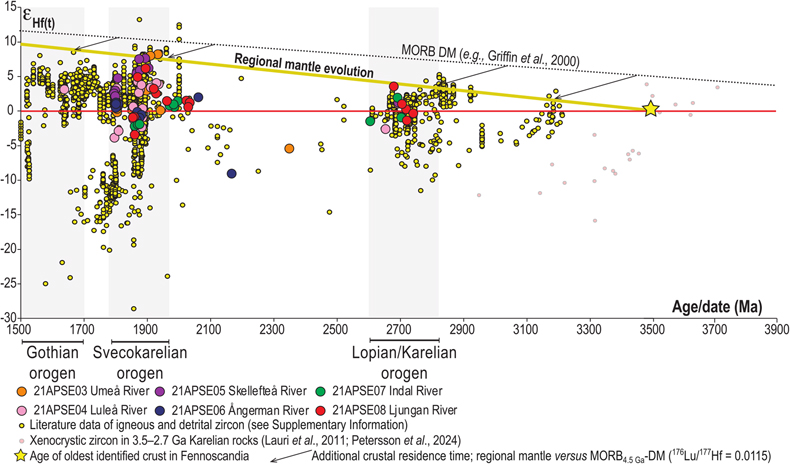
Figure 2 Zircon ɛHf(t) versus age of river zircon and Fennoscandian literature data. ɛHf(t) = [(176Hf/177Hf)unknown/(176Hf/177Hf)CHUR − 1)] × 104.
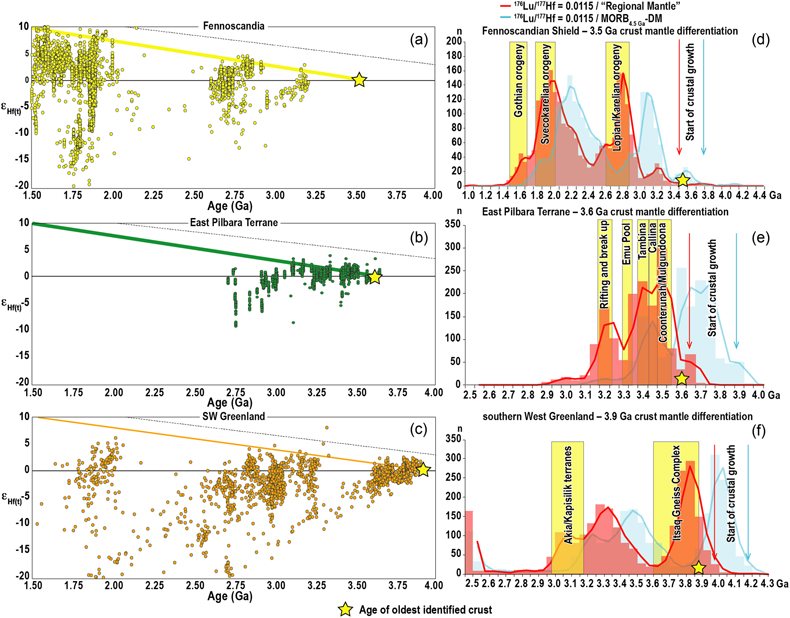
Figure 3 (a–c) Zircon ɛHf(t) versus age, showing regional mantle curves defined by the most radiogenic Hf isotope signatures traced back to a chondritic mantle at the age of the oldest known regional crust. (a) Fennoscandian Shield. (b) East Pilbara Terrane, Western Australia. (c) Southern West Greenland. (d–f) Histograms showing respective two stage model ages based on a bulk continental crustal 176Lu/177Hf = 0.0115 evolution. Red data using a regional mantle references and blue data are based on a

Figure 4 Probability density plots showing the change in crustal growth peaks with different 176Lu/177Hf values for the (a) MORB DM and (b) regional 3.5 Ga mantle sources.