


Production of highly silicic 3.9 to 4.27 Ga crust on the Moon
Affiliations | Corresponding Author | Cite as | Funding information
Published by the European Association of Geochemistry
under Creative Commons License CC BY-NC-ND 4.0
Keywords: lunar, silicic, zircon, XANES


- Share this article


-
Article views:2,683Cumulative count of HTML views and PDF downloads.
- Download Citation
- Rights & Permissions

top
Abstract
Figures
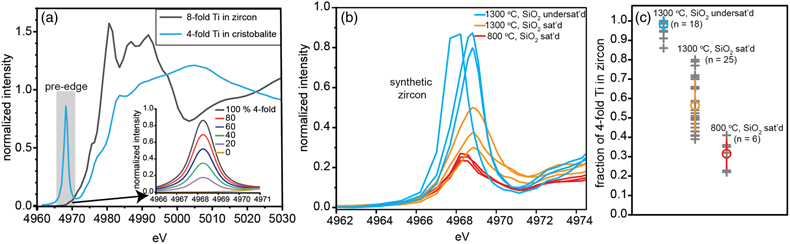
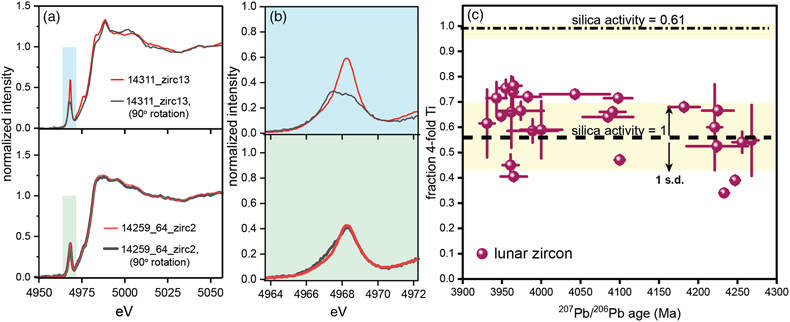
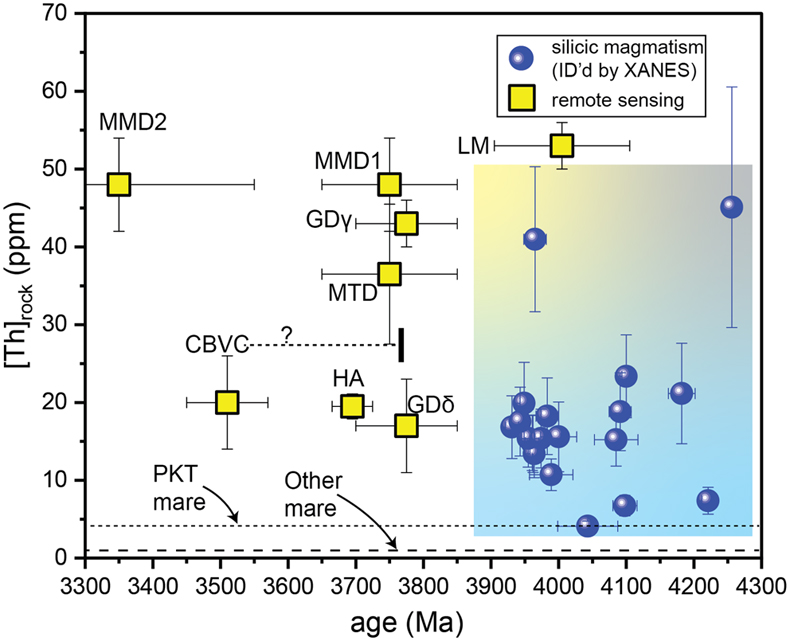
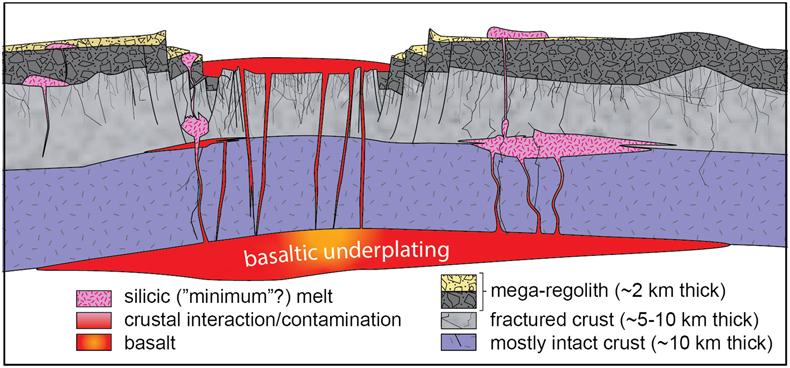
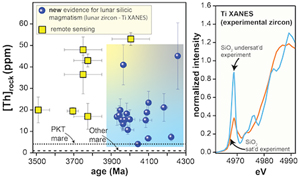
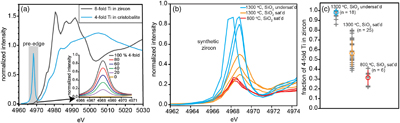 Figure 1 XANES spectral analysis of Ti coordination in zircon. (a) Two standard spectra with Ti present in only 4-fold coordination (cristobalite); and a model spectrum for Ti in 8-fold coordination in zircon along the a axis (Tailby et al., 2011). (inset) Linear mixing of the pre-edge feature showing model spectra for different fractions of Ti in 4-fold coordination. (b) Example pre-edge features for experimental zircon for silica saturated and silica undersaturated (Tailby et al., 2011) experiments. The 1300 °C, 1 atm, SiO2 undersaturated experiment (srilankite (Ti,Zr)O4, rutile, zircon) has a pre-edge intensity similar to that of the 4-fold standard, whereas the intensity of the pre-edge feature for the two silica saturated experiments is muted meaning that a significant fraction of 8-fold Ti is present in zircon. The energy shift observed in the pre-edge spectra of the silica undersaturated samples is common, and has been shown to be related to crystal orientation (Tailby et al., 2011; Crisp et al., 2023). Differences in pre-edge intensity are due to orientation and/or sample heterogeneity (Tailby et al., 2011). Spectra were carefully evaluated for inclusions (see Supplementary Information and Fig. S-1). (c) Fraction of 4-fold Ti in zircon, each analysis from the three experiments calculated from a linear combination of the two standard spectra presented in (a) (Tailby et al., 2011; Crisp et al., 2023). When aqtzSiO2 ≈ 1, only ∼50 % of the Ti is occupying the 4-fold Si site, whereas with aqtzSiO2 ≈ 0.6 nearly 100 % of the Ti is in the 4-fold Si site. Error bars represent the 1 s.d. for each group. Experimental products can be found in Table S-1. | 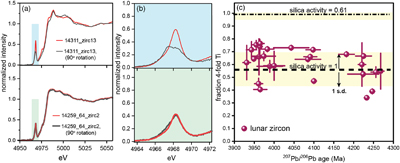 Figure 2 Ti XANES spectra and coordination in lunar zircon. (a, b) Two representative grain analyses showing XANES spectra before and after a 90° rotation. The top panel shows a significant change in pre-edge absorption intensity, while the lower panel, more typical, shows virtually no change. (c) Calculation of Ti in 4-fold coordination, with points averaging lunar zircon measurements in two crystal orientations, plotted against the previously reported 207Pb/206Pb age (Trail et al., 2020). Dashed lines show the average fraction of 4-fold Ti at 1300 °C, and shaded yellow areas represent the 1 s.d. of the fraction in synthetic zircon. | 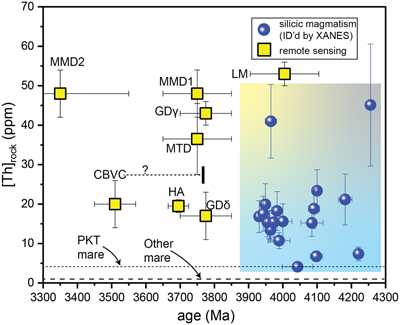 Figure 3 Th contents of highly silicic lunar systems. Circles represent calculated Th contents of igneous systems derived from zircon-melt Th experimental partitioning (see Supplementary Information; Fig. S-5 and Table S-5). Yellow squares represent Th contents for younger silicic systems investigated and quantified by remote sensing (Hagerty et al., 2006; Wilson et al., 2015). The ages for the silicic systems identified by remote sensing data are estimated through crater counting. The average Th contents from the PKT mare terrain (4.9 ppm) and other mare (2.2 ppm) are also shown for comparison (Jolliff et al., 2000). MMD1/2, first and second eruptions of Middle Mairan Dome; MTD, Mairan T Dome; GDδ/γ, Gruithuisen Dome (δ) and (γ); LM, Lassell Massif; HD, Hansteen Alpha; CBVC, Compton–Bel’kovich Volcanic Complex. | 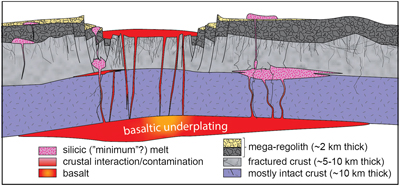 Figure 4 Simplified illustration (not to scale) of the lunar silicic systems whose formation was initiated by partial melting of fertile source rocks such as a KREEP basalt by basaltic underplating (Hagerty et al., 2006). High viscosity minimum melt (?) silicic systems may have developed not far from final emplacement location and/or made significant use of the higher porosity of the fractured crust/mega-regolith, including extensional features associated with impact basins (Valencia et al., 2024). Early silica-rich domes were likely destroyed by large basin-forming impacts, or covered by impact ejecta (Qiu et al., 2023). |
| Figure 1 | Figure 2 | Figure 3 | Figure 4 |
top
Introduction
The emergence of buoyant, silica-rich (>60 wt. %) crust on a rocky planetary body is a key marker of crustal reprocessing and/or extreme differentiation with crucial implications for a planet’s evolution and possibly the origin of life (Harrison, 2020
Harrison, T.M. (2020) Hadean Earth. Springer, Cham. https://doi.org/10.1007/978-3-030-46687-9
). Earth is the only known celestial body where silica-rich crust production occurs today, but whether silicic magma was present early or evolved gradually remains debated. Some models infer that there was continuous production and recycling of early high silica crust (Harrison, 2020Harrison, T.M. (2020) Hadean Earth. Springer, Cham. https://doi.org/10.1007/978-3-030-46687-9
) while others favour the absence of a stable volume of buoyant continental material before 4 Ga (Cawood et al., 2022Cawood, P.A., Chowdhury, P., Mulder, J.A., Hawkesworth, C.J., Capitanio, F.A., Gunawardana, P.M., Nebel, O. (2022) Secular Evolution of Continents and the Earth System. Reviews of Geophysics 60, e2022RG000789. https://doi.org/10.1029/2022RG000789
). Other solar system bodies – like the Moon, Mars, and Vesta – are composed predominantly of a primordial low silica (∼40–50 wt. %) crust but lack clear signs of early silicic magma production.The Moon exhibits evidence of younger (∼3.4–4 Ga) silica-rich systems, identified through remote sensing (Glotch et al., 2010
Glotch, T.D., Lucey, P.G., Bandfield, J.L., Greenhagen, B.T., Thomas, I.R., Elphic, R.C., Bowles, N., Wyatt, M.B., Allen, C.C., Hanna, K.D., Paige, D.A. (2010) Highly Silicic Compositions on the Moon. Science 329, 1510–1513. https://doi.org/10.1126/science.1192148
; Siegler et al., 2023Siegler, M.A., Feng, J., Lehman-Franco, K., Andrews-Hanna, J.C., Economos, R.C., St. Clair, M., Million, C., Head, J.W., Glotch, T.D., White, M.N. (2023) Remote detection of a lunar granitic batholith at Compton–Belkovich. Nature 620, 116–121. https://doi.org/10.1038/s41586-023-06183-5
), although detecting such features earlier in lunar history remains challenging. Apollo breccias contain ancient “granite” clasts with 4–4.3 Ga zircon (Meyer et al., 1996Meyer, C., Williams, I.S., Compston, W. (1996) Uranium-lead ages for lunar zircons: Evidence for a prolonged period of granophyre formation from 4.32 to 3.88 Ga. Meteoritics & Planetary Science 31, 370–387. https://doi.org/10.1111/j.1945-5100.1996.tb02075.x
), but their complex history of crust formation (Su et al., 2023Su, B., Chen, Y., Yue, Z., Chen, L., Mitchell, R.N., Tang, M., Yang, W., Huang, G., Guo, J., Li, X.-H., Wu, F.-Y. (2023) Crustal remelting origin of highly silicic magmatism on the Moon. Communications Earth & Environment 4, 228. https://doi.org/10.1038/s43247-023-00900-8
), meteorite impacts (Thiessen et al., 2018Thiessen, F., Nemchin, A.A., Snape, J.F., Bellucci, J.J., Whitehouse, M.J. (2018) Apollo 12 breccia 12013: Impact-induced partial Pb loss in zircon and its implications for lunar geochronology. Geochimica et Cosmochimica Acta 230, 94–111. https://doi.org/10.1016/j.gca.2018.03.023
; Valencia et al., 2024Valencia, S.N., Korotev, R.L., Jolliff, B.L. (2024) Compositional analysis of Apollo 12 Granitic Breccia 12013: Insights into protoliths and formation. Geochimica et Cosmochimica Acta 367, 189–212. https://doi.org/10.1016/j.gca.2023.12.034
) and disequilibrium assemblages (Seddio et al., 2013Seddio, S.M., Jolliff, B.L., Korotev, R.L., Zeigler, R.A. (2013) Petrology and geochemistry of lunar granite 12032,366-19 and implications for lunar granite petrogenesis. American Mineralogist 98, 1697–1713. https://doi.org/10.2138/am.2013.4330
; Bellucci et al., 2019Bellucci, J.J., Nemchin, A.A., Grange, M., Robinson, K.L., Collins, G., Whitehouse, M.J., Snape, J.F., Norman, M.D., Kring, D.A. (2019) Terrestrial-like zircon in a clast from an Apollo 14 breccia. Earth and Planetary Science Letters 510, 173–185. https://doi.org/10.1016/j.epsl.2019.01.010
) obscure primary chemistry. Large variations in accessory mineral ages within individual clasts (Grange et al., 2013Grange, M.L., Pidgeon, R.T., Nemchin, A.A., Timms, N.E., Meyer, C. (2013) Interpreting U–Pb data from primary and secondary features in lunar zircon. Geochimica et Cosmochimica Acta 101, 112–132. https://doi.org/10.1016/j.gca.2012.10.013
; Thiessen et al., 2018Thiessen, F., Nemchin, A.A., Snape, J.F., Bellucci, J.J., Whitehouse, M.J. (2018) Apollo 12 breccia 12013: Impact-induced partial Pb loss in zircon and its implications for lunar geochronology. Geochimica et Cosmochimica Acta 230, 94–111. https://doi.org/10.1016/j.gca.2018.03.023
) further complicate interpretations. To circumvent these challenges and better understand the early lunar crust’s composition, we need a tool that can probe the silica component of the system, independent of the samples’ complex histories. To accomplish this, we combine lunar zircon (ZrSiO4) ages with a new proxy for melt silica activity – a strong indicator of silicic magmatism – to characterise ancient crust missing from the lunar record. From first principles in thermodynamics, zircon can crystallise with a silica activity from ∼0.5, like a mafic or anorthositic system, to 1 in quartz-saturated silicic (granitic) environments (see Supplementary Information). We also calculate the Th content of the melts from which the zircons crystallised and find strong evidence that they were enriched in radioactive elements relative to the Procellarum KREEP Terrane. These data reveal persistent, highly silicic, Th-rich crust in the Apollo 14 lunar breccia record.Our approach utilises X-ray absorption near edge structure spectroscopy (XANES) to investigate Ti coordination in zircon. The Ti content in zircon is often used as a tool to determine crystallisation temperature (Ferry and Watson, 2007
Ferry, J.M., Watson, E.B. (2007) New thermodynamic models and revised calibrations for the Ti-in-zircon and Zr-in-rutile thermometers. Contributions to Mineralogy and Petrology 154, 429–437. https://doi.org/10.1007/s00410-007-0201-0
; Trail et al., 2020Trail, D., Barboni, M., McKeegan, K.D. (2020) Evidence for diverse lunar melt compositions and mixing of the pre-3.9 Ga crust from zircon chemistry. Geochimica et Cosmochimica Acta 284, 173–195. https://doi.org/10.1016/j.gca.2020.06.018
). A critical component of the thermodynamic theory that dictates the application of the thermometer is that Ti substitutes overwhelmingly for Si on the tetrahedral site in the zircon structure, as opposed to the Zr dodecahedral site, at crustal pressures (Tailby et al., 2011Tailby, N.D., Walker, A.M., Berry, A.J., Hermann, J., Evans, K.A., Mavrogenes, J.A., O’Neill, H.St.C., Rodina, I.S., Soldatov, A.V., Rubatto, D., Sutton, S.R. (2011) Ti site occupancy in zircon. Geochimica et Cosmochimica Acta 75, 905–921. https://doi.org/10.1016/j.gca.2010.11.004
) (see Supplementary Information). We demonstrate that this long held view requires significant modification. We present experiments in which zircon co-crystallised with rutile but where the silica activity of each experimental system was buffered and calculable (see Methods and Supplementary Information). In one case, the silica activity was buffered by tridymite, akin to the crystallisation environment of a granite (aSiO2 ≈ 1, relative to quartz). The other experiment was undersaturated in SiO2 with a silica activity buffered at ∼0.6, representative of a crystallising mafic/anorthositic rock. Both experiments were conducted at 1300 °C and 1 atm (Table S-1).top
Results
We report 43 XANES spectra on randomly oriented zircons from these two experimental products to determine the fraction of Ti residing in the Si tetrahedral site (in 4-fold coordination) vs. Zr dodecahedral site (in 8-fold coordination) of zircon (see Methods). Contrary to expectation (Ferry and Watson, 2007
Ferry, J.M., Watson, E.B. (2007) New thermodynamic models and revised calibrations for the Ti-in-zircon and Zr-in-rutile thermometers. Contributions to Mineralogy and Petrology 154, 429–437. https://doi.org/10.1007/s00410-007-0201-0
; Tailby et al., 2011Tailby, N.D., Walker, A.M., Berry, A.J., Hermann, J., Evans, K.A., Mavrogenes, J.A., O’Neill, H.St.C., Rodina, I.S., Soldatov, A.V., Rubatto, D., Sutton, S.R. (2011) Ti site occupancy in zircon. Geochimica et Cosmochimica Acta 75, 905–921. https://doi.org/10.1016/j.gca.2010.11.004
; Crisp et al., 2023Crisp, L.J., Berry, A.J., Burnham, A.D., Miller, L.A., Newville, M. (2023) The Ti-in-zircon thermometer revised: The effect of pressure on the Ti site in zircon. Geochimica et Cosmochimica Acta 360, 241–258. https://doi.org/10.1016/j.gca.2023.04.031
), a significant fraction of the Ti was found to be in the zircon 8-fold site (Tables S-2, S-3). To further confirm our observations, we performed a separate experiment at different P/T conditions. While the previous experiments were conducted at 1300 °C/1 atm, lunar zircons likely crystallised at a lower T and moderately higher P (Crow et al., 2017Crow, C.A., McKeegan, K.D., Moser, D.E. (2017) Coordinated U–Pb geochronology, trace element, Ti-in-zircon thermometry and microstructural analysis of Apollo zircons. Geochimica et Cosmochimica Acta 202, 264–284. https://doi.org/10.1016/j.gca.2016.12.019
; Bellucci et al., 2019Bellucci, J.J., Nemchin, A.A., Grange, M., Robinson, K.L., Collins, G., Whitehouse, M.J., Snape, J.F., Norman, M.D., Kring, D.A. (2019) Terrestrial-like zircon in a clast from an Apollo 14 breccia. Earth and Planetary Science Letters 510, 173–185. https://doi.org/10.1016/j.epsl.2019.01.010
; Trail et al., 2020Trail, D., Barboni, M., McKeegan, K.D. (2020) Evidence for diverse lunar melt compositions and mixing of the pre-3.9 Ga crust from zircon chemistry. Geochimica et Cosmochimica Acta 284, 173–195. https://doi.org/10.1016/j.gca.2020.06.018
). Our follow up experiment was performed at 800 °C and 1 GPa – i.e. at lower T and higher P than expected for lunar zircons (see Methods), with SiO2 and TiO2 activities buffered by quartz and rutile, respectively. These zircons from this experiment also yield a low fraction of Ti in the Si tetrahedral site (∼0.3). Considering these results alongside the other silica saturated experiment at 1300 °C and 1 atm, the differences in Ti site occupancy of zircon represent a drastic change from past studies, which interpreted ∼95 % of the Ti to be present in the Si site (Tailby et al., 2011Tailby, N.D., Walker, A.M., Berry, A.J., Hermann, J., Evans, K.A., Mavrogenes, J.A., O’Neill, H.St.C., Rodina, I.S., Soldatov, A.V., Rubatto, D., Sutton, S.R. (2011) Ti site occupancy in zircon. Geochimica et Cosmochimica Acta 75, 905–921. https://doi.org/10.1016/j.gca.2010.11.004
; Crisp et al., 2023Crisp, L.J., Berry, A.J., Burnham, A.D., Miller, L.A., Newville, M. (2023) The Ti-in-zircon thermometer revised: The effect of pressure on the Ti site in zircon. Geochimica et Cosmochimica Acta 360, 241–258. https://doi.org/10.1016/j.gca.2023.04.031
). These findings require a revision of the thermodynamic model for Ti in zircon and its application to thermometry (see Supplementary Information). However, they also present a significant opportunity, as the Ti coordination in zircon separated from the parent rock can serve as proxy for identifying high silica systems (Fig. 1).Figure 1 XANES spectral analysis of Ti coordination in zircon. (a) Two standard spectra with Ti present in only 4-fold coordination (cristobalite); and a model spectrum for Ti in 8-fold coordination in zircon along the a axis (Tailby et al., 2011
Tailby, N.D., Walker, A.M., Berry, A.J., Hermann, J., Evans, K.A., Mavrogenes, J.A., O’Neill, H.St.C., Rodina, I.S., Soldatov, A.V., Rubatto, D., Sutton, S.R. (2011) Ti site occupancy in zircon. Geochimica et Cosmochimica Acta 75, 905–921. https://doi.org/10.1016/j.gca.2010.11.004
). (inset) Linear mixing of the pre-edge feature showing model spectra for different fractions of Ti in 4-fold coordination. (b) Example pre-edge features for experimental zircon for silica saturated and silica undersaturated (Tailby et al., 2011Tailby, N.D., Walker, A.M., Berry, A.J., Hermann, J., Evans, K.A., Mavrogenes, J.A., O’Neill, H.St.C., Rodina, I.S., Soldatov, A.V., Rubatto, D., Sutton, S.R. (2011) Ti site occupancy in zircon. Geochimica et Cosmochimica Acta 75, 905–921. https://doi.org/10.1016/j.gca.2010.11.004
) experiments. The 1300 °C, 1 atm, SiO2 undersaturated experiment (srilankite (Ti,Zr)O4, rutile, zircon) has a pre-edge intensity similar to that of the 4-fold standard, whereas the intensity of the pre-edge feature for the two silica saturated experiments is muted meaning that a significant fraction of 8-fold Ti is present in zircon. The energy shift observed in the pre-edge spectra of the silica undersaturated samples is common, and has been shown to be related to crystal orientation (Tailby et al., 2011Tailby, N.D., Walker, A.M., Berry, A.J., Hermann, J., Evans, K.A., Mavrogenes, J.A., O’Neill, H.St.C., Rodina, I.S., Soldatov, A.V., Rubatto, D., Sutton, S.R. (2011) Ti site occupancy in zircon. Geochimica et Cosmochimica Acta 75, 905–921. https://doi.org/10.1016/j.gca.2010.11.004
; Crisp et al., 2023Crisp, L.J., Berry, A.J., Burnham, A.D., Miller, L.A., Newville, M. (2023) The Ti-in-zircon thermometer revised: The effect of pressure on the Ti site in zircon. Geochimica et Cosmochimica Acta 360, 241–258. https://doi.org/10.1016/j.gca.2023.04.031
). Differences in pre-edge intensity are due to orientation and/or sample heterogeneity (Tailby et al., 2011Tailby, N.D., Walker, A.M., Berry, A.J., Hermann, J., Evans, K.A., Mavrogenes, J.A., O’Neill, H.St.C., Rodina, I.S., Soldatov, A.V., Rubatto, D., Sutton, S.R. (2011) Ti site occupancy in zircon. Geochimica et Cosmochimica Acta 75, 905–921. https://doi.org/10.1016/j.gca.2010.11.004
). Spectra were carefully evaluated for inclusions (see Supplementary Information and Fig. S-1). (c) Fraction of 4-fold Ti in zircon, each analysis from the three experiments calculated from a linear combination of the two standard spectra presented in (a) (Tailby et al., 2011Tailby, N.D., Walker, A.M., Berry, A.J., Hermann, J., Evans, K.A., Mavrogenes, J.A., O’Neill, H.St.C., Rodina, I.S., Soldatov, A.V., Rubatto, D., Sutton, S.R. (2011) Ti site occupancy in zircon. Geochimica et Cosmochimica Acta 75, 905–921. https://doi.org/10.1016/j.gca.2010.11.004
; Crisp et al., 2023Crisp, L.J., Berry, A.J., Burnham, A.D., Miller, L.A., Newville, M. (2023) The Ti-in-zircon thermometer revised: The effect of pressure on the Ti site in zircon. Geochimica et Cosmochimica Acta 360, 241–258. https://doi.org/10.1016/j.gca.2023.04.031
). When aqtzSiO2 ≈ 1, only ∼50 % of the Ti is occupying the 4-fold Si site, whereas with aqtzSiO2 ≈ 0.6 nearly 100 % of the Ti is in the 4-fold Si site. Error bars represent the 1 s.d. for each group. Experimental products can be found in Table S-1.The experimental observations are crucial because they can be applied to evaluate the silica activity in the igneous systems that crystallised zircon. Lunar zircons are exactly that: they are commonly found in breccias and soils as fragments of larger crystals yet they are high value analytical targets because U-Pb ages, typically with 10 Ma precision, can be measured in situ (Trail et al., 2020
Trail, D., Barboni, M., McKeegan, K.D. (2020) Evidence for diverse lunar melt compositions and mixing of the pre-3.9 Ga crust from zircon chemistry. Geochimica et Cosmochimica Acta 284, 173–195. https://doi.org/10.1016/j.gca.2020.06.018
). With age information already available for a suite of samples (Trail et al., 2020Trail, D., Barboni, M., McKeegan, K.D. (2020) Evidence for diverse lunar melt compositions and mixing of the pre-3.9 Ga crust from zircon chemistry. Geochimica et Cosmochimica Acta 284, 173–195. https://doi.org/10.1016/j.gca.2020.06.018
), we collected Ti XANES spectra on zircons with ages spanning ∼400 Myr (Table S-4). The majority of zircons (n = 22) are from Apollo sample 14311,58 whose parent rock is a polymict impact melt breccia. In addition, zircons from Apollo 14 soil samples 14259 and 14163 were also analysed (n = 4).To evaluate the sensitivity of grain orientation to spectral features, we collected XANES spectra for two different grain orientations, separated by 90° (Fig. 2). Some grains exhibit differences in absorption characteristics depending on the orientation whereas others do not (Fig. 2a,b). We attribute this to a combination of beam polarisation, grain orientation, and mineral anisotropy. The difference in the pre-edge intensity is, on average, 0.07 normalised units, about a factor of seven smaller than the effects caused by a change in the silica activity of the system. Thus, while grain orientation does change the pre-edge intensities, it is a second order effect (see Supplementary Information and Figs. S-2, S-3). We compare the fraction of Ti in 4-fold coordination in lunar zircon with that from 1300 °C experiments, which provide strong evidence for a high silica activity (ameltSiO2 ≈ 1) for zircon crystallisation in the lunar environment (Fig. 2c). This differs from previous thermodynamic calculations for lunar melt evolution, which used the MELTS algorithm and zircon saturation thermometry to estimate ameltSiO2 in igneous systems at zircon saturation ranging from 0.5 to 0.7 (Crow et al., 2017
Crow, C.A., McKeegan, K.D., Moser, D.E. (2017) Coordinated U–Pb geochronology, trace element, Ti-in-zircon thermometry and microstructural analysis of Apollo zircons. Geochimica et Cosmochimica Acta 202, 264–284. https://doi.org/10.1016/j.gca.2016.12.019
).Figure 2 Ti XANES spectra and coordination in lunar zircon. (a, b) Two representative grain analyses showing XANES spectra before and after a 90° rotation. The top panel shows a significant change in pre-edge absorption intensity, while the lower panel, more typical, shows virtually no change. (c) Calculation of Ti in 4-fold coordination, with points averaging lunar zircon measurements in two crystal orientations, plotted against the previously reported 207Pb/206Pb age (Trail et al., 2020
Trail, D., Barboni, M., McKeegan, K.D. (2020) Evidence for diverse lunar melt compositions and mixing of the pre-3.9 Ga crust from zircon chemistry. Geochimica et Cosmochimica Acta 284, 173–195. https://doi.org/10.1016/j.gca.2020.06.018
). Dashed lines show the average fraction of 4-fold Ti at 1300 °C, and shaded yellow areas represent the 1 s.d. of the fraction in synthetic zircon.Pressure influences the Ti site occupancy in zircon at >2 GPa (Ferriss et al., 2008
Ferriss, E.D.A., Essene, E.J., Becker, U. (2008) Computational study of the effect of pressure on the Ti-in-zircon geothermometer. European Journal of Mineralogy 20, 745–755. https://doi.org/10.1127/0935-1221/2008/0020-1860
; Crisp et al., 2023Crisp, L.J., Berry, A.J., Burnham, A.D., Miller, L.A., Newville, M. (2023) The Ti-in-zircon thermometer revised: The effect of pressure on the Ti site in zircon. Geochimica et Cosmochimica Acta 360, 241–258. https://doi.org/10.1016/j.gca.2023.04.031
). Although these pressures exceed typical lunar crustal formation conditions, many surface samples likely experienced transient pressures >2 GPa due to impact shock metamorphism (Thiessen et al., 2018Thiessen, F., Nemchin, A.A., Snape, J.F., Bellucci, J.J., Whitehouse, M.J. (2018) Apollo 12 breccia 12013: Impact-induced partial Pb loss in zircon and its implications for lunar geochronology. Geochimica et Cosmochimica Acta 230, 94–111. https://doi.org/10.1016/j.gca.2018.03.023
; Valencia et al., 2024Valencia, S.N., Korotev, R.L., Jolliff, B.L. (2024) Compositional analysis of Apollo 12 Granitic Breccia 12013: Insights into protoliths and formation. Geochimica et Cosmochimica Acta 367, 189–212. https://doi.org/10.1016/j.gca.2023.12.034
). To investigate the effect of shock on Ti coordination in zircon, we collected Ti XANES spectra on ZrSiO4 synthetically shocked to ∼30 GPa (Szumila et al., 2023Szumila, I., Trail, D., Erickson, T., Simon, J.I., Wielicki, M.M., Lapen, T., Nakajima, M., Fries, M., Bell, E.A. (2023) Microstructural changes and Pb mobility during the zircon to reidite transformation: Implications for planetary impact chronology. American Mineralogist 108, 1516–1529. https://doi.org/10.2138/am-2022-8604
). The products include shocked zircon, amorphous ZrSiO4, and reidite (Szumila et al., 2023Szumila, I., Trail, D., Erickson, T., Simon, J.I., Wielicki, M.M., Lapen, T., Nakajima, M., Fries, M., Bell, E.A. (2023) Microstructural changes and Pb mobility during the zircon to reidite transformation: Implications for planetary impact chronology. American Mineralogist 108, 1516–1529. https://doi.org/10.2138/am-2022-8604
) (a high pressure ZrSiO4 polymorph). The fraction of 4-fold coordinated Ti is equal to or slightly higher in the shocked ZrSiO4 products when compared to unshocked zircon starting material (Fig. S-4 and Table S-5). Results indicate either no impact shock modification of the Ti XANES spectral features, or shock modification that would shift the calculated silica activity to lower apparent values. Thus, there is no or very limited Ti site exchange between Si and Zr sites in zircon during high pressure shock events, confirming that lunar zircons in this study formed in highly silicic systems. This interpretation is further supported by the relatively limited evidence of impact shock twining among the zircons investigated here, as determined by electron backscatter diffraction (see Fig. S-3). With these experimental constraints in mind, we now explore the implications of high silica systems within the broader context of early lunar crustal evolution and, more generally, the evolution of planetary crusts.Remote sensing has identified younger ∼3.4–4.0 Ga plutonic and volcanic silicic rock on the near side of the Moon (Glotch et al., 2010
Glotch, T.D., Lucey, P.G., Bandfield, J.L., Greenhagen, B.T., Thomas, I.R., Elphic, R.C., Bowles, N., Wyatt, M.B., Allen, C.C., Hanna, K.D., Paige, D.A. (2010) Highly Silicic Compositions on the Moon. Science 329, 1510–1513. https://doi.org/10.1126/science.1192148
), also characterised by high Th contents (∼10–55 ppm; Hagerty et al., 2006Hagerty, J.J., Lawrence, D.J., Hawke, B.R., Vaniman, D.T., Elphic, R.C., Feldman, W.C. (2006) Refined thorium abundances for lunar red spots: Implications for evolved, nonmare volcanism on the Moon. Journal of Geophysical Research: Planets 111, E06002. https://doi.org/10.1029/2005JE002592
; Wilson et al., 2015Wilson, J.T., Eke, V.R., Massey, R.J., Elphic, R.C., Jolliff, B.L., Lawrence, D.J., Llewellin, E.W., McElwaine, J.N., Teodoro, L.F.A. (2015) Evidence for explosive silicic volcanism on the Moon from the extended distribution of thorium near the Compton-Belkovich Volcanic Complex. Journal of Geophysical Research: Planets 120, 92–108. https://doi.org/10.1002/2014JE004719
) relative to the Procellarum KREEP Terrane (∼5 ppm; Jolliff et al., 2000Jolliff, B.L., Gillis, J.J., Haskin, L.A., Korotev, R.L., Wieczorek, M.A. (2000) Major lunar crustal terranes: Surface expressions and crust-mantle origins. Journal of Geophysical Research: Planets 105, 4197–4216. https://doi.org/10.1029/1999JE001103
). The Compton–Bel’kovich Volcanic Complex represents a similar highly silicic Th-rich feature on the far side of the Moon, that erupted at ∼3.5 Ga and possibly earlier at ∼3.8 Ga, based on crater size frequency distributions (Jolliff et al., 2011Jolliff, B.L., Wiseman, S.A., Lawrence, S.J., Tran, T.N., Robinson, M.S., Sato, H., Hawke, B.R., Scholten, F., Oberst, J., Hiesinger, H., van der Bogert, C.H., Greenhagen, B.T., Glotch, T.D., Paige, D.A. (2011) Non-mare silicic volcanism on the lunar farside at Compton–Belkovich. Nature Geoscience 4, 566–571. https://doi.org/10.1038/ngeo1212
; Wilson et al., 2015Wilson, J.T., Eke, V.R., Massey, R.J., Elphic, R.C., Jolliff, B.L., Lawrence, D.J., Llewellin, E.W., McElwaine, J.N., Teodoro, L.F.A. (2015) Evidence for explosive silicic volcanism on the Moon from the extended distribution of thorium near the Compton-Belkovich Volcanic Complex. Journal of Geophysical Research: Planets 120, 92–108. https://doi.org/10.1002/2014JE004719
; Siegler et al., 2023Siegler, M.A., Feng, J., Lehman-Franco, K., Andrews-Hanna, J.C., Economos, R.C., St. Clair, M., Million, C., Head, J.W., Glotch, T.D., White, M.N. (2023) Remote detection of a lunar granitic batholith at Compton–Belkovich. Nature 620, 116–121. https://doi.org/10.1038/s41586-023-06183-5
). The lunar zircons from highly silicic systems identified here are older, with U-Pb ages ranging from 3.93 to 4.27 Ga. To compare these older zircons with the younger silicic systems mentioned above, we apply zircon-melt Th partition coefficients to calculate Th melt contents of ∼5–40 ppm for the 3.93 to 4.27 Ga zircon saturated systems. These values are in broad agreement with the younger silicic systems but extend the record of highly silicic, Th-enriched magmatism back to the early Moon (Fig. 3).Figure 3 Th contents of highly silicic lunar systems. Circles represent calculated Th contents of igneous systems derived from zircon-melt Th experimental partitioning (see Supplementary Information; Fig. S-5 and Table S-5). Yellow squares represent Th contents for younger silicic systems investigated and quantified by remote sensing (Hagerty et al., 2006
Hagerty, J.J., Lawrence, D.J., Hawke, B.R., Vaniman, D.T., Elphic, R.C., Feldman, W.C. (2006) Refined thorium abundances for lunar red spots: Implications for evolved, nonmare volcanism on the Moon. Journal of Geophysical Research: Planets 111, E06002. https://doi.org/10.1029/2005JE002592
; Wilson et al., 2015Wilson, J.T., Eke, V.R., Massey, R.J., Elphic, R.C., Jolliff, B.L., Lawrence, D.J., Llewellin, E.W., McElwaine, J.N., Teodoro, L.F.A. (2015) Evidence for explosive silicic volcanism on the Moon from the extended distribution of thorium near the Compton-Belkovich Volcanic Complex. Journal of Geophysical Research: Planets 120, 92–108. https://doi.org/10.1002/2014JE004719
). The ages for the silicic systems identified by remote sensing data are estimated through crater counting. The average Th contents from the PKT mare terrain (4.9 ppm) and other mare (2.2 ppm) are also shown for comparison (Jolliff et al., 2000Jolliff, B.L., Gillis, J.J., Haskin, L.A., Korotev, R.L., Wieczorek, M.A. (2000) Major lunar crustal terranes: Surface expressions and crust-mantle origins. Journal of Geophysical Research: Planets 105, 4197–4216. https://doi.org/10.1029/1999JE001103
). MMD1/2, first and second eruptions of Middle Mairan Dome; MTD, Mairan T Dome; GDδ/γ, Gruithuisen Dome (δ) and (γ); LM, Lassell Massif; HD, Hansteen Alpha; CBVC, Compton–Bel’kovich Volcanic Complex.The XANES data also allow us to evaluate whether these zircons record significant changes to the silica activities of the igneous systems during crystallisation. For instance, if zircons crystallised from the extreme fractionation of mafic melts, evolving silica activity should produce variable pre-edge intensities of the XANES spectra. However, for ∼90 % of the analysed lunar grains, the pre-edge intensity is within 0.05 normalised units across different analytical locations on each grain (see Supplementary Information). We interpret this as evidence that most zircons crystallised from high silica igneous bodies with approximately constant silica activity (e.g., quartz saturated), rather than from fractionating mafic systems. A few exceptional grains show large pre-edge intensity variations of ∼0.3, which we interpret to represent evolving silica conditions along the liquid line of descent (Figs. S-6, S-7). But overall, the zircon data represent highly silicic systems that are under-represented in sample collections from Apollo, Luna, meteorites, and Chang’e 5 missions (Neal, 2009
Neal, C.R. (2009) The Moon 35 years after Apollo: What’s left to learn? Geochemistry 69, 3–43. https://doi.org/10.1016/j.chemer.2008.07.002
; Wu et al., 2024Wu, F.-Y., Li, Q.-L., Chen, Y., Hu, S., Yue, Z.-Y., Zhou, Q., Wang, H., Yang, W., Tian, H.-C., Zhang, C., Li, J.-H., Li, L.-X., Hui, H.-J., Li, C.-L., Lin, Y.-T., Li, X.-H., Delano, J.W. (2024) Lunar Evolution in Light of the Chang’e-5 Returned Samples. Annual Review of Earth and Planetary Sciences 52, 159–194. https://doi.org/10.1146/annurev-earth-040722-100453
).Next, we examine models that could lead to high silica activity in lunar systems, including felsic mesostasis, liquid immiscibility, and basaltic underplating of the crust accompanied by partial melting. Based on textural evidence, phase assemblage, and partition coefficients that conflict with our zircon data, we consider felsic mesostasis and liquid immiscibility between mafic and felsic systems to be unlikely (Seddio et al., 2013
Seddio, S.M., Jolliff, B.L., Korotev, R.L., Zeigler, R.A. (2013) Petrology and geochemistry of lunar granite 12032,366-19 and implications for lunar granite petrogenesis. American Mineralogist 98, 1697–1713. https://doi.org/10.2138/am.2013.4330
; Gullikson et al., 2016Gullikson, A.L., Hagerty, J.J., Reid, M.R., Rapp, J.F., Draper, D.S. (2016) Silicic lunar volcanism: Testing the crustal melting model. American Mineralogist 101, 2312–2321. https://doi.org/10.2138/am-2016-5619
) (see Supplementary Information). Instead, we favour a model similar to that ascribed to the origin of the red spot features (Hagerty et al., 2006Hagerty, J.J., Lawrence, D.J., Hawke, B.R., Vaniman, D.T., Elphic, R.C., Feldman, W.C. (2006) Refined thorium abundances for lunar red spots: Implications for evolved, nonmare volcanism on the Moon. Journal of Geophysical Research: Planets 111, E06002. https://doi.org/10.1029/2005JE002592
), in which basaltic underplating and partial melting of pre-existing lunar crust produces highly silicic, high Th lunar melts (Hagerty et al., 2006Hagerty, J.J., Lawrence, D.J., Hawke, B.R., Vaniman, D.T., Elphic, R.C., Feldman, W.C. (2006) Refined thorium abundances for lunar red spots: Implications for evolved, nonmare volcanism on the Moon. Journal of Geophysical Research: Planets 111, E06002. https://doi.org/10.1029/2005JE002592
; Glotch et al., 2010Glotch, T.D., Lucey, P.G., Bandfield, J.L., Greenhagen, B.T., Thomas, I.R., Elphic, R.C., Bowles, N., Wyatt, M.B., Allen, C.C., Hanna, K.D., Paige, D.A. (2010) Highly Silicic Compositions on the Moon. Science 329, 1510–1513. https://doi.org/10.1126/science.1192148
; Gullikson et al., 2016Gullikson, A.L., Hagerty, J.J., Reid, M.R., Rapp, J.F., Draper, D.S. (2016) Silicic lunar volcanism: Testing the crustal melting model. American Mineralogist 101, 2312–2321. https://doi.org/10.2138/am-2016-5619
; Valencia et al., 2024Valencia, S.N., Korotev, R.L., Jolliff, B.L. (2024) Compositional analysis of Apollo 12 Granitic Breccia 12013: Insights into protoliths and formation. Geochimica et Cosmochimica Acta 367, 189–212. https://doi.org/10.1016/j.gca.2023.12.034
) which is consistent with our data (Fig. 4).Figure 4 Simplified illustration (not to scale) of the lunar silicic systems whose formation was initiated by partial melting of fertile source rocks such as a KREEP basalt by basaltic underplating (Hagerty et al., 2006
Hagerty, J.J., Lawrence, D.J., Hawke, B.R., Vaniman, D.T., Elphic, R.C., Feldman, W.C. (2006) Refined thorium abundances for lunar red spots: Implications for evolved, nonmare volcanism on the Moon. Journal of Geophysical Research: Planets 111, E06002. https://doi.org/10.1029/2005JE002592
). High viscosity minimum melt (?) silicic systems may have developed not far from final emplacement location and/or made significant use of the higher porosity of the fractured crust/mega-regolith, including extensional features associated with impact basins (Valencia et al., 2024Valencia, S.N., Korotev, R.L., Jolliff, B.L. (2024) Compositional analysis of Apollo 12 Granitic Breccia 12013: Insights into protoliths and formation. Geochimica et Cosmochimica Acta 367, 189–212. https://doi.org/10.1016/j.gca.2023.12.034
). Early silica-rich domes were likely destroyed by large basin-forming impacts, or covered by impact ejecta (Qiu et al., 2023Qiu, D., Sasaki, S., Yan, J., Ye, M., Deng, Q., Liang, F., Liu, L., Li, F. (2023) Buried Silicic Volcanoes Discovered in the Gruithuisen Region on the Moon. Geophysical Research Letters 50, e2023GL103336. https://doi.org/10.1029/2023GL103336
).In summary, the high silica activities and Th contents recorded by these zircons, provide compelling evidence for production of a silica-rich component of the lunar crust from at least 4.27 to 3.4 Ga. We propose that these zircons represent vestiges of early highly silicic rocks that have been largely obliterated by basin-forming impacts, buried in impact ejecta, or covered by later mare basalts. Similar processes are observed in younger silicic localities such as the Gruithuisen region (Qiu et al., 2023
Qiu, D., Sasaki, S., Yan, J., Ye, M., Deng, Q., Liang, F., Liu, L., Li, F. (2023) Buried Silicic Volcanoes Discovered in the Gruithuisen Region on the Moon. Geophysical Research Letters 50, e2023GL103336. https://doi.org/10.1029/2023GL103336
), Aristarchus, and Lassell regions, where silicic lithologies are exposed through later impact cratering (Glotch et al., 2010Glotch, T.D., Lucey, P.G., Bandfield, J.L., Greenhagen, B.T., Thomas, I.R., Elphic, R.C., Bowles, N., Wyatt, M.B., Allen, C.C., Hanna, K.D., Paige, D.A. (2010) Highly Silicic Compositions on the Moon. Science 329, 1510–1513. https://doi.org/10.1126/science.1192148
; Clegg-Watkins et al., 2017Clegg-Watkins, R.N., Jolliff, B.L., Watkins, M.J., Coman, E., Giguere, T.A., Stopar, J.D., Lawrence, S.J. (2017) Nonmare volcanism on the Moon: Photometric evidence for the presence of evolved silicic materials. Icarus 285, 169–184. https://doi.org/10.1016/j.icarus.2016.12.004
; Yang et al., 2023Yang, J., Ju, D., Pang, R., Li, R., Liu, J., Du, W. (2023) Significance of silicate liquid immiscibility for the origin of young highly evolved lithic clasts in Chang’E-5 regolith. Geochimica et Cosmochimica Acta 340, 189–205. https://doi.org/10.1016/j.gca.2022.11.008
). This aligns with the occurrence of 1–3 mm felsic clasts found in lunar breccia (Meyer et al., 1996Meyer, C., Williams, I.S., Compston, W. (1996) Uranium-lead ages for lunar zircons: Evidence for a prolonged period of granophyre formation from 4.32 to 3.88 Ga. Meteoritics & Planetary Science 31, 370–387. https://doi.org/10.1111/j.1945-5100.1996.tb02075.x
; Seddio et al., 2013Seddio, S.M., Jolliff, B.L., Korotev, R.L., Zeigler, R.A. (2013) Petrology and geochemistry of lunar granite 12032,366-19 and implications for lunar granite petrogenesis. American Mineralogist 98, 1697–1713. https://doi.org/10.2138/am.2013.4330
) containing impact-generated glass and brecciated material (Warren et al., 1983Warren, P.H., Taylor, G.J., Keil, K., Shirley, D.N., Wasson, J.T. (1983) Petrology and chemistry of two “large” granite clasts from the moon. Earth and Planetary Science Letters 64, 175–185. https://doi.org/10.1016/0012-821X(83)90202-9
; Jolliff, 1991Jolliff, B.L. (1991) Fragments of quartz monzodiorite and felsite in Apollo 14 soil particles. Proceedings of Lunar and Planetary Science 21, 101–118.
).Our zircon record demonstrates that, despite the broadly mafic/anorthositic character of the lunar crust, silicic lithologies were an integral and persistent component of the early Moon. Crucially, this variability is not confined to a specific period in lunar history, nor do we uncover clear evidence for distinct intervals of silicic melt initiation and cessation (Meyer et al., 1996
Meyer, C., Williams, I.S., Compston, W. (1996) Uranium-lead ages for lunar zircons: Evidence for a prolonged period of granophyre formation from 4.32 to 3.88 Ga. Meteoritics & Planetary Science 31, 370–387. https://doi.org/10.1111/j.1945-5100.1996.tb02075.x
). Further confirmation will require additional measurements similar to those presented here for time intervals not represented including the pre-4.3 Ga lunar zircon record. We conclude that even small single plate planetary bodies acquire a heterogeneous crust of mafic and highly silicic rocks, and that the ongoing production of silicic systems is likely a common trait of planetary bodies, even in the first billion years of development.top
Acknowledgements
We are grateful for the constructive and thorough reviews of Timmons Erickson and Steve Parman. We thank Hugh O’Neill for advice and input. This work was funded by the NASA Solar System Workings grant 80NSSC20K1039. We thank Axel Wittman for assistance with EBSD analyses. Portions of this work were performed at GeoSoilEnviroCARS (The University of Chicago, Sector 13), Advanced Photon Source (APS), Argonne National Laboratory. GeoSoilEnviroCARS is supported by the National Science Foundation – Earth Sciences (EAR – 1634415) and NASA’s Planetary Science Enabling Facilities (PSEF) program (grant number 80NSSC23K0196). This research used resources of the Advanced Photon Source, a U.S. Department of Energy (DOE) Office of Science User Facility operated for the DOE Office of Science by Argonne National Laboratory under Contract No. DE-AC02-06CH11357.
Editor: Francis McCubbin
top
References
Bellucci, J.J., Nemchin, A.A., Grange, M., Robinson, K.L., Collins, G., Whitehouse, M.J., Snape, J.F., Norman, M.D., Kring, D.A. (2019) Terrestrial-like zircon in a clast from an Apollo 14 breccia. Earth and Planetary Science Letters 510, 173–185. https://doi.org/10.1016/j.epsl.2019.01.010
 Show in context
 The Moon exhibits evidence of younger (∼3.4–4 Ga) silica-rich systems, identified through remote sensing (Glotch et al., 2010; Siegler et al., 2023), although detecting such features earlier in lunar history remains challenging. Apollo breccias contain ancient “granite” clasts with 4–4.3 Ga zircon (Meyer et al., 1996), but their complex history of crust formation (Su et al., 2023), meteorite impacts (Thiessen et al., 2018; Valencia et al., 2024) and disequilibrium assemblages (Seddio et al., 2013; Bellucci et al., 2019) obscure primary chemistry. Large variations in accessory mineral ages within individual clasts (Grange et al., 2013; Thiessen et al., 2018) further complicate interpretations.
View in article
To further confirm our observations, we performed a separate experiment at different P/T conditions. While the previous experiments were conducted at 1300 °C/1 atm, lunar zircons likely crystallised at a lower T and moderately higher P (Crow et al., 2017; Bellucci et al., 2019; Trail et al., 2020).
View in article
Cawood, P.A., Chowdhury, P., Mulder, J.A., Hawkesworth, C.J., Capitanio, F.A., Gunawardana, P.M., Nebel, O. (2022) Secular Evolution of Continents and the Earth System. Reviews of Geophysics 60, e2022RG000789. https://doi.org/10.1029/2022RG000789
Show in context Some models infer that there was continuous production and recycling of early high silica crust (Harrison, 2020) while others favour the absence of a stable volume of buoyant continental material before 4 Ga (Cawood et al., 2022).
View in article
Clegg-Watkins, R.N., Jolliff, B.L., Watkins, M.J., Coman, E., Giguere, T.A., Stopar, J.D., Lawrence, S.J. (2017) Nonmare volcanism on the Moon: Photometric evidence for the presence of evolved silicic materials. Icarus 285, 169–184. https://doi.org/10.1016/j.icarus.2016.12.004
Show in context Similar processes are observed in younger silicic localities such as the Gruithuisen region (Qiu et al., 2023), Aristarchus, and Lassell regions, where silicic lithologies are exposed through later impact cratering (Glotch et al., 2010; Clegg-Watkins et al., 2017; Yang et al., 2023).
View in article
Crisp, L.J., Berry, A.J., Burnham, A.D., Miller, L.A., Newville, M. (2023) The Ti-in-zircon thermometer revised: The effect of pressure on the Ti site in zircon. Geochimica et Cosmochimica Acta 360, 241–258. https://doi.org/10.1016/j.gca.2023.04.031
Show in context We report 43 XANES spectra on randomly oriented zircons from these two experimental products to determine the fraction of Ti residing in the Si tetrahedral site (in 4-fold coordination) vs. Zr dodecahedral site (in 8-fold coordination) of zircon (see Methods). Contrary to expectation (Ferry and Watson, 2007; Tailby et al., 2011; Crisp et al., 2023), a significant fraction of the Ti was found to be in the zircon 8-fold site (Tables S-2, S-3).
View in article
Considering these results alongside the other silica saturated experiment at 1300 °C and 1 atm, the differences in Ti site occupancy of zircon represent a drastic change from past studies, which interpreted ∼95 % of the Ti to be present in the Si site (Tailby et al., 2011; Crisp et al., 2023).
View in article
The energy shift observed in the pre-edge spectra of the silica undersaturated samples is common, and has been shown to be related to crystal orientation (Tailby et al., 2011; Crisp et al., 2023).
View in article
(c) Fraction of 4-fold Ti in zircon, each analysis from the three experiments calculated from a linear combination of the two standard spectra presented in (a) (Tailby et al., 2011; Crisp et al., 2023).
View in article
Pressure influences the Ti site occupancy in zircon at >2 GPa (Ferriss et al., 2008; Crisp et al., 2023).
View in article
Crow, C.A., McKeegan, K.D., Moser, D.E. (2017) Coordinated U–Pb geochronology, trace element, Ti-in-zircon thermometry and microstructural analysis of Apollo zircons. Geochimica et Cosmochimica Acta 202, 264–284. https://doi.org/10.1016/j.gca.2016.12.019
Show in context To further confirm our observations, we performed a separate experiment at different P/T conditions. While the previous experiments were conducted at 1300 °C/1 atm, lunar zircons likely crystallised at a lower T and moderately higher P (Crow et al., 2017; Bellucci et al., 2019; Trail et al., 2020).
View in article
This differs from previous thermodynamic calculations for lunar melt evolution, which used the MELTS algorithm and zircon saturation thermometry to estimate ameltSiO2 in igneous systems at zircon saturation ranging from 0.5 to 0.7 (Crow et al., 2017).
View in article
Ferriss, E.D.A., Essene, E.J., Becker, U. (2008) Computational study of the effect of pressure on the Ti-in-zircon geothermometer. European Journal of Mineralogy 20, 745–755. https://doi.org/10.1127/0935-1221/2008/0020-1860
Show in context Pressure influences the Ti site occupancy in zircon at >2 GPa (Ferriss et al., 2008; Crisp et al., 2023).
View in article
Ferry, J.M., Watson, E.B. (2007) New thermodynamic models and revised calibrations for the Ti-in-zircon and Zr-in-rutile thermometers. Contributions to Mineralogy and Petrology 154, 429–437. https://doi.org/10.1007/s00410-007-0201-0
Show in context The Ti content in zircon is often used as a tool to determine crystallisation temperature (Ferry and Watson, 2007; Trail et al., 2020).
View in article
We report 43 XANES spectra on randomly oriented zircons from these two experimental products to determine the fraction of Ti residing in the Si tetrahedral site (in 4-fold coordination) vs. Zr dodecahedral site (in 8-fold coordination) of zircon (see Methods). Contrary to expectation (Ferry and Watson, 2007; Tailby et al., 2011; Crisp et al., 2023), a significant fraction of the Ti was found to be in the zircon 8-fold site (Tables S-2, S-3).
View in article
Glotch, T.D., Lucey, P.G., Bandfield, J.L., Greenhagen, B.T., Thomas, I.R., Elphic, R.C., Bowles, N., Wyatt, M.B., Allen, C.C., Hanna, K.D., Paige, D.A. (2010) Highly Silicic Compositions on the Moon. Science 329, 1510–1513. https://doi.org/10.1126/science.1192148
Show in context The Moon exhibits evidence of younger (∼3.4–4 Ga) silica-rich systems, identified through remote sensing (Glotch et al., 2010; Siegler et al., 2023), although detecting such features earlier in lunar history remains challenging. Apollo breccias contain ancient “granite” clasts with 4–4.3 Ga zircon (Meyer et al., 1996), but their complex history of crust formation (Su et al., 2023), meteorite impacts (Thiessen et al., 2018; Valencia et al., 2024) and disequilibrium assemblages (Seddio et al., 2013; Bellucci et al., 2019) obscure primary chemistry. Large variations in accessory mineral ages within individual clasts (Grange et al., 2013; Thiessen et al., 2018) further complicate interpretations.
View in article
Remote sensing has identified younger ∼3.4–4.0 Ga plutonic and volcanic silicic rock on the near side of the Moon (Glotch et al., 2010), also characterised by high Th contents (∼10–55 ppm; Hagerty et al., 2006; Wilson et al., 2015) relative to the Procellarum KREEP Terrane (∼5 ppm; Jolliff et al., 2000).
View in article
Instead, we favour a model similar to that ascribed to the origin of the red spot features (Hagerty et al., 2006), in which basaltic underplating and partial melting of pre-existing lunar crust produces highly silicic, high Th lunar melts (Hagerty et al., 2006; Glotch et al., 2010; Gullikson et al., 2016; Valencia et al., 2024) which is consistent with our data (Fig. 4).
View in article
Similar processes are observed in younger silicic localities such as the Gruithuisen region (Qiu et al., 2023), Aristarchus, and Lassell regions, where silicic lithologies are exposed through later impact cratering (Glotch et al., 2010; Clegg-Watkins et al., 2017; Yang et al., 2023).
View in article
Grange, M.L., Pidgeon, R.T., Nemchin, A.A., Timms, N.E., Meyer, C. (2013) Interpreting U–Pb data from primary and secondary features in lunar zircon. Geochimica et Cosmochimica Acta 101, 112–132. https://doi.org/10.1016/j.gca.2012.10.013
Show in context The Moon exhibits evidence of younger (∼3.4–4 Ga) silica-rich systems, identified through remote sensing (Glotch et al., 2010; Siegler et al., 2023), although detecting such features earlier in lunar history remains challenging. Apollo breccias contain ancient “granite” clasts with 4–4.3 Ga zircon (Meyer et al., 1996), but their complex history of crust formation (Su et al., 2023), meteorite impacts (Thiessen et al., 2018; Valencia et al., 2024) and disequilibrium assemblages (Seddio et al., 2013; Bellucci et al., 2019) obscure primary chemistry. Large variations in accessory mineral ages within individual clasts (Grange et al., 2013; Thiessen et al., 2018) further complicate interpretations.
View in article
Gullikson, A.L., Hagerty, J.J., Reid, M.R., Rapp, J.F., Draper, D.S. (2016) Silicic lunar volcanism: Testing the crustal melting model. American Mineralogist 101, 2312–2321. https://doi.org/10.2138/am-2016-5619
Show in context Next, we examine models that could lead to high silica activity in lunar systems, including felsic mesostasis, liquid immiscibility, and basaltic underplating of the crust accompanied by partial melting. Based on textural evidence, phase assemblage, and partition coefficients that conflict with our zircon data, we consider felsic mesostasis and liquid immiscibility between mafic and felsic systems to be unlikely (Seddio et al., 2013; Gullikson et al., 2016) (see Supplementary Information).
View in article
Instead, we favour a model similar to that ascribed to the origin of the red spot features (Hagerty et al., 2006), in which basaltic underplating and partial melting of pre-existing lunar crust produces highly silicic, high Th lunar melts (Hagerty et al., 2006; Glotch et al., 2010; Gullikson et al., 2016; Valencia et al., 2024) which is consistent with our data (Fig. 4).
View in article
Hagerty, J.J., Lawrence, D.J., Hawke, B.R., Vaniman, D.T., Elphic, R.C., Feldman, W.C. (2006) Refined thorium abundances for lunar red spots: Implications for evolved, nonmare volcanism on the Moon. Journal of Geophysical Research: Planets 111, E06002. https://doi.org/10.1029/2005JE002592
Show in context Remote sensing has identified younger ∼3.4–4.0 Ga plutonic and volcanic silicic rock on the near side of the Moon (Glotch et al., 2010), also characterised by high Th contents (∼10–55 ppm; Hagerty et al., 2006; Wilson et al., 2015) relative to the Procellarum KREEP Terrane (∼5 ppm; Jolliff et al., 2000).
View in article
Yellow squares represent Th contents for younger silicic systems investigated and quantified by remote sensing (Hagerty et al., 2006; Wilson et al., 2015).
View in article
Instead, we favour a model similar to that ascribed to the origin of the red spot features (Hagerty et al., 2006), in which basaltic underplating and partial melting of pre-existing lunar crust produces highly silicic, high Th lunar melts (Hagerty et al., 2006; Glotch et al., 2010; Gullikson et al., 2016; Valencia et al., 2024) which is consistent with our data (Fig. 4).
View in article
Simplified illustration (not to scale) of the lunar silicic systems whose formation was initiated by partial melting of fertile source rocks such as a KREEP basalt by basaltic underplating (Hagerty et al., 2006).
View in article
Harrison, T.M. (2020) Hadean Earth. Springer, Cham. https://doi.org/10.1007/978-3-030-46687-9
Show in context The emergence of buoyant, silica-rich (>60 wt. %) crust on a rocky planetary body is a key marker of crustal reprocessing and/or extreme differentiation with crucial implications for a planet’s evolution and possibly the origin of life (Harrison, 2020).
View in article
Some models infer that there was continuous production and recycling of early high silica crust (Harrison, 2020) while others favour the absence of a stable volume of buoyant continental material before 4 Ga (Cawood et al., 2022).
View in article
Jolliff, B.L. (1991) Fragments of quartz monzodiorite and felsite in Apollo 14 soil particles. Proceedings of Lunar and Planetary Science 21, 101–118.
Show in context This aligns with the occurrence of 1–3 mm felsic clasts found in lunar breccia (Meyer et al., 1996; Seddio et al., 2013) containing impact-generated glass and brecciated material (Warren et al., 1983; Jolliff, 1991).
View in article
Jolliff, B.L., Gillis, J.J., Haskin, L.A., Korotev, R.L., Wieczorek, M.A. (2000) Major lunar crustal terranes: Surface expressions and crust-mantle origins. Journal of Geophysical Research: Planets 105, 4197–4216. https://doi.org/10.1029/1999JE001103
Show in context Remote sensing has identified younger ∼3.4–4.0 Ga plutonic and volcanic silicic rock on the near side of the Moon (Glotch et al., 2010), also characterised by high Th contents (∼10–55 ppm; Hagerty et al., 2006; Wilson et al., 2015) relative to the Procellarum KREEP Terrane (∼5 ppm; Jolliff et al., 2000).
View in article
The ages for the silicic systems identified by remote sensing data are estimated through crater counting. The average Th contents from the PKT mare terrain (4.9 ppm) and other mare (2.2 ppm) are also shown for comparison (Jolliff et al., 2000).
View in article
Jolliff, B.L., Wiseman, S.A., Lawrence, S.J., Tran, T.N., Robinson, M.S., Sato, H., Hawke, B.R., Scholten, F., Oberst, J., Hiesinger, H., van der Bogert, C.H., Greenhagen, B.T., Glotch, T.D., Paige, D.A. (2011) Non-mare silicic volcanism on the lunar farside at Compton–Belkovich. Nature Geoscience 4, 566–571. https://doi.org/10.1038/ngeo1212
Show in context The Compton–Bel’kovich Volcanic Complex represents a similar highly silicic Th-rich feature on the far side of the Moon, that erupted at ∼3.5 Ga and possibly earlier at ∼3.8 Ga, based on crater size frequency distributions (Jolliff et al., 2011; Wilson et al., 2015; Siegler et al., 2023).
View in article
Meyer, C., Williams, I.S., Compston, W. (1996) Uranium-lead ages for lunar zircons: Evidence for a prolonged period of granophyre formation from 4.32 to 3.88 Ga. Meteoritics & Planetary Science 31, 370–387. https://doi.org/10.1111/j.1945-5100.1996.tb02075.x
Show in context The Moon exhibits evidence of younger (∼3.4–4 Ga) silica-rich systems, identified through remote sensing (Glotch et al., 2010; Siegler et al., 2023), although detecting such features earlier in lunar history remains challenging. Apollo breccias contain ancient “granite” clasts with 4–4.3 Ga zircon (Meyer et al., 1996), but their complex history of crust formation (Su et al., 2023), meteorite impacts (Thiessen et al., 2018; Valencia et al., 2024) and disequilibrium assemblages (Seddio et al., 2013; Bellucci et al., 2019) obscure primary chemistry. Large variations in accessory mineral ages within individual clasts (Grange et al., 2013; Thiessen et al., 2018) further complicate interpretations.
View in article
This aligns with the occurrence of 1–3 mm felsic clasts found in lunar breccia (Meyer et al., 1996; Seddio et al., 2013) containing impact-generated glass and brecciated material (Warren et al., 1983; Jolliff, 1991).
View in article
Crucially, this variability is not confined to a specific period in lunar history, nor do we uncover clear evidence for distinct intervals of silicic melt initiation and cessation (Meyer et al., 1996).
View in article
Neal, C.R. (2009) The Moon 35 years after Apollo: What’s left to learn? Geochemistry 69, 3–43. https://doi.org/10.1016/j.chemer.2008.07.002
Show in context But overall, the zircon data represent highly silicic systems that are under-represented in sample collections from Apollo, Luna, meteorites, and Chang’e 5 missions (Neal, 2009; Wu et al., 2024).
View in article
Qiu, D., Sasaki, S., Yan, J., Ye, M., Deng, Q., Liang, F., Liu, L., Li, F. (2023) Buried Silicic Volcanoes Discovered in the Gruithuisen Region on the Moon. Geophysical Research Letters 50, e2023GL103336. https://doi.org/10.1029/2023GL103336
Show in context Early silica-rich domes were likely destroyed by large basin-forming impacts, or covered by impact ejecta (Qiu et al., 2023).
View in article
Similar processes are observed in younger silicic localities such as the Gruithuisen region (Qiu et al., 2023), Aristarchus, and Lassell regions, where silicic lithologies are exposed through later impact cratering (Glotch et al., 2010; Clegg-Watkins et al., 2017; Yang et al., 2023).
View in article
Seddio, S.M., Jolliff, B.L., Korotev, R.L., Zeigler, R.A. (2013) Petrology and geochemistry of lunar granite 12032,366-19 and implications for lunar granite petrogenesis. American Mineralogist 98, 1697–1713. https://doi.org/10.2138/am.2013.4330
Show in context The Moon exhibits evidence of younger (∼3.4–4 Ga) silica-rich systems, identified through remote sensing (Glotch et al., 2010; Siegler et al., 2023), although detecting such features earlier in lunar history remains challenging. Apollo breccias contain ancient “granite” clasts with 4–4.3 Ga zircon (Meyer et al., 1996), but their complex history of crust formation (Su et al., 2023), meteorite impacts (Thiessen et al., 2018; Valencia et al., 2024) and disequilibrium assemblages (Seddio et al., 2013; Bellucci et al., 2019) obscure primary chemistry. Large variations in accessory mineral ages within individual clasts (Grange et al., 2013; Thiessen et al., 2018) further complicate interpretations.
View in article
Next, we examine models that could lead to high silica activity in lunar systems, including felsic mesostasis, liquid immiscibility, and basaltic underplating of the crust accompanied by partial melting. Based on textural evidence, phase assemblage, and partition coefficients that conflict with our zircon data, we consider felsic mesostasis and liquid immiscibility between mafic and felsic systems to be unlikely (Seddio et al., 2013; Gullikson et al., 2016) (see Supplementary Information).
View in article
This aligns with the occurrence of 1–3 mm felsic clasts found in lunar breccia (Meyer et al., 1996; Seddio et al., 2013) containing impact-generated glass and brecciated material (Warren et al., 1983; Jolliff, 1991).
View in article
Siegler, M.A., Feng, J., Lehman-Franco, K., Andrews-Hanna, J.C., Economos, R.C., St. Clair, M., Million, C., Head, J.W., Glotch, T.D., White, M.N. (2023) Remote detection of a lunar granitic batholith at Compton–Belkovich. Nature 620, 116–121. https://doi.org/10.1038/s41586-023-06183-5
Show in context The Moon exhibits evidence of younger (∼3.4–4 Ga) silica-rich systems, identified through remote sensing (Glotch et al., 2010; Siegler et al., 2023), although detecting such features earlier in lunar history remains challenging. Apollo breccias contain ancient “granite” clasts with 4–4.3 Ga zircon (Meyer et al., 1996), but their complex history of crust formation (Su et al., 2023), meteorite impacts (Thiessen et al., 2018; Valencia et al., 2024) and disequilibrium assemblages (Seddio et al., 2013; Bellucci et al., 2019) obscure primary chemistry. Large variations in accessory mineral ages within individual clasts (Grange et al., 2013; Thiessen et al., 2018) further complicate interpretations.
View in article
The Compton–Bel’kovich Volcanic Complex represents a similar highly silicic Th-rich feature on the far side of the Moon, that erupted at ∼3.5 Ga and possibly earlier at ∼3.8 Ga, based on crater size frequency distributions (Jolliff et al., 2011; Wilson et al., 2015; Siegler et al., 2023).
View in article
Su, B., Chen, Y., Yue, Z., Chen, L., Mitchell, R.N., Tang, M., Yang, W., Huang, G., Guo, J., Li, X.-H., Wu, F.-Y. (2023) Crustal remelting origin of highly silicic magmatism on the Moon. Communications Earth & Environment 4, 228. https://doi.org/10.1038/s43247-023-00900-8
Show in context The Moon exhibits evidence of younger (∼3.4–4 Ga) silica-rich systems, identified through remote sensing (Glotch et al., 2010; Siegler et al., 2023), although detecting such features earlier in lunar history remains challenging. Apollo breccias contain ancient “granite” clasts with 4–4.3 Ga zircon (Meyer et al., 1996), but their complex history of crust formation (Su et al., 2023), meteorite impacts (Thiessen et al., 2018; Valencia et al., 2024) and disequilibrium assemblages (Seddio et al., 2013; Bellucci et al., 2019) obscure primary chemistry. Large variations in accessory mineral ages within individual clasts (Grange et al., 2013; Thiessen et al., 2018) further complicate interpretations.
View in article
Szumila, I., Trail, D., Erickson, T., Simon, J.I., Wielicki, M.M., Lapen, T., Nakajima, M., Fries, M., Bell, E.A. (2023) Microstructural changes and Pb mobility during the zircon to reidite transformation: Implications for planetary impact chronology. American Mineralogist 108, 1516–1529. https://doi.org/10.2138/am-2022-8604
Show in context To investigate the effect of shock on Ti coordination in zircon, we collected Ti XANES spectra on ZrSiO4 synthetically shocked to ∼30 GPa (Szumila et al., 2023).
View in article
The products include shocked zircon, amorphous ZrSiO4, and reidite (Szumila et al., 2023) (a high pressure ZrSiO4 polymorph).
View in article
Tailby, N.D., Walker, A.M., Berry, A.J., Hermann, J., Evans, K.A., Mavrogenes, J.A., O’Neill, H.St.C., Rodina, I.S., Soldatov, A.V., Rubatto, D., Sutton, S.R. (2011) Ti site occupancy in zircon. Geochimica et Cosmochimica Acta 75, 905–921. https://doi.org/10.1016/j.gca.2010.11.004
Show in context A critical component of the thermodynamic theory that dictates the application of the thermometer is that Ti substitutes overwhelmingly for Si on the tetrahedral site in the zircon structure, as opposed to the Zr dodecahedral site, at crustal pressures (Tailby et al., 2011) (see Supplementary Information).
View in article
We report 43 XANES spectra on randomly oriented zircons from these two experimental products to determine the fraction of Ti residing in the Si tetrahedral site (in 4-fold coordination) vs. Zr dodecahedral site (in 8-fold coordination) of zircon (see Methods). Contrary to expectation (Ferry and Watson, 2007; Tailby et al., 2011; Crisp et al., 2023), a significant fraction of the Ti was found to be in the zircon 8-fold site (Tables S-2, S-3).
View in article
Considering these results alongside the other silica saturated experiment at 1300 °C and 1 atm, the differences in Ti site occupancy of zircon represent a drastic change from past studies, which interpreted ∼95 % of the Ti to be present in the Si site (Tailby et al., 2011; Crisp et al., 2023).
View in article
(a) Two standard spectra with Ti present in only 4-fold coordination (cristobalite); and a model spectrum for Ti in 8-fold coordination in zircon along the a axis (Tailby et al., 2011).
View in article
(b) Example pre-edge features for experimental zircon for silica saturated and silica undersaturated (Tailby et al., 2011) experiments.
View in article
The energy shift observed in the pre-edge spectra of the silica undersaturated samples is common, and has been shown to be related to crystal orientation (Tailby et al., 2011; Crisp et al., 2023).
View in article
Differences in pre-edge intensity are due to orientation and/or sample heterogeneity (Tailby et al., 2011).
View in article
(c) Fraction of 4-fold Ti in zircon, each analysis from the three experiments calculated from a linear combination of the two standard spectra presented in (a) (Tailby et al., 2011; Crisp et al., 2023).
View in article
Thiessen, F., Nemchin, A.A., Snape, J.F., Bellucci, J.J., Whitehouse, M.J. (2018) Apollo 12 breccia 12013: Impact-induced partial Pb loss in zircon and its implications for lunar geochronology. Geochimica et Cosmochimica Acta 230, 94–111. https://doi.org/10.1016/j.gca.2018.03.023
Show in context The Moon exhibits evidence of younger (∼3.4–4 Ga) silica-rich systems, identified through remote sensing (Glotch et al., 2010; Siegler et al., 2023), although detecting such features earlier in lunar history remains challenging. Apollo breccias contain ancient “granite” clasts with 4–4.3 Ga zircon (Meyer et al., 1996), but their complex history of crust formation (Su et al., 2023), meteorite impacts (Thiessen et al., 2018; Valencia et al., 2024) and disequilibrium assemblages (Seddio et al., 2013; Bellucci et al., 2019) obscure primary chemistry. Large variations in accessory mineral ages within individual clasts (Grange et al., 2013; Thiessen et al., 2018) further complicate interpretations.
View in article
Although these pressures exceed typical lunar crustal formation conditions, many surface samples likely experienced transient pressures >2 GPa due to impact shock metamorphism (Thiessen et al., 2018; Valencia et al., 2024).
View in article
Trail, D., Barboni, M., McKeegan, K.D. (2020) Evidence for diverse lunar melt compositions and mixing of the pre-3.9 Ga crust from zircon chemistry. Geochimica et Cosmochimica Acta 284, 173–195. https://doi.org/10.1016/j.gca.2020.06.018
Show in context The Ti content in zircon is often used as a tool to determine crystallisation temperature (Ferry and Watson, 2007; Trail et al., 2020).
View in article
To further confirm our observations, we performed a separate experiment at different P/T conditions. While the previous experiments were conducted at 1300 °C/1 atm, lunar zircons likely crystallised at a lower T and moderately higher P (Crow et al., 2017; Bellucci et al., 2019; Trail et al., 2020).
View in article
Lunar zircons are exactly that: they are commonly found in breccias and soils as fragments of larger crystals yet they are high value analytical targets because U-Pb ages, typically with 10 Ma precision, can be measured in situ (Trail et al., 2020).
View in article
With age information already available for a suite of samples (Trail et al., 2020), we collected Ti XANES spectra on zircons with ages spanning ∼400 Myr (Table S-4).
View in article
(c) Calculation of Ti in 4-fold coordination, with points averaging lunar zircon measurements in two crystal orientations, plotted against the previously reported 207Pb/206Pb age (Trail et al., 2020).
View in article
Valencia, S.N., Korotev, R.L., Jolliff, B.L. (2024) Compositional analysis of Apollo 12 Granitic Breccia 12013: Insights into protoliths and formation. Geochimica et Cosmochimica Acta 367, 189–212. https://doi.org/10.1016/j.gca.2023.12.034
Show in context The Moon exhibits evidence of younger (∼3.4–4 Ga) silica-rich systems, identified through remote sensing (Glotch et al., 2010; Siegler et al., 2023), although detecting such features earlier in lunar history remains challenging. Apollo breccias contain ancient “granite” clasts with 4–4.3 Ga zircon (Meyer et al., 1996), but their complex history of crust formation (Su et al., 2023), meteorite impacts (Thiessen et al., 2018; Valencia et al., 2024) and disequilibrium assemblages (Seddio et al., 2013; Bellucci et al., 2019) obscure primary chemistry. Large variations in accessory mineral ages within individual clasts (Grange et al., 2013; Thiessen et al., 2018) further complicate interpretations.
View in article
Although these pressures exceed typical lunar crustal formation conditions, many surface samples likely experienced transient pressures >2 GPa due to impact shock metamorphism (Thiessen et al., 2018; Valencia et al., 2024).
View in article
Instead, we favour a model similar to that ascribed to the origin of the red spot features (Hagerty et al., 2006), in which basaltic underplating and partial melting of pre-existing lunar crust produces highly silicic, high Th lunar melts (Hagerty et al., 2006; Glotch et al., 2010; Gullikson et al., 2016; Valencia et al., 2024) which is consistent with our data (Fig. 4).
View in article
High viscosity minimum melt (?) silicic systems may have developed not far from final emplacement location and/or made significant use of the higher porosity of the fractured crust/mega-regolith, including extensional features associated with impact basins (Valencia et al., 2024).
View in article
Warren, P.H., Taylor, G.J., Keil, K., Shirley, D.N., Wasson, J.T. (1983) Petrology and chemistry of two “large” granite clasts from the moon. Earth and Planetary Science Letters 64, 175–185. https://doi.org/10.1016/0012-821X(83)90202-9
Show in context This aligns with the occurrence of 1–3 mm felsic clasts found in lunar breccia (Meyer et al., 1996; Seddio et al., 2013) containing impact-generated glass and brecciated material (Warren et al., 1983; Jolliff, 1991).
View in article
Wilson, J.T., Eke, V.R., Massey, R.J., Elphic, R.C., Jolliff, B.L., Lawrence, D.J., Llewellin, E.W., McElwaine, J.N., Teodoro, L.F.A. (2015) Evidence for explosive silicic volcanism on the Moon from the extended distribution of thorium near the Compton-Belkovich Volcanic Complex. Journal of Geophysical Research: Planets 120, 92–108. https://doi.org/10.1002/2014JE004719
Show in context Remote sensing has identified younger ∼3.4–4.0 Ga plutonic and volcanic silicic rock on the near side of the Moon (Glotch et al., 2010), also characterised by high Th contents (∼10–55 ppm; Hagerty et al., 2006; Wilson et al., 2015) relative to the Procellarum KREEP Terrane (∼5 ppm; Jolliff et al., 2000).
View in article
The Compton–Bel’kovich Volcanic Complex represents a similar highly silicic Th-rich feature on the far side of the Moon, that erupted at ∼3.5 Ga and possibly earlier at ∼3.8 Ga, based on crater size frequency distributions (Jolliff et al., 2011; Wilson et al., 2015; Siegler et al., 2023).
View in article
Yellow squares represent Th contents for younger silicic systems investigated and quantified by remote sensing (Hagerty et al., 2006; Wilson et al., 2015).
View in article
Wu, F.-Y., Li, Q.-L., Chen, Y., Hu, S., Yue, Z.-Y., Zhou, Q., Wang, H., Yang, W., Tian, H.-C., Zhang, C., Li, J.-H., Li, L.-X., Hui, H.-J., Li, C.-L., Lin, Y.-T., Li, X.-H., Delano, J.W. (2024) Lunar Evolution in Light of the Chang’e-5 Returned Samples. Annual Review of Earth and Planetary Sciences 52, 159–194. https://doi.org/10.1146/annurev-earth-040722-100453
Show in context But overall, the zircon data represent highly silicic systems that are under-represented in sample collections from Apollo, Luna, meteorites, and Chang’e 5 missions (Neal, 2009; Wu et al., 2024).
View in article
Yang, J., Ju, D., Pang, R., Li, R., Liu, J., Du, W. (2023) Significance of silicate liquid immiscibility for the origin of young highly evolved lithic clasts in Chang’E-5 regolith. Geochimica et Cosmochimica Acta 340, 189–205. https://doi.org/10.1016/j.gca.2022.11.008
Show in context Similar processes are observed in younger silicic localities such as the Gruithuisen region (Qiu et al., 2023), Aristarchus, and Lassell regions, where silicic lithologies are exposed through later impact cratering (Glotch et al., 2010; Clegg-Watkins et al., 2017; Yang et al., 2023).
View in article
top
Supplementary Information
The Supplementary Information includes:
- Methods
- Grain Orientation and Intensity of the Pre-edge Feature
- Impact Modification of ZrSiO4
- Determining the Th Melt Contents of Zircon Bearing Igneous Systems
- Implications for Ti-in-Zircon Thermometry
- Explanation for Ti Zircon XANES Differences from Previous Studies
- Silica Activity Calculation
- Other High Silica Activity Lunar Environments
- Correlation with Other Trace Elements
- Figures S-1 to S-9
- Tables S-1 to S-5
- Supplementary Information References
Download the Supplementary Information (PDF)
Download Tables S-1 to S-5 (.xlsx)