


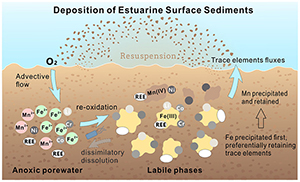
 | Labile iron associated trace metals and REEs in estuarine surface sediments Abstract: Estuarine surface sediments experience frequent redox oscillations due to dynamic depositional environments, potentially altering key element cycles at the sediment-water interface. To examine the associations of elements in the most redox sensitive fractions, we applied flow through time-resolved analysis (FT-TRA) and batch dissolution dynamics to surface sediments collected from the Changjiang Estuary with diluted HNO3. Our results revealed strong correlations in the release patterns of Fe with REEs, Cr, Co, and Li, as well as Mn with Ni. Additionally, light REEs (LREEs) showed enrichment in labile Fe oxyhydroxides, such as ferrihydrite, likely due to their high adsorption affinity for LREEs. Labile Fe plays a dominant role in bonding and fractionating trace elements in estuarine surface sediments, owing to its abundance and rapid reoxidation and coprecipitation. We propose that trace elements associated with labile Fe have high mobility and could be pumped out under dynamic depositional environments and the coupled redox oscillation. Fe served as the main switch of this “redox pump”, regulating the net benthic fluxes and consequently the terrestrial inputs of trace elements to the marginal seas. |
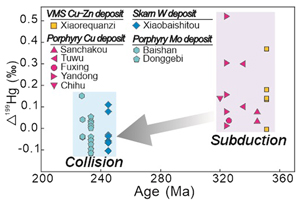 | Hg isotopes constrain metallogenic effects of the Wilson Cycle of the Paleo-Asian Ocean Abstract: The Central Asian Orogenic Belt (CAOB) hosts a variety of hydrothermal mineralised systems that formed during the opening, development and closure of the Paleo-Asian Ocean. Mercury is an important ore-forming metal in hydrothermal systems. Mercury photoreactions on the surface of Earth produce negative and positive Δ199Hg signals in terrestrial and marine sediments, respectively. Here, we observe positive Δ199Hg values in 345 to 320 Ma porphyry Cu deposits (+0.15 ± 0.15 ‰, s.d.), and a 355 Ma volcanogenic massive sulfide Cu–Zn deposit (+0.16 ± 0.13 ‰, s.d.) in the CAOB, which reflect the recycling of marine sediments during oceanic subduction and circulation of seawater in an extensional tectonic regime, respectively. In contrast, we observe negative Δ199Hg values in 232 to 227 Ma porphyry Mo deposits (−0.01 ± 0.07 ‰, s.d.) and a 245 Ma skarn W deposit (−0.02 ± 0.08 ‰, s.d.), which reflect the mixing of recycled Hg from marine and terrestrial sediments during continental collision. This study is useful in understanding the metallogenic effects of the Wilson Cycle and highlights that plate tectonics can cause intensive mobilisation, migration and mineralisation of Hg from subducted oceanic and continental crust to form Hg-bearing hydrothermal systems in long lived accretionary orogens. |
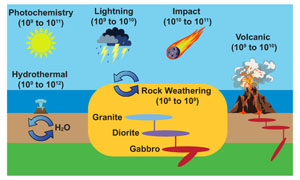 | Igneous rocks as a viable source of fixed nitrogen to the prebiotic world Abstract: The origin and early evolution of life on Earth and other habitable worlds requires constant supply of ammonic nitrogen (N). Previously proposed abiotic ammonium sources rely on sporadic and heterogeneously distributed high energy processes, such as lightning, subaerial volcanic degassing, or deep sea hydrothermal vents to generate bioavailable nitrogen from atmospheric N2 gas. Here we explore weathering of ammonium contained in felsic igneous rocks as an alternative source. We find that this process could have supplied 108–109 mol yr−1 of bioavailable N to surface environments in the early Archean, leading to dissolved concentrations of 0.023 ± 0.017 μM in freshwater and 0.01–0.1 μM in seawater. In terrestrial settings, evaporation paired with elevated N supplies from locally enriched felsic bedrock may have led to concentrations approaching 1 μM. Rock weathering would thus have constituted a smaller flux than the sum of all proposed high energy sources of fixed N, but with the major benefit that it was reliably present, especially in terrestrial settings. Weathering of differentiated igneous rocks should thus be considered in models of the emergence of life on Earth and beyond. |
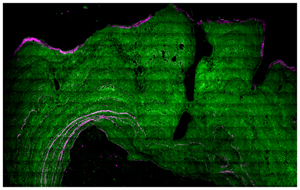 | Origins of the pervasive luminescence in modern stromatolites Abstract: Stromatolites are emblematic geobiological objects in the search for signatures of life. Their biogenicity has usually been assessed based on their macroscopic morphology, texture and/or the presence of microfossils. Surprisingly, ancient stromatolites, as well as the lithified portion of modern stromatolites, contain limited amounts of organics, although they are originally formed by biofilms. This raises intriguing questions about the fate of organics during lithification of microbial communities. Here, we analysed modern stromatolites from a coastal pond in Western Sardinia with confocal laser scanning microscopy (CLSM). We evidenced pervasive fluorescence in stromatolites and distinct spectral signals tentatively attributed to preserved chlorophyll/phycocyanin pigments, providing a direct link to the photosynthetic activities of microbial communities. Additionally, some signals were indicative of various stages of chlorophyll/phycocyanin degradation, producing a non-specific green autofluorescence (GAF), with a degradation advance varying with laminations. This calls for a wider application of CLSM to track this pervasive carbon reservoir in ageing stromatolites and possibly find an additional indication of their biological origin. |
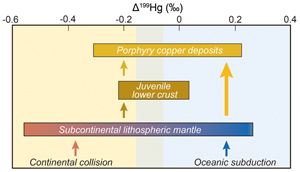 | Large Cu endowment in the Tibetan Plateau as a result of dual stage mantle fertilisation Abstract: The Himalayan-Tibetan orogenic belt hosts numerous world class porphyry copper deposits (PCDs), whose metal sources are controversial. Mercury isotopes display mass independent fractionation during photoreactions, producing positive Δ199Hg in marine sediments and negative Δ199Hg in terrestrial sediments. Here, we observe non-zero Δ199Hg (−0.29 to +0.21 ‰) in PCDs from the Himalayan-Tibetan orogenic belt. These values do not support the sole contribution of Hg from juvenile lower crustal rocks, which contain terrestrially derived Hg and display negative Δ199Hg (−0.20 to +0.01 ‰). The subcontinental lithospheric mantle (SCLM) with highly variable Δ199Hg (−0.54 to +0.25 ‰) can be another Hg source for PCDs. The positive and negative Δ199Hg values observed in PCDs and the SCLM suggest the contribution of Hg from both marine and terrestrial sediments. As the Himalayan-Tibetan orogenic belt underwent Neo-Tethys oceanic subduction followed by Indian-Eurasia continental collision, dual stage fertilisation of the SCLM via oceanic subduction and continental collision likely played an essential role in the generation of metal- and volatile-rich magmas and the associated large number of PCDs. This study offers key insights into the metal source of PCDs in the Himalayan-Tibetan orogenic belt. |
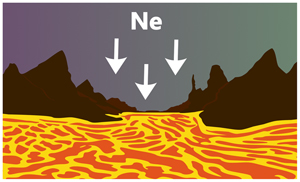 | Solar neon dissolution into an ultramafic magma ocean Abstract: The solar-like neon isotopic signature of the mantle suggests the presence of a primitive reservoir. Its origin remains a puzzle, though the literature suggests that a primordial H2 and He-rich atmosphere captured from the accretion disk was dissolved into a magma ocean. Our study investigates how much neon can be incorporated into the magma ocean based on the basal pressure of such an atmosphere and the neon solubility in mafic to ultramafic melts (49–34 wt. % SiO2 and 9–21 wt. % MgO). The neon solubility range obtained (3.4 × 10⁻⁴ to 6.5 × 10⁻⁵ cm3 STP g−1 bar−1) cannot match the primitive mantle theoretical neon content in a slow accretion scenario, demanding either fast accretion or alternative models for neon origin on Earth. Considering the planetary embryo mass required to accumulate enough neon (>0.8 times the mass of the Earth), the hypothesis of partial dissolution of the atmosphere into the magma ocean remains difficult to consider. |
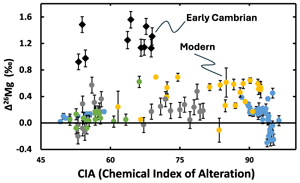 | High δ26Mg in an early Cambrian palaeosol reveals a terrestrial clay mineral factory Abstract: The Mg isotopic signature of a palaeosol developed through the Great Unconformity has been analysed to elucidate the silicate weathering conditions on the Wyoming Craton during the early and middle Cambrian. The bulk saprolite shows substantially increased δ26Mg signatures, ranging from −0.32 ± 0.09 ‰ in the pristine granitic parent to a maximum of +1.24 ± 0.09 ‰ in the saprolite, which are significantly heavier in comparison to the upper continental crust and all modern granitic soils reported in literature. Our results suggest that formation of clay minerals in the saprolite during intensive chemical weathering served as the main control on the δ26Mg isotopic composition. The high δ26Mg signature in the lower saprolite was likely caused by the preferential scavenging of heavy Mg into clay minerals from the contemporaneous soil solution and palaeo-groundwater. Our results indicate that Mg isotopes may serve as a useful tool for tracking clay production in deep time and serve to direct further studies on well preserved palaeosols for more comprehensive understanding of the Mg isotope weathering proxy in palaeo-weathering systems. |
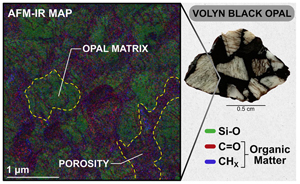 | Preservation of biosignatures in opal probed by infrared nanospectroscopy Abstract: Opal (SiO2·nH2O) is a common alteration mineral formed at the subsurface of planets that have experienced liquid water. Occasionally, opals found on Earth exhibit no discernible trace of biological remnants, but display discrete infrared signature of organic matter (OM), possibly originating from life (i.e. biosignature). This may suggest another type of interaction between OM and abiotic opal, distinct from silica fossilisation. To address this, we investigated two samples using μFTIR and AFM-IR: 35 Myr pink opal from Quincy, France, and 550–1700 Myr black opal from Volyn, Ukraine. The FTIR results reveal characteristic stretching vibration of aliphatic (CH2 and CH3) in the 2800–3000 cm−1 range in both opals. The AFM-IR spectra highlight organic signatures at 1450 cm−1 (CHx), 1620 cm−1 (C=C of aromatics) and 1720 cm−1 (C=O of carbonyls). Moreover, the micron-scale IR maps, acquired by AFM-IR, reveal that the organics are clustered and located in the microporosity. Given these findings, we propose a new hypothesis regarding the occurrence of OM in opal which we attribute to a two-stage entrapment mechanism during opal formation. |
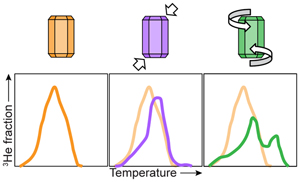 | Deformation modulates helium diffusion behaviour in apatite Abstract: Utilising the apatite (U-Th)/He thermochronometer to infer the thermal histories of geologic materials requires understanding the factors that influence helium diffusion kinetics. Here, we demonstrate that deformation in apatite modulates helium diffusion behaviour. We deformed single crystal Durango apatite under compression and torsion, used electron microscopy to characterise the deformation, and measured the evolution of 3He and 4He released during stepwise heating experiments on proton-irradiated fragments of the deformed crystals. Fragments deformed under compression contained distributed dislocations and resulted in mostly unimodal helium release comparable to undeformed, unannealed Durango apatite, while fragments deformed to higher stress under torsion contain a higher dislocation density, developed subgrain boundaries defined by dislocation arrays, and exhibited multimodal helium release, comparable to results from continuous ramped heating analysis of some natural apatite samples. We conclude that deformation-induced dislocations can modulate helium diffusion behaviour by impeding helium diffusion and functioning as diffusion sinks, and are likely an important source of (U-Th)/He date overdispersion in natural samples. |
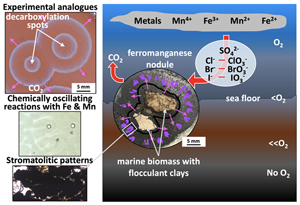 | Abiotic chemically oscillating reactions make patterns in deep–sea ferromanganese nodules and crusts Abstract: Ferromanganese deposits in deep–sea sediments, including both ferromanganese nodules (FMN) and ferromanganese crusts (FMC) are mineralised spheroids of metalliferous oxides that have been attributed to hydrogenetic and diagenetic processes. While ferromanganese deposits are volumetrically dominated by stromatolitic patterns, these have been left unexplained by specific processes. Here, we show that deep–sea FMN and FMC represent mineralised fractal objects, spanning five orders of magnitude in size, and they have self–similar patterns of circular concentricity, radial alignment, spheroidal twins, compositional gradients and stromatolitic–type arborescences. We also show that the same self–similar patterns are produced by abiotic chemically oscillating reactions (COR) performed with different carboxylic acids and iron and manganese compounds with out–of–equilibrium oxidation states. Compositionally, dendritic arborescences and stromatolitic columns in ferromanganese deposits consist of manganese oxides and organic matter (OM) with some directly occurring onto calcitic forams. Spectra show that OM in stromatolitic columns contains slightly fewer carboxyl groups and more C=C bonds compared to the more functionalised OM in the intercolumnar space. The new observations point to a major role for pattern–forming COR during the abiotic decomposition of biomass, which is how patterns in FMN and FMC are likely produced. |
<< Previous issueNext issue >>