



Hg isotopes constrain metallogenic effects of the Wilson Cycle of the Paleo-Asian Ocean
Affiliations | Corresponding Author | Cite as | Funding information
Published by the European Association of Geochemistry
under Creative Commons License CC BY-NC-ND 4.0
Keywords: Mercury isotopes, Wilson Cycles, the Central Asian Orogenic Belt hydrothermal systems, plate subduction


- Share this article


-
Article views:2,059Cumulative count of HTML views and PDF downloads.
- Download Citation
- Rights & Permissions

top
Abstract
Figures and Tables
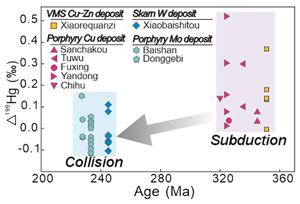
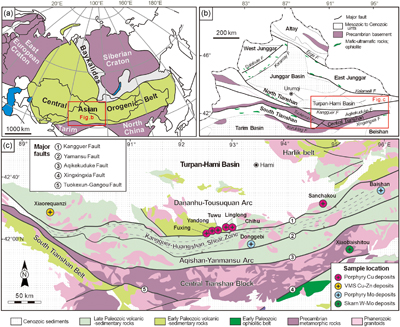 Figure 1 (a) Schematic map illustrating the precise location of the CAOB and the adjacent cratons (after Şengör et al., 1993). (b) Geological map showing the emplacement of tectonic sections in the southern area of the CAOB (after Chen et al., 2012). (c) Geological map exhibiting the arrangement of ore deposits in the Eastern Tianshan (after Wang et al., 2006; Deng et al., 2016). |  Figure 2 Binary diagrams displaying the variations in (a) Δ199Hg–Δ201Hg and (b) Δ199Hg–Age (Ma) of the analysed ore deposits in the Eastern Tianshan. The area of marine sediments is delineated by Yin et al. (2015) and Meng et al. (2019), terrestrial sediments are characterised by Blum et al. (2014) and references therein, and subduction-related deposits are detailed by Deng et al. (2021). | 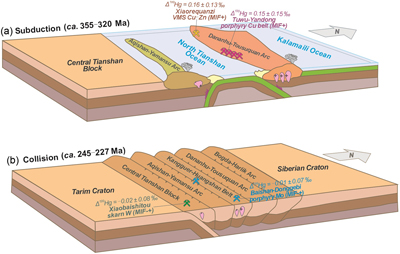 Figure 3 Schematic diagram illustrating the tectonic evolution of the Eastern Tianshan. (a) In the Carboniferous, the double-sided subduction of the NTO plate resulted in the formation of the Dananhu-Tousuquan Arc and Aqishan-Yamansu Arc, during which porphyry Cu deposits and volcanogenic massive sulfide Cu–Zn deposits were generated. (b) During the Triassic, the collision between the Tarim Craton and the Siberian Craton led to the formation of porphyry Mo deposits and skarn-type W deposits. | 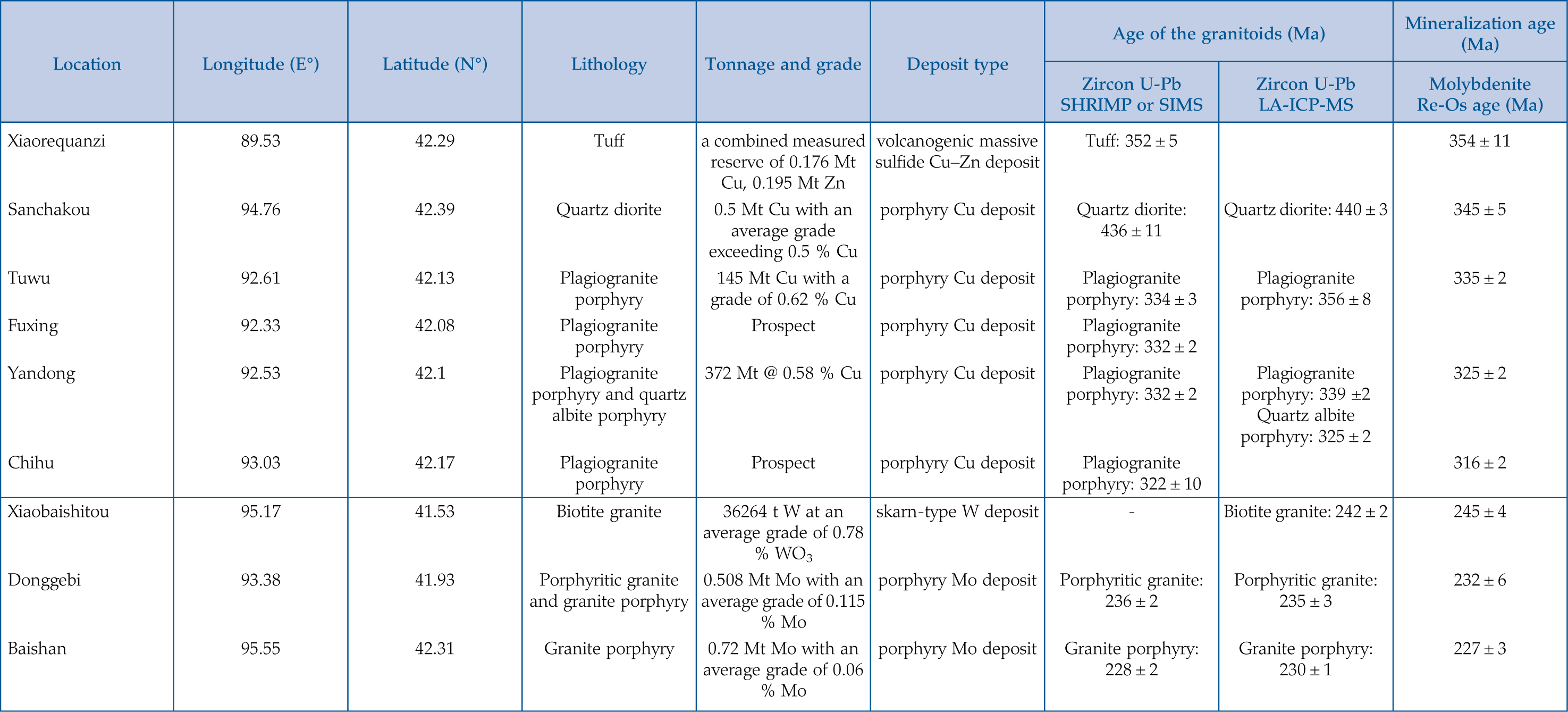 Table 1 Description of the ore deposits studied in the Eastern Tianshan. |
| Figure 1 | Figure 2 | Figure 3 | Table 1 |
top
Introduction
The Central Asian Orogenic Belt (CAOB), known as the world’s largest Phanerozoic continental accretionary orogen (Şengör et al., 1993
Şengör, A.M.C., Natal’in, B.A., Burtman, V.S. (1993) Evolution of the Altaid tectonic collage and Palaeozoic crustal growth in Eurasia. Nature 364, 299–307. https://doi.org/10.1038/364299a0.
), hosts a variety of hydrothermal mineralised systems, including porphyry Cu deposits, volcanogenic massive sulfide Cu–Zn deposits, porphyry Mo deposits, and skarn W deposits (Pirajno et al., 2011Pirajno, F., Seltmann, R., Yang, Y.Q. (2011) A review of mineral systems and associated tectonic settings of northern Xinjiang, NW China. Geoscience Frontiers 2, 157–185. https://doi.org/10.1016/j.gsf.2011.03.006.
). These hydrothermal systems formed in response to the Wilson Cycle (i.e. opening, development and closure) of the Paleo-Asian Ocean. In the early to middle stages of the Wilson Cycle, Paleo-Asian Ocean subduction and associated accretionary orogeny led to the occurrence of porphyry Cu deposits and volcanogenic massive sulfide Cu–Zn deposits between 355 to 320 Ma in the Eastern Tianshan segment of the CAOB (Mao et al., 2020Mao, Q., Wang, J., Yu, M., Ao, S., Deng, X., Lü, X., Li, Y. (2020) Re-Os and U-Pb geochronology for the Xiaorequanzi VMS deposit in the Eastern Tianshan, NW China: Constraints on the timing of mineralization and stratigraphy. Ore Geology Reviews 122, 103473. https://doi.org/10.1016/j.oregeorev.2020.103473.
; Wang et al., 2021Wang, Y.H., Zhang, F.F., Xue, C.J., Liu, J.J., Zhang, Z.C., Sun, M. (2021) Geology and Genesis of the Tuwu Porphyry Cu Deposit, Xinjiang, Northwest China. Economic Geology 116, 471–500. https://doi.org/10.5382/econgeo.4763.
). In the late stage of the Wilson Cycle, continental collision following closure of the Paleo-Asian Ocean led to the formation of porphyry Mo deposits and skarn W deposits between 245 and 227 Ma in the Eastern Tianshan segment of the CAOB (Deng et al., 2017Deng, X.H., Chen, Y.J., Santosh, M., Wang, J.B., Li, C., Yue, S.W., Zheng, Z., Chen, H.J., Tang, H.S., Dong, L.H., Qu, X. (2017) U–Pb zircon, Re–Os molybdenite geochronology and Rb–Sr geochemistry from the Xiaobaishitou W (–Mo) deposit: Implications for Triassic tectonic setting in eastern Tianshan, NW China. Ore Geology Reviews 80, 332–351. https://doi.org/10.1016/j.oregeorev.2016.05.013.
; Wu et al., 2017Wu, Y.S., Chen, Y.J., Zhou, K.F. (2017) Mo deposits in Northwest China: Geology, geochemistry, geochronology and tectonic setting. Ore Geology Reviews 81, 641–671. https://doi.org/10.1016/j.oregeorev.2016.07.010.
). The diverse hydrothermal systems in the CAOB reflect the metallogenic effects of the Wilson Cycle.Mercury (Hg) is an important ore-forming metal in hydrothermal systems. Hg isotopes display unique mass-dependent fractionation (MDF, δ202Hg) and mass-independent fractionation (MIF, Δ199Hg) (Blum and Berquist, 2007
Blum, J.D., Bergquist, B.A. (2007) Reporting of variations in the natural isotopic composition of mercury. Analytical and Bioanalytical Chemistry 388, 353–359. https://doi.org/10.1007/s00216-007-1236-9.
). MDF of Hg isotopes can occur during a large number of geochemical processes (e.g., Blum et al., 2014Blum, J.D., Sherman, L.S., Johnson, M.W. (2014) Mercury isotopes in Earth and environmental sciences. Annual Review of Earth and Planetary Sciences 42, 249–269. https://doi.org/10.1146/annurev-earth-050212-124107.
). However, MIF of Hg isotopes is predominantly associated with photoreactions in the land–ocean–atmosphere systems (Blum and Berquist, 2007Blum, J.D., Bergquist, B.A. (2007) Reporting of variations in the natural isotopic composition of mercury. Analytical and Bioanalytical Chemistry 388, 353–359. https://doi.org/10.1007/s00216-007-1236-9.
). Hg(II) photoreduction has resulted in positive Δ199Hg values in marine sediments and negative Δ199Hg values in terrestrial sediments (Blum et al., 2014Blum, J.D., Sherman, L.S., Johnson, M.W. (2014) Mercury isotopes in Earth and environmental sciences. Annual Review of Earth and Planetary Sciences 42, 249–269. https://doi.org/10.1146/annurev-earth-050212-124107.
). The primitive mantle displays near zero Δ199Hg values (Moynier et al., 2021Moynier, F., Jackson, M.G., Zhang, K., Cai, H.M., Halldórsson, S.A., Pik, R., Day, J.M.D., Chen, J.B. (2021) The mercury isotopic composition of Earth’s mantle and the use of mass independently fractionated Hg to test for recycled crust. Geophysical Research Letters 48, e2021GL094301. https://doi.org/10.1029/2021GL094301.
). Considering that mineralogical and petrological processes cannot generate MIF of Hg isotopes, the unique Δ199Hg signals across marine, terrestrial and mantle reservoirs allow for identification of the source of Hg and, by extension, other metals in hydrothermal systems (Yin et al., 2022Yin, R.S., Chen, D., Pan, X., Deng, C.Z., Chen, L.M., Song, X.Y., Yu, S.Y., Zhu, C.W., Wei, X., Xu, Y., Feng, X.B., Blum, J.D., Lehmann, B. (2022) Mantle Hg isotopic heterogeneity and evidence of oceanic Hg recycling into the mantle. Nature Communications 13, 948. https://doi.org/10.1038/s41467-022-28577-1.
, 2024Yin, R.S., Wang, X., Sun, R., Gao, L., Deng, C., Tian, Z., Luo, A., Lehmann, B. (2024) Linking the mercury biogeochemical cycle to the deep mercury cycle: A mercury isotope perspective. Chemical Geology 654, 122063. https://doi.org/10.1016/j.chemgeo.2024.122063.
). Non-zero Δ199Hg values have been detected in hydrothermal systems across diverse environments, demonstrating the recycling of terrestrial- or marine-derived Hg through oceanic subduction and continental collision (e.g., Yin et al., 2024Yin, R.S., Wang, X., Sun, R., Gao, L., Deng, C., Tian, Z., Luo, A., Lehmann, B. (2024) Linking the mercury biogeochemical cycle to the deep mercury cycle: A mercury isotope perspective. Chemical Geology 654, 122063. https://doi.org/10.1016/j.chemgeo.2024.122063.
).This study presents the Hg isotope compositions of five porphyry Cu deposits, two porphyry Mo deposits, one volcanogenic massive sulfide Cu–Zn deposit, and one skarn W deposit in the Eastern Tianshan segment of the CAOB to clarify the metallogenic impacts of the Wilson Cycle. We demonstrate a large variation of Δ199Hg in these deposits (−0.11 to +0.51 ‰), which reflects the recycling of marine- and terrestrial-derived Hg related to oceanic subduction and continental collision, respectively. During the Wilson Cycle, plate subduction contributed to mobilisation of Hg from subducted oceanic and continental crusts to form various Hg-bearing hydrothermal systems in the accretionary orogen.
top
Geological Background
The CAOB is situated between the Siberian Craton to the north, Tarim and North China cratons to the south, and the East European Craton to the west (Fig. 1a; Jahn, 2004
Jahn, B.M. (2004) The Central Asian Orogenic Belt and growth of the continental crust in the Phanerozoic. In: Malpas, J., Fletcher, C.J.N., Ali, J.R., Aitchison, J.C. (Eds.) Aspects of the Tectonic Evolution of China, Geological Society of London Special Publication 226, 73–100. https://doi.org/10.1144/GSL.SP.2004.226.01.05.
). The Eastern Tianshan metallogenic belt along the southern CAOB comprises the Harlik Belt, the Jueluotage Belt and the Central Tianshan Block, which are bound by the Kalamaili and Aqikekuduke faults (Fig. 1b; Qin et al., 2002Qin, K.Z., Fang, T.H., Wang, S.L. (2002) Plate tectonics division, evolution and metallogenic settings in eastern Tianshan mountains, NW China. Xinjiang Geology 20, 302–308. (in Chinese with English abstract)
; Chen et al., 2012Chen, Y.J., Pirajno, F., Wu, G., Qi, J.P., Xiong, X.L. (2012) Epithermal deposits in North Xinjiang, NW China. International Journal of Earth Sciences 101, 889–917. https://doi.org/10.1007/s00531-011-0689-4.
). From north to south, the Jueluotage Belt is divided into the Dananhu-Tousuquan Arc, the Kangguer-Huangshan Shear Zone and the Aqishan-Yamansu Arc, by the Kangguer and Yamansu faults (Fig. 1c).Figure 1 (a) Schematic map illustrating the precise location of the CAOB and the adjacent cratons (after Şengör et al., 1993
Şengör, A.M.C., Natal’in, B.A., Burtman, V.S. (1993) Evolution of the Altaid tectonic collage and Palaeozoic crustal growth in Eurasia. Nature 364, 299–307. https://doi.org/10.1038/364299a0.
). (b) Geological map showing the emplacement of tectonic sections in the southern area of the CAOB (after Chen et al., 2012Chen, Y.J., Pirajno, F., Wu, G., Qi, J.P., Xiong, X.L. (2012) Epithermal deposits in North Xinjiang, NW China. International Journal of Earth Sciences 101, 889–917. https://doi.org/10.1007/s00531-011-0689-4.
). (c) Geological map exhibiting the arrangement of ore deposits in the Eastern Tianshan (after Wang et al., 2006Wang, J.B., Wang, Y.W., He, Z.H. (2006) Ore deposits as a guide to the tectonic evolution in the east Tianshan mountains, NW China. Geology in China 33, 461–469.
; Deng et al., 2016Deng, X.H., Wang, J.B., Pirajno, F., Wang, Y.W., Li, Y.C., Li, C., Zhou, L.M., Chen, Y.J. (2016) Re–Os dating of chalcopyrite from selected mineral deposits in the Kalatag district in the eastern Tianshan Orogen, China. Ore Geology Reviews 77, 72–81. https://doi.org/10.1016/j.oregeorev.2016.01.014.
).In the Carboniferous, double-sided subduction of the North Tianshan Ocean (NTO) formed the Dananhu-Tousuquan Arc and Aqishan-Yamansu Arc (Wang et al., 2015
Wang, Y.H., Xue, C.J., Liu, J.J., Wang, J.P., Yang, J.T., Zhang, F.F., Zhao, Z.N., Zhao, Y.J., Liu, B. (2015) Early Carboniferous adakitic rocks in the area of the Tuwu deposit, eastern Tianshan, NW China: Slab melting and implications for porphyry copper mineralization. Journal of Asian Earth Sciences 103, 332–349. https://doi.org/10.1016/j.jseaes.2014.09.032.
). As shown in Figure 1c, the Dananhu-Tousuquan Arc contains numerous 355 to 320 Ma porphyry Cu deposits (e.g., Tuwu, Yandong, Sanchakou, Fuxing and Chihu; Wang et al., 2021Wang, Y.H., Zhang, F.F., Xue, C.J., Liu, J.J., Zhang, Z.C., Sun, M. (2021) Geology and Genesis of the Tuwu Porphyry Cu Deposit, Xinjiang, Northwest China. Economic Geology 116, 471–500. https://doi.org/10.5382/econgeo.4763.
; He et al., 2023He, X.H., Zhang, J., Deng, X.H., Long, L.L., Chen, L., Yin, Y.J., Zhang, Z.C. (2023) Metallogeny and tectonic setting of Paleozoic porphyry copper deposits in the East Tianshan. Acta Petrologica Sinica 39, 293–316. https://doi.org/10.18654/1000-0569/2023.02.02.
) and ∼355 Ma volcanogenic massive sulfide Cu–Zn deposits (e.g., Xiaorequanzi; He et al., 2020He, X.H., Deng, X.H., Bagas, L., Zhang, J., Li, C., Zhang, W.D. (2020) Geology, geochronology, and fluid inclusion studies of the Xiaorequanzi volcanogenic massive sulphide Cu–Zn deposit in the East Tianshan Terrane, China. Canadian Journal of Earth Sciences 57, 1392–1410. https://doi.org/10.1139/cjes-2019-0067.
; Mao et al., 2020Mao, Q., Wang, J., Yu, M., Ao, S., Deng, X., Lü, X., Li, Y. (2020) Re-Os and U-Pb geochronology for the Xiaorequanzi VMS deposit in the Eastern Tianshan, NW China: Constraints on the timing of mineralization and stratigraphy. Ore Geology Reviews 122, 103473. https://doi.org/10.1016/j.oregeorev.2020.103473.
). The Aqishan-Yamansu Arc includes numerous 330–300 Ma volcanic-hosted Fe deposits (e.g., Yamansu; Huang et al., 2018Huang, X.W., Zhou, M.F., Beaudoin, G., Gao, J.F., Qi, L., Lyu, C. (2018) Origin of the volcanic-hosted Yamansu Fe deposit, Eastern Tianshan, NW China: constraints from pyrite Re-Os isotopes, stable isotopes, and in situ magnetite trace elements. Mineralium Deposita 53, 1039–1060. https://doi.org/10.1007/s00126-018-0794-4.
). The NTO closed during the Triassic, resulting in the collision of the Dananhu-Tousuquan Arc and Aqishan-Yamansu Arc (Xiao et al., 2004Xiao, W.J., Zhang, L.C., Qin, K.Z., Sun, S., Li, J.L. (2004) Paleozoic accretionary and collisional tectonics of the eastern Tianshan (China): Implications for the continental growth of central Asia. American Journal of Science 304, 370–395. https://doi.org/10.2475/ajs.304.4.370.
; Mao et al., 2022Mao, Q., Ao, S., Windley, B.F., Zhang, Z., Sang, M., Tan, Z., Wang, H., Li, R., Xiao, W., Pan, Z. (2022) Middle–Late Triassic southward-younging granitoids: Tectonic transition from subduction to collision in the Eastern Tianshan–Beishan Orogen, NW China. GSA Bulletin 134, 2206–2224. https://doi.org/10.1130/B36172.1.
). This collision formed the Kangguer-Huangshan Shear Zone and numerous 232 to 227 Ma porphyry Mo deposits (e.g., Baishan and Donggebi; Wu et al., 2017Wu, Y.S., Chen, Y.J., Zhou, K.F. (2017) Mo deposits in Northwest China: Geology, geochemistry, geochronology and tectonic setting. Ore Geology Reviews 81, 641–671. https://doi.org/10.1016/j.oregeorev.2016.07.010.
). The main deposit in the Central Tianshan Block is the 245 Ma Xiaobaishitou skarn-type W deposit (Deng et al., 2017Deng, X.H., Chen, Y.J., Santosh, M., Wang, J.B., Li, C., Yue, S.W., Zheng, Z., Chen, H.J., Tang, H.S., Dong, L.H., Qu, X. (2017) U–Pb zircon, Re–Os molybdenite geochronology and Rb–Sr geochemistry from the Xiaobaishitou W (–Mo) deposit: Implications for Triassic tectonic setting in eastern Tianshan, NW China. Ore Geology Reviews 80, 332–351. https://doi.org/10.1016/j.oregeorev.2016.05.013.
).top
Methods
In this work, 14 granite rocks and 23 sulfide ores were collected from 5 porphyry Cu deposits (Tuwu, Yandong, Sanchakou, Fuxing and Chihu), 1 volcanogenic massive sulfide Cu–Zn deposit (Xiaorequanzi), 2 porphyry Mo deposits (Baishan and Donggebi), and 1 skarn-type W deposit (Xiaobaishitou) in the Eastern Tianshan. The geological characteristics of these ore deposits are summarised in Table 1. The comprehensive details of the samples are provided in Supplementary Information Table S-1. Analyses of Hg concentration and isotopic composition of the samples were done at the Institute of Geochemistry, Chinese Academy of Sciences. Comprehensive analytical methodologies are provided in Supplementary Information Text S-1. Hg-MDF is denoted in δ202Hg in parts per thousand (‰), referring to the NIST-3133 Hg standard, which is examined prior and subsequent to each sample:
Eq. 1

Hg-MIF is expressed as Δ, expressing the discrepancies between the observed and anticipated δ×××Hg values, where xxx = 199, 200 or 201, measured in per mil (‰):
Eq. 2

β is 0.252 for 199Hg, 0.5024 for 200Hg and 0.752 for 201Hg (Blum and Bergquist, 2007
Blum, J.D., Bergquist, B.A. (2007) Reporting of variations in the natural isotopic composition of mercury. Analytical and Bioanalytical Chemistry 388, 353–359. https://doi.org/10.1007/s00216-007-1236-9.
).Table 1 Description of the ore deposits studied in the Eastern Tianshan.
| Location | Longitude (E°) | Latitude (N°) | Lithology | Tonnage and grade | Deposit type | Age of the granitoids (Ma) | Mineralisation age (Ma) | |
| Zircon U-Pb SHRIMP or SIMS | Zircon U-Pb LA-ICP-MS | Molybdenite Re-Os age (Ma) | ||||||
| Xiaorequanzi | 89.53 | 42.29 | Tuff | a combined measured reserve of 0.176 Mt Cu, 0.195 Mt Zn | volcanogenic massive sulfide Cu–Zn deposit | Tuff: 352 ± 5 | 354 ± 11 | |
| Sanchakou | 94.76 | 42.39 | Quartz diorite | 0.5 Mt Cu with an average grade exceeding 0.5 % Cu | porphyry Cu deposit | Quartz diorite: 436 ± 11 | Quartz diorite: 440 ± 3 | 345 ± 5 |
| Tuwu | 92.61 | 42.13 | Plagiogranite porphyry | 145 Mt Cu with a grade of 0.62 % Cu | porphyry Cu deposit | Plagiogranite porphyry: 334 ± 3 | Plagiogranite porphyry: 356 ± 8 | 335 ± 2 |
| Fuxing | 92.33 | 42.08 | Plagiogranite porphyry | Prospect | porphyry Cu deposit | Plagiogranite porphyry: 332 ± 2 | ||
| Yandong | 92.53 | 42.1 | Plagiogranite porphyry and quartz albite porphyry | 372 Mt @ 0.58 % Cu | porphyry Cu deposit | Plagiogranite porphyry: 332 ± 2 | Plagiogranite porphyry: 339 ±2 Quartz albite porphyry: 325 ± 2 | 325 ± 2 |
| Chihu | 93.03 | 42.17 | Plagiogranite porphyry | Prospect | porphyry Cu deposit | Plagiogranite porphyry: 322 ± 10 | 316 ± 2 | |
| Xiaobaishitou | 95.17 | 41.53 | Biotite granite | 36264 t W at an average grade of 0.78 % WO3 | skarn-type W deposit | - | Biotite granite: 242 ± 2 | 245 ± 4 |
| Donggebi | 93.38 | 41.93 | Porphyritic granite and granite porphyry | 0.508 Mt Mo with an average grade of 0.115 % Mo | porphyry Mo deposit | Porphyritic granite: 236 ± 2 | Porphyritic granite: 235 ± 3 | 232 ± 6 |
| Baishan | 95.55 | 42.31 | Granite porphyry | 0.72 Mt Mo with an average grade of 0.06 % Mo | porphyry Mo deposit | Granite porphyry: 228 ± 2 | Granite porphyry: 230 ± 1 | 227 ± 3 |
*Information for porphyry Cu deposits are from He et al. (2023)He, X.H., Zhang, J., Deng, X.H., Long, L.L., Chen, L., Yin, Y.J., Zhang, Z.C. (2023) Metallogeny and tectonic setting of Paleozoic porphyry copper deposits in the East Tianshan. Acta Petrologica Sinica 39, 293–316. https://doi.org/10.18654/1000-0569/2023.02.02. and references therein, for porphyry Mo deposits from Wu et al. (2017)Wu, Y.S., Chen, Y.J., Zhou, K.F. (2017) Mo deposits in Northwest China: Geology, geochemistry, geochronology and tectonic setting. Ore Geology Reviews 81, 641–671. https://doi.org/10.1016/j.oregeorev.2016.07.010. and references therein, for the skarn-type W deposit from Deng et al. (2017)Deng, X.H., Chen, Y.J., Santosh, M., Wang, J.B., Li, C., Yue, S.W., Zheng, Z., Chen, H.J., Tang, H.S., Dong, L.H., Qu, X. (2017) U–Pb zircon, Re–Os molybdenite geochronology and Rb–Sr geochemistry from the Xiaobaishitou W (–Mo) deposit: Implications for Triassic tectonic setting in eastern Tianshan, NW China. Ore Geology Reviews 80, 332–351. https://doi.org/10.1016/j.oregeorev.2016.05.013., and for the volcanogenic massive sulfide Cu–Zn deposit from He et al. (2020)He, X.H., Deng, X.H., Bagas, L., Zhang, J., Li, C., Zhang, W.D. (2020) Geology, geochronology, and fluid inclusion studies of the Xiaorequanzi volcanogenic massive sulphide Cu–Zn deposit in the East Tianshan Terrane, China. Canadian Journal of Earth Sciences 57, 1392–1410. https://doi.org/10.1139/cjes-2019-0067. and Mao et al. (2020)Mao, Q., Wang, J., Yu, M., Ao, S., Deng, X., Lü, X., Li, Y. (2020) Re-Os and U-Pb geochronology for the Xiaorequanzi VMS deposit in the Eastern Tianshan, NW China: Constraints on the timing of mineralization and stratigraphy. Ore Geology Reviews 122, 103473. https://doi.org/10.1016/j.oregeorev.2020.103473.
top
Results
The results of all samples are presented in Supplementary Information Table S-2. The Hg concentration varies largely among porphyry Cu deposits (granite porphyry: 4.90 to 27.9 ng/g; sulfides: 0.85 to 7860 ng/g), porphyry Mo deposits (porphyritic granite: 1.20 to 27.6 ng/g; sulfides: 38.3 to 143 ng/g), volcanogenic massive sulfide Cu–Zn deposit (sulfides: 315 to 8990 ng/g), and skarn-type W deposit (biotite granite: 4.30 to 33.9 ng/g; sulfides: 199 to 359 ng/g). The δ202Hg values vary significantly among all samples (−3.14 to +1.29 ‰), although there is no systematic difference among the different deposit types (porphyry Cu deposits: −0.56 ± 0.96 ‰; porphyry Mo deposits: −0.78 ± 0.87 ‰; volcanogenic massive sulfide Cu–Zn deposit: −1.25 ± 1.18 ‰; skarn-type W deposit: −0.70 ± 1.03 ‰; average ± 1σ). A positive association variation trend exists between Δ201Hg and Δ199Hg values (Fig. 2a), aligning with the patterns observed in the land–ocean–atmosphere systems (Blum et al., 2014
Blum, J.D., Sherman, L.S., Johnson, M.W. (2014) Mercury isotopes in Earth and environmental sciences. Annual Review of Earth and Planetary Sciences 42, 249–269. https://doi.org/10.1146/annurev-earth-050212-124107.
). Based on Δ199Hg values (−0.11 to +0.51 ‰), the samples can be categorised into two groups (Fig. 2b). The first group comprises porphyry Cu deposits and the volcanogenic massive sulfide Cu–Zn deposit, which exhibit positive Δ199Hg values (+0.15 ± 0.15 ‰ and +0.16 ± 0.13 ‰, respectively) that are within the range of marine sediments. The second group comprises porphyry Mo deposits and the skarn-type W deposit, which exhibit near zero Δ199Hg values (−0.01 ± 0.07 ‰ and −0.02 ± 0.08 ‰, respectively) that are intermediate to that of marine and terrestrial sediments.Figure 2 Binary diagrams displaying the variations in (a) Δ199Hg–Δ201Hg and (b) Δ199Hg–Age (Ma) of the analysed ore deposits in the Eastern Tianshan. The area of marine sediments is delineated by Yin et al. (2015)
Yin, R.S., Feng, X.B., Chen, B., Zhang, J., Wang, W., Li, X. (2015) Identifying the sources and processes of mercury in subtropical estuarine and ocean sediments using Hg isotopic composition. Environmental Science and Technology 49, 1347–1355. https://doi.org/10.1021/es504070y.
and Meng et al. (2019)Meng, M., Sun, R.Y., Liu, H.W., Yu, B., Yin, Y.G., Hu, L.G., Shi, J.B., Jiang, G.B. (2019) An integrated model for input and migration of mercury in Chinese coastal sediments. Environmental Science and Technology 53, 2460–2471. https://doi.org/10.1021/acs.est.8b06329.
, terrestrial sediments are characterised by Blum et al. (2014)Blum, J.D., Sherman, L.S., Johnson, M.W. (2014) Mercury isotopes in Earth and environmental sciences. Annual Review of Earth and Planetary Sciences 42, 249–269. https://doi.org/10.1146/annurev-earth-050212-124107.
and references therein, and subduction-related deposits are detailed by Deng et al. (2021)Deng, C.Z., Sun, G.Y., Rong, Y.M., Sun, R.Y., Sun, D.Y., Lehmann, B., Yin, R.S. (2021) Recycling of mercury from the atmosphere-ocean system into volcanic-arc–associated epithermal gold systems. Geology 49, 309–313. https://doi.org/10.1130/G48132.1.
.top
Discussion
Recycling of marine sediments and seawater contributed subduction-related hydrothermal systems. Because MIF of Hg isotopes is mainly related to photochemical processes and does not occur during hydrothermal processes (Yin et al., 2024
Yin, R.S., Wang, X., Sun, R., Gao, L., Deng, C., Tian, Z., Luo, A., Lehmann, B. (2024) Linking the mercury biogeochemical cycle to the deep mercury cycle: A mercury isotope perspective. Chemical Geology 654, 122063. https://doi.org/10.1016/j.chemgeo.2024.122063.
), we utilise Δ199Hg to analyse the origin of Hg and, by extension, other ore-forming metals in the investigated deposits. Sulfide samples from the studied porphyry Cu deposits and volcanogenic massive sulfide Cu–Zn deposit exhibit positive Δ199Hg values (Fig. 2a, b; Δ199Hg: +0.16 ‰ ± 0.14 ‰) that are similar to those of marine reservoirs (Fig. 2a; Blum et al., 2014Blum, J.D., Sherman, L.S., Johnson, M.W. (2014) Mercury isotopes in Earth and environmental sciences. Annual Review of Earth and Planetary Sciences 42, 249–269. https://doi.org/10.1146/annurev-earth-050212-124107.
). The positive Δ199Hg values of porphyry Cu deposits suggest that Hg originated from recycled marine materials. This is consistent with double-sided subduction of the NTO slab below the Dananhu-Tousuquan Arc and Aqishan-Yamansu Arc between 355 and 320 Ma (Fig. 3a; Jahn, 2004Jahn, B.M. (2004) The Central Asian Orogenic Belt and growth of the continental crust in the Phanerozoic. In: Malpas, J., Fletcher, C.J.N., Ali, J.R., Aitchison, J.C. (Eds.) Aspects of the Tectonic Evolution of China, Geological Society of London Special Publication 226, 73–100. https://doi.org/10.1144/GSL.SP.2004.226.01.05.
; Wang et al., 2015Wang, Y.H., Xue, C.J., Liu, J.J., Wang, J.P., Yang, J.T., Zhang, F.F., Zhao, Z.N., Zhao, Y.J., Liu, B. (2015) Early Carboniferous adakitic rocks in the area of the Tuwu deposit, eastern Tianshan, NW China: Slab melting and implications for porphyry copper mineralization. Journal of Asian Earth Sciences 103, 332–349. https://doi.org/10.1016/j.jseaes.2014.09.032.
). Analogous to this interpretation, volcanic arc-associated epithermal Au deposits formed in the circum-Pacific zone display mainly positive Δ199Hg values (−0.02 to +0.27 ‰) due to the recycling of marine Hg from the subducted oceanic slab (Deng et al., 2021Deng, C.Z., Sun, G.Y., Rong, Y.M., Sun, R.Y., Sun, D.Y., Lehmann, B., Yin, R.S. (2021) Recycling of mercury from the atmosphere-ocean system into volcanic-arc–associated epithermal gold systems. Geology 49, 309–313. https://doi.org/10.1130/G48132.1.
). The exsolution of fluids from descending oceanic plates has been shown to play a key role in generating porphyry Cu and epithermal Au deposits in volcanic arcs (Richards, 2003Richards, J.P. (2003) Tectono-magmatic precursors for porphyry Cu-(Mo-Au) deposit formation. Economic Geology 98, 1515–1533. https://doi.org/10.2113/gsecongeo.98.8.1515.
). The positive Δ199Hg values of marine sediments are likely to be inherited by these fluids released via slab dehydration (Deng et al., 2021Deng, C.Z., Sun, G.Y., Rong, Y.M., Sun, R.Y., Sun, D.Y., Lehmann, B., Yin, R.S. (2021) Recycling of mercury from the atmosphere-ocean system into volcanic-arc–associated epithermal gold systems. Geology 49, 309–313. https://doi.org/10.1130/G48132.1.
). The positive Δ199Hg values of volcanogenic massive sulfide deposits can be explained by seawater circulation in an extensional tectonic regime induced by asthenospheric heat, since seawater contains Hg with positive Δ199Hg values (Zhu et al., 2020Zhu, C., Tao, C., Yin, R., Liao, S., Yang, W., Liu, J., Barriga, F.J.A.S. (2020) Seawater versus mantle sources of mercury in sulfide-rich seafloor hydrothermal systems, Southwest Indian Ridge. Geochimica et Cosmochimica Acta 281, 91–101. https://doi.org/10.1016/j.gca.2020.05.008.
).Figure 3 Schematic diagram illustrating the tectonic evolution of the Eastern Tianshan. (a) In the Carboniferous, the double-sided subduction of the NTO plate resulted in the formation of the Dananhu-Tousuquan Arc and Aqishan-Yamansu Arc, during which porphyry Cu deposits and volcanogenic massive sulfide Cu–Zn deposits were generated. (b) During the Triassic, the collision between the Tarim Craton and the Siberian Craton led to the formation of porphyry Mo deposits and skarn-type W deposits.
Recycling of terrestrial sediments contributed to collision-related hydrothermal systems. The near zero Δ199Hg values in porphyry Mo deposits (−0.01 ± 0.07 ‰) and skarn-type W deposits (−0.02 ± 0.08 ‰) are intermediate to those of marine and terrestrial sediments (Fig. 2a). Terrestrial sediments are mainly characterised by negative Δ199Hg values, whereas marine sediments mainly display positive Δ199Hg values. The overall near zero Δ199Hg values of the porphyry Mo deposits and skarn-type W deposit, with a few positive outliers, suggest contributions of Hg from both recycled marine sediments and terrestrial sediments during their formation. This interpretation is consistent with the relatively high 87Sr/86Sri values (0.7060 to 0.7088) of ore-bearing rocks coeval with porphyry Mo deposits and skarn-type W deposits in the Eastern Tianshan, which imply that oceanic subduction fertilised the mantle lithosphere (Deng et al., 2017
Deng, X.H., Chen, Y.J., Santosh, M., Wang, J.B., Li, C., Yue, S.W., Zheng, Z., Chen, H.J., Tang, H.S., Dong, L.H., Qu, X. (2017) U–Pb zircon, Re–Os molybdenite geochronology and Rb–Sr geochemistry from the Xiaobaishitou W (–Mo) deposit: Implications for Triassic tectonic setting in eastern Tianshan, NW China. Ore Geology Reviews 80, 332–351. https://doi.org/10.1016/j.oregeorev.2016.05.013.
; Wu et al., 2017Wu, Y.S., Chen, Y.J., Zhou, K.F. (2017) Mo deposits in Northwest China: Geology, geochemistry, geochronology and tectonic setting. Ore Geology Reviews 81, 641–671. https://doi.org/10.1016/j.oregeorev.2016.07.010.
). Continental subduction during the collisional stage would not only have released hydrothermal fluids with negative Δ199Hg values, but also have caused partial melting and devolatilisation of metasomatised lithospheric mantle, releasing hydrothermal fluids with positive Δ199Hg values (Deng et al., 2022Deng, C.Z., Gou, J., Sun, D.Y., Sun, G.Y., Tian, Z.D., Lehmann, B., Moynier, F., Yin, R.S. (2022) Mercury isotopic composition of igneous rocks from an accretionary orogen: Implications for lithospheric recycling. Geology 50, 1001–1006. https://doi.org/10.1130/G50131.1.
). Mercury in these two types of fluids tends to mix during upwards transport, and precipitate in tectonic weak zones. The negative Δ199Hg values observed in the biotite granite of porphyry Mo deposits and skarn-type W deposits can be attributed to the closure of the NTO around ca. 245 Ma, and support the presence of continental arc magmatism in a collisional setting (Fig. 3b; Wu et al., 2017Wu, Y.S., Chen, Y.J., Zhou, K.F. (2017) Mo deposits in Northwest China: Geology, geochemistry, geochronology and tectonic setting. Ore Geology Reviews 81, 641–671. https://doi.org/10.1016/j.oregeorev.2016.07.010.
).Implications for the metallogenic effects of Wilson Cycles. The CAOB originated from long lived subduction, development and closure of the Paleo-Asian Ocean, during which the accretion of juvenile crust played a significant role in Phanerozoic continental growth (e.g., Jahn, 2004
Jahn, B.M. (2004) The Central Asian Orogenic Belt and growth of the continental crust in the Phanerozoic. In: Malpas, J., Fletcher, C.J.N., Ali, J.R., Aitchison, J.C. (Eds.) Aspects of the Tectonic Evolution of China, Geological Society of London Special Publication 226, 73–100. https://doi.org/10.1144/GSL.SP.2004.226.01.05.
; Xiao et al., 2004Xiao, W.J., Zhang, L.C., Qin, K.Z., Sun, S., Li, J.L. (2004) Paleozoic accretionary and collisional tectonics of the eastern Tianshan (China): Implications for the continental growth of central Asia. American Journal of Science 304, 370–395. https://doi.org/10.2475/ajs.304.4.370.
, 2018Xiao, W.J., Windley, B.F., Han, C., Liu, W., Wan, B., Zhang, J.E., Ao, S., Zhang, Z., Song, D. (2018) Late Paleozoic to early Triassic multiple roll-back and oroclinal bending of the Mongolia collage in Central Asia. Earth-Science Reviews 186, 94–128. https://doi.org/10.1016/j.earscirev.2017.09.020.
). The observation of positive Δ199Hg values in oceanic subduction-related hydrothermal systems (porphyry Cu deposits, volcanogenic massive sulfide Cu–Zn deposits), and near zero Δ199Hg values in continental collision-related hydrothermal systems (porphyry Mo deposits, skarn-type W deposits) suggest that Hg from both continental and oceanic crusts can be remobilised by magmatic–hydrothermal fluids and concentrated to form Hg-bearing hydrothermal deposits at convergent plate margins. As shown in Figure 3, mobilisation of Hg via dehydration of subducted oceanic and continental slabs not only releases Hg-bearing hydrothermal fluids, but also transfers substantial quantities of Hg into the overlying mantle wedge, resulting in non-zero Δ199Hg in the metasomatised lithospheric mantle. Partial melting and devolatilisation of the metasomatised lithospheric mantle, triggered by plate subduction, can also contribute metals for the generation of hydrothermal deposits in accretionary orogens.top
Conclusions
Based on the newly generated Hg isotope dataset for magmatic-hydrothermal deposits in the Eastern Tianshan, this work demonstrates that oceanic subduction and continental collision can drive large scale recycling of Hg from oceanic and continental reservoirs into various hydrothermal systems within long lived accretionary orogens. In oceanic subduction-related porphyry Cu and volcanogenic massive sulfide Cu–Zn hydrothermal systems, the consistently positive Δ199Hg values in sulfides indicate the dominant contribution of Hg from subducted marine sediments and circulated seawater, respectively. In continental collision-related hydrothermal systems (porphyry Mo deposits and skarn-type W deposits), the near zero Δ199Hg values in sulfides suggest the contribution of Hg from subducted terrestrial sediments and the oceanic subduction fertilised mantle lithosphere. Overall, this work provides key knowledge into crust–mantle cycling of Hg and the metallogenic effects of oceanic subduction and continental collision during Wilson Cycles.
top
Acknowledgements
The research was supported by the Natural Science Foundation of China (42222205, 42430804, 41872084), National Key Research and Development Program of China (2018YFC0604006), Xinjiang Key Research and Development Project (2023B03015), and the Third Xinjiang Scientific Expedition Program (2022xjkk1301).
Editor: Horst Marschall
top
References
Blum, J.D., Bergquist, B.A. (2007) Reporting of variations in the natural isotopic composition of mercury. Analytical and Bioanalytical Chemistry 388, 353–359. https://doi.org/10.1007/s00216-007-1236-9.
 Show in context
 Mercury (Hg) is an important ore-forming metal in hydrothermal systems. Hg isotopes display unique mass-dependent fractionation (MDF, δ202Hg) and mass-independent fractionation (MIF, Δ199Hg) (Blum and Berquist, 2007).
View in article
However, MIF of Hg isotopes is predominantly associated with photoreactions in the land–ocean–atmosphere systems (Blum and Berquist, 2007). Hg(II) photoreduction has resulted in positive Δ199Hg values in marine sediments and negative Δ199Hg values in terrestrial sediments (Blum et al., 2014).
View in article
Comprehensive analytical methodologies are provided in Supplementary Information Text S-1. Hg-MDF is denoted in δ202Hg in parts per thousand (‰), referring to the NIST-3133 Hg standard, which is examined prior and subsequent to each sample:
Eq. 1.
Hg-MIF is expressed as Δ, expressing the discrepancies between the observed and anticipated δ×××Hg values, where xxx = 199, 200 or 201, measured in per mil (‰):
Eq. 2.
β is 0.252 for 199Hg, 0.5024 for 200Hg and 0.752 for 201Hg (Blum and Bergquist, 2007).
View in article
Blum, J.D., Sherman, L.S., Johnson, M.W. (2014) Mercury isotopes in Earth and environmental sciences. Annual Review of Earth and Planetary Sciences 42, 249–269. https://doi.org/10.1146/annurev-earth-050212-124107.
Show in context MDF of Hg isotopes can occur during a large number of geochemical processes (e.g., Blum et al., 2014).
View in article
However, MIF of Hg isotopes is predominantly associated with photoreactions in the land–ocean–atmosphere systems (Blum and Berquist, 2007). Hg(II) photoreduction has resulted in positive Δ199Hg values in marine sediments and negative Δ199Hg values in terrestrial sediments (Blum et al., 2014).
View in article
A positive association variation trend exists between Δ201Hg and Δ199Hg values (Fig. 2a), aligning with the patterns observed in the land–ocean–atmosphere systems (Blum et al., 2014).
View in article
The area of marine sediments is delineated by Yin et al. (2015) and Meng et al. (2019), terrestrial sediments are characterised by Blum et al. (2014) and references therein, and subduction-related deposits are detailed by Deng et al. (2021).
View in article
Because MIF of Hg isotopes is mainly related to photochemical processes and does not occur during hydrothermal processes (Yin et al., 2024), we utilise Δ199Hg to analyse the origin of Hg and, by extension, other ore-forming metals in the investigated deposits. Sulfide samples from the studied porphyry Cu deposits and volcanogenic massive sulfide Cu–Zn deposit exhibit positive Δ199Hg values (Fig. 2a, b; Δ199Hg: +0.16 ‰ ± 0.14 ‰) that are similar to those of marine reservoirs (Fig. 2a; Blum et al., 2014).
View in article
Chen, Y.J., Pirajno, F., Wu, G., Qi, J.P., Xiong, X.L. (2012) Epithermal deposits in North Xinjiang, NW China. International Journal of Earth Sciences 101, 889–917. https://doi.org/10.1007/s00531-011-0689-4.
Show in context The Eastern Tianshan metallogenic belt along the southern CAOB comprises the Harlik Belt, the Jueluotage Belt and the Central Tianshan Block, which are bound by the Kalamaili and Aqikekuduke faults (Fig. 1b; Qin et al., 2002; Chen et al., 2012).
View in article
(b) Geological map showing the emplacement of tectonic sections in the southern area of the CAOB (after Chen et al., 2012).
View in article
Deng, C.Z., Sun, G.Y., Rong, Y.M., Sun, R.Y., Sun, D.Y., Lehmann, B., Yin, R.S. (2021) Recycling of mercury from the atmosphere-ocean system into volcanic-arc–associated epithermal gold systems. Geology 49, 309–313. https://doi.org/10.1130/G48132.1.
Show in context The area of marine sediments is delineated by Yin et al. (2015) and Meng et al. (2019), terrestrial sediments are characterised by Blum et al. (2014) and references therein, and subduction-related deposits are detailed by Deng et al. (2021).
View in article
Analogous to this interpretation, volcanic arc-associated epithermal Au deposits formed in the circum-Pacific zone display mainly positive Δ199Hg values (−0.02 to +0.27 ‰) due to the recycling of marine Hg from the subducted oceanic slab (Deng et al., 2021).
View in article
The positive Δ199Hg values of marine sediments are likely to be inherited by these fluids released via slab dehydration (Deng et al., 2021).
View in article
Deng, C.Z., Gou, J., Sun, D.Y., Sun, G.Y., Tian, Z.D., Lehmann, B., Moynier, F., Yin, R.S. (2022) Mercury isotopic composition of igneous rocks from an accretionary orogen: Implications for lithospheric recycling. Geology 50, 1001–1006. https://doi.org/10.1130/G50131.1.
Show in context Continental subduction during the collisional stage would not only have released hydrothermal fluids with negative Δ199Hg values, but also have caused partial melting and devolatilisation of metasomatised lithospheric mantle, releasing hydrothermal fluids with positive Δ199Hg values (Deng et al., 2022).
View in article
Deng, X.H., Wang, J.B., Pirajno, F., Wang, Y.W., Li, Y.C., Li, C., Zhou, L.M., Chen, Y.J. (2016) Re–Os dating of chalcopyrite from selected mineral deposits in the Kalatag district in the eastern Tianshan Orogen, China. Ore Geology Reviews 77, 72–81. https://doi.org/10.1016/j.oregeorev.2016.01.014.
Show in context (c) Geological map exhibiting the arrangement of ore deposits in the Eastern Tianshan (after Wang et al., 2006; Deng et al., 2016).
View in article
Deng, X.H., Chen, Y.J., Santosh, M., Wang, J.B., Li, C., Yue, S.W., Zheng, Z., Chen, H.J., Tang, H.S., Dong, L.H., Qu, X. (2017) U–Pb zircon, Re–Os molybdenite geochronology and Rb–Sr geochemistry from the Xiaobaishitou W (–Mo) deposit: Implications for Triassic tectonic setting in eastern Tianshan, NW China. Ore Geology Reviews 80, 332–351. https://doi.org/10.1016/j.oregeorev.2016.05.013.
Show in context In the late stage of the Wilson Cycle, continental collision following closure of the Paleo-Asian Ocean led to the formation of porphyry Mo deposits and skarn W deposits between 245 and 227 Ma in the Eastern Tianshan segment of the CAOB (Deng et al., 2017; Wu et al., 2017).
View in article
The main deposit in the Central Tianshan Block is the 245 Ma Xiaobaishitou skarn-type W deposit (Deng et al., 2017).
View in article
Information for porphyry Cu deposits are from He et al. (2023) and references therein, for porphyry Mo deposits from Wu et al. (2017) and references therein, for the skarn-type W deposit from Deng et al. (2017), and for the volcanogenic massive sulfide Cu–Zn deposit from He et al. (2020) and Mao et al. (2020).
View in article
This interpretation is consistent with the relatively high 87Sr/86Sri values (0.7060 to 0.7088) of ore-bearing rocks coeval with porphyry Mo deposits and skarn-type W deposits in the Eastern Tianshan, which imply that oceanic subduction fertilised the mantle lithosphere (Deng et al., 2017; Wu et al., 2017).
View in article
He, X.H., Deng, X.H., Bagas, L., Zhang, J., Li, C., Zhang, W.D. (2020) Geology, geochronology, and fluid inclusion studies of the Xiaorequanzi volcanogenic massive sulphide Cu–Zn deposit in the East Tianshan Terrane, China. Canadian Journal of Earth Sciences 57, 1392–1410. https://doi.org/10.1139/cjes-2019-0067.
Show in context As shown in Figure 1c, the Dananhu-Tousuquan Arc contains numerous 355 to 320 Ma porphyry Cu deposits (e.g., Tuwu, Yandong, Sanchakou, Fuxing and Chihu; Wang et al., 2021; He et al., 2023) and ∼355 Ma volcanogenic massive sulfide Cu–Zn deposits (e.g., Xiaorequanzi; He et al., 2020; Mao et al., 2020).
View in article
Information for porphyry Cu deposits are from He et al. (2023) and references therein, for porphyry Mo deposits from Wu et al. (2017) and references therein, for the skarn-type W deposit from Deng et al. (2017), and for the volcanogenic massive sulfide Cu–Zn deposit from He et al. (2020) and Mao et al. (2020).
View in article
He, X.H., Zhang, J., Deng, X.H., Long, L.L., Chen, L., Yin, Y.J., Zhang, Z.C. (2023) Metallogeny and tectonic setting of Paleozoic porphyry copper deposits in the East Tianshan. Acta Petrologica Sinica 39, 293–316. https://doi.org/10.18654/1000-0569/2023.02.02.
Show in context As shown in Figure 1c, the Dananhu-Tousuquan Arc contains numerous 355 to 320 Ma porphyry Cu deposits (e.g., Tuwu, Yandong, Sanchakou, Fuxing and Chihu; Wang et al., 2021; He et al., 2023) and ∼355 Ma volcanogenic massive sulfide Cu–Zn deposits (e.g., Xiaorequanzi; He et al., 2020; Mao et al., 2020).
View in article
Information for porphyry Cu deposits are from He et al. (2023) and references therein, for porphyry Mo deposits from Wu et al. (2017) and references therein, for the skarn-type W deposit from Deng et al. (2017), and for the volcanogenic massive sulfide Cu–Zn deposit from He et al. (2020) and Mao et al. (2020).
View in article
Huang, X.W., Zhou, M.F., Beaudoin, G., Gao, J.F., Qi, L., Lyu, C. (2018) Origin of the volcanic-hosted Yamansu Fe deposit, Eastern Tianshan, NW China: constraints from pyrite Re-Os isotopes, stable isotopes, and in situ magnetite trace elements. Mineralium Deposita 53, 1039–1060. https://doi.org/10.1007/s00126-018-0794-4.
Show in context The Aqishan-Yamansu Arc includes numerous 330–300 Ma volcanic-hosted Fe deposits (e.g., Yamansu; Huang et al., 2018).
View in article
Jahn, B.M. (2004) The Central Asian Orogenic Belt and growth of the continental crust in the Phanerozoic. In: Malpas, J., Fletcher, C.J.N., Ali, J.R., Aitchison, J.C. (Eds.) Aspects of the Tectonic Evolution of China, Geological Society of London Special Publication 226, 73–100. https://doi.org/10.1144/GSL.SP.2004.226.01.05.
Show in context The CAOB is situated between the Siberian Craton to the north, Tarim and North China cratons to the south, and the East European Craton to the west (Fig. 1a; Jahn, 2004).
View in article
This is consistent with double-sided subduction of the NTO slab below the Dananhu-Tousuquan Arc and Aqishan-Yamansu Arc between 355 and 320 Ma (Fig. 3a; Jahn, 2004; Wang et al., 2015).
View in article
The CAOB originated from long lived subduction, development and closure of the Paleo-Asian Ocean, during which the accretion of juvenile crust played a significant role in Phanerozoic continental growth (e.g., Jahn, 2004; Xiao et al., 2004, 2018).
View in article
Mao, Q., Wang, J., Yu, M., Ao, S., Deng, X., Lü, X., Li, Y. (2020) Re-Os and U-Pb geochronology for the Xiaorequanzi VMS deposit in the Eastern Tianshan, NW China: Constraints on the timing of mineralization and stratigraphy. Ore Geology Reviews 122, 103473. https://doi.org/10.1016/j.oregeorev.2020.103473.
Show in context In the early to middle stages of the Wilson Cycle, Paleo-Asian Ocean subduction and associated accretionary orogeny led to the occurrence of porphyry Cu deposits and volcanogenic massive sulfide Cu–Zn deposits between 355 to 320 Ma in the Eastern Tianshan segment of the CAOB (Mao et al., 2020; Wang et al., 2021).
View in article
As shown in Figure 1c, the Dananhu-Tousuquan Arc contains numerous 355 to 320 Ma porphyry Cu deposits (e.g., Tuwu, Yandong, Sanchakou, Fuxing and Chihu; Wang et al., 2021; He et al., 2023) and ∼355 Ma volcanogenic massive sulfide Cu–Zn deposits (e.g., Xiaorequanzi; He et al., 2020; Mao et al., 2020).
View in article
Information for porphyry Cu deposits are from He et al. (2023) and references therein, for porphyry Mo deposits from Wu et al. (2017) and references therein, for the skarn-type W deposit from Deng et al. (2017), and for the volcanogenic massive sulfide Cu–Zn deposit from He et al. (2020) and Mao et al. (2020).
View in article
Mao, Q., Ao, S., Windley, B.F., Zhang, Z., Sang, M., Tan, Z., Wang, H., Li, R., Xiao, W., Pan, Z. (2022) Middle–Late Triassic southward-younging granitoids: Tectonic transition from subduction to collision in the Eastern Tianshan–Beishan Orogen, NW China. GSA Bulletin 134, 2206–2224. https://doi.org/10.1130/B36172.1.
Show in context The NTO closed during the Triassic, resulting in the collision of the Dananhu-Tousuquan Arc and Aqishan-Yamansu Arc (Xiao et al., 2004; Mao et al., 2022).
View in article
Meng, M., Sun, R.Y., Liu, H.W., Yu, B., Yin, Y.G., Hu, L.G., Shi, J.B., Jiang, G.B. (2019) An integrated model for input and migration of mercury in Chinese coastal sediments. Environmental Science and Technology 53, 2460–2471. https://doi.org/10.1021/acs.est.8b06329.
Show in context The area of marine sediments is delineated by Yin et al. (2015) and Meng et al. (2019), terrestrial sediments are characterised by Blum et al. (2014) and references therein, and subduction-related deposits are detailed by Deng et al. (2021).
View in article
Moynier, F., Jackson, M.G., Zhang, K., Cai, H.M., Halldórsson, S.A., Pik, R., Day, J.M.D., Chen, J.B. (2021) The mercury isotopic composition of Earth’s mantle and the use of mass independently fractionated Hg to test for recycled crust. Geophysical Research Letters 48, e2021GL094301. https://doi.org/10.1029/2021GL094301.
Show in context The primitive mantle displays near zero Δ199Hg values (Moynier et al., 2021).
View in article
Pirajno, F., Seltmann, R., Yang, Y.Q. (2011) A review of mineral systems and associated tectonic settings of northern Xinjiang, NW China. Geoscience Frontiers 2, 157–185. https://doi.org/10.1016/j.gsf.2011.03.006.
Show in context The Central Asian Orogenic Belt (CAOB), known as the world’s largest Phanerozoic continental accretionary orogen (Şengör et al., 1993), hosts a variety of hydrothermal mineralised systems, including porphyry Cu deposits, volcanogenic massive sulfide Cu–Zn deposits, porphyry Mo deposits, and skarn W deposits (Pirajno et al., 2011).
View in article
Qin, K.Z., Fang, T.H., Wang, S.L. (2002) Plate tectonics division, evolution and metallogenic settings in eastern Tianshan mountains, NW China. Xinjiang Geology 20, 302–308. (in Chinese with English abstract).
Show in context The Eastern Tianshan metallogenic belt along the southern CAOB comprises the Harlik Belt, the Jueluotage Belt and the Central Tianshan Block, which are bound by the Kalamaili and Aqikekuduke faults (Fig. 1b; Qin et al., 2002; Chen et al., 2012).
View in article
Richards, J.P. (2003) Tectono-magmatic precursors for porphyry Cu-(Mo-Au) deposit formation. Economic Geology 98, 1515–1533. https://doi.org/10.2113/gsecongeo.98.8.1515.
Show in context The exsolution of fluids from descending oceanic plates has been shown to play a key role in generating porphyry Cu and epithermal Au deposits in volcanic arcs (Richards, 2003).
View in article
Şengör, A.M.C., Natal’in, B.A., Burtman, V.S. (1993) Evolution of the Altaid tectonic collage and Palaeozoic crustal growth in Eurasia. Nature 364, 299–307. https://doi.org/10.1038/364299a0.
Show in context The Central Asian Orogenic Belt (CAOB), known as the world’s largest Phanerozoic continental accretionary orogen (Şengör et al., 1993), hosts a variety of hydrothermal mineralised systems, including porphyry Cu deposits, volcanogenic massive sulfide Cu–Zn deposits, porphyry Mo deposits, and skarn W deposits (Pirajno et al., 2011).
View in article
(a) Schematic map illustrating the precise location of the CAOB and the adjacent cratons (after Şengör et al., 1993).
View in article
Wang, J.B., Wang, Y.W., He, Z.H. (2006) Ore deposits as a guide to the tectonic evolution in the east Tianshan mountains, NW China. Geology in China 33, 461–469.
Show in context (c) Geological map exhibiting the arrangement of ore deposits in the Eastern Tianshan (after Wang et al., 2006; Deng et al., 2016).
View in article
Wang, Y.H., Xue, C.J., Liu, J.J., Wang, J.P., Yang, J.T., Zhang, F.F., Zhao, Z.N., Zhao, Y.J., Liu, B. (2015) Early Carboniferous adakitic rocks in the area of the Tuwu deposit, eastern Tianshan, NW China: Slab melting and implications for porphyry copper mineralization. Journal of Asian Earth Sciences 103, 332–349. https://doi.org/10.1016/j.jseaes.2014.09.032.
Show in context In the Carboniferous, double-sided subduction of the North Tianshan Ocean (NTO) formed the Dananhu-Tousuquan Arc and Aqishan-Yamansu Arc (Wang et al., 2015).
View in article
This is consistent with double-sided subduction of the NTO slab below the Dananhu-Tousuquan Arc and Aqishan-Yamansu Arc between 355 and 320 Ma (Fig. 3a; Jahn, 2004; Wang et al., 2015).
View in article
Wang, Y.H., Zhang, F.F., Xue, C.J., Liu, J.J., Zhang, Z.C., Sun, M. (2021) Geology and Genesis of the Tuwu Porphyry Cu Deposit, Xinjiang, Northwest China. Economic Geology 116, 471–500. https://doi.org/10.5382/econgeo.4763.
Show in context In the early to middle stages of the Wilson Cycle, Paleo-Asian Ocean subduction and associated accretionary orogeny led to the occurrence of porphyry Cu deposits and volcanogenic massive sulfide Cu–Zn deposits between 355 to 320 Ma in the Eastern Tianshan segment of the CAOB (Mao et al., 2020; Wang et al., 2021).
View in article
As shown in Figure 1c, the Dananhu-Tousuquan Arc contains numerous 355 to 320 Ma porphyry Cu deposits (e.g., Tuwu, Yandong, Sanchakou, Fuxing and Chihu; Wang et al., 2021; He et al., 2023) and ∼355 Ma volcanogenic massive sulfide Cu–Zn deposits (e.g., Xiaorequanzi; He et al., 2020; Mao et al., 2020).
View in article
Wu, Y.S., Chen, Y.J., Zhou, K.F. (2017) Mo deposits in Northwest China: Geology, geochemistry, geochronology and tectonic setting. Ore Geology Reviews 81, 641–671. https://doi.org/10.1016/j.oregeorev.2016.07.010.
Show in context In the late stage of the Wilson Cycle, continental collision following closure of the Paleo-Asian Ocean led to the formation of porphyry Mo deposits and skarn W deposits between 245 and 227 Ma in the Eastern Tianshan segment of the CAOB (Deng et al., 2017; Wu et al., 2017).
View in article
This collision formed the Kangguer-Huangshan Shear Zone and numerous 232 to 227 Ma porphyry Mo deposits (e.g., Baishan and Donggebi; Wu et al., 2017).
View in article
Information for porphyry Cu deposits are from He et al. (2023) and references therein, for porphyry Mo deposits from Wu et al. (2017) and references therein, for the skarn-type W deposit from Deng et al. (2017), and for the volcanogenic massive sulfide Cu–Zn deposit from He et al. (2020) and Mao et al. (2020).
View in article
This interpretation is consistent with the relatively high 87Sr/86Sri values (0.7060 to 0.7088) of ore-bearing rocks coeval with porphyry Mo deposits and skarn-type W deposits in the Eastern Tianshan, which imply that oceanic subduction fertilised the mantle lithosphere (Deng et al., 2017; Wu et al., 2017).
View in article
245 Ma, and support the presence of continental arc magmatism in a collisional setting (Fig. 3b; Wu et al., 2017).
View in article
Xiao, W.J., Zhang, L.C., Qin, K.Z., Sun, S., Li, J.L. (2004) Paleozoic accretionary and collisional tectonics of the eastern Tianshan (China): Implications for the continental growth of central Asia. American Journal of Science 304, 370–395. https://doi.org/10.2475/ajs.304.4.370.
Show in context The NTO closed during the Triassic, resulting in the collision of the Dananhu-Tousuquan Arc and Aqishan-Yamansu Arc (Xiao et al., 2004; Mao et al., 2022).
View in article
The CAOB originated from long lived subduction, development and closure of the Paleo-Asian Ocean, during which the accretion of juvenile crust played a significant role in Phanerozoic continental growth (e.g., Jahn, 2004; Xiao et al., 2004, 2018).
View in article
Xiao, W.J., Windley, B.F., Han, C., Liu, W., Wan, B., Zhang, J.E., Ao, S., Zhang, Z., Song, D. (2018) Late Paleozoic to early Triassic multiple roll-back and oroclinal bending of the Mongolia collage in Central Asia. Earth-Science Reviews 186, 94–128. https://doi.org/10.1016/j.earscirev.2017.09.020.
Show in context The CAOB originated from long lived subduction, development and closure of the Paleo-Asian Ocean, during which the accretion of juvenile crust played a significant role in Phanerozoic continental growth (e.g., Jahn, 2004; Xiao et al., 2004, 2018).
View in article
Yin, R.S., Feng, X.B., Chen, B., Zhang, J., Wang, W., Li, X. (2015) Identifying the sources and processes of mercury in subtropical estuarine and ocean sediments using Hg isotopic composition. Environmental Science and Technology 49, 1347–1355. https://doi.org/10.1021/es504070y.
Show in context The area of marine sediments is delineated by Yin et al. (2015) and Meng et al. (2019), terrestrial sediments are characterised by Blum et al. (2014) and references therein, and subduction-related deposits are detailed by Deng et al. (2021).
View in article
Yin, R.S., Chen, D., Pan, X., Deng, C.Z., Chen, L.M., Song, X.Y., Yu, S.Y., Zhu, C.W., Wei, X., Xu, Y., Feng, X.B., Blum, J.D., Lehmann, B. (2022) Mantle Hg isotopic heterogeneity and evidence of oceanic Hg recycling into the mantle. Nature Communications 13, 948. https://doi.org/10.1038/s41467-022-28577-1.
Show in context Considering that mineralogical and petrological processes cannot generate MIF of Hg isotopes, the unique Δ199Hg signals across marine, terrestrial and mantle reservoirs allow for identification of the source of Hg and, by extension, other metals in hydrothermal systems (Yin et al., 2022, 2024).
View in article
Yin, R.S., Wang, X., Sun, R., Gao, L., Deng, C., Tian, Z., Luo, A., Lehmann, B. (2024) Linking the mercury biogeochemical cycle to the deep mercury cycle: A mercury isotope perspective. Chemical Geology 654, 122063. https://doi.org/10.1016/j.chemgeo.2024.122063.
Show in context Considering that mineralogical and petrological processes cannot generate MIF of Hg isotopes, the unique Δ199Hg signals across marine, terrestrial and mantle reservoirs allow for identification of the source of Hg and, by extension, other metals in hydrothermal systems (Yin et al., 2022, 2024).
View in article
Non-zero Δ199Hg values have been detected in hydrothermal systems across diverse environments, demonstrating the recycling of terrestrial- or marine-derived Hg through oceanic subduction and continental collision (e.g., Yin et al., 2024).
View in article
Because MIF of Hg isotopes is mainly related to photochemical processes and does not occur during hydrothermal processes (Yin et al., 2024), we utilise Δ199Hg to analyse the origin of Hg and, by extension, other ore-forming metals in the investigated deposits. Sulfide samples from the studied porphyry Cu deposits and volcanogenic massive sulfide Cu–Zn deposit exhibit positive Δ199Hg values (Fig. 2a, b; Δ199Hg: +0.16 ‰ ± 0.14 ‰) that are similar to those of marine reservoirs (Fig. 2a; Blum et al., 2014).
View in article
Zhu, C., Tao, C., Yin, R., Liao, S., Yang, W., Liu, J., Barriga, F.J.A.S. (2020) Seawater versus mantle sources of mercury in sulfide-rich seafloor hydrothermal systems, Southwest Indian Ridge. Geochimica et Cosmochimica Acta 281, 91–101. https://doi.org/10.1016/j.gca.2020.05.008.
Show in context The positive Δ199Hg values of volcanogenic massive sulfide deposits can be explained by seawater circulation in an extensional tectonic regime induced by asthenospheric heat, since seawater contains Hg with positive Δ199Hg values (Zhu et al., 2020).
View in article
top
Supplementary Information
The Supplementary Information includes:
- Methods
- Tables S-1 to S-3
- Supplementary Information References
Download the Supplementary Information (PDF)
Figures
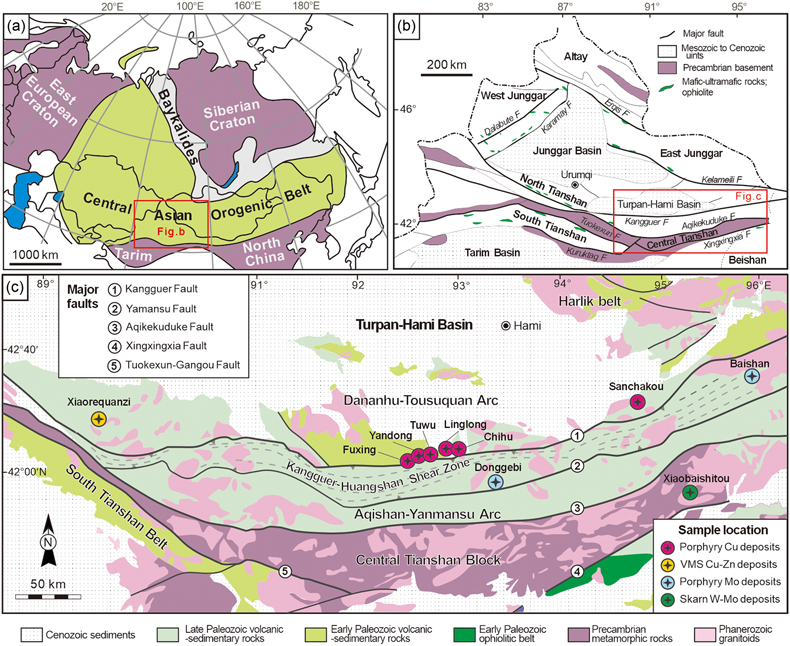
Figure 1 (a) Schematic map illustrating the precise location of the CAOB and the adjacent cratons (after Şengör et al., 1993
Şengör, A.M.C., Natal’in, B.A., Burtman, V.S. (1993) Evolution of the Altaid tectonic collage and Palaeozoic crustal growth in Eurasia. Nature 364, 299–307. https://doi.org/10.1038/364299a0.
). (b) Geological map showing the emplacement of tectonic sections in the southern area of the CAOB (after Chen et al., 2012Chen, Y.J., Pirajno, F., Wu, G., Qi, J.P., Xiong, X.L. (2012) Epithermal deposits in North Xinjiang, NW China. International Journal of Earth Sciences 101, 889–917. https://doi.org/10.1007/s00531-011-0689-4.
). (c) Geological map exhibiting the arrangement of ore deposits in the Eastern Tianshan (after Wang et al., 2006Wang, J.B., Wang, Y.W., He, Z.H. (2006) Ore deposits as a guide to the tectonic evolution in the east Tianshan mountains, NW China. Geology in China 33, 461–469.
; Deng et al., 2016Deng, X.H., Wang, J.B., Pirajno, F., Wang, Y.W., Li, Y.C., Li, C., Zhou, L.M., Chen, Y.J. (2016) Re–Os dating of chalcopyrite from selected mineral deposits in the Kalatag district in the eastern Tianshan Orogen, China. Ore Geology Reviews 77, 72–81. https://doi.org/10.1016/j.oregeorev.2016.01.014.
).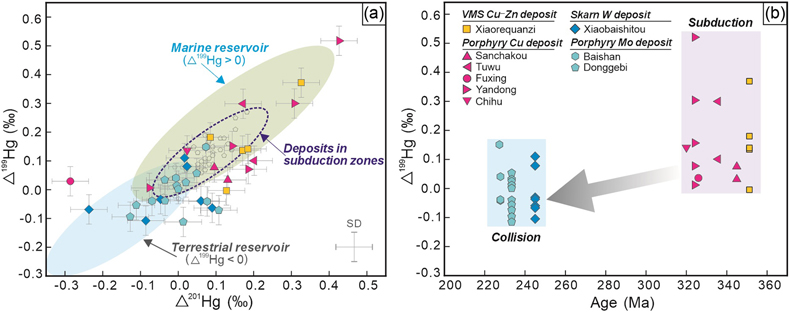
Figure 2 Binary diagrams displaying the variations in (a) Δ199Hg–Δ201Hg and (b) Δ199Hg–Age (Ma) of the analysed ore deposits in the Eastern Tianshan. The area of marine sediments is delineated by Yin et al. (2015)
Yin, R.S., Feng, X.B., Chen, B., Zhang, J., Wang, W., Li, X. (2015) Identifying the sources and processes of mercury in subtropical estuarine and ocean sediments using Hg isotopic composition. Environmental Science and Technology 49, 1347–1355. https://doi.org/10.1021/es504070y.
and Meng et al. (2019)Meng, M., Sun, R.Y., Liu, H.W., Yu, B., Yin, Y.G., Hu, L.G., Shi, J.B., Jiang, G.B. (2019) An integrated model for input and migration of mercury in Chinese coastal sediments. Environmental Science and Technology 53, 2460–2471. https://doi.org/10.1021/acs.est.8b06329.
, terrestrial sediments are characterised by Blum et al. (2014)Blum, J.D., Sherman, L.S., Johnson, M.W. (2014) Mercury isotopes in Earth and environmental sciences. Annual Review of Earth and Planetary Sciences 42, 249–269. https://doi.org/10.1146/annurev-earth-050212-124107.
and references therein, and subduction-related deposits are detailed by Deng et al. (2021)Deng, C.Z., Sun, G.Y., Rong, Y.M., Sun, R.Y., Sun, D.Y., Lehmann, B., Yin, R.S. (2021) Recycling of mercury from the atmosphere-ocean system into volcanic-arc–associated epithermal gold systems. Geology 49, 309–313. https://doi.org/10.1130/G48132.1.
.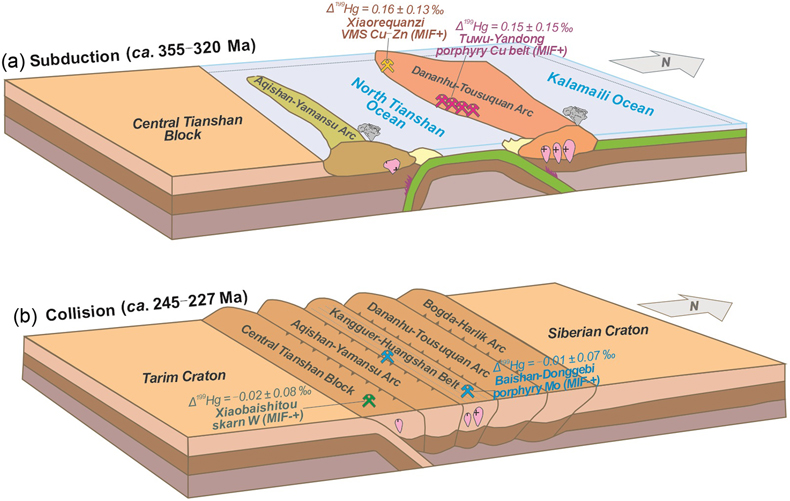
Figure 3 Schematic diagram illustrating the tectonic evolution of the Eastern Tianshan. (a) In the Carboniferous, the double-sided subduction of the NTO plate resulted in the formation of the Dananhu-Tousuquan Arc and Aqishan-Yamansu Arc, during which porphyry Cu deposits and volcanogenic massive sulfide Cu–Zn deposits were generated. (b) During the Triassic, the collision between the Tarim Craton and the Siberian Craton led to the formation of porphyry Mo deposits and skarn-type W deposits.