



High δ26Mg in an early Cambrian palaeosol reveals a terrestrial clay mineral factory
Affiliations | Corresponding Author | Cite as | Funding information
Published by the European Association of Geochemistry
under Creative Commons License CC BY 4.0
Keywords: magnesium isotopes, palaeosol, chemical weathering, clay minerals, Great Unconformity


- Share this article


-
Article views:1,676Cumulative count of HTML views and PDF downloads.
- Download Citation
- Rights & Permissions

top
Abstract
Figures
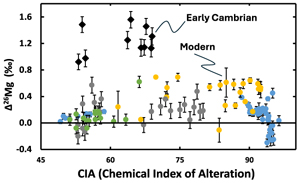
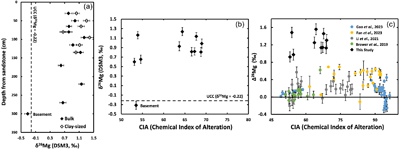 Figure 1 (a) Magnesium isotopic composition of the bulk and clay-sized fractions of the saprolite profile plotted against depth from the overlying sandstone. (b) Magnesium isotopic compositions plotted against CIA (Chemical Index of Alteration; Z. Huang et al., 2024) for the δ26Mg values for the Cambrian palaeosol on the Great Unconformity. (c) The magnesium isotope difference (Δ26Mgsaprolite-bedrock) between the parental bedrock and corresponding regolith, including data from this study and the literature on modern granitic soil profiles (Brewer et al., 2018; Fan et al., 2023; Gao et al., 2023; Li et al., 2021). All error bars are 2σ, and error bars in (c) are calculated using the formula | 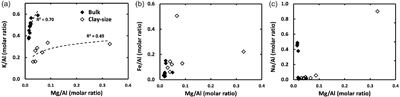 Figure 2 Cross plots for the molar ratios of (a) K/Al, (b) Fe/Al and (c) Na/Al vs. Mg/Al of both bulk and clay-sized portions of the saprolite. | 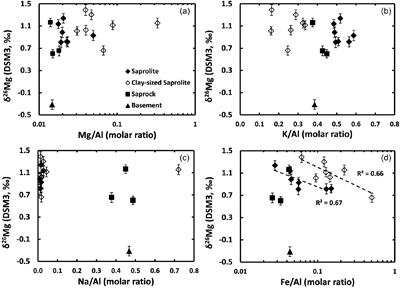 Figure 3 Cross plots for the molar ratios of (a) Mg/Al (semi-log), (b) K/Al, (c) Na/Al and (d) Fe/Al (semi-log) vs. δ26Mg values of both bulk and clay-sized portion of the saprolite. | 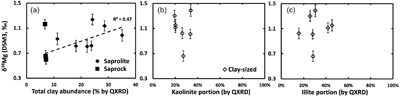 Figure 4 Cross plots of the δ26Mg values of bulk and clay-sized portions with the abundance of (a) total secondary clay abundance detected by XRD (sum of all secondary phyllosilicates), (b) kaolinite fraction of the total clay abundance and (c) illite fraction of the total clay abundance. |
| Figure 1 | Figure 2 | Figure 3 | Figure 4 |
top
Introduction
The late Precambrian is marked by a series of global glaciation events known collectively as the snowball earth, when glaciation extending to the equator (Hoffman and Schrag, 2002
Hoffman, P.F., Schrag, D.P. (2002) The snowball Earth hypothesis: testing the limits of global change. Terra Nova 14, 129–155. https://doi.org/10.1046/j.1365-3121.2002.00408.x
). Subsequent intense chemical weathering and continental erosion, promoted by the high atmospheric CO2 concentration (pCO2) during the terminal Cryogenian, likely contributed to the diversification of the marine biosphere in the Early and Middle Cambrian Ocean (e.g., Sahoo et al., 2012Sahoo, S.K., Planavsky, N.J., Kendall, B., Wang, X., Shi, X., Scott, C., Anbar, A.D., Lyons, T.W., Jiang, G. (2012) Ocean oxygenation in the wake of the Marinoan glaciation. Nature 489, 546–549. https://doi.org/10.1038/nature11445
). However, the specific weathering processes and weathering regimes during the late Precambrian and early Cambrian have not been well constrained.Weathering intensities are usually inferred by studying terrigenous marine sediments regarded as the products of continental weathering. However, palaeo-weathering evidence in sediments can be obscured by heterogeneous source lithologies, transient storage on continental shelves, and authigenic marine clay formation through reverse weathering (Isson and Rauzi, 2024
Isson, T., Rauzi, S. (2024) Oxygen isotope ensemble reveals Earth’s seawater, temperature, and carbon cycle history. Science 383, 666–670. https://doi.org/10.1126/science.adg1366
). In contrast, preserved in situ Precambrian and Cambrian-aged palaeosols formed directly at the Earth’s surface and provide an opportunity for direct palaeo-climatic and environmental reconstructions (Sheldon and Tabor, 2009Sheldon, N.D., Tabor, N.J. (2009) Quantitative paleoenvironmental and paleoclimatic reconstruction using paleosols. Earth-Science Reviews 95, 1–52. https://doi.org/10.1016/j.earscirev.2009.03.004
and references therein). Palaeosol profiles in North America developed during the early Cambrian on the Great Unconformity are relatively under-represented in the literature as they were largely eroded away by the transgressing Cambrian Ocean (e.g., Peters and Gaines, 2012Peters, S.E., Gaines, R.R. (2012) Formation of the ‘Great Unconformity’ as a trigger for the Cambrian explosion. Nature 484, 363–366. https://doi.org/10.1038/nature10969
).Magnesium isotopes fractionate during silicate mineral dissolution (Wimpenny et al., 2010
Wimpenny, J., Gíslason, S.R., James, R.H., Gannoun, A., Pogge Von Strandmann, P.A.E., Burton, K.W. (2010) The behaviour of Li and Mg isotopes during primary phase dissolution and secondary mineral formation in basalt. Geochimica et Cosmochimica Acta 74, 5259–5279. https://doi.org/10.1016/j.gca.2010.06.028
) and clay mineral formation (Wimpenny et al., 2014Wimpenny, J., Colla, C.A., Yin, Q.-Z., Rustad, J.R., Casey, W.H. (2014) Investigating the behaviour of Mg isotopes during the formation of clay minerals. Geochimica et Cosmochimica Acta 128, 178–194. https://doi.org/10.1016/j.gca.2013.12.012
), where weathering residuals retain isotopically heavier 26Mg with increasing chemical weathering intensity (Teng et al., 2010Teng, F.-Z., Li, W.-Y., Rudnick, R.L., Gardner, L.R. (2010) Contrasting lithium and magnesium isotope fractionation during continental weathering. Earth and Planetary Science Letters 300, 63–71. https://doi.org/10.1016/j.epsl.2010.09.036
). Relevant to this observation is that Mg isotopic fractionation during low grade metamorphism and diagenesis is limited in siliciclastic sediments (Wang et al., 2015Wang, S.-J., Teng, F.-Z., Rudnick, R.L., Li, S.-G. (2015) The behavior of magnesium isotopes in low-grade metamorphosed mudrocks. Geochimica et Cosmochimica Acta 165, 435–448. https://doi.org/10.1016/j.gca.2015.06.019
), making the Mg isotope system ideal for tracking Earth’s pedogenic processes in deep time. Although Mg isotopes have been used to examine weathering intensity and regimes from modern weathering and saprolite profiles (e.g., Liu et al., 2014Liu, X.-M., Teng, F.-Z., Rudnick, R.L., McDonough, W.F., Cummings, M.L. (2014) Massive magnesium depletion and isotope fractionation in weathered basalts. Geochimica et Cosmochimica Acta 135, 336–349. https://doi.org/10.1016/j.gca.2014.03.028
), δ26Mg has not been reported for Precambrian or Cambrian-aged palaeosols. Mg isotope systematics are controlled by clay mineralogy in modern felsic saprolites (Li et al., 2021Li, M.Y.H., Teng, F.-Z., Zhou, M.-F. (2021) Phyllosilicate controls on magnesium isotopic fractionation during weathering of granites: Implications for continental weathering and riverine system. Earth and Planetary Science Letters 553, 116613. https://doi.org/10.1016/j.epsl.2020.116613
), suggesting that Mg isotopes may serve as an important tool to track terrestrial clay production in palaeosols.Here, we present the Mg isotopic composition of bulk and clay-sized (r < ∼2 μm) portions of saprolites from a Cambrian age palaeosol outcrop developed on the Wyoming Craton to evaluate the ancient weathering regimes and clay mineral formation in North America during the Precambrian-Cambrian transition.
top
Results
Elevated δ26Mg in the saprolites. The weathering profile is developed on the meta-granitic basement of the Archean Wyoming Craton and recognised as the erosional remnant of the Great Unconformity, where it was subsequently buried by the Middle Cambrian Flathead Sandstone. The weathering processes that produced the saprolite thus immediately preceded the deposition of the Flathead Sandstone during the middle Cambrian. The palaeosol has been previously described and the profile contains both slightly weathered saprocks that still retain crystalline structure of the bedrock, and saprolites that experienced more intensive chemical weathering with a maximum Chemical Index of Alteration (CIA) of 69 and a Plagioclase Index of Alteration (PIA) reaching 98 (Z. Huang et al., 2024
Huang, Z., Peters, S.C., Pazzaglia, F.J., Hernandez, M. (2024) A chemical weathering and paleoclimatic reconstruction of the early Cambrian environment of the Wyoming Craton from the Wind River Canyon, WY paleosol on the Great Unconformity. Precambrian Research 409, 107447. https://doi.org/10.1016/j.precamres.2024.107447
).The unweathered basement has a measured δ26Mg (−0.33 ‰) that is similar to the average composition of the upper continental crust (−0.22 ‰; Li et al., 2010
Li, W.-Y., Teng, F.-Z., Ke, S., Rudnick, R.L., Gao, S., Wu, F.-Y., Chappell, B.W. (2010) Heterogeneous magnesium isotopic composition of the upper continental crust. Geochimica et Cosmochimica Acta 74, 6867–6884. https://doi.org/10.1016/j.gca.2010.08.030
). Both saprolites and moderately weathered saprock samples show elevated 26Mg values compared to their granitic parent, with a maximum δ26Mg of +1.24 ‰ in the saprolite (Fig. 1). The δ26Mg values in the saprolite do not show a simple linear increasing trend from less weathered samples to more intensively weathered samples. Instead, the lower saprolite samples generally have higher δ26Mg values than the more intensively weathered samples from higher in the profile (from +1.14 ‰ in the lowest saprolite to +0.81 ‰ in the highest saprolite; Fig. 1a). The δ26Mg values of the Cambrian palaeosol are considerably higher than the published data from modern granitic weathering profiles, even though the CIA values of the palaeosol suggest that the weathering intensity is relatively unremarkable compared to some of the most weathered samples (Fig. 1c).Figure 1 (a) Magnesium isotopic composition of the bulk and clay-sized fractions of the saprolite profile plotted against depth from the overlying sandstone. (b) Magnesium isotopic compositions plotted against CIA (Chemical Index of Alteration; Z. Huang et al., 2024
Huang, Z., Peters, S.C., Pazzaglia, F.J., Hernandez, M. (2024) A chemical weathering and paleoclimatic reconstruction of the early Cambrian environment of the Wyoming Craton from the Wind River Canyon, WY paleosol on the Great Unconformity. Precambrian Research 409, 107447. https://doi.org/10.1016/j.precamres.2024.107447
) for the δ26Mg values for the Cambrian palaeosol on the Great Unconformity. (c) The magnesium isotope difference (Δ26Mgsaprolite-bedrock) between the parental bedrock and corresponding regolith, including data from this study and the literature on modern granitic soil profiles (Brewer et al., 2018Brewer, A., Teng, F.Z., Dethier, D. (2018) Magnesium isotope fractionation during granite weathering. Chemical Geology 501, 95–103. https://doi.org/10.1016/j.chemgeo.2018.10.013
; Fan et al., 2023Fan, B.L., Yang, X.Q., Jiang, K., Zhao, Z.Q. (2023) Processes controlling the Mg isotope behavior during granite weathering. Journal of Asian Earth Sciences 251, 105674. https://doi.org/10.1016/j.jseaes.2023.105674
; Gao et al., 2023Gao, T., Qi, M., Wang, Z., Yin, R., Liu, C., Liu, Y., Ke, S., Zhao, Z.-Q. (2023) Magnesium Isotope Variations in Granite Regoliths from Two Contrasting Climates. Journal of Geophysical Research: Earth Surface 128, e2023JF007217. https://doi.org/10.1029/2023JF007217
; Li et al., 2021Li, M.Y.H., Teng, F.-Z., Zhou, M.-F. (2021) Phyllosilicate controls on magnesium isotopic fractionation during weathering of granites: Implications for continental weathering and riverine system. Earth and Planetary Science Letters 553, 116613. https://doi.org/10.1016/j.epsl.2020.116613
). All error bars are 2σ, and error bars in (c) are calculated using the formula .
.The clay-sized fraction of the saprolites contains higher total Mg content and Mg/Al values compared to the bulk sample (Table S-2), indicating that the formation of terrestrial clay minerals, such as kaolinite, smectite, illite, and pedogenic chlorite/vermiculite, was responsible for the retention of Mg during palaeosol development. Such enrichment pattern is also observed in modern felsic soils (Li et al., 2021
Li, M.Y.H., Teng, F.-Z., Zhou, M.-F. (2021) Phyllosilicate controls on magnesium isotopic fractionation during weathering of granites: Implications for continental weathering and riverine system. Earth and Planetary Science Letters 553, 116613. https://doi.org/10.1016/j.epsl.2020.116613
). Clay-sized fractions also exhibit a high δ26Mg composition that persists through the entire saprolite, with a maximum δ26Mg at +1.39 ‰. The magnesium isotopic composition is even heavier compared to their bulk counterparts (Fig. 1a). Like the bulk saprolite samples, there is no clear correlation between δ26Mg and the Mg content in the clay-sized fraction. Such observations confirm that the isotopically heavy 26Mg preferentially partitions into the clay minerals during chemical weathering.Surprisingly, even the least weathered saprock samples that represent the incipient weathering stage during palaeosol development have significantly isotopically heavier 26Mg compared to the pristine basement. This isotopic composition also suggests that the weathering intensity was likely not the only factor influencing the δ26Mg of the palaeosol. SEM images of thin sections of these moderately weathered bedrock samples in the lower profile show Mg-rich fine grained clay minerals in the cracks of fractured and physically altered primary silicate minerals such as plagioclase and quartz (Fig. S-2a,b), suggesting downward transport of clay minerals in the profile. This hypothesis is supported by a recent study on a modern granitic soil where the vertical transportation of kaolinite is likely responsible for the enrichment of 26Mg in the lowest weathering profile (Song et al., 2025
Song, K., Qi, M., Gao, T., Liu, C. (2025) Kaolinite as a Key Transporter of Mg and Fe in Subtropical Weathering Crust: Insights from Mg and Fe Isotopes. ACS Earth and Space Chemistry 9, 681–688. https://doi.org/10.1021/acsearthspacechem.4c00367
). In addition, previous studies have shown a preferential adsorption of isotopically heavier 26Mg as an exchangeable form during the weathering and transformation of chlorite to vermiculite in saprocks during the incipient stage of granite weathering (Li et al., 2021Li, M.Y.H., Teng, F.-Z., Zhou, M.-F. (2021) Phyllosilicate controls on magnesium isotopic fractionation during weathering of granites: Implications for continental weathering and riverine system. Earth and Planetary Science Letters 553, 116613. https://doi.org/10.1016/j.epsl.2020.116613
). Therefore, both the downward transport of Mg-containing clays with higher δ26Mg from the upper saprolite of the weathering profile, and adsorption process during the initial chlorite-vermiculite transformation likely elevated the δ26Mg values in saprock samples that otherwise have evidence of relatively low weathering intensity with low CIA.Diagenetic and authigenic influences. Cambrian and Precambrian-aged palaeosol and sedimentary records are often overprinted by post-weathering metasomatism (Nesbitt and Young, 1989
Nesbitt, H.W., Young, G.M. (1989) Formation and Diagenesis of Weathering Profiles. The Journal of Geology 97, 129–147. https://doi.org/10.1086/629290
), where interactions of palaeosols and sediments with seawater, including reverse weathering and carbonate precipitation, could result in the authigenic addition of Fe, Mg, Na, and Ca (Isson and Planavsky, 2018Isson, T.T., Planavsky, N.J. (2018) Reverse weathering as a long-term stabilizer of marine pH and planetary climate. Nature 560, 471–475. https://doi.org/10.1038/s41586-018-0408-4
). Metasomatism through post-burial illitisation is common in North American Cambrian and Precambrian palaeosols (e.g., Medaris et al., 2022Medaris Jr., L.G., Jicha, B.R., Singer, B.S., Wathen, B., Li, Y., Driese, S.G. (2022) Evaluating the Magnitudes of Weathering and Potassium Metasomatism in Paleosols: Examples from Proterozoic, Cambrian, and Cretaceous Paleosols in Midcontinental Laurentia. The Journal of Geology 130, 447–464. https://doi.org/10.1086/724252
). Since metasomatic overprinting could potentially modify the Mg content and Mg isotopic signature, it is thus important to evaluate diagenetic influence on this palaeosol.While the Wind River Canyon palaeosol shows moderate enrichment in bulk K content compared to the unweathered basement, there is no significant addition of Na and Ca in saprolites (Z. Huang et al., 2024
Huang, Z., Peters, S.C., Pazzaglia, F.J., Hernandez, M. (2024) A chemical weathering and paleoclimatic reconstruction of the early Cambrian environment of the Wyoming Craton from the Wind River Canyon, WY paleosol on the Great Unconformity. Precambrian Research 409, 107447. https://doi.org/10.1016/j.precamres.2024.107447
), and no diagenetic plagioclase or authigenic carbonate mineral precipitation observed or detected in bulk saprolite samples, consistent with the lack of Na and Ca metasomatism in the Wind River Canyon saprolite. It is likely that moderate K metasomatism overprinted the Wind River Canyon saprolite with illite, partially or completely replacing smectite and kaolinite in upper saprolite samples, forming illitised kaolinite and interstratified illite-smectite (Fig. S-2c,d). The metasomatic process could potentially influence the Mg isotopic composition through the equilibrium fractionation between Mg-enriched smectite and illite. While there are strong to moderate positive correlations between K and Mg contents (Fig. 2a), the molar K/Al ratio shows no correlation with δ26Mg in neither bulk nor clay-sized fraction of the saprolites (Fig. 3b), indicating that the degree of K addition during metasomatism may have limited effects on the δ26Mg values, particularly in the clay-sized fraction of the weathering profile. The lack of isotopic fractionation due to post-burial K metasomatism also agrees with observations of the Mg isotopic system in other siliciclastic Neoproterozoic-aged sediments (Huang et al., 2016Huang, K.-J., Teng, F.-Z., Shen, B., Xiao, S., Lang, X., Ma, H.-R., Fu, Y., Peng, Y. (2016) Episode of intense chemical weathering during the termination of the 635 Ma Marinoan glaciation. Proceedings of the National Academy of Sciences 113, 14904–14909. https://doi.org/10.1073/pnas.1607712113
; Zhang et al., 2021Zhang, G., Chen, D., Huang, K.-J., Liu, M., Huang, T., Yeasmin, R., Fu, Y. (2021) Dramatic attenuation of continental weathering during the Ediacaran-Cambrian transition: Implications for the climatic-oceanic-biological co-evolution. Global and Planetary Change 203, 103518. https://doi.org/10.1016/j.gloplacha.2021.103518
).Figure 2 Cross plots for the molar ratios of (a) K/Al, (b) Fe/Al and (c) Na/Al vs. Mg/Al of both bulk and clay-sized portions of the saprolite.
Figure 3 Cross plots for the molar ratios of (a) Mg/Al (semi-log), (b) K/Al, (c) Na/Al and (d) Fe/Al (semi-log) vs. δ26Mg values of both bulk and clay-sized portion of the saprolite.
Processes controlling the Mg isotope behaviour. Overall, there is a moderate positive correlation between the bulk δ26Mg values of saprolites and the abundance of the clay-sized fraction (Fig. 4a), except for one saprock sample with an unusually high δ26Mg value. This pattern supports the hypothesis that the formation of secondary clay minerals likely controlled the 26Mg enrichment of the saprolite. However, plots of two pedogenic clay mineral abundances (illite and kaolinite) do not display a significant correlation with the δ26Mg values of the clay-sized portion of saprolites (Fig. 4b,c). Recent studies have shown that Mg isotopes fractionate differently among various clay mineral formation pathways during supergene chemical weathering processes. For example, smectite minerals with low Al such as saponite and stevensite, preferentially uptake 24Mg in a laboratory setting (Hindshaw et al., 2020
Hindshaw, R.S., Tosca, R., Tosca, N.J., Tipper, E.T. (2020) Experimental constraints on Mg isotope fractionation during clay formation: Implications for the global biogeochemical cycle of Mg. Earth and Planetary Science Letters 531, 115980. https://doi.org/10.1016/j.epsl.2019.115980
). Complications could also arise from adsorption-desorption processes of Mg ions from soil solution onto clay minerals where both 24Mg and 26Mg may be preferentially incorporated (Opfergelt et al., 2012Opfergelt, S., Georg, R.B., Delvaux, B., Cabidoche, Y.-M., Burton, K.W., Halliday, A.N. (2012) Mechanisms of magnesium isotope fractionation in volcanic soil weathering sequences, Guadeloupe. Earth and Planetary Science Letters 341–344, 176–185. https://doi.org/10.1016/j.epsl.2012.06.010
). Hence, a more comprehensive examination of the role of clay minerals in controlling Mg isotopes in palaeosol profiles is needed.Figure 4 Cross plots of the δ26Mg values of bulk and clay-sized portions with the abundance of (a) total secondary clay abundance detected by XRD (sum of all secondary phyllosilicates), (b) kaolinite fraction of the total clay abundance and (c) illite fraction of the total clay abundance.
The Fe content in the saprolite shows moderate negative correlations with the δ26Mg values for both bulk and clay-sized fraction of the saprolite (Fig. 3d). Iron oxide minerals, such as goethite and hematite, were detected by XRD and observed in SEM images of thin sections (Z. Huang et al., 2024
Huang, Z., Peters, S.C., Pazzaglia, F.J., Hernandez, M. (2024) A chemical weathering and paleoclimatic reconstruction of the early Cambrian environment of the Wyoming Craton from the Wind River Canyon, WY paleosol on the Great Unconformity. Precambrian Research 409, 107447. https://doi.org/10.1016/j.precamres.2024.107447
). Since there is no clear correlation between Mg and Fe contents in both bulk saprolites and the clay fraction (Fig. 2b), the negative correlation between Fe and δ26Mg may be caused by heterogeneous sorption onto precipitated hematite or goethite in upper saprolites, instead of the formation of Mg and Fe-rich clay minerals such as chlorite and vermiculite. Fe oxides and oxyhydroxides increase the overall cation exchange capacity, which has a higher affinity for 24Mg (Gao et al., 2018Gao, T., Ke, S., Wang, S.-J., Li, F., Liu, C., Lei, J., Liao, C., Wu, F. (2018) Contrasting Mg isotopic compositions between Fe-Mn nodules and surrounding soils: Accumulation of light Mg isotopes by Mg-depleted clay minerals and Fe oxides. Geochimica et Cosmochimica Acta 237, 205–222. https://doi.org/10.1016/j.gca.2018.06.028
). Such a pattern is observed in modern granitic soils (e.g., Fan et al., 2023Fan, B.L., Yang, X.Q., Jiang, K., Zhao, Z.Q. (2023) Processes controlling the Mg isotope behavior during granite weathering. Journal of Asian Earth Sciences 251, 105674. https://doi.org/10.1016/j.jseaes.2023.105674
), where 24Mg is preferentially adsorbed onto goethite and hematite in an exchangeable form while 26Mg is substituted into the Fe oxide structure. Further investigations through a sequential extraction experiment may therefore needed to investigate the distribution of Mg in different phases and estimate the influence of secondary Fe minerals on the Mg isotopic composition in palaeosols.The Wind River Canyon palaeosol isotopic patterns compare favourably with those observed in modern granitic weathering profiles. Specifically, Mg isotopic fractionation in a granitic soil developed under a modern subtropical setting (Li et al., 2021
Li, M.Y.H., Teng, F.-Z., Zhou, M.-F. (2021) Phyllosilicate controls on magnesium isotopic fractionation during weathering of granites: Implications for continental weathering and riverine system. Earth and Planetary Science Letters 553, 116613. https://doi.org/10.1016/j.epsl.2020.116613
), also shows minimally weathered saprock samples with elevated δ26Mg compared to intensively weathered saprolite. Mass balance calculations for Mg (τMgZr) indicates a strong enrichment of Mg in one of the lower saprolite samples with an overall decreasing pattern towards the upper saprolite (Z. Huang et al., 2024Huang, Z., Peters, S.C., Pazzaglia, F.J., Hernandez, M. (2024) A chemical weathering and paleoclimatic reconstruction of the early Cambrian environment of the Wyoming Craton from the Wind River Canyon, WY paleosol on the Great Unconformity. Precambrian Research 409, 107447. https://doi.org/10.1016/j.precamres.2024.107447
; Fig. S-1b). Secondary phyllosilicate may be dissolved during the advanced stage of weathering in the upper weathering profile, mobilising the heavier δ26Mg that was incorporated into clays. According to the overall enrichment pattern and clay abundance in the lower saprolite, we consider that the dissolution of phyllosilicates with higher δ 26Mg values in intensively weathered upper palaeosol induced a vertical mobilisation of 26Mg-enriched soil solution from the upper weathering profile, allowing the incorporation of heavier 26Mg into neo-formed clay minerals in lower saprolite. However, further investigations may be required on other palaeosol profiles as the uppermost section of the Wind River Canyon palaeosol is likely lost due to erosional processes that formed the Great Unconformity.Alternatively, the increase in both Mg abundance and the δ 26Mg in the lower saprolite may be explained by external contributions from the palaeo-groundwater. It is likely that the in situ weathering of the upper weathering profile did not provide all the Mg needed for the observed Mg-enrichment in the lower saprolite. The Mg flux contributed by palaeo-groundwater could enrich the Mg in the lower saprolite. However, groundwater generally contains a relatively lighter Mg isotopic composition compared to the weathering residuals (Tipper et al., 2012
Tipper, E.T., Lemarchand, E., Hindshaw, R.S., Reynolds, B.C., Bourdon, B. (2012) Seasonal sensitivity of weathering processes: Hints from magnesium isotopes in a glacial stream. Chemical Geology 312–313, 80–92. https://doi.org/10.1016/j.chemgeo.2012.04.002
) that are substantially influenced by their respective parental minerals (Chapela Lara et al., 2017Chapela Lara, M., Buss, H.L., Pogge von Strandmann, P.A.E., Schuessler, J.A., Moore, O.W. (2017) The influence of critical zone processes on the Mg isotope budget in a tropical, highly weathered andesitic catchment. Geochimica et Cosmochimica Acta 202, 77–100. https://doi.org/10.1016/j.gca.2016.12.032
). Therefore, the observed high δ26Mg and Mg abundance in the lower saprolite cannot solely be explained by the influx of Mg from the palaeo-groundwater, as it could not directly provide abundant 26Mg for all the saprolite and saprock samples. Instead, the palaeo-groundwater may have contributed a minor amount to the abundance of Mg in the less weathered lower saprolite and the saprock.top
Implications
Preserved marine sediments including sandstones and siltstones, derived from the continental erosion during the termination of the Marinoan glaciation, have distinctively positive δ26Mg values ranging from +0.56 ‰ to +0.95 ‰ (Huang et al., 2016
Huang, K.-J., Teng, F.-Z., Shen, B., Xiao, S., Lang, X., Ma, H.-R., Fu, Y., Peng, Y. (2016) Episode of intense chemical weathering during the termination of the 635 Ma Marinoan glaciation. Proceedings of the National Academy of Sciences 113, 14904–14909. https://doi.org/10.1073/pnas.1607712113
). Similarly, black shales deposited in modern southern China during the middle Cambrian and late Precambrian also exhibit extremely high δ26Mg values (Zhang et al., 2021Zhang, G., Chen, D., Huang, K.-J., Liu, M., Huang, T., Yeasmin, R., Fu, Y. (2021) Dramatic attenuation of continental weathering during the Ediacaran-Cambrian transition: Implications for the climatic-oceanic-biological co-evolution. Global and Planetary Change 203, 103518. https://doi.org/10.1016/j.gloplacha.2021.103518
). The high δ26Mg values of these sediments were interpreted as the result of intensive continental weathering under a warm and humid climate during the early/middle Cambrian and the post-snowball earth deglaciation. However, as suggested by other studies (e.g., T. Huang et al., 2024Huang, T., Shen, B., Huang, K., Ning, M., Li, C., Xue, J., Sun, Y., Huang, B. (2024) Revisiting the Mg isotopic systematics of siliciclastic components of sediments and sedimentary rocks: A new geochemical proxy of continental weathering in Earth’ s history. Science China Earth Sciences 67, 620–633. https://doi.org/10.1007/s11430-023-1199-2
), the weathering intensity may only be precisely constrained from the Mg isotopic signature through also assessing the clay mineralogy from contemporaneous palaeo-weathering profiles. Here we can confirm that all these sediments possess δ26Mg values similar to those observed in an in situ contemporaneous weathering profile, preserved as the Wind River Canyon palaeosol (+1.0 ‰ to + 1.5 ‰).Recent studies have shown that the earliest Phanerozoic is marked as an incipient stage of increased terrestrial clay production known as the clay mineral factory, coupled with the emergence of terrestrial microbial activities (Isson and Rauzi, 2024
Isson, T., Rauzi, S. (2024) Oxygen isotope ensemble reveals Earth’s seawater, temperature, and carbon cycle history. Science 383, 666–670. https://doi.org/10.1126/science.adg1366
; Kennedy et al., 2006Kennedy, M., Droser, M., Mayer, L.M., Pevear, D., Mrofka, D. (2006) Late Precambrian Oxygenation; Inception of the Clay Mineral Factory. Science 311, 1446–1449. https://doi.org/10.1126/science.1118929
). Following the break-up of Rodinia, a large volume of felsic rocks was emplaced in the upper continental crust and exposed to weathering and erosional processes (Keller et al., 2019Keller, C.B., Husson, J.M., Mitchell, R.N., Bottke, W.F., Gernon, T.M., Boehnke, P., Bell, E.A., Swanson-Hysell, N.L., Peters, S.E. (2019) Neoproterozoic glacial origin of the Great Unconformity. Proceedings of the National Academy of Sciences 116, 1136–1145. https://doi.org/10.1073/pnas.1804350116
). The lithological shift in the late Precambrian coupled with an extreme global greenhouse condition during the termination of a global glaciation likely enhanced clay mineral formation through incongruent felsic rock weathering. While our study agrees with the previously established interpretation that weathered products and residuals retain the isotopically heavier 26Mg, considering the poor linear relationship between CIA and δ26Mg, we suggest that heavier Mg isotopic composition may have an indirect and nonlinear connection to a higher weathering intensity in palaeo-weathering profiles. We further hypothesise that the intensive continental weathering inferred from the elevated δ26Mg in sediments from the Ediacaran-Cambrian boundary was likely accompanied by the enhanced terrestrial clay mineral production induced by the weathering of the newly exposed felsic rocks.top
Conclusions
The early/middle Cambrian Wind River Canyon palaeosol on the Great Unconformity in the Bighorn Basin, Wyoming records some of the heaviest Mg isotopic compositions reported in chemical weathering processes of felsic rocks. This study confirms that the Mg isotopes strongly fractionate in palaeo-weathering profiles and could potentially be used to reconstruct palaeo-weathering regimes in deep time. The elevated δ26Mg composition in the saprolite was likely controlled by the formation of clay minerals in the lower saprolite where 26Mg was likely preferentially scavenged from the contemporary soil solution. Due to the poor correlation with CIA values, heavy δ26Mg record in palaeosol or siliciclastic sediment records may not be treated as a direct indicator for palaeo-weathering intensity, but as an indicator of enhanced terrestrial clay mineral productions. This is the first time Mg isotopes have been reported for a Cambrian or Precambrian-aged weathering profile. With further investigations on different palaeosols from the same geologic period, the Mg isotopic system may potentially serve as an important tool to reconstruct palaeo-weathering regimes.
top
Acknowledgements
We thank Dr. Ilia Rodushkin and ALS Scandinavia for the Mg isotope analyses. We thank Dr. Frank J. Pazzaglia for his insightful discussions and comments on an earlier version of this manuscript. We would also like to thank Dr. Claudine Stirling for her editorial handling and two anonymous reviewers for their thoughtful reviews that substantially improved the manuscript.
Editor: Claudine Stirling
top
References
Brewer, A., Teng, F.Z., Dethier, D. (2018) Magnesium isotope fractionation during granite weathering. Chemical Geology 501, 95–103. https://doi.org/10.1016/j.chemgeo.2018.10.013
 Show in context
 (c) The magnesium isotope difference (Δ26Mgsaprolite-bedrock) between the parental bedrock and corresponding regolith, including data from this study and the literature on modern granitic soil profiles (Brewer et al., 2018; Fan et al., 2023; Gao et al., 2023; Li et al., 2021).
View in article
Chapela Lara, M., Buss, H.L., Pogge von Strandmann, P.A.E., Schuessler, J.A., Moore, O.W. (2017) The influence of critical zone processes on the Mg isotope budget in a tropical, highly weathered andesitic catchment. Geochimica et Cosmochimica Acta 202, 77–100. https://doi.org/10.1016/j.gca.2016.12.032
Show in context However, groundwater generally contains a relatively lighter Mg isotopic composition compared to the weathering residuals (Tipper et al., 2012) that are substantially influenced by their respective parental minerals (Chapela Lara et al., 2017).
View in article
Fan, B.L., Yang, X.Q., Jiang, K., Zhao, Z.Q. (2023) Processes controlling the Mg isotope behavior during granite weathering. Journal of Asian Earth Sciences 251, 105674. https://doi.org/10.1016/j.jseaes.2023.105674
Show in context (c) The magnesium isotope difference (Δ26Mgsaprolite-bedrock) between the parental bedrock and corresponding regolith, including data from this study and the literature on modern granitic soil profiles (Brewer et al., 2018; Fan et al., 2023; Gao et al., 2023; Li et al., 2021).
View in article
Such a pattern is observed in modern granitic soils (e.g., Fan et al., 2023), where 24Mg is preferentially adsorbed onto goethite and hematite in an exchangeable form while 26Mg is substituted into the Fe oxide structure.
View in article
Gao, T., Ke, S., Wang, S.-J., Li, F., Liu, C., Lei, J., Liao, C., Wu, F. (2018) Contrasting Mg isotopic compositions between Fe-Mn nodules and surrounding soils: Accumulation of light Mg isotopes by Mg-depleted clay minerals and Fe oxides. Geochimica et Cosmochimica Acta 237, 205–222. https://doi.org/10.1016/j.gca.2018.06.028
Show in context Fe oxides and oxyhydroxides increase the overall cation exchange capacity, which has a higher affinity for 24Mg (Gao et al., 2018).
View in article
Gao, T., Qi, M., Wang, Z., Yin, R., Liu, C., Liu, Y., Ke, S., Zhao, Z.-Q. (2023) Magnesium Isotope Variations in Granite Regoliths from Two Contrasting Climates. Journal of Geophysical Research: Earth Surface 128, e2023JF007217. https://doi.org/10.1029/2023JF007217
Show in context (c) The magnesium isotope difference (Δ26Mgsaprolite-bedrock) between the parental bedrock and corresponding regolith, including data from this study and the literature on modern granitic soil profiles (Brewer et al., 2018; Fan et al., 2023; Gao et al., 2023; Li et al., 2021).
View in article
Hindshaw, R.S., Tosca, R., Tosca, N.J., Tipper, E.T. (2020) Experimental constraints on Mg isotope fractionation during clay formation: Implications for the global biogeochemical cycle of Mg. Earth and Planetary Science Letters 531, 115980. https://doi.org/10.1016/j.epsl.2019.115980
Show in context For example, smectite minerals with low Al such as saponite and stevensite, preferentially uptake 24Mg in a laboratory setting (Hindshaw et al., 2020).
View in article
Hoffman, P.F., Schrag, D.P. (2002) The snowball Earth hypothesis: testing the limits of global change. Terra Nova 14, 129–155. https://doi.org/10.1046/j.1365-3121.2002.00408.x
Show in context The late Precambrian is marked by a series of global glaciation events known collectively as the snowball earth, when glaciation extending to the equator (Hoffman and Schrag, 2002).
View in article
Huang, K.-J., Teng, F.-Z., Shen, B., Xiao, S., Lang, X., Ma, H.-R., Fu, Y., Peng, Y. (2016) Episode of intense chemical weathering during the termination of the 635 Ma Marinoan glaciation. Proceedings of the National Academy of Sciences 113, 14904–14909. https://doi.org/10.1073/pnas.1607712113
Show in context The lack of isotopic fractionation due to post-burial K metasomatism also agrees with observations of the Mg isotopic system in other siliciclastic Neoproterozoic-aged sediments (Huang et al., 2016; Zhang et al., 2021).
View in article
Preserved marine sediments including sandstones and siltstones, derived from the continental erosion during the termination of the Marinoan glaciation, have distinctively positive δ26Mg values ranging from +0.56 ‰ to +0.95 ‰ (Huang et al., 2016).
View in article
Huang, T., Shen, B., Huang, K., Ning, M., Li, C., Xue, J., Sun, Y., Huang, B. (2024) Revisiting the Mg isotopic systematics of siliciclastic components of sediments and sedimentary rocks: A new geochemical proxy of continental weathering in Earth’ s history. Science China Earth Sciences 67, 620–633. https://doi.org/10.1007/s11430-023-1199-2
Show in context However, as suggested by other studies (e.g., T. Huang et al., 2024), the weathering intensity may only be precisely constrained from the Mg isotopic signature through also assessing the clay mineralogy from contemporaneous palaeo-weathering profiles.
View in article
Huang, Z., Peters, S.C., Pazzaglia, F.J., Hernandez, M. (2024) A chemical weathering and paleoclimatic reconstruction of the early Cambrian environment of the Wyoming Craton from the Wind River Canyon, WY paleosol on the Great Unconformity. Precambrian Research 409, 107447. https://doi.org/10.1016/j.precamres.2024.107447
Show in context The palaeosol has been previously described and the profile contains both slightly weathered saprocks that still retain crystalline structure of the bedrock, and saprolites that experienced more intensive chemical weathering with a maximum Chemical Index of Alteration (CIA) of 69 and a Plagioclase Index of Alteration (PIA) reaching 98 (Z. Huang et al., 2024).
View in article
(b) Magnesium isotopic compositions plotted against CIA (Chemical Index of Alteration; Z. Huang et al., 2024) for the δ26Mg values for the Cambrian palaeosol on the Great Unconformity.
View in article
While the Wind River Canyon palaeosol shows moderate enrichment in bulk K content compared to the unweathered basement, there is no significant addition of Na and Ca in saprolites (Z. Huang et al., 2024), and no diagenetic plagioclase or authigenic carbonate mineral precipitation observed or detected in bulk saprolite samples, consistent with the lack of Na and Ca metasomatism in the Wind River Canyon saprolite.
View in article
Iron oxide minerals, such as goethite and hematite, were detected by XRD and observed in SEM images of thin sections (Z. Huang et al., 2024).
View in article
Mass balance calculations for Mg (τMgZr) indicates a strong enrichment of Mg in one of the lower saprolite samples with an overall decreasing pattern towards the upper saprolite (Z. Huang et al., 2024; Fig. S-1b).
View in article
Isson, T.T., Planavsky, N.J. (2018) Reverse weathering as a long-term stabilizer of marine pH and planetary climate. Nature 560, 471–475. https://doi.org/10.1038/s41586-018-0408-4
Show in context Cambrian and Precambrian-aged palaeosol and sedimentary records are often overprinted by post-weathering metasomatism (Nesbitt and Young, 1989), where interactions of palaeosols and sediments with seawater, including reverse weathering and carbonate precipitation, could result in the authigenic addition of Fe, Mg, Na, and Ca (Isson and Planavsky, 2018).
View in article
Isson, T., Rauzi, S. (2024) Oxygen isotope ensemble reveals Earth’s seawater, temperature, and carbon cycle history. Science 383, 666–670. https://doi.org/10.1126/science.adg1366
Show in context However, palaeo-weathering evidence in sediments can be obscured by heterogeneous source lithologies, transient storage on continental shelves, and authigenic marine clay formation through reverse weathering (Isson and Rauzi, 2024).
View in article
Recent studies have shown that the earliest Phanerozoic is marked as an incipient stage of increased terrestrial clay production known as the clay mineral factory, coupled with the emergence of terrestrial microbial activities (Isson and Rauzi, 2024; Kennedy et al., 2006).
View in article
Keller, C.B., Husson, J.M., Mitchell, R.N., Bottke, W.F., Gernon, T.M., Boehnke, P., Bell, E.A., Swanson-Hysell, N.L., Peters, S.E. (2019) Neoproterozoic glacial origin of the Great Unconformity. Proceedings of the National Academy of Sciences 116, 1136–1145. https://doi.org/10.1073/pnas.1804350116
Show in context Following the break-up of Rodinia, a large volume of felsic rocks was emplaced in the upper continental crust and exposed to weathering and erosional processes (Keller et al., 2019).
View in article
Kennedy, M., Droser, M., Mayer, L.M., Pevear, D., Mrofka, D. (2006) Late Precambrian Oxygenation; Inception of the Clay Mineral Factory. Science 311, 1446–1449. https://doi.org/10.1126/science.1118929
Show in context Recent studies have shown that the earliest Phanerozoic is marked as an incipient stage of increased terrestrial clay production known as the clay mineral factory, coupled with the emergence of terrestrial microbial activities (Isson and Rauzi, 2024; Kennedy et al., 2006).
View in article
Li, M.Y.H., Teng, F.-Z., Zhou, M.-F. (2021) Phyllosilicate controls on magnesium isotopic fractionation during weathering of granites: Implications for continental weathering and riverine system. Earth and Planetary Science Letters 553, 116613. https://doi.org/10.1016/j.epsl.2020.116613
Show in context Although Mg isotopes have been used to examine weathering intensity and regimes from modern weathering and saprolite profiles (e.g., Liu et al., 2014), δ26Mg has not been reported for Precambrian or Cambrian-aged palaeosols. Mg isotope systematics are controlled by clay mineralogy in modern felsic saprolites (Li et al., 2021), suggesting that Mg isotopes may serve as an important tool to track terrestrial clay production in palaeosols.
View in article
(c) The magnesium isotope difference (Δ26Mgsaprolite-bedrock) between the parental bedrock and corresponding regolith, including data from this study and the literature on modern granitic soil profiles (Brewer et al., 2018; Fan et al., 2023; Gao et al., 2023; Li et al., 2021).
View in article
Such enrichment pattern is also observed in modern felsic soils (Li et al., 2021).
View in article
In addition, previous studies have shown a preferential adsorption of isotopically heavier 26Mg as an exchangeable form during the weathering and transformation of chlorite to vermiculite in saprocks during the incipient stage of granite weathering (Li et al., 2021).
View in article
Specifically, Mg isotopic fractionation in a granitic soil developed under a modern subtropical setting (Li et al., 2021), also shows minimally weathered saprock samples with elevated δ26Mg compared to intensively weathered saprolite.
View in article
Li, W.-Y., Teng, F.-Z., Ke, S., Rudnick, R.L., Gao, S., Wu, F.-Y., Chappell, B.W. (2010) Heterogeneous magnesium isotopic composition of the upper continental crust. Geochimica et Cosmochimica Acta 74, 6867–6884. https://doi.org/10.1016/j.gca.2010.08.030
Show in context The unweathered basement has a measured δ26Mg (−0.33 ‰) that is similar to the average composition of the upper continental crust (−0.22 ‰; Li et al., 2010).
View in article
Liu, X.-M., Teng, F.-Z., Rudnick, R.L., McDonough, W.F., Cummings, M.L. (2014) Massive magnesium depletion and isotope fractionation in weathered basalts. Geochimica et Cosmochimica Acta 135, 336–349. https://doi.org/10.1016/j.gca.2014.03.028
Show in context Although Mg isotopes have been used to examine weathering intensity and regimes from modern weathering and saprolite profiles (e.g., Liu et al., 2014), δ26Mg has not been reported for Precambrian or Cambrian-aged palaeosols. Mg isotope systematics are controlled by clay mineralogy in modern felsic saprolites (Li et al., 2021), suggesting that Mg isotopes may serve as an important tool to track terrestrial clay production in palaeosols.
View in article
Medaris Jr., L.G., Jicha, B.R., Singer, B.S., Wathen, B., Li, Y., Driese, S.G. (2022) Evaluating the Magnitudes of Weathering and Potassium Metasomatism in Paleosols: Examples from Proterozoic, Cambrian, and Cretaceous Paleosols in Midcontinental Laurentia. The Journal of Geology 130, 447–464. https://doi.org/10.1086/724252
Show in context Metasomatism through post-burial illitisation is common in North American Cambrian and Precambrian palaeosols (e.g., Medaris et al., 2022).
View in article
Nesbitt, H.W., Young, G.M. (1989) Formation and Diagenesis of Weathering Profiles. The Journal of Geology 97, 129–147. https://doi.org/10.1086/629290
Show in context Cambrian and Precambrian-aged palaeosol and sedimentary records are often overprinted by post-weathering metasomatism (Nesbitt and Young, 1989), where interactions of palaeosols and sediments with seawater, including reverse weathering and carbonate precipitation, could result in the authigenic addition of Fe, Mg, Na, and Ca (Isson and Planavsky, 2018).
View in article
Opfergelt, S., Georg, R.B., Delvaux, B., Cabidoche, Y.-M., Burton, K.W., Halliday, A.N. (2012) Mechanisms of magnesium isotope fractionation in volcanic soil weathering sequences, Guadeloupe. Earth and Planetary Science Letters 341–344, 176–185. https://doi.org/10.1016/j.epsl.2012.06.010
Show in context Complications could also arise from adsorption-desorption processes of Mg ions from soil solution onto clay minerals where both 24Mg and 26Mg may be preferentially incorporated (Opfergelt et al., 2012).
View in article
Peters, S.E., Gaines, R.R. (2012) Formation of the ‘Great Unconformity’ as a trigger for the Cambrian explosion. Nature 484, 363–366. https://doi.org/10.1038/nature10969
Show in context Palaeosol profiles in North America developed during the early Cambrian on the Great Unconformity are relatively under-represented in the literature as they were largely eroded away by the transgressing Cambrian Ocean (e.g., Peters and Gaines, 2012).
View in article
Sahoo, S.K., Planavsky, N.J., Kendall, B., Wang, X., Shi, X., Scott, C., Anbar, A.D., Lyons, T.W., Jiang, G. (2012) Ocean oxygenation in the wake of the Marinoan glaciation. Nature 489, 546–549. https://doi.org/10.1038/nature11445
Show in context Subsequent intense chemical weathering and continental erosion, promoted by the high atmospheric CO2 concentration (pCO2) during the terminal Cryogenian, likely contributed to the diversification of the marine biosphere in the Early and Middle Cambrian Ocean (e.g., Sahoo et al., 2012).
View in article
Sheldon, N.D., Tabor, N.J. (2009) Quantitative paleoenvironmental and paleoclimatic reconstruction using paleosols. Earth-Science Reviews 95, 1–52. https://doi.org/10.1016/j.earscirev.2009.03.004
Show in context In contrast, preserved in situ Precambrian and Cambrian-aged palaeosols formed directly at the Earth’s surface and provide an opportunity for direct palaeo-climatic and environmental reconstructions (Sheldon and Tabor, 2009 and references therein).
View in article
Song, K., Qi, M., Gao, T., Liu, C. (2025) Kaolinite as a Key Transporter of Mg and Fe in Subtropical Weathering Crust: Insights from Mg and Fe Isotopes. ACS Earth and Space Chemistry 9, 681–688. https://doi.org/10.1021/acsearthspacechem.4c00367
Show in context This hypothesis is supported by a recent study on a modern granitic soil where the vertical transportation of kaolinite is likely responsible for the enrichment of 26Mg in the lowest weathering profile (Song et al., 2025).
View in article
Teng, F.-Z., Li, W.-Y., Rudnick, R.L., Gardner, L.R. (2010) Contrasting lithium and magnesium isotope fractionation during continental weathering. Earth and Planetary Science Letters 300, 63–71. https://doi.org/10.1016/j.epsl.2010.09.036
Show in context Magnesium isotopes fractionate during silicate mineral dissolution (Wimpenny et al., 2010) and clay mineral formation (Wimpenny et al., 2014), where weathering residuals retain isotopically heavier 26Mg with increasing chemical weathering intensity (Teng et al., 2010).
View in article
Tipper, E.T., Lemarchand, E., Hindshaw, R.S., Reynolds, B.C., Bourdon, B. (2012) Seasonal sensitivity of weathering processes: Hints from magnesium isotopes in a glacial stream. Chemical Geology 312–313, 80–92. https://doi.org/10.1016/j.chemgeo.2012.04.002
Show in context However, groundwater generally contains a relatively lighter Mg isotopic composition compared to the weathering residuals (Tipper et al., 2012) that are substantially influenced by their respective parental minerals (Chapela Lara et al., 2017).
View in article
Wang, S.-J., Teng, F.-Z., Rudnick, R.L., Li, S.-G. (2015) The behavior of magnesium isotopes in low-grade metamorphosed mudrocks. Geochimica et Cosmochimica Acta 165, 435–448. https://doi.org/10.1016/j.gca.2015.06.019
Show in context Relevant to this observation is that Mg isotopic fractionation during low grade metamorphism and diagenesis is limited in siliciclastic sediments (Wang et al., 2015), making the Mg isotope system ideal for tracking Earth’s pedogenic processes in deep time.
View in article
Wimpenny, J., Gíslason, S.R., James, R.H., Gannoun, A., Pogge Von Strandmann, P.A.E., Burton, K.W. (2010) The behaviour of Li and Mg isotopes during primary phase dissolution and secondary mineral formation in basalt. Geochimica et Cosmochimica Acta 74, 5259–5279. https://doi.org/10.1016/j.gca.2010.06.028
Show in context Magnesium isotopes fractionate during silicate mineral dissolution (Wimpenny et al., 2010) and clay mineral formation (Wimpenny et al., 2014), where weathering residuals retain isotopically heavier 26Mg with increasing chemical weathering intensity (Teng et al., 2010).
View in article
Wimpenny, J., Colla, C.A., Yin, Q.-Z., Rustad, J.R., Casey, W.H. (2014) Investigating the behaviour of Mg isotopes during the formation of clay minerals. Geochimica et Cosmochimica Acta 128, 178–194. https://doi.org/10.1016/j.gca.2013.12.012
Show in context Magnesium isotopes fractionate during silicate mineral dissolution (Wimpenny et al., 2010) and clay mineral formation (Wimpenny et al., 2014), where weathering residuals retain isotopically heavier 26Mg with increasing chemical weathering intensity (Teng et al., 2010).
View in article
Zhang, G., Chen, D., Huang, K.-J., Liu, M., Huang, T., Yeasmin, R., Fu, Y. (2021) Dramatic attenuation of continental weathering during the Ediacaran-Cambrian transition: Implications for the climatic-oceanic-biological co-evolution. Global and Planetary Change 203, 103518. https://doi.org/10.1016/j.gloplacha.2021.103518
Show in context The lack of isotopic fractionation due to post-burial K metasomatism also agrees with observations of the Mg isotopic system in other siliciclastic Neoproterozoic-aged sediments (Huang et al., 2016; Zhang et al., 2021).
View in article
Similarly, black shales deposited in modern southern China during the middle Cambrian and late Precambrian also exhibit extremely high δ26Mg values (Zhang et al., 2021).
View in article
top
Supplementary Information
The Supplementary Information includes:
- Samples and Methods
- Tables S-1 to S-3
- Figures S-1 to S-3
- Supplementary Information References
Download the Supplementary Information (PDF)
Download Tables S-1 to S-3 (.xlsx)
Figures
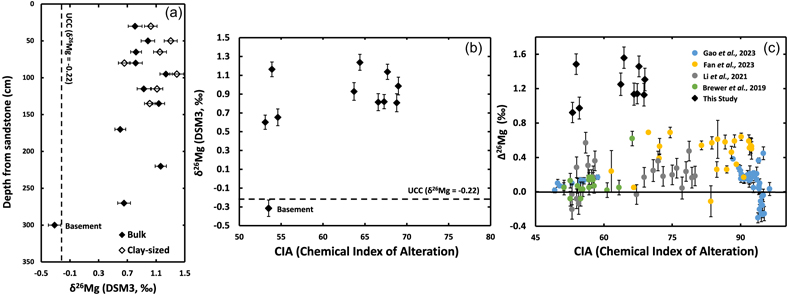
Figure 1 (a) Magnesium isotopic composition of the bulk and clay-sized fractions of the saprolite profile plotted against depth from the overlying sandstone. (b) Magnesium isotopic compositions plotted against CIA (Chemical Index of Alteration; Z. Huang et al., 2024
Huang, Z., Peters, S.C., Pazzaglia, F.J., Hernandez, M. (2024) A chemical weathering and paleoclimatic reconstruction of the early Cambrian environment of the Wyoming Craton from the Wind River Canyon, WY paleosol on the Great Unconformity. Precambrian Research 409, 107447. https://doi.org/10.1016/j.precamres.2024.107447
) for the δ26Mg values for the Cambrian palaeosol on the Great Unconformity. (c) The magnesium isotope difference (Δ26Mgsaprolite-bedrock) between the parental bedrock and corresponding regolith, including data from this study and the literature on modern granitic soil profiles (Brewer et al., 2018Brewer, A., Teng, F.Z., Dethier, D. (2018) Magnesium isotope fractionation during granite weathering. Chemical Geology 501, 95–103. https://doi.org/10.1016/j.chemgeo.2018.10.013
; Fan et al., 2023Fan, B.L., Yang, X.Q., Jiang, K., Zhao, Z.Q. (2023) Processes controlling the Mg isotope behavior during granite weathering. Journal of Asian Earth Sciences 251, 105674. https://doi.org/10.1016/j.jseaes.2023.105674
; Gao et al., 2023Gao, T., Qi, M., Wang, Z., Yin, R., Liu, C., Liu, Y., Ke, S., Zhao, Z.-Q. (2023) Magnesium Isotope Variations in Granite Regoliths from Two Contrasting Climates. Journal of Geophysical Research: Earth Surface 128, e2023JF007217. https://doi.org/10.1029/2023JF007217
; Li et al., 2021Li, M.Y.H., Teng, F.-Z., Zhou, M.-F. (2021) Phyllosilicate controls on magnesium isotopic fractionation during weathering of granites: Implications for continental weathering and riverine system. Earth and Planetary Science Letters 553, 116613. https://doi.org/10.1016/j.epsl.2020.116613
). All error bars are 2σ, and error bars in (c) are calculated using the formula.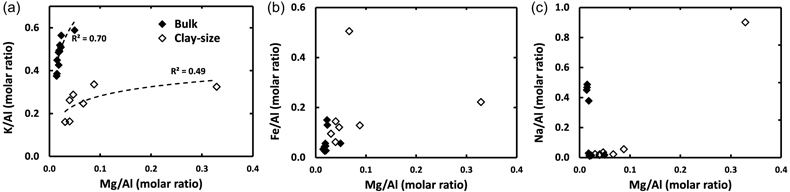
Figure 2 Cross plots for the molar ratios of (a) K/Al, (b) Fe/Al and (c) Na/Al vs. Mg/Al of both bulk and clay-sized portions of the saprolite.
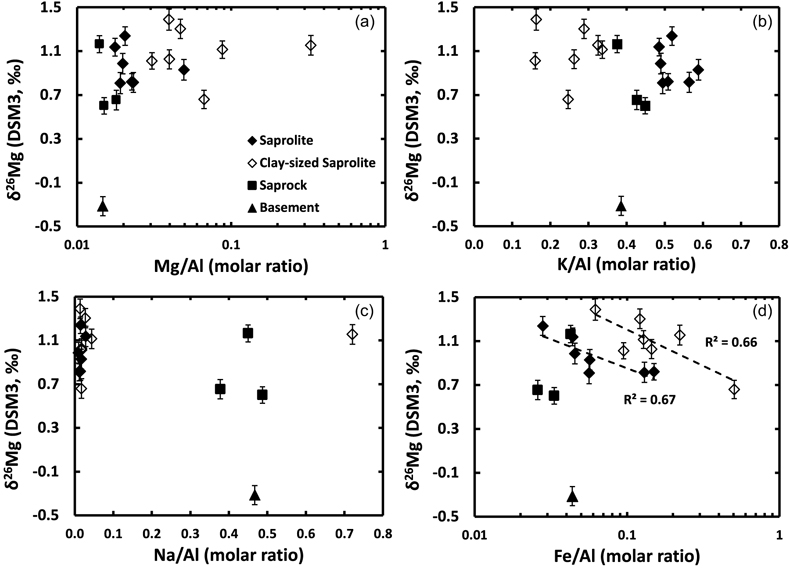
Figure 3 Cross plots for the molar ratios of (a) Mg/Al (semi-log), (b) K/Al, (c) Na/Al and (d) Fe/Al (semi-log) vs. δ26Mg values of both bulk and clay-sized portion of the saprolite.
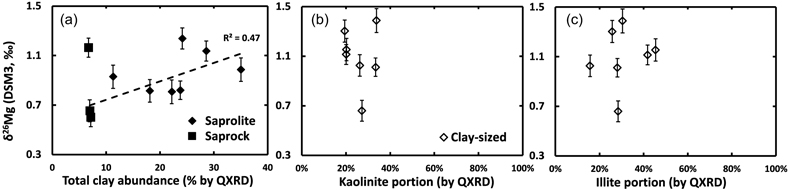
Figure 4 Cross plots of the δ26Mg values of bulk and clay-sized portions with the abundance of (a) total secondary clay abundance detected by XRD (sum of all secondary phyllosilicates), (b) kaolinite fraction of the total clay abundance and (c) illite fraction of the total clay abundance.