



Fluid-mediated uranium isotope fractionation in magmatic systems
Affiliations | Corresponding Author | Cite as | Funding information
Published by the European Association of Geochemistry
under Creative Commons License CC BY-NC-ND 4.0
Keywords: uranium isotopes, isotope fractionation, magmatic differentiation, magmatic-hydrothermal processes


- Share this article


-
Article views:1,958Cumulative count of HTML views and PDF downloads.
- Download Citation
- Rights & Permissions

top
Abstract
Figures
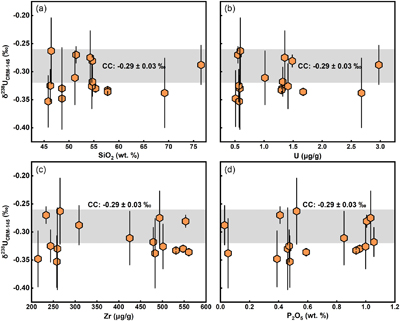 Figure 1 Co-variation of δ238U vs. major and trace compositions of the Hekla rock suite. The δ238U of the continental crust is from Tissot and Dauphas (2015). | 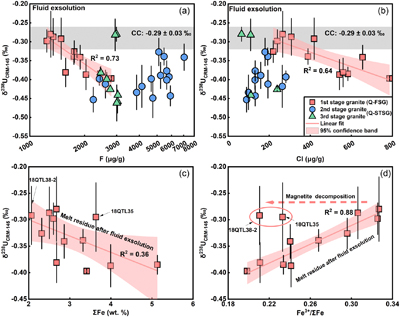 Figure 2 Positive or negative correlations between δ238U with geochemical compositions for the Qitianling granites. Continued exsolution of Fe2+-rich fluids oxidises Q-FSG melts and reduces FeO concentrations. Ultimately, this process can destabilise early crystallised magnetite evidenced in samples 18QTL35 and 18QTL38-2. | 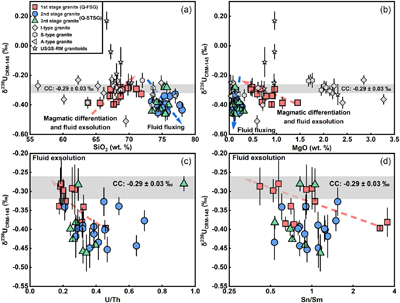 Figure 3 Plots of δ238U vs. (a) SiO2, (b) MgO, (c) U/Th and (d) Sn/Sm compositions for the Qitianling granites. Data for other granites are from Telus et al. (2012) and Li and Tissot (2023). | 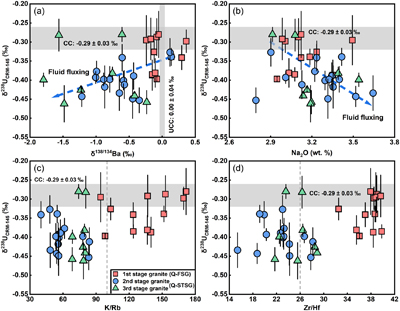 Figure 4 The δ238U vs. (a) δ138Ba, (b) Na2O, (c) K/Rb and (d) Zr/Hf compositions of the Qitianling granites. The vertical grey field indicates the average δ138/134Ba of the UCC (Deng et al., 2022 and references therein). |
| Figure 1 | Figure 2 | Figure 3 | Figure 4 |
top
Introduction
Uranium (U), with an atomic number of 92, is the heaviest naturally occurring element on Earth. Its distinctive geochemical properties make it central to studies of magmatic and hydrothermal processes. Uranium is radioactive, with three primary naturally occurring isotopes: 238U (99.2742 %), 235U (0.7204 %), and 234U (0.0054 %) (Meija et al., 2016
Meija, J., Coplen, T.B., Berglund, M., Brand, W.A., De Bièvre, P., Gröning, M., Holden, N.E., Irrgeher, J., Loss, R.D., Walczyk, T., Prohaska, T. (2016) Isotopic compositions of the elements 2013 (IUPAC Technical Report). Pure and Applied Chemistry 88, 293–306. https://doi.org/10.1515/pac-2015-0503
). The decay of 238U and 235U into 206Pb and 207Pb, respectively, underpins U-Pb geochronology, a cornerstone of Earth sciences. The difference in half-lives between 238U (t1/2 ≈ 4468 Myr) and 235U (t1/2 ≈ 703.7 Myr) has led to an increase in the 238U/235U value from ∼3.3 to ∼137.88 over Earth’s 4.56 Gyr evolution (Andersen et al., 2017Andersen, M.B., Stirling, C.H., Weyer, S. (2017) Uranium Isotope Fractionation. Reviews in Mineralogy and Geochemistry 82, 799–850. https://doi.org/10.2138/rmg.2017.82.19
). This ratio has traditionally been assumed to be constant, given the small mass difference between 238U and 235U, which supports Pb-Pb geochronology. However, small but measurable variations in 238U/235U, expressed as δ238U relative to the CRM-145 standard, have been recently observed (Weyer et al., 2008Weyer, S., Anbar, A.D., Gerdes, A., Gordon, G.W., Algeo, T.J., Boyle, E.A. (2008) Natural fractionation of 238U/235U. Geochimica et Cosmochimica Acta 72, 345–359. https://doi.org/10.1016/j.gca.2007.11.012
; Voinot et al., 2024Voinot, A., Kyser, T.K., Chipley, D., Valentino, M., Uvarova, Y., Layton-Matthews, D., Leybourne, M.I. (2024) Tl, Mo and U isotopes in U-ore deposits record Earth’s fundamental redox processes. Chemical Geology 661, 122154. https://doi.org/10.1016/j.chemgeo.2024.122154
). These variations are primarily attributed to the nuclear field shift associated with U isotope exchange during redox equilibration, representing stable U isotope fractionation (Bigeleisen, 1996Bigeleisen, J. (1996) Nuclear Size and Shape Effects in Chemical Reactions. Isotope Chemistry of the Heavy Elements. Journal of the American Chemical Society 118, 3676–3680. https://doi.org/10.1021/ja954076k
; Weyer et al., 2008Weyer, S., Anbar, A.D., Gerdes, A., Gordon, G.W., Algeo, T.J., Boyle, E.A. (2008) Natural fractionation of 238U/235U. Geochimica et Cosmochimica Acta 72, 345–359. https://doi.org/10.1016/j.gca.2007.11.012
; Tissot and Dauphas, 2015Tissot, F.L.H., Dauphas, N. (2015) Uranium isotopic compositions of the crust and ocean: Age corrections, U budget and global extent of modern anoxia. Geochimica et Cosmochimica Acta 167, 113–143. https://doi.org/10.1016/j.gca.2015.06.034
; Andersen et al., 2017Andersen, M.B., Stirling, C.H., Weyer, S. (2017) Uranium Isotope Fractionation. Reviews in Mineralogy and Geochemistry 82, 799–850. https://doi.org/10.2138/rmg.2017.82.19
; Li and Tissot, 2023Li, H., Tissot, F.L.H. (2023) UID: The uranium isotope database. Chemical Geology 618, 121221. https://doi.org/10.1016/j.chemgeo.2022.121221
).Uranium isotopes are emerging as a powerful geochemical tool for investigating high temperature geological processes (e.g., partial melting and crystallisation fractionation), particularly in granitic magmatic systems (e.g., Weyer et al., 2008
Weyer, S., Anbar, A.D., Gerdes, A., Gordon, G.W., Algeo, T.J., Boyle, E.A. (2008) Natural fractionation of 238U/235U. Geochimica et Cosmochimica Acta 72, 345–359. https://doi.org/10.1016/j.gca.2007.11.012
; Andersen et al., 2017Andersen, M.B., Stirling, C.H., Weyer, S. (2017) Uranium Isotope Fractionation. Reviews in Mineralogy and Geochemistry 82, 799–850. https://doi.org/10.2138/rmg.2017.82.19
; Tissot and Dauphas, 2015Tissot, F.L.H., Dauphas, N. (2015) Uranium isotopic compositions of the crust and ocean: Age corrections, U budget and global extent of modern anoxia. Geochimica et Cosmochimica Acta 167, 113–143. https://doi.org/10.1016/j.gca.2015.06.034
). While there is no U isotope fractionation in basalts from Lake Kilauea due to the strong U incompatibility in mafic magmas (Gaschnig et al., 2021Gaschnig, R.M., Rader, S.T., Reinhard, C.T., Owens, J.D., Planavsky, N., Wang, X., Asael, D., Greaney, A., Helz, R. (2021) Behavior of the Mo, Tl, and U isotope systems during differentiation in the Kilauea Iki lava lake. Chemical Geology 574, 120239. https://doi.org/10.1016/j.chemgeo.2021.120239
), some studies have reported significant δ238U variations in granitic systems. For example, I-, S-, and A-type granites from the Lachlan Fold Belt (Australia) exhibit heterogeneous δ238U (−0.50 ‰ to −0.21 ‰) (Telus et al., 2012Telus, M., Dauphas, N., Moynier, F., Tissot, F.L.H., Teng, F.-Z., Nabelek, P.I., Craddock, P.R., Groat, L.A. (2012) Iron, zinc, magnesium and uranium isotopic fractionation during continental crust differentiation: The tale from migmatites, granitoids, and pegmatites. Geochimica et Cosmochimica Acta 97, 247–265. https://doi.org/10.1016/j.gca.2012.08.024
), with more differentiated granitoids showing even greater fractionation (Tissot and Ibañez-Mejia, 2021Tissot, F.L.H., Ibañez-Mejia, M. (2021) Unlocking the Single-Crystal Record of Heavy Stable Isotopes. Elements 17, 389–394. https://doi.org/10.2138/gselements.17.6.389
). Additionally, U-rich accessory minerals such as zircon, apatite, and titanite show considerable δ238U variability in solution based MC-ICP-MS analyses — up to 3.7 ‰, 0.38 ‰, and 3.0 ‰, respectively (Hiess et al., 2012Hiess, J., Condon, D.J., McLean, N., Noble, S.R. (2012) 238U/235U Systematics in Terrestrial Uranium-Bearing Minerals. Science 335, 1610–1614. https://doi.org/10.1126/science.1215507
; Tissot and Dauphas, 2015Tissot, F.L.H., Dauphas, N. (2015) Uranium isotopic compositions of the crust and ocean: Age corrections, U budget and global extent of modern anoxia. Geochimica et Cosmochimica Acta 167, 113–143. https://doi.org/10.1016/j.gca.2015.06.034
; Livermore et al., 2018Livermore, B.D., Connelly, J.N., Moynier, F., Bizzarro, M. (2018) Evaluating the robustness of a consensus 238U/235U value for U-Pb geochronology. Geochimica et Cosmochimica Acta 237, 171–183. https://doi.org/10.1016/j.gca.2018.06.014
; Tissot et al., 2019Tissot, F.L.H., Ibanez-Mejia, M., Boehnke, P., Dauphas, N., McGee, D., Grove, T.L., Harrison, T.M. (2019) 238U/235U measurement in single-zircon crystals: implications for the Hadean environment, magmatic differentiation and geochronology. Journal of Analytical Atomic Spectrometry 34, 2035–2052. https://doi.org/10.1039/C9JA00205G
). LA-MC-ICP-MS analyses reveal even broader ranges, reaching 10.0 ‰ for zircon and 16.0 ‰ for titanite (Yamamoto et al., 2021Yamamoto, K., Asanuma, H., Takahashi, H., Hirata, T. (2021) In situ isotopic analysis of uranium using a new data acquisition protocol for 1013 ohm Faraday amplifiers. Journal of Analytical Atomic Spectrometry 36, 668–675. https://doi.org/10.1039/D0JA00498G
). These findings suggest that igneous differentiation, particularly through the removal of U-rich accessory minerals or the change in U coordination environments during mineral crystallisation (Tissot et al., 2017Tissot, F.L.H., Dauphas, N., Grove, T.L. (2017) Distinct 238U/235U ratios and REE patterns in plutonic and volcanic angrites: Geochronologic implications and evidence for U isotope fractionation during magmatic processes. Geochimica et Cosmochimica Acta 213, 593–617. https://doi.org/10.1016/j.gca.2017.06.045
), may fractionate U isotopes of residual granitic melts. Furthermore, studies of pegmatites and global granite-related U deposits have shown that U-rich magmatic-hydrothermal fluids (MHF) tend to exhibit low δ238U, reaching as low as −0.97 ‰ (Chernyshev et al., 2014Chernyshev, I., Golubev, V., Chugaev, A., Baranova, A. (2014) 238U/235U isotope ratio variations in minerals from hydrothermal uranium deposits. Geochemistry International 52, 1013–1029. https://doi.org/10.1134/S0016702914120027
; Li and Tissot, 2023Li, H., Tissot, F.L.H. (2023) UID: The uranium isotope database. Chemical Geology 618, 121221. https://doi.org/10.1016/j.chemgeo.2022.121221
; Sheng et al., 2025Sheng, J., Quan, Y., Jiang, D., Deng, G., Li, G., Xu, Z., Huang, F. (2025) Uranium isotope fractionation during magmatic-hydrothermal interactions in pegmatites. Chemical Geology 677, 122632. https://doi.org/10.1016/j.chemgeo.2025.122632
). These observations imply that magmatic-hydrothermal processes can further fractionate U isotopes of granitic magmas, imparting a distinct δ238U signature. Collectively, these studies highlight the potential of δ238U as a tracer for granitic evolution and magmatic-hydrothermal mineralisation. However, the systematic fractionation behaviour of U isotopes during granitic magmatic differentiation and hydrothermal processes is not well constrained.To solve this issue, we report δ238U for the Hekla rock suite (HRS) (Iceland) and Qitianling granites (South China). The HRS consists of basalts through rhyolites that have evolved through fractional crystallisation from a single mafic parental magma (Chekol et al., 2011
Chekol, T.A., Kobayashi, K., Yokoyama, T., Sakaguchi, C., Nakamura, E. (2011) Timescales of magma differentiation from basalt to andesite beneath Hekla Volcano, Iceland: Constraints from U-series disequilibria in lavas from the last quarter-millennium flows. Geochimica et Cosmochimica Acta 75, 256–283. https://doi.org/10.1016/j.gca.2010.10.001
). They differ from those of Kilauea Iki in that they span a much broader compositional range, including evolved high silica rhyolites. Importantly, isotopic evidence from Li, Zn, Mo, Tl, K, Ba, and Rb indicates that these rocks show no signs of hydrothermal alteration (Wang et al., 2023Wang, B., Moynier, F., Jackson, M.G., Huang, F., Hu, X., Halldórsson, S.A., Dai, W., Devos, G. (2023) Rubidium isotopic fractionation during magmatic processes and the composition of the bulk silicate Earth. Geochimica et Cosmochimica Acta 354, 38–50. https://doi.org/10.1016/j.gca.2023.05.021
), making them ideal candidates for investigating U isotope fractionation solely during magmatic differentiation. The Qitianling intrusion consists of three stages of coeval Jurassic granites with the second and third stage granites (Q-STSG) representing fractionated melts extracted from the underlying crystal mush, compositionally similar to the first stage granites (Q-FSG) (Huang et al., 2019Huang, F., Scaillet, B., Wang, R., Erdmann, S., Chen, Y., Faure, M., Liu, H., Xie, L., Wang, B., Zhu, J. (2019) Experimental Constraints on Intensive Crystallization Parameters and Fractionation in A-Type Granites: A Case Study on the Qitianling Pluton, South China. Journal of Geophysical Research: Solid Earth 124, 10132–10152. https://doi.org/10.1029/2019JB017490
; Deng et al., 2022Deng, G., Jiang, D., Zhang, R., Huang, J., Zhang, X., Huang, F. (2022) Barium isotopes reveal the role of deep magmatic fluids in magmatic-hydrothermal evolution and tin enrichment in granites. Earth and Planetary Science Letters 594, 117724. https://doi.org/10.1016/j.epsl.2022.117724
). Recent studies have suggested that the Q-STSG have been fluxed by MHF likely at 600–650 °C, which have exsolved from the Q-FSG under magmatic conditions at ∼650–800 °C (Huang et al., 2019Huang, F., Scaillet, B., Wang, R., Erdmann, S., Chen, Y., Faure, M., Liu, H., Xie, L., Wang, B., Zhu, J. (2019) Experimental Constraints on Intensive Crystallization Parameters and Fractionation in A-Type Granites: A Case Study on the Qitianling Pluton, South China. Journal of Geophysical Research: Solid Earth 124, 10132–10152. https://doi.org/10.1029/2019JB017490
; Deng et al., 2022Deng, G., Jiang, D., Zhang, R., Huang, J., Zhang, X., Huang, F. (2022) Barium isotopes reveal the role of deep magmatic fluids in magmatic-hydrothermal evolution and tin enrichment in granites. Earth and Planetary Science Letters 594, 117724. https://doi.org/10.1016/j.epsl.2022.117724
; Hu et al., 2024Hu, X., Jiang, D., Deng, G., Huang, F. (2024) Rubidium isotope compositions of biotite in granites record magmatic-hydrothermal process and rare metal enrichments. Geochimica et Cosmochimica Acta 382, 26–39. https://doi.org/10.1016/j.gca.2024.08.006
). These characteristics make the Qitianling granites suitable for examining the fractionation behaviour of U isotopes during hydrothermal processes. The partitioning of U into MHF is enhanced by elevated concentrations of F and Cl (Peiffert et al., 1996Peiffert, C., Nguyen-Trung, C., Cuney, M. (1996) Uranium in granitic magmas: Part 2. Experimental determination of uranium solubility and fluid-melt partition coefficients in the uranium oxide-haplogranite-H2O-NaX (X = Cl, F) system at 770°C, 2 kbar. Geochimica et Cosmochimica Acta 60, 1515–1529. https://doi.org/10.1016/0016-7037(96)00039-7
). Therefore, in addition to δ238U, we also report F and Cl concentrations for the Qitianling granites.top
Geological Background and Samples
Hekla volcano is located at the margin of the propagating South Iceland Volcanic Zone. It has been active since 1104 A.D. and has had 18 historic eruptions. Hekla erupted a broad range of magma compositions with SiO2 varying from 45.84 % to 76.52 %, with compositions ranging from basalt to basaltic andesite, andesite, dacite, and rhyolite (Ranta et al., 2021
Ranta, E., Halldórsson, S.A., Barnes, J.D., Jónasson, K., Stefánsson, A. (2021) Chlorine isotope ratios record magmatic brine assimilation during rhyolite genesis. Geochemical Perspectives Letters 16, 35–39. https://doi.org/10.7185/geochemlet.2101
). The lavas have similar Sr-Nd isotope compositions, suggesting that they are cogenetic (Chekol et al., 2011Chekol, T.A., Kobayashi, K., Yokoyama, T., Sakaguchi, C., Nakamura, E. (2011) Timescales of magma differentiation from basalt to andesite beneath Hekla Volcano, Iceland: Constraints from U-series disequilibria in lavas from the last quarter-millennium flows. Geochimica et Cosmochimica Acta 75, 256–283. https://doi.org/10.1016/j.gca.2010.10.001
). Simple fractional crystallisation in a closed system from basaltic to rhyolitic magmas is postulated as the main differentiation mechanism (Geist et al., 2021Geist, D., Harpp, K., Oswald, P., Wallace, P., Bindeman, I., Christensen, B. (2021) Hekla Revisited: Fractionation of a Magma Body at Historical Timescales. Journal of Petrology 62, egab001. https://doi.org/10.1093/petrology/egab001
) though other petrogenetic models were also proposed (Ranta et al., 2021Ranta, E., Halldórsson, S.A., Barnes, J.D., Jónasson, K., Stefánsson, A. (2021) Chlorine isotope ratios record magmatic brine assimilation during rhyolite genesis. Geochemical Perspectives Letters 16, 35–39. https://doi.org/10.7185/geochemlet.2101
).The Qitianling batholith with a surface exposure of ∼520 km2 is located within the South China Block (Fig. S-1a). Field observations suggest that the batholith has three main magmatic stages defined by three distinct lithologies and contact relationships (Chen et al., 2023
Chen, S.-C., Yu, J.-J., Bi, M.-F., Lehmann, B. (2023) Fluid-rock interaction and fluid mixing in the large Furong tin deposit, South China: New insights from tourmaline and apatite chemistry and in situ B-Nd-Sr isotope composition. American Mineralogist 108, 338–353. https://doi.org/10.2138/am-2022-8310
). The Q-FSG are coarse grained porphyritic amphibole-biotite-rich granites (∼45 %), while the Q-STSG are medium grained biotite ± amphibole granites (∼40 %) and fine grained alkali-feldspar granites (∼15 %), respectively. Field observations and zircon U-Pb dating indicate that these granite stages crystallised coevally at 150–160 Ma (Chen et al., 2023Chen, S.-C., Yu, J.-J., Bi, M.-F., Lehmann, B. (2023) Fluid-rock interaction and fluid mixing in the large Furong tin deposit, South China: New insights from tourmaline and apatite chemistry and in situ B-Nd-Sr isotope composition. American Mineralogist 108, 338–353. https://doi.org/10.2138/am-2022-8310
). The whole rock ɛNd(t) (−5.5 to −8.9) of the granites are indistinguishable, implying the same crustal sources (Chen et al., 2023Chen, S.-C., Yu, J.-J., Bi, M.-F., Lehmann, B. (2023) Fluid-rock interaction and fluid mixing in the large Furong tin deposit, South China: New insights from tourmaline and apatite chemistry and in situ B-Nd-Sr isotope composition. American Mineralogist 108, 338–353. https://doi.org/10.2138/am-2022-8310
). Phase equilibrium experiments and trace element modelling suggest that the Qitianling first, second, and third stage granites have compositions that fall along a continuous liquid line of descent (Huang et al., 2019Huang, F., Scaillet, B., Wang, R., Erdmann, S., Chen, Y., Faure, M., Liu, H., Xie, L., Wang, B., Zhu, J. (2019) Experimental Constraints on Intensive Crystallization Parameters and Fractionation in A-Type Granites: A Case Study on the Qitianling Pluton, South China. Journal of Geophysical Research: Solid Earth 124, 10132–10152. https://doi.org/10.1029/2019JB017490
; Chen et al., 2023Chen, S.-C., Yu, J.-J., Bi, M.-F., Lehmann, B. (2023) Fluid-rock interaction and fluid mixing in the large Furong tin deposit, South China: New insights from tourmaline and apatite chemistry and in situ B-Nd-Sr isotope composition. American Mineralogist 108, 338–353. https://doi.org/10.2138/am-2022-8310
).top
Results
The δ238U values for samples from Hekla and Qitianling are listed in Tables S-1 and S-2. The analytical methodology is provided in the Supplementary Information. The δ238U of the HRS ranges from −0.35 ± 0.05 ‰ to −0.26 ± 0.06 ‰, closely comparable to those of Kilauea basalts (−0.38 ± 0.07 ‰ to −0.20 ± 0.06 ‰) (Gaschnig et al., 2021
Gaschnig, R.M., Rader, S.T., Reinhard, C.T., Owens, J.D., Planavsky, N., Wang, X., Asael, D., Greaney, A., Helz, R. (2021) Behavior of the Mo, Tl, and U isotope systems during differentiation in the Kilauea Iki lava lake. Chemical Geology 574, 120239. https://doi.org/10.1016/j.chemgeo.2021.120239
). Although the δ238U is variable, it exhibits no correlation with differentiation indices, such as SiO2, U, Zr, or P2O5 concentrations (Fig. 1).Figure 1 Co-variation of δ238U vs. major and trace compositions of the Hekla rock suite. The δ238U of the continental crust is from Tissot and Dauphas (2015)
Tissot, F.L.H., Dauphas, N. (2015) Uranium isotopic compositions of the crust and ocean: Age corrections, U budget and global extent of modern anoxia. Geochimica et Cosmochimica Acta 167, 113–143. https://doi.org/10.1016/j.gca.2015.06.034
.Fluorine and Cl concentrations of the Q-FSG range from 1240 to 2805 μg/g and 220 to 786 μg/g, respectively, which are well correlated with U/Th and K/Rb values (Fig. 2). Notably, the F (2233 to 7046 μg/g) and Cl (65.6 to 281 μg/g) concentrations of the Q-STSG are much higher or lower than those in the Q-FSG, respectively.
Figure 2 Positive or negative correlations between δ238U with geochemical compositions for the Qitianling granites. Continued exsolution of Fe2+-rich fluids oxidises Q-FSG melts and reduces FeO concentrations. Ultimately, this process can destabilise early crystallised magnetite evidenced in samples 18QTL35 and 18QTL38-2.
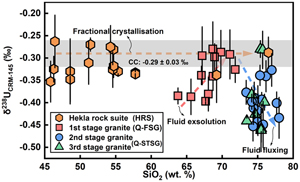
The δ238U in the Q-FSG varies from −0.40 ± 0.00 ‰ to −0.28 ± 0.06 ‰, with an average of −0.34 ± 0.09 ‰. These values increase with increasing SiO2 (and Fe3+/ΣFe) and decreasing MgO, ΣFe, F, Cl, U/Th, and Sn/Sm (Figs. 2, 3). Although the δ238U range of the Q-STSG (−0.46 ± 0.03 ‰ to −0.28 ± 0.02 ‰ with an average of −0.40 ± 0.10 ‰) overlaps with that of the Q-FSG, a t test reveals a statistically significant difference between the groups (p = 0.002). Moreover, Q-STSG samples tend to exhibit lower δ138/134Ba, K/Rb, and Zr/Hf ratios, along with higher Na2O contents, relative to Q-FSG (Fig. 4).
Figure 3 Plots of δ238U vs. (a) SiO2, (b) MgO, (c) U/Th and (d) Sn/Sm compositions for the Qitianling granites. Data for other granites are from Telus et al. (2012)
Telus, M., Dauphas, N., Moynier, F., Tissot, F.L.H., Teng, F.-Z., Nabelek, P.I., Craddock, P.R., Groat, L.A. (2012) Iron, zinc, magnesium and uranium isotopic fractionation during continental crust differentiation: The tale from migmatites, granitoids, and pegmatites. Geochimica et Cosmochimica Acta 97, 247–265. https://doi.org/10.1016/j.gca.2012.08.024
and Li and Tissot (2023)Li, H., Tissot, F.L.H. (2023) UID: The uranium isotope database. Chemical Geology 618, 121221. https://doi.org/10.1016/j.chemgeo.2022.121221
.Figure 4 The δ238U vs. (a) δ138Ba, (b) Na2O, (c) K/Rb and (d) Zr/Hf compositions of the Qitianling granites. The vertical grey field indicates the average δ138/134Ba of the UCC (Deng et al., 2022
Deng, G., Jiang, D., Zhang, R., Huang, J., Zhang, X., Huang, F. (2022) Barium isotopes reveal the role of deep magmatic fluids in magmatic-hydrothermal evolution and tin enrichment in granites. Earth and Planetary Science Letters 594, 117724. https://doi.org/10.1016/j.epsl.2022.117724
and references therein).top
Discussion
Uranium isotope fractionation during igneous differentiation. Typically, U behaves incompatibly during fractional crystallisation with a partition coefficient DUsolid/melt of 0.0011 (Workman and Hart, 2005
Workman, R.K., Hart, S.R. (2005) Major and trace element composition of the depleted MORB mantle (DMM). Earth and Planetary Science Letters 231, 53–72. https://doi.org/10.1016/j.epsl.2004.12.005
) and is thus concentrated in residual melts. This incompatible behaviour is also evident in the monotonic correlations between concentrations of U and major or trace elements of the HRS (Fig. S-2a–f). However, in the Hekla magmas, zircon and apatite have fractionated, as indicated by decreased Zr concentrations at ∼65 wt. % SiO2 and decreased P2O5 concentrations at ∼54 wt. % SiO2 (Fig. S-2g,h). Zircon and apatite are significant U-rich accessory minerals in felsic magmas. Their removal, particularly given their enrichment in 238U relative to crustal rocks (Hiess et al., 2012Hiess, J., Condon, D.J., McLean, N., Noble, S.R. (2012) 238U/235U Systematics in Terrestrial Uranium-Bearing Minerals. Science 335, 1610–1614. https://doi.org/10.1126/science.1215507
; Livermore et al., 2018Livermore, B.D., Connelly, J.N., Moynier, F., Bizzarro, M. (2018) Evaluating the robustness of a consensus 238U/235U value for U-Pb geochronology. Geochimica et Cosmochimica Acta 237, 171–183. https://doi.org/10.1016/j.gca.2018.06.014
; Tissot et al., 2019Tissot, F.L.H., Ibanez-Mejia, M., Boehnke, P., Dauphas, N., McGee, D., Grove, T.L., Harrison, T.M. (2019) 238U/235U measurement in single-zircon crystals: implications for the Hadean environment, magmatic differentiation and geochronology. Journal of Analytical Atomic Spectrometry 34, 2035–2052. https://doi.org/10.1039/C9JA00205G
; Tissot and Ibañez-Mejia, 2021Tissot, F.L.H., Ibañez-Mejia, M. (2021) Unlocking the Single-Crystal Record of Heavy Stable Isotopes. Elements 17, 389–394. https://doi.org/10.2138/gselements.17.6.389
), may enrich the residual melts in 235U. Nevertheless, although the δ238U of the HRS is variable, it exhibits no correlation with differentiation indices, such as SiO2, U, Zr, or P2O5 concentrations (Fig. 1). These trends suggest that U isotope fractionation during granitic differentiation is minimal, even when U-rich accessory phases are removed. The observed δ238U variability in the Hekla basalts may reflect heterogeneity of the mantle source which could contain minor recycled crustal material (Halldórsson et al., 2016Halldórsson, S.A., Hilton, D.R., Barry, P.H., Füri, E., Grönvold, K. (2016) Recycling of crustal material by the Iceland mantle plume: New evidence from nitrogen elemental and isotope systematics of subglacial basalts. Geochimica et Cosmochimica Acta 176, 206–226. https://doi.org/10.1016/j.gca.2015.12.021
) or reflect interactions between the Icelandic plume and the Mid-Atlantic Ridge (Schilling, 1973Schilling, J.-G. (1973) Iceland Mantle Plume: Geochemical Study of Reykjanes Ridge. Nature 242, 565–571. https://doi.org/10.1038/242565a0
). As U isotopes are insignificantly fractionated during fractional crystallisation, we further hypothesise that they are not fractionated during the partial melting of crust and mantle either, which involves mineral melting followed by melt separation. This interpretation is supported by the identical δ238U estimated for bulk crust and mantle compositions (Tissot and Dauphas, 2015Tissot, F.L.H., Dauphas, N. (2015) Uranium isotopic compositions of the crust and ocean: Age corrections, U budget and global extent of modern anoxia. Geochimica et Cosmochimica Acta 167, 113–143. https://doi.org/10.1016/j.gca.2015.06.034
).Uranium isotope fractionation during fluid exsolution. Magmatic-hydrothermal fluids play a critical role in migrating U from granitic magmas (Zajacz et al., 2008
Zajacz, Z., Halter, W.E., Pettke, T., Guillong, M. (2008) Determination of fluid/melt partition coefficients by LA-ICPMS analysis of co-existing fluid and silicate melt inclusions: Controls on element partitioning. Geochimica et Cosmochimica Acta 72, 2169–2197. https://doi.org/10.1016/j.gca.2008.01.034
). Phase equilibrium experiments suggest that the Q-FSG has a solidus of 650 °C and a liquidus above 900 °C (Huang et al., 2019Huang, F., Scaillet, B., Wang, R., Erdmann, S., Chen, Y., Faure, M., Liu, H., Xie, L., Wang, B., Zhu, J. (2019) Experimental Constraints on Intensive Crystallization Parameters and Fractionation in A-Type Granites: A Case Study on the Qitianling Pluton, South China. Journal of Geophysical Research: Solid Earth 124, 10132–10152. https://doi.org/10.1029/2019JB017490
). They also imply that parental magmas of the Q-FSG were initially H2O-rich (≥4 wt. %) and reached water saturation (∼6.5–8.0 wt. %) at ≤300 MPa and 800 °C. However, the loss on ignition (LOI) of the Q-FSG is low (∼0.42 to 0.86 wt. %). Moreover, miarolitic cavities, typically indicating the entrapment of fluid-rich melts or hydrosaline fluids, are absent in the Q-FSG, and evidence of hydrothermal alteration is minimal (Huang et al., 2019Huang, F., Scaillet, B., Wang, R., Erdmann, S., Chen, Y., Faure, M., Liu, H., Xie, L., Wang, B., Zhu, J. (2019) Experimental Constraints on Intensive Crystallization Parameters and Fractionation in A-Type Granites: A Case Study on the Qitianling Pluton, South China. Journal of Geophysical Research: Solid Earth 124, 10132–10152. https://doi.org/10.1029/2019JB017490
). These observations suggest that the exsolution and subsequent loss of MHF occurred during the magmatic evolution of the Q-FSG magmas, likely within a temperature window of ∼650–800 °CThis hypothesis is further supported by other bulk rock geochemical trends.
- Uranium concentrations. In granitic melts, U concentrations typically increase with magmatic differentiation, even when U-rich accessory phases are fractionated (Fig. S-2a–d). However, in the Q-FSG, U concentrations remained constant during magmatic evolution (Fig. S-3). Uranium can be a fluid mobile element, and its concentration in magmas decreases during the exsolution of F (Cl)-rich fluids (Peiffert et al., 1996
Peiffert, C., Nguyen-Trung, C., Cuney, M. (1996) Uranium in granitic magmas: Part 2. Experimental determination of uranium solubility and fluid-melt partition coefficients in the uranium oxide-haplogranite-H2O-NaX (X = Cl, F) system at 770°C, 2 kbar. Geochimica et Cosmochimica Acta 60, 1515–1529. https://doi.org/10.1016/0016-7037(96)00039-7
). Therefore, the consistent U concentrations can result from a compensatory effect involving fractional crystallisation and fluid exsolution. - Fluid mobile vs. fluid incompatible element ratios. K and Rb, U, and Th, as well as Sn and Sm, exhibit similar compatibility during magmatic differentiation. Thus, fractional crystallisation cannot substantially change K/Rb, Rb/Sr, U/Th, and Sn/Sm ratios in magmas. However, during the magmatic evolution of the Q-FSG, the K/Rb ratio increases, while the Rb/Sr, U/Th, and Sn/Sm ratios decrease (Fig. S-4a–d). This pattern can be attributed to variable loss of these elements during fluid exsolution due to their different fluid mobilities. For example, Rb, U, and Sn are more fluid mobile than K, Th, and Sm (Zajacz et al., 2008
Zajacz, Z., Halter, W.E., Pettke, T., Guillong, M. (2008) Determination of fluid/melt partition coefficients by LA-ICPMS analysis of co-existing fluid and silicate melt inclusions: Controls on element partitioning. Geochimica et Cosmochimica Acta 72, 2169–2197. https://doi.org/10.1016/j.gca.2008.01.034
), respectively. Moreover, Rb is more incompatible and more fluid mobile than Sr (Zajacz et al., 2008Zajacz, Z., Halter, W.E., Pettke, T., Guillong, M. (2008) Determination of fluid/melt partition coefficients by LA-ICPMS analysis of co-existing fluid and silicate melt inclusions: Controls on element partitioning. Geochimica et Cosmochimica Acta 72, 2169–2197. https://doi.org/10.1016/j.gca.2008.01.034
). Fluid exsolution preferentially partitions Rb, U, and Sn into the MHF, leaving behind a melt enriched in K, Th, and Sm. - F-Cl concentrations. The Q-FSG have variable F and Cl concentrations which show positive correlations with the U/Th ratio and negative correlations with the K/Rb ratio (Fig. S-5). These trends deviate from the typical patterns expected during fractional crystallisation. Instead, they are consistent with the exsolution of F- and Cl-rich MHF in the Qitianling magmatic system, which is known to be enriched in F, Cl, U, and Rb (Chen et al., 2023
Chen, S.-C., Yu, J.-J., Bi, M.-F., Lehmann, B. (2023) Fluid-rock interaction and fluid mixing in the large Furong tin deposit, South China: New insights from tourmaline and apatite chemistry and in situ B-Nd-Sr isotope composition. American Mineralogist 108, 338–353. https://doi.org/10.2138/am-2022-8310
). - Fe3+/ΣFe ratio. The Fe3+/ΣFe ratio of the Q-FSG increases with magmatic evolution but shows no correlation with SiO2 or Fe2O3T concentrations (Fig. S-6). These observations suggest that the elevated Fe3+/ΣFe ratio does not result from igneous differentiation. Experimental studies indicate that the exsolution of Cl-bearing fluids removes Fe2+ over Fe3+ from melts, thereby increasing the Fe3+/ΣFe ratio in residual melts (Bell and Simon, 2011
Bell, A.S., Simon, A. (2011) Experimental evidence for the alteration of the Fe3+/ΣFe of silicate melt caused by the degassing of chlorine-bearing aqueous volatiles. Geology 39, 499–502. https://doi.org/10.1130/G31828.1
). In the Q-FSG magmas, this interpretation is supported by correlations between Fe3+/ΣFe and K/Rb, Rb/Sr, U/Th, Sn/Sm, F, or Cl compositions (Fig. S-4a–f).
Tissot, F.L.H., Dauphas, N. (2015) Uranium isotopic compositions of the crust and ocean: Age corrections, U budget and global extent of modern anoxia. Geochimica et Cosmochimica Acta 167, 113–143. https://doi.org/10.1016/j.gca.2015.06.034
), this isotopic variation must be attributed to magmatic and/or magmatic-hydrothermal processes. Fractional crystallisation of U-rich minerals, such as zircon and apatite (Fig. S-7a,b), plays a key role in driving compositional variability in the Q-FSG (Deng et al., 2022Deng, G., Jiang, D., Zhang, R., Huang, J., Zhang, X., Huang, F. (2022) Barium isotopes reveal the role of deep magmatic fluids in magmatic-hydrothermal evolution and tin enrichment in granites. Earth and Planetary Science Letters 594, 117724. https://doi.org/10.1016/j.epsl.2022.117724
). However, as seen in the HRS (Fig. 1), U isotopes are also not fractionated during igneous differentiation, even when U-rich phases are fractionated. This suggests that the δ238U variation in the Q-FSG is driven by processes beyond fractional crystallisation. As discussed earlier, the Q-FSG magmas experienced the exsolution and loss of U-rich MHF with the magmatic evolution. More importantly, the δ238U of the Q-FSG shows correlations with SiO2 and MgO, U/Th, Sn/Sm, F, Cl, ΣFe, and Fe3+/ΣFe compositions (Figs. 2, 3). These correlations strongly indicate that the exsolution of MHF, which is inferred to be enriched in 235U, was a key process driving the δ238U fractionation in the Q-FSG. To quantify the fluid exsolution-induced U isotope fractionation, we performed a simulation using Rayleigh distillation models which successfully reproduces the observed δ238U variation in the Q-FSG (Fig. S-8a).Uranium isotope fractionation during fluid fluxing. The Q-STSG experienced greater magmatic differentiation and more extensive fluid exsolution compared to the Q-FSG (Huang et al., 2019
Huang, F., Scaillet, B., Wang, R., Erdmann, S., Chen, Y., Faure, M., Liu, H., Xie, L., Wang, B., Zhu, J. (2019) Experimental Constraints on Intensive Crystallization Parameters and Fractionation in A-Type Granites: A Case Study on the Qitianling Pluton, South China. Journal of Geophysical Research: Solid Earth 124, 10132–10152. https://doi.org/10.1029/2019JB017490
). Theoretically, this enhanced fluid exsolution should result in higher δ238U in the residual melts. However, the δ238U of the Q-STSG (−0.40±0.10 ‰) is lower than that of the Q-FSG (−0.34 ± 0.09 ‰), showing no consistent fractionation trend (Figs. 2, 3). This unexpected pattern indicates that fluid exsolution alone cannot account for the low δ238U observed in the Q-STSG.The Q-STSG exhibit extensive hydrothermal alterations and partial replacement of magmatic minerals such as biotite and titanite by chlorite and Fe-Ti oxides, respectively (Deng et al., 2022
Deng, G., Jiang, D., Zhang, R., Huang, J., Zhang, X., Huang, F. (2022) Barium isotopes reveal the role of deep magmatic fluids in magmatic-hydrothermal evolution and tin enrichment in granites. Earth and Planetary Science Letters 594, 117724. https://doi.org/10.1016/j.epsl.2022.117724
; Hu et al., 2024Hu, X., Jiang, D., Deng, G., Huang, F. (2024) Rubidium isotope compositions of biotite in granites record magmatic-hydrothermal process and rare metal enrichments. Geochimica et Cosmochimica Acta 382, 26–39. https://doi.org/10.1016/j.gca.2024.08.006
). These were driven by the fluxing of low δ138Ba and high δ87Rb MHF (Deng et al., 2022Deng, G., Jiang, D., Zhang, R., Huang, J., Zhang, X., Huang, F. (2022) Barium isotopes reveal the role of deep magmatic fluids in magmatic-hydrothermal evolution and tin enrichment in granites. Earth and Planetary Science Letters 594, 117724. https://doi.org/10.1016/j.epsl.2022.117724
; Hu et al., 2024Hu, X., Jiang, D., Deng, G., Huang, F. (2024) Rubidium isotope compositions of biotite in granites record magmatic-hydrothermal process and rare metal enrichments. Geochimica et Cosmochimica Acta 382, 26–39. https://doi.org/10.1016/j.gca.2024.08.006
), which also contributed to the formation of the giant Sn deposit (SnO2 > 700,000 tons) (Chen et al., 2023Chen, S.-C., Yu, J.-J., Bi, M.-F., Lehmann, B. (2023) Fluid-rock interaction and fluid mixing in the large Furong tin deposit, South China: New insights from tourmaline and apatite chemistry and in situ B-Nd-Sr isotope composition. American Mineralogist 108, 338–353. https://doi.org/10.2138/am-2022-8310
). As shown in Figure 4a,b, the Q-STSG samples with low δ238U also tend to have low δ138/134Ba and elevated Na2O concentrations, typical of ore-forming fluids in the Qitianling intrusion (Chen et al., 2023Chen, S.-C., Yu, J.-J., Bi, M.-F., Lehmann, B. (2023) Fluid-rock interaction and fluid mixing in the large Furong tin deposit, South China: New insights from tourmaline and apatite chemistry and in situ B-Nd-Sr isotope composition. American Mineralogist 108, 338–353. https://doi.org/10.2138/am-2022-8310
). Additionally, these low δ238U samples display low K/Rb and Zr/Hf (Fig. 4c,d), suggesting fluid-melt interaction which modified the melt composition in a way consistent with fluid-derived elemental ratios (i.e. low K/Rb and Zr/Hf) (Deng et al., 2022Deng, G., Jiang, D., Zhang, R., Huang, J., Zhang, X., Huang, F. (2022) Barium isotopes reveal the role of deep magmatic fluids in magmatic-hydrothermal evolution and tin enrichment in granites. Earth and Planetary Science Letters 594, 117724. https://doi.org/10.1016/j.epsl.2022.117724
). Based on these geochemical signatures, it is suggested that the fluxing of MHF fractionated the δ238U of the resident magmas, resulting in the lower δ238U signature of the Q-STSG. This interpretation is consistent with the enrichment of 235U in MHF exsolved from the Q-FSG magmas. Moreover, this conclusion also aligns with the observation that granite-related hydrothermal U deposits typically exhibit lower δ238U than the average CC (Chernyshev et al., 2014Chernyshev, I., Golubev, V., Chugaev, A., Baranova, A. (2014) 238U/235U isotope ratio variations in minerals from hydrothermal uranium deposits. Geochemistry International 52, 1013–1029. https://doi.org/10.1134/S0016702914120027
), although some deposits show δ238U indistinguishable from that of the CC (Voinot et al., 2024Voinot, A., Kyser, T.K., Chipley, D., Valentino, M., Uvarova, Y., Layton-Matthews, D., Leybourne, M.I. (2024) Tl, Mo and U isotopes in U-ore deposits record Earth’s fundamental redox processes. Chemical Geology 661, 122154. https://doi.org/10.1016/j.chemgeo.2024.122154
). To quantify the fluid fluxing-induced U isotope fractionation, we performed open system modelling (Table S-4). The results show that the δ238U of the Q-STSG can be reproduced using apparent fractionation factors (αfluid-melt) ranging from 0.9982 to 0.9996 (Fig. S-8b) which may depend on temperature and compositions of the melt and fluid.top
Conclusions
This study investigated U isotope fractionation behaviour during magmatic differentiation and hydrothermal processes by analysing δ238U in the Hekla rock suite and the Qitianling granites. Our results indicate that δ238U variations in magmatic systems are primarily influenced by fluid related processes rather than magmatic differentiation. The atypical U isotope characteristics observed in granitoids may serve as a novel tracer for fluid related processes, offering valuable insights into the migration and enrichment of fluid mobile elements associated with magmatic-hydrothermal fluids.
top
Data availability
Data will be made available on request.
top
Acknowledgments
We sincerely acknowledge Prof. Sæmundur Ari Halldórsson for his invaluable academic discussions and intellectual contributions. Our profound gratitude also extends to François L.H. Tissot, the anonymous reviewer, and Editor Ambre Luguet, whose incisive critiques and professional guidance have substantially elevated the scholarly rigour and presentation of this work. This work was financially supported by the National Natural Science Foundation of China (Grant No. 42473010).
Editor: Ambre Luguet
top
References
Andersen, M.B., Stirling, C.H., Weyer, S. (2017) Uranium Isotope Fractionation. Reviews in Mineralogy and Geochemistry 82, 799–850. https://doi.org/10.2138/rmg.2017.82.19
 Show in context
 The difference in half-lives between 238U (t1/2 ≈ 4468 Myr) and 235U (t1/2 ≈ 703.7 Myr) has led to an increase in the 238U/235U value from ∼3.3 to ∼137.88 over Earth’s 4.56 Gyr evolution (Andersen et al., 2017).
View in article
These variations are primarily attributed to the nuclear field shift associated with U isotope exchange during redox equilibration, representing stable U isotope fractionation (Bigeleisen, 1996; Weyer et al., 2008; Tissot and Dauphas, 2015; Andersen et al., 2017; Li and Tissot, 2023).
View in article
Uranium isotopes are emerging as a powerful geochemical tool for investigating high temperature geological processes (e.g., partial melting and crystallisation fractionation), particularly in granitic magmatic systems (e.g., Weyer et al., 2008; Andersen et al., 2017; Tissot and Dauphas, 2015).
View in article
Bell, A.S., Simon, A. (2011) Experimental evidence for the alteration of the Fe3+/ΣFe of silicate melt caused by the degassing of chlorine-bearing aqueous volatiles. Geology 39, 499–502. https://doi.org/10.1130/G31828.1
Show in context Experimental studies indicate that the exsolution of Cl-bearing fluids removes Fe2+ over Fe3+ from melts, thereby increasing the Fe3+/ΣFe ratio in residual melts (Bell and Simon, 2011).
View in article
Bigeleisen, J. (1996) Nuclear Size and Shape Effects in Chemical Reactions. Isotope Chemistry of the Heavy Elements. Journal of the American Chemical Society 118, 3676–3680. https://doi.org/10.1021/ja954076k
Show in context These variations are primarily attributed to the nuclear field shift associated with U isotope exchange during redox equilibration, representing stable U isotope fractionation (Bigeleisen, 1996; Weyer et al., 2008; Tissot and Dauphas, 2015; Andersen et al., 2017; Li and Tissot, 2023).
View in article
Chekol, T.A., Kobayashi, K., Yokoyama, T., Sakaguchi, C., Nakamura, E. (2011) Timescales of magma differentiation from basalt to andesite beneath Hekla Volcano, Iceland: Constraints from U-series disequilibria in lavas from the last quarter-millennium flows. Geochimica et Cosmochimica Acta 75, 256–283. https://doi.org/10.1016/j.gca.2010.10.001
Show in context The HRS consists of basalts through rhyolites that have evolved through fractional crystallisation from a single mafic parental magma (Chekol et al., 2011).
View in article
The lavas have similar Sr-Nd isotope compositions, suggesting that they are cogenetic (Chekol et al., 2011).
View in article
Chen, S.-C., Yu, J.-J., Bi, M.-F., Lehmann, B. (2023) Fluid-rock interaction and fluid mixing in the large Furong tin deposit, South China: New insights from tourmaline and apatite chemistry and in situ B-Nd-Sr isotope composition. American Mineralogist 108, 338–353. https://doi.org/10.2138/am-2022-8310
Show in context Field observations suggest that the batholith has three main magmatic stages defined by three distinct lithologies and contact relationships (Chen et al., 2023).
View in article
Field observations and zircon U-Pb dating indicate that these granite stages crystallised coevally at 150–160 Ma (Chen et al., 2023).
View in article
The whole rock ɛNd(t) (−5.5 to −8.9) of the granites are indistinguishable, implying the same crustal sources (Chen et al., 2023).
View in article
Phase equilibrium experiments and trace element modelling suggest that the Qitianling first, second, and third stage granites have compositions that fall along a continuous liquid line of descent (Huang et al., 2019; Chen et al., 2023).
View in article
Instead, they are consistent with the exsolution of F- and Cl-rich MHF in the Qitianling magmatic system, which is known to be enriched in F, Cl, U, and Rb (Chen et al., 2023).
View in article
These were driven by the fluxing of low δ138Ba and high δ87Rb MHF (Deng et al., 2022; Hu et al., 2024), which also contributed to the formation of the giant Sn deposit (SnO2 > 700,000 tons) (Chen et al., 2023).
View in article
As shown in Figure 4a,b, the Q-STSG samples with low δ238U also tend to have low δ138/134Ba and elevated Na2O concentrations, typical of ore-forming fluids in the Qitianling intrusion (Chen et al., 2023).
View in article
Chernyshev, I., Golubev, V., Chugaev, A., Baranova, A. (2014) 238U/235U isotope ratio variations in minerals from hydrothermal uranium deposits. Geochemistry International 52, 1013–1029. https://doi.org/10.1134/S0016702914120027
Show in context Furthermore, studies of pegmatites and global granite-related U deposits have shown that U-rich magmatic-hydrothermal fluids (MHF) tend to exhibit low δ238U, reaching as low as −0.97 ‰ (Chernyshev et al., 2014; Li and Tissot, 2023; Sheng et al., 2025).
View in article
Moreover, this conclusion also aligns with the observation that granite-related hydrothermal U deposits typically exhibit lower δ238U than the average CC (Chernyshev et al., 2014), although some deposits show δ238U indistinguishable from that of the CC (Voinot et al., 2024).
View in article
Deng, G., Jiang, D., Zhang, R., Huang, J., Zhang, X., Huang, F. (2022) Barium isotopes reveal the role of deep magmatic fluids in magmatic-hydrothermal evolution and tin enrichment in granites. Earth and Planetary Science Letters 594, 117724. https://doi.org/10.1016/j.epsl.2022.117724
Show in context The Qitianling intrusion consists of three stages of coeval Jurassic granites with the second and third stage granites (Q-STSG) representing fractionated melts extracted from the underlying crystal mush, compositionally similar to the first stage granites (Q-FSG) (Huang et al., 2019; Deng et al., 2022).
View in article
Recent studies have suggested that the Q-STSG have been fluxed by MHF likely at 600–650 °C, which have exsolved from the Q-FSG under magmatic conditions at ∼650–800 °C (Huang et al., 2019; Deng et al., 2022; Hu et al., 2024).
View in article
The vertical grey field indicates the average δ138/134Ba of the UCC (Deng et al., 2022 and references therein).
View in article
Fractional crystallisation of U-rich minerals, such as zircon and apatite (Fig. S-7a,b), plays a key role in driving compositional variability in the Q-FSG (Deng et al., 2022).
View in article
The Q-STSG exhibit extensive hydrothermal alterations and partial replacement of magmatic minerals such as biotite and titanite by chlorite and Fe-Ti oxides, respectively (Deng et al., 2022; Hu et al., 2024).
View in article
These were driven by the fluxing of low δ138Ba and high δ87Rb MHF (Deng et al., 2022; Hu et al., 2024), which also contributed to the formation of the giant Sn deposit (SnO2 > 700,000 tons) (Chen et al., 2023).
View in article
Additionally, these low δ238U samples display low K/Rb and Zr/Hf (Fig. 4c,d), suggesting fluid-melt interaction which modified the melt composition in a way consistent with fluid-derived elemental ratios (i.e. low K/Rb and Zr/Hf) (Deng et al., 2022).
View in article
Gaschnig, R.M., Rader, S.T., Reinhard, C.T., Owens, J.D., Planavsky, N., Wang, X., Asael, D., Greaney, A., Helz, R. (2021) Behavior of the Mo, Tl, and U isotope systems during differentiation in the Kilauea Iki lava lake. Chemical Geology 574, 120239. https://doi.org/10.1016/j.chemgeo.2021.120239
Show in context While there is no U isotope fractionation in basalts from Lake Kilauea due to the strong U incompatibility in mafic magmas (Gaschnig et al., 2021), some studies have reported significant δ238U variations in granitic systems.
View in article
The δ238U of the HRS ranges from −0.35 ± 0.05 ‰ to −0.26 ± 0.06 ‰, closely comparable to those of Kilauea basalts (−0.38 ± 0.07 ‰ to −0.20 ± 0.06 ‰) (Gaschnig et al., 2021).
View in article
Geist, D., Harpp, K., Oswald, P., Wallace, P., Bindeman, I., Christensen, B. (2021) Hekla Revisited: Fractionation of a Magma Body at Historical Timescales. Journal of Petrology 62, egab001. https://doi.org/10.1093/petrology/egab001
Show in context Simple fractional crystallisation in a closed system from basaltic to rhyolitic magmas is postulated as the main differentiation mechanism (Geist et al., 2021) though other petrogenetic models were also proposed (Ranta et al., 2021).
View in article
Halldórsson, S.A., Hilton, D.R., Barry, P.H., Füri, E., Grönvold, K. (2016) Recycling of crustal material by the Iceland mantle plume: New evidence from nitrogen elemental and isotope systematics of subglacial basalts. Geochimica et Cosmochimica Acta 176, 206–226. https://doi.org/10.1016/j.gca.2015.12.021
Show in context The observed δ238U variability in the Hekla basalts may reflect heterogeneity of the mantle source which could contain minor recycled crustal material (Halldórsson et al., 2016) or reflect interactions between the Icelandic plume and the Mid-Atlantic Ridge (Schilling, 1973).
View in article
Hiess, J., Condon, D.J., McLean, N., Noble, S.R. (2012) 238U/235U Systematics in Terrestrial Uranium-Bearing Minerals. Science 335, 1610–1614. https://doi.org/10.1126/science.1215507
Show in context Additionally, U-rich accessory minerals such as zircon, apatite, and titanite show considerable δ238U variability in solution based MC-ICP-MS analyses — up to 3.7 ‰, 0.38 ‰, and 3.0 ‰, respectively (Hiess et al., 2012; Tissot and Dauphas, 2015; Livermore et al., 2018; Tissot et al., 2019).
View in article
Zircon and apatite are significant U-rich accessory minerals in felsic magmas. Their removal, particularly given their enrichment in 238U relative to crustal rocks (Hiess et al., 2012; Livermore et al., 2018; Tissot et al., 2019; Tissot and Ibañez-Mejia, 2021), may enrich the residual melts in 235U.
View in article
Hu, X., Jiang, D., Deng, G., Huang, F. (2024) Rubidium isotope compositions of biotite in granites record magmatic-hydrothermal process and rare metal enrichments. Geochimica et Cosmochimica Acta 382, 26–39. https://doi.org/10.1016/j.gca.2024.08.006
Show in context Recent studies have suggested that the Q-STSG have been fluxed by MHF likely at 600–650 °C, which have exsolved from the Q-FSG under magmatic conditions at ∼650–800 °C (Huang et al., 2019; Deng et al., 2022; Hu et al., 2024).
View in article
The Q-STSG exhibit extensive hydrothermal alterations and partial replacement of magmatic minerals such as biotite and titanite by chlorite and Fe-Ti oxides, respectively (Deng et al., 2022; Hu et al., 2024).
View in article
These were driven by the fluxing of low δ138Ba and high δ87Rb MHF (Deng et al., 2022; Hu et al., 2024), which also contributed to the formation of the giant Sn deposit (SnO2 > 700,000 tons) (Chen et al., 2023).
View in article
Huang, F., Scaillet, B., Wang, R., Erdmann, S., Chen, Y., Faure, M., Liu, H., Xie, L., Wang, B., Zhu, J. (2019) Experimental Constraints on Intensive Crystallization Parameters and Fractionation in A-Type Granites: A Case Study on the Qitianling Pluton, South China. Journal of Geophysical Research: Solid Earth 124, 10132–10152. https://doi.org/10.1029/2019JB017490
Show in context The Qitianling intrusion consists of three stages of coeval Jurassic granites with the second and third stage granites (Q-STSG) representing fractionated melts extracted from the underlying crystal mush, compositionally similar to the first stage granites (Q-FSG) (Huang et al., 2019; Deng et al., 2022).
View in article
Recent studies have suggested that the Q-STSG have been fluxed by MHF likely at 600–650 °C, which have exsolved from the Q-FSG under magmatic conditions at ∼650–800 °C (Huang et al., 2019; Deng et al., 2022; Hu et al., 2024).
View in article
Phase equilibrium experiments and trace element modelling suggest that the Qitianling first, second, and third stage granites have compositions that fall along a continuous liquid line of descent (Huang et al., 2019; Chen et al., 2023).
View in article
Phase equilibrium experiments suggest that the Q-FSG has a solidus of 650 °C and a liquidus above 900 °C (Huang et al., 2019).
View in article
Moreover, miarolitic cavities, typically indicating the entrapment of fluid-rich melts or hydrosaline fluids, are absent in the Q-FSG, and evidence of hydrothermal alteration is minimal (Huang et al., 2019).
View in article
The Q-STSG experienced greater magmatic differentiation and more extensive fluid exsolution compared to the Q-FSG (Huang et al., 2019).
View in article
Li, H., Tissot, F.L.H. (2023) UID: The uranium isotope database. Chemical Geology 618, 121221. https://doi.org/10.1016/j.chemgeo.2022.121221
Show in context These variations are primarily attributed to the nuclear field shift associated with U isotope exchange during redox equilibration, representing stable U isotope fractionation (Bigeleisen, 1996; Weyer et al., 2008; Tissot and Dauphas, 2015; Andersen et al., 2017; Li and Tissot, 2023).
View in article
Furthermore, studies of pegmatites and global granite-related U deposits have shown that U-rich magmatic-hydrothermal fluids (MHF) tend to exhibit low δ238U, reaching as low as −0.97 ‰ (Chernyshev et al., 2014; Li and Tissot, 2023; Sheng et al., 2025).
View in article
Plots of δ238U vs. (a) SiO2, (b) MgO, (c) U/Th and (d) Sn/Sm compositions for the Qitianling granites. Data for other granites are from Telus et al. (2012) and Li and Tissot (2023).
View in article
Livermore, B.D., Connelly, J.N., Moynier, F., Bizzarro, M. (2018) Evaluating the robustness of a consensus 238U/235U value for U-Pb geochronology. Geochimica et Cosmochimica Acta 237, 171–183. https://doi.org/10.1016/j.gca.2018.06.014
Show in context Additionally, U-rich accessory minerals such as zircon, apatite, and titanite show considerable δ238U variability in solution based MC-ICP-MS analyses — up to 3.7 ‰, 0.38 ‰, and 3.0 ‰, respectively (Hiess et al., 2012; Tissot and Dauphas, 2015; Livermore et al., 2018; Tissot et al., 2019).
View in article
Zircon and apatite are significant U-rich accessory minerals in felsic magmas. Their removal, particularly given their enrichment in 238U relative to crustal rocks (Hiess et al., 2012; Livermore et al., 2018; Tissot et al., 2019; Tissot and Ibañez-Mejia, 2021), may enrich the residual melts in 235U.
View in article
Meija, J., Coplen, T.B., Berglund, M., Brand, W.A., De Bièvre, P., Gröning, M., Holden, N.E., Irrgeher, J., Loss, R.D., Walczyk, T., Prohaska, T. (2016) Isotopic compositions of the elements 2013 (IUPAC Technical Report). Pure and Applied Chemistry 88, 293–306. https://doi.org/10.1515/pac-2015-0503
Show in context Uranium is radioactive, with three primary naturally occurring isotopes: 238U (99.2742 %), 235U (0.7204 %), and 234U (0.0054 %) (Meija et al., 2016).
View in article
Peiffert, C., Nguyen-Trung, C., Cuney, M. (1996) Uranium in granitic magmas: Part 2. Experimental determination of uranium solubility and fluid-melt partition coefficients in the uranium oxide-haplogranite-H2O-NaX (X = Cl, F) system at 770°C, 2 kbar. Geochimica et Cosmochimica Acta 60, 1515–1529. https://doi.org/10.1016/0016-7037(96)00039-7
Show in context The partitioning of U into MHF is enhanced by elevated concentrations of F and Cl (Peiffert et al., 1996).
View in article
Uranium can be a fluid mobile element, and its concentration in magmas decreases during the exsolution of F (Cl)-rich fluids (Peiffert et al., 1996).
View in article
Ranta, E., Halldórsson, S.A., Barnes, J.D., Jónasson, K., Stefánsson, A. (2021) Chlorine isotope ratios record magmatic brine assimilation during rhyolite genesis. Geochemical Perspectives Letters 16, 35–39. https://doi.org/10.7185/geochemlet.2101
Show in context Hekla erupted a broad range of magma compositions with SiO2 varying from 45.84 % to 76.52 %, with compositions ranging from basalt to basaltic andesite, andesite, dacite, and rhyolite (Ranta et al., 2021).
View in article
Simple fractional crystallisation in a closed system from basaltic to rhyolitic magmas is postulated as the main differentiation mechanism (Geist et al., 2021) though other petrogenetic models were also proposed (Ranta et al., 2021).
View in article
Schilling, J.-G. (1973) Iceland Mantle Plume: Geochemical Study of Reykjanes Ridge. Nature 242, 565–571. https://doi.org/10.1038/242565a0
Show in context The observed δ238U variability in the Hekla basalts may reflect heterogeneity of the mantle source which could contain minor recycled crustal material (Halldórsson et al., 2016) or reflect interactions between the Icelandic plume and the Mid-Atlantic Ridge (Schilling, 1973).
View in article
Sheng, J., Quan, Y., Jiang, D., Deng, G., Li, G., Xu, Z., Huang, F. (2025) Uranium isotope fractionation during magmatic-hydrothermal interactions in pegmatites. Chemical Geology 677, 122632. https://doi.org/10.1016/j.chemgeo.2025.122632
Show in context Furthermore, studies of pegmatites and global granite-related U deposits have shown that U-rich magmatic-hydrothermal fluids (MHF) tend to exhibit low δ238U, reaching as low as −0.97 ‰ (Chernyshev et al., 2014; Li and Tissot, 2023; Sheng et al., 2025).
View in article
Telus, M., Dauphas, N., Moynier, F., Tissot, F.L.H., Teng, F.-Z., Nabelek, P.I., Craddock, P.R., Groat, L.A. (2012) Iron, zinc, magnesium and uranium isotopic fractionation during continental crust differentiation: The tale from migmatites, granitoids, and pegmatites. Geochimica et Cosmochimica Acta 97, 247–265. https://doi.org/10.1016/j.gca.2012.08.024
Show in context For example, I-, S-, and A-type granites from the Lachlan Fold Belt (Australia) exhibit heterogeneous δ238U (−0.50 ‰ to −0.21 ‰) (Telus et al., 2012), with more differentiated granitoids showing even greater fractionation (Tissot and Ibañez-Mejia, 2021).
View in article
Plots of δ238U vs. (a) SiO2, (b) MgO, (c) U/Th and (d) Sn/Sm compositions for the Qitianling granites. Data for other granites are from Telus et al. (2012) and Li and Tissot (2023).
View in article
Tissot, F.L.H., Dauphas, N. (2015) Uranium isotopic compositions of the crust and ocean: Age corrections, U budget and global extent of modern anoxia. Geochimica et Cosmochimica Acta 167, 113–143. https://doi.org/10.1016/j.gca.2015.06.034
Show in context These variations are primarily attributed to the nuclear field shift associated with U isotope exchange during redox equilibration, representing stable U isotope fractionation (Bigeleisen, 1996; Weyer et al., 2008; Tissot and Dauphas, 2015; Andersen et al., 2017; Li and Tissot, 2023).
View in article
Uranium isotopes are emerging as a powerful geochemical tool for investigating high temperature geological processes (e.g., partial melting and crystallisation fractionation), particularly in granitic magmatic systems (e.g., Weyer et al., 2008; Andersen et al., 2017; Tissot and Dauphas, 2015).
View in article
Additionally, U-rich accessory minerals such as zircon, apatite, and titanite show considerable δ238U variability in solution based MC-ICP-MS analyses — up to 3.7 ‰, 0.38 ‰, and 3.0 ‰, respectively (Hiess et al., 2012; Tissot and Dauphas, 2015; Livermore et al., 2018; Tissot et al., 2019).
View in article
Co-variation of δ238U vs. major and trace compositions of the Hekla rock suite. The δ238U of the continental crust is from Tissot and Dauphas (2015).
View in article
This interpretation is supported by the identical δ238U estimated for bulk crust and mantle compositions (Tissot and Dauphas, 2015).
View in article
Since U isotopes are not fractionated during continental weathering (Tissot and Dauphas, 2015), this isotopic variation must be attributed to magmatic and/or magmatic-hydrothermal processes.
View in article
Tissot, F.L.H., Ibañez-Mejia, M. (2021) Unlocking the Single-Crystal Record of Heavy Stable Isotopes. Elements 17, 389–394. https://doi.org/10.2138/gselements.17.6.389
Show in context For example, I-, S-, and A-type granites from the Lachlan Fold Belt (Australia) exhibit heterogeneous δ238U (−0.50 ‰ to −0.21 ‰) (Telus et al., 2012), with more differentiated granitoids showing even greater fractionation (Tissot and Ibañez-Mejia, 2021).
View in article
Zircon and apatite are significant U-rich accessory minerals in felsic magmas. Their removal, particularly given their enrichment in 238U relative to crustal rocks (Hiess et al., 2012; Livermore et al., 2018; Tissot et al., 2019; Tissot and Ibañez-Mejia, 2021), may enrich the residual melts in 235U.
View in article
Tissot, F.L.H., Dauphas, N., Grove, T.L. (2017) Distinct 238U/235U ratios and REE patterns in plutonic and volcanic angrites: Geochronologic implications and evidence for U isotope fractionation during magmatic processes. Geochimica et Cosmochimica Acta 213, 593–617. https://doi.org/10.1016/j.gca.2017.06.045
Show in context These findings suggest that igneous differentiation, particularly through the removal of U-rich accessory minerals or the change in U coordination environments during mineral crystallisation (Tissot et al., 2017), may fractionate U isotopes of residual granitic melts.
View in article
Tissot, F.L.H., Ibanez-Mejia, M., Boehnke, P., Dauphas, N., McGee, D., Grove, T.L., Harrison, T.M. (2019) 238U/235U measurement in single-zircon crystals: implications for the Hadean environment, magmatic differentiation and geochronology. Journal of Analytical Atomic Spectrometry 34, 2035–2052. https://doi.org/10.1039/C9JA00205G
Show in context Additionally, U-rich accessory minerals such as zircon, apatite, and titanite show considerable δ238U variability in solution based MC-ICP-MS analyses — up to 3.7 ‰, 0.38 ‰, and 3.0 ‰, respectively (Hiess et al., 2012; Tissot and Dauphas, 2015; Livermore et al., 2018; Tissot et al., 2019).
View in article
Zircon and apatite are significant U-rich accessory minerals in felsic magmas. Their removal, particularly given their enrichment in 238U relative to crustal rocks (Hiess et al., 2012; Livermore et al., 2018; Tissot et al., 2019; Tissot and Ibañez-Mejia, 2021), may enrich the residual melts in 235U.
View in article
Voinot, A., Kyser, T.K., Chipley, D., Valentino, M., Uvarova, Y., Layton-Matthews, D., Leybourne, M.I. (2024) Tl, Mo and U isotopes in U-ore deposits record Earth’s fundamental redox processes. Chemical Geology 661, 122154. https://doi.org/10.1016/j.chemgeo.2024.122154
Show in context However, small but measurable variations in 238U/235U, expressed as δ238U relative to the CRM-145 standard, have been recently observed (Weyer et al., 2008; Voinot et al., 2024).
View in article
Moreover, this conclusion also aligns with the observation that granite-related hydrothermal U deposits typically exhibit lower δ238U than the average CC (Chernyshev et al., 2014), although some deposits show δ238U indistinguishable from that of the CC (Voinot et al., 2024).
View in article
Wang, B., Moynier, F., Jackson, M.G., Huang, F., Hu, X., Halldórsson, S.A., Dai, W., Devos, G. (2023) Rubidium isotopic fractionation during magmatic processes and the composition of the bulk silicate Earth. Geochimica et Cosmochimica Acta 354, 38–50. https://doi.org/10.1016/j.gca.2023.05.021
Show in context Importantly, isotopic evidence from Li, Zn, Mo, Tl, K, Ba, and Rb indicates that these rocks show no signs of hydrothermal alteration (Wang et al., 2023), making them ideal candidates for investigating U isotope fractionation solely during magmatic differentiation.
View in article
Weyer, S., Anbar, A.D., Gerdes, A., Gordon, G.W., Algeo, T.J., Boyle, E.A. (2008) Natural fractionation of 238U/235U. Geochimica et Cosmochimica Acta 72, 345–359. https://doi.org/10.1016/j.gca.2007.11.012
Show in context However, small but measurable variations in 238U/235U, expressed as δ238U relative to the CRM-145 standard, have been recently observed (Weyer et al., 2008; Voinot et al., 2024).
View in article
These variations are primarily attributed to the nuclear field shift associated with U isotope exchange during redox equilibration, representing stable U isotope fractionation (Bigeleisen, 1996; Weyer et al., 2008; Tissot and Dauphas, 2015; Andersen et al., 2017; Li and Tissot, 2023).
View in article
Uranium isotopes are emerging as a powerful geochemical tool for investigating high temperature geological processes (e.g., partial melting and crystallisation fractionation), particularly in granitic magmatic systems (e.g., Weyer et al., 2008; Andersen et al., 2017; Tissot and Dauphas, 2015).
View in article
Workman, R.K., Hart, S.R. (2005) Major and trace element composition of the depleted MORB mantle (DMM). Earth and Planetary Science Letters 231, 53–72. https://doi.org/10.1016/j.epsl.2004.12.005
Show in context Typically, U behaves incompatibly during fractional crystallisation with a partition coefficient DUsolid/melt of 0.0011 (Workman and Hart, 2005) and is thus concentrated in residual melts.
View in article
Yamamoto, K., Asanuma, H., Takahashi, H., Hirata, T. (2021) In situ isotopic analysis of uranium using a new data acquisition protocol for 1013 ohm Faraday amplifiers. Journal of Analytical Atomic Spectrometry 36, 668–675. https://doi.org/10.1039/D0JA00498G
Show in context LA-MC-ICP-MS analyses reveal even broader ranges, reaching 10.0 ‰ for zircon and 16.0 ‰ for titanite (Yamamoto et al., 2021).
View in article
Zajacz, Z., Halter, W.E., Pettke, T., Guillong, M. (2008) Determination of fluid/melt partition coefficients by LA-ICPMS analysis of co-existing fluid and silicate melt inclusions: Controls on element partitioning. Geochimica et Cosmochimica Acta 72, 2169–2197. https://doi.org/10.1016/j.gca.2008.01.034
Show in context Magmatic-hydrothermal fluids play a critical role in migrating U from granitic magmas (Zajacz et al., 2008).
View in article
For example, Rb, U, and Sn are more fluid mobile than K, Th, and Sm (Zajacz et al., 2008), respectively.
View in article
Moreover, Rb is more incompatible and more fluid mobile than Sr (Zajacz et al., 2008).
View in article
top
Supplementary Information
The Supplementary Information includes:
- Analytical Methods
- Rayleigh Distillation Model and Fluid-melt Mixing Model for Figure S-8
- Figures S-1 to S-8
- Tables S-1 to S-4
- Supplementary Information References
Download the Supplementary Information (PDF)
Download Tables S-1 to S-4 (.xlsx)
Figures
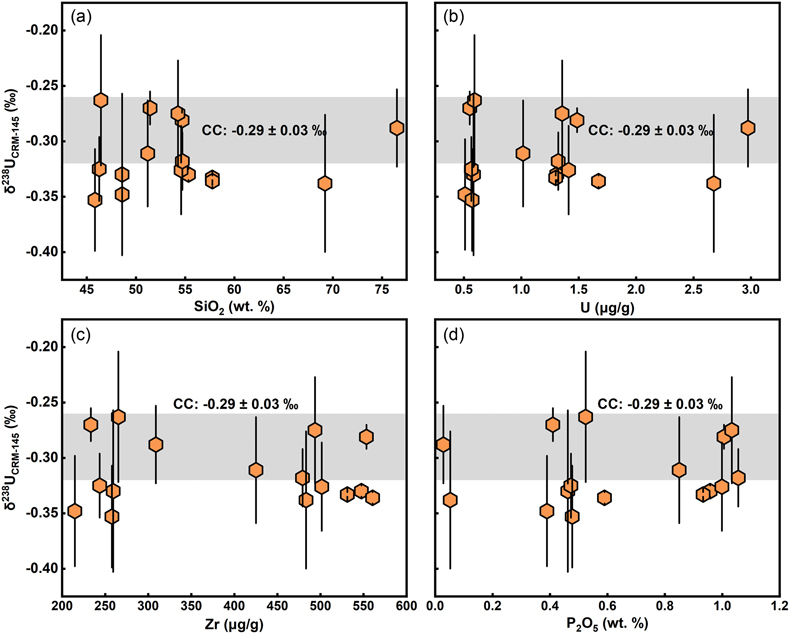
Figure 1 Co-variation of δ238U vs. major and trace compositions of the Hekla rock suite. The δ238U of the continental crust is from Tissot and Dauphas (2015)
Tissot, F.L.H., Dauphas, N. (2015) Uranium isotopic compositions of the crust and ocean: Age corrections, U budget and global extent of modern anoxia. Geochimica et Cosmochimica Acta 167, 113–143. https://doi.org/10.1016/j.gca.2015.06.034
.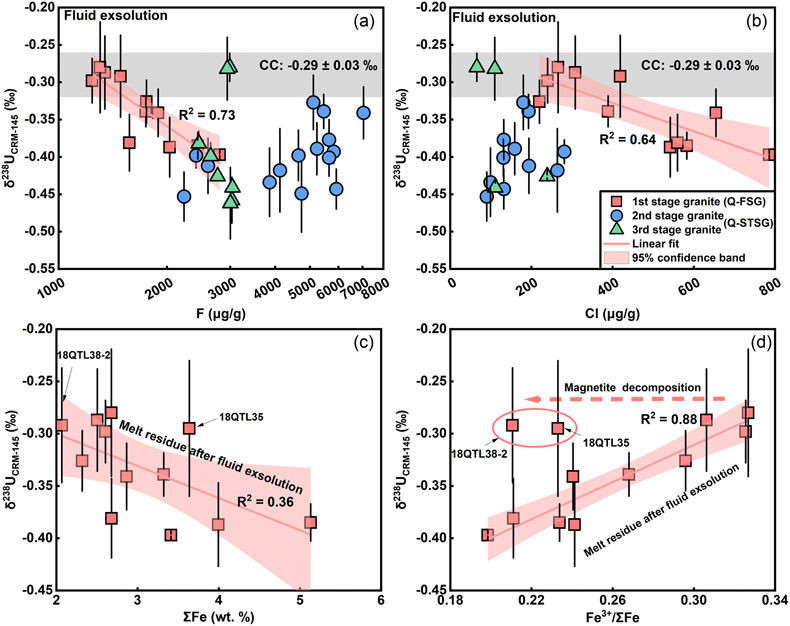
Figure 2 Positive or negative correlations between δ238U with geochemical compositions for the Qitianling granites. Continued exsolution of Fe2+-rich fluids oxidises Q-FSG melts and reduces FeO concentrations. Ultimately, this process can destabilise early crystallised magnetite evidenced in samples 18QTL35 and 18QTL38-2.
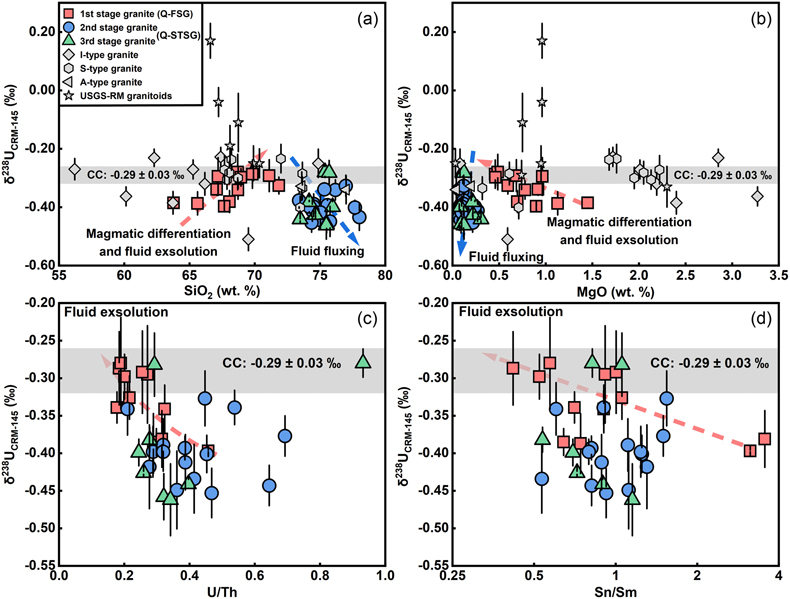
Figure 3 Plots of δ238U vs. (a) SiO2, (b) MgO, (c) U/Th and (d) Sn/Sm compositions for the Qitianling granites. Data for other granites are from Telus et al. (2012)
Telus, M., Dauphas, N., Moynier, F., Tissot, F.L.H., Teng, F.-Z., Nabelek, P.I., Craddock, P.R., Groat, L.A. (2012) Iron, zinc, magnesium and uranium isotopic fractionation during continental crust differentiation: The tale from migmatites, granitoids, and pegmatites. Geochimica et Cosmochimica Acta 97, 247–265. https://doi.org/10.1016/j.gca.2012.08.024
and Li and Tissot (2023)Li, H., Tissot, F.L.H. (2023) UID: The uranium isotope database. Chemical Geology 618, 121221. https://doi.org/10.1016/j.chemgeo.2022.121221
.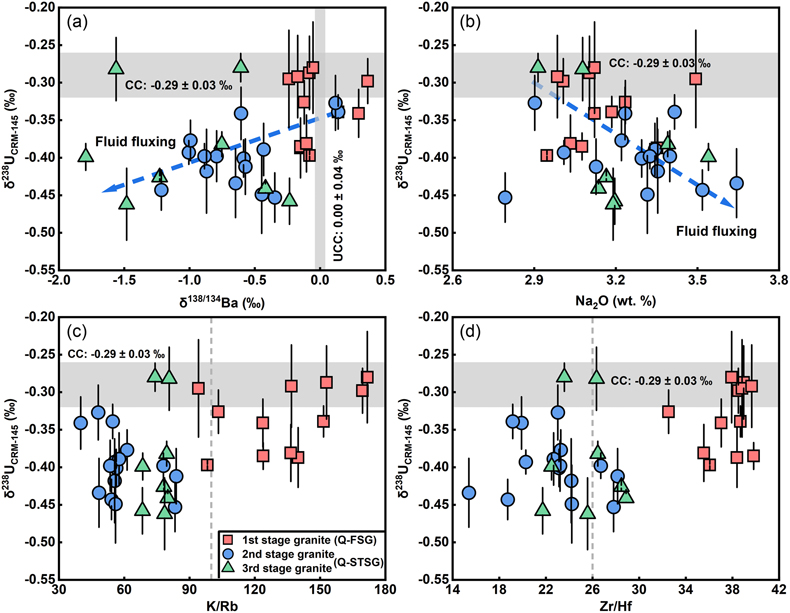
Figure 4 The δ238U vs. (a) δ138Ba, (b) Na2O, (c) K/Rb and (d) Zr/Hf compositions of the Qitianling granites. The vertical grey field indicates the average δ138/134Ba of the UCC (Deng et al., 2022
Deng, G., Jiang, D., Zhang, R., Huang, J., Zhang, X., Huang, F. (2022) Barium isotopes reveal the role of deep magmatic fluids in magmatic-hydrothermal evolution and tin enrichment in granites. Earth and Planetary Science Letters 594, 117724. https://doi.org/10.1016/j.epsl.2022.117724
and references therein).