



Zinc isotope evidence for volatile fluid remelting to form PGE-enriched reefs in layered intrusions
Affiliations | Corresponding Author | Cite as | Funding information
Published by the European Association of Geochemistry
under Creative Commons License CC BY-NC-ND 4.0
Keywords: Zinc isotopes, layered mafic intrusions, Stillwater, Muskox


- Share this article


-
Article views:1,140Cumulative count of HTML views and PDF downloads.
- Download Citation
- Rights & Permissions

top
Abstract
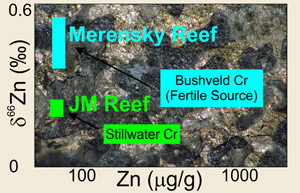
Figures
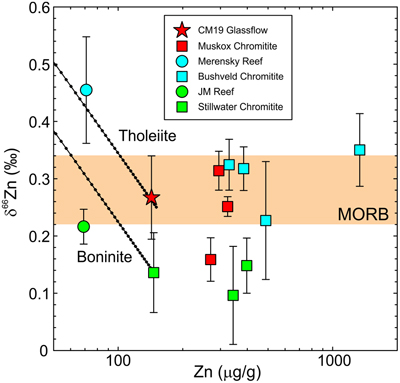 Figure 1 Zinc isotopic composition versus Zn abundance for bulk rock samples of PGE-enriched reefs, chromitite seams and the CM19 glass flow. MORB estimate of 0.28 ± 0.06 ‰ from Day et al. (2022). Shown are two Rayliegh distillation models, assuming the same initial Zn composition of melts (150 μg/g), one with a boninite-like source with low δ66Zn (0.13; Boninite) and the other with a tholeiite source with higher δ66Zn (0.25; Tholeiite) and assuming removal of Zn through spinel fractionation (kD = ∼7) in increments of 0.3 % (dots on model curves). | 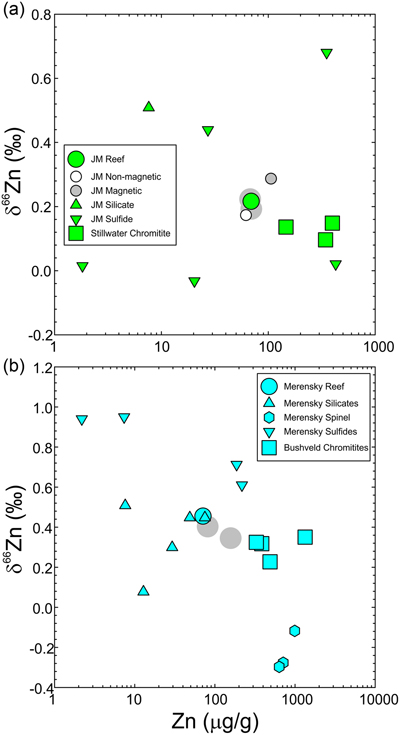 Figure 2 Zinc abundance versus Zn isotopic composition for (a) Stillwater chromitites, the JM Reef and JM Reef components and (b) Bushveld chromitites, the Merensky Reef and Merensky Reef components. Large grey circles denote modally recombined data using components of both reefs (Table S-2). | 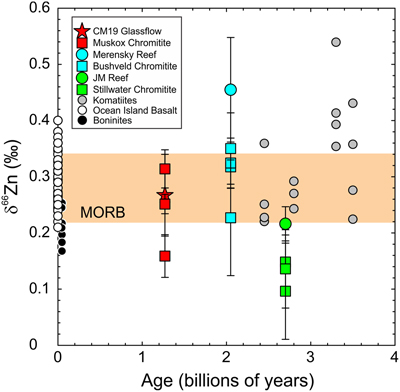 Figure 3 Zinc isotopic composition as a function of time for PGE-rich reefs and chromitite seams from the Stillwater, Bushveld and Muskox layered mafic intrusions, and the Coppermine CFB CM19 glass flow, bulk rock data for komatiites, ocean island basalts and boninites versus the MORB average (summarised in Day et al., 2022). |
| Figure 1 | Figure 2 | Figure 3 |
top
Introduction
The platinum group elements (PGE: Os, Ir, Rh, Ru, Pt, Pd) play a crucial role in many modern technologies, with more than two thirds of the world’s supply sourced from PGE-enriched layers within the Bushveld and Stillwater layered intrusive complexes (e.g., Mudd et al., 2018
Mudd, G.M., Jowitt, S.M., Werner, T.T. (2018) Global platinum group element resources, reserves and mining – A critical assessment. Science of the Total Environment 622, 614–625. https://doi.org/10.1016/j.scitotenv.2017.11.350
). The origin of PGE mineralisation in layered intrusions remains contentious however, with models that assume formation purely through magmatic processes (e.g., Eales and Cawthorn, 1996Eales, H.V., Cawthorn, R.G. (1996) The Bushveld complex. In: Cawthorn, R.G. (Ed.) Layered Intrusions. Developments in Petrology 15, Elsevier, Amsterdam, 181–229. https://doi.org/10.1016/S0167-2894(96)80008-X
; Godel and Barnes, 2008Godel, B., Barnes, S.J. (2008) Platinum-group elements in sulfide minerals and the whole rocks of the J-M Reef (Stillwater Complex): Implication for the formation of the reef. Chemical Geology 248, 272–294. https://doi.org/10.1016/j.chemgeo.2007.05.006
) and those that invoke volatile fluid remelting and mineral reprecipitation to form the sulfide-rich mineralised zones (e.g., Boudreau, 1999Boudreau, A. (1999) Fluid fluxing of cumulates: the J-M reef and associated rocks of the Stillwater Complex, Montana. Journal of Petrology 40, 755–772. https://doi.org/10.1093/petroj/40.5.755
, 2008Boudreau, A.E. (2008) Modeling the Merensky Reef, Bushveld Complex, Republic of South Africa. Contributions to Mineralogy and Petrology 156, 431–437. https://doi.org/10.1007/s00410-008-0294-0
, 2016Boudreau, A.E. (2016) The Stillwater Complex, Montana–Overview and the significance of volatiles. Mineralogical Magazine 80, 585–637. https://doi.org/10.1180/minmag.2016.080.063
, 2026Boudreau, A.E. (2026) Formation of PGE- and sulfide-bearing chromitites and associated anorthositic rocks in layered intrusions by the infiltration of reactive, Cl-rich fluid. In: Mondal, S.K., Reisberg, L.C., González-Jiménez, J.M., Hughes, H.S.R. (Eds.) Mineral Resources Related to Ultramafic-Mafic Magmas, from Archean to Present: Old Deposits and New Prospects of Chromite, Ti-V-Magnetite and Ni-Cu-(PGE) Sulfides. Geological Society, London, Special Publication 552, SP552-2022-324. https://doi.org/10.1144/SP552-2022-324
; Gupta and Boudreau, 2025Gupta, A.R., Boudreau, A.E. (2025) The role of hydrothermal processes and the formation of the J-M reef and associated rocks of olivine-bearing zone I of the Stillwater Complex, Montana. Mineralium Deposita 60, 351–374. https://doi.org/10.1007/s00126-024-01267-2
). Similar controversies also exist for the potential mantle sources of partial melts feeding the layered intrusions, which have important potential implications for the tenor of PGE enrichment.In this study, we employ Zn isotopes as a tool to explore the origin of PGE enrichment in layered intrusive complexes. Zinc is composed of five stable isotopes and Zn isotope composition is usually reported in delta notation, which for 66Zn/64Zn is:

It has previously been demonstrated that Zn exhibits limited (typically <0.3 ‰) isotope fractionation during partial melting, magmatic crystallisation and magmatic ore processes (e.g., Day et al., 2022
Day, J.M.D., Moynier, F., Ishizuka, O. (2022) A partial melting control on the Zn isotope composition of basalts. Geochemical Perspectives Letters 23, 11–16. https://doi.org/10.7185/geochemlet.2230
; Wilkinson, 2023Wilkinson, J.J. (2023) The potential of Zn isotopes in the science and exploration of ore deposits. In: Huston, D., Gutzmer, J. (Eds.) Isotopes in Economic Geology, Metallogenesis and Exploration. Springer, Cham, 451–463. https://doi.org/10.1007/978-3-031-27897-6_15
). In contrast, low temperature and hydrothermal processes can lead to >1 ‰ variations in δ66Zn (Moynier et al., 2017Moynier, F., Vance, D., Fujii, T., Savage, P. (2017) The isotope geochemistry of zinc and copper. Reviews in Mineralogy and Geochemistry 82, 543–600. https://doi.org/10.2138/rmg.2017.82.13
; Wilkinson, 2023Wilkinson, J.J. (2023) The potential of Zn isotopes in the science and exploration of ore deposits. In: Huston, D., Gutzmer, J. (Eds.) Isotopes in Economic Geology, Metallogenesis and Exploration. Springer, Cham, 451–463. https://doi.org/10.1007/978-3-031-27897-6_15
). To date, limited isotopic studies of Zn have been done for large mafic-ultramafic intrusive complexes. The most extensive study has been for the Sudbury Igneous Complex whose origin from a bolide impact indicates that mechanisms of evaporative loss of Zn were important (Kamber and Schoenberg, 2020Kamber, B.S., Schoenberg, R. (2020) Evaporative loss of moderately volatile metals from the superheated 1849 Ma Sudbury impact melt sheet inferred from stable Zn isotopes. Earth and Planetary Science Letters 544, 116356. https://doi.org/10.1016/j.epsl.2020.116356
). In this study we examine layered intrusive complexes formed through endogenous terrestrial magmatic processes. We examined Zn isotope variations in chromitite and PGE-enriched ‘reefs’ from the 1.27 Ga Muskox Intrusion (Canada), 2.05 Ga Bushveld Intrusion (South Africa) and 2.7 Ga Stillwater Intrusion (Montana) to further understand their formation.top
Methods and Results
The methods for the separation and analysis of Zn abundances and isotopic composition are adapted from van Kooten and Moynier (2019)
van Kooten, E., Moynier, F. (2019) Zinc isotope analyses of singularly small samples (<5 ng Zn): Investigating chondrule-matrix complementarity in Leoville. Geochimica et Cosmochimica Acta 261, 248–268. https://doi.org/10.1016/j.gca.2019.07.022
and are described in the Supplementary Information. In this study, three of the world’s largest layered intrusive complexes were examined (Table S-1). Bulk rocks from three PGE-rich chromitite seams were studied from the Mesoproterozoic (1.27 Ga) Muskox Intrusion (Day and O’Driscoll, 2019Day, J.M.D., O’Driscoll, B. (2019) Ancient crustal contaminants with high Pt/Os can explain radiogenic 186Os in intraplate magmas. Earth and Planetary Science Letters 519, 101–108. https://doi.org/10.1016/j.epsl.2019.04.039
). An andesite glass flow (CM19) from the Coppermine Continental Flood Basalt (CFB) and associated with chromitite seam formation in the Muskox Intrusion (Day et al., 2013Day, J.M.D., Pearson, D.G., Hulbert, L.J. (2013) Highly siderophile element behaviour during flood basalt genesis and evidence for melts from intrusive chromitite formation in the Mackenzie large igneous province. Lithos 182–183, 242–258. https://doi.org/10.1016/j.lithos.2013.10.011
), was also analysed. Four bulk rock PGE-rich chromitite seams and bulk rock and mineral fractions from the PGE mineralised pegmatoid Merensky Reef of the Paleoproterozoic (2.05 Ga) Rustenberg Layered Igneous Complex in the Bushveld Intrusion were examined. Finally, three bulk rock PGE-rich chromitite seams and bulk rock and mineral fractions from the PGE mineralised Johns-Manville (JM) Reef in the Olivine-Bearing zone I of the Archean (2.7 Ga) Stillwater Igneous Complex (Day and O’Driscoll, 2019Day, J.M.D., O’Driscoll, B. (2019) Ancient crustal contaminants with high Pt/Os can explain radiogenic 186Os in intraplate magmas. Earth and Planetary Science Letters 519, 101–108. https://doi.org/10.1016/j.epsl.2019.04.039
) were studied.Zinc isotope variations follow mass dependent behaviour (Fig. S-1) and hereafter only δ66Zn values are discussed. Chromitite seams from the layered intrusive complexes have broadly similar Zn contents (100’s up to 1000 μg/g), with δ66Zn between 0.16 and 0.31 ‰ for the Muskox Intrusion, 0.23 to 0.35 ‰ for the Bushveld Intrusion and 0.10 to 0.15 ‰ for the Stillwater Intrusion (Fig. 1). The CM19 glass flow from the Coppermine CFB, which is coeval with Muskox Intrusion, has a δ66Zn value of 0.27 ‰, similar to Muskox chromitite seams. The Merensky and JM Reef samples have similar Zn abundances (∼70 μg/g), with the Merensky Reef (0.45 ‰) having higher δ66Zn than the JM Reef (0.22 ‰).
Figure 1 Zinc isotopic composition versus Zn abundance for bulk rock samples of PGE-enriched reefs, chromitite seams and the CM19 glass flow. MORB estimate of 0.28 ± 0.06 ‰ from Day et al. (2022)
Day, J.M.D., Moynier, F., Ishizuka, O. (2022) A partial melting control on the Zn isotope composition of basalts. Geochemical Perspectives Letters 23, 11–16. https://doi.org/10.7185/geochemlet.2230
. Shown are two Rayliegh distillation models, assuming the same initial Zn composition of melts (150 μg/g), one with a boninite-like source with low δ66Zn (0.13; Boninite) and the other with a tholeiite source with higher δ66Zn (0.25; Tholeiite) and assuming removal of Zn through spinel fractionation (kD = ∼7) in increments of 0.3 % (dots on model curves).Mineral components in the Merensky Reef have lower δ66Zn values in the order of: sulfide (pentlandite, pyrrhotite, chalcopyrite Zn = 2 to 218 μg/g; δ66Zn = 0.61 to 0.95 ‰) > silicate (Zn = 8 to 75 μg/g; δ66Zn = 0.08 to 0.51 ‰) > spinel (Zn = 635 to 991 μg/g; δ66Zn = −0.12 to −0.30 ‰), with modal recombination using a range of measured modal percentages (Table S-2) for the Merensky Reef being within uncertainty of the bulk rock value (Fig. 2). The chalcopyrite grains have the highest Zn of all the sulfides and are ∼0.3 ‰ lighter than pentlandite and pyrrhotite, consistent with equilibrium partitioning (Mason et al., 2005
Mason, T.F., Weiss, D.J., Chapman, J.B., Wilkinson, J.J., Tessalina, S.G., Spiro, B., Horstwood, M.S., Spratt, J., Coles, B.J. (2005) Zn and Cu isotopic variability in the Alexandrinka volcanic-hosted massive sulphide (VHMS) ore deposit, Urals, Russia. Chemical Geology 221, 170–187. https://doi.org/10.1016/j.chemgeo.2005.04.011
). A single silicate mineral phase, plagioclase, was analysed from the JM Reef (7.6 μg/g; δ66Zn = 0.51 ‰), and pentlandite, pyrrhotite and chalcopyrite ranged from 2 to 427 μg/g Zn with δ66Zn from −0.03 to 0.68 ‰. A JM Reef aliquot was separated after crushing using a magnet, revealing that the magnetic portions (106 μg/g; δ66Zn = 0.29 ‰) had higher Zn concentrations with heavier isotopic values than the non-magnetic fraction (62 μg/g; δ66Zn = 0.17 ‰). Modal recombination using the silicate and sulfide or magnetic and non-magnetic fractions give results that are within uncertainty of the measured bulk rock value (Table S-2, Fig. 2).Figure 2 Zinc abundance versus Zn isotopic composition for (a) Stillwater chromitites, the JM Reef and JM Reef components and (b) Bushveld chromitites, the Merensky Reef and Merensky Reef components. Large grey circles denote modally recombined data using components of both reefs (Table S-2).
top
Discussion
Evidence for volatile-induced remelting in the Merensky and JM Reefs. Mineral separate Zn isotope data for the Merensky Reef demonstrate a ∼1 ‰ variation between δ66Zn in spinel versus sulfides (Fig. 2). The ionic radius of Zn2+ (0.74 Å) means that it is considered to substitute for Fe2+ (0.78 Å) (Wang et al., 2017
Wang, Z.Z., Liu, S.A., Liu, J., Huang, J., Xiao, Y., Chu, Z.Y., Zhao, X.M., Tang, L. (2017) Zinc isotope fractionation during mantle melting and constraints on the Zn isotope composition of Earth’s upper mantle. Geochimica et Cosmochimica Acta 198, 151–167. https://doi.org/10.1016/j.gca.2016.11.014
). During purely magmatic processes and formation of the Merensky Reef as a cumulate layer (e.g., Eales and Cawthorn, 1996Eales, H.V., Cawthorn, R.G. (1996) The Bushveld complex. In: Cawthorn, R.G. (Ed.) Layered Intrusions. Developments in Petrology 15, Elsevier, Amsterdam, 181–229. https://doi.org/10.1016/S0167-2894(96)80008-X
), the typical crystallisation order would be spinel > silicate > sulfides. Merensky Reef spinel grains have nearly 20× and 7× higher Zn abundances than the silicate and sulfide grains, respectively, with Δ66ZnSpl-Sil = −0.6 ± 0.2 ‰ and Δ66ZnSpl-Sul = −1 ± 0.2 ‰. These mineral-mineral differences contrast the higher δ66Zn in mantle peridotite spinel relative to silicates and are associated with stiffer Zn-O bonds in spinel than silicate minerals (Wang et al., 2017Wang, Z.Z., Liu, S.A., Liu, J., Huang, J., Xiao, Y., Chu, Z.Y., Zhao, X.M., Tang, L. (2017) Zinc isotope fractionation during mantle melting and constraints on the Zn isotope composition of Earth’s upper mantle. Geochimica et Cosmochimica Acta 198, 151–167. https://doi.org/10.1016/j.gca.2016.11.014
). They are also inconsistent with evidence that high temperature igneous processes are incapable of producing fractionations of δ66Zn greater than about 0.2 ‰ in ore deposits (e.g., Wilkinson, 2023Wilkinson, J.J. (2023) The potential of Zn isotopes in the science and exploration of ore deposits. In: Huston, D., Gutzmer, J. (Eds.) Isotopes in Economic Geology, Metallogenesis and Exploration. Springer, Cham, 451–463. https://doi.org/10.1007/978-3-031-27897-6_15
). Zinc isotope data for Merensky Reef minerals therefore do not support its origin from purely magmatic processes.Field observations (Nicholson and Mathez, 1991
Nicholson, D.M., Mathez, E.A. (1991) Petrogenesis of the Merensky Reef in the Rustenburg section of the Bushveld Complex. Contributions to Mineralogy and Petrology 107, 293–309. https://doi.org/10.1007/BF00325100
), isotopic data (Reid et al., 1993Reid, D.L., Cawthorn, R.G., Kruger, F.J., Tredoux, M. (1993) Isotope and trace-element patterns below the Merensky Reef, Bushveld Complex, South Africa: evidence for fluids? Chemical Geology 106, 171–186. https://doi.org/10.1016/0009-2541(93)90171-E
; Willmore et al., 2002Willmore, C.C., Boudreau, A.E., Spivack, A., Kruger, F.J. (2002) Halogens of Bushveld Complex, South Africa: δ37Cl and Cl/F evidence for hydration melting of the source region in a back-arc setting. Chemical Geology 182, 503–511. https://doi.org/10.1016/S0009-2541(01)00337-0
) and modelling (Boudreau, 2008Boudreau, A.E. (2008) Modeling the Merensky Reef, Bushveld Complex, Republic of South Africa. Contributions to Mineralogy and Petrology 156, 431–437. https://doi.org/10.1007/s00410-008-0294-0
) have indicated that the Merensky Reef may be a zone of volatile-induced remelting, leading to reprecipitation of sulfide and spinel. These models are similar to those developed for the Stillwater JM Reef (see below). Hydrothermal processes have been shown to produce variations in sulfide δ66Zn by up to 0.9 ‰ (e.g., Mason et al., 2005Mason, T.F., Weiss, D.J., Chapman, J.B., Wilkinson, J.J., Tessalina, S.G., Spiro, B., Horstwood, M.S., Spratt, J., Coles, B.J. (2005) Zn and Cu isotopic variability in the Alexandrinka volcanic-hosted massive sulphide (VHMS) ore deposit, Urals, Russia. Chemical Geology 221, 170–187. https://doi.org/10.1016/j.chemgeo.2005.04.011
; John et al., 2008John, S.G., Rouxel, O.J., Craddock, P.R., Engwall, A.M., Boyle, E.A. (2008) Zinc stable isotopes in seafloor hydrothermal vent fluids and chimneys. Earth and Planetary Science Letters 269, 17–28. https://doi.org/10.1016/j.epsl.2007.12.011
). The causes of such fractionations are not well understood, although Rayleigh-type kinetic fractionation appears to be most favoured (Wilkinson, 2023Wilkinson, J.J. (2023) The potential of Zn isotopes in the science and exploration of ore deposits. In: Huston, D., Gutzmer, J. (Eds.) Isotopes in Economic Geology, Metallogenesis and Exploration. Springer, Cham, 451–463. https://doi.org/10.1007/978-3-031-27897-6_15
). For the Merensky Reef, this would mean early precipitation of spinel and preferential enrichment in the lighter isotopes of Zn, followed by later precipitation of sulfide phases. These results suggest that temperature and mineral-melt chemistry may be as an important factor as coordination number and Zn isotope fractionation in spinel.For the JM Reef, there is a ∼0.7 ‰ variation in δ66Zn for measured components (Fig. 2). While strictly magmatic models have been proposed for its origin (e.g., Barnes and Naldrett, 1985
Barnes, S.J., Naldrett, A.J. (1985) Geochemistry of the J-M (Howland) Reef of the Stillwater Complex, Minneapolis Adit area; I, Sulfide chemistry and sulfide-olivine equilibrium. Economic Geology 80, 627–645. https://doi.org/10.2113/gsecongeo.80.3.627
; Godel and Barnes, 2008Godel, B., Barnes, S.J. (2008) Platinum-group elements in sulfide minerals and the whole rocks of the J-M Reef (Stillwater Complex): Implication for the formation of the reef. Chemical Geology 248, 272–294. https://doi.org/10.1016/j.chemgeo.2007.05.006
), the large range in Zn isotopes implies a purely magmatic process may be unlikely. Models of Cl-rich volatile fluid percolation have been well developed for the formation of the JM Reef (Boudreau, 1999Boudreau, A. (1999) Fluid fluxing of cumulates: the J-M reef and associated rocks of the Stillwater Complex, Montana. Journal of Petrology 40, 755–772. https://doi.org/10.1093/petroj/40.5.755
, 2016Boudreau, A.E. (2016) The Stillwater Complex, Montana–Overview and the significance of volatiles. Mineralogical Magazine 80, 585–637. https://doi.org/10.1180/minmag.2016.080.063
), supported by Cl isotope data (Boudreau et al., 1997Boudreau, A.E., Stewart, M.A., Spivack, A.J. (1997) Stable Cl isotopes and origin of high-Cl magmas of the Stillwater Complex, Montana. Geology 25, 791–794. https://doi.org/10.1130/0091-7613(1997)025<0791:SCIAOO>2.3.CO;2
), and involve incongruent melting of the pre-existing partially molten crystal pile. In the case of both the PGE-rich Merensky and JM Reefs, there are large Zn isotope fractionations exceeding those observed from magmatic effects (Day et al., 2022Day, J.M.D., Moynier, F., Ishizuka, O. (2022) A partial melting control on the Zn isotope composition of basalts. Geochemical Perspectives Letters 23, 11–16. https://doi.org/10.7185/geochemlet.2230
; Wilkinson, 2023Wilkinson, J.J. (2023) The potential of Zn isotopes in the science and exploration of ore deposits. In: Huston, D., Gutzmer, J. (Eds.) Isotopes in Economic Geology, Metallogenesis and Exploration. Springer, Cham, 451–463. https://doi.org/10.1007/978-3-031-27897-6_15
). The Zn isotope variations, while complex and warranting further investigation, support reprecipitation models for PGE-bearing sulfides in both reefs. While such processes have led to significant Zn isotope distribution, modal recombination of the individual mineral components reproduces the bulk rock compositions well.Constraining mantle sources of the Muskox, Bushveld and Stillwater intrusions. A major goal in the research of layered igneous complexes that contain economically important PGE resources is to understand potential mantle sources. Chromitite horizons in the Muskox, Bushveld and Stillwater layered igneous complexes are associated with some of the most mafic or ultramafic melts (Eales and Cawthorn, 1996
Eales, H.V., Cawthorn, R.G. (1996) The Bushveld complex. In: Cawthorn, R.G. (Ed.) Layered Intrusions. Developments in Petrology 15, Elsevier, Amsterdam, 181–229. https://doi.org/10.1016/S0167-2894(96)80008-X
; Day et al., 2008Day, J.M.D., Pearson, D.G., Hulbert, L.J. (2008) Rhenium-osmium and platinum-group element constraints on the origin and evolution the 1.27 Ga Muskox layered intrusion. Journal of Petrology 49, 1255–1295. https://doi.org/10.1093/petrology/egn024
; Boudreau, 2016Boudreau, A.E. (2016) The Stillwater Complex, Montana–Overview and the significance of volatiles. Mineralogical Magazine 80, 585–637. https://doi.org/10.1180/minmag.2016.080.063
), and have high Zn contents, so are likely to be faithful representations of the Zn isotopes of mantle sources. In the case of the Bushveld and Stillwater chromitite horizons, these lie lower in the magmatic sequence than the PGE-enriched reefs (Peridotite zone and lower Critical Zone, respectively). A fertile plume-like mantle source has been suggested for the Muskox Intrusion and associated lower Coppermine CFB (e.g., Griselin et al., 1997Griselin, M., Arndt, N.T., Baragar, W.R.A. (1997) Plume–lithosphere interaction and crustal contamination during formation of Coppermine River basalts, Northwest Territories, Canada. Canadian Journal of Earth Sciences 34, 958–975. https://doi.org/10.1139/e17-080
; Day et al., 2008Day, J.M.D., Pearson, D.G., Hulbert, L.J. (2008) Rhenium-osmium and platinum-group element constraints on the origin and evolution the 1.27 Ga Muskox layered intrusion. Journal of Petrology 49, 1255–1295. https://doi.org/10.1093/petrology/egn024
, 2013Day, J.M.D., Pearson, D.G., Hulbert, L.J. (2013) Highly siderophile element behaviour during flood basalt genesis and evidence for melts from intrusive chromitite formation in the Mackenzie large igneous province. Lithos 182–183, 242–258. https://doi.org/10.1016/j.lithos.2013.10.011
). This is consistent with the δ66Zn data for the CM19 glass flow (0.27 ‰) and the weighted average of Muskox chromitites (0.24 ‰), which are within the range of modern OIB or MORB compositions (Fig. 3). The CM19 glass flow has been interpreted as the extrusive manifestation of chromitite formation in the Muskox Intrusion (Day et al., 2013Day, J.M.D., Pearson, D.G., Hulbert, L.J. (2013) Highly siderophile element behaviour during flood basalt genesis and evidence for melts from intrusive chromitite formation in the Mackenzie large igneous province. Lithos 182–183, 242–258. https://doi.org/10.1016/j.lithos.2013.10.011
) and the Zn isotope similarities remain consistent with such a hypothesis.Figure 3 Zinc isotopic composition as a function of time for PGE-rich reefs and chromitite seams from the Stillwater, Bushveld and Muskox layered mafic intrusions, and the Coppermine CFB CM19 glass flow, bulk rock data for komatiites, ocean island basalts and boninites versus the MORB average (summarised in Day et al., 2022
Day, J.M.D., Moynier, F., Ishizuka, O. (2022) A partial melting control on the Zn isotope composition of basalts. Geochemical Perspectives Letters 23, 11–16. https://doi.org/10.7185/geochemlet.2230
).The Bushveld chromitite seams have a weighted average of 0.32 ‰, within the range of modern OIB or MORB compositions (Fig. 3). Notably, the chromitites in the Bushveld are isotopically lighter with respect to Zn than the Merensky Reef (Δ66Znchromitite-reef = −0.1 ‰). The chromitites are stratigraphically lower than the Merensky Reef, suggesting isotopic fractionation of Zn to heavier values towards the top of the Main Zone of the Rustenberg Layered Series, with no evidence of isotopic fractionation in the chromitites themselves. A similar scenario exists for the Stillwater chromitites, which are stratigraphically lower in the Ultramafic Series relative to the JM Reef, which is in the Lower Banded Series (e.g., Boudreau, 2016
Boudreau, A.E. (2016) The Stillwater Complex, Montana–Overview and the significance of volatiles. Mineralogical Magazine 80, 585–637. https://doi.org/10.1180/minmag.2016.080.063
), yet these show a similar sense of fractionation (Δ66Znchromitite-reef = −0.1 ‰). We suggest that these results point to similar formation processes whereby Rayleigh distillation type fractionation of Zn during cumulate crystallisation from parental type ultramafic melts, represented by the chromitites, followed by volatile fluid reprecipitation in the upper portions of the sequences, led to the formation of the PGE-rich reefs. In Figure 1, examples of Zn isotope fractionation during cumulate crystallisation of Cr-spinel are shown, accentuated by the isotopically light Zn composition of the spinel, yet the strong affinity for Zn into the spinel structure. This further emphasises the importance of spinel in hosting Zn in layered intrusive complexes.A major distinction between the Stillwater chromitites, and those from the Muskox or Bushveld intrusive complexes is that the weighted average of δ66Zn is anomalously low (0.13 ‰). No OIB, MORB or komatiite type melts have been measured with such low δ66Zn (Fig. 3). The only modern mafic-ultramafic melts for which low δ66Zn have been recorded to date are boninites (Day et al., 2022
Day, J.M.D., Moynier, F., Ishizuka, O. (2022) A partial melting control on the Zn isotope composition of basalts. Geochemical Perspectives Letters 23, 11–16. https://doi.org/10.7185/geochemlet.2230
). Boninite-type parental magmas have been widely invoked for the Stillwater parental magma (e.g., McCallum, 1996McCallum, I.S. (1996) The Stillwater Complex. In: Cawthorn, R.G. (Ed.) Layered Intrusions. Developments in Petrology 15, Elsevier, Amsterdam, 441–483. https://doi.org/10.1016/S0167-2894(96)80015-7
; Boudreau, 2016Boudreau, A.E. (2016) The Stillwater Complex, Montana–Overview and the significance of volatiles. Mineralogical Magazine 80, 585–637. https://doi.org/10.1180/minmag.2016.080.063
) and the presented Zn isotope data for the chromitites may provide some of the strongest evidence yet for a depleted mantle source where fluid-assisted type melting was required to induce melting to produce the Stillwater igneous complex. Stillwater chromitites are characterised by lower PGE abundances and lower Pt/Pd than either Muskox or Bushveld chromitites (Naldrett et al., 2009Naldrett, A.J., Kinnaird, J., Wilson, A., Yudovskaya, M., McQuade, S., Chunnett, G., Stanley, C. (2009) Chromite composition and PGE content of Bushveld chromitites: Part 1 – the Lower and Middle Groups. Applied Earth Science 118, 131–161. https://doi.org/10.1179/174327509X12550990458004
; Day and O’Driscoll, 2019Day, J.M.D., O’Driscoll, B. (2019) Ancient crustal contaminants with high Pt/Os can explain radiogenic 186Os in intraplate magmas. Earth and Planetary Science Letters 519, 101–108. https://doi.org/10.1016/j.epsl.2019.04.039
). Given that melt-depleted peridotites are typically strongly depleted in both Pd and Pt (e.g., Lin et al., 2024Lin, Y., Day, J.M.D., Brown, D.B., Harvey, J., Liu, C.-Z. (2024) Evidence for large-scale, long-term highly siderophile element heterogeneities in the Atlantic mantle from Leg 153 and 209 peridotites. Geochimica et Cosmochimica Acta 378, 300–314. https://doi.org/10.1016/j.gca.2024.06.035
), the mantle source of the Stillwater Igneous Complex may have been metasomatically re-enriched in Pd and the rare earth elements to explain its composition.top
Acknowledgments
We are grateful to A. Boudreau and R. Mathur, who provided constructive review comments. We thank L.J. Hulbert for the provision of Muskox and Coppermine samples, Sibanye-Stillwater mining company for access to the Stillwater Igneous Complex and R. Latypov for arranging access to mine sites in the western limb of the Rustenberg Layered Series. This work was partly supported by the platform PARI and Region Île-de-France SESAME grant nos. 12015908 and EX047016 to FM, and DIM ACAV+. FM acknowledges funding from the ERC under the European Community’s H2020 framework program/ERC grant agreement No. 101001282 (METAL).
Editor: Raúl Fonseca
top
References
Barnes, S.J., Naldrett, A.J. (1985) Geochemistry of the J-M (Howland) Reef of the Stillwater Complex, Minneapolis Adit area; I, Sulfide chemistry and sulfide-olivine equilibrium. Economic Geology 80, 627–645. https://doi.org/10.2113/gsecongeo.80.3.627
 Show in context
 While strictly magmatic models have been proposed for its origin (e.g., Barnes and Naldrett, 1985; Godel and Barnes, 2008), the large range in Zn isotopes implies a purely magmatic process may be unlikely.
View in article
Boudreau, A. (1999) Fluid fluxing of cumulates: the J-M reef and associated rocks of the Stillwater Complex, Montana. Journal of Petrology 40, 755–772. https://doi.org/10.1093/petroj/40.5.755
Show in context The origin of PGE mineralisation in layered intrusions remains contentious however, with models that assume formation purely through magmatic processes (e.g., Eales and Cawthorn, 1996; Godel and Barnes, 2008) and those that invoke volatile fluid remelting and mineral reprecipitation to form the sulfide-rich mineralised zones (e.g., Boudreau, 1999, 2008, 2016, 2026, Gupta and Boudreau, 2025).
View in article
Models of Cl-rich volatile fluid percolation have been well developed for the formation of the JM Reef (Boudreau, 1999, 2016), supported by Cl isotope data (Boudreau et al., 1997), and involve incongruent melting of the pre-existing partially molten crystal pile.
View in article
Boudreau, A.E. (2008) Modeling the Merensky Reef, Bushveld Complex, Republic of South Africa. Contributions to Mineralogy and Petrology 156, 431–437. https://doi.org/10.1007/s00410-008-0294-0
Show in context The origin of PGE mineralisation in layered intrusions remains contentious however, with models that assume formation purely through magmatic processes (e.g., Eales and Cawthorn, 1996; Godel and Barnes, 2008) and those that invoke volatile fluid remelting and mineral reprecipitation to form the sulfide-rich mineralised zones (e.g., Boudreau, 1999, 2008, 2016, 2026, Gupta and Boudreau, 2025).
View in article
Field observations (Nicholson and Mathez, 1991), isotopic data (Reid et al., 1993; Willmore et al., 2002) and modelling (Boudreau, 2008) have indicated that the Merensky Reef may be a zone of volatile-induced remelting, leading to reprecipitation of sulfide and spinel.
View in article
Boudreau, A.E. (2016) The Stillwater Complex, Montana–Overview and the significance of volatiles. Mineralogical Magazine 80, 585–637. https://doi.org/10.1180/minmag.2016.080.063
Show in context The origin of PGE mineralisation in layered intrusions remains contentious however, with models that assume formation purely through magmatic processes (e.g., Eales and Cawthorn, 1996; Godel and Barnes, 2008) and those that invoke volatile fluid remelting and mineral reprecipitation to form the sulfide-rich mineralised zones (e.g., Boudreau, 1999, 2008, 2016, 2026, Gupta and Boudreau, 2025).
View in article
Models of Cl-rich volatile fluid percolation have been well developed for the formation of the JM Reef (Boudreau, 1999, 2016), supported by Cl isotope data (Boudreau et al., 1997), and involve incongruent melting of the pre-existing partially molten crystal pile.
View in article
Chromitite horizons in the Muskox, Bushveld and Stillwater layered igneous complexes are associated with some of the most mafic or ultramafic melts (Eales and Cawthorn, 1996; Day et al., 2008; Boudreau, 2016), and have high Zn contents, so are likely to be faithful representations of the Zn isotopes of mantle sources.
View in article
A similar scenario exists for the Stillwater chromitites, which are stratigraphically lower in the Ultramafic Series relative to the JM Reef, which is in the Lower Banded Series (e.g., Boudreau, 2016), yet these show a similar sense of fractionation (Δ66Znchromitite-reef = −0.1 ‰).
View in article
Boninite-type parental magmas have been widely invoked for the Stillwater parental magma (e.g., McCallum, 1996; Boudreau, 2016) and the presented Zn isotope data for the chromitites may provide some of the strongest evidence yet for a depleted mantle source where fluid-assisted type melting was required to induce melting to produce the Stillwater igneous complex.
View in article
Boudreau, A.E. (2026) Formation of PGE- and sulfide-bearing chromitites and associated anorthositic rocks in layered intrusions by the infiltration of reactive, Cl-rich fluid. In: Mondal, S.K., Reisberg, L.C., González-Jiménez, J.M., Hughes, H.S.R. (Eds.) Mineral Resources Related to Ultramafic-Mafic Magmas, from Archean to Present: Old Deposits and New Prospects of Chromite, Ti-V-Magnetite and Ni-Cu-(PGE) Sulfides. Geological Society, London, Special Publication 552, SP552-2022-324. https://doi.org/10.1144/SP552-2022-324
Show in context The origin of PGE mineralisation in layered intrusions remains contentious however, with models that assume formation purely through magmatic processes (e.g., Eales and Cawthorn, 1996; Godel and Barnes, 2008) and those that invoke volatile fluid remelting and mineral reprecipitation to form the sulfide-rich mineralised zones (e.g., Boudreau, 1999, 2008, 2016, 2026, Gupta and Boudreau, 2025).
View in article
Boudreau, A.E., Stewart, M.A., Spivack, A.J. (1997) Stable Cl isotopes and origin of high-Cl magmas of the Stillwater Complex, Montana. Geology 25, 791–794. https://doi.org/10.1130/0091-7613(1997)025<0791:SCIAOO>2.3.CO;2
Show in context Models of Cl-rich volatile fluid percolation have been well developed for the formation of the JM Reef (Boudreau, 1999, 2016), supported by Cl isotope data (Boudreau et al., 1997), and involve incongruent melting of the pre-existing partially molten crystal pile.
View in article
Day, J.M.D., O’Driscoll, B. (2019) Ancient crustal contaminants with high Pt/Os can explain radiogenic 186Os in intraplate magmas. Earth and Planetary Science Letters 519, 101–108. https://doi.org/10.1016/j.epsl.2019.04.039
Show in context Bulk rocks from three PGE-rich chromitite seams were studied from the Mesoproterozoic (1.27 Ga) Muskox Intrusion (Day and O’Driscoll, 2019).
View in article
Finally, three bulk rock PGE-rich chromitite seams and bulk rock and mineral fractions from the PGE mineralised Johns-Manville (JM) Reef in the Olivine-Bearing zone I of the Archean (2.7 Ga) Stillwater Igneous Complex (Day and O’Driscoll, 2019) were studied.
View in article
A fertile plume-like mantle source has been suggested for the Muskox Intrusion and associated lower Coppermine CFB (e.g., Griselin et al., 1997; Day et al., 2008, 2013).
View in article
Stillwater chromitites are characterised by lower PGE abundances and lower Pt/Pd than either Muskox or Bushveld chromitites (Naldrett et al., 2009; Day and O’Driscoll, 2019).
View in article
Day, J.M.D., Pearson, D.G., Hulbert, L.J. (2008) Rhenium-osmium and platinum-group element constraints on the origin and evolution the 1.27 Ga Muskox layered intrusion. Journal of Petrology 49, 1255–1295. https://doi.org/10.1093/petrology/egn024
Show in context Chromitite horizons in the Muskox, Bushveld and Stillwater layered igneous complexes are associated with some of the most mafic or ultramafic melts (Eales and Cawthorn, 1996; Day et al., 2008; Boudreau, 2016), and have high Zn contents, so are likely to be faithful representations of the Zn isotopes of mantle sources.
View in article
A fertile plume-like mantle source has been suggested for the Muskox Intrusion and associated lower Coppermine CFB (e.g., Griselin et al., 1997; Day et al., 2008, 2013).
View in article
Day, J.M.D., Pearson, D.G., Hulbert, L.J. (2013) Highly siderophile element behaviour during flood basalt genesis and evidence for melts from intrusive chromitite formation in the Mackenzie large igneous province. Lithos 182–183, 242–258. https://doi.org/10.1016/j.lithos.2013.10.011
Show in context An andesite glass flow (CM19) from the Coppermine Continental Flood Basalt (CFB) and associated with chromitite seam formation in the Muskox Intrusion (Day et al., 2013), was also analysed.
View in article
The CM19 glass flow has been interpreted as the extrusive manifestation of chromitite formation in the Muskox Intrusion (Day et al., 2013) and the Zn isotope similarities remain consistent with such a hypothesis.
View in article
Day, J.M.D., Moynier, F., Ishizuka, O. (2022) A partial melting control on the Zn isotope composition of basalts. Geochemical Perspectives Letters 23, 11–16. https://doi.org/10.7185/geochemlet.2230
Show in context It has previously been demonstrated that Zn exhibits limited (typically <0.3 ‰) isotope fractionation during partial melting, magmatic crystallisation and magmatic ore processes (e.g., Day et al., 2022; Wilkinson, 2023).
View in article
MORB estimate of 0.28 ± 0.06 ‰ from Day et al. (2022).
View in article
In the case of both the PGE-rich Merensky and JM Reefs, there are large Zn isotope fractionations exceeding those observed from magmatic effects (Day et al., 2022; Wilkinson, 2023).
View in article
Zinc isotopic composition as a function of time for PGE-rich reefs and chromitite seams from the Stillwater, Bushveld and Muskox layered mafic intrusions, and the Coppermine CFB CM19 glass flow, bulk rock data for komatiites, ocean island basalts and boninites versus the MORB average (summarised in Day et al., 2022).
View in article
The only modern mafic-ultramafic melts for which low δ66Zn have been recorded to date are boninites (Day et al., 2022).
View in article
Eales, H.V., Cawthorn, R.G. (1996) The Bushveld complex. In: Cawthorn, R.G. (Ed.) Layered Intrusions. Developments in Petrology 15, Elsevier, Amsterdam, 181–229. https://doi.org/10.1016/S0167-2894(96)80008-X
Show in context The origin of PGE mineralisation in layered intrusions remains contentious however, with models that assume formation purely through magmatic processes (e.g., Eales and Cawthorn, 1996; Godel and Barnes, 2008) and those that invoke volatile fluid remelting and mineral reprecipitation to form the sulfide-rich mineralised zones (e.g., Boudreau, 1999, 2008, 2016, 2026, Gupta and Boudreau, 2025).
View in article
During purely magmatic processes and formation of the Merensky Reef as a cumulate layer (e.g., Eales and Cawthorn, 1996), the typical crystallisation order would be spinel > silicate > sulfides.
View in article
Chromitite horizons in the Muskox, Bushveld and Stillwater layered igneous complexes are associated with some of the most mafic or ultramafic melts (Eales and Cawthorn, 1996; Day et al., 2008; Boudreau, 2016), and have high Zn contents, so are likely to be faithful representations of the Zn isotopes of mantle sources.
View in article
Godel, B., Barnes, S.J. (2008) Platinum-group elements in sulfide minerals and the whole rocks of the J-M Reef (Stillwater Complex): Implication for the formation of the reef. Chemical Geology 248, 272–294. https://doi.org/10.1016/j.chemgeo.2007.05.006
Show in context The origin of PGE mineralisation in layered intrusions remains contentious however, with models that assume formation purely through magmatic processes (e.g., Eales and Cawthorn, 1996; Godel and Barnes, 2008) and those that invoke volatile fluid remelting and mineral reprecipitation to form the sulfide-rich mineralised zones (e.g., Boudreau, 1999, 2008, 2016, 2026, Gupta and Boudreau, 2025).
View in article
While strictly magmatic models have been proposed for its origin (e.g., Barnes and Naldrett, 1985; Godel and Barnes, 2008), the large range in Zn isotopes implies a purely magmatic process may be unlikely.
View in article
Griselin, M., Arndt, N.T., Baragar, W.R.A. (1997) Plume–lithosphere interaction and crustal contamination during formation of Coppermine River basalts, Northwest Territories, Canada. Canadian Journal of Earth Sciences 34, 958–975. https://doi.org/10.1139/e17-080
Show in context A fertile plume-like mantle source has been suggested for the Muskox Intrusion and associated lower Coppermine CFB (e.g., Griselin et al., 1997; Day et al., 2008, 2013).
View in article
Gupta, A.R., Boudreau, A.E. (2025) The role of hydrothermal processes and the formation of the J-M reef and associated rocks of olivine-bearing zone I of the Stillwater Complex, Montana. Mineralium Deposita 60, 351–374. https://doi.org/10.1007/s00126-024-01267-2
Show in context The origin of PGE mineralisation in layered intrusions remains contentious however, with models that assume formation purely through magmatic processes (e.g., Eales and Cawthorn, 1996; Godel and Barnes, 2008) and those that invoke volatile fluid remelting and mineral reprecipitation to form the sulfide-rich mineralised zones (e.g., Boudreau, 1999, 2008, 2016, 2026, Gupta and Boudreau, 2025).
View in article
John, S.G., Rouxel, O.J., Craddock, P.R., Engwall, A.M., Boyle, E.A. (2008) Zinc stable isotopes in seafloor hydrothermal vent fluids and chimneys. Earth and Planetary Science Letters 269, 17–28. https://doi.org/10.1016/j.epsl.2007.12.011
Show in context Hydrothermal processes have been shown to produce variations in sulfide δ66Zn by up to 0.9 ‰ (e.g., Mason et al., 2005; John et al., 2008).
View in article
Kamber, B.S., Schoenberg, R. (2020) Evaporative loss of moderately volatile metals from the superheated 1849 Ma Sudbury impact melt sheet inferred from stable Zn isotopes. Earth and Planetary Science Letters 544, 116356. https://doi.org/10.1016/j.epsl.2020.116356
Show in context The most extensive study has been for the Sudbury Igneous Complex whose origin from a bolide impact indicates that mechanisms of evaporative loss of Zn were important (Kamber and Schoenberg 2020).
View in article
Lin, Y., Day, J.M.D., Brown, D.B., Harvey, J., Liu, C.-Z. (2024) Evidence for large-scale, long-term highly siderophile element heterogeneities in the Atlantic mantle from Leg 153 and 209 peridotites. Geochimica et Cosmochimica Acta 378, 300–314. https://doi.org/10.1016/j.gca.2024.06.035
Show in context Given that melt-depleted peridotites are typically strongly depleted in both Pd and Pt (e.g., Lin et al., 2024), the mantle source of the Stillwater Igneous Complex may have been metasomatically re-enriched in Pd and the rare earth elements to explain its composition.
View in article
Mason, T.F., Weiss, D.J., Chapman, J.B., Wilkinson, J.J., Tessalina, S.G., Spiro, B., Horstwood, M.S., Spratt, J., Coles, B.J. (2005) Zn and Cu isotopic variability in the Alexandrinka volcanic-hosted massive sulphide (VHMS) ore deposit, Urals, Russia. Chemical Geology 221, 170–187. https://doi.org/10.1016/j.chemgeo.2005.04.011
Show in context The chalcopyrite grains have the highest Zn of all the sulfides and are ∼0.3 ‰ lighter than pentlandite and pyrrhotite, consistent with equilibrium partitioning (Mason et al., 2005).
View in article
Hydrothermal processes have been shown to produce variations in sulfide δ66Zn by up to 0.9 ‰ (e.g., Mason et al., 2005; John et al., 2008).
View in article
McCallum, I.S. (1996) The Stillwater Complex. In: Cawthorn, R.G. (Ed.) Layered Intrusions. Developments in Petrology 15, Elsevier, Amsterdam, 441–483. https://doi.org/10.1016/S0167-2894(96)80015-7
Show in context Boninite-type parental magmas have been widely invoked for the Stillwater parental magma (e.g., McCallum, 1996; Boudreau, 2016) and the presented Zn isotope data for the chromitites may provide some of the strongest evidence yet for a depleted mantle source where fluid-assisted type melting was required to induce melting to produce the Stillwater igneous complex.
View in article
Moynier, F., Vance, D., Fujii, T., Savage, P. (2017) The isotope geochemistry of zinc and copper. Reviews in Mineralogy and Geochemistry 82, 543–600. https://doi.org/10.2138/rmg.2017.82.13
Show in context In contrast, low temperature and hydrothermal processes can lead to >1 ‰ variations in δ66Zn (Moynier et al., 2017; Wilkinson, 2023).
View in article
Mudd, G.M., Jowitt, S.M., Werner, T.T. (2018) Global platinum group element resources, reserves and mining – A critical assessment. Science of the Total Environment 622, 614–625. https://doi.org/10.1016/j.scitotenv.2017.11.350
Show in context The platinum group elements (PGE: Os, Ir, Rh, Ru, Pt, Pd) play a crucial role in many modern technologies, with more than two thirds of the world’s supply sourced from PGE-enriched layers within the Bushveld and Stillwater layered intrusive complexes (e.g., Mudd et al., 2018).
View in article
Naldrett, A.J., Kinnaird, J., Wilson, A., Yudovskaya, M., McQuade, S., Chunnett, G., Stanley, C. (2009) Chromite composition and PGE content of Bushveld chromitites: Part 1 – the Lower and Middle Groups. Applied Earth Science 118, 131–161. https://doi.org/10.1179/174327509X12550990458004
Show in context Stillwater chromitites are characterised by lower PGE abundances and lower Pt/Pd than either Muskox or Bushveld chromitites (Naldrett et al., 2009; Day and O’Driscoll, 2019).
View in article
Nicholson, D.M., Mathez, E.A. (1991) Petrogenesis of the Merensky Reef in the Rustenburg section of the Bushveld Complex. Contributions to Mineralogy and Petrology 107, 293–309. https://doi.org/10.1007/BF00325100
Show in context Field observations (Nicholson and Mathez, 1991), isotopic data (Reid et al., 1993; Willmore et al., 2002) and modelling (Boudreau, 2008) have indicated that the Merensky Reef may be a zone of volatile-induced remelting, leading to reprecipitation of sulfide and spinel.
View in article
Reid, D.L., Cawthorn, R.G., Kruger, F.J., Tredoux, M. (1993) Isotope and trace-element patterns below the Merensky Reef, Bushveld Complex, South Africa: evidence for fluids? Chemical Geology 106, 171–186. https://doi.org/10.1016/0009-2541(93)90171-E
Show in context Field observations (Nicholson and Mathez, 1991), isotopic data (Reid et al., 1993; Willmore et al., 2002) and modelling (Boudreau, 2008) have indicated that the Merensky Reef may be a zone of volatile-induced remelting, leading to reprecipitation of sulfide and spinel.
View in article
van Kooten, E., Moynier, F. (2019) Zinc isotope analyses of singularly small samples (<5 ng Zn): Investigating chondrule-matrix complementarity in Leoville. Geochimica et Cosmochimica Acta 261, 248–268. https://doi.org/10.1016/j.gca.2019.07.022
Show in context The methods for the separation and analysis of Zn abundances and isotopic composition are adapted from van Kooten and Moynier (2019) and are described in the Supplementary Information
View in article
Wang, Z.Z., Liu, S.A., Liu, J., Huang, J., Xiao, Y., Chu, Z.Y., Zhao, X.M., Tang, L. (2017) Zinc isotope fractionation during mantle melting and constraints on the Zn isotope composition of Earth’s upper mantle. Geochimica et Cosmochimica Acta 198, 151–167. https://doi.org/10.1016/j.gca.2016.11.014
Show in context The ionic radius of Zn2+ (0.74 Å) means that it is considered to substitute for Fe2+ (0.78 Å) (Wang et al., 2017).
View in article
These mineral-mineral differences contrast the higher δ66Zn in mantle peridotite spinel relative to silicates and are associated with stiffer Zn-O bonds in spinel than silicate minerals (Wang et al., 2017).
View in article
Wilkinson, J.J. (2023) The potential of Zn isotopes in the science and exploration of ore deposits. In: Huston, D., Gutzmer, J. (Eds.) Isotopes in Economic Geology, Metallogenesis and Exploration. Springer, Cham, 451–463. https://doi.org/10.1007/978-3-031-27897-6_15
Show in context It has previously been demonstrated that Zn exhibits limited (typically <0.3 ‰) isotope fractionation during partial melting, magmatic crystallisation and magmatic ore processes (e.g., Day et al., 2022; Wilkinson, 2023).
View in article
In contrast, low temperature and hydrothermal processes can lead to >1 ‰ variations in δ66Zn (Moynier et al., 2017; Wilkinson, 2023).
View in article
They are also inconsistent with evidence that high temperature igneous processes are incapable of producing fractionations of δ66Zn greater than about 0.2 ‰ in ore deposits (e.g., Wilkinson, 2023).
View in article
The causes of such fractionations are not well understood, although Rayleigh-type kinetic fractionation appears to be most favoured (Wilkinson, 2023).
View in article
In the case of both the PGE-rich Merensky and JM Reefs, there are large Zn isotope fractionations exceeding those observed from magmatic effects (Day et al., 2022; Wilkinson, 2023).
View in article
Willmore, C.C., Boudreau, A.E., Spivack, A., Kruger, F.J. (2002) Halogens of Bushveld Complex, South Africa: δ37Cl and Cl/F evidence for hydration melting of the source region in a back-arc setting. Chemical Geology 182, 503–511. https://doi.org/10.1016/S0009-2541(01)00337-0
Show in context Field observations (Nicholson and Mathez, 1991), isotopic data (Reid et al., 1993; Willmore et al., 2002) and modelling (Boudreau, 2008) have indicated that the Merensky Reef may be a zone of volatile-induced remelting, leading to reprecipitation of sulfide and spinel.
View in article
top
Supplementary Information
The Supplementary Information includes:
- Methods
- Supplementary Data Tables S-1, S-2
- Supplementary Figure S-1
- Supplementary Information References
Download the Supplementary Information (PDF)
Figures

Figure 1 Zinc isotopic composition versus Zn abundance for bulk rock samples of PGE-enriched reefs, chromitite seams and the CM19 glass flow. MORB estimate of 0.28 ± 0.06 ‰ from Day et al. (2022)
Day, J.M.D., Moynier, F., Ishizuka, O. (2022) A partial melting control on the Zn isotope composition of basalts. Geochemical Perspectives Letters 23, 11–16. https://doi.org/10.7185/geochemlet.2230
. Shown are two Rayliegh distillation models, assuming the same initial Zn composition of melts (150 μg/g), one with a boninite-like source with low δ66Zn (0.13; Boninite) and the other with a tholeiite source with higher δ66Zn (0.25; Tholeiite) and assuming removal of Zn through spinel fractionation (kD = ∼7) in increments of 0.3 % (dots on model curves).
Figure 2 Zinc abundance versus Zn isotopic composition for (a) Stillwater chromitites, the JM Reef and JM Reef components and (b) Bushveld chromitites, the Merensky Reef and Merensky Reef components. Large grey circles denote modally recombined data using components of both reefs (Table S-2).
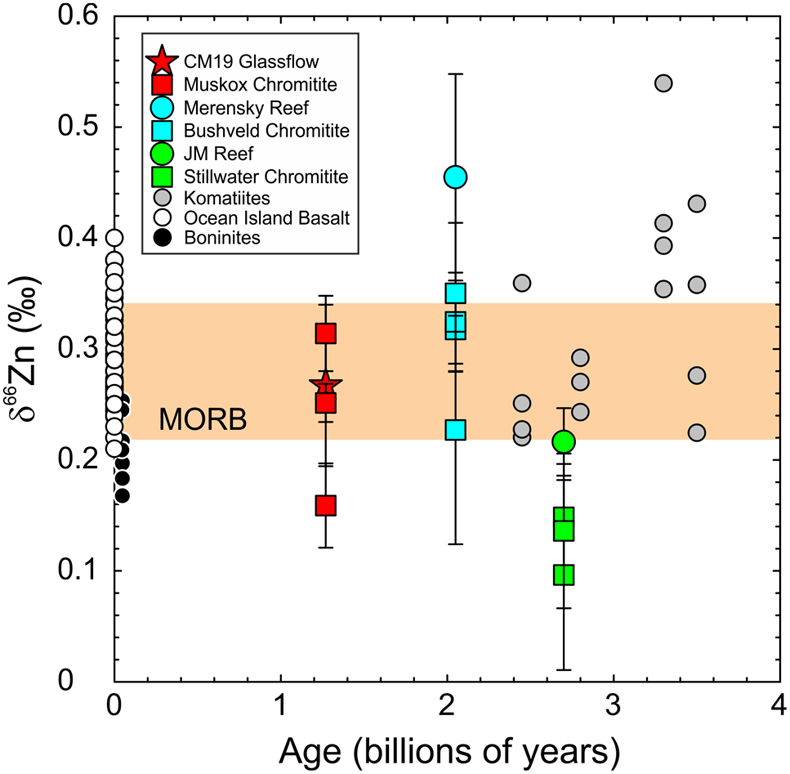
Figure 3 Zinc isotopic composition as a function of time for PGE-rich reefs and chromitite seams from the Stillwater, Bushveld and Muskox layered mafic intrusions, and the Coppermine CFB CM19 glass flow, bulk rock data for komatiites, ocean island basalts and boninites versus the MORB average (summarised in Day et al., 2022
Day, J.M.D., Moynier, F., Ishizuka, O. (2022) A partial melting control on the Zn isotope composition of basalts. Geochemical Perspectives Letters 23, 11–16. https://doi.org/10.7185/geochemlet.2230
).