



Impact of wildfires on Gondwanan flora during the Permian–Triassic transition
Affiliations | Corresponding Author | Cite as | Funding information
Published by the European Association of Geochemistry
under Creative Commons License CC BY-NC-ND 4.0
Keywords: Permian-Triassic, polyaromatic hydrocarbons, charcoal, wildfires, paleoecology


- Share this article


-
Article views:1,995Cumulative count of HTML views and PDF downloads.
- Download Citation
- Rights & Permissions

top
Abstract
Figures and Tables
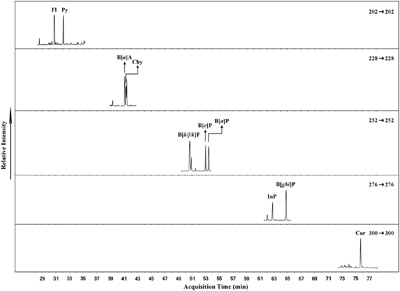 Figure 1 Representative multiple reaction monitoring (MRM) chromatograms obtained from GC-QQQ-MS analyses showing distributions of polycyclic aromatic hydrocarbons in the transition sample (R/M/XX/58), Raniganj sub-basin, eastern India. Fl: Fluoranthene; Py: Pyrene; B[a]A: benzo[a]anthracene; Chy: chrysene; B[b/j/k]F: benzo[b/j/k]fluoranthene; B[a]P: benzo[a]pyrene; B[e]P: benzo[e]pyrene; InP: indeno[1,2,3-cd]; B[ghi]P: benzo[ghi]perylene; Cor: Coronene. | 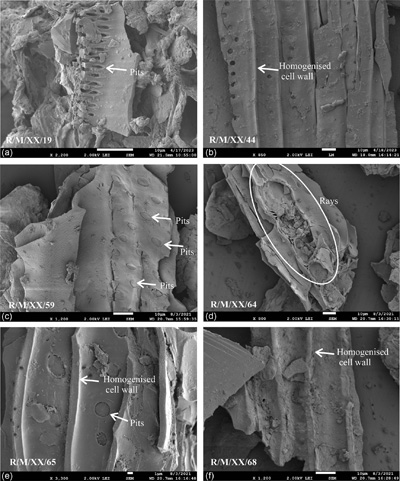 Figure 2 Scanning electron microscope (SEM) images of charcoalified tracheids in selected Upper Permian (R/M/XX/59; R/M/XX/64; R/M/XX/65; R/M/XX/68) and Lower Triassic (R/M/XX/19; R/M/XX/44) sediments, Raniganj sub-basin, eastern India. | 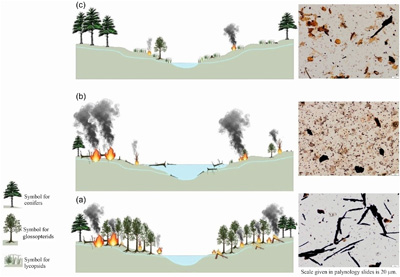 Figure 3 Palaeoecological changes during Changhsingian–Induan transition. This series depicts (a) a fire-prone dense mire where Glossopteris spp. thrived as the main coal-forming flora and conifers as subordinate flora during Changhsingian, (b) an impoverished ecosystem where the mire ceased to exist and fires continued burning the dieback vegetation during the transition, and (c) the recolonisation of the floodplains by conifers and the opportunistic lycopsids in a fire-prone ecosystem during Induan. Water table and kerogen matter (samples R/M/XX/61 in (a); R/M/XX/50 in (b); R/M/XX/28 in (c)) shown. | 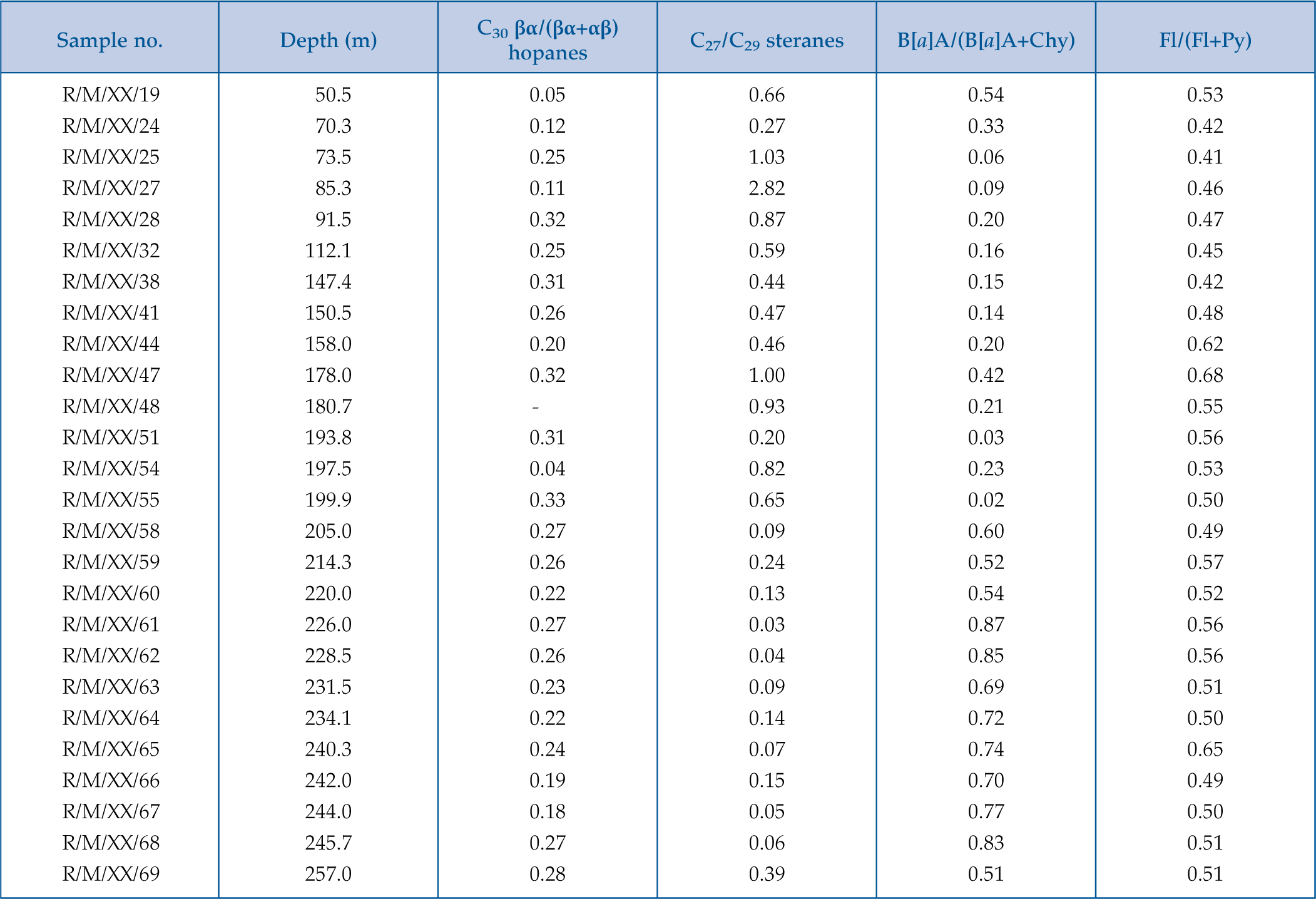 Table 1 A list of selected biomarker and hydrocarbon proxy ratios across the depth of the studied Upper Permian (R/M/XX/69 to R/M/XX/59), transition (R/M/XX/58), and Lower Triassic (R/M/XX/55 to R/M/XX/19) sediments from Raniganj sub-basin, eastern India. Fl: Fluoranthene; Py: Pyrene; B[a]A: benzo[a]anthracene; Chy: chrysene. |
| Figure 1 | Figure 2 | Figure 3 | Table 1 |
top
Introduction
The geological record shows that, for the past 540 Myr, Earth’s biosphere experienced a relatively stable rate of background extinction that was occasionally punctuated by mass extinctions followed by biological diversification (Parry, 2021
Parry, L.A. (2021) Evolution: No extinction? No way! Current Biology 31, 907–909. https://doi.org/10.1016/j.cub.2021.06.009
). One such critical event was the end-Permian mass extinction during which around 90 % of marine species and 70 % of terrestrial vertebrates disappeared (Dal Corso et al., 2022Dal Corso, J., Song, H., Callegaro, S., Chu, D., Sun, Y., Hilton, J., Grasby, S.E., Joachimski, M.M., Wignall, P.B. (2022) Environmental crises at the Permian–Triassic mass extinction. Nature Reviews Earth & Environment 3, 197–214. https://doi.org/10.1038/s43017-021-00259-4
and references therein). A stronger understanding of these crises may be informative in an era of contemporary deforestation, wildfires and climate change. The terrestrial P/T sections in Gondwana, deposited in a wide range of basinal settings, are distributed across South America, South Africa, India, Australia and Antarctica (Benton and Newell, 2014Benton, M.J., Newell, A.J. (2014) Impacts of global warming on Permo-Triassic terrestrial ecosystems. Gondwana Research 25, 1308–1337. https://doi.org/10.1016/j.gr.2012.12.010
). During most of the Permian, widespread peat-forming depositional environments were largely favoured within 20–80° S palaeolatitude in Gondwana and abruptly perished at the end-Permian as a result of ecosystem collapse (Retallack et al., 1996Retallack, G.J., Veevers, J.J., Morante, R. (1996) Global coal gap between Permian-Triassic extinction and Middle Triassic recovery of peat-forming plants. Geological Society of America Bulletin 108, 195–207. https://doi.org/10.1130/0016-7606
).Extinction events also play a role in natural selection through the expansion and creation of new ecological niches (Benton and Newell, 2014
Benton, M.J., Newell, A.J. (2014) Impacts of global warming on Permo-Triassic terrestrial ecosystems. Gondwana Research 25, 1308–1337. https://doi.org/10.1016/j.gr.2012.12.010
and references therein). Vegetation turnover in Pangea’s phytogeographic provinces was evident through the Late Permian–Early Triassic, coincident with widespread occurrences of wildfires (Rees, 2002Rees, P.M. (2002) Land-plant diversity and the end-Permian mass extinction. Geology 30, 827–830. https://doi.org/10.1130/0091-7613
). Fires may significantly impact ecosystems via the destruction of fauna and vegetation, leading to deforestation, promoting soil erosion and associated deleterious landform effects (Ward et al., 2000Ward, P.D., Montgomery, D.R., Smith, R. (2000) Altered river morphology in South Africa related to the Permian-Triassic Extinction. Science 289, 1740–1743. https://doi.org/10.1126/science.289.5485.1740
), which serve as agents in natural selection (Robinson, 1989Robinson, J.M. (1989) Phanerozoic O2 variation, fire, and terrestrial ecology. Palaeogeography, Palaeoclimatology, Palaeoecology 75, 223–240. https://doi.org/10.1016/0031-0182(89)90178-8
; He et al., 2015He, T., Belcher, C.M., Lamont, B.B., Lim, S.L. (2015) A 350-million-year legacy of fire adaptation among conifers. Journal of Ecology 104, 352–363. https://doi.org/10.1111/1365-2745.12513
). Fires can arise across a range of climatic conditions, including humid environments, as long as sufficient flammable biomass is available under high atmospheric pO2 conditions (Robinson, 1989Robinson, J.M. (1989) Phanerozoic O2 variation, fire, and terrestrial ecology. Palaeogeography, Palaeoclimatology, Palaeoecology 75, 223–240. https://doi.org/10.1016/0031-0182(89)90178-8
).Polycyclic aromatic hydrocarbons (PAHs) and charcoals in geological archives serve as direct evidence of wildfires, while steroids, hopanoids and carotenoids may be associated with ancient biota and palaeoenvironmental conditions (Peters et al., 2007
Peters, K.E., Walters, C.C., Moldowan, J.M. (2007) The Biomarker Guide. Volume 2: Biomarkers and Isotopes in the Petroleum Exploration and Earth History. Second Edition, Cambridge University Press, Cambridge.
). PAHs are formed through the catagenetic alterations of organic matter and pyrogenic events, such as forest fires, volcanic activity or meteor impacts. For example, a recent study identified centennial scale wildfires with PAHs, and enhanced erosion and marine euxinia indicated by S and Fe concentrations from the Meishan section in China (Saito et al., 2023Saito, R., Wörmer, L., Taubner, H., Kaiho, K., Takahashi, S., Tian, L., Ikeda, M., Summons, R.E., Hinrichs, K. (2023) Centennial scale sequences of environmental deterioration preceded the end-Permian mass extinction. Nature Communications 14, 2113. https://doi.org/10.1038/s41467-023-37717-0
). Further, carotenoid hydrocarbons are widely associated with anoxic, H2S-rich waters (Grice et al., 2005Grice, K., Cao, C., Love, G.D., Böttcher, M.E., Twitchett, R.J., Grosjean, E., Summons, R.J., Turgeon, S.C., Dunning, W., Jin, Y. (2005) Photic zone euxinia during the Permian-Triassic superanoxic event. Science 307, 706–709. https://doi.org/10.1126/science.1104323
; Cui et al., 2020Cui, X., Liu, X.L., Shen, G., Ma, J., Husain, F., Rocher, D., Zumberg, J.E., Bryant, D.A., Summons, R.E. (2020) Niche expansion for phototrophic sulfur bacteria at the Proterozoic–Phanerozoic transition. Proceedings of the National Academy of Sciences 117, 17599–17606. https://doi.org/10.1073/pnas.2006379117
). Combusted morphological remains, e.g., charcoals are also informative such as those sections concurrent with an early terrestrialisation event in the Silurian (Glasspool et al., 2004Glasspool, I.J., Edwards, D., Axe, L. (2004) Charcoal in the Silurian as evidence for the earliest wildfire. Geology 32, 381–383. https://doi.org/10.1130/G20363.1
). This is consistent with the idea that wildfires coevolved with the initial expansion of terrestrial vegetation. Incomplete combustion converts cellular components into highly recalcitrant molecular and morphological structures which, when preserved in the geosphere, may offer important insights into past high temperature processes.Here, we report the distribution and significance of PAHs, charcoal and select hydrocarbon biomarkers from a stratigraphic section, comprising terrestrial Upper Permian and Lower Triassic rocks to reconstruct past ecosystem changes. While continental sections may potentially be disrupted by stratigraphic gaps, the Raniganj and Panchet formations in the Gondwanan Raniganj sub-basin contain records from the Late Permian and Early Triassic, respectively. In the absence of radiometric age markers, sedimentary formations can be biostratigraphically dated using the first and last appearances of palynotaxa. The Densipollenites magnicorpus Assemblage Zone dates the Raniganj as Late Permian (Changhsingian), while the Lundbladispora-Densoisporites Assemblage Zone dates the Panchet as Induan (Nowak et al., 2018
Nowak, H., Schneebeli-Hermann, E., Kustatscher, E. (2018) Correlation of Lopingian to Middle Triassic Palynozones. Journal of Earth Science 29, 755–777. https://doi.org/10.1007/s12583-018-0790-8
; Bhattacharya et al., 2021Bhattacharya, S., Ankit, Y., Murthy, S., Kushwaha, V. (2021) Biotic response to environmental shift during the Permian-Triassic transition: Assessment from organic geochemical proxies and palynomorphs in terrestrial sediments from Raniganj sub-basin, India. Palaeogeography, Palaeoclimatology, Palaeoecology 576, 110483. https://doi.org/10.1016/j.palaeo.2021.110483
). Data from the present study reveal the palaeoecology of wildfires in relation to the pattern of floral reorganisation during one of the most consequential chapters in the biotic history of the planet.top
Methods
A total of 26 drill core samples were collected from a 257 m thick section (Fig. S-1). The geological background is provided in Bhattacharya et al. (2021)
Bhattacharya, S., Ankit, Y., Murthy, S., Kushwaha, V. (2021) Biotic response to environmental shift during the Permian-Triassic transition: Assessment from organic geochemical proxies and palynomorphs in terrestrial sediments from Raniganj sub-basin, India. Palaeogeography, Palaeoclimatology, Palaeoecology 576, 110483. https://doi.org/10.1016/j.palaeo.2021.110483
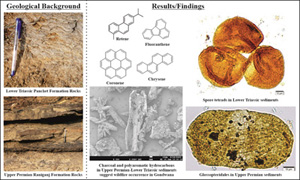
and details of the samples studied for molecular markers and those studied for palynology are given in Table 1 and Table S-1, respectively. The samples R/M/XX/19 to R/M/XX/55 belong to the Lower Triassic Panchet Formation, while R/M/XX/59 to R/M/XX/69 belong to the Upper Permian Raniganj Formation. The sample R/M/ XX/58, defined by conglomerate-mudstone lithotype, represents the transition from the Permian to Triassic. The methods employed for hydrocarbon and charcoal analyses are provided in the Supplementary Information.Table 1 A list of selected biomarker and hydrocarbon proxy ratios across the depth of the studied Upper Permian (R/M/XX/69 to R/M/XX/59), transition (R/M/XX/58), and Lower Triassic (R/M/XX/55 to R/M/XX/19) sediments from Raniganj sub-basin, eastern India. Fl: Fluoranthene; Py: Pyrene; B[a]A: benzo[a]anthracene; Chy: chrysene.
| Sample no. | Depth (m) | C30 βα/(βα+αβ) hopanes | C27/C29 steranes | B[a]A/(B[a]A+Chy) | Fl/(Fl+Py) |
| R/M/XX/19 | 50.5 | 0.05 | 0.66 | 0.54 | 0.53 |
| R/M/XX/24 | 70.3 | 0.12 | 0.27 | 0.33 | 0.42 |
| R/M/XX/25 | 73.5 | 0.25 | 1.03 | 0.06 | 0.41 |
| R/M/XX/27 | 85.3 | 0.11 | 2.82 | 0.09 | 0.46 |
| R/M/XX/28 | 91.5 | 0.32 | 0.87 | 0.20 | 0.47 |
| R/M/XX/32 | 112.1 | 0.25 | 0.59 | 0.16 | 0.45 |
| R/M/XX/38 | 147.4 | 0.31 | 0.44 | 0.15 | 0.42 |
| R/M/XX/41 | 150.5 | 0.26 | 0.47 | 0.14 | 0.48 |
| R/M/XX/44 | 158.0 | 0.20 | 0.46 | 0.20 | 0.62 |
| R/M/XX/47 | 178.0 | 0.32 | 1.00 | 0.42 | 0.68 |
| R/M/XX/48 | 180.7 | - | 0.93 | 0.21 | 0.55 |
| R/M/XX/51 | 193.8 | 0.31 | 0.20 | 0.03 | 0.56 |
| R/M/XX/54 | 197.5 | 0.04 | 0.82 | 0.23 | 0.53 |
| R/M/XX/55 | 199.9 | 0.33 | 0.65 | 0.02 | 0.50 |
| R/M/XX/58 | 205.0 | 0.27 | 0.09 | 0.60 | 0.49 |
| R/M/XX/59 | 214.3 | 0.26 | 0.24 | 0.52 | 0.57 |
| R/M/XX/60 | 220.0 | 0.22 | 0.13 | 0.54 | 0.52 |
| R/M/XX/61 | 226.0 | 0.27 | 0.03 | 0.87 | 0.56 |
| R/M/XX/62 | 228.5 | 0.26 | 0.04 | 0.85 | 0.56 |
| R/M/XX/63 | 231.5 | 0.23 | 0.09 | 0.69 | 0.51 |
| R/M/XX/64 | 234.1 | 0.22 | 0.14 | 0.72 | 0.50 |
| R/M/XX/65 | 240.3 | 0.24 | 0.07 | 0.74 | 0.65 |
| R/M/XX/66 | 242.0 | 0.19 | 0.15 | 0.70 | 0.49 |
| R/M/XX/67 | 244.0 | 0.18 | 0.05 | 0.77 | 0.50 |
| R/M/XX/68 | 245.7 | 0.27 | 0.06 | 0.83 | 0.51 |
| R/M/XX/69 | 257.0 | 0.28 | 0.39 | 0.51 | 0.51 |
top
Results and Discussion
Preserved polycyclic aromatic hydrocarbons and micro-charcoal in Upper Permian–Lower Triassic sediments. Unsubstituted high and low molecular weight PAHs in conjunction with micro-charcoals are recorded in the Upper Permian and Lower Triassic sediments in the depth interval between ∼257 to 50.5 m (Fig. S-1). The dominant PAHs present are the four-ring compounds fluoranthene (Fl), pyrene (Py), benzo[a]anthracene (B[a]A) and chrysene (Chy); five-ring aromatics include benzo[b/j/k]fluoranthene (B[b/j/k]F), benzo[a]pyrene (B[a]P) and benzo[e]pyrene (B[e]P). Heavier PAHs with 6 rings, such as indeno[1,2,3-cd]pyrene (InP) and benzo[ghi]perylene (B[ghi]P) and 7-ringed coronene (Cor) are also recorded (Fig. 1). Retene, usually formed through thermal alteration of conifer resins (Tewari et al., 2019
Tewari, A., D’Rozario, A., Bhattacharya, S., Barua, A., Bera, M., Bera, S., Dutta, S. (2019) Biomarker signatures of the iconic Glossopteris plant. Palaeogeography, Palaeoclimatology, Palaeoecology 531, 108887. https://doi.org/10.1016/j.palaeo.2018.08.001
and references therein), is also detected. The PAHs ratios B[a]A/(B[a]A + Chy) > 0.35 and Fl/(Fl + Py) > 0.5 correspond to pyrogenic source (Table 1; Fox et al., 2022Fox, C.P., Holman, A.I., Rigo, M., Al Suwaidi, A., Grice, K. (2022) Paleowildfire at the end-Triassic mass extinction: Smoke or fire? Global and Planetary Change 218, 103974. https://doi.org/10.1016/j.gloplacha.2022.103974
). The PAHs are accompanied by well preserved charcoalified tracheids in some samples (Fig. 2a–f) where the homogenised cell walls exhibit circular to oval-shaped uniseriate and biseriate pits, and biseriate alternate pits. The pits serve as evidence of charred woody fragments (Mays and McLoughlin, 2022Mays, C., McLoughlin, S. (2022) End-Permian burnout: The role of Permian–Triassic wildfires in extinction, carbon cycling, and environmental change in eastern Gondwana. Palaios 37, 292–317. https://doi.org/10.2110/palo.2021.051
). A gymnosperm affinity of the charcoalified remains is determined from the anatomical characteristics, although the detailed taxonomy could not be inferred due to fragmentary nature of the remains. Further, detailed palynological inspection reveals the presence of dispersed miospore genera from midcanopy floras, such as Monosulcites, and the upper-canopy floras, such as Chasmatosporites and Cycadopites (Fig. S-2 (1–6)) attributed to Mesozoic gymnosperms (Balme, 1995Balme, B.E. (1995) Fossil in situ spores and pollen grains: an annotated catalogue. Review of Palaeobotany and Palynology 87, 81–323. https://doi.org/10.1016/0034-6667(95)93235-X
), in Lower Triassic sediments in the depth interval between 150.5 m and 70.3 m.Figure 1 Representative multiple reaction monitoring (MRM) chromatograms obtained from GC-QQQ-MS analyses showing distributions of polycyclic aromatic hydrocarbons in the transition sample (R/M/XX/58), Raniganj sub-basin, eastern India. Fl: Fluoranthene; Py: Pyrene; B[a]A: benzo[a]anthracene; Chy: chrysene; B[b/j/k]F: benzo[b/j/k]fluoranthene; B[a]P: benzo[a]pyrene; B[e]P: benzo[e]pyrene; InP: indeno[1,2,3-cd]; B[ghi]P: benzo[ghi]perylene; Cor: Coronene.
Figure 2 Scanning electron microscope (SEM) images of charcoalified tracheids in selected Upper Permian (R/M/XX/59; R/M/XX/64; R/M/XX/65; R/M/XX/68) and Lower Triassic (R/M/XX/19; R/M/XX/44) sediments, Raniganj sub-basin, eastern India.
Hydrocarbons denoting microbial input into the Upper Permian–Lower Triassic sediments. Derivatives of carotenoid pigments are detected using multiple reaction monitoring (MRM) mass spectrometric analyses. Aliphatic carotenoid compounds such as β-carotane (Fig. S-3) is recorded. These are remnants of cyanobacterial pigments (Lee and Brocks, 2011
Lee, C., Brocks, J.J. (2011) Identification of carotane breakdown products in the 1.64 billion year old Barney Creek Formation, McArthur Basin, northern Australia. Organic Geochemistry 42, 425–430. https://doi.org/10.1016/j.orggeochem.2011.02.006
). The attribution of these biomarkers is buttressed by detection of two peaks for a C38 carotenoid (Fig. S-3) sourced from cyanobacteria-specific carotenoid synechoxanthin (Cui et al., 2020Cui, X., Liu, X.L., Shen, G., Ma, J., Husain, F., Rocher, D., Zumberg, J.E., Bryant, D.A., Summons, R.E. (2020) Niche expansion for phototrophic sulfur bacteria at the Proterozoic–Phanerozoic transition. Proceedings of the National Academy of Sciences 117, 17599–17606. https://doi.org/10.1073/pnas.2006379117
). Hopanoids present also denote bacterial contribution, while algal input is indicated by steranes (Summons and Walter, 1990Summons, R.E., Walter, M.R. (1990) Molecular fossils and microfossils of prokaryotes and protists from Proterozoic sediments. American Journal of Science A290, 212–244.
; Peters et al., 2007Peters, K.E., Walters, C.C., Moldowan, J.M. (2007) The Biomarker Guide. Volume 2: Biomarkers and Isotopes in the Petroleum Exploration and Earth History. Second Edition, Cambridge University Press, Cambridge.
). Elevated levels (>0.1) of C30 βα/(βα+αβ) hopane ratio may indicate contributions from soil bacteria that preferentially produce βα hopanoids (Saito et al., 2023Saito, R., Wörmer, L., Taubner, H., Kaiho, K., Takahashi, S., Tian, L., Ikeda, M., Summons, R.E., Hinrichs, K. (2023) Centennial scale sequences of environmental deterioration preceded the end-Permian mass extinction. Nature Communications 14, 2113. https://doi.org/10.1038/s41467-023-37717-0
). The C27/C29 sterane ratio recorded in Lower Triassic sediments are higher (avg. 0.80) than those in the Upper Permian sediments (avg. 0.12) (Table 1), which along with high abundances of Reduviasporonites of presumed algal affinity (Foster et al., 2002Foster, C.B., Logan, G.A., Stephenson, M.H., Greenwood, P.F., Marshall, C. (2002) A revision of Reduviasporonites Wilson 1962: description, illustration, comparison and biological affinities. Palynology 26, 35–58. https://doi.org/10.1080/01916122.2002.9989566
; Spina et al., 2015Spina, A., Cirilli, S., Utting, J., Jansonius, J. (2015) Palynology of the Permian and Triassic of the Tesero and Bulla sections (Western Dolomites, Italy) and consideration about the enigmatic species Reduviasporonites chalastus. Review of Palaeobotany and Palynology 218, 3–14. https://doi.org/10.1016/j.revpalbo.2014.10.003
), suggest proliferation of algal biota in the water bodies. The C40 monoaromatic β-isorenieratane and diaromatic isorenieratane detected (Fig. S-3) are typically sourced from obligate anaerobic phototrophs, such as brown-pigmented Chlorobiaceae adapted to dimly sunlit environments (Summons and Powell, 1986Summons, R.E., Powell, T.G. (1986) Chlorobiaceae in Paleozoic seas revealed by biological markers, isotopes and geology. Nature 319, 763–765. https://doi.org/10.1038/319763a0
).From presence of the carotenoids, we infer that both the Changhsingian wetland ecosystem and the Induan waning mire accumulated sufficient sulfate to generate the sulfide necessary for aromatic carotenoid production through reduction and sulfurisation. The β-isorenieratane and isorenieratane offer insights into the redox-stratified conditions where a euxinic bottom layer persists beneath an oxygenated surface. Such a system promotes preservation of both autochthonous and catchment-derived organic matter that is later transformed into coal and carbonaceous shale layers. A build-up of euxinic conditions in the marine realm in Pangea in response to Siberian Trap volcanism is well established (Grice et al., 2005
Grice, K., Cao, C., Love, G.D., Böttcher, M.E., Twitchett, R.J., Grosjean, E., Summons, R.J., Turgeon, S.C., Dunning, W., Jin, Y. (2005) Photic zone euxinia during the Permian-Triassic superanoxic event. Science 307, 706–709. https://doi.org/10.1126/science.1104323
; Saito et al., 2023Saito, R., Wörmer, L., Taubner, H., Kaiho, K., Takahashi, S., Tian, L., Ikeda, M., Summons, R.E., Hinrichs, K. (2023) Centennial scale sequences of environmental deterioration preceded the end-Permian mass extinction. Nature Communications 14, 2113. https://doi.org/10.1038/s41467-023-37717-0
). Our study suggests development and sustenance of euxinic conditions in a terrestrial ecosystem in Gondwana during P/T.A succession of ecological changes across Changhsingian–Induan in the Gondwana derived from floodplain environment. In the depth interval from ∼257 to ∼50.5 m spanning the Changhsingian–Induan, the PAHs ratios and presence of charcoals could be attributed to pyrogenic sources (Table S-1; Fox et al., 2022
Fox, C.P., Holman, A.I., Rigo, M., Al Suwaidi, A., Grice, K. (2022) Paleowildfire at the end-Triassic mass extinction: Smoke or fire? Global and Planetary Change 218, 103974. https://doi.org/10.1016/j.gloplacha.2022.103974
). The charcoal particles are generally less abundant in Lower Triassic samples as compared to Upper Permian samples (Table S-1). Well defined phases with characteristic distributions of PAHs and charcoals suggest a distinct fire ecology in the floodplain environment (Fig. 3). The observed PAHs and charcoal in the Upper Permian sediments (∼257 to ∼214 m) are produced as a result of burning the arborescent Glossopteris Flora that flourished on floodplains (Fig. 3a). This depth interval depicts a high charcoal amount in the palynological remains (Table S-1), suggesting frequent wildfire events during the Changhsingian. Seasonal desiccation in Gondwana plausibly incited burning of combustible woody vegetation in an otherwise cool and humid environment. However, independent of strong seasonality, high atmospheric pO2 would support combustion of such flora by counteracting the dampening effects of the humidity (Robinson, 1989Robinson, J.M. (1989) Phanerozoic O2 variation, fire, and terrestrial ecology. Palaeogeography, Palaeoclimatology, Palaeoecology 75, 223–240. https://doi.org/10.1016/0031-0182(89)90178-8
; He et al., 2015He, T., Belcher, C.M., Lamont, B.B., Lim, S.L. (2015) A 350-million-year legacy of fire adaptation among conifers. Journal of Ecology 104, 352–363. https://doi.org/10.1111/1365-2745.12513
; Mays and McLoughlin, 2022Mays, C., McLoughlin, S. (2022) End-Permian burnout: The role of Permian–Triassic wildfires in extinction, carbon cycling, and environmental change in eastern Gondwana. Palaios 37, 292–317. https://doi.org/10.2110/palo.2021.051
). Initially, the Changhsingian Glossopteris Flora regenerated after the burning events evident from their palynological distribution (Bhattacharya et al., 2021Bhattacharya, S., Ankit, Y., Murthy, S., Kushwaha, V. (2021) Biotic response to environmental shift during the Permian-Triassic transition: Assessment from organic geochemical proxies and palynomorphs in terrestrial sediments from Raniganj sub-basin, India. Palaeogeography, Palaeoclimatology, Palaeoecology 576, 110483. https://doi.org/10.1016/j.palaeo.2021.110483
). In the next phase, between ∼205 m (marked by the conglomerate-mudstone lithotype) to ∼180 m, the samples are devoid of detectable palynological remains except for the presence of charcoal in two samples (R/M/XX/51 and R/M/XX/50). We interpret this to represent an ecosystem where vegetation density was reduced with continued fire episodes at the end-Permian and the earliest Triassic (Fig. 3b). The pyrogenic PAHs in this interval (Table 1) may correspond to frequent wildfires burning available combustible matter, which was likely comprised of dieback vegetation. At the ∼178 m core depth, pronounced differences in the floodplain vegetation suggest a reduction of Glossopteris Flora with repopulation of the non-coal forming “clastic swamp” environment by diverse conifer and lycopsid genera (Bhattacharya et al., 2021Bhattacharya, S., Ankit, Y., Murthy, S., Kushwaha, V. (2021) Biotic response to environmental shift during the Permian-Triassic transition: Assessment from organic geochemical proxies and palynomorphs in terrestrial sediments from Raniganj sub-basin, India. Palaeogeography, Palaeoclimatology, Palaeoecology 576, 110483. https://doi.org/10.1016/j.palaeo.2021.110483
). Fire events intermittently continued until ∼50 m, with the reduced charcoal content suggesting a reduction in the density of the recolonising Induan vegetation (Fig. 3c). Palynological results from this section (see Fig. 9 in Bhattacharya et al., 2021Bhattacharya, S., Ankit, Y., Murthy, S., Kushwaha, V. (2021) Biotic response to environmental shift during the Permian-Triassic transition: Assessment from organic geochemical proxies and palynomorphs in terrestrial sediments from Raniganj sub-basin, India. Palaeogeography, Palaeoclimatology, Palaeoecology 576, 110483. https://doi.org/10.1016/j.palaeo.2021.110483
) and angular charcoal fragments in Lower Triassic sediments suggest that reworked charcoal from the Upper Permian does not contribute to these Triassic records, although further detailed studies are required from the lowermost Lower Triassic sediments. Despite declining atmospheric pO2 levels, the growing aridity during the Early Triassic (Macleod et al., 2017Macleod, K.G., Quinton, P.C., Bassett, D.J. (2017) Warming and increased aridity during the earliest Triassic in the Karoo Basin, South Africa. Geology 45, 483–486. https://doi.org/10.1130/G38957.1
) might have played a significant role in prolonging the fire events. The environment was further exacerbated by a rapid warming, as suggested by a study on conodont oxygen isotopes from South China (Chen et al., 2016Chen, J., Shen, S., Li, X., Xu, Y., Joachimski, M.M., Bowring, S.A., Erwin, D.H., Yuan, D., Chen, B., Zhang, H., Wang, Y., Cao, C., Zheng, Q., Mu, L. (2016) High-resolution SIMS oxygen isotope analysis on conodont apatite from South China and implications for the end-Permian mass extinction. Palaeogeography, Palaeoclimatology, Palaeoecology 448, 26–38. http://dx.doi.org/10.1016/j.palaeo.2015.11.025
). This study demonstrates the warming of seawaters, where the temperatures might have risen by ∼10 °C; however, this warming event was delayed and asynchronous to the onset of the negative shift in δ13Ccarb that has been recognised from multiple Permian–Triassic boundary sections. This suggests that the climate warming may not have been the direct endangering cause of the extinction but rather an accelerating factor in the decline in biodiversity (Chen et al., 2016Chen, J., Shen, S., Li, X., Xu, Y., Joachimski, M.M., Bowring, S.A., Erwin, D.H., Yuan, D., Chen, B., Zhang, H., Wang, Y., Cao, C., Zheng, Q., Mu, L. (2016) High-resolution SIMS oxygen isotope analysis on conodont apatite from South China and implications for the end-Permian mass extinction. Palaeogeography, Palaeoclimatology, Palaeoecology 448, 26–38. http://dx.doi.org/10.1016/j.palaeo.2015.11.025
) demonstratively seen for the Glossopteris Flora.Figure 3 Palaeoecological changes during Changhsingian–Induan transition. This series depicts (a) a fire-prone dense mire where Glossopteris spp. thrived as the main coal-forming flora and conifers as subordinate flora during Changhsingian, (b) an impoverished ecosystem where the mire ceased to exist and fires continued burning the dieback vegetation during the transition, and (c) the recolonisation of the floodplains by conifers and the opportunistic lycopsids in a fire-prone ecosystem during Induan. Water table and kerogen matter (samples R/M/XX/61 in (a); R/M/XX/50 in (b); R/M/XX/28 in (c)) shown.
Palaeoecology of wildfires with increasing dominance of conifers in the Triassic. Following the late Palaeozoic deglaciation, the Glossopteris Flora became the main coal-forming flora and essentially dominated the Permian period in Gondwana (Rees, 2002
Rees, P.M. (2002) Land-plant diversity and the end-Permian mass extinction. Geology 30, 827–830. https://doi.org/10.1130/0091-7613
). Various traits ensured its rapid colonisation in the southern high latitudes (Mays and McLoughlin, 2022Mays, C., McLoughlin, S. (2022) End-Permian burnout: The role of Permian–Triassic wildfires in extinction, carbon cycling, and environmental change in eastern Gondwana. Palaios 37, 292–317. https://doi.org/10.2110/palo.2021.051
), and there is evidence, from preserved charcoal and fusinite, that the flora was subjected and adapted to wildfires through the Early to Late Permian of India (Murthy et al., 2021Murthy, S., Mendhe, V.A., Uhl, D., Mathews, R.P., Mishra, V.K., Gautam, S. (2021) Palaeobotanical and biomarker evidence for Early Permian (Artinskian) wildfire in the Rajmahal Basin, India. Journal of Palaeogeography 10, 5. https://doi.org/10.1186/s42501-021-00084-2.
and references therein), as it had been throughout Gondwana (Mays and McLoughlin, 2022Mays, C., McLoughlin, S. (2022) End-Permian burnout: The role of Permian–Triassic wildfires in extinction, carbon cycling, and environmental change in eastern Gondwana. Palaios 37, 292–317. https://doi.org/10.2110/palo.2021.051
). It is possible that a cool, humid Changhsingian afforded climate refugia for elements of the Glossopteris Flora through continuous buffering and maintenance of habitat stability (Keppel et al., 2015Keppel, G., Monkany, K., Wardell-Johnson, G., Phillips, B., Welbergen, J., Reside, A. (2015) The capacity of refugia for conservation planning under climate change. Frontiers in Ecology and the Environment 13, 106–112. https://doi.org/10.1890/140055
). However, the strong dependence of Glossopteris Flora on facilitative interactions combined with low species diversity inhibited its adaptability to end-Permian and Early Triassic conditions. Additionally, glossopterids largely thrived in lowlands close to water bodies (Prevec et al., 2022Prevec, R., Nel, A., Day, M.O., Muir, R.A., Matiwane, A., Kirkaldy, A.P., Moyo, S., Staniczek, A., Cariglino, B., Maseko, Z., Kom, N., Rubidge, B.S., Garrouste, R., Holland, A., Barber-James, H.M. (2022) South African Lagerstätte reveals middle Permian Gondwanan lakeshore ecosystem in exquisite detail. Communication Biology 5, 1154. https://doi.org/10.1038/s42003-022-04132-y
), and this might explain the dominant production of the mid-chain n-alkanes (Bhattacharya et al., 2021Bhattacharya, S., Ankit, Y., Murthy, S., Kushwaha, V. (2021) Biotic response to environmental shift during the Permian-Triassic transition: Assessment from organic geochemical proxies and palynomorphs in terrestrial sediments from Raniganj sub-basin, India. Palaeogeography, Palaeoclimatology, Palaeoecology 576, 110483. https://doi.org/10.1016/j.palaeo.2021.110483
) known to be produced by aquatic macrophytes. Hence, we posit that such flora failed to adapt and survive in the arid and warmer Induan environment.The presence of conifers in Induan suggests that this flora had a different response in the stressed environment. Conifers are known to be equipped with mechanisms to endure fires and arid environments and have a long history of such resilience (Robinson, 1989
Robinson, J.M. (1989) Phanerozoic O2 variation, fire, and terrestrial ecology. Palaeogeography, Palaeoclimatology, Palaeoecology 75, 223–240. https://doi.org/10.1016/0031-0182(89)90178-8
; He et al., 2015He, T., Belcher, C.M., Lamont, B.B., Lim, S.L. (2015) A 350-million-year legacy of fire adaptation among conifers. Journal of Ecology 104, 352–363. https://doi.org/10.1111/1365-2745.12513
). For example, multiple lines of evidence support the serotinous character of Late-Carboniferous protoconifers, suggesting a long history of fire-adapted traits (for example serotiny) in coniferous gymnosperms (He et al., 2015He, T., Belcher, C.M., Lamont, B.B., Lim, S.L. (2015) A 350-million-year legacy of fire adaptation among conifers. Journal of Ecology 104, 352–363. https://doi.org/10.1111/1365-2745.12513
). Remnants of conifer wood that are found in the form of burnt tracheid remains in our studied samples are consistent with the higher tolerance of conifers to fires. Tracheid cells offer greater resistance to fires since these largely constitute lignified xylem tissues that are less susceptible to complete combustion (Robinson, 1989Robinson, J.M. (1989) Phanerozoic O2 variation, fire, and terrestrial ecology. Palaeogeography, Palaeoclimatology, Palaeoecology 75, 223–240. https://doi.org/10.1016/0031-0182(89)90178-8
). The presence of lignin in plants of the Glossopteris Flora is noteworthy (Tewari et al., 2019Tewari, A., D’Rozario, A., Bhattacharya, S., Barua, A., Bera, M., Bera, S., Dutta, S. (2019) Biomarker signatures of the iconic Glossopteris plant. Palaeogeography, Palaeoclimatology, Palaeoecology 531, 108887. https://doi.org/10.1016/j.palaeo.2018.08.001
), though conifers contain higher concentrations in comparison (Robinson, 1989Robinson, J.M. (1989) Phanerozoic O2 variation, fire, and terrestrial ecology. Palaeogeography, Palaeoclimatology, Palaeoecology 75, 223–240. https://doi.org/10.1016/0031-0182(89)90178-8
). Thus, the conifers that grew through the Changhsingian and Induan were likely already adapted to water and heat stressed environments. Hence, our observations suggest that fires may have fostered the diversification of conifers by creating a new niche through the deforestation of Glossopteris. Notably, Bennettitales, recorded in some Lower Triassic sediments, is also known to contain structures analogous to fire-adapted features in modern plants (Bond and Scott, 2010Bond, W.J., Scott, A.C. (2010) Fire and the spread of flowering plants in the Cretaceous. New Phytologist 188, 1137–1150. https://doi.org/10.1111/j.1469-8137.2010.03418.x
). Moreover, studies have observed the expansion of angiosperm flora during the Cretaceous in different fire regimes (Bond and Scott, 2010Bond, W.J., Scott, A.C. (2010) Fire and the spread of flowering plants in the Cretaceous. New Phytologist 188, 1137–1150. https://doi.org/10.1111/j.1469-8137.2010.03418.x
), connoting a strong link between plant evolution and fires.Late Permian floras from each of the five distinct phytogeographic provinces across Pangea experienced episodes of wildfires (Rees, 2002
Rees, P.M. (2002) Land-plant diversity and the end-Permian mass extinction. Geology 30, 827–830. https://doi.org/10.1130/0091-7613
; Mays and McLoughlin, 2022Mays, C., McLoughlin, S. (2022) End-Permian burnout: The role of Permian–Triassic wildfires in extinction, carbon cycling, and environmental change in eastern Gondwana. Palaios 37, 292–317. https://doi.org/10.2110/palo.2021.051
and references therein). Evidence (mainly charcoal) of Late Permian wildfires in the Pangea are known, both from high and low latitudes—Gröden Formation, northern Italy; the Zechstein (Upper Permian), northwestern Hesse, Germany; Um Irna Formation, Jordan; Junggar Basin, northwestern China; Lambert Graben, East Antarctica; and Sydney and Bowen Basins, eastern Australia (Mays and McLoughlin, 2022Mays, C., McLoughlin, S. (2022) End-Permian burnout: The role of Permian–Triassic wildfires in extinction, carbon cycling, and environmental change in eastern Gondwana. Palaios 37, 292–317. https://doi.org/10.2110/palo.2021.051
and references therein). The Pangean coal-forming flora collapsed while opportunistic biota colonised during the Early Triassic. These lines of evidence strongly suggest that wildfires were pervasive in Pangea and may have played a role in natural selection, ultimately shaping Early Triassic biodiversity. Fire may have acted as an evolutionary vector, selectively removing the typical coal-forming Pangean seed ferns, but it is unlikely to be the sole factor driving large-scale terrestrial plant extinction. Direct impacts of wildfires probably accelerated soil erosion during the Early Triassic through removal of the binding vegetation and by causing significant changes in fluvial geomorphology (Ward et al., 2000Ward, P.D., Montgomery, D.R., Smith, R. (2000) Altered river morphology in South Africa related to the Permian-Triassic Extinction. Science 289, 1740–1743. https://doi.org/10.1126/science.289.5485.1740
). However, whether fires critically endangered plant floral biodiversity across the extinction boundary is still not clear. Our study reveals sufficiently rapid recolonisation and an increase in diversity of conifers and lycopsids during the Induan, although pre-boundary levels of vegetation density was not attained (Retallack et al., 1996Retallack, G.J., Veevers, J.J., Morante, R. (1996) Global coal gap between Permian-Triassic extinction and Middle Triassic recovery of peat-forming plants. Geological Society of America Bulletin 108, 195–207. https://doi.org/10.1130/0016-7606
).top
Conclusions
Coeval pyrogenic PAHs and micro-charcoals in conjunction with vegetation shifts during the Changhsingian–Induan transition in a Gondwanan floodplain environment reveal a complex palaeoecology influenced by wildfires. The pyrogenic markers, sharp decline of the Glossopteris Flora in the Induan and continuation of some early conifers suggest that wildfires may have significantly impacted the floodplain flora in the Raniganj sub-basin. We posit that the Glossopteris Flora died out as a result of loss of swamp habitat, whereas the conifers might have had an advantage in the fire-prone environment and repopulated the vacated spaces. Understanding the links between abiotic forces and responses of biota during mass extinctions is particularly important in contemporary environments increasingly challenged by wildfires and widespread aridification.
top
Acknowledgements
S.B. is thankful to Department of Science and Technology (DST), India, for awarding the financial support (INSPIRE-18-149) to carry out the research work. The Simons Foundation Collaboration on the Origins of Life (SCOL) provided instrumentation used in this work through an award (#290361FY18) to R.E.S. The authors are indebted to Coal India Limited for providing the core samples of the study. S.B. greatly appreciates Department of Earth and Environmental Sciences, IISER Mohali, for the necessary infrastructure and facilities for accomplishing the research. We gratefully acknowledge Dr. Anoop Ambili for the access to speed extractor and GC–MS at his laboratory, Mr. Pushpit Yadav for assisting in sample processing and all the members of PRISM lab for technical support. The authors are very grateful to BSIP for providing the facilities to carry out the maceration process.
Editor: Gavin Foster
top
References
Balme, B.E. (1995) Fossil in situ spores and pollen grains: an annotated catalogue. Review of Palaeobotany and Palynology 87, 81–323. https://doi.org/10.1016/0034-6667(95)93235-X
 Show in context
 Further, detailed palynological inspection reveals the presence of dispersed miospore genera from midcanopy floras, such as Monosulcites, and the upper-canopy floras, such as Chasmatosporites and Cycadopites (Fig. S-2 (1–6)) attributed to Mesozoic gymnosperms (Balme, 1995), in Lower Triassic sediments in the depth interval between 150.5 m and 70.3 m.
View in article
Benton, M.J., Newell, A.J. (2014) Impacts of global warming on Permo-Triassic terrestrial ecosystems. Gondwana Research 25, 1308–1337. https://doi.org/10.1016/j.gr.2012.12.010
Show in context The terrestrial P/T sections in Gondwana, deposited in a wide range of basinal settings, are distributed across South America, South Africa, India, Australia and Antarctica (Benton and Newell, 2014).
View in article
Extinction events also play a role in natural selection through the expansion and creation of new ecological niches (Benton and Newell, 2014 and references therein).
View in article
Bhattacharya, S., Ankit, Y., Murthy, S., Kushwaha, V. (2021) Biotic response to environmental shift during the Permian-Triassic transition: Assessment from organic geochemical proxies and palynomorphs in terrestrial sediments from Raniganj sub-basin, India. Palaeogeography, Palaeoclimatology, Palaeoecology 576, 110483. https://doi.org/10.1016/j.palaeo.2021.110483
Show in context The Densipollenites magnicorpus Assemblage Zone dates the Raniganj as Late Permian (Changhsingian), while the Lundbladispora-Densoisporites Assemblage Zone dates the Panchet as Induan (Nowak et al., 2018; Bhattacharya et al., 2021).
View in article
A total of 26 drill core samples were collected from a 257 m thick section (Fig. S-1). The geological background is provided in Bhattacharya et al. (2021) and details of the samples studied for molecular markers and those studied for palynology are given in Table 1 and Table S-1, respectively.
View in article
Initially, the Changhsingian Glossopteris Flora regenerated after the burning events evident from their palynological distribution (Bhattacharya et al., 2021).
View in article
At the ∼178 m core depth, pronounced differences in the floodplain vegetation suggest a reduction of Glossopteris Flora with repopulation of the non-coal forming “clastic swamp” environment by diverse conifer and lycopsid genera (Bhattacharya et al., 2021).
View in article
Fire events intermittently continued until ∼50 m, with the reduced charcoal content suggesting a reduction in the density of the recolonising Induan vegetation (Fig. 3c). Palynological results from this section (see Fig. 9 in Bhattacharya et al., 2021) and angular charcoal fragments in Lower Triassic sediments suggest that reworked charcoal from the Upper Permian does not contribute to these Triassic records, although further detailed studies are required from the lowermost Lower Triassic sediments.
View in article
Additionally, glossopterids largely thrived in lowlands close to water bodies (Prevec et al., 2022), and this might explain the dominant production of the mid-chain n-alkanes (Bhattacharya et al., 2021) known to be produced by aquatic macrophytes.
View in article
Bond, W.J., Scott, A.C. (2010) Fire and the spread of flowering plants in the Cretaceous. New Phytologist 188, 1137–1150. https://doi.org/10.1111/j.1469-8137.2010.03418.x
Show in context Notably, Bennettitales, recorded in some Lower Triassic sediments, is also known to contain structures analogous to fire-adapted features in modern plants (Bond and Scott, 2010).
View in article
Moreover, studies have observed the expansion of angiosperm flora during the Cretaceous in different fire regimes (Bond and Scott, 2010), connoting a strong link between plant evolution and fires.
View in article
Chen, J., Shen, S., Li, X., Xu, Y., Joachimski, M.M., Bowring, S.A., Erwin, D.H., Yuan, D., Chen, B., Zhang, H., Wang, Y., Cao, C., Zheng, Q., Mu, L. (2016) High-resolution SIMS oxygen isotope analysis on conodont apatite from South China and implications for the end-Permian mass extinction. Palaeogeography, Palaeoclimatology, Palaeoecology 448, 26–38. https://dx.doi.org/10.1016/j.palaeo.2015.11.025
Show in context The environment was further exacerbated by a rapid warming, as suggested by a study on conodont oxygen isotopes from South China (Chen et al., 2016).
View in article
This suggests that the climate warming may not have been the direct endangering cause of the extinction but rather an accelerating factor in the decline in biodiversity (Chen et al., 2016) demonstratively seen for the Glossopteris Flora.
View in article
Cui, X., Liu, X.L., Shen, G., Ma, J., Husain, F., Rocher, D., Zumberg, J.E., Bryant, D.A., Summons, R.E. (2020) Niche expansion for phototrophic sulfur bacteria at the Proterozoic–Phanerozoic transition. Proceedings of the National Academy of Sciences 117, 17599–17606. https://doi.org/10.1073/pnas.2006379117
Show in context Further, carotenoid hydrocarbons are widely associated with anoxic, H2S-rich waters (Grice et al., 2005; Cui et al., 2020).
View in article
The attribution of these biomarkers is buttressed by detection of two peaks for a C38 carotenoid (Fig. S-3) sourced from cyanobacteria-specific carotenoid synechoxanthin (Cui et al., 2020).
View in article
Dal Corso, J., Song, H., Callegaro, S., Chu, D., Sun, Y., Hilton, J., Grasby, S.E., Joachimski, M.M., Wignall, P.B. (2022) Environmental crises at the Permian–Triassic mass extinction. Nature Reviews Earth & Environment 3, 197–214. https://doi.org/10.1038/s43017-021-00259-4
Show in context One such critical event was the end-Permian mass extinction during which around 90 % of marine species and 70 % of terrestrial vertebrates disappeared (Dal Corso et al., 2022 and references therein).
View in article
Foster, C.B., Logan, G.A., Stephenson, M.H., Greenwood, P.F., Marshall, C. (2002) A revision of Reduviasporonites Wilson 1962: description, illustration, comparison and biological affinities. Palynology 26, 35–58. https://doi.org/10.1080/01916122.2002.9989566
Show in context The C27/C29 sterane ratio recorded in Lower Triassic sediments are higher (avg. 0.80) than those in the Upper Permian sediments (avg. 0.12) (Table 1), which along with high abundances of Reduviasporonites of presumed algal affinity (Foster et al., 2002; Spina et al., 2015), suggest proliferation of algal biota in the water bodies.
View in article
Fox, C.P., Holman, A.I., Rigo, M., Al Suwaidi, A., Grice, K. (2022) Paleowildfire at the end-Triassic mass extinction: Smoke or fire? Global and Planetary Change 218, 103974. https://doi.org/10.1016/j.gloplacha.2022.103974
Show in context In the depth interval from ∼257 to ∼50.5 m spanning the Changhsingian–Induan, the PAHs ratios and presence of charcoals could be attributed to pyrogenic sources (Table S-1; Fox et al., 2022).
View in article
Glasspool, I.J., Edwards, D., Axe, L. (2004) Charcoal in the Silurian as evidence for the earliest wildfire. Geology 32, 381–383. https://doi.org/10.1130/G20363.1
Show in context Combusted morphological remains, e.g., charcoals are also informative such as those sections concurrent with an early terrestrialisation event in the Silurian (Glasspool et al., 2004).
View in article
Grice, K., Cao, C., Love, G.D., Böttcher, M.E., Twitchett, R.J., Grosjean, E., Summons, R.J., Turgeon, S.C., Dunning, W., Jin, Y. (2005) Photic zone euxinia during the Permian-Triassic superanoxic event. Science 307, 706–709. https://doi.org/10.1126/science.1104323
Show in context Further, carotenoid hydrocarbons are widely associated with anoxic, H2S-rich waters (Grice et al., 2005; Cui et al., 2020).
View in article
A build-up of euxinic conditions in the marine realm in Pangea in response to Siberian Trap volcanism is well established (Grice et al., 2005; Saito et al., 2023).
View in article
He, T., Belcher, C.M., Lamont, B.B., Lim, S.L. (2015) A 350-million-year legacy of fire adaptation among conifers. Journal of Ecology 104, 352–363. https://doi.org/10.1111/1365-2745.12513
Show in context Fires may significantly impact ecosystems via the destruction of fauna and vegetation, leading to deforestation, promoting soil erosion and associated deleterious landform effects (Ward et al., 2000), which serve as agents in natural selection (Robinson, 1989; He et al., 2015).
View in article
However, independent of strong seasonality, high atmospheric pO2 would support combustion of such flora by counteracting the dampening effects of the humidity (Robinson, 1989; He et al., 2015; Mays and McLoughlin, 2022).
View in article
Conifers are known to be equipped with mechanisms to endure fires and arid environments and have a long history of such resilience (Robinson, 1989; He et al., 2015).
View in article
For example, multiple lines of evidence support the serotinous character of Late-Carboniferous protoconifers, suggesting a long history of fire-adapted traits (for example serotiny) in coniferous gymnosperms (He et al., 2015).
View in article
Keppel, G., Monkany, K., Wardell-Johnson, G., Phillips, B., Welbergen, J., Reside, A. (2015) The capacity of refugia for conservation planning under climate change. Frontiers in Ecology and the Environment 13, 106–112. https://doi.org/10.1890/140055
Show in context It is possible that a cool, humid Changhsingian afforded climate refugia for elements of the Glossopteris Flora through continuous buffering and maintenance of habitat stability (Keppel et al., 2015).
View in article
Lee, C., Brocks, J.J. (2011) Identification of carotane breakdown products in the 1.64 billion year old Barney Creek Formation, McArthur Basin, northern Australia. Organic Geochemistry 42, 425–430. https://doi.org/10.1016/j.orggeochem.2011.02.006
Show in context These are remnants of cyanobacterial pigments (Lee and Brocks, 2011).
View in article
Macleod, K.G., Quinton, P.C., Bassett, D.J. (2017) Warming and increased aridity during the earliest Triassic in the Karoo Basin, South Africa. Geology 45, 483–486. https://doi.org/10.1130/G38957.1
Show in context Despite declining atmospheric pO2 levels, the growing aridity during the Early Triassic (Macleod et al., 2017) might have played a significant role in prolonging the fire events.
View in article
Mays, C., McLoughlin, S. (2022) End-Permian burnout: The role of Permian–Triassic wildfires in extinction, carbon cycling, and environmental change in eastern Gondwana. Palaios 37, 292–317. https://doi.org/10.2110/palo.2021.051
Show in context The pits serve as evidence of charred woody fragments (Mays and McLoughlin, 2022).
View in article
However, independent of strong seasonality, high atmospheric pO2 would support combustion of such flora by counteracting the dampening effects of the humidity (Robinson, 1989; He et al., 2015; Mays and McLoughlin, 2022).
View in article
Various traits ensured its rapid colonisation in the southern high latitudes (Mays and McLoughlin, 2022), and there is evidence, from preserved charcoal and fusinite, that the flora was subjected and adapted to wildfires through the Early to Late Permian of India (Murthy et al., 2021 and references therein), as it had been throughout Gondwana (Mays and McLoughlin, 2022).
View in article
Late Permian floras from each of the five distinct phytogeographic provinces across Pangea experienced episodes of wildfires (Rees, 2002; Mays and McLoughlin, 2022 and references therein).
View in article
Evidence (mainly charcoal) of Late Permian wildfires in the Pangea are known, both from high and low latitudes—Gröden Formation, northern Italy; the Zechstein (Upper Permian), northwestern Hesse, Germany; Um Irna Formation, Jordan; Junggar Basin, northwestern China; Lambert Graben, East Antarctica; and Sydney and Bowen Basins, eastern Australia (Mays and McLoughlin, 2022 and references therein).
View in article
Murthy, S., Mendhe, V.A., Uhl, D., Mathews, R.P., Mishra, V.K., Gautam, S. (2021) Palaeobotanical and biomarker evidence for Early Permian (Artinskian) wildfire in the Rajmahal Basin, India. Journal of Palaeogeography 10, 5. https://doi.org/10.1186/s42501-021-00084-2.
Show in context Various traits ensured its rapid colonisation in the southern high latitudes (Mays and McLoughlin, 2022), and there is evidence, from preserved charcoal and fusinite, that the flora was subjected and adapted to wildfires through the Early to Late Permian of India (Murthy et al., 2021 and references therein), as it had been throughout Gondwana (Mays and McLoughlin, 2022).
View in article
Nowak, H., Schneebeli-Hermann, E., Kustatscher, E. (2018) Correlation of Lopingian to Middle Triassic Palynozones. Journal of Earth Science 29, 755–777. https://doi.org/10.1007/s12583-018-0790-8
Show in context The Densipollenites magnicorpus Assemblage Zone dates the Raniganj as Late Permian (Changhsingian), while the Lundbladispora-Densoisporites Assemblage Zone dates the Panchet as Induan (Nowak et al., 2018; Bhattacharya et al., 2021).
View in article
Parry, L.A. (2021) Evolution: No extinction? No way! Current Biology 31, 907–909. https://doi.org/10.1016/j.cub.2021.06.009
Show in context The geological record shows that, for the past 540 Myr, Earth’s biosphere experienced a relatively stable rate of background extinction that was occasionally punctuated by mass extinctions followed by biological diversification (Parry, 2021).
View in article
Peters, K.E., Walters, C.C., Moldowan, J.M. (2007) The Biomarker Guide. Volume 2: Biomarkers and Isotopes in the Petroleum Exploration and Earth History. Second Edition, Cambridge University Press, Cambridge.
Show in context Polycyclic aromatic hydrocarbons (PAHs) and charcoals in geological archives serve as direct evidence of wildfires, while steroids, hopanoids and carotenoids may be associated with ancient biota and palaeoenvironmental conditions (Peters et al., 2007).
View in article
Hopanoids present also denote bacterial contribution, while algal input is indicated by steranes (Summons and Walter, 1990; Peters et al., 2007).
View in article
Prevec, R., Nel, A., Day, M.O., Muir, R.A., Matiwane, A., Kirkaldy, A.P., Moyo, S., Staniczek, A., Cariglino, B., Maseko, Z., Kom, N., Rubidge, B.S., Garrouste, R., Holland, A., Barber-James, H.M. (2022) South African Lagerstätte reveals middle Permian Gondwanan lakeshore ecosystem in exquisite detail. Communication Biology 5, 1154. https://doi.org/10.1038/s42003-022-04132-y
Show in context Additionally, glossopterids largely thrived in lowlands close to water bodies (Prevec et al., 2022), and this might explain the dominant production of the mid-chain n-alkanes (Bhattacharya et al., 2021) known to be produced by aquatic macrophytes.
View in article
Rees, P.M. (2002) Land-plant diversity and the end-Permian mass extinction. Geology 30, 827–830. https://doi.org/10.1130/0091-7613
Show in context Vegetation turnover in Pangea’s phytogeographic provinces was evident through the Late Permian–Early Triassic, coincident with widespread occurrences of wildfires (Rees, 2002).
View in article
Following the late Palaeozoic deglaciation, the Glossopteris Flora became the main coal-forming flora and essentially dominated the Permian period in Gondwana (Rees, 2002).
View in article
Late Permian floras from each of the five distinct phytogeographic provinces across Pangea experienced episodes of wildfires (Rees, 2002; Mays and McLoughlin, 2022 and references therein).
View in article
Retallack, G.J., Veevers, J.J., Morante, R. (1996) Global coal gap between Permian-Triassic extinction and Middle Triassic recovery of peat-forming plants. Geological Society of America Bulletin 108, 195–207. https://doi.org/10.1130/0016-7606
Show in context During most of the Permian, widespread peat-forming depositional environments were largely favoured within 20–80° S palaeolatitude in Gondwana and abruptly perished at the end-Permian as a result of ecosystem collapse (Retallack et al., 1996).
View in article
Our study reveals sufficiently rapid recolonisation and an increase in diversity of conifers and lycopsids during the Induan, although pre-boundary levels of vegetation density was not attained (Retallack et al., 1996).
View in article
Robinson, J.M. (1989) Phanerozoic O2 variation, fire, and terrestrial ecology. Palaeogeography, Palaeoclimatology, Palaeoecology 75, 223–240. https://doi.org/10.1016/0031-0182(89)90178-8
Show in context Fires may significantly impact ecosystems via the destruction of fauna and vegetation, leading to deforestation, promoting soil erosion and associated deleterious landform effects (Ward et al., 2000), which serve as agents in natural selection (Robinson, 1989; He et al., 2015).
View in article
Fires can arise across a range of climatic conditions, including humid environments, as long as sufficient flammable biomass is available under high atmospheric pO2 conditions (Robinson, 1989).
View in article
However, independent of strong seasonality, high atmospheric pO2 would support combustion of such flora by counteracting the dampening effects of the humidity (Robinson, 1989; He et al., 2015; Mays and McLoughlin, 2022).
View in article
Conifers are known to be equipped with mechanisms to endure fires and arid environments and have a long history of such resilience (Robinson, 1989; He et al., 2015).
View in article
Tracheid cells offer greater resistance to fires since these largely constitute lignified xylem tissues that are less susceptible to complete combustion (Robinson, 1989).
View in article
The presence of lignin in plants of the Glossopteris Flora is noteworthy (Tewari et al., 2019), though conifers contain higher concentrations in comparison (Robinson, 1989).
View in article
Saito, R., Wörmer, L., Taubner, H., Kaiho, K., Takahashi, S., Tian, L., Ikeda, M., Summons, R.E., Hinrichs, K. (2023) Centennial scale sequences of environmental deterioration preceded the end-Permian mass extinction. Nature Communications 14, 2113. https://doi.org/10.1038/s41467-023-37717-0
Show in context For example, a recent study identified centennial scale wildfires with PAHs, and enhanced erosion and marine euxinia indicated by S and Fe concentrations from the Meishan section in China (Saito et al., 2023).
View in article
Elevated levels (>0.1) of C30 βα/(βα+αβ) hopane ratio may indicate contributions from soil bacteria that preferentially produce βα hopanoids (Saito et al., 2023).
View in article
A build-up of euxinic conditions in the marine realm in Pangea in response to Siberian Trap volcanism is well established (Grice et al., 2005; Saito et al., 2023).
View in article
Spina, A., Cirilli, S., Utting, J., Jansonius, J. (2015) Palynology of the Permian and Triassic of the Tesero and Bulla sections (Western Dolomites, Italy) and consideration about the enigmatic species Reduviasporonites chalastus. Review of Palaeobotany and Palynology 218, 3–14. https://doi.org/10.1016/j.revpalbo.2014.10.003
Show in context The C27/C29 sterane ratio recorded in Lower Triassic sediments are higher (avg. 0.80) than those in the Upper Permian sediments (avg. 0.12) (Table 1), which along with high abundances of Reduviasporonites of presumed algal affinity (Foster et al., 2002; Spina et al., 2015), suggest proliferation of algal biota in the water bodies.
View in article
Summons, R.E., Powell, T.G. (1986) Chlorobiaceae in Paleozoic seas revealed by biological markers, isotopes and geology. Nature 319, 763–765. https://doi.org/10.1038/319763a0
Show in context The C40 monoaromatic β-isorenieratane and diaromatic isorenieratane detected (Fig. S-3) are typically sourced from obligate anaerobic phototrophs, such as brown-pigmented Chlorobiaceae adapted to dimly sunlit environments (Summons and Powell, 1986).
View in article
Summons, R.E., Walter, M.R. (1990) Molecular fossils and microfossils of prokaryotes and protists from Proterozoic sediments. American Journal of Science A290, 212–244.
Show in context Hopanoids present also denote bacterial contribution, while algal input is indicated by steranes (Summons and Walter, 1990; Peters et al., 2007).
View in article
Tewari, A., D’Rozario, A., Bhattacharya, S., Barua, A., Bera, M., Bera, S., Dutta, S. (2019) Biomarker signatures of the iconic Glossopteris plant. Palaeogeography, Palaeoclimatology, Palaeoecology 531, 108887. https://doi.org/10.1016/j.palaeo.2018.08.001
Show in context Retene, usually formed through thermal alteration of conifer resins (Tewari et al., 2019 and references therein), is also detected.
View in article
The presence of lignin in plants of the Glossopteris Flora is noteworthy (Tewari et al., 2019), though conifers contain higher concentrations in comparison (Robinson, 1989).
View in article
Ward, P.D., Montgomery, D.R., Smith, R. (2000) Altered river morphology in South Africa related to the Permian-Triassic Extinction. Science 289, 1740–1743. https://doi.org/10.1126/science.289.5485.1740
Show in context Fires may significantly impact ecosystems via the destruction of fauna and vegetation, leading to deforestation, promoting soil erosion and associated deleterious landform effects (Ward et al., 2000), which serve as agents in natural selection (Robinson, 1989; He et al., 2015).
View in article
Direct impacts of wildfires probably accelerated soil erosion during the Early Triassic through removal of the binding vegetation and by causing significant changes in fluvial geomorphology (Ward et al., 2000).
View in article
top
Supplementary Information
The Supplementary Information includes:
- Methods of Hydrocarbon and Charcoal Analyses
- A Note on Field Excursion and Outcrop Sampling
- Table S-1
- Figures S-1 to S-3
- Supplementary Information References
Download the Supplementary Information (PDF)
Figures
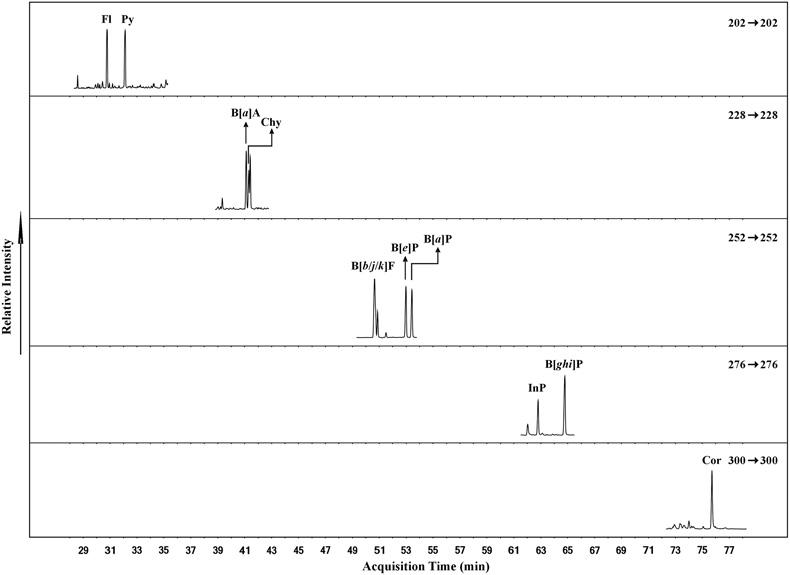
Figure 1 Representative multiple reaction monitoring (MRM) chromatograms obtained from GC-QQQ-MS analyses showing distributions of polycyclic aromatic hydrocarbons in the transition sample (R/M/XX/58), Raniganj sub-basin, eastern India. Fl: Fluoranthene; Py: Pyrene; B[a]A: benzo[a]anthracene; Chy: chrysene; B[b/j/k]F: benzo[b/j/k]fluoranthene; B[a]P: benzo[a]pyrene; B[e]P: benzo[e]pyrene; InP: indeno[1,2,3-cd]; B[ghi]P: benzo[ghi]perylene; Cor: Coronene.
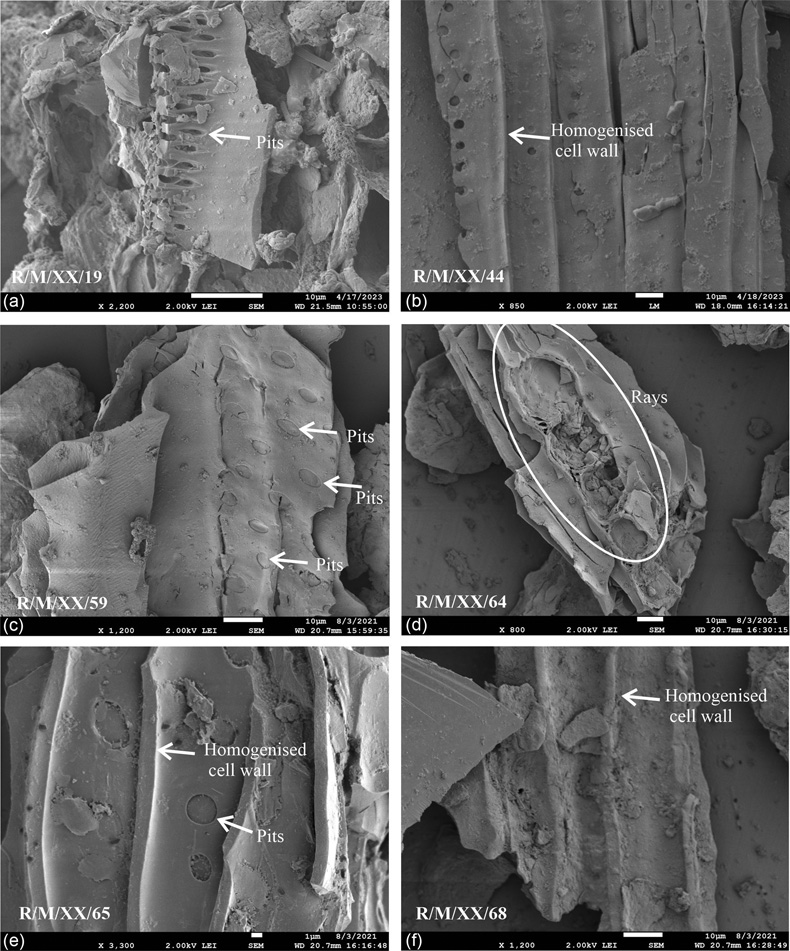
Figure 2 Scanning electron microscope (SEM) images of charcoalified tracheids in selected Upper Permian (R/M/XX/59; R/M/XX/64; R/M/XX/65; R/M/XX/68) and Lower Triassic (R/M/XX/19; R/M/XX/44) sediments, Raniganj sub-basin, eastern India.
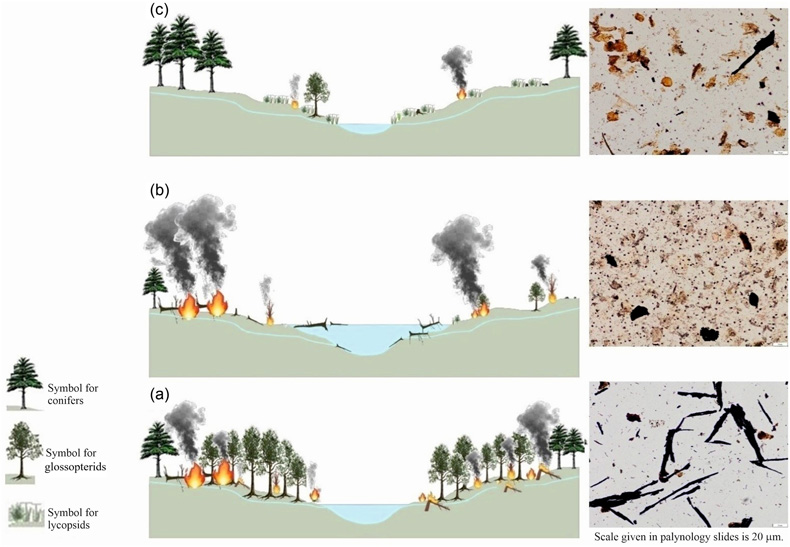
Figure 3 Palaeoecological changes during Changhsingian–Induan transition. This series depicts (a) a fire-prone dense mire where Glossopteris spp. thrived as the main coal-forming flora and conifers as subordinate flora during Changhsingian, (b) an impoverished ecosystem where the mire ceased to exist and fires continued burning the dieback vegetation during the transition, and (c) the recolonisation of the floodplains by conifers and the opportunistic lycopsids in a fire-prone ecosystem during Induan. Water table and kerogen matter (samples R/M/XX/61 in (a); R/M/XX/50 in (b); R/M/XX/28 in (c)) shown.