



Stable strontium isotopes reveal magma-fluid interaction during the evolution of granitic magma
Affiliations | Corresponding Author | Cite as | Funding information
Published by the European Association of Geochemistry
under Creative Commons License CC BY-NC-ND 4.0
Keywords: stable strontium isotope, anatectic rocks, magma differentiation, magma-fluid interaction


- Share this article


-
Article views:1,945Cumulative count of HTML views and PDF downloads.
- Download Citation
- Rights & Permissions

top
Abstract
Figures
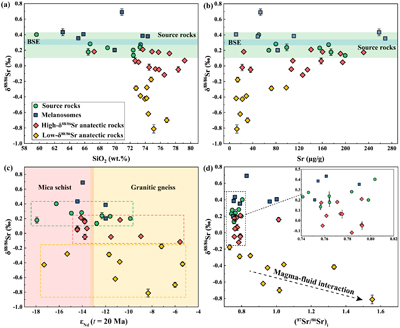 Figure 1 δ88/86Sr vs. (a) SiO2, (b) Sr, (c) ɛNd(t) and (d) (87Sr/86Sr)i. The green and blue shaded regions in (a) and (b) represent stable Sr isotopic compositions of the source rocks in this study and the BSE as defined by Moynier et al. (2010), respectively. The pink and yellow shaded regions in (c) represent the ɛNd(t) ranges of mica schists and granitic gneisses (Ji et al., 2022), respectively. Initial radiogenic Sr and Nd ratios are calculated at t = 20 Ma versus 87Rb/87Sr ratios and 147Sm/144Nd ratios. | 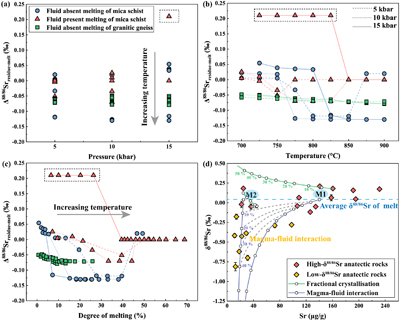 Figure 2 Simulation of partial melting of mica schist and granitic gneiss under different (a) pressures, (b) temperatures and (c) degrees of melting. The dashed box indicates the case of maximum Sr isotopic fractionation. (d) Simulation of mixing between melts and fluids. The initial compositions M1 and M2 are set as melt end members in the model. The dashed grey lines are the contours of the amount of fluids. Numbers on the lines denote the fraction of feldspar separation (green line) and the fraction of fluid (purple lines), respectively. | 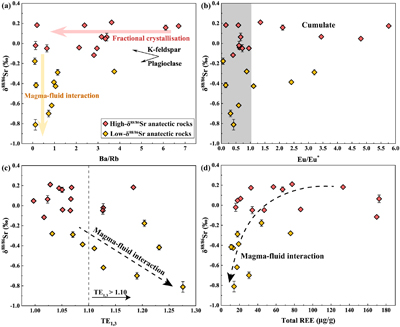 Figure 3 δ88/86Sr vs. (a) Ba/Rb, (b) Eu/Eu*, (c) TE1,3 and (d) Total REE. (a) The red and yellow arrows indicate the direction of fractional crystallisation and magma-fluid interaction, respectively. The different effects caused by plagioclase and K-feldspar are indicated by two black arrows. (b) Grey shading area covered anatectic rocks with Eu/Eu* < 1 representing differentiated melt. The Eu anomaly is calculated by the equation: | 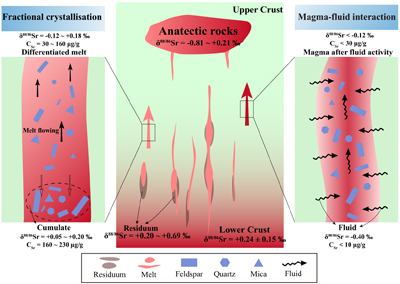 Figure 4 Schematic diagram depicting our current understanding of stable Sr isotopic behaviour during formation and evolution of felsic melts. See text for details. |
| Figure 1 | Figure 2 | Figure 3 | Figure 4 |
top
Introduction
Magma-fluid interaction plays a pivotal role in granite evolution, element transport, and rare metal mineralisation (Wu et al., 2020
Wu, F.-Y., Liu, X.-C., Liu, Z.-C., Wang, R.-C., Xie, L., Wang, J.-M., Ji, W.-Q., Yang, L., Liu, C., Khanal, G.P., He, S.-X. (2020) Highly fractionated Himalayan leucogranites and associated rare-metal mineralization. Lithos 352–353, 105319. https://doi.org/10.1016/j.lithos.2019.105319
; Zheng and Gao, 2021Zheng, Y.-F., Gao, P. (2021) The production of granitic magmas through crustal anatexis at convergent plate boundaries. Lithos 402–403, 106232. https://doi.org/10.1016/j.lithos.2021.106232
). Geochemical and petrological studies reveal that granite formation is a result of multiple processes, such as partial melting of source rocks, magma fractional crystallisation, fluid-magma interaction, and wall rock assimilation (Powell, 1984Powell, R. (1984) Inversion of the assimilation and fractional crystallization (AFC) equations; characterization of contaminants from isotope and trace element relationships in volcanic suites. Journal of the Geological Society 141, 447–452. https://doi.org/10.1144/gsjgs.141.3.0447
; Cao et al., 2022Cao, H.-W., Pei, Q.-M., Santosh, M., Li, G.-M., Zhang, L.-K., Zhang, X.-F., Zhang, Y.-H., Zou, H., Zai, Z.-W., Lin, B., Tang, L., Yu, X. (2022) Himalayan leucogranites: A review of geochemical and isotopic characteristics, timing of formation, genesis, and rare metal mineralization. Earth-Science Reviews 234, 104229. https://doi.org/10.1016/j.earscirev.2022.104229
). However, the complexity and overprinting of geochemical signatures often limit the effectiveness of traditional elemental tracers in uniquely constraining granite genesis (Bartoli, 2021Bartoli, O. (2021) Granite geochemistry is not diagnostic of the role of water in the source. Earth and Planetary Science Letters 564, 116927. https://doi.org/10.1016/j.epsl.2021.116927
; Cao et al., 2022Cao, H.-W., Pei, Q.-M., Santosh, M., Li, G.-M., Zhang, L.-K., Zhang, X.-F., Zhang, Y.-H., Zou, H., Zai, Z.-W., Lin, B., Tang, L., Yu, X. (2022) Himalayan leucogranites: A review of geochemical and isotopic characteristics, timing of formation, genesis, and rare metal mineralization. Earth-Science Reviews 234, 104229. https://doi.org/10.1016/j.earscirev.2022.104229
). In contrast, stable metal isotopes (e.g., Mg, Fe, Zn, K) provide robust tracers for these processes (Teng et al., 2017Teng, F.-Z., Dauphas, N., Watkins, J.M. (2017) Non-Traditional Stable Isotopes: Retrospective and Prospective. Reviews in Mineralogy and Geochemistry 82, 1–26. https://doi.org/10.2138/rmg.2017.82.1
), making them powerful tools for deciphering multiple processes during granite formation.Strontium (Sr), which is compatible in feldspar but incompatible in mica, exhibits contrasting partitioning behaviour that makes it particularly useful for investigating melt generation and evolution (Harris et al., 1995
Harris, N., Ayres, M., Massey, J. (1995) Geochemistry of granitic melts produced during the incongruent melting of muscovite: Implications for the extraction of Himalayan leucogranite magmas. Journal of Geophysical Research: Solid Earth 100, 15767–15777. https://doi.org/10.1029/94JB02623
). To data, the stable Sr isotopic composition (δ88/86Sr, defined as [(88Sr/86Sr)sample/(88Sr/86Sr)SRM987 − 1] × 1000 (‰)) is poorly constrained in terrestrial rocks. The δ88/86Sr values for the Bulk Silicate Earth (BSE) vary from +0.27 to +0.30 ‰ (Moynier et al., 2010Moynier, F., Agranier, A., Hezel, D.C., Bouvier, A. (2010) Sr stable isotope composition of Earth, the Moon, Mars, Vesta and meteorites. Earth and Planetary Science Letters 300, 359–366. https://doi.org/10.1016/j.epsl.2010.10.017
; Chen et al., 2022Chen, X.-Q., Zeng, Z., Yu, H.-M., Sun, N., Huang, F. (2022) Precise measurements of δ88/86Sr for twenty geological reference materials by double-spike MC-ICP-MS. International Journal of Mass Spectrometry 479, 116883. https://doi.org/10.1016/j.ijms.2022.116883
), whereas intermediate to felsic crustal rocks exhibit a broader range from −0.19 to +0.30 ‰ (Ohno et al., 2008Ohno, T., Komiya, T., Ueno, Y., Hirata, T., Maruyama, S. (2008) Determination of 88Sr/86Sr mass-dependent isotopic fractionation and radiogenic isotope variation of 87Sr/86Sr in the Neoproterozoic Doushantuo Formation. Gondwana Research 14, 126–133. https://doi.org/10.1016/j.gr.2007.10.007
; Moynier et al., 2010Moynier, F., Agranier, A., Hezel, D.C., Bouvier, A. (2010) Sr stable isotope composition of Earth, the Moon, Mars, Vesta and meteorites. Earth and Planetary Science Letters 300, 359–366. https://doi.org/10.1016/j.epsl.2010.10.017
; Charlier et al., 2012Charlier, B.L.A., Nowell, G.M., Parkinson, I.J., Kelley, S.P., Pearson, D.G., Burton, K.W. (2012) High temperature strontium stable isotope behaviour in the early solar system and planetary bodies. Earth and Planetary Science Letters 329–330, 31–40. https://doi.org/10.1016/j.epsl.2012.02.008
). Such processes as seawater alteration and slab dehydration are thought to preferentially remove isotopically lighter Sr (Amsellem et al., 2018Amsellem, E., Moynier, F., Day, J.M.D., Moreira, M., Puchtel, I.S., Teng, F.-Z. (2018) The stable strontium isotopic composition of ocean island basalts, mid-ocean ridge basalts, and komatiites. Chemical Geology 483, 595–602. https://doi.org/10.1016/j.chemgeo.2018.03.030
; Klaver et al., 2020Klaver, M., Lewis, J., Parkinson, I.J., Elburg, M.A., Vroon, P.Z., Kelley, K.A., Elliott, T. (2020) Sr isotopes in arcs revisited: tracking slab dehydration using δ88/86Sr and 87Sr/86Sr systematics of arc lavas. Geochimica et Cosmochimica Acta 288, 101–119. https://doi.org/10.1016/j.gca.2020.08.010
; Kani et al., 2023Kani, T., Misawa, K., Morikawa, N., Kazahaya, K., Kusuhara, F., Yoneda, S., Terakado, Y. (2023) Strontium Isotope Characteristics (δ88/86Sr, 87Sr/86Sr) of Arima-Type Brines Originated From Slab-Fluids. Geophysical Research Letters 50, e2022GL100309. https://doi.org/10.1029/2022GL100309
). However, the fractionation coefficients of stable Sr isotopes in crystal-melt-fluid systems remain unknown, as they have not yet been measured in experimental studies or examined from first principles calculations. The mechanisms governing stable Sr isotopic fractionation during metamorphism, partial melting and magma-fluid evolution therefore require further investigation.In this study, we report high precision stable Sr isotope data for the anatectic rocks (primarily granitic veins and dikes), melanosomes, and their potential source rocks (mica schists and granitic gneisses) from the Cona area, eastern Himalaya, China (Figs. S-1, S-2). In this area, widespread crustal anatexis and migration of felsic melts result in the extensive exposure of migmatites and anatectic rocks including granitic veins, dikes, and leucogranites (Ji et al., 2022
Ji, M., Gao, X.-Y., Zheng, Y.-F. (2022) Geochemical evidence for partial melting of progressively varied crustal sources for leucogranites during the Oligocene–Miocene in the Himalayan orogen. Chemical Geology 589, 120674. https://doi.org/10.1016/j.chemgeo.2021.120674
, 2023Ji, M., Gao, X.-Y., Zheng, Y.-F. (2023) The petrogenetic relationship between migmatite and granite in the Himalayan orogen: Petrological and geochemical constraints. Lithos 444–445, 107110. https://doi.org/10.1016/j.lithos.2023.107110
). These anatectic rocks were mainly produced by incongruent partial melting of mica schists and granitic gneisses in the late Oligocene to Miocene (Ji et al., 2021Ji, M., Gao, X.-Y., Zheng, Y.-F., Meng, Z.-Y., Gao, P. (2021) Metapelites record two episodes of decompressional metamorphism in the Himalayan orogen. Lithos 394–395, 106183. https://doi.org/10.1016/j.lithos.2021.106183
). Detailed geological setting and petrological descriptions of the studied samples are provided in Supplementary Information. The exposure of anatectic rocks, migmatites, and their potential source rocks thus make them well suited for investigating partial melting and granitic magma evolution processes. Our results reveal ∼1 ‰ variation in δ88/86Sr values for these anatectic rocks from the Cona area in eastern Himalaya. These findings offer new insights into stable Sr isotope fractionation during partial melting and granite magma evolution and provide a novel approach for understanding the petrogenesis of Himalayan leucogranites and associated rare metal mineralisation.top
Results
The analytical procedures for stable Sr isotopes and the data set are provided in the SI. Uncertainties in the stable Sr isotope measurements are expressed as 2 s.d. (standard deviation), with long term external precision ≤0.03 ‰ for δ88/86Sr values, based on repeated analyses of in-house reference USTC-Sr and GB-Sr. Data quality was monitored by analysing four USGS reference materials (G-2, AGV-2, RGM-1 and BHVO-2), which yielded results consistent with recent literature values (Chen et al., 2022
Chen, X.-Q., Zeng, Z., Yu, H.-M., Sun, N., Huang, F. (2022) Precise measurements of δ88/86Sr for twenty geological reference materials by double-spike MC-ICP-MS. International Journal of Mass Spectrometry 479, 116883. https://doi.org/10.1016/j.ijms.2022.116883
), as shown in Table S-1.All country rocks, including mica schists and granitic gneisses, show a narrow range of δ88/86Sr values from +0.14 ‰ to +0.40 ‰ (mean = +0.24 ± 0.15 ‰, n = 8) (Fig. 1a). The melanosomes have slightly higher δ88/86Sr values from +0.20 ‰ to +0.69 ‰ (mean = +0.36 ± 0.34 ‰, n = 7), although their overall variations remain limited (Fig. 1a). In contrast, the anatectic rocks exhibit much lower and more variable δ88/86Sr values, ranging from −0.81 to +0.21 ‰ (mean = −0.15 ± 0.59 ‰, n = 22) (Fig. 1a). Based on distinct correlations between δ88/86Sr values and SiO2 contents, the anatectic rocks are subdivided into two groups (Fig. 1a). These groups also differ in both Sr contents and δ88/86Sr values (Fig. 1b). Group 1 has a wide range in the Sr content (36 to 230 μg/g) but a narrow range in δ88/86Sr values (−0.12 to +0.21 ‰). In contrast, Group 2 shows a relatively narrow range in the Sr content (generally <100 μg/g, typically <30 μg/g) but a broad range in δ88/86Sr values (−0.81 to −0.18 ‰).
Figure 1 δ88/86Sr vs. (a) SiO2, (b) Sr, (c) ɛNd(t) and (d) (87Sr/86Sr)i. The green and blue shaded regions in (a) and (b) represent stable Sr isotopic compositions of the source rocks in this study and the BSE as defined by Moynier et al. (2010)
Moynier, F., Agranier, A., Hezel, D.C., Bouvier, A. (2010) Sr stable isotope composition of Earth, the Moon, Mars, Vesta and meteorites. Earth and Planetary Science Letters 300, 359–366. https://doi.org/10.1016/j.epsl.2010.10.017
, respectively. The pink and yellow shaded regions in (c) represent the ɛNd(t) ranges of mica schists and granitic gneisses (Ji et al., 2022Ji, M., Gao, X.-Y., Zheng, Y.-F. (2022) Geochemical evidence for partial melting of progressively varied crustal sources for leucogranites during the Oligocene–Miocene in the Himalayan orogen. Chemical Geology 589, 120674. https://doi.org/10.1016/j.chemgeo.2021.120674
), respectively. Initial radiogenic Sr and Nd ratios are calculated at t = 20 Ma versus 87Rb/87Sr ratios and 147Sm/144Nd ratios.top
Discussion
Stable Sr isotopic fractionation due to chemical weathering and source heterogeneity. The distinct geochemical characteristics of the two groups of anatectic rocks suggest the effects of diverse petrological and geochemical processes. Chemical weathering and source heterogeneity should be considered first to evaluate the origin of stable Sr isotopic variations. The chemical index of alteration (CIA = mol. Al2O3/(Al2O3 + CaO + Na2O + K2O)) (Nesbitt and Young, 1982
Nesbitt, H.W., Young, G.M. (1982) Early Proterozoic climates and plate motions inferred from major element chemistry of lutites. Nature 299, 715–717. https://doi.org/10.1038/299715a0
) is an important indicator of the degree of chemical weathering. All studied samples have very low CIA values, indicating minimal weathering. The CIA values show no correlation with the δ88/86Sr values (Fig. S-4). In addition, petrological observations confirm that the studied rocks were not strongly overprinted by later alteration. Therefore, the observed δ88/86Sr variations are not attributable to chemical weathering. In the Himalayan orogen, initial Nd isotope compositions calculated at 20 Ma, expressed as ɛNd(t), effectively distinguish source rock types: mica schists exhibit low ɛNd(t) values (−19.9 to −13.0), whereas granitic gneisses have higher values (−13.3 to −8.1) (Ji et al., 2022Ji, M., Gao, X.-Y., Zheng, Y.-F. (2022) Geochemical evidence for partial melting of progressively varied crustal sources for leucogranites during the Oligocene–Miocene in the Himalayan orogen. Chemical Geology 589, 120674. https://doi.org/10.1016/j.chemgeo.2021.120674
; Zeng et al., 2005Zeng, L., Asimow, P.D., Saleeby, J.B. (2005) Coupling of anatectic reactions and dissolution of accessory phases and the Sr and Nd isotope systematics of anatectic melts from a metasedimentary source. Geochimica et Cosmochimica Acta 69, 3671–3682. https://doi.org/10.1016/j.gca.2005.02.035
). Despite variability in ɛNd(t) values, both mica schists and granitic gneisses in this study exhibit narrow ranges in of δ88/86Sr values and initial radiogenic Sr isotope compositions calculated at 20 Ma, expressed as (87Sr/86Sr)i (Fig. 1c,d). Notably, anatectic rocks with both high and low δ88/86Sr values display overlapping ɛNd(t) values. No correlation between δ88/86Sr and ɛNd(t) values is observed (Fig. 1c). Thus, source heterogeneity cannot explain the observed variations in δ88/86Sr values. Other processes, such as partial melting of the source rocks, magma fractional crystallisation, and magma-fluid interaction, must therefore be considered.Stable Sr isotopic fractionation during crustal melting. Anatectic rocks in the Cona area were produced mainly by melting of mica schists and granitic gneisses through the incongruent breakdown of muscovite and biotite (Knesel and Davidson, 2002
Knesel, K.M., Davidson, J.P. (2002) Insights into Collisional Magmatism from Isotopic Fingerprints of Melting Reactions. Science 296, 2206–2208. https://doi.org/10.1126/science.1070622
; Patiño Douce and Harris, 1998Patiño Douce, A.E., Harris, N. (1998) Experimental Constraints on Himalayan Anatexis. Journal of Petrology 39, 689–710. https://doi.org/10.1093/petroj/39.4.689
), leaving the melanosome residue (Ji et al., 2021Ji, M., Gao, X.-Y., Zheng, Y.-F., Meng, Z.-Y., Gao, P. (2021) Metapelites record two episodes of decompressional metamorphism in the Himalayan orogen. Lithos 394–395, 106183. https://doi.org/10.1016/j.lithos.2021.106183
). The mineral proportions during this process are dependent on temperature, pressure, and H2O activity (Patiño Douce and Harris, 1998Patiño Douce, A.E., Harris, N. (1998) Experimental Constraints on Himalayan Anatexis. Journal of Petrology 39, 689–710. https://doi.org/10.1093/petroj/39.4.689
). Sr contents in melts are mainly controlled by feldspar, which is significantly richer in Sr than mica (Fig. S-5a). We note that higher (87Sr/86Sr)i values correspond to greater δ88/86Sr values (Fig. 1d). Although different melting reactions of heterogeneous source rock types can account for variable geochemical characteristics, such as (87Sr/86Sr)i and Sr contents, of the Himalayan leucogranites (Knesel and Davidson, 2002Knesel, K.M., Davidson, J.P. (2002) Insights into Collisional Magmatism from Isotopic Fingerprints of Melting Reactions. Science 296, 2206–2208. https://doi.org/10.1126/science.1070622
; Gao et al., 2017Gao, L.-E., Zeng, L., Asimow, P.D. (2017) Contrasting geochemical signatures of fluid-absent versus fluid-fluxed melting of muscovite in metasedimentary sources: The Himalayan leucogranites. Geology 45, 39–42. https://doi.org/10.1130/G38336.1
), the calculated (87Sr/86Sr)i values do not exceed 0.8, even for melting through the breakdown of biotite (see SI). Therefore, the extremely high (87Sr/86Sr)i values in the anatectic rocks cannot be attributed to partial melting process.To investigate the stable Sr isotopic fractionation during partial melting, we conducted phase equilibrium modelling of mica schist and granitic gneiss using the Perple_X software combined with geochemical modelling based on mass balance equation (see SI). The mineral assemblages and model proportions of minerals and melt under different anatectic conditions were directly obtained from the phase equilibrium modelling, whereas the Sr contents in the melt and residue were calculated according to batch melting equations (see Table S-4). The average δ88/86Sr value of mica schists (δ88/86Sr = +0.29 ‰) and granitic gneiss (δ88/86Sr = +0.22 ‰) were selected as the primary values, and the estimated fractionation between minerals and melt (Δ88/86SrPl-melt = +0.02 ‰; Δ88/86SrKfs-melt = −0.13 ‰; Δ88/86SrMs-melt = +0.21 ‰; Δ88/86SrBt-melt = −0.07 ‰) based on the observations in this study were used (see SI). The modelled results indicate that partial melting would produce limited Sr isotopic fractionation (Δ88/86Srresidue-melt < +0.10 ‰ in most cases) (Fig. 2a,b,c). This agrees with observations that the δ88/86Sr values for most melanosomes and some leucosomes overlap with the values for their source rocks. Only fluid-present melting of mica schist under high pressure and low temperature yields larger fractionation (Δ88/86Srresidue-melt = +0.21 ‰), which is able to explain the heaviest δ88/86Sr value of 0.69 ‰ for one melanosome (Figs. 1b, 2a,b,c). Therefore, partial melting cannot account for the extremely low δ88/86Sr values for the studied anatectic rocks.
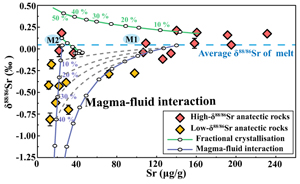
Figure 2 Simulation of partial melting of mica schist and granitic gneiss under different (a) pressures, (b) temperatures and (c) degrees of melting. The dashed box indicates the case of maximum Sr isotopic fractionation. (d) Simulation of mixing between melts and fluids. The initial compositions M1 and M2 are set as melt end members in the model. The dashed grey lines are the contours of the amount of fluids. Numbers on the lines denote the fraction of feldspar separation (green line) and the fraction of fluid (purple lines), respectively.
Stable Sr isotopic fractionation during fractional crystallisation. Fractional crystallisation has a significant impact on geochemical characteristics of the Himalayan leucogranites (Wu et al., 2020
Wu, F.-Y., Liu, X.-C., Liu, Z.-C., Wang, R.-C., Xie, L., Wang, J.-M., Ji, W.-Q., Yang, L., Liu, C., Khanal, G.P., He, S.-X. (2020) Highly fractionated Himalayan leucogranites and associated rare-metal mineralization. Lithos 352–353, 105319. https://doi.org/10.1016/j.lithos.2019.105319
; Cao et al., 2022Cao, H.-W., Pei, Q.-M., Santosh, M., Li, G.-M., Zhang, L.-K., Zhang, X.-F., Zhang, Y.-H., Zou, H., Zai, Z.-W., Lin, B., Tang, L., Yu, X. (2022) Himalayan leucogranites: A review of geochemical and isotopic characteristics, timing of formation, genesis, and rare metal mineralization. Earth-Science Reviews 234, 104229. https://doi.org/10.1016/j.earscirev.2022.104229
). Since Eu is strongly compatible in plagioclase and Ba is more compatible than Rb in feldspar, the Ba/Rb ratio and europium anomaly (Eu/Eu*) are useful indicators of fractional differentiation. In high-δ88/86Sr anatectic rocks, Ba/Rb ratios decrease while δ88/86Sr values remain relatively constant. In contrast, low-δ88/86Sr anatectic rocks exhibit significant stable Sr isotopic variations with little change in Ba/Rb ratios (Fig. 3a). Although Sr removal via feldspar separation is supported by the correlation between Sr contents and Eu/Eu*ratios (Fig. S-6d), δ88/86Sr values show no correlation with Eu/Eu* in samples with Eu/Eu* < 1 (Fig. 3b). This indicates that the δ88/86Sr variations are not controlled by fractional crystallisation.Figure 3 δ88/86Sr vs. (a) Ba/Rb, (b) Eu/Eu*, (c) TE1,3 and (d) Total REE. (a) The red and yellow arrows indicate the direction of fractional crystallisation and magma-fluid interaction, respectively. The different effects caused by plagioclase and K-feldspar are indicated by two black arrows. (b) Grey shading area covered anatectic rocks with Eu/Eu* < 1 representing differentiated melt. The Eu anomaly is calculated by the equation:
 . (c) TE1,3 is calculated by the following equation (Irber, 1999
Irber, W. (1999) The lanthanide tetrad effect and its correlation with K/Rb, Eu/Eu*, Sr/Eu, Y/Ho, and Zr/Hf of evolving peraluminous granite suites. Geochimica et Cosmochimica Acta 63, 489–508. https://doi.org/10.1016/S0016-7037(99)00027-7
): TE1,3 = (t1 × t3)0.5, where t1 = [CeN/(LaN2/3 × NdN1/3) × PrN/(LaN1/3 × NdN2/3)]0.5; t3 = [TbN/(GdN2/3 × HoN1/3) × DyN/(GdN1/3 × HoN2/3)]0.5. The subscript “N” denotes normalisation to chondritic values (Sun and McDonough, 1989Sun, S.-s., McDonough, W.F. (1989) Chemical and isotopic systematics of oceanic basalts: implications for mantle composition and processes. Geological Society, London, Special Publications 42, 313–345. https://doi.org/10.1144/GSL.SP.1989.042.01.19
). Black arrows indicate changes of stable Sr isotopes with TE1,3 and total REE contents in (c) and (d).Anatectic rocks with Eu/Eu* > 1, representing cumulates, generally exhibit overlapping δ88/86Sr values (Fig. 3b). To investigate stable Sr isotope fractionation during fractional crystallisation, we performed phase equilibrium modelling using the Perple_X software (see SI). Note that Sr contents in the primary melts would have a large range during partial melting of mica schist and granitic gneiss (Table S-4). Two representative anatectic rocks with different Sr contents (CSr = 161 μg/g and δ88/86Sr = +0.18 ‰; CSr = 36 μg/g and δ88/86Sr = −0.05 ‰) were selected in the modelling as representative compositions of the primary melts. The mineral assemblage and model proportion of minerals and melt under different crystallisation conditions were directly estimated from the phase equilibrium modelling (Table S-5). The same fractionation factors between minerals and melt as in the partial melting modelling were used. Rayleigh fractionation models were depicted in the Figure 2d. The modelling results show that fractional crystallisation would not produce large variations in δ88/86Sr values for the differentiated melts, consistent with high-δ88/86Sr anatectic rocks (Fig. 2d). Thus, the extremely low δ88/86Sr values for anatectic rocks cannot be explained by fractional crystallisation.
Stable Sr isotopic fractionation during magma-fluid interaction. The most plausible process responsible for the extremely low δ88/86Sr and high (87Sr/86Sr)i values for the Sr-poor anatectic rocks is the interaction of their magma with high temperature fluids. Metasomatic textures and fluid inclusions in quartz provide direct evidence for such interactions (Fig. S-3). Rare earth elements (REE) form complexes with non-bridging oxygen, F−, and Cl− in fluids, generating tetrad effects (expressed as TE1,3) and reducing REE content during magma-fluid interaction (Bau, 1996
Bau, M. (1996) Controls on the fractionation of isovalent trace elements in magmatic and aqueous systems: evidence from Y/Ho, Zr/Hf, and lanthanide tetrad effect. Contributions to Mineralogy and Petrology 123, 323–333. https://doi.org/10.1007/s004100050159
; Irber, 1999Irber, W. (1999) The lanthanide tetrad effect and its correlation with K/Rb, Eu/Eu*, Sr/Eu, Y/Ho, and Zr/Hf of evolving peraluminous granite suites. Geochimica et Cosmochimica Acta 63, 489–508. https://doi.org/10.1016/S0016-7037(99)00027-7
). The correlations between δ88/86Sr values and these sensitive proxies further support the influence of magma-fluid interaction on stable Sr isotope compositions (Fig. 3c,d). In addition, the elevated (87Sr/86Sr)i values for the anatectic rocks cannot be explained by partial melting or fractional crystallisation processes, indicating infiltration of external fluids (Fig. 1d). Fluids are known to preferentially carry light Ba isotopes (δ138/134Ba) (Guo et al., 2020Guo, H., Li, W.-Y., Nan, X., Huang, F. (2020) Experimental evidence for light Ba isotopes favouring aqueous fluids over silicate melts. Geochemical Perspectives Letters 16, 6–11. http://dx.doi.org/10.7185/geochemlet.2036
). Since Ba and Sr share similar geochemical properties, light Sr isotopes are similarly favoured by fluids (Amsellem et al., 2018Amsellem, E., Moynier, F., Day, J.M.D., Moreira, M., Puchtel, I.S., Teng, F.-Z. (2018) The stable strontium isotopic composition of ocean island basalts, mid-ocean ridge basalts, and komatiites. Chemical Geology 483, 595–602. https://doi.org/10.1016/j.chemgeo.2018.03.030
, Klaver et al., 2020Klaver, M., Lewis, J., Parkinson, I.J., Elburg, M.A., Vroon, P.Z., Kelley, K.A., Elliott, T. (2020) Sr isotopes in arcs revisited: tracking slab dehydration using δ88/86Sr and 87Sr/86Sr systematics of arc lavas. Geochimica et Cosmochimica Acta 288, 101–119. https://doi.org/10.1016/j.gca.2020.08.010
; Kani et al., 2023Kani, T., Misawa, K., Morikawa, N., Kazahaya, K., Kusuhara, F., Yoneda, S., Terakado, Y. (2023) Strontium Isotope Characteristics (δ88/86Sr, 87Sr/86Sr) of Arima-Type Brines Originated From Slab-Fluids. Geophysical Research Letters 50, e2022GL100309. https://doi.org/10.1029/2022GL100309
). Therefore, fluid influx is inferred to introduce light stable Sr isotopes.According to the above discussion, it is clear that external fluids with low δ88/86Sr are required to explain light Sr isotope compositions in the anatectic rocks. To quantify this effect, a simplified two end member mixing model was applied (SI). The Sr contents in Himalayan granites are generally less than 100 μg/g (Cao et al., 2022
Cao, H.-W., Pei, Q.-M., Santosh, M., Li, G.-M., Zhang, L.-K., Zhang, X.-F., Zhang, Y.-H., Zou, H., Zai, Z.-W., Lin, B., Tang, L., Yu, X. (2022) Himalayan leucogranites: A review of geochemical and isotopic characteristics, timing of formation, genesis, and rare metal mineralization. Earth-Science Reviews 234, 104229. https://doi.org/10.1016/j.earscirev.2022.104229
). Since partitioning coefficient of Sr between fluid and melt (DSrfluid/melt < 0.3) is low (Borchert et al., 2010Borchert, M., Wilke, M., Schmidt, C., Rickers, K. (2010) Rb and Sr partitioning between haplogranitic melts and aqueous solutions. Geochimica et Cosmochimica Acta 74, 1057–1076. https://doi.org/10.1016/j.gca.2009.10.033
), a fluid exsolved from a magma reservoir is predicted to be extremely poor in Sr (<30 μg/g). Alternatively, the external fluids can also be supplied via metamorphic dehydration dominated by decomposition of mica, whose Sr content is low. In this regard, we reasonably set the Sr content in the fluids to be 10 μg/g. In addition, since the high-δ88/86Sr anatectic rocks represent products of partial melting and fractional crystallisation, two initial points with the average δ88/86Sr value and different Sr contents were selected as the end members in modelling (M1: CSr = 140 μg/g, δ88/86Sr = +0.04 ‰; M2: CSr = 25 μg/g; δ88/86Sr = +0.04 ‰). If 20–40 % fluids, which is carrying capacity in granitic magma (Thomas and Davidson, 2016Thomas, R., Davidson, P. (2016) Revisiting complete miscibility between silicate melts and hydrous fluids, and the extreme enrichment of some elements in the supercritical state — Consequences for the formation of pegmatites and ore deposits. Ore Geology Reviews 72, 1088–1101. https://doi.org/10.1016/j.oregeorev.2015.10.004
; Deng et al., 2024Deng, G., Jiang, D., Li, G., Xu, Z., Huang, F. (2024) Barium isotope evidence for a magmatic fluid-dominated petrogenesis of LCT-type pegmatites. Geochemical Perspectives Letters 31, 14–20. https://doi.org/10.7185/geochemlet.2426
), was adopted in the modelling, then the modelling results in the δ88/86Sr value of −4.0 ‰ in fluids. Such an extremely light isotopic composition in fluids was also determined for Ba isotope system (Deng et al., 2024Deng, G., Jiang, D., Li, G., Xu, Z., Huang, F. (2024) Barium isotope evidence for a magmatic fluid-dominated petrogenesis of LCT-type pegmatites. Geochemical Perspectives Letters 31, 14–20. https://doi.org/10.7185/geochemlet.2426
). It is worth mentioning that using higher Sr contents in the modelling will make slightly heavier Sr isotope in fluids. In a nutshell, stable Sr isotopic compositions for the anatectic rocks with low Sr content are more susceptible to be reduced by interaction between melts and fluids (Fig. 2d).Implications for stable Sr isotopic variation in high silica granites and magmatic evolution. Understanding the differentiation processes of felsic magmas is crucial for elucidating the origin of granites and related rare metal mineralisation. Highly fractionated leucogranites of the Himalayan orogen are enriched in Be-, Nb-, Ta-, and Li-bearing minerals showing significant ore forming potential (Wu et al., 2020
Wu, F.-Y., Liu, X.-C., Liu, Z.-C., Wang, R.-C., Xie, L., Wang, J.-M., Ji, W.-Q., Yang, L., Liu, C., Khanal, G.P., He, S.-X. (2020) Highly fractionated Himalayan leucogranites and associated rare-metal mineralization. Lithos 352–353, 105319. https://doi.org/10.1016/j.lithos.2019.105319
). The formation of these leucogranites involved partial melting of source rocks, magma fractional crystallisation, and magma-fluid interaction. Notably, rare metal mineralisation is often closely associated with pegmatites that formed during late stage magmatic evolution with voluminous participation of fluids (Wu et al., 2020Wu, F.-Y., Liu, X.-C., Liu, Z.-C., Wang, R.-C., Xie, L., Wang, J.-M., Ji, W.-Q., Yang, L., Liu, C., Khanal, G.P., He, S.-X. (2020) Highly fractionated Himalayan leucogranites and associated rare-metal mineralization. Lithos 352–353, 105319. https://doi.org/10.1016/j.lithos.2019.105319
). Thus, recognising and tracing fluid activity is essential for understanding both magmatic evolution and associated ore mineralisation. However, quantifying the extent of fluid activity remains challenging. While tetrad REE patterns are widely considered qualitative indicators of magma-fluid interaction, they provide limited constraints on fluid volume or other quantitative information (Irber, 1999Irber, W. (1999) The lanthanide tetrad effect and its correlation with K/Rb, Eu/Eu*, Sr/Eu, Y/Ho, and Zr/Hf of evolving peraluminous granite suites. Geochimica et Cosmochimica Acta 63, 489–508. https://doi.org/10.1016/S0016-7037(99)00027-7
). Our study is the first to reveal substantial stable Sr isotopic variations between anatectic rocks (Fig. 4). Importantly, neither partial melting nor fractional crystallisation produces significant variation in stable Sr isotopes, despite their effects on Sr contents in melts. Only melt-fluid interaction could induce substantial stable Sr isotopic variations (Fig. 4).Figure 4 Schematic diagram depicting our current understanding of stable Sr isotopic behaviour during formation and evolution of felsic melts. See text for details.
Thus, stable Sr isotopes emerge as a novel geochemical tracer for identifying fluid activity in the granitic magma systems. Furthermore, systematic correlations among Sr, Ba, and Rb contents and their corresponding stable isotopes may provide a powerful framework for constraining the evolution of felsic magmas (Hu et al., 2022
Hu, X., Nan, X., Liu, X., Huang, F. (2022) Rubidium isotope compositions of the average upper continental crust and the Himalayan leucogranites: Implications for magmatic-fluid interaction. Geochimica et Cosmochimica Acta 336, 165–176. https://doi.org/10.1016/j.gca.2022.09.015
; Deng et al., 2024Deng, G., Jiang, D., Li, G., Xu, Z., Huang, F. (2024) Barium isotope evidence for a magmatic fluid-dominated petrogenesis of LCT-type pegmatites. Geochemical Perspectives Letters 31, 14–20. https://doi.org/10.7185/geochemlet.2426
).top
Acknowledgements
This study was supported by funds from the National Key R and D programme of China (2024YFF0807302), the National Science Foundation of China (42472076 and 42330806), the Fundamental Research Funds for the Central Universities, and joint Russian Scientific Foundation – National Science Foundation of China (RSCF-NSFC) project (W2412052 and 25-47-00073). We are grateful to two anonymous reviewers for their thorough and constructive comments that greatly improved the paper. We also express our appreciation to Editor Raul O. C. Fonseca for his editorial handling.
Editor: Raul O.C. Fonseca
top
References
Amsellem, E., Moynier, F., Day, J.M.D., Moreira, M., Puchtel, I.S., Teng, F.-Z. (2018) The stable strontium isotopic composition of ocean island basalts, mid-ocean ridge basalts, and komatiites. Chemical Geology 483, 595–602. https://doi.org/10.1016/j.chemgeo.2018.03.030
 Show in context
 Such processes as seawater alteration and slab dehydration are thought to preferentially remove isotopically lighter Sr (Amsellem et al., 2018; Klaver et al., 2020; Kani et al., 2023).
View in article
Since Ba and Sr share similar geochemical properties, light Sr isotopes are similarly favoured by fluids (Amsellem et al., 2018, Klaver et al., 2020; Kani et al., 2023).
View in article
Bartoli, O. (2021) Granite geochemistry is not diagnostic of the role of water in the source. Earth and Planetary Science Letters 564, 116927. https://doi.org/10.1016/j.epsl.2021.116927
Show in context However, the complexity and overprinting of geochemical signatures often limit the effectiveness of traditional elemental tracers in uniquely constraining granite genesis (Bartoli, 2021; Cao et al., 2022).
View in article
Bau, M. (1996) Controls on the fractionation of isovalent trace elements in magmatic and aqueous systems: evidence from Y/Ho, Zr/Hf, and lanthanide tetrad effect. Contributions to Mineralogy and Petrology 123, 323–333. https://doi.org/10.1007/s004100050159
Show in context Rare earth elements (REE) form complexes with non-bridging oxygen, F−, and Cl− in fluids, generating tetrad effects (expressed as TE1,3) and reducing REE content during magma-fluid interaction (Bau, 1996; Irber, 1999).
View in article
Borchert, M., Wilke, M., Schmidt, C., Rickers, K. (2010) Rb and Sr partitioning between haplogranitic melts and aqueous solutions. Geochimica et Cosmochimica Acta 74, 1057–1076. https://doi.org/10.1016/j.gca.2009.10.033
Show in context Since partitioning coefficient of Sr between fluid and melt (D Sr fluid/melt < 0.3) is low (Borchert et al., 2010), a fluid exsolved from a magma reservoir is predicted to be extremely poor in Sr (<30 μg/g).
View in article
Cao, H.-W., Pei, Q.-M., Santosh, M., Li, G.-M., Zhang, L.-K., Zhang, X.-F., Zhang, Y.-H., Zou, H., Zai, Z.-W., Lin, B., Tang, L., Yu, X. (2022) Himalayan leucogranites: A review of geochemical and isotopic characteristics, timing of formation, genesis, and rare metal mineralization. Earth-Science Reviews 234, 104229. https://doi.org/10.1016/j.earscirev.2022.104229
Show in context Geochemical and petrological studies reveal that granite formation is a result of multiple processes, such as partial melting of source rocks, magma fractional crystallisation, fluid-magma interaction, and wall rock assimilation (Powell, 1984; Cao et al., 2022).
View in article
However, the complexity and overprinting of geochemical signatures often limit the effectiveness of traditional elemental tracers in uniquely constraining granite genesis (Bartoli, 2021; Cao et al., 2022).
View in article
Fractional crystallisation has a significant impact on geochemical characteristics of the Himalayan leucogranites (Wu et al., 2020; Cao et al., 2022).
View in article
The Sr contents in Himalayan granites are generally less than 100 μg/g (Cao et al., 2022).
View in article
Charlier, B.L.A., Nowell, G.M., Parkinson, I.J., Kelley, S.P., Pearson, D.G., Burton, K.W. (2012) High temperature strontium stable isotope behaviour in the early solar system and planetary bodies. Earth and Planetary Science Letters 329–330, 31–40. https://doi.org/10.1016/j.epsl.2012.02.008
Show in context The δ88/86Sr values for the Bulk Silicate Earth (BSE) vary from +0.27 to +0.30 ‰ (Moynier et al., 2010; Chen et al., 2022), whereas intermediate to felsic crustal rocks exhibit a broader range from −0.19 to +0.30 ‰ (Ohno et al., 2008; Moynier et al., 2010; Charlier et al., 2012).
View in article
Chen, X.-Q., Zeng, Z., Yu, H.-M., Sun, N., Huang, F. (2022) Precise measurements of δ88/86Sr for twenty geological reference materials by double-spike MC-ICP-MS. International Journal of Mass Spectrometry 479, 116883. https://doi.org/10.1016/j.ijms.2022.116883
Show in context The δ88/86Sr values for the Bulk Silicate Earth (BSE) vary from +0.27 to +0.30 ‰ (Moynier et al., 2010; Chen et al., 2022), whereas intermediate to felsic crustal rocks exhibit a broader range from −0.19 to +0.30 ‰ (Ohno et al., 2008; Moynier et al., 2010; Charlier et al., 2012).
View in article
Data quality was monitored by analysing four USGS reference materials (G-2, AGV-2, RGM-1 and BHVO-2), which yielded results consistent with recent literature values (Chen et al., 2022), as shown in Table S-1
View in article
Deng, G., Jiang, D., Li, G., Xu, Z., Huang, F. (2024) Barium isotope evidence for a magmatic fluid-dominated petrogenesis of LCT-type pegmatites. Geochemical Perspectives Letters 31, 14–20. https://doi.org/10.7185/geochemlet.2426
Show in context If 20–40 % fluids, which is carrying capacity in granitic magma (Thomas and Davidson, 2016; Deng et al., 2024), was adopted in the modelling, then the modelling results in the δ88/86Sr value of −4.0 ‰ in fluids.
View in article
Such an extremely light isotopic composition in fluids was also determined for Ba isotope system (Deng et al., 2024).
View in article
Furthermore, systematic correlations among Sr, Ba, and Rb contents and their corresponding stable isotopes may provide a powerful framework for constraining the evolution of felsic magmas (Hu et al., 2022; Deng et al., 2024).
View in article
Gao, L.-E., Zeng, L., Asimow, P.D. (2017) Contrasting geochemical signatures of fluid-absent versus fluid-fluxed melting of muscovite in metasedimentary sources: The Himalayan leucogranites. Geology 45, 39–42. https://doi.org/10.1130/G38336.1
Show in context Although different melting reactions of heterogeneous source rock types can account for variable geochemical characteristics, such as (87Sr/86Sr)i and Sr contents, of the Himalayan leucogranites (Knesel and Davidson, 2002; Gao et al., 2017), the calculated (87Sr/86Sr)i values do not exceed 0.8, even for melting through the breakdown of biotite (see SI).
View in article
Guo, H., Li, W.-Y., Nan, X., Huang, F. (2020) Experimental evidence for light Ba isotopes favouring aqueous fluids over silicate melts. Geochemical Perspectives Letters 16, 6–11. https://dx.doi.org/10.7185/geochemlet.2036
Show in context Fluids are known to preferentially carry light Ba isotopes (δ138/134Ba) (Guo et al., 2020).
View in article
Harris, N., Ayres, M., Massey, J. (1995) Geochemistry of granitic melts produced during the incongruent melting of muscovite: Implications for the extraction of Himalayan leucogranite magmas. Journal of Geophysical Research: Solid Earth 100, 15767–15777. https://doi.org/10.1029/94JB02623
Show in context Strontium (Sr), which is compatible in feldspar but incompatible in mica, exhibits contrasting partitioning behaviour that makes it particularly useful for investigating melt generation and evolution (Harris et al., 1995).
View in article
Hu, X., Nan, X., Liu, X., Huang, F. (2022) Rubidium isotope compositions of the average upper continental crust and the Himalayan leucogranites: Implications for magmatic-fluid interaction. Geochimica et Cosmochimica Acta 336, 165–176. https://doi.org/10.1016/j.gca.2022.09.015
Show in context Furthermore, systematic correlations among Sr, Ba, and Rb contents and their corresponding stable isotopes may provide a powerful framework for constraining the evolution of felsic magmas (Hu et al., 2022; Deng et al., 2024).
View in article
Irber, W. (1999) The lanthanide tetrad effect and its correlation with K/Rb, Eu/Eu*, Sr/Eu, Y/Ho, and Zr/Hf of evolving peraluminous granite suites. Geochimica et Cosmochimica Acta 63, 489–508. https://doi.org/10.1016/S0016-7037(99)00027-7
Show in context The Eu anomaly is calculated by the equation: . (c) TE1,3 is calculated by the following equation (Irber, 1999): TE1,3 = (t1 × t3)0.5, where t1 = [CeN/(LaN2/3 × NdN1/3) × PrN/(LaN1/3 × NdN2/3)]0.5; t3 = [TbN/(GdN2/3 × HoN1/3) × DyN/(GdN1/3 × HoN2/3)]0.5. The subscript “N” denotes normalisation to chondritic values (Sun and McDonough, 1989).
View in article
Rare earth elements (REE) form complexes with non-bridging oxygen, F−, and Cl− in fluids, generating tetrad effects (expressed as TE1,3) and reducing REE content during magma-fluid interaction (Bau, 1996; Irber, 1999).
View in article
While tetrad REE patterns are widely considered qualitative indicators of magma-fluid interaction, they provide limited constraints on fluid volume or other quantitative information (Irber, 1999).
View in article
Ji, M., Gao, X.-Y., Zheng, Y.-F., Meng, Z.-Y., Gao, P. (2021) Metapelites record two episodes of decompressional metamorphism in the Himalayan orogen. Lithos 394–395, 106183. https://doi.org/10.1016/j.lithos.2021.106183
Show in context These anatectic rocks were mainly produced by incongruent partial melting of mica schists and granitic gneisses in the late Oligocene to Miocene (Ji et al., 2021).
View in article
Anatectic rocks in the Cona area were produced mainly by melting of mica schists and granitic gneisses through the incongruent breakdown of muscovite and biotite (Knesel and Davidson, 2002; Patiño Douce and Harris, 1998), leaving the melanosome residue (Ji et al., 2021).
View in article
Ji, M., Gao, X.-Y., Zheng, Y.-F. (2022) Geochemical evidence for partial melting of progressively varied crustal sources for leucogranites during the Oligocene–Miocene in the Himalayan orogen. Chemical Geology 589, 120674. https://doi.org/10.1016/j.chemgeo.2021.120674
Show in context In this area, widespread crustal anatexis and migration of felsic melts result in the extensive exposure of migmatites and anatectic rocks including granitic veins, dikes, and leucogranites (Ji et al., 2022, 2023).
View in article
The pink and yellow shaded regions in (c) represent the ɛNd(t) ranges of mica schists and granitic gneisses (Ji et al., 2022), respectively.
View in article
In the Himalayan orogen, initial Nd isotope compositions calculated at 20 Ma, expressed as ɛNd(t), effectively distinguish source rock types: mica schists exhibit low ɛNd(t) values (−19.9 to −13.0), whereas granitic gneisses have higher values (−13.3 to −8.1) (Ji et al., 2022; Zeng et al., 2005).
View in article
Ji, M., Gao, X.-Y., Zheng, Y.-F. (2023) The petrogenetic relationship between migmatite and granite in the Himalayan orogen: Petrological and geochemical constraints. Lithos 444–445, 107110. https://doi.org/10.1016/j.lithos.2023.107110
Show in context In this area, widespread crustal anatexis and migration of felsic melts result in the extensive exposure of migmatites and anatectic rocks including granitic veins, dikes, and leucogranites (Ji et al., 2022, 2023).
View in article
Kani, T., Misawa, K., Morikawa, N., Kazahaya, K., Kusuhara, F., Yoneda, S., Terakado, Y. (2023) Strontium Isotope Characteristics (δ88/86Sr, 87Sr/86Sr) of Arima-Type Brines Originated From Slab-Fluids. Geophysical Research Letters 50, e2022GL100309. https://doi.org/10.1029/2022GL100309
Show in context Such processes as seawater alteration and slab dehydration are thought to preferentially remove isotopically lighter Sr (Amsellem et al., 2018; Klaver et al., 2020; Kani et al., 2023).
View in article
Since Ba and Sr share similar geochemical properties, light Sr isotopes are similarly favoured by fluids (Amsellem et al., 2018, Klaver et al., 2020; Kani et al., 2023).
View in article
Klaver, M., Lewis, J., Parkinson, I.J., Elburg, M.A., Vroon, P.Z., Kelley, K.A., Elliott, T. (2020) Sr isotopes in arcs revisited: tracking slab dehydration using δ88/86Sr and 87Sr/86Sr systematics of arc lavas. Geochimica et Cosmochimica Acta 288, 101–119. https://doi.org/10.1016/j.gca.2020.08.010
Show in context Such processes as seawater alteration and slab dehydration are thought to preferentially remove isotopically lighter Sr (Amsellem et al., 2018; Klaver et al., 2020; Kani et al., 2023).
View in article
Since Ba and Sr share similar geochemical properties, light Sr isotopes are similarly favoured by fluids (Amsellem et al., 2018, Klaver et al., 2020; Kani et al., 2023).
View in article
Knesel, K.M., Davidson, J.P. (2002) Insights into Collisional Magmatism from Isotopic Fingerprints of Melting Reactions. Science 296, 2206–2208. https://doi.org/10.1126/science.1070622
Show in context Anatectic rocks in the Cona area were produced mainly by melting of mica schists and granitic gneisses through the incongruent breakdown of muscovite and biotite (Knesel and Davidson, 2002; Patiño Douce and Harris, 1998), leaving the melanosome residue (Ji et al., 2021).
View in article
Although different melting reactions of heterogeneous source rock types can account for variable geochemical characteristics, such as (87Sr/86Sr)i and Sr contents, of the Himalayan leucogranites (Knesel and Davidson, 2002; Gao et al., 2017), the calculated (87Sr/86Sr)i values do not exceed 0.8, even for melting through the breakdown of biotite (see SI).
View in article
Moynier, F., Agranier, A., Hezel, D.C., Bouvier, A. (2010) Sr stable isotope composition of Earth, the Moon, Mars, Vesta and meteorites. Earth and Planetary Science Letters 300, 359–366. https://doi.org/10.1016/j.epsl.2010.10.017
Show in context The δ88/86Sr values for the Bulk Silicate Earth (BSE) vary from +0.27 to +0.30 ‰ (Moynier et al., 2010; Chen et al., 2022), whereas intermediate to felsic crustal rocks exhibit a broader range from −0.19 to +0.30 ‰ (Ohno et al., 2008; Moynier et al., 2010; Charlier et al., 2012).
View in article
The green and blue shaded regions in (a) and (b) represent stable Sr isotopic compositions of the source rocks in this study and the BSE as defined by Moynier et al. (2010), respectively.
View in article
Nesbitt, H.W., Young, G.M. (1982) Early Proterozoic climates and plate motions inferred from major element chemistry of lutites. Nature 299, 715–717. https://doi.org/10.1038/299715a0
Show in context The chemical index of alteration (CIA = mol. Al2O3/(Al2O3 + CaO + Na2O + K2O)) (Nesbitt and Young, 1982) is an important indicator of the degree of chemical weathering.
View in article
Ohno, T., Komiya, T., Ueno, Y., Hirata, T., Maruyama, S. (2008) Determination of 88Sr/86Sr mass-dependent isotopic fractionation and radiogenic isotope variation of 87Sr/86Sr in the Neoproterozoic Doushantuo Formation. Gondwana Research 14, 126–133. https://doi.org/10.1016/j.gr.2007.10.007
Show in context The δ88/86Sr values for the Bulk Silicate Earth (BSE) vary from +0.27 to +0.30 ‰ (Moynier et al., 2010; Chen et al., 2022), whereas intermediate to felsic crustal rocks exhibit a broader range from −0.19 to +0.30 ‰ (Ohno et al., 2008; Moynier et al., 2010; Charlier et al., 2012).
View in article
Patiño Douce, A.E., Harris, N. (1998) Experimental Constraints on Himalayan Anatexis. Journal of Petrology 39, 689–710. https://doi.org/10.1093/petroj/39.4.689
Show in context Anatectic rocks in the Cona area were produced mainly by melting of mica schists and granitic gneisses through the incongruent breakdown of muscovite and biotite (Knesel and Davidson, 2002; Patiño Douce and Harris, 1998), leaving the melanosome residue (Ji et al., 2021).
View in article
The mineral proportions during this process are dependent on temperature, pressure, and H2O activity (Patiño Douce and Harris, 1998).
View in article
Powell, R. (1984) Inversion of the assimilation and fractional crystallization (AFC) equations; characterization of contaminants from isotope and trace element relationships in volcanic suites. Journal of the Geological Society 141, 447–452. https://doi.org/10.1144/gsjgs.141.3.0447
Show in context Geochemical and petrological studies reveal that granite formation is a result of multiple processes, such as partial melting of source rocks, magma fractional crystallisation, fluid-magma interaction, and wall rock assimilation (Powell, 1984; Cao et al., 2022).
View in article
Sun, S.-s., McDonough, W.F. (1989) Chemical and isotopic systematics of oceanic basalts: implications for mantle composition and processes. Geological Society, London, Special Publications 42, 313–345. https://doi.org/10.1144/GSL.SP.1989.042.01.19
Show in context The Eu anomaly is calculated by the equation: . (c) TE1,3 is calculated by the following equation (Irber, 1999): TE1,3 = (t1 × t3)0.5, where t1 = [CeN/(LaN2/3 × NdN1/3) × PrN/(LaN1/3 × NdN2/3)]0.5; t3 = [TbN/(GdN2/3 × HoN1/3) × DyN/(GdN1/3 × HoN2/3)]0.5. The subscript “N” denotes normalisation to chondritic values (Sun and McDonough, 1989).
View in article
Teng, F.-Z., Dauphas, N., Watkins, J.M. (2017) Non-Traditional Stable Isotopes: Retrospective and Prospective. Reviews in Mineralogy and Geochemistry 82, 1–26. https://doi.org/10.2138/rmg.2017.82.1
Show in context In contrast, stable metal isotopes (e.g., Mg, Fe, Zn, K) provide robust tracers for these processes (Teng et al., 2017), making them powerful tools for deciphering multiple processes during granite formation.
View in article
Thomas, R., Davidson, P. (2016) Revisiting complete miscibility between silicate melts and hydrous fluids, and the extreme enrichment of some elements in the supercritical state — Consequences for the formation of pegmatites and ore deposits. Ore Geology Reviews 72, 1088–1101. https://doi.org/10.1016/j.oregeorev.2015.10.004
Show in context If 20–40 % fluids, which is carrying capacity in granitic magma (Thomas and Davidson, 2016; Deng et al., 2024), was adopted in the modelling, then the modelling results in the δ88/86Sr value of −4.0 ‰ in fluids.
View in article
Wu, F.-Y., Liu, X.-C., Liu, Z.-C., Wang, R.-C., Xie, L., Wang, J.-M., Ji, W.-Q., Yang, L., Liu, C., Khanal, G.P., He, S.-X. (2020) Highly fractionated Himalayan leucogranites and associated rare-metal mineralization. Lithos 352–353, 105319. https://doi.org/10.1016/j.lithos.2019.105319
Show in context Magma-fluid interaction plays a pivotal role in granite evolution, element transport, and rare metal mineralisation (Wu et al., 2020; Zheng and Gao, 2021).
View in article
Fractional crystallisation has a significant impact on geochemical characteristics of the Himalayan leucogranites (Wu et al., 2020; Cao et al., 2022).
View in article
Highly fractionated leucogranites of the Himalayan orogen are enriched in Be-, Nb-, Ta-, and Li-bearing minerals showing significant ore forming potential (Wu et al., 2020).
View in article
Notably, rare metal mineralisation is often closely associated with pegmatites that formed during late stage magmatic evolution with voluminous participation of fluids (Wu et al., 2020).
View in article
Zeng, L., Asimow, P.D., Saleeby, J.B. (2005) Coupling of anatectic reactions and dissolution of accessory phases and the Sr and Nd isotope systematics of anatectic melts from a metasedimentary source. Geochimica et Cosmochimica Acta 69, 3671–3682. https://doi.org/10.1016/j.gca.2005.02.035
Show in context In the Himalayan orogen, initial Nd isotope compositions calculated at 20 Ma, expressed as ɛNd(t), effectively distinguish source rock types: mica schists exhibit low ɛNd(t) values (−19.9 to −13.0), whereas granitic gneisses have higher values (−13.3 to −8.1) (Ji et al., 2022; Zeng et al., 2005).
View in article
Zheng, Y.-F., Gao, P. (2021) The production of granitic magmas through crustal anatexis at convergent plate boundaries. Lithos 402–403, 106232. https://doi.org/10.1016/j.lithos.2021.106232
Show in context Magma-fluid interaction plays a pivotal role in granite evolution, element transport, and rare metal mineralisation (Wu et al., 2020; Zheng and Gao, 2021).
View in article
top
Supplementary Information
The Supplementary Information includes:
- Geological Setting and Samples
- Analytical Methods
- Mineral Sr Contents and Sr Isotopic Compositions
- Details of Geochemical Modelling
- Figures S-1 to S-6
- Tables S-1 to S-13
- Supplementary Information References
Download the Supplementary Information (PDF)
Download Tables S-1 to S-13 (.xlsx)
Figures

Figure 1 δ88/86Sr vs. (a) SiO2, (b) Sr, (c) ɛNd(t) and (d) (87Sr/86Sr)i. The green and blue shaded regions in (a) and (b) represent stable Sr isotopic compositions of the source rocks in this study and the BSE as defined by Moynier et al. (2010)
Moynier, F., Agranier, A., Hezel, D.C., Bouvier, A. (2010) Sr stable isotope composition of Earth, the Moon, Mars, Vesta and meteorites. Earth and Planetary Science Letters 300, 359–366. https://doi.org/10.1016/j.epsl.2010.10.017
, respectively. The pink and yellow shaded regions in (c) represent the ɛNd(t) ranges of mica schists and granitic gneisses (Ji et al., 2022Ji, M., Gao, X.-Y., Zheng, Y.-F. (2022) Geochemical evidence for partial melting of progressively varied crustal sources for leucogranites during the Oligocene–Miocene in the Himalayan orogen. Chemical Geology 589, 120674. https://doi.org/10.1016/j.chemgeo.2021.120674
), respectively. Initial radiogenic Sr and Nd ratios are calculated at t = 20 Ma versus 87Rb/87Sr ratios and 147Sm/144Nd ratios.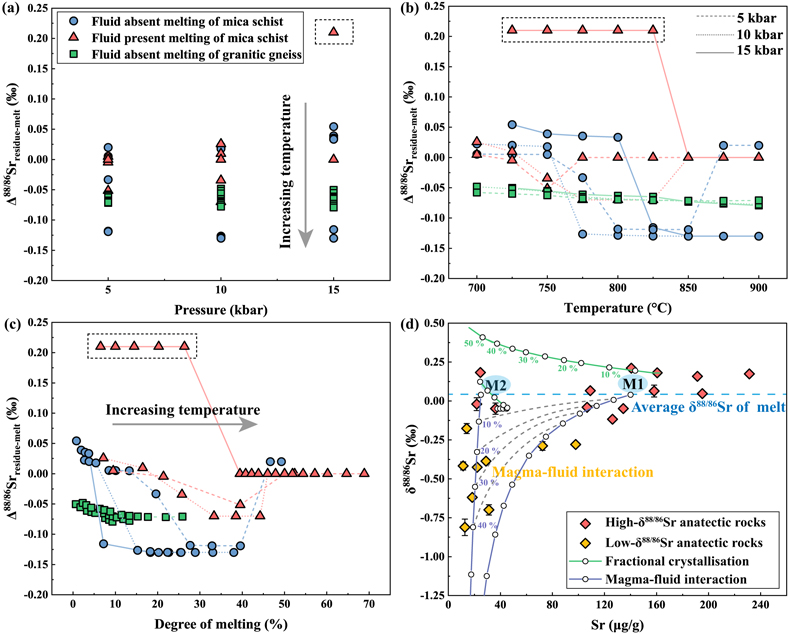
Figure 2 Simulation of partial melting of mica schist and granitic gneiss under different (a) pressures, (b) temperatures and (c) degrees of melting. The dashed box indicates the case of maximum Sr isotopic fractionation. (d) Simulation of mixing between melts and fluids. The initial compositions M1 and M2 are set as melt end members in the model. The dashed grey lines are the contours of the amount of fluids. Numbers on the lines denote the fraction of feldspar separation (green line) and the fraction of fluid (purple lines), respectively.
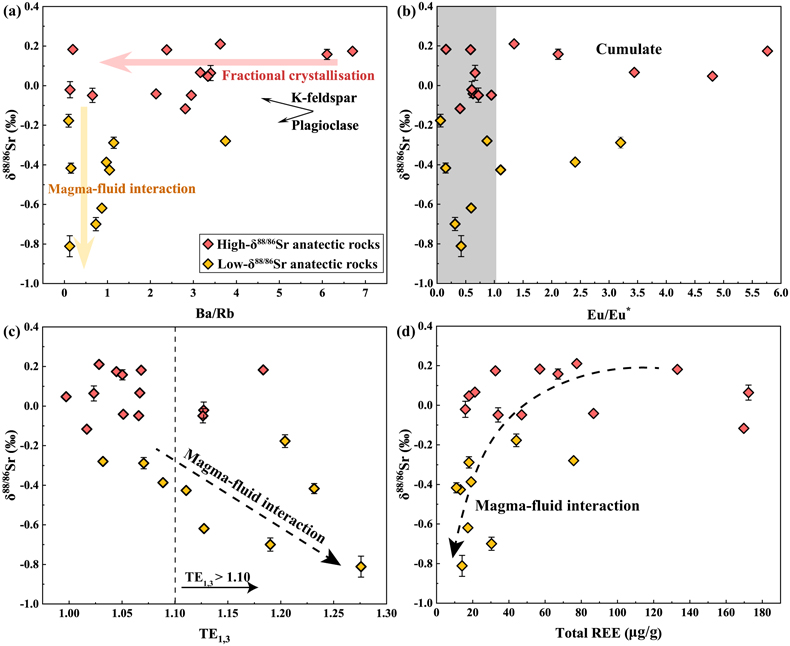
Figure 3 δ88/86Sr vs. (a) Ba/Rb, (b) Eu/Eu*, (c) TE1,3 and (d) Total REE. (a) The red and yellow arrows indicate the direction of fractional crystallisation and magma-fluid interaction, respectively. The different effects caused by plagioclase and K-feldspar are indicated by two black arrows. (b) Grey shading area covered anatectic rocks with Eu/Eu* < 1 representing differentiated melt. The Eu anomaly is calculated by the equation:
. (c) TE1,3 is calculated by the following equation (Irber, 1999Irber, W. (1999) The lanthanide tetrad effect and its correlation with K/Rb, Eu/Eu*, Sr/Eu, Y/Ho, and Zr/Hf of evolving peraluminous granite suites. Geochimica et Cosmochimica Acta 63, 489–508. https://doi.org/10.1016/S0016-7037(99)00027-7
): TE1,3 = (t1 × t3)0.5, where t1 = [CeN/(LaN2/3 × NdN1/3) × PrN/(LaN1/3 × NdN2/3)]0.5; t3 = [TbN/(GdN2/3 × HoN1/3) × DyN/(GdN1/3 × HoN2/3)]0.5. The subscript “N” denotes normalisation to chondritic values (Sun and McDonough, 1989Sun, S.-s., McDonough, W.F. (1989) Chemical and isotopic systematics of oceanic basalts: implications for mantle composition and processes. Geological Society, London, Special Publications 42, 313–345. https://doi.org/10.1144/GSL.SP.1989.042.01.19
). Black arrows indicate changes of stable Sr isotopes with TE1,3 and total REE contents in (c) and (d).
Figure 4 Schematic diagram depicting our current understanding of stable Sr isotopic behaviour during formation and evolution of felsic melts. See text for details.