



Ge, Te, and Zn isotopic link between Ryugu and CI chondrites
Affiliations | Corresponding Author | Cite as | Funding information
Published by the European Association of Geochemistry
under Creative Commons License CC BY 4.0
Keywords: Ryugu, CI chondrites, moderately volatile elements, germanium, tellurium, zinc


- Share this article


-
Article views:1,365Cumulative count of HTML views and PDF downloads.
- Download Citation
- Rights & Permissions

top
Abstract
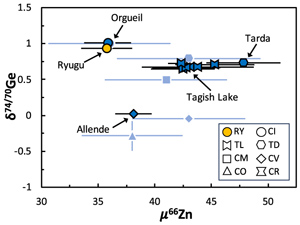
Figures and Tables
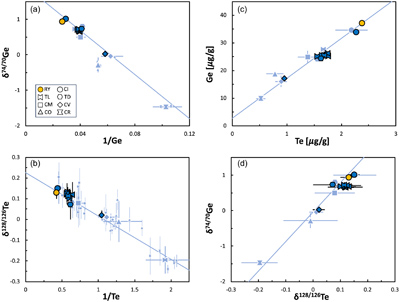 Figure 1 Diagrams of (a) Ge concentration vs. δ74/70Ge, (b) Te concentration vs. δ128/126Te, (c) Te vs. Ge concentrations, and (d) δ128/126Te vs. δ74/70Ge for carbonaceous chondrites (data from this study in dark blue; literature data in light blue [small symbols represent individual samples; large symbols represent group averages]). Ryugu sample A0220 is plotted as orange circle. Literature data for Ge is from Wölfer et al. (2025a); data for Te is from Hellmann et al. (2020, 2023) and Morton et al. (2024). The data of Morton et al. (2024) are re-normalised to δ128/126Te and the SRM standard used by Hellmann et al. (2020, 2023). Linear regressions calculated using IsoplotR based on group averages. | 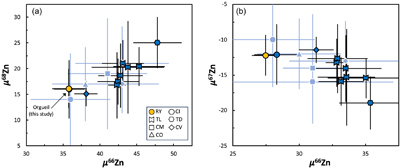 Figure 2 (a) μ66Zn vs. μ68Zn and (b) μ66Zn vs. μ67Zn diagrams for carbonaceous chondrites. Symbols as in Figure 1. Ryugu sample A0220 plots within the CC field and, together with CI chondrites, is characterised by slightly smaller μiZn values compared to Tarda and Tagish Lake. Literature data from Steller et al. (2022). | 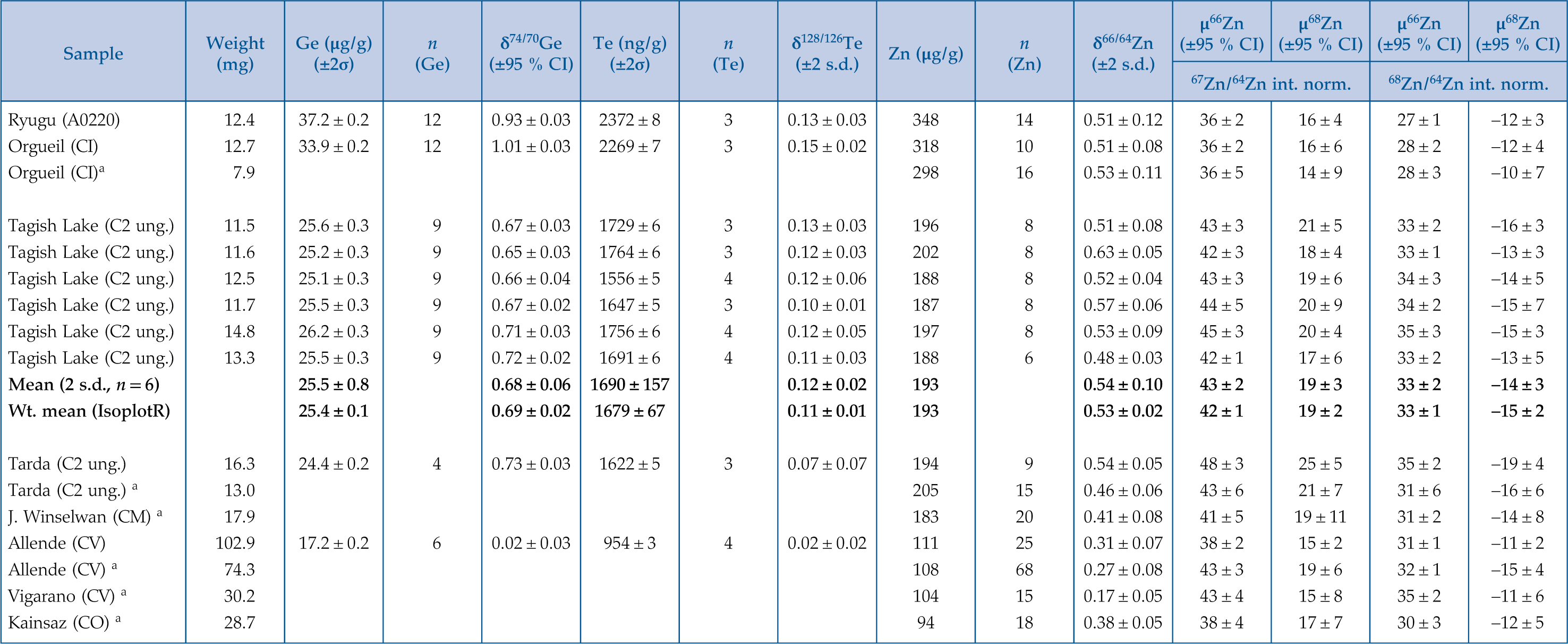 Table 1 Germanium, Te, and Zn concentration and isotopic data for Ryugu (A0220) and carbonaceous chondrites. |
| Figure 1 | Figure 2 | Table 1 |
top
Introduction
Japan Aerospace Exploration Agency’s (JAXA) Hayabusa2 mission returned 5.4 g of sample of the Cb-type asteroid 162173 Ryugu to Earth (Tachibana et al., 2022
Tachibana, S., Sawada, H., Okazaki, R., Takano, Y., Sakamoto, K. et al. (2022) Pebbles and sand on asteroid (162173) Ryugu: In situ observation and particles returned to Earth. Science 375, 1011–1016. https://doi.org/10.1126/science.abj8624
; Yada et al., 2022Yada, T., Abe, M., Okada, T., Nakato, A., Yogata, K. et al. (2022) Preliminary analysis of the Hayabusa2 samples returned from C-type asteroid Ryugu. Nature Astronomy 6, 214–220. https://doi.org/10.1038/s41550-021-01550-6
). Initial analyses of the returned samples have revealed that Ryugu is petrologically, mineralogically, chemically, and isotopically similar to the Ivuna-type (CI) chondrites (Nakamura et al., 2023Nakamura, T., Matsumoto, M., Amano, K., Enokido, Y., Zolensky, M.E. et al. (2023) Formation and evolution of carbonaceous asteroid Ryugu: Direct evidence from returned samples. Science 379, eabn8671. https://doi.org/10.1126/science.abn8671
; Yokoyama et al., 2023aYokoyama, T., Nagashima, K., Nakai, I., Young, E.D., Abe, Y. et al. (2023a) Samples returned from the asteroid Ryugu are similar to Ivuna-type carbonaceous meteorites. Science 379, eabn7850. https://doi.org/10.1126/science.abn7850
,bYokoyama, T., Wadhwa, M., Iizuka, T., Rai, V., Gautam, I. et al. (2023b) Water circulation in Ryugu asteroid affected the distribution of nucleosynthetic isotope anomalies in returned sample. Science Advances 9, eadi7048. https://doi.org/10.1126/sciadv.adi7048
). These chondrites belong to the carbonaceous chondrites and with the exception of the highly volatile elements, their chemical composition closely resembles that of the solar photosphere. As such, CI chondrites are commonly taken to represent the bulk chemical composition of the solar system (e.g., Palme and O’Neill, 2014Palme, H., O’Neill, H.St.C. (2014) 3.1 - Cosmochemical Estimates of Mantle Composition. In: Holland, H.D., Turekian, K.K. (Eds.) Treatise on Geochemistry. Second Edition, Elsevier, Amsterdam, 1–39. https://doi.org/10.1016/B978-0-08-095975-7.00201-1
). Compared to most other carbonaceous chondrites, CI chondrites are extremely rare, and owing to their friable nature, are susceptible to terrestrial alteration, which may have modified their compositions (e.g., Bland et al., 2006Bland, P.A., Zolensky, M.E., Benedix, G.K., Sephton, M.A. (2006) Weathering of Chondritic Meteorites. In: Lauretta, D.S., McSween, H.Y. (Eds.) Meteorites and the Early Solar System II. University of Arizona Press, Tucson, 853–868. https://doi.org/10.2307/j.ctv1v7zdmm.45
; Barrat et al., 2012Barrat, J.A., Zanda, B., Moynier, F., Bollinger, C., Liorzou, C., Bayon, G. (2012) Geochemistry of CI chondrites: Major and trace elements, and Cu and Zn Isotopes. Geochimica et Cosmochimica Acta 83, 79–92. https://doi.org/10.1016/j.gca.2011.12.011
; Koefoed et al., 2023Koefoed, P., Barrat, J.-A., Pravdivtseva, O., Alexander, C.M.O’D., Lodders, K., Ogliore, R., Wang, K. (2023) The potassium isotopic composition of CI chondrites and the origin of isotopic variations among primitive planetary bodies. Geochimica et Cosmochimica Acta 358, 49–60. https://doi.org/10.1016/j.gca.2023.07.025
). Thus, the returned samples from asteroid Ryugu provide the unique opportunity to examine CI chondrite-like material unaffected by terrestrial alteration.Among the carbonaceous chondrites, CI chondrites exhibit unique nucleosynthetic isotope signatures for Fe and Ni (Hopp et al., 2022
Hopp, T., Dauphas, N., Abe, Y., Aléon, J., Alexander, C.M.O’D. et al. (2022) Ryugu’s nucleosynthetic heritage from the outskirts of the Solar System. Science Advances 8, eadd8141. https://doi.org/10.1126/sciadv.add8141
; Spitzer et al., 2024Spitzer, F., Kleine, T., Burkhardt, C., Hopp, T., Yokoyama, T. et al. (2024) The Ni isotopic composition of Ryugu reveals a common accretion region for carbonaceous chondrites. Science Advances 10, eadp2426. https://doi.org/10.1126/sciadv.adp2426
) and also show distinct mass dependent isotope compositions for the moderately volatile elements (MVEs; those that condense from a solar gas between ∼1250 and 650 K). However, while Ryugu and Orgueil, the most commonly analysed CI chondrite, have indistinguishable mass dependent isotopic composition of the MVEs Zn (Paquet et al., 2023Paquet, M., Moynier, F., Yokoyama, T., Dai, W., Hu, Y. et al. (2023) Contribution of Ryugu-like material to Earth’s volatile inventory by Cu and Zn isotopic analysis. Nature Astronomy 7, 182–189. https://doi.org/10.1038/s41550-022-01846-1
) and K (Hu et al., 2024Hu, Y., Moynier, F., Dai, W., Paquet, M., Yokoyama, T. et al. (2024) Pervasive aqueous alteration in the early Solar System revealed by potassium isotopic variations in Ryugu samples and carbonaceous chondrites. Icarus 409, 115884. https://doi.org/10.1016/j.icarus.2023.115884
), these compositions also overlap with those of other volatile-rich carbonaceous chondrites and, therefore, do not provide a clear link between CI chondrites and Ryugu. Moreover, while Ryugu samples exhibit nucleosynthetic Zn isotope anomalies similar to CI chondrites, these compositions overlap with those of other carbonaceous chondrites (Paquet et al., 2023Paquet, M., Moynier, F., Yokoyama, T., Dai, W., Hu, Y. et al. (2023) Contribution of Ryugu-like material to Earth’s volatile inventory by Cu and Zn isotopic analysis. Nature Astronomy 7, 182–189. https://doi.org/10.1038/s41550-022-01846-1
). Given these ambiguities, it is important to assess whether there are other MVEs having isotopic signatures that would provide a link between CI chondrites and Ryugu, and allow distinguishing these materials from other carbonaceous chondrites. This is important for fully understanding the chemical and isotopic make-up of asteroid Ryugu, the nature of the processes determining compositional variations among CI chondrite-like materials, and, ultimately, the use of these materials to determine the bulk chemical composition of the solar system.The two MVEs Ge and Te hold considerable promise to reveal compositional signatures that link Ryugu to CI chondrites and distinguish them from other carbonaceous chondrites. Both elements have been shown to display large and systematic mass dependent isotopic variations among the carbonaceous chondrites, where CI chondrites are characterised by the highest Ge and Te concentrations and strongest heavy isotope enrichments (Hellmann et al., 2020
Hellmann, J.L., Hopp, T., Burkhardt, C., Kleine, T. (2020) Origin of volatile element depletion among carbonaceous chondrites. Earth and Planetary Science Letters 549, 116508. https://doi.org/10.1016/j.epsl.2020.116508
; Wölfer et al., 2025aWölfer, E., Burkhardt, C., Nimmo, F., Kleine, T. (2025a) Origin of moderately volatile elements in Earth inferred from mass-dependent Ge isotope variations among chondrites. Earth and Planetary Science Letters 663, 119435. https://doi.org/10.1016/j.epsl.2025.119435
). Given the strong genetic and chemical link between Ryugu and CI chondrites, Ryugu is expected to exhibit similarly distinct Ge and Te isotope systematics. To assess as to whether this is the case, we report Ge and Te isotope data for a single Ryugu sample together with data for several other MVE-rich carbonaceous chondrites. To facilitate direct comparison to the MVE Zn, all samples have also been analysed for their Zn isotope compositions.top
Samples and Methods
We analysed a 12.4 mg Ryugu sample from chamber A (A0220) together with equivalent masses of Orgueil and the ungrouped C2 chondrites Tarda and Tagish Lake. To test the reproducibility of the isotope measurements on such small sample masses, and to assess the magnitude of any potential heterogeneity at the ∼12 mg level, six aggregate samples of Tagish Lake, each weighing ∼12–15 mg, were also analysed. Similar to CI chondrites and Ryugu, Tagish Lake is dominated by fine grained, volatile-rich matrix with only very low abundances of chondrules, refractory inclusions, and FeNi metal (e.g., Alexander, 2019
Alexander, C.M.O’D. (2019) Quantitative models for the elemental and isotopic fractionations in chondrites: The carbonaceous chondrites. Geochimica et Cosmochimica Acta 254, 277–309. https://doi.org/10.1016/j.gca.2019.02.008
), making this sample suitable to assess the effect of any potential sample heterogeneity on the elemental and isotopic compositions of MVEs in matrix-rich carbonaceous chondrites. The Orgueil sample analysed in this study is an aliquot from a ∼0.7 g powder prepared in a prior study (Schneider et al., 2023Schneider, J.M., Burkhardt, C., Kleine, T. (2023) Distribution of s-, r-, and p-process Nuclides in the Early Solar System Inferred from Sr Isotope Anomalies in Meteorites. The Astrophysical Journal Letters 952, L25. https://doi.org/10.3847/2041-8213/ace187
). Finally, for direct comparison we also analysed aliquots of the large, homogenised MS-A powder of the CV3 chondrite Allende, which has previously been analysed for Ge and Te isotopes using the same analytical setup as in this study (Hellmann et al., 2020Hellmann, J.L., Hopp, T., Burkhardt, C., Kleine, T. (2020) Origin of volatile element depletion among carbonaceous chondrites. Earth and Planetary Science Letters 549, 116508. https://doi.org/10.1016/j.epsl.2020.116508
; Wölfer et al., 2025aWölfer, E., Burkhardt, C., Nimmo, F., Kleine, T. (2025a) Origin of moderately volatile elements in Earth inferred from mass-dependent Ge isotope variations among chondrites. Earth and Planetary Science Letters 663, 119435. https://doi.org/10.1016/j.epsl.2025.119435
).The sample digestion, chemical separation and isotope measurements of Ge, Te, and Zn followed our previously established procedures (Hellmann et al., 2020
Hellmann, J.L., Hopp, T., Burkhardt, C., Kleine, T. (2020) Origin of volatile element depletion among carbonaceous chondrites. Earth and Planetary Science Letters 549, 116508. https://doi.org/10.1016/j.epsl.2020.116508
; Steller et al., 2022Steller, T., Burkhardt, C., Yang, C., Kleine, T. (2022) Nucleosynthetic zinc isotope anomalies reveal a dual origin of terrestrial volatiles. Icarus 386, 115171. https://doi.org/10.1016/j.icarus.2022.115171
; Wölfer et al., 2025aWölfer, E., Burkhardt, C., Nimmo, F., Kleine, T. (2025a) Origin of moderately volatile elements in Earth inferred from mass-dependent Ge isotope variations among chondrites. Earth and Planetary Science Letters 663, 119435. https://doi.org/10.1016/j.epsl.2025.119435
,bWölfer, E., Burkhardt, C., Kleine, T. (2025b) Germanium stable isotope measurements by double-spike MC-ICPMS. Journal of Analytical Atomic Spectrometry 40, 1023–1036. https://doi.org/10.1039/D4JA00359D
) and are described in the Supplementary Information. For Ge and Te, the instrumental mass bias was corrected using 70Ge–73Ge (Wölfer et al., 2025bWölfer, E., Burkhardt, C., Kleine, T. (2025b) Germanium stable isotope measurements by double-spike MC-ICPMS. Journal of Analytical Atomic Spectrometry 40, 1023–1036. https://doi.org/10.1039/D4JA00359D
) and 123Te–125Te double spikes (Hellmann et al., 2020Hellmann, J.L., Hopp, T., Burkhardt, C., Kleine, T. (2020) Origin of volatile element depletion among carbonaceous chondrites. Earth and Planetary Science Letters 549, 116508. https://doi.org/10.1016/j.epsl.2020.116508
), and the data are reported as the per mille deviations from certified standard solutions (see Table 1 for definitions). The double spike measurements also provide precise Ge and Te concentrations determined by isotope dilution. No double spike was used for Zn, and the instrumental mass bias was corrected by standard sample bracketing. This has the advantage that for Zn we can also report mass independent isotope variations (i.e. nucleosynthetic isotope anomalies) after internal normalisation of the data. As for Ge and Te, the mass dependent Zn isotope data are reported as the per mille deviations from a certified standard solution, while the nucleosynthetic isotope anomalies are given as the ppm deviations from the standard after internal normalisation to either 68Zn/64Zn or 67Zn/64Zn.Table 1 Germanium, Te, and Zn concentration and isotopic data for Ryugu (A0220) and carbonaceous chondrites.
| Sample | Weight (mg) | Ge (μg/g) (±2σ) | n (Ge) | δ74/70Ge (±95 % CI) | Te (ng/g) (±2σ) | n (Te) | δ128/126Te (±2 s.d.) | Zn (μg/g) | n (Zn) | δ66/64Zn (±2 s.d.) | μ66Zn (±95 % CI) | μ68Zn (±95 % CI) | μ66Zn (±95 % CI) | μ68Zn (±95 % CI) |
| 67Zn/64Zn int. norm. | 68Zn/64Zn int. norm. | |||||||||||||
| Ryugu (A0220) | 12.4 | 37.2 ± 0.2 | 12 | 0.93 ± 0.03 | 2372 ± 8 | 3 | 0.13 ± 0.03 | 348 | 14 | 0.51 ± 0.12 | 36 ± 2 | 16 ± 4 | 27 ± 1 | –12 ± 3 |
| Orgueil (CI) | 12.7 | 33.9 ± 0.2 | 12 | 1.01 ± 0.03 | 2269 ± 7 | 3 | 0.15 ± 0.02 | 318 | 10 | 0.51 ± 0.08 | 36 ± 2 | 16 ± 6 | 28 ± 2 | –12 ± 4 |
| Orgueil (CI)a | 7.9 | 298 | 16 | 0.53 ± 0.11 | 36 ± 5 | 14 ± 9 | 28 ± 3 | –10 ± 7 | ||||||
| Tagish Lake (C2 ung.) | 11.5 | 25.6 ± 0.3 | 9 | 0.67 ± 0.03 | 1729 ± 6 | 3 | 0.13 ± 0.03 | 196 | 8 | 0.51 ± 0.08 | 43 ± 3 | 21 ± 5 | 33 ± 2 | –16 ± 3 |
| Tagish Lake (C2 ung.) | 11.6 | 25.2 ± 0.3 | 9 | 0.65 ± 0.03 | 1764 ± 6 | 3 | 0.12 ± 0.03 | 202 | 8 | 0.63 ± 0.05 | 42 ± 3 | 18 ± 4 | 33 ± 1 | –13 ± 3 |
| Tagish Lake (C2 ung.) | 12.5 | 25.1 ± 0.3 | 9 | 0.66 ± 0.04 | 1556 ± 5 | 4 | 0.12 ± 0.06 | 188 | 8 | 0.52 ± 0.04 | 43 ± 3 | 19 ± 6 | 34 ± 3 | –14 ± 5 |
| Tagish Lake (C2 ung.) | 11.7 | 25.5 ± 0.3 | 9 | 0.67 ± 0.02 | 1647 ± 5 | 3 | 0.10 ± 0.01 | 187 | 8 | 0.57 ± 0.06 | 44 ± 5 | 20 ± 9 | 34 ± 2 | –15 ± 7 |
| Tagish Lake (C2 ung.) | 14.8 | 26.2 ± 0.3 | 9 | 0.71 ± 0.03 | 1756 ± 6 | 4 | 0.12 ± 0.05 | 197 | 8 | 0.53 ± 0.09 | 45 ± 3 | 20 ± 4 | 35 ± 3 | –15 ± 3 |
| Tagish Lake (C2 ung.) | 13.3 | 25.5 ± 0.3 | 9 | 0.72 ± 0.02 | 1691 ± 6 | 4 | 0.11 ± 0.03 | 188 | 6 | 0.48 ± 0.03 | 42 ± 1 | 17 ± 6 | 33 ± 2 | –13 ± 5 |
| Mean (2 s.d., n = 6) | 25.5 ± 0.8 | 0.68 ± 0.06 | 1690 ± 157 | 0.12 ± 0.02 | 193 | 0.54 ± 0.10 | 43 ± 2 | 19 ± 3 | 33 ± 2 | –14 ± 3 | ||||
| Wt. mean (IsoplotR) | 25.4 ± 0.1 | 0.69 ± 0.02 | 1679 ± 67 | 0.11 ± 0.01 | 193 | 0.53 ± 0.02 | 42 ± 1 | 19 ± 2 | 33 ± 1 | –15 ± 2 | ||||
| Tarda (C2 ung.) | 16.3 | 24.4 ± 0.2 | 4 | 0.73 ± 0.03 | 1622 ± 5 | 3 | 0.07 ± 0.07 | 194 | 9 | 0.54 ± 0.05 | 48 ± 3 | 25 ± 5 | 35 ± 2 | –19 ± 4 |
| Tarda (C2 ung.) a | 13.0 | 205 | 15 | 0.46 ± 0.06 | 43 ± 6 | 21 ± 7 | 31 ± 6 | –16 ± 6 | ||||||
| J. Winselwan (CM) a | 17.9 | 183 | 20 | 0.41 ± 0.08 | 41 ± 5 | 19 ± 11 | 31 ± 2 | –14 ± 8 | ||||||
| Allende (CV) | 102.9 | 17.2 ± 0.2 | 6 | 0.02 ± 0.03 | 954 ± 3 | 4 | 0.02 ± 0.02 | 111 | 25 | 0.31 ± 0.07 | 38 ± 2 | 15 ± 2 | 31 ± 1 | –11 ± 2 |
| Allende (CV) a | 74.3 | 108 | 68 | 0.27 ± 0.08 | 43 ± 3 | 19 ± 6 | 32 ± 1 | –15 ± 4 | ||||||
| Vigarano (CV) a | 30.2 | 104 | 15 | 0.17 ± 0.05 | 43 ± 4 | 15 ± 8 | 35 ± 2 | –11 ± 6 | ||||||
| Kainsaz (CO) a | 28.7 | 94 | 18 | 0.38 ± 0.05 | 38 ± 4 | 17 ± 7 | 30 ± 3 | –12 ± 5 | ||||||
The Ge and Te concentrations were determined by isotope dilution and the Zn concentrations were determined by quadrupole ICP–MS, the latter of which have an uncertainty of ∼5 %. The isotope data of individual samples are reported as the mean of pooled measurements and are expressed as in the common δ notation as δ74Ge [‰] = [(74Ge/70Ge)sample/(74Ge/70Ge)SRM3210a – 1] × 103, δ128Te [‰] = [(128Te/126Te)sample/(128Te/126Te)SRM3156 – 1] × 103, δ66Zn [‰] = [(66Zn/64Zn)sample/(66Zn/64Zn)JMC,Lyon – 1] × 103, and μiZn = [(iZn/64Zn)sample/(iZn/64Zn)SRM683 − 1] × 106, respectively. n: number of isotope analyses.
aMass independent Zn isotope data previously published in Steller et al. (2022)Steller, T., Burkhardt, C., Yang, C., Kleine, T. (2022) Nucleosynthetic zinc isotope anomalies reveal a dual origin of terrestrial volatiles. Icarus 386, 115171. https://doi.org/10.1016/j.icarus.2022.115171.
top
Results
The Ge, Te, and Zn concentrations and isotopic compositions of Ryugu (A0220) and the carbonaceous chondrites investigated in this study are provided in Table 1. We show in the SI (Tables S-1 to S-3, Fig. S-1) that the new data for Orgueil, Tagish Lake, Tarda, and Allende agree well with results of prior studies, demonstrating that the combined use of two different double spikes has no effect on the isotope analyses of any of the three elements investigated, and that analysing mg-sized samples does not compromise the accuracy and precision of the isotopic data. While the six Tagish Lake subsamples have similar Ge, Te, and Zn concentrations and isotopic compositions, they show resolved δ74/70Ge and δ66/64Zn variations, indicating some level of compositional heterogeneities at the ∼12 mg sampling scale (Fig. S-2). This heterogeneity appears to be more pronounced for Zn, where our analyses of several samples of Tagish Lake are systematically offset from some prior analyses (Fig. S-2).
Ryugu sample A0220 and Orgueil have the highest Ge, Te, and Zn concentrations and are characterised by the most elevated δ74/70Ge and δ128/126Te values among the carbonaceous chondrites of this and prior studies (Figs. 1, S-3). Consistent with Paquet et al. (2023)
Paquet, M., Moynier, F., Yokoyama, T., Dai, W., Hu, Y. et al. (2023) Contribution of Ryugu-like material to Earth’s volatile inventory by Cu and Zn isotopic analysis. Nature Astronomy 7, 182–189. https://doi.org/10.1038/s41550-022-01846-1
, we find no δ66/64Zn differences among Ryugu sample A0220, Orgueil, Tagish Lake, and Tarda, despite their different Zn contents. Compared to CI chondrites, Ryugu sample A0220 is enriched in Ge, Te, and Zn by ∼5–10 %, consistent with the ∼10 % higher Zn concentrations found in prior studies (Paquet et al., 2023Paquet, M., Moynier, F., Yokoyama, T., Dai, W., Hu, Y. et al. (2023) Contribution of Ryugu-like material to Earth’s volatile inventory by Cu and Zn isotopic analysis. Nature Astronomy 7, 182–189. https://doi.org/10.1038/s41550-022-01846-1
; Yokoyama et al., 2023aYokoyama, T., Nagashima, K., Nakai, I., Young, E.D., Abe, Y. et al. (2023a) Samples returned from the asteroid Ryugu are similar to Ivuna-type carbonaceous meteorites. Science 379, eabn7850. https://doi.org/10.1126/science.abn7850
). These higher MVE concentrations can partly or wholly be accounted for by the >6 wt. % lower water content of Ryugu samples compared to CI chondrites, and ultimately might stem from the incorporation of terrestrial water into CI meteorites and/or the loss of water from Ryugu’s surface during space weathering (Noguchi et al., 2023Noguchi, T., Matsumoto, T., Miyake, A., Igami, Y., Haruta, M. et al. (2023) A dehydrated space-weathered skin cloaking the hydrated interior of Ryugu. Nature Astronomy 7, 170–181. https://doi.org/10.1038/s41550-022-01841-6
; Yokoyama et al., 2023aYokoyama, T., Nagashima, K., Nakai, I., Young, E.D., Abe, Y. et al. (2023a) Samples returned from the asteroid Ryugu are similar to Ivuna-type carbonaceous meteorites. Science 379, eabn7850. https://doi.org/10.1126/science.abn7850
). For Ge, the δ74/70Ge of sample A0220 is ∼0.07 ‰ lower than for Orgueil samples analysed in this and previous studies. This difference is similar to those found among the subsamples of Tagish Lake, indicating these differences most likely reflect sample heterogeneity. This is likely also the case for Te, where sample A0220 has the same δ128/126Te as Ivuna (Hellmann et al., 2020Hellmann, J.L., Hopp, T., Burkhardt, C., Kleine, T. (2020) Origin of volatile element depletion among carbonaceous chondrites. Earth and Planetary Science Letters 549, 116508. https://doi.org/10.1016/j.epsl.2020.116508
), but a slightly lower δ128/126Te than two analyses of Orgueil (from this study and Hellmann et al., 2020Hellmann, J.L., Hopp, T., Burkhardt, C., Kleine, T. (2020) Origin of volatile element depletion among carbonaceous chondrites. Earth and Planetary Science Letters 549, 116508. https://doi.org/10.1016/j.epsl.2020.116508
).Figure 1 Diagrams of (a) Ge concentration vs. δ74/70Ge, (b) Te concentration vs. δ128/126Te, (c) Te vs. Ge concentrations, and (d) δ128/126Te vs. δ74/70Ge for carbonaceous chondrites (data from this study in dark blue; literature data in light blue [small symbols represent individual samples; large symbols represent group averages]). Ryugu sample A0220 is plotted as orange circle. Literature data for Ge is from Wölfer et al. (2025a)
Wölfer, E., Burkhardt, C., Nimmo, F., Kleine, T. (2025a) Origin of moderately volatile elements in Earth inferred from mass-dependent Ge isotope variations among chondrites. Earth and Planetary Science Letters 663, 119435. https://doi.org/10.1016/j.epsl.2025.119435
; data for Te is from Hellmann et al. (2020Hellmann, J.L., Hopp, T., Burkhardt, C., Kleine, T. (2020) Origin of volatile element depletion among carbonaceous chondrites. Earth and Planetary Science Letters 549, 116508. https://doi.org/10.1016/j.epsl.2020.116508
, 2023Hellmann, J.L., Schneider, J.M., Wölfer, E., Dra˛z˙kowska, J., Jansen, C.A., Hopp, T., Burkhardt, C., Kleine, T. (2023) Origin of Isotopic Diversity among Carbonaceous Chondrites. The Astrophysical Journal Letters 946, L34. https://doi.org/10.3847/2041-8213/acc102
) and Morton et al. (2024)Morton, E.M., Pickard, H., Wombacher, F., Huang, Y., Palk, E., Martins, R., Kuthning, S., Schönbächler, M., Rehkämper, M. (2024) Volatile Element Depletion of Carbonaceous Chondrites—Insights from Mass-dependent Zinc, Cadmium, and Tellurium Isotope Variations. The Astrophysical Journal 977, 53. https://doi.org/10.3847/1538-4357/ad87ed
. The data of Morton et al. (2024)Morton, E.M., Pickard, H., Wombacher, F., Huang, Y., Palk, E., Martins, R., Kuthning, S., Schönbächler, M., Rehkämper, M. (2024) Volatile Element Depletion of Carbonaceous Chondrites—Insights from Mass-dependent Zinc, Cadmium, and Tellurium Isotope Variations. The Astrophysical Journal 977, 53. https://doi.org/10.3847/1538-4357/ad87ed
are re-normalised to δ128/126Te and the SRM standard used by Hellmann et al. (2020Hellmann, J.L., Hopp, T., Burkhardt, C., Kleine, T. (2020) Origin of volatile element depletion among carbonaceous chondrites. Earth and Planetary Science Letters 549, 116508. https://doi.org/10.1016/j.epsl.2020.116508
, 2023Hellmann, J.L., Schneider, J.M., Wölfer, E., Dra˛z˙kowska, J., Jansen, C.A., Hopp, T., Burkhardt, C., Kleine, T. (2023) Origin of Isotopic Diversity among Carbonaceous Chondrites. The Astrophysical Journal Letters 946, L34. https://doi.org/10.3847/2041-8213/acc102
). Linear regressions calculated using IsoplotR based on group averages.For the nucleosynthetic Zn isotope anomalies, sample A0220, together with the other carbonaceous chondrites of this study, plots in the CC field on μ66Zn–μ68Zn and μ66Zn–μ67Zn diagrams (Fig. 2). The results for Orgueil, Tagish Lake, Tarda, and Allende agree well with those of prior studies. Ryugu sample A0220 is characterised by μ66Zn = 36 ± 2, identical to the values measured for Orgueil in this study and by Steller et al. (2022)
Steller, T., Burkhardt, C., Yang, C., Kleine, T. (2022) Nucleosynthetic zinc isotope anomalies reveal a dual origin of terrestrial volatiles. Icarus 386, 115171. https://doi.org/10.1016/j.icarus.2022.115171
(the latter data have been corrected for a small –9 ppm offset measured for terrestrial samples). The only other study on Zn isotope anomalies in Ryugu only reported μ66Zn values using the 68Zn/64Zn normalisation (Paquet et al., 2023Paquet, M., Moynier, F., Yokoyama, T., Dai, W., Hu, Y. et al. (2023) Contribution of Ryugu-like material to Earth’s volatile inventory by Cu and Zn isotopic analysis. Nature Astronomy 7, 182–189. https://doi.org/10.1038/s41550-022-01846-1
), which results in overall smaller anomalies than the 67Zn/64Zn normalisation. These authors found a mean μ66Zn = 33 ± 4 (2 s.e.) for samples from chambers A and C, slightly higher than μ66Zn = 27 ± 1 (95 % conf.) (68Zn/64Zn normalisation) measured here.Figure 2 (a) μ66Zn vs. μ68Zn and (b) μ66Zn vs. μ67Zn diagrams for carbonaceous chondrites. Symbols as in Figure 1. Ryugu sample A0220 plots within the CC field and, together with CI chondrites, is characterised by slightly smaller μiZn values compared to Tarda and Tagish Lake. Literature data from Steller et al. (2022)
Steller, T., Burkhardt, C., Yang, C., Kleine, T. (2022) Nucleosynthetic zinc isotope anomalies reveal a dual origin of terrestrial volatiles. Icarus 386, 115171. https://doi.org/10.1016/j.icarus.2022.115171
.top
Discussion
A genetic link between asteroid Ryugu and CI chondrites has been established in numerous studies, based on for instance nucleosynthetic isotope anomalies in the non-volatile elements Cr, Ti, Fe, and Ni (Hopp et al., 2022
Hopp, T., Dauphas, N., Abe, Y., Aléon, J., Alexander, C.M.O’D. et al. (2022) Ryugu’s nucleosynthetic heritage from the outskirts of the Solar System. Science Advances 8, eadd8141. https://doi.org/10.1126/sciadv.add8141
; Yokoyama et al., 2023aYokoyama, T., Nagashima, K., Nakai, I., Young, E.D., Abe, Y. et al. (2023a) Samples returned from the asteroid Ryugu are similar to Ivuna-type carbonaceous meteorites. Science 379, eabn7850. https://doi.org/10.1126/science.abn7850
, 2023bYokoyama, T., Nagashima, K., Nakai, I., Young, E.D., Abe, Y. et al. (2023a) Samples returned from the asteroid Ryugu are similar to Ivuna-type carbonaceous meteorites. Science 379, eabn7850. https://doi.org/10.1126/science.abn7850
; Spitzer et al., 2024Spitzer, F., Kleine, T., Burkhardt, C., Hopp, T., Yokoyama, T. et al. (2024) The Ni isotopic composition of Ryugu reveals a common accretion region for carbonaceous chondrites. Science Advances 10, eadp2426. https://doi.org/10.1126/sciadv.adp2426
). Among the MVEs, Zn also shows nucleosynthetic isotope anomalies, but until now no isotopic variations among the carbonaceous chondrites have been identified (Savage et al., 2022Savage, P.S., Moynier, F., Boyet, M. (2022) Zinc isotope anomalies in primitive meteorites identify the outer solar system as an important source of Earth’s volatile inventory. Icarus 386, 115172. https://doi.org/10.1016/j.icarus.2022.115172
; Steller et al., 2022Steller, T., Burkhardt, C., Yang, C., Kleine, T. (2022) Nucleosynthetic zinc isotope anomalies reveal a dual origin of terrestrial volatiles. Icarus 386, 115171. https://doi.org/10.1016/j.icarus.2022.115171
; Martins et al., 2023Martins, R., Kuthning, S., Coles, B.J., Kreissig, K., Rehkämper, M. (2023) Nucleosynthetic isotope anomalies of zinc in meteorites constrain the origin of Earth’s volatiles. Science 379, 369–372. https://doi.org/10.1126/science.abn1021
). However, the data of this study suggest that CI chondrites and Ryugu may have distinct nucleosynthetic Zn isotope signatures compared to other carbonaceous chondrites. We find identical μ66Zn values for two separate analyses of Orgueil (μ66Zn = 36 ± 5 in Steller et al., 2022Steller, T., Burkhardt, C., Yang, C., Kleine, T. (2022) Nucleosynthetic zinc isotope anomalies reveal a dual origin of terrestrial volatiles. Icarus 386, 115171. https://doi.org/10.1016/j.icarus.2022.115171
, and 36 ± 2 in this study) and Ryugu sample A0220 (μ66Zn = 36 ± 2). By contrast, for the next most volatile-rich carbonaceous chondrites, Tagish Lake and Tarda, we find more elevated μ66Zn values of 43 ± 2 and 48 ± 3, respectively (Table 1). This suggests that CI chondrites/Ryugu may be characterised by slightly lower μ66Zn values than other volatile-rich carbonaceous chondrites. This difference is barely resolved, however, and there are other non-CI carbonaceous chondrites overlapping with the μ66Zn values of CI chondrites and Ryugu (Fig. 2). As such, additional high precision Zn isotope data are needed for firmly establishing a nucleosynthetic Zn isotope difference between CI and other carbonaceous chondrites.More robust evidence for an MVE-based link between Ryugu and CI chondrites comes from the elemental and mass dependent isotopic compositions reported here. Compositional variations among the carbonaceous chondrites are thought to reflect mixing among the chondrite’s constituent components, namely volatile-poor, isotopically light chondrules and volatile-rich, isotopically heavy, CI chondrite-like matrix (e.g., Alexander, 2019
Alexander, C.M.O’D. (2019) Quantitative models for the elemental and isotopic fractionations in chondrites: The carbonaceous chondrites. Geochimica et Cosmochimica Acta 254, 277–309. https://doi.org/10.1016/j.gca.2019.02.008
; Hellmann et al., 2020Hellmann, J.L., Hopp, T., Burkhardt, C., Kleine, T. (2020) Origin of volatile element depletion among carbonaceous chondrites. Earth and Planetary Science Letters 549, 116508. https://doi.org/10.1016/j.epsl.2020.116508
). Variations in the abundance of these two components result in correlations among the concentrations and mass dependent isotopic compositions of the MVEs, including Ge (Wölfer et al., 2025aWölfer, E., Burkhardt, C., Nimmo, F., Kleine, T. (2025a) Origin of moderately volatile elements in Earth inferred from mass-dependent Ge isotope variations among chondrites. Earth and Planetary Science Letters 663, 119435. https://doi.org/10.1016/j.epsl.2025.119435
), Te (Hellmann et al., 2020Hellmann, J.L., Hopp, T., Burkhardt, C., Kleine, T. (2020) Origin of volatile element depletion among carbonaceous chondrites. Earth and Planetary Science Letters 549, 116508. https://doi.org/10.1016/j.epsl.2020.116508
), Zn (e.g., Pringle et al., 2017Pringle, E.A., Moynier, F., Beck, P., Paniello, R., Hezel, D.C. (2017) The origin of volatile element depletion in early solar system material: Clues from Zn isotopes in chondrules. Earth and Planetary Science Letters 468, 62–71. https://doi.org/10.1016/j.epsl.2017.04.002
), Rb (e.g., Nie et al., 2021Nie, N.X., Chen, X.-Y., Hopp, T., Hu, J.Y., Zhang, Z.J., Teng, F.-Z., Shahar, A., Dauphas, N. (2021) Imprint of chondrule formation on the K and Rb isotopic compositions of carbonaceous meteorites. Science Advances 7, eabl3929. https://doi.org/10.1126/sciadv.abl3929
), K (e.g., Koefoed et al., 2023Koefoed, P., Barrat, J.-A., Pravdivtseva, O., Alexander, C.M.O’D., Lodders, K., Ogliore, R., Wang, K. (2023) The potassium isotopic composition of CI chondrites and the origin of isotopic variations among primitive planetary bodies. Geochimica et Cosmochimica Acta 358, 49–60. https://doi.org/10.1016/j.gca.2023.07.025
), and Cd (Morton et al., 2024Morton, E.M., Pickard, H., Wombacher, F., Huang, Y., Palk, E., Martins, R., Kuthning, S., Schönbächler, M., Rehkämper, M. (2024) Volatile Element Depletion of Carbonaceous Chondrites—Insights from Mass-dependent Zinc, Cadmium, and Tellurium Isotope Variations. The Astrophysical Journal 977, 53. https://doi.org/10.3847/1538-4357/ad87ed
). Our results are consistent with these correlations and demonstrate that Ryugu and Orgueil together are characterised by distinctly higher MVE abundances and heavier isotopic compositions compared to other carbonaceous chondrites (Fig. 1). However, given the small mass analysed for each sample, it is important to assess how much of the observed variability may reflect sample heterogeneities rather than true compositional variations among the chondrite groups. For instance, different Ryugu subsamples exhibit variable Cr, Ti, and Ni nucleosynthetic isotope signatures (Yokoyama et al., 2023aYokoyama, T., Nagashima, K., Nakai, I., Young, E.D., Abe, Y. et al. (2023a) Samples returned from the asteroid Ryugu are similar to Ivuna-type carbonaceous meteorites. Science 379, eabn7850. https://doi.org/10.1126/science.abn7850
, 2023bYokoyama, T., Nagashima, K., Nakai, I., Young, E.D., Abe, Y. et al. (2023a) Samples returned from the asteroid Ryugu are similar to Ivuna-type carbonaceous meteorites. Science 379, eabn7850. https://doi.org/10.1126/science.abn7850
; Spitzer et al., 2024Spitzer, F., Kleine, T., Burkhardt, C., Hopp, T., Yokoyama, T. et al. (2024) The Ni isotopic composition of Ryugu reveals a common accretion region for carbonaceous chondrites. Science Advances 10, eadp2426. https://doi.org/10.1126/sciadv.adp2426
), which at least in part have been attributed to the redistribution of isotopically anomalous phases during aqueous alteration in the parent body (Yokoyama et al., 2023bYokoyama, T., Wadhwa, M., Iizuka, T., Rai, V., Gautam, I. et al. (2023b) Water circulation in Ryugu asteroid affected the distribution of nucleosynthetic isotope anomalies in returned sample. Science Advances 9, eadi7048. https://doi.org/10.1126/sciadv.adi7048
). The pronounced Mo isotope anomalies observed for a Ryugu sample has been explained in a similar manner (Nakanishi et al., 2023Nakanishi, N., Yokoyama, T., Ishikawa, A., Walker, R.J., Abe, Y. et al. (2023) Nucleosynthetic s-Process Depletion in Mo from Ryugu samples returned by Hayabusa2. Geochemical Perspectives Letters 28, 31–36. https://doi.org/10.7185/geochemlet.2341
). These observations suggest that small scale heterogeneities may also exist for mass dependent isotope compositions. For instance, mass dependent Zn isotope variations have been observed among the components of chondrites (Luck et al., 2005Luck, J.-M., Othman, D.B., Albarède, F. (2005) Zn and Cu isotopic variations in chondrites and iron meteorites: Early solar nebula reservoirs and parent-body processes. Geochimica et Cosmochimica Acta 69, 5351–5363. https://doi.org/10.1016/j.gca.2005.06.018
; Pringle et al., 2017Pringle, E.A., Moynier, F., Beck, P., Paniello, R., Hezel, D.C. (2017) The origin of volatile element depletion in early solar system material: Clues from Zn isotopes in chondrules. Earth and Planetary Science Letters 468, 62–71. https://doi.org/10.1016/j.epsl.2017.04.002
), and so over- or under-sampling of certain components having distinct isotopic compositions may have occurred.Our results for six ∼12–15 mg subsamples of Tagish Lake show that the effects of sample heterogeneity are different for Ge, Te, and Zn. While the δ128/126Te values are quite homogeneous, δ74/70Ge and δ66/64Zn values vary by ∼0.07 ‰ and ∼0.16 ‰, respectively. For Zn this difference covers almost half of the entire δ66/64Zn variations observed among carbonaceous chondrites. By contrast, for Ge, these variations amount to only ∼3 % of the overall δ74/70Ge variability among the carbonaceous chondrites (Wölfer et al., 2025a
Wölfer, E., Burkhardt, C., Nimmo, F., Kleine, T. (2025a) Origin of moderately volatile elements in Earth inferred from mass-dependent Ge isotope variations among chondrites. Earth and Planetary Science Letters 663, 119435. https://doi.org/10.1016/j.epsl.2025.119435
), and the difference between CI chondrites and Tagish Lake itself is about four times larger than the heterogeneity observed among the CI chondrite and Ryugu samples. These observations suggest that the disparate levels of isotopic heterogeneity among the Tagish Lake subsamples are neither controlled by volatility (because Te and Zn have similar condensation temperatures) nor by heterogeneous sampling of chondrule and matrix fractions (because in this case similar relative variations would be expected for all three elements). Instead, they more likely reflect differences in the mobility of these elements during parent body alteration, and in the magnitude of isotope fractionation among the MVE’s host minerals. Regardless of their exact cause, the larger intra-sample δ66/64Zn variability combined with the overall smaller range of δ66/64Zn values among carbonaceous chondrites makes Zn less suitable for linking Ryugu samples to a specific carbonaceous chondrite group than Ge and Te. Moreover, the larger overall isotope fractionation of Ge compared to Te makes mass dependent Ge isotope variations particularly powerful to identify genetic relations of MVEs among carbonaceous chondrite-like materials, especially for the small sample sizes typically available from sample return missions.The Ge and Te results of this study demonstrate that compared to other carbonaceous chondrites, Ryugu and CI chondrites are characterised by elemental and heavy isotope enrichments in the MVEs. The same conclusion was reached previously based on Zn isotopes (Paquet et al., 2023
Paquet, M., Moynier, F., Yokoyama, T., Dai, W., Hu, Y. et al. (2023) Contribution of Ryugu-like material to Earth’s volatile inventory by Cu and Zn isotopic analysis. Nature Astronomy 7, 182–189. https://doi.org/10.1038/s41550-022-01846-1
), but we emphasise that only for Ge and Te are the isotopic compositions of Ryugu and CI chondrites distinct from those of other volatile-rich carbonaceous chondrites.Identical nucleosynthetic isotope signatures of Ryugu and CI chondrites have revealed that both formed from the same mix of presolar and nebular materials, but these signatures provide little information on any physicochemical processes acting on these materials before and after parent body accretion. The mass dependent isotopic compositions of MVEs are a more sensitive tracer of such processes, and so the MVE-based link between Ryugu and CI chondrites indicates that any physicochemical processes acting on these materials were also similar. Given the strong chemical similarities between Ryugu/CI chondrites and the solar photosphere, this in turn implies that these samples are good proxies for the average chemical and mass dependent isotopic compositions of the MVEs for most of the solar protoplanetary disk and, hence, the bulk solar system. Importantly, as is evident for instance from the distinct O isotope composition of the Sun (McKeegan et al., 2011
McKeegan, K.D., Kallio, A.P.A., Heber, V.S., Jarzebinski, G., Mao, P.H., Coath, C.D., Kunihiro, T., Wiens, R.C., Nordholt, J.E., Moses Jr., R.W., Reisenfeld, D.B., Jurewicz, A.J.G., Burnett, D.S. (2011) The Oxygen Isotopic Composition of the Sun Inferred from Captured Solar Wind. Science 332, 1528–1532. https://doi.org/10.1126/science.1204636
) for mass independent isotope anomalies, the isotopic composition of the solar system may be markedly different from that of CI chondrites, which likely was established by mixing of isotopically distinct materials during the formation and dynamical evolution of the protoplanetary disk (e.g., Nanne et al., 2019Nanne, J.A.M., Nimmo, F., Cuzzi, J.N., Kleine, T. (2019) Origin of the non-carbonaceous–carbonaceous meteorite dichotomy. Earth and Planetary Science Letters 511, 44–54. https://doi.org/10.1016/j.epsl.2019.01.027
).top
Acknowledgements
The Ryugu samples used in this paper were distributed through The Announcement of Opportunity for Hayabusa2 samples. These samples were referred to the Ryugu Sample Database at https://www.darts.isas.jaxa.jp/curation/hayabusa2/. We gratefully acknowledge Rayssa Martins and Kun Wang for their constructive comments and Helen Williams for her editorial handling. This work was funded by the European Research Council Advanced Grant HolyEarth (grant no. 101019380).
Editor: Helen Williams
top
References
Alexander, C.M.O’D. (2019) Quantitative models for the elemental and isotopic fractionations in chondrites: The carbonaceous chondrites. Geochimica et Cosmochimica Acta 254, 277–309. https://doi.org/10.1016/j.gca.2019.02.008
 Show in context
 Similar to CI chondrites and Ryugu, Tagish Lake is dominated by fine grained, volatile-rich matrix with only very low abundances of chondrules, refractory inclusions, and FeNi metal (e.g., Alexander, 2019), making this sample suitable to assess the effect of any potential sample heterogeneity on the elemental and isotopic compositions of MVEs in matrix-rich carbonaceous chondrites.
View in article
Compositional variations among the carbonaceous chondrites are thought to reflect mixing among the chondrite’s constituent components, namely volatile-poor, isotopically light chondrules and volatile-rich, isotopically heavy, CI chondrite-like matrix (e.g., Alexander, 2019; Hellmann et al., 2020).
View in article
Barrat, J.A., Zanda, B., Moynier, F., Bollinger, C., Liorzou, C., Bayon, G. (2012) Geochemistry of CI chondrites: Major and trace elements, and Cu and Zn Isotopes. Geochimica et Cosmochimica Acta 83, 79–92. https://doi.org/10.1016/j.gca.2011.12.011
Show in context Compared to most other carbonaceous chondrites, CI chondrites are extremely rare, and owing to their friable nature, are susceptible to terrestrial alteration, which may have modified their compositions (e.g., Bland et al., 2006; Barrat et al., 2012; Koefoed et al., 2023).
View in article
Bland, P.A., Zolensky, M.E., Benedix, G.K., Sephton, M.A. (2006) Weathering of Chondritic Meteorites. In: Lauretta, D.S., McSween, H.Y. (Eds.) Meteorites and the Early Solar System II. University of Arizona Press, Tucson, 853–868. https://doi.org/10.2307/j.ctv1v7zdmm.45
Show in context Compared to most other carbonaceous chondrites, CI chondrites are extremely rare, and owing to their friable nature, are susceptible to terrestrial alteration, which may have modified their compositions (e.g., Bland et al., 2006; Barrat et al., 2012; Koefoed et al., 2023).
View in article
Hellmann, J.L., Hopp, T., Burkhardt, C., Kleine, T. (2020) Origin of volatile element depletion among carbonaceous chondrites. Earth and Planetary Science Letters 549, 116508. https://doi.org/10.1016/j.epsl.2020.116508
Show in context Both elements have been shown to display large and systematic mass dependent isotopic variations among the carbonaceous chondrites, where CI chondrites are characterised by the highest Ge and Te concentrations and strongest heavy isotope enrichments (Hellmann et al., 2020; Wölfer et al., 2025a).
View in article
Finally, for direct comparison we also analysed aliquots of the large, homogenised MS-A powder of the CV3 chondrite Allende, which has previously been analysed for Ge and Te isotopes using the same analytical setup as in this study (Hellmann et al., 2020; Wölfer et al., 2025a).
View in article
The sample digestion, chemical separation and isotope measurements of Ge, Te, and Zn followed our previously established procedures (Hellmann et al., 2020; Steller et al., 2022; Wölfer et al., 2025a,b) and are described in the Supplementary Information
View in article
For Ge and Te, the instrumental mass bias was corrected using 70Ge–73Ge (Wölfer et al., 2025b) and 123Te–125Te double spikes (Hellmann et al., 2020), and the data are reported as the per mille deviations from certified standard solutions (see Table 1 for definitions).
View in article
This is likely also the case for Te, where sample A0220 has the same δ128/126Te as Ivuna (Hellmann et al., 2020), but a slightly lower δ128/126Te than two analyses of Orgueil (from this study and Hellmann et al., 2020).
View in article
Literature data for Ge is from Wölfer et al. (2025a); data for Te is from Hellmann et al. (2020, 2023) and Morton et al. (2024).
View in article
The data of Morton et al. (2024) are re-normalised to δ128/126Te and the SRM standard used by Hellmann et al. (2020, 2023).
View in article
Compositional variations among the carbonaceous chondrites are thought to reflect mixing among the chondrite’s constituent components, namely volatile-poor, isotopically light chondrules and volatile-rich, isotopically heavy, CI chondrite-like matrix (e.g., Alexander, 2019; Hellmann et al., 2020).
View in article
Variations in the abundance of these two components result in correlations among the concentrations and mass dependent isotopic compositions of the MVEs, including Ge (Wölfer et al., 2025a), Te (Hellmann et al., 2020), Zn (e.g., Pringle et al., 2017), Rb (e.g., Nie et al., 2021), K (e.g., Koefoed et al., 2023), and Cd (Morton et al., 2024).
View in article
Hellmann, J.L., Schneider, J.M., Wölfer, E., Dra˛z˙kowska, J., Jansen, C.A., Hopp, T., Burkhardt, C., Kleine, T. (2023) Origin of Isotopic Diversity among Carbonaceous Chondrites. The Astrophysical Journal Letters 946, L34. https://doi.org/10.3847/2041-8213/acc102
Show in context Literature data for Ge is from Wölfer et al. (2025a); data for Te is from Hellmann et al. (2020, 2023) and Morton et al. (2024).
View in article
The data of Morton et al. (2024) are re-normalised to δ128/126Te and the SRM standard used by Hellmann et al. (2020, 2023).
View in article
Hopp, T., Dauphas, N., Abe, Y., Aléon, J., Alexander, C.M.O’D. et al. (2022) Ryugu’s nucleosynthetic heritage from the outskirts of the Solar System. Science Advances 8, eadd8141. https://doi.org/10.1126/sciadv.add8141
Show in context Among the carbonaceous chondrites, CI chondrites exhibit unique nucleosynthetic isotope signatures for Fe and Ni (Hopp et al., 2022; Spitzer et al., 2024) and also show distinct mass dependent isotope compositions for the moderately volatile elements (MVEs; those that condense from a solar gas between ∼1250 and 650 K).
View in article
A genetic link between asteroid Ryugu and CI chondrites has been established in numerous studies, based on for instance nucleosynthetic isotope anomalies in the non-volatile elements Cr, Ti, Fe, and Ni (Hopp et al., 2022; Yokoyama et al., 2023a, 2023b; Spitzer et al., 2024).
View in article
Hu, Y., Moynier, F., Dai, W., Paquet, M., Yokoyama, T. et al. (2024) Pervasive aqueous alteration in the early Solar System revealed by potassium isotopic variations in Ryugu samples and carbonaceous chondrites. Icarus 409, 115884. https://doi.org/10.1016/j.icarus.2023.115884
Show in context However, while Ryugu and Orgueil, the most commonly analysed CI chondrite, have indistinguishable mass dependent isotopic composition of the MVEs Zn (Paquet et al., 2023) and K (Hu et al., 2024), these compositions also overlap with those of other volatile-rich carbonaceous chondrites and, therefore, do not provide a clear link between CI chondrites and Ryugu.
View in article
Koefoed, P., Barrat, J.-A., Pravdivtseva, O., Alexander, C.M.O’D., Lodders, K., Ogliore, R., Wang, K. (2023) The potassium isotopic composition of CI chondrites and the origin of isotopic variations among primitive planetary bodies. Geochimica et Cosmochimica Acta 358, 49–60. https://doi.org/10.1016/j.gca.2023.07.025
Show in context Compared to most other carbonaceous chondrites, CI chondrites are extremely rare, and owing to their friable nature, are susceptible to terrestrial alteration, which may have modified their compositions (e.g., Bland et al., 2006; Barrat et al., 2012; Koefoed et al., 2023).
View in article
Variations in the abundance of these two components result in correlations among the concentrations and mass dependent isotopic compositions of the MVEs, including Ge (Wölfer et al., 2025a), Te (Hellmann et al., 2020), Zn (e.g., Pringle et al., 2017), Rb (e.g., Nie et al., 2021), K (e.g., Koefoed et al., 2023), and Cd (Morton et al., 2024).
View in article
Luck, J.-M., Othman, D.B., Albarède, F. (2005) Zn and Cu isotopic variations in chondrites and iron meteorites: Early solar nebula reservoirs and parent-body processes. Geochimica et Cosmochimica Acta 69, 5351–5363. https://doi.org/10.1016/j.gca.2005.06.018
Show in context For instance, mass dependent Zn isotope variations have been observed among the components of chondrites (Luck et al., 2005; Pringle et al., 2017), and so over- or under-sampling of certain components having distinct isotopic compositions may have occurred.
View in article
Martins, R., Kuthning, S., Coles, B.J., Kreissig, K., Rehkämper, M. (2023) Nucleosynthetic isotope anomalies of zinc in meteorites constrain the origin of Earth’s volatiles. Science 379, 369–372. https://doi.org/10.1126/science.abn1021
Show in context Among the MVEs, Zn also shows nucleosynthetic isotope anomalies, but until now no isotopic variations among the carbonaceous chondrites have been identified (Savage et al., 2022; Steller et al., 2022; Martins et al., 2023).
View in article
McKeegan, K.D., Kallio, A.P.A., Heber, V.S., Jarzebinski, G., Mao, P.H., Coath, C.D., Kunihiro, T., Wiens, R.C., Nordholt, J.E., Moses Jr., R.W., Reisenfeld, D.B., Jurewicz, A.J.G., Burnett, D.S. (2011) The Oxygen Isotopic Composition of the Sun Inferred from Captured Solar Wind. Science 332, 1528–1532. https://doi.org/10.1126/science.1204636
Show in context Importantly, as is evident for instance from the distinct O isotope composition of the Sun (McKeegan et al., 2011) for mass independent isotope anomalies, the isotopic composition of the solar system may be markedly different from that of CI chondrites, which likely was established by mixing of isotopically distinct materials during the formation and dynamical evolution of the protoplanetary disk (e.g., Nanne et al., 2019).
View in article
Morton, E.M., Pickard, H., Wombacher, F., Huang, Y., Palk, E., Martins, R., Kuthning, S., Schönbächler, M., Rehkämper, M. (2024) Volatile Element Depletion of Carbonaceous Chondrites—Insights from Mass-dependent Zinc, Cadmium, and Tellurium Isotope Variations. The Astrophysical Journal 977, 53. https://doi.org/10.3847/1538-4357/ad87ed
Show in context Literature data for Ge is from Wölfer et al. (2025a); data for Te is from Hellmann et al. (2020, 2023) and Morton et al. (2024).
View in article
The data of Morton et al. (2024) are re-normalised to δ128/126Te and the SRM standard used by Hellmann et al. (2020, 2023).
View in article
Variations in the abundance of these two components result in correlations among the concentrations and mass dependent isotopic compositions of the MVEs, including Ge (Wölfer et al., 2025a), Te (Hellmann et al., 2020), Zn (e.g., Pringle et al., 2017), Rb (e.g., Nie et al., 2021), K (e.g., Koefoed et al., 2023), and Cd (Morton et al., 2024).
View in article
Nakamura, T., Matsumoto, M., Amano, K., Enokido, Y., Zolensky, M.E. et al. (2023) Formation and evolution of carbonaceous asteroid Ryugu: Direct evidence from returned samples. Science 379, eabn8671. https://doi.org/10.1126/science.abn8671
Show in context Initial analyses of the returned samples have revealed that Ryugu is petrologically, mineralogically, chemically, and isotopically similar to the Ivuna-type (CI) chondrites (Nakamura et al., 2023; Yokoyama et al., 2023a,b).
View in article
Nakanishi, N., Yokoyama, T., Ishikawa, A., Walker, R.J., Abe, Y. et al. (2023) Nucleosynthetic s-Process Depletion in Mo from Ryugu samples returned by Hayabusa2. Geochemical Perspectives Letters 28, 31–36. https://doi.org/10.7185/geochemlet.2341
Show in context The pronounced Mo isotope anomalies observed for a Ryugu sample has been explained in a similar manner (Nakanishi et al., 2023).
View in article
Nanne, J.A.M., Nimmo, F., Cuzzi, J.N., Kleine, T. (2019) Origin of the non-carbonaceous–carbonaceous meteorite dichotomy. Earth and Planetary Science Letters 511, 44–54. https://doi.org/10.1016/j.epsl.2019.01.027
Show in context Importantly, as is evident for instance from the distinct O isotope composition of the Sun (McKeegan et al., 2011) for mass independent isotope anomalies, the isotopic composition of the solar system may be markedly different from that of CI chondrites, which likely was established by mixing of isotopically distinct materials during the formation and dynamical evolution of the protoplanetary disk (e.g., Nanne et al., 2019).
View in article
Nie, N.X., Chen, X.-Y., Hopp, T., Hu, J.Y., Zhang, Z.J., Teng, F.-Z., Shahar, A., Dauphas, N. (2021) Imprint of chondrule formation on the K and Rb isotopic compositions of carbonaceous meteorites. Science Advances 7, eabl3929. https://doi.org/10.1126/sciadv.abl3929
Show in context Variations in the abundance of these two components result in correlations among the concentrations and mass dependent isotopic compositions of the MVEs, including Ge (Wölfer et al., 2025a), Te (Hellmann et al., 2020), Zn (e.g., Pringle et al., 2017), Rb (e.g., Nie et al., 2021), K (e.g., Koefoed et al., 2023), and Cd (Morton et al., 2024).
View in article
Noguchi, T., Matsumoto, T., Miyake, A., Igami, Y., Haruta, M. et al. (2023) A dehydrated space-weathered skin cloaking the hydrated interior of Ryugu. Nature Astronomy 7, 170–181. https://doi.org/10.1038/s41550-022-01841-6
Show in context These higher MVE concentrations can partly or wholly be accounted for by the >6 wt. % lower water content of Ryugu samples compared to CI chondrites, and ultimately might stem from the incorporation of terrestrial water into CI meteorites and/or the loss of water from Ryugu’s surface during space weathering (Noguchi et al., 2023; Yokoyama et al., 2023a).
View in article
Palme, H., O’Neill, H.St.C. (2014) 3.1 - Cosmochemical Estimates of Mantle Composition. In: Holland, H.D., Turekian, K.K. (Eds.) Treatise on Geochemistry. Second Edition, Elsevier, Amsterdam, 1–39. https://doi.org/10.1016/B978-0-08-095975-7.00201-1
Show in context As such, CI chondrites are commonly taken to represent the bulk chemical composition of the solar system (e.g., Palme and O’Neill, 2014).
View in article
Paquet, M., Moynier, F., Yokoyama, T., Dai, W., Hu, Y. et al. (2023) Contribution of Ryugu-like material to Earth’s volatile inventory by Cu and Zn isotopic analysis. Nature Astronomy 7, 182–189. https://doi.org/10.1038/s41550-022-01846-1
Show in context However, while Ryugu and Orgueil, the most commonly analysed CI chondrite, have indistinguishable mass dependent isotopic composition of the MVEs Zn (Paquet et al., 2023) and K (Hu et al., 2024), these compositions also overlap with those of other volatile-rich carbonaceous chondrites and, therefore, do not provide a clear link between CI chondrites and Ryugu.
View in article
Moreover, while Ryugu samples exhibit nucleosynthetic Zn isotope anomalies similar to CI chondrites, these compositions overlap with those of other carbonaceous chondrites (Paquet et al., 2023).
View in article
Consistent with Paquet et al. (2023), we find no δ66/64Zn differences among Ryugu sample A0220, Orgueil, Tagish Lake, and Tarda, despite their different Zn contents.
View in article
Compared to CI chondrites, Ryugu sample A0220 is enriched in Ge, Te, and Zn by ∼5–10 %, consistent with the ∼10 % higher Zn concentrations found in prior studies (Paquet et al., 2023; Yokoyama et al., 2023a).
View in article
The only other study on Zn isotope anomalies in Ryugu only reported μ66Zn values using the 68Zn/64Zn normalisation (Paquet et al., 2023), which results in overall smaller anomalies than the 67Zn/64Zn normalisation.
View in article
The same conclusion was reached previously based on Zn isotopes (Paquet et al., 2023), but we emphasise that only for Ge and Te are the isotopic compositions of Ryugu and CI chondrites distinct from those of other volatile-rich carbonaceous chondrites.
View in article
Pringle, E.A., Moynier, F., Beck, P., Paniello, R., Hezel, D.C. (2017) The origin of volatile element depletion in early solar system material: Clues from Zn isotopes in chondrules. Earth and Planetary Science Letters 468, 62–71. https://doi.org/10.1016/j.epsl.2017.04.002
Show in context Variations in the abundance of these two components result in correlations among the concentrations and mass dependent isotopic compositions of the MVEs, including Ge (Wölfer et al., 2025a), Te (Hellmann et al., 2020), Zn (e.g., Pringle et al., 2017), Rb (e.g., Nie et al., 2021), K (e.g., Koefoed et al., 2023), and Cd (Morton et al., 2024).
View in article
For instance, mass dependent Zn isotope variations have been observed among the components of chondrites (Luck et al., 2005; Pringle et al., 2017), and so over- or under-sampling of certain components having distinct isotopic compositions may have occurred.
View in article
Savage, P.S., Moynier, F., Boyet, M. (2022) Zinc isotope anomalies in primitive meteorites identify the outer solar system as an important source of Earth’s volatile inventory. Icarus 386, 115172. https://doi.org/10.1016/j.icarus.2022.115172
Show in context Among the MVEs, Zn also shows nucleosynthetic isotope anomalies, but until now no isotopic variations among the carbonaceous chondrites have been identified (Savage et al., 2022; Steller et al., 2022; Martins et al., 2023).
View in article
Schneider, J.M., Burkhardt, C., Kleine, T. (2023) Distribution of s-, r-, and p-process Nuclides in the Early Solar System Inferred from Sr Isotope Anomalies in Meteorites. The Astrophysical Journal Letters 952, L25. https://doi.org/10.3847/2041-8213/ace187
Show in context The Orgueil sample analysed in this study is an aliquot from a ∼0.7 g powder prepared in a prior study (Schneider et al., 2023).
View in article
Spitzer, F., Kleine, T., Burkhardt, C., Hopp, T., Yokoyama, T. et al. (2024) The Ni isotopic composition of Ryugu reveals a common accretion region for carbonaceous chondrites. Science Advances 10, eadp2426. https://doi.org/10.1126/sciadv.adp2426
Show in context Among the carbonaceous chondrites, CI chondrites exhibit unique nucleosynthetic isotope signatures for Fe and Ni (Hopp et al., 2022; Spitzer et al., 2024) and also show distinct mass dependent isotope compositions for the moderately volatile elements (MVEs; those that condense from a solar gas between ∼1250 and 650 K).
View in article
A genetic link between asteroid Ryugu and CI chondrites has been established in numerous studies, based on for instance nucleosynthetic isotope anomalies in the non-volatile elements Cr, Ti, Fe, and Ni (Hopp et al., 2022; Yokoyama et al., 2023a, 2023b; Spitzer et al., 2024).
View in article
For instance, different Ryugu subsamples exhibit variable Cr, Ti, and Ni nucleosynthetic isotope signatures (Yokoyama et al., 2023a, 2023b; Spitzer et al., 2024), which at least in part have been attributed to the redistribution of isotopically anomalous phases during aqueous alteration in the parent body (Yokoyama et al., 2023b).
View in article
Steller, T., Burkhardt, C., Yang, C., Kleine, T. (2022) Nucleosynthetic zinc isotope anomalies reveal a dual origin of terrestrial volatiles. Icarus 386, 115171. https://doi.org/10.1016/j.icarus.2022.115171
Show in context The sample digestion, chemical separation and isotope measurements of Ge, Te, and Zn followed our previously established procedures (Hellmann et al., 2020; Steller et al., 2022; Wölfer et al., 2025a,b) and are described in the Supplementary Information
View in article
Mass independent Zn isotope data previously published in Steller et al. (2022).
View in article
Literature data from Steller et al. (2022).
View in article
Among the MVEs, Zn also shows nucleosynthetic isotope anomalies, but until now no isotopic variations among the carbonaceous chondrites have been identified (Savage et al., 2022; Steller et al., 2022; Martins et al., 2023).
View in article
We find identical μ66Zn values for two separate analyses of Orgueil (μ66Zn = 36 ± 5 in Steller et al., 2022, and 36 ± 2 in this study) and Ryugu sample A0220 (μ66Zn = 36 ± 2).
View in article
Tachibana, S., Sawada, H., Okazaki, R., Takano, Y., Sakamoto, K. et al. (2022) Pebbles and sand on asteroid (162173) Ryugu: In situ observation and particles returned to Earth. Science 375, 1011–1016. https://doi.org/10.1126/science.abj8624
Show in context Japan Aerospace Exploration Agency’s (JAXA) Hayabusa2 mission returned 5.4 g of sample of the Cb-type asteroid 162173 Ryugu to Earth (Tachibana et al., 2022; Yada et al., 2022).
View in article
Wölfer, E., Burkhardt, C., Nimmo, F., Kleine, T. (2025a) Origin of moderately volatile elements in Earth inferred from mass-dependent Ge isotope variations among chondrites. Earth and Planetary Science Letters 663, 119435. https://doi.org/10.1016/j.epsl.2025.119435
Show in context Both elements have been shown to display large and systematic mass dependent isotopic variations among the carbonaceous chondrites, where CI chondrites are characterised by the highest Ge and Te concentrations and strongest heavy isotope enrichments (Hellmann et al., 2020; Wölfer et al., 2025a).
View in article
Finally, for direct comparison we also analysed aliquots of the large, homogenised MS-A powder of the CV3 chondrite Allende, which has previously been analysed for Ge and Te isotopes using the same analytical setup as in this study (Hellmann et al., 2020; Wölfer et al., 2025a).
View in article
The sample digestion, chemical separation and isotope measurements of Ge, Te, and Zn followed our previously established procedures (Hellmann et al., 2020; Steller et al., 2022; Wölfer et al., 2025a,b) and are described in the Supplementary Information
View in article
Literature data for Ge is from Wölfer et al. (2025a); data for Te is from Hellmann et al. (2020, 2023) and Morton et al. (2024).
View in article
Variations in the abundance of these two components result in correlations among the concentrations and mass dependent isotopic compositions of the MVEs, including Ge (Wölfer et al., 2025a), Te (Hellmann et al., 2020), Zn (e.g., Pringle et al., 2017), Rb (e.g., Nie et al., 2021), K (e.g., Koefoed et al., 2023), and Cd (Morton et al., 2024).
View in article
By contrast, for Ge, these variations amount to only ∼3 % of the overall δ74/70Ge variability among the carbonaceous chondrites (Wölfer et al., 2025a), and the difference between CI chondrites and Tagish Lake itself is about four times larger than the heterogeneity observed among the CI chondrite and Ryugu samples.
View in article
Wölfer, E., Burkhardt, C., Kleine, T. (2025b) Germanium stable isotope measurements by double-spike MC-ICPMS. Journal of Analytical Atomic Spectrometry 40, 1023–1036. https://doi.org/10.1039/D4JA00359D
Show in context The sample digestion, chemical separation and isotope measurements of Ge, Te, and Zn followed our previously established procedures (Hellmann et al., 2020; Steller et al., 2022; Wölfer et al., 2025a,b) and are described in the Supplementary Information
View in article
For Ge and Te, the instrumental mass bias was corrected using 70Ge–73Ge (Wölfer et al., 2025b) and 123Te–125Te double spikes (Hellmann et al., 2020), and the data are reported as the per mille deviations from certified standard solutions (see Table 1 for definitions).
View in article
Yada, T., Abe, M., Okada, T., Nakato, A., Yogata, K. et al. (2022) Preliminary analysis of the Hayabusa2 samples returned from C-type asteroid Ryugu. Nature Astronomy 6, 214–220. https://doi.org/10.1038/s41550-021-01550-6
Show in context Japan Aerospace Exploration Agency’s (JAXA) Hayabusa2 mission returned 5.4 g of sample of the Cb-type asteroid 162173 Ryugu to Earth (Tachibana et al., 2022; Yada et al., 2022).
View in article
Yokoyama, T., Nagashima, K., Nakai, I., Young, E.D., Abe, Y. et al. (2023a) Samples returned from the asteroid Ryugu are similar to Ivuna-type carbonaceous meteorites. Science 379, eabn7850. https://doi.org/10.1126/science.abn7850
Show in context Initial analyses of the returned samples have revealed that Ryugu is petrologically, mineralogically, chemically, and isotopically similar to the Ivuna-type (CI) chondrites (Nakamura et al., 2023; Yokoyama et al., 2023a,b).
View in article
Compared to CI chondrites, Ryugu sample A0220 is enriched in Ge, Te, and Zn by ∼5–10 %, consistent with the ∼10 % higher Zn concentrations found in prior studies (Paquet et al., 2023; Yokoyama et al., 2023a).
View in article
These higher MVE concentrations can partly or wholly be accounted for by the >6 wt. % lower water content of Ryugu samples compared to CI chondrites, and ultimately might stem from the incorporation of terrestrial water into CI meteorites and/or the loss of water from Ryugu’s surface during space weathering (Noguchi et al., 2023; Yokoyama et al., 2023a).
View in article
A genetic link between asteroid Ryugu and CI chondrites has been established in numerous studies, based on for instance nucleosynthetic isotope anomalies in the non-volatile elements Cr, Ti, Fe, and Ni (Hopp et al., 2022; Yokoyama et al., 2023a, 2023b; Spitzer et al., 2024).
View in article
For instance, different Ryugu subsamples exhibit variable Cr, Ti, and Ni nucleosynthetic isotope signatures (Yokoyama et al., 2023a, 2023b; Spitzer et al., 2024), which at least in part have been attributed to the redistribution of isotopically anomalous phases during aqueous alteration in the parent body (Yokoyama et al., 2023b).
View in article
Yokoyama, T., Wadhwa, M., Iizuka, T., Rai, V., Gautam, I. et al. (2023b) Water circulation in Ryugu asteroid affected the distribution of nucleosynthetic isotope anomalies in returned sample. Science Advances 9, eadi7048. https://doi.org/10.1126/sciadv.adi7048
Show in context Initial analyses of the returned samples have revealed that Ryugu is petrologically, mineralogically, chemically, and isotopically similar to the Ivuna-type (CI) chondrites (Nakamura et al., 2023; Yokoyama et al., 2023a,b).
View in article
A genetic link between asteroid Ryugu and CI chondrites has been established in numerous studies, based on for instance nucleosynthetic isotope anomalies in the non-volatile elements Cr, Ti, Fe, and Ni (Hopp et al., 2022; Yokoyama et al., 2023a, 2023b; Spitzer et al., 2024).
View in article
For instance, different Ryugu subsamples exhibit variable Cr, Ti, and Ni nucleosynthetic isotope signatures (Yokoyama et al., 2023a, 2023b; Spitzer et al., 2024), which at least in part have been attributed to the redistribution of isotopically anomalous phases during aqueous alteration in the parent body (Yokoyama et al., 2023b).
View in article
top
Supplementary Information
The Supplementary Information includes:
- Extended Methods
- Tables S-1 to S-4
- Figures S-1 to S-3
- Supplementary Information References
Download the Supplementary Information (PDF)
Figures
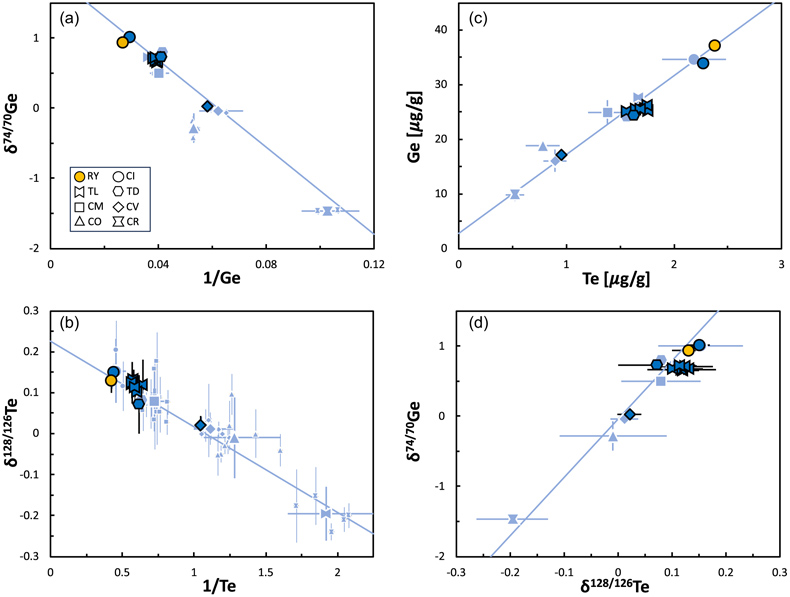
Figure 1 Diagrams of (a) Ge concentration vs. δ74/70Ge, (b) Te concentration vs. δ128/126Te, (c) Te vs. Ge concentrations, and (d) δ128/126Te vs. δ74/70Ge for carbonaceous chondrites (data from this study in dark blue; literature data in light blue [small symbols represent individual samples; large symbols represent group averages]). Ryugu sample A0220 is plotted as orange circle. Literature data for Ge is from Wölfer et al. (2025a)
Wölfer, E., Burkhardt, C., Nimmo, F., Kleine, T. (2025a) Origin of moderately volatile elements in Earth inferred from mass-dependent Ge isotope variations among chondrites. Earth and Planetary Science Letters 663, 119435. https://doi.org/10.1016/j.epsl.2025.119435
; data for Te is from Hellmann et al. (2020Hellmann, J.L., Hopp, T., Burkhardt, C., Kleine, T. (2020) Origin of volatile element depletion among carbonaceous chondrites. Earth and Planetary Science Letters 549, 116508. https://doi.org/10.1016/j.epsl.2020.116508
, 2023Hellmann, J.L., Schneider, J.M., Wölfer, E., Dra˛z˙kowska, J., Jansen, C.A., Hopp, T., Burkhardt, C., Kleine, T. (2023) Origin of Isotopic Diversity among Carbonaceous Chondrites. The Astrophysical Journal Letters 946, L34. https://doi.org/10.3847/2041-8213/acc102
) and Morton et al. (2024)Morton, E.M., Pickard, H., Wombacher, F., Huang, Y., Palk, E., Martins, R., Kuthning, S., Schönbächler, M., Rehkämper, M. (2024) Volatile Element Depletion of Carbonaceous Chondrites—Insights from Mass-dependent Zinc, Cadmium, and Tellurium Isotope Variations. The Astrophysical Journal 977, 53. https://doi.org/10.3847/1538-4357/ad87ed
. The data of Morton et al. (2024)Morton, E.M., Pickard, H., Wombacher, F., Huang, Y., Palk, E., Martins, R., Kuthning, S., Schönbächler, M., Rehkämper, M. (2024) Volatile Element Depletion of Carbonaceous Chondrites—Insights from Mass-dependent Zinc, Cadmium, and Tellurium Isotope Variations. The Astrophysical Journal 977, 53. https://doi.org/10.3847/1538-4357/ad87ed
are re-normalised to δ128/126Te and the SRM standard used by Hellmann et al. (2020Hellmann, J.L., Hopp, T., Burkhardt, C., Kleine, T. (2020) Origin of volatile element depletion among carbonaceous chondrites. Earth and Planetary Science Letters 549, 116508. https://doi.org/10.1016/j.epsl.2020.116508
, 2023Hellmann, J.L., Schneider, J.M., Wölfer, E., Dra˛z˙kowska, J., Jansen, C.A., Hopp, T., Burkhardt, C., Kleine, T. (2023) Origin of Isotopic Diversity among Carbonaceous Chondrites. The Astrophysical Journal Letters 946, L34. https://doi.org/10.3847/2041-8213/acc102
). Linear regressions calculated using IsoplotR based on group averages.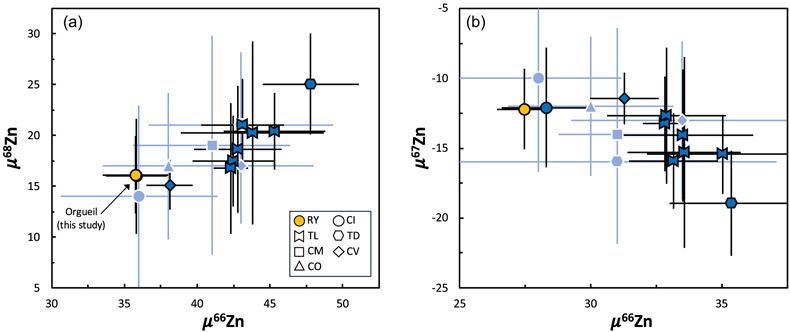
Figure 2 (a) μ66Zn vs. μ68Zn and (b) μ66Zn vs. μ67Zn diagrams for carbonaceous chondrites. Symbols as in Figure 1. Ryugu sample A0220 plots within the CC field and, together with CI chondrites, is characterised by slightly smaller μiZn values compared to Tarda and Tagish Lake. Literature data from Steller et al. (2022)
Steller, T., Burkhardt, C., Yang, C., Kleine, T. (2022) Nucleosynthetic zinc isotope anomalies reveal a dual origin of terrestrial volatiles. Icarus 386, 115171. https://doi.org/10.1016/j.icarus.2022.115171
.