



Consolidating the isotopic trichotomy of planetary materials with new evidence
Affiliations | Corresponding Author | Cite as | Funding information
Published by the European Association of Geochemistry
under Creative Commons License CC BY-NC-ND 4.0
Keywords: iron isotopes, trichotomy, dichotomy, achondrite


- Share this article


-
Article views:1,604Cumulative count of HTML views and PDF downloads.
- Download Citation
- Rights & Permissions

top
Abstract
Figures and Tables
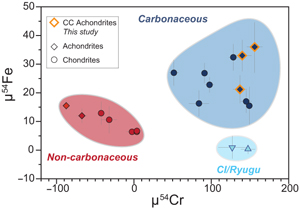
 Figure 1 Plots of μ50Ti vs. μ54Cr (a), μ50Ti vs. Δ17O (b), and μ54Cr vs. Δ17O (c) for NC (open red circles for chondrites and diamonds for achondrites), non-CI carbonaceous chondrites (open dark blue circles), Ryugu/CI (light blue triangles), CC achondrites analysed in this study (dark orange diamonds) and other CC achondrites (light orange diamonds). The average Ti, Cr and O isotopic compositions of non-carbonaceous (NC) and carbonaceous (CC) meteorite groups are from the data compilation by Dauphas et al. (2024). Data for CC achondrites are from Yamaguchi et al. (2002), Trinquier et al. (2009), Gardner-Vandy et al. (2012), Göpel et al. (2015), Hibiya et al. (2019), and Williams et al. (2020). |  Figure 2 Hierarchical cluster analysis (HCA) of meteorite groups based on (a) μ54Fe vs. μ54Cr and (b) μ54Fe vs. μ50Ti (see main text for details and references). Isotopic values are plotted as Z-scores to normalise the differing ranges of variation and to enable consistent distance metrics for clustering. HCA was performed using Ward’s method. Included groups are CI/Ryugu, CM, CO, CV, CK, CR, CH, CB, CL, H, L, LL, R, EH, EL, HED, Ureilite, IIAB, IIIAB and IVA, as well as Erg Chech 002 (EC 002), NWA 5400 and the CC achondrites analysed in this study. Samples measured in this study are shown in bold, and literature data are shown with empty symbols. |  Figure 3 Plots of (a) μ54Fe vs. μ54Cr and (b) μ54Fe vs. μ50Ti, showing carbonaceous achondrites measured in this study (orange and blue diamonds), including Tafassasset, NWA 6704 and NWA 011, compared to predicted isotopic compositions (P). Dashed lines connect measured and predicted values. Diamond symbols indicate achondrites, while circles indicate chondrites. Red open symbols represent NC meteorites, blue open symbols represent CC meteorites, and filled blue symbols represent Ryugu and CI. Yap and Tissot (2023) predicted that some CC achondrites would exhibit μ54Fe values intermediate between CC and CI. However, our new data show that these achondrites have μ54Fe values consistent with other CC meteorites, reaffirming the isotopic trichotomy among meteorite groups. |  Table 1 Iron isotopic composition of primitive CC achondrites, carbonaceous chondrites and non-carbonaceous achondrites analysed in this study. Uncertainties are reported as 95 % confidence intervals. |
| Figure 1 | Figure 2 | Figure 3 | Table 1 |
top
Introduction
Nucleosynthetic anomalies are defined as variations in isotopic ratios that depart from mass-dependent fractionation and cannot be explained by radioactive decay or nucleogenic/cosmogenic reactions (Dauphas and Schauble, 2016
Dauphas, N., Schauble, E.A. (2016) Mass Fractionation Laws, Mass-Independent Effects, and Isotopic Anomalies. Annual Review of Earth and Planetary Sciences 44, 709–783. https://doi.org/10.1146/annurev-earth-060115-012157
). Such isotopic anomalies, commonly found in meteorites, have offered fundamental insights into material transport and mixing processes in the early Solar System. They help reveal genetic links between planets and their building blocks and delineate the regions of the protoplanetary disk from which these materials originated (Warren, 2011Warren, P.H. (2011) Stable-isotopic anomalies and the accretionary assemblage of the Earth and Mars: A subordinate role for carbonaceous chondrites. Earth and Planetary Science Letters 311, 93–100. https://doi.org/10.1016/j.epsl.2011.08.047
; Kruijer et al., 2017Kruijer, T.S., Burkhardt, C., Budde, G., Kleine, T. (2017) Age of Jupiter inferred from the distinct genetics and formation times of meteorites. Proceedings of the National Academy of Sciences of the United States of America 114, 6712–6716. https://doi.org/10.1073/pnas.1704461114
; Dauphas et al., 2024Dauphas, N., Hopp, T., Nesvorný, D. (2024) Bayesian inference on the isotopic building blocks of Mars and Earth. Icarus 408, 115805. https://doi.org/10.1016/j.icarus.2023.115805
). Trinquier et al. (2007)Trinquier, A., Birck, J., Allegre, C.J. (2007) Widespread 54 Cr Heterogeneity in the Inner Solar System. The Astrophysical Journal 655, 1179–1185. https://doi.org/10.1086/510360
first showed that non-carbonaceous (NC) and carbonaceous (CC) chondrite groups had distinct O–Cr isotopic anomalies. Warren (2011)Warren, P.H. (2011) Stable-isotopic anomalies and the accretionary assemblage of the Earth and Mars: A subordinate role for carbonaceous chondrites. Earth and Planetary Science Letters 311, 93–100. https://doi.org/10.1016/j.epsl.2011.08.047
demonstrated that this dichotomy spanned several isotopic systems and all meteorite groups. Kruijer et al. (2017)Kruijer, T.S., Burkhardt, C., Budde, G., Kleine, T. (2017) Age of Jupiter inferred from the distinct genetics and formation times of meteorites. Proceedings of the National Academy of Sciences of the United States of America 114, 6712–6716. https://doi.org/10.1073/pnas.1704461114
later revealed that the NC/CC dichotomy extended to iron meteorites, which formed earlier than chondrites, implying that the two reservoirs were spatially separated from the beginning. Ivuna-type (CI) carbonaceous chondrites define an endmember within the broader carbonaceous chondrite (CC) group in Ti–Cr isotopic space. However, the Fe isotopic compositions of CIs fall within the range of NCs, not CCs (Schiller et al., 2020Schiller, M., Bizzarro, M., Siebert, J. (2020) Iron isotope evidence for very rapid accretion and differentiation of the proto-Earth. Science Advances 6, 1–7. https://doi.org/10.1126/sciadv.aay7604
; Hopp et al., 2022Hopp, T., Dauphas, N., Abe, Y., Aléon, J., Alexander, C.M.O’D. et al. (2022) Ryugu’s nucleosynthetic heritage from the outskirts of the Solar System. Science Advances 8, 1–10. https://doi.org/10.1126/sciadv.add8141
; Gattacceca et al., 2025Gattacceca, J., Gounelle, M., Devouard, B., Barrat, J.-A., Bonal, A., et al. (2025) Oued Chebeika 002: A new CI1 meteorite linked to outer solar system bodies. Meteoritics and Planetary Science 60, 1441–1479. https://doi.org/10.1111/maps.14359
).Hopp et al. (2022)
Hopp, T., Dauphas, N., Abe, Y., Aléon, J., Alexander, C.M.O’D. et al. (2022) Ryugu’s nucleosynthetic heritage from the outskirts of the Solar System. Science Advances 8, 1–10. https://doi.org/10.1126/sciadv.add8141
studied the Fe isotopic compositions of carbonaceous chondrites and samples from the Cb-type asteroid Ryugu, which were returned to Earth by JAXA’s Hayabusa2 mission (Yokoyama et al., 2022Yokoyama, T., Nagashima, K., Nakai, I., Young, E.D., Abe, Y., et al. (2022) Samples returned from the asteroid Ryugu are similar to Ivuna-type carbonaceous meteorites. Science 379, 1–10. https://doi.org/10.1126/science.abn7850
). They found that CI and Ryugu exhibit distinct isotopic signatures, separate from both CC and NC. This finding was confirmed through statistical analysis of other isotopic systems (Dauphas et al., 2024Dauphas, N., Hopp, T., Nesvorný, D. (2024) Bayesian inference on the isotopic building blocks of Mars and Earth. Icarus 408, 115805. https://doi.org/10.1016/j.icarus.2023.115805
; Shollenberger et al., 2025Shollenberger, Q.R., Render, J., Wimpenny, J., Armytage, R.M.G., Gunawardena, N., Rolison, J.M., Simon, J.I., Brennecka, G.A. (2025) Elemental and isotopic signatures of Asteroid Ryugu support three early Solar System reservoirs. Earth and Planetary Science Letters 664, 119443. https://doi.org/10.1016/j.epsl.2025.119443
). Similarly, the study of the Ni isotopic composition of Ryugu and meteorites revealed that CI chondrites are distinct from other carbonaceous chondrites in their Ni isotopic anomalies (Spitzer et al., 2024Spitzer, F., Kleine, T., Burkhardt, C., Hopp, T., Yokoyama, T., et al. (2024) The Ni isotopic composition of Ryugu reveals a common accretion region for carbonaceous chondrites. Science Advances 10, eadp2426. https://doi.org/10.1126/sciadv.adp2426
). This isotopic trichotomy could either reflect the existence of a third isotopic reservoir located in the outer region of the planetary accretion zone (Hopp et al., 2022Hopp, T., Dauphas, N., Abe, Y., Aléon, J., Alexander, C.M.O’D. et al. (2022) Ryugu’s nucleosynthetic heritage from the outskirts of the Solar System. Science Advances 8, 1–10. https://doi.org/10.1126/sciadv.add8141
), or the temporal evolution of the CC reservoir through fractionation of isotopically anomalous Fe–Ni grains (Spitzer et al., 2024Spitzer, F., Kleine, T., Burkhardt, C., Hopp, T., Yokoyama, T., et al. (2024) The Ni isotopic composition of Ryugu reveals a common accretion region for carbonaceous chondrites. Science Advances 10, eadp2426. https://doi.org/10.1126/sciadv.adp2426
).Yap and Tissot (2023)
Yap, T.E., Tissot, F.L.H. (2023) The NC-CC dichotomy explained by significant addition of CAI-like dust to the Bulk Molecular Cloud (BMC) composition. Icarus 405, 115680.https://doi.org/10.1016/j.icarus.2023.115680
argued that CI chondrites lie on extrapolated correlations of Fe, Cr and Ti isotopic anomalies in CC meteorites, implying that CI chondrites would have formed within the CC reservoir. They predicted that some carbonaceous primitive achondrite meteorites would bridge the isotopic gap between CI and CC, as these achondrites exhibit μ50Ti and μ54Cr isotopic anomalies approaching those observed in CI chondrites (Fig. 1). Marrocchi et al. (2023)Marrocchi, Y., Piralla, M., Tissot, F.L.H. (2023) Iron Isotope Constraints on the Structure of the Early Solar System. The Astrophysical Journal Letters 954, L27. https://doi.org/10.3847/2041-8213/acefd1
supported this observation by correlating mass-dependent fractionation of Te isotopes with nucleosynthetic Fe isotope anomalies. To evaluate the idea put forward by Yap and Tissot (2023)Yap, T.E., Tissot, F.L.H. (2023) The NC-CC dichotomy explained by significant addition of CAI-like dust to the Bulk Molecular Cloud (BMC) composition. Icarus 405, 115680.https://doi.org/10.1016/j.icarus.2023.115680
, we present Fe isotopic data for NC and CC achondrites, as well as previously unstudied chondrite groups. Our results reveal that CC achondrites exhibit μ54Fe anomalies within the same range as those observed in CC chondrites. These findings refute previous claims that CC achondrites bridge the CI–CC gap and corroborate the existence of a distinct isotopic reservoir for CI chondrites.Figure 1 Plots of μ50Ti vs. μ54Cr (a), μ50Ti vs. Δ17O (b), and μ54Cr vs. Δ17O (c) for NC (open red circles for chondrites and diamonds for achondrites), non-CI carbonaceous chondrites (open dark blue circles), Ryugu/CI (light blue triangles), CC achondrites analysed in this study (dark orange diamonds) and other CC achondrites (light orange diamonds). The average Ti, Cr and O isotopic compositions of non-carbonaceous (NC) and carbonaceous (CC) meteorite groups are from the data compilation by Dauphas et al. (2024)
Dauphas, N., Hopp, T., Nesvorný, D. (2024) Bayesian inference on the isotopic building blocks of Mars and Earth. Icarus 408, 115805. https://doi.org/10.1016/j.icarus.2023.115805
. Data for CC achondrites are from Yamaguchi et al. (2002)Yamaguchi, A., Clayton, R.N., Mayeda, T.K., Ebihara, M., Oura, Y., et al. (2002) A new source of basaltic meteorites inferred from Northwest Africa 011. Science 296, 334–336. https://doi.org/10.1126/science.1069408
, Trinquier et al. (2009)Trinquier, A., Elliott, T., Ulfbeck, D., Coath, C., Krot, A.N., Bizzarro, M. (2009) Origin of Nucleosynthetic Isotope Heterogeneity in the Solar Protoplanetary Disk. Science 324, 374–376. https://doi.org/10.1126/science.1168221
, Gardner-Vandy et al. (2012)Gardner-Vandy, K.G., Lauretta, D.S., Greenwood, R.C., McCoy, T.J., Killgore, M., Franchi, I.A. (2012) The Tafassasset primitive achondrite: Insights into initial stages of planetary differentiation. Geochimica et Cosmochimica Acta 85, 142–159. https://doi.org/10.1016/j.gca.2012.01.014
, Göpel et al. (2015)Göpel, C., Birck, J.L., Galy, A., Barrat, J.A., Zanda, B. (2015) Mn-Cr systematics in primitive meteorites: Insights from mineral separation and partial dissolution. Geochimica et Cosmochimica Acta 156, 1–24. https://doi.org/10.1016/j.gca.2015.02.008
, Hibiya et al. (2019)Hibiya, Y., Archer, G.J., Tanaka, R., Sanborn, M.E., Sato, Y., Iizuka, T., Ozawa, K., Walker, R.J., Yamaguchi, A., Yin, Q.-Z., Nakamura, T., Irving, A.J. (2019) The origin of the unique achondrite Northwest Africa 6704: Constraints from petrology, chemistry and Re–Os, O and Ti isotope systematics. Geochimica et Cosmochimica Acta 245, 597–627. https://doi.org/10.1016/j.gca.2018.04.031
, and Williams et al. (2020)Williams, C.D., Sanborn, M.E., Defouilloy, C., Yin, Q.Z., Kita, N.T., Ebel, D.S., Yamakawa, A., Yamashita, K. (2020) Chondrules reveal large-scale outward transport of inner Solar System materials in the protoplanetary disk. Proceedings of the National Academy of Sciences of the United States of America 117, 23426–23435. https://doi.org/10.1073/pnas.2005235117
.top
Results
The samples analysed in this study include three carbonaceous achondrites—Northwest Africa (NWA) 011 and NWA 6704 (both ungrouped achondrites) and Tafassasset (CR6), along with other CC and NC chondrites, including Coolidge (CL), Bencubbin (CB), Renazzo (CR), Erg Chech 002 (andesitic achondrite) and NWA 5400 (ungrouped achondrite). The iron isotopic data are reported in Tables 1 and S-1. Achondrites and carbonaceous chondrites have small mass-dependent fractionation with δ56Fe values relative to reference material IRMM524A, ranging from −0.11 ± 0.02 to +0.07 ± 0.02 ‰. Primitive carbonaceous achondrites NWA 011, NWA 6704 and Tafassasset show mass-independent variations with μ54Fe = +21 ± 5, +36 ± 11, and +33 ± 6, respectively. These values are within the same range as was previously measured for CC groups CM, CO, CV, CK, CR and CH (Schiller et al., 2020
Schiller, M., Bizzarro, M., Siebert, J. (2020) Iron isotope evidence for very rapid accretion and differentiation of the proto-Earth. Science Advances 6, 1–7. https://doi.org/10.1126/sciadv.aay7604
; Hopp et al., 2022Hopp, T., Dauphas, N., Abe, Y., Aléon, J., Alexander, C.M.O’D. et al. (2022) Ryugu’s nucleosynthetic heritage from the outskirts of the Solar System. Science Advances 8, 1–10. https://doi.org/10.1126/sciadv.add8141
). One sample from the CR group, Renazzo (CR2), shows a CC-like μ54Fe value of +33 ± 8. All CRs measured in this study, including Tafassasset (CR6), have μ54Fe values consistent with those of previously reported CR chondrites (Hopp et al., 2022Hopp, T., Dauphas, N., Abe, Y., Aléon, J., Alexander, C.M.O’D. et al. (2022) Ryugu’s nucleosynthetic heritage from the outskirts of the Solar System. Science Advances 8, 1–10. https://doi.org/10.1126/sciadv.add8141
). Similarly, Bencubbin (CBa) exhibits a μ54Fe value of +36 ± 6, supporting a genetic link between CR, CB and CH chondrites (Weisberg et al., 1995Weisberg M.K., Prinz, M., Clayton, R.N., Mayeda, T.K., Grady, M.M., Pillinger, C.T. (1995) The CR chondrite clan. Proceedings of the NIPR Symposium on Antarctic Meteorites 8, 11–32.
). We also analysed the iron isotopic composition of meteorite groups that had not previously been measured, including Coolidge (CL), which yield μ54Fe values of +20 ± 8. The iron isotopic composition of the oldest andesitic achondrite, Erg Chech 002 (Barrat et al., 2021Barrat, J.A., Chaussidon, M., Yamaguchi, A., Beck, P., Villeneuve, J., Byrne, D.J., Broadley, M.W., Marty, B. (2021) A 4,565-My-old andesite from an extinct chondritic protoplanet. Proceedings of the National Academy of Sciences of the United States of America 118, 1–7. https://doi.org/10.1073/pnas.2026129118
), is μ54Fe = +10 ± 6, while the Brachinite-like ungrouped achondrite NWA 5400 has μ54Fe = +9 ± 8.Table 1 Iron isotopic composition of primitive CC achondrites, carbonaceous chondrites and non-carbonaceous achondrites analysed in this study. Uncertainties are reported as 95 % confidence intervals.
| Sample | N | μ54Fe (7/6) | ± | δ56Fe (‰) | ± | |
| NWA 6704 | CC Achondrite | 14 | 36 | 11 | 0.01 | 0.02 |
| NWA 011 | CC Achondrite | 12 | 21 | 5 | 0.03 | 0.03 |
| Tafassasset | CC Achondrite | 15 | 33 | 6 | −0.06 | 0.02 |
| Coolidge | CL | 15 | 20 | 8 | −0.04 | 0.02 |
| Bencubbin | CB | 15 | 36 | 6 | −0.11 | 0.02 |
| Renazzo | CR | 15 | 33 | 8 | 0.01 | 0.02 |
| Erg Chech 002 | NC achondrite | 15 | 10 | 6 | 0.07 | 0.02 |
| NWA 5400 | Achondrite ung. | 13 | 9 | 8 | −0.02 | 0.03 |
top
Discussion
Hierarchical cluster analysis of meteoritic isotope data. To uncover underlying patterns in the Cr–Ti–Fe isotopic space, we use hierarchical cluster analysis (HCA), implemented with Ward’s minimum variance method as the linkage criterion (see Supplementary Information). This approach groups samples based on their pairwise similarity, minimising within-cluster variance at each step. The number of clusters is not set beforehand in this approach but is decided afterward based on an evaluation of the clustering structure. Instead of applying this approach to all isotopic anomalies (Dauphas et al., 2024
Dauphas, N., Hopp, T., Nesvorný, D. (2024) Bayesian inference on the isotopic building blocks of Mars and Earth. Icarus 408, 115805. https://doi.org/10.1016/j.icarus.2023.115805
), focusing only on the Cr–Ti–Fe isotopic space allows us to cover a larger number of meteorites for which we have a complete dataset (Shollenberger et al., 2025Shollenberger, Q.R., Render, J., Wimpenny, J., Armytage, R.M.G., Gunawardena, N., Rolison, J.M., Simon, J.I., Brennecka, G.A. (2025) Elemental and isotopic signatures of Asteroid Ryugu support three early Solar System reservoirs. Earth and Planetary Science Letters 664, 119443. https://doi.org/10.1016/j.epsl.2025.119443
). This also enables us to statistically evaluate clustering in spaces where the notions of dichotomy or trichotomy have been disputed (Hopp et al., 2022Hopp, T., Dauphas, N., Abe, Y., Aléon, J., Alexander, C.M.O’D. et al. (2022) Ryugu’s nucleosynthetic heritage from the outskirts of the Solar System. Science Advances 8, 1–10. https://doi.org/10.1126/sciadv.add8141
; Yap and Tissot, 2023Yap, T.E., Tissot, F.L.H. (2023) The NC-CC dichotomy explained by significant addition of CAI-like dust to the Bulk Molecular Cloud (BMC) composition. Icarus 405, 115680.https://doi.org/10.1016/j.icarus.2023.115680
).Our statistical analysis encompasses the major meteorite groups, including CI/Ryugu, CM, CO, CV, CK, CR, CH, CB, CL, H, L, LL, R, EH, EL, HED, Ureilite, IIAB, IIIAB, IVA and CC achondrites. We normalised the isotopic anomalies for Fe, Cr and Ti using Z-score normalisation, and performed HCA using Ward’s method. Hierarchical clustering using Ward’s method starts with each object as its own cluster and progressively merges clusters until a single cluster remains. At each step, the Euclidean distance between cluster centroids is calculated, and the pair of clusters that produces the smallest increase in variance is merged. This produces a hierarchical structure of groupings across scales. Although HCA produces this hierarchy, it does not define the final number of clusters. To determine the optimal number of clusters in the dataset, we applied the elbow method. This method involves plotting the within-cluster sum of squares (WCSS), which is the sum of squared Euclidean distances between each point and the centroid of its assigned cluster, against the number of clusters (k). The optimal number of clusters corresponds to the inflexion point (the “elbow”) in the WCSS curve, where adding further clusters results in only marginal reductions in the WCSS. We conducted this analysis using Fe, Cr and Ti isotopic systems. We identified an elbow at k = 3, suggesting that three clusters best capture the structure of the data (Fig. S-1). These clusters correspond to NC meteorites, CC meteorites and CI/Ryugu (Fig. 2a,b). Because neither Ward’s clustering nor the elbow method account for the uncertainties in group compositions, we assessed the robustness of the clustering results using Monte Carlo simulations (MCS). These simulations involved allowing each meteorite group composition to vary according to a normal distribution, with standard deviation set by its reported uncertainty. We re-ran the clustering algorithm for each realisation and determined the optimal number of clusters using the elbow method. The elbow method consistently points to three as the optimal number of clusters (Fig. S-1). Across simulations, CI and Ryugu samples co-clustered in ∼100 % of simulations, NC samples in ∼100 % and CC samples in ∼76 % (see SI). This analysis demonstrates that both the three-cluster solution and group assignments are robust, despite compositional uncertainties.
Figure 2 Hierarchical cluster analysis (HCA) of meteorite groups based on (a) μ54Fe vs. μ54Cr and (b) μ54Fe vs. μ50Ti (see main text for details and references). Isotopic values are plotted as Z-scores to normalise the differing ranges of variation and to enable consistent distance metrics for clustering. HCA was performed using Ward’s method. Included groups are CI/Ryugu, CM, CO, CV, CK, CR, CH, CB, CL, H, L, LL, R, EH, EL, HED, Ureilite, IIAB, IIIAB and IVA, as well as Erg Chech 002 (EC 002), NWA 5400 and the CC achondrites analysed in this study. Samples measured in this study are shown in bold, and literature data are shown with empty symbols.
Persistence of the NC–CC–CI trichotomy. Previous work on the NC–CC dichotomy has shown that planetesimals formed in the inner and outer Solar System carry distinct isotopic fingerprints (Warren, 2011
Warren, P.H. (2011) Stable-isotopic anomalies and the accretionary assemblage of the Earth and Mars: A subordinate role for carbonaceous chondrites. Earth and Planetary Science Letters 311, 93–100. https://doi.org/10.1016/j.epsl.2011.08.047
; Kruijer et al., 2017Kruijer, T.S., Burkhardt, C., Budde, G., Kleine, T. (2017) Age of Jupiter inferred from the distinct genetics and formation times of meteorites. Proceedings of the National Academy of Sciences of the United States of America 114, 6712–6716. https://doi.org/10.1073/pnas.1704461114
). The possible existence of a third formation region (isotopic reservoir) for planetesimals, not sampled by NC and CC groups, was proposed by Hopp et al. (2022)Hopp, T., Dauphas, N., Abe, Y., Aléon, J., Alexander, C.M.O’D. et al. (2022) Ryugu’s nucleosynthetic heritage from the outskirts of the Solar System. Science Advances 8, 1–10. https://doi.org/10.1126/sciadv.add8141
based on high precision Fe isotopic analyses of samples from the Cb-type asteroid Ryugu. Using principal component analysis to examine isotopic anomalies in chondrites, Dauphas et al. (2024)Dauphas, N., Hopp, T., Nesvorný, D. (2024) Bayesian inference on the isotopic building blocks of Mars and Earth. Icarus 408, 115805. https://doi.org/10.1016/j.icarus.2023.115805
found that the first principal component separated meteorites into NC and CC groups, while the second principal component isolated CI chondrites. Shollenberger et al. (2025)Shollenberger, Q.R., Render, J., Wimpenny, J., Armytage, R.M.G., Gunawardena, N., Rolison, J.M., Simon, J.I., Brennecka, G.A. (2025) Elemental and isotopic signatures of Asteroid Ryugu support three early Solar System reservoirs. Earth and Planetary Science Letters 664, 119443. https://doi.org/10.1016/j.epsl.2025.119443
conducted a similar analysis but restricted the elements considered to Ca, Ti, Cr, Fe, Ni and Zn, as well as chemical compositions, allowing them to consider more meteorite groups. They also concluded that three distinct isotopic endmembers existed in the solar nebula. Recent Ni isotopic measurements have further confirmed that CI chondrites possess distinct isotopic compositions compared to CC chondrites (Spitzer et al., 2024Spitzer, F., Kleine, T., Burkhardt, C., Hopp, T., Yokoyama, T., et al. (2024) The Ni isotopic composition of Ryugu reveals a common accretion region for carbonaceous chondrites. Science Advances 10, eadp2426. https://doi.org/10.1126/sciadv.adp2426
). Yap and Tissot (2023)Yap, T.E., Tissot, F.L.H. (2023) The NC-CC dichotomy explained by significant addition of CAI-like dust to the Bulk Molecular Cloud (BMC) composition. Icarus 405, 115680.https://doi.org/10.1016/j.icarus.2023.115680
challenged this view by hypothesising that Fe isotopic anomalies measured in CC achondrites would bridge the gap between Ryugu/CI and CC chondrites. The authors argued that a trend exists in the Ti–Cr–O isotopic space, extending from Ryugu/CI to other CC chondrites, indicating that these meteorites originated from a single reservoir (Marrocchi et al., 2023Marrocchi, Y., Piralla, M., Tissot, F.L.H. (2023) Iron Isotope Constraints on the Structure of the Early Solar System. The Astrophysical Journal Letters 954, L27. https://doi.org/10.3847/2041-8213/acefd1
; Yap and Tissot, 2023Yap, T.E., Tissot, F.L.H. (2023) The NC-CC dichotomy explained by significant addition of CAI-like dust to the Bulk Molecular Cloud (BMC) composition. Icarus 405, 115680.https://doi.org/10.1016/j.icarus.2023.115680
) (Fig. 1). By assuming that Ryugu/CI belong to the CC reservoir, Yap and Tissot (2023)Yap, T.E., Tissot, F.L.H. (2023) The NC-CC dichotomy explained by significant addition of CAI-like dust to the Bulk Molecular Cloud (BMC) composition. Icarus 405, 115680.https://doi.org/10.1016/j.icarus.2023.115680
conducted linear regressions through Ryugu, CI chondrites and CC chondrites in both the Fe–Cr and Fe–Ti isotopic spaces, and predicted mean μ54Fe values for CC achondrites of +14.2 ± 4.3 (2SE) and +13.1 ± 7.1 (2SE), respectively. The authors argue that there is no need to invoke an additional reservoir to explain the large scale isotopic architecture of the early Solar System, as CC achondrites are likely to fill the isotopic gap between Ryugu/CI and CC chondrites. The CC achondrites NWA 6704/6926/6693, NWA 011 and Tafassasset were suggested candidates to bridge this isotopic gap because they only show slight deviations from the CI isotopic composition in Ti–Cr isotope space (Fig. 1a), with μ50Ti ranging from +201 ± 54 to +283 ± 19 (Trinquier et al., 2009Trinquier, A., Elliott, T., Ulfbeck, D., Coath, C., Krot, A.N., Bizzarro, M. (2009) Origin of Nucleosynthetic Isotope Heterogeneity in the Solar Protoplanetary Disk. Science 324, 374–376. https://doi.org/10.1126/science.1168221
; Hibiya et al., 2019Hibiya, Y., Archer, G.J., Tanaka, R., Sanborn, M.E., Sato, Y., Iizuka, T., Ozawa, K., Walker, R.J., Yamaguchi, A., Yin, Q.-Z., Nakamura, T., Irving, A.J. (2019) The origin of the unique achondrite Northwest Africa 6704: Constraints from petrology, chemistry and Re–Os, O and Ti isotope systematics. Geochimica et Cosmochimica Acta 245, 597–627. https://doi.org/10.1016/j.gca.2018.04.031
; Sanborn et al., 2019Sanborn, M.E., Wimpenny, J., Williams, C.D., Yamakawa, A., Amelin, Y., Irving, A.J., Yin, Q.Z. (2019) Carbonaceous achondrites Northwest Africa 6704/6693: Milestones for early Solar System chronology and genealogy. Geochimica et Cosmochimica Acta 245, 577–596. https://doi.org/10.1016/j.gca.2018.10.004
; Williams et al., 2020Williams, C.D., Sanborn, M.E., Defouilloy, C., Yin, Q.Z., Kita, N.T., Ebel, D.S., Yamakawa, A., Yamashita, K. (2020) Chondrules reveal large-scale outward transport of inner Solar System materials in the protoplanetary disk. Proceedings of the National Academy of Sciences of the United States of America 117, 23426–23435. https://doi.org/10.1073/pnas.2005235117
) and μ54Cr ranging from +137 ± 9 to +156 ± 10 (Göpel et al., 2015Göpel, C., Birck, J.L., Galy, A., Barrat, J.A., Zanda, B. (2015) Mn-Cr systematics in primitive meteorites: Insights from mineral separation and partial dissolution. Geochimica et Cosmochimica Acta 156, 1–24. https://doi.org/10.1016/j.gca.2015.02.008
; Sanborn et al., 2019Sanborn, M.E., Wimpenny, J., Williams, C.D., Yamakawa, A., Amelin, Y., Irving, A.J., Yin, Q.Z. (2019) Carbonaceous achondrites Northwest Africa 6704/6693: Milestones for early Solar System chronology and genealogy. Geochimica et Cosmochimica Acta 245, 577–596. https://doi.org/10.1016/j.gca.2018.10.004
; Williams et al., 2020Williams, C.D., Sanborn, M.E., Defouilloy, C., Yin, Q.Z., Kita, N.T., Ebel, D.S., Yamakawa, A., Yamashita, K. (2020) Chondrules reveal large-scale outward transport of inner Solar System materials in the protoplanetary disk. Proceedings of the National Academy of Sciences of the United States of America 117, 23426–23435. https://doi.org/10.1073/pnas.2005235117
), while CI have μ50Ti and μ54Cr values of +189 ± 15 and +155 ± 7, respectively (Shukolyukov and Lugmair, 2006Shukolyukov, A., Lugmair, G.W. (2006) Manganese-chromium isotope systematics of carbonaceous chondrites. Earth and Planetary Science Letters 250, 200–213. https://doi.org/10.1016/j.epsl.2006.07.036
; Trinquier et al., 2007Trinquier, A., Birck, J., Allegre, C.J. (2007) Widespread 54 Cr Heterogeneity in the Inner Solar System. The Astrophysical Journal 655, 1179–1185. https://doi.org/10.1086/510360
, 2009Trinquier, A., Elliott, T., Ulfbeck, D., Coath, C., Krot, A.N., Bizzarro, M. (2009) Origin of Nucleosynthetic Isotope Heterogeneity in the Solar Protoplanetary Disk. Science 324, 374–376. https://doi.org/10.1126/science.1168221
; Williams et al., 2020Williams, C.D., Sanborn, M.E., Defouilloy, C., Yin, Q.Z., Kita, N.T., Ebel, D.S., Yamakawa, A., Yamashita, K. (2020) Chondrules reveal large-scale outward transport of inner Solar System materials in the protoplanetary disk. Proceedings of the National Academy of Sciences of the United States of America 117, 23426–23435. https://doi.org/10.1073/pnas.2005235117
). Given the importance of this question’s bearing on material transport and planetary genetics, we have decided to test the hypothesis formulated by Yap and Tissot (2023)Yap, T.E., Tissot, F.L.H. (2023) The NC-CC dichotomy explained by significant addition of CAI-like dust to the Bulk Molecular Cloud (BMC) composition. Icarus 405, 115680.https://doi.org/10.1016/j.icarus.2023.115680
, that some CC achondrites would fill the isotopic gap between CC and CI.Our results reveal that the Fe isotopic compositions of CC achondrites (NWA 6704, NWA 011 and Tafassasset) have μ54Fe values ranging from +21 ± 5 to +36 ± 11. Our measured Fe isotopic compositions of CC achondrites fall within the same range as that previously measured for CC chondrites and are clearly distinct from CI (Schiller et al., 2020
Schiller, M., Bizzarro, M., Siebert, J. (2020) Iron isotope evidence for very rapid accretion and differentiation of the proto-Earth. Science Advances 6, 1–7. https://doi.org/10.1126/sciadv.aay7604
; Hopp et al., 2022Hopp, T., Dauphas, N., Abe, Y., Aléon, J., Alexander, C.M.O’D. et al. (2022) Ryugu’s nucleosynthetic heritage from the outskirts of the Solar System. Science Advances 8, 1–10. https://doi.org/10.1126/sciadv.add8141
) (Figs. 2,3). Thus, contrary to the predictions of Yap and Tissot (2023)Yap, T.E., Tissot, F.L.H. (2023) The NC-CC dichotomy explained by significant addition of CAI-like dust to the Bulk Molecular Cloud (BMC) composition. Icarus 405, 115680.https://doi.org/10.1016/j.icarus.2023.115680
, the new Fe isotopic analyses of CC achondrites clearly anchor them in the CC reservoir (Fig. 3a,b), reaffirming the existence of a trichotomy in isotopic anomalies between NC, CC and CI (Hopp et al., 2022Hopp, T., Dauphas, N., Abe, Y., Aléon, J., Alexander, C.M.O’D. et al. (2022) Ryugu’s nucleosynthetic heritage from the outskirts of the Solar System. Science Advances 8, 1–10. https://doi.org/10.1126/sciadv.add8141
).Figure 3 Plots of (a) μ54Fe vs. μ54Cr and (b) μ54Fe vs. μ50Ti, showing carbonaceous achondrites measured in this study (orange and blue diamonds), including Tafassasset, NWA 6704 and NWA 011, compared to predicted isotopic compositions (P). Dashed lines connect measured and predicted values. Diamond symbols indicate achondrites, while circles indicate chondrites. Red open symbols represent NC meteorites, blue open symbols represent CC meteorites, and filled blue symbols represent Ryugu and CI. Yap and Tissot (2023)
Yap, T.E., Tissot, F.L.H. (2023) The NC-CC dichotomy explained by significant addition of CAI-like dust to the Bulk Molecular Cloud (BMC) composition. Icarus 405, 115680.https://doi.org/10.1016/j.icarus.2023.115680
predicted that some CC achondrites would exhibit μ54Fe values intermediate between CC and CI. However, our new data show that these achondrites have μ54Fe values consistent with other CC meteorites, reaffirming the isotopic trichotomy among meteorite groups.The reason why CI chondrites stand apart from CC chondrites remains uncertain. One possibility is that, relative to CC, CI chondrites formed farther out in the protoplanetary disk, in the same region as Oort cloud comets, and were then implanted into the main asteroid belt after being dynamically excited by Uranus and Neptune (Hopp et al., 2022
Hopp, T., Dauphas, N., Abe, Y., Aléon, J., Alexander, C.M.O’D. et al. (2022) Ryugu’s nucleosynthetic heritage from the outskirts of the Solar System. Science Advances 8, 1–10. https://doi.org/10.1126/sciadv.add8141
; Nesvorný et al., 2024Nesvorný, D., Dauphas, N., Vokrouhlický, D., Deienno, R., Hopp, T. (2024) Isotopic trichotomy of main belt asteroids from implantation of outer solar system planetesimals. Earth and Planetary Science Letters 626, 118521. https://doi.org/10.1016/j.epsl.2023.118521
). Such implantation requires the presence of nebular gas to dampen eccentricities. In this context, the absence of isotopic anomalies intermediate between CC and CI could be explained by the dynamics of planetesimals in the region between the gas and ice giant planets. These planetesimals could have had isotopic compositions intermediate between CC and CI, as suggested by Yap and Tissot (2023)Yap, T.E., Tissot, F.L.H. (2023) The NC-CC dichotomy explained by significant addition of CAI-like dust to the Bulk Molecular Cloud (BMC) composition. Icarus 405, 115680.https://doi.org/10.1016/j.icarus.2023.115680
, but they were dynamically excited by giant planets after the dissipation of nebular gas, hindering their implantation into the main asteroid belt. An alternative explanation is that CC and CI chondrites formed in the same reservoir but at a different time or by different processes, leading to their distinct isotopic signatures. Recently, Spitzer et al. (2024)Spitzer, F., Kleine, T., Burkhardt, C., Hopp, T., Yokoyama, T., et al. (2024) The Ni isotopic composition of Ryugu reveals a common accretion region for carbonaceous chondrites. Science Advances 10, eadp2426. https://doi.org/10.1126/sciadv.adp2426
proposed that the accretion of CI chondrite parent bodies was triggered by photoevaporation at the end of the disk lifetime, and incorporated a higher fraction of hypothetical Fe–Ni metal alloy with exotic isotopic composition (Spitzer et al., 2024Spitzer, F., Kleine, T., Burkhardt, C., Hopp, T., Yokoyama, T., et al. (2024) The Ni isotopic composition of Ryugu reveals a common accretion region for carbonaceous chondrites. Science Advances 10, eadp2426. https://doi.org/10.1126/sciadv.adp2426
).As shown here, achondrites associated with carbonaceous meteorites have isotopic anomalies that are distinctly different from those of CI chondrites (Fig. 3). While it is likely that we have not yet accessed the full inventory of Solar System materials, the CI-like isotopic signature has, to date, only been observed in primitive objects that appear to have escaped 26Al-induced melting. The absence of differentiated CI bodies could be explained by late formation of CI parent bodies preventing production of enough heat by decay of 26Al required for differentiation (Spitzer et al., 2024
Spitzer, F., Kleine, T., Burkhardt, C., Hopp, T., Yokoyama, T., et al. (2024) The Ni isotopic composition of Ryugu reveals a common accretion region for carbonaceous chondrites. Science Advances 10, eadp2426. https://doi.org/10.1126/sciadv.adp2426
). However, whether CI chondrite/Ryugu parent bodies accreted late is still debated (McCain et al., 2023McCain, K.A., Matsuda, M., Liu, M.-C., McKeegan, K.D., Yamaguchi, A., et al. (2023) Early fluid activity on Ryugu inferred by isotopic analyses of carbonates and magnetite. Nature Astronomy 7, 309–317. https://doi.org/10.1038/s41550-022-01863-0
; Tanaka et al., 2024Tanaka, R., Ratnayake, D.M., Ota, T., Miklusicak, N., Kunihiro, T., et al. (2024) Unraveling the Cr Isotopes of Ryugu: An Accurate Aqueous Alteration Age and the Least Thermally Processed Solar System Material. The Astrophysical Journal 965, 52. https://doi.org/10.3847/1538-4357/ad276a
). Hopp et al. (2022)Hopp, T., Dauphas, N., Abe, Y., Aléon, J., Alexander, C.M.O’D. et al. (2022) Ryugu’s nucleosynthetic heritage from the outskirts of the Solar System. Science Advances 8, 1–10. https://doi.org/10.1126/sciadv.add8141
and Nesvorný et al. (2024)Nesvorný, D., Dauphas, N., Vokrouhlický, D., Deienno, R., Hopp, T. (2024) Isotopic trichotomy of main belt asteroids from implantation of outer solar system planetesimals. Earth and Planetary Science Letters 626, 118521. https://doi.org/10.1016/j.epsl.2023.118521
proposed that CI chondrites likely formed in the same region of the protoplanetary disk as Oort cloud comets, meaning that they would have accreted significant amounts of ice. Others have also proposed a genetic link between CI chondrites and comets (Gounelle, 2011Gounelle, M. (2011) The asteroid-comet continuum: In search of lost primitivity. Elements 7, 29–34. https://doi.org/10.2113/gselements.7.1.29
). The fact that CI parent bodies avoided heating and differentiation may be attributed to the presence of water ice in the parent body. Indeed, simulations of the thermal evolution of ice-bearing planetesimals (Grimm and Mcsween, 1989Grimm, R.E., Mcsween, H.Y. (1989) Water and the thermal evolution of carbonaceous chondrite parent bodies. Icarus 82, 244–280. https://doi.org/10.1016/0019-1035(89)90038-9
; Wakita and Sekiya, 2011Wakita, S., Sekiya, M. (2011) Thermal evolution of icy planetesimals in the solar nebula. Earth, Planets and Space 63, 1193–1206. https://doi.org/10.5047/eps.2011.08.012
) have demonstrated that heating in such bodies is limited by several factors: (i) the melting of ice, which absorbs significant amounts of radioactive heat as latent heat; and (ii) hydrothermal circulation, which transports heat from the interior to the surface, where it is radiated away. Additionally, under low lithostatic pressure, processes such as ice sublimation and liquid water vaporisation can also absorb substantial heat. These mechanisms may account for the absence of differentiated objects within the CI-clan (Hopp et al., 2022Hopp, T., Dauphas, N., Abe, Y., Aléon, J., Alexander, C.M.O’D. et al. (2022) Ryugu’s nucleosynthetic heritage from the outskirts of the Solar System. Science Advances 8, 1–10. https://doi.org/10.1126/sciadv.add8141
; Dauphas et al., 2024Dauphas, N., Hopp, T., Nesvorný, D. (2024) Bayesian inference on the isotopic building blocks of Mars and Earth. Icarus 408, 115805. https://doi.org/10.1016/j.icarus.2023.115805
), as such objects likely formed further out in the disk and possessed a higher ice-to-rock ratio compared to CC meteorites (Hopp et al. 2022Hopp, T., Dauphas, N., Abe, Y., Aléon, J., Alexander, C.M.O’D. et al. (2022) Ryugu’s nucleosynthetic heritage from the outskirts of the Solar System. Science Advances 8, 1–10. https://doi.org/10.1126/sciadv.add8141
; Nesvorný et al., 2024Nesvorný, D., Dauphas, N., Vokrouhlický, D., Deienno, R., Hopp, T. (2024) Isotopic trichotomy of main belt asteroids from implantation of outer solar system planetesimals. Earth and Planetary Science Letters 626, 118521. https://doi.org/10.1016/j.epsl.2023.118521
).top
Acknowledgements
We thank the Field Museum for providing samples used in this study. Constructive criticism from three anonymous reviewers and editors was greatly appreciated. This work was supported by NASA grants 80NSSC23K1022 (LARS), 80NSSC21K0380 and 80NSSC20K0821 (Emerging Worlds), 80NSSC23K1163 (MMX-PSP), and DOE grant DE-SC0022451 to N.D.
Editor: Romain Tartèse
top
References
Barrat, J.A., Chaussidon, M., Yamaguchi, A., Beck, P., Villeneuve, J., Byrne, D.J., Broadley, M.W., Marty, B. (2021) A 4,565-My-old andesite from an extinct chondritic protoplanet. Proceedings of the National Academy of Sciences of the United States of America 118, 1–7. https://doi.org/10.1073/pnas.2026129118
 Show in context
 The iron isotopic composition of the oldest andesitic achondrite, Erg Chech 002 (Barrat et al., 2021), is μ54Fe = +10 ± 6, while the Brachinite-like ungrouped achondrite NWA 5400 has μ54Fe = +9 ± 8.
View in article
Dauphas, N., Schauble, E.A. (2016) Mass Fractionation Laws, Mass-Independent Effects, and Isotopic Anomalies. Annual Review of Earth and Planetary Sciences 44, 709–783. https://doi.org/10.1146/annurev-earth-060115-012157
Show in context Nucleosynthetic anomalies are defined as variations in isotopic ratios that depart from mass-dependent fractionation and cannot be explained by radioactive decay or nucleogenic/cosmogenic reactions (Dauphas and Schauble, 2016).
View in article
Dauphas, N., Hopp, T., Nesvorný, D. (2024) Bayesian inference on the isotopic building blocks of Mars and Earth. Icarus 408, 115805. https://doi.org/10.1016/j.icarus.2023.115805
Show in context They help reveal genetic links between planets and their building blocks and delineate the regions of the protoplanetary disk from which these materials originated (Warren, 2011; Kruijer et al., 2017; Dauphas et al., 2024).
View in article
This finding was confirmed through statistical analysis of other isotopic systems (Dauphas et al., 2024; Shollenberger et al., 2025).
View in article
The average Ti, Cr and O isotopic compositions of non-carbonaceous (NC) and carbonaceous (CC) meteorite groups are from the data compilation by Dauphas et al. (2024).
View in article
Instead of applying this approach to all isotopic anomalies (Dauphas et al., 2024), focusing only on the Cr–Ti–Fe isotopic space allows us to cover a larger number of meteorites for which we have a complete dataset (Shollenberger et al., 2025).
View in article
Using principal component analysis to examine isotopic anomalies in chondrites, Dauphas et al. (2024) found that the first principal component separated meteorites into NC and CC groups, while the second principal component isolated CI chondrites.
View in article
These mechanisms may account for the absence of differentiated objects within the CI-clan (Hopp et al., 2022; Dauphas et al., 2024), as such objects likely formed further out in the disk and possessed a higher ice-to-rock ratio compared to CC meteorites (Hopp et al. 2022; Nesvorný et al., 2024).
View in article
Gardner-Vandy, K.G., Lauretta, D.S., Greenwood, R.C., McCoy, T.J., Killgore, M., Franchi, I.A. (2012) The Tafassasset primitive achondrite: Insights into initial stages of planetary differentiation. Geochimica et Cosmochimica Acta 85, 142–159. https://doi.org/10.1016/j.gca.2012.01.014
Show in context Data for CC achondrites are from Yamaguchi et al. (2002), Trinquier et al. (2009), Gardner-Vandy et al. (2012), Göpel et al. (2015), Hibiya et al. (2019), and Williams et al. (2020).
View in article
Gattacceca, J., Gounelle, M., Devouard, B., Barrat, J.-A., Bonal, A., et al. (2025) Oued Chebeika 002: A new CI1 meteorite linked to outer solar system bodies. Meteoritics and Planetary Science 60, 1441–1479. https://doi.org/10.1111/maps.14359
Show in context However, the Fe isotopic compositions of CIs fall within the range of NCs, not CCs (Schiller et al., 2020; Hopp et al., 2022; Gattacceca et al., 2025).
View in article
Göpel, C., Birck, J.L., Galy, A., Barrat, J.A., Zanda, B. (2015) Mn-Cr systematics in primitive meteorites: Insights from mineral separation and partial dissolution. Geochimica et Cosmochimica Acta 156, 1–24. https://doi.org/10.1016/j.gca.2015.02.008
Show in context Data for CC achondrites are from Yamaguchi et al. (2002), Trinquier et al. (2009), Gardner-Vandy et al. (2012), Göpel et al. (2015), Hibiya et al. (2019), and Williams et al. (2020).
View in article
The CC achondrites NWA 6704/6926/6693, NWA 011 and Tafassasset were suggested candidates to bridge this isotopic gap because they only show slight deviations from the CI isotopic composition in Ti–Cr isotope space (Fig. 1a), with μ50Ti ranging from +201 ± 54 to +283 ± 19 (Trinquier et al., 2009; Hibiya et al., 2019; Sanborn et al., 2019; Williams et al., 2020) and μ54Cr ranging from +137 ± 9 to +156 ± 10 (Göpel et al., 2015; Sanborn et al., 2019; Williams et al., 2020), while CI have μ50Ti and μ54Cr values of +189 ± 15 and +155 ± 7, respectively (Shukolyukov and Lugmair, 2006; Trinquier et al., 2007, 2009; Williams et al., 2020).
View in article
Gounelle, M. (2011) The asteroid-comet continuum: In search of lost primitivity. Elements 7, 29–34. https://doi.org/10.2113/gselements.7.1.29
Show in context Others have also proposed a genetic link between CI chondrites and comets (Gounelle, 2011).
View in article
Grimm, R.E., Mcsween, H.Y. (1989) Water and the thermal evolution of carbonaceous chondrite parent bodies. Icarus 82, 244–280. https://doi.org/10.1016/0019-1035(89)90038-9
Show in context The fact that CI parent bodies avoided heating and differentiation may be attributed to the presence of water ice in the parent body. Indeed, simulations of the thermal evolution of ice-bearing planetesimals (Grimm and Mcsween, 1989; Wakita and Sekiya, 2011) have demonstrated that heating in such bodies is limited by several factors: (i) the melting of ice, which absorbs significant amounts of radioactive heat as latent heat; and (ii) hydrothermal circulation, which transports heat from the interior to the surface, where it is radiated away.
View in article
Hibiya, Y., Archer, G.J., Tanaka, R., Sanborn, M.E., Sato, Y., Iizuka, T., Ozawa, K., Walker, R.J., Yamaguchi, A., Yin, Q.-Z., Nakamura, T., Irving, A.J. (2019) The origin of the unique achondrite Northwest Africa 6704: Constraints from petrology, chemistry and Re–Os, O and Ti isotope systematics. Geochimica et Cosmochimica Acta 245, 597–627. https://doi.org/10.1016/j.gca.2018.04.031
Show in context Data for CC achondrites are from Yamaguchi et al. (2002), Trinquier et al. (2009), Gardner-Vandy et al. (2012), Göpel et al. (2015), Hibiya et al. (2019), and Williams et al. (2020).
View in article
The CC achondrites NWA 6704/6926/6693, NWA 011 and Tafassasset were suggested candidates to bridge this isotopic gap because they only show slight deviations from the CI isotopic composition in Ti–Cr isotope space (Fig. 1a), with μ50Ti ranging from +201 ± 54 to +283 ± 19 (Trinquier et al., 2009; Hibiya et al., 2019; Sanborn et al., 2019; Williams et al., 2020) and μ54Cr ranging from +137 ± 9 to +156 ± 10 (Göpel et al., 2015; Sanborn et al., 2019; Williams et al., 2020), while CI have μ50Ti and μ54Cr values of +189 ± 15 and +155 ± 7, respectively (Shukolyukov and Lugmair, 2006; Trinquier et al., 2007, 2009; Williams et al., 2020).
View in article
Hopp, T., Dauphas, N., Abe, Y., Aléon, J., Alexander, C.M.O’D. et al. (2022) Ryugu’s nucleosynthetic heritage from the outskirts of the Solar System. Science Advances 8, 1–10. https://doi.org/10.1126/sciadv.add8141
Show in context However, the Fe isotopic compositions of CIs fall within the range of NCs, not CCs (Schiller et al., 2020; Hopp et al., 2022; Gattacceca et al., 2025).
View in article
Hopp et al. (2022) studied the Fe isotopic compositions of carbonaceous chondrites and samples from the Cb-type asteroid Ryugu, which were returned to Earth by JAXA’s Hayabusa2 mission (Yokoyama et al., 2022).
View in article
This isotopic trichotomy could either reflect the existence of a third isotopic reservoir located in the outer region of the planetary accretion zone (Hopp et al., 2022), or the temporal evolution of the CC reservoir through fractionation of isotopically anomalous Fe–Ni grains (Spitzer et al., 2024).
View in article
These values are within the same range as was previously measured for CC groups CM, CO, CV, CK, CR and CH (Schiller et al., 2020; Hopp et al., 2022).
View in article
All CRs measured in this study, including Tafassasset (CR6), have μ54Fe values consistent with those of previously reported CR chondrites (Hopp et al., 2022).
View in article
This also enables us to statistically evaluate clustering in spaces where the notions of dichotomy or trichotomy have been disputed (Hopp et al., 2022; Yap and Tissot, 2023).
View in article
The possible existence of a third formation region (isotopic reservoir) for planetesimals, not sampled by NC and CC groups, was proposed by Hopp et al. (2022) based on high precision Fe isotopic analyses of samples from the Cb-type asteroid Ryugu.
View in article
Our measured Fe isotopic compositions of CC achondrites fall within the same range as that previously measured for CC chondrites and are clearly distinct from CI (Schiller et al., 2020; Hopp et al., 2022) (Figs. 2,3).
View in article
Thus, contrary to the predictions of Yap and Tissot (2023), the new Fe isotopic analyses of CC achondrites clearly anchor them in the CC reservoir (Fig. 3a,b), reaffirming the existence of a trichotomy in isotopic anomalies between NC, CC and CI (Hopp et al., 2022).
View in article
One possibility is that, relative to CC, CI chondrites formed farther out in the protoplanetary disk, in the same region as Oort cloud comets, and were then implanted into the main asteroid belt after being dynamically excited by Uranus and Neptune (Hopp et al., 2022; Nesvorný et al., 2024).
View in article
Hopp et al. (2022) and Nesvorný et al. (2024) proposed that CI chondrites likely formed in the same region of the protoplanetary disk as Oort cloud comets, meaning that they would have accreted significant amounts of ice.
View in article
These mechanisms may account for the absence of differentiated objects within the CI-clan (Hopp et al., 2022; Dauphas et al., 2024), as such objects likely formed further out in the disk and possessed a higher ice-to-rock ratio compared to CC meteorites (Hopp et al. 2022; Nesvorný et al., 2024).
View in article
Kruijer, T.S., Burkhardt, C., Budde, G., Kleine, T. (2017) Age of Jupiter inferred from the distinct genetics and formation times of meteorites. Proceedings of the National Academy of Sciences of the United States of America 114, 6712–6716. https://doi.org/10.1073/pnas.1704461114
Show in context They help reveal genetic links between planets and their building blocks and delineate the regions of the protoplanetary disk from which these materials originated (Warren, 2011; Kruijer et al., 2017; Dauphas et al., 2024).
View in article
Kruijer et al. (2017) later revealed that the NC/CC dichotomy extended to iron meteorites, which formed earlier than chondrites, implying that the two reservoirs were spatially separated from the beginning.
View in article
Previous work on the NC–CC dichotomy has shown that planetesimals formed in the inner and outer Solar System carry distinct isotopic fingerprints (Warren, 2011; Kruijer et al., 2017).
View in article
Marrocchi, Y., Piralla, M., Tissot, F.L.H. (2023) Iron Isotope Constraints on the Structure of the Early Solar System. The Astrophysical Journal Letters 954, L27. https://doi.org/10.3847/2041-8213/acefd1
Show in context Marrocchi et al. (2023) supported this observation by correlating mass-dependent fractionation of Te isotopes with nucleosynthetic Fe isotope anomalies.
View in article
The authors argued that a trend exists in the Ti–Cr–O isotopic space, extending from Ryugu/CI to other CC chondrites, indicating that these meteorites originated from a single reservoir (Marrocchi et al., 2023; Yap and Tissot, 2023) (Fig. 1).
View in article
McCain, K.A., Matsuda, M., Liu, M.-C., McKeegan, K.D., Yamaguchi, A., et al. (2023) Early fluid activity on Ryugu inferred by isotopic analyses of carbonates and magnetite. Nature Astronomy 7, 309–317. https://doi.org/10.1038/s41550-022-01863-0
Show in context However, whether CI chondrite/Ryugu parent bodies accreted late is still debated (McCain et al., 2023; Tanaka et al., 2024).
View in article
Nesvorný, D., Dauphas, N., Vokrouhlický, D., Deienno, R., Hopp, T. (2024) Isotopic trichotomy of main belt asteroids from implantation of outer solar system planetesimals. Earth and Planetary Science Letters 626, 118521. https://doi.org/10.1016/j.epsl.2023.118521
Show in context One possibility is that, relative to CC, CI chondrites formed farther out in the protoplanetary disk, in the same region as Oort cloud comets, and were then implanted into the main asteroid belt after being dynamically excited by Uranus and Neptune (Hopp et al., 2022; Nesvorný et al., 2024).
View in article
Hopp et al. (2022) and Nesvorný et al. (2024) proposed that CI chondrites likely formed in the same region of the protoplanetary disk as Oort cloud comets, meaning that they would have accreted significant amounts of ice.
View in article
These mechanisms may account for the absence of differentiated objects within the CI-clan (Hopp et al., 2022; Dauphas et al., 2024), as such objects likely formed further out in the disk and possessed a higher ice-to-rock ratio compared to CC meteorites (Hopp et al. 2022; Nesvorný et al., 2024).
View in article
Sanborn, M.E., Wimpenny, J., Williams, C.D., Yamakawa, A., Amelin, Y., Irving, A.J., Yin, Q.Z. (2019) Carbonaceous achondrites Northwest Africa 6704/6693: Milestones for early Solar System chronology and genealogy. Geochimica et Cosmochimica Acta 245, 577–596. https://doi.org/10.1016/j.gca.2018.10.004
Show in context The CC achondrites NWA 6704/6926/6693, NWA 011 and Tafassasset were suggested candidates to bridge this isotopic gap because they only show slight deviations from the CI isotopic composition in Ti–Cr isotope space (Fig. 1a), with μ50Ti ranging from +201 ± 54 to +283 ± 19 (Trinquier et al., 2009; Hibiya et al., 2019; Sanborn et al., 2019; Williams et al., 2020) and μ54Cr ranging from +137 ± 9 to +156 ± 10 (Göpel et al., 2015; Sanborn et al., 2019; Williams et al., 2020), while CI have μ50Ti and μ54Cr values of +189 ± 15 and +155 ± 7, respectively (Shukolyukov and Lugmair, 2006; Trinquier et al., 2007, 2009; Williams et al., 2020).
View in article
Schiller, M., Bizzarro, M., Siebert, J. (2020) Iron isotope evidence for very rapid accretion and differentiation of the proto-Earth. Science Advances 6, 1–7. https://doi.org/10.1126/sciadv.aay7604
Show in context However, the Fe isotopic compositions of CIs fall within the range of NCs, not CCs (Schiller et al., 2020; Hopp et al., 2022; Gattacceca et al., 2025).
View in article
These values are within the same range as was previously measured for CC groups CM, CO, CV, CK, CR and CH (Schiller et al., 2020; Hopp et al., 2022).
View in article
Our measured Fe isotopic compositions of CC achondrites fall within the same range as that previously measured for CC chondrites and are clearly distinct from CI (Schiller et al., 2020; Hopp et al., 2022) (Figs. 2,3).
View in article
Shollenberger, Q.R., Render, J., Wimpenny, J., Armytage, R.M.G., Gunawardena, N., Rolison, J.M., Simon, J.I., Brennecka, G.A. (2025) Elemental and isotopic signatures of Asteroid Ryugu support three early Solar System reservoirs. Earth and Planetary Science Letters 664, 119443. https://doi.org/10.1016/j.epsl.2025.119443
Show in context This finding was confirmed through statistical analysis of other isotopic systems (Dauphas et al., 2024; Shollenberger et al., 2025).
View in article
Instead of applying this approach to all isotopic anomalies (Dauphas et al., 2024), focusing only on the Cr–Ti–Fe isotopic space allows us to cover a larger number of meteorites for which we have a complete dataset (Shollenberger et al., 2025).
View in article
Shollenberger et al. (2025) conducted a similar analysis but restricted the elements considered to Ca, Ti, Cr, Fe, Ni and Zn, as well as chemical compositions, allowing them to consider more meteorite groups.
View in article
Shukolyukov, A., Lugmair, G.W. (2006) Manganese-chromium isotope systematics of carbonaceous chondrites. Earth and Planetary Science Letters 250, 200–213. https://doi.org/10.1016/j.epsl.2006.07.036
Show in context The CC achondrites NWA 6704/6926/6693, NWA 011 and Tafassasset were suggested candidates to bridge this isotopic gap because they only show slight deviations from the CI isotopic composition in Ti–Cr isotope space (Fig. 1a), with μ50Ti ranging from +201 ± 54 to +283 ± 19 (Trinquier et al., 2009; Hibiya et al., 2019; Sanborn et al., 2019; Williams et al., 2020) and μ54Cr ranging from +137 ± 9 to +156 ± 10 (Göpel et al., 2015; Sanborn et al., 2019; Williams et al., 2020), while CI have μ50Ti and μ54Cr values of +189 ± 15 and +155 ± 7, respectively (Shukolyukov and Lugmair, 2006; Trinquier et al., 2007, 2009; Williams et al., 2020).
View in article
Spitzer, F., Kleine, T., Burkhardt, C., Hopp, T., Yokoyama, T., et al. (2024) The Ni isotopic composition of Ryugu reveals a common accretion region for carbonaceous chondrites. Science Advances 10, eadp2426. https://doi.org/10.1126/sciadv.adp2426
Show in context Similarly, the study of the Ni isotopic composition of Ryugu and meteorites revealed that CI chondrites are distinct from other carbonaceous chondrites in their Ni isotopic anomalies (Spitzer et al., 2024).
View in article
This isotopic trichotomy could either reflect the existence of a third isotopic reservoir located in the outer region of the planetary accretion zone (Hopp et al., 2022), or the temporal evolution of the CC reservoir through fractionation of isotopically anomalous Fe–Ni grains (Spitzer et al., 2024).
View in article
Recent Ni isotopic measurements have further confirmed that CI chondrites possess distinct isotopic compositions compared to CC chondrites (Spitzer et al., 2024).
View in article
Recently, Spitzer et al. (2024) proposed that the accretion of CI chondrite parent bodies was triggered by photoevaporation at the end of the disk lifetime, and incorporated a higher fraction of hypothetical Fe–Ni metal alloy with exotic isotopic composition (Spitzer et al., 2024).
View in article
The absence of differentiated CI bodies could be explained by late formation of CI parent bodies preventing production of enough heat by decay of 26Al required for differentiation (Spitzer et al., 2024).
View in article
Tanaka, R., Ratnayake, D.M., Ota, T., Miklusicak, N., Kunihiro, T., et al. (2024) Unraveling the Cr Isotopes of Ryugu: An Accurate Aqueous Alteration Age and the Least Thermally Processed Solar System Material. The Astrophysical Journal 965, 52. https://doi.org/10.3847/1538-4357/ad276a
Show in context However, whether CI chondrite/Ryugu parent bodies accreted late is still debated (McCain et al., 2023; Tanaka et al., 2024).
View in article
Trinquier, A., Birck, J., Allegre, C.J. (2007) Widespread 54 Cr Heterogeneity in the Inner Solar System. The Astrophysical Journal 655, 1179–1185. https://doi.org/10.1086/510360
Show in context Trinquier et al. (2007) first showed that non-carbonaceous (NC) and carbonaceous (CC) chondrite groups had distinct O–Cr isotopic anomalies.
View in article
The CC achondrites NWA 6704/6926/6693, NWA 011 and Tafassasset were suggested candidates to bridge this isotopic gap because they only show slight deviations from the CI isotopic composition in Ti–Cr isotope space (Fig. 1a), with μ50Ti ranging from +201 ± 54 to +283 ± 19 (Trinquier et al., 2009; Hibiya et al., 2019; Sanborn et al., 2019; Williams et al., 2020) and μ54Cr ranging from +137 ± 9 to +156 ± 10 (Göpel et al., 2015; Sanborn et al., 2019; Williams et al., 2020), while CI have μ50Ti and μ54Cr values of +189 ± 15 and +155 ± 7, respectively (Shukolyukov and Lugmair, 2006; Trinquier et al., 2007, 2009; Williams et al., 2020).
View in article
Trinquier, A., Elliott, T., Ulfbeck, D., Coath, C., Krot, A.N., Bizzarro, M. (2009) Origin of Nucleosynthetic Isotope Heterogeneity in the Solar Protoplanetary Disk. Science 324, 374–376. https://doi.org/10.1126/science.1168221
Show in context Data for CC achondrites are from Yamaguchi et al. (2002), Trinquier et al. (2009), Gardner-Vandy et al. (2012), Göpel et al. (2015), Hibiya et al. (2019), and Williams et al. (2020).
View in article
The CC achondrites NWA 6704/6926/6693, NWA 011 and Tafassasset were suggested candidates to bridge this isotopic gap because they only show slight deviations from the CI isotopic composition in Ti–Cr isotope space (Fig. 1a), with μ50Ti ranging from +201 ± 54 to +283 ± 19 (Trinquier et al., 2009; Hibiya et al., 2019; Sanborn et al., 2019; Williams et al., 2020) and μ54Cr ranging from +137 ± 9 to +156 ± 10 (Göpel et al., 2015; Sanborn et al., 2019; Williams et al., 2020), while CI have μ50Ti and μ54Cr values of +189 ± 15 and +155 ± 7, respectively (Shukolyukov and Lugmair, 2006; Trinquier et al., 2007, 2009; Williams et al., 2020).
View in article
Wakita, S., Sekiya, M. (2011) Thermal evolution of icy planetesimals in the solar nebula. Earth, Planets and Space 63, 1193–1206. https://doi.org/10.5047/eps.2011.08.012
Show in context The fact that CI parent bodies avoided heating and differentiation may be attributed to the presence of water ice in the parent body. Indeed, simulations of the thermal evolution of ice-bearing planetesimals (Grimm and Mcsween, 1989; Wakita and Sekiya, 2011) have demonstrated that heating in such bodies is limited by several factors: (i) the melting of ice, which absorbs significant amounts of radioactive heat as latent heat; and (ii) hydrothermal circulation, which transports heat from the interior to the surface, where it is radiated away.
View in article
Warren, P.H. (2011) Stable-isotopic anomalies and the accretionary assemblage of the Earth and Mars: A subordinate role for carbonaceous chondrites. Earth and Planetary Science Letters 311, 93–100. https://doi.org/10.1016/j.epsl.2011.08.047
Show in context They help reveal genetic links between planets and their building blocks and delineate the regions of the protoplanetary disk from which these materials originated (Warren, 2011; Kruijer et al., 2017; Dauphas et al., 2024).
View in article
Warren (2011) demonstrated that this dichotomy spanned several isotopic systems and all meteorite groups.
View in article
Previous work on the NC–CC dichotomy has shown that planetesimals formed in the inner and outer Solar System carry distinct isotopic fingerprints (Warren, 2011; Kruijer et al., 2017).
View in article
Weisberg M.K., Prinz, M., Clayton, R.N., Mayeda, T.K., Grady, M.M., Pillinger, C.T. (1995) The CR chondrite clan. Proceedings of the NIPR Symposium on Antarctic Meteorites 8, 11–32.
Show in context Similarly, Bencubbin (CBa) exhibits a μ54Fe value of +36 ± 6, supporting a genetic link between CR, CB and CH chondrites (Weisberg et al., 1995).
View in article
Williams, C.D., Sanborn, M.E., Defouilloy, C., Yin, Q.Z., Kita, N.T., Ebel, D.S., Yamakawa, A., Yamashita, K. (2020) Chondrules reveal large-scale outward transport of inner Solar System materials in the protoplanetary disk. Proceedings of the National Academy of Sciences of the United States of America 117, 23426–23435. https://doi.org/10.1073/pnas.2005235117
Show in context Data for CC achondrites are from Yamaguchi et al. (2002), Trinquier et al. (2009), Gardner-Vandy et al. (2012), Göpel et al. (2015), Hibiya et al. (2019), and Williams et al. (2020).
View in article
The CC achondrites NWA 6704/6926/6693, NWA 011 and Tafassasset were suggested candidates to bridge this isotopic gap because they only show slight deviations from the CI isotopic composition in Ti–Cr isotope space (Fig. 1a), with μ50Ti ranging from +201 ± 54 to +283 ± 19 (Trinquier et al., 2009; Hibiya et al., 2019; Sanborn et al., 2019; Williams et al., 2020) and μ54Cr ranging from +137 ± 9 to +156 ± 10 (Göpel et al., 2015; Sanborn et al., 2019; Williams et al., 2020), while CI have μ50Ti and μ54Cr values of +189 ± 15 and +155 ± 7, respectively (Shukolyukov and Lugmair, 2006; Trinquier et al., 2007, 2009; Williams et al., 2020).
View in article
Yamaguchi, A., Clayton, R.N., Mayeda, T.K., Ebihara, M., Oura, Y., et al. (2002) A new source of basaltic meteorites inferred from Northwest Africa 011. Science 296, 334–336. https://doi.org/10.1126/science.1069408
Show in context Data for CC achondrites are from Yamaguchi et al. (2002), Trinquier et al. (2009), Gardner-Vandy et al. (2012), Göpel et al. (2015), Hibiya et al. (2019), and Williams et al. (2020).
View in article
Yap, T.E., Tissot, F.L.H. (2023) The NC-CC dichotomy explained by significant addition of CAI-like dust to the Bulk Molecular Cloud (BMC) composition. Icarus 405, 115680.https://doi.org/10.1016/j.icarus.2023.115680
Show in context Yap and Tissot (2023) argued that CI chondrites lie on extrapolated correlations of Fe, Cr and Ti isotopic anomalies in CC meteorites, implying that CI chondrites would have formed within the CC reservoir.
View in article
To evaluate the idea put forward by Yap and Tissot (2023), we present Fe isotopic data for NC and CC achondrites, as well as previously unstudied chondrite groups.
View in article
This also enables us to statistically evaluate clustering in spaces where the notions of dichotomy or trichotomy have been disputed (Hopp et al., 2022; Yap and Tissot, 2023).
View in article
Yap and Tissot (2023) challenged this view by hypothesising that Fe isotopic anomalies measured in CC achondrites would bridge the gap between Ryugu/CI and CC chondrites.
View in article
The authors argued that a trend exists in the Ti–Cr–O isotopic space, extending from Ryugu/CI to other CC chondrites, indicating that these meteorites originated from a single reservoir (Marrocchi et al., 2023; Yap and Tissot, 2023) (Fig. 1).
View in article
By assuming that Ryugu/CI belong to the CC reservoir, Yap and Tissot (2023) conducted linear regressions through Ryugu, CI chondrites and CC chondrites in both the Fe–Cr and Fe–Ti isotopic spaces, and predicted mean μ54Fe values for CC achondrites of +14.2 ± 4.3 (2SE) and +13.1 ± 7.1 (2SE), respectively.
View in article
Given the importance of this question’s bearing on material transport and planetary genetics, we have decided to test the hypothesis formulated by Yap and Tissot (2023), that some CC achondrites would fill the isotopic gap between CC and CI.
View in article
Thus, contrary to the predictions of Yap and Tissot (2023), the new Fe isotopic analyses of CC achondrites clearly anchor them in the CC reservoir (Fig. 3a,b), reaffirming the existence of a trichotomy in isotopic anomalies between NC, CC and CI (Hopp et al., 2022).
View in article
Yap and Tissot (2023) predicted that some CC achondrites would exhibit μ54Fe values intermediate between CC and CI.
View in article
Yokoyama, T., Nagashima, K., Nakai, I., Young, E.D., Abe, Y., et al. (2022) Samples returned from the asteroid Ryugu are similar to Ivuna-type carbonaceous meteorites. Science 379, 1–10. https://doi.org/10.1126/science.abn7850
Show in context Hopp et al. (2022) studied the Fe isotopic compositions of carbonaceous chondrites and samples from the Cb-type asteroid Ryugu, which were returned to Earth by JAXA’s Hayabusa2 mission (Yokoyama et al., 2022).
View in article
top
Supplementary Information
The Supplementary Information includes:
- Material and Methods
- Tables S-1 and S-2
- Statistical Approach to Identifying Isotopically Similar Meteorite Groups
- Figures S-1 and S-2
- Supplementary Information References
Download the Supplementary Information (PDF)
Figures

Figure 1 Plots of μ50Ti vs. μ54Cr (a), μ50Ti vs. Δ17O (b), and μ54Cr vs. Δ17O (c) for NC (open red circles for chondrites and diamonds for achondrites), non-CI carbonaceous chondrites (open dark blue circles), Ryugu/CI (light blue triangles), CC achondrites analysed in this study (dark orange diamonds) and other CC achondrites (light orange diamonds). The average Ti, Cr and O isotopic compositions of non-carbonaceous (NC) and carbonaceous (CC) meteorite groups are from the data compilation by Dauphas et al. (2024)
Dauphas, N., Hopp, T., Nesvorný, D. (2024) Bayesian inference on the isotopic building blocks of Mars and Earth. Icarus 408, 115805. https://doi.org/10.1016/j.icarus.2023.115805
. Data for CC achondrites are from Yamaguchi et al. (2002)Yamaguchi, A., Clayton, R.N., Mayeda, T.K., Ebihara, M., Oura, Y., et al. (2002) A new source of basaltic meteorites inferred from Northwest Africa 011. Science 296, 334–336. https://doi.org/10.1126/science.1069408
, Trinquier et al. (2009)Trinquier, A., Elliott, T., Ulfbeck, D., Coath, C., Krot, A.N., Bizzarro, M. (2009) Origin of Nucleosynthetic Isotope Heterogeneity in the Solar Protoplanetary Disk. Science 324, 374–376. https://doi.org/10.1126/science.1168221
, Gardner-Vandy et al. (2012)Gardner-Vandy, K.G., Lauretta, D.S., Greenwood, R.C., McCoy, T.J., Killgore, M., Franchi, I.A. (2012) The Tafassasset primitive achondrite: Insights into initial stages of planetary differentiation. Geochimica et Cosmochimica Acta 85, 142–159. https://doi.org/10.1016/j.gca.2012.01.014
, Göpel et al. (2015)Göpel, C., Birck, J.L., Galy, A., Barrat, J.A., Zanda, B. (2015) Mn-Cr systematics in primitive meteorites: Insights from mineral separation and partial dissolution. Geochimica et Cosmochimica Acta 156, 1–24. https://doi.org/10.1016/j.gca.2015.02.008
, Hibiya et al. (2019)Hibiya, Y., Archer, G.J., Tanaka, R., Sanborn, M.E., Sato, Y., Iizuka, T., Ozawa, K., Walker, R.J., Yamaguchi, A., Yin, Q.-Z., Nakamura, T., Irving, A.J. (2019) The origin of the unique achondrite Northwest Africa 6704: Constraints from petrology, chemistry and Re–Os, O and Ti isotope systematics. Geochimica et Cosmochimica Acta 245, 597–627. https://doi.org/10.1016/j.gca.2018.04.031
, and Williams et al. (2020)Williams, C.D., Sanborn, M.E., Defouilloy, C., Yin, Q.Z., Kita, N.T., Ebel, D.S., Yamakawa, A., Yamashita, K. (2020) Chondrules reveal large-scale outward transport of inner Solar System materials in the protoplanetary disk. Proceedings of the National Academy of Sciences of the United States of America 117, 23426–23435. https://doi.org/10.1073/pnas.2005235117
.
Figure 2 Hierarchical cluster analysis (HCA) of meteorite groups based on (a) μ54Fe vs. μ54Cr and (b) μ54Fe vs. μ50Ti (see main text for details and references). Isotopic values are plotted as Z-scores to normalise the differing ranges of variation and to enable consistent distance metrics for clustering. HCA was performed using Ward’s method. Included groups are CI/Ryugu, CM, CO, CV, CK, CR, CH, CB, CL, H, L, LL, R, EH, EL, HED, Ureilite, IIAB, IIIAB and IVA, as well as Erg Chech 002 (EC 002), NWA 5400 and the CC achondrites analysed in this study. Samples measured in this study are shown in bold, and literature data are shown with empty symbols.

Figure 3 Plots of (a) μ54Fe vs. μ54Cr and (b) μ54Fe vs. μ50Ti, showing carbonaceous achondrites measured in this study (orange and blue diamonds), including Tafassasset, NWA 6704 and NWA 011, compared to predicted isotopic compositions (P). Dashed lines connect measured and predicted values. Diamond symbols indicate achondrites, while circles indicate chondrites. Red open symbols represent NC meteorites, blue open symbols represent CC meteorites, and filled blue symbols represent Ryugu and CI. Yap and Tissot (2023)
Yap, T.E., Tissot, F.L.H. (2023) The NC-CC dichotomy explained by significant addition of CAI-like dust to the Bulk Molecular Cloud (BMC) composition. Icarus 405, 115680.https://doi.org/10.1016/j.icarus.2023.115680
predicted that some CC achondrites would exhibit μ54Fe values intermediate between CC and CI. However, our new data show that these achondrites have μ54Fe values consistent with other CC meteorites, reaffirming the isotopic trichotomy among meteorite groups.