



Iron isotopic evidence for growth of continental crust at convergent margins
Affiliations | Corresponding Author | Cite as | Funding information
Published by the European Association of Geochemistry
under Creative Commons License CC BY-NC-ND 4.0
Keywords: iron isotopes, granulite xenoliths, lower continental crust, continental growth


- Share this article


-
Article views:1,392Cumulative count of HTML views and PDF downloads.
- Download Citation
- Rights & Permissions

top
Abstract
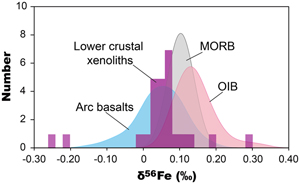
Figures
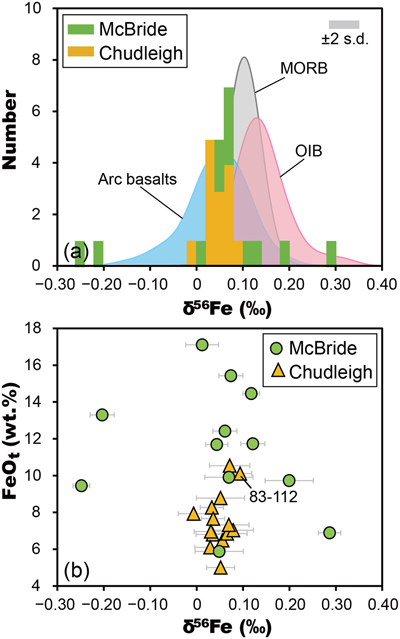 Figure 1 Fe isotopic compositions of granulite-facies xenoliths from the Chudleigh and McBride volcanic provinces, North Queensland, Australia (a), and their variations with FeOt. (b) OIBs, MORBs and arc basalts are from the compilation in Table S-3. Elemental data are from Rudnick et al. (1986) and Rudnick and Taylor (1987). Error bars are 2 sigma for δ56Fe. | 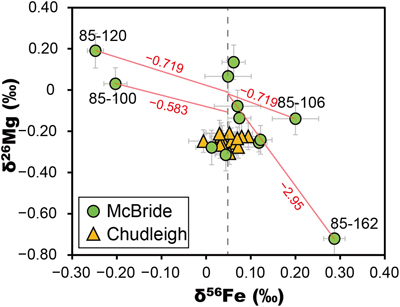 Figure 2 Plot of δ56Fe vs. δ26Mg for McBride and Chudleigh granulite xenoliths. Mg isotopic data are from Teng et al. (2013b). Symbols marked by sample numbers are the samples that likely have been affected by Fe-Mg interdiffusion. Red lines with labelled slopes represent the projection of Fe-Mg nterdiffusion following the equation ( | 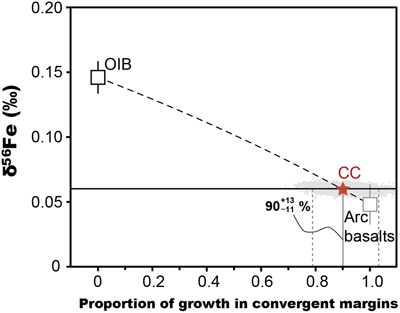 Figure 3 Proportion of continental crustal growth due to convergent margin vs. intraplate magmatism estimated from the Fe isotope budget of the continental crust. Mean compositions of arc basalts and ocean island basalts (OIBs) are from the compilation in Table S-3. The proportion was calculated based on binary mixing (e.g., the black dashed line), with the uncertainty constrained by Monte Carlo simulations (Supplementary Information). Results of representative Monte Carlo runs (i.e. the first 104 runs) are plotted as grey dots. |
| Figure 1 | Figure 2 | Figure 3 |
top
Introduction
One of the defining characteristics of Earth is its differentiated continental crust, which provides the landmass where humans thrive. However, the origins of the continental crust are still debated, with hypotheses ranging from formation at convergent margins in subduction zones to forming via intraplate magmatism (e.g., Rudnick, 1995
Rudnick, R.L. (1995) Making continental crust. Nature 378, 571–578. https://doi.org/10.1038/378571a0
; Albarède, 1998Albarède, F. (1998) The growth of continental crust. Tectonophysics 296, 1–14. https://doi.org/10.1016/S0040-1951(98)00133-4
; Barth et al., 2000Barth, M.G., McDonough, W.F., Rudnick, R.L. (2000) Tracking the budget of Nb and Ta in the continental crust. Chemical Geology 165, 197–213. https://doi.org/10.1016/S0009-2541(99)00173-4
; Foley et al., 2002Foley, S.F., Tiepolo, M., Vannucci, R. (2002) Growth of early continental crust controlled by melting of amphibolite in subduction zones. Nature 417, 837–840. https://doi.org/10.1038/nature00799
; Johnson et al., 2017Johnson, T.E., Brown, M., Gardiner, N.J., Kirkland, C.L., Smithies, R.H. (2017) Earth’s first stable continents did not form by subduction. Nature 543, 239–242. https://doi.org/10.1038/nature21383
). The arc-like trace element signature of the continental crust suggests growth at convergent margins (Rudnick, 1995Rudnick, R.L. (1995) Making continental crust. Nature 378, 571–578. https://doi.org/10.1038/378571a0
; Barth et al., 2000Barth, M.G., McDonough, W.F., Rudnick, R.L. (2000) Tracking the budget of Nb and Ta in the continental crust. Chemical Geology 165, 197–213. https://doi.org/10.1016/S0009-2541(99)00173-4
). However, magmas with such geochemical signatures are not exclusively found at convergent margins and may also result from melting at the base of thick mafic crust, or melting of density-driven crustal drips in the upper mantle in intraplate settings (Willbold et al., 2009Willbold, M., Hegner, E., Stracke, A., Rocholl, A. (2009) Continental geochemical signatures in dacites from Iceland and implications for models of early Archean crust formation. Earth and Planetary Science Letters 279, 44–52. https://doi.org/10.1016/j.epsl.2008.12.029
; Johnson et al., 2017Johnson, T.E., Brown, M., Gardiner, N.J., Kirkland, C.L., Smithies, R.H. (2017) Earth’s first stable continents did not form by subduction. Nature 543, 239–242. https://doi.org/10.1038/nature21383
). Recycling and reworking of pre-existing continental crust in various geological settings further complicate the effort to delineate the origins of the continental crust. Thus, the relative contributions of convergent margins versus intraplate magmatism to the formation of continental crust remain uncertain.Iron isotope geochemistry offers a novel perspective regarding the origins of the continental crust. Iron isotopes fractionate based on the strength of Fe-O bonds, with heavier isotopes favoring Fe3+-rich phases (Dauphas et al., 2014
Dauphas, N., Roskosz, M., Alp, E.E., Neuville, D.R., Hu, M.Y., Sio, C.K., Tissot, F.L.H., Zhao, J., Tissandier, L., Mèdard, E., Cordier, C. (2014) Magma redox and structural controls on iron isotope variations in Earth’s mantle and crust. Earth and Planetary Science Letters 398, 127–140. https://doi.org/10.1016/j.epsl.2014.04.033
). Arc basalts from convergent margins have systematically lighter Fe isotope compositions (expressed as per mil deviations from IRMM014, i.e. δ56Fe = (56Fe/54Fesample/56Fe/54FeIRMM014 − 1) × 1000) than oceanic island basalts (Fig. 1). This has been attributed to influx of fluids with low δ56Fe, derived from slab serpentinites, into the mantle wedge (Chen et al., 2023Chen, Z., Chen, J., Tamehe, L.S., Zhang, Y., Zeng, Z., Zhang, T., Shuai, W., Yin, X. (2023) Light Fe isotopes in arc magmas from cold subduction zones: implications for serpentinite-derived fluids oxidized the sub-arc mantle. Geochimica et Cosmochimica Acta 342, 1–14. https://doi.org/10.1016/j.gca.2022.12.005
) and repeated, water-fluxed melting with fO2-buffered by oxidised, slab-derived fluids (Foden et al., 2018Foden, J., Sossi, P.A., Nebel, O. (2018) Controls on the iron isotopic composition of global arc magmas. Earth and Planetary Science Letters 494, 190–201. https://doi.org/10.1016/j.epsl.2018.04.039
). The Fe isotopic composition of the continental crust, therefore, can provide insights into the proportions of magmatic crustal growth at convergent margins versus within plates. Furthermore, heavy Fe isotopes are commonly enriched in melts compared to their equilibrium residual/crystalline solids (e.g., Telus et al., 2012Telus, M., Dauphas, N., Moynier, F., Tissot, F.L.H., Teng, F.-Z., Nabelek, P.I., Craddock, P.R., Groat, L.A. (2012) Iron, zinc, magnesium and uranium isotopic fractionation during continental crust differentiation: the tale from migmatites, granitoids, and pegmatites. Geochimica et Cosmochimica Acta 97, 247–265. https://doi.org/10.1016/j.gca.2012.08.024
; Dauphas et al., 2014Dauphas, N., Roskosz, M., Alp, E.E., Neuville, D.R., Hu, M.Y., Sio, C.K., Tissot, F.L.H., Zhao, J., Tissandier, L., Mèdard, E., Cordier, C. (2014) Magma redox and structural controls on iron isotope variations in Earth’s mantle and crust. Earth and Planetary Science Letters 398, 127–140. https://doi.org/10.1016/j.epsl.2014.04.033
; Xu et al., 2017Xu, L.J., He, Y., Wang, S.J., Wu, H., Li, S. (2017) Iron isotope fractionation during crustal anatexis: Constraints from migmatites from the Dabie orogen, Central China. Lithos 284–285, 171–179. https://doi.org/10.1016/j.lithos.2017.04.005
), and, thus, recycling and reworking of preexisting continental crust are expected to enrich heavy Fe isotopes in the crust, if the dense, isotopically light residua and crystalline cumulates have been (partially) removed from the base. The mean δ56Fe of present day continental crust can, therefore, provide a minimum estimate of the relative contributions of convergent margin compared to intraplate magmas in its formation (Supplementary Information). Previous studies have estimated that the upper continental crust (UCC) has an average δ56Fe value of approximately 0.10 ‰. This value derives from two independent estimates: a) the global granitoid δ56Fe trend at SiO2 = 66.6 wt. % (Foden et al., 2015Foden, J., Sossi, P.A., Wawryk, C.M. (2015) Fe isotopes and the contrasting petrogenesis of A-, I- and S-type granite. Lithos 212–215, 32–44. https://doi.org/10.1016/j.lithos.2014.10.015
), and b) averaging δ56Fe of Mesoarchean to Palaeozoic diamictite composite samples that were not impacted by iron formations (Liu et al., 2022Liu, X.M., Gaschnig, R.M., Rudnick, R.L., Hazen, R.M., Shahar, A. (2022) Constant iron isotope composition of the upper continental crust over the past 3 Gyr. Geochemical Perspectives Letters 22, 16–19. https://doi.org/10.7185/geochemlet.2221
). By contrast, the Fe isotopic composition of the lower continental crust (LCC) is unknown.Figure 1 Fe isotopic compositions of granulite-facies xenoliths from the Chudleigh and McBride volcanic provinces, North Queensland, Australia (a), and their variations with FeOt. (b) OIBs, MORBs and arc basalts are from the compilation in Table S-3. Elemental data are from Rudnick et al. (1986)
Rudnick, R.L., McDonough, W.F., McCulloch, M.T., Taylor, S.R. (1986) Lower crustal xenoliths from Queensland, Australia: Evidence for deep crustal assimilation and fractionation of continental basalts. Geochemica et Cosmochimica Acta 50, 1099–1115. https://doi.org/10.1016/0016-7037(86)90391-1
and Rudnick and Taylor (1987)Rudnick, R.L., Taylor, S.R. (1987) The composition and petrogenesis of the lower crust: a xenolith study. Journal of Geophysical Research 92, 13981–14005. https://doi.org/10.1029/JB092iB13p13981
. Error bars are 2 sigma for δ56Fe.To address this gap, we report high precision Fe isotopic data for 26 granulite xenoliths from the Chudleigh and McBride volcanic provinces, North Queensland, Australia. These samples are representative of the bulk LCC in terms of average elemental compositions (Rudnick et al., 1986
Rudnick, R.L., McDonough, W.F., McCulloch, M.T., Taylor, S.R. (1986) Lower crustal xenoliths from Queensland, Australia: Evidence for deep crustal assimilation and fractionation of continental basalts. Geochemica et Cosmochimica Acta 50, 1099–1115. https://doi.org/10.1016/0016-7037(86)90391-1
; Rudnick and Taylor, 1987Rudnick, R.L., Taylor, S.R. (1987) The composition and petrogenesis of the lower crust: a xenolith study. Journal of Geophysical Research 92, 13981–14005. https://doi.org/10.1029/JB092iB13p13981
; Rudnick, 1990Rudnick, R.L. (1990) Nd and Sr isotopic compositions of lower-crustal xenoliths from north Queensland, Australia: Implications for Nd model ages and crustal growth processes. Chemical Geology 83, 195–208. https://doi.org/10.1016/0009-2541(90)90280-K
). By averaging their Fe isotopes, and combining this with the above UCC estimate, the average δ56Fe of the continental crust is estimated and, thus, the relative contributions from convergent margin and intraplate magmatism in generating continental crust are determined.top
Sample Descriptions and Analytical Methods
Petrology, ultrasonic velocities and chemistry of the Chudleigh and McBride xenoliths have previously been reported (e.g., Rudnick et al., 1986
Rudnick, R.L., McDonough, W.F., McCulloch, M.T., Taylor, S.R. (1986) Lower crustal xenoliths from Queensland, Australia: Evidence for deep crustal assimilation and fractionation of continental basalts. Geochemica et Cosmochimica Acta 50, 1099–1115. https://doi.org/10.1016/0016-7037(86)90391-1
; Rudnick and Taylor, 1987Rudnick, R.L., Taylor, S.R. (1987) The composition and petrogenesis of the lower crust: a xenolith study. Journal of Geophysical Research 92, 13981–14005. https://doi.org/10.1029/JB092iB13p13981
; Rudnick, 1990Rudnick, R.L. (1990) Nd and Sr isotopic compositions of lower-crustal xenoliths from north Queensland, Australia: Implications for Nd model ages and crustal growth processes. Chemical Geology 83, 195–208. https://doi.org/10.1016/0009-2541(90)90280-K
; Rudnick and Goldstein, 1990Rudnick, R.L., Goldstein, S.L. (1990) The Pb isotopic compositions of lower crustal xenoliths and the evolution of lower crustal Pb. Earth and Planetary Science Letters 98, 192–207. https://doi.org/10.1016/0012-821X(90)90059-7
; Kempton and Harmon, 1992Kempton, P.D., Harmon, R.S. (1992) Oxygen isotope evidence for large-scale hybridization of the lower crust during magmatic underplating. Geochimica et Cosmochimica Acta 56, 971–986. https://doi.org/10.1016/0016-7037(92)90041-G
; Saal et al., 1998Saal, A.E., Rudnick, R.L., Ravizza, G.E., Hart, S.R. (1998) Re-Os isotope evidence for the composition, formation and age of the lower continental crust. Nature 398, 58–61. https://doi.org/10.1038/29966
; Teng et al., 2013bTeng, F.-Z., Yang, W., Rudnick, R.L., Hu, Y. (2013b) Heterogeneous magnesium isotopic composition of the lower continental crust: A xenolith perspective. Geochemistry, Geophysics, Geosystems 14, 3844–3856. https://doi.org/10.1002/ggge.20238
). The Chudleigh xenoliths, carried in Plio-Pleistocene (<2 Ma) alkali basalts, range from 5 to 50 cm in size and are coarse-grained mafic cumulates (SiO2 < 52 wt. %). They fall into three groups— pyroxene-rich, plagioclase-rich and transitional, reflecting chemical equilibration at depths of 20–40 km and temperatures of 700–1000 °C. The shallower xenoliths exhibit relict igneous textures and mineralogy, such as olivine (at the cores of orthopyroxene-spinel coronas) and lath-shaped plagioclase; their elemental and isotopic geochemistry (O, Sr, Nd, Pb and Os) suggest a cogenetic origin as crystal cumulates from mafic magmas that intruded and assimilated the preexisting LCC (Rudnick et al., 1986Rudnick, R.L., McDonough, W.F., McCulloch, M.T., Taylor, S.R. (1986) Lower crustal xenoliths from Queensland, Australia: Evidence for deep crustal assimilation and fractionation of continental basalts. Geochemica et Cosmochimica Acta 50, 1099–1115. https://doi.org/10.1016/0016-7037(86)90391-1
; Rudnick, 1990Rudnick, R.L. (1990) Nd and Sr isotopic compositions of lower-crustal xenoliths from north Queensland, Australia: Implications for Nd model ages and crustal growth processes. Chemical Geology 83, 195–208. https://doi.org/10.1016/0009-2541(90)90280-K
; Kempton and Harmon, 1992Kempton, P.D., Harmon, R.S. (1992) Oxygen isotope evidence for large-scale hybridization of the lower crust during magmatic underplating. Geochimica et Cosmochimica Acta 56, 971–986. https://doi.org/10.1016/0016-7037(92)90041-G
; Saal et al., 1998Saal, A.E., Rudnick, R.L., Ravizza, G.E., Hart, S.R. (1998) Re-Os isotope evidence for the composition, formation and age of the lower continental crust. Nature 398, 58–61. https://doi.org/10.1038/29966
).The McBride xenoliths are carried in a young (<3 Ma) basaltic cinder cone (Hill 32), located 180 km north of Chudleigh. They possess well equilibrated textures, and yield equilibration depths of 26–40 km and temperatures of 630–1070 oC (except for 85–107, which is likely derived from a shallower depth of ca. 18 km) (Rudnick and Taylor, 1987
Rudnick, R.L., Taylor, S.R. (1987) The composition and petrogenesis of the lower crust: a xenolith study. Journal of Geophysical Research 92, 13981–14005. https://doi.org/10.1029/JB092iB13p13981
). Approximately 80 % of these xenoliths are mafic and likely originated from solidified mafic melts, crystal cumulates and residues left after partial melt extraction. The remainder are intermediate to felsic, with protoliths ranging from meta-sediments to crystallised felsic melts. Whole rock 87Sr/86Sr and 143Nd/144Nd ratios suggest a mixing trend around 300 Ma, indicating large scale interaction between mantle-derived mafic melts and preexisting crust that mainly consists of a Palaeoproterozoic basement (Rudnick, 1990Rudnick, R.L. (1990) Nd and Sr isotopic compositions of lower-crustal xenoliths from north Queensland, Australia: Implications for Nd model ages and crustal growth processes. Chemical Geology 83, 195–208. https://doi.org/10.1016/0009-2541(90)90280-K
). Therefore, both sets of xenoliths represent the present day LCC (<3 Ma) beneath Queensland, and are interpreted to have formed from underplating by mantle-derived mafic magmas, their differentiation and mixing with pre-existing crust. While the McBride samples likely formed in the Late Palaeozoic in a continental margin subduction zone, the Chudleigh samples were interpreted to be cumulates of Cenozoic intraplate basaltic magmatism (Supplementary Information).Iron isotopic analyses were performed at the Isotope Geochemistry Lab, China University of Geosciences, Beijing. Powdered samples (3–10 mg) were digested in concentrated HF-HNO3-HClO4, and then sequentially treated with aqua regia twice. Iron was separated using polypropylene columns filled with 1 ml AG1-X8 resin, with matrix elements eluted in 8 ml 6 N HCl and Fe collected in 9 ml 0.4N HCl. This process was repeated to ensure complete matrix elimination. The procedural blank resulted in minimal Fe (<10 ng), less than 0.01 % of the processed Fe, so no blank corrections were applied. Iron isotopic ratios were measured on a Thermo-Finnigan Neptune Plus MC-ICPMS at the “medium” resolution mode. Instrument mass bias was corrected using the standard-sample bracketing method. Standard-sample sequences were repeated nine times, with the reported compositions being the average of these analyses. Long term reproducibility and accuracy were within 0.03 ‰ for δ56Fe, confirmed by analyses on international igneous rock standards (e.g., JP-1, BHVO-2, W-2a, JB-2, AGV-2 and JA-1) (Table S-1).
top
Iron Isotopic Heterogeneity in the Lower Continental Crust
Granulite xenoliths from Chudleigh and McBride exhibit distinct Fe isotopic compositions (Fig. 1). The Chudleigh suite displays a narrow range in δ56Fe from −0.006 ‰ to 0.094 ‰. The preservation of magmatic trends between soluble elements (e.g., Rb, Ba and U) and Mg# (Rudnick et al., 1986
Rudnick, R.L., McDonough, W.F., McCulloch, M.T., Taylor, S.R. (1986) Lower crustal xenoliths from Queensland, Australia: Evidence for deep crustal assimilation and fractionation of continental basalts. Geochemica et Cosmochimica Acta 50, 1099–1115. https://doi.org/10.1016/0016-7037(86)90391-1
) suggests that granulite metamorphism has not significantly influenced the δ56Fe values. The Chudleigh xenoliths are cumulates from magmas that experienced variable amounts of crustal contamination, indicated by variations in Sr and Nd isotopic compositions (e.g., ɛNd ranging from −6.1 to 9.6; Rudnick et al., 1986Rudnick, R.L., McDonough, W.F., McCulloch, M.T., Taylor, S.R. (1986) Lower crustal xenoliths from Queensland, Australia: Evidence for deep crustal assimilation and fractionation of continental basalts. Geochemica et Cosmochimica Acta 50, 1099–1115. https://doi.org/10.1016/0016-7037(86)90391-1
). Nevertheless, δ56Fe is constant in these samples and shows no correlation with either ɛNd or Mg# (Fig. S-1). This leads us to conclude that crustal assimilation had a negligible effect on δ56Fe of these samples, which is possible if the contaminant is felsic and relatively Fe-depleted; the contaminant may also have had a similar δ56Fe as the underplating magma. The Chudleigh granulites have δ56Fe and Nb/La that are lower than those expected for intraplate basalts (Fig. 1), consistent with the accumulation of assemblages dominating by plagioclase and Fe2+-rich pyroxenes with DNb/DLa < 1 (Supplementary Information). The positive correlation between δ56Fe and Nb/La (Fig. S-1f) hints at a role for mineral modes influencing the bulk δ56Fe (e.g., light, low Nb/La pyroxenes versus heavy, high Nb/La Fe-Ti-oxides), but the effect is rather minimal. An abundance of Fe-Ti-oxides in sample 83-112, which are apparent in thin section and in the sample’s high TiO2/MgO ratio (Rudnick et al., 1986Rudnick, R.L., McDonough, W.F., McCulloch, M.T., Taylor, S.R. (1986) Lower crustal xenoliths from Queensland, Australia: Evidence for deep crustal assimilation and fractionation of continental basalts. Geochemica et Cosmochimica Acta 50, 1099–1115. https://doi.org/10.1016/0016-7037(86)90391-1
), may have slightly elevated its δ56Fe (∼0.094 ‰) relative to the other cumulates (−0.006 ‰ to ∼0.079 ‰) that do not show such large amounts of oxide enrichment.The McBride xenoliths, with more diverse protoliths including crystallised mafic to felsic melts, crustal melting residues and siliclastic sediments, have highly heterogeneous δ56Fe values (Fig. 1, Fig. 2 and Fig. S-2). Eight out of these twelve granulites have δ56Fe ranging from 0.012 ‰ to 0.121 ‰, typical for siliclastic sediments and igneous rocks (Teng et al., 2013a
Teng, F.-Z., Dauphas, N., Huang, S., Marty, B. (2013a) Iron isotopic systematics of oceanic basalts. Geochimica et Cosmochimica Acta 107, 12–26. https://doi.org/10.1016/j.gca.2012.12.027
; Foden et al., 2015Foden, J., Sossi, P.A., Wawryk, C.M. (2015) Fe isotopes and the contrasting petrogenesis of A-, I- and S-type granite. Lithos 212–215, 32–44. https://doi.org/10.1016/j.lithos.2014.10.015
; Foden et al., 2018Foden, J., Sossi, P.A., Nebel, O. (2018) Controls on the iron isotopic composition of global arc magmas. Earth and Planetary Science Letters 494, 190–201. https://doi.org/10.1016/j.epsl.2018.04.039
; Liu et al., 2022Liu, X.M., Gaschnig, R.M., Rudnick, R.L., Hazen, R.M., Shahar, A. (2022) Constant iron isotope composition of the upper continental crust over the past 3 Gyr. Geochemical Perspectives Letters 22, 16–19. https://doi.org/10.7185/geochemlet.2221
). The two pyroxene mafic granulites that were interpreted to be crystallised melts have the lowest δ56Fe values, ranging from −0.248 ‰ to −0.203 ‰, outside the range observed in arc and oceanic basalts (Fig. S-3; Teng et al., 2013aTeng, F.-Z., Dauphas, N., Huang, S., Marty, B. (2013a) Iron isotopic systematics of oceanic basalts. Geochimica et Cosmochimica Acta 107, 12–26. https://doi.org/10.1016/j.gca.2012.12.027
; Foden et al., 2018Foden, J., Sossi, P.A., Nebel, O. (2018) Controls on the iron isotopic composition of global arc magmas. Earth and Planetary Science Letters 494, 190–201. https://doi.org/10.1016/j.epsl.2018.04.039
). Felsic xenolith 83-162 has the highest δ56Fe value of 0.287 ‰, heavier than most previously reported felsic igneous samples at 66.9 wt. % SiO2 (Fig. S-3). These unusually low and high δ56Fe values do not correlate with SiO2, Nb/La, δ18O or protolith types, and cannot be explained by equilibrium melting, fractional crystallisation or protolith inheritance (Fig. S-2). The negative correlation between δ56Fe and δ26Mg (Fig. 2) suggests a role for Fe-Mg interdiffusion, which drives Fe and Mg to diffuse in opposite directions (Dauphas et al., 2010Dauphas, N., Teng, F.-Z., Arndt, N.T. (2010) Magnesium and iron isotopes in 2.7 Ga Alexo komatiites: Mantle signatures, no evidence for Soret diffusion, and identification of diffusive transport in zoned olivine. Geochimica et Cosmochimica Acta 74, 3274–3291. https://doi.org/10.1016/j.gca.2010.02.031
). Samples with highly fractionated δ56Fe and δ26Mg values align with the predicted slope for Fe-Mg interdiffusion (Dauphas et al., 2010Dauphas, N., Teng, F.-Z., Arndt, N.T. (2010) Magnesium and iron isotopes in 2.7 Ga Alexo komatiites: Mantle signatures, no evidence for Soret diffusion, and identification of diffusive transport in zoned olivine. Geochimica et Cosmochimica Acta 74, 3274–3291. https://doi.org/10.1016/j.gca.2010.02.031
), indicating that diffusion-driven fractionation is a plausible explanation for the observed variations in the most isotopically extreme McBride xenoliths (Teng et al., 2013bTeng, F.-Z., Yang, W., Rudnick, R.L., Hu, Y. (2013b) Heterogeneous magnesium isotopic composition of the lower continental crust: A xenolith perspective. Geochemistry, Geophysics, Geosystems 14, 3844–3856. https://doi.org/10.1002/ggge.20238
; and this study). All McBride granulite xenoliths have lower Mg# than would be in equilibrium with the host basalt (Fig. S-2b), suggesting the diffusion of isotopically light Fe into the xenoliths. However, Fe-Mg exchange with the host magma cannot account for the heaviest xenoliths, suggesting that diffusion-driven isotope fractionation may have occurred prior to entrainment in the host, reflecting the inherent heterogeneity of the LCC. Such kinetic processes likely occurred at the boundary of diverse lithologies that were not in Fe-Mg exchange equilibrium, driven by heat input during magmatic underplating, as has been observed at intrusion boundaries (e.g., Wu et al., 2018Wu, H., He, Y., Teng, F.-Z., Ke, S., Hou, Z., Li, S. (2018) Diffusion-driven magnesium and iron isotope fractionation at a gabbro-granite boundary. Geochimica et Cosmochimica Acta 222, 671–684. https://doi.org/10.1016/j.gca.2017.11.010
).Figure 2 Plot of δ56Fe vs. δ26Mg for McBride and Chudleigh granulite xenoliths. Mg isotopic data are from Teng et al. (2013b)
Teng, F.-Z., Yang, W., Rudnick, R.L., Hu, Y. (2013b) Heterogeneous magnesium isotopic composition of the lower continental crust: A xenolith perspective. Geochemistry, Geophysics, Geosystems 14, 3844–3856. https://doi.org/10.1002/ggge.20238
. Symbols marked by sample numbers are the samples that likely have been affected by Fe-Mg interdiffusion. Red lines with labelled slopes represent the projection of Fe-Mg nterdiffusion following the equation ( , where Fe/Mg is a mole ratio) from Dauphas et al. (2010)
Dauphas, N., Teng, F.-Z., Arndt, N.T. (2010) Magnesium and iron isotopes in 2.7 Ga Alexo komatiites: Mantle signatures, no evidence for Soret diffusion, and identification of diffusive transport in zoned olivine. Geochimica et Cosmochimica Acta 74, 3274–3291. https://doi.org/10.1016/j.gca.2010.02.031
. Error bars are 2 sigma for δ56Fe and 2 s.d. for δ26Mg.top
Iron Isotopic Composition of the Continental Crust
The mean δ56Fe of the LCC beneath North Queensland, Australia, is 0.045 ± 0.007 ‰ (2 s.e.), which is derived from Monte Carlo simulations and weighted averaging of the δ56Fe of the Chudleigh and McBride xenoliths (see Supplementary Information). This value is considered globally representative of the LCC for several reasons:
- i) The Chudleigh and McBride xenoliths’ average elemental compositions closely match the estimated composition of the bulk LCC (Rudnick et al., 1986
Rudnick, R.L., McDonough, W.F., McCulloch, M.T., Taylor, S.R. (1986) Lower crustal xenoliths from Queensland, Australia: Evidence for deep crustal assimilation and fractionation of continental basalts. Geochemica et Cosmochimica Acta 50, 1099–1115. https://doi.org/10.1016/0016-7037(86)90391-1
; Rudnick and Taylor, 1987Rudnick, R.L., Taylor, S.R. (1987) The composition and petrogenesis of the lower crust: a xenolith study. Journal of Geophysical Research 92, 13981–14005. https://doi.org/10.1029/JB092iB13p13981
; Rudnick, 1990Rudnick, R.L. (1990) Nd and Sr isotopic compositions of lower-crustal xenoliths from north Queensland, Australia: Implications for Nd model ages and crustal growth processes. Chemical Geology 83, 195–208. https://doi.org/10.1016/0009-2541(90)90280-K
). - ii) Despite their diverse protoliths and elemental compositions, both xenolith suites yield comparable weighted averages for δ56Fe (0.051 ± 0.010 ‰ (2 s.e.) for Chudleigh and 0.041 ± 0.009 ‰ (2 s.e.) for McBride).
- iii) The UCC has a mean δ56Fe of ∼0.10 ‰, based on a compilation of granitoid and clastic sedimentary rock data (Foden et al., 2015
Foden, J., Sossi, P.A., Wawryk, C.M. (2015) Fe isotopes and the contrasting petrogenesis of A-, I- and S-type granite. Lithos 212–215, 32–44. https://doi.org/10.1016/j.lithos.2014.10.015
; Liu et al., 2022Liu, X.M., Gaschnig, R.M., Rudnick, R.L., Hazen, R.M., Shahar, A. (2022) Constant iron isotope composition of the upper continental crust over the past 3 Gyr. Geochemical Perspectives Letters 22, 16–19. https://doi.org/10.7185/geochemlet.2221
). With the inclusion of new granitoid data, the UCC estimate has been refined to be 0.109 ± 0.008 ‰ (2 s.e.) (Table S-2). The LCC is expected to have a δ56Fe value lower than the UCC, likely around 0.03–0.07 ‰, assuming that the LCC is complementary to UCC through intracrustal differentiation with isotope fractionation estimated from migmatites (Telus et al., 2012Telus, M., Dauphas, N., Moynier, F., Tissot, F.L.H., Teng, F.-Z., Nabelek, P.I., Craddock, P.R., Groat, L.A. (2012) Iron, zinc, magnesium and uranium isotopic fractionation during continental crust differentiation: the tale from migmatites, granitoids, and pegmatites. Geochimica et Cosmochimica Acta 97, 247–265. https://doi.org/10.1016/j.gca.2012.08.024
; Xu et al., 2017Xu, L.J., He, Y., Wang, S.J., Wu, H., Li, S. (2017) Iron isotope fractionation during crustal anatexis: Constraints from migmatites from the Dabie orogen, Central China. Lithos 284–285, 171–179. https://doi.org/10.1016/j.lithos.2017.04.005
; Supplementary Information).
Provided that the middle continental crust has a similar Fe isotope composition as the LCC, the mean δ56Fe of the bulk continental crust is estimated to be 0.060 ± 0.004 ‰ (2 s.e.), by combining the average δ56Fe, FeOt content and weight proportions of the upper (0.109 ± 0.008 ‰, 5.04 wt. %, 0.317), middle (0.045 ± 0.007 ‰, 6.02 wt. %, 0.296), and lower crust (0.045 ± 0.007 ‰, 8.57 wt. %, 0.388) (Rudnick and Gao, 2014
Rudnick, R.L., Gao, S. (2014) 4.1 - Composition of the Continental Crust. In: Holland, H.D., Turekian, K.K. (Eds.) Treatise on Geochemistry. Second Edition, Elsevier, Oxford, 1–51. https://doi.org/10.1016/B978-0-08-095975-7.00301-6
; Table S-2).top
Growth of the Continental Crust Dominantly at Convergent Margins
Iron can be removed from the continental crust mainly through density foundering of mafic cumulates or residua at the base of the crust if such rocks convert to eclogite (e.g., Kay and Kay, 1993
Kay, R.W., Kay, S.M. (1993) Delamination and delamination magmatism. Tectonophysics 219, 177–189. https://doi.org/10.1016/0040-1951(93)90295-U
), or through loss of these dense mafic rocks during continental subduction followed by relamination of the less dense portions of the subducted crust (Hacker et al., 2011Hacker, B.R., Kelemen, P.B., Behn, M.D. (2011) Differentiation of the continental crust by relamination. Earth and Planetary Science Letters 307, 501–516. https://doi.org/10.1016/j.epsl.2011.05.024
). During crustal melting, lighter Fe isotopes are concentrated in the residua and the melt becomes heavier (Telus et al., 2012Telus, M., Dauphas, N., Moynier, F., Tissot, F.L.H., Teng, F.-Z., Nabelek, P.I., Craddock, P.R., Groat, L.A. (2012) Iron, zinc, magnesium and uranium isotopic fractionation during continental crust differentiation: the tale from migmatites, granitoids, and pegmatites. Geochimica et Cosmochimica Acta 97, 247–265. https://doi.org/10.1016/j.gca.2012.08.024
; Xu et al., 2017Xu, L.J., He, Y., Wang, S.J., Wu, H., Li, S. (2017) Iron isotope fractionation during crustal anatexis: Constraints from migmatites from the Dabie orogen, Central China. Lithos 284–285, 171–179. https://doi.org/10.1016/j.lithos.2017.04.005
). The mean δ56Fe of the continental crust, thus, provides an upper limit for the average composition of its primitive building materials. These materials may be basaltic or more evolved slab melts (Rudnick, 1995Rudnick, R.L. (1995) Making continental crust. Nature 378, 571–578. https://doi.org/10.1038/378571a0
). Tonalite-trondhjemite-granodiorite (TTG) series felsic igneous rocks constitute a significant fraction of the preserved Archean continental crust (Foley et al., 2002Foley, S.F., Tiepolo, M., Vannucci, R. (2002) Growth of early continental crust controlled by melting of amphibolite in subduction zones. Nature 417, 837–840. https://doi.org/10.1038/nature00799
; Moyen, 2011Moyen, J.F. (2011) The composite Archaean grey gneisses: Petrological significance, and evidence for a non-unique tectonic setting for Archaean crustal growth. Lithos 123, 21–36. https://doi.org/10.1016/j.lithos.2010.09.015
). They are proposed to be partial melts of subducted oceanic crust, and, accordingly, slab melting has been proposed as a key mechanism for continental growth during the Archean era (Martin, 1986Martin, H. (1986) Effect of steeper Archean geothermal gradient on geochemistry of subduction-zone magmas. Geology 14, 753–756. https://doi.org/10.1130/0091-7613(1986)14<753:EOSAGG>2.0.CO;2
; Foley et al., 2002Foley, S.F., Tiepolo, M., Vannucci, R. (2002) Growth of early continental crust controlled by melting of amphibolite in subduction zones. Nature 417, 837–840. https://doi.org/10.1038/nature00799
). Available data for Archean TTGs yield a mean δ56Fe of 0.140 ± 0.016 ‰ (2 s.e., N = 53; Table S-5), similar to their younger counterparts (Fig. S-3). The lower mean δ56Fe of ∼0.060 ‰ for the continental crust suggests that such slab melts with intermediate to felsic compositions were not the dominant juvenile component contributing to continental growth. The higher geotherm in the Archean era promoted high degree partial melting of the mantle (Herzberg et al., 2010Herzberg, C., Condie, K., Korenaga, J. (2010) Thermal history of the Earth and its petrological expression. Earth and Planetary Science Letters 292, 79–88. https://doi.org/10.1016/j.epsl.2010.01.022
; and references therein), resulting in komatiites with low δ56Fe of ∼0.04 ‰ (Dauphas et al., 2010Dauphas, N., Teng, F.-Z., Arndt, N.T. (2010) Magnesium and iron isotopes in 2.7 Ga Alexo komatiites: Mantle signatures, no evidence for Soret diffusion, and identification of diffusive transport in zoned olivine. Geochimica et Cosmochimica Acta 74, 3274–3291. https://doi.org/10.1016/j.gca.2010.02.031
). Nevertheless, komatiites contribute minimally to both surface rocks and TTG sources (Foley et al., 2002Foley, S.F., Tiepolo, M., Vannucci, R. (2002) Growth of early continental crust controlled by melting of amphibolite in subduction zones. Nature 417, 837–840. https://doi.org/10.1038/nature00799
; Moyen, 2011Moyen, J.F. (2011) The composite Archaean grey gneisses: Petrological significance, and evidence for a non-unique tectonic setting for Archaean crustal growth. Lithos 123, 21–36. https://doi.org/10.1016/j.lithos.2010.09.015
). It is likely that most pre-3.0 Ga crust has been largely destroyed (Parman, 2015Parman, S.W. (2015) Time-lapse zirconography: Imaging punctuated continental evolution. Geochemical Perspectives Letters 1, 43–52. https://doi.org/10.7185/geochemlet.1505
). Instead, the average Fe isotopic composition of the present day continental crust, which is close to the mean of arc basalts (0.048 ± 0.015 ‰, 2 s.e.; Table S-3) but substantially lower than that of oceanic island basalts (0.146 ± 0.012 ‰, 2 s.e.; Table S-3), indicates that its growth occurred predominantly at convergent margins. A binary mixing model suggests that arc basalts at convergent margins have contributed a minimum of 90−11+13% (95 % c.i.) to continental crust growth (Fig. 3), which is consistent with estimates based on the trace element budget (e.g., 80–95 % estimated from Nb/La; Barth et al., 2000Barth, M.G., McDonough, W.F., Rudnick, R.L. (2000) Tracking the budget of Nb and Ta in the continental crust. Chemical Geology 165, 197–213. https://doi.org/10.1016/S0009-2541(99)00173-4
; see also Fig. S-4). Analyses of additional samples of the deep continental crust from other localities would help refine the Fe isotope budget of the continental crust and the exact proportion of continental growth at convergent margins.Figure 3 Proportion of continental crustal growth due to convergent margin vs. intraplate magmatism estimated from the Fe isotope budget of the continental crust. Mean compositions of arc basalts and ocean island basalts (OIBs) are from the compilation in Table S-3. The proportion was calculated based on binary mixing (e.g., the black dashed line), with the uncertainty constrained by Monte Carlo simulations (Supplementary Information). Results of representative Monte Carlo runs (i.e. the first 104 runs) are plotted as grey dots.
The robustness of our estimate is further tested by simulations with continental crust models considering plausible geological variability (Fig. S-5). Felsic magmas with arc-like trace element signatures generated by melting of basaltic crust in intraplate settings are expected to have δ56Fe values higher than their parental sources, represented by OIB (Supplementary Information). The low δ56Fe for bulk continental crust suggests that felsic intraplate magmas with arc-like trace element signatures were not important in continental growth.
top
Conclusions
We present Fe isotopic data for well characterised lower crustal granulite-facies xenoliths from the Chudleigh and McBride volcanic provinces, North Queensland, Australia. The δ56Fe of these xenoliths range from −0.248 ‰ to 0.287 ‰, reflecting both heterogeneity in their protoliths and the influence of kinetic processes. These data yield a mean δ56Fe of ∼0.045 ‰ for the lower continental crust. When combined with literature data for the upper crust, the bulk continental crust has an estimated mean δ56Fe of ∼0.060 ‰, close to that of arc basalts. Our findings support the notion that growth of the continental crust has predominantly occurred at convergent margins and that arc basalts are the predominant juvenile component contributing to continental growth.
top
Acknowledgements
The constructive comments from three anonymous reviewers and efficient editorial handling of Dr. Francis McCubbin are greatly appreciated. This work was financially supported by the National Natural Science Foundation of China (Grant Nos. 42122019 and 41473016), Fundamental Research Funds for the Central Universities (No. 2652023001 and No. 3-7-5-2019-07), 111 Program (No. B18048) and State Key Laboratory of Geological Processes and Mineral Resources. We thank Yaakov Weiss for his input.
Editor: Francis McCubbin
top
References
Albarède, F. (1998) The growth of continental crust. Tectonophysics 296, 1–14. https://doi.org/10.1016/S0040-1951(98)00133-4
 Show in context
 However, the origins of the continental crust are still debated, with hypotheses ranging from formation at convergent margins in subduction zones to forming via intraplate magmatism (e.g., Rudnick, 1995; Albarède, 1998; Barth et al., 2000; Foley et al., 2002; Johnson et al., 2017).
View in article
Barth, M.G., McDonough, W.F., Rudnick, R.L. (2000) Tracking the budget of Nb and Ta in the continental crust. Chemical Geology 165, 197–213. https://doi.org/10.1016/S0009-2541(99)00173-4
Show in context However, the origins of the continental crust are still debated, with hypotheses ranging from formation at convergent margins in subduction zones to forming via intraplate magmatism (e.g., Rudnick, 1995; Albarède, 1998; Barth et al., 2000; Foley et al., 2002; Johnson et al., 2017).
View in article
The arc-like trace element signature of the continental crust suggests growth at convergent margins (Rudnick, 1995; Barth et al., 2000).
View in article
A binary mixing model suggests that arc basalts at convergent margins have contributed a minimum of 90−11 +13% (95 % c.i.) to continental crust growth (Fig. 3), which is consistent with estimates based on the trace element budget (e.g., 80–95 % estimated from Nb/La; Barth et al., 2000.
View in article
Chen, Z., Chen, J., Tamehe, L.S., Zhang, Y., Zeng, Z., Zhang, T., Shuai, W., Yin, X. (2023) Light Fe isotopes in arc magmas from cold subduction zones: implications for serpentinite-derived fluids oxidized the sub-arc mantle. Geochimica et Cosmochimica Acta 342, 1–14. https://doi.org/10.1016/j.gca.2022.12.005
Show in context This has been attributed to influx of fluids with low δ56Fe, derived from slab serpentinites, into the mantle wedge (Chen et al., 2023) and repeated, water-fluxed melting with fO2-buffered by oxidised, slab-derived fluids (Foden et al., 2018).
View in article
Dauphas, N., Roskosz, M., Alp, E.E., Neuville, D.R., Hu, M.Y., Sio, C.K., Tissot, F.L.H., Zhao, J., Tissandier, L., Mèdard, E., Cordier, C. (2014) Magma redox and structural controls on iron isotope variations in Earth’s mantle and crust. Earth and Planetary Science Letters 398, 127–140. https://doi.org/10.1016/j.epsl.2014.04.033
Show in context Iron isotope geochemistry offers a novel perspective regarding the origins of the continental crust. Iron isotopes fractionate based on the strength of Fe-O bonds, with heavier isotopes favoring Fe3+-rich phases (Dauphas et al., 2014).
View in article
Furthermore, heavy Fe isotopes are commonly enriched in melts compared to their equilibrium residual/crystalline solids (e.g., Telus et al., 2012; Dauphas et al., 2014; Xu et al., 2017), and, thus, recycling and reworking of preexisting continental crust are expected to enrich heavy Fe isotopes in the crust, if the dense, isotopically light residua and crystalline cumulates have been (partially) removed from the base.
View in article
Dauphas, N., Teng, F.-Z., Arndt, N.T. (2010) Magnesium and iron isotopes in 2.7 Ga Alexo komatiites: Mantle signatures, no evidence for Soret diffusion, and identification of diffusive transport in zoned olivine. Geochimica et Cosmochimica Acta 74, 3274–3291. https://doi.org/10.1016/j.gca.2010.02.031
Show in context The negative correlation between δ56Fe and δ26Mg (Fig. 2) suggests a role for Fe-Mg interdiffusion, which drives Fe and Mg to diffuse in opposite directions (Dauphas et al., 2010).
View in article
Samples with highly fractionated δ56Fe and δ26Mg values align with the predicted slope for Fe-Mg interdiffusion (Dauphas et al., 2010), indicating that diffusion-driven fractionation is a plausible explanation for the observed variations in the most isotopically extreme McBride xenoliths (Teng et al., 2013b; and this study).
View in article
Red lines with labelled slopes represent the projection of Fe-Mg nterdiffusion following the equation (, where Fe/Mg is a mole ratio) from Dauphas et al. (2010). Error bars are 2 sigma for δ56Fe and 2 s.d. for δ26Mg.
View in article
The higher geotherm in the Archean era promoted high degree partial melting of the mantle (Herzberg et al., 2010; and references therein), resulting in komatiites with low δ56Fe of ∼0.04 ‰ (Dauphas et al., 2010).
View in article
Foden, J., Sossi, P.A., Nebel, O. (2018) Controls on the iron isotopic composition of global arc magmas. Earth and Planetary Science Letters 494, 190–201. https://doi.org/10.1016/j.epsl.2018.04.039
Show in context This has been attributed to influx of fluids with low δ56Fe, derived from slab serpentinites, into the mantle wedge (Chen et al., 2023) and repeated, water-fluxed melting with fO2-buffered by oxidised, slab-derived fluids (Foden et al., 2018).
View in article
Eight out of these twelve granulites have δ56Fe ranging from 0.012 ‰ to 0.121 ‰, typical for siliclastic sediments and igneous rocks (Teng et al., 2013a; Foden et al., 2015; Foden et al., 2018; Liu et al., 2022).
View in article
The two pyroxene mafic granulites that were interpreted to be crystallised melts have the lowest δ56Fe values, ranging from −0.248 ‰ to −0.203 ‰, outside the range observed in arc and oceanic basalts (Fig. S-3; Teng et al., 2013a; Foden et al., 2018).
View in article
Foden, J., Sossi, P.A., Wawryk, C.M. (2015) Fe isotopes and the contrasting petrogenesis of A-, I- and S-type granite. Lithos 212–215, 32–44. https://doi.org/10.1016/j.lithos.2014.10.015
Show in context This value derives from two independent estimates: a) the global granitoid δ56Fe trend at SiO2 = 66.6 wt. % (Foden et al., 2015), and b) averaging δ56Fe of Mesoarchean to Palaeozoic diamictite composite samples that were not impacted by iron formations (Liu et al., 2022).
View in article
Eight out of these twelve granulites have δ56Fe ranging from 0.012 ‰ to 0.121 ‰, typical for siliclastic sediments and igneous rocks (Teng et al., 2013a; Foden et al., 2015; Foden et al., 2018; Liu et al., 2022).
View in article
The UCC has a mean δ56Fe of ∼0.10 ‰, based on a compilation of granitoid and clastic sedimentary rock data (Foden et al., 2015; Liu et al., 2022).
View in article
Foley, S.F., Tiepolo, M., Vannucci, R. (2002) Growth of early continental crust controlled by melting of amphibolite in subduction zones. Nature 417, 837–840. https://doi.org/10.1038/nature00799
Show in context However, the origins of the continental crust are still debated, with hypotheses ranging from formation at convergent margins in subduction zones to forming via intraplate magmatism (e.g., Rudnick, 1995; Albarède, 1998; Barth et al., 2000; Foley et al., 2002; Johnson et al., 2017).
View in article
Tonalite-trondhjemite-granodiorite (TTG) series felsic igneous rocks constitute a significant fraction of the preserved Archean continental crust (Foley et al., 2002; Moyen, 2011).
View in article
They are proposed to be partial melts of subducted oceanic crust, and, accordingly, slab melting has been proposed as a key mechanism for continental growth during the Archean era (Martin, 1986; Foley et al., 2002).
View in article
Nevertheless, komatiites contribute minimally to both surface rocks and TTG sources (Foley et al., 2002; Moyen, 2011).
View in article
Hacker, B.R., Kelemen, P.B., Behn, M.D. (2011) Differentiation of the continental crust by relamination. Earth and Planetary Science Letters 307, 501–516. https://doi.org/10.1016/j.epsl.2011.05.024
Show in context Iron can be removed from the continental crust mainly through density foundering of mafic cumulates or residua at the base of the crust if such rocks convert to eclogite (e.g., Kay and Kay, 1993), or through loss of these dense mafic rocks during continental subduction followed by relamination of the less dense portions of the subducted crust (Hacker et al., 2011).
View in article
Herzberg, C., Condie, K., Korenaga, J. (2010) Thermal history of the Earth and its petrological expression. Earth and Planetary Science Letters 292, 79–88. https://doi.org/10.1016/j.epsl.2010.01.022
Show in context The higher geotherm in the Archean era promoted high degree partial melting of the mantle (Herzberg et al., 2010; and references therein), resulting in komatiites with low δ56Fe of ∼0.04 ‰ (Dauphas et al., 2010).
View in article
Johnson, T.E., Brown, M., Gardiner, N.J., Kirkland, C.L., Smithies, R.H. (2017) Earth’s first stable continents did not form by subduction. Nature 543, 239–242. https://doi.org/10.1038/nature21383
Show in context However, the origins of the continental crust are still debated, with hypotheses ranging from formation at convergent margins in subduction zones to forming via intraplate magmatism (e.g., Rudnick, 1995; Albarède, 1998; Barth et al., 2000; Foley et al., 2002; Johnson et al., 2017).
View in article
However, magmas with such geochemical signatures are not exclusively found at convergent margins and may also result from melting at the base of thick mafic crust, or melting of density-driven crustal drips in the upper mantle in intraplate settings (Willbold et al., 2009; Johnson et al., 2017).
View in article
Kay, R.W., Kay, S.M. (1993) Delamination and delamination magmatism. Tectonophysics 219, 177–189. https://doi.org/10.1016/0040-1951(93)90295-U
Show in context Iron can be removed from the continental crust mainly through density foundering of mafic cumulates or residua at the base of the crust if such rocks convert to eclogite (e.g., Kay and Kay, 1993), or through loss of these dense mafic rocks during continental subduction followed by relamination of the less dense portions of the subducted crust (Hacker et al., 2011).
View in article
Kempton, P.D., Harmon, R.S. (1992) Oxygen isotope evidence for large-scale hybridization of the lower crust during magmatic underplating. Geochimica et Cosmochimica Acta 56, 971–986. https://doi.org/10.1016/0016-7037(92)90041-G
Show in context Petrology, ultrasonic velocities and chemistry of the Chudleigh and McBride xenoliths have previously been reported (e.g., Rudnick et al., 1986; Rudnick and Taylor, 1987; Rudnick, 1990; Rudnick and Goldstein, 1990; Kempton and Harmon, 1992; Saal et al., 1998; Teng et al., 2013b).
View in article
The shallower xenoliths exhibit relict igneous textures and mineralogy, such as olivine (at the cores of orthopyroxene-spinel coronas) and lath-shaped plagioclase; their elemental and isotopic geochemistry (O, Sr, Nd, Pb and Os) suggest a cogenetic origin as crystal cumulates from mafic magmas that intruded and assimilated the preexisting LCC (Rudnick et al., 1986; Rudnick, 1990; Kempton and Harmon, 1992; Saal et al., 1998).
View in article
Liu, X.M., Gaschnig, R.M., Rudnick, R.L., Hazen, R.M., Shahar, A. (2022) Constant iron isotope composition of the upper continental crust over the past 3 Gyr. Geochemical Perspectives Letters 22, 16–19. https://doi.org/10.7185/geochemlet.2221
Show in context This value derives from two independent estimates: a) the global granitoid δ56Fe trend at SiO2 = 66.6 wt. % (Foden et al., 2015), and b) averaging δ56Fe of Mesoarchean to Palaeozoic diamictite composite samples that were not impacted by iron formations (Liu et al., 2022).
View in article
Eight out of these twelve granulites have δ56Fe ranging from 0.012 ‰ to 0.121 ‰, typical for siliclastic sediments and igneous rocks (Teng et al., 2013a; Foden et al., 2015; Foden et al., 2018; Liu et al., 2022).
View in article
The UCC has a mean δ56Fe of ∼0.10 ‰, based on a compilation of granitoid and clastic sedimentary rock data (Foden et al., 2015; Liu et al., 2022).
View in article
Martin, H. (1986) Effect of steeper Archean geothermal gradient on geochemistry of subduction-zone magmas. Geology 14, 753–756. https://doi.org/10.1130/0091-7613(1986)14<753:EOSAGG>2.0.CO;2
Show in context They are proposed to be partial melts of subducted oceanic crust, and, accordingly, slab melting has been proposed as a key mechanism for continental growth during the Archean era (Martin, 1986; Foley et al., 2002).
View in article
Moyen, J.F. (2011) The composite Archaean grey gneisses: Petrological significance, and evidence for a non-unique tectonic setting for Archaean crustal growth. Lithos 123, 21–36. https://doi.org/10.1016/j.lithos.2010.09.015
Show in context Tonalite-trondhjemite-granodiorite (TTG) series felsic igneous rocks constitute a significant fraction of the preserved Archean continental crust (Foley et al., 2002; Moyen, 2011).
View in article
Nevertheless, komatiites contribute minimally to both surface rocks and TTG sources (Foley et al., 2002; Moyen, 2011).
View in article
Parman, S.W. (2015) Time-lapse zirconography: Imaging punctuated continental evolution. Geochemical Perspectives Letters 1, 43–52. https://doi.org/10.7185/geochemlet.1505
Show in context It is likely that most pre-3.0 Ga crust has been largely destroyed (Parman, 2015).
View in article
Rudnick, R.L. (1990) Nd and Sr isotopic compositions of lower-crustal xenoliths from north Queensland, Australia: Implications for Nd model ages and crustal growth processes. Chemical Geology 83, 195–208. https://doi.org/10.1016/0009-2541(90)90280-K
Show in context These samples are representative of the bulk LCC in terms of average elemental compositions (Rudnick et al., 1986; Rudnick and Taylor, 1987; Rudnick, 1990).
View in article
Petrology, ultrasonic velocities and chemistry of the Chudleigh and McBride xenoliths have previously been reported (e.g., Rudnick et al., 1986; Rudnick and Taylor, 1987; Rudnick, 1990; Rudnick and Goldstein, 1990; Kempton and Harmon, 1992; Saal et al., 1998; Teng et al., 2013b).
View in article
The shallower xenoliths exhibit relict igneous textures and mineralogy, such as olivine (at the cores of orthopyroxene-spinel coronas) and lath-shaped plagioclase; their elemental and isotopic geochemistry (O, Sr, Nd, Pb and Os) suggest a cogenetic origin as crystal cumulates from mafic magmas that intruded and assimilated the preexisting LCC (Rudnick et al., 1986; Rudnick, 1990; Kempton and Harmon, 1992; Saal et al., 1998).
View in article
Whole rock 87Sr/86Sr and 143Nd/144Nd ratios suggest a mixing trend around 300 Ma, indicating large scale interaction between mantle-derived mafic melts and preexisting crust that mainly consists of a Palaeoproterozoic basement (Rudnick, 1990).
View in article
The Chudleigh and McBride xenoliths’ average elemental compositions closely match the estimated composition of the bulk LCC (Rudnick et al., 1986; Rudnick and Taylor, 1987; Rudnick, 1990).
View in article
Rudnick, R.L. (1995) Making continental crust. Nature 378, 571–578. https://doi.org/10.1038/378571a0
Show in context However, the origins of the continental crust are still debated, with hypotheses ranging from formation at convergent margins in subduction zones to forming via intraplate magmatism (e.g., Rudnick, 1995; Albarède, 1998; Barth et al., 2000; Foley et al., 2002; Johnson et al., 2017).
View in article
The arc-like trace element signature of the continental crust suggests growth at convergent margins (Rudnick, 1995; Barth et al., 2000).
View in article
These materials may be basaltic or more evolved slab melts (Rudnick, 1995).
View in article
Rudnick, R.L., Gao, S. (2014) 4.1 - Composition of the Continental Crust. In: Holland, H.D., Turekian, K.K. (Eds.) Treatise on Geochemistry. Second Edition, Elsevier, Oxford, 1–51. https://doi.org/10.1016/B978-0-08-095975-7.00301-6
Show in context Provided that the middle continental crust has a similar Fe isotope composition as the LCC, the mean δ56Fe of the bulk continental crust is estimated to be 0.060 ± 0.004 ‰ (2 s.e.), by combining the average δ56Fe, FeOt content and weight proportions of the upper (0.109 ± 0.008 ‰, 5.04 wt. %, 0.317), middle (0.045 ± 0.007 ‰, 6.02 wt. %, 0.296), and lower crust (0.045 ± 0.007 ‰, 8.57 wt. %, 0.388) (Rudnick and Gao, 2014; Table S-2).
View in article
Rudnick, R.L., Goldstein, S.L. (1990) The Pb isotopic compositions of lower crustal xenoliths and the evolution of lower crustal Pb. Earth and Planetary Science Letters 98, 192–207. https://doi.org/10.1016/0012-821X(90)90059-7
Show in context Petrology, ultrasonic velocities and chemistry of the Chudleigh and McBride xenoliths have previously been reported (e.g., Rudnick et al., 1986; Rudnick and Taylor, 1987; Rudnick, 1990; Rudnick and Goldstein, 1990; Kempton and Harmon, 1992; Saal et al., 1998; Teng et al., 2013b).
View in article
Rudnick, R.L., Taylor, S.R. (1987) The composition and petrogenesis of the lower crust: a xenolith study. Journal of Geophysical Research 92, 13981–14005. https://doi.org/10.1029/JB092iB13p13981
Show in context Elemental data are from Rudnick et al. (1986) and Rudnick and Taylor (1987).
View in article
These samples are representative of the bulk LCC in terms of average elemental compositions (Rudnick et al., 1986; Rudnick and Taylor, 1987; Rudnick, 1990).
View in article
Petrology, ultrasonic velocities and chemistry of the Chudleigh and McBride xenoliths have previously been reported (e.g., Rudnick et al., 1986; Rudnick and Taylor, 1987; Rudnick, 1990; Rudnick and Goldstein, 1990; Kempton and Harmon, 1992; Saal et al., 1998; Teng et al., 2013b).
View in article
They possess well equilibrated textures, and yield equilibration depths of 26–40 km and temperatures of 630–1070 oC (except for 85–107, which is likely derived from a shallower depth of ca. 18 km) (Rudnick and Taylor, 1987).
View in article
The Chudleigh and McBride xenoliths’ average elemental compositions closely match the estimated composition of the bulk LCC (Rudnick et al., 1986; Rudnick and Taylor, 1987; Rudnick, 1990).
View in article
Rudnick, R.L., McDonough, W.F., McCulloch, M.T., Taylor, S.R. (1986) Lower crustal xenoliths from Queensland, Australia: Evidence for deep crustal assimilation and fractionation of continental basalts. Geochemica et Cosmochimica Acta 50, 1099–1115. https://doi.org/10.1016/0016-7037(86)90391-1
Show in context Elemental data are from Rudnick et al. (1986) and Rudnick and Taylor (1987).
View in article
These samples are representative of the bulk LCC in terms of average elemental compositions (Rudnick et al., 1986; Rudnick and Taylor, 1987; Rudnick, 1990).
View in article
Petrology, ultrasonic velocities and chemistry of the Chudleigh and McBride xenoliths have previously been reported (e.g., Rudnick et al., 1986; Rudnick and Taylor, 1987; Rudnick, 1990; Rudnick and Goldstein, 1990; Kempton and Harmon, 1992; Saal et al., 1998; Teng et al., 2013b).
View in article
The shallower xenoliths exhibit relict igneous textures and mineralogy, such as olivine (at the cores of orthopyroxene-spinel coronas) and lath-shaped plagioclase; their elemental and isotopic geochemistry (O, Sr, Nd, Pb and Os) suggest a cogenetic origin as crystal cumulates from mafic magmas that intruded and assimilated the preexisting LCC (Rudnick et al., 1986; Rudnick, 1990; Kempton and Harmon, 1992; Saal et al., 1998).
View in article
The preservation of magmatic trends between soluble elements (e.g., Rb, Ba and U) and Mg# (Rudnick et al., 1986) suggests that granulite metamorphism has not significantly influenced the δ56Fe values.
View in article
The Chudleigh xenoliths are cumulates from magmas that experienced variable amounts of crustal contamination, indicated by variations in Sr and Nd isotopic compositions (e.g., ɛNd ranging from −6.1 to 9.6; Rudnick et al., 1986).
View in article
An abundance of Fe-Ti-oxides in sample 83-112, which are apparent in thin section and in the sample’s high TiO2/MgO ratio (Rudnick et al., 1986), may have slightly elevated its δ56Fe (∼0.094 ‰) relative to the other cumulates (−0.006 ‰ to ∼0.079 ‰) that do not show such large amounts of oxide enrichment.
View in article
The Chudleigh and McBride xenoliths’ average elemental compositions closely match the estimated composition of the bulk LCC (Rudnick et al., 1986; Rudnick and Taylor, 1987; Rudnick, 1990).
View in article
Saal, A.E., Rudnick, R.L., Ravizza, G.E., Hart, S.R. (1998) Re-Os isotope evidence for the composition, formation and age of the lower continental crust. Nature 398, 58–61. https://doi.org/10.1038/29966
Show in context Petrology, ultrasonic velocities and chemistry of the Chudleigh and McBride xenoliths have previously been reported (e.g., Rudnick et al., 1986; Rudnick and Taylor, 1987; Rudnick, 1990; Rudnick and Goldstein, 1990; Kempton and Harmon, 1992; Saal et al., 1998; Teng et al., 2013b).
View in article
The shallower xenoliths exhibit relict igneous textures and mineralogy, such as olivine (at the cores of orthopyroxene-spinel coronas) and lath-shaped plagioclase; their elemental and isotopic geochemistry (O, Sr, Nd, Pb and Os) suggest a cogenetic origin as crystal cumulates from mafic magmas that intruded and assimilated the preexisting LCC (Rudnick et al., 1986; Rudnick, 1990; Kempton and Harmon, 1992; Saal et al., 1998).
View in article
Telus, M., Dauphas, N., Moynier, F., Tissot, F.L.H., Teng, F.-Z., Nabelek, P.I., Craddock, P.R., Groat, L.A. (2012) Iron, zinc, magnesium and uranium isotopic fractionation during continental crust differentiation: the tale from migmatites, granitoids, and pegmatites. Geochimica et Cosmochimica Acta 97, 247–265. https://doi.org/10.1016/j.gca.2012.08.024
Show in context Furthermore, heavy Fe isotopes are commonly enriched in melts compared to their equilibrium residual/crystalline solids (e.g., Telus et al., 2012; Dauphas et al., 2014; Xu et al., 2017), and, thus, recycling and reworking of preexisting continental crust are expected to enrich heavy Fe isotopes in the crust, if the dense, isotopically light residua and crystalline cumulates have been (partially) removed from the base.
View in article
The LCC is expected to have a δ56Fe value lower than the UCC, likely around 0.03–0.07 ‰, assuming that the LCC is complementary to UCC through intracrustal differentiation with isotope fractionation estimated from migmatites (Telus et al., 2012; Xu et al., 2017; Supplementary Information).
View in article
During crustal melting, lighter Fe isotopes are concentrated in the residua and the melt becomes heavier (Telus et al., 2012; Xu et al., 2017).
View in article
Teng, F.-Z., Dauphas, N., Huang, S., Marty, B. (2013a) Iron isotopic systematics of oceanic basalts. Geochimica et Cosmochimica Acta 107, 12–26. https://doi.org/10.1016/j.gca.2012.12.027
Show in context Eight out of these twelve granulites have δ56Fe ranging from 0.012 ‰ to 0.121 ‰, typical for siliclastic sediments and igneous rocks (Teng et al., 2013a; Foden et al., 2015; Foden et al., 2018; Liu et al., 2022).
View in article
The two pyroxene mafic granulites that were interpreted to be crystallised melts have the lowest δ56Fe values, ranging from −0.248 ‰ to −0.203 ‰, outside the range observed in arc and oceanic basalts (Fig. S-3; Teng et al., 2013a; Foden et al., 2018).
View in article
Teng, F.-Z., Yang, W., Rudnick, R.L., Hu, Y. (2013b) Heterogeneous magnesium isotopic composition of the lower continental crust: A xenolith perspective. Geochemistry, Geophysics, Geosystems 14, 3844–3856. https://doi.org/10.1002/ggge.20238
Show in context Petrology, ultrasonic velocities and chemistry of the Chudleigh and McBride xenoliths have previously been reported (e.g., Rudnick et al., 1986; Rudnick and Taylor, 1987; Rudnick, 1990; Rudnick and Goldstein, 1990; Kempton and Harmon, 1992; Saal et al., 1998; Teng et al., 2013b).
View in article
Samples with highly fractionated δ56Fe and δ26Mg values align with the predicted slope for Fe-Mg interdiffusion (Dauphas et al., 2010), indicating that diffusion-driven fractionation is a plausible explanation for the observed variations in the most isotopically extreme McBride xenoliths (Teng et al., 2013b; and this study).
View in article
Mg isotopic data are from Teng et al. (2013b).
View in article
Willbold, M., Hegner, E., Stracke, A., Rocholl, A. (2009) Continental geochemical signatures in dacites from Iceland and implications for models of early Archean crust formation. Earth and Planetary Science Letters 279, 44–52. https://doi.org/10.1016/j.epsl.2008.12.029
Show in context However, magmas with such geochemical signatures are not exclusively found at convergent margins and may also result from melting at the base of thick mafic crust, or melting of density-driven crustal drips in the upper mantle in intraplate settings (Willbold et al., 2009; Johnson et al., 2017).
View in article
Wu, H., He, Y., Teng, F.-Z., Ke, S., Hou, Z., Li, S. (2018) Diffusion-driven magnesium and iron isotope fractionation at a gabbro-granite boundary. Geochimica et Cosmochimica Acta 222, 671–684. https://doi.org/10.1016/j.gca.2017.11.010
Show in context Such kinetic processes likely occurred at the boundary of diverse lithologies that were not in Fe-Mg exchange equilibrium, driven by heat input during magmatic underplating, as has been observed at intrusion boundaries (e.g., Wu et al., 2018).
View in article
Xu, L.J., He, Y., Wang, S.J., Wu, H., Li, S. (2017) Iron isotope fractionation during crustal anatexis: Constraints from migmatites from the Dabie orogen, Central China. Lithos 284–285, 171–179. https://doi.org/10.1016/j.lithos.2017.04.005
Show in context Furthermore, heavy Fe isotopes are commonly enriched in melts compared to their equilibrium residual/crystalline solids (e.g., Telus et al., 2012; Dauphas et al., 2014; Xu et al., 2017), and, thus, recycling and reworking of preexisting continental crust are expected to enrich heavy Fe isotopes in the crust, if the dense, isotopically light residua and crystalline cumulates have been (partially) removed from the base.
View in article
The LCC is expected to have a δ56Fe value lower than the UCC, likely around 0.03–0.07 ‰, assuming that the LCC is complementary to UCC through intracrustal differentiation with isotope fractionation estimated from migmatites (Telus et al., 2012; Xu et al., 2017; Supplementary Information).
View in article
During crustal melting, lighter Fe isotopes are concentrated in the residua and the melt becomes heavier (Telus et al., 2012; Xu et al., 2017).
View in article
top
Supplementary Information
The Supplementary Information includes:
- Geological Settings of the Underplating Mafic Magmas Beneath McBride and Chudleigh
- Monte Carlo Simulations
- Iron Isotope Composition of the Upper Continental Crust
- Iron Isotope Fractionation During Intracrustal Differentiation
- Iron Isotope Fractionation During the Formation of Intraplate Felsic Magmas with ‘Arc-Like’ Trace-Element Signature
- Constraining the Proportion of Continental Growth in Convergent Margins from the Fe Isotope Perspective
- Tables S-1 to S-6
- Figures S-1 and S-5
- Supplementary Information References
Download the Supplementary Information (PDF)
Download Tables S-1 to S-6 (.xlsx)
Figures
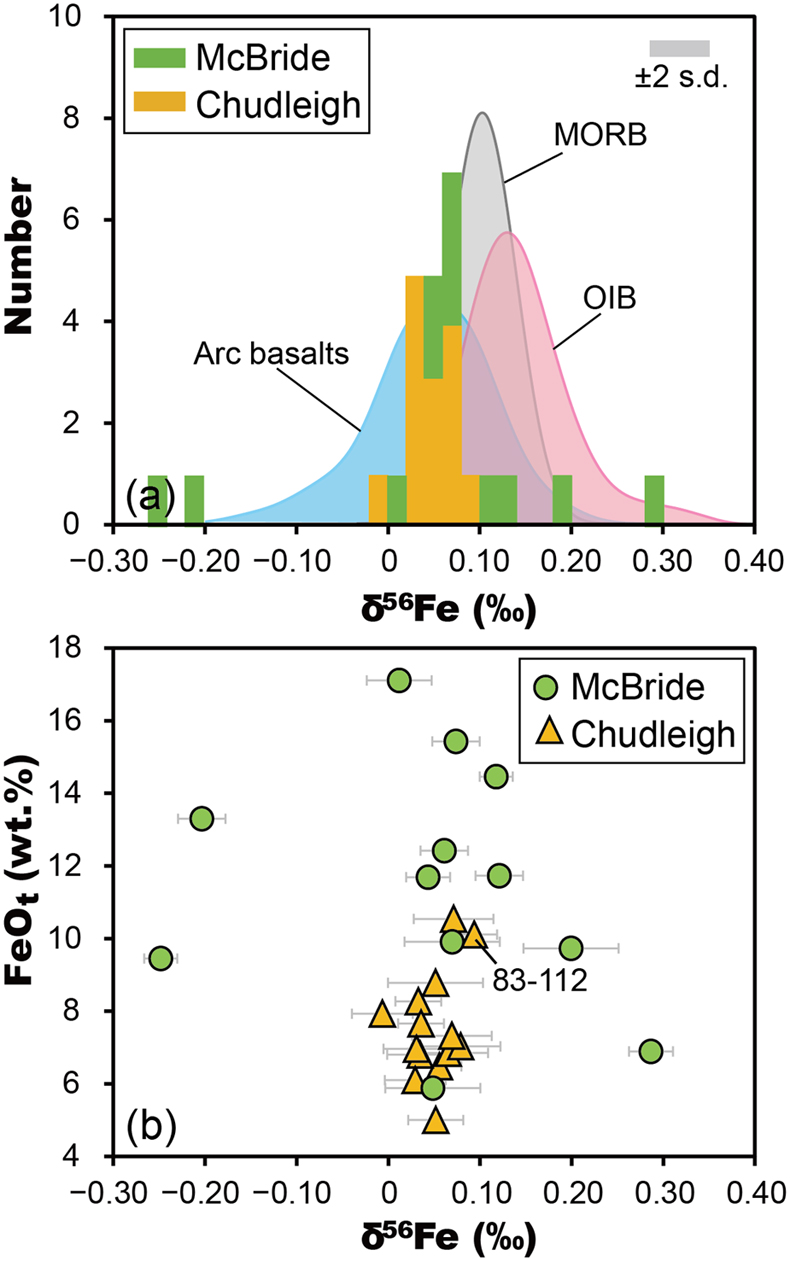
Figure 1 Fe isotopic compositions of granulite-facies xenoliths from the Chudleigh and McBride volcanic provinces, North Queensland, Australia (a), and their variations with FeOt. (b) OIBs, MORBs and arc basalts are from the compilation in Table S-3. Elemental data are from Rudnick et al. (1986)
Rudnick, R.L., McDonough, W.F., McCulloch, M.T., Taylor, S.R. (1986) Lower crustal xenoliths from Queensland, Australia: Evidence for deep crustal assimilation and fractionation of continental basalts. Geochemica et Cosmochimica Acta 50, 1099–1115. https://doi.org/10.1016/0016-7037(86)90391-1
and Rudnick and Taylor (1987)Rudnick, R.L., Taylor, S.R. (1987) The composition and petrogenesis of the lower crust: a xenolith study. Journal of Geophysical Research 92, 13981–14005. https://doi.org/10.1029/JB092iB13p13981
. Error bars are 2 sigma for δ56Fe.
Figure 2 Plot of δ56Fe vs. δ26Mg for McBride and Chudleigh granulite xenoliths. Mg isotopic data are from Teng et al. (2013b)
Teng, F.-Z., Yang, W., Rudnick, R.L., Hu, Y. (2013b) Heterogeneous magnesium isotopic composition of the lower continental crust: A xenolith perspective. Geochemistry, Geophysics, Geosystems 14, 3844–3856. https://doi.org/10.1002/ggge.20238
. Symbols marked by sample numbers are the samples that likely have been affected by Fe-Mg interdiffusion. Red lines with labelled slopes represent the projection of Fe-Mg nterdiffusion following the equation (, where Fe/Mg is a mole ratio) from Dauphas et al. (2010)Dauphas, N., Teng, F.-Z., Arndt, N.T. (2010) Magnesium and iron isotopes in 2.7 Ga Alexo komatiites: Mantle signatures, no evidence for Soret diffusion, and identification of diffusive transport in zoned olivine. Geochimica et Cosmochimica Acta 74, 3274–3291. https://doi.org/10.1016/j.gca.2010.02.031
. Error bars are 2 sigma for δ56Fe and 2 s.d. for δ26Mg.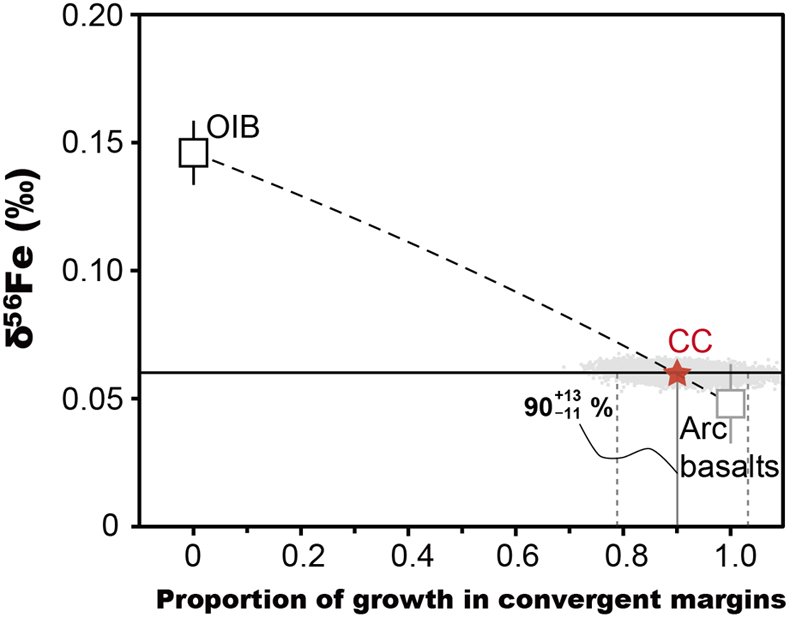
Figure 3 Proportion of continental crustal growth due to convergent margin vs. intraplate magmatism estimated from the Fe isotope budget of the continental crust. Mean compositions of arc basalts and ocean island basalts (OIBs) are from the compilation in Table S-3. The proportion was calculated based on binary mixing (e.g., the black dashed line), with the uncertainty constrained by Monte Carlo simulations (Supplementary Information). Results of representative Monte Carlo runs (i.e. the first 104 runs) are plotted as grey dots.