



The stable carbon isotope fractionation of methanogenesis products at complete carbon consumption
Affiliations | Corresponding Author | Cite as | Funding information
Published by the European Association of Geochemistry
under Creative Commons License CC BY 4.0
Keywords: carbon, isotopes, methanogenesis, carbon limitation, methane, biomass, lipids, hydrogenotrophic, carbon dioxide, isotope fractionation


- Share this article


-
Article views:1,907Cumulative count of HTML views and PDF downloads.
- Download Citation
- Rights & Permissions

top
Abstract
Figures and Tables
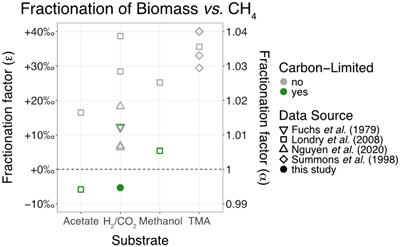 Figure 1 Carbon isotope fractionation between bulk biomass and methane from lab grown methanogens. TMA: trimethylamine. | 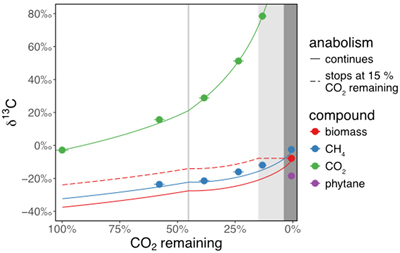 Figure 2 NLS model of CO2 distillation during methanogenesis with δ13C of substrate and accumulated products plotted against % CO2 remaining over the course of culture growth. Lines represent modelled trends and points represent data from this study. The grey vertical line represents the step increase in metabolic fractionation that best fits the data (see text). The dark grey area represents stationary phase. The light grey area represents the stop of anabolism in the adapted model. Horizontal error bars represent standard errors. Vertical error bars are smaller than symbol sizes (Table 1). | 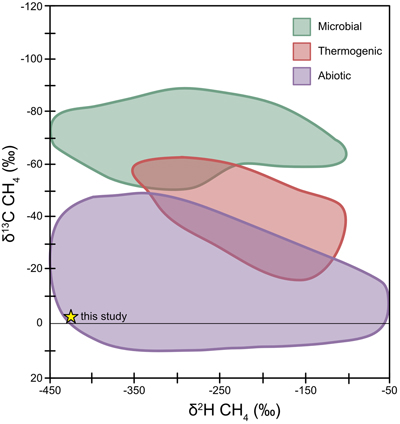 Figure 3 δ13C vs. δ2H plot of CH4 based on Wilkes (2020) with data from Whiticar (1999); Etiope et al. (2016); Milkov and Etiope (2018); Miller et al., (2018), and this study (yellow star). | 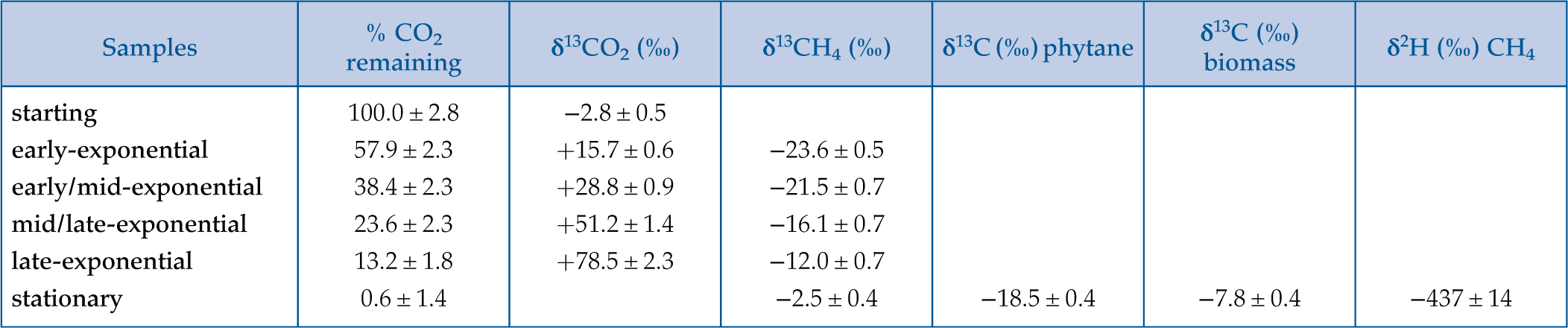 Table 1 δ13C and δ2H of methanogenesis products during complete carbon consumption. Stationary measurements represent 3 replicate cultures. All other measurements represent 1 culture. Errors represent the propagated standard error of the mean. |
| Figure 1 | Figure 2 | Figure 3 | Table 1 |
top
Introduction
Methane is an important energy source, greenhouse gas, and potential biosignature on Earth and other planetary bodies including Mars and Enceladus (Schulte et al., 2006
Schulte, M., Blake, D., Hoehler, T., McCollom, T. (2006) Serpentinization and Its Implications for Life on the Early Earth and Mars. Astrobiology 6, 364–376. https://doi.org/10.1089/ast.2006.6.364
; Waite et al., 2017Waite, H.J., Glein, C.R., Perryman, R.S., Teolis, B.D., Magee, B.A., Miller, G., Grimes, J., Perry, M.E., Miller, K.E., Bouquet, A., Lunine, J.I., Brockwell, T., Bolton, S.J. (2017) Cassini Finds Molecular Hydrogen in the Enceladus Plume: Evidence for Hydrothermal Processes. Science 356, 155–159. https://doi.org/10.1126/science.aai8703.
). The stable isotope composition of methane is often used to distinguish between abiotic, thermogenic, and microbial sources on Earth (Schoell, 1980Schoell, M. (1980) The Hydrogen and Carbon Isotopic Composition of Methane from Natural Gases of Various Origins. Geochimica et Cosmochimica Acta 44, 649–661. https://doi.org/10.1016/0016-7037(80)90155-6
). However, there is ongoing debate about the isotopic range that is possible in biogenic methane (Etiope and Sherwood-Lollar, 2013)Etiope, G., Sherwood-Lollar, B. (2013) Abiotic methane on earth. Reviews of Geophysics 51, 276–299. https://doi.org/10.1002/rog.20011
, complicating interpretation of methane sources in disciplines such as natural gas exploration, origin of life studies, and extraterrestrial life detection.Hydrogenotrophic methanogenesis, or the oxidation of H2 to reduce CO2 to CH4, is the autotrophic mode of growth and most relevant methanogenesis pathway regarding the study of early Earth and the search for extraterrestrial life (Schulte et al., 2006
Schulte, M., Blake, D., Hoehler, T., McCollom, T. (2006) Serpentinization and Its Implications for Life on the Early Earth and Mars. Astrobiology 6, 364–376. https://doi.org/10.1089/ast.2006.6.364
). Hydrogenotrophic methanogenesis usually results in methane with a δ13C range of −110 ‰ to −60 ‰ (Elvert et al., 1999Elvert, M., Suess, E., Whiticar, M.J. (1999) Anaerobic Methane Oxidation Associated with Marine Gas Hydrates: Superlight C-Isotopes from Saturated and Unsaturated C 20 and C 25 Irregular Isoprenoids. Naturwissenschaften 86, 295–300. https://doi.org/10.1007/s001140050619
; Conrad et al., 2011Conrad, R., Noll, M., Claus, P., Klose, M., Bastos, W. R., Enrich-Prast, A. (2011) Stable Carbon Isotope Discrimination and Microbiology of Methane Formation in Tropical Anoxic Lake Sediments. Biogeosciences 8, 795–814. https://doi.org/10.5194/bg-8-795-2011
). Factors including environmental stress, substrate availability, and metabolic reversibility control where biogenic methane plots within this range (Fuchs et al., 1979Fuchs, G., Thauer, R., Ziegler, H., Stichler, W. (1979) Carbon Isotope Fractionation by Methanobacterium Thermoautotrophicum. Archives of Microbiology 120, 135–139. https://doi.org/10.1007/BF00409099
; Valentine et al., 2004Valentine, D.L., Chidthaisong, A., Rice, A., Reeburgh, W.S., Tyler, S.C. (2004) Carbon and Hydrogen Isotope Fractionation by Moderately Thermophilic Methanogens 1. Geochimica et Cosmochimica Acta 68, 1571–1590. https://doi.org/10.1016/j.gca.2003.10.012
) with metabolic net fractionation (ɛ13C) estimated to range between 20 ‰ to −106 ‰ (Gropp et al., 2021Gropp, J., Iron, M.A., Halevy, I. (2021) Theoretical estimates of equilibrium carbon and hydrogen isotope effects in microbial methane production and anaerobic oxidation of methane. Geochimica et Cosmochimica Acta 295, 237–264. https://doi.org/10.1016/j.gca.2020.10.018
). In contrast, abiotic environmental methane is more 13C enriched, with values as depleted as −47 ‰ to enriched positive values (Etiope and Sherwood-Lollar, 2013Etiope, G., Sherwood-Lollar, B. (2013) Abiotic methane on earth. Reviews of Geophysics 51, 276–299. https://doi.org/10.1002/rog.20011
).One example of environments where the source of methane remains ambiguous includes serpentinising systems, where water-rock reactions produce H2 and CH4 and cause extreme carbon limitation due to high alkalinity (Nothaft et al., 2021
Nothaft, D.B., Templeton, A.S., Rhim, J.H., Wang, D.T., Labidi, J., Miller, H.M., Boyd, E.S., Matter, J.M., Ono, S., Young, E.D., Kopf, S.H., Kelemen, P.B., Conrad, M.E., The Oman Drilling Project Science Team. (2021) Geochemical, Biological, and Clumped Isotopologue Evidence for Substantial Microbial Methane Production Under Carbon Limitation in Serpentinites of the Samail Ophiolite, Oman. Journal of Geophysical Research: Biogeosciences 126, e2020JG006025. https://doi.org/10.1029/2020JG006025
). The δ13C of CO2/DIC found in natural serpentinites with high H2 concentrations is −1.08 ‰ to −25.3 ‰ and methane detected in these systems can be relatively enriched in 13C when compared to most natural environments, with δ13C values as positive as +5 ‰ (Etiope and Sherwood-Lollar, 2013Etiope, G., Sherwood-Lollar, B. (2013) Abiotic methane on earth. Reviews of Geophysics 51, 276–299. https://doi.org/10.1002/rog.20011
; Etiope et al., 2016Etiope, G., Vadillo, I., Whiticar, M.J., Marques, J.M., Carreira, P.M., Tiago, I., Benavente, J., Jiménez, P., Urresti, B. (2016) Abiotic Methane Seepage in the Ronda Peridotite Massif, Southern Spain. Applied Geochemistry 66, 101–113. https://doi.org/10.1016/j.apgeochem.2015.12.001
; Miller et al., 2016Miller, H.M., Matter, J.M., Kelemen, P., Ellison, E.T., Conrad, M.E., Fierer, N., Ruchala, T., Tominaga, M., Templeton, A.S. (2016) Modern Water/Rock Reactions in Oman Hyperalkaline Peridotite Aquifers and Implications for Microbial Habitability. Geochimica et Cosmochimica Acta 179, 217–241. https://doi.org/10.1016/j.gca.2016.01.033
; Nothaft et al., 2021Nothaft, D.B., Templeton, A.S., Rhim, J.H., Wang, D.T., Labidi, J., Miller, H.M., Boyd, E.S., Matter, J.M., Ono, S., Young, E.D., Kopf, S.H., Kelemen, P.B., Conrad, M.E., The Oman Drilling Project Science Team. (2021) Geochemical, Biological, and Clumped Isotopologue Evidence for Substantial Microbial Methane Production Under Carbon Limitation in Serpentinites of the Samail Ophiolite, Oman. Journal of Geophysical Research: Biogeosciences 126, e2020JG006025. https://doi.org/10.1029/2020JG006025
). The seemingly abiotic signal of methane in these serpentinites has sparked debate regarding the potential contribution of microbial methanogenesis since autotrophic methanogens have also been found in these systems (Miller et al., 2016Miller, H.M., Matter, J.M., Kelemen, P., Ellison, E.T., Conrad, M.E., Fierer, N., Ruchala, T., Tominaga, M., Templeton, A.S. (2016) Modern Water/Rock Reactions in Oman Hyperalkaline Peridotite Aquifers and Implications for Microbial Habitability. Geochimica et Cosmochimica Acta 179, 217–241. https://doi.org/10.1016/j.gca.2016.01.033
, 2018Miller, H.M., Chaudhry, N., Conrad, M.E., Bill, M., Kopf, S.H., Templeton, A.S. (2018) Large Carbon Isotope Variability during Methanogenesis under Alkaline Conditions. Geochimica et Cosmochimica Acta 237, 18–31. https://doi.org/10.1016/j.gca.2018.06.007
; Nothaft et al., 2021Nothaft, D.B., Templeton, A.S., Rhim, J.H., Wang, D.T., Labidi, J., Miller, H.M., Boyd, E.S., Matter, J.M., Ono, S., Young, E.D., Kopf, S.H., Kelemen, P.B., Conrad, M.E., The Oman Drilling Project Science Team. (2021) Geochemical, Biological, and Clumped Isotopologue Evidence for Substantial Microbial Methane Production Under Carbon Limitation in Serpentinites of the Samail Ophiolite, Oman. Journal of Geophysical Research: Biogeosciences 126, e2020JG006025. https://doi.org/10.1029/2020JG006025
). In theory, methanogens will produce methane with the same isotopic composition as the starting CO2 at complete DIC consumption (Meister et al., 2019). However, the lack of net carbon isotope fractionation at complete DIC consumption has not been experimentally shown. Here, we aim to address the question whether hydrogenotrophic methanogens will actually produce isotopically heavy methane in a carbon limited system.Lipids, which are utilised by all terrestrial life for energy storage and the construction of cellular membranes, are the most chemically stable polymer and can be preserved for over hundreds of millions of years within sediment (Sessions et al., 2004
Sessions, A.L., Sylva, S.P., Summons, R.E., Hayes, J.M. (2004) Isotopic Exchange of Carbon-Bound Hydrogen over Geologic Timescales 1 1Associate Editor: J. Horita. Geochimica et Cosmochimica Acta 68, 1545–1559. https://doi.org/10.1016/j.gca.2003.06.004
). Like methane, lipids have carbon isotope signatures that store metabolic and/or environmental information. Carbon limitation has been seen to cause a smaller depletion in δ13C of methanogen lipids when compared to carbon replete conditions, regardless of substrate (Londry et al., 2008Londry, K.L., Dawson, K.G., Grover, H.D., Summons, R.E., Bradley, A.S. (2008) Stable Carbon Isotope Fractionation between Substrates and Products of Methanosarcina Barkeri. Organic Geochemistry 39, 608–621. https://doi.org/10.1016/j.orggeochem.2008.03.002
). δ13C of lipids analysed from carbon limited serpentinising systems have shown 13C isotopic enrichment, with an average δ13C of +2 ‰ and a high of +14 ‰ compared to typically depleted values of ∼−50 ‰ or less (Bradley et al., 2009Bradley, A. S., Fredricks, H., Hinrichs, K., Summons, R.E. (2009) Structural Diversity of Diether Lipids in Carbonate Chimneys at the Lost City Hydrothermal Field. Organic Geochemistry 40, 1169–1178. https://doi.org/10.1016/j.orggeochem.2009.09.004
; Zwicker et al., 2018Zwicker, J., Birgel, D., Bach, W., Richoz, S., Smrzka, D., Grasemann, B., Gier, S., Schleper, C., Rittmann S.K.-M.R., Kosun, E., Peckmann, J. (2018) Evidence for Archaeal Methanogenesis within Veins at the Onshore Serpentinite-Hosted Chimaera Seeps, Turkey. Chemical Geology 483, 567–580. https://doi.org/10.1016/j.chemgeo.2018.03.027
). It is unknown whether lipids follow the same trend as methane with respect to carbon isotope fractionation under carbon limitation.This study thus investigates the carbon isotope composition of methane, biomass, and lipids of hydrogenotrophic methanogen Methanococcus maripaludis S2 in a closed system under DIC limitation with excess H2. We hypothesise that 13C enriched methane should form from biological activity under extreme carbon limitation, giving rise to methane with δ13C values indistinguishable from abiotic methane.
top
Methods
Experimental setup. Anaerobic batch cultures of Methanococcus maripaludis S2 were grown hydrogenotrophically in 160 mL serum vials in a modified DSMZ141 media devoid of yeast extract, cysteine, and other organic carbon sources. Cultures were given excess H2 at 20 psi (7.4 mmol) as the electron donor and 1.08 mmol inorganic carbon (NaHCO3) as the electron acceptor and sole carbon source. Cultures were continuously stirred at 625 rpm to increase the gas transfer rate between headspace and liquid. Cultures were grown at an initial pH of 6.7 and temperature of 37 °C. Optical density was measured continuously throughout growth at 630 nm. One vial was not inoculated, and the incubation was terminated immediately to capture initial DIC. Four incubations were terminated along various points of exponential growth phase. At termination, exponential cultures were injected with phosphoric acid to stop growth and release all remaining DIC into headspace. Three cultures were allowed to consume the entire DIC pool and sampled in early stationary phase. A small portion of stationary culture medium was acidified to determine if any DIC remained.
Headspace gas (CO2, CH4, and H2) from acidified samples was transferred via gas-tight syringe to sealed serum vials filled with a 30 % NaCl solution for preservation until analysis (Gan et al., 1998
Gan, J., Papiernik, S., Yates, S.R. (1998) Static Headspace and Gas Chromatographic Analysis of Fumigant Residues in Soil and Water. Journal of Agricultural and Food Chemistry 46, 986–990. https://doi.org/10.1021/jf970735w
). After headspace sampling, biomass from stationary phase cultures was pelleted and freeze dried. Biomass pellets were divided in half for bulk biomass analysis and lipid extractions. Bulk biomass was oven dried to prepare for analysis. Lipids were extracted from biomass by acidic hydrolysis methanolysis (Zhou et al., 2020Zhou, A., Weber, Y., Chiu, B.K., Elling F.J., Cobban, A.B., Pearson, A., Leavitt, W.D. (2020) Energy flux controls tetraether lipid cyclization in Sulfolobus acidocaldarius. Environmental Microbiology 22, 343–353. https://doi.org/10.1111/1462-2920.14851
). Phytane was extracted from the total lipid extract by ether cleavage and hydrogenation (Kaneko et al., 2011Kaneko, M., Kitajima, F., Naraoka, H. (2011) Stable Hydrogen Isotope Measurement of Archaeal Ether-Bound Hydrocarbons. Organic Geochemistry 42, 166–172. https://doi.org/10.1016/j.orggeochem.2010.11.002
).Sample analyses. Headspace gases (CO2, CH4, and H2) were quantified on a gas chromatograph with flame ionisation and thermal conductivity detectors (SRI GC-FID/TCD Multi-Gas #5 Configuration). δ13C of CO2 and CH4 were measured on a Picarro Ring-Down Spectrometer G2201-I and δ2H of CH4 on a gas chromatograph isotope ratio mass spectrometry system (Thermo Scientific GC TraceGas Ultra system connected to a Thermo Scientific Delta V Plus).
Bulk biomass δ13C was analysed on a Thermo Delta V continuous flow stable isotope ratio mass spectrometer attached to a Thermo Flash2000 Elemental Analyzer. Phytane was quantified on a GC flame ionisation detector (GC-FID Thermo TRACE 1310) and identified on a single quadrupole gas chromatography mass spectrometer (GC-MS Thermo ISQ LT with TRACE 1310). The δ13C of phytane was measured on a GC pyrolysis isotope ratio MS (GC IsoLink II + MAT253 Plus IRMS, Thermo Scientific).
All carbon and hydrogen isotope measurements were corrected using standards of known isotopic composition and are reported in the conventional delta notation vs. the Vienna Pee Dee Belemnite (VPDB)/Vienna Standard Mean Ocean Water (VSMOW) international scales respectively: δ13C = [13C/12C]sample/[13C/12C]VPDB − 1; δ2H = [2H/1H]sample/[2H/1H]VSMOW − 1. Observed isotope fractionation between two reservoirs is reported in alpha and epsilon notation: 13ɛa/b = 13αa/b − 1 = [13C/12C]a/[13C/12C]b − 1. δ and ɛ values reported in per mille (‰) are implicitly multiplied by a factor of 1000 (Coplen, 2011
Coplen, T.B. (2011) Guidelines and Recommended Terms for Expression of Stable‐isotope‐ratio and Gas‐ratio Measurement Results. Rapid Communications in Mass Spectrometry 25, 2538–2560. https://doi.org/10.1002/rcm.5129
).top
Results and Discussion
During methanogenesis, CO2 was fully consumed while H2 remained in excess throughout the experiment. As CO2 was consumed, the distillation process increased δ13C CO2 from −2.8 ‰ initially to +78.5 ‰ in late exponential phase (see Table 1). Conversely, methane started relatively depleted with δ13C CH4 −23.6 ‰ at the first measurement point (when ∼42 % of the CO2 was consumed) and increased to −2.5 ‰ (i.e. slightly above the starting value of CO2) at the end of the distillation when the methanogens reached stationary phase and had consumed >99 % of the CO2.
Table 1 δ13C and δ2H of methanogenesis products during complete carbon consumption. Stationary measurements represent 3 replicate cultures. All other measurements represent 1 culture. Errors represent the propagated standard error of the mean.
| Samples | % CO2 remaining | δ13CO2 (‰) | δ13CH4 (‰) | δ13C (‰) phytane | δ13C (‰) biomass | δ2H (‰) CH4 |
| starting | 100.0 ± 2.8 | −2.8 ± 0.5 | ||||
| early-exponential | 57.9 ± 2.3 | +15.7 ± 0.6 | −23.6 ± 0.5 | |||
| early/mid-exponential | 38.4 ± 2.3 | +28.8 ± 0.9 | −21.5 ± 0.7 | |||
| mid/late-exponential | 23.6 ± 2.3 | +51.2 ± 1.4 | −16.1 ± 0.7 | |||
| late-exponential | 13.2 ± 1.8 | +78.5 ± 2.3 | −12.0 ± 0.7 | |||
| stationary | 0.6 ± 1.4 | −2.5 ± 0.4 | −18.5 ± 0.4 | −7.8 ± 0.4 | −437 ± 14 |
The δ13C values for biomass and phytane measured in stationary phase were significantly more depleted than the methane that had accumulated at this point (Table 1), with 13ɛbiomass/methane = −5.3 ‰ and 13ɛphytane/methane = −16 ‰. The biomass yield estimate from isotopic mass balance of the final methane and biomass is 6.4 %, assuming no other significant sinks of carbon. This yield is lower than other estimates with abundant substrate but comparable to those with limited substrate (Londry et al., 2008
Londry, K.L., Dawson, K.G., Grover, H.D., Summons, R.E., Bradley, A.S. (2008) Stable Carbon Isotope Fractionation between Substrates and Products of Methanosarcina Barkeri. Organic Geochemistry 39, 608–621. https://doi.org/10.1016/j.orggeochem.2008.03.002
).Carbon isotope fractionation between methanogenesis products. The net carbon isotope fractionation between biomass and methane measured in stationary phase is shown in Figure 1 together with literature data.
Figure 1 Carbon isotope fractionation between bulk biomass and methane from lab grown methanogens. TMA: trimethylamine.
Overall, the data follows the trend that carbon limitation decreases the isotopic offset between biomass and methane. However, data from this study inverts the fractionation typically observed in laboratory experiments (Fuchs et al., 1979
Fuchs, G., Thauer, R., Ziegler, H., Stichler, W. (1979) Carbon Isotope Fractionation by Methanobacterium Thermoautotrophicum. Archives of Microbiology 120, 135–139. https://doi.org/10.1007/BF00409099
; Summons et al., 1998Summons, R.E., Franzmann, P.D., Nichols, P.D. (1998) Carbon Isotopic Fractionation Associated with Methylotrophic Methanogenesis. Organic Geochemistry 28, 465–475. https://doi.org/10.1016/S0146-6380(98)00011-4
; Londry et al., 2008Londry, K.L., Dawson, K.G., Grover, H.D., Summons, R.E., Bradley, A.S. (2008) Stable Carbon Isotope Fractionation between Substrates and Products of Methanosarcina Barkeri. Organic Geochemistry 39, 608–621. https://doi.org/10.1016/j.orggeochem.2008.03.002
; Nguyen et al., 2020Nguyen, T.B., Topçuoğlu, B.D., Holden, J.F., LaRowe, D.E., Lang, S.Q. (2020) Lower hydrogen flux leads to larger carbon isotopic fractionation of methane and biomarkers during hydrogenotrophic methanogenesis. Geochimica et Cosmochimica Acta 271, 212–226. https://doi.org/10.1016/j.gca.2019.11.015
): methane in our cultures is more isotopically enriched than biomass (see Fig. 1; ɛ < 0 ‰/α < 1). Fractionation between lipids and methane exhibits the same pattern (Fig. S-1).We thus observe that extreme carbon limitation in a closed system causes the isotopic signature of accumulated biomass to be more 13C depleted than methane. We hypothesise this could occur if biomass is primarily synthesised early on when there is abundant CO2 available for both catabolism and anabolism. If methanogens prioritise the energy producing catabolic pathway of methanogenesis and reduce CO2 fixation as CO2 becomes limiting, the isotopic composition of biomass remains at relatively light values compared to the still accumulating methane that is produced from the increasingly enriched residual CO2 (illustrated in Fig. 2 in the “anabolism stops” model). Although the impact of carbon limitation on biosynthesis inhibition has not been experimentally investigated in methanogens, inorganic carbon limitation has been found to increase energy producing metabolisms and decrease cell yield in ammonia oxidising bacteria to account for increased cellular maintenance energy requirements (Jiang et al., 2015
Jiang, D., Khunjar, W.O., Wett, B., Murthy, S.N., Chandran, K. (2015) Characterizing the Metabolic Trade-Off in Nitrosomonas Europaea in Response to Changes in Inorganic Carbon Supply. Environmental Science & Technology 49, 2523–2531. https://doi.org/10.1021/es5043222
; Mellbye et al., 2016Mellbye, B.L., Giguere, A., Chaplen, F., Bottomley, P.J., Sayavedra-Soto, L.A. (2016) Steady-State Growth under Inorganic Carbon Limitation Conditions Increases Energy Consumption for Maintenance and Enhances Nitrous Oxide Production in Nitrosomonas Europaea. Applied and Environmental Microbiology 82, 3310–3318. https://doi.org/10.1128/AEM.00294-16
). Additionally, hydrogenotrophic methanogens have been found to uncouple biosynthesis from methanogenesis during stressful situations, including phosphate limitation (Leigh et al., 2008Leigh, J.A., Whitman, W.B., Hackett, M. (2008) Hydrogenases of Methanococcus Maripaludis. U.S. Department of Energy. https://www.hydrogen.energy.gov/docs/hydrogenprogramlibraries/pdfs/review08/besp_1_leigh.pdf?sfvrsn=77852def_1
). As shown in Figure 2, such a decrease in biomass yield over time could cause the accumulated biomass in our experiments to be more isotopically depleted than final accumulated methane because it was predominantly produced from CO2 early during the distillation when CO2 was not yet as heavily 13C enriched. The accumulated methane is isotopically heavier than the biomass because methane generation continued when CO2 was sparse and 13C enriched from the distillation process. This interpretation implies that the δ13C of lipids and biomass may not reflect the final environmental state but rather reflect a time of high CO2 availability.Figure 2 NLS model of CO2 distillation during methanogenesis with δ13C of substrate and accumulated products plotted against % CO2 remaining over the course of culture growth. Lines represent modelled trends and points represent data from this study. The grey vertical line represents the step increase in metabolic fractionation that best fits the data (see text). The dark grey area represents stationary phase. The light grey area represents the stop of anabolism in the adapted model. Horizontal error bars represent standard errors. Vertical error bars are smaller than symbol sizes (Table 1).
Rayleigh distillation and CO2 consumption. The observed isotopic compositions of methane and CO2 fit a Rayleigh distillation model with increasing metabolic fractionation well. In its simplest form, this takes the shape of a two-step distillation process as illustrated in Figure 2 with an initial CO2-CH4 fractionation of −29.6 ± 2.3 ‰ that becomes more heavily fractionating (−44.0 ± 2.5 ‰) after ∼55 % of CO2 is consumed (all 3 parameters estimated simultaneously by non-linear least squares NLS data fitting in R; RMSE 2.2 ‰). This model reflects a closed system that starts with all the carbon as 100 % reactant (CO2) and ends with 100 % products (CH4 and biomass) and both methanogenesis and biomass production stop once all CO2 is consumed. The total biomass yield is assumed to be the 6.4 % inferred from overall isotope mass balance. As expected from a Rayleigh distillation process, residual CO2 and accumulated CH4 and biomass systematically get isotopically heavier as CO2 is consumed. The offset between the biomass and methane curves (−5.3 ‰) results from the constraint posed by the isotopic composition of the final products. At full DIC consumption, the accumulated methane is slightly enriched compared to the initial δ13C of CO2 (initial δ13CCO2 = −2.8 ‰, final δ13CCH4 = −2.5 ‰). This is the expected outcome from near complete consumption of CO2 in a closed system for the majority product. By isotope mass balance, CH4 will be necessarily enriched compared to CO2 if biomass is more depleted than CO2.
A modification of this model where anabolism stops as CO2 becomes increasingly limiting can explain the observed isotopic composition of the accumulated biomass with a positive biomass CH4 fractionation factor (ɛ > 0) that is consistent with literature data under non-carbon limiting conditions (Fig. 1). For example, if the methanogens stopped fixing carbon at a threshold of 15 % CO2 remaining (example “anabolism stops” in Fig. 2), the metabolic fractionation factor between biomass CH4 would be estimated at +8.9 ‰. The exact value of the fractionation factor depends on the threshold at which anabolism stops, which is not fully constrained by the available data (see Fig. S-2). However, based on the available literature data (Fig. 1), we hypothesise that this threshold model (“anabolism stops” in Fig. 2) is a more accurate representation of biomass fractionation, with biomass more enriched than the accumulated methane during initial metabolism until anabolism stops and the accumulated methane continuing to get more enriched from the distillation process. The resulting estimates of the methanogenesis fractionation fall into a narrow range regardless of when anabolism stops and closely match the estimates from the simpler model (“anabolism continues” in Fig. 2): the initial fractionation is −30.0 to 29.6 ‰ and increases to −45.5 to −43.7 ‰ after ∼55 % of CO2 is consumed. These CO2-CH4 fractionation factors fall well within the possible range of methanogenic fractionation (−106 ‰ to −20 ‰, Gropp et al., 2021
Gropp, J., Iron, M.A., Halevy, I. (2021) Theoretical estimates of equilibrium carbon and hydrogen isotope effects in microbial methane production and anaerobic oxidation of methane. Geochimica et Cosmochimica Acta 295, 237–264. https://doi.org/10.1016/j.gca.2020.10.018
). See SI for all equations and github.com/KopfLab/2025_batther_et_al._C_limitation for implementation.Environmental implications. These experimental findings and comparison to model predictions show that biological CH4 can span the full range of δ13C CH4 space depending on carbon availability and environmental conditions, such as hydrogen availability, rather than being constrained by the previously inferred microbial range (Fig. 3). The potential biogenicity of methane cannot be ruled out even if there is little isotopic fractionation between methane and the bulk carbon pool of any system. Rather, the lack of isotopic fractionation may be more indicative of extreme carbon limitation controlling the methane producing reaction pathway. Although such carbon limitation may be rare, environments such as serpentinising systems are an excellent example on Earth that may also be relevant to habitable rocky bodies in our solar system, and where the potential for microbial methanogenesis to produce 13C enriched methane has proven to be controversial. Therefore, the δ13C of CH4 detected in the environment cannot be the sole measurement used to determine the source of CH4, especially to rule out microbial activity. Given possible overlap with the large range of δ13C CH4 formed from Fischer-Tropsch type reactions (Etiope and Sherwood-Lollar, 2013
Etiope, G., Sherwood-Lollar, B. (2013) Abiotic methane on earth. Reviews of Geophysics 51, 276–299. https://doi.org/10.1002/rog.20011
), multiple measurements will be required to determine the biogenicity of CH4, including analysis of the Schultz-Flory distribution of higher hydrocarbons, gene sequencing, lipidomics, or clumped CH4 measurements (Nothaft et al., 2021Nothaft, D.B., Templeton, A.S., Rhim, J.H., Wang, D.T., Labidi, J., Miller, H.M., Boyd, E.S., Matter, J.M., Ono, S., Young, E.D., Kopf, S.H., Kelemen, P.B., Conrad, M.E., The Oman Drilling Project Science Team. (2021) Geochemical, Biological, and Clumped Isotopologue Evidence for Substantial Microbial Methane Production Under Carbon Limitation in Serpentinites of the Samail Ophiolite, Oman. Journal of Geophysical Research: Biogeosciences 126, e2020JG006025. https://doi.org/10.1029/2020JG006025
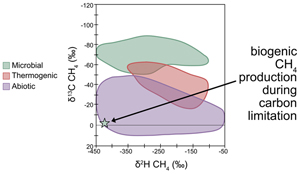
). However, if active biological CH4 production can be confirmed, then the δ13C of CH4 can be used to infer if an environment is carbon limited or carbon replete.Figure 3 δ13C vs. δ2H plot of CH4 based on Wilkes (2020)
Wilkes, H. (2020) Hydrocarbons, Oils and Lipids: Diversity, Origin, Chemistry and Fate. Cham: Springer International Publishing, Switzerland. https://doi.org/10.1007/978-3-319-90569-3
with data from Whiticar (1999)Whiticar, M.J. (1999) Carbon and Hydrogen Isotope Systematics of Bacterial Formation and Oxidation of Methane. Chemical Geology 161, 291–314. https://doi.org/10.1016/S0009-2541(99)00092-3
; Etiope et al. (2016)Etiope, G., Vadillo, I., Whiticar, M.J., Marques, J.M., Carreira, P.M., Tiago, I., Benavente, J., Jiménez, P., Urresti, B. (2016) Abiotic Methane Seepage in the Ronda Peridotite Massif, Southern Spain. Applied Geochemistry 66, 101–113. https://doi.org/10.1016/j.apgeochem.2015.12.001
; Milkov and Etiope (2018)Milkov, A.V., Etiope, G. (2018) Revised Genetic Diagrams for Natural Gases Based on a Global Dataset of >20,000 Samples. Organic Geochemistry 125, 109–120. https://doi.org/10.1016/j.orggeochem.2018.09.002
; Miller et al., (2018)Miller, H.M., Chaudhry, N., Conrad, M.E., Bill, M., Kopf, S.H., Templeton, A.S. (2018) Large Carbon Isotope Variability during Methanogenesis under Alkaline Conditions. Geochimica et Cosmochimica Acta 237, 18–31. https://doi.org/10.1016/j.gca.2018.06.007
, and this study (yellow star).top
Conclusion
This study experimentally demonstrates the impact of full carbon consumption on the carbon isotope signatures of CH4, biomass, and lipids accumulated during purely autotrophic methanogenesis. The data show that carbon limitation causes accumulated CH4 to isotopically reflect initial CO2, which is supported by our Rayleigh Distillation model and has only been previously theorised. This can result in the production of biogenic methane tens of per mille more positive than traditionally assumed. Such 13C enriched biogenic methane contains valuable information about the extent of C limitation, which is rarely utilised in environmental assessments. Instead, the detection of 13C enriched methane has typically been attributed to abiotic sources, which may sometimes be erroneous. Additionally, we see a greater depletion of δ13C biomass/lipids relative to CH4 than expected, which could be caused by the inhibition of anabolism by carbon limitation and is an important physiological response worthy of further investigation. In summary, the data support the concept that biogenic methane, biomass, and lipid δ13C values predicted for natural environments need to be significantly expanded to include the impact of extreme carbon limitation on isotope fractionation.
top
Acknowledgements
This work was supported by NASA Exobiology Program award #21-EXO21-0055, “Methanogenic Activity And Isotopic Biosignatures Under Carbon Limitation”. The work at Lawrence Berkeley National Laboratory is supported by U.S. Department of Energy, Office of Science, Office of Basic Energy Sciences, Chemical Sciences, Geosciences, and Biosciences Division, under Award Numbers DE-AC02-05CH11231. We acknowledge the analytical contributions of the CU Boulder Earth Systems Stable Isotope Lab (CUBES-SIL) Core Facility (RRID:SCR_019300). Publication of this article was funded by the University of Colorado Boulder Libraries Open Access Fund.
Editor: Eric H. Oelkers
top
References
Bradley, A. S., Fredricks, H., Hinrichs, K., Summons, R.E. (2009) Structural Diversity of Diether Lipids in Carbonate Chimneys at the Lost City Hydrothermal Field. Organic Geochemistry 40, 1169–1178. https://doi.org/10.1016/j.orggeochem.2009.09.004
 Show in context
 δ13C of lipids analysed from carbon limited serpentinising systems have shown 13C isotopic enrichment, with an average δ13C of +2 ‰ and a high of +14 ‰ compared to typically depleted values of ∼−50 ‰ or less (Bradley et al., 2009; Zwicker et al., 2018).
View in article
Conrad, R., Noll, M., Claus, P., Klose, M., Bastos, W. R., Enrich-Prast, A. (2011) Stable Carbon Isotope Discrimination and Microbiology of Methane Formation in Tropical Anoxic Lake Sediments. Biogeosciences 8, 795–814. https://doi.org/10.5194/bg-8-795-2011
Show in context Hydrogenotrophic methanogenesis usually results in methane with a δ13C range of −110 ‰ to −60 ‰ (Elvert et al., 1999; Conrad et al., 2011).
View in article
Coplen, T.B. (2011) Guidelines and Recommended Terms for Expression of Stable‐isotope‐ratio and Gas‐ratio Measurement Results. Rapid Communications in Mass Spectrometry 25, 2538–2560. https://doi.org/10.1002/rcm.5129
Show in context Observed isotope fractionation between two reservoirs is reported in alpha and epsilon notation: 13ɛa/b = 13αa/b − 1 = [13C/12C]a/[13C/12C]b − 1. δ and ɛ values reported in per mille (‰) are implicitly multiplied by a factor of 1000 (Coplen, 2011).
View in article
Elvert, M., Suess, E., Whiticar, M.J. (1999) Anaerobic Methane Oxidation Associated with Marine Gas Hydrates: Superlight C-Isotopes from Saturated and Unsaturated C 20 and C 25 Irregular Isoprenoids. Naturwissenschaften 86, 295–300. https://doi.org/10.1007/s001140050619
Show in context Hydrogenotrophic methanogenesis usually results in methane with a δ13C range of −110 ‰ to −60 ‰ (Elvert et al., 1999; Conrad et al., 2011).
View in article
Etiope, G., Sherwood-Lollar, B. (2013) Abiotic methane on earth. Reviews of Geophysics 51, 276–299. https://doi.org/10.1002/rog.20011
Show in context However, there is ongoing debate about the isotopic range that is possible in biogenic methane (Etiope and Sherwood-Lollar, 2013), complicating interpretation of methane sources in disciplines such as natural gas exploration, origin of life studies, and extraterrestrial life detection.
View in article
In contrast, abiotic environmental methane is more 13C enriched, with values as depleted as −47 ‰ to enriched positive values (Etiope and Sherwood-Lollar, 2013).
View in article
The δ13C of CO2/DIC found in natural serpentinites with high H2 concentrations is −1.08 ‰ to −25.3 ‰ and methane detected in these systems can be relatively enriched in 13C when compared to most natural environments, with δ13C values as positive as +5 ‰ (Etiope and Sherwood-Lollar, 2013; Etiope et al., 2016; Miller et al., 2016; Nothaft et al., 2021).
View in article
Given possible overlap with the large range of δ13C CH4 formed from Fischer-Tropsch type reactions (Etiope and Sherwood-Lollar, 2013), multiple measurements will be required to determine the biogenicity of CH4, including analysis of the Schultz-Flory distribution of higher hydrocarbons, gene sequencing, lipidomics, or clumped CH4 measurements (Nothaft et al., 2021).
View in article
Etiope, G., Vadillo, I., Whiticar, M.J., Marques, J.M., Carreira, P.M., Tiago, I., Benavente, J., Jiménez, P., Urresti, B. (2016) Abiotic Methane Seepage in the Ronda Peridotite Massif, Southern Spain. Applied Geochemistry 66, 101–113. https://doi.org/10.1016/j.apgeochem.2015.12.001
Show in context The δ13C of CO2/DIC found in natural serpentinites with high H2 concentrations is −1.08 ‰ to −25.3 ‰ and methane detected in these systems can be relatively enriched in 13C when compared to most natural environments, with δ13C values as positive as +5 ‰ (Etiope and Sherwood-Lollar, 2013; Etiope et al., 2016; Miller et al., 2016; Nothaft et al., 2021).
View in article
δ13C vs. δ2H plot of CH4 based on Wilkes (2020) with data from Whiticar (1999); Etiope et al. (2016); Milkov and Etiope (2018); Miller et al., (2018), and this study (yellow star).
View in article
Fuchs, G., Thauer, R., Ziegler, H., Stichler, W. (1979) Carbon Isotope Fractionation by Methanobacterium Thermoautotrophicum. Archives of Microbiology 120, 135–139. https://doi.org/10.1007/BF00409099
Show in context Factors including environmental stress, substrate availability, and metabolic reversibility control where biogenic methane plots within this range (Fuchs et al., 1979; Valentine et al., 2004) with metabolic net fractionation (ɛ13C) estimated to range between 20 ‰ to −106 ‰ (Gropp et al., 2021).
View in article
However, data from this study inverts the fractionation typically observed in laboratory experiments (Fuchs et al., 1979; Summons et al., 1998; Londry et al., 2008; Nguyen et al., 2020): methane in our cultures is more isotopically enriched than biomass (see Fig. 1; ɛ < 0 ‰/α < 1).
View in article
Gan, J., Papiernik, S., Yates, S.R. (1998) Static Headspace and Gas Chromatographic Analysis of Fumigant Residues in Soil and Water. Journal of Agricultural and Food Chemistry 46, 986–990. https://doi.org/10.1021/jf970735w
Show in context Headspace gas (CO2, CH4, and H2) from acidified samples was transferred via gas-tight syringe to sealed serum vials filled with a 30 % NaCl solution for preservation until analysis (Gan et al., 1998).
View in article
Gropp, J., Iron, M.A., Halevy, I. (2021) Theoretical estimates of equilibrium carbon and hydrogen isotope effects in microbial methane production and anaerobic oxidation of methane. Geochimica et Cosmochimica Acta 295, 237–264. https://doi.org/10.1016/j.gca.2020.10.018
Show in context Factors including environmental stress, substrate availability, and metabolic reversibility control where biogenic methane plots within this range (Fuchs et al., 1979; Valentine et al., 2004) with metabolic net fractionation (ɛ13C) estimated to range between 20 ‰ to −106 ‰ (Gropp et al., 2021).
View in article
Jiang, D., Khunjar, W.O., Wett, B., Murthy, S.N., Chandran, K. (2015) Characterizing the Metabolic Trade-Off in Nitrosomonas Europaea in Response to Changes in Inorganic Carbon Supply. Environmental Science & Technology 49, 2523–2531. https://doi.org/10.1021/es5043222
Show in context Although the impact of carbon limitation on biosynthesis inhibition has not been experimentally investigated in methanogens, inorganic carbon limitation has been found to increase energy producing metabolisms and decrease cell yield in ammonia oxidising bacteria to account for increased cellular maintenance energy requirements (Jiang et al., 2015; Mellbye et al., 2016).
View in article
Kaneko, M., Kitajima, F., Naraoka, H. (2011) Stable Hydrogen Isotope Measurement of Archaeal Ether-Bound Hydrocarbons. Organic Geochemistry 42, 166–172. https://doi.org/10.1016/j.orggeochem.2010.11.002
Show in context Phytane was extracted from the total lipid extract by ether cleavage and hydrogenation (Kaneko et al., 2011).
View in article
Leigh, J.A., Whitman, W.B., Hackett, M. (2008) Hydrogenases of Methanococcus Maripaludis. U.S. Department of Energy. https://www.hydrogen.energy.gov/docs/hydrogenprogramlibraries/pdfs/review08/besp_1_leigh.pdf?sfvrsn=77852def_1
Show in context Additionally, hydrogenotrophic methanogens have been found to uncouple biosynthesis from methanogenesis during stressful situations, including phosphate limitation (Leigh et al., 2008).
View in article
Londry, K.L., Dawson, K.G., Grover, H.D., Summons, R.E., Bradley, A.S. (2008) Stable Carbon Isotope Fractionation between Substrates and Products of Methanosarcina Barkeri. Organic Geochemistry 39, 608–621. https://doi.org/10.1016/j.orggeochem.2008.03.002
Show in context Carbon limitation has been seen to cause a smaller depletion in δ13C of methanogen lipids when compared to carbon replete conditions, regardless of substrate (Londry et al., 2008).
View in article
This yield is lower than other estimates with abundant substrate but comparable to those with limited substrate (Londry et al., 2008).
View in article
However, data from this study inverts the fractionation typically observed in laboratory experiments (Fuchs et al., 1979; Summons et al., 1998; Londry et al., 2008; Nguyen et al., 2020): methane in our cultures is more isotopically enriched than biomass (see Fig. 1; ɛ < 0 ‰/α < 1).
View in article
Meister, P., Wiedling, J., Lott, C., Bach, W., Kuhfuß, H., Wegener, G., Böttcher, M. E., Deusner, C., Lichtschlag, A., Bernasconi, S. M., Weber, M. (2018) Anaerobic methane oxidation inducing carbonate precipitation at abiogenic methane seeps in the Tuscan archipelago (Italy). PLoS ONE 13, e0207305. https://doi.org/10.1371/journal.pone.0207305
Mellbye, B.L., Giguere, A., Chaplen, F., Bottomley, P.J., Sayavedra-Soto, L.A. (2016) Steady-State Growth under Inorganic Carbon Limitation Conditions Increases Energy Consumption for Maintenance and Enhances Nitrous Oxide Production in Nitrosomonas Europaea. Applied and Environmental Microbiology 82, 3310–3318. https://doi.org/10.1128/AEM.00294-16
Show in context Although the impact of carbon limitation on biosynthesis inhibition has not been experimentally investigated in methanogens, inorganic carbon limitation has been found to increase energy producing metabolisms and decrease cell yield in ammonia oxidising bacteria to account for increased cellular maintenance energy requirements (Jiang et al., 2015; Mellbye et al., 2016).
View in article
Milkov, A.V., Etiope, G. (2018) Revised Genetic Diagrams for Natural Gases Based on a Global Dataset of >20,000 Samples. Organic Geochemistry 125, 109–120. https://doi.org/10.1016/j.orggeochem.2018.09.002
Show in context δ13C vs. δ2H plot of CH4 based on Wilkes (2020) with data from Whiticar (1999); Etiope et al. (2016); Milkov and Etiope (2018); Miller et al., (2018), and this study (yellow star).
View in article
Miller, H.M., Matter, J.M., Kelemen, P., Ellison, E.T., Conrad, M.E., Fierer, N., Ruchala, T., Tominaga, M., Templeton, A.S. (2016) Modern Water/Rock Reactions in Oman Hyperalkaline Peridotite Aquifers and Implications for Microbial Habitability. Geochimica et Cosmochimica Acta 179, 217–241. https://doi.org/10.1016/j.gca.2016.01.033
Show in context The δ13C of CO2/DIC found in natural serpentinites with high H2 concentrations is −1.08 ‰ to −25.3 ‰ and methane detected in these systems can be relatively enriched in 13C when compared to most natural environments, with δ13C values as positive as +5 ‰ (Etiope and Sherwood-Lollar, 2013; Etiope et al., 2016; Miller et al., 2016; Nothaft et al., 2021).
View in article
The seemingly abiotic signal of methane in these serpentinites has sparked debate regarding the potential contribution of microbial methanogenesis since autotrophic methanogens have also been found in these systems (Miller et al., 2016, 2018; Nothaft et al., 2021).
View in article
Miller, H.M., Chaudhry, N., Conrad, M.E., Bill, M., Kopf, S.H., Templeton, A.S. (2018) Large Carbon Isotope Variability during Methanogenesis under Alkaline Conditions. Geochimica et Cosmochimica Acta 237, 18–31. https://doi.org/10.1016/j.gca.2018.06.007
Show in context The seemingly abiotic signal of methane in these serpentinites has sparked debate regarding the potential contribution of microbial methanogenesis since autotrophic methanogens have also been found in these systems (Miller et al., 2016, 2018; Nothaft et al., 2021).
View in article
δ13C vs. δ2H plot of CH4 based on Wilkes (2020) with data from Whiticar (1999); Etiope et al. (2016); Milkov and Etiope (2018); Miller et al., (2018), and this study (yellow star).
View in article
Nothaft, D.B., Templeton, A.S., Rhim, J.H., Wang, D.T., Labidi, J., Miller, H.M., Boyd, E.S., Matter, J.M., Ono, S., Young, E.D., Kopf, S.H., Kelemen, P.B., Conrad, M.E., The Oman Drilling Project Science Team. (2021) Geochemical, Biological, and Clumped Isotopologue Evidence for Substantial Microbial Methane Production Under Carbon Limitation in Serpentinites of the Samail Ophiolite, Oman. Journal of Geophysical Research: Biogeosciences 126, e2020JG006025. https://doi.org/10.1029/2020JG006025
Show in context One example of environments where the source of methane remains ambiguous includes serpentinising systems, where water-rock reactions produce H2 and CH4 and cause extreme carbon limitation due to high alkalinity (Nothaft et al., 2021).
View in article
The δ13C of CO2/DIC found in natural serpentinites with high H2 concentrations is −1.08 ‰ to −25.3 ‰ and methane detected in these systems can be relatively enriched in 13C when compared to most natural environments, with δ13C values as positive as +5 ‰ (Etiope and Sherwood-Lollar, 2013; Etiope et al., 2016; Miller et al., 2016; Nothaft et al., 2021).
View in article
The seemingly abiotic signal of methane in these serpentinites has sparked debate regarding the potential contribution of microbial methanogenesis since autotrophic methanogens have also been found in these systems (Miller et al., 2016, 2018; Nothaft et al., 2021).
View in article
Given possible overlap with the large range of δ13C CH4 formed from Fischer-Tropsch type reactions (Etiope and Sherwood-Lollar, 2013), multiple measurements will be required to determine the biogenicity of CH4, including analysis of the Schultz-Flory distribution of higher hydrocarbons, gene sequencing, lipidomics, or clumped CH4 measurements (Nothaft et al., 2021).
View in article
Nguyen, T.B., Topçuoğlu, B.D., Holden, J.F., LaRowe, D.E., Lang, S.Q. (2020) Lower hydrogen flux leads to larger carbon isotopic fractionation of methane and biomarkers during hydrogenotrophic methanogenesis. Geochimica et Cosmochimica Acta 271, 212–226. https://doi.org/10.1016/j.gca.2019.11.015
Show in context However, data from this study inverts the fractionation typically observed in laboratory experiments (Fuchs et al., 1979; Summons et al., 1998; Londry et al., 2008; Nguyen et al., 2020): methane in our cultures is more isotopically enriched than biomass (see Fig. 1; ɛ < 0 ‰/α < 1).
View in article
Schoell, M. (1980) The Hydrogen and Carbon Isotopic Composition of Methane from Natural Gases of Various Origins. Geochimica et Cosmochimica Acta 44, 649–661. https://doi.org/10.1016/0016-7037(80)90155-6
Show in context The stable isotope composition of methane is often used to distinguish between abiotic, thermogenic, and microbial sources on Earth (Schoell, 1980).
View in article
Schulte, M., Blake, D., Hoehler, T., McCollom, T. (2006) Serpentinization and Its Implications for Life on the Early Earth and Mars. Astrobiology 6, 364–376. https://doi.org/10.1089/ast.2006.6.364
Show in context Methane is an important energy source, greenhouse gas, and potential biosignature on Earth and other planetary bodies including Mars and Enceladus (Schulte et al., 2006; Waite et al., 2017).
View in article
Hydrogenotrophic methanogenesis, or the oxidation of H2 to reduce CO2 to CH4, is the autotrophic mode of growth and most relevant methanogenesis pathway regarding the study of early Earth and the search for extraterrestrial life (Schulte et al., 2006).
View in article
Sessions, A.L., Sylva, S.P., Summons, R.E., Hayes, J.M. (2004) Isotopic Exchange of Carbon-Bound Hydrogen over Geologic Timescales 1 1Associate Editor: J. Horita. Geochimica et Cosmochimica Acta 68, 1545–1559. https://doi.org/10.1016/j.gca.2003.06.004
Show in context Lipids, which are utilised by all terrestrial life for energy storage and the construction of cellular membranes, are the most chemically stable polymer and can be preserved for over hundreds of millions of years within sediment (Sessions et al., 2004).
View in article
Summons, R.E., Franzmann, P.D., Nichols, P.D. (1998) Carbon Isotopic Fractionation Associated with Methylotrophic Methanogenesis. Organic Geochemistry 28, 465–475. https://doi.org/10.1016/S0146-6380(98)00011-4
Show in context However, data from this study inverts the fractionation typically observed in laboratory experiments (Fuchs et al., 1979; Summons et al., 1998; Londry et al., 2008; Nguyen et al., 2020): methane in our cultures is more isotopically enriched than biomass (see Fig. 1; ɛ < 0 ‰/α < 1).
View in article
Valentine, D.L., Chidthaisong, A., Rice, A., Reeburgh, W.S., Tyler, S.C. (2004) Carbon and Hydrogen Isotope Fractionation by Moderately Thermophilic Methanogens 1. Geochimica et Cosmochimica Acta 68, 1571–1590. https://doi.org/10.1016/j.gca.2003.10.012
Show in context Factors including environmental stress, substrate availability, and metabolic reversibility control where biogenic methane plots within this range (Fuchs et al., 1979; Valentine et al., 2004) with metabolic net fractionation (ɛ13C) estimated to range between 20 ‰ to −106 ‰ (Gropp et al., 2021).
View in article
Waite, H.J., Glein, C.R., Perryman, R.S., Teolis, B.D., Magee, B.A., Miller, G., Grimes, J., Perry, M.E., Miller, K.E., Bouquet, A., Lunine, J.I., Brockwell, T., Bolton, S.J. (2017) Cassini Finds Molecular Hydrogen in the Enceladus Plume: Evidence for Hydrothermal Processes. Science 356, 155–159. https://doi.org/10.1126/science.aai8703.
Show in context Methane is an important energy source, greenhouse gas, and potential biosignature on Earth and other planetary bodies including Mars and Enceladus (Schulte et al., 2006; Waite et al., 2017).
View in article
Whiticar, M.J. (1999) Carbon and Hydrogen Isotope Systematics of Bacterial Formation and Oxidation of Methane. Chemical Geology 161, 291–314. https://doi.org/10.1016/S0009-2541(99)00092-3
Show in context δ13C vs. δ2H plot of CH4 based on Wilkes (2020) with data from Whiticar (1999); Etiope et al. (2016); Milkov and Etiope (2018); Miller et al., (2018), and this study (yellow star).
View in article
Wilkes, H. (2020) Hydrocarbons, Oils and Lipids: Diversity, Origin, Chemistry and Fate. Cham: Springer International Publishing, Switzerland. https://doi.org/10.1007/978-3-319-90569-3
Show in context δ13C vs. δ2H plot of CH4 based on Wilkes (2020) with data from Whiticar (1999); Etiope et al. (2016); Milkov and Etiope (2018); Miller et al., (2018), and this study (yellow star).
View in article
Zhou, A., Weber, Y., Chiu, B.K., Elling F.J., Cobban, A.B., Pearson, A., Leavitt, W.D. (2020) Energy flux controls tetraether lipid cyclization in Sulfolobus acidocaldarius. Environmental Microbiology 22, 343–353. https://doi.org/10.1111/1462-2920.14851
Show in context Lipids were extracted from biomass by acidic hydrolysis methanolysis (Zhou et al., 2020).
View in article
Zwicker, J., Birgel, D., Bach, W., Richoz, S., Smrzka, D., Grasemann, B., Gier, S., Schleper, C., Rittmann S.K.-M.R., Kosun, E., Peckmann, J. (2018) Evidence for Archaeal Methanogenesis within Veins at the Onshore Serpentinite-Hosted Chimaera Seeps, Turkey. Chemical Geology 483, 567–580. https://doi.org/10.1016/j.chemgeo.2018.03.027
Show in context δ13C of lipids analysed from carbon limited serpentinising systems have shown 13C isotopic enrichment, with an average δ13C of +2 ‰ and a high of +14 ‰ compared to typically depleted values of ∼−50 ‰ or less (Bradley et al., 2009; Zwicker et al., 2018).
View in article
top
Supplementary Information
The Supplementary Information includes:
- Methods
- Calculations
- Figures S-1 and S-2
- Supplementary Information References
Download the Supplementary Information (PDF)
Figures
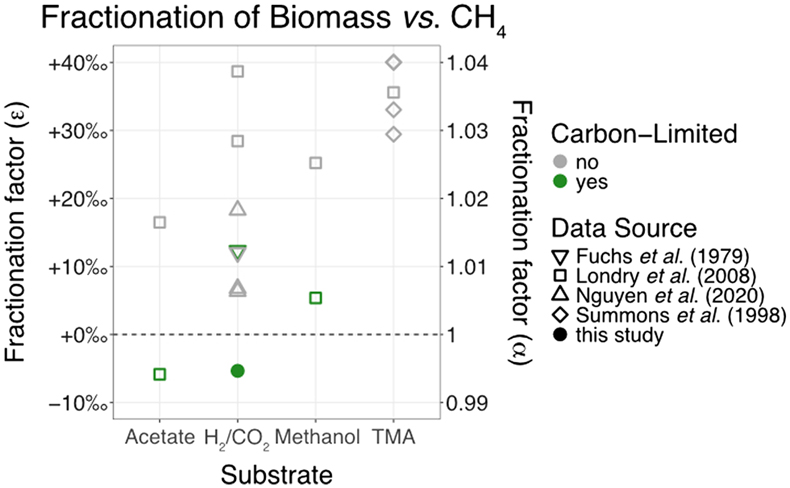
Figure 1 Carbon isotope fractionation between bulk biomass and methane from lab grown methanogens. TMA: trimethylamine.
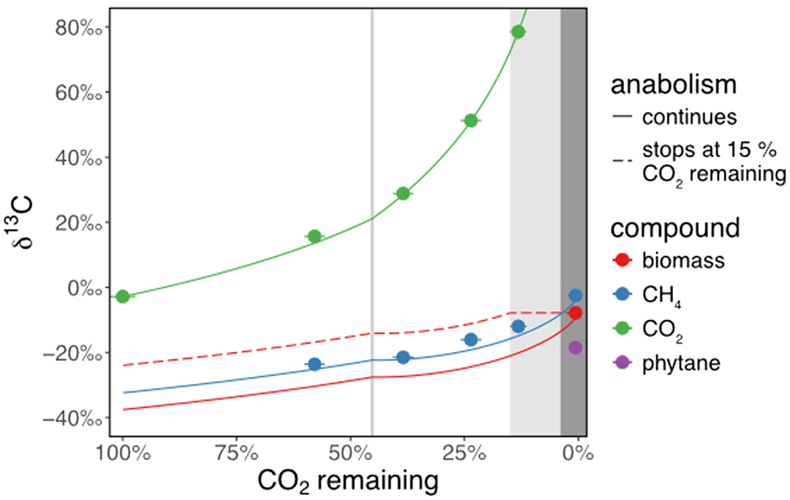
Figure 2 NLS model of CO2 distillation during methanogenesis with δ13C of substrate and accumulated products plotted against % CO2 remaining over the course of culture growth. Lines represent modelled trends and points represent data from this study. The grey vertical line represents the step increase in metabolic fractionation that best fits the data (see text). The dark grey area represents stationary phase. The light grey area represents the stop of anabolism in the adapted model. Horizontal error bars represent standard errors. Vertical error bars are smaller than symbol sizes (Table 1).

Figure 3 δ13C vs. δ2H plot of CH4 based on Wilkes (2020)
Wilkes, H. (2020) Hydrocarbons, Oils and Lipids: Diversity, Origin, Chemistry and Fate. Cham: Springer International Publishing, Switzerland. https://doi.org/10.1007/978-3-319-90569-3
with data from Whiticar (1999)Whiticar, M.J. (1999) Carbon and Hydrogen Isotope Systematics of Bacterial Formation and Oxidation of Methane. Chemical Geology 161, 291–314. https://doi.org/10.1016/S0009-2541(99)00092-3
; Etiope et al. (2016)Etiope, G., Vadillo, I., Whiticar, M.J., Marques, J.M., Carreira, P.M., Tiago, I., Benavente, J., Jiménez, P., Urresti, B. (2016) Abiotic Methane Seepage in the Ronda Peridotite Massif, Southern Spain. Applied Geochemistry 66, 101–113. https://doi.org/10.1016/j.apgeochem.2015.12.001
; Milkov and Etiope (2018)Milkov, A.V., Etiope, G. (2018) Revised Genetic Diagrams for Natural Gases Based on a Global Dataset of >20,000 Samples. Organic Geochemistry 125, 109–120. https://doi.org/10.1016/j.orggeochem.2018.09.002
; Miller et al., (2018)Miller, H.M., Chaudhry, N., Conrad, M.E., Bill, M., Kopf, S.H., Templeton, A.S. (2018) Large Carbon Isotope Variability during Methanogenesis under Alkaline Conditions. Geochimica et Cosmochimica Acta 237, 18–31. https://doi.org/10.1016/j.gca.2018.06.007
, and this study (yellow star).