



High precision Al-Mg dating of NWA 15118 challenges a primary anorthositic crust on Vesta
Affiliations | Corresponding Author | Cite as | Funding information
Published by the European Association of Geochemistry
under Creative Commons License CC BY-NC-ND 4.0
Keywords: short-lived radionuclide chronology, 26Al-26Mg dating, Vesta, anorthositic crust, HED meteorites, magma ocean differentiation


- Share this article


-
Article views:1,320Cumulative count of HTML views and PDF downloads.
- Download Citation
- Rights & Permissions

top
Abstract
Figures
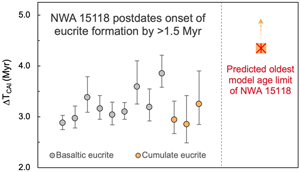
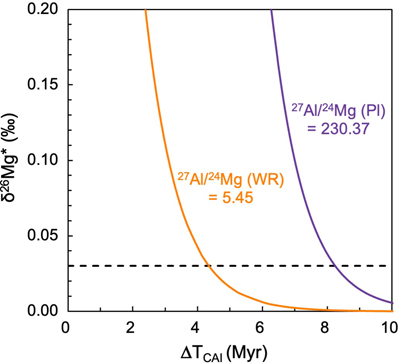 Figure 1 Predicted present δ26Mg* based on known 27Al/24Mg ratios and expected ages. The black dashed line represents the conservative 2 s.e. estimate of δ26Mg*. Calculation details are provided in the Supplementary Information. The oldest age limit of NWA 15118 constrained from the plot using the 2 s.e. estimate matches the model age result since both assume a chondritic Al/Mg ratio and initial δ26Mg*. WR = whole rock; Pl = plagioclase. Numbers along the lines denote measured molar 27Al/24Mg ratios; the Pl fraction of NWA 15118 uses the highest measured 27Al/24Mg ratio. | 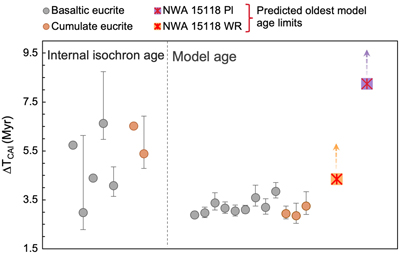 Figure 2 Comparison of 26Al-26Mg ages from this study with previous HEDs results. The oldest model age limits for NWA 15118 estimated from both the bulk rock (WR) and mineral fraction (Pl) with the highest Al/Mg ratio, are shown. All the 26Al-26Mg ages in comparison were recalculated using the 26Al half-life of 0.717 Myr (Kondev et al., 2021) and anchored to the solar initial (26Al/27Al)0 ratio of 5.23 ± 0.13 × 10⁻⁵ (Jacobsen et al., 2008). Literature data sources are listed in Table S-3. |
| Figure 1 | Figure 2 |
top
Introduction
The formation and crystallisation of the magma oceans, possibly a prevalent process during the early development of asteroids and planets, are crucial for understanding the evolution of solar system materials (Greenwood et al., 2014
Greenwood, R.C., Barrat, J.-A., Yamaguchi, A., Franchi, I.A., Scott, E.R.D., Bottke, W.F., Gibson, J.M. (2014) The oxygen isotope composition of diogenites: Evidence for early global melting on a single, compositionally diverse, HED parent body. Earth and Planetary Science Letters 390, 165–174. https://doi.org/10.1016/j.epsl.2013.12.011
). The Moon is believed to have formed via a giant impact that induced a global lunar magma ocean, during which buoyant anorthitic plagioclase floated to the surface, forming a global primordial anorthositic crust (Elkins-Tanton et al., 2011Elkins-Tanton, L.T., Burgess, S., Yin, Q.-Z. (2011) The lunar magma ocean: Reconciling the solidification process with lunar petrology and geochronology. Earth and Planetary Science Letters 304, 326–336. https://doi.org/10.1016/j.epsl.2011.02.004
). However, other planetary bodies have not observed such a global primary anorthositic crust. The asteroid 4 Vesta is among the most suited solar system objects for the presence of such a primitive anorthositic crust (Li et al., 2024Li, S., Zhang, D., Shu, Q., Bao, H., Cao, X., Liu, J., Qin, L., Fan, Y., Zhou, S., Shen, D., Li, M. (2024) An anorthositic meteorite supporting an ancient magma ocean on Vesta. Nature Astronomy 8, 739–747. https://doi.org/10.1038/s41550-024-02243-6
). The main reasons are that 1) Vesta is widely regarded as the largest surviving differentiated protoplanet (Russell et al., 2012Russell, C.T., Raymond, C.A., Coradini, A., McSween, H.Y., Zuber, M.T., Nathues, A., De Sanctis, M.C., Jaumann, R., Konopliv, A.S., Preusker, F., Asmar, S.W., Park, R.S., Gaskell, R., Keller, H.U., Mottola, S., Roatsch, T., Scully, J.E.C., Smith, D.E., Tricarico, P., Toplis, M.J., Christensen, U.R., Feldman, W.C., Lawrence, D.J., McCoy, T.J., Prettyman, T.H., Reedy, R.C., Sykes, M.E., Titus, T.N. (2012) Dawn at Vesta: Testing the Protoplanetary Paradigm. Science 336, 684–686. https://doi.org/10.1126/science.1219381
), 2) The homogeneous Δ17O (e.g., Greenwood et al., 2014Greenwood, R.C., Barrat, J.-A., Yamaguchi, A., Franchi, I.A., Scott, E.R.D., Bottke, W.F., Gibson, J.M. (2014) The oxygen isotope composition of diogenites: Evidence for early global melting on a single, compositionally diverse, HED parent body. Earth and Planetary Science Letters 390, 165–174. https://doi.org/10.1016/j.epsl.2013.12.011
) and siderophile element depletion (e.g., Steenstra et al., 2016Steenstra, E.S., Knibbe, J.S., Rai, N., van Westrenen, W. (2016) Constraints on core formation in Vesta from metal–silicate partitioning of siderophile elements. Geochimica et Cosmochimica Acta 177, 48–61. https://doi.org/10.1016/j.gca.2016.01.002
) of the Howardite-Eucrite-Diogenite (HED) meteorite clan, which is one of the largest differentiated meteorite groups and thought to originate from Vesta (De Sanctis et al., 2012De Sanctis, M.C., Ammannito, E., Capria, M.T., Tosi, F., Capaccioni, F., Zambon, F., Carraro, F., Fonte, S., Frigeri, A., Jaumann, R., Magni, G., Marchi, S., McCord, T.B., McFadden, L.A., McSween, H.Y., Mittlefehldt, D.W., Nathues, A., Palomba, E., Pieters, C.M., Raymond, C.A., Russell, C.T., Toplis, M.J., Turrini, D. (2012) Spectroscopic Characterization of Mineralogy and Its Diversity Across Vesta. Science 336, 697–700. https://doi.org/10.1126/science.1219270
; Russell et al., 2012Russell, C.T., Raymond, C.A., Coradini, A., McSween, H.Y., Zuber, M.T., Nathues, A., De Sanctis, M.C., Jaumann, R., Konopliv, A.S., Preusker, F., Asmar, S.W., Park, R.S., Gaskell, R., Keller, H.U., Mottola, S., Roatsch, T., Scully, J.E.C., Smith, D.E., Tricarico, P., Toplis, M.J., Christensen, U.R., Feldman, W.C., Lawrence, D.J., McCoy, T.J., Prettyman, T.H., Reedy, R.C., Sykes, M.E., Titus, T.N. (2012) Dawn at Vesta: Testing the Protoplanetary Paradigm. Science 336, 684–686. https://doi.org/10.1126/science.1219381
), support the existence of a global magma ocean, and 3) the newly discovered anorthositic meteorite Northwest Africa (NWA) 15118 with ∼94 vol. % plagioclase and ∼6 vol. % orthopyroxene from Vesta shares petrology and composition similarities with lunar anorthosite (Li et al., 2024Li, S., Zhang, D., Shu, Q., Bao, H., Cao, X., Liu, J., Qin, L., Fan, Y., Zhou, S., Shen, D., Li, M. (2024) An anorthositic meteorite supporting an ancient magma ocean on Vesta. Nature Astronomy 8, 739–747. https://doi.org/10.1038/s41550-024-02243-6
).In the original magma ocean scenario for Vesta, diogenites and eucrites are thought to represent a continuous crystallisation sequence, with diogenites as early cumulates forming the deep crust, and eucrites crystallising from residual melts to form the upper crust (e.g., Righter and Drake, 1997
Righter, K., Drake, M.J. (1997) A magma ocean on Vesta: Core formation and petrogenesis of eucrites and diogenites. Meteoritics & Planetary Science 32, 929–944. https://doi.org/10.1111/j.1945-5100.1997.tb01582.x
). However, the variability in heavy rare earth elements (HREE; e.g., variability in Dy/Yb) enrichment in diogenites contradicts their crystallisation from a single, homogeneous magma ocean or shallow magma chambers, replenished by magma ocean-derived melt (e.g., Barrat et al., 2008Barrat, J.-A., Yamaguchi, A., Greenwood, R.C., Benoit, M., Cotten, J., Bohn, M., Franchi, I.A. (2008) Geochemistry of diogenites: Still more diversity in their parental melts. Meteoritics & Planetary Science 43, 1759–1775. https://doi.org/10.1111/j.1945-5100.2008.tb00641.x
). In addition, the absence or weak Eu anomaly in eucrites also contradicts their complementary role to diogenites, as the latter exhibit a strong negative Eu anomaly (e.g., Barrat et al., 2010Barrat, J.-A., Yamaguchi, A., Zanda, B., Bollinger, C., Bohn, M. (2010) Relative chronology of crust formation on asteroid Vesta: Insights from the geochemistry of diogenites. Geochimica et Cosmochimica Acta 74, 6218–6231. https://doi.org/10.1016/j.gca.2010.07.028
; Dhaliwal et al., 2023Dhaliwal, J.K., Day, J.M.D., Tait, K.T. (2023) Pristinity and petrogenesis of eucrites. Meteoritics & Planetary Science 58, 275–295. https://doi.org/10.1111/maps.13945
). Therefore, HREE variability in diogenites is thought to reflect diverse parental magmas (Barrat et al., 2008Barrat, J.-A., Yamaguchi, A., Greenwood, R.C., Benoit, M., Cotten, J., Bohn, M., Franchi, I.A. (2008) Geochemistry of diogenites: Still more diversity in their parental melts. Meteoritics & Planetary Science 43, 1759–1775. https://doi.org/10.1111/j.1945-5100.2008.tb00641.x
), possibly involving eucritic crustal contamination (Barrat et al., 2010Barrat, J.-A., Yamaguchi, A., Zanda, B., Bollinger, C., Bohn, M. (2010) Relative chronology of crust formation on asteroid Vesta: Insights from the geochemistry of diogenites. Geochimica et Cosmochimica Acta 74, 6218–6231. https://doi.org/10.1016/j.gca.2010.07.028
).Based on the similar Cr and O isotopic composition of the newly discovered anorthositic meteorite NWA 15118 with HEDs, Li et al. (2024)
Li, S., Zhang, D., Shu, Q., Bao, H., Cao, X., Liu, J., Qin, L., Fan, Y., Zhou, S., Shen, D., Li, M. (2024) An anorthositic meteorite supporting an ancient magma ocean on Vesta. Nature Astronomy 8, 739–747. https://doi.org/10.1038/s41550-024-02243-6
proposed a lunar-like hypothesis for the presence of an anorthositic crust on Vesta. In this model, the anorthosite (with a strong positive Eu anomaly) and diogenite layers crystallised simultaneously from the magma ocean, with buoyant plagioclase flotation forming the anorthositic crust, while dense pyroxene sank to the bottom, forming the diogenitic layers; eucrites formed later from the residue. This model requires that anorthosites be coeval with diogenites and predate eucrites, which has not yet been tested by precise chronology. Compared with long-lived (e.g., Pb-Pb) and other short-lived systems (e.g, Mn-Cr), the 26Al-26Mg system is particularly suited for high resolution age constraints on early solar system magmatic activities due to 1) the short half-life of 26Al decay (0.717 Myr; Kondev et al., 2021Kondev, F.G., Wang, M., Huang, W.J., Naimi, S., Audi, G. (2021) The NUBASE2020 evaluation of nuclear physics properties. Chinese Physics C 45, 030001. https://doi.org/10.1088/1674-1137/abddae
), and 2) the high abundance of Al and Mg as major rock-forming elements. In this study, we apply Al-Mg chronology to anorthosite NWA 15118 to test the lunar-like magma ocean hypothesis and to improve our understanding of Vestan crustal evolution.top
Sample Description
NWA 15118 is an anorthositic achondrite with a cataclastic texture (Li et al., 2024
Li, S., Zhang, D., Shu, Q., Bao, H., Cao, X., Liu, J., Qin, L., Fan, Y., Zhou, S., Shen, D., Li, M. (2024) An anorthositic meteorite supporting an ancient magma ocean on Vesta. Nature Astronomy 8, 739–747. https://doi.org/10.1038/s41550-024-02243-6
; Sheen et al., 2025Sheen, A.I., Tait, K.T., Di Cecco, V.E., Joy, B.R., Bray, C.J. (2025) Incompatible trace element geochemistry of the anorthositic achondrite Northwest Africa (NWA) 15118: Relation to diogenites and the Vestan magma ocean. Meteoritics & Planetary Science 60, 103–123. https://doi.org/10.1111/maps.14292
). The sample used for this study (a 1.2 g chunk and 180 mg powder) derives from the meteorite investigated by Li et al. (2024)Li, S., Zhang, D., Shu, Q., Bao, H., Cao, X., Liu, J., Qin, L., Fan, Y., Zhou, S., Shen, D., Li, M. (2024) An anorthositic meteorite supporting an ancient magma ocean on Vesta. Nature Astronomy 8, 739–747. https://doi.org/10.1038/s41550-024-02243-6
. It is dominated by plagioclase (∼94 vol. %), with subordinate orthopyroxene, trace amounts of clinopyroxene, chromite, olivine, and troilite (Li et al., 2024Li, S., Zhang, D., Shu, Q., Bao, H., Cao, X., Liu, J., Qin, L., Fan, Y., Zhou, S., Shen, D., Li, M. (2024) An anorthositic meteorite supporting an ancient magma ocean on Vesta. Nature Astronomy 8, 739–747. https://doi.org/10.1038/s41550-024-02243-6
; Sheen et al., 2025Sheen, A.I., Tait, K.T., Di Cecco, V.E., Joy, B.R., Bray, C.J. (2025) Incompatible trace element geochemistry of the anorthositic achondrite Northwest Africa (NWA) 15118: Relation to diogenites and the Vestan magma ocean. Meteoritics & Planetary Science 60, 103–123. https://doi.org/10.1111/maps.14292
). Clasts of plagioclase (up to 7 mm) and orthopyroxene (up to 0.6 mm) are embedded within a fine grained matrix mainly composed of plagioclase. Minor clinopyroxene (μm size width) is present exclusively as veins within large anorthite grains (Li et al., 2024Li, S., Zhang, D., Shu, Q., Bao, H., Cao, X., Liu, J., Qin, L., Fan, Y., Zhou, S., Shen, D., Li, M. (2024) An anorthositic meteorite supporting an ancient magma ocean on Vesta. Nature Astronomy 8, 739–747. https://doi.org/10.1038/s41550-024-02243-6
). Oxygen and chromium isotopes suggest that this meteorite shares an affinity with the HED group (Li et al., 2024Li, S., Zhang, D., Shu, Q., Bao, H., Cao, X., Liu, J., Qin, L., Fan, Y., Zhou, S., Shen, D., Li, M. (2024) An anorthositic meteorite supporting an ancient magma ocean on Vesta. Nature Astronomy 8, 739–747. https://doi.org/10.1038/s41550-024-02243-6
).top
Results
The 27Al/24Mg ratios and the Mg isotope data are presented in Table S-1. Repeated measurements of international standards (AGV-2, BCR-2) ensured a precision better than 3 % (r.s.d.) for 27Al/24Mg ratios (Table S-2). The 27Al/24Mg ratios range from 0.05 to 230.37 for NWA 15118. The repeated analyses of international standards and samples yielded a conservative 2 s.e. estimate of radiogenic δ26Mg* (δ26Mg* = δ26Mg − δ25Mg/β, β = 0.511; according to the kinetic mass dependent fractionation law) better than 0.03 ‰ (Table S-1). All phases in NWA 15118 show no resolvable radiogenic 26Mg excess, preventing meaningful internal isochron ages from being determined. However, an oldest model age limit can be obtained by combining their Al-Mg data and our conservative 2 s.e. estimate (0.03 ‰) of δ26Mg* with a chondritic bulk solar system 27Al/24Mg = 0.101 and terrestrial δ26Mg* = 0 ‰ (Bizzarro et al., 2005
Bizzarro, M., Baker, J.A., Haack, H., Lundgaard, K.L. (2005) Rapid Timescales for Accretion and Melting of Differentiated Planetesimals Inferred from 26Al-26Mg Chronometry. The Astrophysical Journal 632, L41–L44. https://doi.org/10.1086/497638
; Wimpenny et al., 2019Wimpenny, J., Sanborn, M.E., Koefoed, P., Cooke, I.R., Stirling, C., Amelin, Y., Yin, Q.-Z. (2019) Reassessing the origin and chronology of the unique achondrite Asuka 881394: Implications for distribution of 26Al in the early Solar System. Geochimica et Cosmochimica Acta 244, 478–501. https://doi.org/10.1016/j.gca.2018.10.006
). The absence of radiogenic 26Mg excess in the bulk sample yields an upper limit of initial (26Al/27Al)0 = (7.81 ± 0.24) × 10−7 for NWA 15118, corresponding to an oldest model age limit of 4.35 ± 0.03 Myr after CAIs (CAIs have a U-corrected Pb-Pb age of about 4567 Ma) (Table S-1). The highest Al/Mg fraction in NWA 15118 yields an upper limit of the initial (26Al/27Al)0 = (1.82 ± 0.05) × 10−8, corresponding to an oldest model age limit of 8.24 ± 0.03 Myr after CAI formation (Table S-1).top
Discussion
Young Vestan magmatism recorded by the 26Al-26Mg chronology of NWA 15118. All phases in NWA 15118 show no radiogenic Mg excesses (Table S-1). An oldest model age limit can be obtained from a binary isochron combining the Al-Mg data with our conservative 2 s.e. estimate (0.03 ‰) of δ26Mg*, assuming a chondritic bulk solar system 27Al/24Mg = 0.101 and terrestrial δ26Mg* = 0 ‰, using the canonical solar initial (26Al/27Al)0 of 5.23 ± 0.13 × 10⁻⁵ (Baker et al., 2005
Baker, J., Bizzarro, M., Wittig, N., Connelly, J., Haack, H. (2005) Early planetesimal melting from an age of 4.5662 Gyr for differentiated meteorites. Nature 436, 1127–1131. https://doi.org/10.1038/nature03882
; Jacobsen et al., 2008Jacobsen, B., Yin, Q.-Z., Moynier, F., Amelin, Y., Krot, A.N., Nagashima, K., Hutcheon, I.D., Palme, H. (2008) 26Al–26Mg and 207Pb–206Pb systematics of Allende CAIs: Canonical solar initial 26Al/27Al ratio reinstated. Earth and Planetary Science Letters 272, 353–364. https://doi.org/10.1016/j.epsl.2008.05.003
; Hublet et al., 2017Hublet, G., Debaille, V., Wimpenny, J., Yin, Q.-Z. (2017) Differentiation and magmatic activity in Vesta evidenced by 26Al-26Mg dating in eucrites and diogenites. Geochimica et Cosmochimica Acta 218, 73–97. https://doi.org/10.1016/j.gca.2017.09.005
). The use of the terrestrial δ26Mg* = 0 ‰ is justified by the absence of radiogenic δ26Mg* excesses in the bulk chondrites, terrestrial basalt, the Moon, and Mars (at a precision better than ∼0.007 ‰; Baker et al., 2005Baker, J., Bizzarro, M., Wittig, N., Connelly, J., Haack, H. (2005) Early planetesimal melting from an age of 4.5662 Gyr for differentiated meteorites. Nature 436, 1127–1131. https://doi.org/10.1038/nature03882
), which has been widely accepted by the later studies (e.g., Hublet et al., 2017Hublet, G., Debaille, V., Wimpenny, J., Yin, Q.-Z. (2017) Differentiation and magmatic activity in Vesta evidenced by 26Al-26Mg dating in eucrites and diogenites. Geochimica et Cosmochimica Acta 218, 73–97. https://doi.org/10.1016/j.gca.2017.09.005
; Wimpenny et al., 2019Wimpenny, J., Sanborn, M.E., Koefoed, P., Cooke, I.R., Stirling, C., Amelin, Y., Yin, Q.-Z. (2019) Reassessing the origin and chronology of the unique achondrite Asuka 881394: Implications for distribution of 26Al in the early Solar System. Geochimica et Cosmochimica Acta 244, 478–501. https://doi.org/10.1016/j.gca.2018.10.006
). With this assumption and the canonical solar initial (26Al/27Al)0, the calculated solar initial δ26Mg* (−0.038 ‰; e.g., Wimpenny et al., 2019Wimpenny, J., Sanborn, M.E., Koefoed, P., Cooke, I.R., Stirling, C., Amelin, Y., Yin, Q.-Z. (2019) Reassessing the origin and chronology of the unique achondrite Asuka 881394: Implications for distribution of 26Al in the early Solar System. Geochimica et Cosmochimica Acta 244, 478–501. https://doi.org/10.1016/j.gca.2018.10.006
) is in line with the CAI isochron result (Villeneuve et al., 2009Villeneuve, J., Chaussidon, M., Libourel, G. (2009) Homogeneous Distribution of 26Al in the Solar System from the Mg Isotopic Composition of Chondrules. Science 325, 985–988. https://doi.org/10.1126/science.1173907
). Although mass independent Mg isotope heterogeneity of the solar system has been proposed (Larsen et al., 2011Larsen, K.K., Trinquier, A., Paton, C., Schiller, M., Wielandt, D., Ivanova, M.A., Connelly, J.N., Nordlund, Å., Krot, A.N., Bizzarro, M. (2011) Evidence for Magnesium Isotope Heterogeneity in the Solar Protoplanetary Disk. The Astrophysical Journal Letters 735, L37. https://doi.org/10.1088/2041-8205/735/2/L37
), this will not affect the relative model age differences among meteorites from the same parent body.The absence of radiogenic Mg excess in plagioclases (with 27Al/24Mg up to 230.37; Table S-1) of NWA 15118 indicates a 26Al-26Mg closure age >8.24 ± 0.03 Myr after CAIs (Fig. 1 and Table S-1), anchored to the canonical solar initial (26Al/27Al)0 of Jacobsen et al. (2008)
Jacobsen, B., Yin, Q.-Z., Moynier, F., Amelin, Y., Krot, A.N., Nagashima, K., Hutcheon, I.D., Palme, H. (2008) 26Al–26Mg and 207Pb–206Pb systematics of Allende CAIs: Canonical solar initial 26Al/27Al ratio reinstated. Earth and Planetary Science Letters 272, 353–364. https://doi.org/10.1016/j.epsl.2008.05.003
. Discrepancies between Pb-Pb and Al-Mg ages in early differentiated meteorites and chondrites may reflect reduced (26Al/27A)0 ratios in parts of the solar protoplanetary disk (Larsen et al., 2011Larsen, K.K., Trinquier, A., Paton, C., Schiller, M., Wielandt, D., Ivanova, M.A., Connelly, J.N., Nordlund, Å., Krot, A.N., Bizzarro, M. (2011) Evidence for Magnesium Isotope Heterogeneity in the Solar Protoplanetary Disk. The Astrophysical Journal Letters 735, L37. https://doi.org/10.1088/2041-8205/735/2/L37
; Krestianinov et al., 2023Krestianinov, E., Amelin, Y., Yin, Q.-Z., Cary, P., Huyskens, M.H., Miller, A., Dey, S., Hibiya, Y., Tang, H., Young, E.D., Pack, A., Di Rocco, T. (2023) Igneous meteorites suggest Aluminium-26 heterogeneity in the early Solar Nebula. Nature Communications 14, 4940. https://doi.org/10.1038/s41467-023-40026-1
), but the closure differences of these two chronometers have also been suggested (e.g., Wimpenny et al., 2019Wimpenny, J., Sanborn, M.E., Koefoed, P., Cooke, I.R., Stirling, C., Amelin, Y., Yin, Q.-Z. (2019) Reassessing the origin and chronology of the unique achondrite Asuka 881394: Implications for distribution of 26Al in the early Solar System. Geochimica et Cosmochimica Acta 244, 478–501. https://doi.org/10.1016/j.gca.2018.10.006
). Whether the eucrite parent body accreted in a disk region with distinct 26Al/27Al ratios from CAI-forming reservoirs remains debated (Nyquist et al., 2003Nyquist, L.E., Reese, Y., Wiesmann, H., Shih, C.-Y., Takeda, H. (2003) Fossil 26Al and 53Mn in the Asuka 881394 eucrite: evidence of the earliest crust on asteroid 4 Vesta. Earth and Planetary Science Letters 214, 11–25. https://doi.org/10.1016/S0012-821X(03)00371-6
; Wimpenny et al., 2019Wimpenny, J., Sanborn, M.E., Koefoed, P., Cooke, I.R., Stirling, C., Amelin, Y., Yin, Q.-Z. (2019) Reassessing the origin and chronology of the unique achondrite Asuka 881394: Implications for distribution of 26Al in the early Solar System. Geochimica et Cosmochimica Acta 244, 478–501. https://doi.org/10.1016/j.gca.2018.10.006
). However, the choice of the anchoring initial (26Al/27Al)0 will also not affect the “relative” ages of meteorites from a single parent body. For consistency, all comparison data sets were also anchored to the canonical initial (26Al/27Al)0 value from Jacobsen et al. (2008)Jacobsen, B., Yin, Q.-Z., Moynier, F., Amelin, Y., Krot, A.N., Nagashima, K., Hutcheon, I.D., Palme, H. (2008) 26Al–26Mg and 207Pb–206Pb systematics of Allende CAIs: Canonical solar initial 26Al/27Al ratio reinstated. Earth and Planetary Science Letters 272, 353–364. https://doi.org/10.1016/j.epsl.2008.05.003
.Figure 1 Predicted present δ26Mg* based on known 27Al/24Mg ratios and expected ages. The black dashed line represents the conservative 2 s.e. estimate of δ26Mg*. Calculation details are provided in the Supplementary Information. The oldest age limit of NWA 15118 constrained from the plot using the 2 s.e. estimate matches the model age result since both assume a chondritic Al/Mg ratio and initial δ26Mg*. WR = whole rock; Pl = plagioclase. Numbers along the lines denote measured molar 27Al/24Mg ratios; the Pl fraction of NWA 15118 uses the highest measured 27Al/24Mg ratio.
The relatively young model age of NWA 15118, constrained from the mineral fraction with the highest Al/Mg, may reflect partial resetting by later thermal events. Its fragmental breccia texture indicates the impact shock influence; however, the absence of melt veins and even diaplectic glass suggests that shock intensity was insufficient to induce melting of the meteorite (Li et al., 2024
Li, S., Zhang, D., Shu, Q., Bao, H., Cao, X., Liu, J., Qin, L., Fan, Y., Zhou, S., Shen, D., Li, M. (2024) An anorthositic meteorite supporting an ancient magma ocean on Vesta. Nature Astronomy 8, 739–747. https://doi.org/10.1038/s41550-024-02243-6
; Sheen et al., 2025Sheen, A.I., Tait, K.T., Di Cecco, V.E., Joy, B.R., Bray, C.J. (2025) Incompatible trace element geochemistry of the anorthositic achondrite Northwest Africa (NWA) 15118: Relation to diogenites and the Vestan magma ocean. Meteoritics & Planetary Science 60, 103–123. https://doi.org/10.1111/maps.14292
). Sub-solidus Mg diffusion from Mg-rich (e.g., olivine, orthopyroxene) to Mg-poor phases (e.g., anorthite in this study) could disturb the Al-Mg system (Van Orman et al., 2014Van Orman, J.A., Cherniak, D.J., Kita, N.T. (2014) Magnesium diffusion in plagioclase: Dependence on composition, and implications for thermal resetting of the 26Al–26Mg early solar system chronometer. Earth and Planetary Science Letters 385, 79–88. https://doi.org/10.1016/j.epsl.2013.10.026
). The absence of augite exsolution lamellae in orthopyroxenes of NWA 15118 indicates a lack of significant sub-solidus thermal metamorphism and rapid cooling (Li et al., 2024Li, S., Zhang, D., Shu, Q., Bao, H., Cao, X., Liu, J., Qin, L., Fan, Y., Zhou, S., Shen, D., Li, M. (2024) An anorthositic meteorite supporting an ancient magma ocean on Vesta. Nature Astronomy 8, 739–747. https://doi.org/10.1038/s41550-024-02243-6
; Sheen et al., 2025Sheen, A.I., Tait, K.T., Di Cecco, V.E., Joy, B.R., Bray, C.J. (2025) Incompatible trace element geochemistry of the anorthositic achondrite Northwest Africa (NWA) 15118: Relation to diogenites and the Vestan magma ocean. Meteoritics & Planetary Science 60, 103–123. https://doi.org/10.1111/maps.14292
), likely >10,000 °C/Myr, since the exsolution lamellae in eucrite pyroxene could reach such a cooling rate (e.g., Miyamoto et al., 1996Miyamoto, M., Warren, P.H., Takeda, H. (1996) The cooling rate of the Sioux County eucrite. Lunar and Planetary Science XXVII, 893–894. https://www.lpi.usra.edu/meetings/lpsc1996/pdf/1447.pdf
). The Dodson equation yields a high closure temperature for anorthite of 1–2 mm in radius (the primary crystal size selected for highest Al/Mg analysis, i.e. Pl-3) of about >880–940 °C at this cooling rate (Fig. S-1). Although minor clinopyroxene veins within large anorthites indicate localised modification, the transect of major and minor elements of plagioclases and orthopyroxenes in NWA 15118 shows fractional crystallisation trends, consistent with preservation of the primary igneous compositions (Li et al., 2024Li, S., Zhang, D., Shu, Q., Bao, H., Cao, X., Liu, J., Qin, L., Fan, Y., Zhou, S., Shen, D., Li, M. (2024) An anorthositic meteorite supporting an ancient magma ocean on Vesta. Nature Astronomy 8, 739–747. https://doi.org/10.1038/s41550-024-02243-6
; Sheen et al., 2025Sheen, A.I., Tait, K.T., Di Cecco, V.E., Joy, B.R., Bray, C.J. (2025) Incompatible trace element geochemistry of the anorthositic achondrite Northwest Africa (NWA) 15118: Relation to diogenites and the Vestan magma ocean. Meteoritics & Planetary Science 60, 103–123. https://doi.org/10.1111/maps.14292
). Nevertheless, partial sampling of such veins in the plagioclase fraction (though rare; Li et al., 2024Li, S., Zhang, D., Shu, Q., Bao, H., Cao, X., Liu, J., Qin, L., Fan, Y., Zhou, S., Shen, D., Li, M. (2024) An anorthositic meteorite supporting an ancient magma ocean on Vesta. Nature Astronomy 8, 739–747. https://doi.org/10.1038/s41550-024-02243-6
) may slightly bias the crystallisation age limit. However, resetting of the bulk rock Al-Mg system, which is not susceptible to secondary redistribution of Al-Mg among mineral phases, would require open system fluid metamorphism (Hublet et al., 2017Hublet, G., Debaille, V., Wimpenny, J., Yin, Q.-Z. (2017) Differentiation and magmatic activity in Vesta evidenced by 26Al-26Mg dating in eucrites and diogenites. Geochimica et Cosmochimica Acta 218, 73–97. https://doi.org/10.1016/j.gca.2017.09.005
and references therein), while no fluid alteration minerals are observed in NWA 15118 (e.g., halite, sylvite, carbonate, phyllosilicates, etc.; Zolensky et al., 2017Zolensky, M.E., Bodnar, R.J., Yurimoto, H., Itoh, S., Fries, M., Steele, A., Chan, Q.H.-S., Tsuchiyama, A., Kebukawa, Y., Ito, M. (2017) The search for and analysis of direct samples of early Solar System aqueous fluids. Philosophical Transactions of the Royal Society A: Mathematical, Physical and Engineering Sciences 375, 20150386. https://doi.org/10.1098/rsta.2015.0386
). Thus, we can constrain a more conservative age limit using the bulk rock Al-Mg data, and this yields >4.35 ± 0.03 Myr after CAI formation but still younger than most eucrites (Fig. 2).Figure 2 Comparison of 26Al-26Mg ages from this study with previous HEDs results. The oldest model age limits for NWA 15118 estimated from both the bulk rock (WR) and mineral fraction (Pl) with the highest Al/Mg ratio, are shown. All the 26Al-26Mg ages in comparison were recalculated using the 26Al half-life of 0.717 Myr (Kondev et al., 2021
Kondev, F.G., Wang, M., Huang, W.J., Naimi, S., Audi, G. (2021) The NUBASE2020 evaluation of nuclear physics properties. Chinese Physics C 45, 030001. https://doi.org/10.1088/1674-1137/abddae
) and anchored to the solar initial (26Al/27Al)0 ratio of 5.23 ± 0.13 × 10⁻⁵ (Jacobsen et al., 2008Jacobsen, B., Yin, Q.-Z., Moynier, F., Amelin, Y., Krot, A.N., Nagashima, K., Hutcheon, I.D., Palme, H. (2008) 26Al–26Mg and 207Pb–206Pb systematics of Allende CAIs: Canonical solar initial 26Al/27Al ratio reinstated. Earth and Planetary Science Letters 272, 353–364. https://doi.org/10.1016/j.epsl.2008.05.003
). Literature data sources are listed in Table S-3.Reassessing the anorthositic crust hypothesis on Vesta. The lunar magma ocean hypothesis, supported by chronology, experimental evidence for absence of plagioclase at the liquidus of mare basalts, and complementary Eu anomalies in lunar anorthosites and mare basalts, proposes extensive fractional crystallisation, where early formed mafic minerals (e.g., olivine, pyroxene) sank to form the mantle, while buoyant plagioclase floated to form a global anorthositic crust (Elkins-Tanton et al., 2011
Elkins-Tanton, L.T., Burgess, S., Yin, Q.-Z. (2011) The lunar magma ocean: Reconciling the solidification process with lunar petrology and geochronology. Earth and Planetary Science Letters 304, 326–336. https://doi.org/10.1016/j.epsl.2011.02.004
). By analogy, Li et al. (2024)Li, S., Zhang, D., Shu, Q., Bao, H., Cao, X., Liu, J., Qin, L., Fan, Y., Zhou, S., Shen, D., Li, M. (2024) An anorthositic meteorite supporting an ancient magma ocean on Vesta. Nature Astronomy 8, 739–747. https://doi.org/10.1038/s41550-024-02243-6
proposed a similar differentiation model for Vesta, suggesting a global anorthositic crust (represented by NWA 15118) overlying a diogenitic layer, with eucrites forming from subsequent magmatism. This model requires anorthosites to be the oldest Vestan crustal rocks, coeval with diogenites and predating eucrites.Limited 26Al-26Mg data exist for diogenites, and the available ages remain controversial, partly due to their sub-chondritic 27Al/24Mg ratios, hindering the detection of radiogenic 26Mg. Hublet et al. (2017)
Hublet, G., Debaille, V., Wimpenny, J., Yin, Q.-Z. (2017) Differentiation and magmatic activity in Vesta evidenced by 26Al-26Mg dating in eucrites and diogenites. Geochimica et Cosmochimica Acta 218, 73–97. https://doi.org/10.1016/j.gca.2017.09.005
attributed the absence of radiogenic 26Mg anomaly to diogenite formation >7.25 Myr after CAIs; however, this prediction is rather arbitrary without considering the low Al/Mg of diogenites. Schiller et al. (2011)Schiller, M., Baker, J., Creech, J., Paton, C., Millet, M.-A., Irving, A., Bizzarro, M. (2011) Rapid Timescales for Magma Ocean Crystallization on the Howardite-Eucrite-Diogenite Parent Body. The Astrophysical Journal Letters 740, L22. https://doi.org/10.1088/2041-8205/740/1/L22
reported small radiogenic 26Mg excesses in diogenites and suggested early formation (0.6 to 2.5 Myr after CAIs) based on the ɛ54Cr-μ26Mg* correlation. However, the positive radiogenic 26Mg excess in some diogenites conflicts with their sub-chondritic 27Al/24Mg and may indicate contamination by eucrites (Hublet et al., 2017Hublet, G., Debaille, V., Wimpenny, J., Yin, Q.-Z. (2017) Differentiation and magmatic activity in Vesta evidenced by 26Al-26Mg dating in eucrites and diogenites. Geochimica et Cosmochimica Acta 218, 73–97. https://doi.org/10.1016/j.gca.2017.09.005
). Despite the limited constraints on diogenites, existing 26Al-26Mg model ages on basaltic and cumulate eucrites show similar and homogeneous results, indicating eucritic crust formation initiated at ∼2.88 Myr after CAIs, and the primary crust building lasted for ∼1 Myr (Fig. 2). Internal isochron ages of basaltic and cumulate eucrites show a wider range, from 2.98 to 6.62 Myr after CAIs, mostly younger than the model ages (Fig. 2), which has been suggested to be related to metamorphic resetting or slow cooling of the magma (Hublet et al., 2017Hublet, G., Debaille, V., Wimpenny, J., Yin, Q.-Z. (2017) Differentiation and magmatic activity in Vesta evidenced by 26Al-26Mg dating in eucrites and diogenites. Geochimica et Cosmochimica Acta 218, 73–97. https://doi.org/10.1016/j.gca.2017.09.005
). Our Al-Mg model age demonstrates that NWA 15118 postdated the onset of eucrite formation by at least ∼1.5 Myr (Fig. 2). This relatively young crystallisation age challenges the hypothesis that NWA 15118 represents a primary global crust from a Vestan magma ocean, as proposed by Li et al. (2024)Li, S., Zhang, D., Shu, Q., Bao, H., Cao, X., Liu, J., Qin, L., Fan, Y., Zhou, S., Shen, D., Li, M. (2024) An anorthositic meteorite supporting an ancient magma ocean on Vesta. Nature Astronomy 8, 739–747. https://doi.org/10.1038/s41550-024-02243-6
.Genetic links of NWA 15118 with HEDs. Although the Al-Mg age constraints for diogenites remain debated, Barrat et al. (2010)
Barrat, J.-A., Yamaguchi, A., Zanda, B., Bollinger, C., Bohn, M. (2010) Relative chronology of crust formation on asteroid Vesta: Insights from the geochemistry of diogenites. Geochimica et Cosmochimica Acta 74, 6218–6231. https://doi.org/10.1016/j.gca.2010.07.028
proposed, based on the negative Eu anomalies and wider Dy/Yb variation in diogenitic orthopyroxenes compared to those in eucrites, that diogenites represent late stage intrusions contaminated by overlying eucritic crust. The positive radiogenic 26Mg excess in some diogenites may also indicate such contamination (Schiller et al., 2011Schiller, M., Baker, J., Creech, J., Paton, C., Millet, M.-A., Irving, A., Bizzarro, M. (2011) Rapid Timescales for Magma Ocean Crystallization on the Howardite-Eucrite-Diogenite Parent Body. The Astrophysical Journal Letters 740, L22. https://doi.org/10.1088/2041-8205/740/1/L22
; Hublet et al., 2017Hublet, G., Debaille, V., Wimpenny, J., Yin, Q.-Z. (2017) Differentiation and magmatic activity in Vesta evidenced by 26Al-26Mg dating in eucrites and diogenites. Geochimica et Cosmochimica Acta 218, 73–97. https://doi.org/10.1016/j.gca.2017.09.005
). In addition, three dimensional modelling of impact basins and gravity mapping on Vesta indicate that the absence of large-scale exposures of pure diogenites is inconsistent with a layered structure derived from a global magma ocean, instead supporting an intrusive origin for diogenites (Clenet et al., 2014Clenet, H., Jutzi, M., Barrat, J.-A., Asphaug, E.I., Benz, W., Gillet, P. (2014) A deep crust–mantle boundary in the asteroid 4 Vesta. Nature 511, 303–306. https://doi.org/10.1038/nature13499
; McSween et al., 2019McSween Jr., H.Y., Raymond, C.A., Stolper, E.M., Mittlefehldt, D.W., Baker, M.B., Lunning, N.G., Beck, A.W., Hahn, T.M. (2019) Differentiation and magmatic history of Vesta: Constraints from HED meteorites and Dawn spacecraft data. Geochemistry 79, 125526. https://doi.org/10.1016/j.chemer.2019.07.008
). On Earth, Archean calcic anorthosites with An >90 % (comparable to lunar ferroan anorthosite and NWA 15118) also occur as small intrusions (10–30 km2) (Ashwal, 2010Ashwal, L.D. (2010) The temporality of anorthosites. The Canadian Mineralogist 48, 711–728. https://doi.org/10.3749/canmin.48.4.711
). The positive Eu anomaly and young age of NWA 15118 are consistent with its complementary relationship to diogenites as intrusive crustal fragments. A simple mass balance calculation shows that to generate a parental melt with chondrite normalised Eu/Eu* = 1 (i.e. no Eu anomaly), the required volume proportion of anorthosite to diogenite would be ∼3 %, using density of 3.46 g/cm3 for diogenite (Consolmagno et al., 2008Consolmagno, G.J., Britt, D.T., Macke, R.J. (2008) The significance of meteorite density and porosity. Geochemistry 68, 1–29. https://doi.org/10.1016/j.chemer.2008.01.003
) and 2.23 g/cm3 for lunar ferroan anorthosite (Li et al., 2024Li, S., Zhang, D., Shu, Q., Bao, H., Cao, X., Liu, J., Qin, L., Fan, Y., Zhou, S., Shen, D., Li, M. (2024) An anorthositic meteorite supporting an ancient magma ocean on Vesta. Nature Astronomy 8, 739–747. https://doi.org/10.1038/s41550-024-02243-6
). Visible and near-infrared spectroscopy (VNIR) data from the Dawn mission revealed widespread diogenitic lithologies on Vesta; however, no definitive anorthosite, even in the largest diogenite exposures in the Rheasilvia basin (De Sanctis et al., 2012De Sanctis, M.C., Ammannito, E., Capria, M.T., Tosi, F., Capaccioni, F., Zambon, F., Carraro, F., Fonte, S., Frigeri, A., Jaumann, R., Magni, G., Marchi, S., McCord, T.B., McFadden, L.A., McSween, H.Y., Mittlefehldt, D.W., Nathues, A., Palomba, E., Pieters, C.M., Raymond, C.A., Russell, C.T., Toplis, M.J., Turrini, D. (2012) Spectroscopic Characterization of Mineralogy and Its Diversity Across Vesta. Science 336, 697–700. https://doi.org/10.1126/science.1219270
). However, the VNIR instrument measures the average spectrum within a pixel (nominal resolution: 70–700 m, depending on orbit), so anorthositic exposures smaller than the spatial resolution could remain undetected (De Sanctis et al., 2013De Sanctis, M.C., Ammannito, E., Capria, M.T., Capaccioni, F., Combe, J.-P., Frigeri, A., Longobardo, A., Magni, G., Marchi, S., McCord, T.B., Palomba, E., Tosi, F., Zambon, F., Carraro, F., Fonte, S., Li, Y.J., McFadden, L.A., Mittlefehldt, D.W., Pieters, C.M., Jaumann, R., Stephan, K., Raymond, C.A., Russell, C.T. (2013) Vesta’s mineralogical composition as revealed by the visible and infrared spectrometer on Dawn. Meteoritics & Planetary Science 48, 2166–2184. https://doi.org/10.1111/maps.12138
). Nevertheless, the lower trace element ratios (e.g., Ti/Y, Ti/Yb, La/Sm) of NWA 15118 in orthopyroxene and plagioclase compared to those expected if equilibrated with diogenitic melts challenge their complementary origin (Sheen et al., 2025Sheen, A.I., Tait, K.T., Di Cecco, V.E., Joy, B.R., Bray, C.J. (2025) Incompatible trace element geochemistry of the anorthositic achondrite Northwest Africa (NWA) 15118: Relation to diogenites and the Vestan magma ocean. Meteoritics & Planetary Science 60, 103–123. https://doi.org/10.1111/maps.14292
). The Al-Mg age of basaltic eucrites (fine to medium grained non-cumulate eucrites, ∼2.88 to 6.51 Myr after CAIs) overlaps with NWA 15118, and some basaltic eucrites also show negative Eu anomalies (Dhaliwal et al., 2023Dhaliwal, J.K., Day, J.M.D., Tait, K.T. (2023) Pristinity and petrogenesis of eucrites. Meteoritics & Planetary Science 58, 275–295. https://doi.org/10.1111/maps.13945
), suggesting potential genetic links. Alternatively, the distinct trace element characteristic of NWA 15118 may indicate derivation from a chemically distinct source (Sheen et al., 2025Sheen, A.I., Tait, K.T., Di Cecco, V.E., Joy, B.R., Bray, C.J. (2025) Incompatible trace element geochemistry of the anorthositic achondrite Northwest Africa (NWA) 15118: Relation to diogenites and the Vestan magma ocean. Meteoritics & Planetary Science 60, 103–123. https://doi.org/10.1111/maps.14292
). The ungrouped achondrite Wan Zawatin 001, with high anorthite content (76 vol. %) and similar O isotopes with HEDs, may also originate from Vesta (Sheen et al., 2025Sheen, A.I., Tait, K.T., Di Cecco, V.E., Joy, B.R., Bray, C.J. (2025) Incompatible trace element geochemistry of the anorthositic achondrite Northwest Africa (NWA) 15118: Relation to diogenites and the Vestan magma ocean. Meteoritics & Planetary Science 60, 103–123. https://doi.org/10.1111/maps.14292
and references therein). Further investigation of its Al-Mg age and potential relationship with NWA 15118 could provide additional insights into the magmatic evolution of Vesta. In summary, the present evidence suggests that NWA 15118 more plausibly represents a fragment of regional crust formed after the primary crustal differentiation of Vesta, potentially related to some late-stage basaltic eucrites or from a chemically distinct source.top
Acknowledgements
We sincerely thank the editor, Francis McCubbin, for his efficient handling of the review process. We are also very grateful to Paul Warren and one anonymous reviewer for their thorough and constructive reviews. This work was supported by MOST Special Fund from the State Key Laboratory of Geological Processes and Mineral Resources, China University of Geosciences (Grant No. MSFGPMR2025-202), ERC grant 101001282 (METAL) to FM, Region Île-de-France SESAME grant nos. 12015908 and EX047016 to FM, IdEx Université de Paris grant ANR-18-IDEX-0001 to FM, and DIM ACAV+ to FM. Thanks to the China Scholarship Council for a Ph.D. fellowship (# 202306410071).
Editor: Francis McCubbin
top
Author Contributions
Conceptualisation: FM. Methodology: LF and HR. Investigation: HR and FM. Visualisation: HR, LF. Supervision: FM. Writing–original draft: HR. Writing–review and editing: all authors.
top
References
Ashwal, L.D. (2010) The temporality of anorthosites. The Canadian Mineralogist 48, 711–728. https://doi.org/10.3749/canmin.48.4.711
 Show in context
 On Earth, Archean calcic anorthosites with An >90 % (comparable to lunar ferroan anorthosite and NWA 15118) also occur as small intrusions (10–30 km2) (Ashwal, 2010).
View in article
Baker, J., Bizzarro, M., Wittig, N., Connelly, J., Haack, H. (2005) Early planetesimal melting from an age of 4.5662 Gyr for differentiated meteorites. Nature 436, 1127–1131. https://doi.org/10.1038/nature03882
Show in context An oldest model age limit can be obtained from a binary isochron combining the Al-Mg data with our conservative 2 s.e. estimate (0.03 ‰) of δ26Mg*, assuming a chondritic bulk solar system 27Al/24Mg = 0.101 and terrestrial δ26Mg* = 0 ‰, using the canonical solar initial (26Al/27Al)0 of 5.23 ± 0.13 × 10⁻⁵ (Baker et al., 2005; Jacobsen et al., 2008; Hublet et al., 2017).
View in article
The use of the terrestrial δ26Mg* = 0 ‰ is justified by the absence of radiogenic δ26Mg* excesses in the bulk chondrites, terrestrial basalt, the Moon, and Mars (at a precision better than ∼0.007 ‰; Baker et al., 2005), which has been widely accepted by the later studies (e.g., Hublet et al., 2017; Wimpenny et al., 2019).
View in article
Barrat, J.-A., Yamaguchi, A., Greenwood, R.C., Benoit, M., Cotten, J., Bohn, M., Franchi, I.A. (2008) Geochemistry of diogenites: Still more diversity in their parental melts. Meteoritics & Planetary Science 43, 1759–1775. https://doi.org/10.1111/j.1945-5100.2008.tb00641.x
Show in context However, the variability in heavy rare earth elements (HREE; e.g., variability in Dy/Yb) enrichment in diogenites contradicts their crystallisation from a single, homogeneous magma ocean or shallow magma chambers, replenished by magma ocean-derived melt (e.g., Barrat et al., 2008).
View in article
Therefore, HREE variability in diogenites is thought to reflect diverse parental magmas (Barrat et al., 2008), possibly involving eucritic crustal contamination (Barrat et al., 2010).
View in article
Barrat, J.-A., Yamaguchi, A., Zanda, B., Bollinger, C., Bohn, M. (2010) Relative chronology of crust formation on asteroid Vesta: Insights from the geochemistry of diogenites. Geochimica et Cosmochimica Acta 74, 6218–6231. https://doi.org/10.1016/j.gca.2010.07.028
Show in context In addition, the absence or weak Eu anomaly in eucrites also contradicts their complementary role to diogenites, as the latter exhibit a strong negative Eu anomaly (e.g., Barrat et al., 2010; Dhaliwal et al., 2023).
View in article
Therefore, HREE variability in diogenites is thought to reflect diverse parental magmas (Barrat et al., 2008), possibly involving eucritic crustal contamination (Barrat et al., 2010).
View in article
Although the Al-Mg age constraints for diogenites remain debated, Barrat et al. (2010) proposed, based on the negative Eu anomalies and wider Dy/Yb variation in diogenitic orthopyroxenes compared to those in eucrites, that diogenites represent late stage intrusions contaminated by overlying eucritic crust.
View in article
Bizzarro, M., Baker, J.A., Haack, H., Lundgaard, K.L. (2005) Rapid Timescales for Accretion and Melting of Differentiated Planetesimals Inferred from 26Al-26Mg Chronometry. The Astrophysical Journal 632, L41–L44. https://doi.org/10.1086/497638
Show in context However, an oldest model age limit can be obtained by combining their Al-Mg data and our conservative 2 s.e. estimate (0.03 ‰) of δ26Mg* with a chondritic bulk solar system 27Al/24Mg = 0.101 and terrestrial δ26Mg* = 0 ‰ (Bizzarro et al., 2005; Wimpenny et al., 2019).
View in article
Clenet, H., Jutzi, M., Barrat, J.-A., Asphaug, E.I., Benz, W., Gillet, P. (2014) A deep crust–mantle boundary in the asteroid 4 Vesta. Nature 511, 303–306. https://doi.org/10.1038/nature13499
Show in context In addition, three dimensional modelling of impact basins and gravity mapping on Vesta indicate that the absence of large-scale exposures of pure diogenites is inconsistent with a layered structure derived from a global magma ocean, instead supporting an intrusive origin for diogenites (Clenet et al., 2014; McSween et al., 2019).
View in article
Consolmagno, G.J., Britt, D.T., Macke, R.J. (2008) The significance of meteorite density and porosity. Geochemistry 68, 1–29. https://doi.org/10.1016/j.chemer.2008.01.003
Show in context A simple mass balance calculation shows that to generate a parental melt with chondrite normalised Eu/Eu* = 1 (i.e. no Eu anomaly), the required volume proportion of anorthosite to diogenite would be ∼3 %, using density of 3.46 g/cm3 for diogenite (Consolmagno et al., 2008) and 2.23 g/cm3 for lunar ferroan anorthosite (Li et al., 2024).
View in article
De Sanctis, M.C., Ammannito, E., Capria, M.T., Tosi, F., Capaccioni, F., Zambon, F., Carraro, F., Fonte, S., Frigeri, A., Jaumann, R., Magni, G., Marchi, S., McCord, T.B., McFadden, L.A., McSween, H.Y., Mittlefehldt, D.W., Nathues, A., Palomba, E., Pieters, C.M., Raymond, C.A., Russell, C.T., Toplis, M.J., Turrini, D. (2012) Spectroscopic Characterization of Mineralogy and Its Diversity Across Vesta. Science 336, 697–700. https://doi.org/10.1126/science.1219270
Show in context The main reasons are that 1) Vesta is widely regarded as the largest surviving differentiated protoplanet (Russell et al., 2012), 2) The homogeneous Δ17O (e.g., Greenwood et al., 2014) and siderophile element depletion (e.g., Steenstra et al., 2016) of the Howardite-Eucrite-Diogenite (HED) meteorite clan, which is one of the largest differentiated meteorite groups and thought to originate from Vesta (De Sanctis et al., 2012; Russell et al., 2012), support the existence of a global magma ocean, and 3) the newly discovered anorthositic meteorite Northwest Africa (NWA) 15118 with ∼94 vol. % plagioclase and ∼6 vol. % orthopyroxene from Vesta shares petrology and composition similarities with lunar anorthosite (Li et al., 2024).
View in article
Visible and near-infrared spectroscopy (VNIR) data from the Dawn mission revealed widespread diogenitic lithologies on Vesta; however, no definitive anorthosite, even in the largest diogenite exposures in the Rheasilvia basin (De Sanctis et al., 2012).
View in article
De Sanctis, M.C., Ammannito, E., Capria, M.T., Capaccioni, F., Combe, J.-P., Frigeri, A., Longobardo, A., Magni, G., Marchi, S., McCord, T.B., Palomba, E., Tosi, F., Zambon, F., Carraro, F., Fonte, S., Li, Y.J., McFadden, L.A., Mittlefehldt, D.W., Pieters, C.M., Jaumann, R., Stephan, K., Raymond, C.A., Russell, C.T. (2013) Vesta’s mineralogical composition as revealed by the visible and infrared spectrometer on Dawn. Meteoritics & Planetary Science 48, 2166–2184. https://doi.org/10.1111/maps.12138
Show in context However, the VNIR instrument measures the average spectrum within a pixel (nominal resolution: 70–700 m, depending on orbit), so anorthositic exposures smaller than the spatial resolution could remain undetected (De Sanctis et al., 2013).
View in article
Dhaliwal, J.K., Day, J.M.D., Tait, K.T. (2023) Pristinity and petrogenesis of eucrites. Meteoritics & Planetary Science 58, 275–295. https://doi.org/10.1111/maps.13945
Show in context In addition, the absence or weak Eu anomaly in eucrites also contradicts their complementary role to diogenites, as the latter exhibit a strong negative Eu anomaly (e.g., Barrat et al., 2010; Dhaliwal et al., 2023).
View in article
The Al-Mg age of basaltic eucrites (fine to medium grained non-cumulate eucrites, ∼2.88 to 6.51 Myr after CAIs) overlaps with NWA 15118, and some basaltic eucrites also show negative Eu anomalies (Dhaliwal et al., 2023), suggesting potential genetic links. Alternatively, the distinct trace element characteristic of NWA 15118 may indicate derivation from a chemically distinct source (Sheen et al., 2025).
View in article
Elkins-Tanton, L.T., Burgess, S., Yin, Q.-Z. (2011) The lunar magma ocean: Reconciling the solidification process with lunar petrology and geochronology. Earth and Planetary Science Letters 304, 326–336. https://doi.org/10.1016/j.epsl.2011.02.004
Show in context The Moon is believed to have formed via a giant impact that induced a global lunar magma ocean, during which buoyant anorthitic plagioclase floated to the surface, forming a global primordial anorthositic crust (Elkins-Tanton et al., 2011).
View in article
The lunar magma ocean hypothesis, supported by chronology, experimental evidence for absence of plagioclase at the liquidus of mare basalts, and complementary Eu anomalies in lunar anorthosites and mare basalts, proposes extensive fractional crystallisation, where early formed mafic minerals (e.g., olivine, pyroxene) sank to form the mantle, while buoyant plagioclase floated to form a global anorthositic crust (Elkins-Tanton et al., 2011).
View in article
Greenwood, R.C., Barrat, J.-A., Yamaguchi, A., Franchi, I.A., Scott, E.R.D., Bottke, W.F., Gibson, J.M. (2014) The oxygen isotope composition of diogenites: Evidence for early global melting on a single, compositionally diverse, HED parent body. Earth and Planetary Science Letters 390, 165–174. https://doi.org/10.1016/j.epsl.2013.12.011
Show in context The formation and crystallisation of the magma oceans, possibly a prevalent process during the early development of asteroids and planets, are crucial for understanding the evolution of solar system materials (Greenwood et al., 2014).
View in article
The main reasons are that 1) Vesta is widely regarded as the largest surviving differentiated protoplanet (Russell et al., 2012), 2) The homogeneous Δ17O (e.g., Greenwood et al., 2014) and siderophile element depletion (e.g., Steenstra et al., 2016) of the Howardite-Eucrite-Diogenite (HED) meteorite clan, which is one of the largest differentiated meteorite groups and thought to originate from Vesta (De Sanctis et al., 2012; Russell et al., 2012), support the existence of a global magma ocean, and 3) the newly discovered anorthositic meteorite Northwest Africa (NWA) 15118 with ∼94 vol. % plagioclase and ∼6 vol. % orthopyroxene from Vesta shares petrology and composition similarities with lunar anorthosite (Li et al., 2024).
View in article
Hublet, G., Debaille, V., Wimpenny, J., Yin, Q.-Z. (2017) Differentiation and magmatic activity in Vesta evidenced by 26Al-26Mg dating in eucrites and diogenites. Geochimica et Cosmochimica Acta 218, 73–97. https://doi.org/10.1016/j.gca.2017.09.005
Show in context An oldest model age limit can be obtained from a binary isochron combining the Al-Mg data with our conservative 2 s.e. estimate (0.03 ‰) of δ26Mg*, assuming a chondritic bulk solar system 27Al/24Mg = 0.101 and terrestrial δ26Mg* = 0 ‰, using the canonical solar initial (26Al/27Al)0 of 5.23 ± 0.13 × 10⁻⁵ (Baker et al., 2005; Jacobsen et al., 2008; Hublet et al., 2017).
View in article
The use of the terrestrial δ26Mg* = 0 ‰ is justified by the absence of radiogenic δ26Mg* excesses in the bulk chondrites, terrestrial basalt, the Moon, and Mars (at a precision better than ∼0.007 ‰; Baker et al., 2005), which has been widely accepted by the later studies (e.g., Hublet et al., 2017; Wimpenny et al., 2019).
View in article
However, resetting of the bulk rock Al-Mg system, which is not susceptible to secondary redistribution of Al-Mg among mineral phases, would require open system fluid metamorphism (Hublet et al., 2017 and references therein), while no fluid alteration minerals are observed in NWA 15118 (e.g., halite, sylvite, carbonate, phyllosilicates, etc.; Zolensky et al., 2017).
View in article
Hublet et al. (2017) attributed the absence of radiogenic 26Mg anomaly to diogenite formation >7.25 Myr after CAIs; however, this prediction is rather arbitrary without considering the low Al/Mg of diogenites.
View in article
However, the positive radiogenic 26Mg excess in some diogenites conflicts with their sub-chondritic 27Al/24Mg and may indicate contamination by eucrites (Hublet et al., 2017).
View in article
Internal isochron ages of basaltic and cumulate eucrites show a wider range, from 2.98 to 6.62 Myr after CAIs, mostly younger than the model ages (Fig. 2), which has been suggested to be related to metamorphic resetting or slow cooling of the magma (Hublet et al., 2017).
View in article
The positive radiogenic 26Mg excess in some diogenites may also indicate such contamination (Schiller et al., 2011; Hublet et al., 2017).
View in article
Jacobsen, B., Yin, Q.-Z., Moynier, F., Amelin, Y., Krot, A.N., Nagashima, K., Hutcheon, I.D., Palme, H. (2008) 26Al–26Mg and 207Pb–206Pb systematics of Allende CAIs: Canonical solar initial 26Al/27Al ratio reinstated. Earth and Planetary Science Letters 272, 353–364. https://doi.org/10.1016/j.epsl.2008.05.003
Show in context An oldest model age limit can be obtained from a binary isochron combining the Al-Mg data with our conservative 2 s.e. estimate (0.03 ‰) of δ26Mg*, assuming a chondritic bulk solar system 27Al/24Mg = 0.101 and terrestrial δ26Mg* = 0 ‰, using the canonical solar initial (26Al/27Al)0 of 5.23 ± 0.13 × 10⁻⁵ (Baker et al., 2005; Jacobsen et al., 2008; Hublet et al., 2017).
View in article
The absence of radiogenic Mg excess in plagioclases (with 27Al/24Mg up to 230.37; Table S-1) of NWA 15118 indicates a 26Al-26Mg closure age >8.24 ± 0.03 Myr after CAIs (Fig. 1 and Table S-1), anchored to the canonical solar initial (26Al/27Al)0 of Jacobsen et al. (2008).
View in article
For consistency, all comparison data sets were also anchored to the canonical initial (26Al/27Al)0 value from Jacobsen et al. (2008).
View in article
All the 26Al-26Mg ages in comparison were recalculated using the 26Al half-life of 0.717 Myr (Kondev et al., 2021) and anchored to the solar initial (26Al/27Al)0 ratio of 5.23 ± 0.13 × 10⁻⁵ (Jacobsen et al., 2008).
View in article
Kondev, F.G., Wang, M., Huang, W.J., Naimi, S., Audi, G. (2021) The NUBASE2020 evaluation of nuclear physics properties. Chinese Physics C 45, 030001. https://doi.org/10.1088/1674-1137/abddae
Show in context Compared with long-lived (e.g., Pb-Pb) and other short-lived systems (e.g, Mn-Cr), the 26Al-26Mg system is particularly suited for high resolution age constraints on early solar system magmatic activities due to 1) the short half-life of 26Al decay (0.717 Myr; Kondev et al., 2021), and 2) the high abundance of Al and Mg as major rock-forming elements.
View in article
All the 26Al-26Mg ages in comparison were recalculated using the 26Al half-life of 0.717 Myr (Kondev et al., 2021) and anchored to the solar initial (26Al/27Al)0 ratio of 5.23 ± 0.13 × 10⁻⁵ (Jacobsen et al., 2008).
View in article
Krestianinov, E., Amelin, Y., Yin, Q.-Z., Cary, P., Huyskens, M.H., Miller, A., Dey, S., Hibiya, Y., Tang, H., Young, E.D., Pack, A., Di Rocco, T. (2023) Igneous meteorites suggest Aluminium-26 heterogeneity in the early Solar Nebula. Nature Communications 14, 4940. https://doi.org/10.1038/s41467-023-40026-1
Show in context Discrepancies between Pb-Pb and Al-Mg ages in early differentiated meteorites and chondrites may reflect reduced (26Al/27A)0 ratios in parts of the solar protoplanetary disk (Larsen et al., 2011; Krestianinov et al., 2023), but the closure differences of these two chronometers have also been suggested (e.g., Wimpenny et al., 2019).
View in article
Larsen, K.K., Trinquier, A., Paton, C., Schiller, M., Wielandt, D., Ivanova, M.A., Connelly, J.N., Nordlund, Å., Krot, A.N., Bizzarro, M. (2011) Evidence for Magnesium Isotope Heterogeneity in the Solar Protoplanetary Disk. The Astrophysical Journal Letters 735, L37. https://doi.org/10.1088/2041-8205/735/2/L37
Show in context Although mass independent Mg isotope heterogeneity of the solar system has been proposed (Larsen et al., 2011), this will not affect the relative model age differences among meteorites from the same parent body.
View in article
Discrepancies between Pb-Pb and Al-Mg ages in early differentiated meteorites and chondrites may reflect reduced (26Al/27A)0 ratios in parts of the solar protoplanetary disk (Larsen et al., 2011; Krestianinov et al., 2023), but the closure differences of these two chronometers have also been suggested (e.g., Wimpenny et al., 2019).
View in article
Li, S., Zhang, D., Shu, Q., Bao, H., Cao, X., Liu, J., Qin, L., Fan, Y., Zhou, S., Shen, D., Li, M. (2024) An anorthositic meteorite supporting an ancient magma ocean on Vesta. Nature Astronomy 8, 739–747. https://doi.org/10.1038/s41550-024-02243-6
Show in context The asteroid 4 Vesta is among the most suited solar system objects for the presence of such a primitive anorthositic crust (Li et al., 2024).
View in article
The main reasons are that 1) Vesta is widely regarded as the largest surviving differentiated protoplanet (Russell et al., 2012), 2) The homogeneous Δ17O (e.g., Greenwood et al., 2014) and siderophile element depletion (e.g., Steenstra et al., 2016) of the Howardite-Eucrite-Diogenite (HED) meteorite clan, which is one of the largest differentiated meteorite groups and thought to originate from Vesta (De Sanctis et al., 2012; Russell et al., 2012), support the existence of a global magma ocean, and 3) the newly discovered anorthositic meteorite Northwest Africa (NWA) 15118 with ∼94 vol. % plagioclase and ∼6 vol. % orthopyroxene from Vesta shares petrology and composition similarities with lunar anorthosite (Li et al., 2024).
View in article
Based on the similar Cr and O isotopic composition of the newly discovered anorthositic meteorite NWA 15118 with HEDs, Li et al. (2024) proposed a lunar-like hypothesis for the presence of an anorthositic crust on Vesta.
View in article
NWA 15118 is an anorthositic achondrite with a cataclastic texture (Li et al., 2024; Sheen et al., 2025).
View in article
The sample used for this study (a 1.2 g chunk and 180 mg powder) derives from the meteorite investigated by Li et al. (2024).
View in article
It is dominated by plagioclase (∼94 vol. %), with subordinate orthopyroxene, trace amounts of clinopyroxene, chromite, olivine, and troilite (Li et al., 2024; Sheen et al., 2025).
View in article
Minor clinopyroxene (μm size width) is present exclusively as veins within large anorthite grains (Li et al., 2024).
View in article
Oxygen and chromium isotopes suggest that this meteorite shares an affinity with the HED group (Li et al., 2024).
View in article
Its fragmental breccia texture indicates the impact shock influence; however, the absence of melt veins and even diaplectic glass suggests that shock intensity was insufficient to induce melting of the meteorite (Li et al., 2024; Sheen et al., 2025).
View in article
The absence of augite exsolution lamellae in orthopyroxenes of NWA 15118 indicates a lack of significant sub-solidus thermal metamorphism and rapid cooling (Li et al., 2024; Sheen et al., 2025), likely >10,000 °C/Myr, since the exsolution lamellae in eucrite pyroxene could reach such a cooling rate (e.g., Miyamoto et al., 1996).
View in article
Although minor clinopyroxene veins within large anorthites indicate localised modification, the transect of major and minor elements of plagioclases and orthopyroxenes in NWA 15118 shows fractional crystallisation trends, consistent with preservation of the primary igneous compositions (Li et al., 2024; Sheen et al., 2025).
View in article
Nevertheless, partial sampling of such veins in the plagioclase fraction (though rare; Li et al., 2024) may slightly bias the crystallisation age limit.
View in article
By analogy, Li et al. (2024) proposed a similar differentiation model for Vesta, suggesting a global anorthositic crust (represented by NWA 15118) overlying a diogenitic layer, with eucrites forming from subsequent magmatism.
View in article
This relatively young crystallisation age challenges the hypothesis that NWA 15118 represents a primary global crust from a Vestan magma ocean, as proposed by Li et al. (2024).
View in article
A simple mass balance calculation shows that to generate a parental melt with chondrite normalised Eu/Eu* = 1 (i.e. no Eu anomaly), the required volume proportion of anorthosite to diogenite would be ∼3 %, using density of 3.46 g/cm3 for diogenite (Consolmagno et al., 2008) and 2.23 g/cm3 for lunar ferroan anorthosite (Li et al., 2024).
View in article
McSween Jr., H.Y., Raymond, C.A., Stolper, E.M., Mittlefehldt, D.W., Baker, M.B., Lunning, N.G., Beck, A.W., Hahn, T.M. (2019) Differentiation and magmatic history of Vesta: Constraints from HED meteorites and Dawn spacecraft data. Geochemistry 79, 125526. https://doi.org/10.1016/j.chemer.2019.07.008
Show in context In addition, three dimensional modelling of impact basins and gravity mapping on Vesta indicate that the absence of large-scale exposures of pure diogenites is inconsistent with a layered structure derived from a global magma ocean, instead supporting an intrusive origin for diogenites (Clenet et al., 2014; McSween et al., 2019).
View in article
Miyamoto, M., Warren, P.H., Takeda, H. (1996) The cooling rate of the Sioux County eucrite. Lunar and Planetary Science XXVII, 893–894. https://www.lpi.usra.edu/meetings/lpsc1996/pdf/1447.pdf
Show in context The absence of augite exsolution lamellae in orthopyroxenes of NWA 15118 indicates a lack of significant sub-solidus thermal metamorphism and rapid cooling (Li et al., 2024; Sheen et al., 2025), likely >10,000 °C/Myr, since the exsolution lamellae in eucrite pyroxene could reach such a cooling rate (e.g., Miyamoto et al., 1996).
View in article
Nyquist, L.E., Reese, Y., Wiesmann, H., Shih, C.-Y., Takeda, H. (2003) Fossil 26Al and 53Mn in the Asuka 881394 eucrite: evidence of the earliest crust on asteroid 4 Vesta. Earth and Planetary Science Letters 214, 11–25. https://doi.org/10.1016/S0012-821X(03)00371-6
Show in context Whether the eucrite parent body accreted in a disk region with distinct 26Al/27Al ratios from CAI-forming reservoirs remains debated (Nyquist et al., 2003; Wimpenny et al., 2019).
View in article
Righter, K., Drake, M.J. (1997) A magma ocean on Vesta: Core formation and petrogenesis of eucrites and diogenites. Meteoritics & Planetary Science 32, 929–944. https://doi.org/10.1111/j.1945-5100.1997.tb01582.x
Show in context In the original magma ocean scenario for Vesta, diogenites and eucrites are thought to represent a continuous crystallisation sequence, with diogenites as early cumulates forming the deep crust, and eucrites crystallising from residual melts to form the upper crust (e.g., Righter and Drake, 1997).
View in article
Russell, C.T., Raymond, C.A., Coradini, A., McSween, H.Y., Zuber, M.T., Nathues, A., De Sanctis, M.C., Jaumann, R., Konopliv, A.S., Preusker, F., Asmar, S.W., Park, R.S., Gaskell, R., Keller, H.U., Mottola, S., Roatsch, T., Scully, J.E.C., Smith, D.E., Tricarico, P., Toplis, M.J., Christensen, U.R., Feldman, W.C., Lawrence, D.J., McCoy, T.J., Prettyman, T.H., Reedy, R.C., Sykes, M.E., Titus, T.N. (2012) Dawn at Vesta: Testing the Protoplanetary Paradigm. Science 336, 684–686. https://doi.org/10.1126/science.1219381
Show in context The main reasons are that 1) Vesta is widely regarded as the largest surviving differentiated protoplanet (Russell et al., 2012), 2) The homogeneous Δ17O (e.g., Greenwood et al., 2014) and siderophile element depletion (e.g., Steenstra et al., 2016) of the Howardite-Eucrite-Diogenite (HED) meteorite clan, which is one of the largest differentiated meteorite groups and thought to originate from Vesta (De Sanctis et al., 2012; Russell et al., 2012), support the existence of a global magma ocean, and 3) the newly discovered anorthositic meteorite Northwest Africa (NWA) 15118 with ∼94 vol. % plagioclase and ∼6 vol. % orthopyroxene from Vesta shares petrology and composition similarities with lunar anorthosite (Li et al., 2024).
View in article
Schiller, M., Baker, J., Creech, J., Paton, C., Millet, M.-A., Irving, A., Bizzarro, M. (2011) Rapid Timescales for Magma Ocean Crystallization on the Howardite-Eucrite-Diogenite Parent Body. The Astrophysical Journal Letters 740, L22. https://doi.org/10.1088/2041-8205/740/1/L22
Show in context Schiller et al. (2011) reported small radiogenic 26Mg excesses in diogenites and suggested early formation (0.6 to 2.5 Myr after CAIs) based on the ɛ54Cr-μ26Mg* correlation.
View in article
The positive radiogenic 26Mg excess in some diogenites may also indicate such contamination (Schiller et al., 2011; Hublet et al., 2017).
View in article
Sheen, A.I., Tait, K.T., Di Cecco, V.E., Joy, B.R., Bray, C.J. (2025) Incompatible trace element geochemistry of the anorthositic achondrite Northwest Africa (NWA) 15118: Relation to diogenites and the Vestan magma ocean. Meteoritics & Planetary Science 60, 103–123. https://doi.org/10.1111/maps.14292
Show in context NWA 15118 is an anorthositic achondrite with a cataclastic texture (Li et al., 2024; Sheen et al., 2025).
View in article
It is dominated by plagioclase (∼94 vol. %), with subordinate orthopyroxene, trace amounts of clinopyroxene, chromite, olivine, and troilite (Li et al., 2024; Sheen et al., 2025).
View in article
Its fragmental breccia texture indicates the impact shock influence; however, the absence of melt veins and even diaplectic glass suggests that shock intensity was insufficient to induce melting of the meteorite (Li et al., 2024; Sheen et al., 2025).
View in article
The absence of augite exsolution lamellae in orthopyroxenes of NWA 15118 indicates a lack of significant sub-solidus thermal metamorphism and rapid cooling (Li et al., 2024; Sheen et al., 2025), likely >10,000 °C/Myr, since the exsolution lamellae in eucrite pyroxene could reach such a cooling rate (e.g., Miyamoto et al., 1996).
View in article
Although minor clinopyroxene veins within large anorthites indicate localised modification, the transect of major and minor elements of plagioclases and orthopyroxenes in NWA 15118 shows fractional crystallisation trends, consistent with preservation of the primary igneous compositions (Li et al., 2024; Sheen et al., 2025).
View in article
Nevertheless, the lower trace element ratios (e.g., Ti/Y, Ti/Yb, La/Sm) of NWA 15118 in orthopyroxene and plagioclase compared to those expected if equilibrated with diogenitic melts challenge their complementary origin (Sheen et al., 2025).
View in article
The Al-Mg age of basaltic eucrites (fine to medium grained non-cumulate eucrites, ∼2.88 to 6.51 Myr after CAIs) overlaps with NWA 15118, and some basaltic eucrites also show negative Eu anomalies (Dhaliwal et al., 2023), suggesting potential genetic links. Alternatively, the distinct trace element characteristic of NWA 15118 may indicate derivation from a chemically distinct source (Sheen et al., 2025).
View in article
The ungrouped achondrite Wan Zawatin 001, with high anorthite content (76 vol. %) and similar O isotopes with HEDs, may also originate from Vesta (Sheen et al., 2025 and references therein).
View in article
Steenstra, E.S., Knibbe, J.S., Rai, N., van Westrenen, W. (2016) Constraints on core formation in Vesta from metal–silicate partitioning of siderophile elements. Geochimica et Cosmochimica Acta 177, 48–61. https://doi.org/10.1016/j.gca.2016.01.002
Show in context The main reasons are that 1) Vesta is widely regarded as the largest surviving differentiated protoplanet (Russell et al., 2012), 2) The homogeneous Δ17O (e.g., Greenwood et al., 2014) and siderophile element depletion (e.g., Steenstra et al., 2016) of the Howardite-Eucrite-Diogenite (HED) meteorite clan, which is one of the largest differentiated meteorite groups and thought to originate from Vesta (De Sanctis et al., 2012; Russell et al., 2012), support the existence of a global magma ocean, and 3) the newly discovered anorthositic meteorite Northwest Africa (NWA) 15118 with ∼94 vol. % plagioclase and ∼6 vol. % orthopyroxene from Vesta shares petrology and composition similarities with lunar anorthosite (Li et al., 2024).
View in article
Van Orman, J.A., Cherniak, D.J., Kita, N.T. (2014) Magnesium diffusion in plagioclase: Dependence on composition, and implications for thermal resetting of the 26Al–26Mg early solar system chronometer. Earth and Planetary Science Letters 385, 79–88. https://doi.org/10.1016/j.epsl.2013.10.026
Show in context Sub-solidus Mg diffusion from Mg-rich (e.g., olivine, orthopyroxene) to Mg-poor phases (e.g., anorthite in this study) could disturb the Al-Mg system (Van Orman et al., 2014).
View in article
Villeneuve, J., Chaussidon, M., Libourel, G. (2009) Homogeneous Distribution of 26Al in the Solar System from the Mg Isotopic Composition of Chondrules. Science 325, 985–988. https://doi.org/10.1126/science.1173907
Show in context With this assumption and the canonical solar initial (26Al/27Al)0, the calculated solar initial δ26Mg* (−0.038 ‰; e.g., Wimpenny et al., 2019) is in line with the CAI isochron result (Villeneuve et al., 2009).
View in article
Wimpenny, J., Sanborn, M.E., Koefoed, P., Cooke, I.R., Stirling, C., Amelin, Y., Yin, Q.-Z. (2019) Reassessing the origin and chronology of the unique achondrite Asuka 881394: Implications for distribution of 26Al in the early Solar System. Geochimica et Cosmochimica Acta 244, 478–501. https://doi.org/10.1016/j.gca.2018.10.006
Show in context However, an oldest model age limit can be obtained by combining their Al-Mg data and our conservative 2 s.e. estimate (0.03 ‰) of δ26Mg* with a chondritic bulk solar system 27Al/24Mg = 0.101 and terrestrial δ26Mg* = 0 ‰ (Bizzarro et al., 2005; Wimpenny et al., 2019).
View in article
The use of the terrestrial δ26Mg* = 0 ‰ is justified by the absence of radiogenic δ26Mg* excesses in the bulk chondrites, terrestrial basalt, the Moon, and Mars (at a precision better than ∼0.007 ‰; Baker et al., 2005), which has been widely accepted by the later studies (e.g., Hublet et al., 2017; Wimpenny et al., 2019).
View in article
With this assumption and the canonical solar initial (26Al/27Al)0, the calculated solar initial δ26Mg* (−0.038 ‰; e.g., Wimpenny et al., 2019) is in line with the CAI isochron result (Villeneuve et al., 2009).
View in article
Discrepancies between Pb-Pb and Al-Mg ages in early differentiated meteorites and chondrites may reflect reduced (26Al/27A)0 ratios in parts of the solar protoplanetary disk (Larsen et al., 2011; Krestianinov et al., 2023), but the closure differences of these two chronometers have also been suggested (e.g., Wimpenny et al., 2019).
View in article
Whether the eucrite parent body accreted in a disk region with distinct 26Al/27Al ratios from CAI-forming reservoirs remains debated (Nyquist et al., 2003; Wimpenny et al., 2019).
View in article
Zolensky, M.E., Bodnar, R.J., Yurimoto, H., Itoh, S., Fries, M., Steele, A., Chan, Q.H.-S., Tsuchiyama, A., Kebukawa, Y., Ito, M. (2017) The search for and analysis of direct samples of early Solar System aqueous fluids. Philosophical Transactions of the Royal Society A: Mathematical, Physical and Engineering Sciences 375, 20150386. https://doi.org/10.1098/rsta.2015.0386
Show in context However, resetting of the bulk rock Al-Mg system, which is not susceptible to secondary redistribution of Al-Mg among mineral phases, would require open system fluid metamorphism (Hublet et al., 2017 and references therein), while no fluid alteration minerals are observed in NWA 15118 (e.g., halite, sylvite, carbonate, phyllosilicates, etc.; Zolensky et al., 2017).
View in article
top
Supplementary Information
The Supplementary Information includes:
- Methods (Sample Preparation and Mg Isotope Analysis)
- The Predicted Present Radiogenic Mg Isotope Estimation for Meteorites with Known 27Al/24Mg
- Tables S-1 to S-3
- Figure S-1
- Supplementary Information References
Download the Supplementary Information (PDF)
Download Tables S-1 and S-2 (.xlsx)
Figures
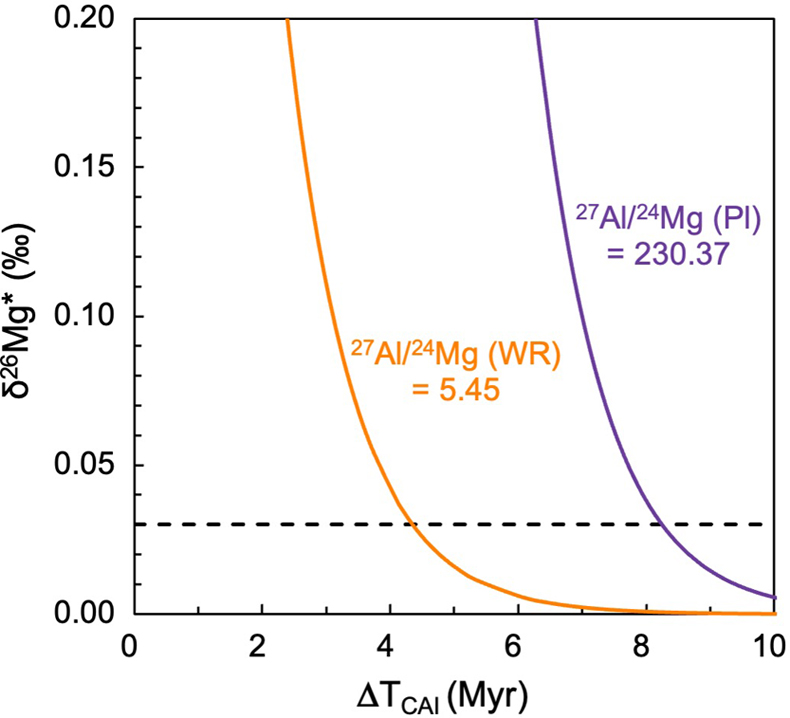
Figure 1 Predicted present δ26Mg* based on known 27Al/24Mg ratios and expected ages. The black dashed line represents the conservative 2 s.e. estimate of δ26Mg*. Calculation details are provided in the Supplementary Information. The oldest age limit of NWA 15118 constrained from the plot using the 2 s.e. estimate matches the model age result since both assume a chondritic Al/Mg ratio and initial δ26Mg*. WR = whole rock; Pl = plagioclase. Numbers along the lines denote measured molar 27Al/24Mg ratios; the Pl fraction of NWA 15118 uses the highest measured 27Al/24Mg ratio.

Figure 2 Comparison of 26Al-26Mg ages from this study with previous HEDs results. The oldest model age limits for NWA 15118 estimated from both the bulk rock (WR) and mineral fraction (Pl) with the highest Al/Mg ratio, are shown. All the 26Al-26Mg ages in comparison were recalculated using the 26Al half-life of 0.717 Myr (Kondev et al., 2021
Kondev, F.G., Wang, M., Huang, W.J., Naimi, S., Audi, G. (2021) The NUBASE2020 evaluation of nuclear physics properties. Chinese Physics C 45, 030001. https://doi.org/10.1088/1674-1137/abddae
) and anchored to the solar initial (26Al/27Al)0 ratio of 5.23 ± 0.13 × 10⁻⁵ (Jacobsen et al., 2008Jacobsen, B., Yin, Q.-Z., Moynier, F., Amelin, Y., Krot, A.N., Nagashima, K., Hutcheon, I.D., Palme, H. (2008) 26Al–26Mg and 207Pb–206Pb systematics of Allende CAIs: Canonical solar initial 26Al/27Al ratio reinstated. Earth and Planetary Science Letters 272, 353–364. https://doi.org/10.1016/j.epsl.2008.05.003
). Literature data sources are listed in Table S-3.