



Silver isotope fractionation by chemical diffusion in granitic melt
Affiliations | Corresponding Author | Cite as | Funding information
Published by the European Association of Geochemistry
under Creative Commons License CC BY-NC-ND 4.0
Keywords: silver isotopes, diffusive isotope fractionation, granitic melt


- Share this article


-
Article views:1,179Cumulative count of HTML views and PDF downloads.
- Download Citation
- Rights & Permissions

top
Abstract

Figures
 Figure 1 (a) Reflected light photo of LSTAg2. (b) Reflected light photo of LSTAg3. The black spots indicate the position of laser ablation pits. The five lines from left to right are designated as Line A to Line E. The blue rectangles represent the first etching using laser ultra-precision processing system. The red rectangles show location information sampled for Ag isotopic measurements. |  Figure 2 Ag concentration measured by LA-ICP-MS and δ109Ag measured by MC-ICP-MS. The five lines are represented by Line A to Line E longitudinally through the sample, from left to right. The concentration profiles of LSTAg2 and LSTAg3 were fitted using finite diffusion couple solutions, assuming a constant effective binary diffusivity (EBD). Orange line shows error function fits. A comparison was made between the Ag fractionation data for two experiments and profiles calculated using various β-factors. Blue line represents the best fit of δ109Ag profile (β = 0.274 ± 0.016 for LSTAg2 and 0.317 ± 0.036 for LSTAg3). | 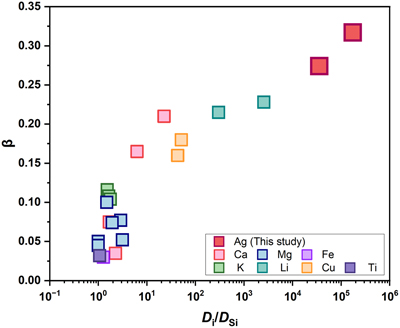 Figure 3 The relationship between experimentally determined βi-factor and Di/DSi for eight metal elements. Data are from: Ca (Richter et al., 2003; Watkins et al., 2009, 2011), Mg (Richter et al., 2008; Watkins et al., 2011; Chopra et al., 2012; Zhang and Bai, 2025), Fe (Richter et al., 2009b), K (Zhang, 2022), Li (Richter et al., 2003; Holycross et al., 2018), Cu (Ni and Shahar, 2023), Ti (Zhou et al., 2025) and Ag (this work). | 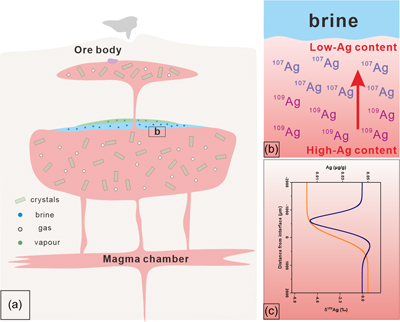 Figure 4 Schematic model of magma ascent and decompression process. |
| Figure 1 | Figure 2 | Figure 3 | Figure 4 |
top
Introduction
Silver (Ag), a moderately volatile transition element known for its thiophilicity and polarisability, is commonly found in nature as sulfides, sulfosalts and natural silver. Ag is also a precious metal of great economic and strategic importance due to its high electrical and thermal conductivity. Ag has a relatively low content in various geological samples and is heterogeneously distributed. The Ag content in CI chondrites is about 208 ng/g, about 7.1 μg/g in the solar system, 0.05 μg/g on BSE and 0.15 μg/g in the core (McDonough and Sun, 1995
McDonough, W.F., Sun, S.-s. (1995) The composition of the Earth. Chemical Geology 120, 223–253. https://doi.org/10.1016/0009-2541(94)00140-4
; McDonough, 2003McDonough, W.F. (2003) 2.15 - Compositional model for the Earth’s core. In: Holland, H.D., Turekian, K.K. (Eds.) Treatise on Geochemistry. First Edition, Elsevier, Amsterdam, 547–568. https://doi.org/10.1016/B0-08-043751-6/02015-6
).Ag has two stable isotopes: 107Ag (51.839 %) and 109Ag (48.161 %) (Rosman and Taylor, 1998
Rosman, K.J.R., Taylor, P.D.P. (1998) Isotopic compositions of the elements 1997 (Technical Report). Pure and Applied Chemistry 70, 217–235. https://doi.org/10.1351/pac199870010217
). Due to its unique geochemical properties, Ag isotopes have significant potential in a variety of areas. As a moderately volatile element, stable Ag isotopes are expected to be an emerging geochemical tracer. Important application aspects are: 1) Ag may have mainly entered the Earth’s core during the early stages of Earth’s evolution, and Ag isotopes can help us understand the core formation process (Theis et al., 2013Theis, K.J., Schönbächler, M., Benedix, G.K., Rehkämper, M., Andreasen, R., Davies, C. (2013) Palladium–silver chronology of IAB iron meteorites. Earth and Planetary Science Letters 361, 402–411. https://doi.org/10.1016/j.epsl.2012.11.004
); 2) Ag is highly chalcophile, and its isotopes can be used to constrain the crust–mantle interactions, particularly material transfer between the mantle and the crust (Righter et al., 2020Righter, K., Schönbächler, M., Pando, K., Rowland II, R., Righter, M., Lapen, T. (2020) Ag isotopic and chalcophile element evolution of the terrestrial and martian mantles during accretion: New constraints from Bi and Ag metal-silicate partitioning. Earth and Planetary Science Letters 552, 116590. https://doi.org/10.1016/j.epsl.2020.116590
); 3) Experimental and theoretical findings indicate that Ag has a propensity to enrich light isotopes in the reduced phase and heavy isotopes in the oxidised phase (Mathur et al., 2018Mathur, R., Arribas, A., Megaw, P., Wilson, M., Stroup, S., Meyer-Arrivillaga, D., Arribas, I. (2018) Fractionation of silver isotopes in native silver explained by redox reactions. Geochimica et Cosmochimica Acta 224, 313–326. https://doi.org/10.1016/j.gca.2018.01.011
). Therefore, Ag isotopes can preserve information on oxygen fugacity and temperature changes during magmatism and mineralisation (Voisey et al., 2019Voisey, C.R., Maas, R., Tomkins, A.G., Brauns, M., Brügmann, G. (2019) Extreme Silver Isotope Variation in Orogenic Gold Systems Implies Multistaged Metal Remobilization During Ore Genesis. Economic Geology 114, 233–242. https://doi.org/10.5382/econgeo.2019.4629
; Wang et al., 2022Wang, J.-L., Wei, H.-Z., Williams-Jones, A.E., Dong, G., Zhu, Y.-F., Jiang, S.-Y., Ma, J., Hohl, S.V., Liu, X., Li, Y.-C., Lu, J.-J. (2022) Silver isotope fractionation in ore-forming hydrothermal systems. Geochimica et Cosmochimica Acta 322, 24–42. https://doi.org/10.1016/j.gca.2022.01.024
).Diffusion plays a key role in the material transport mechanisms within magmatic systems, with the potential to induce significant isotopic fractionation. Experimental studies have shown that Ag diffuses rapidly, resulting in efficient Ag transfer from the silicate melt to the hydrothermal and sulfide fluid, which is beneficial for Ag mineralisation (Zhang et al., 2021
Zhang, L., Guo, X., Li, W.-C., Ding, J., Bai, B., Ni, H. (2021) Rapid Ag diffusion in granitic melt: Implications for Ag mineralization and melt inclusion record. Geochimica et Cosmochimica Acta 310, 47–60. https://doi.org/10.1016/j.gca.2021.07.008
). Although there are currently no data of natural samples that demonstrate significant Ag isotope fractionation through diffusion, understanding the diffusion properties of Ag isotopes could help to explain the Ag transport and enrichment processes in magmatic and hydrothermal activities. The relative diffusivities of the two isotopes can be expressed as follows: D1/D2 = (m2/m1)β, where D1 and D2 are isotopic diffusivities, and m1 and m2 are atomic masses (Richter et al., 1999Richter, F.M., Liang, Y., Davis, A.M. (1999) Isotope fractionation by diffusion in molten oxides. Geochimica et Cosmochimica Acta 63, 2853–2861. https://doi.org/10.1016/S0016-7037(99)00164-7
). In order to quantify the magnitude of Ag isotope fractionation by chemical diffusion, it is necessary to constrain the β-factor, which is an empirical value ranging from 0 to 0.5. However, there is still no experimental study on diffusive fractionation of Ag isotopes in silicate melts. In this study, we performed piston-cylinder experiments to determine β-factors for Ag isotope fractionation by diffusion in granitic melts.top
Experimental and Analytical Methods
All experiments and analyses were carried out at the University of Science and Technology of China. For the diffusion experiments, two types of anhydrous glasses were prepared. The two glasses have similar major element compositions but distinct Ag concentrations (25–36 μg/g vs. 190–310 μg/g). The glass utilised in both experiments exhibited an Ag content variation of less than 5 %, a value that can be regarded as homogeneous. Maintaining only the Ag content as the variable can eliminate interference from variations in other compositions and ensure that the Ag concentration gradient is the only driving force for isotope fractionation. Consequently, the contribution of diffusion to isotopic fractionation can be quantified, and the Ag diffusion coefficient and β-factor can be accurately determined. The two glass cylinders were double polished and fit closely into a graphite capsule with an outer diameter of 4.6 mm; then, the graphite capsule was welded shut in a Pt capsule. The capsule was placed inside a ¾” talc-pyrex-graphite-MgO assembly. Both experiments were conducted at 1 GPa, with LSTAg2 at 1473 K for 9.49 minutes and LSTAg3 at 1273 K for 57.69 minutes. Rapid quenching was applied by power shutdown. Because the diffusion took place within one hour, isotope fractionation driven by thermal diffusion is not further considered (Huang et al., 2009
Huang, F., Lundstrom, C.C., Glessner, J., Ianno, A., Boudreau, A., Li, J., Ferré, E.C., Marshak, S., DeFrates, J. (2009) Chemical and isotopic fractionation of wet andesite in a temperature gradient: Experiments and models suggesting a new mechanism of magma differentiation. Geochimica et Cosmochimica Acta 73, 729–749. https://doi.org/10.1016/j.gca.2008.11.012
, 2010Huang, F., Chakraborty, P., Lundstrom, C.C., Holmden, C., Glessner, J.J.G., Kieffer, S.W., Lesher, C.E. (2010) Isotope fractionation in silicate melts by thermal diffusion. Nature 464, 396–400. https://doi.org/10.1038/nature08840
). Detailed sample description and experimental methods are provided in the Supplementary Information.After the experiments, the first step was to cut samples longitudinally in half along their centre using a diamond saw. One half of the sample was mounted inside an epoxy resin and then polished for EPMA and LA-ICP-MS analysis. The other half was etched at the USTC Center for Micro- and Nanoscale Research and Fabrication using a laser ultra-precision processing system, where the glass samples were cut into seven pieces, each 200–300 um wide and then removed under a microscope using tweezers (Fig. 1). This method allows precise determination of the location of each glass piece.
Figure 1 (a) Reflected light photo of LSTAg2. (b) Reflected light photo of LSTAg3. The black spots indicate the position of laser ablation pits. The five lines from left to right are designated as Line A to Line E. The blue rectangles represent the first etching using laser ultra-precision processing system. The red rectangles show location information sampled for Ag isotopic measurements.
Chemical digestion and purification processes for Ag isotope analysis were performed in a metal-free clean laboratory. Given the knowledge of the elements contained in the diffusion experimental samples, using a single column of cation resin (AG50 W-X8) was sufficient to completely separate Ag. The resin was cleaned with 6 N HNO3 (30 mL), followed by a final rinse with Milli-Q H2O (5 mL). The resin was then filled in Savillex microcolumns. The purification process used 6 N HNO3 throughout to separate Ag and other elements. The overall yield of Ag from the chemical process was >95 %. Ag solutions were diluted to 5 or 10 ng/g for analysis.
Ag isotope ratios were analysed using a Neptune Plus MC-ICP–MS. The isotope composition is expressed as follows:
Eq. 1

Each sample was measured more than three times. A bracketing standard (NIST SRM978a) was used during the analysis and AAS-Ag solution was used to monitor instrumental stability. We made two synthetic Ag standards (LOW-Ag and HIGH-Ag), consisting of different Ag contents with other matrix elements to verify the reliability of Ag isotope measurement. The standards (LOW-Ag and HIGH-Ag) yielded δ109Ag values of +0.05 ± 0.02 ‰ and +0.02 ± 0.02 ‰, respectively, which is consistent with the recommended value (0.00 ‰) within error. All analytical conditions are provided in the Supplementary Information.
top
Ag Diffusion Coefficients in Anhydrous Granitic Melt
The major element composition of the glass in the LSTAg2 experiment is shown in Figure S-2, with small variations (less than 10 % relative variation) in major elements. This observation indicates that the major elements are homogeneous, suggesting that diffusion is not affected by melt composition during the experiments, and that the concentration gradient of Ag is the sole driver of diffusion occurrence. The Ag concentration profiles are fitted by the analytical solution to a one-dimensional diffusion couple (Crank, 1975
Crank, J. (1975) The Mathematics of Diffusion. Second Edition, Oxford University Press, Oxford.
):Eq. 2

where CL and CR are the initial Ag concentrations of the low-Ag and high-Ag glasses at the flat regions, respectively, x0 is the position of the interface, D is Ag diffusivity and t is time. Four parameters (CL, CR, x0, D) were simultaneously optimised through non-linear least squares fitting with initial values set based on data characteristics and the final results were evaluated for error using the covariance matrix. The fits for the two experiments were: for LSTAg3 (1273 K), CL = 25.8 μg/g, CR = 190.9 μg/g, x0 = 183.7 μm, D = 33.0 ± 1.7 μm2/s; and for LSTAg2 (1473 K), CL = 35.1 μg/g, CR = 308.7 μg/g, x0 = −84.9 μm, D = 125.8 ± 6.2 μm2/s. The diffusion coefficient agrees well with both the calculated results developed by Mungall (2002)
Mungall, J.E. (2002) Empirical models relating viscosity and tracer diffusion in magmatic silicate melts. Geochimica et Cosmochimica Acta 66, 125–143. https://doi.org/10.1016/S0016-7037(01)00736-0
and the empirical model for Ag diffusion reported by Zhang et al. (2021)Zhang, L., Guo, X., Li, W.-C., Ding, J., Bai, B., Ni, H. (2021) Rapid Ag diffusion in granitic melt: Implications for Ag mineralization and melt inclusion record. Geochimica et Cosmochimica Acta 310, 47–60. https://doi.org/10.1016/j.gca.2021.07.008
.top
Ag Isotope Fractionation in Anhydrous Granitic Melt
The measured Ag isotopic composition profiles for both experiments show significant δ109Ag variation, from 5.21 ± 0.13 ‰ to 2.10 ± 0.05 ‰ (Table S-3). For the two diffusion-couple experiments, the δ109Ag measured at the high concentration end was 4.28 ± 0.07 ‰ (LSTAg2) and 4.31 ± 0.02 ‰ (LSTAg3), which are in general agreement with the independent measurements of the HIGH-Ag initial glass (∼4.14 ± 0.02 ‰). The δ109Ag measured at the low end was 5.21 ± 0.13 ‰ (LSTAg2) and 4.37 ± 0.11 ‰ (LSTAg3), while the LOW-Ag initial glass ∼4.74 ± 0.03 ‰. For LSTAg2, the LOW-Ag glass (4.74 ± 0.03 ‰) can be used as the low concentration end (see Fig. 2). The relative diffusivities of 107Ag and 109Ag are expressed by β in the equation:
Eq. 3

where D107Ag and D109Ag are the diffusivities of 107Ag and 109Ag, respectively. β is constrained by regression using nonlinear least squares fitting, and the standard error of β was calculated using the covariance matrix. This was to find the value of β that best matches the model predictions to the measured data with rigorous error analysis. The fits of the β-factor obtained by this method were 0.274 ± 0.016 (2σ) for LSTAg2 and 0.317 ± 0.036 (2σ) for LSTAg3, respectively (Table S-2). The calculated Ag fractionation profiles are highly consistent with the measured data, thereby confirming the hypothesis that 107Ag and 109Ag diffuse at different rates. Experimental determination of β-factors has been conducted for seven metal elements (Li, Ca, Mg, Fe, K, Cu and Ti), within the range of 0.030 to 0.228 (Richter et al., 2003
Richter, F.M., Davis, A.M., DePaolo, D.J., Watson, E.B. (2003) Isotope fractionation by chemical diffusion between molten basalt and rhyolite. Geochimica et Cosmochimica Acta 67, 3905–3923. https://doi.org/10.1016/S0016-7037(03)00174-1
, 2008Richter, F.M., Watson, E.B., Mendybaev, R.A., Teng, F.-Z., Janney, P.E. (2008) Magnesium isotope fractionation in silicate melts by chemical and thermal diffusion. Geochimica et Cosmochimica Acta 72, 206–220. https://doi.org/10.1016/j.gca.2007.10.016
, 2009bRichter, F.M., Watson, E.B., Mendybaev, R., Dauphas, N., Georg, B., Watkins, J., Valley, J. (2009b) Isotopic fractionation of the major elements of molten basalt by chemical and thermal diffusion. Geochimica et Cosmochimica Acta 73, 4250–4263. https://doi.org/10.1016/j.gca.2009.04.011
; Watkins et al., 2009Watkins, J.M., DePaolo, D.J., Huber, C., Ryerson, F.J. (2009) Liquid composition-dependence of calcium isotope fractionation during diffusion in molten silicates. Geochimica et Cosmochimica Acta 73, 7341–7359. https://doi.org/10.1016/j.gca.2009.09.004
, 2011Watkins, J.M., DePaolo, D.J., Ryerson, F.J., Peterson, B.T. (2011) Influence of liquid structure on diffusive isotope separation in molten silicates and aqueous solutions. Geochimica et Cosmochimica Acta 75, 3103–3118. https://doi.org/10.1016/j.gca.2011.03.002
; Chopra et al., 2012Chopra, R., Richter, F.M., Watson, E.B., Scullard, C.R. (2012) Magnesium isotope fractionation by chemical diffusion in natural settings and in laboratory analogues. Geochimica et Cosmochimica Acta 88, 1–18. https://doi.org/10.1016/j.gca.2012.03.039
; Holycross et al., 2018Holycross, M.E., Watson, E.B., Richter, F.M., Villeneuve, J. (2018) Diffusive fractionation of Li isotopes in wet, highly silicic melts. Geochemical Perspectives Letters 6, 39–42. https://doi.org/10.7185/geochemlet.1807
; Zhang, 2022Zhang, Y. (2022) Diffusive fractionation of K isotopes in molten basalts. Earth and Planetary Science Letters 581, 117405. https://doi.org/10.1016/j.epsl.2022.117405
; Ni and Shahar, 2023Ni, P., Shahar, A. (2023) Copper isotope fractionation by diffusion in a basaltic melt. Earth and Planetary Science Letters 624, 118459. https://doi.org/10.1016/j.epsl.2023.118459
; Zhang and Bai, 2025Zhang, Y., Bai, B. (2025) Diffusive Mg isotope fractionation in silicate melts during mineral dissolution. Chemical Geology 681, 122720. https://doi.org/10.1016/j.chemgeo.2025.122720
; Zhou et al., 2025Zhou, S., Zhang, Y., Kita, N.T. (2025) Diffusive titanium isotope fractionation in silicate melts. Earth and Planetary Science Letters 651, 119176. https://doi.org/10.1016/j.epsl.2024.119176
). Among these elements, Ag has the highest β-factor, with its diffusion coefficient of Ag in granite melts only slightly lower than that of Li. The high β-factor for Ag can be explained by its unique geochemical properties. Calculations using silicon self-diffusion data from Zhang and Gan (2022)Zhang, Y., Gan, T. (2022) Diffusion in Melts and Magmas. Reviews in Mineralogy and Geochemistry 87, 283–337. https://doi.org/10.2138/rmg.2022.87.07
yielded DAg/DSi of 35,000 and 170,000 for the two experiments (Fig. 3). This suggests that β increases with Di/DSi (where i is the element of interest), supporting the correlation between the β-factor and Si-normalised diffusivity as posited in previous studies (Watkins et al., 2017Watkins, J.M., DePaolo, D.J., Watson, E.B. (2017) Kinetic Fractionation of Non-Traditional Stable Isotopes by Diffusion and Crystal Growth Reactions. Reviews in Mineralogy and Geochemistry 82, 85–125. https://doi.org/10.2138/rmg.2017.82.4
; Holycross et al., 2018Holycross, M.E., Watson, E.B., Richter, F.M., Villeneuve, J. (2018) Diffusive fractionation of Li isotopes in wet, highly silicic melts. Geochemical Perspectives Letters 6, 39–42. https://doi.org/10.7185/geochemlet.1807
). As a monovalent cation with a large ionic radius and low field strength, Ag+ interacts minimally with the silicate melt network due to its fast diffusion rate, resulting in diffusion behaviour that is almost independent, making it more easy moving within the melt network. Consequently, the mass-related dependence of diffusivity is strongly affected by the differences in relative mass among isotopes. This trend is largely consistent with the observations in this study, which validates the correlation between β and Di/DSi.Figure 2 Ag concentration measured by LA-ICP-MS and δ109Ag measured by MC-ICP-MS. The five lines are represented by Line A to Line E longitudinally through the sample, from left to right. The concentration profiles of LSTAg2 and LSTAg3 were fitted using finite diffusion couple solutions, assuming a constant effective binary diffusivity (EBD). Orange line shows error function fits. A comparison was made between the Ag fractionation data for two experiments and profiles calculated using various β-factors. Blue line represents the best fit of δ109Ag profile (β = 0.274 ± 0.016 for LSTAg2 and 0.317 ± 0.036 for LSTAg3).
Figure 3 The relationship between experimentally determined βi-factor and Di/DSi for eight metal elements. Data are from: Ca (Richter et al., 2003
Richter, F.M., Davis, A.M., DePaolo, D.J., Watson, E.B. (2003) Isotope fractionation by chemical diffusion between molten basalt and rhyolite. Geochimica et Cosmochimica Acta 67, 3905–3923. https://doi.org/10.1016/S0016-7037(03)00174-1
; Watkins et al., 2009Watkins, J.M., DePaolo, D.J., Huber, C., Ryerson, F.J. (2009) Liquid composition-dependence of calcium isotope fractionation during diffusion in molten silicates. Geochimica et Cosmochimica Acta 73, 7341–7359. https://doi.org/10.1016/j.gca.2009.09.004
, 2011Watkins, J.M., DePaolo, D.J., Ryerson, F.J., Peterson, B.T. (2011) Influence of liquid structure on diffusive isotope separation in molten silicates and aqueous solutions. Geochimica et Cosmochimica Acta 75, 3103–3118. https://doi.org/10.1016/j.gca.2011.03.002
), Mg (Richter et al., 2008Richter, F.M., Watson, E.B., Mendybaev, R.A., Teng, F.-Z., Janney, P.E. (2008) Magnesium isotope fractionation in silicate melts by chemical and thermal diffusion. Geochimica et Cosmochimica Acta 72, 206–220. https://doi.org/10.1016/j.gca.2007.10.016
; Watkins et al., 2011Watkins, J.M., DePaolo, D.J., Ryerson, F.J., Peterson, B.T. (2011) Influence of liquid structure on diffusive isotope separation in molten silicates and aqueous solutions. Geochimica et Cosmochimica Acta 75, 3103–3118. https://doi.org/10.1016/j.gca.2011.03.002
; Chopra et al., 2012Chopra, R., Richter, F.M., Watson, E.B., Scullard, C.R. (2012) Magnesium isotope fractionation by chemical diffusion in natural settings and in laboratory analogues. Geochimica et Cosmochimica Acta 88, 1–18. https://doi.org/10.1016/j.gca.2012.03.039
; Zhang and Bai, 2025Zhang, Y., Bai, B. (2025) Diffusive Mg isotope fractionation in silicate melts during mineral dissolution. Chemical Geology 681, 122720. https://doi.org/10.1016/j.chemgeo.2025.122720
), Fe (Richter et al., 2009bRichter, F.M., Watson, E.B., Mendybaev, R., Dauphas, N., Georg, B., Watkins, J., Valley, J. (2009b) Isotopic fractionation of the major elements of molten basalt by chemical and thermal diffusion. Geochimica et Cosmochimica Acta 73, 4250–4263. https://doi.org/10.1016/j.gca.2009.04.011
), K (Zhang, 2022Zhang, Y. (2022) Diffusive fractionation of K isotopes in molten basalts. Earth and Planetary Science Letters 581, 117405. https://doi.org/10.1016/j.epsl.2022.117405
), Li (Richter et al., 2003Richter, F.M., Davis, A.M., DePaolo, D.J., Watson, E.B. (2003) Isotope fractionation by chemical diffusion between molten basalt and rhyolite. Geochimica et Cosmochimica Acta 67, 3905–3923. https://doi.org/10.1016/S0016-7037(03)00174-1
; Holycross et al., 2018Holycross, M.E., Watson, E.B., Richter, F.M., Villeneuve, J. (2018) Diffusive fractionation of Li isotopes in wet, highly silicic melts. Geochemical Perspectives Letters 6, 39–42. https://doi.org/10.7185/geochemlet.1807
), Cu (Ni and Shahar, 2023Ni, P., Shahar, A. (2023) Copper isotope fractionation by diffusion in a basaltic melt. Earth and Planetary Science Letters 624, 118459. https://doi.org/10.1016/j.epsl.2023.118459
), Ti (Zhou et al., 2025Zhou, S., Zhang, Y., Kita, N.T. (2025) Diffusive titanium isotope fractionation in silicate melts. Earth and Planetary Science Letters 651, 119176. https://doi.org/10.1016/j.epsl.2024.119176
) and Ag (this work).In the diffusion process, light isotopes consistently diffuse faster than heavy isotopes, leading to comparative light isotope enrichment at the low concentration end (Richter et al., 2008
Richter, F.M., Watson, E.B., Mendybaev, R.A., Teng, F.-Z., Janney, P.E. (2008) Magnesium isotope fractionation in silicate melts by chemical and thermal diffusion. Geochimica et Cosmochimica Acta 72, 206–220. https://doi.org/10.1016/j.gca.2007.10.016
, 2009aRichter, F.M., Dauphas, N., Teng, F.-Z. (2009a) Non-traditional fractionation of non-traditional isotopes: Evaporation, chemical diffusion and Soret diffusion. Chemical Geology 258, 92–103. https://doi.org/10.1016/j.chemgeo.2008.06.011
). Following the modelling in Richter et al. (2003)Richter, F.M., Davis, A.M., DePaolo, D.J., Watson, E.B. (2003) Isotope fractionation by chemical diffusion between molten basalt and rhyolite. Geochimica et Cosmochimica Acta 67, 3905–3923. https://doi.org/10.1016/S0016-7037(03)00174-1
, which estimated diffusive isotope fractionation as a function of β-factor and concentration difference, this study combines Ag isotope experimental data with model predictions. Figure S-3 demonstrates the relationship between isotope fractionation by diffusion and the diffusion coefficients ratio of the two isotopes (D1/D2) as well as the elemental concentration ratio (C1/C2). The modelling results indicate that significant isotope fractionation can occur with a sufficiently large elemental concentration difference and a notable β-value. This is crucial for evaluating the applicability of experimental results to natural silicate melts. The theoretical framework in Figure S-3 establishes a set of geochemical methodologies for identifying diffusion processes through isotope fractionation, which can be used to understand and predict Ag isotope variations in natural samples. Given the rapid advance in metal stable isotope analytical techniques, Ag isotopic compositions of these metal elements can shed more light on the diffusion processes and kinetic conditions in magmatic systems and provide rich information for understanding the chemical evolution and physical processes of magmas. Subsequent studies that integrate Ag isotopes with other geochemical tracers (e.g., Cu, S isotopes) will further delineate the relative significance of diffusion as compared to other geochemical processes in magmatic–hydrothermal systems.top
Modelling Ag Isotope Fractionation in Hydrothermal-Magmatic Systems
To demonstrate the geological significance of the Ag isotope data, we construct a numerical model of fluid exsolution distribution and Ag diffusive isotope fractionation during granitic magma ascent. The initial granitic melt undergoes fluid desorption driven by decompression (Fig. 4). Ag can be partitioned between the fluid and residual melt. In accordance with the principle of conservation of mass, Ag content in melt can be deduced as:
Eq. 4

Figure 4 Schematic model of magma ascent and decompression process.
The experimentally determined brine/melt partition coefficient of Ag
 is set to 413 (Simon et al., 2008
Simon, A.C., Pettke, T., Candela, P.A., Piccoli, P.M. (2008) The partitioning behavior of silver in a vapor–brine–rhyolite melt assemblage. Geochimica et Cosmochimica Acta 72, 1638–1659. https://doi.org/10.1016/j.gca.2008.01.003
), typically with fluid mass fractions of ∼5–10 %. The UCC silver content is approximately 50 ng/g (Taylor and McLennan, 1985Taylor, S.R., McLennan, S.M. (1985) The Continental Crust: Its Composition and Evolution. Blackwell Scientific Publications, Oxford.
), and a concentration gradient can be formed at the melt interface due to loss of Ag into the fluid. Assuming the DAg is 125.8 μm2/s at 1 GPa and 1473 K and the β is 0.3 value as obtained in this study, the diffusion profiles and isotope profiles for different time sequences can be calculated as shown in Figures 4 and S-4. The model predicts that the diffusive fractionation for Ag isotopes could be greater than 6 ‰, suggesting that Ag isotopes can be a useful tracer for Ag transport in granitic magmatism.In summary, the results of the diffusion experiments show rapid Ag diffusion and significant Ag isotope fractionation. The experimental determination of Ag isotope fractionation during diffusion provides a quantitative framework for interpreting Ag isotopic variations in natural systems. The remarkably elevated β-factor of Ag isotopes serves to substantiate the notion that kinetic processes have the capacity to engender substantial diffusive Ag isotope fractionation during the magmatic and hydrothermal processes, likely involving magma mixing, fluid exsolution and mineral segregation. This is essential for using the experimentally measured βAg to model the kinetic Ag isotope fractionation in natural systems to understand how Ag is transferred in the Earth’s system.
top
Acknowledgements
This study was financially supported by the National Natural Science Foundation of China (42330101). We are grateful to Editor Raúl Fonseca, Reviewer Megan Holycross, and an anonymous reviewer for their constructive comments.
Editor: Raul O.C. Fonseca
top
References
Chopra, R., Richter, F.M., Watson, E.B., Scullard, C.R. (2012) Magnesium isotope fractionation by chemical diffusion in natural settings and in laboratory analogues. Geochimica et Cosmochimica Acta 88, 1–18. https://doi.org/10.1016/j.gca.2012.03.039
 Show in context
 Experimental determination of β-factors has been conducted for seven metal elements (Li, Ca, Mg, Fe, K, Cu and Ti), within the range of 0.030 to 0.228 (Richter et al., 2003, 2008, 2009b; Watkins et al., 2009, 2011; Chopra et al., 2012; Holycross et al., 2018; Zhang, 2022; Ni and Shahar, 2023; Zhang and Bai, 2025; Zhou et al., 2025).
View in article
Data are from: Ca (Richter et al., 2003; Watkins et al., 2009, 2011), Mg (Richter et al., 2008; Watkins et al., 2011; Chopra et al., 2012; Zhang and Bai, 2025), Fe (Richter et al., 2009b), K (Zhang, 2022), Li (Richter et al., 2003; Holycross et al., 2018), Cu (Ni and Shahar, 2023), Ti (Zhou et al., 2025) and Ag (this work).
View in article
Crank, J. (1975) The Mathematics of Diffusion. Second Edition, Oxford University Press, Oxford.
Show in context The Ag concentration profiles are fitted by the analytical solution to a one-dimensional diffusion couple (Crank, 1975):
Eq. 2
where CL and CR are the initial Ag concentrations of the low-Ag and high-Ag glasses at the flat regions, respectively, x0 is the position of the interface, D is Ag diffusivity and t is time. Four parameters (CL, CR, x0, D) were simultaneously optimised through non-linear least squares fitting with initial values set based on data characteristics and the final results were evaluated for error using the covariance matrix. The fits for the two experiments were: for LSTAg3 (1273 K), CL = 25.8 μg/g, CR = 190.9 μg/g, x0 = 183.7 μm, D = 33.0 ± 1.7 μm2/s; and for LSTAg2 (1473 K), CL = 35.1 μg/g, CR = 308.7 μg/g, x0 = −84.9 μm, D = 125.8 ± 6.2 μm2/s.
View in article
Holycross, M.E., Watson, E.B., Richter, F.M., Villeneuve, J. (2018) Diffusive fractionation of Li isotopes in wet, highly silicic melts. Geochemical Perspectives Letters 6, 39–42. https://doi.org/10.7185/geochemlet.1807
Show in context Experimental determination of β-factors has been conducted for seven metal elements (Li, Ca, Mg, Fe, K, Cu and Ti), within the range of 0.030 to 0.228 (Richter et al., 2003, 2008, 2009b; Watkins et al., 2009, 2011; Chopra et al., 2012; Holycross et al., 2018; Zhang, 2022; Ni and Shahar, 2023; Zhang and Bai, 2025; Zhou et al., 2025).
View in article
This suggests that β increases with Di/DSi (where i is the element of interest), supporting the correlation between the β-factor and Si-normalised diffusivity as posited in previous studies (Watkins et al., 2017; Holycross et al., 2018).
View in article
Data are from: Ca (Richter et al., 2003; Watkins et al., 2009, 2011), Mg (Richter et al., 2008; Watkins et al., 2011; Chopra et al., 2012; Zhang and Bai, 2025), Fe (Richter et al., 2009b), K (Zhang, 2022), Li (Richter et al., 2003; Holycross et al., 2018), Cu (Ni and Shahar, 2023), Ti (Zhou et al., 2025) and Ag (this work).
View in article
Huang, F., Lundstrom, C.C., Glessner, J., Ianno, A., Boudreau, A., Li, J., Ferré, E.C., Marshak, S., DeFrates, J. (2009) Chemical and isotopic fractionation of wet andesite in a temperature gradient: Experiments and models suggesting a new mechanism of magma differentiation. Geochimica et Cosmochimica Acta 73, 729–749. https://doi.org/10.1016/j.gca.2008.11.012
Show in context Because the diffusion took place within one hour, isotope fractionation driven by thermal diffusion is not further considered (Huang et al., 2009, 2010).
View in article
Huang, F., Chakraborty, P., Lundstrom, C.C., Holmden, C., Glessner, J.J.G., Kieffer, S.W., Lesher, C.E. (2010) Isotope fractionation in silicate melts by thermal diffusion. Nature 464, 396–400. https://doi.org/10.1038/nature08840
Show in context Because the diffusion took place within one hour, isotope fractionation driven by thermal diffusion is not further considered (Huang et al., 2009, 2010).
View in article
Mathur, R., Arribas, A., Megaw, P., Wilson, M., Stroup, S., Meyer-Arrivillaga, D., Arribas, I. (2018) Fractionation of silver isotopes in native silver explained by redox reactions. Geochimica et Cosmochimica Acta 224, 313–326. https://doi.org/10.1016/j.gca.2018.01.011
Show in context Important application aspects are: 1) Ag may have mainly entered the Earth’s core during the early stages of Earth’s evolution, and Ag isotopes can help us understand the core formation process (Theis et al., 2013); 2) Ag is highly chalcophile, and its isotopes can be used to constrain the crust–mantle interactions, particularly material transfer between the mantle and the crust (Righter et al., 2020); 3) Experimental and theoretical findings indicate that Ag has a propensity to enrich light isotopes in the reduced phase and heavy isotopes in the oxidised phase (Mathur et al., 2018).
View in article
McDonough, W.F. (2003) 2.15 - Compositional model for the Earth’s core. In: Holland, H.D., Turekian, K.K. (Eds.) Treatise on Geochemistry. First Edition, Elsevier, Amsterdam, 547–568. https://doi.org/10.1016/B0-08-043751-6/02015-6
Show in context The Ag content in CI chondrites is about 208 ng/g, about 7.1 μg/g in the solar system, 0.05 μg/g on BSE and 0.15 μg/g in the core (McDonough and Sun, 1995; McDonough, 2003).
View in article
McDonough, W.F., Sun, S.-s. (1995) The composition of the Earth. Chemical Geology 120, 223–253. https://doi.org/10.1016/0009-2541(94)00140-4
Show in context The Ag content in CI chondrites is about 208 ng/g, about 7.1 μg/g in the solar system, 0.05 μg/g on BSE and 0.15 μg/g in the core (McDonough and Sun, 1995; McDonough, 2003).
View in article
Mungall, J.E. (2002) Empirical models relating viscosity and tracer diffusion in magmatic silicate melts. Geochimica et Cosmochimica Acta 66, 125–143. https://doi.org/10.1016/S0016-7037(01)00736-0
Show in context The diffusion coefficient agrees well with both the calculated results developed by Mungall (2002) and the empirical model for Ag diffusion reported by Zhang et al. (2021).
View in article
Ni, P., Shahar, A. (2023) Copper isotope fractionation by diffusion in a basaltic melt. Earth and Planetary Science Letters 624, 118459. https://doi.org/10.1016/j.epsl.2023.118459
Show in context Experimental determination of β-factors has been conducted for seven metal elements (Li, Ca, Mg, Fe, K, Cu and Ti), within the range of 0.030 to 0.228 (Richter et al., 2003, 2008, 2009b; Watkins et al., 2009, 2011; Chopra et al., 2012; Holycross et al., 2018; Zhang, 2022; Ni and Shahar, 2023; Zhang and Bai, 2025; Zhou et al., 2025).
View in article
Data are from: Ca (Richter et al., 2003; Watkins et al., 2009, 2011), Mg (Richter et al., 2008; Watkins et al., 2011; Chopra et al., 2012; Zhang and Bai, 2025), Fe (Richter et al., 2009b), K (Zhang, 2022), Li (Richter et al., 2003; Holycross et al., 2018), Cu (Ni and Shahar, 2023), Ti (Zhou et al., 2025) and Ag (this work).
View in article
Richter, F.M., Liang, Y., Davis, A.M. (1999) Isotope fractionation by diffusion in molten oxides. Geochimica et Cosmochimica Acta 63, 2853–2861. https://doi.org/10.1016/S0016-7037(99)00164-7
Show in context The relative diffusivities of the two isotopes can be expressed as follows: D1/D2 = (m2/m1)β, where D1 and D2 are isotopic diffusivities, and m1 and m2 are atomic masses (Richter et al., 1999).
View in article
Richter, F.M., Davis, A.M., DePaolo, D.J., Watson, E.B. (2003) Isotope fractionation by chemical diffusion between molten basalt and rhyolite. Geochimica et Cosmochimica Acta 67, 3905–3923. https://doi.org/10.1016/S0016-7037(03)00174-1
Show in context Experimental determination of β-factors has been conducted for seven metal elements (Li, Ca, Mg, Fe, K, Cu and Ti), within the range of 0.030 to 0.228 (Richter et al., 2003, 2008, 2009b; Watkins et al., 2009, 2011; Chopra et al., 2012; Holycross et al., 2018; Zhang, 2022; Ni and Shahar, 2023; Zhang and Bai, 2025; Zhou et al., 2025).
View in article
Data are from: Ca (Richter et al., 2003; Watkins et al., 2009, 2011), Mg (Richter et al., 2008; Watkins et al., 2011; Chopra et al., 2012; Zhang and Bai, 2025), Fe (Richter et al., 2009b), K (Zhang, 2022), Li (Richter et al., 2003; Holycross et al., 2018), Cu (Ni and Shahar, 2023), Ti (Zhou et al., 2025) and Ag (this work).
View in article
Following the modelling in Richter et al. (2003), which estimated diffusive isotope fractionation as a function of β-factor and concentration difference, this study combines Ag isotope experimental data with model predictions.
View in article
Richter, F.M., Watson, E.B., Mendybaev, R.A., Teng, F.-Z., Janney, P.E. (2008) Magnesium isotope fractionation in silicate melts by chemical and thermal diffusion. Geochimica et Cosmochimica Acta 72, 206–220. https://doi.org/10.1016/j.gca.2007.10.016
Show in context Experimental determination of β-factors has been conducted for seven metal elements (Li, Ca, Mg, Fe, K, Cu and Ti), within the range of 0.030 to 0.228 (Richter et al., 2003, 2008, 2009b; Watkins et al., 2009, 2011; Chopra et al., 2012; Holycross et al., 2018; Zhang, 2022; Ni and Shahar, 2023; Zhang and Bai, 2025; Zhou et al., 2025).
View in article
Data are from: Ca (Richter et al., 2003; Watkins et al., 2009, 2011), Mg (Richter et al., 2008; Watkins et al., 2011; Chopra et al., 2012; Zhang and Bai, 2025), Fe (Richter et al., 2009b), K (Zhang, 2022), Li (Richter et al., 2003; Holycross et al., 2018), Cu (Ni and Shahar, 2023), Ti (Zhou et al., 2025) and Ag (this work).
View in article
In the diffusion process, light isotopes consistently diffuse faster than heavy isotopes, leading to comparative light isotope enrichment at the low concentration end (Richter et al., 2008, 2009a).
View in article
Richter, F.M., Dauphas, N., Teng, F.-Z. (2009a) Non-traditional fractionation of non-traditional isotopes: Evaporation, chemical diffusion and Soret diffusion. Chemical Geology 258, 92–103. https://doi.org/10.1016/j.chemgeo.2008.06.011
Show in context In the diffusion process, light isotopes consistently diffuse faster than heavy isotopes, leading to comparative light isotope enrichment at the low concentration end (Richter et al., 2008, 2009a).
View in article
Richter, F.M., Watson, E.B., Mendybaev, R., Dauphas, N., Georg, B., Watkins, J., Valley, J. (2009b) Isotopic fractionation of the major elements of molten basalt by chemical and thermal diffusion. Geochimica et Cosmochimica Acta 73, 4250–4263. https://doi.org/10.1016/j.gca.2009.04.011
Show in context Experimental determination of β-factors has been conducted for seven metal elements (Li, Ca, Mg, Fe, K, Cu and Ti), within the range of 0.030 to 0.228 (Richter et al., 2003, 2008, 2009b; Watkins et al., 2009, 2011; Chopra et al., 2012; Holycross et al., 2018; Zhang, 2022; Ni and Shahar, 2023; Zhang and Bai, 2025; Zhou et al., 2025).
View in article
Data are from: Ca (Richter et al., 2003; Watkins et al., 2009, 2011), Mg (Richter et al., 2008; Watkins et al., 2011; Chopra et al., 2012; Zhang and Bai, 2025), Fe (Richter et al., 2009b), K (Zhang, 2022), Li (Richter et al., 2003; Holycross et al., 2018), Cu (Ni and Shahar, 2023), Ti (Zhou et al., 2025) and Ag (this work).
View in article
Righter, K., Schönbächler, M., Pando, K., Rowland II, R., Righter, M., Lapen, T. (2020) Ag isotopic and chalcophile element evolution of the terrestrial and martian mantles during accretion: New constraints from Bi and Ag metal-silicate partitioning. Earth and Planetary Science Letters 552, 116590. https://doi.org/10.1016/j.epsl.2020.116590
Show in context Important application aspects are: 1) Ag may have mainly entered the Earth’s core during the early stages of Earth’s evolution, and Ag isotopes can help us understand the core formation process (Theis et al., 2013); 2) Ag is highly chalcophile, and its isotopes can be used to constrain the crust–mantle interactions, particularly material transfer between the mantle and the crust (Righter et al., 2020); 3) Experimental and theoretical findings indicate that Ag has a propensity to enrich light isotopes in the reduced phase and heavy isotopes in the oxidised phase (Mathur et al., 2018).
View in article
Rosman, K.J.R., Taylor, P.D.P. (1998) Isotopic compositions of the elements 1997 (Technical Report). Pure and Applied Chemistry 70, 217–235. https://doi.org/10.1351/pac199870010217
Show in context Ag has two stable isotopes: 107Ag (51.839 %) and 109Ag (48.161 %) (Rosman and Taylor, 1998).
View in article
Simon, A.C., Pettke, T., Candela, P.A., Piccoli, P.M. (2008) The partitioning behavior of silver in a vapor–brine–rhyolite melt assemblage. Geochimica et Cosmochimica Acta 72, 1638–1659. https://doi.org/10.1016/j.gca.2008.01.003
Show in context The experimentally determined brine/melt partition coefficient of Ag is set to 413 (Simon et al., 2008), typically with fluid mass fractions of ∼5–10 %.
View in article
Taylor, S.R., McLennan, S.M. (1985) The Continental Crust: Its Composition and Evolution. Blackwell Scientific Publications, Oxford.
Show in context The UCC silver content is approximately 50 ng/g (Taylor and McLennan, 1985), and a concentration gradient can be formed at the melt interface due to loss of Ag into the fluid.
View in article
Theis, K.J., Schönbächler, M., Benedix, G.K., Rehkämper, M., Andreasen, R., Davies, C. (2013) Palladium–silver chronology of IAB iron meteorites. Earth and Planetary Science Letters 361, 402–411. https://doi.org/10.1016/j.epsl.2012.11.004
Show in context Important application aspects are: 1) Ag may have mainly entered the Earth’s core during the early stages of Earth’s evolution, and Ag isotopes can help us understand the core formation process (Theis et al., 2013); 2) Ag is highly chalcophile, and its isotopes can be used to constrain the crust–mantle interactions, particularly material transfer between the mantle and the crust (Righter et al., 2020); 3) Experimental and theoretical findings indicate that Ag has a propensity to enrich light isotopes in the reduced phase and heavy isotopes in the oxidised phase (Mathur et al., 2018).
View in article
Voisey, C.R., Maas, R., Tomkins, A.G., Brauns, M., Brügmann, G. (2019) Extreme Silver Isotope Variation in Orogenic Gold Systems Implies Multistaged Metal Remobilization During Ore Genesis. Economic Geology 114, 233–242. https://doi.org/10.5382/econgeo.2019.4629
Show in context Therefore, Ag isotopes can preserve information on oxygen fugacity and temperature changes during magmatism and mineralisation (Voisey et al., 2019; Wang et al., 2022).
View in article
Wang, J.-L., Wei, H.-Z., Williams-Jones, A.E., Dong, G., Zhu, Y.-F., Jiang, S.-Y., Ma, J., Hohl, S.V., Liu, X., Li, Y.-C., Lu, J.-J. (2022) Silver isotope fractionation in ore-forming hydrothermal systems. Geochimica et Cosmochimica Acta 322, 24–42. https://doi.org/10.1016/j.gca.2022.01.024
Show in context Therefore, Ag isotopes can preserve information on oxygen fugacity and temperature changes during magmatism and mineralisation (Voisey et al., 2019; Wang et al., 2022).
View in article
Watkins, J.M., DePaolo, D.J., Huber, C., Ryerson, F.J. (2009) Liquid composition-dependence of calcium isotope fractionation during diffusion in molten silicates. Geochimica et Cosmochimica Acta 73, 7341–7359. https://doi.org/10.1016/j.gca.2009.09.004
Show in context Experimental determination of β-factors has been conducted for seven metal elements (Li, Ca, Mg, Fe, K, Cu and Ti), within the range of 0.030 to 0.228 (Richter et al., 2003, 2008, 2009b; Watkins et al., 2009, 2011; Chopra et al., 2012; Holycross et al., 2018; Zhang, 2022; Ni and Shahar, 2023; Zhang and Bai, 2025; Zhou et al., 2025).
View in article
Data are from: Ca (Richter et al., 2003; Watkins et al., 2009, 2011), Mg (Richter et al., 2008; Watkins et al., 2011; Chopra et al., 2012; Zhang and Bai, 2025), Fe (Richter et al., 2009b), K (Zhang, 2022), Li (Richter et al., 2003; Holycross et al., 2018), Cu (Ni and Shahar, 2023), Ti (Zhou et al., 2025) and Ag (this work).
View in article
Watkins, J.M., DePaolo, D.J., Ryerson, F.J., Peterson, B.T. (2011) Influence of liquid structure on diffusive isotope separation in molten silicates and aqueous solutions. Geochimica et Cosmochimica Acta 75, 3103–3118. https://doi.org/10.1016/j.gca.2011.03.002
Show in context Experimental determination of β-factors has been conducted for seven metal elements (Li, Ca, Mg, Fe, K, Cu and Ti), within the range of 0.030 to 0.228 (Richter et al., 2003, 2008, 2009b; Watkins et al., 2009, 2011; Chopra et al., 2012; Holycross et al., 2018; Zhang, 2022; Ni and Shahar, 2023; Zhang and Bai, 2025; Zhou et al., 2025).
View in article
Data are from: Ca (Richter et al., 2003; Watkins et al., 2009, 2011), Mg (Richter et al., 2008; Watkins et al., 2011; Chopra et al., 2012; Zhang and Bai, 2025), Fe (Richter et al., 2009b), K (Zhang, 2022), Li (Richter et al., 2003; Holycross et al., 2018), Cu (Ni and Shahar, 2023), Ti (Zhou et al., 2025) and Ag (this work).
View in article
Watkins, J.M., DePaolo, D.J., Watson, E.B. (2017) Kinetic Fractionation of Non-Traditional Stable Isotopes by Diffusion and Crystal Growth Reactions. Reviews in Mineralogy and Geochemistry 82, 85–125. https://doi.org/10.2138/rmg.2017.82.4
Show in context This suggests that β increases with Di/DSi (where i is the element of interest), supporting the correlation between the β-factor and Si-normalised diffusivity as posited in previous studies (Watkins et al., 2017; Holycross et al., 2018).
View in article
Zhang, L., Guo, X., Li, W.-C., Ding, J., Bai, B., Ni, H. (2021) Rapid Ag diffusion in granitic melt: Implications for Ag mineralization and melt inclusion record. Geochimica et Cosmochimica Acta 310, 47–60. https://doi.org/10.1016/j.gca.2021.07.008
Show in context Experimental studies have shown that Ag diffuses rapidly, resulting in efficient Ag transfer from the silicate melt to the hydrothermal and sulfide fluid, which is beneficial for Ag mineralisation (Zhang et al., 2021).
View in article
The diffusion coefficient agrees well with both the calculated results developed by Mungall (2002) and the empirical model for Ag diffusion reported by Zhang et al. (2021).
View in article
Zhang, Y. (2022) Diffusive fractionation of K isotopes in molten basalts. Earth and Planetary Science Letters 581, 117405. https://doi.org/10.1016/j.epsl.2022.117405
Show in context Experimental determination of β-factors has been conducted for seven metal elements (Li, Ca, Mg, Fe, K, Cu and Ti), within the range of 0.030 to 0.228 (Richter et al., 2003, 2008, 2009b; Watkins et al., 2009, 2011; Chopra et al., 2012; Holycross et al., 2018; Zhang, 2022; Ni and Shahar, 2023; Zhang and Bai, 2025; Zhou et al., 2025).
View in article
Data are from: Ca (Richter et al., 2003; Watkins et al., 2009, 2011), Mg (Richter et al., 2008; Watkins et al., 2011; Chopra et al., 2012; Zhang and Bai, 2025), Fe (Richter et al., 2009b), K (Zhang, 2022), Li (Richter et al., 2003; Holycross et al., 2018), Cu (Ni and Shahar, 2023), Ti (Zhou et al., 2025) and Ag (this work).
View in article
Zhang, Y., Gan, T. (2022) Diffusion in Melts and Magmas. Reviews in Mineralogy and Geochemistry 87, 283–337. https://doi.org/10.2138/rmg.2022.87.07
Show in context The high β-factor for Ag can be explained by its unique geochemical properties. Calculations using silicon self-diffusion data from Zhang and Gan (2022) yielded DAg/DSi of 35,000 and 170,000 for the two experiments (Fig. 3).
View in article
Zhang, Y., Bai, B. (2025) Diffusive Mg isotope fractionation in silicate melts during mineral dissolution. Chemical Geology 681, 122720. https://doi.org/10.1016/j.chemgeo.2025.122720
Show in context Experimental determination of β-factors has been conducted for seven metal elements (Li, Ca, Mg, Fe, K, Cu and Ti), within the range of 0.030 to 0.228 (Richter et al., 2003, 2008, 2009b; Watkins et al., 2009, 2011; Chopra et al., 2012; Holycross et al., 2018; Zhang, 2022; Ni and Shahar, 2023; Zhang and Bai, 2025; Zhou et al., 2025).
View in article
Data are from: Ca (Richter et al., 2003; Watkins et al., 2009, 2011), Mg (Richter et al., 2008; Watkins et al., 2011; Chopra et al., 2012; Zhang and Bai, 2025), Fe (Richter et al., 2009b), K (Zhang, 2022), Li (Richter et al., 2003; Holycross et al., 2018), Cu (Ni and Shahar, 2023), Ti (Zhou et al., 2025) and Ag (this work).
View in article
Zhou, S., Zhang, Y., Kita, N.T. (2025) Diffusive titanium isotope fractionation in silicate melts. Earth and Planetary Science Letters 651, 119176. https://doi.org/10.1016/j.epsl.2024.119176
Show in context Experimental determination of β-factors has been conducted for seven metal elements (Li, Ca, Mg, Fe, K, Cu and Ti), within the range of 0.030 to 0.228 (Richter et al., 2003, 2008, 2009b; Watkins et al., 2009, 2011; Chopra et al., 2012; Holycross et al., 2018; Zhang, 2022; Ni and Shahar, 2023; Zhang and Bai, 2025; Zhou et al., 2025).
View in article
Data are from: Ca (Richter et al., 2003; Watkins et al., 2009, 2011), Mg (Richter et al., 2008; Watkins et al., 2011; Chopra et al., 2012; Zhang and Bai, 2025), Fe (Richter et al., 2009b), K (Zhang, 2022), Li (Richter et al., 2003; Holycross et al., 2018), Cu (Ni and Shahar, 2023), Ti (Zhou et al., 2025) and Ag (this work).
View in article
top
Supplementary Information
The Supplementary Information includes:
- Starting Glasses
- Experimental Methods
- Analytical Methods
- Tables S-1 to S-3
- Figures S-1 to S-4
Download the Supplementary Information (PDF)
Figures
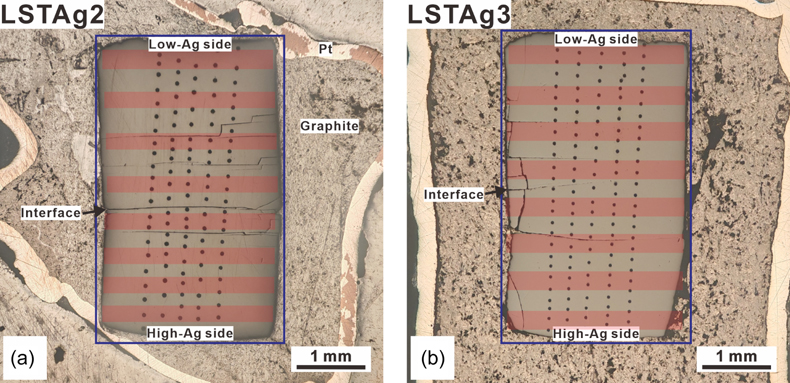
Figure 1 (a) Reflected light photo of LSTAg2. (b) Reflected light photo of LSTAg3. The black spots indicate the position of laser ablation pits. The five lines from left to right are designated as Line A to Line E. The blue rectangles represent the first etching using laser ultra-precision processing system. The red rectangles show location information sampled for Ag isotopic measurements.
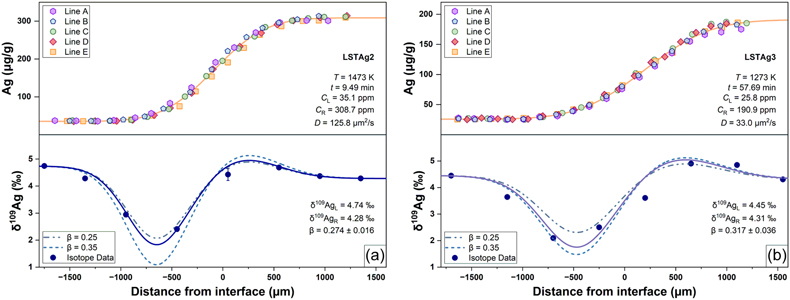
Figure 2 Ag concentration measured by LA-ICP-MS and δ109Ag measured by MC-ICP-MS. The five lines are represented by Line A to Line E longitudinally through the sample, from left to right. The concentration profiles of LSTAg2 and LSTAg3 were fitted using finite diffusion couple solutions, assuming a constant effective binary diffusivity (EBD). Orange line shows error function fits. A comparison was made between the Ag fractionation data for two experiments and profiles calculated using various β-factors. Blue line represents the best fit of δ109Ag profile (β = 0.274 ± 0.016 for LSTAg2 and 0.317 ± 0.036 for LSTAg3).
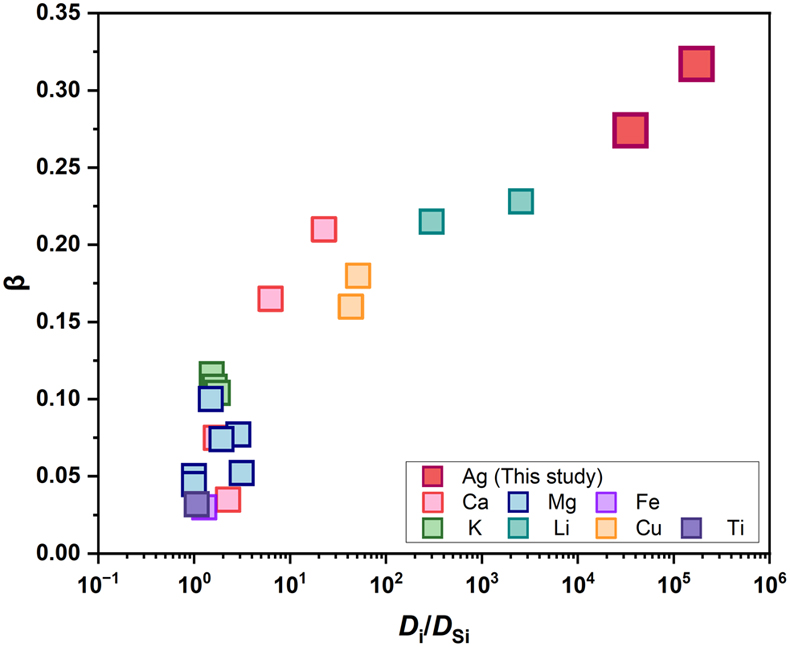
Figure 3 The relationship between experimentally determined βi -factor and Di /DSi for eight metal elements. Data are from: Ca (Richter et al., 2003
Richter, F.M., Davis, A.M., DePaolo, D.J., Watson, E.B. (2003) Isotope fractionation by chemical diffusion between molten basalt and rhyolite. Geochimica et Cosmochimica Acta 67, 3905–3923. https://doi.org/10.1016/S0016-7037(03)00174-1
; Watkins et al., 2009Watkins, J.M., DePaolo, D.J., Huber, C., Ryerson, F.J. (2009) Liquid composition-dependence of calcium isotope fractionation during diffusion in molten silicates. Geochimica et Cosmochimica Acta 73, 7341–7359. https://doi.org/10.1016/j.gca.2009.09.004
, 2011Watkins, J.M., DePaolo, D.J., Ryerson, F.J., Peterson, B.T. (2011) Influence of liquid structure on diffusive isotope separation in molten silicates and aqueous solutions. Geochimica et Cosmochimica Acta 75, 3103–3118. https://doi.org/10.1016/j.gca.2011.03.002
), Mg (Richter et al., 2008Richter, F.M., Watson, E.B., Mendybaev, R.A., Teng, F.-Z., Janney, P.E. (2008) Magnesium isotope fractionation in silicate melts by chemical and thermal diffusion. Geochimica et Cosmochimica Acta 72, 206–220. https://doi.org/10.1016/j.gca.2007.10.016
; Watkins et al., 2011Watkins, J.M., DePaolo, D.J., Ryerson, F.J., Peterson, B.T. (2011) Influence of liquid structure on diffusive isotope separation in molten silicates and aqueous solutions. Geochimica et Cosmochimica Acta 75, 3103–3118. https://doi.org/10.1016/j.gca.2011.03.002
; Chopra et al., 2012Chopra, R., Richter, F.M., Watson, E.B., Scullard, C.R. (2012) Magnesium isotope fractionation by chemical diffusion in natural settings and in laboratory analogues. Geochimica et Cosmochimica Acta 88, 1–18. https://doi.org/10.1016/j.gca.2012.03.039
; Zhang and Bai, 2025Zhang, Y., Bai, B. (2025) Diffusive Mg isotope fractionation in silicate melts during mineral dissolution. Chemical Geology 681, 122720. https://doi.org/10.1016/j.chemgeo.2025.122720
), Fe (Richter et al., 2009bRichter, F.M., Watson, E.B., Mendybaev, R., Dauphas, N., Georg, B., Watkins, J., Valley, J. (2009b) Isotopic fractionation of the major elements of molten basalt by chemical and thermal diffusion. Geochimica et Cosmochimica Acta 73, 4250–4263. https://doi.org/10.1016/j.gca.2009.04.011
), K (Zhang, 2022Zhang, Y. (2022) Diffusive fractionation of K isotopes in molten basalts. Earth and Planetary Science Letters 581, 117405. https://doi.org/10.1016/j.epsl.2022.117405
), Li (Richter et al., 2003Richter, F.M., Davis, A.M., DePaolo, D.J., Watson, E.B. (2003) Isotope fractionation by chemical diffusion between molten basalt and rhyolite. Geochimica et Cosmochimica Acta 67, 3905–3923. https://doi.org/10.1016/S0016-7037(03)00174-1
; Holycross et al., 2018Holycross, M.E., Watson, E.B., Richter, F.M., Villeneuve, J. (2018) Diffusive fractionation of Li isotopes in wet, highly silicic melts. Geochemical Perspectives Letters 6, 39–42. https://doi.org/10.7185/geochemlet.1807
), Cu (Ni and Shahar, 2023Ni, P., Shahar, A. (2023) Copper isotope fractionation by diffusion in a basaltic melt. Earth and Planetary Science Letters 624, 118459. https://doi.org/10.1016/j.epsl.2023.118459
), Ti (Zhou et al., 2025Zhou, S., Zhang, Y., Kita, N.T. (2025) Diffusive titanium isotope fractionation in silicate melts. Earth and Planetary Science Letters 651, 119176. https://doi.org/10.1016/j.epsl.2024.119176
) and Ag (this work).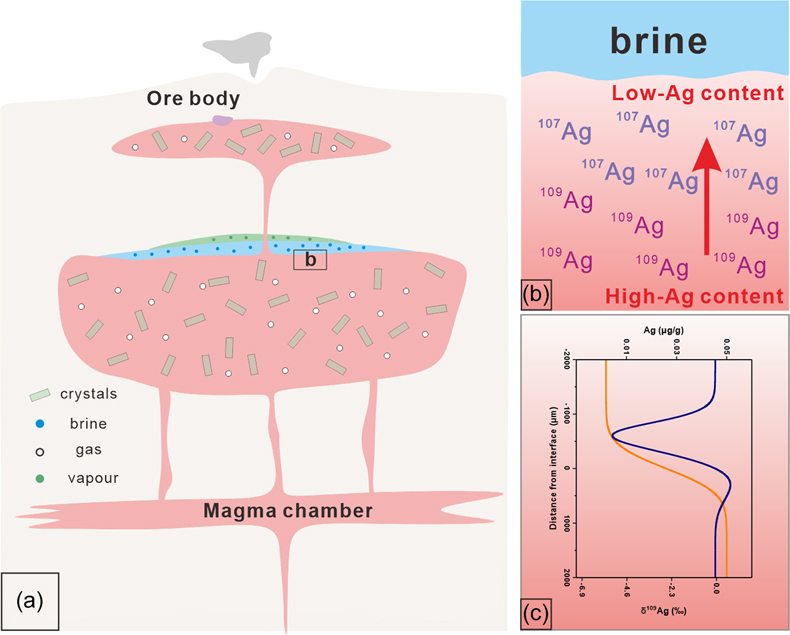
Figure 4 Schematic model of magma ascent and decompression process.