



Tracing anatexis and bottom-up crustal homogenisation with in situ Sm-Nd isotopes
Affiliations | Corresponding Author | Cite as | Funding information
Published by the European Association of Geochemistry
under Creative Commons License CC BY-NC-ND 4.0
Keywords: accessory minerals, Nd isotopes, crustal differentiation


- Share this article


-
Article views:940Cumulative count of HTML views and PDF downloads.
- Download Citation
- Rights & Permissions

top
Abstract
Figures
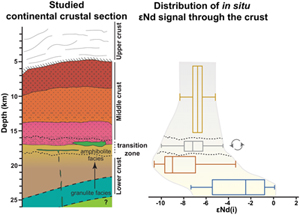
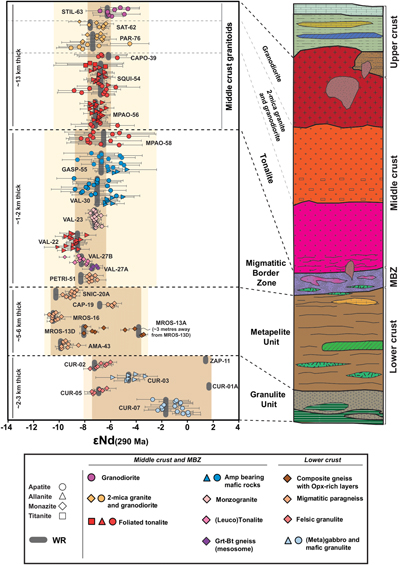 Figure 1 Compilation of whole rock and in situ Nd isotopic compositions (εNd290 Ma) for apatite, monazite, allanite, and titanite from the studied lower and mid-crustal samples, ordered by increasing 147Sm/144Nd for each mineral. Error bars are ± 2 s.e. Light-brown and light-yellow fields illustrate whole rock and in situ isotopic variability, respectively. Samples are arranged by approximate palaeo-depth within the crustal section, following the lithostratigraphic column in Figure S-1. Vertical spacing among samples is schematic and not to scale. | 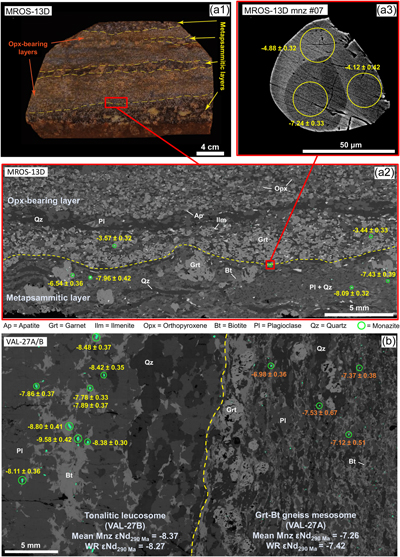 Figure 2 Illustration of the multiscale Nd isotopic heterogeneities of monazite from MROS-13D composite migmatite. (a1) Hand specimen, (a2) thin section (backscattered electron (BSE) image) and (a3) mineral (monazite). (b) Thin section scale isotopic variability of monazite between leucosome and mesosome in the VAL-27A/B diatexite. Hand specimen is displayed in Fig. S-7c. Values in yellow and orange correspond to εNd290 Ma ± 2 s.e. | 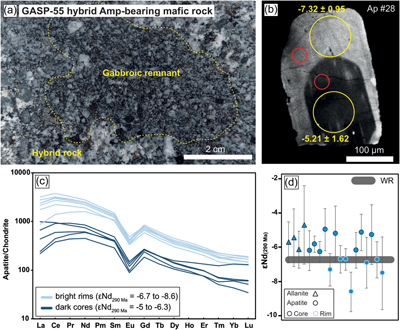 Figure 3 (a) Macroscopic view of GASP-55 hybrid mafic rock. (b) Representative CL image of apatite showing core–rim zoning with trace element (red circles) and Sm-Nd isotope (yellow circles) analytical spots with ±2 s.e. uncertainties. (c) Chondrite normalised (McDonough and Sun, 1995) REE patterns for GASP-55 apatite. (d) GASP-55 whole rock, apatite, and allanite Nd isotopic compositions (εNd(i)) with ±2 s.e. error bars. | 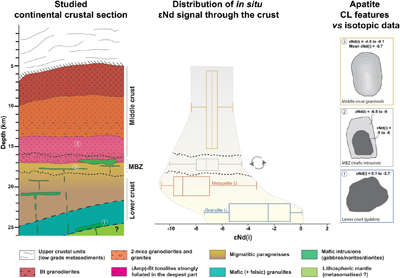 Figure 4 Sm-Nd isotopic scan of the Serre Massif–Capo Vaticano crustal section, illustrated with box plots for the Granulite Unit, Metapelite Unit, MBZ, and middle crust granitoid in situ data sets (SI). Box plots display minimum, maximum, median, and 25th–75th percentiles, highlighting isotopic homogenisation from the MBZ. On the right side, representative apatite CL features and isotopic data from igneous rocks (mafic intrusives and granitoids) across the crustal section. |
| Figure 1 | Figure 2 | Figure 3 | Figure 4 |
top
Introduction
The Phanerozoic continental crust forms predominantly in magmatic arc settings (e.g., Jagoutz and Kelemen, 2015
Jagoutz, O., Kelemen, P.B. (2015) Role of Arc Processes in the Formation of Continental Crust. Annual Review of Earth and Planetary Sciences 43, 363–404. https://doi.org/10.1146/annurev-earth-040809-152345
) and can be reworked during subsequent orogenic stages by tectonic, magmatic, and metamorphic processes. These geological processes promote intracrustal differentiation through high temperature (HT) metamorphism and partial melting of lower crustal rocks, resulting in a chemically stratified crustal structure (e.g., Rudnick and Gao, 2014Rudnick, R. L., Gao, S. (2014) 4.1 - Composition of the Continental Crust. In: Holland, H.D., Turekian, K.K. (Eds.) Treatise on Geochemistry. Second Edition, Elsevier, Oxford, 1–51. https://doi.org/10.1016/B978-0-08-095975-7.00301-6
). Consequently, segregation, extraction, and ascent of melts through the crust lead to the emplacement of granitoids in the middle crust. In addition, in most collisional/post-collisional environments, a wide variety of granitoids can be generated, including hybrid magmas (mantle and crustal sources) and pure crustal S-type magmas (Jacob et al., 2021Jacob, J.-B., Moyen, J.-F., Fiannacca, P., Laurent, O., Bachmann, O., Janoušek, V., Farina, F., Villaros, A. (2021) Crustal melting vs. fractionation of basaltic magmas: Part 2, Attempting to quantify mantle and crustal contributions in granitoids. Lithos 402–403, 106292. https://doi.org/10.1016/j.lithos.2021.106292
). However, accurately assessing the relative contributions of mantle and crustal components remains difficult. In particular, some studies suggest that commonly used geochemical proxies such as Hf isotopes in zircon can substantially underestimate the mantle component in post-collisional magmas (e.g., Couzinié et al., 2016Couzinié, S., Laurent, O., Moyen, J.-F., Zeh, A., Bouilhol, P., Villaros, A. (2016) Post-collisional magmatism: Crustal growth not identified by zircon Hf–O isotopes. Earth and Planetary Science Letters 456, 182–195. https://doi.org/10.1016/j.epsl.2016.09.033
). Another limitation is the restricted exposure of mantle rocks and deep crust where important melting and hybridisation processes occur (e.g., Voshage et al., 1990Voshage, H., Hofmann, A.W., Mazzucchelli, M., Rivalenti, G., Sinigoi, S., Raczek, I., Demarchi, G. (1990) Isotopic evidence from the Ivrea Zone for a hybrid lower crust formed by magmatic underplating. Nature 347, 731–736. https://doi.org/10.1038/347731a0
). One approach to overcome these limitations is to study exceptionally exposed crustal sections, with only ∼15 examples worldwide (e.g., Rudnick and Gao, 2014Rudnick, R. L., Gao, S. (2014) 4.1 - Composition of the Continental Crust. In: Holland, H.D., Turekian, K.K. (Eds.) Treatise on Geochemistry. Second Edition, Elsevier, Oxford, 1–51. https://doi.org/10.1016/B978-0-08-095975-7.00301-6
). This study focuses on a 25–30 km thick tilted Variscan crustal section in Calabria (Schenk, 1990Schenk, V. (1990) The Exposed Crustal Cross Section of Southern Calabria, Italy: Structure and Evolution of a Segment of Hercynian Crust. In: Salisbury, M.H., Fountain, D.M. (Eds.) Exposed Cross-Sections of the Continental Crust. Springer, Dordrecht, 21–42. https://doi.org/10.1007/978-94-009-0675-4_2
), offering a unique opportunity to observe the two dominant products of crustal differentiation: (1) the lower crustal granulites and partially melted metasediments, and (2) the mid-crustal granitoids emplaced in a post-collisional setting. We present an extensive data set of Sm-Nd isotopes along this crustal section, including both whole rock analyses and in situ measurements on accessory phases, in order to (i) characterise isotopic variability at multiple scales (outcrop, thin section, mineral), (ii) assess the extent and spatial distribution of hybridisation processes and their impact on the final Nd isotopic signatures of granitoids, and (iii) investigate granitoid sources and petrogenesis. Our results reveal strong multiscale heterogeneities in the Calabria lower crust, contrasting with the notable Nd isotopic homogeneity of the granitoids. We also identify hybridisation processes at the lower–middle crust transition and finally discuss the relative contributions of crust and mantle to the genesis of these post-collisional magmas.top
Geological Setting and Sample Selection
Calabria, along with the Peloritani Mountains in Sicily, forms an arcuate mountain belt formerly belonging to the western Mediterranean Alpine chain and later disrupted after the Oligo-Miocene tectonic evolution of the region. The Calabria massifs consist of a stack of basement nappes tectonically juxtaposed during the Alpine orogeny (e.g., Schenk, 1990
Schenk, V. (1990) The Exposed Crustal Cross Section of Southern Calabria, Italy: Structure and Evolution of a Segment of Hercynian Crust. In: Salisbury, M.H., Fountain, D.M. (Eds.) Exposed Cross-Sections of the Continental Crust. Springer, Dordrecht, 21–42. https://doi.org/10.1007/978-94-009-0675-4_2
). The uppermost nappe preserves a 25–30 km thick crustal cross section exposed in the Serre Massif and Capo Vaticano Promontory (CVP) area (central Calabria; Fig. S-1). This section, considered as nearly complete and unaffected by major thrust zones, was primarily formed during the late Variscan orogeny and later tilted by Alpine-Apennine tectonics (e.g., Schenk, 1990Schenk, V. (1990) The Exposed Crustal Cross Section of Southern Calabria, Italy: Structure and Evolution of a Segment of Hercynian Crust. In: Salisbury, M.H., Fountain, D.M. (Eds.) Exposed Cross-Sections of the Continental Crust. Springer, Dordrecht, 21–42. https://doi.org/10.1007/978-94-009-0675-4_2
). The lower crust comprises two units affected by late Variscan (300–290 Ma) HT metamorphism: (1) the 2–3 km thick Granulite Unit, composed of mafic and felsic granulites, which underwent peak T of 850–900 °C, overlain by (2) the 5–6 km thick Metapelite Unit consisting mostly of granulite to upper amphibolite facies migmatitic paragneisses (peak T ranging from 650 to 850 °C; SI), interspersed by small mafic intrusions (Schenk, 1990Schenk, V. (1990) The Exposed Crustal Cross Section of Southern Calabria, Italy: Structure and Evolution of a Segment of Hercynian Crust. In: Salisbury, M.H., Fountain, D.M. (Eds.) Exposed Cross-Sections of the Continental Crust. Springer, Dordrecht, 21–42. https://doi.org/10.1007/978-94-009-0675-4_2
; Caggianelli et al., 1991Caggianelli, A., Del Moro, A., Paglionico, A., Piccarreta, G., Pinarelli, L., Rottura, A. (1991) Lower crustal granite genesis connected with chemical fractionation in the continental crust of Calabria (Southern Italy). European Journal of Mineralogy 3, 159–180. https://doi.org/10.1127/ejm/3/1/0159
). The transition between migmatites and the deepest mid-crustal granitoids is marked by the Migmatitic Border Zone (MBZ), which shows diffuse evidence of partial melting. This zone contains a wide variety of lithologies, including garnet-bearing tonalites/diorites, amphibole gabbros, migmatites, leucogranites, and minor augen gneisses (e.g., Caggianelli et al., 2013Caggianelli, A., Prosser, G., Festa, V., Langone, A., Spiess, R. (2013) From the upper to the lower continental crust exposed in Calabria. Geological Field Trips 5, no. 1.2. https://doi.org/10.3301/gft.2013.02
).Middle crust granitoids are late Variscan, as indicated by emplacement ages ranging from 306.4 ± 1.6 Ma to 292.2 ± 2.6 Ma (Langone et al., 2014
Langone, A., Caggianelli, A., Festa, V., Prosser, G. (2014) Time Constraints on the Building of the Serre Batholith: Consequences for the Thermal Evolution of the Hercynian Continental Crust Exposed in Calabria (Southern Italy). The Journal of Geology 122, 183–199. https://doi.org/10.1086/675227
; Fiannacca et al., 2017Fiannacca, P., Williams, I.S., Cirrincione, R. (2017) Timescales and mechanisms of batholith construction: Constraints from zircon oxygen isotopes and geochronology of the late Variscan Serre Batholith (Calabria, southern Italy). Lithos 277, 302–314. https://doi.org/10.1016/j.lithos.2016.06.011
). They form a ∼13 km thick batholith composed, from the base to the top, of quartz diorites, tonalites, granodiorites and two-mica granites and granodiorites. Based on whole rock major and trace elements and Sr-Nd isotopic compositions of these granitoids, earlier petrogenetic models suggest either (1) an (almost) exclusively crustal origin (e.g., Fiannacca et al. 2015Fiannacca, P., Cirrincione, R., Bonanno, F., Carciotto, M.M. (2015) Source-inherited compositional diversity in granite batholiths: The geochemical message of Late Paleozoic intrusive magmatism in central Calabria (southern Italy). Lithos 236–237, 123–140. https://doi.org/10.1016/j.lithos.2015.09.003
), or (2) a mixing between mantle and crust-derived melts (Rottura et al., 1991Rottura, A., Del Moro, A., Pinarelli, L., Petrini, R., Peccerillo, A., Caggianelli, A., Bargossi, G.M., Piccarreta, G. (1991) Relationships between intermediate and acidic rocks in orogenic granitoid suites: petrological, geochemical and isotopic (Sr, Nd, Pb) data from Capo Vaticano (southern Calabria, Italy). Chemical Geology 92, 153–176.https://doi.org/10.1016/0009-2541(91)90054-U
; Fornelli et al., 1994Fornelli, A., Caggianelli, A., Del Moro, A., Bargossi, G.M., Paglionico, A., Piccarreta, G., Rottura, A. (1994) Petrology and evolution of the Central Serre granitoids (southern Calabria–Italy). Periodico di Mineralogia 63, 53–70.
).In this study, we use the Sm-Nd isotopic systematics, combining whole rock and in situ analyses of accessory minerals (apatite, monazite, allanite, titanite) on 26 samples representative of the lower and middle crust of the Serre Massif and CVP (Fig. S-1, Tables S-1 and S-2). Petrographic descriptions of the samples and additional age information are available in the Supplementary Information (SI).
top
Results
Whole rock and in situ Sm-Nd analyses by LA-MC-ICP-MS on apatite, allanite, monazite, and titanite grains are presented in Figure 1. Analytical details are provided in the SI and the complete Nd isotope data set in Tables S-3 and S-4. All initial isotopic ratios and ɛNd(i) were calculated for an age of 290 Ma, marking the end of granitoid magmatism and T peak of late Variscan metamorphism in Central Calabria (e.g., Schenk, 1990
Schenk, V. (1990) The Exposed Crustal Cross Section of Southern Calabria, Italy: Structure and Evolution of a Segment of Hercynian Crust. In: Salisbury, M.H., Fountain, D.M. (Eds.) Exposed Cross-Sections of the Continental Crust. Springer, Dordrecht, 21–42. https://doi.org/10.1007/978-94-009-0675-4_2
; SI).Figure 1 Compilation of whole rock and in situ Nd isotopic compositions (εNd290 Ma) for apatite, monazite, allanite, and titanite from the studied lower and mid-crustal samples, ordered by increasing 147Sm/144Nd for each mineral. Error bars are ± 2 s.e. Light-brown and light-yellow fields illustrate whole rock and in situ isotopic variability, respectively. Samples are arranged by approximate palaeo-depth within the crustal section, following the lithostratigraphic column in Figure S-1. Vertical spacing among samples is schematic and not to scale.
Samples from the Granulite Unit exhibit a wide whole rock ɛNd(i) range, particularly in mafic rocks (+1.7 to −4.6), indicating mantle-like to crustal affinities (Fig. 1, Table S-3). In contrast, two felsic granulites show crustal signatures around −7 (Fig. 1). The Metapelite Unit also displays heterogeneous whole rock isotopic compositions (from −3.8 to −10.5), falling within the broad range of Nd isotopic compositions previously reported for the Serre Massif migmatitic metasediments (from +1.1 to −12.5; Rottura et al., 1990
Rottura, A., Bargossi, G.M., Caironi, V., Del Moro, A., Maccarrone, E., Macera, P., Paglionico, A., Petrini, R., Piccarreta, G., Poli, G. (1990) Petrogenesis of contrasting Hercynian granitoids from the Calabrian Arc, southern Italy. Lithos 24, 97–119. https://doi.org/10.1016/0024-4937(90)90019-W
; Caggianelli et al., 1991Caggianelli, A., Del Moro, A., Paglionico, A., Piccarreta, G., Pinarelli, L., Rottura, A. (1991) Lower crustal granite genesis connected with chemical fractionation in the continental crust of Calabria (Southern Italy). European Journal of Mineralogy 3, 159–180. https://doi.org/10.1127/ejm/3/1/0159
; Del Moro et al., 2000Del Moro, A., Fornelli, A., Piccarreta, G. (2000) Disequilibrium melting in granulite-facies metasedimentary rocks of the Northern Serre (Calabria-Southern Italy). Mineralogy and Petrology 70, 89–104. https://doi.org/10.1007/s007100070015
). The MBZ samples show narrower whole rock ɛNd(i) ranging from −6.5 to −8.6 (Fig. 1). Interestingly, even the mafic rocks (VAL-30 and GASP-55; Table S-3) yield highly negative whole rock ɛNd(i) close to −7. Mid-crustal granitoids show a restricted whole rock ɛNd(i) range from −6.2 to −7.6 with a mean ɛNd(i) of −7.1 ± 1.4 (2 s.d.) mostly overlapping the range of the MBZ rocks, but sharply contrasting with the heterogeneous lower crust (Fig. 1). Although more radiogenic Nd isotopic compositions were occasionally reported in some tonalites and two-mica granodiorites (up to ɛNd(i) = +0.3) by Rottura et al. (1990)Rottura, A., Bargossi, G.M., Caironi, V., Del Moro, A., Maccarrone, E., Macera, P., Paglionico, A., Petrini, R., Piccarreta, G., Poli, G. (1990) Petrogenesis of contrasting Hercynian granitoids from the Calabrian Arc, southern Italy. Lithos 24, 97–119. https://doi.org/10.1016/0024-4937(90)90019-W
, no such compositions could be replicated in this study.Overall, accessory minerals yield isotopic compositions broadly consistent with their host rocks, except in the three shallowest migmatitic metapelites (CAP-19, SNIC-20A, PETRI-51; Fig. 1, Tables S-3 and S-4), where monazite ɛNd(i) are ∼1 ɛNd unit higher than whole rock values. In other cases, significant grain scale isotopic variations are observed. For instance, in the MROS-13D gneiss (Fig. 2a1) composed of alternating orthopyroxene-bearing and metapsammitic layers, monazite shows significant ɛNd(i) variation (∼4.5 ɛNd units) within a single thin section (Fig. 2a2). The least negative isotopic compositions (ɛNd(i) = −3.4 to −4.9) are found in the orthopyroxene-bearing layers, while monazite from the metapsammitic layers displays the most negative values (ɛNd(i) = −7.2 to −8.1). This difference is also observed in some grains at layer interfaces (Fig. 2a3). In these grains, the rims exhibit Nd signatures similar to monazite from the orthopyroxene-rich layers, while the cores yield more negative isotopic compositions, matching with monazite from metapsammitic layers and approaching the whole rock composition of a nearby metapsammitic sample located ∼3 m away (MROS-13A; ɛNd(i) = −8.1; Fig. 1).
Figure 2 Illustration of the multiscale Nd isotopic heterogeneities of monazite from MROS-13D composite migmatite. (a1) Hand specimen, (a2) thin section (backscattered electron (BSE) image) and (a3) mineral (monazite). (b) Thin section scale isotopic variability of monazite between leucosome and mesosome in the VAL-27A/B diatexite. Hand specimen is displayed in Fig. S-7c. Values in yellow and orange correspond to εNd290 Ma ± 2 s.e.
In another specific case from the MBZ (GASP-55 mafic rock; Fig. 3a), apatite grains show isotopic variations that can be linked to internal zoning and chemistry. Two populations can be distinguished: (1) cathodoluminescence (CL)-bright rims enriched in Rare Earth Elements (REE) and an average ɛNd(i) of −7.2 ± 1.4 (2 s.d.), compared to (2) CL-dark cores with systematically lower REE contents and an average ɛNd(i) of −5.6 ± 1.1 (2 s.d.) (Fig. 3b–d). The latter population aligns with the average ɛNd(i) (−5.5 ± 1.2; 2 s.d.) of allanite from the same sample (Figs. 1, 3d).
Figure 3 (a) Macroscopic view of GASP-55 hybrid mafic rock. (b) Representative CL image of apatite showing core–rim zoning with trace element (red circles) and Sm-Nd isotope (yellow circles) analytical spots with ±2 s.e. uncertainties. (c) Chondrite normalised (McDonough and Sun, 1995
McDonough, W.F., Sun, S.-s. (1995) The composition of the Earth. Chemical Geology 120, 223–253. https://doi.org/10.1016/0009-2541(94)00140-4
) REE patterns for GASP-55 apatite. (d) GASP-55 whole rock, apatite, and allanite Nd isotopic compositions (εNd(i)) with ±2 s.e. error bars.top
Discussion
Nd isotopic heterogeneities of the lower crust: from km to grain scale. The middle and lower crust levels of the Serre section display contrasting Nd isotopic compositions. While the former is globally homogeneous with whole rock ɛNd(i) values around −7, the lower crust exhibits pronounced isotopic heterogeneities. This variability likely reflects diverse source contributions: radiogenic mafic rocks forming the protoliths of the mafic granulites; ancient and mature (>600 Ma) sediments constituting most protoliths of the metapelites (e.g., Schenk, 1990
Schenk, V. (1990) The Exposed Crustal Cross Section of Southern Calabria, Italy: Structure and Evolution of a Segment of Hercynian Crust. In: Salisbury, M.H., Fountain, D.M. (Eds.) Exposed Cross-Sections of the Continental Crust. Springer, Dordrecht, 21–42. https://doi.org/10.1007/978-94-009-0675-4_2
), and younger greywackes derived from the erosion of igneous rocks possibly related to upper crustal Paleozoic volcano-sedimentary sequences (Rottura et al., 1990Rottura, A., Bargossi, G.M., Caironi, V., Del Moro, A., Maccarrone, E., Macera, P., Paglionico, A., Petrini, R., Piccarreta, G., Poli, G. (1990) Petrogenesis of contrasting Hercynian granitoids from the Calabrian Arc, southern Italy. Lithos 24, 97–119. https://doi.org/10.1016/0024-4937(90)90019-W
; Del Moro et al., 2000Del Moro, A., Fornelli, A., Piccarreta, G. (2000) Disequilibrium melting in granulite-facies metasedimentary rocks of the Northern Serre (Calabria-Southern Italy). Mineralogy and Petrology 70, 89–104. https://doi.org/10.1007/s007100070015
; Fiannacca et al., 2015Fiannacca, P., Cirrincione, R., Bonanno, F., Carciotto, M.M. (2015) Source-inherited compositional diversity in granite batholiths: The geochemical message of Late Paleozoic intrusive magmatism in central Calabria (southern Italy). Lithos 236–237, 123–140. https://doi.org/10.1016/j.lithos.2015.09.003
).Our results show that in situ Nd isotopic compositions generally match whole rock values, with minimal inter-mineral variability. This supports previous findings that accessory phases become isotopically homogenised for the Sm-Nd system above ∼550 °C within a given bulk lithology, at the cm to dm scale (e.g., Hammerli and Kemp, 2021
Hammerli, J., Kemp, A.I.S. (2021) Combined Hf and Nd isotope microanalysis of co-existing zircon and REE-rich accessory minerals: High resolution insights into crustal processes. Chemical Geology 581, 120393. https://doi.org/10.1016/j.chemgeo.2021.120393
; Biget et al., 2024Biget, T., Bruand, E., Pereira, I., Boyet, M., Gasser, D., Stüwe, K., Langone, A. (2024) The chemical and Sm–Nd isotopic behaviour of accessory minerals in metasediments along the LP-HT Chugach Metamorphic Complex (Alaska). Contributions to Mineralogy and Petrology 179, 108. https://doi.org/10.1007/s00410-024-02185-2
). However, some mineral-whole rock discrepancies or grain scale isotopic variations revealed by in situ measurements in some composite samples can reflect more complex geological processes not resolvable at the whole rock scale.In the composite gneiss MROS-13D, Nd isotopic variations of up to 4 ɛNd units occur at the cm scale between alternating orthopyroxene-bearing and metapsammitic layers (Fig. 2a1–3). Such variations may reflect inherited cm scale compositional heterogeneities in a protolith originally composed of finely alternating psammo-pelitic and more greywacke-like layers (Johnson et al., 2008
Johnson, T.E., White, R.W., Powell, R. (2008) Partial melting of metagreywacke: a calculated mineral equilibria study. Journal of Metamorphic Geology 26, 837–853. https://doi.org/10.1111/j.1525-1314.2008.00790.x
), deriving from isotopically distinct sources. In this case, the core–rim isotopic zoning of monazite at layer interfaces may suggest interaction of monazite with melt derived from anatexis of metagreywacke layers. Alternatively, the isotopic zoning of monazite could reflect the injection of mafic melts (orthopyroxene-bearing layers) into migmatites.The three uppermost migmatites display clear mineral–whole rock discrepancies (Fig. 1) most likely resulting from open system melting and the infiltration/percolation of isotopically distinct anatectic melts, a common feature in migmatitic terrains (e.g., Hammerli et al., 2018
Hammerli, J., Kemp, A.I.S., Shimura, T., Vervoort, J.D., EIMF, Dunkley, D.J. (2018) Generation of I-type granitic rocks by melting of heterogeneous lower crust. Geology 46, 907–910. https://doi.org/10.1130/G45119.1
). This is further exemplified by VAL-27 diatexite, where whole rock and monazite analyses differ by ∼1 ɛNd unit between mesosome and leucosome (Fig. 2b), suggesting that the tonalitic leucosome may not form via in situ partial melting of the garnet-biotite gneiss.Magma hybridisation and isotopic homogenisation in the Migmatitic Border Zone (MBZ). The MBZ displays limited Nd isotopic variability despite encompassing a wide range of lithologies, including leucogranites, migmatites, and mafic rocks (gabbros, norites), intimately imbricated at the outcrop scale. The study of mafic rocks provides key evidence for hybridisation processes. In particular, in an amphibole-bearing mafic sample (GASP-55), apatite exhibits pronounced reverse chemical zoning with CL-dark cores depleted in REE (+Th and U), and CL-bright rims enriched in these elements (Fig. 3c, Table S-8). Similar patterns, documented elsewhere, have been interpreted as the result of mixing between compositionally distinct magmas (e.g., Bruand et al., 2014
Bruand, E., Storey, C., Fowler, M. (2014) Accessory Mineral Chemistry of High Ba–Sr Granites from Northern Scotland: Constraints on Petrogenesis and Records of Whole-rock Signature. Journal of Petrology 55, 1619–1651. https://doi.org/10.1093/petrology/egu037
; Laurent et al., 2017Laurent, O., Zeh, A., Gerdes, A. Villaros, A., Gros, K., Słaby, E. (2017) How do granitoid magmas mix with each other? Insights from textures, trace element and Sr–Nd isotopic composition of apatite and titanite from the Matok pluton (South Africa). Contributions to Mineralogy and Petrology 172, 80. https://doi.org/10.1007/s00410-017-1398-1
). According to the apatite compositional database of Xu et al. (2024)Xu, J., Xia, X.-P., Wang, Q., Spencer, C.J., Zhang, L., Zhu, X. (2024) Apatite Textures, Elemental and Isotopic Compositions Unmask the Homogenizing Process in Silicic Magma Chambers. Geophysical Research Letters 51, e2023GL106646. https://doi.org/10.1029/2023GL106646
, apatite cores likely crystallised from low SiO2 melts (45–55 wt. %), whereas rims reflect melts with higher SiO2 contents (55–65 wt. %; Fig. S-14). Nd isotopic compositions, though mostly similar within uncertainties, tend to correlate with this zoning: dark domains yield ɛNd(i) values around −5, while bright domains show more negative values near −7 (Fig. 3b,d). These chemical and isotopic variations record the interaction between a gabbroic magma with less negative ɛNd(i) and a felsic melt with a more negative signature.Isotopic homogenisation towards ɛNd(i) ≈ −7 may result from various processes during melt migration from source to emplacement, including hybridisation during transport into melt channelways (Hasalová et al., 2011
Hasalová, P., Weinberg, R.F., MacRae, C. (2011) Microstructural evidence for magma confluence and reusage of magma pathways: implications for magma hybridization, Karakoram Shear Zone in NW India. Journal of Metamorphic Geology 29, 875–900. https://doi.org/10.1111/j.1525-1314.2011.00945.x
), mixing between multiple magma batches, or assimilation of crustal components enhanced by prolonged convection and diffusion driven exchange (Poitrasson and Pin, 1998Poitrasson, F., Pin, C. (1998) Extreme Nd isotope homogeneity in a large rhyolitic province: the Estérel massif, southeast France. Bulletin of Volcanology 60, 213–223. https://doi.org/10.1007/s004450050228
). Altogether, field observations, isotopic homogenisation of igneous rocks, and grain scale Nd isotopic heterogeneities indicate that the Migmatitic Border Zone (MBZ) acted as a key site for magma hybridisation and homogenisation prior to possible ascent and emplacement at shallower crustal levels. These features echo those of lower crustal MASH Zones (e.g., Hildreth and Moorbath, 1988Hildreth, W., Moorbath, S. (1988) Crustal contributions to arc magmatism in the Andes of Central Chile. Contributions to Mineralogy and Petrology 98, 455–489. https://doi.org/10.1007/BF00372365
) or Deep Crustal Hot Zones (Annen et al., 2006Annen, C., Blundy, J.D., Sparks, R.S.J. (2006) The Genesis of Intermediate and Silicic Magmas in Deep Crustal Hot Zones. Journal of Petrology 47, 505–539. https://doi.org/10.1093/petrology/egi084
), where mafic and crustal-derived magmas hybridise and homogenise in arc settings. In a field based study, Schwindinger and Weinberg (2017)Schwindinger, M., Weinberg, R.F. (2017) A felsic MASH zone of crustal magmas — Feedback between granite magma intrusion and in situ crustal anatexis. Lithos 284–285, 109–121. https://doi.org/10.1016/j.lithos.2017.03.030
suggested that analogous zones could exist at shallower crustal levels (similar to the MBZ location), where repeated magma injections supply heat and H2O, promoting local anatexis, hybridisation and homogenisation through a positive feedback loop. The example of the MBZ in Calabria suggests that such hybridisation zones at the transition between lower and middle crust might be more widespread than previously reported in crust dominated, (post-) collisional settings.Middle crust granitoids’ “amnesia” toward their sources. Nd isotopic analyses show that all granitoids, including tonalites, display a consistent crustal signature at both the whole rock and accessory mineral scales (average ɛNd(i) ≈ −7). The Nd isotopic variability of the lower crust, observed in metasediments and mafic bodies, is notably greater than the apparent homogeneity of the granitoids. This contrast highlights the middle crust’s isotopic “amnesia” to source heterogeneities (Fig. 4), although certain parts of the batholith may locally escape homogenisation and retain isotopic compositions close to their source rock, as indicated by more radiogenic values reported by Rottura et al. (1990)
Rottura, A., Bargossi, G.M., Caironi, V., Del Moro, A., Maccarrone, E., Macera, P., Paglionico, A., Petrini, R., Piccarreta, G., Poli, G. (1990) Petrogenesis of contrasting Hercynian granitoids from the Calabrian Arc, southern Italy. Lithos 24, 97–119. https://doi.org/10.1016/0024-4937(90)90019-W
. If only granitoid isotopic data were considered, mantle contributions would appear weak or even absent (e.g., Fiannacca et al., 2015Fiannacca, P., Cirrincione, R., Bonanno, F., Carciotto, M.M. (2015) Source-inherited compositional diversity in granite batholiths: The geochemical message of Late Paleozoic intrusive magmatism in central Calabria (southern Italy). Lithos 236–237, 123–140. https://doi.org/10.1016/j.lithos.2015.09.003
, 2017Fiannacca, P., Williams, I.S., Cirrincione, R. (2017) Timescales and mechanisms of batholith construction: Constraints from zircon oxygen isotopes and geochronology of the late Variscan Serre Batholith (Calabria, southern Italy). Lithos 277, 302–314. https://doi.org/10.1016/j.lithos.2016.06.011
). However, the occurrence of small mafic bodies (norites, amphibole gabbros, and diorites) within the lower crust and the MBZ of both the Serre and adjacent Sila crustal sections (e.g., Schenk, 1990Schenk, V. (1990) The Exposed Crustal Cross Section of Southern Calabria, Italy: Structure and Evolution of a Segment of Hercynian Crust. In: Salisbury, M.H., Fountain, D.M. (Eds.) Exposed Cross-Sections of the Continental Crust. Springer, Dordrecht, 21–42. https://doi.org/10.1007/978-94-009-0675-4_2
; Caggianelli et al., 1994Caggianelli, A., Del Moro, A., Piccarreta, G. (1994) Petrology of basic and intermediate orogenic granitoids from the Sila Massif (Calabria, southern Italy). Geological Journal 29, 11–28. https://doi.org/10.1002/gj.3350290103
) supports a mantle input to the genesis of the Calabrian granitoids (Rottura et al., 1991Rottura, A., Del Moro, A., Pinarelli, L., Petrini, R., Peccerillo, A., Caggianelli, A., Bargossi, G.M., Piccarreta, G. (1991) Relationships between intermediate and acidic rocks in orogenic granitoid suites: petrological, geochemical and isotopic (Sr, Nd, Pb) data from Capo Vaticano (southern Calabria, Italy). Chemical Geology 92, 153–176.https://doi.org/10.1016/0009-2541(91)90054-U
; Fornelli et al., 1994Fornelli, A., Caggianelli, A., Del Moro, A., Bargossi, G.M., Paglionico, A., Piccarreta, G., Rottura, A. (1994) Petrology and evolution of the Central Serre granitoids (southern Calabria–Italy). Periodico di Mineralogia 63, 53–70.
).Figure 4 Sm-Nd isotopic scan of the Serre Massif–Capo Vaticano crustal section, illustrated with box plots for the Granulite Unit, Metapelite Unit, MBZ, and middle crust granitoid in situ data sets (SI). Box plots display minimum, maximum, median, and 25th–75th percentiles, highlighting isotopic homogenisation from the MBZ. On the right side, representative apatite CL features and isotopic data from igneous rocks (mafic intrusives and granitoids) across the crustal section.
Mafic intrusives (locally olivine-bearing) from the Sila crustal section display whole rock ɛNd(i) values between −2.4 and −7.4 (Caggianelli et al., 1994
Caggianelli, A., Del Moro, A., Piccarreta, G. (1994) Petrology of basic and intermediate orogenic granitoids from the Sila Massif (Calabria, southern Italy). Geological Journal 29, 11–28. https://doi.org/10.1002/gj.3350290103
), comparable to certain mafic rocks from the Serre section. These negative ɛNd(i) values do not reflect pristine mantle composition but likely result from (i) metasomatisation of the mantle source, or (ii) modification by crustal assimilation and contamination of the magmas during underplating or ascent through the lower crust. Indeed, a mantle metasomatised by crustal-derived fluids can display similarly negative ɛNd(i) values (down to −5.2 in the Ivrea-Verbano Zone; Voshage et al., 1990Voshage, H., Hofmann, A.W., Mazzucchelli, M., Rivalenti, G., Sinigoi, S., Raczek, I., Demarchi, G. (1990) Isotopic evidence from the Ivrea Zone for a hybrid lower crust formed by magmatic underplating. Nature 347, 731–736. https://doi.org/10.1038/347731a0
, and references therein), potentially masking its contribution to mid-crustal granitoid genesis (Jacob et al., 2021Jacob, J.-B., Moyen, J.-F., Fiannacca, P., Laurent, O., Bachmann, O., Janoušek, V., Farina, F., Villaros, A. (2021) Crustal melting vs. fractionation of basaltic magmas: Part 2, Attempting to quantify mantle and crustal contributions in granitoids. Lithos 402–403, 106292. https://doi.org/10.1016/j.lithos.2021.106292
). In the Serre section, rare phlogopite-bearing peridotite remnants at the base of the lower crust (Rizzo et al., 2001Rizzo, G., Piluso, E., Morten, L. (2001) Phlogopite from the Serre ultramafic rocks, Central Calabria, Southern Italy. European Journal of Mineralogy 13, 1139–1151. https://doi.org/10.1127/0935-1221/2001/0013-1139
) suggest the presence of a metasomatic agent in the lithospheric mantle, although no Nd isotopic data exist for these rocks. Alternatively, negative ɛNd(i) values may result from assimilation of crustal material by mantle-derived melts at the roof of mafic intrusions emplaced within metasediments (e.g., gabbros with ɛNd(i) = −3.1 to −6.4, Ivrea-Verbano Zone; Voshage et al., 1990Voshage, H., Hofmann, A.W., Mazzucchelli, M., Rivalenti, G., Sinigoi, S., Raczek, I., Demarchi, G. (1990) Isotopic evidence from the Ivrea Zone for a hybrid lower crust formed by magmatic underplating. Nature 347, 731–736. https://doi.org/10.1038/347731a0
). In the Serre crustal section, both processes could have contributed to the negative ɛNd(i) values observed in mafic intrusions.Although the Serre batholith formed in a crust dominated system, this study demonstrates that the diversity of lower crustal sources cannot be resolved using the Sm-Nd system in the granitoids. On the other hand, in situ analyses from the MBZ constitute a powerful tool for detecting hybridisation processes before complete isotopic homogenisation (Fig. 4). At this stage, the quantification of the mantle contribution remains speculative without constraints on the local mantle isotopic composition and may be underestimated in such crust-dominated systems.
top
Conclusions
Whole rock and in situ Sm-Nd analyses of accessory minerals provide an isotopic overview of a crustal section in central Calabria (Italy). The lower crust exhibits significant source heterogeneity (whole rock ɛNd(i) = −10.5 to +1.7), dominated by crustal isotopic signatures, with a subtle mantle affinity recorded in some of the deepest mafic granulites and metagabbros. In situ data also reveal heterogeneities at the thin section or grain scale and highlight open system melting in some migmatites. Conversely, mid-crustal igneous rocks composing the batholith are remarkably homogeneous, with whole rock and mineral ɛNd(i) close to −7. This homogenisation arises from a 1–2 km thick transition zone (Migmatitic Border Zone; MBZ) between the lower and middle crust, where hybridisation occurred between anatectic melts and mafic magmas. Although the granitoids display pronounced crustal Nd signatures suggesting derivation through partial melting of the lower crust, locally hybridised gabbro-norites at various crustal levels — particularly within the MBZ — suggest a mantle contribution. However, their original isotopic signature was likely obscured by metasomatisation of the mantle source or by intense crustal assimilation and hybridisation with anatectic melts during magma ascent. The relative proportions of crustal and mantle components remain difficult to constrain using the Sm-Nd system.
top
Acknowledgements
This work was supported by the French National Research Agency (grant ANR-21-CE49-0001-01, AMNESIA, PI Emilie Bruand). Two anonymous reviewers and the editor R. Tartèse are thanked for their very constructive and helpful comments.
Editor: Romain Tartèse
top
References
Annen, C., Blundy, J.D., Sparks, R.S.J. (2006) The Genesis of Intermediate and Silicic Magmas in Deep Crustal Hot Zones. Journal of Petrology 47, 505–539. https://doi.org/10.1093/petrology/egi084
 Show in context
 These features echo those of lower crustal MASH Zones (e.g., Hildreth and Moorbath, 1988) or Deep Crustal Hot Zones (Annen et al., 2006), where mafic and crustal-derived magmas hybridise and homogenise in arc settings.
View in article
Biget, T., Bruand, E., Pereira, I., Boyet, M., Gasser, D., Stüwe, K., Langone, A. (2024) The chemical and Sm–Nd isotopic behaviour of accessory minerals in metasediments along the LP-HT Chugach Metamorphic Complex (Alaska). Contributions to Mineralogy and Petrology 179, 108. https://doi.org/10.1007/s00410-024-02185-2
Show in context This supports previous findings that accessory phases become isotopically homogenised for the Sm-Nd system above ∼550 °C within a given bulk lithology, at the cm to dm scale (e.g., Hammerli and Kemp, 2021; Biget et al., 2024).
View in article
Bruand, E., Storey, C., Fowler, M. (2014) Accessory Mineral Chemistry of High Ba–Sr Granites from Northern Scotland: Constraints on Petrogenesis and Records of Whole-rock Signature. Journal of Petrology 55, 1619–1651. https://doi.org/10.1093/petrology/egu037
Show in context Similar patterns, documented elsewhere, have been interpreted as the result of mixing between compositionally distinct magmas (e.g., Bruand et al., 2014; Laurent et al., 2017).
View in article
Caggianelli, A., Del Moro, A., Paglionico, A., Piccarreta, G., Pinarelli, L., Rottura, A. (1991) Lower crustal granite genesis connected with chemical fractionation in the continental crust of Calabria (Southern Italy). European Journal of Mineralogy 3, 159–180. https://doi.org/10.1127/ejm/3/1/0159
Show in context The lower crust comprises two units affected by late Variscan (300–290 Ma) HT metamorphism: (1) the 2–3 km thick Granulite Unit, composed of mafic and felsic granulites, which underwent peak T of 850–900 °C, overlain by (2) the 5–6 km thick Metapelite Unit consisting mostly of granulite to upper amphibolite facies migmatitic paragneisses (peak T ranging from 650 to 850 °C; SI), interspersed by small mafic intrusions (Schenk, 1990; Caggianelli et al., 1991).
View in article
The Metapelite Unit also displays heterogeneous whole rock isotopic compositions (from −3.8 to −10.5), falling within the broad range of Nd isotopic compositions previously reported for the Serre Massif migmatitic metasediments (from +1.1 to −12.5; Rottura et al., 1990; Caggianelli et al., 1991; Del Moro et al., 2000).
View in article
Caggianelli, A., Del Moro, A., Piccarreta, G. (1994) Petrology of basic and intermediate orogenic granitoids from the Sila Massif (Calabria, southern Italy). Geological Journal 29, 11–28. https://doi.org/10.1002/gj.3350290103
Show in context However, the occurrence of small mafic bodies (norites, amphibole gabbros, and diorites) within the lower crust and the MBZ of both the Serre and adjacent Sila crustal sections (e.g., Schenk, 1990; Caggianelli et al., 1994) supports a mantle input to the genesis of the Calabrian granitoids (Rottura et al., 1991; Fornelli et al., 1994).
View in article
Mafic intrusives (locally olivine-bearing) from the Sila crustal section display whole rock ɛNd(i) values between −2.4 and −7.4 (Caggianelli et al., 1994), comparable to certain mafic rocks from the Serre section.
View in article
Caggianelli, A., Prosser, G., Festa, V., Langone, A., Spiess, R. (2013) From the upper to the lower continental crust exposed in Calabria. Geological Field Trips 5, no. 1.2. https://doi.org/10.3301/gft.2013.02
Show in context This zone contains a wide variety of lithologies, including garnet-bearing tonalites/diorites, amphibole gabbros, migmatites, leucogranites, and minor augen gneisses (e.g., Caggianelli et al., 2013).
View in article
Couzinié, S., Laurent, O., Moyen, J.-F., Zeh, A., Bouilhol, P., Villaros, A. (2016) Post-collisional magmatism: Crustal growth not identified by zircon Hf–O isotopes. Earth and Planetary Science Letters 456, 182–195. https://doi.org/10.1016/j.epsl.2016.09.033
Show in context In particular, some studies suggest that commonly used geochemical proxies such as Hf isotopes in zircon can substantially underestimate the mantle component in post-collisional magmas (e.g., Couzinié et al., 2016).
View in article
Del Moro, A., Fornelli, A., Piccarreta, G. (2000) Disequilibrium melting in granulite-facies metasedimentary rocks of the Northern Serre (Calabria-Southern Italy). Mineralogy and Petrology 70, 89–104. https://doi.org/10.1007/s007100070015
Show in context The Metapelite Unit also displays heterogeneous whole rock isotopic compositions (from −3.8 to −10.5), falling within the broad range of Nd isotopic compositions previously reported for the Serre Massif migmatitic metasediments (from +1.1 to −12.5; Rottura et al., 1990; Caggianelli et al., 1991; Del Moro et al., 2000).
View in article
This variability likely reflects diverse source contributions: radiogenic mafic rocks forming the protoliths of the mafic granulites; ancient and mature (>600 Ma) sediments constituting most protoliths of the metapelites (e.g., Schenk, 1990), and younger greywackes derived from the erosion of igneous rocks possibly related to upper crustal Paleozoic volcano-sedimentary sequences (Rottura et al., 1990; Del Moro et al., 2000; Fiannacca et al., 2015).
View in article
Fiannacca, P., Cirrincione, R., Bonanno, F., Carciotto, M.M. (2015) Source-inherited compositional diversity in granite batholiths: The geochemical message of Late Paleozoic intrusive magmatism in central Calabria (southern Italy). Lithos 236–237, 123–140. https://doi.org/10.1016/j.lithos.2015.09.003
Show in context Based on whole rock major and trace elements and Sr-Nd isotopic compositions of these granitoids, earlier petrogenetic models suggest either (1) an (almost) exclusively crustal origin (e.g., Fiannacca et al. 2015), or (2) a mixing between mantle and crust-derived melts (Rottura et al., 1991; Fornelli et al., 1994).
View in article
This variability likely reflects diverse source contributions: radiogenic mafic rocks forming the protoliths of the mafic granulites; ancient and mature (>600 Ma) sediments constituting most protoliths of the metapelites (e.g., Schenk, 1990), and younger greywackes derived from the erosion of igneous rocks possibly related to upper crustal Paleozoic volcano-sedimentary sequences (Rottura et al., 1990; Del Moro et al., 2000; Fiannacca et al., 2015).
View in article
If only granitoid isotopic data were considered, mantle contributions would appear weak or even absent (e.g., Fiannacca et al., 2015, 2017).
View in article
Fiannacca, P., Williams, I.S., Cirrincione, R. (2017) Timescales and mechanisms of batholith construction: Constraints from zircon oxygen isotopes and geochronology of the late Variscan Serre Batholith (Calabria, southern Italy). Lithos 277, 302–314. https://doi.org/10.1016/j.lithos.2016.06.011
Show in context Middle crust granitoids are late Variscan, as indicated by emplacement ages ranging from 306.4 ± 1.6 Ma to 292.2 ± 2.6 Ma (Langone et al., 2014; Fiannacca et al., 2017).
View in article
If only granitoid isotopic data were considered, mantle contributions would appear weak or even absent (e.g., Fiannacca et al., 2015, 2017).
View in article
Fornelli, A., Caggianelli, A., Del Moro, A., Bargossi, G.M., Paglionico, A., Piccarreta, G., Rottura, A. (1994) Petrology and evolution of the Central Serre granitoids (southern Calabria–Italy). Periodico di Mineralogia 63, 53–70.
Show in context Based on whole rock major and trace elements and Sr-Nd isotopic compositions of these granitoids, earlier petrogenetic models suggest either (1) an (almost) exclusively crustal origin (e.g., Fiannacca et al. 2015), or (2) a mixing between mantle and crust-derived melts (Rottura et al., 1991; Fornelli et al., 1994).
View in article
However, the occurrence of small mafic bodies (norites, amphibole gabbros, and diorites) within the lower crust and the MBZ of both the Serre and adjacent Sila crustal sections (e.g., Schenk, 1990; Caggianelli et al., 1994) supports a mantle input to the genesis of the Calabrian granitoids (Rottura et al., 1991; Fornelli et al., 1994).
View in article
Hammerli, J., Kemp, A.I.S. (2021) Combined Hf and Nd isotope microanalysis of co-existing zircon and REE-rich accessory minerals: High resolution insights into crustal processes. Chemical Geology 581, 120393. https://doi.org/10.1016/j.chemgeo.2021.120393
Show in context This supports previous findings that accessory phases become isotopically homogenised for the Sm-Nd system above ∼550 °C within a given bulk lithology, at the cm to dm scale (e.g., Hammerli and Kemp, 2021; Biget et al., 2024).
View in article
Hammerli, J., Kemp, A.I.S., Shimura, T., Vervoort, J.D., EIMF, Dunkley, D.J. (2018) Generation of I-type granitic rocks by melting of heterogeneous lower crust. Geology 46, 907–910. https://doi.org/10.1130/G45119.1
Show in context The three uppermost migmatites display clear mineral–whole rock discrepancies (Fig. 1) most likely resulting from open system melting and the infiltration/percolation of isotopically distinct anatectic melts, a common feature in migmatitic terrains (e.g., Hammerli et al., 2018).
View in article
Hasalová, P., Weinberg, R.F., MacRae, C. (2011) Microstructural evidence for magma confluence and reusage of magma pathways: implications for magma hybridization, Karakoram Shear Zone in NW India. Journal of Metamorphic Geology 29, 875–900. https://doi.org/10.1111/j.1525-1314.2011.00945.x
Show in context Isotopic homogenisation towards ɛNd(i) ≈ −7 may result from various processes during melt migration from source to emplacement, including hybridisation during transport into melt channelways (Hasalová et al., 2011), mixing between multiple magma batches, or assimilation of crustal components enhanced by prolonged convection and diffusion driven exchange (Poitrasson and Pin, 1998).
View in article
Hildreth, W., Moorbath, S. (1988) Crustal contributions to arc magmatism in the Andes of Central Chile. Contributions to Mineralogy and Petrology 98, 455–489. https://doi.org/10.1007/BF00372365
Show in context These features echo those of lower crustal MASH Zones (e.g., Hildreth and Moorbath, 1988) or Deep Crustal Hot Zones (Annen et al., 2006), where mafic and crustal-derived magmas hybridise and homogenise in arc settings.
View in article
Jacob, J.-B., Moyen, J.-F., Fiannacca, P., Laurent, O., Bachmann, O., Janoušek, V., Farina, F., Villaros, A. (2021) Crustal melting vs. fractionation of basaltic magmas: Part 2, Attempting to quantify mantle and crustal contributions in granitoids. Lithos 402–403, 106292. https://doi.org/10.1016/j.lithos.2021.106292
Show in context In addition, in most collisional/post-collisional environments, a wide variety of granitoids can be generated, including hybrid magmas (mantle and crustal sources) and pure crustal S-type magmas (Jacob et al., 2021).
View in article
Indeed, a mantle metasomatised by crustal-derived fluids can display similarly negative ɛNd(i) values (down to −5.2 in the Ivrea-Verbano Zone; Voshage et al., 1990, and references therein), potentially masking its contribution to mid-crustal granitoid genesis (Jacob et al., 2021).
View in article
Jagoutz, O., Kelemen, P.B. (2015) Role of Arc Processes in the Formation of Continental Crust. Annual Review of Earth and Planetary Sciences 43, 363–404. https://doi.org/10.1146/annurev-earth-040809-152345
Show in context The Phanerozoic continental crust forms predominantly in magmatic arc settings (e.g., Jagoutz and Kelemen, 2015) and can be reworked during subsequent orogenic stages by tectonic, magmatic, and metamorphic processes.
View in article
Johnson, T.E., White, R.W., Powell, R. (2008) Partial melting of metagreywacke: a calculated mineral equilibria study. Journal of Metamorphic Geology 26, 837–853. https://doi.org/10.1111/j.1525-1314.2008.00790.x
Show in context Such variations may reflect inherited cm scale compositional heterogeneities in a protolith originally composed of finely alternating psammo-pelitic and more greywacke-like layers (Johnson et al., 2008), deriving from isotopically distinct sources.
View in article
Langone, A., Caggianelli, A., Festa, V., Prosser, G. (2014) Time Constraints on the Building of the Serre Batholith: Consequences for the Thermal Evolution of the Hercynian Continental Crust Exposed in Calabria (Southern Italy). The Journal of Geology 122, 183–199. https://doi.org/10.1086/675227
Show in context Middle crust granitoids are late Variscan, as indicated by emplacement ages ranging from 306.4 ± 1.6 Ma to 292.2 ± 2.6 Ma (Langone et al., 2014; Fiannacca et al., 2017).
View in article
Laurent, O., Zeh, A., Gerdes, A. Villaros, A., Gros, K., Słaby, E. (2017) How do granitoid magmas mix with each other? Insights from textures, trace element and Sr–Nd isotopic composition of apatite and titanite from the Matok pluton (South Africa). Contributions to Mineralogy and Petrology 172, 80. https://doi.org/10.1007/s00410-017-1398-1
Show in context Similar patterns, documented elsewhere, have been interpreted as the result of mixing between compositionally distinct magmas (e.g., Bruand et al., 2014; Laurent et al., 2017).
View in article
McDonough, W.F., Sun, S.-s. (1995) The composition of the Earth. Chemical Geology 120, 223–253. https://doi.org/10.1016/0009-2541(94)00140-4
Show in context (c) Chondrite normalised (McDonough and Sun, 1995) REE patterns for GASP-55 apatite.
View in article
Poitrasson, F., Pin, C. (1998) Extreme Nd isotope homogeneity in a large rhyolitic province: the Estérel massif, southeast France. Bulletin of Volcanology 60, 213–223. https://doi.org/10.1007/s004450050228
Show in context Isotopic homogenisation towards ɛNd(i) ≈ −7 may result from various processes during melt migration from source to emplacement, including hybridisation during transport into melt channelways (Hasalová et al., 2011), mixing between multiple magma batches, or assimilation of crustal components enhanced by prolonged convection and diffusion driven exchange (Poitrasson and Pin, 1998).
View in article
Rizzo, G., Piluso, E., Morten, L. (2001) Phlogopite from the Serre ultramafic rocks, Central Calabria, Southern Italy. European Journal of Mineralogy 13, 1139–1151. https://doi.org/10.1127/0935-1221/2001/0013-1139
Show in context In the Serre section, rare phlogopite-bearing peridotite remnants at the base of the lower crust (Rizzo et al., 2001) suggest the presence of a metasomatic agent in the lithospheric mantle, although no Nd isotopic data exist for these rocks.
View in article
Rottura, A., Bargossi, G.M., Caironi, V., Del Moro, A., Maccarrone, E., Macera, P., Paglionico, A., Petrini, R., Piccarreta, G., Poli, G. (1990) Petrogenesis of contrasting Hercynian granitoids from the Calabrian Arc, southern Italy. Lithos 24, 97–119. https://doi.org/10.1016/0024-4937(90)90019-W
Show in context The Metapelite Unit also displays heterogeneous whole rock isotopic compositions (from −3.8 to −10.5), falling within the broad range of Nd isotopic compositions previously reported for the Serre Massif migmatitic metasediments (from +1.1 to −12.5; Rottura et al., 1990; Caggianelli et al., 1991; Del Moro et al., 2000).
View in article
Although more radiogenic Nd isotopic compositions were occasionally reported in some tonalites and two-mica granodiorites (up to ɛNd(i) = +0.3) by Rottura et al. (1990), no such compositions could be replicated in this study.
View in article
This variability likely reflects diverse source contributions: radiogenic mafic rocks forming the protoliths of the mafic granulites; ancient and mature (>600 Ma) sediments constituting most protoliths of the metapelites (e.g., Schenk, 1990), and younger greywackes derived from the erosion of igneous rocks possibly related to upper crustal Paleozoic volcano-sedimentary sequences (Rottura et al., 1990; Del Moro et al., 2000; Fiannacca et al., 2015).
View in article
This contrast highlights the middle crust’s isotopic “amnesia” to source heterogeneities (Fig. 4), although certain parts of the batholith may locally escape homogenisation and retain isotopic compositions close to their source rock, as indicated by more radiogenic values reported by Rottura et al. (1990).
View in article
Rottura, A., Del Moro, A., Pinarelli, L., Petrini, R., Peccerillo, A., Caggianelli, A., Bargossi, G.M., Piccarreta, G. (1991) Relationships between intermediate and acidic rocks in orogenic granitoid suites: petrological, geochemical and isotopic (Sr, Nd, Pb) data from Capo Vaticano (southern Calabria, Italy). Chemical Geology 92, 153–176.https://doi.org/10.1016/0009-2541(91)90054-U
Show in context Based on whole rock major and trace elements and Sr-Nd isotopic compositions of these granitoids, earlier petrogenetic models suggest either (1) an (almost) exclusively crustal origin (e.g., Fiannacca et al. 2015), or (2) a mixing between mantle and crust-derived melts (Rottura et al., 1991; Fornelli et al., 1994).
View in article
However, the occurrence of small mafic bodies (norites, amphibole gabbros, and diorites) within the lower crust and the MBZ of both the Serre and adjacent Sila crustal sections (e.g., Schenk, 1990; Caggianelli et al., 1994) supports a mantle input to the genesis of the Calabrian granitoids (Rottura et al., 1991; Fornelli et al., 1994).
View in article
Rudnick, R. L., Gao, S. (2014) 4.1 - Composition of the Continental Crust. In: Holland, H.D., Turekian, K.K. (Eds.) Treatise on Geochemistry. Second Edition, Elsevier, Oxford, 1–51. https://doi.org/10.1016/B978-0-08-095975-7.00301-6
Show in context These geological processes promote intracrustal differentiation through high temperature (HT) metamorphism and partial melting of lower crustal rocks, resulting in a chemically stratified crustal structure (e.g., Rudnick and Gao, 2014).
View in article
One approach to overcome these limitations is to study exceptionally exposed crustal sections, with only ∼15 examples worldwide (e.g., Rudnick and Gao, 2014).
View in article
Schenk, V. (1990) The Exposed Crustal Cross Section of Southern Calabria, Italy: Structure and Evolution of a Segment of Hercynian Crust. In: Salisbury, M.H., Fountain, D.M. (Eds.) Exposed Cross-Sections of the Continental Crust. Springer, Dordrecht, 21–42. https://doi.org/10.1007/978-94-009-0675-4_2
Show in context This study focuses on a 25–30 km thick tilted Variscan crustal section in Calabria (Schenk, 1990), offering a unique opportunity to observe the two dominant products of crustal differentiation: (1) the lower crustal granulites and partially melted metasediments, and (2) the mid-crustal granitoids emplaced in a post-collisional setting.
View in article
The Calabria massifs consist of a stack of basement nappes tectonically juxtaposed during the Alpine orogeny (e.g., Schenk, 1990).
View in article
This section, considered as nearly complete and unaffected by major thrust zones, was primarily formed during the late Variscan orogeny and later tilted by Alpine-Apennine tectonics (e.g., Schenk, 1990).
View in article
The lower crust comprises two units affected by late Variscan (300–290 Ma) HT metamorphism: (1) the 2–3 km thick Granulite Unit, composed of mafic and felsic granulites, which underwent peak T of 850–900 °C, overlain by (2) the 5–6 km thick Metapelite Unit consisting mostly of granulite to upper amphibolite facies migmatitic paragneisses (peak T ranging from 650 to 850 °C; SI), interspersed by small mafic intrusions (Schenk, 1990; Caggianelli et al., 1991).
View in article
All initial isotopic ratios and ɛNd(i) were calculated for an age of 290 Ma, marking the end of granitoid magmatism and T peak of late Variscan metamorphism in Central Calabria (e.g., Schenk, 1990; SI).
View in article
This variability likely reflects diverse source contributions: radiogenic mafic rocks forming the protoliths of the mafic granulites; ancient and mature (>600 Ma) sediments constituting most protoliths of the metapelites (e.g., Schenk, 1990), and younger greywackes derived from the erosion of igneous rocks possibly related to upper crustal Paleozoic volcano-sedimentary sequences (Rottura et al., 1990; Del Moro et al., 2000; Fiannacca et al., 2015).
View in article
However, the occurrence of small mafic bodies (norites, amphibole gabbros, and diorites) within the lower crust and the MBZ of both the Serre and adjacent Sila crustal sections (e.g., Schenk, 1990; Caggianelli et al., 1994) supports a mantle input to the genesis of the Calabrian granitoids (Rottura et al., 1991; Fornelli et al., 1994).
View in article
Schwindinger, M., Weinberg, R.F. (2017) A felsic MASH zone of crustal magmas — Feedback between granite magma intrusion and in situ crustal anatexis. Lithos 284–285, 109–121. https://doi.org/10.1016/j.lithos.2017.03.030
Show in context In a field based study, Schwindinger and Weinberg (2017) suggested that analogous zones could exist at shallower crustal levels (similar to the MBZ location), where repeated magma injections supply heat and H2O, promoting local anatexis, hybridisation and homogenisation through a positive feedback loop.
View in article
Voshage, H., Hofmann, A.W., Mazzucchelli, M., Rivalenti, G., Sinigoi, S., Raczek, I., Demarchi, G. (1990) Isotopic evidence from the Ivrea Zone for a hybrid lower crust formed by magmatic underplating. Nature 347, 731–736. https://doi.org/10.1038/347731a0
Show in context Another limitation is the restricted exposure of mantle rocks and deep crust where important melting and hybridisation processes occur (e.g., Voshage et al., 1990).
View in article
Indeed, a mantle metasomatised by crustal-derived fluids can display similarly negative ɛNd(i) values (down to −5.2 in the Ivrea-Verbano Zone; Voshage et al., 1990, and references therein), potentially masking its contribution to mid-crustal granitoid genesis (Jacob et al., 2021).
View in article
Alternatively, negative ɛNd(i) values may result from assimilation of crustal material by mantle-derived melts at the roof of mafic intrusions emplaced within metasediments (e.g., gabbros with ɛNd(i) = −3.1 to −6.4, Ivrea-Verbano Zone; Voshage et al., 1990).
View in article
Xu, J., Xia, X.-P., Wang, Q., Spencer, C.J., Zhang, L., Zhu, X. (2024) Apatite Textures, Elemental and Isotopic Compositions Unmask the Homogenizing Process in Silicic Magma Chambers. Geophysical Research Letters 51, e2023GL106646. https://doi.org/10.1029/2023GL106646
Show in context According to the apatite compositional database of Xu et al. (2024), apatite cores likely crystallised from low SiO2 melts (45–55 wt. %), whereas rims reflect melts with higher SiO2 contents (55–65 wt. %; Fig. S-14).
View in article
top
Supplementary Information
The Supplementary Information includes:
- 1. Sample Selection: petrographic description of the samples and additional information on the formation ages.
- 2. Analytical Techniques
- 3. Figures S-1 to S-14
- 4. Tables S-1 to S-9
- 5. Supplementary Information References
Download the Supplementary Information (PDF)
Download Tables S-3 to S-9 (xlsx)
Figures
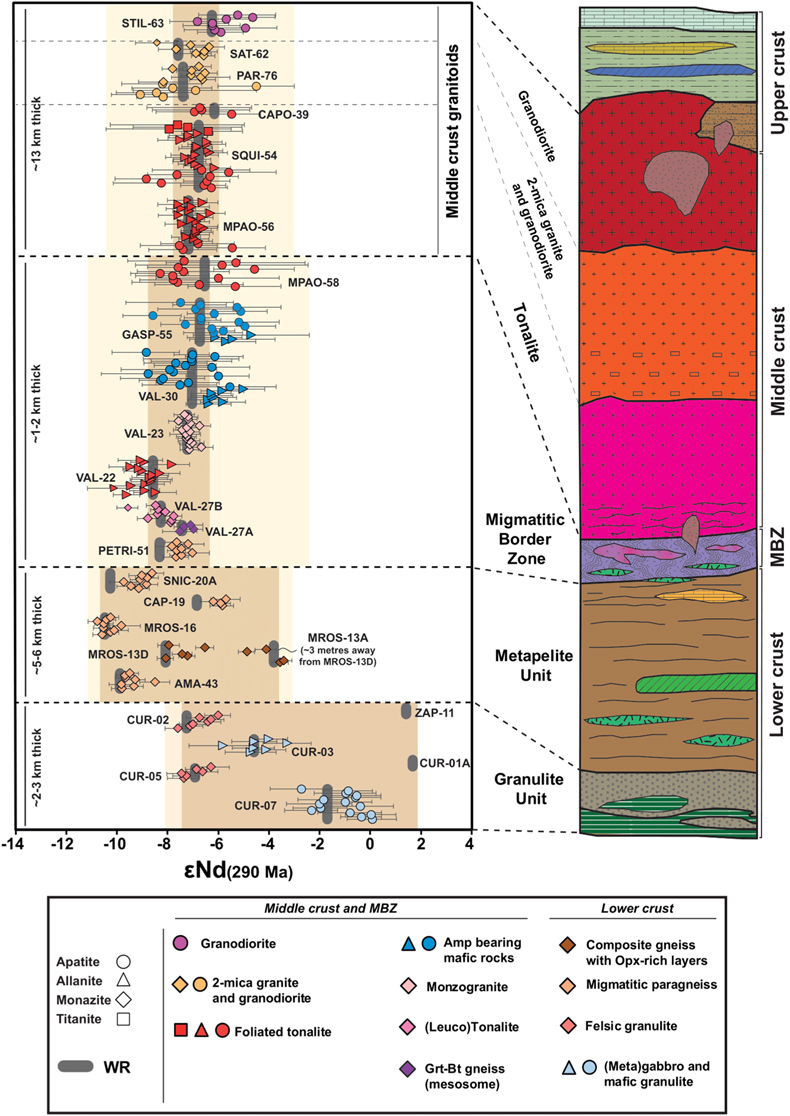
Figure 1 Compilation of whole rock and in situ Nd isotopic compositions (εNd290 Ma) for apatite, monazite, allanite, and titanite from the studied lower and mid-crustal samples, ordered by increasing 147Sm/144Nd for each mineral. Error bars are ± 2 s.e. Light-brown and light-yellow fields illustrate whole rock and in situ isotopic variability, respectively. Samples are arranged by approximate palaeo-depth within the crustal section, following the lithostratigraphic column in Figure S-1. Vertical spacing among samples is schematic and not to scale.
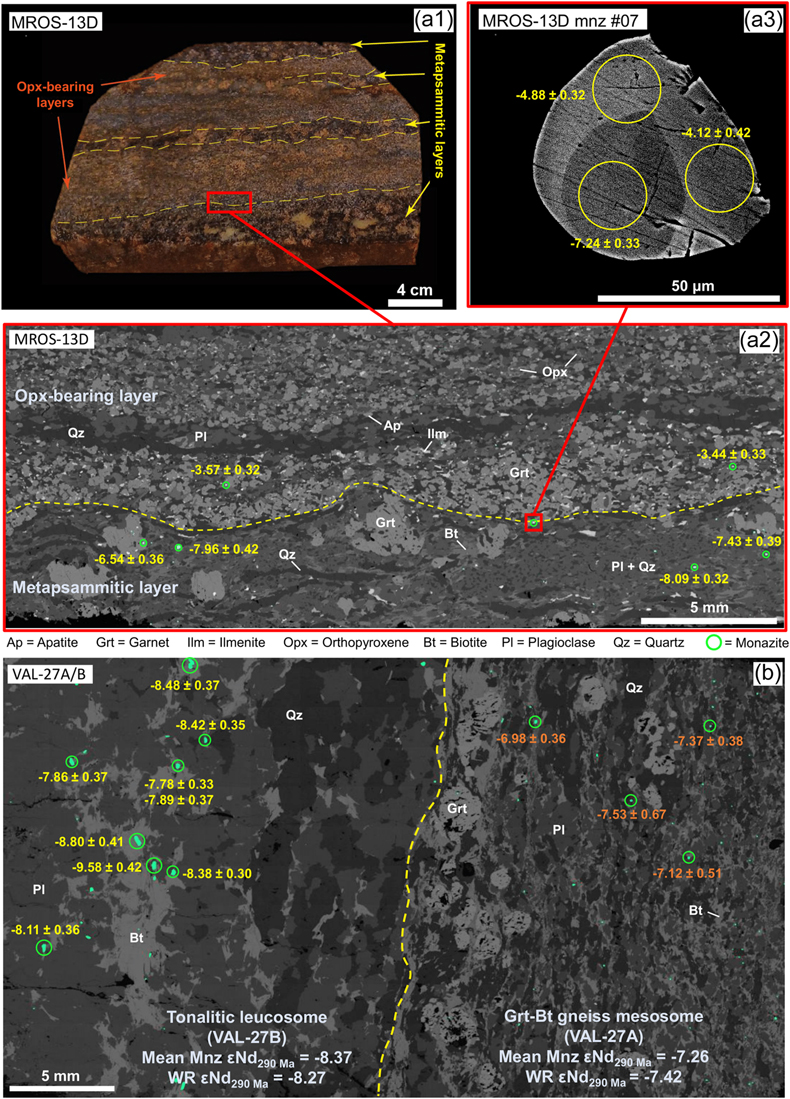
Figure 2 Illustration of the multiscale Nd isotopic heterogeneities of monazite from MROS-13D composite migmatite. (a1) Hand specimen, (a2) thin section (backscattered electron (BSE) image) and (a3) mineral (monazite). (b) Thin section scale isotopic variability of monazite between leucosome and mesosome in the VAL-27A/B diatexite. Hand specimen is displayed in Fig. S-7c. Values in yellow and orange correspond to εNd290 Ma ± 2 s.e.
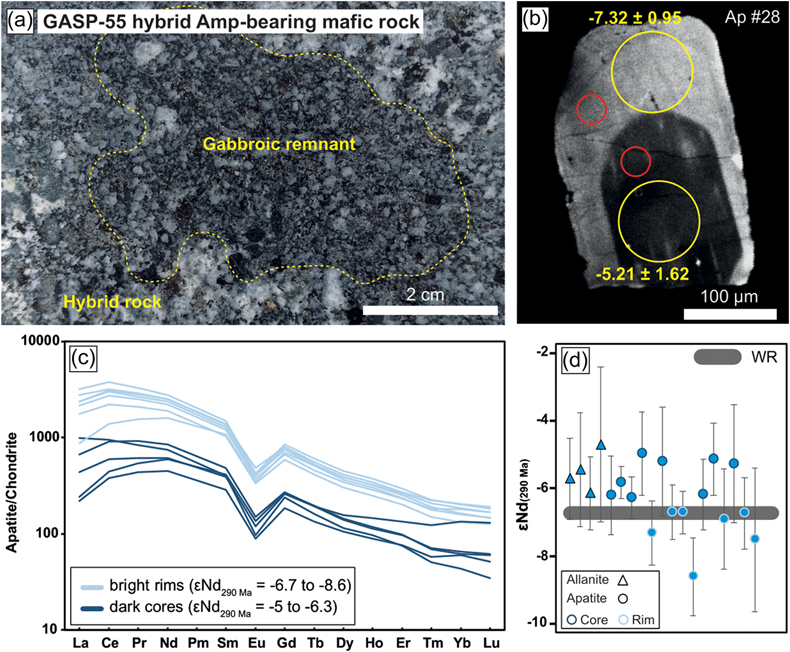
Figure 3 (a) Macroscopic view of GASP-55 hybrid mafic rock. (b) Representative CL image of apatite showing core–rim zoning with trace element (red circles) and Sm-Nd isotope (yellow circles) analytical spots with ±2 s.e. uncertainties. (c) Chondrite normalised (McDonough and Sun, 1995
McDonough, W.F., Sun, S.-s. (1995) The composition of the Earth. Chemical Geology 120, 223–253. https://doi.org/10.1016/0009-2541(94)00140-4
) REE patterns for GASP-55 apatite. (d) GASP-55 whole rock, apatite, and allanite Nd isotopic compositions (εNd(i)) with ±2 s.e. error bars.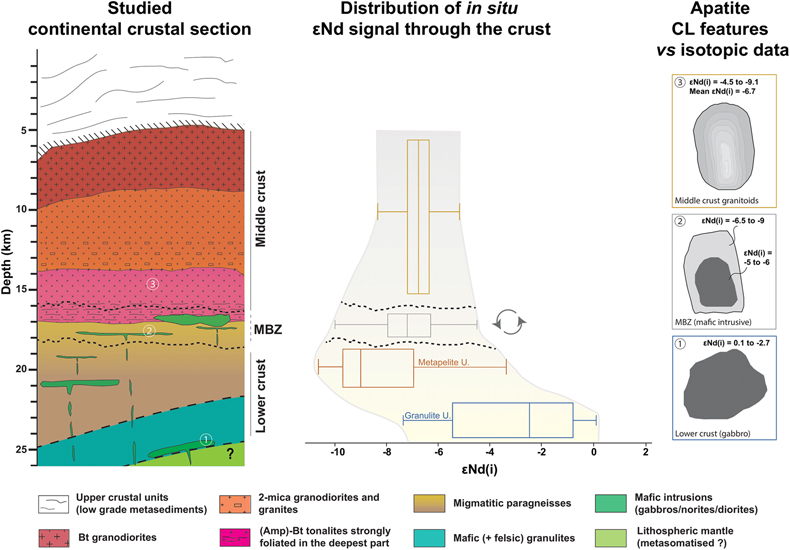
Figure 4 Sm-Nd isotopic scan of the Serre Massif–Capo Vaticano crustal section, illustrated with box plots for the Granulite Unit, Metapelite Unit, MBZ, and middle crust granitoid in situ data sets (SI). Box plots display minimum, maximum, median, and 25th–75th percentiles, highlighting isotopic homogenisation from the MBZ. On the right side, representative apatite CL features and isotopic data from igneous rocks (mafic intrusives and granitoids) across the crustal section.