



Pyrite records fluid evolution: sulfur sources controls on arsenic speciation and zonation
Affiliations | Corresponding Author | Cite as | Funding information
Published by the European Association of Geochemistry
under Creative Commons License CC BY 4.0
Keywords: pyrite, zoning, arsenic speciation, nucleation, growth, ore deposits, hydrothermal


- Share this article


-
Article views:1,263Cumulative count of HTML views and PDF downloads.
- Download Citation
- Rights & Permissions

top
Abstract
Figures
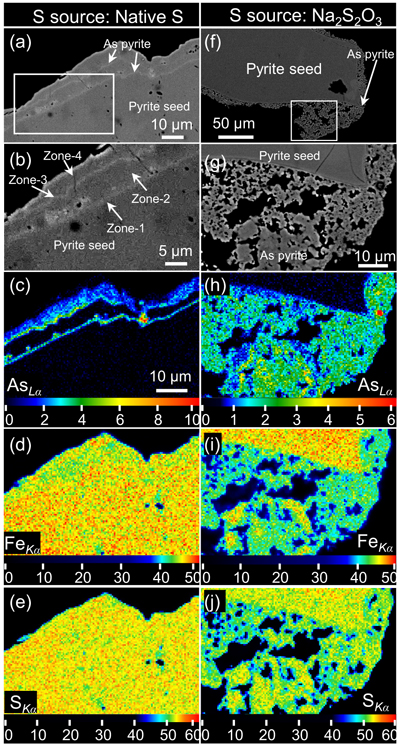 Figure 1 Backscattered electron images (a, b, f, g) and elemental mapping of As (c, h), Fe (d, i), and S (e, j) in newly formed pyrite. (a–e) Pyrite-S, (f–j) pyrite-SO. Note four zones of pyrite-S deposited on pyrite seed (b) and the sponge-like texture of pyrite-SO. | 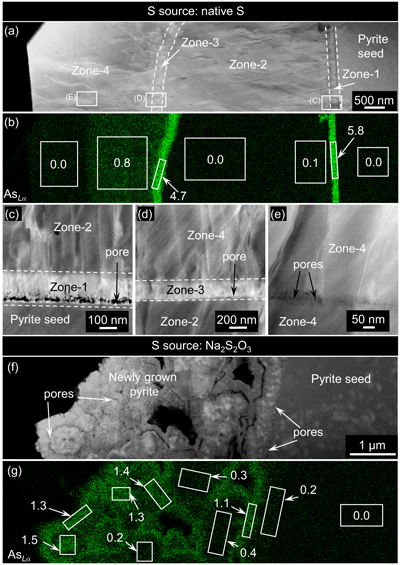 Figure 2 Summary of pyrite textures observed at higher resolution (HAADF-STEM) with corresponding TEM-EDS elemental maps of As. (a, b) Alternating As-in (Zones-1, -3) and As-out (Zones-2, -4) zones deposited on pyrite seed. (b) The rectangles and the values represent the areas of analysis and the concentration of As (in wt. %). (c–e) Porous pyrite formed between the seed and between the zones. (f, g) Aggregates of As zoned microcrystalline pyrite-SO. Note the porosity between the pyrite seed and the product and between the As-rich and As-poor zones of pyrite. (a, b) Pyrite-S; (f, g) pyrite-SO. | 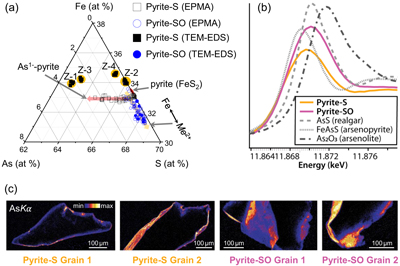 Figure 3 (a) Chemical composition of pyrite plotted in the As-Fe-S ternary. Filled symbols indicate the TEM-EDS analyses of Zones-1 to Zone-4 (Z-1 to Z-4). The coloured arrows indicate the trends associated with the substitution of (i) As for S (red), and (ii) Me2+ for Fe (yellow). Red cross; starting pyrite. (b) XANES spectra obtained on grains in (c). (c) XFM maps showing the distribution of As in Pyrite-S (two grains, total 148 kpixel, with ∼9000 As-rich) and Pyrite-SO (two grains, total 240 kpixel, including ∼20,000 As-rich). | 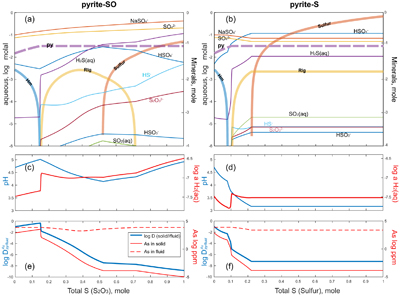 Figure 4 Model results of titrating different S sources as Na sulfite or native sulfur to precipitate arsenian pyrite. (a, c, e) The Na2S2O3 system, and (b, d, f) the native sulfur system. Panels (a, b) show the amounts of mineral present (thick lines) and the dominant aqueous sulfur species (thin solid lines). Panels (c, d) show redox as a H2(aq) (right axes) and solution pH (left axes). Panels (e, f) display the variations in As concentrations and partitioning coefficients between pyrite and fluid; Dpy/fluidAs is the partitioning coefficient in ppm and is plotted on the left axis. Mineral abbreviations: py, pyrite; Hm, hematite; Rlg, realgar. |
| Figure 1 | Figure 2 | Figure 3 | Figure 4 |
top
Introduction
The incorporation of arsenic and other trace elements into distinct zones during pyrite growth is one of the most prominent features that helps elucidate the evolution of fluid composition during ore deposition (Muntean et al., 2011
Muntean, J.L., Cline, J.S., Simon, A.C., Longo, A.A. (2011) Magmatic–hydrothermal origin of Nevada’s Carlin-type gold deposits. Nature Geoscience 4, 122–127. https://doi.org/10.1038/ngeo1064
; Peterson and Mavrogenes, 2014Peterson, E.C., Mavrogenes, J.A. (2014) Linking high-grade gold mineralization to earthquake-induced fault-valve processes in the Porgera gold deposit, Papua New Guinea. Geology 42, 383–386. https://doi.org/10.1130/G35286.1
; Morin et al., 2017Morin, G., Noël, V., Menguy, N., Brest, J., Baptiste, B., Tharaud, M., Ona-Nguema, G., Ikogou, M., Viollier, E., Juillot, F. (2017) Nickel accelerates pyrite nucleation at ambient temperature. Geochemical Perspectives Letters 5, 6–11. https://doi.org/10.7185/geochemlet.1738
; Román et al., 2019Román, N., Reich, M., Leisen, M., Morata, D., Barra, F., Deditius, A.P. (2019) Geochemical and micro-textural fingerprints of boiling in pyrite. Geochimica et Cosmochimica Acta 246, 60–85. https://doi.org/10.1016/j.gca.2018.11.034
; Xing et al., 2019Xing, Y., Brugger, J., Tomkins, A., Shvarov, Y. (2019) Arsenic evolution as a tool for understanding formation of pyritic gold ores. Geology 47, 335–338. https://doi.org/10.1130/G45708.1
). Commonly, pyrite growth zones are arranged in concentric As-rich and As-poor zones (Chouinard et al., 2005Chouinard, A., Paquette, J., Williams-Jones, A.E. (2005) Crystallographic controls on trace-element incorporation in auriferous pyrite from the Pascua epithermal high-sulfidation deposit, Chile–Argentina. The Canadian Mineralogist 43, 951–963. https://doi.org/10.2113/gscanmin.43.3.951
) or as spongy porous aggregates of spheroidal particles deposited on barren pyrite (Deditius et al., 2008Deditius, A.P., Utsunomiya, S., Renock, D., Ewing, R.C., Ramana, C.V., Becker, U., Kesler, S.E. (2008) A proposed new type of arsenian pyrite: Composition, nanostructure and geological significance. Geochimica et Cosmochimica Acta 72, 2919–2933. https://doi.org/10.1016/j.gca.2008.03.014
; Genna and Gaboury, 2015Genna, D., Gaboury, D. (2015) Deciphering the Hydrothermal Evolution of a VMS System by LA-ICP-MS Using Trace Elements in Pyrite: An Example from the Bracemac-McLeod Deposits, Abitibi, Canada, and Implications for Exploration. Economic Geology 110, 2087–2108. https://doi.org/10.2113/econgeo.110.8.2087
). Lattice bound arsenic in pyrite occurs either as As1− (Simon et al., 1999Simon, G., Huang, H., Penner-Hahn, J.E., Kesler, S.E., Kao, L.-S. (1999) Oxidation state of gold and arsenic in gold-bearing arsenian pyrite. American Mineralogist 84, 1071–1079. https://doi.org/10.2138/am-1999-7-809
; Manceau et al., 2020Manceau, A., Merkulova, M., Mathon, O., Glatzel, P., Murdzek, M., Batanova, V., Simionovici, A., Steinmann, S.N., Paktunc, D. (2020) The Mode of Incorporation of As(-I) and Se(-I) in Natural Pyrite Revisited. ACS Earth and Space Chemistry 4, 379–390. https://doi.org/10.1021/acsearthspacechem.9b00301
) or As2+/3+ (Deditius et al., 2008Deditius, A.P., Utsunomiya, S., Renock, D., Ewing, R.C., Ramana, C.V., Becker, U., Kesler, S.E. (2008) A proposed new type of arsenian pyrite: Composition, nanostructure and geological significance. Geochimica et Cosmochimica Acta 72, 2919–2933. https://doi.org/10.1016/j.gca.2008.03.014
; Qian et al., 2013Qian, G., Brugger, J., Testemale, D., Skinner, W., Pring, A. (2013) Formation of As(II)-pyrite during experimental replacement of magnetite under hydrothermal conditions. Geochimica et Cosmochimica Acta 100, 1–10. https://doi.org/10.1016/j.gca.2012.09.034
; Le Pape et al., 2018Le Pape, P., Blanchard, M., Juhin, A., Rueff, J.-P., Ducher, M., Morin, G., Cabaret, D. (2018) Local environment of arsenic in sulfide minerals: insights from high-resolution X-ray spectroscopies, and first-principles calculations at the As K-edge. Journal of Analytical Atomic Spectrometry 33, 2070–2082. https://doi.org/10.1039/C8JA00272J
), reflecting different incorporation mechanisms. Importantly, the concentrations and oxidation state of As in pyrite are some of the key parameters controlling the incorporation of Au into the mineral and its fate during the formation of gold deposits (e.g., Reich et al., 2005Reich, M., Kesler, S.E., Utsunomiya, S., Palenik, C.S., Chryssoulis, S.L., Ewing, R.C. (2005) Solubility of gold in arsenian pyrite. Geochimica et Cosmochimica Acta 69, 2781–2796. https://doi.org/10.1016/j.gca.2005.01.011
; Deditius et al., 2014Deditius, A.P., Reich, M., Kesler, S.E., Utsunomiya, S., Chryssoulis, S.L., Walshe, J., Ewing, R.C. (2014) The coupled geochemistry of Au and As in pyrite from hydrothermal ore deposits. Geochimica et Cosmochimica Acta 140, 644–670. https://doi.org/10.1016/j.gca.2014.05.045
; Pokrovski et al., 2021Pokrovski, G.S., Escoda, C., Blanchard, M., Testemale, D., Hazemann, J.-L., Guoy, S., Kokh, M.A., Boiron, M.-C., de Parseval, F., Aigouy, T., Menjot, L., de Parseval, P., Proux, O., Rovezzi, M., Béziat, D., Salvi, S., Kouzmanov, K., Bartsch, T., Pöttgen, R., Doert, T. (2021) An arsenic-driven pump for invisible gold in hydrothermal systems. Geochemical Perspectives Letters 17, 39–44. https://doi.org/10.7185/geochemlet.2112
). Changes in the physicochemical parameters of the hydrothermal fluids, such as vigorous vs. gentle fluid boiling (Román et al., 2019Román, N., Reich, M., Leisen, M., Morata, D., Barra, F., Deditius, A.P. (2019) Geochemical and micro-textural fingerprints of boiling in pyrite. Geochimica et Cosmochimica Acta 246, 60–85. https://doi.org/10.1016/j.gca.2018.11.034
); the kinetics of crystal growth (Kusebauch et al., 2018Kusebauch, C., Oelze, M., Gleeson, S.A. (2018) Partitioning of arsenic between hydrothermal fluid and pyrite during experimental siderite replacement. Chemical Geology 500, 136–147. https://doi.org/10.1016/j.chemgeo.2018.09.027
; Wu et al., 2019Wu, Y.-F., Fougerouse, D., Evans, K., Reddy, S.M., Saxey, D.W., Guagliardo, P., Li, J.-W. (2019) Gold, arsenic, and copper zoning in pyrite: A record of fluid chemistry and growth kinetics. Geology 47, 641–644. https://doi.org/10.1130/G46114.1
); the type of As source (Qian et al., 2013Qian, G., Brugger, J., Testemale, D., Skinner, W., Pring, A. (2013) Formation of As(II)-pyrite during experimental replacement of magnetite under hydrothermal conditions. Geochimica et Cosmochimica Acta 100, 1–10. https://doi.org/10.1016/j.gca.2012.09.034
); and surface chemistry (Fleet and Mumin, 1997Fleet, M.E., Mumin, A.H. (1997) Gold-bearing arsenian pyrite and marcasite and arsenopyrite from Carlin Trend gold deposits and laboratory synthesis. American Mineralogist 82, 182–193. https://doi.org/10.2138/am-1997-1-220
) were suggested to account for variable As concentrations, oxidation states, and zoning patterns in pyrite. Yet, the mechanisms controlling As scavenging by pyrite remain poorly understood.Here, we show that changes in fluid composition affect the formation mechanism of zoned As pyrite overgrowing pyrite seeds (Table S-1). Different S sources, i.e. elemental S or thiosulphate (Na2S2O3·5H2O), led to contrasting zoning textures and As oxidation states in the overgrowths after hydrothermal treatments that alternated between As-rich and As-free fluids at 200 °C (Table S-2). The aqueous solution compositions involved a mixture of oxidised (HSO4−, SO42−) and reduced S species (HS−, H2S(aq)) in the pyrite stability field, relevant for natural hydrothermal systems. Experimental details, analytical methods, and thermodynamic modelling results can be found in the Supplementary Information.
top
Results
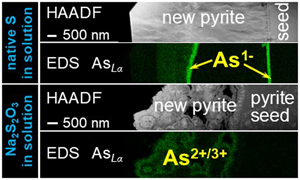
Pyrite morphology, zoning, and composition. Addition of native S resulted in four concentric pyrite growth zones around the seeds (denoted as pyrite-S) (Fig. 1a–e), i.e. As-rich (Zones-1, -3) and As depleted or As-free zones (Zones-2, -4). The alternating zones record the imposed variations in fluid composition. However, when native S was replaced with Na2S2O3·5H2O, spongy aggregates (5–50 μm) of microparticulate As pyrite (denoted as pyrite-SO) formed instead (Fig. 1f–j); these textures do not reflect the chemical evolution of the system (Fig. 1c,h).
Figure 1 Backscattered electron images (a, b, f, g) and elemental mapping of As (c, h), Fe (d, i), and S (e, j) in newly formed pyrite. (a–e) Pyrite-S, (f–j) pyrite-SO. Note four zones of pyrite-S deposited on pyrite seed (b) and the sponge-like texture of pyrite-SO.
Electron probe microanalysis (EPMA) data show that the As concentrations in Zones-1 and -3 of pyrite-S vary broadly (0.02 to 6.02 wt. %), whereas pyrite-SO contains less As (<1.5 wt. %; Fig. S-1, Table S-3). High angle annular dark field scanning transmission electron microscopy (HAADF-STEM) observations and electron dispersive spectroscopy (EDS) analyses confirm the systematic textural and compositional changes across the four zones in pyrite-S (Figs. 2a,b, S-1 and S-2). Zones-1 and -3 are 200–300 nm thick and contain ≤5.8 wt. % and ≤4.7 wt. % As, respectively; Zones-2 and -4 are 3–5 μm thick and contain As (0.1 and 0.8 wt. %, respectively) near the contact with Zones-1 and -3 (Fig. 2b). Trails of pores occur along the contact between the pyrite seed and Zone-1; between Zones-2 and -3; and within Zone-4 (Fig. 2c–e). High resolution (HR) TEM and electron backscattered diffraction (EBSD) data show that, except for a few spherical misoriented domains (<500 nm) of As-bearing pyrite-S located near the contact between the seed and Zone-1, the lattice orientation of the zoned overgrowth aligns with that of the pyrite seed (Figs. S-3a,b, S-4a). This indicates the predominance of epitaxial growth. The Fast Fourier transformation (FFT) diffraction pattern from the Zone-1 HRTEM image documented rare realgar nanodomains (d = 3.05 Å) (Fig. S-5) in quantities below the detection limit of XRD (<0.1 wt. %) (Fig. S-6a).
Figure 2 Summary of pyrite textures observed at higher resolution (HAADF-STEM) with corresponding TEM-EDS elemental maps of As. (a, b) Alternating As-in (Zones-1, -3) and As-out (Zones-2, -4) zones deposited on pyrite seed. (b) The rectangles and the values represent the areas of analysis and the concentration of As (in wt. %). (c–e) Porous pyrite formed between the seed and between the zones. (f, g) Aggregates of As zoned microcrystalline pyrite-SO. Note the porosity between the pyrite seed and the product and between the As-rich and As-poor zones of pyrite. (a, b) Pyrite-S; (f, g) pyrite-SO.
Pyrite-SO is the only phase detected in the Na2S2O3·5H2O experiments (Fig. S-6b). It comprises concentrically zoned particles, randomly oriented and assembled into aggregates (Figs. 2f,g, S-3c,d, and S-4b). Porosity formed along the contacts between the 50–200 nm thick alternating zones of As-rich and As-poor pyrite (Fig. 2f). Some particles contain oval shaped As-rich (1.1–1.5 wt. %) cores, ∼300 nm in diameter, followed by subhedral As depleted zones (0.2–0.7 wt. %), and by a third As enriched zone (∼1.4 wt. %) (Fig. 2g). In some particles, a subhedral As depleted core formed first (Figs. S-7, S-8). In pyrite-SO, random As zoning reflects local fluid variations, whereas in pyrite-S the ordered four zone pattern records changes in bulk fluid composition (Figs. 1, 2).
Sulfur source affects arsenic incorporation in pyrite. Pyrite-S compositions plot along the As-S join, indicating the substitution of anionic As1− for S; i.e. As substitutes as [As2]2− for the [S2]2− dimer (Manceau et al., 2020
Manceau, A., Merkulova, M., Mathon, O., Glatzel, P., Murdzek, M., Batanova, V., Simionovici, A., Steinmann, S.N., Paktunc, D. (2020) The Mode of Incorporation of As(-I) and Se(-I) in Natural Pyrite Revisited. ACS Earth and Space Chemistry 4, 379–390. https://doi.org/10.1021/acsearthspacechem.9b00301
) (Fig. 3a). In contrast, pyrite-SO compositions form a trend parallel to the Fe-S join towards the As corner of the ternary diagram, indicating cationic As2+/3+ substitution for Fe2+ (Deditius et al., 2008Deditius, A.P., Utsunomiya, S., Renock, D., Ewing, R.C., Ramana, C.V., Becker, U., Kesler, S.E. (2008) A proposed new type of arsenian pyrite: Composition, nanostructure and geological significance. Geochimica et Cosmochimica Acta 72, 2919–2933. https://doi.org/10.1016/j.gca.2008.03.014
). These indirect EPMA and EDS results are corroborated by the X-ray absorption near edge structure (XANES) analyses (Fig. 3b,c).Figure 3 (a) Chemical composition of pyrite plotted in the As-Fe-S ternary. Filled symbols indicate the TEM-EDS analyses of Zones-1 to Zone-4 (Z-1 to Z-4). The coloured arrows indicate the trends associated with the substitution of (i) As for S (red), and (ii) Me2+ for Fe (yellow). Red cross; starting pyrite. (b) XANES spectra obtained on grains in (c). (c) XFM maps showing the distribution of As in Pyrite-S (two grains, total 148 kpixel, with ∼9000 As-rich) and Pyrite-SO (two grains, total 240 kpixel, including ∼20,000 As-rich).
Reaction conditions based on equilibrium thermodynamics. We used activity-activity diagrams to examine As and S speciation in fluids during pyrite formation (Fig. S-9), and aliquot-type thermodynamic modelling to predict reaction paths and mineral compositions resulting from progressive reactions with the two sulfur sources (native S or Na2S2O3). These equilibrium models serve as a reference for discussing potential kinetic effects. The sulfur speciation in both systems was buffered near the bisulfide-sulfate boundary, at different bisulfide/sulfate ratios:
Eq. 1

Eq. 2

As(OH)3(aq) is the predominant species for As at the pH (∼2–6) and redox conditions of the experiments, as it is in most hydrothermal fluids (James-Smith et al., 2010
James-Smith, J., Cauzid, J., Testemale, D., Liu, W., Hazemann, J.-L., Proux, O., Etschmann, B., Philippot, P., Banks, D., Williams, P., Brugger, J. (2010) Arsenic speciation in fluid inclusions using micro-beam X-ray absorption spectroscopy. American Mineralogist 95, 921–932. https://doi.org/10.2138/am.2010.3411
; Testemale et al., 2011Testemale, D., Pokrovski, G.S., Hazemann, J.-L. (2011) Speciation of AsIII and AsV in hydrothermal fluids by in situ X-ray absorption spectroscopy. European Journal of Mineralogy 23, 379–390. https://doi.org/10.1127/0935-1221/2011/0023-2104
). Note that arsenopyrite and realgar are predicted to form in H2S(aq)-rich, reduced (aH2(aq) > 10−10) fluids (Fig. S-9a). In our experiments, H2S(aq) concentrations increase rapidly during sulfur dissolution (Fig. 4a,b), and hence the model predictions are consistent with the presence of small amounts of realgar in pyrite-S (Fig. S-5).Figure 4 Model results of titrating different S sources as Na sulfite or native sulfur to precipitate arsenian pyrite. (a, c, e) The Na2S2O3 system, and (b, d, f) the native sulfur system. Panels (a, b) show the amounts of mineral present (thick lines) and the dominant aqueous sulfur species (thin solid lines). Panels (c, d) show redox as a H2(aq) (right axes) and solution pH (left axes). Panels (e, f) display the variations in As concentrations and partitioning coefficients between pyrite and fluid; Dpy/fluidAs is the partitioning coefficient in ppm and is plotted on the left axis. Mineral abbreviations: py, pyrite; Hm, hematite; Rlg, realgar.
Pyrite is highly supersaturated in the initial solutions with a saturation index (SI) of ∼8 for both sulfur sources (Fig. S-10). This SI increases to ∼10 in the Na2S2O3·5H2O experiments; but decreases gradually towards ∼6 in the S experiments (Fig. S-10). The predicted pH (neutral pH is 5.64 at 200 °C, Psat) is slightly acidic (4.5–5) in the Na2S2O3·5H2O experiments (Fig. 4c), and rapidly evolves towards more acidic (∼3.2) conditions in the S experiments (Fig. 4d). The redox conditions in both experiments remain buffered close to the sulfate-bisulfide equilibrium (Fig. S-9b). The modelling predicts maximum As concentrations of 1000 ppm in pyrite-S and pyrite-SO, lower than the maxima measured in pyrite-S (6.0 wt. %) and pyrite-SO (1.5 wt. %). The predicted As partitioning coefficients between the mineral and fluid decrease by several orders of magnitude in the early stages of the reaction (Fig. 4e,f).
top
Discussion
Chemical zoning in minerals forms due to changes in fluid composition, temperature, and pressure (Shore and Fowler, 1996
Shore, M., Fowler, A.D. (1996) Oscillatory zoning in minerals; a common phenomenon. The Canadian Mineralogist 34, 1111–1126.
), kinetic factors, and/or self organisation (e.g., Rakovan and Reeder, 1996Rakovan, J., Reader, R.J. (1996) Intracrystalline rare earth element distributions in apatite: Surface structural influences on incorporation during growth. Geochimica et Cosmochimica Acta 60, 4435–4445. https://doi.org/10.1016/S0016-7037(96)00244-X
). The alternating As-rich and As-free/poor zones in pyrite-S reflect the pulses of fluids with different compositions, but this record is absent in pyrite-SO (Figs. 1, 2).The differences between pyrite-S and pyrite-SO are related to the S source, and its effect on the (super-)saturation state of pyrite. First, native S (<1 g/100 mL) is far less soluble than Na2S2O3·5H2O (73 g/100 mL). Second, the progressive disproportionation of thiosulfate (Eq. 2) increases the pyrite supersaturation level, whereas the disproportionation of sulfur (Eq. 1; Liu et al., 2021
Liu, W., Spinks, S.C., Glenn, M., MacRae, C., Pearce, M.A. (2021) How carbonate dissolution facilitates sediment-hosted Zn-Pb mineralization. Geology 49, 1363–1368. https://doi.org/10.1130/G49056.1
) is predicted to decrease supersaturation (Fig. S-10). This is mainly because during pyrite precipitation (Fig. S-9), the same amounts of total S added result in a pH increase when using Na2S2O3·5H2O, whereas native S causes a rapid pH decrease. This promotes fast nucleation of pyrite-SO and kinetically driven precipitation of spongy aggregates (Figs. 1f–j, 2f,g, and S-9). In contrast, slower nucleation in the sulfur-bearing experiments resulted in epitaxial growth of pyrite S (Figs. S-3a, S-4a).The XANES data indicate that As exists predominantly as As1− in pyrite-S (Fig. 3b). Hence, the formation of pyrite-S from dissolved Fe, As and S under acidic conditions is described by:
Eq. 3

From the equilibrium constant K3 of Equation 3, assuming a dilute solution, the value of the molal concentration of As(OH)3(aq) ([As(OH)3(aq)]) is equal to the activity (a) of As(OH)3(aq), since γ As(OH)3(aq) ≈ 1, where γ is the activity coefficient. Similarly, for a small mole fraction (x) of the FeAs2 component in arsenian pyrite, γ FeAs2 ≈ 1 according to the standard state based on Henry’s law (Supplementary Information); hence, the values of the concentrations of FeAs2 ([FeAs2], in mole fraction units) are identical to aFeAs2. Using these assumptions, the partitioning coefficient for As between solid and solution is proportional to:
Eq. 4

This indicates that the As partitioning coefficient is expected to change rapidly during precipitation, depending not only on the amounts of As in solution, but also on pH, redox, and the amounts of dissolved Fe and S. The thermodynamic model of Xing et al. (2019
Xing, Y., Brugger, J., Tomkins, A., Shvarov, Y. (2019) Arsenic evolution as a tool for understanding formation of pyritic gold ores. Geology 47, 335–338. https://doi.org/10.1130/G45708.1
) and Equations 3, 4 assume As1− substitution for S in pyrite, requiring a reduction of As3+ to As1−. The rapid decrease in the As partitioning coefficient predicted by this thermodynamic model (Fig. 4) is primarily attributed to changes in pH and redox (a H2(aq)) during the reaction.In contrast, cationic As2+/3+ substitutes for Fe2+ in pyrite-SO. Assuming As2+:
Eq. 5

The stability constant K5 for Equation 5 is:
Eq. 6

Compared to anionic As, the incorporation of cationic As is less sensitive to redox.
The thermodynamic modelling shows that the As contents in the pyrite-SO increase with pH when a small amount of S2O3 (<∼0.15 mole Stotal) is added (Fig. 4). For pyrite-S, adding similar amounts of native S results in a continuous decrease of As contents in pyrite, coinciding with pH decrease. Overall, the model results indicate that solution chemistry plays a critical role in controlling the precipitation and As content of arsenian pyrite.
Le Pape et al. (2017)
Le Pape, P., Blanchard, M., Brest, J., Boulliard, J.-C., Ikogou, M., Stetten, L., Wang, S., Landrot, G., Morin, G. (2017) Arsenic Incorporation in Pyrite at Ambient Temperature at Both Tetrahedral S–I and Octahedral FeII Sites: Evidence from EXAFS–DFT Analysis. Environmental Science & Technology 51, 150–158. https://doi.org/10.1021/acs.est.6b03502
reported that the polysulfide pathway of pyrite formation generates more oxidising conditions than when reacting FeS with H2S(aq), facilitating the incorporation of As2+/3+. However, incorporation of As2+/3+ into pyrite-SO suggests that cationic As in pyrite may not only be related to a relatively higher oxidation state but also to the kinetics of pyrite formation; i.e. nucleation is the predominant process for pyrite-SO precipitation at high supersaturation levels, whereas growth is the predominant process for pyrite-S. Thermodynamic modelling suggests that the fluid redox differs only slightly between both experiments (Δlog aH2(aq) < 1; Fig. 4c,d). The incorporation of As2+/3+ introduces structural distortion, which is balanced by the formation of vacancies (Deditius et al., 2008Deditius, A.P., Utsunomiya, S., Renock, D., Ewing, R.C., Ramana, C.V., Becker, U., Kesler, S.E. (2008) A proposed new type of arsenian pyrite: Composition, nanostructure and geological significance. Geochimica et Cosmochimica Acta 72, 2919–2933. https://doi.org/10.1016/j.gca.2008.03.014
) and is favoured by rapid growth.Implications for As geochemistry and the formation of ore deposits. The new experiments illustrate how arsenian pyrite precipitation and associated dynamic changes in fluid composition (pH, redox, As and Fe contents) result in different As speciation (anionic vs. cationic As substitution) and variable product morphology arising from different mechanisms of pyrite growth (epitaxial vs. nucleation of randomly oriented particles) (Figs. 1–3). Thus, these results help explain the natural variability of pyrite textures in porphyry epithermal, volcanic-hosted massive sulfide (VMS), and Carlin-type ore deposits, as well as in hydrothermal vents. In these dynamic environments, zoned As pyrite forms during fluid boiling/phase separation and/or mixing of seawater or meteoric water with hydrothermal fluids, and/or rapid fluid-rock interactions commonly in the presence of pre-existing pyrite, as documented by changes in S isotopes (Reich et al., 2013
Reich, M., Deditius, A., Chryssoulis, S., Li, J.-W., Ma, C.-Q., Parada, M.A., Barra, F., Mittermayr, F. (2013) Pyrite as a record of hydrothermal fluid evolution in a porphyry copper system: A SIMS/EPMA trace element study. Geochimica et Cosmochimica Acta 104, 42–62. https://doi.org/10.1016/j.gca.2012.11.006
; Peterson and Mavrogenes, 2014Peterson, E.C., Mavrogenes, J.A. (2014) Linking high-grade gold mineralization to earthquake-induced fault-valve processes in the Porgera gold deposit, Papua New Guinea. Geology 42, 383–386. https://doi.org/10.1130/G35286.1
; Franchini et al., 2015Franchini, M., McFarlane, C., Maydagán, L., Reich, M., Lentz, D.R., Meinert, L., Bouhier, V. (2015) Trace metals in pyrite and marcasite from the Agua Rica porphyry-high sulfidation epithermal deposit, Catamarca, Argentina: Textural features and metal zoning at the porphyry to epithermal transition. Ore Geology Reviews 66, 366–387. https://doi.org/10.1016/j.oregeorev.2014.10.022
; Román et al., 2019Román, N., Reich, M., Leisen, M., Morata, D., Barra, F., Deditius, A.P. (2019) Geochemical and micro-textural fingerprints of boiling in pyrite. Geochimica et Cosmochimica Acta 246, 60–85. https://doi.org/10.1016/j.gca.2018.11.034
; McLeish et al., 2024McLeish, D.F., Williams-Jones, A.E., Clark, J.R., Stern, R.A. (2024) Extreme shifts in pyrite isotope compositions reveal the path to bonanza gold. Proceedings of the National Academy of Sciences 121, e2402116121. https://doi.org/10.1073/pnas.2402116121
; Schaarschmidt et al., 2021Schaarschmidt, A., Haase, K.M., Klemd, R., Keith, M., Voudouris, P.C., Alfieris, D., Strauss, H., Wiedenbeck, M. (2021) Boiling effects on trace element and sulfur isotope compositions of sulfides in shallow-marine hydrothermal systems: Evidence from Milos Island, Greece. Chemical Geology 583, 120457. https://doi.org/10.1016/j.chemgeo.2021.120457
; Holley et al., 2024Holley, E.A., Jilly-Rehak, C., Fulton, A.A., Gorman, B. (2024) Trace Element Zonation in Carlin-Type Pyrite: Tracking Ore-Forming Processes at the Nanoscale. Economic Geology 119, 1139–1169. https://doi.org/10.5382/econgeo.5089
; Xiao et al., 2025Xiao, J., Xie, Z., Xia, Y., Gopon, P., Tan, Q. (2025) Consistent crystal orientation of core and rim pyrites indicates an epitaxial growth of rim in Carlin-type gold deposits. Geoscience Frontiers 16, 101966. https://doi.org/10.1016/j.gsf.2024.101966
). Resulting pyrite textures exhibit a single type, or a mixture of euhedral oscillatory zoned grains (pyrite-S) associated with collomorphic overgrowths and/or aggregates of spongy pyrite (pyrite-SO) reflecting the change in the conditions of the hydrothermal systems.A higher proportion of oxidised S species is expected during flash vapourisation of hydrothermal fluids at low pressures and/or extreme disproportionation of magmatic SO2 (Reeves et al., 2011
Reeves, E.P., Seewald, J.S., Saccocia, P., Bach, W., Craddock, P.R., Shanks, W.C., Sylva, S.P., Walsh, E., Pichler, T., Rosner, M. (2011) Geochemistry of hydrothermal fluids from the PACMANUS, Northeast Paul and Vienna Woods hydrothermal fields, Manus Basin, Papua New Guinea. Geochimica et Cosmochimica Acta 75, 1088–1123. https://doi.org/10.1016/j.gca.2010.11.008
; Peterson and Mavrogenes, 2014Peterson, E.C., Mavrogenes, J.A. (2014) Linking high-grade gold mineralization to earthquake-induced fault-valve processes in the Porgera gold deposit, Papua New Guinea. Geology 42, 383–386. https://doi.org/10.1130/G35286.1
). The epitaxial growth of As-bearing pyrite-S resembles the structure of As pyrite in porphyry and epithermal gold deposits (Chouinard et al., 2005Chouinard, A., Paquette, J., Williams-Jones, A.E. (2005) Crystallographic controls on trace-element incorporation in auriferous pyrite from the Pascua epithermal high-sulfidation deposit, Chile–Argentina. The Canadian Mineralogist 43, 951–963. https://doi.org/10.2113/gscanmin.43.3.951
; Deditius et al., 2008Deditius, A.P., Utsunomiya, S., Renock, D., Ewing, R.C., Ramana, C.V., Becker, U., Kesler, S.E. (2008) A proposed new type of arsenian pyrite: Composition, nanostructure and geological significance. Geochimica et Cosmochimica Acta 72, 2919–2933. https://doi.org/10.1016/j.gca.2008.03.014
; Peterson and Mavrogenes, 2014Peterson, E.C., Mavrogenes, J.A. (2014) Linking high-grade gold mineralization to earthquake-induced fault-valve processes in the Porgera gold deposit, Papua New Guinea. Geology 42, 383–386. https://doi.org/10.1130/G35286.1
). There, pyrite records the transition from porphyry to epithermal conditions, through As, Au, and chalcophile element-rich rims overgrowing a (Co, Ni)-bearing euhedral porphyry pyrite core (Fig. 1) (Reich et al., 2013Reich, M., Deditius, A., Chryssoulis, S., Li, J.-W., Ma, C.-Q., Parada, M.A., Barra, F., Mittermayr, F. (2013) Pyrite as a record of hydrothermal fluid evolution in a porphyry copper system: A SIMS/EPMA trace element study. Geochimica et Cosmochimica Acta 104, 42–62. https://doi.org/10.1016/j.gca.2012.11.006
; Peterson and Mavrogenes, 2014Peterson, E.C., Mavrogenes, J.A. (2014) Linking high-grade gold mineralization to earthquake-induced fault-valve processes in the Porgera gold deposit, Papua New Guinea. Geology 42, 383–386. https://doi.org/10.1130/G35286.1
; Franchini et al., 2015Franchini, M., McFarlane, C., Maydagán, L., Reich, M., Lentz, D.R., Meinert, L., Bouhier, V. (2015) Trace metals in pyrite and marcasite from the Agua Rica porphyry-high sulfidation epithermal deposit, Catamarca, Argentina: Textural features and metal zoning at the porphyry to epithermal transition. Ore Geology Reviews 66, 366–387. https://doi.org/10.1016/j.oregeorev.2014.10.022
). Porosity aligned with the contact between the As-rich zones and As-free pyrite (Fig. 2) highlights the change in the fluid chemistry. A similar texture was interpreted to signify enrichment of chalcophile elements in arsenian pyrite during fluid boiling in hydrothermal systems (Román et al., 2019Román, N., Reich, M., Leisen, M., Morata, D., Barra, F., Deditius, A.P. (2019) Geochemical and micro-textural fingerprints of boiling in pyrite. Geochimica et Cosmochimica Acta 246, 60–85. https://doi.org/10.1016/j.gca.2018.11.034
). Importantly, the textural changes and porosity (Figs. 1, S-1) from As-rich to As-poor may be the only evidence of changing conditions during continuous growth of pyrite without disturbing the S isotopic signature (McLeish et al., 2024McLeish, D.F., Williams-Jones, A.E., Clark, J.R., Stern, R.A. (2024) Extreme shifts in pyrite isotope compositions reveal the path to bonanza gold. Proceedings of the National Academy of Sciences 121, e2402116121. https://doi.org/10.1073/pnas.2402116121
).The spherical morphology and randomly orientated pyrite-SO, often detached from the pyrite seed (Figs. S-7, S-8), resembles textures in Carlin-type gold deposits formed during mixing of meteoric water and hydrothermal fluids interacting with pre-existing pyrite traps (Muntean et al., 2011
Muntean, J.L., Cline, J.S., Simon, A.C., Longo, A.A. (2011) Magmatic–hydrothermal origin of Nevada’s Carlin-type gold deposits. Nature Geoscience 4, 122–127. https://doi.org/10.1038/ngeo1064
; Holley et al., 2024Holley, E.A., Jilly-Rehak, C., Fulton, A.A., Gorman, B. (2024) Trace Element Zonation in Carlin-Type Pyrite: Tracking Ore-Forming Processes at the Nanoscale. Economic Geology 119, 1139–1169. https://doi.org/10.5382/econgeo.5089
), or those in hydrothermal pyrite precipitated under far from equilibrium conditions of hydrothermal vents during the mixing of the hot fluids with seawater with decreasing H2S(aq) concentrations (Gartman and Luther, 2013Gartman, A., Luther III, G.W. (2013) Comparison of pyrite (FeS2) synthesis mechanisms to reproduce natural FeS2 nanoparticles found at hydrothermal vents. Geochimica et Cosmochimica Acta 120, 447–458. https://doi.org/10.1016/j.gca.2013.06.016
; McLeish et al., 2024McLeish, D.F., Williams-Jones, A.E., Clark, J.R., Stern, R.A. (2024) Extreme shifts in pyrite isotope compositions reveal the path to bonanza gold. Proceedings of the National Academy of Sciences 121, e2402116121. https://doi.org/10.1073/pnas.2402116121
; Schaarschmidt et al., 2021Schaarschmidt, A., Haase, K.M., Klemd, R., Keith, M., Voudouris, P.C., Alfieris, D., Strauss, H., Wiedenbeck, M. (2021) Boiling effects on trace element and sulfur isotope compositions of sulfides in shallow-marine hydrothermal systems: Evidence from Milos Island, Greece. Chemical Geology 583, 120457. https://doi.org/10.1016/j.chemgeo.2021.120457
). The variable concentrations of As in pyrite-SO resemble the internally heterogeneous nanoscale concentric As zonation of pyrite from Carlin-type gold deposits, stemming from the partial replacement of pre-existing As-rich zones and liberation of As into the fluid. This process explains the formation of the aggregates of randomly oriented nanoparticles on the sedimentary pyrite or detached from its surface (Holley et al., 2024Holley, E.A., Jilly-Rehak, C., Fulton, A.A., Gorman, B. (2024) Trace Element Zonation in Carlin-Type Pyrite: Tracking Ore-Forming Processes at the Nanoscale. Economic Geology 119, 1139–1169. https://doi.org/10.5382/econgeo.5089
; Xiao et al., 2025Xiao, J., Xie, Z., Xia, Y., Gopon, P., Tan, Q. (2025) Consistent crystal orientation of core and rim pyrites indicates an epitaxial growth of rim in Carlin-type gold deposits. Geoscience Frontiers 16, 101966. https://doi.org/10.1016/j.gsf.2024.101966
). Epitaxial growth of As pyrite on the pyrite core was explained by means of decoupled dissolution of the core and subsequent precipitation of the As pyrite rim (Xiao et al., 2025Xiao, J., Xie, Z., Xia, Y., Gopon, P., Tan, Q. (2025) Consistent crystal orientation of core and rim pyrites indicates an epitaxial growth of rim in Carlin-type gold deposits. Geoscience Frontiers 16, 101966. https://doi.org/10.1016/j.gsf.2024.101966
).In nature, most As pyrite contains anionic As substituting for S (Deditius et al., 2014
Deditius, A.P., Reich, M., Kesler, S.E., Utsunomiya, S., Chryssoulis, S.L., Walshe, J., Ewing, R.C. (2014) The coupled geochemistry of Au and As in pyrite from hydrothermal ore deposits. Geochimica et Cosmochimica Acta 140, 644–670. https://doi.org/10.1016/j.gca.2014.05.045
). Epitaxial overgrowth of pyrite by As pyrite (Fig. S-5) or recrystallised As pyrite hosts As1−, while fast nucleation of spherical, randomly oriented pyrite sequesters cationic As2+/3+. We find that the incorporation of anionic or cationic As into pyrite (Figs. 1–3) may depend on pyrite saturation levels. At high S concentrations (high supersaturation), pyrite incorporates cationic As, since no (or little) redox reaction is required (Eqs. 3–6; Figs. 1, 2 and 4).In addition, the ppm-based As partitioning coefficient, Dpy/fluidAs (= [As (ppm) in pyrite/As (ppm) in fluid]) for pyrite-S (∼100), is an order of magnitude higher than in pyrite-SO (∼12), following the decreasing trend with increasing As concentration in the fluid (Figs. S-11, S-12) (Kusebauch et al., 2018
Kusebauch, C., Oelze, M., Gleeson, S.A. (2018) Partitioning of arsenic between hydrothermal fluid and pyrite during experimental siderite replacement. Chemical Geology 500, 136–147. https://doi.org/10.1016/j.chemgeo.2018.09.027
). This may stem from different mechanisms of incorporation of anionic vs. cationic As species; thermodynamically controlled (Eq. 2) growth of arsenian pyrite-S and nucleation of pyrite-SO. In nucleation controlled pyrite-SO, the As zoning does not reflect As-rich and As-free pulses, i.e. pyrite-SO does not preserve the history of successive fluid inputs (Holley et al., 2024Holley, E.A., Jilly-Rehak, C., Fulton, A.A., Gorman, B. (2024) Trace Element Zonation in Carlin-Type Pyrite: Tracking Ore-Forming Processes at the Nanoscale. Economic Geology 119, 1139–1169. https://doi.org/10.5382/econgeo.5089
). Consequently, the incorporation of other metals, such as Au, Cu, Co, Ni, and Zn, which often coexist with As (Parnell et al., 2018Parnel, J., Perez, M., Armstrong, J., Bullock, L., Feldmann, J., Boyce, A.J. (2018) Geochemistry and metallogeny of Neoproterozoic pyrite in oxic and anoxic sediments. Geochemical Perspectives Letters 7, 12–16. https://doi.org/10.7185/geochemlet.1812
; Domingos et al., 2023Domingos, J.M., Runge, E., Dreher, C., Chiu, T.-H., Shuster, J., Fischer, S., Kappler, A., Duda, J.-P., Xu, J., Mansor, M. (2023) Inferred pyrite growth via the particle attachment pathway in the presence of trace metals. Geochemical Perspectives Letters 26, 14–19. https://doi.org/10.7185/geochemlet.2318
), may be limited, therefore affecting the capability of pyrite to record the composition of the hydrothermal fluid. These results provide important and first hand information on how mineral formation responds to changing fluid chemistry, with implications for a detailed understanding of ore deposit-forming processes.top
Acknowledgements
The authors acknowledge funding from the Australian Research Council (DP170101893, DP220100500); the Australian Microscopy and Microanalysis Research Facility at the Centre for Microscopy, Characterisation and Analysis, The University of Western Australia; and The Australian Synchrotron, part of ANSTO, for access to the Powder Diffraction and X-ray Fluorescence Microscopy beamlines. XY acknowledges Murdoch University for a Strategic Scholarship. We are grateful to Gleb Pokrovski, Denis Fougerouse, Duncan McLeish, two anonymous reviewers, and editor Eric Oelkers for their insightful suggestions, which helped us to improve this manuscript.
Editor: Eric Oelkers
top
References
Chouinard, A., Paquette, J., Williams-Jones, A.E. (2005) Crystallographic controls on trace-element incorporation in auriferous pyrite from the Pascua epithermal high-sulfidation deposit, Chile–Argentina. The Canadian Mineralogist 43, 951–963. https://doi.org/10.2113/gscanmin.43.3.951
 Show in context
 Commonly, pyrite growth zones are arranged in concentric As-rich and As-poor zones (Chouinard et al., 2005) or as spongy porous aggregates of spheroidal particles deposited on barren pyrite (Deditius et al., 2008; Genna and Gaboury, 2015).
View in article
The epitaxial growth of As-bearing pyrite-S resembles the structure of As pyrite in porphyry and epithermal gold deposits (Chouinard et al., 2005; Deditius et al., 2008; Peterson and Mavrogenes, 2014).
View in article
Deditius, A.P., Utsunomiya, S., Renock, D., Ewing, R.C., Ramana, C.V., Becker, U., Kesler, S.E. (2008) A proposed new type of arsenian pyrite: Composition, nanostructure and geological significance. Geochimica et Cosmochimica Acta 72, 2919–2933. https://doi.org/10.1016/j.gca.2008.03.014
Show in context Commonly, pyrite growth zones are arranged in concentric As-rich and As-poor zones (Chouinard et al., 2005) or as spongy porous aggregates of spheroidal particles deposited on barren pyrite (Deditius et al., 2008; Genna and Gaboury, 2015).
View in article
Lattice bound arsenic in pyrite occurs either as As1− (Simon et al., 1999; Manceau et al., 2020) or As2+/3+ (Deditius et al., 2008; Qian et al., 2013; Le Pape et al., 2018), reflecting different incorporation mechanisms.
View in article
In contrast, pyrite-SO compositions form a trend parallel to the Fe-S join towards the As corner of the ternary diagram, indicating cationic As2+/3+ substitution for Fe2+ (Deditius et al., 2008).
View in article
The incorporation of As2+/3+ introduces structural distortion, which is balanced by the formation of vacancies (Deditius et al., 2008) and is favoured by rapid growth.
View in article
The epitaxial growth of As-bearing pyrite-S resembles the structure of As pyrite in porphyry and epithermal gold deposits (Chouinard et al., 2005; Deditius et al., 2008; Peterson and Mavrogenes, 2014).
View in article
Deditius, A.P., Reich, M., Kesler, S.E., Utsunomiya, S., Chryssoulis, S.L., Walshe, J., Ewing, R.C. (2014) The coupled geochemistry of Au and As in pyrite from hydrothermal ore deposits. Geochimica et Cosmochimica Acta 140, 644–670. https://doi.org/10.1016/j.gca.2014.05.045
Show in context Importantly, the concentrations and oxidation state of As in pyrite are some of the key parameters controlling the incorporation of Au into the mineral and its fate during the formation of gold deposits (e.g., Reich et al., 2005; Deditius et al., 2014; Pokrovski et al., 2021).
View in article
In nature, most As pyrite contains anionic As substituting for S (Deditius et al., 2014).
View in article
Domingos, J.M., Runge, E., Dreher, C., Chiu, T.-H., Shuster, J., Fischer, S., Kappler, A., Duda, J.-P., Xu, J., Mansor, M. (2023) Inferred pyrite growth via the particle attachment pathway in the presence of trace metals. Geochemical Perspectives Letters 26, 14–19. https://doi.org/10.7185/geochemlet.2318
Show in context Consequently, the incorporation of other metals, such as Au, Cu, Co, Ni, and Zn, which often coexist with As (Parnell et al., 2018; Domingos et al., 2023), may be limited, therefore affecting the capability of pyrite to record the composition of the hydrothermal fluid.
View in article
Fleet, M.E., Mumin, A.H. (1997) Gold-bearing arsenian pyrite and marcasite and arsenopyrite from Carlin Trend gold deposits and laboratory synthesis. American Mineralogist 82, 182–193. https://doi.org/10.2138/am-1997-1-220
Show in context Changes in the physicochemical parameters of the hydrothermal fluids, such as vigorous vs. gentle fluid boiling (Román et al., 2019); the kinetics of crystal growth (Kusebauch et al., 2018; Wu et al., 2019); the type of As source (Qian et al., 2013); and surface chemistry (Fleet and Mumin, 1997) were suggested to account for variable As concentrations, oxidation states, and zoning patterns in pyrite.
View in article
Franchini, M., McFarlane, C., Maydagán, L., Reich, M., Lentz, D.R., Meinert, L., Bouhier, V. (2015) Trace metals in pyrite and marcasite from the Agua Rica porphyry-high sulfidation epithermal deposit, Catamarca, Argentina: Textural features and metal zoning at the porphyry to epithermal transition. Ore Geology Reviews 66, 366–387. https://doi.org/10.1016/j.oregeorev.2014.10.022
Show in context In these dynamic environments, zoned As pyrite forms during fluid boiling/phase separation and/or mixing of seawater or meteoric water with hydrothermal fluids, and/or rapid fluid-rock interactions commonly in the presence of pre-existing pyrite, as documented by changes in S isotopes (Reich et al., 2013; Peterson and Mavrogenes, 2014; Franchini et al., 2015; Román et al., 2019; McLeish et al., 2024; Schaarschmidt et al., 2021; Holley et al., 2024; Xiao et al., 2025).
View in article
There, pyrite records the transition from porphyry to epithermal conditions, through As, Au, and chalcophile element-rich rims overgrowing a (Co, Ni)-bearing euhedral porphyry pyrite core (Fig. 1) (Reich et al., 2013; Peterson and Mavrogenes, 2014; Franchini et al., 2015).
View in article
Gartman, A., Luther III, G.W. (2013) Comparison of pyrite (FeS2) synthesis mechanisms to reproduce natural FeS2 nanoparticles found at hydrothermal vents. Geochimica et Cosmochimica Acta 120, 447–458. https://doi.org/10.1016/j.gca.2013.06.016
Show in context The spherical morphology and randomly orientated pyrite-SO, often detached from the pyrite seed (Figs. S-7, S-8), resembles textures in Carlin-type gold deposits formed during mixing of meteoric water and hydrothermal fluids interacting with pre-existing pyrite traps (Muntean et al., 2011; Holley et al., 2024), or those in hydrothermal pyrite precipitated under far from equilibrium conditions of hydrothermal vents during the mixing of the hot fluids with seawater with decreasing H2S(aq) concentrations (Gartman and Luther, 2013; McLeish et al., 2024; Schaarschmidt et al., 2021).
View in article
Genna, D., Gaboury, D. (2015) Deciphering the Hydrothermal Evolution of a VMS System by LA-ICP-MS Using Trace Elements in Pyrite: An Example from the Bracemac-McLeod Deposits, Abitibi, Canada, and Implications for Exploration. Economic Geology 110, 2087–2108. https://doi.org/10.2113/econgeo.110.8.2087
Show in context Commonly, pyrite growth zones are arranged in concentric As-rich and As-poor zones (Chouinard et al., 2005) or as spongy porous aggregates of spheroidal particles deposited on barren pyrite (Deditius et al., 2008; Genna and Gaboury, 2015).
View in article
Holley, E.A., Jilly-Rehak, C., Fulton, A.A., Gorman, B. (2024) Trace Element Zonation in Carlin-Type Pyrite: Tracking Ore-Forming Processes at the Nanoscale. Economic Geology 119, 1139–1169. https://doi.org/10.5382/econgeo.5089
Show in context In these dynamic environments, zoned As pyrite forms during fluid boiling/phase separation and/or mixing of seawater or meteoric water with hydrothermal fluids, and/or rapid fluid-rock interactions commonly in the presence of pre-existing pyrite, as documented by changes in S isotopes (Reich et al., 2013; Peterson and Mavrogenes, 2014; Franchini et al., 2015; Román et al., 2019; McLeish et al., 2024; Schaarschmidt et al., 2021; Holley et al., 2024; Xiao et al., 2025).
View in article
The spherical morphology and randomly orientated pyrite-SO, often detached from the pyrite seed (Figs. S-7, S-8), resembles textures in Carlin-type gold deposits formed during mixing of meteoric water and hydrothermal fluids interacting with pre-existing pyrite traps (Muntean et al., 2011; Holley et al., 2024), or those in hydrothermal pyrite precipitated under far from equilibrium conditions of hydrothermal vents during the mixing of the hot fluids with seawater with decreasing H2S(aq) concentrations (Gartman and Luther, 2013; McLeish et al., 2024; Schaarschmidt et al., 2021).
View in article
This process explains the formation of the aggregates of randomly oriented nanoparticles on the sedimentary pyrite or detached from its surface (Holley et al., 2024; Xiao et al., 2025).
View in article
In nucleation controlled pyrite-SO, the As zoning does not reflect As-rich and As-free pulses, i.e. pyrite-SO does not preserve the history of successive fluid inputs (Holley et al., 2024).
View in article
James-Smith, J., Cauzid, J., Testemale, D., Liu, W., Hazemann, J.-L., Proux, O., Etschmann, B., Philippot, P., Banks, D., Williams, P., Brugger, J. (2010) Arsenic speciation in fluid inclusions using micro-beam X-ray absorption spectroscopy. American Mineralogist 95, 921–932. https://doi.org/10.2138/am.2010.3411
Show in context As(OH)3(aq) is the predominant species for As at the pH (∼2–6) and redox conditions of the experiments, as it is in most hydrothermal fluids (James-Smith et al., 2010; Testemale et al., 2011).
View in article
Kusebauch, C., Oelze, M., Gleeson, S.A. (2018) Partitioning of arsenic between hydrothermal fluid and pyrite during experimental siderite replacement. Chemical Geology 500, 136–147. https://doi.org/10.1016/j.chemgeo.2018.09.027
Show in context Changes in the physicochemical parameters of the hydrothermal fluids, such as vigorous vs. gentle fluid boiling (Román et al., 2019); the kinetics of crystal growth (Kusebauch et al., 2018; Wu et al., 2019); the type of As source (Qian et al., 2013); and surface chemistry (Fleet and Mumin, 1997) were suggested to account for variable As concentrations, oxidation states, and zoning patterns in pyrite.
View in article
In addition, the ppm-based As partitioning coefficient, Dpy/fluidAs (= [As (ppm) in pyrite/As (ppm) in fluid]) for pyrite-S (∼100), is an order of magnitude higher than in pyrite-SO (∼12), following the decreasing trend with increasing As concentration in the fluid (Figs. S-11, S-12) (Kusebauch et al., 2018).
View in article
Le Pape, P., Blanchard, M., Brest, J., Boulliard, J.-C., Ikogou, M., Stetten, L., Wang, S., Landrot, G., Morin, G. (2017) Arsenic Incorporation in Pyrite at Ambient Temperature at Both Tetrahedral S–I and Octahedral FeII Sites: Evidence from EXAFS–DFT Analysis. Environmental Science & Technology 51, 150–158. https://doi.org/10.1021/acs.est.6b03502
Show in context Le Pape et al. (2017) reported that the polysulfide pathway of pyrite formation generates more oxidising conditions than when reacting FeS with H2S(aq), facilitating the incorporation of As2+/3+
View in article
Le Pape, P., Blanchard, M., Juhin, A., Rueff, J.-P., Ducher, M., Morin, G., Cabaret, D. (2018) Local environment of arsenic in sulfide minerals: insights from high-resolution X-ray spectroscopies, and first-principles calculations at the As K-edge. Journal of Analytical Atomic Spectrometry 33, 2070–2082. https://doi.org/10.1039/C8JA00272J
Show in context Lattice bound arsenic in pyrite occurs either as As1− (Simon et al., 1999; Manceau et al., 2020) or As2+/3+ (Deditius et al., 2008; Qian et al., 2013; Le Pape et al., 2018), reflecting different incorporation mechanisms.
View in article
Liu, W., Spinks, S.C., Glenn, M., MacRae, C., Pearce, M.A. (2021) How carbonate dissolution facilitates sediment-hosted Zn-Pb mineralization. Geology 49, 1363–1368. https://doi.org/10.1130/G49056.1
Show in context First, native S (<1 g/100 mL) is far less soluble than Na2S2O3·5H2O (73 g/100 mL). Second, the progressive disproportionation of thiosulfate (Eq. 2) increases the pyrite supersaturation level, whereas the disproportionation of sulfur (Eq. 1; Liu et al., 2021) is predicted to decrease supersaturation (Fig. S-10).
View in article
Manceau, A., Merkulova, M., Mathon, O., Glatzel, P., Murdzek, M., Batanova, V., Simionovici, A., Steinmann, S.N., Paktunc, D. (2020) The Mode of Incorporation of As(-I) and Se(-I) in Natural Pyrite Revisited. ACS Earth and Space Chemistry 4, 379–390. https://doi.org/10.1021/acsearthspacechem.9b00301
Show in context Lattice bound arsenic in pyrite occurs either as As1− (Simon et al., 1999; Manceau et al., 2020) or As2+/3+ (Deditius et al., 2008; Qian et al., 2013; Le Pape et al., 2018), reflecting different incorporation mechanisms.
View in article
Sulfur source affects arsenic incorporation in pyrite. Pyrite-S compositions plot along the As-S join, indicating the substitution of anionic As1− for S; i.e. As substitutes as [As2]2− for the [S2]2− dimer (Manceau et al., 2020) (Fig. 3a).
View in article
McLeish, D.F., Williams-Jones, A.E., Clark, J.R., Stern, R.A. (2024) Extreme shifts in pyrite isotope compositions reveal the path to bonanza gold. Proceedings of the National Academy of Sciences 121, e2402116121. https://doi.org/10.1073/pnas.2402116121
Show in context In these dynamic environments, zoned As pyrite forms during fluid boiling/phase separation and/or mixing of seawater or meteoric water with hydrothermal fluids, and/or rapid fluid-rock interactions commonly in the presence of pre-existing pyrite, as documented by changes in S isotopes (Reich et al., 2013; Peterson and Mavrogenes, 2014; Franchini et al., 2015; Román et al., 2019; McLeish et al., 2024; Schaarschmidt et al., 2021; Holley et al., 2024; Xiao et al., 2025).
View in article
Importantly, the textural changes and porosity (Figs. 1, S-1) from As-rich to As-poor may be the only evidence of changing conditions during continuous growth of pyrite without disturbing the S isotopic signature (McLeish et al., 2024).
View in article
The spherical morphology and randomly orientated pyrite-SO, often detached from the pyrite seed (Figs. S-7, S-8), resembles textures in Carlin-type gold deposits formed during mixing of meteoric water and hydrothermal fluids interacting with pre-existing pyrite traps (Muntean et al., 2011; Holley et al., 2024), or those in hydrothermal pyrite precipitated under far from equilibrium conditions of hydrothermal vents during the mixing of the hot fluids with seawater with decreasing H2S(aq) concentrations (Gartman and Luther, 2013; McLeish et al., 2024; Schaarschmidt et al., 2021).
View in article
Morin, G., Noël, V., Menguy, N., Brest, J., Baptiste, B., Tharaud, M., Ona-Nguema, G., Ikogou, M., Viollier, E., Juillot, F. (2017) Nickel accelerates pyrite nucleation at ambient temperature. Geochemical Perspectives Letters 5, 6–11. https://doi.org/10.7185/geochemlet.1738
Show in context The incorporation of arsenic and other trace elements into distinct zones during pyrite growth is one of the most prominent features that helps elucidate the evolution of fluid composition during ore deposition (Muntean et al., 2011; Peterson and Mavrogenes, 2014; Morin et al., 2017; Román et al., 2019; Xing et al., 2019).
View in article
Muntean, J.L., Cline, J.S., Simon, A.C., Longo, A.A. (2011) Magmatic–hydrothermal origin of Nevada’s Carlin-type gold deposits. Nature Geoscience 4, 122–127. https://doi.org/10.1038/ngeo1064
Show in context The incorporation of arsenic and other trace elements into distinct zones during pyrite growth is one of the most prominent features that helps elucidate the evolution of fluid composition during ore deposition (Muntean et al., 2011; Peterson and Mavrogenes, 2014; Morin et al., 2017; Román et al., 2019; Xing et al., 2019).
View in article
The spherical morphology and randomly orientated pyrite-SO, often detached from the pyrite seed (Figs. S-7, S-8), resembles textures in Carlin-type gold deposits formed during mixing of meteoric water and hydrothermal fluids interacting with pre-existing pyrite traps (Muntean et al., 2011; Holley et al., 2024), or those in hydrothermal pyrite precipitated under far from equilibrium conditions of hydrothermal vents during the mixing of the hot fluids with seawater with decreasing H2S(aq) concentrations (Gartman and Luther, 2013; McLeish et al., 2024; Schaarschmidt et al., 2021).
View in article
Parnel, J., Perez, M., Armstrong, J., Bullock, L., Feldmann, J., Boyce, A.J. (2018) Geochemistry and metallogeny of Neoproterozoic pyrite in oxic and anoxic sediments. Geochemical Perspectives Letters 7, 12–16. https://doi.org/10.7185/geochemlet.1812
Show in context Consequently, the incorporation of other metals, such as Au, Cu, Co, Ni, and Zn, which often coexist with As (Parnell et al., 2018; Domingos et al., 2023), may be limited, therefore affecting the capability of pyrite to record the composition of the hydrothermal fluid.
View in article
Peterson, E.C., Mavrogenes, J.A. (2014) Linking high-grade gold mineralization to earthquake-induced fault-valve processes in the Porgera gold deposit, Papua New Guinea. Geology 42, 383–386. https://doi.org/10.1130/G35286.1
Show in context The incorporation of arsenic and other trace elements into distinct zones during pyrite growth is one of the most prominent features that helps elucidate the evolution of fluid composition during ore deposition (Muntean et al., 2011; Peterson and Mavrogenes, 2014; Morin et al., 2017; Román et al., 2019; Xing et al., 2019).
View in article
In these dynamic environments, zoned As pyrite forms during fluid boiling/phase separation and/or mixing of seawater or meteoric water with hydrothermal fluids, and/or rapid fluid-rock interactions commonly in the presence of pre-existing pyrite, as documented by changes in S isotopes (Reich et al., 2013; Peterson and Mavrogenes, 2014; Franchini et al., 2015; Román et al., 2019; McLeish et al., 2024; Schaarschmidt et al., 2021; Holley et al., 2024; Xiao et al., 2025).
View in article
A higher proportion of oxidised S species is expected during flash vapourisation of hydrothermal fluids at low pressures and/or extreme disproportionation of magmatic SO2 (Reeves et al., 2011; Peterson and Mavrogenes, 2014).
View in article
The epitaxial growth of As-bearing pyrite-S resembles the structure of As pyrite in porphyry and epithermal gold deposits (Chouinard et al., 2005; Deditius et al., 2008; Peterson and Mavrogenes, 2014).
View in article
There, pyrite records the transition from porphyry to epithermal conditions, through As, Au, and chalcophile element-rich rims overgrowing a (Co, Ni)-bearing euhedral porphyry pyrite core (Fig. 1) (Reich et al., 2013; Peterson and Mavrogenes, 2014; Franchini et al., 2015).
View in article
Pokrovski, G.S., Escoda, C., Blanchard, M., Testemale, D., Hazemann, J.-L., Guoy, S., Kokh, M.A., Boiron, M.-C., de Parseval, F., Aigouy, T., Menjot, L., de Parseval, P., Proux, O., Rovezzi, M., Béziat, D., Salvi, S., Kouzmanov, K., Bartsch, T., Pöttgen, R., Doert, T. (2021) An arsenic-driven pump for invisible gold in hydrothermal systems. Geochemical Perspectives Letters 17, 39–44. https://doi.org/10.7185/geochemlet.2112
Show in context Importantly, the concentrations and oxidation state of As in pyrite are some of the key parameters controlling the incorporation of Au into the mineral and its fate during the formation of gold deposits (e.g., Reich et al., 2005; Deditius et al., 2014; Pokrovski et al., 2021).
View in article
Qian, G., Brugger, J., Testemale, D., Skinner, W., Pring, A. (2013) Formation of As(II)-pyrite during experimental replacement of magnetite under hydrothermal conditions. Geochimica et Cosmochimica Acta 100, 1–10. https://doi.org/10.1016/j.gca.2012.09.034
Show in context Lattice bound arsenic in pyrite occurs either as As1− (Simon et al., 1999; Manceau et al., 2020) or As2+/3+ (Deditius et al., 2008; Qian et al., 2013; Le Pape et al., 2018), reflecting different incorporation mechanisms.
View in article
Changes in the physicochemical parameters of the hydrothermal fluids, such as vigorous vs. gentle fluid boiling (Román et al., 2019); the kinetics of crystal growth (Kusebauch et al., 2018; Wu et al., 2019); the type of As source (Qian et al., 2013); and surface chemistry (Fleet and Mumin, 1997) were suggested to account for variable As concentrations, oxidation states, and zoning patterns in pyrite.
View in article
Rakovan, J., Reader, R.J. (1996) Intracrystalline rare earth element distributions in apatite: Surface structural influences on incorporation during growth. Geochimica et Cosmochimica Acta 60, 4435–4445. https://doi.org/10.1016/S0016-7037(96)00244-X
Show in context Chemical zoning in minerals forms due to changes in fluid composition, temperature, and pressure (Shore and Fowler, 1996), kinetic factors, and/or self organisation (e.g., Rakovan and Reeder, 1996).
View in article
Reeves, E.P., Seewald, J.S., Saccocia, P., Bach, W., Craddock, P.R., Shanks, W.C., Sylva, S.P., Walsh, E., Pichler, T., Rosner, M. (2011) Geochemistry of hydrothermal fluids from the PACMANUS, Northeast Paul and Vienna Woods hydrothermal fields, Manus Basin, Papua New Guinea. Geochimica et Cosmochimica Acta 75, 1088–1123. https://doi.org/10.1016/j.gca.2010.11.008
Show in context A higher proportion of oxidised S species is expected during flash vapourisation of hydrothermal fluids at low pressures and/or extreme disproportionation of magmatic SO2 (Reeves et al., 2011; Peterson and Mavrogenes, 2014).
View in article
Reich, M., Kesler, S.E., Utsunomiya, S., Palenik, C.S., Chryssoulis, S.L., Ewing, R.C. (2005) Solubility of gold in arsenian pyrite. Geochimica et Cosmochimica Acta 69, 2781–2796. https://doi.org/10.1016/j.gca.2005.01.011
Show in context Importantly, the concentrations and oxidation state of As in pyrite are some of the key parameters controlling the incorporation of Au into the mineral and its fate during the formation of gold deposits (e.g., Reich et al., 2005; Deditius et al., 2014; Pokrovski et al., 2021).
View in article
Reich, M., Deditius, A., Chryssoulis, S., Li, J.-W., Ma, C.-Q., Parada, M.A., Barra, F., Mittermayr, F. (2013) Pyrite as a record of hydrothermal fluid evolution in a porphyry copper system: A SIMS/EPMA trace element study. Geochimica et Cosmochimica Acta 104, 42–62. https://doi.org/10.1016/j.gca.2012.11.006
Show in context In these dynamic environments, zoned As pyrite forms during fluid boiling/phase separation and/or mixing of seawater or meteoric water with hydrothermal fluids, and/or rapid fluid-rock interactions commonly in the presence of pre-existing pyrite, as documented by changes in S isotopes (Reich et al., 2013; Peterson and Mavrogenes, 2014; Franchini et al., 2015; Román et al., 2019; McLeish et al., 2024; Schaarschmidt et al., 2021; Holley et al., 2024; Xiao et al., 2025).
View in article
There, pyrite records the transition from porphyry to epithermal conditions, through As, Au, and chalcophile element-rich rims overgrowing a (Co, Ni)-bearing euhedral porphyry pyrite core (Fig. 1) (Reich et al., 2013; Peterson and Mavrogenes, 2014; Franchini et al., 2015).
View in article
Román, N., Reich, M., Leisen, M., Morata, D., Barra, F., Deditius, A.P. (2019) Geochemical and micro-textural fingerprints of boiling in pyrite. Geochimica et Cosmochimica Acta 246, 60–85. https://doi.org/10.1016/j.gca.2018.11.034
Show in context The incorporation of arsenic and other trace elements into distinct zones during pyrite growth is one of the most prominent features that helps elucidate the evolution of fluid composition during ore deposition (Muntean et al., 2011; Peterson and Mavrogenes, 2014; Morin et al., 2017; Román et al., 2019; Xing et al., 2019).
View in article
Changes in the physicochemical parameters of the hydrothermal fluids, such as vigorous vs. gentle fluid boiling (Román et al., 2019); the kinetics of crystal growth (Kusebauch et al., 2018; Wu et al., 2019); the type of As source (Qian et al., 2013); and surface chemistry (Fleet and Mumin, 1997) were suggested to account for variable As concentrations, oxidation states, and zoning patterns in pyrite.
View in article
In these dynamic environments, zoned As pyrite forms during fluid boiling/phase separation and/or mixing of seawater or meteoric water with hydrothermal fluids, and/or rapid fluid-rock interactions commonly in the presence of pre-existing pyrite, as documented by changes in S isotopes (Reich et al., 2013; Peterson and Mavrogenes, 2014; Franchini et al., 2015; Román et al., 2019; McLeish et al., 2024; Schaarschmidt et al., 2021; Holley et al., 2024; Xiao et al., 2025).
View in article
A similar texture was interpreted to signify enrichment of chalcophile elements in arsenian pyrite during fluid boiling in hydrothermal systems (Román et al., 2019).
View in article
Schaarschmidt, A., Haase, K.M., Klemd, R., Keith, M., Voudouris, P.C., Alfieris, D., Strauss, H., Wiedenbeck, M. (2021) Boiling effects on trace element and sulfur isotope compositions of sulfides in shallow-marine hydrothermal systems: Evidence from Milos Island, Greece. Chemical Geology 583, 120457. https://doi.org/10.1016/j.chemgeo.2021.120457
Show in context In these dynamic environments, zoned As pyrite forms during fluid boiling/phase separation and/or mixing of seawater or meteoric water with hydrothermal fluids, and/or rapid fluid-rock interactions commonly in the presence of pre-existing pyrite, as documented by changes in S isotopes (Reich et al., 2013; Peterson and Mavrogenes, 2014; Franchini et al., 2015; Román et al., 2019; McLeish et al., 2024; Schaarschmidt et al., 2021; Holley et al., 2024; Xiao et al., 2025).
View in article
The spherical morphology and randomly orientated pyrite-SO, often detached from the pyrite seed (Figs. S-7, S-8), resembles textures in Carlin-type gold deposits formed during mixing of meteoric water and hydrothermal fluids interacting with pre-existing pyrite traps (Muntean et al., 2011; Holley et al., 2024), or those in hydrothermal pyrite precipitated under far from equilibrium conditions of hydrothermal vents during the mixing of the hot fluids with seawater with decreasing H2S(aq) concentrations (Gartman and Luther, 2013; McLeish et al., 2024; Schaarschmidt et al., 2021).
View in article
Shore, M., Fowler, A.D. (1996) Oscillatory zoning in minerals; a common phenomenon. The Canadian Mineralogist 34, 1111–1126.
Show in context Chemical zoning in minerals forms due to changes in fluid composition, temperature, and pressure (Shore and Fowler, 1996), kinetic factors, and/or self organisation (e.g., Rakovan and Reeder, 1996).
View in article
Simon, G., Huang, H., Penner-Hahn, J.E., Kesler, S.E., Kao, L.-S. (1999) Oxidation state of gold and arsenic in gold-bearing arsenian pyrite. American Mineralogist 84, 1071–1079. https://doi.org/10.2138/am-1999-7-809
Show in context Lattice bound arsenic in pyrite occurs either as As1− (Simon et al., 1999; Manceau et al., 2020) or As2+/3+ (Deditius et al., 2008; Qian et al., 2013; Le Pape et al., 2018), reflecting different incorporation mechanisms.
View in article
Testemale, D., Pokrovski, G.S., Hazemann, J.-L. (2011) Speciation of AsIII and AsV in hydrothermal fluids by in situ X-ray absorption spectroscopy. European Journal of Mineralogy 23, 379–390. https://doi.org/10.1127/0935-1221/2011/0023-2104
Show in context As(OH)3(aq) is the predominant species for As at the pH (∼2–6) and redox conditions of the experiments, as it is in most hydrothermal fluids (James-Smith et al., 2010; Testemale et al., 2011).
View in article
Wu, Y.-F., Fougerouse, D., Evans, K., Reddy, S.M., Saxey, D.W., Guagliardo, P., Li, J.-W. (2019) Gold, arsenic, and copper zoning in pyrite: A record of fluid chemistry and growth kinetics. Geology 47, 641–644. https://doi.org/10.1130/G46114.1
Show in context Changes in the physicochemical parameters of the hydrothermal fluids, such as vigorous vs. gentle fluid boiling (Román et al., 2019); the kinetics of crystal growth (Kusebauch et al., 2018; Wu et al., 2019); the type of As source (Qian et al., 2013); and surface chemistry (Fleet and Mumin, 1997) were suggested to account for variable As concentrations, oxidation states, and zoning patterns in pyrite.
View in article
Xiao, J., Xie, Z., Xia, Y., Gopon, P., Tan, Q. (2025) Consistent crystal orientation of core and rim pyrites indicates an epitaxial growth of rim in Carlin-type gold deposits. Geoscience Frontiers 16, 101966. https://doi.org/10.1016/j.gsf.2024.101966
Show in context In these dynamic environments, zoned As pyrite forms during fluid boiling/phase separation and/or mixing of seawater or meteoric water with hydrothermal fluids, and/or rapid fluid-rock interactions commonly in the presence of pre-existing pyrite, as documented by changes in S isotopes (Reich et al., 2013; Peterson and Mavrogenes, 2014; Franchini et al., 2015; Román et al., 2019; McLeish et al., 2024; Schaarschmidt et al., 2021; Holley et al., 2024; Xiao et al., 2025).
View in article
This process explains the formation of the aggregates of randomly oriented nanoparticles on the sedimentary pyrite or detached from its surface (Holley et al., 2024; Xiao et al., 2025).
View in article
Epitaxial growth of As pyrite on the pyrite core was explained by means of decoupled dissolution of the core and subsequent precipitation of the As pyrite rim (Xiao et al., 2025).
View in article
Xing, Y., Brugger, J., Tomkins, A., Shvarov, Y. (2019) Arsenic evolution as a tool for understanding formation of pyritic gold ores. Geology 47, 335–338. https://doi.org/10.1130/G45708.1
Show in context The incorporation of arsenic and other trace elements into distinct zones during pyrite growth is one of the most prominent features that helps elucidate the evolution of fluid composition during ore deposition (Muntean et al., 2011; Peterson and Mavrogenes, 2014; Morin et al., 2017; Román et al., 2019; Xing et al., 2019).
View in article
This indicates that the As partitioning coefficient is expected to change rapidly during precipitation, depending not only on the amounts of As in solution, but also on pH, redox, and the amounts of dissolved Fe and S. The thermodynamic model of Xing et al. (2019) and Equations 3, 4 assume As1− substitution for S in pyrite, requiring a reduction of As3+ to As1−
View in article
top
Supplementary Information
The Supplementary Information includes:
- Materials and Experiments
- Analytical Methods
- Thermodynamic Modelling
- Tables S-1 to S-6
- Figures S-1 to S-13
- Supplementary Information References
Download the Supplementary Information (PDF)
Figures
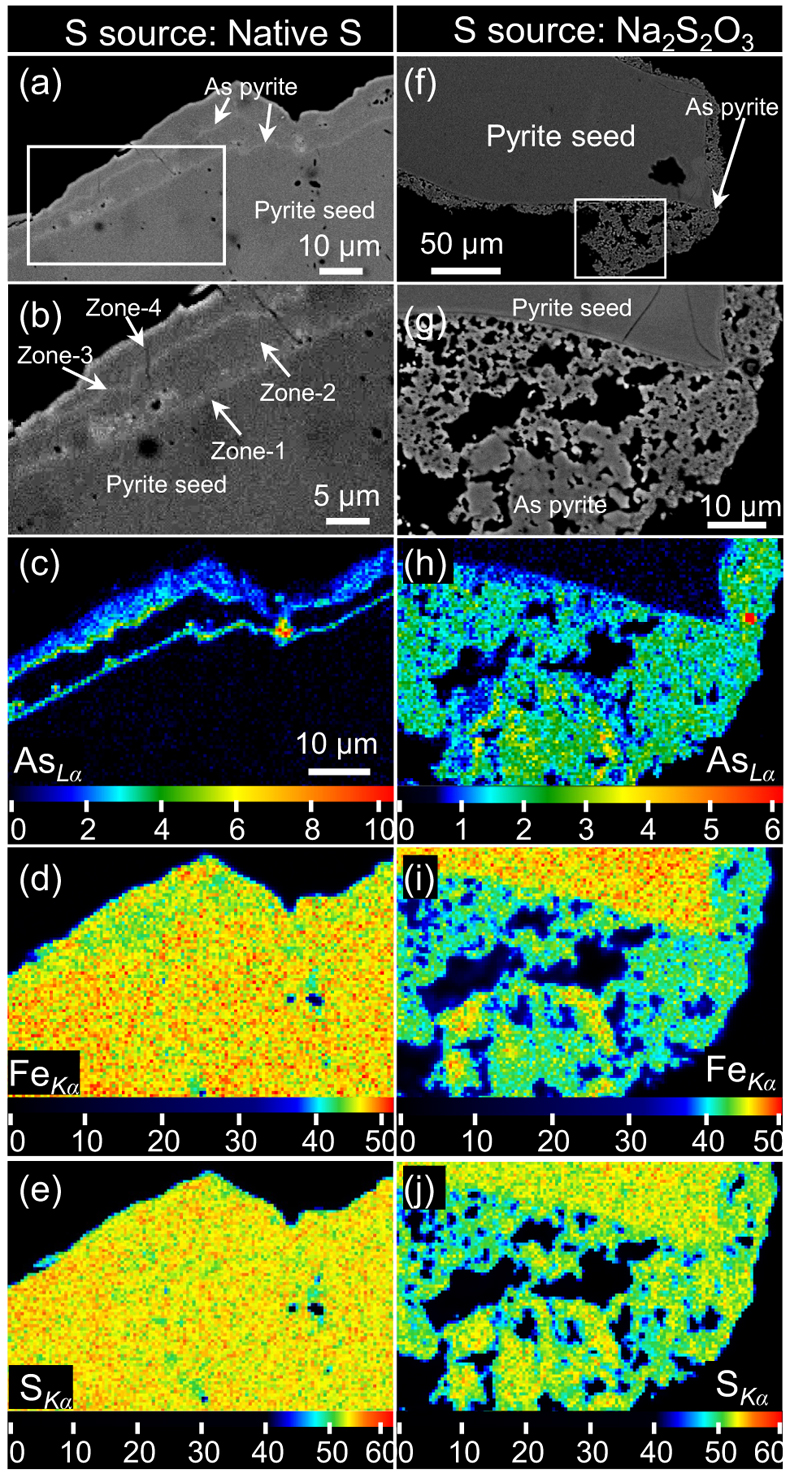
Figure 1 Backscattered electron images (a, b, f, g) and elemental mapping of As (c, h), Fe (d, i), and S (e, j) in newly formed pyrite. (a–e) Pyrite-S, (f–j) pyrite-SO. Note four zones of pyrite-S deposited on pyrite seed (b) and the sponge-like texture of pyrite-SO.
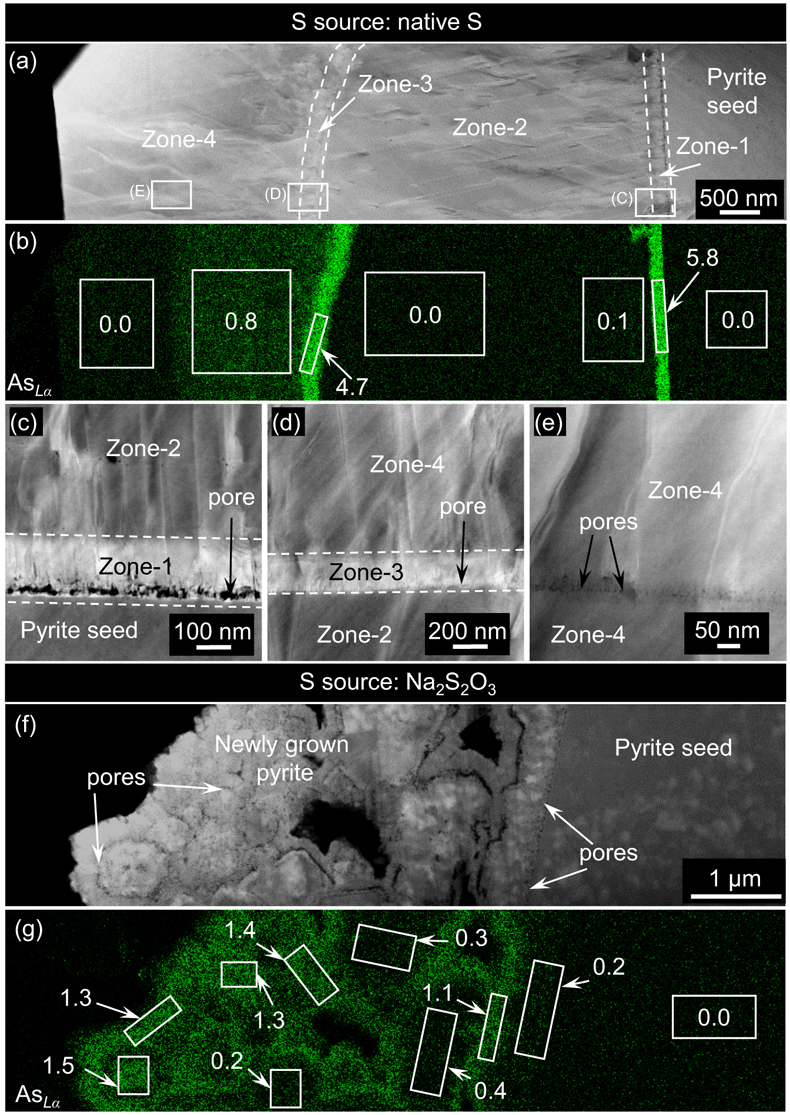
Figure 2 Summary of pyrite textures observed at higher resolution (HAADF-STEM) with corresponding TEM-EDS elemental maps of As. (a, b) Alternating As-in (Zones-1, -3) and As-out (Zones-2, -4) zones deposited on pyrite seed. (b) The rectangles and the values represent the areas of analysis and the concentration of As (in wt. %). (c–e) Porous pyrite formed between the seed and between the zones. (f, g) Aggregates of As zoned microcrystalline pyrite-SO. Note the porosity between the pyrite seed and the product and between the As-rich and As-poor zones of pyrite. (a, b) Pyrite-S; (f, g) pyrite-SO.
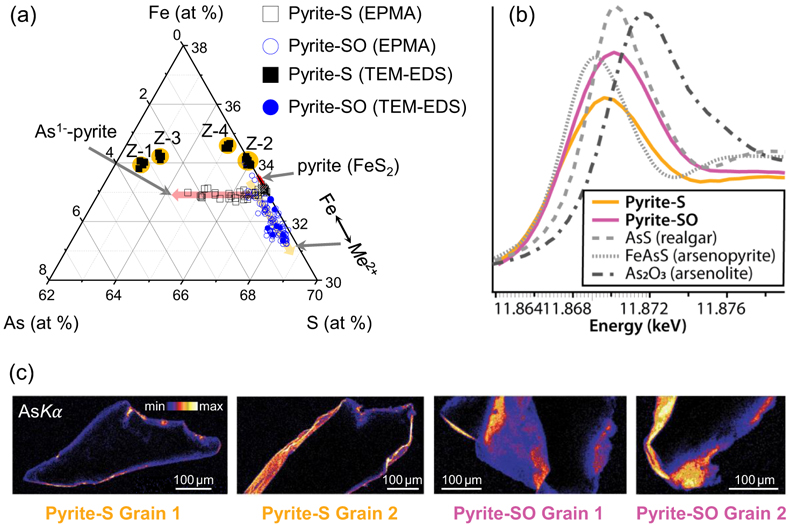
Figure 3 (a) Chemical composition of pyrite plotted in the As-Fe-S ternary. Filled symbols indicate the TEM-EDS analyses of Zones-1 to Zone-4 (Z-1 to Z-4). The coloured arrows indicate the trends associated with the substitution of (i) As for S (red), and (ii) Me2+ for Fe (yellow). Red cross; starting pyrite. (b) XANES spectra obtained on grains in (c). (c) XFM maps showing the distribution of As in Pyrite-S (two grains, total 148 kpixel, with ∼9000 As-rich) and Pyrite-SO (two grains, total 240 kpixel, including ∼20,000 As-rich).
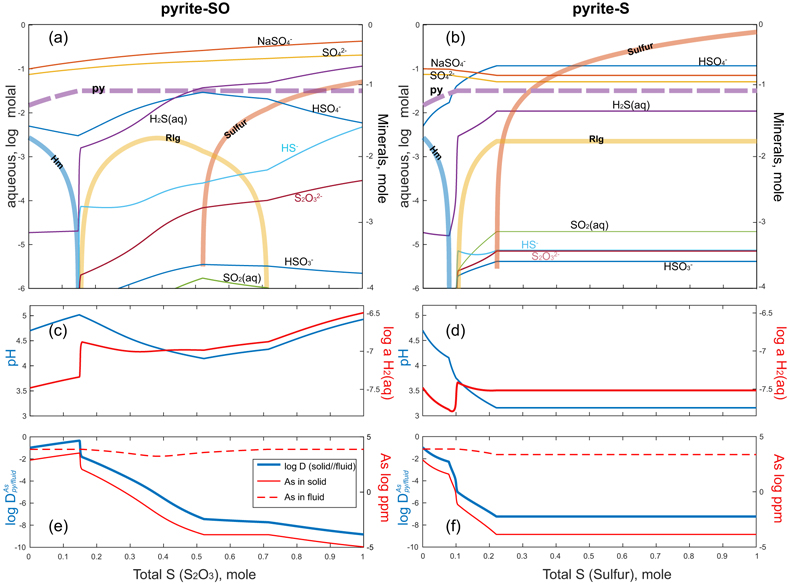
Figure 4 Model results of titrating different S sources as Na sulfite or native sulfur to precipitate arsenian pyrite. (a, c, e) The Na2S2O3 system, and (b, d, f) the native sulfur system. Panels (a, b) show the amounts of mineral present (thick lines) and the dominant aqueous sulfur species (thin solid lines). Panels (c, d) show redox as a H2(aq) (right axes) and solution pH (left axes). Panels (e, f) display the variations in As concentrations and partitioning coefficients between pyrite and fluid;
 is the partitioning coefficient in ppm and is plotted on the left axis. Mineral abbreviations: py, pyrite; Hm, hematite; Rlg, realgar.