



Kinetic Zr isotope fractionation on Mars recorded in ancient Zr-rich minerals
Affiliations | Corresponding Author | Cite as | Funding information
Published by the European Association of Geochemistry
under Creative Commons License CC BY-NC-ND 4.0
Keywords: Mars, NWA 7533, zircon, stable Zr isotopes, U-Pb isotopes, Lu-Hf isotopes, MC-ICPMS, ID-TIMS


- Share this article


-
Article views:948Cumulative count of HTML views and PDF downloads.
- Download Citation
- Rights & Permissions

top
Abstract

Figures
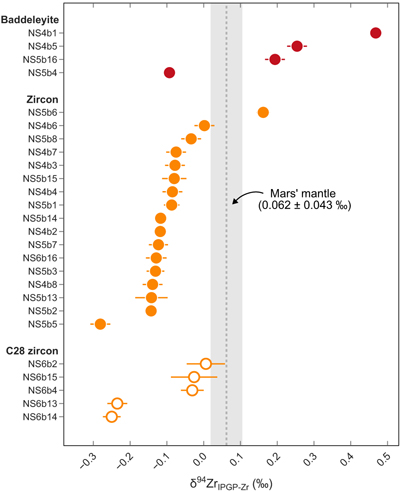 Figure 1 Stable Zr isotope results for zircon and baddeleyite from NWA 7533. The grey dotted line and shaded bar reflect the stable Zr isotope composition inferred for the Martian mantle (Jensen et al., 2025a). The data point error bars reflect the 2-standard error of the mean. | 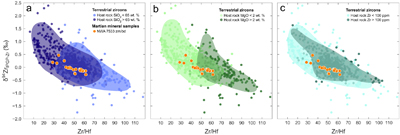 Figure 2 Both NWA 7533 samples and terrestrial zircons show a negative correlation between δ94Zr and Zr/Hf. Zircons from high-SiO2, low-MgO host rocks trend toward heavier δ94Zr and lower Zr/Hf values. Terrestrial zircon data are from Ibañez-Mejia and Tissot (2019), Yuan et al. (2023), Z. Zhu et al. (2023), E.-L. Zhu et al. (2024), Li et al. (2025), Ma et al. (2025), and Wang et al. (2025). | 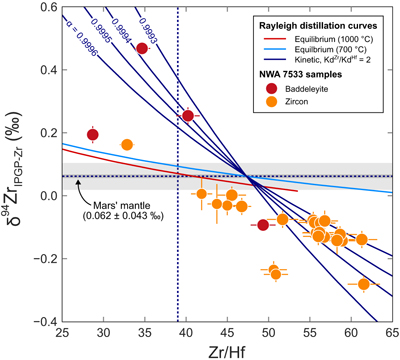 Figure 3 The δ94Zr and Zr/Hf compositions of NWA 7533 zircon and baddeleyite are plotted with Rayleigh fractionation curves for equilibrium isotope fractionation at 1000 °C (α = 0.99995, KdZr/KdHf = 1.4) and 700 °C (α = 0.99992, KdZr/KdHf = 2.0), and kinetic isotope fractionation (KdZr/KdHf = 2, α = 0.9993 to 0.9996). Dotted lines show the assumed initial melt composition, where δ94ZrIPGP-Zr represents the Martian mantle composition (0.062 ± 0.043 ‰; Jensen et al., 2025a), and Zr/Hf = 39 represents bulk NWA 7533 (Jensen et al., 2025b). The shaded grey field shows uncertainty in the Martian mantle composition. | 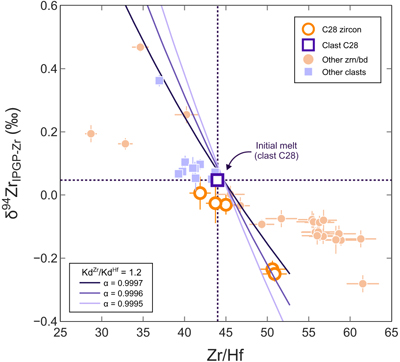 Figure 4 Rayleigh fractionation models assuming an initial melt composition akin to the host clast (the dotted lines). The three curves correspond to KdZr/KdHf = 1.2, but variable α. These models cannot explain the three smaller C28 zircons which have heavier Zr isotope compositions. The NWA 7533 clast data is from Jensen et al. (2025a, 2025b). |
| Figure 1 | Figure 2 | Figure 3 | Figure 4 |
top
Introduction
Zirconium is a high field strength element with five naturally occurring stable isotopes (90Zr, 91Zr, 92Zr, 94Zr and 96Zr). Since the first demonstrations of stable Zr isotope analysis by isotope dilution multi-collector inductively coupled mass spectrometry (MC-ICPMS; Inglis et al., 2018
Inglis, E.C., Creech, J.B., Deng, Z., Moynier, F. (2018) High-precision zirconium stable isotope measurements of geological reference materials as measured by double-spike MC-ICPMS. Chemical Geology 493, 544–552. https://doi.org/10.1016/j.chemgeo.2018.07.007
) and laser-ablation MC-ICPMS analysis of zircon (Zhang et al., 2019Zhang, W., Wang, Z., Moynier, F., Inglis, E., Tian, S., Li, M., Liu, Y., Hu, Z. (2019) Determination of Zr isotopic ratios in zircons using laser-ablation multiple-collector inductively coupled-plasma mass-spectrometry. Journal of Analytical Atomic Spectrometry 34, 1800–1809. https://doi.org/10.1039/c9ja00192a
), several subsequent studies have documented mass dependent stable Zr isotope fractionation in nature (e.g., Inglis et al., 2019Inglis, E.C., Moynier, F., Creech, J., Deng, Z., Day, J.M.D., Teng, F.-Z., Bizzarro, M., Jackson, M., Savage, P. (2019) Isotopic fractionation of zirconium during magmatic differentiation and the stable isotope composition of the silicate Earth. Geochimica et Cosmochimica Acta 250, 311–323. https://doi.org/10.1016/j.gca.2019.02.010
; Guo et al., 2020Guo, J.-L., Wang, Z., Zhang, W., Moynier, F., Cui, D., Hu, Z., Ducea, M.N. (2020) Significant Zr isotope variations in single zircon grains recording magma evolution history. Proceedings of the National Academy of Sciences 117, 21125–21131. https://doi.org/10.1073/pnas.2002053117
; Tian et al., 2021Tian, S., Moynier, F., Inglis, E.C., Rudnick, R.L., Huang, F., Chauvel, C., Creech, J.B., Gaschnig, R.M., Wang, Z., Guo, J.-L. (2021) Zirconium isotopic composition of the upper continental crust through time. Earth and Planetary Science Letters 572, 117086. https://doi.org/10.1016/j.epsl.2021.117086
; Yuan et al., 2022Yuan, Y., Guo, J.-L., Zong, K., Feng, L., Wang, Z., Moynier, F., Zhang, W., Hu, Z., Xu, H. (2022) Stable zirconium isotopic fractionation during alkaline magma differentiation: Implications for the differentiation of continental crust. Geochimica et Cosmochimica Acta 326, 41–55. https://doi.org/10.1016/j.gca.2022.03.035
). As a result, abundant Zr isotopic data exist for zircons from a wide range of felsic lithologies (granites, granitoids and pegmatite; e.g., Zhu et al., 2024Zhu, E.-L., Xia, Q.-X., Zhang, S.-B., Van Orman, J., Chen, R.-X., Li, Z.-Y., Gao, P. (2024) Zirconium isotope tracing of the magmatic-hydrothermal transition. Geochimica et Cosmochimica Acta 380, 194–207. https://doi.org/10.1016/j.gca.2024.07.023
; Li et al., 2025Li, Z.-X., Zhang, S.-B., Zheng, Y.-F., Antonelli, M.A., Zhang, W., Zhang, L., Sun, F.-Y., Liang, T. (2025) Transition from kinetic to equilibrium Zr isotope fractionations during magma crystallization. Geochimica et Cosmochimica Acta 400, 1–17. https://doi.org/10.1016/j.gca.2025.05.017
) and a few mafic lithologies (gabbro and troctolite; e.g., Ma et al., 2025Ma, L.-T., Dai, L.-Q., Zhang, S.-B., Chen, R.-X., Xia, Q.-X., Zhao, Z.-F. (2025) Diffusion-driven zircon Zr isotopic fractionation during ultramafic–mafic magmatic differentiation. Geochimica et Cosmochimica Acta 400, 129–141. https://doi.org/10.1016/j.gca.2025.04.020
). This extensive dataset shows that, in most silicate–magmatic settings, zircon preferentially incorporates lighter Zr isotopes, consistent with first-principles predictions of mass dependent isotope fractionation between zircon and silicate melt at thermodynamic equilibrium (Chen et al., 2020Chen, X., Wang, W., Zhang, Z., Nie, N.X., Dauphas, N. (2020) Evidence from Ab Initio and Transport Modeling for Diffusion-Driven Zirconium Isotopic Fractionation in Igneous Rocks. ACS Earth and Space Chemistry 4, 1572–1595. https://doi.org/10.1021/acsearthspacechem.0c00146
; Méheut et al., 2021Méheut, M., Ibañez-Mejia, M., Tissot, F.L.H. (2021) Drivers of zirconium isotope fractionation in Zr-bearing phases and melts: The roles of vibrational, nuclear field shift and diffusive effects. Geochimica et Cosmochimica Acta 292, 217–234. https://doi.org/10.1016/j.gca.2020.09.028
). This behaviour is theoretically explained by the preference of heavier isotopes for the shorter and stiffer bonds that characterise the low coordination configurations of Zr in the silicate melt relative to zircon (Bigeleisen and Mayer, 1947Bigeleisen, J., Mayer, M.G. (1947) Calculation of Equilibrium Constants for Isotopic Exchange Reactions. The Journal of Chemical Physics 15, 261–267. https://doi.org/10.1063/1.1746492
; Urey, 1947Urey, H.C. (1947) The Thermodynumic Properties of Isotopic Substances. Journal of the Chemical Society (Resumed) 562–581. https://doi.org/10.1039/JR9470000562
; Chen et al., 2020Chen, X., Wang, W., Zhang, Z., Nie, N.X., Dauphas, N. (2020) Evidence from Ab Initio and Transport Modeling for Diffusion-Driven Zirconium Isotopic Fractionation in Igneous Rocks. ACS Earth and Space Chemistry 4, 1572–1595. https://doi.org/10.1021/acsearthspacechem.0c00146
). Thus, progressive zircon crystallisation generally enriches the residual melt in heavier Zr isotopes, leading to heavier Zr isotopic compositions in later formed crystals. Due to the preferential incorporation of Zr over Hf in zircon (Claiborne et al., 2006Claiborne, L.L., Miller, C.F., Walker, B.A., Wooden, J.L., Mazdab, F.K., Bea, F. (2006) Tracking magmatic processes through Zr/Hf ratios in rocks and Hf and Ti zoning in zircons: An example from the Spirit Mountain batholith, Nevada. Mineralogical Magazine 70, 517–543. https://doi.org/10.1180/0026461067050348
), this enrichment in heavy Zr isotopes in the residual melt is accompanied by a decreasing Zr/Hf ratio as crystallisation progresses, leading to a negative correlation between 94Zr/90Zr and Zr/Hf. Indeed, most zircon literature data exhibit a negative correlation between δ94Zr (the per mil deviation of the 94Zr/90Zr ratio in the sample relative to the reference material) and Zr/Hf, with lower δ94Zr and higher Zr/Hf ratios indicative of earlier crystallisation (e.g., Guo et al., 2020Guo, J.-L., Wang, Z., Zhang, W., Moynier, F., Cui, D., Hu, Z., Ducea, M.N. (2020) Significant Zr isotope variations in single zircon grains recording magma evolution history. Proceedings of the National Academy of Sciences 117, 21125–21131. https://doi.org/10.1073/pnas.2002053117
; Yuan et al., 2023Yuan, Y., Zong, K., Guo, J.-L., Zhang, W., Wang, Z., Moynier, F., Feng, L., Hu, Z., Liu, Y. (2023) Linking Significant Zr Isotopic Fractionation in Magmatic Zircons With Petrographic Textures. Journal of Geophysical Research: Solid Earth 128, e2023JB026915. https://doi.org/10.1029/2023jb026915
; Zhu et al., 2023Zhu, Z., Zhang, W., Wang, J., Wang, Z., Guo, J.-L., Hoffmann, J.E., Feng, L., Luo, T., Hu, Z., Liu, Y., Moynier, F. (2023) Magmatic crystallization drives zircon Zr isotopic variations in a large granite batholith. Geochimica et Cosmochimica Acta 342, 15–30. https://doi.org/10.1016/j.gca.2022.12.003
). However, the magnitude of stable Zr isotope fractionation recorded in zircon typically exceeds that expected from equilibrium fractionation, reflecting an additional isotope fractionation mechanism. Such a mechanism has been proposed to be diffusion-driven (kinetic) Zr isotope fractionation, which describes the isotope fractionation that occurs due to Zr diffusion in the melt (in response to Zr concentration gradients) and the faster diffusion of lighter relative to heavier Zr isotopes (Chen et al., 2020Chen, X., Wang, W., Zhang, Z., Nie, N.X., Dauphas, N. (2020) Evidence from Ab Initio and Transport Modeling for Diffusion-Driven Zirconium Isotopic Fractionation in Igneous Rocks. ACS Earth and Space Chemistry 4, 1572–1595. https://doi.org/10.1021/acsearthspacechem.0c00146
; Méheut et al., 2021Méheut, M., Ibañez-Mejia, M., Tissot, F.L.H. (2021) Drivers of zirconium isotope fractionation in Zr-bearing phases and melts: The roles of vibrational, nuclear field shift and diffusive effects. Geochimica et Cosmochimica Acta 292, 217–234. https://doi.org/10.1016/j.gca.2020.09.028
). As this process can readily induce Zr isotope fractionation at the per mil level, a general consensus has been established that the stable Zr isotope variations in natural zircon results from a combination of equilibrium and diffusion-driven kinetic isotope fractionation (e.g., Guo et al., 2023Guo, J.-L., Wang, Z., Zhang, W., Feng, L., Moynier, F., Hu, Z., Zhou, L., Liu, Y. (2023) Zirconium and its stable isotopes in igneous systems. Earth-Science Reviews 237, 104289. https://doi.org/10.1016/j.earscirev.2022.104289
). Nonetheless, the factors controlling the relative roles of diffusion and equilibrium fractionation in silicate melt systems remain unclear, and further work is needed to constrain the extent of disequilibrium fractionation generated during different crust formation processes. In fact, it may be informative to study the stable Zr isotope compositions of zircons formed in the early history of planetary bodies where crust formation was partially controlled by impact melting and, thus, fundamentally different from later times (e.g., Johnson et al., 2018Johnson, T.E., Gardiner, N.J., Miljković, K., Spencer, C.J., Kirkland, C.L., Bland, P.A., Smithies, H. (2018) An impact melt origin for Earth’s oldest known evolved rocks. Nature Geoscience 11, 795–799. https://doi.org/10.1038/s41561-018-0206-5
). The Martian polymict regolith breccia meteorite Northwest Africa (NWA) 7034 and paired stones (e.g., NWA 7533) contain zircon and baddeleyite with ages up to ∼4480 Ma that formed from impact reworking of the primordial Martian crust (Bouvier et al., 2018Bouvier, L.C., Costa, M.M., Connelly, J.N., Jensen, N.K., Wielandt, D., Storey, M., Nemchin, A.A., Whitehouse, M.J., Snape, J.F., Bellucci, J.J., Moynier, F., Agranier, A., Gueguen, B., Schönbächler, M., Bizzarro, M. (2018) Evidence for extremely rapid magma ocean crystallization and crust formation on Mars. Nature 558, 586–589. https://doi.org/10.1038/s41586-018-0222-z
; Costa et al., 2020Costa, M.M., Jensen, N.K., Bouvier, L.C., Connelly, J.N., Mikouchi, T., Horstwood, M.S.A., Suuronen, J.-P., Moynier, F., Deng, Z., Agranier, A., Martin, L.A.J., Johnson, T.E., Nemchin, A.A., Bizzarro, M. (2020) The internal structure and geodynamics of Mars inferred from a 4.2-Gyr zircon record. Proceedings of the National Academy of Sciences 117, 30973–30979. https://doi.org/10.1073/pnas.2016326117
). These samples, therefore, provide a unique opportunity to investigate Zr isotope fractionation under early planetary conditions. We emphasise that the predicted equilibrium Zr isotope fractionation between baddeleyite and silicate melt is of similar magnitude to that calculated for zircon and, as such, we expect a similar isotope fractionation behaviour for these two Zr-rich minerals (Chen et al., 2020Chen, X., Wang, W., Zhang, Z., Nie, N.X., Dauphas, N. (2020) Evidence from Ab Initio and Transport Modeling for Diffusion-Driven Zirconium Isotopic Fractionation in Igneous Rocks. ACS Earth and Space Chemistry 4, 1572–1595. https://doi.org/10.1021/acsearthspacechem.0c00146
).This study presents the first stable Zr isotope data for zircon and baddeleyite from Mars that formed within the early history of the planet during crustal reworking. We show that ∼4.45 Gyr-old zircon and baddeleyite grains from NWA 7533 typically record isotopically light Zr isotope compositions relative to the presumed parent melt composition, with a fractionation magnitude suggesting kinetic isotope fractionation effects.
top
Methods
We conducted U-Pb, Lu-Hf, and stable Zr isotope measurements for 26 zircon and baddeleyite grains separated from the Martian polymict regolith breccia meteorite NWA 7533 following established procedures (Costa et al., 2020
Costa, M.M., Jensen, N.K., Bouvier, L.C., Connelly, J.N., Mikouchi, T., Horstwood, M.S.A., Suuronen, J.-P., Moynier, F., Deng, Z., Agranier, A., Martin, L.A.J., Johnson, T.E., Nemchin, A.A., Bizzarro, M. (2020) The internal structure and geodynamics of Mars inferred from a 4.2-Gyr zircon record. Proceedings of the National Academy of Sciences 117, 30973–30979. https://doi.org/10.1073/pnas.2016326117
; Jensen et al., 2024Jensen, N.K., Deng, Z., Connelly, J.N., Bizzarro, M. (2024) Novel Methods for Concomitant Determination of the Stable Zr Isotope Composition, Lu‐Hf Isotope Systematics and U‐Pb Age of Individual Zircons. Geostandards and Geoanalytical Research 48, 5–28. https://doi.org/10.1111/ggr.12529
). In detail, 17 zircons and four baddeleyites derive from a crushed bulk aliquot of the meteorite, and five zircons were separated from a basaltic andesitic clast (“C28”; Jensen et al., 2025bJensen, N.K., Nemchin, A.A., Kenny, G., Whitehouse, M.J., Connelly, J.N., Mikouchi, T., Bizzarro, M. (2025b) Timing of crustal reworking on Mars inferred from the Lu-Hf isotope systematics of igneous clasts in NWA 7533. Geochimica et Cosmochimica Acta 390, 70–85. https://doi.org/10.1016/j.gca.2024.11.014
). Most of the zircons used in this study had a brown and granular appearance, indicating metamictisation (Figs. S-1 to S-3). Whereas disturbed U-Pb isotope systematics are expected, these metamict grains might preserve pristine Lu-Hf and Zr isotope compositions (see SI for further details). We highlight that an assessment of the degree of isotope disturbance is permitted in this study through the concomitant determination of the U-Pb, Lu-Hf and stable Zr isotope compositions of the grains. In brief, the U-Pb isotope analyses were conducted by isotope dilution thermal ionisation mass spectrometry (ID-TIMS), and the Lu-Hf (unspiked) and Zr double-spiked isotope analyses were conducted by solution-based MC-ICPMS. We stress that the individual zircon and baddeleyite crystals were processed as single grains, and the presented isotope and trace element data reflect the same grain volume. To allow for a comparison to terrestrial zircon data, the stable Zr isotope compositions are corrected for the mass independent 96Zr enrichment of Mars relative to Earth (see Supplementary Information for details), and the results are reported relative to the IPGP-Zr reference material as:Eq. 1

top
U-Pb and Lu-Hf Isotope Results
In accordance with the metamict appearance of the majority of the grains investigated in this study, only five out of 26 grains yield concordant U-Pb ages (Table S-3). While zircon NS5b5 yields the oldest age with a 207Pb/206Pb date of 4479.8 ± 1.9 Ma (2 s.e.), the four investigated baddeleyite grains record a ∼200 Myr age range from ∼4255 to ∼4470 Ma. The remaining 21 grains exhibit U-Pb age discordances between 5 % and 50 %, defining an array with approximate upper and lower concordia line intercepts at 4.45 Ga and 1.4 Ga (Fig. S-4). This is consistent with the results of previous studies of NWA 7034/7533 minerals, suggesting that the meteorite source region experienced a thermal event at 1.3–1.7 Ga (e.g., Humayun et al., 2013
Humayun, M., Nemchin, A., Zanda, B., Hewins, R.H., Grange, M., Kennedy, A., Lorand, J.-P., Göpel, C., Fieni, C., Pont, S., Deldicque, D. (2013) Origin and age of the earliest Martian crust from meteorite NWA 7533. Nature 503, 513–517. https://doi.org/10.1038/nature12764
; Bellucci et al., 2015Bellucci, J.J., Nemchin, A.A., Whitehouse, M.J., Humayun, M., Hewins, R., Zanda, B. (2015) Pb-isotopic evidence for an early, enriched crust on Mars. Earth and Planetary Science Letters 410, 34–41. https://doi.org/10.1016/j.epsl.2014.11.018
; McCubbin et al., 2016McCubbin, F.M., Boyce, J.W., Novák-Szabó, T., Santos, A.R., Tartèse, R., Muttik, N., Domokos, G., Vazquez, J., Keller, L.P., Moser, D.E., Jerolmack, D.J., Shearer, C.K., Steele, A., Elardo, S.M., Rahman, Z., Anand, M., Delhaye, T., Agee, C.B. (2016) Geologic history of Martian regolith breccia Northwest Africa 7034: Evidence for hydrothermal activity and lithologic diversity in the Martian crust. Journal of Geophysical Research: Planets 121, 2120–2149. https://doi.org/10.1002/2016je005143
; Cassata et al., 2018Cassata, W.S., Cohen, B.E., Mark, D.F., Trappitsch, R., Crow, C.A., Wimpenny, J., Lee, M.R., Smith, C.L. (2018) Chronology of the martian breccia NWA 7034 and the formation of the martian crustal dichotomy. Science Advances 4, eaap8306. https://doi.org/10.1126/sciadv.aap8306
).The five concordant grains return initial epsilon Hf values (ɛHf, the 176Hf/177Hf composition of the sample relative to that of the CHondritic Uniform Reservoir) between 0 and −4, with the more negative values corresponding to the younger grains. While the highly discordant grains have experienced significant Pb loss at ∼1.4 Ga, the Lu-Hf isotope systematics are undisturbed with 176Lu/177Hf and 176Hf/177Hf ratios that follow the isotopic trend defined by concordant zircon and baddeleyite samples from NWA 7034/7533 (Fig. S-9), with the exception of one grain with a relatively radiogenic Hf isotope composition (NS5b6; see SI for further details). Thus, we can confirm that the investigated grains belong to the population of ∼4.45 Gyr-old crystals from NWA 7533 that formed during reworking of the primordial Martian crust.
top
Stable Zr Isotope Results
The 26 grains record stable Zr isotope fractionation with δ94ZrIPGP-Zr compositions ranging from −0.281 ± 0.011 ‰ in the concordant zircon NS5b5 to +0.468 ± 0.009 ‰ in the baddeleyite NS4b1 (Fig. 1, Table S-3). Notably, 22 of the grains exhibit δ94ZrIPGP-Zr values lower than the Martian mantle value (δ94ZrIPGP-Zr = 0.062 ± 0.043 ‰; Jensen et al., 2025a
Jensen, N.K., Deng, Z., Bizzarro, M. (2025a) The stable Zr isotope composition of the martian mantle. Chemical Geology 688, 122811. https://doi.org/10.1016/j.chemgeo.2025.122811
), and three out of four baddeleyites record δ94ZrIPGP-Zr values heavier than the mantle. The zircons from clast C28 form two groups, with the two largest zircons yielding δ94ZrIPGP-Zr of about −0.250 ‰, and the three smaller grains yielding δ94ZrIPGP-Zr close to 0 ‰. Importantly, the stable Zr isotope compositions do not correlate with the degree of U-Pb age discordance (Fig. S-6a), reflecting that the Zr isotopes were, in general, not affected during the ∼1.4 Ga event that led to partial U-Pb isotope resetting, in agreement with the preservation of undisturbed Lu-Hf isotope systematics. However, the zircon with an anomalously radiogenic Hf isotope signature (NS5b6) records a heavier stable Zr isotope composition (δ94ZrIPGP-Zr = 0.162 ± 0.010 ‰) relative to the other zircons. This may reflect partial recrystallisation during the ∼1.4 Ga thermal event, consistent with the almost complete resetting of the U-Pb isotope systematics in this grain (Table S-3, Fig. S-4).Figure 1 Stable Zr isotope results for zircon and baddeleyite from NWA 7533. The grey dotted line and shaded bar reflect the stable Zr isotope composition inferred for the Martian mantle (Jensen et al., 2025a
Jensen, N.K., Deng, Z., Bizzarro, M. (2025a) The stable Zr isotope composition of the martian mantle. Chemical Geology 688, 122811. https://doi.org/10.1016/j.chemgeo.2025.122811
). The data point error bars reflect the 2-standard error of the mean.top
Comparison to Terrestrial Zircons
The stable Zr isotope compositions of the NWA 7533 grains exhibit a negative correlation with the Zr/Hf ratios, similar to the trends observed for most terrestrial zircon datasets (Fig. 2). This illustrates the typical evolution of the magma towards a heavier Zr isotope composition due to fractional crystallisation of zircon and/or baddeleyite. The zircon and baddeleyite grains from Mars investigated here have δ94Zr compositions at the lighter end of the correlation defined by zircons from terrestrial rocks with SiO2 > 65 wt. % and MgO < 2 wt. % (Fig. 2a,b). This may reflect the origin of the NWA 7533 grains from less evolved melts, which is consistent with the typically basaltic composition of igneous clasts from the NWA 7533 breccia meteorite (e.g., Santos et al., 2015
Santos, A.R., Agee, C.B., McCubbin, F.M., Shearer, C.K., Burger, P.V., Tartèse, R., Anand, M. (2015) Petrology of igneous clasts in Northwest Africa 7034: Implications for the petrologic diversity of the martian crust. Geochimica et Cosmochimica Acta 157, 56–85. https://doi.org/10.1016/j.gca.2015.02.023
; Jensen et al., 2025bJensen, N.K., Nemchin, A.A., Kenny, G., Whitehouse, M.J., Connelly, J.N., Mikouchi, T., Bizzarro, M. (2025b) Timing of crustal reworking on Mars inferred from the Lu-Hf isotope systematics of igneous clasts in NWA 7533. Geochimica et Cosmochimica Acta 390, 70–85. https://doi.org/10.1016/j.gca.2024.11.014
).Figure 2 Both NWA 7533 samples and terrestrial zircons show a negative correlation between δ94Zr and Zr/Hf. Zircons from high-SiO2, low-MgO host rocks trend toward heavier δ94Zr and lower Zr/Hf values. Terrestrial zircon data are from Ibañez-Mejia and Tissot (2019)
Ibañez-Mejia, M., Tissot, F.L.H. (2019) Extreme Zr stable isotope fractionation during magmatic fractional crystallization. Science Advances 5, eaax8648. https://doi.org/10.1126/sciadv.aax8648
, Yuan et al. (2023)Yuan, Y., Zong, K., Guo, J.-L., Zhang, W., Wang, Z., Moynier, F., Feng, L., Hu, Z., Liu, Y. (2023) Linking Significant Zr Isotopic Fractionation in Magmatic Zircons With Petrographic Textures. Journal of Geophysical Research: Solid Earth 128, e2023JB026915. https://doi.org/10.1029/2023jb026915
, Z. Zhu et al. (2023)Zhu, Z., Zhang, W., Wang, J., Wang, Z., Guo, J.-L., Hoffmann, J.E., Feng, L., Luo, T., Hu, Z., Liu, Y., Moynier, F. (2023) Magmatic crystallization drives zircon Zr isotopic variations in a large granite batholith. Geochimica et Cosmochimica Acta 342, 15–30. https://doi.org/10.1016/j.gca.2022.12.003
, E.-L. Zhu et al. (2024)Zhu, E.-L., Xia, Q.-X., Zhang, S.-B., Van Orman, J., Chen, R.-X., Li, Z.-Y., Gao, P. (2024) Zirconium isotope tracing of the magmatic-hydrothermal transition. Geochimica et Cosmochimica Acta 380, 194–207. https://doi.org/10.1016/j.gca.2024.07.023
, Li et al. (2025)Li, Z.-X., Zhang, S.-B., Zheng, Y.-F., Antonelli, M.A., Zhang, W., Zhang, L., Sun, F.-Y., Liang, T. (2025) Transition from kinetic to equilibrium Zr isotope fractionations during magma crystallization. Geochimica et Cosmochimica Acta 400, 1–17. https://doi.org/10.1016/j.gca.2025.05.017
, Ma et al. (2025)Ma, L.-T., Dai, L.-Q., Zhang, S.-B., Chen, R.-X., Xia, Q.-X., Zhao, Z.-F. (2025) Diffusion-driven zircon Zr isotopic fractionation during ultramafic–mafic magmatic differentiation. Geochimica et Cosmochimica Acta 400, 129–141. https://doi.org/10.1016/j.gca.2025.04.020
, and Wang et al. (2025)Wang, J., Zhang, X., Zhu, Z., Wang, X., Wang, Z., Zhang, W., Zhang, F., Feng, L., Lai, S., Li, Q., Luo, T., Moynier, F., Hu, Z., Guo, J.-L. (2025) Zirconium isotope evidence for crystal-melt segregation during high-silica granitic magma differentiation. Earth and Planetary Science Letters 655, 119251. https://doi.org/10.1016/j.epsl.2025.119251
.The lower compositional variability in the NWA 7533 grains compared to terrestrial zircon data may partly reflect methodological differences. This study probes the bulk grain compositions (full dissolution method) while terrestrial zircon data typically reflects laser ablation MC-ICPMS, which captures both inter- and intra-grain variability. As zircon intra-grain δ94Zr variability can be at the per mil level (up to 2.8 ‰ in Haladala pluton zircon; Ma et al., 2025
Ma, L.-T., Dai, L.-Q., Zhang, S.-B., Chen, R.-X., Xia, Q.-X., Zhao, Z.-F. (2025) Diffusion-driven zircon Zr isotopic fractionation during ultramafic–mafic magmatic differentiation. Geochimica et Cosmochimica Acta 400, 129–141. https://doi.org/10.1016/j.gca.2025.04.020
), a lower degree of Zr isotope variability may be expected in the zircon data presented here relative to the compiled terrestrial zircon dataset. Despite this, the NWA 7533 bulk grains exhibit δ94Zr and Zr/Hf variations comparable to the inter-/intra-grain variability observed for zircons from the Taihua Complex and the Linglong granite batholith in the North China Craton and the Barberton Granitoid-Greenstone Terrane in the Kaapvaal Craton (Fig. S-10; Zhu et al., 2023Zhu, Z., Zhang, W., Wang, J., Wang, Z., Guo, J.-L., Hoffmann, J.E., Feng, L., Luo, T., Hu, Z., Liu, Y., Moynier, F. (2023) Magmatic crystallization drives zircon Zr isotopic variations in a large granite batholith. Geochimica et Cosmochimica Acta 342, 15–30. https://doi.org/10.1016/j.gca.2022.12.003
; Li et al., 2025Li, Z.-X., Zhang, S.-B., Zheng, Y.-F., Antonelli, M.A., Zhang, W., Zhang, L., Sun, F.-Y., Liang, T. (2025) Transition from kinetic to equilibrium Zr isotope fractionations during magma crystallization. Geochimica et Cosmochimica Acta 400, 1–17. https://doi.org/10.1016/j.gca.2025.05.017
).top
Kinetic Zr Isotope Fractionation
The total δ94Zr range of ∼0.75 ‰ exhibited by the 26 investigated grains reveals that the early reworking of the primordial Martian crust was associated with stable Zr isotope fractionation, similar to that occurring in plutons and batholiths on Earth. Given that the investigated grains were extracted from a polymict regolith breccia, they may plausibly derive from different rock fragments and record the crystallisation of different magmatic source reservoirs. However, we emphasise that the 176Hf/177Hf-176Lu/177Hf correlation exhibited by the grains (Fig. S-9) indicates that their magmatic source(s) can be treated as a single closed system that evolved from the same initial 176Hf/177Hf isotope composition. If new magma was introduced to this system in the time frame of zircon/baddeleyite crystallisation, it must have been relatively depleted in Hf (and other incompatible trace elements such as Zr) to preserve undisturbed Lu-Hf isotope systematics. Consequently, the Zr isotope compositions of the grains most likely reflect closed-system evolution from a uniform initial δ94Zr. Moreover, it is reasonable to assume that the evolution of the Zr isotope composition of the system is dominantly controlled by zircon/baddeleyite fractional crystallisation rather than by primary rock-forming minerals, such as pyroxene, based on the limited stable Zr isotope fractionation recorded in bulk clasts from NWA 7533 (Jensen et al., 2025a
Jensen, N.K., Deng, Z., Bizzarro, M. (2025a) The stable Zr isotope composition of the martian mantle. Chemical Geology 688, 122811. https://doi.org/10.1016/j.chemgeo.2025.122811
). We therefore model the stable Zr isotope and Zr/Hf evolution of the system as a function of zircon/baddeleyite fractional crystallisation (Rayleigh fractionation). Assuming the initial melt had a Martian mantle δ94ZrIPGP-Zr composition (δ94ZrIPGP-Zr = 0.062 ± 0.043 ‰; Jensen et al., 2025aJensen, N.K., Deng, Z., Bizzarro, M. (2025a) The stable Zr isotope composition of the martian mantle. Chemical Geology 688, 122811. https://doi.org/10.1016/j.chemgeo.2025.122811
) and an initial Zr/Hf ratio of 39 (the composition of the bulk NWA 7533 breccia; Jensen et al., 2025bJensen, N.K., Nemchin, A.A., Kenny, G., Whitehouse, M.J., Connelly, J.N., Mikouchi, T., Bizzarro, M. (2025b) Timing of crustal reworking on Mars inferred from the Lu-Hf isotope systematics of igneous clasts in NWA 7533. Geochimica et Cosmochimica Acta 390, 70–85. https://doi.org/10.1016/j.gca.2024.11.014
), we find that the δ94Zr compositional range of the NWA 7533 grains cannot be reproduced by equilibrium Zr isotope fractionation alone (Fig. 3). This conclusion holds even when constraints on the initial melt composition are relaxed. For example, assuming a significantly lighter initial melt δ94ZrIPGP-Zr composition (−0.07 ‰) and higher Zr/Hf ratio (51) still fails to fully explain the compositional range of the NWA 7533 grains through equilibrium isotope fractionation alone (Fig. S-13).Figure 3 The δ94Zr and Zr/Hf compositions of NWA 7533 zircon and baddeleyite are plotted with Rayleigh fractionation curves for equilibrium isotope fractionation at 1000 °C (α = 0.99995, KdZr/KdHf = 1.4) and 700 °C (α = 0.99992, KdZr/KdHf = 2.0), and kinetic isotope fractionation (KdZr/KdHf = 2, α = 0.9993 to 0.9996). Dotted lines show the assumed initial melt composition, where δ94ZrIPGP-Zr represents the Martian mantle composition (0.062 ± 0.043 ‰; Jensen et al., 2025a
Jensen, N.K., Deng, Z., Bizzarro, M. (2025a) The stable Zr isotope composition of the martian mantle. Chemical Geology 688, 122811. https://doi.org/10.1016/j.chemgeo.2025.122811
), and Zr/Hf = 39 represents bulk NWA 7533 (Jensen et al., 2025bJensen, N.K., Nemchin, A.A., Kenny, G., Whitehouse, M.J., Connelly, J.N., Mikouchi, T., Bizzarro, M. (2025b) Timing of crustal reworking on Mars inferred from the Lu-Hf isotope systematics of igneous clasts in NWA 7533. Geochimica et Cosmochimica Acta 390, 70–85. https://doi.org/10.1016/j.gca.2024.11.014
). The shaded grey field shows uncertainty in the Martian mantle composition.Instead, the Zr isotope fractionation preserved in the Martian grains must partly reflect a kinetic process, such as diffusion-limited crystallisation (e.g., Chen et al., 2020
Chen, X., Wang, W., Zhang, Z., Nie, N.X., Dauphas, N. (2020) Evidence from Ab Initio and Transport Modeling for Diffusion-Driven Zirconium Isotopic Fractionation in Igneous Rocks. ACS Earth and Space Chemistry 4, 1572–1595. https://doi.org/10.1021/acsearthspacechem.0c00146
). Using a mineral-melt Zr/Hf fractionation factor (KdZr/KdHf) of 2 (the predicted value for equilibrium fractionation at 700 °C), a fraction of the NWA 7533 grains can be matched by Rayleigh fractionation with α values ranging from 0.9993 to 0.9996, reflecting a mixture of equilibrium and kinetic isotope fractionation processes (Fig. 3). These isotope fractionation factors are similar to those inferred from terrestrial zircons from different granitic bodies (e.g., Guo et al., 2020Guo, J.-L., Wang, Z., Zhang, W., Moynier, F., Cui, D., Hu, Z., Ducea, M.N. (2020) Significant Zr isotope variations in single zircon grains recording magma evolution history. Proceedings of the National Academy of Sciences 117, 21125–21131. https://doi.org/10.1073/pnas.2002053117
; Zhu et al., 2023Zhu, Z., Zhang, W., Wang, J., Wang, Z., Guo, J.-L., Hoffmann, J.E., Feng, L., Luo, T., Hu, Z., Liu, Y., Moynier, F. (2023) Magmatic crystallization drives zircon Zr isotopic variations in a large granite batholith. Geochimica et Cosmochimica Acta 342, 15–30. https://doi.org/10.1016/j.gca.2022.12.003
). Thus, we find that the stable Zr isotope fractionation occurring during crustal reworking on early Mars is partly kinetic in origin and similar in magnitude to that occurring in many terrestrial silicate systems. Since the magnitude of generated kinetic isotope fractionation reflects the net effect of several melt conditions (e.g., cooling, mineral growth and element diffusion rates), it is unclear to what extent the conditions in early Martian impact melts were similar to those in terrestrial magma intrusions. However, we can conclude that stable Zr isotope fractionation of comparable magnitude occurs in different tectonic settings: intrusive silicate melt systems on Earth and impact melt bodies on Mars. Further work is required to determine whether the magnitude of kinetic stable Zr isotope fractionation in zircon is unambiguously linked to specific melt conditions such as cooling rate, which will determine the utility of the stable Zr isotope system as a tracer for magmatic processes.top
Complex Zr Isotope Fractionation Systematics Recorded in Clast C28 Zircons
Whereas the petrological context is unknown for most of the grains investigated in this study, five zircons derive from the basaltic andesitic clast C28, providing additional constraints on the zircon parental melt composition. Notably, Rayleigh fractionation curves that assume an initial melt composition akin to the bulk C28 clast (with α = 0.9995 to 0.9997, KdZr/KdHf = 1.2) approach the compositions of the two largest C28 zircons (NS6b13 and NS6b14, Fig. 4). However, the three smaller zircons with heavier δ94Zr require fractionation factors closer to equilibrium and only minor Zr/Hf fractionation. Thus, the stable Zr isotope compositions of the five zircons from clast C28 cannot be explained by a single Rayleigh fractionation model (Fig. 4). Instead, a range of α and KdZr/KdHf values is required to explain the zircon compositions if the initial melt was identical to the host clast. Given the nearly basaltic composition of C28, the crystallisation of the C28 zircons likely took place in late-stage melt pockets, and the governing Zr/Hf and δ94Zr fractionation factors may reflect the variable effects of co-crystallising phases on the element concentration gradients in these melt pockets.
Figure 4 Rayleigh fractionation models assuming an initial melt composition akin to the host clast (the dotted lines). The three curves correspond to KdZr/KdHf = 1.2, but variable α. These models cannot explain the three smaller C28 zircons which have heavier Zr isotope compositions. The NWA 7533 clast data is from Jensen et al. (2025a
Jensen, N.K., Deng, Z., Bizzarro, M. (2025a) The stable Zr isotope composition of the martian mantle. Chemical Geology 688, 122811. https://doi.org/10.1016/j.chemgeo.2025.122811
, 2025bJensen, N.K., Nemchin, A.A., Kenny, G., Whitehouse, M.J., Connelly, J.N., Mikouchi, T., Bizzarro, M. (2025b) Timing of crustal reworking on Mars inferred from the Lu-Hf isotope systematics of igneous clasts in NWA 7533. Geochimica et Cosmochimica Acta 390, 70–85. https://doi.org/10.1016/j.gca.2024.11.014
).Alternatively, the zircons could have formed from a parental melt composition distinct from that of the bulk clast. For example, the measured clast composition may not be representative for the true bulk rock, or the clast could represent a cumulate (Fig. S-11). However, the limited number of separated zircons from this clast and the very small size of most of these grains prevent us from constraining the formation history further. Nonetheless, the results support a model in which the Zr isotope fractionation recorded in the C28 zircons was partly controlled by a kinetic process. This is consistent with the observations from the NWA 7533 zircon and baddeleyite grains without petrological context.
To conclude, we find that stable Zr isotope fractionation associated with crustal reworking on early Mars was partly kinetic in nature. Moreover, the δ94Zr and Zr/Hf fractionation recorded in the ancient Martian grains from mafic impact melt environments is similar to that observed for zircons from terrestrial magmatic intrusions. Further investigations of intra-grain Zr isotope fractionation in NWA 7533 zircons are required for direct comparison of the magnitudes of kinetic Zr isotope fractionation occurring in terrestrial plutons and Pre-Noachian impact melt systems on Mars.
top
Acknowledgements
Financial support for this project was provided by grants from the Villum Fonden (grant # 54476) and the European Research Council (ERC Advanced Grant Agreement 833275 – DEEPTIME) to M.B.
Editor: Helen Williams
top
References
Bellucci, J.J., Nemchin, A.A., Whitehouse, M.J., Humayun, M., Hewins, R., Zanda, B. (2015) Pb-isotopic evidence for an early, enriched crust on Mars. Earth and Planetary Science Letters 410, 34–41. https://doi.org/10.1016/j.epsl.2014.11.018
 Show in context
 This is consistent with the results of previous studies of NWA 7034/7533 minerals, suggesting that the meteorite source region experienced a thermal event at 1.3–1.7 Ga (e.g., Humayun et al., 2013; Bellucci et al., 2015; McCubbin et al., 2016; Cassata et al., 2018).
View in article
Bigeleisen, J., Mayer, M.G. (1947) Calculation of Equilibrium Constants for Isotopic Exchange Reactions. The Journal of Chemical Physics 15, 261–267. https://doi.org/10.1063/1.1746492
Show in context This behaviour is theoretically explained by the preference of heavier isotopes for the shorter and stiffer bonds that characterise the low coordination configurations of Zr in the silicate melt relative to zircon (Bigeleisen and Mayer, 1947; Urey, 1947; Chen et al., 2020).
View in article
Bouvier, L.C., Costa, M.M., Connelly, J.N., Jensen, N.K., Wielandt, D., Storey, M., Nemchin, A.A., Whitehouse, M.J., Snape, J.F., Bellucci, J.J., Moynier, F., Agranier, A., Gueguen, B., Schönbächler, M., Bizzarro, M. (2018) Evidence for extremely rapid magma ocean crystallization and crust formation on Mars. Nature 558, 586–589. https://doi.org/10.1038/s41586-018-0222-z
Show in context The Martian polymict regolith breccia meteorite Northwest Africa (NWA) 7034 and paired stones (e.g., NWA 7533) contain zircon and baddeleyite with ages up to ∼4480 Ma that formed from impact reworking of the primordial Martian crust (Bouvier et al., 2018; Costa et al., 2020).
View in article
Cassata, W.S., Cohen, B.E., Mark, D.F., Trappitsch, R., Crow, C.A., Wimpenny, J., Lee, M.R., Smith, C.L. (2018) Chronology of the martian breccia NWA 7034 and the formation of the martian crustal dichotomy. Science Advances 4, eaap8306. https://doi.org/10.1126/sciadv.aap8306
Show in context This is consistent with the results of previous studies of NWA 7034/7533 minerals, suggesting that the meteorite source region experienced a thermal event at 1.3–1.7 Ga (e.g., Humayun et al., 2013; Bellucci et al., 2015; McCubbin et al., 2016; Cassata et al., 2018).
View in article
Chen, X., Wang, W., Zhang, Z., Nie, N.X., Dauphas, N. (2020) Evidence from Ab Initio and Transport Modeling for Diffusion-Driven Zirconium Isotopic Fractionation in Igneous Rocks. ACS Earth and Space Chemistry 4, 1572–1595. https://doi.org/10.1021/acsearthspacechem.0c00146
Show in context This extensive dataset shows that, in most silicate–magmatic settings, zircon preferentially incorporates lighter Zr isotopes, consistent with first-principles predictions of mass dependent isotope fractionation between zircon and silicate melt at thermodynamic equilibrium (Chen et al., 2020; Méheut et al., 2021).
View in article
This behaviour is theoretically explained by the preference of heavier isotopes for the shorter and stiffer bonds that characterise the low coordination configurations of Zr in the silicate melt relative to zircon (Bigeleisen and Mayer, 1947; Urey, 1947; Chen et al., 2020).
View in article
Such a mechanism has been proposed to be diffusion-driven (kinetic) Zr isotope fractionation, which describes the isotope fractionation that occurs due to Zr diffusion in the melt (in response to Zr concentration gradients) and the faster diffusion of lighter relative to heavier Zr isotopes (Chen et al., 2020; Méheut et al., 2021).
View in article
We emphasise that the predicted equilibrium Zr isotope fractionation between baddeleyite and silicate melt is of similar magnitude to that calculated for zircon and, as such, we expect a similar isotope fractionation behaviour for these two Zr-rich minerals (Chen et al., 2020).
View in article
Instead, the Zr isotope fractionation preserved in the Martian grains must partly reflect a kinetic process, such as diffusion-limited crystallisation (e.g., Chen et al., 2020).
View in article
Claiborne, L.L., Miller, C.F., Walker, B.A., Wooden, J.L., Mazdab, F.K., Bea, F. (2006) Tracking magmatic processes through Zr/Hf ratios in rocks and Hf and Ti zoning in zircons: An example from the Spirit Mountain batholith, Nevada. Mineralogical Magazine 70, 517–543. https://doi.org/10.1180/0026461067050348
Show in context Due to the preferential incorporation of Zr over Hf in zircon (Claiborne et al., 2006), this enrichment in heavy Zr isotopes in the residual melt is accompanied by a decreasing Zr/Hf ratio as crystallisation progresses, leading to a negative correlation between 94Zr/90Zr and Zr/Hf.
View in article
Costa, M.M., Jensen, N.K., Bouvier, L.C., Connelly, J.N., Mikouchi, T., Horstwood, M.S.A., Suuronen, J.-P., Moynier, F., Deng, Z., Agranier, A., Martin, L.A.J., Johnson, T.E., Nemchin, A.A., Bizzarro, M. (2020) The internal structure and geodynamics of Mars inferred from a 4.2-Gyr zircon record. Proceedings of the National Academy of Sciences 117, 30973–30979. https://doi.org/10.1073/pnas.2016326117
Show in context The Martian polymict regolith breccia meteorite Northwest Africa (NWA) 7034 and paired stones (e.g., NWA 7533) contain zircon and baddeleyite with ages up to ∼4480 Ma that formed from impact reworking of the primordial Martian crust (Bouvier et al., 2018; Costa et al., 2020).
View in article
We conducted U-Pb, Lu-Hf, and stable Zr isotope measurements for 26 zircon and baddeleyite grains separated from the Martian polymict regolith breccia meteorite NWA 7533 following established procedures (Costa et al., 2020; Jensen et al., 2024).
View in article
Guo, J.-L., Wang, Z., Zhang, W., Moynier, F., Cui, D., Hu, Z., Ducea, M.N. (2020) Significant Zr isotope variations in single zircon grains recording magma evolution history. Proceedings of the National Academy of Sciences 117, 21125–21131. https://doi.org/10.1073/pnas.2002053117
Show in context Since the first demonstrations of stable Zr isotope analysis by isotope dilution multi-collector inductively coupled mass spectrometry (MC-ICPMS; Inglis et al., 2018) and laser-ablation MC-ICPMS analysis of zircon (Zhang et al., 2019), several subsequent studies have documented mass dependent stable Zr isotope fractionation in nature (e.g., Inglis et al., 2019; Guo et al., 2020; Tian et al., 2021; Yuan et al., 2022).
View in article
Indeed, most zircon literature data exhibit a negative correlation between δ94Zr (the per mil deviation of the 94Zr/90Zr ratio in the sample relative to the reference material) and Zr/Hf, with lower δ94Zr and higher Zr/Hf ratios indicative of earlier crystallisation (e.g., Guo et al., 2020; Yuan et al., 2023; Zhu et al., 2023).
View in article
These isotope fractionation factors are similar to those inferred from terrestrial zircons from different granitic bodies (e.g., Guo et al., 2020; Zhu et al., 2023).
View in article
Guo, J.-L., Wang, Z., Zhang, W., Feng, L., Moynier, F., Hu, Z., Zhou, L., Liu, Y. (2023) Zirconium and its stable isotopes in igneous systems. Earth-Science Reviews 237, 104289. https://doi.org/10.1016/j.earscirev.2022.104289
Show in context As this process can readily induce Zr isotope fractionation at the per mil level, a general consensus has been established that the stable Zr isotope variations in natural zircon results from a combination of equilibrium and diffusion-driven kinetic isotope fractionation (e.g., Guo et al., 2023).
View in article
Humayun, M., Nemchin, A., Zanda, B., Hewins, R.H., Grange, M., Kennedy, A., Lorand, J.-P., Göpel, C., Fieni, C., Pont, S., Deldicque, D. (2013) Origin and age of the earliest Martian crust from meteorite NWA 7533. Nature 503, 513–517. https://doi.org/10.1038/nature12764
Show in context This is consistent with the results of previous studies of NWA 7034/7533 minerals, suggesting that the meteorite source region experienced a thermal event at 1.3–1.7 Ga (e.g., Humayun et al., 2013; Bellucci et al., 2015; McCubbin et al., 2016; Cassata et al., 2018).
View in article
Ibañez-Mejia, M., Tissot, F.L.H. (2019) Extreme Zr stable isotope fractionation during magmatic fractional crystallization. Science Advances 5, eaax8648. https://doi.org/10.1126/sciadv.aax8648
Show in context Terrestrial zircon data are from Ibañez-Mejia and Tissot (2019), Yuan et al. (2023), Z. Zhu et al. (2023), E.-L. Zhu et al. (2024), Li et al. (2025), Ma et al. (2025), and Wang et al. (2025).
View in article
Inglis, E.C., Creech, J.B., Deng, Z., Moynier, F. (2018) High-precision zirconium stable isotope measurements of geological reference materials as measured by double-spike MC-ICPMS. Chemical Geology 493, 544–552. https://doi.org/10.1016/j.chemgeo.2018.07.007
Show in context Since the first demonstrations of stable Zr isotope analysis by isotope dilution multi-collector inductively coupled mass spectrometry (MC-ICPMS; Inglis et al., 2018) and laser-ablation MC-ICPMS analysis of zircon (Zhang et al., 2019), several subsequent studies have documented mass dependent stable Zr isotope fractionation in nature (e.g., Inglis et al., 2019; Guo et al., 2020; Tian et al., 2021; Yuan et al., 2022).
View in article
Inglis, E.C., Moynier, F., Creech, J., Deng, Z., Day, J.M.D., Teng, F.-Z., Bizzarro, M., Jackson, M., Savage, P. (2019) Isotopic fractionation of zirconium during magmatic differentiation and the stable isotope composition of the silicate Earth. Geochimica et Cosmochimica Acta 250, 311–323. https://doi.org/10.1016/j.gca.2019.02.010
Show in context Since the first demonstrations of stable Zr isotope analysis by isotope dilution multi-collector inductively coupled mass spectrometry (MC-ICPMS; Inglis et al., 2018) and laser-ablation MC-ICPMS analysis of zircon (Zhang et al., 2019), several subsequent studies have documented mass dependent stable Zr isotope fractionation in nature (e.g., Inglis et al., 2019; Guo et al., 2020; Tian et al., 2021; Yuan et al., 2022).
View in article
Jensen, N.K., Deng, Z., Connelly, J.N., Bizzarro, M. (2024) Novel Methods for Concomitant Determination of the Stable Zr Isotope Composition, Lu‐Hf Isotope Systematics and U‐Pb Age of Individual Zircons. Geostandards and Geoanalytical Research 48, 5–28. https://doi.org/10.1111/ggr.12529
Show in context We conducted U-Pb, Lu-Hf, and stable Zr isotope measurements for 26 zircon and baddeleyite grains separated from the Martian polymict regolith breccia meteorite NWA 7533 following established procedures (Costa et al., 2020; Jensen et al., 2024).
View in article
Jensen, N.K., Deng, Z., Bizzarro, M. (2025a) The stable Zr isotope composition of the martian mantle. Chemical Geology 688, 122811. https://doi.org/10.1016/j.chemgeo.2025.122811
Show in context Notably, 22 of the grains exhibit δ94ZrIPGP-Zr values lower than the Martian mantle value (δ94ZrIPGP-Zr = 0.062 ± 0.043 ‰; Jensen et al., 2025a), and three out of four baddeleyites record δ94ZrIPGP-Zr values heavier than the mantle.
View in article
Stable Zr isotope results for zircon and baddeleyite from NWA 7533. The grey dotted line and shaded bar reflect the stable Zr isotope composition inferred for the Martian mantle (Jensen et al., 2025a).
View in article
Moreover, it is reasonable to assume that the evolution of the Zr isotope composition of the system is dominantly controlled by zircon/baddeleyite fractional crystallisation rather than by primary rock-forming minerals, such as pyroxene, based on the limited stable Zr isotope fractionation recorded in bulk clasts from NWA 7533 (Jensen et al., 2025a).
View in article
Assuming the initial melt had a Martian mantle δ94ZrIPGP-Zr composition (δ94ZrIPGP-Zr = 0.062 ± 0.043 ‰; Jensen et al., 2025a) and an initial Zr/Hf ratio of 39 (the composition of the bulk NWA 7533 breccia; Jensen et al., 2025b), we find that the δ94Zr compositional range of the NWA 7533 grains cannot be reproduced by equilibrium Zr isotope fractionation alone (Fig. 3).
View in article
Dotted lines show the assumed initial melt composition, where δ94ZrIPGP-Zr represents the Martian mantle composition (0.062 ± 0.043 ‰; Jensen et al., 2025a), and Zr/Hf = 39 represents bulk NWA 7533 (Jensen et al., 2025b).
View in article
The NWA 7533 clast data is from Jensen et al. (2025a, 2025b).
View in article
Jensen, N.K., Nemchin, A.A., Kenny, G., Whitehouse, M.J., Connelly, J.N., Mikouchi, T., Bizzarro, M. (2025b) Timing of crustal reworking on Mars inferred from the Lu-Hf isotope systematics of igneous clasts in NWA 7533. Geochimica et Cosmochimica Acta 390, 70–85. https://doi.org/10.1016/j.gca.2024.11.014
Show in context In detail, 17 zircons and four baddeleyites derive from a crushed bulk aliquot of the meteorite, and five zircons were separated from a basaltic andesitic clast (“C28”; Jensen et al., 2025b).
View in article
This may reflect the origin of the NWA 7533 grains from less evolved melts, which is consistent with the typically basaltic composition of igneous clasts from the NWA 7533 breccia meteorite (e.g., Santos et al., 2015; Jensen et al., 2025b).
View in article
Assuming the initial melt had a Martian mantle δ94ZrIPGP-Zr composition (δ94ZrIPGP-Zr = 0.062 ± 0.043 ‰; Jensen et al., 2025a) and an initial Zr/Hf ratio of 39 (the composition of the bulk NWA 7533 breccia; Jensen et al., 2025b), we find that the δ94Zr compositional range of the NWA 7533 grains cannot be reproduced by equilibrium Zr isotope fractionation alone (Fig. 3).
View in article
Dotted lines show the assumed initial melt composition, where δ94ZrIPGP-Zr represents the Martian mantle composition (0.062 ± 0.043 ‰; Jensen et al., 2025a), and Zr/Hf = 39 represents bulk NWA 7533 (Jensen et al., 2025b).
View in article
The NWA 7533 clast data is from Jensen et al. (2025a, 2025b).
View in article
Johnson, T.E., Gardiner, N.J., Miljković, K., Spencer, C.J., Kirkland, C.L., Bland, P.A., Smithies, H. (2018) An impact melt origin for Earth’s oldest known evolved rocks. Nature Geoscience 11, 795–799. https://doi.org/10.1038/s41561-018-0206-5
Show in context In fact, it may be informative to study the stable Zr isotope compositions of zircons formed in the early history of planetary bodies where crust formation was partially controlled by impact melting and, thus, fundamentally different from later times (e.g., Johnson et al., 2018).
View in article
Li, Z.-X., Zhang, S.-B., Zheng, Y.-F., Antonelli, M.A., Zhang, W., Zhang, L., Sun, F.-Y., Liang, T. (2025) Transition from kinetic to equilibrium Zr isotope fractionations during magma crystallization. Geochimica et Cosmochimica Acta 400, 1–17. https://doi.org/10.1016/j.gca.2025.05.017
Show in context As a result, abundant Zr isotopic data exist for zircons from a wide range of felsic lithologies (granites, granitoids and pegmatite; e.g., Zhu et al., 2024; Li et al., 2025) and a few mafic lithologies (gabbro and troctolite; e.g., Ma et al., 2025).
View in article
Terrestrial zircon data are from Ibañez-Mejia and Tissot (2019), Yuan et al. (2023), Z. Zhu et al. (2023), E.-L. Zhu et al. (2024), Li et al. (2025), Ma et al. (2025), and Wang et al. (2025).
View in article
Despite this, the NWA 7533 bulk grains exhibit δ94Zr and Zr/Hf variations comparable to the inter-/intra-grain variability observed for zircons from the Taihua Complex and the Linglong granite batholith in the North China Craton and the Barberton Granitoid-Greenstone Terrane in the Kaapvaal Craton (Fig. S-10; Zhu et al., 2023; Li et al., 2025).
View in article
Ma, L.-T., Dai, L.-Q., Zhang, S.-B., Chen, R.-X., Xia, Q.-X., Zhao, Z.-F. (2025) Diffusion-driven zircon Zr isotopic fractionation during ultramafic–mafic magmatic differentiation. Geochimica et Cosmochimica Acta 400, 129–141. https://doi.org/10.1016/j.gca.2025.04.020
Show in context As a result, abundant Zr isotopic data exist for zircons from a wide range of felsic lithologies (granites, granitoids and pegmatite; e.g., Zhu et al., 2024; Li et al., 2025) and a few mafic lithologies (gabbro and troctolite; e.g., Ma et al., 2025).
View in article
Terrestrial zircon data are from Ibañez-Mejia and Tissot (2019), Yuan et al. (2023), Z. Zhu et al. (2023), E.-L. Zhu et al. (2024), Li et al. (2025), Ma et al. (2025), and Wang et al. (2025).
View in article
As zircon intra-grain δ94Zr variability can be at the per mil level (up to 2.8 ‰ in Haladala pluton zircon; Ma et al., 2025), a lower degree of Zr isotope variability may be expected in the zircon data presented here relative to the compiled terrestrial zircon dataset.
View in article
McCubbin, F.M., Boyce, J.W., Novák-Szabó, T., Santos, A.R., Tartèse, R., Muttik, N., Domokos, G., Vazquez, J., Keller, L.P., Moser, D.E., Jerolmack, D.J., Shearer, C.K., Steele, A., Elardo, S.M., Rahman, Z., Anand, M., Delhaye, T., Agee, C.B. (2016) Geologic history of Martian regolith breccia Northwest Africa 7034: Evidence for hydrothermal activity and lithologic diversity in the Martian crust. Journal of Geophysical Research: Planets 121, 2120–2149. https://doi.org/10.1002/2016je005143
Show in context This is consistent with the results of previous studies of NWA 7034/7533 minerals, suggesting that the meteorite source region experienced a thermal event at 1.3–1.7 Ga (e.g., Humayun et al., 2013; Bellucci et al., 2015; McCubbin et al., 2016; Cassata et al., 2018).
View in article
Méheut, M., Ibañez-Mejia, M., Tissot, F.L.H. (2021) Drivers of zirconium isotope fractionation in Zr-bearing phases and melts: The roles of vibrational, nuclear field shift and diffusive effects. Geochimica et Cosmochimica Acta 292, 217–234. https://doi.org/10.1016/j.gca.2020.09.028
Show in context This extensive dataset shows that, in most silicate–magmatic settings, zircon preferentially incorporates lighter Zr isotopes, consistent with first-principles predictions of mass dependent isotope fractionation between zircon and silicate melt at thermodynamic equilibrium (Chen et al., 2020; Méheut et al., 2021).
View in article
Such a mechanism has been proposed to be diffusion-driven (kinetic) Zr isotope fractionation, which describes the isotope fractionation that occurs due to Zr diffusion in the melt (in response to Zr concentration gradients) and the faster diffusion of lighter relative to heavier Zr isotopes (Chen et al., 2020; Méheut et al., 2021).
View in article
Santos, A.R., Agee, C.B., McCubbin, F.M., Shearer, C.K., Burger, P.V., Tartèse, R., Anand, M. (2015) Petrology of igneous clasts in Northwest Africa 7034: Implications for the petrologic diversity of the martian crust. Geochimica et Cosmochimica Acta 157, 56–85. https://doi.org/10.1016/j.gca.2015.02.023
Show in context This may reflect the origin of the NWA 7533 grains from less evolved melts, which is consistent with the typically basaltic composition of igneous clasts from the NWA 7533 breccia meteorite (e.g., Santos et al., 2015; Jensen et al., 2025b).
View in article
Tian, S., Moynier, F., Inglis, E.C., Rudnick, R.L., Huang, F., Chauvel, C., Creech, J.B., Gaschnig, R.M., Wang, Z., Guo, J.-L. (2021) Zirconium isotopic composition of the upper continental crust through time. Earth and Planetary Science Letters 572, 117086. https://doi.org/10.1016/j.epsl.2021.117086
Show in context Since the first demonstrations of stable Zr isotope analysis by isotope dilution multi-collector inductively coupled mass spectrometry (MC-ICPMS; Inglis et al., 2018) and laser-ablation MC-ICPMS analysis of zircon (Zhang et al., 2019), several subsequent studies have documented mass dependent stable Zr isotope fractionation in nature (e.g., Inglis et al., 2019; Guo et al., 2020; Tian et al., 2021; Yuan et al., 2022).
View in article
Urey, H.C. (1947) The Thermodynumic Properties of Isotopic Substances. Journal of the Chemical Society (Resumed) 562–581. https://doi.org/10.1039/JR9470000562
Show in context This behaviour is theoretically explained by the preference of heavier isotopes for the shorter and stiffer bonds that characterise the low coordination configurations of Zr in the silicate melt relative to zircon (Bigeleisen and Mayer, 1947; Urey, 1947; Chen et al., 2020).
View in article
Wang, J., Zhang, X., Zhu, Z., Wang, X., Wang, Z., Zhang, W., Zhang, F., Feng, L., Lai, S., Li, Q., Luo, T., Moynier, F., Hu, Z., Guo, J.-L. (2025) Zirconium isotope evidence for crystal-melt segregation during high-silica granitic magma differentiation. Earth and Planetary Science Letters 655, 119251. https://doi.org/10.1016/j.epsl.2025.119251
Show in context Terrestrial zircon data are from Ibañez-Mejia and Tissot (2019), Yuan et al. (2023), Z. Zhu et al. (2023), E.-L. Zhu et al. (2024), Li et al. (2025), Ma et al. (2025), and Wang et al. (2025).
View in article
Yuan, Y., Guo, J.-L., Zong, K., Feng, L., Wang, Z., Moynier, F., Zhang, W., Hu, Z., Xu, H. (2022) Stable zirconium isotopic fractionation during alkaline magma differentiation: Implications for the differentiation of continental crust. Geochimica et Cosmochimica Acta 326, 41–55. https://doi.org/10.1016/j.gca.2022.03.035
Show in context Since the first demonstrations of stable Zr isotope analysis by isotope dilution multi-collector inductively coupled mass spectrometry (MC-ICPMS; Inglis et al., 2018) and laser-ablation MC-ICPMS analysis of zircon (Zhang et al., 2019), several subsequent studies have documented mass dependent stable Zr isotope fractionation in nature (e.g., Inglis et al., 2019; Guo et al., 2020; Tian et al., 2021; Yuan et al., 2022).
View in article
Yuan, Y., Zong, K., Guo, J.-L., Zhang, W., Wang, Z., Moynier, F., Feng, L., Hu, Z., Liu, Y. (2023) Linking Significant Zr Isotopic Fractionation in Magmatic Zircons With Petrographic Textures. Journal of Geophysical Research: Solid Earth 128, e2023JB026915. https://doi.org/10.1029/2023jb026915
Show in context Indeed, most zircon literature data exhibit a negative correlation between δ94Zr (the per mil deviation of the 94Zr/90Zr ratio in the sample relative to the reference material) and Zr/Hf, with lower δ94Zr and higher Zr/Hf ratios indicative of earlier crystallisation (e.g., Guo et al., 2020; Yuan et al., 2023; Zhu et al., 2023).
View in article
Terrestrial zircon data are from Ibañez-Mejia and Tissot (2019), Yuan et al. (2023), Z. Zhu et al. (2023), E.-L. Zhu et al. (2024), Li et al. (2025), Ma et al. (2025), and Wang et al. (2025).
View in article
Zhang, W., Wang, Z., Moynier, F., Inglis, E., Tian, S., Li, M., Liu, Y., Hu, Z. (2019) Determination of Zr isotopic ratios in zircons using laser-ablation multiple-collector inductively coupled-plasma mass-spectrometry. Journal of Analytical Atomic Spectrometry 34, 1800–1809. https://doi.org/10.1039/c9ja00192a
Show in context Since the first demonstrations of stable Zr isotope analysis by isotope dilution multi-collector inductively coupled mass spectrometry (MC-ICPMS; Inglis et al., 2018) and laser-ablation MC-ICPMS analysis of zircon (Zhang et al., 2019), several subsequent studies have documented mass dependent stable Zr isotope fractionation in nature (e.g., Inglis et al., 2019; Guo et al., 2020; Tian et al., 2021; Yuan et al., 2022).
View in article
Zhu, E.-L., Xia, Q.-X., Zhang, S.-B., Van Orman, J., Chen, R.-X., Li, Z.-Y., Gao, P. (2024) Zirconium isotope tracing of the magmatic-hydrothermal transition. Geochimica et Cosmochimica Acta 380, 194–207. https://doi.org/10.1016/j.gca.2024.07.023
Show in context As a result, abundant Zr isotopic data exist for zircons from a wide range of felsic lithologies (granites, granitoids and pegmatite; e.g., Zhu et al., 2024; Li et al., 2025) and a few mafic lithologies (gabbro and troctolite; e.g., Ma et al., 2025).
View in article
Terrestrial zircon data are from Ibañez-Mejia and Tissot (2019), Yuan et al. (2023), Z. Zhu et al. (2023), E.-L. Zhu et al. (2024), Li et al. (2025), Ma et al. (2025), and Wang et al. (2025).
View in article
Zhu, Z., Zhang, W., Wang, J., Wang, Z., Guo, J.-L., Hoffmann, J.E., Feng, L., Luo, T., Hu, Z., Liu, Y., Moynier, F. (2023) Magmatic crystallization drives zircon Zr isotopic variations in a large granite batholith. Geochimica et Cosmochimica Acta 342, 15–30. https://doi.org/10.1016/j.gca.2022.12.003
Show in context Indeed, most zircon literature data exhibit a negative correlation between δ94Zr (the per mil deviation of the 94Zr/90Zr ratio in the sample relative to the reference material) and Zr/Hf, with lower δ94Zr and higher Zr/Hf ratios indicative of earlier crystallisation (e.g., Guo et al., 2020; Yuan et al., 2023; Zhu et al., 2023).
View in article
Terrestrial zircon data are from Ibañez-Mejia and Tissot (2019), Yuan et al. (2023), Z. Zhu et al. (2023), E.-L. Zhu et al. (2024), Li et al. (2025), Ma et al. (2025), and Wang et al. (2025).
View in article
Despite this, the NWA 7533 bulk grains exhibit δ94Zr and Zr/Hf variations comparable to the inter-/intra-grain variability observed for zircons from the Taihua Complex and the Linglong granite batholith in the North China Craton and the Barberton Granitoid-Greenstone Terrane in the Kaapvaal Craton (Fig. S-10; Zhu et al., 2023; Li et al., 2025).
View in article
These isotope fractionation factors are similar to those inferred from terrestrial zircons from different granitic bodies (e.g., Guo et al., 2020; Zhu et al., 2023).
View in article
top
Supplementary Information
The Supplementary Information includes:
- Materials and Methods
- Sample Morphologies, Sizes and Isotope Results
- The Effect of Sample Impurity on Element Ratios
- Sample NS5b6 – A Metamorphic Grain?
- Rayleigh Fractionation Modelling
- Equilibrium versus Kinetic Isotope Fractionation
- Clast C28 Zircons
- Tables S-1 to S-4
- Figures S-1 to S-13
- Supplementary Information References
Download the Supplementary Information (PDF)
Download Table S-4 (xlsx)
Figures

Figure 1 Stable Zr isotope results for zircon and baddeleyite from NWA 7533. The grey dotted line and shaded bar reflect the stable Zr isotope composition inferred for the Martian mantle (Jensen et al., 2025a
Jensen, N.K., Deng, Z., Bizzarro, M. (2025a) The stable Zr isotope composition of the martian mantle. Chemical Geology 688, 122811. https://doi.org/10.1016/j.chemgeo.2025.122811
). The data point error bars reflect the 2-standard error of the mean.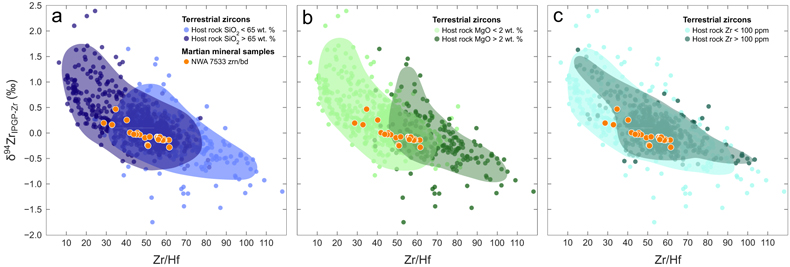
Figure 2 Both NWA 7533 samples and terrestrial zircons show a negative correlation between δ94Zr and Zr/Hf. Zircons from high-SiO2, low-MgO host rocks trend toward heavier δ94Zr and lower Zr/Hf values. Terrestrial zircon data are from Ibañez-Mejia and Tissot (2019)
Ibañez-Mejia, M., Tissot, F.L.H. (2019) Extreme Zr stable isotope fractionation during magmatic fractional crystallization. Science Advances 5, eaax8648. https://doi.org/10.1126/sciadv.aax8648
, Yuan et al. (2023)Yuan, Y., Zong, K., Guo, J.-L., Zhang, W., Wang, Z., Moynier, F., Feng, L., Hu, Z., Liu, Y. (2023) Linking Significant Zr Isotopic Fractionation in Magmatic Zircons With Petrographic Textures. Journal of Geophysical Research: Solid Earth 128, e2023JB026915. https://doi.org/10.1029/2023jb026915
, Z. Zhu et al. (2023)Zhu, Z., Zhang, W., Wang, J., Wang, Z., Guo, J.-L., Hoffmann, J.E., Feng, L., Luo, T., Hu, Z., Liu, Y., Moynier, F. (2023) Magmatic crystallization drives zircon Zr isotopic variations in a large granite batholith. Geochimica et Cosmochimica Acta 342, 15–30. https://doi.org/10.1016/j.gca.2022.12.003
, E.-L. Zhu et al. (2024)Zhu, E.-L., Xia, Q.-X., Zhang, S.-B., Van Orman, J., Chen, R.-X., Li, Z.-Y., Gao, P. (2024) Zirconium isotope tracing of the magmatic-hydrothermal transition. Geochimica et Cosmochimica Acta 380, 194–207. https://doi.org/10.1016/j.gca.2024.07.023
, Li et al. (2025)Li, Z.-X., Zhang, S.-B., Zheng, Y.-F., Antonelli, M.A., Zhang, W., Zhang, L., Sun, F.-Y., Liang, T. (2025) Transition from kinetic to equilibrium Zr isotope fractionations during magma crystallization. Geochimica et Cosmochimica Acta 400, 1–17. https://doi.org/10.1016/j.gca.2025.05.017
, Ma et al. (2025)Ma, L.-T., Dai, L.-Q., Zhang, S.-B., Chen, R.-X., Xia, Q.-X., Zhao, Z.-F. (2025) Diffusion-driven zircon Zr isotopic fractionation during ultramafic–mafic magmatic differentiation. Geochimica et Cosmochimica Acta 400, 129–141. https://doi.org/10.1016/j.gca.2025.04.020
, and Wang et al. (2025)Wang, J., Zhang, X., Zhu, Z., Wang, X., Wang, Z., Zhang, W., Zhang, F., Feng, L., Lai, S., Li, Q., Luo, T., Moynier, F., Hu, Z., Guo, J.-L. (2025) Zirconium isotope evidence for crystal-melt segregation during high-silica granitic magma differentiation. Earth and Planetary Science Letters 655, 119251. https://doi.org/10.1016/j.epsl.2025.119251
.
Figure 3 The δ94Zr and Zr/Hf compositions of NWA 7533 zircon and baddeleyite are plotted with Rayleigh fractionation curves for equilibrium isotope fractionation at 1000 °C (α = 0.99995, KdZr/KdHf = 1.4) and 700 °C (α = 0.99992, KdZr/KdHf = 2.0), and kinetic isotope fractionation (KdZr/KdHf = 2, α = 0.9993 to 0.9996). Dotted lines show the assumed initial melt composition, where δ94ZrIPGP-Zr represents the Martian mantle composition (0.062 ± 0.043 ‰; Jensen et al., 2025a
Jensen, N.K., Deng, Z., Bizzarro, M. (2025a) The stable Zr isotope composition of the martian mantle. Chemical Geology 688, 122811. https://doi.org/10.1016/j.chemgeo.2025.122811
), and Zr/Hf = 39 represents bulk NWA 7533 (Jensen et al., 2025bJensen, N.K., Nemchin, A.A., Kenny, G., Whitehouse, M.J., Connelly, J.N., Mikouchi, T., Bizzarro, M. (2025b) Timing of crustal reworking on Mars inferred from the Lu-Hf isotope systematics of igneous clasts in NWA 7533. Geochimica et Cosmochimica Acta 390, 70–85. https://doi.org/10.1016/j.gca.2024.11.014
). The shaded grey field shows uncertainty in the Martian mantle composition.
Figure 4 Rayleigh fractionation models assuming an initial melt composition akin to the host clast (the dotted lines). The three curves correspond to KdZr/KdHf = 1.2, but variable α. These models cannot explain the three smaller C28 zircons which have heavier Zr isotope compositions. The NWA 7533 clast data is from Jensen et al. (2025a
Jensen, N.K., Deng, Z., Bizzarro, M. (2025a) The stable Zr isotope composition of the martian mantle. Chemical Geology 688, 122811. https://doi.org/10.1016/j.chemgeo.2025.122811
, 2025bJensen, N.K., Nemchin, A.A., Kenny, G., Whitehouse, M.J., Connelly, J.N., Mikouchi, T., Bizzarro, M. (2025b) Timing of crustal reworking on Mars inferred from the Lu-Hf isotope systematics of igneous clasts in NWA 7533. Geochimica et Cosmochimica Acta 390, 70–85. https://doi.org/10.1016/j.gca.2024.11.014
).