



H-N budgets and isotopic signatures of Oued Chebeika 002 and CI reservoir heterogeneity
Affiliations | Corresponding Author | Cite as | Funding information
Published by the European Association of Geochemistry
under Creative Commons License CC BY-NC-ND 4.0
Keywords: CI chondrites, hydrogen isotopes, nitrogen isotopes, terrestrial volatiles


- Share this article


-
Article views:1,372Cumulative count of HTML views and PDF downloads.
- Download Citation
- Rights & Permissions

top
Abstract
Figures
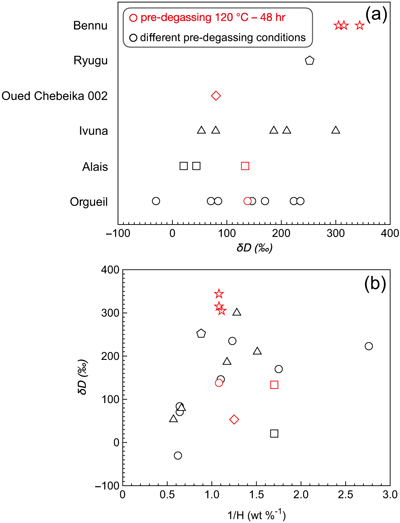 Figure 1 Comparison of (a) the bulk H isotopic composition (δD) and (b) the inverse of the H concentration of OC 002 with other CI chondrites (Alais, Ivuna, Orgueil) and with samples returned from the asteroids Ryugu and Bennu (compiled data provided at https://doi.org/10.24396/ORDAR-201). Red symbols indicate samples pre-degassed under identical conditions (120 °C for 48 hr), while black symbols correspond to those treated under different protocols. Data and associated references are reported in SI. | 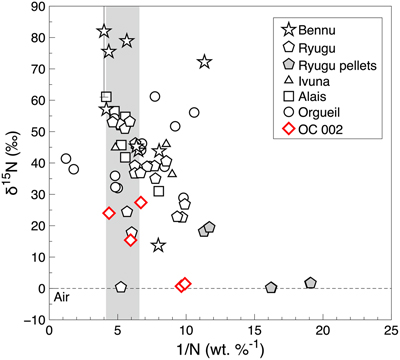 Figure 2 Nitrogen isotopic composition (δ15N) as a function of the inverse of the N concentration of five OC 002 fragments compared to other CI chondrite samples (Alais, Ivuna, Orgueil) and samples returned from the asteroids Ryugu and Bennu (compiled data provided at https://doi.org/10.24396/ORDAR-190, and additional results for Bennu by Marty et al., 2026). ‘Pellets’ correspond to Ryugu samples placed into a Cu disk and pressed against a diamond disk; this pelletisation procedure was carried out within a N2-filled glove box (Okazaki et al., 2022). The average N content for CI chondrite (1965 ± 447 ppm N) proposed by Lodders et al. (2025) is indicated by the grey bar. | 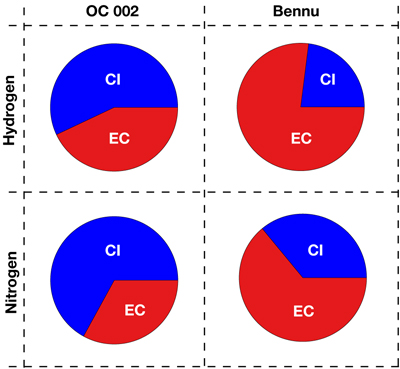 Figure 3 Pie charts showing the mass fraction of the Earth’s surficial H and N budget derived from CI and enstatite chondrites (EC), depending on whether the average H-N isotopic composition of OC 002 or Bennu samples are considered. |
| Figure 1 | Figure 2 | Figure 3 |
top
Introduction
Among the diverse types of meteorites, CI (Ivuna-type) carbonaceous chondrites (CCs) are unique objects with distinctive mineralogical, chemical, and isotopic characteristics (Morlok et al., 2006
Morlok, A., Bischoff, A., Stephan, T., Floss, C., Zinner, E., Jessberger, E.K. (2006) Brecciation and chemical heterogeneities of CI chondrites. Geochimica et Cosmochimica Acta 70, 5371–5394. https://doi.org/10.1016/j.gca.2006.08.007
; Russell et al., 2022Russell, S.S., Suttle, M.D., King, A.J. (2022) Abundance and importance of petrological type 1 chondritic material. Meteoritics & Planetary Science 57, 277–301. https://doi.org/10.1111/maps.13753
). The predominance of phyllosilicates, and to a lesser extent magnetite and carbonates, attests to the high degree of parent body aqueous alteration, which erased the initial CI components (Russell et al., 2022Russell, S.S., Suttle, M.D., King, A.J. (2022) Abundance and importance of petrological type 1 chondritic material. Meteoritics & Planetary Science 57, 277–301. https://doi.org/10.1111/maps.13753
). Nevertheless, CI chondrites have bulk chemical compositions similar to that of the solar photosphere, except for highly volatile elements such as H, N and noble gases (Lodders et al., 2025Lodders, K., Bergemann, M., Palme, H. (2025) Solar System Elemental Abundances from the Solar Photosphere and CI-Chondrites. Space Science Reviews 221, 23. https://doi.org/10.1007/s11214-025-01146-w
). Compared to other CCs, CIs have distinct O, Fe, and Ni isotopic compositions (Clayton and Mayeda, 1984Clayton, R.N., Mayeda, T.K. (1984) The oxygen isotope record in Murchison and other carbonaceous chondrites. Earth and Planetary Science Letters 67, 151–161. https://doi.org/10.1016/0012-821X(84)90110-9
; Hopp et al., 2022Hopp, T., Dauphas, N., Abe, Y., Aléon, J., Alexander, C.M.O’D. et al. (2022) Ryugu’s nucleosynthetic heritage from the outskirts of the Solar System. Science Advances 8, eadd8141. https://doi.org/10.1126/sciadv.add8141
; Spitzer et al., 2024Spitzer, F., Kleine, T., Burkhardt, C., Hopp, T., Yokoyama, T. et al. (2024) The Ni isotopic composition of Ryugu reveals a common accretion region for carbonaceous chondrites. Science Advances 10, eadp2426. https://doi.org/10.1126/sciadv.adp2426
). Based on these results, it has been proposed that CIs originate from a unique parent body (or bodies) that records an isotopically distinct third reservoir located beyond Saturn’s orbit (Hopp et al., 2022Hopp, T., Dauphas, N., Abe, Y., Aléon, J., Alexander, C.M.O’D. et al. (2022) Ryugu’s nucleosynthetic heritage from the outskirts of the Solar System. Science Advances 8, eadd8141. https://doi.org/10.1126/sciadv.add8141
), in addition to the classical non-carbonaceous and carbonaceous reservoirs, which are thought to represent the inner and outer solar system, respectively (Tissot et al., 2025Tissot, F.L.H., Burkhardt, C., Kuznetsova, A., Pack, A., Schiller, M., Spitzer, F., Van Kooten, E.M.M.E., Yap, T.E. (2025) Infall and Disk Processes – the Message from Meteorites. Space Science Reviews 221, 85. https://doi.org/10.1007/s11214-025-01207-0
). Alternatively, CI chondrites may reflect a specific accretion process triggered by photoevaporation during the final stages of the disk’s lifetime (Spitzer et al., 2024Spitzer, F., Kleine, T., Burkhardt, C., Hopp, T., Yokoyama, T. et al. (2024) The Ni isotopic composition of Ryugu reveals a common accretion region for carbonaceous chondrites. Science Advances 10, eadp2426. https://doi.org/10.1126/sciadv.adp2426
). Although rare in our collections, CIs were likely much more abundant in the early outer disk, as attested by the CI-like nature of the samples returned from the asteroids Ryugu and Bennu by JAXA’s Hayabusa2 and NASA’s OSIRIS-REx missions, respectively (Yokoyama et al., 2023Yokoyama, T., Nagashima, K., Nakai, I., Young, E.D., Abe, Y. et al. (2023) Samples returned from the asteroid Ryugu are similar to Ivuna-type carbonaceous meteorites. Science 379, eabn7850. https://doi.org/10.1126/science.abn7850
; Barnes et al., 2025Barnes, J.J., Nguyen, A.N, Abernethy, F.A.J., Bajo, K., Bekaert, D.V. et al. (2025) The variety and origin of materials accreted by Bennu’s parent asteroid. Nature Astronomy 9, 1785–1802. https://doi.org/10.1038/s41550-025-02631-6
). In addition, it has recently been proposed that CI-like material could represent the matrix component of all CCs (Hellmann et al., 2020Hellmann, J.L., Hopp, T., Burkhardt, C., Kleine, T. (2020) Origin of volatile element depletion among carbonaceous chondrites. Earth and Planetary Science Letters 549, 116508. https://doi.org/10.1016/j.epsl.2020.116508
). Altogether, these observations suggest that CI-like material constituted a major component of the outer solar system reservoir and may also have contributed to inner solar system planetesimals, as inferred from bulk chemical compositions of NC and CC meteorites (Braukmüller et al., 2025Braukmüller, N., Funk, C., Abouchami, W., Pickard, H., Rehkämper, M. et al. (2025) Moderately volatile elements in chondrites record chondrule formation, two-component mixing and redistribution on parent bodies. Geochimica et Cosmochimica Acta 393, 43–62. https://doi.org/10.1016/j.gca.2025.02.001
).CI chondrites are also of paramount importance, as they may represent a significant mass fraction of the building blocks of the terrestrial planets, with estimates ranging from 5 to 50 % (Tissot et al., 2025
Tissot, F.L.H., Burkhardt, C., Kuznetsova, A., Pack, A., Schiller, M., Spitzer, F., Van Kooten, E.M.M.E., Yap, T.E. (2025) Infall and Disk Processes – the Message from Meteorites. Space Science Reviews 221, 85. https://doi.org/10.1007/s11214-025-01207-0
). Thus, CIs could have provided an important source of volatile elements, including H and N, which played a fundamental role in shaping the habitability of Earth and Mars. However, estimating the initial H-N budget and isotopic composition of CIs is not straightforward, as their volatile signatures may have been (i) overprinted by terrestrial contamination (Vacher et al., 2020Vacher, L.G., Piani, L., Rigaudier, T., Thomassin, D., Florin, G., Piralla, M., Marrocchi, Y. (2020) Hydrogen in chondrites: Influence of parent body alteration and atmospheric contamination on primordial components. Geochimica et Cosmochimica Acta 281, 53–66. https://doi.org/10.1016/j.gca.2020.05.007
; Greenwood et al., 2023Greenwood, R.C., Franchi, I.A., Findlay, R., Malley, J.A., Ito, M. et al. (2023) Oxygen isotope evidence from Ryugu samples for early water delivery to Earth by CI chondrites. Nature Astronomy 7, 29–38. https://doi.org/10.1038/s41550-022-01824-7
), and/or (ii) affected by nugget effects resulting from small sample sizes and their brecciated nature (Morlok et al., 2006Morlok, A., Bischoff, A., Stephan, T., Floss, C., Zinner, E., Jessberger, E.K. (2006) Brecciation and chemical heterogeneities of CI chondrites. Geochimica et Cosmochimica Acta 70, 5371–5394. https://doi.org/10.1016/j.gca.2006.08.007
; Barrat et al., 2012Barrat, J.A., Zanda, B., Moynier, F., Bollinger, C., Liorzou, C., Bayon, G. (2012) Geochemistry of CI chondrites: Major and trace elements, and Cu and Zn Isotopes. Geochimica et Cosmochimica Acta 83, 79–92. https://doi.org/10.1016/j.gca.2011.12.011
). Advances in analytical techniques, the increasing number of CI samples made available through space missions, and the recent discovery of Oued Chebeika 002 (hereafter OC 002; Gattacceca et al., 2025Gattacceca, J., Gounelle, M., Devouard, B., Barrat, J.-A., Bonal, L. et al. (2025) Oued Chebeika 002: A new CI1 meteorite linked to outer solar system bodies. Meteoritics & Planetary Science 60, 1441–1479. https://doi.org/10.1111/maps.14359
) in the Sahara Desert, now offer a unique opportunity to address these issues. Here, we report the bulk H and N (as well as Ne and Ar) abundances and isotopic compositions of OC 002, and compare these data with previously published results to discuss the potential heterogeneity of the CI reservoir, the extent to which its H and N characteristics can be defined, and the implications for the volatile budget of the terrestrial planets.top
Methods and Results
The sample analysed here was recovered during the initial collection of OC 002 fragments and has been stored at CEREGE in Aix-en-Provence under conditions minimising terrestrial weathering (Lee and Glazer, 2026
Lee, M.R., Glazer, J. (2026) Rapid terrestrial weathering of the CI1 carbonaceous chondrite find Oued Chebeika 002. Meteoritics & Planetary Science (in press). https://doi.org/10.1111/maps.70089
). The H concentration and isotopic composition of one OC 002 aliquot (1.21 mg) was determined using a Thermo Scientific EA IsoLink-DeltaV IRMS (isotope ratio mass spectrometer) system at the stable isotope mass spectrometry facility of the Centre de Recherches Pétrographiques et Géochimiques (CRPG, Nancy, France). The 1.21 mg aliquot was taken from a ∼5 mg fragment that was crushed and homogenised. The procedure was similar to that detailed in Vacher et al. (2020)Vacher, L.G., Piani, L., Rigaudier, T., Thomassin, D., Florin, G., Piralla, M., Marrocchi, Y. (2020) Hydrogen in chondrites: Influence of parent body alteration and atmospheric contamination on primordial components. Geochimica et Cosmochimica Acta 281, 53–66. https://doi.org/10.1016/j.gca.2020.05.007
and included a pre-degassing step to remove adsorbed atmospheric water. Details on the analytical procedure are provided in the Supplementary Information. The analysed aliquot of OC 002 contains 0.82 wt. % H, equivalent to 7.36 wt. % H2O, and has an H isotopic value of δD = 81.6 ± 2 ‰ (Fig. 1). The H content is consistent, within uncertainty, with that previously determined for OC 002 by Gattacceca et al. (2025)Gattacceca, J., Gounelle, M., Devouard, B., Barrat, J.-A., Bonal, L. et al. (2025) Oued Chebeika 002: A new CI1 meteorite linked to outer solar system bodies. Meteoritics & Planetary Science 60, 1441–1479. https://doi.org/10.1111/maps.14359
(i.e. 0.97 ± 0.2 wt. %; determined by elemental analysis of two ∼1.5 mg powdered aliquots, without pre-degassing).Figure 1 Comparison of (a) the bulk H isotopic composition (δD) and (b) the inverse of the H concentration of OC 002 with other CI chondrites (Alais, Ivuna, Orgueil) and with samples returned from the asteroids Ryugu and Bennu (compiled data provided at https://doi.org/10.24396/ORDAR-201). Red symbols indicate samples pre-degassed under identical conditions (120 °C for 48 hr), while black symbols correspond to those treated under different protocols. Data and associated references are reported in SI.
Nitrogen and noble gas (Ne, Ar) concentrations and isotopic compositions of six OC 002 fragments (0.048 to 0.417 mg) were determined by CO2 laser heating using a Noblesse-HR multicollector noble gas mass spectrometer at CRPG’s noble gas facility (Fig. 2; Zimmermann et al., 2025
Zimmermann, L., Füri, E., Boulliung, J., Saxton, J.M. (2025) Performance of the 3F4M Noblesse–HR Noble Gas Mass Spectrometer for Multicollection Ne‐Ar‐N2 Analyses. Geochemistry, Geophysics, Geosystems 26, e2025GC012247. https://doi.org/10.1029/2025GC012247
). Details of the analytical procedure for N-Ne-Ar measurements and for the noble gas (Ne, Ar) isotopic composition of OC 002 are provided in the SI. Nitrogen concentrations (determined in five of the six fragments) range from 1036 ± 48 to 2290 ± 105 ppm (by weight) and are significantly higher than those reported for OC 002 by Gattacceca et al. (2025)Gattacceca, J., Gounelle, M., Devouard, B., Barrat, J.-A., Bonal, L. et al. (2025) Oued Chebeika 002: A new CI1 meteorite linked to outer solar system bodies. Meteoritics & Planetary Science 60, 1441–1479. https://doi.org/10.1111/maps.14359
(i.e. 0.07 ± 0.02 wt. %). The corresponding δ15N values vary from +0.7 ± 0.9 to +27.4 ± 1.4 ‰ (Fig. 2).Figure 2 Nitrogen isotopic composition (δ15N) as a function of the inverse of the N concentration of five OC 002 fragments compared to other CI chondrite samples (Alais, Ivuna, Orgueil) and samples returned from the asteroids Ryugu and Bennu (compiled data provided at https://doi.org/10.24396/ORDAR-190, and additional results for Bennu by Marty et al., 2026
Marty, B., Zimmermann, L., Füri, E., Bekaert, D.V., Barnes, J.J., Nguyen, A.N., Connolly, H.C., Lauretta, D.S. (2026) Noble gases and nitrogen in material from asteroid Bennu. Meteoritics & Planetary Science (in press). https://doi.org/10.1111/maps.70058
). ‘Pellets’ correspond to Ryugu samples placed into a Cu disk and pressed against a diamond disk; this pelletisation procedure was carried out within a N2-filled glove box (Okazaki et al., 2022Okazaki, R., Yamanouchi, S., Shimada, K., Baba, A., Kitajima, F., Yada, T. (2022) Methods and tools for handling, transportation, weighing, and pelletization applied to the initial analysis of volatile components in the Hayabusa2 samples. Earth, Planets and Space 74, 190. https://doi.org/10.1186/s40623-022-01747-7
). The average N content for CI chondrite (1965 ± 447 ppm N) proposed by Lodders et al. (2025)Lodders, K., Bergemann, M., Palme, H. (2025) Solar System Elemental Abundances from the Solar Photosphere and CI-Chondrites. Space Science Reviews 221, 23. https://doi.org/10.1007/s11214-025-01146-w
is indicated by the grey bar.top
Discussion
Compared to other CIs (Alais, Ivuna, and Orgueil) as well as Ryugu and Bennu samples (see compiled data https://doi.org/10.24396/ORDAR-225), OC 002 shows similar H concentrations and light isotopic compositions (Fig. 1). To a first approximation, the compiled data set attests to the pronounced heterogeneity among CI samples, particularly in their H isotopic compositions, which range from −30.2 to +344 ‰ (Fig. 1). However, it should be noted that these data were obtained using markedly different analytical protocols: some samples were measured without prior degassing, whereas others underwent pre-degassing at temperatures ranging from 120 to 350 °C for varying durations. Interestingly, samples prepared following the same procedure (i.e. pre-degassing at 120 °C for 48 hr) show similar H concentrations (0.82–0.93 wt. %) but large H isotopic variations, with δD values ranging from +81.6 to +344 ‰ (Fig. 1). This includes Bennu samples returned by the OSIRIS-REx mission (Lauretta et al., 2024
Lauretta, D.S., Connolly Jr., H.C., Aebersold, J.E., Alexander, C.M.O’D., Ballouz, R.-L. et al. (2024) Asteroid (101955) Bennu in the laboratory: Properties of the sample collected by OSIRIS-REx. Meteoritics & Planetary Science 59, 2453–2486. https://doi.org/10.1111/maps.14227
), the fresh CI OC 002 (Gattacceca et al., 2025Gattacceca, J., Gounelle, M., Devouard, B., Barrat, J.-A., Bonal, L. et al. (2025) Oued Chebeika 002: A new CI1 meteorite linked to outer solar system bodies. Meteoritics & Planetary Science 60, 1441–1479. https://doi.org/10.1111/maps.14359
), and the historical CIs Alais and Orgueil, which have been preserved in collections since 1806 and 1864, respectively. Although Bennu samples may appear as outliers relative to other CI chondrites, they nonetheless attest to the isotopic variability recorded within the CI group. Moreover, despite being obtained using a different analytical approach, data from Ryugu samples also support the existence of H isotopic heterogeneity. Accounting for potential atmospheric contamination would further shift the inferred H isotopic compositions of the Ryugu samples toward more deuterium-rich values.At first order, the lighter H isotopic compositions of Alais and Orgueil compared to Bennu samples could be attributed to terrestrial contamination; however, several lines of evidence argue against this interpretation. First, pre-degassing at 120 °C for 48 hours has been shown to remove most terrestrial contamination (Vacher et al., 2020
Vacher, L.G., Piani, L., Rigaudier, T., Thomassin, D., Florin, G., Piralla, M., Marrocchi, Y. (2020) Hydrogen in chondrites: Influence of parent body alteration and atmospheric contamination on primordial components. Geochimica et Cosmochimica Acta 281, 53–66. https://doi.org/10.1016/j.gca.2020.05.007
), a protocol now routinely adopted by other research groups (e.g., Lauretta et al., 2024Lauretta, D.S., Connolly Jr., H.C., Aebersold, J.E., Alexander, C.M.O’D., Ballouz, R.-L. et al. (2024) Asteroid (101955) Bennu in the laboratory: Properties of the sample collected by OSIRIS-REx. Meteoritics & Planetary Science 59, 2453–2486. https://doi.org/10.1111/maps.14227
). Second, the most pristine CI, OC 002, displays H isotopic compositions within the same range as those of the historical CIs Alais and Orgueil (Fig. 1). Although terrestrial contamination can rapidly result in contamination by adsorbed water (Lee et al., 2023Lee, M.R., Hallis, L.J., Daly, L., Boyce, A.J. (2023) The water content of CM carbonaceous chondrite falls and finds, and their susceptibility to terrestrial contamination. Meteoritics & Planetary Science 58, 1760–1772. https://doi.org/10.1111/maps.14099
), OC 002 does not show the sulfate veins that developed extremely rapidly in Orgueil (Gounelle and Zolensky, 2014Gounelle, M., Zolensky, M.E. (2014) The Orgueil meteorite: 150 years of history. Meteoritics & Planetary Science 49, 1769–1794. https://doi.org/10.1111/maps.12351
; Lee and Glazer, 2026Lee, M.R., Glazer, J. (2026) Rapid terrestrial weathering of the CI1 carbonaceous chondrite find Oued Chebeika 002. Meteoritics & Planetary Science (in press). https://doi.org/10.1111/maps.70089
). Finally, the H isotopic compositions of Alais, Orgueil, OC 002, and the Bennu and Ryugu samples correlate positively with their C contents (Fig. S-3a). These samples were selected because they were degassed at 120 °C for 48 hr, and the Ryugu data are affected by minimal contamination. The δD-C correlation is unlikely to result from terrestrial contamination, as such contamination would affect only the H isotopic compositions of Orgueil, Alais, and OC 002, without modifying their carbon contents. This is supported by the fact that no δD-C correlation is observed when including CI chondrites whose H isotopic compositions were determined without degassing or at different degassing temperatures (Fig. S-4). Instead, we argue that the δD-C correlation reflects H isotopic variations arising from the heterogeneous distribution of deuterium-rich organic matter (OM) at both (i) the macroscale, as illustrated by the large variability in the C contents of different Ryugu grains (Nakamura et al., 2022Nakamura, E., Kobayashi, K., Tanaka, R., Kunihiro, T., Kitagawa, H. et al. (2022) On the origin and evolution of the asteroid Ryugu: A comprehensive geochemical perspective. Proceedings of the Japan Academy, Series B 98, 227–282. https://doi.org/10.2183/pjab.98.015
), and (ii) the micron scale, as shown by the D/H heterogeneity observed in CI chondrites from in situ measurements (Remusat et al., 2010Remusat, L., Guan, Y., Wang, Y., Eiler, J.M. (2010) Accretion and preservation of D-rich organic particles in carbonaceous chondrites: Evidence for important transport in the early solar system nebula. The Astrophysical Journal 713, 1048–1058. https://doi.org/10.1088/0004-637X/713/2/1048
). We note that the δD vs. C correlation yields an intercept of −183 ± 91 ‰, a value consistent with that previously inferred from in situ δD vs. C/H mixing lines in CI chondrites (−100 ± 100 ‰; Piani et al., 2021Piani, L., Marrocchi, Y., Vacher, L.G., Yurimoto, H., Bizzarro, M. (2021) Origin of hydrogen isotopic variations in chondritic water and organics. Earth and Planetary Science Letters 567, 117008. https://doi.org/10.1016/j.epsl.2021.117008
). Similarly, the δD vs. 1/C correlation (Fig. S-5) suggests an H isotopic composition of the CI insoluble organic matter of around 1000 ‰, which is fully consistent with values reported for the insoluble OM of Orgueil and Ivuna (Alexander et al., 2007Alexander, C.M.O’D., Fogel, M., Yabuta, H., Cody, G.D. (2007) The origin and evolution of chondrites recorded in the elemental and isotopic compositions of their macromolecular organic matter. Geochimica et Cosmochimica Acta 71, 4380–4403. https://doi.org/10.1016/j.gca.2007.06.052
).We also note that CIs display distinct features compared to CM chondrites, the other main group of hydrated chondrites. Whereas CIs show a strong δD-C correlation (Fig. S-3a) and a weaker δD-C/H relationship (Fig. S-3b), CMs display the opposite behaviour (Fig. S-3c,d). It is important to note that δD-C/H relationships have been observed in CM chondrites, both without and with degassing prior to analysis (Alexander et al., 2012
Alexander, C.M.O’D., Bowden, R., Fogel, M.L., Howard, K.T., Herd, C.D.K., Nittler, L.R. (2012) The Provenances of Asteroids, and Their Contributions to the Volatile Inventories of the Terrestrial Planets. Science 337, 721–723. https://doi.org/10.1126/science.1223474
; Marrocchi et al., 2023Marrocchi, Y., Rigaudier, T., Piralla, M., Piani, L. (2023) Hydrogen isotopic evidence for nebular pre-hydration and the limited role of parent-body processes in CM chondrites. Earth and Planetary Science Letters 611, 118151. https://doi.org/10.1016/j.epsl.2023.118151
). This suggests that the H isotopic variations among CIs and CMs are controlled by different H-bearing carriers. The fact that δD of CIs preferentially correlates with their C contents (and not their C/H ratios) suggests that they accreted similar abundances of water-ice grains with homogeneous D/H ratios but variable amounts of D-rich OM. Conversely, the co-variation observed in CMs between H isotopic compositions and their C/H ratios (and not their C contents, Fig. S-3c,d; Alexander et al., 2012Alexander, C.M.O’D., Bowden, R., Fogel, M.L., Howard, K.T., Herd, C.D.K., Nittler, L.R. (2012) The Provenances of Asteroids, and Their Contributions to the Volatile Inventories of the Terrestrial Planets. Science 337, 721–723. https://doi.org/10.1126/science.1223474
) indicates that their isotopic compositions are controlled by the abundances of three H-bearing carriers: water-ice grains, OM and amorphous silicates (Marrocchi et al., 2023Marrocchi, Y., Rigaudier, T., Piralla, M., Piani, L. (2023) Hydrogen isotopic evidence for nebular pre-hydration and the limited role of parent-body processes in CM chondrites. Earth and Planetary Science Letters 611, 118151. https://doi.org/10.1016/j.epsl.2023.118151
).Nitrogen abundances and isotopic compositions in CI chondrites (Alais, Ivuna, and Orgueil) and CI-like material returned from the asteroids Ryugu and Bennu are also highly heterogeneous (Fig. 2). Overall, N concentrations range from 524 to 2500 ppm, excluding two exceptionally high values of 0.56 and 0.82 wt. % reported for Orgueil by Pearson et al. (2006)
Pearson, V.K., Sephton, M.A., Franchi, I.A., Gibson, J.M., Gilmour, I. (2006) Carbon and nitrogen in carbonaceous chondrites: Elemental abundances and stable isotopic compositions. Meteoritics & Planetary Science 41, 1899–1918. https://doi.org/10.1111/j.1945-5100.2006.tb00459.x
(see compiled data at https://doi.org/10.24396/ORDAR-190, and additional results for Bennu by Marty et al., 2026Marty, B., Zimmermann, L., Füri, E., Bekaert, D.V., Barnes, J.J., Nguyen, A.N., Connolly, H.C., Lauretta, D.S. (2026) Noble gases and nitrogen in material from asteroid Bennu. Meteoritics & Planetary Science (in press). https://doi.org/10.1111/maps.70058
). Deriving an average N abundance for CI chondrites (e.g., Lodders et al., 2025Lodders, K., Bergemann, M., Palme, H. (2025) Solar System Elemental Abundances from the Solar Photosphere and CI-Chondrites. Space Science Reviews 221, 23. https://doi.org/10.1007/s11214-025-01146-w
) is therefore challenging and potentially misleading. The δ15N values of CI-type samples vary between −2.8 and +82 ± 21 ‰ (Fig. 2). Notably, the δ15N values of OC 002 are lower than those of other CIs and most Bennu samples (Fig. 2), and the 15N-rich component (δ15N > 80 ‰, up to 160 ‰) observed during step heating analyses of individual Bennu particles (Marty et al., 2026Marty, B., Zimmermann, L., Füri, E., Bekaert, D.V., Barnes, J.J., Nguyen, A.N., Connolly, H.C., Lauretta, D.S. (2026) Noble gases and nitrogen in material from asteroid Bennu. Meteoritics & Planetary Science (in press). https://doi.org/10.1111/maps.70058
) is not detected here (SI). The N isotopic composition of OC 002 is, however, comparable to that of several Ryugu particles and pellets. The observed N abundance and isotopic variations likely reflect, in part (i) the heterogeneous distribution of various N carrier phases in CIs, including (insoluble and soluble) OM and ammonia, at both micro- and macro-scales (see Gamblin et al., 2024Gamblin, J., Füri, E., Marty, B., Zimmermann, L., Bekaert, D.V. (2024) Dissecting the complex Ne-Ar-N signature of asteroid Ryugu by step-heating analysis. Geochemical Perspectives Letters 31, 44–48. https://doi.org/10.7185/geochemlet.2431
and references therein; Glavin et al., 2025Glavin, D.P., Dworkin, J.P., Alexander, C.M.O’D., Aponte, J.C., Baczynski, A.A. et al. (2025) Abundant ammonia and nitrogen-rich soluble organic matter in samples from asteroid (101955) Bennu. Nature Astronomy 9, 199–210. https://doi.org/10.1038/s41550-024-02472-9
; Sandford et al., 2025Sandford, S.A., Gainsforth, Z., Nuevo, M., Marcus, M.A., Bechtel, H.A. et al. (2025) Nitrogen- and oxygen-rich organic material indicative of polymerization in pre-aqueous cryochemistry on Bennu’s parent body. Nature Astronomy 9, 1803–1811. https://doi.org/10.1038/s41550-025-02694-5
), and/or (ii) nugget effects resulting from the small mass of analysed material, particularly in studies conducted using static noble gas mass spectrometry (≪1 mg; Broadley et al., 2023Broadley, M.W., Byrne, D.J., Füri, E., Zimmermann, L., Marty, B. et al. (2023) The noble gas and nitrogen relationship between Ryugu and carbonaceous chondrites. Geochimica et Cosmochimica Acta 345, 62–74. https://doi.org/10.1016/j.gca.2023.01.020
; Gamblin et al., 2024Gamblin, J., Füri, E., Marty, B., Zimmermann, L., Bekaert, D.V. (2024) Dissecting the complex Ne-Ar-N signature of asteroid Ryugu by step-heating analysis. Geochemical Perspectives Letters 31, 44–48. https://doi.org/10.7185/geochemlet.2431
; Marty et al., 2026Marty, B., Zimmermann, L., Füri, E., Bekaert, D.V., Barnes, J.J., Nguyen, A.N., Connolly, H.C., Lauretta, D.S. (2026) Noble gases and nitrogen in material from asteroid Bennu. Meteoritics & Planetary Science (in press). https://doi.org/10.1111/maps.70058
). Nonetheless, the results obtained here suggest that the parent body of OC 002 accreted isotopically lighter N than the parent body or bodies of other CIs and Bennu.Altogether, these observations attest to the intrinsically heterogeneous nature of CI samples. They also illustrate that defining a single, representative CI value for H and N is likely illusory. This is particularly true for isotopic compositions, as evidenced by the large H and N isotopic variations observed among CI-type materials (Figs. 1, 2), even when analysed using the same technique in the same laboratory. It is, however, noteworthy that these results were obtained from small aliquots, whereas data derived from much larger, homogenised samples, might show less variable isotopic compositions (Barrat et al., 2012
Barrat, J.A., Zanda, B., Moynier, F., Bollinger, C., Liorzou, C., Bayon, G. (2012) Geochemistry of CI chondrites: Major and trace elements, and Cu and Zn Isotopes. Geochimica et Cosmochimica Acta 83, 79–92. https://doi.org/10.1016/j.gca.2011.12.011
). That said, the isotopic heterogeneities may also reflect specific conditions and timing of CI parent body accretion. Although Bennu, Ryugu and CI chondrites represent an end member of the carbonaceous meteorites in the 50Ti-54Cr-O isotope space, they nonetheless plot along the extension of the trend defined by other CCs (Barnes et al., 2025Barnes, J.J., Nguyen, A.N, Abernethy, F.A.J., Bajo, K., Bekaert, D.V. et al. (2025) The variety and origin of materials accreted by Bennu’s parent asteroid. Nature Astronomy 9, 1785–1802. https://doi.org/10.1038/s41550-025-02631-6
; Tissot et al., 2025Tissot, F.L.H., Burkhardt, C., Kuznetsova, A., Pack, A., Schiller, M., Spitzer, F., Van Kooten, E.M.M.E., Yap, T.E. (2025) Infall and Disk Processes – the Message from Meteorites. Space Science Reviews 221, 85. https://doi.org/10.1007/s11214-025-01207-0
). In contrast, the Fe and Ni isotopic anomalies of Ryugu and CIs are indistinguishable from each other but significantly different from those of other CCs (Hopp et al., 2022Hopp, T., Dauphas, N., Abe, Y., Aléon, J., Alexander, C.M.O’D. et al. (2022) Ryugu’s nucleosynthetic heritage from the outskirts of the Solar System. Science Advances 8, eadd8141. https://doi.org/10.1126/sciadv.add8141
; Spitzer et al., 2024Spitzer, F., Kleine, T., Burkhardt, C., Hopp, T., Yokoyama, T. et al. (2024) The Ni isotopic composition of Ryugu reveals a common accretion region for carbonaceous chondrites. Science Advances 10, eadp2426. https://doi.org/10.1126/sciadv.adp2426
). This has been interpreted as reflecting the late accretion of the CI parent bodies (i.e. ∼4–5 Myr after Ca-Al-rich inclusions), when planetesimal growth was driven by photoevaporation rather than by streaming instability (Spitzer et al., 2024Spitzer, F., Kleine, T., Burkhardt, C., Hopp, T., Yokoyama, T. et al. (2024) The Ni isotopic composition of Ryugu reveals a common accretion region for carbonaceous chondrites. Science Advances 10, eadp2426. https://doi.org/10.1126/sciadv.adp2426
). This scenario implies that CIs accreted small, icy pebbles carrying ammonia ice (Glavin et al., 2025Glavin, D.P., Dworkin, J.P., Alexander, C.M.O’D., Aponte, J.C., Baczynski, A.A. et al. (2025) Abundant ammonia and nitrogen-rich soluble organic matter in samples from asteroid (101955) Bennu. Nature Astronomy 9, 199–210. https://doi.org/10.1038/s41550-024-02472-9
) and small OM grains: (i) more efficiently than other CCs, because the streaming instability process favours the incorporation of large grains compared to photoevaporation, and (ii) that these grains did not undergo isotopic exchange with the disk gas as it cooled below the organic sublimation temperature (i.e. 350–450 K; Piani et al., 2021Piani, L., Marrocchi, Y., Vacher, L.G., Yurimoto, H., Bizzarro, M. (2021) Origin of hydrogen isotopic variations in chondritic water and organics. Earth and Planetary Science Letters 567, 117008. https://doi.org/10.1016/j.epsl.2021.117008
). A natural consequence is that CIs accreted D- and 15N-rich, isotopically heterogeneous ices and OM, consistent with the H and N isotopic heterogeneities observed in CI insoluble organic matter (Nittler et al., 2024Nittler, L.R., Barosch, J., Burgess, K., Stroud, R.M., Wang, J. et al. (2024) Microscale hydrogen, carbon, and nitrogen isotopic diversity of organic matter in asteroid Ryugu. Earth and Planetary Science Letters 637, 118719. https://doi.org/10.1016/j.epsl.2024.118719
). Therefore, random sampling of small CI fragments for analysis is bound to yield variable H and N isotopic compositions, as illustrated in this study (Figs. 1, 2).The H-N isotopic heterogeneities observed among CI chondrites have fundamental implications for Earth’s volatile budget. Early interpretations of the H and N isotopic compositions of the bulk silicate Earth (BSE) suggested a CI/CM-like source (Alexander et al., 2012
Alexander, C.M.O’D., Bowden, R., Fogel, M.L., Howard, K.T., Herd, C.D.K., Nittler, L.R. (2012) The Provenances of Asteroids, and Their Contributions to the Volatile Inventories of the Terrestrial Planets. Science 337, 721–723. https://doi.org/10.1126/science.1223474
; Marty, 2012Marty, B. (2012) The origins and concentrations of water, carbon, nitrogen and noble gases on Earth. Earth and Planetary Science Letters 313–314, 56–66. https://doi.org/10.1016/j.epsl.2011.10.040
) More recent studies, however, indicate that the H and N isotopic compositions of Earth’s mantle are indistinguishable from those of enstatite chondrites (ECs; Piani et al., 2020Piani, L., Marrocchi, Y., Rigaudier, T., Vacher, L.G., Thomassin, D., Marty, B. (2020) Earth’s water may have been inherited from material similar to enstatite chondrite meteorites. Science 369, 1110–1113. https://doi.org/10.1126/science.aba1948
), whereas Earth’s surface reservoirs (oceans and atmosphere) have signatures that differ from ECs and instead require an additional CI-like contribution (Piani et al., 2020Piani, L., Marrocchi, Y., Rigaudier, T., Vacher, L.G., Thomassin, D., Marty, B. (2020) Earth’s water may have been inherited from material similar to enstatite chondrite meteorites. Science 369, 1110–1113. https://doi.org/10.1126/science.aba1948
). Assuming a fixed, average H-N isotopic composition for ECs (i.e. δD = −104.4 ‰ and δ15N = −23 ‰; Piani et al., 2020Piani, L., Marrocchi, Y., Rigaudier, T., Vacher, L.G., Thomassin, D., Marty, B. (2020) Earth’s water may have been inherited from material similar to enstatite chondrite meteorites. Science 369, 1110–1113. https://doi.org/10.1126/science.aba1948
), the mass fraction of H and N brought by CI chondrites can be estimated as follows:
and

It is evident that estimates of the CI contribution to Earth’s surface volatiles are strongly influenced by their heterogeneous H-N isotopic compositions among CI samples. For example, calculations based on OC 002, which exhibits the lightest average H and N isotopic signatures, yield CI-derived H and N mass fractions that are 0.57 ± 0.05 and 0.67 ± 0.04 (2 s.d.), respectively (Fig. 3). In contrast, calculations using Bennu samples, which display the heaviest average values, produce much lower mass fractions of 0.23 ± 0.09 and 0.33 ± 0.06 (Fig. 3). These differences underscore the difficulty of accurately constraining this critical parameter, as it is highly sensitive to the specific CI reference adopted for mass balance calculations. They also reveal that, under extreme scenarios, CIs could dominate Earth’s surficial H and N budget. Future high precision isotopic analyses of diverse solar system materials — including samples from both primitive (undifferentiated) and differentiated planetary bodies — as well as direct comparisons with returned samples from primitive asteroids, will be essential to refine these mass balance estimates and better quantify the nature and timing of volatile delivery to Earth.
Figure 3 Pie charts showing the mass fraction of the Earth’s surficial H and N budget derived from CI and enstatite chondrites (EC), depending on whether the average H-N isotopic composition of OC 002 or Bennu samples are considered.
top
Acknowledgements
We thank Jérôme Gattacceca for providing the sample of OC 002 used in this study and Thomas Rigaudier for performing H measurements. This work was co-funded by the European Union (ERC, IRONIS, 101087562, awarded to EF). Views and opinions expressed are however those of the author(s) only and do not necessarily reflect those of the European Union or the European Research Council. Neither the European Union nor the granting authority can be held responsible for them. We thank Jessica Barnes and Ashley King for their constructive reviews, and Romain Tartèse for efficient editorial handling. This is CRPG contribution #2879.
Editor: Romain Tartèse
top
References
Alexander, C.M.O’D., Fogel, M., Yabuta, H., Cody, G.D. (2007) The origin and evolution of chondrites recorded in the elemental and isotopic compositions of their macromolecular organic matter. Geochimica et Cosmochimica Acta 71, 4380–4403. https://doi.org/10.1016/j.gca.2007.06.052
 Show in context
 Similarly, the δD vs. 1/C correlation (Fig. S-5) suggests an H isotopic composition of the CI insoluble organic matter of around 1000 ‰, which is fully consistent with values reported for the insoluble OM of Orgueil and Ivuna (Alexander et al., 2007).
View in article
Alexander, C.M.O’D., Bowden, R., Fogel, M.L., Howard, K.T., Herd, C.D.K., Nittler, L.R. (2012) The Provenances of Asteroids, and Their Contributions to the Volatile Inventories of the Terrestrial Planets. Science 337, 721–723. https://doi.org/10.1126/science.1223474
Show in context It is important to note that δD-C/H relationships have been observed in CM chondrites, both without and with degassing prior to analysis (Alexander et al., 2012; Marrocchi et al., 2023).
View in article
Conversely, the co-variation observed in CMs between H isotopic compositions and their C/H ratios (and not their C contents, Fig. S-3c,d; Alexander et al., 2012) indicates that their isotopic compositions are controlled by the abundances of three H-bearing carriers: water-ice grains, OM and amorphous silicates (Marrocchi et al., 2023).
View in article
The H-N isotopic heterogeneities observed among CI chondrites have fundamental implications for Earth’s volatile budget. Early interpretations of the H and N isotopic compositions of the bulk silicate Earth (BSE) suggested a CI/CM-like source (Alexander et al., 2012; Marty, 2012) More recent studies, however, indicate that the H and N isotopic compositions of Earth’s mantle are indistinguishable from those of enstatite chondrites (ECs; Piani et al., 2020), whereas Earth’s surface reservoirs (oceans and atmosphere) have signatures that differ from ECs and instead require an additional CI-like contribution (Piani et al., 2020).
View in article
Barnes, J.J., Nguyen, A.N, Abernethy, F.A.J., Bajo, K., Bekaert, D.V. et al. (2025) The variety and origin of materials accreted by Bennu’s parent asteroid. Nature Astronomy 9, 1785–1802. https://doi.org/10.1038/s41550-025-02631-6
Show in context Although rare in our collections, CIs were likely much more abundant in the early outer disk, as attested by the CI-like nature of the samples returned from the asteroids Ryugu and Bennu by JAXA’s Hayabusa2 and NASA’s OSIRIS-REx missions, respectively (Yokoyama et al., 2023; Barnes et al., 2025).
View in article
That said, the isotopic heterogeneities may also reflect specific conditions and timing of CI parent body accretion. Although Bennu, Ryugu and CI chondrites represent an end member of the carbonaceous meteorites in the 50Ti-54Cr-O isotope space, they nonetheless plot along the extension of the trend defined by other CCs (Barnes et al., 2025; Tissot et al., 2025).
View in article
Barrat, J.A., Zanda, B., Moynier, F., Bollinger, C., Liorzou, C., Bayon, G. (2012) Geochemistry of CI chondrites: Major and trace elements, and Cu and Zn Isotopes. Geochimica et Cosmochimica Acta 83, 79–92. https://doi.org/10.1016/j.gca.2011.12.011
Show in context However, estimating the initial H-N budget and isotopic composition of CIs is not straightforward, as their volatile signatures may have been (i) overprinted by terrestrial contamination (Vacher et al., 2020; Greenwood et al., 2023), and/or (ii) affected by nugget effects resulting from small sample sizes and their brecciated nature (Morlok et al., 2006; Barrat et al., 2012).
View in article
It is, however, noteworthy that these results were obtained from small aliquots, whereas data derived from much larger, homogenised samples, might show less variable isotopic compositions (Barrat et al., 2012).
View in article
Braukmüller, N., Funk, C., Abouchami, W., Pickard, H., Rehkämper, M. et al. (2025) Moderately volatile elements in chondrites record chondrule formation, two-component mixing and redistribution on parent bodies. Geochimica et Cosmochimica Acta 393, 43–62. https://doi.org/10.1016/j.gca.2025.02.001
Show in context Altogether, these observations suggest that CI-like material constituted a major component of the outer solar system reservoir and may also have contributed to inner solar system planetesimals, as inferred from bulk chemical compositions of NC and CC meteorites (Braukmüller et al., 2025).
View in article
Broadley, M.W., Byrne, D.J., Füri, E., Zimmermann, L., Marty, B. et al. (2023) The noble gas and nitrogen relationship between Ryugu and carbonaceous chondrites. Geochimica et Cosmochimica Acta 345, 62–74. https://doi.org/10.1016/j.gca.2023.01.020
Show in context The observed N abundance and isotopic variations likely reflect, in part (i) the heterogeneous distribution of various N carrier phases in CIs, including (insoluble and soluble) OM and ammonia, at both micro- and macro-scales (see Gamblin et al., 2024 and references therein; Glavin et al., 2025; Sandford et al., 2025), and/or (ii) nugget effects resulting from the small mass of analysed material, particularly in studies conducted using static noble gas mass spectrometry (≪1 mg; Broadley et al., 2023; Gamblin et al., 2024; Marty et al., 2026).
View in article
Clayton, R.N., Mayeda, T.K. (1984) The oxygen isotope record in Murchison and other carbonaceous chondrites. Earth and Planetary Science Letters 67, 151–161. https://doi.org/10.1016/0012-821X(84)90110-9
Show in context Compared to other CCs, CIs have distinct O, Fe, and Ni isotopic compositions (Clayton and Mayeda, 1984; Hopp et al., 2022; Spitzer et al., 2024).
View in article
Gamblin, J., Füri, E., Marty, B., Zimmermann, L., Bekaert, D.V. (2024) Dissecting the complex Ne-Ar-N signature of asteroid Ryugu by step-heating analysis. Geochemical Perspectives Letters 31, 44–48. https://doi.org/10.7185/geochemlet.2431
Show in context The observed N abundance and isotopic variations likely reflect, in part (i) the heterogeneous distribution of various N carrier phases in CIs, including (insoluble and soluble) OM and ammonia, at both micro- and macro-scales (see Gamblin et al., 2024 and references therein; Glavin et al., 2025; Sandford et al., 2025), and/or (ii) nugget effects resulting from the small mass of analysed material, particularly in studies conducted using static noble gas mass spectrometry (≪1 mg; Broadley et al., 2023; Gamblin et al., 2024; Marty et al., 2026).
View in article
Gattacceca, J., Gounelle, M., Devouard, B., Barrat, J.-A., Bonal, L. et al. (2025) Oued Chebeika 002: A new CI1 meteorite linked to outer solar system bodies. Meteoritics & Planetary Science 60, 1441–1479. https://doi.org/10.1111/maps.14359
Show in context Advances in analytical techniques, the increasing number of CI samples made available through space missions, and the recent discovery of Oued Chebeika 002 (hereafter OC 002; Gattacceca et al., 2025) in the Sahara Desert, now offer a unique opportunity to address these issues.
View in article
The H content is consistent, within uncertainty, with that previously determined for OC 002 by Gattacceca et al. (2025) (i.e. 0.97 ± 0.2 wt. %; determined by elemental analysis of two ∼1.5 mg powdered aliquots, without pre-degassing).
View in article
Nitrogen concentrations (determined in five of the six fragments) range from 1036 ± 48 to 2290 ± 105 ppm (by weight) and are significantly higher than those reported for OC 002 by Gattacceca et al. (2025) (i.e. 0.07 ± 0.02 wt. %).
View in article
This includes Bennu samples returned by the OSIRIS-REx mission (Lauretta et al., 2024), the fresh CI OC 002 (Gattacceca et al., 2025), and the historical CIs Alais and Orgueil, which have been preserved in collections since 1806 and 1864, respectively.
View in article
Glavin, D.P., Dworkin, J.P., Alexander, C.M.O’D., Aponte, J.C., Baczynski, A.A. et al. (2025) Abundant ammonia and nitrogen-rich soluble organic matter in samples from asteroid (101955) Bennu. Nature Astronomy 9, 199–210. https://doi.org/10.1038/s41550-024-02472-9
Show in context
The observed N abundance and isotopic variations likely reflect, in part (i) the heterogeneous distribution of various N carrier phases in CIs, including (insoluble and soluble) OM and ammonia, at both micro- and macro-scales (see Gamblin et al., 2024 and references therein; Glavin et al., 2025; Sandford et al., 2025), and/or (ii) nugget effects resulting from the small mass of analysed material, particularly in studies conducted using static noble gas mass spectrometry (≪1 mg; Broadley et al., 2023; Gamblin et al., 2024; Marty et al., 2026).
View in article
This scenario implies that CIs accreted small, icy pebbles carrying ammonia ice (Glavin et al., 2025) and small OM grains: (i) more efficiently than other CCs, because the streaming instability process favours the incorporation of large grains compared to photoevaporation, and (ii) that these grains did not undergo isotopic exchange with the disk gas as it cooled below the organic sublimation temperature (i.e. 350–450 K; Piani et al., 2021).
View in article
Gounelle, M., Zolensky, M.E. (2014) The Orgueil meteorite: 150 years of history. Meteoritics & Planetary Science 49, 1769–1794. https://doi.org/10.1111/maps.12351
Show in context Although terrestrial contamination can rapidly result in contamination by adsorbed water (Lee et al., 2023), OC 002 does not show the sulfate veins that developed extremely rapidly in Orgueil (Gounelle and Zolensky, 2014; Lee and Glazer, 2026).
View in article
Greenwood, R.C., Franchi, I.A., Findlay, R., Malley, J.A., Ito, M. et al. (2023) Oxygen isotope evidence from Ryugu samples for early water delivery to Earth by CI chondrites. Nature Astronomy 7, 29–38. https://doi.org/10.1038/s41550-022-01824-7
Show in context However, estimating the initial H-N budget and isotopic composition of CIs is not straightforward, as their volatile signatures may have been (i) overprinted by terrestrial contamination (Vacher et al., 2020; Greenwood et al., 2023), and/or (ii) affected by nugget effects resulting from small sample sizes and their brecciated nature (Morlok et al., 2006; Barrat et al., 2012).
View in article
Hellmann, J.L., Hopp, T., Burkhardt, C., Kleine, T. (2020) Origin of volatile element depletion among carbonaceous chondrites. Earth and Planetary Science Letters 549, 116508. https://doi.org/10.1016/j.epsl.2020.116508
Show in context In addition, it has recently been proposed that CI-like material could represent the matrix component of all CCs (Hellmann et al., 2020).
View in article
Hopp, T., Dauphas, N., Abe, Y., Aléon, J., Alexander, C.M.O’D. et al. (2022) Ryugu’s nucleosynthetic heritage from the outskirts of the Solar System. Science Advances 8, eadd8141. https://doi.org/10.1126/sciadv.add8141
Show in context Compared to other CCs, CIs have distinct O, Fe, and Ni isotopic compositions (Clayton and Mayeda, 1984; Hopp et al., 2022; Spitzer et al., 2024).
View in article
Based on these results, it has been proposed that CIs originate from a unique parent body (or bodies) that records an isotopically distinct third reservoir located beyond Saturn’s orbit (Hopp et al., 2022), in addition to the classical non-carbonaceous and carbonaceous reservoirs, which are thought to represent the inner and outer solar system, respectively (Tissot et al., 2025).
View in article
In contrast, the Fe and Ni isotopic anomalies of Ryugu and CIs are indistinguishable from each other but significantly different from those of other CCs (Hopp et al., 2022; Spitzer et al., 2024).
View in article
Lauretta, D.S., Connolly Jr., H.C., Aebersold, J.E., Alexander, C.M.O’D., Ballouz, R.-L. et al. (2024) Asteroid (101955) Bennu in the laboratory: Properties of the sample collected by OSIRIS-REx. Meteoritics & Planetary Science 59, 2453–2486. https://doi.org/10.1111/maps.14227
Show in context This includes Bennu samples returned by the OSIRIS-REx mission (Lauretta et al., 2024), the fresh CI OC 002 (Gattacceca et al., 2025), and the historical CIs Alais and Orgueil, which have been preserved in collections since 1806 and 1864, respectively.
View in article
First, pre-degassing at 120 °C for 48 hours has been shown to remove most terrestrial contamination (Vacher et al., 2020), a protocol now routinely adopted by other research groups (e.g., Lauretta et al., 2024).
View in article
Lee, M.R., Glazer, J. (2026) Rapid terrestrial weathering of the CI1 carbonaceous chondrite find Oued Chebeika 002. Meteoritics & Planetary Science (in press). https://doi.org/10.1111/maps.70089
Show in context The sample analysed here was recovered during the initial collection of OC 002 fragments and has been stored at CEREGE in Aix-en-Provence under conditions minimising terrestrial weathering (Lee and Glazer, 2026).
View in article
Although terrestrial contamination can rapidly result in contamination by adsorbed water (Lee et al., 2023), OC 002 does not show the sulfate veins that developed extremely rapidly in Orgueil (Gounelle and Zolensky, 2014; Lee and Glazer, 2026).
View in article
Lee, M.R., Hallis, L.J., Daly, L., Boyce, A.J. (2023) The water content of CM carbonaceous chondrite falls and finds, and their susceptibility to terrestrial contamination. Meteoritics & Planetary Science 58, 1760–1772. https://doi.org/10.1111/maps.14099
Show in context Although terrestrial contamination can rapidly result in contamination by adsorbed water (Lee et al., 2023), OC 002 does not show the sulfate veins that developed extremely rapidly in Orgueil (Gounelle and Zolensky, 2014; Lee and Glazer, 2026).
View in article
Lodders, K., Bergemann, M., Palme, H. (2025) Solar System Elemental Abundances from the Solar Photosphere and CI-Chondrites. Space Science Reviews 221, 23. https://doi.org/10.1007/s11214-025-01146-w
Show in context Nevertheless, CI chondrites have bulk chemical compositions similar to that of the solar photosphere, except for highly volatile elements such as H, N and noble gases (Lodders et al., 2025).
View in article
The average N content for CI chondrite (1965 ± 447 ppm N) proposed by Lodders et al. (2025) is indicated by the grey bar.
View in article
Deriving an average N abundance for CI chondrites (e.g., Lodders et al., 2025) is therefore challenging and potentially misleading.
View in article
Marrocchi, Y., Rigaudier, T., Piralla, M., Piani, L. (2023) Hydrogen isotopic evidence for nebular pre-hydration and the limited role of parent-body processes in CM chondrites. Earth and Planetary Science Letters 611, 118151. https://doi.org/10.1016/j.epsl.2023.118151
Show in context It is important to note that δD-C/H relationships have been observed in CM chondrites, both without and with degassing prior to analysis (Alexander et al., 2012; Marrocchi et al., 2023).
View in article
Conversely, the co-variation observed in CMs between H isotopic compositions and their C/H ratios (and not their C contents, Fig. S-3c,d; Alexander et al., 2012) indicates that their isotopic compositions are controlled by the abundances of three H-bearing carriers: water-ice grains, OM and amorphous silicates (Marrocchi et al., 2023).
View in article
Marty, B. (2012) The origins and concentrations of water, carbon, nitrogen and noble gases on Earth. Earth and Planetary Science Letters 313–314, 56–66. https://doi.org/10.1016/j.epsl.2011.10.040
Show in context The H-N isotopic heterogeneities observed among CI chondrites have fundamental implications for Earth’s volatile budget. Early interpretations of the H and N isotopic compositions of the bulk silicate Earth (BSE) suggested a CI/CM-like source (Alexander et al., 2012; Marty, 2012) More recent studies, however, indicate that the H and N isotopic compositions of Earth’s mantle are indistinguishable from those of enstatite chondrites (ECs; Piani et al., 2020), whereas Earth’s surface reservoirs (oceans and atmosphere) have signatures that differ from ECs and instead require an additional CI-like contribution (Piani et al., 2020).
View in article
Marty, B., Zimmermann, L., Füri, E., Bekaert, D.V., Barnes, J.J., Nguyen, A.N., Connolly, H.C., Lauretta, D.S. (2026) Noble gases and nitrogen in material from asteroid Bennu. Meteoritics & Planetary Science (in press). https://doi.org/10.1111/maps.70058
Show in context Nitrogen isotopic composition (δ15N) as a function of the inverse of the N concentration of five OC 002 fragments compared to other CI chondrite samples (Alais, Ivuna, Orgueil) and samples returned from the asteroids Ryugu and Bennu (compiled data provided at https://doi.org/10.24396/ORDAR-190, and additional results for Bennu by Marty et al., 2026).
View in article
Overall, N concentrations range from 524 to 2500 ppm, excluding two exceptionally high values of 0.56 and 0.82 wt. % reported for Orgueil by Pearson et al. (2006) (see compiled data at https://doi.org/10.24396/ORDAR-190, and additional results for Bennu by Marty et al., 2026).
View in article
Notably, the δ15N values of OC 002 are lower than those of other CIs and most Bennu samples (Fig. 2), and the 15N-rich component (δ15N > 80 ‰, up to 160 ‰) observed during step heating analyses of individual Bennu particles (Marty et al., 2026) is not detected here (SI).
View in article
The observed N abundance and isotopic variations likely reflect, in part (i) the heterogeneous distribution of various N carrier phases in CIs, including (insoluble and soluble) OM and ammonia, at both micro- and macro-scales (see Gamblin et al., 2024 and references therein; Glavin et al., 2025; Sandford et al., 2025), and/or (ii) nugget effects resulting from the small mass of analysed material, particularly in studies conducted using static noble gas mass spectrometry (≪1 mg; Broadley et al., 2023; Gamblin et al., 2024; Marty et al., 2026).
View in article
Morlok, A., Bischoff, A., Stephan, T., Floss, C., Zinner, E., Jessberger, E.K. (2006) Brecciation and chemical heterogeneities of CI chondrites. Geochimica et Cosmochimica Acta 70, 5371–5394. https://doi.org/10.1016/j.gca.2006.08.007
Show in context Among the diverse types of meteorites, CI (Ivuna-type) carbonaceous chondrites (CCs) are unique objects with distinctive mineralogical, chemical, and isotopic characteristics (Morlok et al., 2006; Russell et al., 2022).
View in article
However, estimating the initial H-N budget and isotopic composition of CIs is not straightforward, as their volatile signatures may have been (i) overprinted by terrestrial contamination (Vacher et al., 2020; Greenwood et al., 2023), and/or (ii) affected by nugget effects resulting from small sample sizes and their brecciated nature (Morlok et al., 2006; Barrat et al., 2012).
View in article
Nakamura, E., Kobayashi, K., Tanaka, R., Kunihiro, T., Kitagawa, H. et al. (2022) On the origin and evolution of the asteroid Ryugu: A comprehensive geochemical perspective. Proceedings of the Japan Academy, Series B 98, 227–282. https://doi.org/10.2183/pjab.98.015
Show in context Instead, we argue that the δD-C correlation reflects H isotopic variations arising from the heterogeneous distribution of deuterium-rich organic matter (OM) at both (i) the macroscale, as illustrated by the large variability in the C contents of different Ryugu grains (Nakamura et al., 2022), and (ii) the micron scale, as shown by the D/H heterogeneity observed in CI chondrites from in situ measurements (Remusat et al., 2010).
View in article
Nittler, L.R., Barosch, J., Burgess, K., Stroud, R.M., Wang, J. et al. (2024) Microscale hydrogen, carbon, and nitrogen isotopic diversity of organic matter in asteroid Ryugu. Earth and Planetary Science Letters 637, 118719. https://doi.org/10.1016/j.epsl.2024.118719
Show in context A natural consequence is that CIs accreted D- and 15N-rich, isotopically heterogeneous ices and OM, consistent with the H and N isotopic heterogeneities observed in CI insoluble organic matter (Nittler et al., 2024).
View in article
Okazaki, R., Yamanouchi, S., Shimada, K., Baba, A., Kitajima, F., Yada, T. (2022) Methods and tools for handling, transportation, weighing, and pelletization applied to the initial analysis of volatile components in the Hayabusa2 samples. Earth, Planets and Space 74, 190. https://doi.org/10.1186/s40623-022-01747-7
Show in context ‘Pellets’ correspond to Ryugu samples placed into a Cu disk and pressed against a diamond disk; this pelletisation procedure was carried out within a N2-filled glove box (Okazaki et al., 2022).
View in article
Pearson, V.K., Sephton, M.A., Franchi, I.A., Gibson, J.M., Gilmour, I. (2006) Carbon and nitrogen in carbonaceous chondrites: Elemental abundances and stable isotopic compositions. Meteoritics & Planetary Science 41, 1899–1918. https://doi.org/10.1111/j.1945-5100.2006.tb00459.x
Show in context Overall, N concentrations range from 524 to 2500 ppm, excluding two exceptionally high values of 0.56 and 0.82 wt. % reported for Orgueil by Pearson et al. (2006) (see compiled data at https://doi.org/10.24396/ORDAR-190, and additional results for Bennu by Marty et al., 2026).
View in article
Piani, L., Marrocchi, Y., Rigaudier, T., Vacher, L.G., Thomassin, D., Marty, B. (2020) Earth’s water may have been inherited from material similar to enstatite chondrite meteorites. Science 369, 1110–1113. https://doi.org/10.1126/science.aba1948
Show in context The H-N isotopic heterogeneities observed among CI chondrites have fundamental implications for Earth’s volatile budget. Early interpretations of the H and N isotopic compositions of the bulk silicate Earth (BSE) suggested a CI/CM-like source (Alexander et al., 2012; Marty, 2012) More recent studies, however, indicate that the H and N isotopic compositions of Earth’s mantle are indistinguishable from those of enstatite chondrites (ECs; Piani et al., 2020), whereas Earth’s surface reservoirs (oceans and atmosphere) have signatures that differ from ECs and instead require an additional CI-like contribution (Piani et al., 2020).
View in article
Assuming a fixed, average H-N isotopic composition for ECs (i.e. δD = −104.4 ‰ and δ15N = −23 ‰; Piani et al., 2020), the mass fraction of H and N brought by CI chondrites can be estimated as follows:
and
.
View in article
Piani, L., Marrocchi, Y., Vacher, L.G., Yurimoto, H., Bizzarro, M. (2021) Origin of hydrogen isotopic variations in chondritic water and organics. Earth and Planetary Science Letters 567, 117008. https://doi.org/10.1016/j.epsl.2021.117008
Show in context C/H mixing lines in CI chondrites (−100 ± 100 ‰; Piani et al., 2021).
View in article
This scenario implies that CIs accreted small, icy pebbles carrying ammonia ice (Glavin et al., 2025) and small OM grains: (i) more efficiently than other CCs, because the streaming instability process favours the incorporation of large grains compared to photoevaporation, and (ii) that these grains did not undergo isotopic exchange with the disk gas as it cooled below the organic sublimation temperature (i.e. 350–450 K; Piani et al., 2021).
View in article
Remusat, L., Guan, Y., Wang, Y., Eiler, J.M. (2010) Accretion and preservation of D-rich organic particles in carbonaceous chondrites: Evidence for important transport in the early solar system nebula. The Astrophysical Journal 713, 1048–1058. https://doi.org/10.1088/0004-637X/713/2/1048
Show in context Instead, we argue that the δD-C correlation reflects H isotopic variations arising from the heterogeneous distribution of deuterium-rich organic matter (OM) at both (i) the macroscale, as illustrated by the large variability in the C contents of different Ryugu grains (Nakamura et al., 2022), and (ii) the micron scale, as shown by the D/H heterogeneity observed in CI chondrites from in situ measurements (Remusat et al., 2010).
View in article
Russell, S.S., Suttle, M.D., King, A.J. (2022) Abundance and importance of petrological type 1 chondritic material. Meteoritics & Planetary Science 57, 277–301. https://doi.org/10.1111/maps.13753
Show in context Among the diverse types of meteorites, CI (Ivuna-type) carbonaceous chondrites (CCs) are unique objects with distinctive mineralogical, chemical, and isotopic characteristics (Morlok et al., 2006; Russell et al., 2022).
View in article
The predominance of phyllosilicates, and to a lesser extent magnetite and carbonates, attests to the high degree of parent body aqueous alteration, which erased the initial CI components (Russell et al., 2022).
View in article
Sandford, S.A., Gainsforth, Z., Nuevo, M., Marcus, M.A., Bechtel, H.A. et al. (2025) Nitrogen- and oxygen-rich organic material indicative of polymerization in pre-aqueous cryochemistry on Bennu’s parent body. Nature Astronomy 9, 1803–1811. https://doi.org/10.1038/s41550-025-02694-5
Show in context The observed N abundance and isotopic variations likely reflect, in part (i) the heterogeneous distribution of various N carrier phases in CIs, including (insoluble and soluble) OM and ammonia, at both micro- and macro-scales (see Gamblin et al., 2024 and references therein; Glavin et al., 2025; Sandford et al., 2025), and/or (ii) nugget effects resulting from the small mass of analysed material, particularly in studies conducted using static noble gas mass spectrometry (≪1 mg; Broadley et al., 2023; Gamblin et al., 2024; Marty et al., 2026).
View in article
Spitzer, F., Kleine, T., Burkhardt, C., Hopp, T., Yokoyama, T. et al. (2024) The Ni isotopic composition of Ryugu reveals a common accretion region for carbonaceous chondrites. Science Advances 10, eadp2426. https://doi.org/10.1126/sciadv.adp2426
Show in context Compared to other CCs, CIs have distinct O, Fe, and Ni isotopic compositions (Clayton and Mayeda, 1984; Hopp et al., 2022; Spitzer et al., 2024).
View in article
Alternatively, CI chondrites may reflect a specific accretion process triggered by photoevaporation during the final stages of the disk’s lifetime (Spitzer et al., 2024).
View in article
In contrast, the Fe and Ni isotopic anomalies of Ryugu and CIs are indistinguishable from each other but significantly different from those of other CCs (Hopp et al., 2022; Spitzer et al., 2024).
View in article
This has been interpreted as reflecting the late accretion of the CI parent bodies (i.e. ∼4–5 Myr after Ca-Al-rich inclusions), when planetesimal growth was driven by photoevaporation rather than by streaming instability (Spitzer et al., 2024).
View in article
Tissot, F.L.H., Burkhardt, C., Kuznetsova, A., Pack, A., Schiller, M., Spitzer, F., Van Kooten, E.M.M.E., Yap, T.E. (2025) Infall and Disk Processes – the Message from Meteorites. Space Science Reviews 221, 85. https://doi.org/10.1007/s11214-025-01207-0
Show in context Based on these results, it has been proposed that CIs originate from a unique parent body (or bodies) that records an isotopically distinct third reservoir located beyond Saturn’s orbit (Hopp et al., 2022), in addition to the classical non-carbonaceous and carbonaceous reservoirs, which are thought to represent the inner and outer solar system, respectively (Tissot et al., 2025).
View in article
CI chondrites are also of paramount importance, as they may represent a significant mass fraction of the building blocks of the terrestrial planets, with estimates ranging from 5 to 50 % (Tissot et al., 2025).
View in article
That said, the isotopic heterogeneities may also reflect specific conditions and timing of CI parent body accretion. Although Bennu, Ryugu and CI chondrites represent an end member of the carbonaceous meteorites in the 50Ti-54Cr-O isotope space, they nonetheless plot along the extension of the trend defined by other CCs (Barnes et al., 2025; Tissot et al., 2025).
View in article
Vacher, L.G., Piani, L., Rigaudier, T., Thomassin, D., Florin, G., Piralla, M., Marrocchi, Y. (2020) Hydrogen in chondrites: Influence of parent body alteration and atmospheric contamination on primordial components. Geochimica et Cosmochimica Acta 281, 53–66. https://doi.org/10.1016/j.gca.2020.05.007
Show in context However, estimating the initial H-N budget and isotopic composition of CIs is not straightforward, as their volatile signatures may have been (i) overprinted by terrestrial contamination (Vacher et al., 2020; Greenwood et al., 2023), and/or (ii) affected by nugget effects resulting from small sample sizes and their brecciated nature (Morlok et al., 2006; Barrat et al., 2012).
View in article
The procedure was similar to that detailed in Vacher et al. (2020) and included a pre-degassing step to remove adsorbed atmospheric water.
View in article
First, pre-degassing at 120 °C for 48 hours has been shown to remove most terrestrial contamination (Vacher et al., 2020), a protocol now routinely adopted by other research groups (e.g., Lauretta et al., 2024).
View in article
Yokoyama, T., Nagashima, K., Nakai, I., Young, E.D., Abe, Y. et al. (2023) Samples returned from the asteroid Ryugu are similar to Ivuna-type carbonaceous meteorites. Science 379, eabn7850. https://doi.org/10.1126/science.abn7850
Show in context Although rare in our collections, CIs were likely much more abundant in the early outer disk, as attested by the CI-like nature of the samples returned from the asteroids Ryugu and Bennu by JAXA’s Hayabusa2 and NASA’s OSIRIS-REx missions, respectively (Yokoyama et al., 2023; Barnes et al., 2025).
View in article
Zimmermann, L., Füri, E., Boulliung, J., Saxton, J.M. (2025) Performance of the 3F4M Noblesse–HR Noble Gas Mass Spectrometer for Multicollection Ne‐Ar‐N2 Analyses. Geochemistry, Geophysics, Geosystems 26, e2025GC012247. https://doi.org/10.1029/2025GC012247
Show in context Nitrogen and noble gas (Ne, Ar) concentrations and isotopic compositions of six OC 002 fragments (0.048 to 0.417 mg) were determined by CO2 laser heating using a Noblesse-HR multicollector noble gas mass spectrometer at CRPG’s noble gas facility (Fig. 2; Zimmermann et al., 2025).
View in article
top
Supplementary Information
The Supplementary Information includes:
- Analytical Methods (H, N and Noble Gases)
- Noble Gas (Ne, Ar) Isotopic Composition of OC 002
- Nitrogen Concentration and Isotopic Composition of OC 002 – Step-heating Profiles
- δD vs. C and δD vs. C/H Diagrams for CI and CM Chondrites
- Figures S-1 to S-5
- Tables S-1 to S-3
- Supplementary Information References
Download the Supplementary Information (PDF)
Figures
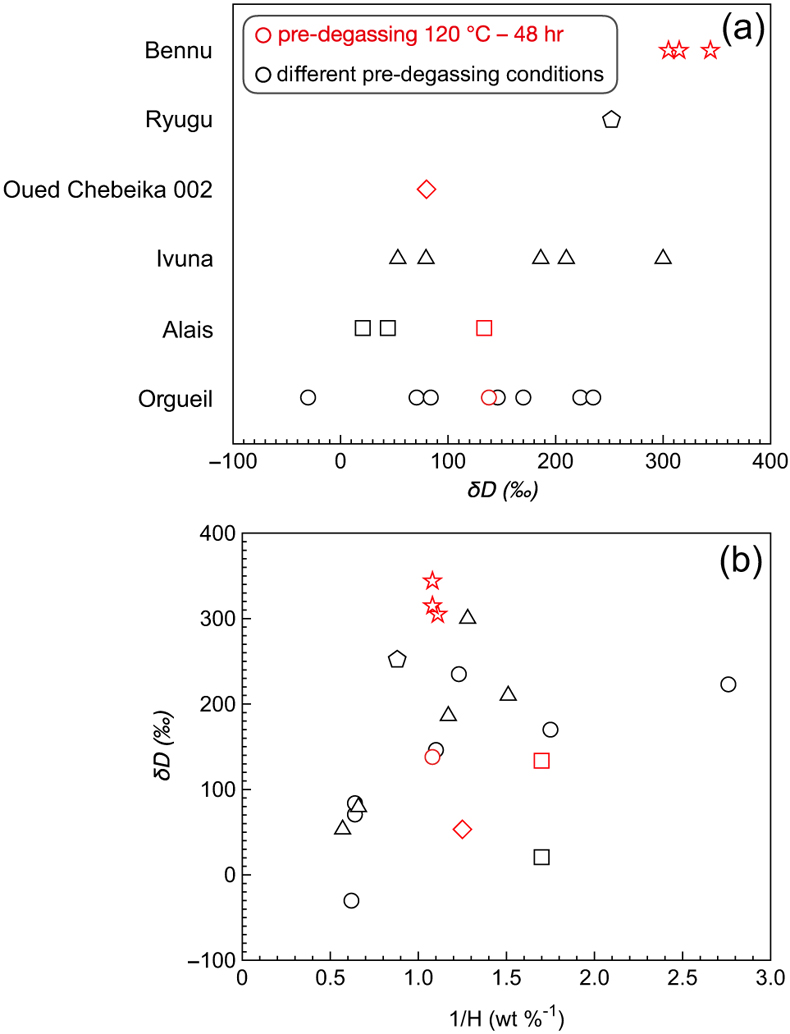
Figure 1 Comparison of (a) the bulk H isotopic composition (δD) and (b) the inverse of the H concentration of OC 002 with other CI chondrites (Alais, Ivuna, Orgueil) and with samples returned from the asteroids Ryugu and Bennu (compiled data provided at https://doi.org/10.24396/ORDAR-201). Red symbols indicate samples pre-degassed under identical conditions (120 °C for 48 hr), while black symbols correspond to those treated under different protocols. Data and associated references are reported in SI.
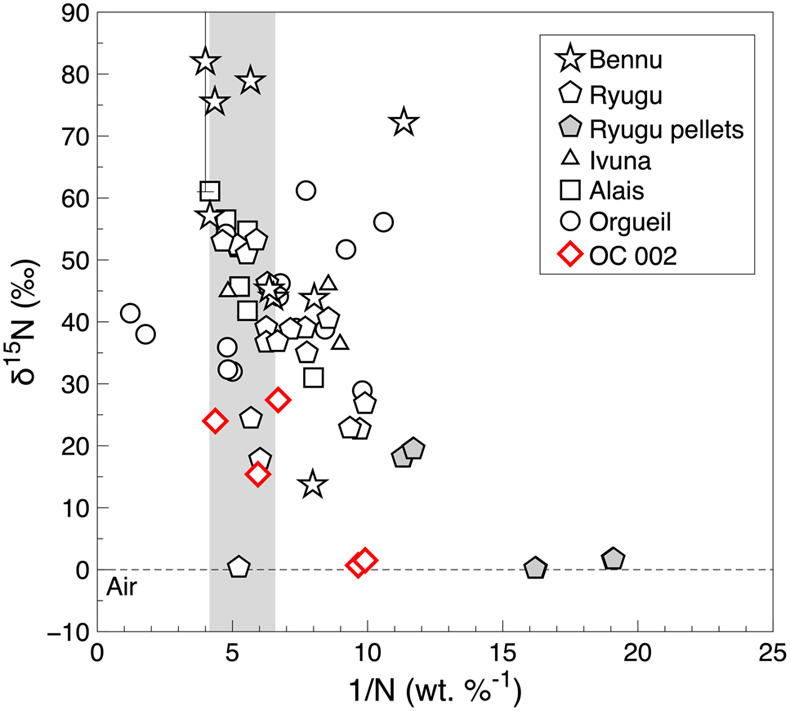
Figure 2 Nitrogen isotopic composition (δ15N) as a function of the inverse of the N concentration of five OC 002 fragments compared to other CI chondrite samples (Alais, Ivuna, Orgueil) and samples returned from the asteroids Ryugu and Bennu (compiled data provided at https://doi.org/10.24396/ORDAR-190, and additional results for Bennu by Marty et al., 2026
Marty, B., Zimmermann, L., Füri, E., Bekaert, D.V., Barnes, J.J., Nguyen, A.N., Connolly, H.C., Lauretta, D.S. (2026) Noble gases and nitrogen in material from asteroid Bennu. Meteoritics & Planetary Science (in press). https://doi.org/10.1111/maps.70058
). ‘Pellets’ correspond to Ryugu samples placed into a Cu disk and pressed against a diamond disk; this pelletisation procedure was carried out within a N2-filled glove box (Okazaki et al., 2022Okazaki, R., Yamanouchi, S., Shimada, K., Baba, A., Kitajima, F., Yada, T. (2022) Methods and tools for handling, transportation, weighing, and pelletization applied to the initial analysis of volatile components in the Hayabusa2 samples. Earth, Planets and Space 74, 190. https://doi.org/10.1186/s40623-022-01747-7
). The average N content for CI chondrite (1965 ± 447 ppm N) proposed by Lodders et al. (2025)Lodders, K., Bergemann, M., Palme, H. (2025) Solar System Elemental Abundances from the Solar Photosphere and CI-Chondrites. Space Science Reviews 221, 23. https://doi.org/10.1007/s11214-025-01146-w
is indicated by the grey bar.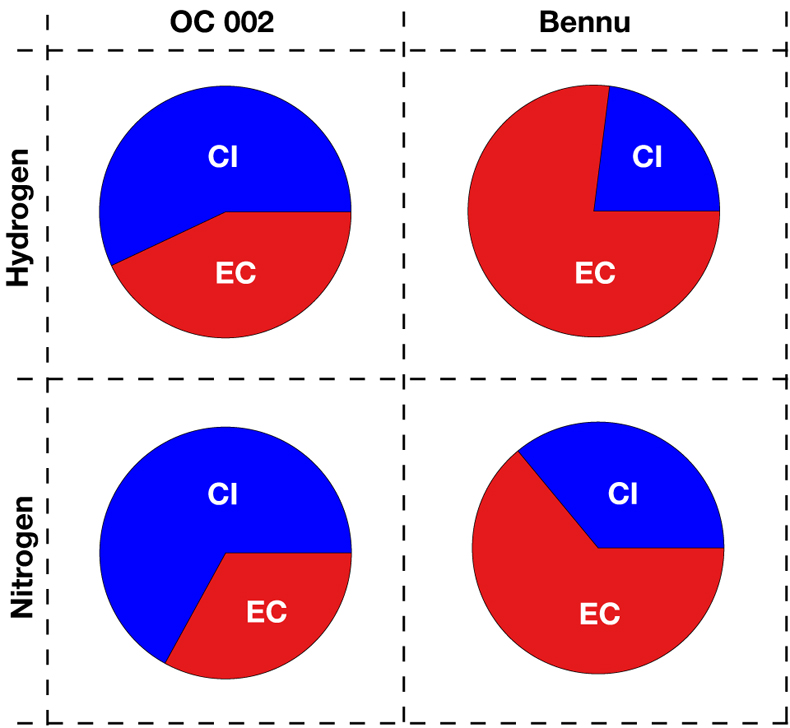
Figure 3 Pie charts showing the mass fraction of the Earth’s surficial H and N budget derived from CI and enstatite chondrites (EC), depending on whether the average H-N isotopic composition of OC 002 or Bennu samples are considered.