


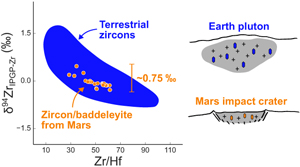
 | Kinetic Zr isotope fractionation on Mars recorded in ancient Zr-rich minerals Abstract: Zircon crystallisation induces stable Zr isotope fractionation by the preferential incorporation of the lighter Zr isotopes. The Zr isotope compositions recorded in terrestrial zircons show that, in most cases, the magnitude of isotope fractionation exceeds that expected from thermodynamic equilibrium. In other words, kinetic Zr isotope fractionation between zircon and silicate melt is the rule rather than the exception. Here, we investigate the stable Zr isotope compositions of ∼4.45 Gyr-old zircon and baddeleyite grains from the meteorite Northwest Africa (NWA) 7533, a regolith breccia sample from Mars. These Zr-rich minerals crystallised during impact reworking of the primordial Martian crust and, thus, probe a magmatic system fundamentally different from the plutons and batholiths represented in the existing zircon Zr isotope data. The 26 analysed grains reveal a total 94Zr/90Zr variation of ∼0.75 ‰, indicative of kinetic isotope fractionation. Further, the grains record a correlation between 94Zr/90Zr and Zr/Hf, similar to that observed in terrestrial zircon samples, suggesting that the fractionation behaviour in Pre-Noachian impact melt systems on Mars is similar to that occurring in younger magmatic intrusions on Earth. |
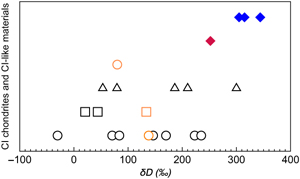 | H-N budgets and isotopic signatures of Oued Chebeika 002 and CI reservoir heterogeneity Abstract: We report the hydrogen (H) and nitrogen (N) elemental and isotopic compositions of the recently recovered CI chondrite Oued Chebeika 002 (OC 002) and compare them with published data for other CI meteorites and CI-like samples returned from the asteroids Ryugu and Bennu. When measured using the same protocol (vacuum degassing at 120 °C for 48 hr), OC 002 exhibits similar H concentrations but lighter isotopic compositions than other CIs and Bennu samples. Nitrogen data likewise indicate that the parent body of OC 002 accreted isotopically lighter nitrogen. Compilation of available data reveals pronounced H-N isotopic heterogeneities among CI-like materials, even when analysed under comparable conditions. These observations suggest that CI chondrites are intrinsically heterogeneous and that a single representative CI isotopic composition cannot be defined. This variability likely reflects the late accretion history of CIs and the incorporation of organic grains and ammonia ice that experienced diverse thermal histories in the protosolar disk. Such intrinsic heterogeneity strongly affects mass balance estimates of CI contributions to Earth’s surface volatiles, potentially varying by more than a factor of two depending on the CI reference used. |
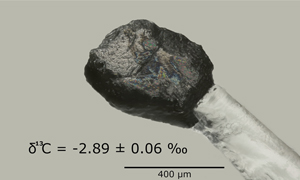 | Shock origin of the largest ureilitic microdiamond: structural observations and δ13C value Abstract: We report structural evidence for impact formed diaphite or stacking disorder in the largest known extraterrestrial microdiamond (>300 μm) from the highly shocked ureilite Northwest Africa 6871. Shock indicators within the microdiamond indicate a diamond formation model during the catastrophic disruption of the ureilite parent body, rather than deep static processes. After removal of associated graphite, large geometry secondary ion mass spectrometry yielded δ13C = –2.89 ± 0.06 ‰, an intermediate value in the range of ureilitic δ13C values. Combined with the Mg# of Northwest Africa 6871, the carbon isotopic signature shows that carbon was not affected by the impact which destroyed the ureilite parent body. Our findings therefore challenge the hypothesis that large ureilitic diamonds formed deep within their parent body and show that the carbon isotopes did not fractionate during diamond formation. |
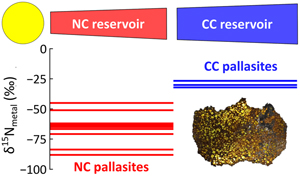 | Nitrogen isotopic variations in the early Solar System recorded by pallasites Abstract: To gain new insights into nitrogen (N) isotopic variations in the early Solar System, N and noble gas (Ne, Ar) isotopes were measured in metal fragments and olivine separates from thirteen pallasites and five IIIAB iron meteorites. While δ15N values in olivine are affected by cosmogenic 15N, as demonstrated by cosmogenic 21Ne abundances, the δ15N values of metal phases reflect reservoir signatures rather than secondary processes. Non-carbonaceous (NC) pallasites have lower δ15N values (–88.86 ± 0.90 ‰ to –45.04 ± 0.91 ‰) than carbonaceous (CC) pallasites (–34.03 ± 0.69 ‰ to –26.12 ± 0.64 ‰), indicating their parent bodies accreted isotopically distinct N-bearing precursors in the inner and outer regions of the protoplanetary disk. The δ15N variations within each reservoir also suggest N isotopic heterogeneity at a smaller scale. While NC irons and NC pallasites exhibit overlapping δ15N values, CC pallasites are less 15N-rich than CC irons, implying that their parent bodies accreted in different locations and/or at different times within the outer disk. |
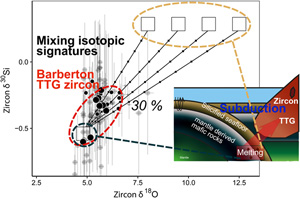 | Silicified seafloor contribution to TTG formation: insights from zircon O and Si isotopes Abstract: Tracing the input of altered seafloor lithologies to primary melts of tonalite-trondhjemite-granodiorite suites (TTGs) is critical for understanding Archean geodynamic processes that transported these lithologies towards melting regions. Zircon oxygen and silicon isotopic compositions in TTGs are particularly useful for this end, but their interpretation remains challenged by scarce quantitative constrains on isotopic compositions reflecting partial melting of specific Archean lithologies. Here, we combine oxygen and silicon isotope measurements in 3.45 and 3.22 Ga Barberton TTGs and their zircons with numerical models simulating partial melting of different source lithologies, which predict the isotope signatures of zircons and their host melts. Measured whole rock and zircon O and Si isotope compositions reflect the presence of up to 30 wt. % of hydrothermally silicified mafic rocks derived from the seafloor in the Barberton TTG source region. Considering the regional geological context, we propose subduction-like processes to explain the burial of the silicified seafloor into the TTG source. These results imply that subduction-like processes operated at least locally on Earth during the Paleoarchean. |
 | Corrigendum to “Additive impact on early-stage magnesium carbonate mineralisation” by Santoro De Vico et al., 2024 |
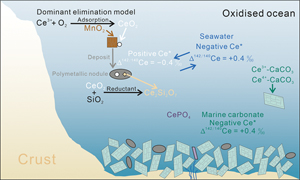 | Cerium isotopic constraints on oceanic redox conditions: Insights from first-principles calculations Abstract: Oceanic redox conditions are important for understanding life explosions, mass extinctions and surface environments. Stable cerium (Ce) isotopes may provide a useful proxy for oceanic redox conditions by combining Ce anomalies in stratigraphic profiles. However, the quantitative response of Ce isotope compositions to redox conditions has yet to be investigated. Here, we estimate equilibrium Ce isotope fractionation factors between marine authigenic minerals to constrain Ce isotope compositional variations under different redox conditions using first-principles calculations. Cerium isotope fractionations (103lnαTotal) between minerals are controlled by mass-dependent (103lnαMass) and mass-independent isotope fractionation factors (103lnαNVE). Our results show that the magnitude of 103lnαNVE is comparable to or even larger than that of 103lnαMass. The 103ln142/140αTotal values between seawater and minerals are +0.40, −0.34, +0.11 and −0.07 ‰ for manganese oxides, phosphates and Ce3+- and Ce4+-doped calcites, respectively. In a locally oxidised ocean, the precipitation of manganese oxides increases the Ce isotope composition (δ142/140Ce) of seawater; in an anaerobic ocean, the precipitation of phosphates decreases the δ142/140Ce value of seawater. Therefore, calcite can faithfully record seawater δ142/140Ce values because of the limited Ce isotope fractionations in those redox conditions. |
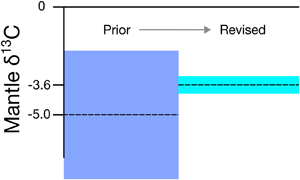 | A revised carbon isotope composition of the convecting upper mantle Abstract: The carbon isotope composition of the convecting upper mantle is key to constraining Earth’s carbon budget. Canonical estimates place upper mantle δ13C between −4 and −6 ‰, but recent measurements suggest inter-ocean basin heterogeneity of several per mille. We test this hypothesis using high precision secondary ion mass spectrometry on olivine hosted melt inclusions from two contrasting settings: mid-ocean ridge basalts from the East Pacific Rise and plume influenced basalts from Iceland’s Northern Volcanic Zone. Both melt inclusion suites yield indistinguishable δ13C compositions despite sampling the upper mantle in different tectonic environments. We propose the convecting upper mantle δ13C = −3.6 ± 0.2 ‰ (95 % confidence interval; CI), with source heterogeneity present at ±0.8 ‰ (1σ). Use of this new δ13C value changes the global carbon mass balance and yields a fractional organic carbon burial of 13.7−2.1+2.3 % (68 % CI), resolving previous discrepancies between isotopic and sedimentary inventory based estimates. Our results have implications for the deep carbon cycle, reducing the need to invoke large carbonate contributions to arc emissions and refining estimates of recycled organic carbon in mantle-derived reservoirs such as diamonds, carbonatites and kimberlites. |
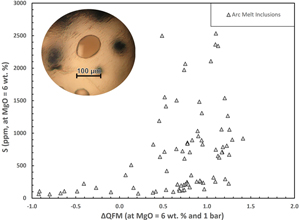 | On the oxidation state of arc magmas Abstract: Arc magmas have long been considered significantly more oxidised than their ocean island and mid-ocean ridge counterparts, a characteristic widely attributed to infusion of the mantle wedge by fluids from subducted lithologies. However, here we show that at comparable degree of differentiation and sulfur content, arc magmas have comparable oxidation state to ocean island magmas. Our study is based on measurements of Fe3+/∑Fe along with major and volatile elements in olivine and plagioclase hosted melt inclusions and matrix glasses from eleven volcanic systems located in arc settings worldwide. Accounting for fractional crystallisation (to MgO = 6 wt. %) we find that all systems lie on a reducing trend accompanying sulfur degassing, from QFM +0.9 (±0.2, 1σ) when S > 2000 ppm to QFM −0.2 (±0.6, 1σ) when S < 100 ppm (where QFM stands for the Quartz-Fayalite-Magnetite buffer). These findings reconcile the observed discrepancy between the oxidation states of xenoliths in arc magmas and gas emissions from arc volcanoes. We further show that fractional crystallisation influences the redox evolution of arc magmas to a comparable extent as, and sometimes counteracting, sulfur degassing. |
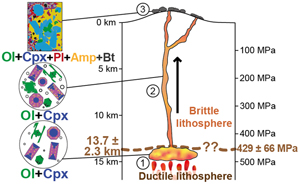 | The journey of K-MORBs, told through geological, geochemical and geophysical data Abstract: The compositional variability of mid-ocean ridge basalts (MORBs) stems from a combination of the heterogeneity of the mantle source, magma mixing, and partial crystallisation of magma in the lower crust. These variations have been mainly explored at the global and ridge scales, with only a few studies investigating them at the kilometre scale and below. Here, we focus on a series of tholeiitic to K-rich basalt samples collected during a single submarine dive near the eastern intersection between the Mid-Atlantic Ridge and the Romanche transform fault, in the equatorial Atlantic. The geochemical and petrological variations, attributed to variations in melting conditions, are extreme and consistent with the geological features. Clinopyroxene phenocrysts present in certain K-rich basalts, recorded the history of magma storage. We calculated the crystallisation pressures of clinopyroxenes and compared them to microseismicity depths recorded in the area, thus providing constraints on the lithospheric structure. This multidisciplinary work highlights the interest in exploring the composition of MORBs at high resolution to better understand the construction of the oceanic crust. |
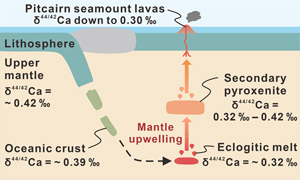 | Light calcium isotope anomaly in the Pitcairn mantle plume: a signal of pyroxenite melting Abstract: The light calcium (Ca) isotope anomaly observed in ocean island basalts (OIBs) compared to mid-ocean ridge lavas has typically been attributed to recycling of carbonate-bearing sediments, partial melting of garnet-rich lithologies or a combination of both. This study presents Ca isotopic data for lavas from Pitcairn Island and nearby seamounts, yielding a δ44/42Ca variation (0.30 ± 0.02 ‰ to 0.40 ± 0.02 ‰) similar to that found in global OIBs. This δ44/42Ca variation cannot be attributed to post-eruption alteration, magmatic differentiation or recycling of carbonate-bearing sediments. Instead, correlations of δ44/42Ca with Sr/Nd and Eu/Eu* suggest that the light Ca isotope anomaly in Pitcairn lavas most likely reflects derivation from a pyroxenite source akin to the lower part of the recycled oceanic crust. Modelling suggests that the low δ44/42Ca end member can be explained by multiple-stage pyroxenite melting without requiring recycled carbonate-bearing sediments, offering new insights into using Ca isotopes to trace crust-mantle interactions. |
<< Previous issueNext issue >>