



A revised carbon isotope composition of the convecting upper mantle
Affiliations | Corresponding Author | Cite as | Funding information
Published by the European Association of Geochemistry
under Creative Commons License CC BY 4.0
Keywords: carbon isotopes, upper mantle, carbon, organic carbon burial, δ13C, SIMS


- Share this article


-
Article views:1,205Cumulative count of HTML views and PDF downloads.
- Download Citation
- Rights & Permissions

top
Abstract
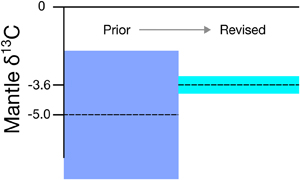
Figures
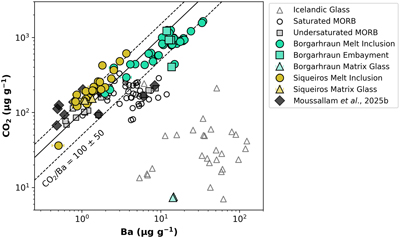 Figure 1 Test for carbon saturation using CO2 versus Ba. Carbon undersaturated melts define CO2/Ba = 100 ± 50, consistent with undersaturated mantle values prior to degassing. Borgarhraun and Siqueiros melt inclusions and embayments plot within this range, overlapping carbon undersaturated MORB, whereas carbon saturated MORB define higher CO2/Ba. Siqueiros matrix glasses plot within mantle values; however, Borgarhraun matrix glasses show significant degassing, consistent with other Icelandic glasses that plot at lower CO2 for a given Ba. Additional MORB glasses from Moussallam et al. (2025b) and Icelandic literature data (Barry et al., 2014; Marshall et al., 2024) are shown for comparison. | 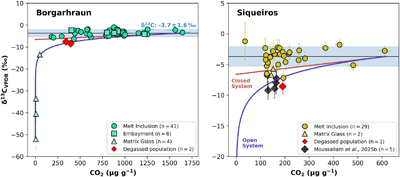 Figure 2 Testing for degassed compositions in Borgarhraun (left) and Siqueiros (right). Melt inclusions (circles), embayments (squares), and matrix glass (triangles) are shown; red diamonds indicate degassed outliers (|z| > 3; see SI). Closed and open system degassing curves (brown, purple) use a fractionation factor of +2.9 ‰ (Lee et al., 2024a) and initial mantle δ13C of −3.7 ± 1.6 ‰ (black line, blue shading), with initial CO2 from the highest melt inclusion concentrations. Black diamonds show Siqueiros melt inclusion data from Moussallam et al. (2025b). Uncertainties are 1σ. | 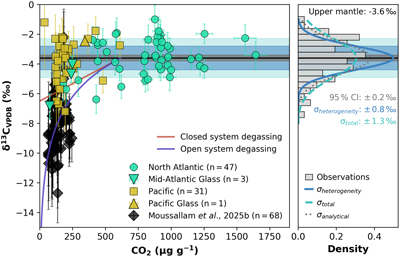 Figure 3 δ13C (‰ VPDB) versus CO2 (μg g−1) for un-degassed, olivine hosted melt inclusions and new glass measurements from the Atlantic and Pacific compared to literature data from Moussallam et al. (2025b). The solid black line shows the preferred convecting upper mantle value (−3.6 ‰), with shaded bands showing the 95 % confidence interval (±0.2 ‰; grey), intrinsic mantle heterogeneity (σheterogeneity = ±0.8 ‰; blue), and expected observed scatter including analytical uncertainty (σtotal = ±1.3 ‰; teal). Degassing curves show equilibrium closed and open system fractionation trajectories. The right panel shows the δ13C distribution of un-degassed melt inclusions with Gaussian curves illustrating analytical, heterogeneity, and total variance components. Uncertainty bars are 1σ. |
| Figure 1 | Figure 2 | Figure 3 |
top
Introduction
The carbon isotope (δ13C) composition of the convecting upper mantle underpins models of core formation, volatile cycles, and bulk silicate Earth (BSE) composition, with implications for carbon budgets and climate (Kump and Arthur, 1999
Kump, L.R., Arthur, M.A. (1999) Interpreting carbon-isotope excursions: carbonates and organic matter. Chemical Geology 161, 181–198. https://doi.org/10.1016/S0009-2541(99)00086-8
; Wood et al., 2013Wood, B.J., Li, J., Shahar, A. (2013) Carbon in the Core: Its Influence on the Properties of Core and Mantle. Reviews in Mineralogy and Geochemistry 75, 231–250. https://doi.org/10.2138/rmg.2013.75.8
; Horita and Polyakov, 2015Horita, J., Polyakov, V.B. (2015) Carbon-bearing iron phases and the carbon isotope composition of the deep Earth. Proceedings of the National Academy of Sciences 112, 31–36. https://doi.org/10.1073/pnas.1401782112
). These calculations rely on indirect proxies sampling distinct mantle reservoirs: peridotitic diamonds (−4.9 ± 1.9 ‰; Stachel et al., 2022Stachel, T., Cartigny, P., Chacko, T., Pearson, D.G. (2022) Carbon and Nitrogen in Mantle-Derived Diamonds. Reviews in Mineralogy and Geochemistry 88, 809–875. https://doi.org/10.2138/rmg.2022.88.15
) are a metasomatic phase (Cartigny et al., 2014Cartigny, P., Palot, M., Thomassot, E., Harris, J.W. (2014) Diamond Formation: A Stable Isotope Perspective. Annual Review of Earth and Planetary Sciences 42, 699–732. https://doi.org/10.1146/annurev-earth-042711-105259
); mantle xenoliths (−5 ‰; Deines, 2002Deines, P. (2002) The carbon isotope geochemistry of mantle xenoliths. Earth-Science Reviews 58, 247–278. https://doi.org/10.1016/S0012-8252(02)00064-8
) reflect the lithospheric, not convecting, mantle; and carbonatites (−4.2 ± 2.1 ‰; Moussallam, 2025Moussallam, Y. (2025) Carbon Isotopes in Magmatic Systems: Measurements, Interpretations, and the Carbon Isotopic Signature of the Earth’s Mantle. Geosciences 15, 266. https://doi.org/10.3390/geosciences15070266
) record localised heterogeneities rather than typical upper mantle compositions. Direct measurements from un-degassed MORB glasses, such as Mid-Atlantic Ridge (MAR) ‘popping rocks’ (∼−4 ‰; Javoy and Pineau, 1991Javoy, M., Pineau, F. (1991) The volatiles record of a “popping” rock from the Mid-Atlantic Ridge at 14°N: chemical and isotopic composition of gas trapped in the vesicles. Earth and Planetary Science Letters 107, 598–611. https://doi.org/10.1016/0012-821X(91)90104-P
; Pineau et al., 2004Pineau, F., Shilobreeva, S., Hekinian, R., Bideau, D., Javoy, M. (2004) Deep-sea explosive activity on the Mid-Atlantic Ridge near 34°50′N: a stable isotope (C, H, O) study. Chemical Geology 211, 159–175. https://doi.org/10.1016/j.chemgeo.2004.06.029
; Bekaert et al., 2024Bekaert, D.V., Barry, P.H., Curtice, J., Blusztajn, J., Hudak, M., Seltzer, A., Broadley, M.W., Krantz, J.A., Wanless, V.D., Soule, S.A., Mittelstaedt, E., Kurz, M.D. (2024) A carbon, nitrogen, and multi-isotope study of basalt glasses near 14°N on the Mid-Atlantic Ridge. Part A: Degassing processes. Geochimica et Cosmochimica Acta 369, 160–178. https://doi.org/10.1016/j.gca.2023.12.015
), provide valuable constraints but depend on accurate accounting for CO2-rich bubble accumulation, which can decouple bulk carbon isotope compositions from the original melt.Recent advances in secondary ion mass spectrometry (SIMS) now enable routine δ13C measurement of olivine hosted melt inclusions, providing direct access to mantle carbon isotope compositions (Lee et al., 2024a
Lee, H., Moussallam, Y., Aubaud, C., Iacono-Marziano, G., Hammond, K., Ebel, D. (2024a) Carbon isotope fractionation between CO2 and carbon in silicate melts at high temperature. Geochimica et Cosmochimica Acta 380, 208–219. https://doi.org/10.1016/j.gca.2024.07.015
; Shea et al., 2025Shea, J., Hughes, E., Balzer, R., Bindeman, I., Blundy, J., Brooker, R., Botcharnikov, R., Cartigny, P., EIMF, Gaetani, G., Kilgour, G., Maclennan, J., Monteleone, B., Neave, D.A., Shorttle, O. (2025) Improved Precision and Reference Materials for Stable Carbon Isotope Measurement in Basaltic Glasses using Secondary Ion Mass Spectrometry. Geostandards and Geoanalytical Research 49, 607–627. https://doi.org/10.1111/ggr.12610
). These inclusions better preserve pre-degassed δ13C than low pressure quenched glasses, where equilibrium degassing enriches residual melts in 12C as 13C partitions into the vapour phase (Javoy et al., 1978Javoy, M., Pineau, F., Iiyama, I. (1978) Experimental determination of the isotopic fractionation between gaseous CO2 and carbon dissolved in tholeiitic magma. A preliminary study. Contributions to Mineralogy and Petrology 67, 35–39. https://doi.org/10.1007/BF00371631
; Mattey et al., 1990Mattey, D.P., Taylor, W.R., Green, D.H., Pillinger, C.T. (1990) Carbon isotopic fractionation between CO2 vapour, silicate and carbonate melts: an experimental study to 30 kbar. Contributions to Mineralogy and Petrology 104, 492–505. https://doi.org/10.1007/BF01575626
; Lee et al., 2024bLee, H., Moussallam, Y., Rose Koga, E.F., Piani, L., Villeneuve, J., Bouden, N., Gurenko, A.A., Monteleone, B., Gaetani, G.A. (2024b) High-precision determination of carbon stable isotope in silicate glasses by secondary ion mass spectrometry: Evaluation of international reference materials. Chemical Geology 670, 122428. https://doi.org/10.1016/j.chemgeo.2024.122428
). Initial applications to natural samples challenge the notion of a homogenous mantle δ13C. Moussallam et al. (2025b)Moussallam, Y., Rose-Koga, E.F., Aubaud, C., Georgeais, G., Cartigny, P., Koga, K.T., Devidal, J.-L., Michael, P.J., Shimizu, K., Saal, A.E. (2025b) Enigmatic carbon isotopic variability in the oceanic upper mantle. Proceedings of the National Academy of Sciences 122, e2502886122. https://doi.org/10.1073/pnas.2502886122
reported Pacific upper mantle values (δ13C = −8.4 ± 1.1 ‰, 1σ) markedly lower than Atlantic values (−3.9 ± 0.4 ‰, 1σ), yet consistent with Southwest Indian Ridge measurements (−7.5 ± 1.4 ‰, 2 s.e.; Moussallam et al., 2025aMoussallam, Y., Koga, K.T., Rose-Koga, E.F., Aubaud, C., Lee, H.J., Georgeais, G. (2025a) The carbon isotopic signature of the upper mantle is heterogeneous. Communications Earth & Environment 6, 6. https://doi.org/10.1038/s43247-024-01973-9
). Fagradalsfjall melt inclusions (−6.5 ± 2.5 ‰) likewise suggest heterogenous mantle carbon, with local variation (−4 and −9 ‰) implying organic carbon contributions in the Iceland plume (Moussallam et al., 2024Moussallam, Y., Rose-Koga, E.F., Fischer, T.P., Georgeais, G., Lee, H.J., Birnbaum, J., Pfeffer, M.A., Barnie, T., Regis, E. (2024) Kinetic Isotopic Degassing of CO2 During the 2021 Fagradalsfjall Eruption and the δ13C Signature of the Icelandic Mantle. Geochemistry, Geophysics, Geosystems 25, e2024GC011997. https://doi.org/10.1029/2024GC011997
). These measurements indicate significant mantle heterogeneity and an average δ13C lower than the canonical −5 ‰ (Deines, 2002Deines, P. (2002) The carbon isotope geochemistry of mantle xenoliths. Earth-Science Reviews 58, 247–278. https://doi.org/10.1016/S0012-8252(02)00064-8
; Stachel et al., 2022Stachel, T., Cartigny, P., Chacko, T., Pearson, D.G. (2022) Carbon and Nitrogen in Mantle-Derived Diamonds. Reviews in Mineralogy and Geochemistry 88, 809–875. https://doi.org/10.2138/rmg.2022.88.15
).Previous work has argued that large inter-basin δ13C heterogeneity may reflect mantle structure, with Pacific subduction zones introducing isotopically light recycled carbon, Atlantic ridges sampling less contaminated mantle, and the Iceland plume carrying variable organic inputs. However, these interpretations rest on small sample data sets (five inclusions for a single location; Moussallam et al., 2025b
Moussallam, Y., Rose-Koga, E.F., Aubaud, C., Georgeais, G., Cartigny, P., Koga, K.T., Devidal, J.-L., Michael, P.J., Shimizu, K., Saal, A.E. (2025b) Enigmatic carbon isotopic variability in the oceanic upper mantle. Proceedings of the National Academy of Sciences 122, e2502886122. https://doi.org/10.1073/pnas.2502886122
), and limited CO2 concentrations (<250 μg g−1 CO2; Moussallam et al., 2025bMoussallam, Y., Rose-Koga, E.F., Aubaud, C., Georgeais, G., Cartigny, P., Koga, K.T., Devidal, J.-L., Michael, P.J., Shimizu, K., Saal, A.E. (2025b) Enigmatic carbon isotopic variability in the oceanic upper mantle. Proceedings of the National Academy of Sciences 122, e2502886122. https://doi.org/10.1073/pnas.2502886122
). One concern is that this previous work may have captured degassing related fractionation rather than primary mantle δ13C.We test the null hypothesis that the convecting upper mantle is homogeneous in carbon isotope composition. Using the SIMS protocol of Shea et al. (2025)
Shea, J., Hughes, E., Balzer, R., Bindeman, I., Blundy, J., Brooker, R., Botcharnikov, R., Cartigny, P., EIMF, Gaetani, G., Kilgour, G., Maclennan, J., Monteleone, B., Neave, D.A., Shorttle, O. (2025) Improved Precision and Reference Materials for Stable Carbon Isotope Measurement in Basaltic Glasses using Secondary Ion Mass Spectrometry. Geostandards and Geoanalytical Research 49, 607–627. https://doi.org/10.1111/ggr.12610
, we obtained 85 δ13C measurements on melt inclusions (n = 73), embayments (n = 6) and matrix glasses (n = 6) from the Siqueiros Transform Fault (East Pacific Rise, EPR) and Borgarhraun (Iceland). Siqueiros represents the primitive end member of the EPR D-MORB (depleted), with minimal fractionation or mixing, whereas Borgarhraun tephra reflect primitive melts from the North Atlantic spreading ridge influenced by the Iceland plume. Their un-degassed melt inclusions define the canonical CO2/Ba ratio of 100 ± 50 for the convecting mantle (Le Voyer et al., 2017Le Voyer, M., Kelley, K.A., Cottrell, E., Hauri, E.H. (2017) Heterogeneity in mantle carbon content from CO2-undersaturated basalts. Nature Communications 8, 14062. https://doi.org/10.1038/ncomms14062
; Hauri et al., 2018Hauri, E.H., Maclennan, J., McKenzie, D., Gronvold, K., Oskarsson, N., Shimizu, N. (2018) CO2 content beneath northern Iceland and the variability of mantle carbon. Geology 46, 55–58. https://doi.org/10.1130/G39413.1
; Hirschmann, 2018Hirschmann, M.M. (2018) Comparative deep Earth volatile cycles: The case for C recycling from exosphere/mantle fractionation of major (H2O, C, N) volatiles and from H2O/Ce, CO2/Ba, and CO2/Nb exosphere ratios. Earth and Planetary Science Letters 502, 262–273. https://doi.org/10.1016/j.epsl.2018.08.023
), underpinning global estimates of mantle carbon content and surface flux via melting and degassing (Pacific: Saal et al., 2002Saal, A.E., Hauri, E.H., Langmuir, C.H., Perfit, M.R. (2002) Vapour undersaturation in primitive mid-ocean-ridge basalt and the volatile content of Earth’s upper mantle. Nature 419, 451–455. https://doi.org/10.1038/nature01073
; Atlantic: Hauri et al., 2018Hauri, E.H., Maclennan, J., McKenzie, D., Gronvold, K., Oskarsson, N., Shimizu, N. (2018) CO2 content beneath northern Iceland and the variability of mantle carbon. Geology 46, 55–58. https://doi.org/10.1130/G39413.1
). Together, these sites can be used to test the Pacific-Atlantic dichotomy in ridge and plume settings. Our samples span 6.38–1678 μg g−1 CO2 and include both mantle-like and degassed CO2/Ba ratios, allowing independent recognition of degassing modification. We compare melt inclusion results to erupted MORB glass measurements from both the EPR and MAR. Analytical and modelling details are provided in the Supplementary Information.top
Results and Discussion
Testing for carbon degassing. CO2-Ba systematics (Fig. 1) show that despite contrasting petrogenetic histories, which do not bias δ13C (see SI), Borgarhraun and Siqueiros melt inclusions preserve near-primary volatile compositions, making them ideal for constraining upper mantle δ13C. Inclusions and embayments from both locations have CO2 concentrations of 36.3–1678 μg g−1 and plot along the mantle reference trend (CO2/Ba = 100 ± 50), indicating minimal pre-entrapment degassing. Carbon undersaturated MORB glasses overlap this trend, confirming it as characteristic of un-degassed spreading ridge melts (Le Voyer et al., 2017
Le Voyer, M., Kelley, K.A., Cottrell, E., Hauri, E.H. (2017) Heterogeneity in mantle carbon content from CO2-undersaturated basalts. Nature Communications 8, 14062. https://doi.org/10.1038/ncomms14062
; Hirschmann, 2018Hirschmann, M.M. (2018) Comparative deep Earth volatile cycles: The case for C recycling from exosphere/mantle fractionation of major (H2O, C, N) volatiles and from H2O/Ce, CO2/Ba, and CO2/Nb exosphere ratios. Earth and Planetary Science Letters 502, 262–273. https://doi.org/10.1016/j.epsl.2018.08.023
; Hauri et al., 2018Hauri, E.H., Maclennan, J., McKenzie, D., Gronvold, K., Oskarsson, N., Shimizu, N. (2018) CO2 content beneath northern Iceland and the variability of mantle carbon. Geology 46, 55–58. https://doi.org/10.1130/G39413.1
). Most carbon saturated MORB and Icelandic glasses fall to lower CO2/Ba, reflecting degassing.Figure 1 Test for carbon saturation using CO2 versus Ba. Carbon undersaturated melts define CO2/Ba = 100 ± 50, consistent with undersaturated mantle values prior to degassing. Borgarhraun and Siqueiros melt inclusions and embayments plot within this range, overlapping carbon undersaturated MORB, whereas carbon saturated MORB define higher CO2/Ba. Siqueiros matrix glasses plot within mantle values; however, Borgarhraun matrix glasses show significant degassing, consistent with other Icelandic glasses that plot at lower CO2 for a given Ba. Additional MORB glasses from Moussallam et al. (2025b)
Moussallam, Y., Rose-Koga, E.F., Aubaud, C., Georgeais, G., Cartigny, P., Koga, K.T., Devidal, J.-L., Michael, P.J., Shimizu, K., Saal, A.E. (2025b) Enigmatic carbon isotopic variability in the oceanic upper mantle. Proceedings of the National Academy of Sciences 122, e2502886122. https://doi.org/10.1073/pnas.2502886122
and Icelandic literature data (Barry et al., 2014Barry, P.H., Hilton, D.R., Füri, E., Halldórsson, S.A., Grönvold, K. (2014) Carbon isotope and abundance systematics of Icelandic geothermal gases, fluids and subglacial basalts with implications for mantle plume-related CO2 fluxes. Geochimica et Cosmochimica Acta 134, 74–99. https://doi.org/10.1016/j.gca.2014.02.038
; Marshall et al., 2024Marshall, E.W., Halldórsson, S.A., Tian, L., Jackson, M.G., Jenner, F., Stefánsson, A. (2024) The effect of diffusion on lithium isotope ratios in Icelandic basalts. Chemical Geology 662, 122206. https://doi.org/10.1016/j.chemgeo.2024.122206
) are shown for comparison.Melt inclusion CO2 concentrations decrease systematically toward matrix glasses (Fig. 2), reflecting progressive volatile loss during ascent and eruption. Borgarhraun matrix glasses show extensive degassing (<10 μg g−1 CO2), typical of subaerial Icelandic lavas (Barry et al., 2014
Barry, P.H., Hilton, D.R., Füri, E., Halldórsson, S.A., Grönvold, K. (2014) Carbon isotope and abundance systematics of Icelandic geothermal gases, fluids and subglacial basalts with implications for mantle plume-related CO2 fluxes. Geochimica et Cosmochimica Acta 134, 74–99. https://doi.org/10.1016/j.gca.2014.02.038
). The most degassed glasses, from Borgarhraun, record the most negative δ13C values observed in basalts, indicating extreme isotopic fractionation of >99.9 % CO2 loss (Fig. 2). In contrast, submarine Siqueiros matrix glasses overlap with melt inclusion compositions (Saal et al., 2002Saal, A.E., Hauri, E.H., Langmuir, C.H., Perfit, M.R. (2002) Vapour undersaturation in primitive mid-ocean-ridge basalt and the volatile content of Earth’s upper mantle. Nature 419, 451–455. https://doi.org/10.1038/nature01073
), showing they retained volatiles upon eruption. The agreement between melt inclusions and primary CO2/Ba ratios confirms that our δ13C data represent upper mantle, not degassing-modified, compositions.Figure 2 Testing for degassed compositions in Borgarhraun (left) and Siqueiros (right). Melt inclusions (circles), embayments (squares), and matrix glass (triangles) are shown; red diamonds indicate degassed outliers (|z| > 3; see SI). Closed and open system degassing curves (brown, purple) use a fractionation factor of +2.9 ‰ (Lee et al., 2024a
Lee, H., Moussallam, Y., Aubaud, C., Iacono-Marziano, G., Hammond, K., Ebel, D. (2024a) Carbon isotope fractionation between CO2 and carbon in silicate melts at high temperature. Geochimica et Cosmochimica Acta 380, 208–219. https://doi.org/10.1016/j.gca.2024.07.015
) and initial mantle δ13C of −3.7 ± 1.6 ‰ (black line, blue shading), with initial CO2 from the highest melt inclusion concentrations. Black diamonds show Siqueiros melt inclusion data from Moussallam et al. (2025b)Moussallam, Y., Rose-Koga, E.F., Aubaud, C., Georgeais, G., Cartigny, P., Koga, K.T., Devidal, J.-L., Michael, P.J., Shimizu, K., Saal, A.E. (2025b) Enigmatic carbon isotopic variability in the oceanic upper mantle. Proceedings of the National Academy of Sciences 122, e2502886122. https://doi.org/10.1073/pnas.2502886122
. Uncertainties are 1σ.We screened all samples for degassing using statistical outliers and degassing models to ensure δ¹3C measurements reflect primary compositions. Weighted mean δ13C from all melt inclusions embayment at both sites is −3.7 ± 1.6 ‰ (1σ), representing an initial estimate of mantle δ13C. Samples with z-scores >3 s.d. were flagged as degassed (red diamonds in Fig. 2). This identified two Borgarhraun and one Siqueiros outlier (<5 % of total data set). Their δ13C values (range: −7.56 to −8.50 ‰) are systematically lower and contain intermediate CO2 concentrations that align with partial open system equilibrium degassing trajectories (Fig. 2), confirming partial carbon loss; these were excluded. Siqueiros matrix glasses and Borgarhraun embayments show δ13C-CO2 consistent with melt inclusions, representing the final pre-eruptive magma recharge, and are retained as primary values.
Carbon isotope homogeneity across ocean basins. Following filtering of degassed melt inclusions, Borgarhraun samples yield a weighted mean δ13C = −3.52 ± 0.12 ‰ (n = 47), while Siqueiros samples yield δ13C = −3.66 ± 0.22 ‰ (n = 31). Although these means differ by 0.14 ‰, this offset is smaller than the standard error of the difference (∼0.25 ‰), indicating statistical indistinguishability. The 95 % confidence intervals (Borgarhraun, −3.76 to −3.28 ‰; Siqueiros, −4.10 to −3.22 ‰) show substantial overlap, with a common range spanning 0.54 ‰. This overlap encompasses most of both uncertainty ranges, confirming that any apparent difference between the locations reflects analytical uncertainty rather than genuine source heterogeneity.
Inverse variance weighting of both data sets yields a combined constraint of δ13C = −3.6 ± 0.2 ‰ (95 % CI, n = 78; Fig. 3; see SI for further details). This analysis yields the most precise estimate of the carbon isotopic composition of the upper mantle yet obtained. The weighting favours Borgarhraun (76 %) due to its superior individual-sample measurement precision, but both locations contribute meaningfully to the final constraint.
Figure 3 δ13C (‰ VPDB) versus CO2 (μg g−1) for un-degassed, olivine hosted melt inclusions and new glass measurements from the Atlantic and Pacific compared to literature data from Moussallam et al. (2025b)
Moussallam, Y., Rose-Koga, E.F., Aubaud, C., Georgeais, G., Cartigny, P., Koga, K.T., Devidal, J.-L., Michael, P.J., Shimizu, K., Saal, A.E. (2025b) Enigmatic carbon isotopic variability in the oceanic upper mantle. Proceedings of the National Academy of Sciences 122, e2502886122. https://doi.org/10.1073/pnas.2502886122
. The solid black line shows the preferred convecting upper mantle value (−3.6 ‰), with shaded bands showing the 95 % confidence interval (±0.2 ‰; grey), intrinsic mantle heterogeneity (σheterogeneity = ±0.8 ‰; blue), and expected observed scatter including analytical uncertainty (σtotal = ±1.3 ‰; teal). Degassing curves show equilibrium closed and open system fractionation trajectories. The right panel shows the δ13C distribution of un-degassed melt inclusions with Gaussian curves illustrating analytical, heterogeneity, and total variance components. Uncertainty bars are 1σ.Mantle source heterogeneity. Un-degassed melt inclusions reveal significant over dispersion beyond analytical uncertainties: z-score standard deviations are σz = 1.40 (95 % CI; 1.10–1.8) for Borgarhraun, and σz = 1.05 (95 % CI; 0.83–1.4) for Siqueiros. Combined data yield σz = 1.26 (95 % CI; 1.10–1.5), indicating excess variance relative to analytical uncertainty. Over dispersion (σz > 1) indicates isotopic heterogeneity within mantle sources. Individual melt batches captured by melt inclusions and embayments preserve isotopically distinct mantle signatures that are otherwise homogenised during substantial mixing in the magma chamber. Variance decomposition quantifies this natural mantle heterogeneity at 0.8 ‰ (1σ; SI). Melt inclusions sample melts that have undergone partial mixing during melt transport and storage, which reduces compositional variance. Therefore, this value likely represents a minimum estimate of intrinsic variability in the convecting mantle.
The coexistence of a consistent mean δ13C with local scale heterogeneity reflects mantle convection dynamics: sufficiently vigorous for mingling of mantle sources, yet incomplete enough to preserve short length-scale isotopic variability. The upper mantle is stirred, but not mixed, by diffusive homogenisation, so preserves isotopic heterogeneity inherent to melting domains within a larger homogenous mantle that maintains long length-scale bulk compositions. We recommend δ13C = −3.6 ± 0.2 ‰ (95 % CI) as the convecting upper mantle mean, with 0.8 ‰ (1σ) natural heterogeneity.
Our proposed δ13C value is supported by measurements of additional MORB glasses: a Pacific glass (East Pacific Rise, ALV981-R23; Shea et al., 2025
Shea, J., Hughes, E., Balzer, R., Bindeman, I., Blundy, J., Brooker, R., Botcharnikov, R., Cartigny, P., EIMF, Gaetani, G., Kilgour, G., Maclennan, J., Monteleone, B., Neave, D.A., Shorttle, O. (2025) Improved Precision and Reference Materials for Stable Carbon Isotope Measurement in Basaltic Glasses using Secondary Ion Mass Spectrometry. Geostandards and Geoanalytical Research 49, 607–627. https://doi.org/10.1111/ggr.12610
) and three MAR glasses reported here (CH98-DR02, CH98-DR12 and CH98-DR17). Two MAR glasses erupted at depth (4185 and 4300 m) and overlap with the mantle heterogeneity range of our convecting upper mantle value. In contrast, a third MAR glass contains a low CO2 (76.8 μg g−1 CO2) and lower δ13C (−6.8 ± 0.8 ‰), consistent with extensive equilibrium degassing associated with its shallower eruption depth (1800 m). Similarly, the MORB glass data set of Moussallam et al. (2025b)Moussallam, Y., Rose-Koga, E.F., Aubaud, C., Georgeais, G., Cartigny, P., Koga, K.T., Devidal, J.-L., Michael, P.J., Shimizu, K., Saal, A.E. (2025b) Enigmatic carbon isotopic variability in the oceanic upper mantle. Proceedings of the National Academy of Sciences 122, e2502886122. https://doi.org/10.1073/pnas.2502886122
spans the mantle heterogeneity range at higher CO2 concentrations but includes many samples with lower δ13C and CO2, consistent with degassing of MORB melts during ascent rather than reflecting primary mantle composition (Fig. 3).Previously reported MORB glasses (Moussallam et al., 2025a
Moussallam, Y., Koga, K.T., Rose-Koga, E.F., Aubaud, C., Lee, H.J., Georgeais, G. (2025a) The carbon isotopic signature of the upper mantle is heterogeneous. Communications Earth & Environment 6, 6. https://doi.org/10.1038/s43247-024-01973-9
) include many degassed samples that, if treated as primary, bias mantle δ13C estimates toward lower values. In contrast, our constraint (−3.6 ± 0.2 ‰) closely matches the pristine ‘popping rock’ MORB glass (−3.36 ‰; Bekaert et al., 2024Bekaert, D.V., Barry, P.H., Curtice, J., Blusztajn, J., Hudak, M., Seltzer, A., Broadley, M.W., Krantz, J.A., Wanless, V.D., Soule, S.A., Mittelstaedt, E., Kurz, M.D. (2024) A carbon, nitrogen, and multi-isotope study of basalt glasses near 14°N on the Mid-Atlantic Ridge. Part A: Degassing processes. Geochimica et Cosmochimica Acta 369, 160–178. https://doi.org/10.1016/j.gca.2023.12.015
). While indirect proxies such as peridotitic diamonds (−4.9 ± 1.9 ‰), mantle xenoliths (∼−5 ‰), and carbonatites (−4.2 ± 2.1 ‰) span broad and poorly constrained ranges that partly overlap our estimate; they sample distinct mantle reservoirs rather than the convecting upper mantle accessed by spreading ridge magmatism.Basis for broad δ13C homogeneity in the convecting upper mantle. Isotopic uniformity across spreading ridges reflects efficient mantle convection operating on time scales (106–107 years; Coltice and Schmalzl, 2006
Coltice, N., Schmalzl, J. (2006) Mixing times in the mantle of the early Earth derived from 2-D and 3-D numerical simulations of convection. Geophysical Research Letters 33, L23304. https://doi.org/10.1029/2006GL027707
) shorter than carbon’s mantle residence time (>1 Gyr to ∼4.6 Gyr; Dasgupta and Hirschmann, 2010Dasgupta, R., Hirschmann, M.M. (2010) The deep carbon cycle and melting in Earth’s interior. Earth and Planetary Science Letters 298, 1–13. https://doi.org/10.1016/j.epsl.2010.06.039
), ensuring effective homogenisation of isotope heterogeneities from subduction zones. Carbon’s chemical behaviour further facilitates homogenisation; it depresses the mantle solidus, has strong incompatibility, and shows high silicate melt solubility, promoting redistribution and mixing by incipient melting across large mantle volumes (Green and Wallace, 1988Green, D.H., Wallace, M.E. (1988) Mantle metasomatism by ephemeral carbonatite melts. Nature 336, 459–462. https://doi.org/10.1038/336459a0
; Ni and Keppler, 2013Ni, H., Keppler, H. (2013) Carbon in Silicate Melts. Reviews in Mineralogy and Geochemistry 75, 251–287. https://doi.org/10.2138/rmg.2013.75.9
; Rosenthal et al., 2015Rosenthal, A., Hauri, E.H., Hirschmann, M.M. (2015) Experimental determination of C, F, and H partitioning between mantle minerals and carbonated basalt, CO2/Ba and CO2/Nb systematics of partial melting, and the CO2 contents of basaltic source regions. Earth and Planetary Science Letters 412, 77–87. https://doi.org/10.1016/j.epsl.2014.11.044
). At depth, redox melting during decompression driven breakdown of carbon-bearing phases creates carbonatite melts that remain mobile even at very low melt fractions (<1 wt. %; Rohrbach and Schmidt, 2011Rohrbach, A., Schmidt, M.W. (2011) Redox freezing and melting in the Earth’s deep mantle resulting from carbon–iron redox coupling. Nature 472, 209–212. https://doi.org/10.1038/nature09899
; Minarik and Watson, 1995Minarik, W.G., Watson, E.B. (1995) Interconnectivity of carbonate melt at low melt fraction. Earth and Planetary Science Letters 133, 423–437. https://doi.org/10.1016/0012-821X(95)00085-Q
). This property of carbonate melts facilitates efficient isotopic equilibrium. Carbon’s long residence time and its chemical behaviour promotes homogenisation of long length-scale variation in the convecting upper mantle.Carbon cycle implications. Our constraint on the convecting upper mantle δ13C (−3.6 ± 0.2 ‰) represents a ∼1.3 ‰ shift toward more positive values from widely used canonical estimates of −4 to −6 ‰, with broad implications for carbon cycling between Earth’s reservoirs. This heavier mantle carbon composition requires revision of BSE carbon budgets and affects global mass balance calculations, from subduction input to volcanic output fluxes, which anchor carbon atmospheric fluxes. Incorporating natural mantle heterogeneity (0.8 ‰, 1σ), a population mean primary magmatic δ13C value lower than −4.4 ‰ (mean minus 1σ natural heterogeneity) likely indicates recycled contributions, shifting the threshold for recycled carbon input from −6 ‰ to −4.4 ‰.
The mean δ13C of melt inclusions from mantle derived melts should scatter within the 0.8 ‰ inherent heterogeneity of the −3.6 ‰ mantle mean, providing a baseline for distinguishing primary melt compositions, potentially degassed magmas, or contributions from recycled carbon components. Using previously established −4.9 ± 1.9 ‰ mantle estimates from diamonds, 69 % of diamonds were classified as sampling solely mantle derived carbon (Cartigny et al., 2014
Cartigny, P., Palot, M., Thomassot, E., Harris, J.W. (2014) Diamond Formation: A Stable Isotope Perspective. Annual Review of Earth and Planetary Sciences 42, 699–732. https://doi.org/10.1146/annurev-earth-042711-105259
; Stachel et al., 2022Stachel, T., Cartigny, P., Chacko, T., Pearson, D.G. (2022) Carbon and Nitrogen in Mantle-Derived Diamonds. Reviews in Mineralogy and Geochemistry 88, 809–875. https://doi.org/10.2138/rmg.2022.88.15
). Within the framework of this mass balance, our constraint suggests instead that most diamonds are consistent with contributions from 13C-depleted recycled organic carbon: peridotitic diamonds (average δ13C = −4.9 ± 1.9 ‰) reflect convecting mantle carbon with minor recycled contributions, whereas asthenospheric and transition zone diamonds (−9.4 ± 6.7 ‰) and lower mantle diamonds (−14.5 ± 7.2 ‰) record recycled organic carbon subducted into Earth’s deep interior (Stachel et al., 2022Stachel, T., Cartigny, P., Chacko, T., Pearson, D.G. (2022) Carbon and Nitrogen in Mantle-Derived Diamonds. Reviews in Mineralogy and Geochemistry 88, 809–875. https://doi.org/10.2138/rmg.2022.88.15
). This either reflects a strong bias in the sampling of sub-lithospheric diamonds, a more carbon-poor deep Earth, or diamond formation being internalised within deeply subducted slabs and therefore low mantle carbon contributions. Many carbonatites (δ13C = −4.2 ± 2.1 ‰; Moussallam, 2025Moussallam, Y. (2025) Carbon Isotopes in Magmatic Systems: Measurements, Interpretations, and the Carbon Isotopic Signature of the Earth’s Mantle. Geosciences 15, 266. https://doi.org/10.3390/geosciences15070266
) are consistent with melting of the convecting mantle. Kimberlites and associated melts span a wide δ13C (range −1.2 to −10.8 ‰, average −5.2 ± 1.2 ‰, 1σ; Giuliani et al., 2025Giuliani, A., Dalton, H., Pearson, D.G. (2025) Kimberlites: The deepest geochemical probes of Earth. In: Anbar, A., Weis, D. (Eds.) Treatise on Geochemistry. Third Edition, Volume 1, Elsevier, Amsterdam, 159–230. https://doi.org/10.1016/B978-0-323-99762-1.00064-4
), most consistent with melting of the convecting mantle followed by degassing rather than by melting a mantle source modified by organic or crustal carbonate assimilation (Fig. S-3).Our revised mantle δ13C value enables more accurate quantification of volcanic degassing and volatile fluxes. Mason et al. (2017)
Mason, E., Edmonds, M., Turchyn, A.V. (2017) Remobilization of crustal carbon may dominate volcanic arc emissions. Science 357, 290–294. https://doi.org/10.1126/science.aan5049
attributed elevated volcanic arc gas δ13C values (−3.8 to −4.6 ‰) in comparison to a MORB source (−6.0 ‰) to crustal carbonate assimilation. Our baseline, however, suggests these gas values fall within the range of intrinsic mantle heterogeneity, removing the requirement for widespread incorporation of 13C-enriched recycled carbonate or crustal carbonate assimilation in petrogenetic models.Global carbon cycle mass balance depends on the fraction of organic carbon buried in the solid Earth (forg). We estimate forg using Monte Carlo uncertainty propagation of the standard two end member carbon isotope mass balance (e.g., Derry, 2014
Derry, L.A. (2014) 12.9 - Organic Carbon Cycling and the Lithosphere. In: Holland, H.D., Turekian, K.K. (Eds.) Treatise on Geochemistry. Second Edition, Elsevier, Amsterdam, 239–249. https://doi.org/10.1016/B978-0-08-095975-7.01014-7
):
where δ13Cin is the mantle input composition, and δ13Corg and δ13Ccarb are the organic and carbonate end members. Using our revised mantle value (δ13Cin=−3.6 ± 0.2 ‰), we obtain forg =13.7−2.1+2.3 % (68 % CI; see SI). This aligns with sedimentary estimates (10–17 %; Derry, 2014
Derry, L.A. (2014) 12.9 - Organic Carbon Cycling and the Lithosphere. In: Holland, H.D., Turekian, K.K. (Eds.) Treatise on Geochemistry. Second Edition, Elsevier, Amsterdam, 239–249. https://doi.org/10.1016/B978-0-08-095975-7.01014-7
) and overlaps, but is lower than, estimates derived from high temperature volcanic gas emissions (15.2 to 18.4 %; Mason et al., 2017Mason, E., Edmonds, M., Turchyn, A.V. (2017) Remobilization of crustal carbon may dominate volcanic arc emissions. Science 357, 290–294. https://doi.org/10.1126/science.aan5049
).Previous isotope based estimates of forg=19−34 % assumed mantle carbon isotope compositions of −5 to −6 ‰ using an equivalent mass balance approach (Derry, 2014
Derry, L.A. (2014) 12.9 - Organic Carbon Cycling and the Lithosphere. In: Holland, H.D., Turekian, K.K. (Eds.) Treatise on Geochemistry. Second Edition, Elsevier, Amsterdam, 239–249. https://doi.org/10.1016/B978-0-08-095975-7.01014-7
). Applying the same Monte Carlo framework, using an earlier mantle value (−4.9 ± 1.9 ‰; Stachel et al., 2022Stachel, T., Cartigny, P., Chacko, T., Pearson, D.G. (2022) Carbon and Nitrogen in Mantle-Derived Diamonds. Reviews in Mineralogy and Geochemistry 88, 809–875. https://doi.org/10.2138/rmg.2022.88.15
) reproduces similarly elevated burial fractions (Figs. S-5, S-6), demonstrating that the discrepancy arises directly from the assumed mantle isotope composition and its uncertainty. The heavier mantle value determined here resolves this inconsistency and establishes a revised baseline for global carbon cycle mass balance. A lower forg reduces the requirement for long term organic carbon burial to balance mantle degassing via volcanism, providing tighter closure on organic burial in Earth’s long term carbon cycle.top
Conclusions
We establish δ13C = −3.6 ± 0.2 ‰ as the convecting upper mantle carbon isotope composition, an order of magnitude improvement in precision over previous estimates. This value derives from olivine hosted melt inclusions from distinct spreading ridges: Pacific MORB (Siqueiros Transform Fault) and plume influenced North Atlantic basalts (Borgarhraun, Iceland). Statistical equivalence between these sites (−3.5 ± 0.1 ‰ and −3.7 ± 0.2 ‰), despite ∼7000 km separation and contrasting geodynamic settings, indicates large scale isotopic uniformity in bulk mantle, while preserving natural source heterogeneity (0.8 ‰, 1σ) at the melt region scale. Apparent mantle δ13C heterogeneity in earlier work reflects volatile loss, where CO2-depleted samples yield systematically lower δ13C values following degassing trajectories. Such degassed samples artificially bias estimates of mean mantle composition and heterogeneity.
Our revised δ13C value reframes global carbon cycling. This ∼1.3 ‰ shift toward more positive values relative to widely used estimates redefines the recycled carbon threshold to −4.4 ‰, indicating many peridotitic diamonds previously considered mantle derived may contain recycled organic carbon. This baseline also removes the need for substantial crustal carbonate assimilation in volcanic arc gases. Monte Carlo mass balance gives forg =13.7−2.1+2.3 % (68 % CI), consistent with sedimentary inventories (10–17 %) rather than isotopic calculations (19–34 %; Derry, 2014
Derry, L.A. (2014) 12.9 - Organic Carbon Cycling and the Lithosphere. In: Holland, H.D., Turekian, K.K. (Eds.) Treatise on Geochemistry. Second Edition, Elsevier, Amsterdam, 239–249. https://doi.org/10.1016/B978-0-08-095975-7.01014-7
). This value refines end member compositions for global carbon flux models and improves constraints on natural carbon cycle baselines.top
Author Contributions and Acknowledgements
JS conceived and led the study, performed SIMS analyses, developed the statistical framework, conducted Monte Carlo modelling, and wrote the manuscript. JM, OS, and ME contributed to study design, interpretation, and manuscript development. EH, MH, SM, and MP contributed to interpretation and manuscript revision. All authors contributed to discussion and approved the final manuscript. We thank Brian Monteleone for expert assistance with SIMS analyses at the Northeast National Ion Microprobe Facility at Woods Hole Oceanographic Institution, operated under the direction of Glenn Gaetani. We thank Iris Buisman for assistance with electron microprobe analyses. We thank Jason Day for assistance with LA-ICP-MS analyses, operated under the direction of Sally Gibson. JS, OS, JM, MH, and SM acknowledge support from UKRI grant NE/V011383/1. JS and OS acknowledge support from the Leverhulme Centre for Life in the Universe Joint Collaborations Research Project Grant G112026/LBAG429. We thank Raúl Fonseca for editorial handling of the manuscript, and David Bekaert and an anonymous reviewer for constructive comments that improved the manuscript.
Editor: Raul O.C. Fonseca
top
References
Barry, P.H., Hilton, D.R., Füri, E., Halldórsson, S.A., Grönvold, K. (2014) Carbon isotope and abundance systematics of Icelandic geothermal gases, fluids and subglacial basalts with implications for mantle plume-related CO2 fluxes. Geochimica et Cosmochimica Acta 134, 74–99. https://doi.org/10.1016/j.gca.2014.02.038
 Show in context
 Additional MORB glasses from Moussallam et al. (2025b) and Icelandic literature data (Barry et al., 2014; Marshall et al., 2024) are shown for comparison.
View in article
Borgarhraun matrix glasses show extensive degassing (<10 μg g−1 CO2), typical of subaerial Icelandic lavas (Barry et al., 2014).
View in article
Bekaert, D.V., Barry, P.H., Curtice, J., Blusztajn, J., Hudak, M., Seltzer, A., Broadley, M.W., Krantz, J.A., Wanless, V.D., Soule, S.A., Mittelstaedt, E., Kurz, M.D. (2024) A carbon, nitrogen, and multi-isotope study of basalt glasses near 14°N on the Mid-Atlantic Ridge. Part A: Degassing processes. Geochimica et Cosmochimica Acta 369, 160–178. https://doi.org/10.1016/j.gca.2023.12.015
Show in context Direct measurements from un-degassed MORB glasses, such as Mid-Atlantic Ridge (MAR) ‘popping rocks’ (∼−4 ‰; Javoy and Pineau, 1991; Pineau et al., 2004; Bekaert et al., 2024), provide valuable constraints but depend on accurate accounting for CO2-rich bubble accumulation, which can decouple bulk carbon isotope compositions from the original melt.
View in article
Previously reported MORB glasses (Moussallam et al., 2025a) include many degassed samples that, if treated as primary, bias mantle δ13C estimates toward lower values. In contrast, our constraint (−3.6 ± 0.2 ‰) closely matches the pristine ‘popping rock’ MORB glass (−3.36 ‰; Bekaert et al., 2024).
View in article
Cartigny, P., Palot, M., Thomassot, E., Harris, J.W. (2014) Diamond Formation: A Stable Isotope Perspective. Annual Review of Earth and Planetary Sciences 42, 699–732. https://doi.org/10.1146/annurev-earth-042711-105259
Show in context These calculations rely on indirect proxies sampling distinct mantle reservoirs: peridotitic diamonds (−4.9 ± 1.9 ‰; Stachel et al., 2022) are a metasomatic phase (Cartigny et al., 2014); mantle xenoliths (−5 ‰; Deines, 2002) reflect the lithospheric, not convecting, mantle; and carbonatites (−4.2 ± 2.1 ‰; Moussallam, 2025) record localised heterogeneities rather than typical upper mantle compositions.
View in article
Using previously established −4.9 ± 1.9 ‰ mantle estimates from diamonds, 69 % of diamonds were classified as sampling solely mantle derived carbon (Cartigny et al., 2014; Stachel et al., 2022).
View in article
Coltice, N., Schmalzl, J. (2006) Mixing times in the mantle of the early Earth derived from 2-D and 3-D numerical simulations of convection. Geophysical Research Letters 33, L23304. https://doi.org/10.1029/2006GL027707
Show in context Isotopic uniformity across spreading ridges reflects efficient mantle convection operating on time scales (106–107 years; Coltice and Schmalzl, 2006) shorter than carbon’s mantle residence time (>1 Gyr to ∼4.6 Gyr; Dasgupta and Hirschmann, 2010), ensuring effective homogenisation of isotope heterogeneities from subduction zones.
View in article
Dasgupta, R., Hirschmann, M.M. (2010) The deep carbon cycle and melting in Earth’s interior. Earth and Planetary Science Letters 298, 1–13. https://doi.org/10.1016/j.epsl.2010.06.039
Show in context Isotopic uniformity across spreading ridges reflects efficient mantle convection operating on time scales (106–107 years; Coltice and Schmalzl, 2006) shorter than carbon’s mantle residence time (>1 Gyr to ∼4.6 Gyr; Dasgupta and Hirschmann, 2010), ensuring effective homogenisation of isotope heterogeneities from subduction zones.
View in article
Deines, P. (2002) The carbon isotope geochemistry of mantle xenoliths. Earth-Science Reviews 58, 247–278. https://doi.org/10.1016/S0012-8252(02)00064-8
Show in context These calculations rely on indirect proxies sampling distinct mantle reservoirs: peridotitic diamonds (−4.9 ± 1.9 ‰; Stachel et al., 2022) are a metasomatic phase (Cartigny et al., 2014); mantle xenoliths (−5 ‰; Deines, 2002) reflect the lithospheric, not convecting, mantle; and carbonatites (−4.2 ± 2.1 ‰; Moussallam, 2025) record localised heterogeneities rather than typical upper mantle compositions.
View in article
These measurements indicate significant mantle heterogeneity and an average δ13C lower than the canonical −5 ‰ (Deines, 2002; Stachel et al., 2022).
View in article
Derry, L.A. (2014) 12.9 - Organic Carbon Cycling and the Lithosphere. In: Holland, H.D., Turekian, K.K. (Eds.) Treatise on Geochemistry. Second Edition, Elsevier, Amsterdam, 239–249. https://doi.org/10.1016/B978-0-08-095975-7.01014-7
Show in context Global carbon cycle mass balance depends on the fraction of organic carbon buried in the solid Earth (forg). We estimate forg using Monte Carlo uncertainty propagation of the standard two end member carbon isotope mass balance (e.g., Derry, 2014):
where δ13Cin is the mantle input composition, and δ13Corg and δ13Ccarb are the organic and carbonate end members. Using our revised mantle value (δ13Cin=−3.6 ± 0.2 ‰), we obtain forg =13.7−2.1+2.3 % (68 % CI; see SI)
View in article
This aligns with sedimentary estimates (10–17 %; Derry, 2014) and overlaps, but is lower than, estimates derived from high temperature volcanic gas emissions (15.2 to 18.4 %; Mason et al., 2017).
View in article
Previous isotope based estimates of forg=19−34 % assumed mantle carbon isotope compositions of −5 to −6 ‰ using an equivalent mass balance approach (Derry, 2014).
View in article
Monte Carlo mass balance gives forg =13.7−2.1+2.3 % (68 % CI), consistent with sedimentary inventories (10–17 %) rather than isotopic calculations (19–34 %; Derry, 2014).
View in article
Giuliani, A., Dalton, H., Pearson, D.G. (2025) Kimberlites: The deepest geochemical probes of Earth. In: Anbar, A., Weis, D. (Eds.) Treatise on Geochemistry. Third Edition, Volume 1, Elsevier, Amsterdam, 159–230. https://doi.org/10.1016/B978-0-323-99762-1.00064-4
Show in context Many carbonatites (δ13C = −4.2 ± 2.1 ‰; Moussallam, 2025) are consistent with melting of the convecting mantle. Kimberlites and associated melts span a wide δ13C (range −1.2 to −10.8 ‰, average −5.2 ± 1.2 ‰, 1σ; Giuliani et al., 2025), most consistent with melting of the convecting mantle followed by degassing rather than by melting a mantle source modified by organic or crustal carbonate assimilation (Fig. S-3).
View in article
Green, D.H., Wallace, M.E. (1988) Mantle metasomatism by ephemeral carbonatite melts. Nature 336, 459–462. https://doi.org/10.1038/336459a0
Show in context Carbon’s chemical behaviour further facilitates homogenisation; it depresses the mantle solidus, has strong incompatibility, and shows high silicate melt solubility, promoting redistribution and mixing by incipient melting across large mantle volumes (Green and Wallace, 1988; Ni and Keppler, 2013; Rosenthal et al., 2015).
View in article
Hauri, E.H., Maclennan, J., McKenzie, D., Gronvold, K., Oskarsson, N., Shimizu, N. (2018) CO2 content beneath northern Iceland and the variability of mantle carbon. Geology 46, 55–58. https://doi.org/10.1130/G39413.1
Show in context Their un-degassed melt inclusions define the canonical CO2/Ba ratio of 100 ± 50 for the convecting mantle (Le Voyer et al., 2017; Hauri et al., 2018; Hirschmann, 2018), underpinning global estimates of mantle carbon content and surface flux via melting and degassing (Pacific: Saal et al., 2002; Atlantic: Hauri et al., 2018).
View in article
Carbon undersaturated MORB glasses overlap this trend, confirming it as characteristic of un-degassed spreading ridge melts (Le Voyer et al., 2017; Hirschmann, 2018; Hauri et al., 2018).
View in article
Hirschmann, M.M. (2018) Comparative deep Earth volatile cycles: The case for C recycling from exosphere/mantle fractionation of major (H2O, C, N) volatiles and from H2O/Ce, CO2/Ba, and CO2/Nb exosphere ratios. Earth and Planetary Science Letters 502, 262–273. https://doi.org/10.1016/j.epsl.2018.08.023
Show in context Their un-degassed melt inclusions define the canonical CO2/Ba ratio of 100 ± 50 for the convecting mantle (Le Voyer et al., 2017; Hauri et al., 2018; Hirschmann, 2018), underpinning global estimates of mantle carbon content and surface flux via melting and degassing (Pacific: Saal et al., 2002; Atlantic: Hauri et al., 2018).
View in article
Carbon undersaturated MORB glasses overlap this trend, confirming it as characteristic of un-degassed spreading ridge melts (Le Voyer et al., 2017; Hirschmann, 2018; Hauri et al., 2018).
View in article
Horita, J., Polyakov, V.B. (2015) Carbon-bearing iron phases and the carbon isotope composition of the deep Earth. Proceedings of the National Academy of Sciences 112, 31–36. https://doi.org/10.1073/pnas.1401782112
Show in context The carbon isotope (δ13C) composition of the convecting upper mantle underpins models of core formation, volatile cycles, and bulk silicate Earth (BSE) composition, with implications for carbon budgets and climate (Kump and Arthur, 1999; Wood et al., 2013; Horita and Polyakov, 2015).
View in article
Javoy, M., Pineau, F. (1991) The volatiles record of a “popping” rock from the Mid-Atlantic Ridge at 14°N: chemical and isotopic composition of gas trapped in the vesicles. Earth and Planetary Science Letters 107, 598–611. https://doi.org/10.1016/0012-821X(91)90104-P
Show in context Direct measurements from un-degassed MORB glasses, such as Mid-Atlantic Ridge (MAR) ‘popping rocks’ (∼−4 ‰; Javoy and Pineau, 1991; Pineau et al., 2004; Bekaert et al., 2024), provide valuable constraints but depend on accurate accounting for CO2-rich bubble accumulation, which can decouple bulk carbon isotope compositions from the original melt.
View in article
Javoy, M., Pineau, F., Iiyama, I. (1978) Experimental determination of the isotopic fractionation between gaseous CO2 and carbon dissolved in tholeiitic magma. A preliminary study. Contributions to Mineralogy and Petrology 67, 35–39. https://doi.org/10.1007/BF00371631
Show in context These inclusions better preserve pre-degassed δ13C than low pressure quenched glasses, where equilibrium degassing enriches residual melts in 12C as 13C partitions into the vapour phase (Javoy et al., 1978; Mattey et al., 1990; Lee et al., 2024b).
View in article
Kump, L.R., Arthur, M.A. (1999) Interpreting carbon-isotope excursions: carbonates and organic matter. Chemical Geology 161, 181–198. https://doi.org/10.1016/S0009-2541(99)00086-8
Show in context The carbon isotope (δ13C) composition of the convecting upper mantle underpins models of core formation, volatile cycles, and bulk silicate Earth (BSE) composition, with implications for carbon budgets and climate (Kump and Arthur, 1999; Wood et al., 2013; Horita and Polyakov, 2015).
View in article
Le Voyer, M., Kelley, K.A., Cottrell, E., Hauri, E.H. (2017) Heterogeneity in mantle carbon content from CO2-undersaturated basalts. Nature Communications 8, 14062. https://doi.org/10.1038/ncomms14062
Show in context Their un-degassed melt inclusions define the canonical CO2/Ba ratio of 100 ± 50 for the convecting mantle (Le Voyer et al., 2017; Hauri et al., 2018; Hirschmann, 2018), underpinning global estimates of mantle carbon content and surface flux via melting and degassing (Pacific: Saal et al., 2002; Atlantic: Hauri et al., 2018).
View in article
Carbon undersaturated MORB glasses overlap this trend, confirming it as characteristic of un-degassed spreading ridge melts (Le Voyer et al., 2017; Hirschmann, 2018; Hauri et al., 2018).
View in article
Lee, H., Moussallam, Y., Aubaud, C., Iacono-Marziano, G., Hammond, K., Ebel, D. (2024a) Carbon isotope fractionation between CO2 and carbon in silicate melts at high temperature. Geochimica et Cosmochimica Acta 380, 208–219. https://doi.org/10.1016/j.gca.2024.07.015
Show in context Recent advances in secondary ion mass spectrometry (SIMS) now enable routine δ13C measurement of olivine hosted melt inclusions, providing direct access to mantle carbon isotope compositions (Lee et al., 2024a; Shea et al., 2025).
View in article
Closed and open system degassing curves (brown, purple) use a fractionation factor of +2.9 ‰ (Lee et al., 2024a) and initial mantle δ13C of −3.7 ± 1.6 ‰ (black line, blue shading), with initial CO2 from the highest melt inclusion concentrations. Black diamonds show Siqueiros melt inclusion data from Moussallam et al. (2025b). Uncertainties are 1σ.
View in article
Lee, H., Moussallam, Y., Rose Koga, E.F., Piani, L., Villeneuve, J., Bouden, N., Gurenko, A.A., Monteleone, B., Gaetani, G.A. (2024b) High-precision determination of carbon stable isotope in silicate glasses by secondary ion mass spectrometry: Evaluation of international reference materials. Chemical Geology 670, 122428. https://doi.org/10.1016/j.chemgeo.2024.122428
Show in context These inclusions better preserve pre-degassed δ13C than low pressure quenched glasses, where equilibrium degassing enriches residual melts in 12C as 13C partitions into the vapour phase (Javoy et al., 1978; Mattey et al., 1990; Lee et al., 2024b).
View in article
Marshall, E.W., Halldórsson, S.A., Tian, L., Jackson, M.G., Jenner, F., Stefánsson, A. (2024) The effect of diffusion on lithium isotope ratios in Icelandic basalts. Chemical Geology 662, 122206. https://doi.org/10.1016/j.chemgeo.2024.122206
Show in context Additional MORB glasses from Moussallam et al. (2025b) and Icelandic literature data (Barry et al., 2014; Marshall et al., 2024) are shown for comparison.
View in article
Mason, E., Edmonds, M., Turchyn, A.V. (2017) Remobilization of crustal carbon may dominate volcanic arc emissions. Science 357, 290–294. https://doi.org/10.1126/science.aan5049
Show in context Mason et al. (2017) attributed elevated volcanic arc gas δ13C values (−3.8 to −4.6 ‰) in comparison to a MORB source (−6.0 ‰) to crustal carbonate assimilation.
View in article
This aligns with sedimentary estimates (10–17 %; Derry, 2014) and overlaps, but is lower than, estimates derived from high temperature volcanic gas emissions (15.2 to 18.4 %; Mason et al., 2017).
View in article
Mattey, D.P., Taylor, W.R., Green, D.H., Pillinger, C.T. (1990) Carbon isotopic fractionation between CO2 vapour, silicate and carbonate melts: an experimental study to 30 kbar. Contributions to Mineralogy and Petrology 104, 492–505. https://doi.org/10.1007/BF01575626
Show in context These inclusions better preserve pre-degassed δ13C than low pressure quenched glasses, where equilibrium degassing enriches residual melts in 12C as 13C partitions into the vapour phase (Javoy et al., 1978; Mattey et al., 1990; Lee et al., 2024b).
View in article
Minarik, W.G., Watson, E.B. (1995) Interconnectivity of carbonate melt at low melt fraction. Earth and Planetary Science Letters 133, 423–437. https://doi.org/10.1016/0012-821X(95)00085-Q
Show in context At depth, redox melting during decompression driven breakdown of carbon-bearing phases creates carbonatite melts that remain mobile even at very low melt fractions (<1 wt. %; Rohrbach and Schmidt, 2011; Minarik and Watson, 1995).
View in article
Moussallam, Y. (2025) Carbon Isotopes in Magmatic Systems: Measurements, Interpretations, and the Carbon Isotopic Signature of the Earth’s Mantle. Geosciences 15, 266. https://doi.org/10.3390/geosciences15070266
Show in context These calculations rely on indirect proxies sampling distinct mantle reservoirs: peridotitic diamonds (−4.9 ± 1.9 ‰; Stachel et al., 2022) are a metasomatic phase (Cartigny et al., 2014); mantle xenoliths (−5 ‰; Deines, 2002) reflect the lithospheric, not convecting, mantle; and carbonatites (−4.2 ± 2.1 ‰; Moussallam, 2025) record localised heterogeneities rather than typical upper mantle compositions.
View in article
Many carbonatites (δ13C = −4.2 ± 2.1 ‰; Moussallam, 2025) are consistent with melting of the convecting mantle. Kimberlites and associated melts span a wide δ13C (range −1.2 to −10.8 ‰, average −5.2 ± 1.2 ‰, 1σ; Giuliani et al., 2025), most consistent with melting of the convecting mantle followed by degassing rather than by melting a mantle source modified by organic or crustal carbonate assimilation (Fig. S-3).
View in article
Moussallam, Y., Rose-Koga, E.F., Fischer, T.P., Georgeais, G., Lee, H.J., Birnbaum, J., Pfeffer, M.A., Barnie, T., Regis, E. (2024) Kinetic Isotopic Degassing of CO2 During the 2021 Fagradalsfjall Eruption and the δ13C Signature of the Icelandic Mantle. Geochemistry, Geophysics, Geosystems 25, e2024GC011997. https://doi.org/10.1029/2024GC011997
Show in context Fagradalsfjall melt inclusions (−6.5 ± 2.5 ‰) likewise suggest heterogenous mantle carbon, with local variation (−4 and −9 ‰) implying organic carbon contributions in the Iceland plume (Moussallam et al., 2024).
View in article
Moussallam, Y., Koga, K.T., Rose-Koga, E.F., Aubaud, C., Lee, H.J., Georgeais, G. (2025a) The carbon isotopic signature of the upper mantle is heterogeneous. Communications Earth & Environment 6, 6. https://doi.org/10.1038/s43247-024-01973-9
Show in context Initial applications to natural samples challenge the notion of a homogenous mantle δ13C. Moussallam et al. (2025b) reported Pacific upper mantle values (δ13C = −8.4 ± 1.1 ‰, 1σ) markedly lower than Atlantic values (−3.9 ± 0.4 ‰, 1σ), yet consistent with Southwest Indian Ridge measurements (−7.5 ± 1.4 ‰, 2 s.e.; Moussallam et al., 2025a).
View in article
Previously reported MORB glasses (Moussallam et al., 2025a) include many degassed samples that, if treated as primary, bias mantle δ13C estimates toward lower values. In contrast, our constraint (−3.6 ± 0.2 ‰) closely matches the pristine ‘popping rock’ MORB glass (−3.36 ‰; Bekaert et al., 2024).
View in article
Moussallam, Y., Rose-Koga, E.F., Aubaud, C., Georgeais, G., Cartigny, P., Koga, K.T., Devidal, J.-L., Michael, P.J., Shimizu, K., Saal, A.E. (2025b) Enigmatic carbon isotopic variability in the oceanic upper mantle. Proceedings of the National Academy of Sciences 122, e2502886122. https://doi.org/10.1073/pnas.2502886122
Show in context Initial applications to natural samples challenge the notion of a homogenous mantle δ13C. Moussallam et al. (2025b) reported Pacific upper mantle values (δ13C = −8.4 ± 1.1 ‰, 1σ) markedly lower than Atlantic values (−3.9 ± 0.4 ‰, 1σ), yet consistent with Southwest Indian Ridge measurements (−7.5 ± 1.4 ‰, 2 s.e.; Moussallam et al., 2025a).
View in article
However, these interpretations rest on small sample data sets (five inclusions for a single location; Moussallam et al., 2025b), and limited CO2 concentrations (<250 μg g−1 CO2; Moussallam et al., 2025b).
View in article
Additional MORB glasses from Moussallam et al. (2025b) and Icelandic literature data (Barry et al., 2014; Marshall et al., 2024) are shown for comparison.
View in article
Closed and open system degassing curves (brown, purple) use a fractionation factor of +2.9 ‰ (Lee et al., 2024a) and initial mantle δ13C of −3.7 ± 1.6 ‰ (black line, blue shading), with initial CO2 from the highest melt inclusion concentrations. Black diamonds show Siqueiros melt inclusion data from Moussallam et al. (2025b). Uncertainties are 1σ.
View in article
δ13C (‰ VPDB) versus CO2 (μg g−1) for un-degassed, olivine hosted melt inclusions and new glass measurements from the Atlantic and Pacific compared to literature data from Moussallam et al. (2025b).
View in article
Similarly, the MORB glass data set of Moussallam et al. (2025b) spans the mantle heterogeneity range at higher CO2 concentrations but includes many samples with lower δ13C and CO2, consistent with degassing of MORB melts during ascent rather than reflecting primary mantle composition (Fig. 3).
View in article
Ni, H., Keppler, H. (2013) Carbon in Silicate Melts. Reviews in Mineralogy and Geochemistry 75, 251–287. https://doi.org/10.2138/rmg.2013.75.9
Show in context Carbon’s chemical behaviour further facilitates homogenisation; it depresses the mantle solidus, has strong incompatibility, and shows high silicate melt solubility, promoting redistribution and mixing by incipient melting across large mantle volumes (Green and Wallace, 1988; Ni and Keppler, 2013; Rosenthal et al., 2015).
View in article
Pineau, F., Shilobreeva, S., Hekinian, R., Bideau, D., Javoy, M. (2004) Deep-sea explosive activity on the Mid-Atlantic Ridge near 34°50′N: a stable isotope (C, H, O) study. Chemical Geology 211, 159–175. https://doi.org/10.1016/j.chemgeo.2004.06.029
Show in context Direct measurements from un-degassed MORB glasses, such as Mid-Atlantic Ridge (MAR) ‘popping rocks’ (∼−4 ‰; Javoy and Pineau, 1991; Pineau et al., 2004; Bekaert et al., 2024), provide valuable constraints but depend on accurate accounting for CO2-rich bubble accumulation, which can decouple bulk carbon isotope compositions from the original melt.
View in article
Rohrbach, A., Schmidt, M.W. (2011) Redox freezing and melting in the Earth’s deep mantle resulting from carbon–iron redox coupling. Nature 472, 209–212. https://doi.org/10.1038/nature09899
Show in context At depth, redox melting during decompression driven breakdown of carbon-bearing phases creates carbonatite melts that remain mobile even at very low melt fractions (<1 wt. %; Rohrbach and Schmidt, 2011; Minarik and Watson, 1995).
View in article
Rosenthal, A., Hauri, E.H., Hirschmann, M.M. (2015) Experimental determination of C, F, and H partitioning between mantle minerals and carbonated basalt, CO2/Ba and CO2/Nb systematics of partial melting, and the CO2 contents of basaltic source regions. Earth and Planetary Science Letters 412, 77–87. https://doi.org/10.1016/j.epsl.2014.11.044
Show in context Carbon’s chemical behaviour further facilitates homogenisation; it depresses the mantle solidus, has strong incompatibility, and shows high silicate melt solubility, promoting redistribution and mixing by incipient melting across large mantle volumes (Green and Wallace, 1988; Ni and Keppler, 2013; Rosenthal et al., 2015).
View in article
Saal, A.E., Hauri, E.H., Langmuir, C.H., Perfit, M.R. (2002) Vapour undersaturation in primitive mid-ocean-ridge basalt and the volatile content of Earth’s upper mantle. Nature 419, 451–455. https://doi.org/10.1038/nature01073
Show in context Their un-degassed melt inclusions define the canonical CO2/Ba ratio of 100 ± 50 for the convecting mantle (Le Voyer et al., 2017; Hauri et al., 2018; Hirschmann, 2018), underpinning global estimates of mantle carbon content and surface flux via melting and degassing (Pacific: Saal et al., 2002; Atlantic: Hauri et al., 2018).
View in article
In contrast, submarine Siqueiros matrix glasses overlap with melt inclusion compositions (Saal et al., 2002), showing they retained volatiles upon eruption.
View in article
Shea, J., Hughes, E., Balzer, R., Bindeman, I., Blundy, J., Brooker, R., Botcharnikov, R., Cartigny, P., EIMF, Gaetani, G., Kilgour, G., Maclennan, J., Monteleone, B., Neave, D.A., Shorttle, O. (2025) Improved Precision and Reference Materials for Stable Carbon Isotope Measurement in Basaltic Glasses using Secondary Ion Mass Spectrometry. Geostandards and Geoanalytical Research 49, 607–627. https://doi.org/10.1111/ggr.12610
Show in context Recent advances in secondary ion mass spectrometry (SIMS) now enable routine δ13C measurement of olivine hosted melt inclusions, providing direct access to mantle carbon isotope compositions (Lee et al., 2024a; Shea et al., 2025).
View in article
Using the SIMS protocol of Shea et al. (2025), we obtained 85 δ13C measurements on melt inclusions (n = 73), embayments (n = 6) and matrix glasses (n = 6) from the Siqueiros Transform Fault (East Pacific Rise, EPR) and Borgarhraun (Iceland).
View in article
Our proposed δ13C value is supported by measurements of additional MORB glasses: a Pacific glass (East Pacific Rise, ALV981-R23; Shea et al., 2025) and three MAR glasses reported here (CH98-DR02, CH98-DR12 and CH98-DR17).
View in article
Stachel, T., Cartigny, P., Chacko, T., Pearson, D.G. (2022) Carbon and Nitrogen in Mantle-Derived Diamonds. Reviews in Mineralogy and Geochemistry 88, 809–875. https://doi.org/10.2138/rmg.2022.88.15
Show in context These calculations rely on indirect proxies sampling distinct mantle reservoirs: peridotitic diamonds (−4.9 ± 1.9 ‰; Stachel et al., 2022) are a metasomatic phase (Cartigny et al., 2014); mantle xenoliths (−5 ‰; Deines, 2002) reflect the lithospheric, not convecting, mantle; and carbonatites (−4.2 ± 2.1 ‰; Moussallam, 2025) record localised heterogeneities rather than typical upper mantle compositions.
View in article
These measurements indicate significant mantle heterogeneity and an average δ13C lower than the canonical −5 ‰ (Deines, 2002; Stachel et al., 2022).
View in article
Using previously established −4.9 ± 1.9 ‰ mantle estimates from diamonds, 69 % of diamonds were classified as sampling solely mantle derived carbon (Cartigny et al., 2014; Stachel et al., 2022).
View in article
Within the framework of this mass balance, our constraint suggests instead that most diamonds are consistent with contributions from 13C-depleted recycled organic carbon: peridotitic diamonds (average δ13C = −4.9 ± 1.9 ‰) reflect convecting mantle carbon with minor recycled contributions, whereas asthenospheric and transition zone diamonds (−9.4 ± 6.7 ‰) and lower mantle diamonds (−14.5 ± 7.2 ‰) record recycled organic carbon subducted into Earth’s deep interior (Stachel et al., 2022).
View in article
Applying the same Monte Carlo framework, using an earlier mantle value (−4.9 ± 1.9 ‰; Stachel et al., 2022) reproduces similarly elevated burial fractions (Figs. S-5, S-6), demonstrating that the discrepancy arises directly from the assumed mantle isotope composition and its uncertainty.
View in article
Wood, B.J., Li, J., Shahar, A. (2013) Carbon in the Core: Its Influence on the Properties of Core and Mantle. Reviews in Mineralogy and Geochemistry 75, 231–250. https://doi.org/10.2138/rmg.2013.75.8
Show in context The carbon isotope (δ13C) composition of the convecting upper mantle underpins models of core formation, volatile cycles, and bulk silicate Earth (BSE) composition, with implications for carbon budgets and climate (Kump and Arthur, 1999; Wood et al., 2013; Horita and Polyakov, 2015).
View in article
top
Supplementary Information
The Supplementary Information includes:
- Analytical Methods
- Statistical Methods
- Results
- Sample Characterisation
- Kimberlites and Associated Rocks
- Laser Secondary Standards
- Sample Measurements
- Tables S-1 to S-6
- Figures S-1 to S-6
- Supplementary Information References
Download the Supplementary Information (PDF)
Download Laser secondary standards (xlsx)
Download Borgarhraun measurements (csv)
Download Glass measurements (csv)
Download Siqueiros measurements (csv)
Figures
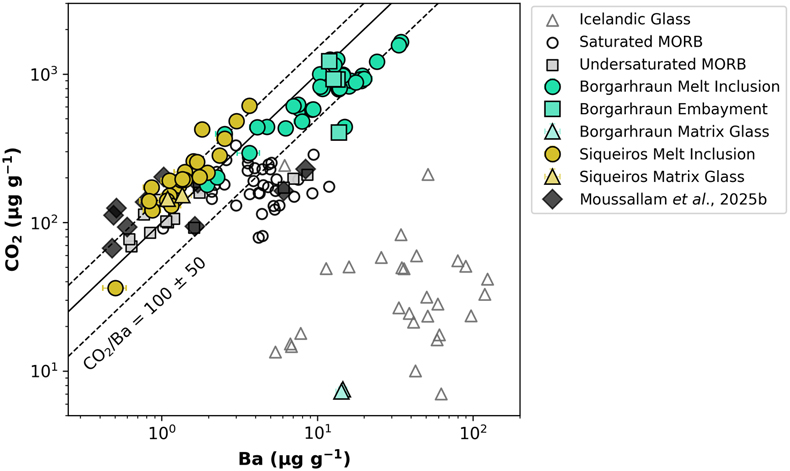
Figure 1 Test for carbon saturation using CO2 versus Ba. Carbon undersaturated melts define CO2/Ba = 100 ± 50, consistent with undersaturated mantle values prior to degassing. Borgarhraun and Siqueiros melt inclusions and embayments plot within this range, overlapping carbon undersaturated MORB, whereas carbon saturated MORB define higher CO2/Ba. Siqueiros matrix glasses plot within mantle values; however, Borgarhraun matrix glasses show significant degassing, consistent with other Icelandic glasses that plot at lower CO2 for a given Ba. Additional MORB glasses from Moussallam et al. (2025b)
Moussallam, Y., Rose-Koga, E.F., Aubaud, C., Georgeais, G., Cartigny, P., Koga, K.T., Devidal, J.-L., Michael, P.J., Shimizu, K., Saal, A.E. (2025b) Enigmatic carbon isotopic variability in the oceanic upper mantle. Proceedings of the National Academy of Sciences 122, e2502886122. https://doi.org/10.1073/pnas.2502886122
and Icelandic literature data (Barry et al., 2014Barry, P.H., Hilton, D.R., Füri, E., Halldórsson, S.A., Grönvold, K. (2014) Carbon isotope and abundance systematics of Icelandic geothermal gases, fluids and subglacial basalts with implications for mantle plume-related CO2 fluxes. Geochimica et Cosmochimica Acta 134, 74–99. https://doi.org/10.1016/j.gca.2014.02.038
; Marshall et al., 2024Marshall, E.W., Halldórsson, S.A., Tian, L., Jackson, M.G., Jenner, F., Stefánsson, A. (2024) The effect of diffusion on lithium isotope ratios in Icelandic basalts. Chemical Geology 662, 122206. https://doi.org/10.1016/j.chemgeo.2024.122206
) are shown for comparison.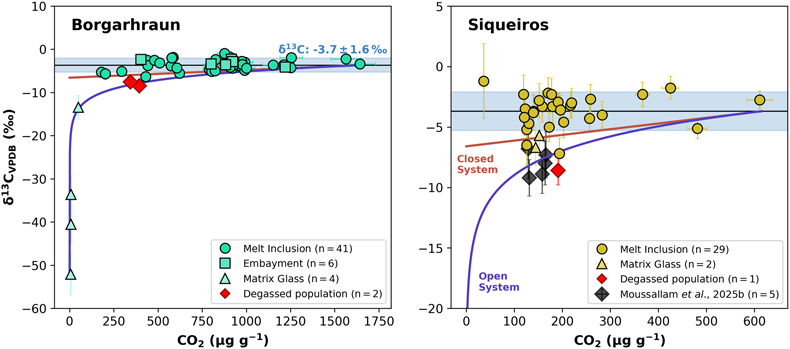
Figure 2 Testing for degassed compositions in Borgarhraun (left) and Siqueiros (right). Melt inclusions (circles), embayments (squares), and matrix glass (triangles) are shown; red diamonds indicate degassed outliers (|z| > 3; see SI). Closed and open system degassing curves (brown, purple) use a fractionation factor of +2.9 ‰ (Lee et al., 2024a
Lee, H., Moussallam, Y., Aubaud, C., Iacono-Marziano, G., Hammond, K., Ebel, D. (2024a) Carbon isotope fractionation between CO2 and carbon in silicate melts at high temperature. Geochimica et Cosmochimica Acta 380, 208–219. https://doi.org/10.1016/j.gca.2024.07.015
) and initial mantle δ13C of −3.7 ± 1.6 ‰ (black line, blue shading), with initial CO2 from the highest melt inclusion concentrations. Black diamonds show Siqueiros melt inclusion data from Moussallam et al. (2025b)Moussallam, Y., Rose-Koga, E.F., Aubaud, C., Georgeais, G., Cartigny, P., Koga, K.T., Devidal, J.-L., Michael, P.J., Shimizu, K., Saal, A.E. (2025b) Enigmatic carbon isotopic variability in the oceanic upper mantle. Proceedings of the National Academy of Sciences 122, e2502886122. https://doi.org/10.1073/pnas.2502886122
. Uncertainties are 1σ.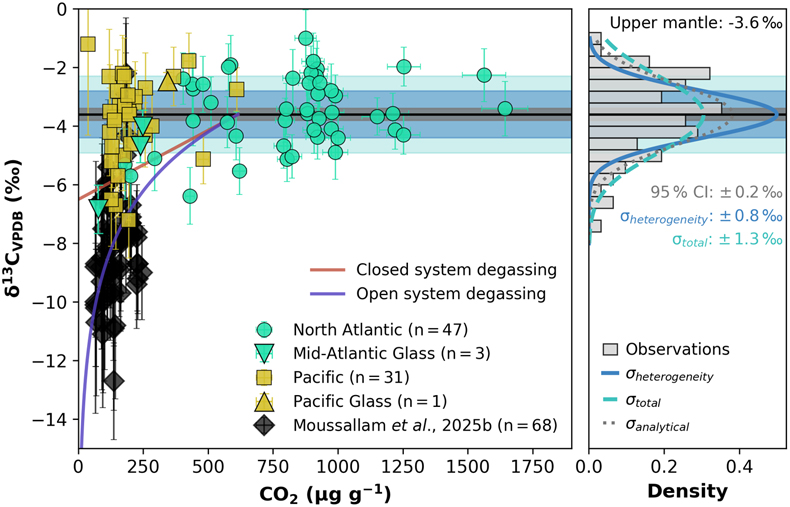
Figure 3 δ13C (‰ VPDB) versus CO2 (μg g−1) for un-degassed, olivine hosted melt inclusions and new glass measurements from the Atlantic and Pacific compared to literature data from Moussallam et al. (2025b)
Moussallam, Y., Rose-Koga, E.F., Aubaud, C., Georgeais, G., Cartigny, P., Koga, K.T., Devidal, J.-L., Michael, P.J., Shimizu, K., Saal, A.E. (2025b) Enigmatic carbon isotopic variability in the oceanic upper mantle. Proceedings of the National Academy of Sciences 122, e2502886122. https://doi.org/10.1073/pnas.2502886122
. The solid black line shows the preferred convecting upper mantle value (−3.6 ‰), with shaded bands showing the 95 % confidence interval (±0.2 ‰; grey), intrinsic mantle heterogeneity (σheterogeneity = ±0.8 ‰; blue), and expected observed scatter including analytical uncertainty (σtotal = ±1.3 ‰; teal). Degassing curves show equilibrium closed and open system fractionation trajectories. The right panel shows the δ13C distribution of un-degassed melt inclusions with Gaussian curves illustrating analytical, heterogeneity, and total variance components. Uncertainty bars are 1σ.