



Water driven iodine degassing from basaltic volcanic systems
Affiliations | Corresponding Author | Cite as | Funding information
Published by the European Association of Geochemistry
under Creative Commons License CC BY-NC-ND 4.0
Keywords: iodine, volcanic degassing, experimental study, monitoring, ozone


- Share this article


-
Article views:702Cumulative count of HTML views and PDF downloads.
- Download Citation
- Rights & Permissions

top
Abstract
Figures and Tables
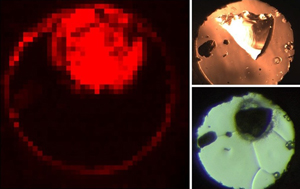
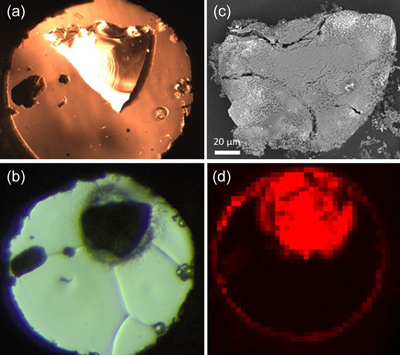 Figure 1 Experiment HAKA (see Table 1) performed at 0.89 GPa, 1391 °C in CO2. (a) Optical photograph of the starting DAC sample chamber showing the I-bearing basaltic glass loaded in CO2 with ruby spheres and a piece of gold. The diameter of the sample chamber is 500 μm. (b) Optical photograph of the same DAC after laser heating, showing the laser spot (in dark) and CO2 at the solid state at 0.89 GPa, room temperature. (c) SEM image of the quenched glass ex situ after the experiment. The hot spot is at the centre of the piece of glass which was totally melted at the centre and partly crystallised at the rims. (d) In situ SXRF mapping of iodine (red) in the closed DAC at room T, 0.89 GPa after the experiment. It shows the stronger affinity of iodine for the basalt (red) than for the CO2 fluid (black). | 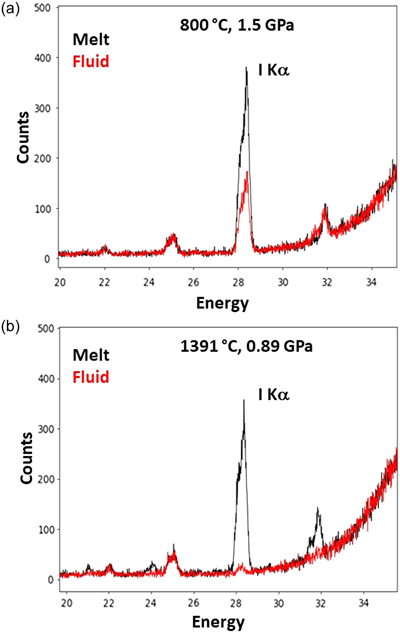 Figure 2 In situ SXRF Spectra for experiments (a) LN2 (hydrous) and (b) HAKA (anhydrous, CO2). The red spectrum is corresponding to the fluid (H2O or CO2) and the dark one is corresponding to the basaltic melt. In both cases laser heating is performed in the basaltic melt to avoid the presence of crystals. The analysis is performed at HP and HT conditions in both phases with a 2 × 2 μm beam that allows analysis of only the desired phase without contamination. HPHT Spectra show that iodine has a strong affinity for the aqueous fluid whereas it remains in the melt when the fluid is CO2. | 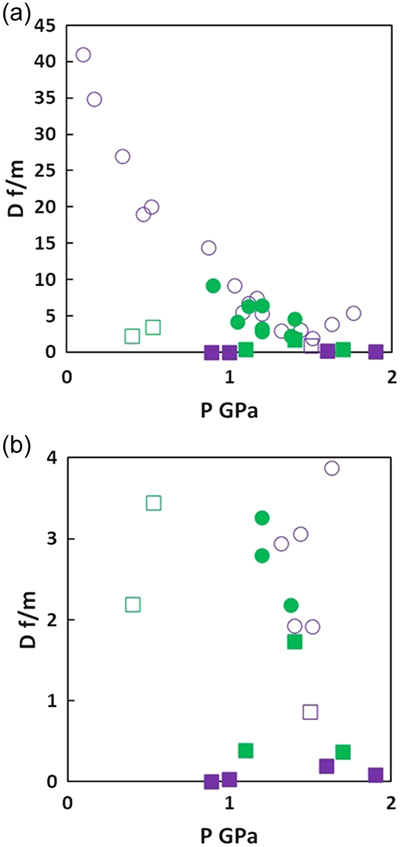 Figure 3 (a) Partition coefficients (±20 % rel) of iodine (purple) and bromine (green) determined in situ between melts and fluids (H2O, CO2 for iodine; H2O, neon for bromine) in diamond anvil cells versus pressure (± 0.2 GPa) and (b) zoomed in on low coefficients. Round symbols are for haplogranite melts (i.e. crustal melts, only in water): bold green circles are for bromine, open purple circles are for iodine. Square symbols are for natural basaltic melts. Bold squares are for CO2 (iodine) or neon (analogue for CO2, bromine) fluids. Open squares are for H2O fluids. Maximum error bars are shown with the upper right crosses. Data are from this study (basaltic melts), Bureau et al. (2010, 2016; bromine and iodine in crustal melts, respectively) and Grützner et al. (2024; bromine in basaltic melts). The data highlight the crucial dependence of heavy halogens distribution on fluid phase composition, with a stronger affinity to aqueous fluids than for CO2 or neon as CO2 analogue in Grützner et al. (2024), the high partition coefficient for bromine (1.73) is due to the total dehydration of the hydrous basaltic glass, as shown by the presence of bromine-rich water droplets. |  Table 1 Experimental results. Iodine concentrations in glass, melt and fluid in situ and corresponding partition coefficient at extreme conditions. |
| Figure 1 | Figure 2 | Figure 3 | Table 1 |
top
Introduction
Volcanic eruptions and passive degassing can inject substantial amounts of volatiles into the atmosphere, with a potential impact on ozone chemistry, most especially from the halogens bromine and iodine. In the past decades, the volcanic origin for atmospheric iodine was considered to be too insignificant to play a role in global ozone depletion. This assumption was based on the observation of volcanic HI release and a lack of evidence for the production of oxidised iodine species by volcanic eruptions, unlike bromine with the BrO explosion (Bobrowski et al., 2003
Bobrowski, N., Hönninger, G., Galle, B., Platt, U. (2003) Detection of bromine monoxide in a volcanic plume. Nature 423, 273–276. https://doi.org/10.1038/nature01625
) which has the capability to destroy ozone molecules. Iodine is among the most efficient ozone killer by catalytic destruction (Saiz-Lopez et al., 2012Saiz-Lopez, A., Plane, J.M.C., Baker, A.R., Carpenter, L.J., von Glasow, R., Gómez Martin, J.C., McFiggans, G., Saunders, R.W. (2012) Atmospheric Chemistry of Iodine. Chemical Reviews 112, 1773–1804. https://doi.org/10.1021/cr200029u
), responsible for 32 % of the halogen induced ozone loss (bromine 40 %, chlorine 28 %; Koenig et al., 2020Koenig, T.K., Baidar, S., Campuzano-Jost, P., Cuevas, C.A., Dix, B., Fernandez, R.P., Guo, H., Hall, S.R., Kinnison, D., Nault, B.A., Ullmann, K., Jimenez, J.L., Saiz-Lopez, A., Volkamer, R. (2020) Quantitative detection of iodine in the stratosphere. Proceedings of the National Academy of Sciences 117, 1860–1866. https://doi.org/10.1073/pnas.1916828117
).A large column of IO was measured at the Kasatochi Volcano in Alaska in 2008 using scanning imaging absorption spectrometry from satellites (Schönhardt et al., 2017
Schönhardt, A., Richter, A., Theys, N., Burrows, J.P. (2017) Space-based observation of volcanic iodine monoxide. Atmospheric Chemistry and Physics 17, 4857–4870. https://doi.org/10.5194/acp-17-4857-2017
). The column amounts of IO were 1 order of magnitude smaller than those of BrO (i.e. on 8 August, 2.3 × 10¹³ molecules cm−2 IO and 4.2 × 10¹⁴ molecules cm−2 BrO).Recent in situ airborne measurements in Nicaragua confirmed that the injection of iodine to the atmosphere during quiescent degassing was higher than previously assumed (Rüdiger et al., 2021
Rüdiger, J., Gutmann, A., Bobrowski, N., Liotta, M., de Moor, J.M., Sander, R., Dinger, F., Tirpitz, J.-L., Ibarra, M., Saballos, A., Martínez, M., Mendoza, E., Ferrufino, A., Stix, J., Valdés, J., Castro, J.M., Hoffmann, T. (2021) Halogen activation in the plume of Masaya volcano: field observations and box model investigations. Atmospheric Chemistry and Physics 21, 3371–3393. https://doi.org/10.5194/acp-21-3371-2021
), with halogen activation sampled in the plume from Masaya volcano. It was shown that 92 % of HI, the species commonly released by volcanoes, is converted to reactive iodine species (e.g., IO) by an autocatalytic mechanism during the first 11 minutes in the plume, corresponding to an “iodine explosion”, when only 0.1 % of Cl is converted in ClO. The presence of iodine monoxide columns in volcanic plumes suggests that volcanoes contribute to iodine concentrations in the lower stratosphere, where the ozone layer stands.The main source of iodine in the atmosphere is “water” via volatilisation processes from the world oceans (the highest contribution), sea ices, snow packs, and macro/micro algae. This results in the generation of oxidised species IO, IOx, I2, HOI, which enter into chain reactions for destruction of O3 molecules over the years and significant amounts of reactive iodine species are measured in the atmosphere for a variety of geographical locations (Saiz-Lopez et al., 2012
Saiz-Lopez, A., Plane, J.M.C., Baker, A.R., Carpenter, L.J., von Glasow, R., Gómez Martin, J.C., McFiggans, G., Saunders, R.W. (2012) Atmospheric Chemistry of Iodine. Chemical Reviews 112, 1773–1804. https://doi.org/10.1021/cr200029u
). Recent quantitative measurements of iodine monoxide radicals and particulate iodine from aircraft in the stratosphere show that 0.77 ± 0.10 parts per trillion by volume inorganic iodine is injected into the stratosphere (Koenig et al., 2020Koenig, T.K., Baidar, S., Campuzano-Jost, P., Cuevas, C.A., Dix, B., Fernandez, R.P., Guo, H., Hall, S.R., Kinnison, D., Nault, B.A., Ullmann, K., Jimenez, J.L., Saiz-Lopez, A., Volkamer, R. (2020) Quantitative detection of iodine in the stratosphere. Proceedings of the National Academy of Sciences 117, 1860–1866. https://doi.org/10.1073/pnas.1916828117
).The role of chlorine and bromine in Antarctic stratospheric ozone depletion is well known. Despite the negligible amounts of iodine reported to enter the stratosphere, new modelling demonstrates that iodine injection into the lower stratosphere can enhance spring ozone loss at the lower part of the ozone hole over Antarctica, and even dominate ozone loss from halogens in summer by 73 % (Cuervas et al., 2022
Cuevas, C.A., Fernandez, R.P., Kinnison, D.E., Li, Q., Lamarque J.-F., Trabelsi, T., Francisco, J.S., Solomon, S., Saiz-Lopez, A. (2022) The influence of iodine on the Antarctic stratospheric ozone hole. Proceedings of the National Academy of Sciences 119, e2110864119. https://doi.org/10.1073/pnas.2110864119
). The relative contribution of iodine to future stratospheric ozone loss is even likely to increase with the decline in anthropogenic chlorine and bromine emissions following the Montreal Protocol (Cuervas et al., 2022Cuevas, C.A., Fernandez, R.P., Kinnison, D.E., Li, Q., Lamarque J.-F., Trabelsi, T., Francisco, J.S., Solomon, S., Saiz-Lopez, A. (2022) The influence of iodine on the Antarctic stratospheric ozone hole. Proceedings of the National Academy of Sciences 119, e2110864119. https://doi.org/10.1073/pnas.2110864119
).In this study, we use an experimental approach to quantify iodine degassing from natural basaltic magmas from different settings. We propose a global annual iodine flux to the atmosphere and compare it to the previous estimates.
top
Methods and Results
We combine diamond anvil cell experiments at high pressures and high temperatures and synchrotron X-Ray fluorescence (SXRF) at the upgraded ID27 beamline of the European Synchrotron Radiation Facility (ESRF), to reproduce magma degassing and to characterise in real time the chemical distribution of iodine between the degassed fluid and the basaltic silicate melt, following the same strategy as in our previous study (Grützner et al., 2024
Grützner, T., Bureau, H., Boulard, E., Munsch, P., Guignot, N., Siebert, J., Guarnelli, Y. (2024) An in-situ experimental HP/HT study on bromine release from a natural basalt. Chemical Geology 644, 121869. https://doi.org/10.1016/j.chemgeo.2023.121869
). Details about the experiments are provided in Supplementary Information. As starting samples, we use a natural basalt powder doped with iodine (Table S-1). Details about the preparation of the starting basaltic glass are given in SI. For each experiment, external heating of gas membrane driven diamond anvil cells (DAC) is combined with laser heating which is necessary to avoid crystallisation of the basaltic melt. We used two different fluids that correspond to the two distinct situations of Earth’s volcanism: a hydrous fluid (major volatile H2O) for subduction conditions, and an anhydrous fluid (major volatile CO2) for rifting and intraplate volcanism. The concentration of iodine in both fluids and basaltic silicate melts is measured for each pressure and temperature step. After each experiment, a final SXRF mapping is performed on the whole quenched sample chamber (Figs. 1, S-3). The obtained iodine concentrations are shown in Table 1 together with the experimental conditions. After the experiments, the DACs are opened, quenched glasses are carefully deposited on stubs and analysed by Scanning Electron Microscopy SEM-EDX using a Zeiss Crossbeam Neon40 at IMPMC Paris, France (Table S-2).Figure 1 Experiment HAKA (see Table 1) performed at 0.89 GPa, 1391 °C in CO2. (a) Optical photograph of the starting DAC sample chamber showing the I-bearing basaltic glass loaded in CO2 with ruby spheres and a piece of gold. The diameter of the sample chamber is 500 μm. (b) Optical photograph of the same DAC after laser heating, showing the laser spot (in dark) and CO2 at the solid state at 0.89 GPa, room temperature. (c) SEM image of the quenched glass ex situ after the experiment. The hot spot is at the centre of the piece of glass which was totally melted at the centre and partly crystallised at the rims. (d) In situ SXRF mapping of iodine (red) in the closed DAC at room T, 0.89 GPa after the experiment. It shows the stronger affinity of iodine for the basalt (red) than for the CO2 fluid (black).
Table 1 Experimental results. Iodine concentrations in glass, melt and fluid in situ and corresponding partition coefficient at extreme conditions.
| Experiment | P (GPa) | T (°C) | Fluid | iodine wt. % starting glass | iodine ppm wt. melt | iodine ppm wt. fluid | Diodinef/m |
| LN2 * | 1.52*** | 800 | H2O | 1.08 | 4217 | 3660 | 0.86 |
| HAKA ** | 0.89 | 1391 | CO2 | 1.19 | 4291 | 4 | 0.001 |
| EMMA ** | 1.6 | 1324 | CO2 | 1.07 | 3947 | 832 | 0.21 |
| MARINA ** | 1.9 | 1400 | CO2 | 1.01 | 4507 | 549 | 0.09 |
| H10 ** | 1 | 1500 | CO2 | 1.19 | 7650 | 220 | 0.028 |
*Hydrothermal DAC, both laser heating and external heating, laser heating is stopped during SXRF measurements.
**LH-DAC equipped with external heating rings. External heating at 250 °C to homogenise the fluid.
***For LN2 pressure is calculated using EOS of water after Saul and Wagner (1989)Saul, A., Wagner, W. (1989) A fundamental equation for water covering the range from the melting line to 1273 K at pressures up to 25 000 MPa. Journal of Physical and Chemical Reference Data 18, 1537–1564. https://doi.org/10.1063/1.555836 at HT, and also measured in situ at 250 °C on ruby spheres on the beamline set up for LH-DAC.
Iodine concentrations are calculated from SXRF spectra using PyMCA (see SI) with an uncertainty of 20 % relative. The starting glass is measured before each experiment in situ.
Of the eight conducted experiments five were successful: four with the CO2 fluid and one with water. They are presented in Table 1 and Figures 1, S2, and S3. The analyses carried out in situ in the DAC with SXRF or ex situ with SEM are in good agreement with the iodine content of the un-heated glasses (average 1.1 wt. %) and the starting iodine concentration of the basaltic glass (Table S-1). The analyses also show that carbon is massively introduced into the melt during high pressure heating. This is expected from the well known high solubility of CO2 in basaltic melts at high pressures (Pan et al., 1991
Pan, V., Holloway, J.R., Hervig, R.L. (1991) The pressure and temperature dependence of carbon dioxide solubility in tholeiitic basalt melts. Geochimica et Cosmochimica Acta 55, 1587–1595. https://doi.org/10.1016/0016-7037(91)90130-W
).For each high pressure, high temperature HPHT step, partition coefficients between the fluid (f) and the basaltic melt (m) are obtained from the equation: Diodinef/m = (iodine)f/(iodine)m where (iodine)f is the concentration of iodine in the fluid (water, CO2), and (iodine)m is the concentration of iodine in the melt, obtained from the SXRF spectra (Fig. 2). An increase of Diodinef/m during the experiment means a transfer of iodine from the silicate melt to the fluid phase, corresponding to a degassing process during decompression (Table S-3, Fig. 3). We obtain Diodinef/m from 0.001 to 0.09 for iodine degassing in CO2 and of 0.86 for iodine degassing in water.
Figure 2 In situ SXRF Spectra for experiments (a) LN2 (hydrous) and (b) HAKA (anhydrous, CO2). The red spectrum is corresponding to the fluid (H2O or CO2) and the dark one is corresponding to the basaltic melt. In both cases laser heating is performed in the basaltic melt to avoid the presence of crystals. The analysis is performed at HP and HT conditions in both phases with a 2 × 2 μm beam that allows analysis of only the desired phase without contamination. HPHT Spectra show that iodine has a strong affinity for the aqueous fluid whereas it remains in the melt when the fluid is CO2.
Figure 3 (a) Partition coefficients (±20 % rel) of iodine (purple) and bromine (green) determined in situ between melts and fluids (H2O, CO2 for iodine; H2O, neon for bromine) in diamond anvil cells versus pressure (± 0.2 GPa) and (b) zoomed in on low coefficients. Round symbols are for haplogranite melts (i.e. crustal melts, only in water): bold green circles are for bromine, open purple circles are for iodine. Square symbols are for natural basaltic melts. Bold squares are for CO2 (iodine) or neon (analogue for CO2, bromine) fluids. Open squares are for H2O fluids. Maximum error bars are shown with the upper right crosses. Data are from this study (basaltic melts), Bureau et al. (2010
Bureau, H., Foy, E., Raepsaet, C., Somogyi, A., Munsch, P., Simon, G., Kubsky, S. (2010) Bromine cycle in subduction zones through in situ Br monitoring in diamond anvil cells. Geochimica et Cosmochimica Acta 74, 3839–3850. https://doi.org/10.1016/j.gca.2010.04.001
, 2016Bureau, H., Auzende, A.-L., Marocchi, M., Raepsaet, C., Munsch, P., Testemale, D., Mézouar, M., Kubsky, S., Carrière, M., Ricolleau, A., Fiquet, G. (2016) Modern and past volcanic degassing of iodine. Geochimica et Cosmochimica Acta 173, 114–125. https://doi.org/10.1016/j.gca.2015.10.017
; bromine and iodine in crustal melts, respectively) and Grützner et al. (2024Grützner, T., Bureau, H., Boulard, E., Munsch, P., Guignot, N., Siebert, J., Guarnelli, Y. (2024) An in-situ experimental HP/HT study on bromine release from a natural basalt. Chemical Geology 644, 121869. https://doi.org/10.1016/j.chemgeo.2023.121869
; bromine in basaltic melts). The data highlight the crucial dependence of heavy halogens distribution on fluid phase composition, with a stronger affinity to aqueous fluids than for CO2 or neon as CO2 analogue in Grützner et al. (2024)Grützner, T., Bureau, H., Boulard, E., Munsch, P., Guignot, N., Siebert, J., Guarnelli, Y. (2024) An in-situ experimental HP/HT study on bromine release from a natural basalt. Chemical Geology 644, 121869. https://doi.org/10.1016/j.chemgeo.2023.121869
, the high partition coefficient for bromine (1.73) is due to the total dehydration of the hydrous basaltic glass, as shown by the presence of bromine-rich water droplets.top
Volcanic Iodine Degassing
Partition coefficients (Table 1) and SEM-EDX analysis of the quenched glasses (Table S-2) show that iodine is significantly lost from the hydrous basaltic melt during magma ascent (i.e. decompression), in agreement with previous results obtained on crustal magma analogues (i.e. haplogranite hydrous melts; Bureau et al., 2016
Bureau, H., Auzende, A.-L., Marocchi, M., Raepsaet, C., Munsch, P., Testemale, D., Mézouar, M., Kubsky, S., Carrière, M., Ricolleau, A., Fiquet, G. (2016) Modern and past volcanic degassing of iodine. Geochimica et Cosmochimica Acta 173, 114–125. https://doi.org/10.1016/j.gca.2015.10.017
; Leroy et al., 2019Leroy, C., Bureau, H., Sanloup, C., Raepsaet, C., Glazirin, K., Munsch, P., Harmand, M., Prouteau, G., Khodja, H. (2019) Xenon and iodine behaviour in magmas. Earth and Planetary Science Letters 522, 144–154. https://doi.org/10.1016/j.epsl.2019.06.031
), while it remains mainly in the basaltic melts during degassing in CO2 (Fig. 3). We suggest that the fraction of iodine lost from the melt at high pressure in CO2 is degassed together with water (3.85 wt. %) initially dissolved in the starting basalt. This behaviour is also observed for bromine (Grützner et al., 2024Grützner, T., Bureau, H., Boulard, E., Munsch, P., Guignot, N., Siebert, J., Guarnelli, Y. (2024) An in-situ experimental HP/HT study on bromine release from a natural basalt. Chemical Geology 644, 121869. https://doi.org/10.1016/j.chemgeo.2023.121869
), where bromine-bearing water bubbles were observed on the DAC diamond culet after the experiment.Our results confirm the increasing affinity of heavy halogens for water during decompression and together with previous studies, Figure 3 shows that the degassing of heavy halogens is water driven whatever the composition of the melt (haplogranite: Bureau et al., 2000
Bureau, H., Keppler, H., Métrich, N. (2000) Volcanic degassing of bromine and iodine: experimental fluid/melt partitioning data and applications to stratospheric chemistry. Earth and Planetary Science Letters 183, 51–60. https://doi.org/10.1016/S0012-821X(00)00258-2
, 2010Bureau, H., Foy, E., Raepsaet, C., Somogyi, A., Munsch, P., Simon, G., Kubsky, S. (2010) Bromine cycle in subduction zones through in situ Br monitoring in diamond anvil cells. Geochimica et Cosmochimica Acta 74, 3839–3850. https://doi.org/10.1016/j.gca.2010.04.001
, 2016Bureau, H., Auzende, A.-L., Marocchi, M., Raepsaet, C., Munsch, P., Testemale, D., Mézouar, M., Kubsky, S., Carrière, M., Ricolleau, A., Fiquet, G. (2016) Modern and past volcanic degassing of iodine. Geochimica et Cosmochimica Acta 173, 114–125. https://doi.org/10.1016/j.gca.2015.10.017
; or natural basalt for bromine: Grützner et al., 2024Grützner, T., Bureau, H., Boulard, E., Munsch, P., Guignot, N., Siebert, J., Guarnelli, Y. (2024) An in-situ experimental HP/HT study on bromine release from a natural basalt. Chemical Geology 644, 121869. https://doi.org/10.1016/j.chemgeo.2023.121869
; this study). This is also the case for felsic melts at crustal (i.e. low) pressures, as demonstrated by a different experimental approach. Indeed, a good agreement is observed between experiments carried out in situ in DAC and those carried out in externally heated, rapid quench, cold seal pressure vessel apparatuses: i.e. Diodinef/m from 198 to 736 for haplogranitic melts in the 200–790 MPa pressure range (Miranda et al., 2025Miranda, M., Zajacz, Z., Tsay, A., Bouvier, A.-S. (2025) The fluid/melt partitioning of chlorine, bromine and iodine in felsic magmas and the utility of halogen ratios to track the devolatilization and fluid fluxing of magma reservoirs. Geochimica et Cosmochimica Acta 392, 88–106. https://doi.org/10.1016/j.gca.2024.11.026
). The results of all these studies show that, as shown for bromine, iodine degassing is water driven in hydrous melts, regardless of the composition in major elements (i.e. haplogranitic or basaltic).top
Contribution of Volcanic Iodine to Ozone Destruction
These first iodine partition coefficients for natural basaltic systems suggest that iodine degasses from subduction zone magmas, where primary magmas are naturally rich in water: 4 wt. % on average (Plank et al., 2013
Plank, T., Kelley, K.A., Zimmer, M.M., Hauri, E.H., Wallace, P.J. (2013) Why do mafic arc magmas contain ∼4 wt. % water on average? Earth and Planetary Science Letters 364, 168–179. https://doi.org/10.1016/j.epsl.2012.11.044
), possibly up to 20 wt. % (Urann et al., 2022Urann, B.M., Le Roux, V. Jagoutz, O. Müntener, O. Behn, M.D., Chin, E.J. (2022) High water content of arc magmas recorded in cumulates from subduction zone lower crust. Nature Geosciences 15, 501–508. https://doi.org/10.1038/s41561-022-00947-w
). These magmas are also rich in iodine compared to other settings: indeed marine sediments contain the largest reservoir of iodine in Earth’s crust (Muramatsu and Wedepohl, 1998Muramatsu, Y., Wedepohl, K.H. (1998) The distribution of iodine in the earth’s crust. Chemical Geology 147, 201–216. https://doi.org/10.1016/S0009-2541(98)00013-8
). Iodine is efficiently recycled in subduction zones (Beaudouin et al., 2022Beaudouin, G.M., Barnes, J.D., John, T., Hoffmann, J.E., Chatterjee, R., Stockli, D.F. (2022) Global halogen flux of subducting oceanic crust. Earth and Planetary Science Letters 594, 117750. https://doi.org/10.1016/j.epsl.2022.117750
), from marine sediments and organic materials in subducted oceanic crusts, and enriched in magmas from volcanic arcs compared to other settings (i.e. MORBs, 0.0000007–0.0000014 wt. % I; subduction andesites, 0.00006–0.011 wt. % I; Aiuppa et al., 2009Aiuppa, A., Baker, D.R., Webster, J.D. (2009) Halogens in volcanic systems. Chemical Geology 263, 1–18. https://doi.org/10.1016/j.chemgeo.2008.10.005
). This iodine enrichment is mainly attributed to the breakdown of iodine-rich serpentine (Kendrick et al., 2012Kendrick, M.A., Woodhead, J.D., Kamenetsky, V.S. (2012) Tracking halogens through the subduction cycle. Geology 40, 1075–1078. https://doi.org/10.1130/G33265.1
).The initial iodine concentration of primary melts from subduction zones is difficult to estimate due to the limited availability of un-degassed glassy samples. Residual volatile concentrations in groundmass from felsic magmas from different localities (Vesuvius, Montagne Pelée, Fogo, and Santa Maria-Santiaguito) are still 350 ppb I and up to 2.4 wt. % H2O (Balcone-Boissard et al., 2010
Balcone-Boissard, H., Villemant, B., Boudon, G. (2010) Behavior of halogens during the degassing of felsic magmas. Geochemistry, Geophysics, Geosystems 11, Q09005. https://doi.org/10.1029/2010GC003028
). Pillow lava rims of primitive basaltic glasses from the Manus Basin Back Arc Basin Basalts range from 181 to 500 ppb I (Kendrick et al., 2012Kendrick, M.A., Woodhead, J.D., Kamenetsky, V.S. (2012) Tracking halogens through the subduction cycle. Geology 40, 1075–1078. https://doi.org/10.1130/G33265.1
), for a water content range from 0.99 to 1.21 wt. % (Kamenetsky et al., 2001Kamenetsky, V.S., Binns, R.A., Gemmell, J.B., Crawford, A.J., Mernagh, T.P., Maas, R., Steele, D. (2001) Parental basaltic melts and fluids in eastern Manus backarc Basin: implications for hydrothermal mineralisation. Earth and Planetary Science Letters 184, 685–702. https://doi.org/10.1016/S0012-821X(00)00352-6
). Basaltic melt inclusions trapped in plagioclases and clinopyroxenes in scoria clasts from Plinian eruptions (Fontana tephra West-Central Nicaragua) erupted near the caldera of the Masaya volcano contain between 6 and 113 ppm with an average of 32 ppm I (Wehrmann, 2005Wehrmann, H. (2005) Volatile degassing and plinian eruption dynamics of the mafic Fontana Tephra, Nicaragua. Ph.D. dissertation, Christian-Albrechts-Universität zu Kiel.
), when associated matrix glasses still contain 2 to 8 ppm I. These low iodine contents in primary basaltic melts are then in strong contrast with the high solubility in basaltic melts (1.42 wt. % at 2 GPa; Leroy et al., 2019Leroy, C., Bureau, H., Sanloup, C., Raepsaet, C., Glazirin, K., Munsch, P., Harmand, M., Prouteau, G., Khodja, H. (2019) Xenon and iodine behaviour in magmas. Earth and Planetary Science Letters 522, 144–154. https://doi.org/10.1016/j.epsl.2019.06.031
).To estimate the contribution of iodine to ozone destruction produced from volcanic iodine explosion (i.e. high concentrations of reactive iodine species in the stratosphere), we only consider subduction related eruptive events. Arc volcanoes account for 90 % of subaerial eruptions (Global Volcanism Program
Global Volcanism Program (2025) [Database] Volcanoes of the World (v. 5.3.5; 31 Mar 2026). Distributed by Smithsonian Institution, compiled by Venzke, E. https://doi.org/10.5479/si.GVP.VOTW5-2025.5.3
, Smithsonian Institution) and are the main source of volcanic gases to the atmosphere. The contribution of iodine from hot spot plumes is considered negligible as a first approximation. Iodine emissions from MORBs are submarine, volcanic iodine is dissolved in sea water and does not reach the atmosphere.Similar to our previous study on bromine degassing (Grützner et al., 2024
Grützner, T., Bureau, H., Boulard, E., Munsch, P., Guignot, N., Siebert, J., Guarnelli, Y. (2024) An in-situ experimental HP/HT study on bromine release from a natural basalt. Chemical Geology 644, 121869. https://doi.org/10.1016/j.chemgeo.2023.121869
), we calculate a maximum global volcanic iodine flux qiodine:
with ρbasalt as the density for basalt (2.8 g/cm3). For the annual magma flux Q, we use the value corresponding to the erupted magmas: the annual global addition in volcanic material brought to the Earth’s surface along 35,000 km of arc which varies between 0.14 and 0.9 × 1015 cm3/yr (Carmichael, 2002
Carmichael, I.S. (2002) The andesite aqueduct: perspectives on the evolution of intermediate magmatism in west-central (105–99°W) Mexico. Contributions to Mineralogy and Petrology 143, 641–663. https://doi.org/10.1007/s00410-002-0370-9
), we use 0.9 × 1015 cm3/yr. Cfluid is calculated as:
As a range of Cmelt, we use the maximum iodine content in Massaya melt inclusions of 113 ppm I and the maximum iodine content of iodine in pillow lava glassy rims of primitive BABB at 500 ppb I (Kendrick et al., 2012
Kendrick, M.A., Woodhead, J.D., Kamenetsky, V.S. (2012) Tracking halogens through the subduction cycle. Geology 40, 1075–1078. https://doi.org/10.1130/G33265.1
). Assuming that iodine degassing is water driven (not composition dependant), and that most of the iodine is degassed during eruption, we use Diodinef/m = 0.86 and Diodinef/m = 41 from Bureau et al. (2016Bureau, H., Auzende, A.-L., Marocchi, M., Raepsaet, C., Munsch, P., Testemale, D., Mézouar, M., Kubsky, S., Carrière, M., Ricolleau, A., Fiquet, G. (2016) Modern and past volcanic degassing of iodine. Geochimica et Cosmochimica Acta 173, 114–125. https://doi.org/10.1016/j.gca.2015.10.017
; Fig. 3), corresponding to the lowest pressure partitioning measured between hydrous melt and water in situ at 0.1 GPa, a pressure relevant for shallow magma chambers. This coefficient remains low compared to the value of 104 ± 7 obtained for albitic melts (Bureau et al., 2000Bureau, H., Keppler, H., Métrich, N. (2000) Volcanic degassing of bromine and iodine: experimental fluid/melt partitioning data and applications to stratospheric chemistry. Earth and Planetary Science Letters 183, 51–60. https://doi.org/10.1016/S0012-821X(00)00258-2
). Since the fluid fraction of the experiments carried out in DAC is higher than in nature, we correct with the factor W from 3 to 7, corresponding to a water content between 5 and 12 wt. % (Grützner et al., 2024Grützner, T., Bureau, H., Boulard, E., Munsch, P., Guignot, N., Siebert, J., Guarnelli, Y. (2024) An in-situ experimental HP/HT study on bromine release from a natural basalt. Chemical Geology 644, 121869. https://doi.org/10.1016/j.chemgeo.2023.121869
; see SI).The estimated global eruptive fluxes of potentially reactive iodine released in the atmosphere (i.e. all erupted HI is converted to oxidised species in the plume) span from 0.004 to 1.94 Gg/yr for Diodinef/m = 41 and from 0.002 to 0.92 Gg/yr for Diodinef/m = 0.86.
Previous estimates for the average volcanic iodine emission for subduction settings made by Snyder and Fehn (2002)
Snyder, G.T., Fehn, U. (2002) Origin of iodine in volcanic fluids: 129I results in the Central American Volcanic Arc. Geochimica et Cosmochimica Acta 66, 3827–3838. https://doi.org/10.1016/S0016-7037(02)00825-6
, using ultraviolet correlation spectroscopy (COSPEC), SO2 flux determinations, and published ratios of HCl/SO2, and I/Cl, propose a global flux of iodine of 0.2–7.7 Gg/yr for arc volcanism, which includes our values. More recently, iodine degassing during individual eruptions has been estimated at 0.02–0.03 Gg/year (Cadoux et al., 2022Cadoux, A., Tegtmeier, S., Aiuppa, A. (2022) Natural Halogen Emissions to the Atmosphere: Sources, Flux, and Environmental Impact. Elements 18, 27–33. https://doi.org/10.2138/gselements.18.1.27
), which corresponds to our lowest fluxes. The input of iodine during eruptions can be compared to the passive one derived by scaling volcanic gas composition to volcanic SO2 fluxes, measured from space (Carn et al., 2017Carn, S.A., Fioletov, V.E., McLinden, C.A., Li, C., Krotkov, N.A. (2017) A decade of global volcanic SO2 emissions measured from space. Scientific Reports 7, 44095. https://doi.org/10.1038/srep44095
). A SO2/iodine ratio of 26,600 is assigned to persistent volcanic gas emissions corresponding to a global iodine flux of 1.2 Gg/yr (Cadoux et al., 2022Cadoux, A., Tegtmeier, S., Aiuppa, A. (2022) Natural Halogen Emissions to the Atmosphere: Sources, Flux, and Environmental Impact. Elements 18, 27–33. https://doi.org/10.2138/gselements.18.1.27
), a much higher iodine input than the one they calculated for eruptions. This assessment of the passive iodine flux is of the same order of magnitude as our calculation of the current supply of iodine to the atmosphere by effusive volcanism.The high variability of volcanic iodine fluxes reflects our limited knowledge of the iodine cycle and its deep storage, further compounded by our lack of knowledge about the amount of iodine supplied to magmas through iodine recycling in subduction zones. Interestingly, all the estimates are 3 orders of magnitude lower than the total annual budget of iodine emissions (all sources, and all iodine species) of 4006 Gg/yr (Cadoux et al., 2022
Cadoux, A., Tegtmeier, S., Aiuppa, A. (2022) Natural Halogen Emissions to the Atmosphere: Sources, Flux, and Environmental Impact. Elements 18, 27–33. https://doi.org/10.2138/gselements.18.1.27
).Iodine is efficient at destroying ozone in the stratosphere (e.g., Koenig et al., 2020
Koenig, T.K., Baidar, S., Campuzano-Jost, P., Cuevas, C.A., Dix, B., Fernandez, R.P., Guo, H., Hall, S.R., Kinnison, D., Nault, B.A., Ullmann, K., Jimenez, J.L., Saiz-Lopez, A., Volkamer, R. (2020) Quantitative detection of iodine in the stratosphere. Proceedings of the National Academy of Sciences 117, 1860–1866. https://doi.org/10.1073/pnas.1916828117
). In the future, iodine fluxes will change under global warming, oceanic emissions of inorganic iodine may increase by up to ∼20 % over the 2000–2100 period (Iglesias-Suarez et al., 2020Iglesias-Suarez, F., Badia, A., Fernandez, R.P., Cuevas, C.A., Kinnison, D.E., Tilmes, S., Lamarque, J.-F., Long, M.C., Hossaini, R., Saiz-Lopez, A. (2020) Natural halogens buffer tropospheric ozone in a changing climate. Nature Climate Change 10, 147–154. https://doi.org/10.1038/s41558-019-0675-6
), meaning that the future contribution of iodine to stratospheric ozone loss could be higher than currently, potentially delaying the future closing of the ozone hole (Cuevas et al., 2022Cuevas, C.A., Fernandez, R.P., Kinnison, D.E., Li, Q., Lamarque J.-F., Trabelsi, T., Francisco, J.S., Solomon, S., Saiz-Lopez, A. (2022) The influence of iodine on the Antarctic stratospheric ozone hole. Proceedings of the National Academy of Sciences 119, e2110864119. https://doi.org/10.1073/pnas.2110864119
). In such a context, the volcanic regular contribution of iodine in the stratosphere does not appear to be significant. This does not predict what would happen in the case of major Plinian eruptions, when the magma is strongly enriched in water, like the Bronze Age eruption of the Santorini Volcano. Far more halogens (Cl, Br and I) than sulphur were released and partly reached the stratosphere, including 20 to 69 Gg iodine (Cadoux et al., 2015Cadoux, A., Scaillet, B., Bekki, S., Oppenheimer, C., Druitt, T.H. (2015) Stratospheric Ozone destruction by the Bronze-Age Minoan eruption (Santorini Volcano, Greece). Scientific Reports 5, 12243. https://doi.org/10.1038/srep12243
). During such exceptional events, strong global ozone depletion is expected to be caused by volcanic halogens including iodine.top
Acknowledgements
We are extremely grateful to Alain Polian for his precious help during the preparation of the experiments, to Angelika Rosa for her help for synchrotron data processing, to Gaëlle Prouteau for the natural basalt from Saint Vincent and to Divine Vangu for her assistance during the synchrotron session. We thank the Id27 beam line staff and the ESRF High Pressure Laboratory staff for their precious assistance during the beam time. We thank the ESRF for the attribution of beam time to our proposal ES-1142. Our warm thanks to Nicole Bobrowski and to one anonymous reviewer for their reviews which helped to improve the manuscript, as well as Ambre Luguet for handling the manuscript. The project was funded by the ANR Projet de Recherche Collaborative VOLC-HAL-CLIM (Volcanic Halogens: from Deep Earth to Atmospheric Impacts), ANR-18-CE01-0018 (Hélène Bureau).
Editor: Ambre Luguet
top
References
Aiuppa, A., Baker, D.R., Webster, J.D. (2009) Halogens in volcanic systems. Chemical Geology 263, 1–18. https://doi.org/10.1016/j.chemgeo.2008.10.005
 Show in context
 Iodine is efficiently recycled in subduction zones (Beaudouin et al., 2022), from marine sediments and organic materials in subducted oceanic crusts, and enriched in magmas from volcanic arcs compared to other settings (i.e. MORBs, 0.0000007–0.0000014 wt. % I; subduction andesites, 0.00006–0.011 wt. % I; Aiuppa et al., 2009).
View in article
Balcone-Boissard, H., Villemant, B., Boudon, G. (2010) Behavior of halogens during the degassing of felsic magmas. Geochemistry, Geophysics, Geosystems 11, Q09005. https://doi.org/10.1029/2010GC003028
Show in context Residual volatile concentrations in groundmass from felsic magmas from different localities (Vesuvius, Montagne Pelée, Fogo, and Santa Maria-Santiaguito) are still 350 ppb I and up to 2.4 wt. % H2O (Balcone-Boissard et al., 2010).
View in article
Beaudouin, G.M., Barnes, J.D., John, T., Hoffmann, J.E., Chatterjee, R., Stockli, D.F. (2022) Global halogen flux of subducting oceanic crust. Earth and Planetary Science Letters 594, 117750. https://doi.org/10.1016/j.epsl.2022.117750
Show in context Iodine is efficiently recycled in subduction zones (Beaudouin et al., 2022), from marine sediments and organic materials in subducted oceanic crusts, and enriched in magmas from volcanic arcs compared to other settings (i.e. MORBs, 0.0000007–0.0000014 wt. % I; subduction andesites, 0.00006–0.011 wt. % I; Aiuppa et al., 2009).
View in article
Bobrowski, N., Hönninger, G., Galle, B., Platt, U. (2003) Detection of bromine monoxide in a volcanic plume. Nature 423, 273–276. https://doi.org/10.1038/nature01625
Show in context This assumption was based on the observation of volcanic HI release and a lack of evidence for the production of oxidised iodine species by volcanic eruptions, unlike bromine with the BrO explosion (Bobrowski et al., 2003) which has the capability to destroy ozone molecules.
View in article
Bureau, H., Keppler, H., Métrich, N. (2000) Volcanic degassing of bromine and iodine: experimental fluid/melt partitioning data and applications to stratospheric chemistry. Earth and Planetary Science Letters 183, 51–60. https://doi.org/10.1016/S0012-821X(00)00258-2
Show in context Our results confirm the increasing affinity of heavy halogens for water during decompression and together with previous studies, Figure 3 shows that the degassing of heavy halogens is water driven whatever the composition of the melt (haplogranite: Bureau et al., 2000, 2010, 2016; or natural basalt for bromine: Grützner et al., 2024; this study).
View in article
This coefficient remains low compared to the value of 104 ± 7 obtained for albitic melts (Bureau et al., 2000).
View in article
Bureau, H., Foy, E., Raepsaet, C., Somogyi, A., Munsch, P., Simon, G., Kubsky, S. (2010) Bromine cycle in subduction zones through in situ Br monitoring in diamond anvil cells. Geochimica et Cosmochimica Acta 74, 3839–3850. https://doi.org/10.1016/j.gca.2010.04.001
Show in context Maximum error bars are shown with the upper right crosses. Data are from this study (basaltic melts), Bureau et al. (2010, 2016; bromine and iodine in crustal melts, respectively) and Grützner et al. (2024; bromine in basaltic melts).
View in article
Our results confirm the increasing affinity of heavy halogens for water during decompression and together with previous studies, Figure 3 shows that the degassing of heavy halogens is water driven whatever the composition of the melt (haplogranite: Bureau et al., 2000, 2010, 2016; or natural basalt for bromine: Grützner et al., 2024; this study).
View in article
Bureau, H., Auzende, A.-L., Marocchi, M., Raepsaet, C., Munsch, P., Testemale, D., Mézouar, M., Kubsky, S., Carrière, M., Ricolleau, A., Fiquet, G. (2016) Modern and past volcanic degassing of iodine. Geochimica et Cosmochimica Acta 173, 114–125. https://doi.org/10.1016/j.gca.2015.10.017
Show in context Maximum error bars are shown with the upper right crosses. Data are from this study (basaltic melts), Bureau et al. (2010, 2016; bromine and iodine in crustal melts, respectively) and Grützner et al. (2024; bromine in basaltic melts).
View in article
Partition coefficients (Table 1) and SEM-EDX analysis of the quenched glasses (Table S-2) show that iodine is significantly lost from the hydrous basaltic melt during magma ascent (i.e. decompression), in agreement with previous results obtained on crustal magma analogues (i.e. haplogranite hydrous melts; Bureau et al., 2016; Leroy et al., 2019), while it remains mainly in the basaltic melts during degassing in CO2 (Fig. 3).
View in article
Our results confirm the increasing affinity of heavy halogens for water during decompression and together with previous studies, Figure 3 shows that the degassing of heavy halogens is water driven whatever the composition of the melt (haplogranite: Bureau et al., 2000, 2010, 2016; or natural basalt for bromine: Grützner et al., 2024; this study).
View in article
Assuming that iodine degassing is water driven (not composition dependant), and that most of the iodine is degassed during eruption, we use Diodinef/m = 0.86 and Diodinef/m = 41 from Bureau et al. (2016; Fig. 3), corresponding to the lowest pressure partitioning measured between hydrous melt and water in situ at 0.1 GPa, a pressure relevant for shallow magma chambers.
View in article
Cadoux, A., Scaillet, B., Bekki, S., Oppenheimer, C., Druitt, T.H. (2015) Stratospheric Ozone destruction by the Bronze-Age Minoan eruption (Santorini Volcano, Greece). Scientific Reports 5, 12243. https://doi.org/10.1038/srep12243
Show in context Far more halogens (Cl, Br and I) than sulphur were released and partly reached the stratosphere, including 20 to 69 Gg iodine (Cadoux et al., 2015).
View in article
Cadoux, A., Tegtmeier, S., Aiuppa, A. (2022) Natural Halogen Emissions to the Atmosphere: Sources, Flux, and Environmental Impact. Elements 18, 27–33. https://doi.org/10.2138/gselements.18.1.27
Show in context Previous estimates for the average volcanic iodine emission for subduction settings made by Snyder and Fehn (2002), using ultraviolet correlation spectroscopy (COSPEC), SO2 flux determinations, and published ratios of HCl/SO2, and I/Cl, propose a global flux of iodine of 0.2–7.7 Gg/yr for arc volcanism, which includes our values. More recently, iodine degassing during individual eruptions has been estimated at 0.02–0.03 Gg/year (Cadoux et al., 2022), which corresponds to our lowest fluxes.
View in article
A SO2/iodine ratio of 26,600 is assigned to persistent volcanic gas emissions corresponding to a global iodine flux of 1.2 Gg/yr (Cadoux et al., 2022), a much higher iodine input than the one they calculated for eruptions.
View in article
Interestingly, all the estimates are 3 orders of magnitude lower than the total annual budget of iodine emissions (all sources, and all iodine species) of 4006 Gg/yr (Cadoux et al., 2022).
View in article
Carmichael, I.S. (2002) The andesite aqueduct: perspectives on the evolution of intermediate magmatism in west-central (105–99°W) Mexico. Contributions to Mineralogy and Petrology 143, 641–663. https://doi.org/10.1007/s00410-002-0370-9
Show in context For the annual magma flux Q, we use the value corresponding to the erupted magmas: the annual global addition in volcanic material brought to the Earth’s surface along 35,000 km of arc which varies between 0.14 and 0.9 × 1015 cm3/yr (Carmichael, 2002), we use 0.9 × 1015 cm3/yr. Cfluid is calculated as:
View in article
Carn, S.A., Fioletov, V.E., McLinden, C.A., Li, C., Krotkov, N.A. (2017) A decade of global volcanic SO2 emissions measured from space. Scientific Reports 7, 44095. https://doi.org/10.1038/srep44095
Show in context The input of iodine during eruptions can be compared to the passive one derived by scaling volcanic gas composition to volcanic SO2 fluxes, measured from space (Carn et al., 2017).
View in article
Cuevas, C.A., Fernandez, R.P., Kinnison, D.E., Li, Q., Lamarque J.-F., Trabelsi, T., Francisco, J.S., Solomon, S., Saiz-Lopez, A. (2022) The influence of iodine on the Antarctic stratospheric ozone hole. Proceedings of the National Academy of Sciences 119, e2110864119. https://doi.org/10.1073/pnas.2110864119
Show in context Despite the negligible amounts of iodine reported to enter the stratosphere, new modelling demonstrates that iodine injection into the lower stratosphere can enhance spring ozone loss at the lower part of the ozone hole over Antarctica, and even dominate ozone loss from halogens in summer by 73 % (Cuervas et al., 2022).
View in article
The relative contribution of iodine to future stratospheric ozone loss is even likely to increase with the decline in anthropogenic chlorine and bromine emissions following the Montreal Protocol (Cuervas et al., 2022).
View in article
In the future, iodine fluxes will change under global warming, oceanic emissions of inorganic iodine may increase by up to ∼20 % over the 2000–2100 period (Iglesias-Suarez et al., 2020), meaning that the future contribution of iodine to stratospheric ozone loss could be higher than currently, potentially delaying the future closing of the ozone hole (Cuevas et al., 2022).
View in article
Global Volcanism Program (2025) [Database] Volcanoes of the World (v. 5.3.5; 31 Mar 2026). Distributed by Smithsonian Institution, compiled by Venzke, E. https://doi.org/10.5479/si.GVP.VOTW5-2025.5.3
Show in context Arc volcanoes account for 90 % of subaerial eruptions (Global Volcanism Program, Smithsonian Institution) and are the main source of volcanic gases to the atmosphere. The contribution of iodine from hot spot plumes is considered negligible as a first approximation.
View in article
Grützner, T., Bureau, H., Boulard, E., Munsch, P., Guignot, N., Siebert, J., Guarnelli, Y. (2024) An in-situ experimental HP/HT study on bromine release from a natural basalt. Chemical Geology 644, 121869. https://doi.org/10.1016/j.chemgeo.2023.121869
Show in context We combine diamond anvil cell experiments at high pressures and high temperatures and synchrotron X-Ray fluorescence (SXRF) at the upgraded ID27 beamline of the European Synchrotron Radiation Facility (ESRF), to reproduce magma degassing and to characterise in real time the chemical distribution of iodine between the degassed fluid and the basaltic silicate melt, following the same strategy as in our previous study (Grützner et al., 2024).
View in article
Maximum error bars are shown with the upper right crosses. Data are from this study (basaltic melts), Bureau et al. (2010, 2016; bromine and iodine in crustal melts, respectively) and Grützner et al. (2024; bromine in basaltic melts).
View in article
The data highlight the crucial dependence of heavy halogens distribution on fluid phase composition, with a stronger affinity to aqueous fluids than for CO2 or neon as CO2 analogue in Grützner et al. (2024), the high partition coefficient for bromine (1.73) is due to the total dehydration of the hydrous basaltic glass, as shown by the presence of bromine-rich water droplets.
View in article
This behaviour is also observed for bromine (Grützner et al., 2024), where bromine-bearing water bubbles were observed on the DAC diamond culet after the experiment.
View in article
Our results confirm the increasing affinity of heavy halogens for water during decompression and together with previous studies, Figure 3 shows that the degassing of heavy halogens is water driven whatever the composition of the melt (haplogranite: Bureau et al., 2000, 2010, 2016; or natural basalt for bromine: Grützner et al., 2024; this study).
View in article
Similar to our previous study on bromine degassing (Grützner et al., 2024), we calculate a maximum global volcanic iodine flux qiodine:
with ρbasalt as the density for basalt (2.8 g/cm3).
View in article
Since the fluid fraction of the experiments carried out in DAC is higher than in nature, we correct with the factor W from 3 to 7, corresponding to a water content between 5 and 12 wt. % (Grützner et al., 2024; see SI).
View in article
Iglesias-Suarez, F., Badia, A., Fernandez, R.P., Cuevas, C.A., Kinnison, D.E., Tilmes, S., Lamarque, J.-F., Long, M.C., Hossaini, R., Saiz-Lopez, A. (2020) Natural halogens buffer tropospheric ozone in a changing climate. Nature Climate Change 10, 147–154. https://doi.org/10.1038/s41558-019-0675-6
Show in context In the future, iodine fluxes will change under global warming, oceanic emissions of inorganic iodine may increase by up to ∼20 % over the 2000–2100 period (Iglesias-Suarez et al., 2020), meaning that the future contribution of iodine to stratospheric ozone loss could be higher than currently, potentially delaying the future closing of the ozone hole (Cuevas et al., 2022).
View in article
Kamenetsky, V.S., Binns, R.A., Gemmell, J.B., Crawford, A.J., Mernagh, T.P., Maas, R., Steele, D. (2001) Parental basaltic melts and fluids in eastern Manus backarc Basin: implications for hydrothermal mineralisation. Earth and Planetary Science Letters 184, 685–702. https://doi.org/10.1016/S0012-821X(00)00352-6
Show in context Pillow lava rims of primitive basaltic glasses from the Manus Basin Back Arc Basin Basalts range from 181 to 500 ppb I (Kendrick et al., 2012), for a water content range from 0.99 to 1.21 wt. % (Kamenetsky et al., 2001).
View in article
Kendrick, M.A., Woodhead, J.D., Kamenetsky, V.S. (2012) Tracking halogens through the subduction cycle. Geology 40, 1075–1078. https://doi.org/10.1130/G33265.1
Show in context This iodine enrichment is mainly attributed to the breakdown of iodine-rich serpentine (Kendrick et al., 2012).
View in article
Pillow lava rims of primitive basaltic glasses from the Manus Basin Back Arc Basin Basalts range from 181 to 500 ppb I (Kendrick et al., 2012), for a water content range from 0.99 to 1.21 wt. % (Kamenetsky et al., 2001).
View in article
As a range of Cmelt, we use the maximum iodine content in Massaya melt inclusions of 113 ppm I and the maximum iodine content of iodine in pillow lava glassy rims of primitive BABB at 500 ppb I (Kendrick et al., 2012).
View in article
Koenig, T.K., Baidar, S., Campuzano-Jost, P., Cuevas, C.A., Dix, B., Fernandez, R.P., Guo, H., Hall, S.R., Kinnison, D., Nault, B.A., Ullmann, K., Jimenez, J.L., Saiz-Lopez, A., Volkamer, R. (2020) Quantitative detection of iodine in the stratosphere. Proceedings of the National Academy of Sciences 117, 1860–1866. https://doi.org/10.1073/pnas.1916828117
Show in context Iodine is among the most efficient ozone killer by catalytic destruction (Saiz-Lopez et al., 2012), responsible for 32 % of the halogen induced ozone loss (bromine 40 %, chlorine 28 %; Koenig et al., 2020).
View in article
Recent quantitative measurements of iodine monoxide radicals and particulate iodine from aircraft in the stratosphere show that 0.77 ± 0.10 parts per trillion by volume inorganic iodine is injected into the stratosphere (Koenig et al., 2020).
View in article
Iodine is efficient at destroying ozone in the stratosphere (e.g., Koenig et al., 2020).
View in article
Leroy, C., Bureau, H., Sanloup, C., Raepsaet, C., Glazirin, K., Munsch, P., Harmand, M., Prouteau, G., Khodja, H. (2019) Xenon and iodine behaviour in magmas. Earth and Planetary Science Letters 522, 144–154. https://doi.org/10.1016/j.epsl.2019.06.031
Show in context Partition coefficients (Table 1) and SEM-EDX analysis of the quenched glasses (Table S-2) show that iodine is significantly lost from the hydrous basaltic melt during magma ascent (i.e. decompression), in agreement with previous results obtained on crustal magma analogues (i.e. haplogranite hydrous melts; Bureau et al., 2016; Leroy et al., 2019), while it remains mainly in the basaltic melts during degassing in CO2 (Fig. 3).
View in article
These low iodine contents in primary basaltic melts are then in strong contrast with the high solubility in basaltic melts (1.42 wt. % at 2 GPa; Leroy et al., 2019).
View in article
Miranda, M., Zajacz, Z., Tsay, A., Bouvier, A.-S. (2025) The fluid/melt partitioning of chlorine, bromine and iodine in felsic magmas and the utility of halogen ratios to track the devolatilization and fluid fluxing of magma reservoirs. Geochimica et Cosmochimica Acta 392, 88–106. https://doi.org/10.1016/j.gca.2024.11.026
Show in context Indeed, a good agreement is observed between experiments carried out in situ in DAC and those carried out in externally heated, rapid quench, cold seal pressure vessel apparatuses: i.e. Diodinef/m from 198 to 736 for haplogranitic melts in the 200–790 MPa pressure range (Miranda et al., 2025).
View in article
Muramatsu, Y., Wedepohl, K.H. (1998) The distribution of iodine in the earth’s crust. Chemical Geology 147, 201–216. https://doi.org/10.1016/S0009-2541(98)00013-8
Show in context These magmas are also rich in iodine compared to other settings: indeed marine sediments contain the largest reservoir of iodine in Earth’s crust (Muramatsu and Wedepohl, 1998).
View in article
Pan, V., Holloway, J.R., Hervig, R.L. (1991) The pressure and temperature dependence of carbon dioxide solubility in tholeiitic basalt melts. Geochimica et Cosmochimica Acta 55, 1587–1595. https://doi.org/10.1016/0016-7037(91)90130-W
Show in context This is expected from the well known high solubility of CO2 in basaltic melts at high pressures (Pan et al., 1991).
View in article
Plank, T., Kelley, K.A., Zimmer, M.M., Hauri, E.H., Wallace, P.J. (2013) Why do mafic arc magmas contain ∼4 wt. % water on average? Earth and Planetary Science Letters 364, 168–179. https://doi.org/10.1016/j.epsl.2012.11.044
Show in context These first iodine partition coefficients for natural basaltic systems suggest that iodine degasses from subduction zone magmas, where primary magmas are naturally rich in water: 4 wt. % on average (Plank et al., 2013), possibly up to 20 wt. % (Urann et al., 2022).
View in article
Rüdiger, J., Gutmann, A., Bobrowski, N., Liotta, M., de Moor, J.M., Sander, R., Dinger, F., Tirpitz, J.-L., Ibarra, M., Saballos, A., Martínez, M., Mendoza, E., Ferrufino, A., Stix, J., Valdés, J., Castro, J.M., Hoffmann, T. (2021) Halogen activation in the plume of Masaya volcano: field observations and box model investigations. Atmospheric Chemistry and Physics 21, 3371–3393. https://doi.org/10.5194/acp-21-3371-2021
Show in context Recent in situ airborne measurements in Nicaragua confirmed that the injection of iodine to the atmosphere during quiescent degassing was higher than previously assumed (Rüdiger et al., 2021), with halogen activation sampled in the plume from Masaya volcano.
View in article
Saiz-Lopez, A., Plane, J.M.C., Baker, A.R., Carpenter, L.J., von Glasow, R., Gómez Martin, J.C., McFiggans, G., Saunders, R.W. (2012) Atmospheric Chemistry of Iodine. Chemical Reviews 112, 1773–1804. https://doi.org/10.1021/cr200029u
Show in context Iodine is among the most efficient ozone killer by catalytic destruction (Saiz-Lopez et al., 2012), responsible for 32 % of the halogen induced ozone loss (bromine 40 %, chlorine 28 %; Koenig et al., 2020).
View in article
This results in the generation of oxidised species IO, IOx, I2, HOI, which enter into chain reactions for destruction of O3 molecules over the years and significant amounts of reactive iodine species are measured in the atmosphere for a variety of geographical locations (Saiz-Lopez et al., 2012).
View in article
Saul, A., Wagner, W. (1989) A fundamental equation for water covering the range from the melting line to 1273 K at pressures up to 25 000 MPa. Journal of Physical and Chemical Reference Data 18, 1537–1564. https://doi.org/10.1063/1.555836
Show in context For LN2 pressure is calculated using EOS of water after Saul and Wagner (1989) at HT, and also measured in situ at 250 °C on ruby spheres on the beamline set up for LH-DAC.
View in article
Schönhardt, A., Richter, A., Theys, N., Burrows, J.P. (2017) Space-based observation of volcanic iodine monoxide. Atmospheric Chemistry and Physics 17, 4857–4870. https://doi.org/10.5194/acp-17-4857-2017
Show in context A large column of IO was measured at the Kasatochi Volcano in Alaska in 2008 using scanning imaging absorption spectrometry from satellites (Schönhardt et al., 2017).
View in article
Snyder, G.T., Fehn, U. (2002) Origin of iodine in volcanic fluids: 129I results in the Central American Volcanic Arc. Geochimica et Cosmochimica Acta 66, 3827–3838. https://doi.org/10.1016/S0016-7037(02)00825-6
Show in context Previous estimates for the average volcanic iodine emission for subduction settings made by Snyder and Fehn (2002), using ultraviolet correlation spectroscopy (COSPEC), SO2 flux determinations, and published ratios of HCl/SO2, and I/Cl, propose a global flux of iodine of 0.2–7.7 Gg/yr for arc volcanism, which includes our values. More recently, iodine degassing during individual eruptions has been estimated at 0.02–0.03 Gg/year (Cadoux et al., 2022), which corresponds to our lowest fluxes.
View in article
Urann, B.M., Le Roux, V. Jagoutz, O. Müntener, O. Behn, M.D., Chin, E.J. (2022) High water content of arc magmas recorded in cumulates from subduction zone lower crust. Nature Geosciences 15, 501–508. https://doi.org/10.1038/s41561-022-00947-w
Show in context These first iodine partition coefficients for natural basaltic systems suggest that iodine degasses from subduction zone magmas, where primary magmas are naturally rich in water: 4 wt. % on average (Plank et al., 2013), possibly up to 20 wt. % (Urann et al., 2022).
View in article
Wehrmann, H. (2005) Volatile degassing and plinian eruption dynamics of the mafic Fontana Tephra, Nicaragua. Ph.D. dissertation, Christian-Albrechts-Universität zu Kiel.
Show in context Basaltic melt inclusions trapped in plagioclases and clinopyroxenes in scoria clasts from Plinian eruptions (Fontana tephra West-Central Nicaragua) erupted near the caldera of the Masaya volcano contain between 6 and 113 ppm with an average of 32 ppm I (Wehrmann, 2005), when associated matrix glasses still contain 2 to 8 ppm I.
View in article
top
Supplementary Information
The Supplementary Information includes:
- Methods
- Tables S-1 and S-2
- Figures S-1 to S-4
- Supplementary Information References
Download the Supplementary Information (PDF)
Figures
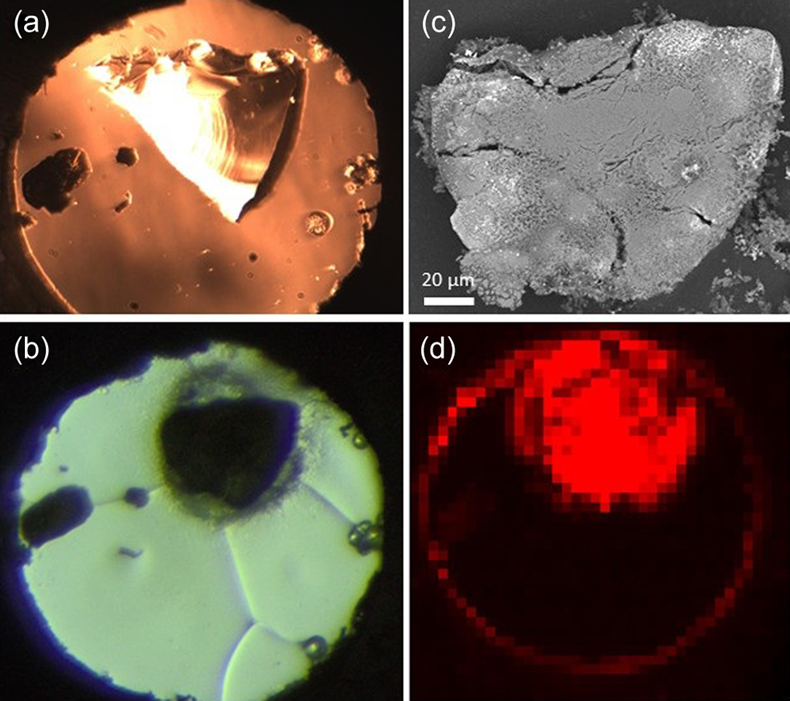
Figure 1 Experiment HAKA (see Table 1) performed at 0.89 GPa, 1391 °C in CO2. (a) Optical photograph of the starting DAC sample chamber showing the I-bearing basaltic glass loaded in CO2 with ruby spheres and a piece of gold. The diameter of the sample chamber is 500 μm. (b) Optical photograph of the same DAC after laser heating, showing the laser spot (in dark) and CO2 at the solid state at 0.89 GPa, room temperature. (c) SEM image of the quenched glass ex situ after the experiment. The hot spot is at the centre of the piece of glass which was totally melted at the centre and partly crystallised at the rims. (d) In situ SXRF mapping of iodine (red) in the closed DAC at room T, 0.89 GPa after the experiment. It shows the stronger affinity of iodine for the basalt (red) than for the CO2 fluid (black).
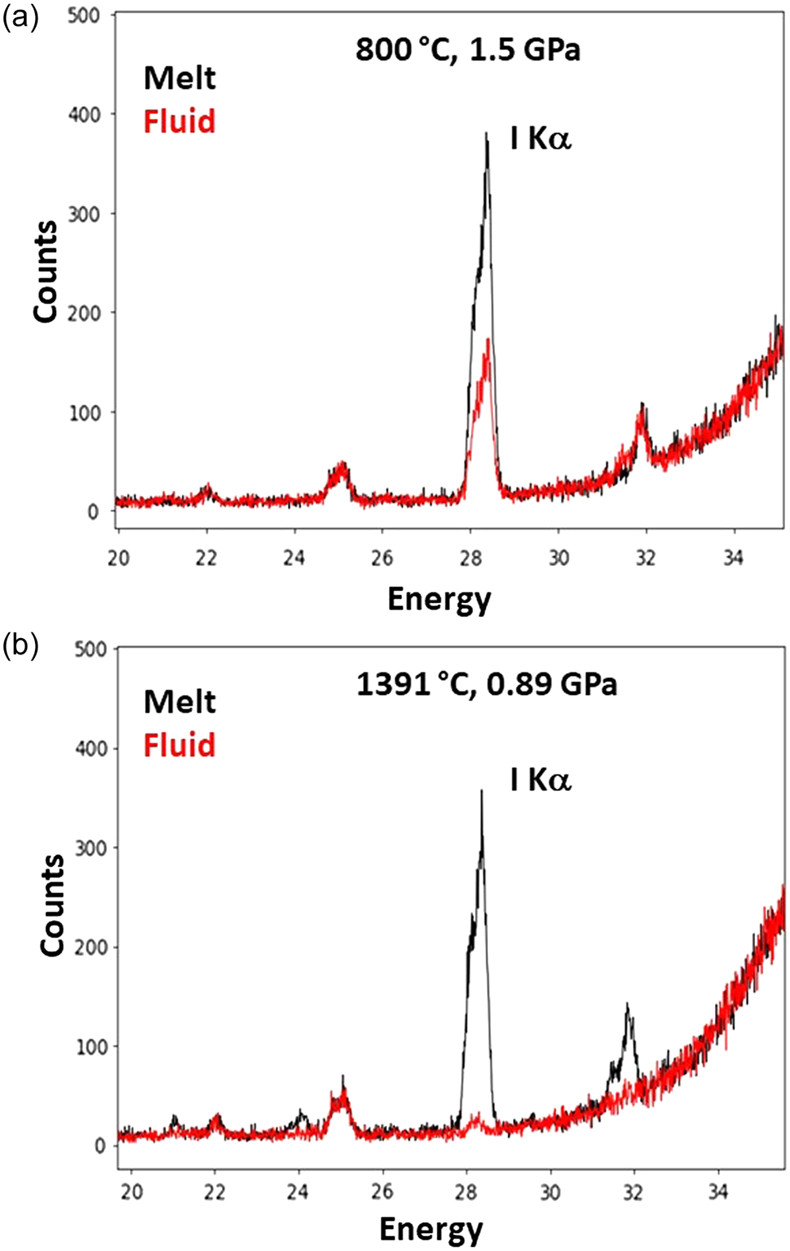
Figure 2 In situ SXRF Spectra for experiments (a) LN2 (hydrous) and (b) HAKA (anhydrous, CO2). The red spectrum is corresponding to the fluid (H2O or CO2) and the dark one is corresponding to the basaltic melt. In both cases laser heating is performed in the basaltic melt to avoid the presence of crystals. The analysis is performed at HP and HT conditions in both phases with a 2 × 2 μm beam that allows analysis of only the desired phase without contamination. HPHT Spectra show that iodine has a strong affinity for the aqueous fluid whereas it remains in the melt when the fluid is CO2.
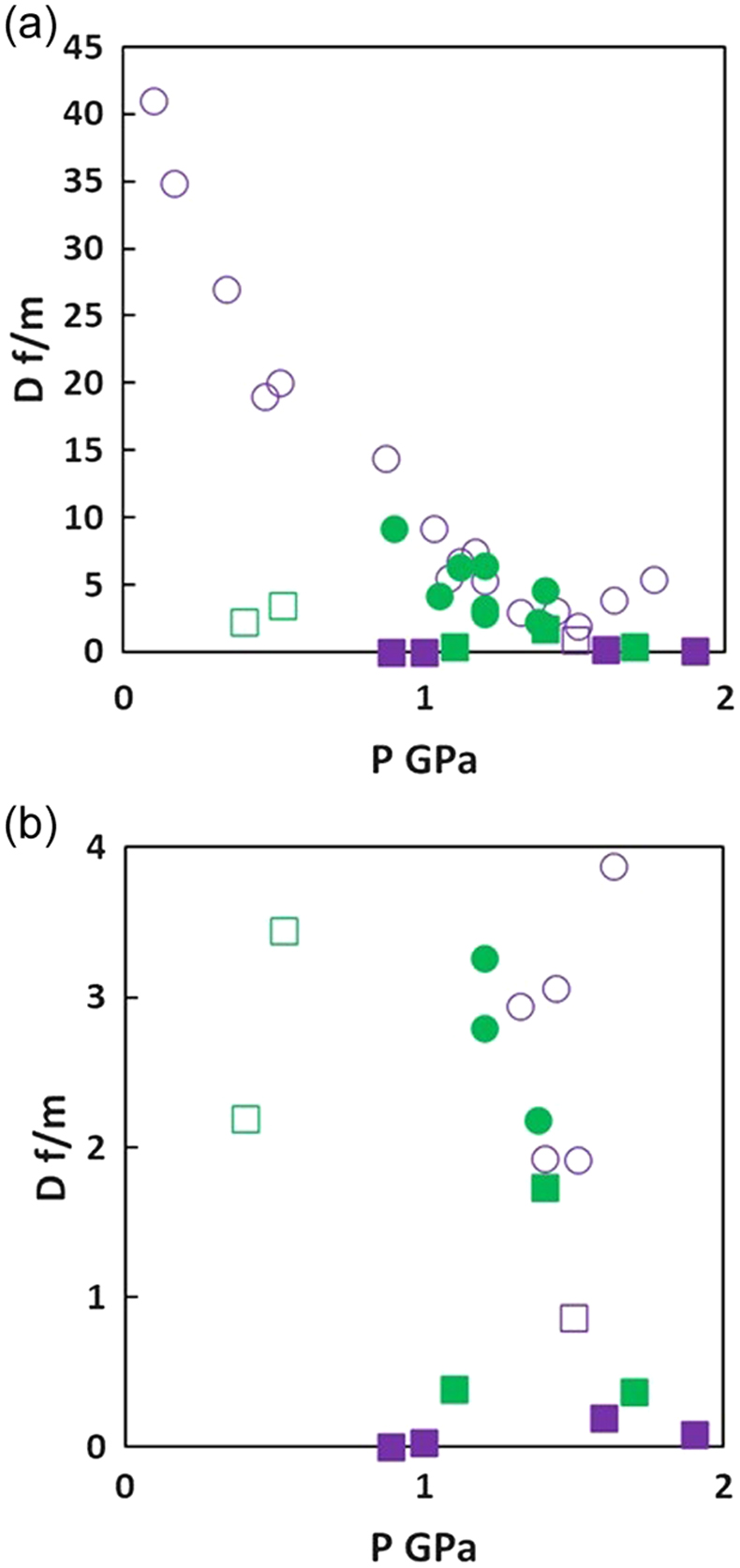
Figure 3 (a) Partition coefficients (±20 % rel) of iodine (purple) and bromine (green) determined in situ between melts and fluids (H2O, CO2 for iodine; H2O, neon for bromine) in diamond anvil cells versus pressure (± 0.2 GPa) and (b) zoomed in on low coefficients. Round symbols are for haplogranite melts (i.e. crustal melts, only in water): bold green circles are for bromine, open purple circles are for iodine. Square symbols are for natural basaltic melts. Bold squares are for CO2 (iodine) or neon (analogue for CO2, bromine) fluids. Open squares are for H2O fluids. Maximum error bars are shown with the upper right crosses. Data are from this study (basaltic melts), Bureau et al. (2010
Bureau, H., Foy, E., Raepsaet, C., Somogyi, A., Munsch, P., Simon, G., Kubsky, S. (2010) Bromine cycle in subduction zones through in situ Br monitoring in diamond anvil cells. Geochimica et Cosmochimica Acta 74, 3839–3850. https://doi.org/10.1016/j.gca.2010.04.001
, 2016Bureau, H., Auzende, A.-L., Marocchi, M., Raepsaet, C., Munsch, P., Testemale, D., Mézouar, M., Kubsky, S., Carrière, M., Ricolleau, A., Fiquet, G. (2016) Modern and past volcanic degassing of iodine. Geochimica et Cosmochimica Acta 173, 114–125. https://doi.org/10.1016/j.gca.2015.10.017
; bromine and iodine in crustal melts, respectively) and Grützner et al. (2024Grützner, T., Bureau, H., Boulard, E., Munsch, P., Guignot, N., Siebert, J., Guarnelli, Y. (2024) An in-situ experimental HP/HT study on bromine release from a natural basalt. Chemical Geology 644, 121869. https://doi.org/10.1016/j.chemgeo.2023.121869
; bromine in basaltic melts). The data highlight the crucial dependence of heavy halogens distribution on fluid phase composition, with a stronger affinity to aqueous fluids than for CO2 or neon as CO2 analogue in Grützner et al. (2024)Grützner, T., Bureau, H., Boulard, E., Munsch, P., Guignot, N., Siebert, J., Guarnelli, Y. (2024) An in-situ experimental HP/HT study on bromine release from a natural basalt. Chemical Geology 644, 121869. https://doi.org/10.1016/j.chemgeo.2023.121869
, the high partition coefficient for bromine (1.73) is due to the total dehydration of the hydrous basaltic glass, as shown by the presence of bromine-rich water droplets.