



K, Rb, Ge, and Cu isotopes in Oued Chebeika 002 compared with CI chondrites, Ryugu, and Bennu
Affiliations | Corresponding Author | Cite as | Funding information
Published by the European Association of Geochemistry
under Creative Commons License CC BY-NC-ND 4.0
Keywords: CI chondrites, moderately volatile elements, isotope geochemistry, aqueous alteration


- Share this article


-
Article views:881Cumulative count of HTML views and PDF downloads.
- Download Citation
- Rights & Permissions

top
Abstract
Figures and Tables
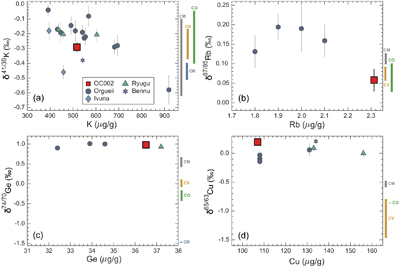 Figure 1 Isotopic compositions versus concentrations for (a) K, (b) Rb, (c) Ge, and (d) Cu in OC002, other CI chondrites, Ryugu, and Bennu. OC002 exhibits light δ41/39K and δ87/85Rb relative to other CI chondrites and Ryugu, while the δ74/70Ge and δ65/63Cu fall within the CI-Ryugu field. On the right side of each plot, the ranges of isotopic compositions for other carbonaceous chondrite groups are shown for comparison. OC002 data from this study; literature data from Wang and Jacobsen (2016), Pringle and Moynier (2017), Ku and Jacobsen (2020), Nie et al. (2021), Koefoed et al. (2023), Paquet et al. (2023), Hu et al. (2024), Barnes et al. (2025), Luais and Florin (2025), Wölfer et al. (2025a,b). Error bars represent 2 s.d. or 95 % c.i.; where not visible, they are smaller than the symbol size. | 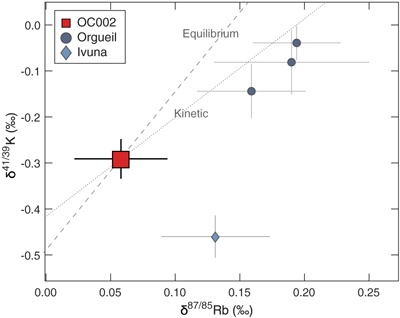 Figure 2 Coupled δ41/39K and δ87/85Rb for CI chondrites with paired measurements from the same aliquots. OC002 (this study), Orgueil and Ivuna data from Pringle and Moynier (2017), Nie et al. (2021), and Hu et al. (2024). OC002 and Orgueil define a positive correlation consistent with fluid mediated alkali fractionation; Ivuna plots off this trend. Dashed and dotted lines represent slopes predicted δ41/39K/δ87/85Rb slopes for equilibrium fractionation (3.5) and kinetic fractionation due to diffusion in water (2.2), respectively (Zeng et al., 2019). Error bars represent 2 s.d. or 95 % c.i. | 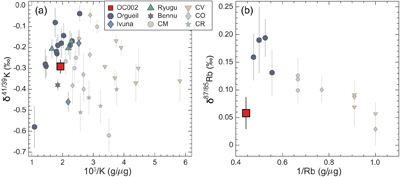 Figure 3 Isotopic compositions versus inverse concentrations for (a) K and (b) Rb in carbonaceous chondrites. The range of δ41/39K and δ87/85Rb in CI chondrites (including OC002) spans nearly the total variation observed across other carbonaceous chondrite groups. Data sources are in Figure 1. |  Table 1 Isotopic compositions and concentrations of K, Rb, Ge, and Cu. |
| Figure 1 | Figure 2 | Figure 3 | Table 1 |
top
Introduction
Ivuna-type (CI) chondrites are the most chemically primitive meteorites, with elemental abundances matching solar photosphere values for all but the most volatile elements (Lodders, 2003
Lodders, K. (2003) Solar System Abundances and Condensation Temperatures of the Elements. The Astrophysical Journal 591, 1220–1247. https://doi.org/10.1086/375492
). However, this chemical primitiveness belies a complex alteration history: CI chondrites are derived from ice-rich planetesimals which underwent pervasive aqueous alteration, which can produce isotopic heterogeneity within the parent body (Hu et al., 2024Hu, Y., Moynier, F., Dai, W., Paquet, M., Yokoyama, T., et al. (2024) Pervasive aqueous alteration in the early Solar System revealed by potassium isotopic variations in Ryugu samples and carbonaceous chondrites. Icarus 409, 115884. https://doi.org/10.1016/j.icarus.2023.115884
; Barnes et al., 2025Barnes, J.J., Nguyen, A.N., Abernethy, F.A.J., Bajo, K., Bekaert, D.V., et al. (2025) The variety and origin of materials accreted by Bennu’s parent asteroid. Nature Astronomy 9, 1785–1802. https://doi.org/10.1038/s41550-025-02631-6
) and likely renders efforts to define the primordial isotopic composition of the CI group prone to sampling bias. This heterogeneity is particularly consequential for the mass dependent isotopic compositions of moderately volatile elements (MVEs; 50 % condensation temperatures between ∼1300 and 650 K). Chondrule-free CI chondrites represent the isotopically “heavy” end member relative to other carbonaceous chondrites, which are mixtures of a CI-like matrix and isotopically light chondrules (Nie et al., 2021Nie, N.X., Chen, X.-Y., Hopp, T., Hu, J.Y., Zhang, Z.J., Teng, F.-Z., Shahar, A., Dauphas, N. (2021) Imprint of chondrule formation on the K and Rb isotopic compositions of carbonaceous meteorites. Science Advances 7, eabl3929. https://doi.org/10.1126/sciadv.abl3929
; Zhang and Grewal, 2026Zhang, Z., Grewal, D.S. (2026) A re-assessment of moderately volatile elements in the non-matrix component of carbonaceous chondrites. Icarus 452, 117049. https://doi.org/10.1016/j.icarus.2026.117049
). Since CI values are used as the matrix end member to constrain the MVE isotopic composition of the chondrule component, any internal variability in CI chondrites directly propagates into uncertainty in the calculated chondrule composition. Yet the extent of this variability, and whether it reflects parent body aqueous alteration, terrestrial weathering, or both, remains poorly constrained.Among MVEs, K, Rb, Ge, and Cu isotopes have been critical for constraining chondrule formation conditions (Nie et al., 2021
Nie, N.X., Chen, X.-Y., Hopp, T., Hu, J.Y., Zhang, Z.J., Teng, F.-Z., Shahar, A., Dauphas, N. (2021) Imprint of chondrule formation on the K and Rb isotopic compositions of carbonaceous meteorites. Science Advances 7, eabl3929. https://doi.org/10.1126/sciadv.abl3929
; Zhang and Grewal, 2026Zhang, Z., Grewal, D.S. (2026) A re-assessment of moderately volatile elements in the non-matrix component of carbonaceous chondrites. Icarus 452, 117049. https://doi.org/10.1016/j.icarus.2026.117049
), yet they record distinct aspects of parent body processing due to their differing geochemical affinities. Lithophile K and Rb are highly fluid mobile and thus sensitive to aqueous alteration (Pringle and Moynier, 2017Pringle, E.A., Moynier, F. (2017) Rubidium isotopic composition of the Earth, meteorites, and the Moon: Evidence for the origin of volatile loss during planetary accretion. Earth and Planetary Science Letters 473, 62–70. https://doi.org/10.1016/j.epsl.2017.05.033
; Koefoed et al., 2023Koefoed, P., Barrat, J.-A., Pravdivtseva, O., Alexander, C.M.O’D., Lodders, K., Ogliore, R., Wang, K. (王昆) (2023) The potassium isotopic composition of CI chondrites and the origin of isotopic variations among primitive planetary bodies. Geochimica et Cosmochimica Acta 358, 49–60. https://doi.org/10.1016/j.gca.2023.07.025
; Nie et al., 2023Nie, N.X., Chen, X.-Y., Zhang, Z.J., Hu, J.Y., Liu, W., Tissot, F.L.H., Teng, F.-Z., Shahar, A., Dauphas, N. (2023) Rubidium and potassium isotopic variations in chondrites and Mars: Accretion signatures and planetary overprints. Geochimica et Cosmochimica Acta 344, 207–229. https://doi.org/10.1016/j.gca.2023.01.004
; Hu et al., 2024Hu, Y., Moynier, F., Dai, W., Paquet, M., Yokoyama, T., et al. (2024) Pervasive aqueous alteration in the early Solar System revealed by potassium isotopic variations in Ryugu samples and carbonaceous chondrites. Icarus 409, 115884. https://doi.org/10.1016/j.icarus.2023.115884
; Barnes et al., 2025Barnes, J.J., Nguyen, A.N., Abernethy, F.A.J., Bajo, K., Bekaert, D.V., et al. (2025) The variety and origin of materials accreted by Bennu’s parent asteroid. Nature Astronomy 9, 1785–1802. https://doi.org/10.1038/s41550-025-02631-6
), whereas siderophile Ge and chalcophile Cu are hosted in phases less susceptible to fluid mobilisation (Luck et al., 2005Luck, J.-M., Othman, D.B., Albarède, F. (2005) Zn and Cu isotopic variations in chondrites and iron meteorites: Early solar nebula reservoirs and parent-body processes. Geochimica et Cosmochimica Acta 69, 5351–5363. https://doi.org/10.1016/j.gca.2005.06.018
; Barnes et al., 2025Barnes, J.J., Nguyen, A.N., Abernethy, F.A.J., Bajo, K., Bekaert, D.V., et al. (2025) The variety and origin of materials accreted by Bennu’s parent asteroid. Nature Astronomy 9, 1785–1802. https://doi.org/10.1038/s41550-025-02631-6
; Luais and Florin, 2025Luais, B., Florin, G. (2025) Origin of the mass-dependent germanium isotopic continuum in the early Solar System. Earth and Planetary Science Letters 672, 119663. https://doi.org/10.1016/j.epsl.2025.119663
; Wölfer et al., 2025aWölfer, E., Burkhardt, C., Nimmo, F., Kleine, T. (2025a) Origin of moderately volatile elements in Earth inferred from mass-dependent Ge isotope variations among chondrites. Earth and Planetary Science Letters 663, 119435. https://doi.org/10.1016/j.epsl.2025.119435
). Such contrasting behaviours mean these isotopic systems respond differently to aqueous alteration; however, distinguishing parent body effects from terrestrial weathering in historical falls like Orgueil (1864) and Ivuna (1938), which may have experienced alteration during prolonged storage, remains challenging. For instance, δ41/39K values in Orgueil span from −0.581 to −0.039 ‰ (Wang and Jacobsen, 2016Wang, K., Jacobsen, S.B. (2016) Potassium isotopic evidence for a high-energy giant impact origin of the Moon. Nature 538, 487–490. https://doi.org/10.1038/nature19341
; Ku and Jacobsen, 2020Ku, Y., Jacobsen, S.B. (2020) Potassium isotope anomalies in meteorites inherited from the protosolar molecular cloud. Science Advances 6, eabd0511. https://doi.org/10.1126/sciadv.abd0511
; Nie et al., 2021Nie, N.X., Chen, X.-Y., Hopp, T., Hu, J.Y., Zhang, Z.J., Teng, F.-Z., Shahar, A., Dauphas, N. (2021) Imprint of chondrule formation on the K and Rb isotopic compositions of carbonaceous meteorites. Science Advances 7, eabl3929. https://doi.org/10.1126/sciadv.abl3929
; Koefoed et al., 2023Koefoed, P., Barrat, J.-A., Pravdivtseva, O., Alexander, C.M.O’D., Lodders, K., Ogliore, R., Wang, K. (王昆) (2023) The potassium isotopic composition of CI chondrites and the origin of isotopic variations among primitive planetary bodies. Geochimica et Cosmochimica Acta 358, 49–60. https://doi.org/10.1016/j.gca.2023.07.025
) (Fig. 1a), and Ivuna shows a similarly broad range of −0.460 to −0.180 ‰ (Nie et al., 2021Nie, N.X., Chen, X.-Y., Hopp, T., Hu, J.Y., Zhang, Z.J., Teng, F.-Z., Shahar, A., Dauphas, N. (2021) Imprint of chondrule formation on the K and Rb isotopic compositions of carbonaceous meteorites. Science Advances 7, eabl3929. https://doi.org/10.1126/sciadv.abl3929
; Koefoed et al., 2023Koefoed, P., Barrat, J.-A., Pravdivtseva, O., Alexander, C.M.O’D., Lodders, K., Ogliore, R., Wang, K. (王昆) (2023) The potassium isotopic composition of CI chondrites and the origin of isotopic variations among primitive planetary bodies. Geochimica et Cosmochimica Acta 358, 49–60. https://doi.org/10.1016/j.gca.2023.07.025
) (Fig. 1a). In contrast, Ryugu samples define a narrower and heavier range (−0.207 ‰ to −0.172 ‰; Hu et al., 2024Hu, Y., Moynier, F., Dai, W., Paquet, M., Yokoyama, T., et al. (2024) Pervasive aqueous alteration in the early Solar System revealed by potassium isotopic variations in Ryugu samples and carbonaceous chondrites. Icarus 409, 115884. https://doi.org/10.1016/j.icarus.2023.115884
), while Bennu yields a lighter value of −0.380 ± 0.026 ‰ (Barnes et al., 2025Barnes, J.J., Nguyen, A.N., Abernethy, F.A.J., Bajo, K., Bekaert, D.V., et al. (2025) The variety and origin of materials accreted by Bennu’s parent asteroid. Nature Astronomy 9, 1785–1802. https://doi.org/10.1038/s41550-025-02631-6
). The situation is even more poorly constrained for Rb isotopes, where data exist only for Orgueil and Ivuna (Pringle and Moynier, 2017Pringle, E.A., Moynier, F. (2017) Rubidium isotopic composition of the Earth, meteorites, and the Moon: Evidence for the origin of volatile loss during planetary accretion. Earth and Planetary Science Letters 473, 62–70. https://doi.org/10.1016/j.epsl.2017.05.033
; Nie et al., 2021Nie, N.X., Chen, X.-Y., Hopp, T., Hu, J.Y., Zhang, Z.J., Teng, F.-Z., Shahar, A., Dauphas, N. (2021) Imprint of chondrule formation on the K and Rb isotopic compositions of carbonaceous meteorites. Science Advances 7, eabl3929. https://doi.org/10.1126/sciadv.abl3929
) (Fig. 1b), with no measurements for Ryugu or Bennu. Whether this variability among CI-like materials reflects aqueous alteration on their parent bodies or, in the case of historical meteorite falls, remobilisation during terrestrial residence remains unclear. Constraining the MVE isotopic compositions of additional pristine CI samples is therefore critical.Figure 1 Isotopic compositions versus concentrations for (a) K, (b) Rb, (c) Ge, and (d) Cu in OC002, other CI chondrites, Ryugu, and Bennu. OC002 exhibits light δ41/39K and δ87/85Rb relative to other CI chondrites and Ryugu, while the δ74/70Ge and δ65/63Cu fall within the CI-Ryugu field. On the right side of each plot, the ranges of isotopic compositions for other carbonaceous chondrite groups are shown for comparison. OC002 data from this study; literature data from Wang and Jacobsen (2016)
Wang, K., Jacobsen, S.B. (2016) Potassium isotopic evidence for a high-energy giant impact origin of the Moon. Nature 538, 487–490. https://doi.org/10.1038/nature19341
, Pringle and Moynier (2017)Pringle, E.A., Moynier, F. (2017) Rubidium isotopic composition of the Earth, meteorites, and the Moon: Evidence for the origin of volatile loss during planetary accretion. Earth and Planetary Science Letters 473, 62–70. https://doi.org/10.1016/j.epsl.2017.05.033
, Ku and Jacobsen (2020)Ku, Y., Jacobsen, S.B. (2020) Potassium isotope anomalies in meteorites inherited from the protosolar molecular cloud. Science Advances 6, eabd0511. https://doi.org/10.1126/sciadv.abd0511
, Nie et al. (2021)Nie, N.X., Chen, X.-Y., Hopp, T., Hu, J.Y., Zhang, Z.J., Teng, F.-Z., Shahar, A., Dauphas, N. (2021) Imprint of chondrule formation on the K and Rb isotopic compositions of carbonaceous meteorites. Science Advances 7, eabl3929. https://doi.org/10.1126/sciadv.abl3929
, Koefoed et al. (2023)Koefoed, P., Barrat, J.-A., Pravdivtseva, O., Alexander, C.M.O’D., Lodders, K., Ogliore, R., Wang, K. (王昆) (2023) The potassium isotopic composition of CI chondrites and the origin of isotopic variations among primitive planetary bodies. Geochimica et Cosmochimica Acta 358, 49–60. https://doi.org/10.1016/j.gca.2023.07.025
, Paquet et al. (2023)Paquet, M., Moynier, F., Yokoyama, T., Dai, W., Hu, Y., et al. (2023) Contribution of Ryugu-like material to Earth’s volatile inventory by Cu and Zn isotopic analysis. Nature Astronomy 7, 182–189. https://doi.org/10.1038/s41550-022-01846-1
, Hu et al. (2024)Hu, Y., Moynier, F., Dai, W., Paquet, M., Yokoyama, T., et al. (2024) Pervasive aqueous alteration in the early Solar System revealed by potassium isotopic variations in Ryugu samples and carbonaceous chondrites. Icarus 409, 115884. https://doi.org/10.1016/j.icarus.2023.115884
, Barnes et al. (2025)Barnes, J.J., Nguyen, A.N., Abernethy, F.A.J., Bajo, K., Bekaert, D.V., et al. (2025) The variety and origin of materials accreted by Bennu’s parent asteroid. Nature Astronomy 9, 1785–1802. https://doi.org/10.1038/s41550-025-02631-6
, Luais and Florin (2025)Luais, B., Florin, G. (2025) Origin of the mass-dependent germanium isotopic continuum in the early Solar System. Earth and Planetary Science Letters 672, 119663. https://doi.org/10.1016/j.epsl.2025.119663
, Wölfer et al. (2025aWölfer, E., Burkhardt, C., Nimmo, F., Kleine, T. (2025a) Origin of moderately volatile elements in Earth inferred from mass-dependent Ge isotope variations among chondrites. Earth and Planetary Science Letters 663, 119435. https://doi.org/10.1016/j.epsl.2025.119435
,b)Wölfer, E., Hellmann, J.L., Burkhardt, C., Kleine, T. (2025b) Ge, Te, and Zn isotopic link between Ryugu and CI chondrites. Geochemical Perspectives Letters 37, 1–6. https://doi.org/10.7185/geochemlet.2537
. Error bars represent 2 s.d. or 95 % c.i.; where not visible, they are smaller than the symbol size.The discovery of Oued Chebeika 002 (OC002) in Morocco in 2024 provides an excellent opportunity to address these uncertainties. Recovered shortly after falling in a hot desert, OC002 has experienced negligible terrestrial weathering, making it comparable to samples returned from asteroids Ryugu and Bennu (Gattacceca et al., 2025
Gattacceca, J., Gounelle, M., Devouard, B., Barrat, J.-A., Bonal, L., et al. (2025) Oued Chebeika 002: A new CI1 meteorite linked to outer solar system bodies. Meteoritics & Planetary Science 60, 1441–1479. https://doi.org/10.1111/maps.14359
; Zhu et al., 2025Zhu, K. (朱柯), Dai, B., Cao, X., Tian, S., Chen, L. (2025) O–Fe–Ti isotopic evidence for classifying Oued Chebeika 002 as a CI chondrite and its genetic affinities with CY chondrites, Ryugu, and Bennu. Monthly Notices of the Royal Astronomical Society: Letters 542, L7–L11. https://doi.org/10.1093/mnrasl/slaf059
). Here, we report K, Rb, Ge, and Cu isotopic compositions of OC002 and compare them with other CI chondrites to evaluate (1) the extent of isotopic heterogeneity among CI chondrites, and (2) its implications for constraining the chondrule component using CI end member compositions.top
Samples and Methods
A ∼260 mg aliquot of OC002 was purchased from the same batch of mm sized fragments analysed by Gattacceca et al. (2025)
Gattacceca, J., Gounelle, M., Devouard, B., Barrat, J.-A., Bonal, L., et al. (2025) Oued Chebeika 002: A new CI1 meteorite linked to outer solar system bodies. Meteoritics & Planetary Science 60, 1441–1479. https://doi.org/10.1111/maps.14359
. Given the broadly homogeneous bulk elemental composition of CI chondrites at the mg scale, separate aliquots were used for Ge and K + Rb + Cu isotope systems at different laboratories. ∼200 mg was allocated for Ge isotope and chemical composition analyses at Université de Lorraine. The remaining material was homogenised, after which ∼50 mg was used for K and Rb isotope analyses at MIT, and ∼4 mg was used for Cu isotope analyses at UCLA. Sample digestion, chemical separation, and isotope measurements followed established procedures [(K, Rb: Nie et al., 2021Nie, N.X., Chen, X.-Y., Hopp, T., Hu, J.Y., Zhang, Z.J., Teng, F.-Z., Shahar, A., Dauphas, N. (2021) Imprint of chondrule formation on the K and Rb isotopic compositions of carbonaceous meteorites. Science Advances 7, eabl3929. https://doi.org/10.1126/sciadv.abl3929
; Zhang et al., 2025Zhang, Z.J., Nie, N.X., Lin, C.Z. (2025) Potassium and rubidium isotopic analysis using Neoma MC-ICPMS with the collision/reaction cell. Journal of Analytical Atomic Spectrometry 40, 2945–2956. https://doi.org/10.1039/D5JA00189G
); (Ge: Luais, 2012Luais, B. (2012) Germanium chemistry and MC-ICPMS isotopic measurements of Fe–Ni, Zn alloys and silicate matrices: Insights into deep Earth processes. Chemical Geology 334, 295–311. https://doi.org/10.1016/j.chemgeo.2012.10.017
; Luais and Florin, 2025Luais, B., Florin, G. (2025) Origin of the mass-dependent germanium isotopic continuum in the early Solar System. Earth and Planetary Science Letters 672, 119663. https://doi.org/10.1016/j.epsl.2025.119663
; Ahmad et al., 2026Ahmad, Q., Cividini, D., Luais, B. (2026) A fast double-stack chromatographic separation of germanium from silicate material for isotope analysis with MC-ICP-MS. Journal of Analytical Atomic Spectrometry 41, 935–941. https://doi.org/10.1039/D5JA00471C
); (Cu: Ni et al., 2021Ni, P. (倪鹏), Macris, C.A., Darling, E.A., Shahar, A. (2021) Evaporation-induced copper isotope fractionation: Insights from laser levitation experiments. Geochimica et Cosmochimica Acta 298, 131–148. https://doi.org/10.1016/j.gca.2021.02.007
)], with details provided in Supplementary Information. Isotopic compositions are reported in delta notation (‰) relative to certified standards (SRM 999c for K, SRM 984 for Rb, NIST SRM 3120a for Ge, and SRM 976 for Cu). Uncertainties are 95 % confidence intervals (c.i.) based on repeated measurements (n = 5–7) of each sample solution, assuming a Student’s t distribution. Major and trace element compositions are reported in Table S-1.Table 1 Isotopic compositions and concentrations of K, Rb, Ge, and Cu.
| δ (‰) | Count | 2 s.d. | c.i. (95 %) | Concentration (μg/g) | |
| 41/39 K | −0.291 | 6 | 0.082 | 0.043 | 525 |
| 87/85 Rb | 0.058 | 7 | 0.078 | 0.036 | 2.3 |
| 74/70 Ge | 0.980 | 5 | 0.067 | 0.042 | 36.5 |
| 65/63 Cu | 0.197 | 6 | 0.038 | 0.020 | 107 |
top
Results
The K, Rb, Ge, and Cu concentrations and isotopic compositions of OC002 are reported in Table 1. OC002 yields δ41/39K of −0.291 ± 0.043 ‰, lower than the Ryugu mean (−0.194 ± 0.038 ‰; Hu et al., 2024
Hu, Y., Moynier, F., Dai, W., Paquet, M., Yokoyama, T., et al. (2024) Pervasive aqueous alteration in the early Solar System revealed by potassium isotopic variations in Ryugu samples and carbonaceous chondrites. Icarus 409, 115884. https://doi.org/10.1016/j.icarus.2023.115884
), and the heavier Orgueil values (−0.183 to −0.039 ‰; Ku and Jacobsen, 2020Ku, Y., Jacobsen, S.B. (2020) Potassium isotope anomalies in meteorites inherited from the protosolar molecular cloud. Science Advances 6, eabd0511. https://doi.org/10.1126/sciadv.abd0511
; Nie et al., 2021Nie, N.X., Chen, X.-Y., Hopp, T., Hu, J.Y., Zhang, Z.J., Teng, F.-Z., Shahar, A., Dauphas, N. (2021) Imprint of chondrule formation on the K and Rb isotopic compositions of carbonaceous meteorites. Science Advances 7, eabl3929. https://doi.org/10.1126/sciadv.abl3929
; Koefoed et al., 2023Koefoed, P., Barrat, J.-A., Pravdivtseva, O., Alexander, C.M.O’D., Lodders, K., Ogliore, R., Wang, K. (王昆) (2023) The potassium isotopic composition of CI chondrites and the origin of isotopic variations among primitive planetary bodies. Geochimica et Cosmochimica Acta 358, 49–60. https://doi.org/10.1016/j.gca.2023.07.025
; Hu et al., 2024Hu, Y., Moynier, F., Dai, W., Paquet, M., Yokoyama, T., et al. (2024) Pervasive aqueous alteration in the early Solar System revealed by potassium isotopic variations in Ryugu samples and carbonaceous chondrites. Icarus 409, 115884. https://doi.org/10.1016/j.icarus.2023.115884
), but comparable to the lighter Orgueil measurements (−0.29 to −0.28 ‰; Koefoed et al., 2023Koefoed, P., Barrat, J.-A., Pravdivtseva, O., Alexander, C.M.O’D., Lodders, K., Ogliore, R., Wang, K. (王昆) (2023) The potassium isotopic composition of CI chondrites and the origin of isotopic variations among primitive planetary bodies. Geochimica et Cosmochimica Acta 358, 49–60. https://doi.org/10.1016/j.gca.2023.07.025
) and Bennu (−0.380 ± 0.026 ‰; Barnes et al., 2025Barnes, J.J., Nguyen, A.N., Abernethy, F.A.J., Bajo, K., Bekaert, D.V., et al. (2025) The variety and origin of materials accreted by Bennu’s parent asteroid. Nature Astronomy 9, 1785–1802. https://doi.org/10.1038/s41550-025-02631-6
) (Fig. 1a). OC002 is heavier than both the lightest Ivuna (−0.460 ± 0.046 ‰; Nie et al., 2021Nie, N.X., Chen, X.-Y., Hopp, T., Hu, J.Y., Zhang, Z.J., Teng, F.-Z., Shahar, A., Dauphas, N. (2021) Imprint of chondrule formation on the K and Rb isotopic compositions of carbonaceous meteorites. Science Advances 7, eabl3929. https://doi.org/10.1126/sciadv.abl3929
) and Orgueil (−0.581 ± 0.097 ‰; Wang and Jacobsen, 2016Wang, K., Jacobsen, S.B. (2016) Potassium isotopic evidence for a high-energy giant impact origin of the Moon. Nature 538, 487–490. https://doi.org/10.1038/nature19341
) values. The δ87/85Rb of OC002 is +0.058 ± 0.036 ‰, lower than Ivuna (+0.131 ± 0.042 ‰; Nie et al., 2021Nie, N.X., Chen, X.-Y., Hopp, T., Hu, J.Y., Zhang, Z.J., Teng, F.-Z., Shahar, A., Dauphas, N. (2021) Imprint of chondrule formation on the K and Rb isotopic compositions of carbonaceous meteorites. Science Advances 7, eabl3929. https://doi.org/10.1126/sciadv.abl3929
) and Orgueil (+0.159 to +0.194 ‰; Nie et al., 2021Nie, N.X., Chen, X.-Y., Hopp, T., Hu, J.Y., Zhang, Z.J., Teng, F.-Z., Shahar, A., Dauphas, N. (2021) Imprint of chondrule formation on the K and Rb isotopic compositions of carbonaceous meteorites. Science Advances 7, eabl3929. https://doi.org/10.1126/sciadv.abl3929
; Pringle and Moynier, 2017Pringle, E.A., Moynier, F. (2017) Rubidium isotopic composition of the Earth, meteorites, and the Moon: Evidence for the origin of volatile loss during planetary accretion. Earth and Planetary Science Letters 473, 62–70. https://doi.org/10.1016/j.epsl.2017.05.033
), representing the lightest Rb isotopic composition yet measured in a CI chondrite (Fig. 1b). In contrast, the Cu and Ge isotopic compositions of OC002 closely match those of other CI chondrites and Ryugu (Fig. 1c,d). The δ74/70Ge value (+0.980 ± 0.042 ‰) falls within the CI-Ryugu range (+0.901 to +1.010 ‰; Luais and Florin, 2025Luais, B., Florin, G. (2025) Origin of the mass-dependent germanium isotopic continuum in the early Solar System. Earth and Planetary Science Letters 672, 119663. https://doi.org/10.1016/j.epsl.2025.119663
; Wölfer et al., 2025aWölfer, E., Burkhardt, C., Nimmo, F., Kleine, T. (2025a) Origin of moderately volatile elements in Earth inferred from mass-dependent Ge isotope variations among chondrites. Earth and Planetary Science Letters 663, 119435. https://doi.org/10.1016/j.epsl.2025.119435
,b)Wölfer, E., Hellmann, J.L., Burkhardt, C., Kleine, T. (2025b) Ge, Te, and Zn isotopic link between Ryugu and CI chondrites. Geochemical Perspectives Letters 37, 1–6. https://doi.org/10.7185/geochemlet.2537
. The δ65/63Cu (+0.197 ± 0.020 ‰) is comparable to Bennu (+0.209 ± 0.015 ‰; Barnes et al., 2025Barnes, J.J., Nguyen, A.N., Abernethy, F.A.J., Bajo, K., Bekaert, D.V., et al. (2025) The variety and origin of materials accreted by Bennu’s parent asteroid. Nature Astronomy 9, 1785–1802. https://doi.org/10.1038/s41550-025-02631-6
) and Alais (+0.17 ± 0.03 ‰; Paquet et al., 2023Paquet, M., Moynier, F., Yokoyama, T., Dai, W., Hu, Y., et al. (2023) Contribution of Ryugu-like material to Earth’s volatile inventory by Cu and Zn isotopic analysis. Nature Astronomy 7, 182–189. https://doi.org/10.1038/s41550-022-01846-1
), lying at the upper end of the CI-Ryugu range (−0.09 to +0.17 ‰; Luck et al., 2005Luck, J.-M., Othman, D.B., Albarède, F. (2005) Zn and Cu isotopic variations in chondrites and iron meteorites: Early solar nebula reservoirs and parent-body processes. Geochimica et Cosmochimica Acta 69, 5351–5363. https://doi.org/10.1016/j.gca.2005.06.018
; Paquet et al., 2023Paquet, M., Moynier, F., Yokoyama, T., Dai, W., Hu, Y., et al. (2023) Contribution of Ryugu-like material to Earth’s volatile inventory by Cu and Zn isotopic analysis. Nature Astronomy 7, 182–189. https://doi.org/10.1038/s41550-022-01846-1
).top
Discussion
OC002 reveals an element specific pattern in MVE isotopes: K and Rb are isotopically lighter relative to CI-Ryugu averages, whereas Ge and Cu remain within the CI-Ryugu field.
Because CI-like materials are essentially chondrule-free, this variability cannot be attributed to differing proportions of primordial nebular components. Instead, given that these materials are heavily aqueously altered, the coupled light isotopic signatures in both K and Rb most likely reflect selective redistribution of fluid mobile alkalis during aqueous processing on their parent bodies.
Coupled K-Rb isotopic systematics: parent body or terrestrial aqueous alteration? Among the five CI samples with paired K and Rb isotope data (Pringle and Moynier, 2017
Pringle, E.A., Moynier, F. (2017) Rubidium isotopic composition of the Earth, meteorites, and the Moon: Evidence for the origin of volatile loss during planetary accretion. Earth and Planetary Science Letters 473, 62–70. https://doi.org/10.1016/j.epsl.2017.05.033
; Nie et al., 2021Nie, N.X., Chen, X.-Y., Hopp, T., Hu, J.Y., Zhang, Z.J., Teng, F.-Z., Shahar, A., Dauphas, N. (2021) Imprint of chondrule formation on the K and Rb isotopic compositions of carbonaceous meteorites. Science Advances 7, eabl3929. https://doi.org/10.1126/sciadv.abl3929
; Hu et al., 2024Hu, Y., Moynier, F., Dai, W., Paquet, M., Yokoyama, T., et al. (2024) Pervasive aqueous alteration in the early Solar System revealed by potassium isotopic variations in Ryugu samples and carbonaceous chondrites. Icarus 409, 115884. https://doi.org/10.1016/j.icarus.2023.115884
), OC002 exhibits light δ41/39K and δ87/85Rb values, while three Orgueil samples cluster at heavier values (Fig. 2). These four samples define a positive δ41/39K-δ87/85Rb correlation, consistent with a common fractionation process affecting both alkali elements. Terrestrial weathering studies suggest that aqueous fluids preferentially incorporate heavier K isotopes relative to coexisting silicates, with apparent fractionation of up to ∼0.6 ‰ documented in weathering profiles (Chen et al., 2020Chen, H., Liu, X.-M., Wang, K. (2020) Potassium isotope fractionation during chemical weathering of basalts. Earth and Planetary Science Letters 539, 116192. https://doi.org/10.1016/j.epsl.2020.116192
) and theoretical calculations predicting ∼0.24 ‰ fractionation between aqueous K+ and clay minerals at 298 K (Zeng et al., 2019Zeng, H., Rozsa, V.F., Nie, N.X., Zhang, Z., Pham, T.A., Galli, G., Dauphas, N. (2019) Ab Initio Calculation of Equilibrium Isotopic Fractionations of Potassium and Rubidium in Minerals and Water. ACS Earth and Space Chemistry 3, 2601–2612. https://doi.org/10.1021/acsearthspacechem.9b00180
). Because K and Rb share similar ionic radii, coordination chemistry, and residence in phyllosilicate interlayer sites, Rb is expected to follow K during fluid-rock interaction (Zeng et al., 2019Zeng, H., Rozsa, V.F., Nie, N.X., Zhang, Z., Pham, T.A., Galli, G., Dauphas, N. (2019) Ab Initio Calculation of Equilibrium Isotopic Fractionations of Potassium and Rubidium in Minerals and Water. ACS Earth and Space Chemistry 3, 2601–2612. https://doi.org/10.1021/acsearthspacechem.9b00180
). The predicted equilibrium δ41/39K/δ87/85Rb slope is ∼3.5, while kinetic diffusion in water yields a slope of ∼2.2 (Zeng et al., 2019Zeng, H., Rozsa, V.F., Nie, N.X., Zhang, Z., Pham, T.A., Galli, G., Dauphas, N. (2019) Ab Initio Calculation of Equilibrium Isotopic Fractionations of Potassium and Rubidium in Minerals and Water. ACS Earth and Space Chemistry 3, 2601–2612. https://doi.org/10.1021/acsearthspacechem.9b00180
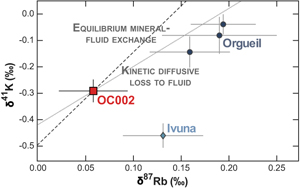
). Excluding Ivuna, OC002 and the three Orgueil samples define a slope consistent with kinetic fractionation (Fig. 2), suggesting that diffusion controlled processes, such as ion migration within phyllosilicates or at mineral-fluid interfaces, dominated alkali redistribution during aqueous alteration.Figure 2 Coupled δ41/39K and δ87/85Rb for CI chondrites with paired measurements from the same aliquots. OC002 (this study), Orgueil and Ivuna data from Pringle and Moynier (2017)
Pringle, E.A., Moynier, F. (2017) Rubidium isotopic composition of the Earth, meteorites, and the Moon: Evidence for the origin of volatile loss during planetary accretion. Earth and Planetary Science Letters 473, 62–70. https://doi.org/10.1016/j.epsl.2017.05.033
, Nie et al. (2021)Nie, N.X., Chen, X.-Y., Hopp, T., Hu, J.Y., Zhang, Z.J., Teng, F.-Z., Shahar, A., Dauphas, N. (2021) Imprint of chondrule formation on the K and Rb isotopic compositions of carbonaceous meteorites. Science Advances 7, eabl3929. https://doi.org/10.1126/sciadv.abl3929
, and Hu et al. (2024)Hu, Y., Moynier, F., Dai, W., Paquet, M., Yokoyama, T., et al. (2024) Pervasive aqueous alteration in the early Solar System revealed by potassium isotopic variations in Ryugu samples and carbonaceous chondrites. Icarus 409, 115884. https://doi.org/10.1016/j.icarus.2023.115884
. OC002 and Orgueil define a positive correlation consistent with fluid mediated alkali fractionation; Ivuna plots off this trend. Dashed and dotted lines represent slopes predicted δ41/39K/δ87/85Rb slopes for equilibrium fractionation (3.5) and kinetic fractionation due to diffusion in water (2.2), respectively (Zeng et al., 2019Zeng, H., Rozsa, V.F., Nie, N.X., Zhang, Z., Pham, T.A., Galli, G., Dauphas, N. (2019) Ab Initio Calculation of Equilibrium Isotopic Fractionations of Potassium and Rubidium in Minerals and Water. ACS Earth and Space Chemistry 3, 2601–2612. https://doi.org/10.1021/acsearthspacechem.9b00180
). Error bars represent 2 s.d. or 95 % c.i.Although the fractionation direction would be identical for both parent body and terrestrial aqueous alteration, several observations favour a parent body origin for OC002’s light K and Rb isotopic signatures. OC002 was recovered shortly after its fall and exhibits minimal terrestrial weathering, with preserved fusion crust, absence of sulfates and ferrihydrite, and mineralogy indistinguishable from Ryugu and Bennu (Gattacceca et al., 2025
Gattacceca, J., Gounelle, M., Devouard, B., Barrat, J.-A., Bonal, L., et al. (2025) Oued Chebeika 002: A new CI1 meteorite linked to outer solar system bodies. Meteoritics & Planetary Science 60, 1441–1479. https://doi.org/10.1111/maps.14359
). Bennu samples, entirely free from terrestrial weathering, yield comparably light δ41/39K (Barnes et al., 2025Barnes, J.J., Nguyen, A.N., Abernethy, F.A.J., Bajo, K., Bekaert, D.V., et al. (2025) The variety and origin of materials accreted by Bennu’s parent asteroid. Nature Astronomy 9, 1785–1802. https://doi.org/10.1038/s41550-025-02631-6
), reinforcing that such signatures are intrinsic to CI-like materials. The K and Rb abundances of OC002 fall within the normal CI range (Fig. 1a,b), consistent with parent body isotopic redistribution rather than terrestrial addition or leaching. Furthermore, the δ87/85Rb of OC002 distinguishes it from common terrestrial materials, which have much lower δ87/85Rb values (−0.23 to −0.11 ‰; Nie et al., 2021Nie, N.X., Chen, X.-Y., Hopp, T., Hu, J.Y., Zhang, Z.J., Teng, F.-Z., Shahar, A., Dauphas, N. (2021) Imprint of chondrule formation on the K and Rb isotopic compositions of carbonaceous meteorites. Science Advances 7, eabl3929. https://doi.org/10.1126/sciadv.abl3929
; Zhang et al., 2025Zhang, Z.J., Nie, N.X., Lin, C.Z. (2025) Potassium and rubidium isotopic analysis using Neoma MC-ICPMS with the collision/reaction cell. Journal of Analytical Atomic Spectrometry 40, 2945–2956. https://doi.org/10.1039/D5JA00189G
). The Ivuna sample analysed by Nie et al. (2021)Nie, N.X., Chen, X.-Y., Hopp, T., Hu, J.Y., Zhang, Z.J., Teng, F.-Z., Shahar, A., Dauphas, N. (2021) Imprint of chondrule formation on the K and Rb isotopic compositions of carbonaceous meteorites. Science Advances 7, eabl3929. https://doi.org/10.1126/sciadv.abl3929
plots off the OC002-Orgueil trend, exhibiting one of the lightest δ41/39K among all CI chondrites yet only intermediate δ87/85Rb (Fig. 2). This decoupling likely reflects either that its K and Rb isotopes were fractionated at different times or by different processes, or sampling of lithologically distinct material within the brecciated CI regolith.Constraints from Ge and Cu isotopes. The contrasting behaviour of Ge and Cu compared to K and Rb provides independent constraints on the origin of alkali isotope heterogeneity. The δ74/70Ge and δ65/63Cu values of OC002 fall within the CI-Ryugu-Bennu field despite its light K and Rb isotopic signatures. Although Ge is siderophile, CI chondrites lack metal phases due to pervasive aqueous alteration; instead, Ge substitutes for Si in the tetrahedral sites of phyllosilicates and silicates (Rouxel and Luais, 2017
Rouxel, O.J., Luais, B. (2017) Germanium Isotope Geochemistry. Reviews in Mineralogy and Geochemistry 82, 601–656. https://doi.org/10.2138/rmg.2017.82.14
), where it is structurally bound rather than exchangeable and thus essentially immobile during low temperature fluid-rock interaction. Copper, primarily hosted in sulfides, remains isotopically homogeneous at the bulk sample scale in CI chondrites, Ryugu, and Bennu (Paquet et al., 2023Paquet, M., Moynier, F., Yokoyama, T., Dai, W., Hu, Y., et al. (2023) Contribution of Ryugu-like material to Earth’s volatile inventory by Cu and Zn isotopic analysis. Nature Astronomy 7, 182–189. https://doi.org/10.1038/s41550-022-01846-1
; Barnes et al., 2025Barnes, J.J., Nguyen, A.N., Abernethy, F.A.J., Bajo, K., Bekaert, D.V., et al. (2025) The variety and origin of materials accreted by Bennu’s parent asteroid. Nature Astronomy 9, 1785–1802. https://doi.org/10.1038/s41550-025-02631-6
), likely reflecting efficient local re-equilibration. The total isotopic variations in Ge and Cu across carbonaceous chondrites are much larger than those of K and Rb (Fig. 1), possibly reflecting their higher volatility and thus more fractionated chondrule isotopic compositions (Zhang and Grewal, 2026Zhang, Z., Grewal, D.S. (2026) A re-assessment of moderately volatile elements in the non-matrix component of carbonaceous chondrites. Icarus 452, 117049. https://doi.org/10.1016/j.icarus.2026.117049
). Any isotopic effects of aqueous alteration on Ge and Cu are therefore small relative to intergroup variations.This element specific pattern – alkali isotopes variable, and Ge and Cu isotopes uniform – indicates that K and Rb isotopic heterogeneity in CI chondrites reflects selective mobilisation of elements hosted in exchangeable phyllosilicate interlayer sites rather than heterogeneous nebular inheritance. The latter would produce correlated variations across all isotope systems, which is not observed. Instead, K and Rb isotopes record parent body aqueous redistribution, while Ge and Cu were not significantly affected. This interpretation is independently supported by Barnes et al. (2025)
Barnes, J.J., Nguyen, A.N., Abernethy, F.A.J., Bajo, K., Bekaert, D.V., et al. (2025) The variety and origin of materials accreted by Bennu’s parent asteroid. Nature Astronomy 9, 1785–1802. https://doi.org/10.1038/s41550-025-02631-6
, who observed similar decoupling – variable K but uniform Cu – in Bennu samples.The challenge of constraining primordial K and Rb isotopic compositions. Although aqueous alteration is clearly implicated in K and Rb isotope variability in CI chondrites, knowing the direction of fractionation does not resolve a more fundamental problem: what was the primordial K and Rb isotopic composition of the CI group before alteration occurred? A sample with relatively heavy K isotopic composition could represent either material that retained heavy isotope-enriched fluids or material that experienced minimal fluid-rock interaction and better preserves the primordial signature. Conversely, a sample with light K isotopic composition could represent residual material from which heavy isotope-enriched fluids were extracted, with the isotopic shift reflecting the extent of fluid loss. Without independent constraints on fluid fluxes, which K and Rb abundances and isotopes alone cannot provide, the pre-alteration δ41/39K and δ87/85Rb values in CI chondrites remain indeterminate. Isotopic shifts of the magnitude observed (∼0.5 ‰ and ∼0.15 ‰ range in δ41/39K and δ87/85Rb, respectively) could bias any calculated average either light or heavy relative to the true primordial composition, depending on whether sampled CI materials were net fluid loss or fluid gain systems.
Implications for chondrule-matrix mixing models. The recognition that CI chondrites exhibit resolvable K and Rb isotopic variability has important implications for chondrule-matrix mixing models. These models constrain chondrule and matrix end member isotopic compositions by regressing bulk chondrite isotopic compositions against matrix mass fractions, with end member values determined by the intercepts (Luais and Florin, 2025
Luais, B., Florin, G. (2025) Origin of the mass-dependent germanium isotopic continuum in the early Solar System. Earth and Planetary Science Letters 672, 119663. https://doi.org/10.1016/j.epsl.2025.119663
; Nie et al., 2021Nie, N.X., Chen, X.-Y., Hopp, T., Hu, J.Y., Zhang, Z.J., Teng, F.-Z., Shahar, A., Dauphas, N. (2021) Imprint of chondrule formation on the K and Rb isotopic compositions of carbonaceous meteorites. Science Advances 7, eabl3929. https://doi.org/10.1126/sciadv.abl3929
; Wölfer et al., 2025aWölfer, E., Burkhardt, C., Nimmo, F., Kleine, T. (2025a) Origin of moderately volatile elements in Earth inferred from mass-dependent Ge isotope variations among chondrites. Earth and Planetary Science Letters 663, 119435. https://doi.org/10.1016/j.epsl.2025.119435
; Zhang and Grewal, 2026Zhang, Z., Grewal, D.S. (2026) A re-assessment of moderately volatile elements in the non-matrix component of carbonaceous chondrites. Icarus 452, 117049. https://doi.org/10.1016/j.icarus.2026.117049
). CI chondrites, being 100 % matrix, plot at the high matrix fraction end of such regressions. Our data indicate that caution is warranted when including CI chondrites in K and Rb regressions. The range of δ41/39K values in CI chondrites (−0.58 to −0.04 ‰) spans nearly the total variation observed across other carbonaceous chondrite groups (−0.62 to −0.10 ‰; Bloom et al., 2020Bloom, H., Lodders, K., Chen, H., Zhao, C., Tian, Z., Koefoed, P., Pető, M.K., Jiang, Y., Wang, K. (王昆) (2020) Potassium isotope compositions of carbonaceous and ordinary chondrites: Implications on the origin of volatile depletion in the early solar system. Geochimica et Cosmochimica Acta 277, 111–131. https://doi.org/10.1016/j.gca.2020.03.018
; Nie et al., 2021Nie, N.X., Chen, X.-Y., Hopp, T., Hu, J.Y., Zhang, Z.J., Teng, F.-Z., Shahar, A., Dauphas, N. (2021) Imprint of chondrule formation on the K and Rb isotopic compositions of carbonaceous meteorites. Science Advances 7, eabl3929. https://doi.org/10.1126/sciadv.abl3929
; Koefoed et al., 2023Koefoed, P., Barrat, J.-A., Pravdivtseva, O., Alexander, C.M.O’D., Lodders, K., Ogliore, R., Wang, K. (王昆) (2023) The potassium isotopic composition of CI chondrites and the origin of isotopic variations among primitive planetary bodies. Geochimica et Cosmochimica Acta 358, 49–60. https://doi.org/10.1016/j.gca.2023.07.025
; Hu et al., 2024Hu, Y., Moynier, F., Dai, W., Paquet, M., Yokoyama, T., et al. (2024) Pervasive aqueous alteration in the early Solar System revealed by potassium isotopic variations in Ryugu samples and carbonaceous chondrites. Icarus 409, 115884. https://doi.org/10.1016/j.icarus.2023.115884
) (Fig. 3a). Similar variability is observed for Rb (Fig. 3b). This scatter at the matrix-rich end propagates into the uncertainty of both end member intercepts. Although the slopes of mixing arrays may still encode chondrule-matrix proportions, the inferred intercepts are only as robust as the data constraining them.Figure 3 Isotopic compositions versus inverse concentrations for (a) K and (b) Rb in carbonaceous chondrites. The range of δ41/39K and δ87/85Rb in CI chondrites (including OC002) spans nearly the total variation observed across other carbonaceous chondrite groups. Data sources are in Figure 1.
One approach to mitigate this limitation might be to exclude CI chondrites and use only other carbonaceous chondrite groups for regressions. However, the problem extends beyond CI chondrites. Previous studies have documented large intra-group δ41/39K variability in several carbonaceous chondrite groups, with scatter that can occur without corresponding variability in less mobile isotopic systems (Nie et al., 2021
Nie, N.X., Chen, X.-Y., Hopp, T., Hu, J.Y., Zhang, Z.J., Teng, F.-Z., Shahar, A., Dauphas, N. (2021) Imprint of chondrule formation on the K and Rb isotopic compositions of carbonaceous meteorites. Science Advances 7, eabl3929. https://doi.org/10.1126/sciadv.abl3929
; Hu et al., 2024Hu, Y., Moynier, F., Dai, W., Paquet, M., Yokoyama, T., et al. (2024) Pervasive aqueous alteration in the early Solar System revealed by potassium isotopic variations in Ryugu samples and carbonaceous chondrites. Icarus 409, 115884. https://doi.org/10.1016/j.icarus.2023.115884
; Barnes et al., 2025Barnes, J.J., Nguyen, A.N., Abernethy, F.A.J., Bajo, K., Bekaert, D.V., et al. (2025) The variety and origin of materials accreted by Bennu’s parent asteroid. Nature Astronomy 9, 1785–1802. https://doi.org/10.1038/s41550-025-02631-6
) (Fig. 3a). Similar behaviour is observed for fluid mobile highly volatile elements such as C and N, whose isotopic compositions show substantial intra-group variability in carbonaceous chondrites (Grewal, 2022Grewal, D.S. (2022) Origin of Nitrogen Isotopic Variations in the Rocky Bodies of the Solar System. The Astrophysical Journal 937, 123. https://doi.org/10.3847/1538-4357/ac8eb4
; Grewal et al., 2022Grewal, D.S., Seales, J.D., Dasgupta, R. (2022) Internal or external magma oceans in the earliest protoplanets – Perspectives from nitrogen and carbon fractionation. Earth and Planetary Science Letters 598, 117847. https://doi.org/10.1016/j.epsl.2022.117847
, 2025Grewal, D.S., Bhattacharjee, S., Mardaru, G.-D., Asimow, P.D. (2025) Tracing the origin of volatiles on Earth using nitrogen isotope ratios in iron meteorites. Geochimica et Cosmochimica Acta 388, 34–47. https://doi.org/10.1016/j.gca.2024.11.011
; Grewal and Mukhopadhyay, 2025Grewal, D.S., Mukhopadhyay, S. (2025) Using carbon isotopes to trace the origin of volatiles on Earth and Mars. Geochimica et Cosmochimica Acta 408, 12–27. https://doi.org/10.1016/j.gca.2025.09.014
). This pattern is also evident in that K abundances display pronounced scatter among CM chondrites (Braukmüller et al., 2018Braukmüller, N., Wombacher, F., Hezel, D.C., Escoube, R., Münker, C. (2018) The chemical composition of carbonaceous chondrites: Implications for volatile element depletion, complementarity and alteration. Geochimica et Cosmochimica Acta 239, 17–48. https://doi.org/10.1016/j.gca.2018.07.023
), irrespective of fall/find classification, indicating that alkali abundances can vary significantly even within a single group. These observations suggest that for K and Rb, aqueous alteration introduces sample scale heterogeneity that makes the bulk isotopic composition of any carbonaceous chondrite group difficult to constrain precisely – unlike isotopic systems less sensitive to fluid redistribution, such as Ge and Cu.Previous studies have attempted to address CI variability by defining a best estimate CI δ41/39K from Orgueil, Ivuna, and Ryugu, treating the anomalously light Ivuna value as an outlier (Koefoed et al., 2023
Koefoed, P., Barrat, J.-A., Pravdivtseva, O., Alexander, C.M.O’D., Lodders, K., Ogliore, R., Wang, K. (王昆) (2023) The potassium isotopic composition of CI chondrites and the origin of isotopic variations among primitive planetary bodies. Geochimica et Cosmochimica Acta 358, 49–60. https://doi.org/10.1016/j.gca.2023.07.025
; Hu et al., 2024Hu, Y., Moynier, F., Dai, W., Paquet, M., Yokoyama, T., et al. (2024) Pervasive aqueous alteration in the early Solar System revealed by potassium isotopic variations in Ryugu samples and carbonaceous chondrites. Icarus 409, 115884. https://doi.org/10.1016/j.icarus.2023.115884
). However, this approach implicitly assumes that averaging captures the pre-alteration value − an assumption that cannot be validated without independent constraints on fluid flux history. If fluid extraction was systematically unidirectional across the CI reservoir (Hu et al., 2024Hu, Y., Moynier, F., Dai, W., Paquet, M., Yokoyama, T., et al. (2024) Pervasive aqueous alteration in the early Solar System revealed by potassium isotopic variations in Ryugu samples and carbonaceous chondrites. Icarus 409, 115884. https://doi.org/10.1016/j.icarus.2023.115884
), even a carefully constructed average could be biased. The practical outcome is that CI chondrites should be treated not as a single point but as a bounded field for fluid mobile elements such as K and Rb.Our results underscore a broader conclusion: “pristine” with respect to terrestrial weathering does not equal “primitive” with respect to parent body alteration. OC002, despite being among the least terrestrially altered CI chondrites yet recovered, records a K and Rb isotopic signature that deviates from the proposed CI group average − evidence that aqueous alteration on CI parent bodies has introduced irreducible heterogeneity into the alkali isotope record.
top
Acknowledgements
The authors thank Rayssa Martins and Kun Wang for their constructive comments. BL and QA thank D. Cividini for technical assistance with the Ge isotopes analyses at CRPG. This study was supported by start-up funds provided by Yale University to DSG; NASA grants (80NSSC23K1163 and 80NSSC24K1785), a Research Innovation Seed Fund and start-up funds provided by MIT to NXN; ANR-FRANCE (French National Research Agency) project PlanetGEM (Grant# ANR-21-CE49-0011) to BL; and a NASA grant (80NSSC25K7918) to PN.
Editor: Helen Williams
top
Author Contributions
Conceptualisation: DSG, NXN, BL, PN. Methodology: NXN, BL, ZJZ, QA, PN. Investigation: ZJZ, BL, PN, NXN, AVO. Writing-original draft: DSG. Writing-review and editing: DSG, NXN, BL, PN.
top
References
Ahmad, Q., Cividini, D., Luais, B. (2026) A fast double-stack chromatographic separation of germanium from silicate material for isotope analysis with MC-ICP-MS. Journal of Analytical Atomic Spectrometry 41, 935–941. https://doi.org/10.1039/D5JA00471C
 Show in context
 Sample digestion, chemical separation, and isotope measurements followed established procedures [(K, Rb: Nie et al., 2021; Zhang et al., 2025); (Ge: Luais, 2012; Luais and Florin, 2025; Ahmad et al., 2026); (Cu: Ni et al., 2021)], with details provided in Supplementary Information. Isotopic compositions are reported in delta notation (‰) relative to certified standards (SRM 999c for K, SRM 984 for Rb, NIST SRM 3120a for Ge, and SRM 976 for Cu).
View in article
Barnes, J.J., Nguyen, A.N., Abernethy, F.A.J., Bajo, K., Bekaert, D.V., et al. (2025) The variety and origin of materials accreted by Bennu’s parent asteroid. Nature Astronomy 9, 1785–1802. https://doi.org/10.1038/s41550-025-02631-6
Show in context However, this chemical primitiveness belies a complex alteration history: CI chondrites are derived from ice-rich planetesimals which underwent pervasive aqueous alteration, which can produce isotopic heterogeneity within the parent body (Hu et al., 2024; Barnes et al., 2025) and likely renders efforts to define the primordial isotopic composition of the CI group prone to sampling bias.
View in article
Lithophile K and Rb are highly fluid mobile and thus sensitive to aqueous alteration (Pringle and Moynier, 2017; Koefoed et al., 2023; Nie et al., 2023; Hu et al., 2024; Barnes et al., 2025), whereas siderophile Ge and chalcophile Cu are hosted in phases less susceptible to fluid mobilisation (Luck et al., 2005; Barnes et al., 2025; Luais and Florin, 2025; Wölfer et al., 2025a).
View in article
In contrast, Ryugu samples define a narrower and heavier range (−0.207 ‰ to −0.172 ‰; Hu et al., 2024), while Bennu yields a lighter value of −0.380 ± 0.026 ‰ (Barnes et al., 2025).
View in article
On the right side of each plot, the ranges of isotopic compositions for other carbonaceous chondrite groups are shown for comparison. OC002 data from this study; literature data from Wang and Jacobsen (2016), Pringle and Moynier (2017), Ku and Jacobsen (2020), Nie et al. (2021), Koefoed et al. (2023), Paquet et al. (2023), Hu et al. (2024), Barnes et al. (2025), Luais and Florin (2025), Wölfer et al. (2025a,b).
View in article
OC002 yields δ41/39K of −0.291 ± 0.043 ‰, lower than the Ryugu mean (−0.194 ± 0.038 ‰; Hu et al., 2024), and the heavier Orgueil values (−0.183 to −0.039 ‰; Ku and Jacobsen, 2020; Nie et al., 2021; Koefoed et al., 2023; Hu et al., 2024), but comparable to the lighter Orgueil measurements (−0.29 to −0.28 ‰; Koefoed et al., 2023) and Bennu (−0.380 ± 0.026 ‰; Barnes et al., 2025) (Fig. 1a).
View in article
The δ65/63Cu (+0.197 ± 0.020 ‰) is comparable to Bennu (+0.209 ± 0.015 ‰; Barnes et al., 2025) and Alais (+0.17 ± 0.03 ‰; Paquet et al., 2023), lying at the upper end of the CI-Ryugu range (−0.09 to +0.17 ‰; Luck et al., 2005; Paquet et al., 2023).
View in article
Bennu samples, entirely free from terrestrial weathering, yield comparably light δ41/39K (Barnes et al., 2025), reinforcing that such signatures are intrinsic to CI-like materials.
View in article
Copper, primarily hosted in sulfides, remains isotopically homogeneous at the bulk sample scale in CI chondrites, Ryugu, and Bennu (Paquet et al., 2023; Barnes et al., 2025), likely reflecting efficient local re-equilibration.
View in article
This interpretation is independently supported by Barnes et al. (2025), who observed similar decoupling – variable K but uniform Cu – in Bennu samples.
View in article
Previous studies have documented large intra-group δ41/39K variability in several carbonaceous chondrite groups, with scatter that can occur without corresponding variability in less mobile isotopic systems (Nie et al., 2021; Hu et al., 2024; Barnes et al., 2025) (Fig. 3a).
View in article
Bloom, H., Lodders, K., Chen, H., Zhao, C., Tian, Z., Koefoed, P., Pető, M.K., Jiang, Y., Wang, K. (王昆) (2020) Potassium isotope compositions of carbonaceous and ordinary chondrites: Implications on the origin of volatile depletion in the early solar system. Geochimica et Cosmochimica Acta 277, 111–131. https://doi.org/10.1016/j.gca.2020.03.018
Show in context The range of δ41/39K values in CI chondrites (−0.58 to −0.04 ‰) spans nearly the total variation observed across other carbonaceous chondrite groups (−0.62 to −0.10 ‰; Bloom et al., 2020; Nie et al., 2021; Koefoed et al., 2023; Hu et al., 2024) (Fig. 3a).
View in article
Braukmüller, N., Wombacher, F., Hezel, D.C., Escoube, R., Münker, C. (2018) The chemical composition of carbonaceous chondrites: Implications for volatile element depletion, complementarity and alteration. Geochimica et Cosmochimica Acta 239, 17–48. https://doi.org/10.1016/j.gca.2018.07.023
Show in context This pattern is also evident in that K abundances display pronounced scatter among CM chondrites (Braukmüller et al., 2018), irrespective of fall/find classification, indicating that alkali abundances can vary significantly even within a single group.
View in article
Chen, H., Liu, X.-M., Wang, K. (2020) Potassium isotope fractionation during chemical weathering of basalts. Earth and Planetary Science Letters 539, 116192. https://doi.org/10.1016/j.epsl.2020.116192
Show in context Terrestrial weathering studies suggest that aqueous fluids preferentially incorporate heavier K isotopes relative to coexisting silicates, with apparent fractionation of up to ∼0.6 ‰ documented in weathering profiles (Chen et al., 2020) and theoretical calculations predicting ∼0.24 ‰ fractionation between aqueous K+ and clay minerals at 298 K (Zeng et al., 2019).
View in article
Gattacceca, J., Gounelle, M., Devouard, B., Barrat, J.-A., Bonal, L., et al. (2025) Oued Chebeika 002: A new CI1 meteorite linked to outer solar system bodies. Meteoritics & Planetary Science 60, 1441–1479. https://doi.org/10.1111/maps.14359
Show in context Recovered shortly after falling in a hot desert, OC002 has experienced negligible terrestrial weathering, making it comparable to samples returned from asteroids Ryugu and Bennu (Gattacceca et al., 2025; Zhu et al., 2025).
View in article
A ∼260 mg aliquot of OC002 was purchased from the same batch of mm sized fragments analysed by Gattacceca et al. (2025).
View in article
OC002 was recovered shortly after its fall and exhibits minimal terrestrial weathering, with preserved fusion crust, absence of sulfates and ferrihydrite, and mineralogy indistinguishable from Ryugu and Bennu (Gattacceca et al., 2025).
View in article
Grewal, D.S. (2022) Origin of Nitrogen Isotopic Variations in the Rocky Bodies of the Solar System. The Astrophysical Journal 937, 123. https://doi.org/10.3847/1538-4357/ac8eb4
Show in context Similar behaviour is observed for fluid mobile highly volatile elements such as C and N, whose isotopic compositions show substantial intra-group variability in carbonaceous chondrites (Grewal, 2022; Grewal et al., 2022, 2025; Grewal and Mukhopadhyay, 2025).
View in article
Grewal, D.S., Mukhopadhyay, S. (2025) Using carbon isotopes to trace the origin of volatiles on Earth and Mars. Geochimica et Cosmochimica Acta 408, 12–27. https://doi.org/10.1016/j.gca.2025.09.014
Show in context Similar behaviour is observed for fluid mobile highly volatile elements such as C and N, whose isotopic compositions show substantial intra-group variability in carbonaceous chondrites (Grewal, 2022; Grewal et al., 2022, 2025; Grewal and Mukhopadhyay, 2025).
View in article
Grewal, D.S., Seales, J.D., Dasgupta, R. (2022) Internal or external magma oceans in the earliest protoplanets – Perspectives from nitrogen and carbon fractionation. Earth and Planetary Science Letters 598, 117847. https://doi.org/10.1016/j.epsl.2022.117847
Show in context Similar behaviour is observed for fluid mobile highly volatile elements such as C and N, whose isotopic compositions show substantial intra-group variability in carbonaceous chondrites (Grewal, 2022; Grewal et al., 2022, 2025; Grewal and Mukhopadhyay, 2025).
View in article
Grewal, D.S., Bhattacharjee, S., Mardaru, G.-D., Asimow, P.D. (2025) Tracing the origin of volatiles on Earth using nitrogen isotope ratios in iron meteorites. Geochimica et Cosmochimica Acta 388, 34–47. https://doi.org/10.1016/j.gca.2024.11.011
Show in context Similar behaviour is observed for fluid mobile highly volatile elements such as C and N, whose isotopic compositions show substantial intra-group variability in carbonaceous chondrites (Grewal, 2022; Grewal et al., 2022, 2025; Grewal and Mukhopadhyay, 2025).
View in article
Hu, Y., Moynier, F., Dai, W., Paquet, M., Yokoyama, T., et al. (2024) Pervasive aqueous alteration in the early Solar System revealed by potassium isotopic variations in Ryugu samples and carbonaceous chondrites. Icarus 409, 115884. https://doi.org/10.1016/j.icarus.2023.115884
Show in context However, this chemical primitiveness belies a complex alteration history: CI chondrites are derived from ice-rich planetesimals which underwent pervasive aqueous alteration, which can produce isotopic heterogeneity within the parent body (Hu et al., 2024; Barnes et al., 2025) and likely renders efforts to define the primordial isotopic composition of the CI group prone to sampling bias.
View in article
Lithophile K and Rb are highly fluid mobile and thus sensitive to aqueous alteration (Pringle and Moynier, 2017; Koefoed et al., 2023; Nie et al., 2023; Hu et al., 2024; Barnes et al., 2025), whereas siderophile Ge and chalcophile Cu are hosted in phases less susceptible to fluid mobilisation (Luck et al., 2005; Barnes et al., 2025; Luais and Florin, 2025; Wölfer et al., 2025a).
View in article
In contrast, Ryugu samples define a narrower and heavier range (−0.207 ‰ to −0.172 ‰; Hu et al., 2024), while Bennu yields a lighter value of −0.380 ± 0.026 ‰ (Barnes et al., 2025).
View in article
On the right side of each plot, the ranges of isotopic compositions for other carbonaceous chondrite groups are shown for comparison. OC002 data from this study; literature data from Wang and Jacobsen (2016), Pringle and Moynier (2017), Ku and Jacobsen (2020), Nie et al. (2021), Koefoed et al. (2023), Paquet et al. (2023), Hu et al. (2024), Barnes et al. (2025), Luais and Florin (2025), Wölfer et al. (2025a,b).
View in article
OC002 yields δ41/39K of −0.291 ± 0.043 ‰, lower than the Ryugu mean (−0.194 ± 0.038 ‰; Hu et al., 2024), and the heavier Orgueil values (−0.183 to −0.039 ‰; Ku and Jacobsen, 2020; Nie et al., 2021; Koefoed et al., 2023; Hu et al., 2024), but comparable to the lighter Orgueil measurements (−0.29 to −0.28 ‰; Koefoed et al., 2023) and Bennu (−0.380 ± 0.026 ‰; Barnes et al., 2025) (Fig. 1a).
View in article
Among the five CI samples with paired K and Rb isotope data (Pringle and Moynier, 2017; Nie et al., 2021; Hu et al., 2024), OC002 exhibits light δ41/39K and δ87/85Rb values, while three Orgueil samples cluster at heavier values (Fig. 2).
View in article
Coupled δ41/39K and δ87/85Rb for CI chondrites with paired measurements from the same aliquots. OC002 (this study), Orgueil and Ivuna data from Pringle and Moynier (2017), Nie et al. (2021), and Hu et al. (2024).
View in article
The range of δ41/39K values in CI chondrites (−0.58 to −0.04 ‰) spans nearly the total variation observed across other carbonaceous chondrite groups (−0.62 to −0.10 ‰; Bloom et al., 2020; Nie et al., 2021; Koefoed et al., 2023; Hu et al., 2024) (Fig. 3a).
View in article
Previous studies have documented large intra-group δ41/39K variability in several carbonaceous chondrite groups, with scatter that can occur without corresponding variability in less mobile isotopic systems (Nie et al., 2021; Hu et al., 2024; Barnes et al., 2025) (Fig. 3a).
View in article
Previous studies have attempted to address CI variability by defining a best estimate CI δ41/39K from Orgueil, Ivuna, and Ryugu, treating the anomalously light Ivuna value as an outlier (Koefoed et al., 2023; Hu et al., 2024).
View in article
If fluid extraction was systematically unidirectional across the CI reservoir (Hu et al., 2024), even a carefully constructed average could be biased.
View in article
Koefoed, P., Barrat, J.-A., Pravdivtseva, O., Alexander, C.M.O’D., Lodders, K., Ogliore, R., Wang, K. (王昆) (2023) The potassium isotopic composition of CI chondrites and the origin of isotopic variations among primitive planetary bodies. Geochimica et Cosmochimica Acta 358, 49–60. https://doi.org/10.1016/j.gca.2023.07.025
Show in context Lithophile K and Rb are highly fluid mobile and thus sensitive to aqueous alteration (Pringle and Moynier, 2017; Koefoed et al., 2023; Nie et al., 2023; Hu et al., 2024; Barnes et al., 2025), whereas siderophile Ge and chalcophile Cu are hosted in phases less susceptible to fluid mobilisation (Luck et al., 2005; Barnes et al., 2025; Luais and Florin, 2025; Wölfer et al., 2025a).
View in article
For instance, δ41/39K values in Orgueil span from −0.581 to −0.039 ‰ (Wang and Jacobsen, 2016; Ku and Jacobsen, 2020; Nie et al., 2021; Koefoed et al., 2023) (Fig. 1a), and Ivuna shows a similarly broad range of −0.460 to −0.180 ‰ (Nie et al., 2021; Koefoed et al., 2023).
View in article
On the right side of each plot, the ranges of isotopic compositions for other carbonaceous chondrite groups are shown for comparison. OC002 data from this study; literature data from Wang and Jacobsen (2016), Pringle and Moynier (2017), Ku and Jacobsen (2020), Nie et al. (2021), Koefoed et al. (2023), Paquet et al. (2023), Hu et al. (2024), Barnes et al. (2025), Luais and Florin (2025), Wölfer et al. (2025a,b).
View in article
OC002 yields δ41/39K of −0.291 ± 0.043 ‰, lower than the Ryugu mean (−0.194 ± 0.038 ‰; Hu et al., 2024), and the heavier Orgueil values (−0.183 to −0.039 ‰; Ku and Jacobsen, 2020; Nie et al., 2021; Koefoed et al., 2023; Hu et al., 2024), but comparable to the lighter Orgueil measurements (−0.29 to −0.28 ‰; Koefoed et al., 2023) and Bennu (−0.380 ± 0.026 ‰; Barnes et al., 2025) (Fig. 1a).
View in article
The range of δ41/39K values in CI chondrites (−0.58 to −0.04 ‰) spans nearly the total variation observed across other carbonaceous chondrite groups (−0.62 to −0.10 ‰; Bloom et al., 2020; Nie et al., 2021; Koefoed et al., 2023; Hu et al., 2024) (Fig. 3a).
View in article
Previous studies have attempted to address CI variability by defining a best estimate CI δ41/39K from Orgueil, Ivuna, and Ryugu, treating the anomalously light Ivuna value as an outlier (Koefoed et al., 2023; Hu et al., 2024).
View in article
Ku, Y., Jacobsen, S.B. (2020) Potassium isotope anomalies in meteorites inherited from the protosolar molecular cloud. Science Advances 6, eabd0511. https://doi.org/10.1126/sciadv.abd0511
Show in context For instance, δ41/39K values in Orgueil span from −0.581 to −0.039 ‰ (Wang and Jacobsen, 2016; Ku and Jacobsen, 2020; Nie et al., 2021; Koefoed et al., 2023) (Fig. 1a), and Ivuna shows a similarly broad range of −0.460 to −0.180 ‰ (Nie et al., 2021; Koefoed et al., 2023).
View in article
On the right side of each plot, the ranges of isotopic compositions for other carbonaceous chondrite groups are shown for comparison. OC002 data from this study; literature data from Wang and Jacobsen (2016), Pringle and Moynier (2017), Ku and Jacobsen (2020), Nie et al. (2021), Koefoed et al. (2023), Paquet et al. (2023), Hu et al. (2024), Barnes et al. (2025), Luais and Florin (2025), Wölfer et al. (2025a,b).
View in article
OC002 yields δ41/39K of −0.291 ± 0.043 ‰, lower than the Ryugu mean (−0.194 ± 0.038 ‰; Hu et al., 2024), and the heavier Orgueil values (−0.183 to −0.039 ‰; Ku and Jacobsen, 2020; Nie et al., 2021; Koefoed et al., 2023; Hu et al., 2024), but comparable to the lighter Orgueil measurements (−0.29 to −0.28 ‰; Koefoed et al., 2023) and Bennu (−0.380 ± 0.026 ‰; Barnes et al., 2025) (Fig. 1a).
View in article
Lodders, K. (2003) Solar System Abundances and Condensation Temperatures of the Elements. The Astrophysical Journal 591, 1220–1247. https://doi.org/10.1086/375492
Show in context Ivuna-type (CI) chondrites are the most chemically primitive meteorites, with elemental abundances matching solar photosphere values for all but the most volatile elements (Lodders, 2003).
View in article
Luais, B. (2012) Germanium chemistry and MC-ICPMS isotopic measurements of Fe–Ni, Zn alloys and silicate matrices: Insights into deep Earth processes. Chemical Geology 334, 295–311. https://doi.org/10.1016/j.chemgeo.2012.10.017
Show in context Sample digestion, chemical separation, and isotope measurements followed established procedures [(K, Rb: Nie et al., 2021; Zhang et al., 2025); (Ge: Luais, 2012; Luais and Florin, 2025; Ahmad et al., 2026); (Cu: Ni et al., 2021)], with details provided in Supplementary Information. Isotopic compositions are reported in delta notation (‰) relative to certified standards (SRM 999c for K, SRM 984 for Rb, NIST SRM 3120a for Ge, and SRM 976 for Cu).
View in article
Luais, B., Florin, G. (2025) Origin of the mass-dependent germanium isotopic continuum in the early Solar System. Earth and Planetary Science Letters 672, 119663. https://doi.org/10.1016/j.epsl.2025.119663
Show in context Lithophile K and Rb are highly fluid mobile and thus sensitive to aqueous alteration (Pringle and Moynier, 2017; Koefoed et al., 2023; Nie et al., 2023; Hu et al., 2024; Barnes et al., 2025), whereas siderophile Ge and chalcophile Cu are hosted in phases less susceptible to fluid mobilisation (Luck et al., 2005; Barnes et al., 2025; Luais and Florin, 2025; Wölfer et al., 2025a).
View in article
On the right side of each plot, the ranges of isotopic compositions for other carbonaceous chondrite groups are shown for comparison. OC002 data from this study; literature data from Wang and Jacobsen (2016), Pringle and Moynier (2017), Ku and Jacobsen (2020), Nie et al. (2021), Koefoed et al. (2023), Paquet et al. (2023), Hu et al. (2024), Barnes et al. (2025), Luais and Florin (2025), Wölfer et al. (2025a,b).
View in article
Sample digestion, chemical separation, and isotope measurements followed established procedures [(K, Rb: Nie et al., 2021; Zhang et al., 2025); (Ge: Luais, 2012; Luais and Florin, 2025; Ahmad et al., 2026); (Cu: Ni et al., 2021)], with details provided in Supplementary Information. Isotopic compositions are reported in delta notation (‰) relative to certified standards (SRM 999c for K, SRM 984 for Rb, NIST SRM 3120a for Ge, and SRM 976 for Cu).
View in article
The δ74/70Ge value (+0.980 ± 0.042 ‰) falls within the CI-Ryugu range (+0.901 to +1.010 ‰; Luais and Florin, 2025; Wölfer et al., 2025a,b).
View in article
These models constrain chondrule and matrix end member isotopic compositions by regressing bulk chondrite isotopic compositions against matrix mass fractions, with end member values determined by the intercepts (Luais and Florin, 2025; Nie et al., 2021; Wölfer et al., 2025a; Zhang and Grewal, 2026).
View in article
Luck, J.-M., Othman, D.B., Albarède, F. (2005) Zn and Cu isotopic variations in chondrites and iron meteorites: Early solar nebula reservoirs and parent-body processes. Geochimica et Cosmochimica Acta 69, 5351–5363. https://doi.org/10.1016/j.gca.2005.06.018
Show in context Lithophile K and Rb are highly fluid mobile and thus sensitive to aqueous alteration (Pringle and Moynier, 2017; Koefoed et al., 2023; Nie et al., 2023; Hu et al., 2024; Barnes et al., 2025), whereas siderophile Ge and chalcophile Cu are hosted in phases less susceptible to fluid mobilisation (Luck et al., 2005; Barnes et al., 2025; Luais and Florin, 2025; Wölfer et al., 2025a).
View in article
The δ65/63Cu (+0.197 ± 0.020 ‰) is comparable to Bennu (+0.209 ± 0.015 ‰; Barnes et al., 2025) and Alais (+0.17 ± 0.03 ‰; Paquet et al., 2023), lying at the upper end of the CI-Ryugu range (−0.09 to +0.17 ‰; Luck et al., 2005; Paquet et al., 2023).
View in article
Ni, P. (倪鹏), Macris, C.A., Darling, E.A., Shahar, A. (2021) Evaporation-induced copper isotope fractionation: Insights from laser levitation experiments. Geochimica et Cosmochimica Acta 298, 131–148. https://doi.org/10.1016/j.gca.2021.02.007
Show in context Sample digestion, chemical separation, and isotope measurements followed established procedures [(K, Rb: Nie et al., 2021; Zhang et al., 2025); (Ge: Luais, 2012; Luais and Florin, 2025; Ahmad et al., 2026); (Cu: Ni et al., 2021)], with details provided in Supplementary Information. Isotopic compositions are reported in delta notation (‰) relative to certified standards (SRM 999c for K, SRM 984 for Rb, NIST SRM 3120a for Ge, and SRM 976 for Cu).
View in article
Nie, N.X., Chen, X.-Y., Hopp, T., Hu, J.Y., Zhang, Z.J., Teng, F.-Z., Shahar, A., Dauphas, N. (2021) Imprint of chondrule formation on the K and Rb isotopic compositions of carbonaceous meteorites. Science Advances 7, eabl3929. https://doi.org/10.1126/sciadv.abl3929
Show in context Chondrule-free CI chondrites represent the isotopically “heavy” end member relative to other carbonaceous chondrites, which are mixtures of a CI-like matrix and isotopically light chondrules (Nie et al., 2021; Zhang and Grewal, 2026).
View in article
Among MVEs, K, Rb, Ge, and Cu isotopes have been critical for constraining chondrule formation conditions (Nie et al., 2021; Zhang and Grewal, 2026), yet they record distinct aspects of parent body processing due to their differing geochemical affinities.
View in article
For instance, δ41/39K values in Orgueil span from −0.581 to −0.039 ‰ (Wang and Jacobsen, 2016; Ku and Jacobsen, 2020; Nie et al., 2021; Koefoed et al., 2023) (Fig. 1a), and Ivuna shows a similarly broad range of −0.460 to −0.180 ‰ (Nie et al., 2021; Koefoed et al., 2023).
View in article
The situation is even more poorly constrained for Rb isotopes, where data exist only for Orgueil and Ivuna (Pringle and Moynier, 2017; Nie et al., 2021) (Fig. 1b), with no measurements for Ryugu or Bennu.
View in article
On the right side of each plot, the ranges of isotopic compositions for other carbonaceous chondrite groups are shown for comparison. OC002 data from this study; literature data from Wang and Jacobsen (2016), Pringle and Moynier (2017), Ku and Jacobsen (2020), Nie et al. (2021), Koefoed et al. (2023), Paquet et al. (2023), Hu et al. (2024), Barnes et al. (2025), Luais and Florin (2025), Wölfer et al. (2025a,b).
View in article
Sample digestion, chemical separation, and isotope measurements followed established procedures [(K, Rb: Nie et al., 2021; Zhang et al., 2025); (Ge: Luais, 2012; Luais and Florin, 2025; Ahmad et al., 2026); (Cu: Ni et al., 2021)], with details provided in Supplementary Information. Isotopic compositions are reported in delta notation (‰) relative to certified standards (SRM 999c for K, SRM 984 for Rb, NIST SRM 3120a for Ge, and SRM 976 for Cu).
View in article
OC002 yields δ41/39K of −0.291 ± 0.043 ‰, lower than the Ryugu mean (−0.194 ± 0.038 ‰; Hu et al., 2024), and the heavier Orgueil values (−0.183 to −0.039 ‰; Ku and Jacobsen, 2020; Nie et al., 2021; Koefoed et al., 2023; Hu et al., 2024), but comparable to the lighter Orgueil measurements (−0.29 to −0.28 ‰; Koefoed et al., 2023) and Bennu (−0.380 ± 0.026 ‰; Barnes et al., 2025) (Fig. 1a).
View in article
OC002 is heavier than both the lightest Ivuna (−0.460 ± 0.046 ‰; Nie et al., 2021) and Orgueil (−0.581 ± 0.097 ‰; Wang and Jacobsen, 2016) values. The δ87/85Rb of OC002 is +0.058 ± 0.036 ‰, lower than Ivuna (+0.131 ± 0.042 ‰; Nie et al., 2021) and Orgueil (+0.159 to +0.194 ‰; Nie et al., 2021; Pringle and Moynier, 2017), representing the lightest Rb isotopic composition yet measured in a CI chondrite (Fig. 1b).
View in article
Among the five CI samples with paired K and Rb isotope data (Pringle and Moynier, 2017; Nie et al., 2021; Hu et al., 2024), OC002 exhibits light δ41/39K and δ87/85Rb values, while three Orgueil samples cluster at heavier values (Fig. 2).
View in article
Coupled δ41/39K and δ87/85Rb for CI chondrites with paired measurements from the same aliquots. OC002 (this study), Orgueil and Ivuna data from Pringle and Moynier (2017), Nie et al. (2021), and Hu et al. (2024).
View in article
Furthermore, the δ87/85Rb of OC002 distinguishes it from common terrestrial materials, which have much lower δ87/85Rb values (−0.23 to −0.11 ‰; Nie et al., 2021; Zhang et al., 2025).
View in article
The Ivuna sample analysed by Nie et al. (2021) plots off the OC002-Orgueil trend, exhibiting one of the lightest δ41/39K among all CI chondrites yet only intermediate δ87/85Rb (Fig. 2).
View in article
These models constrain chondrule and matrix end member isotopic compositions by regressing bulk chondrite isotopic compositions against matrix mass fractions, with end member values determined by the intercepts (Luais and Florin, 2025; Nie et al., 2021; Wölfer et al., 2025a; Zhang and Grewal, 2026).
View in article
The range of δ41/39K values in CI chondrites (−0.58 to −0.04 ‰) spans nearly the total variation observed across other carbonaceous chondrite groups (−0.62 to −0.10 ‰; Bloom et al., 2020; Nie et al., 2021; Koefoed et al., 2023; Hu et al., 2024) (Fig. 3a).
View in article
Previous studies have documented large intra-group δ41/39K variability in several carbonaceous chondrite groups, with scatter that can occur without corresponding variability in less mobile isotopic systems (Nie et al., 2021; Hu et al., 2024; Barnes et al., 2025) (Fig. 3a).
View in article
Nie, N.X., Chen, X.-Y., Zhang, Z.J., Hu, J.Y., Liu, W., Tissot, F.L.H., Teng, F.-Z., Shahar, A., Dauphas, N. (2023) Rubidium and potassium isotopic variations in chondrites and Mars: Accretion signatures and planetary overprints. Geochimica et Cosmochimica Acta 344, 207–229. https://doi.org/10.1016/j.gca.2023.01.004
Show in context Lithophile K and Rb are highly fluid mobile and thus sensitive to aqueous alteration (Pringle and Moynier, 2017; Koefoed et al., 2023; Nie et al., 2023; Hu et al., 2024; Barnes et al., 2025), whereas siderophile Ge and chalcophile Cu are hosted in phases less susceptible to fluid mobilisation (Luck et al., 2005; Barnes et al., 2025; Luais and Florin, 2025; Wölfer et al., 2025a).
View in article
Paquet, M., Moynier, F., Yokoyama, T., Dai, W., Hu, Y., et al. (2023) Contribution of Ryugu-like material to Earth’s volatile inventory by Cu and Zn isotopic analysis. Nature Astronomy 7, 182–189. https://doi.org/10.1038/s41550-022-01846-1
Show in context On the right side of each plot, the ranges of isotopic compositions for other carbonaceous chondrite groups are shown for comparison. OC002 data from this study; literature data from Wang and Jacobsen (2016), Pringle and Moynier (2017), Ku and Jacobsen (2020), Nie et al. (2021), Koefoed et al. (2023), Paquet et al. (2023), Hu et al. (2024), Barnes et al. (2025), Luais and Florin (2025), Wölfer et al. (2025a,b).
View in article
The δ65/63Cu (+0.197 ± 0.020 ‰) is comparable to Bennu (+0.209 ± 0.015 ‰; Barnes et al., 2025) and Alais (+0.17 ± 0.03 ‰; Paquet et al., 2023), lying at the upper end of the CI-Ryugu range (−0.09 to +0.17 ‰; Luck et al., 2005; Paquet et al., 2023).
View in article
Copper, primarily hosted in sulfides, remains isotopically homogeneous at the bulk sample scale in CI chondrites, Ryugu, and Bennu (Paquet et al., 2023; Barnes et al., 2025), likely reflecting efficient local re-equilibration.
View in article
Pringle, E.A., Moynier, F. (2017) Rubidium isotopic composition of the Earth, meteorites, and the Moon: Evidence for the origin of volatile loss during planetary accretion. Earth and Planetary Science Letters 473, 62–70. https://doi.org/10.1016/j.epsl.2017.05.033
Show in context Lithophile K and Rb are highly fluid mobile and thus sensitive to aqueous alteration (Pringle and Moynier, 2017; Koefoed et al., 2023; Nie et al., 2023; Hu et al., 2024; Barnes et al., 2025), whereas siderophile Ge and chalcophile Cu are hosted in phases less susceptible to fluid mobilisation (Luck et al., 2005; Barnes et al., 2025; Luais and Florin, 2025; Wölfer et al., 2025a).
View in article
The situation is even more poorly constrained for Rb isotopes, where data exist only for Orgueil and Ivuna (Pringle and Moynier, 2017; Nie et al., 2021) (Fig. 1b), with no measurements for Ryugu or Bennu.
View in article
On the right side of each plot, the ranges of isotopic compositions for other carbonaceous chondrite groups are shown for comparison. OC002 data from this study; literature data from Wang and Jacobsen (2016), Pringle and Moynier (2017), Ku and Jacobsen (2020), Nie et al. (2021), Koefoed et al. (2023), Paquet et al. (2023), Hu et al. (2024), Barnes et al. (2025), Luais and Florin (2025), Wölfer et al. (2025a,b).
View in article
OC002 is heavier than both the lightest Ivuna (−0.460 ± 0.046 ‰; Nie et al., 2021) and Orgueil (−0.581 ± 0.097 ‰; Wang and Jacobsen, 2016) values. The δ87/85Rb of OC002 is +0.058 ± 0.036 ‰, lower than Ivuna (+0.131 ± 0.042 ‰; Nie et al., 2021) and Orgueil (+0.159 to +0.194 ‰; Nie et al., 2021; Pringle and Moynier, 2017), representing the lightest Rb isotopic composition yet measured in a CI chondrite (Fig. 1b).
View in article
Among the five CI samples with paired K and Rb isotope data (Pringle and Moynier, 2017; Nie et al., 2021; Hu et al., 2024), OC002 exhibits light δ41/39K and δ87/85Rb values, while three Orgueil samples cluster at heavier values (Fig. 2).
View in article
Coupled δ41/39K and δ87/85Rb for CI chondrites with paired measurements from the same aliquots. OC002 (this study), Orgueil and Ivuna data from Pringle and Moynier (2017), Nie et al. (2021), and Hu et al. (2024).
View in article
Rouxel, O.J., Luais, B. (2017) Germanium Isotope Geochemistry. Reviews in Mineralogy and Geochemistry 82, 601–656. https://doi.org/10.2138/rmg.2017.82.14
Show in context Although Ge is siderophile, CI chondrites lack metal phases due to pervasive aqueous alteration; instead, Ge substitutes for Si in the tetrahedral sites of phyllosilicates and silicates (Rouxel and Luais, 2017), where it is structurally bound rather than exchangeable and thus essentially immobile during low temperature fluid-rock interaction.
View in article
Wang, K., Jacobsen, S.B. (2016) Potassium isotopic evidence for a high-energy giant impact origin of the Moon. Nature 538, 487–490. https://doi.org/10.1038/nature19341
Show in context For instance, δ41/39K values in Orgueil span from −0.581 to −0.039 ‰ (Wang and Jacobsen, 2016; Ku and Jacobsen, 2020; Nie et al., 2021; Koefoed et al., 2023) (Fig. 1a), and Ivuna shows a similarly broad range of −0.460 to −0.180 ‰ (Nie et al., 2021; Koefoed et al., 2023).
View in article
On the right side of each plot, the ranges of isotopic compositions for other carbonaceous chondrite groups are shown for comparison. OC002 data from this study; literature data from Wang and Jacobsen (2016), Pringle and Moynier (2017), Ku and Jacobsen (2020), Nie et al. (2021), Koefoed et al. (2023), Paquet et al. (2023), Hu et al. (2024), Barnes et al. (2025), Luais and Florin (2025), Wölfer et al. (2025a,b).
View in article
OC002 is heavier than both the lightest Ivuna (−0.460 ± 0.046 ‰; Nie et al., 2021) and Orgueil (−0.581 ± 0.097 ‰; Wang and Jacobsen, 2016) values. The δ87/85Rb of OC002 is +0.058 ± 0.036 ‰, lower than Ivuna (+0.131 ± 0.042 ‰; Nie et al., 2021) and Orgueil (+0.159 to +0.194 ‰; Nie et al., 2021; Pringle and Moynier, 2017), representing the lightest Rb isotopic composition yet measured in a CI chondrite (Fig. 1b).
View in article
Wölfer, E., Burkhardt, C., Nimmo, F., Kleine, T. (2025a) Origin of moderately volatile elements in Earth inferred from mass-dependent Ge isotope variations among chondrites. Earth and Planetary Science Letters 663, 119435. https://doi.org/10.1016/j.epsl.2025.119435
Show in context Lithophile K and Rb are highly fluid mobile and thus sensitive to aqueous alteration (Pringle and Moynier, 2017; Koefoed et al., 2023; Nie et al., 2023; Hu et al., 2024; Barnes et al., 2025), whereas siderophile Ge and chalcophile Cu are hosted in phases less susceptible to fluid mobilisation (Luck et al., 2005; Barnes et al., 2025; Luais and Florin, 2025; Wölfer et al., 2025a).
View in article
On the right side of each plot, the ranges of isotopic compositions for other carbonaceous chondrite groups are shown for comparison. OC002 data from this study; literature data from Wang and Jacobsen (2016), Pringle and Moynier (2017), Ku and Jacobsen (2020), Nie et al. (2021), Koefoed et al. (2023), Paquet et al. (2023), Hu et al. (2024), Barnes et al. (2025), Luais and Florin (2025), Wölfer et al. (2025a,b).
View in article
The δ74/70Ge value (+0.980 ± 0.042 ‰) falls within the CI-Ryugu range (+0.901 to +1.010 ‰; Luais and Florin, 2025; Wölfer et al., 2025a,b).
View in article
These models constrain chondrule and matrix end member isotopic compositions by regressing bulk chondrite isotopic compositions against matrix mass fractions, with end member values determined by the intercepts (Luais and Florin, 2025; Nie et al., 2021; Wölfer et al., 2025a; Zhang and Grewal, 2026).
View in article
Wölfer, E., Hellmann, J.L., Burkhardt, C., Kleine, T. (2025b) Ge, Te, and Zn isotopic link between Ryugu and CI chondrites. Geochemical Perspectives Letters 37, 1–6. https://doi.org/10.7185/geochemlet.2537
Show in context On the right side of each plot, the ranges of isotopic compositions for other carbonaceous chondrite groups are shown for comparison. OC002 data from this study; literature data from Wang and Jacobsen (2016), Pringle and Moynier (2017), Ku and Jacobsen (2020), Nie et al. (2021), Koefoed et al. (2023), Paquet et al. (2023), Hu et al. (2024), Barnes et al. (2025), Luais and Florin (2025), Wölfer et al. (2025a,b).
View in article
The δ74/70Ge value (+0.980 ± 0.042 ‰) falls within the CI-Ryugu range (+0.901 to +1.010 ‰; Luais and Florin, 2025; Wölfer et al., 2025a,b).
View in article
Zeng, H., Rozsa, V.F., Nie, N.X., Zhang, Z., Pham, T.A., Galli, G., Dauphas, N. (2019) Ab Initio Calculation of Equilibrium Isotopic Fractionations of Potassium and Rubidium in Minerals and Water. ACS Earth and Space Chemistry 3, 2601–2612. https://doi.org/10.1021/acsearthspacechem.9b00180
Show in context Terrestrial weathering studies suggest that aqueous fluids preferentially incorporate heavier K isotopes relative to coexisting silicates, with apparent fractionation of up to ∼0.6 ‰ documented in weathering profiles (Chen et al., 2020) and theoretical calculations predicting ∼0.24 ‰ fractionation between aqueous K+ and clay minerals at 298 K (Zeng et al., 2019).
View in article
Because K and Rb share similar ionic radii, coordination chemistry, and residence in phyllosilicate interlayer sites, Rb is expected to follow K during fluid-rock interaction (Zeng et al., 2019).
View in article
The predicted equilibrium δ41/39K/δ87/85Rb slope is ∼3.5, while kinetic diffusion in water yields a slope of ∼2.2 (Zeng et al., 2019).
View in article
Dashed and dotted lines represent slopes predicted δ41/39K/δ87/85Rb slopes for equilibrium fractionation (3.5) and kinetic fractionation due to diffusion in water (2.2), respectively (Zeng et al., 2019).
View in article
Zhang, Z., Grewal, D.S. (2026) A re-assessment of moderately volatile elements in the non-matrix component of carbonaceous chondrites. Icarus 452, 117049. https://doi.org/10.1016/j.icarus.2026.117049
Show in context Chondrule-free CI chondrites represent the isotopically “heavy” end member relative to other carbonaceous chondrites, which are mixtures of a CI-like matrix and isotopically light chondrules (Nie et al., 2021; Zhang and Grewal, 2026).
View in article
Among MVEs, K, Rb, Ge, and Cu isotopes have been critical for constraining chondrule formation conditions (Nie et al., 2021; Zhang and Grewal, 2026), yet they record distinct aspects of parent body processing due to their differing geochemical affinities.
View in article
The total isotopic variations in Ge and Cu across carbonaceous chondrites are much larger than those of K and Rb (Fig. 1), possibly reflecting their higher volatility and thus more fractionated chondrule isotopic compositions (Zhang and Grewal, 2026).
View in article
These models constrain chondrule and matrix end member isotopic compositions by regressing bulk chondrite isotopic compositions against matrix mass fractions, with end member values determined by the intercepts (Luais and Florin, 2025; Nie et al., 2021; Wölfer et al., 2025a; Zhang and Grewal, 2026).
View in article
Zhang, Z.J., Nie, N.X., Lin, C.Z. (2025) Potassium and rubidium isotopic analysis using Neoma MC-ICPMS with the collision/reaction cell. Journal of Analytical Atomic Spectrometry 40, 2945–2956. https://doi.org/10.1039/D5JA00189G
Show in context Sample digestion, chemical separation, and isotope measurements followed established procedures [(K, Rb: Nie et al., 2021; Zhang et al., 2025); (Ge: Luais, 2012; Luais and Florin, 2025; Ahmad et al., 2026); (Cu: Ni et al., 2021)], with details provided in Supplementary Information. Isotopic compositions are reported in delta notation (‰) relative to certified standards (SRM 999c for K, SRM 984 for Rb, NIST SRM 3120a for Ge, and SRM 976 for Cu).
View in article
Furthermore, the δ87/85Rb of OC002 distinguishes it from common terrestrial materials, which have much lower δ87/85Rb values (−0.23 to −0.11 ‰; Nie et al., 2021; Zhang et al., 2025).
View in article
Zhu, K. (朱柯), Dai, B., Cao, X., Tian, S., Chen, L. (2025) O–Fe–Ti isotopic evidence for classifying Oued Chebeika 002 as a CI chondrite and its genetic affinities with CY chondrites, Ryugu, and Bennu. Monthly Notices of the Royal Astronomical Society: Letters 542, L7–L11. https://doi.org/10.1093/mnrasl/slaf059
Show in context Recovered shortly after falling in a hot desert, OC002 has experienced negligible terrestrial weathering, making it comparable to samples returned from asteroids Ryugu and Bennu (Gattacceca et al., 2025; Zhu et al., 2025).
View in article
top
Supplementary Information
The Supplementary Information includes:
- Analytical Methods
- Tables S-1 and S-2
- Supplementary Information References
Download the Supplementary Information (PDF)
Figures
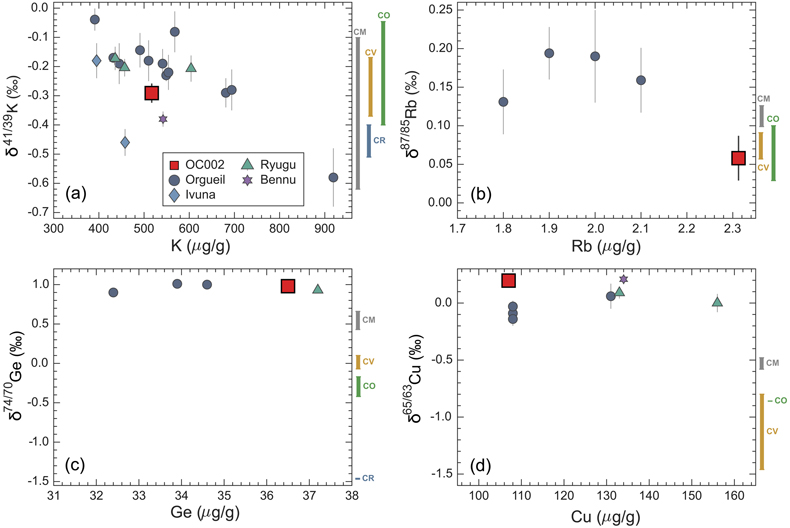
Figure 1 Isotopic compositions versus concentrations for (a) K, (b) Rb, (c) Ge, and (d) Cu in OC002, other CI chondrites, Ryugu, and Bennu. OC002 exhibits light δ41/39K and δ87/85Rb relative to other CI chondrites and Ryugu, while the δ74/70Ge and δ65/63Cu fall within the CI-Ryugu field. On the right side of each plot, the ranges of isotopic compositions for other carbonaceous chondrite groups are shown for comparison. OC002 data from this study; literature data from Wang and Jacobsen (2016)
Wang, K., Jacobsen, S.B. (2016) Potassium isotopic evidence for a high-energy giant impact origin of the Moon. Nature 538, 487–490. https://doi.org/10.1038/nature19341
, Pringle and Moynier (2017)Pringle, E.A., Moynier, F. (2017) Rubidium isotopic composition of the Earth, meteorites, and the Moon: Evidence for the origin of volatile loss during planetary accretion. Earth and Planetary Science Letters 473, 62–70. https://doi.org/10.1016/j.epsl.2017.05.033
, Ku and Jacobsen (2020)Ku, Y., Jacobsen, S.B. (2020) Potassium isotope anomalies in meteorites inherited from the protosolar molecular cloud. Science Advances 6, eabd0511. https://doi.org/10.1126/sciadv.abd0511
, Nie et al. (2021)Nie, N.X., Chen, X.-Y., Hopp, T., Hu, J.Y., Zhang, Z.J., Teng, F.-Z., Shahar, A., Dauphas, N. (2021) Imprint of chondrule formation on the K and Rb isotopic compositions of carbonaceous meteorites. Science Advances 7, eabl3929. https://doi.org/10.1126/sciadv.abl3929
, Koefoed et al. (2023)Koefoed, P., Barrat, J.-A., Pravdivtseva, O., Alexander, C.M.O’D., Lodders, K., Ogliore, R., Wang, K. (王昆) (2023) The potassium isotopic composition of CI chondrites and the origin of isotopic variations among primitive planetary bodies. Geochimica et Cosmochimica Acta 358, 49–60. https://doi.org/10.1016/j.gca.2023.07.025
, Paquet et al. (2023)Paquet, M., Moynier, F., Yokoyama, T., Dai, W., Hu, Y., et al. (2023) Contribution of Ryugu-like material to Earth’s volatile inventory by Cu and Zn isotopic analysis. Nature Astronomy 7, 182–189. https://doi.org/10.1038/s41550-022-01846-1
, Hu et al. (2024)Hu, Y., Moynier, F., Dai, W., Paquet, M., Yokoyama, T., et al. (2024) Pervasive aqueous alteration in the early Solar System revealed by potassium isotopic variations in Ryugu samples and carbonaceous chondrites. Icarus 409, 115884. https://doi.org/10.1016/j.icarus.2023.115884
, Barnes et al. (2025)Barnes, J.J., Nguyen, A.N., Abernethy, F.A.J., Bajo, K., Bekaert, D.V., et al. (2025) The variety and origin of materials accreted by Bennu’s parent asteroid. Nature Astronomy 9, 1785–1802. https://doi.org/10.1038/s41550-025-02631-6
, Luais and Florin (2025)Luais, B., Florin, G. (2025) Origin of the mass-dependent germanium isotopic continuum in the early Solar System. Earth and Planetary Science Letters 672, 119663. https://doi.org/10.1016/j.epsl.2025.119663
, Wölfer et al. (2025aWölfer, E., Burkhardt, C., Nimmo, F., Kleine, T. (2025a) Origin of moderately volatile elements in Earth inferred from mass-dependent Ge isotope variations among chondrites. Earth and Planetary Science Letters 663, 119435. https://doi.org/10.1016/j.epsl.2025.119435
,b)Wölfer, E., Hellmann, J.L., Burkhardt, C., Kleine, T. (2025b) Ge, Te, and Zn isotopic link between Ryugu and CI chondrites. Geochemical Perspectives Letters 37, 1–6. https://doi.org/10.7185/geochemlet.2537
. Error bars represent 2 s.d. or 95 % c.i.; where not visible, they are smaller than the symbol size.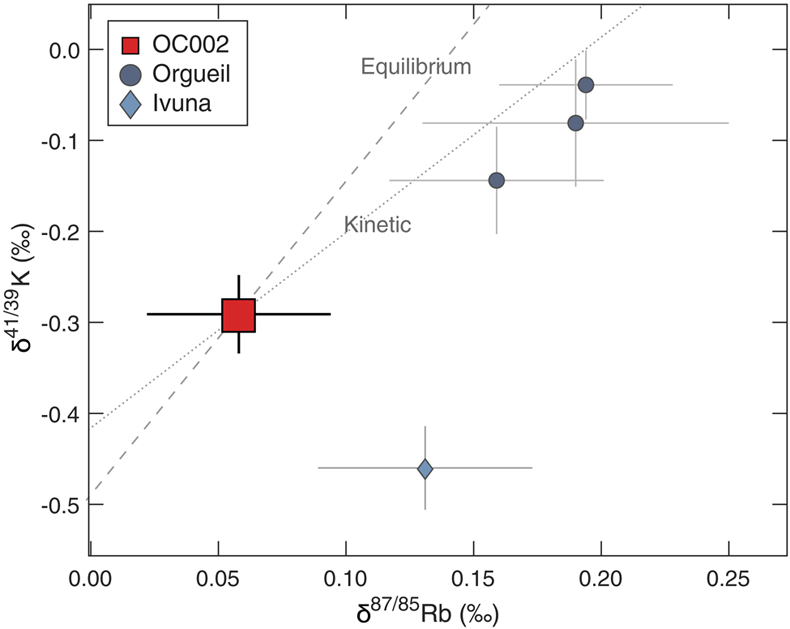
Figure 2 Coupled δ41/39K and δ87/85Rb for CI chondrites with paired measurements from the same aliquots. OC002 (this study), Orgueil and Ivuna data from Pringle and Moynier (2017)
Pringle, E.A., Moynier, F. (2017) Rubidium isotopic composition of the Earth, meteorites, and the Moon: Evidence for the origin of volatile loss during planetary accretion. Earth and Planetary Science Letters 473, 62–70. https://doi.org/10.1016/j.epsl.2017.05.033
, Nie et al. (2021)Nie, N.X., Chen, X.-Y., Hopp, T., Hu, J.Y., Zhang, Z.J., Teng, F.-Z., Shahar, A., Dauphas, N. (2021) Imprint of chondrule formation on the K and Rb isotopic compositions of carbonaceous meteorites. Science Advances 7, eabl3929. https://doi.org/10.1126/sciadv.abl3929
, and Hu et al. (2024)Hu, Y., Moynier, F., Dai, W., Paquet, M., Yokoyama, T., et al. (2024) Pervasive aqueous alteration in the early Solar System revealed by potassium isotopic variations in Ryugu samples and carbonaceous chondrites. Icarus 409, 115884. https://doi.org/10.1016/j.icarus.2023.115884
. OC002 and Orgueil define a positive correlation consistent with fluid mediated alkali fractionation; Ivuna plots off this trend. Dashed and dotted lines represent slopes predicted δ41/39K/δ87/85Rb slopes for equilibrium fractionation (3.5) and kinetic fractionation due to diffusion in water (2.2), respectively (Zeng et al., 2019Zeng, H., Rozsa, V.F., Nie, N.X., Zhang, Z., Pham, T.A., Galli, G., Dauphas, N. (2019) Ab Initio Calculation of Equilibrium Isotopic Fractionations of Potassium and Rubidium in Minerals and Water. ACS Earth and Space Chemistry 3, 2601–2612. https://doi.org/10.1021/acsearthspacechem.9b00180
). Error bars represent 2 s.d. or 95 % c.i.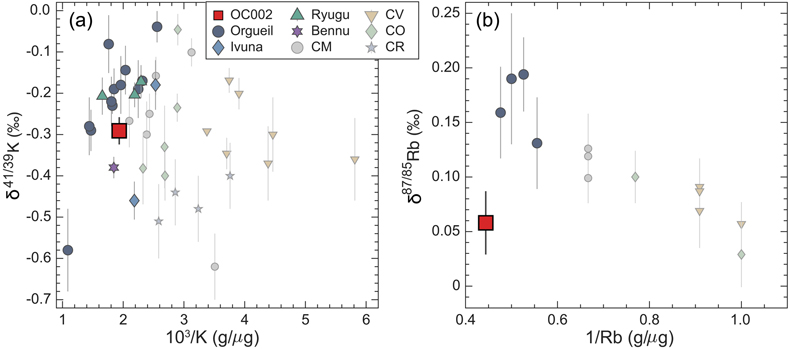
Figure 3 Isotopic compositions versus inverse concentrations for (a) K and (b) Rb in carbonaceous chondrites. The range of δ41/39K and δ87/85Rb in CI chondrites (including OC002) spans nearly the total variation observed across other carbonaceous chondrite groups. Data sources are in Figure 1.