



Ikaite precipitation indicates near surface occurrence of methane in an Icelandic fjord
Affiliations | Corresponding Author | Cite as | Funding information
Published by the European Association of Geochemistry
under Creative Commons License CC BY-NC-ND 4.0
Keywords: marine sediments, carbon isotope geochemistry, authigenic carbonates, high-latitude environments, porewater, sediment-water exchange


- Share this article


-
Article views:767Cumulative count of HTML views and PDF downloads.
- Download Citation
- Rights & Permissions

top
Abstract
Figures
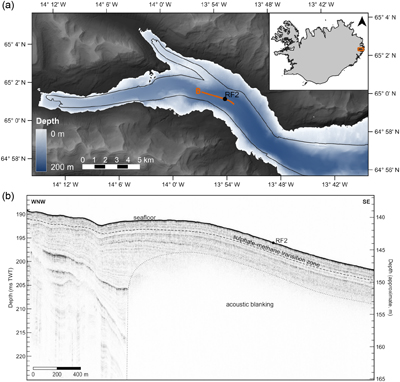 Figure 1 (a) Map of the sampling site (RF2) in Reyðarfjörður, eastern Iceland. The area within the black line shows the bottom topography as mapped by multibeam echo sounder. The orange line shows the location of the sub-bottom transect in panel B. The map was produced with the datasets LMI Digital Elevation Model, IS 50V Strandlína and IS 50V Vatnafar from Náttúrufræðistofnun, licensed under CC BY 4.0, and the EMODnet Bathymetry Consortium (2024). (b) Sub-bottom transect showing acoustic blanking below station RF2, suggesting the presence of gas. TWT = two way travel time. | 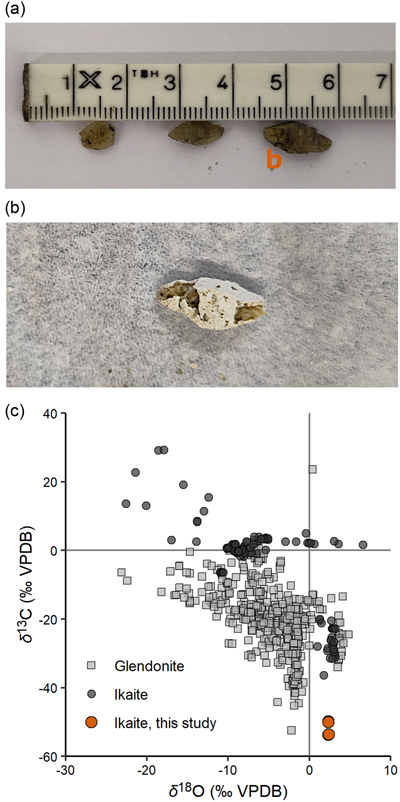 Figure 2 (a) Photograph of three of the ikaite crystals found at RF2I. (b) Photograph of a dried, recrystallised ikaite crystal marked with ‘b’ in panel (a). (c) Global compilation of isotopic compositions of glendonite and ikaite (Rogov et al., 2021), including the ikaite from this study. | 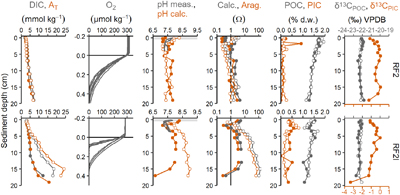 Figure 3 Porewater and solid phase profiles from stations RF2 and RF2I. Filled and empty markers represent replicate sediment cores, grey lines represent microprofiling data. The light grey area in the pH graph marks the scale of the O2 graph. Note the differences in scales on both x and y axes between plots. | 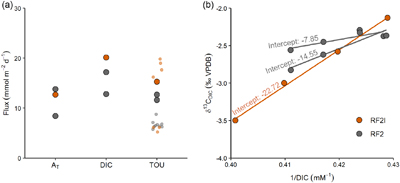 Figure 4 (a) Sediment-water fluxes of alkalinity (AT), dissolved inorganic carbon (DIC), and total oxygen uptake (TOU) from RF2 (grey) and RF2I (orange). Large circles mark fluxes measured in the incubation chambers; small circles mark diffusive O2 uptake rates from microprofiling data. (b) Keeling plot showing the DIC concentration and δ13C composition (δ13CDIC) in the incubations. The calculated intercepts indicate the δ13C signal of the combined DIC sources in each incubation. |
| Figure 1 | Figure 2 | Figure 3 | Figure 4 |
top
Introduction
The large reservoirs of methane (CH4) in Arctic and sub-Arctic marine sediments are of considerable interest due to their potential destabilisation from global warming (James et al., 2016
James, R.H., Bousquet, P., Bussmann, I., Haeckel, M., Kipfer, R., Leifer, I., Niemann, H., Ostrovsky, I., Piskozub, J., Rehder, G., Treude, T., Vielstädte, L., Greinert, J. (2016) Effects of climate change on methane emissions from seafloor sediments in the Arctic Ocean: A review. Limnology and Oceanography 61, S283–S299. https://doi.org/10.1002/lno.10307
). Identifying CH4 reservoirs is crucial for understanding their stability, as is tracking their occurrences and responses to climate change over geological time. Since the anaerobic oxidation of methane (AOM) produces alkalinity (AT) and can induce authigenic carbonate precipitation in sediments, carbonates can be used to trace CH4 reservoirs by their stable carbon isotope (δ13C) composition (Campbell, 2006Campbell, K.A. (2006) Hydrocarbon seep and hydrothermal vent paleoenvironments and paleontology: Past developments and future research directions. Palaeogeography, Palaeoclimatology, Palaeoecology 232, 362–407. https://doi.org/10.1016/j.palaeo.2005.06.018
; Vickers et al., 2022Vickers, M.L., Vickers, M., Rickaby, R.E.M., Wu, H., Bernasconi, S.M., Ullmann, C.V., Bohrmann, G., Spielhagen, R.F., Kassens, H., Pagh Schultz, B., Alwmark, C., Thibault, N., Korte, C. (2022) The ikaite to calcite transformation: Implications for palaeoclimate studies. Geochimica et Cosmochimica Acta 334, 201–216. https://doi.org/10.1016/j.gca.2022.08.001
). Isotopically heavy carbonates (> −5 ‰) indicate incorporation of residual dissolved inorganic carbon (DIC) from methanogenesis, while isotopically light carbonates (< −30 ‰) precipitate from DIC formed through AOM. By contrast, carbonates formed from DIC released during organic matter mineralisation have δ13C values around −25 ‰.The mineral ikaite (CaCO3·6H2O) (Pauly, 1963
Pauly, H. (1963) “Ikaite”, a new mineral from Greenland. Arctic 16, 263–264. https://doi.org/10.14430/arctic3545
) is of particular interest as an indicator of CH4 and AOM. It forms at low temperatures (<6 °C) under highly alkaline conditions, where inhibitors such as phosphate and organic compounds suppress the precipitation of less soluble calcium carbonate phases, such as calcite and aragonite (Lu et al., 2012Lu, Z., Rickaby, R.E.M., Kennedy, H., Kennedy, P., Pancost, R.D., Shaw, S., Lennie, A., Wellner, J., Anderson, J.B. (2012) An ikaite record of late Holocene climate at the Antarctic Peninsula. Earth and Planetary Science Letters 325–326, 108–115. https://doi.org/10.1016/j.epsl.2012.01.036
; Zhou et al., 2015Zhou, X., Lu, Z., Rickaby, R.E.M., Domack, E.W., Wellner, J.S., Kennedy, H.A. (2015) Ikaite Abundance Controlled by Porewater Phosphorus Level: Potential Links to Dust and Productivity. The Journal of Geology 123, 269–281. https://doi.org/10.1086/681918
; Tollefsen et al., 2018Tollefsen, E., Stockmann, G., Skelton, A., Mörth, C.-M., Dupraz, C., Sturkell, E. (2018) Chemical controls on ikaite formation. Mineralogical Magazine 82, 1119–1129. https://doi.org/10.1180/mgm.2018.110
). Because of this temperature dependence, ikaite and its pseudomorph glendonite are used as proxies for cold conditions in palaeoenvironmental reconstructions (Rogov et al., 2021Rogov, M., Ershova, V., Vereshchagin, O., Vasileva, K., Mikhailova, K., Krylov, A. (2021) Database of global glendonite and ikaite records throughout the Phanerozoic. Earth System Science Data. Copernicus GmbH 13, 343–356. https://doi.org/10.5194/essd-13-343-2021
; Schultz et al., 2022Schultz, B., Thibault, N., Huggett, J. (2022) The minerals ikaite and its pseudomorph glendonite: Historical perspective and legacies of Douglas Shearman and Alec K. Smith. Proceedings of the Geologists’ Association 133, 176–192. https://doi.org/10.1016/j.pgeola.2022.02.003
; Vickers et al., 2022Vickers, M.L., Vickers, M., Rickaby, R.E.M., Wu, H., Bernasconi, S.M., Ullmann, C.V., Bohrmann, G., Spielhagen, R.F., Kassens, H., Pagh Schultz, B., Alwmark, C., Thibault, N., Korte, C. (2022) The ikaite to calcite transformation: Implications for palaeoclimate studies. Geochimica et Cosmochimica Acta 334, 201–216. https://doi.org/10.1016/j.gca.2022.08.001
), and their δ13C signatures and presence have been applied to identify modern and past CH4 seeps in cold systems (Schubert et al., 1997Schubert, C.J., Nürnberg, D., Scheele, N., Pauer, F., Kriews, M. (1997) 13C isotope depletion in ikaite crystals: evidence for methane release from the Siberian shelves? Geo-Marine Letters 17, 169–174. https://doi.org/10.1007/s003670050023
; Greinert and Derkachev, 2004Greinert, J., Derkachev, A. (2004) Glendonites and methane-derived Mg-calcites in the Sea of Okhotsk, Eastern Siberia: implications of a venting-related ikaite/glendonite formation. Marine Geology 204, 129–144. https://doi.org/10.1016/S0025-3227(03)00354-2
; Teichert and Luppold, 2013Teichert, B.M.A., Luppold, F.W. (2013) Glendonites from an Early Jurassic methane seep — Climate or methane indicators? Palaeogeography, Palaeoclimatology, Palaeoecology 390, 81–93. https://doi.org/10.1016/j.palaeo.2013.03.001
; Morales et al., 2017Morales, C., Rogov, M., Wierzbowski, H., Ershova, V., Suan, G., Adatte, T., Föllmi, K.B., Tegelaar, E., Reichart, G.-J., de Lange, G.J., Middelburg, J.J., van de Schootbrugge, B. (2017) Glendonites track methane seepage in Mesozoic polar seas. Geology 45, 503–506. https://doi.org/10.1130/G38967.1
).Although ikaite suggested to have formed due to intense organic matter degradation has been found near the sediment surface (Kennedy, 2022
Kennedy, G.L. (2022) Glendonites: Enigmatic Mineral Pseudomorphs and Their Ephemeral Precursor. Rocks and Minerals 97, 496–509. https://doi.org/10.1080/00357529.2022.2087146
), ikaite linked with CH4 and AOM has only been retrieved from 1–4 m sediment depth (Schubert et al., 1997Schubert, C.J., Nürnberg, D., Scheele, N., Pauer, F., Kriews, M. (1997) 13C isotope depletion in ikaite crystals: evidence for methane release from the Siberian shelves? Geo-Marine Letters 17, 169–174. https://doi.org/10.1007/s003670050023
; Lu et al., 2012Lu, Z., Rickaby, R.E.M., Kennedy, H., Kennedy, P., Pancost, R.D., Shaw, S., Lennie, A., Wellner, J., Anderson, J.B. (2012) An ikaite record of late Holocene climate at the Antarctic Peninsula. Earth and Planetary Science Letters 325–326, 108–115. https://doi.org/10.1016/j.epsl.2012.01.036
; Hiruta and Matsumoto, 2022Hiruta, A., Matsumoto, R. (2022) Geochemical comparison of ikaite and methane-derived authigenic carbonates recovered from Echigo Bank in the Sea of Japan. Marine Geology 443, 106672. https://doi.org/10.1016/j.margeo.2021.106672
; Kolesnik et al., 2025Kolesnik, O.N., Kolesnik, A.N., Karabtsov, A.A., Vasilenko, Yu. P., Gorbarev, A.A. (2025) Ikaite from Holocene Sediments of the Chukchi Sea. Doklady Earth Sciences 520, 3. https://doi.org/10.1134/S1028334X24604383
; also see references in Schultz et al., 2022Schultz, B., Thibault, N., Huggett, J. (2022) The minerals ikaite and its pseudomorph glendonite: Historical perspective and legacies of Douglas Shearman and Alec K. Smith. Proceedings of the Geologists’ Association 133, 176–192. https://doi.org/10.1016/j.pgeola.2022.02.003
). How well ikaite and glendonite trace CH4 occurrences at the sediment-water interface thus remains unclear. Here, we report the occurrence of ikaite crystals in the surface sediment (top 40 cm) of Reyðarfjörður, Iceland. Sediment geochemistry and low ikaite δ13C values indicate that the mineral formed as a result of AOM. This observation substantially extends the known depth range of CH4 derived ikaite (Teichert and Luppold, 2013Teichert, B.M.A., Luppold, F.W. (2013) Glendonites from an Early Jurassic methane seep — Climate or methane indicators? Palaeogeography, Palaeoclimatology, Palaeoecology 390, 81–93. https://doi.org/10.1016/j.palaeo.2013.03.001
; Morales et al., 2017Morales, C., Rogov, M., Wierzbowski, H., Ershova, V., Suan, G., Adatte, T., Föllmi, K.B., Tegelaar, E., Reichart, G.-J., de Lange, G.J., Middelburg, J.J., van de Schootbrugge, B. (2017) Glendonites track methane seepage in Mesozoic polar seas. Geology 45, 503–506. https://doi.org/10.1130/G38967.1
), supporting its use for tracing past occurrences of CH4 at the sediment surface, and demonstrates, for the first time, the presence of ikaite in Icelandic waters (Rogov et al., 2021Rogov, M., Ershova, V., Vereshchagin, O., Vasileva, K., Mikhailova, K., Krylov, A. (2021) Database of global glendonite and ikaite records throughout the Phanerozoic. Earth System Science Data. Copernicus GmbH 13, 343–356. https://doi.org/10.5194/essd-13-343-2021
).top
Site Description and Sampling
Samples were collected in Reyðarfjörður (Fig. 1a), eastern Iceland, aboard the R/V Belgica on July 8, 2023. Sampling and analytical methods are detailed in the Supplementary Information. The fjord is not influenced by active volcanic systems (Thordarson and Höskuldsson, 2008
Thordarson, T., Höskuldsson, Á. (2008) Postglacial volcanism in Iceland. Jökull 58, 197–228. https://doi.org/10.33799/jokull2008.58.197
). The sampling site RF2 (65° 0.9021’ N; 13° 53.5279’ W; 150 m depth) is located above an area of acoustic blanking identified by a hull mounted TOPAS profiler (Fig. 1b), indicating sub-seafloor gas (Judd and Hovland, 1992Judd, A.G., Hovland, M. (1992) The evidence of shallow gas in marine sediments. Continental Shelf Research 12, 1081–1095. https://doi.org/10.1016/0278-4343(92)90070-Z
). Prior to sediment sampling, CTD measurements 5 m above the seafloor recorded a salinity of 34.4, a temperature of 4.2 °C, and a dissolved oxygen (O2) concentration of 287 μmol kg−1.Figure 1 (a) Map of the sampling site (RF2) in Reyðarfjörður, eastern Iceland. The area within the black line shows the bottom topography as mapped by multibeam echo sounder. The orange line shows the location of the sub-bottom transect in panel B. The map was produced with the datasets LMI Digital Elevation Model, IS 50V Strandlína and IS 50V Vatnafar from Náttúrufræðistofnun, licensed under CC BY 4.0, and the EMODnet Bathymetry Consortium (2024)
EMODnet Bathymetry Consortium (2024) https://doi.org/10.12770/cf51df64-56f9-4a99-b1aa-36b8d7b743a1
. (b) Sub-bottom transect showing acoustic blanking below station RF2, suggesting the presence of gas. TWT = two way travel time.Sediment for geochemical profiling was collected using a GEMAX corer (Ø 9 cm). One set of cores was used for microsensor profiling for O2, hydrogen sulphide (H2S), and pH. Replicate cores were sliced and centrifuged to separate solids from porewater. The solid phase was analysed for particulate organic and inorganic carbon (POC, PIC), their stable isotope compositions (δ13CPOC, δ13CPIC), mineralogy, and the contents of iron oxides, acid volatile sulphide (AVS), and chromium reducible sulphide (CRS). Porewater was analysed for DIC, total alkalinity (AT), dissolved phosphorus, sulphur, calcium, and magnesium. Porewater concentrations of DIC and AT were used to calculate pH and the saturation states of calcite and aragonite. An additional sediment core was collected for 210Pb and 137Cs dating.
A box corer (Ø 50 cm) was used to collect the upper 40 cm of sediment for flux incubations. Three replicate cores, collected 5 m apart, were sub-cored into incubation chambers (Ø 14.4 cm; Fig. S-1) for measuring sediment-water fluxes of DIC (including δ13C composition; δ13CDIC), AT, and O2. The top 5 cm of all cores were brown and bioturbated, but deeper layers varied: two were grey to dark grey, and one was black. Owing to these visual differences, the black core was designated RF2I. Repeated attempts to relocate RF2I-type sediment were unsuccessful, indicating strong local heterogeneity.
Multiple crystals resembling ikaite (Fig. 2a) were found at 20–40 cm sediment depth at RF2I. One crystal was analysed by single crystal XRD under a nitrogen gas cryostream, and the stable isotope composition (δ13Cikaite and δ18Oikaite) was measured at two points on another (Fig. 2b). Following the flux incubation, the RF2I sediment was sub-cored (Ø 5.9 cm) to <20 cm sediment depth for solid phase carbon and mineralogy analyses, microprofiles of O2, pH and H2S, and measurement of porewater DIC and AT. No ikaite crystals were found in the incubated sediment.
Figure 2 (a) Photograph of three of the ikaite crystals found at RF2I. (b) Photograph of a dried, recrystallised ikaite crystal marked with ‘b’ in panel (a). (c) Global compilation of isotopic compositions of glendonite and ikaite (Rogov et al., 2021
Rogov, M., Ershova, V., Vereshchagin, O., Vasileva, K., Mikhailova, K., Krylov, A. (2021) Database of global glendonite and ikaite records throughout the Phanerozoic. Earth System Science Data. Copernicus GmbH 13, 343–356. https://doi.org/10.5194/essd-13-343-2021
), including the ikaite from this study.top
Sediment Geochemistry
The sediment geochemistry reflected the visual differences between RF2 and RF2I (Fig. S-1). At RF2, porewater AT and DIC increased from 2.6 mmol kg−1 at the surface to 7.0 mmol kg−1 at depth, with O2 penetrating 0.4 cm (Fig. 3). In contrast, the RF2I sediment was heterogeneous and showed signs of more intense diagenesis. In one replicate core, the porewater AT and DIC increased from 3.0 mmol kg−1 at the surface to 15 mmol kg−1 at depth, while in a second core, they reached 20–25 mmol kg−1, with AT clearly exceeding DIC. The O2 penetration depths clustered into two groups at 0.1 and 0.3 cm, and a strong H2S odour was present. At both sites, measured and calculated porewater pH profiles were in agreement. The calculated pH is sensitive to small DIC and AT losses during sampling, so profiles should be seen as general trends. At both sites, pH decreased in the upper centimetres, stabilising near 7.5 at RF2 but increasing with depth to ∼9 at RF2I, particularly in the core with high At and DIC.
Figure 3 Porewater and solid phase profiles from stations RF2 and RF2I. Filled and empty markers represent replicate sediment cores, grey lines represent microprofiling data. The light grey area in the pH graph marks the scale of the O2 graph. Note the differences in scales on both x and y axes between plots.
The geochemical differences between RF2 and RF2I were not due to variations in organic matter degradation, as POC contents were similar (Fig. 3). No differences in mineralogy as determined by powder XRD were observed between sites (Fig. S-2). Instead, linear increases in the DIC and AT at the bottom of the porewater profiles suggest upward diffusion from deeper sediment layers at both locations, with considerably steeper concentration gradients indicating stronger upward fluxes at RF2I. Elevated pH, and DIC and AT concentrations are consistent with AOM (Campbell, 2006
Campbell, K.A. (2006) Hydrocarbon seep and hydrothermal vent paleoenvironments and paleontology: Past developments and future research directions. Palaeogeography, Palaeoclimatology, Palaeoecology 232, 362–407. https://doi.org/10.1016/j.palaeo.2005.06.018
) and suggest a deep CH4 source, plausibly connected to the area of acoustic blanking seen in the TOPAS profile (Fig. 1b). Although AOM typically produces H2S via sulphate reduction (Egger et al., 2018Egger, M., Riedinger, N., Mogollón, J.M., Jørgensen, B.B. (2018) Global diffusive fluxes of methane in marine sediments. Nature Geoscience 11, 421–425. https://doi.org/10.1038/s41561-018-0122-8
) and a strong H2S odour was noted during coring, no H2S was detected in the top 4 cm of sediment. This absence of H2S is consistent with high ferric iron contents (200–300 μmol g−1) at 2–15 cm depth at station RF2, which could scavenge H2S as iron sulphides (AVS and CRS; Fig. S-3; Berner, 1970Berner, R.A. (1970) Sedimentary pyrite formation. American Journal of Science 268, 1–23. https://doi.org/10.2475/ajs.268.1.1
).Despite contrasting porewater profiles at RF2 and RF2I, the measured sediment-water fluxes of AT, DIC, and O2 were similar across both sites (Fig. 4a). Interestingly, diffusive O2 uptake rates calculated from microprofiles at RF2I clustered into two groups at 16–20 mmol m−2 d−1 and 5–6 mmol m−2 d−1, whereas the total O2 uptake (TOU) measured in the chamber was 15 mmol m−2 d−1. At RF2, the diffusive O2 uptake was 6–9 mmol m−2 d−1, and the TOU was 11–12 mmol m−2 d−1. Small scale differences in sediment-water solute exchange, as indicated by microprofiles, suggest heterogeneous chemical conditions within the sediment at RF2I, whereas the TOU over the larger surface area of the incubation chamber approached that at RF2.
Figure 4 (a) Sediment-water fluxes of alkalinity (AT), dissolved inorganic carbon (DIC), and total oxygen uptake (TOU) from RF2 (grey) and RF2I (orange). Large circles mark fluxes measured in the incubation chambers; small circles mark diffusive O2 uptake rates from microprofiling data. (b) Keeling plot showing the DIC concentration and δ13C composition (δ13CDIC) in the incubations. The calculated intercepts indicate the δ13C signal of the combined DIC sources in each incubation.
top
Carbonate Dynamics and Ikaite Formation
Analysis by XRD confirmed the mineral as ikaite (a = 8.760 Å, b = 8.305 Å, c = 11.000 Å, β = 110.477, space group C2/c). The ikaite δ13C values (−49.8 to −53.8 ‰), the lowest reported for ikaite and glendonite (Fig. 2c; Rogov et al., 2020
Rogov, M., Vasileva, K., Mikhailova, K., Ershova, V. (2020) Database of global glendonite and ikaite records throughout the Phanerozoic. Zenodo. https://doi.org/10.5281/ZENODO.7833894
, 2021Rogov, M., Ershova, V., Vereshchagin, O., Vasileva, K., Mikhailova, K., Krylov, A. (2021) Database of global glendonite and ikaite records throughout the Phanerozoic. Earth System Science Data. Copernicus GmbH 13, 343–356. https://doi.org/10.5194/essd-13-343-2021
), indicate carbon derived from DIC formed during AOM (Greinert and Derkachev, 2004Greinert, J., Derkachev, A. (2004) Glendonites and methane-derived Mg-calcites in the Sea of Okhotsk, Eastern Siberia: implications of a venting-related ikaite/glendonite formation. Marine Geology 204, 129–144. https://doi.org/10.1016/S0025-3227(03)00354-2
; Hiruta and Matsumoto, 2022Hiruta, A., Matsumoto, R. (2022) Geochemical comparison of ikaite and methane-derived authigenic carbonates recovered from Echigo Bank in the Sea of Japan. Marine Geology 443, 106672. https://doi.org/10.1016/j.margeo.2021.106672
). At site RF2I, very high porewater saturation states for aragonite (>80) and calcite (>100; Fig. 3) suggest that the precipitation of these phases was suppressed, allowing AT to accumulate to levels conducive for ikaite formation. Porewater concentrations of phosphorus, Mg and sulfur, known inhibitors of calcite and aragonite growth (Bischoff et al., 1993Bischoff, J.L., Fitzpatrick, J.A., Rosenbauer, R.J. (1993) The Solubility and Stabilization of Ikaite (CaCO3·6H2O) from 0° to 25°C: Environmental and Paleoclimatic Implications for Thinolite Tufa. The Journal of Geology 101, 21–33. https://doi.org/10.1086/648194
; Tollefsen et al., 2018Tollefsen, E., Stockmann, G., Skelton, A., Mörth, C.-M., Dupraz, C., Sturkell, E. (2018) Chemical controls on ikaite formation. Mineralogical Magazine 82, 1119–1129. https://doi.org/10.1180/mgm.2018.110
), were within expected ranges for coastal sediments at RF2 (Schulz, 2006Schulz, H.D. (2006) Quantification of Early Diagenesis: Dissolved Constituents in Pore Water and Signals in the Solid Phase. In: Schulz, H.D., Zabel, M. (Eds.) Marine Geochemistry. Springer-Verlag, Berlin/Heidelberg, 73–124. https://doi.org/10.1007/3-540-32144-6_3
; Ruttenberg, 2014Ruttenberg, K.C. (2014) The Global Phosphorus Cycle. In: Holland, H.D., Turekian, K.K. (Eds.) Treatise on Geochemistry (Second Edition). Elsevier, Oxford, 499–558. https://doi.org/10.1016/B978-0-08-095975-7.00813-5
; Fig. S-3). Assuming the main difference between sites was the upward migration of CH4-rich porewater at RF2I, these results indicate that aragonite and calcite precipitation can be suppressed under typical coastal conditions, enabling ikaite formation at cold temperatures and a high AT supply.The δ13CPIC at RF2 and RF2I (Fig. 3), along with decreasing porewater Ca and Mg with depth at RF2 (Fig. S-3), indicate authigenic carbonate precipitation within the top 20 cm of sediment. Increasingly negative δ13CPIC values with depth suggest in situ PIC formation incorporating isotopically light DIC from organic matter mineralisation or AOM (Campbell, 2006
Campbell, K.A. (2006) Hydrocarbon seep and hydrothermal vent paleoenvironments and paleontology: Past developments and future research directions. Palaeogeography, Palaeoclimatology, Palaeoecology 232, 362–407. https://doi.org/10.1016/j.palaeo.2005.06.018
). More negative δ13CPIC values at RF2I (−3.35 to 0.00 ‰) compared to RF2 (−1.2 to 0.05 ‰) imply more intense carbonate formation or a greater contribution of AOM derived DIC. Contrasting carbonate dynamics are also reflected in the δ13C composition of the sediment-water DIC flux, with lighter DIC released at RF2I (Fig. 4b). Assuming organic matter degradation and carbonate dissolution are the only DIC sources, their relative contributions were estimated from a Keeling plot (Pataki et al., 2003Pataki, D.E., Ehleringer, J.R., Flanagan, L.B., Yakir, D., Bowling, D.R., Still, C.J., Buchmann, N., Kaplan, J.O., Berry, J.A. (2003) The application and interpretation of Keeling plots in terrestrial carbon cycle research. Global Biogeochemical Cycles 17. https://doi.org/10.1029/2001GB001850
). Carbonate dissolution contributed 36–66 % of the DIC efflux at RF2 (SI), consistent with aragonite and calcite undersaturation in the top 5–10 cm of sediment (Fig. 3). At RF2I, the Keeling plot indicated no dissolution, although isotopically light DIC from CH4 oxidation was not considered and may have obscured any dissolution signal.top
Ikaite as an Indicator of Methane
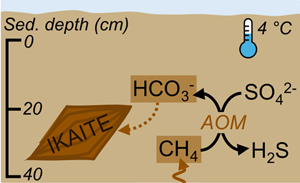
This study reports the discovery of ikaite near the sediment surface (<40 cm) in an Icelandic fjord. While our data suggest formation driven by AOM, alternative mechanisms should be considered. Volcanic ash diagenesis can enhance carbonate saturation and promote ikaite precipitation (Vickers et al., 2024
Vickers, M.L., Jones, M.T., Longman, J., Evans, D., Ullmann, C.V., Wulfsberg Stokke, E., Vickers, M., Frieling, J., Harper, D.T., Clementi, V.J., IODP Expedition 396 Scientists (2024) Paleocene–Eocene age glendonites from the Mid-Norwegian Margin – indicators of cold snaps in the hothouse? Climate of the Past 20, 1–23. https://doi.org/10.5194/cp-20-1-2024
), but this is unlikely here given the absence of nearby volcanic activity (Thordarson and Höskuldsson, 2008Thordarson, T., Höskuldsson, Á. (2008) Postglacial volcanism in Iceland. Jökull 58, 197–228. https://doi.org/10.33799/jokull2008.58.197
) and the mineralogical similarities between RF2 and RF2I (Fig. S-2). Ikaite formation can also occur via seepage of highly alkaline groundwater, as observed in the Ikka fjord (Buchardt et al., 1997Buchardt, B., Seaman, P., Stockmann, G., Vous, M., Wilken, U., Düwel, L., Kristiansen, A., Jenner, C., Whiticar, M.J., Kristensen, R.M., Petersen, G.H., Thorbjørn, L. (1997) Submarine columns of ikaite tufa. Nature 390, 129–130. https://doi.org/10.1038/36474
). The proximity to the Helgustaðir mine, where Icelandic spar was historically extracted, and faults in the region (Karson et al., 2018Karson, J.A., Farrell, J.A., Chutas, L.A., Nanfito, A.F., Proett, J.A., Runnals, K.T., Sæmundsson, K. (2018) Rift-Parallel Strike-Slip Faulting Near the Iceland Plate Boundary Zone: Implications for Propagating Rifts. Tectonics 37, 4567–4594. https://doi.org/10.1029/2018TC005206
), indicate that such inputs are possible. However, the exceptionally low δ13Cikaite values strongly suggest mineral formation driven by intense AOM fuelled by a deep CH4 source; a hypothesis supported by porewater geochemistry and sub-bottom profiling indicating the presence of gas below the site.Accordingly, ikaite provides indirect evidence that CH4 reaches the surface sediment at some locations in the investigated fjord. Although reports of CH4 in coastal Icelandic sediments are rare, both biogenic and thermogenic sources have been identified at CH4 seeps in northern Iceland (Þorsteinsdóttir et al., 2020
Þorsteinsdóttir, G.V., Blischke, A., Sigurbjörnsdóttir, M.A., Òskarsson, F., Arnarson, Þ.S., Magnússon, K.P., Vilhelmsson, O. (2020) Gas seepage pockmark microbiomes suggest the presence of sedimentary coal seams in the Öxarfjörður graben of northeastern Iceland. Canadian Journal of Microbiology 66, 25–38. https://doi.org/10.1139/cjm-2019-0081
). The CH4 origin here cannot be resolved from the δ13Cikaite as multiple DIC sources influenced the porewater δ13CDIC (Teichert and Luppold, 2013Teichert, B.M.A., Luppold, F.W. (2013) Glendonites from an Early Jurassic methane seep — Climate or methane indicators? Palaeogeography, Palaeoclimatology, Palaeoecology 390, 81–93. https://doi.org/10.1016/j.palaeo.2013.03.001
), but the light isotopic signal may indicate a biogenic source (Whiticar, 1999Whiticar, M.J. (1999) Carbon and hydrogen isotope systematics of bacterial formation and oxidation of methane. Chemical Geology 161, 291–314. https://doi.org/10.1016/S0009-2541(99)00092-3
). This interpretation is further supported by the lack of volcanic activity in the area and δ13Cikaite values lower than those associated with thermogenically formed CH4 in hydrothermal fluids in Iceland (Stefánsson et al., 2024Stefánsson, A., Ricci, A., Garnett, M., Gunnarsson-Robin, J., Kleine-Marshall, B.I., Scott, S.W., Lelli, M., Cardoso, C.D., Pik, R., Santinelli, C., Ono, S., Barry, P.H., Broadley, M.W., Byrne, D., Halldórsson, S.A., Fiebig, J. (2024) Isotopic and kinetic constraints on methane origins in Icelandic hydrothermal fluids. Geochimica et Cosmochimica Acta 373, 84–97. https://doi.org/10.1016/j.gca.2024.03.015
).The sediment accumulation rate measured by 210Pb at RF2 was 0.43 cm yr−1 (SI). Assuming the same accumulation rate at RF2I, the ikaite would be no more than 93 years old if it were the same age as the surrounding sediment. It is plausible that the crystals were considerably younger, since the ikaite likely was not formed at the sediment-water interface but deeper in the sediment where carbonate supersaturation was reached (Lu et al., 2012
Lu, Z., Rickaby, R.E.M., Kennedy, H., Kennedy, P., Pancost, R.D., Shaw, S., Lennie, A., Wellner, J., Anderson, J.B. (2012) An ikaite record of late Holocene climate at the Antarctic Peninsula. Earth and Planetary Science Letters 325–326, 108–115. https://doi.org/10.1016/j.epsl.2012.01.036
; Whiticar et al., 2022Whiticar, M.J., Suess, E., Wefer, G., Müller, P.J. (2022) Calcium Carbonate Hexahydrate (Ikaite): History of Mineral Formation as Recorded by Stable Isotopes. Minerals 12, 1627. https://doi.org/10.3390/min12121627
). There is no evidence of substantial CH4 emissions from the sediment, such as pockmarks, suggesting that the occurrence of ikaite was very localised. Yet, the presence of CH4 derived ikaite so close to the sediment surface substantially expands the environmental range within which the mineral is known to form, and confirms the usability of ikaite and glendonite δ13C to track CH4 seeps in cold water environments.top
Acknowledgments
The authors thank the captain and crew of the RV Belgica for assistance at sea, Yannick Stroobandt at KU Leuven for carbon isotope analysis, Daniel Borschneck at CEREGE for assistance with the powder XRD analysis, and Dimitris Triandafillidis at HARBOR for assistance with single crystal XRD data collection. This research was supported by the Belgian Federal Science Policy Office (grant no RV/21/DEHEAT). AH was funded by a junior postdoctoral fellowship from Research Foundation – Flanders (FWO; grant no. 1241724N) and a Marie Sklodowska-Curie Individual Fellowship (MSCA; grant no. 101204337). SA was funded by the F.R.S.-FNRS (FIESTA, grant no. 35266740). JPB was funded by the US National Science Foundation (OCE-2241721) and the Lehigh CAS Dean’s Opportunity Grant. KH was funded by Queens’ College, University of Cambridge, and the Natural Environment Research Council (SiCLING, grant no. NE/X014819/1). RKJ was funded by MSCA (grant no. 101060342). PL, LV, and CW were funded by PhD fellowships from FWO (grants no. 1139224N, 1114521N, and 11P8Z24N). We thank Bo Schultz and an anonymous reviewer for constructive comments on the manuscript.
Editor: Gavin Foster
top
References
Berner, R.A. (1970) Sedimentary pyrite formation. American Journal of Science 268, 1–23. https://doi.org/10.2475/ajs.268.1.1
 Show in context
 This absence of H2S is consistent with high ferric iron contents (200–300 μmol g−1) at 2–15 cm depth at station RF2, which could scavenge H2S as iron sulphides (AVS and CRS; Fig. S-3; Berner, 1970).
View in article
Bischoff, J.L., Fitzpatrick, J.A., Rosenbauer, R.J. (1993) The Solubility and Stabilization of Ikaite (CaCO3·6H2O) from 0° to 25°C: Environmental and Paleoclimatic Implications for Thinolite Tufa. The Journal of Geology 101, 21–33. https://doi.org/10.1086/648194
Show in context Porewater concentrations of phosphorus, Mg and sulfur, known inhibitors of calcite and aragonite growth (Bischoff et al., 1993; Tollefsen et al., 2018), were within expected ranges for coastal sediments at RF2 (Schulz, 2006; Ruttenberg, 2014; Fig. S-3).
View in article
Buchardt, B., Seaman, P., Stockmann, G., Vous, M., Wilken, U., Düwel, L., Kristiansen, A., Jenner, C., Whiticar, M.J., Kristensen, R.M., Petersen, G.H., Thorbjørn, L. (1997) Submarine columns of ikaite tufa. Nature 390, 129–130. https://doi.org/10.1038/36474
Show in context Ikaite formation can also occur via seepage of highly alkaline groundwater, as observed in the Ikka fjord (Buchardt et al., 1997).
View in article
Campbell, K.A. (2006) Hydrocarbon seep and hydrothermal vent paleoenvironments and paleontology: Past developments and future research directions. Palaeogeography, Palaeoclimatology, Palaeoecology 232, 362–407. https://doi.org/10.1016/j.palaeo.2005.06.018
Show in context Since the anaerobic oxidation of methane (AOM) produces alkalinity (AT) and can induce authigenic carbonate precipitation in sediments, carbonates can be used to trace CH4 reservoirs by their stable carbon isotope (δ13C) composition (Campbell, 2006; Vickers et al., 2022).
View in article
Elevated pH, and DIC and AT concentrations are consistent with AOM (Campbell, 2006) and suggest a deep CH4 source, plausibly connected to the area of acoustic blanking seen in the TOPAS profile (Fig. 1b).
View in article
Increasingly negative δ13CPIC values with depth suggest in situ PIC formation incorporating isotopically light DIC from organic matter mineralisation or AOM (Campbell, 2006).
View in article
Egger, M., Riedinger, N., Mogollón, J.M., Jørgensen, B.B. (2018) Global diffusive fluxes of methane in marine sediments. Nature Geoscience 11, 421–425. https://doi.org/10.1038/s41561-018-0122-8
Show in context Although AOM typically produces H2S via sulphate reduction (Egger et al., 2018) and a strong H2S odour was noted during coring, no H2S was detected in the top 4 cm of sediment.
View in article
EMODnet Bathymetry Consortium (2024) https://doi.org/10.12770/cf51df64-56f9-4a99-b1aa-36b8d7b743a1
Show in context The map was produced with the datasets LMI Digital Elevation Model, IS 50V Strandlína and IS 50V Vatnafar from Náttúrufræðistofnun, licensed under CC BY 4.0, and the EMODnet Bathymetry Consortium (2024).
View in article
Greinert, J., Derkachev, A. (2004) Glendonites and methane-derived Mg-calcites in the Sea of Okhotsk, Eastern Siberia: implications of a venting-related ikaite/glendonite formation. Marine Geology 204, 129–144. https://doi.org/10.1016/S0025-3227(03)00354-2
Show in context Because of this temperature dependence, ikaite and its pseudomorph glendonite are used as proxies for cold conditions in palaeoenvironmental reconstructions (Rogov et al., 2021; Schultz et al., 2022; Vickers et al., 2022), and their δ13C signatures and presence have been applied to identify modern and past CH4 seeps in cold systems (Schubert et al., 1997; Greinert and Derkachev, 2004; Teichert and Luppold, 2013; Morales et al., 2017).
View in article
The ikaite δ13C values (−49.8 to −53.8 ‰), the lowest reported for ikaite and glendonite (Fig. 2c; Rogov et al., 2020, 2021), indicate carbon derived from DIC formed during AOM (Greinert and Derkachev, 2004; Hiruta and Matsumoto, 2022).
View in article
Hiruta, A., Matsumoto, R. (2022) Geochemical comparison of ikaite and methane-derived authigenic carbonates recovered from Echigo Bank in the Sea of Japan. Marine Geology 443, 106672. https://doi.org/10.1016/j.margeo.2021.106672
Show in context Although ikaite suggested to have formed due to intense organic matter degradation has been found near the sediment surface (Kennedy, 2022), ikaite linked with CH4 and AOM has only been retrieved from 1–4 m sediment depth (Schubert et al., 1997; Lu et al., 2012; Hiruta and Matsumoto, 2022; Kolesnik et al., 2025; also see references in Schultz et al., 2022).
View in article
The ikaite δ13C values (−49.8 to −53.8 ‰), the lowest reported for ikaite and glendonite (Fig. 2c; Rogov et al., 2020, 2021), indicate carbon derived from DIC formed during AOM (Greinert and Derkachev, 2004; Hiruta and Matsumoto, 2022).
View in article
James, R.H., Bousquet, P., Bussmann, I., Haeckel, M., Kipfer, R., Leifer, I., Niemann, H., Ostrovsky, I., Piskozub, J., Rehder, G., Treude, T., Vielstädte, L., Greinert, J. (2016) Effects of climate change on methane emissions from seafloor sediments in the Arctic Ocean: A review. Limnology and Oceanography 61, S283–S299. https://doi.org/10.1002/lno.10307
Show in context The large reservoirs of methane (CH4) in Arctic and sub-Arctic marine sediments are of considerable interest due to their potential destabilisation from global warming (James et al., 2016).
View in article
Judd, A.G., Hovland, M. (1992) The evidence of shallow gas in marine sediments. Continental Shelf Research 12, 1081–1095. https://doi.org/10.1016/0278-4343(92)90070-Z
Show in context The sampling site RF2 (65° 0.9021’ N; 13° 53.5279’ W; 150 m depth) is located above an area of acoustic blanking identified by a hull mounted TOPAS profiler (Fig. 1b), indicating sub-seafloor gas (Judd and Hovland, 1992).
View in article
Karson, J.A., Farrell, J.A., Chutas, L.A., Nanfito, A.F., Proett, J.A., Runnals, K.T., Sæmundsson, K. (2018) Rift-Parallel Strike-Slip Faulting Near the Iceland Plate Boundary Zone: Implications for Propagating Rifts. Tectonics 37, 4567–4594. https://doi.org/10.1029/2018TC005206
Show in context The proximity to the Helgustaðir mine, where Icelandic spar was historically extracted, and faults in the region (Karson et al., 2018), indicate that such inputs are possible.
View in article
Kennedy, G.L. (2022) Glendonites: Enigmatic Mineral Pseudomorphs and Their Ephemeral Precursor. Rocks and Minerals 97, 496–509. https://doi.org/10.1080/00357529.2022.2087146
Show in context Although ikaite suggested to have formed due to intense organic matter degradation has been found near the sediment surface (Kennedy, 2022), ikaite linked with CH4 and AOM has only been retrieved from 1–4 m sediment depth (Schubert et al., 1997; Lu et al., 2012; Hiruta and Matsumoto, 2022; Kolesnik et al., 2025; also see references in Schultz et al., 2022).
View in article
Kolesnik, O.N., Kolesnik, A.N., Karabtsov, A.A., Vasilenko, Yu. P., Gorbarev, A.A. (2025) Ikaite from Holocene Sediments of the Chukchi Sea. Doklady Earth Sciences 520, 3. https://doi.org/10.1134/S1028334X24604383
Show in context Although ikaite suggested to have formed due to intense organic matter degradation has been found near the sediment surface (Kennedy, 2022), ikaite linked with CH4 and AOM has only been retrieved from 1–4 m sediment depth (Schubert et al., 1997; Lu et al., 2012; Hiruta and Matsumoto, 2022; Kolesnik et al., 2025; also see references in Schultz et al., 2022).
View in article
Lu, Z., Rickaby, R.E.M., Kennedy, H., Kennedy, P., Pancost, R.D., Shaw, S., Lennie, A., Wellner, J., Anderson, J.B. (2012) An ikaite record of late Holocene climate at the Antarctic Peninsula. Earth and Planetary Science Letters 325–326, 108–115. https://doi.org/10.1016/j.epsl.2012.01.036
Show in context It forms at low temperatures (<6 °C) under highly alkaline conditions, where inhibitors such as phosphate and organic compounds suppress the precipitation of less soluble calcium carbonate phases, such as calcite and aragonite (Lu et al., 2012; Zhou et al., 2015; Tollefsen et al., 2018).
View in article
Although ikaite suggested to have formed due to intense organic matter degradation has been found near the sediment surface (Kennedy, 2022), ikaite linked with CH4 and AOM has only been retrieved from 1–4 m sediment depth (Schubert et al., 1997; Lu et al., 2012; Hiruta and Matsumoto, 2022; Kolesnik et al., 2025; also see references in Schultz et al., 2022).
View in article
It is plausible that the crystals were considerably younger, since the ikaite likely was not formed at the sediment-water interface but deeper in the sediment where carbonate supersaturation was reached (Lu et al., 2012; Whiticar et al., 2022).
View in article
Morales, C., Rogov, M., Wierzbowski, H., Ershova, V., Suan, G., Adatte, T., Föllmi, K.B., Tegelaar, E., Reichart, G.-J., de Lange, G.J., Middelburg, J.J., van de Schootbrugge, B. (2017) Glendonites track methane seepage in Mesozoic polar seas. Geology 45, 503–506. https://doi.org/10.1130/G38967.1
Show in context Because of this temperature dependence, ikaite and its pseudomorph glendonite are used as proxies for cold conditions in palaeoenvironmental reconstructions (Rogov et al., 2021; Schultz et al., 2022; Vickers et al., 2022), and their δ13C signatures and presence have been applied to identify modern and past CH4 seeps in cold systems (Schubert et al., 1997; Greinert and Derkachev, 2004; Teichert and Luppold, 2013; Morales et al., 2017).
View in article
This observation substantially extends the known depth range of CH4 derived ikaite (Teichert and Luppold, 2013; Morales et al., 2017), supporting its use for tracing past occurrences of CH4 at the sediment surface, and demonstrates, for the first time, the presence of ikaite in Icelandic waters (Rogov et al., 2021).
View in article
Pataki, D.E., Ehleringer, J.R., Flanagan, L.B., Yakir, D., Bowling, D.R., Still, C.J., Buchmann, N., Kaplan, J.O., Berry, J.A. (2003) The application and interpretation of Keeling plots in terrestrial carbon cycle research. Global Biogeochemical Cycles 17. https://doi.org/10.1029/2001GB001850
Show in context Assuming organic matter degradation and carbonate dissolution are the only DIC sources, their relative contributions were estimated from a Keeling plot (Pataki et al., 2003).
View in article
Pauly, H. (1963) “Ikaite”, a new mineral from Greenland. Arctic 16, 263–264. https://doi.org/10.14430/arctic3545
Show in context The mineral ikaite (CaCO3·6H2O) (Pauly, 1963) is of particular interest as an indicator of CH4 and AOM.
View in article
Rogov, M., Ershova, V., Vereshchagin, O., Vasileva, K., Mikhailova, K., Krylov, A. (2021) Database of global glendonite and ikaite records throughout the Phanerozoic. Earth System Science Data. Copernicus GmbH 13, 343–356. https://doi.org/10.5194/essd-13-343-2021
Show in context Because of this temperature dependence, ikaite and its pseudomorph glendonite are used as proxies for cold conditions in palaeoenvironmental reconstructions (Rogov et al., 2021; Schultz et al., 2022; Vickers et al., 2022), and their δ13C signatures and presence have been applied to identify modern and past CH4 seeps in cold systems (Schubert et al., 1997; Greinert and Derkachev, 2004; Teichert and Luppold, 2013; Morales et al., 2017).
View in article
This observation substantially extends the known depth range of CH4 derived ikaite (Teichert and Luppold, 2013; Morales et al., 2017), supporting its use for tracing past occurrences of CH4 at the sediment surface, and demonstrates, for the first time, the presence of ikaite in Icelandic waters (Rogov et al., 2021).
View in article
(c) Global compilation of isotopic compositions of glendonite and ikaite (Rogov et al., 2021), including the ikaite from this study.
View in article
The ikaite δ13C values (−49.8 to −53.8 ‰), the lowest reported for ikaite and glendonite (Fig. 2c; Rogov et al., 2020, 2021), indicate carbon derived from DIC formed during AOM (Greinert and Derkachev, 2004; Hiruta and Matsumoto, 2022).
View in article
Rogov, M., Vasileva, K., Mikhailova, K., Ershova, V. (2020) Database of global glendonite and ikaite records throughout the Phanerozoic. Zenodo. https://doi.org/10.5281/ZENODO.7833894
Show in context The ikaite δ13C values (−49.8 to −53.8 ‰), the lowest reported for ikaite and glendonite (Fig. 2c; Rogov et al., 2020, 2021), indicate carbon derived from DIC formed during AOM (Greinert and Derkachev, 2004; Hiruta and Matsumoto, 2022).
View in article
Ruttenberg, K.C. (2014) The Global Phosphorus Cycle. In: Holland, H.D., Turekian, K.K. (Eds.) Treatise on Geochemistry (Second Edition). Elsevier, Oxford, 499–558. https://doi.org/10.1016/B978-0-08-095975-7.00813-5
Show in context Porewater concentrations of phosphorus, Mg and sulfur, known inhibitors of calcite and aragonite growth (Bischoff et al., 1993; Tollefsen et al., 2018), were within expected ranges for coastal sediments at RF2 (Schulz, 2006; Ruttenberg, 2014; Fig. S-3).
View in article
Schubert, C.J., Nürnberg, D., Scheele, N., Pauer, F., Kriews, M. (1997) 13C isotope depletion in ikaite crystals: evidence for methane release from the Siberian shelves? Geo-Marine Letters 17, 169–174. https://doi.org/10.1007/s003670050023
Show in context Because of this temperature dependence, ikaite and its pseudomorph glendonite are used as proxies for cold conditions in palaeoenvironmental reconstructions (Rogov et al., 2021; Schultz et al., 2022; Vickers et al., 2022), and their δ13C signatures and presence have been applied to identify modern and past CH4 seeps in cold systems (Schubert et al., 1997; Greinert and Derkachev, 2004; Teichert and Luppold, 2013; Morales et al., 2017).
View in article
Although ikaite suggested to have formed due to intense organic matter degradation has been found near the sediment surface (Kennedy, 2022), ikaite linked with CH4 and AOM has only been retrieved from 1–4 m sediment depth (Schubert et al., 1997; Lu et al., 2012; Hiruta and Matsumoto, 2022; Kolesnik et al., 2025; also see references in Schultz et al., 2022).
View in article
Schultz, B., Thibault, N., Huggett, J. (2022) The minerals ikaite and its pseudomorph glendonite: Historical perspective and legacies of Douglas Shearman and Alec K. Smith. Proceedings of the Geologists’ Association 133, 176–192. https://doi.org/10.1016/j.pgeola.2022.02.003
Show in context Because of this temperature dependence, ikaite and its pseudomorph glendonite are used as proxies for cold conditions in palaeoenvironmental reconstructions (Rogov et al., 2021; Schultz et al., 2022; Vickers et al., 2022), and their δ13C signatures and presence have been applied to identify modern and past CH4 seeps in cold systems (Schubert et al., 1997; Greinert and Derkachev, 2004; Teichert and Luppold, 2013; Morales et al., 2017).
View in article
Although ikaite suggested to have formed due to intense organic matter degradation has been found near the sediment surface (Kennedy, 2022), ikaite linked with CH4 and AOM has only been retrieved from 1–4 m sediment depth (Schubert et al., 1997; Lu et al., 2012; Hiruta and Matsumoto, 2022; Kolesnik et al., 2025; also see references in Schultz et al., 2022).
View in article
Schulz, H.D. (2006) Quantification of Early Diagenesis: Dissolved Constituents in Pore Water and Signals in the Solid Phase. In: Schulz, H.D., Zabel, M. (Eds.) Marine Geochemistry. Springer-Verlag, Berlin/Heidelberg, 73–124. https://doi.org/10.1007/3-540-32144-6_3
Show in context Porewater concentrations of phosphorus, Mg and sulfur, known inhibitors of calcite and aragonite growth (Bischoff et al., 1993; Tollefsen et al., 2018), were within expected ranges for coastal sediments at RF2 (Schulz, 2006; Ruttenberg, 2014; Fig. S-3).
View in article
Stefánsson, A., Ricci, A., Garnett, M., Gunnarsson-Robin, J., Kleine-Marshall, B.I., Scott, S.W., Lelli, M., Cardoso, C.D., Pik, R., Santinelli, C., Ono, S., Barry, P.H., Broadley, M.W., Byrne, D., Halldórsson, S.A., Fiebig, J. (2024) Isotopic and kinetic constraints on methane origins in Icelandic hydrothermal fluids. Geochimica et Cosmochimica Acta 373, 84–97. https://doi.org/10.1016/j.gca.2024.03.015
Show in context This interpretation is further supported by the lack of volcanic activity in the area and δ13Cikaite values lower than those associated with thermogenically formed CH4 in hydrothermal fluids in Iceland (Stefánsson et al., 2024).
View in article
Teichert, B.M.A., Luppold, F.W. (2013) Glendonites from an Early Jurassic methane seep — Climate or methane indicators? Palaeogeography, Palaeoclimatology, Palaeoecology 390, 81–93. https://doi.org/10.1016/j.palaeo.2013.03.001
Show in context Because of this temperature dependence, ikaite and its pseudomorph glendonite are used as proxies for cold conditions in palaeoenvironmental reconstructions (Rogov et al., 2021; Schultz et al., 2022; Vickers et al., 2022), and their δ13C signatures and presence have been applied to identify modern and past CH4 seeps in cold systems (Schubert et al., 1997; Greinert and Derkachev, 2004; Teichert and Luppold, 2013; Morales et al., 2017).
View in article
This observation substantially extends the known depth range of CH4 derived ikaite (Teichert and Luppold, 2013; Morales et al., 2017), supporting its use for tracing past occurrences of CH4 at the sediment surface, and demonstrates, for the first time, the presence of ikaite in Icelandic waters (Rogov et al., 2021).
View in article
The CH4 origin here cannot be resolved from the δ13Cikaite as multiple DIC sources influenced the porewater δ13CDIC (Teichert and Luppold, 2013), but the light isotopic signal may indicate a biogenic source (Whiticar, 1999).
View in article
Thordarson, T., Höskuldsson, Á. (2008) Postglacial volcanism in Iceland. Jökull 58, 197–228. https://doi.org/10.33799/jokull2008.58.197
Show in context Sampling and analytical methods are detailed in the Supplementary Information. The fjord is not influenced by active volcanic systems (Thordarson and Höskuldsson, 2008).
View in article
Volcanic ash diagenesis can enhance carbonate saturation and promote ikaite precipitation (Vickers et al., 2024), but this is unlikely here given the absence of nearby volcanic activity (Thordarson and Höskuldsson, 2008) and the mineralogical similarities between RF2 and RF2I (Fig. S-2).
View in article
Tollefsen, E., Stockmann, G., Skelton, A., Mörth, C.-M., Dupraz, C., Sturkell, E. (2018) Chemical controls on ikaite formation. Mineralogical Magazine 82, 1119–1129. https://doi.org/10.1180/mgm.2018.110
Show in context It forms at low temperatures (<6 °C) under highly alkaline conditions, where inhibitors such as phosphate and organic compounds suppress the precipitation of less soluble calcium carbonate phases, such as calcite and aragonite (Lu et al., 2012; Zhou et al., 2015; Tollefsen et al., 2018).
View in article
Porewater concentrations of phosphorus, Mg and sulfur, known inhibitors of calcite and aragonite growth (Bischoff et al., 1993; Tollefsen et al., 2018), were within expected ranges for coastal sediments at RF2 (Schulz, 2006; Ruttenberg, 2014; Fig. S-3).
View in article
Vickers, M.L., Jones, M.T., Longman, J., Evans, D., Ullmann, C.V., Wulfsberg Stokke, E., Vickers, M., Frieling, J., Harper, D.T., Clementi, V.J., IODP Expedition 396 Scientists (2024) Paleocene–Eocene age glendonites from the Mid-Norwegian Margin – indicators of cold snaps in the hothouse? Climate of the Past 20, 1–23. https://doi.org/10.5194/cp-20-1-2024
Show in context Volcanic ash diagenesis can enhance carbonate saturation and promote ikaite precipitation (Vickers et al., 2024), but this is unlikely here given the absence of nearby volcanic activity (Thordarson and Höskuldsson, 2008) and the mineralogical similarities between RF2 and RF2I (Fig. S-2).
View in article
Vickers, M.L., Vickers, M., Rickaby, R.E.M., Wu, H., Bernasconi, S.M., Ullmann, C.V., Bohrmann, G., Spielhagen, R.F., Kassens, H., Pagh Schultz, B., Alwmark, C., Thibault, N., Korte, C. (2022) The ikaite to calcite transformation: Implications for palaeoclimate studies. Geochimica et Cosmochimica Acta 334, 201–216. https://doi.org/10.1016/j.gca.2022.08.001
Show in context Since the anaerobic oxidation of methane (AOM) produces alkalinity (AT) and can induce authigenic carbonate precipitation in sediments, carbonates can be used to trace CH4 reservoirs by their stable carbon isotope (δ13C) composition (Campbell, 2006; Vickers et al., 2022).
View in article
Because of this temperature dependence, ikaite and its pseudomorph glendonite are used as proxies for cold conditions in palaeoenvironmental reconstructions (Rogov et al., 2021; Schultz et al., 2022; Vickers et al., 2022), and their δ13C signatures and presence have been applied to identify modern and past CH4 seeps in cold systems (Schubert et al., 1997; Greinert and Derkachev, 2004; Teichert and Luppold, 2013; Morales et al., 2017).
View in article
Whiticar, M.J. (1999) Carbon and hydrogen isotope systematics of bacterial formation and oxidation of methane. Chemical Geology 161, 291–314. https://doi.org/10.1016/S0009-2541(99)00092-3
Show in context The CH4 origin here cannot be resolved from the δ13Cikaite as multiple DIC sources influenced the porewater δ13CDIC (Teichert and Luppold, 2013), but the light isotopic signal may indicate a biogenic source (Whiticar, 1999).
View in article
Whiticar, M.J., Suess, E., Wefer, G., Müller, P.J. (2022) Calcium Carbonate Hexahydrate (Ikaite): History of Mineral Formation as Recorded by Stable Isotopes. Minerals 12, 1627. https://doi.org/10.3390/min12121627
Show in context It is plausible that the crystals were considerably younger, since the ikaite likely was not formed at the sediment-water interface but deeper in the sediment where carbonate supersaturation was reached (Lu et al., 2012; Whiticar et al., 2022).
View in article
Zhou, X., Lu, Z., Rickaby, R.E.M., Domack, E.W., Wellner, J.S., Kennedy, H.A. (2015) Ikaite Abundance Controlled by Porewater Phosphorus Level: Potential Links to Dust and Productivity. The Journal of Geology 123, 269–281. https://doi.org/10.1086/681918
Show in context It forms at low temperatures (<6 °C) under highly alkaline conditions, where inhibitors such as phosphate and organic compounds suppress the precipitation of less soluble calcium carbonate phases, such as calcite and aragonite (Lu et al., 2012; Zhou et al., 2015; Tollefsen et al., 2018).
View in article
Þorsteinsdóttir, G.V., Blischke, A., Sigurbjörnsdóttir, M.A., Òskarsson, F., Arnarson, Þ.S., Magnússon, K.P., Vilhelmsson, O. (2020) Gas seepage pockmark microbiomes suggest the presence of sedimentary coal seams in the Öxarfjörður graben of northeastern Iceland. Canadian Journal of Microbiology 66, 25–38. https://doi.org/10.1139/cjm-2019-0081
Show in context Although reports of CH4 in coastal Icelandic sediments are rare, both biogenic and thermogenic sources have been identified at CH4 seeps in northern Iceland (Þorsteinsdóttir et al., 2020).
View in article
top
Supplementary Information
The Supplementary Information includes:
- Methods
- Table S-1
- Figures S-1 to S-3
- Supplementary Information References
Download the Supplementary Information (PDF)
Figures
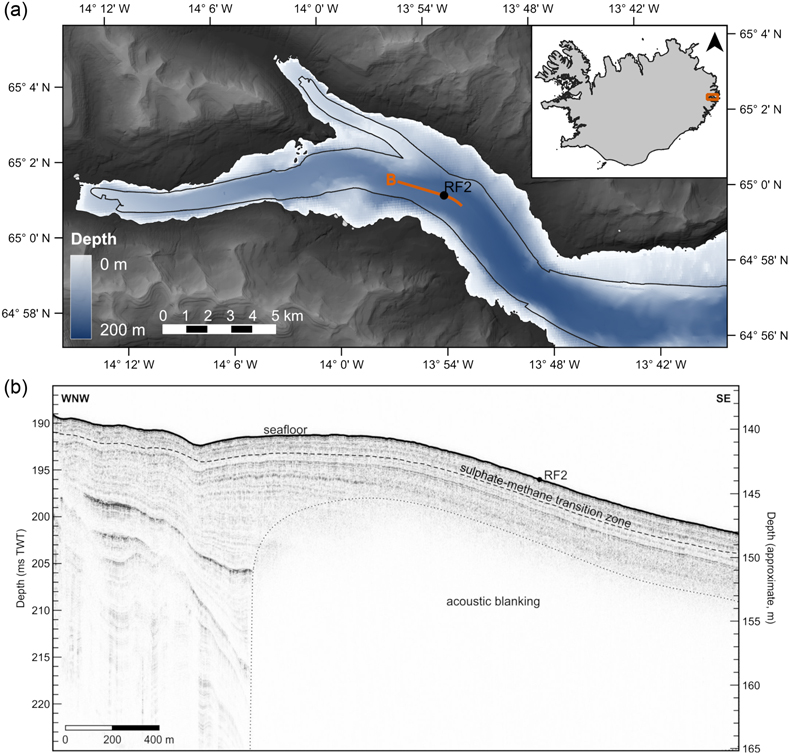
Figure 1 (a) Map of the sampling site (RF2) in Reyðarfjörður, eastern Iceland. The area within the black line shows the bottom topography as mapped by multibeam echo sounder. The orange line shows the location of the sub-bottom transect in panel B. The map was produced with the datasets LMI Digital Elevation Model, IS 50V Strandlína and IS 50V Vatnafar from Náttúrufræðistofnun, licensed under CC BY 4.0, and the EMODnet Bathymetry Consortium (2024)
EMODnet Bathymetry Consortium (2024) https://doi.org/10.12770/cf51df64-56f9-4a99-b1aa-36b8d7b743a1
. (b) Sub-bottom transect showing acoustic blanking below station RF2, suggesting the presence of gas. TWT = two way travel time.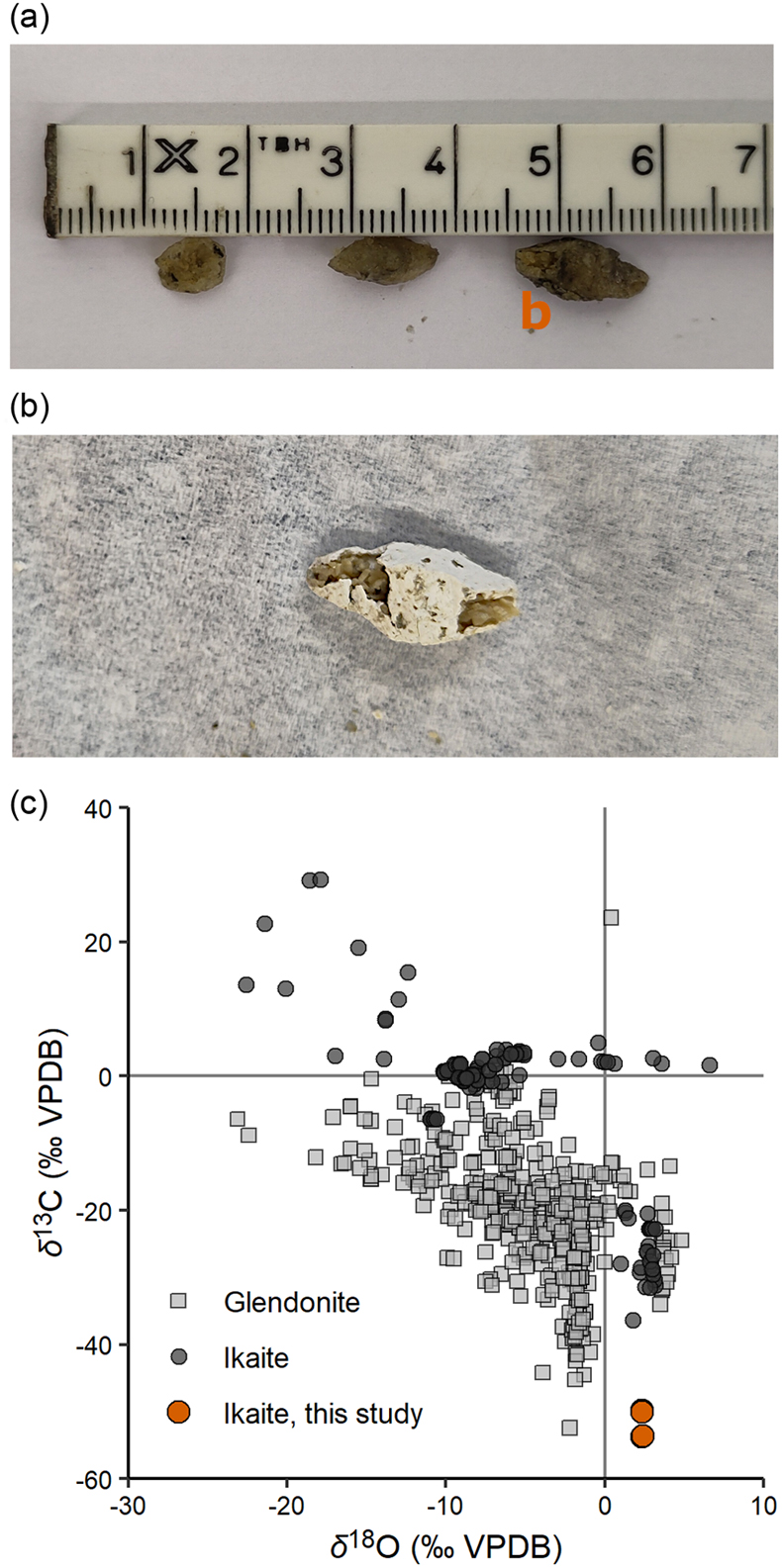
Figure 2 (a) Photograph of three of the ikaite crystals found at RF2I. (b) Photograph of a dried, recrystallised ikaite crystal marked with ‘b’ in panel (a). (c) Global compilation of isotopic compositions of glendonite and ikaite (Rogov et al., 2021
Rogov, M., Ershova, V., Vereshchagin, O., Vasileva, K., Mikhailova, K., Krylov, A. (2021) Database of global glendonite and ikaite records throughout the Phanerozoic. Earth System Science Data. Copernicus GmbH 13, 343–356. https://doi.org/10.5194/essd-13-343-2021
), including the ikaite from this study.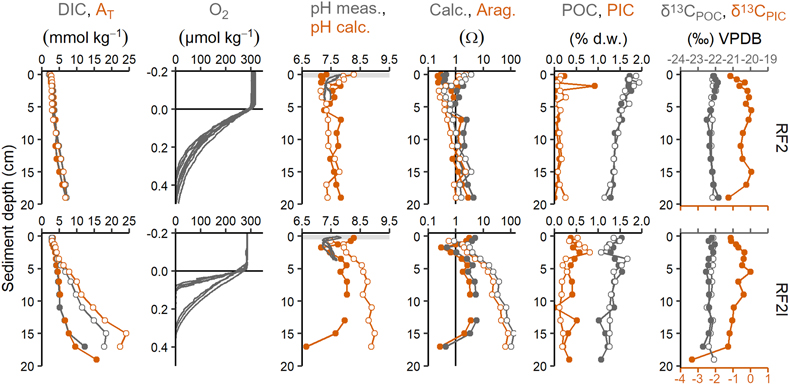
Figure 3 Porewater and solid phase profiles from stations RF2 and RF2I. Filled and empty markers represent replicate sediment cores, grey lines represent microprofiling data. The light grey area in the pH graph marks the scale of the O2 graph. Note the differences in scales on both x and y axes between plots.
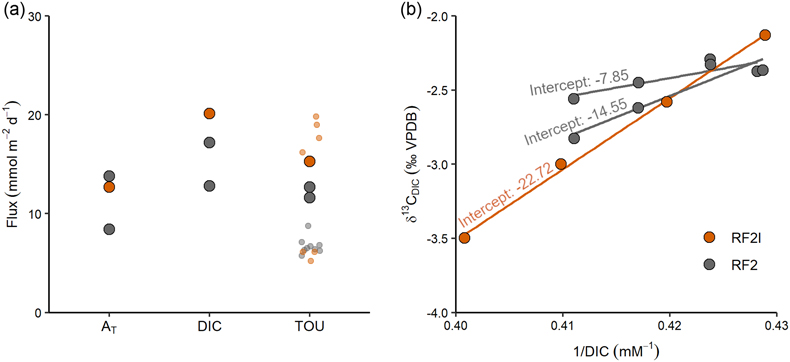
Figure 4 (a) Sediment-water fluxes of alkalinity (AT), dissolved inorganic carbon (DIC), and total oxygen uptake (TOU) from RF2 (grey) and RF2I (orange). Large circles mark fluxes measured in the incubation chambers; small circles mark diffusive O2 uptake rates from microprofiling data. (b) Keeling plot showing the DIC concentration and δ13C composition (δ13CDIC) in the incubations. The calculated intercepts indicate the δ13C signal of the combined DIC sources in each incubation.