



Diffusional fractionation of neon isotopes in MORB melts: a molecular dynamics study
Affiliations | Corresponding Author | Cite as | Funding information
Published by the European Association of Geochemistry
under Creative Commons License CC BY-NC-ND 4.0
Keywords: neon isotope fractionation, molecular dynamics simulations, MORB melts


- Share this article


-
Article views:15Cumulative count of HTML views and PDF downloads.
- Download Citation
- Rights & Permissions

top
Abstract
Figures
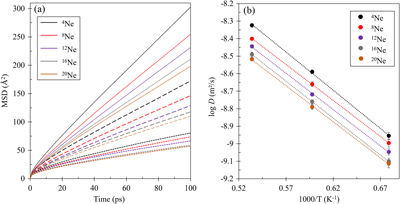 Figure 1 (a) Mean squared displacement (MSD) of Ne pseudo-isotopes in MORB melt at near-zero pressure and temperatures of 1473 K (dotted), 1673 K (dashed), and 1873 K (solid). (b) Diffusion coefficients as a function of inverse temperature. | 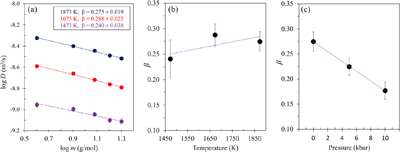 Figure 2 (a) Log D versus log m for Ne pseudo-isotopes at different temperatures. (b) Mass dependence exponent β as a function of temperature. (c) β as a function of pressure at 1873 K. | 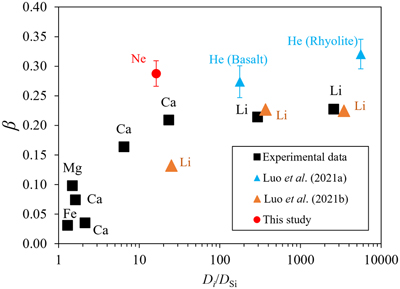 Figure 3 Relationship between the mass dependence exponent β and the solvent-normalised diffusivity (Di/DSi), modified from Luo et al. (2021a). Li and He data are from Luo et al. (2021a, 2021b); experimental data are from the references compiled therein. | 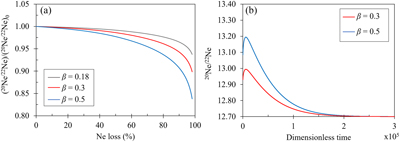 Figure 4 (a) Normalised melt 20Ne/22Ne as a function of neon loss for different β values. (b) Transient evolution of vesicle 20Ne/22Ne during diffusion-controlled degassing for β = 0.3 and 0.5, assuming 1 % vesicularity and an initial 20Ne/22Ne of 12.7. |
| Figure 1 | Figure 2 | Figure 3 | Figure 4 |
top
Introduction
The origin and evolution of highly volatile elements on Earth remain central questions in planetary science. These elements originate from multiple sources in the early Solar System and their present-day signatures reflect a complex history of planetary accretion, differentiation, degassing and loss to space (Marty et al., 2016
Marty, B., Avice, G., Sano, Y., Altwegg, K., Balsiger, H., Hässig, M., et al. (2016) Origins of volatile elements (H, C, N, noble gases) on Earth and Mars in light of recent results from the ROSETTA cometary mission. Earth and Planetary Science Letters 441, 91–102. https://doi.org/10.1016/j.epsl.2016.02.031
; Avice et al., 2017Avice, G., Marty, B., Burgess, R. (2017) The origin and degassing history of the Earth’s atmosphere revealed by Archean xenon. Nature Communications 8, 15455. https://doi.org/10.1038/ncomms15455
; Bekaert et al., 2019Bekaert, D.V., Broadley, M.W., Caracausi, A., Marty, B. (2019) Novel insights into the degassing history of Earth’s mantle from high precision noble gas analysis of magmatic gas. Earth and Planetary Science Letters 525, 115766. https://doi.org/10.1016/j.epsl.2019.115766
; Péron et al., 2018Péron, S., Moreira, M., Agranier, A. (2018) Origin of light noble gases (He, Ne, and Ar) on Earth: A review. Geochemistry, Geophysics, Geosystems 19, 979–996. https://doi.org/10.1002/2017GC007388
, 2021Péron, S., Mukhopadhyay, S., Kurz, M.D., Graham, D.W. (2021) Deep-mantle krypton reveals Earth’s early accretion of carbonaceous matter. Nature 600, 462–467. https://doi.org/10.1038/s41586-021-04092-z
). Noble gases are particularly valuable tracers of these processes because of their chemical inertness: their isotopic compositions are unaffected by biological or chemical reactions and are modified only by physical mechanisms such as diffusion, adsorption, or ion implantation (Ozima and Podosek, 1983Ozima, M., Podosek, F.A. (1983) Noble Gas Geochemistry. First Edition, Cambridge University Press, Cambridge.
; Moreira, 2013Moreira, M. (2013) Noble Gas Constraints on the Origin and Evolution of Earth’s Volatiles. Geochemical Perspectives 2, 229–403. https://doi.org/10.7185/geochempersp.2.2
). Among them, neon provides a unique window into Earth’s volatile history, as its two primordial isotopes (20Ne and 22Ne) are negligibly produced by nuclear reactions in the mantle (Yatsevich and Honda, 1997Yatsevich, I., Honda, M. (1997) Production of nucleogenic neon in the Earth from natural radioactive decay. Journal of Geophysical Research: Solid Earth 102, 10291–10298. https://doi.org/10.1029/97JB00395
) and thus potentially record the incorporation of a primordial component during Earth’s formation (Sarda et al., 1988Sarda, P., Staudacher, T., Allègre, C.J. (1988) Neon isotopes in submarine basalts. Earth and Planetary Science Letters 91, 73–88. https://doi.org/10.1016/0012-821X(88)90152-5
; Honda et al., 1993Honda, M., McDougall, I., Patterson, D.B., Doulgeris, A., Clague, D.A. (1993) Noble gases in submarine pillow basalt glasses from Loihi and Kilauea, Hawaii: a solar component in the Earth. Geochimica et Cosmochimica Acta 57, 859–874. https://doi.org/10.1016/0016-7037(93)90174-U
; Moreira et al., 1995Moreira, M., Staudacher, T., Sarda, P., Schilling, J.-G., Allègre, C.J. (1995) A primitive plume neon component in MORB: The Shona ridge-anomaly, South Atlantic (51–52°S). Earth and Planetary Science Letters 133, 367–377. https://doi.org/10.1016/0012-821X(95)00080-V
, 1998Moreira, M., Kunz, J., Allègre, C. (1998) Rare gas systematics in popping rock: isotopic and elemental compositions in the upper mantle. Science 279, 1178–1181. https://doi.org/10.1126/science.279.5354.1178
). It is now well established that the mantle 20Ne/22Ne ratio is solar-like, although its exact value and spatial homogeneity within the mantle remain debated (Sarda et al., 1988Sarda, P., Staudacher, T., Allègre, C.J. (1988) Neon isotopes in submarine basalts. Earth and Planetary Science Letters 91, 73–88. https://doi.org/10.1016/0012-821X(88)90152-5
; Honda et al., 1993Honda, M., McDougall, I., Patterson, D.B., Doulgeris, A., Clague, D.A. (1993) Noble gases in submarine pillow basalt glasses from Loihi and Kilauea, Hawaii: a solar component in the Earth. Geochimica et Cosmochimica Acta 57, 859–874. https://doi.org/10.1016/0016-7037(93)90174-U
; Moreira et al., 1995Moreira, M., Staudacher, T., Sarda, P., Schilling, J.-G., Allègre, C.J. (1995) A primitive plume neon component in MORB: The Shona ridge-anomaly, South Atlantic (51–52°S). Earth and Planetary Science Letters 133, 367–377. https://doi.org/10.1016/0012-821X(95)00080-V
, 1998Moreira, M., Kunz, J., Allègre, C. (1998) Rare gas systematics in popping rock: isotopic and elemental compositions in the upper mantle. Science 279, 1178–1181. https://doi.org/10.1126/science.279.5354.1178
, 2001Moreira, M., Breddam, K., Curtice, J., Kurz, M.D. (2001) Solar neon in the Icelandic mantle: new evidence for an undegassed lower mantle. Earth and Planetary Science Letters 185, 15–23. https://doi.org/10.1016/S0012-821X(00)00351-4
; Trieloff et al., 2002Trieloff, M., Kunz, J., Allègre, C.J. (2002) Noble gas systematics of the Réunion mantle plume source and the origin of primordial noble gases in Earth’s mantle. Earth and Planetary Science Letters 200, 297–313. https://doi.org/10.1016/S0012-821X(02)00639-8
; Ballentine et al., 2005Ballentine, C.J., Marty, B., Sherwood Lollar, B., Cassidy, M. (2005) Neon isotopes constrain convection and volatile origin in the Earth’s mantle. Nature 433, 33–38. https://doi.org/10.1038/nature03182.
; Kurz et al., 2009Kurz, M.D., Curtice, J., Fornari, D., Geist, D., Moreira, M. (2009) Primitive neon from the center of the Galápagos hotspot. Earth and Planetary Science Letters 286, 23–34. https://doi.org/10.1016/j.epsl.2009.06.008
). Competing models attribute mantle neon either to the dissolution of a solar-captured proto-atmosphere into a global magma ocean (e.g., Mizuno et al., 1980Mizuno, H., Nakazawa, K., Hayashi, C. (1980) Dissolution of the primordial rare gases into the molten Earth’s material. Earth and Planetary Science Letters 50, 202–210. https://doi.org/10.1016/0012-821X(80)90131-4
), or to the accretion of solar-wind-irradiated dust into Earth’s parent bodies (Ballentine et al., 2005Ballentine, C.J., Marty, B., Sherwood Lollar, B., Cassidy, M. (2005) Neon isotopes constrain convection and volatile origin in the Earth’s mantle. Nature 433, 33–38. https://doi.org/10.1038/nature03182.
; Kurz et al., 2009Kurz, M.D., Curtice, J., Fornari, D., Geist, D., Moreira, M. (2009) Primitive neon from the center of the Galápagos hotspot. Earth and Planetary Science Letters 286, 23–34. https://doi.org/10.1016/j.epsl.2009.06.008
; Moreira and Charnoz, 2016Moreira, M., Charnoz, S. (2016) The origin of the neon isotopes in chondrites and on Earth. Earth and Planetary Science Letters 433, 249–256. https://doi.org/10.1016/j.epsl.2015.11.002
; Péron et al., 2016Péron, S., Moreira, M., Colin, A., Arbaret, L., Putlitz, B., Kurz, M.D. (2016) Neon isotopic composition of the mantle constrained by single vesicle analyses. Earth and Planetary Science Letters 449, 145–154. https://doi.org/10.1016/j.epsl.2016.05.052
, 2017Péron, S., Moreira, M., Putlitz, B., Kurz, M. (2017) Solar wind implantation supplied light volatiles during the first stage of Earth accretion. Geochemical Perspectives Letters 3, 151–159. https://doi.org/10.7185/geochemlet.1718
, 2018Péron, S., Moreira, M., Agranier, A. (2018) Origin of light noble gases (He, Ne, and Ar) on Earth: A review. Geochemistry, Geophysics, Geosystems 19, 979–996. https://doi.org/10.1002/2017GC007388
).Distinguishing between these scenarios requires understanding how neon isotopes fractionate during magmatic processes. Volcanic glasses from mid-ocean ridge basalts (MORBs) and ocean island basalts (OIBs) provide access to the mantle neon signature. However, their interpretation is complicated by possible isotopic fractionation during magma ascent and degassing. Degassing of basaltic melts is primarily driven by CO2 exsolution, leading to bubble nucleation and growth. Because Ne is highly incompatible in silicate melts, it partitions strongly into vesicles, where isotopic fractionation may occur if diffusion rates differ between isotopes. Lighter 20Ne atoms are expected to diffuse faster than 22Ne, potentially enriching early-formed vesicles in 20Ne relative to the residual melt. This kinetic isotope effect could alter the isotopic ratios measured in natural samples and bias estimates of the mantle source composition. Until recently, direct evidence for such fractionation was lacking. Laboratory experiments by Núñez-Guerrero et al. (2025)
Núñez-Guerrero, E., Moreira, M., Scaillet, B. (2025) Isotopic fractionation of neon during magma degassing. Geochemical Perspectives Letters 34, 1–5. https://doi.org/10.7185/geochemlet.2505
demonstrated for the first time that individual vesicles in vesiculated basaltic glasses exhibit measurable variations in 20Ne/22Ne, consistent with kinetic mass-dependent fractionation during disequilibrium degassing. These results highlight the importance of diffusion-driven fractionation in natural magmatic systems and underscore the need for quantitative models capable of predicting its magnitude under mantle conditions.A key parameter characterising isotope-dependent diffusion is the mass dependence exponent β, defined through the relation:
(Eq. 1)

where Di and Dj are the diffusion coefficients of isotopes with masses mi and mj, respectively. In noble gas isotope fractionation studies, β = 0.5 is often adopted when isotope-specific diffusion data are unavailable. This assumption originates from Graham’s law of diffusion and effusion in gases (Graham, 1833
Graham, T. (1833) XXVII. On the law of the diffusion of gases. The London, Edinburgh, and Dublin Philosophical Magazine and Journal of Science 2, 175–190. https://doi.org/10.1080/14786443308648004
), which predicts that the transport rate of a particle is inversely proportional to the square root of its mass. While Graham’s law applies to free particles in the gas phase, atomistic interactions in dense silicate melts are expected to reduce the influence of mass on diffusivity. For helium, recent molecular dynamics studies using advanced neural network potentials showed that β indeed departs significantly from 0.5, taking values of 0.27–0.36 depending on melt composition and temperature (Luo et al., 2021aLuo, H., Karki, B.B., Ghosh, D.B., Bao, H. (2021a) Diffusional fractionation of helium isotopes in silicate melts. Geochemical Perspectives Letters 19, 19–22. https://doi.org/10.7185/geochemlet.2128
). However, no equivalent quantitative constraints exist for neon, despite its critical role as a tracer of mantle processes.In this study, we address this gap by performing classical molecular dynamics simulations of neon diffusion in a representative MORB melt. Using the pseudo-isotope method, which artificially extends the mass range beyond natural isotopes while preserving interatomic interactions, we systematically quantify the dependence of diffusion on mass across temperatures from 1473 K to 1873 K and pressures of 0, 5, and 10 kbar. From these simulations, we derive robust β values for neon in silicate melts, evaluate their dependence on temperature and pressure, and assess their implications for isotope fractionation during magma degassing. Our results provide a quantitative framework for interpreting experimental observations of neon isotopic variations in vesicles, refining models of noble gas loss during magmatic ascent, and constraining the preservation of primitive volatile signatures in Earth’s mantle.
top
Methods
Molecular dynamics (MD) simulations were performed using the LAMMPS package (Thompson et al., 2022
Thompson, A.P., Aktulga, H.M., Berger, R., Bolintineanu, D.S., Brown, W.M., Crozier, P.S., et al. (2022) LAMMPS - a flexible simulation tool for particle-based materials modeling at the atomic, meso, and continuum scales. Computer Physics Communications 271, 108171. https://doi.org/10.1016/j.cpc.2021.108171
). The simulated system consisted of 3,000 melt atoms and a single Ne atom in a cubic simulation cell with periodic boundary conditions. The melt structure was described using an empirical potential developed for silicate melts of the KNCFMATS system (K2O-Na2O-CaO-FeO-MgO-Al2O3-TiO2-SiO2), which has been shown to accurately reproduce key thermodynamic and transport properties of these melts (Guillot and Sator, 2007Guillot, B., Sator, N. (2007) A computer simulation study of natural silicate melts. Part I: Low pressure properties. Geochimica et Cosmochimica Acta 71, 1249–1265. https://doi.org/10.1016/j.gca.2006.11.015
). The melt composition and all interaction parameters are reported in Tables S-1 to S-3.The initial melt configuration was generated by randomly distributing the melt-forming atoms within the simulation cell. The system was first equilibrated at 4000 K and 10 kbar to remove any structural bias associated with the initial random configuration. A single Ne atom was subsequently introduced into the equilibrated melt, and the system was equilibrated for an additional 1 ns at each target temperature and pressure. Production runs were then carried out for 10 ns in the NVT ensemble using a Nosé-Hoover thermostat with a timestep of 1 fs. Long-range electrostatic interactions were evaluated using the particle-particle particle-mesh (PPPM) method, while short-range interactions were truncated at 10 Å.
The mass dependence of diffusion was investigated using the pseudo-isotope approach (e.g., Goel et al., 2012
Goel, G., Zhang, L., Lacks, D.J., Van Orman, J.A. (2012) Isotope fractionation by diffusion in silicate melts: Insights from molecular dynamics simulations. Geochimica et Cosmochimica Acta 93, 205–213. https://doi.org/10.1016/j.gca.2012.07.008
; Luo et al., 2020Luo, H., Karki, B.B., Ghosh, D.B., Bao, H. (2020) First-principles computation of diffusional Mg isotope fractionation in silicate melts. Geochimica et Cosmochimica Acta 290, 27–40. https://doi.org/10.1016/j.gca.2020.08.028
, 2021aLuo, H., Karki, B.B., Ghosh, D.B., Bao, H. (2021a) Diffusional fractionation of helium isotopes in silicate melts. Geochemical Perspectives Letters 19, 19–22. https://doi.org/10.7185/geochemlet.2128
, 2021bLuo, H., Karki, B.B., Ghosh, D.B., Bao, H. (2021b) Deep neural network potentials for diffusional lithium isotope fractionation in silicate melts. Geochimica et Cosmochimica Acta 303, 38–50. https://doi.org/10.1016/j.gca.2021.03.031
), in which artificial isotopes with modified masses but identical interaction parameters are introduced to amplify kinetic isotope effects. In addition to natural 20Ne, pseudo-masses of 4, 8, 12, and 16 g/mol were simulated. Diffusion coefficients were determined from the linear regime of the mean squared displacement (MSD) using the Einstein relation:(Eq. 2)

where 〈Δr(t)2〉 is the ensemble-averaged MSD. For each mass-temperature-pressure condition, 20 independent simulations were performed, and MSDs were averaged over multiple time origins using 100 segments of 100 ps. Final diffusion coefficients are reported as the mean across all runs, with uncertainties given as the standard error of the mean. The mass dependence exponent β was obtained from linear regressions of log D versus log m.
top
Results
To evaluate the influence of isotopic mass on diffusion, we first verified that the diffusion process was properly sampled in our simulations. Figure 1a shows the MSD of Ne atoms at different temperatures under near-zero-pressure conditions. The MSD curves exhibit the expected two-stage behaviour: an initial ballistic regime lasting about 1 ps, followed by diffusive behaviour at longer times. MSD curves for different pseudo-isotopes are clearly separated. Diffusion coefficients derived from the MSD curves are reported in Table S-4. They follow the expected trends: diffusivity decreases with increasing isotopic mass, increases with temperature, and decreases with pressure. The temperature dependence follows an Arrhenius law:
(Eq. 3)

where D0 is the pre-exponential factor, Ea is the activation energy and R is the gas constant. This relationship holds for all neon isotopes investigated (Fig. 1b). The calculated D0 values appear to decrease with increasing mass, whereas the activation energies show no definite mass dependence and remain within the range 78–83 kJ/mol (Fig. S-1). The predicted diffusivity for 20Ne at 1623 K is 1.38 × 10⁻⁹ m2/s, which is of the same order of magnitude as the experimental value of 2.75 × 10⁻⁹ m2/s reported by Lux (1987)
Lux, G. (1987) The behavior of noble gases in silicate liquids: Solution, diffusion, bubbles and surface effects, with applications to natural samples. Geochimica et Cosmochimica Acta 51, 1549–1560. https://doi.org/10.1016/0016-7037(87)90336-X
.Figure 1 (a) Mean squared displacement (MSD) of Ne pseudo-isotopes in MORB melt at near-zero pressure and temperatures of 1473 K (dotted), 1673 K (dashed), and 1873 K (solid). (b) Diffusion coefficients as a function of inverse temperature.
The dependence of diffusion on isotopic mass is well captured by the linear relationship between log D and log m across the entire temperature range investigated (Fig. 2a). This demonstrates that isotopic mass influences neon mobility in MORB melts at zero pressure. From these regressions, we derive the mass dependence exponent β. Unlike the gas kinetic prediction of β = 0.5, our values are significantly lower, ranging from 0.240 ± 0.038 at 1473 K to 0.288 ± 0.022 at 1673 K and 0.275 ± 0.019 at 1873 K. This reduction reflects the influence of the dense silicate network, which hinders isotopic separation compared to gaseous systems. The β versus temperature relationship (Fig. 2b) suggests a weak positive correlation, corresponding to slightly higher β values at elevated temperatures. However, this trend remains within analytical uncertainty and does not support a statistically significant temperature dependence of β over the investigated range. This contrasts with previous studies reporting a decrease of β with increasing temperature in silicate melts at near-zero pressure for lighter species such as He and Li (e.g., Luo et al., 2021a
Luo, H., Karki, B.B., Ghosh, D.B., Bao, H. (2021a) Diffusional fractionation of helium isotopes in silicate melts. Geochemical Perspectives Letters 19, 19–22. https://doi.org/10.7185/geochemlet.2128
, 2021bLuo, H., Karki, B.B., Ghosh, D.B., Bao, H. (2021b) Deep neural network potentials for diffusional lithium isotope fractionation in silicate melts. Geochimica et Cosmochimica Acta 303, 38–50. https://doi.org/10.1016/j.gca.2021.03.031
).Figure 2 (a) Log D versus log m for Ne pseudo-isotopes at different temperatures. (b) Mass dependence exponent β as a function of temperature. (c) β as a function of pressure at 1873 K.
At elevated pressures, the linear relationship between log D and log m is preserved at 1873 K (Fig. S-3), indicating that isotopic mass still exerts an influence on neon diffusion. β decreases approximately linearly with pressure, varying from 0.275 at ambient pressure to 0.225 ± 0.017 at 5 kbar and 0.177 ± 0.017 at 10 kbar (Fig. 2c). This behaviour is consistent with observations for Mg diffusion in silicate melts, where the mass dependence weakens with increasing pressure (e.g., Goel et al., 2012
Goel, G., Zhang, L., Lacks, D.J., Van Orman, J.A. (2012) Isotope fractionation by diffusion in silicate melts: Insights from molecular dynamics simulations. Geochimica et Cosmochimica Acta 93, 205–213. https://doi.org/10.1016/j.gca.2012.07.008
; Luo et al., 2020Luo, H., Karki, B.B., Ghosh, D.B., Bao, H. (2020) First-principles computation of diffusional Mg isotope fractionation in silicate melts. Geochimica et Cosmochimica Acta 290, 27–40. https://doi.org/10.1016/j.gca.2020.08.028
). In those systems, the reduction in β has been attributed to pressure-induced structural compaction, which increases atomic coordination and reduces the free volume available for uncorrelated motion. Although neon is an inert, non-bonding species, a similar effect may operate indirectly, as increased network rigidity constrains transport pathways and promotes more collective motion, thereby attenuating the isotopic mass effect.Previous studies have proposed that β in silicate melts increases with the solvent-normalised diffusivity (Di/DSi), suggesting that species weakly coupled to the silicate network tend to exhibit stronger isotopic fractionation during diffusion (e.g., Watkins et al., 2011
Watkins, J.M., DePaolo, D.J., Ryerson, F.J., Peterson, B.T. (2011) Influence of liquid structure on diffusive isotope separation in molten silicates and aqueous solutions. Geochimica et Cosmochimica Acta 75, 3103–3118. https://doi.org/10.1016/j.gca.2011.03.002
). However, Luo et al. (2020Luo, H., Karki, B.B., Ghosh, D.B., Bao, H. (2020) First-principles computation of diffusional Mg isotope fractionation in silicate melts. Geochimica et Cosmochimica Acta 290, 27–40. https://doi.org/10.1016/j.gca.2020.08.028
, 2021a)Luo, H., Karki, B.B., Ghosh, D.B., Bao, H. (2021a) Diffusional fractionation of helium isotopes in silicate melts. Geochemical Perspectives Letters 19, 19–22. https://doi.org/10.7185/geochemlet.2128
argued that this relationship is valid only over a limited temperature range and becomes less systematic when comparing different elements and melt compositions. Our results support this more nuanced interpretation. Although DNe/DSi is substantially lower than DHe/DSi in basaltic melts at comparable temperatures (∼1700 K; Luo et al., 2021aLuo, H., Karki, B.B., Ghosh, D.B., Bao, H. (2021a) Diffusional fractionation of helium isotopes in silicate melts. Geochemical Perspectives Letters 19, 19–22. https://doi.org/10.7185/geochemlet.2128
), Ne exhibits a β value (0.288 ± 0.022) very similar to that of He (Fig. 3). If β were controlled solely by Di/DSi, a much larger difference between He and Ne would be expected. Instead, the similarity of their β values suggests that the mass dependence of diffusion for small noble gases is affected by the silicate network in a comparable manner, despite significant differences in their absolute diffusivities.Figure 3 Relationship between the mass dependence exponent β and the solvent-normalised diffusivity (Di/DSi), modified from Luo et al. (2021a)
Luo, H., Karki, B.B., Ghosh, D.B., Bao, H. (2021a) Diffusional fractionation of helium isotopes in silicate melts. Geochemical Perspectives Letters 19, 19–22. https://doi.org/10.7185/geochemlet.2128
. Li and He data are from Luo et al. (2021aLuo, H., Karki, B.B., Ghosh, D.B., Bao, H. (2021a) Diffusional fractionation of helium isotopes in silicate melts. Geochemical Perspectives Letters 19, 19–22. https://doi.org/10.7185/geochemlet.2128
, 2021b)Luo, H., Karki, B.B., Ghosh, D.B., Bao, H. (2021b) Deep neural network potentials for diffusional lithium isotope fractionation in silicate melts. Geochimica et Cosmochimica Acta 303, 38–50. https://doi.org/10.1016/j.gca.2021.03.031
; experimental data are from the references compiled therein.This behaviour likely reflects a fundamental difference between noble gases and network-bound species. Elements such as Li, Mg, Ca or Fe interact directly with the silicate structure, and their diffusivities are therefore closely linked to the degree of coupling with the network. In contrast, noble gases diffuse through transient free volume regions generated by thermal fluctuations of the melt structure. Their absolute diffusivities are strongly influenced by atomic size, with He diffusing faster than Ne because it can more readily migrate through these transient pathways. However, once these pathways become accessible, the isotope dependence of diffusion appears to be governed by similar interactions with the dynamic silicate network, resulting in comparable β values for He and Ne. The noble gas data therefore suggest that the β-Di/DSi relationship established primarily from network-bound species may not be directly transferable to weakly interacting interstitial species. Additional experimental and computational studies on noble gas diffusion in silicate melts will be required to determine whether a distinct scaling relationship applies to this class of elements.
top
Discussion and Conclusions
The mass dependence of neon diffusion quantified in this study provides a physically grounded framework for evaluating diffusion-driven isotope fractionation during magmatic degassing. Across the investigated temperature range, the linear relationship between log D and log m confirms that isotopic mass exerts a measurable control on neon mobility in MORB melts (Fig. 2a). However, the derived mass dependence exponents (β = 0.24–0.29) remain substantially lower than the gas kinetic prediction of β = 0.5, reflecting the influence of the dense silicate network on atomic transport. These results demonstrate that melt-specific β values should be used when modelling noble gas isotope fractionation in magmatic systems.
The consequences of these reduced β values depend on the scale at which isotope fractionation is considered. At the bulk melt scale, the relatively low β values obtained here at ambient pressure indicate that diffusion alone is unlikely to generate large, system-wide 20Ne/22Ne offsets, particularly under conditions approaching quasi-equilibrium or progressive gas loss during ascent. Figure 4a illustrates the predicted evolution of the bulk melt composition during diffusion-controlled neon loss. Isotopic fractionation in the melt-averaged composition remains limited over most of the degassing range, and the magnitude of the predicted shift is systematically smaller when using the β values constrained in this study (β ≈ 0.3) than when adopting the theoretical gas kinetic limit of β = 0.5. Even at high degrees of neon loss, the melt-averaged ratio (20Ne/22Ne)/(20Ne/22Ne)0 remains close to unity (generally above ∼0.9 for β = 0.3). These results suggest that, in slowly ascending or efficiently re-equilibrating magmas, the primary mantle neon signature is likely to be largely preserved in the residual melt.
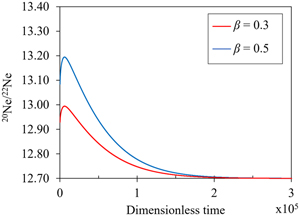
Figure 4 (a) Normalised melt 20Ne/22Ne as a function of neon loss for different β values. (b) Transient evolution of vesicle 20Ne/22Ne during diffusion-controlled degassing for β = 0.3 and 0.5, assuming 1 % vesicularity and an initial 20Ne/22Ne of 12.7.
The situation is different at the scale of individual vesicles, where diffusion can generate localised and transient isotopic heterogeneities under strongly non-equilibrium degassing conditions. To evaluate the magnitude of such effects, we considered an idealised spherical vesicle of fixed radius embedded within the melt and examined the transient isotopic evolution resulting solely from diffusion-driven transport, assuming that transfer across the melt-vesicle interface does not introduce additional isotope fractionation. This time-dependent vesicle model (Fig. 4b) demonstrates that the faster diffusion of 20Ne relative to 22Ne leads to a transient enrichment of the light isotope in the gas phase, with peak 20Ne/22Ne ratios that depend sensitively on β. For an initial magma 20Ne/22Ne ratio of 12.7, representative of an implanted solar wind component (see Moreira and Charnoz, 2016
Moreira, M., Charnoz, S. (2016) The origin of the neon isotopes in chondrites and on Earth. Earth and Planetary Science Letters 433, 249–256. https://doi.org/10.1016/j.epsl.2015.11.002
), the maximum vesicle ratio reaches approximately 13.0 for β = 0.3, compared to about 13.2 for β = 0.5. Although the fractionation predicted using the MD-derived β values is smaller than that obtained using the theoretical gas kinetic value β = 0.5, the resulting vesicle isotopic compositions remain comparable to the highest 20Ne/22Ne ratios reported for mantle-derived materials, which range from approximately 12.5 to 13.0 (Moreira and Charnoz, 2016Moreira, M., Charnoz, S. (2016) The origin of the neon isotopes in chondrites and on Earth. Earth and Planetary Science Letters 433, 249–256. https://doi.org/10.1016/j.epsl.2015.11.002
). These results indicate that diffusion-driven fractionation is sufficiently large to generate measurable isotopic variations that may contribute to the neon isotope variability observed in natural magmatic systems, particularly if rapid ascent or quenching limits subsequent re-equilibration between the melt and the gas phase.The pressure dependence of β further constrains the depth range over which diffusion-driven fractionation is expected to be most effective. The linear decrease of β with increasing pressure observed in our simulations implies that isotopic mass effects are progressively suppressed in deeper parts of ascending magmas. This is consistent with pressure-induced structural compaction of the melt, which enhances atomic coordination and promotes more collective transport mechanisms, thereby reducing the contribution of uncorrelated, mass-dependent diffusion. As a result, diffusion-controlled fractionation is expected to be weakest during early stages of ascent and bubble nucleation at high lithostatic pressures, and to become more effective only at shallower levels where degassing proceeds under stronger disequilibrium.
Taken together, these results demonstrate that the commonly assumed value of β = 0.5 is not appropriate for describing neon diffusion in silicate melts. Instead, a lower, melt-specific value of β ≈ 0.3 at low pressure, with further reduction under compression, provides a more realistic and physically grounded basis for modelling isotope fractionation during magmatic degassing. While this implies that diffusion-driven fractionation is smaller than previously inferred from kinetic models, it remains sufficiently large to generate measurable, and potentially preserved, isotopic signatures in vesicles formed under rapid ascent or quenching conditions. Consequently, neon isotopic ratios measured in vesiculated volcanic glasses should not always be interpreted as direct proxies for mantle source compositions, but rather as records that may carry a superimposed, diffusion-controlled signature acquired during magma ascent and degassing.
top
Acknowledgments
The authors acknowledge support from the European Research Council (ERC) (Grant Agreement No. 101096688[APATE][ERC-2022-ADG]).
Editor: Horst R. Marschall
top
References
Avice, G., Marty, B., Burgess, R. (2017) The origin and degassing history of the Earth’s atmosphere revealed by Archean xenon. Nature Communications 8, 15455. https://doi.org/10.1038/ncomms15455
 Show in context
 These elements originate from multiple sources in the early Solar System and their present-day signatures reflect a complex history of planetary accretion, differentiation, degassing and loss to space (Marty et al., 2016; Avice et al., 2017; Bekaert et al., 2019; Péron et al., 2018, 2021).
View in article
Ballentine, C.J., Marty, B., Sherwood Lollar, B., Cassidy, M. (2005) Neon isotopes constrain convection and volatile origin in the Earth’s mantle. Nature 433, 33–38. https://doi.org/10.1038/nature03182.
Show in context It is now well established that the mantle 20Ne/22Ne ratio is solar-like, although its exact value and spatial homogeneity within the mantle remain debated (Sarda et al., 1988; Honda et al., 1993; Moreira et al., 1995, 1998, 2001; Trieloff et al., 2002; Ballentine et al., 2005; Kurz et al., 2009).
View in article
Competing models attribute mantle neon either to the dissolution of a solar-captured proto-atmosphere into a global magma ocean (e.g., Mizuno et al., 1980), or to the accretion of solar-wind-irradiated dust into Earth’s parent bodies (Ballentine et al., 2005; Kurz et al., 2009; Moreira and Charnoz, 2016; Péron et al., 2016, 2017, 2018).
View in article
Bekaert, D.V., Broadley, M.W., Caracausi, A., Marty, B. (2019) Novel insights into the degassing history of Earth’s mantle from high precision noble gas analysis of magmatic gas. Earth and Planetary Science Letters 525, 115766. https://doi.org/10.1016/j.epsl.2019.115766
Show in context These elements originate from multiple sources in the early Solar System and their present-day signatures reflect a complex history of planetary accretion, differentiation, degassing and loss to space (Marty et al., 2016; Avice et al., 2017; Bekaert et al., 2019; Péron et al., 2018, 2021)
View in article
Goel, G., Zhang, L., Lacks, D.J., Van Orman, J.A. (2012) Isotope fractionation by diffusion in silicate melts: Insights from molecular dynamics simulations. Geochimica et Cosmochimica Acta 93, 205–213. https://doi.org/10.1016/j.gca.2012.07.008
Show in context The mass dependence of diffusion was investigated using the pseudo-isotope approach (e.g., Goel et al., 2012; Luo et al., 2020, 2021a, 2021b), in which artificial isotopes with modified masses but identical interaction parameters are introduced to amplify kinetic isotope effects.
View in article
This behaviour is consistent with observations for Mg diffusion in silicate melts, where the mass dependence weakens with increasing pressure (e.g., Goel et al., 2012; Luo et al., 2020).
View in article
Graham, T. (1833) XXVII. On the law of the diffusion of gases. The London, Edinburgh, and Dublin Philosophical Magazine and Journal of Science 2, 175–190. https://doi.org/10.1080/14786443308648004
Show in context This assumption originates from Graham’s law of diffusion and effusion in gases (Graham, 1833), which predicts that the transport rate of a particle is inversely proportional to the square root of its mass.
View in article
Guillot, B., Sator, N. (2007) A computer simulation study of natural silicate melts. Part I: Low pressure properties. Geochimica et Cosmochimica Acta 71, 1249–1265. https://doi.org/10.1016/j.gca.2006.11.015
Show in context The melt structure was described using an empirical potential developed for silicate melts of the KNCFMATS system (K2O-Na2O-CaO-FeO-MgO-Al2O3-TiO2-SiO2), which has been shown to accurately reproduce key thermodynamic and transport properties of these melts (Guillot and Sator, 2007).
View in article
Honda, M., McDougall, I., Patterson, D.B., Doulgeris, A., Clague, D.A. (1993) Noble gases in submarine pillow basalt glasses from Loihi and Kilauea, Hawaii: a solar component in the Earth. Geochimica et Cosmochimica Acta 57, 859–874. https://doi.org/10.1016/0016-7037(93)90174-U
Show in context Among them, neon provides a unique window into Earth’s volatile history, as its two primordial isotopes (20Ne and 22Ne) are negligibly produced by nuclear reactions in the mantle (Yatsevich and Honda, 1997) and thus potentially record the incorporation of a primordial component during Earth’s formation (Sarda et al., 1988; Honda et al., 1993; Moreira et al., 1995, 1998).
View in article
It is now well established that the mantle 20Ne/22Ne ratio is solar-like, although its exact value and spatial homogeneity within the mantle remain debated (Sarda et al., 1988; Honda et al., 1993; Moreira et al., 1995, 1998, 2001; Trieloff et al., 2002; Ballentine et al., 2005; Kurz et al., 2009).
View in article
Kurz, M.D., Curtice, J., Fornari, D., Geist, D., Moreira, M. (2009) Primitive neon from the center of the Galápagos hotspot. Earth and Planetary Science Letters 286, 23–34. https://doi.org/10.1016/j.epsl.2009.06.008
Show in context It is now well established that the mantle 20Ne/22Ne ratio is solar-like, although its exact value and spatial homogeneity within the mantle remain debated (Sarda et al., 1988; Honda et al., 1993; Moreira et al., 1995, 1998, 2001; Trieloff et al., 2002; Ballentine et al., 2005; Kurz et al., 2009).
View in article
Competing models attribute mantle neon either to the dissolution of a solar-captured proto-atmosphere into a global magma ocean (e.g., Mizuno et al., 1980), or to the accretion of solar-wind-irradiated dust into Earth’s parent bodies (Ballentine et al., 2005; Kurz et al., 2009; Moreira and Charnoz, 2016; Péron et al., 2016, 2017, 2018). View in article
Luo, H., Karki, B.B., Ghosh, D.B., Bao, H. (2020) First-principles computation of diffusional Mg isotope fractionation in silicate melts. Geochimica et Cosmochimica Acta 290, 27–40. https://doi.org/10.1016/j.gca.2020.08.028
Show in context The mass dependence of diffusion was investigated using the pseudo-isotope approach (e.g., Goel et al., 2012; Luo et al., 2020, 2021a, 2021b), in which artificial isotopes with modified masses but identical interaction parameters are introduced to amplify kinetic isotope effects.
View in article
This behaviour is consistent with observations for Mg diffusion in silicate melts, where the mass dependence weakens with increasing pressure (e.g., Goel et al., 2012; Luo et al., 2020).
View in article
However, Luo et al. (2020, 2021a) argued that this relationship is valid only over a limited temperature range and becomes less systematic when comparing different elements and melt compositions.
View in article
Luo, H., Karki, B.B., Ghosh, D.B., Bao, H. (2021a) Diffusional fractionation of helium isotopes in silicate melts. Geochemical Perspectives Letters 19, 19–22. https://doi.org/10.7185/geochemlet.2128
Show in context For helium, recent molecular dynamics studies using advanced neural network potentials showed that β indeed departs significantly from 0.5, taking values of 0.27–0.36 depending on melt composition and temperature (Luo et al., 2021a).
View in article
The mass dependence of diffusion was investigated using the pseudo-isotope approach (e.g., Goel et al., 2012; Luo et al., 2020, 2021a, 2021b), in which artificial isotopes with modified masses but identical interaction parameters are introduced to amplify kinetic isotope effects.
View in article
This contrasts with previous studies reporting a decrease of β with increasing temperature in silicate melts at near-zero pressure for lighter species such as He and Li (e.g., Luo et al., 2021a, 2021b).
View in article
However, Luo et al. (2020, 2021a) argued that this relationship is valid only over a limited temperature range and becomes less systematic when comparing different elements and melt compositions.
View in article
Relationship between the mass dependence exponent β and the solvent-normalised diffusivity (Di/DSi), modified from Luo et al. (2021a).
View in article
Li and He data are from Luo et al. (2021a, 2021b); experimental data are from the references compiled therein.
View in article
Luo, H., Karki, B.B., Ghosh, D.B., Bao, H. (2021b) Deep neural network potentials for diffusional lithium isotope fractionation in silicate melts. Geochimica et Cosmochimica Acta 303, 38–50. https://doi.org/10.1016/j.gca.2021.03.031
Show in context The mass dependence of diffusion was investigated using the pseudo-isotope approach (e.g., Goel et al., 2012; Luo et al., 2020, 2021a, 2021b), in which artificial isotopes with modified masses but identical interaction parameters are introduced to amplify kinetic isotope effects.
View in article
This contrasts with previous studies reporting a decrease of β with increasing temperature in silicate melts at near-zero pressure for lighter species such as He and Li (e.g., Luo et al., 2021a, 2021b).
View in article
Li and He data are from Luo et al. (2021a, 2021b); experimental data are from the references compiled therein.
View in article
Lux, G. (1987) The behavior of noble gases in silicate liquids: Solution, diffusion, bubbles and surface effects, with applications to natural samples. Geochimica et Cosmochimica Acta 51, 1549–1560. https://doi.org/10.1016/0016-7037(87)90336-X
Show in context The predicted diffusivity for 20Ne at 1623 K is 1.38 × 10⁻⁹ m2/s, which is of the same order of magnitude as the experimental value of 2.75 × 10⁻⁹ m2/s reported by Lux (1987).
View in article
Marty, B., Avice, G., Sano, Y., Altwegg, K., Balsiger, H., Hässig, M., et al. (2016) Origins of volatile elements (H, C, N, noble gases) on Earth and Mars in light of recent results from the ROSETTA cometary mission. Earth and Planetary Science Letters 441, 91–102. https://doi.org/10.1016/j.epsl.2016.02.031
Show in context These elements originate from multiple sources in the early Solar System and their present-day signatures reflect a complex history of planetary accretion, differentiation, degassing and loss to space (Marty et al., 2016; Avice et al., 2017; Bekaert et al., 2019; Péron et al., 2018, 2021).
View in article
Mizuno, H., Nakazawa, K., Hayashi, C. (1980) Dissolution of the primordial rare gases into the molten Earth’s material. Earth and Planetary Science Letters 50, 202–210. https://doi.org/10.1016/0012-821X(80)90131-4
Show in context Competing models attribute mantle neon either to the dissolution of a solar-captured proto-atmosphere into a global magma ocean (e.g., Mizuno et al., 1980), or to the accretion of solar-wind-irradiated dust into Earth’s parent bodies (Ballentine et al., 2005; Kurz et al., 2009; Moreira and Charnoz, 2016; Péron et al., 2016, 2017, 2018).
View in article
Moreira, M. (2013) Noble Gas Constraints on the Origin and Evolution of Earth’s Volatiles. Geochemical Perspectives 2, 229–403. https://doi.org/10.7185/geochempersp.2.2
Show in context Noble gases are particularly valuable tracers of these processes because of their chemical inertness: their isotopic compositions are unaffected by biological or chemical reactions and are modified only by physical mechanisms such as diffusion, adsorption, or ion implantation (Ozima and Podosek, 1983; Moreira, 2013).
View in article
Moreira, M., Charnoz, S. (2016) The origin of the neon isotopes in chondrites and on Earth. Earth and Planetary Science Letters 433, 249–256. https://doi.org/10.1016/j.epsl.2015.11.002
Show in context Competing models attribute mantle neon either to the dissolution of a solar-captured proto-atmosphere into a global magma ocean (e.g., Mizuno et al., 1980), or to the accretion of solar-wind-irradiated dust into Earth’s parent bodies (Ballentine et al., 2005; Kurz et al., 2009; Moreira and Charnoz, 2016; Péron et al., 2016, 2017, 2018).
View in article
For an initial magma 20Ne/22Ne ratio of 12.7, representative of an implanted solar wind component (see Moreira and Charnoz, 2016), the maximum vesicle ratio reaches approximately 13.0 for β = 0.3, compared to about 13.2 for β = 0.5.
View in article
Although the fractionation predicted using the MD-derived β values is smaller than that obtained using the theoretical gas kinetic value β = 0.5, the resulting vesicle isotopic compositions remain comparable to the highest 20Ne/22Ne ratios reported for mantle-derived materials, which range from approximately 12.5 to 13.0 (Moreira and Charnoz, 2016).
View in article
Moreira, M., Staudacher, T., Sarda, P., Schilling, J.-G., Allègre, C.J. (1995) A primitive plume neon component in MORB: The Shona ridge-anomaly, South Atlantic (51–52°S). Earth and Planetary Science Letters 133, 367–377. https://doi.org/10.1016/0012-821X(95)00080-V
Show in context Among them, neon provides a unique window into Earth’s volatile history, as its two primordial isotopes (20Ne and 22Ne) are negligibly produced by nuclear reactions in the mantle (Yatsevich and Honda, 1997) and thus potentially record the incorporation of a primordial component during Earth’s formation (Sarda et al., 1988; Honda et al., 1993; Moreira et al., 1995, 1998).
View in article
It is now well established that the mantle 20Ne/22Ne ratio is solar-like, although its exact value and spatial homogeneity within the mantle remain debated (Sarda et al., 1988; Honda et al., 1993; Moreira et al., 1995, 1998, 2001; Trieloff et al., 2002; Ballentine et al., 2005; Kurz et al., 2009).
View in article
Moreira, M., Kunz, J., Allègre, C. (1998) Rare gas systematics in popping rock: isotopic and elemental compositions in the upper mantle. Science 279, 1178–1181. https://doi.org/10.1126/science.279.5354.1178
Show in context Among them, neon provides a unique window into Earth’s volatile history, as its two primordial isotopes (20Ne and 22Ne) are negligibly produced by nuclear reactions in the mantle (Yatsevich and Honda, 1997) and thus potentially record the incorporation of a primordial component during Earth’s formation (Sarda et al., 1988; Honda et al., 1993; Moreira et al., 1995, 1998).
View in article
It is now well established that the mantle 20Ne/22Ne ratio is solar-like, although its exact value and spatial homogeneity within the mantle remain debated (Sarda et al., 1988; Honda et al., 1993; Moreira et al., 1995, 1998, 2001; Trieloff et al., 2002; Ballentine et al., 2005; Kurz et al., 2009).
View in article
Moreira, M., Breddam, K., Curtice, J., Kurz, M.D. (2001) Solar neon in the Icelandic mantle: new evidence for an undegassed lower mantle. Earth and Planetary Science Letters 185, 15–23. https://doi.org/10.1016/S0012-821X(00)00351-4
Show in context It is now well established that the mantle 20Ne/22Ne ratio is solar-like, although its exact value and spatial homogeneity within the mantle remain debated (Sarda et al., 1988; Honda et al., 1993; Moreira et al., 1995, 1998, 2001; Trieloff et al., 2002; Ballentine et al., 2005; Kurz et al., 2009).
View in article
Núñez-Guerrero, E., Moreira, M., Scaillet, B. (2025) Isotopic fractionation of neon during magma degassing. Geochemical Perspectives Letters 34, 1–5. https://doi.org/10.7185/geochemlet.2505
Show in context Laboratory experiments by Núñez-Guerrero et al. (2025) demonstrated for the first time that individual vesicles in vesiculated basaltic glasses exhibit measurable variations in 20Ne/22Ne, consistent with kinetic mass-dependent fractionation during disequilibrium degassing.
View in article
Ozima, M., Podosek, F.A. (1983) Noble Gas Geochemistry. First Edition, Cambridge University Press, Cambridge.
Show in context Noble gases are particularly valuable tracers of these processes because of their chemical inertness: their isotopic compositions are unaffected by biological or chemical reactions and are modified only by physical mechanisms such as diffusion, adsorption, or ion implantation (Ozima and Podosek, 1983; Moreira, 2013).
View in article
Péron, S., Moreira, M., Colin, A., Arbaret, L., Putlitz, B., Kurz, M.D. (2016) Neon isotopic composition of the mantle constrained by single vesicle analyses. Earth and Planetary Science Letters 449, 145–154. https://doi.org/10.1016/j.epsl.2016.05.052
Show in context Competing models attribute mantle neon either to the dissolution of a solar-captured proto-atmosphere into a global magma ocean (e.g., Mizuno et al., 1980), or to the accretion of solar-wind-irradiated dust into Earth’s parent bodies (Ballentine et al., 2005; Kurz et al., 2009; Moreira and Charnoz, 2016; Péron et al., 2016, 2017, 2018).
View in article
Péron, S., Moreira, M., Putlitz, B., Kurz, M. (2017) Solar wind implantation supplied light volatiles during the first stage of Earth accretion. Geochemical Perspectives Letters 3, 151–159. https://doi.org/10.7185/geochemlet.1718
Show in context Competing models attribute mantle neon either to the dissolution of a solar-captured proto-atmosphere into a global magma ocean (e.g., Mizuno et al., 1980), or to the accretion of solar-wind-irradiated dust into Earth’s parent bodies (Ballentine et al., 2005; Kurz et al., 2009; Moreira and Charnoz, 2016; Péron et al., 2016, 2017, 2018).
View in article
Péron, S., Moreira, M., Agranier, A. (2018) Origin of light noble gases (He, Ne, and Ar) on Earth: A review. Geochemistry, Geophysics, Geosystems 19, 979–996. https://doi.org/10.1002/2017GC007388
Show in context These elements originate from multiple sources in the early Solar System and their present-day signatures reflect a complex history of planetary accretion, differentiation, degassing and loss to space (Marty et al., 2016; Avice et al., 2017; Bekaert et al., 2019; Péron et al., 2018, 2021).
View in article
Competing models attribute mantle neon either to the dissolution of a solar-captured proto-atmosphere into a global magma ocean (e.g., Mizuno et al., 1980), or to the accretion of solar-wind-irradiated dust into Earth’s parent bodies (Ballentine et al., 2005; Kurz et al., 2009; Moreira and Charnoz, 2016; Péron et al., 2016, 2017, 2018).
View in article
Péron, S., Mukhopadhyay, S., Kurz, M.D., Graham, D.W. (2021) Deep-mantle krypton reveals Earth’s early accretion of carbonaceous matter. Nature 600, 462–467. https://doi.org/10.1038/s41586-021-04092-z
Show in context These elements originate from multiple sources in the early Solar System and their present-day signatures reflect a complex history of planetary accretion, differentiation, degassing and loss to space (Marty et al., 2016; Avice et al., 2017; Bekaert et al., 2019; Péron et al., 2018, 2021).
View in article
Sarda, P., Staudacher, T., Allègre, C.J. (1988) Neon isotopes in submarine basalts. Earth and Planetary Science Letters 91, 73–88. https://doi.org/10.1016/0012-821X(88)90152-5
Show in context Among them, neon provides a unique window into Earth’s volatile history, as its two primordial isotopes (20Ne and 22Ne) are negligibly produced by nuclear reactions in the mantle (Yatsevich and Honda, 1997) and thus potentially record the incorporation of a primordial component during Earth’s formation (Sarda et al., 1988; Honda et al., 1993; Moreira et al., 1995, 1998).
View in article
It is now well established that the mantle 20Ne/22Ne ratio is solar-like, although its exact value and spatial homogeneity within the mantle remain debated (Sarda et al., 1988; Honda et al., 1993; Moreira et al., 1995, 1998, 2001; Trieloff et al., 2002; Ballentine et al., 2005; Kurz et al., 2009).
View in article
Thompson, A.P., Aktulga, H.M., Berger, R., Bolintineanu, D.S., Brown, W.M., Crozier, P.S., et al. (2022) LAMMPS - a flexible simulation tool for particle-based materials modeling at the atomic, meso, and continuum scales. Computer Physics Communications 271, 108171. https://doi.org/10.1016/j.cpc.2021.108171
Show in context Molecular dynamics (MD) simulations were performed using the LAMMPS package (Thompson et al., 2022).
View in article
Trieloff, M., Kunz, J., Allègre, C.J. (2002) Noble gas systematics of the Réunion mantle plume source and the origin of primordial noble gases in Earth’s mantle. Earth and Planetary Science Letters 200, 297–313. https://doi.org/10.1016/S0012-821X(02)00639-8
Show in context It is now well established that the mantle 20Ne/22Ne ratio is solar-like, although its exact value and spatial homogeneity within the mantle remain debated (Sarda et al., 1988; Honda et al., 1993; Moreira et al., 1995, 1998, 2001; Trieloff et al., 2002; Ballentine et al., 2005; Kurz et al., 2009).
View in article
Watkins, J.M., DePaolo, D.J., Ryerson, F.J., Peterson, B.T. (2011) Influence of liquid structure on diffusive isotope separation in molten silicates and aqueous solutions. Geochimica et Cosmochimica Acta 75, 3103–3118. https://doi.org/10.1016/j.gca.2011.03.002
Show in context Previous studies have proposed that β in silicate melts increases with the solvent-normalised diffusivity (Di/DSi), suggesting that species weakly coupled to the silicate network tend to exhibit stronger isotopic fractionation during diffusion (e.g., Watkins et al., 2011).
View in article
Yatsevich, I., Honda, M. (1997) Production of nucleogenic neon in the Earth from natural radioactive decay. Journal of Geophysical Research: Solid Earth 102, 10291–10298. https://doi.org/10.1029/97JB00395
Show in context Among them, neon provides a unique window into Earth’s volatile history, as its two primordial isotopes (20Ne and 22Ne) are negligibly produced by nuclear reactions in the mantle (Yatsevich and Honda, 1997) and thus potentially record the incorporation of a primordial component during Earth’s formation (Sarda et al., 1988; Honda et al., 1993; Moreira et al., 1995, 1998).
View in article
top
Supplementary Information
The Supplementary Information includes:
- Interaction Potentials and Parameters
- Numerical Modelling of Diffusion-Driven Neon Isotope Fractionation
- Tables S-1 to S-4
- Figures S-1 to S-3
- Supplementary Information References
Download the Supplementary Information (PDF)
Figures
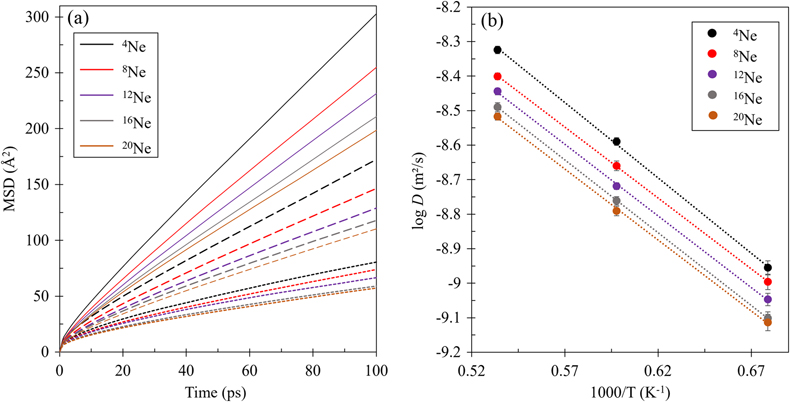
Figure 1 (a) Mean squared displacement (MSD) of Ne pseudo-isotopes in MORB melt at near-zero pressure and temperatures of 1473 K (dotted), 1673 K (dashed), and 1873 K (solid). (b) Diffusion coefficients as a function of inverse temperature.
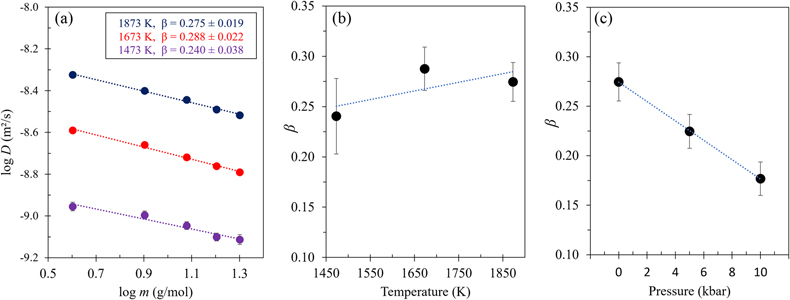
Figure 2 (a) Log D versus log m for Ne pseudo-isotopes at different temperatures. (b) Mass dependence exponent β as a function of temperature. (c) β as a function of pressure at 1873 K.
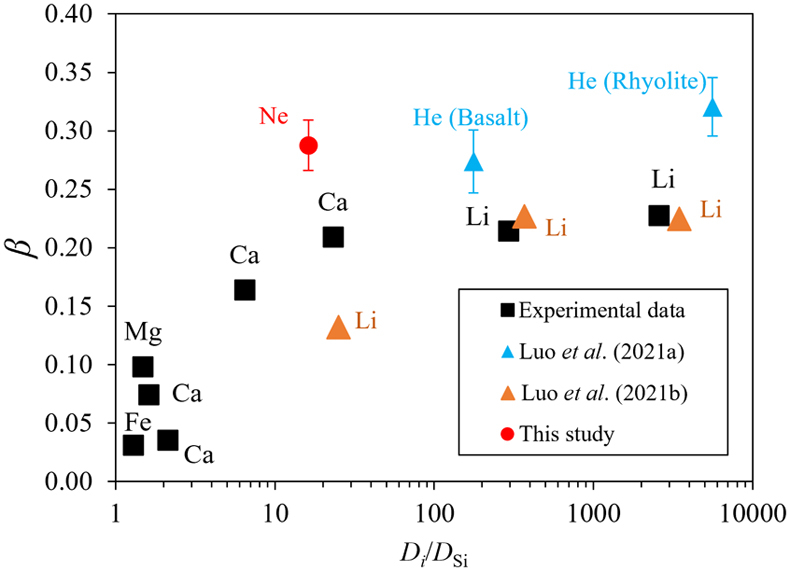
Figure 3 Relationship between the mass dependence exponent β and the solvent-normalised diffusivity (Di/DSi), modified from Luo et al. (2021a)
Luo, H., Karki, B.B., Ghosh, D.B., Bao, H. (2021a) Diffusional fractionation of helium isotopes in silicate melts. Geochemical Perspectives Letters 19, 19–22. https://doi.org/10.7185/geochemlet.2128
. Li and He data are from Luo et al. (2021aLuo, H., Karki, B.B., Ghosh, D.B., Bao, H. (2021a) Diffusional fractionation of helium isotopes in silicate melts. Geochemical Perspectives Letters 19, 19–22. https://doi.org/10.7185/geochemlet.2128
, 2021b)Luo, H., Karki, B.B., Ghosh, D.B., Bao, H. (2021b) Deep neural network potentials for diffusional lithium isotope fractionation in silicate melts. Geochimica et Cosmochimica Acta 303, 38–50. https://doi.org/10.1016/j.gca.2021.03.031
; experimental data are from the references compiled therein.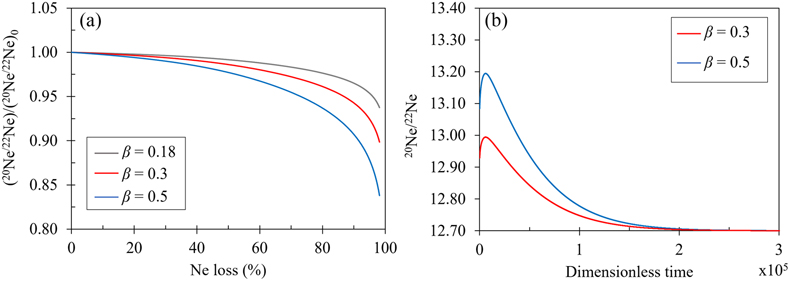
Figure 4 (a) Normalised melt 20Ne/22Ne as a function of neon loss for different β values. (b) Transient evolution of vesicle 20Ne/22Ne during diffusion-controlled degassing for β = 0.3 and 0.5, assuming 1 % vesicularity and an initial 20Ne/22Ne of 12.7.