


Boron isotopes in Archean-Proterozoic marine deposits trace continental emergence
Affiliations | Corresponding Author | Cite as | Funding information
Published by the European Association of Geochemistry
under Creative Commons License CC BY-NC-ND 4.0
Keywords: Boron Isotopes, Banded Iron Formations, chert, continental emergence, Archean-Proterozoic


- Share this article


-
Article views:10Cumulative count of HTML views and PDF downloads.
- Download Citation
- Rights & Permissions

top
Abstract
Figures
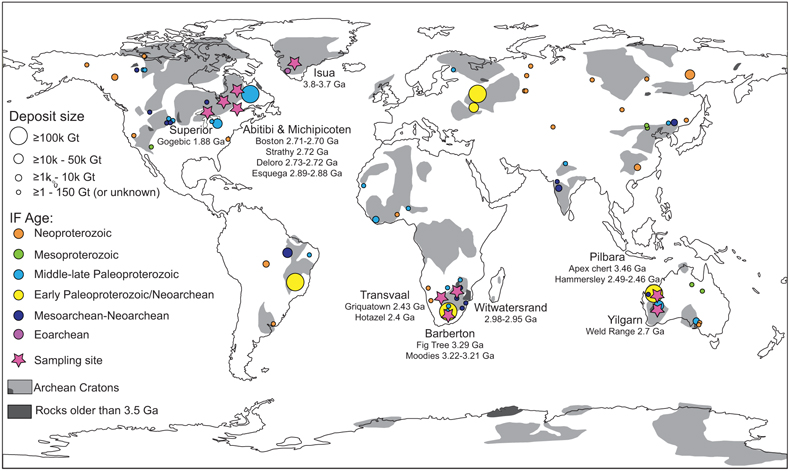
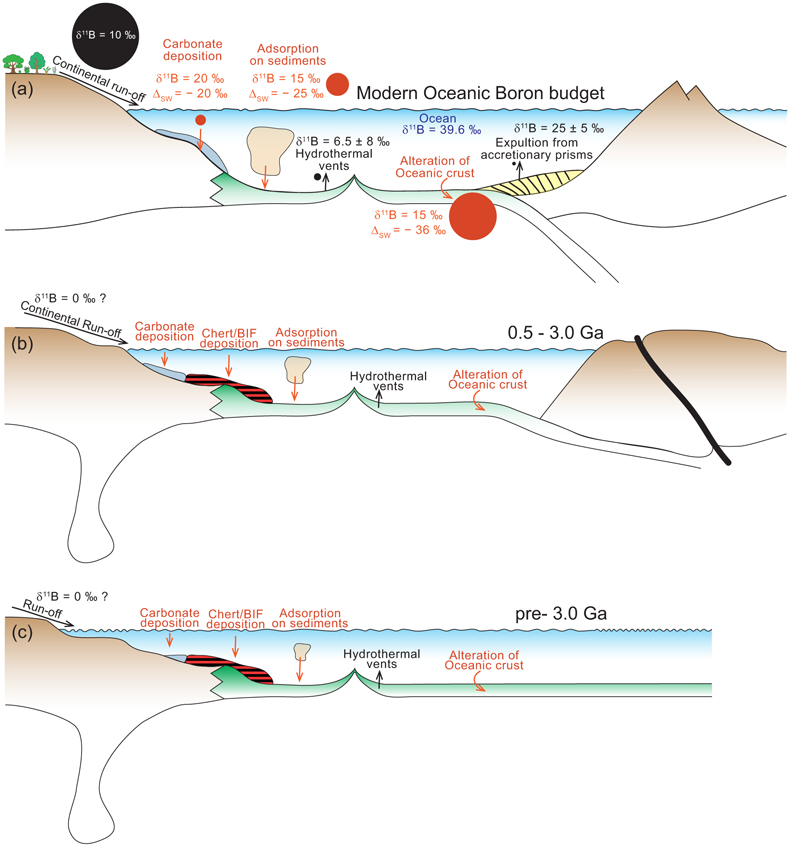
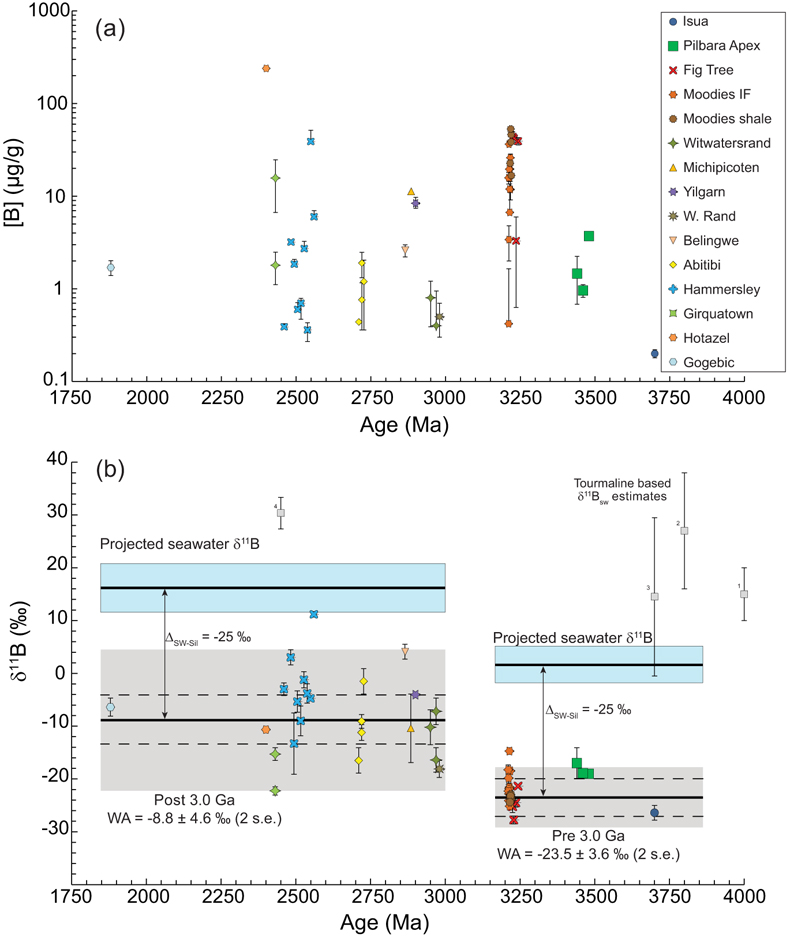
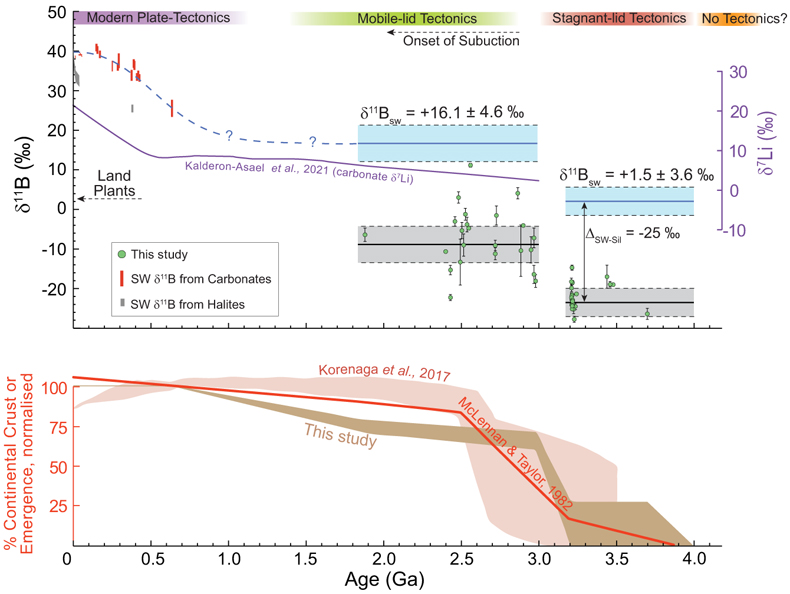
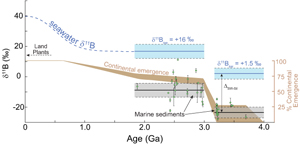
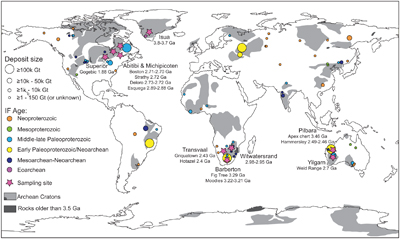 Figure 1 Global distribution of Iron Formations (after Konhauser et al., 2017). Stars indicate sample locations (Table S-1). Also shown are Archean cratons and rocks >3.5 Ga. | 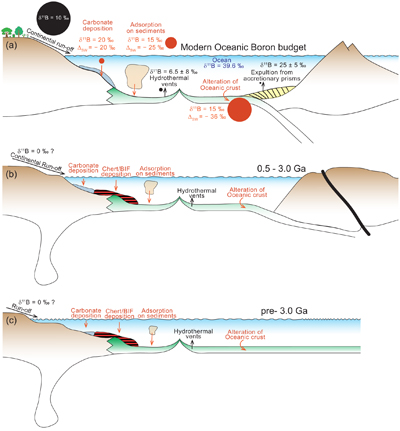 Figure 2 (a) Modern oceanic boron budget showing fluxes in/out of the ocean with δ11B composition and fractionation factors (Δ). Circle sizes are proportional to modern flux magnitudes (after Lemarchand et al., 2002). (b) Proposed oceanic boron budget for 3.0–0.5 Ga showing main fluxes including IF deposition and growing continental crust. (c) Proposed oceanic boron budget for pre-3.0 Ga Earth (see text). While fractionation factors remain mostly unchanged, past magnitudes and δ11B values of the different fluxes are mostly unconstrained. | 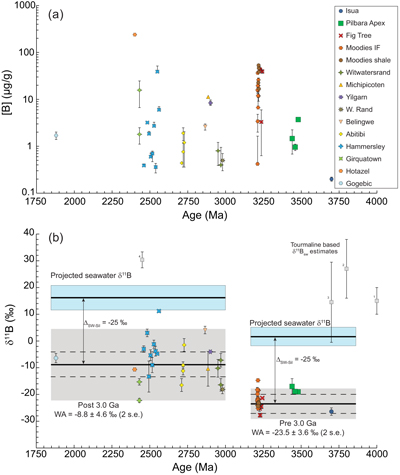 Figure 3 (a) Boron concentrations vs. age for all samples (Table S-1). (b) Boron isotopic composition vs. age for all samples (Table S-1). Values shown are of silica in IF, chert or shale (see Table S-1). Also shown are Archean-Proterozoic oceanic B estimates (1Chaussidon and Albarède, 1992; 2Chaussidon and Appel, 1997; 3Grew et al., 2015; 4Bhuyan et al., 2023). Grey shaded areas and dashed lines represent 2 s.d. and 2 s.e. respectively about the weighted mean of each sample group (see text). | 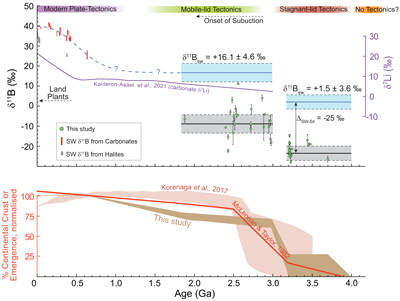 Figure 4 δ11B and projected seawater composition from marine sediments (this study). Also shown: Phanerozoic carbonate/halite records (Lemarchand et al., 2002; Joachimski et al., 2005; Kasemann et al., 2010; Paris et al., 2010; Foster et al., 2012; Clarkson et al., 2015; Anagnostou et al., 2016; Marschall, 2018); carbonate δ7Li (Kalderon-Asael et al., 2021); tectonic regimes (Palin et al., 2020). Bottom panel shows continental emergence model envelope based on δ11BSW (see text) alongside crustal growth and emergence curves normalised to 100 % crust or emergence at 0.64 Ga (McLennan and Taylor, 1982; Korenaga et al., 2017; see text). |
| Figure 1 | Figure 2 | Figure 3 | Figure 4 |
top
Introduction
The reconstruction of the secular growth and accumulation of continental crust on Earth is crucial for understanding planetary differentiation and the evolution of the hydrosphere, atmosphere and biosphere. It thus attracts both major research efforts together with lively controversy (e.g., Dhuime et al., 2018
Dhuime, B., Hawkesworth, C.J., Delavault, H., Cawood, P.A. (2018) Rates of generation and destruction of the continental crust: Implications for continental growth. Philosophical Transactions of the Royal Society A: Mathematical, Physical and Engineering Sciences 376, 20170403. https://doi.org/10.1098/rsta.2017.0403
; Palin et al., 2020Palin, R.M., Santosh, M., Cao, W., Li, S.S., Hernández-Uribe, D., Parsons, A. (2020) Secular change and the onset of plate tectonics on Earth. Earth-Science Reviews 207, 103172–103172. https://doi.org/10.1016/j.earscirev.2020.103172
; Stern and Gerya, 2024Stern, R.J., Gerya, T.V. (2024) The importance of continents, oceans and plate tectonics for the evolution of complex life: implications for finding extraterrestrial civilizations. Scientific Reports 14, 8552–8552. https://doi.org/10.1038/s41598-024-54700-x
). The emergence of continental crust above sea level ensued continental erosion and the enrichment of ocean water with nutrients. This created conditions that enabled biomineralising marine microorganisms to evolve and flourish, setting the stage both for the evolution of complex life and for the oxygenation of Earth’s atmosphere (Bindeman et al., 2018Bindeman, I.N., Zakharov, D.O., Palandri, J., Greber, N.D., Dauphas, N., Retallack, G.J., Hofmann, A., Lackey, J.S., Bekker, A. (2018) Rapid emergence of subaerial landmasses and onset of a modern hydrologic cycle 2.5 billion years ago. Nature 557, 545–548. https://doi.org/10.1038/s41586-018-0131-1
). The accumulation of continental crust on Earth is also linked to changes in the tectonic style, i.e. the transition from stagnant/squishy lid vertical tectonics to modern style subduction driven horizontal lithospheric motions and interactions at plate boundaries (Spencer et al., 2017Spencer, C.J., Roberts, N.M.W., Santosh, M. (2017) Growth, destruction, and preservation of Earth’s continental crust. Earth-Science Reviews 172, 87–106. https://doi.org/10.1016/j.earscirev.2017.07.013
; Palin et al., 2020Palin, R.M., Santosh, M., Cao, W., Li, S.S., Hernández-Uribe, D., Parsons, A. (2020) Secular change and the onset of plate tectonics on Earth. Earth-Science Reviews 207, 103172–103172. https://doi.org/10.1016/j.earscirev.2020.103172
).Although there is still no consensus on the onset of modern style plate tectonics on Earth, many studies point to 3.0–2.5 Ga (Archean-Proterozoic transition) as the time when subduction became dominant on Earth (Palin et al., 2020
Palin, R.M., Santosh, M., Cao, W., Li, S.S., Hernández-Uribe, D., Parsons, A. (2020) Secular change and the onset of plate tectonics on Earth. Earth-Science Reviews 207, 103172–103172. https://doi.org/10.1016/j.earscirev.2020.103172
). Most continental growth studies rely on compilations of records coming from fine grained sediments (shale) or from resilient minerals within them, such as zircon, and analyses of stable and radiogenic isotope systems such as Sr, Nd, Hf, and O that may indicate the separation of Earth reservoirs into mantle and crust (e.g., Roerdink et al., 2022Roerdink, D.L., Ronen, Y., Strauss, H., Mason, P.R.D. (2022) Emergence of felsic crust and subaerial weathering recorded in Palaeoarchaean barite. Nature Geoscience 15, 227–232. https://doi.org/10.1038/s41561-022-00902-9
). Such studies typically involve the compilation of large data sets based on extensive analytical work that required many years to gather. Uncertainties in these studies arise from potential representation bias of different source rocks in these sediments or their detrital mineral load (Andersen et al., 2019Andersen, T., Elburg, M.A., Magwaza, B.N. (2019) Sources of bias in detrital zircon geochronology: Discordance, concealed lead loss and common lead correction. Earth-Science Reviews 197, 102899–102899. https://doi.org/10.1016/j.earscirev.2019.102899
). Alternatively, Archean-Proterozoic crustal rocks are investigated directly, but these are rather scarce on Earth with increasing age (Fig. 1), and each sample represents its regional/local environments and results are more difficult to extrapolate to the global regime. Notably, radiogenic isotopes are less powerful discriminators of crustal growth further back in Earth history, as the crust-mantle system diverged over time. This is not the case for stable isotopes, which follow the same fractionation laws independent of age.Figure 1 Global distribution of Iron Formations (after Konhauser et al., 2017
Konhauser, K.O., Planavsky, N.J., Hardisty, D.S., Robbins, L.J., Warchola, T.J., et al. (2017) Iron formations: A global record of Neoarchaean to Palaeoproterozoic environmental history. Earth-Science Reviews 172, 140–177. https://doi.org/10.1016/j.earscirev.2017.06.012
). Stars indicate sample locations (Table S-1). Also shown are Archean cratons and rocks >3.5 Ga.Besides uncertainties on the composition and growth curve of continental crust, it remains unclear what was the extent of exposure of Archean crust above sea level. Estimates of crustal emergence through time are both scarce and variable. Recently Mineart et al., (2025)
Mineart, D., Duncanson, S., Nachlas, W., Johnson, B.W. (2025) Continental crust had fully emerged by the end of the Paleoproterozoic. Geochemical Perspectives Letters 38, 23–28. https://doi.org/10.7185/geochemlet.2551
reconstructed the oxygen isotope composition of seawater deduced from Archean-Proterozoic altered oceanic complexes, to propose modern-like emergence was achieved by ca. 1720 Ma, albeit involving complex calculations for the deduction. Complications in evaluating emergence rise from the scarcity and uneven spatial distribution of Archean-Proterozoic exposure (Fig. 1), and from the variable metamorphic alteration in many of these rocks, which may have overprinted their original geochemical signals.Unlike continental rocks, the ocean is a well mixed global reservoir, greatly affected geochemically by changes in the adjacent emerged landmass exposed to subaerial erosion. Marine sediments record the geochemical composition of ocean water, which is in part controlled by the global continental runoff. Marine sediments thus allow tracing of continental processes on Earth (Frings et al., 2016
Frings, P.J., Clymans, W., Fontorbe, G., De La Rocha, C.L., Conley, D.J. (2016) The continental Si cycle and its impact on the ocean Si isotope budget. Chemical Geology 425, 12–36. https://doi.org/10.1016/j.chemgeo.2016.01.020
). Modern oceans are oxygenated, slightly alkaline and host a variety of biomineralising microorganisms that account for most marine sedimentation – carbonate and silica. Properties of the Archean ocean are less firmly constrained (Bekker et al., 2014Bekker, A., Planavsky, N.J., Krapež, B., Rasmussen, B., Hofmann, A., Slack, J.F., Rouxel, O.J., Konhauser, K.O. (2014) 9.18 - Iron Formations: Their Origins and Implications for Ancient Seawater Chemistry. In: Holland, H.D., Turekian, K.K. (Eds.) Treatise on Geochemistry (Second Edition). Elsevier, Oxford, 561–628. https://doi.org/10.1016/B978-0-08-095975-7.00719-1
; Albarede et al., 2020Albarede, F., Thibon, F., Blichert-Toft, J., Tsikos, H. (2020) Chemical archeoceanography. Chemical Geology 548, 119625–119625. https://doi.org/10.1016/j.chemgeo.2020.119625
) Archean oceans were probably deficient of oxygen, more acidic than their modern counterparts and for the most part devoid of biomineralising agents (Krissansen-Totton et al., 2018Krissansen-Totton, J., Arney, G.N., Catling, D.C. (2018) Constraining the climate and ocean pH of the early Earth with a geological carbon cycle model. Proceedings of the National Academy of Sciences of the United States of America 115, 4105–4110. https://doi.org/10.1073/pnas.1721296115
; Albarede et al., 2020Albarede, F., Thibon, F., Blichert-Toft, J., Tsikos, H. (2020) Chemical archeoceanography. Chemical Geology 548, 119625–119625. https://doi.org/10.1016/j.chemgeo.2020.119625
). Archean marine chemical sediments (such that precipitated directly from the ocean water) mostly consist of chert and/or Iron Formations (IFs) alongside subordinate carbonate rocks and marine shales. The mechanisms responsible for IFs and chert deposition are still debated (Bekker et al., 2014Bekker, A., Planavsky, N.J., Krapež, B., Rasmussen, B., Hofmann, A., Slack, J.F., Rouxel, O.J., Konhauser, K.O. (2014) 9.18 - Iron Formations: Their Origins and Implications for Ancient Seawater Chemistry. In: Holland, H.D., Turekian, K.K. (Eds.) Treatise on Geochemistry (Second Edition). Elsevier, Oxford, 561–628. https://doi.org/10.1016/B978-0-08-095975-7.00719-1
; Konhauser et al., 2017Konhauser, K.O., Planavsky, N.J., Hardisty, D.S., Robbins, L.J., Warchola, T.J., et al. (2017) Iron formations: A global record of Neoarchaean to Palaeoproterozoic environmental history. Earth-Science Reviews 172, 140–177. https://doi.org/10.1016/j.earscirev.2017.06.012
; Rasmussen et al., 2021Rasmussen, B., Muhling, J.R., Krapež, B. (2021) Greenalite and its role in the genesis of early Precambrian iron formations – A review. Earth-Science Reviews 217, 103613. https://doi.org/10.1016/j.earscirev.2021.103613
), yet they are considered to represent chemical precipitation from seawater, probably assisted by Fe oxidising bacteria (Konhauser et al., 2017Konhauser, K.O., Planavsky, N.J., Hardisty, D.S., Robbins, L.J., Warchola, T.J., et al. (2017) Iron formations: A global record of Neoarchaean to Palaeoproterozoic environmental history. Earth-Science Reviews 172, 140–177. https://doi.org/10.1016/j.earscirev.2017.06.012
). Archean cherts and IFs are chemical marine deposits, which precipitated hydrothermally sourced Fe and Si directly from seawater (assisted by microbial and/or photochemical Fe oxidation). Therefore, these deposits serve as an archive of the chemical composition of Archean seawater (Bekker et al., 2014Bekker, A., Planavsky, N.J., Krapež, B., Rasmussen, B., Hofmann, A., Slack, J.F., Rouxel, O.J., Konhauser, K.O. (2014) 9.18 - Iron Formations: Their Origins and Implications for Ancient Seawater Chemistry. In: Holland, H.D., Turekian, K.K. (Eds.) Treatise on Geochemistry (Second Edition). Elsevier, Oxford, 561–628. https://doi.org/10.1016/B978-0-08-095975-7.00719-1
; Konhauser et al., 2017Konhauser, K.O., Planavsky, N.J., Hardisty, D.S., Robbins, L.J., Warchola, T.J., et al. (2017) Iron formations: A global record of Neoarchaean to Palaeoproterozoic environmental history. Earth-Science Reviews 172, 140–177. https://doi.org/10.1016/j.earscirev.2017.06.012
) and record the effects continental emergence had upon it.The long-term variation in oceanic B isotopic composition (δ11Bsw) is controlled by the balance of input and output fluxes, which are affected in composition and magnitude by the global tectonic regime (Fig. 2; see discussion in the Supplementary Information). Emergence of continental crust above sea level and its erosion significantly affected the chemical composition of global seawater, δ11Bsw included. The geochemical signal preserved in Archean-Proterozoic marine deposits such as IFs, cherts and marine shales is expected to record that change. In this study we utilise the analysis of B isotopes in Archean-Proterozoic marine deposits to reconstruct the ancient seawater composition and its secular variation, and to infer the influence of continental erosion (and emergence) on this compositional change.
Figure 2 (a) Modern oceanic boron budget showing fluxes in/out of the ocean with δ11B composition and fractionation factors (Δ). Circle sizes are proportional to modern flux magnitudes (after Lemarchand et al., 2002
Lemarchand, D., Gaillardet, J., Lewin, É., Allègre, C.J. (2002) Boron isotope systematics in large rivers: implications for the marine boron budget and paleo-pH reconstruction over the Cenozoic. Chemical Geology 190, 123–140. https://doi.org/10.1016/S0009-2541(02)00114-6
). (b) Proposed oceanic boron budget for 3.0–0.5 Ga showing main fluxes including IF deposition and growing continental crust. (c) Proposed oceanic boron budget for pre-3.0 Ga Earth (see text). While fractionation factors remain mostly unchanged, past magnitudes and δ11B values of the different fluxes are mostly unconstrained.top
Results
Samples of IFs, chert and shale, with age constraints spanning between 3.7–1.88 Ga (Table S-1), were prepared, examined by optical and electron microscopy, and measured for boron concentrations and isotope composition using Laser Ablation-Multi-Collector-Inductively Coupled Plasma Mass Spectrometry (LA-MC-ICPMS). Obtained δ11B results were translated to the contemporaneous seawater composition (δ11Bsw) by applying a fractionation factor (see Supplementary Information for details; Figs. 3,4), while accounting for the measured mineral phase and evaluated pH for Archean-Proterozoic seawater (Spivack et al., 1987
Spivack, A.J., Palmer, M.R., Edmond, J.M. (1987) The sedimentary cycle of the boron isotopes. Geochimica et Cosmochimica Acta 51, 1939–1949. https://doi.org/10.1016/0016-7037(87)90183-9
; Krissansen-Totton et al., 2018Krissansen-Totton, J., Arney, G.N., Catling, D.C. (2018) Constraining the climate and ocean pH of the early Earth with a geological carbon cycle model. Proceedings of the National Academy of Sciences of the United States of America 115, 4105–4110. https://doi.org/10.1073/pnas.1721296115
; Saldi et al., 2021Saldi, G.D., Louvat, P., Schott, J., Gaillardet, J. (2021) The pH dependence of the isotopic composition of boron adsorbed on amorphous silica. Geochimica et Cosmochimica Acta 308, 1–20. https://doi.org/10.1016/j.gca.2021.05.052
). Multiple analytical spots on mineralogically different sediment layers (if present) were measured within each sample. Seawater composition was reconstructed from values measured in silica and clay phases. We accounted for possible detrital contamination and mixing (co-ablation) with Fe oxides by examining results in δ11B vs. [B] space and isolating the silica end member. This was apparent in 5 of the 48 samples, whereas the remaining 43 samples showed a homogenous composition (see Supplementary Information; Fig. S-4). A detailed discussion of the boron fractionation factors between bulk acidic seawater and the precipitated solids, sample selection criteria including a detailed discussion on the determination of δ11Bsw from marine sediments, description of our analytical setup including data processing and statistical considerations, and the determination of δ11Bsw from marine sediments are given in the Supplementary Information.Figure 3 (a) Boron concentrations vs. age for all samples (Table S-1). (b) Boron isotopic composition vs. age for all samples (Table S-1). Values shown are of silica in IF, chert or shale (see Table S-1). Also shown are Archean-Proterozoic oceanic B estimates (1Chaussidon and Albarède, 1992
Chaussidon, M., Albarède, F. (1992) Secular boron isotope variations in the continental crust: an ion microprobe study. Earth and Planetary Science Letters 108, 229–241. https://doi.org/10.1016/0012-821X(92)90025-Q
; 2Chaussidon and Appel, 1997Chaussidon, M., Appel, P.W.U. (1997) Boron isotopic composition of tourmalines from the 3.8-Ga-old Isua supracrustals, West Greenland: Implications on the δ11B value of early Archean seawater. Chemical Geology 136, 171–180. https://doi.org/10.1016/S0009-2541(96)00140-4
; 3Grew et al., 2015Grew, E.S., Dymek, R.F., De Hoog, J.C.M., Harley, S.L., Boak, J., Hazen, R.M., Yates, M.G. (2015) Boron isotopes in tourmaline from the ca. 3.7-3.8Ga Isua supracrustal belt, Greenland: Sources for boron in Eoarchean continental crust and seawater. Geochimica et Cosmochimica Acta 163, 156–177. https://doi.org/10.1016/j.gca.2015.04.045
; 4Bhuyan et al., 2023Bhuyan, N., Hazarika, P., Upadhyay, D. (2023) Continental evaporites as brine sources for formation of SEDEX and MVT deposits: Implications from boron isotope compositions of tourmaline. Geochimica et Cosmochimica Acta 361, 82–100. https://doi.org/10.1016/j.gca.2023.10.014
). Grey shaded areas and dashed lines represent 2 s.d. and 2 s.e. respectively about the weighted mean of each sample group (see text).Figure 4 δ11B and projected seawater composition from marine sediments (this study). Also shown: Phanerozoic carbonate/halite records (Lemarchand et al., 2002
Lemarchand, D., Gaillardet, J., Lewin, É., Allègre, C.J. (2002) Boron isotope systematics in large rivers: implications for the marine boron budget and paleo-pH reconstruction over the Cenozoic. Chemical Geology 190, 123–140. https://doi.org/10.1016/S0009-2541(02)00114-6
; Joachimski et al., 2005Joachimski, M.M., Simon, L., van Geldern, R., Lécuyer, C. (2005) Boron isotope geochemistry of Paleozoic brachiopod calcite: Implications for a secular change in the boron isotope geochemistry of seawater over the Phanerozoic. Geochimica et Cosmochimica Acta 69, 4035–4044. https://doi.org/10.1016/j.gca.2004.11.017
; Kasemann et al., 2010Kasemann, S.A., Prave, A.R., Fallick, A.E., Hawkesworth, C.J., Hoffmann, K.H. (2010) Neoproterozoic ice ages, boron isotopes, and ocean acidification: Implications for a snowball Earth. Geology 38, 775–778. https://doi.org/10.1130/G30851.1
; Paris et al., 2010Paris, G., Gaillardet, J., Louvat, P. (2010) Geological evolution of seawater boron isotopic composition recorded in evaporites. Geology 38, 1035–1038.
; Foster et al., 2012Foster, G.L., Lear, C.H., Rae, J.W.B. (2012) The evolution of pCO2, ice volume and climate during the middle Miocene. Earth and Planetary Science Letters 341–344, 243–254.
; Clarkson et al., 2015Clarkson, M.O., Kasemann, S.A., Wood, R.A., Lenton, T.M., Daines, S.J., et al (2015) Ocean acidification and the Permo-Triassic mass extinction. Science 348, 229–232. https://doi.org/10.1126/science.aaa0193
; Anagnostou et al., 2016Anagnostou, E., John, E.H., Edgar, K.M., Foster, G.L., Ridgwell, A., et al (2016) Changing atmospheric CO2 concentration was the primary driver of early Cenozoic climate. Nature 533, 380–384. https://doi.org/10.1038/nature17423
; Marschall, 2018Marschall, H.R. (2018) Boron Isotopes in the Ocean Floor Realm and the Mantle. In: Marschall, H., Foster, G. (Eds.) Boron Isotopes: The Fifth Element. Springer International Publishing, Cham, 189–215.
); carbonate δ7Li (Kalderon-Asael et al., 2021Kalderon-Asael, B., Katchinoff, J.A.R., Planavsky, N.J., Hood, A.v.S., Dellinger, M., et al. (2021) A lithium-isotope perspective on the evolution of carbon and silicon cycles. Nature 595, 394–398. https://doi.org/10.1038/s41586-021-03612-1
); tectonic regimes (Palin et al., 2020Palin, R.M., Santosh, M., Cao, W., Li, S.S., Hernández-Uribe, D., Parsons, A. (2020) Secular change and the onset of plate tectonics on Earth. Earth-Science Reviews 207, 103172–103172. https://doi.org/10.1016/j.earscirev.2020.103172
). Bottom panel shows continental emergence model envelope based on δ11BSW (see text) alongside crustal growth and emergence curves normalised to 100 % crust or emergence at 0.64 Ga (McLennan and Taylor, 1982McLennan, S.M., Taylor, S.R. (1982) Geochemical constraints on the growth of the continental crust. The Journal of Geology 90, 347–361. https://doi.org/10.1086/628690
; Korenaga et al., 2017Korenaga, J., Planavsky, N.J., Evans, D.A.D. (2017) Global water cycle and the coevolution of the Earth’s interior and surface environment. Philosophical Transactions of the Royal Society A: Mathematical, Physical and Engineering Sciences 375, 20150393. https://doi.org/10.1098/rsta.2015.0393
; see text).Most IFs, especially older than 3.0 Ga, show boron concentrations below 10 μg/g (Fig. 3a). Higher B concentrations of up to 30 μg/g were found in IFs and cherts of the Fig Tree group in the Barberton Greenstone Belt (BGB). Marine shale samples from overlying the Moodies group also show high [B], akin to modern shales (50–150 μg/g; Spivack et al., 1987
Spivack, A.J., Palmer, M.R., Edmond, J.M. (1987) The sedimentary cycle of the boron isotopes. Geochimica et Cosmochimica Acta 51, 1939–1949. https://doi.org/10.1016/0016-7037(87)90183-9
; Ishikawa and Nakamura, 1993Ishikawa, T., Nakamura, E. (1993) Boron isotope systematics of marine sediments. Earth and Planetary Science Letters 117, 567–580. https://doi.org/10.1016/0012-821X(93)90103-G
;). In addition, samples from the Moodies group include subordinate IFs with variably lower [B]. Overall IFs, cherts and shales show boron concentrations between 0.1–60 μg/g, and an increased variability of [B] set in at ca. 3.2 Ga (Fig. 3a). Out of all measured samples, 57 % show [B] <10 μg/g. Hammersley group samples show some variability in boron concentration, however only one sample has [B] >10 μg/g.It is evident from measured δ11B of silica in IFs and shales that the seawater boron isotopic composition shifted prominently in the Mesoarchean. Samples older than 3 Ga from Isua, the BGB and the Pilbara craton all cluster between δ11B of −28 and −17 ‰ with a weighted mean of −23.5 ± 3.6 ‰ (2 s.e; Figs. 3b, 4), translating to seawater composition of δ11Bsw = +1.5 ± 3.6 ‰, which is isotopically much lighter than modern seawater (+39.6 ‰). The post-2.9 Ga Mesoarchean and the Neoarchean samples show a noticeably heavier δ11B compositions, with values as high as δ11B = +4.1 ‰, as well as an increased scatter in δ11B compared to pre-3.0 Ga. Post-3.0 Ga material represents a mean seawater value of +16.1 ± 4.6 ‰ (Figs. 3, 4). This is a well pronounced shift from the pre-3 Ga signal notwithstanding the spread and uncertainties in our data set. The pre- and post-3.0 Ga sample populations are statistically different (Welch’s t test: t = 8.60, p = 1.16 × 10⁻⁹), demonstrating they remain distinct well beyond the 99.9 % confidence level, despite internal variability within each group. The youngest Paleoproterozoic samples, represented by the Hammersley group of the Pilbara craton and the Griquatown IF from the Transvaal Supergroup show a large variation in δ11B spanning almost 25 ‰ (Fig. 3b). Such variation over less than 150 Myr raises questions whether it reflects global changes in seawater composition or rather local or regional effects. We also noted the effect of admixing of Fe oxide and possibly detrital components to the silica phase in some of the Hammersley samples. We took care to isolate the effects of such mixing as much as possible (Fig. S-4; see above and Supplementary Information for elaboration).
top
Discussion
The notion that variation of the seawater isotopic composition reflects changes in the continental regime and was impacted by the extent of emerged continental crust was previously demonstrated based on traditional isotope systems (Frings et al., 2016
Frings, P.J., Clymans, W., Fontorbe, G., De La Rocha, C.L., Conley, D.J. (2016) The continental Si cycle and its impact on the ocean Si isotope budget. Chemical Geology 425, 12–36. https://doi.org/10.1016/j.chemgeo.2016.01.020
). Boron has a long residence time in the modern ocean and large shifts of the boron isotopic composition in global seawater reflect changes in the dominant fluxes of boron to and from the ocean (Lemarchand et al., 2002Lemarchand, D., Gaillardet, J., Lewin, É., Allègre, C.J. (2002) Boron isotope systematics in large rivers: implications for the marine boron budget and paleo-pH reconstruction over the Cenozoic. Chemical Geology 190, 123–140. https://doi.org/10.1016/S0009-2541(02)00114-6
; Joachimski et al., 2005Joachimski, M.M., Simon, L., van Geldern, R., Lécuyer, C. (2005) Boron isotope geochemistry of Paleozoic brachiopod calcite: Implications for a secular change in the boron isotope geochemistry of seawater over the Phanerozoic. Geochimica et Cosmochimica Acta 69, 4035–4044. https://doi.org/10.1016/j.gca.2004.11.017
). While the Phanerozoic record of δ11Bsw shows an increase of similar magnitude (ca. 10 ‰) to our recorded shift across the 3.0 Ga boundary (where it occurred over a time interval of less than 300 Myr; Fig. 4), we should highlight the fundamental difference in the boron cycle between the Archean and Phanerozoic. Without terrestrial vegetation covering the continents, boron fractionation is limited to processes of continental crust formation producing an average composition very close to the mantle and Bulk Silicate Earth (BSE). Terrestrial vegetation and soils were shown to enrich 11B in the weathering environment, in a mechanism also described for 7Li (Gaillardet and Lemarchand, 2018Gaillardet, J., Lemarchand, D. (2018) Boron in the Weathering Environment. In: Marschall, H., Foster, G. (Eds.) Boron Isotopes: The Fifth Element. Springer International Publishing, Cham, 163–188. https://doi.org/10.1007/978-3-319-64666-4_7
; Kalderon-Asael et al., 2021Kalderon-Asael, B., Katchinoff, J.A.R., Planavsky, N.J., Hood, A.v.S., Dellinger, M., et al. (2021) A lithium-isotope perspective on the evolution of carbon and silicon cycles. Nature 595, 394–398. https://doi.org/10.1038/s41586-021-03612-1
). Therefore, influx of B from continental weathering into the Archean ocean was significantly lighter than the modern equivalent (Fig. 2). The observed shift in δ11Bsw of more than 10 ‰ in the time interval between 3.2 and 2.9 Ga in absence of vegetation, requires major changes in the boron flux to the ocean. The most plausible candidate that can explain such a change is the emergence of continental landmass of a significant extent above sea level followed by subaerial weathering, transporting boron into the ocean, and the isotope fractionation these processes entail.Using a mass balance model, we reconstruct the history of continental emergence from the boron isotopic evolution of the reconstructed seawater curve, which evolves from δ11Bsw = +1.9 ‰ between 3.70–3.21 Ga to +16.2 ‰ at 2.98–2.40 ‰ to +25.5 ‰ in the Neoproterozoic (Kasemann et al., 2010
Kasemann, S.A., Prave, A.R., Fallick, A.E., Hawkesworth, C.J., Hoffmann, K.H. (2010) Neoproterozoic ice ages, boron isotopes, and ocean acidification: Implications for a snowball Earth. Geology 38, 775–778. https://doi.org/10.1130/G30851.1
). The Neoproterozoic δ11Bsw value (Kasemann et al., 2010Kasemann, S.A., Prave, A.R., Fallick, A.E., Hawkesworth, C.J., Hoffmann, K.H. (2010) Neoproterozoic ice ages, boron isotopes, and ocean acidification: Implications for a snowball Earth. Geology 38, 775–778. https://doi.org/10.1130/G30851.1
) is taken to represent 100 % continental emergence (relative to the modern state), but still in the absence of terrestrial vegetation (Fig. 4), and assuming continental emergence is the sole component contributing to changes in δ11Bsw. Continental emergence is then computed from its proportionality with the shift in δ11Bsw, which is 3.1–4.2 ‰ per percent of emerged crust relative to the present, or 0.24–0.33 % emerged crust for each per mille elevation in δ11Bsw (see Supplementary Information; Table S-5). Our model suggests that the amount of emerged continental crust in the Eo-/Paleoarchean is bracketed to between zero and approximately one quarter (0–27.6 %) of the amount of crust emerged today (depending on the degree to which the shift from the δ11B = −7.1 ‰ of the mantle to +1.9 ‰ recorded by the oldest marine sediments was caused by continental emergence). The value of continental emergence in the late Archean to early Proterozoic (2.98–2.40 Ga) is not very sensitive to the choice of this parameter and is bracketed between 60.2 % and 71.2 % (Fig. 4; see Table S-5).It is noteworthy that our results align with published continental growth curves (McLennan and Taylor, 1982
McLennan, S.M., Taylor, S.R. (1982) Geochemical constraints on the growth of the continental crust. The Journal of Geology 90, 347–361. https://doi.org/10.1086/628690
; Korenaga et al., 2017Korenaga, J., Planavsky, N.J., Evans, D.A.D. (2017) Global water cycle and the coevolution of the Earth’s interior and surface environment. Philosophical Transactions of the Royal Society A: Mathematical, Physical and Engineering Sciences 375, 20150393. https://doi.org/10.1098/rsta.2015.0393
; Reimink et al., 2023Reimink, J.R., Davies, J.H.F.L., Moyen, J.F., Pearson, D.G. (2023) A whole-lithosphere view of continental growth. Geochemical Perspectives Letters 26, 45–49. https://doi.org/10.7185/geochemlet.2324
; Figs. 4, S-1), portraying rapid growth and emergence of continents in the Mesoarchean. Our results also show that continental growth and emergence produced an isotopic signal that is globally evident and is sensitive to the amount of exposed crust above sea level.Previous reconstructions of Archean-Proterozoic δ11Bsw have relied on multi-step calculations from δ11B analyses of tourmaline (Chaussidon and Albarède, 1992
Chaussidon, M., Albarède, F. (1992) Secular boron isotope variations in the continental crust: an ion microprobe study. Earth and Planetary Science Letters 108, 229–241. https://doi.org/10.1016/0012-821X(92)90025-Q
; Chaussidon and Appel, 1997Chaussidon, M., Appel, P.W.U. (1997) Boron isotopic composition of tourmalines from the 3.8-Ga-old Isua supracrustals, West Greenland: Implications on the δ11B value of early Archean seawater. Chemical Geology 136, 171–180. https://doi.org/10.1016/S0009-2541(96)00140-4
; Grew et al., 2015Grew, E.S., Dymek, R.F., De Hoog, J.C.M., Harley, S.L., Boak, J., Hazen, R.M., Yates, M.G. (2015) Boron isotopes in tourmaline from the ca. 3.7-3.8Ga Isua supracrustal belt, Greenland: Sources for boron in Eoarchean continental crust and seawater. Geochimica et Cosmochimica Acta 163, 156–177. https://doi.org/10.1016/j.gca.2015.04.045
; Bhuyan et al., 2023Bhuyan, N., Hazarika, P., Upadhyay, D. (2023) Continental evaporites as brine sources for formation of SEDEX and MVT deposits: Implications from boron isotope compositions of tourmaline. Geochimica et Cosmochimica Acta 361, 82–100. https://doi.org/10.1016/j.gca.2023.10.014
). Because tourmaline does not form on the ocean floor, such reconstructions are indirect: they require estimates of mineral-fluid fractionation and assumptions about the protolith of the schists in which the tourmaline is found, and it has been argued that they may not constrain ancient seawater composition (Byerly and Palmer, 1991Byerly, G.R., Palmer, M.R. (1991) Tourmaline mineralization in the Barberton greenstone belt, South Africa: early Archean metasomatism by evaporite-derived boron. Contributions to Mineralogy and Petrology 107, 387–402. https://doi.org/10.1007/BF00325106
). Full propagation of the uncertainties related to the various fractionation steps yields a precision of ±15 ‰ (Grew et al., 2015Grew, E.S., Dymek, R.F., De Hoog, J.C.M., Harley, S.L., Boak, J., Hazen, R.M., Yates, M.G. (2015) Boron isotopes in tourmaline from the ca. 3.7-3.8Ga Isua supracrustal belt, Greenland: Sources for boron in Eoarchean continental crust and seawater. Geochimica et Cosmochimica Acta 163, 156–177. https://doi.org/10.1016/j.gca.2015.04.045
); hence, although tourmaline based values are nominally 10−15 ‰ heavier than ours (Fig. 3b), some overlap within error. Our approach, in situ analysis of marine deposits combined with the established seawater-silica fractionation (Saldi et al., 2021Saldi, G.D., Louvat, P., Schott, J., Gaillardet, J. (2021) The pH dependence of the isotopic composition of boron adsorbed on amorphous silica. Geochimica et Cosmochimica Acta 308, 1–20. https://doi.org/10.1016/j.gca.2021.05.052
), rests on fewer assumptions and accumulates less uncertainty.Our data suggest an evolution of δ11Bsw from an initially low value (closer to the mantle value of −7.1 ± 0.9 ‰; Marschall et al., 2017
Marschall, H.R., Wanless, V.D., Shimizu, N., Pogge von Strandmann, P.A.E., Elliott, T., Monteleone, B.D. (2017) The boron and lithium isotopic composition of mid-ocean ridge basalts and the mantle. Geochimica et Cosmochimica Acta 207, 102–138. https://doi.org/10.1016/j.gca.2017.03.028
) toward its present level, not through a continuous secular increase, but in a stepped increase across 3.0 Ga (Figs. 2, 4). Evolution across the Mesoproterozoic, however, calls for further exploration.Phanerozoic δ11Bsw evolution is constrained by a denser set of estimates from analysed marine sediments, as well as box model reconstructions (Lemarchand et al., 2002
Lemarchand, D., Gaillardet, J., Lewin, É., Allègre, C.J. (2002) Boron isotope systematics in large rivers: implications for the marine boron budget and paleo-pH reconstruction over the Cenozoic. Chemical Geology 190, 123–140. https://doi.org/10.1016/S0009-2541(02)00114-6
; Joachimski et al., 2005Joachimski, M.M., Simon, L., van Geldern, R., Lécuyer, C. (2005) Boron isotope geochemistry of Paleozoic brachiopod calcite: Implications for a secular change in the boron isotope geochemistry of seawater over the Phanerozoic. Geochimica et Cosmochimica Acta 69, 4035–4044. https://doi.org/10.1016/j.gca.2004.11.017
; Legett et al., 2020Legett, S.A., Rasbury, E.T., Grossman, E.L., Hemming, N.G., Penman, D.E. (2020) The Brachiopod δ11B Record Across the Carboniferous-Permian Climate Transition. Paleoceanography and Paleoclimatology 35, 1–13. https://doi.org/10.1029/2019PA003838
; Jurikova et al., 2025Jurikova, H. et al. (2025) Rapid rise in atmospheric CO2 marked the end of the Late Palaeozoic Ice Age. Nature Geoscience 18, 91–97. https://doi.org/10.1038/s41561-024-01610-2
). Seawater boron isotopic reconstructions from Neoproterozoic carbonates provide δ11Bsw = +25 ‰ (Kasemann et al., 2010Kasemann, S.A., Prave, A.R., Fallick, A.E., Hawkesworth, C.J., Hoffmann, K.H. (2010) Neoproterozoic ice ages, boron isotopes, and ocean acidification: Implications for a snowball Earth. Geology 38, 775–778. https://doi.org/10.1130/G30851.1
), which are only 11 ‰ heavier than the mean of our estimate from early Paleoproterozoic IFs (Fig. 4). This suggests that change in the extent of emerged continents was not insignificant (21–29 % of the modern extent) over the gap of 1.25 billion years between 1.88 and 0.64 Ga, i.e. the so called ‘boring billion’ (Brasier, 2012Brasier, M.D. (2012) Secret chambers: the inside story of cells and complex life. Oxford University Press.
).The first major observable shift in δ11Bsw precedes the formation of the first supercontinent at ca. 2.7 Ga (Ur). Some crustal growth models predict the formation of large swaths of continental crust already at that time (Figs. 4, S-1). The post-3 Ga major rise in δ11Bsw documented here likely represents the response of the oceans to accumulation and emergence of continental crust after 3.2 Ga, due to the onset of boron input into the ocean via erosion and the resultant additional fluxes (e.g., adsorption) that began to operate. A second stage of increase in δ11Bsw occurred in the Neoproterozoic and Phanerozoic towards the modern value (Fig. 4). Interestingly, oceanic δ7Li values estimated from carbonate rocks also show a similar increase towards the modern value starting in the early Phanerozoic, attributed to the evolution of terrestrial plants (Kalderon-Asael et al., 2021
Kalderon-Asael, B., Katchinoff, J.A.R., Planavsky, N.J., Hood, A.v.S., Dellinger, M., et al. (2021) A lithium-isotope perspective on the evolution of carbon and silicon cycles. Nature 595, 394–398. https://doi.org/10.1038/s41586-021-03612-1
). To date, the seawater Li isotope record does not extend far enough back to allow for an evaluation of the critical period around 3 Ga identified here in the B isotope record (Kalderon-Asael et al., 2021Kalderon-Asael, B., Katchinoff, J.A.R., Planavsky, N.J., Hood, A.v.S., Dellinger, M., et al. (2021) A lithium-isotope perspective on the evolution of carbon and silicon cycles. Nature 595, 394–398. https://doi.org/10.1038/s41586-021-03612-1
). Overall, we demonstrated that the record of δ11Bsw may be used as a proxy for the buildup and emergence of continental crust and its erosion. This new tool of boron isotopic analysis of Precambrian marine deposits may shed light on early Earth and Archean-Proterozoic processes and can complement existing isotopic tracers of continental evolution.Implications for seawater and crustal evolution:
We present the first comprehensive record of Archean-Proterozoic δ11Bsw traced from marine deposits including IFs, chert, and shales, utilising a protocol capable of measuring boron isotopes in low concentration samples (≥0.2 μg/g) with meaningful precision and accuracy. Our data spanning 3.7 to 1.88 Ga across multiple cratons reveal a significant compositional shift in silica δ11B from a mean of −23.5 ± 3.6 ‰ pre-3.0 Ga to a mean of −8.8 ± 4.6 ‰ post-3.0 Ga, corresponding to projected δ11Bsw values of +1.5 ± 3.6 ‰ and +16.1 ± 4.6 ‰ respectively. We suggest this shift reflects enhanced continental crustal emergence and associated subaerial weathering driving increased boron transport into the ocean that outpaced boron removal by seafloor alteration. Our results support independent crustal growth models that indicate rapid continental crust accumulation by 3.0 Ga. Our simple model based on the evolution of δ11Bsw suggests that continental emergence had reached 0–27 % of the modern value by 3.7 Ga, evolved further to 60–71 % continental emergence between 3.2 and 3.0 Ga and further emergence throughout the Proterozoic, particularly the Mesoproterozoic. A second phase of apparent increase in δ11Bsw throughout the Phanerozoic (parallel to the increase in seawater δ7Li) was likely related to the appearance and radiation of terrestrial plants, developing incongruent weathering regimes that led to the enhanced formation of terrestrial clays.
top
Acknowledgements
This study benefited from funding by the Minerva Stiftung and the German Research Foundation (DFG; Grant No. 539548092). Authors are grateful to Dr. Axel Hofmann, Dr. Thomas Angerer, Dr. Paul Duuring, Dr. Albertus Smith, Prof. Luc Andre, and Dr. Yaron Be’eri Shlevin for providing samples for analysis. We are also indebted to the ICDP-BASE project and Prof. Cristoph Heubeck for allowing AA to join the scientific team of the project and access the Moodies IF cores. We also wish to thank Dr. Simone Kaesemann for the solution measurement of our in-house Hematite boron standards. FIERCE is financially supported by the Deutsche Forschungsgemeinschaft (DFG: INST 161/921-1 FUGG, INST 161/923-1 FUGG and INST 161/1073-1 FUGG), and received financial support from the Wilhelm and Else Heraeus Foundation, which is gratefully acknowledged. This is FIERCE contribution No. 254.
Editor: Gavin Foster
top
References
Albarede, F., Thibon, F., Blichert-Toft, J., Tsikos, H. (2020) Chemical archeoceanography. Chemical Geology 548, 119625–119625. https://doi.org/10.1016/j.chemgeo.2020.119625
 Show in context
 Properties of the Archean ocean are less firmly constrained (Bekker et al., 2014; Albarede et al., 2020) Archean oceans were probably deficient of oxygen, more acidic than their modern counterparts and for the most part devoid of biomineralising agents (Krissansen-Totton et al., 2018; Albarede et al., 2020).
View in article
Anagnostou, E., John, E.H., Edgar, K.M., Foster, G.L., Ridgwell, A., et al (2016) Changing atmospheric CO2 concentration was the primary driver of early Cenozoic climate. Nature 533, 380–384. https://doi.org/10.1038/nature17423
Show in context Also shown: Phanerozoic carbonate/halite records (Lemarchand et al., 2002; Joachimski et al., 2005; Kasemann et al., 2010; Paris et al., 2010; Foster et al., 2012; Clarkson et al., 2015; Anagnostou et al., 2016; Marschall, 2018); carbonate δ7Li (Kalderon-Asael et al., 2021); tectonic regimes (Palin et al., 2020).
View in article
Andersen, T., Elburg, M.A., Magwaza, B.N. (2019) Sources of bias in detrital zircon geochronology: Discordance, concealed lead loss and common lead correction. Earth-Science Reviews 197, 102899–102899. https://doi.org/10.1016/j.earscirev.2019.102899
Show in context Uncertainties in these studies arise from potential representation bias of different source rocks in these sediments or their detrital mineral load (Andersen et al., 2019).
View in article
Bekker, A., Planavsky, N.J., Krapež, B., Rasmussen, B., Hofmann, A., Slack, J.F., Rouxel, O.J., Konhauser, K.O. (2014) 9.18 - Iron Formations: Their Origins and Implications for Ancient Seawater Chemistry. In: Holland, H.D., Turekian, K.K. (Eds.) Treatise on Geochemistry (Second Edition). Elsevier, Oxford, 561–628. https://doi.org/10.1016/B978-0-08-095975-7.00719-1
Show in context Properties of the Archean ocean are less firmly constrained (Bekker et al., 2014; Albarede et al., 2020) Archean oceans were probably deficient of oxygen, more acidic than their modern counterparts and for the most part devoid of biomineralising agents (Krissansen-Totton et al., 2018; Albarede et al., 2020).
View in article
The mechanisms responsible for IFs and chert deposition are still debated (Bekker et al., 2014; Konhauser et al., 2017; Rasmussen et al., 2021), yet they are considered to represent chemical precipitation from seawater, probably assisted by Fe oxidising bacteria (Konhauser et al., 2017).
View in article
Therefore, these deposits serve as an archive of the chemical composition of Archean seawater (Bekker et al., 2014; Konhauser et al., 2017) and record the effects continental emergence had upon it.
View in article
Bhuyan, N., Hazarika, P., Upadhyay, D. (2023) Continental evaporites as brine sources for formation of SEDEX and MVT deposits: Implications from boron isotope compositions of tourmaline. Geochimica et Cosmochimica Acta 361, 82–100. https://doi.org/10.1016/j.gca.2023.10.014
Show in context Also shown are Archean-Proterozoic oceanic B estimates (1Chaussidon and Albarède, 1992; 2Chaussidon and Appel, 1997; 3Grew et al., 2015; 4Bhuyan et al., 2023).
View in article
Previous reconstructions of Archean-Proterozoic δ11Bsw have relied on multi-step calculations from δ11B analyses of tourmaline (Chaussidon and Albarède, 1992; Chaussidon and Appel, 1997; Grew et al., 2015; Bhuyan et al., 2023).
View in article
Bindeman, I.N., Zakharov, D.O., Palandri, J., Greber, N.D., Dauphas, N., Retallack, G.J., Hofmann, A., Lackey, J.S., Bekker, A. (2018) Rapid emergence of subaerial landmasses and onset of a modern hydrologic cycle 2.5 billion years ago. Nature 557, 545–548. https://doi.org/10.1038/s41586-018-0131-1
Show in context This created conditions that enabled biomineralising marine microorganisms to evolve and flourish, setting the stage both for the evolution of complex life and for the oxygenation of Earth’s atmosphere (Bindeman et al., 2018).
View in article
Brasier, M.D. (2012) Secret chambers: the inside story of cells and complex life. Oxford University Press.
Show in context This suggests that change in the extent of emerged continents was not insignificant (21–29 % of the modern extent) over the gap of 1.25 billion years between 1.88 and 0.64 Ga, i.e. the so called ‘boring billion’ (Brasier, 2012).
View in article
Byerly, G.R., Palmer, M.R. (1991) Tourmaline mineralization in the Barberton greenstone belt, South Africa: early Archean metasomatism by evaporite-derived boron. Contributions to Mineralogy and Petrology 107, 387–402. https://doi.org/10.1007/BF00325106
Show in context Because tourmaline does not form on the ocean floor, such reconstructions are indirect: they require estimates of mineral-fluid fractionation and assumptions about the protolith of the schists in which the tourmaline is found, and it has been argued that they may not constrain ancient seawater composition (Byerly and Palmer, 1991).
View in article
Chaussidon, M., Albarède, F. (1992) Secular boron isotope variations in the continental crust: an ion microprobe study. Earth and Planetary Science Letters 108, 229–241. https://doi.org/10.1016/0012-821X(92)90025-Q
Show in context Also shown are Archean-Proterozoic oceanic B estimates (1Chaussidon and Albarède, 1992; 2Chaussidon and Appel, 1997; 3Grew et al., 2015; 4Bhuyan et al., 2023).
View in article
Previous reconstructions of Archean-Proterozoic δ11Bsw have relied on multi-step calculations from δ11B analyses of tourmaline (Chaussidon and Albarède, 1992; Chaussidon and Appel, 1997; Grew et al., 2015; Bhuyan et al., 2023).
View in article
Chaussidon, M., Appel, P.W.U. (1997) Boron isotopic composition of tourmalines from the 3.8-Ga-old Isua supracrustals, West Greenland: Implications on the δ11B value of early Archean seawater. Chemical Geology 136, 171–180. https://doi.org/10.1016/S0009-2541(96)00140-4
Show in context Also shown are Archean-Proterozoic oceanic B estimates (1Chaussidon and Albarède, 1992; 2Chaussidon and Appel, 1997; 3Grew et al., 2015; 4Bhuyan et al., 2023).
View in article
Previous reconstructions of Archean-Proterozoic δ11Bsw have relied on multi-step calculations from δ11B analyses of tourmaline (Chaussidon and Albarède, 1992; Chaussidon and Appel, 1997; Grew et al., 2015; Bhuyan et al., 2023).
View in article
Clarkson, M.O., Kasemann, S.A., Wood, R.A., Lenton, T.M., Daines, S.J., et al (2015) Ocean acidification and the Permo-Triassic mass extinction. Science 348, 229–232. https://doi.org/10.1126/science.aaa0193
Show in context Also shown: Phanerozoic carbonate/halite records (Lemarchand et al., 2002; Joachimski et al., 2005; Kasemann et al., 2010; Paris et al., 2010; Foster et al., 2012; Clarkson et al., 2015; Anagnostou et al., 2016; Marschall, 2018); carbonate δ7Li (Kalderon-Asael et al., 2021); tectonic regimes (Palin et al., 2020).
View in article
Dhuime, B., Hawkesworth, C.J., Delavault, H., Cawood, P.A. (2018) Rates of generation and destruction of the continental crust: Implications for continental growth. Philosophical Transactions of the Royal Society A: Mathematical, Physical and Engineering Sciences 376, 20170403. https://doi.org/10.1098/rsta.2017.0403
Show in context It thus attracts both major research efforts together with lively controversy (e.g., Dhuime et al., 2018; Palin et al., 2020; Stern and Gerya, 2024).
View in article
Foster, G.L., Lear, C.H., Rae, J.W.B. (2012) The evolution of pCO2, ice volume and climate during the middle Miocene. Earth and Planetary Science Letters 341–344, 243–254.
Show in context Also shown: Phanerozoic carbonate/halite records (Lemarchand et al., 2002; Joachimski et al., 2005; Kasemann et al., 2010; Paris et al., 2010; Foster et al., 2012; Clarkson et al., 2015; Anagnostou et al., 2016; Marschall, 2018); carbonate δ7Li (Kalderon-Asael et al., 2021); tectonic regimes (Palin et al., 2020).
View in article
Frings, P.J., Clymans, W., Fontorbe, G., De La Rocha, C.L., Conley, D.J. (2016) The continental Si cycle and its impact on the ocean Si isotope budget. Chemical Geology 425, 12–36. https://doi.org/10.1016/j.chemgeo.2016.01.020
Show in context Marine sediments thus allow tracing of continental processes on Earth (Frings et al., 2016).
View in article
The notion that variation of the seawater isotopic composition reflects changes in the continental regime and was impacted by the extent of emerged continental crust was previously demonstrated based on traditional isotope systems (Frings et al., 2016).
View in article
Gaillardet, J., Lemarchand, D. (2018) Boron in the Weathering Environment. In: Marschall, H., Foster, G. (Eds.) Boron Isotopes: The Fifth Element. Springer International Publishing, Cham, 163–188. https://doi.org/10.1007/978-3-319-64666-4_7
Show in context Terrestrial vegetation and soils were shown to enrich 11B in the weathering environment, in a mechanism also described for 7Li (Gaillardet and Lemarchand, 2018; Kalderon-Asael et al., 2021).
Grew, E.S., Dymek, R.F., De Hoog, J.C.M., Harley, S.L., Boak, J., Hazen, R.M., Yates, M.G. (2015) Boron isotopes in tourmaline from the ca. 3.7-3.8Ga Isua supracrustal belt, Greenland: Sources for boron in Eoarchean continental crust and seawater. Geochimica et Cosmochimica Acta 163, 156–177. https://doi.org/10.1016/j.gca.2015.04.045
Show in context Also shown are Archean-Proterozoic oceanic B estimates (1Chaussidon and Albarède, 1992; 2Chaussidon and Appel, 1997; 3Grew et al., 2015; 4Bhuyan et al., 2023).
View in article
Previous reconstructions of Archean-Proterozoic δ11Bsw have relied on multi-step calculations from δ11B analyses of tourmaline (Chaussidon and Albarède, 1992; Chaussidon and Appel, 1997; Grew et al., 2015; Bhuyan et al., 2023).
View in article
Full propagation of the uncertainties related to the various fractionation steps yields a precision of ±15 ‰ (Grew et al., 2015); hence, although tourmaline based values are nominally 10−15 ‰ heavier than ours (Fig. 3b), some overlap within error.
View in article
Ishikawa, T., Nakamura, E. (1993) Boron isotope systematics of marine sediments. Earth and Planetary Science Letters 117, 567–580. https://doi.org/10.1016/0012-821X(93)90103-G
Show in context Marine shale samples from overlying the Moodies group also show high [B], akin to modern shales (50–150 μg/g; Spivack et al., 1987; Ishikawa and Nakamura, 1993;).
View in article
Joachimski, M.M., Simon, L., van Geldern, R., Lécuyer, C. (2005) Boron isotope geochemistry of Paleozoic brachiopod calcite: Implications for a secular change in the boron isotope geochemistry of seawater over the Phanerozoic. Geochimica et Cosmochimica Acta 69, 4035–4044. https://doi.org/10.1016/j.gca.2004.11.017
Show in context Also shown: Phanerozoic carbonate/halite records (Lemarchand et al., 2002; Joachimski et al., 2005; Kasemann et al., 2010; Paris et al., 2010; Foster et al., 2012; Clarkson et al., 2015; Anagnostou et al., 2016; Marschall, 2018); carbonate δ7Li (Kalderon-Asael et al., 2021); tectonic regimes (Palin et al., 2020).
View in article
Boron has a long residence time in the modern ocean and large shifts of the boron isotopic composition in global seawater reflect changes in the dominant fluxes of boron to and from the ocean (Lemarchand et al., 2002; Joachimski et al., 2005).
View in article
Phanerozoic δ11Bsw evolution is constrained by a denser set of estimates from analysed marine sediments, as well as box model reconstructions (Lemarchand et al., 2002; Joachimski et al., 2005; Legett et al., 2020; Jurikova et al., 2025).
View in article
Jurikova, H. et al. (2025) Rapid rise in atmospheric CO2 marked the end of the Late Palaeozoic Ice Age. Nature Geoscience 18, 91–97. https://doi.org/10.1038/s41561-024-01610-2
Show in context Phanerozoic δ11Bsw evolution is constrained by a denser set of estimates from analysed marine sediments, as well as box model reconstructions (Lemarchand et al., 2002; Joachimski et al., 2005; Legett et al., 2020; Jurikova et al., 2025).
View in article
Kalderon-Asael, B., Katchinoff, J.A.R., Planavsky, N.J., Hood, A.v.S., Dellinger, M., et al. (2021) A lithium-isotope perspective on the evolution of carbon and silicon cycles. Nature 595, 394–398. https://doi.org/10.1038/s41586-021-03612-1
Show in context Also shown: Phanerozoic carbonate/halite records (Lemarchand et al., 2002; Joachimski et al., 2005; Kasemann et al., 2010; Paris et al., 2010; Foster et al., 2012; Clarkson et al., 2015; Anagnostou et al., 2016; Marschall, 2018); carbonate δ7Li (Kalderon-Asael et al., 2021); tectonic regimes (Palin et al., 2020).
View in article
Terrestrial vegetation and soils were shown to enrich 11B in the weathering environment, in a mechanism also described for 7Li (Gaillardet and Lemarchand, 2018; Kalderon-Asael et al., 2021).
View in article
A second stage of increase in δ11Bsw occurred in the Neoproterozoic and Phanerozoic towards the modern value (Fig. 4). Interestingly, oceanic δ7Li values estimated from carbonate rocks also show a similar increase towards the modern value starting in the early Phanerozoic, attributed to the evolution of terrestrial plants (Kalderon-Asael et al., 2021).
View in article
To date, the seawater Li isotope record does not extend far enough back to allow for an evaluation of the critical period around 3 Ga identified here in the B isotope record (Kalderon-Asael et al., 2021).
View in article
Kasemann, S.A., Prave, A.R., Fallick, A.E., Hawkesworth, C.J., Hoffmann, K.H. (2010) Neoproterozoic ice ages, boron isotopes, and ocean acidification: Implications for a snowball Earth. Geology 38, 775–778. https://doi.org/10.1130/G30851.1
Show in context Also shown: Phanerozoic carbonate/halite records (Lemarchand et al., 2002; Joachimski et al., 2005; Kasemann et al., 2010; Paris et al., 2010; Foster et al., 2012; Clarkson et al., 2015; Anagnostou et al., 2016; Marschall, 2018); carbonate δ7Li (Kalderon-Asael et al., 2021); tectonic regimes (Palin et al., 2020).
View in article
Using a mass balance model, we reconstruct the history of continental emergence from the boron isotopic evolution of the reconstructed seawater curve, which evolves from δ11Bsw = +1.9 ‰ between 3.70–3.21 Ga to +16.2 ‰ at 2.98–2.40 ‰ to +25.5 ‰ in the Neoproterozoic (Kasemann et al., 2010).
View in article
The Neoproterozoic δ11Bsw value (Kasemann et al., 2010) is taken to represent 100 % continental emergence (relative to the modern state), but still in the absence of terrestrial vegetation (Fig. 4), and assuming continental emergence is the sole component contributing to changes in δ11Bsw.
View in article
Seawater boron isotopic reconstructions from Neoproterozoic carbonates provide δ11Bsw = +25 ‰ (Kasemann et al., 2010), which are only 11 ‰ heavier than the mean of our estimate from early Paleoproterozoic IFs (Fig. 4).
View in article
Konhauser, K.O., Planavsky, N.J., Hardisty, D.S., Robbins, L.J., Warchola, T.J., et al. (2017) Iron formations: A global record of Neoarchaean to Palaeoproterozoic environmental history. Earth-Science Reviews 172, 140–177. https://doi.org/10.1016/j.earscirev.2017.06.012
Show in context Global distribution of Iron Formations (after Konhauser et al., 2017).
View in article
The mechanisms responsible for IFs and chert deposition are still debated (Bekker et al., 2014; Konhauser et al., 2017; Rasmussen et al., 2021), yet they are considered to represent chemical precipitation from seawater, probably assisted by Fe oxidising bacteria (Konhauser et al., 2017).
View in article
Therefore, these deposits serve as an archive of the chemical composition of Archean seawater (Bekker et al., 2014; Konhauser et al., 2017) and record the effects continental emergence had upon it.
View in article
Korenaga, J., Planavsky, N.J., Evans, D.A.D. (2017) Global water cycle and the coevolution of the Earth’s interior and surface environment. Philosophical Transactions of the Royal Society A: Mathematical, Physical and Engineering Sciences 375, 20150393. https://doi.org/10.1098/rsta.2015.0393
Show in context Bottom panel shows continental emergence model envelope based on δ11BSW (see text) alongside crustal growth and emergence curves normalised to 100 % crust or emergence at 0.64 Ga (McLennan and Taylor, 1982; Korenaga et al., 2017; see text).
View in article
It is noteworthy that our results align with published continental growth curves (McLennan and Taylor, 1982; Korenaga et al., 2017; Reimink et al., 2023; Figs. 4,
View in article
Krissansen-Totton, J., Arney, G.N., Catling, D.C. (2018) Constraining the climate and ocean pH of the early Earth with a geological carbon cycle model. Proceedings of the National Academy of Sciences of the United States of America 115, 4105–4110. https://doi.org/10.1073/pnas.1721296115
Show in context Properties of the Archean ocean are less firmly constrained (Bekker et al., 2014; Albarede et al., 2020) Archean oceans were probably deficient of oxygen, more acidic than their modern counterparts and for the most part devoid of biomineralising agents (Krissansen-Totton et al., 2018; Albarede et al., 2020).
View in article
Obtained δ11B results were translated to the contemporaneous seawater composition (δ11Bsw) by applying a fractionation factor (see
View in article
Legett, S.A., Rasbury, E.T., Grossman, E.L., Hemming, N.G., Penman, D.E. (2020) The Brachiopod δ11B Record Across the Carboniferous-Permian Climate Transition. Paleoceanography and Paleoclimatology 35, 1–13. https://doi.org/10.1029/2019PA003838
Show in context Phanerozoic δ11Bsw evolution is constrained by a denser set of estimates from analysed marine sediments, as well as box model reconstructions (Lemarchand et al., 2002; Joachimski et al., 2005; Legett et al., 2020; Jurikova et al., 2025).
View in article
Lemarchand, D., Gaillardet, J., Lewin, É., Allègre, C.J. (2002) Boron isotope systematics in large rivers: implications for the marine boron budget and paleo-pH reconstruction over the Cenozoic. Chemical Geology 190, 123–140. https://doi.org/10.1016/S0009-2541(02)00114-6
Show in context Circle sizes are proportional to modern flux magnitudes (after Lemarchand et al., 2002).
View in article
Also shown: Phanerozoic carbonate/halite records (Lemarchand et al., 2002; Joachimski et al., 2005; Kasemann et al., 2010; Paris et al., 2010; Foster et al., 2012; Clarkson et al., 2015; Anagnostou et al., 2016; Marschall, 2018); carbonate δ7Li (Kalderon-Asael et al., 2021); tectonic regimes (Palin et al., 2020).
View in article
Boron has a long residence time in the modern ocean and large shifts of the boron isotopic composition in global seawater reflect changes in the dominant fluxes of boron to and from the ocean (Lemarchand et al., 2002; Joachimski et al., 2005).
View in article
Phanerozoic δ11Bsw evolution is constrained by a denser set of estimates from analysed marine sediments, as well as box model reconstructions (Lemarchand et al., 2002; Joachimski et al., 2005; Legett et al., 2020; Jurikova et al., 2025).
View in article
Marschall, H.R., Wanless, V.D., Shimizu, N., Pogge von Strandmann, P.A.E., Elliott, T., Monteleone, B.D. (2017) The boron and lithium isotopic composition of mid-ocean ridge basalts and the mantle. Geochimica et Cosmochimica Acta 207, 102–138. https://doi.org/10.1016/j.gca.2017.03.028
Show in context Our data suggest an evolution of δ11Bsw from an initially low value (closer to the mantle value of −7.1 ± 0.9 ‰; Marschall et al., 2017) toward its present level, not through a continuous secular increase, but in a stepped increase across 3.0 Ga (Figs. 2, 4).
View in article
Marschall, H.R. (2018) Boron Isotopes in the Ocean Floor Realm and the Mantle. In: Marschall, H., Foster, G. (Eds.) Boron Isotopes: The Fifth Element. Springer International Publishing, Cham, 189–215.
Show in context Also shown: Phanerozoic carbonate/halite records (Lemarchand et al., 2002; Joachimski et al., 2005; Kasemann et al., 2010; Paris et al., 2010; Foster et al., 2012; Clarkson et al., 2015; Anagnostou et al., 2016; Marschall, 2018); carbonate δ7Li (Kalderon-Asael et al., 2021); tectonic regimes (Palin et al., 2020).
View in article
McLennan, S.M., Taylor, S.R. (1982) Geochemical constraints on the growth of the continental crust. The Journal of Geology 90, 347–361. https://doi.org/10.1086/628690
Show in context Bottom panel shows continental emergence model envelope based on δ11BSW (see text) alongside crustal growth and emergence curves normalised to 100 % crust or emergence at 0.64 Ga (McLennan and Taylor, 1982; Korenaga et al., 2017; see text).
View in article
It is noteworthy that our results align with published continental growth curves (McLennan and Taylor, 1982; Korenaga et al., 2017; Reimink et al., 2023; Figs. 4,
View in article
Mineart, D., Duncanson, S., Nachlas, W., Johnson, B.W. (2025) Continental crust had fully emerged by the end of the Paleoproterozoic. Geochemical Perspectives Letters 38, 23–28. https://doi.org/10.7185/geochemlet.2551
Show in context Recently Mineart et al., (2025) reconstructed the oxygen isotope composition of seawater deduced from Archean-Proterozoic altered oceanic complexes, to propose modern-like emergence was achieved by ca. 1720 Ma, albeit involving complex calculations for the deduction.
View in article
Palin, R.M., Santosh, M., Cao, W., Li, S.S., Hernández-Uribe, D., Parsons, A. (2020) Secular change and the onset of plate tectonics on Earth. Earth-Science Reviews 207, 103172–103172. https://doi.org/10.1016/j.earscirev.2020.103172
Show in context It thus attracts both major research efforts together with lively controversy (e.g., Dhuime et al., 2018; Palin et al., 2020; Stern and Gerya, 2024).
View in article
The accumulation of continental crust on Earth is also linked to changes in the tectonic style, i.e. the transition from stagnant/squishy lid vertical tectonics to modern style subduction driven horizontal lithospheric motions and interactions at plate boundaries (Spencer et al., 2017; Palin et al., 2020).
View in article
Although there is still no consensus on the onset of modern style plate tectonics on Earth, many studies point to 3.0–2.5 Ga (Archean-Proterozoic transition) as the time when subduction became dominant on Earth (Palin et al., 2020).
View in article
Also shown: Phanerozoic carbonate/halite records (Lemarchand et al., 2002; Joachimski et al., 2005; Kasemann et al., 2010; Paris et al., 2010; Foster et al., 2012; Clarkson et al., 2015; Anagnostou et al., 2016; Marschall, 2018); carbonate δ7Li (Kalderon-Asael et al., 2021); tectonic regimes (Palin et al., 2020).
View in article
Paris, G., Gaillardet, J., Louvat, P. (2010) Geological evolution of seawater boron isotopic composition recorded in evaporites. Geology 38, 1035–1038.
Show in context Also shown: Phanerozoic carbonate/halite records (Lemarchand et al., 2002; Joachimski et al., 2005; Kasemann et al., 2010; Paris et al., 2010; Foster et al., 2012; Clarkson et al., 2015; Anagnostou et al., 2016; Marschall, 2018); carbonate δ7Li (Kalderon-Asael et al., 2021); tectonic regimes (Palin et al., 2020).
View in article
Rasmussen, B., Muhling, J.R., Krapež, B. (2021) Greenalite and its role in the genesis of early Precambrian iron formations – A review. Earth-Science Reviews 217, 103613. https://doi.org/10.1016/j.earscirev.2021.103613
Show in context The mechanisms responsible for IFs and chert deposition are still debated (Bekker et al., 2014; Konhauser et al., 2017; Rasmussen et al., 2021), yet they are considered to represent chemical precipitation from seawater, probably assisted by Fe oxidising bacteria (Konhauser et al., 2017).
View in article
Reimink, J.R., Davies, J.H.F.L., Moyen, J.F., Pearson, D.G. (2023) A whole-lithosphere view of continental growth. Geochemical Perspectives Letters 26, 45–49. https://doi.org/10.7185/geochemlet.2324
Show in context It is noteworthy that our results align with published continental growth curves (McLennan and Taylor, 1982; Korenaga et al., 2017; Reimink et al., 2023; Figs. 4,
View in article
Roerdink, D.L., Ronen, Y., Strauss, H., Mason, P.R.D. (2022) Emergence of felsic crust and subaerial weathering recorded in Palaeoarchaean barite. Nature Geoscience 15, 227–232. https://doi.org/10.1038/s41561-022-00902-9
Show in context Most continental growth studies rely on compilations of records coming from fine grained sediments (shale) or from resilient minerals within them, such as zircon, and analyses of stable and radiogenic isotope systems such as Sr, Nd, Hf, and O that may indicate the separation of Earth reservoirs into mantle and crust (e.g., Roerdink et al., 2022).
View in article
Saldi, G.D., Louvat, P., Schott, J., Gaillardet, J. (2021) The pH dependence of the isotopic composition of boron adsorbed on amorphous silica. Geochimica et Cosmochimica Acta 308, 1–20. https://doi.org/10.1016/j.gca.2021.05.052
Show in context Obtained δ11B results were translated to the contemporaneous seawater composition (δ11Bsw) by applying a fractionation factor (see
View in article
Our approach, in situ analysis of marine deposits combined with the established seawater-silica fractionation (Saldi et al., 2021), rests on fewer assumptions and accumulates less uncertainty.
View in article
Spencer, C.J., Roberts, N.M.W., Santosh, M. (2017) Growth, destruction, and preservation of Earth’s continental crust. Earth-Science Reviews 172, 87–106. https://doi.org/10.1016/j.earscirev.2017.07.013
Show in context The accumulation of continental crust on Earth is also linked to changes in the tectonic style, i.e. the transition from stagnant/squishy lid vertical tectonics to modern style subduction driven horizontal lithospheric motions and interactions at plate boundaries (Spencer et al., 2017; Palin et al., 2020).
View in article
Spivack, A.J., Palmer, M.R., Edmond, J.M. (1987) The sedimentary cycle of the boron isotopes. Geochimica et Cosmochimica Acta 51, 1939–1949. https://doi.org/10.1016/0016-7037(87)90183-9
Show in context Obtained δ11B results were translated to the contemporaneous seawater composition (δ11Bsw) by applying a fractionation factor (see
View in article
Marine shale samples from overlying the Moodies group also show high [B], akin to modern shales (50–150 μg/g; Spivack et al., 1987; Ishikawa and Nakamura, 1993;).
View in article
Stern, R.J., Gerya, T.V. (2024) The importance of continents, oceans and plate tectonics for the evolution of complex life: implications for finding extraterrestrial civilizations. Scientific Reports 14, 8552–8552. https://doi.org/10.1038/s41598-024-54700-x
Show in context It thus attracts both major research efforts together with lively controversy (e.g., Dhuime et al., 2018; Palin et al., 2020; Stern and Gerya, 2024).
View in article
top
Supplementary Information
The Supplementary Information includes:
- Rationale, Sampling and methods
- Tables S-1 to S-5
- Figures S-1 to S-4
- Supplementary Information References
Download the Supplementary Information (PDF)
Tables S-1 to S-5