


Deep winter dissolved organic carbon transfer from taliks in permafrost landscapes
Affiliations | Corresponding Author | Cite as | Funding information
Published by the European Association of Geochemistry
under Creative Commons License CC BY-NC-ND 4.0
Keywords: Permafrost, talik, stream, winter, Carbon, Silicon


- Share this article


-
Article views:11Cumulative count of HTML views and PDF downloads.
- Download Citation
- Rights & Permissions

top
Abstract
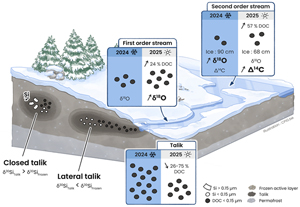
Figures and Tables
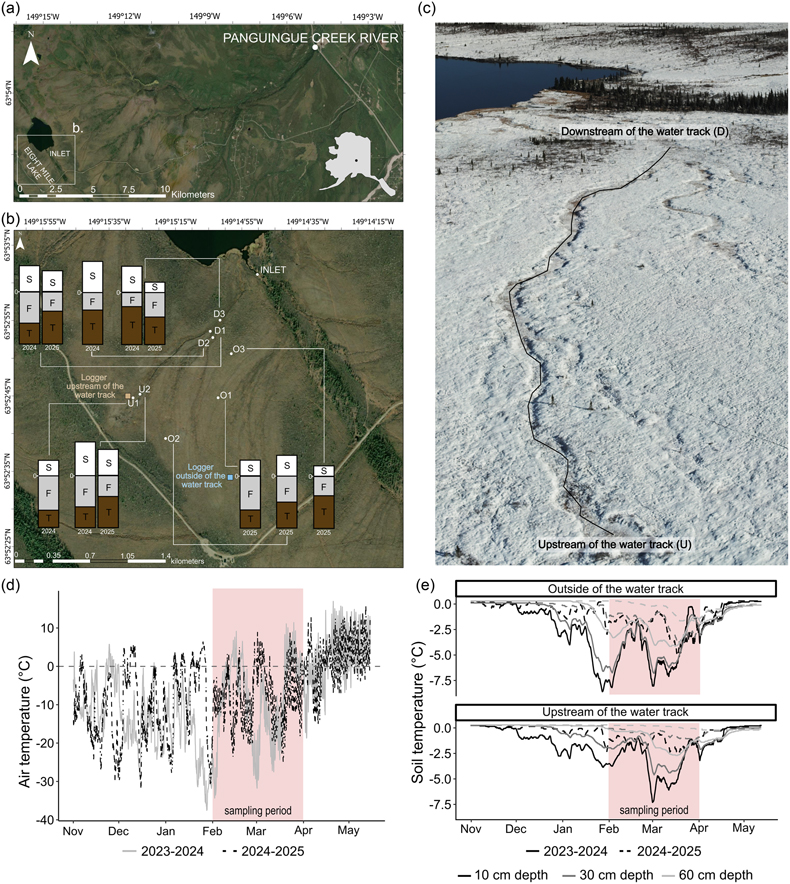
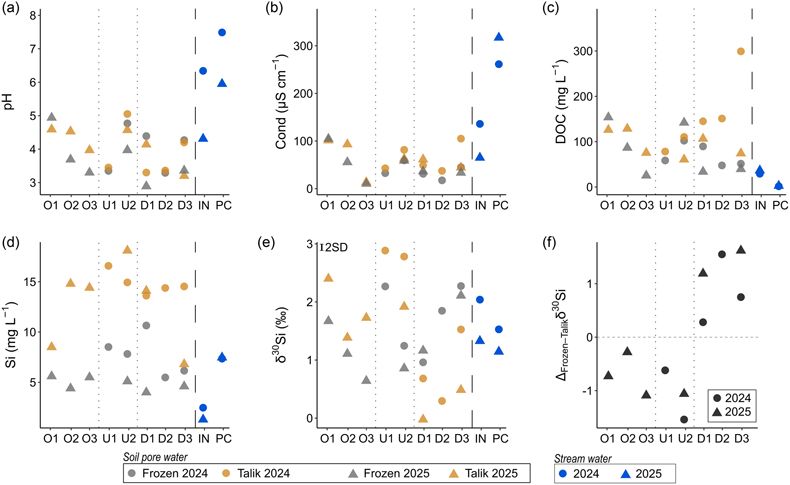
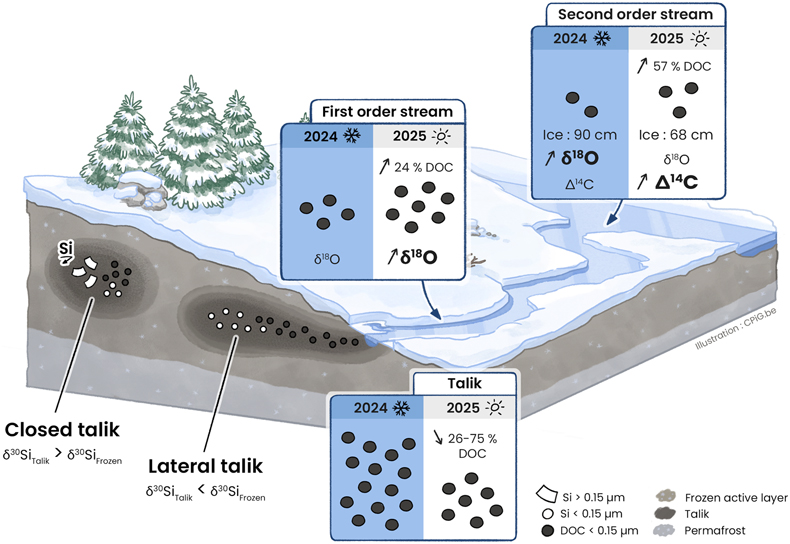
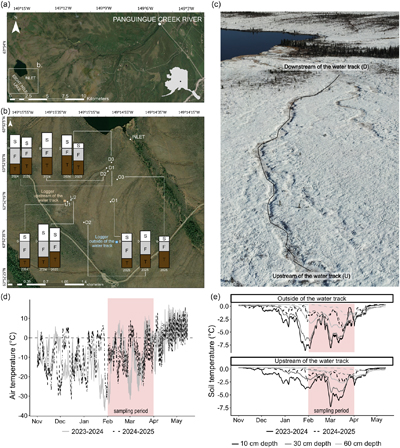 Figure 1 (a) Eight Mile Lake (details in (b)), the first order stream (inlet), and the second order stream (Panguingue Creek River). (b) Study site showing core positions outside (O1-O3), upstream (U1-U2), and downstream (D1-D3) of the water track, the inlet, and temperature loggers; core schematics show snow depth (S), frozen soil thickness (F), and talik depth (T), to scale (Table S-1). (c) Drone photograph (October 2023) showing the water track. (d) Air and (e) soil temperatures (10, 30, 60 cm depth) from November 1 to May 15 at locations in (b). | 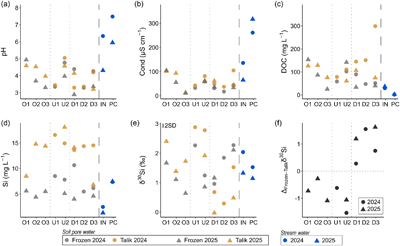 Figure 2 (a) pH, (b) conductivity (μS cm-1), (c) DOC and (d) Si concentration (mg L-1), (e) δ30Si (‰), and (f) ΔFrozen-Talikδ30Si in soil pore waters from the taliks (in yellow; n = 11) and the frozen portions of the soil (in grey; n = 11) from coring outside (O), upstream (U), and downstream (D) of the water track in 2024 and 2025; and in stream waters (n = 4; in blue: IN = inlet and PC = Panguingue Creek River; Table 1). | 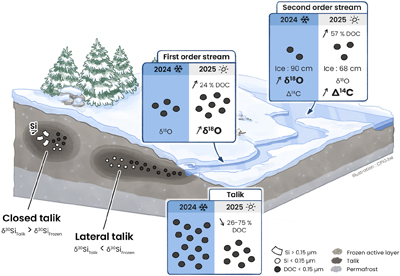 Figure 3 Synthesis of winter biogeochemical processes in between February-March 2024 and 2025. The first order stream represents the inlet, and the second order stream represents the Panguingue Creek River in this study. (The figure was designed by CPiG-Carolina Levicek) | 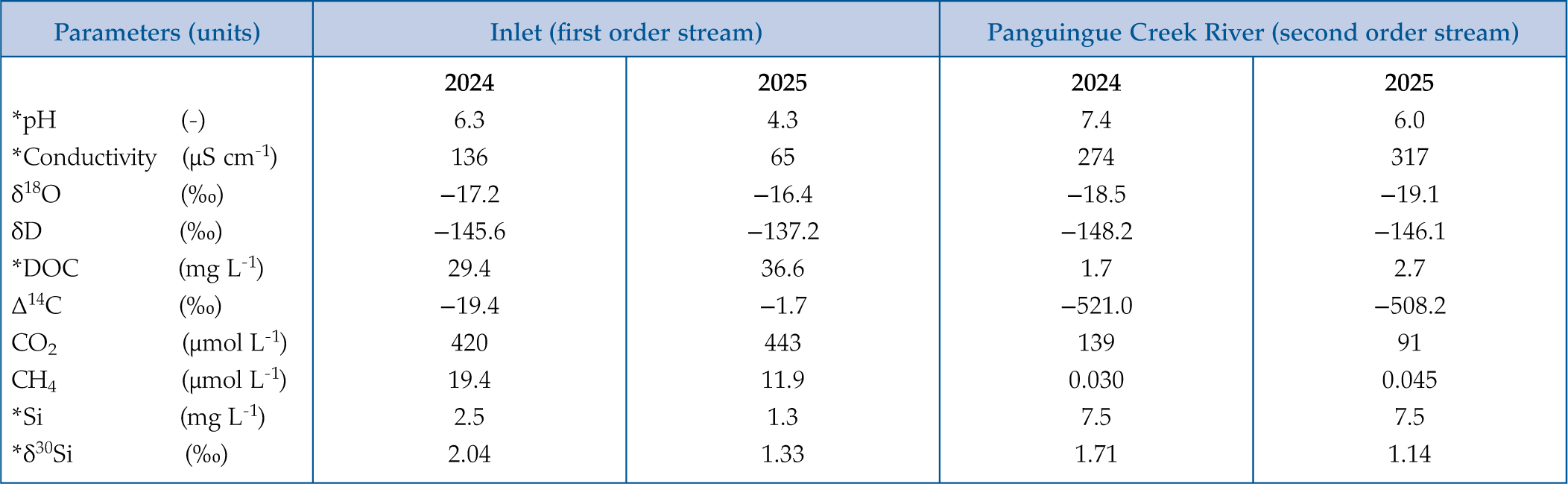 Table 1 pH, conductivity (μS cm-1), water isotopes (δ18O and δD, ‰), DOC concentration (mg L-1), Δ14C-DOC (‰), dissolved concentrations of CO2 (μmol L-1) and CH4 (μmol L-1), Si concentrations (mg L-1), and δ30Si (‰) from the inlet and the Panguingue Creek River. (*) Shown in Figure 2. |
| Figure 1 | Figure 2 | Figure 3 | Table 1 |
top
Introduction
Across the northern permafrost region, 1,662 Tg of carbon per year is released to the atmosphere as carbon dioxide (CO2) and methane (CH4) during the winter season (October-April; Natali et al., 2019
Natali, S.M., Watts, J.D., Rogers, B.M., Potter, S., Ludwig, S.M., et al. (2019) Large loss of CO2 in winter observed across the northern permafrost region. Nature Climate Change 9, 852–857. https://doi.org/10.1038/s41558-019-0592-8
; Arndt et al., 2023Arndt, K.A., Hashemi, J., Natali, S.M., Schiferl, L.D., Virkkala, A.-M. (2023) Recent Advances and Challenges in Monitoring and Modeling Non-Growing Season Carbon Dioxide Fluxes from the Arctic Boreal Zone. Current Climate Change Reports 9, 27–40. https://doi.org/10.1007/s40641-023-00190-4
). Winter carbon emissions may be preceded by subsurface mobilisation and transfer of dissolved organic carbon (DOC) within taliks (Parazoo et al., 2018Parazoo, N.C., Koven, C.D., Lawrence, D.M., Romanovsky, V E., Miller, C E. (2018) Detecting the permafrost carbon feedback: Talik formation and increased cold-season respiration as precursors to sink-to-source transitions. The Cryosphere 12, 123–144. https://doi.org/10.5194/tc-12-123-2018
; Walter Anthony et al., 2024Walter Anthony, K.M., Anthony, P., Hasson, N., Edgar, C., Sivan, O., et al. (2024) Upland Yedoma taliks are an unpredicted source of atmospheric methane. Nature Communications 15, 6056. https://doi.org/10.1038/s41467-024-50346-5
; Bergman et al., 2025Bergman, O., Walter Anthony, K., Eliani-Russak, E., Sivan, O. (2025) Nitrogen Redox Controls on Greenhouse Gas Production in Yedoma Taliks. Global Change Biology 31, e70356. https://doi.org/10.1111/gcb.70356
), processes that remain poorly constrained. A talik is defined as “a part of the ground at a site with permafrost that remains unfrozen year round” (Lewkowicz et al., 2024Lewkowicz, A.G., Wolfe, S.A., Roujanski, V.E., Hoeve, E., O’Neill, H.B., et al. (2024) An Illustrated Permafrost Dictionary Canadian Permafrost Association. https://ostrnrcan-dostrncan.canada.ca/handle/1845/347162
) and may be either between the base of the active layer and permafrost (supra-permafrost talik), or within a permafrost profile (intra-permafrost talik; Devoie et al., 2024Devoie, É.G., Connon, R. F., Beddoe, R., Goordial, J., Quinton, W.L., Craig, J.R. (2024) Disconnected active layers and unfrozen permafrost: A discussion of permafrost-related terms and definitions. Science of The Total Environment 912, 169017. https://doi.org/10.1016/j.scitotenv.2023.169017
). Supra-permafrost taliks can be either closed or lateral (O’Neill et al., 2020O’Neill, H.B., Roy-Leveillee, P., Lebedeva, L., Ling, F. (2020) Recent advances (2010–2019) in the study of taliks. Permafrost and Periglacial Processes 31, 346–357. https://doi.org/10.1002/ppp.2050
): closed taliks are surrounded by frozen ground with talik water relatively stagnant, having only a localised sphere of influence and limited flow potential; and lateral taliks can form lateral water flow pathways, leading to an increase in DOC transfer from soil to streams in winter (Connon et al., 2018Connon, R., Devoie, É., Hayashi, M., Veness, T., Quinton, W. (2018) The Influence of Shallow Taliks on Permafrost Thaw and Active Layer Dynamics in Subarctic Canada. Journal of Geophysical Research: Earth Surface 123, 281–297. https://doi.org/10.1002/2017JF004469
; Devoie et al., 2024Devoie, É.G., Connon, R. F., Beddoe, R., Goordial, J., Quinton, W.L., Craig, J.R. (2024) Disconnected active layers and unfrozen permafrost: A discussion of permafrost-related terms and definitions. Science of The Total Environment 912, 169017. https://doi.org/10.1016/j.scitotenv.2023.169017
). Thus, distinguishing between closed and lateral taliks is crucial for determining how supra-permafrost taliks regulate winter carbon transfer from soils to streams (Kurylyk and Walvoord, 2021Kurylyk, B.L., Walvoord, M.A. (2021) Permafrost Hydrogeology. In: Yang, D., Kane, D.L. (Éds.) Arctic Hydrology, Permafrost and Ecosystems, 493–523. Springer International Publishing. https://doi.org/10.1007/978-3-030-50930-9_17
; Zhao et al., 2026Zhao, Y., Zheng, C., Gelfan, A., Watanabe, K., Liu, H., et al. (2026) Frozen Soil Hydrological Processes and Their Effects: A Review and Synthesis. Reviews of Geophysics 64, e2024RG000839. https://doi.org/10.1029/2024RG000839
).Water tracks are unchanneled zones overlying permafrost that concentrate water flow downslope, and exhibit higher soil moisture and snow thickness than the surrounding areas (Del Vecchio and Evans, 2025
Del Vecchio, J., Evans, S.G. (2025) Climate and Hydrogeological Controls on Water Tracks in Permafrost Landscapes. Reviews of Geophysics 63, e2024RG000854. https://doi.org/10.1029/2024RG000854
). Moreover, soil moisture increases along the water tracks, leading to wetter areas downstream of the water tracks, mainly fed by water from upstream during the growing season (Tananaev et al., 2021Tananaev, N., Isaev, V., Sergeev, D., Kotov, P., Komarov, O. (2021) Hydrological Connectivity in a Permafrost Tundra Landscape near Vorkuta, North-European Arctic Russia. Hydrology 8, 3. https://doi.org/10.3390/hydrology8030106
). Increasing soil moisture associated with water flows enhances advective heat transfer, promoting the development of taliks, potentially favouring closed taliks where the soil moisture is lower upstream, and lateral taliks where the soil moisture is higher downstream of the water track (Devoie et al., 2021Devoie, É.G., Craig, J.R., Dominico, M., Carpino, O., Connon, R.F., Rudy, A.C.A., Quinton, W.L. (2021) Mechanisms of Discontinuous Permafrost Thaw in Peatlands. Journal of Geophysical Research: Earth Surface 126, e2021JF006204. https://doi.org/10.1029/2021JF006204
). Existing methods for talik detection are based on mechanical, geophysical and thermal approaches (O’Neill et al., 2020O’Neill, H.B., Roy-Leveillee, P., Lebedeva, L., Ling, F. (2020) Recent advances (2010–2019) in the study of taliks. Permafrost and Periglacial Processes 31, 346–357. https://doi.org/10.1002/ppp.2050
). The gap in biogeochemical methods reflects the exceptional logistical challenges of collecting soil pore water from taliks during deep winter, when frozen surface conditions and extreme cold make in situ sampling difficult.Talik connectivity may be assessed using the stable isotope composition of silicon (δ30Si), based on Hirst et al. (2023)
Hirst, C., Monhonval, A., Mauclet, E., Thomas, M., Villani, M., Ledman, J., Schuur, E.A.G., Opfergelt, S. (2023) Evidence for late winter biogeochemical connectivity in permafrost soils. Communications Earth and Environment 4, Article 1. https://doi.org/10.1038/s43247-023-00740-6
, who measured δ30Si in soil pore waters to distinguish isolated from connected soil pore water during the late winter to snow melt transition. We apply it here to a colder, earlier stage of winter, prior to any onset of thaw. Upon freezing of soil pore water under a closed system, the decrease in liquid water volume drives an increase in the silicic acid concentration in soil pore waters over the amorphous silica solubility (Dietzel, 2005Dietzel, M. (2005) Impact of cyclic freezing on precipitation of silica in Me–SiO2–H2O systems and geochemical implications for cryosoils and -sediments. Chemical Geology 216, 79–88. https://doi.org/10.1016/j.chemgeo.2004.11.003
). Amorphous silica precipitation induces silicon isotope fractionation by preferentially incorporating lighter isotopes into solid phases (from nanosized solid phases termed colloids to particulate sized phases), leaving the dissolved soil pore water fraction isotopically heavier (Oelze et al., 2015Oelze, M., von Blanckenburg, F., Bouchez, J., Hoellen, D., Dietzel, M. (2015) The effect of Al on Si isotope fractionation investigated by silica precipitation experiments. Chemical Geology 397, 94–105. https://doi.org/10.1016/j.chemgeo.2015.01.002
). This process may happen in closed taliks (Hirst et al., 2023Hirst, C., Monhonval, A., Mauclet, E., Thomas, M., Villani, M., Ledman, J., Schuur, E.A.G., Opfergelt, S. (2023) Evidence for late winter biogeochemical connectivity in permafrost soils. Communications Earth and Environment 4, Article 1. https://doi.org/10.1038/s43247-023-00740-6
), leaving the soil pore water from taliks isotopically heavier than soil pore water from the surrounding frozen soil (soil pore water δ30talikSi > δ30frozenSi). In lateral taliks, water flow prevents silicic acid concentration. In addition, the freezing front facilitates colloid mobilisation through preferential flow paths (Mohanty et al., 2014Mohanty, S.K., Saiers, J.E., Ryan, J.N. (2014) Colloid-Facilitated Mobilization of Metals by Freeze–Thaw Cycles. Environmental Science and Technology 48, 997–984. https://doi.org/10.1021/es403698u
) from the frozen ground to the lateral talik. This leads to a soil pore water isotopically lighter in lateral taliks with the accumulation of light δ30Si bearing-colloids compared to the surrounding frozen soil (soil pore water δ30talikSi < δ30frozenSi).This study aims to biogeochemically distinguish supra-permafrost taliks located upstream, downstream, and outside a water track from Eight Mile Lake (Healy, Alaska; Fig. 1), using soil pore water chemistry (pH, conductivity, DOC concentrations, and δ30Si) from the taliks and the frozen portions of the soil within the active layer. The chemistry of local first order (inlet) and second order stream waters (Panguingue Creek River) is investigated to assess the implications of talik connectivity for DOC transfer to streams (pH, conductivity, δ18O, DOC concentrations, radiocarbon of DOC (Δ14C-DOC), dissolved CO2 and CH4 concentrations, Si concentrations, and δ30Si). As winters become increasingly warmer in permafrost regions (Graham et al., 2017
Graham, R.M., Cohen, L., Petty, A.A., Boisvert, L.N., Rinke, A., Hudson, S.R., Nicolaus, M., Granskog, M.A. (2017) Increasing frequency and duration of Arctic winter warming events. Geophysical Research Letters 44, 6974–6983. https://doi.org/10.1002/2017GL073395
), we compare two contrasted winters to examine how interannual differences in air temperature (winter 2025 warmer than winter 2024) influence carbon transfer to streams (see SI).Figure 1 (a) Eight Mile Lake (details in (b)), the first order stream (inlet), and the second order stream (Panguingue Creek River). (b) Study site showing core positions outside (O1-O3), upstream (U1-U2), and downstream (D1-D3) of the water track, the inlet, and temperature loggers; core schematics show snow depth (S), frozen soil thickness (F), and talik depth (T), to scale (Table S-1). (c) Drone photograph (October 2023) showing the water track. (d) Air and (e) soil temperatures (10, 30, 60 cm depth) from November 1 to May 15 at locations in (b).
top
Contrasting Interannual Winter Conditions
At Eight Mile Lake, winter air temperatures in 2023–2024 and 2024–2025 were significantly higher compared to the previous ten winters (−11.3 ± 9.1 °C; p < 0.001; Wilcoxon test; Kennedy et al., 2026
Kennedy, E., Celis, G., See, C., Schaedel, C., Mauritz, M., Taylor, M., Ledman, J., Natali, S., Schuur, E.A.G. (2026) Eight Mile Lake Research Watershed: Hourly meteorological data, 2004-2025, Bonanza Creek LTER - University of Alaska Fairbanks. BNZ:453. https://doi.org/doi:10.6073/pasta/c1b76570a7f3d4feaef428e98970b2be
), and the winter freezing degree day was higher in 2024–2025 (−1528 °C) than in 2023–2024 (−1911°C; calculated by summing all negative values between 1 November and 14 May; Farquharson et al., 2022Farquharson, L.M., Romanovsky, V.E., Kholodov, A., Nicolsky, D. (2022) Sub-aerial talik formation observed across the discontinuous permafrost zone of Alaska. Nature Geoscience 15, 475–481. https://doi.org/10.1038/s41561-022-00952-z
). Winter 2024–2025 was then warmer than winter 2023–2024 overall, and this was also observed more specifically during the sampling period (February-March): air temperatures were significantly higher (p value < 0.001) of 1.9 °C in 2025 (−7.4 ± 6.9 °C (mean ± s.d.) with a minimum of −25 °C) than in 2024 (−9.3 ± 10.6 °C (mean ± s.d.) with a minimum of −34 °C; Fig. 1d). As a result, February-March soil temperatures were significantly higher (p value < 0.001) in 2025 than in 2024 for each depth at each site, with increases ranging from 1.5 to 2.4 °C (Fig. 1e). Snow depth at the site was thinner both upstream and outside of the water track in 2025 (15 ± 8 cm, n = 6) than in 2024 (23 ± 13 cm, n = 6; Fig. 1b). Despite a large variability in snow depth, this trend is consistent with regional observations of thinner snow depth in 2025 (42 ± 23 cm) than in 2024 (50 ± 23 cm) in Healy (Thompson et al., 2025Thompson, A., Ledman, J., Celis, G., Mauritz, M., Taylor, M., Schuur, E.A.G. (2025) Eight Mile Lake Research Watershed, Carbon in Permafrost Experimental Heating Research (CiPEHR): CiPEHR snow depth manual data 2009-2025, Bonanza Creek LTER - University of Alaska Fairbanks. BNZ:629. https://doi.org/doi:10.6073/pasta/79eafbe49cff540115cd6869e382f28c
). These contrasting air and soil temperatures and snow layer thicknesses between the two winters may then influence talik biogeochemical connectivity.top
Chemical Composition of the Soil Pore Waters and Streams
In soil pore waters from the taliks and the frozen portions of the soil, pH, conductivity, and DOC concentrations varied from 2.9 to 5.1 (3.9 ± 0.6), 10.3 to 105 μS cm-1 (53.5 ± 28.5 μS cm-1), and 25.4 to 299 mg L-1 (100 ± 59.0 mg L-1) respectively (Fig. 2a-c). In soil pore waters from the taliks sampled both in 2024 and 2025 (n = 6; upstream and downstream of the water track), DOC concentrations are 45 (U2), 26 (D1) and 75 % (D3) lower in 2025 compared to 2024, respectively, suggesting DOC dilution within a wetter water track under warmer conditions in 2025 (Del Vecchio and Evans, 2025
Del Vecchio, J., Evans, S.G. (2025) Climate and Hydrogeological Controls on Water Tracks in Permafrost Landscapes. Reviews of Geophysics 63, e2024RG000854. https://doi.org/10.1029/2024RG000854
).Figure 2 (a) pH, (b) conductivity (μS cm-1), (c) DOC and (d) Si concentration (mg L-1), (e) δ30Si (‰), and (f) ΔFrozen-Talikδ30Si in soil pore waters from the taliks (in yellow; n = 11) and the frozen portions of the soil (in grey; n = 11) from coring outside (O), upstream (U), and downstream (D) of the water track in 2024 and 2025; and in stream waters (n = 4; in blue: IN = inlet and PC = Panguingue Creek River; Table 1).
At the inlet (first order stream), water pH and conductivity varied respectively between 6.3 and 4.3, and between 136 and 65 μS cm-1 (Fig. 2, Table 1). Water δ18O values and DOC concentrations were respectively 4 % and 24 % higher in 2025 compared to 2024. Values of Δ14C-DOC were slightly higher in 2025 (−1.7 ‰) than in 2024 (−19.4 ‰), corresponding to young DOC radiocarbon ages of ∼0 and 86 years BP, respectively, potentially derived from recently fixed plant litter in the downslope area close to the inlet (Benner et al., 2004
Benner, R., Benitez-Nelson, B., Kaiser, K., Amon, R.M.W. (2004) Export of young terrigenous dissolved organic carbon from rivers to the Arctic Ocean. Geophysical Research Letters 31. https://doi.org/10.1029/2003GL019251
). Dissolved CO2 and CH4 concentrations in inlet waters were considered stable between 2024 (420 μmol L-1 CO2 and 19.4 μmol L-1 CH4) and 2025 (443 μmol L-1 CO2 and 11.9 μmol L-1 CH4) given the typical variability of these quantities in streams in permafrost areas (Street et al., 2016Street, L.E., Dean, J.F., Billett, M.F., Baxter, R., Dinsmore, K.J., et al. (2016) Redox dynamics in the active layer of an Arctic headwater catchment; examining the potential for transfer of dissolved methane from soils to stream water. Journal of Geophysical Research: Biogeosciences 121, 2776–2792. https://doi.org/10.1002/2016JG003387
).Table 1 pH, conductivity (μS cm-1), water isotopes (δ18O and δD, ‰), DOC concentration (mg L-1), Δ14C-DOC (‰), dissolved concentrations of CO2 (μmol L-1) and CH4 (μmol L-1), Si concentrations (mg L-1), and δ30Si (‰) from the inlet and the Panguingue Creek River. (*) Shown in Figure 2.
| Parameters (units) | Inlet (first order stream) | Panguingue Creek River (second order stream) | ||
| 2024 | 2025 | 2024 | 2025 | |
| *pH (-) | 6.3 | 4.3 | 7.4 | 6.0 |
| *Conductivity (μS cm-1) | 136 | 65 | 274 | 317 |
| δ18O (‰) | −17.2 | −16.4 | −18.5 | −19.1 |
| δD (‰) | −145.6 | −137.2 | −148.2 | −146.1 |
| *DOC (mg L-1) | 29.4 | 36.6 | 1.7 | 2.7 |
| Δ14C (‰) | −19.4 | −1.7 | −521.0 | −508.2 |
| CO2 (μmol L-1) | 420 | 443 | 139 | 91 |
| CH4 (μmol L-1) | 19.4 | 11.9 | 0.030 | 0.045 |
| *Si (mg L-1) | 2.5 | 1.3 | 7.5 | 7.5 |
| *δ30Si (‰) | 2.04 | 1.33 | 1.71 | 1.14 |
At the Panguingue Creek River (second order stream), water pH and conductivity varied respectively between 7.4 and 6.0, and between 274 and 317 μS cm-1 (Fig. 2, Table 1). Water δ18O values were 3 % lower, and DOC concentrations were 57 % higher in 2025 compared to 2024. Values of Δ14C-DOC were higher (i.e. less depleted) in 2025 (−508.2 ‰, 5628 years BP) compared to 2024 (−521 ‰, 5841 years BP), indicating a younger DOC source in 2025. Dissolved CO2 and CH4 concentrations remained similar in 2024 (139 μmol L-1 CO2 and 0.030 μmol L-1 CH4) and 2025 (91 μmol L-1 CO2 and 0.045 μmol L-1 CH4) in the Panguingue Creek River water, in agreement with the absence of changes observed at the inlet.
top
Silicon Isotopes Reveal Talik Connectivity (Closed versus Lateral)
In soil pore waters from the taliks and from the frozen portions of the soil, Si concentrations varied from 4.0 to 18.1 mg L-1, and the silicon isotope compositions (δ30Si) varied from −0.02 to 2.88 ‰ (Fig. 2d-e). To characterise talik connectivity (closed versus lateral), we consider the difference in δ30Si values between soil pore waters from the taliks and from the frozen portions of the soil, i.e. the ΔFrozen-Talikδ30Si (Fig. 2f).
In 2024, the ΔFrozen-Talikδ30Si (Fig. 2f) had two distinct patterns depending on the locations of the cores along the slope: upstream of the water track, δ30Si was higher in the taliks than in the frozen portions of the soil (ΔFrozen-Talik δ30Si < 0) with a mean difference of −1.08 ‰; whereas downstream of the water track, δ30Si was lower in the taliks than in the frozen portions of the soil (ΔFrozen-Talik δ30Si > 0) with a mean difference of +0.86 ‰, consistent with Si isotope fractionation during freezing processes (Hirst et al., 2023
Hirst, C., Monhonval, A., Mauclet, E., Thomas, M., Villani, M., Ledman, J., Schuur, E.A.G., Opfergelt, S. (2023) Evidence for late winter biogeochemical connectivity in permafrost soils. Communications Earth and Environment 4, Article 1. https://doi.org/10.1038/s43247-023-00740-6
). Upstream of the water track (δ30Sitalik > δ30Sifrozen), the heavier signature is consistent with closed system Si isotopic fractionation (Hatton et al., 2019Hatton, J.E., Hendry, K.R., Hawkings, J.R., Wadham, J.L., Opfergelt, S., Kohler, T.J., Yde, J.C., Stibal, M., Žárský, J.D. (2019) Silicon isotopes in Arctic and sub-Arctic glacial meltwaters: The role of subglacial weathering in the silicon cycle. Proceedings of the Royal Society A: Mathematical, Physical and Engineering Sciences 475, 20190098. https://doi.org/10.1098/rspa.2019.0098
): in closed taliks. Downstream of the water track (δ30Sitalik < δ30Sifrozen), the lighter signature indicates an open system without Si isotopic fractionation in lateral taliks. Downstream taliks were also shallower (40 ± 17 cm) than upstream (64 ± 5 cm; Fig. 1b, Table S-1), consistent with a wetter, more connected zone that may transfer carbon to streams in deep winter.In 2025, ΔFrozen-Talik δ30Si was negative upstream of the water track and positive downstream of the water track, which confirms the results obtained in 2024 (Fig. 2f): closed taliks are upstream and lateral taliks are downstream of the water track. Moreover, δ30Si values from soil pore waters outside of the water track exhibit patterns similar to those measured upstream of the water track: ΔFrozen-Talik δ30Si was negative with δ30Si in the taliks and 0.70 ‰ higher than in the frozen portions of the soil. As a result, taliks from outside of the water track are closed, like upstream of the water track.
top
Tracing Lateral Talik Contributions to Streams Using Silicon Isotopes
At the inlet (first order stream), dissolved Si concentrations and δ30Si values were 47 % and 35 % lower, respectively, in 2025 compared to 2024 (Fig. 2d,e, Table 1). Inlet δ30Si was lower in 2025 (1.33 ‰) than in 2024 (2.04 ‰), a shift toward lighter values, consistent with an increased contribution of soil pore waters from lateral taliks (0.59 ± 0.58 ‰) in 2025. The increase in δ18O values from the inlet waters in 2025 compared to 2024 also supports this higher contribution of soil pore waters under warmer conditions (Table 1; Hirst et al., 2022
Hirst, C., Mauclet, E., Monhonval, A., Tihon, E., Ledman, J., Schuur, Edward. A.G., Opfergelt, S. (2022) Seasonal changes in hydrology and permafrost degradation control mineral element-bound DOC transport from permafrost soils to streams. Global Biogeochemical Cycles 36, e2021GB007105. https://doi.org/10.1029/2021GB007105
). As a result, our data suggest that, under warmer conditions (2025), winter inlet waters reflect an increased input from lateral talik pore waters, in addition to a persistent contribution from deep sub-permafrost groundwater (O’Donnell et al., 2012O’Donnell, J.A., Aiken, G.R., Walvoord, M.A., Butler, K.D. (2012) Dissolved organic matter composition of winter flow in the Yukon River basin: Implications of permafrost thaw and increased groundwater discharge. Global Biogeochemical Cycles 26, GB0E06. https://doi.org/10.1029/2012GB004341
; Roux et al., 2026Roux, P., Hirst, C., Villani, M., du Bois d’Aische, E., Osy, C., et al. (2026) Radiogenic Sr isotopes reveal extended seasonal windows of soil-river dissolved organic carbon transfer in an Arctic permafrost catchment. Chemical Geology 712, 123427. https://doi.org/10.1016/j.chemgeo.2026.123427
).At the Panguingue Creek River (second order stream), Si concentrations remained similar in 2024 and 2025 (7.5 mg L-1), and δ30Si values were 33 % lower in 2025 compared to 2024 (Fig. 2d,e, Table 1). Panguingue Creek δ30Si was lower in 2025 (1.14 ‰) than in 2024 (1.71 ‰), a shift toward lighter values, consistent with an increased contribution of soil pore waters from lateral taliks (0.59 ± 0.58 ‰) in 2025, similar to the pattern observed at the inlet. The decrease in δ18O in 2025 compared to 2024 (Table 1) likely reflects intra-river processes (Gibson and Prowse, 2002
Gibson, J.J., Prowse, T.D. (2002) Stable isotopes in river ice : Identifying primary over-winter streamflow signals and their hydrological significance. Hydrological Processes 16, 873–890. https://doi.org/10.1002/hyp.366
), including reduced river ice thickness during the warmer winter (90 cm in 2024 and 68 cm in 2025; see SI), rather than a direct soil signal. This indicates that Panguingue Creek, as a second order stream, reflects an increased input from talik pore waters under warmer conditions (2025), in addition to a persistent contribution from deep sub-permafrost groundwater (O’Donnell et al., 2012O’Donnell, J.A., Aiken, G.R., Walvoord, M.A., Butler, K.D. (2012) Dissolved organic matter composition of winter flow in the Yukon River basin: Implications of permafrost thaw and increased groundwater discharge. Global Biogeochemical Cycles 26, GB0E06. https://doi.org/10.1029/2012GB004341
; Roux et al., 2026Roux, P., Hirst, C., Villani, M., du Bois d’Aische, E., Osy, C., et al. (2026) Radiogenic Sr isotopes reveal extended seasonal windows of soil-river dissolved organic carbon transfer in an Arctic permafrost catchment. Chemical Geology 712, 123427. https://doi.org/10.1016/j.chemgeo.2026.123427
), and intra-river processes.top
Implications for Winter Carbon Mobilisation and Transfer into Streams
Lateral taliks being hydrologically connected during winter (Zhao et al., 2026
Zhao, Y., Zheng, C., Gelfan, A., Watanabe, K., Liu, H., et al. (2026) Frozen Soil Hydrological Processes and Their Effects: A Review and Synthesis. Reviews of Geophysics 64, e2024RG000839. https://doi.org/10.1029/2024RG000839
), they likely enhance the transfer of DOC to streams. As the sampling period in 2025 was warmer than in 2024, the increase in DOC concentrations in the first and the second order stream waters in 2025 compared to 2024 suggests an increase in this mobilisation and the transfer of DOC from soils to streams (Fig. 3). The parallel increase in Δ14C values at the second order stream (from −521.0 in 2024 to −508.2 ‰ in 2025; Table 1) under warming conditions also supports a greater contribution of younger DOC from talik pore waters (Δ14C-DOC = −123.5 ± 120.2 ‰; Fig. S-1a). This increase in transfer of young DOC from lateral taliks in 2025 is in line with δ30Si and δ18O values at the first order stream, and δ30Si at the second order stream (Fig. 2, Table 1). Stream waters were sampled once per year at each site, precluding formal statistical testing of interannual differences. However, the consistent direction of change across several independent parameters (DOC concentration, Δ14C-DOC, δ30Si, and δ18O) demonstrates that these shifts reflect an increase in lateral talik contribution to streams under warmer conditions, rather than sampling variability alone.Figure 3 Synthesis of winter biogeochemical processes in between February-March 2024 and 2025. The first order stream represents the inlet, and the second order stream represents the Panguingue Creek River in this study. (The figure was designed by CPiG-Carolina Levicek)
At both the first and second order streams, dissolved CO2 and CH4 concentrations were stable between 2024 and 2025, (Table 1), suggesting that the mobilisation of DOC from lateral taliks in 2025 compared to 2024 does not translate into a change in the production of CO2 and CH4 and transfer to streams. A similar decoupling between DOC mobilisation and CO2/CH4 production was reported in Yedoma thaw affected lakes, where highly labile permafrost DOC nonetheless accumulated rather than being rapidly mineralised (Ollivier et al., 2026
Ollivier, S., Séjourné, A., Hatté, C., Bouchard, F., Noret, A., Hughes-Allen, L., Costard, F., Gandois, L. (2026) Massive concentrations of old dissolved organic carbon from Yedoma thaw in lakes in Siberia. Communications Earth and Environment 7, 200. https://doi.org/10.1038/s43247-026-03229-0
). This decoupling contrasts with conditions in the soil itself: in free standing water from a shallow unconfined saturated zone at the most downstream site (Fig. S-1b; D4), dissolved CO2 and CH4 concentrations increased ∼2 and ∼17 fold, respectively, between 2024 (CO2 = 303 μmol L-1, CH4 = 2.7 μmol L-1) and 2025 (CO2 = 590 μmol L-1, CH4 = 45.0 μmol L-1), pointing to stronger CO2 and CH4 production in saturated soils under warmer conditions. This enhanced soil production, however, provides no evidence of a corresponding transfer of dissolved CO2 and CH4 to streams. Alternatively, we cannot exclude that part of the transferred DOC is mineralised along the flow path between the first and second order streams, without being captured by our fixed point sampling. Enhanced winter DOC transfer from lateral taliks and active microbial CO2 and CH4 production in talik soils (Fig. S-1b) may also have delayed effects on riverine greenhouse gas dynamics during subsequent high flow period after deep winter (Castro-Morales et al., 2022Castro-Morales, K., Canning, A., Körtzinger, A., Göckede, M., Küsel, K., et al. (2022) Effects of Reversal of Water Flow in an Arctic Floodplain River on Fluvial Emissions of CO2 and CH4. Journal of Geophysical Research: Biogeosciences 127, e2021JG006485. https://doi.org/10.1029/2021JG006485
), contributing to the permafrost driven increase in annual stream CO2 emissions (Mu et al., 2025Mu, C., Li, K., Liu, S., Wei, Y., Mu, M., et al. (2025) Recent intensified riverine CO2 emission across the Northern Hemisphere permafrost region. Nature Communications 16, 3616. https://doi.org/10.1038/s41467-025-58716-3
).top
Conclusion
This study provides geochemical evidence of lateral talik connectivity using silicon isotopes. Contrasting δ30Si signatures between taliks and frozen soil pore waters (heavier upstream and lighter downstream of the water track) distinguish closed from lateral taliks. The higher DOC concentrations in stream waters in 2025 than in 2024 suggest a greater lateral talik contribution to streams under warmer conditions. Together, these results indicate that lateral taliks act as critical subsurface pathways linking winter soil pore waters DOC mobilisation to aquatic carbon cycling. As winters continue to warm, the expansion of lateral taliks may enhance DOC transfer to streams, but do not necessarily lead to immediate increases in riverine dissolved CO2 and CH4 concentrations during winter. This study represents a first step toward understanding talik biogeochemical connectivity, given the logistical challenges of winter sampling in remote permafrost environments. Expanding observations across multiple sites and combining geochemical tracers with existing geophysical and thermal characterisation of taliks will be essential to fully assess the biogeochemical significance of lateral taliks in permafrost ecosystems.
top
Acknowledgments
We thank the analytical platform MOCA at UCLouvain, L. Smeyers for his contribution to field sampling, and the valuable input from LandSense team K. Van Oost, V. Vanacker, F. Jonard and S. Lambot (Action de Recherche Concertée (ARC), no. 21/26–119, funded by the Fédération Wallonie-Bruxelles (FWB)). We acknowledge funding from the European Research Council (ERC) under the European Union’s Horizon 2020 research and innovation programme (ERC Starting Grant, WeThaw, n°714617) to SO, from the Fonds National de la Recherche Scientifique to SO, MV and E d BA (FNRS: FC69480, FC49507, FC54613, and CDR MOIST), from BELSPO (RT/23/LIFTHAW), from CircleU (Seed funding CEDRIC), and from VOCATIO grant (Belgium) to MV. We thank the editor, Andreas Kappler, and the two reviewers, Aaron Bufe and one anonymous reviewer, for their valuable comments and suggestions.
Editor: Andreas Kappler
top
Data Availability
The data related to this article is available online at: https://doi.org/10.14428/DVN/LPFBWO
top
References
Arndt, K.A., Hashemi, J., Natali, S.M., Schiferl, L.D., Virkkala, A.-M. (2023) Recent Advances and Challenges in Monitoring and Modeling Non-Growing Season Carbon Dioxide Fluxes from the Arctic Boreal Zone. Current Climate Change Reports 9, 27–40. https://doi.org/10.1007/s40641-023-00190-4
 Show in context
 Across the northern permafrost region, 1,662 Tg of carbon per year is released to the atmosphere as carbon dioxide (CO2) and methane (CH4) during the winter season (October-April; Natali et al., 2019; Arndt et al., 2023).
View in article
Benner, R., Benitez-Nelson, B., Kaiser, K., Amon, R.M.W. (2004) Export of young terrigenous dissolved organic carbon from rivers to the Arctic Ocean. Geophysical Research Letters 31. https://doi.org/10.1029/2003GL019251
Show in context Values of Δ14C-DOC were slightly higher in 2025 (−1.7 ‰) than in 2024 (−19.4 ‰), corresponding to young DOC radiocarbon ages of ∼0 and 86 years BP, respectively, potentially derived from recently fixed plant litter in the downslope area close to the inlet (Benner et al., 2004).
View in article
Bergman, O., Walter Anthony, K., Eliani-Russak, E., Sivan, O. (2025) Nitrogen Redox Controls on Greenhouse Gas Production in Yedoma Taliks. Global Change Biology 31, e70356. https://doi.org/10.1111/gcb.70356
Show in context Winter carbon emissions may be preceded by subsurface mobilisation and transfer of dissolved organic carbon (DOC) within taliks (Parazoo et al., 2018; Walter Anthony et al., 2024; Bergman et al., 2025), processes that remain poorly constrained.
View in article
Castro-Morales, K., Canning, A., Körtzinger, A., Göckede, M., Küsel, K., et al. (2022) Effects of Reversal of Water Flow in an Arctic Floodplain River on Fluvial Emissions of CO2 and CH4. Journal of Geophysical Research: Biogeosciences 127, e2021JG006485. https://doi.org/10.1029/2021JG006485
Show in context Enhanced winter DOC transfer from lateral taliks and active microbial CO2 and CH4 production in talik soils (Fig. S-1b) may also have delayed effects on riverine greenhouse gas dynamics during subsequent high flow period after deep winter (Castro-Morales et al., 2022), contributing to the permafrost driven increase in annual stream CO2 emissions (Mu et al., 2025).
View in article
Connon, R., Devoie, É., Hayashi, M., Veness, T., Quinton, W. (2018) The Influence of Shallow Taliks on Permafrost Thaw and Active Layer Dynamics in Subarctic Canada. Journal of Geophysical Research: Earth Surface 123, 281–297. https://doi.org/10.1002/2017JF004469
Show in context Supra-permafrost taliks can be either closed or lateral (O’Neill et al., 2020): closed taliks are surrounded by frozen ground with talik water relatively stagnant, having only a localised sphere of influence and limited flow potential; and lateral taliks can form lateral water flow pathways, leading to an increase in DOC transfer from soil to streams in winter (Connon et al., 2018; Devoie et al., 2024).
View in article
Del Vecchio, J., Evans, S.G. (2025) Climate and Hydrogeological Controls on Water Tracks in Permafrost Landscapes. Reviews of Geophysics 63, e2024RG000854. https://doi.org/10.1029/2024RG000854
Show in context Water tracks are unchanneled zones overlying permafrost that concentrate water flow downslope, and exhibit higher soil moisture and snow thickness than the surrounding areas (Del Vecchio and Evans, 2025).
View in article
In soil pore waters from the taliks sampled both in 2024 and 2025 (n = 6; upstream and downstream of the water track), DOC concentrations are 45 (U2), 26 (D1) and 75 % (D3) lower in 2025 compared to 2024, respectively, suggesting DOC dilution within a wetter water track under warmer conditions in 2025 (Del Vecchio and Evans, 2025).
View in article
Devoie, É.G., Craig, J.R., Dominico, M., Carpino, O., Connon, R.F., Rudy, A.C.A., Quinton, W.L. (2021) Mechanisms of Discontinuous Permafrost Thaw in Peatlands. Journal of Geophysical Research: Earth Surface 126, e2021JF006204. https://doi.org/10.1029/2021JF006204
Show in context Increasing soil moisture associated with water flows enhances advective heat transfer, promoting the development of taliks, potentially favouring closed taliks where the soil moisture is lower upstream, and lateral taliks where the soil moisture is higher downstream of the water track (Devoie et al., 2021).
View in article
Devoie, É.G., Connon, R. F., Beddoe, R., Goordial, J., Quinton, W.L., Craig, J.R. (2024) Disconnected active layers and unfrozen permafrost: A discussion of permafrost-related terms and definitions. Science of The Total Environment 912, 169017. https://doi.org/10.1016/j.scitotenv.2023.169017
Show in context A talik is defined as “a part of the ground at a site with permafrost that remains unfrozen year round” (Lewkowicz et al., 2024) and may be either between the base of the active layer and permafrost (supra-permafrost talik), or within a permafrost profile (intra-permafrost talik; Devoie et al., 2024).
View in article
Supra-permafrost taliks can be either closed or lateral (O’Neill et al., 2020): closed taliks are surrounded by frozen ground with talik water relatively stagnant, having only a localised sphere of influence and limited flow potential; and lateral taliks can form lateral water flow pathways, leading to an increase in DOC transfer from soil to streams in winter (Connon et al., 2018; Devoie et al., 2024).
View in article
Dietzel, M. (2005) Impact of cyclic freezing on precipitation of silica in Me–SiO2–H2O systems and geochemical implications for cryosoils and -sediments. Chemical Geology 216, 79–88. https://doi.org/10.1016/j.chemgeo.2004.11.003
Show in context Upon freezing of soil pore water under a closed system, the decrease in liquid water volume drives an increase in the silicic acid concentration in soil pore waters over the amorphous silica solubility (Dietzel, 2005).
View in article
Farquharson, L.M., Romanovsky, V.E., Kholodov, A., Nicolsky, D. (2022) Sub-aerial talik formation observed across the discontinuous permafrost zone of Alaska. Nature Geoscience 15, 475–481. https://doi.org/10.1038/s41561-022-00952-z
Show in context At Eight Mile Lake, winter air temperatures in 2023–2024 and 2024–2025 were significantly higher compared to the previous ten winters (−11.3 ± 9.1 °C; p < 0.001; Wilcoxon test; Kennedy et al., 2026), and the winter freezing degree day was higher in 2024–2025 (−1528 °C) than in 2023–2024 (−1911°C; calculated by summing all negative values between 1 November and 14 May; Farquharson et al., 2022).
View in article
Gibson, J.J., Prowse, T.D. (2002) Stable isotopes in river ice: Identifying primary over-winter streamflow signals and their hydrological significance. Hydrological Processes 16, 873–890. https://doi.org/10.1002/hyp.366
Show in context The decrease in δ18O in 2025 compared to 2024 (Table 1) likely reflects intra-river processes (Gibson and Prowse, 2002), including reduced river ice thickness during the warmer winter (90 cm in 2024 and 68 cm in 2025; see SI), rather than a direct soil signal.
View in article
Graham, R.M., Cohen, L., Petty, A.A., Boisvert, L.N., Rinke, A., Hudson, S.R., Nicolaus, M., Granskog, M.A. (2017) Increasing frequency and duration of Arctic winter warming events. Geophysical Research Letters 44, 6974–6983. https://doi.org/10.1002/2017GL073395
Show in context As winters become increasingly warmer in permafrost regions (Graham et al., 2017), we compare two contrasted winters to examine how interannual differences in air temperature (winter 2025 warmer than winter 2024) influence carbon transfer to streams (see SI).
View in article
Hatton, J.E., Hendry, K.R., Hawkings, J.R., Wadham, J.L., Opfergelt, S., Kohler, T.J., Yde, J.C., Stibal, M., Žárský, J.D. (2019) Silicon isotopes in Arctic and sub-Arctic glacial meltwaters: The role of subglacial weathering in the silicon cycle. Proceedings of the Royal Society A: Mathematical, Physical and Engineering Sciences 475, 20190098. https://doi.org/10.1098/rspa.2019.0098
Show in context Upstream of the water track (δ30Sitalik > δ30Sifrozen), the heavier signature is consistent with closed system Si isotopic fractionation (Hatton et al., 2019): in closed taliks.
View in article
Hirst, C., Mauclet, E., Monhonval, A., Tihon, E., Ledman, J., Schuur, Edward. A.G., Opfergelt, S. (2022) Seasonal changes in hydrology and permafrost degradation control mineral element-bound DOC transport from permafrost soils to streams. Global Biogeochemical Cycles 36, e2021GB007105. https://doi.org/10.1029/2021GB007105
Show in context The increase in δ18O values from the inlet waters in 2025 compared to 2024 also supports this higher contribution of soil pore waters under warmer conditions (Table 1; Hirst et al., 2022).
View in article
Hirst, C., Monhonval, A., Mauclet, E., Thomas, M., Villani, M., Ledman, J., Schuur, E.A.G., Opfergelt, S. (2023) Evidence for late winter biogeochemical connectivity in permafrost soils. Communications Earth and Environment 4, Article 1. https://doi.org/10.1038/s43247-023-00740-6
Show in context Talik connectivity may be assessed using the stable isotope composition of silicon (δ30Si), based on Hirst et al. (2023), who measured δ30Si in soil pore waters to distinguish isolated from connected soil pore water during the late winter to snow melt transition.
View in article
This process may happen in closed taliks (Hirst et al., 2023), leaving the soil pore water from taliks isotopically heavier than soil pore water from the surrounding frozen soil (soil pore water δ30talikSi > δ30frozenSi).
View in article
In 2024, the ΔFrozen-Talikδ30Si (Fig. 2f) had two distinct patterns depending on the locations of the cores along the slope: upstream of the water track, δ30Si was higher in the taliks than in the frozen portions of the soil (ΔFrozen-Talik δ30Si < 0) with a mean difference of −1.08 ‰; whereas downstream of the water track, δ30Si was lower in the taliks than in the frozen portions of the soil (ΔFrozen-Talik δ30Si > 0) with a mean difference of +0.86 ‰, consistent with Si isotope fractionation during freezing processes (Hirst et al., 2023).
View in article
Kennedy, E., Celis, G., See, C., Schaedel, C., Mauritz, M., Taylor, M., Ledman, J., Natali, S., Schuur, E.A.G. (2026) Eight Mile Lake Research Watershed: Hourly meteorological data, 2004-2025, Bonanza Creek LTER - University of Alaska Fairbanks. BNZ:453. https://doi.org/doi:10.6073/pasta/c1b76570a7f3d4feaef428e98970b2be
Show in context At Eight Mile Lake, winter air temperatures in 2023–2024 and 2024–2025 were significantly higher compared to the previous ten winters (−11.3 ± 9.1 °C; p < 0.001; Wilcoxon test; Kennedy et al., 2026), and the winter freezing degree day was higher in 2024–2025 (−1528 °C) than in 2023–2024 (−1911°C; calculated by summing all negative values between 1 November and 14 May; Farquharson et al., 2022).
View in article
Kurylyk, B.L., Walvoord, M.A. (2021) Permafrost Hydrogeology. In: Yang, D., Kane, D.L. (Éds.) Arctic Hydrology, Permafrost and Ecosystems, 493–523. Springer International Publishing. https://doi.org/10.1007/978-3-030-50930-9_17
Show in context Thus, distinguishing between closed and lateral taliks is crucial for determining how supra-permafrost taliks regulate winter carbon transfer from soils to streams (Kurylyk and Walvoord, 2021; Zhao et al., 2026).
View in article
Lewkowicz, A.G., Wolfe, S.A., Roujanski, V.E., Hoeve, E., O’Neill, H.B., et al. (2024) An Illustrated Permafrost Dictionary Canadian Permafrost Association. https://ostrnrcan-dostrncan.canada.ca/handle/1845/347162
Show in context A talik is defined as “a part of the ground at a site with permafrost that remains unfrozen year round” (Lewkowicz et al., 2024) and may be either between the base of the active layer and permafrost (supra-permafrost talik), or within a permafrost profile (intra-permafrost talik; Devoie et al., 2024).
View in article
Mohanty, S.K., Saiers, J.E., Ryan, J.N. (2014) Colloid-Facilitated Mobilization of Metals by Freeze–Thaw Cycles. Environmental Science and Technology 48, 997–984. https://doi.org/10.1021/es403698u
Show in context In lateral taliks, water flow prevents silicic acid concentration. In addition, the freezing front facilitates colloid mobilisation through preferential flow paths (Mohanty et al., 2014) from the frozen ground to the lateral talik.
View in article
Mu, C., Li, K., Liu, S., Wei, Y., Mu, M., et al. (2025) Recent intensified riverine CO2 emission across the Northern Hemisphere permafrost region. Nature Communications 16, 3616. https://doi.org/10.1038/s41467-025-58716-3
Show in context Enhanced winter DOC transfer from lateral taliks and active microbial CO2 and CH4 production in talik soils (Fig. S-1b) may also have delayed effects on riverine greenhouse gas dynamics during subsequent high flow period after deep winter (Castro-Morales et al., 2022), contributing to the permafrost driven increase in annual stream CO2 emissions (Mu et al., 2025).
View in article
Natali, S.M., Watts, J.D., Rogers, B.M., Potter, S., Ludwig, S.M., et al. (2019) Large loss of CO2 in winter observed across the northern permafrost region. Nature Climate Change 9, 852–857. https://doi.org/10.1038/s41558-019-0592-8
Show in context Across the northern permafrost region, 1,662 Tg of carbon per year is released to the atmosphere as carbon dioxide (CO2) and methane (CH4) during the winter season (October-April; Natali et al., 2019; Arndt et al., 2023).
View in article
O’Donnell, J.A., Aiken, G.R., Walvoord, M.A., Butler, K.D. (2012) Dissolved organic matter composition of winter flow in the Yukon River basin: Implications of permafrost thaw and increased groundwater discharge. Global Biogeochemical Cycles 26, GB0E06. https://doi.org/10.1029/2012GB004341
Show in context As a result, our data suggest that, under warmer conditions (2025), winter inlet waters reflect an increased input from lateral talik pore waters, in addition to a persistent contribution from deep sub-permafrost groundwater (O’Donnell et al., 2012; Roux et al., 2026).
View in article
This indicates that Panguingue Creek, as a second order stream, reflects an increased input from talik pore waters under warmer conditions (2025), in addition to a persistent contribution from deep sub-permafrost groundwater (O’Donnell et al., 2012; Roux et al., 2026), and intra-river processes.
View in article
Oelze, M., von Blanckenburg, F., Bouchez, J., Hoellen, D., Dietzel, M. (2015) The effect of Al on Si isotope fractionation investigated by silica precipitation experiments. Chemical Geology 397, 94–105. https://doi.org/10.1016/j.chemgeo.2015.01.002
Show in context Amorphous silica precipitation induces silicon isotope fractionation by preferentially incorporating lighter isotopes into solid phases (from nanosized solid phases termed colloids to particulate sized phases), leaving the dissolved soil pore water fraction isotopically heavier (Oelze et al., 2015).
View in article
Ollivier, S., Séjourné, A., Hatté, C., Bouchard, F., Noret, A., Hughes-Allen, L., Costard, F., Gandois, L. (2026) Massive concentrations of old dissolved organic carbon from Yedoma thaw in lakes in Siberia. Communications Earth and Environment 7, 200. https://doi.org/10.1038/s43247-026-03229-0
Show in context A similar decoupling between DOC mobilisation and CO2/CH4 production was reported in Yedoma thaw affected lakes, where highly labile permafrost DOC nonetheless accumulated rather than being rapidly mineralised (Ollivier et al., 2026).
View in article
O’Neill, H.B., Roy-Leveillee, P., Lebedeva, L., Ling, F. (2020) Recent advances (2010–2019) in the study of taliks. Permafrost and Periglacial Processes 31, 346–357. https://doi.org/10.1002/ppp.2050
Show in context Supra-permafrost taliks can be either closed or lateral (O’Neill et al., 2020): closed taliks are surrounded by frozen ground with talik water relatively stagnant, having only a localised sphere of influence and limited flow potential; and lateral taliks can form lateral water flow pathways, leading to an increase in DOC transfer from soil to streams in winter (Connon et al., 2018; Devoie et al., 2024).
View in article
Existing methods for talik detection are based on mechanical, geophysical and thermal approaches (O’Neill et al., 2020).
View in article
Parazoo, N.C., Koven, C.D., Lawrence, D.M., Romanovsky, V E., Miller, C E. (2018) Detecting the permafrost carbon feedback: Talik formation and increased cold-season respiration as precursors to sink-to-source transitions. The Cryosphere 12, 123–144. https://doi.org/10.5194/tc-12-123-2018
Show in context Winter carbon emissions may be preceded by subsurface mobilisation and transfer of dissolved organic carbon (DOC) within taliks (Parazoo et al., 2018; Walter Anthony et al., 2024; Bergman et al., 2025), processes that remain poorly constrained.
View in article
Roux, P., Hirst, C., Villani, M., du Bois d’Aische, E., Osy, C., et al. (2026) Radiogenic Sr isotopes reveal extended seasonal windows of soil-river dissolved organic carbon transfer in an Arctic permafrost catchment. Chemical Geology 712, 123427. https://doi.org/10.1016/j.chemgeo.2026.123427
Show in context As a result, our data suggest that, under warmer conditions (2025), winter inlet waters reflect an increased input from lateral talik pore waters, in addition to a persistent contribution from deep sub-permafrost groundwater (O’Donnell et al., 2012; Roux et al., 2026).
View in article
This indicates that Panguingue Creek, as a second order stream, reflects an increased input from talik pore waters under warmer conditions (2025), in addition to a persistent contribution from deep sub-permafrost groundwater (O’Donnell et al., 2012; Roux et al., 2026), and intra-river processes.
View in article
Street, L.E., Dean, J.F., Billett, M.F., Baxter, R., Dinsmore, K.J., et al. (2016) Redox dynamics in the active layer of an Arctic headwater catchment; examining the potential for transfer of dissolved methane from soils to stream water. Journal of Geophysical Research: Biogeosciences 121, 2776–2792. https://doi.org/10.1002/2016JG003387
Show in context Dissolved CO2 and CH4 concentrations in inlet waters were considered stable between 2024 (420 μmol L-1 CO2 and 19.4 μmol L-1 CH4) and 2025 (443 μmol L-1 CO2 and 11.9 μmol L-1 CH4) given the typical variability of these quantities in streams in permafrost areas (Street et al., 2016).
View in article
Tananaev, N., Isaev, V., Sergeev, D., Kotov, P., Komarov, O. (2021) Hydrological Connectivity in a Permafrost Tundra Landscape near Vorkuta, North-European Arctic Russia. Hydrology 8, 3. https://doi.org/10.3390/hydrology8030106
Show in context Moreover, soil moisture increases along the water tracks, leading to wetter areas downstream of the water tracks, mainly fed by water from upstream during the growing season (Tananaev et al., 2021).
View in article
Thompson, A., Ledman, J., Celis, G., Mauritz, M., Taylor, M., Schuur, E.A.G. (2025) Eight Mile Lake Research Watershed, Carbon in Permafrost Experimental Heating Research (CiPEHR): CiPEHR snow depth manual data 2009-2025, Bonanza Creek LTER - University of Alaska Fairbanks. BNZ:629. https://doi.org/doi:10.6073/pasta/79eafbe49cff540115cd6869e382f28c
Show in context Despite a large variability in snow depth, this trend is consistent with regional observations of thinner snow depth in 2025 (42 ± 23 cm) than in 2024 (50 ± 23 cm) in Healy (Thompson et al., 2025).
View in article
Walter Anthony, K.M., Anthony, P., Hasson, N., Edgar, C., Sivan, O., et al. (2024) Upland Yedoma taliks are an unpredicted source of atmospheric methane. Nature Communications 15, 6056. https://doi.org/10.1038/s41467-024-50346-5
Show in context Winter carbon emissions may be preceded by subsurface mobilisation and transfer of dissolved organic carbon (DOC) within taliks (Parazoo et al., 2018; Walter Anthony et al., 2024; Bergman et al., 2025), processes that remain poorly constrained.
View in article
Zhao, Y., Zheng, C., Gelfan, A., Watanabe, K., Liu, H., et al. (2026) Frozen Soil Hydrological Processes and Their Effects: A Review and Synthesis. Reviews of Geophysics 64, e2024RG000839. https://doi.org/10.1029/2024RG000839
Show in context Thus, distinguishing between closed and lateral taliks is crucial for determining how supra-permafrost taliks regulate winter carbon transfer from soils to streams (Kurylyk and Walvoord, 2021; Zhao et al., 2026).
View in article
Lateral taliks being hydrologically connected during winter (Zhao et al., 2026), they likely enhance the transfer of DOC to streams.
View in article
top
Supplementary Information
The Supplementary Information includes:
- Materials and Methods
- Supplementary Figures S-1 and S-2
- Supplementary Information References
Download the Supplementary Information (PDF)