



Halogens track mantle enrichment along the Reykjanes Ridge towards Iceland
Affiliations | Corresponding Author | Cite as | Funding information
Published by the European Association of Geochemistry
under Creative Commons License CC BY 4.0
Keywords: halogens, mantle, recycling, Reykjanes Ridge, Iceland


- Share this article


-
Article views:8Cumulative count of HTML views and PDF downloads.
- Download Citation
- Rights & Permissions

top
Abstract
Figures
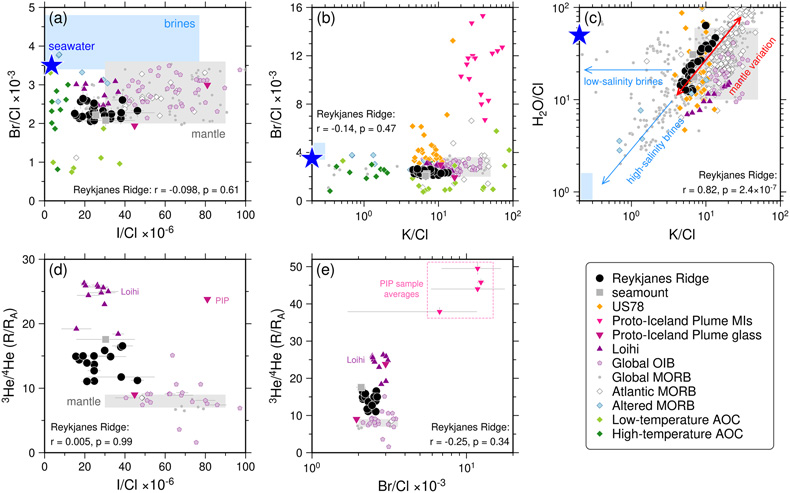
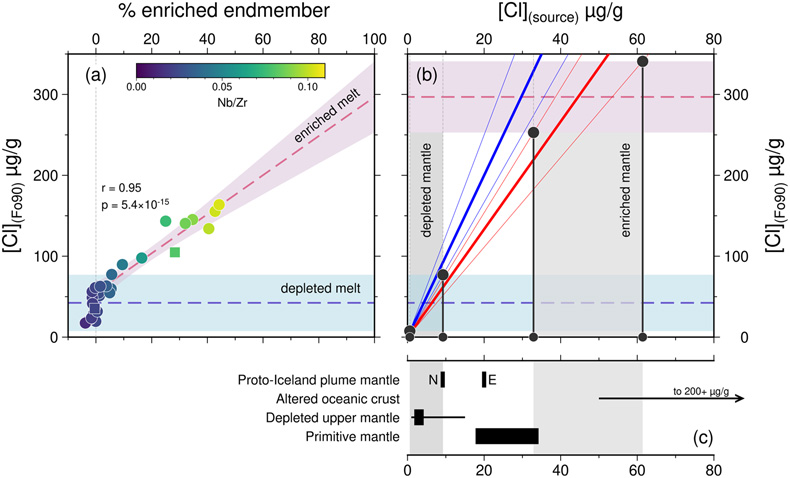
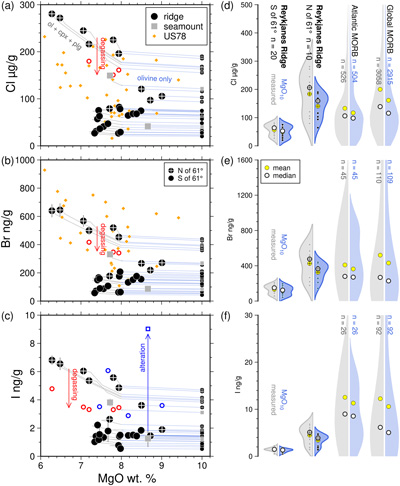 Figure 1 (a–c) Halogen contents in Reykjanes Ridge glasses from 57.4–63° N vs. MgO, with reverse fractional crystallisation paths to 10 wt. % MgO. Crossed symbols indicate samples from the northern Reykjanes Ridge ≥61° N. Open symbols show glass compositions without correction for degassing (red) or alteration (blue). Orange diamonds are Reykjanes Ridge whole rocks from 57.7–63.8° N (US78; Unni and Schilling, 1978). (d–f) Kernel density distributions of glass compositions as measured (left, grey; note change of y axis scale), and after correction to 10 wt. % MgO (right, blue). Southern (<61° N) and northern segments of the Reykjanes Ridge are compared with Atlantic and global MORB (data compiled from PetDB, www.earthchem.org/petdb). | 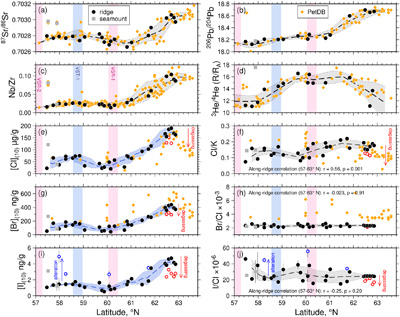 Figure 2 Along-ridge compositional variation in Reykjanes Ridge glasses. (a) 87Sr/86Sr, (b) 206Pb/204Pb, (c) Nb/Zr, (d) 3He/4He (R/RA notation), (e, g, h) halogen concentrations after fractionation correction to 10 wt. % MgO (halogen contents without fractionation correction are shown in Fig. S-7), and (f) Cl/K, (h) Br/Cl, (j) I/Cl ratios (no fractionation correction). Vertical bands: V-shaped ridges (VSR, pink) and troughs (VST, blue). Open red and blue symbols as for Figure 1. Dashed lines and shaded areas show the along-ridge running average and 1σ standard deviation, calculated using a boxcar filter with bandwidth 2° latitude. Reykjanes Ridge glass and whole-rock compositions (orange diamonds) are compiled from PetDB; Br and Cl (Unni and Schilling, 1978) are not corrected for the effects of degassing or alteration. | 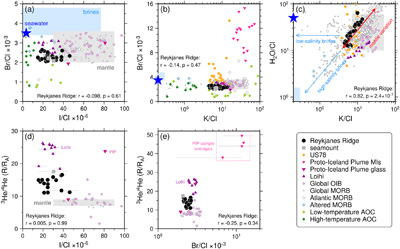 Figure 3 Compositions of Reykjanes Ridge glasses (this study) and whole rocks (US78; Unni and Schilling, 1978) compared with proto-Iceland plume melt inclusions (MI; Tomlinson et al., 2025), glasses from Lō’ihi (Kendrick et al., 2025), global MORB and OIB, and altered oceanic crust (AOC). Data sources listed in Table S-2. | 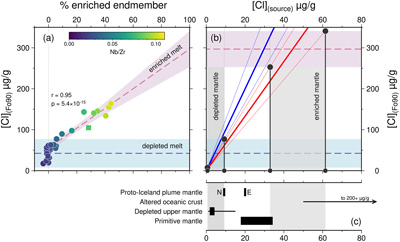 Figure 4 (a) The proportion of enriched melt contributing to Reykjanes Ridge basalts is regressed against the fractionation-corrected [Cl](Fo90). Shaded area shows 95 % confidence interval on the best-fit regression. Right-most edge of the plot indicates the expected Cl content of enriched Icelandic basalts as represented by Stapafell. (b) An aggregate fractional melting model is used to link depleted and enriched primary melt compositions with plausible mantle source compositions, |
| Figure 1 | Figure 2 | Figure 3 | Figure 4 |
top
Introduction
The flux of volatile elements into the mantle via subduction has created significant geochemical heterogeneity in the deep Earth over geological time (e.g., Bekaert et al., 2024
Bekaert, D.V., Barry, P.H., Curtice, J., Blusztajn, J., Hudak, M., et al. (2024) A carbon, nitrogen, and multi-isotope study of basalt glasses near 14°N on the Mid-Atlantic Ridge. Part B: Mantle source heterogeneities. Geochimica et Cosmochimica Acta 369, 179–195. https://doi.org/10.1016/j.gca.2023.12.017
). The fluid-mobile and highly incompatible halogens (Cl, Br, I) are significantly enriched in seawater, sediments, altered oceanic crust and serpentinised lithosphere compared to depleted upper mantle (Barnes et al., 2018Barnes, J.D., Manning, C.E., Scambelluri, M., Selverstone, J. (2018) The Behavior of Halogens During Subduction-Zone Processes. In: Harlov, D.E., Aranovich, L. (Eds.) The Role of Halogens in Terrestrial and Extraterrestrial Geochemical Processes: Surface, Crust and Mantle. Springer Geochemistry, Cham, 545–590. https://doi.org/10.1007/978-3-319-61667-4_8
). Although halogens from subducting slabs are lost to the mantle wedge and arc magmatism, primarily via slab dehydration, exhumed high-pressure antigorite serpentinites can retain significant halogen concentrations (John et al., 2011John, T., Scambelluri, M., Frische, M., Barnes, J.D., Bach, W. (2011) Dehydration of subducting serpentinite: Implications for halogen mobility in subduction zones and the deep halogen cycle. Earth and Planetary Science Letters 308, 65–76. https://doi.org/10.1016/j.epsl.2011.05.038
). The stability of antigorite to depths of 150–200 km (Ulmer and Trommsdorff, 1995Ulmer, P., Trommsdorff, V. (1995) Serpentine Stability to Mantle Depths and Subduction-Related Magmatism. Science 268, 858–861. https://doi.org/10.1126/science.268.5212.858
) suggests that slab residues have capacity to return a significant flux of halogens to the deep mantle (Barnes et al., 2018Barnes, J.D., Manning, C.E., Scambelluri, M., Selverstone, J. (2018) The Behavior of Halogens During Subduction-Zone Processes. In: Harlov, D.E., Aranovich, L. (Eds.) The Role of Halogens in Terrestrial and Extraterrestrial Geochemical Processes: Surface, Crust and Mantle. Springer Geochemistry, Cham, 545–590. https://doi.org/10.1007/978-3-319-61667-4_8
), making halogens potentially powerful tracers of recycled subducted lithologies.Diverse halogen enrichments and δ37Cl values have been observed among plume settings (e.g., John et al., 2010
John, T., Layne, G.D., Haase, K.M., Barnes, J.D. (2010) Chlorine isotope evidence for crustal recycling into the Earth’s mantle. Earth and Planetary Science Letters 298, 175–182. https://doi.org/10.1016/j.epsl.2010.07.039
; Kendrick et al., 2015Kendrick, M.A., Jackson, M.G., Hauri, E.H., Phillips, D. (2015) The halogen (F, Cl, Br, I) and H2O systematics of Samoan lavas: Assimilated-seawater, EM2 and high-3He/4He components. Earth and Planetary Science Letters 410, 197–209. https://doi.org/10.1016/j.epsl.2014.11.026
; Halldórsson et al., 2016aHalldórsson, S.A., Barnes, J.D., Stefánsson, A., Hilton, D.R., Hauri, E.H., Marshall, E.W. (2016a) Subducted lithosphere controls halogen enrichments in the Iceland mantle plume source. Geology 44, 679–682. https://doi.org/10.1130/G37924.1
), implying variability in the efficiency of the solid Earth halogen cycle in space and/or time. The Iceland mantle plume, as the largest modern expression of a deep mantle upwelling (Hoggard et al., 2016Hoggard, M.J., White, N., Al-Attar, D. (2016) Global dynamic topography observations reveal limited influence of large-scale mantle flow. Nature Geoscience 9, 456–463. https://doi.org/10.1038/ngeo2709
) and known to return recycled material to the surface (Shorttle and Maclennan, 2011Shorttle, O., Maclennan, J. (2011) Compositional trends of Icelandic basalts: Implications for short–length scale lithological heterogeneity in mantle plumes. Geochemistry, Geophysics, Geosystems 12, Q11008. https://doi.org/10.1029/2011GC003748
), provides an excellent opportunity to evaluate the solid Earth halogen cycle.We report halogen (Cl, Br, I) compositions in 29 basalt glasses dredged from the Reykjanes Ridge between 57.4° N and 63° N during the RSS Charles Darwin cruise CD80 (Murton et al., 2002
Murton, B.J., Taylor, R.N., Thirlwall, M.F. (2002) Plume–Ridge Interaction: a Geochemical Perspective from the Reykjanes Ridge. Journal of Petrology 43, 1987–2012. https://doi.org/10.1093/petrology/43.11.1987
) (Fig. S-1). The Reykjanes Ridge lies in a region of the North Atlantic with positive residual depth and V-shaped ridges manifest, preserving an indirect record of thermal pulsing of the Iceland plume over time (Parnell-Turner et al., 2017Parnell-Turner, R., White, N., Henstock, T.J., Jones, S.M., Maclennan, J., Murton, B.J. (2017) Causes and Consequences of Diachronous V-Shaped Ridges in the North Atlantic Ocean. Journal of Geophysical Research: Solid Earth 122, 8675–8708. https://doi.org/10.1002/2017JB014225
). It samples along-ridge mantle heterogeneity associated with the Iceland plume, as well as local heterogeneity in adjacent seamounts. Lithophile trace element and isotopic signatures (e.g., Murton et al., 2002Murton, B.J., Taylor, R.N., Thirlwall, M.F. (2002) Plume–Ridge Interaction: a Geochemical Perspective from the Reykjanes Ridge. Journal of Petrology 43, 1987–2012. https://doi.org/10.1093/petrology/43.11.1987
) indicate the progressive melting out of enriched domains as the mantle flows radially outwards from the Iceland plume and through the melting region of the Reykjanes Ridge (Shorttle et al., 2010Shorttle, O., Maclennan, J., Jones, S.M. (2010) Control of the symmetry of plume-ridge interaction by spreading ridge geometry. Geochemistry, Geophysics, Geosystems 11, Q0AC05. https://doi.org/10.1029/2009GC002986
), until by 61° N the fingerprint of trace element and isotopic enrichment is gone. A broad peak in 3He/4He (16.0 R/RA) at 59–62° N coincides with the first V-shaped ridge, while elevated 3He/4He above 11 R/RA persists as far south as 57° N (Hilton et al., 2000Hilton, D.R., Thirlwall, M.F., Taylor, R.N., Murton, B.J., Nichols, A. (2000) Controls on magmatic degassing along the Reykjanes Ridge with implications for the helium paradox. Earth and Planetary Science Letters 183, 43–50. https://doi.org/10.1016/S0012-821X(00)00253-3
). To a first order, these observations suggest a heterogeneous plume in which lithophile element and helium isotopic signatures are carried by different mantle components, with the high-3He/4He component becoming visible once the enriched component(s) is exhausted and/or at very high temperatures of melting (e.g., Rasmussen et al., 2020Rasmussen, M.B., Halldórsson, S.A., Gibson, S.A., Guðfinnsson, G.H. (2020) Olivine chemistry reveals compositional source heterogeneities within a tilted mantle plume beneath Iceland. Earth and Planetary Science Letters 531, 116008. https://doi.org/10.1016/j.epsl.2019.116008
). Icelandic basalts are overall geochemically depleted and exhibit neither extreme EM nor HIMU compositions (e.g., Harðardóttir et al., 2022Harðardóttir, S., Matthews, S., Halldórsson, S.A., Jackson, M.G. (2022) Spatial distribution and geochemical characterization of Icelandic mantle end-members: Implications for plume geometry and melting processes. Chemical Geology 604, 120930. https://doi.org/10.1016/j.chemgeo.2022.120930
); however, their trace element and isotopic heterogeneity requires at least two depleted and three enriched local mantle endmembers with weak but variable EM1- or HIMU-like affinities (e.g., Peate et al., 2010Peate, D.W., Breddam, K., Baker, J.A., Kurz, M.D., Barker, A.K., Prestvik, T., Grassineau, N., Skovgaard, A.C. (2010) Compositional Characteristics and Spatial Distribution of Enriched Icelandic Mantle Components. Journal of Petrology 51, 1447–1475. https://doi.org/10.1093/petrology/egq025
). We aim to constrain the relative contributions of enriched, depleted and high-3He/4He mantle endmembers to the halogen budget of Reykjanes Ridge magmas.top
Halogen Abundances in Reykjanes Ridge Glasses
We measured Cl, Br, I and K in fresh glass chips by neutron irradiation noble gas mass spectrometry (Ruzié-Hamilton et al., 2016
Ruzié-Hamilton, L., Clay, P.L., Burgess, R., Joachim, B., Ballentine, C.J., Turner, G. (2016) Determination of halogen abundances in terrestrial and extraterrestrial samples by the analysis of noble gases produced by neutron irradiation. Chemical Geology 437, 77–87. https://doi.org/10.1016/j.chemgeo.2016.05.003
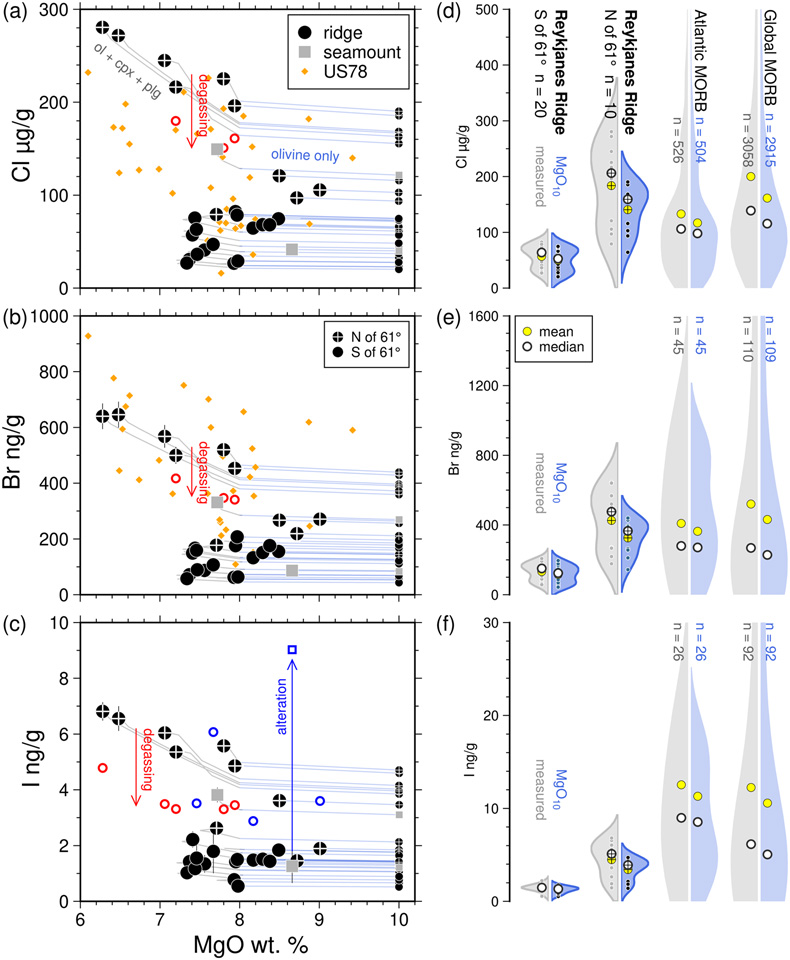
). Analytical and data reduction procedures, and complete datasets, are provided as Supplementary Information. Typical 1σ uncertainties are ±1–3 μg/g for Cl, ±5–40 ng/g for Br, ±0.05–0.30 ng/g for I, and ±1–10 μg/g for K. From a mantle geochemical perspective, it is important to ascertain whether halogen contents were modified by magma degassing or assimilation of seawater or brines. We corrected five samples for degassing and five for alteration. Following corrections, pristine Reykjanes Ridge glasses contain 26–281 μg/g Cl, 57–646 ng/g Br, 0.5–9.0 ng/g I, and 270–1580 μg/g K. Negative correlations between MgO and halogens in glasses from the northern Reykjanes Ridge ≥61° N (Fig. 1a–c) are well explained as incompatible element enrichment by exclusion during fractional crystallisation, arguing strongly against an assimilation origin for the elemental halogen variability in these samples.Figure 1 (a–c) Halogen contents in Reykjanes Ridge glasses from 57.4–63° N vs. MgO, with reverse fractional crystallisation paths to 10 wt. % MgO. Crossed symbols indicate samples from the northern Reykjanes Ridge ≥61° N. Open symbols show glass compositions without correction for degassing (red) or alteration (blue). Orange diamonds are Reykjanes Ridge whole rocks from 57.7–63.8° N (US78; Unni and Schilling, 1978
Unni, C.K., Schilling, J.-G. (1978) Cl and Br degassing by volcanism along the Reykjanes Ridge and Iceland. Nature 272, 19–23. https://doi.org/10.1038/272019a0
). (d–f) Kernel density distributions of glass compositions as measured (left, grey; note change of y axis scale), and after correction to 10 wt. % MgO (right, blue). Southern (<61° N) and northern segments of the Reykjanes Ridge are compared with Atlantic and global MORB (data compiled from PetDB, www.earthchem.org/petdb).To explore mantle-derived variability in primary melt halogen contents we correct all Reykjanes Ridge glasses to 10 wt. % MgO. This yields primary melt halogen abundances of 20–190 μg/g Cl, 43–440 ng/g Br and 0.5–4.7 ng/g I (Fig. 1). Samples from <61° N have lower mean and median halogen contents than Atlantic and global MORB (Fig. 1d–f). All Reykjanes Ridge basalts have lower I contents than Atlantic or global MORB, although the broad MORB composition distributions extending to 30 ng/g I (Fig. 1f) likely include samples affected by alteration.
top
Along-Ridge Variations in Halogen Geochemistry
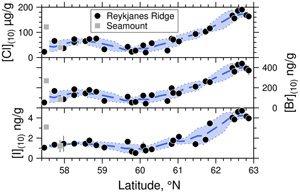
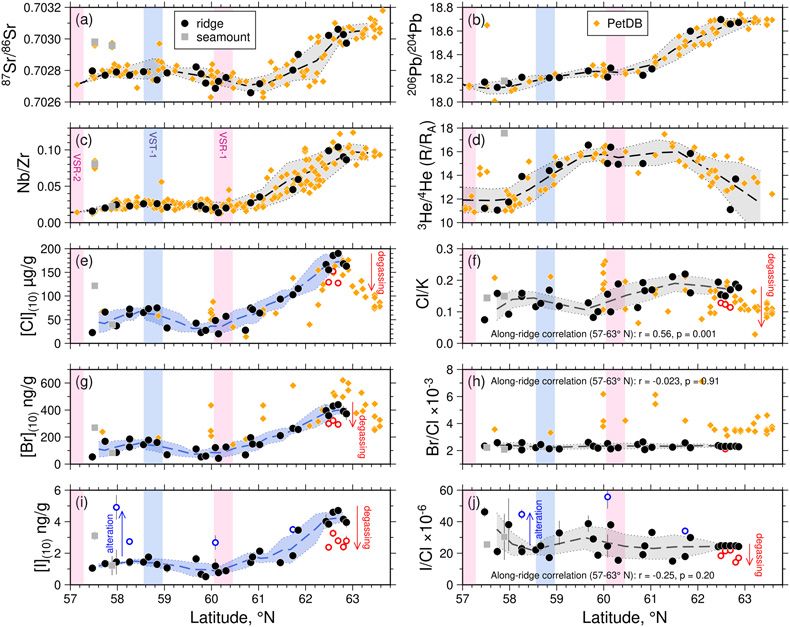
Fractionation-corrected Cl, Br and I contents show significant along-ridge enrichments north of 61° N (Figs. 2e,g,i, S-7), and correlate positively with radiogenic isotopic signatures (Figs. 2a,b, S-8); incompatible trace element abundances; and ratios of similarly incompatible trace elements such as Nb/Zr (Figs. 2c; S-8). South of 61° N, halogens and Cl/K co-vary with Sr isotopes and Nb/Zr in a broad swell centred around 58.7° N (Fig. 2). This region includes two enriched seamounts, one of which has high halogen abundances (Fig. 2).
Figure 2 Along-ridge compositional variation in Reykjanes Ridge glasses. (a) 87Sr/86Sr, (b) 206Pb/204Pb, (c) Nb/Zr, (d) 3He/4He (R/RA notation), (e, g, h) halogen concentrations after fractionation correction to 10 wt. % MgO (halogen contents without fractionation correction are shown in Fig. S-7), and (f) Cl/K, (h) Br/Cl, (j) I/Cl ratios (no fractionation correction). Vertical bands: V-shaped ridges (VSR, pink) and troughs (VST, blue). Open red and blue symbols as for Figure 1. Dashed lines and shaded areas show the along-ridge running average and 1σ standard deviation, calculated using a boxcar filter with bandwidth 2° latitude. Reykjanes Ridge glass and whole-rock compositions (orange diamonds) are compiled from PetDB; Br and Cl (Unni and Schilling, 1978
Unni, C.K., Schilling, J.-G. (1978) Cl and Br degassing by volcanism along the Reykjanes Ridge and Iceland. Nature 272, 19–23. https://doi.org/10.1038/272019a0
) are not corrected for the effects of degassing or alteration.South of 61° N, the mean Cl/K = 0.13 ± 0.04 and mean Br/K = (0.31 ± 0.09) × 10−3 are higher than reported for global MORB (Kendrick, 2024
Kendrick, M.A. (2024) Halogen Cycling in the Solid Earth. Annual Review of Earth and Planetary Sciences 52, 195–220. https://doi.org/10.1146/annurev-earth-031621-111700
) but overlap within 1σ; the mean I/K = (3.4 ± 0.7) × 10−6 lies towards the lower end of the global MORB range. Halogen/K ratios show statistically significant along-ridge increases between 57.4° N and 63° N (e.g., Cl/K rises from ∼0.1 to ∼0.19; Fig. 2f), but halogen/halogen ratios remain constant (Fig. 2h,j). The near doubling of halogen abundances with respect to K cannot be explained by simple fractionation control. These along-ridge geochemical associations indicate that the high halogen budgets of basalts from ≥61° N are strongly controlled by the influence of an enriched upper mantle component that is inherently halogen-rich compared to local depleted mantle.top
Reykjanes Ridge Halogen Ratios are Mantle-Like
Potassium, Cl, Br and I have similar partition coefficients during mantle melting (Kendrick et al., 2012
Kendrick, M.A., Kamenetsky, V.S., Phillips, D., Honda, M. (2012) Halogen systematics (Cl, Br, I) in Mid-Ocean Ridge Basalts: A Macquarie Island case study. Geochimica et Cosmochimica Acta 81, 82–93. https://doi.org/10.1016/j.gca.2011.12.004
); thus, melt halogen/K and halogen/halogen ratios should reflect their mantle source. Reykjanes Ridge glasses show mantle-like Br/Cl and H2O/Cl, and their I/Cl and K/Cl overlap global MORB and the lower bounds of mantle ranges (Fig. 3).Figure 3 Compositions of Reykjanes Ridge glasses (this study) and whole rocks (US78; Unni and Schilling, 1978
Unni, C.K., Schilling, J.-G. (1978) Cl and Br degassing by volcanism along the Reykjanes Ridge and Iceland. Nature 272, 19–23. https://doi.org/10.1038/272019a0
) compared with proto-Iceland plume melt inclusions (MI; Tomlinson et al., 2025Tomlinson, E.L., Rose-Koga, E.F., Bouvier, A.-S., O’Farrell, D., Caulfield, J.T., Jackson, M.G., Moussallam, Y., Stuart, F.M., Villeneuve, J. (2025) Halogens in proto-Iceland plume basalts. Geochemical Perspectives Letters 37, 12–17. https://doi.org/10.7185/geochemlet.2539
), glasses from Lō’ihi (Kendrick et al., 2025Kendrick, M.A., Nebel, O., Hanyu, T., Maunder, B.L., Maas, R. (2025) Earth’s early differentiation recorded by halogen abundance ratios in Hawaiian lavas. Geochimica et Cosmochimica Acta 393, 196–207. https://doi.org/10.1016/j.gca.2025.01.019
), global MORB and OIB, and altered oceanic crust (AOC). Data sources listed in Table S-2.High Cl/K in Reykjanes Ridge glasses has previously been interpreted as indicating seawater-derived Cl enrichment via assimilation of hydrothermally altered material (Michael and Cornell, 1998
Michael, P.J., Cornell, W.C. (1998) Influence of spreading rate and magma supply on crystallization and assimilation beneath mid-ocean ridges: Evidence from chlorine and major element chemistry of mid-ocean ridge basalts. Journal of Geophysical Research: Solid Earth 103, 18325–18356. https://doi.org/10.1029/98JB00791
). High-temperature alteration of basalt and dolerite in the upper oceanic crust may lead to K and I leaching coupled with crystallisation of Cl-rich amphiboles, producing high bulk Cl/K and low I/Cl compared to fresh MORB (Chavrit et al., 2016Chavrit, D., Burgess, R., Sumino, H., Teagle, D.A.H., Droop, G., Shimizu, A., Ballentine, C.J. (2016) The contribution of hydrothermally altered ocean crust to the mantle halogen and noble gas cycles. Geochimica et Cosmochimica Acta 183, 106–124. https://doi.org/10.1016/j.gca.2016.03.014
). However, Reykjanes Ridge Br/Cl, I/Cl and K/Cl are not correlated, and are not similar to altered oceanic crust (Fig. 3). Likewise, systematic covariation of halogens, Sr and Pb isotopes, and Nb/Zr (Fig. 2) indicates no role for progressive seawater assimilation with proximity to Iceland. We therefore interpret our Reykjanes Ridge halogen/halogen and halogen/K ratios as primary and mantle-derived. The high Cl/K suggests that the enriched upper mantle component sampled by the northern Reykjanes Ridge tends toward weak HIMU affinity (e.g., Kendrick, 2024Kendrick, M.A. (2024) Halogen Cycling in the Solid Earth. Annual Review of Earth and Planetary Sciences 52, 195–220. https://doi.org/10.1146/annurev-earth-031621-111700
and references therein).Helium isotopes are decoupled from trace elements and halogen enrichments (Fig. 2) and show no relationship with halogen/halogen or halogen/K ratios (Figs. 3d,e, S-8 and S-9). Helium concentrations decrease due to pre-eruptive magmatic degassing as eruption depth shallows from ∼2 km at 57.4° N to ∼300 m at 63° N (Hilton et al., 2000
Hilton, D.R., Thirlwall, M.F., Taylor, R.N., Murton, B.J., Nichols, A. (2000) Controls on magmatic degassing along the Reykjanes Ridge with implications for the helium paradox. Earth and Planetary Science Letters 183, 43–50. https://doi.org/10.1016/S0012-821X(00)00253-3
), but degassing is not expected to fractionate 3He/4He. Lower 3He/4He in the northern ridge segment ≥61° N can be attributed to the addition of radiogenic crustal helium to already-degassed magmas (Hilton et al., 2000Hilton, D.R., Thirlwall, M.F., Taylor, R.N., Murton, B.J., Nichols, A. (2000) Controls on magmatic degassing along the Reykjanes Ridge with implications for the helium paradox. Earth and Planetary Science Letters 183, 43–50. https://doi.org/10.1016/S0012-821X(00)00253-3
), obscuring mantle-derived 3He/4He signatures. However, the absence of correlation between halogen abundances and 3He/4He persists even if samples from ≥61° N are excluded (Fig. S-8). Olivine-hosted melt inclusions in high-3He/4He proto-Iceland plume (PIP) basalts from Baffin Island and West Greenland exhibit high Br/Cl (Tomlinson et al., 2025Tomlinson, E.L., Rose-Koga, E.F., Bouvier, A.-S., O’Farrell, D., Caulfield, J.T., Jackson, M.G., Moussallam, Y., Stuart, F.M., Villeneuve, J. (2025) Halogens in proto-Iceland plume basalts. Geochemical Perspectives Letters 37, 12–17. https://doi.org/10.7185/geochemlet.2539
), but this signature is absent from the moderate-3He/4He Reykjanes Ridge glasses (Figs. 3e, S-8). Reykjanes Ridge glasses have low I/Cl similar to glasses from Lō’ihi (Kendrick et al., 2025Kendrick, M.A., Nebel, O., Hanyu, T., Maunder, B.L., Maas, R. (2025) Earth’s early differentiation recorded by halogen abundance ratios in Hawaiian lavas. Geochimica et Cosmochimica Acta 393, 196–207. https://doi.org/10.1016/j.gca.2025.01.019
), but are unlike high-3He/4He PIP glass which has high I/Cl (Fig. 3d). Taken together, these observations suggest that Iceland’s high-3He/4He mantle contributes minimally to the halogen budget of Reykjanes Ridge magmas, and consequently that low I/Cl is intrinsic to the Reykjanes Ridge mantle rather than associated with the high-3He/4He component.top
Halogen Abundances of Enriched and Depleted Primary Melts along the Reykjanes Ridge
Our data suggest that the halogen contents of Reykjanes Ridge basalts are relatively insensitive to the complex multi-component heterogeneity of the Iceland plume and can, to a first order, be modelled as binary mixtures of depleted and enriched endmember melts. This affords an opportunity to calculate a predicted halogen budget for Iceland’s most enriched basalts. To do this, we take the average composition of Reykjanes Ridge basalts south of 61° N as the depleted melt endmember, and for the enriched endmember we select the onland Stapafell subglacial formation (Fig. S-1) because it continues the towards-Iceland geochemical enrichment trends set by the Reykjanes Ridge (Novella et al., 2020
Novella, D., Maclennan, J., Shorttle, O., Prytulak, J., Murton, B.J. (2020) A multi-proxy investigation of mantle oxygen fugacity along the Reykjanes Ridge. Earth and Planetary Science Letters 531, 115973. https://doi.org/10.1016/j.epsl.2019.115973
). Stapafell basalts (8.3 wt. % MgO) represent some of the most enriched compositions in Iceland’s neovolcanic rift zones: they have 3He/4He ≈ 14 R/RA (Halldórsson et al., 2016bHalldórsson, S.A., Hilton, D.R., Barry, P.H., Füri, E., Grönvold, K. (2016b) Recycling of crustal material by the Iceland mantle plume: New evidence from nitrogen elemental and isotope systematics of subglacial basalts. Geochimica et Cosmochimica Acta 176, 206–226. https://doi.org/10.1016/j.gca.2015.12.021
) and high incompatible element contents, low 143Nd/144Nd ≈ 0.5013 and high 206Pb/204Pb ≈ 18.9 (Peate et al., 2009Peate, D.W., Baker, J.A., Jakobsson, S.P., Waight, T.E., Kent, A.J.R., Grassineau, N.V., Skovgaard, A.C. (2009) Historic magmatism on the Reykjanes Peninsula, Iceland: a snap-shot of melt generation at a ridge segment. Contributions to Mineralogy and Petrology 157, 359–382. https://doi.org/10.1007/s00410-008-0339-4
) that could be interpreted as consistent with either very weak EM1 or HIMU affinity.We use the incompatible trace element ratio Nb/Zr as a proxy for enrichment (Shorttle and Maclennan, 2011
Shorttle, O., Maclennan, J. (2011) Compositional trends of Icelandic basalts: Implications for short–length scale lithological heterogeneity in mantle plumes. Geochemistry, Geophysics, Geosystems 12, Q11008. https://doi.org/10.1029/2011GC003748
). Reykjanes Ridge basalts south of 61° N have mean Nb/Zr = 0.02 (Murton et al., 2002Murton, B.J., Taylor, R.N., Thirlwall, M.F. (2002) Plume–Ridge Interaction: a Geochemical Perspective from the Reykjanes Ridge. Journal of Petrology 43, 1987–2012. https://doi.org/10.1093/petrology/43.11.1987
); Stapafell basalts have Nb/Zr = 0.159 (Peate et al., 2009Peate, D.W., Baker, J.A., Jakobsson, S.P., Waight, T.E., Kent, A.J.R., Grassineau, N.V., Skovgaard, A.C. (2009) Historic magmatism on the Reykjanes Peninsula, Iceland: a snap-shot of melt generation at a ridge segment. Contributions to Mineralogy and Petrology 157, 359–382. https://doi.org/10.1007/s00410-008-0339-4
). We use mass balance to constrain the mass fraction of enriched melt that must be added to ambient Reykjanes Ridge depleted melt to produce the observed Nb/Zr for each Reykjanes Ridge sample. Calculated contributions from the enriched endmember are then plotted against sample halogen contents that are fractionation-corrected to be in equilibrium with Fo90 mantle olivine (Fig. 4a), and best-fit regression is used to constrain the halogen content of the enriched primary melt. Depleted Reykjanes Ridge primary melts are constrained by our samples to contain 7.5–75 μg/g Cl (Fig. 4a), 55–140 ng/g Br and 0.75–1.35 ng/g I. Enriched Stapafell-like primary melts are projected to contain 215–340 μg/g Cl (Fig. 4a), 590–830 ng/g Br and 6.5–9.1 ng/g I.Figure 4 (a) The proportion of enriched melt contributing to Reykjanes Ridge basalts is regressed against the fractionation-corrected [Cl](Fo90). Shaded area shows 95 % confidence interval on the best-fit regression. Right-most edge of the plot indicates the expected Cl content of enriched Icelandic basalts as represented by Stapafell. (b) An aggregate fractional melting model is used to link depleted and enriched primary melt compositions with plausible mantle source compositions, [Cl](source). Blue lines show aggregate melt compositions for spinel lherzolite, calculated for melt fractions 0.08 < F < 0.12 with DClbulk = 0.0015. Red lines show aggregate melt compositions for an enriched pyroxenite (0.13 < F < 0.18; DClbulk = 0.0197). Vertical grey bars mark viable mantle source compositions that, for the stated assumptions regarding F and DClbulk, could produce the depleted and enriched primary melt compositions. (c) Viable mantle source Cl contents are compared with published mantle compositions and altered oceanic crust. Data sources listed in Table S-7. Equivalent figures for Br and I are provided as Supplementary Information.
top
Halogen Abundances of Enriched and Depleted Mantle Sources Supplying the Reykjanes Ridge
We next project the depleted and enriched primary melt compositions into plausible estimates of the halogen contents of their respective mantle sources. We constructed an aggregate fractional melting model to constrain the mantle lithology, composition and melting degree that best reproduce the trace element systematics of Reykjanes Ridge and Stapafell basalts (Supplementary Information). Halogens are incorporated into the melting model by calculating suitable partition coefficients based on mineral-melt partitioning experiments (Joachim et al., 2015
Joachim, B., Pawley, A., Lyon, I.C., Marquardt (neé Hartmann), K., Henkel, T., Clay, P.L., Ruzié, L., Burgess, R., Ballentine, C.J. (2015) Experimental partitioning of F and Cl between olivine, orthopyroxene and silicate melt at Earth’s mantle conditions. Chemical Geology 416, 65–78. https://doi.org/10.1016/j.chemgeo.2015.08.012
), and assuming that DClbulk = DBrbulk = DIbulk.Trace element systematics of Reykjanes Ridge basalts south of 61° N are reproduced by 8–13 % melting of depleted spinel peridotite (Fig. S-10), consistent with previous estimates (Murton et al., 2002
Murton, B.J., Taylor, R.N., Thirlwall, M.F. (2002) Plume–Ridge Interaction: a Geochemical Perspective from the Reykjanes Ridge. Journal of Petrology 43, 1987–2012. https://doi.org/10.1093/petrology/43.11.1987
). Taking this mantle lithology and range of melting degrees, and using our estimated halogen contents for depleted primary melts along the Reykjanes Ridge as input liquid compositions, we calculate that the depleted mantle sourcing these melts contains 1–10 μg/g Cl (Fig. 4b), 4–17 ng/g Br and 0.06–0.16 ng/g I; all are within published estimates for the upper mantle (Kendrick, 2024Kendrick, M.A. (2024) Halogen Cycling in the Solid Earth. Annual Review of Earth and Planetary Sciences 52, 195–220. https://doi.org/10.1146/annurev-earth-031621-111700
). Setting melting degree to F = 0.1 we obtain preferred Br/Cl = 2.3 × 10⁻³ and I/Cl = 25 × 10−6 (Table S-6).Trace element systematics of enriched Stapafell-like magmas are best reproduced by a more complex melting model in which instantaneous melts from a Reykjanes Ridge-like depleted mantle mix with melts of a more enriched upper mantle component (Novella et al., 2020
Novella, D., Maclennan, J., Shorttle, O., Prytulak, J., Murton, B.J. (2020) A multi-proxy investigation of mantle oxygen fugacity along the Reykjanes Ridge. Earth and Planetary Science Letters 531, 115973. https://doi.org/10.1016/j.epsl.2019.115973
) – a scenario similar to that proposed for the 2021 Fagradalsfjall eruption (Marshall et al., 2024Marshall, E.W., Caracciolo, A., Bali, E., Halldórsson, S.A., Matthews, S., et al. (2024) The Petrology and Geochemistry of the 2021 Fagradalsfjall Eruption, Iceland: An Eruption Sourced From Multiple, Compositionally Diverse, Near-Moho Sills. AGU Advances 5, e2024AV001310. https://doi.org/10.1029/2024AV001310
). To bracket plausible halogen contents for the enriched mantle, we require reasonable assumptions regarding its lithology, composition and melting degree. To calculate lower-bound halogen abundances we consider 13 % melting of primitive spinel pyroxenite, and for the upper bound we consider 18 % melting of primitive garnet pyroxenite. These lithologies and melting degrees closely match those chosen by Shorttle et al. (2015)Shorttle, O., Moussallam, Y., Hartley, M.E., Maclennan, J., Edmonds, M., Murton, B.J. (2015) Fe-XANES analyses of Reykjanes Ridge basalts: Implications for oceanic crust’s role in the solid Earth oxygen cycle. Earth and Planetary Science Letters 427, 272–285. https://doi.org/10.1016/j.epsl.2015.07.017
as reasonable estimates given the requirement for melting model results to match along-ridge crustal thickness variations. Using these assumptions, we calculate that the enriched Icelandic mantle component, as represented by Stapafell, could contain 33–61 μg/g Cl (Fig. 4b), 77–149 ng/g Br and 0.8–1.6 ng/g I (Table S-6). These Cl and Br contents overlap upper estimates for primitive mantle and lowermost estimates for altered oceanic crust (Figs. 4c, S-11c); the I content is lower than primitive mantle (7 ± 4 ng/g; Kendrick, 2024Kendrick, M.A. (2024) Halogen Cycling in the Solid Earth. Annual Review of Earth and Planetary Sciences 52, 195–220. https://doi.org/10.1146/annurev-earth-031621-111700
). Setting melting degree to F = 0.15 we obtain preferred Br/Cl = 2.4 × 10⁻³ and I/Cl = 26 × 10−6, indistinguishable from depleted Reykjanes Ridge mantle. While our calculations cannot uniquely constrain the halogen budget of the enriched Icelandic mantle component, they illustrate the key parameters that must be considered in order to arrive at plausible estimates.Despite the limitations of our modelling approach, our results strongly indicate that the enriched Icelandic mantle component is halogen-rich compared to depleted Reykjanes Ridge mantle. This enriched component is well matched by a refertilised pyroxenite containing up to 50 % recycled subducted oceanic crust, i.e. the KG1 lithology (Shorttle and Maclennan, 2011
Shorttle, O., Maclennan, J. (2011) Compositional trends of Icelandic basalts: Implications for short–length scale lithological heterogeneity in mantle plumes. Geochemistry, Geophysics, Geosystems 12, Q11008. https://doi.org/10.1029/2011GC003748
). Thus, we propose that the high halogen inventory of enriched Icelandic melts can be attributed to recycled oceanic crust in the mantle source. This recycled component is constrained to be as young as Phanerozoic in age (Halldórsson et al., 2016bHalldórsson, S.A., Hilton, D.R., Barry, P.H., Füri, E., Grönvold, K. (2016b) Recycling of crustal material by the Iceland mantle plume: New evidence from nitrogen elemental and isotope systematics of subglacial basalts. Geochimica et Cosmochimica Acta 176, 206–226. https://doi.org/10.1016/j.gca.2015.12.021
, and references therein). Strong positive correlations between halogens, radiogenic isotopes and the proportion of enriched melt (Figs. 3, S-8) reveal that high halogen abundances are characteristic fingerprints of recycled oceanic crust. In contrast, enriched Icelandic and depleted Reykjanes Ridge mantle have near-identical Br/Cl and I/Cl, despite their differing halogen contents. This is consistent with halogens being minimally fractionated from one another during subduction processing and/or in the upper mantle during mixing and dilution of subducted materials with halogen-poor depleted peridotite over geological time (e.g., Kendrick, 2024Kendrick, M.A. (2024) Halogen Cycling in the Solid Earth. Annual Review of Earth and Planetary Sciences 52, 195–220. https://doi.org/10.1146/annurev-earth-031621-111700
). Our preferred I/Cl lies slightly below mantle estimates, suggesting that at least some global-scale heterogeneity of halogen ratios is retained in the upper mantle and recovered at the surface in erupted basalt compositions.top
Conclusions and Implications
We have constrained the halogen budget of an enriched upper mantle component that contributes significantly to trace element, radiogenic isotope and halogen enrichment in Reykjanes Ridge basalts approaching Iceland. The halogen signature of Iceland’s high-3He/4He plume source is not resolved in our data, suggesting that Iceland’s high-3He/4He mantle may be halogen-poor, similar to the Cl- and strongly I-depleted Lō’ihi source (Kendrick et al., 2025
Kendrick, M.A., Nebel, O., Hanyu, T., Maunder, B.L., Maas, R. (2025) Earth’s early differentiation recorded by halogen abundance ratios in Hawaiian lavas. Geochimica et Cosmochimica Acta 393, 196–207. https://doi.org/10.1016/j.gca.2025.01.019
), and that low I/Cl is intrinsic to local Reykjanes Ridge mantle. The I/Cl signature of Iceland’s high-3He/4He plume remains to be characterised, leaving open the possibility that halogen depletions and low I/Cl are characteristic of global high-3He/4He mantle sources.top
Acknowledgements
The authors thank Mark Kendrick, Emma Tomlinson, an anonymous reviewer, and handling editor Ambre Luguet, for their thoughtful reviews. This work was funded by NERC grant NE/P002331/1 and a NERC studentship to ECW through the Manchester-Liverpool Doctoral Training Partnership NE/L002469/1. We acknowledge support from NERC grants NE/T012455/1 (OS), NE/V011383/1 (OS), NE/V010905/1 (MEH), and NE/X01642/1 (MEH, RB). We thank Lydia Fawcett for assistance with sample irradiation and NI-NGMS analyses. We acknowledge the National Oceanographic Centre, the PETROS project, and Bramley Murton for access to the Reykjanes Ridge samples.
Editor: Ambre Luguet
top
References
Barnes, J.D., Manning, C.E., Scambelluri, M., Selverstone, J. (2018) The Behavior of Halogens During Subduction-Zone Processes. In: Harlov, D.E., Aranovich, L. (Eds.) The Role of Halogens in Terrestrial and Extraterrestrial Geochemical Processes: Surface, Crust and Mantle. Springer Geochemistry, Cham, 545–590. https://doi.org/10.1007/978-3-319-61667-4_8
 Show in context
The fluid-mobile and highly incompatible halogens (Cl, Br, I) are significantly enriched in seawater, sediments, altered oceanic crust and serpentinised lithosphere compared to depleted upper mantle (Barnes et al., 2018).
View in article
The stability of antigorite to depths of 150–200 km (Ulmer and Trommsdorff, 1995) suggests that slab residues have capacity to return a significant flux of halogens to the deep mantle (Barnes et al., 2018), making halogens potentially powerful tracers of recycled subducted lithologies.
View in article
Bekaert, D.V., Barry, P.H., Curtice, J., Blusztajn, J., Hudak, M., et al. (2024) A carbon, nitrogen, and multi-isotope study of basalt glasses near 14°N on the Mid-Atlantic Ridge. Part B: Mantle source heterogeneities. Geochimica et Cosmochimica Acta 369, 179–195. https://doi.org/10.1016/j.gca.2023.12.017
Show in context The flux of volatile elements into the mantle via subduction has created significant geochemical heterogeneity in the deep Earth over geological time (e.g., Bekaert et al., 2024).
View in article
Chavrit, D., Burgess, R., Sumino, H., Teagle, D.A.H., Droop, G., Shimizu, A., Ballentine, C.J. (2016) The contribution of hydrothermally altered ocean crust to the mantle halogen and noble gas cycles. Geochimica et Cosmochimica Acta 183, 106–124. https://doi.org/10.1016/j.gca.2016.03.014
Show in context High-temperature alteration of basalt and dolerite in the upper oceanic crust may lead to K and I leaching coupled with crystallisation of Cl-rich amphiboles, producing high bulk Cl/K and low I/Cl compared to fresh MORB (Chavrit et al., 2016).
View in article
Halldórsson, S.A., Barnes, J.D., Stefánsson, A., Hilton, D.R., Hauri, E.H., Marshall, E.W. (2016a) Subducted lithosphere controls halogen enrichments in the Iceland mantle plume source. Geology 44, 679–682. https://doi.org/10.1130/G37924.1
Show in context Diverse halogen enrichments and δ37Cl values have been observed among plume settings (e.g., John et al., 2010; Kendrick et al., 2015; Halldórsson et al., 2016a), implying variability in the efficiency of the solid Earth halogen cycle in space and/or time.
View in article
Halldórsson, S.A., Hilton, D.R., Barry, P.H., Füri, E., Grönvold, K. (2016b) Recycling of crustal material by the Iceland mantle plume: New evidence from nitrogen elemental and isotope systematics of subglacial basalts. Geochimica et Cosmochimica Acta 176, 206–226. https://doi.org/10.1016/j.gca.2015.12.021
Show in context Stapafell basalts (8.3 wt. % MgO) represent some of the most enriched compositions in Iceland’s neovolcanic rift zones: they have 3He/4He ≈ 14 R/RA (Halldórsson et al., 2016b) and high incompatible element contents, low 143Nd/144Nd ≈ 0.5013 and high 206Pb/204Pb ≈ 18.9 (Peate et al., 2009) that could be interpreted as consistent with either very weak EM1 or HIMU affinity.
View in article
This recycled component is constrained to be as young as Phanerozoic in age (Halldórsson et al., 2016b, and references therein).
View in article
Harðardóttir, S., Matthews, S., Halldórsson, S.A., Jackson, M.G. (2022) Spatial distribution and geochemical characterization of Icelandic mantle end-members: Implications for plume geometry and melting processes. Chemical Geology 604, 120930. https://doi.org/10.1016/j.chemgeo.2022.120930
Show in context Icelandic basalts are overall geochemically depleted and exhibit neither extreme EM nor HIMU compositions (e.g., Harðardóttir et al., 2022); however, their trace element and isotopic heterogeneity requires at least two depleted and three enriched local mantle endmembers with weak but variable EM1- or HIMU-like affinities (e.g., Peate et al., 2010).
View in article
Hilton, D.R., Thirlwall, M.F., Taylor, R.N., Murton, B.J., Nichols, A. (2000) Controls on magmatic degassing along the Reykjanes Ridge with implications for the helium paradox. Earth and Planetary Science Letters 183, 43–50. https://doi.org/10.1016/S0012-821X(00)00253-3
Show in context A broad peak in 3He/4He (16.0 R/RA) at 59–62° N coincides with the first V-shaped ridge, while elevated 3He/4He above 11 R/RA persists as far south as 57° N (Hilton et al., 2000).
View in article
Helium concentrations decrease due to pre-eruptive magmatic degassing as eruption depth shallows from ∼2 km at 57.4° N to ∼300 m at 63° N (Hilton et al., 2000), but degassing is not expected to fractionate 3He/4He.
View in article
Lower 3He/4He in the northern ridge segment ≥61° N can be attributed to the addition of radiogenic crustal helium to already-degassed magmas (Hilton et al., 2000), obscuring mantle-derived 3He/4He signatures.
View in article
Hoggard, M.J., White, N., Al-Attar, D. (2016) Global dynamic topography observations reveal limited influence of large-scale mantle flow. Nature Geoscience 9, 456–463. https://doi.org/10.1038/ngeo2709
Show in context The Iceland mantle plume, as the largest modern expression of a deep mantle upwelling (Hoggard et al., 2016) and known to return recycled material to the surface (Shorttle and Maclennan, 2011), provides an excellent opportunity to evaluate the solid Earth halogen cycle.
View in article
Joachim, B., Pawley, A., Lyon, I.C., Marquardt (neé Hartmann), K., Henkel, T., Clay, P.L., Ruzié, L., Burgess, R., Ballentine, C.J. (2015) Experimental partitioning of F and Cl between olivine, orthopyroxene and silicate melt at Earth’s mantle conditions. Chemical Geology 416, 65–78. https://doi.org/10.1016/j.chemgeo.2015.08.012
Show in context Halogens are incorporated into the melting model by calculating suitable partition coefficients based on mineral-melt partitioning experiments (Joachim et al., 2015), and assuming that DClbulk = DBrbulk = DIbulk.
View in article
John, T., Layne, G.D., Haase, K.M., Barnes, J.D. (2010) Chlorine isotope evidence for crustal recycling into the Earth’s mantle. Earth and Planetary Science Letters 298, 175–182. https://doi.org/10.1016/j.epsl.2010.07.039
Show in context Diverse halogen enrichments and δ37Cl values have been observed among plume settings (e.g., John et al., 2010; Kendrick et al., 2015; Halldórsson et al., 2016a), implying variability in the efficiency of the solid Earth halogen cycle in space and/or time.
View in article
John, T., Scambelluri, M., Frische, M., Barnes, J.D., Bach, W. (2011) Dehydration of subducting serpentinite: Implications for halogen mobility in subduction zones and the deep halogen cycle. Earth and Planetary Science Letters 308, 65–76. https://doi.org/10.1016/j.epsl.2011.05.038
Show in context Although halogens from subducting slabs are lost to the mantle wedge and arc magmatism, primarily via slab dehydration, exhumed high-pressure antigorite serpentinites can retain significant halogen concentrations (John et al., 2011).
View in article
Kendrick, M.A. (2024) Halogen Cycling in the Solid Earth. Annual Review of Earth and Planetary Sciences 52, 195–220. https://doi.org/10.1146/annurev-earth-031621-111700
Show in context South of 61° N, the mean Cl/K = 0.13 ± 0.04 and mean Br/K = (0.31 ± 0.09) × 10−3 are higher than reported for global MORB (Kendrick, 2024) but overlap within 1σ; the mean I/K = (3.4 ± 0.7) × 10−6 lies towards the lower end of the global MORB range.
View in article
The high Cl/K suggests that the enriched upper mantle component sampled by the northern Reykjanes Ridge tends toward weak HIMU affinity (e.g., Kendrick, 2024 and references therein).
View in article
Taking this mantle lithology and range of melting degrees, and using our estimated halogen contents for depleted primary melts along the Reykjanes Ridge as input liquid compositions, we calculate that the depleted mantle sourcing these melts contains 1–10 μg/g Cl (Fig. 4b), 4–17 ng/g Br and 0.06–0.16 ng/g I; all are within published estimates for the upper mantle (Kendrick, 2024).
View in article
These Cl and Br contents overlap upper estimates for primitive mantle and lowermost estimates for altered oceanic crust (Figs. 4c, S-11c); the I content is lower than primitive mantle (7 ± 4 ng/g; Kendrick, 2024).
View in article
This is consistent with halogens being minimally fractionated from one another during subduction processing and/or in the upper mantle during mixing and dilution of subducted materials with halogen-poor depleted peridotite over geological time (e.g., Kendrick, 2024).
View in article
Kendrick, M.A., Kamenetsky, V.S., Phillips, D., Honda, M. (2012) Halogen systematics (Cl, Br, I) in Mid-Ocean Ridge Basalts: A Macquarie Island case study. Geochimica et Cosmochimica Acta 81, 82–93. https://doi.org/10.1016/j.gca.2011.12.004
Show in context Potassium, Cl, Br and I have similar partition coefficients during mantle melting (Kendrick et al., 2012); thus, melt halogen/K and halogen/halogen ratios should reflect their mantle source.
View in article
Kendrick, M.A., Jackson, M.G., Hauri, E.H., Phillips, D. (2015) The halogen (F, Cl, Br, I) and H2O systematics of Samoan lavas: Assimilated-seawater, EM2 and high-3He/4He components. Earth and Planetary Science Letters 410, 197–209. https://doi.org/10.1016/j.epsl.2014.11.026
Show in context Diverse halogen enrichments and δ37Cl values have been observed among plume settings (e.g., John et al., 2010; Kendrick et al., 2015; Halldórsson et al., 2016a), implying variability in the efficiency of the solid Earth halogen cycle in space and/or time.
View in article
Kendrick, M.A., Nebel, O., Hanyu, T., Maunder, B.L., Maas, R. (2025) Earth’s early differentiation recorded by halogen abundance ratios in Hawaiian lavas. Geochimica et Cosmochimica Acta 393, 196–207. https://doi.org/10.1016/j.gca.2025.01.019
Show in context Compositions of Reykjanes Ridge glasses (this study) and whole rocks (US78; Unni and Schilling, 1978) compared with proto-Iceland plume melt inclusions (MI; Tomlinson et al., 2025), glasses from Lō’ihi (Kendrick et al., 2025), global MORB and OIB, and altered oceanic crust (AOC).
View in article
Reykjanes Ridge glasses have low I/Cl similar to glasses from Lō’ihi (Kendrick et al., 2025), but are unlike high-3He/4He PIP glass which has high I/Cl (Fig. 3d).
View in article
The halogen signature of Iceland’s high-3He/4He plume source is not resolved in our data, suggesting that Iceland’s high-3He/4He mantle may be halogen-poor, similar to the Cl- and strongly I-depleted Lō’ihi source (Kendrick et al., 2025), and that low I/Cl is intrinsic to local Reykjanes Ridge mantle.
View in article
Marshall, E.W., Caracciolo, A., Bali, E., Halldórsson, S.A., Matthews, S., et al. (2024) The Petrology and Geochemistry of the 2021 Fagradalsfjall Eruption, Iceland: An Eruption Sourced From Multiple, Compositionally Diverse, Near-Moho Sills. AGU Advances 5, e2024AV001310. https://doi.org/10.1029/2024AV001310
Show in context Trace element systematics of enriched Stapafell-like magmas are best reproduced by a more complex melting model in which instantaneous melts from a Reykjanes Ridge-like depleted mantle mix with melts of a more enriched upper mantle component (Novella et al., 2020) – a scenario similar to that proposed for the 2021 Fagradalsfjall eruption (Marshall et al., 2024).
View in article
Michael, P.J., Cornell, W.C. (1998) Influence of spreading rate and magma supply on crystallization and assimilation beneath mid-ocean ridges: Evidence from chlorine and major element chemistry of mid-ocean ridge basalts. Journal of Geophysical Research: Solid Earth 103, 18325–18356. https://doi.org/10.1029/98JB00791
Show in context High Cl/K in Reykjanes Ridge glasses has previously been interpreted as indicating seawater-derived Cl enrichment via assimilation of hydrothermally altered material (Michael and Cornell, 1998).
View in article
Murton, B.J., Taylor, R.N., Thirlwall, M.F. (2002) Plume–Ridge Interaction: a Geochemical Perspective from the Reykjanes Ridge. Journal of Petrology 43, 1987–2012. https://doi.org/10.1093/petrology/43.11.1987
Show in context We report halogen (Cl, Br, I) compositions in 29 basalt glasses dredged from the Reykjanes Ridge between 57.4° N and 63° N during the RSS Charles Darwin cruise CD80 (Murton et al., 2002) (
View in article
Lithophile trace element and isotopic signatures (e.g., Murton et al., 2002) indicate the progressive melting out of enriched domains as the mantle flows radially outwards from the Iceland plume and through the melting region of the Reykjanes Ridge (Shorttle et al., 2010), until by 61° N the fingerprint of trace element and isotopic enrichment is gone.
View in article
Reykjanes Ridge basalts south of 61° N have mean Nb/Zr = 0.02 (Murton et al., 2002); Stapafell basalts have Nb/Zr = 0.159 (Peate et al., 2009).
View in article
Trace element systematics of Reykjanes Ridge basalts south of 61° N are reproduced by 8–13 % melting of depleted spinel peridotite (
View in article
Novella, D., Maclennan, J., Shorttle, O., Prytulak, J., Murton, B.J. (2020) A multi-proxy investigation of mantle oxygen fugacity along the Reykjanes Ridge. Earth and Planetary Science Letters 531, 115973. https://doi.org/10.1016/j.epsl.2019.115973
Show in context To do this, we take the average composition of Reykjanes Ridge basalts south of 61° N as the depleted melt endmember, and for the enriched endmember we select the onland Stapafell subglacial formation (
View in article
Trace element systematics of enriched Stapafell-like magmas are best reproduced by a more complex melting model in which instantaneous melts from a Reykjanes Ridge-like depleted mantle mix with melts of a more enriched upper mantle component (Novella et al., 2020) – a scenario similar to that proposed for the 2021 Fagradalsfjall eruption (Marshall et al., 2024).
View in article
Parnell-Turner, R., White, N., Henstock, T.J., Jones, S.M., Maclennan, J., Murton, B.J. (2017) Causes and Consequences of Diachronous V-Shaped Ridges in the North Atlantic Ocean. Journal of Geophysical Research: Solid Earth 122, 8675–8708. https://doi.org/10.1002/2017JB014225
Show in context The Reykjanes Ridge lies in a region of the North Atlantic with positive residual depth and V-shaped ridges manifest, preserving an indirect record of thermal pulsing of the Iceland plume over time (Parnell-Turner et al., 2017).
View in article
Peate, D.W., Baker, J.A., Jakobsson, S.P., Waight, T.E., Kent, A.J.R., Grassineau, N.V., Skovgaard, A.C. (2009) Historic magmatism on the Reykjanes Peninsula, Iceland: a snap-shot of melt generation at a ridge segment. Contributions to Mineralogy and Petrology 157, 359–382. https://doi.org/10.1007/s00410-008-0339-4
Show in context Stapafell basalts (8.3 wt. % MgO) represent some of the most enriched compositions in Iceland’s neovolcanic rift zones: they have 3He/4He ≈ 14 R/RA (Halldórsson et al., 2016b) and high incompatible element contents, low 143Nd/144Nd ≈ 0.5013 and high 206Pb/204Pb ≈ 18.9 (Peate et al., 2009) that could be interpreted as consistent with either very weak EM1 or HIMU affinity.
View in article
Reykjanes Ridge basalts south of 61° N have mean Nb/Zr = 0.02 (Murton et al., 2002); Stapafell basalts have Nb/Zr = 0.159 (Peate et al., 2009).
View in article
Peate, D.W., Breddam, K., Baker, J.A., Kurz, M.D., Barker, A.K., Prestvik, T., Grassineau, N., Skovgaard, A.C. (2010) Compositional Characteristics and Spatial Distribution of Enriched Icelandic Mantle Components. Journal of Petrology 51, 1447–1475. https://doi.org/10.1093/petrology/egq025
Show in context Icelandic basalts are overall geochemically depleted and exhibit neither extreme EM nor HIMU compositions (e.g., Harðardóttir et al., 2022); however, their trace element and isotopic heterogeneity requires at least two depleted and three enriched local mantle endmembers with weak but variable EM1- or HIMU-like affinities (e.g., Peate et al., 2010).
View in article
Rasmussen, M.B., Halldórsson, S.A., Gibson, S.A., Guðfinnsson, G.H. (2020) Olivine chemistry reveals compositional source heterogeneities within a tilted mantle plume beneath Iceland. Earth and Planetary Science Letters 531, 116008. https://doi.org/10.1016/j.epsl.2019.116008
Show in context To a first order, these observations suggest a heterogeneous plume in which lithophile element and helium isotopic signatures are carried by different mantle components, with the high-3He/4He component becoming visible once the enriched component(s) is exhausted and/or at very high temperatures of melting (e.g., Rasmussen et al., 2020).
View in article
Ruzié-Hamilton, L., Clay, P.L., Burgess, R., Joachim, B., Ballentine, C.J., Turner, G. (2016) Determination of halogen abundances in terrestrial and extraterrestrial samples by the analysis of noble gases produced by neutron irradiation. Chemical Geology 437, 77–87. https://doi.org/10.1016/j.chemgeo.2016.05.003
Show in context We measured Cl, Br, I and K in fresh glass chips by neutron irradiation noble gas mass spectrometry (Ruzié-Hamilton et al., 2016).
View in article
Shorttle, O., Maclennan, J. (2011) Compositional trends of Icelandic basalts: Implications for short–length scale lithological heterogeneity in mantle plumes. Geochemistry, Geophysics, Geosystems 12, Q11008. https://doi.org/10.1029/2011GC003748
Show in context The Iceland mantle plume, as the largest modern expression of a deep mantle upwelling (Hoggard et al., 2016) and known to return recycled material to the surface (Shorttle and Maclennan, 2011), provides an excellent opportunity to evaluate the solid Earth halogen cycle.
View in article
We use the incompatible trace element ratio Nb/Zr as a proxy for enrichment (Shorttle and Maclennan, 2011).
View in article
This enriched component is well matched by a refertilised pyroxenite containing up to 50 % recycled subducted oceanic crust, i.e. the KG1 lithology (Shorttle and Maclennan, 2011).
View in article
Shorttle, O., Maclennan, J., Jones, S.M. (2010) Control of the symmetry of plume-ridge interaction by spreading ridge geometry. Geochemistry, Geophysics, Geosystems 11, Q0AC05. https://doi.org/10.1029/2009GC002986
Show in context Lithophile trace element and isotopic signatures (e.g., Murton et al., 2002) indicate the progressive melting out of enriched domains as the mantle flows radially outwards from the Iceland plume and through the melting region of the Reykjanes Ridge (Shorttle et al., 2010), until by 61° N the fingerprint of trace element and isotopic enrichment is gone.
View in article
Shorttle, O., Moussallam, Y., Hartley, M.E., Maclennan, J., Edmonds, M., Murton, B.J. (2015) Fe-XANES analyses of Reykjanes Ridge basalts: Implications for oceanic crust’s role in the solid Earth oxygen cycle. Earth and Planetary Science Letters 427, 272–285. https://doi.org/10.1016/j.epsl.2015.07.017
Show in context These lithologies and melting degrees closely match those chosen by Shorttle et al. (2015) as reasonable estimates given the requirement for melting model results to match along-ridge crustal thickness variations.
View in article
Tomlinson, E.L., Rose-Koga, E.F., Bouvier, A.-S., O’Farrell, D., Caulfield, J.T., Jackson, M.G., Moussallam, Y., Stuart, F.M., Villeneuve, J. (2025) Halogens in proto-Iceland plume basalts. Geochemical Perspectives Letters 37, 12–17. https://doi.org/10.7185/geochemlet.2539
Show in context Compositions of Reykjanes Ridge glasses (this study) and whole rocks (US78; Unni and Schilling, 1978) compared with proto-Iceland plume melt inclusions (MI; Tomlinson et al., 2025), glasses from Lō’ihi (Kendrick et al., 2025), global MORB and OIB, and altered oceanic crust (AOC).
View in article
Olivine-hosted melt inclusions in high-3He/4He proto-Iceland plume (PIP) basalts from Baffin Island and West Greenland exhibit high Br/Cl (Tomlinson et al., 2025), but this signature is absent from the moderate-3He/4He Reykjanes Ridge glasses (Figs. 3e,
View in article
Ulmer, P., Trommsdorff, V. (1995) Serpentine Stability to Mantle Depths and Subduction-Related Magmatism. Science 268, 858–861. https://doi.org/10.1126/science.268.5212.858
Show in context The stability of antigorite to depths of 150–200 km (Ulmer and Trommsdorff, 1995) suggests that slab residues have capacity to return a significant flux of halogens to the deep mantle (Barnes et al., 2018), making halogens potentially powerful tracers of recycled subducted lithologies.
View in article
Unni, C.K., Schilling, J.-G. (1978) Cl and Br degassing by volcanism along the Reykjanes Ridge and Iceland. Nature 272, 19–23. https://doi.org/10.1038/272019a0
Show in context Orange diamonds are Reykjanes Ridge whole rocks from 57.7–63.8° N (US78; Unni and Schilling, 1978).
View in article
Reykjanes Ridge glass and whole-rock compositions (orange diamonds) are compiled from PetDB; Br and Cl (Unni and Schilling, 1978) are not corrected for the effects of degassing or alteration.
View in article
Compositions of Reykjanes Ridge glasses (this study) and whole rocks (US78; Unni and Schilling, 1978) compared with proto-Iceland plume melt inclusions (MI; Tomlinson et al., 2025), glasses from Lō’ihi (Kendrick et al., 2025), global MORB and OIB, and altered oceanic crust (AOC).
View in article
top
Supplementary Information
The Supplementary Information includes:
- 1. Sample Collection
- 2. Analytical Methods and Data Reduction
- 3. Screening and Correcting for Halogen Degassing and Alteration
- 4. Measured Compositions of Reykjanes Ridge Basalts
- 5. Reverse Fractional Crystallization
- 6. Calculating the Halogen Contents of Enriched and Depleted Mantle Endmembers
- 7. Literature Datasets: Reykjanes Ridge, Atlantic and Global MORB
- Tables S-1 to S-9
- Figures S-1 to S-12
- Supplementary Information References
Download the Supplementary Information (PDF)
Download Table S-8 (xlsx)
Download Table S-9 (xlsx)
 = 0.0015. Red lines show aggregate melt compositions for an enriched pyroxenite (0.13 < F < 0.18;