



No V-Fe-Zn isotopic variation in basalts from the 2021 Fagradalsfjall eruption
Affiliations | Corresponding Author | Cite as | Funding information
Published by the European Association of Geochemistry
under Creative Commons License CC BY 4.0
Keywords: Iceland, Fagradalsfjall, mantle heterogeneity, iron isotopes, zinc isotopes, vanadium isotopes


- Share this article


-
Article views:2,667Cumulative count of HTML views and PDF downloads.
- Download Citation
- Rights & Permissions

top
Abstract
Figures
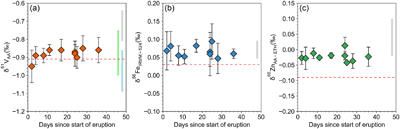 Figure 1 (a) Vanadium, (b) iron and (c) zinc isotopic compositions over the first 40 days of the eruption. Error bars are 2 s.d. of at least three measurements of each sample. Red dashed lines show estimates of the Bulk Silicate Earth (BSE); δ51VAA = −0.91 ± 0.09 ‰ (Qi et al., 2019), δ56FeIRMM-524 = +0.030 ± 0.007 ‰ (Sossi et al., 2016) and δ66ZnAA-ETH = −0.09 ± 0.08 ‰ (Fang et al., 2022). Grey vertical bands indicate the ranges of V (Prytulak et al., 2017), Fe (Schuessler et al., 2009) and Zn (Chen et al., 2013) isotopic compositions in lavas from Hekla volcano with whole rock SiO2 < 50 wt. %. Vertical blue and green bars indicate the ranges of V isotopic compositions in basalts from the Reykjanes Ridge (Novella et al., 2020) and Reykjanes Peninsula (Prytulak et al., 2013). | 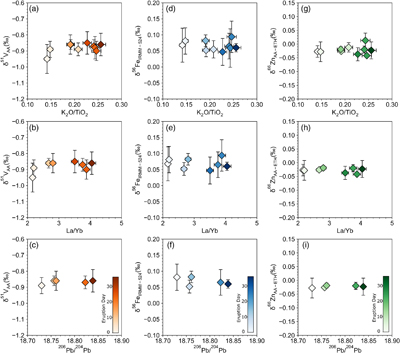 Figure 2 (a–c) Vanadium, (d–f) iron and (g–i) zinc isotopic compositions against whole rock (a, d, g) K2O/TiO2, (b, e, h) La/Yb and (c, f, i) 206Pb/204Pb from Halldórsson et al. (2022). The more enriched melts have higher La/Yb, K2O/TiO2 and 206Pb/204Pb. The colour bar indicates the day the sample was erupted. Plots of isotopic composition against Sr and Nd isotopes are shown in Figure S-4. | 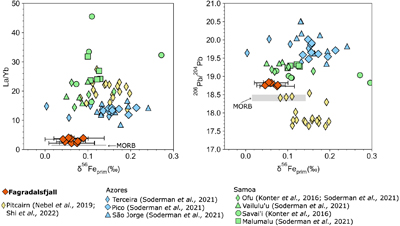 Figure 3 Iron isotopic compositions of selected ocean island basalts from the literature. The δ56Feprim values are calculated as described in the Supplementary Information. The MORB La/Yb and 206Pb/204Pb values are from Gale et al. (2013), and MORB δ56Feprim values from Sossi et al. (2016). |
| Figure 1 | Figure 2 | Figure 3 |
top
Introduction
It is widely accepted that crustal recycling has led to the formation of a chemically and isotopically heterogeneous upper mantle. Due to the relative inaccessibility of the mantle reservoir, most information about its composition comes from the study of mantle-derived basalts. Variations in the major, trace element and radiogenic isotopic composition of basalts require the presence of chemically enriched and depleted mantle domains (e.g., Hofmann, 1997
Hofmann, A.W. (1997) Mantle geochemistry: the message from oceanic volcanism. Nature 385, 219–229. https://doi.org/10.1038/385219a0
). Enriched components can exist as pyroxene-rich (pyroxenite/eclogite) lithologies derived from subducted oceanic crust, which are more fusible and melt at a lower solidus temperature than peridotite (e.g., Pertermann and Hirschmann, 2003Pertermann, M., Hirschmann, M.M. (2003) Partial melting experiments on a MORB-like pyroxenite between 2 and 3 GPa: Constraints on the presence of pyroxenite in basalt source regions from solidus location and melting rate. Journal of Geophysical Research: Solid Earth 108, 2125. https://doi.org/10.1029/2000JB000118
). Therefore, minor pyroxenite melting can dominate the trace element signature of basalts, making investigation of the spatial extent and characteristics of these heterogeneities challenging.An emerging approach for investigating potential variation in mantle lithology is to use transition metal stable isotopes (TMI), the most well studied being Fe (e.g., Williams and Bizimis, 2014
Williams, H.M., Bizimis, M. (2014) Iron isotope tracing of mantle heterogeneity within the source regions of oceanic basalts. Earth and Planetary Science Letters 404, 396–407. https://doi.org/10.1016/j.epsl.2014.07.033
; Konter et al., 2016Konter, J.G., Pietruszka, A.J., Hanan, B.B., Finlayson, V.A., Craddock, P.R., Jackson, M.G., Dauphas, N. (2016) Unusual δ56Fe values in Samoan rejuvenated lavas generated in the mantle. Earth and Planetary Science Letters 450, 221–232. https://doi.org/10.1016/j.epsl.2016.06.029
; Soderman et al., 2021Soderman, C.R., Matthews, S., Shorttle, O., Jackson, M.G., Ruttor, S., Nebel, O., Turner, S., Beier, C., Millet, M.-A., Widom, E., Humayun, M., Williams, H.M. (2021) Heavy δ57Fe in ocean island basalts: A non-unique signature of processes and source lithologies in the mantle. Geochimica et Cosmochimica Acta 292, 309–332. https://doi.org/10.1016/j.gca.2020.09.033
). At equilibrium, stable isotope fractionation between phases is theoretically controlled by bond strength, with heavier isotopes concentrating in stronger bonds where elements are present in higher oxidation state and lower bond coordination (e.g., Schauble, 2004Schauble, E.A. (2004) Applying Stable Isotope Fractionation Theory to New Systems. Reviews in Mineralogy and Geochemistry 55, 65–111. https://doi.org/10.2138/gsrmg.55.1.65
). Analytically resolvable variations in the magnitude of TMI equilibrium mineral-mineral and mineral-melt isotopic fractionation at magmatic temperatures have been both theoretically predicted and directly documented (e.g., Prytulak et al., 2017Prytulak, J., Sossi, P.A., Halliday, A.N., Plank, T., Savage, P.S., Woodhead, J.D. (2017) Stable vanadium isotopes as a redox proxy in magmatic systems? Geochemical Perspectives Letters 3, 75–84. https://doi.org/10.7185/geochemlet.1708
; Sossi and O’Neill, 2017Sossi, P.A., O’Neill, H.St.C. (2017) The effect of bonding environment on iron isotope fractionation between minerals at high temperature. Geochimica et Cosmochimica Acta 196, 121–143. https://doi.org/10.1016/j.gca.2016.09.017
; Stow et al., 2022Stow, M.A., Prytulak, J., Humphreys, M.C.S., Nowell, G.M. (2022) Integrated petrological and Fe-Zn isotopic modelling of plutonic differentiation. Geochimica et Cosmochimica Acta 320, 366–391. https://doi.org/10.1016/j.gca.2021.12.018
). For example, in the case of Fe, the difference in bonding environment and valence between pyroxene and olivine leads to heavier Fe isotopic composition in pyroxene-rich lithologies derived from subducted oceanic crust compared to olivine-rich peridotite (e.g., Williams and Bizimis, 2014Williams, H.M., Bizimis, M. (2014) Iron isotope tracing of mantle heterogeneity within the source regions of oceanic basalts. Earth and Planetary Science Letters 404, 396–407. https://doi.org/10.1016/j.epsl.2014.07.033
). Thus, the transition metal stable isotopic composition of primitive basalts is an attractive prospect for fingerprinting magmatic source lithology.Although TMI could theoretically track variations in mantle lithology, there is debate about their efficacy. Whether signals of mantle heterogeneity are preserved in primitive basalts depends on the contrast in isotopic composition between the different mantle sources and the proportions of each source melted (e.g., Soderman et al., 2022
Soderman, C.R., Shorttle, O., Matthews, S., Williams, H.M. (2022) Global trends in novel stable isotopes in basalts: Theory and observations. Geochimica et Cosmochimica Acta 318, 388–414. https://doi.org/10.1016/j.gca.2021.12.008
).The 2021 Fagradalsfjall eruption on the Reykjanes Peninsula, Iceland, provides a unique opportunity to investigate the relationship between potential mantle lithological heterogeneity and the transition metal stable isotope composition of basalts. Continuous eruption and high-resolution sampling of basaltic material occurred from 19 March to 18 September 2021. The Fagradalsfjall time series is an ideal sample set for several reasons:
- It is generally accepted that the mantle beneath Iceland, and the Reykjanes peninsula specifically, is lithologically heterogeneous and contains various depleted and enriched domains (e.g., Maclennan, 2008
Maclennan, J. (2008) Lead isotope variability in olivine-hosted melt inclusions from Iceland. Geochimica et Cosmochimica Acta 72, 4159–4176. https://doi.org/10.1016/j.gca.2008.05.034
; Shorttle and Maclennan, 2011Shorttle, O., Maclennan, J. (2011) Compositional trends of Icelandic basalts: Implications for short–length scale lithological heterogeneity in mantle plumes. Geochemistry, Geophysics, Geosystems 12, Q11008. https://doi.org/10.1029/2011GC003748
; Rasmussen et al., 2020Rasmussen, M.B., Halldórsson, S.A., Gibson, S.A., Guðfinnsson, G.H. (2020) Olivine chemistry reveals compositional source heterogeneities within a tilted mantle plume beneath Iceland. Earth and Planetary Science Letters 531, 116008. https://doi.org/10.1016/j.epsl.2019.116008
; Harðardóttir et al., 2022Harðardóttir, S., Matthews, S., Halldórsson, S.A., Jackson, M.G. (2022) Spatial distribution and geochemical characterization of Icelandic mantle end-members: Implications for plume geometry and melting processes. Chemical Geology 604, 120930. https://doi.org/10.1016/j.chemgeo.2022.120930
). - The Fagradalsfjall basalts display systematic temporal variations in trace element compositions over the first 40 days of the eruption, which requires the melting of chemically, and potentially lithologically, distinct sources (Bindeman et al., 2022
Bindeman, I.N., Deegan, F.M., Troll, V.R., Thordarson, T., Höskuldsson, Á., Moreland, W.M., Zorn, E.U., Shevchenko, A.V., Walter, T.R. (2022) Diverse mantle components with invariant oxygen isotopes in the 2021 Fagradalsfjall eruption, Iceland. Nature Communications 13, 3737. https://doi.org/10.1038/s41467-022-31348-7
; Halldórsson et al., 2022Halldórsson, S.A., Marshall, E.W., Caracciolo, A., Matthews, S., Bali, E., Rasmussen, M.B., Ranta, E., Robin, J.G., Guðfinnsson, G.H., Sigmarsson, O., Maclennan, J., Jackson, M.G., Whitehouse, M.J., Jeon, H., van der Meer, Q.H.A., Mibei, G.K., Kalliokoski, M.H., Repczynska, M.M., Rúnarsdóttir, R.H., Sigurðsson, G., Pfeffer, M.A., Scott, S.W., Kjartansdóttir, R., Kleine, B.I., Oppenheimer, C., Aiuppa, A., Ilyinskaya, E., Bitetto, M., Giudice, G., Stefánsson, A. (2022) Rapid shifting of a deep magmatic source at Fagradalsfjall volcano, Iceland. Nature 609, 529–534. https://doi.org/10.1038/s41586-022-04981-x
). Increases in La/Yb and K2O/TiO2 suggest recharge of melts derived from a more enriched source during the eruption, consistent with increasing 206Pb/204Pb and 87Sr/86Sr, and decreasing 143Nd/144Nd (Halldórsson et al., 2022Halldórsson, S.A., Marshall, E.W., Caracciolo, A., Matthews, S., Bali, E., Rasmussen, M.B., Ranta, E., Robin, J.G., Guðfinnsson, G.H., Sigmarsson, O., Maclennan, J., Jackson, M.G., Whitehouse, M.J., Jeon, H., van der Meer, Q.H.A., Mibei, G.K., Kalliokoski, M.H., Repczynska, M.M., Rúnarsdóttir, R.H., Sigurðsson, G., Pfeffer, M.A., Scott, S.W., Kjartansdóttir, R., Kleine, B.I., Oppenheimer, C., Aiuppa, A., Ilyinskaya, E., Bitetto, M., Giudice, G., Stefánsson, A. (2022) Rapid shifting of a deep magmatic source at Fagradalsfjall volcano, Iceland. Nature 609, 529–534. https://doi.org/10.1038/s41586-022-04981-x
). - The basalts have high MgO content (8.8–10 wt. %) and show no evidence for crustal assimilation or long-term crustal storage (Bindeman et al., 2022
Bindeman, I.N., Deegan, F.M., Troll, V.R., Thordarson, T., Höskuldsson, Á., Moreland, W.M., Zorn, E.U., Shevchenko, A.V., Walter, T.R. (2022) Diverse mantle components with invariant oxygen isotopes in the 2021 Fagradalsfjall eruption, Iceland. Nature Communications 13, 3737. https://doi.org/10.1038/s41467-022-31348-7
; Halldórsson et al., 2022Halldórsson, S.A., Marshall, E.W., Caracciolo, A., Matthews, S., Bali, E., Rasmussen, M.B., Ranta, E., Robin, J.G., Guðfinnsson, G.H., Sigmarsson, O., Maclennan, J., Jackson, M.G., Whitehouse, M.J., Jeon, H., van der Meer, Q.H.A., Mibei, G.K., Kalliokoski, M.H., Repczynska, M.M., Rúnarsdóttir, R.H., Sigurðsson, G., Pfeffer, M.A., Scott, S.W., Kjartansdóttir, R., Kleine, B.I., Oppenheimer, C., Aiuppa, A., Ilyinskaya, E., Bitetto, M., Giudice, G., Stefánsson, A. (2022) Rapid shifting of a deep magmatic source at Fagradalsfjall volcano, Iceland. Nature 609, 529–534. https://doi.org/10.1038/s41586-022-04981-x
; Kahl et al., 2023Kahl, M., Mutch, E.J.F., Maclennan, J., Morgan, D.J., Couperthwaite, F., Bali, E., Thordarson, T., Guðfinnsson, G.H., Walshaw, R., Buisman, I., Buhre, S., van der Meer, Q.H.A., Caracciolo, A., Marshall, E.W., Rasmussen, M.B., Gallagher, C.R., Moreland, W.M., Höskuldsson, A., Askew, R.A. (2023) Deep magma mobilization years before the 2021 CE Fagradalsfjall eruption, Iceland. Geology 51, 184–188. https://doi.org/10.1130/G50340.1
). Therefore, the geochemical variability of these primitive basalts most likely reflects variation in the mantle source.
This work provides the first combined V, Fe and Zn stable isotope investigation of mantle-derived basalts. Iron, V and Zn are concentrated in different mineral phases with distinct equilibrium mineral-melt fractionation factors controlled by mineral bonding environment. Therefore, Fe, V and Zn should have distinctive responses to variations in mantle lithology. It follows that the combination of the three systems likely provides better constraint than any one system in isolation. Iron isotopes have been used to infer the presence of pyroxene-rich domains in mantle sources (e.g., Williams and Bizimis, 2014
Williams, H.M., Bizimis, M. (2014) Iron isotope tracing of mantle heterogeneity within the source regions of oceanic basalts. Earth and Planetary Science Letters 404, 396–407. https://doi.org/10.1016/j.epsl.2014.07.033
; Konter et al., 2016Konter, J.G., Pietruszka, A.J., Hanan, B.B., Finlayson, V.A., Craddock, P.R., Jackson, M.G., Dauphas, N. (2016) Unusual δ56Fe values in Samoan rejuvenated lavas generated in the mantle. Earth and Planetary Science Letters 450, 221–232. https://doi.org/10.1016/j.epsl.2016.06.029
; Nebel et al., 2019Nebel, O., Sossi, P.A., Bénard, A., Arculus, R.J., Yaxley, G.M., Woodhead, J.D., Davies, D.R., Ruttor, S. (2019) Reconciling petrological and isotopic mixing mechanisms in the Pitcairn mantle plume using stable Fe isotopes. Earth and Planetary Science Letters 521, 60–67. https://doi.org/10.1016/j.epsl.2019.05.037
; Soderman et al., 2021Soderman, C.R., Matthews, S., Shorttle, O., Jackson, M.G., Ruttor, S., Nebel, O., Turner, S., Beier, C., Millet, M.-A., Widom, E., Humayun, M., Williams, H.M. (2021) Heavy δ57Fe in ocean island basalts: A non-unique signature of processes and source lithologies in the mantle. Geochimica et Cosmochimica Acta 292, 309–332. https://doi.org/10.1016/j.gca.2020.09.033
). The influence of lithological heterogeneity on V isotopes is less well constrained; however, several studies report V isotopic compositions of Icelandic lavas, which can be compared to the Fagradalsfjall data (Prytulak et al., 2013Prytulak, J., Nielsen, S.G., Ionov, D.A., Halliday, A.N., Harvey, J., Kelley, K.A., Niu, Y.L., Peate, D.W., Shimizu, K., Sims, K.W.W. (2013) The stable vanadium isotope composition of the mantle and mafic lavas. Earth and Planetary Science Letters 365, 177–189. https://doi.org/10.1016/j.epsl.2013.01.010
, 2017Prytulak, J., Sossi, P.A., Halliday, A.N., Plank, T., Savage, P.S., Woodhead, J.D. (2017) Stable vanadium isotopes as a redox proxy in magmatic systems? Geochemical Perspectives Letters 3, 75–84. https://doi.org/10.7185/geochemlet.1708
; Novella et al., 2020Novella, D., Maclennan, J., Shorttle, O., Prytulak, J., Murton, B.J. (2020) A multi-proxy investigation of mantle oxygen fugacity along the Reykjanes Ridge. Earth and Planetary Science Letters 531, 115973. https://doi.org/10.1016/j.epsl.2019.115973
). It is debated whether Zn isotopes are fractionated during partial melting of distinct lithologies (e.g., Doucet et al., 2016Doucet, L.S., Mattielli, N., Ionov, D.A., Debouge, W., Golovin, A.V. (2016) Zn isotopic heterogeneity in the mantle: A melting control? Earth and Planetary Science Letters 451, 232–240. https://doi.org/10.1016/j.epsl.2016.06.040
; Day et al., 2022Day, J.M.D., Moynier, F., Ishizuka, O. (2022) A partial melting control on the Zn isotope composition of basalts. Geochemical Perspectives Letters 23, 11–16. https://doi.org/10.7185/geochemlet.2230
), or if variation is largely controlled by kinetic fractionation during melt or fluid percolation (Huang et al., 2019Huang, J., Ackerman, L., Zhang, X.-C., Huang, F. (2019) Mantle Zn Isotopic Heterogeneity Caused by Melt-Rock Reaction: Evidence From Fe-Rich Peridotites and Pyroxenites From the Bohemian Massif, Central Europe. Journal of Geophysical Research: Solid Earth 124, 3588–3604. https://doi.org/10.1029/2018JB017125
; Fang et al., 2022Fang, S.-B., Huang, J., Zhang, X.-C., Ionov, D.A., Zhao, Z.-F., Huang, F. (2022) Zinc isotope fractionation in mantle rocks and minerals, and a revised δ66Zn value for the Bulk Silicate Earth. Geochimica et Cosmochimica Acta 338, 79–92. https://doi.org/10.1016/j.gca.2022.10.017
). Finally, Fe and V are redox sensitive elements whereas Zn is a monovalent element in terrestrial systems. Consequently, potential redox variations will not directly influence Zn isotopic fractionation, but may influence Fe and V (e.g., Stow et al., 2022Stow, M.A., Prytulak, J., Humphreys, M.C.S., Nowell, G.M. (2022) Integrated petrological and Fe-Zn isotopic modelling of plutonic differentiation. Geochimica et Cosmochimica Acta 320, 366–391. https://doi.org/10.1016/j.gca.2021.12.018
). Thus, a multi-isotope approach can address existing uncertainties by evaluating the relationships between the three isotope systems. The Fagradalsfjall basalts and their well-characterised secular chemical variations provide an opportunity to evaluate the sensitivity of V-Fe-Zn variations to potential changes in parameters such as oxygen fugacity, partial melting, and lithological heterogeneity.top
Methods
We determined the V, Fe and Zn stable isotopic compositions of 10 glassy basalts erupted between 21 March and 24 April 2021, which capture the full breadth of trace element variability during the overall eruption. These are newly prepared aliquots of the same samples analysed by Halldórsson et al. (2022)
Halldórsson, S.A., Marshall, E.W., Caracciolo, A., Matthews, S., Bali, E., Rasmussen, M.B., Ranta, E., Robin, J.G., Guðfinnsson, G.H., Sigmarsson, O., Maclennan, J., Jackson, M.G., Whitehouse, M.J., Jeon, H., van der Meer, Q.H.A., Mibei, G.K., Kalliokoski, M.H., Repczynska, M.M., Rúnarsdóttir, R.H., Sigurðsson, G., Pfeffer, M.A., Scott, S.W., Kjartansdóttir, R., Kleine, B.I., Oppenheimer, C., Aiuppa, A., Ilyinskaya, E., Bitetto, M., Giudice, G., Stefánsson, A. (2022) Rapid shifting of a deep magmatic source at Fagradalsfjall volcano, Iceland. Nature 609, 529–534. https://doi.org/10.1038/s41586-022-04981-x
. Chemical separation and isotope ratio measurements were carried out in the Arthur Holmes Isotope Geology Laboratory, Durham University. The column chromatography procedure quantitatively separated V, Fe and Zn from the same sample digestion. See the Supplementary Information for a full description of the methods. Analytical uncertainties, reported as 2 s.d., are typically <0.1 ‰ for δ51V, <0.05 ‰ for δ56Fe and <0.03 ‰ for δ66Zn (see Table S-1).top
Results and Discussion
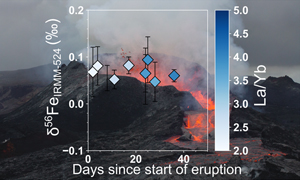
The first order observation of this study is that there is no analytically resolvable temporal variation in V, Fe or Zn isotopic compositions of the Fagradalsfjall basalts over the first 40 days of the eruption (Fig. 1; Table S-1). There are limited published Icelandic V-Fe-Zn data for comparison, but the basalts have similar isotopic compositions to mafic samples (<50 wt. % whole rock SiO2) from Hekla volcano (grey bars in Fig. 1; Schuessler et al., 2009
Schuessler, J.A., Schoenberg, R., Sigmarsson, O. (2009) Iron and lithium isotope systematics of the Hekla volcano, Iceland — Evidence for Fe isotope fractionation during magma differentiation. Chemical Geology 258, 78–91. https://doi.org/10.1016/j.chemgeo.2008.06.021
; Chen et al., 2013Chen, H., Savage, P.S., Teng, F.-Z., Helz, R.T., Moynier, F. (2013) Zinc isotope fractionation during magmatic differentiation and the isotopic composition of the bulk Earth. Earth and Planetary Science Letters 369–370, 34–42. https://doi.org/10.1016/j.epsl.2013.02.037
; Prytulak et al., 2017Prytulak, J., Sossi, P.A., Halliday, A.N., Plank, T., Savage, P.S., Woodhead, J.D. (2017) Stable vanadium isotopes as a redox proxy in magmatic systems? Geochemical Perspectives Letters 3, 75–84. https://doi.org/10.7185/geochemlet.1708
). In addition, δ51V values are within error of basalts from the Reykjanes Ridge (blue bar in Fig. 1a; Novella et al., 2020Novella, D., Maclennan, J., Shorttle, O., Prytulak, J., Murton, B.J. (2020) A multi-proxy investigation of mantle oxygen fugacity along the Reykjanes Ridge. Earth and Planetary Science Letters 531, 115973. https://doi.org/10.1016/j.epsl.2019.115973
) and Reykjanes Peninsula (green bar in Fig. 1a; Prytulak et al., 2013Prytulak, J., Nielsen, S.G., Ionov, D.A., Halliday, A.N., Harvey, J., Kelley, K.A., Niu, Y.L., Peate, D.W., Shimizu, K., Sims, K.W.W. (2013) The stable vanadium isotope composition of the mantle and mafic lavas. Earth and Planetary Science Letters 365, 177–189. https://doi.org/10.1016/j.epsl.2013.01.010
).Figure 1 (a) Vanadium, (b) iron and (c) zinc isotopic compositions over the first 40 days of the eruption. Error bars are 2 s.d. of at least three measurements of each sample. Red dashed lines show estimates of the Bulk Silicate Earth (BSE); δ51VAA = −0.91 ± 0.09 ‰ (Qi et al., 2019
Qi, Y.-H., Wu, F., Ionov, D.A., Puchtel, I.S., Carlson, R.W., Nicklas, R.W., Yu, H.-M., Kang, J.-T., Li, C.-H., Huang, F. (2019) Vanadium isotope composition of the Bulk Silicate Earth: Constraints from peridotites and komatiites. Geochimica et Cosmochimica Acta 259, 288–301. https://doi.org/10.1016/j.gca.2019.06.008
), δ56FeIRMM-524 = +0.030 ± 0.007 ‰ (Sossi et al., 2016Sossi, P.A., Nebel, O., Foden, J. (2016) Iron isotope systematics in planetary reservoirs. Earth and Planetary Science Letters 452, 295–308. https://doi.org/10.1016/j.epsl.2016.07.032
) and δ66ZnAA-ETH = −0.09 ± 0.08 ‰ (Fang et al., 2022Fang, S.-B., Huang, J., Zhang, X.-C., Ionov, D.A., Zhao, Z.-F., Huang, F. (2022) Zinc isotope fractionation in mantle rocks and minerals, and a revised δ66Zn value for the Bulk Silicate Earth. Geochimica et Cosmochimica Acta 338, 79–92. https://doi.org/10.1016/j.gca.2022.10.017
). Grey vertical bands indicate the ranges of V (Prytulak et al., 2017Prytulak, J., Sossi, P.A., Halliday, A.N., Plank, T., Savage, P.S., Woodhead, J.D. (2017) Stable vanadium isotopes as a redox proxy in magmatic systems? Geochemical Perspectives Letters 3, 75–84. https://doi.org/10.7185/geochemlet.1708
), Fe (Schuessler et al., 2009Schuessler, J.A., Schoenberg, R., Sigmarsson, O. (2009) Iron and lithium isotope systematics of the Hekla volcano, Iceland — Evidence for Fe isotope fractionation during magma differentiation. Chemical Geology 258, 78–91. https://doi.org/10.1016/j.chemgeo.2008.06.021
) and Zn (Chen et al., 2013Chen, H., Savage, P.S., Teng, F.-Z., Helz, R.T., Moynier, F. (2013) Zinc isotope fractionation during magmatic differentiation and the isotopic composition of the bulk Earth. Earth and Planetary Science Letters 369–370, 34–42. https://doi.org/10.1016/j.epsl.2013.02.037
) isotopic compositions in lavas from Hekla volcano with whole rock SiO2 < 50 wt. %. Vertical blue and green bars indicate the ranges of V isotopic compositions in basalts from the Reykjanes Ridge (Novella et al., 2020Novella, D., Maclennan, J., Shorttle, O., Prytulak, J., Murton, B.J. (2020) A multi-proxy investigation of mantle oxygen fugacity along the Reykjanes Ridge. Earth and Planetary Science Letters 531, 115973. https://doi.org/10.1016/j.epsl.2019.115973
) and Reykjanes Peninsula (Prytulak et al., 2013Prytulak, J., Nielsen, S.G., Ionov, D.A., Halliday, A.N., Harvey, J., Kelley, K.A., Niu, Y.L., Peate, D.W., Shimizu, K., Sims, K.W.W. (2013) The stable vanadium isotope composition of the mantle and mafic lavas. Earth and Planetary Science Letters 365, 177–189. https://doi.org/10.1016/j.epsl.2013.01.010
).The Fagradalsfjall basalts display a greater variation in major and trace element compositions over the first 40 days of the eruption than have been observed in historical lavas from the Reykjanes Peninsula (Halldórsson et al., 2022
Halldórsson, S.A., Marshall, E.W., Caracciolo, A., Matthews, S., Bali, E., Rasmussen, M.B., Ranta, E., Robin, J.G., Guðfinnsson, G.H., Sigmarsson, O., Maclennan, J., Jackson, M.G., Whitehouse, M.J., Jeon, H., van der Meer, Q.H.A., Mibei, G.K., Kalliokoski, M.H., Repczynska, M.M., Rúnarsdóttir, R.H., Sigurðsson, G., Pfeffer, M.A., Scott, S.W., Kjartansdóttir, R., Kleine, B.I., Oppenheimer, C., Aiuppa, A., Ilyinskaya, E., Bitetto, M., Giudice, G., Stefánsson, A. (2022) Rapid shifting of a deep magmatic source at Fagradalsfjall volcano, Iceland. Nature 609, 529–534. https://doi.org/10.1038/s41586-022-04981-x
). Bindeman et al. (2022)Bindeman, I.N., Deegan, F.M., Troll, V.R., Thordarson, T., Höskuldsson, Á., Moreland, W.M., Zorn, E.U., Shevchenko, A.V., Walter, T.R. (2022) Diverse mantle components with invariant oxygen isotopes in the 2021 Fagradalsfjall eruption, Iceland. Nature Communications 13, 3737. https://doi.org/10.1038/s41467-022-31348-7
and Halldórsson et al. (2022)Halldórsson, S.A., Marshall, E.W., Caracciolo, A., Matthews, S., Bali, E., Rasmussen, M.B., Ranta, E., Robin, J.G., Guðfinnsson, G.H., Sigmarsson, O., Maclennan, J., Jackson, M.G., Whitehouse, M.J., Jeon, H., van der Meer, Q.H.A., Mibei, G.K., Kalliokoski, M.H., Repczynska, M.M., Rúnarsdóttir, R.H., Sigurðsson, G., Pfeffer, M.A., Scott, S.W., Kjartansdóttir, R., Kleine, B.I., Oppenheimer, C., Aiuppa, A., Ilyinskaya, E., Bitetto, M., Giudice, G., Stefánsson, A. (2022) Rapid shifting of a deep magmatic source at Fagradalsfjall volcano, Iceland. Nature 609, 529–534. https://doi.org/10.1038/s41586-022-04981-x
proposed similar models to explain these geochemical variations. A depleted melt sourced from shallow mantle melting is thought to dominate the initial eruptive products. Enriched melts derived from deeper and lower degrees of mantle melting became more significant as the eruption proceeded. Rapid mixing of depleted and enriched melts occurs in the deep magma reservoir which feeds the eruption, generating the linear trends observed in the trace elements (Halldórsson et al., 2022Halldórsson, S.A., Marshall, E.W., Caracciolo, A., Matthews, S., Bali, E., Rasmussen, M.B., Ranta, E., Robin, J.G., Guðfinnsson, G.H., Sigmarsson, O., Maclennan, J., Jackson, M.G., Whitehouse, M.J., Jeon, H., van der Meer, Q.H.A., Mibei, G.K., Kalliokoski, M.H., Repczynska, M.M., Rúnarsdóttir, R.H., Sigurðsson, G., Pfeffer, M.A., Scott, S.W., Kjartansdóttir, R., Kleine, B.I., Oppenheimer, C., Aiuppa, A., Ilyinskaya, E., Bitetto, M., Giudice, G., Stefánsson, A. (2022) Rapid shifting of a deep magmatic source at Fagradalsfjall volcano, Iceland. Nature 609, 529–534. https://doi.org/10.1038/s41586-022-04981-x
). However, there is no correlation between V-Fe-Zn isotopes and K2O/TiO2 or La/Yb (Fig. 2), the parameters used to demonstrate progressive contribution of melts derived from a deeper and/or more enriched source (Halldórsson et al., 2022Halldórsson, S.A., Marshall, E.W., Caracciolo, A., Matthews, S., Bali, E., Rasmussen, M.B., Ranta, E., Robin, J.G., Guðfinnsson, G.H., Sigmarsson, O., Maclennan, J., Jackson, M.G., Whitehouse, M.J., Jeon, H., van der Meer, Q.H.A., Mibei, G.K., Kalliokoski, M.H., Repczynska, M.M., Rúnarsdóttir, R.H., Sigurðsson, G., Pfeffer, M.A., Scott, S.W., Kjartansdóttir, R., Kleine, B.I., Oppenheimer, C., Aiuppa, A., Ilyinskaya, E., Bitetto, M., Giudice, G., Stefánsson, A. (2022) Rapid shifting of a deep magmatic source at Fagradalsfjall volcano, Iceland. Nature 609, 529–534. https://doi.org/10.1038/s41586-022-04981-x
).Figure 2 (a–c) Vanadium, (d–f) iron and (g–i) zinc isotopic compositions against whole rock (a, d, g) K2O/TiO2, (b, e, h) La/Yb and (c, f, i) 206Pb/204Pb from Halldórsson et al. (2022)
Halldórsson, S.A., Marshall, E.W., Caracciolo, A., Matthews, S., Bali, E., Rasmussen, M.B., Ranta, E., Robin, J.G., Guðfinnsson, G.H., Sigmarsson, O., Maclennan, J., Jackson, M.G., Whitehouse, M.J., Jeon, H., van der Meer, Q.H.A., Mibei, G.K., Kalliokoski, M.H., Repczynska, M.M., Rúnarsdóttir, R.H., Sigurðsson, G., Pfeffer, M.A., Scott, S.W., Kjartansdóttir, R., Kleine, B.I., Oppenheimer, C., Aiuppa, A., Ilyinskaya, E., Bitetto, M., Giudice, G., Stefánsson, A. (2022) Rapid shifting of a deep magmatic source at Fagradalsfjall volcano, Iceland. Nature 609, 529–534. https://doi.org/10.1038/s41586-022-04981-x
. The more enriched melts have higher La/Yb, K2O/TiO2 and 206Pb/204Pb. The colour bar indicates the day the sample was erupted. Plots of isotopic composition against Sr and Nd isotopes are shown in Figure S-4.The Fagradalsfjall basalts also record resolvable variation in Sr, Nd and Pb isotopic compositions over the first 40 days of the eruption, which are likewise thought to reflect the presence of melts from distinct mantle sources (Halldórsson et al., 2022
Halldórsson, S.A., Marshall, E.W., Caracciolo, A., Matthews, S., Bali, E., Rasmussen, M.B., Ranta, E., Robin, J.G., Guðfinnsson, G.H., Sigmarsson, O., Maclennan, J., Jackson, M.G., Whitehouse, M.J., Jeon, H., van der Meer, Q.H.A., Mibei, G.K., Kalliokoski, M.H., Repczynska, M.M., Rúnarsdóttir, R.H., Sigurðsson, G., Pfeffer, M.A., Scott, S.W., Kjartansdóttir, R., Kleine, B.I., Oppenheimer, C., Aiuppa, A., Ilyinskaya, E., Bitetto, M., Giudice, G., Stefánsson, A. (2022) Rapid shifting of a deep magmatic source at Fagradalsfjall volcano, Iceland. Nature 609, 529–534. https://doi.org/10.1038/s41586-022-04981-x
). There is also no correlation between V-Fe-Zn isotopes and Sr, Nd or Pb isotopes (Figs. 2, S-4).Although there is no variation in V-Fe-Zn isotopes at Fagradalsfjall, several previous studies of ocean island basalts have observed correlations between δ56Fe and the ratios of trace elements and radiogenic isotopes. These studies suggest that heavy Fe isotope signatures are at least in part inherited from an isotopically heavy pyroxene-bearing source (e.g., Konter et al., 2016
Konter, J.G., Pietruszka, A.J., Hanan, B.B., Finlayson, V.A., Craddock, P.R., Jackson, M.G., Dauphas, N. (2016) Unusual δ56Fe values in Samoan rejuvenated lavas generated in the mantle. Earth and Planetary Science Letters 450, 221–232. https://doi.org/10.1016/j.epsl.2016.06.029
; Nebel et al., 2019Nebel, O., Sossi, P.A., Bénard, A., Arculus, R.J., Yaxley, G.M., Woodhead, J.D., Davies, D.R., Ruttor, S. (2019) Reconciling petrological and isotopic mixing mechanisms in the Pitcairn mantle plume using stable Fe isotopes. Earth and Planetary Science Letters 521, 60–67. https://doi.org/10.1016/j.epsl.2019.05.037
; Soderman et al., 2021Soderman, C.R., Matthews, S., Shorttle, O., Jackson, M.G., Ruttor, S., Nebel, O., Turner, S., Beier, C., Millet, M.-A., Widom, E., Humayun, M., Williams, H.M. (2021) Heavy δ57Fe in ocean island basalts: A non-unique signature of processes and source lithologies in the mantle. Geochimica et Cosmochimica Acta 292, 309–332. https://doi.org/10.1016/j.gca.2020.09.033
; Shi et al., 2022Shi, J.-H., Zeng, G., Chen, L.-H., Hanyu, T., Wang, X.-J., Zhong, Y., Xie, L.-W., Xie, W.-L. (2022) An eclogitic component in the Pitcairn mantle plume: Evidence from olivine compositions and Fe isotopes of basalts. Geochimica et Cosmochimica Acta 318, 415–427. https://doi.org/10.1016/j.gca.2021.12.017
). However, these studies often analyse samples erupted from multiple volcanic vents across different islands, and are therefore not directly comparable to the Fagradalsfjall eruption. To facilitate a more direct comparison, we plot a selection of the literature data where at least four samples are from the same volcanic island, and where the presence of a pyroxene-bearing source has been proposed (Fig. 3). Although the Fagradalsfjall basalts do display resolvable variations in trace element and radiogenic isotope ratios, these ranges are much smaller than those observed in the other ocean island basalts. It is perhaps not surprising that the Fagradalsfjall basalts display no change in Fe isotopic composition. Although minor amounts of pyroxenite are required to explain some of the changes in the trace element and radiogenic isotope compositions of the basalts (i.e. <10–20 % pyroxenite melt; see Supplementary Information), this amount would be insufficient to drive changes in basalt δ56Fe. A binary mixing model (Fig. S-3) demonstrates that a contribution of at least 40–50 % enriched melt with δ56Fe > 0.2 ‰ is generally required to generate resolvable Fe isotopic variation. Therefore, the lack of variation in δ56Fe in the Fagradalsfjall basalts is consistent with the lack of a volumetrically significant contribution of melts from a lithologically distinct source with a heavy Fe isotopic composition.Figure 3 Iron isotopic compositions of selected ocean island basalts from the literature. The δ56Feprim values are calculated as described in the Supplementary Information. The MORB La/Yb and 206Pb/204Pb values are from Gale et al. (2013)
Gale, A., Dalton, C.A., Langmuir, C.H., Su, Y., Schilling, J.-G. (2013) The mean composition of ocean ridge basalts. Geochemistry, Geophysics, Geosystems 14, 489–518. https://doi.org/10.1029/2012GC004334
, and MORB δ56Feprim values from Sossi et al. (2016)Sossi, P.A., Nebel, O., Foden, J. (2016) Iron isotope systematics in planetary reservoirs. Earth and Planetary Science Letters 452, 295–308. https://doi.org/10.1016/j.epsl.2016.07.032
.The controls on V and Zn isotope fractionation during mantle melting are not as well constrained as for Fe, but we can examine covariations between the three systems to investigate the drivers of isotopic fractionation. Previous empirical and modelling studies have suggested that V isotopes are insensitive to the presence of pyroxenite lithologies (Novella et al., 2020
Novella, D., Maclennan, J., Shorttle, O., Prytulak, J., Murton, B.J. (2020) A multi-proxy investigation of mantle oxygen fugacity along the Reykjanes Ridge. Earth and Planetary Science Letters 531, 115973. https://doi.org/10.1016/j.epsl.2019.115973
; Soderman et al., 2022Soderman, C.R., Shorttle, O., Matthews, S., Williams, H.M. (2022) Global trends in novel stable isotopes in basalts: Theory and observations. Geochimica et Cosmochimica Acta 318, 388–414. https://doi.org/10.1016/j.gca.2021.12.008
). The lack of correlation between δ56Fe and δ51V in the Fagradalsfjall basalts supports this inference. In addition, the lack of correlation between these two redox sensitive elements suggests that there is no variation in mantle oxygen fugacity.Previous studies suggest that Zn isotopic variability may be controlled by kinetic fractionation during percolation of melts and/or fluids through the mantle, and consequently hybridised mantle should have more variable δ66Zn than peridotites (Huang et al., 2019
Huang, J., Ackerman, L., Zhang, X.-C., Huang, F. (2019) Mantle Zn Isotopic Heterogeneity Caused by Melt-Rock Reaction: Evidence From Fe-Rich Peridotites and Pyroxenites From the Bohemian Massif, Central Europe. Journal of Geophysical Research: Solid Earth 124, 3588–3604. https://doi.org/10.1029/2018JB017125
; Fang et al., 2022Fang, S.-B., Huang, J., Zhang, X.-C., Ionov, D.A., Zhao, Z.-F., Huang, F. (2022) Zinc isotope fractionation in mantle rocks and minerals, and a revised δ66Zn value for the Bulk Silicate Earth. Geochimica et Cosmochimica Acta 338, 79–92. https://doi.org/10.1016/j.gca.2022.10.017
). Therefore, the lack of covariation between Fe and Zn isotopes in the Fagradalsfjall basalts also supports the lack of a volumetrically significant contribution of melts from an enriched source.This work has explored the sensitivity of a novel combination of three isotope systems (V, Fe and Zn) with contrasting chemical behaviours. In the case of the Fagradalsfjall high resolution eruptive time series, the lack of V-Fe-Zn isotopic variation suggests that there is no significant contribution of melts from a pyroxenite source. However, a multi-isotope approach still holds promise in identifying and disentangling processes and components involved in the generation of mantle-derived basalts.
top
Acknowledgements
MAS was supported by a NERC IAPETUS Doctoral Training Programme (NE/L002590/1) studentship. EWM, SAH, SM, AC, MBR and ER were supported by the Icelandic Research Fund, grant number 228933-051 and by the Department of Civil Protection and Emergency Management. This work was greatly improved by detailed reviews from M. Bizimis and an anonymous reviewer, and the comments and efficient editorial handling of R. Fonseca.
Editor: Raúl Fonseca
top
Data Access Statement
All data generated during this study are included in the published article and the Supplementary Information.
top
References
Bindeman, I.N., Deegan, F.M., Troll, V.R., Thordarson, T., Höskuldsson, Á., Moreland, W.M., Zorn, E.U., Shevchenko, A.V., Walter, T.R. (2022) Diverse mantle components with invariant oxygen isotopes in the 2021 Fagradalsfjall eruption, Iceland. Nature Communications 13, 3737. https://doi.org/10.1038/s41467-022-31348-7
 Show in context
 The Fagradalsfjall basalts display systematic temporal variations in trace element compositions over the first 40 days of the eruption, which requires the melting of chemically, and potentially lithologically, distinct sources (Bindeman et al., 2022; Halldórsson et al., 2022).
View in article
The basalts have high MgO content (8.8–10 wt. %) and show no evidence for crustal assimilation or long-term crustal storage (Bindeman et al., 2022; Halldórsson et al., 2022; Kahl et al., 2023).
View in article
Bindeman et al. (2022) and Halldórsson et al. (2022) proposed similar models to explain these geochemical variations.
View in article
Chen, H., Savage, P.S., Teng, F.-Z., Helz, R.T., Moynier, F. (2013) Zinc isotope fractionation during magmatic differentiation and the isotopic composition of the bulk Earth. Earth and Planetary Science Letters 369–370, 34–42. https://doi.org/10.1016/j.epsl.2013.02.037
Show in context There are limited published Icelandic V-Fe-Zn data for comparison, but the basalts have similar isotopic compositions to mafic samples (<50 wt. % whole rock SiO2) from Hekla volcano (grey bars in Fig. 1; Schuessler et al., 2009; Chen et al., 2013; Prytulak et al., 2017).
View in article
Grey vertical bands indicate the ranges of V (Prytulak et al., 2017), Fe (Schuessler et al., 2009) and Zn (Chen et al., 2013) isotopic compositions in lavas from Hekla volcano with whole rock SiO2 < 50 wt. %.
View in article
Day, J.M.D., Moynier, F., Ishizuka, O. (2022) A partial melting control on the Zn isotope composition of basalts. Geochemical Perspectives Letters 23, 11–16. https://doi.org/10.7185/geochemlet.2230
Show in context It is debated whether Zn isotopes are fractionated during partial melting of distinct lithologies (e.g., Doucet et al., 2016; Day et al., 2022), or if variation is largely controlled by kinetic fractionation during melt or fluid percolation (Huang et al., 2019; Fang et al., 2022).
View in article
Doucet, L.S., Mattielli, N., Ionov, D.A., Debouge, W., Golovin, A.V. (2016) Zn isotopic heterogeneity in the mantle: A melting control? Earth and Planetary Science Letters 451, 232–240. https://doi.org/10.1016/j.epsl.2016.06.040
Show in context It is debated whether Zn isotopes are fractionated during partial melting of distinct lithologies (e.g., Doucet et al., 2016; Day et al., 2022), or if variation is largely controlled by kinetic fractionation during melt or fluid percolation (Huang et al., 2019; Fang et al., 2022).
View in article
Fang, S.-B., Huang, J., Zhang, X.-C., Ionov, D.A., Zhao, Z.-F., Huang, F. (2022) Zinc isotope fractionation in mantle rocks and minerals, and a revised δ66Zn value for the Bulk Silicate Earth. Geochimica et Cosmochimica Acta 338, 79–92. https://doi.org/10.1016/j.gca.2022.10.017
Show in context It is debated whether Zn isotopes are fractionated during partial melting of distinct lithologies (e.g., Doucet et al., 2016; Day et al., 2022), or if variation is largely controlled by kinetic fractionation during melt or fluid percolation (Huang et al., 2019; Fang et al., 2022).
View in article
Red dashed lines show estimates of the Bulk Silicate Earth (BSE); δ51VAA = −0.91 ± 0.09 ‰ (Qi et al., 2019), δ56FeIRMM-524 = +0.030 ± 0.007 ‰ (Sossi et al., 2016) and δ66ZnAA-ETH = −0.09 ± 0.08 ‰ (Fang et al., 2022).
View in article
Previous studies suggest that Zn isotopic variability may be controlled by kinetic fractionation during percolation of melts and/or fluids through the mantle, and consequently hybridised mantle should have more variable δ66Zn than peridotites (Huang et al., 2019; Fang et al., 2022).
View in article
Gale, A., Dalton, C.A., Langmuir, C.H., Su, Y., Schilling, J.-G. (2013) The mean composition of ocean ridge basalts. Geochemistry, Geophysics, Geosystems 14, 489–518. https://doi.org/10.1029/2012GC004334
Show in context The MORB La/Yb and 206Pb/204Pb values are from Gale et al. (2013), and MORB δ56Feprim values from Sossi et al. (2016).
View in article
Halldórsson, S.A., Marshall, E.W., Caracciolo, A., Matthews, S., Bali, E., Rasmussen, M.B., Ranta, E., Robin, J.G., Guðfinnsson, G.H., Sigmarsson, O., Maclennan, J., Jackson, M.G., Whitehouse, M.J., Jeon, H., van der Meer, Q.H.A., Mibei, G.K., Kalliokoski, M.H., Repczynska, M.M., Rúnarsdóttir, R.H., Sigurðsson, G., Pfeffer, M.A., Scott, S.W., Kjartansdóttir, R., Kleine, B.I., Oppenheimer, C., Aiuppa, A., Ilyinskaya, E., Bitetto, M., Giudice, G., Stefánsson, A. (2022) Rapid shifting of a deep magmatic source at Fagradalsfjall volcano, Iceland. Nature 609, 529–534. https://doi.org/10.1038/s41586-022-04981-x
Show in context The Fagradalsfjall basalts display systematic temporal variations in trace element compositions over the first 40 days of the eruption, which requires the melting of chemically, and potentially lithologically, distinct sources (Bindeman et al., 2022; Halldórsson et al., 2022).
View in article
Increases in La/Yb and K2O/TiO2 suggest recharge of melts derived from a more enriched source during the eruption, consistent with increasing 206Pb/204Pb and 87Sr/86Sr, and decreasing 143Nd/144Nd (Halldórsson et al., 2022).
View in article
The basalts have high MgO content (8.8–10 wt. %) and show no evidence for crustal assimilation or long-term crustal storage (Bindeman et al., 2022; Halldórsson et al., 2022; Kahl et al., 2023).
View in article
These are newly prepared aliquots of the same samples analysed by Halldórsson et al. (2022).
View in article
The Fagradalsfjall basalts display a greater variation in major and trace element compositions over the first 40 days of the eruption than have been observed in historical lavas from the Reykjanes Peninsula (Halldórsson et al., 2022).
View in article
Bindeman et al. (2022) and Halldórsson et al. (2022) proposed similar models to explain these geochemical variations.
View in article
Enriched melts derived from deeper and lower degrees of mantle melting became more significant as the eruption proceeded. Rapid mixing of depleted and enriched melts occurs in the deep magma reservoir which feeds the eruption, generating the linear trends observed in the trace elements (Halldórsson et al., 2022).
View in article
However, there is no correlation between V-Fe-Zn isotopes and K2O/TiO2 or La/Yb (Fig. 2), the parameters used to demonstrate progressive contribution of melts derived from a deeper and/or more enriched source (Halldórsson et al., 2022).
View in article
(a–c) Vanadium, (d–f) iron and (g–i) zinc isotopic compositions against whole rock (a, d, g) K2O/TiO2, (b, e, h) La/Yb and (c, f, i) 206Pb/204Pb from Halldórsson et al. (2022).
View in article
The Fagradalsfjall basalts also record resolvable variation in Sr, Nd and Pb isotopic compositions over the first 40 days of the eruption, which are likewise thought to reflect the presence of melts from distinct mantle sources (Halldórsson et al., 2022).
View in article
Harðardóttir, S., Matthews, S., Halldórsson, S.A., Jackson, M.G. (2022) Spatial distribution and geochemical characterization of Icelandic mantle end-members: Implications for plume geometry and melting processes. Chemical Geology 604, 120930. https://doi.org/10.1016/j.chemgeo.2022.120930
Show in context It is generally accepted that the mantle beneath Iceland, and the Reykjanes peninsula specifically, is lithologically heterogeneous and contains various depleted and enriched domains (e.g., Maclennan, 2008; Shorttle and Maclennan, 2011; Rasmussen et al., 2020; Harðardóttir et al., 2022).
View in article
Hofmann, A.W. (1997) Mantle geochemistry: the message from oceanic volcanism. Nature 385, 219–229. https://doi.org/10.1038/385219a0
Show in context Variations in the major, trace element and radiogenic isotopic composition of basalts require the presence of chemically enriched and depleted mantle domains (e.g., Hofmann, 1997).
View in article
Huang, J., Ackerman, L., Zhang, X.-C., Huang, F. (2019) Mantle Zn Isotopic Heterogeneity Caused by Melt-Rock Reaction: Evidence From Fe-Rich Peridotites and Pyroxenites From the Bohemian Massif, Central Europe. Journal of Geophysical Research: Solid Earth 124, 3588–3604. https://doi.org/10.1029/2018JB017125
Show in context It is debated whether Zn isotopes are fractionated during partial melting of distinct lithologies (e.g., Doucet et al., 2016; Day et al., 2022), or if variation is largely controlled by kinetic fractionation during melt or fluid percolation (Huang et al., 2019; Fang et al., 2022).
View in article
Previous studies suggest that Zn isotopic variability may be controlled by kinetic fractionation during percolation of melts and/or fluids through the mantle, and consequently hybridised mantle should have more variable δ66Zn than peridotites (Huang et al., 2019; Fang et al., 2022).
View in article
Kahl, M., Mutch, E.J.F., Maclennan, J., Morgan, D.J., Couperthwaite, F., Bali, E., Thordarson, T., Guðfinnsson, G.H., Walshaw, R., Buisman, I., Buhre, S., van der Meer, Q.H.A., Caracciolo, A., Marshall, E.W., Rasmussen, M.B., Gallagher, C.R., Moreland, W.M., Höskuldsson, A., Askew, R.A. (2023) Deep magma mobilization years before the 2021 CE Fagradalsfjall eruption, Iceland. Geology 51, 184–188. https://doi.org/10.1130/G50340.1
Show in context The basalts have high MgO content (8.8–10 wt. %) and show no evidence for crustal assimilation or long-term crustal storage (Bindeman et al., 2022; Halldórsson et al., 2022; Kahl et al., 2023).
View in article
Konter, J.G., Pietruszka, A.J., Hanan, B.B., Finlayson, V.A., Craddock, P.R., Jackson, M.G., Dauphas, N. (2016) Unusual δ56Fe values in Samoan rejuvenated lavas generated in the mantle. Earth and Planetary Science Letters 450, 221–232. https://doi.org/10.1016/j.epsl.2016.06.029
Show in context An emerging approach for investigating potential variation in mantle lithology is to use transition metal stable isotopes (TMI), the most well studied being Fe (e.g., Williams and Bizimis, 2014; Konter et al., 2016; Soderman et al., 2021).
View in article
Iron isotopes have been used to infer the presence of pyroxene-rich domains in mantle sources (e.g., Williams and Bizimis, 2014; Konter et al., 2016; Nebel et al., 2019; Soderman et al., 2021).
View in article
These studies suggest that heavy Fe isotope signatures are at least in part inherited from an isotopically heavy pyroxene-bearing source (e.g., Konter et al., 2016; Nebel et al., 2019; Soderman et al., 2021; Shi et al., 2022).
View in article
Maclennan, J. (2008) Lead isotope variability in olivine-hosted melt inclusions from Iceland. Geochimica et Cosmochimica Acta 72, 4159–4176. https://doi.org/10.1016/j.gca.2008.05.034
Show in context It is generally accepted that the mantle beneath Iceland, and the Reykjanes peninsula specifically, is lithologically heterogeneous and contains various depleted and enriched domains (e.g., Maclennan, 2008; Shorttle and Maclennan, 2011; Rasmussen et al., 2020; Harðardóttir et al., 2022).
View in article
Nebel, O., Sossi, P.A., Bénard, A., Arculus, R.J., Yaxley, G.M., Woodhead, J.D., Davies, D.R., Ruttor, S. (2019) Reconciling petrological and isotopic mixing mechanisms in the Pitcairn mantle plume using stable Fe isotopes. Earth and Planetary Science Letters 521, 60–67. https://doi.org/10.1016/j.epsl.2019.05.037
Show in context Iron isotopes have been used to infer the presence of pyroxene-rich domains in mantle sources (e.g., Williams and Bizimis, 2014; Konter et al., 2016; Nebel et al., 2019; Soderman et al., 2021).
View in article
These studies suggest that heavy Fe isotope signatures are at least in part inherited from an isotopically heavy pyroxene-bearing source (e.g., Konter et al., 2016; Nebel et al., 2019; Soderman et al., 2021; Shi et al., 2022).
View in article
Novella, D., Maclennan, J., Shorttle, O., Prytulak, J., Murton, B.J. (2020) A multi-proxy investigation of mantle oxygen fugacity along the Reykjanes Ridge. Earth and Planetary Science Letters 531, 115973. https://doi.org/10.1016/j.epsl.2019.115973
Show in context The influence of lithological heterogeneity on V isotopes is less well constrained; however, several studies report V isotopic compositions of Icelandic lavas, which can be compared to the Fagradalsfjall data (Prytulak et al., 2013, 2017; Novella et al., 2020).
View in article
In addition, δ51V values are within error of basalts from the Reykjanes Ridge (blue bar in Fig. 1a; Novella et al., 2020) and Reykjanes Peninsula (green bar in Fig. 1a; Prytulak et al., 2013).
View in article
Vertical blue and green bars indicate the ranges of V isotopic compositions in basalts from the Reykjanes Ridge (Novella et al., 2020) and Reykjanes Peninsula (Prytulak et al., 2013).
View in article
Previous empirical and modelling studies have suggested that V isotopes are insensitive to the presence of pyroxenite lithologies (Novella et al., 2020; Soderman et al., 2022).
View in article
Pertermann, M., Hirschmann, M.M. (2003) Partial melting experiments on a MORB-like pyroxenite between 2 and 3 GPa: Constraints on the presence of pyroxenite in basalt source regions from solidus location and melting rate. Journal of Geophysical Research: Solid Earth 108, 2125. https://doi.org/10.1029/2000JB000118
Show in context Enriched components can exist as pyroxene-rich (pyroxenite/eclogite) lithologies derived from subducted oceanic crust, which are more fusible and melt at a lower solidus temperature than peridotite (e.g., Pertermann and Hirschmann, 2003).
View in article
Prytulak, J., Nielsen, S.G., Ionov, D.A., Halliday, A.N., Harvey, J., Kelley, K.A., Niu, Y.L., Peate, D.W., Shimizu, K., Sims, K.W.W. (2013) The stable vanadium isotope composition of the mantle and mafic lavas. Earth and Planetary Science Letters 365, 177–189. https://doi.org/10.1016/j.epsl.2013.01.010
Show in context The influence of lithological heterogeneity on V isotopes is less well constrained; however, several studies report V isotopic compositions of Icelandic lavas, which can be compared to the Fagradalsfjall data (Prytulak et al., 2013, 2017; Novella et al., 2020).
View in article
In addition, δ51V values are within error of basalts from the Reykjanes Ridge (blue bar in Fig. 1a; Novella et al., 2020) and Reykjanes Peninsula (green bar in Fig. 1a; Prytulak et al., 2013).
View in article
Vertical blue and green bars indicate the ranges of V isotopic compositions in basalts from the Reykjanes Ridge (Novella et al., 2020) and Reykjanes Peninsula (Prytulak et al., 2013).
View in article
Prytulak, J., Sossi, P.A., Halliday, A.N., Plank, T., Savage, P.S., Woodhead, J.D. (2017) Stable vanadium isotopes as a redox proxy in magmatic systems? Geochemical Perspectives Letters 3, 75–84. https://doi.org/10.7185/geochemlet.1708
Show in context Analytically resolvable variations in the magnitude of TMI equilibrium mineral-mineral and mineral-melt isotopic fractionation at magmatic temperatures have been both theoretically predicted and directly documented (e.g., Prytulak et al., 2017; Sossi and O’Neill, 2017; Stow et al., 2022).
View in article
The influence of lithological heterogeneity on V isotopes is less well constrained; however, several studies report V isotopic compositions of Icelandic lavas, which can be compared to the Fagradalsfjall data (Prytulak et al., 2013, 2017; Novella et al., 2020).
View in article
There are limited published Icelandic V-Fe-Zn data for comparison, but the basalts have similar isotopic compositions to mafic samples (<50 wt. % whole rock SiO2) from Hekla volcano (grey bars in Fig. 1; Schuessler et al., 2009; Chen et al., 2013; Prytulak et al., 2017).
View in article
Grey vertical bands indicate the ranges of V (Prytulak et al., 2017), Fe (Schuessler et al., 2009) and Zn (Chen et al., 2013) isotopic compositions in lavas from Hekla volcano with whole rock SiO2 < 50 wt. %.
View in article
Qi, Y.-H., Wu, F., Ionov, D.A., Puchtel, I.S., Carlson, R.W., Nicklas, R.W., Yu, H.-M., Kang, J.-T., Li, C.-H., Huang, F. (2019) Vanadium isotope composition of the Bulk Silicate Earth: Constraints from peridotites and komatiites. Geochimica et Cosmochimica Acta 259, 288–301. https://doi.org/10.1016/j.gca.2019.06.008
Show in context Red dashed lines show estimates of the Bulk Silicate Earth (BSE); δ51VAA = −0.91 ± 0.09 ‰ (Qi et al., 2019), δ56FeIRMM-524 = +0.030 ± 0.007 ‰ (Sossi et al., 2016) and δ66ZnAA-ETH = −0.09 ± 0.08 ‰ (Fang et al., 2022).
View in article
Rasmussen, M.B., Halldórsson, S.A., Gibson, S.A., Guðfinnsson, G.H. (2020) Olivine chemistry reveals compositional source heterogeneities within a tilted mantle plume beneath Iceland. Earth and Planetary Science Letters 531, 116008. https://doi.org/10.1016/j.epsl.2019.116008
Show in context It is generally accepted that the mantle beneath Iceland, and the Reykjanes peninsula specifically, is lithologically heterogeneous and contains various depleted and enriched domains (e.g., Maclennan, 2008; Shorttle and Maclennan, 2011; Rasmussen et al., 2020; Harðardóttir et al., 2022).
View in article
Schauble, E.A. (2004) Applying Stable Isotope Fractionation Theory to New Systems. Reviews in Mineralogy and Geochemistry 55, 65–111. https://doi.org/10.2138/gsrmg.55.1.65
Show in context At equilibrium, stable isotope fractionation between phases is theoretically controlled by bond strength, with heavier isotopes concentrating in stronger bonds where elements are present in higher oxidation state and lower bond coordination (e.g., Schauble, 2004).
View in article
Schuessler, J.A., Schoenberg, R., Sigmarsson, O. (2009) Iron and lithium isotope systematics of the Hekla volcano, Iceland — Evidence for Fe isotope fractionation during magma differentiation. Chemical Geology 258, 78–91. https://doi.org/10.1016/j.chemgeo.2008.06.021
Show in context There are limited published Icelandic V-Fe-Zn data for comparison, but the basalts have similar isotopic compositions to mafic samples (<50 wt. % whole rock SiO2) from Hekla volcano (grey bars in Fig. 1; Schuessler et al., 2009; Chen et al., 2013; Prytulak et al., 2017).
View in article
Grey vertical bands indicate the ranges of V (Prytulak et al., 2017), Fe (Schuessler et al., 2009) and Zn (Chen et al., 2013) isotopic compositions in lavas from Hekla volcano with whole rock SiO2 < 50 wt. %.
View in article
Shi, J.-H., Zeng, G., Chen, L.-H., Hanyu, T., Wang, X.-J., Zhong, Y., Xie, L.-W., Xie, W.-L. (2022) An eclogitic component in the Pitcairn mantle plume: Evidence from olivine compositions and Fe isotopes of basalts. Geochimica et Cosmochimica Acta 318, 415–427. https://doi.org/10.1016/j.gca.2021.12.017
Show in context These studies suggest that heavy Fe isotope signatures are at least in part inherited from an isotopically heavy pyroxene-bearing source (e.g., Konter et al., 2016; Nebel et al., 2019; Soderman et al., 2021; Shi et al., 2022).
View in article
Shorttle, O., Maclennan, J. (2011) Compositional trends of Icelandic basalts: Implications for short–length scale lithological heterogeneity in mantle plumes. Geochemistry, Geophysics, Geosystems 12, Q11008. https://doi.org/10.1029/2011GC003748
Show in context It is generally accepted that the mantle beneath Iceland, and the Reykjanes peninsula specifically, is lithologically heterogeneous and contains various depleted and enriched domains (e.g., Maclennan, 2008; Shorttle and Maclennan, 2011; Rasmussen et al., 2020; Harðardóttir et al., 2022).
View in article
Soderman, C.R., Matthews, S., Shorttle, O., Jackson, M.G., Ruttor, S., Nebel, O., Turner, S., Beier, C., Millet, M.-A., Widom, E., Humayun, M., Williams, H.M. (2021) Heavy δ57Fe in ocean island basalts: A non-unique signature of processes and source lithologies in the mantle. Geochimica et Cosmochimica Acta 292, 309–332. https://doi.org/10.1016/j.gca.2020.09.033
Show in context An emerging approach for investigating potential variation in mantle lithology is to use transition metal stable isotopes (TMI), the most well studied being Fe (e.g., Williams and Bizimis, 2014; Konter et al., 2016; Soderman et al., 2021).
View in article
Iron isotopes have been used to infer the presence of pyroxene-rich domains in mantle sources (e.g., Williams and Bizimis, 2014; Konter et al., 2016; Nebel et al., 2019; Soderman et al., 2021).
View in article
These studies suggest that heavy Fe isotope signatures are at least in part inherited from an isotopically heavy pyroxene-bearing source (e.g., Konter et al., 2016; Nebel et al., 2019; Soderman et al., 2021; Shi et al., 2022).
View in article
Soderman, C.R., Shorttle, O., Matthews, S., Williams, H.M. (2022) Global trends in novel stable isotopes in basalts: Theory and observations. Geochimica et Cosmochimica Acta 318, 388–414. https://doi.org/10.1016/j.gca.2021.12.008
Show in context Although TMI could theoretically track variations in mantle lithology, there is debate about their efficacy. Whether signals of mantle heterogeneity are preserved in primitive basalts depends on the contrast in isotopic composition between the different mantle sources and the proportions of each source melted (e.g., Soderman et al., 2022).
View in article
Previous empirical and modelling studies have suggested that V isotopes are insensitive to the presence of pyroxenite lithologies (Novella et al., 2020; Soderman et al., 2022).
View in article
Sossi, P.A., O’Neill, H.St.C. (2017) The effect of bonding environment on iron isotope fractionation between minerals at high temperature. Geochimica et Cosmochimica Acta 196, 121–143. https://doi.org/10.1016/j.gca.2016.09.017
Show in context Analytically resolvable variations in the magnitude of TMI equilibrium mineral-mineral and mineral-melt isotopic fractionation at magmatic temperatures have been both theoretically predicted and directly documented (e.g., Prytulak et al., 2017; Sossi and O’Neill, 2017; Stow et al., 2022).
View in article
Sossi, P.A., Nebel, O., Foden, J. (2016) Iron isotope systematics in planetary reservoirs. Earth and Planetary Science Letters 452, 295–308. https://doi.org/10.1016/j.epsl.2016.07.032
Show in context Red dashed lines show estimates of the Bulk Silicate Earth (BSE); δ51VAA = −0.91 ± 0.09 ‰ (Qi et al., 2019), δ56FeIRMM-524 = +0.030 ± 0.007 ‰ (Sossi et al., 2016) and δ66ZnAA-ETH = −0.09 ± 0.08 ‰ (Fang et al., 2022).
View in article
The MORB La/Yb and 206Pb/204Pb values are from Gale et al. (2013), and MORB δ56Feprim values from Sossi et al. (2016).
View in article
Stow, M.A., Prytulak, J., Humphreys, M.C.S., Nowell, G.M. (2022) Integrated petrological and Fe-Zn isotopic modelling of plutonic differentiation. Geochimica et Cosmochimica Acta 320, 366–391. https://doi.org/10.1016/j.gca.2021.12.018
Show in context Analytically resolvable variations in the magnitude of TMI equilibrium mineral-mineral and mineral-melt isotopic fractionation at magmatic temperatures have been both theoretically predicted and directly documented (e.g., Prytulak et al., 2017; Sossi and O’Neill, 2017; Stow et al., 2022).
View in article
Consequently, potential redox variations will not directly influence Zn isotopic fractionation, but may influence Fe and V (e.g., Stow et al., 2022).
View in article
Williams, H.M., Bizimis, M. (2014) Iron isotope tracing of mantle heterogeneity within the source regions of oceanic basalts. Earth and Planetary Science Letters 404, 396–407. https://doi.org/10.1016/j.epsl.2014.07.033
Show in context An emerging approach for investigating potential variation in mantle lithology is to use transition metal stable isotopes (TMI), the most well studied being Fe (e.g., Williams and Bizimis, 2014; Konter et al., 2016; Soderman et al., 2021).
View in article
For example, in the case of Fe, the difference in bonding environment and valence between pyroxene and olivine leads to heavier Fe isotopic composition in pyroxene-rich lithologies derived from subducted oceanic crust compared to olivine-rich peridotite (e.g., Williams and Bizimis, 2014).
View in article
Iron isotopes have been used to infer the presence of pyroxene-rich domains in mantle sources (e.g., Williams and Bizimis, 2014; Konter et al., 2016; Nebel et al., 2019; Soderman et al., 2021).
View in article
top
Supplementary Information
The Supplementary Information includes:
- 1. Analytical Methods
- 2. Results
- 3. Correcting Fe Isotopes for Fractional Crystallisation
- 4. Fe Isotope Modelling During Mantle Melting
- Supplementary Tables S-1 to S-6
- Supplementary Figure S-1 to S-4
- Supplementary Information References
Download the Supplementary Information (PDF)
Figures
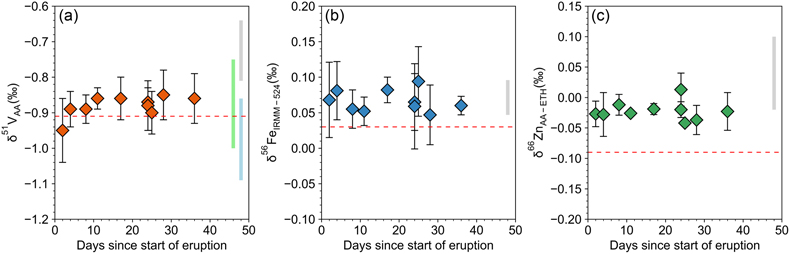
Figure 1 (a) Vanadium, (b) iron and (c) zinc isotopic compositions over the first 40 days of the eruption. Error bars are 2 s.d. of at least three measurements of each sample. Red dashed lines show estimates of the Bulk Silicate Earth (BSE); δ51VAA = −0.91 ± 0.09 ‰ (Qi et al., 2019
Qi, Y.-H., Wu, F., Ionov, D.A., Puchtel, I.S., Carlson, R.W., Nicklas, R.W., Yu, H.-M., Kang, J.-T., Li, C.-H., Huang, F. (2019) Vanadium isotope composition of the Bulk Silicate Earth: Constraints from peridotites and komatiites. Geochimica et Cosmochimica Acta 259, 288–301. https://doi.org/10.1016/j.gca.2019.06.008
), δ56FeIRMM-524 = +0.030 ± 0.007 ‰ (Sossi et al., 2016Sossi, P.A., Nebel, O., Foden, J. (2016) Iron isotope systematics in planetary reservoirs. Earth and Planetary Science Letters 452, 295–308. https://doi.org/10.1016/j.epsl.2016.07.032
) and δ66ZnAA-ETH = −0.09 ± 0.08 ‰ (Fang et al., 2022Fang, S.-B., Huang, J., Zhang, X.-C., Ionov, D.A., Zhao, Z.-F., Huang, F. (2022) Zinc isotope fractionation in mantle rocks and minerals, and a revised δ66Zn value for the Bulk Silicate Earth. Geochimica et Cosmochimica Acta 338, 79–92. https://doi.org/10.1016/j.gca.2022.10.017
). Grey vertical bands indicate the ranges of V (Prytulak et al., 2017Prytulak, J., Sossi, P.A., Halliday, A.N., Plank, T., Savage, P.S., Woodhead, J.D. (2017) Stable vanadium isotopes as a redox proxy in magmatic systems? Geochemical Perspectives Letters 3, 75–84. https://doi.org/10.7185/geochemlet.1708
), Fe (Schuessler et al., 2009Schuessler, J.A., Schoenberg, R., Sigmarsson, O. (2009) Iron and lithium isotope systematics of the Hekla volcano, Iceland — Evidence for Fe isotope fractionation during magma differentiation. Chemical Geology 258, 78–91. https://doi.org/10.1016/j.chemgeo.2008.06.021
) and Zn (Chen et al., 2013Chen, H., Savage, P.S., Teng, F.-Z., Helz, R.T., Moynier, F. (2013) Zinc isotope fractionation during magmatic differentiation and the isotopic composition of the bulk Earth. Earth and Planetary Science Letters 369–370, 34–42. https://doi.org/10.1016/j.epsl.2013.02.037
) isotopic compositions in lavas from Hekla volcano with whole rock SiO2 < 50 wt. %. Vertical blue and green bars indicate the ranges of V isotopic compositions in basalts from the Reykjanes Ridge (Novella et al., 2020Novella, D., Maclennan, J., Shorttle, O., Prytulak, J., Murton, B.J. (2020) A multi-proxy investigation of mantle oxygen fugacity along the Reykjanes Ridge. Earth and Planetary Science Letters 531, 115973. https://doi.org/10.1016/j.epsl.2019.115973
) and Reykjanes Peninsula (Prytulak et al., 2013Prytulak, J., Nielsen, S.G., Ionov, D.A., Halliday, A.N., Harvey, J., Kelley, K.A., Niu, Y.L., Peate, D.W., Shimizu, K., Sims, K.W.W. (2013) The stable vanadium isotope composition of the mantle and mafic lavas. Earth and Planetary Science Letters 365, 177–189. https://doi.org/10.1016/j.epsl.2013.01.010
).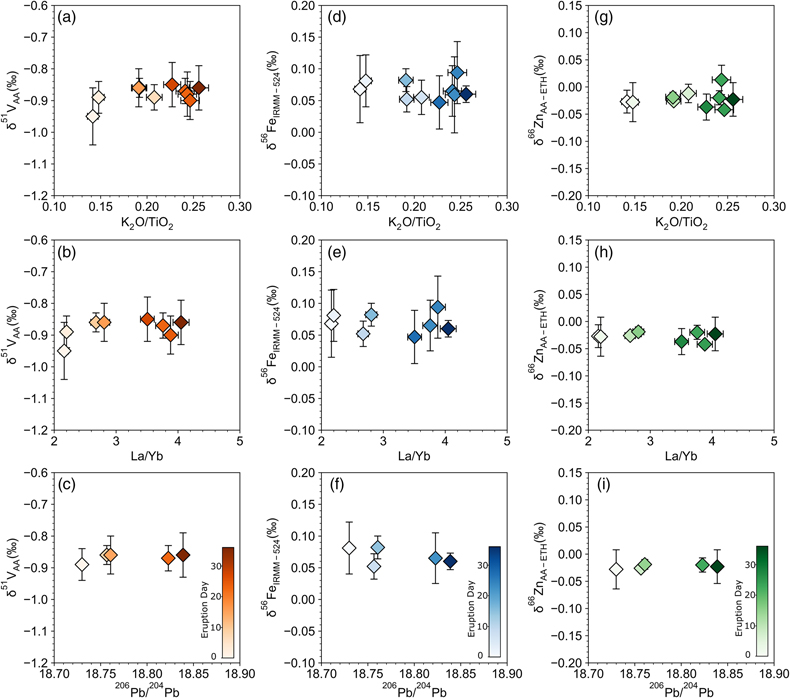
Figure 2 (a–c) Vanadium, (d–f) iron and (g–i) zinc isotopic compositions against whole rock (a, d, g) K2O/TiO2, (b, e, h) La/Yb and (c, f, i) 206Pb/204Pb from Halldórsson et al. (2022)
Halldórsson, S.A., Marshall, E.W., Caracciolo, A., Matthews, S., Bali, E., Rasmussen, M.B., Ranta, E., Robin, J.G., Guðfinnsson, G.H., Sigmarsson, O., Maclennan, J., Jackson, M.G., Whitehouse, M.J., Jeon, H., van der Meer, Q.H.A., Mibei, G.K., Kalliokoski, M.H., Repczynska, M.M., Rúnarsdóttir, R.H., Sigurðsson, G., Pfeffer, M.A., Scott, S.W., Kjartansdóttir, R., Kleine, B.I., Oppenheimer, C., Aiuppa, A., Ilyinskaya, E., Bitetto, M., Giudice, G., Stefánsson, A. (2022) Rapid shifting of a deep magmatic source at Fagradalsfjall volcano, Iceland. Nature 609, 529–534. https://doi.org/10.1038/s41586-022-04981-x
. The more enriched melts have higher La/Yb, K2O/TiO2 and 206Pb/204Pb. The colour bar indicates the day the sample was erupted. Plots of isotopic composition against Sr and Nd isotopes are shown in Figure S-4.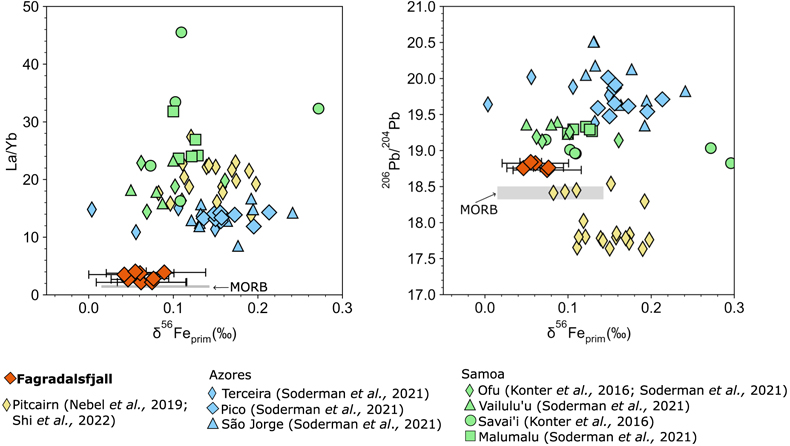
Figure 3 Iron isotopic compositions of selected ocean island basalts from the literature. The δ56Feprim values are calculated as described in the Supplementary Information. The MORB La/Yb and 206Pb/204Pb values are from Gale et al. (2013)
Gale, A., Dalton, C.A., Langmuir, C.H., Su, Y., Schilling, J.-G. (2013) The mean composition of ocean ridge basalts. Geochemistry, Geophysics, Geosystems 14, 489–518. https://doi.org/10.1029/2012GC004334
, and MORB δ56Feprim values from Sossi et al. (2016)Sossi, P.A., Nebel, O., Foden, J. (2016) Iron isotope systematics in planetary reservoirs. Earth and Planetary Science Letters 452, 295–308. https://doi.org/10.1016/j.epsl.2016.07.032
.