



A baseline for the Sn isotopic composition of the upper continental crust
Affiliations | Corresponding Author | Cite as | Funding information
Published by the European Association of Geochemistry
under Creative Commons License CC BY-NC-ND 4.0
Keywords: upper continental crust, tin stable isotopes, isotopic fractionation, glacial diamictites


- Share this article


-
Article views:3,059Cumulative count of HTML views and PDF downloads.
- Download Citation
- Rights & Permissions

top
Abstract
Figures
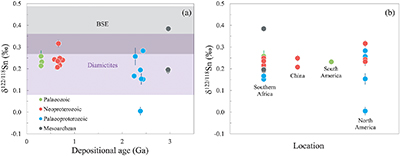 Figure 1 (a) δ122/118Sn as a function of the depositional age of the glacial diamictites. (b) δ122/118Sn of the measured glacial diamictites sorted by locations. Here and in subsequent figures, the symbols are colour coded according to the depositional age. | 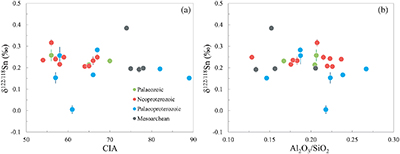 Figure 2 δ122/118Sn of glacial diamictites as a function of two indicators of chemical weathering: (a) CIA (chemical index of alteration) values and (b) Al2O3/SiO2. All elemental compositions used are from Gaschnig et al. (2016). | 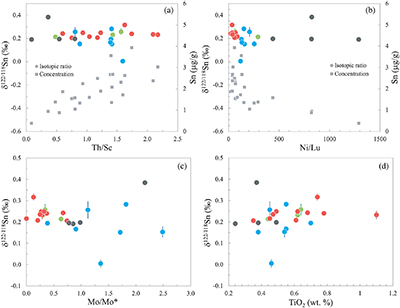 Figure 3 δ122/118Sn of glacial diamictites as a function of two differentiation indicators: (a) Th/Sc ratio, including Sn abundances in the corresponding samples, and (b) Ni/Lu ratio, as well as (c) Mo/Mo*, a proxy for oxidative weathering (Gaschnig et al., 2014) and (d) TiO2 abundance, an indicator of ilmenite crystallisation. All trace element data were compiled from Gaschnig et al. (2016). | 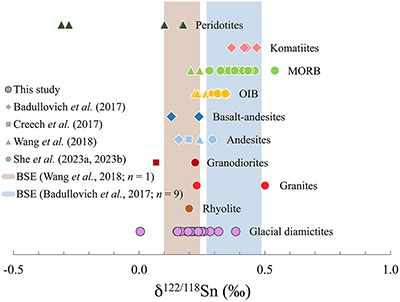 Figure 4 Tin isotopic compositions expressed as δ122/118Sn of terrestrial igneous samples (Badullovich et al., 2017; Creech et al., 2017; Wang et al., 2018; She et al., 2023a, 2023b) compared to those of glacial diamictite composites analysed in this study. |
| Figure 1 | Figure 2 | Figure 3 | Figure 4 |
top
Introduction
Continents are a combined product of both differentiation and plate tectonics (Rudnick, 1995
Rudnick, R.L. (1995) Making continental crust. Nature 378, 571–578. https://doi.org/10.1038/378571a0
), and constitute a unique feature of Earth. As a significant planetary reservoir, the mechanisms producing continental crust, as well as the chemical and physical interactions of continents with other reservoirs, are key processes that need to be defined to understand Earth as a differentiated, dynamical planet. One clue to understanding how continental crust forms comes from its bulk major and trace element composition, which is similar to that of magmas found above subduction zones (e.g., Rudnick, 1995Rudnick, R.L. (1995) Making continental crust. Nature 378, 571–578. https://doi.org/10.1038/378571a0
; Tatsumi, 2008Tatsumi, Y. (2008) Making continental crust: The sanukitoid connection. Chinese Science Bulletin 53, 1620–1633. https://doi.org/10.1007/s11434-008-0185-9
). However, the continental crust is highly heterogeneous, posing a significant challenge in estimating its average composition. Nevertheless, making such estimates is necessary to understand its origin and its contribution to element cycles within the bulk silicate Earth. Because of intracrustal differentiation, incompatible elements are concentrated in the upper continental crust (UCC), making this region the most critical for understanding the bulk crust composition. Estimates of the average composition of the UCC have primarily been obtained through two approaches: large scale bedrock sampling with grid-based averages and analyses of fine grained sedimentary rocks such as shales, loess and the matrix of glacial diamictites (e.g., Rudnick and Gao, 2014Rudnick, R.L., Gao, S. (2014) 4.1 - Composition of the Continental Crust. In: Holland, H.D., Turekian, K.K. (Eds.) Treatise on Geochemistry. Second Edition, Elsevier, Hoboken, 1–51. https://doi.org/10.1016/B978-0-08-095975-7.00301-6
; Gaschnig et al., 2016Gaschnig, R.M., Rudnick, R.L., McDonough, W.F., Kaufman, A.J., Valley, J.W., Hu, Z., Gao, S., Beck, M.L. (2016) Compositional evolution of the upper continental crust through time, as constrained by ancient glacial diamictites. Geochimica et Cosmochimica Acta 186, 316–343. https://doi.org/10.1016/j.gca.2016.03.020
).Here we use the fine grained matrix of glacial diamictites to estimate the stable isotope composition of tin (Sn) in the UCC and use these results to infer crustal formation and evolution processes. We compare this result with that of igneous rocks. This UCC estimate can be used as a baseline for studying Sn mineralisation, with implications for ore-forming processes (Zhou et al., 2022
Zhou, Z.-H., Mao, J.-W., Zhao, J.-Q., Gao, X., Weyer, S., Horn, I., Holtz, F., Sossi, P.A., Wang, D.-C. (2022) Tin isotopes as geochemical tracers of ore-forming processes with Sn mineralization. American Mineralogist 107, 2111–2127. https://doi.org/10.2138/am-2022-8200
; Wu et al., 2023Wu, J., Li, H., Mathur, R., Bouvier, A., Powell, W., Yonezu, K., Zhu, D. (2023) Compositional variation and Sn isotope fractionation of cassiterite during magmatic-hydrothermal processes. Earth and Planetary Science Letters 613, 118186. https://doi.org/10.1016/j.epsl.2023.118186
).Tin is a moderately siderophile, chalcophile and volatile element (Jochum et al., 1993
Jochum, K.P., Hofmann, A.W., Seufert, H.M. (1993) Tin in mantle-derived rocks: Constraints on Earth evolution. Geochimica et Cosmochimica Acta 57, 3585–3595. https://doi.org/10.1016/0016-7037(93)90141-I
). It exhibits incompatible and lithophile behaviour during igneous differentiation and, as such, is concentrated in the crust relative to the mantle. In magmatic systems, Sn is incompatible in most phases but compatible in ilmenite, its main host, where it exists as VI fold coordinated Sn4+ (Klemme et al., 2006Klemme, S., Günther, D., Hametner, K., Prowatke, S., Zack, T. (2006) The partitioning of trace elements between ilmenite, ulvospinel, armalcolite and silicate melts with implications for the early differentiation of the moon. Chemical Geology 234, 251–263. https://doi.org/10.1016/j.chemgeo.2006.05.005
; Rudnick and Gao, 2014Rudnick, R.L., Gao, S. (2014) 4.1 - Composition of the Continental Crust. In: Holland, H.D., Turekian, K.K. (Eds.) Treatise on Geochemistry. Second Edition, Elsevier, Hoboken, 1–51. https://doi.org/10.1016/B978-0-08-095975-7.00301-6
). Within the continental crust, Sn is concentrated in highly evolved granitic magmas derived from partial melting of metapelitic rocks (Jochum et al., 1993Jochum, K.P., Hofmann, A.W., Seufert, H.M. (1993) Tin in mantle-derived rocks: Constraints on Earth evolution. Geochimica et Cosmochimica Acta 57, 3585–3595. https://doi.org/10.1016/0016-7037(93)90141-I
). Systematic element distribution patterns in these granites point to fractional crystallisation as the main process controlling magmatic evolution and Sn enrichment (Lehmann, 2021Lehmann, B. (2021) Formation of tin ore deposits: A reassessment. Lithos 402–403, 105756. https://doi.org/10.1016/j.lithos.2020.105756
). All Sn — a medium scale “critical metal” — production originates from continental crustal ore deposits consisting of Sn granites, pegmatites and Sn porphyries (Lehmann, 2021Lehmann, B. (2021) Formation of tin ore deposits: A reassessment. Lithos 402–403, 105756. https://doi.org/10.1016/j.lithos.2020.105756
). Finally, Sn is an insoluble element that is not mobilised during chemical weathering (White, 2018White, W.M. (2018) Tin. In: White, W.M. (Ed.) Encyclopedia of Geochemistry. Springer, Cham, 1443–1445. https://doi.org/10.1007/978-3-319-39312-4_297
).Tin is concentrated in dense minerals of the continental crust, which are likely sorted during wind- or water-driven transport (Gaschnig et al., 2016
Gaschnig, R.M., Rudnick, R.L., McDonough, W.F., Kaufman, A.J., Valley, J.W., Hu, Z., Gao, S., Beck, M.L. (2016) Compositional evolution of the upper continental crust through time, as constrained by ancient glacial diamictites. Geochimica et Cosmochimica Acta 186, 316–343. https://doi.org/10.1016/j.gca.2016.03.020
), which hinders using the geochemistry of wind- or water-transported sedimentary rocks (e.g., shales, periglacial and desert loess) to obtain a robust Sn isotopic composition for the UCC. On the other hand, glacial diamictites, which are produced by mechanical erosion of the bedrock by glaciers, deposited in the form of glacial till, and subsequently lithified in a rapid and low temperature process that minimises chemical weathering (Li et al., 2016Li, S., Gaschnig, R.M., Rudnick, R.L. (2016) Insights into chemical weathering of the upper continental crust from the geochemistry of ancient glacial diamictites. Geochimica et Cosmochimica Acta 176, 96–117. https://doi.org/10.1016/j.gca.2015.12.012
), may be a useful means to estimate the Sn isotopic composition of the UCC. Tin is one of the few trace elements that shows secular increase in abundance in glacial deposits through time (Gaschnig et al., 2016Gaschnig, R.M., Rudnick, R.L., McDonough, W.F., Kaufman, A.J., Valley, J.W., Hu, Z., Gao, S., Beck, M.L. (2016) Compositional evolution of the upper continental crust through time, as constrained by ancient glacial diamictites. Geochimica et Cosmochimica Acta 186, 316–343. https://doi.org/10.1016/j.gca.2016.03.020
) due to its incompatible behaviour. Significant Sn isotope fractionation has been reported in terrestrial samples (Badullovich et al., 2017Badullovich, N., Moynier, F., Creech, J., Teng, F.-Z., Sossi, P.A. (2017) Tin isotopic fractionation during igneous differentiation and Earth’s mantle composition. Geochemical Perspectives Letters 5, 24–28. https://doi.org/10.7185/geochemlet.1741
; Wang et al., 2018Wang, X., Amet, Q., Fitoussi, C., Bourdon, B. (2018) Tin isotope fractionation during magmatic processes and the isotope composition of the bulk silicate Earth. Geochimica et Cosmochimica Acta 228, 320–335. https://doi.org/10.1016/j.gca.2018.02.014
) and in a number of geological processes such as liquid-vapour separation (She et al., 2020She, J.-X., Wang, T., Liang, H., Muhtar, M.N., Li, W., Liu, X. (2020) Sn isotope fractionation during volatilization of Sn(IV) chloride: Laboratory experiments and quantum mechanical calculations. Geochimica et Cosmochimica Acta 269, 184–202. https://doi.org/10.1016/j.gca.2019.10.033
), redox processes (Roskosz et al., 2020Roskosz, M., Amet, Q., Fitoussi, C., Dauphas, N., Bourdon, B., Tissandier, L., Hu, M.Y., Said, A., Alatas, A., Alp, E.E. (2020) Redox and structural controls on tin isotopic fractionations among magmas. Geochimica et Cosmochimica Acta 268, 42–55. https://doi.org/10.1016/j.gca.2019.09.036
), metal–silicate equilibrium (Kubik et al., 2021Kubik, E., Siebert, J., Mahan, B., Creech, J., Blanchard, I., Agranier, A., Shcheka, S., Moynier, F. (2021) Tracing Earth’s Volatile Delivery With Tin. Journal of Geophysical Research: Solid Earth 126, e2021JB022026. https://doi.org/10.1029/2021JB022026
), and hydrothermal processes (Liu et al., 2021Liu, P., Mao, J., Lehmann, B., Weyer, S., Horn, I., Mathur, R., Wang, F., Zhou, Z. (2021) Tin isotopes via fs-LA-MC-ICP-MS analysis record complex fluid evolution in single cassiterite crystals. American Mineralogist 106, 1980–1986. https://doi.org/10.2138/am-2021-7558
), indicating that Sn isotopes may be fractionated during continental crust formation. This raises the question of whether there may also be a secular evolution of the Sn isotopic composition in glacial diamictites. In this study, we use glacial diamictite composites derived from units with depositional ages spanning 3 Ga and collected from four continents to study secular changes, geographic influence, the effects of chemical weathering and magmatic differentiation on δ122/118Sn and to calculate an average Sn isotopic composition of the UCC.top
Materials and Methods
Glacial diamictites are produced by mechanical erosion of Earth’s surface by ice sheets, which dump their load upon melting. Many, though not all of the 24 diamictite composites investigated here were deposited in a shallow marine environment and are, by definition, unsorted and experienced little post-depositional weathering (Li et al., 2016
Li, S., Gaschnig, R.M., Rudnick, R.L. (2016) Insights into chemical weathering of the upper continental crust from the geochemistry of ancient glacial diamictites. Geochimica et Cosmochimica Acta 176, 96–117. https://doi.org/10.1016/j.gca.2015.12.012
). Many are unmetamorphosed, but some experienced up to greenschist facies conditions (Gaschnig et al., 2016Gaschnig, R.M., Rudnick, R.L., McDonough, W.F., Kaufman, A.J., Valley, J.W., Hu, Z., Gao, S., Beck, M.L. (2016) Compositional evolution of the upper continental crust through time, as constrained by ancient glacial diamictites. Geochimica et Cosmochimica Acta 186, 316–343. https://doi.org/10.1016/j.gca.2016.03.020
; Han et al., 2023Han, P.-Y., Rudnick, R.L., He, T., Marks, M.A.W., Wang, S.-J., Gaschnig, R.M., Hu, Z.-C. (2023) Halogen (F, Cl, Br, and I) concentrations of the upper continental crust through time as recorded in ancient glacial diamictite composites. Geochimica et Cosmochimica Acta 341, 28–45. https://doi.org/10.1016/j.gca.2022.11.012
). The diamictites have depositional ages between 2.9 and 0.3 Ga, and wide geographic origins, spanning four modern continents. These samples were previously analysed for their major and trace element compositions (Gaschnig et al., 2014Gaschnig, R.M., Rudnick, R.L., McDonough, W.F., Kaufman, A.J., Hu, Z., Gao, S. (2014) Onset of oxidative weathering of continents recorded in the geochemistry of ancient glacial diamictites. Earth and Planetary Science Letters 408, 87–99. https://doi.org/10.1016/j.epsl.2014.10.002
, 2016Gaschnig, R.M., Rudnick, R.L., McDonough, W.F., Kaufman, A.J., Valley, J.W., Hu, Z., Gao, S., Beck, M.L. (2016) Compositional evolution of the upper continental crust through time, as constrained by ancient glacial diamictites. Geochimica et Cosmochimica Acta 186, 316–343. https://doi.org/10.1016/j.gca.2016.03.020
), for their stable Li, N, O, Si, K, Ti, V, Fe, Ni, Zr, Mo, Ba, Ce isotopes, radiogenic Sm-Nd, Hf-W, Re-Os isotope compositions (full listing of these studies in Li et al., 2023Li, W., Nakada, R., Takahashi, Y., Gaschnig, R.M., Hu, Y., Shakouri, M., Rudnick, R.L., Liu, X.-M. (2023) Cerium geochemical composition of the upper continental crust through time: Implications for tracing past surface redox conditions. Geochimica et Cosmochimica Acta 359, 20–29. https://doi.org/10.1016/j.gca.2023.08.024
), and U-Pb and Lu-Hf analyses of detrital zircon (Gaschnig et al., 2022Gaschnig, R.M., Horan, M.F., Rudnick, R.L., Vervoort, J.D., Fisher, C.M. (2022) History of crustal growth in Africa and the Americas from detrital zircon and Nd isotopes in glacial diamictites. Precambrian Research 373, 106641. https://doi.org/10.1016/j.precamres.2022.106641
). These studies demonstrated that, although there is great chemical heterogeneity in the individual samples and even in the composites, the samples nevertheless can be used to estimate the average composition of the UCC (e.g., Gaschnig et al., 2016Gaschnig, R.M., Rudnick, R.L., McDonough, W.F., Kaufman, A.J., Valley, J.W., Hu, Z., Gao, S., Beck, M.L. (2016) Compositional evolution of the upper continental crust through time, as constrained by ancient glacial diamictites. Geochimica et Cosmochimica Acta 186, 316–343. https://doi.org/10.1016/j.gca.2016.03.020
).Tin purification and subsequent isotope measurements were performed in a class-100 clean room environment using class-10 laminar flow hoods at the Institut de Physique du Globe de Paris. Tin purification uses the ion exchange chromatography and measurements employ a double spike protocol described in Creech et al. (2017)
Creech, J.B., Moynier, F., Badullovich, N. (2017) Tin stable isotope analysis of geological materials by double-spike MC-ICPMS. Chemical Geology 457, 61–67. https://doi.org/10.1016/j.chemgeo.2017.03.013
. Tin isotope ratios were measured using a Thermo-Scientific Neptune Plus. The purification method and analytical parameters are detailed in the Supplementary Information.top
Results
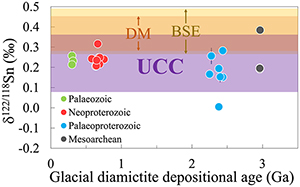
All Sn isotopic ratios herein are expressed as δ122/118Sn relative to the NIST3161a standard and uncertainties are 2 standard deviations. The glacial diamictites are generally isotopically homogeneous, except for two outliers (0.00 and 0.38 ‰), with δ122/118Sn values between 0.15 and 0.32 ‰ with an average of 0.22 ± 0.14 ‰. These values overlap with the very few measurements performed on granite and granodiorite reference materials (from 0.20 to 0.52 ‰; Creech et al., 2017
Creech, J.B., Moynier, F., Badullovich, N. (2017) Tin stable isotope analysis of geological materials by double-spike MC-ICPMS. Chemical Geology 457, 61–67. https://doi.org/10.1016/j.chemgeo.2017.03.013
; Wang et al., 2022Wang, Z.-Y., Luo, Z.-Y., Zhang, L., Liu, J.-J., Li, J. (2022) Sn Isotopic Values in Ten Geological Reference Materials by Double‐Spike MC‐ICP‐MS. Geostandards and Geoanalytical Research 46, 547–561. https://doi.org/10.1111/ggr.12443
; She et al., 2023bShe, J.-X., Li, W., An, S., Cai, Y. (2023b) High-precision double-spike Sn isotope analysis of geological materials by MC-ICP-MS. Journal of Analytical Atomic Spectrometry 38, 142–155. https://doi.org/10.1039/D2JA00339B
), and are isotopically heavier than peridotites (average of −0.03 ± 0.49 ‰; Wang et al., 2018Wang, X., Amet, Q., Fitoussi, C., Bourdon, B. (2018) Tin isotope fractionation during magmatic processes and the isotope composition of the bulk silicate Earth. Geochimica et Cosmochimica Acta 228, 320–335. https://doi.org/10.1016/j.gca.2018.02.014
).top
Discussion
Tin shows a secular increase in abundance with time in the diamictite composites (Gaschnig et al., 2016
Gaschnig, R.M., Rudnick, R.L., McDonough, W.F., Kaufman, A.J., Valley, J.W., Hu, Z., Gao, S., Beck, M.L. (2016) Compositional evolution of the upper continental crust through time, as constrained by ancient glacial diamictites. Geochimica et Cosmochimica Acta 186, 316–343. https://doi.org/10.1016/j.gca.2016.03.020
), with higher concentrations in the Neoproterozoic and Palaeozoic than Mesoarchean and Palaeoproterozoic samples. This is attributed to its incompatible behaviour and therefore preferential partitioning into melt during partial melting and crystal fractionation. Despite this increase in concentration, there is no resolvable change in the δ122/118Sn values of glacial diamictites through time (Fig. 1a). This is in agreement with the Sn isotopic ratios measured in komatiites (Badullovich et al., 2017Badullovich, N., Moynier, F., Creech, J., Teng, F.-Z., Sossi, P.A. (2017) Tin isotopic fractionation during igneous differentiation and Earth’s mantle composition. Geochemical Perspectives Letters 5, 24–28. https://doi.org/10.7185/geochemlet.1741
), which show that samples across a wide range of degrees of partial melting produce variable Sn abundances in the melts, but identical Sn isotopic compositions. Thus, the transition from mafic to felsic UCC at the end of the Archean does not translate into a change of Sn isotopic composition. This absence of secular change therefore suggests a relatively constant Sn isotopic composition of the UCC since the Mesoarchean. Moreover, there is no clear correlation between the Sn isotopic compositions of glacial diamictites and their geographic location (Fig. 1b), demonstrating a widespread spatial homogeneity of the UCC with respect to Sn isotopic compositions.Figure 1 (a) δ122/118Sn as a function of the depositional age of the glacial diamictites. (b) δ122/118Sn of the measured glacial diamictites sorted by locations. Here and in subsequent figures, the symbols are colour coded according to the depositional age.
The diamictites record variable weathering signatures, which mostly reflect the material that the glaciers sampled (Li et al., 2016
Li, S., Gaschnig, R.M., Rudnick, R.L. (2016) Insights into chemical weathering of the upper continental crust from the geochemistry of ancient glacial diamictites. Geochimica et Cosmochimica Acta 176, 96–117. https://doi.org/10.1016/j.gca.2015.12.012
). We therefore evaluated potential chemical weathering effects on Sn isotopes. Chemical weathering proxies include the chemical index of alteration (CIA, corresponding to molar Al2O3/(Al2O3 + K2O + Na2O + CaO*) with CaO* corrected to remove the contribution of apatite and carbonate) and Al2O3/SiO2 which increases due to Al2O3 enrichment during clay formation (Gaschnig et al., 2014Gaschnig, R.M., Rudnick, R.L., McDonough, W.F., Kaufman, A.J., Hu, Z., Gao, S. (2014) Onset of oxidative weathering of continents recorded in the geochemistry of ancient glacial diamictites. Earth and Planetary Science Letters 408, 87–99. https://doi.org/10.1016/j.epsl.2014.10.002
). The Sn isotopic compositions of glacial diamictites reported in this study do not correlate with any of these proxies (Fig. 2), consistent with Sn’s low solubility (White, 2018White, W.M. (2018) Tin. In: White, W.M. (Ed.) Encyclopedia of Geochemistry. Springer, Cham, 1443–1445. https://doi.org/10.1007/978-3-319-39312-4_297
) and indicating that chemical weathering did not fractionate Sn isotopes. Therefore, glacial diamictites can be used to (1) establish an average Sn isotopic composition of the UCC, and (2) study other processes influencing UCC composition, such as igneous differentiation, without these signatures being obscured by chemical weathering effects.Figure 2 δ122/118Sn of glacial diamictites as a function of two indicators of chemical weathering: (a) CIA (chemical index of alteration) values and (b) Al2O3/SiO2. All elemental compositions used are from Gaschnig et al. (2016)
Gaschnig, R.M., Rudnick, R.L., McDonough, W.F., Kaufman, A.J., Valley, J.W., Hu, Z., Gao, S., Beck, M.L. (2016) Compositional evolution of the upper continental crust through time, as constrained by ancient glacial diamictites. Geochimica et Cosmochimica Acta 186, 316–343. https://doi.org/10.1016/j.gca.2016.03.020
.The effect of the transition from mafic to more felsic crustal sources on the Sn isotopic composition of glacial diamictites was assessed using two different proxies for igneous differentiation (Fig. 3). The Th/Sc ratio can be used to distinguish mafic from felsic sources due to the compatible behaviour of Sc as opposed to the incompatible behaviour of Th, with high Th/Sc therefore indicating a granitic source. The Th/Sc of the diamictite composites increases between the Mesoarchean and Palaeoproterozoic and remains constant thereafter (Gaschnig et al., 2016
Gaschnig, R.M., Rudnick, R.L., McDonough, W.F., Kaufman, A.J., Valley, J.W., Hu, Z., Gao, S., Beck, M.L. (2016) Compositional evolution of the upper continental crust through time, as constrained by ancient glacial diamictites. Geochimica et Cosmochimica Acta 186, 316–343. https://doi.org/10.1016/j.gca.2016.03.020
) while the Ni/Lu ratio decreases exponentially from the Mesoarchean, which sampled a UCC with very high Ni abundance. There is no correlation between either of these proxies and the Sn isotopic compositions in the glacial diamictites. This indicates that Sn isotopes are largely unaffected by crustal differentiation over time and by the possible evolution of the crustal source from mafic to a more felsic composition.Figure 3 δ122/118Sn of glacial diamictites as a function of two differentiation indicators: (a) Th/Sc ratio, including Sn abundances in the corresponding samples, and (b) Ni/Lu ratio, as well as (c) Mo/Mo*, a proxy for oxidative weathering (Gaschnig et al., 2014
Gaschnig, R.M., Rudnick, R.L., McDonough, W.F., Kaufman, A.J., Hu, Z., Gao, S. (2014) Onset of oxidative weathering of continents recorded in the geochemistry of ancient glacial diamictites. Earth and Planetary Science Letters 408, 87–99. https://doi.org/10.1016/j.epsl.2014.10.002
) and (d) TiO2 abundance, an indicator of ilmenite crystallisation. All trace element data were compiled from Gaschnig et al. (2016)Gaschnig, R.M., Rudnick, R.L., McDonough, W.F., Kaufman, A.J., Valley, J.W., Hu, Z., Gao, S., Beck, M.L. (2016) Compositional evolution of the upper continental crust through time, as constrained by ancient glacial diamictites. Geochimica et Cosmochimica Acta 186, 316–343. https://doi.org/10.1016/j.gca.2016.03.020
.Two diamictite composites, Mozaan (0.38 ± 0.01 ‰) and Bruce (0.00 ± 0.02 ‰) are significant outliers in terms of their Sn isotopic signatures, though their Sn abundances are not anomalous. The Archean Mozaan diamictite contains exceptionally high Fe2O3, high magnetite content (Han et al., 2023
Han, P.-Y., Rudnick, R.L., He, T., Marks, M.A.W., Wang, S.-J., Gaschnig, R.M., Hu, Z.-C. (2023) Halogen (F, Cl, Br, and I) concentrations of the upper continental crust through time as recorded in ancient glacial diamictite composites. Geochimica et Cosmochimica Acta 341, 28–45. https://doi.org/10.1016/j.gca.2022.11.012
), low SiO2 and Al2O3 abundances, and very low δ30Si (Murphy et al., 2022Murphy, M.E., Savage, P.S., Gardiner, N.J., Prave, A.R., Gaschnig, R.M., Rudnick, R.L. (2022) Homogenising the upper continental crust: The Si isotope evolution of the crust recorded by ancient glacial diamictites. Earth and Planetary Science Letters 591, 117620. https://doi.org/10.1016/j.epsl.2022.117620
), interpreted as reflecting a significant contribution from banded Fe formation (Gaschnig et al., 2014Gaschnig, R.M., Rudnick, R.L., McDonough, W.F., Kaufman, A.J., Hu, Z., Gao, S. (2014) Onset of oxidative weathering of continents recorded in the geochemistry of ancient glacial diamictites. Earth and Planetary Science Letters 408, 87–99. https://doi.org/10.1016/j.epsl.2014.10.002
; Murphy et al., 2022Murphy, M.E., Savage, P.S., Gardiner, N.J., Prave, A.R., Gaschnig, R.M., Rudnick, R.L. (2022) Homogenising the upper continental crust: The Si isotope evolution of the crust recorded by ancient glacial diamictites. Earth and Planetary Science Letters 591, 117620. https://doi.org/10.1016/j.epsl.2022.117620
). This suggests that magnetite that precipitates from seawater may preferentially incorporate the heavy isotopes of Sn. The origin of the light Sn isotopic signature measured in the Bruce diamictite remains unclear but could be attributed to a change in redox conditions, which can translate into Sn isotopic fractionation.The Sn isotopic composition of glacial diamictite composites is not significantly influenced by chemical weathering, depositional age, geographic setting, or average UCC compositional changes due to igneous differentiation processes. The δ122/118Sn of these samples thus provide an ideal means by which to derive a robust estimate of the Sn isotopic composition of the UCC. The arithmetic mean of δ122/118Sn in all measured diamictites corresponds to 0.22 ± 0.14 ‰ (2 s.d., n = 24). This UCC Sn isotopic estimate is on the lower side but within error of the depleted mantle (0.37 ± 0.09 ‰, as sampled by mid-ocean ridge basalts; She et al., 2023a
She, J.-X., Kubik, E., Li, W., Moynier, F. (2023a) Stable Sn isotope signatures of Mid-ocean ridge basalts. Chemical Geology 622, 121347. https://doi.org/10.1016/j.chemgeo.2023.121347
), and two BSE estimates based on komatiites (0.38 ± 0.11 ‰) and a peridotite (0.17 ± 0.07 ‰) (Fig. 4).Figure 4 Tin isotopic compositions expressed as δ122/118Sn of terrestrial igneous samples (Badullovich et al., 2017
Badullovich, N., Moynier, F., Creech, J., Teng, F.-Z., Sossi, P.A. (2017) Tin isotopic fractionation during igneous differentiation and Earth’s mantle composition. Geochemical Perspectives Letters 5, 24–28. https://doi.org/10.7185/geochemlet.1741
; Creech et al., 2017Creech, J.B., Moynier, F., Badullovich, N. (2017) Tin stable isotope analysis of geological materials by double-spike MC-ICPMS. Chemical Geology 457, 61–67. https://doi.org/10.1016/j.chemgeo.2017.03.013
; Wang et al., 2018Wang, X., Amet, Q., Fitoussi, C., Bourdon, B. (2018) Tin isotope fractionation during magmatic processes and the isotope composition of the bulk silicate Earth. Geochimica et Cosmochimica Acta 228, 320–335. https://doi.org/10.1016/j.gca.2018.02.014
; She et al., 2023aShe, J.-X., Kubik, E., Li, W., Moynier, F. (2023a) Stable Sn isotope signatures of Mid-ocean ridge basalts. Chemical Geology 622, 121347. https://doi.org/10.1016/j.chemgeo.2023.121347
, 2023bShe, J.-X., Li, W., An, S., Cai, Y. (2023b) High-precision double-spike Sn isotope analysis of geological materials by MC-ICP-MS. Journal of Analytical Atomic Spectrometry 38, 142–155. https://doi.org/10.1039/D2JA00339B
) compared to those of glacial diamictite composites analysed in this study.Significant Sn isotope fractionation has been reported to occur through three igneous processes: ilmenite-melt fractionation (Badullovich et al., 2017
Badullovich, N., Moynier, F., Creech, J., Teng, F.-Z., Sossi, P.A. (2017) Tin isotopic fractionation during igneous differentiation and Earth’s mantle composition. Geochemical Perspectives Letters 5, 24–28. https://doi.org/10.7185/geochemlet.1741
), redox changes (Roskosz et al., 2020Roskosz, M., Amet, Q., Fitoussi, C., Dauphas, N., Bourdon, B., Tissandier, L., Hu, M.Y., Said, A., Alatas, A., Alp, E.E. (2020) Redox and structural controls on tin isotopic fractionations among magmas. Geochimica et Cosmochimica Acta 268, 42–55. https://doi.org/10.1016/j.gca.2019.09.036
) and during partial melting (Wang et al., 2018Wang, X., Amet, Q., Fitoussi, C., Bourdon, B. (2018) Tin isotope fractionation during magmatic processes and the isotope composition of the bulk silicate Earth. Geochimica et Cosmochimica Acta 228, 320–335. https://doi.org/10.1016/j.gca.2018.02.014
). Here, we evaluate the potential of each of these processes in establishing the Sn isotopic composition of the UCC.Ilmenite crystallisation has been proposed as a fractionating process during magmatic differentiation, based on a suite of samples from the Kilauea Iki lava lake (Badullovich et al., 2017
Badullovich, N., Moynier, F., Creech, J., Teng, F.-Z., Sossi, P.A. (2017) Tin isotopic fractionation during igneous differentiation and Earth’s mantle composition. Geochemical Perspectives Letters 5, 24–28. https://doi.org/10.7185/geochemlet.1741
). Ilmenite crystallisation is predicted to enrich silicate melts in light Sn isotopes, which could explain the observed offset between the Sn isotopic compositions of the diamictites and that of MORB and komatiites (Fig. 4). We also note identical Sn isotopic signatures measured in the basalt-andesite and andesite samples of the Kilauea suite and in the glacial diamictites. However, this process is more likely to generate intracrustal heterogeneities as opposed to fractionating Sn isotopes in the continental crust with respect to the mantle, thus shifting the bulk isotopic composition of the UCC. Indeed, in Badullovich et al. (2017)Badullovich, N., Moynier, F., Creech, J., Teng, F.-Z., Sossi, P.A. (2017) Tin isotopic fractionation during igneous differentiation and Earth’s mantle composition. Geochemical Perspectives Letters 5, 24–28. https://doi.org/10.7185/geochemlet.1741
, the differentiation suite from basalt to andesite generates a 0.20 ‰ difference between the end members which correlates with TiO2. However, the evolution of the continental crust from mafic to felsic does not produce such a trend in Sn isotopic ratios (Fig. 1a) and Sn isotopes do not correlate with TiO2 (Fig. 3d). In fact, the Sn isotopic variability within our data set, excluding outliers, is <0.20 ‰ as the diamictites range from 0.15 to 0.32 ‰, suggesting that ilmenite crystallisation did not play a major role in fractionating the Sn isotopic composition of the continental crust from the mantle.First principle calculations (Wang et al., 2021
Wang, T., She, J.-X., Yin, K., Wang, K., Zhang, Y., Lu, X., Liu, X., Li, W. (2021) Sn(II) chloride speciation and equilibrium Sn isotope fractionation under hydrothermal conditions: A first principles study. Geochimica et Cosmochimica Acta 300, 25–43. https://doi.org/10.1016/j.gca.2021.02.023
) and nuclear resonant inelastic X-ray scattering studies (Polyakov et al., 2005Polyakov, V.B., Mineev, S.D., Clayton, R.N., Hu, G., Mineev, K.S. (2005) Determination of tin equilibrium isotope fractionation factors from synchrotron radiation experiments. Geochimica et Cosmochimica Acta 69, 5531–5536. https://doi.org/10.1016/j.gca.2005.07.010
; Roskosz et al., 2020Roskosz, M., Amet, Q., Fitoussi, C., Dauphas, N., Bourdon, B., Tissandier, L., Hu, M.Y., Said, A., Alatas, A., Alp, E.E. (2020) Redox and structural controls on tin isotopic fractionations among magmas. Geochimica et Cosmochimica Acta 268, 42–55. https://doi.org/10.1016/j.gca.2019.09.036
) have also shown that the force constants of Sn substantially increase from Sn2+- to Sn4+-bearing materials, implying that heavy Sn isotopes are enriched in Sn4+- relative to Sn2+-bearing materials. As Sn4+ is more incompatible than Sn2+, the continental crust ought to be enriched in heavy Sn isotopes compared to MORB. However, the UCC Sn isotopic estimate derived from our measurements is within error of MORB samples (Fig. 4) and depleted mantle estimates (She et al., 2023aShe, J.-X., Kubik, E., Li, W., Moynier, F. (2023a) Stable Sn isotope signatures of Mid-ocean ridge basalts. Chemical Geology 622, 121347. https://doi.org/10.1016/j.chemgeo.2023.121347
). This suggests that the isotopic fractionation identified from different Sn force constants measured between Sn4+- and Sn2+-bearing synthesised melts (Roskosz et al., 2020Roskosz, M., Amet, Q., Fitoussi, C., Dauphas, N., Bourdon, B., Tissandier, L., Hu, M.Y., Said, A., Alatas, A., Alp, E.E. (2020) Redox and structural controls on tin isotopic fractionations among magmas. Geochimica et Cosmochimica Acta 268, 42–55. https://doi.org/10.1016/j.gca.2019.09.036
) is not the main process establishing the Sn isotopic composition of the UCC. Additionally, we tested the influence of oxidative weathering on the Sn isotopic composition of the diamictites (Gaschnig et al., 2014Gaschnig, R.M., Rudnick, R.L., McDonough, W.F., Kaufman, A.J., Hu, Z., Gao, S. (2014) Onset of oxidative weathering of continents recorded in the geochemistry of ancient glacial diamictites. Earth and Planetary Science Letters 408, 87–99. https://doi.org/10.1016/j.epsl.2014.10.002
). There is no correlation between our data and Mo/Mo* (Fig. 3c) demonstrating that the Sn isotopic composition of the diamictites is not affected by secondary redox related processes.The fractionation of Sn isotopes during partial melting has been proposed based on the observed offset between the isotopic composition of basalts and peridotites (Wang et al., 2018
Wang, X., Amet, Q., Fitoussi, C., Bourdon, B. (2018) Tin isotope fractionation during magmatic processes and the isotope composition of the bulk silicate Earth. Geochimica et Cosmochimica Acta 228, 320–335. https://doi.org/10.1016/j.gca.2018.02.014
). However, the melt products appear to be unaffected by the percentage of partial melting, as the Sn isotopic compositions across a series of komatiites reflecting a wide range of degrees of melting (Badullovich et al., 2017Badullovich, N., Moynier, F., Creech, J., Teng, F.-Z., Sossi, P.A. (2017) Tin isotopic fractionation during igneous differentiation and Earth’s mantle composition. Geochemical Perspectives Letters 5, 24–28. https://doi.org/10.7185/geochemlet.1741
), and MORB from ridges with very different spreading rates (She et al., 2023aShe, J.-X., Kubik, E., Li, W., Moynier, F. (2023a) Stable Sn isotope signatures of Mid-ocean ridge basalts. Chemical Geology 622, 121347. https://doi.org/10.1016/j.chemgeo.2023.121347
) are similar. The currently limited data available for Sn isotopic ratios in peridotites shows a large variability that hampers deciphering magmatic processes. Moreover, our Sn isotope UCC estimate based on glacial diamictite analysis — which is constant through time and uncorrelated to any proxy — suggests that the continental crust was formed from a source that had a constant bulk Sn isotopic composition, not significantly different from that of the UCC. The BSE is therefore likely to have a similar signature to the depleted mantle, in agreement with the identical estimates of the depleted MORB mantle (0.37 ± 0.09 ‰; She et al., 2023aShe, J.-X., Kubik, E., Li, W., Moynier, F. (2023a) Stable Sn isotope signatures of Mid-ocean ridge basalts. Chemical Geology 622, 121347. https://doi.org/10.1016/j.chemgeo.2023.121347
) and BSE of Badullovich et al. (2017)Badullovich, N., Moynier, F., Creech, J., Teng, F.-Z., Sossi, P.A. (2017) Tin isotopic fractionation during igneous differentiation and Earth’s mantle composition. Geochemical Perspectives Letters 5, 24–28. https://doi.org/10.7185/geochemlet.1741
corresponding to 0.38 ± 0.11 ‰. Both these estimates largely overlap within error with the proposed UCC estimate derived from our measurements. Measurements of Zr isotopes in the glacial diamictites also yield compositions that are constant through time but slightly heavier than the BSE, which has been interpreted as a large scale mixing of isotopically heavy felsic material with isotopically light mantle-like mafic material (Tian et al., 2021Tian, S., Moynier, F., Inglis, E.C., Rudnick, R.L., Huang, F., Chauvel, C., Creech, J.B., Gaschnig, R.M., Wang, Z., Guo, J.-L. (2021) Zirconium isotopic composition of the upper continental crust through time. Earth and Planetary Science Letters 572, 117086. https://doi.org/10.1016/j.epsl.2021.117086
). In the case of Sn, available data for felsic igneous rocks (Fig. 4) are not particularly isotopically light, suggesting that such a mixing process is not required to explain the slightly isotopically light signature of the UCC. However, very few data are available for evolved igneous rocks and future studies on this topic are expected to bring new insight regarding Sn isotope behaviour in igneous rocks.top
Synthesis
We propose a new estimate for the Sn isotopic composition of the UCC based on high precision measurements of glacial diamictite composites of 0.22 ± 0.14 ‰ (2 s.d., n = 24). The Sn isotopic composition of the diamictites is not influenced by chemical weathering, depositional age, geographic setting, igneous differentiation or any of the previously reported Sn-fractionating processes. Our data suggest limited fractionation between the BSE, the depleted MORB mantle and the UCC, in agreement with previous studies investigating Sn isotope behaviour in magmatic processes (Badullovich et al., 2017
Badullovich, N., Moynier, F., Creech, J., Teng, F.-Z., Sossi, P.A. (2017) Tin isotopic fractionation during igneous differentiation and Earth’s mantle composition. Geochemical Perspectives Letters 5, 24–28. https://doi.org/10.7185/geochemlet.1741
; Creech et al., 2017Creech, J.B., Moynier, F., Badullovich, N. (2017) Tin stable isotope analysis of geological materials by double-spike MC-ICPMS. Chemical Geology 457, 61–67. https://doi.org/10.1016/j.chemgeo.2017.03.013
; She et al., 2023aShe, J.-X., Kubik, E., Li, W., Moynier, F. (2023a) Stable Sn isotope signatures of Mid-ocean ridge basalts. Chemical Geology 622, 121347. https://doi.org/10.1016/j.chemgeo.2023.121347
, 2023bShe, J.-X., Li, W., An, S., Cai, Y. (2023b) High-precision double-spike Sn isotope analysis of geological materials by MC-ICP-MS. Journal of Analytical Atomic Spectrometry 38, 142–155. https://doi.org/10.1039/D2JA00339B
). Moreover, our estimate for the UCC Sn isotopic composition provides a useful baseline to study isotope fractionation during cassiterite crystallisation (Wu et al., 2023Wu, J., Li, H., Mathur, R., Bouvier, A., Powell, W., Yonezu, K., Zhu, D. (2023) Compositional variation and Sn isotope fractionation of cassiterite during magmatic-hydrothermal processes. Earth and Planetary Science Letters 613, 118186. https://doi.org/10.1016/j.epsl.2023.118186
) with direct applications for tracing Sn mineralisations (Zhou et al., 2022Zhou, Z.-H., Mao, J.-W., Zhao, J.-Q., Gao, X., Weyer, S., Horn, I., Holtz, F., Sossi, P.A., Wang, D.-C. (2022) Tin isotopes as geochemical tracers of ore-forming processes with Sn mineralization. American Mineralogist 107, 2111–2127. https://doi.org/10.2138/am-2022-8200
).top
Acknowledgements
The authors thank two anonymous reviewers and editor Raúl Fonseca for their detailed reviews which greatly improved our manuscript. We thank Pascale Louvat and Dimitri Rigoussen for their technical support during MC-ICP-MS measurements. FM acknowledges funding from the ERC METAL (No. 101001282) and the UnivEarthS Labex program (ANR-10-LABX-0023 and ANR-11-IDEX-0005-02). This research work was supported by the IPGP analytical platform PARI, region Île-de-France SESAME Grant No. 12015908 and DIM ACAV+.
top
References
Badullovich, N., Moynier, F., Creech, J., Teng, F.-Z., Sossi, P.A. (2017) Tin isotopic fractionation during igneous differentiation and Earth’s mantle composition. Geochemical Perspectives Letters 5, 24–28. https://doi.org/10.7185/geochemlet.1741
 Show in context
 Tin is one of the few trace elements that shows secular increase in abundance in glacial deposits through time (Gaschnig et al., 2016) due to its incompatible behaviour. Significant Sn isotope fractionation has been reported in terrestrial samples (Badullovich et al., 2017; Wang et al., 2018) and in a number of geological processes such as liquid-vapour separation (She et al., 2020), redox processes (Roskosz et al., 2020), metal–silicate equilibrium (Kubik et al., 2021), and hydrothermal processes (Liu et al., 2021), indicating that Sn isotopes may be fractionated during continental crust formation.
View in article
This is in agreement with the Sn isotopic ratios measured in komatiites (Badullovich et al., 2017), which show that samples across a wide range of degrees of partial melting produce variable Sn abundances in the melts, but identical Sn isotopic compositions.
View in article
Tin isotopic compositions expressed as δ122/118Sn of terrestrial igneous samples (Badullovich et al., 2017; Creech et al., 2017; Wang et al., 2018; She et al., 2023a, 2023b) compared to those of glacial diamictite composites analysed in this study.
View in article
Significant Sn isotope fractionation has been reported to occur through three igneous processes: ilmenite-melt fractionation (Badullovich et al., 2017), redox changes (Roskosz et al., 2020) and during partial melting (Wang et al., 2018).
View in article
Ilmenite crystallisation has been proposed as a fractionating process during magmatic differentiation, based on a suite of samples from the Kilauea Iki lava lake (Badullovich et al., 2017).
View in article
Indeed, in Badullovich et al. (2017), the differentiation suite from basalt to andesite generates a 0.20 ‰ difference between the end members which correlates with TiO2
View in article
However, the melt products appear to be unaffected by the percentage of partial melting, as the Sn isotopic compositions across a series of komatiites reflecting a wide range of degrees of melting (Badullovich et al., 2017), and MORB from ridges with very different spreading rates (She et al., 2023a) are similar.
View in article
The BSE is therefore likely to have a similar signature to the depleted mantle, in agreement with the identical estimates of the depleted MORB mantle (0.37 ± 0.09 ‰; She et al., 2023a) and BSE of Badullovich et al. (2017) corresponding to 0.38 ± 0.11 ‰.
View in article
Our data suggest limited fractionation between the BSE, the depleted MORB mantle and the UCC, in agreement with previous studies investigating Sn isotope behaviour in magmatic processes (Badullovich et al., 2017; Creech et al., 2017; She et al., 2023a, 2023b).
View in article
Creech, J.B., Moynier, F., Badullovich, N. (2017) Tin stable isotope analysis of geological materials by double-spike MC-ICPMS. Chemical Geology 457, 61–67. https://doi.org/10.1016/j.chemgeo.2017.03.013
Show in context Tin purification uses the ion exchange chromatography and measurements employ a double spike protocol described in Creech et al. (2017).
View in article
These values overlap with the very few measurements performed on granite and granodiorite reference materials (from 0.20 to 0.52 ‰; Creech et al., 2017; Wang et al., 2022; She et al., 2023b), and are isotopically heavier than peridotites (average of −0.03 ± 0.49 ‰; Wang et al., 2018).
View in article
Tin isotopic compositions expressed as δ122/118Sn of terrestrial igneous samples (Badullovich et al., 2017; Creech et al., 2017; Wang et al., 2018; She et al., 2023a, 2023b) compared to those of glacial diamictite composites analysed in this study.
View in article
Our data suggest limited fractionation between the BSE, the depleted MORB mantle and the UCC, in agreement with previous studies investigating Sn isotope behaviour in magmatic processes (Badullovich et al., 2017; Creech et al., 2017; She et al., 2023a, 2023b).
View in article
Gaschnig, R.M., Rudnick, R.L., McDonough, W.F., Kaufman, A.J., Hu, Z., Gao, S. (2014) Onset of oxidative weathering of continents recorded in the geochemistry of ancient glacial diamictites. Earth and Planetary Science Letters 408, 87–99. https://doi.org/10.1016/j.epsl.2014.10.002
Show in context The diamictites have depositional ages between 2.9 and 0.3 Ga, and wide geographic origins, spanning four modern continents. These samples were previously analysed for their major and trace element compositions (Gaschnig et al., 2014, 2016), for their stable Li, N, O, Si, K, Ti, V, Fe, Ni, Zr, Mo, Ba, Ce isotopes, radiogenic Sm-Nd, Hf-W, Re-Os isotope compositions (full listing of these studies in Li et al., 2023), and U-Pb and Lu-Hf analyses of detrital zircon (Gaschnig et al., 2022).
View in article
Chemical weathering proxies include the chemical index of alteration (CIA, corresponding to molar Al2O3/(Al2O3 + K2O + Na2O + CaO*) with CaO* corrected to remove the contribution of apatite and carbonate) and Al2O3/SiO2 which increases due to Al2O3 enrichment during clay formation (Gaschnig et al., 2014).
View in article
(a) Th/Sc ratio, including Sn abundances in the corresponding samples, and (b) Ni/Lu ratio, as well as (c) Mo/Mo*, a proxy for oxidative weathering (Gaschnig et al., 2014) and (d) TiO2 abundance, an indicator of ilmenite crystallisation.
View in article
The Archean Mozaan diamictite contains exceptionally high Fe2O3, high magnetite content (Han et al., 2023), low SiO2 and Al2O3 abundances, and very low δ30Si (Murphy et al., 2022), interpreted as reflecting a significant contribution from banded Fe formation (Gaschnig et al., 2014; Murphy et al., 2022).
View in article
Additionally, we tested the influence of oxidative weathering on the Sn isotopic composition of the diamictites (Gaschnig et al., 2014).
View in article
Gaschnig, R.M., Rudnick, R.L., McDonough, W.F., Kaufman, A.J., Valley, J.W., Hu, Z., Gao, S., Beck, M.L. (2016) Compositional evolution of the upper continental crust through time, as constrained by ancient glacial diamictites. Geochimica et Cosmochimica Acta 186, 316–343. https://doi.org/10.1016/j.gca.2016.03.020
Show in context Estimates of the average composition of the UCC have primarily been obtained through two approaches: large scale bedrock sampling with grid-based averages and analyses of fine grained sedimentary rocks such as shales, loess and the matrix of glacial diamictites (e.g., Rudnick and Gao, 2014; Gaschnig et al., 2016).
View in article
Tin is concentrated in dense minerals of the continental crust, which are likely sorted during wind- or water-driven transport (Gaschnig et al., 2016), which hinders using the geochemistry of wind- or water-transported sedimentary rocks (e.g., shales, periglacial and desert loess) to obtain a robust Sn isotopic composition for the UCC.
View in article
Tin is one of the few trace elements that shows secular increase in abundance in glacial deposits through time (Gaschnig et al., 2016) due to its incompatible behaviour. Significant Sn isotope fractionation has been reported in terrestrial samples (Badullovich et al., 2017; Wang et al., 2018) and in a number of geological processes such as liquid-vapour separation (She et al., 2020), redox processes (Roskosz et al., 2020), metal–silicate equilibrium (Kubik et al., 2021), and hydrothermal processes (Liu et al., 2021), indicating that Sn isotopes may be fractionated during continental crust formation.
View in article
Many are unmetamorphosed, but some experienced up to greenschist facies conditions (Gaschnig et al., 2016; Han et al., 2023).
View in article
The diamictites have depositional ages between 2.9 and 0.3 Ga, and wide geographic origins, spanning four modern continents. These samples were previously analysed for their major and trace element compositions (Gaschnig et al., 2014, 2016), for their stable Li, N, O, Si, K, Ti, V, Fe, Ni, Zr, Mo, Ba, Ce isotopes, radiogenic Sm-Nd, Hf-W, Re-Os isotope compositions (full listing of these studies in Li et al., 2023), and U-Pb and Lu-Hf analyses of detrital zircon (Gaschnig et al., 2022).
View in article
These studies demonstrated that, although there is great chemical heterogeneity in the individual samples and even in the composites, the samples nevertheless can be used to estimate the average composition of the UCC (e.g., Gaschnig et al., 2016).
View in article
Tin shows a secular increase in abundance with time in the diamictite composites (Gaschnig et al., 2016), with higher concentrations in the Neoproterozoic and Palaeozoic than Mesoarchean and Palaeoproterozoic samples.
View in article
All elemental compositions used are from Gaschnig et al. (2016).
View in article
The Th/Sc of the diamictite composites increases between the Mesoarchean and Palaeoproterozoic and remains constant thereafter (Gaschnig et al., 2016) while the Ni/Lu ratio decreases exponentially from the Mesoarchean, which sampled a UCC with very high Ni abundance.
View in article
All trace element data were compiled from Gaschnig et al. (2016).
View in article
Gaschnig, R.M., Horan, M.F., Rudnick, R.L., Vervoort, J.D., Fisher, C.M. (2022) History of crustal growth in Africa and the Americas from detrital zircon and Nd isotopes in glacial diamictites. Precambrian Research 373, 106641. https://doi.org/10.1016/j.precamres.2022.106641
Show in context The diamictites have depositional ages between 2.9 and 0.3 Ga, and wide geographic origins, spanning four modern continents. These samples were previously analysed for their major and trace element compositions (Gaschnig et al., 2014, 2016), for their stable Li, N, O, Si, K, Ti, V, Fe, Ni, Zr, Mo, Ba, Ce isotopes, radiogenic Sm-Nd, Hf-W, Re-Os isotope compositions (full listing of these studies in Li et al., 2023), and U-Pb and Lu-Hf analyses of detrital zircon (Gaschnig et al., 2022).
View in article
Han, P.-Y., Rudnick, R.L., He, T., Marks, M.A.W., Wang, S.-J., Gaschnig, R.M., Hu, Z.-C. (2023) Halogen (F, Cl, Br, and I) concentrations of the upper continental crust through time as recorded in ancient glacial diamictite composites. Geochimica et Cosmochimica Acta 341, 28–45. https://doi.org/10.1016/j.gca.2022.11.012
Show in context Many are unmetamorphosed, but some experienced up to greenschist facies conditions (Gaschnig et al., 2016; Han et al., 2023).
View in article
The Archean Mozaan diamictite contains exceptionally high Fe2O3, high magnetite content (Han et al., 2023), low SiO2 and Al2O3 abundances, and very low δ30Si (Murphy et al., 2022), interpreted as reflecting a significant contribution from banded Fe formation (Gaschnig et al., 2014; Murphy et al., 2022).
View in article
Jochum, K.P., Hofmann, A.W., Seufert, H.M. (1993) Tin in mantle-derived rocks: Constraints on Earth evolution. Geochimica et Cosmochimica Acta 57, 3585–3595. https://doi.org/10.1016/0016-7037(93)90141-I
Show in context Tin is a moderately siderophile, chalcophile and volatile element (Jochum et al., 1993).
View in article
Within the continental crust, Sn is concentrated in highly evolved granitic magmas derived from partial melting of metapelitic rocks (Jochum et al., 1993).
View in article
Klemme, S., Günther, D., Hametner, K., Prowatke, S., Zack, T. (2006) The partitioning of trace elements between ilmenite, ulvospinel, armalcolite and silicate melts with implications for the early differentiation of the moon. Chemical Geology 234, 251–263. https://doi.org/10.1016/j.chemgeo.2006.05.005
Show in context In magmatic systems, Sn is incompatible in most phases but compatible in ilmenite, its main host, where it exists as VI fold coordinated Sn4+ (Klemme et al., 2006; Rudnick and Gao, 2014).
View in article
Kubik, E., Siebert, J., Mahan, B., Creech, J., Blanchard, I., Agranier, A., Shcheka, S., Moynier, F. (2021) Tracing Earth’s Volatile Delivery With Tin. Journal of Geophysical Research: Solid Earth 126, e2021JB022026. https://doi.org/10.1029/2021JB022026
Show in context Tin is one of the few trace elements that shows secular increase in abundance in glacial deposits through time (Gaschnig et al., 2016) due to its incompatible behaviour. Significant Sn isotope fractionation has been reported in terrestrial samples (Badullovich et al., 2017; Wang et al., 2018) and in a number of geological processes such as liquid-vapour separation (She et al., 2020), redox processes (Roskosz et al., 2020), metal–silicate equilibrium (Kubik et al., 2021), and hydrothermal processes (Liu et al., 2021), indicating that Sn isotopes may be fractionated during continental crust formation.
View in article
Lehmann, B. (2021) Formation of tin ore deposits: A reassessment. Lithos 402–403, 105756. https://doi.org/10.1016/j.lithos.2020.105756
Show in context Systematic element distribution patterns in these granites point to fractional crystallisation as the main process controlling magmatic evolution and Sn enrichment (Lehmann, 2021).
View in article
All Sn — a medium scale “critical metal” — production originates from continental crustal ore deposits consisting of Sn granites, pegmatites and Sn porphyries (Lehmann, 2021).
View in article
Li, S., Gaschnig, R.M., Rudnick, R.L. (2016) Insights into chemical weathering of the upper continental crust from the geochemistry of ancient glacial diamictites. Geochimica et Cosmochimica Acta 176, 96–117. https://doi.org/10.1016/j.gca.2015.12.012
Show in context On the other hand, glacial diamictites, which are produced by mechanical erosion of the bedrock by glaciers, deposited in the form of glacial till, and subsequently lithified in a rapid and low temperature process that minimises chemical weathering (Li et al., 2016), may be a useful means to estimate the Sn isotopic composition of the UCC.
View in article
Many, though not all of the 24 diamictite composites investigated here were deposited in a shallow marine environment and are, by definition, unsorted and experienced little post-depositional weathering (Li et al., 2016).
View in article
The diamictites record variable weathering signatures, which mostly reflect the material that the glaciers sampled (Li et al., 2016).
View in article
Li, W., Nakada, R., Takahashi, Y., Gaschnig, R.M., Hu, Y., Shakouri, M., Rudnick, R.L., Liu, X.-M. (2023) Cerium geochemical composition of the upper continental crust through time: Implications for tracing past surface redox conditions. Geochimica et Cosmochimica Acta 359, 20–29. https://doi.org/10.1016/j.gca.2023.08.024
Show in context The diamictites have depositional ages between 2.9 and 0.3 Ga, and wide geographic origins, spanning four modern continents. These samples were previously analysed for their major and trace element compositions (Gaschnig et al., 2014, 2016), for their stable Li, N, O, Si, K, Ti, V, Fe, Ni, Zr, Mo, Ba, Ce isotopes, radiogenic Sm-Nd, Hf-W, Re-Os isotope compositions (full listing of these studies in Li et al., 2023), and U-Pb and Lu-Hf analyses of detrital zircon (Gaschnig et al., 2022).
View in article
Liu, P., Mao, J., Lehmann, B., Weyer, S., Horn, I., Mathur, R., Wang, F., Zhou, Z. (2021) Tin isotopes via fs-LA-MC-ICP-MS analysis record complex fluid evolution in single cassiterite crystals. American Mineralogist 106, 1980–1986. https://doi.org/10.2138/am-2021-7558
Show in context Tin is one of the few trace elements that shows secular increase in abundance in glacial deposits through time (Gaschnig et al., 2016) due to its incompatible behaviour. Significant Sn isotope fractionation has been reported in terrestrial samples (Badullovich et al., 2017; Wang et al., 2018) and in a number of geological processes such as liquid-vapour separation (She et al., 2020), redox processes (Roskosz et al., 2020), metal–silicate equilibrium (Kubik et al., 2021), and hydrothermal processes (Liu et al., 2021), indicating that Sn isotopes may be fractionated during continental crust formation.
View in article
Murphy, M.E., Savage, P.S., Gardiner, N.J., Prave, A.R., Gaschnig, R.M., Rudnick, R.L. (2022) Homogenising the upper continental crust: The Si isotope evolution of the crust recorded by ancient glacial diamictites. Earth and Planetary Science Letters 591, 117620. https://doi.org/10.1016/j.epsl.2022.117620
Show in context The Archean Mozaan diamictite contains exceptionally high Fe2O3, high magnetite content (Han et al., 2023), low SiO2 and Al2O3 abundances, and very low δ30Si (Murphy et al., 2022), interpreted as reflecting a significant contribution from banded Fe formation (Gaschnig et al., 2014; Murphy et al., 2022).
View in article
Polyakov, V.B., Mineev, S.D., Clayton, R.N., Hu, G., Mineev, K.S. (2005) Determination of tin equilibrium isotope fractionation factors from synchrotron radiation experiments. Geochimica et Cosmochimica Acta 69, 5531–5536. https://doi.org/10.1016/j.gca.2005.07.010
Show in context First principle calculations (Wang et al., 2021) and nuclear resonant inelastic X-ray scattering studies (Polyakov et al., 2005; Roskosz et al., 2020) have also shown that the force constants of Sn substantially increase from Sn2+- to Sn4+-bearing materials, implying that heavy Sn isotopes are enriched in Sn4+- relative to Sn2+-bearing materials.
View in article
Roskosz, M., Amet, Q., Fitoussi, C., Dauphas, N., Bourdon, B., Tissandier, L., Hu, M.Y., Said, A., Alatas, A., Alp, E.E. (2020) Redox and structural controls on tin isotopic fractionations among magmas. Geochimica et Cosmochimica Acta 268, 42–55. https://doi.org/10.1016/j.gca.2019.09.036
Show in context Tin is one of the few trace elements that shows secular increase in abundance in glacial deposits through time (Gaschnig et al., 2016) due to its incompatible behaviour. Significant Sn isotope fractionation has been reported in terrestrial samples (Badullovich et al., 2017; Wang et al., 2018) and in a number of geological processes such as liquid-vapour separation (She et al., 2020), redox processes (Roskosz et al., 2020), metal–silicate equilibrium (Kubik et al., 2021), and hydrothermal processes (Liu et al., 2021), indicating that Sn isotopes may be fractionated during continental crust formation.
View in article
Significant Sn isotope fractionation has been reported to occur through three igneous processes: ilmenite-melt fractionation (Badullovich et al., 2017), redox changes (Roskosz et al., 2020) and during partial melting (Wang et al., 2018).
View in article
First principle calculations (Wang et al., 2021) and nuclear resonant inelastic X-ray scattering studies (Polyakov et al., 2005; Roskosz et al., 2020) have also shown that the force constants of Sn substantially increase from Sn2+- to Sn4+-bearing materials, implying that heavy Sn isotopes are enriched in Sn4+- relative to Sn2+-bearing materials.
View in article
This suggests that the isotopic fractionation identified from different Sn force constants measured between Sn4+- and Sn2+-bearing synthesised melts (Roskosz et al., 2020) is not the main process establishing the Sn isotopic composition of the UCC.
View in article
Rudnick, R.L. (1995) Making continental crust. Nature 378, 571–578. https://doi.org/10.1038/378571a0
Show in context Continents are a combined product of both differentiation and plate tectonics (Rudnick, 1995), and constitute a unique feature of Earth.
View in article
One clue to understanding how continental crust forms comes from its bulk major and trace element composition, which is similar to that of magmas found above subduction zones (e.g., Rudnick, 1995; Tatsumi, 2008).
View in article
Rudnick, R.L., Gao, S. (2014) 4.1 - Composition of the Continental Crust. In: Holland, H.D., Turekian, K.K. (Eds.) Treatise on Geochemistry. Second Edition, Elsevier, Hoboken, 1–51. https://doi.org/10.1016/B978-0-08-095975-7.00301-6
Show in context Estimates of the average composition of the UCC have primarily been obtained through two approaches: large scale bedrock sampling with grid-based averages and analyses of fine grained sedimentary rocks such as shales, loess and the matrix of glacial diamictites (e.g., Rudnick and Gao, 2014; Gaschnig et al., 2016).
View in article
In magmatic systems, Sn is incompatible in most phases but compatible in ilmenite, its main host, where it exists as VI fold coordinated Sn4+ (Klemme et al., 2006; Rudnick and Gao, 2014).
View in article
She, J.-X., Wang, T., Liang, H., Muhtar, M.N., Li, W., Liu, X. (2020) Sn isotope fractionation during volatilization of Sn(IV) chloride: Laboratory experiments and quantum mechanical calculations. Geochimica et Cosmochimica Acta 269, 184–202. https://doi.org/10.1016/j.gca.2019.10.033
Show in context Tin is one of the few trace elements that shows secular increase in abundance in glacial deposits through time (Gaschnig et al., 2016) due to its incompatible behaviour. Significant Sn isotope fractionation has been reported in terrestrial samples (Badullovich et al., 2017; Wang et al., 2018) and in a number of geological processes such as liquid-vapour separation (She et al., 2020), redox processes (Roskosz et al., 2020), metal–silicate equilibrium (Kubik et al., 2021), and hydrothermal processes (Liu et al., 2021), indicating that Sn isotopes may be fractionated during continental crust formation.
View in article
She, J.-X., Kubik, E., Li, W., Moynier, F. (2023a) Stable Sn isotope signatures of Mid-ocean ridge basalts. Chemical Geology 622, 121347. https://doi.org/10.1016/j.chemgeo.2023.121347
Show in context This UCC Sn isotopic estimate is on the lower side but within error of the depleted mantle (0.37 ± 0.09 ‰, as sampled by mid-ocean ridge basalts; She et al., 2023a), and two BSE estimates based on komatiites (0.38 ± 0.11 ‰) and a peridotite (0.17 ± 0.07 ‰) (Fig. 4).
View in article
Tin isotopic compositions expressed as δ122/118Sn of terrestrial igneous samples (Badullovich et al., 2017; Creech et al., 2017; Wang et al., 2018; She et al., 2023a, 2023b) compared to those of glacial diamictite composites analysed in this study.
View in article
However, the UCC Sn isotopic estimate derived from our measurements is within error of MORB samples (Fig. 4) and depleted mantle estimates (She et al., 2023a).
View in article
However, the melt products appear to be unaffected by the percentage of partial melting, as the Sn isotopic compositions across a series of komatiites reflecting a wide range of degrees of melting (Badullovich et al., 2017), and MORB from ridges with very different spreading rates (She et al., 2023a) are similar.
View in article
The BSE is therefore likely to have a similar signature to the depleted mantle, in agreement with the identical estimates of the depleted MORB mantle (0.37 ± 0.09 ‰; She et al., 2023a) and BSE of Badullovich et al. (2017) corresponding to 0.38 ± 0.11 ‰.
View in article
Our data suggest limited fractionation between the BSE, the depleted MORB mantle and the UCC, in agreement with previous studies investigating Sn isotope behaviour in magmatic processes (Badullovich et al., 2017; Creech et al., 2017; She et al., 2023a, 2023b).
View in article
She, J.-X., Li, W., An, S., Cai, Y. (2023b) High-precision double-spike Sn isotope analysis of geological materials by MC-ICP-MS. Journal of Analytical Atomic Spectrometry 38, 142–155. https://doi.org/10.1039/D2JA00339B
Show in context These values overlap with the very few measurements performed on granite and granodiorite reference materials (from 0.20 to 0.52 ‰; Creech et al., 2017; Wang et al., 2022; She et al., 2023b), and are isotopically heavier than peridotites (average of −0.03 ± 0.49 ‰; Wang et al., 2018).
View in article
Tin isotopic compositions expressed as δ122/118Sn of terrestrial igneous samples (Badullovich et al., 2017; Creech et al., 2017; Wang et al., 2018; She et al., 2023a, 2023b) compared to those of glacial diamictite composites analysed in this study.
View in article
Our data suggest limited fractionation between the BSE, the depleted MORB mantle and the UCC, in agreement with previous studies investigating Sn isotope behaviour in magmatic processes (Badullovich et al., 2017; Creech et al., 2017; She et al., 2023a, 2023b).
View in article
Tatsumi, Y. (2008) Making continental crust: The sanukitoid connection. Chinese Science Bulletin 53, 1620–1633. https://doi.org/10.1007/s11434-008-0185-9
Show in context One clue to understanding how continental crust forms comes from its bulk major and trace element composition, which is similar to that of magmas found above subduction zones (e.g., Rudnick, 1995; Tatsumi, 2008).
View in article
Tian, S., Moynier, F., Inglis, E.C., Rudnick, R.L., Huang, F., Chauvel, C., Creech, J.B., Gaschnig, R.M., Wang, Z., Guo, J.-L. (2021) Zirconium isotopic composition of the upper continental crust through time. Earth and Planetary Science Letters 572, 117086. https://doi.org/10.1016/j.epsl.2021.117086
Show in context Measurements of Zr isotopes in the glacial diamictites also yield compositions that are constant through time but slightly heavier than the BSE, which has been interpreted as a large scale mixing of isotopically heavy felsic material with isotopically light mantle-like mafic material (Tian et al., 2021).
View in article
Wang, T., She, J.-X., Yin, K., Wang, K., Zhang, Y., Lu, X., Liu, X., Li, W. (2021) Sn(II) chloride speciation and equilibrium Sn isotope fractionation under hydrothermal conditions: A first principles study. Geochimica et Cosmochimica Acta 300, 25–43. https://doi.org/10.1016/j.gca.2021.02.023
Show in context First principle calculations (Wang et al., 2021) and nuclear resonant inelastic X-ray scattering studies (Polyakov et al., 2005; Roskosz et al., 2020) have also shown that the force constants of Sn substantially increase from Sn2+- to Sn4+-bearing materials, implying that heavy Sn isotopes are enriched in Sn4+- relative to Sn2+-bearing materials.
View in article
Wang, X., Amet, Q., Fitoussi, C., Bourdon, B. (2018) Tin isotope fractionation during magmatic processes and the isotope composition of the bulk silicate Earth. Geochimica et Cosmochimica Acta 228, 320–335. https://doi.org/10.1016/j.gca.2018.02.014
Show in context Tin is one of the few trace elements that shows secular increase in abundance in glacial deposits through time (Gaschnig et al., 2016) due to its incompatible behaviour. Significant Sn isotope fractionation has been reported in terrestrial samples (Badullovich et al., 2017; Wang et al., 2018) and in a number of geological processes such as liquid-vapour separation (She et al., 2020), redox processes (Roskosz et al., 2020), metal–silicate equilibrium (Kubik et al., 2021), and hydrothermal processes (Liu et al., 2021), indicating that Sn isotopes may be fractionated during continental crust formation.
View in article
These values overlap with the very few measurements performed on granite and granodiorite reference materials (from 0.20 to 0.52 ‰; Creech et al., 2017; Wang et al., 2022; She et al., 2023b), and are isotopically heavier than peridotites (average of −0.03 ± 0.49 ‰; Wang et al., 2018).
View in article
Tin isotopic compositions expressed as δ122/118Sn of terrestrial igneous samples (Badullovich et al., 2017; Creech et al., 2017; Wang et al., 2018; She et al., 2023a, 2023b) compared to those of glacial diamictite composites analysed in this study.
View in article
Significant Sn isotope fractionation has been reported to occur through three igneous processes: ilmenite-melt fractionation (Badullovich et al., 2017), redox changes (Roskosz et al., 2020) and during partial melting (Wang et al., 2018).
View in article
The fractionation of Sn isotopes during partial melting has been proposed based on the observed offset between the isotopic composition of basalts and peridotites (Wang et al., 2018).
View in article
Wang, Z.-Y., Luo, Z.-Y., Zhang, L., Liu, J.-J., Li, J. (2022) Sn Isotopic Values in Ten Geological Reference Materials by Double‐Spike MC‐ICP‐MS. Geostandards and Geoanalytical Research 46, 547–561. https://doi.org/10.1111/ggr.12443
Show in context These values overlap with the very few measurements performed on granite and granodiorite reference materials (from 0.20 to 0.52 ‰; Creech et al., 2017; Wang et al., 2022; She et al., 2023b), and are isotopically heavier than peridotites (average of −0.03 ± 0.49 ‰; Wang et al., 2018).
View in article
White, W.M. (2018) Tin. In: White, W.M. (Ed.) Encyclopedia of Geochemistry. Springer, Cham, 1443–1445. https://doi.org/10.1007/978-3-319-39312-4_297
Show in context Finally, Sn is an insoluble element that is not mobilised during chemical weathering (White, 2018).
View in article
The Sn isotopic compositions of glacial diamictites reported in this study do not correlate with any of these proxies (Fig. 2), consistent with Sn’s low solubility (White, 2018) and indicating that chemical weathering did not fractionate Sn isotopes.
View in article
Wu, J., Li, H., Mathur, R., Bouvier, A., Powell, W., Yonezu, K., Zhu, D. (2023) Compositional variation and Sn isotope fractionation of cassiterite during magmatic-hydrothermal processes. Earth and Planetary Science Letters 613, 118186. https://doi.org/10.1016/j.epsl.2023.118186
Show in context This UCC estimate can be used as a baseline for studying Sn mineralisation, with implications for ore-forming processes (Zhou et al., 2022; Wu et al., 2023).
View in article
Moreover, our estimate for the UCC Sn isotopic composition provides a useful baseline to study isotope fractionation during cassiterite crystallisation (Wu et al., 2023) with direct applications for tracing Sn mineralisations (Zhou et al., 2022).
View in article
Zhou, Z.-H., Mao, J.-W., Zhao, J.-Q., Gao, X., Weyer, S., Horn, I., Holtz, F., Sossi, P.A., Wang, D.-C. (2022) Tin isotopes as geochemical tracers of ore-forming processes with Sn mineralization. American Mineralogist 107, 2111–2127. https://doi.org/10.2138/am-2022-8200
Show in context This UCC estimate can be used as a baseline for studying Sn mineralisation, with implications for ore-forming processes (Zhou et al., 2022; Wu et al., 2023).
View in article
Moreover, our estimate for the UCC Sn isotopic composition provides a useful baseline to study isotope fractionation during cassiterite crystallisation (Wu et al., 2023) with direct applications for tracing Sn mineralisations (Zhou et al., 2022).
View in article
top
Supplementary Information
The Supplementary Information includes:
- Analytical Method
- Geological Reference Material Analysis
- Tables S-1 and S-2
- Supplementary Information References
Download the Supplementary Information (PDF)
Figures
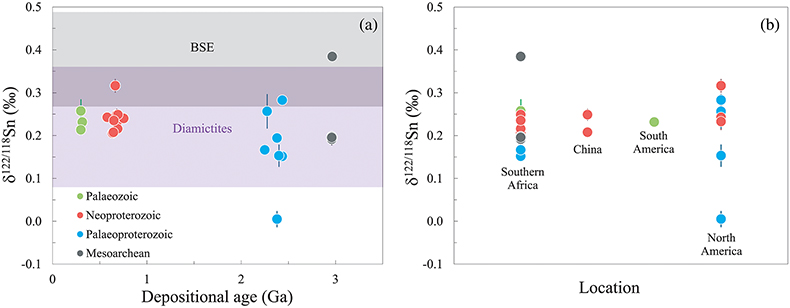
Figure 1 (a) δ122/118Sn as a function of the depositional age of the glacial diamictites. (b) δ122/118Sn of the measured glacial diamictites sorted by locations. Here and in subsequent figures, the symbols are colour coded according to the depositional age.
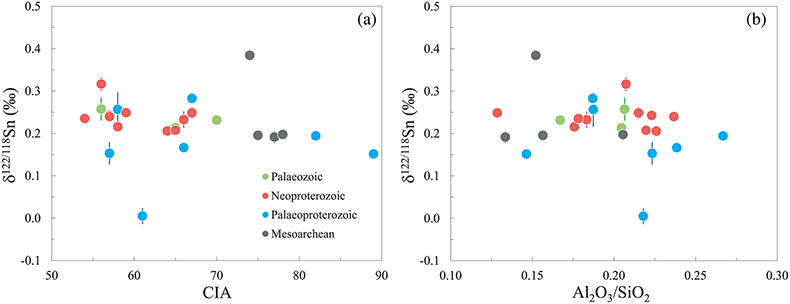
Figure 2 δ122/118Sn of glacial diamictites as a function of two indicators of chemical weathering: (a) CIA (chemical index of alteration) values and (b) Al2O3/SiO2. All elemental compositions used are from Gaschnig et al. (2016)
Gaschnig, R.M., Rudnick, R.L., McDonough, W.F., Kaufman, A.J., Valley, J.W., Hu, Z., Gao, S., Beck, M.L. (2016) Compositional evolution of the upper continental crust through time, as constrained by ancient glacial diamictites. Geochimica et Cosmochimica Acta 186, 316–343. https://doi.org/10.1016/j.gca.2016.03.020
.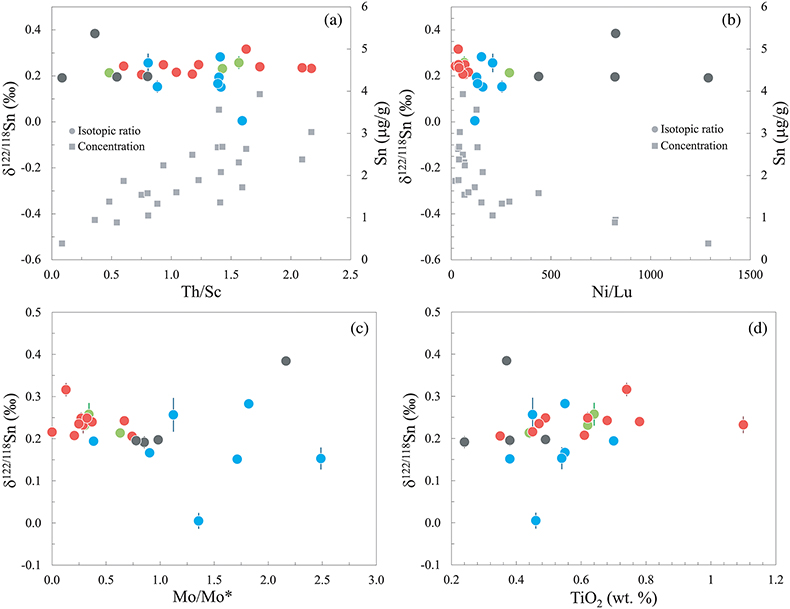
Figure 3 δ122/118Sn of glacial diamictites as a function of two differentiation indicators: (a) Th/Sc ratio, including Sn abundances in the corresponding samples, and (b) Ni/Lu ratio, as well as (c) Mo/Mo*, a proxy for oxidative weathering (Gaschnig et al., 2014
Gaschnig, R.M., Rudnick, R.L., McDonough, W.F., Kaufman, A.J., Hu, Z., Gao, S. (2014) Onset of oxidative weathering of continents recorded in the geochemistry of ancient glacial diamictites. Earth and Planetary Science Letters 408, 87–99. https://doi.org/10.1016/j.epsl.2014.10.002
) and (d) TiO2 abundance, an indicator of ilmenite crystallisation. All trace element data were compiled from Gaschnig et al. (2016)Gaschnig, R.M., Rudnick, R.L., McDonough, W.F., Kaufman, A.J., Valley, J.W., Hu, Z., Gao, S., Beck, M.L. (2016) Compositional evolution of the upper continental crust through time, as constrained by ancient glacial diamictites. Geochimica et Cosmochimica Acta 186, 316–343. https://doi.org/10.1016/j.gca.2016.03.020
.
Figure 4 Tin isotopic compositions expressed as δ122/118Sn of terrestrial igneous samples (Badullovich et al., 2017
Badullovich, N., Moynier, F., Creech, J., Teng, F.-Z., Sossi, P.A. (2017) Tin isotopic fractionation during igneous differentiation and Earth’s mantle composition. Geochemical Perspectives Letters 5, 24–28. https://doi.org/10.7185/geochemlet.1741
; Creech et al., 2017Creech, J.B., Moynier, F., Badullovich, N. (2017) Tin stable isotope analysis of geological materials by double-spike MC-ICPMS. Chemical Geology 457, 61–67. https://doi.org/10.1016/j.chemgeo.2017.03.013
; Wang et al., 2018Wang, X., Amet, Q., Fitoussi, C., Bourdon, B. (2018) Tin isotope fractionation during magmatic processes and the isotope composition of the bulk silicate Earth. Geochimica et Cosmochimica Acta 228, 320–335. https://doi.org/10.1016/j.gca.2018.02.014
; She et al., 2023aShe, J.-X., Kubik, E., Li, W., Moynier, F. (2023a) Stable Sn isotope signatures of Mid-ocean ridge basalts. Chemical Geology 622, 121347. https://doi.org/10.1016/j.chemgeo.2023.121347
, 2023bShe, J.-X., Li, W., An, S., Cai, Y. (2023b) High-precision double-spike Sn isotope analysis of geological materials by MC-ICP-MS. Journal of Analytical Atomic Spectrometry 38, 142–155. https://doi.org/10.1039/D2JA00339B
) compared to those of glacial diamictite composites analysed in this study.