



Textural and chemical inheritance during a pseudomorphic double mineral transformation
Affiliations | Corresponding Author | Cite as | Funding information
Published by the European Association of Geochemistry
under Creative Commons License CC BY-NC-ND 4.0
Keywords: pseudomorphism, mineral replacement reaction, dissolution-precipitation, chemical and textural inheritance, sulfates, carbonates


- Share this article


-
Article views:2,195Cumulative count of HTML views and PDF downloads.
- Download Citation
- Rights & Permissions

top
Abstract

Figures
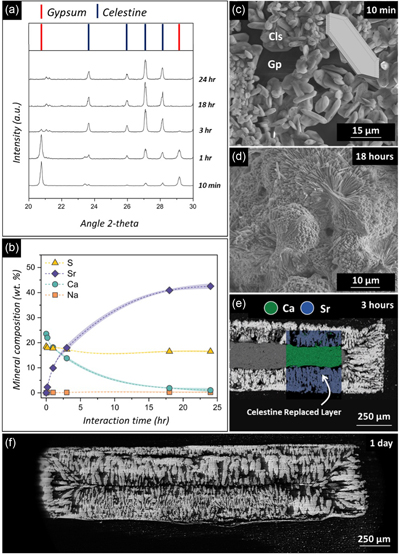 Figure 1 (a) Selected pXRD data showing the full replacement of gypsum single crystals (Gp; red lines) by celestine (Cls; blue lines). (b) Composition of the digested solids after increasing reaction times derived from ICP-OES data. (c, d) Prismatic celestine crystals initially grow on gypsum surfaces, and as the reaction progresses, spherulitic habits become dominant. (e, f) The interaction results in the full pseudomorphic replacement of gypsum by celestine. Images (c–f) were obtained in the SEM using SE (c, d) and BSE (e, f). | 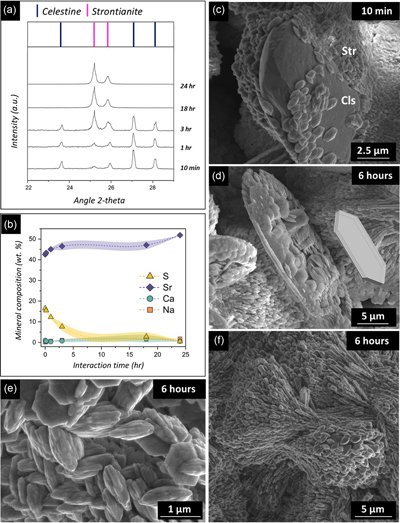 Figure 2 (a) Selected pXRD data showing the full replacement of the celestine pseudomorphs (Cls; blue lines) by strontianite (Str; pink lines). (b) Composition of the digested solids derived from ICP-OES data. (c–e) During the transformation, each celestine crystal that makes up the first pseudomorph is itself pseudomorphically replaced by tiny crystals of strontianite with the characteristic pseudohexagonal morphology of the aragonite group minerals (Deer et al., 2013). (f) Celestine spherulites are also pseudomorphically replaced by strontianite. Images (a–f) were obtained in the SEM using SE. | 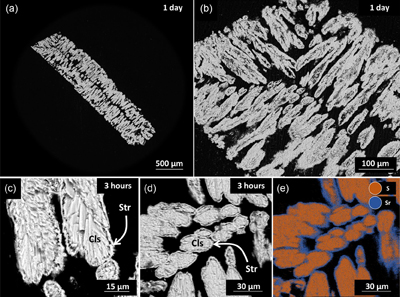 Figure 3 Polished sections of celestine pseudomorphs obtained in the SEM using BSE after (a, b) 1 day and (c–e) 3 hr interaction with a Na2CO3 solution. (a, b) The replacement of the celestine pseudomorphs by strontianite preserved the texture developed in the previous transformation. (c–e) Images of partially replaced pseudomorphs after 3 hr of reaction. | 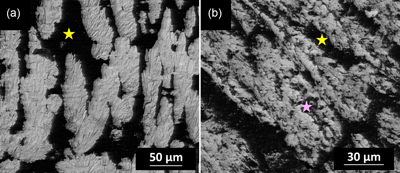 Figure 4 (a) After the transformation of the gypsum single crystals into celestine, the celestine aggregates appear distributed within elongated pores (yellow star). The aggregates appear compact and homogeneous. (b) After the transformation of these aggregates into strontianite, the compact aggregates became highly fragmented due to formation of additional porosity (pink star). Both images were obtained in the SEM using BSE. |
| Figure 1 | Figure 2 | Figure 3 | Figure 4 |
top
Introduction
Minerals undergo phase transformation reactions in response to changing environmental conditions (Putnis, 2002
Putnis, A. (2002) Mineral replacement reactions: from macroscopic observations to microscopic mechanisms. Mineralogical Magazine 66, 689–708. https://doi.org/10.1180/0026461026650056
, 2009Putnis, A. (2009) Mineral Replacement Reactions. Reviews in Mineralogy and Geochemistry 70, 87–124. https://doi.org/10.2138/rmg.2009.70.3
; Ruiz-Agudo et al., 2014Ruiz-Agudo, E., Putnis, C.V., Putnis, A. (2014) Coupled dissolution and precipitation at mineral–fluid interfaces. Chemical Geology 383, 132–146. https://doi.org/10.1016/j.chemgeo.2014.06.007
). At Earth (sub)surface conditions, these mineral transformations are usually driven by fluids. Typically, such fluid-driven reactions proceed through the dissolution of a primary phase and the subsequent precipitation of a secondary one. These two steps are often coupled in space and time, often resulting in pseudomorphic mineral products (Putnis, 2002Putnis, A. (2002) Mineral replacement reactions: from macroscopic observations to microscopic mechanisms. Mineralogical Magazine 66, 689–708. https://doi.org/10.1180/0026461026650056
, 2009Putnis, A. (2009) Mineral Replacement Reactions. Reviews in Mineralogy and Geochemistry 70, 87–124. https://doi.org/10.2138/rmg.2009.70.3
). The degree of coupling between dissolution and crystallisation determines the fidelity with which the secondary phase replicates the micro- and nano-textural features of the parent mineral phase (Xia et al., 2009Xia, F., Brugger, J., Chen, G., Ngothai, Y., O’Neill, B., Putnis, A., Pring, A. (2009) Mechanism and kinetics of pseudomorphic mineral replacement reactions: A case study of the replacement of pentlandite by violarite. Geochimica et Cosmochimica Acta 73, 1945–1969. https://doi.org/10.1016/j.gca.2009.01.007
). Unsurprisingly, pseudomorphism has been a subject of scientific interest for over two centuries as pseudomorphs constitute crucial geological proxies recording fluid-driven mineral processes in sedimentary (Leitner et al., 2013Leitner, C., Neubauer, F., Marschallinger, R., Genser, J., Bernroider, M. (2013) Origin of deformed halite hopper crystals, pseudomorphic anhydrite cubes and polyhalite in Alpine evaporites (Austria, Germany). International Journal of Earth Sciences 102, 813–829. 10.1007/s00531-012-0836-6
), igneous (Nozaka and Fryer, 2011Nozaka, T., Fryer, P. (2011) Alteration of the Oceanic Lower Crust at a Slow-spreading Axis: Insight from Vein-related Zoned Halos in Olivine Gabbro from Atlantis Massif, Mid-Atlantic Ridge. Journal of Petrology 52, 643–664. https://doi.org/10.1093/petrology/egq098
) and metamorphic settings (Centrella et al., 2015Centrella, S., Austrheim, H., Putnis, A. (2015) Coupled mass transfer through a fluid phase and volume preservation during the hydration of granulite: An example from the Bergen Arcs, Norway. Lithos 236–237, 245–255. https://doi.org/10.1016/j.lithos.2015.09.010
).Once the dissolving primary phase is fully carpeted by crystals of the precipitating secondary phase, the replacement typically progresses inwards through the formation of a network of pores. Porosity arises from the difference in molar volume and solubility between the initial and final phases. Furthermore, this porosity plays a key role in allowing the reaction to proceed from the outside to the inside, facilitating fluids to penetrate towards the reaction front (Putnis, 2002
Putnis, A. (2002) Mineral replacement reactions: from macroscopic observations to microscopic mechanisms. Mineralogical Magazine 66, 689–708. https://doi.org/10.1180/0026461026650056
, 2009Putnis, A. (2009) Mineral Replacement Reactions. Reviews in Mineralogy and Geochemistry 70, 87–124. https://doi.org/10.2138/rmg.2009.70.3
; Ruiz-Agudo et al., 2014Ruiz-Agudo, E., Putnis, C.V., Putnis, A. (2014) Coupled dissolution and precipitation at mineral–fluid interfaces. Chemical Geology 383, 132–146. https://doi.org/10.1016/j.chemgeo.2014.06.007
; Altree-Williams et al., 2015Altree-Williams, A., Pring, A., Ngothai, Y., Brugger, J. (2015) Textural and compositional complexities resulting from coupled dissolution–reprecipitation reactions in geomaterials. Earth-Science Reviews 150, 628–651. https://doi.org/10.1016/j.earscirev.2015.08.013
). Even though many pseudomorphic mineral replacement reaction systems have been studied over the last decades, the long term fate of such pseudomorphs has barely received attention. The porosity formed during these transformations usually has a transient nature and tends to reorganise and close (Jonas et al., 2014Jonas, L., John, T., King, H.E., Geisler, T., Putnis, A. (2014) The role of grain boundaries and transient porosity in rocks as fluid pathways for reaction front propagation. Earth and Planetary Science Letters 386, 64–74. https://doi.org/10.1016/j.epsl.2013.10.050
; Putnis, 2015Putnis, A. (2015) Transient Porosity Resulting from Fluid–Mineral Interaction and its Consequences. Reviews in Mineralogy and Geochemistry 80, 1–23. https://doi.org/10.2138/rmg.2015.80.01
; Beaudoin et al., 2018Beaudoin, N., Hamilton, A., Koehn, D., Shipton, Z.K., Kelka, U. (2018) Reaction-induced porosity fingering: Replacement dynamic and porosity evolution in the KBr-KCl system. Geochimica et Cosmochimica Acta 232, 163–180. https://doi.org/10.1016/j.gca.2018.04.026
). Additionally, the consequences of the interaction between freshly formed pseudomorphs and new solutions of different composition, is unknown. This is striking, considering that numerous naturally occurring pseudomorphs, which host different mineral phases, have been reported in nature (Dempster and Jess, 2015Dempster, T., Jess, S.A. (2015) Ikaite pseudomorphs in Neoproterozoic Dalradian slates record Earth’s coldest metamorphism. Journal of the Geological Society 172, 459–464. https://doi.org/10.1144/jgs2015-018
). Addressing this latter issue is the aim of this study. Here, we seek to understand how a double pseudomorphic replacement operates, and if any textural and/or chemical features useful to trace the history of the pseudomorphs are preserved during the successive transformations. To do so, we have studied the transformation of gypsum (CaSO4·2H2O) into celestine (SrSO4), followed by their subsequent transformation into strontianite (SrCO3). Individually, both replacement reactions proceed rapidly (gypsum-celestine, Forjanes et al., 2020aForjanes, P., Astilleros, J.M., Fernández-Díaz, L. (2020a) The Formation of Barite and Celestite through the Replacement of Gypsum. Minerals 10, 189. https://doi.org/10.3390/min10020189
; and celestine-strontianite, Pina et al., 2019Pina, C.M. (2019) Topotaxial replacement of celestite single crystals by strontianite aggregates: Pseudomorphisation and porosity generation. Geochimica et Cosmochimica Acta 244, 155–162. https://doi.org/10.1016/j.gca.2018.09.032
) and are therefore an ideal model system. Yet, the parameters controlling the evolution of the mineralogy, chemical composition and texture (i.e. porosity, organisation of secondary crystals, etc.) of a pseudomorph when it itself undergoes a second transformation are unknown.top
Materials and Methods
We followed the consecutive conversion: (i) of gypsum single crystals to celestine, and (ii) of the so-formed celestine to strontianite. Small gypsum single crystals (Teruel, Spain) were first reacted with 1 mL of a 0.5 M Sr-bearing solution, leading to their complete replacement by celestine within one day. Following this, half of the so-formed celestine crystals were reacted with 1 mL of a 0.5 M carbonate-rich solution to transform them into strontianite. Initial, intermediate, and end products of the interacted materials were analysed using powder X-ray diffraction (pXRD), Fourier transform infrared (FTIR) spectroscopy, and scanning electron microscopy (SEM). The porosity development, indicated by changes in surface area, was followed with nitrogen gas sorption analysis using the Brunauer-Emmett-Teller (BET) model. Finally, the changes in chemical composition of the crystals and of the reacting solutions were determined via inductively coupled plasma optical emission spectrometry (ICP-OES). For detailed information on all experimental procedures and characterisation methods see Supplementary Information.
top
Results and Discussion
The transformation of gypsum (CaSO4·2H2O) single crystals into celestine (SrSO4). The interaction between gypsum and the Sr-rich solutions results in their full replacement by celestine within one day, as evidenced by pXRD, FTIR and ICP-OES data (Figs. 1a,b, S-3 and S-4, Table S-3). The replacement takes place through a dissolution-crystallisation mechanism and begins as soon as the gypsum crystal comes into contact with the Sr-rich solution. Our solution data reveal that gypsum immediately starts to dissolve, releasing calcium and sulfate ions into the solution (Table S-3). The dissolution of gypsum should hypothetically continue until the solution reaches equilibrium with respect to this mineral (Ksp = 10−4.58; PHREEQC database). However, before this occurs, the fluid becomes saturated with respect to celestine (Ksp = 10−6.63, SI 3.03; Howell et al., 1992
Howell, R.D., Raju, K., Atkinson, G. (1992) Thermodynamics of “Scale” Mineral Solubilities. 4. Experimental Measurements of SrSO4(s) in H2O and Aqueous NaCl from 25 to 250 °C and from 1 to 500 bar. Journal of Chemical & Engineering Data 37, 464–469. https://doi.org/10.1021/je00008a020
), causing this mineral to precipitate on the surfaces of the gypsum parent material, as observed in our results (Fig. 1c). The precipitation of celestine depletes the sulfate released during the dissolution of gypsum, triggering further dissolution of the later mineral. This establishes a gypsum dissolution–celestine crystallisation loop, which operates until the complete replacement of the parent crystal is achieved. This interpretation is supported by the evolution of the ion concentrations in the solution (Fig. S-5) that reveal that, upon reacting gypsum (∼150 mg) with ∼15 mL of the Sr-bearing solution, the interacted fluid now contains ∼54 mM of Ca2+, corresponding to a release of ∼99 % of the Ca present in the precursor (Table S-3, Fig. S-5). Surprisingly, dissolved sulfate concentrations remain low (<1 mM) throughout the experiments, suggesting that all the sulfate released during gypsum dissolution is rapidly captured to precipitate celestine. The external morphology of the parent gypsum is preserved, resulting in celestine pseudomorphs after gypsum. (Fig. S-6). In fact, this pseudomorphism is so perfect that even μm-scale features of the original gypsum surface (e.g., exfoliation steps) are preserved during its conversion into celestine. Xia et al. (2009)Xia, F., Brugger, J., Chen, G., Ngothai, Y., O’Neill, B., Putnis, A., Pring, A. (2009) Mechanism and kinetics of pseudomorphic mineral replacement reactions: A case study of the replacement of pentlandite by violarite. Geochimica et Cosmochimica Acta 73, 1945–1969. https://doi.org/10.1016/j.gca.2009.01.007
defined the concept of length-scale of pseudomorphism, stating that for a fluid-driven mineral transformation to achieve perfect pseudomorphism, dissolution and precipitation have to be strongly coupled. This condition is typically met when the transformation kinetics are controlled by the dissolution of the primary mineral. Our SEM observations, which evidence pseudomorphism occurring even at the micro-scale, point to this scenario. This is consistent with the results of ICP-OES data showing a permanently low concentration of sulfate in the fluid. The early celestine crystals growing on the gypsum surfaces exhibit distinct prismatic habits with flat and well developed faces (Fig. 1c). Their growth is initially concentrated near the exfoliation steps of the gypsum surfaces, which are the most reactive areas (Fig. S-7). However, with time, the majority of the crystals exhibit sheaf-like and spherulitic morphologies (Fig. 1d). Such a morphological evolution is related to the incorporation of Ca coming from gypsum dissolution into the crystal structure of the growing celestine, where it replaces Sr (Forjanes et al., 2020aForjanes, P., Astilleros, J.M., Fernández-Díaz, L. (2020a) The Formation of Barite and Celestite through the Replacement of Gypsum. Minerals 10, 189. https://doi.org/10.3390/min10020189
, 2020bForjanes, P., Gómez-Barreiro, J., Morales, J., Astilleros, J.M., Fernández-Díaz, L. (2020b) Epitactic growth of celestite on anhydrite: substrate induced twinning and morphological evolution of aggregates. CrystEngComm 22, 5743–5759. https://doi.org/10.1039/D0CE00755B
), an observation supported by EDS and ICP-OES analyses on the solids (Table S-3, Fig. 1b). This morphological evolution of minerals due to incorporation of other ions into their structures is a well documented phenomenon in the literature (Fernández-Díaz et al., 2006Fernández-Díaz, L., Astilleros, J.M., Pina, C.M. (2006) The morphology of calcite crystals grown in a porous medium doped with divalent cations. Chemical Geology 225, 314–321. https://doi.org/10.1016/j.chemgeo.2005.08.024
; Shtukenberg et al., 2012Shtukenberg, A.G., Punin, Y.O., Gunn, E., Kahr, B. (2012) Spherulites. Chemical Reviews 112, 1805–1838. https://doi.org/10.1021/cr200297f
).Figure 1 (a) Selected pXRD data showing the full replacement of gypsum single crystals (Gp; red lines) by celestine (Cls; blue lines). (b) Composition of the digested solids after increasing reaction times derived from ICP-OES data. (c, d) Prismatic celestine crystals initially grow on gypsum surfaces, and as the reaction progresses, spherulitic habits become dominant. (e, f) The interaction results in the full pseudomorphic replacement of gypsum by celestine. Images (c–f) were obtained in the SEM using SE (c, d) and BSE (e, f).
The pseudomorphic replacement of gypsum by celestine involves a significant difference in molar volume between primary gypsum, (74.31 cm3/mol) and secondary celestine (46.25 cm3/mol). When gypsum is transformed pseudomorphically into celestine, in order to compensate for this volume decrease, a considerable volume of porosity is generated within the newly formed phase (Fig. 1e,f), accompanied by an increase in the BET surface area (<0.01 m2/g in gypsum vs. 0.54 m2/g in celestine; Fig. S-8). This porosity plays a key role in facilitating the rapid progression of the transformation, as it allows the solution to reach the reaction front, enabling the replacement reaction to proceed easily (Fig. 1e,f). Based on the evaluation of SEM images of polished sections, we determined the 2D porosity reduction to be 38 %, a value close to the theoretical reduction in molar volume between gypsum and celestine (−37.76 %). The newly formed pore network is arranged in channels perpendicular to the gypsum surfaces, and distributed between elongated celestine crystals. This stockade-like distribution of the celestine aggregates and the associated porosity can be attributed to the competitive growth between celestine crystals during the transformation. All celestine crystals in the replaced layer appear with their c axis perpendicular to the gypsum surface, as only crystals growing in this direction can grow without interference. In contrast, crystals oriented differently cannot grow due to the lack of available pore space. A similar phenomenon has been observed in other fluid-driven mineral replacement systems (Pöml et al., 2007
Pöml, P., Menneken, M., Stephan, T., Niedermeier, D.R.D., Geisler, T., Putnis, A. (2007) Mechanism of hydrothermal alteration of natural self-irradiated and synthetic crystalline titanate-based pyrochlore. Geochimica et Cosmochimica Acta 71, 3311–3322. https://doi.org/10.1016/j.gca.2007.03.031
; Fernández-Díaz et al., 2009Fernández-Díaz, L., Pina, C.M., Astilleros, J.M., Sánchez-Pastor, N. (2009) The carbonatation of gypsum: Pathways and pseudomorph formation. American Mineralogist 94, 1223–1234. https://doi.org/10.2138/am.2009.3194
; Zhao et al., 2009Zhao, J., Brugger, J., Grundler, P.V., Xia, F., Chen, G., Pring, A. (2009) Mechanism and kinetics of a mineral transformation under hydrothermal conditions: Calaverite to metallic gold. American Mineralogist 94, 1541–1555. https://doi.org/10.2138/am.2009.3252
).The second pseudomorphic transformation: celestine (SrSO4) to strontianite (SrCO3). In the second transformation, the interaction between the celestine pseudomorphs and a carbonate-rich solution leads to a second replacement of the pseudomorphs by strontianite. This also occurs through a dissolution-precipitation reaction and happens within one day, as confirmed by pXRD, ICP-OES and FTIR data (Figs. 2a,b, S-4 and S-9, Table S-3). The most interesting feature is that this second replacement reaction is also pseudomorphic, and occurs while (again) preserving the external morphology of the original gypsum precursor. Thus, this second replacement results in the formation of strontianite pseudomorphs after gypsum, produced via intermediate celestine (Fig. S-10). This transformation again proceeds via a coupled mechanism of celestine dissolution and strontianite precipitation (Ksp = 10−9.27, SI 1.94; De Villiers, 1971
De Villiers, J.P.R. (1971) Crystal Structures of Aragonite, Strontianite, and Witherite. American Mineralogist 56, 758–767. http://www.minsocam.org/ammin/AM56/AM56_758.pdf
). ICP-OES analysis of the reacted fluids show that ∼99 % of the total S from celestine is released into the fluid during the transformation, while the aqueous Sr concentrations remain low throughout the whole reaction (Table S-4 and Fig. S-11), indicating that all the Sr released during the dissolution of celestine is rapidly captured to form strontianite.Figure 2 (a) Selected pXRD data showing the full replacement of the celestine pseudomorphs (Cls; blue lines) by strontianite (Str; pink lines). (b) Composition of the digested solids derived from ICP-OES data. (c–e) During the transformation, each celestine crystal that makes up the first pseudomorph is itself pseudomorphically replaced by tiny crystals of strontianite with the characteristic pseudohexagonal morphology of the aragonite group minerals (Deer et al., 2013
Deer, W.A., Howie, R.A., Zussman, J. (2013) An Introduction to the Rock-Forming Minerals. Third Edition, The Mineralogical Society, London. https://doi.org/10.1180/DHZ
). (f) Celestine spherulites are also pseudomorphically replaced by strontianite. Images (a–f) were obtained in the SEM using SE.SEM images of the surfaces of the reacted celestine pseudomorphs after 10 min of reaction with the carbonate-rich solution reveal that each celestine crystal is, in turn, pseudomorphically replaced itself by tiny crystals of strontianite (<0.5 μm) (Fig. 2c,d) initially growing on the surfaces of the celestine ones (Fig. 2e). Nevertheless, in each pseudomorphically replaced celestine crystal, the morphology of the celestine precursor remains perfectly preserved (Fig. 2d) and even the celestine spherulites appear pseudomorphically replaced by strontianite (Fig. 2f). The preservation of the external morphology of the initial gypsum precursor is possible because every individual celestine crystal that formed in the first pseudomorphic transformation is itself pseudomorphically transformed into strontianite in the 2nd reaction. Consequently, the final outcome of the two mineral replacements are pseudomorphs of strontianite after gypsum comprised of thousands of pseudomorphs of strontianite after the intermediate celestine. The ICP-OES analyses of the digested strontianite crystals evidence that they inherit not only textural features of the two previous phases, but also part of the chemical information. Despite being compositionally and mineralogically a totally new phase, the final strontianite (SrCO3) pseudomorphs still contain trace amounts of both Ca (∼0.59 wt. %), from the gypsum precursor, and S (∼0.51 wt. %), from the intermediate celestine (Table S-3).
The textural preservation after the second pseudomorphic transformation, documented through SEM images of polished sections (Fig. 3), reveals that the replaced crystals still display the texture developed during the first gypsum to celestine replacement reaction: long aggregates perpendicular to the gypsum original surfaces with channel-arranged pores in between them. This texture is perfectly preserved, without evidence of pore infilling, during the second transformation of the aggregates into strontianite (Fig. 3a). However, the second transformation of celestine (46.25 cm3/mol) to strontianite (39.01 cm3/mol) also involves a decrease in molar volume (−15.6 %) which is, once again, compensated by the generation of additional porosity. This additional porosity forms within each transformed celestine crystal (Fig. 3b; 13.5 % according to measurements made on SEM images). After the two consecutive mineral transformations, this produces two generations of pores: (i) a first generation of channel-arranged pores formed during the first gypsum to celestine transformation that are dispersed in between the elongated celestine aggregates, and (ii) a second generation of pores formed during the transformation of celestine into strontianite that forms within each of the transformed celestine aggregates. This second transformation and pore generation also increased the BET specific surface area, from 0.54 m2/g in the celestine pseudomorphs to 3.75 m2/g in the strontianite ones (Fig. S-8).
Figure 3 Polished sections of celestine pseudomorphs obtained in the SEM using BSE after (a, b) 1 day and (c–e) 3 hr interaction with a Na2CO3 solution. (a, b) The replacement of the celestine pseudomorphs by strontianite preserved the texture developed in the previous transformation. (c–e) Images of partially replaced pseudomorphs after 3 hr of reaction.
The progression of the second mineral transformation is documented in the polished sections of celestine pseudomorphs only partially replaced by strontianite after 3 hr of reaction, where each celestine aggregate is surrounded by porous rims of strontianite (Fig. 3c–e). This indicates that, similar to the gypsum crystal replacement by celestine, the replacement of each celestine aggregate by strontianite also occurs from the outside to the inside due to the penetration of the carbonate-rich solution through the newly formed second generation porosity.
After the first transformation of gypsum into celestine, the celestine aggregates, exhibited a compact appearance and a homogeneous surface (Fig. 4a). However, this changes significantly after the second transformation of celestine into strontianite (Fig. 4), where these transformed aggregates host a considerable additional volume of porosity, resulting in a highly fragmented appearance. In Figure 4, the two generations of pores can be clearly distinguished: (i) the 1st generation of pores between the celestine aggregates (yellow star), and (ii) the 2nd generation of pores formed after the transformation of the celestine aggregates into strontianite (pink star).
Figure 4 (a) After the transformation of the gypsum single crystals into celestine, the celestine aggregates appear distributed within elongated pores (yellow star). The aggregates appear compact and homogeneous. (b) After the transformation of these aggregates into strontianite, the compact aggregates became highly fragmented due to formation of additional porosity (pink star). Both images were obtained in the SEM using BSE.
top
Conclusions and Implications
We documented via mineralogical and geochemical data sets two rapid and consecutive mineral pseudomorphic replacements taking place through a coupled mechanism of primary phase dissolution-secondary phase crystallisation: i) gypsum single crystals to celestine, and ii) celestine to strontianite. The first transformation occurs upon reaction of gypsum with a Sr solution and proceeds rapidly due to the formation of an extensive network of porosity within the pseudomorph. This porosity compensates the decrease in molar volume between gypsum and celestine. During the second transformation, the celestine pseudomorphs react with a carbonate-rich solution and are replaced by strontianite. The external morphology of the original gypsum precursor remains preserved (again), resulting in strontianite pseudomorphs after gypsum. The preservation of the gypsum morphology occurs because each celestine crystal that formed the first pseudomorph is pseudomorphically replaced itself by smaller crystals of strontianite. Consequently, the outcome of the two replacements are pseudomorphs of strontianite after gypsum, formed by thousands of tiny strontianite pseudomorphs after celestine. During the second transformation, a second generation of porosity within each celestine replaced crystal is formed linked to a further decrease in molar volume.
We have documented, for the first time, that in a double mineral replacement process, the morphology, microtexture and, to some extent the chemistry, of the original precursor can be preserved throughout the whole transformation. As long as dissolution-crystallisation processes are coupled, pseudomorphism can survive successive transformations while retaining textures developed during intermediate transformation stages. These results are crucial for understanding natural mineral replacement phenomena, where the transformations are usually complex and where pseudomorphs can host different mineral phases formed at different stages. Our data provide valuable insights into the significance of pseudomorphs as geological proxies, as this chemical and textural inheritance can be used to reconstruct the geochemical history of the pseudomorph. Furthermore, our data improve our understanding of the complex pseudomorphs found in the geological record. A good example are glendolites, pseudomorphs produced from ikaite (CaCO3·6H2O; e.g., Selleck et al., 2007
Selleck, B.W., Carr, P.F., Jones, B.G. (2007) A Review and Synthesis of Glendonites (Pseudomorphs after Ikaite) with New Data: Assessing Applicability as Recorders of Ancient Coldwater Conditions. Journal of Sedimentary Research 77, 980–991. https://doi.org/10.2110/jsr.2007.087
; Sanchez-Pastor et al., 2016Sánchez-Pastor, N., Oehlerich, M., Astilleros, J.M., Kaliwoda, M., Mayr, C.C., Fernández-Díaz, L., Schmahl, W.W. (2016) Crystallization of ikaite and its pseudomorphic transformation into calcite: Raman spectroscopy evidence. Geochimica et Cosmochimica Acta 175, 271–281. https://doi.org/10.1016/j.gca.2015.12.006
), a carbonate found in cold, polar waters. Ikaite can transform pseudomorphically into calcite, aragonite and/or monohydrocalcite depending on the transformation conditions (Stockmann et al., 2022Stockmann, G.J., Seaman, P., Balic-Zunic, T., Peternell, M., Sturkell, E., Liljebladh, B., Gyllencreutz, R. (2022) Mineral Changes to the Tufa Columns of Ikka Fjord, SW Greenland. Minerals 12, 1430. https://doi.org/10.3390/min12111430
). Another example is the complex pseudomorphs formed from the weathering of igneous feldspars (Morad et al., 1989Morad, S., Marfil, R., De La Peňa, J.A. (1989) Diagenetic K-feldspar pseudomorphs in the Triassic Buntsandstein sandstones of the Iberian Range, Spain. Sedimentology 36, 635–650. https://doi.org/10.1111/j.1365-3091.1989.tb02090.x
). Our results provide useful data for understanding such complex, often consecutive, natural mineral replacement reactions.top
Acknowledgements
This project has received funding from the Helmholtz Recruiting Initiative awarded to LGB (award no. I-044-16-01). JPHP is funded by his independent research fellowship (GFZ Discovery Fund; grant no. P-032-45-002). PF acknowledges support from the PID2021-125467NB-I00 project of the Spanish Ministry of Science, Innovation and Universities. ICP-OES analyses were performed at the Helmholtz Laboratory for the Geochemistry of the Earth Surface at GFZ Potsdam with the assistance of Sebastian Focke. The experiments, XRD, FTIR and SEM analyses were carried out in the laboratories of Environmental Mineralogy and at the Potsdam Imaging and Spectral Analysis (PISA) Facility of section 3.5 (Interface Geochemistry) at the GFZ.
Editor: Juan Liu
top
References
Altree-Williams, A., Pring, A., Ngothai, Y., Brugger, J. (2015) Textural and compositional complexities resulting from coupled dissolution–reprecipitation reactions in geomaterials. Earth-Science Reviews 150, 628–651. https://doi.org/10.1016/j.earscirev.2015.08.013
 Show in context
 Furthermore, this porosity plays a key role in allowing the reaction to proceed from the outside to the inside, facilitating fluids to penetrate towards the reaction front (Putnis, 2002, 2009; Ruiz-Agudo et al., 2014; Altree-Williams et al., 2015).
View in article
Beaudoin, N., Hamilton, A., Koehn, D., Shipton, Z.K., Kelka, U. (2018) Reaction-induced porosity fingering: Replacement dynamic and porosity evolution in the KBr-KCl system. Geochimica et Cosmochimica Acta 232, 163–180. https://doi.org/10.1016/j.gca.2018.04.026
Show in context The porosity formed during these transformations usually has a transient nature and tends to reorganise and close (Jonas et al., 2014; Putnis, 2015; Beaudoin et al., 2018).
View in article
Centrella, S., Austrheim, H., Putnis, A. (2015) Coupled mass transfer through a fluid phase and volume preservation during the hydration of granulite: An example from the Bergen Arcs, Norway. Lithos 236–237, 245–255. https://doi.org/10.1016/j.lithos.2015.09.010
Show in context Unsurprisingly, pseudomorphism has been a subject of scientific interest for over two centuries as pseudomorphs constitute crucial geological proxies recording fluid-driven mineral processes in sedimentary (Leitner et al., 2013), igneous (Nozaka and Fryer, 2011) and metamorphic settings (Centrella et al., 2015).
View in article
Deer, W.A., Howie, R.A., Zussman, J. (2013) An Introduction to the Rock-Forming Minerals. Third Edition, The Mineralogical Society, London. https://doi.org/10.1180/DHZ
Show in context (c–e) During the transformation, each celestine crystal that makes up the first pseudomorph is itself pseudomorphically replaced by tiny crystals of strontianite with the characteristic pseudohexagonal morphology of the aragonite group minerals (Deer et al., 2013).
View in article
Dempster, T., Jess, S.A. (2015) Ikaite pseudomorphs in Neoproterozoic Dalradian slates record Earth’s coldest metamorphism. Journal of the Geological Society 172, 459–464. https://doi.org/10.1144/jgs2015-018
Show in context This is striking, considering that numerous naturally occurring pseudomorphs, which host different mineral phases, have been reported in nature (Dempster and Jess, 2015).
View in article
De Villiers, J.P.R. (1971) Crystal Structures of Aragonite, Strontianite, and Witherite. American Mineralogist 56, 758–767. http://www.minsocam.org/ammin/AM56/AM56_758.pdf.
Show in context This transformation again proceeds via a coupled mechanism of celestine dissolution and strontianite precipitation (K sp = 10−9.27, SI 1.94; De Villiers, 1971).
View in article
Fernández-Díaz, L., Astilleros, J.M., Pina, C.M. (2006) The morphology of calcite crystals grown in a porous medium doped with divalent cations. Chemical Geology 225, 314–321. https://doi.org/10.1016/j.chemgeo.2005.08.024
Show in context This morphological evolution of minerals due to incorporation of other ions into their structures is a well documented phenomenon in the literature (Fernández-Díaz et al., 2006; Shtukenberg et al., 2012).
View in article
Fernández-Díaz, L., Pina, C.M., Astilleros, J.M., Sánchez-Pastor, N. (2009) The carbonatation of gypsum: Pathways and pseudomorph formation. American Mineralogist 94, 1223–1234. https://doi.org/10.2138/am.2009.3194
Show in context A similar phenomenon has been observed in other fluid-driven mineral replacement systems (Pöml et al., 2007; Fernández-Díaz et al., 2009; Zhao et al., 2009).
View in article
Forjanes, P., Astilleros, J.M., Fernández-Díaz, L. (2020a) The Formation of Barite and Celestite through the Replacement of Gypsum. Minerals 10, 189. https://doi.org/10.3390/min10020189
Show in context Individually, both replacement reactions proceed rapidly (gypsum-celestine, Forjanes et al., 2020a; and celestine-strontianite, Pina et al., 2019) and are therefore an ideal model system.
View in article
Such a morphological evolution is related to the incorporation of Ca coming from gypsum dissolution into the crystal structure of the growing celestine, where it replaces Sr (Forjanes et al., 2020a, 2020b), an observation supported by EDS and ICP-OES analyses on the solids (Table S-3, Fig. 1b).
View in article
Forjanes, P., Gómez-Barreiro, J., Morales, J., Astilleros, J.M., Fernández-Díaz, L. (2020b) Epitactic growth of celestite on anhydrite: substrate induced twinning and morphological evolution of aggregates. CrystEngComm 22, 5743–5759. https://doi.org/10.1039/D0CE00755B
Show in context Such a morphological evolution is related to the incorporation of Ca coming from gypsum dissolution into the crystal structure of the growing celestine, where it replaces Sr (Forjanes et al., 2020a, 2020b), an observation supported by EDS and ICP-OES analyses on the solids (Table S-3, Fig. 1b).
View in article
Howell, R.D., Raju, K., Atkinson, G. (1992) Thermodynamics of “Scale” Mineral Solubilities. 4. Experimental Measurements of SrSO4(s) in H2O and Aqueous NaCl from 25 to 250 °C and from 1 to 500 bar. Journal of Chemical & Engineering Data 37, 464–469. https://doi.org/10.1021/je00008a020
Show in context The dissolution of gypsum should hypothetically continue until the solution reaches equilibrium with respect to this mineral (K sp = 10−4.58; PHREEQC database). However, before this occurs, the fluid becomes saturated with respect to celestine (K sp = 10−6.63, SI 3.03; Howell et al., 1992), causing this mineral to precipitate on the surfaces of the gypsum parent material, as observed in our results (Fig. 1c).
View in article
Jonas, L., John, T., King, H.E., Geisler, T., Putnis, A. (2014) The role of grain boundaries and transient porosity in rocks as fluid pathways for reaction front propagation. Earth and Planetary Science Letters 386, 64–74. https://doi.org/10.1016/j.epsl.2013.10.050
Show in context The porosity formed during these transformations usually has a transient nature and tends to reorganise and close (Jonas et al., 2014; Putnis, 2015; Beaudoin et al., 2018).
View in article
Leitner, C., Neubauer, F., Marschallinger, R., Genser, J., Bernroider, M. (2013) Origin of deformed halite hopper crystals, pseudomorphic anhydrite cubes and polyhalite in Alpine evaporites (Austria, Germany). International Journal of Earth Sciences 102, 813–829. 10.1007/s00531-012-0836-6.
Show in context Unsurprisingly, pseudomorphism has been a subject of scientific interest for over two centuries as pseudomorphs constitute crucial geological proxies recording fluid-driven mineral processes in sedimentary (Leitner et al., 2013), igneous (Nozaka and Fryer, 2011) and metamorphic settings (Centrella et al., 2015).
View in article
Morad, S., Marfil, R., De La Peňa, J.A. (1989) Diagenetic K-feldspar pseudomorphs in the Triassic Buntsandstein sandstones of the Iberian Range, Spain. Sedimentology 36, 635–650. https://doi.org/10.1111/j.1365-3091.1989.tb02090.x
Show in context Another example is the complex pseudomorphs formed from the weathering of igneous feldspars (Morad et al., 1989).
View in article
Nozaka, T., Fryer, P. (2011) Alteration of the Oceanic Lower Crust at a Slow-spreading Axis: Insight from Vein-related Zoned Halos in Olivine Gabbro from Atlantis Massif, Mid-Atlantic Ridge. Journal of Petrology 52, 643–664. https://doi.org/10.1093/petrology/egq098
Show in context Unsurprisingly, pseudomorphism has been a subject of scientific interest for over two centuries as pseudomorphs constitute crucial geological proxies recording fluid-driven mineral processes in sedimentary (Leitner et al., 2013), igneous (Nozaka and Fryer, 2011) and metamorphic settings (Centrella et al., 2015).
View in article
Pina, C.M. (2019) Topotaxial replacement of celestite single crystals by strontianite aggregates: Pseudomorphisation and porosity generation. Geochimica et Cosmochimica Acta 244, 155–162. https://doi.org/10.1016/j.gca.2018.09.032
Show in context Individually, both replacement reactions proceed rapidly (gypsum-celestine, Forjanes et al., 2020a; and celestine-strontianite, Pina et al., 2019) and are therefore an ideal model system.
View in article
Pöml, P., Menneken, M., Stephan, T., Niedermeier, D.R.D., Geisler, T., Putnis, A. (2007) Mechanism of hydrothermal alteration of natural self-irradiated and synthetic crystalline titanate-based pyrochlore. Geochimica et Cosmochimica Acta 71, 3311–3322. https://doi.org/10.1016/j.gca.2007.03.031
Show in context A similar phenomenon has been observed in other fluid-driven mineral replacement systems (Pöml et al., 2007; Fernández-Díaz et al., 2009; Zhao et al., 2009).
View in article
Putnis, A. (2002) Mineral replacement reactions: from macroscopic observations to microscopic mechanisms. Mineralogical Magazine 66, 689–708. https://doi.org/10.1180/0026461026650056
Show in context Minerals undergo phase transformation reactions in response to changing environmental conditions (Putnis, 2002, 2009; Ruiz-Agudo et al., 2014).
View in article
These two steps are often coupled in space and time, often resulting in pseudomorphic mineral products (Putnis, 2002, 2009).
View in article
Furthermore, this porosity plays a key role in allowing the reaction to proceed from the outside to the inside, facilitating fluids to penetrate towards the reaction front (Putnis, 2002, 2009; Ruiz-Agudo et al., 2014; Altree-Williams et al., 2015).
View in article
Putnis, A. (2009) Mineral Replacement Reactions. Reviews in Mineralogy and Geochemistry 70, 87–124. https://doi.org/10.2138/rmg.2009.70.3
Show in context Minerals undergo phase transformation reactions in response to changing environmental conditions (Putnis, 2002, 2009; Ruiz-Agudo et al., 2014).
View in article
These two steps are often coupled in space and time, often resulting in pseudomorphic mineral products (Putnis, 2002, 2009).
View in article
Furthermore, this porosity plays a key role in allowing the reaction to proceed from the outside to the inside, facilitating fluids to penetrate towards the reaction front (Putnis, 2002, 2009; Ruiz-Agudo et al., 2014; Altree-Williams et al., 2015).
View in article
Putnis, A. (2015) Transient Porosity Resulting from Fluid–Mineral Interaction and its Consequences. Reviews in Mineralogy and Geochemistry 80, 1–23. https://doi.org/10.2138/rmg.2015.80.01
Show in context The porosity formed during these transformations usually has a transient nature and tends to reorganise and close (Jonas et al., 2014; Putnis, 2015; Beaudoin et al., 2018).
View in article
Ruiz-Agudo, E., Putnis, C.V., Putnis, A. (2014) Coupled dissolution and precipitation at mineral–fluid interfaces. Chemical Geology 383, 132–146. https://doi.org/10.1016/j.chemgeo.2014.06.007
Show in context Minerals undergo phase transformation reactions in response to changing environmental conditions (Putnis, 2002, 2009; Ruiz-Agudo et al., 2014).
View in article
Furthermore, this porosity plays a key role in allowing the reaction to proceed from the outside to the inside, facilitating fluids to penetrate towards the reaction front (Putnis, 2002, 2009; Ruiz-Agudo et al., 2014; Altree-Williams et al., 2015).
View in article
Sánchez-Pastor, N., Oehlerich, M., Astilleros, J.M., Kaliwoda, M., Mayr, C.C., Fernández-Díaz, L., Schmahl, W.W. (2016) Crystallization of ikaite and its pseudomorphic transformation into calcite: Raman spectroscopy evidence. Geochimica et Cosmochimica Acta 175, 271–281. https://doi.org/10.1016/j.gca.2015.12.006
Show in context A good example are glendolites, pseudomorphs produced from ikaite (CaCO3·6H2O; e.g., Selleck et al., 2007; Sanchez-Pastor et al., 2016), a carbonate found in cold, polar waters.
View in article
Selleck, B.W., Carr, P.F., Jones, B.G. (2007) A Review and Synthesis of Glendonites (Pseudomorphs after Ikaite) with New Data: Assessing Applicability as Recorders of Ancient Coldwater Conditions. Journal of Sedimentary Research 77, 980–991. https://doi.org/10.2110/jsr.2007.087
Show in context A good example are glendolites, pseudomorphs produced from ikaite (CaCO3·6H2O; e.g., Selleck et al., 2007; Sanchez-Pastor et al., 2016), a carbonate found in cold, polar waters.
View in article
Shtukenberg, A.G., Punin, Y.O., Gunn, E., Kahr, B. (2012) Spherulites. Chemical Reviews 112, 1805–1838. https://doi.org/10.1021/cr200297f
Show in context This morphological evolution of minerals due to incorporation of other ions into their structures is a well documented phenomenon in the literature (Fernández-Díaz et al., 2006; Shtukenberg et al., 2012).
View in article
Stockmann, G.J., Seaman, P., Balic-Zunic, T., Peternell, M., Sturkell, E., Liljebladh, B., Gyllencreutz, R. (2022) Mineral Changes to the Tufa Columns of Ikka Fjord, SW Greenland. Minerals 12, 1430. https://doi.org/10.3390/min12111430
Show in context Ikaite can transform pseudomorphically into calcite, aragonite and/or monohydrocalcite depending on the transformation conditions (Stockmann et al., 2022).
View in article
Xia, F., Brugger, J., Chen, G., Ngothai, Y., O’Neill, B., Putnis, A., Pring, A. (2009) Mechanism and kinetics of pseudomorphic mineral replacement reactions: A case study of the replacement of pentlandite by violarite. Geochimica et Cosmochimica Acta 73, 1945–1969. https://doi.org/10.1016/j.gca.2009.01.007
Show in context The degree of coupling between dissolution and crystallisation determines the fidelity with which the secondary phase replicates the micro- and nano-textural features of the parent mineral phase (Xia et al., 2009).
View in article
In fact, this pseudomorphism is so perfect that even μm-scale features of the original gypsum surface (e.g., exfoliation steps) are preserved during its conversion into celestine. Xia et al. (2009) defined the concept of length-scale of pseudomorphism, stating that for a fluid-driven mineral transformation to achieve perfect pseudomorphism, dissolution and precipitation have to be strongly coupled.
View in article
Zhao, J., Brugger, J., Grundler, P.V., Xia, F., Chen, G., Pring, A. (2009) Mechanism and kinetics of a mineral transformation under hydrothermal conditions: Calaverite to metallic gold. American Mineralogist 94, 1541–1555. https://doi.org/10.2138/am.2009.3252
Show in context A similar phenomenon has been observed in other fluid-driven mineral replacement systems (Pöml et al., 2007; Fernández-Díaz et al., 2009; Zhao et al., 2009).
View in article
top
Supplementary Information
The Supplementary Information includes:
- Description of the Starting Materials, Reagents and Replacement Experiments
- In-depth Description of the Methods Used to Characterize the Materials
- Supplementary Tables S-1 to S-4
- Supplementary Figures S-1 to S-11
- Supplementary Information References
Download the Supplementary Information (PDF)
Figures

Figure 1 (a) Selected pXRD data showing the full replacement of gypsum single crystals (Gp; red lines) by celestine (Cls; blue lines). (b) Composition of the digested solids after increasing reaction times derived from ICP-OES data. (c, d) Prismatic celestine crystals initially grow on gypsum surfaces, and as the reaction progresses, spherulitic habits become dominant. (e, f) The interaction results in the full pseudomorphic replacement of gypsum by celestine. Images (c–f) were obtained in the SEM using SE (c, d) and BSE (e, f).

Figure 2 (a) Selected pXRD data showing the full replacement of the celestine pseudomorphs (Cls; blue lines) by strontianite (Str; pink lines). (b) Composition of the digested solids derived from ICP-OES data. (c–e) During the transformation, each celestine crystal that makes up the first pseudomorph is itself pseudomorphically replaced by tiny crystals of strontianite with the characteristic pseudohexagonal morphology of the aragonite group minerals (Deer et al., 2013
Deer, W.A., Howie, R.A., Zussman, J. (2013) An Introduction to the Rock-Forming Minerals. Third Edition, The Mineralogical Society, London. https://doi.org/10.1180/DHZ
). (f) Celestine spherulites are also pseudomorphically replaced by strontianite. Images (a–f) were obtained in the SEM using SE.
Figure 3 Polished sections of celestine pseudomorphs obtained in the SEM using BSE after (a, b) 1 day and (c–e) 3 hr interaction with a Na2CO3 solution. (a, b) The replacement of the celestine pseudomorphs by strontianite preserved the texture developed in the previous transformation. (c–e) Images of partially replaced pseudomorphs after 3 hr of reaction.

Figure 4 (a) After the transformation of the gypsum single crystals into celestine, the celestine aggregates appear distributed within elongated pores (yellow star). The aggregates appear compact and homogeneous. (b) After the transformation of these aggregates into strontianite, the compact aggregates became highly fragmented due to formation of additional porosity (pink star). Both images were obtained in the SEM using BSE.