



Europium traces the impact of high temperature hydrothermal systems on the early oceans
Affiliations | Corresponding Author | Cite as | Funding information
Published by the European Association of Geochemistry
under Creative Commons License CC BY-NC-ND 4.0
Keywords: Trace element geochemistry, Iron Formations, stromatolites, Precambrian, seawater, element fluxes


- Share this article


-
Article views:2,531Cumulative count of HTML views and PDF downloads.
- Download Citation
- Rights & Permissions

top
Abstract

Figures
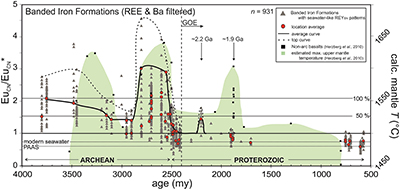 Figure 1 Precambrian EuCN/EuCN* evolution curve of iron formations. The dashed and solid lines represent the global top and location average EuCN anomaly curves of pure iron formation samples (931 data points). EuCN anomalies are abundant throughout the Archean and decrease from the Eoarchean until ca. 2.5 Ga ago. Positive EuCN excursions from 2.8 until 2.55 Ga and potentially at ∼2.2 and ∼1.9 Ga suggest strong REE fluxes into the oceans due to intense magmatic activity. Note that the EuCN evolution curves coincide with the evolution of calculated upper mantle temperature values (black squares and green field with estimated mantle temperatures on the right y-axis; Herzberg et al., 2010). Percentage values refer to the de- or increase of EuCN/EuCN* values relative to the Eoarchean Isua BIF; the location average includes >3 samples. Respective data is available in the Supplementary Information. GOE: Great Oxidation Event; PAAS: Post Archean Australian Shale. | 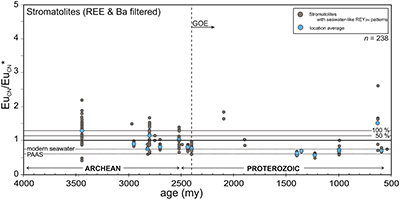 Figure 2 Precambrian EuCN/EuCN* evolution curve of stromatolites deposited in marine environments. The average value of EuCN anomalies in pure stromatolites (229 data points), representing shallow marine microbial habitats, decreases from the Palaeoarchean until 2.5 Ga. EuCN anomalies are generally absent in the Proterozoic with two local exceptions at 2.1 and 0.635 Ga. Note that some of the Archean stromatolite locations do not show positive EuCN anomalies. Percentage values are relative to Palaeoarchean stromatolites from the Pilbara Craton. Location average includes >3 samples. Respective data is available in the Supplementary Information. GOE: Great Oxidation Event; PAAS: Post Archean Australian Shale. | 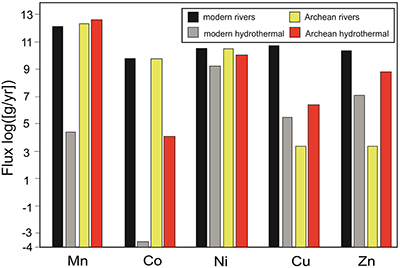 Figure 3 Flux estimate of bio-essential elements via rivers and hydrothermal systems. See Supplementary Information for model assumptions and parameters. |
| Figure 1 | Figure 2 | Figure 3 |
top
Introduction
Environmental conditions during the origin and early evolution of life on Earth are intensely debated. Hydrothermal systems have long been considered critical players in this debate because they may have released essential nutrients and provided catalytic minerals for the formation of prebiotic organic molecules (e.g., Martin et al., 2008
Martin, W., Baross, J., Kelley, D., Russell, M.J. (2008) Hydrothermal vents and the origin of life. Nature Reviews Microbiology 6, 805–814. https://doi.org/10.1038/nrmicro1991
). Hydrothermal settings have been described from the early Archean rock record (Vearncombe et al., 1995Vearncombe, S., Barley, M.E., Groves, D.I., McNaughton, N.J., Mikucki, E.J., Vearncombe, J.R. (1995) 3.26 Ga black smoker-type mineralization in the Strelley Belt, Pilbara Craton, Western Australia. Journal of the Geological Society 152, 587–590. https://doi.org/10.1144/gsjgs.152.4.0587
; Djokic et al., 2017Djokic, T., Van Kranendonk, M.J., Campbell, K.A., Walter, M.R., Ward, C.R. (2017) Earliest signs of life on land preserved in ca. 3.5 Ga hot spring deposits. Nature Communications 8, 15263. https://doi.org/10.1038/ncomms15263
) and are implicated in models for the precipitation of iron formations 3.8–1.8 Ga ago (Isley and Abbott, 1999Isley, A.E., Abbott, D.H. (1999) Plume-related mafic volcanism and the deposition of banded iron formation. Journal of Geophysical Research: Solid Earth 104, 15461–15477. https://doi.org/10.1029/1999JB900066
; Tosca and Tutolo, 2023Tosca, N.J., Tutolo, B.M. (2023) Hydrothermal vent fluid-seawater mixing and the origins of Archean iron formation. Geochimica et Cosmochimica Acta 352, 51–68. https://doi.org/10.1016/j.gca.2023.05.002
). However, a quantitative assessment of the intensity and fluctuations of mass fluxes originating from hydrothermal systems contributing to the elemental inventories of early oceans has so far not been attempted.Europium can fill this gap. It occurs in a 3+ state under surface environmental conditions similar to the other rare earth elements (REE) but is reduced to the more soluble Eu2+ under reducing, acidic, conditions above 250 °C, and enriched relative to the neighbouring REE (Bau, 1991
Bau, M. (1991) Rare-earth element mobility during hydrothermal and metamorphic fluid-rock interaction and the significance of the oxidation state of europium. Chemical Geology 93, 219–230. https://doi.org/10.1016/0009-2541(91)90115-8
). Thus, high temperature hydrothermal fluids become enriched in Eu relative to the host rocks during fluid–rock interactions. Although Eu2+ immediately oxidises to Eu3+ in lower temperature regimes, where it behaves geochemically similar to the neighbouring, strictly trivalent REE, the precipitates of hydrothermal fluids can preserve this Eu enrichment over geologic time. In the modern fully vented and oxidised oceans, REE are particle-reactive and show residence times of only a few hundred years. Acidic fluids reaching temperatures up to ∼400 °C with positive Eu anomalies are exhaled at hydrothermal vent systems such as submarine trenches, hot spots, or rift systems into seawater, and are immediately cooled and oxidised (e.g., German et al., 1990German, C.R., Klinkhammer, G.P., Edmond, J.M., Mitra, A., Elderfield, H. (1990) Hydrothermal scavenging of rare-earth elements in the ocean. Nature 345, 516–518. https://doi.org/10.1038/345516a0
). Subsequently, precipitating Fe- and Mn(oxy)hydroxides scavenge REE from the hydrothermal fluid and seawater. Therefore, hydrothermal Fe-Mn oxide precipitates (Bau et al., 2014Bau, M., Schmidt, K., Koschinsky, A., Hein, J., Kuhn, T., Usui, A. (2014) Discriminating between different genetic types of marine ferro-manganese crusts and nodules based on rare earth elements and yttrium. Chemical Geology 381, 1–9. https://doi.org/10.1016/j.chemgeo.2014.05.004
) and carbonates in mussel shells proximal to black smoker vent sites show strong Eu enrichments (Bau et al., 2010Bau, M., Balan, S., Schmidt, K., Koschinsky, A. (2010) Rare earth elements in mussel shells of the Mytilidae family as tracers for hidden and fossil high-temperature hydrothermal systems. Earth and Planetary Science Letters 299, 310–316. https://doi.org/10.1016/j.epsl.2010.09.011
). Modern submarine high temperature hydrothermal systems, where Fe-Mn oxides precipitate proximal to the vent site, act as sinks rather than sources for REE and other particle-reactive elements (German et al., 1990German, C.R., Klinkhammer, G.P., Edmond, J.M., Mitra, A., Elderfield, H. (1990) Hydrothermal scavenging of rare-earth elements in the ocean. Nature 345, 516–518. https://doi.org/10.1038/345516a0
). In a stratified, anoxic water column, such as proposed for long periods of the Precambrian, REE could likely reach much longer residence times due to the lack of direct scavenging onto Fe- and Mn(oxy)hydroxides. Thus, REE exhaled from hydrothermal systems into Precambrian oceans should have been dispersed more widely. However, beyond computational models (Tutolo and Tosca 2023Tosca, N.J., Tutolo, B.M. (2023) Hydrothermal vent fluid-seawater mixing and the origins of Archean iron formation. Geochimica et Cosmochimica Acta 352, 51–68. https://doi.org/10.1016/j.gca.2023.05.002
), there is no empirical constraint on the extent to which these fluids contributed to water chemistry in the different environments of early oceans, such as outer shelf or near shore environments.Europium systematics have previously been used to investigate the impact of high temperature, hydrothermal systems on ancient local depositional environments (e.g., Bau and Dulski, 1996
Bau, M., Dulski, P. (1996) Distribution of yttrium and rare-earth elements in the Penge and Kuruman iron-formations, Transvaal Supergroup, South Africa. Precambrian Research 79, 37–55. https://doi.org/10.1016/0301-9268(95)00087-9
) and the thermal state of Earth’s mantle (Danielson et al., 1992Danielson, A., Möller, P., Dulski, P. (1992) The europium anomalies in banded iron formations and the thermal history of the oceanic crust. Chemical Geology 97, 89–100. https://doi.org/10.1016/0009-2541(92)90137-T
; Viehmann et al., 2015Viehmann, S., Bau, M., Hoffmann, J.E., Münker, C. (2015) Geochemistry of the Krivoy Rog Banded Iron Formation, Ukraine, and the impact of peak episodes of increased global magmatic activity on the trace element composition of Precambrian seawater. Precambrian Research 270, 165–180. https://doi.org/10.1016/j.precamres.2015.09.015
), as well as in ore geology to fingerprint the temperature of ore-forming hydrothermal fluids (Kraemer et al., 2019Kraemer, D., Viehmann, S., Banks, D., Sumoondur, A.D., Koeberl, C., Bau, M. (2019) Regional variations in fluid formation and metal sources in MVT mineralization in the Pennine Orefield, UK: Implications from rare earth element and yttrium distribution, Sr-Nd isotopes and fluid inclusion compositions of hydrothermal vein fluorites. Ore Geology Reviews 107, 960–972. https://doi.org/10.1016/j.oregeorev.2019.03.014
). Prior studies of iron formations (IFs; Danielson et al., 1992Danielson, A., Möller, P., Dulski, P. (1992) The europium anomalies in banded iron formations and the thermal history of the oceanic crust. Chemical Geology 97, 89–100. https://doi.org/10.1016/0009-2541(92)90137-T
; Viehmann et al., 2015Viehmann, S., Bau, M., Hoffmann, J.E., Münker, C. (2015) Geochemistry of the Krivoy Rog Banded Iron Formation, Ukraine, and the impact of peak episodes of increased global magmatic activity on the trace element composition of Precambrian seawater. Precambrian Research 270, 165–180. https://doi.org/10.1016/j.precamres.2015.09.015
) have shown a decline of Eu anomalies between 3.8 Ga and 2.7 Ga ago, with a much more positive Eu peak at 2.6 Ga. These studies proposed variable REE fluxes from submarine high temperature systems into Archean seawater.While these studies demonstrate that Eu signatures in chemical sediments can serve as a robust proxy for hydrothermal inputs, the previous focus on IFs limits current knowledge to the deeper continental shelf and, in some cases, to sites that were deposited in proximity to active submarine volcanic zones. A new approach is needed to track hydrothermal influences on shallow marine settings, which are known for occurrences of stromatolites from ca. ≥3.5 Ga until today (Riding, 2011
Riding, R. (2011) The nature of stromatolites: 3,500 million years of history and a century of research. In: Reitner, J., Quéric, N.-V., Arp, G., (Eds.) Advances in Stromatolite Geobiology. Springer, 29–74. https://doi.org/10.1007/978-3-642-10415-2_3
) and have been crucial for the appearance and radiation of oxygenic phototrophs that ultimately led to the oxygenation of Earth’s atmosphere at ca. 2.4 Ga (Lyons et al., 2014Lyons, T.W., Reinhard, C.T., Planavsky, N.J. (2014) The rise of oxygen in Earth’s early ocean and atmosphere. Nature 506, 307–315. https://doi.org/10.1038/nature13068
). Shallow marine sites also host the earliest eukaryotic algae in the Proterozoic (Javaux et al., 2001Javaux, E.J., Knoll, A.H., Walter, M.R. (2001) Morphological and ecological complexity in early eukaryotic ecosystems. Nature 412, 66–69. https://doi.org/10.1038/35083562
). Accurate reconstructions of the evolution of Earth’s biosphere and surface environments thus require an assessment to establish if, and to which extent, hydrothermal systems in these shallow marine settings affected water chemistry and the delivery of nutrients amongst other elements.Here, we report Eu anomaly curves of IFs and marine stromatolites throughout the Precambrian to determine the influence of high temperature hydrothermal fluxes on seawater chemistry in both deep and shallow marine environments. The results allow constraint of the impact of high temperature hydrothermal systems on a range of marine habitats throughout Earth’s history.
top
The Link of Eu Abundances in Iron Formations to the Geodynamic Evolution of the Earth
The compilation of chondrite-normalised Eu mass fractions (EuCN) in IFs (Fig. 1) and stromatolites (Fig. 2) reflects deep and shallow marine Precambrian environments. The enrichment of Eu in carbonates, where REE substitutes for Ca in the crystal lattice, is not quantitatively comparable to REE enrichments in IFs that are the result of sorption onto Fe(oxy)hydroxides. However, qualitative trends of Eu anomalies in both rock types reflect the change in concentration of Eu in the Precambrian oceans over time. Our data compilation includes new and published data, screened for sample purity. Notably, all samples used for Eu anomaly evaluation show shale-normalised, seawater-like REE patterns with positive La, Gd, and Y anomalies, as well as a heavy over light REE enrichment. This rules out significant amounts of detrital contamination and post-depositional REY mobility during diagenesis, metamorphism, or weathering that would instead result in non-seawater-like REE signatures (see Methods in the Supplementary Information). Sample details are available in the Supplementary Information.
Figure 1 Precambrian EuCN/EuCN* evolution curve of iron formations. The dashed and solid lines represent the global top and location average EuCN anomaly curves of pure iron formation samples (931 data points). EuCN anomalies are abundant throughout the Archean and decrease from the Eoarchean until ca. 2.5 Ga ago. Positive EuCN excursions from 2.8 until 2.55 Ga and potentially at ∼2.2 and ∼1.9 Ga suggest strong REE fluxes into the oceans due to intense magmatic activity. Note that the EuCN evolution curves coincide with the evolution of calculated upper mantle temperature values (black squares and green field with estimated mantle temperatures on the right y-axis; Herzberg et al., 2010
Herzberg, C., Condie, K., Korenaga, J. (2010) Thermal history of the Earth and its petrological expression. Earth and Planetary Science Letters 292, 79–88. https://doi.org/10.1016/j.epsl.2010.01.022
). Percentage values refer to the de- or increase of EuCN/EuCN* values relative to the Eoarchean Isua BIF; the location average includes >3 samples. Respective data is available in the Supplementary Information. GOE: Great Oxidation Event; PAAS: Post Archean Australian Shale.Figure 2 Precambrian EuCN/EuCN* evolution curve of stromatolites deposited in marine environments. The average value of EuCN anomalies in pure stromatolites (229 data points), representing shallow marine microbial habitats, decreases from the Palaeoarchean until 2.5 Ga. EuCN anomalies are generally absent in the Proterozoic with two local exceptions at 2.1 and 0.635 Ga. Note that some of the Archean stromatolite locations do not show positive EuCN anomalies. Percentage values are relative to Palaeoarchean stromatolites from the Pilbara Craton. Location average includes >3 samples. Respective data is available in the Supplementary Information. GOE: Great Oxidation Event; PAAS: Post Archean Australian Shale.
Our new compilation of IFs shows consistently positive Eu abundances throughout the Archean, irrespective of IF type (Algoma-type IFs are related to volcaniclastic sequences, whereas Superior-type IFs were deposited on the continental shelf and slope; e.g., Gross, (1965)
Gross, G.A. (1965) Geology of Iron Deposits in Canada, volume III: Iron Ranges of the Labrador Geosyncline. Economic Geology Report 22, Geological Survey of Canada, 162pp.
. Within the Archean, the Eu curve shows an overall decrease from the Eoarchean until ca. 2.8 Ga, followed by a strong positive Eu excess between 2.8 and 2.55 Ga that is larger than in the Eoarchean (Fig. 1). High Eu anomalies in the Eoarchean are related to a hotter upper mantle resulting from the combination of residual accretionary heat and a higher abundance of radioactive elements (Korenaga, 2008Korenaga, J. (2008) Urey ratio and the structure and evolution of Earth’s mantle. Reviews of Geophysics 46, RG2007. https://doi.org/10.1029/2007RG000241
). At ca. 3.8 Ga, average Eu anomalies in the Isua supracrustal belt (Greenland) are more positive than those observed in Nuvvuagittuq greenstone belt (Canada), maybe due to variable upper mantle temperatures that led to local Eu enrichments and depletions in seawater at that time. The decrease in Eu anomalies from the Eoarchean until 2.8 Ga (∼80 %) is interpreted to reflect overall decreasing upper mantle temperatures and, therefore, a decreasing impact of high temperature hydrothermal systems on ocean chemistry.A strong EuCN/EuCN* peak, on average ca. 20 % higher than initial Eoarchean values, occurs in multiple localities between 2.8 and 2.55 Ga. The starting point of this period is locally preserved in the ca. hundred-million-year older Kushtagi Shist Belt of the Dharwar Craton with up to 87 % higher EuCN/EuCN* values than in the Eoarchean; the termination of this period is recorded in the 2.55 Ga old Nanfen IF with up to 76 % higher EuCN/EuCN* values. Herzberg et al. (2010)
Herzberg, C., Condie, K., Korenaga, J. (2010) Thermal history of the Earth and its petrological expression. Earth and Planetary Science Letters 292, 79–88. https://doi.org/10.1016/j.epsl.2010.01.022
estimated upper mantle temperatures of ca. 1500 to 1600 °C between 3.0 and 2.5 Ga derived from non-arc basalts. Interestingly, the EuCN anomalies of Archean seawater mirror the estimated upper mantle temperature evolution (Herzberg et al., 2010Herzberg, C., Condie, K., Korenaga, J. (2010) Thermal history of the Earth and its petrological expression. Earth and Planetary Science Letters 292, 79–88. https://doi.org/10.1016/j.epsl.2010.01.022
; Fig. 1). Their data show a progressive decrease from >1600 °C to <1550 °C between 3.4 and 2.8 Ga, followed by a return to almost 1650 °C between 2.8 and 2.5 Ga (Fig. 1). If this comparison is valid, EuCN systematics in IFs are a promising proxy to estimate upper mantle temperatures. Conversely, our data identify a strong linkage between solid Earth processes and global ocean chemistry.Positive EuCN anomalies in IFs nearly disappear from the rock record by the onset of atmospheric oxidation at ca. 2.4 Ga, known as the Great Oxidation Event (GOE). From this point onwards, EuCN/EuCN* values are below unity and cluster around the value of modern seawater, suggesting insignificant impact of high temperature hydrothermal systems on the deep marine chemistry of REE and other particle-reactive elements. There are two possible reasons for this drop. First, mantle temperatures and resultant hydrothermal activity may have declined asymptotically (e.g., Labrosse and Jaupart, 2007
Labrosse, S., Jaupart, C. (2007) Thermal evolution of the Earth: Secular changes and fluctuations of plate characteristics. Earth and Planetary Science Letters 260, 465–481. https://doi.org/10.1016/j.epsl.2007.05.046
), so that Eu signals from hydrothermal vents became too dilute in the global ocean to leave a trace in IF. Second, travel distances of water masses carrying a hydrothermal signature declined due to the penetration of O2 into the water column (Poulton and Canfield, 2011Poulton, S.W., Canfeld, D.E. (2011) Ferruginous conditions: A dominant feature of the ocean through Earth’s history. Elements 7, 107–112. https://doi.org/10.2113/gselements.7.2.107
) that led to the formation of Fe- and Mn(oxy)hydroxides and scavenging of REE deeper in the oceans and a lower residence time of REE. Both scenarios, or a combination thereof, would have led to an almost complete dilution of EuCN anomalies in Proterozoic IFs. Periodic, local peaks in EuCN anomalies at 2.2 Ga and around 1.9 Ga indicate a temporary return to intense magmatic activity and higher upper mantle temperature that led to elevated REE fluxes into seawater via high temperature hydrothermal systems. Notably, these Proterozoic EuCN excess events and the broad EuCN anomaly peak between 2.8 and 2.6 Ga overlap with proposed mantle overturn events tied to supercontinent aggregation (Bédard, 2018Bédard, J.H. (2018) Stagnant lids and mantle overturns: Implications for Archaean tectonics, magmagenesis, crustal growth, mantle evolution, and the start of plate tectonics. Geoscience Frontiers 9, 19–49. https://doi.org/10.1016/j.gsf.2017.01.005
), which are also thought to have triggered widespread IF deposition (Isley and Abbott, 1999Isley, A.E., Abbott, D.H. (1999) Plume-related mafic volcanism and the deposition of banded iron formation. Journal of Geophysical Research: Solid Earth 104, 15461–15477. https://doi.org/10.1029/1999JB900066
). Other Proterozoic thermal peaks around 1.0 and 0.6 Ga ago (cf. Arndt, 2013Arndt, N. (2013) Formation and Evolution of the Continental Crust. Geochemical Perspectives 2, 405–533. https://doi.org/10.7185/geochempersp.2.3
) are not recorded in IFs, probably related to the above-mentioned scenarios leading to lower REE residence times and/or IF preservation bias due to their scarcity in the Proterozoic record. Importantly, Neoproterozoic IFs show no evidence for contributions from high temperature hydrothermal systems due to widespread and deeper ocean ventilation (Baldwin et al., 2012Baldwin, G.J., Turner, E.C., Kamber, B.S., Colpron, M. (2012) A new depositional model for glaciogenic Neoproterozoic iron formation: insights from the chemostratigraphy and basin configuration of the Rapitan iron formation. Canadian Journal of Earth Sciences 49, 455–476. https://doi.org/10.1139/e11-066
), leading to rapid REE scavenging and shorter residence times of REE in the global ocean. By this point, residence times of REE were perhaps within a few hundred years, comparable to those of modern oceans.top
Impact of High Temperature Hydrothermal Fluids on Shallow Marine Precambrian Microbial Habitats
Marine stromatolitic carbonates are mostly preserved as lime- or dolostones in worldwide occurring Precambrian stratigraphies and provide, independent of their mineralogy, a local snapshot into near shore microbial habitats within the photic zone. EuCN anomalies in such archives suggest that high temperature hydrothermal systems impacted these environments, which may potentially have influenced the evolution of phototrophic organisms commencing at ∼3.5 Ga (Fournier et al., 2021
Fournier, G.P., Moore, K.R., Rangel, L.T., Payette, J.G., Momper, L., Bosak, T. (2021) The Archean origin of oxygenic photosynthesis and extant cyanobacterial lineages. Proceedings of the Royal Society B: Biological Sciences 288, 20210675. https://doi.org/10.1098/rspb.2021.0675
). The largest EuCN anomalies are preserved in the oldest stromatolitic carbonates from the Pilbara Craton, suggesting the strongest impact of hydrothermal influx on local seawater chemistry in these habitats (Fig. 2; Van Kranendonk et al., 2019Van Kranendonk, M.J., Djokic, T., Poole, G., Tadbiri, S., Steller, L., Baumgartner, R. (2019) Depositional setting of the fossiliferous, c. 3480 Ma Dresser Formation, Pilbara Craton: A review. In: Van Kranendonk, M.J., Bennett, V., Hoffmann, E. (Eds.) Earth’s Oldest Rocks. Second Edition, Elsevier, Cambridge, 985–1006. https://doi.org/10.1016/B978-0-444-63901-1.00040-X
).Positive EuCN anomalies are also observed in some Meso- and Neoarchean stromatolites, reflecting locally or temporarily enhanced hydrothermal input to these sites. However, many Archean stromatolite locations lack positive EuCN anomalies, indicating that hydrothermally-derived REE from high temperature systems, as captured by IF, were efficiently scavenged in deeper marine settings or diluted by continentally derived solutes. Hence, hydrothermal REE fluxes may not always have reached near shore, shallow marine microbial habitats during the Archean. Overall, maximum EuCN anomalies decrease over time across the Archean, but there is no distinct enrichment between 2.8 and 2.55 Ga as recorded in the IF data, suggesting that hydrothermal fluids during this intense magmatic period had no impact on the REE budget of Neoarchean near shore, shallow marine environments.
Interestingly, the unfiltered stromatolite EuCN anomaly curve (Fig. S-3 in the Supplementary Information) shows positive peaks between 2.9 and 2.7 Ga, 2.1 Ga, and 1.9 Ga. Most of these positive Eu anomalies are artificial based on BaO interference on Eu concentration during analyses (see Supplementary Information); the high concentrations of Ba in the carbonates, however, may hint at temporal increased Ba-rich fluxes from hydrothermal systems into seawater. Although EuCN anomalies are present in some Archean stromatolites, the impact of high temperature hydrothermal systems on seawater chemistry in stromatolite-forming microbial habitats was only locally elevated. Similarly, positive EuCN anomalies in the Neoproterozoic are almost entirely absent in the IF record except for a few stromatolites from the Taoudeni Basin. Thus, microbial life thriving in habitats without influx from hydrothermal systems had to adapt to element delivery from different sources, such as continental solutes. This is supported by the complete absence of EuCN anomalies in half of the Archean stromatolite localities, providing evidence that microbial life in photic zones of near shore environments was probably not dependent on element fluxes of REE and other elements with comparable residence times from high temperature systems, but instead was reliant on solutions derived from weathering and erosion processes of already emerged landmasses.
top
Significance of Bio-Essential Elements Delivered From High Temperature Systems Into Archean Oceans
Armed with a new constraint on the influence of high temperature hydrothermal vents on seawater chemistry through the Precambrian, we independently explored in a first order model the implications of hydrothermal activity for bio-essential elements, such as Mn, Co, Ni, Cu, and Zn that are enriched in hydrothermal fluids compared to seawater and river waters (Von Damm, 1995
Von Damm, K.L. (1995) Temporal and compositional diversity in seafloor hydrothermal fluids. Reviews of Geophysics 33, 1297–1305. https://doi.org/10.1029/95RG00283
). To constrain the hydrothermal flux of each of these elements, we mixed a black smoker fluid with modern and Archean seawater, respectively, using a thermodynamic model (see Supplementary Information for details). The final amount of the respective element in solution, after precipitation of hydrothermal precipitates, was multiplied by the hydrothermal water flux. To be conservative, we assumed that the hydrothermal flux was the same as today, but as shown by the Eu data, the flux may have been much higher during parts of the Archean. The riverine element flux was calculated from the river water flux multiplied by average elemental concentrations in modern and Archean river water. The results suggest that, even without additional enhancement above modern levels, hydrothermal vents would have been the dominant sources of Mn, Cu, and Zn to the Archean ocean (Fig. 3). If the river water flux was smaller due to smaller landmasses while hydrothermal water fluxes were elevated, as suggested by the EuCN data for extended times during the Archean (Fig. 1), also the input of Ni would likely have been dominated by hydrothermal sources.Figure 3 Flux estimate of bio-essential elements via rivers and hydrothermal systems. See Supplementary Information for model assumptions and parameters.
Today, rivers constitute the major sources of all of these dissolved elements to the ocean (Fig. 3). The first evidence of continental weathering affecting seawater chemistry is reported at ca. 3.2 Ga ago (Satkoski et al., 2016
Satkoski, A.M., Lowe, D.R., Beard, B.L., Coleman, M.L., Johnson, C.M. (2016) A high continental weathering flux into Paleoarchean seawater revealed by strontium isotope analysis of 3.26 Ga barite. Earth and Planetary Science Letters 454, 28–35. https://doi.org/10.1016/j.epsl.2016.08.032
), and it became widespread in the Neoarchean at around 2.7–2.6 Ga ago (Viehmann et al., 2014Viehmann, S., Hoffmann, J.E., Münker, C., Bau, M. (2014) Decoupled Hf-Nd isotopes in Neoarchean seawater reveal weathering of emerged continents. Geology 42, 115–118. https://doi.org/10.1130/G35014.1
, 2018Viehmann, S., Bau, M., Hoffmann, J.E., Münker, C. (2018) Decoupled Hf and Nd isotopes in suspended particles and in the dissolved load of Late Archean seawater. Chemical Geology 483, 111–118. https://doi.org/10.1016/j.chemgeo.2018.01.017
). We, therefore, speculate that the transition to riverine dominance in nutrient fluxes dates back to the early Proterozoic, when continental land masses were likely well established while the hydrothermal influence waned (Fig. 1). Life in the Neoarchean, in the lead-up to the Great Oxidation Event, may have benefitted from a combination of elevated hydrothermal activity (Fig. 1) and increasing continental weathering (Viehmann et al., 2014Viehmann, S., Hoffmann, J.E., Münker, C., Bau, M. (2014) Decoupled Hf-Nd isotopes in Neoarchean seawater reveal weathering of emerged continents. Geology 42, 115–118. https://doi.org/10.1130/G35014.1
, 2018Viehmann, S., Bau, M., Hoffmann, J.E., Münker, C. (2018) Decoupled Hf and Nd isotopes in suspended particles and in the dissolved load of Late Archean seawater. Chemical Geology 483, 111–118. https://doi.org/10.1016/j.chemgeo.2018.01.017
). In conclusion, our data suggest that the fluxes of hydrothermally sourced bio-essential elements into the Archean oceans were most potent in the Eoarchean, around the time of life’s origins, and again in the Neoarchean when nutrient fluxes drove cyanobacterial diversification and niche expansion (Fournier et al., 2021Fournier, G.P., Moore, K.R., Rangel, L.T., Payette, J.G., Momper, L., Bosak, T. (2021) The Archean origin of oxygenic photosynthesis and extant cyanobacterial lineages. Proceedings of the Royal Society B: Biological Sciences 288, 20210675. https://doi.org/10.1098/rspb.2021.0675
). It is, therefore, conceivable that elevated mantle temperatures and resulting hydrothermal fluid flow indirectly drove biological activity and innovation by modulating nutrient supplies.top
Acknowledgements
We acknowledge the editorial handling of Tanja Bosak and the comments of two anonymous reviewers that improved the manuscript. SV and JK acknowledge funding from the FWF for project P34238. SVH acknowledges funding from NSFC (grant no. 42150610481 – The “Stromatolite Geochemical Archive”). EES acknowledges funding from a NERC Frontiers grant (NE/V010824/1) and from a Leverhulme Trust research grant (RPG-2022-313).
Editor: Tanja Bosak
top
References
Arndt, N. (2013) Formation and Evolution of the Continental Crust. Geochemical Perspectives 2, 405–533. https://doi.org/10.7185/geochempersp.2.3
 Show in context
 Other Proterozoic thermal peaks around 1.0 and 0.6 Ga ago (cf. Arndt, 2013) are not recorded in IFs, probably related to the above-mentioned scenarios leading to lower REE residence times and/or IF preservation bias due to their scarcity in the Proterozoic record.
View in article
Baldwin, G.J., Turner, E.C., Kamber, B.S., Colpron, M. (2012) A new depositional model for glaciogenic Neoproterozoic iron formation: insights from the chemostratigraphy and basin configuration of the Rapitan iron formation. Canadian Journal of Earth Sciences 49, 455–476. https://doi.org/10.1139/e11-066
Show in context Importantly, Neoproterozoic IFs show no evidence for contributions from high temperature hydrothermal systems due to widespread and deeper ocean ventilation (Baldwin et al., 2012), leading to rapid REE scavenging and shorter residence times of REE in the global ocean.
View in article
Bau, M. (1991) Rare-earth element mobility during hydrothermal and metamorphic fluid-rock interaction and the significance of the oxidation state of europium. Chemical Geology 93, 219–230. https://doi.org/10.1016/0009-2541(91)90115-8
Show in context It occurs in a 3+ state under surface environmental conditions similar to the other rare earth elements (REE) but is reduced to the more soluble Eu2+ under reducing, acidic, conditions above 250 °C, and enriched relative to the neighbouring REE (Bau, 1991).
View in article
Bau, M., Dulski, P. (1996) Distribution of yttrium and rare-earth elements in the Penge and Kuruman iron-formations, Transvaal Supergroup, South Africa. Precambrian Research 79, 37–55. https://doi.org/10.1016/0301-9268(95)00087-9
Show in context Europium systematics have previously been used to investigate the impact of high temperature, hydrothermal systems on ancient local depositional environments (e.g., Bau and Dulski, 1996) and the thermal state of Earth’s mantle (Danielson et al., 1992; Viehmann et al., 2015), as well as in ore geology to fingerprint the temperature of ore-forming hydrothermal fluids (Kraemer et al., 2019).
View in article
Bau, M., Balan, S., Schmidt, K., Koschinsky, A. (2010) Rare earth elements in mussel shells of the Mytilidae family as tracers for hidden and fossil high-temperature hydrothermal systems. Earth and Planetary Science Letters 299, 310–316. https://doi.org/10.1016/j.epsl.2010.09.011
Show in context Therefore, hydrothermal Fe-Mn oxide precipitates (Bau et al., 2014) and carbonates in mussel shells proximal to black smoker vent sites show strong Eu enrichments (Bau et al., 2010).
View in article
Bau, M., Schmidt, K., Koschinsky, A., Hein, J., Kuhn, T., Usui, A. (2014) Discriminating between different genetic types of marine ferro-manganese crusts and nodules based on rare earth elements and yttrium. Chemical Geology 381, 1–9. https://doi.org/10.1016/j.chemgeo.2014.05.004
Show in context Therefore, hydrothermal Fe-Mn oxide precipitates (Bau et al., 2014) and carbonates in mussel shells proximal to black smoker vent sites show strong Eu enrichments (Bau et al., 2010).
View in article
Bédard, J.H. (2018) Stagnant lids and mantle overturns: Implications for Archaean tectonics, magmagenesis, crustal growth, mantle evolution, and the start of plate tectonics. Geoscience Frontiers 9, 19–49. https://doi.org/10.1016/j.gsf.2017.01.005
Show in context Notably, these Proterozoic EuCN excess events and the broad EuCN anomaly peak between 2.8 and 2.6 Ga overlap with proposed mantle overturn events tied to supercontinent aggregation (Bédard, 2018), which are also thought to have triggered widespread IF deposition (Isley and Abbott, 1999).
View in article
Danielson, A., Möller, P., Dulski, P. (1992) The europium anomalies in banded iron formations and the thermal history of the oceanic crust. Chemical Geology 97, 89–100. https://doi.org/10.1016/0009-2541(92)90137-T
Show in context Europium systematics have previously been used to investigate the impact of high temperature, hydrothermal systems on ancient local depositional environments (e.g., Bau and Dulski, 1996) and the thermal state of Earth’s mantle (Danielson et al., 1992; Viehmann et al., 2015), as well as in ore geology to fingerprint the temperature of ore-forming hydrothermal fluids (Kraemer et al., 2019).
View in article
Prior studies of iron formations (IFs; Danielson et al., 1992; Viehmann et al., 2015) have shown a decline of Eu anomalies between 3.8 Ga and 2.7 Ga ago, with a much more positive Eu peak at 2.6 Ga.
View in article
Djokic, T., Van Kranendonk, M.J., Campbell, K.A., Walter, M.R., Ward, C.R. (2017) Earliest signs of life on land preserved in ca. 3.5 Ga hot spring deposits. Nature Communications 8, 15263. https://doi.org/10.1038/ncomms15263
Show in context Hydrothermal settings have been described from the early Archean rock record (Vearncombe et al., 1995; Djokic et al., 2017) and are implicated in models for the precipitation of iron formations 3.8–1.8 Ga ago (Isley and Abbott, 1999; Tosca and Tutolo, 2023).
View in article
Fournier, G.P., Moore, K.R., Rangel, L.T., Payette, J.G., Momper, L., Bosak, T. (2021) The Archean origin of oxygenic photosynthesis and extant cyanobacterial lineages. Proceedings of the Royal Society B: Biological Sciences 288, 20210675. https://doi.org/10.1098/rspb.2021.0675
Show in context EuCN anomalies in such archives suggest that high temperature hydrothermal systems impacted these environments, which may potentially have influenced the evolution of phototrophic organisms commencing at ∼3.5 Ga (Fournier et al., 2021).
View in article
In conclusion, our data suggest that the fluxes of hydrothermally sourced bio-essential elements into the Archean oceans were most potent in the Eoarchean, around the time of life’s origins, and again in the Neoarchean when nutrient fluxes drove cyanobacterial diversification and niche expansion (Fournier et al., 2021).
View in article
German, C.R., Klinkhammer, G.P., Edmond, J.M., Mitra, A., Elderfield, H. (1990) Hydrothermal scavenging of rare-earth elements in the ocean. Nature 345, 516–518. https://doi.org/10.1038/345516a0
Show in context Acidic fluids reaching temperatures up to ∼400 °C with positive Eu anomalies are exhaled at hydrothermal vent systems such as submarine trenches, hot spots, or rift systems into seawater, and are immediately cooled and oxidised (e.g., German et al., 1990).
View in article
Modern submarine high temperature hydrothermal systems, where Fe-Mn oxides precipitate proximal to the vent site, act as sinks rather than sources for REE and other particle-reactive elements (German et al., 1990).
View in article
Gross, G.A. (1965) Geology of Iron Deposits in Canada, volume III: Iron Ranges of the Labrador Geosyncline. Economic Geology Report 22, Geological Survey of Canada, 162pp.
Show in context Our new compilation of IFs shows consistently positive Eu abundances throughout the Archean, irrespective of IF type (Algoma-type IFs are related to volcaniclastic sequences, whereas Superior-type IFs were deposited on the continental shelf and slope; e.g., Gross, (1965).
View in article
Herzberg, C., Condie, K., Korenaga, J. (2010) Thermal history of the Earth and its petrological expression. Earth and Planetary Science Letters 292, 79–88. https://doi.org/10.1016/j.epsl.2010.01.022
Show in context Note that the EuCN evolution curves coincide with the evolution of calculated upper mantle temperature values (black squares and green field with estimated mantle temperatures on the right y-axis; Herzberg et al., 2010).
View in article
Herzberg et al. (2010) estimated upper mantle temperatures of ca. 1500 to 1600 °C between 3.0 and 2.5 Ga derived from non-arc basalts.
View in article
Interestingly, the EuCN anomalies of Archean seawater mirror the estimated upper mantle temperature evolution (Herzberg et al., 2010; Fig. 1).
View in article
Isley, A.E., Abbott, D.H. (1999) Plume-related mafic volcanism and the deposition of banded iron formation. Journal of Geophysical Research: Solid Earth 104, 15461–15477. https://doi.org/10.1029/1999JB900066
Show in context Hydrothermal settings have been described from the early Archean rock record (Vearncombe et al., 1995; Djokic et al., 2017) and are implicated in models for the precipitation of iron formations 3.8–1.8 Ga ago (Isley and Abbott, 1999; Tosca and Tutolo, 2023).
View in article
Notably, these Proterozoic EuCN excess events and the broad EuCN anomaly peak between 2.8 and 2.6 Ga overlap with proposed mantle overturn events tied to supercontinent aggregation (Bédard, 2018), which are also thought to have triggered widespread IF deposition (Isley and Abbott, 1999).
View in article
Javaux, E.J., Knoll, A.H., Walter, M.R. (2001) Morphological and ecological complexity in early eukaryotic ecosystems. Nature 412, 66–69. https://doi.org/10.1038/35083562
Show in context Shallow marine sites also host the earliest eukaryotic algae in the Proterozoic (Javaux et al., 2001).
View in article
Korenaga, J. (2008) Urey ratio and the structure and evolution of Earth’s mantle. Reviews of Geophysics 46, RG2007. https://doi.org/10.1029/2007RG000241
Show in context High Eu anomalies in the Eoarchean are related to a hotter upper mantle resulting from the combination of residual accretionary heat and a higher abundance of radioactive elements (Korenaga, 2008).
View in article
Kraemer, D., Viehmann, S., Banks, D., Sumoondur, A.D., Koeberl, C., Bau, M. (2019) Regional variations in fluid formation and metal sources in MVT mineralization in the Pennine Orefield, UK: Implications from rare earth element and yttrium distribution, Sr-Nd isotopes and fluid inclusion compositions of hydrothermal vein fluorites. Ore Geology Reviews 107, 960–972. https://doi.org/10.1016/j.oregeorev.2019.03.014
Show in context Europium systematics have previously been used to investigate the impact of high temperature, hydrothermal systems on ancient local depositional environments (e.g., Bau and Dulski, 1996) and the thermal state of Earth’s mantle (Danielson et al., 1992; Viehmann et al., 2015), as well as in ore geology to fingerprint the temperature of ore-forming hydrothermal fluids (Kraemer et al., 2019).
View in article
Labrosse, S., Jaupart, C. (2007) Thermal evolution of the Earth: Secular changes and fluctuations of plate characteristics. Earth and Planetary Science Letters 260, 465–481. https://doi.org/10.1016/j.epsl.2007.05.046
Show in context There are two possible reasons for this drop. First, mantle temperatures and resultant hydrothermal activity may have declined asymptotically (e.g., Labrosse and Jaupart, 2007), so that Eu signals from hydrothermal vents became too dilute in the global ocean to leave a trace in IF.
View in article
Lyons, T.W., Reinhard, C.T., Planavsky, N.J. (2014) The rise of oxygen in Earth’s early ocean and atmosphere. Nature 506, 307–315. https://doi.org/10.1038/nature13068
Show in context A new approach is needed to track hydrothermal influences on shallow marine settings, which are known for occurrences of stromatolites from ca. ≥3.5 Ga until today (Riding, 2011) and have been crucial for the appearance and radiation of oxygenic phototrophs that ultimately led to the oxygenation of Earth’s atmosphere at ca. 2.4 Ga (Lyons et al., 2014).
View in article
Martin, W., Baross, J., Kelley, D., Russell, M.J. (2008) Hydrothermal vents and the origin of life. Nature Reviews Microbiology 6, 805–814. https://doi.org/10.1038/nrmicro1991
Show in context Hydrothermal systems have long been considered critical players in this debate because they may have released essential nutrients and provided catalytic minerals for the formation of prebiotic organic molecules (e.g., Martin et al., 2008).
View in article
Poulton, S.W., Canfeld, D.E. (2011) Ferruginous conditions: A dominant feature of the ocean through Earth’s history. Elements 7, 107–112. https://doi.org/10.2113/gselements.7.2.107
Show in context Second, travel distances of water masses carrying a hydrothermal signature declined due to the penetration of O2 into the water column (Poulton and Canfield, 2011) that led to the formation of Fe- and Mn(oxy)hydroxides and scavenging of REE deeper in the oceans and a lower residence time of REE.
View in article
Riding, R. (2011) The nature of stromatolites: 3,500 million years of history and a century of research. In: Reitner, J., Quéric, N.-V., Arp, G. (Eds.) Advances in Stromatolite Geobiology. Springer, 29–74. https://doi.org/10.1007/978-3-642-10415-2_3
Show in context A new approach is needed to track hydrothermal influences on shallow marine settings, which are known for occurrences of stromatolites from ca. ≥3.5 Ga until today (Riding, 2011) and have been crucial for the appearance and radiation of oxygenic phototrophs that ultimately led to the oxygenation of Earth’s atmosphere at ca. 2.4 Ga (Lyons et al., 2014).
View in article
Satkoski, A.M., Lowe, D.R., Beard, B.L., Coleman, M.L., Johnson, C.M. (2016) A high continental weathering flux into Paleoarchean seawater revealed by strontium isotope analysis of 3.26 Ga barite. Earth and Planetary Science Letters 454, 28–35. https://doi.org/10.1016/j.epsl.2016.08.032
Show in context The first evidence of continental weathering affecting seawater chemistry is reported at ca. 3.2 Ga ago (Satkoski et al., 2016), and it became widespread in the Neoarchean at around 2.7–2.6 Ga ago (Viehmann et al., 2014, 2018).
View in article
Tosca, N.J., Tutolo, B.M. (2023) Hydrothermal vent fluid-seawater mixing and the origins of Archean iron formation. Geochimica et Cosmochimica Acta 352, 51–68. https://doi.org/10.1016/j.gca.2023.05.002
Show in context Hydrothermal settings have been described from the early Archean rock record (Vearncombe et al., 1995; Djokic et al., 2017) and are implicated in models for the precipitation of iron formations 3.8–1.8 Ga ago (Isley and Abbott, 1999; Tosca and Tutolo, 2023).
View in article
However, beyond computational models (Tutolo and Tosca 2023), there is no empirical constraint on the extent to which these fluids contributed to water chemistry in the different environments of early oceans, such as outer shelf or near shore environments.
View in article
Van Kranendonk, M.J., Djokic, T., Poole, G., Tadbiri, S., Steller, L., Baumgartner, R. (2019) Depositional setting of the fossiliferous, c. 3480 Ma Dresser Formation, Pilbara Craton: A review. In: Van Kranendonk, M.J., Bennett, V., Hoffmann, E. (Eds.) Earth’s Oldest Rocks. Second Edition, Elsevier, Cambridge, 985–1006. https://doi.org/10.1016/B978-0-444-63901-1.00040-X
Show in context The largest EuCN anomalies are preserved in the oldest stromatolitic carbonates from the Pilbara Craton, suggesting the strongest impact of hydrothermal influx on local seawater chemistry in these habitats (Fig. 2; Van Kranendonk et al., 2019).
View in article
Vearncombe, S., Barley, M.E., Groves, D.I., McNaughton, N.J., Mikucki, E.J., Vearncombe, J.R. (1995) 3.26 Ga black smoker-type mineralization in the Strelley Belt, Pilbara Craton, Western Australia. Journal of the Geological Society 152, 587–590. https://doi.org/10.1144/gsjgs.152.4.0587
Show in context Hydrothermal settings have been described from the early Archean rock record (Vearncombe et al., 1995; Djokic et al., 2017) and are implicated in models for the precipitation of iron formations 3.8–1.8 Ga ago (Isley and Abbott, 1999; Tosca and Tutolo, 2023).
View in article
Viehmann, S., Hoffmann, J.E., Münker, C., Bau, M. (2014) Decoupled Hf-Nd isotopes in Neoarchean seawater reveal weathering of emerged continents. Geology 42, 115–118. https://doi.org/10.1130/G35014.1
Show in context The first evidence of continental weathering affecting seawater chemistry is reported at ca. 3.2 Ga ago (Satkoski et al., 2016), and it became widespread in the Neoarchean at around 2.7–2.6 Ga ago (Viehmann et al., 2014, 2018).
View in article
Life in the Neoarchean, in the lead-up to the Great Oxidation Event, may have benefitted from a combination of elevated hydrothermal activity (Fig. 1) and increasing continental weathering (Viehmann et al., 2014, 2018).
View in article
Viehmann, S., Bau, M., Hoffmann, J.E., Münker, C. (2015) Geochemistry of the Krivoy Rog Banded Iron Formation, Ukraine, and the impact of peak episodes of increased global magmatic activity on the trace element composition of Precambrian seawater. Precambrian Research 270, 165–180. https://doi.org/10.1016/j.precamres.2015.09.015
Show in context Europium systematics have previously been used to investigate the impact of high temperature, hydrothermal systems on ancient local depositional environments (e.g., Bau and Dulski, 1996) and the thermal state of Earth’s mantle (Danielson et al., 1992; Viehmann et al., 2015), as well as in ore geology to fingerprint the temperature of ore-forming hydrothermal fluids (Kraemer et al., 2019).
View in article
Prior studies of iron formations (IFs; Danielson et al., 1992; Viehmann et al., 2015) have shown a decline of Eu anomalies between 3.8 Ga and 2.7 Ga ago, with a much more positive Eu peak at 2.6 Ga.
View in article
Viehmann, S., Bau, M., Hoffmann, J.E., Münker, C. (2018) Decoupled Hf and Nd isotopes in suspended particles and in the dissolved load of Late Archean seawater. Chemical Geology 483, 111–118. https://doi.org/10.1016/j.chemgeo.2018.01.017
Show in context The first evidence of continental weathering affecting seawater chemistry is reported at ca. 3.2 Ga ago (Satkoski et al., 2016), and it became widespread in the Neoarchean at around 2.7–2.6 Ga ago (Viehmann et al., 2014, 2018).
View in article
Life in the Neoarchean, in the lead-up to the Great Oxidation Event, may have benefitted from a combination of elevated hydrothermal activity (Fig. 1) and increasing continental weathering (Viehmann et al., 2014, 2018).
View in article
Von Damm, K.L. (1995) Temporal and compositional diversity in seafloor hydrothermal fluids. Reviews of Geophysics 33, 1297–1305. https://doi.org/10.1029/95RG00283
Show in context Armed with a new constraint on the influence of high temperature hydrothermal vents on seawater chemistry through the Precambrian, we independently explored in a first order model the implications of hydrothermal activity for bio-essential elements, such as Mn, Co, Ni, Cu, and Zn that are enriched in hydrothermal fluids compared to seawater and river waters (Von Damm, 1995).
View in article
top
Supplementary Information
The Supplementary Information includes:
- Samples and Geological Overview
- Analytical Methods, Eu Anomaly Calculation, Sample Screening for EuCN Seawater Curves, and Description of the Flux Model for Bio-essential Elements
- Supplementary Figures S-1 to S-6
- Supplementary Tables S-1 and S-2
- Supplementary Information References
Download the Supplementary Information (PDF)
Download Table S-1 (.xlsx)
Download Table S-2 (.xlsx)
Figures
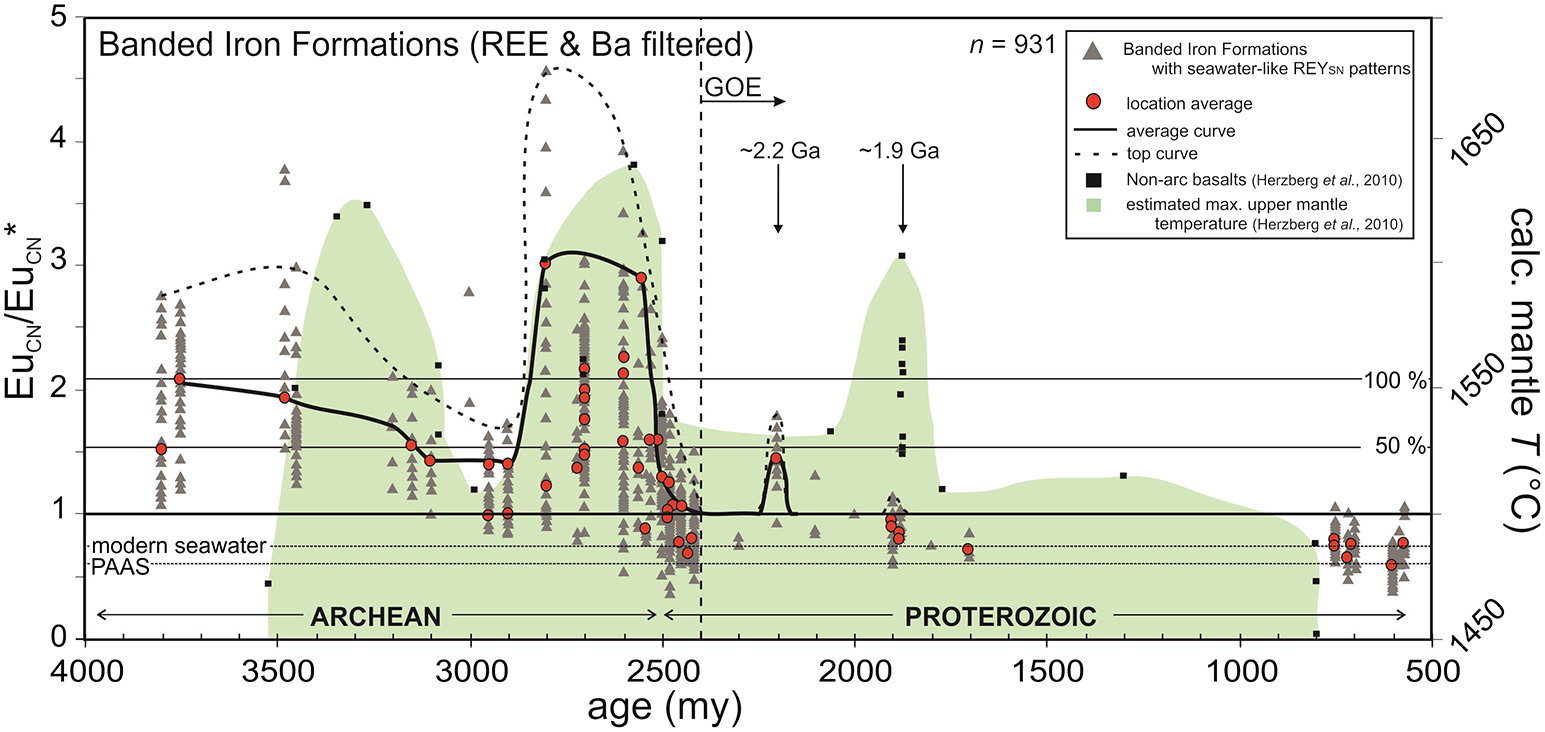
Figure 1 Precambrian EuCN/EuCN* evolution curve of iron formations. The dashed and solid lines represent the global top and location average EuCN anomaly curves of pure iron formation samples (931 data points). EuCN anomalies are abundant throughout the Archean and decrease from the Eoarchean until ca. 2.5 Ga ago. Positive EuCN excursions from 2.8 until 2.55 Ga and potentially at ∼2.2 and ∼1.9 Ga suggest strong REE fluxes into the oceans due to intense magmatic activity. Note that the EuCN evolution curves coincide with the evolution of calculated upper mantle temperature values (black squares and green field with estimated mantle temperatures on the right y-axis; Herzberg et al., 2010
Herzberg, C., Condie, K., Korenaga, J. (2010) Thermal history of the Earth and its petrological expression. Earth and Planetary Science Letters 292, 79–88. https://doi.org/10.1016/j.epsl.2010.01.022
). Percentage values refer to the de- or increase of EuCN/EuCN* values relative to the Eoarchean Isua BIF; the location average includes >3 samples. Respective data is available in the Supplementary Information. GOE: Great Oxidation Event; PAAS: Post Archean Australian Shale.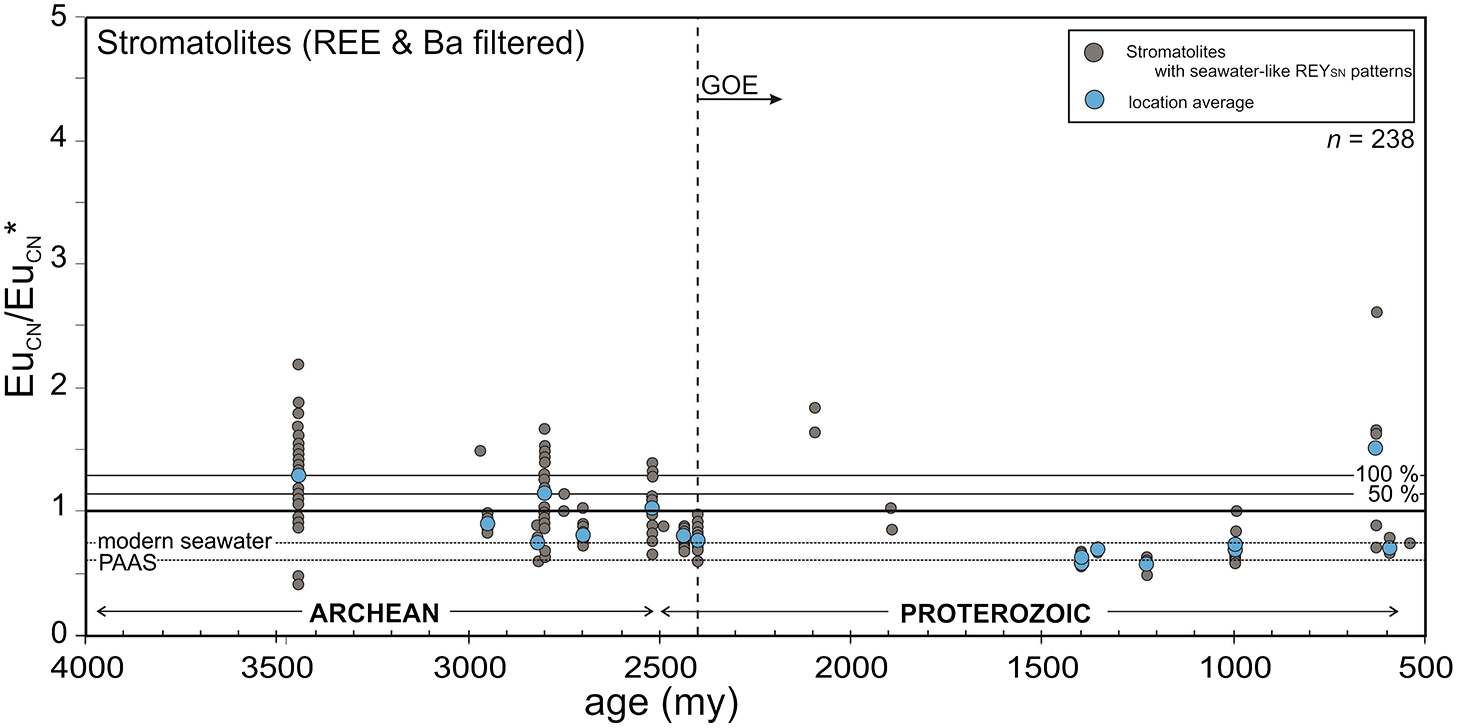
Figure 2 Precambrian EuCN/EuCN* evolution curve of stromatolites deposited in marine environments. The average value of EuCN anomalies in pure stromatolites (229 data points), representing shallow marine microbial habitats, decreases from the Palaeoarchean until 2.5 Ga. EuCN anomalies are generally absent in the Proterozoic with two local exceptions at 2.1 and 0.635 Ga. Note that some of the Archean stromatolite locations do not show positive EuCN anomalies. Percentage values are relative to Palaeoarchean stromatolites from the Pilbara Craton. Location average includes >3 samples. Respective data is available in the Supplementary Information. GOE: Great Oxidation Event; PAAS: Post Archean Australian Shale.
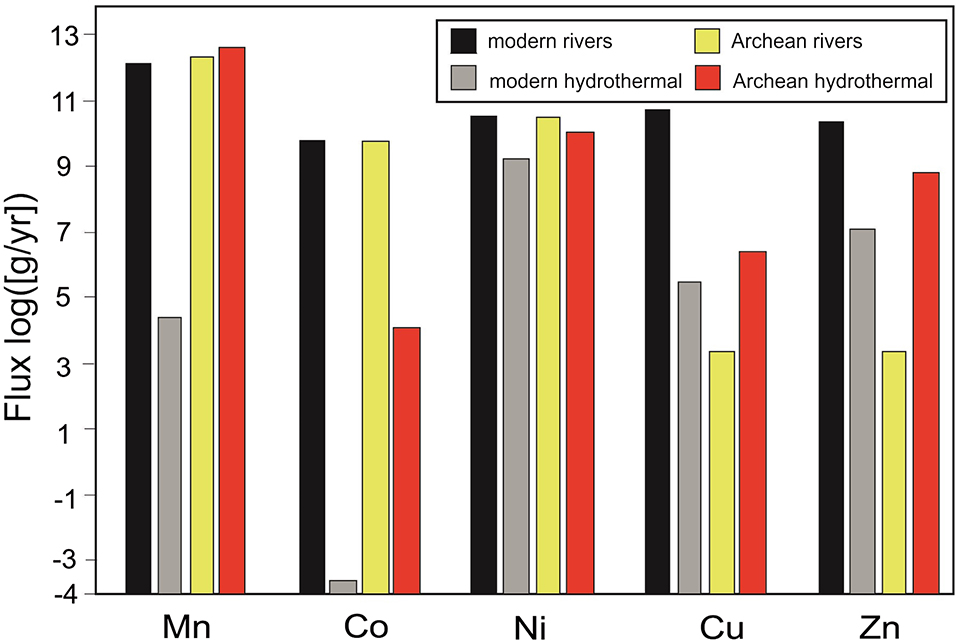
Figure 3 Flux estimate of bio-essential elements via rivers and hydrothermal systems. See Supplementary Information for model assumptions and parameters.