



Labile iron associated trace metals and REEs in estuarine surface sediments
Affiliations | Corresponding Author | Cite as | Funding information
Published by the European Association of Geochemistry
under Creative Commons License CC BY-NC-ND 4.0
Keywords: esturine sediments, labile Fe, trace metals, rare earth elements, redox oscillation, benthic cycling


- Share this article


-
Article views:1,796Cumulative count of HTML views and PDF downloads.
- Download Citation
- Rights & Permissions

top
Abstract

Figures
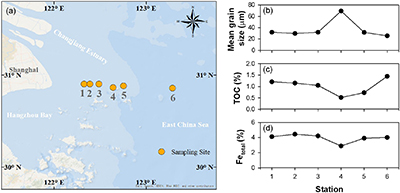 Figure 1 (a) Map of sampling stations in the Changjiang Estuary, (b) the mean grain size, (c) total organic carbon, and (d) total Fe weight percentage in sieved surface sediments of each station. | 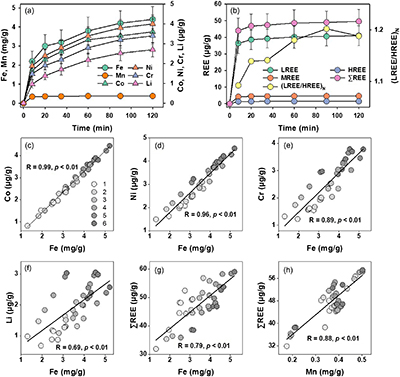 Figure 2 The release of (a) Fe, Mn, Co, Ni, Cr, and (b) REEs during the sediment leaching with 0.5 M HNO3, as well as the cross plot of (c) Fe vs. Co, (d) Fe vs. Ni, (e) Fe vs. Cr, (f) Fe vs. Li, (g) Fe vs. ∑REE, (h) Mn vs. ∑REE over the releasing processes. In (a, b), each point represents the mean ± standard deviation of values measured in sediments from six stations. (LREE/HREE)N represents the value that was PAAS normalised. | 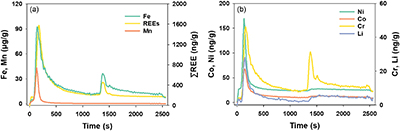 Figure 3 The dynamics of (a) Fe, Mn, and ∑REE, and (b) Co, Ni, Cr, and Li in the FT-TRA, during which 0.1 M and 0.5 M HNO3 sequentially flowed through the sediments. The data points represent average values measured in six stations. |  Figure 4 The cross plot of (a) Fe vs. Co, (b) Mn vs. Ni, (c) Fe vs. Cr, (d) Fe vs. Li, (e) Fe vs. ∑REE, and (f) Fe vs. LREE/∑REE in the effluent of FT-TRA. Solid and dashed lines represent the linear regression line in 0.1 M and 0.5 M HNO3 leaching, respectively. |
| Figure 1 | Figure 2 | Figure 3 | Figure 4 |
top
Introduction
Iron (Fe) and manganese (Mn) oxyhydroxides are essential mediators in the benthic cycling of rare earth elements (REEs) and trace metals in dynamic marginal seas (Yang et al., 2002
Yang, S.Y., Jung, H.S., Choi, M.S., Li, C.X. (2002) The rare earth element compositions of the Changjiang (Yangtze) and Huanghe (Yellow) river sediments. Earth and Planetary Science Letters 201, 407–419. https://doi.org/10.1016/S0012-821X(02)00715-X
; Borch et al., 2010Borch, T., Kretzschmar, R., Kappler, A., Cappellen, P.V., Ginder-Vogel, M., Voegelin, A., Campbell, K. (2010) Biogeochemical Redox Processes and their Impact on Contaminant Dynamics. Environmental Science & Technology 44, 15–23. https://doi.org/10.1021/es9026248
; Deng et al., 2022Deng, K., Yang, S., Du, J., Lian, E., Vance, D. (2022) Dominance of benthic flux of REEs on continental shelves: implications for oceanic budgets. Geochemical Perspectives Letters 22, 26–30. https://doi.org/10.7185/geochemlet.2223
; Lafrenière et al., 2023Lafrenière, M.-C., Lapierre, J.-F., Ponton, D.E., Guillemette, F., Amyot, M. (2023) Rare earth elements (REEs) behavior in a large river across a geological and anthropogenic gradient. Geochimica et Cosmochimica Acta 353, 129–141. https://doi.org/10.1016/j.gca.2023.05.019
). Their redox sensitive nature and high capacity for adsorption and co-precipitation drive their critical roles in the retention and release of trace elements (Yang et al., 2002Yang, S.Y., Jung, H.S., Choi, M.S., Li, C.X. (2002) The rare earth element compositions of the Changjiang (Yangtze) and Huanghe (Yellow) river sediments. Earth and Planetary Science Letters 201, 407–419. https://doi.org/10.1016/S0012-821X(02)00715-X
; Yuan et al., 2004Yuan, C.-G., Shi, J.-B., He, B., Liu, J.-F., Liang, L.-N., Jiang, G.-B. (2004) Speciation of heavy metals in marine sediments from the East China Sea by ICP-MS with sequential extraction. Environment International 30, 769–783. https://doi.org/10.1016/j.envint.2004.01.001
; Borch et al., 2010Borch, T., Kretzschmar, R., Kappler, A., Cappellen, P.V., Ginder-Vogel, M., Voegelin, A., Campbell, K. (2010) Biogeochemical Redox Processes and their Impact on Contaminant Dynamics. Environmental Science & Technology 44, 15–23. https://doi.org/10.1021/es9026248
). This role becomes particularly pronounced in estuarine environments, where redox oscillation in surface sediment prevails, modulated by coupled controls of hydrodynamic disturbance, benthic fauna, microbial activity, and organic matter inputs, etc. (Peiffer et al., 2021Peiffer, S., Kappler, A., Haderlein, S.B., Schmidt, C., Byrne, J.M., Kleindienst, S., Vogt, C., Richnow, H.H., Obst, M., Angenent, L.T., Bryce, C., McCammon, C., Planer-Friedrich, B. (2021) A biogeochemical–hydrological framework for the role of redox-active compounds in aquatic systems. Nature Geoscience 14, 264–272. https://doi.org/10.1038/s41561-021-00742-z
; Zhou et al., 2023Zhou, Z., Henkel, S., Kasten, S., Holtappels, M. (2023) The iron “redox battery” in sandy sediments: Its impact on organic matter remineralization and phosphorus cycling. Science of The Total Environment 865, 161168. https://doi.org/10.1016/j.scitotenv.2022.161168
). The frequency of redox oscillations across distinct spatiotemporal scales from minutely to monthly, amplifying the complexity of Fe and Mn cycling and their influence on trace element fluxes at the sediment-water interface (Borch et al., 2010Borch, T., Kretzschmar, R., Kappler, A., Cappellen, P.V., Ginder-Vogel, M., Voegelin, A., Campbell, K. (2010) Biogeochemical Redox Processes and their Impact on Contaminant Dynamics. Environmental Science & Technology 44, 15–23. https://doi.org/10.1021/es9026248
; Peiffer et al., 2021Peiffer, S., Kappler, A., Haderlein, S.B., Schmidt, C., Byrne, J.M., Kleindienst, S., Vogt, C., Richnow, H.H., Obst, M., Angenent, L.T., Bryce, C., McCammon, C., Planer-Friedrich, B. (2021) A biogeochemical–hydrological framework for the role of redox-active compounds in aquatic systems. Nature Geoscience 14, 264–272. https://doi.org/10.1038/s41561-021-00742-z
; Song et al., 2022Song, S., Santos, I.R., Yu, H., Wang, F., Burnett, W.C., Bianchi, T.S., Dong, J., Lian, E., Zhao, B., Mayer, L., Yao, Q., Yu, Z., Xu, B. (2022) A global assessment of the mixed layer in coastal sediments and implications for carbon storage. Nature Communications 13, 4903. https://doi.org/10.1038/s41467-022-32650-0
; Hu et al., 2024Hu, C., Liu, M., Li, Y., Li, J., Che, X., Wang, H. (2024) Sedimentation and transformation of heavy metals during the transport from the Yellow River estuary to the sea: Evidence from surface sediments of the Yellow River subaqueous delta. Marine Pollution Bulletin 207, 116862. https://doi.org/10.1016/j.marpolbul.2024.116862
).During steady state early diagenesis, Mn(IV) and Fe(III) oxyhydroxides are successively used by microbes as electron acceptors for organic matter remineralisation. The dissimilatory reduction of Fe and Mn phases and the complexation of organic ligands facilitates the release of adsorbed or coprecipitated trace metals (e.g., Co, Ni, Cr) and REEs into porewaters, enabling their liberation from sediments via diffusion (Liu et al., 2022
Liu, W., Lu, G., Wang, W.X. (2022) In situ high-resolution two-dimensional profiles of redox sensitive metal mobility in sediment-water interface and porewater from estuarine sediments. Science of The Total Environment 820, 153034. https://doi.org/10.1016/j.scitotenv.2022.153034
; Zhu et al., 2022Zhu, L., Zhang, X., Zhang, J., Liu, T., Qiu, Y. (2022) Saltwater intrusion weakens Fe-(oxyhydr)oxide-mediated (im)mobilization of Ni and Zn in redox-fluctuating soil–groundwater system. Water Research 221, 118799. https://doi.org/10.1016/j.watres.2022.118799
; Zhang and Shields, 2023Zhang, K., Shields, G.A. (2023) Early diagenetic mobilization of rare earth elements and implications for the Ce anomaly as a redox proxy. Chemical Geology 635, 121619. https://doi.org/10.1016/j.chemgeo.2023.121619
). Conversely, in the oxic sediment layer, as well as the reoxidation caused by sediment resuspension or bioturbation, dissolved Fe(II) and Mn(II) can be reoxidised forming oxyhydroxides that scavenge trace elements from porewater via coprecipitation and adsorption (Stolpe et al., 2013Stolpe, B., Guo, L.D., Shiller, A.M. (2013) Binding and transport of rare earth elements by organic and iron-rich nanocolloids in Alaskan rivers, as revealed by field-flow fractionation and ICP-MS. Geochimica et Cosmochimica Acta 106, 446–462. https://doi.org/10.1016/j.gca.2012.12.033
; Zhou et al., 2023Zhou, Z., Henkel, S., Kasten, S., Holtappels, M. (2023) The iron “redox battery” in sandy sediments: Its impact on organic matter remineralization and phosphorus cycling. Science of The Total Environment 865, 161168. https://doi.org/10.1016/j.scitotenv.2022.161168
). This cyclic dissolution and precipitation directly control the benthic fluxes of trace elements at the sediment-water interface, ultimately influencing terrestrial inputs of REEs and trace metals to marginal seas. Furthermore, these cyclic processes can cause fractionation of REEs or trace metals, producing distinctive geochemical signatures that reflect sedimentary redox histories and broader environmental conditions (Wu et al., 2020Wu, Y.J., Fan, D.D., Wang, D.L., Yin, P. (2020) Increasing hypoxia in the Changjiang Estuary during the last three decades deciphered from sedimentary redox-sensitive elements. Marine Geology 419, 106044. https://doi.org/10.1016/j.margeo.2019.106044
; Peiffer et al., 2021Peiffer, S., Kappler, A., Haderlein, S.B., Schmidt, C., Byrne, J.M., Kleindienst, S., Vogt, C., Richnow, H.H., Obst, M., Angenent, L.T., Bryce, C., McCammon, C., Planer-Friedrich, B. (2021) A biogeochemical–hydrological framework for the role of redox-active compounds in aquatic systems. Nature Geoscience 14, 264–272. https://doi.org/10.1038/s41561-021-00742-z
; Ma and Wang, 2023Ma, L., Wang, W.-X. (2023) Dissolved rare earth elements in the Pearl River Delta: Using Gd as a tracer of anthropogenic activity from river towards the sea. Science of The Total Environment 856, 159241. https://doi.org/10.1016/j.scitotenv.2022.159241
).Although many studies have highlighted the quantitative importance of Fe-Mn oxyhydroxides in preserving trace elements (Manceau et al., 2007
Manceau, A., Lanson, M., Geoffroy, N. (2007) Natural speciation of Ni, Zn, Ba, and As in ferromanganese coatings on quartz using X-ray fluorescence, absorption, and diffraction. Geochimica et Cosmochimica Acta 71, 95–128. https://doi.org/10.1016/j.gca.2006.08.036
; Chang et al., 2016Chang, C., Li, F., Liu, C., Gao, J., Tong, H., Chen, M. (2016) Fractionation characteristics of rare earth elements (REEs) linked with secondary Fe, Mn, and Al minerals in soils. Acta Geochimica 35, 329–339. https://doi.org/10.1007/s11631-016-0119-1
; Su et al., 2017Su, N., Yang, S.Y., Guo, Y.L., Yue, W., Wang, X.D., Yin, P., Huang, X.T. (2017) Revisit of rare earth element fractionation during chemical weathering and river sediment transport. Geochemistry, Geophysics, Geosystems 18, 935–955. https://doi.org/10.1002/2016GC006659
), large fractions of these oxyhydroxides are relatively unreactive during the redox oscillations of surface sediments (Poulton and Canfield, 2005Poulton, S.W., Canfield, D.E. (2005) Development of a sequential extraction procedure for iron: implications for iron partitioning in continentally derived particulates. Chemical Geology 214, 209–221. https://doi.org/10.1016/j.chemgeo.2004.09.003
). Only the labile fractions are susceptible to frequent redox oscillations and subsequently influence benthic fluxes at the sediment-water interface (Laufer et al., 2020Laufer, K., Michaud, A.B., Røy, H., Jørgensen, B.B. (2020) Reactivity of Iron Minerals in the Seabed Toward Microbial Reduction – A Comparison of Different Extraction Techniques. Geomicrobiology Journal 37, 170–189. https://doi.org/10.1080/01490451.2019.1679291
; Peiffer et al., 2021Peiffer, S., Kappler, A., Haderlein, S.B., Schmidt, C., Byrne, J.M., Kleindienst, S., Vogt, C., Richnow, H.H., Obst, M., Angenent, L.T., Bryce, C., McCammon, C., Planer-Friedrich, B. (2021) A biogeochemical–hydrological framework for the role of redox-active compounds in aquatic systems. Nature Geoscience 14, 264–272. https://doi.org/10.1038/s41561-021-00742-z
). However, the geochemical properties of trace elements in the labile Fe-Mn oxyhydroxides and their potential recycling processes remain underexplored.This study focuses on the labile fractions in surficial sediments of the Changjiang Estuary. In addition to the conventional batch dissolution dynamics, this study employed flow through time-resolved analysis (FT-TRA) to resolve compositional evolution at sub-minute resolution. The co-releases of Fe, Mn, REEs, and trace metals were closely monitored and compared using these two approaches. We aimed to investigate the distribution and associations of REEs and trace metals in the labile fractions of Fe and Mn oxyhydroxides, providing crucial insights into the benthic cycling processes during non-steady state early diagenesis. Understanding these dynamics is essential for evaluating the benthic fluxes of trace metals and REEs to coastal marine systems.
top
Materials and Methods
Sediment sampling. Surface sediment samples were collected from six stations along a salinity gradient in the Changjiang Estuary during research cruises in August and October 2023 (Fig. 1, Table S-1). Sediments from the upper 2 cm of the seabed, recognised by their yellowish colour, were retrieved using a box sampler. After collection, samples were immediately stored at 4 °C and freeze dried within one week. The dried sediments were sieved to remove particles larger than 125 μm. The sieved sediments were analysed for grain size distribution using a laser diffraction particle analyser (Malvern Mastersizer 3000). Total organic carbon (TOC) content was measured with a TOC analyser (Elementar vario EL cube). Total Fe content and other elements were quantified using HNO3/HF digestion followed by measurement with inductively coupled plasma-optical emission spectrometry (ICP-OES, IRIS Advantage) and mass spectrometry (ICP-MS, Agilent 7900 Quadrupole).
Figure 1 (a) Map of sampling stations in the Changjiang Estuary, (b) the mean grain size, (c) total organic carbon, and (d) total Fe weight percentage in sieved surface sediments of each station.
Batch leaching experiments. For each station, 500 mg of sediment sample were extracted with 50 mL of 1 M MgCl2 for two hours to remove exchangeable fractions. After centrifugation, the remaining solid was resuspended in 50 mL 0.5 M HNO3 (double distilled) and stirred at 120 rpm. Labile Fe-Mn oxyhydroxides, which are most sensitive to redox oscillation and are potentially bioavailable, were expected to be leachable under these conditions. The suspension was sampled at regular intervals, centrifuged, and filtered through 0.22 μm filters. The filtrates were diluted 50 fold with 0.1 M HNO3 and analysed using inductively coupled plasma mass spectrometry (ICP-MS, Agilent 7900 Quadrupole). During ICP-MS measurements, a helium collision cell was used. Concentrations of Mn, Fe, Co, Ni, Cd, Li, and rare earth elements (REEs) were determined (McCurdy and Woods, 2004
McCurdy, E., Woods, G. (2004) The application of collision/reaction cell inductively coupled plasma mass spectrometry to multi-element analysis in variable sample matrices, using He as a non-reactive cell gas. Journal of Analytical Atomic Spectrometry 19, 607–615. https://doi.org/10.1039/b312250f
). The total REE concentration (∑REE) was calculated as the sum of La, Ce, Pr, Nd, Sm, Eu, Gd, Tb, Dy, Ho, Er, Tm, Yb, and Lu. REEs were further categorised into Light REEs (LREEs: La, Ce, Pr, Nd), Medium REEs (MREEs: Eu, Gd, Tb, Dy), and Heavy REEs (HREEs: Er, Tm, Yb, Lu). Internal standards (103Rh and 115In) were monitored to ensure precision, with count rate stability maintained below 3 % relative standard deviation (RSD). Double charging and oxide effects were minimised to below 1.7 % and 2.1 %, respectively.Flow through time-resolved Analysis (FT-TRA). To avoid artifacts inherent to closed system reactors (e.g., surface re-adsorption, secondary precipitation), a continuous flow through configuration was employed to leach the sediments, enabling phase discrimination through time-resolved elution signatures. To prepare for FT-TRA, 100 mg of sediment sample were initially extracted with 10 mL of 1 M MgCl2 for two hours to remove the exchangeable fraction. After centrifugation, the solids were resuspended in 10 mL of ultrapure water. From this suspension, 10 mg of sediment were filtered onto 0.22 μm filters (Millipore Co.) and mounted in a flow through leaching system connected to an ICP-MS (Agilent 7900 Quadrupole) (Börner et al., 2017
Börner, N., De Baere, B., Francois, R., Schwalb, A. (2017) Application of flow-through time-resolved analysis (FT-TRA) to isolate the elemental composition in ostracod calcite. Chemical Geology 467, 53–63. https://doi.org/10.1016/j.chemgeo.2017.07.019
). During the operation of FT-TRA, a constant flow rate of 0.5 mL/min was maintained using a gradient pump. Sequentially, 10 mL of 0.1 M and 0.5 M HNO3 (double distilled) were pumped through the sediments. These HNO3 solutions showed comparable Fe extraction capacity with HCl based on our pre-tests, and were chosen to target labile fractions of Fe-Mn oxyhydroxides, while optimising the matrix for real time measurement with ICP-MS. Similar ICP-MS methods and setups to those described above were used. Analytical reproducibility was confirmed using certified reference materials (GSR-6 limestone) and periodic testing of blank solutions. Analytical precision was ensured by replicating experiments under identical conditions. More information about our experiments, such as total amount of leached elements and correlation analysis, can be found in the Supplementary Information.top
Results and Discussion
Sediment characteristics. The average grain size of the studied sediment fractions was 30.1 ± 2.7 μm across stations, except at station 4, where larger grains (69.4 μm) suggest a potential influence from nearby topography (Fig. 1). TOC content averaged 1.02 ± 0.34 %, and total Fe content averaged 3.93 ± 0.54 %, both showing stronger correlations with grain size than with distance from the estuary (Fig. 1). The total amounts of Fe extracted by batch leaching and FT-TRA were 4.3 ± 0.68 and 3.5 ± 1.05 mg/g sediment, which were comparable with each other and accounted for about 10 % of the total Fe (Table S-2).
Compared with traditional sequential Fe extractions (Poulton and Canfield, 2005
Poulton, S.W., Canfield, D.E. (2005) Development of a sequential extraction procedure for iron: implications for iron partitioning in continentally derived particulates. Chemical Geology 214, 209–221. https://doi.org/10.1016/j.chemgeo.2004.09.003
), our extractions likely included carbonate-associated Fe and a large fraction of easily reducible oxides (e.g., ferrihydrite, lepidocrocite), which were quantitively consistent with previous studies using sediments from a similar area of the Changjiang Estuary (Xu et al., 2024Xu, P., Su, N., Lian, E., Wang, R., Yang, S. (2024) Enrichment effect and environmental control of clay reactive iron in the Changjiang River estuary and East China Sea. Marine Geology & Quaternary Geology 44, 54–64. https://doi.org/10.16562/j.cnki.0256-1492.2024030301
). Approximately 0.35 ± 0.03 mg/g sediment of Mn were leached by batch leaching and FT-TRA. The abundance of Mn was less than one tenth that of Fe, implying Fe’s greater role in trace element cycling. These labile Fe-Mn fractions are potentially the most susceptible to redox oscillations, reflecting the effects of complex biogeochemical processes during non-steady state early diagenesis (Laufer et al., 2020Laufer, K., Michaud, A.B., Røy, H., Jørgensen, B.B. (2020) Reactivity of Iron Minerals in the Seabed Toward Microbial Reduction – A Comparison of Different Extraction Techniques. Geomicrobiology Journal 37, 170–189. https://doi.org/10.1080/01490451.2019.1679291
; Peiffer et al., 2021Peiffer, S., Kappler, A., Haderlein, S.B., Schmidt, C., Byrne, J.M., Kleindienst, S., Vogt, C., Richnow, H.H., Obst, M., Angenent, L.T., Bryce, C., McCammon, C., Planer-Friedrich, B. (2021) A biogeochemical–hydrological framework for the role of redox-active compounds in aquatic systems. Nature Geoscience 14, 264–272. https://doi.org/10.1038/s41561-021-00742-z
).Trace metals associations with labile Fe-Mn oxyhydroxides. In both batch leaching and FT-TRA, the six stations exhibited consistent elemental release patterns with minor quantitative variations. The amount of trace metals extracted by these two approaches were comparable, with 16 % of Co, 17 % of Ni, 5 % of Cr, and 5 % of Li extracted from the sediments, respectively (Table S-2).
In the batch leaching, 92 % of Mn was released within 8 minutes, while Fe release was more gradual, with 52 % of Fe released within the same time frame (Fig. 2a). The extracted Ni, Co, Cr, and Li showed similar release patterns to Fe (Fig. 2a). Further Pearson correlation analysis revealed that Co and Ni correlated with both Fe and Mn, though Fe showed a stronger correlation than Mn as indicated by the R value (Fig. 2, Table S-3). Cr and Li only showed correlations with Fe.
Figure 2 The release of (a) Fe, Mn, Co, Ni, Cr, and (b) REEs during the sediment leaching with 0.5 M HNO3, as well as the cross plot of (c) Fe vs. Co, (d) Fe vs. Ni, (e) Fe vs. Cr, (f) Fe vs. Li, (g) Fe vs. ∑REE, (h) Mn vs. ∑REE over the releasing processes. In (a, b), each point represents the mean ± standard deviation of values measured in sediments from six stations. (LREE/HREE)N represents the value that was PAAS normalised.
In FT-TRA, more detailed associations were observed due to higher time resolution and different leaching gradients. Labile Mn was rapidly depleted by 0.1 M HNO3, displaying a sharp release peak, with no further significant Mn release in subsequent 0.5 M HNO3 leaching (Fig. 3a). In contrast, Fe exhibited a more gradual release, with higher peak intensity and a strong tailing effect during 0.1 M HNO3 leaching. Further Fe release continued in 0.5 M HNO3 leaching, albeit at reduced intensity (∼0.38 times lower). Co and Li displayed strong correlations with Fe only during 0.1 M HNO3 leaching (R = 0.97, p < 0.01), while Cr aligned closely with Fe in both leaching stages. Ni, on the other hand, was more strongly associated with Mn (Fig. 4, Table S-4). Combining the FT-TRA and batch leaching results, we suggest that in the labile fractions of estuarine surface sediments, Cr, Li and Co are primarily associated with Fe oxyhydroxides (e.g., ferrihydrite), while Ni is preferentially associated with Mn oxides (e.g., birnessite).
Figure 3 The dynamics of (a) Fe, Mn, and ∑REE, and (b) Co, Ni, Cr, and Li in the FT-TRA, during which 0.1 M and 0.5 M HNO3 sequentially flowed through the sediments. The data points represent average values measured in six stations.
Figure 4 The cross plot of (a) Fe vs. Co, (b) Mn vs. Ni, (c) Fe vs. Cr, (d) Fe vs. Li, (e) Fe vs. ∑REE, and (f) Fe vs. LREE/∑REE in the effluent of FT-TRA. Solid and dashed lines represent the linear regression line in 0.1 M and 0.5 M HNO3 leaching, respectively.
These observations align with prior studies where Ni was efficiently complexed with Mn oxides, particularly on the octahedral vacancy sites present on the birnessite [001] face, and further incorporated into the crystal structure of birnessite and buserite in marine sediments (Peacock, 2009
Peacock, C.L. (2009) Physiochemical controls on the crystal-chemistry of Ni in birnessite: Genetic implications for ferromanganese precipitates. Geochimica et Cosmochimica Acta 73, 3568–3578. https://doi.org/10.1016/j.gca.2009.03.020
; Shi et al., 2024Shi, M., Li, Q., Wang, Q., Yan, X., Li, B., Feng, L., Wu, C., Qiu, R., Zhang, H., Yang, Z., Yang, W., Liao, Q., Chai, L. (2024) A review on the transformation of birnessite in the environment: Implication for the stabilization of heavy metals. Journal of Environmental Sciences 139, 496–515. https://doi.org/10.1016/j.jes.2023.06.019
). Mn(IV) can oxidise Cr to highly soluble Cr(VI) species, limiting its association with Mn oxides (Liang et al., 2021Liang, J.L., Huang, X.M., Yan, J.W., Li, Y.Y., Zhao, Z.W., Liu, Y.Y., Ye, J.Y., Wei, Y.M. (2021) A review of the formation of Cr(VI) via Cr(III) oxidation in soils and groundwater. Science of The Total Environment 774, 145762. https://doi.org/10.1016/j.scitotenv.2021.145762
). Additionally, Cr(III) shares a high structural similarity with Fe(III), and may replace or incorporate preferentially into the lattices of labile Fe oxyhydroxides like ferrihydrite (coherent scattering domain size ∼27 Å) (Tang et al., 2010Tang, Y.Z., Michel, F.M., Zhang, L.H., Harrington, R., Parise, J.B., Reeder, R.J. (2010) Structural Properties of the Cr(III)−Fe(III) (Oxy)hydroxide Compositional Series: Insights for a Nanomaterial “Solid Solution”. Chemistry of Materials 22, 3589–3598. https://doi.org/10.1021/cm1000472
). The different Cr/Fe ratios in 0.1 M and 0.5 M HNO3 extractions potentially reflect varying extents of structural replacement in Fe(III) oxyhydroxides with different crystallinities (Fig. 4c). Co and Li exhibited preferences for more labile and redox sensitive fractions of Fe oxyhydroxides, such as ferrihydrite, rather than more crystalline Fe forms extractable only in 0.5 M HNO3 (Fig. 4a,d).REEs association and fractionation by labile Fe. The amounts of REEs extracted by batch leaching and FT-TRA were comparable with each other, with 30.5 ± 1.5 % of REEs in sediments extracted, showing their enrichment in labile Fe fractions (Table S-2). In the batch leaching, 89 % of the release occurred within the first 8 minutes, while the compositions of REEs shifted with further releases of REEs and Fe (Fig. 1b). Notably, the ratio of LREE to HREE increased over time, indicating a stronger association of LREE with Fe oxyhydroxides. Correlation analysis revealed that REEs associate with both Fe and Mn (Fig. 2g,h), though FT-TRA provided more precise differentiation.
In FT-TRA, REEs release closely mirrored Fe release, with a relatively stable ∑REE/Fe ratio (∼0.02) during 0.1 M HNO3 leaching that decreased in 0.5 M HNO3 leaching (Figs. 3a, 4e). This suggests that more labile fractions, such as amorphous Fe and ferrihydrite, are more efficient at retaining REEs. The correlation between Fe and ∑REE reached 0.94 (p < 0.01) and 0.93 (p < 0.01) for 0.1 M and 0.5 M HNO3 leaching, respectively (Fig. 4e). Additionally, the LREE/∑REE ratio increased as Fe release progressed, stabilising around 0.75 after substantial Fe release (Fig. 4f). These results demonstrate Fe’s dominant role in binding REEs and offer direct evidence for the preferential retention and fractionation of LREEs in labile Fe oxyhydroxides. This finding is consistent with the higher affinity of LREEs for Fe oxyhydroxide surface sites, where stable inner sphere complexes (a mixture of eight fold and nine fold coordination) resist rapid dissolution (Ohta et al., 2009
Ohta, A., Kagi, H., Nomura, M., Tsuno, H., Kawabe, I. (2009) Coordination study of rare earth elements on Fe oxyhydroxide and Mn dioxides: Part I. Influence of a multi-electron excitation on EXAFS analyses of La, Pr, Nd, and Sm. American Mineralogist 94, 467–475. https://doi.org/10.2138/am.2009.2986
).PAAS-normalised REE patterns revealed distinctions between conventional batch leaching and FT-TRA (Fig. S-3). The patterns from batch leaching were enriched in MREEs, resembling the characteristics found in the labile phases of Changjiang river and estuary sediments (Zhang et al., 1998
Zhang, C., Wang, L., Zhang, S., Li, X. (1998) Geochemistry of rare earth elements in the mainstream of the Yangtze River, China. Applied Geochemistry 13, 451–462. https://doi.org/10.1016/S0883-2927(97)00079-6
; Wang and Liu, 2008Wang, Z.-L., Liu, C.-Q. (2008) Geochemistry of rare earth elements in the dissolved, acid-soluble and residual phases in surface waters of the Changjiang Estuary. Journal of Oceanography 64, 407–416. https://doi.org/10.1007/s10872-008-0034-0
). However, the patterns obtained by FT-TRA were enriched in HREE, resembling the porewater characteristics (Deng et al., 2022Deng, K., Yang, S., Du, J., Lian, E., Vance, D. (2022) Dominance of benthic flux of REEs on continental shelves: implications for oceanic budgets. Geochemical Perspectives Letters 22, 26–30. https://doi.org/10.7185/geochemlet.2223
). We highlight the advantages of FT-TRA in avoiding surface re-complexation and secondary precipitation, reflecting more accurate elemental spatial distribution than batch dissolution in closed system. The resemblance of REE patterns with porewater may reflect the frequent aqueous-solid exchange under dynamic redox conditions, showing the high mobility of trace elements in the labile fractions.Implications for trace element cycling in estuary sediments. This study underscores the role of labile Fe oxyhydroxides as primary drivers of trace metal and REE retention in estuarine surface sediments. The controlling influence of Fe could be intensified by the dynamic redox condition characteristic of these environments (Yuan et al., 2004
Yuan, C.-G., Shi, J.-B., He, B., Liu, J.-F., Liang, L.-N., Jiang, G.-B. (2004) Speciation of heavy metals in marine sediments from the East China Sea by ICP-MS with sequential extraction. Environment International 30, 769–783. https://doi.org/10.1016/j.envint.2004.01.001
; Borch et al., 2010Borch, T., Kretzschmar, R., Kappler, A., Cappellen, P.V., Ginder-Vogel, M., Voegelin, A., Campbell, K. (2010) Biogeochemical Redox Processes and their Impact on Contaminant Dynamics. Environmental Science & Technology 44, 15–23. https://doi.org/10.1021/es9026248
; Shi et al., 2024Shi, M., Li, Q., Wang, Q., Yan, X., Li, B., Feng, L., Wu, C., Qiu, R., Zhang, H., Yang, Z., Yang, W., Liao, Q., Chai, L. (2024) A review on the transformation of birnessite in the environment: Implication for the stabilization of heavy metals. Journal of Environmental Sciences 139, 496–515. https://doi.org/10.1016/j.jes.2023.06.019
). In diffusion dominated settings, the Mn redox transition zone is typically closer to the sediment-water interface than Fe, thus Mn often regulates trace element fluxes from sediments (Deng et al., 2022Deng, K., Yang, S., Du, J., Lian, E., Vance, D. (2022) Dominance of benthic flux of REEs on continental shelves: implications for oceanic budgets. Geochemical Perspectives Letters 22, 26–30. https://doi.org/10.7185/geochemlet.2223
). However, in estuarine sediments, physical disturbances (e.g., tides, waves, offshore currents) and bioturbation frequently disrupt redox stratification, leading to bulk sediment re-oxygenation in daily to monthly frequency (Song et al., 2022Song, S., Santos, I.R., Yu, H., Wang, F., Burnett, W.C., Bianchi, T.S., Dong, J., Lian, E., Zhao, B., Mayer, L., Yao, Q., Yu, Z., Xu, B. (2022) A global assessment of the mixed layer in coastal sediments and implications for carbon storage. Nature Communications 13, 4903. https://doi.org/10.1038/s41467-022-32650-0
). The faster reoxidation of Fe(II) compared to Mn(II) prioritises Fe(III) oxyhydroxides in coprecipitating and trapping trace metals and REEs, thereby diminishing Mn’s role in their retention (Peiffer et al., 2021Peiffer, S., Kappler, A., Haderlein, S.B., Schmidt, C., Byrne, J.M., Kleindienst, S., Vogt, C., Richnow, H.H., Obst, M., Angenent, L.T., Bryce, C., McCammon, C., Planer-Friedrich, B. (2021) A biogeochemical–hydrological framework for the role of redox-active compounds in aquatic systems. Nature Geoscience 14, 264–272. https://doi.org/10.1038/s41561-021-00742-z
; Zhou et al., 2023Zhou, Z., Henkel, S., Kasten, S., Holtappels, M. (2023) The iron “redox battery” in sandy sediments: Its impact on organic matter remineralization and phosphorus cycling. Science of The Total Environment 865, 161168. https://doi.org/10.1016/j.scitotenv.2022.161168
). This mechanism aligns with our findings that trace elements are preferentially associated and fractionated by Fe in the labile fractions of estuarine surface sediments.Estimating benthic fluxes using porewater data from static cores often fails to include the output of dynamic depositional environments, particularly those driven by redox oscillation. Trace elements associated with labile Fe oxyhydroxides can be liberated during reductive dissolution using organic carbon as electron donor. These liberated trace elements can partially escape from capture by Fe reoxidation and coprecipitation/adsorption during advective discharge, thus contributing to benthic trace element fluxes (Zhou et al., 2023
Zhou, Z., Henkel, S., Kasten, S., Holtappels, M. (2023) The iron “redox battery” in sandy sediments: Its impact on organic matter remineralization and phosphorus cycling. Science of The Total Environment 865, 161168. https://doi.org/10.1016/j.scitotenv.2022.161168
). We hypothesise that this “redox pump”, powered by non-steady state early diagenesis, increased the general mobility of trace elements preserved in the temporal sink of labile Fe oxyhydroxides, making them potential sources for benthic-pelagic exchange. Although the abundance of iron and trace elements in labile fractions is very limited (≤10 %), their role in trace elements solid-aqueous exchange is magnified under redox oscillation.The power of the “redox pump”, reflecting on the induced interactions between labile Fe and trace elements and their net fluxes, exhibits pronounced spatiotemporal variabilities in the estuarine environment. It is shaped by the sedimentary geochemical properties (e.g., OC, Fe bioavailability) and the frequency of redox oscillation, which is further determined by the interplay of hydrodynamics, microbial activities, etc. Anthropogenic disturbances (e.g., dredging, trawling) further disturbed sedimentary redox stratification, potentially amplifying the fluxes of trace metals liberated from labile Fe into the water column.
In summary, this study highlights the complexity of biogeochemical processes in estuarine surface sediments and emphasises the critical role of labile Fe in regulating trace element cycling. We suggest that the dynamic depositional environments, particularly the induced redox oscillations, can improve the mobility of trace elements associated with labile Fe, increasing their benthic fluxes and ultimately the overall fluvial inputs into the marginal sea. We highlight the importance of labile fractions in estuarine sediments, and encourage further application of FT-TRA to deepen insights into the co-evolution of elemental abundances and compositions during source to sink processes in the dynamic estuarine environments.
top
Acknowledgements
Financial supports were provided by the National Science Foundation of China (42230410; 42306052), and the Interdisciplinary Program of Tongji University (20231YB04). We would like to thank Dr. Fangbin Li, Wenwen Liu for their assistance in sample collection, and Dr. Juan Xu for the help in data curation.
Editor: Juan Liu
top
References
Borch, T., Kretzschmar, R., Kappler, A., Cappellen, P.V., Ginder-Vogel, M., Voegelin, A., Campbell, K. (2010) Biogeochemical Redox Processes and their Impact on Contaminant Dynamics. Environmental Science & Technology 44, 15–23. https://doi.org/10.1021/es9026248
 Show in context
 Iron (Fe) and manganese (Mn) oxyhydroxides are essential mediators in the benthic cycling of rare earth elements (REEs) and trace metals in dynamic marginal seas (Yang et al., 2002; Borch et al., 2010; Deng et al., 2022; Lafrenière et al., 2023).
View in article
Their redox sensitive nature and high capacity for adsorption and co-precipitation drive their critical roles in the retention and release of trace elements (Yang et al., 2002; Yuan et al., 2004; Borch et al., 2010).
View in article
The frequency of redox oscillations across distinct spatiotemporal scales from minutely to monthly, amplifying the complexity of Fe and Mn cycling and their influence on trace element fluxes at the sediment-water interface (Borch et al., 2010; Peiffer et al., 2021; Song et al., 2022; Hu et al., 2024).
View in article
The controlling influence of Fe could be intensified by the dynamic redox condition characteristic of these environments (Yuan et al., 2004; Borch et al., 2010; Shi et al., 2024).
View in article
Börner, N., De Baere, B., Francois, R., Schwalb, A. (2017) Application of flow-through time-resolved analysis (FT-TRA) to isolate the elemental composition in ostracod calcite. Chemical Geology 467, 53–63. https://doi.org/10.1016/j.chemgeo.2017.07.019
Show in context From this suspension, 10 mg of sediment were filtered onto 0.22 μm filters (Millipore Co.) and mounted in a flow through leaching system connected to an ICP-MS (Agilent 7900 Quadrupole) (Börner et al., 2017).
View in article
Chang, C., Li, F., Liu, C., Gao, J., Tong, H., Chen, M. (2016) Fractionation characteristics of rare earth elements (REEs) linked with secondary Fe, Mn, and Al minerals in soils. Acta Geochimica 35, 329–339. https://doi.org/10.1007/s11631-016-0119-1
Show in context Although many studies have highlighted the quantitative importance of Fe-Mn oxyhydroxides in preserving trace elements (Manceau et al., 2007; Chang et al., 2016; Su et al., 2017), large fractions of these oxyhydroxides are relatively unreactive during the redox oscillations of surface sediments (Poulton and Canfield, 2005).
View in article
Deng, K., Yang, S., Du, J., Lian, E., Vance, D. (2022) Dominance of benthic flux of REEs on continental shelves: implications for oceanic budgets. Geochemical Perspectives Letters 22, 26–30. https://doi.org/10.7185/geochemlet.2223
Show in context Iron (Fe) and manganese (Mn) oxyhydroxides are essential mediators in the benthic cycling of rare earth elements (REEs) and trace metals in dynamic marginal seas (Yang et al., 2002; Borch et al., 2010; Deng et al., 2022; Lafrenière et al., 2023).
View in article
However, the patterns obtained by FT-TRA were enriched in HREE, resembling the porewater characteristics (Deng et al., 2022).
View in article
In diffusion dominated settings, the Mn redox transition zone is typically closer to the sediment-water interface than Fe, thus Mn often regulates trace element fluxes from sediments (Deng et al., 2022).
View in article
Hu, C., Liu, M., Li, Y., Li, J., Che, X., Wang, H. (2024) Sedimentation and transformation of heavy metals during the transport from the Yellow River estuary to the sea: Evidence from surface sediments of the Yellow River subaqueous delta. Marine Pollution Bulletin 207, 116862. https://doi.org/10.1016/j.marpolbul.2024.116862
Show in context The frequency of redox oscillations across distinct spatiotemporal scales from minutely to monthly, amplifying the complexity of Fe and Mn cycling and their influence on trace element fluxes at the sediment-water interface (Borch et al., 2010; Peiffer et al., 2021; Song et al., 2022; Hu et al., 2024).
View in article
Lafrenière, M.-C., Lapierre, J.-F., Ponton, D.E., Guillemette, F., Amyot, M. (2023) Rare earth elements (REEs) behavior in a large river across a geological and anthropogenic gradient. Geochimica et Cosmochimica Acta 353, 129–141. https://doi.org/10.1016/j.gca.2023.05.019
Show in context Iron (Fe) and manganese (Mn) oxyhydroxides are essential mediators in the benthic cycling of rare earth elements (REEs) and trace metals in dynamic marginal seas (Yang et al., 2002; Borch et al., 2010; Deng et al., 2022; Lafrenière et al., 2023).
View in article
Laufer, K., Michaud, A.B., Røy, H., Jørgensen, B.B. (2020) Reactivity of Iron Minerals in the Seabed Toward Microbial Reduction – A Comparison of Different Extraction Techniques. Geomicrobiology Journal 37, 170–189. https://doi.org/10.1080/01490451.2019.1679291
Show in context Only the labile fractions are susceptible to frequent redox oscillations and subsequently influence benthic fluxes at the sediment-water interface (Laufer et al., 2020; Peiffer et al., 2021).
View in article
These labile Fe-Mn fractions are potentially the most susceptible to redox oscillations, reflecting the effects of complex biogeochemical processes during non-steady state early diagenesis (Laufer et al., 2020; Peiffer et al., 2021).
View in article
Liang, J.L., Huang, X.M., Yan, J.W., Li, Y.Y., Zhao, Z.W., Liu, Y.Y., Ye, J.Y., Wei, Y.M. (2021) A review of the formation of Cr(VI) via Cr(III) oxidation in soils and groundwater. Science of The Total Environment 774, 145762. https://doi.org/10.1016/j.scitotenv.2021.145762
Show in context Mn(IV) can oxidise Cr to highly soluble Cr(VI) species, limiting its association with Mn oxides (Liang et al., 2021).
View in article
Liu, W., Lu, G., Wang, W.X. (2022) In situ high-resolution two-dimensional profiles of redox sensitive metal mobility in sediment-water interface and porewater from estuarine sediments. Science of The Total Environment 820, 153034. https://doi.org/10.1016/j.scitotenv.2022.153034
Show in context The dissimilatory reduction of Fe and Mn phases and the complexation of organic ligands facilitates the release of adsorbed or coprecipitated trace metals (e.g., Co, Ni, Cr) and REEs into porewaters, enabling their liberation from sediments via diffusion (Liu et al., 2022; Zhu et al., 2022; Zhang and Shields, 2023).
View in article
Ma, L., Wang, W.-X. (2023) Dissolved rare earth elements in the Pearl River Delta: Using Gd as a tracer of anthropogenic activity from river towards the sea. Science of The Total Environment 856, 159241. https://doi.org/10.1016/j.scitotenv.2022.159241
Show in context Furthermore, these cyclic processes can cause fractionation of REEs or trace metals, producing distinctive geochemical signatures that reflect sedimentary redox histories and broader environmental conditions (Wu et al., 2020; Peiffer et al., 2021; Ma and Wang, 2023).
View in article
Manceau, A., Lanson, M., Geoffroy, N. (2007) Natural speciation of Ni, Zn, Ba, and As in ferromanganese coatings on quartz using X-ray fluorescence, absorption, and diffraction. Geochimica et Cosmochimica Acta 71, 95–128. https://doi.org/10.1016/j.gca.2006.08.036
Show in context Although many studies have highlighted the quantitative importance of Fe-Mn oxyhydroxides in preserving trace elements (Manceau et al., 2007; Chang et al., 2016; Su et al., 2017), large fractions of these oxyhydroxides are relatively unreactive during the redox oscillations of surface sediments (Poulton and Canfield, 2005).
View in article
McCurdy, E., Woods, G. (2004) The application of collision/reaction cell inductively coupled plasma mass spectrometry to multi-element analysis in variable sample matrices, using He as a non-reactive cell gas. Journal of Analytical Atomic Spectrometry 19, 607–615. https://doi.org/10.1039/b312250f
Show in context During ICP-MS measurements, a helium collision cell was used. Concentrations of Mn, Fe, Co, Ni, Cd, Li, and rare earth elements (REEs) were determined (McCurdy and Woods, 2004).
View in article
Ohta, A., Kagi, H., Nomura, M., Tsuno, H., Kawabe, I. (2009) Coordination study of rare earth elements on Fe oxyhydroxide and Mn dioxides: Part I. Influence of a multi-electron excitation on EXAFS analyses of La, Pr, Nd, and Sm. American Mineralogist 94, 467–475. https://doi.org/10.2138/am.2009.2986
Show in context This finding is consistent with the higher affinity of LREEs for Fe oxyhydroxide surface sites, where stable inner sphere complexes (a mixture of eight fold and nine fold coordination) resist rapid dissolution (Ohta et al., 2009).
View in article
Peacock, C.L. (2009) Physiochemical controls on the crystal-chemistry of Ni in birnessite: Genetic implications for ferromanganese precipitates. Geochimica et Cosmochimica Acta 73, 3568–3578. https://doi.org/10.1016/j.gca.2009.03.020
Show in context These observations align with prior studies where Ni was efficiently complexed with Mn oxides, particularly on the octahedral vacancy sites present on the birnessite [001] face, and further incorporated into the crystal structure of birnessite and buserite in marine sediments (Peacock, 2009; Shi et al., 2024).
View in article
Peiffer, S., Kappler, A., Haderlein, S.B., Schmidt, C., Byrne, J.M., Kleindienst, S., Vogt, C., Richnow, H.H., Obst, M., Angenent, L.T., Bryce, C., McCammon, C., Planer-Friedrich, B. (2021) A biogeochemical–hydrological framework for the role of redox-active compounds in aquatic systems. Nature Geoscience 14, 264–272. https://doi.org/10.1038/s41561-021-00742-z
Show in context This role becomes particularly pronounced in estuarine environments, where redox oscillation in surface sediment prevails, modulated by coupled controls of hydrodynamic disturbance, benthic fauna, microbial activity, and organic matter inputs, etc. (Peiffer et al., 2021; Zhou et al., 2023).
View in article
The frequency of redox oscillations across distinct spatiotemporal scales from minutely to monthly, amplifying the complexity of Fe and Mn cycling and their influence on trace element fluxes at the sediment-water interface (Borch et al., 2010; Peiffer et al., 2021; Song et al., 2022; Hu et al., 2024).
View in article
Furthermore, these cyclic processes can cause fractionation of REEs or trace metals, producing distinctive geochemical signatures that reflect sedimentary redox histories and broader environmental conditions (Wu et al., 2020; Peiffer et al., 2021; Ma and Wang, 2023).
View in article
Only the labile fractions are susceptible to frequent redox oscillations and subsequently influence benthic fluxes at the sediment-water interface (Laufer et al., 2020; Peiffer et al., 2021).
View in article
These labile Fe-Mn fractions are potentially the most susceptible to redox oscillations, reflecting the effects of complex biogeochemical processes during non-steady state early diagenesis (Laufer et al., 2020; Peiffer et al., 2021).
View in article
The faster reoxidation of Fe(II) compared to Mn(II) prioritises Fe(III) oxyhydroxides in coprecipitating and trapping trace metals and REEs, thereby diminishing Mn’s role in their retention (Peiffer et al., 2021; Zhou et al., 2023).
View in article
Poulton, S.W., Canfield, D.E. (2005) Development of a sequential extraction procedure for iron: implications for iron partitioning in continentally derived particulates. Chemical Geology 214, 209–221. https://doi.org/10.1016/j.chemgeo.2004.09.003
Show in context Although many studies have highlighted the quantitative importance of Fe-Mn oxyhydroxides in preserving trace elements (Manceau et al., 2007; Chang et al., 2016; Su et al., 2017), large fractions of these oxyhydroxides are relatively unreactive during the redox oscillations of surface sediments (Poulton and Canfield, 2005).
View in article
Compared with traditional sequential Fe extractions (Poulton and Canfield, 2005), our extractions likely included carbonate-associated Fe and a large fraction of easily reducible oxides (e.g., ferrihydrite, lepidocrocite), which were quantitively consistent with previous studies using sediments from a similar area of the Changjiang Estuary (Xu et al., 2024).
View in article
Shi, M., Li, Q., Wang, Q., Yan, X., Li, B., Feng, L., Wu, C., Qiu, R., Zhang, H., Yang, Z., Yang, W., Liao, Q., Chai, L. (2024) A review on the transformation of birnessite in the environment: Implication for the stabilization of heavy metals. Journal of Environmental Sciences 139, 496–515. https://doi.org/10.1016/j.jes.2023.06.019
Show in context These observations align with prior studies where Ni was efficiently complexed with Mn oxides, particularly on the octahedral vacancy sites present on the birnessite [001] face, and further incorporated into the crystal structure of birnessite and buserite in marine sediments (Peacock, 2009; Shi et al., 2024).
View in article
The controlling influence of Fe could be intensified by the dynamic redox condition characteristic of these environments (Yuan et al., 2004; Borch et al., 2010; Shi et al., 2024).
View in article
Song, S., Santos, I.R., Yu, H., Wang, F., Burnett, W.C., Bianchi, T.S., Dong, J., Lian, E., Zhao, B., Mayer, L., Yao, Q., Yu, Z., Xu, B. (2022) A global assessment of the mixed layer in coastal sediments and implications for carbon storage. Nature Communications 13, 4903. https://doi.org/10.1038/s41467-022-32650-0
Show in context The frequency of redox oscillations across distinct spatiotemporal scales from minutely to monthly, amplifying the complexity of Fe and Mn cycling and their influence on trace element fluxes at the sediment-water interface (Borch et al., 2010; Peiffer et al., 2021; Song et al., 2022; Hu et al., 2024).
View in article
However, in estuarine sediments, physical disturbances (e.g., tides, waves, offshore currents) and bioturbation frequently disrupt redox stratification, leading to bulk sediment re-oxygenation in daily to monthly frequency (Song et al., 2022).
View in article
Stolpe, B., Guo, L.D., Shiller, A.M. (2013) Binding and transport of rare earth elements by organic and iron-rich nanocolloids in Alaskan rivers, as revealed by field-flow fractionation and ICP-MS. Geochimica et Cosmochimica Acta 106, 446–462. https://doi.org/10.1016/j.gca.2012.12.033
Show in context Conversely, in the oxic sediment layer, as well as the reoxidation caused by sediment resuspension or bioturbation, dissolved Fe(II) and Mn(II) can be reoxidised forming oxyhydroxides that scavenge trace elements from porewater via coprecipitation and adsorption (Stolpe et al., 2013; Zhou et al., 2023).
View in article
Su, N., Yang, S.Y., Guo, Y.L., Yue, W., Wang, X.D., Yin, P., Huang, X.T. (2017) Revisit of rare earth element fractionation during chemical weathering and river sediment transport. Geochemistry, Geophysics, Geosystems 18, 935–955. https://doi.org/10.1002/2016GC006659
Show in context Although many studies have highlighted the quantitative importance of Fe-Mn oxyhydroxides in preserving trace elements (Manceau et al., 2007; Chang et al., 2016; Su et al., 2017), large fractions of these oxyhydroxides are relatively unreactive during the redox oscillations of surface sediments (Poulton and Canfield, 2005).
View in article
Tang, Y.Z., Michel, F.M., Zhang, L.H., Harrington, R., Parise, J.B., Reeder, R.J. (2010) Structural Properties of the Cr(III)−Fe(III) (Oxy)hydroxide Compositional Series: Insights for a Nanomaterial “Solid Solution”. Chemistry of Materials 22, 3589–3598. https://doi.org/10.1021/cm1000472
Show in context Additionally, Cr(III) shares a high structural similarity with Fe(III), and may replace or incorporate preferentially into the lattices of labile Fe oxyhydroxides like ferrihydrite (coherent scattering domain size ∼27 Å) (Tang et al., 2010).
View in article
Wang, Z.-L., Liu, C.-Q. (2008) Geochemistry of rare earth elements in the dissolved, acid-soluble and residual phases in surface waters of the Changjiang Estuary. Journal of Oceanography 64, 407–416. https://doi.org/10.1007/s10872-008-0034-0
Show in context PAAS-normalised REE patterns revealed distinctions between conventional batch leaching and FT-TRA (Fig. S-3). The patterns from batch leaching were enriched in MREEs, resembling the characteristics found in the labile phases of Changjiang river and estuary sediments (Zhang et al., 1998; Wang and Liu, 2008).
View in article
Wu, Y.J., Fan, D.D., Wang, D.L., Yin, P. (2020) Increasing hypoxia in the Changjiang Estuary during the last three decades deciphered from sedimentary redox-sensitive elements. Marine Geology 419, 106044. https://doi.org/10.1016/j.margeo.2019.106044
Show in context Furthermore, these cyclic processes can cause fractionation of REEs or trace metals, producing distinctive geochemical signatures that reflect sedimentary redox histories and broader environmental conditions (Wu et al., 2020; Peiffer et al., 2021; Ma and Wang, 2023).
View in article
Xu, P., Su, N., Lian, E., Wang, R., Yang, S. (2024) Enrichment effect and environmental control of clay reactive iron in the Changjiang River estuary and East China Sea. Marine Geology & Quaternary Geology 44, 54–64. https://doi.org/10.16562/j.cnki.0256-1492.2024030301
Show in context Compared with traditional sequential Fe extractions (Poulton and Canfield, 2005), our extractions likely included carbonate-associated Fe and a large fraction of easily reducible oxides (e.g., ferrihydrite, lepidocrocite), which were quantitively consistent with previous studies using sediments from a similar area of the Changjiang Estuary (Xu et al., 2024).
View in article
Yang, S.Y., Jung, H.S., Choi, M.S., Li, C.X. (2002) The rare earth element compositions of the Changjiang (Yangtze) and Huanghe (Yellow) river sediments. Earth and Planetary Science Letters 201, 407–419. https://doi.org/10.1016/S0012-821X(02)00715-X
Show in context Iron (Fe) and manganese (Mn) oxyhydroxides are essential mediators in the benthic cycling of rare earth elements (REEs) and trace metals in dynamic marginal seas (Yang et al., 2002; Borch et al., 2010; Deng et al., 2022; Lafrenière et al., 2023).
View in article
Their redox sensitive nature and high capacity for adsorption and co-precipitation drive their critical roles in the retention and release of trace elements (Yang et al., 2002; Yuan et al., 2004; Borch et al., 2010).
View in article
Yuan, C.-G., Shi, J.-B., He, B., Liu, J.-F., Liang, L.-N., Jiang, G.-B. (2004) Speciation of heavy metals in marine sediments from the East China Sea by ICP-MS with sequential extraction. Environment International 30, 769–783. https://doi.org/10.1016/j.envint.2004.01.001
Show in context Their redox sensitive nature and high capacity for adsorption and co-precipitation drive their critical roles in the retention and release of trace elements (Yang et al., 2002; Yuan et al., 2004; Borch et al., 2010).
View in article
The controlling influence of Fe could be intensified by the dynamic redox condition characteristic of these environments (Yuan et al., 2004; Borch et al., 2010; Shi et al., 2024).
View in article
Zhang, C., Wang, L., Zhang, S., Li, X. (1998) Geochemistry of rare earth elements in the mainstream of the Yangtze River, China. Applied Geochemistry 13, 451–462. https://doi.org/10.1016/S0883-2927(97)00079-6
Show in context PAAS-normalised REE patterns revealed distinctions between conventional batch leaching and FT-TRA (Fig. S-3). The patterns from batch leaching were enriched in MREEs, resembling the characteristics found in the labile phases of Changjiang river and estuary sediments (Zhang et al., 1998; Wang and Liu, 2008).
View in article
Zhang, K., Shields, G.A. (2023) Early diagenetic mobilization of rare earth elements and implications for the Ce anomaly as a redox proxy. Chemical Geology 635, 121619. https://doi.org/10.1016/j.chemgeo.2023.121619
Show in context The dissimilatory reduction of Fe and Mn phases and the complexation of organic ligands facilitates the release of adsorbed or coprecipitated trace metals (e.g., Co, Ni, Cr) and REEs into porewaters, enabling their liberation from sediments via diffusion (Liu et al., 2022; Zhu et al., 2022; Zhang and Shields, 2023).
View in article
Zhou, Z., Henkel, S., Kasten, S., Holtappels, M. (2023) The iron “redox battery” in sandy sediments: Its impact on organic matter remineralization and phosphorus cycling. Science of The Total Environment 865, 161168. https://doi.org/10.1016/j.scitotenv.2022.161168
Show in context This role becomes particularly pronounced in estuarine environments, where redox oscillation in surface sediment prevails, modulated by coupled controls of hydrodynamic disturbance, benthic fauna, microbial activity, and organic matter inputs, etc. (Peiffer et al., 2021; Zhou et al., 2023).
View in article
Conversely, in the oxic sediment layer, as well as the reoxidation caused by sediment resuspension or bioturbation, dissolved Fe(II) and Mn(II) can be reoxidised forming oxyhydroxides that scavenge trace elements from porewater via coprecipitation and adsorption (Stolpe et al., 2013; Zhou et al., 2023).
View in article
The faster reoxidation of Fe(II) compared to Mn(II) prioritises Fe(III) oxyhydroxides in coprecipitating and trapping trace metals and REEs, thereby diminishing Mn’s role in their retention (Peiffer et al., 2021; Zhou et al., 2023).
View in article
These liberated trace elements can partially escape from capture by Fe reoxidation and coprecipitation/adsorption during advective discharge, thus contributing to benthic trace element fluxes (Zhou et al., 2023).
View in article
Zhu, L., Zhang, X., Zhang, J., Liu, T., Qiu, Y. (2022) Saltwater intrusion weakens Fe-(oxyhydr)oxide-mediated (im)mobilization of Ni and Zn in redox-fluctuating soil–groundwater system. Water Research 221, 118799. https://doi.org/10.1016/j.watres.2022.118799
Show in context The dissimilatory reduction of Fe and Mn phases and the complexation of organic ligands facilitates the release of adsorbed or coprecipitated trace metals (e.g., Co, Ni, Cr) and REEs into porewaters, enabling their liberation from sediments via diffusion (Liu et al., 2022; Zhu et al., 2022; Zhang and Shields, 2023).
View in article
top
Supplementary Information
The Supplementary Information includes:
- Supplementary Tables S-1 to S-4
- Supplementary Figures S-1 to S-3
- Supplementary Information References
Download the Supplementary Information (PDF)
Figures
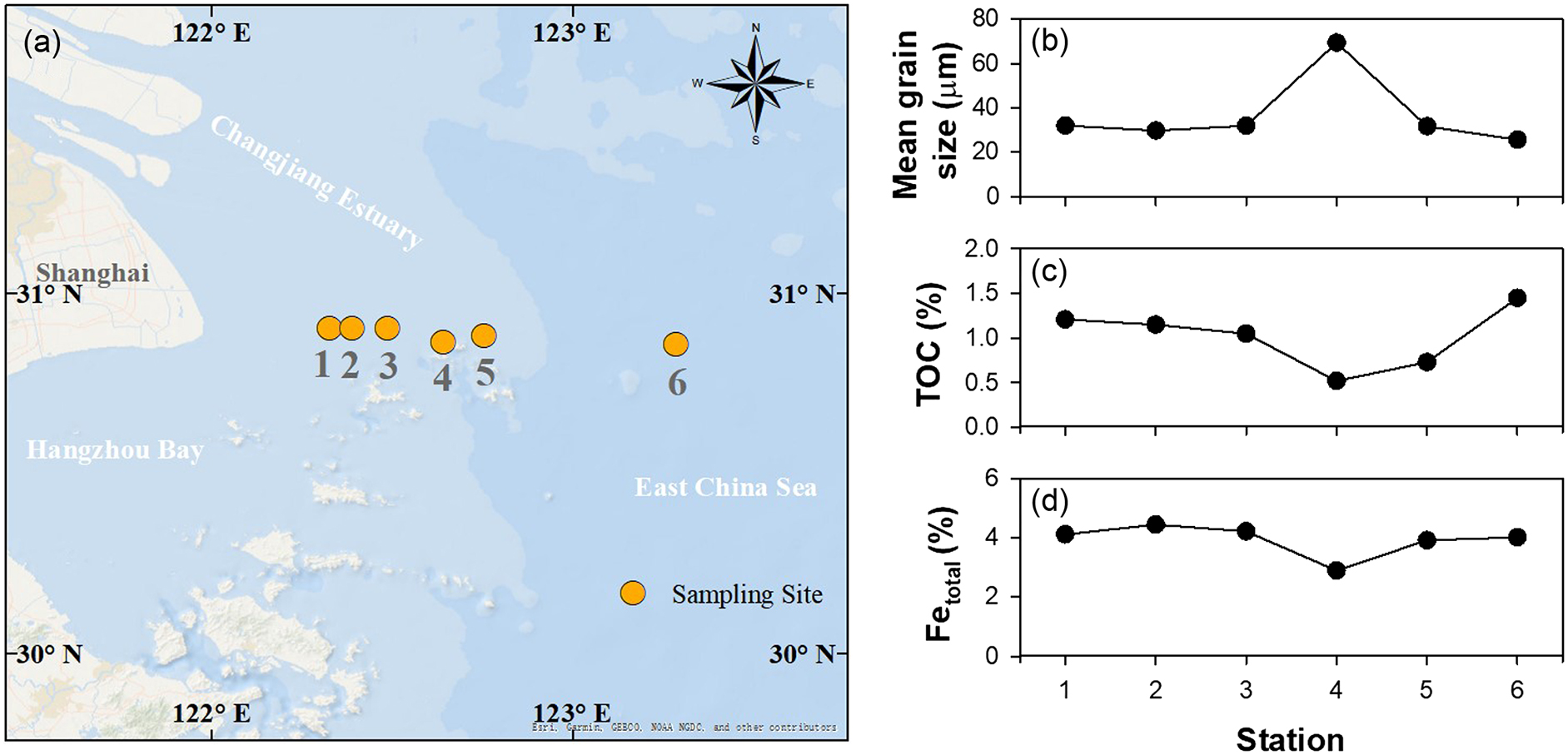
Figure 1 (a) Map of sampling stations in the Changjiang Estuary, (b) the mean grain size, (c) total organic carbon, and (d) total Fe weight percentage in sieved surface sediments of each station.
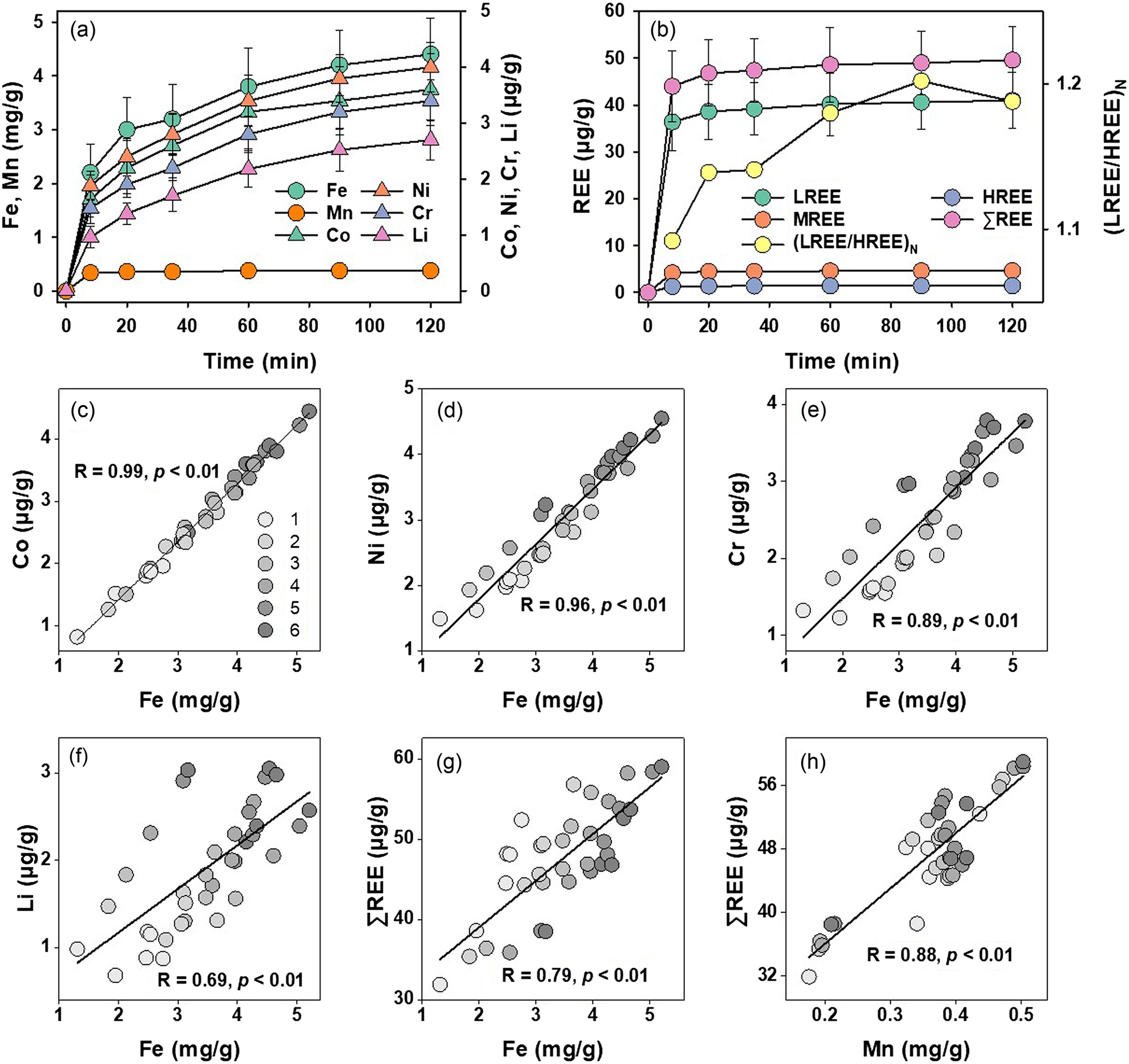
Figure 2 The release of (a) Fe, Mn, Co, Ni, Cr, and (b) REEs during the sediment leaching with 0.5 M HNO3, as well as the cross plot of (c) Fe vs. Co, (d) Fe vs. Ni, (e) Fe vs. Cr, (f) Fe vs. Li, (g) Fe vs. ∑REE, (h) Mn vs. ∑REE over the releasing processes. In (a, b), each point represents the mean ± standard deviation of values measured in sediments from six stations. (LREE/HREE)N represents the value that was PAAS normalised.
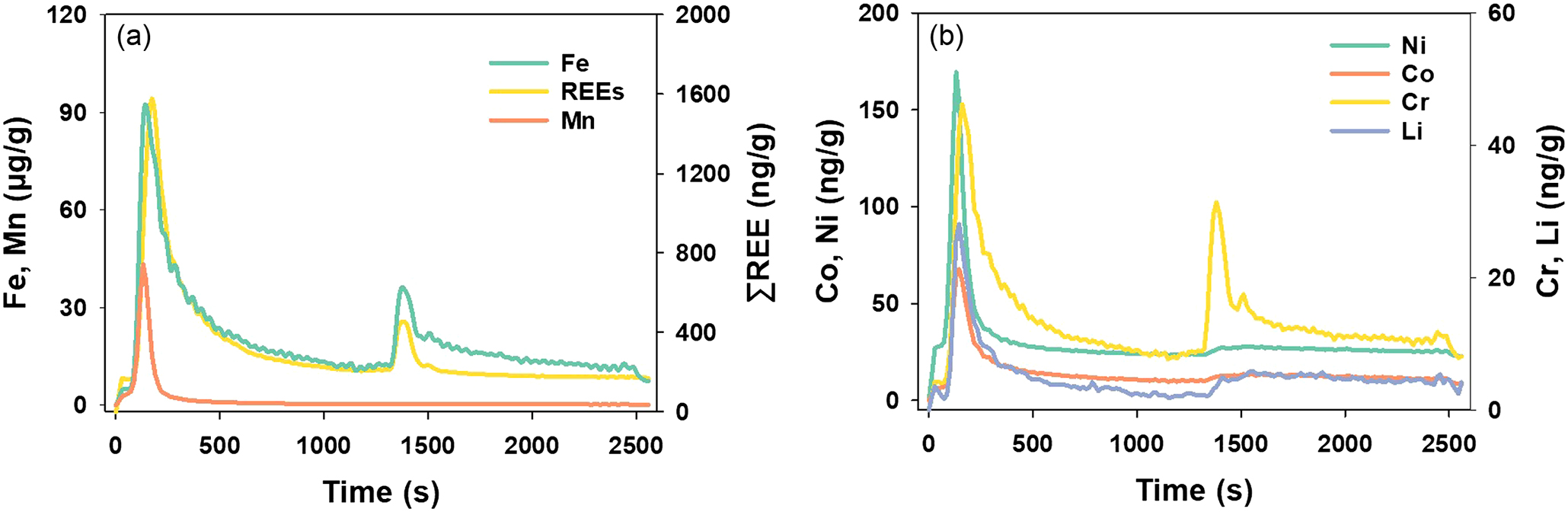
Figure 3 The dynamics of (a) Fe, Mn, and ∑REE, and (b) Co, Ni, Cr, and Li in the FT-TRA, during which 0.1 M and 0.5 M HNO3 sequentially flowed through the sediments. The data points represent average values measured in six stations.
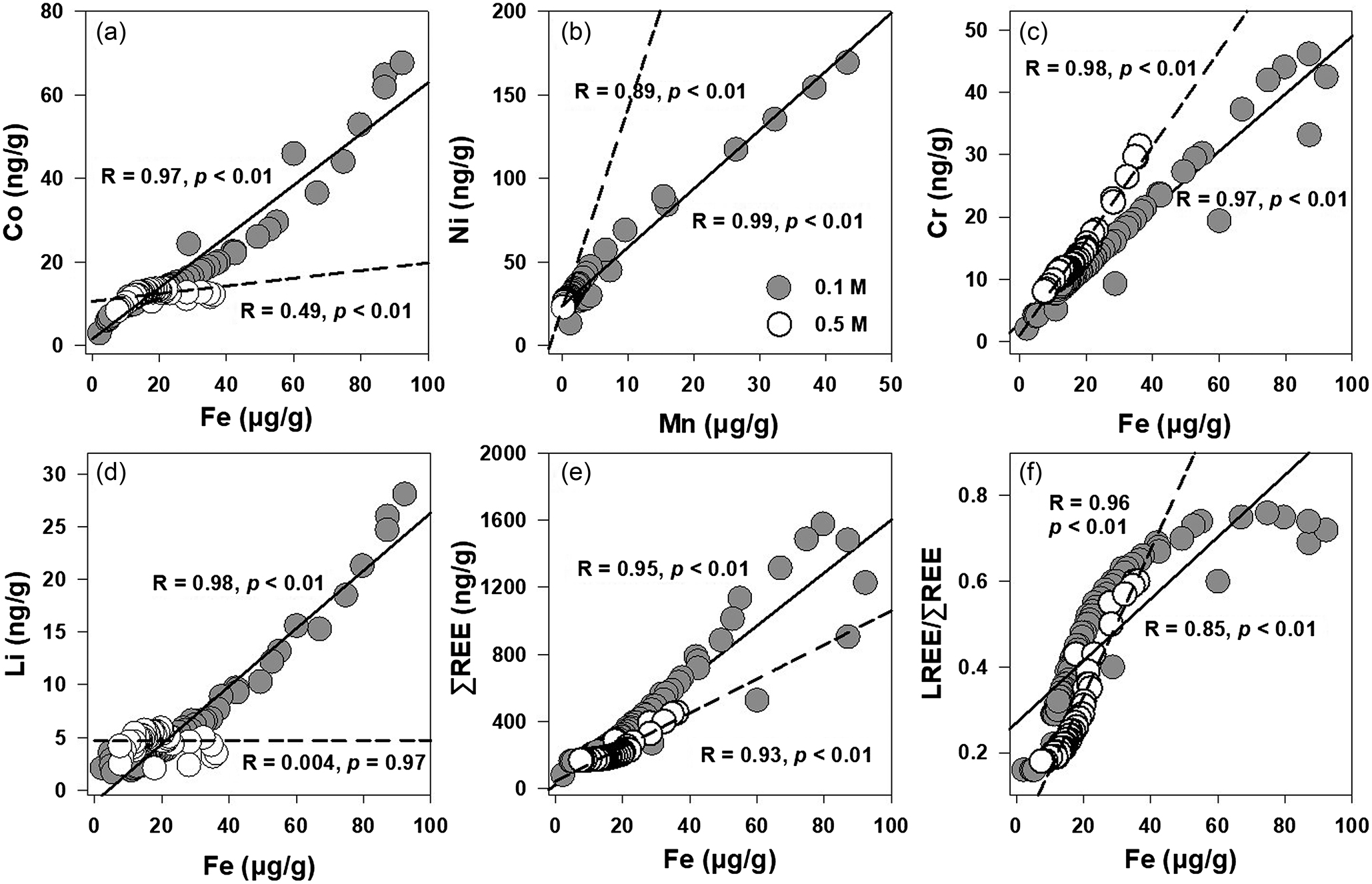
Figure 4 The cross plot of (a) Fe vs. Co, (b) Mn vs. Ni, (c) Fe vs. Cr, (d) Fe vs. Li, (e) Fe vs. ∑REE, and (f) Fe vs. LREE/∑REE in the effluent of FT-TRA. Solid and dashed lines represent the linear regression line in 0.1 M and 0.5 M HNO3 leaching, respectively.