



Large Cu endowment in the Tibetan Plateau as a result of dual stage mantle fertilisation
Affiliations | Corresponding Author | Cite as | Funding information
Published by the European Association of Geochemistry
under Creative Commons License CC BY-NC-ND 4.0
Keywords: porphyry Cu deposits, Himalayan-Tibetan orogenic belt, mantle fertilization, oceanic subduction, Hg isotopes


- Share this article


-
Article views:1,557Cumulative count of HTML views and PDF downloads.
- Download Citation
- Rights & Permissions

top
Abstract
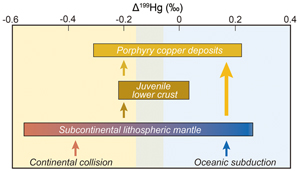
Figures
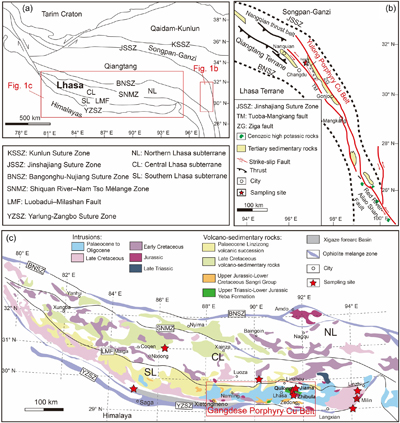 Figure 1 Geological map showing (a) the Himalayan-Tibetan orogen, (b) the Yulong porphyry Cu belt (after Liang et al., 2006) and (c) the Gangdese porphyry Cu belt (after Sun et al., 2024). | 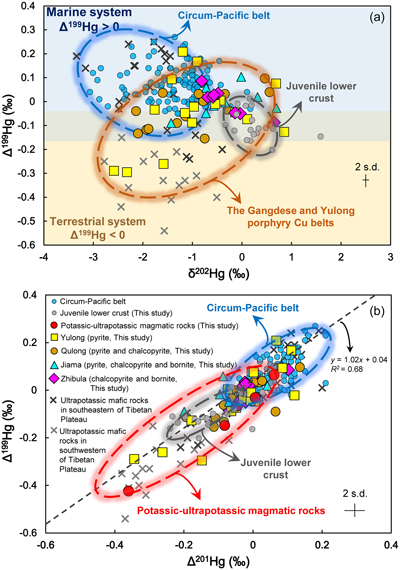 Figure 2 (a) Δ199Hg versus δ202Hg and (b) Δ199Hg versus Δ201Hg for the Gangdese and Yulong PCDs, juvenile lower crust rocks and potassic-ultrapotassic rocks in the Tibetan Plateau. Data sources: marine and terrestrial systems (Blum et al., 2014); Circum-Pacific belt (Deng et al., 2021; Gao et al., 2024a); ultrapotassic mafic rocks in south Tibet (Xu et al., 2024). s.d., standard deviation. | 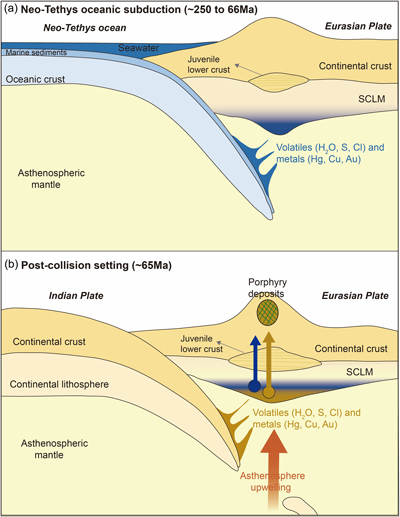 Figure 3 Genetic model of PCDs in the Alpine-Himalayan belt. (a) The Neo-Tethys oceanic subduction introduced large amounts of ocean-derived Hg released from subducted marine sediments into the SCLM. (b) Indian-Eurasia continental collision introduced terrestrially derived Hg into the SCLM, and tearing of the subducting Indian lithosphere triggered asthenospheric upwelling, leading to melting of the SCLM to generate large volumes of metal- and volatile-rich magma and magmatic-hydrothermal fluids. |
| Figure 1 | Figure 2 | Figure 3 |
top
Introduction
Porphyry copper (Cu) deposits (PCDs) provide ∼75 % of the global Cu resources. Oceanic subduction and continental collision trigger the large metallogeny of PCDs at convergent plate boundaries. PCDs related to Pacific plate subduction typically occur in the Circum-Pacific belt, particularly in the Andes, Papua New Guinea, and the Philippines (Sillitoe, 2010
Sillitoe, R.H. (2010) Porphyry Copper Systems. Economic Geology 105, 3–41. https://doi.org/10.2113/gsecongeo.105.1.3
; Wilkinson, 2013Wilkinson, J.J. (2013) Triggers for the formation of porphyry ore deposits in magmatic arcs. Nature Geoscience 6, 917–925. https://doi.org/10.1038/ngeo1940
). PCDs related to collision of the African, Arabian and Indian Plates with the Eurasian Plate occur in the Alpine-Himalayan belt (Richards, 2009Richards, J.P. (2009) Postsubduction porphyry Cu-Au and epithermal Au deposits: Products of remelting of subduction-modified lithosphere. Geology 37, 247–250. https://doi.org/10.1130/G25451A.1
). PCDs in these two belts provide a window to probe plate subduction and associated effects on large Cu endowments. A variety of geochemical tools (e.g., Sr, Nd, Pb and Cu isotopes) have been employed to constrain the sources of metals in PCDs of the Alpine-Himalayan belt, but it remains debated whether the ore-forming metals are sourced from the partial melting of sulfide-rich juvenile lower crustal rocks (Li et al., 2011Li, J.-X., Qin, K.-Z., Li, G.-M., Xiao, B., Chen, L., Zhao, J.-X. (2011) Post-collisional ore-bearing adakitic porphyries from Gangdese porphyry copper belt, southern Tibet: Melting of thickened juvenile arc lower crust. Lithos 126, 265–277. https://doi.org/10.1016/j.lithos.2011.07.018
; Hou et al., 2020Hou, Z., Yang, Z., Wang, R., Zheng, Y. (2020) Further discussion on porphyry Cu-Mo-Au deposit formation in mainland China. Earth Science Frontiers 27, 20–44. https://doi.org/10.13745/j.esf.sf.2020.3.8
) or the fertile subcontinental lithospheric mantle (SCLM) (Xu et al., 2016Xu, L., Bi, X., Hu, R., Qi, Y., Tang, Y., Wang, X., Zhu, J. (2016) Redox states and genesis of magmas associated with intra-continental porphyry Cu–Au mineralization within the Jinshajiang–Red River alkaline igneous belt, SW China. Ore Geology Reviews 73, 330–345. https://doi.org/10.1016/j.oregeorev.2015.05.007
; Zheng et al., 2019Zheng, Y.-C., Liu, S.-A., Wu, C.-D., Griffin, W.L., Li, Z.-Q., Xu, B., Yang, Z.-M., Hou, Z.-Q., O’Reilly, S.Y. (2019) Cu isotopes reveal initial Cu enrichment in sources of giant porphyry deposits in a collisional setting. Geology 47, 135–138. https://doi.org/10.1130/G45362.1
).Mercury (Hg) is a chalcophile metal and an important component in PCDs (Xu et al., 2024
Xu, B., Yin, R.-S., Chiaradia, M., Miao, Z., Griffin, W.L., Hou, Z.-Q., Yang, Z.-M., O’Reilly, S.Y. (2024) Mercury isotope evidence for the importance of recycled fluids in collisional ore systems. Science Advances 10, eadp7383. https://doi.org/10.1126/sciadv.adp7383
). The seven natural stable isotopes of Hg (196Hg, 198Hg, 199Hg, 200Hg, 201Hg, 202Hg, 204Hg) display mass-dependent fractionation (Hg-MDF, reported as δ202Hg) and mass-independent fractionation (Hg-MIF, reported as Δ199Hg). Hg-MDF occurs during various geochemical processes (e.g., microbial Hg(II) reduction, Hg(II) methylation, Hg(0) volatilisation), whereas Hg-MIF occurs mainly during photochemical reactions (Blum et al., 2014Blum, J.D., Sherman, L.S., Johnson, M.W. (2014) Mercury Isotopes in Earth and Environmental Sciences. Annual Review of Earth and Planetary Sciences 42, 249–269. https://doi.org/10.1146/annurev-earth-050212-124107
). The primitive mantle displays near-zero Δ199Hg values (0.00 ± 0.10 ‰; 2 s.d.; Moynier et al., 2021Moynier, F., Jackson, M.G., Zhang, K., Cai, H., Halldórsson, S.A., Pik, R., Day, J.M.D., Chen, J. (2021) The Mercury Isotopic Composition of Earth’s Mantle and the Use of Mass Independently Fractionated Hg to Test for Recycled Crust. Geophysical Research Letters 48, e2021GL094301. https://doi.org/10.1029/2021GL094301
). In contrast to magmatic Hg isotope signatures, Hg(II) photoreduction results in negative Δ199Hg signals in terrestrial systems (−0.6 to 0 ‰; soil and vegetation) and positive Δ199Hg values in marine systems (0 to +0.3 ‰; sediments and seawater) (Blum et al., 2014Blum, J.D., Sherman, L.S., Johnson, M.W. (2014) Mercury Isotopes in Earth and Environmental Sciences. Annual Review of Earth and Planetary Sciences 42, 249–269. https://doi.org/10.1146/annurev-earth-050212-124107
). The distinctive Δ199Hg signatures of terrestrial, marine and mantle reservoirs allow for tracing the source of metals in magmatic and hydrothermal systems (Yin et al., 2024Yin, R., Wang, X., Sun, R., Gao, L., Deng, C., Tian, Z., Luo, A., Lehmann, B. (2024) Linking the mercury biogeochemical cycle to the deep mercury cycle: A mercury isotope perspective. Chemical Geology 654, 122063. https://doi.org/10.1016/j.chemgeo.2024.122063
). Positive Δ199Hg values have been observed in arc basalts and hydrothermal systems (0 to +0.3 ‰; epithermal Au deposits and porphyry Mo deposits) in the Circum-Pacific belt, reflecting large scale recycling of metals from marine reservoirs via oceanic subduction (Deng et al., 2021Deng, C., Sun, G., Rong, Y., Sun, R., Sun, D., Lehmann, B., Yin, R. (2021) Recycling of mercury from the atmosphere-ocean system into volcanic-arc–associated epithermal gold systems. Geology 49, 309–313. https://doi.org/10.1130/G48132.1
; Yin et al., 2022Yin, R., Chen, D., Pan, X., Deng, C., Chen, L., Song, X., Yu, S., Zhu, C., Wei, X., Xu, Y., Feng, X., Blum, J.D., Lehmann, B. (2022) Mantle Hg isotopic heterogeneity and evidence of oceanic Hg recycling into the mantle. Nature Communications 13, 948. https://doi.org/10.1038/s41467-022-28577-1
; Gao et al., 2024aGao, L., Sun, D., Tian, Z., Luo, A., Lehmann, B., Yin, R. (2024a) Positive Δ199Hg anomalies in Mesozoic porphyry Mo deposits of Northeastern China and their implications to the metallogeny of arc-related hydrothermal systems at convergent margins. Chemical Geology 645, 121880. https://doi.org/10.1016/j.chemgeo.2023.121880
).A recent study observed highly variable Δ199Hg in fertile porphyry-related magmas (−0.30 to +0.22 ‰) and coeval ultrapotassic mafic rocks (−0.54 to +0.25 ‰) in the Himalayan-Tibetan orogenic belt, highlighting that PCDs receive metals or volatiles from the SCLM modified by subducted materials (Xu et al., 2024
Xu, B., Yin, R.-S., Chiaradia, M., Miao, Z., Griffin, W.L., Hou, Z.-Q., Yang, Z.-M., O’Reilly, S.Y. (2024) Mercury isotope evidence for the importance of recycled fluids in collisional ore systems. Science Advances 10, eadp7383. https://doi.org/10.1126/sciadv.adp7383
). However, there are yet undefined Hg isotopic reservoirs related to PCDs, including lower crustal rocks and the ore-forming sulfides. In this work, we investigate the Hg isotopic composition of these reservoirs in the Himalayan-Tibetan orogenic belt to gain an understanding of the metal sources of PCDs.top
Geological Background
The eastern part of the Alpine-Himalayan orogenic belt comprises a series of blocks and micro-continents (Fig. 1a). Subduction of the Palaeo-Tethys Ocean in the Palaeozoic caused collision of these blocks and micro-continents (Metcalfe, 2021
Metcalfe, I. (2021) Multiple Tethyan ocean basins and orogenic belts in Asia. Gondwana Research 100, 87–130. https://doi.org/10.1016/j.gr.2021.01.012
). The Neo-Tethys Ocean was closed in the Late Cretaceous, followed by the collision of the Indian and Eurasian continents (Metcalfe, 2021Metcalfe, I. (2021) Multiple Tethyan ocean basins and orogenic belts in Asia. Gondwana Research 100, 87–130. https://doi.org/10.1016/j.gr.2021.01.012
). The Songpan-Ganzi, Qiangtang, Lhasa and Himalaya Terranes, divided by the Jinsha, Bangong-Nujiang and Yarlung-Zangbo suture zones, mark the sequential closure of the Palaeo-, Meso- and Neo-Tethys oceans, respectively (Zheng et al., 2021Zheng, Y.-C., Shen, Y., Wang, L., Griffin, W.L., Hou, Z.-Q. (2021) Collision‐related porphyry Cu deposits formed by input of ultrapotassic melts into the sulfide‐rich lower crust. Terra Nova 33, 582–589. https://doi.org/10.1111/ter.12550
). The Tibetan Plateau hosts the Yulong and the Gangdese porphyry Cu belts, which contain numerous world-class PCDs formed during the Indian-Eurasian collisional orogeny.Figure 1 Geological map showing (a) the Himalayan-Tibetan orogen, (b) the Yulong porphyry Cu belt (after Liang et al., 2006
Liang, H.-Y., Campbell, I.H., Allen, C., Sun, W.-D., Liu, C.-Q., Yu, H.-X., Xie, Y.-W., Zhang, Y.-Q. (2006) Zircon Ce4+/Ce3+ ratios and ages for Yulong ore-bearing porphyries in eastern Tibet. Mineralium Deposita 41, 152–159. https://doi.org/10.1007/s00126-005-0047-1
) and (c) the Gangdese porphyry Cu belt (after Sun et al., 2024Sun, J.-L., Bai, Z.-J., Zhong, H., Liu, X., Zhu, J.-J., Chen, L., Zhu, W.-G. (2024) Sulfide saturation in reduced magmas during generation of the Gangdese juvenile lower crust: Implications for porphyry Cu–Au mineralization in the Gangdese belt, Tibet. Mineralium Deposita 59, 1387–1405. https://doi.org/10.1007/s00126-024-01269-0
).The Yulong porphyry Cu belt (Fig. 1b) follows the northwestward trend of the Red River-Ailao Shan Fault, i.e. a sinistral fault system that emerged due to the Indian-Eurasian continental collision. It comprises Proterozoic to early Palaeozoic crystalline folded basement and middle to late Palaeozoic carbonate and clastic sedimentary rocks, and distributes >20 PCDs (e.g., Yulong) with mineralisation ages (∼40 Ma) synchronous with nearby Eocene alkaline magmatism (Yang and Cooke, 2019
Yang, Z., Cooke, D.R. (2019) Porphyry Copper Deposits in China. In: Chang, Z., Goldfarb, R.J. (Eds.) Mineral Deposits of China. Society of Economic Geologists, Littleton, 133–187. https://doi.org/10.5382/SP.22.05
). Ore-bearing porphyries at Yulong are mainly monzonite granite porphyries containing assemblages of pyrite, chalcopyrite and molybdenite (Fig. S-1). The Yulong PCD is associated with potassic, sericitic, and epidote alterations, manifested as the widespread distribution of quartz-biotite veins, secondary K-feldspar, and epidote-altered zones, accompanied by localised development of sulfide mineralisation (Fig. S-2).The Gangdese porphyry Cu belt is located in the Lhasa terrane (Fig. 1c), which is a microcontinental fragment comprising Precambrian basement rocks, Palaeozoic to Mesozoic sedimentary formations, and Mesozoic to Cenozoic igneous rocks (Sun et al., 2024
Sun, J.-L., Bai, Z.-J., Zhong, H., Liu, X., Zhu, J.-J., Chen, L., Zhu, W.-G. (2024) Sulfide saturation in reduced magmas during generation of the Gangdese juvenile lower crust: Implications for porphyry Cu–Au mineralization in the Gangdese belt, Tibet. Mineralium Deposita 59, 1387–1405. https://doi.org/10.1007/s00126-024-01269-0
). This belt was formed during post-collision between the Indian and Eurasian continents and hosts abundant Miocene ultrapotassic magmatic rocks and numerous PCDs (e.g., Jiama, Qulong, and Zhibula) with mineralisation ages of 16 to 14 Ma (Hou et al., 2011Hou, Z., Zhang, H., Pan, X., Yang, Z. (2011) Porphyry Cu (–Mo–Au) deposits related to melting of thickened mafic lower crust: Examples from the eastern Tethyan metallogenic domain. Ore Geology Reviews 39, 21–45. https://doi.org/10.1016/j.oregeorev.2010.09.002
). Mineralised intrusions in the Gangdese PCDs are mainly monzonite granite and quartz monzonite porphyries, containing assemblages of pyrite, chalcopyrite, molybdenite, magnetite and bornite (Fig. S-3). The deposits are characterised by pyrite-sericitisation alteration in Qulong, sericitic and skarn-related alteration in Jiama, and epidote-garnet alteration in Zhibula (Fig. S-4).top
Methods
A total of 43 sulfide-bearing bulk ore samples (i.e. mineralised porphyries) were collected from the Yulong, Qulong, Jiama, and Zhibula deposits. Sulfides (pyrite, n = 26; chalcopyrite, n = 16; bornite, n = 4) were separated from the bulk ore samples. Sulfides were pre-concentrated using flotation with xanthate as the collector, followed by hand picking under a binocular microscope to ensure high purity. Magmatic rocks (n = 19) representing the juvenile lower crust and ultrapotassic mafic rocks (n = 5) representing the SCLM from the Gangdese area were also collected. Detailed information for the samples can be found in Supplementary Tables S-1 and S-2. All the samples were prewashed with 18.2 MΩ cm water, air dried, ground to a particle size of 200 mesh, and homogenised in an agate mortar for petrochemical analysis.
The major elements of rock powders were analysed using X-ray fluorescence (XRF) spectrometry at ALS Guangzhou with a PANalytical PW5400 instrument, which yielded an analytical uncertainty of <5 % for sample duplicates. The loss on ignition (LOI) was measured according to the percentage weight loss before and after heating the samples at 1000 °C in a muffle furnace. LOI values of all samples are <3 wt. % (Table S-3), indicating limited alteration effects. The major element concentrations of the lower crustal rocks (n = 19) have been recently reported (Sun et al., 2024
Sun, J.-L., Bai, Z.-J., Zhong, H., Liu, X., Zhu, J.-J., Chen, L., Zhu, W.-G. (2024) Sulfide saturation in reduced magmas during generation of the Gangdese juvenile lower crust: Implications for porphyry Cu–Au mineralization in the Gangdese belt, Tibet. Mineralium Deposita 59, 1387–1405. https://doi.org/10.1007/s00126-024-01269-0
).Total Hg (THg) concentrations and Hg isotopic compositions were determined at the Institute of Geochemistry, Chinese Academy of Sciences. Concentrations of THg were directly measured using a Lumex R915+ Hg analyser (detection limit 50 pg Hg), which yielded Hg recoveries of 90–110 % (n = 8) for GSS-4 standard reference material and uncertainties of <10 % (2 s.d.) for sample duplicates. Based on the measured THg concentrations, variable amounts of sample powders containing 10 ng Hg were weighed and prepared using a two stage combustion furnace for preconcentrating Hg into 5 mL of 40 % acid mixture (HNO3/HCl = 2/1, v/v), following previous methods (Zerkle et al., 2020
Zerkle, A.L., Yin, R., Chen, C., Li, X., Izon, G.J., Grasby, S.E. (2020) Anomalous fractionation of mercury isotopes in the Late Archean atmosphere. Nature Communications 11, 1709. https://doi.org/10.1038/s41467-020-15495-3
; Gao et al., 2024bGao, L., Sun, D., Wang, X., Chen, D., Tian, Z., Luo, A., Yin, R. (2024b) A Catalyst Tube-Equipped Dual-Stage Tube Furnace System for Accurate Hg Isotopic Determination of Ore Samples Using Neptune Plus Multicollector Inductively Coupled Plasma Mass Spectrometry. Analytical Chemistry 96, 17560–17566. https://doi.org/10.1021/acs.analchem.4c03041
). The Hg blank of the acid mixture is below 0.05 ng/mL. Preparation of zero sample powders yielded a method blank of less than 50 pg Hg in the sample solution. Pretreatment of standard reference material (GSS-4, soil) yielded Hg recoveries of 90–110 % (n = 8). The Hg preconcentrated solutions were diluted to 1 ng/mL with 10–20 % of acid mixture (HNO3/HCl = 2/1, v/v) before Hg isotopic analysis at the Institute of Geochemistry, Chinese Academy of Sciences, using a Thermo Scientific Neptune Plus multi-collector inductively coupled plasma mass spectrometry (Supplementary Text S-1; Yin et al., 2016Yin, R., Krabbenhoft, D.P., Bergquist, B.A., Zheng, W., Lepak, R.F., Hurley, J.P. (2016) Effects of mercury and thallium concentrations on high precision determination of mercury isotopic composition by Neptune Plus multiple collector inductively coupled plasma mass spectrometry. Journal of Analytical Atomic Spectrometry 31, 2060–2068. https://doi.org/10.1039/C6JA00107F
). Hg-MDF is expressed as δ202Hg in ‰ in reference to the NIST-3133 Hg standard:Eq. 1

MIF is reported in Δ notation as the difference between the measured δxxxHg values and theoretically predicted values:
Eq. 2

where xxx represents 199, 200, or 201, and β is 0.252 for 199Hg, 0.5024 for 200Hg, and 0.752 for 201Hg (Blum and Bergquist, 2007
Blum, J.D., Bergquist, B.A. (2007) Reporting of variations in the natural isotopic composition of mercury. Analytical and Bioanalytical Chemistry 388, 353–359. https://doi.org/10.1007/s00216-007-1236-9
). NIST-3177 secondary standard solutions were measured every 10 samples. The overall average and uncertainty of NIST-3177 (δ202Hg = −0.53 ± 0.06 ‰, Δ199Hg = −0.02 ± 0.04 ‰; Δ200Hg = +0.01 ± 0.03 ‰; Δ201Hg = −0.02 ± 0.06 ‰; 2 s.d., n = 10) and GSS-4 (δ202Hg = −1.69 ± 0.13 ‰; Δ199Hg = −0.41 ± 0.06 ‰; Δ200Hg = −0.02 ± 0.06 ‰; Δ201Hg = −0.37 ± 0.06 ‰; 2 s.d., n = 8) agree well with previous results (Table S-4; Blum and Berquist, 2007Blum, J.D., Bergquist, B.A. (2007) Reporting of variations in the natural isotopic composition of mercury. Analytical and Bioanalytical Chemistry 388, 353–359. https://doi.org/10.1007/s00216-007-1236-9
; Deng et al., 2021Deng, C., Sun, G., Rong, Y., Sun, R., Sun, D., Lehmann, B., Yin, R. (2021) Recycling of mercury from the atmosphere-ocean system into volcanic-arc–associated epithermal gold systems. Geology 49, 309–313. https://doi.org/10.1130/G48132.1
; Gao et al., 2024bGao, L., Sun, D., Wang, X., Chen, D., Tian, Z., Luo, A., Yin, R. (2024b) A Catalyst Tube-Equipped Dual-Stage Tube Furnace System for Accurate Hg Isotopic Determination of Ore Samples Using Neptune Plus Multicollector Inductively Coupled Plasma Mass Spectrometry. Analytical Chemistry 96, 17560–17566. https://doi.org/10.1021/acs.analchem.4c03041
). The larger values of standard deviation (2 s.d.) for either NIST-3177 or GSS-4 are used to reflect analytical uncertainties.top
Results
As shown in Tables S-1 and S-2 and Figure 2a, the studied sulfide samples show large variations in Hg concentration (0.77 to 2253 ng/g), δ202Hg (−2.59 to +0.85 ‰), and Δ199Hg values (−0.29 to +0.21 ‰). Sulfides (pyrite, chalcopyrite and bornite) from the three Gangdese PCDs (Qulong, Jiama, and Zhibula) display δ202Hg values ranging from −2.14 to +0.69 ‰ and Δ199Hg from −0.15 to +0.10 ‰. Sulfides (pyrite) from Yulong PCD display a similar range in δ202Hg (−2.59 to +0.85 ‰), but a larger range for Δ199Hg values (−0.29 to +0.21 ‰). The juvenile lower crustal rocks from the Milin area display low Hg concentrations (0.12 to 2.67 ng/g), mainly positive δ202Hg (−0.33 to +1.59 ‰) and negative Δ199Hg values (−0.20 to +0.01 ‰). Ultrapotassic mafic rocks display low Hg levels (0.29 to 6.03 ng/g), negative δ202Hg (−1.48 to −0.48 ‰) and mainly negative Δ199Hg (−0.42 to +0.06 ‰). All samples show a positive correlation between Δ201Hg and Δ199Hg with the Δ199Hg/Δ201Hg ≈ 1 (R2 = 0.68) (Fig. 2b), consistent with that observed in the atmosphere-land-ocean system (Blum et al., 2014
Blum, J.D., Sherman, L.S., Johnson, M.W. (2014) Mercury Isotopes in Earth and Environmental Sciences. Annual Review of Earth and Planetary Sciences 42, 249–269. https://doi.org/10.1146/annurev-earth-050212-124107
). The LOI values of the juvenile lower crustal rocks and ultrapotassic mafic rocks are less than 3 wt. %, indicating that these samples are fresh and have not undergone significant weathering or alteration.Figure 2 (a) Δ199Hg versus δ202Hg and (b) Δ199Hg versus Δ201Hg for the Gangdese and Yulong PCDs, juvenile lower crust rocks and potassic-ultrapotassic rocks in the Tibetan Plateau. Data sources: marine and terrestrial systems (Blum et al., 2014
Blum, J.D., Sherman, L.S., Johnson, M.W. (2014) Mercury Isotopes in Earth and Environmental Sciences. Annual Review of Earth and Planetary Sciences 42, 249–269. https://doi.org/10.1146/annurev-earth-050212-124107
); Circum-Pacific belt (Deng et al., 2021Deng, C., Sun, G., Rong, Y., Sun, R., Sun, D., Lehmann, B., Yin, R. (2021) Recycling of mercury from the atmosphere-ocean system into volcanic-arc–associated epithermal gold systems. Geology 49, 309–313. https://doi.org/10.1130/G48132.1
; Gao et al., 2024aGao, L., Sun, D., Tian, Z., Luo, A., Lehmann, B., Yin, R. (2024a) Positive Δ199Hg anomalies in Mesozoic porphyry Mo deposits of Northeastern China and their implications to the metallogeny of arc-related hydrothermal systems at convergent margins. Chemical Geology 645, 121880. https://doi.org/10.1016/j.chemgeo.2023.121880
); ultrapotassic mafic rocks in south Tibet (Xu et al., 2024Xu, B., Yin, R.-S., Chiaradia, M., Miao, Z., Griffin, W.L., Hou, Z.-Q., Yang, Z.-M., O’Reilly, S.Y. (2024) Mercury isotope evidence for the importance of recycled fluids in collisional ore systems. Science Advances 10, eadp7383. https://doi.org/10.1126/sciadv.adp7383
). s.d., standard deviation.top
Discussion
The existence of terrestrial Hg in the lithospheric mantle and juvenile lower crust. Ultrapotassic mafic rocks and juvenile lower crustal rocks display low LOI values (<3 wt. %; Table S-3). A lack of correlation between the LOI and Hg concentrations, and δ202Hg or Δ199Hg values of these rocks (Fig. S-5) suggests that the variations of Hg abundance and isotopic composition do not correlate with alteration. Since magmatic processes trigger minor Hg-MDF but not Hg-MIF (Moynier et al., 2021
Moynier, F., Jackson, M.G., Zhang, K., Cai, H., Halldórsson, S.A., Pik, R., Day, J.M.D., Chen, J. (2021) The Mercury Isotopic Composition of Earth’s Mantle and the Use of Mass Independently Fractionated Hg to Test for Recycled Crust. Geophysical Research Letters 48, e2021GL094301. https://doi.org/10.1029/2021GL094301
), we use Δ199Hg instead of δ202Hg to constrain the sources of Hg in the rock samples.The primitive mantle displays low Hg concentrations (0.4–0.6 ng/g) and near-zero Δ199Hg (0.00 ± 0.10 ‰; 2 s.d.) (Moynier et al., 2021
Moynier, F., Jackson, M.G., Zhang, K., Cai, H., Halldórsson, S.A., Pik, R., Day, J.M.D., Chen, J. (2021) The Mercury Isotopic Composition of Earth’s Mantle and the Use of Mass Independently Fractionated Hg to Test for Recycled Crust. Geophysical Research Letters 48, e2021GL094301. https://doi.org/10.1029/2021GL094301
). The elevated Hg concentrations (1.79 ± 4.28 ng/g; 2 s.d., n = 5) and negative Δ199Hg (−0.12 ± 0.33 ‰; 2 s.d., n = 5) values in ultrapotassic mafic rocks suggest the existence of recycled terrestrially derived Hg in their magma source, since Hg in terrestrial reservoirs displays negative Δ199Hg values (Blum et al., 2014Blum, J.D., Sherman, L.S., Johnson, M.W. (2014) Mercury Isotopes in Earth and Environmental Sciences. Annual Review of Earth and Planetary Sciences 42, 249–269. https://doi.org/10.1146/annurev-earth-050212-124107
). Measurements of Sr-Nd-Pb isotopes confirmed that these ultrapotassic mafic rocks were derived from the SCLM fertilised by terrestrial components via Indian Plate continental subduction (Wang et al., 2020Wang, P., Zhao, G., Han, Y., Liu, Q., Zhou, N., Yao, J., Li, J., Li, Y. (2020) Post-collisional potassic rocks in Western Kunlun, NW Tibet Plateau: Insights into lateral variations in the crust-mantle structure beneath the India-Asia collision zone. Lithos 370–371, 105645. https://doi.org/10.1016/j.lithos.2020.105645
). Furthermore, Sr-Nd-Pb isotope data suggest that crustal material was incorporated early into the juvenile lower crust during the melting-assimilation-storage-homogenisation process (Miller et al., 1999Miller, C., Schuster, R., Klötzli, U., Frank, W., Purtscheller, F. (1999) Post-Collisional Potassic and Ultrapotassic Magmatism in SW Tibet: Geochemical and Sr–Nd–Pb–O Isotopic Constraints for Mantle Source Characteristics and Petrogenesis. Journal of Petrology 40, 1399–1424. https://doi.org/10.1093/petroj/40.9.1399
), which could explain the negative Δ199Hg values in juvenile lower crustal rocks.Genesis of PCDs in the Himalayan-Tibetan belt. Due to the chalcophile behaviour of Hg and the lack of Hg-MIF during metallogenic processes (Deng et al., 2021
Deng, C., Sun, G., Rong, Y., Sun, R., Sun, D., Lehmann, B., Yin, R. (2021) Recycling of mercury from the atmosphere-ocean system into volcanic-arc–associated epithermal gold systems. Geology 49, 309–313. https://doi.org/10.1130/G48132.1
), Δ199Hg can be used to trace the source of Hg and other metals in PCDs. The Δ199Hg signals of sulfides in Yulong and Gangdese PCDs show negative to positive Δ199Hg values of −0.29 to +0.21 ‰. These values are different from the overall positive Δ199Hg values for epithermal Au deposits (−0.03 to +0.27 ‰) and porphyry Mo deposits (−0.05 to +0.24 ‰) in the Circum-Pacific belt (Fig. 2), which receive Hg from subducted marine sediments (Deng et al., 2021Deng, C., Sun, G., Rong, Y., Sun, R., Sun, D., Lehmann, B., Yin, R. (2021) Recycling of mercury from the atmosphere-ocean system into volcanic-arc–associated epithermal gold systems. Geology 49, 309–313. https://doi.org/10.1130/G48132.1
; Gao et al., 2024aGao, L., Sun, D., Tian, Z., Luo, A., Lehmann, B., Yin, R. (2024a) Positive Δ199Hg anomalies in Mesozoic porphyry Mo deposits of Northeastern China and their implications to the metallogeny of arc-related hydrothermal systems at convergent margins. Chemical Geology 645, 121880. https://doi.org/10.1016/j.chemgeo.2023.121880
).Potential metal sources for PCDs of the Himalayan-Tibetan orogenic belt include the juvenile lower crust and SCLM (Wang et al., 2018
Wang, R., Weinberg, R.F., Collins, W.J., Richards, J.P., Zhu, D.-c. (2018) Origin of postcollisional magmas and formation of porphyry Cu deposits in southern Tibet. Earth-Science Reviews 181, 122–143. https://doi.org/10.1016/j.earscirev.2018.02.019
; Xu et al., 2023Xu, L.-L., Zhu, J.-J., Huang, M.-L., Pan, L.-C., Hu, R., Bi, X.-W. (2023) Genesis of hydrous-oxidized parental magmas for porphyry Cu (Mo, Au) deposits in a postcollisional setting: examples from the Sanjiang region, SW China. Mineralium Deposita 58, 161–196. https://doi.org/10.1007/s00126-022-01143-x
). In Figure 2, 17 sulfides from the Gangdese PCDs and 9 sulfides from the Yulong PCD display Δ199Hg values within the range of juvenile lower crustal rocks, suggesting that they received large fractions of Hg from the juvenile lower crust. However, the non-zero Δ199Hg values in other sulfides in these PCDs, either below −0.1 ‰ or above +0.1 ‰, suggest that the juvenile lower crust was not the sole source of Hg. Photoreduction of Hg(II) results in negative and positive Δ199Hg values in terrestrial and marine systems, respectively (Blum et al., 2014Blum, J.D., Sherman, L.S., Johnson, M.W. (2014) Mercury Isotopes in Earth and Environmental Sciences. Annual Review of Earth and Planetary Sciences 42, 249–269. https://doi.org/10.1146/annurev-earth-050212-124107
). Three sulfides (chalcopyrite, pyrite) display positive Δ199Hg values above +0.1 ‰, and 8 sulfides (chalcopyrite, pyrite) display negative Δ199Hg values below −0.1 ‰ (Fig. 2), suggesting the existence of recycled Hg from both marine and terrestrial systems. Since the Himalayan-Tibetan orogenic belt was influenced by the Neo-Tethys oceanic subduction followed by the Indian-Eurasian continental collision, the coexistence of positive and negative Δ199Hg values in the Gangdese and Yulong PCDs may be a consequence of dual stage fertilisation of the SCLM.The Neo-Tethys oceanic subduction may have fertilised the SCLM by marine-derived Hg released from subducted marine sediments (Fig. 3a), as supported by positive Δ199Hg values of ultrapotassic mafic rocks (Xu et al., 2024
Xu, B., Yin, R.-S., Chiaradia, M., Miao, Z., Griffin, W.L., Hou, Z.-Q., Yang, Z.-M., O’Reilly, S.Y. (2024) Mercury isotope evidence for the importance of recycled fluids in collisional ore systems. Science Advances 10, eadp7383. https://doi.org/10.1126/sciadv.adp7383
). The positive Δ199Hg values above +0.1 ‰ in the studied Gangdese and Yulong PCDs confirm the contribution of recycled marine Hg released from the fertilised SCLM. Crustal assimilation, which produces S-type granites, may impart negative Δ199Hg values to Gangdese and Yulong PCDs. However, the lack of coeval S-type melts in the eastern Gangdese area suggests limited crustal assimilation (Li et al., 2022Li, W.-T., Ding, H.-X., Zhang, Z.-M., Larson, K.P. (2022) Petrogenesis of meta-sedimentary rocks in the deep crust of the eastern Gangdese arc. Lithos 430–431, 106884. https://doi.org/10.1016/j.lithos.2022.106884
). The negative Δ199Hg values of Gangdese and Yulong PCDs are more reasonably explained by the Indian-Eurasian continental collision, which fertilised the SCLM by introducing abundant terrestrially derived Hg (Fig. 3b), as supported by the negative Δ199Hg values of ultrapotassic mafic rocks (Xu et al., 2024Xu, B., Yin, R.-S., Chiaradia, M., Miao, Z., Griffin, W.L., Hou, Z.-Q., Yang, Z.-M., O’Reilly, S.Y. (2024) Mercury isotope evidence for the importance of recycled fluids in collisional ore systems. Science Advances 10, eadp7383. https://doi.org/10.1126/sciadv.adp7383
). Following the dual stage fertilisation processes, the subducted Indian continental lithosphere underwent tearing, triggering upwelling of the asthenosphere, leading to melting of the metasomatised SCLM and juvenile lower crust, favouring the formation of large volumes of metal- and volatile-rich magma and an associated large number of PCDs (Hou et al., 2015Hou, Z., Yang, Z., Lu, Y., Kemp, A., Zheng, Y., Li, Q., Tang, J., Yang, Z., Duan, L. (2015) A genetic linkage between subduction- and collision-related porphyry Cu deposits in continental collision zones. Geology 43, 247–250. https://doi.org/10.1130/G36362.1
; Zheng et al., 2019Zheng, Y.-C., Liu, S.-A., Wu, C.-D., Griffin, W.L., Li, Z.-Q., Xu, B., Yang, Z.-M., Hou, Z.-Q., O’Reilly, S.Y. (2019) Cu isotopes reveal initial Cu enrichment in sources of giant porphyry deposits in a collisional setting. Geology 47, 135–138. https://doi.org/10.1130/G45362.1
; Xu et al., 2024Xu, B., Yin, R.-S., Chiaradia, M., Miao, Z., Griffin, W.L., Hou, Z.-Q., Yang, Z.-M., O’Reilly, S.Y. (2024) Mercury isotope evidence for the importance of recycled fluids in collisional ore systems. Science Advances 10, eadp7383. https://doi.org/10.1126/sciadv.adp7383
).Figure 3 Genetic model of PCDs in the Alpine-Himalayan belt. (a) The Neo-Tethys oceanic subduction introduced large amounts of ocean-derived Hg released from subducted marine sediments into the SCLM. (b) Indian-Eurasia continental collision introduced terrestrially derived Hg into the SCLM, and tearing of the subducting Indian lithosphere triggered asthenospheric upwelling, leading to melting of the SCLM to generate large volumes of metal- and volatile-rich magma and magmatic-hydrothermal fluids.
top
Conclusions
The formation of massive PCDs in the Tibetan Plateau is to be expected. Based on Hg isotopes, this study demonstrates that the Neo-Tethys oceanic subduction and Indian-Eurasia continental collision have extensively fertilised the SCLM beneath the Tibetan Plateau. These two processes transported large amounts of metals and volatiles from recycled terrestrial and marine sediments to the SCLM, providing a material base for the metallogeny of PCDs. This study highlights the powerful use of Hg isotopes in tracing recycled metals and volatiles in the mantle, and highlights the crucial role of multistage plate subduction and mantle fertilisation in the generation of PCDs in the Himalayan-Tibetan orogenic belt.
top
Acknowledgements
This work is supported by the Hundred Talent Plan through the Chinese Academy of Sciences. We thank Rui Wang for providing some of the samples, Massimo Chiaradia for his assistance in data interpretation, and Manuel Keith and an anonymous reviewer for providing valuable comments.
Editor: Raul O.C. Fonseca
top
References
Blum, J.D., Bergquist, B.A. (2007) Reporting of variations in the natural isotopic composition of mercury. Analytical and Bioanalytical Chemistry 388, 353–359. https://doi.org/10.1007/s00216-007-1236-9
 Show in context
 Hg-MDF is expressed as δ202Hg in ‰ in reference to the NIST-3133 Hg standard:
Eq. 1.
MIF is reported in Δ notation as the difference between the measured δxxxHg values and theoretically predicted values:
Eq. 2.
where xxx represents 199, 200, or 201, and β is 0.252 for 199Hg, 0.5024 for 200Hg, and 0.752 for 201Hg (Blum and Bergquist, 2007).
View in article
The overall average and uncertainty of NIST-3177 (δ202Hg = −0.53 ± 0.06 ‰, Δ199Hg = −0.02 ± 0.04 ‰; Δ200Hg = +0.01 ± 0.03 ‰; Δ201Hg = −0.02 ± 0.06 ‰; 2 s.d., n = 10) and GSS-4 (δ202Hg = −1.69 ± 0.13 ‰; Δ199Hg = −0.41 ± 0.06 ‰; Δ200Hg = −0.02 ± 0.06 ‰; Δ201Hg = −0.37 ± 0.06 ‰; 2 s.d., n = 8) agree well with previous results (Table S-4; Blum and Berquist, 2007; Deng et al., 2021; Gao et al., 2024b).
View in article
Blum, J.D., Sherman, L.S., Johnson, M.W. (2014) Mercury Isotopes in Earth and Environmental Sciences. Annual Review of Earth and Planetary Sciences 42, 249–269. https://doi.org/10.1146/annurev-earth-050212-124107
Show in context Hg-MDF occurs during various geochemical processes (e.g., microbial Hg(II) reduction, Hg(II) methylation, Hg(0) volatilisation), whereas Hg-MIF occurs mainly during photochemical reactions (Blum et al., 2014).
View in article
In contrast to magmatic Hg isotope signatures, Hg(II) photoreduction results in negative Δ199Hg signals in terrestrial systems (−0.6 to 0 ‰; soil and vegetation) and positive Δ199Hg values in marine systems (0 to +0.3 ‰; sediments and seawater) (Blum et al., 2014).
View in article
All samples show a positive correlation between Δ201Hg and Δ199Hg with the Δ199Hg/Δ201Hg ≈ 1 (R 2 = 0.68) (Fig. 2b), consistent with that observed in the atmosphere-land-ocean system (Blum et al., 2014).
View in article
Data sources: marine and terrestrial systems (Blum et al., 2014); Circum-Pacific belt (Deng et al., 2021; Gao et al., 2024a); ultrapotassic mafic rocks in south Tibet (Xu et al., 2024). s.d., standard deviation.
View in article
The elevated Hg concentrations (1.79 ± 4.28 ng/g; 2 s.d., n = 5) and negative Δ199Hg (−0.12 ± 0.33 ‰; 2 s.d., n = 5) values in ultrapotassic mafic rocks suggest the existence of recycled terrestrially derived Hg in their magma source, since Hg in terrestrial reservoirs displays negative Δ199Hg values (Blum et al., 2014).
View in article
However, the non-zero Δ199Hg values in other sulfides in these PCDs, either below −0.1 ‰ or above +0.1 ‰, suggest that the juvenile lower crust was not the sole source of Hg. Photoreduction of Hg(II) results in negative and positive Δ199Hg values in terrestrial and marine systems, respectively (Blum et al., 2014).
View in article
Deng, C., Sun, G., Rong, Y., Sun, R., Sun, D., Lehmann, B., Yin, R. (2021) Recycling of mercury from the atmosphere-ocean system into volcanic-arc–associated epithermal gold systems. Geology 49, 309–313. https://doi.org/10.1130/G48132.1
Show in context Positive Δ199Hg values have been observed in arc basalts and hydrothermal systems (0 to +0.3 ‰; epithermal Au deposits and porphyry Mo deposits) in the Circum-Pacific belt, reflecting large scale recycling of metals from marine reservoirs via oceanic subduction (Deng et al., 2021; Yin et al., 2022; Gao et al., 2024a).
View in article
The overall average and uncertainty of NIST-3177 (δ202Hg = −0.53 ± 0.06 ‰, Δ199Hg = −0.02 ± 0.04 ‰; Δ200Hg = +0.01 ± 0.03 ‰; Δ201Hg = −0.02 ± 0.06 ‰; 2 s.d., n = 10) and GSS-4 (δ202Hg = −1.69 ± 0.13 ‰; Δ199Hg = −0.41 ± 0.06 ‰; Δ200Hg = −0.02 ± 0.06 ‰; Δ201Hg = −0.37 ± 0.06 ‰; 2 s.d., n = 8) agree well with previous results (Table S-4; Blum and Berquist, 2007; Deng et al., 2021; Gao et al., 2024b).
View in article
Data sources: marine and terrestrial systems (Blum et al., 2014); Circum-Pacific belt (Deng et al., 2021; Gao et al., 2024a); ultrapotassic mafic rocks in south Tibet (Xu et al., 2024). s.d., standard deviation.
View in article
Due to the chalcophile behaviour of Hg and the lack of Hg-MIF during metallogenic processes (Deng et al., 2021), Δ199Hg can be used to trace the source of Hg and other metals in PCDs.
View in article
These values are different from the overall positive Δ199Hg values for epithermal Au deposits (−0.03 to +0.27 ‰) and porphyry Mo deposits (−0.05 to +0.24 ‰) in the Circum-Pacific belt (Fig. 2), which receive Hg from subducted marine sediments (Deng et al., 2021; Gao et al., 2024a).
View in article
Gao, L., Sun, D., Tian, Z., Luo, A., Lehmann, B., Yin, R. (2024a) Positive Δ199Hg anomalies in Mesozoic porphyry Mo deposits of Northeastern China and their implications to the metallogeny of arc-related hydrothermal systems at convergent margins. Chemical Geology 645, 121880. https://doi.org/10.1016/j.chemgeo.2023.121880
Show in context Positive Δ199Hg values have been observed in arc basalts and hydrothermal systems (0 to +0.3 ‰; epithermal Au deposits and porphyry Mo deposits) in the Circum-Pacific belt, reflecting large scale recycling of metals from marine reservoirs via oceanic subduction (Deng et al., 2021; Yin et al., 2022; Gao et al., 2024a).
View in article
Data sources: marine and terrestrial systems (Blum et al., 2014); Circum-Pacific belt (Deng et al., 2021; Gao et al., 2024a); ultrapotassic mafic rocks in south Tibet (Xu et al., 2024). s.d., standard deviation.
View in article
These values are different from the overall positive Δ199Hg values for epithermal Au deposits (−0.03 to +0.27 ‰) and porphyry Mo deposits (−0.05 to +0.24 ‰) in the Circum-Pacific belt (Fig. 2), which receive Hg from subducted marine sediments (Deng et al., 2021; Gao et al., 2024a).
View in article
Gao, L., Sun, D., Wang, X., Chen, D., Tian, Z., Luo, A., Yin, R. (2024b) A Catalyst Tube-Equipped Dual-Stage Tube Furnace System for Accurate Hg Isotopic Determination of Ore Samples Using Neptune Plus Multicollector Inductively Coupled Plasma Mass Spectrometry. Analytical Chemistry 96, 17560–17566. https://doi.org/10.1021/acs.analchem.4c03041
Show in context Based on the measured THg concentrations, variable amounts of sample powders containing 10 ng Hg were weighed and prepared using a two stage combustion furnace for preconcentrating Hg into 5 mL of 40 % acid mixture (HNO3/HCl = 2/1, v/v), following previous methods (Zerkle et al., 2020; Gao et al., 2024b).
View in article
The overall average and uncertainty of NIST-3177 (δ202Hg = −0.53 ± 0.06 ‰, Δ199Hg = −0.02 ± 0.04 ‰; Δ200Hg = +0.01 ± 0.03 ‰; Δ201Hg = −0.02 ± 0.06 ‰; 2 s.d., n = 10) and GSS-4 (δ202Hg = −1.69 ± 0.13 ‰; Δ199Hg = −0.41 ± 0.06 ‰; Δ200Hg = −0.02 ± 0.06 ‰; Δ201Hg = −0.37 ± 0.06 ‰; 2 s.d., n = 8) agree well with previous results (Table S-4; Blum and Berquist, 2007; Deng et al., 2021; Gao et al., 2024b).
View in article
Hou, Z., Zhang, H., Pan, X., Yang, Z. (2011) Porphyry Cu (–Mo–Au) deposits related to melting of thickened mafic lower crust: Examples from the eastern Tethyan metallogenic domain. Ore Geology Reviews 39, 21–45. https://doi.org/10.1016/j.oregeorev.2010.09.002
Show in context This belt was formed during post-collision between the Indian and Eurasian continents and hosts abundant Miocene ultrapotassic magmatic rocks and numerous PCDs (e.g., Jiama, Qulong, and Zhibula) with mineralisation ages of 16 to 14 Ma (Hou et al., 2011).
View in article
Hou, Z., Yang, Z., Lu, Y., Kemp, A., Zheng, Y., Li, Q., Tang, J., Yang, Z., Duan, L. (2015) A genetic linkage between subduction- and collision-related porphyry Cu deposits in continental collision zones. Geology 43, 247–250. https://doi.org/10.1130/G36362.1
Show in context Following the dual stage fertilisation processes, the subducted Indian continental lithosphere underwent tearing, triggering upwelling of the asthenosphere, leading to melting of the metasomatised SCLM and juvenile lower crust, favouring the formation of large volumes of metal- and volatile-rich magma and an associated large number of PCDs (Hou et al., 2015; Zheng et al., 2019; Xu et al., 2024).
View in article
Hou, Z., Yang, Z., Wang, R., Zheng, Y. (2020) Further discussion on porphyry Cu-Mo-Au deposit formation in mainland China. Earth Science Frontiers 27, 20–44. https://doi.org/10.13745/j.esf.sf.2020.3.8
Show in context A variety of geochemical tools (e.g., Sr, Nd, Pb and Cu isotopes) have been employed to constrain the sources of metals in PCDs of the Alpine-Himalayan belt, but it remains debated whether the ore-forming metals are sourced from the partial melting of sulfide-rich juvenile lower crustal rocks (Li et al., 2011; Hou et al., 2020) or the fertile subcontinental lithospheric mantle (SCLM) (Xu et al., 2016; Zheng et al., 2019).
View in article
Li, J.-X., Qin, K.-Z., Li, G.-M., Xiao, B., Chen, L., Zhao, J.-X. (2011) Post-collisional ore-bearing adakitic porphyries from Gangdese porphyry copper belt, southern Tibet: Melting of thickened juvenile arc lower crust. Lithos 126, 265–277. https://doi.org/10.1016/j.lithos.2011.07.018
Show in context A variety of geochemical tools (e.g., Sr, Nd, Pb and Cu isotopes) have been employed to constrain the sources of metals in PCDs of the Alpine-Himalayan belt, but it remains debated whether the ore-forming metals are sourced from the partial melting of sulfide-rich juvenile lower crustal rocks (Li et al., 2011; Hou et al., 2020) or the fertile subcontinental lithospheric mantle (SCLM) (Xu et al., 2016; Zheng et al., 2019).
View in article
Li, W.-T., Ding, H.-X., Zhang, Z.-M., Larson, K.P. (2022) Petrogenesis of meta-sedimentary rocks in the deep crust of the eastern Gangdese arc. Lithos 430–431, 106884. https://doi.org/10.1016/j.lithos.2022.106884
Show in context However, the lack of coeval S-type melts in the eastern Gangdese area suggests limited crustal assimilation (Li et al., 2022).
View in article
Liang, H.-Y., Campbell, I.H., Allen, C., Sun, W.-D., Liu, C.-Q., Yu, H.-X., Xie, Y.-W., Zhang, Y.-Q. (2006) Zircon Ce4+/Ce3+ ratios and ages for Yulong ore-bearing porphyries in eastern Tibet. Mineralium Deposita 41, 152–159. https://doi.org/10.1007/s00126-005-0047-1
Show in context Geological map showing (a) the Himalayan-Tibetan orogen, (b) the Yulong porphyry Cu belt (after Liang et al., 2006) and (c) the Gangdese porphyry Cu belt (after Sun et al., 2024).
View in article
Metcalfe, I. (2021) Multiple Tethyan ocean basins and orogenic belts in Asia. Gondwana Research 100, 87–130. https://doi.org/10.1016/j.gr.2021.01.012
Show in context Subduction of the Palaeo-Tethys Ocean in the Palaeozoic caused collision of these blocks and micro-continents (Metcalfe, 2021).
View in article
The Neo-Tethys Ocean was closed in the Late Cretaceous, followed by the collision of the Indian and Eurasian continents (Metcalfe, 2021).
View in article
Miller, C., Schuster, R., Klötzli, U., Frank, W., Purtscheller, F. (1999) Post-Collisional Potassic and Ultrapotassic Magmatism in SW Tibet: Geochemical and Sr–Nd–Pb–O Isotopic Constraints for Mantle Source Characteristics and Petrogenesis. Journal of Petrology 40, 1399–1424. https://doi.org/10.1093/petroj/40.9.1399
Show in context Furthermore, Sr-Nd-Pb isotope data suggest that crustal material was incorporated early into the juvenile lower crust during the melting-assimilation-storage-homogenisation process (Miller et al., 1999), which could explain the negative Δ199Hg values in juvenile lower crustal rocks.
View in article
Moynier, F., Jackson, M.G., Zhang, K., Cai, H., Halldórsson, S.A., Pik, R., Day, J.M.D., Chen, J. (2021) The Mercury Isotopic Composition of Earth’s Mantle and the Use of Mass Independently Fractionated Hg to Test for Recycled Crust. Geophysical Research Letters 48, e2021GL094301. https://doi.org/10.1029/2021GL094301
Show in context The primitive mantle displays near-zero Δ199Hg values (0.00 ± 0.10 ‰; 2 s.d.; Moynier et al., 2021).
View in article
Since magmatic processes trigger minor Hg-MDF but not Hg-MIF (Moynier et al., 2021), we use Δ199Hg instead of δ202Hg to constrain the sources of Hg in the rock samples.
View in article
The primitive mantle displays low Hg concentrations (0.4–0.6 ng/g) and near-zero Δ199Hg (0.00 ± 0.10 ‰; 2 s.d.) (Moynier et al., 2021).
View in article
Richards, J.P. (2009) Postsubduction porphyry Cu-Au and epithermal Au deposits: Products of remelting of subduction-modified lithosphere. Geology 37, 247–250. https://doi.org/10.1130/G25451A.1
Show in context PCDs related to collision of the African, Arabian and Indian Plates with the Eurasian Plate occur in the Alpine-Himalayan belt (Richards, 2009).
View in article
Sillitoe, R.H. (2010) Porphyry Copper Systems. Economic Geology 105, 3–41. https://doi.org/10.2113/gsecongeo.105.1.3
Show in context PCDs related to Pacific plate subduction typically occur in the Circum-Pacific belt, particularly in the Andes, Papua New Guinea, and the Philippines (Sillitoe, 2010; Wilkinson, 2013).
View in article
Sun, J.-L., Bai, Z.-J., Zhong, H., Liu, X., Zhu, J.-J., Chen, L., Zhu, W.-G. (2024) Sulfide saturation in reduced magmas during generation of the Gangdese juvenile lower crust: Implications for porphyry Cu–Au mineralization in the Gangdese belt, Tibet. Mineralium Deposita 59, 1387–1405. https://doi.org/10.1007/s00126-024-01269-0
Show in context The Gangdese porphyry Cu belt is located in the Lhasa terrane (Fig. 1c), which is a microcontinental fragment comprising Precambrian basement rocks, Palaeozoic to Mesozoic sedimentary formations, and Mesozoic to Cenozoic igneous rocks (Sun et al., 2024).
View in article
Geological map showing (a) the Himalayan-Tibetan orogen, (b) the Yulong porphyry Cu belt (after Liang et al., 2006) and (c) the Gangdese porphyry Cu belt (after Sun et al., 2024).
View in article
The major element concentrations of the lower crustal rocks (n = 19) have been recently reported (Sun et al., 2024).
View in article
Wang, P., Zhao, G., Han, Y., Liu, Q., Zhou, N., Yao, J., Li, J., Li, Y. (2020) Post-collisional potassic rocks in Western Kunlun, NW Tibet Plateau: Insights into lateral variations in the crust-mantle structure beneath the India-Asia collision zone. Lithos 370–371, 105645. https://doi.org/10.1016/j.lithos.2020.105645
Show in context Measurements of Sr-Nd-Pb isotopes confirmed that these ultrapotassic mafic rocks were derived from the SCLM fertilised by terrestrial components via Indian Plate continental subduction (Wang et al., 2020).
View in article
Wang, R., Weinberg, R.F., Collins, W.J., Richards, J.P., Zhu, D.-c. (2018) Origin of postcollisional magmas and formation of porphyry Cu deposits in southern Tibet. Earth-Science Reviews 181, 122–143. https://doi.org/10.1016/j.earscirev.2018.02.019
Show in context Potential metal sources for PCDs of the Himalayan-Tibetan orogenic belt include the juvenile lower crust and SCLM (Wang et al., 2018; Xu et al., 2023).
View in article
Wilkinson, J.J. (2013) Triggers for the formation of porphyry ore deposits in magmatic arcs. Nature Geoscience 6, 917–925. https://doi.org/10.1038/ngeo1940
Show in context PCDs related to Pacific plate subduction typically occur in the Circum-Pacific belt, particularly in the Andes, Papua New Guinea, and the Philippines (Sillitoe, 2010; Wilkinson, 2013).
View in article
Xu, B., Yin, R.-S., Chiaradia, M., Miao, Z., Griffin, W.L., Hou, Z.-Q., Yang, Z.-M., O’Reilly, S.Y. (2024) Mercury isotope evidence for the importance of recycled fluids in collisional ore systems. Science Advances 10, eadp7383. https://doi.org/10.1126/sciadv.adp7383
Show in context Mercury (Hg) is a chalcophile metal and an important component in PCDs (Xu et al., 2024).
View in article
A recent study observed highly variable Δ199Hg in fertile porphyry-related magmas (−0.30 to +0.22 ‰) and coeval ultrapotassic mafic rocks (−0.54 to +0.25 ‰) in the Himalayan-Tibetan orogenic belt, highlighting that PCDs receive metals or volatiles from the SCLM modified by subducted materials (Xu et al., 2024).
View in article
The Neo-Tethys oceanic subduction may have fertilised the SCLM by marine-derived Hg released from subducted marine sediments (Fig. 3a), as supported by positive Δ199Hg values of ultrapotassic mafic rocks (Xu et al., 2024).
View in article
Data sources: marine and terrestrial systems (Blum et al., 2014); Circum-Pacific belt (Deng et al., 2021; Gao et al., 2024a); ultrapotassic mafic rocks in south Tibet (Xu et al., 2024). s.d., standard deviation.
View in article
The negative Δ199Hg values of Gangdese and Yulong PCDs are more reasonably explained by the Indian-Eurasian continental collision, which fertilised the SCLM by introducing abundant terrestrially derived Hg (Fig. 3b), as supported by the negative Δ199Hg values of ultrapotassic mafic rocks (Xu et al., 2024).
View in article
Following the dual stage fertilisation processes, the subducted Indian continental lithosphere underwent tearing, triggering upwelling of the asthenosphere, leading to melting of the metasomatised SCLM and juvenile lower crust, favouring the formation of large volumes of metal- and volatile-rich magma and an associated large number of PCDs (Hou et al., 2015; Zheng et al., 2019; Xu et al., 2024).
View in article
Xu, L., Bi, X., Hu, R., Qi, Y., Tang, Y., Wang, X., Zhu, J. (2016) Redox states and genesis of magmas associated with intra-continental porphyry Cu–Au mineralization within the Jinshajiang–Red River alkaline igneous belt, SW China. Ore Geology Reviews 73, 330–345. https://doi.org/10.1016/j.oregeorev.2015.05.007
Show in context A variety of geochemical tools (e.g., Sr, Nd, Pb and Cu isotopes) have been employed to constrain the sources of metals in PCDs of the Alpine-Himalayan belt, but it remains debated whether the ore-forming metals are sourced from the partial melting of sulfide-rich juvenile lower crustal rocks (Li et al., 2011; Hou et al., 2020) or the fertile subcontinental lithospheric mantle (SCLM) (Xu et al., 2016; Zheng et al., 2019).
View in article
Xu, L.-L., Zhu, J.-J., Huang, M.-L., Pan, L.-C., Hu, R., Bi, X.-W. (2023) Genesis of hydrous-oxidized parental magmas for porphyry Cu (Mo, Au) deposits in a postcollisional setting: examples from the Sanjiang region, SW China. Mineralium Deposita 58, 161–196. https://doi.org/10.1007/s00126-022-01143-x
Show in context Potential metal sources for PCDs of the Himalayan-Tibetan orogenic belt include the juvenile lower crust and SCLM (Wang et al., 2018; Xu et al., 2023).
View in article
Yang, Z., Cooke, D.R. (2019) Porphyry Copper Deposits in China. In: Chang, Z., Goldfarb, R.J. (Eds.) Mineral Deposits of China. Society of Economic Geologists, Littleton, 133–187. https://doi.org/10.5382/SP.22.05
Show in context It comprises Proterozoic to early Palaeozoic crystalline folded basement and middle to late Palaeozoic carbonate and clastic sedimentary rocks, and distributes >20 PCDs (e.g., Yulong) with mineralisation ages (∼40 Ma) synchronous with nearby Eocene alkaline magmatism (Yang and Cooke, 2019).
View in article
Yin, R., Krabbenhoft, D.P., Bergquist, B.A., Zheng, W., Lepak, R.F., Hurley, J.P. (2016) Effects of mercury and thallium concentrations on high precision determination of mercury isotopic composition by Neptune Plus multiple collector inductively coupled plasma mass spectrometry. Journal of Analytical Atomic Spectrometry 31, 2060–2068. https://doi.org/10.1039/C6JA00107F
Show in context The Hg preconcentrated solutions were diluted to 1 ng/mL with 10–20 % of acid mixture (HNO3/HCl = 2/1, v/v) before Hg isotopic analysis at the Institute of Geochemistry, Chinese Academy of Sciences, using a Thermo Scientific Neptune Plus multi-collector inductively coupled plasma mass spectrometry (Supplementary Text S-1; Yin et al., 2016).
View in article
Yin, R., Chen, D., Pan, X., Deng, C., Chen, L., Song, X., Yu, S., Zhu, C., Wei, X., Xu, Y., Feng, X., Blum, J.D., Lehmann, B. (2022) Mantle Hg isotopic heterogeneity and evidence of oceanic Hg recycling into the mantle. Nature Communications 13, 948. https://doi.org/10.1038/s41467-022-28577-1
Show in context Positive Δ199Hg values have been observed in arc basalts and hydrothermal systems (0 to +0.3 ‰; epithermal Au deposits and porphyry Mo deposits) in the Circum-Pacific belt, reflecting large scale recycling of metals from marine reservoirs via oceanic subduction (Deng et al., 2021; Yin et al., 2022; Gao et al., 2024a).
View in article
Yin, R., Wang, X., Sun, R., Gao, L., Deng, C., Tian, Z., Luo, A., Lehmann, B. (2024) Linking the mercury biogeochemical cycle to the deep mercury cycle: A mercury isotope perspective. Chemical Geology 654, 122063. https://doi.org/10.1016/j.chemgeo.2024.122063
Show in context The distinctive Δ199Hg signatures of terrestrial, marine and mantle reservoirs allow for tracing the source of metals in magmatic and hydrothermal systems (Yin et al., 2024).
View in article
Zerkle, A.L., Yin, R., Chen, C., Li, X., Izon, G.J., Grasby, S.E. (2020) Anomalous fractionation of mercury isotopes in the Late Archean atmosphere. Nature Communications 11, 1709. https://doi.org/10.1038/s41467-020-15495-3
Show in context Based on the measured THg concentrations, variable amounts of sample powders containing 10 ng Hg were weighed and prepared using a two stage combustion furnace for preconcentrating Hg into 5 mL of 40 % acid mixture (HNO3/HCl = 2/1, v/v), following previous methods (Zerkle et al., 2020; Gao et al., 2024b).
View in article
Zheng, Y.-C., Liu, S.-A., Wu, C.-D., Griffin, W.L., Li, Z.-Q., Xu, B., Yang, Z.-M., Hou, Z.-Q., O’Reilly, S.Y. (2019) Cu isotopes reveal initial Cu enrichment in sources of giant porphyry deposits in a collisional setting. Geology 47, 135–138. https://doi.org/10.1130/G45362.1
Show in context A variety of geochemical tools (e.g., Sr, Nd, Pb and Cu isotopes) have been employed to constrain the sources of metals in PCDs of the Alpine-Himalayan belt, but it remains debated whether the ore-forming metals are sourced from the partial melting of sulfide-rich juvenile lower crustal rocks (Li et al., 2011; Hou et al., 2020) or the fertile subcontinental lithospheric mantle (SCLM) (Xu et al., 2016; Zheng et al., 2019).
View in article
Following the dual stage fertilisation processes, the subducted Indian continental lithosphere underwent tearing, triggering upwelling of the asthenosphere, leading to melting of the metasomatised SCLM and juvenile lower crust, favouring the formation of large volumes of metal- and volatile-rich magma and an associated large number of PCDs (Hou et al., 2015; Zheng et al., 2019; Xu et al., 2024).
View in article
Zheng, Y.-C., Shen, Y., Wang, L., Griffin, W.L., Hou, Z.-Q. (2021) Collision‐related porphyry Cu deposits formed by input of ultrapotassic melts into the sulfide‐rich lower crust. Terra Nova 33, 582–589. https://doi.org/10.1111/ter.12550
Show in context The Songpan-Ganzi, Qiangtang, Lhasa and Himalaya Terranes, divided by the Jinsha, Bangong-Nujiang and Yarlung-Zangbo suture zones, mark the sequential closure of the Palaeo-, Meso- and Neo-Tethys oceans, respectively (Zheng et al., 2021).
View in article
top
Supplementary Information
The Supplementary Information includes:
- Text S-1
- Tables S-1 to S-4
- Figures S-1 to S-5
- Supplementary Information References
Download the Supplementary Information (PDF)
Figures
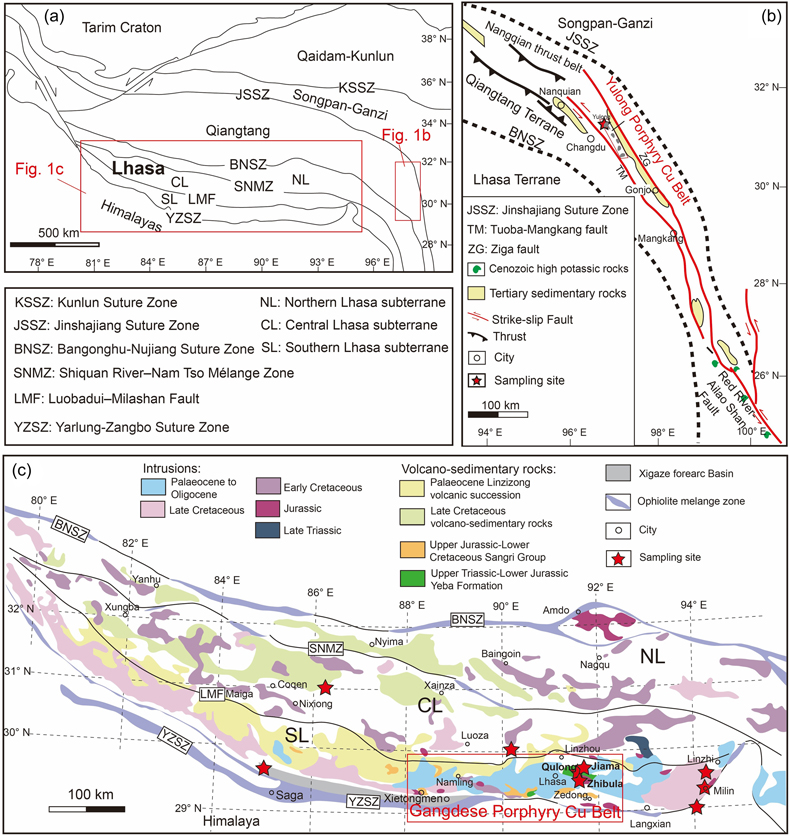
Figure 1 Geological map showing (a) the Himalayan-Tibetan orogen, (b) the Yulong porphyry Cu belt (after Liang et al., 2006
Liang, H.-Y., Campbell, I.H., Allen, C., Sun, W.-D., Liu, C.-Q., Yu, H.-X., Xie, Y.-W., Zhang, Y.-Q. (2006) Zircon Ce4+/Ce3+ ratios and ages for Yulong ore-bearing porphyries in eastern Tibet. Mineralium Deposita 41, 152–159. https://doi.org/10.1007/s00126-005-0047-1
) and (c) the Gangdese porphyry Cu belt (after Sun et al., 2024Sun, J.-L., Bai, Z.-J., Zhong, H., Liu, X., Zhu, J.-J., Chen, L., Zhu, W.-G. (2024) Sulfide saturation in reduced magmas during generation of the Gangdese juvenile lower crust: Implications for porphyry Cu–Au mineralization in the Gangdese belt, Tibet. Mineralium Deposita 59, 1387–1405. https://doi.org/10.1007/s00126-024-01269-0
).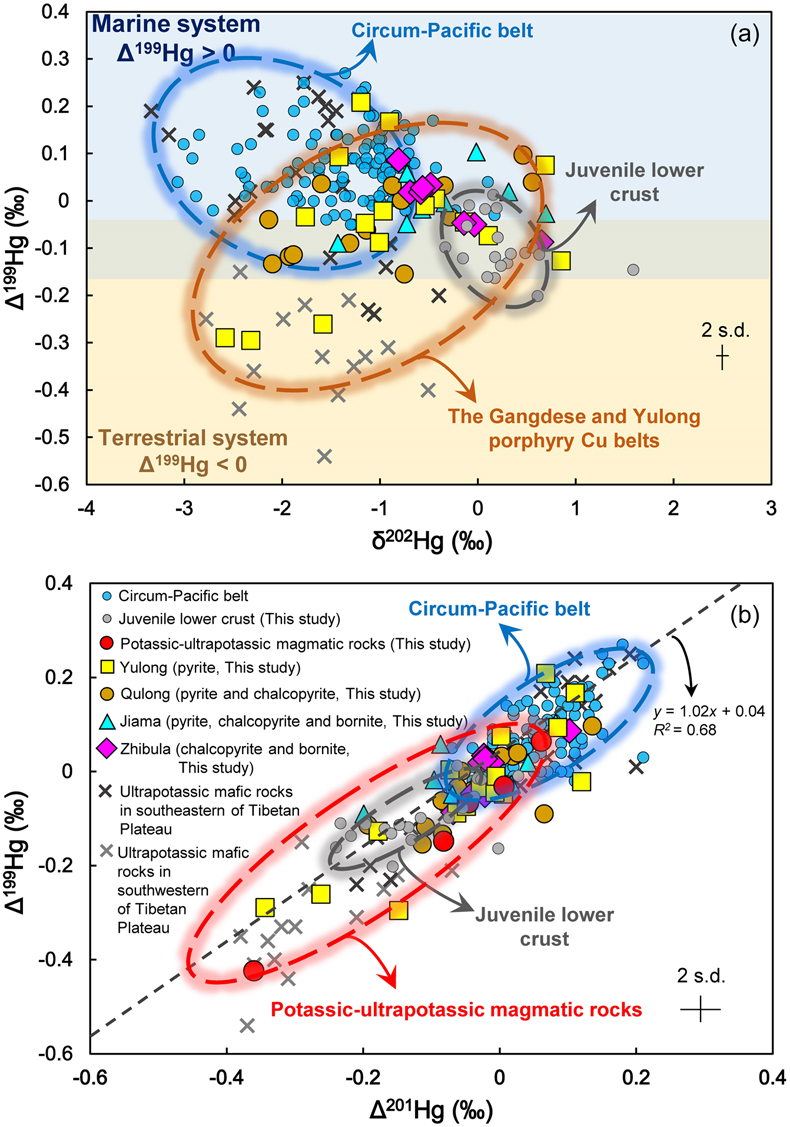
Figure 2 (a) Δ199Hg versus δ202Hg and (b) Δ199Hg versus Δ201Hg for the Gangdese and Yulong PCDs, juvenile lower crust rocks and potassic-ultrapotassic rocks in the Tibetan Plateau. Data sources: marine and terrestrial systems (Blum et al., 2014
Blum, J.D., Sherman, L.S., Johnson, M.W. (2014) Mercury Isotopes in Earth and Environmental Sciences. Annual Review of Earth and Planetary Sciences 42, 249–269. https://doi.org/10.1146/annurev-earth-050212-124107
); Circum-Pacific belt (Deng et al., 2021Deng, C., Sun, G., Rong, Y., Sun, R., Sun, D., Lehmann, B., Yin, R. (2021) Recycling of mercury from the atmosphere-ocean system into volcanic-arc–associated epithermal gold systems. Geology 49, 309–313. https://doi.org/10.1130/G48132.1
; Gao et al., 2024aGao, L., Sun, D., Tian, Z., Luo, A., Lehmann, B., Yin, R. (2024a) Positive Δ199Hg anomalies in Mesozoic porphyry Mo deposits of Northeastern China and their implications to the metallogeny of arc-related hydrothermal systems at convergent margins. Chemical Geology 645, 121880. https://doi.org/10.1016/j.chemgeo.2023.121880
); ultrapotassic mafic rocks in south Tibet (Xu et al., 2024Xu, B., Yin, R.-S., Chiaradia, M., Miao, Z., Griffin, W.L., Hou, Z.-Q., Yang, Z.-M., O’Reilly, S.Y. (2024) Mercury isotope evidence for the importance of recycled fluids in collisional ore systems. Science Advances 10, eadp7383. https://doi.org/10.1126/sciadv.adp7383
). s.d., standard deviation.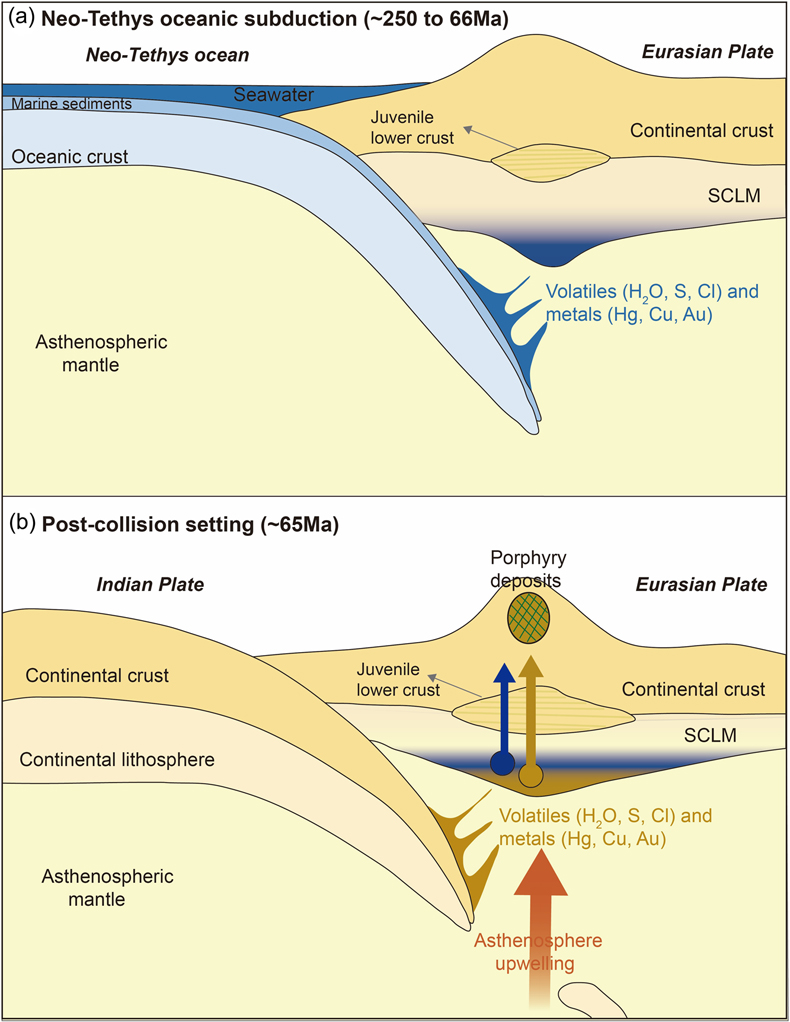
Figure 3 Genetic model of PCDs in the Alpine-Himalayan belt. (a) The Neo-Tethys oceanic subduction introduced large amounts of ocean-derived Hg released from subducted marine sediments into the SCLM. (b) Indian-Eurasia continental collision introduced terrestrially derived Hg into the SCLM, and tearing of the subducting Indian lithosphere triggered asthenospheric upwelling, leading to melting of the SCLM to generate large volumes of metal- and volatile-rich magma and magmatic-hydrothermal fluids.