



Deformation modulates helium diffusion behaviour in apatite
Affiliations | Corresponding Author | Cite as | Funding information
Published by the European Association of Geochemistry
under Creative Commons License CC BY 4.0
Keywords: apatite, helium, diffusion, deformation


- Share this article


-
Article views:1,688Cumulative count of HTML views and PDF downloads.
- Download Citation
- Rights & Permissions

top
Abstract
Figures
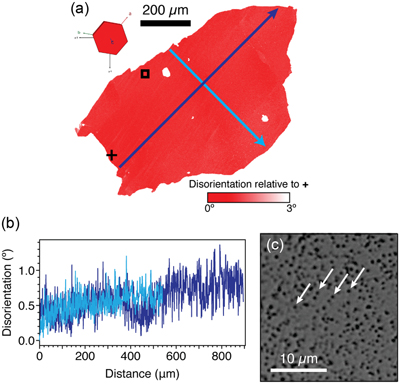 Figure 1 Damage induced in Durango apatite deformed under compression in experiment PI2014. (a) EBSD disorientation map and (b) line scans across a deformed fragment. (c) Reflected light image after 10–20 seconds of etching in 0.5 M HNO3 to reveal defects. Area corresponds to the black box in (a). Arrows highlight several dislocation etch pits visible in this surface. Note that the specific fragment used for the diffusion experiment was plucked during polishing, so this is a different fragment. Note also the crystallographic orientation at which each fragment was mounted, which affects the degree of disorientation observed (see also Fig. S-1). Additional EBSD data from PI2014 deformed material are shown in Figure S-3. | 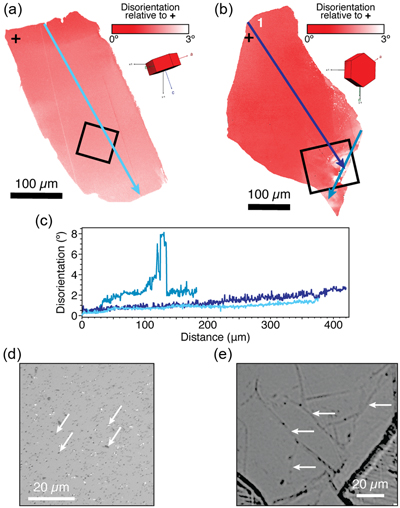 Figure 2 Damage induced in Durango apatite deformed under torsion in experiment PT1547. (a, b) EBSD disorientation maps and (c) line scans across the two fragments degassed in diffusion experiments. (d, e) Reflected light images after etching in 0.5 M HNO3 for 10–20 seconds to reveal defects, with arrows highlighting (d) etched dislocations and (e) etched subgrain boundaries. Bright dislocations in (d) are subparallel to the etched surface. The fragment used for the diffusion experiment in Figures 3 and 4 is shown in (a, d), while the fragment used for the replicate experiment in Figure S-5 is shown in (b, e). Note the crystallographic orientation at which each fragment was mounted, which affects the degree of disorientation observed and the likelihood of observing subgrain boundaries (see also Fig. S-1). Additional EBSD data from PT1547 deformed material are shown in Figure S-4. | 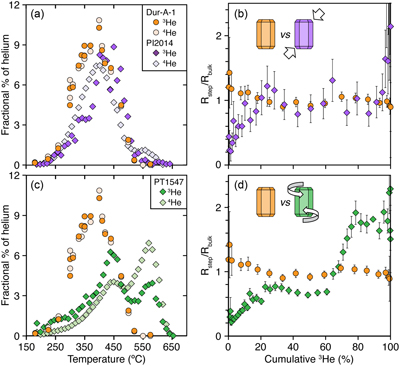 Figure 3 Step heating experiments on Durango apatite fragments deformed under (a, b) compression (PI2014) or (c, d) torsion (PT1547), compared to undeformed, unannealed Durango apatite (DUR-A-1). (a, c) Fractional release of 3He and 4He as a function of temperature. (b, d) Step 4He/3He normalised to the cumulative 4He/3He (Rstep/Rbulk), plotted with 1σ uncertainties, as a function of cumulative 3He release. | 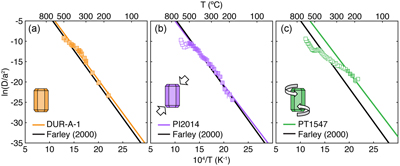 Figure 4 Arrhenius plot for diffusion of proton-induced 3He in (a) DUR-A-1, (b) PI2014, and (c) PT1547, compared to the helium diffusion kinetics for Durango apatite reported by Farley (2000), scaled to the spherical equivalent radii of each fragment. Lines are fit to the filled data points. Where not visible, uncertainties in ln(D/a2) values are smaller than the symbols plotted. |
| Figure 1 | Figure 2 | Figure 3 | Figure 4 |
top
Introduction
The apatite (U-Th)/He thermochronometer is widely utilised for inferring the low temperature thermal histories of rocks in relation to landscape evolution and tectonic processes (e.g., Gautheron and Zeitler, 2020
Gautheron, C., Zeitler, P.K. (2020) Noble Gases Deliver Cool Dates from Hot Rocks. Elements 16, 303–309. https://doi.org/10.2138/gselements.16.5.303
). However, apatite (U-Th)/He dates from individual samples are often overdispersed, limiting the thermal history information that can be inferred. This date overdispersion cannot be fully explained by the well documented effects of grain size (e.g., Reiners and Farley, 2001Reiners, P.W., Farley, K.A. (2001) Influence of crystal size on apatite (U–Th)/He thermochronology: an example from the Bighorn Mountains, Wyoming. Earth and Planetary Science Letters 188, 413–420. https://doi.org/10.1016/S0012-821X(01)00341-7
), parent nuclide zonation (e.g., Meesters and Dunai, 2002Meesters, A.G.C.A., Dunai, T.J. (2002) Solving the production–diffusion equation for finite diffusion domains of various shapes: Part II. Application to cases with α-ejection and nonhomogeneous distribution of the source. Chemical Geology 186, 57–73. https://doi.org/10.1016/S0009-2541(01)00423-5
; Hourigan et al., 2005Hourigan, J.K., Reiners, P.W., Brandon, M.T. (2005) U-Th zonation-dependent alpha-ejection in (U-Th)/He chronometry. Geochimica et Cosmochimica Acta 69, 3349–3365. https://doi.org/10.1016/j.gca.2005.01.024
; Sousa et al., 2024Sousa, F.J., Cox, S.E., Rasbury, E.T., Hemming, S.R., Lanzirotti, A., Newville, M. (2024) U and Th zonation in apatite observed by synchrotron X-ray fluorescence tomography and implications for the (U–Th)/He system. Geochronology 6, 553–570. https://doi.org/10.5194/gchron-6-553-2024
), or radiation damage on helium diffusion kinetics (e.g., Shuster et al., 2006Shuster, D.L., Flowers, R.M., Farley, K.A. (2006) The influence of natural radiation damage on helium diffusion kinetics in apatite. Earth and Planetary Science Letters 249, 148–161. https://doi.org/10.1016/j.epsl.2006.07.028
; Flowers et al., 2009Flowers, R.M., Ketcham, R.A., Shuster, D.L., Farley, K.A. (2009) Apatite (U–Th)/He thermochronometry using a radiation damage accumulation and annealing model. Geochimica et Cosmochimica Acta 73, 2347–2365. https://doi.org/10.1016/j.gca.2009.01.015
; Gautheron et al., 2013Gautheron, C., Barbarand, J., Ketcham, R.A., Tasson-Got, L., van der Beek, P., Pagel, M., Pinna-Jamme, R., Couffignal, F., Fialin, M. (2013) Chemical influence on α-recoil damage annealing in apatite: Implications for (U–Th)/He dating. Chemical Geology 351, 257–267. https://doi.org/10.1016/j.chemgeo.2013.05.027
; Willett et al., 2017Willett, C.D., Fox, M., Shuster, D.L. (2017) A helium-based model for the effects of radiation damage annealing on helium diffusion kinetics in apatite. Earth and Planetary Science Letters 447, 195–204. https://doi.org/10.1016/j.epsl.2017.07.047
).The development of continuous ramped heating (CRH) measurements (Idleman et al., 2018
Idleman, B.D., Zeitler, P.K., McDannell, K.T. (2018) Characterization of helium release from apatite by continuous ramped heating. Chemical Geology 476, 223–232. https://doi.org/10.1016/j.chemgeo.2017.11.019
), wherein radiogenic 4He is continuously measured during progressive heating to higher temperatures, has provided new insights into grain-specific helium diffusion behaviour in apatite. Some apatite grains exhibit unimodal helium release over the temperature range expected from the helium diffusion kinetics for the reference material Durango apatite, the basis for existing models of helium diffusion in apatite (e.g., Flowers et al., 2009Flowers, R.M., Ketcham, R.A., Shuster, D.L., Farley, K.A. (2009) Apatite (U–Th)/He thermochronometry using a radiation damage accumulation and annealing model. Geochimica et Cosmochimica Acta 73, 2347–2365. https://doi.org/10.1016/j.gca.2009.01.015
). However, other grains exhibit helium release peaks at multiple temperatures and/or significantly different temperatures than would be predicted from Durango apatite kinetics (e.g., Guo et al., 2021Guo, H., Zeitler, P.K., Idleman, B.D., Fayon, A.K., Fitzgerald, P.G., McDannell, K.T. (2021) Helium diffusion systematics inferred from continuous ramped heating analysis of Transantarctic Mountains apatites showing age overdispersion. Geochimica et Cosmochimica Acta 310, 113–130. https://doi.org/10.1016/j.gca.2021.07.015
; Idleman et al., 2018Idleman, B.D., Zeitler, P.K., McDannell, K.T. (2018) Characterization of helium release from apatite by continuous ramped heating. Chemical Geology 476, 223–232. https://doi.org/10.1016/j.chemgeo.2017.11.019
; McDannell et al., 2018McDannell, K.T., Zeitler, P.K., Janes, D.G., Idleman, B.D., Fayon, A.K. (2018) Screening apatites for (U-Th)/He thermochronometry via continuous ramped heating: He age components and implications for age dispersion. Geochimica et Cosmochimica Acta 223, 90–106. https://doi.org/10.1016/j.gca.2017.11.031
). Most notably, apatite grains from the KTB borehole, sampled at depths where no radiogenic helium is predicted to be retained due to high temperatures, can contain substantial 4He and exhibit complex 4He release patterns (Guo et al., 2024Guo, H., Zeitler, P.K., Idleman, B.D. (2024) Behavior of helium diffusion sinks in apatite: Evidence from continuous ramped heating analysis of borehole and well-characterized samples. Earth and Planetary Science Letters 641, 118828. https://doi.org/10.1016/j.epsl.2024.118828
). While complex helium behaviour observed in CRH measurements has broadly been attributed to imperfections in the crystal lattice of apatite that act as helium ‘sinks’ (e.g., Guo et al., 2021Guo, H., Zeitler, P.K., Idleman, B.D., Fayon, A.K., Fitzgerald, P.G., McDannell, K.T. (2021) Helium diffusion systematics inferred from continuous ramped heating analysis of Transantarctic Mountains apatites showing age overdispersion. Geochimica et Cosmochimica Acta 310, 113–130. https://doi.org/10.1016/j.gca.2021.07.015
, 2024Guo, H., Zeitler, P.K., Idleman, B.D. (2024) Behavior of helium diffusion sinks in apatite: Evidence from continuous ramped heating analysis of borehole and well-characterized samples. Earth and Planetary Science Letters 641, 118828. https://doi.org/10.1016/j.epsl.2024.118828
), the origin and nature of such imperfections remains an open question. Vacancies have been proposed to impact helium retentivity in apatite (Gerin et al., 2017Gerin, C., Gautheron, C., Oliviero, E., Bachelet, C., Djimbi, D.M., Seydoux-Guillaume, A.-M., Tassan-Got, L., Sarda, P., Roques, J., Garrido, F. (2017) Influence of vacancy damage on He diffusion in apatite, investigated at atomic to mineralogical scales. Geochimica et Cosmochimica Acta 197, 87–103. https://doi.org/10.1016/j.gca.2016.10.018
) but not necessarily to cause complex helium diffusion behaviour. Here, we present laboratory experiments that investigate whether deformation-induced imperfections can function as helium sinks in apatite and explain the range of kinetics observed across many grains that is unexplained by radiation damage (Guo et al., 2021Guo, H., Zeitler, P.K., Idleman, B.D., Fayon, A.K., Fitzgerald, P.G., McDannell, K.T. (2021) Helium diffusion systematics inferred from continuous ramped heating analysis of Transantarctic Mountains apatites showing age overdispersion. Geochimica et Cosmochimica Acta 310, 113–130. https://doi.org/10.1016/j.gca.2021.07.015
). By experimentally deforming Durango apatite – a sample for which helium behaviour is well characterised and simple in the absence of deformation – we can directly link deformation features we generate to their effects on helium behaviour.top
Methods
We deformed cylinders of single crystal Durango apatite in a Paterson gas-medium apparatus under two different experimental conditions. Experiment PI2014 was conducted in compression with the crystal cut such that the basal plane was oriented 45° to the maximum compressive stress. Experiment PT1547 was conducted in torsion with the crystal oriented such that the c-axis was parallel to the twist axis resulting in shear along the basal plane, analogous to how apatite would deform under shear in geologic settings. The deformation experiments were conducted at 300 MPa confining pressure and 1100 °C for 2 hours (PI2014) and 5 hours (PT1547). Deformed samples were characterised using backscatter electron imaging, electron backscatter diffraction (EBSD) analysis, and chemical etching. Full deformation experiment and sample characterisation details are provided in the Supplementary Information.
We anticipated that radiogenic 4He in the deformed apatite crystals would be diffusively lost during the high temperature deformation experiments. Therefore, we needed to introduce helium into the deformed crystals to understand the effects of the deformation on helium behaviour. To achieve this, we crushed the deformed crystals into ∼100–500 μm fragments and irradiated both deformed and undeformed, unannealed Durango apatite fragments with protons. Proton irradiation produces a uniform, high concentration of 3He, enabling diffusion experiments with many heating steps to be carried out on individual mineral grains or fragments (e.g., Shuster et al., 2004
Shuster, D.L., Farley, K.A., Sisterson, J.M., Burnett, D.S. (2004) Quantifying the diffusion kinetics and spatial distributions of radiogenic 4He in minerals containing proton-induced 3He. Earth and Planetary Science Letters 217, 19–32. https://doi.org/10.1016/S0012-821X(03)00594-6
). Following proton irradiation, stepwise heating diffusion experiments on individual fragments were carried out in the noble gas thermochronology facility at Purdue University. Full details about the proton irradiation and diffusion experiments are provided in the Supplementary Information.top
Results
Experimentally induced deformation. Both experimentally deformed samples exhibit crystal defects but differ in both the density and organisation of defects present. PI2014, deformed in compression, exhibits dislocations within the basal plane with minor lattice distortion (Fig. 1a,b): a dislocation density of ∼1010 m−2 is necessary to account for the observed lattice curvature in EBSD data (Pantleon, 2008
Pantleon, W. (2008) Resolving the geometrically necessary dislocation content by conventional electron backscattering diffraction. Scripta Materialia 58, 994–997. https://doi.org/10.1016/j.scriptamat.2008.01.050
). This produces a very subtle ‘tiger-stripe’ microtexture in the EBSD map (Fig. 1a), comparable to textures seen in naturally deformed apatite samples (e.g., Odlum and Stockli, 2020Odlum, M.L., Stockli, D.F. (2020) Geochronologic constraints on deformation and metasomatism along an exhumed mylonitic shear zone using apatite U-Pb, geochemistry, and microtextural analysis. Earth and Planetary Science Letters 538, 116177. https://doi.org/10.1016/j.epsl.2020.116177
). The etched surface of this sample shows a relatively uniform distribution of dislocations at an angle to the surface of the grain (Fig. 1c).Figure 1 Damage induced in Durango apatite deformed under compression in experiment PI2014. (a) EBSD disorientation map and (b) line scans across a deformed fragment. (c) Reflected light image after 10–20 seconds of etching in 0.5 M HNO3 to reveal defects. Area corresponds to the black box in (a). Arrows highlight several dislocation etch pits visible in this surface. Note that the specific fragment used for the diffusion experiment was plucked during polishing, so this is a different fragment. Note also the crystallographic orientation at which each fragment was mounted, which affects the degree of disorientation observed (see also Fig. S-1). Additional EBSD data from PI2014 deformed material are shown in Figure S-3.
PT1547, deformed in torsion, exhibits both dislocations and bands of subgrains whose boundaries are defined by dislocation arrays subparallel to and within the basal plane (Fig. 2). Lattice curvature measured from EBSD data for PT1547 requires a dislocation density of ∼1011 and up to 1012 m−2 across subgrain boundaries, at least an order of magnitude greater than the dislocation density for PI2014. In addition to the lattice curvature, subgrains are observed in PT1547 with misorientations between 2 and 8° (Fig. 2b,c). These subgrains are not pervasive but are visible in both EBSD data and etched surfaces when oriented such that the c-axis is near-orthogonal to the polished surface (Fig. 2b; see also Supplementary Information) and are characterised by a higher dislocation density relative to other parts of the sample. The presence of subgrains and 5–15° of disorientation, comparable to the deformation we produced in PT1547, have been observed in naturally deformed apatite samples (e.g., Ribeiro et al., 2020
Ribeiro, B.V., Lagoeiro, L., Faleiros, F.M., Hunter, N.J.R., Queiroga, G., Raveggi, M., Cawood, P.A., Finch, M., Campanha, G.A.C. (2020) Strain localization and fluid-assisted deformation in apatite and its influence on trace elements and U–Pb systematics. Earth and Planetary Science Letters 545, 116421. https://doi.org/10.1016/j.epsl.2020.116421
; Odlum et al., 2022Odlum, M.L., Levy, D.A., Stockli, D.F., Stockli, L.D., DesOrmeau, J.W. (2022) Deformation and metasomatism recorded by single-grain apatite petrochronology. Geology 50, 697–703. https://doi.org/10.1130/G49809.1
).Figure 2 Damage induced in Durango apatite deformed under torsion in experiment PT1547. (a, b) EBSD disorientation maps and (c) line scans across the two fragments degassed in diffusion experiments. (d, e) Reflected light images after etching in 0.5 M HNO3 for 10–20 seconds to reveal defects, with arrows highlighting (d) etched dislocations and (e) etched subgrain boundaries. Bright dislocations in (d) are subparallel to the etched surface. The fragment used for the diffusion experiment in Figures 3 and 4 is shown in (a, d), while the fragment used for the replicate experiment in Figure S-5 is shown in (b, e). Note the crystallographic orientation at which each fragment was mounted, which affects the degree of disorientation observed and the likelihood of observing subgrain boundaries (see also Fig. S-1). Additional EBSD data from PT1547 deformed material are shown in Figure S-4.
Stepwise degassing experiments. Figure 3 shows results from stepwise degassing experiments on individual fragments in two formats: as a fraction of helium released as a function of temperature (Fig. 3a,c), which are analogous to CRH analysis incremental helium loss curves, and as 4He/3He ratios as a function of cumulative 3He release (Fig. 3b,d), comparable to conventional 4He/3He datasets. A second experiment on PT1547 is shown in the Supplementary Information. For undeformed, unannealed Durango apatite (DUR-A-1), we observed a unimodal release of both 3He and 4He with nearly identical release peaks at ∼400 °C (Fig. 3a,c), corresponding to an invariant 4He/3He (Fig. 3b,d). These observations are expected for Durango apatite based on previous experiments characterising its diffusion kinetics (see Supplementary Information; e.g., Farley, 2000
Farley, K.A. (2000) Helium diffusion from apatite: General behavior as illustrated by Durango fluorapatite. Journal of Geophysical Research: Solid Earth 105, 2903–2914. https://doi.org/10.1029/1999JB900348
; Shuster et al., 2004Shuster, D.L., Farley, K.A., Sisterson, J.M., Burnett, D.S. (2004) Quantifying the diffusion kinetics and spatial distributions of radiogenic 4He in minerals containing proton-induced 3He. Earth and Planetary Science Letters 217, 19–32. https://doi.org/10.1016/S0012-821X(03)00594-6
) as well as CRH measurements (Idleman et al., 2018Idleman, B.D., Zeitler, P.K., McDannell, K.T. (2018) Characterization of helium release from apatite by continuous ramped heating. Chemical Geology 476, 223–232. https://doi.org/10.1016/j.chemgeo.2017.11.019
; McDannell et al., 2018McDannell, K.T., Zeitler, P.K., Janes, D.G., Idleman, B.D., Fayon, A.K. (2018) Screening apatites for (U-Th)/He thermochronometry via continuous ramped heating: He age components and implications for age dispersion. Geochimica et Cosmochimica Acta 223, 90–106. https://doi.org/10.1016/j.gca.2017.11.031
). Our experiments on deformed Durango fragments exhibit different behaviour. For Durango apatite deformed under compression (PI2014), we observe a mostly unimodal release of both 3He and 4He, similar to DUR-A-1 (Fig. 3a), with a minor second peak observed at >500 °C. The 4He/3He increases in this experiment over the first ∼30 % of the 3He release and then remains constant (Fig. 3b). The helium diffusion kinetics derived from the proton-induced 3He in PI2014 are similar to the kinetics of Durango apatite reported by Farley (2000)Farley, K.A. (2000) Helium diffusion from apatite: General behavior as illustrated by Durango fluorapatite. Journal of Geophysical Research: Solid Earth 105, 2903–2914. https://doi.org/10.1029/1999JB900348
and measured in our DUR-A-1 experiment (Figs. 4a,b, S-7), but substantially different from the helium diffusion kinetics measured in Durango apatite with annealed radiation damage (Figs. S-6, S-7).Figure 3 Step heating experiments on Durango apatite fragments deformed under (a, b) compression (PI2014) or (c, d) torsion (PT1547), compared to undeformed, unannealed Durango apatite (DUR-A-1). (a, c) Fractional release of 3He and 4He as a function of temperature. (b, d) Step 4He/3He normalised to the cumulative 4He/3He (Rstep/Rbulk), plotted with 1σ uncertainties, as a function of cumulative 3He release.
Figure 4 Arrhenius plot for diffusion of proton-induced 3He in (a) DUR-A-1, (b) PI2014, and (c) PT1547, compared to the helium diffusion kinetics for Durango apatite reported by Farley (2000)
Farley, K.A. (2000) Helium diffusion from apatite: General behavior as illustrated by Durango fluorapatite. Journal of Geophysical Research: Solid Earth 105, 2903–2914. https://doi.org/10.1029/1999JB900348
, scaled to the spherical equivalent radii of each fragment. Lines are fit to the filled data points. Where not visible, uncertainties in ln(D/a2) values are smaller than the symbols plotted.For Durango apatite deformed under torsion (PT1547), we observe two prominent, coincident release peaks for 3He and 4He, with the second peak occurring at higher temperatures (>500 °C) than in DUR-A-1 (Figs. 3c, S-5). The 3He release fraction corresponding to the first peak is larger than the second, higher temperature peak, while the opposite was observed for 4He. The resulting 4He/3He evolution in this experiment has two discrete benches or plateaus (Fig. 3d), and the diffusion kinetics derived from the proton-induced 3He are markedly different from the kinetics of undeformed, unannealed Durango apatite (Fig. 4a,c). Specifically, we observe higher apparent diffusivities for the first ∼20 % of the 3He released and a pair of lower apparent diffusivity trends for the remaining 3He released.
top
Discussion
Deformation-induced helium diffusion sinks and changes in volume diffusion kinetics. The deformation features we produced in PI2014 and PT1547 are comparable to features in naturally deformed apatite observed in petrochronologic studies (e.g., Odlum and Stockli, 2020
Odlum, M.L., Stockli, D.F. (2020) Geochronologic constraints on deformation and metasomatism along an exhumed mylonitic shear zone using apatite U-Pb, geochemistry, and microtextural analysis. Earth and Planetary Science Letters 538, 116177. https://doi.org/10.1016/j.epsl.2020.116177
; Ribeiro et al., 2020Ribeiro, B.V., Lagoeiro, L., Faleiros, F.M., Hunter, N.J.R., Queiroga, G., Raveggi, M., Cawood, P.A., Finch, M., Campanha, G.A.C. (2020) Strain localization and fluid-assisted deformation in apatite and its influence on trace elements and U–Pb systematics. Earth and Planetary Science Letters 545, 116421. https://doi.org/10.1016/j.epsl.2020.116421
; Odlum et al., 2022Odlum, M.L., Levy, D.A., Stockli, D.F., Stockli, L.D., DesOrmeau, J.W. (2022) Deformation and metasomatism recorded by single-grain apatite petrochronology. Geology 50, 697–703. https://doi.org/10.1130/G49809.1
). It is important to note that the dislocations produced in the deformation experiments can migrate during hydrostatic conditions (e.g., glide or climb; Passchier and Trouw, 2005Passchier, C.W., Trouw, R.A.J. (2005) Microtectonics. Second Edition, Springer, Berlin.
) but do not anneal like radiation damage, and during the heating conditions of our diffusion experiments were thermally persistent. This is evidenced by the dislocations and subgrain boundaries retained in the PT1547 diffusion experiment fragments (Fig. 2), as well as observations from the apatite fission track community that dislocations persist even after fission tracks have been annealed (e.g., Bertel and Märk, 1983Bertel, E., Märk, T.D. (1983) Fission tracks in minerals: Annealing kinetics, track structure and age correction. Physics and Chemistry of Minerals 9, 197–204. https://doi.org/10.1007/BF00311955
). While it has been hypothesised that deformation modifies helium behaviour in apatite (e.g., Fayon and Hansen, 2015Fayon, A.K., Hansen, L. (2015) Effects of deformation on apatite (U-Th)/He single-grain ages. 2015 GSA Annual Meeting [Abstract], 1–4 November 2015, Baltimore, MD, 104–11.
; McDannell et al., 2018McDannell, K.T., Zeitler, P.K., Janes, D.G., Idleman, B.D., Fayon, A.K. (2018) Screening apatites for (U-Th)/He thermochronometry via continuous ramped heating: He age components and implications for age dispersion. Geochimica et Cosmochimica Acta 223, 90–106. https://doi.org/10.1016/j.gca.2017.11.031
; Fayon and Cherniak, 2021Fayon, A.K., Cherniak, D.J. (2021) Helium diffusion in experimentally deformed Durango apatite single crystals. 17th International Conference on Thermochronology [Abstract], 12–17 September 2021, Santa Fe, NM.
; Guo et al., 2024Guo, H., Zeitler, P.K., Idleman, B.D. (2024) Behavior of helium diffusion sinks in apatite: Evidence from continuous ramped heating analysis of borehole and well-characterized samples. Earth and Planetary Science Letters 641, 118828. https://doi.org/10.1016/j.epsl.2024.118828
), the impact of deformation has not been clearly documented in previous studies.PI2014 contains a uniform distribution of dislocations (Fig. 1) and exhibits a mostly unimodal helium release behaviour that is comparable to undeformed, unannealed Durango apatite (Figs. 3a,b, 4b), albeit with some apparent diffusive rounding of radiogenic 4He (Fig. 3b). The presence of a minor second release peak at temperatures >500 °C suggests that the dislocations in PI2014 have induced some complex helium release behaviour, albeit limited compared to PT1547. Additionally, the similarity of helium diffusion kinetics in PI2014 and in undeformed, unannealed Durango apatite (Figs. 4a,b, S-7) suggests that the dislocations produced in PI2014 impeded helium diffusion in a manner comparable to radiation damage (e.g., Shuster et al., 2006
Shuster, D.L., Flowers, R.M., Farley, K.A. (2006) The influence of natural radiation damage on helium diffusion kinetics in apatite. Earth and Planetary Science Letters 249, 148–161. https://doi.org/10.1016/j.epsl.2006.07.028
; Flowers et al., 2009Flowers, R.M., Ketcham, R.A., Shuster, D.L., Farley, K.A. (2009) Apatite (U–Th)/He thermochronometry using a radiation damage accumulation and annealing model. Geochimica et Cosmochimica Acta 73, 2347–2365. https://doi.org/10.1016/j.gca.2009.01.015
). If this were not the case, we would expect the 3He diffusion kinetics in PI2014 to be less retentive and more similar to the diffusion kinetics of Durango apatite in which radiation damage had been experimentally annealed (Figs. S-6, S-7; Shuster and Farley, 2009Shuster, D.L., Farley, K.A. (2009) The influence of artificial radiation damage and thermal annealing on helium diffusion kinetics in apatite. Geochimica et Cosmochimica Acta 73, 183–196. https://doi.org/10.1016/j.gca.2008.10.013
), since radiation damage present in the PI2014 starting material was annealed at the high temperatures of the deformation experiment.The higher density of dislocations and dislocation arrays comprising subgrain boundaries in PT1547 (Figs. 2, S-4) are associated with anomalous, significant multimodal helium release behaviour (Fig. 3c,d), reminiscent of multiple diffusion domain behaviour commonly observed for 40Ar/39Ar spectra from K Feldspars (e.g., Harrison and Lovera, 2014
Harrison, T.M., Lovera, O.M. (2014) The multi-diffusion domain model: past, present and future. In: Jourdan, F., Mark, D.F., Verati, C. (Eds.) Advances in 40Ar/39Ar Dating: From Archaeology to Planetary Sciences. Geological Society of London, London, Special Publication 378, 91–106. https://doi.org/10.1144/SP378.9
) and comparable to the CRH evolution of 4He in some natural apatite samples (e.g., Guo et al., 2024Guo, H., Zeitler, P.K., Idleman, B.D. (2024) Behavior of helium diffusion sinks in apatite: Evidence from continuous ramped heating analysis of borehole and well-characterized samples. Earth and Planetary Science Letters 641, 118828. https://doi.org/10.1016/j.epsl.2024.118828
). It is important to note that the proton-induced 3He has a uniform spatial distribution at the beginning of a stepwise degassing experiment. Therefore, the multimodal release of 3He we observe can only result from the redistribution of 3He during the degassing experiment. The high apparent diffusivities characterising the initial 3He release in PT1547 (Fig. 4b) may result from fractures we did not detect when selecting this fragment that essentially reduce the effective diffusion length scale for a small portion of the fragment analysed. Alternatively, these high diffusivities could reflect a change in the volume diffusion kinetics induced by deformation in at least part of the sample.The high apparent initial diffusivities in PT1547 transition to diffusivities consistent with the helium diffusion kinetics for undeformed Durango apatite (Fig. 4b), corresponding to the first ‘plateau’ we see in the 4He/3He evolution (Fig. 3d). A significant proportion of the 3He is then retained until higher temperatures than we would expect from undeformed Durango apatite kinetics (Figs. 3c, 4b), corresponding to the second ‘plateau’ we see in the 4He/3He evolution (Fig. 3d). Guo et al. (2024)
Guo, H., Zeitler, P.K., Idleman, B.D. (2024) Behavior of helium diffusion sinks in apatite: Evidence from continuous ramped heating analysis of borehole and well-characterized samples. Earth and Planetary Science Letters 641, 118828. https://doi.org/10.1016/j.epsl.2024.118828
hypothesised that this could occur if 3He encountered lattice imperfections that acted as helium sinks, such that there was an additional kinetic barrier for helium to continue diffusing interstitially once it encountered a sink in the degassing experiment, resulting in a higher temperature release of 3He. The corresponding second release peak for 4He, which corresponds to larger gas release fractions than 3He, further suggests that trapping of radiogenic 4He occurred during the deformation experiment, in addition to trapping during the subsequent diffusion experiment. Overall, our observations from PT1547 suggest that a locally high dislocation density (i.e. relative to PI2014) or array of dislocations can create diffusion sinks related to crystal-plastic deformation, which is perhaps not surprising, as extended defects have previously been suggested to impede helium diffusion and/or trap helium in apatite and other minerals based on first principles calculations (e.g., Domingos et al., 2020Domingos, R., Tremblay, M.M., Shuster, D.L., Militzer, B. (2020) Simulations and Experiments Reveal Effect of Nanopores on Helium Diffusion in Quartz. ACS Earth and Space Chemistry 4, 1906–1912. https://doi.org/10.1021/acsearthspacechem.0c00187
; Gautheron et al., 2020Gautheron, C., Djimbi, D.M., Roques, J., Balout, H., Ketcham, R.A., Simoni, E., Pik, R., Seydoux-Guillaume, A.-M., Tassan-Got, L. (2020) A multi-method, multi-scale theoretical study of He and Ne diffusion in zircon. Geochimica et Cosmochimica Acta 268, 348–367. https://doi.org/10.1016/j.gca.2019.10.007
; Gerin et al., 2017Gerin, C., Gautheron, C., Oliviero, E., Bachelet, C., Djimbi, D.M., Seydoux-Guillaume, A.-M., Tassan-Got, L., Sarda, P., Roques, J., Garrido, F. (2017) Influence of vacancy damage on He diffusion in apatite, investigated at atomic to mineralogical scales. Geochimica et Cosmochimica Acta 197, 87–103. https://doi.org/10.1016/j.gca.2016.10.018
).Farley (2000)
Farley, K.A. (2000) Helium diffusion from apatite: General behavior as illustrated by Durango fluorapatite. Journal of Geophysical Research: Solid Earth 105, 2903–2914. https://doi.org/10.1029/1999JB900348
predicted that helium diffusion kinetics in apatite should vary based on the presence of crystal imperfections including, but not limited to, radiation damage, and Guo et al. (2021)Guo, H., Zeitler, P.K., Idleman, B.D., Fayon, A.K., Fitzgerald, P.G., McDannell, K.T. (2021) Helium diffusion systematics inferred from continuous ramped heating analysis of Transantarctic Mountains apatites showing age overdispersion. Geochimica et Cosmochimica Acta 310, 113–130. https://doi.org/10.1016/j.gca.2021.07.015
demonstrated that this kinetics variation does occur and cannot be completely explained by different combinations of grain size and radiation damage. Our paired deformation–4He/3He experiments support the hypothesis that deformation-induced extended defects in apatite impact the behaviour of radiogenic 4He in natural apatite samples. Defects can function as reversible, temperature dependent diffusion ‘sinks’ that impede the diffusive loss of 4He over a sample’s geologic thermal history and may also alter volume diffusion kinetics. Because these defects form during crystal-plastic deformation (e.g., Nakano et al., 2001Nakano, T., Awazu, T., Umakoshi, Y. (2001) Plastic deformation and operative slip system in mineral fluorapatite single crystal. Scripta Materialia 44, 811–815. https://doi.org/10.1016/S1359-6462(00)00656-4
; Saka et al., 2008Saka, H., Goto, D., Moon, W.-J. (2008) Dislocations in plastically deformed apatite. Journal of Materials Science 43, 3234–3239. https://doi.org/10.1007/s10853-008-2551-z
; Odlum et al., 2022Odlum, M.L., Levy, D.A., Stockli, D.F., Stockli, L.D., DesOrmeau, J.W. (2022) Deformation and metasomatism recorded by single-grain apatite petrochronology. Geology 50, 697–703. https://doi.org/10.1130/G49809.1
), we can infer that, in natural samples, such defects will form during the high temperature portion of an apatite sample’s geologic history, before significant radiogenic 4He accumulation occurs. The impact of such defects on helium behaviour likely contributes to apatite (U-Th)/He date overdispersion, specifically resulting in dispersion toward older ages (e.g., Guo et al., 2021Guo, H., Zeitler, P.K., Idleman, B.D., Fayon, A.K., Fitzgerald, P.G., McDannell, K.T. (2021) Helium diffusion systematics inferred from continuous ramped heating analysis of Transantarctic Mountains apatites showing age overdispersion. Geochimica et Cosmochimica Acta 310, 113–130. https://doi.org/10.1016/j.gca.2021.07.015
) compared to what is expected given current diffusion models. Importantly, detecting such behaviour requires obtaining information about the behaviour of helium release during laboratory degassing, either through 4He/3He experiments like those presented here or through CRH measurements (Idleman et al., 2018Idleman, B.D., Zeitler, P.K., McDannell, K.T. (2018) Characterization of helium release from apatite by continuous ramped heating. Chemical Geology 476, 223–232. https://doi.org/10.1016/j.chemgeo.2017.11.019
). Further work is necessary to evaluate if a constitutive relationship between deformation and helium retentivity can be developed and broadly applied to (U-Th)/He datasets.top
Conclusions
We demonstrate with experiments that dislocations produced during plastic deformation of apatite can operate as diffusion sinks for helium. Retention of helium to higher temperatures in such sinks is likely an important source of (U-Th)/He date overdispersion in natural apatite samples, and incorporating the effects of deformation-induced helium sinks into our apatite helium diffusion models will be important for making accurate thermal history interpretations from many (U-Th)/He datasets.
top
Acknowledgements
This research was supported by a Sloan Research Fellowship awarded to MMT by the Alfred P. Sloan Foundation (FG-2022-18729). Apatite deformation experiments were carried out with U.S. National Science Foundation grants to AKF (EAR-1727203) and PKZ and BDI (EAR-1726350). We thank L. Hansen, A. Dillman, and H. Wiesman for helpful discussions, W. Nachlas for assistance with EBSD data collection, three anonymous reviewers for their constructive feedback, and F. McCubbin for editorial handling.
Editor: Francis McCubbin
top
References
Bertel, E., Märk, T.D. (1983) Fission tracks in minerals: Annealing kinetics, track structure and age correction. Physics and Chemistry of Minerals 9, 197–204. https://doi.org/10.1007/BF00311955
 Show in context
 This is evidenced by the dislocations and subgrain boundaries retained in the PT1547 diffusion experiment fragments (Fig. 2), as well as observations from the apatite fission track community that dislocations persist even after fission tracks have been annealed (e.g., Bertel and Märk, 1983).
View in article
Domingos, R., Tremblay, M.M., Shuster, D.L., Militzer, B. (2020) Simulations and Experiments Reveal Effect of Nanopores on Helium Diffusion in Quartz. ACS Earth and Space Chemistry 4, 1906–1912. https://doi.org/10.1021/acsearthspacechem.0c00187
Show in context Overall, our observations from PT1547 suggest that a locally high dislocation density (i.e. relative to PI2014) or array of dislocations can create diffusion sinks related to crystal-plastic deformation, which is perhaps not surprising, as extended defects have previously been suggested to impede helium diffusion and/or trap helium in apatite and other minerals based on first principles calculations (e.g., Domingos et al., 2020; Gautheron et al., 2020; Gerin et al., 2017).
View in article
Farley, K.A. (2000) Helium diffusion from apatite: General behavior as illustrated by Durango fluorapatite. Journal of Geophysical Research: Solid Earth 105, 2903–2914. https://doi.org/10.1029/1999JB900348
Show in context These observations are expected for Durango apatite based on previous experiments characterising its diffusion kinetics (see Supplementary Information; e.g., Farley, 2000; Shuster et al., 2004) as well as CRH measurements (Idleman et al., 2018; McDannell et al., 2018).
View in article
The helium diffusion kinetics derived from the proton-induced 3He in PI2014 are similar to the kinetics of Durango apatite reported by Farley (2000) and measured in our DUR-A-1 experiment (Figs. 4a,b, S-7), but substantially different from the helium diffusion kinetics measured in Durango apatite with annealed radiation damage (Figs. S-6, S-7).
View in article
Arrhenius plot for diffusion of proton-induced 3He in (a) DUR-A-1, (b) PI2014, and (c) PT1547, compared to the helium diffusion kinetics for Durango apatite reported by Farley (2000), scaled to the spherical equivalent radii of each fragment.
View in article
Farley (2000) predicted that helium diffusion kinetics in apatite should vary based on the presence of crystal imperfections including, but not limited to, radiation damage, and Guo et al. (2021) demonstrated that this kinetics variation does occur and cannot be completely explained by different combinations of grain size and radiation damage.
View in article
Fayon, A.K., Cherniak, D.J. (2021) Helium diffusion in experimentally deformed Durango apatite single crystals. 17th International Conference on Thermochronology [Abstract], 12–17 September 2021, Santa Fe, NM.
Show in context While it has been hypothesised that deformation modifies helium behaviour in apatite (e.g., Fayon and Hansen, 2015; McDannell et al., 2018; Fayon and Cherniak, 2021; Guo et al., 2024), the impact of deformation has not been clearly documented in previous studies.
View in article
Fayon, A.K., Hansen, L. (2015) Effects of deformation on apatite (U-Th)/He single-grain ages. 2015 GSA Annual Meeting [Abstract], 1–4 November 2015, Baltimore, MD, 104–11.
Show in context While it has been hypothesised that deformation modifies helium behaviour in apatite (e.g., Fayon and Hansen, 2015; McDannell et al., 2018; Fayon and Cherniak, 2021; Guo et al., 2024), the impact of deformation has not been clearly documented in previous studies.
View in article
Flowers, R.M., Ketcham, R.A., Shuster, D.L., Farley, K.A. (2009) Apatite (U–Th)/He thermochronometry using a radiation damage accumulation and annealing model. Geochimica et Cosmochimica Acta 73, 2347–2365. https://doi.org/10.1016/j.gca.2009.01.015
Show in context This date overdispersion cannot be fully explained by the well documented effects of grain size (e.g., Reiners and Farley, 2001), parent nuclide zonation (e.g., Meesters and Dunai, 2002; Hourigan et al., 2005; Sousa et al., 2024), or radiation damage on helium diffusion kinetics (e.g., Shuster et al., 2006; Flowers et al., 2009; Gautheron et al., 2013; Willett et al., 2017).
View in article
Some apatite grains exhibit unimodal helium release over the temperature range expected from the helium diffusion kinetics for the reference material Durango apatite, the basis for existing models of helium diffusion in apatite (e.g., Flowers et al., 2009).
View in article
Additionally, the similarity of helium diffusion kinetics in PI2014 and in undeformed, unannealed Durango apatite (Figs. 4a,b, S-7) suggests that the dislocations produced in PI2014 impeded helium diffusion in a manner comparable to radiation damage (e.g., Shuster et al., 2006; Flowers et al., 2009).
View in article
Gautheron, C., Zeitler, P.K. (2020) Noble Gases Deliver Cool Dates from Hot Rocks. Elements 16, 303–309. https://doi.org/10.2138/gselements.16.5.303
Show in context The apatite (U-Th)/He thermochronometer is widely utilised for inferring the low temperature thermal histories of rocks in relation to landscape evolution and tectonic processes (e.g., Gautheron and Zeitler, 2020).
View in article
Gautheron, C., Barbarand, J., Ketcham, R.A., Tasson-Got, L., van der Beek, P., Pagel, M., Pinna-Jamme, R., Couffignal, F., Fialin, M. (2013) Chemical influence on α-recoil damage annealing in apatite: Implications for (U–Th)/He dating. Chemical Geology 351, 257–267. https://doi.org/10.1016/j.chemgeo.2013.05.027
Show in context This date overdispersion cannot be fully explained by the well documented effects of grain size (e.g., Reiners and Farley, 2001), parent nuclide zonation (e.g., Meesters and Dunai, 2002; Hourigan et al., 2005; Sousa et al., 2024), or radiation damage on helium diffusion kinetics (e.g., Shuster et al., 2006; Flowers et al., 2009; Gautheron et al., 2013; Willett et al., 2017).
View in article
Gautheron, C., Djimbi, D.M., Roques, J., Balout, H., Ketcham, R.A., Simoni, E., Pik, R., Seydoux-Guillaume, A.-M., Tassan-Got, L. (2020) A multi-method, multi-scale theoretical study of He and Ne diffusion in zircon. Geochimica et Cosmochimica Acta 268, 348–367. https://doi.org/10.1016/j.gca.2019.10.007
Show in context Overall, our observations from PT1547 suggest that a locally high dislocation density (i.e. relative to PI2014) or array of dislocations can create diffusion sinks related to crystal-plastic deformation, which is perhaps not surprising, as extended defects have previously been suggested to impede helium diffusion and/or trap helium in apatite and other minerals based on first principles calculations (e.g., Domingos et al., 2020; Gautheron et al., 2020; Gerin et al., 2017).
View in article
Gerin, C., Gautheron, C., Oliviero, E., Bachelet, C., Djimbi, D.M., Seydoux-Guillaume, A.-M., Tassan-Got, L., Sarda, P., Roques, J., Garrido, F. (2017) Influence of vacancy damage on He diffusion in apatite, investigated at atomic to mineralogical scales. Geochimica et Cosmochimica Acta 197, 87–103. https://doi.org/10.1016/j.gca.2016.10.018
Show in context While complex helium behaviour observed in CRH measurements has broadly been attributed to imperfections in the crystal lattice of apatite that act as helium ‘sinks’ (e.g., Guo et al., 2021, 2024), the origin and nature of such imperfections remains an open question. Vacancies have been proposed to impact helium retentivity in apatite (Gerin et al., 2017) but not necessarily to cause complex helium diffusion behaviour.
View in article
Overall, our observations from PT1547 suggest that a locally high dislocation density (i.e. relative to PI2014) or array of dislocations can create diffusion sinks related to crystal-plastic deformation, which is perhaps not surprising, as extended defects have previously been suggested to impede helium diffusion and/or trap helium in apatite and other minerals based on first principles calculations (e.g., Domingos et al., 2020; Gautheron et al., 2020; Gerin et al., 2017).
View in article
Guo, H., Zeitler, P.K., Idleman, B.D., Fayon, A.K., Fitzgerald, P.G., McDannell, K.T. (2021) Helium diffusion systematics inferred from continuous ramped heating analysis of Transantarctic Mountains apatites showing age overdispersion. Geochimica et Cosmochimica Acta 310, 113–130. https://doi.org/10.1016/j.gca.2021.07.015
Show in context However, other grains exhibit helium release peaks at multiple temperatures and/or significantly different temperatures than would be predicted from Durango apatite kinetics (e.g., Guo et al., 2021; Idleman et al., 2018; McDannell et al., 2018).
View in article
While complex helium behaviour observed in CRH measurements has broadly been attributed to imperfections in the crystal lattice of apatite that act as helium ‘sinks’ (e.g., Guo et al., 2021, 2024), the origin and nature of such imperfections remains an open question. Vacancies have been proposed to impact helium retentivity in apatite (Gerin et al., 2017) but not necessarily to cause complex helium diffusion behaviour.
View in article
Here, we present laboratory experiments that investigate whether deformation-induced imperfections can function as helium sinks in apatite and explain the range of kinetics observed across many grains that is unexplained by radiation damage (Guo et al., 2021).
View in article
Farley (2000) predicted that helium diffusion kinetics in apatite should vary based on the presence of crystal imperfections including, but not limited to, radiation damage, and Guo et al. (2021) demonstrated that this kinetics variation does occur and cannot be completely explained by different combinations of grain size and radiation damage.
View in article
The impact of such defects on helium behaviour likely contributes to apatite (U-Th)/He date overdispersion, specifically resulting in dispersion toward older ages (e.g., Guo et al., 2021) compared to what is expected given current diffusion models.
View in article
Guo, H., Zeitler, P.K., Idleman, B.D. (2024) Behavior of helium diffusion sinks in apatite: Evidence from continuous ramped heating analysis of borehole and well-characterized samples. Earth and Planetary Science Letters 641, 118828. https://doi.org/10.1016/j.epsl.2024.118828
Show in context Most notably, apatite grains from the KTB borehole, sampled at depths where no radiogenic helium is predicted to be retained due to high temperatures, can contain substantial 4He and exhibit complex 4He release patterns (Guo et al., 2024).
View in article
While complex helium behaviour observed in CRH measurements has broadly been attributed to imperfections in the crystal lattice of apatite that act as helium ‘sinks’ (e.g., Guo et al., 2021, 2024), the origin and nature of such imperfections remains an open question. Vacancies have been proposed to impact helium retentivity in apatite (Gerin et al., 2017) but not necessarily to cause complex helium diffusion behaviour.
View in article
While it has been hypothesised that deformation modifies helium behaviour in apatite (e.g., Fayon and Hansen, 2015; McDannell et al., 2018; Fayon and Cherniak, 2021; Guo et al., 2024), the impact of deformation has not been clearly documented in previous studies.
View in article
The higher density of dislocations and dislocation arrays comprising subgrain boundaries in PT1547 (Figs. 2, S-4) are associated with anomalous, significant multimodal helium release behaviour (Fig. 3c,d), reminiscent of multiple diffusion domain behaviour commonly observed for 40Ar/39Ar spectra from K Feldspars (e.g., Harrison and Lovera, 2014) and comparable to the CRH evolution of 4He in some natural apatite samples (e.g., Guo et al., 2024).
View in article
Guo et al. (2024) hypothesised that this could occur if 3He encountered lattice imperfections that acted as helium sinks, such that there was an additional kinetic barrier for helium to continue diffusing interstitially once it encountered a sink in the degassing experiment, resulting in a higher temperature release of 3He.
View in article
Harrison, T.M., Lovera, O.M. (2014) The multi-diffusion domain model: past, present and future. In: Jourdan, F., Mark, D.F., Verati, C. (Eds.) Advances in 40 Ar/ 39 Ar Dating: From Archaeology to Planetary Sciences . Geological Society of London, London, Special Publication 378, 91–106. https://doi.org/10.1144/SP378.9
Show in context The higher density of dislocations and dislocation arrays comprising subgrain boundaries in PT1547 (Figs. 2, S-4) are associated with anomalous, significant multimodal helium release behaviour (Fig. 3c,d), reminiscent of multiple diffusion domain behaviour commonly observed for 40Ar/39Ar spectra from K Feldspars (e.g., Harrison and Lovera, 2014) and comparable to the CRH evolution of 4He in some natural apatite samples (e.g., Guo et al., 2024).
View in article
Hourigan, J.K., Reiners, P.W., Brandon, M.T. (2005) U-Th zonation-dependent alpha-ejection in (U-Th)/He chronometry. Geochimica et Cosmochimica Acta 69, 3349–3365. https://doi.org/10.1016/j.gca.2005.01.024
Show in context This date overdispersion cannot be fully explained by the well documented effects of grain size (e.g., Reiners and Farley, 2001), parent nuclide zonation (e.g., Meesters and Dunai, 2002; Hourigan et al., 2005; Sousa et al., 2024), or radiation damage on helium diffusion kinetics (e.g., Shuster et al., 2006; Flowers et al., 2009; Gautheron et al., 2013; Willett et al., 2017).
View in article
Idleman, B.D., Zeitler, P.K., McDannell, K.T. (2018) Characterization of helium release from apatite by continuous ramped heating. Chemical Geology 476, 223–232. https://doi.org/10.1016/j.chemgeo.2017.11.019
Show in context The development of continuous ramped heating (CRH) measurements (Idleman et al., 2018), wherein radiogenic 4He is continuously measured during progressive heating to higher temperatures, has provided new insights into grain-specific helium diffusion behaviour in apatite.
View in article
However, other grains exhibit helium release peaks at multiple temperatures and/or significantly different temperatures than would be predicted from Durango apatite kinetics (e.g., Guo et al., 2021; Idleman et al., 2018; McDannell et al., 2018).
View in article
These observations are expected for Durango apatite based on previous experiments characterising its diffusion kinetics (see Supplementary Information; e.g., Farley, 2000; Shuster et al., 2004) as well as CRH measurements (Idleman et al., 2018; McDannell et al., 2018).
View in article
Importantly, detecting such behaviour requires obtaining information about the behaviour of helium release during laboratory degassing, either through 4He/3He experiments like those presented here or through CRH measurements (Idleman et al., 2018).
View in article
McDannell, K.T., Zeitler, P.K., Janes, D.G., Idleman, B.D., Fayon, A.K. (2018) Screening apatites for (U-Th)/He thermochronometry via continuous ramped heating: He age components and implications for age dispersion. Geochimica et Cosmochimica Acta 223, 90–106. https://doi.org/10.1016/j.gca.2017.11.031
Show in context However, other grains exhibit helium release peaks at multiple temperatures and/or significantly different temperatures than would be predicted from Durango apatite kinetics (e.g., Guo et al., 2021; Idleman et al., 2018; McDannell et al., 2018).
View in article
These observations are expected for Durango apatite based on previous experiments characterising its diffusion kinetics (see Supplementary Information; e.g., Farley, 2000; Shuster et al., 2004) as well as CRH measurements (Idleman et al., 2018; McDannell et al., 2018).
View in article
While it has been hypothesised that deformation modifies helium behaviour in apatite (e.g., Fayon and Hansen, 2015; McDannell et al., 2018; Fayon and Cherniak, 2021; Guo et al., 2024), the impact of deformation has not been clearly documented in previous studies.
View in article
Meesters, A.G.C.A., Dunai, T.J. (2002) Solving the production–diffusion equation for finite diffusion domains of various shapes: Part II. Application to cases with α-ejection and nonhomogeneous distribution of the source. Chemical Geology 186, 57–73. https://doi.org/10.1016/S0009-2541(01)00423-5
Show in context This date overdispersion cannot be fully explained by the well documented effects of grain size (e.g., Reiners and Farley, 2001), parent nuclide zonation (e.g., Meesters and Dunai, 2002; Hourigan et al., 2005; Sousa et al., 2024), or radiation damage on helium diffusion kinetics (e.g., Shuster et al., 2006; Flowers et al., 2009; Gautheron et al., 2013; Willett et al., 2017).
View in article
Nakano, T., Awazu, T., Umakoshi, Y. (2001) Plastic deformation and operative slip system in mineral fluorapatite single crystal. Scripta Materialia 44, 811–815. https://doi.org/10.1016/S1359-6462(00)00656-4
Show in context Because these defects form during crystal-plastic deformation (e.g., Nakano et al., 2001; Saka et al., 2008; Odlum et al., 2022), we can infer that, in natural samples, such defects will form during the high temperature portion of an apatite sample’s geologic history, before significant radiogenic 4He accumulation occurs.
View in article
Odlum, M.L., Stockli, D.F. (2020) Geochronologic constraints on deformation and metasomatism along an exhumed mylonitic shear zone using apatite U-Pb, geochemistry, and microtextural analysis. Earth and Planetary Science Letters 538, 116177. https://doi.org/10.1016/j.epsl.2020.116177
Show in context This produces a very subtle ‘tiger-stripe’ microtexture in the EBSD map (Fig. 1a), comparable to textures seen in naturally deformed apatite samples (e.g., Odlum and Stockli, 2020).
View in article
The deformation features we produced in PI2014 and PT1547 are comparable to features in naturally deformed apatite observed in petrochronologic studies (e.g., Odlum and Stockli, 2020; Ribeiro et al., 2020; Odlum et al., 2022).
View in article
Odlum, M.L., Levy, D.A., Stockli, D.F., Stockli, L.D., DesOrmeau, J.W. (2022) Deformation and metasomatism recorded by single-grain apatite petrochronology. Geology 50, 697–703. https://doi.org/10.1130/G49809.1
Show in context The presence of subgrains and 5–15° of disorientation, comparable to the deformation we produced in PT1547, have been observed in naturally deformed apatite samples (e.g., Ribeiro et al., 2020; Odlum et al., 2022).
View in article
The deformation features we produced in PI2014 and PT1547 are comparable to features in naturally deformed apatite observed in petrochronologic studies (e.g., Odlum and Stockli, 2020; Ribeiro et al., 2020; Odlum et al., 2022).
View in article
Because these defects form during crystal-plastic deformation (e.g., Nakano et al., 2001; Saka et al., 2008; Odlum et al., 2022), we can infer that, in natural samples, such defects will form during the high temperature portion of an apatite sample’s geologic history, before significant radiogenic 4He accumulation occurs.
View in article
Pantleon, W. (2008) Resolving the geometrically necessary dislocation content by conventional electron backscattering diffraction. Scripta Materialia 58, 994–997. https://doi.org/10.1016/j.scriptamat.2008.01.050
Show in context PI2014, deformed in compression, exhibits dislocations within the basal plane with minor lattice distortion (Fig. 1a,b): a dislocation density of ∼1010 m−2 is necessary to account for the observed lattice curvature in EBSD data (Pantleon, 2008).
View in article
Passchier, C.W., Trouw, R.A.J. (2005) Microtectonics. Second Edition, Springer, Berlin.
Show in context It is important to note that the dislocations produced in the deformation experiments can migrate during hydrostatic conditions (e.g., glide or climb; Passchier and Trouw, 2005) but do not anneal like radiation damage, and during the heating conditions of our diffusion experiments were thermally persistent.
View in article
Reiners, P.W., Farley, K.A. (2001) Influence of crystal size on apatite (U–Th)/He thermochronology: an example from the Bighorn Mountains, Wyoming. Earth and Planetary Science Letters 188, 413–420. https://doi.org/10.1016/S0012-821X(01)00341-7
Show in context This date overdispersion cannot be fully explained by the well documented effects of grain size (e.g., Reiners and Farley, 2001), parent nuclide zonation (e.g., Meesters and Dunai, 2002; Hourigan et al., 2005; Sousa et al., 2024), or radiation damage on helium diffusion kinetics (e.g., Shuster et al., 2006; Flowers et al., 2009; Gautheron et al., 2013; Willett et al., 2017).
View in article
Ribeiro, B.V., Lagoeiro, L., Faleiros, F.M., Hunter, N.J.R., Queiroga, G., Raveggi, M., Cawood, P.A., Finch, M., Campanha, G.A.C. (2020) Strain localization and fluid-assisted deformation in apatite and its influence on trace elements and U–Pb systematics. Earth and Planetary Science Letters 545, 116421. https://doi.org/10.1016/j.epsl.2020.116421
Show in context The presence of subgrains and 5–15° of disorientation, comparable to the deformation we produced in PT1547, have been observed in naturally deformed apatite samples (e.g., Ribeiro et al., 2020; Odlum et al., 2022).
View in article
The deformation features we produced in PI2014 and PT1547 are comparable to features in naturally deformed apatite observed in petrochronologic studies (e.g., Odlum and Stockli, 2020; Ribeiro et al., 2020; Odlum et al., 2022).
View in article
Saka, H., Goto, D., Moon, W.-J. (2008) Dislocations in plastically deformed apatite. Journal of Materials Science 43, 3234–3239. https://doi.org/10.1007/s10853-008-2551-z
Show in context Because these defects form during crystal-plastic deformation (e.g., Nakano et al., 2001; Saka et al., 2008; Odlum et al., 2022), we can infer that, in natural samples, such defects will form during the high temperature portion of an apatite sample’s geologic history, before significant radiogenic 4He accumulation occurs.
View in article
Shuster, D.L., Farley, K.A. (2009) The influence of artificial radiation damage and thermal annealing on helium diffusion kinetics in apatite. Geochimica et Cosmochimica Acta 73, 183–196. https://doi.org/10.1016/j.gca.2008.10.013
Show in context If this were not the case, we would expect the 3He diffusion kinetics in PI2014 to be less retentive and more similar to the diffusion kinetics of Durango apatite in which radiation damage had been experimentally annealed (Figs. S-6, S-7; Shuster and Farley, 2009), since radiation damage present in the PI2014 starting material was annealed at the high temperatures of the deformation experiment.
View in article
Shuster, D.L., Farley, K.A., Sisterson, J.M., Burnett, D.S. (2004) Quantifying the diffusion kinetics and spatial distributions of radiogenic 4He in minerals containing proton-induced 3He. Earth and Planetary Science Letters 217, 19–32. https://doi.org/10.1016/S0012-821X(03)00594-6
Show in context Proton irradiation produces a uniform, high concentration of 3He, enabling diffusion experiments with many heating steps to be carried out on individual mineral grains or fragments (e.g., Shuster et al., 2004).
View in article
These observations are expected for Durango apatite based on previous experiments characterising its diffusion kinetics (see Supplementary Information; e.g., Farley, 2000; Shuster et al., 2004) as well as CRH measurements (Idleman et al., 2018; McDannell et al., 2018).
View in article
Shuster, D.L., Flowers, R.M., Farley, K.A. (2006) The influence of natural radiation damage on helium diffusion kinetics in apatite. Earth and Planetary Science Letters 249, 148–161. https://doi.org/10.1016/j.epsl.2006.07.028
Show in context This date overdispersion cannot be fully explained by the well documented effects of grain size (e.g., Reiners and Farley, 2001), parent nuclide zonation (e.g., Meesters and Dunai, 2002; Hourigan et al., 2005; Sousa et al., 2024), or radiation damage on helium diffusion kinetics (e.g., Shuster et al., 2006; Flowers et al., 2009; Gautheron et al., 2013; Willett et al., 2017).
View in article
Additionally, the similarity of helium diffusion kinetics in PI2014 and in undeformed, unannealed Durango apatite (Figs. 4a,b, S-7) suggests that the dislocations produced in PI2014 impeded helium diffusion in a manner comparable to radiation damage (e.g., Shuster et al., 2006; Flowers et al., 2009).
View in article
Sousa, F.J., Cox, S.E., Rasbury, E.T., Hemming, S.R., Lanzirotti, A., Newville, M. (2024) U and Th zonation in apatite observed by synchrotron X-ray fluorescence tomography and implications for the (U–Th)/He system. Geochronology 6, 553–570. https://doi.org/10.5194/gchron-6-553-2024
Show in context This date overdispersion cannot be fully explained by the well documented effects of grain size (e.g., Reiners and Farley, 2001), parent nuclide zonation (e.g., Meesters and Dunai, 2002; Hourigan et al., 2005; Sousa et al., 2024), or radiation damage on helium diffusion kinetics (e.g., Shuster et al., 2006; Flowers et al., 2009; Gautheron et al., 2013; Willett et al., 2017).
View in article
Willett, C.D., Fox, M., Shuster, D.L. (2017) A helium-based model for the effects of radiation damage annealing on helium diffusion kinetics in apatite. Earth and Planetary Science Letters 447, 195–204. https://doi.org/10.1016/j.epsl.2017.07.047
Show in context This date overdispersion cannot be fully explained by the well documented effects of grain size (e.g., Reiners and Farley, 2001), parent nuclide zonation (e.g., Meesters and Dunai, 2002; Hourigan et al., 2005; Sousa et al., 2024), or radiation damage on helium diffusion kinetics (e.g., Shuster et al., 2006; Flowers et al., 2009; Gautheron et al., 2013; Willett et al., 2017).
View in article
top
Supplementary Information
The Supplementary Information includes:
- Deformation Experiment and Sample Characterization Methods
- Proton Irradiation and Diffusion Experiment Methods
- Methods for Obtaining Diffusion Kinetics Parameters
- Helium Diffusion Activation Volume Calculations
- Tables S-1 to S-6
- Figures S-1 to S-8
- Supplementary Information References
Download the Supplementary Information (PDF)
Download Tables S-2 to S-5 (.xlsx)
Figures

Figure 1 Damage induced in Durango apatite deformed under compression in experiment PI2014. (a) EBSD disorientation map and (b) line scans across a deformed fragment. (c) Reflected light image after 10–20 seconds of etching in 0.5 M HNO3 to reveal defects. Area corresponds to the black box in (a). Arrows highlight several dislocation etch pits visible in this surface. Note that the specific fragment used for the diffusion experiment was plucked during polishing, so this is a different fragment. Note also the crystallographic orientation at which each fragment was mounted, which affects the degree of disorientation observed (see also Fig. S-1). Additional EBSD data from PI2014 deformed material are shown in Figure S-3.
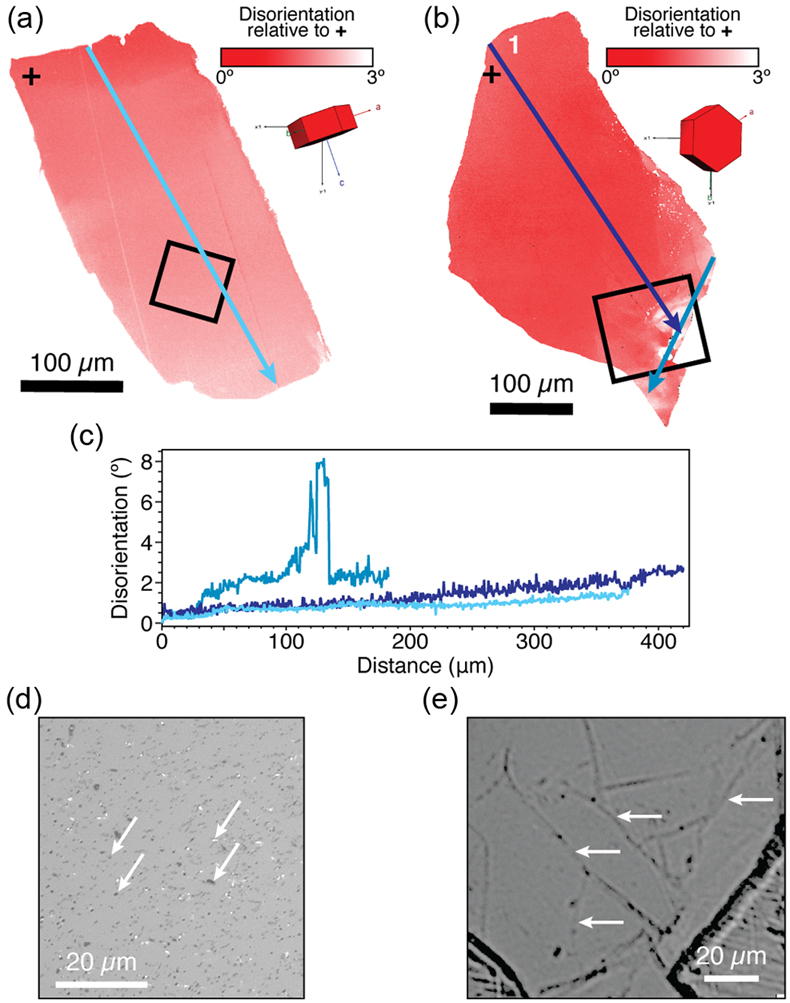
Figure 2 Damage induced in Durango apatite deformed under torsion in experiment PT1547. (a, b) EBSD disorientation maps and (c) line scans across the two fragments degassed in diffusion experiments. (d, e) Reflected light images after etching in 0.5 M HNO3 for 10–20 seconds to reveal defects, with arrows highlighting (d) etched dislocations and (e) etched subgrain boundaries. Bright dislocations in (d) are subparallel to the etched surface. The fragment used for the diffusion experiment in Figures 3 and 4 is shown in (a, d), while the fragment used for the replicate experiment in Figure S-5 is shown in (b, e). Note the crystallographic orientation at which each fragment was mounted, which affects the degree of disorientation observed and the likelihood of observing subgrain boundaries (see also Fig. S-1). Additional EBSD data from PT1547 deformed material are shown in Figure S-4.

Figure 3 Step heating experiments on Durango apatite fragments deformed under (a, b) compression (PI2014) or (c, d) torsion (PT1547), compared to undeformed, unannealed Durango apatite (DUR-A-1). (a, c) Fractional release of 3He and 4He as a function of temperature. (b, d) Step 4He/3He normalised to the cumulative 4He/3He (R step/R bulk), plotted with 1σ uncertainties, as a function of cumulative 3He release.

Figure 4 Arrhenius plot for diffusion of proton-induced 3He in (a) DUR-A-1, (b) PI2014, and (c) PT1547, compared to the helium diffusion kinetics for Durango apatite reported by Farley (2000)
Farley, K.A. (2000) Helium diffusion from apatite: General behavior as illustrated by Durango fluorapatite. Journal of Geophysical Research: Solid Earth 105, 2903–2914. https://doi.org/10.1029/1999JB900348
, scaled to the spherical equivalent radii of each fragment. Lines are fit to the filled data points. Where not visible, uncertainties in ln(D/a 2) values are smaller than the symbols plotted.