



Abiotic chemically oscillating reactions make patterns in deep–sea ferromanganese nodules and crusts
Affiliations | Corresponding Author | Cite as | Funding information
Published by the European Association of Geochemistry
under Creative Commons License CC BY 4.0
Keywords: diagenesis, manganese cycle, stromatolite, marine metal deposits, spectroscopy, Belousov-Zhabotinsky


- Share this article


-
Article views:1,716Cumulative count of HTML views and PDF downloads.
- Download Citation
- Rights & Permissions

top
Abstract
Figures
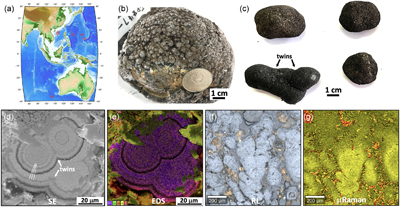 Figure 1 (a) Bathymetric map of sample collection sites (in red). (b) dm–sized sub–spheroidal FMN with circularly concentric layers (arrows) and cm– and mm–sized botryoids (FDZ187–NO4). (c) cm–sized FMN with multiple spheroidal twins (JLBC01). (d) μm–sized circularly concentric rosettes with spheroidal twins (arrows) and radially aligned patterns (lines) (SY165). (e) EDS map showing gradients of Mn and C. (f) Arborescent microdigitate stromatolites (MDS) of Mn oxide in FMC (SY314). (g) Raman image of panel (e) showing more functionalised (red) and sp2–hybridised carbon (yellow) OM. RL: reflected light, SE: secondary electron. | 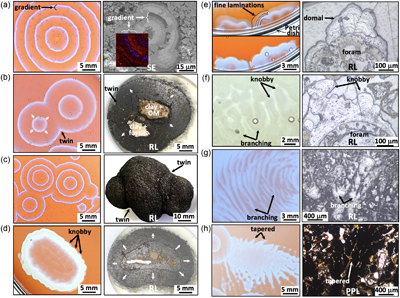 Figure 2 Comparison of patterns between COR (left columns) and FMN (right columns). (a) Circularly concentric rings with colour gradients. Inset shows EDS map overlays for C (red) and Mn (purple). (b) Double twin and radial geometry (white arrows). (c) Multiple twins. (d) Sub–circular pattern with knobby edges. (e) Finely laminated domal stromatolitic pattern. (f) Knobby stromatolitic pattern. (g) Equidistant to branching linear pattern. (h) Arborescent pattern with tapered branches. (b) and (d) show FMN with nuclei of clay with OM and fossils. Reactants for COR are the classical B–Z reaction except for (d), (e) and (f), where MnSO4 and KMnO4 are added, and for (g) where α–ketoglutarate is added. PPL: plane polarised light. | 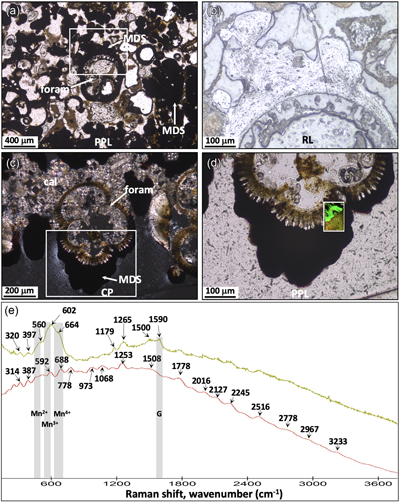 Figure 3 Fossil–bound MDS in FMC (SY314). (a) Foram with brown OM and coated with black multifurcate MDS. (b) Details of fine laminations in MDS. (c) Calcite–rich region with a foram coated with MDS. (d) MDS with location of Raman image in overlay (green: calcite, yellow: sp2–hybridised carbon in OM). (e) Raman spectra of more functionalized OM (red) in foram and sp2–hybridised carbon in OM (yellow) in MDS. The G–band and Mn oxide oxidation states bands (after Bernardini et al., 2020) are highlighted. CP: cross polarised light. | 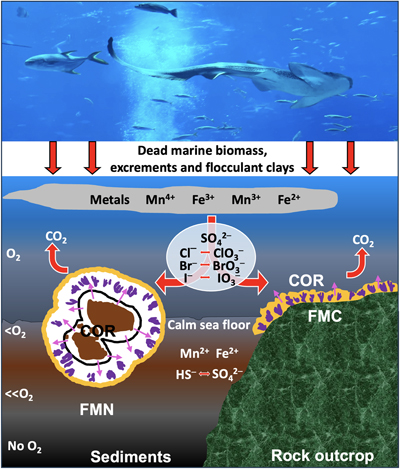 Figure 4 Interpreted formation of FMN and FMC on the sea floor. Botryoidal crust (yellow) is formed by diffusion growth (pink arrows) of radially aligned MDS (purple). FMN are concentrically centred (black line) on one or more variably sized nuclei, possibly flocculated onto clays (brown), while FMC form on hardgrounds volcanic rock outcrops. For both FMN and FMC, marine biomass is derived from the water column, which fuels pattern–forming COR using common reactants in seawater and metals from hydrothermal sources. COR in redox gradients produce ferromanganese oxides and decarboxylate biomass. |
| Figure 1 | Figure 2 | Figure 3 | Figure 4 |
top
Introduction
Deep–sea FMN are sub–spheroidal objects, with one or more distinct nuclei encircled by manganese (Mn) and iron (Fe) oxide minerals, that occur on the sea floor worldwide. Their nuclei are often fossil–bearing and the presence of chemolithotrophic bacteria suggests potential biological influences (Molari et al., 2020
Molari, M., Janssen, F., Vonnahma, T.R., Wenzhöfer, F., Boetius, A. (2020) The contribution of microbial communities in polymetallic nodules to the diversity of the deep–sea microbiome of the Peru Basin (4130–4198m depth). Biogeosciences 17, 3203–3222. https://doi.org/10.5194/bg-17-3203-2020
; Hein et al., 2023Hein, J.R., Koschinsky, A., Kuhn, T. (2023) Deep–ocean polymetallic nodules as a resource for critical materials. Nature Earth and Environment 1, 158–169. https://doi.org/10.1038/s43017-020-0027-0
). In comparison, FMC commonly form on deep–sea hardgrounds, like rock outcrops (Josso et al., 2021Josso, P., van Peer, T., Horstwood, M.S.A., Lusty, P., Murton, B. (2021) Geochemical evidence of Milankovitch cycles in Atlantic Ocean ferromanganese crusts. Earth and Planetary Science Letters 553, 1–12. https://doi.org/10.1016/j.epsl.2020.116651
, and both FMN and FMC contain stromatolitic patterns with rhythmic laminations reminiscent of Milankovitch cycles (Han et al., 2003Han, X., Jin, X., Yang, S., Fietzke, J., Eisenhauer, A. (2003) Rhythmic growth of Pacific ferromanganese nodules and their Milankovitch climatic origin. Earth and Planetary Science Letters 211, 143–157. https://doi.org/10.1016/S0012-821X(03)00169-9
; Josso et al., 2021Josso, P., van Peer, T., Horstwood, M.S.A., Lusty, P., Murton, B. (2021) Geochemical evidence of Milankovitch cycles in Atlantic Ocean ferromanganese crusts. Earth and Planetary Science Letters 553, 1–12. https://doi.org/10.1016/j.epsl.2020.116651
). Both also contain abundant elements critical for the transition towards greener sources of energy, making them attractive for deep–sea mining (Hein et al., 2023Hein, J.R., Koschinsky, A., Kuhn, T. (2023) Deep–ocean polymetallic nodules as a resource for critical materials. Nature Earth and Environment 1, 158–169. https://doi.org/10.1038/s43017-020-0027-0
). Prevailing hypotheses suggest origins possibly controlled by microbial metabolisms, hydrogenetic precipitation in seawater, hydrothermal fluids, slow accretion onto nuclei, and porewater diagenetic processes (Dekov et al., 2003Dekov, V.M., Marchig, V., Rajta, I., Uzonyi, I. (2003) Fe–Mn micronodules born in the metalliferous sediments of two spreading centres: the East Pacific Rise and Mid–Atlantic Ridge. Marine Geology 199, 101–121. https://doi.org/10.1016/S0025-3227(03)00124-5
; Li et al., 2021Li, J., Li, L., Bai, S., Chen, S., Xu, H., Ta, K., Qu, Y., Wang, Y., Yao, H., Dong, Y., Dasgupta, S., Du, M., Liu, S., Lin, F., Peng, X. (2021) Geochemical and molecular characteristics of ferromanganese deposits and surrounding sediments in the Mariana Trench: an implication for the geochemical Mn cycle in sedimentary environments of the Trench zone. Geochimica et Cosmochimica Acta 310, 155–168. https://doi.org/10.1016/j.gca.2021.07.018
; Machida et al., 2021Machida, S., Nakamura, K., Kogiso, T., Shimomura, R., Horinoucho, K., Okino, K., Kato, Y. (2021) Fine–scale chemostratigraphy of cross–sectioned hydrogenous ferromanganese nodules from the western North Pacific. Island Arc 30, 1–14. https://doi.org/10.1111/iar.12395
; Hein et al., 2023Hein, J.R., Koschinsky, A., Kuhn, T. (2023) Deep–ocean polymetallic nodules as a resource for critical materials. Nature Earth and Environment 1, 158–169. https://doi.org/10.1038/s43017-020-0027-0
; Yang et al., 2024Yang, K., Dong, Y., Li, Z., Wang, H., Ma, W., Qiu, Z., Li, X., Han, C., Zhao, J. (2024) Geochemistry of buried polymetallic nodules from the eastern Pacific Ocean: implication for the depth–controlled alteration process. Marine Chemistry 467, 1–14. https://doi.org/10.1016/j.margeo.2023.107190
). However, the exact mechanism of pattern formation in FMN and FMC remains elusive. This contribution aims to compare patterns and substances in FMN and FMC with those from geochemically relevant COR experiments. Characteristic patterns and substances of COR have already been successfully compared with those of botryoidal minerals, concretions, agate geodes, granules, and rosettes (Papineau et al., 2021Papineau, D., Yin, J., Devine, K., Liu, D., She, Z. (2021) Chemically oscillating reactions during the diagenetic formation of Ediacaran siliceous and carbonate botryoids. Minerals 11, 1–30. https://doi.org/10.3390/min11101060
, 2024Papineau, D. (2024) Chemically oscillating reactions as a new model for the formation of mineral patterns in agate geodes and concretions. Minerals 14, 203. https://doi.org/10.3390/min14020203
, 2025Papineau, D., She, Z., Jiao, L., Liu, S., Liu, D., Luo, G., Li, C. (2025) Widespread chemically oscillating reactions during oxidative organic diagenesis recorded during the Ediacaran. Chemical Geology 683, 1–22. https://doi.org/10.1016/j.chemgeo.2025.122753
); therefore, COR are relevant for understanding the abiotic origin of various spheroidal objects forming during sedimentary diagenesis.top
Materials and methods
The ferromanganese deposit samples of FMN and FMC came from the Indian and Pacific oceans and have representative patterns and sizes (Fig. 1a, Table S–1). Petrography was performed on polished thin sections by polarising microscopy and by scanning electron microscopy (SEM) with energy dispersive spectroscopy (EDS). Targets with OM were analysed using Raman spectroscopy and X–ray photoelectron spectroscopy (XPS). COR were performed according to the classical recipe with 6 ml of a strong acid (sulphuric acid (H2SO4) [0.33 M]) mixed with a strong oxidiser (sodium bromate (NaBrO3) [1 M]), 1 ml of carboxylic acids (malonic acid (C3H4O4) [1 M]), 0.5 ml of sodium bromide (NaBr) [1 M], and 1ml of the redox indicator ferroin (phenanthroline ferrous sulphate [0.025 M]). In this work, these COR were also performed with added 1 ml α–ketoglutarate (C5H4O5) [1 M], 1 ml potassium permanganate (KMnO4) [0.1 M] and 1 ml manganese sulphate (MnSO4) [0.1 M]. COR experiments were done inside a 10 cm diameter glass Petri dish, filmed with a charged–coupled device camera, and directly compared with patterns in FMN and FMC (see more details on methods in Supplementary Information).
Figure 1 (a) Bathymetric map of sample collection sites (in red). (b) dm–sized sub–spheroidal FMN with circularly concentric layers (arrows) and cm– and mm–sized botryoids (FDZ187–NO4). (c) cm–sized FMN with multiple spheroidal twins (JLBC01). (d) μm–sized circularly concentric rosettes with spheroidal twins (arrows) and radially aligned patterns (lines) (SY165). (e) EDS map showing gradients of Mn and C. (f) Arborescent microdigitate stromatolites (MDS) of Mn oxide in FMC (SY314). (g) Raman image of panel (e) showing more functionalised (red) and sp2–hybridised carbon (yellow) OM. RL: reflected light, SE: secondary electron.
top
Fractal Patterns in Deep–Sea Ferromanganese Deposits
Deep–sea FMN typically preserve concentric laminations and multiple nuclei (Xu et al., 2020
Xu, H., Peng, X., Ta, K., Song, T., Du, M., Li, J., Chen, S., Qu, Y. (2020) Structure and composition of micro–manganese nodules in deep–sea carbonate from the Zhaoshu Plateau, North of the South China Sea. Minerals 10, 1016. https://doi.org/10.3390/min10111016
) with radially aligned Mn oxide patterns, akin to those made by dendritic minerals (Machida et al., 2021Machida, S., Nakamura, K., Kogiso, T., Shimomura, R., Horinoucho, K., Okino, K., Kato, Y. (2021) Fine–scale chemostratigraphy of cross–sectioned hydrogenous ferromanganese nodules from the western North Pacific. Island Arc 30, 1–14. https://doi.org/10.1111/iar.12395
). A range of twinned and circularly concentric patterns are discernible in FMN, and they span five orders of magnitude in size, ranging from tens of micrometres (also known as micro–nodules in Dekov et al., 2003Dekov, V.M., Marchig, V., Rajta, I., Uzonyi, I. (2003) Fe–Mn micronodules born in the metalliferous sediments of two spreading centres: the East Pacific Rise and Mid–Atlantic Ridge. Marine Geology 199, 101–121. https://doi.org/10.1016/S0025-3227(03)00124-5
and Xu et al., 2020Xu, H., Peng, X., Ta, K., Song, T., Du, M., Li, J., Chen, S., Qu, Y. (2020) Structure and composition of micro–manganese nodules in deep–sea carbonate from the Zhaoshu Plateau, North of the South China Sea. Minerals 10, 1016. https://doi.org/10.3390/min10111016
) to several decimetres (Fig. 1b–d). In FMN, common patterns include circular concentricity and compositional gradients of C and Mn (Figs. 1e, 2a), spheroidal twins (Figs. 1c,d, 2b,c), and radial alignment (Figs. 1d, 2b,d), all of which are akin to patterns in botryoidal minerals and agate geodes, where they have been described as fractal patterns (Varkouhi and Papineau, 2023Varkouhi, S., Papineau, D. (2023) Silica botryoids from chemically oscillating reactions and as Precambrian environmental proxies. Geology 51, 683–687. https://doi.org/10.1130/G50948.1
; Papineau, 2024Papineau, D. (2024) Chemically oscillating reactions as a new model for the formation of mineral patterns in agate geodes and concretions. Minerals 14, 203. https://doi.org/10.3390/min14020203
).Figure 2 Comparison of patterns between COR (left columns) and FMN (right columns). (a) Circularly concentric rings with colour gradients. Inset shows EDS map overlays for C (red) and Mn (purple). (b) Double twin and radial geometry (white arrows). (c) Multiple twins. (d) Sub–circular pattern with knobby edges. (e) Finely laminated domal stromatolitic pattern. (f) Knobby stromatolitic pattern. (g) Equidistant to branching linear pattern. (h) Arborescent pattern with tapered branches. (b) and (d) show FMN with nuclei of clay with OM and fossils. Reactants for COR are the classical B–Z reaction except for (d), (e) and (f), where MnSO4 and KMnO4 are added, and for (g) where α–ketoglutarate is added. PPL: plane polarised light.
FMN and FMC also commonly contain arborescent and stromatolitic patterns (Figs. 1e, 2e,f), akin to dendrites, Frutexites (a microscopic dubiofossil of uncertain biological origin and akin to macroscopic dendrites) and MDS (micrometre to millimetre size columnar branching stromatolites). In fact, deep–sea ferromanganese deposits appear volumetrically dominated by MDS patterns, such as in the abyss of the Pacific (Akai et al., 2013
Akai, J., Akiyama, S., Tsuchiyama, A., Akai, K. (2013) Ocean manganese nodules as stromatolite with a fractal like signature. Physics and Chemistry of the Earth 58–60, 42–48. https://doi.org/10.1016/j.pce.2013.04.004
; Yang et al., 2024Yang, K., Dong, Y., Li, Z., Wang, H., Ma, W., Qiu, Z., Li, X., Han, C., Zhao, J. (2024) Geochemistry of buried polymetallic nodules from the eastern Pacific Ocean: implication for the depth–controlled alteration process. Marine Chemistry 467, 1–14. https://doi.org/10.1016/j.margeo.2023.107190
), Atlantic (Josso et al., 2021Josso, P., van Peer, T., Horstwood, M.S.A., Lusty, P., Murton, B. (2021) Geochemical evidence of Milankovitch cycles in Atlantic Ocean ferromanganese crusts. Earth and Planetary Science Letters 553, 1–12. https://doi.org/10.1016/j.epsl.2020.116651
), Indian (Fig. 1b; van Dongen et al., 2014van Dongen, B.E., Ashton, N.J., Patrick, R.A.D. (2014) The formation of ferromanganese nodules in the southwest Indian Ocean; an abiotic process. Mineralogical Magazine 78, 941–955, https://doi.org/10.1180/minmag.2014.078.4.12
), Arctic oceans (Kim et al., 2023Kim, H.–I., Goo Cho, H., Lee, S., Jin Koo, H., Hong, J.K., Keun Jin, Y. (2023) Spatial distribution of manganese oxide minerals in the natural ferromanganese nodule of the Arctic Sea: A view from Raman spectroscopy. Chemical Geology 623, 1–10. https://doi.org/10.1016/j.chemgeo.2023.121398
) and of the Philippine and South China Seas (Fig. 1c–f; Xu et al., 2020Xu, H., Peng, X., Ta, K., Song, T., Du, M., Li, J., Chen, S., Qu, Y. (2020) Structure and composition of micro–manganese nodules in deep–sea carbonate from the Zhaoshu Plateau, North of the South China Sea. Minerals 10, 1016. https://doi.org/10.3390/min10111016
). In the hadal, such as the Mariana Trench, MDS patterns occur in FMN (Li et al., 2021Li, J., Li, L., Bai, S., Chen, S., Xu, H., Ta, K., Qu, Y., Wang, Y., Yao, H., Dong, Y., Dasgupta, S., Du, M., Liu, S., Lin, F., Peng, X. (2021) Geochemical and molecular characteristics of ferromanganese deposits and surrounding sediments in the Mariana Trench: an implication for the geochemical Mn cycle in sedimentary environments of the Trench zone. Geochimica et Cosmochimica Acta 310, 155–168. https://doi.org/10.1016/j.gca.2021.07.018
) and Frutexites occur inside concretionary zeolite (Peng et al., 2020Peng, X., Guo, Z., Du, M., Czaja, A.D., Papineau, D., Chen, S., Xu, H., Li, J., Ta, K., Bai, S., Dasgupta (2020) Past endolithic life in metamorphic ocean crust. Geochemical Perspective Letters 14, 14–19. https://doi.org/10.7185/geochemlet.2017
). However, MDS from the geological record fundamentally differ because they are composed of carbonate minerals and attributed to photosynthetic microbial activity, and therefore occurrences of MDS patterns in the light–deprived abyssal and hadal ferromanganese deposits pose an enduring enigma. Yet, MDS and botryoidal patterns in FMN have been described by mathematical fractals because of their self–similarity at many size scales (Akai et al., 2013Akai, J., Akiyama, S., Tsuchiyama, A., Akai, K. (2013) Ocean manganese nodules as stromatolite with a fractal like signature. Physics and Chemistry of the Earth 58–60, 42–48. https://doi.org/10.1016/j.pce.2013.04.004
), which appears critical in understanding the possible abiotic origin of some Precambrian stromatolites (Grotzinger and Rothman, 1996Grotzinger, J.P., Rothman, D.H. (1996) An abiotic model for stromatolite morphogenesis. Nature 383, 423–425. https://doi.org/10.1038/383423a0
). For instance, Proterozoic MDS display millimetre–sized finger–like columns, sometimes with laminations of botryoidal and diagenetic minerals thought to have mixed abiotic and microbial origins (Goodwin and Papineau, 2022Goodwin, A., Papineau, D. (2022) Biosignatures associated with OM in late Paleoproterozoic stromatolitic dolomite and possible implications for Martian carbonates. Astrobiology 22, 1–27. https://doi.org/10.1089/ast.2021.0010
; Yang et al., 2022Yang, H., Chen, Z.–Q., Papineau, D. (2022) Biosignatures in microdigitate stromatolites from the Mesoproterozoic Wumishan Formation, Jixian, North China. Precambrian Research 368, 1–17. https://doi.org/10.1016/j.precamres.2021.106496
).top
Comparisons of Patterns Between COR and Ferromanganese Deposits
In the classical COR (i.e. the Belousov–Zhabotinsky (B–Z) reaction), decarboxylation (i.e. the removal of –COOH groups from organic molecules) of C3H4O4 takes place in the presence of H2SO4, NaBrO3 and NaBr, when this process is self–catalyzed by ferroin (Zaikin and Zhabotinsky, 1970
Zaikin, A.N., Zhabotinsky, A.M. (1970) Concentration wave propagation in two–dimensional liquid phase self–oscillating system. Nature 225, 535–537. https://doi.org/10.1038/225535b0
). Notably, this out–of–equilibrium mixture, containing Br5+ and Br−, spontaneously initiates periodic oscillations manifested as self–similar patterns of radially expanding circularly concentric rings with colour gradients (Fig. 2a). Circular twins form when rings merge during radial diffusion (Fig. 2b,c; Papineau, 2024Papineau, D. (2024) Chemically oscillating reactions as a new model for the formation of mineral patterns in agate geodes and concretions. Minerals 14, 203. https://doi.org/10.3390/min14020203
), akin to the above described patterns in FMN (Fig. 2a–c). Periodic oscillations can also arise in COR performed with Mn compounds (Briggs and Rauscher, 1973Briggs, T.S., Rauscher, W.C. (1973) An oscillating iodine clock. Journal of Chemical Education 49, 496. https://doi.org/10.1021/ed050p496
; Belmonte et al., 1997Belmonte, A., Ouyang, Q., Flesselles, J.–M. (1997) Experimental survey of spiral dynamics in the Belousov–Zhabotinsky reaction. Journal de Physique II, EDP Sciences 7, 1425–1468. https://doi.org/10.1051/jp2:1997195
); however, the patterns of Mn–based COR are not well documented.New COR experiments performed with other carboxylic acids and out–of–equilibrium Mn compounds with different oxidation states, namely KMnO4 and MnSO4, produce stromatolitic and arborescent patterns (Fig. 2d–h). COR with these Mn7+ and Mn2+ compounds produce stromatolitic patterns with knobby edges and colour gradients (Fig. 2d), domal patterns with fine laminations (Fig. 2e), knobby columns like MDS (Fig. 2f), equidistant to branching lines (Fig. 2g) and arborescences with tapered branches (Fig. 2h). All these patterns (Fig. S–1) occur in FMN and FMC (Fig. 1, 2), and can occur directly on calcitic foraminifera (Fig. 2e,f), coralline algae (Xu et al., 2020
Xu, H., Peng, X., Ta, K., Song, T., Du, M., Li, J., Chen, S., Qu, Y. (2020) Structure and composition of micro–manganese nodules in deep–sea carbonate from the Zhaoshu Plateau, North of the South China Sea. Minerals 10, 1016. https://doi.org/10.3390/min10111016
), or as dendritic to Frutexites–like patterns (Fig. 2g,h). Hence, COR produce at least ten qualitatively distinct types of self–similar patterns like those in ferromanganese deposits, which suggest the involvement of COR in their formation. The COR model also suggests that stromatolite patterns in FMN and FMC are abiotic, supporting long held views that abiotic processes likely produced some patterns in ancient stromatolites (Grotzinger and Rothman, 1996Grotzinger, J.P., Rothman, D.H. (1996) An abiotic model for stromatolite morphogenesis. Nature 383, 423–425. https://doi.org/10.1038/383423a0
).Differences in time scales and spatial representation between COR and ferromanganese deposits need to be considered and contrasted to support the comparisons established in this work. Firstly, to experimentally produce COR patterns within a reasonable time span, solutions of reactants are prepared using elevated concentrations compared to natural concentrations in deep–sea environments where ferromanganese deposits form. It has been argued that lower reactant concentrations would produce COR patterns at a slower rate because the duration of intermediate steps in chemical reactions is directly proportional to the concentration of reactants (Belmonte et al., 1997
Belmonte, A., Ouyang, Q., Flesselles, J.–M. (1997) Experimental survey of spiral dynamics in the Belousov–Zhabotinsky reaction. Journal de Physique II, EDP Sciences 7, 1425–1468. https://doi.org/10.1051/jp2:1997195
). Secondly, the spatial representation of COR as two–dimensional films of aqueous solutions can be legitimately extrapolated to three dimensions, because this is commonly done in geology with two–dimensional petrographic images in thin sections linked back to three–dimensional rock samples. Hence, the self–repeating patterns in COR have dimensions and geometries like those in ferromanganese deposits (Fig. 2), which points to similar processes regulating their formation (Varkouhi and Papineau, 2023Varkouhi, S., Papineau, D. (2023) Silica botryoids from chemically oscillating reactions and as Precambrian environmental proxies. Geology 51, 683–687. https://doi.org/10.1130/G50948.1
; Papineau et al., 2025Papineau, D., She, Z., Jiao, L., Liu, S., Liu, D., Luo, G., Li, C. (2025) Widespread chemically oscillating reactions during oxidative organic diagenesis recorded during the Ediacaran. Chemical Geology 683, 1–22. https://doi.org/10.1016/j.chemgeo.2025.122753
). Therefore, it is argued that comparisons between the patterns in COR experiments and ferromanganese deposits are justified, well–supported, novel and informative.top
Comparisons of Substances Between COR and Ferromanganese Deposits
Malonic acid is a reactant that enables COR to proceed over minutes time scales, and it represents a simple dicarboxylic acid common in lifeforms. Carboxylic acids, in general, are widespread in lifeforms and have a wide range of biochemical functions, such as in metabolic pathways, amino acids and phospholipids. Other carboxylic acids, such as α–ketoglutarate and succinate, can produce B–Z patterns in COR experiments (Fig. 2g; Papineau et al., 2021
Papineau, D., Yin, J., Devine, K., Liu, D., She, Z. (2021) Chemically oscillating reactions during the diagenetic formation of Ediacaran siliceous and carbonate botryoids. Minerals 11, 1–30. https://doi.org/10.3390/min11101060
). In deep–sea sediments, a significant source of carboxylic acids is decaying biomass raining down from the water column. Although not enriched in ferromanganese deposits, OM preserved in stromatolitic columns has more sp2–hybridised carbon than OM in the intercolumnar space, which is more functionalised as indicated by Raman spectroscopy (Fig. 1f–g). In fact, the Raman spectra of OM within MDS of Mn oxides grown on calcitic foraminifera (Fig. 3a–d) have a well resolved G–peak at 1590 cm−1, which indicates a higher abundance of sp2–hybridised C=C bonds. In contrast, this peak is absent in the Raman spectra of OM preserved in stromatolite intercolumns and in calcite, although the latter has other, more prominent peaks, including at 1179 cm−1, 1778 cm−1, 2516 cm−1, 2778 cm−1, 2967 cm−1, and 3233 cm−1 (Fig. 3e). These peaks can be assigned to various organic molecular vibrational modes.Figure 3 Fossil–bound MDS in FMC (SY314). (a) Foram with brown OM and coated with black multifurcate MDS. (b) Details of fine laminations in MDS. (c) Calcite–rich region with a foram coated with MDS. (d) MDS with location of Raman image in overlay (green: calcite, yellow: sp2–hybridised carbon in OM). (e) Raman spectra of more functionalized OM (red) in foram and sp2–hybridised carbon in OM (yellow) in MDS. The G–band and Mn oxide oxidation states bands (after Bernardini et al., 2020
Bernardini, S., Bellatreccia, F., Della Ventura, G., Sodo, A. (2020) A reliable method for determining the oxidation state of Manganese at the microscale in Mn oxides via Raman spectroscopy. Geostandards and Geoanalytical Research 45, 223-244. https://doi.org/10.1111/ggr.12361
) are highlighted. CP: cross polarised light.XPS spectra from those distinct locations–stromatolite column and intercolumnar space–independently confirm slightly different levels of C=O/O–C=O bonds between the two types of OM (Fig. S–2d). This is attributable to slightly higher levels of carboxyl in OM from the intercolumnar space. Therefore, OM in stromatolitic Mn oxide columns is shown by XPS observations to have a slightly lower proportion of O–C=O bonds and by Raman spectra to have higher levels of C=C bonds. In brief, OM in stromatolitic Mn oxide columns preserves more defunctionalised OM from primary biomass, which is thus interpreted to have experienced more metal–catalysed, redox–based decomposition and decarboxylation, compared to OM in stromatolite intercolumns.
A novelty in the COR experiments performed in this work is the inclusion of Mn oxide compounds with out–of–equilibrium oxidation states in addition to the ferroin catalyst usually used in COR. This means that these modified COR experiments contain the same dominant transition metal catalysts, each with an analogous range of oxidation states as those found in minerals from FMN. In fact, common minerals in FMN include Mn oxides (todorokite, vernadite, asbolane, etc.), Fe oxides (goethite, hematite, etc.), and accessory barite, pyrite, calcite, carbonate fluorapatite and clays (Zhong et al., 2017
Zhong, Y., Chen, Z., Gonzalez, F.J., Hein, J.R., Zheng, X., Li, G., Luo, Y., Mo, A., Tian, Y., Wang, S. (2017) Composition and genesis of ferromanganese deposits from the northern South China Sea. Journal of Asian Earth Sciences 138, 110–128, https://doi.org/10.1016/j.jseaes.2017.02.015
). Raman spectra in the stromatolitic columns exhibit a broad peak with Mn oxides of variable oxidation states, including Mn2+ near 560 cm−1, Mn3+ near 602 cm−1, and Mn4+ near 664 cm−1 (Fig. 3e; Bernardini et al., 2020Bernardini, S., Bellatreccia, F., Della Ventura, G., Sodo, A. (2020) A reliable method for determining the oxidation state of Manganese at the microscale in Mn oxides via Raman spectroscopy. Geostandards and Geoanalytical Research 45, 223-244. https://doi.org/10.1111/ggr.12361
). In addition, XPS spectra at the Mn2p and Mn3s edges independently confirm the presence of mixed Mn3+ and Mn4+ in the stromatolitic columns (Fig. S–2g–h; Ilton et al., 2016Ilton, E.S, Post, J.E., Heaney, P.J., Ling, F.T., Kerisit, S.N. (2016) XPS determination of Mn oxidation states in Mn (hydr)oxides. Applied Surface Science 366, 475–485. https://doi.org/10.1016/j.apsusc.2015.12.159
). Furthermore, the XPS spectra at the Fe2p edge show the presence of oxide phases with both Fe3+ and Fe2+ (Fig. S–2i). Spectroscopic observations therefore demonstrate that both Mn and Fe have variable oxidation states in the metalliferous stromatolitic columns of ferromanganese deposits. In deep–sea FMN, it can thus be argued that the redox–variable Fe and Mn contribute to the catalysis of abiotic decarboxylation of marine biomass, analogously to Fe and Mn catalysed COR (Papineau et al., 2021Papineau, D., Yin, J., Devine, K., Liu, D., She, Z. (2021) Chemically oscillating reactions during the diagenetic formation of Ediacaran siliceous and carbonate botryoids. Minerals 11, 1–30. https://doi.org/10.3390/min11101060
) and to abiotic oxidative decarboxylation reactions with ferrous iron catalysts (Muchowska et al., 2019Muchowska, K.B., Varma, S., Moran, J. (2019) Synthesis and breakdown of universal metabolic precursors promoted by iron. Nature 569, 104–107. https://doi.org/10.1038/s41586-019-1151-1
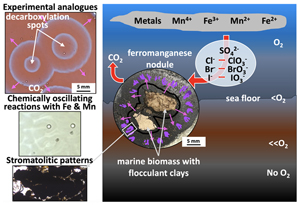
). As petrographic observations show some metalliferous stromatolites occur directly over foraminifera or other microfossils, the source of the carboxylic acid for the inferred COR in deep–sea FMN and FMC is inferred to be a combination of marine microorganisms, dead marine biomass, animal excrements and OM flocculated onto clays (Fig. 4). Hence, pattern comparisons between COR and ferromanganese deposits are well justified and solidly established, as based on observations that they represent fractal objects with self–similar patterns and composed of similar comparable substances.Figure 4 Interpreted formation of FMN and FMC on the sea floor. Botryoidal crust (yellow) is formed by diffusion growth (pink arrows) of radially aligned MDS (purple). FMN are concentrically centred (black line) on one or more variably sized nuclei, possibly flocculated onto clays (brown), while FMC form on hardgrounds volcanic rock outcrops. For both FMN and FMC, marine biomass is derived from the water column, which fuels pattern–forming COR using common reactants in seawater and metals from hydrothermal sources. COR in redox gradients produce ferromanganese oxides and decarboxylate biomass.
top
Influences of Environmental Conditions on FMN and FMC
Subsurface sea floor redox conditions during early diagenesis are thought to influence the formation of FMN (Wegorzewski and Kuhn, 2014
Wegorzewski, A.V., Kuhn, T. (2014) The influence of suboxic diagenesis on the formation of manganese nodules in the Clarion Clipperton nodule belt of the Pacific Ocean. Marine Geology 357, 123–138. https://doi.org/10.1016/j.margeo.2014.07.004
; Hein et al., 2023Hein, J.R., Koschinsky, A., Kuhn, T. (2023) Deep–ocean polymetallic nodules as a resource for critical materials. Nature Earth and Environment 1, 158–169. https://doi.org/10.1038/s43017-020-0027-0
). Microorganisms performing Fe and Mn oxidation and reduction occur in FMN (Xu et al., 2020Xu, H., Peng, X., Ta, K., Song, T., Du, M., Li, J., Chen, S., Qu, Y. (2020) Structure and composition of micro–manganese nodules in deep–sea carbonate from the Zhaoshu Plateau, North of the South China Sea. Minerals 10, 1016. https://doi.org/10.3390/min10111016
), and while they play a significant role in deep–sea Mn biogeochemical cycling (Molari et al., 2020Molari, M., Janssen, F., Vonnahma, T.R., Wenzhöfer, F., Boetius, A. (2020) The contribution of microbial communities in polymetallic nodules to the diversity of the deep–sea microbiome of the Peru Basin (4130–4198m depth). Biogeosciences 17, 3203–3222. https://doi.org/10.5194/bg-17-3203-2020
), these bacteria are not known to mediate the formation of stromatolites or nodules (Akai et al., 2013Akai, J., Akiyama, S., Tsuchiyama, A., Akai, K. (2013) Ocean manganese nodules as stromatolite with a fractal like signature. Physics and Chemistry of the Earth 58–60, 42–48. https://doi.org/10.1016/j.pce.2013.04.004
), which suggests a possible opportunistic presence in ferromanganese deposits. Besides, organic geochemical analyses suggest the formation of FMN is likely abiotic (van Dongen et al., 2014van Dongen, B.E., Ashton, N.J., Patrick, R.A.D. (2014) The formation of ferromanganese nodules in the southwest Indian Ocean; an abiotic process. Mineralogical Magazine 78, 941–955, https://doi.org/10.1180/minmag.2014.078.4.12
). During the abiotic decomposition of biomass by compounds such as sulphate, oxidised halogens and redox sensitive metals (e.g., Fe and Mn) are suggested to spontaneously produce patterned objects on sea floor sediments and rock outcrops (Fig. 4). Under redox gradients in sea floor sediments, COR are expected to occur when this combination of reactants spontaneously reacts with carboxylic acids of biological origin, which can explain why FMN and FMC may contain teeth, bones and microfossils. FMN cores can also be composed of clays onto which OM flocculates in the water column. Hence, biological remains on the sea floor provide fuel for slow abiotic decarboxylation reactions, which then lead to the formation of patterns in FMN and FMC when other COR reactants are available. Importantly and more broadly, ferromanganese deposits do not necessarily require biomass as a source of carboxylic acids; COR could also occur with abiotically synthesised carboxylic acids, such as from Fischer–Tropsch synthesis (Fu et al., 2008Fu, Q., Foustoukos, D.I., Seyfried Jr, W.E. (2008) Mineral catalyzed organic synthesis in hydrothermal systems: An experimental study using time–of–flight secondary ion mass spectrometry. Geophysical Research Letters 35, L07612. https://doi.org/10.1029/2008GL033389
; McCollom, 2016McCollom, T.M. (2016) Abiotic methane formation during experimental serpentinization of olivine. Proceedings of the National Academy of Science of the United States of America 113, 13965–13970. https://doi.org/10.1073/pnas.1611843113
). Therefore, while FMN and FMC can represent indirect signs of life when they contain fossils and microorganisms, it is conceivable that they could also form during abiotic carbon cycling of abiotic carboxylic acids.top
Conclusions
The formation of circular and stromatolitic patterns in FMN and FMC is elegantly explained by the abiotic COR model. COR with added Mn compounds display the same self–similar patterns as in ferromanganese deposits, including circular concentricity, compositional gradients, spheroidal twins, radial orientation, stromatolites and arborescences. Spectra of OM in deep–sea FMN show higher levels of sp2–hybridised carbon in OM inside stromatolitic columns compared to the more functionalised OM in the intercolumnar space. Spectra also show Mn and Fe have highly variable oxidation states in FMN, comparable to the new pattern–forming COR experiments with Fe and Mn documented here. It is thus inferred that abiotic COR participate in the formation of fractal patterns in FMN and FMC from deep–sea environments where both have a purported diagenetic and hydrogenetic origin.
The formation of FMN and FMC on the sea floor likely depends on the availability of carboxylic acids, metal catalysts, halogens, sulphate, as well as redox gradients. Broader implications of abiotic stromatolite pattern formation by COR include possible roles for COR in the formation of MDS in the Precambrian geological record and of concretionary objects in modern shallow marine, lacustrine and evaporative environments. The deep–sea biogeochemical cycle of Mn and other metals in FMN thus appears intimately linked to abiotic carbon cycling. The COR model sheds some light on the multifaceted problem of distinguishing biosignatures from abiotic signatures, including in stromatolites, and possibly in prebiotic–like processes potentially before the origin of life.
top
Acknowledgements
We thank the crews of the R/V Tansuoyihao (cruises TS07–1, TS14, TS29–3), R/V Tansuoerhao (cruise TS2–2), and R/V Senhaiyihao (cruise 2021) and the pilots of Jiaolong, Shenhaiyongshi, and Fendouzhe manned submersibles. We thank Ms. Shuang Liu for assistance collecting XPS analyses. We also thank Fanghui Wang of the Theoretical and Computational Chemistry Team from Scientific Compass, Shiyanjia Lab (www.shiyanjia.com) for XPS spectral corrections. The National Key Research and Development Program of China (Grant No. 2022YFC2805400). DP acknowledges a PiFi fellowship from the Chinese Academy of Sciences. We also acknowledge the following sources of funding: the IDSSE (Grant No. E572070101), the CAS (Grant No. E51X070102), ISTC Program of Hainan Province (GHYF2024009), and the NSFC (Grant No. 42372229).
Editor: Andreas Kappler
top
References
Akai, J., Akiyama, S., Tsuchiyama, A., Akai, K. (2013) Ocean manganese nodules as stromatolite with a fractal like signature. Physics and Chemistry of the Earth 58–60, 42–48. https://doi.org/10.1016/j.pce.2013.04.004
 Show in context
 In fact, deep–sea ferromanganese deposits appear volumetrically dominated by MDS patterns, such as in the abyss of the Pacific (Akai et al., 2013; Yang et al., 2024), Atlantic (Josso et al., 2021), Indian (Fig. 1b; van Dongen et al., 2014), Arctic oceans (Kim et al., 2023) and of the Philippine and South China Seas (Fig. 1c–f; Xu et al., 2020).
View in article
Yet, MDS and botryoidal patterns in FMN have been described by mathematical fractals because of their self–similarity at many size scales (Akai et al., 2013), which appears critical in understanding the possible abiotic origin of some Precambrian stromatolites (Grotzinger and Rothman, 1996).
View in article
Microorganisms performing Fe and Mn oxidation and reduction occur in FMN (Xu et al., 2020), and while they play a significant role in deep–sea Mn biogeochemical cycling (Molari et al., 2020), these bacteria are not known to mediate the formation of stromatolites or nodules (Akai et al., 2013), which suggests a possible opportunistic presence in ferromanganese deposits. Besides, organic geochemical analyses suggest the formation of FMN is likely abiotic (van Dongen et al., 2014).
View in article
Belmonte, A., Ouyang, Q., Flesselles, J.–M. (1997) Experimental survey of spiral dynamics in the Belousov–Zhabotinsky reaction. Journal de Physique II, EDP Sciences 7, 1425–1468. https://doi.org/10.1051/jp2:1997195
Show in context Periodic oscillations can also arise in COR performed with Mn compounds (Briggs and Rauscher, 1973; Belmonte et al., 1997); however, the patterns of Mn–based COR are not well documented.
View in article
It has been argued that lower reactant concentrations would produce COR patterns at a slower rate because the duration of intermediate steps in chemical reactions is directly proportional to the concentration of reactants (Belmonte et al., 1997).
View in article
Bernardini, S., Bellatreccia, F., Della Ventura, G., Sodo, A. (2020) A reliable method for determining the oxidation state of Manganese at the microscale in Mn oxides via Raman spectroscopy. Geostandards and Geoanalytical Research 45, 223-244. https://doi.org/10.1111/ggr.12361
Show in context The G–band and Mn oxide oxidation states bands (after Bernardini et al., 2020) are highlighted. CP: cross polarised light.
View in article
Raman spectra in the stromatolitic columns exhibit a broad peak with Mn oxides of variable oxidation states, including Mn2+ near 560 cm−1, Mn3+ near 602 cm−1, and Mn4+ near 664 cm−1 (Fig. 3e; Bernardini et al., 2020).
View in article
Briggs, T.S., Rauscher, W.C. (1973) An oscillating iodine clock. Journal of Chemical Education 49, 496. https://doi.org/10.1021/ed050p496
Show in context Periodic oscillations can also arise in COR performed with Mn compounds (Briggs and Rauscher, 1973; Belmonte et al., 1997); however, the patterns of Mn–based COR are not well documented.
View in article
Dekov, V.M., Marchig, V., Rajta, I., Uzonyi, I. (2003) Fe–Mn micronodules born in the metalliferous sediments of two spreading centres: the East Pacific Rise and Mid–Atlantic Ridge. Marine Geology 199, 101–121. https://doi.org/10.1016/S0025-3227(03)00124-5
Show in context Prevailing hypotheses suggest origins possibly controlled by microbial metabolisms, hydrogenetic precipitation in seawater, hydrothermal fluids, slow accretion onto nuclei, and porewater diagenetic processes (Dekov et al., 2003; Li et al., 2021; Machida et al., 2021; Hein et al., 2023; Yang et al., 2024).
View in article
A range of twinned and circularly concentric patterns are discernible in FMN, and they span five orders of magnitude in size, ranging from tens of micrometres (also known as micro–nodules in Dekov et al., 2003 and Xu et al., 2020) to several decimetres (Fig. 1b–d).
View in article
Fu, Q., Foustoukos, D.I., Seyfried Jr, W.E. (2008) Mineral catalyzed organic synthesis in hydrothermal systems: An experimental study using time–of–flight secondary ion mass spectrometry. Geophysical Research Letters 35, L07612. https://doi.org/10.1029/2008GL033389
Show in context Importantly and more broadly, ferromanganese deposits do not necessarily require biomass as a source of carboxylic acids; COR could also occur with abiotically synthesised carboxylic acids, such as from Fischer–Tropsch synthesis (Fu et al., 2008; McCollom, 2016).
View in article
Goodwin, A., Papineau, D. (2022) Biosignatures associated with OM in late Paleoproterozoic stromatolitic dolomite and possible implications for Martian carbonates. Astrobiology 22, 1–27. https://doi.org/10.1089/ast.2021.0010
Show in context For instance, Proterozoic MDS display millimetre–sized finger–like columns, sometimes with laminations of botryoidal and diagenetic minerals thought to have mixed abiotic and microbial origins (Goodwin and Papineau, 2022; Yang et al., 2022).
View in article
Grotzinger, J.P., Rothman, D.H. (1996) An abiotic model for stromatolite morphogenesis. Nature 383, 423–425. https://doi.org/10.1038/383423a0
Show in context Yet, MDS and botryoidal patterns in FMN have been described by mathematical fractals because of their self–similarity at many size scales (Akai et al., 2013), which appears critical in understanding the possible abiotic origin of some Precambrian stromatolites (Grotzinger and Rothman, 1996).
View in article
The COR model also suggests that stromatolite patterns in FMN and FMC are abiotic, supporting long held views that abiotic processes likely produced some patterns in ancient stromatolites (Grotzinger and Rothman, 1996).
View in article
Han, X., Jin, X., Yang, S., Fietzke, J., Eisenhauer, A. (2003) Rhythmic growth of Pacific ferromanganese nodules and their Milankovitch climatic origin. Earth and Planetary Science Letters 211, 143–157. https://doi.org/10.1016/S0012-821X(03)00169-9
Show in context In comparison, FMC commonly form on deep–sea hardgrounds, like rock outcrops (Josso et al., 2021, and both FMN and FMC contain stromatolitic patterns with rhythmic laminations reminiscent of Milankovitch cycles (Han et al., 2003; Josso et al., 2021).
View in article
Hein, J.R., Koschinsky, A., Kuhn, T. (2023) Deep–ocean polymetallic nodules as a resource for critical materials. Nature Earth and Environment 1, 158–169. https://doi.org/10.1038/s43017-020-0027-0
Show in context Their nuclei are often fossil–bearing and the presence of chemolithotrophic bacteria suggests potential biological influences (Molari et al., 2020; Hein et al., 2023).
View in article
Both also contain abundant elements critical for the transition towards greener sources of energy, making them attractive for deep–sea mining (Hein et al., 2023).
View in article
Prevailing hypotheses suggest origins possibly controlled by microbial metabolisms, hydrogenetic precipitation in seawater, hydrothermal fluids, slow accretion onto nuclei, and porewater diagenetic processes (Dekov et al., 2003; Li et al., 2021; Machida et al., 2021; Hein et al., 2023; Yang et al., 2024).
View in article
Subsurface sea floor redox conditions during early diagenesis are thought to influence the formation of FMN (Wegorzewski and Kuhn, 2014; Hein et al., 2023).
View in article
Ilton, E.S, Post, J.E., Heaney, P.J., Ling, F.T., Kerisit, S.N. (2016) XPS determination of Mn oxidation states in Mn (hydr)oxides. Applied Surface Science 366, 475–485. https://doi.org/10.1016/j.apsusc.2015.12.159
Show in context In addition, XPS spectra at the Mn2p and Mn3s edges independently confirm the presence of mixed Mn3+ and Mn4+ in the stromatolitic columns (Fig. S–2g–h; Ilton et al., 2016).
View in article
Josso, P., van Peer, T., Horstwood, M.S.A., Lusty, P., Murton, B. (2021) Geochemical evidence of Milankovitch cycles in Atlantic Ocean ferromanganese crusts. Earth and Planetary Science Letters 553, 1–12. https://doi.org/10.1016/j.epsl.2020.116651
Show in context In fact, deep–sea ferromanganese deposits appear volumetrically dominated by MDS patterns, such as in the abyss of the Pacific (Akai et al., 2013; Yang et al., 2024), Atlantic (Josso et al., 2021), Indian (Fig. 1b; van Dongen et al., 2014), Arctic oceans (Kim et al., 2023) and of the Philippine and South China Seas (Fig. 1c–f; Xu et al., 2020).
View in article
Kim, H.–I., Goo Cho, H., Lee, S., Jin Koo, H., Hong, J.K., Keun Jin, Y. (2023) Spatial distribution of manganese oxide minerals in the natural ferromanganese nodule of the Arctic Sea: A view from Raman spectroscopy. Chemical Geology 623, 1–10. https://doi.org/10.1016/j.chemgeo.2023.121398
Show in context In fact, deep–sea ferromanganese deposits appear volumetrically dominated by MDS patterns, such as in the abyss of the Pacific (Akai et al., 2013; Yang et al., 2024), Atlantic (Josso et al., 2021), Indian (Fig. 1b; van Dongen et al., 2014), Arctic oceans (Kim et al., 2023) and of the Philippine and South China Seas (Fig. 1c–f; Xu et al., 2020).
View in article
Li, J., Li, L., Bai, S., Chen, S., Xu, H., Ta, K., Qu, Y., Wang, Y., Yao, H., Dong, Y., Dasgupta, S., Du, M., Liu, S., Lin, F., Peng, X. (2021) Geochemical and molecular characteristics of ferromanganese deposits and surrounding sediments in the Mariana Trench: an implication for the geochemical Mn cycle in sedimentary environments of the Trench zone. Geochimica et Cosmochimica Acta 310, 155–168. https://doi.org/10.1016/j.gca.2021.07.018
Show in context Prevailing hypotheses suggest origins possibly controlled by microbial metabolisms, hydrogenetic precipitation in seawater, hydrothermal fluids, slow accretion onto nuclei, and porewater diagenetic processes (Dekov et al., 2003; Li et al., 2021; Machida et al., 2021; Hein et al., 2023; Yang et al., 2024).
View in article
In the hadal, such as the Mariana Trench, MDS patterns occur in FMN (Li et al., 2021) and Frutexites occur inside concretionary zeolite (Peng et al., 2020).
View in article
Machida, S., Nakamura, K., Kogiso, T., Shimomura, R., Horinoucho, K., Okino, K., Kato, Y. (2021) Fine–scale chemostratigraphy of cross–sectioned hydrogenous ferromanganese nodules from the western North Pacific. Island Arc 30, 1–14. https://doi.org/10.1111/iar.12395
Show in context Prevailing hypotheses suggest origins possibly controlled by microbial metabolisms, hydrogenetic precipitation in seawater, hydrothermal fluids, slow accretion onto nuclei, and porewater diagenetic processes (Dekov et al., 2003; Li et al., 2021; Machida et al., 2021; Hein et al., 2023; Yang et al., 2024).
View in article
Deep–sea FMN typically preserve concentric laminations and multiple nuclei (Xu et al., 2020) with radially aligned Mn oxide patterns, akin to those made by dendritic minerals (Machida et al., 2021).
View in article
McCollom, T.M. (2016) Abiotic methane formation during experimental serpentinization of olivine. Proceedings of the National Academy of Science of the United States of America 113, 13965–13970. https://doi.org/10.1073/pnas.1611843113
Show in context Importantly and more broadly, ferromanganese deposits do not necessarily require biomass as a source of carboxylic acids; COR could also occur with abiotically synthesised carboxylic acids, such as from Fischer–Tropsch synthesis (Fu et al., 2008; McCollom, 2016).
View in article
Molari, M., Janssen, F., Vonnahma, T.R., Wenzhöfer, F., Boetius, A. (2020) The contribution of microbial communities in polymetallic nodules to the diversity of the deep–sea microbiome of the Peru Basin (4130–4198m depth). Biogeosciences 17, 3203–3222. https://doi.org/10.5194/bg-17-3203-2020
Show in context Their nuclei are often fossil–bearing and the presence of chemolithotrophic bacteria suggests potential biological influences (Molari et al., 2020; Hein et al., 2023).
View in article
Microorganisms performing Fe and Mn oxidation and reduction occur in FMN (Xu et al., 2020), and while they play a significant role in deep–sea Mn biogeochemical cycling (Molari et al., 2020), these bacteria are not known to mediate the formation of stromatolites or nodules (Akai et al., 2013), which suggests a possible opportunistic presence in ferromanganese deposits. Besides, organic geochemical analyses suggest the formation of FMN is likely abiotic (van Dongen et al., 2014).
View in article
Muchowska, K.B., Varma, S., Moran, J. (2019) Synthesis and breakdown of universal metabolic precursors promoted by iron. Nature 569, 104–107. https://doi.org/10.1038/s41586-019-1151-1
Show in context In deep–sea FMN, it can thus be argued that the redox–variable Fe and Mn contribute to the catalysis of abiotic decarboxylation of marine biomass, analogously to Fe and Mn catalysed COR (Papineau et al., 2021) and to abiotic oxidative decarboxylation reactions with ferrous iron catalysts (Muchowska et al., 2019).
View in article
Papineau, D. (2024) Chemically oscillating reactions as a new model for the formation of mineral patterns in agate geodes and concretions. Minerals 14, 203. https://doi.org/10.3390/min14020203
Show in context Characteristic patterns and substances of COR have already been successfully compared with those of botryoidal minerals, concretions, agate geodes, granules, and rosettes (Papineau et al., 2021, 2024, 2025); therefore, COR are relevant for understanding the abiotic origin of various spheroidal objects forming during sedimentary diagenesis.
View in article
In FMN, common patterns include circular concentricity and compositional gradients of C and Mn (Figs. 1e, 2a), spheroidal twins (Figs. 1c,d, 2b,c), and radial alignment (Figs. 1d, 2b,d), all of which are akin to patterns in botryoidal minerals and agate geodes, where they have been described as fractal patterns (Varkouhi and Papineau, 2023; Papineau, 2024).
View in article
Notably, this out–of–equilibrium mixture, containing Br5+ and Br−, spontaneously initiates periodic oscillations manifested as self–similar patterns of radially expanding circularly concentric rings with colour gradients (Fig. 2a). Circular twins form when rings merge during radial diffusion (Fig. 2b,c; Papineau, 2024), akin to the above described patterns in FMN (Fig. 2a–c).
View in article
Papineau, D., Yin, J., Devine, K., Liu, D., She, Z. (2021) Chemically oscillating reactions during the diagenetic formation of Ediacaran siliceous and carbonate botryoids. Minerals 11, 1–30. https://doi.org/10.3390/min11101060
Show in context Characteristic patterns and substances of COR have already been successfully compared with those of botryoidal minerals, concretions, agate geodes, granules, and rosettes (Papineau et al., 2021, 2024, 2025); therefore, COR are relevant for understanding the abiotic origin of various spheroidal objects forming during sedimentary diagenesis.
View in article
Other carboxylic acids, such as α–ketoglutarate and succinate, can produce B–Z patterns in COR experiments (Fig. 2g; Papineau et al., 2021).
View in article
In deep–sea FMN, it can thus be argued that the redox–variable Fe and Mn contribute to the catalysis of abiotic decarboxylation of marine biomass, analogously to Fe and Mn catalysed COR (Papineau et al., 2021) and to abiotic oxidative decarboxylation reactions with ferrous iron catalysts (Muchowska et al., 2019).
View in article
Papineau, D., She, Z., Jiao, L., Liu, S., Liu, D., Luo, G., Li, C. (2025) Widespread chemically oscillating reactions during oxidative organic diagenesis recorded during the Ediacaran. Chemical Geology 683, 1–22. https://doi.org/10.1016/j.chemgeo.2025.122753
Show in context
Characteristic patterns and substances of COR have already been successfully compared with those of botryoidal minerals, concretions, agate geodes, granules, and rosettes (Papineau et al., 2021, 2024, 2025); therefore, COR are relevant for understanding the abiotic origin of various spheroidal objects forming during sedimentary diagenesis.
View in article Hence, the self–repeating patterns in COR have dimensions and geometries like those in ferromanganese deposits (Fig. 2), which points to similar processes regulating their formation (Varkouhi and Papineau, 2023; Papineau et al., 2025).
View in article
Peng, X., Guo, Z., Du, M., Czaja, A.D., Papineau, D., Chen, S., Xu, H., Li, J., Ta, K., Bai, S., Dasgupta (2020) Past endolithic life in metamorphic ocean crust. Geochemical Perspective Letters 14, 14–19. https://doi.org/10.7185/geochemlet.2017
Show in context In the hadal, such as the Mariana Trench, MDS patterns occur in FMN (Li et al., 2021) and Frutexites occur inside concretionary zeolite (Peng et al., 2020).
View in article
van Dongen, B.E., Ashton, N.J., Patrick, R.A.D. (2014) The formation of ferromanganese nodules in the southwest Indian Ocean; an abiotic process. Mineralogical Magazine 78, 941–955, https://doi.org/10.1180/minmag.2014.078.4.12
Show in context In fact, deep–sea ferromanganese deposits appear volumetrically dominated by MDS patterns, such as in the abyss of the Pacific (Akai et al., 2013; Yang et al., 2024), Atlantic (Josso et al., 2021), Indian (Fig. 1b; van Dongen et al., 2014), Arctic oceans (Kim et al., 2023) and of the Philippine and South China Seas (Fig. 1c–f; Xu et al., 2020).
View in article
Microorganisms performing Fe and Mn oxidation and reduction occur in FMN (Xu et al., 2020), and while they play a significant role in deep–sea Mn biogeochemical cycling (Molari et al., 2020), these bacteria are not known to mediate the formation of stromatolites or nodules (Akai et al., 2013), which suggests a possible opportunistic presence in ferromanganese deposits. Besides, organic geochemical analyses suggest the formation of FMN is likely abiotic (van Dongen et al., 2014).
View in article
Varkouhi, S., Papineau, D. (2023) Silica botryoids from chemically oscillating reactions and as Precambrian environmental proxies. Geology 51, 683–687. https://doi.org/10.1130/G50948.1
Show in context In FMN, common patterns include circular concentricity and compositional gradients of C and Mn (Figs. 1e, 2a), spheroidal twins (Figs. 1c,d, 2b,c), and radial alignment (Figs. 1d, 2b,d), all of which are akin to patterns in botryoidal minerals and agate geodes, where they have been described as fractal patterns (Varkouhi and Papineau, 2023; Papineau, 2024).
View in article
Hence, the self–repeating patterns in COR have dimensions and geometries like those in ferromanganese deposits (Fig. 2), which points to similar processes regulating their formation (Varkouhi and Papineau, 2023; Papineau et al., 2025).
View in article
Wegorzewski, A.V., Kuhn, T. (2014) The influence of suboxic diagenesis on the formation of manganese nodules in the Clarion Clipperton nodule belt of the Pacific Ocean. Marine Geology 357, 123–138. https://doi.org/10.1016/j.margeo.2014.07.004
Show in context Subsurface sea floor redox conditions during early diagenesis are thought to influence the formation of FMN (Wegorzewski and Kuhn, 2014; Hein et al., 2023).
View in article
Xu, H., Peng, X., Ta, K., Song, T., Du, M., Li, J., Chen, S., Qu, Y. (2020) Structure and composition of micro–manganese nodules in deep–sea carbonate from the Zhaoshu Plateau, North of the South China Sea. Minerals 10, 1016. https://doi.org/10.3390/min10111016
Show in context Deep–sea FMN typically preserve concentric laminations and multiple nuclei (Xu et al., 2020) with radially aligned Mn oxide patterns, akin to those made by dendritic minerals (Machida et al., 2021).
View in article
A range of twinned and circularly concentric patterns are discernible in FMN, and they span five orders of magnitude in size, ranging from tens of micrometres (also known as micro–nodules in Dekov et al., 2003 and Xu et al., 2020) to several decimetres (Fig. 1b–d).
View in article
In fact, deep–sea ferromanganese deposits appear volumetrically dominated by MDS patterns, such as in the abyss of the Pacific (Akai et al., 2013; Yang et al., 2024), Atlantic (Josso et al., 2021), Indian (Fig. 1b; van Dongen et al., 2014), Arctic oceans (Kim et al., 2023) and of the Philippine and South China Seas (Fig. 1c–f; Xu et al., 2020).
View in article
All these patterns (Fig. S–1) occur in FMN and FMC (Fig. 1, 2), and can occur directly on calcitic foraminifera (Fig. 2e,f), coralline algae (Xu et al., 2020), or as dendritic to Frutexites–like patterns (Fig. 2g,h).
View in article
Microorganisms performing Fe and Mn oxidation and reduction occur in FMN (Xu et al., 2020), and while they play a significant role in deep–sea Mn biogeochemical cycling (Molari et al., 2020), these bacteria are not known to mediate the formation of stromatolites or nodules (Akai et al., 2013), which suggests a possible opportunistic presence in ferromanganese deposits. Besides, organic geochemical analyses suggest the formation of FMN is likely abiotic (van Dongen et al., 2014).
View in article
Yang, H., Chen, Z.–Q., Papineau, D. (2022) Biosignatures in microdigitate stromatolites from the Mesoproterozoic Wumishan Formation, Jixian, North China. Precambrian Research 368, 1–17. https://doi.org/10.1016/j.precamres.2021.106496
Show in context For instance, Proterozoic MDS display millimetre–sized finger–like columns, sometimes with laminations of botryoidal and diagenetic minerals thought to have mixed abiotic and microbial origins (Goodwin and Papineau, 2022; Yang et al., 2022).
View in article
Yang, K., Dong, Y., Li, Z., Wang, H., Ma, W., Qiu, Z., Li, X., Han, C., Zhao, J. (2024) Geochemistry of buried polymetallic nodules from the eastern Pacific Ocean: implication for the depth–controlled alteration process. Marine Chemistry 467, 1–14. https://doi.org/10.1016/j.margeo.2023.107190
Show in context Prevailing hypotheses suggest origins possibly controlled by microbial metabolisms, hydrogenetic precipitation in seawater, hydrothermal fluids, slow accretion onto nuclei, and porewater diagenetic processes (Dekov et al., 2003; Li et al., 2021; Machida et al., 2021; Hein et al., 2023; Yang et al., 2024).
View in article
In fact, deep–sea ferromanganese deposits appear volumetrically dominated by MDS patterns, such as in the abyss of the Pacific (Akai et al., 2013; Yang et al., 2024), Atlantic (Josso et al., 2021), Indian (Fig. 1b; van Dongen et al., 2014), Arctic oceans (Kim et al., 2023) and of the Philippine and South China Seas (Fig. 1c–f; Xu et al., 2020).
View in article
Zaikin, A.N., Zhabotinsky, A.M. (1970) Concentration wave propagation in two–dimensional liquid phase self–oscillating system. Nature 225, 535–537. https://doi.org/10.1038/225535b0
Show in context In the classical COR (i.e. the Belousov–Zhabotinsky (B–Z) reaction), decarboxylation (i.e. the removal of –COOH groups from organic molecules) of C3H4O4 takes place in the presence of H2SO4, NaBrO3 and NaBr, when this process is self–catalyzed by ferroin (Zaikin and Zhabotinsky, 1970).
View in article
Zhong, Y., Chen, Z., Gonzalez, F.J., Hein, J.R., Zheng, X., Li, G., Luo, Y., Mo, A., Tian, Y., Wang, S. (2017) Composition and genesis of ferromanganese deposits from the northern South China Sea. Journal of Asian Earth Sciences 138, 110–128, https://doi.org/10.1016/j.jseaes.2017.02.015
Show in context In fact, common minerals in FMN include Mn oxides (todorokite, vernadite, asbolane, etc.), Fe oxides (goethite, hematite, etc.), and accessory barite, pyrite, calcite, carbonate fluorapatite and clays (Zhong et al., 2017).
View in article
top
Supplementary Information
The Supplementary Information includes:
- Materials and Methods
- Supplementary Text
- Figures S–1 to S–2
- Tables S–1 to S–3
Download the Supplementary Information (PDF)
Figures

Figure 1 (a) Bathymetric map of sample collection sites (in red). (b) dm–sized sub–spheroidal FMN with circularly concentric layers (arrows) and cm– and mm–sized botryoids (FDZ187–NO4). (c) cm–sized FMN with multiple spheroidal twins (JLBC01). (d) μm–sized circularly concentric rosettes with spheroidal twins (arrows) and radially aligned patterns (lines) (SY165). (e) EDS map showing gradients of Mn and C. (f) Arborescent microdigitate stromatolites (MDS) of Mn oxide in FMC (SY314). (g) Raman image of panel (e) showing more functionalised (red) and sp2–hybridised carbon (yellow) OM. RL: reflected light, SE: secondary electron.

Figure 2 Comparison of patterns between COR (left columns) and FMN (right columns). (a) Circularly concentric rings with colour gradients. Inset shows EDS map overlays for C (red) and Mn (purple). (b) Double twin and radial geometry (white arrows). (c) Multiple twins. (d) Sub–circular pattern with knobby edges. (e) Finely laminated domal stromatolitic pattern. (f) Knobby stromatolitic pattern. (g) Equidistant to branching linear pattern. (h) Arborescent pattern with tapered branches. (b) and (d) show FMN with nuclei of clay with OM and fossils. Reactants for COR are the classical B–Z reaction except for (d), (e) and (f), where MnSO4 and KMnO4 are added, and for (g) where α–ketoglutarate is added. PPL: plane polarised light.

Figure 3 Fossil–bound MDS in FMC (SY314). (a) Foram with brown OM and coated with black multifurcate MDS. (b) Details of fine laminations in MDS. (c) Calcite–rich region with a foram coated with MDS. (d) MDS with location of Raman image in overlay (green: calcite, yellow: sp2–hybridised carbon in OM). (e) Raman spectra of more functionalized OM (red) in foram and sp2–hybridised carbon in OM (yellow) in MDS. The G–band and Mn oxide oxidation states bands (after Bernardini et al., 2020
Bernardini, S., Bellatreccia, F., Della Ventura, G., Sodo, A. (2020) A reliable method for determining the oxidation state of Manganese at the microscale in Mn oxides via Raman spectroscopy. Geostandards and Geoanalytical Research 45, 223-244. https://doi.org/10.1111/ggr.12361
) are highlighted. CP: cross polarised light.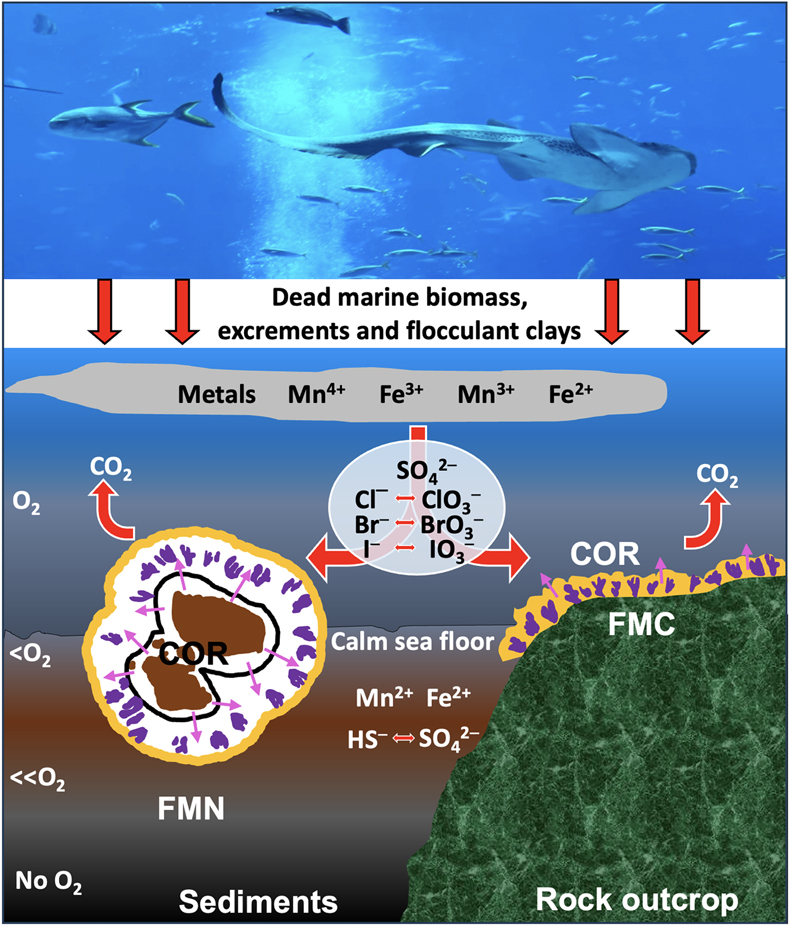
Figure 4 Interpreted formation of FMN and FMC on the sea floor. Botryoidal crust (yellow) is formed by diffusion growth (pink arrows) of radially aligned MDS (purple). FMN are concentrically centred (black line) on one or more variably sized nuclei, possibly flocculated onto clays (brown), while FMC form on hardgrounds volcanic rock outcrops. For both FMN and FMC, marine biomass is derived from the water column, which fuels pattern–forming COR using common reactants in seawater and metals from hydrothermal sources. COR in redox gradients produce ferromanganese oxides and decarboxylate biomass.