



Resolving the chlorine isotope composition of Earth’s depleted mantle
Affiliations | Corresponding Author | Cite as | Funding information
Published by the European Association of Geochemistry
under Creative Commons License CC BY-NC-ND 4.0
Keywords: Chlorine isotopes, mantle heterogeneity, volatile elements, halogens, stable isotopes


- Share this article


-
Article views:1,649Cumulative count of HTML views and PDF downloads.
- Download Citation
- Rights & Permissions

top
Abstract
Figures
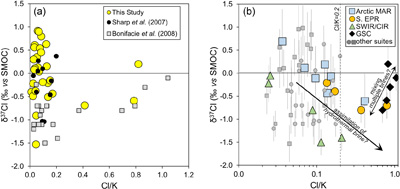 Figure 1 Cl/K plotted against δ37Cl values of MORB glasses from this study and literature. Data are grouped by (a) the study that measured them and (b) by locality. (a) There is no clear consistent correlation between Cl/K and δ37Cl values. (b) Only suites that contain one or more samples with Cl/K > 0.2 are denoted by coloured symbols. All other suites in which all measured samples have Cl/K < 0.2 are coloured in grey. Note that x-axis (Cl/K) in (b) is log scale to more easily discern trends between Cl/K and δ37Cl values. Error bars are 2 s.d. References for the Cl and K concentrations are given in Table S-3. | 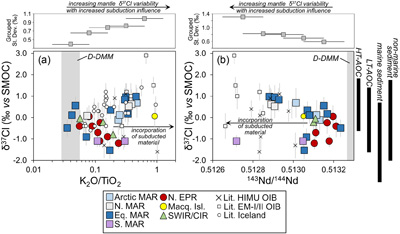 Figure 2 Chlorine isotope ratios of MORB samples from this study and MORB and OIB samples from literature filtered for Cl contamination plotted against (a) K2O/TiO2 and (b) 143Nd/144Nd. Error bars are 2 s.d. Large coloured symbols are MORB samples from this study, Sharp et al., (2007) and Bonifacie et al. (2008). Literature EM-I/II and HIMU OIB data are from John et al. (2010). Literature Iceland data are from Halldórsson et al. (2016). Grey vertical bars are the most depleted end member of DMM (D-DMM) K2O/TiO2 and 143Nd/144Nd values based Workman and Hart (2005) and Shimizu et al. (2016). The black bars to the right show the range of δ37Cl values in subducted materials (HT-AOC = high temperature altered oceanic crust, LT-AOC = low temperature altered oceanic crust; from Barnes and Sharp, 2017 and references therein). Grouped St. Dev. = grouped standard deviations, which shows the standard deviation in δ37Cl values of a subset of MORB and OIB samples for a range of K2O/TiO2 (left) or 143Nd/144Nd (right) shown by the horizontal black lines. References for K2O/TiO2 and 143Nd/144Nd are given in Table S-3. | 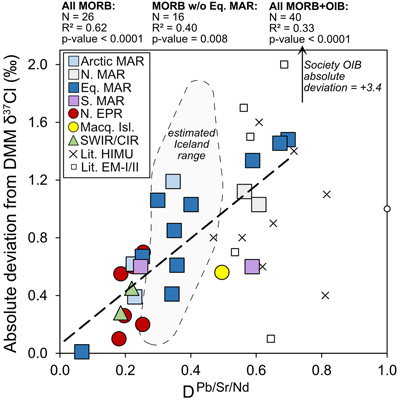 Figure 3 Absolute deviation from the DMM δ37Cl value (−0.5 ‰; see main text) plotted against DPb/Sr/Nd for MORB glasses filtered for seawater/brine assimilation. Large coloured symbols are MORB samples from this study, Sharp et al. (2007), and Bonifacie et al. (2008). The dashed black line is a linear regression through all MORB samples. The R2 value and non-directional p-value labelled “All MORB” include all MORB samples, whereas “MORB w/o Eq. MAR” excludes the Equatorial MAR from the linear regression, and “All MORB + OIB” includes all MORB and previously published OIB data. Literature OIB data from John et al. (2010). “Estimated Iceland range” indicates that the DPb/Sr/Nd values are not from measured 143Nd/144Nd and 87Sr/86Sr of these glasses but based on Icelandic basalts from the GEOROC database. One OIB sample from Society Islands extends beyond the range of this plot (absolute deviation from DMM = +3.4 ‰). References for radiogenic isotopes are given in Table S-3. |
| Figure 1 | Figure 2 | Figure 3 |
top
Introduction
The chlorine isotope ratio (δ37Cl value) of Earth’s mantle has important implications for both the extent of volatile exchange between Earth’s surface and mantle and the source of Earth’s volatiles during early accretion. The δ37Cl values of Earth’s major surface reservoirs (e.g., hydrosphere, evaporites, sediments) have ranges that are largely agreed upon (e.g., Barnes and Sharp, 2017
Barnes, J.D., Sharp, Z.D. (2017) Chlorine Isotope Geochemistry. Reviews in Mineralogy and Geochemistry 82, 345–378. https://doi.org/10.1515/9783110545630-010
), but the δ37Cl value of Earth’s mantle is more contentious. Previous studies have examined the δ37Cl values of mid-ocean ridge basalt (MORB) glasses because Cl isotopes do not significantly fractionate at high temperatures (e.g., Balan et al., 2019Balan, E., Créon, L., Sanloup, C., Aléon, J., Blanchard, M., Paulatto, L., Bureau, H. (2019) First-principles modeling of chlorine isotope fractionation between chloride bearing molecules and minerals. Chemical Geology 525, 424–434. https://doi.org/10.1016/j.chemgeo.2019.07.032
) during partial melting or fractional crystallisation, so MORB samples should preserve the δ37Cl values of their mantle source if there is minimal shallow assimilation. Studies of MORB glasses and other mantle-derived samples have come to contrasting conclusions about the δ37Cl values of the depleted MORB-source mantle (DMM), with recent estimates ranging from −3 ‰ to +0.9 ‰ (Sharp et al., 2007Sharp, Z.D., Barnes, J.D., Brearley, A.J., Chaussidon, M., Fischer, T.P., Kamenetsky, V.S. (2007) Chlorine isotope homogeneity of the mantle, crust, and carbonaceous chondrites. Nature 446, 1062–1065. https://doi.org/10.1038/nature05748
, 2013Sharp, Z.D., Mercer, J.A., Jones, R.H., Brearley, A.J., Selverstone, J., Bekker, A., Stachel, T. (2013) The chlorine isotope composition of chondrites and Earth. Geochimica et Cosmochimica Acta 107, 189–204. https://doi.org/10.1016/j.gca.2013.01.003
; Bonifacie et al., 2008Bonifacie, M., Jendrzejewski, N., Agrinier, P., Humler, E., Coleman, M., Javoy, M. (2008) The chlorine isotope composition of Earth’s mantle. Science 319, 1518–1520. https://doi.org/10.1126/science.1150988
; Layne et al., 2009Layne, G.D., Kent, A.J.R., Bach, W. (2009) δ37Cl systematics of a backarc spreading system: the Lau Basin. Geology 37, 427–430. https://doi.org/10.1130/G25520A.1
; Pinti et al., 2020Pinti, D.L., Shouakar-Stash, O., Castro, M.C., Lopez-Hernández, A., Hall, C.M., Rocher, O., Shibata, T., Ramírez-Montes, M. (2020) The bromine and chlorine isotopic composition of the mantle as revealed by deep geothermal fluids. Geochimica et Cosmochimica Acta 276, 14–30. https://doi.org/10.1016/j.gca.2020.02.028
). These DMM estimates span a large portion of the natural δ37Cl range of predominant Cl hosts on Earth’s surface (−2 ‰ to +2 ‰; Barnes and Sharp, 2017Barnes, J.D., Sharp, Z.D. (2017) Chlorine Isotope Geochemistry. Reviews in Mineralogy and Geochemistry 82, 345–378. https://doi.org/10.1515/9783110545630-010
). Each estimate has differing implications for the cosmochemical source of Earth’s volatile elements and the extent of volatile exchange between Earth’s mantle and surface. It is therefore imperative to better constrain the δ37Cl composition of Earth’s mantle. To do that, we analysed the δ37Cl values of MORB glasses spanning a range of trace element and radiogenic isotope compositions. We combine our new data with previously published MORB glass δ37Cl values to examine the effects of shallow assimilation and mantle heterogeneity and more tightly constrain the δ37Cl value of Earth’s mantle.top
Samples and Geologic Context
Samples analysed in this study are MORB glasses from the Mid-Atlantic Ridge (MAR); the East Pacific Rise (EPR); the Galapagos Spreading Centre (GSC); the Southwest Indian Ridge (SWIR); and the Central Indian Ridge (CIR) (Fig. S-3a). These localities range from ultrafast to ultraslow spreading centres. Samples were dredged from depths of 1305–5150 metres below sea level. Selected samples have MgO contents of 5.6–10.4 wt. % and have trace element (e.g., K2O/TiO2, Nb/Zr, Th/La) and radiogenic isotope (e.g., 143Nd/144Nd) compositions (Fig. S-3b) that include D-MORB, N-MORB, and E-MORB. Samples also span a wide range of Cl/K (0.010–0.819; Fig. S-3b). Details of sample locations and compositions are provided in Table S-3. Measurements of δ37Cl values of pristine MORB glasses were conducted via isotope ratio mass spectrometry at the University of Texas at Austin and via secondary ionisation mass spectrometry at the University of Lausanne, Switzerland. For details of preparation procedures and analytical methods see the Supplementary Information S-1 and S-2.
top
Results
Chlorine isotope ratios of MORB glasses measured in this study range from −1.5 ‰ to +1.0 ‰, slightly larger than the range of previous studies (−1.9 ‰ to +0.4 ‰; Sharp et al., 2007
Sharp, Z.D., Barnes, J.D., Brearley, A.J., Chaussidon, M., Fischer, T.P., Kamenetsky, V.S. (2007) Chlorine isotope homogeneity of the mantle, crust, and carbonaceous chondrites. Nature 446, 1062–1065. https://doi.org/10.1038/nature05748
; Bonifacie et al., 2008Bonifacie, M., Jendrzejewski, N., Agrinier, P., Humler, E., Coleman, M., Javoy, M. (2008) The chlorine isotope composition of Earth’s mantle. Science 319, 1518–1520. https://doi.org/10.1126/science.1150988
). After integrating MORB δ37Cl data from previous studies filtered for potential analytical artifacts (see Supplementary Information S-3), δ37Cl values do not correlate with indices of seawater/brine assimilation such as Cl/K when all data are considered together (Fig. 1). The most depleted sample from this study (RC2806 1D-1; 143Nd/144Nd = 0.513234, 87Sr/86Sr = 0.702125; Le Voyer et al., 2015Le Voyer, M., Cottrell, E., Kelley, K.A., Brounce, M., Hauri, E.H. (2015) The effect of primary versus secondary processes on the volatile content of MORB glasses: An example from the equatorial Mid-Atlantic Ridge (5°N–3°S). Journal of Geophysical Research Solid Earth 120, 125–144. https://doi.org/10.1002/2014JB011160
) has a δ37Cl value of −0.5 ‰. For all localities, samples with higher K2O/TiO2 and lower 143Nd/144Nd extend to both positive and negative δ37Cl values (Fig. 2). See Table S-3 for all collected and compiled δ37Cl values and other geochemical data used in this study.Figure 1 Cl/K plotted against δ37Cl values of MORB glasses from this study and literature. Data are grouped by (a) the study that measured them and (b) by locality. (a) There is no clear consistent correlation between Cl/K and δ37Cl values. (b) Only suites that contain one or more samples with Cl/K > 0.2 are denoted by coloured symbols. All other suites in which all measured samples have Cl/K < 0.2 are coloured in grey. Note that x-axis (Cl/K) in (b) is log scale to more easily discern trends between Cl/K and δ37Cl values. Error bars are 2 s.d. References for the Cl and K concentrations are given in Table S-3.
Figure 2 Chlorine isotope ratios of MORB samples from this study and MORB and OIB samples from literature filtered for Cl contamination plotted against (a) K2O/TiO2 and (b) 143Nd/144Nd. Error bars are 2 s.d. Large coloured symbols are MORB samples from this study, Sharp et al., (2007)
Sharp, Z.D., Barnes, J.D., Brearley, A.J., Chaussidon, M., Fischer, T.P., Kamenetsky, V.S. (2007) Chlorine isotope homogeneity of the mantle, crust, and carbonaceous chondrites. Nature 446, 1062–1065. https://doi.org/10.1038/nature05748
and Bonifacie et al. (2008)Bonifacie, M., Jendrzejewski, N., Agrinier, P., Humler, E., Coleman, M., Javoy, M. (2008) The chlorine isotope composition of Earth’s mantle. Science 319, 1518–1520. https://doi.org/10.1126/science.1150988
. Literature EM-I/II and HIMU OIB data are from John et al. (2010)John, T., Layne, G.D., Haase, K.M., Barnes, J.D. (2010) Chlorine isotope evidence for crustal recycling into the Earth’s mantle. Earth and Planetary Sciences Letters 298, 175–182. https://doi.org/10.1016/j.epsl.2010.07.039
. Literature Iceland data are from Halldórsson et al. (2016)Halldórsson, S.A., Barnes, J.D., Stefánsson, A., Hilton, D.R., Hauri, E.H., Marshall, E.W. (2016) Subducted lithosphere controls halogen enrichments in the Iceland mantle plume source. Geology 44, 679–682. https://doi.org/10.1130/G37924.1
. Grey vertical bars are the most depleted end member of DMM (D-DMM) K2O/TiO2 and 143Nd/144Nd values based Workman and Hart (2005)Workman, R.K., Hart, S.R. (2005) Major and trace element composition of the depleted MORB mantle (DMM). Earth and Planetary Science Letters 231, 53–72. https://doi.org/10.1016/j.epsl.2004.12.005
and Shimizu et al. (2016)Shimizu, K., Saal, A.E., Myers, C.E., Nagle, A.N., Hauri, E.H., Forsyth, D.W., Kamenetsky, V.S., Niu, Y. (2016) Two-component mantle melting-mixing model for the generation of mid-ocean ridge basalts: Implications for the volatile content of the Pacific upper mantle. Geochimica et Cosmochimica Acta 176, 44–80. https://doi.org/10.1016/j.gca.2015.10.033
. The black bars to the right show the range of δ37Cl values in subducted materials (HT-AOC = high temperature altered oceanic crust, LT-AOC = low temperature altered oceanic crust; from Barnes and Sharp, 2017Barnes, J.D., Sharp, Z.D. (2017) Chlorine Isotope Geochemistry. Reviews in Mineralogy and Geochemistry 82, 345–378. https://doi.org/10.1515/9783110545630-010
and references therein). Grouped St. Dev. = grouped standard deviations, which shows the standard deviation in δ37Cl values of a subset of MORB and OIB samples for a range of K2O/TiO2 (left) or 143Nd/144Nd (right) shown by the horizontal black lines. References for K2O/TiO2 and 143Nd/144Nd are given in Table S-3.top
Discussion
Effects of seawater/brine assimilation. Shallow assimilation of seawater or brine has been shown to significantly increase the Cl content of MORB glasses (e.g., Michael and Schilling, 1989
Michael, P.J., Schilling, J.-G. (1989) Chlorine in mid-ocean ridge magmas: Evidence for assimilation of seawater-influenced components. Geochimica et Cosmochimica Acta 53, 3131–3143. https://doi.org/10.1016/0016-7037(89)90094-X
). Previous studies have used Cl/K as a filter for seawater and high salinity brine assimilation (e.g., Michael and Cornell, 1998Michael, P.J., Cornell, W.C. (1998) Influence of spreading rate and magma supply on crystallization and assimilation beneath mid-ocean ridges: Evidence from chlorine and major element chemistry of mid-ocean ridge basalts. Journal of Geophysical Research 103, 18325–18356. https://doi.org/10.1029/98JB00791
; Le Roux et al., 2006Le Roux, P.J., Shirey, S.B., Hauri, E.H., Perfit, M.R., Bender, J.F. (2006) The effects of variable sources, processes and contaminants on the composition of northern EPR MORB (8–10°N and 12–14°N): Evidence from volatiles (H2O, CO2, S) and halogens (F, Cl). Earth and Planetary Science Letters 251, 209–231. https://doi.org/10.1016/j.epsl.2006.09.012
). Although Michael and Cornell (1998)Michael, P.J., Cornell, W.C. (1998) Influence of spreading rate and magma supply on crystallization and assimilation beneath mid-ocean ridges: Evidence from chlorine and major element chemistry of mid-ocean ridge basalts. Journal of Geophysical Research 103, 18325–18356. https://doi.org/10.1029/98JB00791
proposed that any sample with Cl/K > 0.08 has been affected by brine assimilation, subsequent studies have shown higher Cl/K values up to 0.09–0.14 can be primary mantle signatures (Shimizu et al., 2016Shimizu, K., Saal, A.E., Myers, C.E., Nagle, A.N., Hauri, E.H., Forsyth, D.W., Kamenetsky, V.S., Niu, Y. (2016) Two-component mantle melting-mixing model for the generation of mid-ocean ridge basalts: Implications for the volatile content of the Pacific upper mantle. Geochimica et Cosmochimica Acta 176, 44–80. https://doi.org/10.1016/j.gca.2015.10.033
; Kendrick et al., 2017Kendrick, M.A., Hémond, C., Kamenetsky, V.S., Danyushevsky, L., Devey, C.W., Rodermann, T., Jackson, M.G., Perfit, M.R. (2017) Seawater cycled throughout Earth’s mantle in partially serpentinized lithosphere. Nature Geoscience 10, 222–227. https://doi.org/10.1038/ngeo2902
). Samples with Cl/K in this range may contain primary or assimilated Cl. In this study, we filter samples based on Cl/K thresholds from Shimizu et al. (2016)Shimizu, K., Saal, A.E., Myers, C.E., Nagle, A.N., Hauri, E.H., Forsyth, D.W., Kamenetsky, V.S., Niu, Y. (2016) Two-component mantle melting-mixing model for the generation of mid-ocean ridge basalts: Implications for the volatile content of the Pacific upper mantle. Geochimica et Cosmochimica Acta 176, 44–80. https://doi.org/10.1016/j.gca.2015.10.033
(see Supplementary Information S-3). Filtered samples may contain assimilated Cl and so are not considered in the discussion of mantle δ37Cl values.Bonifacie et al. (2008)
Bonifacie, M., Jendrzejewski, N., Agrinier, P., Humler, E., Coleman, M., Javoy, M. (2008) The chlorine isotope composition of Earth’s mantle. Science 319, 1518–1520. https://doi.org/10.1126/science.1150988
interpreted correlations between MORB glass δ37Cl values and both Cl concentration and Cl/K as the result of seawater/brine assimilation driving MORB towards seawater-like δ37Cl values (∼0 ‰) at higher Cl/K. However, when data from this study and filtered literature (see Supplementary Information S-3) are considered together, there is no clear correlation between δ37Cl and Cl/K (Fig. 1a). When samples are considered by locality, samples with unambiguous signs of brine assimilation (Cl/K > 0.2) tend to have lower δ37Cl values than other samples from the same locality, extending to δ37Cl values lower than −0.6 ‰ to −1.5 ‰ (Fig. 1b). This indicates that shallow assimilation does not drive MORB glasses to seawater-like δ37Cl values of 0.0 ‰, as suggested by Bonifacie et al. (2008)Bonifacie, M., Jendrzejewski, N., Agrinier, P., Humler, E., Coleman, M., Javoy, M. (2008) The chlorine isotope composition of Earth’s mantle. Science 319, 1518–1520. https://doi.org/10.1126/science.1150988
, but rather towards δ37Cl values lower than seawater. An exception to this is the GSC suite because the samples with the highest Cl/K do extend towards seawater-like δ37Cl values (Fig. 1b). However, all GSC samples measured in this study and by Bonifacie et al. (2008)Bonifacie, M., Jendrzejewski, N., Agrinier, P., Humler, E., Coleman, M., Javoy, M. (2008) The chlorine isotope composition of Earth’s mantle. Science 319, 1518–1520. https://doi.org/10.1126/science.1150988
have Cl/K of 0.70–1.04, and so have likely all assimilated significant Cl. The generally negative δ37Cl value of assimilated components indicates that assimilation of seawater-derived Cl from a high salinity brine or hydrothermal fluid will not necessarily result in seawater-like δ37Cl values in MORB, as has been previously suggested.Variations in MORB δ37Cl values related to mantle heterogeneity. Previous studies of MORB δ37Cl values assumed that the DMM source of MORB was largely a single reservoir (Sharp et al., 2007
Sharp, Z.D., Barnes, J.D., Brearley, A.J., Chaussidon, M., Fischer, T.P., Kamenetsky, V.S. (2007) Chlorine isotope homogeneity of the mantle, crust, and carbonaceous chondrites. Nature 446, 1062–1065. https://doi.org/10.1038/nature05748
) or that it was divided into an E-MORB and N-MORB source (Bonifacie et al., 2008Bonifacie, M., Jendrzejewski, N., Agrinier, P., Humler, E., Coleman, M., Javoy, M. (2008) The chlorine isotope composition of Earth’s mantle. Science 319, 1518–1520. https://doi.org/10.1126/science.1150988
). However, the mantle is not composed of just one or two reservoirs, but a large range of chemically heterogenous materials including at least three end members (EM-I, EM-II, HIMU) in addition to DMM (e.g., Stracke, 2012Stracke, A. (2012) Earth’s heterogeneous mantle: A product of convection-driven interaction between crust and mantle. Chemical Geology 330-331, 274–299. https://doi.org/10.1016/j.chemgeo.2012.08.007
). These end members likely result from incorporation of subducted oceanic crust and sediment into the mantle source of basalts, resulting in higher K2O/TiO2 (e.g., Jackson and Dasgupta, 2008Jackson, M.G., Dasgupta, R. (2008) Compositions of HIMU, EM1, and EM2 from global trends between radiogenic isotopes and major elements in ocean island basalts. Earth and Planetary Sciences Letters 276, 175–186. https://doi.org/10.1016/j.epsl.2008.09.023
) and lower 143Nd/144Nd (e.g., White and Hofmann, 1982White, W.M., Hofmann, A.W. (1982) Mantle heterogeneity and isotopes in oceanic basalts. Nature 295, 363–364. https://doi.org/10.1038/295363a0
). Although these components are more abundant in ocean island basalts (OIBs), they can also be introduced at mid-ocean ridges either from interaction with a mantle plume (e.g., Le Voyer et al., 2015Le Voyer, M., Cottrell, E., Kelley, K.A., Brounce, M., Hauri, E.H. (2015) The effect of primary versus secondary processes on the volatile content of MORB glasses: An example from the equatorial Mid-Atlantic Ridge (5°N–3°S). Journal of Geophysical Research Solid Earth 120, 125–144. https://doi.org/10.1002/2014JB011160
) or from distributed components in the upper mantle (e.g., Castillo et al., 1998Castillo, P.R., Natland, J.H., Niu, Y., Lonsdale, P.F. (1998) Sr, Nd and Pb isotopic variation along the Pacific–Antarctic risecrest, 53–578S: Implications for the composition and dynamics of the South Pacific upper mantle. Earth and Planetary Science Letters 154, 109–125. https://doi.org/10.1016/S0012-821X(97)00172-6
). Some of the disagreement on the DMM δ37Cl values may arise from incorporation of these subduction-derived enriched components in some of the previously analysed samples. The possibility of MORB Cl isotope heterogeneity was raised by both Sharp et al. (2007)Sharp, Z.D., Barnes, J.D., Brearley, A.J., Chaussidon, M., Fischer, T.P., Kamenetsky, V.S. (2007) Chlorine isotope homogeneity of the mantle, crust, and carbonaceous chondrites. Nature 446, 1062–1065. https://doi.org/10.1038/nature05748
and Bonifacie et al. (2008)Bonifacie, M., Jendrzejewski, N., Agrinier, P., Humler, E., Coleman, M., Javoy, M. (2008) The chlorine isotope composition of Earth’s mantle. Science 319, 1518–1520. https://doi.org/10.1126/science.1150988
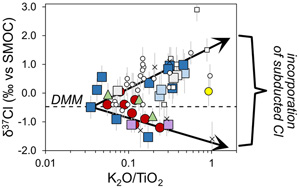
but was never explored.When MORB data filtered for shallow assimilation from this study and previous studies are combined, the most depleted samples (lowest K2O/TiO2; highest 143Nd/144Nd) from several localities have δ37Cl values of −0.2 ‰ to −0.5 ‰, and other MORB samples diverge towards lower and higher δ37Cl values at greater degrees of enrichment (higher K2O/TiO2, lower 143Nd/144Nd; Fig. 2). Previously published OIB data (John et al., 2010
John, T., Layne, G.D., Haase, K.M., Barnes, J.D. (2010) Chlorine isotope evidence for crustal recycling into the Earth’s mantle. Earth and Planetary Sciences Letters 298, 175–182. https://doi.org/10.1016/j.epsl.2010.07.039
; Halldórsson et al., 2016Halldórsson, S.A., Barnes, J.D., Stefánsson, A., Hilton, D.R., Hauri, E.H., Marshall, E.W. (2016) Subducted lithosphere controls halogen enrichments in the Iceland mantle plume source. Geology 44, 679–682. https://doi.org/10.1130/G37924.1
) also follow these general trends (Fig. 2). We calculated the standard deviation in δ37Cl values of subsets of MORB and OIB samples grouped by increasing K2O/TiO2 and 143Nd/144Nd ranges (see Fig. 2a,b). The standard deviation of the sample subsets increases with increasing subduction influence (Fig. 2a,b), consistent with addition of subducted altered oceanic crust and sediment with heterogenous δ37Cl values (−3.0 to +3.0 ‰; Barnes and Sharp, 2017Barnes, J.D., Sharp, Z.D. (2017) Chlorine Isotope Geochemistry. Reviews in Mineralogy and Geochemistry 82, 345–378. https://doi.org/10.1515/9783110545630-010
and references therein; Fig. 2) into the DMM. The δ37Cl values higher or lower than DMM are not uniquely associated with specific mantle components. Samples with HIMU/FOZO influence (Fig. S-3b) extend to both higher and lower δ37Cl values (Fig. S-4a), as do samples influenced by EM-I/EM-II components (Figs. S-3b, S-4b). Although the addition of subducted crust and sediment in the upper mantle influences MORB δ37Cl values, there is currently no clear differentiation between the δ37Cl values of different subducted materials.To quantify the relationship between changes in δ37Cl values and incorporation of subducted components, we calculate the absolute deviation from the DMM end member δ37Cl value for each sample. Here the DMM δ37Cl value selected is −0.5 ‰ based on the value of the most depleted sample (RC2806 1D-1). We then compare these absolute deviations to the DPb/Nd/Sr values for each sample (method modified from Jackson et al., 2020
Jackson, M.G., Blichert-Toft, J., Halldórsson, S.A., Mundl-Petermeier, A., Bizimis, M., Kurz, M.D., Price, A.A., Harðardóttir, S., Willhite, L.N., Breddam, K., Becker, T.W., Fischer, R.A. (2020) Ancient helium and tungsten isotopic signatures preserved in mantle domains least modified by crustal recycling. Proceedings of the National Academy of Sciences 202009663. https://doi.org/10.1073/pnas.2009663117
; Supplementary Information S-4). The DPb/Nd/Sr value describes the distance in three dimensional radiogenic isotope space that a sample is from the DMM end member. As the samples extend farther from the DMM component in radiogenic isotope space (higher DPb/Nd/Sr), the δ37Cl values also deviate more strongly from the DMM value (Fig. 3). This indicates much of the observed variability in the MORB δ37Cl values results from incorporation of subduction-derived components with heterogeneous δ37Cl values into an ambient DMM reservoir with a δ37Cl value of ∼ −0.5 ‰. Although this trend is largely defined by the HIMU-influenced Equatorial MAR samples (Fig. 3), the observed correlation is still statistically significant if the Equatorial MAR samples are not considered (non-directional p-value = 0.008). When including OIB data from John et al. (2010)John, T., Layne, G.D., Haase, K.M., Barnes, J.D. (2010) Chlorine isotope evidence for crustal recycling into the Earth’s mantle. Earth and Planetary Sciences Letters 298, 175–182. https://doi.org/10.1016/j.epsl.2010.07.039
, the correlation remains significant (non-directional p-value < 0.0001). Therefore, after accounting for shallow assimilation, mantle heterogeneity, and potential analytical artifacts in previous studies (see Supplementary Information S-3), contradictory estimates of the DMM δ37Cl value from studies in the past two decades can largely be reconciled.Figure 3 Absolute deviation from the DMM δ37Cl value (−0.5 ‰; see main text) plotted against DPb/Sr/Nd for MORB glasses filtered for seawater/brine assimilation. Large coloured symbols are MORB samples from this study, Sharp et al. (2007)
Sharp, Z.D., Barnes, J.D., Brearley, A.J., Chaussidon, M., Fischer, T.P., Kamenetsky, V.S. (2007) Chlorine isotope homogeneity of the mantle, crust, and carbonaceous chondrites. Nature 446, 1062–1065. https://doi.org/10.1038/nature05748
, and Bonifacie et al. (2008)Bonifacie, M., Jendrzejewski, N., Agrinier, P., Humler, E., Coleman, M., Javoy, M. (2008) The chlorine isotope composition of Earth’s mantle. Science 319, 1518–1520. https://doi.org/10.1126/science.1150988
. The dashed black line is a linear regression through all MORB samples. The R2 value and non-directional p-value labelled “All MORB” include all MORB samples, whereas “MORB w/o Eq. MAR” excludes the Equatorial MAR from the linear regression, and “All MORB + OIB” includes all MORB and previously published OIB data. Literature OIB data from John et al. (2010)John, T., Layne, G.D., Haase, K.M., Barnes, J.D. (2010) Chlorine isotope evidence for crustal recycling into the Earth’s mantle. Earth and Planetary Sciences Letters 298, 175–182. https://doi.org/10.1016/j.epsl.2010.07.039
. “Estimated Iceland range” indicates that the DPb/Sr/Nd values are not from measured 143Nd/144Nd and 87Sr/86Sr of these glasses but based on Icelandic basalts from the GEOROC database. One OIB sample from Society Islands extends beyond the range of this plot (absolute deviation from DMM = +3.4 ‰). References for radiogenic isotopes are given in Table S-3.Estimate of the Bulk Silicate Earth δ37Cl value and similarity to chondrites. Previous studies have suggested multiple sources of volatile elements to Earth, including nebular ingassing, comet addition, chondrite addition, or a mixture of these three (e.g., Sharp, 2017
Sharp, Z.D. (2017) Nebular ingassing as a source of volatiles to the Terrestrial planets. Chemical Geology 448, 137–150. https://doi.org/10.1016/j.chemgeo.2016.11.018
). The δ37Cl value of the Bulk Silicate Earth (BSE) can shed light on the source of Earth’s volatile elements. We calculated the BSE δ37Cl value by adding all surface material into the processed mantle with their respective Cl concentrations and δ37Cl values. The methods and parameters for this procedure are given in the Supplementary Information S-5. Because seawater and evaporites both have near-zero δ37Cl value and account for a combined 44 ± 6 % of the BSE Cl (Table S-2), whereas the processed mantle contains only 9 ± 2 % (Table S-2), the BSE δ37Cl value must be close to 0 ‰. Indeed, we calculated that the BSE δ37Cl value is −0.04 ± 0.13 ‰ (2 s.e.), statistically indistinguishable from bulk δ37Cl values of all chondrites considered together (−0.12 ± 0.26 ‰; 2 s.e.), or carbonaceous (−0.2 ± 0.4 ‰; 2 s.e.), ordinary (−0.4 ±0. 6‰; 2 s.e.), or enstatite (+0.2 ± 0.4 ‰; 2 s.e.) chondrites considered individually (Sharp et al., 2013Sharp, Z.D., Mercer, J.A., Jones, R.H., Brearley, A.J., Selverstone, J., Bekker, A., Stachel, T. (2013) The chlorine isotope composition of chondrites and Earth. Geochimica et Cosmochimica Acta 107, 189–204. https://doi.org/10.1016/j.gca.2013.01.003
). In contrast, the BSE δ37Cl value is dissimilar to δ37Cl estimates of the solar nebula (−7 ‰; Gargano and Sharp, 2019Gargano, A., Sharp, Z.D. (2019) The chlorine isotope composition of iron meteorites: Evidence for the Cl isotope composition of the solar nebula and implications for extensive devolatilization during planet formation. Meteoritics and Planetary Science 54, 1619–1631. https://doi.org/10.1111/maps.13303
).Previous authors have noted the general similarity between the δ37Cl values of Earth’s various reservoirs and chondrites and interpreted that as indicative of a chondritic source of Cl on Earth (Sharp et al., 2013
Sharp, Z.D., Mercer, J.A., Jones, R.H., Brearley, A.J., Selverstone, J., Bekker, A., Stachel, T. (2013) The chlorine isotope composition of chondrites and Earth. Geochimica et Cosmochimica Acta 107, 189–204. https://doi.org/10.1016/j.gca.2013.01.003
). However, later studies suggested the δ37Cl value of the proto-Earth was originally similar to the solar nebula (−7 ‰; Gargano and Sharp, 2019Gargano, A., Sharp, Z.D. (2019) The chlorine isotope composition of iron meteorites: Evidence for the Cl isotope composition of the solar nebula and implications for extensive devolatilization during planet formation. Meteoritics and Planetary Science 54, 1619–1631. https://doi.org/10.1111/maps.13303
) and obtained its current δ37Cl value through kinetic fractionation associated with volatile loss during degassing or impact erosion (Sharp et al., 2016Sharp, Z.D., Williams, J., Shearer, C., Agee, C., McKeegan, K. (2016) The chlorine isotope composition of Martian meteorites 2. Implications for the early solar system and the formation of Mars. Meteoritics and Planetary Science 51, 2111–2126. https://doi.org/10.1111/maps.12591
; Gargano and Sharp, 2019Gargano, A., Sharp, Z.D. (2019) The chlorine isotope composition of iron meteorites: Evidence for the Cl isotope composition of the solar nebula and implications for extensive devolatilization during planet formation. Meteoritics and Planetary Science 54, 1619–1631. https://doi.org/10.1111/maps.13303
). Other studies suggest the δ37Cl values of chondrites are derived through equilibrium isotope fractionation of nebular gases at low temperature (Sharp et al., 2013Sharp, Z.D., Mercer, J.A., Jones, R.H., Brearley, A.J., Selverstone, J., Bekker, A., Stachel, T. (2013) The chlorine isotope composition of chondrites and Earth. Geochimica et Cosmochimica Acta 107, 189–204. https://doi.org/10.1016/j.gca.2013.01.003
, 2016Sharp, Z.D., Williams, J., Shearer, C., Agee, C., McKeegan, K. (2016) The chlorine isotope composition of Martian meteorites 2. Implications for the early solar system and the formation of Mars. Meteoritics and Planetary Science 51, 2111–2126. https://doi.org/10.1111/maps.12591
). These studies imply that the δ37Cl values of Earth and chondrites are not genetically related and any similarity between the two is coincidental. The total range of δ37Cl values on differentiated bodies that have undergone extensive Cl loss spans >46 ‰ (Sarafian et al., 2017Sarafian, A.R., John, T., Roszjar, J., Whitehouse, M.J. (2017) Chlorine and hydrogen degassing in Vesta’s magma ocean. Earth and Planetary Science Letters 459, 311–319. https://doi.org/10.1016/j.epsl.2016.10.029
; Gargano and Sharp., 2019Gargano, A., Sharp, Z.D. (2019) The chlorine isotope composition of iron meteorites: Evidence for the Cl isotope composition of the solar nebula and implications for extensive devolatilization during planet formation. Meteoritics and Planetary Science 54, 1619–1631. https://doi.org/10.1111/maps.13303
; Barrett et al., 2019Barrett, T.J., Barnes, J.J., Anand, M., Franchi, I.A., Greenwood, R.C., Charlier, B.L.A., Zhao, X., Moynier, F., Grady, M.M. (2019) Investigating magmatic processes in the early Solar System using the Cl isotopic systematics of eucrites. Geochimica et Cosmochimica Acta 266, 582–597. https://doi.org/10.1016/j.gca.2019.06.024
). Given this large range, it appears unlikely that varying degrees of planetesimal degassing, impact erosion, and/or subsequent ingassing would result in nearly identical δ37Cl values in the BSE and in distinct classes of chondrites. We do not argue that such a mechanism is impossible, but rather that a more parsimonious model is that Earth’s chondrite-like average δ37Cl value reflects Cl derivation from a chondrite source.The chondrite-like BSE δ37Cl value requires that little to no Cl was added to Earth from ingassing of the solar nebula. Previous studies have suggested ingassing of the solar nebula into a terrestrial magma ocean as a potential major source of volatiles to the early Earth (e.g., Sharp 2017
Sharp, Z.D. (2017) Nebular ingassing as a source of volatiles to the Terrestrial planets. Chemical Geology 448, 137–150. https://doi.org/10.1016/j.chemgeo.2016.11.018
; Olson and Sharp, 2019Olson, P.L., Sharp, Z.D. (2019) Nebular atmosphere to magma ocean: A model for volatile capture during Earth accretion. Physics of Earth and Planetary Interiors 294, 106294. https://doi.org/10.1016/j.pepi.2019.106294
). Such incorporation would also impact Cl, which existed as HCl gas in the proto-solar nebula (Fegley et al., 2020Fegley, B., Lodders, K., Jacobson, N.S. (2020) Volatile element chemistry during accretion of the earth. Geochemistry 80, 125594. https://doi.org/10.1016/j.chemer.2019.125594
). Given the chondritic δ37Cl value of Earth, a maximum of 1–9 % of Earth’s Cl can be derived from ingassing of the solar nebula. Chlorine abundance in the early solar nebula was 10–1000 times lower than C, N, Ne, and Ar (Lodders et al., 2009Lodders, K., Palme H., Gail, H.P. (2009) Abundances of the elements in the solar system. In: Trümper J.E. (Ed.), Landolt Börnstein, New Series, Springer-Verlag, Berlin, Heidelberg, New York, 560–630. https://doi.org/10.1007/978-3-540-88055-4_34
), but HCl is 100–100,000 times more soluble than CH4, CO2, N2, Ne, and Ar in silicate melts at high temperature/low pressure conditions (Fegley et al., 2020Fegley, B., Lodders, K., Jacobson, N.S. (2020) Volatile element chemistry during accretion of the earth. Geochemistry 80, 125594. https://doi.org/10.1016/j.chemer.2019.125594
and references therein). Therefore, ingassing of these volatiles will be similar to or lower than for Cl, so Earth’s low nebular Cl fraction requires relatively little ingassing of these other volatiles as well. This is consistent with the estimate made by Marty (2012)Marty, B. (2012) The origins and concentrations of water, carbon, nitrogen and noble gases on Earth. Earth and Planetary Science Letters 313–314, 56–66. https://doi.org/10.1016/j.epsl.2011.10.040
that ≤10 % of Earth’s volatile elements are derived from nebular ingassing based on C, N, H, and noble gas isotope compositions. Therefore, the estimates of Earth’s δ37Cl value as well as other volatile element isotope ratios are consistent with minimal nebular ingassing contribution to Earth’s volatile content.top
Conclusions
This study examines δ37Cl values of MORB glasses to better constrain the δ37Cl value of Earth’s mantle and the source of volatiles on Earth. The unmodified DMM has a δ37Cl value ≈ −0.5 ‰, and deviations from that value are either due to incorporation of subducted material with heterogeneous δ37Cl values or assimilation of seawater/brine. In the context of a heterogeneous mantle, the previous disparate mantle δ37Cl estimates are not contradictory, but rather sample different subduction-related components in the upper mantle. Shallow assimilation of hydrothermal brines results in MORB δ37Cl values that extend lower than −0.6 ‰ to −1.5 ‰ and does not necessarily result in seawater-like δ37Cl values. We calculate that the BSE has a δ37Cl value ≈ −0.04 ± 0.13 ‰, consistent with a chondritic source of Cl on Earth with a maximum of 1–9 % contribution from early ingassing of the solar nebula.
top
Acknowledgements
This work was supported by funding by NSF-EAR-1850749 to JDB and JCL, GSA Graduate Research Grant to GSW, and the Jackson School of Geoscience student support to GSW. Thanks go to the Smithsonian NMNH Mineral Sciences Department and the Marine Geological Samples Laboratory, University of Rhode Island for access to samples. NSF grant OCE-2116199 provides support for the curation and distribution of geological samples at the Marine Geological Samples Laboratory, University of Rhode Island. Our thanks go Dr. Jeff Cullen for assistance with IRMS measurements and to Clémence Le Lay for assistance with SIMS measurements. Additional thanks go to undergraduate students Julie Hammons and Enrique Morales for their many hours separating clean glass chips. This manuscript benefitted from constructive comments from Peter Michael, one anonymous reviewer, and editor Helen Williams.
Editor: Helen Williams
top
References
Balan, E., Créon, L., Sanloup, C., Aléon, J., Blanchard, M., Paulatto, L., Bureau, H. (2019) First-principles modeling of chlorine isotope fractionation between chloride bearing molecules and minerals. Chemical Geology 525, 424–434. https://doi.org/10.1016/j.chemgeo.2019.07.032
 Show in context
 Previous studies have examined the δ37Cl values of mid-ocean ridge basalt (MORB) glasses because Cl isotopes do not significantly fractionate at high temperatures (e.g., Balan et al., 2019) during partial melting or fractional crystallisation, so MORB samples should preserve the δ37Cl values of their mantle source if there is minimal shallow assimilation.
View in article
Barnes, J.D., Sharp, Z.D. (2017) Chlorine Isotope Geochemistry. Reviews in Mineralogy and Geochemistry 82, 345–378. https://doi.org/10.1515/9783110545630-010
Show in context The δ37Cl values of Earth’s major surface reservoirs (e.g., hydrosphere, evaporites, sediments) have ranges that are largely agreed upon (e.g., Barnes and Sharp, 2017), but the δ37Cl value of Earth’s mantle is more contentious.
View in article
These DMM estimates span a large portion of the natural δ37Cl range of predominant Cl hosts on Earth’s surface (−2 ‰ to +2 ‰; Barnes and Sharp, 2017).
View in article
The black bars to the right show the range of δ37Cl values in subducted materials (HT-AOC = high temperature altered oceanic crust, LT-AOC = low temperature altered oceanic crust; from Barnes and Sharp, 2017 and references therein).
View in article
The standard deviation of the sample subsets increases with increasing subduction influence (Fig. 2a,b), consistent with addition of subducted altered oceanic crust and sediment with heterogenous δ37Cl values (−3.0 to +3.0 ‰; Barnes and Sharp, 2017 and references therein; Fig. 2) into the DMM.
View in article
Barrett, T.J., Barnes, J.J., Anand, M., Franchi, I.A., Greenwood, R.C., Charlier, B.L.A., Zhao, X., Moynier, F., Grady, M.M. (2019) Investigating magmatic processes in the early Solar System using the Cl isotopic systematics of eucrites. Geochimica et Cosmochimica Acta 266, 582–597. https://doi.org/10.1016/j.gca.2019.06.024
Show in context The total range of δ37Cl values on differentiated bodies that have undergone extensive Cl loss spans >46 ‰ (Sarafian et al., 2017; Gargano and Sharp., 2019; Barrett et al., 2019).
View in article
Bonifacie, M., Jendrzejewski, N., Agrinier, P., Humler, E., Coleman, M., Javoy, M. (2008) The chlorine isotope composition of Earth’s mantle. Science 319, 1518–1520. https://doi.org/10.1126/science.1150988
Show in context Studies of MORB glasses and other mantle-derived samples have come to contrasting conclusions about the δ37Cl values of the depleted MORB-source mantle (DMM), with recent estimates ranging from −3 ‰ to +0.9 ‰ (Sharp et al., 2007, 2013; Bonifacie et al., 2008; Layne et al., 2009; Pinti et al., 2020).
View in article
Chlorine isotope ratios of MORB glasses measured in this study range from −1.5 ‰ to +1.0 ‰, slightly larger than the range of previous studies (−1.9 ‰ to +0.4 ‰; Sharp et al., 2007; Bonifacie et al., 2008).
View in article
Error bars are 2 s.d. Large coloured symbols are MORB samples from this study, Sharp et al., (2007) and Bonifacie et al. (2008).
View in article
Bonifacie et al. (2008) interpreted correlations between MORB glass δ37Cl values and both Cl concentration and Cl/K as the result of seawater/brine assimilation driving MORB towards seawater-like δ37Cl values (∼0 ‰) at higher Cl/K.
View in article
This indicates that shallow assimilation does not drive MORB glasses to seawater-like δ37Cl values of 0.0 ‰, as suggested by Bonifacie et al. (2008), but rather towards δ37Cl values lower than seawater. An exception to this is the GSC suite because the samples with the highest Cl/K do extend towards seawater-like δ37Cl values (Fig. 1b).
View in article
However, all GSC samples measured in this study and by Bonifacie et al. (2008) have Cl/K of 0.70–1.04, and so have likely all assimilated significant Cl.
View in article
Previous studies of MORB δ37Cl values assumed that the DMM source of MORB was largely a single reservoir (Sharp et al., 2007) or that it was divided into an E-MORB and N-MORB source (Bonifacie et al., 2008).
View in article
The possibility of MORB Cl isotope heterogeneity was raised by both Sharp et al. (2007) and Bonifacie et al. (2008) but was never explored.
View in article
Large coloured symbols are MORB samples from this study, Sharp et al. (2007), and Bonifacie et al. (2008).
View in article
Castillo, P.R., Natland, J.H., Niu, Y., Lonsdale, P.F. (1998) Sr, Nd and Pb isotopic variation along the Pacific–Antarctic risecrest, 53–578S: Implications for the composition and dynamics of the South Pacific upper mantle. Earth and Planetary Science Letters 154, 109–125. https://doi.org/10.1016/S0012-821X(97)00172-6
Show in context Although these components are more abundant in ocean island basalts (OIBs), they can also be introduced at mid-ocean ridges either from interaction with a mantle plume (e.g., Le Voyer et al., 2015) or from distributed components in the upper mantle (e.g., Castillo et al., 1998).
View in article
Fegley, B., Lodders, K., Jacobson, N.S. (2020) Volatile element chemistry during accretion of the earth. Geochemistry 80, 125594. https://doi.org/10.1016/j.chemer.2019.125594
Show in context Such incorporation would also impact Cl, which existed as HCl gas in the proto-solar nebula (Fegley et al., 2020).
View in article
Chlorine abundance in the early solar nebula was 10–1000 times lower than C, N, Ne, and Ar (Lodders et al., 2009), but HCl is 100–100,000 times more soluble than CH4, CO2, N2, Ne, and Ar in silicate melts at high temperature/low pressure conditions (Fegley et al., 2020 and references therein).
View in article
Gargano, A., Sharp, Z.D. (2019) The chlorine isotope composition of iron meteorites: Evidence for the Cl isotope composition of the solar nebula and implications for extensive devolatilization during planet formation. Meteoritics and Planetary Science 54, 1619–1631. https://doi.org/10.1111/maps.13303
Show in context In contrast, the BSE δ37Cl value is dissimilar to δ37Cl estimates of the solar nebula (−7 ‰; Gargano and Sharp, 2019).
View in article
However, later studies suggested the δ37Cl value of the proto-Earth was originally similar to the solar nebula (−7 ‰; Gargano and Sharp, 2019) and obtained its current δ37Cl value through kinetic fractionation associated with volatile loss during degassing or impact erosion (Sharp et al., 2016; Gargano and Sharp, 2019).
View in article
The total range of δ37Cl values on differentiated bodies that have undergone extensive Cl loss spans >46 ‰ (Sarafian et al., 2017; Gargano and Sharp., 2019; Barrett et al., 2019).
View in article
Halldórsson, S.A., Barnes, J.D., Stefánsson, A., Hilton, D.R., Hauri, E.H., Marshall, E.W. (2016) Subducted lithosphere controls halogen enrichments in the Iceland mantle plume source. Geology 44, 679–682. https://doi.org/10.1130/G37924.1
Show in context Literature Iceland data are from Halldórsson et al. (2016).
View in article
Previously published OIB data (John et al., 2010; Halldórsson et al., 2016) also follow these general trends (Fig. 2).
View in article
Jackson, M.G., Dasgupta, R. (2008) Compositions of HIMU, EM1, and EM2 from global trends between radiogenic isotopes and major elements in ocean island basalts. Earth and Planetary Sciences Letters 276, 175–186. https://doi.org/10.1016/j.epsl.2008.09.023
Show in context These end members likely result from incorporation of subducted oceanic crust and sediment into the mantle source of basalts, resulting in higher K2O/TiO2 (e.g., Jackson and Dasgupta, 2008) and lower 143Nd/144Nd (e.g., White and Hofmann, 1982).
View in article
Jackson, M.G., Blichert-Toft, J., Halldórsson, S.A., Mundl-Petermeier, A., Bizimis, M., Kurz, M.D., Price, A.A., Harðardóttir, S., Willhite, L.N., Breddam, K., Becker, T.W., Fischer, R.A. (2020) Ancient helium and tungsten isotopic signatures preserved in mantle domains least modified by crustal recycling. Proceedings of the National Academy of Sciences 202009663. https://doi.org/10.1073/pnas.2009663117
Show in context We then compare these absolute deviations to the DPb/Nd/Sr values for each sample (method modified from Jackson et al., 2020; Supplementary Information S-4).
View in article
John, T., Layne, G.D., Haase, K.M., Barnes, J.D. (2010) Chlorine isotope evidence for crustal recycling into the Earth’s mantle. Earth and Planetary Sciences Letters 298, 175–182. https://doi.org/10.1016/j.epsl.2010.07.039
Show in context Literature EM-I/II and HIMU OIB data are from John et al. (2010).
View in article
Previously published OIB data (John et al., 2010; Halldórsson et al., 2016) also follow these general trends (Fig. 2).
View in article
Although this trend is largely defined by the HIMU-influenced Equatorial MAR samples (Fig. 3), the observed correlation is still statistically significant if the Equatorial MAR samples are not considered (non-directional p-value = 0.008). When including OIB data from John et al. (2010), the correlation remains significant (non-directional p-value < 0.0001).
View in article
Literature OIB data from John et al. (2010).
View in article
Kendrick, M.A., Hémond, C., Kamenetsky, V.S., Danyushevsky, L., Devey, C.W., Rodermann, T., Jackson, M.G., Perfit, M.R. (2017) Seawater cycled throughout Earth’s mantle in partially serpentinized lithosphere. Nature Geoscience 10, 222–227. https://doi.org/10.1038/ngeo2902
Show in context Although Michael and Cornell (1998) proposed that any sample with Cl/K > 0.08 has been affected by brine assimilation, subsequent studies have shown higher Cl/K values up to 0.09–0.14 can be primary mantle signatures (Shimizu et al., 2016; Kendrick et al., 2017).
View in article
Layne, G.D., Kent, A.J.R., Bach, W. (2009) δ37Cl systematics of a backarc spreading system: the Lau Basin. Geology 37, 427–430. https://doi.org/10.1130/G25520A.1
Show in context Studies of MORB glasses and other mantle-derived samples have come to contrasting conclusions about the δ37Cl values of the depleted MORB-source mantle (DMM), with recent estimates ranging from −3 ‰ to +0.9 ‰ (Sharp et al., 2007, 2013; Bonifacie et al., 2008; Layne et al., 2009; Pinti et al., 2020).
View in article
Le Roux, P.J., Shirey, S.B., Hauri, E.H., Perfit, M.R., Bender, J.F. (2006) The effects of variable sources, processes and contaminants on the composition of northern EPR MORB (8–10°N and 12–14°N): Evidence from volatiles (H2O, CO2, S) and halogens (F, Cl). Earth and Planetary Science Letters 251, 209–231. https://doi.org/10.1016/j.epsl.2006.09.012
Show in context Previous studies have used Cl/K as a filter for seawater and high salinity brine assimilation (e.g., Michael and Cornell, 1998; Le Roux et al., 2006).
View in article
Le Voyer, M., Cottrell, E., Kelley, K.A., Brounce, M., Hauri, E.H. (2015) The effect of primary versus secondary processes on the volatile content of MORB glasses: An example from the equatorial Mid-Atlantic Ridge (5°N–3°S). Journal of Geophysical Research Solid Earth 120, 125–144. https://doi.org/10.1002/2014JB011160
Show in context The most depleted sample from this study (RC2806 1D-1; 143Nd/144Nd = 0.513234, 87Sr/86Sr = 0.702125; Le Voyer et al., 2015) has a δ37Cl value of −0.5 ‰.
View in article
Although these components are more abundant in ocean island basalts (OIBs), they can also be introduced at mid-ocean ridges either from interaction with a mantle plume (e.g., Le Voyer et al., 2015) or from distributed components in the upper mantle (e.g., Castillo et al., 1998).
View in article
Lodders, K., Palme H., Gail, H.P. (2009) Abundances of the elements in the solar system. In: Trümper J.E. (Ed.), Landolt Börnstein, New Series, Springer-Verlag, Berlin, Heidelberg, New York, 560–630. https://doi.org/10.1007/978-3-540-88055-4_34
Show in context Chlorine abundance in the early solar nebula was 10–1000 times lower than C, N, Ne, and Ar (Lodders et al., 2009), but HCl is 100–100,000 times more soluble than CH4, CO2, N2, Ne, and Ar in silicate melts at high temperature/low pressure conditions (Fegley et al., 2020 and references therein).
View in article
Marty, B. (2012) The origins and concentrations of water, carbon, nitrogen and noble gases on Earth. Earth and Planetary Science Letters 313–314, 56–66. https://doi.org/10.1016/j.epsl.2011.10.040
Show in context This is consistent with the estimate made by Marty (2012) that ≤10 % of Earth’s volatile elements are derived from nebular ingassing based on C, N, H, and noble gas isotope compositions.
View in article
Michael, P.J., Schilling, J.-G. (1989) Chlorine in mid-ocean ridge magmas: Evidence for assimilation of seawater-influenced components. Geochimica et Cosmochimica Acta 53, 3131–3143. https://doi.org/10.1016/0016-7037(89)90094-X
Show in context Shallow assimilation of seawater or brine has been shown to significantly increase the Cl content of MORB glasses (e.g., Michael and Schilling, 1989).
View in article
Michael, P.J., Cornell, W.C. (1998) Influence of spreading rate and magma supply on crystallization and assimilation beneath mid-ocean ridges: Evidence from chlorine and major element chemistry of mid-ocean ridge basalts. Journal of Geophysical Research 103, 18325–18356. https://doi.org/10.1029/98JB00791
Show in context Previous studies have used Cl/K as a filter for seawater and high salinity brine assimilation (e.g., Michael and Cornell, 1998; Le Roux et al., 2006).
View in article
Although Michael and Cornell (1998) proposed that any sample with Cl/K > 0.08 has been affected by brine assimilation, subsequent studies have shown higher Cl/K values up to 0.09–0.14 can be primary mantle signatures (Shimizu et al., 2016; Kendrick et al., 2017).
View in article
Olson, P.L., Sharp, Z.D. (2019) Nebular atmosphere to magma ocean: A model for volatile capture during Earth accretion. Physics of Earth and Planetary Interiors 294, 106294. https://doi.org/10.1016/j.pepi.2019.106294
Show in context Previous studies have suggested ingassing of the solar nebula into a terrestrial magma ocean as a potential major source of volatiles to the early Earth (e.g., Sharp 2017; Olson and Sharp, 2019).
View in article
Pinti, D.L., Shouakar-Stash, O., Castro, M.C., Lopez-Hernández, A., Hall, C.M., Rocher, O., Shibata, T., Ramírez-Montes, M. (2020) The bromine and chlorine isotopic composition of the mantle as revealed by deep geothermal fluids. Geochimica et Cosmochimica Acta 276, 14–30. https://doi.org/10.1016/j.gca.2020.02.028
Show in context Studies of MORB glasses and other mantle-derived samples have come to contrasting conclusions about the δ37Cl values of the depleted MORB-source mantle (DMM), with recent estimates ranging from −3 ‰ to +0.9 ‰ (Sharp et al., 2007, 2013; Bonifacie et al., 2008; Layne et al., 2009; Pinti et al., 2020).
View in article
Sarafian, A.R., John, T., Roszjar, J., Whitehouse, M.J. (2017) Chlorine and hydrogen degassing in Vesta’s magma ocean. Earth and Planetary Science Letters 459, 311–319. https://doi.org/10.1016/j.epsl.2016.10.029
Show in context The total range of δ37Cl values on differentiated bodies that have undergone extensive Cl loss spans >46 ‰ (Sarafian et al., 2017; Gargano and Sharp., 2019; Barrett et al., 2019).
View in article
Sharp, Z.D. (2017) Nebular ingassing as a source of volatiles to the Terrestrial planets. Chemical Geology 448, 137–150. https://doi.org/10.1016/j.chemgeo.2016.11.018
Show in context Previous studies have suggested multiple sources of volatile elements to Earth, including nebular ingassing, comet addition, chondrite addition, or a mixture of these three (e.g., Sharp, 2017).
View in article
Previous studies have suggested ingassing of the solar nebula into a terrestrial magma ocean as a potential major source of volatiles to the early Earth (e.g., Sharp 2017; Olson and Sharp, 2019).
View in article
Sharp, Z.D., Barnes, J.D., Brearley, A.J., Chaussidon, M., Fischer, T.P., Kamenetsky, V.S. (2007) Chlorine isotope homogeneity of the mantle, crust, and carbonaceous chondrites. Nature 446, 1062–1065. https://doi.org/10.1038/nature05748
Show in context Studies of MORB glasses and other mantle-derived samples have come to contrasting conclusions about the δ37Cl values of the depleted MORB-source mantle (DMM), with recent estimates ranging from −3 ‰ to +0.9 ‰ (Sharp et al., 2007, 2013; Bonifacie et al., 2008; Layne et al., 2009; Pinti et al., 2020).
View in article
Chlorine isotope ratios of MORB glasses measured in this study range from −1.5 ‰ to +1.0 ‰, slightly larger than the range of previous studies (−1.9 ‰ to +0.4 ‰; Sharp et al., 2007; Bonifacie et al., 2008).
View in article
Error bars are 2 s.d. Large coloured symbols are MORB samples from this study, Sharp et al., (2007) and Bonifacie et al. (2008).
View in article
Previous studies of MORB δ37Cl values assumed that the DMM source of MORB was largely a single reservoir (Sharp et al., 2007) or that it was divided into an E-MORB and N-MORB source (Bonifacie et al., 2008).
View in article
The possibility of MORB Cl isotope heterogeneity was raised by both Sharp et al. (2007) and Bonifacie et al. (2008) but was never explored.
View in article
Large coloured symbols are MORB samples from this study, Sharp et al. (2007), and Bonifacie et al. (2008).
View in article
Sharp, Z.D., Mercer, J.A., Jones, R.H., Brearley, A.J., Selverstone, J., Bekker, A., Stachel, T. (2013) The chlorine isotope composition of chondrites and Earth. Geochimica et Cosmochimica Acta 107, 189–204. https://doi.org/10.1016/j.gca.2013.01.003
Show in context Studies of MORB glasses and other mantle-derived samples have come to contrasting conclusions about the δ37Cl values of the depleted MORB-source mantle (DMM), with recent estimates ranging from −3 ‰ to +0.9 ‰ (Sharp et al., 2007, 2013; Bonifacie et al., 2008; Layne et al., 2009; Pinti et al., 2020).
View in article
Other studies suggest the δ37Cl values of chondrites are derived through equilibrium isotope fractionation of nebular gases at low temperature (Sharp et al., 2013, 2016).
View in article
Sharp, Z.D., Williams, J., Shearer, C., Agee, C., McKeegan, K. (2016) The chlorine isotope composition of Martian meteorites 2. Implications for the early solar system and the formation of Mars. Meteoritics and Planetary Science 51, 2111–2126. https://doi.org/10.1111/maps.12591
Show in context However, later studies suggested the δ37Cl value of the proto-Earth was originally similar to the solar nebula (−7 ‰; Gargano and Sharp, 2019) and obtained its current δ37Cl value through kinetic fractionation associated with volatile loss during degassing or impact erosion (Sharp et al., 2016; Gargano and Sharp, 2019).
View in article
Other studies suggest the δ37Cl values of chondrites are derived through equilibrium isotope fractionation of nebular gases at low temperature (Sharp et al., 2013, 2016).
View in article
Shimizu, K., Saal, A.E., Myers, C.E., Nagle, A.N., Hauri, E.H., Forsyth, D.W., Kamenetsky, V.S., Niu, Y. (2016) Two-component mantle melting-mixing model for the generation of mid-ocean ridge basalts: Implications for the volatile content of the Pacific upper mantle. Geochimica et Cosmochimica Acta 176, 44–80. https://doi.org/10.1016/j.gca.2015.10.033
Show in context Grey vertical bars are the most depleted end member of DMM (D-DMM) K2O/TiO2 and 143Nd/144Nd values based Workman and Hart (2005) and Shimizu et al. (2016).
View in article
Although Michael and Cornell (1998) proposed that any sample with Cl/K > 0.08 has been affected by brine assimilation, subsequent studies have shown higher Cl/K values up to 0.09–0.14 can be primary mantle signatures (Shimizu et al., 2016; Kendrick et al., 2017).
View in article
Samples with Cl/K in this range may contain primary or assimilated Cl. In this study, we filter samples based on Cl/K thresholds from Shimizu et al. (2016) (see Supplementary Information S-3). Filtered samples may contain assimilated Cl and so are not considered in the discussion of mantle δ37Cl values.
View in article
Stracke, A. (2012) Earth’s heterogeneous mantle: A product of convection-driven interaction between crust and mantle. Chemical Geology 330-331, 274–299. https://doi.org/10.1016/j.chemgeo.2012.08.007
Show in context However, the mantle is not composed of just one or two reservoirs, but a large range of chemically heterogenous materials including at least three end members (EM-I, EM-II, HIMU) in addition to DMM (e.g., Stracke, 2012).
View in article
White, W.M., Hofmann, A.W. (1982) Mantle heterogeneity and isotopes in oceanic basalts. Nature 295, 363–364. https://doi.org/10.1038/295363a0
Show in context These end members likely result from incorporation of subducted oceanic crust and sediment into the mantle source of basalts, resulting in higher K2O/TiO2 (e.g., Jackson and Dasgupta, 2008) and lower 143Nd/144Nd (e.g., White and Hofmann, 1982).
View in article
Workman, R.K., Hart, S.R. (2005) Major and trace element composition of the depleted MORB mantle (DMM). Earth and Planetary Science Letters 231, 53–72. https://doi.org/10.1016/j.epsl.2004.12.005
Show in context Grey vertical bars are the most depleted end member of DMM (D-DMM) K2O/TiO2 and 143Nd/144Nd values based Workman and Hart (2005) and Shimizu et al. (2016).
View in article
top
Supplementary Information
The Supplementary Information includes:
- IRMS Methods
- SIMS Procedure
- Filtering for Data Quality in Literature and Filtering All Samples for Shallow Assimilation
- Calculating the Distance from the DMM Endmember in Pb, Sr, Nd Multi-Isotope Space
- δ37Cl Values of Terrestrial Reservoirs and the Calculation of the Bulk Silicate Earth δ37Cl value
- Tables S-1 to S-3
- Figures S-1 to S-5
- Supplementary Data Table
- Supplementary Information References
Download the Supplementary Information (PDF)
Download Table S-3 (.xlsx)
Figures
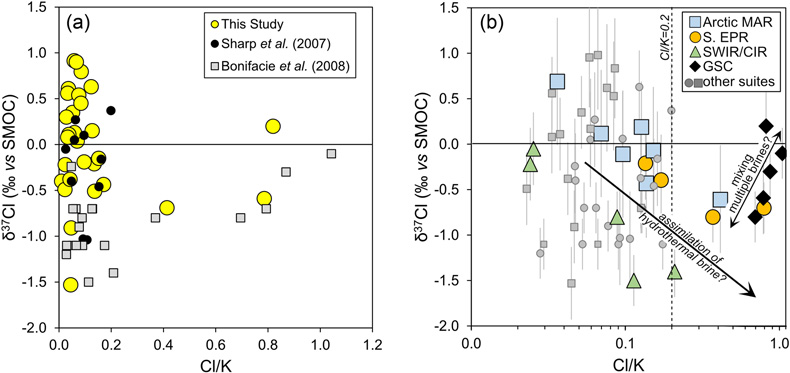
Figure 1 Cl/K plotted against δ37Cl values of MORB glasses from this study and literature. Data are grouped by (a) the study that measured them and (b) by locality. (a) There is no clear consistent correlation between Cl/K and δ37Cl values. (b) Only suites that contain one or more samples with Cl/K > 0.2 are denoted by coloured symbols. All other suites in which all measured samples have Cl/K < 0.2 are coloured in grey. Note that x-axis (Cl/K) in (b) is log scale to more easily discern trends between Cl/K and δ37Cl values. Error bars are 2 s.d. References for the Cl and K concentrations are given in Table S-3.

Figure 2 Chlorine isotope ratios of MORB samples from this study and MORB and OIB samples from literature filtered for Cl contamination plotted against (a) K2O/TiO2 and (b) 143Nd/144Nd. Error bars are 2 s.d. Large coloured symbols are MORB samples from this study, Sharp et al., (2007)
Sharp, Z.D., Barnes, J.D., Brearley, A.J., Chaussidon, M., Fischer, T.P., Kamenetsky, V.S. (2007) Chlorine isotope homogeneity of the mantle, crust, and carbonaceous chondrites. Nature 446, 1062–1065. https://doi.org/10.1038/nature05748
and Bonifacie et al. (2008)Bonifacie, M., Jendrzejewski, N., Agrinier, P., Humler, E., Coleman, M., Javoy, M. (2008) The chlorine isotope composition of Earth’s mantle. Science 319, 1518–1520. https://doi.org/10.1126/science.1150988
. Literature EM-I/II and HIMU OIB data are from John et al. (2010)John, T., Layne, G.D., Haase, K.M., Barnes, J.D. (2010) Chlorine isotope evidence for crustal recycling into the Earth’s mantle. Earth and Planetary Sciences Letters 298, 175–182. https://doi.org/10.1016/j.epsl.2010.07.039
. Literature Iceland data are from Halldórsson et al. (2016)Halldórsson, S.A., Barnes, J.D., Stefánsson, A., Hilton, D.R., Hauri, E.H., Marshall, E.W. (2016) Subducted lithosphere controls halogen enrichments in the Iceland mantle plume source. Geology 44, 679–682. https://doi.org/10.1130/G37924.1
. Grey vertical bars are the most depleted end member of DMM (D-DMM) K2O/TiO2 and 143Nd/144Nd values based Workman and Hart (2005)Workman, R.K., Hart, S.R. (2005) Major and trace element composition of the depleted MORB mantle (DMM). Earth and Planetary Science Letters 231, 53–72. https://doi.org/10.1016/j.epsl.2004.12.005
and Shimizu et al. (2016)Shimizu, K., Saal, A.E., Myers, C.E., Nagle, A.N., Hauri, E.H., Forsyth, D.W., Kamenetsky, V.S., Niu, Y. (2016) Two-component mantle melting-mixing model for the generation of mid-ocean ridge basalts: Implications for the volatile content of the Pacific upper mantle. Geochimica et Cosmochimica Acta 176, 44–80. https://doi.org/10.1016/j.gca.2015.10.033
. The black bars to the right show the range of δ37Cl values in subducted materials (HT-AOC = high temperature altered oceanic crust, LT-AOC = low temperature altered oceanic crust; from Barnes and Sharp, 2017Barnes, J.D., Sharp, Z.D. (2017) Chlorine Isotope Geochemistry. Reviews in Mineralogy and Geochemistry 82, 345–378. https://doi.org/10.1515/9783110545630-010
and references therein). Grouped St. Dev. = grouped standard deviations, which shows the standard deviation in δ37Cl values of a subset of MORB and OIB samples for a range of K2O/TiO2 (left) or 143Nd/144Nd (right) shown by the horizontal black lines. References for K2O/TiO2 and 143Nd/144Nd are given in Table S-3.
Figure 3 Absolute deviation from the DMM δ37Cl value (−0.5 ‰; see main text) plotted against DPb/Sr/Nd for MORB glasses filtered for seawater/brine assimilation. Large coloured symbols are MORB samples from this study, Sharp et al. (2007)
Sharp, Z.D., Barnes, J.D., Brearley, A.J., Chaussidon, M., Fischer, T.P., Kamenetsky, V.S. (2007) Chlorine isotope homogeneity of the mantle, crust, and carbonaceous chondrites. Nature 446, 1062–1065. https://doi.org/10.1038/nature05748
, and Bonifacie et al. (2008)Bonifacie, M., Jendrzejewski, N., Agrinier, P., Humler, E., Coleman, M., Javoy, M. (2008) The chlorine isotope composition of Earth’s mantle. Science 319, 1518–1520. https://doi.org/10.1126/science.1150988
. The dashed black line is a linear regression through all MORB samples. The R2 value and non-directional p-value labelled “All MORB” include all MORB samples, whereas “MORB w/o Eq. MAR” excludes the Equatorial MAR from the linear regression, and “All MORB + OIB” includes all MORB and previously published OIB data. Literature OIB data from John et al. (2010)John, T., Layne, G.D., Haase, K.M., Barnes, J.D. (2010) Chlorine isotope evidence for crustal recycling into the Earth’s mantle. Earth and Planetary Sciences Letters 298, 175–182. https://doi.org/10.1016/j.epsl.2010.07.039
. “Estimated Iceland range” indicates that the DPb/Sr/Nd values are not from measured 143Nd/144Nd and 87Sr/86Sr of these glasses but based on Icelandic basalts from the GEOROC database. One OIB sample from Society Islands extends beyond the range of this plot (absolute deviation from DMM = +3.4 ‰). References for radiogenic isotopes are given in Table S-3.