



Reply to Comment on “Formation of abnormally high density H2S fluid in sedimentary basins” by Liu et al., 2025
Affiliations | Corresponding Author | Cite as | Funding information
Published by the European Association of Geochemistry
under Creative Commons License CC BY-NC-ND 4.0


- Share this article


-
Article views:1,210Cumulative count of HTML views and PDF downloads.
- Download Citation
- Rights & Permissions
top
Figures
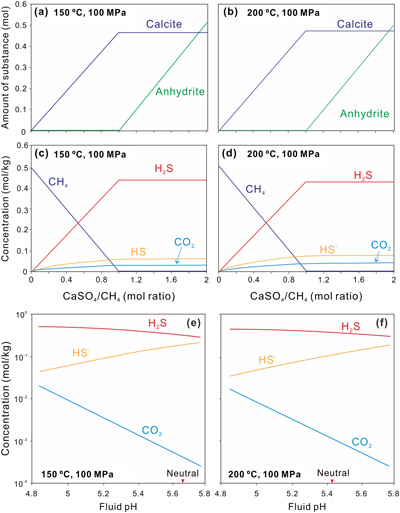 Figure 1 HCh simulation results of the TSR reactions. (a–d) CH4-CaSO4-H2O system; (e–f) CH4-CaSO4-CaCl2-H2O system. |
| Figure 1 |
top
Reply to Comment
We acknowledge, with appreciation, the comments from Cui (2025)
Cui, H. (2025) Comment on “Formation of abnormally high density H2S fluid in sedimentary basins” by Liu et al., 2025. Geochemical Perspectives Letters 36, 18–19. https://doi.org/10.7185/geochemlet.2528
and his effort in evaluating our recent publication on Raman spectroscopic and microthermometric identification of high density, high purity H2S fluid inclusions in sedimentary basins (Liu et al., 2025Liu, Y., Wang, X., Song, Y., Shi, H., Chou, I-M., Zhou, C. (2025) Formation of abnormally high density H2S fluid in sedimentary basins. Geochemical Perspectives Letters 34, 43–49. https://doi.org/10.7185/geochemlet.2512
). We are also grateful to the editor for the opportunity to clarify aspects of our manuscript requiring further explanation. Below we respond to the questions raised by Cui (2025)Cui, H. (2025) Comment on “Formation of abnormally high density H2S fluid in sedimentary basins” by Liu et al., 2025. Geochemical Perspectives Letters 36, 18–19. https://doi.org/10.7185/geochemlet.2528
.1. Mississippi Valley-Type (MVT) Pb-Zn Ore Deposits. In Liu et al. (2025)
Liu, Y., Wang, X., Song, Y., Shi, H., Chou, I-M., Zhou, C. (2025) Formation of abnormally high density H2S fluid in sedimentary basins. Geochemical Perspectives Letters 34, 43–49. https://doi.org/10.7185/geochemlet.2512
, we pointed out the major goal of this work as “…to test whether high density H2S fluids can be formed in sedimentary basins and to evaluate the validity of the proposed mineralising mechanisms for MVT deposits”. Our fluid inclusion observations provide direct evidence confirming the potential for high density H2S fluid formation. Therefore, in the discussion, we emphasised that such a finding provides critical implications for research on the mineralisation models of MVT Pb-Zn deposits. We acknowledge the point raised by Cui (2025)Cui, H. (2025) Comment on “Formation of abnormally high density H2S fluid in sedimentary basins” by Liu et al., 2025. Geochemical Perspectives Letters 36, 18–19. https://doi.org/10.7185/geochemlet.2528
that sections like Caojunba do not host MVT Pb-Zn mineralisation, which was not the primary focus of Liu et al. (2025)Liu, Y., Wang, X., Song, Y., Shi, H., Chou, I-M., Zhou, C. (2025) Formation of abnormally high density H2S fluid in sedimentary basins. Geochemical Perspectives Letters 34, 43–49. https://doi.org/10.7185/geochemlet.2512
. The formation of ore deposits is the result of convergence of multiple factors. For the fluid mixing model, formation of an H2S reservoir is only a prerequisite. In the “Samples and Methods” section, we stated: “The nodular pore-filling quartz-calcite cements are common in the upper Z1d and the lower to middle Z2dn dolomites hosting MVT deposits (e.g., Yangjiaping, Zhongling, Caojunba, Nanbeizhen, and Zouma sections)”. This statement plausibly led to the misunderstanding by Cui (2025)Cui, H. (2025) Comment on “Formation of abnormally high density H2S fluid in sedimentary basins” by Liu et al., 2025. Geochemical Perspectives Letters 36, 18–19. https://doi.org/10.7185/geochemlet.2528
. Our intended meaning was that the upper Z1d and lower to middle Z2dn dolomite represent host rocks for MVT Pb-Zn deposits, and the aforementioned sections are typical Z1d-Z2dn outcrops. In fact, several large MVT Pb-Zn deposits, such as Bingdongshan, Dongjiahe, and Muyuhe, have been discovered within Z1d dolomite in South China (see Supplementary Information in Liu et al., 2025Liu, Y., Wang, X., Song, Y., Shi, H., Chou, I-M., Zhou, C. (2025) Formation of abnormally high density H2S fluid in sedimentary basins. Geochemical Perspectives Letters 34, 43–49. https://doi.org/10.7185/geochemlet.2512
).2. Calcite Purification Model. Cui (2025)
Cui, H. (2025) Comment on “Formation of abnormally high density H2S fluid in sedimentary basins” by Liu et al., 2025. Geochemical Perspectives Letters 36, 18–19. https://doi.org/10.7185/geochemlet.2528
argues that H2S cannot coexist with calcite, as high H2S concentrations indicate strongly acidic fluids, which would lead to calcite dissolution. Consequently, he dismisses the proposed calcite purification model—where calcite precipitation consumes CO2 and enriches H2S—as unfeasible. However, this interpretation overlooks well documented evidence that TSR-derived CO2 can be sequestered by secondary carbonate minerals (Worden et al., 1996Worden, R.H., Smalley, P.C., Oxtoby, N.H. (1996) The effects of thermochemical sulfate reduction upon formation water salinity and oxygen isotopes in carbonate gas reservoirs. Geochimica et Cosmochimica Acta 60, 3925–3931. https://doi.org/10.1016/0016-7037(96)00216-5
; Bildstein et al., 2001Bildstein, O., Worden, R.H., Brosse, E. (2001) Assessment of anhydrite dissolution as the rate-limiting step during thermochemical sulfate reduction. Chemical Geology 176, 173–189. https://doi.org/10.1016/S0009-2541(00)00398-3
; Zhu et al., 2005Zhu, G., Zhang, S., Liang, Y., Dai, J., Li, J. (2005) Isotopic evidence of TSR origin for natural gas bearing high H2S contents within the Feixianguan Formation of the Northeastern Sichuan Basin, southwestern China. Science in China, Series D: Earth Sciences 48, 1960–1971. https://doi.org/10.1360/082004-147
). Notably, the negative carbon isotope values of such carbonates (e.g., <−5 ‰, VPDB) serve as a key indicator of TSR involvement (Krouse et al., 1988Krouse, H.R., Viau, C.A., Eliuk, L.S., Ueda, A., Halas, S. (1988) Chemical and isotopic evidence of thermochemical sulphate reduction by light hydrocarbon gases in deep carbonate reservoirs. Nature 333, 415–419. https://doi.org/10.1038/333415a0
; Jiang et al., 2014Jiang, L., Worden, R.H., Cai, C.F. (2014) Thermochemical sulfate reduction and fluid evolution of the Lower Triassic Feixianguan Formation sour gas reservoirs, northeast Sichuan Basin, China. AAPG Bulletin 98, 947–973. https://doi.org/10.1306/10171312220
; Jenden et al., 2015Jenden, P.D., Titley, P.A., Worden, R.H. (2015) Enrichment of nitrogen and 13C of methane in natural gases from the Khuff Formation, Saudi Arabia, caused by thermochemical sulfate reduction. Organic Geochemistry 82, 54–68. https://doi.org/10.1016/j.orggeochem.2015.02.008
). For example, in Sichuan (South China) and Southern Permian basins (Poland), TSR significantly alters hydrocarbon compositions, with H2S concentrations exceeding those of CO2, while carbonate cements are common (Liu et al., 2014Liu, Q., Jin, Z., Wu, X., Liu, W., Gao, B., Zhang, D., Li, J., Hu, A. (2014) Origin and carbon isotope fractionation of CO2 in marine sour gas reservoirs in the Eastern Sichuan Basin. Organic Geochemistry 74, 22–32. https://doi.org/10.1016/j.orggeochem.2014.01.012
; Li et al., 2016Li, P., Hao, F., Guo, X., Zou, H., Zhu, Y., Yu, X., Wang, G. (2016) Origin and distribution of hydrogen sulfide in the Yuanba gas field, Sichuan Basin, Southwest China. Marine and Petroleum Geology 75, 220–239. https://doi.org/10.1016/j.marpetgeo.2016.04.021
; Kotarba et al., 2017Kotarba, M.J., Bilkiewicz, E., Hałas, S. (2017) Mechanisms of generation of hydrogen sulphide, carbon dioxide and hydrocarbon gases from selected petroleum fields of the Zechstein Main Dolomite carbonates of the western part of Polish Southern Permian Basin: Isotopic and geological approach. Journal of Petroleum Science and Engineering 157, 380–391. https://doi.org/10.1016/j.petrol.2017.07.015
, 2020Kotarba, M.J., Bilkiewicz, E., Kosakowski, P. (2020) Origin of hydrocarbon and non-hydrocarbon (H2S, CO2 and N2) components of natural gas accumulated in the Zechstein Main Dolomite carbonate reservoir of the western part of the Polish sector of the Southern Permian Basin. Chemical Geology 554, 119807. https://doi.org/10.1016/j.chemgeo.2020.119807
).To evaluate the feasibility of calcite purification, we simulated the TSR reaction using HCh software under conditions relevant to deep burial diagenetic environments (150–200 °C, 100 MPa). For the CaSO4-CH4-H2O system, it comprised 0.5 mol CH4 and 1 kg H2O, with stepwise additions of anhydrite (0.01 mol/step) to emulate progressive sulfate availability. The simulations confirmed the redox reaction:

where anhydrite dissolution drives methane oxidation, yielding calcite and H2S as dominant products (Fig. 1a, b). At 150 °C, the system produced 0.465 mol calcite with residual 0.0338 mol/kg CO2 and 0.423 mol/kg H2S (plus 0.0721 mol/kg HS−; Fig. 1c); at 200 °C, calcite precipitation increased to 0.472 mol, while CO2 declined to 0.0277 mol/kg and H2S rose to 0.437 mol/kg (Fig. 1d). H2S concentration consistently exceeded CO2 by an order of magnitude, underscoring the efficiency of CO2 sequestration via calcite formation.
Figure 1 HCh simulation results of the TSR reactions. (a–d) CH4-CaSO4-H2O system; (e–f) CH4-CaSO4-CaCl2-H2O system.
To address natural brine chemistry, we incorporated 7.6 wt. % CaCl2 and tested pH conditions (neutral to slightly alkaline: ΔpH = 0–0.2) to account for TSR’s hydrogen demand (Truche et al., 2014
Truche, L., Bazarkina, E.F., Barré, G., Thomassot, E., Berger, G., Dubessy, J., Robert, P. (2014) The role of S3− ion in thermochemical sulphate reduction: Geological and geochemical implications. Earth and Planetary Science Letters 396, 190–200. https://doi.org/10.1016/j.epsl.2014.04.018
) and carbonate buffering (Machel, 2001Machel, H.G. (2001) Bacterial and thermochemical sulfate reduction in diagenetic settings — old and new insights. Sedimentary Geology 140, 143–175. https://doi.org/10.1016/S0037-0738(00)00176-7
) (Fig. 1e, f). Under these constraints, calcite precipitation further suppresses CO2 concentrations to <0.001 mol/kg, while H2S dominates the fluid phase (0.3–0.34 mol/kg). The resultant H2S/CO2 ratios (∼660:1) demonstrate that calcite acts as a CO2 sink, enabling H2S enrichment. If phase separation occurs, the volatile H2S may partition into a gas phase, generating high purity H2S fluids—a plausible mechanism for the observed H2S predominance in TSR-altered reservoirs.Cui (2025)
Cui, H. (2025) Comment on “Formation of abnormally high density H2S fluid in sedimentary basins” by Liu et al., 2025. Geochemical Perspectives Letters 36, 18–19. https://doi.org/10.7185/geochemlet.2528
proposed that the formation of large scale MVT Pb-Zn deposits requires external sulfur sources, which constitutes the essence of the fluid mixing model (e.g., Leach et al., 2010Leach, D.L., Bradley, D.C., Huston, D., Pisarevsky, S.A., Taylor, R.D., Gardoll, S.J. (2010) Sediment-Hosted Lead-Zinc Deposits in Earth History. Economic Geology 105, 593–625. https://doi.org/10.2113/gsecongeo.105.3.593
). However, we emphasise that potential sulfur sources are not limited to microbial sulfate reduction, as TSR also represents a significant source of reduced sulfur. Regarding paragenetic sequence, while Cui (2025)Cui, H. (2025) Comment on “Formation of abnormally high density H2S fluid in sedimentary basins” by Liu et al., 2025. Geochemical Perspectives Letters 36, 18–19. https://doi.org/10.7185/geochemlet.2528
suggested quartz cementation might predate calcite formation, our petrographic observations revealed no quartz rims lining the nodule. Instead, H2S-rich fluid inclusions were exclusively found in quartz cements located within the nodules (Fig. 1b in Liu et al., 2025Liu, Y., Wang, X., Song, Y., Shi, H., Chou, I-M., Zhou, C. (2025) Formation of abnormally high density H2S fluid in sedimentary basins. Geochemical Perspectives Letters 34, 43–49. https://doi.org/10.7185/geochemlet.2512
), whereas only aqueous inclusions were identified in adjacent calcite cements, with no high density, H2S-bearing inclusions detected. These observations lead us to conclude that the high density H2S fluids were generated subsequent to calcite precipitation.3. Complex Diagenetic and Burial Histories. Cui (2025)
Cui, H. (2025) Comment on “Formation of abnormally high density H2S fluid in sedimentary basins” by Liu et al., 2025. Geochemical Perspectives Letters 36, 18–19. https://doi.org/10.7185/geochemlet.2528
highlighted the complexity of the diagenetic history of the Neoproterozoic strata in South China. We have no disagreement with this understanding. We appreciate the recognition of our fluid inclusion observations. In comparison with calcite and dolomite, quartz has greater hardness and, generally, does not develop cleavage. As a result, fluid inclusions within quartz can often retain primary information even after undergoing complex diagenetic alteration. Nevertheless, further studies are still necessary to better reconstruct the diagenetic history.Editor: Raúl Fonseca
top
References
Bildstein, O., Worden, R.H., Brosse, E. (2001) Assessment of anhydrite dissolution as the rate-limiting step during thermochemical sulfate reduction. Chemical Geology 176, 173–189. https://doi.org/10.1016/S0009-2541(00)00398-3
 Show in context
 However, this interpretation overlooks well documented evidence that TSR-derived CO2 can be sequestered by secondary carbonate minerals (Worden et al., 1996; Bildstein et al., 2001; Zhu et al., 2005).
View in article
Cui, H. (2025) Comment on “Formation of abnormally high density H2S fluid in sedimentary basins” by Liu et al., 2025. Geochemical Perspectives Letters 36, 18–19. https://doi.org/10.7185/geochemlet.2528
Show in context We acknowledge, with appreciation, the comments from Cui (2025) and his effort in evaluating our recent publication on Raman spectroscopic and microthermometric identification of high density, high purity H2S fluid inclusions in sedimentary basins (Liu et al., 2025).
View in article
We are also grateful to the editor for the opportunity to clarify aspects of our manuscript requiring further explanation. Below we respond to the questions raised by Cui (2025).
View in article
We acknowledge the point raised by Cui (2025) that sections like Caojunba do not host MVT Pb-Zn mineralisation, which was not the primary focus of Liu et al. (2025).
View in article
This statement plausibly led to the misunderstanding by Cui (2025).
View in article
Cui (2025) argues that H2S cannot coexist with calcite, as high H2S concentrations indicate strongly acidic fluids, which would lead to calcite dissolution.
View in article
Cui (2025) proposed that the formation of large scale MVT Pb-Zn deposits requires external sulfur sources, which constitutes the essence of the fluid mixing model (e.g., Leach et al., 2010).
View in article
Regarding paragenetic sequence, while Cui (2025) suggested quartz cementation might predate calcite formation, our petrographic observations revealed no quartz rims lining the nodule.
View in article
Cui (2025) highlighted the complexity of the diagenetic history of the Neoproterozoic strata in South China.
View in article
Jenden, P.D., Titley, P.A., Worden, R.H. (2015) Enrichment of nitrogen and 13C of methane in natural gases from the Khuff Formation, Saudi Arabia, caused by thermochemical sulfate reduction. Organic Geochemistry 82, 54–68. https://doi.org/10.1016/j.orggeochem.2015.02.008
Show in context Notably, the negative carbon isotope values of such carbonates (e.g., <−5 ‰, VPDB) serve as a key indicator of TSR involvement (Krouse et al., 1988; Jiang et al., 2014; Jenden et al., 2015).
View in article
Jiang, L., Worden, R.H., Cai, C.F. (2014) Thermochemical sulfate reduction and fluid evolution of the Lower Triassic Feixianguan Formation sour gas reservoirs, northeast Sichuan Basin, China. AAPG Bulletin 98, 947–973. https://doi.org/10.1306/10171312220
Show in context Notably, the negative carbon isotope values of such carbonates (e.g., <−5 ‰, VPDB) serve as a key indicator of TSR involvement (Krouse et al., 1988; Jiang et al., 2014; Jenden et al., 2015).
View in article
Kotarba, M.J., Bilkiewicz, E., Hałas, S. (2017) Mechanisms of generation of hydrogen sulphide, carbon dioxide and hydrocarbon gases from selected petroleum fields of the Zechstein Main Dolomite carbonates of the western part of Polish Southern Permian Basin: Isotopic and geological approach. Journal of Petroleum Science and Engineering 157, 380–391. https://doi.org/10.1016/j.petrol.2017.07.015
Show in context For example, in Sichuan (South China) and Southern Permian basins (Poland), TSR significantly alters hydrocarbon compositions, with H2S concentrations exceeding those of CO2, while carbonate cements are common (Liu et al., 2014; Li et al., 2016; Kotarba et al., 2017, 2020).
View in article
Kotarba, M.J., Bilkiewicz, E., Kosakowski, P. (2020) Origin of hydrocarbon and non-hydrocarbon (H2S, CO2 and N2) components of natural gas accumulated in the Zechstein Main Dolomite carbonate reservoir of the western part of the Polish sector of the Southern Permian Basin. Chemical Geology 554, 119807. https://doi.org/10.1016/j.chemgeo.2020.119807
Show in context For example, in Sichuan (South China) and Southern Permian basins (Poland), TSR significantly alters hydrocarbon compositions, with H2S concentrations exceeding those of CO2, while carbonate cements are common (Liu et al., 2014; Li et al., 2016; Kotarba et al., 2017, 2020).
View in article
Krouse, H.R., Viau, C.A., Eliuk, L.S., Ueda, A., Halas, S. (1988) Chemical and isotopic evidence of thermochemical sulphate reduction by light hydrocarbon gases in deep carbonate reservoirs. Nature 333, 415–419. https://doi.org/10.1038/333415a0
Show in context Notably, the negative carbon isotope values of such carbonates (e.g., <−5 ‰, VPDB) serve as a key indicator of TSR involvement (Krouse et al., 1988; Jiang et al., 2014; Jenden et al., 2015).
View in article
Leach, D.L., Bradley, D.C., Huston, D., Pisarevsky, S.A., Taylor, R.D., Gardoll, S.J. (2010) Sediment-Hosted Lead-Zinc Deposits in Earth History. Economic Geology 105, 593–625. https://doi.org/10.2113/gsecongeo.105.3.593
Show in context Cui (2025) proposed that the formation of large scale MVT Pb-Zn deposits requires external sulfur sources, which constitutes the essence of the fluid mixing model (e.g., Leach et al., 2010).
View in article
Li, P., Hao, F., Guo, X., Zou, H., Zhu, Y., Yu, X., Wang, G. (2016) Origin and distribution of hydrogen sulfide in the Yuanba gas field, Sichuan Basin, Southwest China. Marine and Petroleum Geology 75, 220–239. https://doi.org/10.1016/j.marpetgeo.2016.04.021
Show in context For example, in Sichuan (South China) and Southern Permian basins (Poland), TSR significantly alters hydrocarbon compositions, with H2S concentrations exceeding those of CO2, while carbonate cements are common (Liu et al., 2014; Li et al., 2016; Kotarba et al., 2017, 2020).
View in article
Liu, Q., Jin, Z., Wu, X., Liu, W., Gao, B., Zhang, D., Li, J., Hu, A. (2014) Origin and carbon isotope fractionation of CO2 in marine sour gas reservoirs in the Eastern Sichuan Basin. Organic Geochemistry 74, 22–32. https://doi.org/10.1016/j.orggeochem.2014.01.012
Show in context For example, in Sichuan (South China) and Southern Permian basins (Poland), TSR significantly alters hydrocarbon compositions, with H2S concentrations exceeding those of CO2, while carbonate cements are common (Liu et al., 2014; Li et al., 2016; Kotarba et al., 2017, 2020).
View in article
Liu, Y., Wang, X., Song, Y., Shi, H., Chou, I-M., Zhou, C. (2025) Formation of abnormally high density H2S fluid in sedimentary basins. Geochemical Perspectives Letters 34, 43–49. https://doi.org/10.7185/geochemlet.2512
Show in context We acknowledge, with appreciation, the comments from Cui (2025) and his effort in evaluating our recent publication on Raman spectroscopic and microthermometric identification of high density, high purity H2S fluid inclusions in sedimentary basins (Liu et al., 2025).
View in article
In Liu et al. (2025), we pointed out the major goal of this work as “…to test whether high density H2S fluids can be formed in sedimentary basins and to evaluate the validity of the proposed mineralising mechanisms for MVT deposits”.
View in article
We acknowledge the point raised by Cui (2025) that sections like Caojunba do not host MVT Pb-Zn mineralisation, which was not the primary focus of Liu et al. (2025).
View in article
In fact, several large MVT Pb-Zn deposits, such as Bingdongshan, Dongjiahe, and Muyuhe, have been discovered within Z1d dolomite in South China (see Supplementary Information in Liu et al., 2025).
View in article
Instead, H2S-rich fluid inclusions were exclusively found in quartz cements located within the nodules (Fig. 1b in Liu et al., 2025), whereas only aqueous inclusions were identified in adjacent calcite cements, with no high density, H2S-bearing inclusions detected.
View in article
Machel, H.G. (2001) Bacterial and thermochemical sulfate reduction in diagenetic settings — old and new insights. Sedimentary Geology 140, 143–175. https://doi.org/10.1016/S0037-0738(00)00176-7
Show in context To address natural brine chemistry, we incorporated 7.6 wt. % CaCl2 and tested pH conditions (neutral to slightly alkaline: ΔpH = 0–0.2) to account for TSR’s hydrogen demand (Truche et al., 2014) and carbonate buffering (Machel, 2001) (Fig. 1e, f).
View in article
Truche, L., Bazarkina, E.F., Barré, G., Thomassot, E., Berger, G., Dubessy, J., Robert, P. (2014) The role of S3− ion in thermochemical sulphate reduction: Geological and geochemical implications. Earth and Planetary Science Letters 396, 190–200. https://doi.org/10.1016/j.epsl.2014.04.018
Show in context To address natural brine chemistry, we incorporated 7.6 wt. % CaCl2 and tested pH conditions (neutral to slightly alkaline: ΔpH = 0–0.2) to account for TSR’s hydrogen demand (Truche et al., 2014) and carbonate buffering (Machel, 2001) (Fig. 1e, f).
View in article
Worden, R.H., Smalley, P.C., Oxtoby, N.H. (1996) The effects of thermochemical sulfate reduction upon formation water salinity and oxygen isotopes in carbonate gas reservoirs. Geochimica et Cosmochimica Acta 60, 3925–3931. https://doi.org/10.1016/0016-7037(96)00216-5
Show in context However, this interpretation overlooks well documented evidence that TSR-derived CO2 can be sequestered by secondary carbonate minerals (Worden et al., 1996; Bildstein et al., 2001; Zhu et al., 2005).
View in article
Zhu, G., Zhang, S., Liang, Y., Dai, J., Li, J. (2005) Isotopic evidence of TSR origin for natural gas bearing high H2S contents within the Feixianguan Formation of the Northeastern Sichuan Basin, southwestern China. Science in China, Series D: Earth Sciences 48, 1960–1971. https://doi.org/10.1360/082004-147
Show in context However, this interpretation overlooks well documented evidence that TSR-derived CO2 can be sequestered by secondary carbonate minerals (Worden et al., 1996; Bildstein et al., 2001; Zhu et al., 2005).
View in article
Figures

Figure 1 HCh simulation results of the TSR reactions. (a–d) CH4-CaSO4-H2O system; (e–f) CH4-CaSO4-CaCl2-H2O system.