



Water storage in the refractory lithospheric mantle
Affiliations | Corresponding Author | Cite as | Funding information
Published by the European Association of Geochemistry
under Creative Commons License CC BY-NC-ND 4.0
Keywords: olivine, water, lithospheric mantle, ophiolite, xenolith


- Share this article


-
Article views:1,982Cumulative count of HTML views and PDF downloads.
- Download Citation
- Rights & Permissions

top
Abstract
Figures
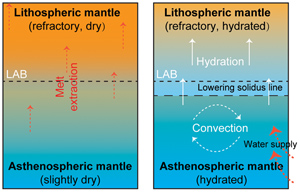
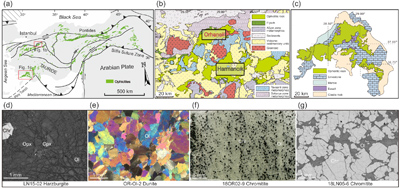 Figure 1 Distribution of ophiolites in Türkiye and locations of Bursa and Lycian ophiolites (a); simplified geological maps of Bursa (b) and Lycian (c) ophiolites. Microphotographs of representive samples (d–g). Back-scattered electron image of harzburgite from Lycian ophiolite showing mineral assemblage of olivine, orthopyroxene, clinopyroxene and chromite (d). Crossed polarised image of dunite (e) and scanned image of chromitite (f) from Bursa ophiolite showing occurrence of olivine and chromite. Back-scattered electron image of pristine olivine occurrence in chromitite from Lycian ophiolite (g). | 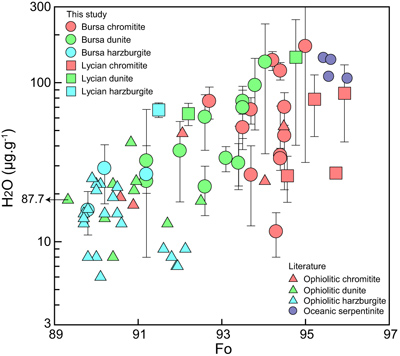 Figure 2 Correlation diagram of forsterite (Fo) vs. H2O (μg.g−1) contents in olivine from Bursa and Lycian ophiolitic chromitites, dunites and harzburgites. Literature data of ophiolites and Unterer Theodulgletscher oceanic lithospheric massif (see data sources in Supplementary Information) are plotted for comparison. Error bars of some analytical data are smaller than the symbols. | 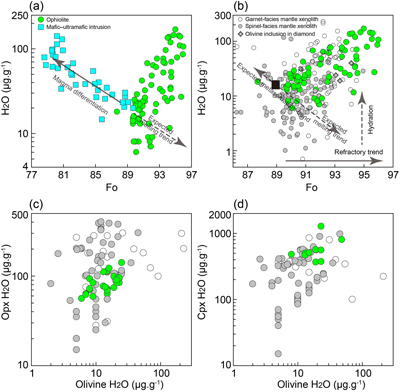 Figure 3 Comparisons of H2O (μg.g−1) vs. forsterite (Fo) contents in olivine between ophiolites, mafic–ultramafic intrusions, mantle xenoliths and inclusions in diamond. The magma differentiation trend is defined by the data from mafic–ultramafic intrusions, while expected melting and metasomatism trends are defined by incompatible behaviour of hydrogen in olivine. Spinel-facies mantle xenoliths, garnet-facies mantle xenoliths and olivine inclusion in diamond represent increasing depths of sub-continental lithospheric mantle. The refractory trend is defined by variation of forsterite content in olivine, while the hydration trend is expected from water variation observed in this study. The black square in panel b is the estimated water content of the lithospheric mantle beneach cratons (17 ± 13 μg.g−1; Wang, 2010), with Fo 89 in olivine. The hydrated state of the lithospheric mantle depends on degree of refractoriness and is defined as the field above the line of expected melting trend in panel b. Plots of H2O contents between olivine and (c) orthopyroxene (Opx) and (d) clinopyroxene (Cpx) in ophiolites and mantle xenoliths. See data sources in Supplementary Information. | 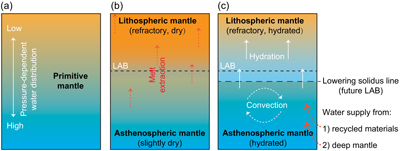 Figure 4 Illustration showing water distribution and variation during formation of local lithospheric mantle. (a) Water distribution in primitive mantle is mainly pressure-dependent. (b) Melt extraction results in removal of water from the asthenosphere and formation of lithospheric mantle. (c) Mantle convection supplies water from recycled materials or deep mantle to the top of the local asthenosphere where the lithospheric mantle just formed, and meanwhile water migration from the asthenosphere to the lithosphere occurs. See main text for more details. LAB, lithosphere-asthenosphere boundary. Hydration here refers to the infiltration of volatiles (hydrogen-dominated), leading to an increase in hydrogen abundance without affecting major and trace elements, which distinguishes it from melt/fluid metasomatism. |
| Figure 1 | Figure 2 | Figure 3 | Figure 4 |
top
Introduction
Hydrogen, primarily present as OH within the Earth’s mantle, is a volatile and highly incompatible element, predominantly extracted from the mantle source during partial melting (Williams and Hemley, 2001
Williams, Q., Hemley, R.J. (2001) Hydrogen in the deep Earth. Annual Review of Earth and Planetary Sciences 29, 365–418. https://doi.org/10.1146/annurev.earth.29.1.365
). It is assumed to be depleted in mantle minerals following melt extraction and in early crystallising phases (e.g., olivine) of mantle-derived magmas. Olivine, comprising over 60 % by volume of the upper mantle, tends to be retained in the mantle during partial melting, and its forsterite (Fo) content serves as a refractory index. Recent advancements in analytical techniques have enabled precise determination of hydrogen abundance in olivine (e.g., Peslier et al., 2010Peslier, A.H., Woodland, A.B., Bell, D.R., Lazarov, M. (2010) Olivine water contents in the continental lithosphere and the longevity of cratons. Nature 467, 78–81. https://doi.org/10.1038/nature09317
; Xia et al., 2019Xia, Q.K., Liu, J., Kovács, I., Hao, Y.T., Li, P., Yang, X.Z., Chen, H., Sheng, Y.M. (2019) Water in the upper mantle and deep crust of eastern China: concentration, distribution and implications. National Science Review 6, 125–144. https://doi.org/10.1093/nsr/nwx016
). Available data reveal that hydrogen significantly influences mantle rheology and thermal conductivity (Dixon et al., 2004Dixon, J.E., Dixon, T.H., Bell, D.R., Malservisi, R. (2004) Lateral variation in upper mantle viscosity: role of water. Earth and Planetary Science Letters 222, 451–467. http://dx.doi.org/10.1016/j.epsl.2004.03.022
; Li et al., 2008Li, Z.-X.A., Lee, C.-T.A., Peslier, A.H., Lenardic, A., Mackwell, S.J. (2008) Water contents in mantle xenoliths from the Colorado Plateau and vicinity: Implications for the mantle rheology and hydration-induced thinning of continental lithosphere. Journal of Geophysical Research: Solid Earth 113, B09210. https://doi.org/10.1029/2007JB005540
; Demouchy and Bolfan-Casanova, 2016Demouchy, S., Bolfan-Casanova, N. (2016) Distribution and transport of hydrogen in the lithospheric mantle: a review. Lithos 240–243, 402–425. http://dx.doi.org/10.1016/j.lithos.2015.11.012
; Chang et al., 2017Chang, Y.Y., Hsieh, W.P., Tan, E., Chen, J. (2017) Hydration-reduced lattice thermal conductivity of olivine in Earth’s upper mantle. Proceedings of the National Academy of Sciences 114, 4078–4081. https://doi.org/10.1073/pnas.1616216114
). However, the relationship between water storage capacity and compositional variations in refractory mantle olivine remains poorly constrained.Ophiolites, fragments of ancient oceanic lithosphere, predominantly originate in the supra-subduction zone. Their mantle sequences undergo high degree partial melting, resulting in refractory compositions. These compositions generally remain uncontaminated by subsequent melt/fluid modification, which often introduce volatile components released from dehydrating slabs (Su et al., 2023
Su, B.X., Pan, Q.Q., Xiao, Y., Jing, J.J., Robinson, P.T, Uysal, I., Liu, X., Liu, J.G. (2023) Mantle peridotites of ophiolites rarely preserve reliable records of paleo-oceanic lithospheric mantle. Earth-Science Reviews 244, 104544. https://doi.org/10.1016/j.earscirev.2023.104544
). The fate of subduction-derived volatiles, including water, remains enigmatic (Peacock and Hyndman, 1999Peacock, S.M., Hyndman, R.D. (1999) Hydrous minerals in the mantle wedge and the maximum depth of subduction thrust earthquakes. Geophysical Research Letters 26, 2517–2520. https://doi.org/10.1029/1999GL900558
) due to the scarcity of hydrous minerals in ophiolites.In this study, we measured hydrogen abundance in olivine from 40 samples of the Bursa and Lycian ophiolites (90 Ma in age) in western Türkiye. These ophiolites lie within the Cretaceous Neo-Tethyan suture zone (Fig. 1a) and preserve extensive mantle peridotite massifs alongside overlying crustal units (Fig. 1b, c). The mantle peridotites are predominantly harzburgites hosting chromite deposits, with dunites occurring as lens/dykes or associated with chromitites (Pan et al., 2022
Pan, Q.Q., Xiao, Y., Su, B.X., Liu, X., Robinson, P.T., Cui, M.M., Wang, J., Uysal, I. (2022) Fingerprinting stealth metasomatism in ophiolitic peridotites. Lithos 424–425, 106755. https://doi.org/10.1016/j.lithos.2022.106755
; Su et al., 2023Su, B.X., Pan, Q.Q., Xiao, Y., Jing, J.J., Robinson, P.T, Uysal, I., Liu, X., Liu, J.G. (2023) Mantle peridotites of ophiolites rarely preserve reliable records of paleo-oceanic lithospheric mantle. Earth-Science Reviews 244, 104544. https://doi.org/10.1016/j.earscirev.2023.104544
). Mineral assemblages of the three rock types include olivine and chromite, with additional orthopyroxene and clinopyroxene in harzburgites (Fig. 1d–f). Pristine samples with no or rare alteration features, comprising 4 harzburgites, 16 dunites and 20 chromitites, were selected for olivine separation and analyses (see Supplementary Information for detailed analytical methods).Figure 1 Distribution of ophiolites in Türkiye and locations of Bursa and Lycian ophiolites (a); simplified geological maps of Bursa (b) and Lycian (c) ophiolites. Microphotographs of representive samples (d–g). Back-scattered electron image of harzburgite from Lycian ophiolite showing mineral assemblage of olivine, orthopyroxene, clinopyroxene and chromite (d). Crossed polarised image of dunite (e) and scanned image of chromitite (f) from Bursa ophiolite showing occurrence of olivine and chromite. Back-scattered electron image of pristine olivine occurrence in chromitite from Lycian ophiolite (g).
top
Results
The analysed olivine grains exhibit Fo contents of 90 to 96 and water contents of 5–169 μg.g−1 (Table S-1), with values increasing from harzburgites, to dunites and chromitite (Fig. 2). A strong covariation between Fo and water contents aligns with data from ophiolites and oceanic lithospheric massifs (Fig. 2). This trend contrasts with patterns expected from mantle peridotite melting, where water content should decrease with increasing Fo number (Fig. 3a). Some dunites and chromitites formed as magmatic cumulates within lithospheric mantle magma conduits or chambers (Su et al., 2023
Su, B.X., Pan, Q.Q., Xiao, Y., Jing, J.J., Robinson, P.T, Uysal, I., Liu, X., Liu, J.G. (2023) Mantle peridotites of ophiolites rarely preserve reliable records of paleo-oceanic lithospheric mantle. Earth-Science Reviews 244, 104544. https://doi.org/10.1016/j.earscirev.2023.104544
). Their Fo and water contents of olivine exhibit a positive correlation, opposing the negative trend observed during magma differentiation (Fig. 3a), as exemplified by mafic–ultramafic intrusions (Tang et al., 2022Tang, D.M., Qin, K.Z., Su, B.X., Mao, Y.J., Evans, N.J., Fang, L.R. (2022) Addition of H2O at the Baishiquan and Tianyu magmatic Ni-Cu sulfide deposits, southern Central Asian Orogenic Belt, China: evidence from isotopic geochemistry of olivine and zircon. Mineralium Deposita 57, 235–254. https://doi.org/10.1007/s00126-021-01063-2
, 2023Tang, D., Qin, K., Evans, N.J., Fang, L. (2023) Silicate mineral inclusions in chromite from the Eastern Bushveld complex: Implications for the origin and evolution of hydrous melt during chromite mineralization in the Critical Zone. Lithos 438, 106997. https://doi.org/10.1016/j.lithos.2022.106997
; Bai et al., 2024Bai, Y., Cui, M.M., Su, B.X., Liu, X., Xiao, Y., Robinson, P.T., Gu, X.Y. (2024) FTIR study of H2O in silicate minerals and mineral inclusions in chromite from the Peridotite Zone of the Stillwater Complex: evidence for chromitite formation in a H2O-rich environment. Geological Society of America Bulletin 136, 1661–1674. https://doi.org/10.1130/B36733.1
).Figure 2 Correlation diagram of forsterite (Fo) vs. H2O (μg.g−1) contents in olivine from Bursa and Lycian ophiolitic chromitites, dunites and harzburgites. Literature data of ophiolites and Unterer Theodulgletscher oceanic lithospheric massif (see data sources in Supplementary Information) are plotted for comparison. Error bars of some analytical data are smaller than the symbols.
Figure 3 Comparisons of H2O (μg.g−1) vs. forsterite (Fo) contents in olivine between ophiolites, mafic–ultramafic intrusions, mantle xenoliths and inclusions in diamond. The magma differentiation trend is defined by the data from mafic–ultramafic intrusions, while expected melting and metasomatism trends are defined by incompatible behaviour of hydrogen in olivine. Spinel-facies mantle xenoliths, garnet-facies mantle xenoliths and olivine inclusion in diamond represent increasing depths of sub-continental lithospheric mantle. The refractory trend is defined by variation of forsterite content in olivine, while the hydration trend is expected from water variation observed in this study. The black square in panel b is the estimated water content of the lithospheric mantle beneach cratons (17 ± 13 μg.g−1; Wang, 2010
Wang, Q. (2010) A review of water contents and ductile deformation mechanisms of olivine: implications for the lithosphere–asthenosphere boundary of continents. Lithos 120, 30–41. https://doi.org/10.1016/j.lithos.2010.05.010
), with Fo 89 in olivine. The hydrated state of the lithospheric mantle depends on degree of refractoriness and is defined as the field above the line of expected melting trend in panel b. Plots of H2O contents between olivine and (c) orthopyroxene (Opx) and (d) clinopyroxene (Cpx) in ophiolites and mantle xenoliths. See data sources in Supplementary Information.top
Discussion
Xenolithic olivine from the continental lithospheric mantle has been extensively studied (Wang, 2010
Wang, Q. (2010) A review of water contents and ductile deformation mechanisms of olivine: implications for the lithosphere–asthenosphere boundary of continents. Lithos 120, 30–41. https://doi.org/10.1016/j.lithos.2010.05.010
). Its water contents (1 to 200 μg.g−1) correlate positively with Fo (mostly 88–95), mirroring the trend observed in ophiolitic olivine (Fig. 3b). Olivine from deeper garnet-facies and diamond-facies sources generally exhibits higher water and Fo contents than its spinel-facies counterparts, consistent with pressure-dependent water storage (Peslier and Luhr, 2006Peslier, A., Luhr, J. (2006) Hydrogen loss from olivines in mantle xenoliths from Simcoe (USA) and Mexico: mafic alkalic magma ascent rates and water budget of the sub-continental lithosphere. Earth and Planetary Science Letters 242, 302–319. https://doi.org/10.1016/j.epsl.2005.12.019
; Hirschmann and Kohlstedt, 2012Hirschmann, M.M., Kohlstedt, D. (2012) Water in Earth’s mantle. Physics Today 65, 40–45. http://dx.doi.org/10.1063/PT.3.1476
; Demouchy and Bolfan-Casanova, 2016Demouchy, S., Bolfan-Casanova, N. (2016) Distribution and transport of hydrogen in the lithospheric mantle: a review. Lithos 240–243, 402–425. http://dx.doi.org/10.1016/j.lithos.2015.11.012
). Ophiolitic olivine (spinel-facies) spans water contents equivalent to garnet-facies xenolithic olivine (Fig. 3b). Xenolithic olivine from diverse tectonic settings (craton, off-craton and oceanic) and ages (Archean to Cenozoic) follows the same covariation trend. Thus, water content variability in refractory mantle olivine is not controlled by locations, depths or ages, but predominantly by its chemical composition. We also note that the possibility for hydrogen loss from olivine during ascent (Peslier and Luhr, 2006Peslier, A., Luhr, J. (2006) Hydrogen loss from olivines in mantle xenoliths from Simcoe (USA) and Mexico: mafic alkalic magma ascent rates and water budget of the sub-continental lithosphere. Earth and Planetary Science Letters 242, 302–319. https://doi.org/10.1016/j.epsl.2005.12.019
) suggests that measured water contents represent minima.The OH in olivine predominantly occupies point defects in the crystalline structure, and hydrogen incorporation is thus controlled by cation vacancies in olivine (Demouchy and Bolfan-Casanova, 2016
Demouchy, S., Bolfan-Casanova, N. (2016) Distribution and transport of hydrogen in the lithospheric mantle: a review. Lithos 240–243, 402–425. http://dx.doi.org/10.1016/j.lithos.2015.11.012
). Water storage capacity depends on vacancy population, influenced by factors such as temperature, pressure, composition and oxygen fugacity (Withers and Hirschmann, 2008Withers, A.C., Hirschmann, M.M. (2008) Influence of temperature, composition, silica activity and oxygen fugacity on the H2O storage capacity of olivine at 8 GPa. Contributions to Mineralogy and Petrology 156, 595–605. https://doi.org/10.1007/s00410-008-0303-3
; Wang, 2010Wang, Q. (2010) A review of water contents and ductile deformation mechanisms of olivine: implications for the lithosphere–asthenosphere boundary of continents. Lithos 120, 30–41. https://doi.org/10.1016/j.lithos.2010.05.010
). Vacancy concentration is primarily controlled by temperature; that is, with increasing temperature, vacancy concentration increases (Nakamura and Schmalzried, 1983Nakamura, A., Schmalzried, H. (1983) On the nonstoichiometry and point defects of olivine. Physics and Chemistry of Minerals 10, 27–37. https://doi.org/10.1007/BF01204323
). Studies have revealed that the Fe3+/(Fe3++Fe2+) ratio in olivine tends to increase with rising pressure within lithospheric mantle conditions (Gaetani et al., 2014Gaetani, G.A., O’Leary, J.A., Koga, K.T., Hauri, E.H., Rose-Koga, E.F., Monteleone, B.D. (2014) Hydration of mantle olivine under variable water and oxygen fugacity conditions. Contributions to Mineralogy and Petrology 167, 965. http://dx.doi.org/10.1007/s00410-014-0965-y
; Muir et al., 2023Muir, J.M., Jollands, M., Zhang, F.W. (2023) The oxidation states of iron in dry and wet olivine: A thermodynamic model. Journal of Geophysical Research: Solid Earth 128, e2023JB026840. https://doi.org/10.1029/2023JB026840
), generating more defects for the entry of hydrogen. This aligns with the observed variation in water content from spinel-facies to garnet-facies olivine from mantle xenoliths (Fig. 3b). Given that the Fe3+/(Fe3++Fe2+) ratio indicates oxygen fugacity, ophiolitic olivine formed under highly oxidised subduction conditions (Su et al., 2023Su, B.X., Pan, Q.Q., Xiao, Y., Jing, J.J., Robinson, P.T, Uysal, I., Liu, X., Liu, J.G. (2023) Mantle peridotites of ophiolites rarely preserve reliable records of paleo-oceanic lithospheric mantle. Earth-Science Reviews 244, 104544. https://doi.org/10.1016/j.earscirev.2023.104544
) is likely enriched in Fe3+ to enhance water storage capacity. However, determining this enrichment is challenging due to the extremely low Fe3+ content in olivine. Additionally, experimental results indicate that hydrogen in olivine occupies silicon vacancies at low Si activity (aSiO2) and Mg vacancies at high aSiO2 (Lemaire et al., 2004Lemaire, C., Kohn, S.C., Brooker, R.A. (2004) The effect of silica activity on the incorporation mechanisms of water in synthetic forsterite: a polarised infrared spectroscopic study. Contributions to Mineralogy and Petrology 147, 48–57. http://dx.doi.org/10.1007/s00410-003-0539-x
). The Mg/Si ratios in various olivine are also covarying with water contents (Fig. S-1). Consequently, the lower Si content in refractory olivine enhances water storage compared to fertile compositions.Water contents of olivine also depend on coexisting phases, particularly pyroxenes (Withers and Hirschmann, 2008
Withers, A.C., Hirschmann, M.M. (2008) Influence of temperature, composition, silica activity and oxygen fugacity on the H2O storage capacity of olivine at 8 GPa. Contributions to Mineralogy and Petrology 156, 595–605. https://doi.org/10.1007/s00410-008-0303-3
), which have higher hydrogen partition coefficients (Kovács et al., 2012Kovács, I., Green, D.H., Rosenthal, A., Hermann, J., O’Neill, H.St.C., Hibberson, W.O., Udvardi, B. (2012) An experimental study of water in nominally anhydrous minerals in the upper mantle near the water-saturated solidus. Journal of Petrology 53, 2067–2093. https://doi.org/10.1093/petrology/egs044
; Demouchy and Bolfan-Casanova, 2016Demouchy, S., Bolfan-Casanova, N. (2016) Distribution and transport of hydrogen in the lithospheric mantle: a review. Lithos 240–243, 402–425. http://dx.doi.org/10.1016/j.lithos.2015.11.012
; Xia et al., 2019Xia, Q.K., Liu, J., Kovács, I., Hao, Y.T., Li, P., Yang, X.Z., Chen, H., Sheng, Y.M. (2019) Water in the upper mantle and deep crust of eastern China: concentration, distribution and implications. National Science Review 6, 125–144. https://doi.org/10.1093/nsr/nwx016
). In ophiolites and mantle xenoliths, orthopyroxene shows variable and higher water contents than that of coexisting olivine (Fig. 3c), while the rough positive correlation of water contents is observed between clinopyroxene and olivine (Fig. 3c, d). The covariations suggest that olivine grains are equilibrated with pyroxenes in water contents for most, if not all, samples. In the less refractory or fertile lithospheric mantle, the increased presence of pyroxenes provides a competitive advantage relative to olivine, resulting in a low abundance of water in olivine. Conversely, the predominance of olivine in the refractory lithospheric mantle offers more opportunities for olivine to incorporate water during mantle hydration. Less competition from pyroxenes in the refractory mantle could potentially explain the higher water contents observed in olivine in dunites and chromitites (Fig. 2a), both of which notably lack pyroxenes (Fig. 1e–g). The significant water storage capacity of olivine might also hinder the crystallisation of hydrous minerals during mantle hydration, consistent with the rarity of hydrous minerals in ophiolitic rocks. Moreover, the hydrogen diffusion rate in defects in Fe-free olivine is one order of magnitude lower than that in Fe-bearing olivine at given P-T conditions (Padrón-Navarta et al., 2014Padrón-Navarta, J.A., Hermann, J., O’Neill, H.St.C. (2014) Site-specific hydrogen diffusion rates in forsterite. Earth and Planetary Science Letters 392, 100–112. https://doi.org/10.1016/j.epsl.2014.01.055
; Demouchy and Bolfan-Casanova, 2016Demouchy, S., Bolfan-Casanova, N. (2016) Distribution and transport of hydrogen in the lithospheric mantle: a review. Lithos 240–243, 402–425. http://dx.doi.org/10.1016/j.lithos.2015.11.012
; Fei et al., 2018Fei, H., Koizumi, S., Sakamoto, N., Hashiguchi, M., Yurimoto, H., Marquardt, K., Miyajima, N., Katsura, T. (2018) Mg lattice diffusion in iron-free olivine and implications to conductivity anomaly in the oceanic asthenosphere. Earth and Planetary Science Letters 484, 204–212. https://doi.org/10.1016/j.epsl.2017.12.020
). Consequently, refractory olivine has a higher capacity for water preservation than fertile olivine. In addition, the tentative covariations of water contents between pyroxenes and olivine (Fig. 3c, d) indicate that orthopyroxene and clinopyroxene in the refractory mantle are also rich in water. Therefore, the refractory mantle should exhibit an even more pronounced enrichment in water and would represent a significant water reservoir on a global scale.The upward-decreasing water distribution in Earth’s mantle (Hirschmann and Kohlstedt, 2012
Hirschmann, M.M., Kohlstedt, D. (2012) Water in Earth’s mantle. Physics Today 65, 40–45. http://dx.doi.org/10.1063/PT.3.1476
; Fig. 4a) is accentuated by melt extraction, forming a refractory, ‘dry’ lithospheric mantle (Fig. 4b). However, the rarity of olivine with Fo-water negative correlations (Fig. 3a) suggests that the ‘dry’ signature of the lithospheric mantle could not be preserved for a long time. Instead, the water enrichment observed in refractory olivine in this study and in literature suggests that the ‘dry’ signature of most lithospheric mantle should likely be immediately overridden by mantle hydration. Mantle hydration involves the infiltration of volatiles, predominantly hydrogen, resulting in an increase in hydrogen abundance without affecting the major and trace element contents (Nishi, 2015Nishi, M. (2015) Mantle hydration. Nature Geoscience 8, 9–10. https://doi.org/10.1038/ngeo2326
). This stands in contrast to typical melt- or fluid-induced metasomatism, which would normally enrich the mantle in incompatible elements, with reducing Fo contents in olivine. To discriminate typical melt/fluid metasomatism, “Simultaneous hydration and metasomatism of the lithospheric mantle by a water-rich silicate melt/fluid” and “hydrogen metasomatism” (Demouchy et al., 2015Demouchy, S., Ishikawa, A., Tommasi, A., Alard, O., Keshav, S. (2015) Characterization of hydration in the mantle lithosphere: Peridotite xenoliths from the Ontong Java Plateau as an example. Lithos 212, 189–201. http://dx.doi.org/10.1016/j.lithos.2014.11.005
) have been proposed to account for water enrichment of olivine (Liu et al., 2017Liu, J., Xia, Q.K., Kuritani, T., Hanski, E., Yu, H.R. (2017) Mantle hydration and the role of water in the generation of large igneous provinces. Nature Communications 8, 1824. https://doi.org/10.1038/s41467-017-01940-3
; Fig. 3b). The hydration process appears to be an ongoing and widespread phenomenon within the mantle, as the presence of hydrated refractory olivine remains consistent across various spatial and temporal settings. The water may originate from the decomposition of minerals in the deep mantle (Németh et al., 2017Németh, P., Leinenweber, K., Ohfuji, H., Groy, T., Domanik, K.J., Kovács, I.J., Kovács, J.S., Buseck, P.R. (2017) Water-bearing, high-pressure Ca-silicates. Earth and Planetary Science Letters 469, 148–155. https://doi.org/10.1016/j.epsl.2017.04.011
) or from recycled materials mainly through plate subduction (Li et al., 2018Li, P., Scott, J.M., Liu, J., Xia, Q.K. (2018) Lateral H2O variation in the Zealandia lithospheric mantle controls orogen width. Earth and Planetary Science Letters 502, 200–209. https://doi.org/10.1016/j.epsl.2018.09.004
; Gose and Schmädicke, 2021Gose, J., Schmädicke, E. (2021) Water in the supra-subduction-zone mantle of the Mariana-Izu-Bonin forearc: Constraints from peridotitic orthopyroxene. Geochemistry, Geophysics, Geosystems 22, e2020GC009586. https://doi.org/10.1029/2020GC009586
; Su et al., 2023Su, B.X., Pan, Q.Q., Xiao, Y., Jing, J.J., Robinson, P.T, Uysal, I., Liu, X., Liu, J.G. (2023) Mantle peridotites of ophiolites rarely preserve reliable records of paleo-oceanic lithospheric mantle. Earth-Science Reviews 244, 104544. https://doi.org/10.1016/j.earscirev.2023.104544
). In comparison to the continental lithospheric mantle, the subduction zone is a water (over)saturated environment due to continuous dehydration of the subducting slab. Ophiolitic olivine could undergo more extensive hydration than those in the continental lithospheric mantle.Figure 4 Illustration showing water distribution and variation during formation of local lithospheric mantle. (a) Water distribution in primitive mantle is mainly pressure-dependent. (b) Melt extraction results in removal of water from the asthenosphere and formation of lithospheric mantle. (c) Mantle convection supplies water from recycled materials or deep mantle to the top of the local asthenosphere where the lithospheric mantle just formed, and meanwhile water migration from the asthenosphere to the lithosphere occurs. See main text for more details. LAB, lithosphere-asthenosphere boundary. Hydration here refers to the infiltration of volatiles (hydrogen-dominated), leading to an increase in hydrogen abundance without affecting major and trace elements, which distinguishes it from melt/fluid metasomatism.
Partial melting removes water, creating a concentration gradient between the asthenosphere and lithospheric mantle. This gradient drives water migration into the lithospheric mantle, lowering solidus temperature of the refractory mantle (Hirschmann, 2006
Hirschmann, M.M. (2006) Water, melting, and the deep Earth H2O cycle. Annual Review of Earth and Planetary Sciences 34, 629–653. http://dx.doi.org/10.1146/annurev.earth.34.031405.125211
), prompting further melting of the already hydrated refractory mantle, enhancing its refractory nature. Concurrently, the asthenosphere beneath the refractory lithospheric mantle would receive water supply from recycled materials or deep mantle through mantle convection, and become more enriched in water. Similar to the overlying lithospheric mantle, partial melting could easily occur at the top of the locally hydrated asthenosphere, which would result in the formation of new lithospheric mantle, with a downward shift of the lithosphere-asthenosphere boundary (Fig. 4c). This melting-hydration feedback may facilitate lithospheric thickening.top
Conclusion
This study challenges the paradigm of a dehydrated refractory lithospheric mantle by demonstrating that ophiolitic and xenolithic olivine can retain substantial water contents (5–170 μg.g−1). The positive Fo-water correlation indicates that post-melting hydration—not initial melting—governs water storage. Hydration is enabled by favourable thermodynamic conditions and reduced competition from pyroxenes in refractory lithologies. Water incorporation lowers the solidus, triggering recurrent melting that enhances the refractory nature of mantle residues, while sustaining the refractory mantle as a major global water reservoir. This reservoir is replenished by fluids derived from deep mantle sources or subduction-related recycling. The cyclic feedback between hydration and melting preserves water in the lithospheric mantle and drives its thickening, offering a transformative framework for understanding upper mantle evolution.
top
Acknowledgements
We thank editor Dr. Romain Tartèse and two anonymous reviewers for their constructive comments, which significantly improved the quality of the paper. This study is funded by National Natural Science Foundation of China (42350001, 42302062, and 92462305).
Editor: Romain Tartèse
top
References
Bai, Y., Cui, M.M., Su, B.X., Liu, X., Xiao, Y., Robinson, P.T., Gu, X.Y. (2024) FTIR study of H2O in silicate minerals and mineral inclusions in chromite from the Peridotite Zone of the Stillwater Complex: evidence for chromitite formation in a H2O-rich environment. Geological Society of America Bulletin 136, 1661–1674. https://doi.org/10.1130/B36733.1
 Show in context
 Their Fo and water contents of olivine exhibit a positive correlation, opposing the negative trend observed during magma differentiation (Fig. 3a), as exemplified by mafic–ultramafic intrusions (Tang et al., 2022, 2023; Bai et al., 2024).
View in article
Chang, Y.Y., Hsieh, W.P., Tan, E., Chen, J. (2017) Hydration-reduced lattice thermal conductivity of olivine in Earth’s upper mantle. Proceedings of the National Academy of Sciences 114, 4078–4081. https://doi.org/10.1073/pnas.1616216114
Show in context Available data reveal that hydrogen significantly influences mantle rheology and thermal conductivity (Dixon et al., 2004; Li et al., 2008; Demouchy and Bolfan-Casanova, 2016; Chang et al., 2017).
View in article
Demouchy, S., Ishikawa, A., Tommasi, A., Alard, O., Keshav, S. (2015) Characterization of hydration in the mantle lithosphere: Peridotite xenoliths from the Ontong Java Plateau as an example. Lithos 212, 189–201. https://dx.doi.org/10.1016/j.lithos.2014.11.005
Show in context To discriminate typical melt/fluid metasomatism, “Simultaneous hydration and metasomatism of the lithospheric mantle by a water-rich silicate melt/fluid” and “hydrogen metasomatism” (Demouchy et al., 2015) have been proposed to account for water enrichment of olivine (Liu et al., 2017; Fig. 3b).
View in article
Demouchy, S., Bolfan-Casanova, N. (2016) Distribution and transport of hydrogen in the lithospheric mantle: a review. Lithos 240–243, 402–425. https://dx.doi.org/10.1016/j.lithos.2015.11.012
Show in context Available data reveal that hydrogen significantly influences mantle rheology and thermal conductivity (Dixon et al., 2004; Li et al., 2008; Demouchy and Bolfan-Casanova, 2016; Chang et al., 2017).
View in article
Olivine from deeper garnet-facies and diamond-facies sources generally exhibits higher water and Fo contents than its spinel-facies counterparts, consistent with pressure-dependent water storage (Peslier and Luhr, 2006; Hirschmann and Kohlstedt, 2012; Demouchy and Bolfan-Casanova, 2016).
View in article
The OH in olivine predominantly occupies point defects in the crystalline structure, and hydrogen incorporation is thus controlled by cation vacancies in olivine (Demouchy and Bolfan-Casanova, 2016).
View in article
Water contents of olivine also depend on coexisting phases, particularly pyroxenes (Withers and Hirschmann, 2008), which have higher hydrogen partition coefficients (Kovács et al., 2012; Demouchy and Bolfan-Casanova, 2016; Xia et al., 2019).
View in article
Moreover, the hydrogen diffusion rate in defects in Fe-free olivine is one order of magnitude lower than that in Fe-bearing olivine at given P-T conditions (Padrón-Navarta et al., 2014; Demouchy and Bolfan-Casanova, 2016; Fei et al., 2018).
View in article
Dixon, J.E., Dixon, T.H., Bell, D.R., Malservisi, R. (2004) Lateral variation in upper mantle viscosity: role of water. Earth and Planetary Science Letters 222, 451–467. https://dx.doi.org/10.1016/j.epsl.2004.03.022
Show in context Available data reveal that hydrogen significantly influences mantle rheology and thermal conductivity (Dixon et al., 2004; Li et al., 2008; Demouchy and Bolfan-Casanova, 2016; Chang et al., 2017).
View in article
Fei, H., Koizumi, S., Sakamoto, N., Hashiguchi, M., Yurimoto, H., Marquardt, K., Miyajima, N., Katsura, T. (2018) Mg lattice diffusion in iron-free olivine and implications to conductivity anomaly in the oceanic asthenosphere. Earth and Planetary Science Letters 484, 204–212. https://doi.org/10.1016/j.epsl.2017.12.020
Show in context Moreover, the hydrogen diffusion rate in defects in Fe-free olivine is one order of magnitude lower than that in Fe-bearing olivine at given P-T conditions (Padrón-Navarta et al., 2014; Demouchy and Bolfan-Casanova, 2016; Fei et al., 2018).
View in article
Gaetani, G.A., O’Leary, J.A., Koga, K.T., Hauri, E.H., Rose-Koga, E.F., Monteleone, B.D. (2014) Hydration of mantle olivine under variable water and oxygen fugacity conditions. Contributions to Mineralogy and Petrology 167, 965. https://dx.doi.org/10.1007/s00410-014-0965-y
Show in context Studies have revealed that the Fe3+/(Fe3++Fe2+) ratio in olivine tends to increase with rising pressure within lithospheric mantle conditions (Gaetani et al., 2014; Muir et al., 2023), generating more defects for the entry of hydrogen.
View in article
Gose, J., Schmädicke, E. (2021) Water in the supra-subduction-zone mantle of the Mariana-Izu-Bonin forearc: Constraints from peridotitic orthopyroxene. Geochemistry, Geophysics, Geosystems 22, e2020GC009586. https://doi.org/10.1029/2020GC009586
Show in context The water may originate from the decomposition of minerals in the deep mantle (Németh et al., 2017) or from recycled materials mainly through plate subduction (Li et al., 2018; Gose and Schmädicke, 2021; Su et al., 2023).
View in article
Hirschmann, M.M. (2006) Water, melting, and the deep Earth H2O cycle. Annual Review of Earth and Planetary Sciences 34, 629–653. https://dx.doi.org/10.1146/annurev.earth.34.031405.125211
Show in context This gradient drives water migration into the lithospheric mantle, lowering solidus temperature of the refractory mantle (Hirschmann, 2006), prompting further melting of the already hydrated refractory mantle, enhancing its refractory nature.
View in article
Hirschmann, M.M., Kohlstedt, D. (2012) Water in Earth’s mantle. Physics Today 65, 40–45. https://dx.doi.org/10.1063/PT.3.1476
Show in context Olivine from deeper garnet-facies and diamond-facies sources generally exhibits higher water and Fo contents than its spinel-facies counterparts, consistent with pressure-dependent water storage (Peslier and Luhr, 2006; Hirschmann and Kohlstedt, 2012; Demouchy and Bolfan-Casanova, 2016).
View in article
The upward-decreasing water distribution in Earth’s mantle (Hirschmann and Kohlstedt, 2012; Fig. 4a) is accentuated by melt extraction, forming a refractory, ‘dry’ lithospheric mantle (Fig. 4b).
View in article
Kovács, I., Green, D.H., Rosenthal, A., Hermann, J., O’Neill, H.St.C., Hibberson, W.O., Udvardi, B. (2012) An experimental study of water in nominally anhydrous minerals in the upper mantle near the water-saturated solidus. Journal of Petrology 53, 2067–2093. https://doi.org/10.1093/petrology/egs044
Show in context Water contents of olivine also depend on coexisting phases, particularly pyroxenes (Withers and Hirschmann, 2008), which have higher hydrogen partition coefficients (Kovács et al., 2012; Demouchy and Bolfan-Casanova, 2016; Xia et al., 2019).
View in article
Lemaire, C., Kohn, S.C., Brooker, R.A. (2004) The effect of silica activity on the incorporation mechanisms of water in synthetic forsterite: a polarised infrared spectroscopic study. Contributions to Mineralogy and Petrology 147, 48–57. https://dx.doi.org/10.1007/s00410-003-0539-x
Show in context Additionally, experimental results indicate that hydrogen in olivine occupies silicon vacancies at low Si activity (aSiO2) and Mg vacancies at high aSiO2 (Lemaire et al., 2004).
View in article
Li, P., Scott, J.M., Liu, J., Xia, Q.K. (2018) Lateral H2O variation in the Zealandia lithospheric mantle controls orogen width. Earth and Planetary Science Letters 502, 200–209. https://doi.org/10.1016/j.epsl.2018.09.004
Show in context The water may originate from the decomposition of minerals in the deep mantle (Németh et al., 2017) or from recycled materials mainly through plate subduction (Li et al., 2018; Gose and Schmädicke, 2021; Su et al., 2023).
View in article
Li, Z.-X.A., Lee, C.-T.A., Peslier, A.H., Lenardic, A., Mackwell, S.J. (2008) Water contents in mantle xenoliths from the Colorado Plateau and vicinity: Implications for the mantle rheology and hydration-induced thinning of continental lithosphere. Journal of Geophysical Research: Solid Earth 113, B09210. https://doi.org/10.1029/2007JB005540
Show in context Available data reveal that hydrogen significantly influences mantle rheology and thermal conductivity (Dixon et al., 2004; Li et al., 2008; Demouchy and Bolfan-Casanova, 2016; Chang et al., 2017).
View in article
Liu, J., Xia, Q.K., Kuritani, T., Hanski, E., Yu, H.R. (2017) Mantle hydration and the role of water in the generation of large igneous provinces. Nature Communications 8, 1824. https://doi.org/10.1038/s41467-017-01940-3
Show in context To discriminate typical melt/fluid metasomatism, “Simultaneous hydration and metasomatism of the lithospheric mantle by a water-rich silicate melt/fluid” and “hydrogen metasomatism” (Demouchy et al., 2015) have been proposed to account for water enrichment of olivine (Liu et al., 2017; Fig. 3b).
View in article
Muir, J.M., Jollands, M., Zhang, F.W. (2023) The oxidation states of iron in dry and wet olivine: A thermodynamic model. Journal of Geophysical Research: Solid Earth 128, e2023JB026840. https://doi.org/10.1029/2023JB026840
Show in context Studies have revealed that the Fe3+/(Fe3++Fe2+) ratio in olivine tends to increase with rising pressure within lithospheric mantle conditions (Gaetani et al., 2014; Muir et al., 2023), generating more defects for the entry of hydrogen.
View in article
Nakamura, A., Schmalzried, H. (1983) On the nonstoichiometry and point defects of olivine. Physics and Chemistry of Minerals 10, 27–37. https://doi.org/10.1007/BF01204323
Show in context Vacancy concentration is primarily controlled by temperature; that is, with increasing temperature, vacancy concentration increases (Nakamura and Schmalzried, 1983).
View in article
Németh, P., Leinenweber, K., Ohfuji, H., Groy, T., Domanik, K.J., Kovács, I.J., Kovács, J.S., Buseck, P.R. (2017) Water-bearing, high-pressure Ca-silicates. Earth and Planetary Science Letters 469, 148–155. https://doi.org/10.1016/j.epsl.2017.04.011
Show in context The water may originate from the decomposition of minerals in the deep mantle (Németh et al., 2017) or from recycled materials mainly through plate subduction (Li et al., 2018; Gose and Schmädicke, 2021; Su et al., 2023).
View in article
Nishi, M. (2015) Mantle hydration. Nature Geoscience 8, 9–10. https://doi.org/10.1038/ngeo2326
Show in context Mantle hydration involves the infiltration of volatiles, predominantly hydrogen, resulting in an increase in hydrogen abundance without affecting the major and trace element contents (Nishi, 2015).
View in article
Padrón-Navarta, J.A., Hermann, J., O’Neill, H.St.C. (2014) Site-specific hydrogen diffusion rates in forsterite. Earth and Planetary Science Letters 392, 100–112. https://doi.org/10.1016/j.epsl.2014.01.055
Show in context Moreover, the hydrogen diffusion rate in defects in Fe-free olivine is one order of magnitude lower than that in Fe-bearing olivine at given P-T conditions (Padrón-Navarta et al., 2014; Demouchy and Bolfan-Casanova, 2016; Fei et al., 2018).
View in article
Pan, Q.Q., Xiao, Y., Su, B.X., Liu, X., Robinson, P.T., Cui, M.M., Wang, J., Uysal, I. (2022) Fingerprinting stealth metasomatism in ophiolitic peridotites. Lithos 424–425, 106755. https://doi.org/10.1016/j.lithos.2022.106755
Show in context The mantle peridotites are predominantly harzburgites hosting chromite deposits, with dunites occurring as lens/dykes or associated with chromitites (Pan et al., 2022; Su et al., 2023).
View in article
Peacock, S.M., Hyndman, R.D. (1999) Hydrous minerals in the mantle wedge and the maximum depth of subduction thrust earthquakes. Geophysical Research Letters 26, 2517–2520. https://doi.org/10.1029/1999GL900558
Show in context The fate of subduction-derived volatiles, including water, remains enigmatic (Peacock and Hyndman, 1999) due to the scarcity of hydrous minerals in ophiolites.
View in article
Peslier, A., Luhr, J. (2006) Hydrogen loss from olivines in mantle xenoliths from Simcoe (USA) and Mexico: mafic alkalic magma ascent rates and water budget of the sub-continental lithosphere. Earth and Planetary Science Letters 242, 302–319. https://doi.org/10.1016/j.epsl.2005.12.019
Show in context Olivine from deeper garnet-facies and diamond-facies sources generally exhibits higher water and Fo contents than its spinel-facies counterparts, consistent with pressure-dependent water storage (Peslier and Luhr, 2006; Hirschmann and Kohlstedt, 2012; Demouchy and Bolfan-Casanova, 2016).
View in article
We also note that the possibility for hydrogen loss from olivine during ascent (Peslier and Luhr, 2006) suggests that measured water contents represent minima.
View in article
Peslier, A.H., Woodland, A.B., Bell, D.R., Lazarov, M. (2010) Olivine water contents in the continental lithosphere and the longevity of cratons. Nature 467, 78–81. https://doi.org/10.1038/nature09317
Show in context Recent advancements in analytical techniques have enabled precise determination of hydrogen abundance in olivine (e.g., Peslier et al., 2010; Xia et al., 2019).
View in article
Su, B.X., Pan, Q.Q., Xiao, Y., Jing, J.J., Robinson, P.T, Uysal, I., Liu, X., Liu, J.G. (2023) Mantle peridotites of ophiolites rarely preserve reliable records of paleo-oceanic lithospheric mantle. Earth-Science Reviews 244, 104544. https://doi.org/10.1016/j.earscirev.2023.104544
Show in context These compositions generally remain uncontaminated by subsequent melt/fluid modification, which often introduce volatile components released from dehydrating slabs (Su et al., 2023).
View in article
The mantle peridotites are predominantly harzburgites hosting chromite deposits, with dunites occurring as lens/dykes or associated with chromitites (Pan et al., 2022; Su et al., 2023).
View in article
Some dunites and chromitites formed as magmatic cumulates within lithospheric mantle magma conduits or chambers (Su et al., 2023).
View in article
Given that the Fe3+/(Fe3++Fe2+) ratio indicates oxygen fugacity, ophiolitic olivine formed under highly oxidised subduction conditions (Su et al., 2023) is likely enriched in Fe3+ to enhance water storage capacity.
View in article
The water may originate from the decomposition of minerals in the deep mantle (Németh et al., 2017) or from recycled materials mainly through plate subduction (Li et al., 2018; Gose and Schmädicke, 2021; Su et al., 2023).
View in article
Tang, D.M., Qin, K.Z., Su, B.X., Mao, Y.J., Evans, N.J., Fang, L.R. (2022) Addition of H2O at the Baishiquan and Tianyu magmatic Ni-Cu sulfide deposits, southern Central Asian Orogenic Belt, China: evidence from isotopic geochemistry of olivine and zircon. Mineralium Deposita 57, 235–254. https://doi.org/10.1007/s00126-021-01063-2
Show in context Their Fo and water contents of olivine exhibit a positive correlation, opposing the negative trend observed during magma differentiation (Fig. 3a), as exemplified by mafic–ultramafic intrusions (Tang et al., 2022, 2023; Bai et al., 2024).
View in article
Tang, D., Qin, K., Evans, N.J., Fang, L. (2023) Silicate mineral inclusions in chromite from the Eastern Bushveld complex: Implications for the origin and evolution of hydrous melt during chromite mineralization in the Critical Zone. Lithos 438, 106997. https://doi.org/10.1016/j.lithos.2022.106997
Show in context Their Fo and water contents of olivine exhibit a positive correlation, opposing the negative trend observed during magma differentiation (Fig. 3a), as exemplified by mafic–ultramafic intrusions (Tang et al., 2022, 2023; Bai et al., 2024).
View in article
Wang, Q. (2010) A review of water contents and ductile deformation mechanisms of olivine: implications for the lithosphere–asthenosphere boundary of continents. Lithos 120, 30–41. https://doi.org/10.1016/j.lithos.2010.05.010
Show in context The black square in panel b is the estimated water content of the lithospheric mantle beneach cratons (17 ± 13 μg.g−1; Wang, 2010), with Fo 89 in olivine.
View in article
Xenolithic olivine from the continental lithospheric mantle has been extensively studied (Wang, 2010).
View in article
Water storage capacity depends on vacancy population, influenced by factors such as temperature, pressure, composition and oxygen fugacity (Withers and Hirschmann, 2008; Wang, 2010).
View in article
Williams, Q., Hemley, R.J. (2001) Hydrogen in the deep Earth. Annual Review of Earth and Planetary Sciences 29, 365–418. https://doi.org/10.1146/annurev.earth.29.1.365
Show in context Hydrogen, primarily present as OH within the Earth’s mantle, is a volatile and highly incompatible element, predominantly extracted from the mantle source during partial melting (Williams and Hemley, 2001).
View in article
Withers, A.C., Hirschmann, M.M. (2008) Influence of temperature, composition, silica activity and oxygen fugacity on the H2O storage capacity of olivine at 8 GPa. Contributions to Mineralogy and Petrology 156, 595–605. https://doi.org/10.1007/s00410-008-0303-3
Show in context Water storage capacity depends on vacancy population, influenced by factors such as temperature, pressure, composition and oxygen fugacity (Withers and Hirschmann, 2008; Wang, 2010).
View in article
Water contents of olivine also depend on coexisting phases, particularly pyroxenes (Withers and Hirschmann, 2008), which have higher hydrogen partition coefficients (Kovács et al., 2012; Demouchy and Bolfan-Casanova, 2016; Xia et al., 2019).
View in article
Xia, Q.K., Liu, J., Kovács, I., Hao, Y.T., Li, P., Yang, X.Z., Chen, H., Sheng, Y.M. (2019) Water in the upper mantle and deep crust of eastern China: concentration, distribution and implications. National Science Review 6, 125–144. https://doi.org/10.1093/nsr/nwx016
Show in context Recent advancements in analytical techniques have enabled precise determination of hydrogen abundance in olivine (e.g., Peslier et al., 2010; Xia et al., 2019).
View in article
Water contents of olivine also depend on coexisting phases, particularly pyroxenes (Withers and Hirschmann, 2008), which have higher hydrogen partition coefficients (Kovács et al., 2012; Demouchy and Bolfan-Casanova, 2016; Xia et al., 2019).
View in article
top
Supplementary Information
The Supplementary Information includes:
- Methods
- Tables S-1 to S-4
- Figures S-1
- Supplementary Information references
- Additional references for data sources in Figs. 2 and 3.
Download the Supplementary Information (PDF)
Download Tables S-1 to S-4 (.xlsx)
Figures
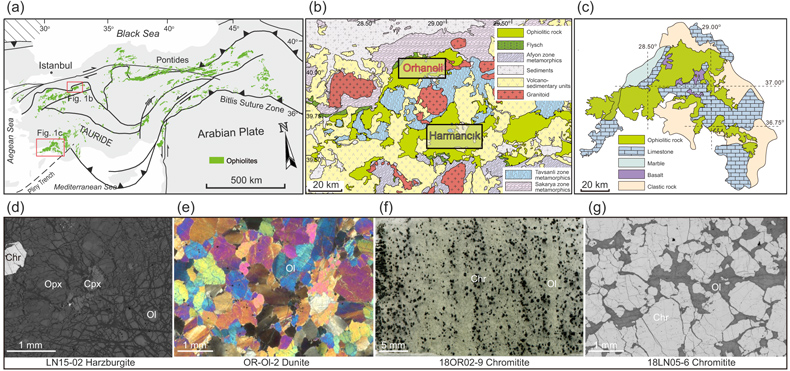
Figure 1 Distribution of ophiolites in Türkiye and locations of Bursa and Lycian ophiolites (a); simplified geological maps of Bursa (b) and Lycian (c) ophiolites. Microphotographs of representive samples (d–g). Back-scattered electron image of harzburgite from Lycian ophiolite showing mineral assemblage of olivine, orthopyroxene, clinopyroxene and chromite (d). Crossed polarised image of dunite (e) and scanned image of chromitite (f) from Bursa ophiolite showing occurrence of olivine and chromite. Back-scattered electron image of pristine olivine occurrence in chromitite from Lycian ophiolite (g).
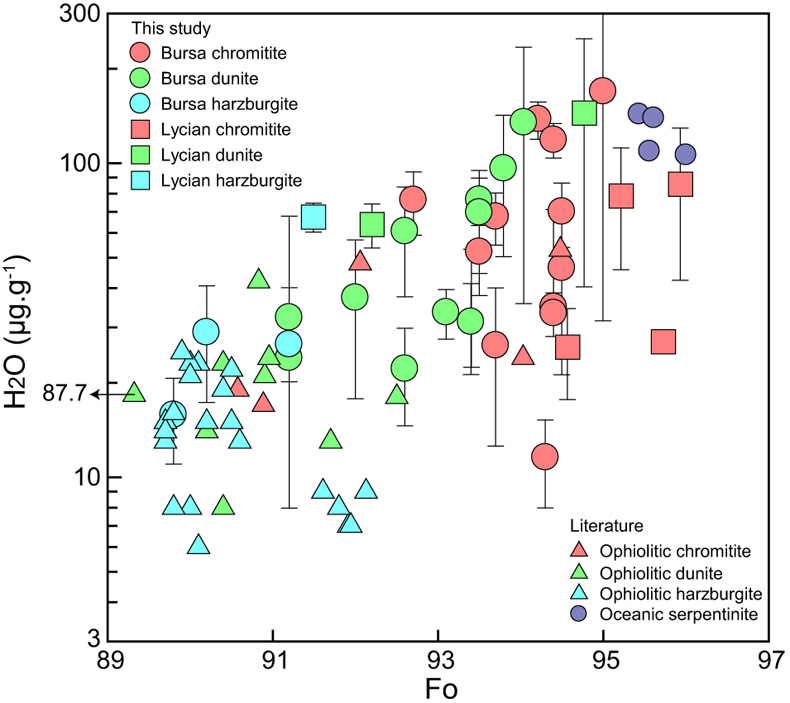
Figure 2 Correlation diagram of forsterite (Fo) vs. H2O (μg.g−1) contents in olivine from Bursa and Lycian ophiolitic chromitites, dunites and harzburgites. Literature data of ophiolites and Unterer Theodulgletscher oceanic lithospheric massif (see data sources in Supplementary Information) are plotted for comparison. Error bars of some analytical data are smaller than the symbols.
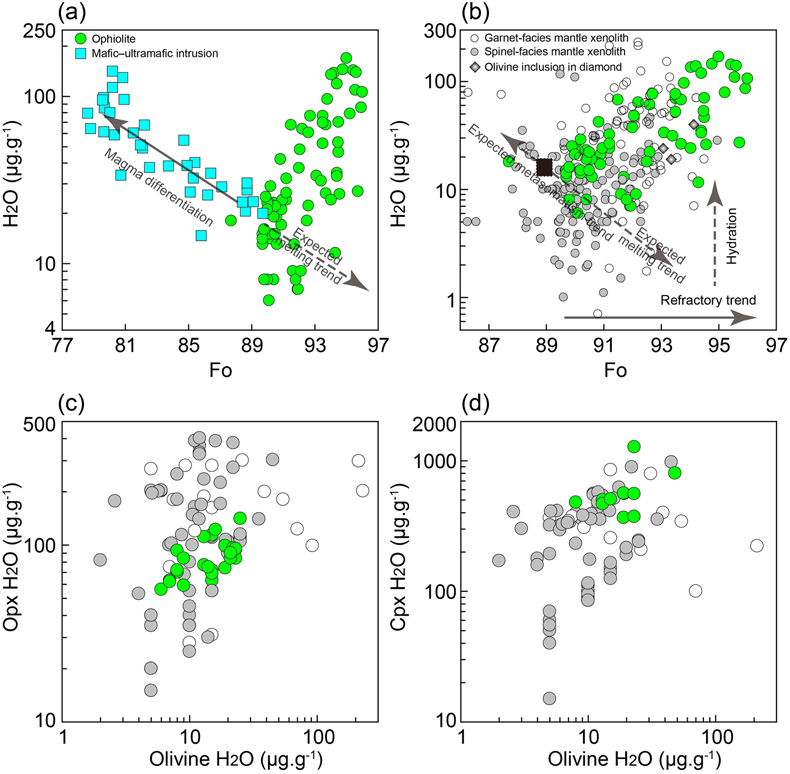
Figure 3 Comparisons of H2O (μg.g−1) vs. forsterite (Fo) contents in olivine between ophiolites, mafic–ultramafic intrusions, mantle xenoliths and inclusions in diamond. The magma differentiation trend is defined by the data from mafic–ultramafic intrusions, while expected melting and metasomatism trends are defined by incompatible behaviour of hydrogen in olivine. Spinel-facies mantle xenoliths, garnet-facies mantle xenoliths and olivine inclusion in diamond represent increasing depths of sub-continental lithospheric mantle. The refractory trend is defined by variation of forsterite content in olivine, while the hydration trend is expected from water variation observed in this study. The black square in panel b is the estimated water content of the lithospheric mantle beneach cratons (17 ± 13 μg.g−1; Wang, 2010
Wang, Q. (2010) A review of water contents and ductile deformation mechanisms of olivine: implications for the lithosphere–asthenosphere boundary of continents. Lithos 120, 30–41. https://doi.org/10.1016/j.lithos.2010.05.010
), with Fo 89 in olivine. The hydrated state of the lithospheric mantle depends on degree of refractoriness and is defined as the field above the line of expected melting trend in panel b. Plots of H2O contents between olivine and (c) orthopyroxene (Opx) and (d) clinopyroxene (Cpx) in ophiolites and mantle xenoliths. See data sources in Supplementary Information.
Figure 4 Illustration showing water distribution and variation during formation of local lithospheric mantle. (a) Water distribution in primitive mantle is mainly pressure-dependent. (b) Melt extraction results in removal of water from the asthenosphere and formation of lithospheric mantle. (c) Mantle convection supplies water from recycled materials or deep mantle to the top of the local asthenosphere where the lithospheric mantle just formed, and meanwhile water migration from the asthenosphere to the lithosphere occurs. See main text for more details. LAB, lithosphere-asthenosphere boundary. Hydration here refers to the infiltration of volatiles (hydrogen-dominated), leading to an increase in hydrogen abundance without affecting major and trace elements, which distinguishes it from melt/fluid metasomatism.