



Fe(II)aq-induced transformation of Fe-rich precipitates from a hydrothermal field
Affiliations | Corresponding Author | Cite as | Funding information
Published by the European Association of Geochemistry
under Creative Commons License CC BY-NC-ND 4.0
Keywords: hydrothermal systems, aqueous Fe(II), Fe-rich precipitates, mineral transformation, trace elements


- Share this article


-
Article views:1,874Cumulative count of HTML views and PDF downloads.
- Download Citation
- Rights & Permissions

top
Abstract
Figures
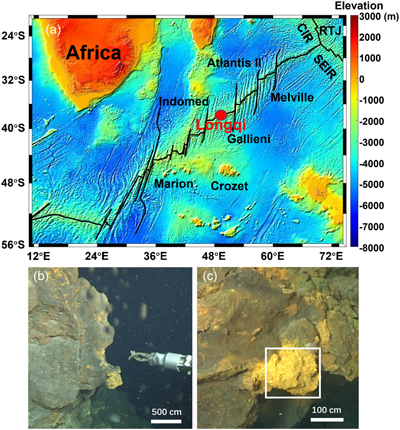 Figure 1 (a) The geotectonic setting and location of Longqi hydrothermal field. (b) Photo of sampling site that is away from active vent, and (c) the specific sampling point of the Fe-rich precipitates used in this study, with environmental pH (7.8–8.0) and temperature ranged from 50–60 °C (closer to vent) to 2–4 °C that is similar to ambient deep sea water. | 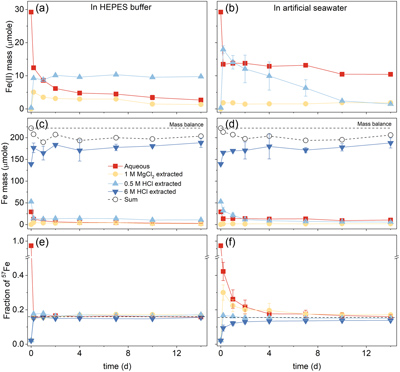 Figure 2 The mass of Fe(II) (a, b) and total Fe (c, d), as well as the fraction of 57Fe in the aqueous, exchangeable (1 M MgCl2 extracted), and 0.5 M HCl extracted pools during the reaction in HEPES buffer (a, c, e) or artificial seawater (b, d, f). The dashed lines in (c)-(f) represent the mass or isotope balance. The overall Fe recovery rate was 91 ± 3 %. Each point represents the mean ± standard deviation of triplicate reactors. Where error bars are not visible, they are smaller than the symbols. | 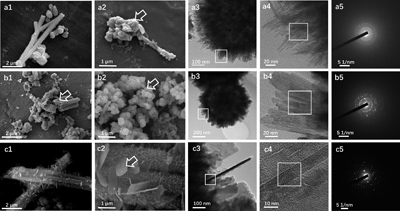 Figure 3 Images of typical mineral structures in the Fe-rich precipitates of the control group (a), treated with Fe(II) in HEPES buffer (b), and in artificial seawater (c). Columns 1 and 2 represent SEM images, 3 and 4 represent TEM images, and 5 represents the images of SAED. Arrows point to the specific feature discussed in the text. Squared area represents the focus of the following image. | 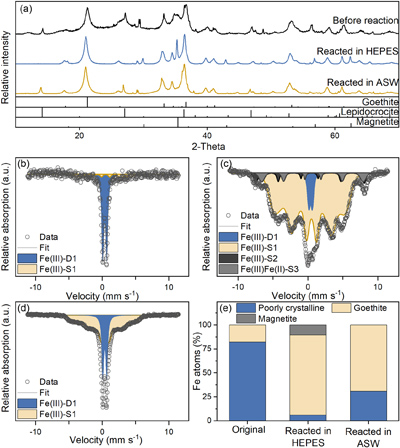 Figure 4 (a) X-ray diffraction patterns of Fe-rich precipitates before and after reaction with Fe(II)aq in HEPES buffer and artificial seawater; Mössbauer spectra of Fe-rich precipitates (b) before reaction; (c) reacted in HEPES buffer; and (d) reacted in artificial seawater. The spectra were collected at 295 K. (e) The estimated percent of Fe atoms in each phase based on Mössbauer spectrum and XRD patterns. Please note the Mössbauer spectra of poorly crystalline minerals (e.g., ferrihydrite, lepidocrocite) are difficult to resolve at room temperature, and a mixed phase of Fe(III)-D1 was introduced to constrain them. |
| Figure 1 | Figure 2 | Figure 3 | Figure 4 |
top
Introduction
Iron and other trace elements released from hydrothermal vents are critical contributors to marine biogeochemical cycles (Elderfield and Schultz, 1996
Elderfield, H., Schultz, A. (1996) Mid-Ocean Ridge Hydrothermal Fluxes and the Chemical Composition of the Ocean. Annual Review of Earth and Planetary Sciences 24, 191–224. https://doi.org/10.1146/annurev.earth.24.1.191
; Resing et al., 2015Resing, J.A., Sedwick, P.N., German, C.R., Jenkins, W.J., Moffett, J.W., Sohst, B.M., Tagliabue, A. (2015) Basin-scale transport of hydrothermal dissolved metals across the South Pacific Ocean. Nature 523, 200–203. https://doi.org/10.1038/nature14577
). In low temperature hydrothermal systems, the mixing of Fe-rich fluids with oxygenated seawater, combined with biomineralisation by Fe(II)-oxidising bacteria, triggers rapid precipitation of amorphous and poorly crystalline Fe(III) oxyhydroxides (e.g., ferrihydrite). These metastable phases act as transient sinks for trace elements and nutrients, such as cobalt (Co), nickel (Ni), silicon (Si), and phosphorus (P), thereby regulating their fluxes into surrounding seawater (German et al., 1991German, C.R., Campbell, A.C., Edmond, J.M. (1991) Hydrothermal scavenging at the Mid-Atlantic Ridge: Modification of trace element dissolved fluxes. Earth and Planetary Science Letters 107, 101–114. https://doi.org/10.1016/0012-821X(91)90047-L
). Yet, these initially formed Fe(III) oxyhydroxides undergo transformations during deposition and burial, with important implications for the mobility and fate of associated trace elements. While microbial mediated mineralisation processes in these setting have been relatively well studied (Konhauser and Riding, 2012Konhauser, K.O., Riding, R. (2012) Bacterial Biomineralization. In: Knoll, A.H., Canfield, D.E., Konhauser, K.O. (Eds.) Fundamentals of Geobiology. Wiley-Blackwell, Oxford, 105–130. https://doi.org/10.1002/9781118280874.ch8
), the role of Fe(II)aq — which is ubiquitous in hydrothermal fluids and porewaters — in driving subsequent mineral transformation remains poorly constrained within hydrothermal systems.Fe(II)-induced transformation of Fe(III) oxyhydroxides is well documented in laboratory experiments using synthetic Fe minerals such as ferrihydrite and lepidocrocite (Liu et al., 2022
Liu, J., Sheng, A., Li, X., Arai, Y., Ding, Y., Nie, M., Yan, M., Rosso, K.M. (2022) Understanding the importance of labile Fe (III) during Fe (II)-catalyzed transformation of metastable iron oxyhydroxides. Environmental Science and Technology 56, 3801–3811. https://doi.org/10.1021/acs.est.1c08044
; Hua et al., 2023Hua, J., Sun, J., Chen, M., Liu, C., Wu, F. (2023) Aqueous Fe(II)-catalyzed iron oxide recrystallization: Fe redox cycling and atom exchange, mineralogical recrystallization and contributing factor. Reviews in Environmental Science and Bio/Technology 22, 55–78. https://doi.org/10.1007/s11157-023-09646-3
). Extensive Fe atom exchange between Fe(II)aq and structural Fe(III) has also been identified even without noticeable mineral transformation (Handler et al., 2014Handler, R.M., Frierdich, A.J., Johnson, C.M., Rosso, K.M., Beard, B.L., Wang, C.M., Latta, D.E., Neumann, A., Pasakarnis, T., Premaratne, W., Scherer, M.M. (2014) Fe(II)-Catalyzed Recrystallization of Goethite Revisited. Environmental Science and Technology 48, 11302–11311. https://doi.org/10.1021/es503084u
; Chen et al., 2023Chen, C., Dong, Y., Thompson, A. (2023) Electron Transfer, Atom Exchange, and Transformation of Iron Minerals in Soils: The Influence of Soil Organic Matter. Environmental Science and Technology 57, 10696–10707. https://doi.org/10.1021/acs.est.3c01876
). This Fe(II)-induced “cryptic” recrystallisation and transformation not only alters the mineralogy of Fe(III) oxyhydroxides, but also affects the stability of associated trace metals (Frierdich et al., 2011Frierdich, A.J., Luo, Y., Catalano, J.G. (2011) Trace element cycling through iron oxide minerals during redox-driven dynamic recrystallization. Geology 39, 1083–1086. https://doi.org/10.1130/G32330.1
; Hua et al., 2023Hua, J., Sun, J., Chen, M., Liu, C., Wu, F. (2023) Aqueous Fe(II)-catalyzed iron oxide recrystallization: Fe redox cycling and atom exchange, mineralogical recrystallization and contributing factor. Reviews in Environmental Science and Bio/Technology 22, 55–78. https://doi.org/10.1007/s11157-023-09646-3
). Additionally, it can drive Fe isotope fractionation among different mineral phases, complicating the interpretation of Fe isotope signatures to trace the origin and formation of Fe deposits (Johnson et al., 2020Johnson, C., Beard, B., Weyer, S. (2020) Iron Geochemistry: An Isotopic Perspective. Springer, Cham. https://doi.org/10.1007/978-3-030-33828-2
; Fitzsimmons and Conway, 2023Fitzsimmons, J.N., Conway, T.M. (2023) Novel Insights into Marine Iron Biogeochemistry from Iron Isotopes. Annual Review of Marine Science 15, 383–406. https://doi.org/10.1146/annurev-marine-032822-103431
). However, natural hydrothermal systems are a unique matrix of mineralogical and geochemical environments, with major and trace elemental compositions that may impede or redirect the transformation pathways of Fe-rich precipitates (Jones et al., 2009Jones, A.M., Collins, R.N., Rose, J., Waite, T.D. (2009) The effect of silica and natural organic matter on the Fe(II)-catalysed transformation and reactivity of Fe(III) minerals. Geochimica et Cosmochimica Acta 73, 4409–4422. https://doi.org/10.1016/j.gca.2009.04.025
; Li et al., 2024Li, J., Sun, M., Qi, W., Zhou, Z., Hohl, S.V., He, Z. (2024) Geochemical and Sr-Nd-Pb-Fe Isotopic Constraints on the Formation of Fe-Si Oxyhydroxide Deposits at the Ultraslow-Spreading Southwest Indian Ridge. Geochemistry, Geophysics, Geosystems 25, e2023GC011185. https://doi.org/10.1029/2023GC011185
). Studies relying solely on laboratory synthesised minerals may therefore fail to capture the full range of processes occurring in situ, underscoring the need to investigate Fe(II)aq-induced processes using geochemically realistic samples from actual hydrothermal systems.In this study, we address this knowledge gap by studying natural Fe-rich precipitates collected from the Longqi Hydrothermal Field on the Southwest Indian Ridge. These samples preserve the chemical and mineralogical complexity of natural systems, allowing us to explore Fe(II)aq-induced processes under environmentally relevant conditions. By coupling 57Fe(II) stable isotope tracer experiments with mass spectroscopy, scanning and transmission electron microscopy, X-ray diffraction, and Mössbauer spectroscopy, we tracked mineralogical and morphological changes in detail and identified Fe atom exchange and trace metal redistribution in laboratory conditions. Our findings highlight the often overlooked role of Fe(II)aq in modern low temperature hydrothermal systems in addition to biomineralisation, providing additional constraints for interpreting sedimentary records in modern and ancient Fe deposits.
top
Materials and Methods
Sample collection. Fe-rich precipitates were sampled from the Longqi low temperature hydrothermal field on the Southwest Indian Ridge, near an active vent located at 49.6497° E, 37.7832° S, at a water depth of ∼2750 metres (Fig. 1). Ambient water temperatures ranged from 50–60 °C near the vent to 2–4 °C farther away, with pH values between 7.8–8.0. Sampling was carried out December 2, 2018, using the RV Tansuoyihao and the submersible “Shenghaiyongshi”. Immediately upon retrieval, the precipitate suspension (solid-liquid ratio was about 1:1) was preserved at −80 °C until further processing. Prior to commencing our experiments, an aliquot of the precipitate suspension was totally digested by 6 M HCl to determine the concentrations of Fe and other elements in the stock (see Table S-1).
Figure 1 (a) The geotectonic setting and location of Longqi hydrothermal field. (b) Photo of sampling site that is away from active vent, and (c) the specific sampling point of the Fe-rich precipitates used in this study, with environmental pH (7.8–8.0) and temperature ranged from 50–60 °C (closer to vent) to 2–4 °C that is similar to ambient deep sea water.
Experiments. All experiments were conducted inside an anoxic glovebox under N2 atmosphere (O2 < 0.2 ppm). Ultrapure water was deoxygenated by purging with N2 and equilibrated within the glovebox for one week before preparing anoxic solutions. A stock solution of 57Fe(II) was prepared by dissolving metallic 57Fe (96 % of 57Fe, ISOFLEX, California) in 1 M HCl (double distilled). This solution was then used to obtain 2 mM 57Fe(II) in either HEPES buffer (25 mM, pH 8.0) or artificial seawater (ASW, pH 8.0, ionic strength 0.72 mol/L)(Kester et al., 1967
Kester, D.R., Duedall, I.W., Connors, D.N., Pytkowicz, R.M. (1967) Preparation of artificial Seawater. Limnology and Oceanography 12, 176–179. https://doi.org/10.4319/lo.1967.12.1.0176
), and subsequently exposed to the Fe-rich precipitates (containing 10 mM Fe). Control experiments were performed with only 57Fe(II)aq or only the precipitates in HEPES buffer and ASW, respectively. For the reaction medium, HEPES buffer was used to isolate Fe(II) driven processes under controlled conditions and investigate their mechanistic feasibility, whereas ASW provided a more environmentally relevant context simulating hydrothermal systems. Although we acknowledge that the experimental setups cannot fully replicate natural conditions, key parameters such as pH (8.0) and Fe(II)/Fe(III) ratios were chosen to reflect conditions relevant to low temperature hydrothermal systems.Triplicate reactors were rotated in the dark and sampled over a 14 day reaction period. Aliquots were centrifuged, and the resulting solids were subjected to sequential extractions: 1 M MgCl2 to isolate the exchangeable fraction, 0.5 M HCl to target the amorphous to poorly crystalline Fe fraction, and 6 M HCl for the crystalline Fe fraction. More detailed methods can be found in SI. Aqueous trace metals (Co, Ni, Zn, Cu, and Ba) were quantified separately by ICP-MS, using 103Rh and 115In as internal standards. The count rate stability of the instrument was maintained below 3 % relative standard deviation (RSD).
Mineral characterisation. To track microstructural changes, aliquots of sediment suspensions were placed on a copper observation table and a copper net, dried in an anoxic glovebox, and characterised with a field emission scanning electron microscope (SEM Nano 450, FEI Co., USA) and a transmission electron microscope (TEM, JEOL JEM-F200, Japan). Due to limited sample volumes, unreacted and reacted samples were filtered (0.22 μm) and characterised using micro X-ray diffraction (μXRD, Bruker D8 Endeavor, Germany). The 57Fe Mössbauer Spectroscopy (Wissel GmbH, Germany) was also applied to track the mineralogical changes. More detailed methods about mineral characterisation can be found in the Supplementary Information.
top
Results and Discussion
Characteristics of the hydrothermal Fe-rich precipitates. The Fe-rich precipitates investigated in this study primarily consist of amorphous to poorly crystalline Fe(III) phases (e.g., ferrihydrite), goethite, and lepidocrocite, as identified by HCl extractions (Fig. 2), TEM imaging (Fig. 3), XRD, and Mössbauer spectroscopy (Fig. 4). Approximately 25 % of Fe in the original precipitates was extractable with 0.5 M HCl, and 100 % was extractable with 6 M HCl, indicating the relatively low stability of these Fe(III) oxyhydroxides (Fig. 2). Morphologically, both amorphous and rod-like hollow structures were observed (Fig. 3a1,a2), suggesting that abiotic and microbially mediated Fe(II) oxidation both contributed to their formation (Chan et al., 2016
Chan, C.S., McAllister, S.M., Leavitt, A.H., Glazer, B.T., Krepski, S.T., Emerson, D. (2016) The Architecture of Iron Microbial Mats Reflects the Adaptation of Chemolithotrophic Iron Oxidation in Freshwater and Marine Environments. Frontiers in Microbiology 7, 796. https://doi.org/10.3389/fmicb.2016.00796
; Li et al., 2024Li, J., Sun, M., Qi, W., Zhou, Z., Hohl, S.V., He, Z. (2024) Geochemical and Sr-Nd-Pb-Fe Isotopic Constraints on the Formation of Fe-Si Oxyhydroxide Deposits at the Ultraslow-Spreading Southwest Indian Ridge. Geochemistry, Geophysics, Geosystems 25, e2023GC011185. https://doi.org/10.1029/2023GC011185
). EDS analysis showed a very low abundance of Si (< 1%) within these structures (Fig. S-1). The crystallinity and structural order of these minerals were further elucidated by selected area electron diffraction (SAED) associated with TEM (Fig. 3a5), the full width at half maximum (FWHM) of identical peaks in XRD patterns (Table S-2), and magnetic ordering from 57Fe Mössbauer spectra at 295 K (Fig. 4b). Collectively, these analyses reveal structural defects in the crystal structures, particularly in goethite with the nanoneedle morphology. Notably, the relatively high proportion of crystallised Fe minerals (goethite and lepidocrocite) combined with low Si content (< 1 %; Fig. S-1) distinguishes these precipitates from those described in our previous study, where only poorly crystalline Fe(III) oxyhydroxides, such as ferrihydrite, were identified (Li et al., 2024Li, J., Sun, M., Qi, W., Zhou, Z., Hohl, S.V., He, Z. (2024) Geochemical and Sr-Nd-Pb-Fe Isotopic Constraints on the Formation of Fe-Si Oxyhydroxide Deposits at the Ultraslow-Spreading Southwest Indian Ridge. Geochemistry, Geophysics, Geosystems 25, e2023GC011185. https://doi.org/10.1029/2023GC011185
).Figure 2 The mass of Fe(II) (a, b) and total Fe (c, d), as well as the fraction of 57Fe in the aqueous, exchangeable (1 M MgCl2 extracted), and 0.5 M HCl extracted pools during the reaction in HEPES buffer (a, c, e) or artificial seawater (b, d, f). The dashed lines in (c)-(f) represent the mass or isotope balance. The overall Fe recovery rate was 91 ± 3 %. Each point represents the mean ± standard deviation of triplicate reactors. Where error bars are not visible, they are smaller than the symbols.
Figure 3 Images of typical mineral structures in the Fe-rich precipitates of the control group (a), treated with Fe(II) in HEPES buffer (b), and in artificial seawater (c). Columns 1 and 2 represent SEM images, 3 and 4 represent TEM images, and 5 represents the images of SAED. Arrows point to the specific feature discussed in the text. Squared area represents the focus of the following image.
Figure 4 (a) X-ray diffraction patterns of Fe-rich precipitates before and after reaction with Fe(II)aq in HEPES buffer and artificial seawater; Mössbauer spectra of Fe-rich precipitates (b) before reaction; (c) reacted in HEPES buffer; and (d) reacted in artificial seawater. The spectra were collected at 295 K. (e) The estimated percent of Fe atoms in each phase based on Mössbauer spectrum and XRD patterns. Please note the Mössbauer spectra of poorly crystalline minerals (e.g., ferrihydrite, lepidocrocite) are difficult to resolve at room temperature, and a mixed phase of Fe(III)-D1 was introduced to constrain them.
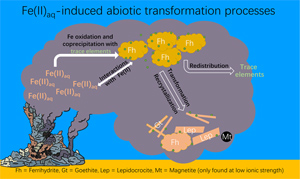
Reactions with Fe(II). While microbial mediated mineral formation and transformation are crucial, this study intentionally focuses on abiotic processes mediated by Fe(II)aq, which are comparatively understudied in hydrothermal systems. By reacting Fe-rich precipitates with Fe(II)aq at an initial Fe(II)/Fe(III) ratio of 0.2, 91 % of Fe(II)aq was removed over 14 days in the HEPES buffer, resulting in a final Fe(II)/Fe(III) ratio of 0.14 in the solid phase (Fig. 2a). Sequential extraction revealed a significant decrease in the total Fe content within the 0.5 M HCl extractable fraction, accompanied by an increase in the 6 M HCl extractable fraction, indicating a shift towards more stable and crystalline mineral phases. Rapid Fe isotope mixing was identified, with the fraction of 57Fe in different phases reaching near equilibrium (57Fe fraction ∼0.16) within two days (Fig. 2e). Visually, the solid phase exhibited a noticeable colour change from yellowish to blackish, signaling substantial mineralogical transformation.
In ASW, the removal of Fe(II)aq proceeded more slowly, with only 50 % removed over 14 days, resulting in a final Fe(II)/Fe(III) ratio of 0.09 in the solid phase (Fig. 2b). This slower removal is mainly due to cation competition with Fe(II) for adsorption sites at high ionic strength. Correspondingly, both the Fe(II) and total Fe mass in the 0.5 M HCl extractable fraction decreased more gradually, and Fe isotope exchange proceeded at a slower rate compared to the reaction in HEPES buffer (Fig. 2d,f), mainly due to the lower Fe(II) loading in the solid phase. Although no visible colour change was observed as seen under the HEPES buffered conditions, microstructural alterations in the solid phase were nevertheless evident in both SEM and TEM analyses.
Morphological and mineralogical alterations. Compared to the control group containing only the original precipitates, the long rod-like hollow structures were generally shorter and showed signs of fragmentation after reaction with Fe(II)aq in HEPES buffer (Fig. 3a1,b1). Additionally, new spherical particle agglomerates formed, indicating substantial mineral transformation likely driven by Fe(II)aq (Fig. 3b2). In ASW, the rod-like hollow structure and nanoneedles were largely preserved, although an additional lath-shaped structure appeared, indicating significant modifications to the morphological features (Fig. 3c1,c2).
TEM, XRD and Mössbauer spectroscopy provided further insights into these transformations. After reaction with Fe(II)aq in HEPES buffer, the abundance of non-crystalline phases in the original precipitates was diminished, corresponding to the formation of more crystallised Fe minerals (Fig. 4). In the XRD pattern, magnetite identical peaks appeared, consistent with the spherical particles observed in SEM images (Figs. 4a, 3b2). In contrast, a higher proportion of non-crystalline phases persisted in ASW (Fig. 4e, Table S-3), accompanied by the formation of secondary goethite and lepidocrocite (Fig. 4a). The ratio of lepidocrocite to goethite decreased from 0.45 to 0.31 after reaction with Fe(II)aq, indicating the enrichment of goethite after mineralogical transformation.
Comparing the SAED of the nanoneedles (Fig. 3) and the FWHM values of the goethite [110] face (Table S-2), we observed an improvement in goethite crystallinity after reaction with Fe(II)aq in both media. This observation is linked to extensive Fe atom exchange between Fe(II)aq and structural Fe(III) within the crystalline Fe minerals (corresponding to the 6 M HCl extractable; Fig. 2e,f). These results suggest that Fe(II)-induced recrystallisation of goethite occurred, leading to a reduction in crystal defects by removing site vacancy or substitutions (Notini et al., 2018
Notini, L., Latta, D.E., Neumann, A., Pearce, C.I., Sassi, M., N’Diaye, A.T., Rosso, K.M., Scherer, M.M. (2018) The Role of Defects in Fe (II)–Goethite Electron Transfer. Environmental Science and Technology 52, 2751–2759. https://doi.org/10.1021/acs.est.7b05772
; Southall et al., 2018Southall, S.C., Micklethwaite, S., Wilson, S., Frierdich, A.J. (2018) Changes in Crystallinity and Tracer-Isotope Distribution of Goethite during Fe(II)-Accelerated Recrystallization. ACS Earth and Space Chemistry 2, 1271–1282. https://doi.org/10.1021/acsearthspacechem.8b00100
). The increased concentration of trace metals immediately after reaction with Fe(II)aq (Fig. S-4) also supports this interpretation (Frierdich et al., 2011Frierdich, A.J., Luo, Y., Catalano, J.G. (2011) Trace element cycling through iron oxide minerals during redox-driven dynamic recrystallization. Geology 39, 1083–1086. https://doi.org/10.1130/G32330.1
).Conversely, in ASW which better simulates natural conditions, the crystallinity of lepidocrocite decreased (Table S-2). This reduction in crystallinity may result from transformation of pre-existing lepidocrocite into secondary goethite, with the pre-existing goethite potentially serving as a template (Yin et al., 2025
Yin, M., Li, X., Guo, C., Zhong, Q., Li, X., Zeng, L., Zhou, Y., Yang, C., Dang, Z. (2025) Effects of coexisting goethite or lepidocrocite on Fe(II)-induced ferrihydrite transformation pathways and Cd speciation. Science of the Total Environment 959, 178321. https://doi.org/10.1016/j.scitotenv.2024.178321
). Additionally, the identified lepidocrocite could be newly formed, promoted by the “lepidocrocite favouring effect” during ferrihydrite transformation influenced by natural components (Chen et al., 2015Chen, C., Kukkadapu, R., Sparks, D.L. (2015) Influence of coprecipitated organic matter on Fe2+(aq)-catalyzed transformation of ferrihydrite: implications for carbon dynamics. Environmental Science and Technology 49, 10927–10936. https://doi.org/10.1021/acs.est.5b02448
). The relatively short aging time of this secondary lepidocrocite likely accounts for its lower crystallinity. This interpretation is also supported by the emergence of newly formed lath-shaped structures (Fig. 3c1,c2). Overall, our findings based on laboratory experiments provide direct evidence that Fe(II)aq can induce rapid mineral transformation and recrystallisation within Fe-rich precipitates derived from the low temperature hydrothermal systems.Coupled trace element cycling. During Fe(II)-induced mineral transformation and recrystallisation, we observed a rapid release of Ni, Co, Cu, Zn and Ba at the beginning of the reactions, followed by near complete resorption of Ni within one day (Figs. S-3, S-4). The concentrations of Co, Cu, Zn and Ba were significantly higher in ASW compared to the HEPES buffer, likely due to higher background levels and cation desorption driven by the higher ionic strength of ASW (Fig. S-3). Most of the trace metal release occurred immediately after Fe(II)aq adsorption, which could be attributed to cation exchange with Fe(II)aq and a reduction in available binding sites within the newly formed secondary minerals (Liu et al., 2016
Liu, C., Zhu, Z., Li, F., Liu, T., Liao, C., Lee, J.-J., Shih, K., Tao, L., Wu, Y. (2016) Fe (II)-induced phase transformation of ferrihydrite: The inhibition effects and stabilization of divalent metal cations. Chemical Geology 444, 110–119. https://doi.org/10.1016/j.chemgeo.2016.10.002
). Importantly, this prompt Fe(II)-induced release of trace elements is crucial for their remobilisation, potentially allowing them to escape capture by Fe(III) oxyhydroxides within the hydrothermal plume (Lough, 2016Lough, A.J.M. (2016) Trace metal chemistry of hydrothermal plumes. PhD Thesis, University of Southampton, Ocean & Earth Science. https://eprints.soton.ac.uk/403372/
). In natural environments, dynamic mixing of hydrothermal fluids with surrounding seawater further facilitates the efficient export of these remobilised trace elements, potentially enhancing their fluxes from hydrothermal systems to the ocean.Implications for the Fe-rich precipitates formation processes. A number of studies have highlighted the role of Fe(II)-oxidising microorganisms in forming Fe-rich precipitates and characteristic morphological features in low temperature hydrothermal fields (Konhauser et al., 2017
Konhauser, K.O., Planaysky, N.J., Hardisty, D.S., Robbins, L.J., Warchola, T.J., Haugaard, R., Lalonde, S.V., Partin, C.A., Oonk, P.B.H., Tsikos, H., Lyons, T.W., Bekker, A., Johnson, C.M. (2017) Iron formations: A global record of Neoarchaean to Palaeoproterozoic environmental history. Earth-Science Reviews 172, 140–177. https://doi.org/10.1016/j.earscirev.2017.06.012
; Dong et al., 2022Dong, A., Sun, Z., Kendall, B., Izon, G., Cao, H., Li, Z., Ma, X., Yin, X., Qiu, Z., Zhu, X.-k., Bekker, A., Poulton, S.W. (2022) Insights from modern diffuse-flow hydrothermal systems into the origin of post-GOE deep-water Fe-Si precipitates. Geochimica et Cosmochimica Acta 317, 1–17. https://doi.org/10.1016/j.gca.2021.10.001
; Li et al., 2024Li, J., Sun, M., Qi, W., Zhou, Z., Hohl, S.V., He, Z. (2024) Geochemical and Sr-Nd-Pb-Fe Isotopic Constraints on the Formation of Fe-Si Oxyhydroxide Deposits at the Ultraslow-Spreading Southwest Indian Ridge. Geochemistry, Geophysics, Geosystems 25, e2023GC011185. https://doi.org/10.1029/2023GC011185
). Complementing this microbial perspective, our study underscores the importance of Fe(II)aq in driving subsequent transformation and recrystallisation of Fe-rich precipitates in these environments.Our experimental findings, together with previous studies, demonstrate that secondary minerals such as goethite, magnetite, and some intermediate minerals (e.g., lepidocrocite, green rust) can form rapidly when settling Fe(III) oxyhydroxides interact with Fe(II)aq within a hydrothermal plume or during the hydrothermal alteration of Fe deposits (Zegeye et al., 2012
Zegeye, A., Bonneville, S., Benning, L.G., Sturm, A., Fowle, D.A., Jones, C., Canfield, D.E., Ruby, C., MacLean, L.C., Nomosatryo, S., Crowe, S.A., Poulton, S.W. (2012) Green rust formation controls nutrient availability in a ferruginous water column. Geology 40, 599–602. https://doi.org/10.1130/G32959.1
; Li et al., 2017Li, Y.-L., Konhauser, K.O., Zhai, M. (2017) The formation of magnetite in the early Archean oceans. Earth and Planetary Science Letters 466, 103–114. https://doi.org/10.1016/j.epsl.2017.03.013
). While our experimental setup may not fully replicate all conditions of the natural environment, especially the system with HEPES buffer, the high Fe(II)/Fe(III) ratios achieved in the solid phase, a key factor for magnetite formation (Bauer et al., 2020Bauer, K., Byrne, J., Kenward, P., Simister, R., Michiels, C., Friese, A., Vuillemin, A., Henny, C., Nomosatryo, S., Kallmeyer, J. (2020) Magnetite biomineralization in ferruginous waters and early Earth evolution. Earth and Planetary Science Letters 549, 116495. https://doi.org/10.1016/j.epsl.2020.116495
), is plausible within a hydrothermal plume or during post-depositional processes, such as those proposed for Precambrian hydrothermal systems (Kump and Seyfried, 2005Kump, L.R., Seyfried, W.E. (2005) Hydrothermal Fe fluxes during the Precambrian: Effect of low oceanic sulfate concentrations and low hydrostatic pressure on the composition of black smokers. Earth and Planetary Science Letters 235, 654–662. https://doi.org/10.1016/j.epsl.2005.04.040
). These results suggest that Fe(II)-induced magnetite formation can occur not only in high temperature settings (Li et al., 2017Li, Y.-L., Konhauser, K.O., Zhai, M. (2017) The formation of magnetite in the early Archean oceans. Earth and Planetary Science Letters 466, 103–114. https://doi.org/10.1016/j.epsl.2017.03.013
) but also in low temperature hydrothermal systems. Furthermore, the secondary lath-shaped structures identified in our experiments closely resemble those observed in natural hydrothermal deposits (Li et al., 2024Li, J., Sun, M., Qi, W., Zhou, Z., Hohl, S.V., He, Z. (2024) Geochemical and Sr-Nd-Pb-Fe Isotopic Constraints on the Formation of Fe-Si Oxyhydroxide Deposits at the Ultraslow-Spreading Southwest Indian Ridge. Geochemistry, Geophysics, Geosystems 25, e2023GC011185. https://doi.org/10.1029/2023GC011185
), implying that such morphologies could serve as indicators for Fe(II)-induced mineral transformation under anoxic and Fe(II)-rich (“ferruginous”) conditions.Additionally, the 57Fe(II) tracer experiments revealed rapid Fe atom exchange between Fe(II)aq and the ferric substrates of varying crystallinity (Fig 2e,f). The prevalence of crystal defects in naturally occuring minerals likely facilitated this efficient Fe atom exchange (Notini et al., 2018
Notini, L., Latta, D.E., Neumann, A., Pearce, C.I., Sassi, M., N’Diaye, A.T., Rosso, K.M., Scherer, M.M. (2018) The Role of Defects in Fe (II)–Goethite Electron Transfer. Environmental Science and Technology 52, 2751–2759. https://doi.org/10.1021/acs.est.7b05772
), enabling the Fe(II)-induced recrystallisation to play a part even in limited coexistence time of Fe(II)aq and Fe(III) oxyhydroxides in the hydrothermal plume. This rapid Fe atom exchange also suggests an additional mechanism of Fe isotope fractionation, thus posing potential constraints on the interpretation of Fe isotope signals in hydrothermal systems (Johnson et al., 2020Johnson, C., Beard, B., Weyer, S. (2020) Iron Geochemistry: An Isotopic Perspective. Springer, Cham. https://doi.org/10.1007/978-3-030-33828-2
). Furthermore, the concurrent redistribution of associated trace elements during mineral transformation and recrystallisation may promote their release into surrounding seawater (Frierdich et al., 2011Frierdich, A.J., Luo, Y., Catalano, J.G. (2011) Trace element cycling through iron oxide minerals during redox-driven dynamic recrystallization. Geology 39, 1083–1086. https://doi.org/10.1130/G32330.1
; Liu et al., 2016Liu, C., Zhu, Z., Li, F., Liu, T., Liao, C., Lee, J.-J., Shih, K., Tao, L., Wu, Y. (2016) Fe (II)-induced phase transformation of ferrihydrite: The inhibition effects and stabilization of divalent metal cations. Chemical Geology 444, 110–119. https://doi.org/10.1016/j.chemgeo.2016.10.002
; Gini et al., 2024Gini, C., Jamieson, J.W., Reeves, E.P., Gartman, A., Barreyre, T., Babechuk, M.G., Jørgensen, S.L., Robert, K. (2024) Iron Oxyhydroxide-Rich Hydrothermal Deposits at the High-Temperature Fåvne Vent Field, Mohns Ridge. Geochemistry, Geophysics, Geosystems 25, e2024GC011481. https://doi.org/10.1029/2024GC011481
). Taken together, these findings highlight the need to take into account Fe(II)-induced processes when reconstructing geochemical cycling and the formation pathways for Fe-rich precipitates. More complex experimental setups better simulating natural conditions and covering greater geochemical gradients will be needed to further elucidate the implications of Fe(II)-Fe(III) interactions in the hydrothermal system.Drawing parallels between modern hydrothermal systems and the depositional environments of ancient iron formations (IFs), our findings suggest that in addition to biomineralisation processes, the abiotic Fe(II)-induced processes could have also played a role in iron deposition on early Earth. During the Great Oxidation Event (GOE), redox stratification within the ocean water column may have permitted the coexistence of Fe(II)aq and Fe(III) oxyhydroxides over a broad spatial and temporal scale (Zegeye et al., 2012
Zegeye, A., Bonneville, S., Benning, L.G., Sturm, A., Fowle, D.A., Jones, C., Canfield, D.E., Ruby, C., MacLean, L.C., Nomosatryo, S., Crowe, S.A., Poulton, S.W. (2012) Green rust formation controls nutrient availability in a ferruginous water column. Geology 40, 599–602. https://doi.org/10.1130/G32959.1
; Liang et al., 2025Liang, X., Stüeken, E.E., Alessi, D.S., Konhauser, K.O., Li, L. (2025) A seawater oxygen oscillation recorded by iron formations prior to the Great Oxidation Event. Nature Geoscience 18, 417–422. https://doi.org/10.1038/s41561-025-01683-7
). Consequently, Fe(II)-induced mineral transformation of settling Fe(III) oxyhydroxides and concurrent recrystallisation could have enhanced the crystallinity of Fe minerals and fractionated Fe isotope compositions in IFs (Johnson et al., 2020Johnson, C., Beard, B., Weyer, S. (2020) Iron Geochemistry: An Isotopic Perspective. Springer, Cham. https://doi.org/10.1007/978-3-030-33828-2
). Furthermore, Fe(II)-induced processes may have facilitated the release of micronutrients (e.g., Co, Ni, Cu, Zn) from amorphous to poorly crystalline Fe(III) oxyhydroxides formed during oxygenation, thus increasing nutrient availability for early marine microorganisms in ancient oceans.top
Acknowledgements
Financial support was provided by the National Key Research and Development Program of China (2021YFF0501301), the National Science Foundation of China (42306052; 42230410; 42072333), and the Shanghai Pilot Program for Basic Research. We thank Shanghai Synchrotron Radiation Facility for the beam time granted under project NO.2024-SSRF-PT-510157. We thank Prof. Hu Wang, Dr. Lei Su, Yan Zhang and Yue Sheng for their help with sample preparations and background information. We would also like to acknowledge all the reviewers and editors for their constructive comments which significantly improved the quality of this work.
Editor: Juan Liu
top
References
Bauer, K., Byrne, J., Kenward, P., Simister, R., Michiels, C., Friese, A., Vuillemin, A., Henny, C., Nomosatryo, S., Kallmeyer, J. (2020) Magnetite biomineralization in ferruginous waters and early Earth evolution. Earth and Planetary Science Letters 549, 116495. https://doi.org/10.1016/j.epsl.2020.116495
 Show in context
 While our experimental setup may not fully replicate all conditions of the natural environment, especially the system with HEPES buffer, the high Fe(II)/Fe(III) ratios achieved in the solid phase, a key factor for magnetite formation (Bauer et al., 2020), is plausible within a hydrothermal plume or during post-depositional processes, such as those proposed for Precambrian hydrothermal systems (Kump and Seyfried, 2005).
View in article
Chan, C.S., McAllister, S.M., Leavitt, A.H., Glazer, B.T., Krepski, S.T., Emerson, D. (2016) The Architecture of Iron Microbial Mats Reflects the Adaptation of Chemolithotrophic Iron Oxidation in Freshwater and Marine Environments. Frontiers in Microbiology 7, 796. https://doi.org/10.3389/fmicb.2016.00796
Show in context Morphologically, both amorphous and rod-like hollow structures were observed (Fig. 3a1,a2), suggesting that abiotic and microbially mediated Fe(II) oxidation both contributed to their formation (Chan et al., 2016; Li et al., 2024).
View in article
Chen, C., Dong, Y., Thompson, A. (2023) Electron Transfer, Atom Exchange, and Transformation of Iron Minerals in Soils: The Influence of Soil Organic Matter. Environmental Science and Technology 57, 10696–10707. https://doi.org/10.1021/acs.est.3c01876
Show in context Extensive Fe atom exchange between Fe(II)aq and structural Fe(III) has also been identified even without noticeable mineral transformation (Handler et al., 2014; Chen et al., 2023).
View in article
Chen, C., Kukkadapu, R., Sparks, D.L. (2015) Influence of coprecipitated organic matter on Fe2+(aq)-catalyzed transformation of ferrihydrite: implications for carbon dynamics. Environmental Science and Technology 49, 10927–10936. https://doi.org/10.1021/acs.est.5b02448
Show in context Additionally, the identified lepidocrocite could be newly formed, promoted by the “lepidocrocite favouring effect” during ferrihydrite transformation influenced by natural components (Chen et al., 2015).
View in article
Dong, A., Sun, Z., Kendall, B., Izon, G., Cao, H., Li, Z., Ma, X., Yin, X., Qiu, Z., Zhu, X.-k., Bekker, A., Poulton, S.W. (2022) Insights from modern diffuse-flow hydrothermal systems into the origin of post-GOE deep-water Fe-Si precipitates. Geochimica et Cosmochimica Acta 317, 1–17. https://doi.org/10.1016/j.gca.2021.10.001
Show in context A number of studies have highlighted the role of Fe(II)-oxidising microorganisms in forming Fe-rich precipitates and characteristic morphological features in low temperature hydrothermal fields (Konhauser et al., 2017; Dong et al., 2022; Li et al., 2024).
View in article
Elderfield, H., Schultz, A. (1996) Mid-Ocean Ridge Hydrothermal Fluxes and the Chemical Composition of the Ocean. Annual Review of Earth and Planetary Sciences 24, 191–224. https://doi.org/10.1146/annurev.earth.24.1.191
Show in context Iron and other trace elements released from hydrothermal vents are critical contributors to marine biogeochemical cycles (Elderfield and Schultz, 1996; Resing et al., 2015).
View in article
Fitzsimmons, J.N., Conway, T.M. (2023) Novel Insights into Marine Iron Biogeochemistry from Iron Isotopes. Annual Review of Marine Science 15, 383–406. https://doi.org/10.1146/annurev-marine-032822-103431
Show in context Additionally, it can drive Fe isotope fractionation among different mineral phases, complicating the interpretation of Fe isotope signatures to trace the origin and formation of Fe deposits (Johnson et al., 2020; Fitzsimmons and Conway, 2023).
View in article
Frierdich, A.J., Luo, Y., Catalano, J.G. (2011) Trace element cycling through iron oxide minerals during redox-driven dynamic recrystallization. Geology 39, 1083–1086. https://doi.org/10.1130/G32330.1
Show in context This Fe(II)-induced “cryptic” recrystallisation and transformation not only alters the mineralogy of Fe(III) oxyhydroxides, but also affects the stability of associated trace metals (Frierdich et al., 2011; Hua et al., 2023).
View in article
The increased concentration of trace metals immediately after reaction with Fe(II)aq (Fig. S-4) also supports this interpretation (Frierdich et al., 2011).
View in article
Furthermore, the concurrent redistribution of associated trace elements during mineral transformation and recrystallisation may promote their release into surrounding seawater (Frierdich et al., 2011; Liu et al., 2016; Gini et al., 2024).
View in article
German, C.R., Campbell, A.C., Edmond, J.M. (1991) Hydrothermal scavenging at the Mid-Atlantic Ridge: Modification of trace element dissolved fluxes. Earth and Planetary Science Letters 107, 101–114. https://doi.org/10.1016/0012-821X(91)90047-L
Show in context These metastable phases act as transient sinks for trace elements and nutrients, such as cobalt (Co), nickel (Ni), silicon (Si), and phosphorus (P), thereby regulating their fluxes into surrounding seawater (German et al., 1991).
View in article
Gini, C., Jamieson, J.W., Reeves, E.P., Gartman, A., Barreyre, T., Babechuk, M.G., Jørgensen, S.L., Robert, K. (2024) Iron Oxyhydroxide-Rich Hydrothermal Deposits at the High-Temperature Fåvne Vent Field, Mohns Ridge. Geochemistry, Geophysics, Geosystems 25, e2024GC011481. https://doi.org/10.1029/2024GC011481
Show in context Furthermore, the concurrent redistribution of associated trace elements during mineral transformation and recrystallisation may promote their release into surrounding seawater (Frierdich et al., 2011; Liu et al., 2016; Gini et al., 2024).
View in article
Handler, R.M., Frierdich, A.J., Johnson, C.M., Rosso, K.M., Beard, B.L., Wang, C.M., Latta, D.E., Neumann, A., Pasakarnis, T., Premaratne, W., Scherer, M.M. (2014) Fe(II)-Catalyzed Recrystallization of Goethite Revisited. Environmental Science and Technology 48, 11302–11311. https://doi.org/10.1021/es503084u
Show in context Extensive Fe atom exchange between Fe(II)aq and structural Fe(III) has also been identified even without noticeable mineral transformation (Handler et al., 2014; Chen et al., 2023).
View in article
Hua, J., Sun, J., Chen, M., Liu, C., Wu, F. (2023) Aqueous Fe(II)-catalyzed iron oxide recrystallization: Fe redox cycling and atom exchange, mineralogical recrystallization and contributing factor. Reviews in Environmental Science and Bio/Technology 22, 55–78. https://doi.org/10.1007/s11157-023-09646-3
Show in context Fe(II)-induced transformation of Fe(III) oxyhydroxides is well documented in laboratory experiments using synthetic Fe minerals such as ferrihydrite and lepidocrocite (Liu et al., 2022; Hua et al., 2023).
View in article
This Fe(II)-induced “cryptic” recrystallisation and transformation not only alters the mineralogy of Fe(III) oxyhydroxides, but also affects the stability of associated trace metals (Frierdich et al., 2011; Hua et al., 2023).
View in article
Johnson, C., Beard, B., Weyer, S. (2020) Iron Geochemistry: An Isotopic Perspective. Springer, Cham. https://doi.org/10.1007/978-3-030-33828-2
Show in context Additionally, it can drive Fe isotope fractionation among different mineral phases, complicating the interpretation of Fe isotope signatures to trace the origin and formation of Fe deposits (Johnson et al., 2020; Fitzsimmons and Conway, 2023).
View in article
This rapid Fe atom exchange also suggests an additional mechanism of Fe isotope fractionation, thus posing potential constraints on the interpretation of Fe isotope signals in hydrothermal systems (Johnson et al., 2020).
View in article
Consequently, Fe(II)-induced mineral transformation of settling Fe(III) oxyhydroxides and concurrent recrystallisation could have enhanced the crystallinity of Fe minerals and fractionated Fe isotope compositions in IFs (Johnson et al., 2020).
View in article
Jones, A.M., Collins, R.N., Rose, J., Waite, T.D. (2009) The effect of silica and natural organic matter on the Fe(II)-catalysed transformation and reactivity of Fe(III) minerals. Geochimica et Cosmochimica Acta 73, 4409–4422. https://doi.org/10.1016/j.gca.2009.04.025
Show in context However, natural hydrothermal systems are a unique matrix of mineralogical and geochemical environments, with major and trace elemental compositions that may impede or redirect the transformation pathways of Fe-rich precipitates (Jones et al., 2009; Li et al., 2024).
View in article
Kester, D.R., Duedall, I.W., Connors, D.N., Pytkowicz, R.M. (1967) Preparation of artificial Seawater. Limnology and Oceanography 12, 176–179. https://doi.org/10.4319/lo.1967.12.1.0176
Show in context This solution was then used to obtain 2 mM 57Fe(II) in either HEPES buffer (25 mM, pH 8.0) or artificial seawater (ASW, pH 8.0, ionic strength 0.72 mol/L)(Kester et al., 1967), and subsequently exposed to the Fe-rich precipitates (containing 10 mM Fe).
View in article
Konhauser, K.O., Riding, R. (2012) Bacterial Biomineralization. In: Knoll, A.H., Canfield, D.E., Konhauser, K.O. (Eds.) Fundamentals of Geobiology. Wiley-Blackwell, Oxford, 105–130. https://doi.org/10.1002/9781118280874.ch8
Show in context While microbial mediated mineralisation processes in these setting have been relatively well studied (Konhauser and Riding, 2012), the role of Fe(II)aq — which is ubiquitous in hydrothermal fluids and porewaters — in driving subsequent mineral transformation remains poorly constrained within hydrothermal systems.
View in article
Konhauser, K.O., Planaysky, N.J., Hardisty, D.S., Robbins, L.J., Warchola, T.J., Haugaard, R., Lalonde, S.V., Partin, C.A., Oonk, P.B.H., Tsikos, H., Lyons, T.W., Bekker, A., Johnson, C.M. (2017) Iron formations: A global record of Neoarchaean to Palaeoproterozoic environmental history. Earth-Science Reviews 172, 140–177. https://doi.org/10.1016/j.earscirev.2017.06.012
Show in context A number of studies have highlighted the role of Fe(II)-oxidising microorganisms in forming Fe-rich precipitates and characteristic morphological features in low temperature hydrothermal fields (Konhauser et al., 2017; Dong et al., 2022; Li et al., 2024).
View in article
Kump, L.R., Seyfried, W.E. (2005) Hydrothermal Fe fluxes during the Precambrian: Effect of low oceanic sulfate concentrations and low hydrostatic pressure on the composition of black smokers. Earth and Planetary Science Letters 235, 654–662. https://doi.org/10.1016/j.epsl.2005.04.040
Show in context While our experimental setup may not fully replicate all conditions of the natural environment, especially the system with HEPES buffer, the high Fe(II)/Fe(III) ratios achieved in the solid phase, a key factor for magnetite formation (Bauer et al., 2020), is plausible within a hydrothermal plume or during post-depositional processes, such as those proposed for Precambrian hydrothermal systems (Kump and Seyfried, 2005).
View in article
Li, J., Sun, M., Qi, W., Zhou, Z., Hohl, S.V., He, Z. (2024) Geochemical and Sr-Nd-Pb-Fe Isotopic Constraints on the Formation of Fe-Si Oxyhydroxide Deposits at the Ultraslow-Spreading Southwest Indian Ridge. Geochemistry, Geophysics, Geosystems 25, e2023GC011185. https://doi.org/10.1029/2023GC011185
Show in context However, natural hydrothermal systems are a unique matrix of mineralogical and geochemical environments, with major and trace elemental compositions that may impede or redirect the transformation pathways of Fe-rich precipitates (Jones et al., 2009; Li et al., 2024).
View in article
Morphologically, both amorphous and rod-like hollow structures were observed (Fig. 3a1,a2), suggesting that abiotic and microbially mediated Fe(II) oxidation both contributed to their formation (Chan et al., 2016; Li et al., 2024).
View in article
Notably, the relatively high proportion of crystallised Fe minerals (goethite and lepidocrocite) combined with low Si content (< 1 %; Fig. S-1) distinguishes these precipitates from those described in our previous study, where only poorly crystalline Fe(III) oxyhydroxides, such as ferrihydrite, were identified (Li et al., 2024).
View in article
A number of studies have highlighted the role of Fe(II)-oxidising microorganisms in forming Fe-rich precipitates and characteristic morphological features in low temperature hydrothermal fields (Konhauser et al., 2017; Dong et al., 2022; Li et al., 2024).
View in article
Furthermore, the secondary lath-shaped structures identified in our experiments closely resemble those observed in natural hydrothermal deposits (Li et al., 2024), implying that such morphologies could serve as indicators for Fe(II)-induced mineral transformation under anoxic and Fe(II)-rich (“ferruginous”) conditions.
View in article
Li, Y.-L., Konhauser, K.O., Zhai, M. (2017) The formation of magnetite in the early Archean oceans. Earth and Planetary Science Letters 466, 103–114. https://doi.org/10.1016/j.epsl.2017.03.013
Show in context Our experimental findings, together with previous studies, demonstrate that secondary minerals such as goethite, magnetite, and some intermediate minerals (e.g., lepidocrocite, green rust) can form rapidly when settling Fe(III) oxyhydroxides interact with Fe(II)aq within a hydrothermal plume or during the hydrothermal alteration of Fe deposits (Zegeye et al., 2012; Li et al., 2017).
View in article
These results suggest that Fe(II)-induced magnetite formation can occur not only in high temperature settings (Li et al., 2017) but also in low temperature hydrothermal systems.
View in article
Liang, X., Stüeken, E.E., Alessi, D.S., Konhauser, K.O., Li, L. (2025) A seawater oxygen oscillation recorded by iron formations prior to the Great Oxidation Event. Nature Geoscience 18, 417–422. https://doi.org/10.1038/s41561-025-01683-7
Show in context During the Great Oxidation Event (GOE), redox stratification within the ocean water column may have permitted the coexistence of Fe(II)aq and Fe(III) oxyhydroxides over a broad spatial and temporal scale (Zegeye et al., 2012; Liang et al., 2025).
View in article
Liu, C., Zhu, Z., Li, F., Liu, T., Liao, C., Lee, J.-J., Shih, K., Tao, L., Wu, Y. (2016) Fe (II)-induced phase transformation of ferrihydrite: The inhibition effects and stabilization of divalent metal cations. Chemical Geology 444, 110–119. https://doi.org/10.1016/j.chemgeo.2016.10.002
Show in context Most of the trace metal release occurred immediately after Fe(II)aq adsorption, which could be attributed to cation exchange with Fe(II)aq and a reduction in available binding sites within the newly formed secondary minerals (Liu et al., 2016).
View in article
Furthermore, the concurrent redistribution of associated trace elements during mineral transformation and recrystallisation may promote their release into surrounding seawater (Frierdich et al., 2011; Liu et al., 2016; Gini et al., 2024).
View in article
Liu, J., Sheng, A., Li, X., Arai, Y., Ding, Y., Nie, M., Yan, M., Rosso, K.M. (2022) Understanding the importance of labile Fe (III) during Fe (II)-catalyzed transformation of metastable iron oxyhydroxides. Environmental Science and Technology 56, 3801–3811. https://doi.org/10.1021/acs.est.1c08044
Show in context Fe(II)-induced transformation of Fe(III) oxyhydroxides is well documented in laboratory experiments using synthetic Fe minerals such as ferrihydrite and lepidocrocite (Liu et al., 2022; Hua et al., 2023).
View in article
Lough, A.J.M. (2016) Trace metal chemistry of hydrothermal plumes. PhD Thesis, University of Southampton, Ocean & Earth Science. https://eprints.soton.ac.uk/403372/
Show in context Importantly, this prompt Fe(II)-induced release of trace elements is crucial for their remobilisation, potentially allowing them to escape capture by Fe(III) oxyhydroxides within the hydrothermal plume (Lough, 2016).
View in article
Notini, L., Latta, D.E., Neumann, A., Pearce, C.I., Sassi, M., N’Diaye, A.T., Rosso, K.M., Scherer, M.M. (2018) The Role of Defects in Fe (II)–Goethite Electron Transfer. Environmental Science and Technology 52, 2751–2759. https://doi.org/10.1021/acs.est.7b05772
Show in context These results suggest that Fe(II)-induced recrystallisation of goethite occurred, leading to a reduction in crystal defects by removing site vacancy or substitutions (Notini et al., 2018; Southall et al., 2018).
View in article
The prevalence of crystal defects in naturally occuring minerals likely facilitated this efficient Fe atom exchange (Notini et al., 2018), enabling the Fe(II)-induced recrystallisation to play a part even in limited coexistence time of Fe(II)aq and Fe(III) oxyhydroxides in the hydrothermal plume.
View in article
Resing, J.A., Sedwick, P.N., German, C.R., Jenkins, W.J., Moffett, J.W., Sohst, B.M., Tagliabue, A. (2015) Basin-scale transport of hydrothermal dissolved metals across the South Pacific Ocean. Nature 523, 200–203. https://doi.org/10.1038/nature14577
Show in context Iron and other trace elements released from hydrothermal vents are critical contributors to marine biogeochemical cycles (Elderfield and Schultz, 1996; Resing et al., 2015).
View in article
Southall, S.C., Micklethwaite, S., Wilson, S., Frierdich, A.J. (2018) Changes in Crystallinity and Tracer-Isotope Distribution of Goethite during Fe(II)-Accelerated Recrystallization. ACS Earth and Space Chemistry 2, 1271–1282. https://doi.org/10.1021/acsearthspacechem.8b00100
Show in context These results suggest that Fe(II)-induced recrystallisation of goethite occurred, leading to a reduction in crystal defects by removing site vacancy or substitutions (Notini et al., 2018; Southall et al., 2018).
View in article
Yin, M., Li, X., Guo, C., Zhong, Q., Li, X., Zeng, L., Zhou, Y., Yang, C., Dang, Z. (2025) Effects of coexisting goethite or lepidocrocite on Fe(II)-induced ferrihydrite transformation pathways and Cd speciation. Science of the Total Environment 959, 178321. https://doi.org/10.1016/j.scitotenv.2024.178321
Show in context This reduction in crystallinity may result from transformation of pre-existing lepidocrocite into secondary goethite, with the pre-existing goethite potentially serving as a template (Yin et al., 2025).
View in article
Zegeye, A., Bonneville, S., Benning, L.G., Sturm, A., Fowle, D.A., Jones, C., Canfield, D.E., Ruby, C., MacLean, L.C., Nomosatryo, S., Crowe, S.A., Poulton, S.W. (2012) Green rust formation controls nutrient availability in a ferruginous water column. Geology 40, 599–602. https://doi.org/10.1130/G32959.1
Show in context Our experimental findings, together with previous studies, demonstrate that secondary minerals such as goethite, magnetite, and some intermediate minerals (e.g., lepidocrocite, green rust) can form rapidly when settling Fe(III) oxyhydroxides interact with Fe(II)aq within a hydrothermal plume or during the hydrothermal alteration of Fe deposits (Zegeye et al., 2012; Li et al., 2017).
View in article
During the Great Oxidation Event (GOE), redox stratification within the ocean water column may have permitted the coexistence of Fe(II)aq and Fe(III) oxyhydroxides over a broad spatial and temporal scale (Zegeye et al., 2012; Liang et al., 2025).
View in article
top
Supplementary Information
The Supplementary Information includes:
- Supplementary Methods
- Tables S-1 to S-3
- Figures S-1 to S-4
- Supplementary Information References
Download the Supplementary Information (PDF)
Figures
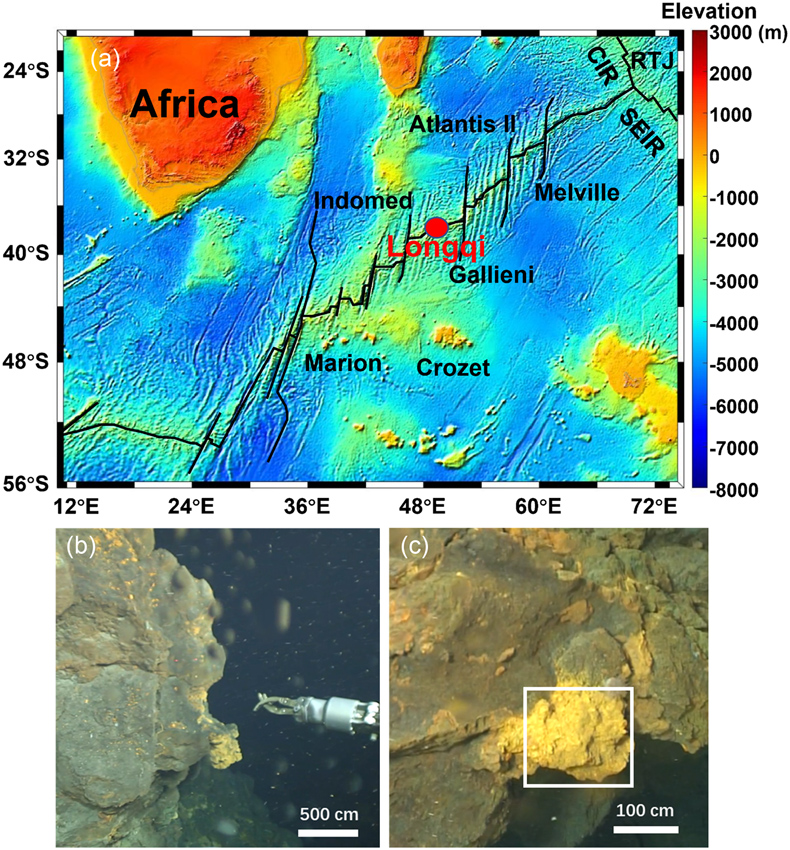
Figure 1 (a) The geotectonic setting and location of Longqi hydrothermal field. (b) Photo of sampling site that is away from active vent, and (c) the specific sampling point of the Fe-rich precipitates used in this study, with environmental pH (7.8–8.0) and temperature ranged from 50–60 °C (closer to vent) to 2–4 °C that is similar to ambient deep sea water.

Figure 2 The mass of Fe(II) (a, b) and total Fe (c, d), as well as the fraction of 57Fe in the aqueous, exchangeable (1 M MgCl2 extracted), and 0.5 M HCl extracted pools during the reaction in HEPES buffer (a, c, e) or artificial seawater (b, d, f). The dashed lines in (c)-(f) represent the mass or isotope balance. The overall Fe recovery rate was 91 ± 3 %. Each point represents the mean ± standard deviation of triplicate reactors. Where error bars are not visible, they are smaller than the symbols.
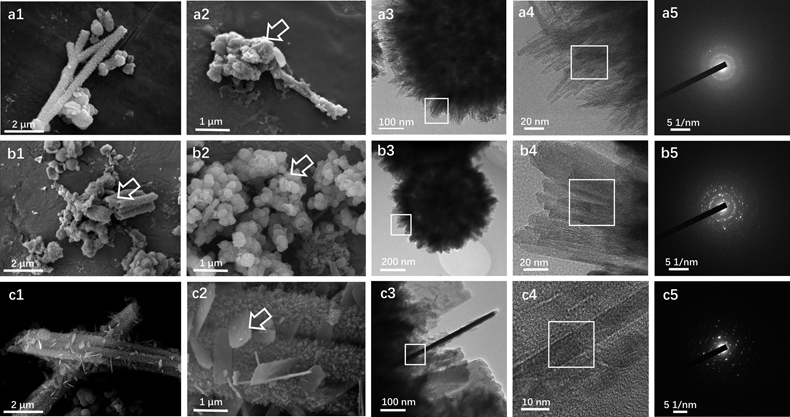
Figure 3 Images of typical mineral structures in the Fe-rich precipitates of the control group (a), treated with Fe(II) in HEPES buffer (b), and in artificial seawater (c). Columns 1 and 2 represent SEM images, 3 and 4 represent TEM images, and 5 represents the images of SAED. Arrows point to the specific feature discussed in the text. Squared area represents the focus of the following image.
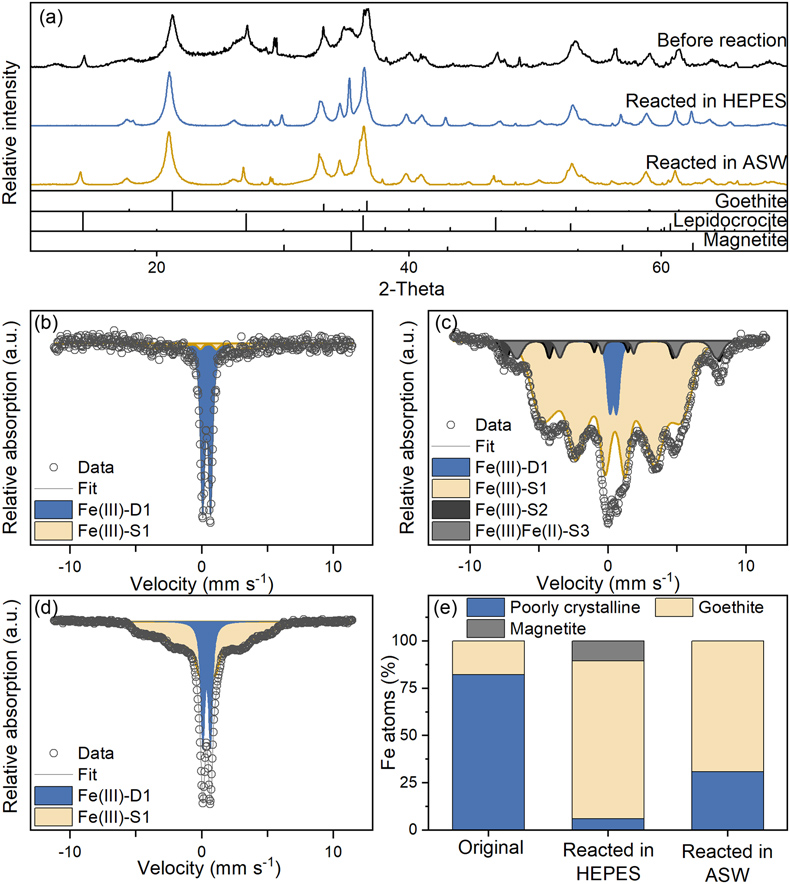
Figure 4 (a) X-ray diffraction patterns of Fe-rich precipitates before and after reaction with Fe(II)aq in HEPES buffer and artificial seawater; Mössbauer spectra of Fe-rich precipitates (b) before reaction; (c) reacted in HEPES buffer; and (d) reacted in artificial seawater. The spectra were collected at 295 K. (e) The estimated percent of Fe atoms in each phase based on Mössbauer spectrum and XRD patterns. Please note the Mössbauer spectra of poorly crystalline minerals (e.g., ferrihydrite, lepidocrocite) are difficult to resolve at room temperature, and a mixed phase of Fe(III)-D1 was introduced to constrain them.