



Eclogite xenoliths record a constant ocean oxygen isotope composition for 3 billion years
Affiliations | Corresponding Author | Cite as | Funding information
Published by the European Association of Geochemistry
under Creative Commons License CC BY-NC-ND 4.0
Keywords: eclogite xenolith, Archean ocean, altered oceanic crust, triple oxygen isotopes, mantle metasomatism


- Share this article


-
Article views:1,564Cumulative count of HTML views and PDF downloads.
- Download Citation
- Rights & Permissions

top
Abstract

Figures
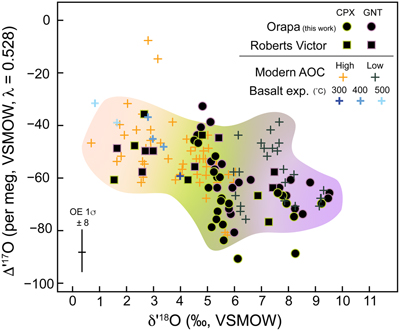 Figure 1 Δ′17O versus δ′18O modern natural and experimental altered ocean crust and ancient eclogite xenoliths. Eclogite garnet (black with purple outline) and clinopyroxene (black with green outline) mineral separate analyses are represented by the circles (Orapa: this work) and squares (Roberts Victor) (McGunnigle et al., 2022). The yellow and grey crosses (+) are the high and low temperature modern altered ocean crust samples, respectively. The modern field is outlined by the coloured region. Two sample replicates for one bulk rock analysis of AOC with high Δ′17O values were found to be very heterogeneous and are not included in the construction of the coloured region (note that two samples from IODP Hole 504B had similar values; Sengupta and Pack, 2018). The blue crosses are data from high temperature basalt-water equilibration experiments (McGunnigle et al., 2022). The Δ′17O 1σ uncertainty range is shown for the Orapa eclogite only and was calculated based on San Carlos olivine analyses (n = 25) for this work (Table S-1). The garnet and clinopyroxene triple oxygen isotope ranges are identical and overlap almost exactly with the modern AOC analyses. | 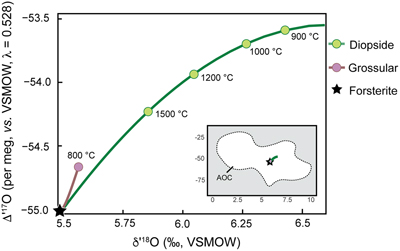 Figure 2 Δ′17O versus δ′18O triple oxygen isotope fractionation between olivine and eclogite mineral phases. Calculated theoretical equilibrium fractionation (Schauble and Young, 2021) between eclogite phases relative to mantle olivine with TOI values of δ′18O = 5.5 ‰, Δ′17O = −55 per meg (Cano et al., 2020). The greatest Δ′18O difference (δ′18Odiopside − δ′18Oforsterite) corresponding to equilibrium at 900 °C is only 1 ‰, and for grossular is <0.2 ‰. The inset shows these fractionations relative to the general range found in modern AOC and ancient eclogite xenoliths from this work. Equilibrium isotope fractionation cannot explain the variation of δ18O and Δ′17O values found in the eclogites. | 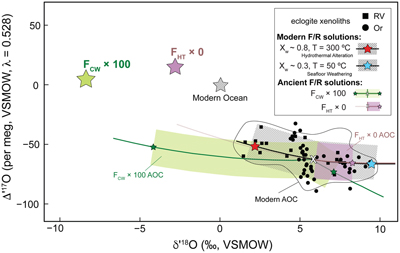 Figure 3 Closed system, fluid–rock model trajectories for modern MORB (X) altered by modern ocean water (δ′18O = 0 ‰, Δ′17O = 0 per meg, black crosshatched star) at low (50 °C) and high (300 °C) temperatures (see Supplementary Information, Section 5 for details). The modern AOC modelled variation is represented by the crosshatched region extending from X to a fluid–rock ratio (XW) of 0.8 for high and 0.3 for low temperature alteration. The solid black line and cross hatched region shows the range for measured AOC (McGunnigle et al., 2022). Each high and low temperature solution is used to solve the Δ′17O basalt-water apparent fractionations for hydrothermal alteration and seafloor weathering under two different model ocean compositions (McGunnigle et al., 2022): 1) Extreme continental weathering (FCW × 100, large green star); and 2) No high temperature hydrothermal alteration (FHT × 0, large purple star). The respective shaded region for each ocean composition represents the predicted ranges for AOC extrapolated to the same fluid–rock ratio as the modern one. The reduced range for HT × 0 is due to a lack of high temperature hydrothermal alteration that underlies this model. Ancient eclogite xenoliths from Orapa (Or) and Roberts Victor (RV) (black squares and circles) extend to a nearly identical range as modern AOC. These data cannot be explained from an δ′18O ocean value of −8 ‰ or −4 ‰ assuming the latter shift is due to a lack of high temperature ocean crust alteration. |
| Figure 1 | Figure 2 | Figure 3 |
top
Introduction
The oxygen isotope composition of the Earth’s Archean ocean has principally been interpreted through the oxygen isotope composition of sedimentary rocks. As a surficial sedimentary archive, Archean cherts offer a window into the past, but only if diagenesis during or after deposition has not overprinted the original seawater oxygen isotope signature. Significant oxygen isotope modification is seen in recent (Miocene to present) deep ocean silica (Ibarra et al., 2022
Ibarra, D.E., Yanchilina, A.G., Lloyd, M.K., Methner, K.A., Chamberlain, C.P., Yam, R., Shemesh, A., Stolper, D.A. (2022) Triple oxygen isotope systematics of diagenetic recrystallization of diatom opal-A to opal-CT to microquartz in deep sea sediments. Geochimica et Cosmochimica Acta 320, 304–323. https://doi.org/10.1016/j.gca.2021.11.027
; Tatzel et al., 2022Tatzel, M., Frings, P.J., Oelze, M., Herwartz, D., Lünsdorf, N.K., Wiedenbeck, M. (2022) Chert oxygen isotope ratios are driven by Earth’s thermal evolution. Proceedings of the National Academy of Sciences 119, e2213076119. https://doi.org/10.1073/pnas.2213076119
), but the trends do not match the Archean data, suggesting an alternative explanation. It remains unresolved as to whether the highest δ18Ochert values (or the least altered) (δ = (Rsam/Rstd − 1)1000 in per mille notation, R = 18O/16O ratio of sample or standard) reflect either an isotopically lower ocean than the present (up to 15 ‰) (Perry, 1967Perry Jr., E.C. (1967) The oxygen isotope chemistry of ancient cherts. Earth and Planetary Science Letters 3, 62–66. https://doi.org/10.1016/0012-821x(67)90012-x
) or a record of extremely hot seawater (>70 °C) (Lowe et al., 2020Lowe, D.R., Ibarra, D.E., Drabon, N., Chamberlain, C.P. (2020) Constraints on Surface Temperature 3.4 Billion Years Ago Based on Triple Oxygen Isotopes of Cherts From the Barberton Greenstone Belt, South Africa, and the Problem of Sample Selection. American Journal of Science 320, 790–814. https://doi.org/10.2475/11.2020.02
). Deciphering the conditions of the Archean ocean and its hydrologic implications for the Earth’s earliest rock record requires an independent proxy for either the δ18O or the temperature of ancient seawater that is not prone to the effects of diagenesis.top
Altered Oceanic Crust as a Proxy for Ancient Seawater δ18O
Unaltered ocean crust is emplaced at spreading centres as a stratified sequence of pillow basalts near the surface, underlain by sheeted dikes and gabbro with increasing depth. Hydrothermal alteration occurs both from a deep, high temperature hydrothermal interaction with seawater near the spreading centre and cold, off axis alteration on million year timescales. The final equilibrated whole rock δ18O value of the altered oceanic crust (AOC) is a function of the initial mid-ocean ridge basalt (MORB) and seawater δ18O values, as well as the temperature and degree of alteration (fluid/rock ratio). The oxygen isotope composition of fresh MORB has been constant through time (Mattey et al., 1994
Mattey, D., Lowry, D., Macpherson, C. (1994) Oxygen isotope composition of mantle peridotite. Earth and Planetary Science Letters 128, 231–241. https://doi.org/10.1016/0012-821X(94)90147-3
). The low (∼50 °C) and high (∼350 °C) temperatures of hydrothermal alteration have also remained constant through time (Staudigel, 2003Staudigel, H. (2003) 3.15 - Hydrothermal Alteration Processes in the Oceanic Crust. In: Holland, H.D., Turekian, K.K. (Eds.) Treatise on Geochemistry. First Edition, Elsevier, Amsterdam, 511–535. https://doi.org/10.1016/B0-08-043751-6/03032-2
). Therefore, any differences in the triple oxygen isotope fields between ancient and modern AOC is a direct measure of changes in the δ18O of seawater over geologic time.Due to the nature of subduction, the oldest existing oceanic lithosphere is around 200 Ma with older AOC preserved almost exclusively as obducted oceanic crust, known as ophiolite sequences. Exposures of Palaeoproterozoic (2.5 Ga) ophiolites generally have δ18O values that overlap with modern oceanic crust from the Deep Sea Drilling Program (DSDP) (Holmden and Muehlenbachs, 1993
Holmden, C., Muehlenbachs, K. (1993) The 18O/16O ratio of 2-Billion-Year-Old Seawater Inferred from Anicent Oceanic Crust. Science 259, 1733–1736. https://doi.org/10.1126/science.259.5102.1733
). Older, Archean-age hydrothermally altered mafic rocks are limited to greenstone belts which have a complicated emplacement and fluid alteration history (Gregory, 2003Gregory, R.T. (2003) Ophiolites and global geochemical cycles: Implications for the isotopic evolution of seawater. In: Dilek, Y., Robinson, P.T. (Eds.) Ophiolites in Earth History. Geological Society, London, Special Publication 218, 353–368. https://doi.org/10.1144/GSL.SP.2003.218.01.18
). The degree of diagenetic alteration, and therefore the possibility that obducted AOC sequences provide non-primary information, is uncertain.Xenolithic eclogites provide an attractive alternative to determining the Archean seawater δ18O value because they are thought to be subducted AOC (MacGregor and Manton, 1986
MacGregor, I.D., Manton, W.I. (1986) Roberts victor eclogites: Ancient oceanic crust. Journal of Geophysical Research: Solid Earth 91, 14063–14079. https://doi.org/10.1029/jb091ib14p14063
) that became metamorphosed to garnet- and omphacite-bearing rocks without significant isotopic modification. The eclogite xenolith record is especially relevant for interpreting the oldest oceanic lithosphere because most are of Archean age (Aulbach and Smart, 2023Aulbach, S., Smart, K.A. (2023) Petrogenesis and Geodynamic Significance of Xenolithic Eclogites. Annual Review of Earth and Planetary Sciences 51, 521–549. https://doi.org/10.1146/annurev-earth-031621-112904
), and isotopic preservation is generally supported because low fluid–rock ratios are likely to prevail within the cold and thick continental lithosphere. Modification has been suggested only from intense melt-rock interaction that is identified in a subset of samples from any given eclogite xenolith suite and that is easily identified using geochemical proxies (Aulbach et al., 2020Aulbach, S., Massuyeau, M., Garber, J.M., Gerdes, A., Heaman, L.M., Viljoen, K.S. (2020) Ultramafic Carbonated Melt- and Auto-Metasomatism in Mantle Eclogites: Compositional Effects and Geophysical Consequences. Geochemistry, Geophysics, Geosystems 21, e2019GC008774. https://doi.org/10.1029/2019GC008774
).top
The Overlapping Triple Oxygen Isotope Signature of Modern AOC and Ancient Eclogite Xenoliths
We report new triple oxygen isotope (TOI) values for Archean-age eclogite xenoliths from the Cretaceous Orapa kimberlite (2.99 ± 0.26 Ga) (Shirey et al., 2008
Shirey, S.B., Richardson, S.H., Harris, J.W. (2008) Mesoarchean to Mesoproterozoic Re-Os ages for sulfide inclusions in Orapa diamonds and implications for Kaapvaal-Zimbabwe craton development. International Kimberlite Conference: Extended Abstracts 9, 9IKC-A-00365. https://doi.org/10.29173/ikc3582
) located on the margin of the Zimbabwe Craton (Botswana). We measured pristine separates of garnet (n = 23) and clinopyroxene (n = 22) mineral pairs from the Orapa kimberlite mine (Table S-2). These data, combined with eclogite xenolith triple oxygen analyses from the proximal Roberts Victor kimberlite mine (2.7 ± 0.1 Ga) (Jagoutz et al., 1984Jagoutz, E., Dawson, J.B., Hoernes, S., Spettel, B., Wänke, H. (1984) Anorthositic Oceanic Crust in the Archean Earth. Lunar and Planetary Science XV 395–396 [abstract].
), located on the Kaapvaal Craton (South Africa), as well as modern AOC (McGunnigle et al., 2022McGunnigle, J.P., Cano, E.J., Sharp, Z.D., Muehlenbachs, K., Cole, D., Hardman, M.F., Stachel, T., Pearson, D.G. (2022) Triple oxygen isotope evidence for a hot Archean ocean. Geology 50, 991–995. https://doi.org/10.1130/G50230.1
), are shown in Figure 1. The eclogite δ18O and Δ′17O values range from 1.8 to 9.8 ‰ and −35 to −85 per meg, respectively. The combined triple oxygen isotope range of both ancient suites is identical to near modern AOC. If the eclogite xenoliths analysed here have retained their original near surface oxygen isotope signature, then they serve as a proxy for the oxygen isotope composition of ancient seawater. We show how the overlapping TOI signature of modern AOC and ancient eclogite xenoliths reflects no difference between the reconstructed Archean and modern ocean oxygen isotope compositions, and has three broadly important geologic consequences: 1) Eclogite xenoliths preserve a signature of Archean altered oceanic crust that underwent subduction and recycling back to the surface via kimberlite volcanism without modification; 2) The composition of ancient seawater was buffered by similar 18O fluxes relative to the modern hydrologic system on Earth (Muehlenbachs, 1998Muehlenbachs, K. (1998) The oxygen isotopic composition of the oceans, sediments and the seafloor. Chemical Geology 145, 263–273. https://doi.org/10.1016/S0009-2541(97)00147-2
); and 3) The oxygen isotope composition of Archean cherts records either a hot ancient ocean or diagenesis.Figure 1 Δ′17O versus δ′18O modern natural and experimental altered ocean crust and ancient eclogite xenoliths. Eclogite garnet (black with purple outline) and clinopyroxene (black with green outline) mineral separate analyses are represented by the circles (Orapa: this work) and squares (Roberts Victor) (McGunnigle et al., 2022
McGunnigle, J.P., Cano, E.J., Sharp, Z.D., Muehlenbachs, K., Cole, D., Hardman, M.F., Stachel, T., Pearson, D.G. (2022) Triple oxygen isotope evidence for a hot Archean ocean. Geology 50, 991–995. https://doi.org/10.1130/G50230.1
). The yellow and grey crosses (+) are the high and low temperature modern altered ocean crust samples, respectively. The modern field is outlined by the coloured region. Two sample replicates for one bulk rock analysis of AOC with high Δ′17O values were found to be very heterogeneous and are not included in the construction of the coloured region (note that two samples from IODP Hole 504B had similar values; Sengupta and Pack, 2018Sengupta, S., Pack, A. (2018) Triple oxygen isotope mass balance for the Earth’s oceans with application to Archean cherts. Chemical Geology 495, 18–26. https://doi.org/10.1016/j.chemgeo.2018.07.012
). The blue crosses are data from high temperature basalt-water equilibration experiments (McGunnigle et al., 2022McGunnigle, J.P., Cano, E.J., Sharp, Z.D., Muehlenbachs, K., Cole, D., Hardman, M.F., Stachel, T., Pearson, D.G. (2022) Triple oxygen isotope evidence for a hot Archean ocean. Geology 50, 991–995. https://doi.org/10.1130/G50230.1
). The Δ′17O 1σ uncertainty range is shown for the Orapa eclogite only and was calculated based on San Carlos olivine analyses (n = 25) for this work (Table S-1). The garnet and clinopyroxene triple oxygen isotope ranges are identical and overlap almost exactly with the modern AOC analyses.top
Possible Mantle Modification of the Eclogite Xenolith Record
The origins of eclogite xenoliths and their utility as a recorder of ancient AOC isotope values is an ongoing debate due to the susceptibility of fluid or melt alteration within the continental lithosphere. The overlapping TOI range of eclogite xenoliths with modern AOC is evidence of a surficial origin, primarily because large isotopic variations are representative of low temperature mineral-water fractionations only. The main argument against a surficial signature is mantle metasomatism (O’Reilly and Griffin, 2013
O’Reilly, S.Y., Griffin, W.L. (2013) Mantle Metasomatism. In: Harlov, D.E., Austrheim, H. (Eds.) Metasomatism and the Chemical Transformation of Rock: The Role of Fluids in Terrestrial and Extraterrestrial Processes. Springer-Verlag, Berlin Heidelberg, 471–534. https://doi.org/10.1007/978-3-642-28394-9_12
) or alteration by an externally derived fluid or melt prior to kimberlite entrainment. Two main ideas have evolved from mantle metasomatic studies. The first prescribes eclogite δ18O values greater than 5.5 ‰ as interaction with a mantle metasomatic agent sourced from subducted sediments (δ18Ofluid: +15 to +30 ‰) (Gréau et al., 2011Gréau, Y., Huang, J.-X., Griffin, W.L., Renac, C., Alard, O., O’Reilly, S.Y. (2011) Type I eclogites from Roberts Victor kimberlites: Products of extensive mantle metasomatism. Geochimica et Cosmochimica Acta 75, 6927–6954. https://doi.org/10.1016/j.gca.2011.08.035
). Alternatively, more recent studies of intense metasomatic modification by proto-kimberlite magmatism support a mantle-like oxygen isotope ‘overprinting’ (δ18Ofluid ∼ 5.5 ‰) on subordinate portions of the eclogite inventory for a given locality (Aulbach et al., 2020Aulbach, S., Massuyeau, M., Garber, J.M., Gerdes, A., Heaman, L.M., Viljoen, K.S. (2020) Ultramafic Carbonated Melt- and Auto-Metasomatism in Mantle Eclogites: Compositional Effects and Geophysical Consequences. Geochemistry, Geophysics, Geosystems 21, e2019GC008774. https://doi.org/10.1029/2019GC008774
).The eclogite xenolith record in this work exhibits a δ18O range both less than and greater than the canonical mantle value (Cano et al., 2020
Cano, E.J., Sharp, Z.D., Shearer, C.K. (2020) Distinct oxygen isotope compositions of the Earth and Moon. Nature Geoscience 13, 270–274. https://doi.org/10.1038/s41561-020-0550-0
). Surficial sedimentary sourced metasomatic fluids can only increase the δ18O value of eclogitic materials. Therefore, the isotopically low TOI values could then only be explained by a mantle metasomatism with isotopically low primordial mantle materials (δ18O < 5.5 ‰). This is not supported by Archean-age peridotitic diamond inclusions, which are shielded by their chemically inert hosts, and whose similarity with modern MORB infers a constant mantle O-isotope composition since their inception (>3 Ga) (Mattey et al., 1994Mattey, D., Lowry, D., Macpherson, C. (1994) Oxygen isotope composition of mantle peridotite. Earth and Planetary Science Letters 128, 231–241. https://doi.org/10.1016/0012-821X(94)90147-3
).High temperature isotope fractionations alone are too small to modify the δ18O and Δ′17O values of mantle minerals which have a TOI composition of roughly δ′18O = 5.5 ‰ and Δ′17O = −55 ± 5 per meg based on terrestrial basalt glasses and dunites (Cano et al., 2020
Cano, E.J., Sharp, Z.D., Shearer, C.K. (2020) Distinct oxygen isotope compositions of the Earth and Moon. Nature Geoscience 13, 270–274. https://doi.org/10.1038/s41561-020-0550-0
). We calculated the TOI fractionation between garnet (grossular), clinopyroxene (diopside) and olivine (forsterite) using theoretically determined fractionation factors (Schauble and Young, 2021Schauble, E.A., Young, E.D. (2021) Mass Dependence of Equilibrium Oxygen Isotope Fractionation in Carbonate, Nitrate, Oxide, Perchlorate, Phosphate, Silicate, and Sulfate Minerals. Reviews in Mineralogy and Geochemistry 86, 137–178. https://doi.org/10.2138/rmg.2021.86.04
). Even at the relatively ‘cold’ sublithospheric temperatures of 900 °C, the diopside–forsterite fractionation is only +1 ‰ for δ18O and +1.5 per meg for Δ17O, meaning that diopside will be slightly enriched in δ18O relative to forsterite, with a near constant Δ′17O (within analytical uncertainty) (Fig. 2). The grossular–forsterite fractionation is essentially 0 ‰ (within analytical uncertainty). Based on these calculations, mantle metasomatism is inefficient for generating the widespread oxygen isotopic heterogeneity found in eclogite xenoliths unless a metasomatic fluid with an exotic, non-mantle fluid is assumed. Rather, metasomatism homogenises the isotopic variation closer to the bulk composition of the mantle (Aulbach et al., 2020Aulbach, S., Massuyeau, M., Garber, J.M., Gerdes, A., Heaman, L.M., Viljoen, K.S. (2020) Ultramafic Carbonated Melt- and Auto-Metasomatism in Mantle Eclogites: Compositional Effects and Geophysical Consequences. Geochemistry, Geophysics, Geosystems 21, e2019GC008774. https://doi.org/10.1029/2019GC008774
). Because the purported sources of exotic fluids capable of mantle metasomatic alteration are surficial sedimentary melts, this hypothesis is only capable of explaining a portion of the eclogite inventory, those with δ18O values greater than 5.5 ‰. Despite mantle homogenisation, our combined data set remains representative of the entire modern range, suggesting isotopic preservation of altered oceanic crust within the subcontinental lithosphere throughout the multi-billion-year residence time and prevalent metasomatic alteration. While perhaps not intuitive, it is reasonable to conclude that subduction and metamorphism of oceanic crust is a good way of preserving the seawater alteration signature unobscured by diagenesis that affects the sedimentary record.Figure 2 Δ′17O versus δ′18O triple oxygen isotope fractionation between olivine and eclogite mineral phases. Calculated theoretical equilibrium fractionation (Schauble and Young, 2021
Schauble, E.A., Young, E.D. (2021) Mass Dependence of Equilibrium Oxygen Isotope Fractionation in Carbonate, Nitrate, Oxide, Perchlorate, Phosphate, Silicate, and Sulfate Minerals. Reviews in Mineralogy and Geochemistry 86, 137–178. https://doi.org/10.2138/rmg.2021.86.04
) between eclogite phases relative to mantle olivine with TOI values of δ′18O = 5.5 ‰, Δ′17O = −55 per meg (Cano et al., 2020Cano, E.J., Sharp, Z.D., Shearer, C.K. (2020) Distinct oxygen isotope compositions of the Earth and Moon. Nature Geoscience 13, 270–274. https://doi.org/10.1038/s41561-020-0550-0
). The greatest Δ′18O difference (δ′18Odiopside − δ′18Oforsterite) corresponding to equilibrium at 900 °C is only 1 ‰, and for grossular is <0.2 ‰. The inset shows these fractionations relative to the general range found in modern AOC and ancient eclogite xenoliths from this work. Equilibrium isotope fractionation cannot explain the variation of δ18O and Δ′17O values found in the eclogites.top
Comparing Ancient Eclogites to Modern AOC
The oxygen isotope composition of the ancient ocean is preserved in AOC and is represented by the eclogite xenolith record. Continuous seawater circulation imposes a distinct oxygen isotope signature upon the initially unaltered MORB, resulting in isotopic exchange that reflects either high temperature hydrothermal alteration or low temperature seafloor ‘weathering’ (Muehlenbachs, 1986
Muehlenbachs, K. (1986) Alteration of the Oceanic Crust and the 18O History of Seawater. Reviews in Mineralogy 16, 425–444. https://doi.org/10.1515/9781501508936-017
). Two juxtaposing results arise from this currently active seafloor process: an imprint of the δ18Oocean upon the altered crustal assemblage and a buffered δ18Oocean value controlled by water–rock interaction between the ocean and various 18O reservoirs present on Earth. Under this model, the composition of the ocean will remain at steady state so long as seafloor spreading persists, because the contribution of 18O from hydrothermally altered basalt serves as the greatest flux, offset by low temperature sinks from the oceans and continents (Muehlenbachs, 1998Muehlenbachs, K. (1998) The oxygen isotopic composition of the oceans, sediments and the seafloor. Chemical Geology 145, 263–273. https://doi.org/10.1016/S0009-2541(97)00147-2
).The oxygen isotope composition of a complete section of ocean crust, recognised from both modern drill cores and ancient ophiolite sections emphasises the geologic significance of subsurface seawater circulation (Gregory and Taylor, 1981
Gregory, R.T., Taylor Jr., H.P. (1981) An oxygen isotope profile in a section of Cretaceous oceanic crust, Samail Ophiolite, Oman: Evidence for δ18O buffering of the oceans by deep (>5 km) seawater-hydrothermal circulation at mid-ocean ridges. Journal of Geophysical Research: Solid Earth 86, 2737–2755. https://doi.org/10.1029/jb086ib04p02737
). To test the consistency of the buffered ocean paradigm in the Archean, the eclogite xenolith record is useful because the ancient triple oxygen isotope variation is fully analogous to the modern one, with virtually identical ranges in δ′18O and Δ′17O values. We therefore argue that the same processes buffering the current ocean were also active early in Earth’s geologic history despite alternative hypotheses, such as minimised rates of hydrothermal alteration (Kasting et al., 2006Kasting, J.F., Howard, M.T., Wallmann, K., Veizer, J., Shields, G., Jaffrés, J. (2006) Paleoclimates, ocean depth, and the oxygen isotopic composition of seawater. Earth and Planetary Science Letters 252, 82–93. https://doi.org/10.1016/j.epsl.2006.09.029
), closed system basalt-water exchange (Jaffrés et al., 2007Jaffrés, J.B.D., Shields, G.A., Wallmann, K. (2007) The oxygen isotope evolution of seawater: A critical review of a long-standing controversy and an improved geological water cycle model for the past 3.4 billion years. Earth-Science Reviews 83, 83–122. https://doi.org/10.1016/j.earscirev.2007.04.002
), and extreme rates of continental weathering, all of which have been proposed based on the low δ18Oocean estimates from sedimentary archives (Wallmann, 2001Wallmann, K. (2001) The geological water cycle and the evolution of marine δ18O values. Geochimica et Cosmochimica Acta 65, 2469–2485. https://doi.org/10.1016/S0016-7037(01)00603-2
). These ad hoc explanations for low or high ancient δ18O values of the ocean are not consistent with the near identical range of triple isotope values of ancient eclogites and modern AOC.To show that the Archean hydrological system operated similarly to the modern one, we used a closed system, fluid–rock exchange model to calculate and compare the expected triple oxygen isotope compositions of low and high temperature AOC that would be preserved in the eclogite xenolith record if the ocean oxygen isotope value was lower than the present. The triple isotope solution is resolvable by using the modern measured minimum and maximum δ′18O (high and low temperature) altered rocks and experimentally determined ‘apparent’ basalt-water fractionations (Δ18Obasalt-water) (Cole et al., 1987
Cole, D.R., Mottl, M.J., Ohmoto, H. (1987) Isotopic exchange in mineral-fluid systems. II. Oxygen and hydrogen isotopic investigation of the experimental basalt-seawater system. Geochimica et Cosmochimica Acta 51, 1523–1538. https://doi.org/10.1016/0016-7037(87)90334-6
) to calculate the water fractions (Xw). We extrapolated the latter unknown to solve the Δ17Obasalt-water apparent fractionations and applied our results using modelled triple oxygen isotope ocean compositions for the condition of 0 % hydrothermal alteration (HA × 0) and extreme continental weathering (CW × 100) (Fig. 3) (McGunnigle et al., 2022McGunnigle, J.P., Cano, E.J., Sharp, Z.D., Muehlenbachs, K., Cole, D., Hardman, M.F., Stachel, T., Pearson, D.G. (2022) Triple oxygen isotope evidence for a hot Archean ocean. Geology 50, 991–995. https://doi.org/10.1130/G50230.1
). Each seawater solution has its own unique altered oceanic crust signature that is not consistent with the xenolith record. Our calculations show that the HA × 0 AOC solution, which only consists of low temperature ‘weathered’ crust, has a minimal TOI range, while the CW × 100 AOC solution extends far beyond the modern trajectory, with negative δ′18O values. Neither low δ′18Oocean model prediction can explain the Archean eclogite signature in this work, leaving the explanation of a 0 ± 2 ‰ δ18O Archean ocean as the only plausible explanation for the eclogite triple isotope data.Figure 3 Closed system, fluid–rock model trajectories for modern MORB (X) altered by modern ocean water (δ′18O = 0 ‰, Δ′17O = 0 per meg, black crosshatched star) at low (50 °C) and high (300 °C) temperatures (see Supplementary Information, Section 5 for details). The modern AOC modelled variation is represented by the crosshatched region extending from X to a fluid–rock ratio (XW) of 0.8 for high and 0.3 for low temperature alteration. The solid black line and cross hatched region shows the range for measured AOC (McGunnigle et al., 2022
McGunnigle, J.P., Cano, E.J., Sharp, Z.D., Muehlenbachs, K., Cole, D., Hardman, M.F., Stachel, T., Pearson, D.G. (2022) Triple oxygen isotope evidence for a hot Archean ocean. Geology 50, 991–995. https://doi.org/10.1130/G50230.1
). Each high and low temperature solution is used to solve the Δ′17O basalt-water apparent fractionations for hydrothermal alteration and seafloor weathering under two different model ocean compositions (McGunnigle et al., 2022McGunnigle, J.P., Cano, E.J., Sharp, Z.D., Muehlenbachs, K., Cole, D., Hardman, M.F., Stachel, T., Pearson, D.G. (2022) Triple oxygen isotope evidence for a hot Archean ocean. Geology 50, 991–995. https://doi.org/10.1130/G50230.1
): 1) Extreme continental weathering (FCW × 100, large green star); and 2) No high temperature hydrothermal alteration (FHT × 0, large purple star). The respective shaded region for each ocean composition represents the predicted ranges for AOC extrapolated to the same fluid–rock ratio as the modern one. The reduced range for HT × 0 is due to a lack of high temperature hydrothermal alteration that underlies this model. Ancient eclogite xenoliths from Orapa (Or) and Roberts Victor (RV) (black squares and circles) extend to a nearly identical range as modern AOC. These data cannot be explained from an δ′18O ocean value of −8 ‰ or −4 ‰ assuming the latter shift is due to a lack of high temperature ocean crust alteration.top
Conclusions
This work provides a significant amendment to the Archean ocean oxygen isotope record by comparing the indifferent triple oxygen isotope composition of near modern altered oceanic crust and ancient eclogite xenoliths. The resemblance suggests the ocean’s δ′18O-Δ′17O composition has remained constant through time, preserving a signature of Earth’s hydrological evolution that persisted in a similar manner for the past three billion years. Establishing that the oxygen isotope composition of the Archean ocean was like the modern one reduces the interpretations for the low δ18O values of Archean cherts to either 1) a hot Archean ocean, or 2) post-depositional diagenesis. Conversely, an isotopically light ocean with temperatures similar to the modern is not compatible with the eclogite record presented here.
top
Acknowledgements
We would like to acknowledge NSF EAR-1903852 for funding this project; Graham Pearson, Erick Cano, Tony Gargano, and Jordan Wostbrock for data interpretation; Karen Ziegler, Erick Cano and Jesse McGunnigle for assisting in training on the fluorination line; and Viorel Atudorei, Laura Burkemper and Chris Anderson for maintaining laboratory equipment in the Center for Stable Isotopes (CSI) at the University of New Mexico.
Editor: Ambre Luguet
top
References
Aulbach, S., Massuyeau, M., Garber, J.M., Gerdes, A., Heaman, L.M., Viljoen, K.S. (2020) Ultramafic Carbonated Melt- and Auto-Metasomatism in Mantle Eclogites: Compositional Effects and Geophysical Consequences. Geochemistry, Geophysics, Geosystems 21, e2019GC008774. https://doi.org/10.1029/2019GC008774
 Show in context
 Modification has been suggested only from intense melt-rock interaction that is identified in a subset of samples from any given eclogite xenolith suite and that is easily identified using geochemical proxies (Aulbach et al., 2020).
View in article
Alternatively, more recent studies of intense metasomatic modification by proto-kimberlite magmatism support a mantle-like oxygen isotope ‘overprinting’ (δ18Ofluid ∼ 5.5 ‰) on subordinate portions of the eclogite inventory for a given locality (Aulbach et al., 2020).
View in article
Rather, metasomatism homogenises the isotopic variation closer to the bulk composition of the mantle (Aulbach et al., 2020).
View in article
Aulbach, S., Smart, K.A. (2023) Petrogenesis and Geodynamic Significance of Xenolithic Eclogites. Annual Review of Earth and Planetary Sciences 51, 521–549. https://doi.org/10.1146/annurev-earth-031621-112904
Show in context The eclogite xenolith record is especially relevant for interpreting the oldest oceanic lithosphere because most are of Archean age (Aulbach and Smart, 2023), and isotopic preservation is generally supported because low fluid–rock ratios are likely to prevail within the cold and thick continental lithosphere.
View in article
Cano, E.J., Sharp, Z.D., Shearer, C.K. (2020) Distinct oxygen isotope compositions of the Earth and Moon. Nature Geoscience 13, 270–274. https://doi.org/10.1038/s41561-020-0550-0
Show in context The eclogite xenolith record in this work exhibits a δ18O range both less than and greater than the canonical mantle value (Cano et al., 2020).
View in article
High temperature isotope fractionations alone are too small to modify the δ18O and Δ′17O values of mantle minerals which have a TOI composition of roughly δ′18O = 5.5 ‰ and Δ′17O = −55 ± 5 per meg based on terrestrial basalt glasses and dunites (Cano et al., 2020).
View in article
Calculated theoretical equilibrium fractionation (Schauble and Young, 2021) between eclogite phases relative to mantle olivine with TOI values of δ′18O = 5.5 ‰, Δ′17O = −55 per meg (Cano et al., 2020).
View in article
Cole, D.R., Mottl, M.J., Ohmoto, H. (1987) Isotopic exchange in mineral-fluid systems. II. Oxygen and hydrogen isotopic investigation of the experimental basalt-seawater system. Geochimica et Cosmochimica Acta 51, 1523–1538. https://doi.org/10.1016/0016-7037(87)90334-6
Show in context The triple isotope solution is resolvable by using the modern measured minimum and maximum δ′18O (high and low temperature) altered rocks and experimentally determined ‘apparent’ basalt-water fractionations (Δ18Obasalt-water) (Cole et al., 1987) to calculate the water fractions (Xw).
View in article
Gréau, Y., Huang, J.-X., Griffin, W.L., Renac, C., Alard, O., O’Reilly, S.Y. (2011) Type I eclogites from Roberts Victor kimberlites: Products of extensive mantle metasomatism. Geochimica et Cosmochimica Acta 75, 6927–6954. https://doi.org/10.1016/j.gca.2011.08.035
Show in context The first prescribes eclogite δ18O values greater than 5.5 ‰ as interaction with a mantle metasomatic agent sourced from subducted sediments (δ18Ofluid: +15 to +30 ‰) (Gréau et al., 2011).
View in article
Gregory, R.T. (2003) Ophiolites and global geochemical cycles: Implications for the isotopic evolution of seawater. In: Dilek, Y., Robinson, P.T. (Eds.) Ophiolites in Earth History. Geological Society, London, Special Publication 218, 353–368. https://doi.org/10.1144/GSL.SP.2003.218.01.18
Show in context Older, Archean-age hydrothermally altered mafic rocks are limited to greenstone belts which have a complicated emplacement and fluid alteration history (Gregory, 2003).
View in article
Gregory, R.T., Taylor Jr., H.P. (1981) An oxygen isotope profile in a section of Cretaceous oceanic crust, Samail Ophiolite, Oman: Evidence for δ18O buffering of the oceans by deep (>5 km) seawater-hydrothermal circulation at mid-ocean ridges. Journal of Geophysical Research: Solid Earth 86, 2737–2755. https://doi.org/10.1029/jb086ib04p02737
Show in context The oxygen isotope composition of a complete section of ocean crust, recognised from both modern drill cores and ancient ophiolite sections emphasises the geologic significance of subsurface seawater circulation (Gregory and Taylor, 1981).
View in article
Holmden, C., Muehlenbachs, K. (1993) The 18O/16O ratio of 2-Billion-Year-Old Seawater Inferred from Anicent Oceanic Crust. Science 259, 1733–1736. https://doi.org/10.1126/science.259.5102.1733
Show in context Exposures of Palaeoproterozoic (2.5 Ga) ophiolites generally have δ18O values that overlap with modern oceanic crust from the Deep Sea Drilling Program (DSDP) (Holmden and Muehlenbachs, 1993).
View in article
Ibarra, D.E., Yanchilina, A.G., Lloyd, M.K., Methner, K.A., Chamberlain, C.P., Yam, R., Shemesh, A., Stolper, D.A. (2022) Triple oxygen isotope systematics of diagenetic recrystallization of diatom opal-A to opal-CT to microquartz in deep sea sediments. Geochimica et Cosmochimica Acta 320, 304–323. https://doi.org/10.1016/j.gca.2021.11.027
Show in context Significant oxygen isotope modification is seen in recent (Miocene to present) deep ocean silica (Ibarra et al., 2022; Tatzel et al., 2022), but the trends do not match the Archean data, suggesting an alternative explanation.
View in article
Jaffrés, J.B.D., Shields, G.A., Wallmann, K. (2007) The oxygen isotope evolution of seawater: A critical review of a long-standing controversy and an improved geological water cycle model for the past 3.4 billion years. Earth-Science Reviews 83, 83–122. https://doi.org/10.1016/j.earscirev.2007.04.002
Show in context We therefore argue that the same processes buffering the current ocean were also active early in Earth’s geologic history despite alternative hypotheses, such as minimised rates of hydrothermal alteration (Kasting et al., 2006), closed system basalt-water exchange (Jaffrés et al., 2007), and extreme rates of continental weathering, all of which have been proposed based on the low δ18Oocean estimates from sedimentary archives (Wallmann, 2001).
View in article
Jagoutz, E., Dawson, J.B., Hoernes, S., Spettel, B., Wänke, H. (1984) Anorthositic Oceanic Crust in the Archean Earth. Lunar and Planetary Science XV 395–396 [abstract].
Show in context These data, combined with eclogite xenolith triple oxygen analyses from the proximal Roberts Victor kimberlite mine (2.7 ± 0.1 Ga) (Jagoutz et al., 1984), located on the Kaapvaal Craton (South Africa), as well as modern AOC (McGunnigle et al., 2022), are shown in Figure 1.
View in article
Kasting, J.F., Howard, M.T., Wallmann, K., Veizer, J., Shields, G., Jaffrés, J. (2006) Paleoclimates, ocean depth, and the oxygen isotopic composition of seawater. Earth and Planetary Science Letters 252, 82–93. https://doi.org/10.1016/j.epsl.2006.09.029
Show in context We therefore argue that the same processes buffering the current ocean were also active early in Earth’s geologic history despite alternative hypotheses, such as minimised rates of hydrothermal alteration (Kasting et al., 2006), closed system basalt-water exchange (Jaffrés et al., 2007), and extreme rates of continental weathering, all of which have been proposed based on the low δ18Oocean estimates from sedimentary archives (Wallmann, 2001).
View in article
Lowe, D.R., Ibarra, D.E., Drabon, N., Chamberlain, C.P. (2020) Constraints on Surface Temperature 3.4 Billion Years Ago Based on Triple Oxygen Isotopes of Cherts From the Barberton Greenstone Belt, South Africa, and the Problem of Sample Selection. American Journal of Science 320, 790–814. https://doi.org/10.2475/11.2020.02
Show in context It remains unresolved as to whether the highest δ18Ochert values (or the least altered) (δ = (Rsam/Rstd − 1)1000 in per mille notation, R = 18O/16O ratio of sample or standard) reflect either an isotopically lower ocean than the present (up to 15 ‰) (Perry, 1967) or a record of extremely hot seawater (>70 °C) (Lowe et al., 2020).
View in article
MacGregor, I.D., Manton, W.I. (1986) Roberts victor eclogites: Ancient oceanic crust. Journal of Geophysical Research: Solid Earth 91, 14063–14079. https://doi.org/10.1029/jb091ib14p14063
Show in context Xenolithic eclogites provide an attractive alternative to determining the Archean seawater δ18O value because they are thought to be subducted AOC (MacGregor and Manton, 1986) that became metamorphosed to garnet- and omphacite-bearing rocks without significant isotopic modification.
View in article
Mattey, D., Lowry, D., Macpherson, C. (1994) Oxygen isotope composition of mantle peridotite. Earth and Planetary Science Letters 128, 231–241. https://doi.org/10.1016/0012-821X(94)90147-3
Show in context The oxygen isotope composition of fresh MORB has been constant through time (Mattey et al., 1994).
View in article
This is not supported by Archean-age peridotitic diamond inclusions, which are shielded by their chemically inert hosts, and whose similarity with modern MORB infers a constant mantle O-isotope composition since their inception (>3 Ga) (Mattey et al., 1994).
View in article
McGunnigle, J.P., Cano, E.J., Sharp, Z.D., Muehlenbachs, K., Cole, D., Hardman, M.F., Stachel, T., Pearson, D.G. (2022) Triple oxygen isotope evidence for a hot Archean ocean. Geology 50, 991–995. https://doi.org/10.1130/G50230.1
Show in context These data, combined with eclogite xenolith triple oxygen analyses from the proximal Roberts Victor kimberlite mine (2.7 ± 0.1 Ga) (Jagoutz et al., 1984), located on the Kaapvaal Craton (South Africa), as well as modern AOC (McGunnigle et al., 2022), are shown in Figure 1.
View in article
Eclogite garnet (black with purple outline) and clinopyroxene (black with green outline) mineral separate analyses are represented by the circles (Orapa: this work) and squares (Roberts Victor) (McGunnigle et al., 2022).
View in article
The blue crosses are data from high temperature basalt-water equilibration experiments (McGunnigle et al., 2022).
View in article
We extrapolated the latter unknown to solve the Δ17Obasalt-water apparent fractionations and applied our results using modelled triple oxygen isotope ocean compositions for the condition of 0 % hydrothermal alteration (HA × 0) and extreme continental weathering (CW × 100) (Fig. 3) (McGunnigle et al., 2022).
View in article
The solid black line and cross hatched region shows the range for measured AOC (McGunnigle et al., 2022).
View in article
Each high and low temperature solution is used to solve the Δ′17O basalt-water apparent fractionations for hydrothermal alteration and seafloor weathering under two different model ocean compositions (McGunnigle et al., 2022): 1) Extreme continental weathering (FCW × 100, large green star); and 2) No high temperature hydrothermal alteration (FHT × 0, large purple star).
View in article
Muehlenbachs, K. (1986) Alteration of the Oceanic Crust and the 18O History of Seawater. Reviews in Mineralogy 16, 425–444. https://doi.org/10.1515/9781501508936-017
Show in context Continuous seawater circulation imposes a distinct oxygen isotope signature upon the initially unaltered MORB, resulting in isotopic exchange that reflects either high temperature hydrothermal alteration or low temperature seafloor ‘weathering’ (Muehlenbachs, 1986).
View in article
Muehlenbachs, K. (1998) The oxygen isotopic composition of the oceans, sediments and the seafloor. Chemical Geology 145, 263–273. https://doi.org/10.1016/S0009-2541(97)00147-2
Show in context We show how the overlapping TOI signature of modern AOC and ancient eclogite xenoliths reflects no difference between the reconstructed Archean and modern ocean oxygen isotope compositions, and has three broadly important geologic consequences: 1) Eclogite xenoliths preserve a signature of Archean altered oceanic crust that underwent subduction and recycling back to the surface via kimberlite volcanism without modification; 2) The composition of ancient seawater was buffered by similar 18O fluxes relative to the modern hydrologic system on Earth (Muehlenbachs, 1998); and 3) The oxygen isotope composition of Archean cherts records either a hot ancient ocean or diagenesis.
View in article
Under this model, the composition of the ocean will remain at steady state so long as seafloor spreading persists, because the contribution of 18O from hydrothermally altered basalt serves as the greatest flux, offset by low temperature sinks from the oceans and continents (Muehlenbachs, 1998).
View in article
O’Reilly, S.Y., Griffin, W.L. (2013) Mantle Metasomatism. In: Harlov, D.E., Austrheim, H. (Eds.) Metasomatism and the Chemical Transformation of Rock: The Role of Fluids in Terrestrial and Extraterrestrial Processes. Springer-Verlag, Berlin Heidelberg, 471–534. https://doi.org/10.1007/978-3-642-28394-9_12
Show in context The main argument against a surficial signature is mantle metasomatism (O’Reilly and Griffin, 2013) or alteration by an externally derived fluid or melt prior to kimberlite entrainment.
View in article
Perry Jr., E.C. (1967) The oxygen isotope chemistry of ancient cherts. Earth and Planetary Science Letters 3, 62–66. https://doi.org/10.1016/0012-821x(67)90012-x
Show in context It remains unresolved as to whether the highest δ18Ochert values (or the least altered) (δ = (Rsam/Rstd − 1)1000 in per mille notation, R = 18O/16O ratio of sample or standard) reflect either an isotopically lower ocean than the present (up to 15 ‰) (Perry, 1967) or a record of extremely hot seawater (>70 °C) (Lowe et al., 2020).
View in article
Schauble, E.A., Young, E.D. (2021) Mass Dependence of Equilibrium Oxygen Isotope Fractionation in Carbonate, Nitrate, Oxide, Perchlorate, Phosphate, Silicate, and Sulfate Minerals. Reviews in Mineralogy and Geochemistry 86, 137–178. https://doi.org/10.2138/rmg.2021.86.04
Show in context We calculated the TOI fractionation between garnet (grossular), clinopyroxene (diopside) and olivine (forsterite) using theoretically determined fractionation factors (Schauble and Young, 2021).
View in article
Calculated theoretical equilibrium fractionation (Schauble and Young, 2021) between eclogite phases relative to mantle olivine with TOI values of δ′18O = 5.5 ‰, Δ′17O = −55 per meg (Cano et al., 2020).
View in article
Sengupta, S., Pack, A. (2018) Triple oxygen isotope mass balance for the Earth’s oceans with application to Archean cherts. Chemical Geology 495, 18–26. https://doi.org/10.1016/j.chemgeo.2018.07.012
Show in context Two sample replicates for one bulk rock analysis of AOC with high Δ′17O values were found to be very heterogeneous and are not included in the construction of the coloured region (note that two samples from IODP Hole 504B had similar values; Sengupta and Pack, 2018).
View in article
Shirey, S.B., Richardson, S.H., Harris, J.W. (2008) Mesoarchean to Mesoproterozoic Re-Os ages for sulfide inclusions in Orapa diamonds and implications for Kaapvaal-Zimbabwe craton development. International Kimberlite Conference: Extended Abstracts 9, 9IKC-A-00365. https://doi.org/10.29173/ikc3582
Show in context We report new triple oxygen isotope (TOI) values for Archean-age eclogite xenoliths from the Cretaceous Orapa kimberlite (2.99 ± 0.26 Ga) (Shirey et al., 2008) located on the margin of the Zimbabwe Craton (Botswana).
View in article
Staudigel, H. (2003) 3.15 - Hydrothermal Alteration Processes in the Oceanic Crust. In: Holland, H.D., Turekian, K.K. (Eds.) Treatise on Geochemistry. First Edition, Elsevier, Amsterdam, 511–535. https://doi.org/10.1016/B0-08-043751-6/03032-2
Show in context The low (∼50 °C) and high (∼350 °C) temperatures of hydrothermal alteration have also remained constant through time (Staudigel, 2003).
View in article
Tatzel, M., Frings, P.J., Oelze, M., Herwartz, D., Lünsdorf, N.K., Wiedenbeck, M. (2022) Chert oxygen isotope ratios are driven by Earth’s thermal evolution. Proceedings of the National Academy of Sciences 119, e2213076119. https://doi.org/10.1073/pnas.2213076119
Show in context Significant oxygen isotope modification is seen in recent (Miocene to present) deep ocean silica (Ibarra et al., 2022; Tatzel et al., 2022), but the trends do not match the Archean data, suggesting an alternative explanation.
View in article
Wallmann, K. (2001) The geological water cycle and the evolution of marine δ18O values. Geochimica et Cosmochimica Acta 65, 2469–2485. https://doi.org/10.1016/S0016-7037(01)00603-2
Show in context We therefore argue that the same processes buffering the current ocean were also active early in Earth’s geologic history despite alternative hypotheses, such as minimised rates of hydrothermal alteration (Kasting et al., 2006), closed system basalt-water exchange (Jaffrés et al., 2007), and extreme rates of continental weathering, all of which have been proposed based on the low δ18Oocean estimates from sedimentary archives (Wallmann, 2001).
View in article
top
Supplementary Information
The Supplementary Information includes:
- Triple Oxygen Isotope Systematics
- Methods
- Sample Background
- Theoretical High Temperature Triple Oxygen Isotope Fractionation Calculations
- Closed-system Fluid-rock Modelling of Altered Ocean Crust
- Supplementary Tables S-1 to S-3
- Supplementary Figures S-1 and S-2
- Supplementary Information References
Download the Supplementary Information (PDF)
Figures
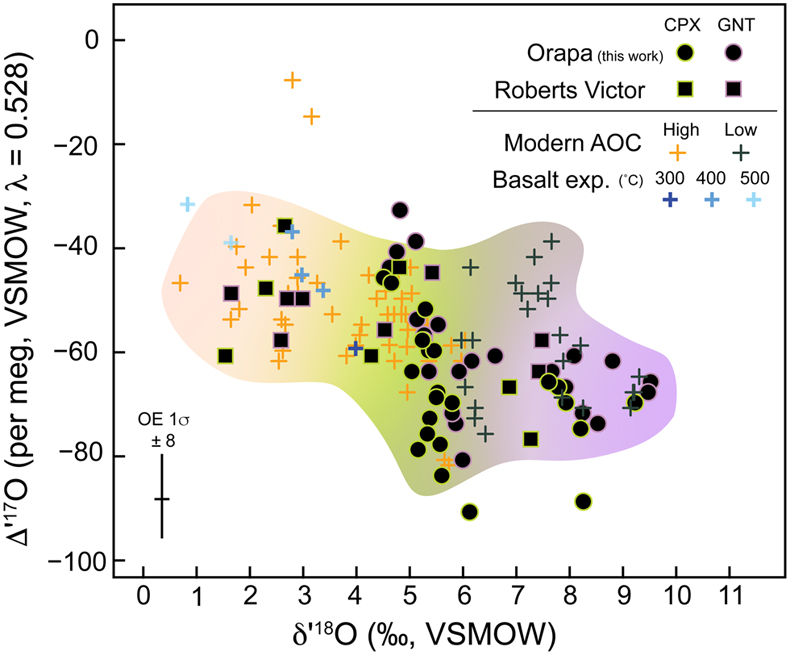
Figure 1 Δ′17O versus δ′18O modern natural and experimental altered ocean crust and ancient eclogite xenoliths. Eclogite garnet (black with purple outline) and clinopyroxene (black with green outline) mineral separate analyses are represented by the circles (Orapa: this work) and squares (Roberts Victor) (McGunnigle et al., 2022
McGunnigle, J.P., Cano, E.J., Sharp, Z.D., Muehlenbachs, K., Cole, D., Hardman, M.F., Stachel, T., Pearson, D.G. (2022) Triple oxygen isotope evidence for a hot Archean ocean. Geology 50, 991–995. https://doi.org/10.1130/G50230.1
). The yellow and grey crosses (+) are the high and low temperature modern altered ocean crust samples, respectively. The modern field is outlined by the coloured region. Two sample replicates for one bulk rock analysis of AOC with high Δ′17O values were found to be very heterogeneous and are not included in the construction of the coloured region (note that two samples from IODP Hole 504B had similar values; Sengupta and Pack, 2018Sengupta, S., Pack, A. (2018) Triple oxygen isotope mass balance for the Earth’s oceans with application to Archean cherts. Chemical Geology 495, 18–26. https://doi.org/10.1016/j.chemgeo.2018.07.012
). The blue crosses are data from high temperature basalt-water equilibration experiments (McGunnigle et al., 2022McGunnigle, J.P., Cano, E.J., Sharp, Z.D., Muehlenbachs, K., Cole, D., Hardman, M.F., Stachel, T., Pearson, D.G. (2022) Triple oxygen isotope evidence for a hot Archean ocean. Geology 50, 991–995. https://doi.org/10.1130/G50230.1
). The Δ′17O 1σ uncertainty range is shown for the Orapa eclogite only and was calculated based on San Carlos olivine analyses (n = 25) for this work (Table S-1). The garnet and clinopyroxene triple oxygen isotope ranges are identical and overlap almost exactly with the modern AOC analyses.
Figure 2 Δ′17O versus δ′18O triple oxygen isotope fractionation between olivine and eclogite mineral phases. Calculated theoretical equilibrium fractionation (Schauble and Young, 2021
Schauble, E.A., Young, E.D. (2021) Mass Dependence of Equilibrium Oxygen Isotope Fractionation in Carbonate, Nitrate, Oxide, Perchlorate, Phosphate, Silicate, and Sulfate Minerals. Reviews in Mineralogy and Geochemistry 86, 137–178. https://doi.org/10.2138/rmg.2021.86.04
) between eclogite phases relative to mantle olivine with TOI values of δ′18O = 5.5 ‰, Δ′17O = −55 per meg (Cano et al., 2020Cano, E.J., Sharp, Z.D., Shearer, C.K. (2020) Distinct oxygen isotope compositions of the Earth and Moon. Nature Geoscience 13, 270–274. https://doi.org/10.1038/s41561-020-0550-0
). The greatest Δ′18O difference (δ′18Odiopside − δ′18Oforsterite) corresponding to equilibrium at 900 °C is only 1 ‰, and for grossular is <0.2 ‰. The inset shows these fractionations relative to the general range found in modern AOC and ancient eclogite xenoliths from this work. Equilibrium isotope fractionation cannot explain the variation of δ18O and Δ′17O values found in the eclogites.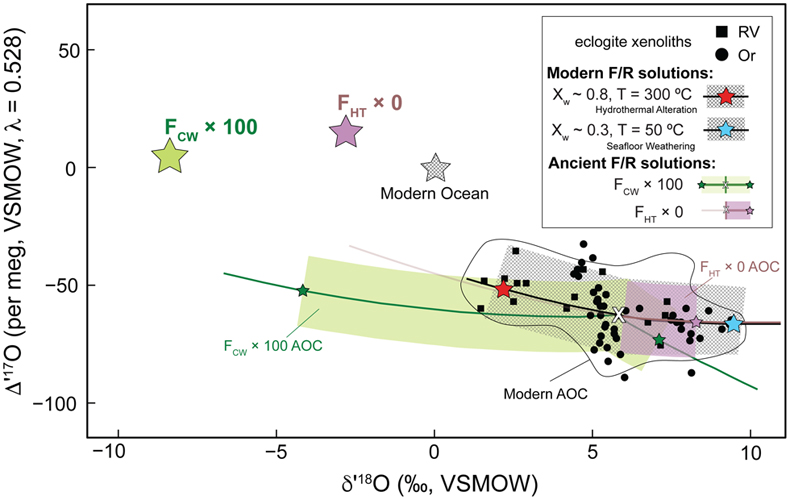
Figure 3 Closed system, fluid–rock model trajectories for modern MORB (X) altered by modern ocean water (δ′18O = 0 ‰, Δ′17O = 0 per meg, black crosshatched star) at low (50 °C) and high (300 °C) temperatures (see Supplementary Information, Section 5 for details). The modern AOC modelled variation is represented by the crosshatched region extending from X to a fluid–rock ratio (XW) of 0.8 for high and 0.3 for low temperature alteration. The solid black line and cross hatched region shows the range for measured AOC (McGunnigle et al., 2022
McGunnigle, J.P., Cano, E.J., Sharp, Z.D., Muehlenbachs, K., Cole, D., Hardman, M.F., Stachel, T., Pearson, D.G. (2022) Triple oxygen isotope evidence for a hot Archean ocean. Geology 50, 991–995. https://doi.org/10.1130/G50230.1
). Each high and low temperature solution is used to solve the Δ′17O basalt-water apparent fractionations for hydrothermal alteration and seafloor weathering under two different model ocean compositions (McGunnigle et al., 2022McGunnigle, J.P., Cano, E.J., Sharp, Z.D., Muehlenbachs, K., Cole, D., Hardman, M.F., Stachel, T., Pearson, D.G. (2022) Triple oxygen isotope evidence for a hot Archean ocean. Geology 50, 991–995. https://doi.org/10.1130/G50230.1
): 1) Extreme continental weathering (FCW × 100, large green star); and 2) No high temperature hydrothermal alteration (FHT × 0, large purple star). The respective shaded region for each ocean composition represents the predicted ranges for AOC extrapolated to the same fluid–rock ratio as the modern one. The reduced range for HT × 0 is due to a lack of high temperature hydrothermal alteration that underlies this model. Ancient eclogite xenoliths from Orapa (Or) and Roberts Victor (RV) (black squares and circles) extend to a nearly identical range as modern AOC. These data cannot be explained from an δ′18O ocean value of −8 ‰ or −4 ‰ assuming the latter shift is due to a lack of high temperature ocean crust alteration.