



Halogens in proto-Iceland plume basalts
Affiliations | Corresponding Author | Cite as | Funding information
Published by the European Association of Geochemistry
under Creative Commons License CC BY-NC-ND 4.0
Keywords: Halogens, mantle, Baffin Island, West Greenland, basalt


- Share this article


-
Article views:1,354Cumulative count of HTML views and PDF downloads.
- Download Citation
- Rights & Permissions

top
Abstract

Figures and Tables
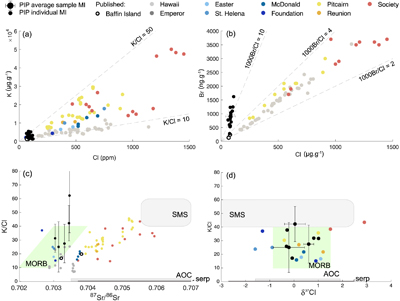 Figure 1 Compositions of the melt inclusions in PIP basalt olivine compared to glasses from depleted (grey; Broadley et al., 2019; Kendrick et al., 2025), EM-type (warm colours; Stroncik and Haase, 2004; John et al., 2010) and HIMU (blues; Stroncik and Haase, 2004; John et al., 2010; Kendrick et al., 2014) basalts. MORB (green field) is from Kendrick et al. (2017). Data sources for average SMS (subducted marine sediments), AOC (altered oceanic crust) and serpentinite fields are provided in Table S-4. | 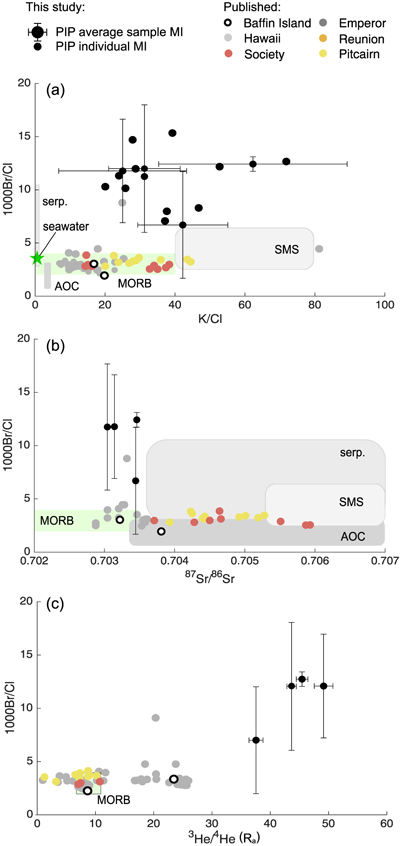 Figure 2 Composition of melt inclusions in PIP olivines compared to depleted (grey), EM-type (warm colours) and HIMU (blues) OIB and to MORB (green field). Date sources as in Figure 1. | 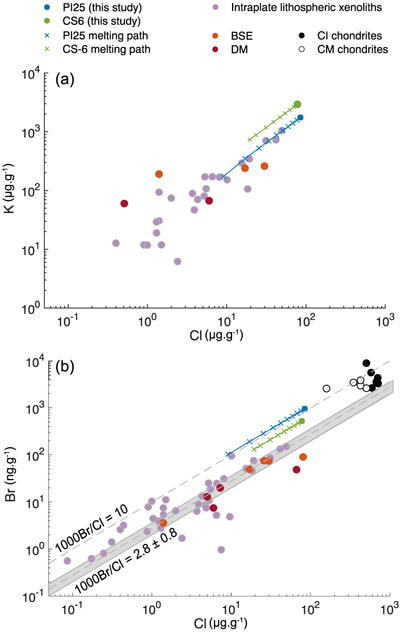 Figure 3 Calculated accumulated fractional melting path yielding the melt seen in N-type (PI-25), and E-type (CS-6) PIP basalts, shown in increments of F = 0.1 from 0.1 (PI-25) and 0.25 (CS-6). Compared to estimates for DM, BSE and to peridotite xenoliths from intraplate settings and to CI- and CM-chondrites (Table S-6). |  Table 1 Average composition of PIP melt inclusions. $Emplacement information from Lass-Evans (2004) and Pedersen et al. (2017); *He data from Stuart et al. (2003) and Starkey et al. (2009). Uncertainties are 2σ. |
| Figure 1 | Figure 2 | Figure 3 | Table 1 |
top
Introduction
The halogens (F, Cl, Br, I) have proved to be valuable tracers of recycled marine sediment, altered oceanic crust and serpentinite in the Earth’s mantle (Kendrick et al., 2017
Kendrick, M.A., Hémond, C., Kamenetsky, V.S., Danyushevsky, L., Devey, C.W., Rodemann, T., Jackson, M.G., Perfit, M.R. (2017) Seawater cycled throughout Earth’s mantle in partially serpentinized lithosphere. Nature Geoscience 10, 222–228. https://doi.org/10.1038/ngeo2902
). This recycled crustal material tends to dominate the halogen inventory of the convecting mantle (Kendrick et al., 2017Kendrick, M.A., Hémond, C., Kamenetsky, V.S., Danyushevsky, L., Devey, C.W., Rodemann, T., Jackson, M.G., Perfit, M.R. (2017) Seawater cycled throughout Earth’s mantle in partially serpentinized lithosphere. Nature Geoscience 10, 222–228. https://doi.org/10.1038/ngeo2902
), likely masking the primordial halogen inventory. The relative abundances of Cl and Br in geochemically enriched intra-plate basalt glasses from Hawaii, Samoa, Society and Pitcairn are essentially indistinguishable from mid-ocean ridge basalts, implying that the convecting mantle is homogenous in terms of halogens (Kendrick et al., 2014Kendrick, M.A., Jackson, M.G., Kent, A.J.R., Hauri, E.H., Wallace, P.J., Woodhead, J. (2014) Contrasting behaviours of CO2, S, H2O and halogens (F, Cl, Br, and I) in enriched-mantle melts from Pitcairn and Society seamounts. Chemical Geology 370, 69–81. https://doi.org/10.1016/j.chemgeo.2014.01.019
; Kendrick et al., 2015Kendrick, M.A., Jackson, M.G., Hauri, E.H., Phillips, D. (2015) The halogen (F, Cl, Br, I) and H2O systematics of Samoan lavas: Assimilated-seawater, EM2 and high-3He/4He components. Earth and Planetary Science Letters 410, 197–209. https://doi.org/10.1016/j.epsl.2014.11.026
; Kendrick et al., 2025Kendrick, M.A., Nebel, O., Hanyu, T., Maunder, B.L., Maas, R. (2025) Earth’s early differentiation recorded by halogen abundance ratios in Hawaiian lavas. Geochimica et Cosmochimica Acta 393, 196–207. https://doi.org/10.1016/j.gca.2025.01.019
). However, the Earth’s mantle is depleted in halogens relative to chondritic meteorites. While the depletion of F aligns with its condensation temperature, Cl and Br concentrations are an order of magnitude lower than predicted by the volatility trend (Lodders and Fegley, 1998Lodders, K., Fegley, B. (1998) The Planetary Scientist’s Companion. Oxford University Press, Oxford. https://doi.org/10.1093/oso/9780195116946.001.0001
). One possible explanation for this discrepancy is the presence of a halogen-rich reservoir in the deep Earth. The recent discovery of elevated Br/Cl in melt inclusion bearing olivine from high 3He/4He basalts from Koko and Suiko in the Emperor Seamount chain (Broadley et al., 2019Broadley, M.W., Sumino, H., Graham, D.W., Burgess, R., Ballentine, C.J. (2019) Recycled components in mantle plumes deduced from variations in halogens (Cl, Br, and I), trace elements, and 3He/4He along the Hawaiian-Emperor seamount chain. Geochemistry, Geophysics, Geosystems 20, 277–294. https://doi.org/10.1029/2018GC007959
) provides the first indication of halogen heterogeneity in the mantle that may be associated with a deep mantle source.The picritic flood basalts from Baffin Island (Clarke and Upton, 1971
Clarke, D.B., Upton, B.G.J. (1971) Tertiary Basalts of Baffin Island: Field Relations and Tectonic Setting. Canadian Journal of Earth Sciences 8, 248–258. https://doi.org/10.1139/e71-025
) and West Greenland (Larsen et al., 1992Larsen, L.M., Pedersen, A.K., Pedersen, G.K., Piasecki, S. (1992) Timing and duration of Early Tertiary volcanism in the North Atlantic: new evidence from West Greenland. Geological Society, London, Special Publications 68, 321–333. https://doi.org/10.1144/GSL.SP.1992.068.01.20
) were erupted at around 61 Ma and are believed to be the earliest volcanic products from the Iceland plume. These proto-Iceland plume (PIP) basalts have the highest mantle-derived 3He/4He ratios recorded to date (Stuart et al., 2003Stuart, F.M., Lass-Evans, S., Fitton, J.G., Ellam, R.M. (2003) High 3He/4He ratios in picritic basalts from Baffin Island and the role of a mixed reservoir in mantle plumes. Nature 424, 57–59. https://doi.org/10.1038/nature01711
; Starkey et al., 2009Starkey, N.A., Stuart, F.M., Ellam, R.M., Fitton, J.G., Basu, S., Larsen, L.M. (2009) Helium isotopes in early Iceland plume picrites: Constraints on the composition of high 3He/4He mantle. Earth and Planetary Science Letters 277, 91–100. https://doi.org/10.1016/j.epsl.2008.10.007
). The high 3He/4He PIP lavas have a large compositional range but tend to be geochemically depleted in terms of trace elements and radiogenic isotope compositions, with only a few enriched basalts (Starkey et al., 2009Starkey, N.A., Stuart, F.M., Ellam, R.M., Fitton, J.G., Basu, S., Larsen, L.M. (2009) Helium isotopes in early Iceland plume picrites: Constraints on the composition of high 3He/4He mantle. Earth and Planetary Science Letters 277, 91–100. https://doi.org/10.1016/j.epsl.2008.10.007
; Willhite et al., 2019Willhite, L.N., Jackson, M.G., Blichert-Toft, J., Bindeman, I., Kurz, M.D., Halldorsson, S.A., Hardardottir, S., Gazel, E., Price, A.A., Byerly, B.L. (2019) Hot and Heterogenous High-3He/4He Components: New Constraints From Proto-Iceland Plume Lavas From Baffin Island. Geochemistry, Geophysics, Geosystems 20, 5939–5967. https://doi.org/10.1029/2019GC008654
). In this contribution, we report the F, Cl and Br compositions of melt inclusions in olivine phenocrysts from high 3He/4He basalts from Baffin Island and West Greenland in an effort to characterise the heavy halogen composition of the 3He-rich deep mantle reservoir.top
Geological Setting
The PIP basalts are subdivided into a depleted N-type (La/SmN < 0.7) and more enriched E-type (Kent et al., 2004
Kent, A.J.R., Stolper, E.M., Francis, D., Woodhead, J., Frei, R., Eiler, J. (2004) Mantle heterogeneity during the formation of the North Atlantic Igneous Province: Constraints from trace element and Sr-Nd-Os-O isotope systematics of Baffin Island picrites. Geochemistry, Geophysics, Geosystems 5, Q11004. https://doi.org/10.1029/2004GC000743
). Both basalt types are depleted relative to the majority of OIB with respect to Sr-Nd-Pb isotopes (Starkey et al., 2009Starkey, N.A., Stuart, F.M., Ellam, R.M., Fitton, J.G., Basu, S., Larsen, L.M. (2009) Helium isotopes in early Iceland plume picrites: Constraints on the composition of high 3He/4He mantle. Earth and Planetary Science Letters 277, 91–100. https://doi.org/10.1016/j.epsl.2008.10.007
; Willhite et al., 2019Willhite, L.N., Jackson, M.G., Blichert-Toft, J., Bindeman, I., Kurz, M.D., Halldorsson, S.A., Hardardottir, S., Gazel, E., Price, A.A., Byerly, B.L. (2019) Hot and Heterogenous High-3He/4He Components: New Constraints From Proto-Iceland Plume Lavas From Baffin Island. Geochemistry, Geophysics, Geosystems 20, 5939–5967. https://doi.org/10.1029/2019GC008654
). Based on incompatible trace elements and Sr-Nd-Pb-Os-O isotopes, the N- and E-type magmas are not related by partial melting, fractional crystallisation or by crustal or lithospheric assimilation (Kent et al., 2004Kent, A.J.R., Stolper, E.M., Francis, D., Woodhead, J., Frei, R., Eiler, J. (2004) Mantle heterogeneity during the formation of the North Atlantic Igneous Province: Constraints from trace element and Sr-Nd-Os-O isotope systematics of Baffin Island picrites. Geochemistry, Geophysics, Geosystems 5, Q11004. https://doi.org/10.1029/2004GC000743
). Instead, the compositional differences are attributed to melting of a heterogeneous mantle (Stuart et al., 2003Stuart, F.M., Lass-Evans, S., Fitton, J.G., Ellam, R.M. (2003) High 3He/4He ratios in picritic basalts from Baffin Island and the role of a mixed reservoir in mantle plumes. Nature 424, 57–59. https://doi.org/10.1038/nature01711
; Kent et al., 2004Kent, A.J.R., Stolper, E.M., Francis, D., Woodhead, J., Frei, R., Eiler, J. (2004) Mantle heterogeneity during the formation of the North Atlantic Igneous Province: Constraints from trace element and Sr-Nd-Os-O isotope systematics of Baffin Island picrites. Geochemistry, Geophysics, Geosystems 5, Q11004. https://doi.org/10.1029/2004GC000743
). Herzberg and O’Hara (2002)Herzberg, C., O’Hara, M.J. (2002) Plume-associated ultramafic magmas of phanerozoic age. Journal of Petrology 43, 1857–1883. https://doi.org/10.1093/petrology/43.10.1857
calculate that the Baffin Island picrites formed by relatively high degrees of fractional melting of the asthenospheric mantle, around 10–11 % (depleted source) and 23–25 % (enriched source) at 120–70 km depth.The studied samples are olivine-phyric N- and E-type basalts from Padloping Island and Cape Searle, Baffin Island, and Disko Island and Nuussuaq, West Greenland, and were previously studied by Stuart et al. (2003)
Stuart, F.M., Lass-Evans, S., Fitton, J.G., Ellam, R.M. (2003) High 3He/4He ratios in picritic basalts from Baffin Island and the role of a mixed reservoir in mantle plumes. Nature 424, 57–59. https://doi.org/10.1038/nature01711
and Starkey et al. (2009Starkey, N.A., Stuart, F.M., Ellam, R.M., Fitton, J.G., Basu, S., Larsen, L.M. (2009) Helium isotopes in early Iceland plume picrites: Constraints on the composition of high 3He/4He mantle. Earth and Planetary Science Letters 277, 91–100. https://doi.org/10.1016/j.epsl.2008.10.007
, 2012)Starkey, N.A., Fitton, J.G., Stuart, F.M., Larsen, L.M. (2012) Melt inclusions in olivines from early Iceland plume picrites support high 3He/ 4He in both enriched and depleted mantle. Chemical Geology 306–307, 54–62. https://doi.org/10.1016/j.chemgeo.2012.02.022
. They are high-Mg (MgO > 13 wt. %) picritic lavas that were selected because of their high 3He/4He (26 to 49.5 Ra), and because their bulk rock compositions are minimally affected by crustal contamination, indicated by high Nb/Th (9–14) and low K/Nb (81–331). We opted to study melt inclusions, rather than whole rock basalts, as they are more likely to record pristine volatile compositions. The host olivines are 300–500 μm diameter and have magnesian cores (100 Mg/Mg + Fe mol. 86–87), indicating equilibrium with the least fractionated PIP basalt (Starkey et al., 2012Starkey, N.A., Fitton, J.G., Stuart, F.M., Larsen, L.M. (2012) Melt inclusions in olivines from early Iceland plume picrites support high 3He/ 4He in both enriched and depleted mantle. Chemical Geology 306–307, 54–62. https://doi.org/10.1016/j.chemgeo.2012.02.022
).The elemental and isotopic (δ37Cl) halogen compositions of PIP melt inclusions were analysed by secondary ion mass spectrometry (SIMS) (see Supplementary Information). The dataset is provided in Table S-1 and summarised in Table 1. Halogen concentrations were calibrated using a suite of natural basalt glasses. The limit of detection (LoD) was calculated using the formula LoD = 3.33σ/S, where σ is the standard deviation of the intercept and S is the slope of the calibration curve. We report uncertainties as 2σ, where σ is calculated from the standard deviations of the slope and intercept of the calibration curve. Halogen ratios were calculated for individual melt inclusions and sample averages were calculated from these ratios. The Cl and Br concentrations of MPI-DING glass StHs6/80-G are within ±10 % of the preferred values and precision for repeat analysis of F, Cl and Br in MPI-DING glass StHs6/80-G was typically ±10 %.
Table 1 Average composition of PIP melt inclusions. $Emplacement information from Lass-Evans (2004)
Lass-Evans, S. (2004) Anatomy of the ancestral Iceland plume a chemical and isotopic study of the tertiary basalts and picrites from Baffin Island. PhD thesis, University of Edinburgh. https://era.ed.ac.uk/handle/1842/11034
and Pedersen et al. (2017)Pedersen, A.K., Larsen, L.M., Pedersen, G.K. (2017) Lithostratigraphy, geology and geochemistry of the volcanic rocks of the Vaigat Formation on Disko and Nuussuaq, Paleocene of West Greenland. GEUS Bulletin 39, 1–244. https://doi.org/10.34194/geusb.v39.4354
; *He data from Stuart et al. (2003)Stuart, F.M., Lass-Evans, S., Fitton, J.G., Ellam, R.M. (2003) High 3He/4He ratios in picritic basalts from Baffin Island and the role of a mixed reservoir in mantle plumes. Nature 424, 57–59. https://doi.org/10.1038/nature01711
and Starkey et al. (2009)Starkey, N.A., Stuart, F.M., Ellam, R.M., Fitton, J.G., Basu, S., Larsen, L.M. (2009) Helium isotopes in early Iceland plume picrites: Constraints on the composition of high 3He/4He mantle. Earth and Planetary Science Letters 277, 91–100. https://doi.org/10.1016/j.epsl.2008.10.007
. Uncertainties are 2σ.| Sample | CS-5 | CS-6 | PI-25 | 362077 | 332901 |
| Location | Cape Searle, Baffin Island | Cape Searle, Baffin Island | Padloping, Baffin Island | Nuussuaq, West Greenland | Disko, West Greenland |
| Member | Anaanaa | Anaanaa | Anaanaa | Naujánguit | Ordlingassoq |
| Deg. N | 67.22 | 67.22 | 67.18 | 70.50 | 70.38 |
| Deg. W | 62.53 | 62.53 | 62.45 | 53.57 | 53.22 |
| Emplacement$ | Dyke | Dyke | Subaerial lava flow | Submarine pillow lava | Subaerial lava flow |
| Olivine Fo | 84.8 (1.2) | 84.5 (0.2) | 84.5 (01.0) | 81.1 (6.8) | 86.0 (1.6) |
| Type | E | E | N | N | E |
| 3He/4He (R/Ra)* | 26.30 (2.0) | 37.90 (1.2) | 49.50 (1.6) | 44.00 (0.8) | 45.80 (1.0) |
| n | 8 | 3 | 32 | 4 | 2 |
| SiO2 (wt. %) | 51.38 (3.30) | 49.06 (1.81) | 49.84 (1.51) | 49.64 (2.13) | 52.96 (0.51) |
| Al2O3 (wt. %) | 17.57 (2.46) | 15.45 (0.34) | 15.39 (0.90) | 15.85 (0.93) | 15.64 (0.01) |
| TiO2 (wt. %) | 1.41 (0.27) | 1.30 (0.05) | 1.21 (0.36) | 1.30 (0.10) | 1.98 (0.17) |
| FeOt (wt. %) | 7.90 (2.48) | 10.04 (0.08) | 9.98 (0.91) | 8.88 (4.40) | 5.99 (0.30) |
| MnO (wt. %) | 0.16 (0.13) | 0.18 (0.03) | 0.19 (0.10) | 0.17 (0.09) | 0.12 (0.04) |
| MgO (wt. %) | 3.17 (2.88) | 7.65 (0.77) | 7.50 (1.17) | 7.26 (2.52) | 7.75 (0.03) |
| CaO (wt. %) | 14.99 (1.58) | 12.77 (1.30) | 13.19 (0.67) | 13.08 (1.77) | 12.38 (0.30) |
| Na2O (wt. %) | 2.03 (0.93) | 2.00 (0.10) | 2.06 (0.25) | 2.04 (0.07) | 2.64 (0.17) |
| K2O (wt. %) | 0.29 (0.14) | 0.35 (0.18) | 0.21 (0.10) | 0.34 (0.11) | 0.54 (0.01) |
| Total | 98.88 | 98.80 | 99.56 | 98.56 | 99.98 |
| n F/Cl/Br | 4/4/0 | 2/3/3 | 11/11/4 | 1/3/4 | 2/3/2 |
| F (μg.g−1) | 211 (26) | 174 (168) | 174 (28) | 216 NA | 440 (14) |
| Cl (μg.g−1) | 100 (22) | 78 (17) | 85 (32) | 98 (31) | 83 (42) |
| Br (ng.g−1) | <LOD NA | 530 (439) | 961 (371) | 1133 (782) | 905 (366) |
| K/Cl | 27 (14) | 42 (13) | 25 (18) | 31 (10) | 62 (27) |
| F/Cl | 2.1 (0.3) | 2.4 (2.4) | 2.1 (0.6) | 2.1 NA | 5.7 (3.8) |
| 1000Br/Cl | - - | 6.7 (5.0) | 11.8 (4.9) | 11.8 (5.9) | 12.4 (0.7) |
| n | 4 | 1 | 12 | - | - |
| δ37Cl (‰) | 0.60 (0.21) | 0.04 (0.43) | -0.21 0.64 | - - | - - |
top
Halogen Composition of PIP Basalt Melt Inclusions
Average melt inclusion compositions in the PIP samples are F = 174–440 μg.g−1, Cl = 78–100 μg.g−1 and Br = 530–1100 ng.g−1. Concentrations of Cl and Br are significantly lower than those reported in enriched, EM-type and HIMU (high μ, μ = 238U/204Pb) glasses from Samoa, Society and Pitcairn (Kendrick et al., 2014
Kendrick, M.A., Jackson, M.G., Kent, A.J.R., Hauri, E.H., Wallace, P.J., Woodhead, J. (2014) Contrasting behaviours of CO2, S, H2O and halogens (F, Cl, Br, and I) in enriched-mantle melts from Pitcairn and Society seamounts. Chemical Geology 370, 69–81. https://doi.org/10.1016/j.chemgeo.2014.01.019
; Kendrick et al., 2015Kendrick, M.A., Jackson, M.G., Hauri, E.H., Phillips, D. (2015) The halogen (F, Cl, Br, I) and H2O systematics of Samoan lavas: Assimilated-seawater, EM2 and high-3He/4He components. Earth and Planetary Science Letters 410, 197–209. https://doi.org/10.1016/j.epsl.2014.11.026
) and are at the lower end of values reported for depleted OIB from Hawaii (Kendrick et al., 2025Kendrick, M.A., Nebel, O., Hanyu, T., Maunder, B.L., Maas, R. (2025) Earth’s early differentiation recorded by halogen abundance ratios in Hawaiian lavas. Geochimica et Cosmochimica Acta 393, 196–207. https://doi.org/10.1016/j.gca.2025.01.019
) (Fig. 1a,b). Low halogen concentrations have previously been recorded in basaltic glasses from E-type PIP lavas from Baffin Island (Kendrick et al., 2015Kendrick, M.A., Jackson, M.G., Hauri, E.H., Phillips, D. (2015) The halogen (F, Cl, Br, I) and H2O systematics of Samoan lavas: Assimilated-seawater, EM2 and high-3He/4He components. Earth and Planetary Science Letters 410, 197–209. https://doi.org/10.1016/j.epsl.2014.11.026
). The PIP basalts analysed here have K/Cl of 27–62 and 87Sr/86Sr of 0.7030–0.7034 that plot at the enriched end of the MORB array (Fig. 1c).Figure 1 Compositions of the melt inclusions in PIP basalt olivine compared to glasses from depleted (grey; Broadley et al., 2019
Broadley, M.W., Sumino, H., Graham, D.W., Burgess, R., Ballentine, C.J. (2019) Recycled components in mantle plumes deduced from variations in halogens (Cl, Br, and I), trace elements, and 3He/4He along the Hawaiian-Emperor seamount chain. Geochemistry, Geophysics, Geosystems 20, 277–294. https://doi.org/10.1029/2018GC007959
; Kendrick et al., 2025Kendrick, M.A., Nebel, O., Hanyu, T., Maunder, B.L., Maas, R. (2025) Earth’s early differentiation recorded by halogen abundance ratios in Hawaiian lavas. Geochimica et Cosmochimica Acta 393, 196–207. https://doi.org/10.1016/j.gca.2025.01.019
), EM-type (warm colours; Stroncik and Haase, 2004Stroncik, N.A., Haase, K.M. (2004) Chlorine in oceanic intraplate basalts: Constraints on mantle sources and recycling processes. Geology 32, 945–948. https://doi.org/10.1130/G21027.1
; John et al., 2010John, T., Layne, G.D., Haase, K.M., Barnes, J.D. (2010) Chlorine isotope evidence for crustal recycling into the Earth’s mantle. Earth and Planetary Science Letters 298, 175–182. https://doi.org/10.1016/j.epsl.2010.07.039
) and HIMU (blues; Stroncik and Haase, 2004Stroncik, N.A., Haase, K.M. (2004) Chlorine in oceanic intraplate basalts: Constraints on mantle sources and recycling processes. Geology 32, 945–948. https://doi.org/10.1130/G21027.1
; John et al., 2010John, T., Layne, G.D., Haase, K.M., Barnes, J.D. (2010) Chlorine isotope evidence for crustal recycling into the Earth’s mantle. Earth and Planetary Science Letters 298, 175–182. https://doi.org/10.1016/j.epsl.2010.07.039
; Kendrick et al., 2014Kendrick, M.A., Jackson, M.G., Kent, A.J.R., Hauri, E.H., Wallace, P.J., Woodhead, J. (2014) Contrasting behaviours of CO2, S, H2O and halogens (F, Cl, Br, and I) in enriched-mantle melts from Pitcairn and Society seamounts. Chemical Geology 370, 69–81. https://doi.org/10.1016/j.chemgeo.2014.01.019
) basalts. MORB (green field) is from Kendrick et al. (2017)Kendrick, M.A., Hémond, C., Kamenetsky, V.S., Danyushevsky, L., Devey, C.W., Rodemann, T., Jackson, M.G., Perfit, M.R. (2017) Seawater cycled throughout Earth’s mantle in partially serpentinized lithosphere. Nature Geoscience 10, 222–228. https://doi.org/10.1038/ngeo2902
. Data sources for average SMS (subducted marine sediments), AOC (altered oceanic crust) and serpentinite fields are provided in Table S-4.Chlorine isotopes can be used as tracers of recycled chlorine in the mantle (John et al., 2010
John, T., Layne, G.D., Haase, K.M., Barnes, J.D. (2010) Chlorine isotope evidence for crustal recycling into the Earth’s mantle. Earth and Planetary Science Letters 298, 175–182. https://doi.org/10.1016/j.epsl.2010.07.039
). The chlorine isotope composition (δ37Cl) of three PIP basalt melt inclusions range from −0.2 to +0.6 ‰ (SMOC). This range overlaps the mantle value (−0.2 ± 0.5 ‰ (1σ); Sharp et al., 2007Sharp, Z.D., Barnes, J.D., Brearley, A.J., Chaussidon, M., Fischer, T.P., Kamenetsky, V.S. (2007) Chlorine isotope homogeneity of the mantle, crust and carbonaceous chondrites. Nature 446, 1062–1065. https://doi.org/10.1038/nature05748
) (Fig. 1d) and is lower than EM-type basalts which have more positive δ37Cl (John et al., 2010John, T., Layne, G.D., Haase, K.M., Barnes, J.D. (2010) Chlorine isotope evidence for crustal recycling into the Earth’s mantle. Earth and Planetary Science Letters 298, 175–182. https://doi.org/10.1016/j.epsl.2010.07.039
).A key observation is that N- and E-type PIP melt inclusions in samples have 1000Br/Cl ratios (6.7 to 12.4) that are significantly higher than recorded by MORB and OIB (2.8 ± 0.8; Kendrick et al., 2017
Kendrick, M.A., Hémond, C., Kamenetsky, V.S., Danyushevsky, L., Devey, C.W., Rodemann, T., Jackson, M.G., Perfit, M.R. (2017) Seawater cycled throughout Earth’s mantle in partially serpentinized lithosphere. Nature Geoscience 10, 222–228. https://doi.org/10.1038/ngeo2902
). These are also higher than Br/Cl ratios recorded in low 3He/4He E-type basalts from Baffin Island (Kendrick et al., 2015Kendrick, M.A., Jackson, M.G., Hauri, E.H., Phillips, D. (2015) The halogen (F, Cl, Br, I) and H2O systematics of Samoan lavas: Assimilated-seawater, EM2 and high-3He/4He components. Earth and Planetary Science Letters 410, 197–209. https://doi.org/10.1016/j.epsl.2014.11.026
) (Fig. 2a,b). The highest values are outside of uncertainty of MORB mantle value at 2σ. Importantly, the samples with the highest 3He/4He have the highest Br/Cl ratios, although any correlation is obscured by the large uncertainty (Fig. 2c).Figure 2 Composition of melt inclusions in PIP olivines compared to depleted (grey), EM-type (warm colours) and HIMU (blues) OIB and to MORB (green field). Date sources as in Figure 1.
top
Contamination
The Br/Cl ratio of basaltic melt can increase during interaction with seawater-derived brines in the crust, either before emplacement within the magma chamber or after emplacement during alteration (Kendrick et al., 2013a
Kendrick, M.A., Arculus, R., Burnard, P., Honda, M. (2013a) Quantifying brine assimilation by submarine magmas: Examples from the Galapagos Spreading Centre and Lau Basin. Geochimica et Cosmochimica Acta 123, 150–165. https://doi.org/10.1016/j.gca.2013.09.012
). However, only one of the studied basalts was emplaced in a submarine setting, the others being subaerial or hypabyssal (Table 1). In addition, the PIP melt inclusions do not show the low K/Cl and F/Cl ratios and the negative correlations of these ratios with Br/Cl that characterise mixing with saline brine (Kendrick et al., 2013aKendrick, M.A., Arculus, R., Burnard, P., Honda, M. (2013a) Quantifying brine assimilation by submarine magmas: Examples from the Galapagos Spreading Centre and Lau Basin. Geochimica et Cosmochimica Acta 123, 150–165. https://doi.org/10.1016/j.gca.2013.09.012
) (Fig. 2a).The PIP basalt sequence was erupted through continental lithosphere and high grade crustal basement (Robillard et al., 1992
Robillard, I., Francis, D., Ludden, J.N. (1992) The relationship between E- and N-type magmas in the Baffin Bay Lavas. Contributions to Mineralogy and Petrology 112, 230–241. https://doi.org/10.1007/BF00310457
), and the high Br/Cl ratios may have been generated during interaction of the melts with the lithosphere and/or crust during ascent. Peridotite xenoliths from the lithospheric mantle have high Br/Cl ratios, a feature that has been attributed to metasomatism by subduction-related fluids (Broadley et al., 2016Broadley, M.W., Ballentine, C.J., Chavrit, D., Dallai, L., Burgess, R. (2016) Sedimentary halogens and noble gases within Western Antarctic xenoliths: Implications of extensive volatile recycling to the sub continental lithospheric mantle. Geochimica et Cosmochimica Acta 176, 139–156. https://doi.org/10.1016/j.gca.2015.12.013
). Similarly, while lower continental crust has low halogen concentrations and low Br/Cl, organic matter within upper continental crust has elevated Br/Cl (Han et al., 2023Han, P.-Y., Rudnick, R.L., He, T., Marks, M.A.W., Wang, S.-J., Gaschnig, R.M., Hu, Z.-C. (2023) Halogen (F, Cl, Br, and I) concentrations of the upper continental crust through time as recorded in ancient glacial diamictite composites. Geochimica et Cosmochimica Acta 341, 28–45. https://doi.org/10.1016/j.gca.2022.11.012
). Assimilation of metasomatised lithosphere or organic-rich upper continental crust could impart high Br/Cl ratios to the basaltic melts. However, the PIP basalts in this study lack the elevated LILE/HREE ratios, HFSE depletions and radiogenic Sr isotope compositions that are indicative of incorporation of altered oceanic crust and lithosphere (Fig. 1c). Furthermore, it is difficult to explain the co-occurrence of high Br/Cl and high 3He/4He by reactivation of subducted or crustal halogens. Therefore, we suggest that the high Br/Cl ratios are likely to be characteristic of the high 3He/4He PIP source.top
Halogen Composition of the Proto-Iceland Plume Mantle Source Region
The composition of the N-type and E-type mantle sources were estimated by accumulated fractional melt modelling assuming modal melting (see Supplementary Information). We use the composition of melt inclusions in samples PI-25 and CS-6 to represent melts from the depleted and enriched asthenospheric mantle, respectively, and assume melt fractions of 0.1 for the depleted melt and 0.25 for the enriched melt, as appropriate for melting of the PIP source (Herzberg and O’Hara, 2002
Herzberg, C., O’Hara, M.J. (2002) Plume-associated ultramafic magmas of phanerozoic age. Journal of Petrology 43, 1857–1883. https://doi.org/10.1093/petrology/43.10.1857
). We use partition coefficients DF and DCl from Joachim et al. (2015)Joachim, B., Pawley, A., Lyon, I.C., Marquardt, K., Henkel, T., Clay, P.L., Ruzie, L., Burgess, R., Ballentine, C.J. (2015) Experimental partitioning of F and Cl between olivine, orthopyroxene and silicate melt at Earth’s mantle conditions. Chemical Geology 416, 65–78. https://doi.org/10.1016/j.chemgeo.2015.08.012
and consider Br and Cl to be similarly incompatible. The calculated halogen composition of the source mantle is shown in Figure 3 and Table S-6, and the 1000Br/Cl ratio is 11.3 (PI-25) and 6.8 (CS-6).Figure 3 Calculated accumulated fractional melting path yielding the melt seen in N-type (PI-25), and E-type (CS-6) PIP basalts, shown in increments of F = 0.1 from 0.1 (PI-25) and 0.25 (CS-6). Compared to estimates for DM, BSE and to peridotite xenoliths from intraplate settings and to CI- and CM-chondrites (Table S-6).
The halogen compositions of bulk silicate Earth (BSE) and depleted mantle (DM) are estimated from the currently available OIB and MORB data (Table S-6). The calculated K, F and Cl contents of the mantle source of the N-type and E-type PIP basalts are broadly within range of most estimates of DM and BSE. However, the calculated Br content of the PIP sources is significantly higher than DM and BSE (Fig. 3), resulting in Br/Cl ratios that are 2–4 times higher than DM and BSE.
top
Scenario 1: Addition of Recycled Halogens to the Iceland Mantle Plume Source
Subducted sediments can have elevated average Br/Cl ratios of 4.9 ± 1.5 but with individual analyses extending to ∼100 (Han et al., 2023
Han, P.-Y., Rudnick, R.L., He, T., Marks, M.A.W., Wang, S.-J., Gaschnig, R.M., Hu, Z.-C. (2023) Halogen (F, Cl, Br, and I) concentrations of the upper continental crust through time as recorded in ancient glacial diamictite composites. Geochimica et Cosmochimica Acta 341, 28–45. https://doi.org/10.1016/j.gca.2022.11.012
). The δ37Cl composition of subducted sediment ranges from −3.7 to +2.4 ‰ (Barnes and Sharp, 2017Barnes, J.D., Sharp, Z.D. (2017) Chlorine Isotope Geochemistry. Reviews in Mineralogy and Geochemistry 82, 345–378. https://doi.org/10.2138/rmg.2017.82.9
), and thus overlaps the mantle-like chlorine isotope composition of the PIP basalt melt inclusions and cannot exclude subducted sediment as the source of the high Br/Cl ratios. However, the PIP basalts are depleted and lack the elevated 87Sr/86Sr signatures typically associated with subducted sediment (Fig. 1c, Fig. 2b). Therefore, a recycled sediment origin for the higher Br/Cl ratios is only possible if the halogens are decoupled from lithophile trace elements during sediment devolatilisation; however, Cl is known to enhance the solubility of trace elements, including Sr, via chloride complexing such that Sr is compatible in saline fluid (e.g., Keppler, 2017Keppler, H. (2017) Fluids and trace element transport in subduction zones. American Mineralogist 102, 5–20. https://doi.org/10.2138/am-2017-5716
). In addition, volcanic glasses that do have radiogenic 87Sr/86Sr compositions associated with the presence of recycled sediment do not have elevated Br/Cl contents (Kendrick et al., 2017Kendrick, M.A., Hémond, C., Kamenetsky, V.S., Danyushevsky, L., Devey, C.W., Rodemann, T., Jackson, M.G., Perfit, M.R. (2017) Seawater cycled throughout Earth’s mantle in partially serpentinized lithosphere. Nature Geoscience 10, 222–228. https://doi.org/10.1038/ngeo2902
).Elevated Br/Cl ratios like those in the PIP melt inclusions are found in sedimentary marine pore fluids and in serpentinite (Kendrick et al., 2013b
Kendrick, M.A., Honda, M., Pettke, T., Scambelluri, M., Phillips, D., Giuliani, A. (2013b) Subduction zone fluxes of halogens and noble gases in seafloor and forearc serpentinites. Earth and Planetary Science Letters 365, 86–96. https://doi.org/10.1016/j.epsl.2013.01.006
) (Fig. 2). Sedimentary pore fluids extend from mantle-like compositions to strongly negative δ37Cl values of −8 ‰, with most of the available data sitting to the negative side of the terrestrial value (Barnes and Sharp, 2017Barnes, J.D., Sharp, Z.D. (2017) Chlorine Isotope Geochemistry. Reviews in Mineralogy and Geochemistry 82, 345–378. https://doi.org/10.2138/rmg.2017.82.9
). This means that sedimentary pore fluids are a possible, but less likely source of high Br/Cl in the PIP melt inclusions. Serpentinite is a more plausible candidate because the δ37Cl averages −0.1 ‰. Broadley et al. (2019)Broadley, M.W., Sumino, H., Graham, D.W., Burgess, R., Ballentine, C.J. (2019) Recycled components in mantle plumes deduced from variations in halogens (Cl, Br, and I), trace elements, and 3He/4He along the Hawaiian-Emperor seamount chain. Geochemistry, Geophysics, Geosystems 20, 277–294. https://doi.org/10.1029/2018GC007959
report high Br/Cl in crushed olivine from high 3He/4He basalts from Suiko and Koko in the Emperor seamounts chain, where the halogens were inferred to reside in fluid and/or melt inclusions. They attribute high Br/Cl to incorporation of altered oceanic crust and dehydrated serpentinite into the high 3He/4He Hawaii plume source. However, serpentinites are characterised by strongly radiogenic 87Sr/86Sr compositions and low K/Cl that are not seen in the PIP basalts (Fig. 1c). Furthermore, the PIP basalts lack elevated Fe/Mn and depleted Ca associated with the presence of eclogite or pyroxenite and have primitive Nd isotope compositions, consistent with an absence of recycled oceanic crust (Jackson et al., 2010Jackson, M.G., Carlson, R.W., Kurz, M.D., Kempton, P.D., Francis, D., Blusztajn, J. (2010) Evidence for the survival of the oldest terrestrial mantle reservoir. Nature 466, 853–856. https://doi.org/10.1038/nature09287
). Therefore, while serpentinite may be the source of the high Br/Cl ratios in the PIP melt inclusions, its contribution to the lithophile element inventory was minimal.top
Scenario 2: High Br/Cl Mantle
An alternative interpretation is that elevated Br/Cl ratios are intrinsic to the deep mantle. In this scenario, the low halogen content of the convecting mantle is due to depletion during crust formation, while the lower Br/Cl is due to incorporation of low Br/Cl recycled material. One option is that the deep mantle source of the PIP lavas is a heavy halogen-poor, high Br/Cl lower mantle reservoir. Such a source must be heterogeneous to account for the presence of both N- and E-type PIP basalts both with high 3He/4He and high Br/Cl. Therefore, the PIP melts may be more easily explained by addition of a small volume of heavy halogen-rich, high Br/Cl deep mantle to halogen-poor mantle.
Current estimates for BSE suggest that the mantle is depleted in Cl and Br relative to chondritic meteorites. In addition, although Cl and Br have similar condensation temperatures, the limited available data suggest that chondritic meteorites have higher Br/Cl ratios than BSE, with most estimates being close to the average solar system value of 4.7 (Lodders and Fegley, 1998
Lodders, K., Fegley, B. (1998) The Planetary Scientist’s Companion. Oxford University Press, Oxford. https://doi.org/10.1093/oso/9780195116946.001.0001
). The Br/Cl ratio of the PIP melt inclusions is within range but at the upper end of compositions reported for CI- and CM-type carbonaceous chondrites (Fig. 3b), the subtypes of carbonaceous chondrites that most closely resemble the source of volatile elements delivered to the Earth (Alexander et al., 2012Alexander, C.M.O'D., Bowden, R., Fogel, M.L., Howard, K.T., Herd, C.D.K., Nittler, L.R. (2012) The Provenances of Asteroids, and Their Contributions to the Volatile Inventories of the Terrestrial Planets. Science 337, 721–723. https://doi.org/10.1126/science.1223474
). Together, this implies that the primordial mantle may have been more halogen-rich and had higher Br/Cl ratios than the convecting mantle, and so incorporation of a small vestige of primitive mantle material into depleted/enriched mantle at the core mantle boundary could explain the unusual halogen composition of the PIP melts. Alternatively, the halogen-rich, high Br/Cl PIP source may reflect a deep mantle heterogeneity, perhaps related to the Earth’s accretion and degassing history.top
Scenario 3: Addition of Heavy Halogens From the Core
The low chlorine content of BSE may be reconciled with the composition of chondritic meteorites if the core is a significant reservoir for the heavy halogens (Yuan and Steinle-Neumann, 2024
Yuan, I., Steinle-Neumann, G. (2024) Earth’s “missing” chlorine may be in the core. Journal of Geophysical Research: Solid Earth 129, e2023JB027731. https://doi.org/10.1029/2023JB027731
). Halogens may reside in the core if they partitioned into liquid metal during core formation. Quantum mechanical calculations indicate that Cl shows lithophile to mildly compatible behaviour (Yuan and Steinle-Neumann, 2024Yuan, I., Steinle-Neumann, G. (2024) Earth’s “missing” chlorine may be in the core. Journal of Geophysical Research: Solid Earth 129, e2023JB027731. https://doi.org/10.1029/2023JB027731
). Bromine partitioning behaviour at high pressure is unknown; however, if halogens become more compatible in metal with increasing atomic number, then the core could potentially have a high Br/Cl ratio. However, if Br is mildly compatible in the core, it would be difficult to explain why Br would be transferred out of the core into PIP source.top
Conclusions and Implications
Melt inclusions in olivine from high 3He/4He PIP basalts are halogen-poor and have high Br/Cl ratios relative to MORB and the majority of OIB. The absence of elemental and radiogenic isotope evidence for recycled crustal material in the PIP basalt source, and the absence of elevated Br/Cl in OIB where recycled material is thought to be present, suggest that recycled halogens may not be the source of the elevated Br/Cl ratios in the PIP melt inclusions.
The high Br/Cl ratios are within range of those of chondritic meteorites that may have delivered volatiles to the early Earth. The PIP melt inclusion compositions are consistent with the addition of a small vestige of halogen-rich, high Br/Cl chondritic material to halogen-poor, low Br/Cl mantle. The presence of a halogen-rich, high Br/Cl chondritic reservoir in deep Earth could explain the apparent deficit of heavy halogens in the Earth relative to chondritic meteorites. Alternatively, the halogen-rich, high Br/Cl mantle source may reflect heterogeneity related to the Earth’s accretion history.
The occurrence of these high Br/Cl melts has implications for our understanding of the cycling and homogenisation of halogens in the mantle, as well as the halogen composition and degassing history of the Earth. The high Br/Cl component may be easier to detect in depleted OIB magmas, where the signature is less strongly overprinted by recycled halogens.
top
Acknowledgements
The authors thank the handling editor Romain Tartèse and Mark Kendrick and Ray Burgess for constructive and thoughtful reviews. This research was funded by SFI grant 15/ERC/B3131 ‘Halogen’ to ELT. The iCRAG laboratory was supported by SFI/RI/3227. ER-K acknowledges SYSTER-INSU-CNRS “Halogens history”. Professor J. Godfrey Fitton is thanked for supplying samples collected in 1996 by Ian Snape, Coleen Cole and Sally Brown during an Edinburgh University expedition to Baffin Island supported by the Laidlaw-Hall Trust.
Editor: Romain Tartèse
top
References
Alexander, C.M.O'D., Bowden, R., Fogel, M.L., Howard, K.T., Herd, C.D.K., Nittler, L.R. (2012) The Provenances of Asteroids, and Their Contributions to the Volatile Inventories of the Terrestrial Planets. Science 337, 721–723. https://doi.org/10.1126/science.1223474
 Show in context
 The Br/Cl ratio of the PIP melt inclusions is within range but at the upper end of compositions reported for CI- and CM-type carbonaceous chondrites (Fig. 3b), the subtypes of carbonaceous chondrites that most closely resemble the source of volatile elements delivered to the Earth (Alexander et al., 2012).
View in article
Barnes, J.D., Sharp, Z.D. (2017) Chlorine Isotope Geochemistry. Reviews in Mineralogy and Geochemistry 82, 345–378. https://doi.org/10.2138/rmg.2017.82.9
Show in context The δ37Cl composition of subducted sediment ranges from −3.7 to +2.4 ‰ (Barnes and Sharp, 2017), and thus overlaps the mantle-like chlorine isotope composition of the PIP basalt melt inclusions and cannot exclude subducted sediment as the source of the high Br/Cl ratios.
View in article
Sedimentary pore fluids extend from mantle-like compositions to strongly negative δ37Cl values of −8 ‰, with most of the available data sitting to the negative side of the terrestrial value (Barnes and Sharp, 2017).
View in article
Broadley, M.W., Ballentine, C.J., Chavrit, D., Dallai, L., Burgess, R. (2016) Sedimentary halogens and noble gases within Western Antarctic xenoliths: Implications of extensive volatile recycling to the sub continental lithospheric mantle. Geochimica et Cosmochimica Acta 176, 139–156. https://doi.org/10.1016/j.gca.2015.12.013
Show in context Peridotite xenoliths from the lithospheric mantle have high Br/Cl ratios, a feature that has been attributed to metasomatism by subduction-related fluids (Broadley et al., 2016).
View in article
Broadley, M.W., Sumino, H., Graham, D.W., Burgess, R., Ballentine, C.J. (2019) Recycled components in mantle plumes deduced from variations in halogens (Cl, Br, and I), trace elements, and 3He/4He along the Hawaiian-Emperor seamount chain. Geochemistry, Geophysics, Geosystems 20, 277–294. https://doi.org/10.1029/2018GC007959
Show in context The recent discovery of elevated Br/Cl in melt inclusion bearing olivine from high 3He/4He basalts from Koko and Suiko in the Emperor Seamount chain (Broadley et al., 2019) provides the first indication of halogen heterogeneity in the mantle that may be associated with a deep mantle source.
View in article
Compositions of the melt inclusions in PIP basalt olivine compared to glasses from depleted (grey; Broadley et al., 2019; Kendrick et al., 2025), EM-type (warm colours; Stroncik and Haase, 2004; John et al., 2010) and HIMU (blues; Stroncik and Haase, 2004; John et al., 2010; Kendrick et al., 2014) basalts.
View in article
Broadley et al. (2019) report high Br/Cl in crushed olivine from high 3He/4He basalts from Suiko and Koko in the Emperor seamounts chain, where the halogens were inferred to reside in fluid and/or melt inclusions.
View in article
Clarke, D.B., Upton, B.G.J. (1971) Tertiary Basalts of Baffin Island: Field Relations and Tectonic Setting. Canadian Journal of Earth Sciences 8, 248–258. https://doi.org/10.1139/e71-025
Show in context The picritic flood basalts from Baffin Island (Clarke and Upton, 1971) and West Greenland (Larsen et al., 1992) were erupted at around 61 Ma and are believed to be the earliest volcanic products from the Iceland plume.
View in article
Han, P.-Y., Rudnick, R.L., He, T., Marks, M.A.W., Wang, S.-J., Gaschnig, R.M., Hu, Z.-C. (2023) Halogen (F, Cl, Br, and I) concentrations of the upper continental crust through time as recorded in ancient glacial diamictite composites. Geochimica et Cosmochimica Acta 341, 28–45. https://doi.org/10.1016/j.gca.2022.11.012
Show in context Similarly, while lower continental crust has low halogen concentrations and low Br/Cl, organic matter within upper continental crust has elevated Br/Cl (Han et al., 2023).
View in article
Subducted sediments can have elevated average Br/Cl ratios of 4.9 ± 1.5 but with individual analyses extending to ∼100 (Han et al., 2023).
View in article
Herzberg, C., O’Hara, M.J. (2002) Plume-associated ultramafic magmas of phanerozoic age. Journal of Petrology 43, 1857–1883. https://doi.org/10.1093/petrology/43.10.1857
Show in context Herzberg and O’Hara (2002) calculate that the Baffin Island picrites formed by relatively high degrees of fractional melting of the asthenospheric mantle, around 10–11 % (depleted source) and 23–25 % (enriched source) at 120–70 km depth.
View in article
We use the composition of melt inclusions in samples PI-25 and CS-6 to represent melts from the depleted and enriched asthenospheric mantle, respectively, and assume melt fractions of 0.1 for the depleted melt and 0.25 for the enriched melt, as appropriate for melting of the PIP source (Herzberg and O’Hara, 2002).
View in article
Jackson, M.G., Carlson, R.W., Kurz, M.D., Kempton, P.D., Francis, D., Blusztajn, J. (2010) Evidence for the survival of the oldest terrestrial mantle reservoir. Nature 466, 853–856. https://doi.org/10.1038/nature09287
Show in context Furthermore, the PIP basalts lack elevated Fe/Mn and depleted Ca associated with the presence of eclogite or pyroxenite and have primitive Nd isotope compositions, consistent with an absence of recycled oceanic crust (Jackson et al., 2010).
View in article
Joachim, B., Pawley, A., Lyon, I.C., Marquardt, K., Henkel, T., Clay, P.L., Ruzie, L., Burgess, R., Ballentine, C.J. (2015) Experimental partitioning of F and Cl between olivine, orthopyroxene and silicate melt at Earth’s mantle conditions. Chemical Geology 416, 65–78. https://doi.org/10.1016/j.chemgeo.2015.08.012
Show in context We use partition coefficients DF and DCl from Joachim et al. (2015) and consider Br and Cl to be similarly incompatible.
View in article
John, T., Layne, G.D., Haase, K.M., Barnes, J.D. (2010) Chlorine isotope evidence for crustal recycling into the Earth’s mantle. Earth and Planetary Science Letters 298, 175–182. https://doi.org/10.1016/j.epsl.2010.07.039
Show in context Compositions of the melt inclusions in PIP basalt olivine compared to glasses from depleted (grey; Broadley et al., 2019; Kendrick et al., 2025), EM-type (warm colours; Stroncik and Haase, 2004; John et al., 2010) and HIMU (blues; Stroncik and Haase, 2004; John et al., 2010; Kendrick et al., 2014) basalts.
View in article
Chlorine isotopes can be used as tracers of recycled chlorine in the mantle (John et al., 2010).
View in article
This range overlaps the mantle value (−0.2 ± 0.5 ‰ (1σ); Sharp et al., 2007) (Fig. 1d) and is lower than EM-type basalts which have more positive δ37Cl (John et al., 2010).
View in article
Kendrick, M.A., Arculus, R., Burnard, P., Honda, M. (2013a) Quantifying brine assimilation by submarine magmas: Examples from the Galapagos Spreading Centre and Lau Basin. Geochimica et Cosmochimica Acta 123, 150–165. https://doi.org/10.1016/j.gca.2013.09.012
Show in context The Br/Cl ratio of basaltic melt can increase during interaction with seawater-derived brines in the crust, either before emplacement within the magma chamber or after emplacement during alteration (Kendrick et al., 2013a).
View in article
In addition, the PIP melt inclusions do not show the low K/Cl and F/Cl ratios and the negative correlations of these ratios with Br/Cl that characterise mixing with saline brine (Kendrick et al., 2013a) (Fig. 2a).
View in article
Kendrick, M.A., Honda, M., Pettke, T., Scambelluri, M., Phillips, D., Giuliani, A. (2013b) Subduction zone fluxes of halogens and noble gases in seafloor and forearc serpentinites. Earth and Planetary Science Letters 365, 86–96. https://doi.org/10.1016/j.epsl.2013.01.006
Show in context Elevated Br/Cl ratios like those in the PIP melt inclusions are found in sedimentary marine pore fluids and in serpentinite (Kendrick et al., 2013b) (Fig. 2).
View in article
Kendrick, M.A., Jackson, M.G., Kent, A.J.R., Hauri, E.H., Wallace, P.J., Woodhead, J. (2014) Contrasting behaviours of CO2, S, H2O and halogens (F, Cl, Br, and I) in enriched-mantle melts from Pitcairn and Society seamounts. Chemical Geology 370, 69–81. https://doi.org/10.1016/j.chemgeo.2014.01.019
Show in context The relative abundances of Cl and Br in geochemically enriched intra-plate basalt glasses from Hawaii, Samoa, Society and Pitcairn are essentially indistinguishable from mid-ocean ridge basalts, implying that the convecting mantle is homogenous in terms of halogens (Kendrick et al., 2014; Kendrick et al., 2015; Kendrick et al., 2025).
View in article
Concentrations of Cl and Br are significantly lower than those reported in enriched, EM-type and HIMU (high μ, μ = 238U/204Pb) glasses from Samoa, Society and Pitcairn (Kendrick et al., 2014; Kendrick et al., 2015) and are at the lower end of values reported for depleted OIB from Hawaii (Kendrick et al., 2025) (Fig. 1a,b).
View in article
Compositions of the melt inclusions in PIP basalt olivine compared to glasses from depleted (grey; Broadley et al., 2019; Kendrick et al., 2025), EM-type (warm colours; Stroncik and Haase, 2004; John et al., 2010) and HIMU (blues; Stroncik and Haase, 2004; John et al., 2010; Kendrick et al., 2014) basalts.
View in article
Kendrick, M.A., Jackson, M.G., Hauri, E.H., Phillips, D. (2015) The halogen (F, Cl, Br, I) and H2O systematics of Samoan lavas: Assimilated-seawater, EM2 and high-3He/4He components. Earth and Planetary Science Letters 410, 197–209. https://doi.org/10.1016/j.epsl.2014.11.026
Show in context The relative abundances of Cl and Br in geochemically enriched intra-plate basalt glasses from Hawaii, Samoa, Society and Pitcairn are essentially indistinguishable from mid-ocean ridge basalts, implying that the convecting mantle is homogenous in terms of halogens (Kendrick et al., 2014; Kendrick et al., 2015; Kendrick et al., 2025).
View in article
Concentrations of Cl and Br are significantly lower than those reported in enriched, EM-type and HIMU (high μ, μ = 238U/204Pb) glasses from Samoa, Society and Pitcairn (Kendrick et al., 2014; Kendrick et al., 2015) and are at the lower end of values reported for depleted OIB from Hawaii (Kendrick et al., 2025) (Fig. 1a,b).
View in article
Low halogen concentrations have previously been recorded in basaltic glasses from E-type PIP lavas from Baffin Island (Kendrick et al., 2015).
View in article
These are also higher than Br/Cl ratios recorded in low 3He/4He E-type basalts from Baffin Island (Kendrick et al., 2015) (Fig. 2a,b).
View in article
Kendrick, M.A., Hémond, C., Kamenetsky, V.S., Danyushevsky, L., Devey, C.W., Rodemann, T., Jackson, M.G., Perfit, M.R. (2017) Seawater cycled throughout Earth’s mantle in partially serpentinized lithosphere. Nature Geoscience 10, 222–228. https://doi.org/10.1038/ngeo2902
Show in context The halogens (F, Cl, Br, I) have proved to be valuable tracers of recycled marine sediment, altered oceanic crust and serpentinite in the Earth’s mantle (Kendrick et al., 2017).
View in article
This recycled crustal material tends to dominate the halogen inventory of the convecting mantle (Kendrick et al., 2017), likely masking the primordial halogen inventory.
View in article
MORB (green field) is from Kendrick et al. (2017).
View in article
A key observation is that N- and E-type PIP melt inclusions in samples have 1000Br/Cl ratios (6.7 to 12.4) that are significantly higher than recorded by MORB and OIB (2.8 ± 0.8; Kendrick et al., 2017).
View in article
In addition, volcanic glasses that do have radiogenic 87Sr/86Sr compositions associated with the presence of recycled sediment do not have elevated Br/Cl contents (Kendrick et al., 2017).
View in article
Kendrick, M.A., Nebel, O., Hanyu, T., Maunder, B.L., Maas, R. (2025) Earth’s early differentiation recorded by halogen abundance ratios in Hawaiian lavas. Geochimica et Cosmochimica Acta 393, 196–207. https://doi.org/10.1016/j.gca.2025.01.019
Show in context The relative abundances of Cl and Br in geochemically enriched intra-plate basalt glasses from Hawaii, Samoa, Society and Pitcairn are essentially indistinguishable from mid-ocean ridge basalts, implying that the convecting mantle is homogenous in terms of halogens (Kendrick et al., 2014; Kendrick et al., 2015; Kendrick et al., 2025).
View in article
Concentrations of Cl and Br are significantly lower than those reported in enriched, EM-type and HIMU (high μ, μ = 238U/204Pb) glasses from Samoa, Society and Pitcairn (Kendrick et al., 2014; Kendrick et al., 2015) and are at the lower end of values reported for depleted OIB from Hawaii (Kendrick et al., 2025) (Fig. 1a,b).
View in article
Compositions of the melt inclusions in PIP basalt olivine compared to glasses from depleted (grey; Broadley et al., 2019; Kendrick et al., 2025), EM-type (warm colours; Stroncik and Haase, 2004; John et al., 2010) and HIMU (blues; Stroncik and Haase, 2004; John et al., 2010; Kendrick et al., 2014) basalts.
View in article
Kent, A.J.R., Stolper, E.M., Francis, D., Woodhead, J., Frei, R., Eiler, J. (2004) Mantle heterogeneity during the formation of the North Atlantic Igneous Province: Constraints from trace element and Sr-Nd-Os-O isotope systematics of Baffin Island picrites. Geochemistry, Geophysics, Geosystems 5, Q11004. https://doi.org/10.1029/2004GC000743
Show in context The PIP basalts are subdivided into a depleted N-type (La/SmN < 0.7) and more enriched E-type (Kent et al., 2004).
View in article
Based on incompatible trace elements and Sr-Nd-Pb-Os-O isotopes, the N- and E-type magmas are not related by partial melting, fractional crystallisation or by crustal or lithospheric assimilation (Kent et al., 2004).
View in article
Instead, the compositional differences are attributed to melting of a heterogeneous mantle (Stuart et al., 2003; Kent et al., 2004).
View in article
Keppler, H. (2017) Fluids and trace element transport in subduction zones. American Mineralogist 102, 5–20. https://doi.org/10.2138/am-2017-5716
Show in context Therefore, a recycled sediment origin for the higher Br/Cl ratios is only possible if the halogens are decoupled from lithophile trace elements during sediment devolatilisation; however, Cl is known to enhance the solubility of trace elements, including Sr, via chloride complexing such that Sr is compatible in saline fluid (e.g., Keppler, 2017).
View in article
Larsen, L.M., Pedersen, A.K., Pedersen, G.K., Piasecki, S. (1992) Timing and duration of Early Tertiary volcanism in the North Atlantic: new evidence from West Greenland. Geological Society, London, Special Publications 68, 321–333. https://doi.org/10.1144/GSL.SP.1992.068.01.20
Show in context The picritic flood basalts from Baffin Island (Clarke and Upton, 1971) and West Greenland (Larsen et al., 1992) were erupted at around 61 Ma and are believed to be the earliest volcanic products from the Iceland plume.
View in article
Lass-Evans, S. (2004) Anatomy of the ancestral Iceland plume a chemical and isotopic study of the tertiary basalts and picrites from Baffin Island. PhD thesis, University of Edinburgh. https://era.ed.ac.uk/handle/1842/11034
Show in context Average composition of PIP melt inclusions. $Emplacement information from Lass-Evans (2004) and Pedersen et al. (2017); *He data from Stuart et al. (2003) and Starkey et al. (2009). Uncertainties are 2σ.
View in article
Lodders, K., Fegley, B. (1998) The Planetary Scientist’s Companion. Oxford University Press, Oxford. https://doi.org/10.1093/oso/9780195116946.001.0001
Show in context While the depletion of F aligns with its condensation temperature, Cl and Br concentrations are an order of magnitude lower than predicted by the volatility trend (Lodders and Fegley, 1998).
View in article
In addition, although Cl and Br have similar condensation temperatures, the limited available data suggest that chondritic meteorites have higher Br/Cl ratios than BSE, with most estimates being close to the average solar system value of 4.7 (Lodders and Fegley, 1998).
View in article
Pedersen, A.K., Larsen, L.M., Pedersen, G.K. (2017) Lithostratigraphy, geology and geochemistry of the volcanic rocks of the Vaigat Formation on Disko and Nuussuaq, Paleocene of West Greenland. GEUS Bulletin 39, 1–244. https://doi.org/10.34194/geusb.v39.4354
Show in context Average composition of PIP melt inclusions. $Emplacement information from Lass-Evans (2004) and Pedersen et al. (2017); *He data from Stuart et al. (2003) and Starkey et al. (2009). Uncertainties are 2σ.
View in article
Robillard, I., Francis, D., Ludden, J.N. (1992) The relationship between E- and N-type magmas in the Baffin Bay Lavas. Contributions to Mineralogy and Petrology 112, 230–241. https://doi.org/10.1007/BF00310457
Show in context The PIP basalt sequence was erupted through continental lithosphere and high grade crustal basement (Robillard et al., 1992), and the high Br/Cl ratios may have been generated during interaction of the melts with the lithosphere and/or crust during ascent.
View in article
Sharp, Z.D., Barnes, J.D., Brearley, A.J., Chaussidon, M., Fischer, T.P., Kamenetsky, V.S. (2007) Chlorine isotope homogeneity of the mantle, crust and carbonaceous chondrites. Nature 446, 1062–1065. https://doi.org/10.1038/nature05748
Show in context This range overlaps the mantle value (−0.2 ± 0.5 ‰ (1σ); Sharp et al., 2007) (Fig. 1d) and is lower than EM-type basalts which have more positive δ37Cl (John et al., 2010).
View in article
Starkey, N.A., Stuart, F.M., Ellam, R.M., Fitton, J.G., Basu, S., Larsen, L.M. (2009) Helium isotopes in early Iceland plume picrites: Constraints on the composition of high 3He/4He mantle. Earth and Planetary Science Letters 277, 91–100. https://doi.org/10.1016/j.epsl.2008.10.007
Show in context These proto-Iceland plume (PIP) basalts have the highest mantle-derived 3He/4He ratios recorded to date (Stuart et al., 2003; Starkey et al., 2009).
View in article
The high 3He/4He PIP lavas have a large compositional range but tend to be geochemically depleted in terms of trace elements and radiogenic isotope compositions, with only a few enriched basalts (Starkey et al., 2009; Willhite et al., 2019).
View in article
Both basalt types are depleted relative to the majority of OIB with respect to Sr-Nd-Pb isotopes (Starkey et al., 2009; Willhite et al., 2019).
View in article
The studied samples are olivine-phyric N- and E-type basalts from Padloping Island and Cape Searle, Baffin Island, and Disko Island and Nuussuaq, West Greenland, and were previously studied by Stuart et al. (2003) and Starkey et al. (2009, 2012).
View in article
Average composition of PIP melt inclusions. $Emplacement information from Lass-Evans (2004) and Pedersen et al. (2017); *He data from Stuart et al. (2003) and Starkey et al. (2009). Uncertainties are 2σ.
View in article
Starkey, N.A., Fitton, J.G., Stuart, F.M., Larsen, L.M. (2012) Melt inclusions in olivines from early Iceland plume picrites support high 3He/ 4He in both enriched and depleted mantle. Chemical Geology 306–307, 54–62. https://doi.org/10.1016/j.chemgeo.2012.02.022
Show in context The studied samples are olivine-phyric N- and E-type basalts from Padloping Island and Cape Searle, Baffin Island, and Disko Island and Nuussuaq, West Greenland, and were previously studied by Stuart et al. (2003) and Starkey et al. (2009, 2012).
View in article
The host olivines are 300–500 μm diameter and have magnesian cores (100 Mg/Mg + Fe mol. 86–87), indicating equilibrium with the least fractionated PIP basalt (Starkey et al., 2012).
View in article
Stroncik, N.A., Haase, K.M. (2004) Chlorine in oceanic intraplate basalts: Constraints on mantle sources and recycling processes. Geology 32, 945–948. https://doi.org/10.1130/G21027.1
Show in context Compositions of the melt inclusions in PIP basalt olivine compared to glasses from depleted (grey; Broadley et al., 2019; Kendrick et al., 2025), EM-type (warm colours; Stroncik and Haase, 2004; John et al., 2010) and HIMU (blues; Stroncik and Haase, 2004; John et al., 2010; Kendrick et al., 2014) basalts.
View in article
Stuart, F.M., Lass-Evans, S., Fitton, J.G., Ellam, R.M. (2003) High 3He/4He ratios in picritic basalts from Baffin Island and the role of a mixed reservoir in mantle plumes. Nature 424, 57–59. https://doi.org/10.1038/nature01711
Show in context These proto-Iceland plume (PIP) basalts have the highest mantle-derived 3He/4He ratios recorded to date (Stuart et al., 2003; Starkey et al., 2009).
View in article
Instead, the compositional differences are attributed to melting of a heterogeneous mantle (Stuart et al., 2003; Kent et al., 2004).
View in article
The studied samples are olivine-phyric N- and E-type basalts from Padloping Island and Cape Searle, Baffin Island, and Disko Island and Nuussuaq, West Greenland, and were previously studied by Stuart et al. (2003) and Starkey et al. (2009, 2012).
View in article
Average composition of PIP melt inclusions. $Emplacement information from Lass-Evans (2004) and Pedersen et al. (2017); *He data from Stuart et al. (2003) and Starkey et al. (2009). Uncertainties are 2σ.
View in article
Willhite, L.N., Jackson, M.G., Blichert-Toft, J., Bindeman, I., Kurz, M.D., Halldorsson, S.A., Hardardottir, S., Gazel, E., Price, A.A., Byerly, B.L. (2019) Hot and Heterogenous High-3He/4He Components: New Constraints From Proto-Iceland Plume Lavas From Baffin Island. Geochemistry, Geophysics, Geosystems 20, 5939–5967. https://doi.org/10.1029/2019GC008654
Show in context The high 3He/4He PIP lavas have a large compositional range but tend to be geochemically depleted in terms of trace elements and radiogenic isotope compositions, with only a few enriched basalts (Starkey et al., 2009; Willhite et al., 2019).
View in article
Both basalt types are depleted relative to the majority of OIB with respect to Sr-Nd-Pb isotopes (Starkey et al., 2009; Willhite et al., 2019).
View in article
Yuan, I., Steinle-Neumann, G. (2024) Earth’s “missing” chlorine may be in the core. Journal of Geophysical Research: Solid Earth 129, e2023JB027731. https://doi.org/10.1029/2023JB027731
Show in context The low chlorine content of BSE may be reconciled with the composition of chondritic meteorites if the core is a significant reservoir for the heavy halogens (Yuan and Steinle-Neumann, 2024).
View in article
Halogens may reside in the core if they partitioned into liquid metal during core formation. Quantum mechanical calculations indicate that Cl shows lithophile to mildly compatible behaviour (Yuan and Steinle-Neumann, 2024).
View in article
top
Supplementary Information
The Supplementary Information includes:
- Methods
- Major Element Compositions
- Halogen Partitioning Calculation
- Tables S-1 to S-6
- Figure S-1 to S-4
- Supplementary Information References
Download the Supplementary Information (PDF)
Download Table S-1(.xlsx)
Figures

Figure 1 Compositions of the melt inclusions in PIP basalt olivine compared to glasses from depleted (grey; Broadley et al., 2019
Broadley, M.W., Sumino, H., Graham, D.W., Burgess, R., Ballentine, C.J. (2019) Recycled components in mantle plumes deduced from variations in halogens (Cl, Br, and I), trace elements, and 3He/4He along the Hawaiian-Emperor seamount chain. Geochemistry, Geophysics, Geosystems 20, 277–294. https://doi.org/10.1029/2018GC007959
; Kendrick et al., 2025Kendrick, M.A., Nebel, O., Hanyu, T., Maunder, B.L., Maas, R. (2025) Earth’s early differentiation recorded by halogen abundance ratios in Hawaiian lavas. Geochimica et Cosmochimica Acta 393, 196–207. https://doi.org/10.1016/j.gca.2025.01.019
), EM-type (warm colours; Stroncik and Haase, 2004Stroncik, N.A., Haase, K.M. (2004) Chlorine in oceanic intraplate basalts: Constraints on mantle sources and recycling processes. Geology 32, 945–948. https://doi.org/10.1130/G21027.1
; John et al., 2010John, T., Layne, G.D., Haase, K.M., Barnes, J.D. (2010) Chlorine isotope evidence for crustal recycling into the Earth’s mantle. Earth and Planetary Science Letters 298, 175–182. https://doi.org/10.1016/j.epsl.2010.07.039
) and HIMU (blues; Stroncik and Haase, 2004Stroncik, N.A., Haase, K.M. (2004) Chlorine in oceanic intraplate basalts: Constraints on mantle sources and recycling processes. Geology 32, 945–948. https://doi.org/10.1130/G21027.1
; John et al., 2010John, T., Layne, G.D., Haase, K.M., Barnes, J.D. (2010) Chlorine isotope evidence for crustal recycling into the Earth’s mantle. Earth and Planetary Science Letters 298, 175–182. https://doi.org/10.1016/j.epsl.2010.07.039
; Kendrick et al., 2014Kendrick, M.A., Jackson, M.G., Kent, A.J.R., Hauri, E.H., Wallace, P.J., Woodhead, J. (2014) Contrasting behaviours of CO2, S, H2O and halogens (F, Cl, Br, and I) in enriched-mantle melts from Pitcairn and Society seamounts. Chemical Geology 370, 69–81. https://doi.org/10.1016/j.chemgeo.2014.01.019
) basalts. MORB (green field) is from Kendrick et al. (2017)Kendrick, M.A., Hémond, C., Kamenetsky, V.S., Danyushevsky, L., Devey, C.W., Rodemann, T., Jackson, M.G., Perfit, M.R. (2017) Seawater cycled throughout Earth’s mantle in partially serpentinized lithosphere. Nature Geoscience 10, 222–228. https://doi.org/10.1038/ngeo2902
. Data sources for average SMS (subducted marine sediments), AOC (altered oceanic crust) and serpentinite fields are provided in Table S-4.
Figure 2 Composition of melt inclusions in PIP olivines compared to depleted (grey), EM-type (warm colours) and HIMU (blues) OIB and to MORB (green field). Date sources as in Figure 1.

Figure 3 Calculated accumulated fractional melting path yielding the melt seen in N-type (PI-25), and E-type (CS-6) PIP basalts, shown in increments of F = 0.1 from 0.1 (PI-25) and 0.25 (CS-6). Compared to estimates for DM, BSE and to peridotite xenoliths from intraplate settings and to CI- and CM-chondrites (Table S-6).